Thursday Island
pp. 47-50 · Read in the full issue

Tropicalities
‘Expats’ and all
that ‘rubbish’
At a time in history when the South Pacific’s two largest nations, Papua New Guinea and Fiji, are applying brakes to their localisation programmes, a columnist in the Lae Nius, PNG, Rex Okona, has a provocative view or two about the use of ‘expats’. ‘We are told time and again that they are here to help us,’ he writes. ‘Help us, yes help us, what a laugh. A lot of Papua New Guineans have come to believe that this country will fall to pieces without them.
Maybe, maybe not. This belief or mental attitude is one of the biggest obstacles to our development as a people in our own right. As long as we have that belief, we will always eas
ily be manipulated. Most
Papua New Guineans have lost their sense of identity, self
respect and confidence . . .
‘Whenever are we going to have confidence in ourselves?
Because of this mentality, foreigners do all the decision making for us. They tell us what is good, and bad. They import this and that to suit their own tastes and standards. You can see that easily right here in Lae. You just walk into any one of the supermarkets and you can bet your bottom kina that most of what you see there is
something ordered to satisfy
the foreigners. For example,
canned cucumber. Ecch! Who wants canned cucumber when you can get a fresh one from the local market? ‘And another thing! About the pay. Some foreigners claim that the standard of life in their
country is high, so they have
the right to get 10 or 20 times more pay than we do . . . Why
are these people getting that
extravagant amount? It is to
maintain their selfish, greedy,
inhuman, egoistic standard . . .
They buy more things, and I
buy less. They have more
money left in their account while I have very little or nothing . . . You call that help
ing to develop this country?
Rubbish! Don’t tell me that garbage about this being my country so I shouldn’t com plain. I’ve heard enough of that
garbage.’
Rex Okona is a lecturer at
the University of Technology,
Lae. The editor of Lae Nius , in the finest traditions of a free press which PNG enjoys added a note to Mr Okona’s column: ‘The opinions ex pressed ... are not necessarily those of this newspaper.’ Con sidering the present state of
newspaper ownership in Papua
New Guinea, the note is not
surprising.
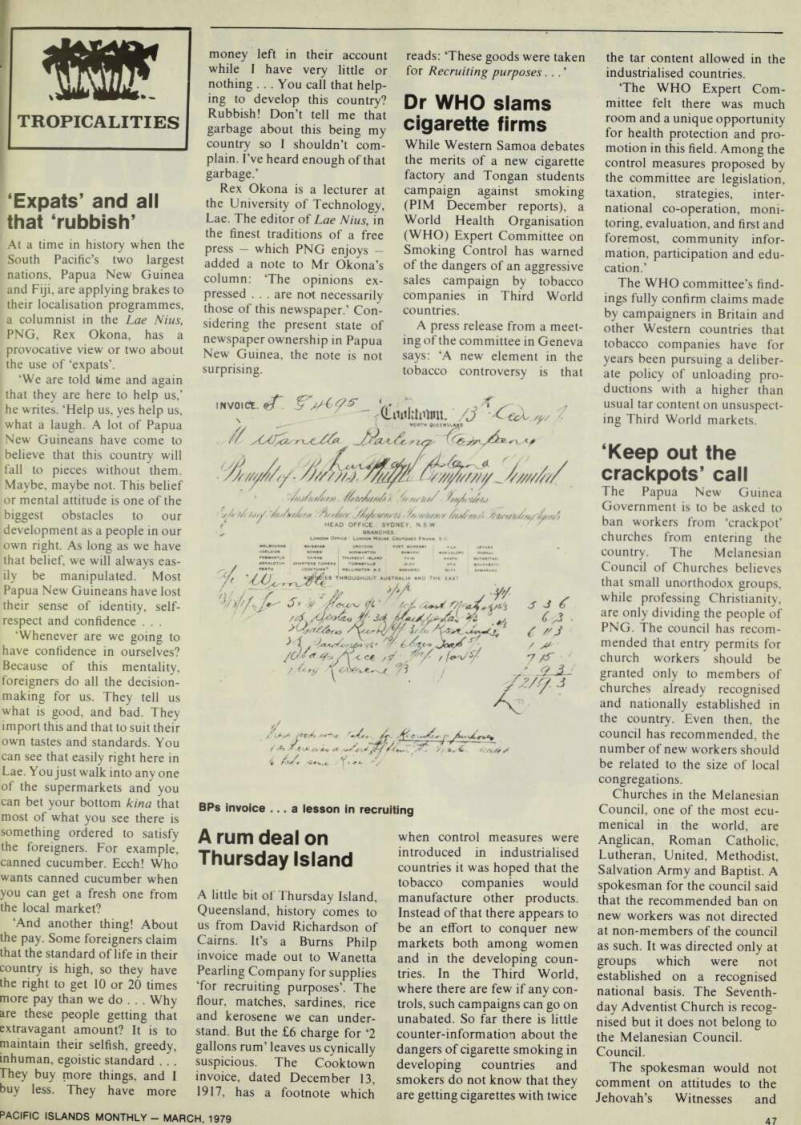
reads: ‘These goods were taken for Recruiting purposes . . . ’
Dr WHO slams
cigarette firms
While Western Samoa debates the merits of a new cigarette factory and Tongan students campaign against smoking (PIM December reports), a World Health Organisation (WHO) Expert Committee on Smoking Control has warned of the dangers of an aggressive sales campaign by tobacco companies in Third World countries.
A press release from a meet ing of the committee in Geneva says: ‘A new element in the tobacco controversy is that
A rum deal on
Thursday Island
A little bit of Thursday Island, Queensland, history comes to us from David Richardson of Cairns. It’s a Burns Philp invoice made out to Wanetta Pearling Company for supplies ‘for recruiting purposes’. The flour, matches, sardines, rice and kerosene we can under stand. But the £6 charge for ‘2 gallons rum’ leaves us cynically suspicious. The Cooktown invoice, dated December 13, 1917, has a footnote which
when control measures were introduced in industrialised countries it was hoped that the tobacco companies would manufacture other products.
Instead of that there appears to be an effort to conquer new markets both among women and in the developing coun tries. In the Third World, where there are few if any con trols, such campaigns can go on unabated. So far there is little counter-information about the dangers of cigarette smoking in developing countries and smokers do not know that they are getting cigarettes with twice
the tar content allowed in the industrialised countries. ‘The WHO Expert Com mittee felt there was much room and a unique opportunity for health protection and pro motion in this field. Among the control measures proposed by the committee are legislation, taxation, strategies, inter national co-operation, moni toring, evaluation, and first and foremost, community infor mation, participation and edu cation.’
The WHO committee’s find ings fully confirm claims made by campaigners in Britain and other Western countries that tobacco companies have for years been pursuing a deliber ate policy of unloading pro ductions with a higher than usual tar content on unsuspect ing Third World markets.
‘Keep out the
crackpots’ call
The Papua New Guinea Government is to be asked to ban workers from ‘crackpot’ churches from entering the country. The Melanesian Council of Churches believes that small unorthodox groups,
while professing Christianity,
are only dividing the people of PNG. The council has recom mended that entry permits for church workers should be granted only to members of churches already recognised and nationally established in the country. Even then, the council has recommended, the number of new workers should be related to the size of local congregations.
Churches in the Melanesian Council, one of the most ecu menical in the world, are Anglican, Roman Catholic, Lutheran, United, Methodist, Salvation Army and Baptist. A spokesman for the council said that the recommended ban on new workers was not directed at non-members of the council as such. It was directed only at groups which were not established on a recognised national basis. The Seventh day Adventist Church is recog nised but it does not belong to the Melanesian Council.
Council.
The spokesman would not comment on attitudes to the Jehovah’s Witnesses and
BPs invoice ... a lesson in recruiting
j Baha’i churches, both of which are represented in PNG. He [ said that under the United [ Nations Charter which applied I to PNG before independence, I complete freedom of entry was
I granted to all groups describing
[ themselves as ‘Christian ’ missions’. This had allowed the [ establishment of many small, radical and unorthodox sects.
One had consisted of only a f man and his daughter who had set up operations in a stockade like structure which they built in the Highlands. The council wanted to restrict the type of
missionary development which
did little except divide the
people and create community
problems.
Cultural centre for
W. Samoa
I The Western Samoan parlia ment has passed a bill to set up a National Cultural Centre Trust, which aims to establish and maintain a building com plex housing a museum, ar chives, a library, a theatre and craft workshops. Under the provisions of the Bill, Treasury will make available $35 000 towards the establishment of the centre. The minister of cul ture will be the chairman of the trust, and the members will in clude the director of education, the secretary of youth, sports and cultural affairs, a centre director, and three other mem bers to be appointed.
WHO’s vigilance
on smallpox
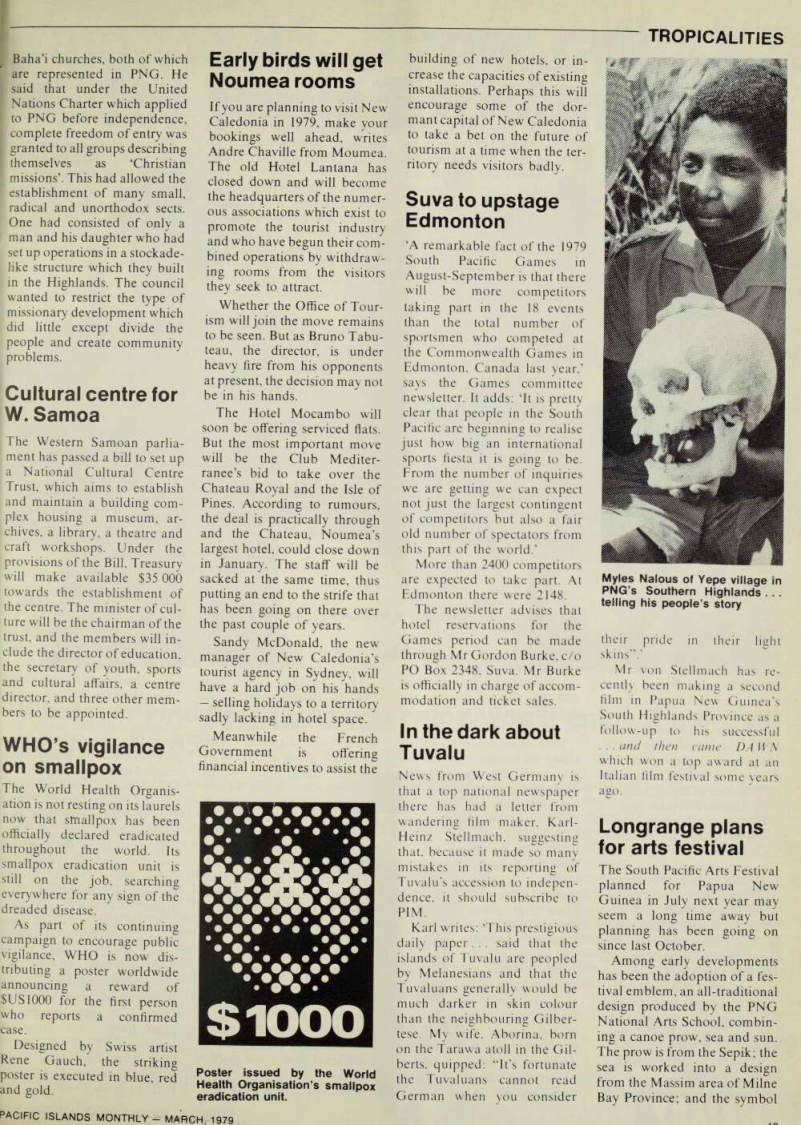
The World Health Organis ation is not resting on its laurels now that smallpox has been officially declared eradicated throughout the world. Its smallpox eradication unit is still on the job, searching everywhere for any sign of the dreaded disease.
As part of its continuing campaign to encourage public vigilance, WHO is now dis tributing a poster worldwide announcing a reward of SUSIOOO for the first person who reports a confirmed case.
Designed by Swiss artist
Rene Gauch, the striking poster is executed in blue, red
and gold.
Early birds will get
Noumea rooms
If you are planning to visit New Caledonia in 1979, make your bookings well ahead, writes Andre Chaville from Moumea.
The old Hotel Lantana has closed down and will become the headquarters of the numer ous associations which exist to promote the tourist industry and who have begun their com bined operations by withdraw ing rooms from the visitors they seek to attract.
Whether the Office of Tour ism will join the move remains to be seen. But as Bruno Tabu teau, the director, is under heavy fire from his opponents at present, the decision may not be in his hands.
The Hotel Mocambo will soon be offering serviced flats.
But the most important move will be the Club Mediter ranee’s bid to take over the Chateau Royal and the Isle of Pines. According to rumours, the deal is practically through and the Chateau, Noumea’s largest hotel, could close down in January. The staff will be sacked at the same time, thus putting an end to the strife that has been going on there over the past couple of years.
Sandy McDonald, the new manager of New Caledonia’s tourist agency in Sydney, will have a hard job on his hands
selling holidays to a territory
sadly lacking in hotel space.
Meanwhile the French Government is offering financial incentives to assist the
building of new hotels, or in crease the capacities of existing installations. Perhaps this will encourage some of the dor mant capital of New Caledonia to take a bet on the future of tourism at a time when the ter
ritory needs visitors badly.
Suva to upstage
Edmonton
‘A remarkable fact of the 1979 South Pacific Games in August-September is that there will be more competitors taking part in the 18 events than the total number of sportsmen who competed at the Commonwealth Games in Edmonton, Canada last year,’ says the Games committee newsletter. It adds: ‘lt is pretty clear that people in the South Pacific are beginning to realise just how big an international sports fiesta it is going to be.
From the number of inquiries we are getting we can expect
not just the largest contingent
of competitors but also a fair old number of spectators from this part of the world.’
More than 2400 competitors are expected to take part. At Edmonton there were 2148.
The newsletter advises that hotel reservations for the Games period can be made through Mr Gordon Burke, c/o PO Box 2348, Suva. Mr Burke is officially in charge of accom modation and ticket sales.
In the dark about
Tuvalu
News from West Germany is that a top national newspaper there has had a letter from wandering film maker. Karl- Heinz Stellmach. suggesting that, because it made so many mistakes in its reporting of Tuvalu’s accession to indepen dence, it should subscribe to
Pim.
Karl writes: ‘This prestigious daily paper . . . said that the islands of Tuvalu are peopled by Melanesians and that the Tuvaluans generally would be much darker in skin colour than the neighbouring Gilber tese. My wife. Aborina. born on the Tarawa atoll in the Gil berts. quipped: “It’s fortunate the Tuvaluans cannot read German when you consider
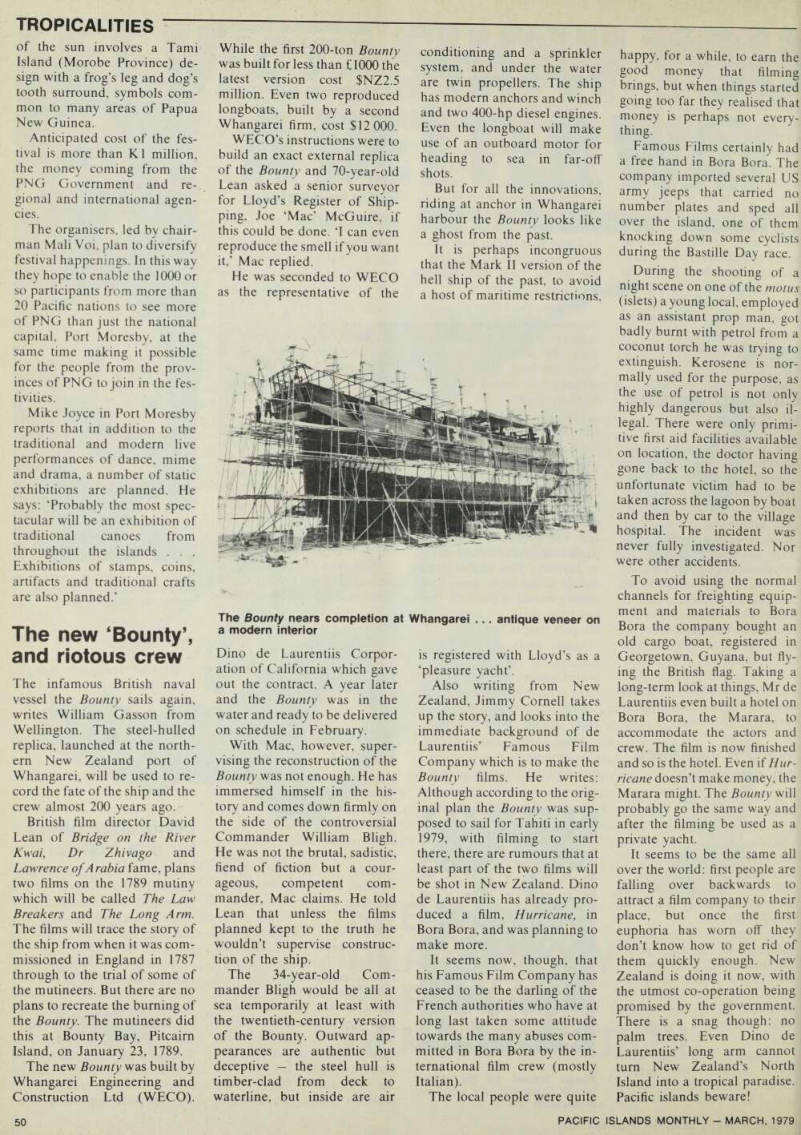
their pride in their light skins”.' Mr von Stellmach has re cently been making a second film in Papua New Guinea’s South Highlands Province as a follow-up to his successful . and then came DA H A which won a top award at an Italian film festival some years ago.
Longrange plans
for arts festival
The South Pacific Arts Festival
planned for Papua New
Guinea in July next year may seem a long time away but planning has been going on since last October.
Among early developments
has been the adoption of a fes tival emblem, an all-traditional
design produced by the PNG
National Arts School, combin ing a canoe prow, sea and sun.
The prow is from the Sepik; the sea is worked into a design from the Massim area of Milne Bay Province; and the symbol
Poster issued by the World Health Organisation's smallpox eradication unit.
Myles Nalous of Yepe village in PNG’s Southern Highlands . . . telling his people's story
of the sun involves a Tami Island (Morobe Province) de sign with a frog’s leg and dog’s tooth surround, symbols com mon to many areas of Papua New Guinea.
Anticipated cost of the fes tival is more than K 1 million, the money coming from the PNG Government and re gional and international agen cies.
The organisers, led by chair man Mali Voi, plan to diversify festival happenings. In this way they hope to enable the 1000 or so participants from more than 20 Pacific nations to see more of PNG than just the national capital. Port Moresby, at the same time making it possible for the people from the prov inces of PNG to join in the fes tivities.
Mike Joyce in Port Moresby reports that in addition to the traditional and modern live performances of dance, mime and drama, a number of static exhibitions are planned. He says: ‘Probably the most spec tacular will be an exhibition of traditional canoes from
throughout the islands . . .
Exhibitions of stamps, coins, artifacts and traditional crafts are also planned.’
The new ‘Bounty’,
and riotous crew
The infamous British naval vessel the Bounty sails again, writes William Gasson from Wellington. The steel-hulled replica, launched at the north ern New Zealand port of Whangarei, will be used to re cord the fate of the ship and the crew almost 200 years ago.
British film director David Lean of Bridge on the River Kwai, Dr Zhivago and Lawrence of Arabia fame, plans two films on the 1789 mutiny which will be called The Law Breakers and The Long Arm.
The films will trace the story of the ship from when it was com missioned in England in 1787 through to the trial of some of the mutineers. But there are no plans to recreate the burning of the Bounty. The mutineers did this at Bounty Bay, Pitcairn Island, on January 23, 1789.
The new Bounty was built by
Whangarei Engineering and
Construction Ltd (WECO).
While the first 200-ton Bounty was built for less than £lOOO the latest version cost SNZ2.S million. Even two reproduced longboats, built by a second Whangarei firm, cost $l2 000.
WECO’s instructions were to build an exact external replica of the Bounty and 70-year-old Lean asked a senior surveyor
for Lloyd’s Register of Ship
ping, Joe ‘Mac’ McGuire, if this could be done. T can even reproduce the smell if you want it,’ Mac replied.
He was seconded to WECO as the representative of the
Dino de Laurentiis Corpor ation of California which gave out the contract. A year later and the Bounty was in the water and ready to be delivered on schedule in February.
With Mac, however, super vising the reconstruction of the Bounty was not enough. He has immersed himself in the his tory and comes down firmly on the side of the controversial Commander William Bligh.
He was not the brutal, sadistic, fiend of fiction but a cour ageous, competent com mander, Mac claims. He told Lean that unless the films planned kept to the truth he wouldn’t supervise construc tion of the ship.
The 34-year-old Com mander Bligh would be all at sea temporarily at least with the twentieth-century version of the Bounty. Outward ap pearances are authentic but deceptive the steel hull is timber-clad from deck to waterline, but inside are air
conditioning and a sprinkler system, and under the water are twin propellers. The ship has modern anchors and winch and two 400-hp diesel engines.
Even the longboat will make use of an outboard motor for heading to sea in far-off shots.
But for all the innovations, riding at anchor in Whangarei harbour the Bounty looks like a ghost from the past.
It is perhaps incongruous
that the Mark II version of the hell ship of the past, to avoid a host of maritime restrictions,
is registered with Lloyd’s as a
‘pleasure yacht’.
Also writing from New Zealand, Jimmy Cornell takes up the story, and looks into the immediate background of de Laurentiis’ Famous Film Company which is to make the Bounty films. He writes:
Although according to the orig
inal plan the Bounty was sup posed to sail for Tahiti in early 1979, with filming to start there, there are rumours that at least part of the two films will be shot in New Zealand. Dino de Laurentiis has already pro duced a film. Hurricane, in Bora Bora, and was planning to make more.
It seems now, though, that his Famous Film Company has ceased to be the darling of the French authorities who have at long last taken some attitude towards the many abuses com mitted in Bora Bora by the in ternational film crew (mostly Italian).
The local people were quite
happy, for a while, to earn the
good money that filming
brings, but when things started going too far they realised that money is perhaps not every
thing.
Famous Films certainly had a free hand in Bora Bora. The company imported several US army jeeps that carried no number plates and sped all over the island, one of them knocking down some cyclists during the Bastille Day race.
During the shooting of a night scene on one of the motus (islets) a young local, employed as an assistant prop man, got badly burnt with petrol from a coconut torch he was trying to extinguish. Kerosene is nor mally used for the purpose, as the use of petrol is not only highly dangerous but also il
legal. There were only primi
tive first aid facilities available on location, the doctor having gone back to the hotel, so the unfortunate victim had to be taken across the lagoon by boat and then by car to the village hospital. The incident was
never fully investigated. Nor
were other accidents.
To avoid using the normal
channels for freighting equip
ment and materials to Bora Bora the company bought an old cargo boat, registered in
Georgetown, Guyana, but fly
ing the British flag. Taking a
long-term look at things, Mr de Laurentiis even built a hotel on Bora Bora, the Marara, to accommodate the actors and crew. The film is now finished and so is the hotel. Even if Hur ricane doesn’t make money, the Marara might. The Bounty will probably go the same way and after the filming be used as a
private yacht.
It seems to be the same all over the world: first people are falling over backwards to attract a film company to their place, but once the first euphoria has worn off they don’t know how to get rid of
them quickly enough. New
Zealand is doing it now, with
the utmost co-operation being
promised by the government.
There is a snag though: no palm trees. Even Dino de Laurentiis’ long arm cannot turn New Zealand’s North Island into a tropical paradise.
Pacific islands beware!
The Bounty nears completion at Whangarei .. . antique veneer on a modern interior