Search Of A
pp. 57-58 · Read in the full issue
Tradewinds
Air Niugini In
New Manager
' Air Niugini last month was look ing for a new general manager in the wake of Bryan Grey’s resig nation at the end of his three-year contract.
Mr Grey’s resignation in mid- January sparked an unexpected blast at government by normally mild-mannered Bart Philemon, assistant to the general manager.
Mr Philemon’s outburst was quickly followed by opposition charges that interference by public servants in the airline’s operations was responsible for any reduction in its effectiveness and profit ability.
Although Mr Grey followed up with an explanation of his de cision not to renew the contract available to him by saying he was leaving for ‘purely personal and family interests’, there is no doubt that, at times, he has had to oper ate Houdini-style to thread his way through snarls of red tape.
Mr Grey, who is understood to be heading for a near top post
with Ansett Transport Industries’
Melbourne-headquartered organ
sation, leaves three years of re markable progress behind him.
In that time he has taken the tirline’s ‘workhorse’ DCS fleet out )f the air; boosted the F 27 Fokker friendship numbers; introduced Hire jet F2B Fellowships; pur :hased a Boeing 707 to take over he role of the previously-leased 'O7; opened up routes to Hong
Cong, Kagoshima in southwest
ern Japan, and Sydney; and, more ecendy, laid the groundwork for he purchase of more F2Bs, a sec >nd 707, and for new routes to Jawaii and Guam in the near uture and to Jakarta and Sin ;apore in the longer term. All this, nd at a profit - and with a high legree of localisation which loubters of yesterday’s colonial J apua New Guinea would not iave believed possible.
Senior among nationals on Air liugini staff is Bart Philemon, enerally regarded as the man lost likely to become the airline’s rst Papua New Guinean general lanager. How Mr Philemon’s anuary outburst will affect his areer remains to be seen.
Mr Philemon is on record as saying that he is ‘simply not capable’ of taking over manage ment, but clearly he feels Mr Grey’s life was made no easier as a result of excessive government
interference and particularly by
non-nationals in the National Planning Office (NPO) who ‘know nothing about running an airline and tend to knock down ideas presented’.
Mr Grey, said Mr Philemon, had had no end of trouble getting the F2Bs into domestic service in the face of NPO resistance.
Then came a government de cision to force Air Niugini to sub mit its papers destined for the National Airlines Commission (NAC) to scrutiny by an ‘Air
Niugini Planning Committee’ be
fore they went to the NAC. ‘The government had representatives on the NAC so the new com mittee simply duplicated the work and added to the general man ager’s frustrations,’ said Mr Philemon.
On overseas landing rights, Mr Philemon argued that it was nor mal for a national airline government-owned or private to negotiate an agreement before seeking the advice of their govern ments. But this was not the case with Air Niugini. ‘You simply can’t run an airline as a govern ment department and at the same time operate efficiently, make a
profit or compete with other air lines,’ he said.
Mr Philemon was lavish in his praise for Mr Grey who, he said, ‘has made a name for himself in the airline mdustiy worldwide de spite the handicaps he has worked with’.
Predictably, opposition leaders
leapt into the fray. Jointly,
National Party leader lambakey
Okuk, People’s Progress Party
chief and former deputy prime minister to Michael Somare, Julius Chan, and Papua Besena top man Galeva Kwarara, said; ‘Mr Bart Philemon should be con-
gratulated for revealing the
truth.’
In the firing line was Paias Wingti known in the airline
industiy since his appointment
late last year as civil aviation minister as ‘Wingtips’. ‘He is still a schoolboy who retains school boy values and schoolboy rhe toric, as opposed to the pragmatic approach of the former minister for transport, Mr Bruce Jephcott,’ the three leaders said. (Mr Jeph cott is a senior member of the PPP which went into opposition last November after nearly seven years in coalition with Mr Somare’s Pangu Pati.) NPO director. Charles Lepani, defended his organisation by say ing that it could not always be taken for granted that whatever was good for Air Niugini was in the interests of Papua New Guinea as a whole.
Air Niugini officials were par ticularly sore about Mr Wingti’s decision to close Rabaul airport at the beginning of the December peak period last year. Mr Philemon said the minister had
overridden the advice of his own technical staff to close the airport.
Said one Air Niugini official: That decision which was wrong cost Air Niugini about K250000.’
Pointedly, Mr Grey in his per sonal explanation, said: i enjoyed working closely with the former minister for transport, Mr Jeph cott, and have no doubt that Air Niugini management will co operate with Mr Wingti and any minister appointed from time to time.’
Mr Grey has had a long career in Papua New Guinea dating back to the fifties. Apart from a spell elsewhere, he has worked with Ansett-MAL, ATl’s dom estic Papua New Guinea service which operated in near parallel with TAA in colonial days, and
with Talair (formerly Territory
Airlines) during which he compu terised its third level operations, a move which sparked considerable controversy.
In 1976, on returning to Papua New Guinea after an absence of four years, I discovered that Air Niugini, like most international operators, had picked up a nick name along the way. Lost bag gage was often blamed for the tag of TANGFU (typical Air Niugini foul-up). It’s a word that’s rarely heard in PNG these days. Its disappearance could be seen as a tribute to the manner in which
Biyan Grey has turned an enfant
terrible into one of the Third World’s aviation successes.
Bob Hawkins
‘Downhill without
brakes’ in
Noumea
After looking forward to autonomy for several years, the members of New Caledonia’s Government Council have found that the territory is as hard to manage as a truck run ning downhill without brakes, writes Andre Chaville from Noumea.
Minister Paul Dijoud had given the council until October 1978 to present a new budget, introducing direct taxation for the first time. But while the Rightwing group in the council has a majority, they are very much in the minority in the Territorial Assembly which had to approve the draft.
With no established organis
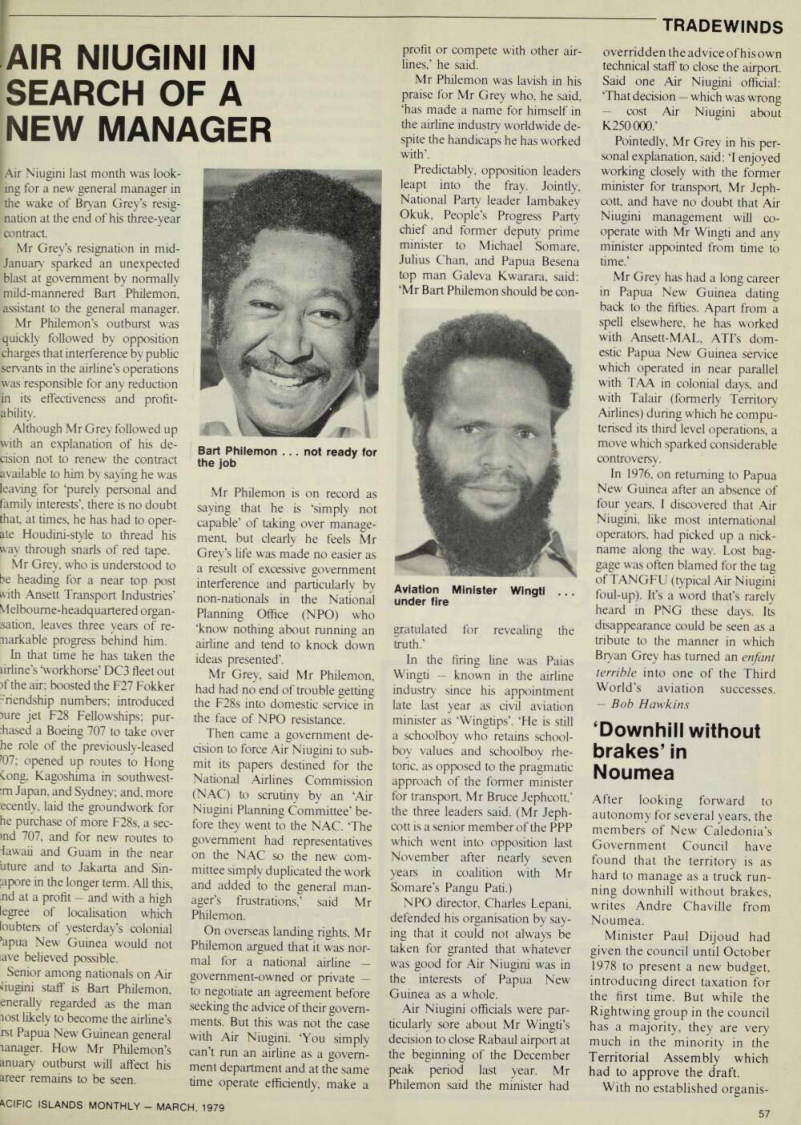
Bart Philemon ... not ready for the job
Aviation Minister Wingti ... under fire
ation to collect direct taxes and no experience of income tax, the councillors sought an easy solution by taxing salaries and wages. At the same time, they proposed a decrease in tax on nickel ore exports and left the independent businessmen and entrepreneurs almost free to declare whatever income they thought fit. With most associ ations, chambers and unions
rejecting the plan or suggesting
more efficient methods of tax ing their social opponents, the council’s recommendations were doomed.
That the Bill was rejected was only half a surprise. But that it was knocked back by an unexpected coalition of cen trists, autonomists, socialists and advocates of independence was more of a shock.
While the wheelings and dealings, so typical of French politics, draw interested atten tion, the territory runs up its debts. Despite the enormous resources of its nickel reserves, the good potential of its
agriculture, and a budding
touris. industry, the territory is
going bankrupt. The general
atmosphere is of indifference or despair and capital invest ment is at its lowest ebb.
The old supporters of auton omy are bitter. Self government during the boom would have been easy to
organise, by encouraging
foreign investment and taxing
the new industries. Today capi tal is pouring in the opposite direction. Socialist Alain Ber nut continues to claim that the first people to tax are those transferring their money over seas.
With theoretical autonomy, New Caledonia is even more dependent on France than be fore. As the daily Les Nouvelles declared: ‘Paul Dijoud asked for our help, but he is the one who holds the purse strings.’
New confidence
for PNG tourism
Three reasons for an improved tourist industry year in Papua New Guinea are offered by Peter Barter, managing direc
tor of the Madang-based Melanesian Tourist Services.
Mr Barter hails the appoint ment, at last, of a new director of tourism; Air Niugini’s in creased activity in tourist pro motion, establishment of over seas offices and planned services to Honolulu, Jakarta, Singapore and Auckland; and the commencement of services
by Philippine Airlines from
Manila and Cathay Pacific Air lines from Hongkong.
Skipjack team
in F. Polynesia
By year’s end about 1500 recaptures had been reported in the South Pacific Com mission’s skipjack survey and assessment programme which began its second year of oper ations last October.
Surveys had been completed in the waters of Guam, the Trust Territory of the Pacific Islands, Tokelau and the north ern Cook Islands and, in December, the chartered vessel, Hatsutori Mam moved into French Polynesian waters
to work in the Society Island and the Tuamotus.
At the end of 1978 more thai 54 000 fish had been tagged
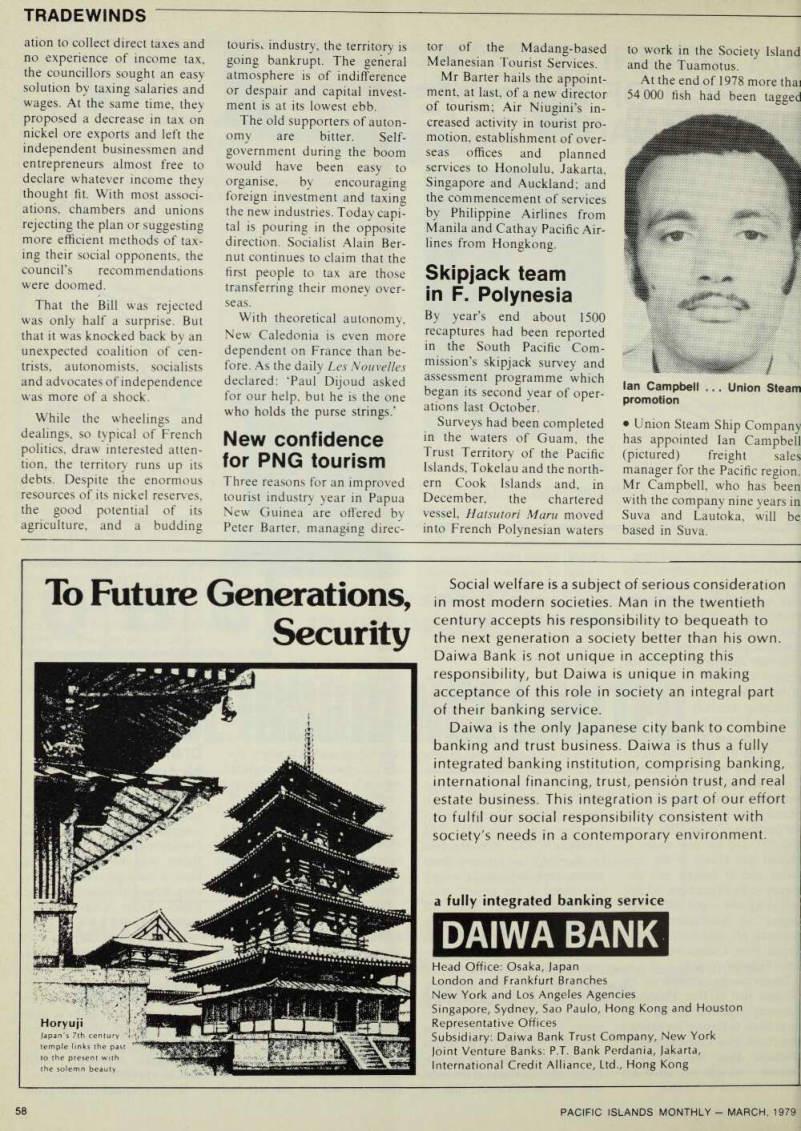
• Union Steam Ship Company has appointed lan Campbell (pictured) freight sales manager for the Pacific region, Mr Campbell, who has been with the company nine years in Suva and Lautoka, will be based in Suva.
Ian Campbell ... Union Steam promotion