Colonial Tunnel
pp. 18-19 · Read in the full issue
Spec
Make Sees Light
At End Of The
Colonial Tunnel
When Pacific governments are satisfied that the end of the colonial period is in sight they will want to bring regional organisations together into one organisation which will establish the Pacific as a region of the world ‘important in its own right,’ says Mahe Tupouniua.
When Mahe Tupouniua at tended last year’s South Pacific Forum in Niue’s capital, Alofi, he had already written what he regarded as his last South Pacific Bureau for Economic Co-operation (SPEC) ‘Direc tor’s Annual Report’ for 1977-78. He was expecting to make way for a successor after five years in the hot seat as founding director of the Forum’s executive arm.
As a consequence, he deemed the time right to add, for the first and last time, a new section to his report to give ‘a perspective of the first five years of SPEC and the Forum’.
In it, he ‘attempts a brief per sonal, but I hope objective, re view of SPEC’s achievements and failures, progress and lack of progress over its first five
years’.
Possibly his most pointed
comment in this new section is that ‘the distinction between the membership of SPEC and the South Pacific Commission (SPC) is becoming progress ively less obvious although cer tain anomalies seem unlikely to be resolved for many years’.
Mahe comments: ‘Neverthe less, the time is not far off when the majority of countries and peoples of the region can meet as equals in the regional bodies to discuss at all levels politi cal, economic and social
developments affecting the
peoples of the South Pacific
region.
‘When governments in the region are satisfied that the end of the colonial period in the Pacific is in sight they will pre sumably want to being together the regional organisations in a way which lends maximum strength to each of them, which allows for full political control by the leaders of governments in the region, and which is capable of delivering to the peoples of the Pacific the kind of assistance that is relevant to and needed by them. Such an
organisation will help give a
community interest and unity
of purpose to the region which marks the Pacific as a region of the world, important in its own
right’.
Mahe does not venture a time scale for his dream of a unified non-colonial Pacific.
When he talks of‘the majority’ does he tacity indicate that not even half of the ultimate poten tial membership of the Forum
yet enjoy independent status?
He sees the smallness of SPEC’s staff as an inhibiting factor in its performance. ‘With a staff of this size it is possible to maintain a modest but effec tive programme of research, to
organise inter-governmental
consultations and to co
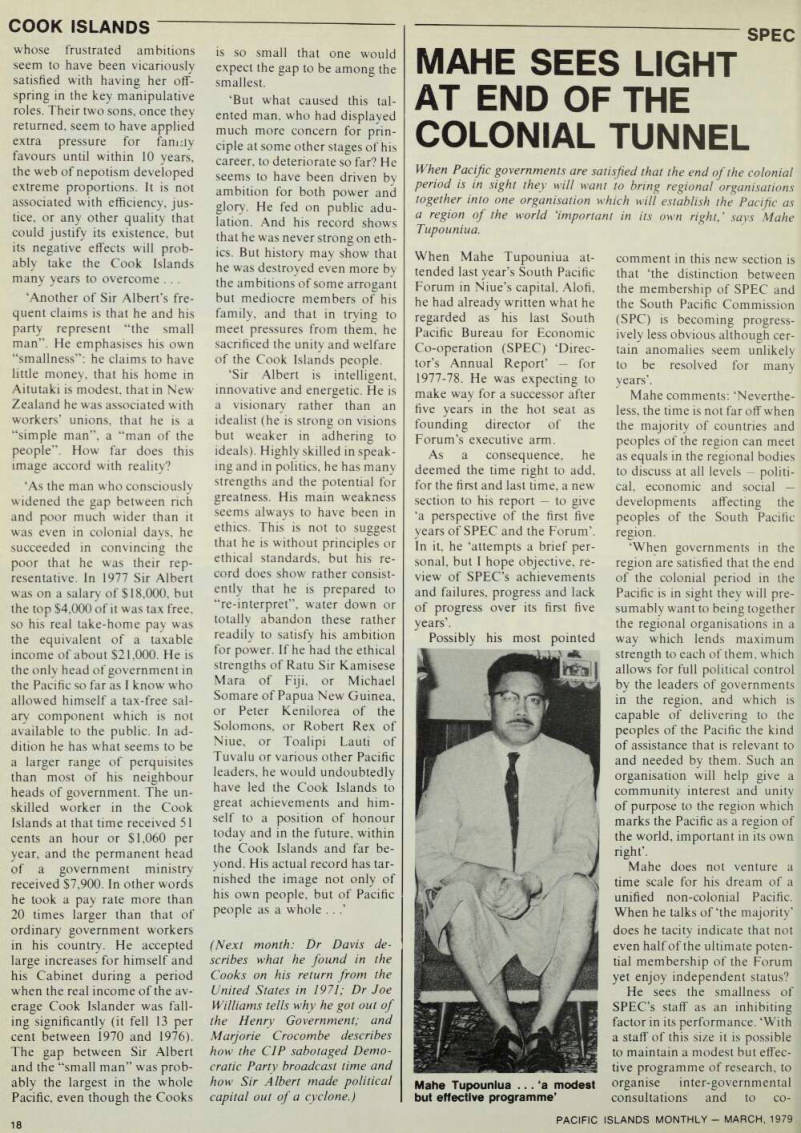
Mahe Tupouniua ... ‘a modest but effective programme’
ordinate activities by other or ■ ganisations,’ he says, but ‘the mounting of field programmes or the undertaking of large scale operational activities would require a different and much larger kind of organis ation, activities to which I do ! not think SPEC should as
pire’.
Mahe says SPEC’s ‘strength and authority’ come from its relationship with the Forum, and comments: ‘Experience shows that regional projects do
not move quickly. Important
national interests are usually involved, and national
decision-making processes
have to be followed through.
SPEC has been able to assist by
organising preliminary studies,
finding facts for feasibility
studies, co-ordinating and
guiding these studies, organis
ing international meetings at
technical level, and, when the groundwork has been properly carried out, presenting minis terial meetings and the Forum with recommendations for de cision. ‘ln these respects I believe that SPEC has played a useful role at a critical time in the development of the region. It served and continues to serve a need. However, as the region changes, so does the need and,
consequently, ability of the
machinery to adapt to serve it.’
In the future, Mahe sees the need for SPEC, as the Forum’s executive arm, to further de velop its capability as a politi cal secretariat, ‘able to exercise a co-ordinating role at a policy level over the full range of economic and social regional activities’ and ‘in this capacity it may be desirable for it to shed some of its operational
activities to agencies ...’
Mahe’s comments on specific Forum projects
through SPEC:
Pacific Forum Line (PFL): ‘The PFL will continue to need the full support and backing of governments in the early criti cal years. Given that support it should, in a few years, be able to play an important role in re gional shipping and in turn protect national carriers from undue competition from out siders.’
Trade: ‘lt has been possible to
make limited progress in areas such as the Regional Sugar Agreement and the Taro Agreement. SPEC’s marketing activities have brought together many potential pro ducers and buyers. We cannot calculate the value of the out come but we hope it has been worth the effort. ’
Bulk purchasing: ‘Many areas
where bulk purchasing might
not be profitable have been identified. Of the commodities which might be purchased
cheaper through collective
buying, only pharmaceuticals
show promise ..
Marketing and trade pro motion: ‘. .. not easily suscep tible to cost benefit analysis ...
It may be that SPEC should not try to build up a capability on trade promotion but rather to establish links with organisa tions in the major markets of island countries with a view to giving businessmen direct access to marketing services in countries of interest.’
Trade relations: ‘.. . perhaps a
more important area for inter governmental action. It is an area of SPEC’s work in which little progress has been poss ible. The SPEC Agreement called for an investigation of a free trade area in the South Pacific. Accordingly SPEC in stigated and has been associ
ated with a number of studies on trade-related questions including a free trade area. Up to this point, however, the pol itical will among all who need to be involved to make real and substantial progress on this question has not been evi dent. ‘The lack of experienced trade negotiations in Island countries has been an inhibit ing factor, as has been the absence in many countries of statistical data on trade flows.
There is nevertheless a growing interest in the region in developing trade links across the region and with new friends in Europe, Asia and North
America. Intra-regionally,
Australia and New Zealand have demonstrated their willingness to discuss trade problems on a selective basis.
However, the system of trade relations within which these countries have traditionally operated are sophisticated and complex from the point of view of Island members of SPEC.
The absence of any coherent system of inter-governmental trade agreements in the region has bedevilled consideration of the question. The desire re mains ... to create a new system of trade relations . . . without damaging, to an in tolerable level, domestic indus
tries in Australia and New Zealand . .
Regional airline: ‘The force and validity of the case for a re gional airline has not been
seriously challenged, but the
formula for bringing countries together on this question re mains elusive. The trend has been toward the creation of more national airlines. Never theless, there are hopeful developments ... the Regional Aviation Council... a decision to bring airlines in the region together in a regional airlines association .. .’
Tourism: *.. . there is an urgent need for countries in the
Pacific to identify a single body
to concentrate solely on the promotion and marketing of tourism . . .’
As it turned out, Mahe is still with SPEC, the two nominees put forward at the Niue Forum for the director’s job, Felix Wendt of Western Samoa, and Sir Maori Kiki of Papua New Guinea, having been with drawn by their respective leaders, apparently to keep the pace.
Tonga, to which Mahe ultimately seems destined to return to resume his duties as a minister with the govern ment, agreed to the Forum’s re quest for a one-year extension of duty for the founding director.
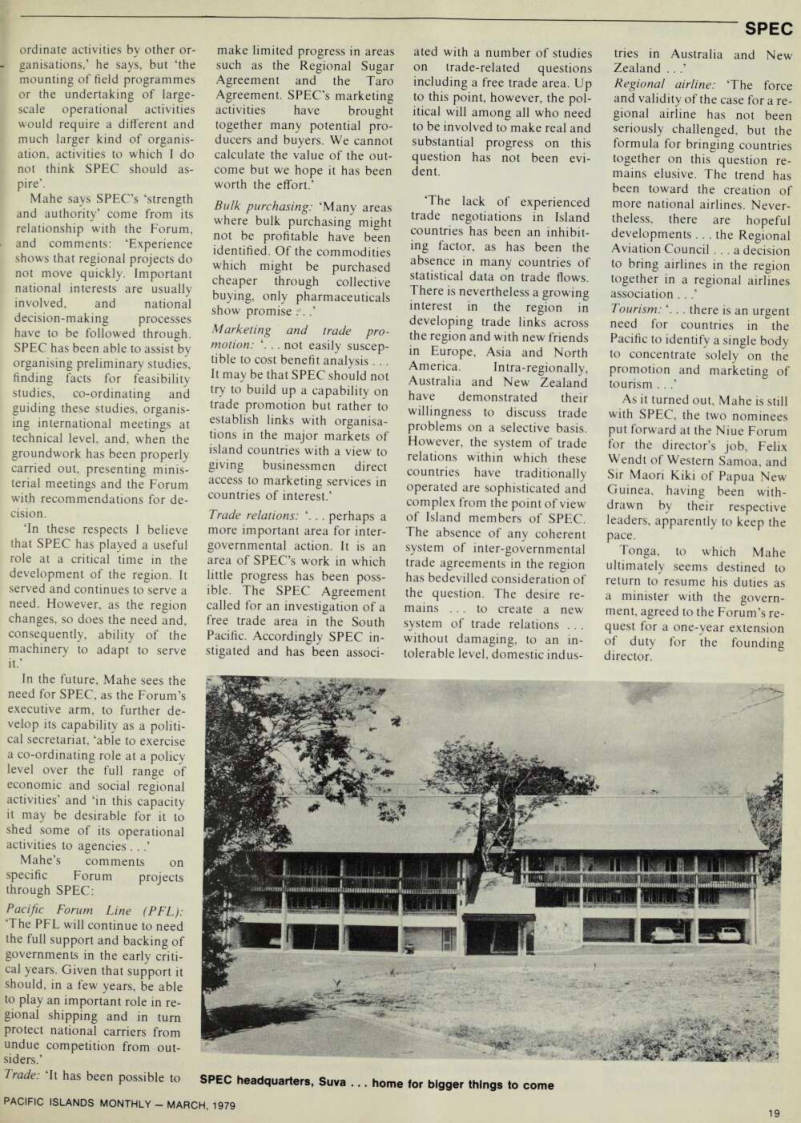
SPEC headquarters, Suva ... home for bigger things to come