Cooks Broth
pp. 15-18 · Read in the full issue
Cook Islands
Too Many Henrys
Spoil The
Cooks Broth
I Cook Islands Politics: The Inside Story - published by Polynesian Press, A uckland, in association with the South Pacific Social Sci ences Association of Suva, from a study co-ordinated by Professor Ron Crocombe of the Institute of Pacific Studies, University of the South Pacific - is a timely, no-punches-pulled account of political life in the Cook Islands since self-government. PI M's editorial adviser, John Carter, has made a selection of extracts.
Sir Albert had already called the snap election in January last year when Professor Crocombe, in the Cooks for Christmas hol idays, sought contributors for the book which Cook Islanders had asked him to compile. He contacted all political camps but Cook Islands Party (CIP) supporters fought shy of the invitation. Many could see the writing on the wall. Rumour was rife at the time and it wasn’t always a lying jade. Consequently, of the book’s 22 writers, only a handful, including Sir Albert’s son Hugh and daughter Louise, were supporters of the CIP. Their offerings are factual and contain little argument in favour of the CIP or Sir Albert.
Sir Albert himself agreed to write a chapter but, not surprisingly, it was never written. Throughout the historic last months of the House of Henry he maintained his dash and panache but, in the closing stages, it was a pose. Some of his thoughts he conveyed to a PIM contributor, Sheree Lipton, in Hawaii in June. He ‘looked tired and sad’ she wrote in PIM last August, adding later in a letter that he seemed to have little hope of a successful outcome to the affair.
Little in the book was written with hindsight, only the rough corners being rounded off, and a chapter. The saga of tension’ added by Ron Crocombe and his Cook Islander wife Marjorie after the House of Henry had crumbled around Sir Albert’s head.
Several writers were prominent in the inner circles of the CIP so their testimony should carry great weight with Cook Islanders who honestly believed in ‘Papa Premier’ and his party. Such a one is Mana Strickland, member of a prominent Island family, one of Sir Albert’s early supporters and first minister for edu cation m the CIP Government. He resigned in 1968, he says in his article, in protest against mismanagement by the CIP.
He points out that the party manifesto framed before self government made seven promises. They were:
1. To ensure the election to government of those men and women dedicated to the cause of greater prosperity and in creased social welfare of the Cook Islands. 2. To extend to all outer islands of the Cook Group, opportuni ties for greater economic
development.
3. To maintain ties which exist between New Zealand and the Cook Islands. 4. To re-establish some of our traditional ways of life, culture, and to restore recognition to the holders of traditional titles. 5. To plan facilities for the encouragement of our young
people to remain in the Islands. 6. To strengthen our economic
resources by good planning.
7. To ensure the establishment of good laws for all people in the Cook Islands.
A nd the result of CIP govern ment, in Strickland’s words: 1. Democratic elections did take place, and a group of per sons were elected who prom ised to be dedicated to the cause of the ordinary people of the Cook Islands. But the Cook Islands Party now so controls the media, promotions, appointments and services for its own political gain that the
democratic vote becomes a farce. 2. Economic development has been ignored. 3. The best tie with New Zealand would have been mutual respect. I would have welcomed a policy of self-help, hard-work and determination to rely more on our efforts rather than more and more on New Zealand’s increased char ity. We have been beggars un necessarily and have lost our self-respect and our self reliance. This third promise to our people has been broken and our relations with New Zealand are at the lowest level they have ever been. 4. Traditional ways of life; little appreciable progress has been made and our traditional leaders have been ignored. 5. Encouragement for the young people to remain in the islands. Negative so far: the main emphasis has been on polarising our young people into a Junior Cook Islands Party which breeds hate and division, subsidised heavily from government staff and re sources. The majority of young men and women emigrate as soon as they can. 6. Economic resources: Nega tive. Dependency in all its forms is acute and worsening. 7. Good laws: Little progress has been made, but crime stat istics continue to increase.
I fear that your verdict will find us guilty on all counts. But I personally confessed my guilt and resigned in 1968. Since
then, I am sorry to say, our small country has seen only
continuing deterioration.
Sir Albert has one admirer in the book - Ted Libby, an American journalist who be came full-time public relations specialist in the premier's office and who moved out when Sir A Ibert’s canoe began to sink. He got his dates wrong, recording one incident which ‘illustrates another reason why Sir Albert
Henry is recognised throughout
the Pacific as one of the more important leaders'. That was Sir Albert's appearance in Suva as the Cook Islands' representative at the first South Pacific Forum conference in Suva, Fiji, in 1950. He was only 22 years out, the conference actually being in
September 1972.
He sums up Sir Albert's ca reer this way: ‘History will show that the Cook Islands has been
extremely fortunate in having
a man of such rare ability on hand to lead them from their birth as a self-governing nation. The combination of his unusual personal talents with his wide experience in politics and business has resulted in a brilliant leader. The things he has gained for the Cook Islands and its people will go down in the annals of Pacific islands
history as outstanding achieve
ments, gained under often adverse conditions. It is sad but true that too often we recognise our greatest men only after
they are long gone.’
A Imost as a planned denial of this praise comes the next chap ter by Professor Crocombe, 29
pages of condemnation, chapter
and verse of Sir A Ibert's alleged nepotism which was the subject of an article in PIM in Sep tember 1976. He uncovers a great deal and alleges that Lady Henry had a finger deep in the pie. Here are a few paragraphs from his case against Sir A Ibert and his wife: ‘Returning to the Cook Islands after 17 years abroad, Albert Henry formed the Cook Islands Party and swept into power with a clear majority. He has been premier ever since.
The 1965 election was fairly conducted and he won it honestly on the basis of his own talents and popularity. The same was true of 1968 election.
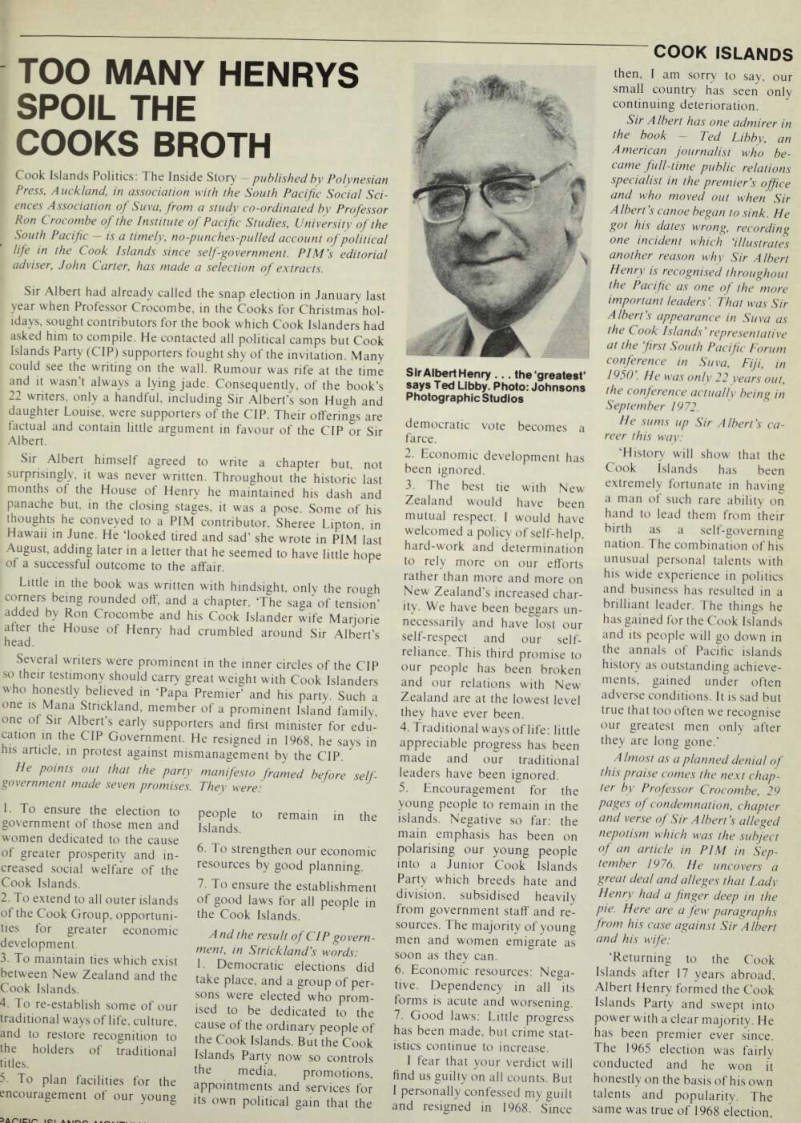
Sir Albert Henry ... the‘greatest’ says Ted Libby. Photo: Johnsons Photographic Studios
a little less true of the 1972 elec tion, significantly less true of the 1974 election and quite untrue of the 1978 election. ‘He was popularly referred to as Papa Premier. This was often used as the term of ad dress to him in speeches, and he often referred to himself as
“Papa Premier speaking” when
he gave an address on the radio. ‘His wife. Lady Elizabeth
Henry, had significantly be
come referred to as Mama Premier. This was no nominal title, it was a recognition of the very significant power she wielded. According to many leading Cook Islanders close to the family, she is the person Sir Albert fears most. In her pres ence he is not allowed to drink alcohol (though his aides know his tastes and add gin or vodka to his orange juice). His behav iour when away from Raro tonga without her is so remarkably different from when he is with her, that the difference is openly discussed in every Pacific capital. At home, her influence on cabinet decisions, public service appointments and ministerial actions of the head of govern ment, form the basis for many a story: some of them hilarious, some startling, some distress ing. Some are no doubt apocryphal, but the evidence for others is irrefutable. ‘Since 1974 Sir Albert under took much of his work at home.
He did not attend Cabinet unless there were matters of
major importance, and con
ducted much of the business of state from his lounge, where
Lady Henry is not only often
present, but frequently a vigor ous and influential participant.
She was a significant political force ... ‘Of the seven Cook Islands students who passed the New Zealand University Entrance examination in 1977, five were from Demo families and two from CIP. The two CIP students received lower marks but both received university scholarships. None of the five Demo students received
scholarships to university.
‘The two northern group islands which support the Cook
Islands Party Pukapuka and
Manihiki, have been supplied with electric power. Aitutaki, the island whose three mem bers are all staunch supporters of the Cook Islands Party, has more power generation ca pacity than it can possibly use.
The island of Mauke, the con stituency of Sir Albert’s son, has about four times more
generating capacity operating
than it uses. Some was for a
very unsuccessful beef cattle
project sponsored by the Hon
Tupui Henry which is heavily
in debt.
The island of Atiu has two Democratic members, but their lead over the Cook Islands Party is not great. A deter mined effort has been made to “win” Atiu and late in 1977, as the election preparations got under way, special aircraft were chartered and staff set aside and sent to Atiu. Every effort was made to get elec tricity installed before the elec tion. They succeeded in getting the churches and village meet ing houses lit up just in time.
But after that, as a result of a
political squabble, the power
supply was taken out. The island of Mangaia, which votes overwhelmingly for the Demo cratic Party, has no electric power. CIP ministers told them firmly that they could not expect to get it while they did not support “the government”.
The adjacent island of Mauke, with less than one third of
Mangaia’s population, is sup
plied with power at a loss of
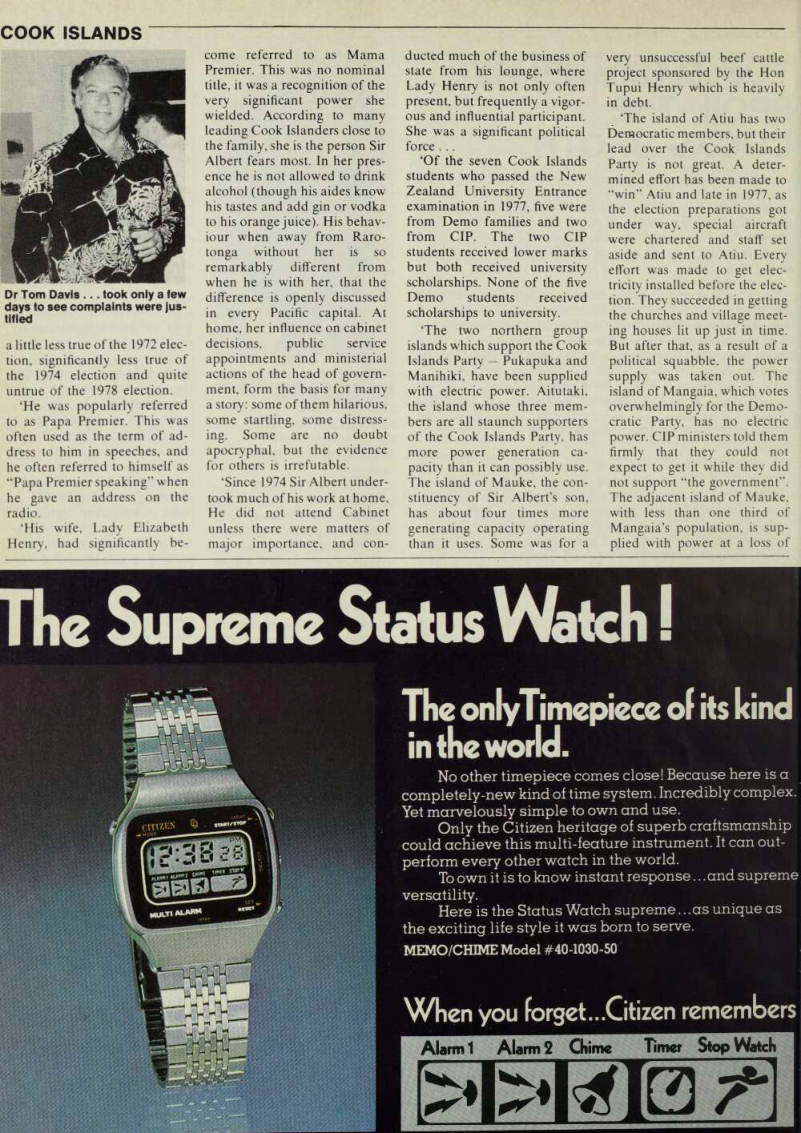
Dr Tom Davis ... took only a few
days to see complaints were jus
tified
$12,000 per year and the Hon
Tupui Henry has demanded
that “his” island be given a 24 hour power supply which will cost the government $48,000 per year in subsidy ... in 1976, Mr Cameron Henry, a cousin of Sir Albert, was charged with killing his own daughter. He was convicted of manslaughter and sentenced to three years imprisonment. A probation report recommended that he not be imprisoned or fined. The
chief justice, in sentencing,
strongly condemned the probation report for its extreme bias and inaccuracy. Mr Henry was sentenced to imprisonment but spent much of his time outside. He was permitted the use of a motor car, and frequently
went shopping, visiting friends,
to social occasions and other activities, and he received government pay, all during his “imprisonment”. The Hon Tupui Henry was minister in
charge of prisons ...
It is noticeable that no members of Sir Albert’s family are
employed outside government or quasi-government occu pations, and that almost all are in advantageous positions, ‘Why then, if the public accepts that the family has been privileged, have they tolerated the situation?
Clearly, many have for years opposed it, and extreme politi cal favouritism was one of the reasons given by both Dr Manea Tamarua for his resig nation from the deputy premiership in 1967, and by Hon Mana Strickland for his resignation from the post of minister of education in 1968.
Likewise, when Dr Joseph Williams resigned as minister of health and education and Mr William Estall from being minister of agriculture and Mr Raui Pokoati from the ruling party just before the 1978 elec tions, all gave nepotism as sig nificant reasons for their dissatisfaction. Other very senior members of the party also privately express strong disapproval of the nepotism, though they value Sir Albert
highly and are prepared to put up with it in order to retain his
leadership. More crudely,
some believe that he has the political skills to retain the premiership whether they like it or not, and that this is a price they have to pay. They may be right. But many Cook Islanders accept what Sir Albert so often tells them, that he has a “very clever family”. He is indeed a most persuasive speaker ...
‘Most of the more serious cases of nepotism involve rela tives of Lady Henry as well, rather than of Sir Albert alone (and most of the glaring examples are those of their children and their grand children and their spouses).
This tends to support the view held by many people in Raro tonga, that the nepotism was in part a concession by Sir Albert to pressure from his wife.
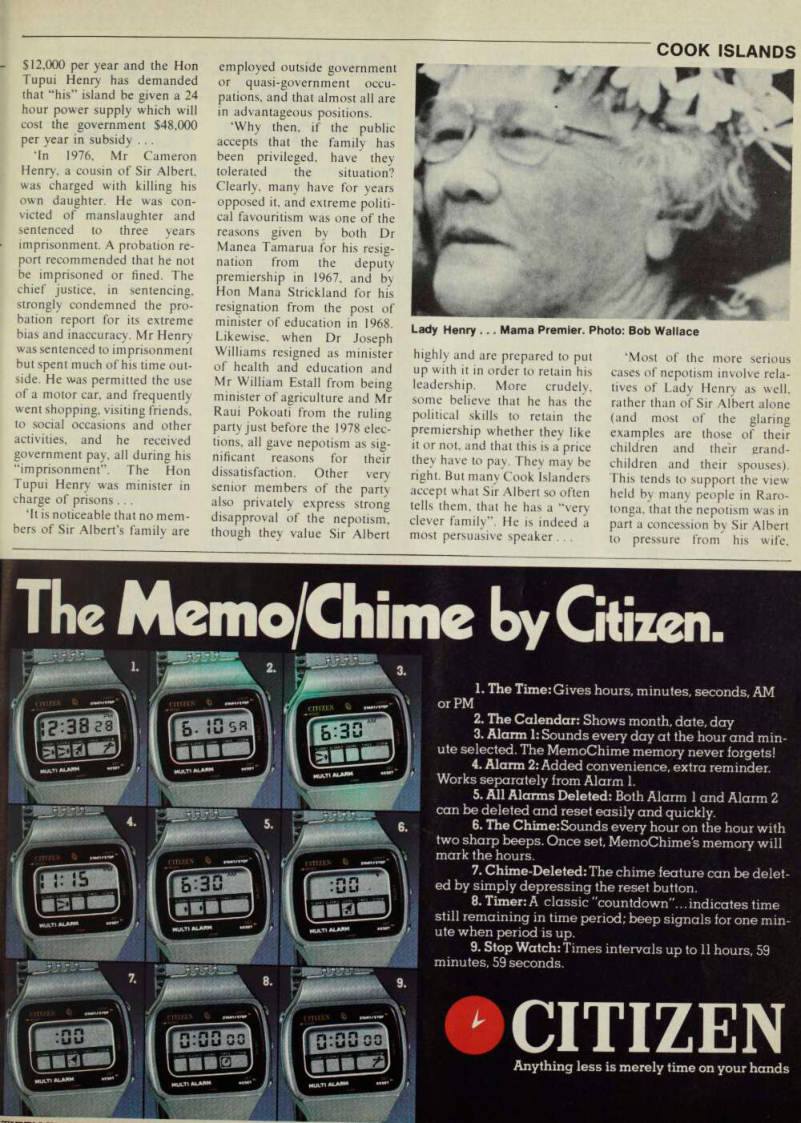
Lady Henry ... Mama Premier. Photo: Bob Wallace
whose frustrated ambitions seem to have been vicariously satisfied with having her off
spring in the key manipulative
roles. Their two sons, once they returned, seem to have applied extra pressure for family favours until within 10 years, the web of nepotism developed extreme proportions. It is not
associated with efficiency, jus
tice, or any other quality that could justify its existence, but its negative effects will prob ably take the Cook Islands many years to overcome . . . ‘Another of Sir Albert’s fre quent claims is that he and his party represent “the small man”. He emphasises his own “smallness”; he claims to have little money, that his home in Aitutaki is modest, that in New Zealand he was associated with workers’ unions, that he is a “simple man”, a “man of the people”. How far does this
image accord with reality?
‘As the man who consciously widened the gap between rich and poor much wider than it was even in colonial days, he succeeded in convincing the poor that he was their rep resentative. In 1977 Sir Albert was on a salary of $ 18,000, but the top $4,000 of it was tax free, so his real take-home pay was the equivalent of a taxable income of about $21,000. He is the only head of government in the Pacific so far as I know who allowed himself a tax-free sal ary component which is not available to the public. In ad dition he has what seems to be a larger range of perquisites than most of his neighbour heads of government. The un skilled worker in the Cook Islands at that time received 51 cents an hour or $1,060 per year, and the permanent head of a government ministry received $7,900. In other words he took a pay rate more than 20 times larger than that of ordinary government workers in his country. He accepted large increases for himself and his Cabinet during a period when the real income of the av erage Cook Islander was fall ing significantly (it fell 13 per cent between 1970 and 1976).
The gap between Sir Albert and the “small man” was prob ably the largest in the whole Pacific, even though the Cooks
is so small that one would expect the gap to be among the smallest. ‘But what caused this tal ented man, who had displayed much more concern for prin ciple at some other stages of his career, to deteriorate so far? He seems to have been driven by ambition for both power and glory. He fed on public adu lation. And his record shows that he was never strong on eth ics. But history may show that he was destroyed even more by the ambitions of some arrogant but mediocre members of his family, and that in trying to meet pressures from them, he sacrificed the unity and welfare of the Cook Islands people. ‘Sir Albert is intelligent, innovative and energetic. He is a visionary rather than an idealist (he is strong on visions but weaker in adhering to ideals). Highly skilled in speak ing and in politics, he has many strengths and the potential for greatness. His main weakness seems always to have been in ethics. This is not to suggest that he is without principles or ethical standards, but his re cord does show rather consist ently that he is prepared to “re-interpret”, water down or totally abandon these rather readily to satisfy his ambition for power. If he had the ethical strengths of Ratu Sir Kamisese Mara of Fiji, or Michael Somare of Papua New Guinea, or Peter Kenilorea of the Solomons, or Robert Rex of Niue, or Toalipi Lauti of Tuvalu or various other Pacific leaders, he would undoubtedly have led the Cook Islands to great achievements and him self to a position of honour today and in the future, within the Cook Islands and far be yond. His actual record has tar nished the image not only of his own people, but of Pacific people as a whole . . .’ (Next month: Dr Davis de scribes what he found in the Cooks on his return from the United States in 1971; Dr Joe Williams tells why he got out of the Henry Government; and Marjorie Crocombe describes how the CIP sabotaged Demo cratic Party broadcast time and how Sir Albert made political
capital out of a cyclone.)