Uncle Sam’S
pp. 20-22 · Read in the full issue
American Samoa
How Almighty
Dollar?
Canadian historian and university lecturer Dr Jim Boutilier was less than flattering in his description of Guam in last April’s PIM.
But there are two sides to the American presence in the Pacific, says Bill Goodwin, a Washington DC lawyer, who spent two months last year in American Samoa.
Dr Jim Boutilier’s impressions of Agana and the American Dream suggest that the American experience in Oceania and Pacific East Asia is one of polyglot populations and crass commercialism. But
having recently spent two
months in American Samoa, I find America’s presence there to be a coin with two sides, tar nished on one side but shiny on the other.
The tarnished side resembles his description of Agana, one that can be applied equally to
Pago Pago. The spectacular
harbour once the reason for America’s presence in Samoa is now ringed with quick-food
takeaways, a plethora of shops
selling cheap Korean, Taiwan
ese and Japanese goods, and a selection of honky-tonk bars
dispensing Schlitz and Olym
pia beer imported directly from
California.
The winding coastal road around the bay is crowded with motor vehicles and littered with beer cans, cardboard boxes and paper wrappings, the evidence of modern civilisation. And the eastern side of the harbour still
supports the stench of tuna
being processed at two
American canneries.
Given this shoddy develop
ment and the proclivity of the moist trade winds to drop 6 350 mm of rain on Pago Pago Bay each year, it is not difficult to appreciate the first im
pressions drawn by travellers
who take one look at the har bour through the rain and catch the next plane to Western Samoa.
The tarnish runs deeper than first impressions, however, and one must get to know the Samoans in order to under stand the American experience there and to appreciate the more elusive shiny side.
One thing soon becomes obvious. The Samoans, in gen eral, have adopted a lifestyle that is dependent on the American dollar, especially the dollar that flows directly from Washington to support a terri torial government that now employs roughly 40% of the work-force. The money is easy, and the wages are relatively
high.
Gone from the main island is any semblance of a viable
agriculture. Young people are not interested in tending a taro or banana plantation when they can get government jobs that pay in a day what it takes their cousins a week or more to earn in Western Samoa. The
territory imports bananas,
although banana trees grow wild all over Tutuila Island.
Another lure away from the family land is free access to Hawaii and the US mainland, where two-thirds of all American Samoans now live.
Salanoa S. P. Aumoeualogo, the president of the American Samoa Senate, has 14 children, 10 of whom live in the States.
“To tell you the truth,” an American official confided cynically, “these islands are little more than a baby factory for Hawaii and California.”
In the absence of so many young American Samoans, the islands have been invaded by Western Samoans and Tongans searching for jobs and rela tively high wages. The top American Samoan musical groups now perform in Honolulu and San Diego, while the bands at the Rainmaker Hotel and Soli’s Restaurant are likely to be from Tonga and
Apia, respectively.
“I work here because I can make much more money,” said a young Western Samoan. “But I can hardly wait until I become a matai and go home. It’s so peaceful and quiet over there.”
The influx of other islanders competing for jobs has caused the government to enforce im migration restrictions which allow non-American Samoans only six months at a time in American Samoa. I found these
restrictions particularly grating
to the Western Samoans, who are closely related in many re spects to the Samoans on American soil.
“If they want to improve re lations with our governement, they must remove those crazy
permits,” an elderly Western
Samoan told me one morning on the ferry between Upulu and Savai’i. “It’s stupid to tell us we can’t go and live with our brothers and sisters.”
Such a restriction also may gall some Americans who see “Old Glory” flying over the air port terminal to remind them that they are on American terri
tory. After all, it’s consti tutionally questionable under American law whether any government, acting under authority of the United States, can exclude an American from an American territory.
Jake King, the editor of the colourful Samoan News,
fought a long legal battle to
avoid being evicted from the islands. The territorial govern ment eventually dropped the
case, apparently fearing an
adverse US court ruling would throw the regulation off the books insofar as it applies to American citizens.
Those regulations are in effect because of the American Samoa Government’s policy which has Washington’s ap proval of maintaining “Samoa for the Samoans”.
Not only are Americans os
tensibly prohibited from
remaining in American Samoa beyond six months without contracts to work for the Government or marriages to Samoan citizens, they are not allowed to own land or to carry on a business without Samoan partners.
Ownership of all but a minuscule fraction of the islands has been preserved in the Samoan families since the treaty ceding the territory to the United States was signed in 1900.
“If the land was open to sale to American citizens, then the Rockefellers and the Fords could come in and buy it up. It would be gone, and we would be just another Hawaii,” says Senator Salanoa, who opposes any form of statehood for American Samoa. “In Hawaii, the political power rests with the Japanese, the money with the Chinese, and the land with the Americans. The poor Hawaiians have nothing.”
If one takes time to rummage around the modern legislative building, where Senator Salanoa’s office commands a view of the Pago Pago water front, or to walk up to the governor’s mansion overlook ing the harbour, he will find most day-to-day decisions being made by Samoans not Americans.
Governor Peter Tali Coleman, the son of a palagi father and Samoan mother,
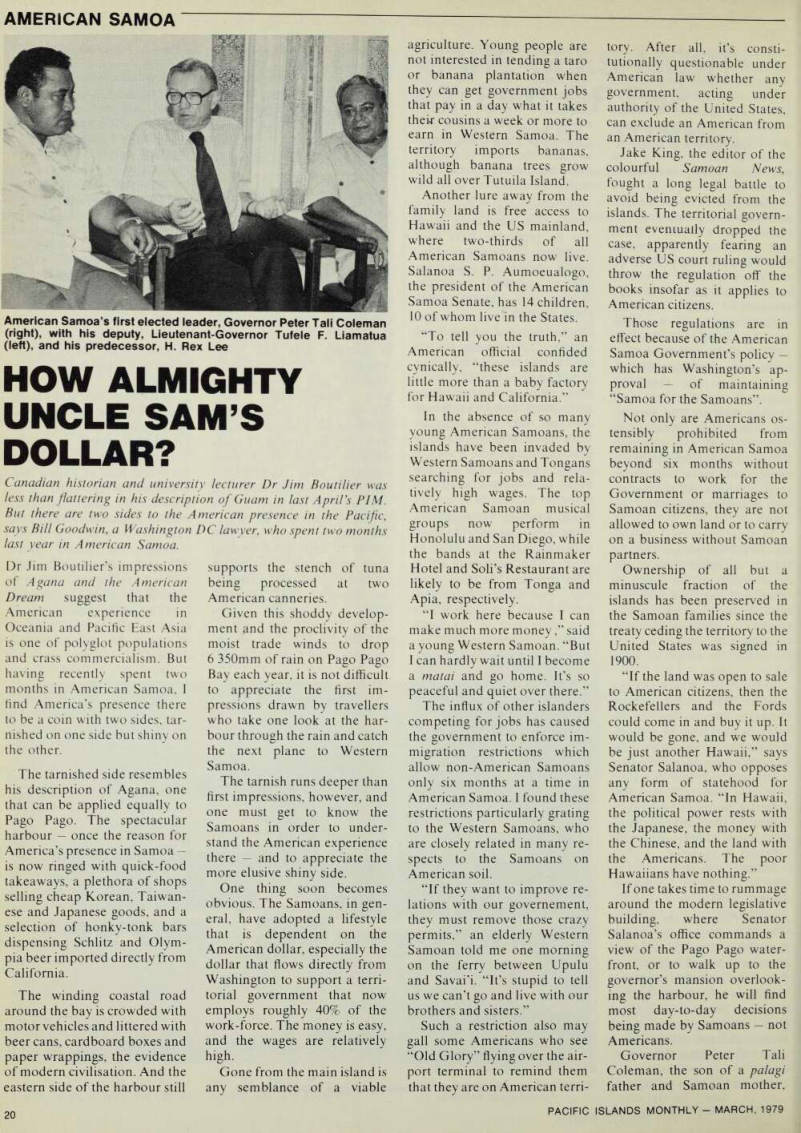
American Samoa’s first elected leader, Governor Peter Tali Coleman (right), with his deputy, Lieutenant-Governor Tufele F. Liamatua (left), and his predecessor, H. Rex Lee
was raised in the islands, educa ted in Washington, and served in the late 1950 s as appointed governor. He was elected to office in November 1977 after the American Samoans agreed,
having disapproved the prop
osition four times previously, to elect their own governor.
In keeping with Samoan cus tom, members of the upper house of the legislature are chosen by the matais, while the lower house members are chosen by popular election.
This blending of Samoan and American ways represents the outlook of many Samoan leaders, who persistently em phasise their intention to “adopt the best of the new while keeping the best of the old”.
The best of the new, at least in terms of material comfort, can be found on Coconut Point, a narrow peninsula of palm fringed coral that looks down Tutuila’s south coast toward Rainmaker Mountain and the entrance to Pago Pago har bour.
Coconut Point is lined with the homes of American Samoa’s newly-affiuent, wes ternised middle class. Gover nor Coleman’s family home, to which he often expressed a de sire to return rather than run for governor, sits on the end of the point.
Next door to Coconut Point is the village of Nuu’uli, Tutuila’s largest, where I lived in a “hurricane house” - one of the buildings that replaced homes ravaged by the hur ricane of 1966. Unlike the
unkempt area around Pago
Pago, Nuu’uli is spotlessly
maintained. Painted boulders lie along its sealed main street, which is bordered by immacu lately groomed yards.
I had lived in Nuu’uli less than a week when the village chief came by to implore me to cut my overgrown grass. It was an eyesore, he said.
Nuu’uli has a lovely swim ming beach, but the wearing of shorts and bikinis there in deference to Samoan customs of dress - is strictly forbidden.
Unlike on Tahiti, where European women tourists are likely to run around topless at the drop of a halter top, no such
behaviour is tolerated in American Samoa.
Also in keeping with Samoan custom, Sundays are sacro sanct. The son of K. William O’Connor, the Chief Justice of American Samoa, was told in no uncertain terms that surfing was not permitted on Sundays.
Samoans have been known to stone Sunday violators, and a paramount chief once punched the foreman of a road construction crew who insisted on working on a Sunday after
a prolonged rainy period.
The roads along Tutuila’s south coast are used extensively by the automobiles that the Samoans’ new affluence has enabled them to purchase, but the motor car is by no means king on the island. The most widely-used form of transport is the gaily-painted aiga buses
those often rickety, wooden bodies built on the beds of pickup trucks. They are fast, convenient, and relatively cheap, and most Samoan extended families keep at least one on the road during week days, using it on Sundays to transport family members to church.
Not far down the road from Nuu’uli is a small shopping centre, American Samoa’s first outright concession to modern suburbia. A large supermarket is owned by three Samoan brothers, each of whom mar ried palagi women while they were attending school in America.
Most American Samoans, re gardless of age, have at least visited the States for extended periods. From that exposure, especially among the young,
are emerging the new leaders of American Samoa both in business and in politics.
Governor Coleman, 59 years old, is seen by many Samoan politicians as an interim gover nor, a man whose experience with the federal bureaucracy can keep the funds flowing
from Washington. Young
leaders formed the backbone of his successful election cam paign last year, especially those who saw in him a continuation of western influence.
After Governor Coleman’s term in office expires, many of his young supporters see him
being succeeded by younger
men of full Samoan blood. The leading prospects mentioned by many of them were Tufele Lea, the former police chief, who now is Lieutenant- Governor, and Senator Fofo Sunia, a high chief on Manua Island who, in 1977, ran unsuccessfully for Lieutenant- Governor on a ticket with A. P.
Lutali, the territory’s delegate
at-large to Washington. Both
Tufele and Fofo were educated in America.
Meantime. Governor
Coleman’s primary problems
will involve reorganising and modernising the territorial government, which has been infused with so much money over so short a time that it has had trouble keeping track of how it was all spent.
He will have assistance from a new breed of American appointed official - and there still will be a few of them around Pago Pago who are more attuned to the attitudes and wishes of the Samoan people than were most of the political appointees sent from Washington in the past.
With the exception of H. Rex Lee, whose accomplishments as governor from 1961 to 1967 have made him a legend in American Samoa, the past saw a parade of men who were sent to Pago Pago from Washington as a reward for political support in the last US presidential elec tion.
If the new American ap pointees are like Chief Justice O’Connor, things will be con siderably different. When the Head of State of Western Samoa, Chief Malietoa Tanumafili 11, paid his first
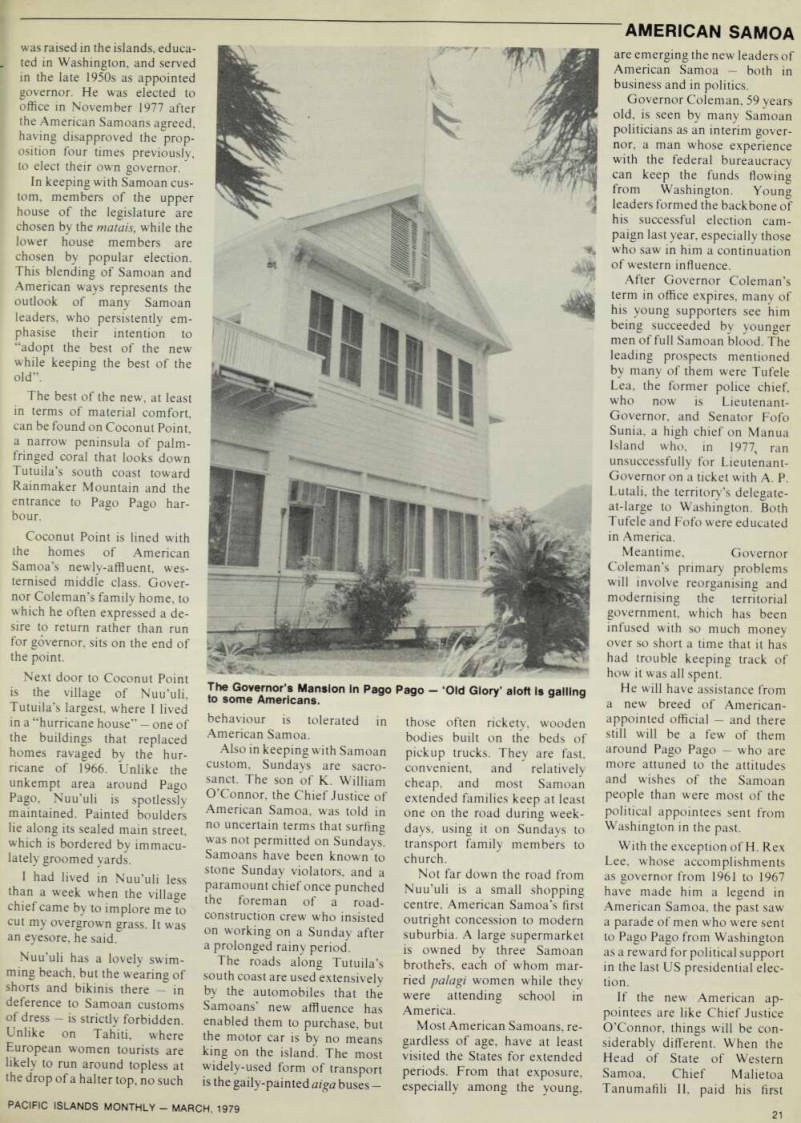
The Governor’s Mansion in Pago Pago - ‘Old Glory’ aloft is galling to some Americans.
official visit to Pago Pago in 1977, he was pleasantly sur prised when Mr O’Connor wel comed him in the Samoan
language.
Governor Lee told me that when he returned as governor in 1977 to oversee the tran sition to “home rule”—as we Americans call it he found many of the Americans work ing in the government were either well-intentioned do
gooders unqualified for the
jobs they held, or that they had come to Pago Pago because they did not “fit” elsewhere.
The question of selecting
good people for his adminis tration aside. Governor Coleman must still cope with the cause of American Samoa’s
growing pains money. To
understand why money is such a cause of the territory’s social problems, one must look back in time a bit.
From the time that the Samoan chiefs ceded their islands to the United States in 1900 until 1951, American authority in Samoa rested with the US Navy, which main tained a station at Pago Pago.
The local chiefs went about their business and were left alone for much of that half century to conduct their own affairs in their own fashion.
The matai system of chiefs was left intact, all but a small fraction of land was left in com munal hands, and justice was carried out at the village level.
The harbour at Pago Pago lost its strategic value when the nuclear age dawned after World War 11, and control of the islands was transferred to the US Department of the Interior in 1951. Unlike Guam, American Samoa now has little military value to the United States, although some officials admit that they would not want the excellent harbour and the jet airstrip at Tafuna to fall into hostile hands.
The Interior Department did little to change things in Samoa until Reader’s Digest magazine ran a well-publicised story about “America’s Shame in the South Seas” a few years later.
That article described the lack of roads, adequate schools or medical care in terms that
could accurately describe con ditions today on the Western Samoan island of Savai’i. In other words, Reader's Digest found a virtually-untouched
Polynesian society, complete
with thatch huts and subsist ence farming, smiling faces and few motor vehicles. And that, by contemporary American standards, was a “disgrace”.
The American Government reacted as it often does when it attempts to solve a perceived
social problem by throwing
money at it.
Along with that money came H. Rex Lee to bring about the overhaul. Unlike his prede cessors, Governor Lee had been a career bureaucrat with years of experience in the Interior Department’s Bureau of Indian Affairs.
He used federal financial aid to augment a massive effort by the Samoans themselves. “I had one great untapped re source,” he recalls, “and that was the desire of the Samoan people to help themselves. All they needed was someone to show them the way.”
He gave the islands sealed roads, improved water and electrical systems, the modern Rainmaker Hotel and a con vention centre, and his pride and joy, a revamped school sys tem complete with educational television. Along with tele vision came the famous cable car across Pago Pago harbour, built to construct and service the transmitter atop Mount Alava.
Reader’s Digest sent its re porter back to the islands late in Lee’s term and pronounced the territory to be “America’s show place in the South Seas”.
Then came the “Great So ciety” domestic programmes
enacted during the presidency
of Lyndon B. Johnson. Those social programmes were cre ated to eliminate poverty in America, and they were made applicable to the territories and possessions as well as in the States themselves.
Other programmes followed during the Nixon administra tion, and Mr Nixon’s appointed governor, John M. Haydon, turned on the money tap at Pago Pago. Since American Samoa easily qualified as a poverty area under criteria ap
plicable to the States, it had almost immediate access to an array of assistance pro grammes, such as aid to edu cation, health programmes, and law-enforcement assist ance.
Over the course of five years, the territorial government’s budget grew from SUSIB millions to $45 millions
twice the present expenditure by the Government of Western Samoa, which has five times as many people. In Governor Lee’s first year, the budget was a mere US$2 million.
And every time a new pro gramme was added, a new bu reaucracy was established to administer that programme.
The government payroll grew and grew.
As more and more Samoans took jobs with the government often after returning home from America they became more and more dissatisfied with the fa’a Samoa custom of turning their earnings over to the head of their families. They had learned to adopt western ways, including the possession of their own paychecks.
So money and exposure to American ways has created a new class of young Samoans who are somewhat leery of old Samoan customs and definitely interested in getting ahead economically. They run the gamut from professionals down to the teenagers who can be found on the streets of Pago Pago at all hours, wearing west
ern jeans and comporting themselves as they have seen their relatives living in America.
Nevertheless, technical skills among the young are sadly lacking, partly because a skilled Samoan can make three or four times as much pay in America as he can at home. That lack of local skill showed up last year when Governor Lee found, upon his return, that “our fiscal and accounting systems and re cords are in poor condition”.
Governor Lee went on to say that the government had “tried to do too much too quickly without proper supervision or technical assistance”.
Money, in other words, rep resents both the tarnished and shiny sides of the American Samoan coin. It has brought about an almost overnight ac ceptance of American ways among large segments of the population, but it has resulted in a dependence on federal lar gesse and a breakdown in Samoan customs. Money has enabled Governor Lee’s prized television station to beam American programmes into every home in the islands, com plete with commercial adver tisements for products either not available locally or far be yond the means of most Samoans.
On the other side of the coin, money has given the American Samoans better schools, better transport, and better health care facilities. And it has given them the unique advantage in the American system of being able to determine their own destinies.
The American Government has made it very clear to the American Samoans that they can become independent, but they obviously have become so
economically dependent on
Washington that few voices can be heard speaking of pol
itical independence.
The choice is theirs, not America’s. Whether the coin becomes shiny on both sides is a decision to be made in Pago Pago, not in Washington.
Given enough time and enlightened young leaders, I have no doubt but that the American Samoans will indeed “adopt the best of the new while keeping the best of the old”.
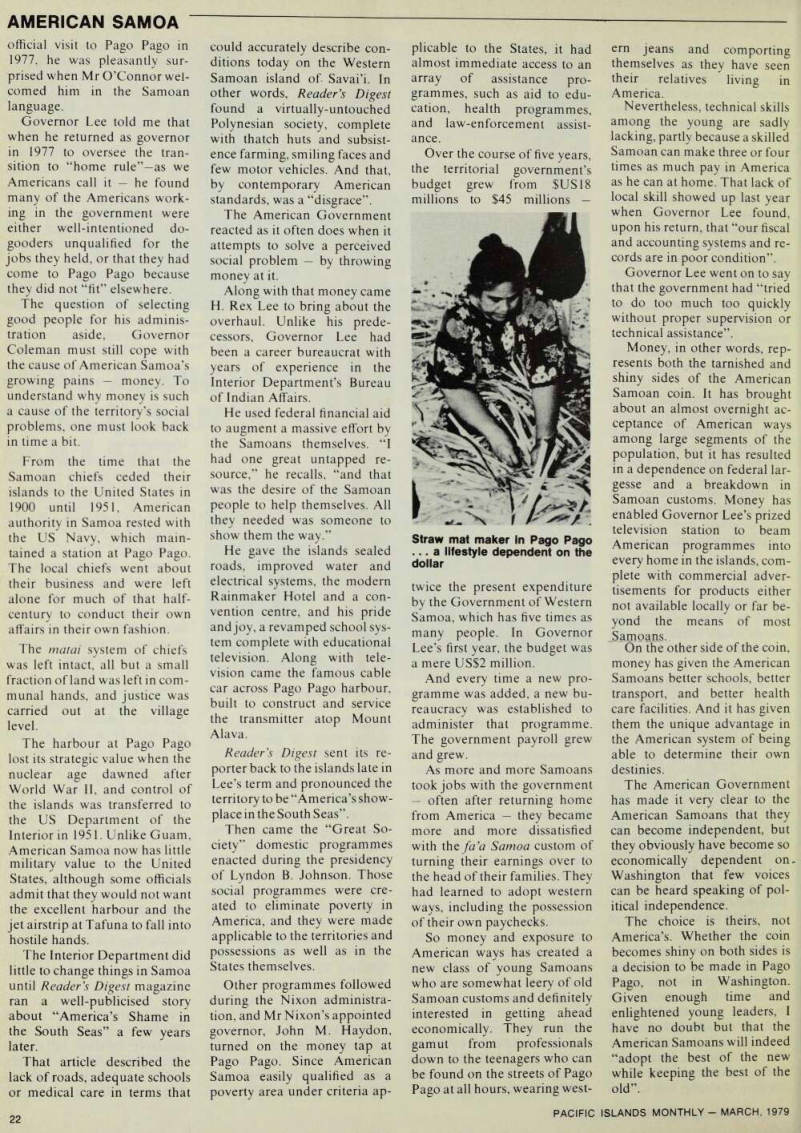
Straw mat maker in Pago Pago ... a lifestyle dependent on the dollar