tight rein
pp. 47-49 · Read in the full issue
Keeping a tight rein on tourism
Will the upgrading of air ser i vices to Norfolk Island, to bring in more visitors, result in destroying the environment that attracts the visitors in the 1 first place? It’s a familiar prob lem in the Islands and Norfolk is currently faced with it.
Norfolk is served by three scheduled airlines East-West
Airlines, operating a daily
return service from Sydney
; with specially-equipped
Fokker 27 500 turbo-prop air craft, Air New Zealand,
f operating regular F27s usually
I four days a week from Auckland, and Norfolk Island
f Airlines, operating nine flights
weekly between Norfolk and Brisbane in a small but fast Beechcraft Super King Air 200
turbo-prop.
East-West is the major air line, carrying twice the traffic that Air New Zealand does from Auckland. Most tourists and most air freight originate in Australia.
East-West began its Norfolk Island service two years ago, purchasing two aircraft for SAS million especially for the route.
Being 1676 km from Sydney and 1063 km from Auckland, Norfolk Island is a long-haul route, and the present length and standard of the airport
(two runways of 1700 m and
1550 m), control the type of equipment that can be used.
The 52-passenger F 27 is the largest aircraft that can be operated on the route but be cause of weight restrictions it carries only 36 passengers from Sydney. The aircraft has to have an 80 per cent loading under these conditions to run
economically.
The two big Australian dom estic airlines, TAA and Ansett, think upgrading of Norfolk’s airport would resolve the prob lem and they have applied to the Australian Department of Transport, which controls Nor folk’s air services, to operate bigger pure jets on the service
from Sydney.
But John Riley, managing
director of East-West, says that before big jets could be used there would have to be an expenditure of $4 or $5 million on the Norfolk airport for work which would take several years to complete and be of no advantage to the island. He says this is because there is a limit to Norfolk’s tourist ca pacity (perhaps a maximum of 25,000 to 30,000 passengers an nually 10 years from now), and bigger aircraft of the type TAA and Ansett propose would simply mean reduced fre quency of services and
environmental damage.
If East-West were permitted to operate a stretch version F2B 4000, or a British Aerospace four-engined 146, each carry ing 70-80 passengers, he says frequencies need not be re duced, less complicated run way improvements would cost no more than $2 to $3 million, and the new aircraft would be available for operation even before the improvements were finished.
An announcement is expected any day on the future of Norfolk air services but Mr Riley is fairly confident that East-West will be allowed to continue its service. He points out that East-West has in creased the Norfolk-Sydney services from two a week under Qantas (which used a bigger, slower plane) to seven, some
times eight flights a week, fly
ing faster and above the weather so that only on three occasions within the last two years have the aircraft been un able to land. East-West has also dramatically increased services
in the historically weak mid winter period through fare incentives and promotion.
East-West Airlines is an Australia-based domestic air line which operates nine F27s.
It carried 484,000 passengers between Australian airports last year.
Norfolk Island Airlines is based on Norfolk Island a local company with 75 local shareholders, operating Beech craft Super King Air 200 prop
jets equipped to international
airline standards. They cruise at 480 kph and connect with Brisbane in three hours.
Chairman John Brown sees Norfolk as the hub of services radiating to nearby islands, such as Lord Howe, Fiji and New Caledonia, as well as to New Zealand and Australia.
He says the French in New Caledonia are keen to have the airline regularly service Noumea. It already operates charters to New Caledonia and
Fiji. Unfortunately the airline
requires Australia’s authoris ation before it can operate scheduled services to other countries, and political interests intrude.
Its regular services already connect Norfolk with neigh bouring Lord Howe Island,
one-and-three-quarter hours
away, en route to Brisbane.
The airline has a good working relationship with East-West and offers a package tour from Brisbane to Norfolk with a stopover at Lord Howe, and onward flight from Norfolk to Sydney via East-West Air lines.
Air services to Australia and
New Zealand are literally Nor folk Island’s lifeblood. They make tourism possible, and tourism is the island’s one major industry, with 50 per cent of the workforce engaged wholly or largely in it.
Norfolk Island has always attracted some tourists, but the present development of the industry began after the first scheduled air services to Nor folk were started (in 1947) by Qantas. Until about 1960 the island’s economy was based
mainly on subsistence farming,
but from 1960 there was a period of rapid tourist traffic
growth, with tourists increasing
from 3000 a year in 1961 to 19.000 by 1974.
To June 30, 1978, there were 20,620 tourist arrivals, nearly 12.000 from Australia, 7000 from New Zealand and the rest on charter flights from else where. Arrivals by sea are min ute.
The figures for 1979 should
be considerably higher, despite
the fact that Professor Gilbert Butland, who made a long term population study of Nor folk Island in 1974, suggested that to avoid destroying the ecology of the island, 20,000 tourists a year is the desirable maximum. He also envisaged a permanent population of 2000 by 1983, and a growth rate of 2% a year thereafter.
Mr Justice Nimmo in his royal commission report of 1976 thought that maximum
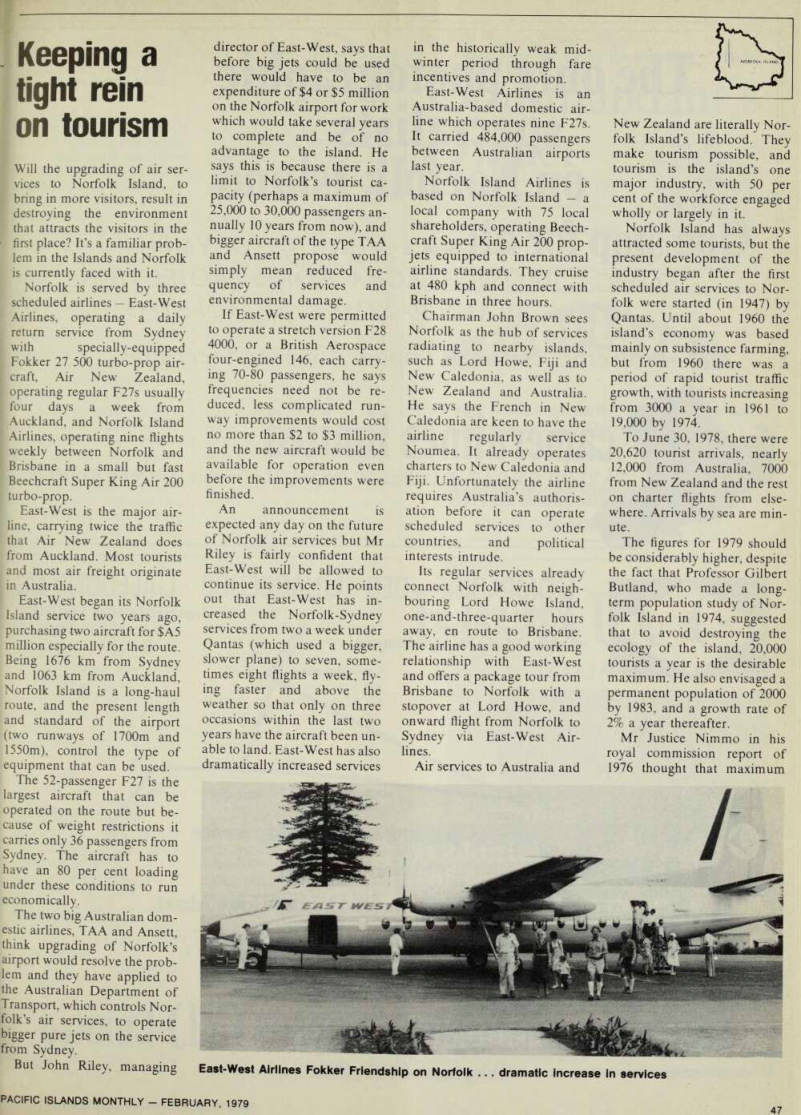
East-West Airlines Fokker Friendship on Norfolk .. . dramatic increase in services
tourist figure might have to be ■ revised but he warned that the views of experts like Professor Rutland should not be
disregarded lightly.
Certainly the trend of expert advice in recent years is that the island must avoid the ‘boom mentality’ that will cause con gestion of the island’s re sources. This can best be done by restricting arrivals and ac commodation on the island to acceptable limits. So far this has happened without there having to be a firm official pol
icy, but the point is probably
quickly being reached where a firm plan has to be adopted
and policed.
Justice Nimmo stressed the [ vital importance of tourism to Norfolk’s economy, and com mented: ‘Norfolk’s main charms are the scenic beauty of its land and seascapes, the rus tic tranquillity of its environ- I ment, the historical interest of its past, its superb fish ing grounds and the low
duty shopping opportunities.
Clearly, for the island to have any economic future it must be based on this tourist industry.
No other viable alternative is at
present predictable.
‘lf any circumstance caused the cessation or serious reduc tion of the tourist industry, hundreds of residents would have to leave the island or face a near-subsistence type of liv ing. The island would be un able to pay for its imported necessities and a large part of its essential services. In such a precarious situation, it behoves policy makers and adminis trators alike to do nothing which may place the tourist industry in jeopardy or even cause its downturn.’
In support of this view, the administration has continued a programme of restoration and maintenance of historic build ings, moved for higher stan dards of new building control and town planning, and sup ported the continuance of low
duty shopping.
But one of the difficulties so far about Norfolk’s depen dence on tourism is the lack of reliable information about just what tourists spend, what they spend it on, and the distri bution of the money in the Norfolk economy.
A clearer picture of the anat omy of tourism will be avail able shortly as a result of the
Norfolk Island feasibility study
being conducted for the Aus tralian Government by Pro fessor R. C. Gates, vice chancellor of New England University, NSW, with the as sistance of Professor M. Tread gold, Professor of Economics at
the University.
For one month in November-December all air passengers departing from Norfolk Island were asked to fill in a form giving details of their expenditure on the island,
including accommodation,
meals, transport and tax-free goods. The information was
given anonymously, and the
facts are being put through a
computer. The picture they
give will be included in a wider report on the island’s economy which Professor Gates expects to submit to the government in
mid-February.
Preliminary work on the visi tor expenditure has confirmed the major importance of the tourist industry and indicates that individual tourists spend greater sums on the island than has been realised.
The feasibility study also in cludes a detailed census of the Norfolk population, held on October 24. Apart from the usual questions about age, marital status and housing, Norfolk Islanders were asked to disclose their income from all sources, whether they were of Pitcairn descent, whether they had life assurance or pen sions of any kind, what food was produced within the household, such as vegetables, milk, meat and fish and whether they gave any of their foodstuffs free to friends and
neighbours. The questions
were aimed at finding out more about the islanders’ life style.
The economic census of business enterprises that has been done as part of the econ omic study should give a more reliable picture of tourism’s importance to local commerce, and the Gates report is awaited with great interest.