USP: agent of
pp. 51-54 · Read in the full issue

Tropicalities
change in Niue
University of the South Pacific extension service centres have brought to isolated communi ties a keen taste of what tertiary education is all about. No cor respondence course or school of the air can give to a student the sense of belonging as can a solid brick structure and human and present instruc tors.
The efficiency of these extension service centres is soon to be enhanced when scheduled video satellite ser vices become fully oper ational.
The USP’s centre on Niue, with Jan Bundy as director, is an example of the worth of the university’s determination to make itself useful in both an academic and practical sense beyond the boudaries of its Laucala Bay campus in Suva.
Two projects carried out over the past two years at the Niue centre speak for them selves as inspirations for the preservation and development of Niuean culture.
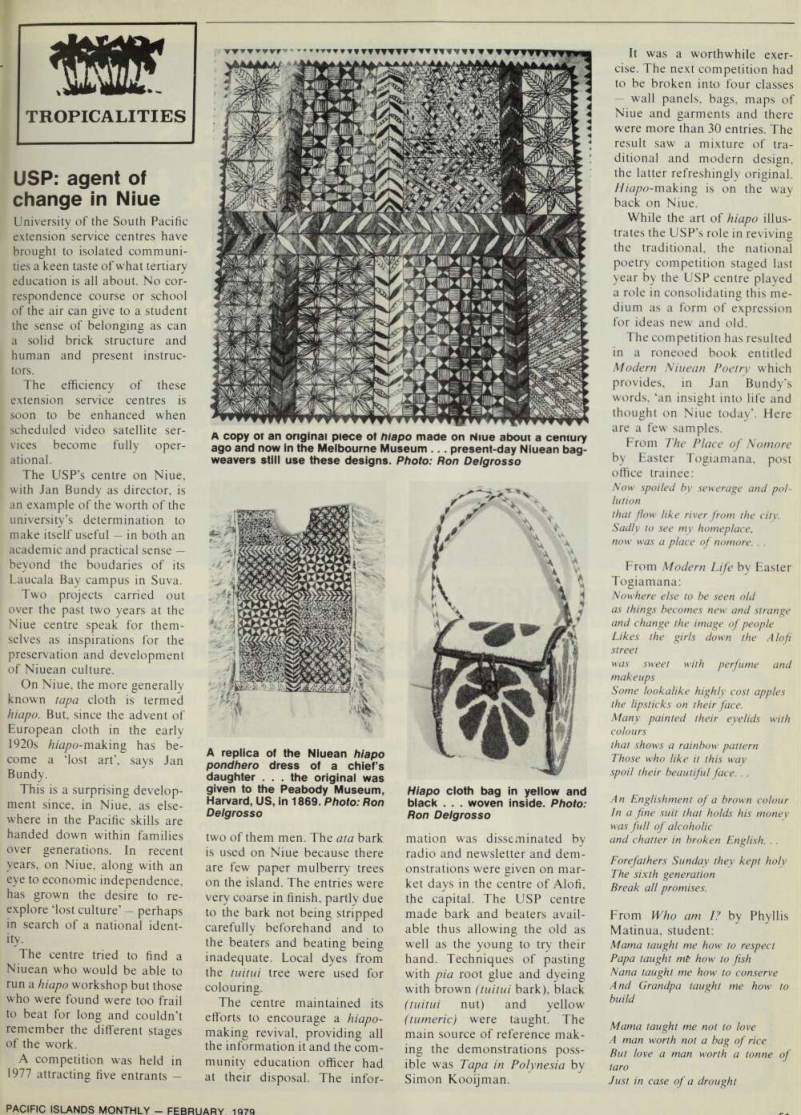
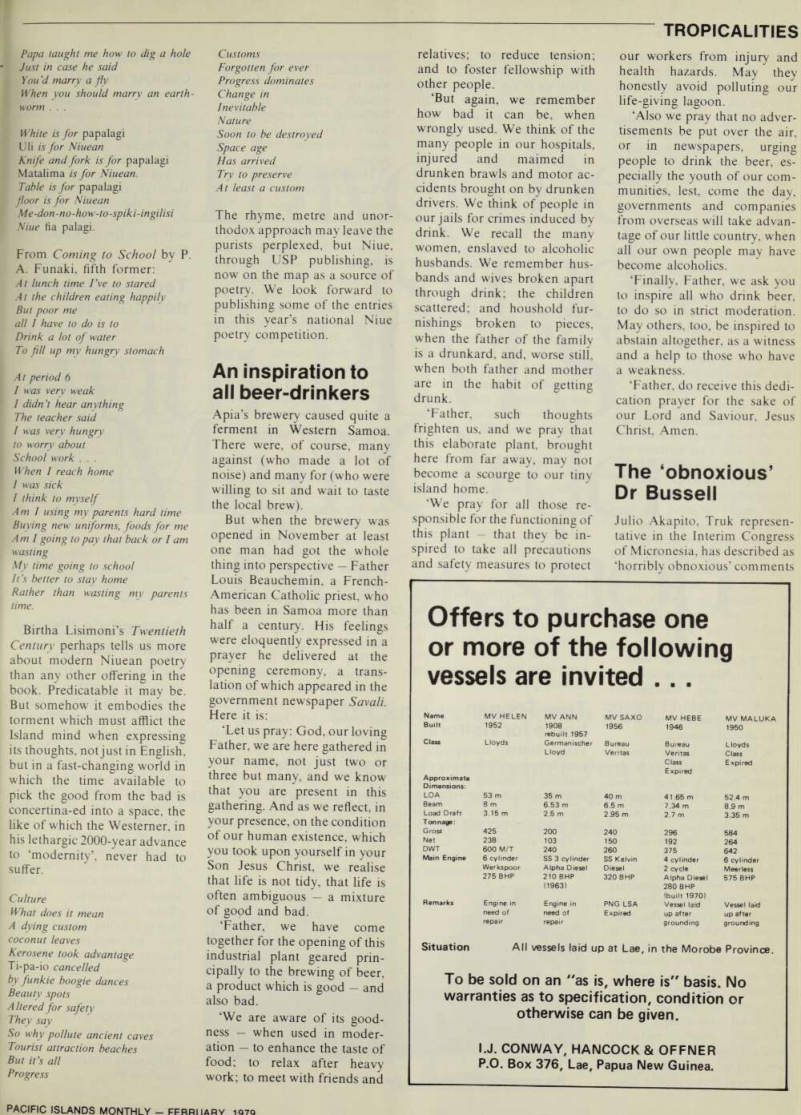
On Niue, the more generally known tapa cloth is termed hiapo. But, since the advent of European cloth in the early
1920 s hiapo- making has be
come a ‘lost art’, says Jan
Bundy.
This is a surprising develop ment since, in Niue, as else where in the Pacific skills are handed down within families over generations. In recent years, on Niue, along with an eye to economic independence, has grown the desire to re
explore ‘lost culture’ perhaps
in search of a national ident
ity.
The centre tried to find a Niuean who would be able to run a hiapo workshop but those who were found were too frail to beat for long and couldn’t remember the different stages of the work.
A competition was held in 1977 attracting five entrants -
two of them men. The ata bark is used on Niue because there are few paper mulberry trees on the island. The entries were very coarse in finish, partly due to the bark not being stripped carefully beforehand and to the beaters and beating being
inadequate. Local dyes from
the tuitui tree were used for
colouring.
The centre maintained its efforts to encourage a hiapo
making revival, providing all
the information it and the com munity education officer had at their disposal. The infor-
mation was disseminated by radio and newsletter and dem onstrations were given on mar ket days in the centre of Alofi, the capital. The USP centre made bark and beaters avail able thus allowing the old as well as the young to try their
hand. Techniques of pasting
with pia root glue and dyeing with brown (tuitui bark), black (tuitui nut) and yellow (tumeric) were taught. The main source of reference mak ing the demonstrations poss ible was Tapa in Polynesia by
Simon Kooijman.
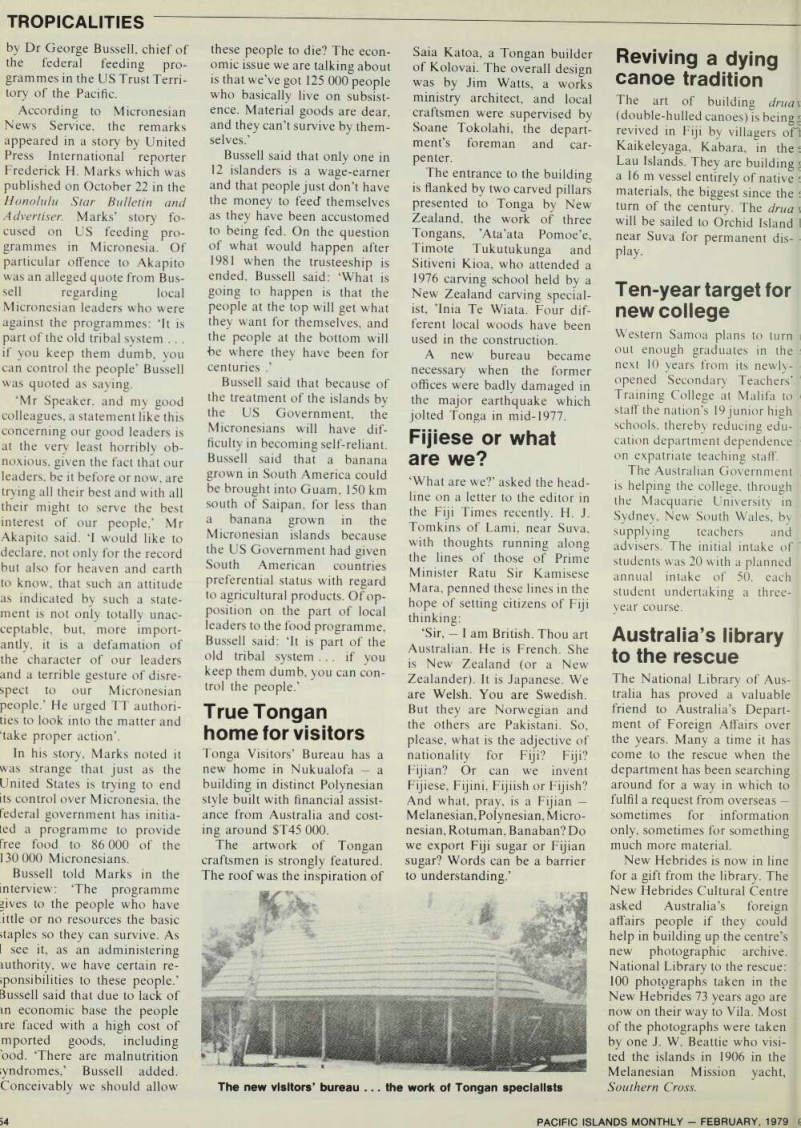
It was a worthwhile exer cise. The next competition had to be broken into four classes - wall panels, bags, maps of Niue and garments and there were more than 30 entries. The result saw a mixture of tra ditional and modern design,
the latter refreshingly original.
Hiapo- making is on the way back on Niue.
While the art of hiapo illus trates the USP’s role in reviving the traditional, the national
poetry competition staged last
year by the USP centre played a role in consolidating this me dium as a form of expression for ideas new and old.
The competition has resulted in a roneoed book entitled Modern Niuean Poetry which provides, in Jan Bundy’s words, ‘an insight into life and thought on Niue today’. Here are a few samples.
From The Place of Nomore
by Easter Togiamana, post
office trainee: Now spoiled by sewerage and pol lution that flow like river from the city.
Sadly to see my homep/ace, now was a place of nomore. . .
From Modern Life by Easter
Togiamana:
Nowhere else to be seen old as things becomes new and strange and change the image of people Likes the girls down the Alofi street was sweet with perfume and makeups Some lookalike highly cost apples the lipsticks on their face.
Many painted their eyelids with colours that shows a rainbow pattern Those who like it this way spoil their beautiful face. . .
An Englishment of a brown colour In a fine suit that holds his money was full of alcoholic and chatter in broken English. . .
Forefathers Sunday they kept holy The sixth generation Break all promises.
From Who am I? by Phyllis Matinua, student: Mama taught me how to respect Papa taught me how to fish Nana taught me how to conserve And Grandpa taught me how to build Mama taught me not to love A man worth not a bag of rice But love a man worth a tonne of taro Just in case of a drought
A copy or an original piece of hiapo made on Niue about a century ago and now in the Melbourne Museum . . . present-day Niuean bag weavers still use these designs. Photo: Ron Delgrosso
A replica of the Niuean hiapo pondhero dress of a chief’s daughter . . . the original was given to the Peabody Museum, Harvard, US, in 1869. Photo: Ron Delgrosso
Hiapo cloth bag in yellow and black . . . woven inside. Photo: Ron Delgrosso
Papa taught me how to dig a hole Just in case he said i You'd marry a fly When you should marry an earth worm . . .
White is for papalagi
Uli is for Niuean
Knife and fork is for papalagi
Matalima is for Niuean.
Table is for papalagi
floor is for Niuean
Me-don-no-how-to-spiki-ingilisi
Niue fia palagi.
From Coming to School by P.
A. Funaki, fifth former: At lunch time I've to stared At the children eating happily But poor me all I have to do is to Drink a lot of water To fill up my hungry stomach At period 6 I was very weak I didn't hear anything The teacher said I was very hungry to worry about School work . . .
When I reach home I was sick I think to myself Am I using my parents hard time
Buying new uniforms, foods for me
Ami going to pay that back or I am
wasting
My time going to school It's better to stay home Rather than wasting my parents time.
Birtha Lisimoni’s Twentieth Century perhaps tells us more about modern Niuean poetry than any other offering in the book. Predicatable it may be.
But somehow it embodies the torment which must afflict the Island mind when expressing
its thoughts, not just in English,
but in a fast-changing world in which the time available to pick the good from the bad is concertina-ed into a space, the like of which the Westerner, in
his lethargic 2000-year advance
to ‘modernity’, never had to suffer.
Culture What does it mean A dying custom coconut leaves Kerosene took advantage
Ti-pa-io cancelled
by funkie boogie dances
Beauty spots
A Itered for safety
They say
So why pollute ancient caves Tourist attraction beaches But it’s all
Progress
Customs Forgotten for ever Progress dominates Change in Inevitable Nature Soon to be destroyed Space age Has arrived Try to preserve At least a custom The rhyme, metre and unor thodox approach may leave the purists perplexed, but Niue, through USP publishing, is now on the map as a source of poetry. We look forward to publishing some of the entries in this year’s national Niue
poetry competition.
An inspiration to
all beer-drinkers
Apia’s brewery caused quite a ferment in Western Samoa.
There were, of course, many against (who made a lot of noise) and many for (who were willing to sit and wait to taste the local brew).
But when the brewery was opened in November at least one man had got the whole
thing into perspective Father
Louis Beauchemin, a French- American Catholic priest, who has been in Samoa more than half a century. His feelings were eloquently expressed in a prayer he delivered at the opening ceremony, a trans lation of which appeared in the government newspaper Savali.
Here it is: ‘Let us pray: God, our loving Father, we are here gathered in your name, not just two or three but many, and we know that you are present in this gathering. And as we reflect, in your presence, on the condition of our human existence, which you took upon yourself in your Son Jesus Christ, we realise that life is not tidy, that life is often ambiguous a mixture of good and bad. ‘Father, we have come together for the opening of this
industrial plant geared prin
cipally to the brewing of beer, a product which is good and also bad. ‘We are aware of its good ness when used in moder ation to enhance the taste of food; to relax after heavy work; to meet with friends and
relatives; to reduce tension; and to foster fellowship with
other people.
‘But again, we remember how bad it can be, when wrongly used. We think of the many people in our hospitals, injured and maimed in drunken brawls and motor accidents brought on by drunken drivers. We think of people in our jails for crimes induced by drink. We recall the many women, enslaved to alcoholic husbands. We remember husbands and wives broken apart through drink; the children scattered; and houshold fur-
nishings broken to pieces.
when the father of the family is a drunkard, and, worse still, when both father and mother are in the habit of getting drunk. ‘Father, such thoughts frighten us, and we pray that
this elaborate plant, brought
here from far away, may not become a scourge to our tiny is| and h ° me ' We pray for all those re sponsible for the functioning of this plant that they be inspired to take all precautions and safety measures to protect
our workers from injury and
health hazards. May they
honestly avoid polluting our
life-giving lagoon,
‘Also we pray that no adver tisements be put over the air, or in newspapers, urging people to drink the beer, es pecially the youth of our coin munities, lest, come the day, governments and companies from overseas will take advan tage of our little country, when all our own people may have become alcoholics, ‘Finally, Father, we ask you to inspire all who drink beer, to do so in strict moderation, May others, too, be inspired to abstain altogether, as a witness and a help to those who have a weakness, ‘Father, do receive this dedi cation prayer for the sake of our Lord and Saviour, Jesus Christ, Amen, g
In© Obnoxious’
Dr Bussell
Julio Akapito, Truk represen tative in the Interim Congress of Micronesia, has described as ‘horribly obnoxious’ comments
by Dr George Bussell, chief of the federal feeding pro grammes in the US Trust Terri tory of the Pacific.
According to Micronesian News Service, the remarks appeared in a story by United Press International reporter Frederick H. Marks which was published on October 22 in the Honolulu Star Bulletin and Advertiser. Marks’ story fo cused on US feeding pro grammes in Micronesia. Of
particular offence to Akapito
was an alleged quote from Bus sell regarding local Micronesian leaders who were against the programmes: ‘lt is part of the old tribal system . . . if you keep them dumb, you can control the people’ Bussell
was quoted as saying.
‘Mr Speaker, and my good colleagues, a statement like this concerning our good leaders is at the very least horribly ob noxious, given the fact that our leaders, be it before or now, are trying all their best and with all their might to serve the best interest of our people,’ Mr Akapito said. ‘1 would like to declare, not only for the record but also for heaven and earth to know, that such an attitude as indicated by such a state ment is not only totally unac
ceptable, but, more import
antly, it is a defamation of the character of our leaders and a terrible gesture of disre spect to our Micronesian people.’ He urged TT authori ties to look into the matter and take proper action’.
In his story, Marks noted it was strange that just as the United States is trying to end its control over Micronesia, the federal government has initia ted a programme to provide free food to 86 000 of the 130 000 Micronesians.
Bussell told Marks in the interview: ‘The programme *ives to the people who have ittle or no resources the basic staples so they can survive. As [ see it, as an administering juthority, we have certain re
sponsibilities to these people.’
Bussell said that due to lack of m economic base the people ire faced with a high cost of
mported goods, including
'ood. ‘There are malnutrition lyndromes,’ Bussell added.
Conceivably we should allow
these people to die? The econ omic issue we are talking about is that we’ve got 125 000 people who basically live on subsist ence. Material goods are dear, and they can’t survive by them selves.’
Bussell said that only one in 12 islanders is a wage-earner and that people just don’t have the money to feed themselves as they have been accustomed to being fed. On the question of what would happen after 1981 when the trusteeship is ended. Bussell said: ‘What is going to happen is that the people at the top will get what they want for themselves, and the people at the bottom will ■be where they have been for centuries .’
Bussell said that because of the treatment of the islands by the US Government, the Micronesians will have dif
ficulty in becoming self-reliant.
Bussell said that a banana grown in South America could be brought into Guam, 150 km south of Saipan, for less than a banana grown in the Micronesian islands because the US Government had given South American countries preferential status with regard to agricultural products. Of op position on the part of local leaders to the food programme, Bussell said: it is part of the old tribal system ... if you keep them dumb, you can con trol the people.’
True Tongan
home for visitors
Tonga Visitors’ Bureau has a new home in Nukualofa a
building in distinct Polynesian
style built with financial assist ance from Australia and cost ing around ST4S 000.
The artwork of Tongan craftsmen is strongly featured.
The roof was the inspiration of
Saia Katoa, a Tongan builder of Kolovai. The overall design was by Jim Watts, a works ministry architect, and local craftsmen were supervised by Soane Tokolahi, the depart ment’s foreman and car penter.
The entrance to the building is flanked by two carved pillars presented to Tonga by New Zealand, the work of three Tongans, ’Ata’ata Pomoe’e, Timote Tukutukunga and Sitiveni Kioa, who attended a 1976 carving school held by a New Zealand carving special ist, ’lnia Te Wiata. Four dif ferent local woods have been used in the construction.
A new bureau became necessary when the former offices were badly damaged in
the major earthquake which
jolted Tonga in mid-1977.
Fijiese or what
are we?
‘What are we?’ asked the head line on a letter to the editor in the Fiji Times recently. H. J.
Tomkins of Lami, near Suva,
with thoughts running along
the lines of those of Prime Minister Ratu Sir Kamisese Mara, penned these lines in the
hope of setting citizens of Fiji
thinking:
‘Sir, I am British. Thou art Australian. He is French. She is New Zealand (or a New Zealander). It is Japanese. We are Welsh. You are Swedish.
But they are Norwegian and the others are Pakistani. So, please, what is the adjective of
nationality for Fiji? Fiji?
Fijian? Or can we invent
Fijiese, Fijini, Fijiish or Fijish?
And what, pray, is a Fijian Melanesian, Polynesian, Micro nesian, Rotuman, Banaban? Do we export Fiji sugar or Fijian sugar? Words can be a barrier
to understanding.’
Reviving a dying
canoe tradition
The art of building drua (double-hulled canoes) is being
revived in Fiji by villagers of
Kaikeleyaga, Kabara, in the Lau Islands. They are building a 16 m vessel entirely of native materials, the biggest since the turn of the century. The drua will be sailed to Orchid Island near Suva for permanent dis
play.
Ten-year target for
new college
Western Samoa plans to turn out enough graduates in the next 10 years from its newly opened Secondary Teachers’
Training College at Malifa to staff the nation’s 19 junior high
schools, thereby reducing edu
cation department dependence
on expatriate teaching staff.
The Australian Government
is helping the college, through
the Macquarie University in
Sydney, New South Wales, by supplying teachers and advisers. The initial intake of students was 20 with a planned annual intake of 50. each student undertaking a three year course.
Australia’s library
to the rescue
The National Library of Aus tralia has proved a valuable friend to Australia’s Depart ment of Foreign Affairs over the years. Many a time it has come to the rescue when the
department has been searching
around for a way in which to fulfil a request from overseas sometimes for information
only, sometimes for something
much more material.
New Hebrides is now in line for a gift from the library. The New Hebrides Cultural Centre asked Australia’s foreign affairs people if they could help in building up the centre’s new photographic archive.
National Library to the rescue: 100 photographs taken in the New Hebrides 73 years ago are now on their way to Vila. Most of the photographs were taken by one J. W. Beattie who visi ted the islands in 1906 in the Melanesian Mission yacht, Southern Cross.
The new visitors’ bureau ... the work of Tongan specialists