Of Convicts, Cows And
p. 45 · Read in the full issue
Meadow Cake Custodians
In the days when Norfolk Island was a penal colony it was said that a prisoner, if given the choice, would prefer to hang by his neck than by his thumbs since only the former would bring release from temporal miseries, writes Alan Gill.
The contrast between past and present is one of the island’s ironies.
The convict section of the colonial cemetry is a major tourist attraction, as are the inscriptions on later graves recording the hardships fac ed by the Bounty settlers from Pit cairn.
Everyone has their own favourite inscription, and the serious visitor should not be without a copy of R.
Nixon Dalkin’s “Colonial Era Cemetery of Norfolk Island.”
It seems not all convicts led such a hard life. I was intrigued by the in scription: “John Atkinson, prisoner of the crown, constable at Govern ment House. Died while fishing for the commandant. This stone is erected by Major Thomas Ryan to mark his deep sorrow at the sad event.”
One of the first things the new visitor notices about Norfolk is the absence of heavy motor traffic. Hire cars are a must (and, thankfully, cheap) because of the absence of public transport.
Another immediately discernible feature is the cows, which are every where on the island and in view of their lawn-mowing capacities considered sacrosanct. There is an automatic fine of $2OO if a motorist hits a cow (a lesser sum for a human).
The cows leave evidence of their presence in other directions. Foot ball teams have a “meadow cake custodian” who cleans up the field before a game.
On Anniversary Day (black mark if you call it Bounty Day) I photo graphed Island children placing wreaths on the graves of their ances tors.
On the way to the cemetery they chatted away in Norfolk (black mark again if you call it ‘Norfolk ese’). I switched on my portable tape recorder, hidden from their view, and gained an additional memento of my stay.
For sociological reasons, partly connected with shyness, decorum, and a feeling that the language is “some form of Pidgin”, most islan ders are unwilling to “talk Norfolk” for the benefit of tourists.
Vistors may, however, buy a num ber of tapes and records of Norfolk Island hymns and songs, including a
delightful record, “Beautiful Nor folk Island”, produced recently by Eric Jupp and his orchestra.
Pet names are applied to several trees and beauty spots on Norfolk.
There is the “Pop up” tree, where a prominent islander popped the question to his girl friend, and the “Tree of knowledge” to which news bulletins (in the days before Norfolk had its own weekly papers) were at tached.
Another tree is called “Quintal’s tree” as the result of an incident several years ago. It appears that a certain John Quintal, who was religiously inclined, was strolling through a wooded area where he stopped and offered a plea for divine guidance.
A local youth, who had climbed a tall tree in search of a bird’s nest, witnessed the incident and called out in a loud voice: “Quintal go and jump in that muddy hole,” whereupon Quintal dutifully obeyed what he assumed was the Lord’s command.
Another resident (now deceased) had not one tree named after her but 100. The planting of 100 trees near the main road linking the Burnt Pine shopping area with Kingston marked the 100th birth day of “Aunt Jemimah” Nobbs.
Norfolk Island is only five miles long by three miles wide, or, as the editor of the Norfolk Islander, Tom Lloyd, puts it, “five minutes by three minutes” a reference to the speed with which news and gossip travels.
During a Sunday sermon the Roman Catholic parish priest, Father Des Scanlon, flung a book by Hans Kung at his congregation’s feet to indicate his dislike of views ex pressed by the trendy Swiss-German theologian. The story had travelled from one end of Norfolk to the other before the priest had finished speak ing.
The various denominations con tinue to have a strong influence on Norfolk life. The Methodist Church, which should under church law be called the Uniting Church, was faced with the problem that there were no Presbyterian or Con gregational churches to unite with.
As a result the church now calls itselt the “Uniting Church in Australia in Norfolk Island, incor porating the Methodist Church”.
With the exception of the “meadow cake” problem and a penchant for throwing discarded rubbish (including cars) over the Headstone, islanders are generally pollution-conscious and realise the “escapist” appeal of Norfolk in a jaded, over-crowded world. Last year the swimming area at Emily Beach became clogged with stones.
A resident, Charlie Strauss, hit on the idea of making every visitor and bather remove a stone from the area as the cost of entry.
Although Norfolk is visited daily by air services from mainland Australia and New Zealand, the phrase “When the boat comes in” still has special meaning.
Cargo ships, which unload cars, horses, crates, and humans, arrive regularly and drop anchor (accord ing to weather conditions) at Cascade or Kingston, a short dis tance beyond the reef.
Watching large objects, such as buses, being unloaded onto lighterage vessels (longboats) and towed through the reef, is a visual feast on which tourists justifiably ex pose vast quantities of film. In be tween these activities, the wharfies chat amiably with visitors. Despite primitive conditions I was told that the wharfies’ output per man was double that of their Sydney counter parts.
Islanders can be frank as well as polite. When the Queen visited the island in 1974 the first visit by a reigning monarch she appeared hesitant (there was a rough sea) about climbing ashore at Kingston jetty. After a seemingly long delay a voice among the welcoming party called out; “Are you coming then?”
The Queen took the hint and boldly disembarked.
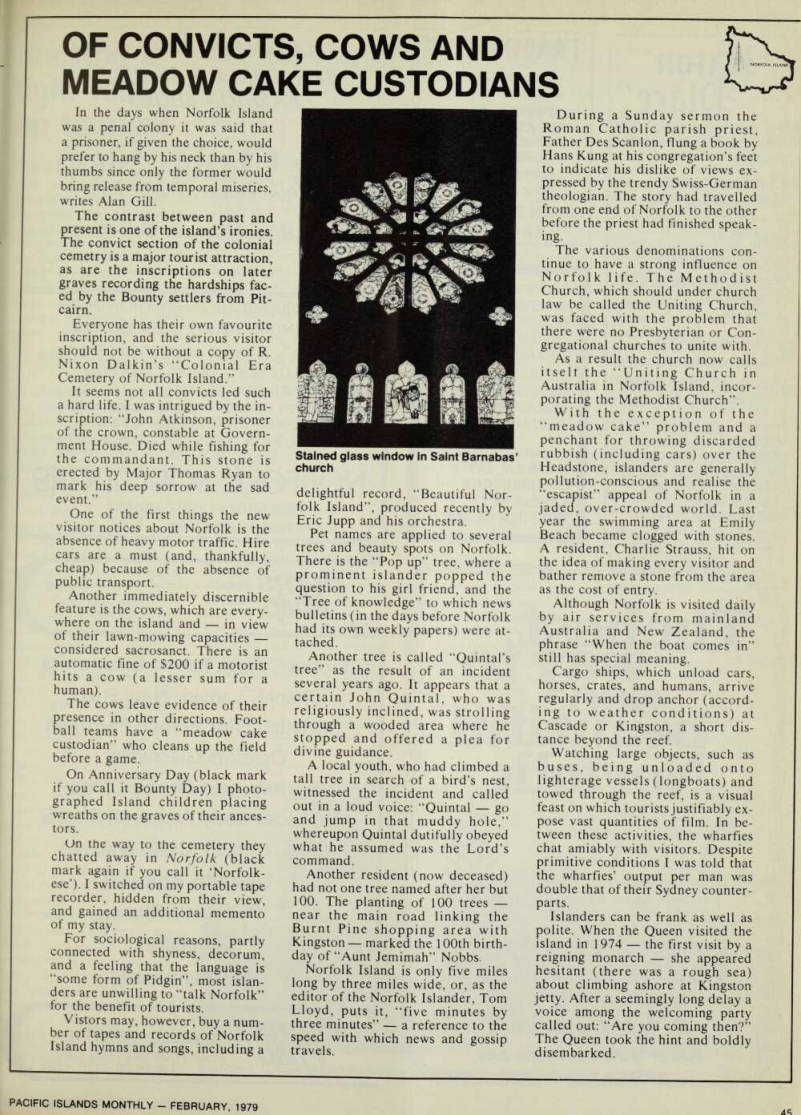
Stained glass window in Saint Barnabas’ church