Looking
p. 44 · Read in the full issue
Back In
Pride
Australia is spending $1.25
nillion over five years on res oration and preservation of listoric buildings in the King ton area of Norfolk Island.
Kingston is unique as a Georgian military establish nent in an Arcadian setting,
mhindered by later develop
nent. And Norfolk’s people
dm to keep it that way. Con tois on building on the green,
oiling hills overlooking King
;ton are designed to keep the vhole area free of intrusions. :t’s unfortunate that one or two :yesores were built before the
xmtrols operated, but public
ippreciation of Kingston’s irchitectural heritage is now growing to the extent that pub-
lie opinion may eventually
force major modifications to these buildings, if not their demolition. Appreciation of
Norfolk’s heritage is only fairly
recent. For many years islanders tended to regard the convict buildings as represent ing a shameful aspect of the island’s past. They were allowed to fall into ruin, or demolished to use their stone elsewhere.
The Australian Government scheme, which is now almost complete, has resulted in the
restoration of the public build ings and cottages in Quality Row. Most spectacular has been the restoration of the old military barracks on the Rooty Hill Road comer which will be finished in the next two or three months. Stone cottages
farther along Quality Row
have also been restored. All interiors are being finished in true Georgian colours greys and pinks. The Sydney firm of restoration architects directing the work, Philip Cox and Part ners, are furnishing some of the
buildings with original period
furniture. It is planned to make this area a living museum. The buildings are being lived in and used. One of the recently restored and furnished, houses is occupied by a government medical officer and his fam
ily.
Administrator D. V.
O’Leary, who takes a keen interest in the architectural res toration, hopes he can keep together the team of 22 artisans plus sub-contractors who have been doing the work. ‘lf we are not restoring we should be
maintaining,’ he said. There is work to be done almost
indefinitely.’
Something new is always
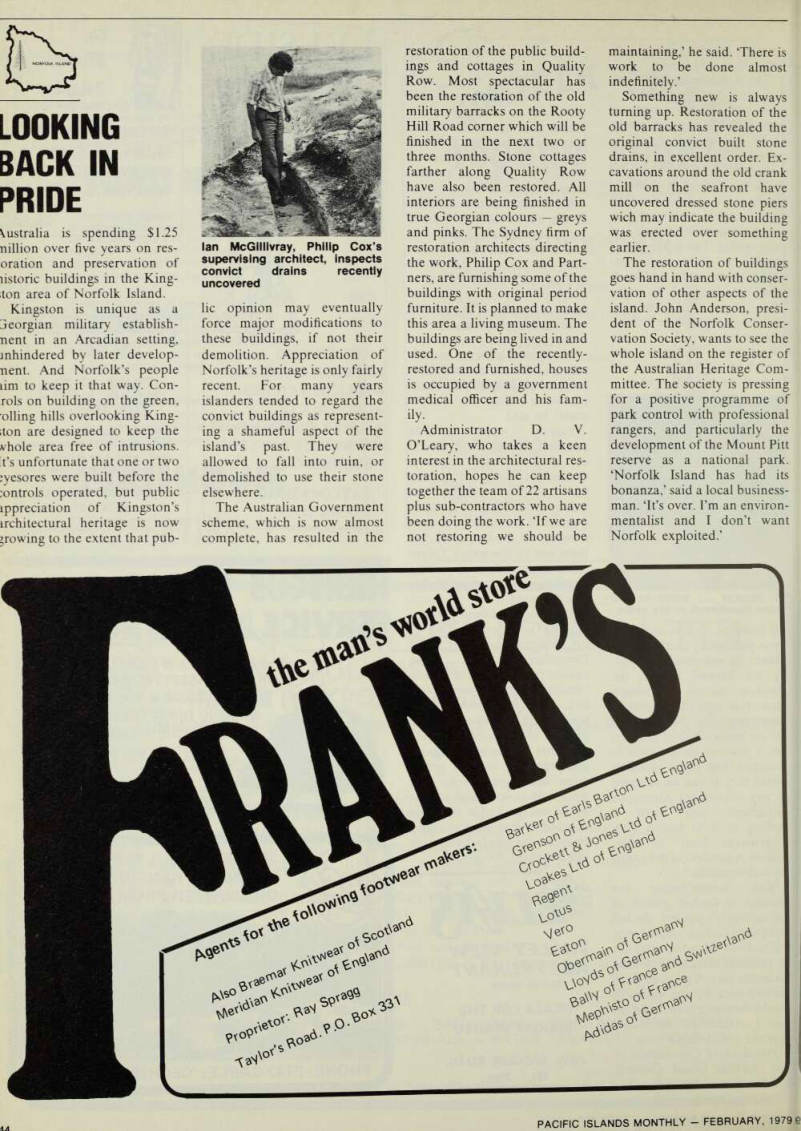
turning up. Restoration of the old barracks has revealed the original convict built stone drains, in excellent order. Ex cavations around the old crank mill on the seafront have uncovered dressed stone piers wich may indicate the building was erected over something earlier.
The restoration of buildings goes hand in hand with conser vation of other aspects of the island. John Anderson, presi dent of the Norfolk Conser vation Society, wants to see the whole island on the register of the Australian Heritage Com mittee. The society is pressing for a positive programme of
park control with professional
rangers, and particularly the development of the Mount Pitt reserve as a national park. ‘Norfolk Island has had its bonanza,’ said a local business man. ‘lt’s over. I’m an environ mentalist and I don’t want
Norfolk exploited.’
lan McGilllvray, Philip Cox’s supervising architect, inspects convict drains recently uncovered