Political
pp. 26-29 · Read in the full issue
Currents
Go-It-Alone
Loyalties?
Cricket, or a rather peculiar version of the sport, is played by the Loyalty Islanders, both at home and in Noumea, writes Andre Chaville from the New Caledonian capital. The basic elements of the game remain, although many of the finer rules have been forgotten.
While it has traditionally been a game played by women, the Loyalty Islanders are eager to learn the rules once again, and men’s teams are now in train
ing.
The popularity of cricket in the Loyalties, which occupy 2000 of New Caledonia’s 19 000 sq km of land, arises from history. These islands, which lie almost halfway be tween the mainland and the New Hebrides, were almost a
British possession, having their
first contact with Europeans
through the London mis sionaries who influenced their language and culture, con tributing to the fact that today
they have many specific
:haracteristics which make them quite different from the *est of this French territory.
As distinct from the inhabi tants of the mainland, their iialect includes many words of English, generally used to de ;cribe articles of clothing or
mimals introduced by the
Europeans: ‘colly’ is a dog,
‘pussie’ is a cat, while ‘boots’ lescribes footwear in general. \ hearty clout on the nose is lescribed as a ‘sikisse’, derived rom the word ‘six’, hitting a Ticket ball over the boundary, fhe people of the main island )f Lifou count in English.
There is no racial or national raternity between the inhabi ants of the Loyalty Islands and hose of the mainland. The
slands were visited regularly
>y travelling Polynesians, and
he inter-marriage has pro
luced a people who are >hysically different from those T Houailou or Canala. As in
most colonies created in the eighteenth and nineteenth cen turies, the indigenous people were encompassed by the boundaries created by the
European powers.
Recent statistics concerning the population of New Caledonia have shown that Europeans now represent 37%
of the population, compared
with 48% a few years ago. If this is not evident to the tourist visiting Noumea, it should be remembered that most Melanesians live in the rural areas, and nearly 25 % of them in the Loyalty Islands.
While the European settlers have taken most of the west coast and part of the east coast of the mainland, there has been no penetration into the islands.
In Lifou, Ouvea and Mare, Melanesian custom has been respected and land belongs to the clans. Economically, the Loyalty Islands offer little interest to France. Copra pro duction has diminished stead ily and there is no nickel in the coral atolls.
Politically, the islands have voted mainly to the Left. For many years they were the stronghold of the Union Caledonienne, but more re cently they have been the ori
gin of the pro-independence
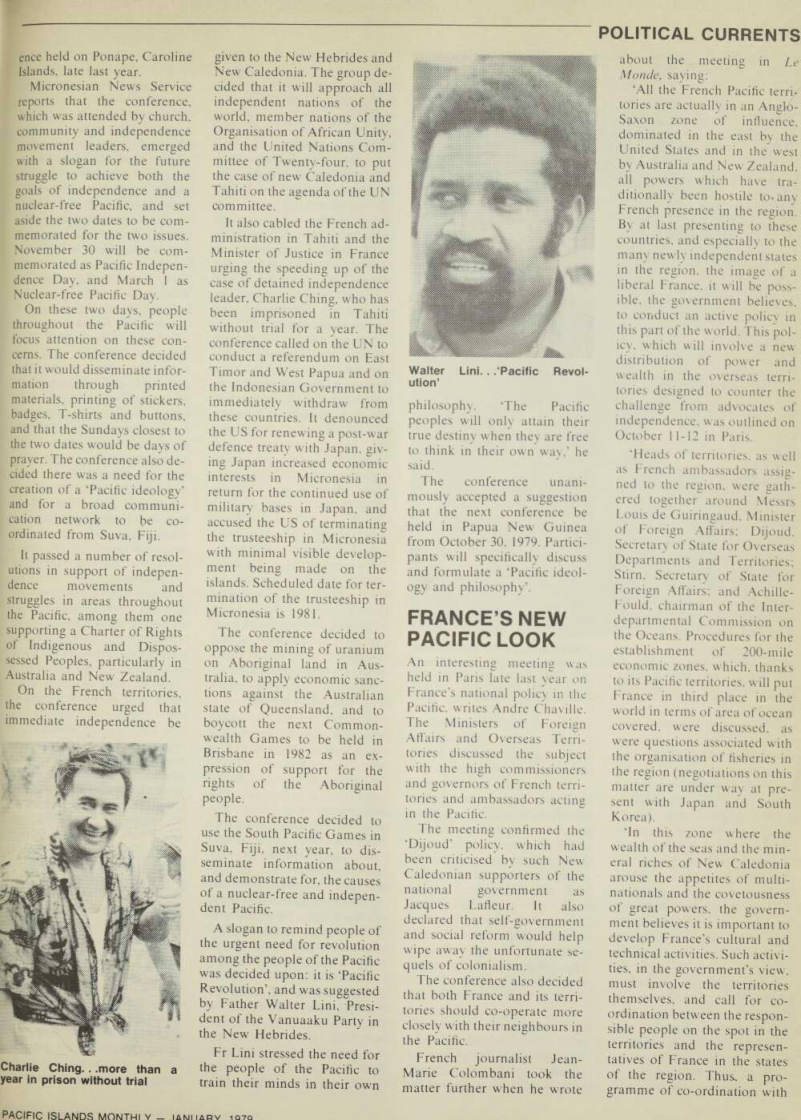
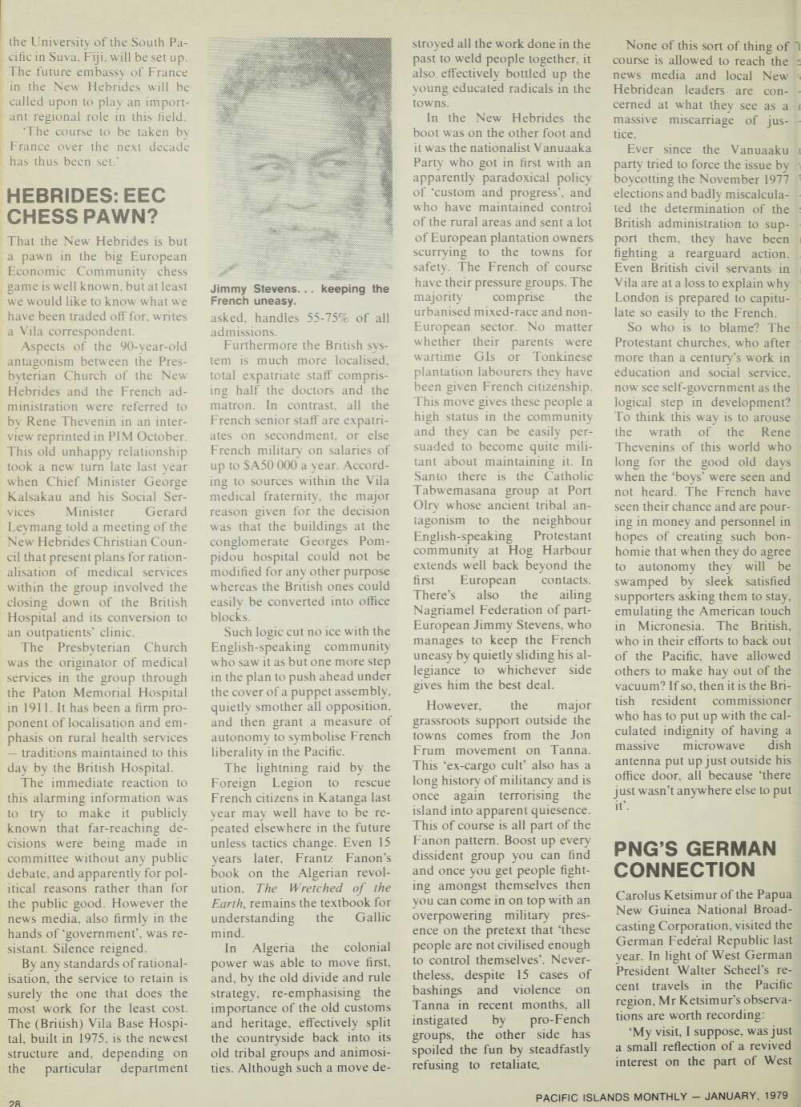
movement. Territorial As sembly member Nidoish Nais seline is chief of the island of Mare, while his colleague Yann Celene Uregei was born on Tiga, a small island between Lifou and Mare. This does not mean that the Loyalty Islands are totally in favour of independence. Robert Pauta, mayor of Lifou, is a staunch supporter of the present ma jority. But Mare, the second island, has always been the trickiest visit for the high com missioner during his tours of
inspection.
With these elements present, it is not unreasonable to try to forecast the future develop ments in New Caledonia.
Among the numerous pos sibilities, a separation of the mainland from the Loyalty Islands is not impossible.
Banabans To
Battle On
The Banaban people of Ocean Island, now living in exile on Rabi Island, Fiji, are to take their campaign to regain their homeland to Australia and New Zealand.
A spokesman for the Banaban people, after they had received yet another rebuff in November from Britain, said they would now turn to Aus tralia and New Zealand, one reason being that the farmers of both those countries had benefited by cheap fertiliser from Ocean Island at the expense of unfair royalties to the Banabans.
Australia and New Zealand have been involved in the Bri tish Phosphate Commission on Ocean Island since 1920 when it bought out the British Phos
phate Company.
The Banabans, represented
by their entire council of leaders from Rabi Island, attended a London conference between Britain and the Gil berts to thrash out indepen dence details.
When Britain’s delegation leader Lord Goronwy-Roberts announced on November 28 that Ocean Island would be in cluded within the new Gilber tese state, the reaction by Banabans and supporters in the British Parliament alike was one of anger.
The Banaban delegation was assisted by six trustees of the Justice for the Banabans Cam paign, drawn from the Con servative, Labour, Liberal and Scottish Nationalist Parties. Sir Bernard Braine, a Conserva tive member of the House of Commons, was particularly bitter: The government’s de cision will be seen by all people who have moral sense as the ultimate injury to the Banabans, a people who have suffered much at the hands of successive British govern ments. It will lead to bitterness and tension within the new Gilbertese state...’
Said a dejected Tom Teai, secretary of the Rabi Council of Leaders: ‘The Banabans felt that the British delegation had no clear grasp of the Banabans’
positon.’ He said anything
apart from the separation of Banaba from the Gilberts would be regarded as ‘death itself. The British decision, he said, would never be accepted. ‘We have now withdrawn from the conference and we are all depressed. But it’s not the end.
Our last chance lies in the UK
parliament.’
Sir Bernard said: ‘The Banabans are not prepared to release the British Government from its solemn and binding undertakings of 1947 in which the Banabans’ rights to their ancestral homeland were guaranteed in perpetuity. ..’
Prayer And
Revolution
November 30 and March 1 will be specially celebrated dates by persons concerned for a nuclear-free and independent Pacific, according to a press re lease from a week-long con ference on Pacific independ
Yann Celene Uregei (above) and Chief Nidoish Naisseline ... pro-independence leaders.
ence held on Ponape, Caroline Islands, late last year.
Micronesian News Service reports that the conference, which was attended by church,
community and independence
movement leaders, emerged with a slogan for the future struggle to achieve both the goals of independence and a nuclear-free Pacific, and set aside the two dates to be com memorated for the two issues.
November 30 will be com memorated as Pacific Indepen dence Day, and March 1 as Nuclear-free Pacific Day.
On these two days, people throughout the Pacific will focus attention on these con cerns. The conference decided that it would disseminate infor
mation through printed
materials, printing of stickers, badges, T-shirts and buttons, and that the Sundays closest to the two dates would be days of prayer. The conference also de cided there was a need for the creation of a ‘Pacific ideology’ and for a broad communi cation network to be co ordinated from Suva, Fiji.
It passed a number of resol utions in support of indepen dence movements and
struggles in areas throughout
the Pacific, among them one supporting a Charter of Rights
of Indigenous and Dispos
sessed Peoples, particularly in
Australia and New Zealand.
On the French territories, the conference urged that immediate independence be
given to the New Hebrides and New Caledonia. The group de cided that it will approach all independent nations of the world, member nations of the
Organisation of African Unity,
and the United Nations Com mittee of Twenty-four, to put the case of new Caledonia and Tahiti on the agenda of the UN committee.
It also cabled the French ad ministration in Tahiti and the Minister of Justice in France urging the speeding up of the case of detained independence leader, Charlie Ching, who has been imprisoned in Tahiti without trial for a year. The conference called on the UN to conduct a referendum on East Timor and West Papua and on the Indonesian Government to immediately withdraw from these countries. It denounced the US for renewing a post-war defence treaty with Japan, giv ing Japan increased economic interests in Micronesia in return for the continued use of military bases in Japan, and accused the US of terminating the trusteeship in Micronesia with minimal visible develop ment being made on the islands. Scheduled date for ter mination of the trusteeship in Micronesia is 1981.
The conference decided to oppose the mining of uranium on Aboriginal land in Aus tralia, to apply economic sanc tions against the Australian state of Queensland, and to boycott the next Common wealth Games to be held in Brisbane in 1982 as an ex pression of support for the
rights of the Aboriginal
people.
The conference decided to use the South Pacific Games in Suva, Fiji, next year, to dis seminate information about, and demonstrate for, the causes of a nuclear-free and indepen dent Pacific.
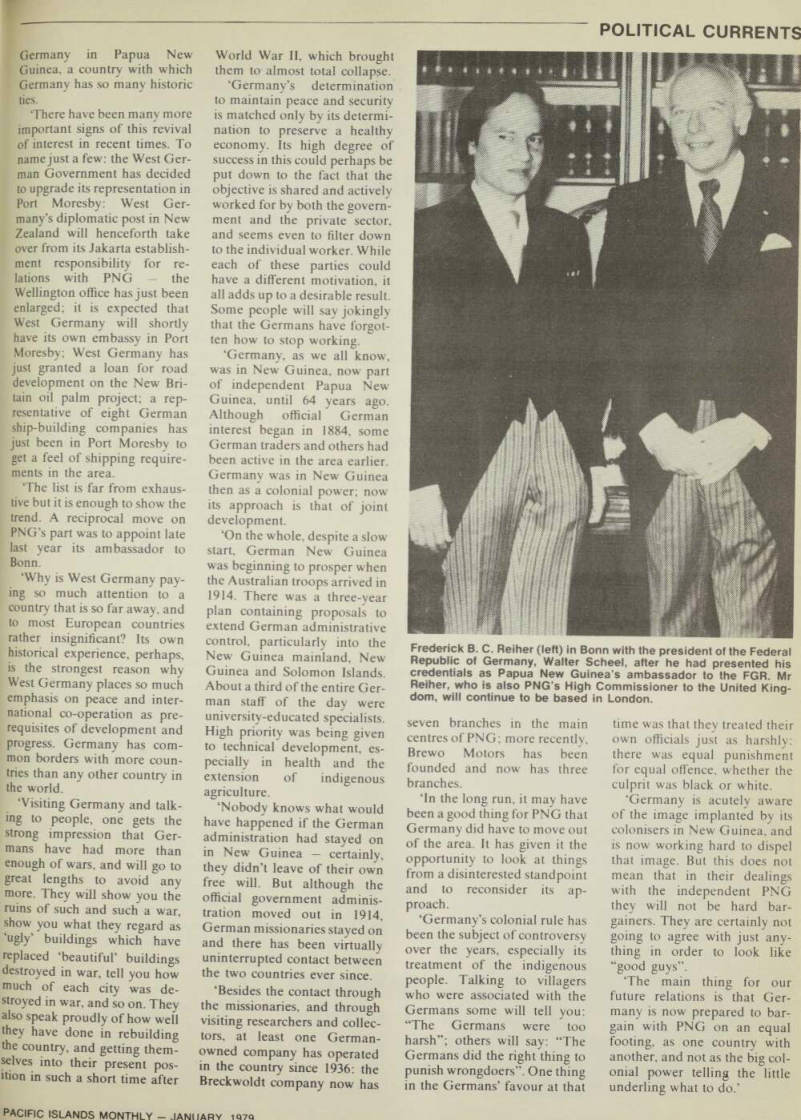
A slogan to remind people of the urgent need for revolution among the people of the Pacific was decided upon: it is ‘Pacific Revolution’, and was suggested by Father Walter Lini, Presi dent of the Vanuaaku Party in the New Hebrides.
Fr Lini stressed the need for the people of the Pacific to train their minds in their own
philosophy. The Pacific peoples will only attain their true destiny when they are free to think in their own way,’ he said.
The conference unani
mously accepted a suggestion
that the next conference be held in Papua New Guinea from October 30, 1979. Partici pants will specifically discuss and formulate a ‘Pacific ideol ogy and philosophy’.
France’S New
Pacific Look
An interesting meeting was
held in Paris late last year on France’s national policy in the Pacific, writes Andre Chaville.
The Ministers of Foreign Affairs and Overseas Terri tories discussed the subject with the high commissioners and governors of French terri tories and ambassadors acting in the Pacific.
The meeting confirmed the
‘Dijoud’ policy, which had
been criticised by such New Caledonian supporters of the national government as Jacques Lafleur. It also declared that self-government and social reform would help wipe away the unfortunate se quels of colonialism.
The conference also decided that both France and its terri tories should co-operate more closely with their neighbours in the Pacific.
French journalist Jean- Marie Colombani took the matter further when he wrote
about the meeting in Le Monde , saying: ‘All the French Pacific terri tories are actually in an Anglo- Saxon zone of influence, dominated in the east by the United States and in the west by Australia and New Zealand, all powers which have tra ditionally been hostile to. any French presence in the region.
By at last presenting to these countries, and especially to the
many newly independent states
in the region, the image of a liberal France, it will be poss ible. the government believes, to conduct an active policy in this part of the world. This pol icy, which will involve a new distribution of power and wealth in the overseas terri tories designed to counter the challenge from advocates of independence, was outlined on October 11-12 in Paris. ‘Heads of territories, as well as French ambassadors assig ned to the region, were gath ered together around Messrs Louis de Guiringaud. Minister
of Foreign Affairs; Dijoud.
Secretary of State for Overseas Departments and Territories; Stirn. Secretary of State for Foreign Affairs; and Achille- Fould. chairman of the Inter departmental Commission on the Oceans. Procedures for the establishment of 200-mile economic zones, which, thanks to its Pacific territories, will put France in third place in the world in terms of area of ocean covered, were discussed, as were questions associated with the organisation of fisheries in the region (negotiations on this matter are under way at pre sent with Japan and South Korea). ‘ln this zone where the wealth of the seas and the min eral riches of New Caledonia arouse the appetites of multi nationals and the covetousness of great powers, the govern ment believes it is important to develop France’s cultural and technical activities. Such activi ties, in the government’s view, must involve the territories themselves, and call for co ordination between the respon sible people on the spot in the territories and the represen tatives of France in the states of the region. Thus, a pro gramme of co-ordination with
Charlie Ching...more than a year in prison without trial
Walter Lini. . .‘Pacific Revol ution’
the University of the South Pa cific in Suva. Fiji, will be set up.
The future embassy of France in the New Hebrides will be called upon to play an import ant regional role in this field.
'The course to be taken by France over the next decade has thus been set.’
Hebrides: Eec
Chess Pawn?
That the New Hebrides is but a pawn in the big European Economic Community chess game is well known, but at least we would like to know what we have been traded off for, writes a Vila correspondent.
Aspects of the 90-year-old antagonism between the Pres byterian Church of the New Hebrides and the French ad ministration were referred to by Rene Thevenin in an inter view reprinted in PIM October.
This old unhappy relationship
took a new turn late last year when Chief Minister George Kalsakau and his Social Ser vices Minister Gerard Leymang told a meeting of the New Hebrides Christian Coun cil that present plans for ration alisation of medical services within the group involved the closing down of the British Hospital and its conversion to an outpatients’ clinic.
The Presbyterian Church was the originator of medical services in the group through the Paton Memorial Hospital in 1911. It has been a firm pro ponent of localisation and em phasis on rural health services traditions maintained to this
day by the British Hospital.
The immediate reaction to this alarming information was to try to make it publicly known that far-reaching de cisions were being made in committee without any public debate, and apparently for pol itical reasons rather than for the public good. However the news media, also firmly in the hands of ‘government’, was re sistant. Silence reigned.
By any standards of rational isation, the service to retain is surely the one that does the most work for the least cost.
The (British) Vila Base Hospi tal, built in 1975, is the newest structure and, depending on
the particular department
asked, handles 55-75% of all admissions.
Furthermore the British sys tem is much more localised, total expatriate staff compris ing half the doctors and the matron. In contrast, all the French senior staff are expatri ates on secondment, or else French military on salaries of up to SASO 000 a year. Accord ing to sources within the Vila medical fraternity, the major reason given for the decision was that the buildings at the conglomerate Georges Pom pidou hospital could not be modified for any other purpose whereas the British ones could easily be converted into office blocks.
Such logic cut no ice with the
English-speaking community
who saw it as but one more step in the plan to push ahead under the cover of a puppet assembly,
quietly smother all opposition,
and then grant a measure of autonomy to symbolise French liberality in the Pacific.
The lightning raid by the
Foreign Legion to rescue
French citizens in Katanga last year may well have to be re peated elsewhere in the future unless tactics change. Even 15 years later, Frantz Fanon’s book on the Algerian revol ution, The Wretched of the Earth, remains the textbook for understanding the Gallic mind.
In Algeria the colonial power was able to move first, and, by the old divide and rule strategy, re-emphasising the importance of the old customs
and heritage, effectively split
the countryside back into its old tribal groups and animosi ties. Although such a move de
stroyed all the work done in the past to weld people together, it also effectively bottled up the young educated radicals in the towns.
In the New Hebrides the boot was on the other foot and it was the nationalist Vanuaaka Party who got in first with an apparently paradoxical policy of ‘custom and progress’, and who have maintained control of the rural areas and sent a lot
of European plantation owners
scurrying to the towns for safety. The French of course have their pressure groups. The majority comprise the urbanised mixed-race and non- European sector. No matter whether their parents were wartime Gls or Tonkinese
plantation labourers they have
been given French citizenship.
This move gives these people a high status in the community and they can be easily per suaded to become quite mili tant about maintaining it. In Santo there is the Catholic Tabwemasana group at Port Olry whose ancient tribal an
tagonism to the neighbour
English-speaking Protestant
community at Hog Harbour
extends well back beyond the first European contacts.
There’s also the ailing Nagriamel Federation of part-
European Jimmy Stevens, who
manages to keep the French
uneasy by quietly sliding his al
legiance to whichever side gives him the best deal.
However, the major grassroots support outside the towns comes from the Jon Frum movement on Tanna.
This ‘ex-cargo cult’ also has a long history of militancy and is
once again terrorising the
island into apparent quiesence.
This of course is all part of the Fanon pattern. Boost up every dissident group you can find and once you get people fight ing amongst themselves then you can come in on top with an overpowering military pres ence on the pretext that ‘these people are not civilised enough to control themselves’. Never theless, despite 15 cases of bashings and violence on Tanna in recent months, all
instigated by pro-Fench
groups, the other side has spoiled the fun by steadfastly refusing to retaliate.
None of this sort of thing of course is allowed to reach the news media and local New Hebridean leaders are con cerned at what they see as a massive miscarriage of jus tice.
Ever since the Vanuaaku party tried to force the issue by boycotting the November 1977 elections and badly miscalcula ted the determination of the British administration to sup port them, they have been fighting a rearguard action.
Even British civil servants in Vila are at a loss to explain why London is prepared to capitu late so easily to the French.
So who is to blame? The Protestant churches, who after more than a century’s work in education and social service, now see self-government as the
logical step in development?
To think this way is to arouse the wrath of the Rene Thevenins of this world who
long for the good old days
when the ‘boys’ were seen and not heard. The French have seen their chance and are pour ing in money and personnel in hopes of creating such bon homie that when they do agree to autonomy they will be swamped by sleek satisfied supporters asking them to stay, emulating the American touch in Micronesia. The British, who in their efforts to back out of the Pacific, have allowed others to make hay out of the vacuum? If so, then it is the Bri tish resident commissioner who has to put up with the cal culated indignity of having a massive microwave dish antenna put up just outside his office door, all because ‘there just wasn’t anywhere else to put it’.
Png’S German
Connection
Carolus Ketsimur of the Papua New Guinea National Broad
casting Corporation, visited the
German Federal Republic last year. In light of West German President Walter Scheel’s re cent travels in the Pacific region. Mr Ketsimur’s observa tions are worth recording: ‘My visit, I suppose, was just a small reflection of a revived interest on the part of West
Jimmy Stevens. . . keeping the French uneasy.
Germany in Papua New Guinea, a country with which Germany has so many historic ties. ‘There have been many more important signs of this revival of interest in recent times. To name just a few: the West Ger man Government has decided to upgrade its representation in Port Moresby; West Ger many’s diplomatic post in New Zealand will henceforth take over from its Jakarta establish ment responsibility for re lations with PNG the Wellington office has just been enlarged; it is expected that
West Germany will shortly
have its own embassy in Port
Moresby; West Germany has
just granted a loan for road development on the New Bri tain oil palm project; a rep resentative of eight German ship-building companies has just been in Port Moresby to get a feel of shipping require ments in the area. ‘The list is far from exhaus tive but it is enough to show the trend. A reciprocal move on PNG’s part was to appoint late last year its ambassador to Bonn. ‘Why is West Germany pay ing so much attention to a country that is so far away, and to most European countries rather insignificant? Its own
historical experience, perhaps,
is the strongest reason why West Germany places so much emphasis on peace and inter national co-operation as pre
requisites of development and
progress. Germany has com mon borders with more coun tries than any other country in the world.
‘Visiting Germany and talk
ing to people, one gets the strong impression that Ger mans have had more than enough of wars, and will go to great lengths to avoid any more. They will show you the ruins of such and such a war, show you what they regard as
‘ugly’ buildings which have
replaced ‘beautiful’ buildings destroyed in war, tell you how much of each city was de stroyed in war, and so on. They also speak proudly of how well they have done in rebuilding the country, and getting them selves into their present pos ition in such a short time after
World War 11, which brought them to almost total collapse.
‘Germany’s determination
to maintain peace and security is matched only by its determi nation to preserve a healthy economy. Its high degree of success in this could perhaps be put down to the fact that the objective is shared and actively worked for by both the govern ment and the private sector, and seems even to filter down to the individual worker. While each of these parties could have a different motivation, it all adds up to a desirable result.
Some people will say jokingly that the Germans have forgot ten how to stop working. ‘Germany, as we all know, was in New Guinea, now part
of independent Papua New
Guinea, until 64 years ago.
Although official German interest began in 1884. some German traders and others had been active in the area earlier.
Germany was in New Guinea then as a colonial power; now its approach is that of joint
development.
‘On the whole, despite a slow start, German New Guinea was beginning to prosper when the Australian troops arrived in 1914. There was a three-year
plan containing proposals to
extend German administrative control, particularly into the New Guinea mainland. New Guinea and Solomon Islands.
About a third of the entire Ger man staff of the day were
university-educated specialists.
High priority was being given
to technical development, es pecially in health and the extension of indigenous
agriculture.
‘Nobody knows what would have happened if the German administration had stayed on in New Guinea certainly, they didn’t leave of their own free will. But although the official government adminis tration moved out in 1914, German missionaries stayed on and there has been virtually uninterrupted contact between the two countries ever since. ‘Besides the contact through the missionaries, and through visiting researchers and collec tors, at least one German owned company has operated in the country since 1936: the Breckwoldt company now has
seven branches in the main centres of PNG; more recently, Brewo Motors has been founded and now has three branches. ‘ln the long run, it may have been a good thing for PNG that Germany did have to move out of the area. It has given it the opportunity to look at things from a disinterested standpoint and to reconsider its ap-
proach.
‘Germany’s colonial rule has been the subject of controversy over the years, especially its treatment of the indigenous
people. Talking to villagers
who were associated with the Germans some will tell you: “The Germans were too harsh”; others will say: “The Germans did the right thing to
punish wrongdoers”. One thing
in the Germans’ favour at that
time was that they treated their own officials just as harshly:
there was equal punishment
for equal offence, whether the culprit was black or white.
‘Germany is acutely aware
of the image implanted by its
colonisers in New Guinea, and is now working hard to dispel that image. But this does not mean that in their dealings with the independent PNG they will not be hard bar
gainers. They are certainly not
going to agree with just any thing in order to look like
“good guys”,
‘The main thing for our future relations is that Ger many is now prepared to bar gain with PNG on an equal footing, as one country with another, and not as the big col onial power telling the little underling what to do.’
Frederick B. C. Reiher (left) in Bonn with the president of the Federal Republic of Germany, Walter Scheel, after he had presented his credentials as Papua New Guinea’s ambassador to the FGR. Mr Reiher, who is also PNG’s High Commissioner to the United King dom, will continue to be based in London.