The Englishman
pp. 31-32 · Read in the full issue
Through Fijian
Eyes - 1940
There is no lack - some might say there is a glut - of records of white men’s impressions of Pacific Island peoples: their appearance, customs, beliefs, and so on. But how rarely has the point of vantage been turned round to provide an Islander’s ideas and impressions concerning Europeans? The document below, consisting of large extracts from a speech delivered at the Defence Club, Suva, in 1940, represents one such case. That the observations are acute, laced with humour and a gentle irony, is guaranteed by the fact that the speaker was no less a figure than the late Ratu (later Sir) Lala Sukuna, known to many in his lifetime and since as ‘the noblest Fijian of them all’. PIM is indebted to Ken James of Victoria, Australia, who forwarded us the copy o/The Mis sionary Review of April 5, 1940, in which the text of this minor classic among club speeches first appeared.
Some four or five years ago our Honourable Secretary was entertaining me in ’his usual lavish way when something racially provocative on his part drew from me the threat that I would some day tell him what
Fijians thought of Europeans.
The thrust missed its mark.
Instead of a gibe, his sense of humour was aroused and I was his objective. Ever since then he has been trying to persuade me to give the Club a talk on this delicate subject which, according to its treatment, may end in goodwill or assaults, in better understanding or the Su preme Court.
After undertaking, last February, to give this talk I pondered for some time as to
how the subject could best be dealt with. Then in the house at which I happened to be stay ing, my hostess gave me a short book to read. Its subject was the Frenchman’s view of the Englishman. It was a very valu able guide and I must here ac knowledge my indebtedness not only to the author but also to my hostess who must have divined what I was in for.
We call Europeans Kai Vavalagi, as if they all come from the same country, which of course they do not. Our fathers are not to blame for this confusion; it was the Tongans that started the idea of a country of common origin be cause all white men appeared to them exactly alike.
Europeans are supposed to
have the same idea about Chinamen. Here in Fiji we
have Europeans from England
direct, from England through
Australia, New Zealand and America, besides those that come from Germany and France.
To whatever place they be long they have these qualities in common. They are rich and excellent subjects for kerekere
(begging), if only they had
more understanding. They
never soil their hands with manual labour, yet they are continuously urging us to do so from the Governor and the Director of Education down wards. Apropos, let me tell you a story. You all know your Bible and remember the pass age beginning ‘Render unto Caesar the things that are of Caesar’. Now ‘Caesar’ was the title of the great kings of Rome, just as ‘Vunivalu' is the title of the great kings of Bau. The kings of Rome were the conquerors of the ancient world, much more powerful than Mussolini, the air victor of Abyssinia, about whom we have lately been hearing so much on the Suva broadcasts.
One of these great kings is reported to have expressed the view that the English were bad and stupid labour. It may be that their disinclination for real work has been handed down through the generations.
To continue. They love money and save it but not to the same extent as the Jews who come from Palestine, a country which until the Great War some of us thought was away up in heaven. The Jews gave the Europeans the Bible
to keep them thinking. They
then began amassing wealth
leaving the Europeans to pon der over the passage, ‘it is easier for a camel to go through the eye of a needle than for a rich man to enter into the Kingdom of God’. It is now our turn to puzzle out that same passage.
Europeans are clever with their hands and have good brains. They can do most things. Do not be surprised if some day you are told they have conquered death. They belong, of course, to a different world from our own. Neverthe
less they do some incredibly stupid things at times, even the best of them.
Our Governors and Colonial Secretaries, indeed nearly all at the head of the government, come from England, the land of our Lord and King. It is only right Englishmen should rule over us, because it was to their Great Queen our Chiefs ceded these Islands. In appearance and manner they are cold and aloof: but our respect is due to them as they come direct from the country our fathers regarded as the ‘Home of Men’. An Englishman is easy to detect. His colouring is fresh and his clothes are always neat.
He is never flurried, speaking quietly in a low guttural drawl, sometimes exaggerated. He
picks up our language quickly
enough; though he frequently
speaks it as if he owned it. He gets to like us in the peculiar European way. For, however much you may admire, say his shirt, he never thinks of giving it to you; and though he knows perfectly well that 10 shillings would be a very useful gift, a sum that means nothing to him,
he rarely gives anything away,
and curiously enough dislikes
gifts.
You will frequently notice
Englishmen wearing coloured
ties of the same device. This in dicates that they come from the same great school, having been trained in the same way and sharing the same traditions. It is alleged they look down on those that custom forbids from wearing such ties and it is claimed that in the govern ment, since reorganisation, unless you are entitled to pos sess one of these tokens of su periority, it is impossible to rise to the higher posts. For this reason it will be very difficult for some of the senior men in the Service to win promotion.
This should be a warning to those of our youths that are bent on qualifying at schools and universities that are not hoary enough with age and tra ditions to have such symbols.
It is easy to pick out an Aus tralian. He is tall and strong, with a brownish complexion.
His voice is thin, shrill, and toneless, not pleasing to the ear. He does not dress as well as the Englishman. His ties are
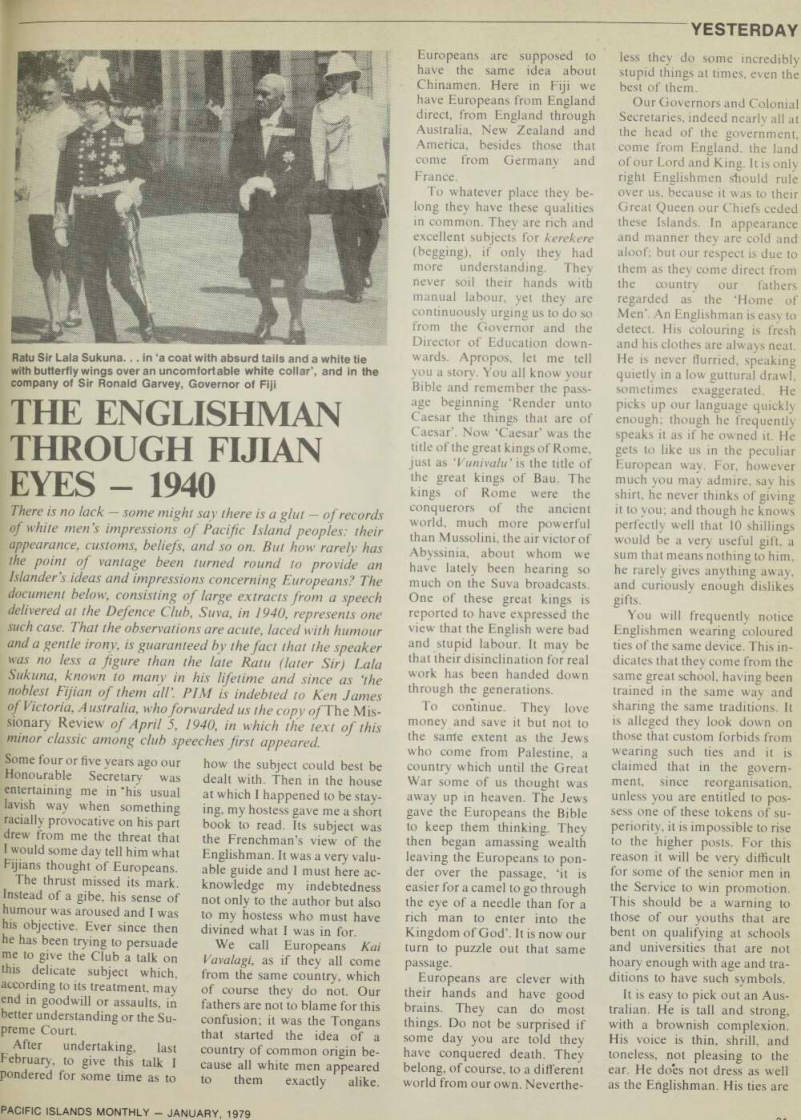
Ratu Sir Lala Sukuna... in ‘a coat with absurd tails and a white tie with butterfly wings over an uncomfortable white collar’, and in the company of Sir Ronald Garvey, Governor of Fiji
not better than ours and no different. He moves about as if he were in a perpetual hurry. He does not mix with us as much
as the Englishman, spending
most of his time seeking money. He has invested more than anybody else in this country. All the large trading companies are Australian, the copra plantations are Australian-owned, so is the big Sugar Company, and last but not least the Tavua Gold Mines
that give employment to nearly
two thousand of our people.
The New Zealander is not quite like the Englishman, is something like the Australian, and though a creature of ‘God’s Own Country’, he shows a tendency to ape the former. He dresses better than his brother from across the Tasman Sea, and speaks more like an Englishman, for whom he would not resent being mistaken. The New Zealander is a great Rugger player he looks on the game as being peculiarly his own. He hates being beaten.
Here the New Zealander lives in a bank counting other people’s money all day. In the Western Pacific he is not considered a model administrator,
being accused of wobbling
from strength to weakness and back from weakness to
strength, missing the mean.
Of Americans we only know of two types, the millionaire and the film actor. The former does nothing but travel round the world in ships, spending
money. Those that we have seen here dress badly but eat and drink well. They expect to be waited on hand and foot and carry young ladies round for the purpose, as some of our High Chiefs do. The film actors we see in our picture theatres, They seem to delight in theft, murder, and love affairs which they want all the world to see and which the rest of the world
keeps secret,
I will proceed to describe some of the curious customs of the Europeans. As we all know, the Governor is our Supreme Chief. None of us would enter his grounds, much less his house, without first receiving a command. We would consider it bad form to place ourselves in a position where, out of courtesy, we would be asked in.
With the Europeans it is dif ferent. The Governor keeps a book in which people who want to go to Government House for tea, drinks, or a meal, write their names. And
curiously enough people do use
the book and what is more re ceive invitations. You will be pleased to know, except for Rokos (Fijian officials in charge of districts Ed, PIM), and some very forward people, no Fijian names appear, Then there is another
peculiar custom, the toying
with tea and cakes between the hours of 4 and 5 pm. If you ever have to go to one of these func tions, remember that you are not going to get a meal. Tea is
served in very small cups.
There is very thin bread and butter on small plates, scones on others, and usually there is some cake. The tea could be taken in one gulp and the whole of the food consumed in a few mouthfuls. But that is not the way things are done. You are expected to talk and sip, smile and nibble. To attend to the business in hand, for which actually you have been invited, is bad form. But, even if you were hungry, you would not have the face to eat your share, because you will soon sense that eating and drinking are not the real objects of the party.
You are there to talk and, in the case of the women, to gossip.
For these reasons our chiefs
prefer cocktail parties.
Now when we go for a meal to a chiefs house, we know that we are going to get ample food and drink. It used to be so in England a century ago when people sat down to dinner at 5 pm and ended at midnight under the table. But this is no longer the custom. I will briefly describe what happens here at Government House when a chief is asked to a big dinner.
First, let me tell you. to dine there you need special clothes, a coat with absurd tails and a white tie with butterfly wings over an uncomfortable looking white collar. Before a chief puts on these clothes he prepares himself by having a square meal, and then to be more flu ent in English, a few drinks.
When he arrives at the door, a young man (called an ‘ADC’) invariably rushes out, shakes hands heartily, and drags him to a chair. Our chief, slow and dignified, is at first puzzled as to the reason for all this bustle.
He soon discovers that other people have to be met, and that he is just a little late and there
fore unpopular, having taken
too long over that last drink at his hotel.
As guests arrive, they are given drinks in rather small tumblers. These drinks are sweet but heady, especially if you have had a whisky or two beforehand. The room fills; everybody is talking. At last the Governor enters but instead of sitting down to receive him, as we would, they just stand and wait while His Excellency goes
round shaking people by the hand, even those, oddly enough, that are staying with him. Dinner begins. Our own meals are silent affairs because, eating only twice a day, we find it necessary to get on with the business in hand. Moreover we do not talk in the presence of our High Chief without his addressing us first. We would thus expect dinners at Govern ment House to be silent func tions with food in abundance.
It is exactly the opposite. There is more drink - and of a more pleasing quality - than food, while the small helpings are never solid enough to satisfy.
As for talking there is a contin ual buzz and you can hardly
hear yourself speak es
pecially was it so in the days when the number of European Members of the Great Council was larger. It is hardly necess ary to add that, unless our chief has taken due precautions, he comes away hungry and muzzy.
I have given you something of the Fijian view of the European. You will have observed that it contains nothing uncharitable, there is no envy and no malice. The view is of course critical but not hostile. Indeed it is to the credit
of the European community
here that they have and hold the goodwill of the Native race.
It is an achievement of which you may justly be proud in these changing times of strikes and riots, of normality and re
organisation, of novelty and
disorganisation. What the future holds for this country none of us can tell. But of the past we can speak with cer tainty. In 1874 our fathers ceded their home to Great Bri tain. After 60 years of British rule, casting our eyes over the world as it is today, we note that there are few places in the Empire where relations be tween governors and governed are better and more har monious than in this Colony.
Your predecessors governors and overseers., merchants and civil servants, planters and traders have laid a solid foundation and on it they have started an edifice whose pillars are the humanities and com mon sense. To you, their suc cessors, Fijians cry ‘Carry on’.
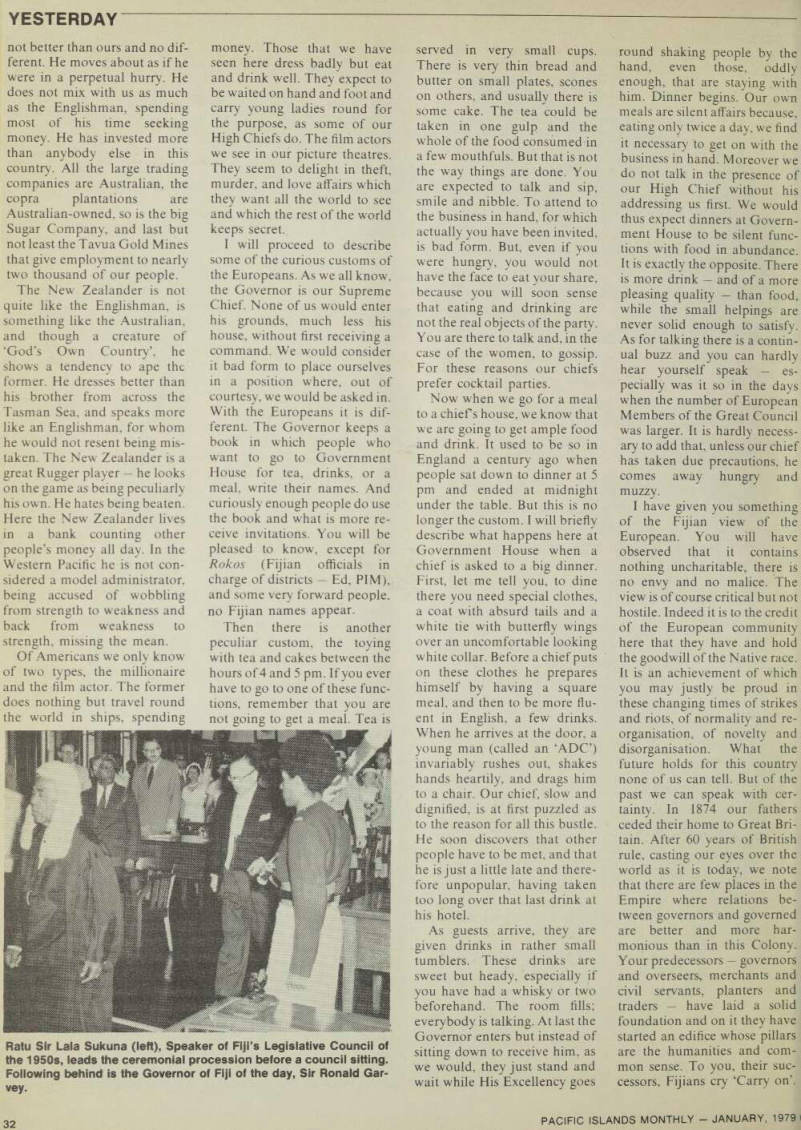
Ratu Sir Lala Sukuna (left), Speaker of Fiji’s Legislative Council of the 1950s, leads the ceremonial procession before a council sitting.
Following behind is the Governor of Fiji of the day, Sir Ronald Gar vey.