of friendship
pp. 23-25 · Read in the full issue
Tropicalities
Three years
A gun is worth a
million dollars
Malcolm S. Forbes is the man who owns Fiji Forbes which is, basically. Laucala Island, 250 kilometres northeast of Suva, Fiji’s capital. When Mr Forbes talks he talks plenty but he doesn’t say much.
Meli Saulekaleka is the man who doesn’t own very much at all. When he talks, he doesn’t talk much but he says plenty.
Malcolm S. Forbes bought Laucala for a million dollars from Morris Hedstrom in 1972 at a time when copra prices were depressed - and Laucala is a copra plantation. But copra prices boomed soon afterwards.
And Laucala made a profit. ‘Justified retribution on the seller, ’ said Mr Forbes who feels that Morris Hedstrom thought ‘they had-stuck us’.
Meli Saulekaleka is Tui Laucala which makes him traditional chief of an island which neither he nor his people
own. In fact, it seems from cas ual inquiry, the Tui Laucala is not claiming that his people ever did own Laucala. But the story goes that a gun is worth a million dollars. At least that’s the way it looks. When Laucala was first sold out of Fijian hands, according to the Tui Laucala, it was for a ‘gun’ by the Tui Cakau, paramount chief of the region of Caukadrove and by whose grace the then Tui Laucala and his people occupied Laucala Island.
Malcolm S. Forbes is quick of tongue. Obviously he loves every second of exposure to the press. But to the questions which seem most pertinent like how much have you spent on Laucala, how much does it cost to bring all these journal ists, politicians and friends to see your works on Laucala, are you looking to further invest ment in Fiji? his responses,
while eloquent, beat irritatingly
all around the bush.
Meli Saulekaleka ponders before he articulates. Yes, he and his people are hopeful one day'of regaining the island, per haps even owning it. Yes, in the past ‘when Mr McGowan’ was here - they had tried to raise $5O 000 or so in the hope of buying the island back but they couldn’t get the money. No, there was no complaint about Mr Forbes owning the island he had acquired it in a proper manner. Yes, it would be good if Mr Forbes would consider the possibility of the Laucala people buying even a small
shareholding in Fiji Forbes.
Malcolm S. Forbes was not available for comment on the
TT▼T»▼ T ' r ▼ w ▼
China-Fui
Anniversary
I_.M.„A . A A . . A
Tui’s last observation. In an earlier press conference, Mr Forbes had said that all of his business is held in his ‘own two hands’. Don Garson, the Forbes organisation’s PR man, indicated that he didn’t think this would come into his boss’s sphere of thinking but he
would take the matter up with him.
Meli Saulekaleka, for some reason we couldn’t identify, sat well away from the crowd when they took lunch at Mr Forbes’ ridgetop home. He wandered off toward a stand of coconut palms, sat cross-legged, and ate his meal, back to the house.
From time to time it seemed he was talking with someone, oc casionally there was a gesture ... perhaps to an ancestor who had once stood on the same
spot, placidly contemplating
the peace and beauty of his home, little realising that, not too long hence, ‘peace and
beauty’ would become ‘Wow It’s a million dollar view.’
Throughout the grand touro: Laucala on November IS.wher Prime Minister Ratu Sii Kamisese Mara and felloe ministers viewed improve ments. cut ribbons, and made short speeches, there didn’t seem to be any communication between Malcolm S. Forbes and Meli Saulekaleka. Perhaps there had been before our arrival. Perhaps there was after
we departed.
Laucala today is a tribute to a new broom sweeping clean the ground beneath the palms is cleared, cattle graze, new crops are beginning to show them-
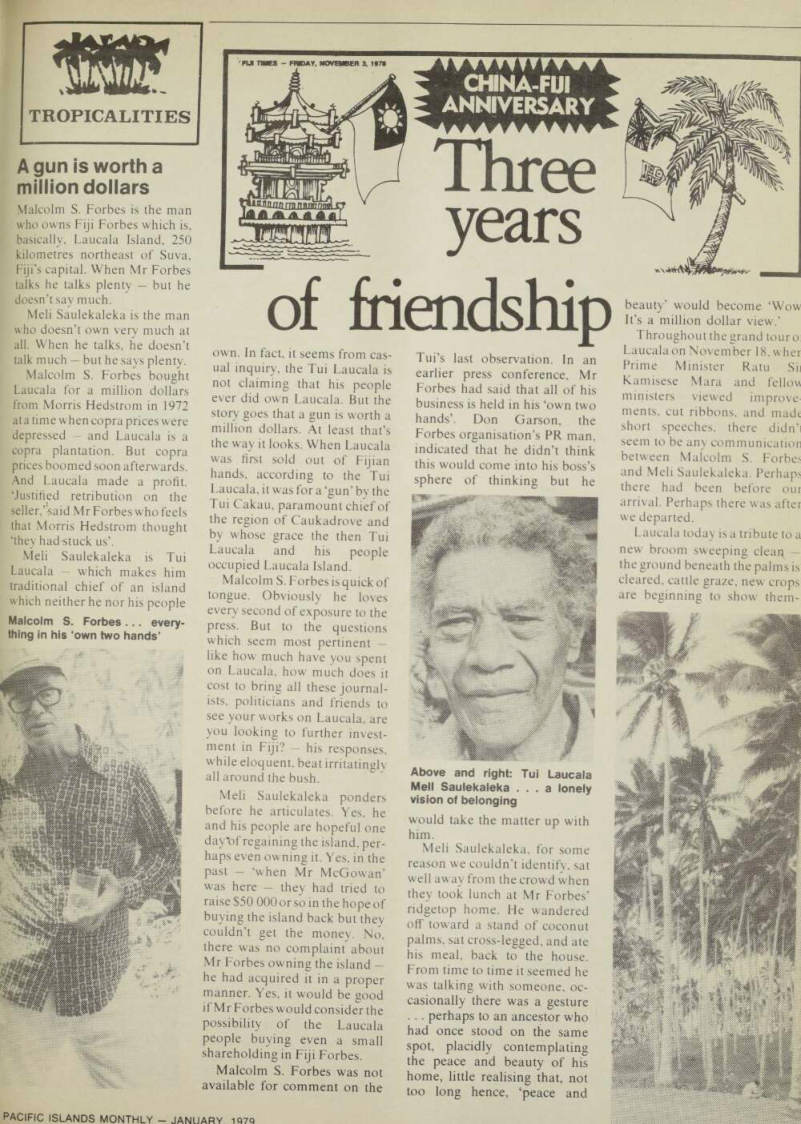
Malcolm S. Forbes ... every thing in his ‘own two hands’
Above and right: Tui Laucala Mell Saulekaleka ... a lonely vision of belonging
selves, in a clearing substantial concrete block homes are being built for the island's growing population (from 200 in 1972 to about 350 now), processing facilities are being updated. It would be satisfying to think that, for once, the Forbes phil osophy could be persuaded to compromise - and the people of Laucala could be given once again a small but solid sense of belonging to their land. - Bob Hawkins.
A Caribou plucked
from wilderness
Great flying skill, stone-age
technology and brute strength
combined to retrieve a crashed Caribou aircraft from the wil derness of the Papua New Guinea highlands last November, writes Jan-Werner
Hente. Nine aircraft from three squadrons, 30 air force and three army personnel, and
dozens of'PNG highlanders
figured in one of the most dif ficult salvage operations in re cent years, .
D Th f salva S e , d airc . raft was a r ustrahan Air Force of No 35 Squadron at T ° w " svllle - Queensland.
"n u uT in
tbe remot e highlands of West Sepik Province on October 23.
Problem s confronting the sal vage team included the remote location of the crash site, Elip tamin village, a few kilometres from Telefomin, the altitude of 1200 m. and a lack of support facilitites.
Salvage operations began on
October 27 and were directed
by Wing-Commander John
Staal, commanding officer of No 35 Squadron.
Airfield guards from Towns ville and Amberley removed the wings and, in the absence of a crane, a gantry was rigged from trees felled around the airstrip. To move the engines, each of which weighs almost a tonne, the help of the Elip tamin villagers was enlisted.
More than 50 of them, tugging on a tow rope and yelling chants, hauled the engines 200 metres across the Eliptamin
airstrip ready for airlifting to
Telefomin.
The ground salvage team stripped the 10 500 kg aircraft of every removable piece of
equipment. They succeeded in
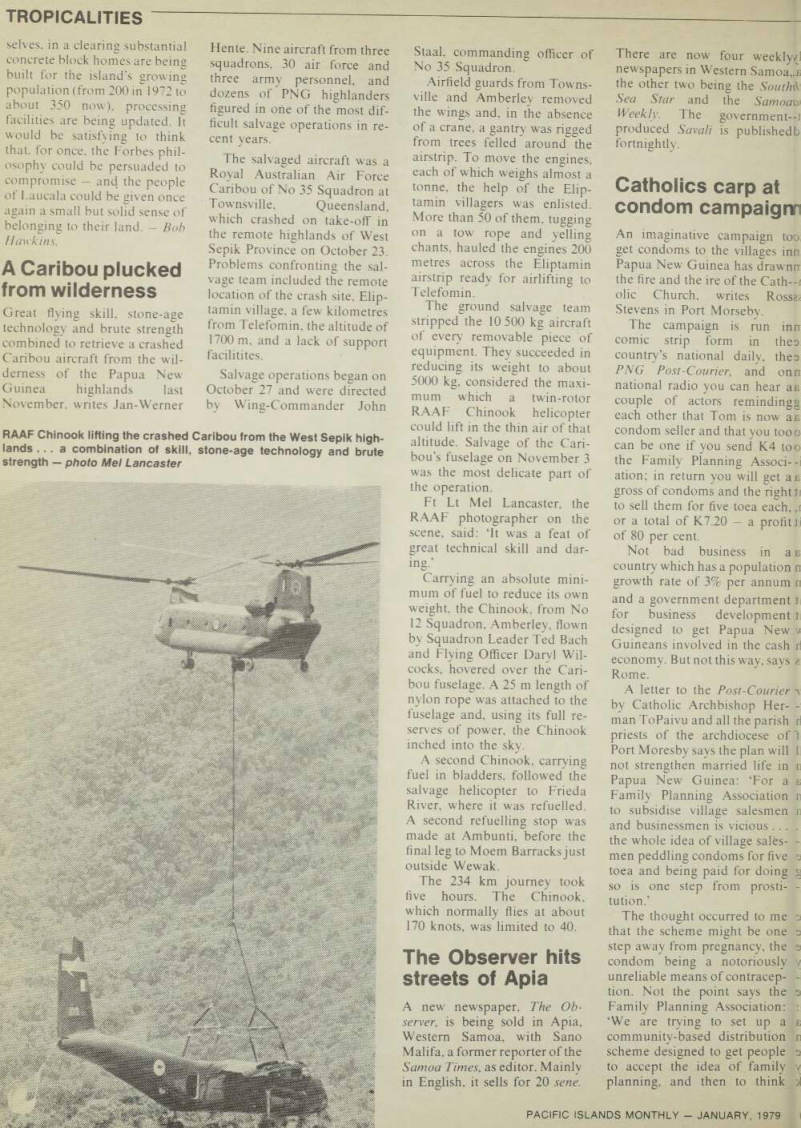
reducing its weight to about 5000 kg, considered the maxi mum which a twin-rotor RAAF Chinook helicopter could lift in the thin air of that altitude. Salvage of the Cari bou’s fuselage on November 3 was the most delicate part of the operation.
Ft Lt Mel Lancaster, the RAAF photographer on the scene, said: ‘lt was a feat of great technical skill and dar
ing.’
Carrying an absolute mini mum of fuel to reduce its own weight, the Chinook, from No
12 Squadron, Amberley, flown
by Squadron Leader Ted Bach and Flying Officer Daryl Wil cocks, hovered over the Cari bou fuselage. A 25 m length of nylon rope was attached to the fuselage and, using its full re serves of power, the Chinook inched into the sky.
A second Chinook, carrying fuel in bladders, followed the
salvage helicopter to Frieda
River, where it was refuelled.
A second refuelling stop was made at Ambunti. before the final leg to Moem Barracks just outside Wewak.
The 234 km journey took five hours. The Chinook, which normally flies at about 170 knots, was limited to 40.
The Observer hits
streets of Apia
A new newspaper. The Ob server, is being sold in Apia, Western Samoa, with Sano Malifa, a former reporter of the Samoa Times, as editor. Mainly in English, it sells for 20 sene.
There are now four weeklyyl newspapers in Western Samoa,.£ the other two being the Souths Sea Star and the Samoan Weekly. The government-J produced Savail is publishedb
fortnightly.
Catholics carp at
condom campaigrrt
An imaginative campaign too;
get condoms to the villages inn Papua New Guinea has drawnn the fire and the ire of the Cath-i olic Church, writes Rossg< Stevens in Port Morseby.
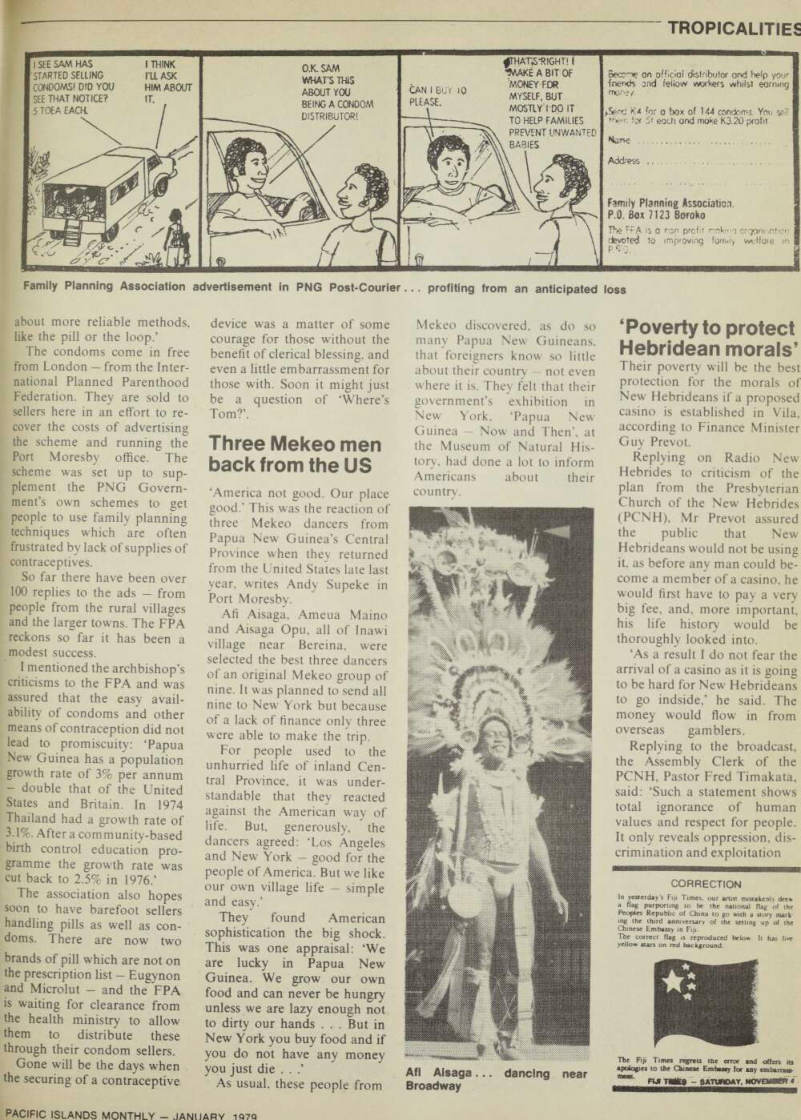
The campaign is run inn comic strip form in thes country’s national daily, thes PNG Post-Courier, and onn national radio you can hear a£
couple of actors remindingg
each other that Tom is now as condom seller and that you tooo can be one if you send K 4 too
the Family Planning Associ--i
ation; in return you will get as gross of condoms and the right Ji to sell them for five toea each, or a total of K 7.20 a profitti of 80 per cent.
Not bad business in a£ country which has a population n growth rate of 3% per annum n and a government department Jj for business development Ji designed to get Papua New v Guineans involved in the cash rl economy. But not this way, says g Rome.
A letter to the Post-Courier -v by Catholic Archbishop Her- man ToPaivu and all the parish rl priests of the archdiocese of 1 Port Moresby says the plan will II not strengthen married life in n Papua New Guinea: ‘For a £
Family Planning Association n
to subsidise village salesmen n and businessmen is vicious ... the whole idea of village sales- men peddling condoms for five 3 toea and being paid for doing § so is one step from prosti- tution.’
The thought occurred to me 3 that the scheme might be one 3 step away from pregnancy, the 3 condom being a notoriously y unreliable means of contracep- tion. Not the point says the 3
Family Planning Association: :
‘We are trying to set up a £ community-based distribution n scheme designed to get people 3 to accept the idea of family y planning, and then to think d
RAAF Chinook lifting the crashed Caribou from the West Sepik high lands ... a combination of skill, stone-age technology and brute strength - photo Mel Lancaster
about more reliable methods, like the pill or the loop.’
The condoms come in free from London from the Inter national Planned Parenthood Federation. They are sold to sellers here in an effort to re cover the costs of advertising the scheme and running the Port Moresby office. The scheme was set up to sup plement the PNG Govern ment’s own schemes to get
people to use family planning
techniques which are often frustrated by lack of supplies of
contraceptives.
So far there have been over 100 replies to the ads from people from the rural villages and the larger towns. The FPA reckons so far it has been a modest success.
I mentioned the archbishop’s criticisms to the FPA and was assured that the easy avail ability of condoms and other means of contraception did not
lead to promiscuity: ‘Papua
New Guinea has a population growth rate of 3% per annum - double that of the United States and Britain. In 1974 Thailand had a growth rate of 3.1%. After a community-based birth control education pro gramme the growth rate was cut back to 2.5% in 1976.’
The association also hopes soon to have barefoot sellers handling pills as well as con doms. There are now two brands of pill which are not on
the prescription list Eugynon
and Microlut - and the FPA is waiting for clearance from the health ministry to allow them to distribute these through their condom sellers.
Gone will be the days when the securing of a contraceptive
device was a matter of some courage for those without the benefit of clerical blessing, and even a little embarrassment for those with. Soon it might just be a question of ‘Where’s Tom?’.
Three Mekeo men
back from the US
‘America not good. Our place good.’ This was the reaction of three Mekeo dancers from Papua New Guinea’s Central Province when they returned from the United States late last year, writes Andy Supeke in
Port Moresby.
Afi Aisaga, Ameua Maino and Aisaga Opu, all of Inawi village near Bereina, were selected the best three dancers of an original Mekeo group of nine. It was planned to send all nine to New York but because of a lack of finance only three were able to make the trip.
For people used to the unhurried life of inland Cen tral Province, it was under standable that they reacted against the American way of life. But, generously, the
dancers agreed: ‘Los Angeles
and New York good for the people of America. But we like our own village life simple
and easy.’
They found American
sophistication the big shock.
This was one appraisal: ‘We are lucky in Papua New Guinea. We grow our own food and can never be hungry unless we are lazy enough not to dirty our hands . . . But in New York you buy food and if you do not have any money you just die . . .’
As usual, these people from
Mekeo discovered, as do so many Papua New Guineans, that foreigners know so little about their country not even where it is. They felt that their government’s exhibition in New York, ‘Papua New Guinea - Now and Then’, at the Museum of Natural His tory, had done a lot to inform Americans about their country.
‘Poverty to protect
Hebridean morals’
Their poverty will be the best protection for the morals of New Hebrideans if a proposed casino is established in Vila, according to Finance Minister
Guy Prevot.
Replying on Radio New Hebrides to criticism of the
plan from the Presbyterian
Church of the New Hebrides (PCNH), Mr Prevot assured the public that New Hebrideans would not be using it, as before any man could be come a member of a casino, he would first have to pay a very big fee, and, more important, his life history would be thoroughly looked into. ‘As a result I do not fear the arrival of a casino as it is going to be hard for New Hebrideans to go indside,’ he said. The money would flow in from
overseas gamblers.
Replying to the broadcast, the Assembly Clerk of the PCNH, Pastor Fred Timakata, said: ‘Such a statement shows total ignorance of human values and respect for people.
It only reveals oppression, dis crimination and exploitation
Family Planning Association advertisement in PNG Post-Courier... profiting from an anticipated loss
Afi Aisaga ... dancing near Broadway