Vatukoula: The
p. 22 · Read in the full issue
Mining
Emperor’S Crown
Is Wobbling
Nobody wants the Emperor gold mine at Vatukoula in the heart °f Fiji s wain island, Viti Leva. Sackings have come thick and fast in the past year. Robert Keith-Reid reports.
November 16. 1978 was ‘the beginning of the end’ of Fiji’s
gold mining town. Vatukoula,
according to Minister of Labour Ratu David Toganivalu. That was the day when convoys of lorries, hired by the government, began fer rying 1300 people out of the town in the heart of the main island of Viti Levu. Those
people were leaving, expecting
never to return.
They were 284 ex-miners ind their families who decided ;o give up and get out while hey still had some cash in their Dockets with which to re
establish themselves in villages
hey left 10 or 15 years before. \s the convoys rolled out. mother 176 ex-miners and ibout 500 of their dependents
vere living squatting in some
:ases in settlements around he town while the government >repared to resettle them as ugarcane and vegetable armers, or as fishermen, in the ocality of the mine.
Nearly 1100 miners were acked in December 1977 as
he Emperor Gold Mining
Company (EGM) again found
itself tottering on the brink of shutdown, partly due to another bout of trouble with the militant Fiji Mineworkers’
Union and partly because of its own deep financial troubles.
But a pay strike crumbled as about 500 men drifted back to work in subsequent months.
This was all the company needed to press on. It took advantage of a surge in world
gold prices and continued
mining increasingly lower
grade ore.
Attempts by the Fiji Govern ment to buy the mine collapsed
completely in May. The
company was asking around SF3S million for its assets. The government, acting on the advice of Canadian consult ants, was suggesting $6 million.
The government was not keen on nationalising the mine but as friction between EGM and the union continued, and relations between the govern ment and what it saw as an ‘in tractable’ company worsened, nationalisation at one point seemed a relatively attractive solution to the problem of Vatukoula.
No one has any doubt that the 43-year-old mine will close eventually. It could be two years, it could be 10, it could be tomorrow, depending on the
vagaries of gold prices, the rate of ore extraction and the pre carious state of industrial re lations in the town.
But what the government had wanted was a means of keeping the mine going for as long as possible to give it breathing space in which to prepare for the massive econ omic and social problems of
relocating or re-employing a
town of 9000 people when
doomsday finally dawned and
the mine closed for good.
The December 1977 strike brought forward the problem of resettling many miners.
Although by September last
year EGM had re-employed about 600 men, the govern ment had found it necessary to find temporary emergency work for 430 men in planting Caribbean pine for the Fiji Pine Commission. This worked ended in October and it was obvious that the mining company didn’t want its former employees back.
So Ratu David Toganivalu, as labour minister, who had been shuttling back and forth between Suva and Vatukoula for the past year, trying to find peaceful solutions to mining disputes, took the bull by the horns: the 430 were asked a straight question: What do you want to do go back to your villages or try farming or fish ing in the Vatukoula area?
Those who opted for farm ing and fishing will get leases of crown or Fijian land and will be encouraged to apply for Fiji Development Bank loans and other forms of assistance avail able under rural development schemes. Those who voted to return to their villages are get
ting low-interest housing loans
and help to encourage local rural development teams to start cash crop and other
agricultural ventures.
Ratu David agreed that there were bound to be ‘readjust ment’ problems back in vil lages which many miners had not seen at all for up to 15 years. ‘But every Fijian has a recognised birthright, his land, which cannot be denied them,’ he said. T hope villagers will open their homes and hearts to the miners on their return.’
There were some grumbles as the exodus from Vatukoula
began. The head of the family should have been allowed to return first to get a house ready before the rest of the family followed,’ said former welder Mosese Sadole. They said we should go back and live with relatives while the new house is under construction, which is totally wrong as we will be forced to live like parasites.’
But most appeared resigned to accept the move. ‘We’ve got no choice,’ said Mrs Esita Daganayasi who, with her hus band, left Kadavu Island 19 years ago.
Ratu David termed the re settlement of more than 2000 people from Vatukoula as ‘dra matic’. ‘I feel it is the beginning of the end of the town,’ he said.
The mine will continue to make people redundant over the next few years, and, in my opinion, it will close.’ Those who chose to continue working for the mine would not get the same sort of help from the government, he warned. Their future would be a matter for negotiation between their union and EGM.
Throughout the exodus the company maintained silence, a policy it seems to have adopted
after apparently becoming
disillusioned with the results of earlier attempts to explain itself to the government, the union and the Fiji public.
Its main contribution to re settling its ex-employees was in waiving rent, water and elec
tricity charges while they
waited in company houses for the exodus to begin.
Ratu David admitted that ‘the government really does not know what the company is planning’ when asked if he had any idea of how long the mine might carry on. With gold prices hitting more than SUS23O an ounce in October about $4O to $5O an ounce above Vatukoula’s break-even point it seemed that Emperor might be in a position to carry on for longer than anyone, including itself, had been in a position to expect just a year ago. But the subsequent drop in gold price in November as America’s President Jimmy Carter moved to shore up the dollar only added to the con fusion in forecasting the end of Fiji’s golden years.
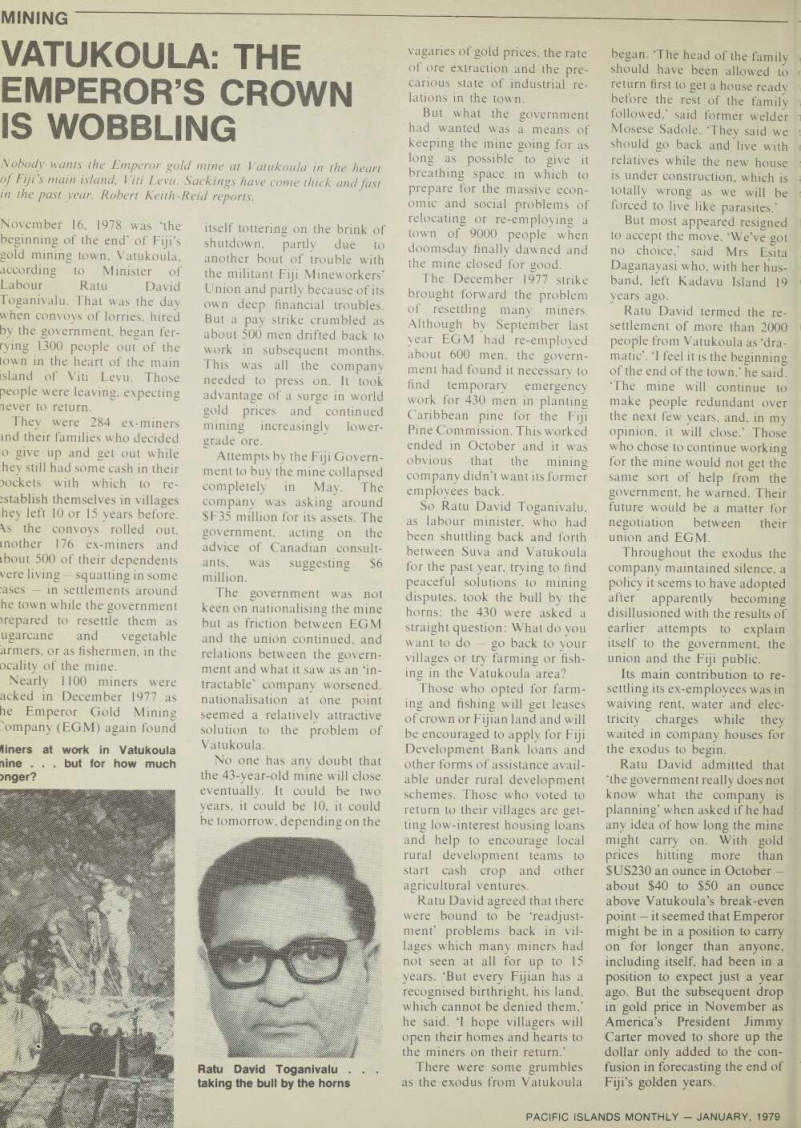
Miners at work in Vatukoula mine ... but for how much
longer?
Ratu David Toganivalu . . . taking the bull by the horns