People
pp. 20-21 · Read in the full issue
instinct of two craftsmen from different cultural back grounds.
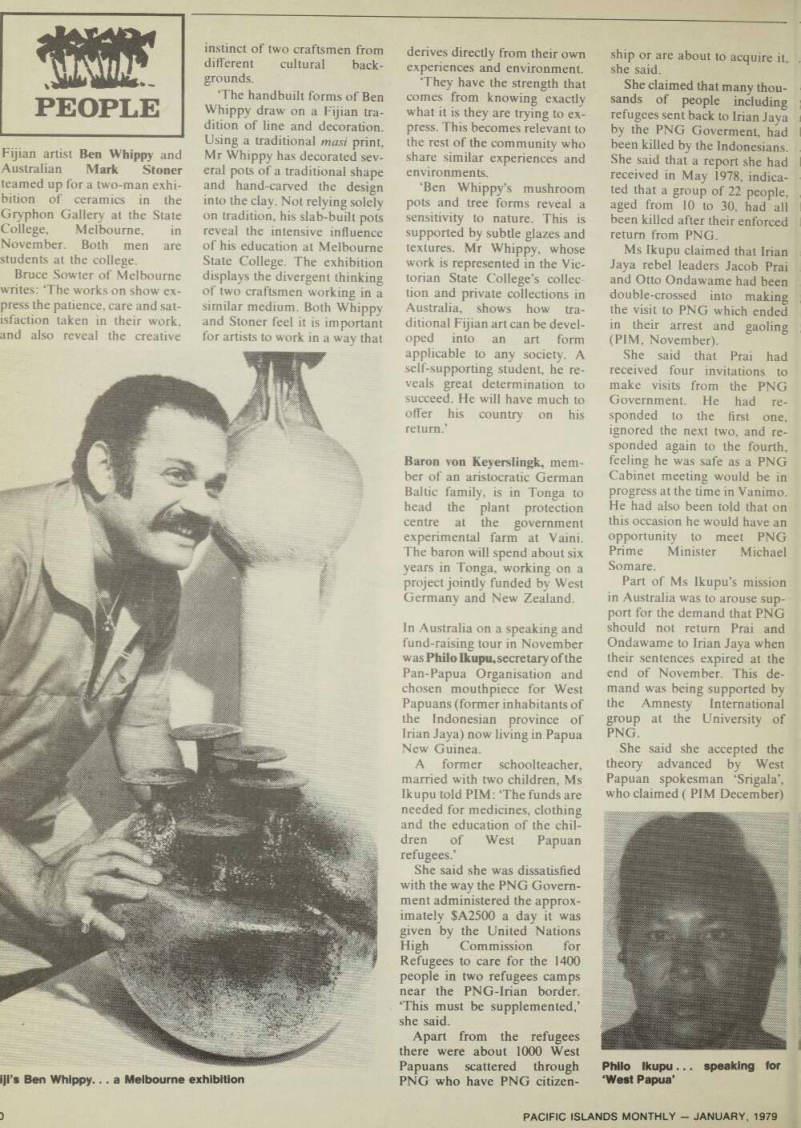
The handbuilt forms of Ben Whippy draw on a Fijian tra dition of line and decoration.
Using a traditional masi print, Mr Whippy has decorated sev eral pots of a traditional shape and hand-carved the design
into the clay. Not relying solely
on tradition, his slab-built pots reveal the intensive influence of his education at Melbourne State College. The exhibition
displays the divergent thinking
of two craftsmen working in a similar medium. Both Whippy and Stoner feel it is important for artists to work in a way that
Fijian artist Ben Whippy and Australian Mark Stoner teamed up for a two-man exhi bition of ceramics in the Gryphon Gallery at the State College, Melbourne, in November. Both men are students at the college.
Bruce Sowter of Melbourne writes; ‘The works on show ex press the patience, care and sat isfaction taken in their work, and also reveal the creative
derives directly from their own experiences and environment.
They have the strength that
comes from knowing exactly
what it is they are trying to ex press. This becomes relevant to the rest of the community who share similar experiences and environments. ‘Ben Whippy’s mushroom pots and tree forms reveal a sensitivity to nature. This is supported by subtle glazes and textures. Mr Whippy, whose work is represented in the Vic torian State College’s collec tion and private collections in Australia, shows how tra ditional Fijian art can be devel oped into an art form applicable to any society. A self-supporting student, he re veals great determination to succeed. He will have much to offer his country on his return.’
Baron von Keyerslingk, mem ber of an aristocratic German Baltic family, is in Tonga to head the plant protection centre at the government experimental farm at Vaini.
The baron will spend about six years in Tonga, working on a
project jointly funded by West
Germany and New Zealand.
In Australia on a speaking and fund-raising tour in November was Philo Ikupu, secretary of the
Pan-Papua Organisation and
chosen mouthpiece for West Papuans (former inhabitants of the Indonesian province of Irian Jaya) now living in Papua New Guinea.
A former schoolteacher, married with two children, Ms Ikupu told PIM: The funds are needed for medicines, clothing and the education of the chil dren of West Papuan
refugees.’
She said she was dissatisfied with the way the PNG Govern ment administered the approx imately $A2500 a day it was given by the United Nations High Commission for Refugees to care for the 1400 people in two refugees camps near the PNG-Irian border.
This must be supplemented,’ she said.
Apart from the refugees there were about 1000 West
Papuans scattered through
PNG who have PNG citizen
ship or are about to acquire it, she said.
She claimed that many thou sands of people including refugees sent back to Irian Jaya by the PNG Goverment, had been killed by the Indonesians.
She said that a report she had received in May 1978, indica ted that a group of 22 people, aged from 10 to 30, had all been killed after their enforced return from PNG.
Ms Ikupu claimed that Irian Jaya rebel leaders Jacob Prai and Otto Ondawame had been double-crossed into making the visit to PNG which ended in their arrest and gaoling (PIM, November).
She said that Prai had received four invitations to make visits from the PNG Government. He had re sponded to the first one, ignored the next two, and re sponded again to the fourth, feeling he was safe as a PNG Cabinet meeting would be in progress at the time in Vanimo.
He had also been told that on this occasion he would have an opportunity to meet PNG Prime Minister Michael Somare.
Part of Ms Ikupu’s mission in Australia was to arouse sup port for the demand that PNG should not return Prai and Ondawame to Irian Jaya when their sentences expired at the end of November. This de
mand was being supported by
the Amnesty International group at the University of
Png.
She said she accepted the
theory advanced by West
Papuan spokesman ‘Srigala’,
who claimed ( PIM December)
Fiji’s Ben Whippy... a Melbourne exhibition
Philo Ikupu ... speaking for ‘West Papua’
that Australian advisers in the PNG Prime Minister’s and
Foreign Affairs departments
had masterminded the doublecross of Prai and Ondawame.
A further motive for her visit to Australia was to have dis cussions with Australian poli ticians about the possibility of
independence for West Papua.
She expressed satisfaction with the visit, and thanked es
pecially Community Aid
Abroad and one of its officers, Juliet Hunt, for their help.
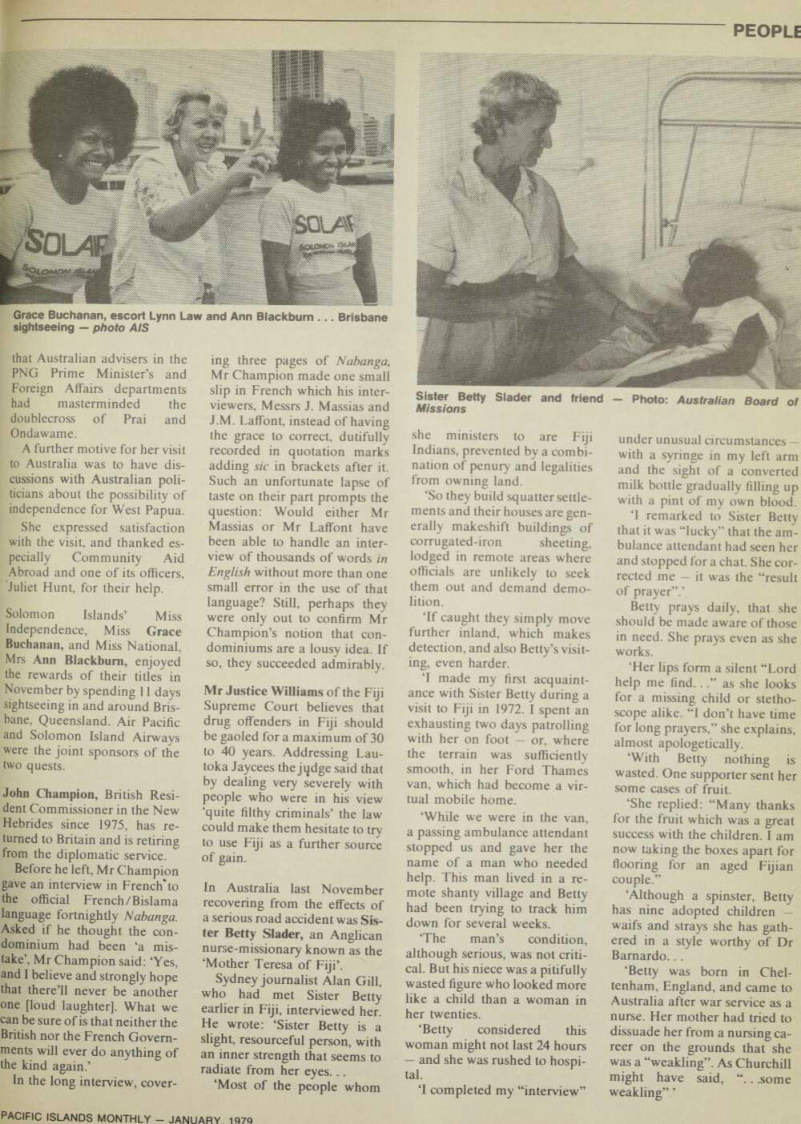
Solomon Islands’ Miss Independence, Miss Grace Buchanan, and Miss National, Mrs Ann Blackburn, enjoyed the rewards of their titles in
November by spending 11 days
sightseeing in and around Bris bane, Queensland. Air Pacific and Solomon Island Airways were the joint sponsors of the two quests.
John Champion, British Resi dent Commissioner in the New Hebrides since 1975, has re turned to Britain and is retiring from the diplomatic service.
Before he left, Mr Champion gave an interview in French*to the official French/Bislama
language fortnightly Nabanga.
Asked if he thought the con dominium had been ‘a mis take’, Mr Champion said: ‘Yes, and I believe and strongly hope that there’ll never be another one [loud laughter]. What we can be sure of is that neither the British nor the French Govern ments will ever do anything of the kind again.’
In the long interview, cover
ing three pages of Nabanga, Mr Champion made one small slip in French which his inter viewers, Messrs J. Massias and J.M. Laffont, instead of having the grace to correct, dutifully recorded in quotation marks adding sic in brackets after it.
Such an unfortunate lapse of taste on their part prompts the question: Would either Mr Massias or Mr Laffont have been able to handle an inter view of thousands of words in English without more than one small error in the use of that
language? Still, perhaps they
were only out to confirm Mr Champion’s notion that con dominiums are a lousy idea. If
so, they succeeded admirably.
Mr Justice Williams of the Fiji Supreme Court believes that drug offenders in Fiji should be gaoled for a maximum of 30 to 40 years. Addressing Lau toka Jaycees the jqdge said that
by dealing very severely with
people who were in his view ‘quite filthy criminals’ the law could make them hesitate to try to use Fiji as a further source
of gain.
In Australia last November recovering from the effects of a serious road accident was Sis ter Betty Slader, an Anglican nurse-missionary known as the ‘Mother Teresa of Fiji’.
Sydney journalist Alan Gill,
who had met Sister Betty earlier in Fiji, interviewed her.
Fie wrote: ‘Sister Betty is a slight, resourceful person, with an inner strength that seems to radiate from her eyes. ‘Most of the people whom
she ministers to are Fiji Indians, prevented by a combination of penury and legalities from owning land.
So they build squatter settlements and their houses are gen-
erally makeshift buildings of
corrugated-iron sheeting,
lodged in remote areas where officials are unlikely to seek them out and demand demo- ■ • .
If caught they simply move
further inland, which makes detection, and also Betty’s visiting, even harder. ‘I made my first acquaintance with Sister Betty during a visit to Fiji in 1972. I spent an
exhausting two days patrolling
with her on foot or, where the terrain was sufficiently smooth, in her Ford Thames van, which had become a virtual mobile home. ‘While we were in the van, a passing ambulance attendant stopped us and gave her the name of a man who needed help. This man lived in a re-
mote shanty village and Betty
had been trying to track him down for several weeks. ‘The man’s condition, although serious, was not critical. But his niece was a pitifully wasted figure who looked more like a child than a woman in her twenties.
Betty considered this woman might not last 24 hours - and she was rushed to hospita l- ‘I completed my “interview”
under unusual circumstances— with a syringe in my left arm and the sight of a converted milk bottle gradually filling up with a pint of my own blood ‘I remarked to Sister Betty that it was “lucky” that the am bulance attendant had seen her and stopped fora chat. She cor reeled me - it was the “result of prayer”.’
Bett y prays daily, that she should be made aware of those in need. She prays even as she works. ‘Her |ip S f ori n a silent “Lord help me find...” as she looks for a missing child or stetho scope alike. “I don’t have time for long prayers,” she explains,
almost apologetically,
‘With Betty nothing is
wasted. One supporter sent her some cases of fruit,
‘She replied: “Many thanks
for the fruit which was a great success with the children. I am now taking the boxes apart for flooring for an aged Fijian
couple.”
‘Although a spinster, Betty
has nine adopted children waifs and strays she has gath ered in a style worthy of Dr Bamardo. ‘Betty was bom in Chel tenham, England, and came to Australia after war service as a nurse. Her mother had tried to dissuade her from a nursing ca reer on the grounds that she was a “weakling”. As Churchill might have said, . .some
weakling’”
Grace Buchanan, escort Lynn Law and Ann Blackburn ... Brisbane sightseeing - photo AIS
Sister Betty Slader and friend - Photo: Australian Board of Missions