Margaret Mead
p. 19 · Read in the full issue
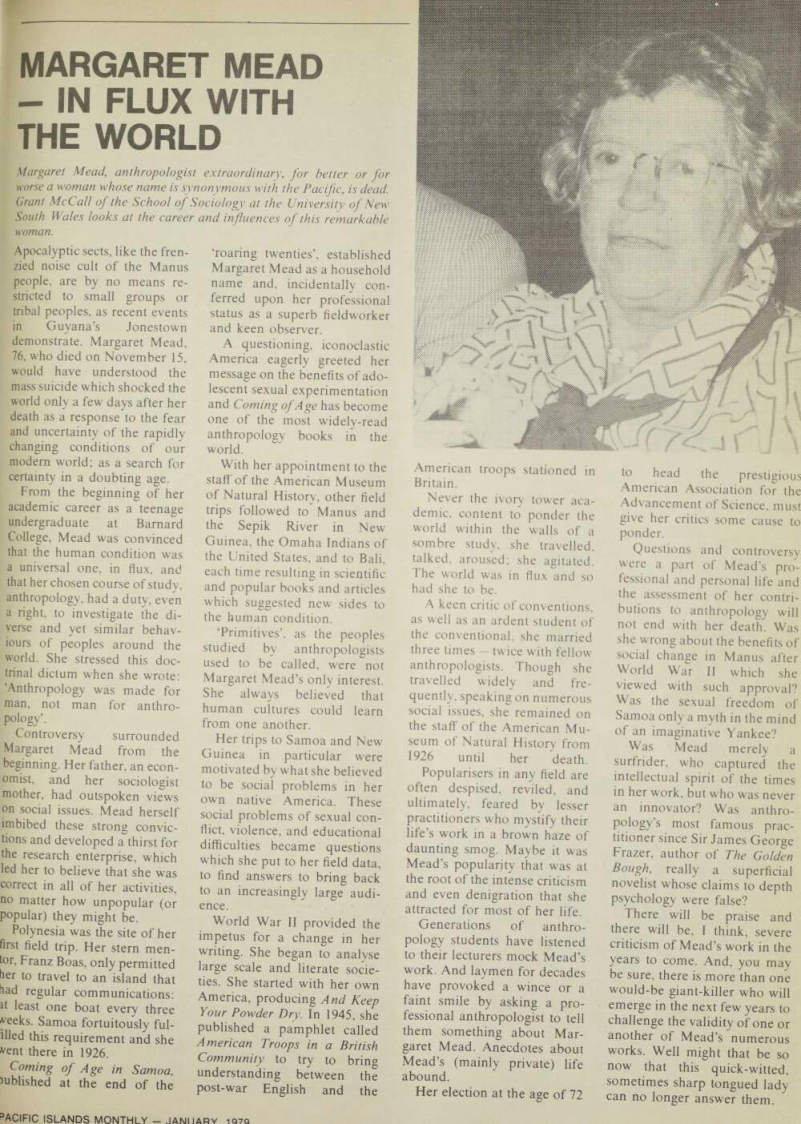
- In Flux With
The World
Margaret Mead, anthropologist extraordinary, for better or for worse a woman whose name is synonymous with the Pacific, is dead.
Grant McCall of the School of Sociology at the University of New South Wales looks at the career and influences of this remarkable woman.
Apocalyptic sects, like the fren zied noise cult of the Manus people, are by no means re stricted to small groups or tribal peoples, as recent events in Guyana’s Jonestown demonstrate. Margaret Mead, 76, who died on November 15, would have understood the mass suicide which shocked the world only a few days after her death as a response to the fear and uncertainty of the rapidly changing conditions of our modem world; as a search for certainty in a doubting age.
From the beginning of her academic career as a teenage undergraduate at Barnard College, Mead was convinced that the human condition was a universal one, in flux, and that her chosen course of study, anthropology, had a duty, even a right, to investigate the di verse and yet similar behav iours of peoples around the world. She stressed this doc trinal dictum when she wrote: ‘Anthropology was made for man, not man for anthro
pology’.
Controversy surrounded
Margaret Mead from the beginning. Her father, an econ omist, and her sociologist mother, had outspoken views on social issues. Mead herself imbibed these strong convic tions and developed a thirst for the research enterprise, which led her to believe that she was correct in all of her activities, no matter how unpopular (or
popular) they might be.
Polynesia was the site of her first field trip. Her stern men tor, Franz Boas, only permitted tier to travel to an island that had regular communications: it least one boat every three Samoa fortuitously ful illed this requirement and she vent there in 1926.
Coming of Age in Samoa, )üblished at the end of the
‘roaring twenties’, established Margaret Mead as a household name and, incidentally con ferred upon her professional status as a superb fieldworker and keen observer, A questioning, iconoclastic America eagerly greeted her message on the benefits of ado lescent sexual experimentation and Coming of Age has become one of the most widely-read anthropology books in the world.
With her appointment to the staff of the American Museum of Natural History, other field trips followed to Manus and the Sepik River in New Guinea, the Omaha Indians of the United States, and to Bali, each time resulting in scientific and popular books and articles which suggested new sides to the human condition, ‘Primitives’, as the peoples
studied by anthropologists
used to be called, were not Margaret Mead’s only interest She always believed that human cultures could learn from one another.
Her trips to Samoa and New Guinea in particular were motivated by what she believed to be social problems in her own native America These social Problems of sexual con flict, violence, and educational difficulties became questions which she put to her field data to find answers to bring back to an increasingly large audi ence.
World War II provided the im P e,us for a chan § e in her "'riling. She began to analyse lar ge scale and literate socie hes. She started with her own
America, producing Keep
Your Powder Dry. 1n1945 she published a pamphlet called i mer,can . a “ Community to try to bring understanding between the post-war English and the
American troops stationed in Britain.
Never the ivory tower aca demic, content to ponder the world within the walls of a sombre study, she travelled, talked, aroused; she agitated.
The world was in flux and so had she to be.
A keen critic of conventions, as well as an ardent student of the conventional, she married three times - twice with fellow
anthropologists. Though she
travelled widely and fre
quently, speaking on numerous
social issues, she remained on the staff of the American Mu seum of Natural History from 1926 until her death.
Popularises in any field are often despised, reviled, and
ultimately, feared by lesser
practitioners who mystify their life’s work in a brown haze of daunting smog. Maybe it was Mead’s popularity that was at the root of the intense criticism and even denigration that she attracted for most of her life.
Generations of anthro pology students have listened to their lecturers mock Mead’s work. And laymen for decades have provoked a wince or a faint smile by asking a pro fessional anthropologist to tell them something about Mar garet Mead. Anecdotes about Mead’s (mainly private) life abound.
Her election at the age of 72
to head the prestigious American Association for the Advancement of Science, must give her critics some cause to ponder.
Questions and controversy were a part of Mead’s pro fessional and personal life and the assessment of her contri butions to anthropology will not end with her death. Was she wrong about the benefits of social change in Manus after World War II which she viewed with such approval?
Was the sexual freedom of Samoa only a myth in the mind of an imaginative Yankee?
Was Mead merely a surfrider, who captured the intellectual spirit of the times in her work, but who was never an innovator? Was anthro pology’s most famous prac titioner since Sir James George Frazer, author of The Golden
Bough, really a superficial
novelist whose claims to depth psychology were false?
There will be praise and there will be, I think, severe criticism of Mead’s work in the years to come. And, you may be sure, there is more than one would-be giant-killer who will emerge in the next few years to challenge the validity of one or another of Mead’s numerous works. Well might that be so now that this quick-witted,
sometimes sharp tongued lady
can no longer answer them.