not democracy
pp. 17-18 · Read in the full issue
The politicians not democracy are in danger
The political situation in Papua New Guinea has become so confused that even those of us who live here find it hard to make sense of it. So it an appropriate moment for a glance backward, a look at the fleeting present, and perhaps a peep into the crystal ball.
Political parties got off the ground in PNG in the closing years of the colonial period. Michael Somare’s Pangu Pati took shape during the second House of Assembly (1968-72), when real power was still in the hands of the colonial establishment.
With its platform of rapid transition to self-government and independence it was regarded by many as dangerously radical, and its emergence provoked the formation of a conservative, go-slow group which later became the United Party. In the closing months of 1971. this group had the numbers to rub Pangu s nose in the dirt, and did so unmercifully.
In 1972, when the third House of Assembly was elected, the stage was set for virtual self-government, though formal self government had to wait till 1974. A centre party, the Peoples
AFTERTHOUGHTS with Percy Chatterton in Port Moresby
Progress Party, had now been formed under the leadership ot Julius Chan. The results of the 1972 elections were indecisive: the United Party remained the largest single party, but without the numbers to govern alone. The small PPP held the balance of power; and instead of turning Right towards the United Party, as many expected it would, it turned Left towards Pangu. with which it formed a coalition with Michael Somare as chief minister.
This rather uneasy coalition survived through formal self government in 1974, independence in 1975. and new elections, for what was by then called the National Parliament, in 1977.
It has been PPP’s recent withdrawal from this coalition which has touched oft'PNG’s present political turmoil; and it is ironic to note that just as it was maladroitness on the part of the UP leadership in 1972 which led to the formation of the Pangu- PPP coalition, so it was maladroitness on the part of the Pangu leadership which led to its break-up in 1978. The failure of the Pangu leadership adequately to consult with its PPP part ners before making important decisions reached a point at which PPP decided it was better to quit than to be pushed around.
In the meantime, there had been another split in the United Party. Impatient with the quiet, unforceful leadership of Sir
Tei Abal. a veteran of the first House of Assembly, there had been a breakaway under the dynamic leadership of lambakey Okuk to form the People’s United Front; and when the chips were down, PUF turned out to be the senior partner, in terms of numbers, in the opposition. Its junior partners were the rump of the United Party, the Papua Besena group, and a few independents, including the veteran Sir John Guise.
Papua Besena merits a few words of explanation. Founded in 1972 by the charismatic Josephine Abaijah as a separatist movement, it increased its tally of seats from one to two in a by-election in 1976, to seven in the 1977 general elections, and to eight after a further by-election in 1978, and thus be came, though still small, a significant factor in the political arena. In the meantime, perhaps against the wishes of its foun der, it had moderated its separatist stance to a willingness to settle for regional autonomy; and it may be presumed that it was lambakey Okuk’s advocacy of regional, in preference to provincial, government, as well as its long-standing hostility to Pangu, which led it to give its support to a PUF-led oppo sition.
At this point, when it looked as if Pangu would be swept out of office, came the big big surprise. The United Party de fected from the opposition to form a new coalition with Pangu.
The extremes of Left and Right had come together to preserve continuity and stability of government and save the country from chaos. Or so they said.
One need not necessarily doubt their sincerity. All over the world parties in power are prone to proclaim that their own continuance in office is essential to the welfare of their coun tries, which will fall to pieces, they say. without them. Some times. no doubt, they really believe it.
However, the cynics may perhaps be pardoned for thinking that the desire of Pangu to retain power and the desire of the United Party to secure it power with its sweet-tasting privi leges and perquisites - may have had something to do with the formation of this unlikely coalition.
Such, at any rate, was the conclusion come to by many of their constituents, and at least two UP branches have dis banded in disgust.
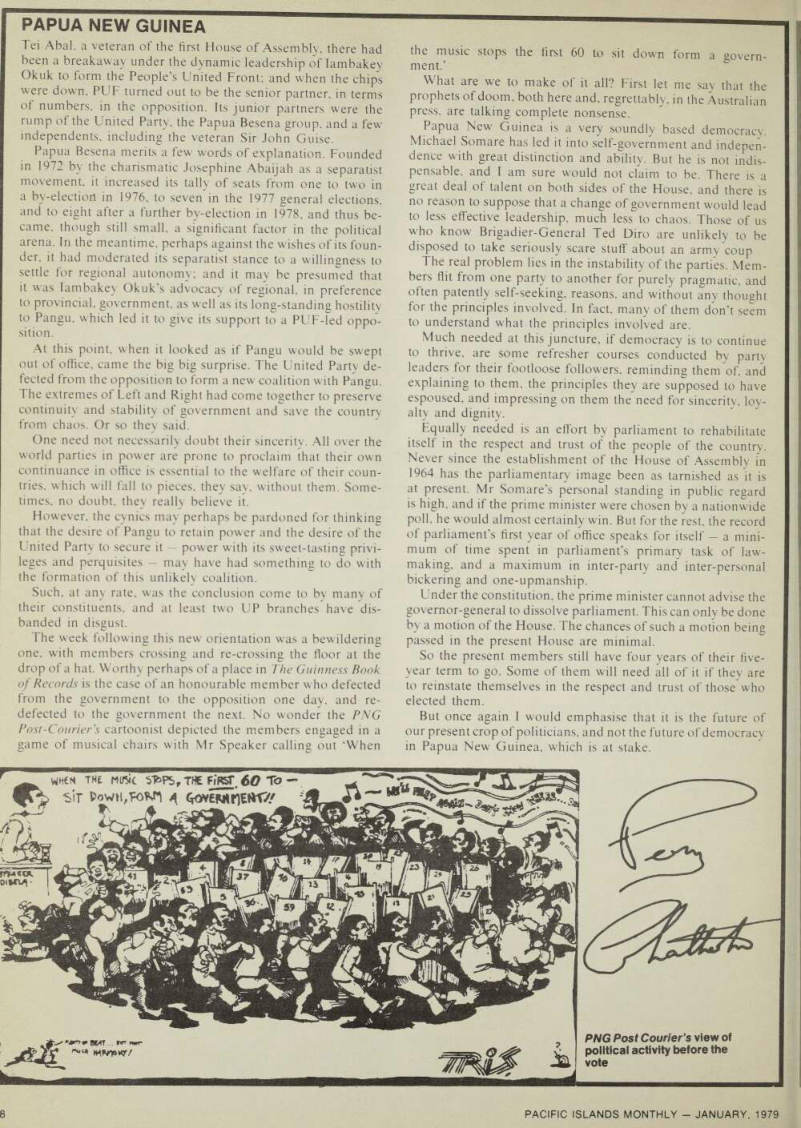
The week following this new orientation was a bewildering one, with members crossing and re-crossing the floor at the drop of a hat. Worthy perhaps of a place in The Guinness Book of Records is the case of an honourable member who defected from the government to the opposition one day, and re defected to the government the next. No wonder the PNG Post-Courier's cartoonist depicted the members engaged in a game of musical chairs with Mr Speaker calling out ‘When
the music stops the first 60 to sit down form a govern ment.’
What are we to make of it all? First let me say that the prophets of doom, both here and, regrettably, in the Australian press, are talking complete nonsense.
Papua New Guinea is a very soundly based democracy.
Michael Somare has led it into self-government and indepen dence with great distinction and ability. But he is not indis pensable, and I am sure would not claim to be. There is a great deal of talent on both sides of the blouse, and there is no reason to suppose that a change of government would lead to less effective leadership, much less to chaos. Those of us who know Brigadier-General Ted Diro are unlikely to be disposed to take seriously scare stuff about an army coup The real problem lies in the instability of the parties. Mem bers flit from one party to another for purely pragmatic, and often patently self-seeking, reasons, and without any thought for the principles involved. In fact, many of them don’t seem to understand what the principles involved are.
Much needed at this juncture, if democracy is to continue to thrive, are some refresher courses conducted by party leaders for their footloose followers, reminding them of. and explaining to them, the principles they are supposed to have espoused, and impressing on them the need for sincerity, loy
alty and dignity.
Equally needed is an effort by parliament to rehabilitate itself in the respect and trust of the people of the country.
Never since the establishment of the House of Assembly in 1964 has the parliamentary image been as tarnished as it is at present. Mr Somare’s personal standing in public regard is high, and if the prime minister were chosen by a nationwide poll, he would almost certainly win. But for the rest, the record of parliament’s first year of office speaks for itself - a mini mum of time spent in parliament’s primary task of law making, and a maximum in inter-party and inter-personal
bickering and one-upmanship.
Under the constitution, the prime minister cannot advise the governor-general to dissolve parliament. This can only be done by a motion of the House. The chances of such a motion being passed in the present House are minimal.
So the present members still have four years of their five year term to go. Some of them will need all of it if they are to reinstate themselves in the respect and trust of those who elected them.
But once again I would emphasise that it is the future of our present crop of politicians, and not the future of democracy in Papua New Guinea, which is at stake.
PNG Post Courier’s view of political activity before the vote