Mahe: Forum
pp. 28-29 · Read in the full issue
Before Self
So little met the eye. So much went on behind the scenes. Surely the South Pacific Conference debate on a proposed ‘South Pacific Regional Environment Programme’ (SPREP) had more at its heart than lofty dreams about preserving the world in which we live.
So, let’s first dispose of the cynicism. Probably without even admitting it to themselves, the participants in the environment debate, in informal closed session and in the final fiery full con ference session, were locked in a power struggle SPC versus SPEC. On evidence available the small but growing SPEC de feated the big, but in danger of stagnating, SPC.
Though SPC staff tended to shrug off the loss of the chairman’s job on the SPREP to SPEC as something of no consequence, they would have been much happier to have had an alternating share of that position. Instead they’ve got the job they’re best at the
secretary’s.
The environment debate culminated in what can only be de scribed as an extraordinary scene on the final morning of the con ference.
But back to somewhere near the beginning of what has been a long story. Its roots go back to before the 1977 South Pacific Forum in Port Moresby. However, it was that meet ing which got things on the move and, from available evidence, SPEC has made the running ever since but with SPC assist ance.
Briefly, SPEC got together a small working group in October last year with SPC, the Univeristy of the South Pacific and the PNG Government represented. It agreed SPEC should find a con " sultant to prepare ‘a case for a regional environment programme, assess financial implications and examine the institutional options for management of the programme’, according to the SPEC Director’s Annual Report 1977-78.
From the consultant’s papers SPEC prepared a single document and SPEC and SPC met in June this year in Noumea to consider the proposed programme. That meeting, ‘well attended by rep resentatives from Island governments’, produced a proposal for a ‘specifc programme of action including a regional conference aimed at launching a South Pacific Regional Environment Pro
gramme’.
That report was considered by the Niue Forum in September and the result was a curiously worded release which, in con clusion. ‘. . .recommended that the Forum instructs its represen tatives to the South Pacific Conference to ensure that full weight was given to the recommendation of the Port Moresby resolu tion. . .and further that SPEC continue its negotiations with the SPC to the same effect. ..' Even curiouser, . .the (SPEC) com mittee recommended that these efforts at the South Pacific Con- ; ference should not be carried out in an atmosphere of destructive confrontation but in a true spirit of regional co-operation’.
Conclusions to be drawn; all was not harmony in the South Pacific environment; was the SPREP programme to become the catalyst for SPEC-SPC co-operation or confrontation in the same way that the convention for the draft fisheries organisation had been used by PNG and Fiji to reassert their determination that no cracks would appear in the overall defences of the South Pa- ; cific Forum?
SPREP action started when environmentalist Dr Peter Ellyard whirled into Noumea as an adviser to Papua New Guinea’s del egation leader. Father John Momis, Minister for Decentralis ation. Between Monday and Thursday three SPREP drafts were to be circulated, the second as a result of on-going informal nego- i tiations which, it seemed, almost threatened the chances of the issue ever coming before the conference, such were the differences and such was SPEC Director Mahe Tupouniua’s determination to
ee that the directives he had received from the Forum were ear ned out. Fiji, apparently, wasn’t keen on any kind of regional
mvironment programme.
The second motion appeared on Thursday morning. It ibviously was not to the SPEC director’s liking. But it was closer o it than the original PNG motion which advocated something vhich neither Mahe nor anyone else would wear: virtually a separ ite organisation with its own director ‘with an office’; a pro gramme management committee with representatives from SPC, iPEC, UNEP (UN Environment Programme) and ESCAP(Econ >mic and Social Commission for Asia and the Pacific); and chair nanship of the committee alternating between SPC and SPEC.
Neither Mahe. SPC Secretary-General Macu Salato, nor his ighthand man Bill Brown, would have gone along with that.
The second proposal seemed about to get the conference’s
green light on the Thursday morning after Father Momis had assured the 22 delegations that ‘the motion and the project docu ment we believe provide. . .a way of making the Port Moresby Declaration effective as well as. . .a brief for co-operation be tween SPC and SPEC’.
But Mahe Tupouniua begged to differ. Over three days he had been unable to get his way in informal discussions. But, as guard ian of the Forum’s interests, he had not finished by a long chalk.
He sought and was granted permission to address the con ference.
What followed was an amazing display. Mahe revealed his total dedication to SPEC even at the risk of having his nose rubbed well and truly in the mud. It was a price he had decided he would have to pay if he was to ensure that the interests of his employers were to be protected.
Mahe. to an attentive ring of conference delegates, drew ‘atten tion to some implications which could be quite serious' and proceeded to clarify the Port Moresby declaration. ‘I agree entirely with the comments made by the minister of Papua New Guinea where he reminded the conference to move with speed.
We also feel that when doing so we should try to see the way ahead.’ said Mahe. The draft resolution, he said, did not follow the spirit or decisions of the Forum. ‘The Port Moresby declar ation made it quite clear which of the two [SPEC or SPC] should
play the primary roll. . .'
From this limited environment discussion. Mahe moved smoothly though to the grander, entire Pacific scene the world of sovereign states ready to stand up and say ‘yea’ or ‘nay’, and of their subject neighbours, never knowing quite what to sav until checking with Paris, London or Washington. ‘I sympathise with the delegate from Australia.’ said Mahe. The situation was quite different for the Forum. When the Forum made decisions they were final decisions. Of the 22 people around the table, he said, ony 12 were independent countries and ‘they are members of the Forum and SPEC’.
Mahe was into his sales pitch. The other 10, he said, could apply for membership of SPEC. . .their applications would be sympath etically considered. . . ‘You must be capable of implementing de cisions of SPEC.. .Mr Chairman, am I out of order?. ..' A firm but not clearly identifiable ‘Yes’ hissed from somewhere in the area of the chairman’s table (but it wasn’t the voice of the chair man. Tuvalu Prime Minister Toalipi Lauti).
Mahe sat silent. This was the part which would hurt personally but he had a job to be done. American Samoa's deputy delegation leader. Palauni ‘Brownie’ Tuiasosopo, rose, his usual cheerfulness forgotten. Deliberately: T want to express to the conference that my native sense of respect has been put to the supreme test. Per haps at this time the distinguished representative of SPEC may be out of order.’
Mahe was: ‘I wish to apologise if I have spoken beyond the confines of the subject. I was seeking clarification of the position.
I apologise if I have erred in doing so.’ Mahe rose, returned to his observer’s position, mission accomplished as subsequent events were to prove.
Chairman Lauti; ‘The question is the motion be adopted.’
Scribbling in the New Zealand corner. Delegation leader Jim Bolger ‘has the floor’. He saw dangers of a ‘quasi-independent’ group coming out of the enviroment motion. He asked for clarifi cation from PNG and then came up with a suggestion which, while not everything he had been seeking, must have been sweet music to Mahe’s ears. New Zealand moved that, to keep SPREP under control and to prevent the emergence of yet another re gional organisation, its chairman should be from SPEC, its sec retary from SPC. PNG came to the party. (This arrangement had originally been in Father Monus's speech but had been deleted.) Apart from a further observation or two from American Samoa it was plain sailing. Mahe, for the South Pacific Forum, had won
the day.
Bob Hawkins.
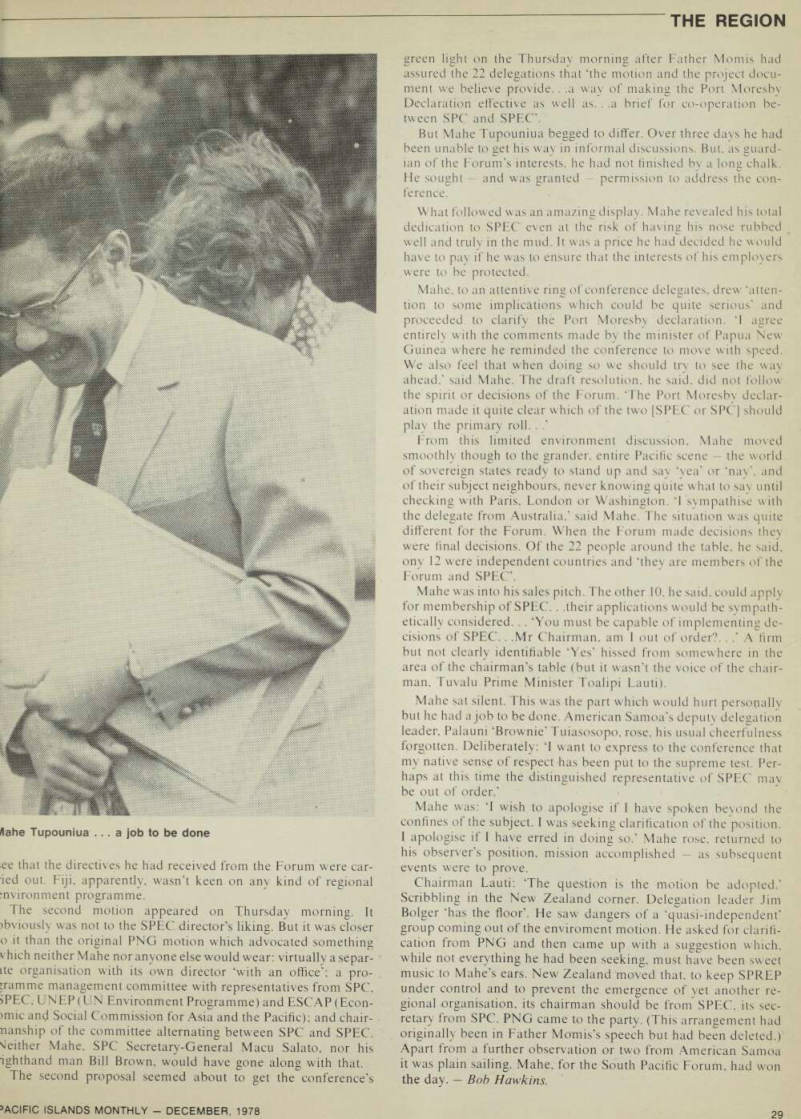
Mahe Tupouniua ... a job to be done