Conference
pp. 26-28 · Read in the full issue
The Hot Politics
Of A ‘Routine’
The South Pacific Conference, decision-making arm of the South Pacific Commission, is a ‘non-political'gathering. Tra ditionally it deals with the ‘doing'in the Pacific, not the ‘whys' and ‘wherefores'. That’s what PIM editor Bob Hawkins understood before he headed off to Noumea and the eight eenth South Pacific Conference in October, his first since the memorable 1965 gathering in Lae, Papua New Guinea, when the then Ratu Mara burst onto the South Pacific stage. In fact, this year's exchanges were no less political than Lae 1965.
It was teabreak on Thursday morning, the fourth day of the conference, when SPC Direc tor of Administration Don Stewart told me that, of the five conferences he had attended, this was the quietest. Neither of us anticipated the firecracker Fiji was planning for the next session; nor the fascinating dis play of SPC-SPEC (South Pa cific Bureau for Economic
Co-operation) politics which
was to burst over the con ference before the lunch adjournment. But first, a look at some of the more prominent performers at the Noumea
gathering of 22 delegations:
Australia and New' Zealand : Nervously, more so in the case of Australia, skirting the edges, offering help ‘only as long as it is in the interests of the Islanders’. New Zealand of all metropolitans came out of the
conference looking extremely
good. Australia on the other hand will want to forget this one.
United States: Trying to tread softly but sometimes looking as if they had a lot to learn. Was that the occasional touch of irritation the US
displayed when confronted by
the ‘Pacific Way’?
Papua New Guinea: Came on strong in the pre-conference committee stages. Agreed to a 12% increase in contributions to the SPC’s 1979 budget but indicated it would freeze its contribution at this level for the ensuing three years. Motive?
Maybe similar to Fiji’s.
Fiji: Feisty, ready to take a
swipe at the metropolitans.
And Australia gave it an excuse
to do so. Also agreed to 12% contribution increase but said there’d be no more unless SPC areas of activity were clearly demarcated.
France: Discreet in con ference but less so in welcom ing delegations to a conference ‘on French soil’ words which stuck in the craw of some del
egations with mixed feelings
about French presence and activities in the South Pacific.
American Samoa: Humour,
spirit of compromise, light
hearted deference to the US, indignation at outside inter ference in conference affairs.
Easily the most entertaining
performer in an otherwise dull conference until the fireworks of the fourth and final day.
Wallis and Futuna: An elo quent delivery of lonely island problems, boring in so many ways but indicative of the cir cumstances which can lead to a sub-regionalising of Pacific groupings (see PIM November).
Usually, each year, the meet ing of the South Pacific Forum countries (each and every one a decision-maker in its own right) takes place just before the independents and depen dents plus their metropolitan masters get together as the South Pacific Conference.
The Forum (this year in Sep tember on Niue) is a bit like a papal conclave but, instead of smoke signals and a permanent lock-up, from time to time its various leaders come out for air, a cup of tea and a biscuit, and the pleasure of smiling enigmatically at the panting press, occasionally dropping
cryptic ‘leaks’ which only help
to add confusion to ignorance.
There is a spokesman appointed to meet the press after each session. We were lucky this year in being able to
interrogate the eloquent Prime
Minister Tupuola Efi of Western Samoa. But even then, we only got answers to questions we asked. If we didn't know something had been discussed we could hardly be expected to
ask penetrating questions
about it. If you’re lucky, the Forum’s administrative arm, SPEC will hand out a press communique when it’s all over.
This year we had to chase SPEC all the way to Fiji to get it. But we are promised things will be better next year and, overall, it is looking hopeful.
All in all, when you read about the Forum, you are reading little more than guesswork.
But, after the Niue drought. the press were treated to a Noumea flood. Whatever you may think about the generous salaries South Pacific Commission bureaucrats over the 1 years have talked others into giving them, there’s no question
about the speed or efficiency with which delegates, observers and press alike are served up with mountains of reports, working papers, information papers, agendas, motions, stat istics, miscellaneous press re leases, occasional papers, Assured that ‘everything has been settled in committee' it looked as if the conference would be plain sailing, several
days of rubber-stamping and
mutual admiration. Not so this year. A few surprises were in
the offing.
Who would have believed that the Australian delegation. headed by a minister, would have in any way suggested that Tuvalu might not be eligible to accede to the Canberra agree ment? (This was specially puz zling when one considers that Australia, of all original signa tories to the 1947 Canberra Agreement which established the South Pacific Commission, had worked with great zeal to broaden accession terms to allow the likes of the Niues, the Cooks, the Gilberts, Solomons and the Tuvalus of the Pacific to join in.)
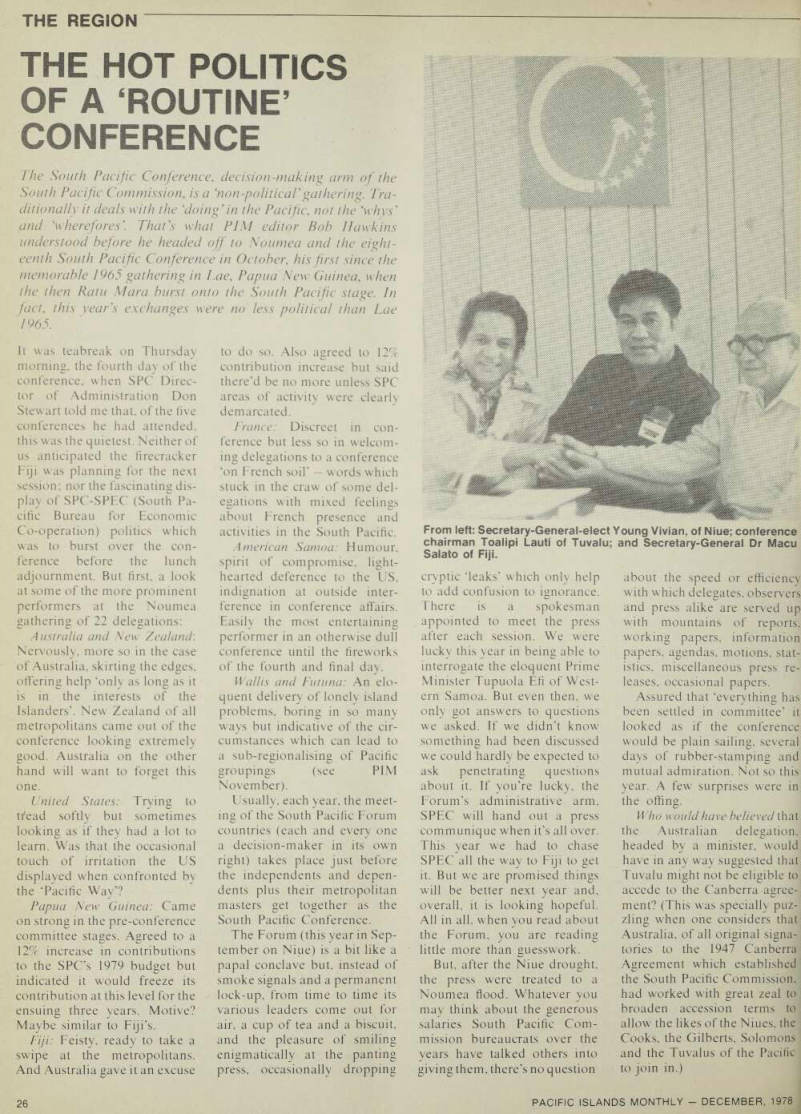
From left: Secretary-General-elect Young Vivian, of Niue; conference chairman Toalipi Lauti of Tuvalu; and Secretary-General Dr Macu Salato of Fiji.
Who would have believed that the Australian delegation would come back a second time during the conference to reveal that it was quite in capable of making a decision
by itself without referring
chapter and verse to Canberra?
This time it was a motion by American Samoa complaining about the protective attitudes of certain metropolitan governments toward their air lines, to the detriment of the Islands. Even when Australia
managed to get the only really
nasty paragraph in the whole resolution deleted, the con ference was again informed by the Australian delegation leader (his minister had gone home by then) that the matter would still have to be referred to Canbera for a final de cision.
And who would have believed that, even with the provocation of Australia, the leader of the
Fiji delegation would accuse
‘some’ of its ‘metropolitan partners’ of treating ‘lsland peoples’ in an ‘insulting and paternalistic way’? It was unex pected. But there was no doubt that someone had to stir the
metropolitan pot. ‘They send
the office boy to the SPC these days’ one observer told me. It wasn’t quite that bad. But cer tainly, if the Islands are willing to maintain a high level of rep resentation (and they seem to be), so should the metropoli tans and they are not doing so. At least France, New Zealand and Australia (even if only momentarily in the latter’s case) sent ministers of govern ment. The United States has decided that ‘Ambassador Suva’ is the level at which they intend to operate even now that Uncle Sam is belatedly realising that he’s been neglect ing the South Pacific ever since the Japanese were pushed back north of the equator. None of this is good enough if the South Pacific Conference is to con tinue to be an effective annual gathering; if the South Pacific Commission is to continue to
play an important practical and
research role on behalf of both
sovereign and dependent
Island groupings; and if one day the SPC-SPEC hatchets are to be buried and the two bodies to merge.
Just one more little ‘Who would have believed?: Fiji’s Minister of State for Co operatives, Livai Nasilivata, had just slipped the knife into the metropolitans more specifically into Australia for its lack of decision when up jumped US Ambassador to Fiji
John Condon to twist the knife home. Referring to Australia’s request the previous day to delay discussion on the avi ation motion by American Samoa, he said that if he had been leading his delegation at the time he would ‘have urged the conference to think twice before they allowed such precedents to be established’.
Mr Condon, a sentence or two before, had observed that the ‘conference should be com
posed of delegates prepared to
take stands on the issues brought before the conference’.
It was his lucky week. Apart from the tension Australia brought on its own head, it seemed that all delegates from the Islands wanted nothing but sweet reason and light between themselves and the metropoli
tans. Nobody said anything
about continued French testing in, around, below, wherever, on Mururoa Atoll in eastern Polynesia; no one complained about New Zealand and Aus tralian trade protectionism (there was only that dig by the American Samoans on the avi ation motion); no one uttered the slightest criticism or ex pressed the remotest fear about
the United States’ obvious con tinuing intention to talk the Islands into letting it get in on the South Pacific fisheries or ganisation act one way or the other. (Have just noticed I forgot to mention the United Kingdom among the metropolitans. Not surprising. It was almost as if it wasn't there. Certainly UK’s was the most innocuous of all presences. Even France chipped in with its few francs’ worth from time to time. The UK’s most memorable contri bution came in the dying min utes of the conference when the record of proceedings was
being checked through. Lord
Dunrossil. British High Com missioner to Fiji and standing in for his leader, wondered if
a typographical ‘proglem’ was
a ‘problem’ or a ‘programme’.
His observation stirred no controversy.) And the biggest ‘Who would have believed'?’ of all: SPEC Director Mahe Tupouniua’s brilliant blatant meddling in
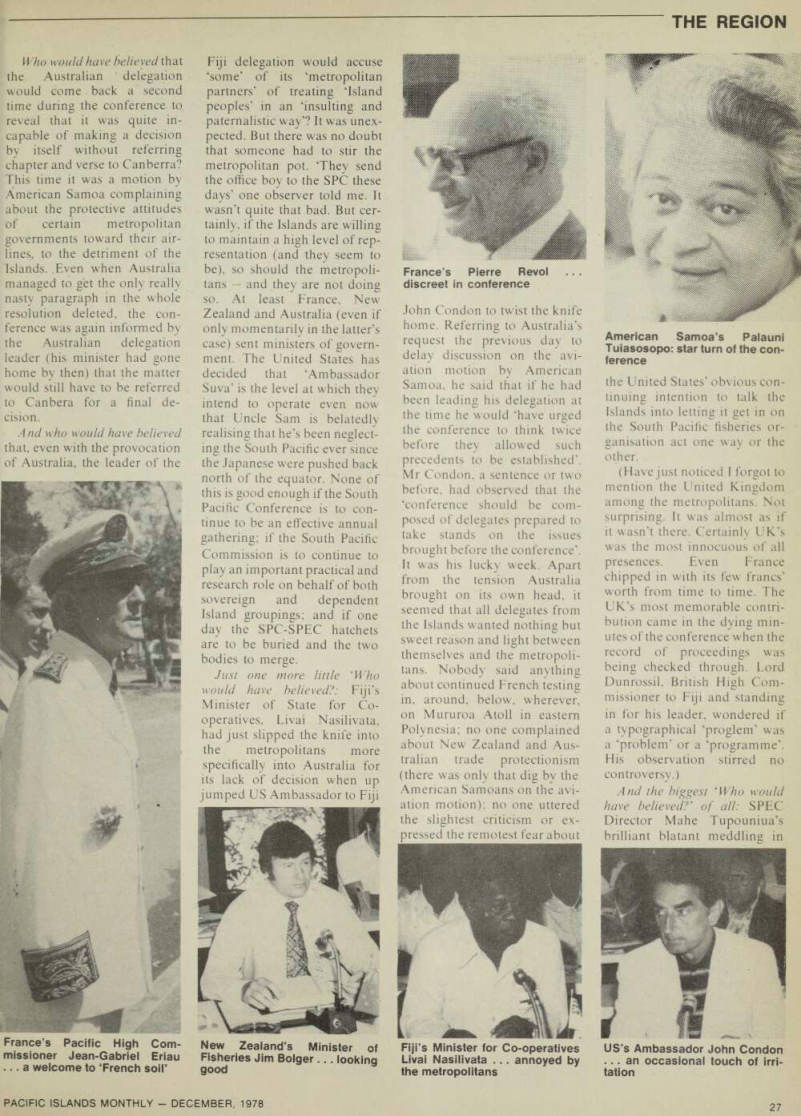
France’s Pacific High Com missioner Jean-Gabriel Eriau ... a welcome to ‘French soil’
New Zealand’s Minister of
Fisheries Jim Bolger. . . looking
good
France’s Pierre Revol... discreet in conference
Fiji’s Minister for Co-operatives Livai Nasilivata ... annoyed by the metropolitans
American Samoa’s Palauni Tuiasosopo: star turn of the con ference
US’s Ambassador John Condon ... an occasional touch of irri tation
the conference’s affairs. The topic was an environment progamme for the South Pa cific. (See Mahe; Forum before self.)
Spc Faces A
Budget
Freeze
Contributions beyond 1979 to the South Pacific Commission budget are under threat. Papua New Guinea and Fiji indicated at the October Noumea South Pacific Conference that their contributions for the three years after 1979 are likely to be frozen at the 1979 level. Be cause of the unanimity rule enshrined in the Canberra Agreement which established the SPC in 1947, Fiji’s and PNG’s refusal to increase their contributions would prevent other SPC members from upping their own contri butions.
Some delegates and ob servers at the Noumea con ference saw the decision by Fiji and PNG as a move to clip the wings of the SPC yet another manifestation of the unspoken struggle between SPC and SPEC. The pressure is on the SPC. A freezing of contri butions after 1979 would not
just prevent SPC expansion.
Inflationary factors alone would force the organisation to cut back on its activities should its budget remain static.
One day, maybe, SPEC and SPC may come to terms. But until island territories can meet the criteria demanded for
SPEC membership basically
the ability to make decisions without resort to their metro politan masters there has to be a continuing role for the SPC. In the meantime, the
retiring secretary-general of
the SPC. Dr Macu Salato of Fiji, will spend much of his final half-year in office con sulting with the director of SPEC, Mahe Tupouniua of Tonga, in an attempt to achieve
several things, most important,
a friendlier relationship be tween the two bodies. Another task will be to sort out a clear picture of the roles of each
other’s organisations.
While several delegation leaders at Noumea showed
concern at the Fiji-PNG de cision on contributions. Dr Salato adopted a much more
philosophical stance. Happy
with the unanimous decision to raise contributions in 1979 by 12 per cent over 1978, his atti tude was that the 1980 bridge should be crossed when it was reached.
Total contributions by the nine member countries to the 1979 SPC budget add up to CEP 319 134 700 (SA3 545 941 at CEP 90 to $A 1).
The breakdown of the 1979 budget on assessed 1978 contributions is:
Voluntary contributions from terri tories and countries which are not par ticipating governments totalled CFP4 017 000 (SA44 633). They were: American Samoa - SUS 7 500 (up 100%), Cook Islands - 5A4140, French Polynesia - CFPI2B 800 (12%), Gilbert Islands - 5A2663 (12%), Guam - SUSIO 819 (12%). New Caledonia CFP2S7 600 (12%), New Hebrides CFP33O 600 (12%), Niue 5A1939 (12%). Solomon Islands 5512937 (12%), Tokelau - $ All2O (12%), Tonga - ST2OOO, Trust Territory of the Pacific Islands SUS3OOO (12%), Tuvalu 5A1344 (12%), Wallis and Futuna
Cfp64 400 (12%).
• An American Samoan motion called on metropolitan governments ‘to resolve at the earliest possible time the issues involved in the provision of air services in the region, keeping in mind the very considerable interests of the Island states and territories of the Pacific, in obtaining reliable and ad equate commercial air service’.
A paragraph in the American Samoan motion was struck out at Australia’s suggestion. It read: ‘Whereas, certain metro politan governments which op
erate or regulate major
commercial air carriers have been very protective of their flag carrier in granting new air
carriers operating rights to
their country and/or have failed to require air carriers to which they have awarded routes to provide adequate and reliable service . . .' Sometimes the Islands are far too obliging in the face of metropolitan requests.
Member 9 C of
Cfp
budget (00s) Australia 33.60 1 072 293
Fiji
0.85 27 126 France 14.00 446 789 Nauru 0.85 27 126 New Zealand 18.00 574 443 Papua New Guinea 0.85 27 126
United Kingdom
14.00 446 789 United Stales 17.00 542 529 Western Samoa 0.85 27 126 Total 3 191 347