It’S A Colonial
pp. 24-25 · Read in the full issue
Crime And Grog
Of A Hangover
AFTERTHOUGHTS with Percy Chatterton in Port Moresby.
When I first came to Port Moresby more than 50 years ago. the maintenance of law and order presented no great problem. In the villages, the village elders, with a bit of help from the government-appointed village constable, were still able to keep things under control. In the small town of 400 or so Europeans with their Papuan domestics drawn from coastal villages to east and west, our one and only European police officer. Tom Gough, with the help of a posse of a dozen or so Papuan constables, kept everyone in line without difficulty.
I can still see in my mind’s eye, Tom’s portly figure proceeding majestically down Musgrave Street to cast a fatherly eye on the Hotel Moresby’s ‘snake pit’, the resort where he was most likely to find those whom he would gently but firmly advise to go home and sleep it off. Rarely did they fail to take his advice the con sequence of recalcitrance could be the posting of a prohibition order in the pubs and stores, and that would make it very difficult to get a drink.
Alcoholic liquor in any form was forbidden to Papuans, and there was very little illicit drinking. Public sentiment in the vil lages was strongly against it.
New Guinea was a faraway, inaccessible place where people spoke a queer language called pidgin: and the Highlands were a Shangri La still to be discovered by the outside world.
How different it all is now. Port Moresby has a population of more than 100 000, made up of people from every part of the country enjoying an anonymity which they never had in their home villages. There they couldn’t get away with anything; here they can get away with murder, and sometimes do. There is a
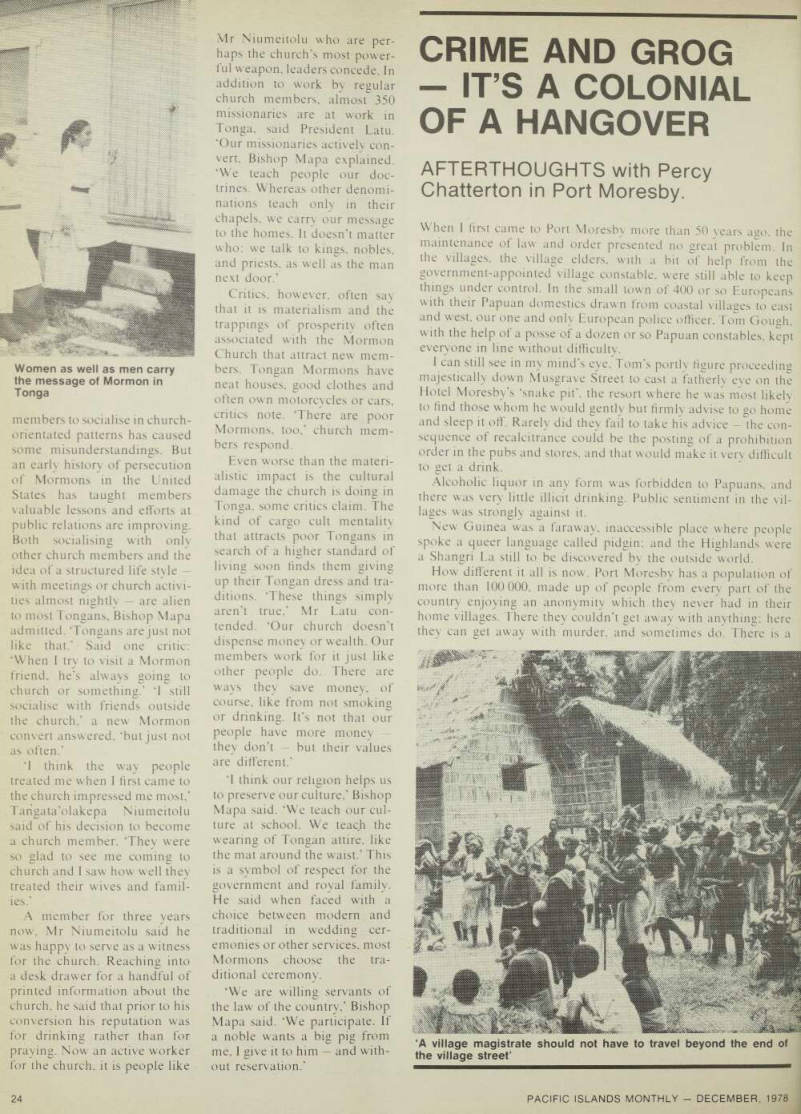
A village magistrate should not have to travel beyond the end of the village street’
growing criticism of. and lack of respect for. the law. an over worked judiciary and magistracy, and a waning respect on the part of a sophisticated younger generation for the authority of
village elders.
Criticism of the law is based on the claim that it is ‘inappropri ate’ (to use one of the most popular in-words of the era of independence) to Papua New Guinea. ‘Away with western law; let’s have Melanesian law'. Which would be fair enough if the people of Papua New Guinea were still doing Melanesian things in a subsistence economy. But fewer and fewer of them are. How can you have a Melanesian law to cover the activities of modern commerce, the operation of banks, or the regulation of public
transport?
It is true, of course, that western law needs adaptation to Melanesian conditions. This adaptation is already going on under the guidance of the Law Reform Commission, a very responsible body which is unlikely to allow itself to be pressured into throwing out the baby with the bathwater. However, the ability of the com mission to improve the situation is dependent on the willingness of the politicians to put aside their games of one-upmanship and get on with the task of lawmaking.
Lack of respect for the law is closely tied in with our over burdened system of law enforcement. What we need most is not different laws or more laws, but speedier and more efficient en forcement of the laws we’ve already got. For this we need a better distribution of the workload between the various courts national, district, local and village; and possibly a new level of jurisdiction between the district and national levels. We also need a larger and better trained police force. This will be expensive, but it could be more expensive not to have it.
In the matter of punishment, there is no way in the world in which our courts can please everybody. Whether a given penalty is too severe or not severe enough depends, in a great deal of Papua New Guinean thinking, on whether the person being pun ished is a wantok (friend) or an outsider. The group that clamours for the release from prison of its friends also clamours for its enemies to be lined up and shot without trial.
An attempt has been made to solve the problem of waning respect for village elders by establishing village courts, presided over by magistrates who are not trained in the law but who are men of stature, and hopefully of integrity, in the community. The idea is a good one, provided there is adequate supervision, ad equate precautions against magistrates or other court officials swiping the fines, and adequate channels of appeal for those penalised. None of these conditions seems to be met at pre sent.
Furthermore, a village court should in my view be a court in i village. To group villages together under the jurisdiction of a single village court is to repeat the error made by colonial admin istrators when they grouped villages together under local govern ment councils. ‘Village courts’ so constituted are in danger of becoming just a lower tier in the local court system, without the benefit of trained magistrates. When I hear that village magis trates are asking for travelling allowances, I sense that something has gone wrong. A village court magistrate should not have to travel beyond the end of the village street.
To the well-worn adage that justice should not only be done but should be seen to be done, should perhaps be added, in Papua New Guinea, ‘and should be done quickly’. Long delays in the administration of justice undermine public confidence in it.
But there are dangers in accelerating the process. In a desire for quick justice it is tempting to adopt the principle that an accused person must prove his innocence rather than that his accusers must prove his guilt. There is also great danger in adopt ing the principle that what ‘everybody knows’ is true. This is par ticularly so in relation to sorcery. Those of us who come from England remember with shame that in our homeland, only a few hundred years ago, harmless old women who lived alone, talked to their cat and got cross when teased by children, were cruelly
put to death because ‘everybody knew’ that they were witches.
Yet both these ‘principles' find their advocates in Papua New
Guinea today.
That a substantial proportion of the total volume of crime and public disorder in Papua New Guinea today is occasioned directly or indirectly by excessive intake of alcohol is not just the havering of an octogenarian ex-missionary. It is the considered conclusion of the police and the courts. They should know.
Current debate as to whether liquor trading hours should be longer or shorter or whether beer should be stronger or weaker has touched off some very interesting and revealing correspon dence in the PNG Post-Courier. Some of these letters confirm what 1 have always suspected, namely that high-falutin’ talk about ‘educating people to drink sensibly’ is just a lot of nonsense. In this country, 16 years after the lifting of restrictions on drinking by nationals, those who want to drink sensibly know how to do it. But it is crystal clear that there are many drinkers in Papua New Guinea who don't want and don’t intend to drink sensibly.
They want to get drunk as quickly and cheaply as possible.
If that’s what they want, let them have it; but let them take the consequences. When they find themselves in court, let them not whine that they were too drunk to know what they were doing, or that they’ll lose their job if their driving licence is sus
pended.
We can’t get rid of beer. But we can debunk it. We can get rid of the roseate cloud of sentimentality which surrounds it in Australia and has unfortunately been imported into Papua New Guinea. A Papuan wife once said to me: ‘I wouldn’t mind my husband coming home drunk; what I can’t stand is having to clean up the vomit and get rid of the smell of urine the next morning.' What a pity that our drunks can’t see and smell themselves as others see and smell them.
To those of my friends in Papua New Guinea who prattle about the ‘Melanesian Way’, I would like to say this; Melanesia is one of the very few areas in the world which traditionally had no alcoholic drink. The Melanesian way was a sober way. If you want to get drunk, go right ahead; but remember that your hang over is a colonial hangover, not a Melanesian one.
It’s quite possible to combine happiness with sobriety. I’ve been doing it for 80 years. Your Melanesian ancestors have been doing it for thousands of years. I wish you a happy, sober Christ mas.
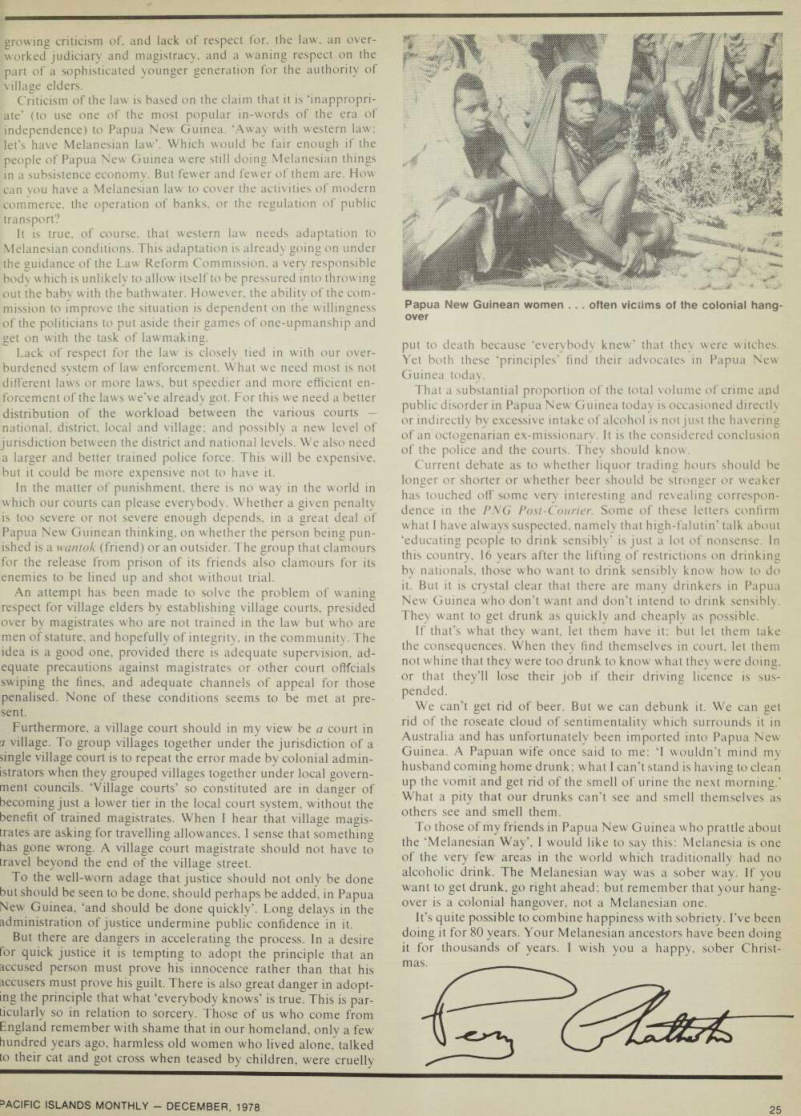
Papua New Guinean women . . . often victims of the colonial hang over