You might just as well be
p. 23 · Read in the full issue
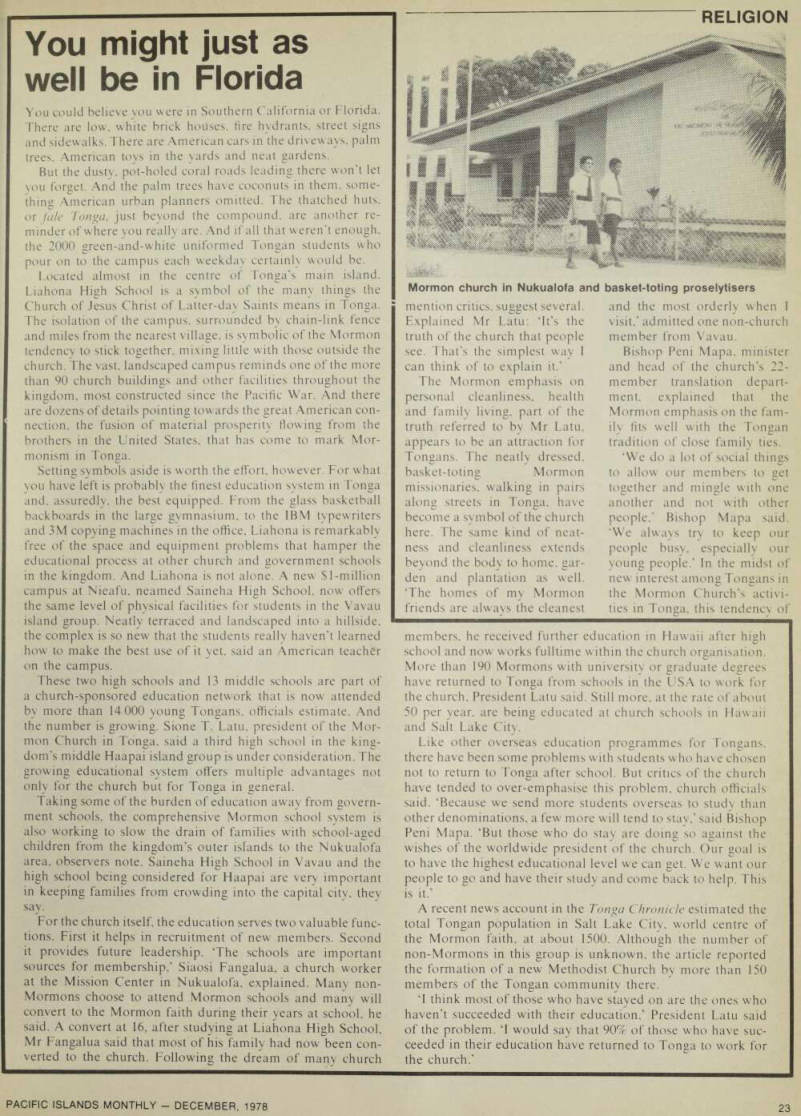
well be in Florida
You could believe you were in Southern California or Florida.
There are low. white brick houses, fire hydrants, street signs and sidewalks. There are American cars in the driveways, palm trees. American toys in the yards and neat gardens.
But the dusty, pot-holed coral roads leading there won't let you forget. And the palm trees have coconuts in them, some thing American urban planners omitted. The thatched huts, or [ale Tonga , just beyond the compound, are another re minder of where you really are. And if all that weren’t enough, the 2000 green-and-white uniformed Tongan students who pour on to the campus each weekday certainly would be.
Located almost in the centre of Tonga's main island.
Liahona High School is a symbol of the many things the Church of Jesus Christ of Latter-day Saints means in Tonga.
The isolation of the campus, surrounded by chain-link fence and miles from the nearest village, is symbolic of the Mormon tendency to stick together, mixing little with those outside the church. The vast, landscaped campus reminds one of the more than 90 church buildings and other facilities throughout the kingdom, most constructed since the Pacific War. And there are dozens of details pointing towards the great American con nection, the fusion of material prosperity flowing from the brothers in the United States, that has come to mark Mor monism in Tonga.
Setting symbols aside is worth the effort, however. For what you have left is probably the finest education system in Tonga and. assuredly, the best equipped. From the glass basketball backboards in the large gymnasium, to the IBM typewriters and 3M copying machines in the office. Liahona is remarkably free of the space and equipment problems that hamper the educational process at other church and government schools in the kingdom. And Liahona is not alone. A new sl-million campus at Nieafu. neamed Saineha High School, now offers the same level of physical facilities for students in the Vavau island group. Neatly terraced and landscaped into a hillside, the complex is so new that the students really haven't learned how to make the best use of it yet, said an American teacher on the campus.
These two high schools and 13 middle schools are part of a church-sponsored education network that is now attended by more than 14 000 young Tongans, officials estimate. And the number is growing. Sione T. Latu. president of the Mor mon Church in Tonga, said a third high school in the king dom’s middle Haapai island group is under consideration. The growing educational system offers multiple advantages not only for the church but for Tonga in general.
Taking some of the burden of education away from govern ment schools, the comprehensive Mormon school system is also working to slow the drain of families with school-aged children from the kingdom’s outer islands to the Nukualofa area, observers note. Saineha High School in Vavau and the high school being considered for Haapai are very important in keeping families from crowding into the capital city, they say.
For the church itself, the education serves two valuable func tions. First it helps in recruitment of new members. Second it provides future leadership. ‘The schools are important sources for membership,’ Siaosi Fangalua, a church worker at the Mission Center in Nukualofa, explained. Many non- Mormons choose to attend Mormon schools and many will convert to the Mormon faith during their years at school, he said. A convert at 16, after studying at Liahona High School, Mr Fangalua said that most of his family had now been con verted to the church. Following the dream of many church
members, he received further education in Hawaii after high school and now works fulltime within the church organisation.
More than 190 Mormons with university or graduate degrees have returned to Tonga from schools in the USA to work for the church. President Latu said. Still more, at the rate of about 50 per year, are being educated at church schools in Hawaii and Salt Lake City.
Like other overseas education programmes for Tongans, there have been some problems with students who have chosen not to return to Tonga after school. But critics of the church have tended to over-emphasise this problem, church officials said. ‘Because we send more students overseas to study than other denominations, a few more will tend to stay,’ said Bishop Peni Mapa. ‘But those who do stay are doing so against the wishes of the worldwide president of the church. Our goal is to have the highest educational level we can get. We want our people to go and have their study and come back to help. This is it.’
A recent news account in the Tonga Chronicle estimated the total Tongan population in Salt Lake City, world centre of the Mormon faith, at about 1500. Although the number of non-Mormons in this group is unknown, the article reported the formation of a new Methodist Church by more than 150 members of the Tongan community there. ‘I think most of those who have stayed on are the ones who haven’t succeeded with their education.' President Latu said of the problem, i would say that 90% of those who have suc ceeded in their education have returned to Tonga to work for the church.’