basket-toting
pp. 21-24 · Read in the full issue

Tonga and its neat basket-toting Mormon missionaries
The Mormons - the Church of Jesus Christ of Latter-Day Saints are into Tonga in a big xay. Will Keener, an American vho has Just completed a long Uay in the country, writes of the ■easons for their success, and the ’arious criticisms aroused by heir activites. He also takes a 'lose look at the thriving Mornon educational system which s already firmly implanted in
he country.
Ve believe in being subject to dngs, rulers, presidents and nagistrates, in obeying, lonouring and sustaining the a "- Articles of Faith, Church f J esus Christ of Latter-Day * aints ■ It was the Tongan version of endering unto Caesar that /hich is Caesar’s. And for the hurch of Jesus Christ of .atter-Day Saints in Tonga it an expensive giving. aesar, in the form of King aufa’ahau Tupou IV, delanded a church. Located in le centre of the capital city ear the Dateline Hotel, the irge chapel had been built on rown land years earlier with pproval of the royal family. his year, the king decided he
wanted the land and the build
ing back. Very quietly, the
Mormon church obeyed.
It was the law of the land and of the church, leaders have quietly indicated. But when ap proached for a public state ment by a reporter from the Tonga Chronicle, both church and palace officials declined to comment. The reluctance to comment energised futher an
already buzzing coconut tele
graph which soon carried re ports between neighbours and islands that the abandoned church building would be used for a Chinese restaurant, or for the ill-fated but controversial Bank of the South Pacific. The king was moving to oust the church, a newspaper headline
in neighbouring Fiji reported.
The church would retaliate by cutting off their multi-million dollar spending programme in the kingdom, others specu lated. ‘Not true at all,’ was the re sponse from church officials and other church members re cently in a series of interviews with PIM. Happy for a chance to tell their story of success in Tonga and to answer criticisms,
officials discussed at length the current and future pro grammes of the Mormon Church in Tonga.
The church was a long way from leaving Tonga. President Sione T. Latu, sitting behind his large desk in Nukualofa, declared. His carpeted and air conditioned office includes a large map of Tonga, pinpoint ing the location of more than 90 church buildings and facili ties. Not only is the church con tinuing to invest at the rate of about ST3 million annually, a major building plan was underway, he said.
People who see the church’s investments as business invest ments, with profits to be made later, are mistaken. Mr Latu believes. Tf we treated the church like a business, it would be impossible to operate here,' he explained. A recent school and church complex in nearby Havelulotu cost the church an estimated $400,000. Tt would take us 100 years to collect money like that from the people here,’ he said. ‘We look at our church in terms of helping individuals not as a business,’ the president said. Plans call for the addition of 25 to 30 church buildings in Tonga within the next two years, in addition to an am bitious renovation programme for other buildings. The church also operates a major island education system and works a significant acreage of farm land in Tonga, including an estimated 30 ha of land on Tongatapu and a 200 ha farm on nearby Eua.
The result of these efforts, as church leaders might say. to
provide an appropriate setting for helping the individual, is a more and more architecturally visible Mormon Church in Tonga. The distinctive, if simi lar. church buildings now dot the landscape of Tonga. As one Australian tourist said; Tf you got lost, just find the Mormon Church. They all look the same, except that the name of the village is written right on the front.' A worldwide church build ing programme allows Ton gans, as with members in other developing nations, to pay only 20% of building costs. Because the church subsidises the build
ings and helps provide
materials, the facilities tend to be of a higher quality thanthose of other Tongan churches, where little outside help can be
expected. Buildings even in
isolated areas make use of the best of materials. They are wired for electricity and have
plumbing for running water,
even though power generators and water systems may not be available for years to come on many islands.
But the growing number of churches, schools and other Mormon-controlled facilities in the kingdom is only the vis ible reflection of the more im portant fact that church
membership is climbing stead
ily. A 1977 census report listed 8 350 Mormons, although Mr Latu says church records show between 13 000 and 14 000 members. By either figure, the church is Tonga’s fourth largest and fastest growing. Census figures from 1956 showed only 4 952 Mormon members.
What is the reason for the rapid growth? Members, not to
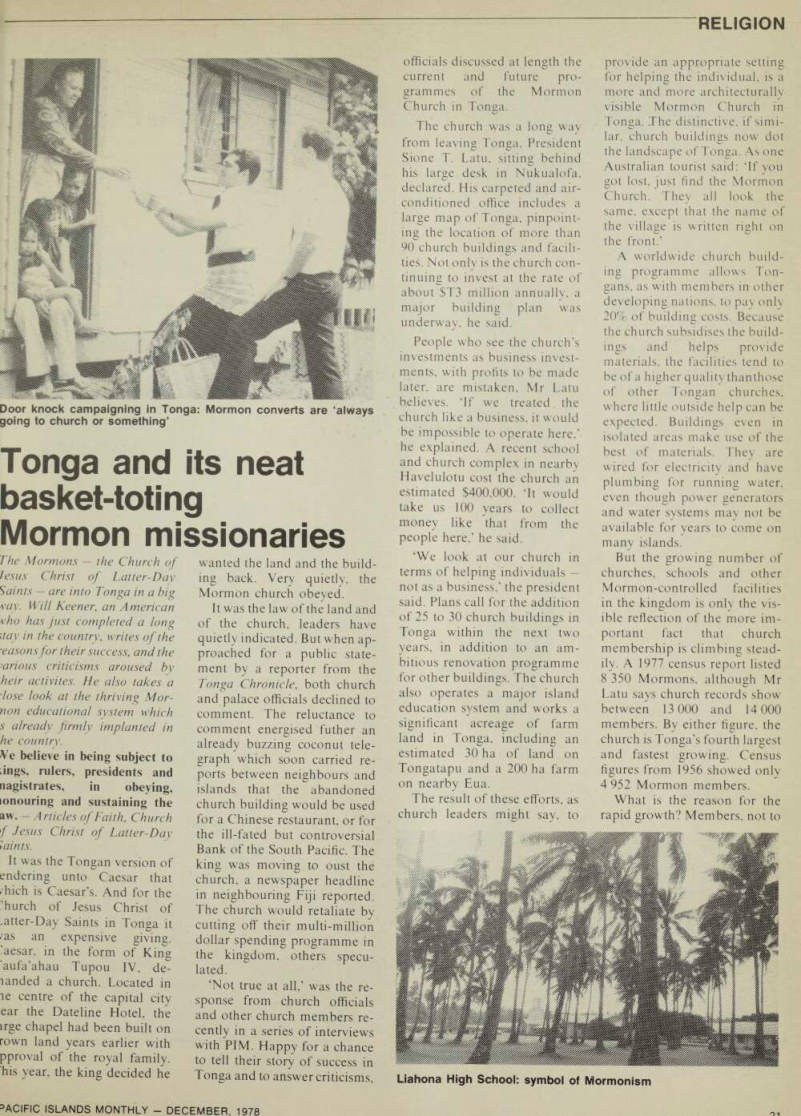
Door knock campaigning in Tonga: Mormon converts are ‘always going to church or something’
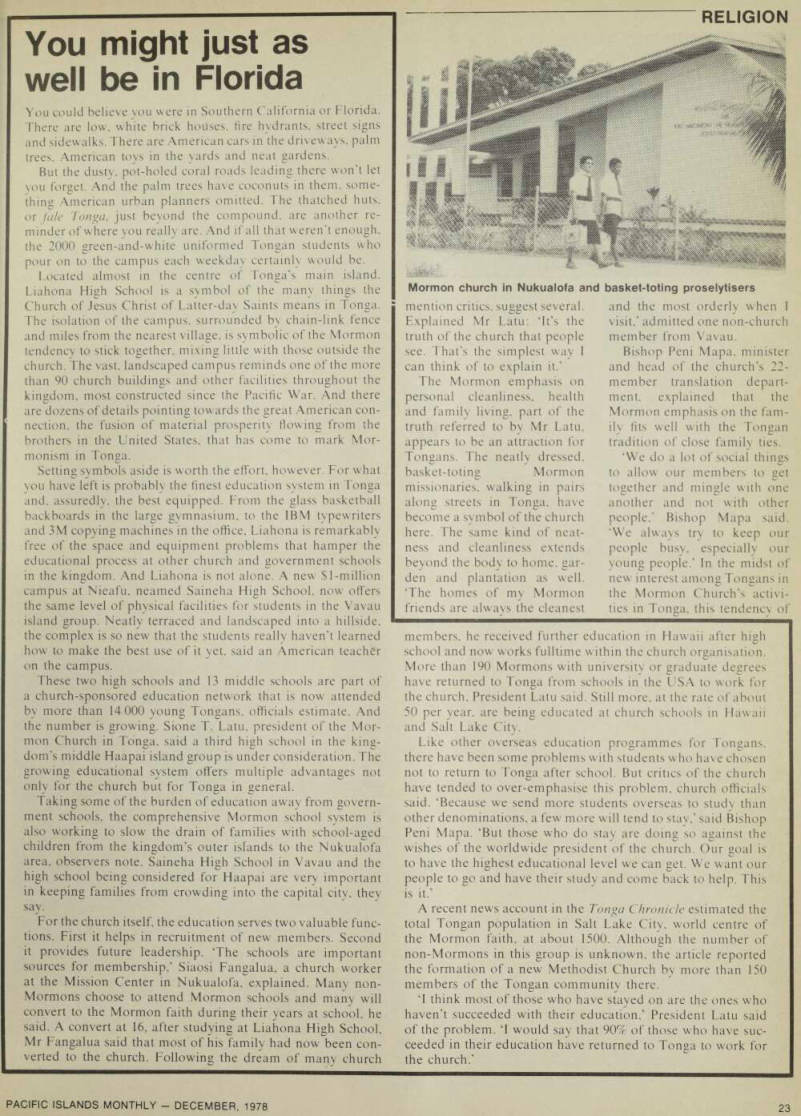
Liahona High School: symbol of Mormonism
mention critics, suggest several.
Explained Mr Latu; ‘lt's the truth of the church that people see. That’s the simplest way I can think of to explain it.' The Mormon emphasis on personal cleanliness, health and family living, part of the truth referred to by Mr Latu. appears to be an attraction for
Tongans. The neatly dressed.
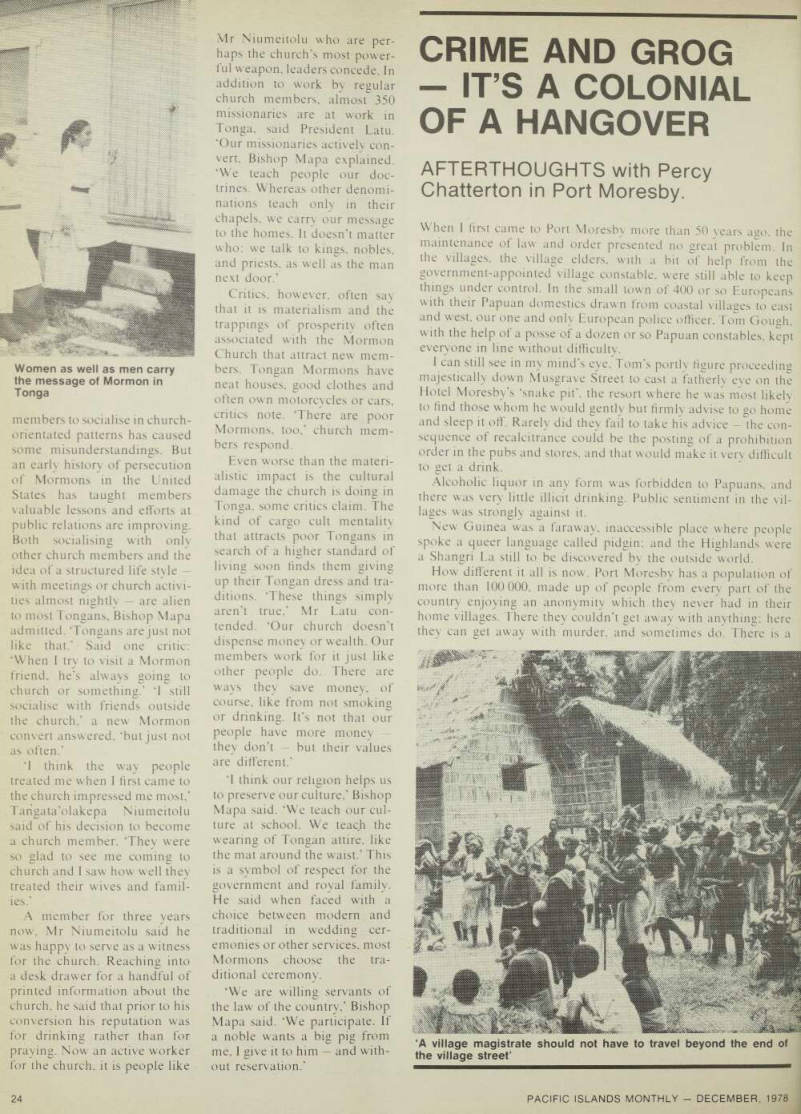
basket-toting Mormon
missionaries, walking in pairs
along streets in Tonga, have become a symbol of the church here. The same kind of neatness and cleanliness extends beyond the body to home, garden and plantation as well.
The homes of my Mormon friends are always the cleanest
and the most orderly when I visit,’admitted one non-church member from Vavau.
Bishop Peni Mapa, minister
and head of the church’s 22member translation depart ment. explained that the Mormon emphasis on the fam ily fits well with the Tongan tradition of close family ties. ‘We do a lot of social things to allow our members to get together and mingle with one another and not with other
people.' Bishop Mapa said,
‘We always try to keep our
people busy, especially our
young people.' In the midst of new interest among Tongans in the Mormon Church's activi ties in Tonga, this tendency of
Mormon church in Nukualofa and basket-toting proselytisers
members to socialise in church orientated patterns has caused some misunderstandings. But
an early history of persecution
of Mormons in the United States has taught members valuable lessons and efforts at
public relations are improving.
Both socialising with only
other church members and the idea of a structured life style with meetings or church activi ties almost nightly are alien
to most Tongans, Bishop Mapa
admitted. ‘Tongans are just not like that.’ Said one critic: ‘When I try to visit a Mormon friend, he’s always going to church or something.’ ‘1 still socialise with friends outside the church.' a new Mormon convert answered, ‘but just not as often.' T think the way people treated me when I first came to the church impressed me most.’
Tarigata’olakepa Niumeitolu
said of his decision to become a church member. ‘They were so glad to see me coming to church and I saw how well they treated their wives and famil ies.’
A member for three years now, Mr Niumeitolu said he was happy to serve as a witness for the church. Reaching into a desk drawer for a handful of printed information about the church, he said that prior to his conversion his reputation was for drinking rather than for praying. Now an active worker for the church, it is people like
Mr Niumeitolu who are per haps the church’s most power ful weapon, leaders concede. In addition to work by regular church members, almost 350 missionaries are at work in Tonga, said President Latu. ’Our missionaries actively con
vert. Bishop Mapa explained.
’We teach people our doc trines. Whereas other denomi nations teach only in their chapels, we carry our message to the homes. It doesn’t matter who; we talk to kings, nobles, and priests, as well as the man next door.’
Critics, however, often say that it is materialism and the
trappings of prosperity often
associated with the Mormon Church that attract new mem bers. Tongan Mormons have neat houses, good clothes and often own motorcycles or cars, critics note. There are poor Mormons, too,’ church mem bers respond.
Even worse than the materi alistic impact is the cultural damage the church is doing in Tonga, some critics claim. The kind of cargo cult mentality that attracts poor Tongans in search of a higher standard of living soon finds them giving up their Tongan dress and tra ditions. ‘These things simply aren’t true,’ Mr Latu con tended. ‘Our church doesn’t dispense money or wealth. Our members work for it just like other people do. There are ways they save money, of course, like from not smoking or drinking. It’s not that our people have more money they don’t — but their values are different.’ ‘1 think our religion helps us to preserve our culture,' Bishop Mapa said. ‘We teach our cul ture at school. We teach the wearing of Tongan attire, like the mat around the waist.’ This is a symbol of respect for the
government and royal family.
He said when faced with a choice between modern and traditional in wedding cer emonies or other services, most Mormons choose the tra ditional ceremony. ‘We are willing servants of the law of the country,’ Bishop Mapa said. ‘We participate. If a noble wants a big pig from me, I give it to him — and with out reservation.’
Women as well as men carry the message of Mormon in Tonga