The Islands
pp. 15-19 · Read in the full issue

Resources
Surveillance
A View From
The Islands
November saw the completion by Hawker de Havilland Aus tralia Pty Ltd of the mammoth job of compiling a verbatim record of the three-day international symposium it sponsored in Sydney in June on coastal and fisheries protection. The record makes a volume of almost 700 pages a rich source of information on the problems of surveillance of national economic zones, and in particular on the vast range of equip ment available to carry out this work. PIM staff writer Mal colm Salmon was at the symposium, talked to Islands representatives there, and has now studied the printed re cord.
The transition from the con :ept of open seas to the various
forms of national sovereignty
3ver very large areas of ocean s a highly complex undertak ng, requiring a great deal of
Datience, foresight and clear
funking on the part of all lations taking part in the Law )f the Sea Conventions. This process can be either organised md orderly, or chaotic and
itormy.’
So says Stan Schaetzel, tech lical director of Hawker de -lavilland Australia Pty Ltd in lis preface to the record of the nternational symposium on :oastal and fisheries protej:ion. Mr Schaetzel was sym >osium convenor.
Most people would agree that n the few words quoted above dr Schaetzel said a mouthful, iut then nobody who was at he symposium will be sur >rised at that. Mr Schaetzel, san, and looking very much ike a middle-aged but still lighly active faun, played an bsolutely key role in its ardu ous proceedings. He was into verything, on his feet when ver a tangled discussion
ceded unravelling, fielding
uestions both inside and far utside his professional sphere
f engineering, and cooling
ituations when, as happened
ften enough, participants’
onflicting interests, business nd otherwise, generated some
personal heat. The drab term ‘convenor’ does not do justice to his role. Presiding genius is much closer to the mark.
The symposium attracted almost 200 participants from more than 20 countries. They
represented aircraft and ship
building companies, manufac
turers of electronic equipment, governments, armed services, and a number of specialist pub lications.
Pacific Island countries rep resented included Papua New Guinea, Fiji. Tonga, the Gil bert Islands, and Nauru. The South Pacific Bureau for Econ omic Co-operation (SPEC) was represented by its assistant research officer, Mr Tamarii Pierre. The South Pacific Com mission was represented by Dr Robert Kearney of the skipjack tuna tagging programme.
Proceedings inevitably
sometimes looked more like a cockfight than anything else. In one incident a Canberra bu reaucrat let slip that a certain American electronics company had won an Australian Government contract. He was
immediately challenged from
the floor by the representative of a rival American tenderer who pointed out hotly that the Australian government depart ment concerned had not yet made any public announce ment of its decision on the ten ders. All the bureaucrat’s flair
for beating about the bush did not save him from leaving the platform with a large and messy amount of egg on his face. As PNG’s chief fisheries inspector, Mr A. E. Adams, remarked to me: ‘We came here expecting a lot of com mercial barrow-pushing, and in this respect we have cer
tainly not been disappointed.’
But the symposium served many useful purposes. In par
ticular, by exposing par
ticipants to the views and concerns of others, it helped them to gain a clearer idea of just what their own precise re quirements are in the still vaguely understood tasks of coastal and fisheries protec tion.
For example, the represen tatives of PNG and Fiji were at one in rejecting some of the options presented at the sym posium. PNG’s Mr Adams told me: ‘High-speed small sea going craft may be okay for some people and some pur poses, but our actual job re
quires something quite
different. ‘We feel we need a trawler design craft rather than pursuit-type vessels. What we need must be able to go out to sea and stay out for a number of weeks. We need long range and long endurance in the vessels we use, with strong em phasis on crew comfort and
proper amenities. We need something very like the craft we are trying to catch. ‘After all, our job is to detect
trawler-type vessels fishing in
our economic zone. The efficiency of the smaller patrol boats drops rapidly as the sea state rises, but the efficiency of the poaching trawlers is hardly affected at all. They come across some of the worst seas in the world to get into our waters, and still they are able to stay out. They have an endurance of something like three months, and what we are after must be able to match that, or something very close to it.’ PNG is at present using five Attack class patrol boats on marine surveillance.
Commander Stan Brown, head of the naval squadron.
Royal Fiji Military Forces,
talked along much the same lines. He told me: ‘From our point of view, coastal sur veillance is not an appropriate description of what we have to do. Our task is really sea sur veillance. We in Fiji have more ocean to cover than the United
Kingdom within our respective
200-mile zones and this is de spite the enormous difference in the resources of the two countries. Fiji rates about twentieth in the world in the matter of the area of ocean to be kept under surveillance - Australia ranks first. ‘Fiji at present has three patrol vessels and one hydro
graphic survey ship. The patrol
vessels are US-built Bluebird class minesweepers converted to a patrol boat role. I would say that a ship that can stay at sea for three weeks is an absol ute requisite for us. Our Blue bird class ships can do this. For us to accept any shorter endurance term would be to evade the problem.
‘Among the equipment
being promoted here I must say I have seen nothing that is ideal for us so far - it all seems either too small or too big. An up-dated version of what we already have would seem to me to provide most of the answers for us.’
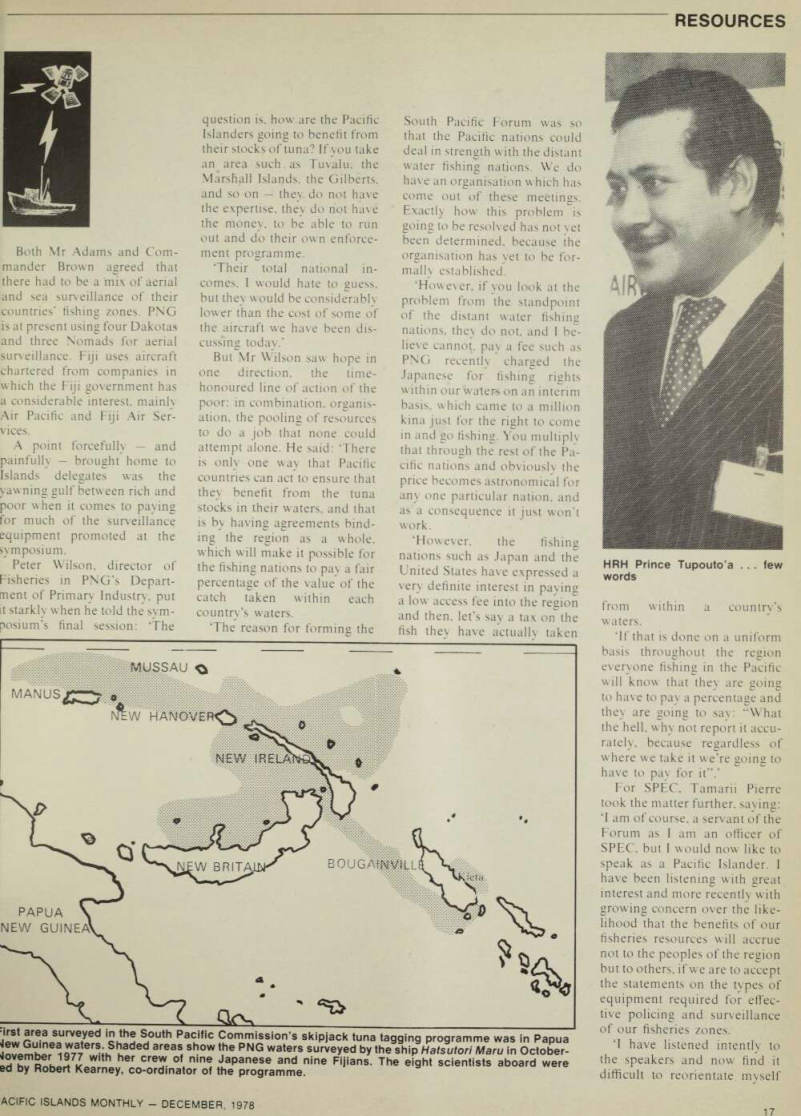
Stan Schaetzel.. . presiding ge nius
Both Mr Adams and Com mander Brown agreed that there had to be a mix of aerial and sea surveillance of their countries' fishing zones. PNG is at present using four Dakotas and three Nomads for aerial surveillance. Fiji uses aircraft chartered from companies in which the Fiji government has a considerable interest, mainly Air Pacific and Fiji Air Ser vices.
A point forcefully and
painfully brought home to
Islands delegates was the
yawning gulf between rich and poor when it comes to paying for much of the surveillance equipment promoted at the
symposium.
Peter Wilson, director of
Fisheries in PNG’s Depart
ment of Primary Industry, put
it starkly when he told the sym
posium's final session: ‘the
question is. how are the Pacific Islanders going to benefit from their stocks of tuna? If vou take an area such as Tuvalu, the Marshall Islands, the Gilberts, and so on they do not have the expertise, they do not have the money, to be able to run out and do their own enforce ment programme. ‘Their total national in comes. I would hate to guess, but they would be considerably lower than the cost of some of the aircraft we have been dis
cussmg today.’
But Mr Wilson saw hope in one direction, the time honoured line of action of the poor: in combination, organis ation. the pooling of resources to do a job that none could attempt alone. He said: ‘There is only one way that Pacific countries can act to ensure that they benefit from the tuna stocks in their waters, and that is by having agreements bind ing the region as a whole, which will make it possible for the fishing nations to pay a fair percentage of the value of the catch taken within each
country’s waters.
‘The reason for forming the
South Pacific Forum was so that the Pacific nations could deal in strength with the distant water fishing nations. We do have an organisation which has come out of these meetings.
Exactly how this problem is going to be resolved has not yet been determined, because the organisation has yet to be for
mally established.
'However, if you look at the
problem from the standpoint
of the distant water fishing nations, they do not, and I be lieve cannot, pay a fee such as
PNG recently charged the
Japanese for fishing rights
within our waters on an interim basis, which came to a million kina just for the right to come in and go fishing. You multiplv that through the rest of the Pa cific nations and obviously the price becomes astronomical for any one particular nation, and as a consequence it just won't work. ‘However. the fishing nations such as Japan and the United States have expressed a very definite interest in paying a low access fee into the region and then, let’s say a tax on the fish they have actually taken
from within a country’s waters. ‘lf that is done on a uniform
basis throughout the region
everyone fishing in the Pacific will know that they are going to have to pay a percentage and they are going to say: “What the hell, why not report it accu
rately, because regardless of
where we take it we're going to have to pay for it”.’
For SPEC. Tamarii Pierre took the matter further, saying: i am of course, a servant of the Forum as I am an officer of SPEC, but I would now like to speak as a Pacific Islander. I have been listening with great interest and more recently with growing concern over the like lihood that the benefits of our fisheries resources will accrue not to the peoples of the region but to others, if we are to accept the statements on the types of
equipment required for effec
tive policing and surveillance of our fisheries zones. ‘I have listened intently to the speakers and now find it difficult to reorientate myself
[?]Firt area surveryed in the South pacific Commission's skipjack tuna tagging programe was in Papua New Guinea waters. Sheded areas show the PNG waters surveryed by the ship Hatsutori Maru in October- November 1977 with her crew of nine Japanese and nine Fijins. The eight scientists aborad were [?]ed by Rodbert kearney, co-ordinator of the programme.
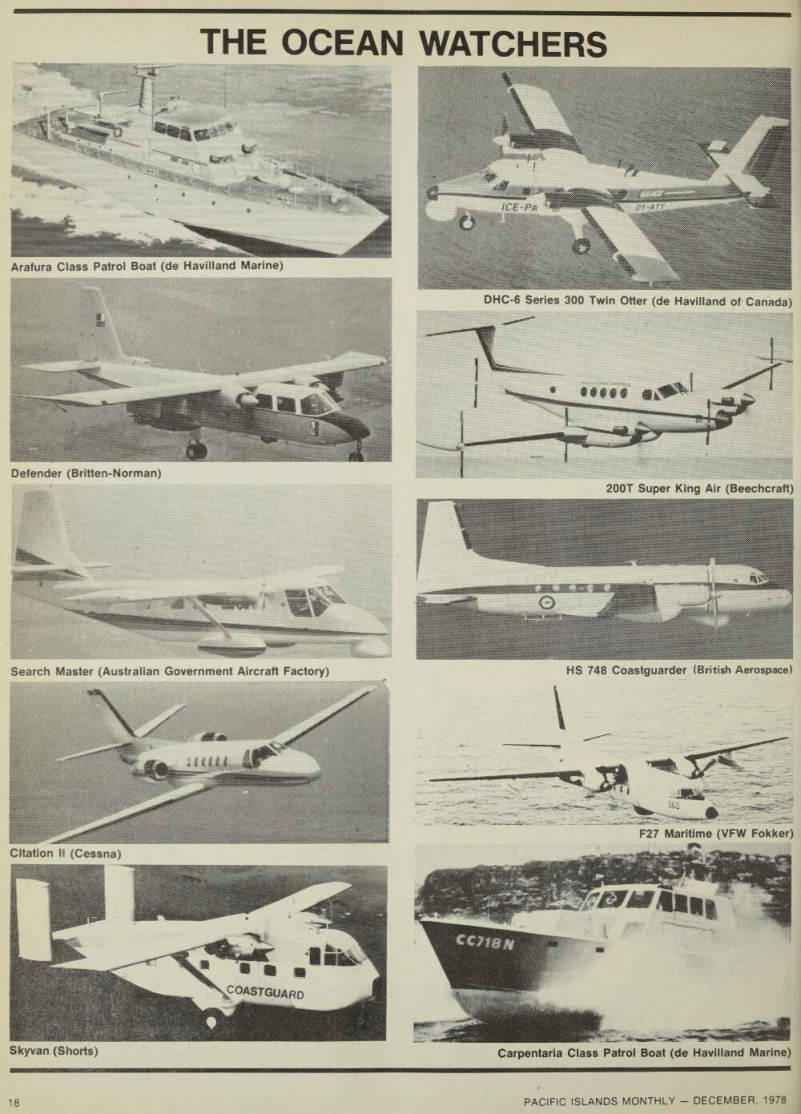
HRH Prince Tupouto’a . . . few words
The Ocean Watchers
Arafura Class Patrol Boat (de Havilland Marine)
Defender (Britten-Norman)
Search Master (Australian Government Aircraft Factory)
Citation II (Cessna)
Skyvan (Shorts)
DHC-6 Series 300 Twin Otter (de Havilland of Canada)
200 T Super King Air (Beechcraft)
HS 748 Coastguarder (British Aerospace)
F27 Maritime (VFW Fokker)
Carpentaria Class Patrol Boat (de Havilland Marine)
o the reality of the scarce inancial resources of the coun ries in the region. ‘Not only can we not afford ill this equipment that has >een displayed to us. I think in he Pacific way we should try o look after each other. We, as ‘acific Islanders, would want nore to co-operate with each •ther than to try to equip our elves for confrontation.
T don’t think the possibility
T regional co-operative action,
r perhaps sub-regional co
operative action in surveillance has been adequately touched upon at the symposium.' On the same theme. PNG’s Peter Wilson said that in the light of the Forum’s directive for the establishment of a fisheries organisation, his
department had been looking
at the possibility of satellite coverage of the Forum area.
He said: ‘Satellites, when we are looking at satellite coverage of PNG, our part of the world, is too darned expensive for us to think about. However, we do feel that from the standpoint of a regional area, the Forum area . . . satellite coverage will now become feasible, par
ticularly with the co-operation
of the United States.’
Other Islands spokesmen proved more sparing with their
words. His Royal Highness Prince Tupouto’a. Tonga’s as sistant secretary for foreign affairs, told me with all the grace born of his royal nurture: T have been much more interested in the technical con tent of the papers than in the more political aspects of the discussion.’ And that was that.
Mr M. Adkin, from the Gil berts’ ministry of natural re source development, wondered whether the Gilberts would do anything about surveillance at all. The government would first need to be convinced that what they were out to protect was worth more than what it would cost them to protect it.
They were waiting for the re sults of the South Pacific Com mission’s skipjack tuna survey
before making up their minds.
Nauru’s legal adviser. Mr K.
P. Whitcombe, was more guarded still. He told me: ‘Our role here has been primarily of
an information-gathering
character. This information will be presented to the govern ment for decision when we have completed our report.' It was noteworthy that not one of the more than 30 papers
presented to the symposium
was delivered by an Islands
representative. Perhaps none
came forward to offer one. but from the point of view of the Island countries it was a weak ness of the symposium just the same.
This weakness was frankly
acknowledged in summing-up
remarks made at the close of the symposium by Mr T. F. C.
Lawrence, from Australia’s
department of productivity.
He said: T was disappointed that we concentrated too much on the Australian context, and some of the comments that have been made subsequently indicate that some others were also a little disappointed that it was the Australian problem that was identified, rather than the South Pacific area problem for instance.’
But all were agreed that as symposiums go, this one was more useful than most. It ident ified many problems that had not been recognised before. As such it made a contribution to clarifying a crucial issue of the future economic development of the Island countries an issue which, as the September meeting of the South Pacific Forum in Niue (PIM Novem ber) dramatically showed, is still far from being resolved.
One thing is clear; for many of the manufacturers of equip ment promoted at the sym posium it’s ‘back to the drawing board’ if they’re ever going to come up with sur veillance systems within the financial and technical reach of many of the Pacific Island countries. Their need for such
equipment could hardly be
more urgent.
[?]rom director maritime operations and Captain Ignatius Lai, pilot, air element, [?]th of PNG Defence Force and Bruce Price, managing directo., Hawker de Havilland Australia