Cruelty and
pp. 31-35 · Read in the full issue

Tropicalities
This month with PI M’s new editor, Bob Hawkins, who turns in a random account of happenings, impressions, and some plain trivia gleaned from his recent Pacific journeyings. . .
Getting to
know you...
Venturing into new Pacific areas can be an unnerving ex perience. Especially if you are not a Pacific Islander and you are keen not to do the wrong thing in an alien society. Per haps what passes as okay in Papua New Guinea will offend in Tuvalu. These were my mis
givings when PlM’s publisher,
Stuart Inder, said: ‘Well, Hawkins, it’s about time you got out and about to introduce yourself as PlM’s new editor.’
Of the western Pacific I knew a little: six years in Papua New Guinea, a few visits to Honiara, a year in Fiji, all basi cally Melanesian societies. Of
Polynesia I knew nothing. My
itinerary? Western Samoa, Niue, American Samoa, Fiji, Tuvalu, New Caledonia. As well as familiarisation, my
specific assignments were the
South Pacific Forum on Niue, Tuvalu’s independence cele brations, and the South Pacific Conference in Noumea. My re ports are written probably not to the satisfaction of some readers. But we do have our let ters columns. Let’s hear from you. What follows are a few sidelights to my travels.
The ‘loafer’
of Faleolo
Faleolo airport. Western
Samoa: Just in from Auckland.
A bus waits outside the customs hall. A fat, slack-jawed, young Samoan is sitting in the bus. He
jumps out, grabs my bags and
puts them in beside the driver’s
seat. Leers in friendly, roguish
fashion: ‘You should go in a taxi. The bus stops too often.’
I ask, curious to know why he should put my bags in a bus and then tell me to take a taxi: Are you a taxi driver?’ Reply: ‘No, I’m a loafer.’ A smile of obvious satisfaction. Was this the Samoan I didn’t want to be lieve in? A totally bald, lean
young man almost certainly American comes to the bus. ‘How much to the city?’ Behind him was a tiny, somehow de formed, thick-lensed, camera laden tourist. ‘Bloody Krishna,’ whispered my new-found Samoan friend. ‘Harmless enough,’ I countered. ‘They turn young people’s heads,’ he said with surprising vehemence and great piety. ‘lf they get on to me I’ve seen ’em all over the world. I’m a sailor you know I give ’em a good working over.’ I made no com ment. Business was bad. Only three passengers. Driver gets in. Sailor gives three tugs on the alarm, rises smoothly to his feet and slips down the steps out into the sunlight. ‘See you mate,’ he waves. As we move out of the airport he is in warm embrace with a plump old lady. Smiles, more hugs. The ‘loafer’ moves on.
Coconut crabs
by night
When my Niue hosts, Kendrick and Heke Vivian, and I left
Hakupu village for an evening
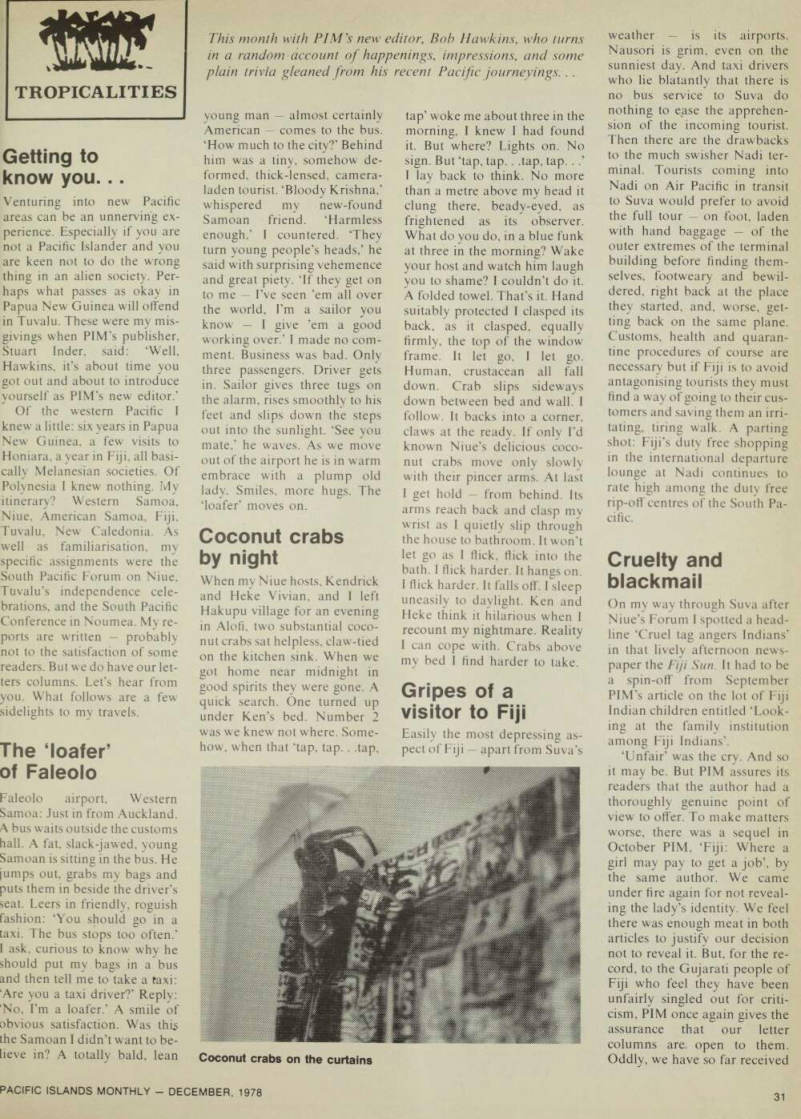
in Alofi, two substantial coco nut crabs sat helpless, claw-tied on the kitchen sink. When we got home near midnight in good spirits they were gone. A quick search. One turned up under Ken’s bed. Number 2 was we knew not where. Some how, when that ‘tap, tap.. .tap.
tap’ woke me about three in the morning, I knew I had found it. But where? Lights on. No sign. But ‘tap, tap.. .tap, tap. ..’
I lay back to think. No more than a metre above my head it
clung there, beady-eyed, as
frightened as its observer.
What do you do. in a blue funk at three in the morning? Wake your host and watch him laugh you to shame? I couldn’t do it.
A folded towel. That’s it. Hand
suitably protected I clasped its
back, as it clasped, equally firmly, the top of the window frame. It let go, I let go.
Human, crustacean all fall
down. Crab slips sideways
down between bed and wall. I follow. It backs into a corner, claws at the ready. If only I’d known Niue’s delicious coco nut crabs move only slowly with their pincer arms. At last I get hold - from behind. Its arms reach back and clasp my
wrist as I quietly slip through
the house to bathroom. It won’t let go as I flick, flick into the bath. I flick harder. It hangs on.
I flick harder. It falls off. I sleep uneasily to daylight. Ken and Heke think it hilarious when I
recount my nightmare. Reality
I can cope with. Crabs above my bed I find harder to take.
Gripes of a
visitor to Fiji
Easily the most depressing as pect of Fiji - apart from Suva’s
weather is its airports.
Nausori is grim, even on the sunniest day. And taxi drivers who lie blatantly that there is no bus service to Suva do nothing to ease the apprehen sion of the incoming tourist.
Then there are the drawbacks to the much swisher Nadi ter minal. Tourists coming into Nadi on Air Pacific in transit to Suva would prefer to avoid the full tour on foot, laden with hand baggage of the outer extremes of the terminal
building before finding them
selves, footweary and bewil dered, right back at the place they started, and, worse, get ting back on the same plane.
Customs, health and quaran tine procedures of course are necessary but if Fiji is to avoid
antagonising tourists they must
find a way of going to their cus tomers and saving them an irri
tating, tiring walk. A parting
shot: Fiji’s duty free shopping
in the international departure lounge at Nadi continues to rate high among the duty free rip-off centres of the South Pa cific.
Cruelty and
blackmail
On my way through Suva after Niue’s Forum I spotted a head line ‘Cruel tag angers Indians’ in that lively afternoon news paper the Fiji Sun. It had to be
a spin-off from September
PI M's article on the lot of Fiji Indian children entitled ‘Look ing at the family institution among Fiji Indians’. ‘Unfair’ was the cry. And so it may be. But PIM assures its readers that the author had a
thoroughly genuine point of
view to offer. To make matters worse, there was a sequel in October PIM, ‘Fiji: Where a girl may pay to get a job’, by the same author. We came under fire again for not reveal
ing the lady’s identity. We feel
there was enough meat in both articles to justify our decision not to reveal it. But, for the re cord, to the Gujarati people of Fiji who feel they have been unfairly singled out for criti cism, PIM once again gives the assurance that our letter columns are open to them.
Oddly, we have so far received
Coconut crabs on the curtains
only one letter and that from a very rational gentleman who validly argues that there are cases of cruelty to children in all societies, not just in Fiji’s Indian community. PIM has no intention of revealing its Fijian Indian correspondent’s ident ity. She, in our estimation, rightly feels she could be sub ject to persecution for her cour age in writing about conditions she has experienced as a life long member of the Fiji Indian community. We, in no way, doubt her sincerity, or her de termination to bring into the open a situation which she feels is in need of cure. We’re not a ‘bad news’ magazine, as our re cord shows. But, as too many governments and communities in this world fail to realise, the moment freedom of expression is taken away from the individual, suppression of the silent majority sets in.
Sir Keith meets
‘his people’
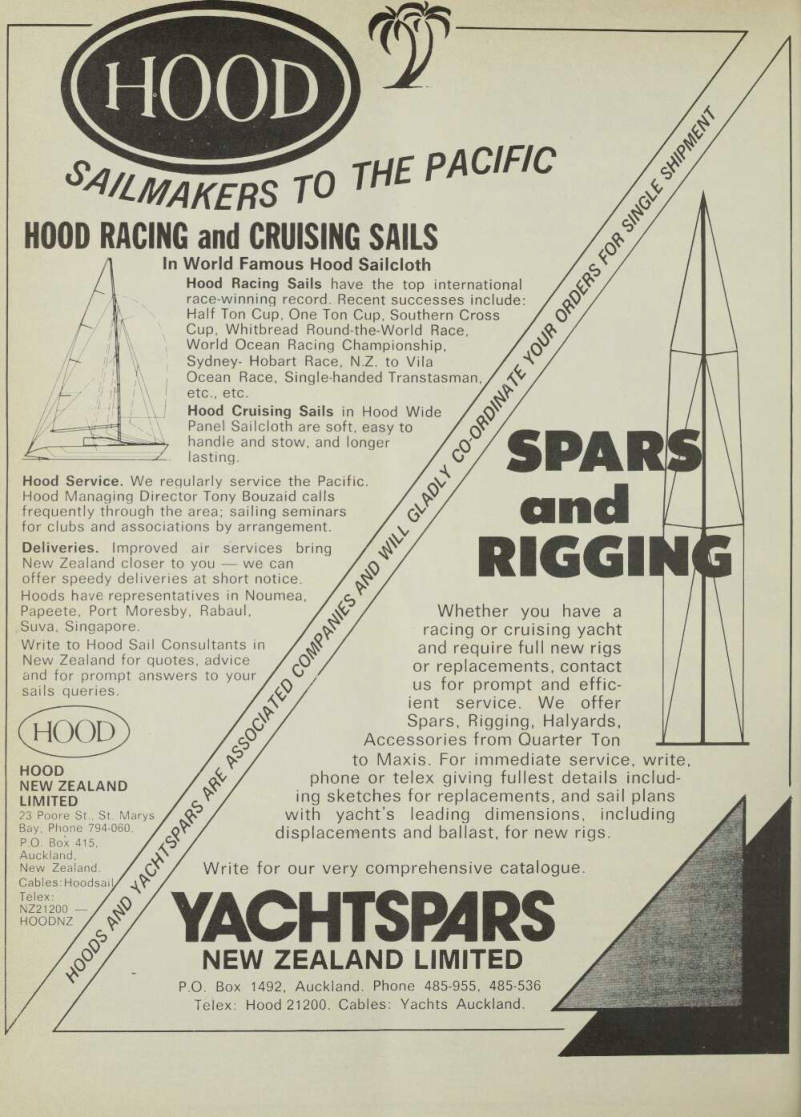
‘Keith Holyoake’s the name,’ said the little round man striding up to a trio of journal ists on Niue. Can’t remember what we talked about, but soon the Governor-General of Niue and New Zealand was off again. ‘Must meet some more of my people.’
Tuvalu’s
first day
Sunday, October 1. dawned bright and hot as Tuvaluans, in communion with departing colonial masters pressed on with the job of legalising their
independence constititional
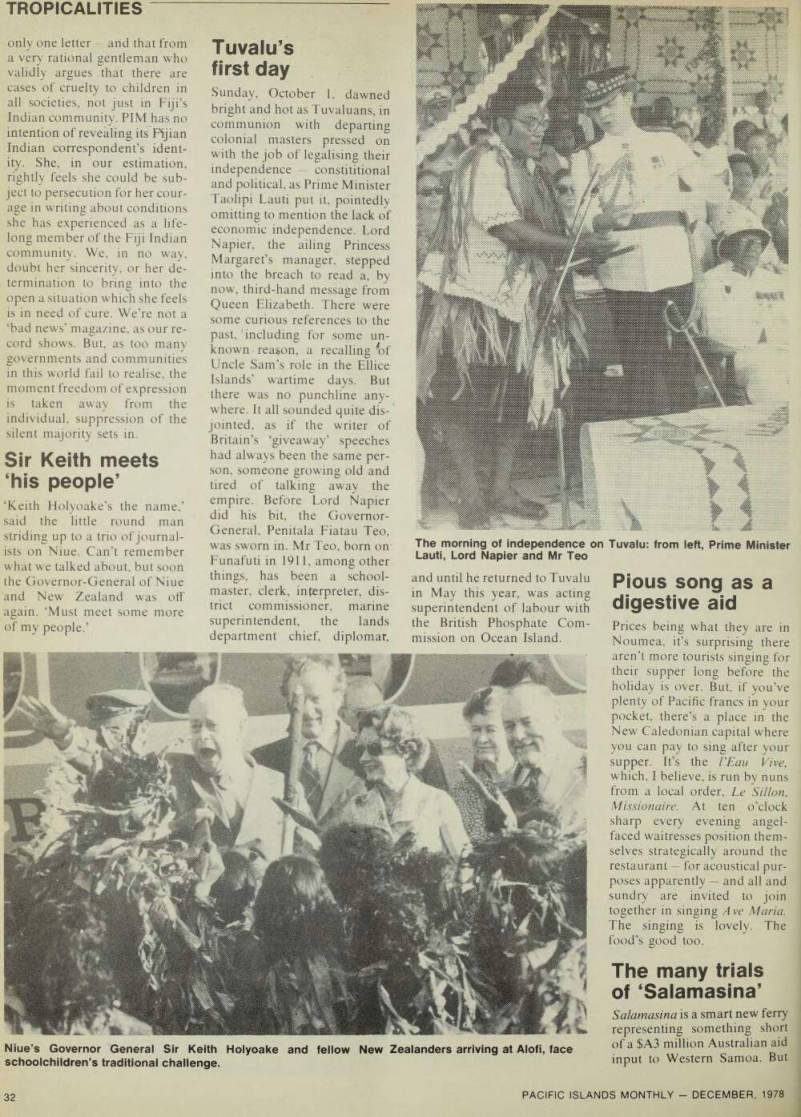
and political, as Prime Minister Taolipi Lauti put it, pointedly omitting to mention the lack of economic independence. Lord
Napier, the ailing Princess
Margaret’s manager, stepped into the breach to read a, by now, third-hand message from Queen Elizabeth. There were some curious references to the past, 'including for some un known reason, a recalling *of Uncle Sam’s role in the Ellice Islands’ wartime days. But there was no punchline any where. It all sounded quite dis jointed, as if the writer of
Britain’s ‘giveaway’ speeches
had always been the same per son, someone growing old and tired of talking away the empire. Before Lord Napier did his bit, the Governor- General. Penitala Fiatau Teo, was sworn in. Mr Teo, born on Funafuti in 1911, among other things, has been a school master, clerk, interpreter, dis trict commissioner, marine superintendent, the lands
department chief, diplomat.
and until he returned to Tuvalu in May this year, was acting superintendent of labour with the British Phosphate Com mission on Ocean Island.
Pious song as a
digestive aid
Prices being what they are in Noumea, it’s surprising there aren’t more tourists singing for their supper long before the holiday is over. But, if you’ve plenty of Pacific francs in your pocket, there’s a place in the New Caledonian capital where you can pay to sing after your supper. It’s the VEau Vive, which, I believe, is run by nuns from a local order, Le Sillon, Missionaire. At ten o’clock
sharp every evening angel
faced waitresses position them selves strategically around the restaurant for acoustical pur poses apparently and all and sundry are invited to join together in singing A ve Maria.
The singing is lovely. The food’s good too.
The many trials
of ‘Salamasina’
Salamasina is a smart new ferry
representing something short
of a SA3 million Australian aid input to Western Samoa. But
Niue’s Governor General Sir Keith Holyoake and fellow New Zealanders arriving at Alofi, face schoolchildren’s traditional challenge.
The morning of independence on Tuvalu: from left, Prime Minister Lauti, Lord Napier and Mr Teo
it’s been far from plain sailing since Salamasina arrived in Western Samoa, its main task being to ferry vehicles between the two main islands Savai’i in the west and Upolu. Only trouble was the channel into the Upolu berth turned out to be not quite wide enough to take the Salamasina. There were red faces all around, par ticularly on the Australian side.
After all. ultimately it was their job to know that what they were giving could do the job it was intended for. Last we heard, Salamasina is now ply ing between Apia and eastern Savai’i and between Apia and Pago Pago, capital of neigh bouring American Samoa but without carrying vehicles.
They’re a-building a ramp at Apia wharf to make it possible to get vehicles onto the Salamasina it might even be complete by now. Someone told me along my way that in many respects they find both New Zealand and Australian aid a nuisance. The New Zealanders, he said, paid far too much attention to how their money was spent. The Aus tralians, he said, did not pay
enough attention.
Tracts from afar
left Niue cold
A steady south-easter was
whistling through Tamakau
tonga village, just down the coast from Niue’s capital Alofi.
I took a walk with my camera
down over the village green to stand on the cliffs just below the pastor’s house. I wanted a shot looking south along the coastline to Avatele. Somehow I wasn’t ready for the bits of printed paper which blew around my feet. ‘Communists did this,’ ‘Communism is a lie' the papers read, with gruesome pictures captioned ‘Com munist terror in Africa’. This didn’t fit in with my idea of Niue. Nor, it seemed, did the anti-communist news sheets, produced by the Christian Mission to the Communist World of Lautoka, appeal to the Ekalesia Niue Christians.
Scores of leaflets had been abandoned to the weather. The terrors of communism in far away Africa, if in fact the photographs were authentic, were all too remote for the leader of this particular Niuean flock.
The rampant
guava
The guava is under fire again in Fiji. At a time when there is talk of expanding guava or chards, beef farmers in Fiji, where the guava tree is a declared noxious weed, are get ting worried. The guava’s prob lem is that it competes far too
successfully with crop plants
and pasture grasses. A good fruit to eat and an ingredient for very tasty jam, the guava’s sheer flamboyance has lined it up to become a victim of the chemicals of Fiji’s beef farmers.
Busy scholars
on Niue
Little Niue, population 5 000, is getting its full share of aca demic attention these days.
Under the auspices of the Insti tute of Pacific Studies, which is part of the University of the South Pacific, Niuean projects now under way include: • A history of Niue, jointly written by about a dozen Niuean school teachers and
educational administrators; • A study of Niuean politics, written by three Niueans; • A study of land tenure in Niue From two angles: the rights of Niuean women to land tenure, and the methods of settling disputes over land two Niueans are engaged on this; • An autobiography by Prem ier Robert R. Rex the IPS
made taperecording equip
ment available to Mr Rex for this purpose, and he’s just about finished the job.
In search of the
fastest paddler
The Diamond Head Paddle Board Race ‘to find the world's fastest paddler’ will be staged this year with four basic changes to the ground rules. The race will be run on December 30 instead of Christ mas Day in the hope of attract
ing more foreign challengers.
Two of the traditional board classes the open (unlimited) and paddleboard (stockboard) - have been deleted ‘to equal ise competition’. For the first time there will be a single board class with only two speci fications; a maximum overall length of 3.6 m and no rudder.
The course* this year will be 10 000 m. beginning and end ing at Sans Souci Beach, and will be around the Diamond Head and Wreck Buoys. The fourth change is the introduc tion of a division for women.
The race was founded 26 years ago by the Waikiki Surf Club.
It is now organised by the Out rigger Canoe Club of Hawaii whose ambition is to have it
accepted as an Olympic
event.
Anti-communist poster: nobody wants them in Tamakautonga
The Salamasina alongside Apia’s wharf . . . vehicle capacity but ramp a-building
The Tahitian community’s new centre in Noumea, opened during the South Pacific Conference in October