Mission Melanesia:
pp. 53-55 · Read in the full issue
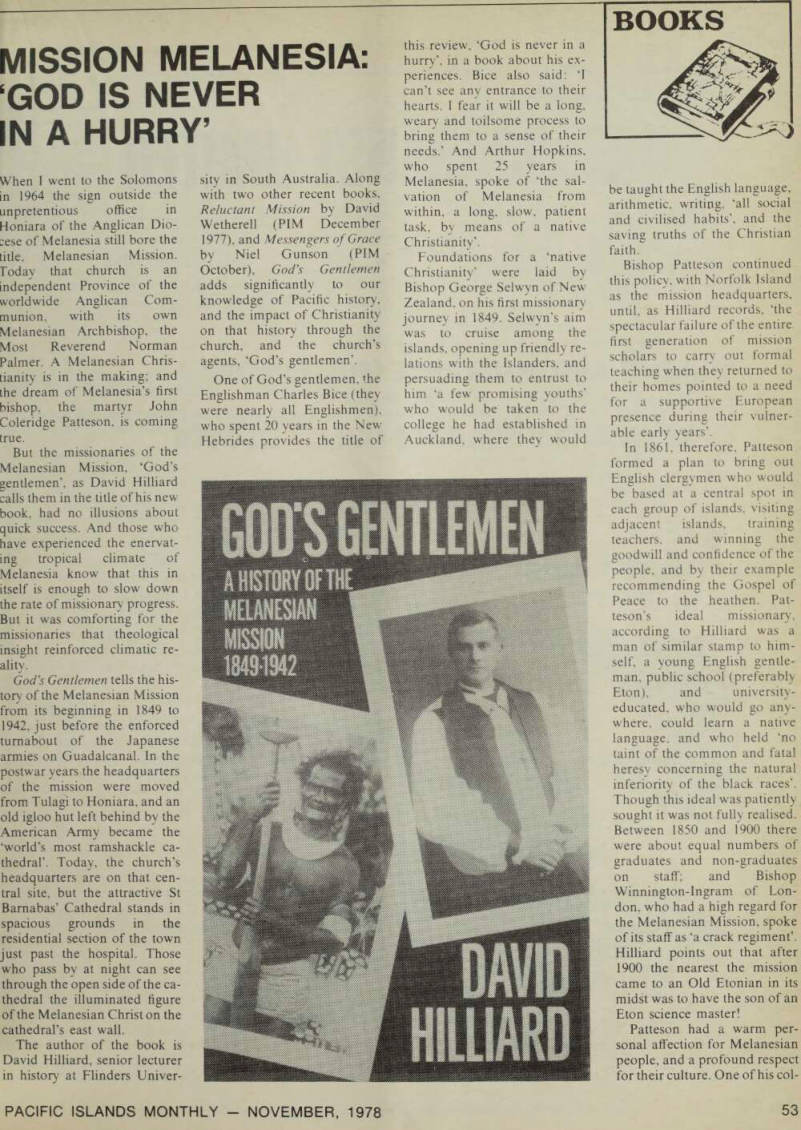

Books
‘God Is Never
In A Hurry’
When I went to the Solomons in 1964 the sign outside the unpretentious office in Honiara of the Anglican Dio :ese of Melanesia still bore the title, Melanesian Mission.
Today that church is an independent Province of the
worldwide Anglican Com
munion, with its own Melanesian Archbishop, the Most Reverend Norman Palmer. A Melanesian Chris tianity is in the making; and the dream of Melanesia’s first bishop, the martyr John
Coleridge Patteson. is coming
true.
But the missionaries of the Melanesian Mission, ‘God’s gentlemen’, as David Hilliard calls them in the title of his new book, had no illusions about quick success. And those who
have experienced the enervat
ing tropical climate of
Melanesia know that this in itself is enough to slow down the rate of missionary progress.
But it was comforting for the
missionaries that theological
insight reinforced climatic re
ality.
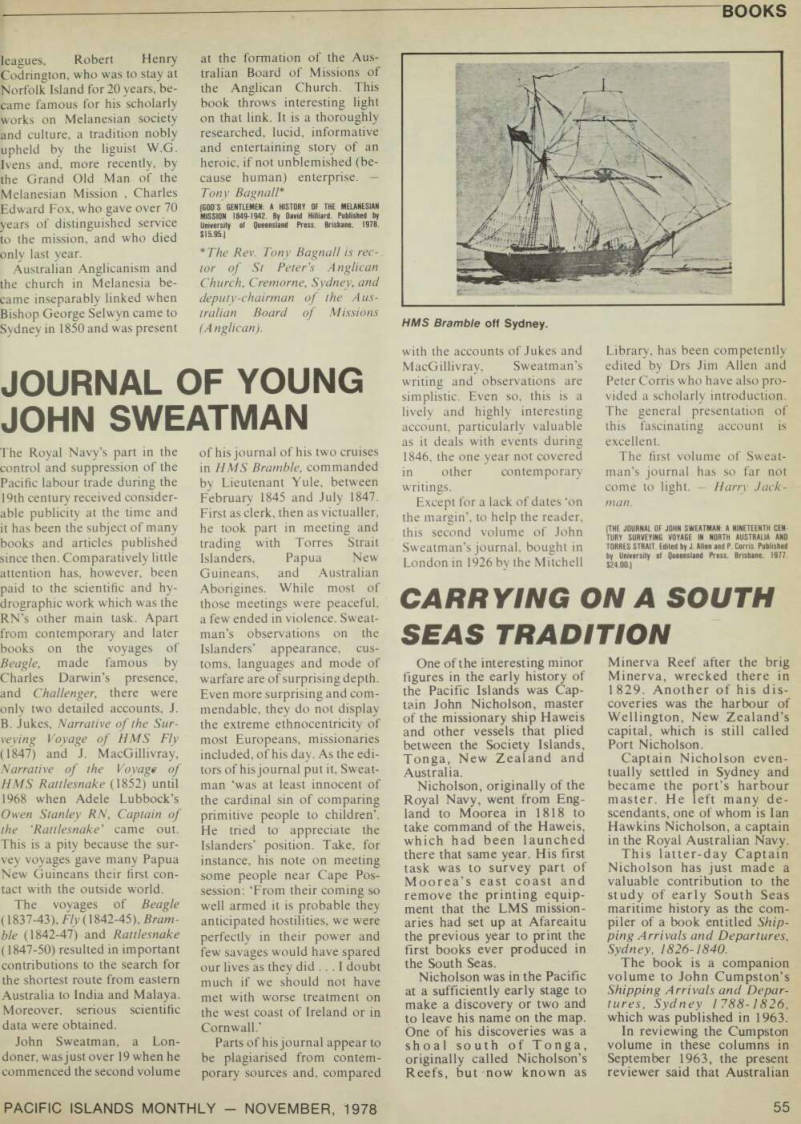
God's Gentlemen tells the his tory of the Melanesian Mission from its beginning in 1849 to 1942, just before the enforced turnabout of the Japanese armies on Guadalcanal. In the postwar years the headquarters of the mission were moved from Tulagi to Honiara, and an old igloo hut left behind by the American Army became the ‘world’s most ramshackle ca thedral’. Today, the church’s headquarters are on that cen tral site, but the attractive St Barnabas’ Cathedral stands in
spacious grounds in the
residential section of the town just past the hospital. Those who pass by at night can see through the open side of the ca thedral the illuminated figure of the Melanesian Christ on the cathedral’s east wall.
The author of the book is David Hilliard, senior lecturer in history at Flinders Univer
sity in South Australia. Along with two other recent books.
Reluctant Mission by David Wetherell (PIM December 1977), and Messengers of Grace by Niel Gunson (PIM October), God's Gentlemen adds significantly to our knowledge of Pacific history, and the impact of Christianity on that history through the church, and the church’s agents, ‘God’s gentlemen’.
One of God’s gentlemen, the Englishman Charles Bice (they were nearly all Englishmen), who spent 20 years in the New Hebrides provides the title of
this review, ‘God is never in a hurry’, in a book about his ex periences. Bice also said: ‘I can’t see any entrance to their hearts. I fear it will be a long, weary and toilsome process to bring them to a sense of their needs.’ And Arthur Hopkins, who spent 25 years in Melanesia, spoke of ‘the sal vation of Melanesia from within, a long, slow, patient task, by means of a native
Christianity’.
Foundations for a ‘native
Christianity’ were laid by
Bishop George Selwyn of New Zealand, on his first missionary journey in 1849. Selwyn’s aim was to cruise among the islands, opening up friendly re lations with the Islanders, and persuading them to entrust to him ‘a few promising youths' who would be taken to the college he had established in Auckland, where they would
be taught the English language, arithmetic, writing, ‘all social and civilised habits’, and the saving truths of the Christian faith.
Bishop Patteson continued this policy, with Norfolk Island as the mission headquarters, until, as Hilliard records, ‘the spectacular failure of the entire, first generation of mission scholars to carry out formal teaching when they returned to their homes pointed to a need for a supportive European presence during their vulner
able early years'.
In 1861, therefore. Patteson formed a plan to bring out
English clergymen who would
be based at a central spot in each group of islands, visiting
adjacent islands. training
teachers, and winning the goodwill and confidence of the
people, and by their example
recommending the Gospel of
Peace to the heathen. Pat teson’s ideal missionary, according to Hilliard was a man of similar stamp to him self, a young English gentle
man. public school (preferably
Eton), and university educated, who would go any where. could learn a native language, and who held ‘no taint of the common and fatal heresy concerning the natural inferiority of the black races’.
Though this ideal was patiently sought it was not fully realised.
Between 1850 and 1900 there were about equal numbers of
graduates and non-graduates
on staff; and Bishop Winnington-Ingram of Lon don, who had a high regard for the Melanesian Mission, spoke of its staff as ‘a crack regiment’.
Hilliard points out that after 1900 the nearest the mission came to an Old Etonian in its midst was to have the son of an Eton science master!
Patteson had a warm per sonal affection for Melanesian people, and a profound respect for their culture. One of his col
leagues, Robert Henry Codrington, who was to stay at Norfolk Island for 20 years, be came famous for his scholarly works on Melanesian society and culture, a tradition nobly
upheld by the liguist W.G.
Ivens and, more recently, by the Grand Old Man of the Melanesian Mission , Charles Edward Fox, who gave over 70
years of distinguished service
to the mission, and who died only last year.
Australian Anglicanism and the church in Melanesia be
came inseparably linked when
Bishop George Selwyn came to Sydney in 1850 and was present
at the formation of the Aus tralian Board of Missions of the Anglican Church. This book throws interesting light on that link. It is a thoroughly researched, lucid, informative and entertaining story of an heroic, if not unblemished (be cause human) enterprise.
Tony Bagnall
(GOD'S GENTLEMEN: A HISTORY OF THE MELANESIAN MISSION 1849-1942. By David Hilliard. Published by University of Queensland Press. Brisbane. 1978. $15.95.) *The Rev. Tony Bagnall is rec tor of St Peter's Anglican Church, Cremorne, Sydney, and
deputy-chairman of the Aus
tralian Board of Missions
(Anglican).