Preserving old
pp. 50-51 · Read in the full issue
Yesterday
Preserving old Levuka, hub of Fiji history
From VICTOR CARELL in Levuka
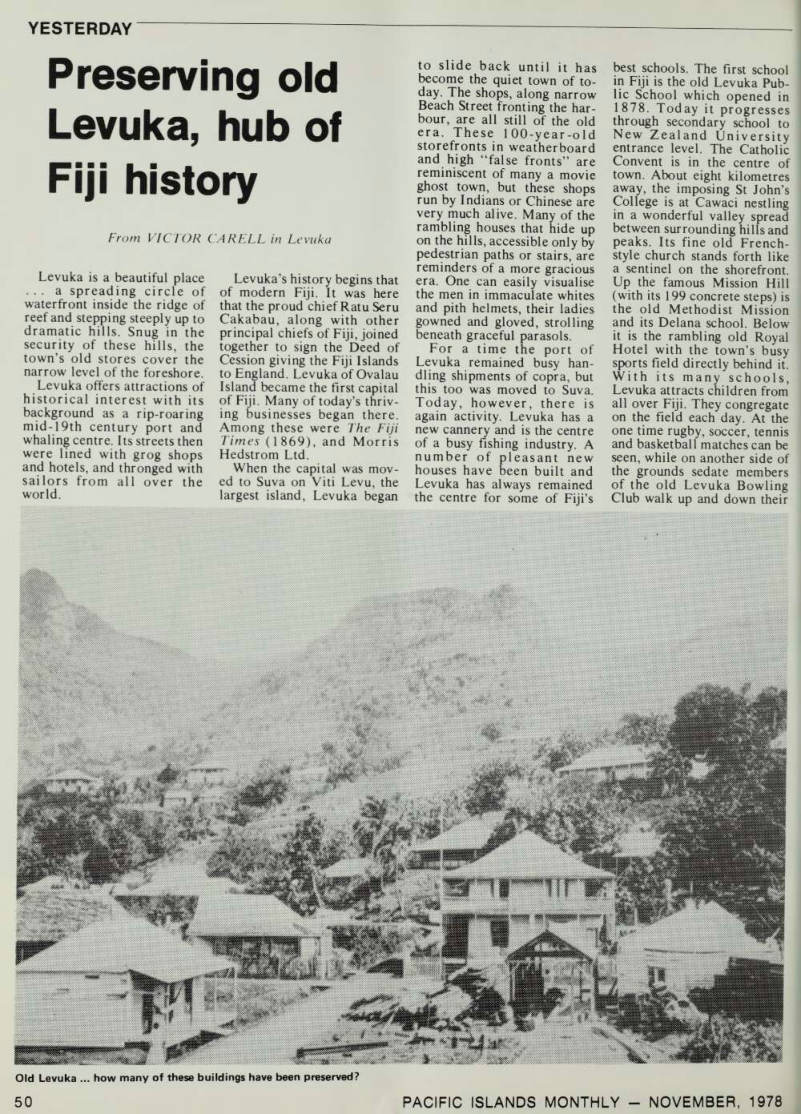
Levuka is a beautiful place ... a spreading circle of waterfront inside the ridge of reef and stepping steeply up to dramatic hills. Snug in the security of these hills, the town’s old stores cover the narrow level of the foreshore.
Levuka offers attractions of historical interest with its background as a rip-roaring mid-19th century port and whaling centre. Its streets then were lined with grog shops and hotels, and thronged with sailors from all over the world.
Levuka’s history begins that of modern Fiji. It was here that the proud chief Ratu Seru Cakabau, along with other principal chiefs of Fiji, joined together to sign the Deed of Cession giving the Fiji Islands to England. Levuka of Ovalau Island became the first capital of Fiji. Many of today’s thriv ing businesses began there.
Among these were The Fiji Times (1869), and Morris Hedstrom Ltd.
When the capital was mov ed to Suva on Viti Levu, the largest island, Levuka began
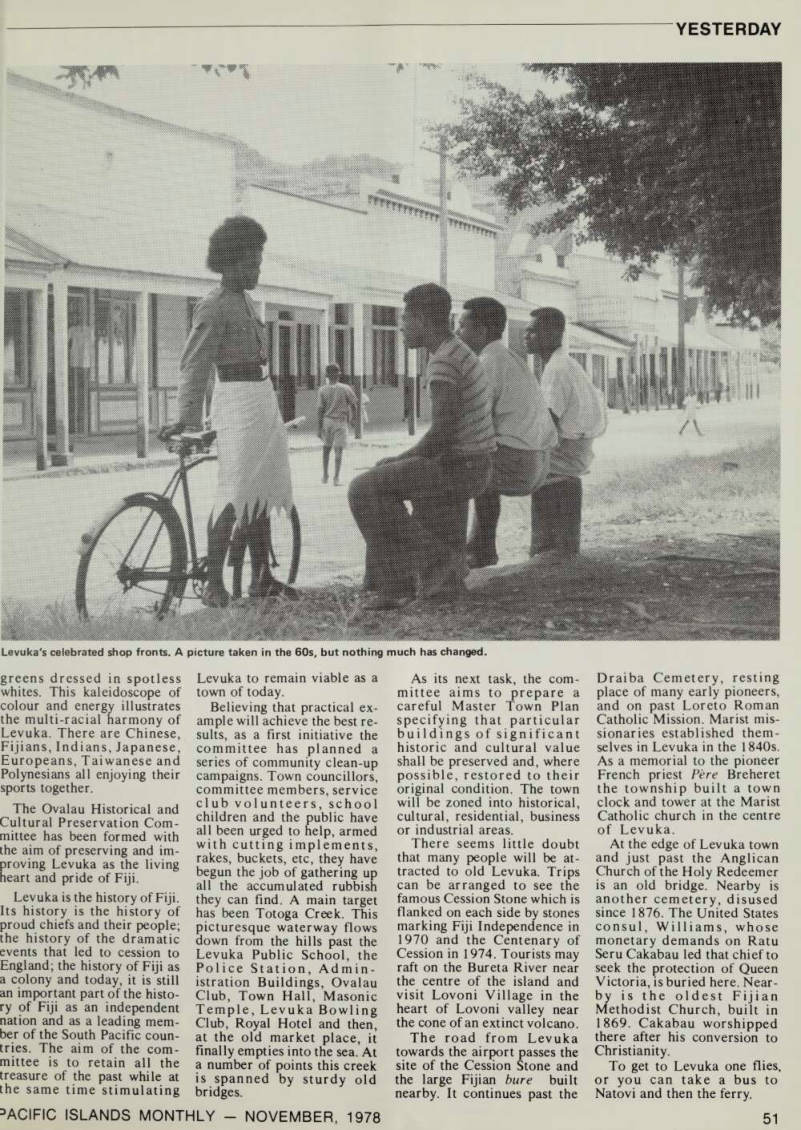
to slide back until it has become the quiet town of today. The shops, along narrow Beach Street fronting the harbour, are all still of the old era. These 100-year-old storefronts in weatherboard and high “false fronts’’ are reminiscent of many a movie ghost town, but these shops run by Indians or Chinese are very much alive. Many of the rambling houses that hide up on the hills, accessible only by pedestrian paths or stairs, are reminders of a more gracious era. One can easily visualise the men in immaculate whites and pith helmets, their ladies gowned and gloved, strolling beneath graceful parasols.
For a time the port of Levuka remained busy handling shipments of copra, but this too was moved to Suva.
Today, however, there is again activity. Levuka has a new cannery and is the centre of a busy fishing industry. A number of pleasant new houses have been built and Levuka has always remained the centre for some of Fiji’s
best schools. The first school in Fiji is the old Levuka Pub lie School which opened in 1878. Today it progresses through secondary school to New Zealand University entrance level. The Catholic Convent is in the centre of town. About eight kilometres away, the imposing St John’s College is at Cawaci nestling in a wonderful valley spread between surrounding hills and peaks. Its fine old French style church stands forth like a sentinel on the shorefront.
Up the famous Mission Hill (with its 199 concrete steps) is the old Methodist Mission and its Delana school. Below it is the rambling old Royal Hotel with the town’s busy sports field directly behind it.
With its many schools, Levuka attracts children from all over Fiji. They congregate on the field each day. At the one time rugby, soccer, tennis and basketball matches can be seen, while on another side of the grounds sedate members of the old Levuka Bowling Club walk up and down their
Old Levuka ... how many of these buildings have been preserved?
greens dressed in spotless whites. This kaleidoscope of colour and energy illustrates the multi-racial harmony of Levuka. There are Chinese, Fijians, Indians, Japanese, Europeans, Taiwanese and Polynesians all enjoying their sports together.
The Ovalau Historical and Cultural Preservation Com mittee has been formed with the aim of preserving and im proving Levuka as the living heart and pride of Fiji.
Levuka is the history of Fiji.
Its history is the history of proud chiefs and their people; the history of the dramatic events that led to cession to England; the history of Fiji as a colony and today, it is still an important part of the histo ry of Fiji as an independent nation and as a leading mem ber of the South Pacific coun tries. The aim of the com mittee is to retain all the treasure of the past while at the same time stimulating
Levuka to remain viable as a town of today.
Believing that practical ex ample will achieve the best re sults, as a first initiative the committee has planned a series of community clean-up campaigns. Town councillors, committee members, service club volunteers, school children and the public have all been urged to help, armed with cutting implements, rakes, buckets, etc, they have begun the job of gathering up all the accumulated rubbish they can find. A main target has been Totoga Creek. This picturesque waterway flows down from the hills past the Levuka Public School, the Police Station, Admin istration Buildings, Ovalau Club, Town Hall, Masonic Temple, Levuka Bowling Club, Royal Hotel and then, at the old market place, it finally empties into the sea. At a number of points this creek is spanned by sturdy old bridges.
As its next task, the com mittee aims to prepare a careful Master Town Plan specifying that particular buildings of significant historic and cultural value shall be preserved and, where possible, restored to their original condition. The town will be zoned into historical, cultural, residential, business or industrial areas.
There seems little doubt that many people will be at tracted to old Levuka. Trips can be arranged to see the famous Cession Stone which is flanked on each side by stones marking Fiji Independence in 1970 and the Centenary of Cession in 1974. Tourists may raft on the Bureta River near the centre of the island and visit Lovoni Village in the heart of Lovoni valley near the cone of an extinct volcano.
The road from Levuka towards the airport passes the site of the Cession Stone and the large Fijian bure built nearby. It continues past the
Draiba Cemetery, resting place of many early pioneers, and on past Loreto Roman Catholic Mission. Marist mis sionaries established them selves in Levuka in the 1840 s.
As a memorial to the pioneer French priest Pere Breheret the township built a town clock and tower at the Marist Catholic church in the centre of Levuka.
At the edge of Levuka town and just past the Anglican Church of the Holy Redeemer is an old bridge. Nearby is another cemetery, disused since 1876. The United States consul, Williams, whose monetary demands on Ratu Seru Cakabau led that chief to seek the protection of Queen Victoria, is buried here. Near by is the oldest Fijian Methodist Church, built in 1869. Cakabau worshipped there after his conversion to
Christianity.
To get to Levuka one flies, or you can take a bus to Natovi and then the ferry.
Levuka's celebrated shop fronts. A picture taken in the 60s, but nothing much has changed.