Journal Of Young
p. 55 · Read in the full issue
John Sweatman
The Royal Navy’s part in the control and suppression of the Pacific labour trade during the 19th century received consider able publicity at the time and it has been the subject of many
books and articles published
since then. Comparatively little
attention has, however, been paid to the scientific and hy drographic work which was the RN’s other main task. Apart from contemporary and later books on the voyages of Beagle, made famous by Charles Darwin’s presence,
and Challenger, there were
only two detailed accounts, J.
B. Jukes, Narrative of the Sur veying Voyage of HMS Fly (1847) and J. MacGillivray, Narrative of the Voyage of HMS Rattlesnake (1852) until 1968 when Adele Lubbock’s Owen Stanley RN, Captain of the ‘Rattlesnake ’ came out.
This is a pity because the sur vey voyages gave many Papua New Guineans their first con tact with the outside world.
The voyages of Beagle (1837-43), Fly{ 1842-45), Bram ble (1842-47) and Rattlesnake (1847-50) resulted in important contributions to the search for the shortest route from eastern Australia to India and Malaya.
Moreover, serious scientific data were obtained.
John Sweatman, a Lon doner, was just over 19 when he commenced the second volume
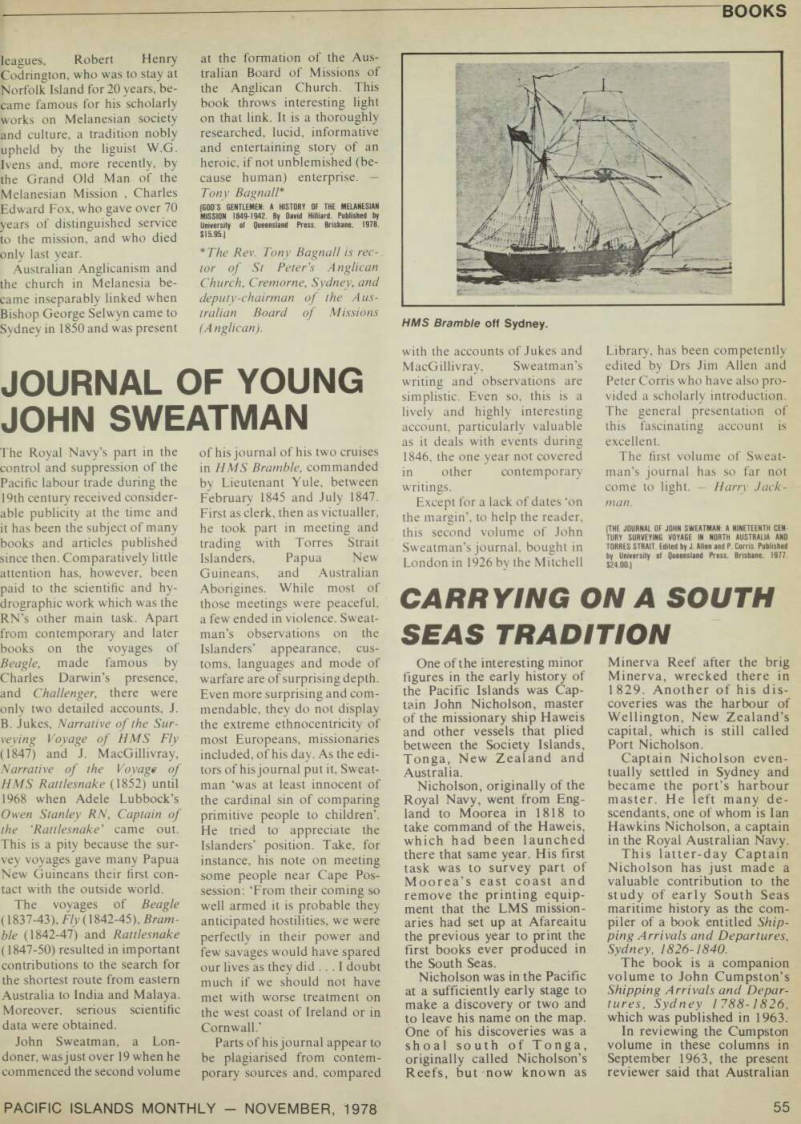
of his journal of his two cruises in HMS Bramble, commanded by Lieutenant Yule, between February 1845 and July 1847.
First as clerk, then as victualler, he took part in meeting and trading with Torres Strait Islanders, Papua New Guineans, and Australian Aborigines. While most of
those meetings were peaceful,
a few ended in violence. Sweat man’s observations on the Islanders’ appearance, cus toms, languages and mode of warfare are of surprising depth.
Even more surprising and com mendable, they do not display the extreme ethnocentricity of most Europeans, missionaries included, of his day. As the edi tors of his journal put it, Sweat man ‘was at least innocent of the cardinal sin of comparing
primitive people to children’.
He tried to appreciate the Islanders’ position. Take, for instance, his note on meeting some people near Cape Pos session: ‘From their coming so well armed it is probable they anticipated hostilities, we were perfectly in their power and few savages would have spared our lives as they did ... I doubt much if we should not have met with worse treatment on the west coast of Ireland or in Cornwall.’
Parts of his journal appear to be plagiarised from contem porary sources and, compared
with the accounts of Jukes and MacGillivray, Sweatman’s writing and observations are simplistic. Even so, this is a
lively and highly interesting
account, particularly valuable as it deals with events during 1846, the one year not covered in other contemporary
writings.
Except for a lack of dates ‘on the margin’, to help the reader, this second volume of John
Luis Sccuiiu Vuiuiiic Ul Jullll
Sweatman’s journal, bought in , , , . w . , ..
London in 1926 by the Mitchell
Library, has been competently
edited by Drs Jim Allen and Peter Corns who have also pro vided a scholarly introduction,
The general presentation of
this fascinating account is excellent.
The first volume of Sweat man’s journal has so far not
come to light.
Harry Jack-
man.
(the journal of john sweatman: a nineteenth cen- TuflY SURVEYING VOYAGE IN NORTH AUSTRALIA AND TORRES STRAIT. Edited by J. Allen and P. Corris. Published by University ol Queensland Press. Brisbane. 1977. $24.00.1
HMS Bramble off Sydney.