Conserving the Pacific
p. 22 · Read in the full issue
Conservation
Conserving the Pacific heritage: Idea whose time has arrived?
There’s nothing so powerful as an idea whose time has arrived - so runs an old saying. It doesn’t seem too far-fetched to apply it to the theme of this month’s PIM cover the need for a conscious effort to pre serve the architectural and cul tural treasures of the South Seas.
Consider the following facts.
In May, 1977, PlM’s publisher, Stuart Inder, devoted his column ‘Up Front’ to this
theme, focusing particularly on
the buildings in the former Fiji capital of Fevuka. His column drew an enthusiastic response, in a letter published in PIM, September, 1977, from Honolulu architect, George J.
Wimberly, who said in part: ‘We, in the Development Authority of the Pacific Area Travel Association, are push ing very hard for just this type of preservation and are
presently exploring the means
and methods of organising (for want of a better term) what we call The Pacific Society ... ‘The Pacific area needs a great deal of help in its preser vation efforts as most of the architecture has not been con structed with very permanent materials. Even well intentioned maintenance sometimes obscures the archi tectural grace of the original structure.’
Things have moved a bit since then. A more recent letter to Mr Inder from John Kena ston of Kuala Lumpur, Malaysia, reports that last year’s 26th PATA conference, held in Hong Kong, adopted a resolution for the creation of a Pacific Heritage Society. A sub-committee was formed within the PATA under the chairmanship of Dale Keller, ‘who.’ says Mr Kenaston, ‘has achieved a position of inter national prominence for his design work and sensitivity towards the preservation and development of the heritage and regional culture in those
many areas where he has been involved’.
Among PATA documents enclosed by Mr Kenaston is one that asks the question; ‘Why should a travel organis ation concern itself with the
protection of heritage?’, and
offers the following reply: ‘ln many PATA member coun tries, the characteristics that make that country different are steadily, and in some cases rap idly, being eroded. If action is not taken to modify this situ ation we may be in danger of losing some of the qualities that led PATA, from the outset, to urge people to “discover the
friendly Pacific”...
‘Something needs to be done to draw the attention of the public in general and of the travel industry in particular to the existing dangers. It is not too late in the Pacific. We can and should take steps to pre serve that part of everyone’s ethnic or national heritage that makes them unique. Unlike Europe, which is now “trying to correct the mistakes of the
past”, we must try to “prevent the mistakes of the future”.’
The document makes some hard-headed business points: ‘Unique cultures attract man’s interest in other areas of the world and thus open the door to travel. There is, in fact, an interdependence between tour ism and conservation, in which each contributes to the econ omic viability of the other.’
Putting its money where its mouth is, PATA resolved to al locate $lO 000 ‘for activities in 1978-79 aimed at furthering the objectives and facilitating the formation of a Pacific Heritage
Society’.
Plans for 1978-79 include development of a mailing list and a membership pro gramme, completion of a re search project already begun, publication of two papers re lated to the functions and aims of the Society, and the organis ation of a Pacific-wide meet
ing.
PIM correspondent Victor Carell, w orking a parallel fur row', makes a special examin
ation of the problems of
preserving the beauties of Levuka in PI M’s Yesterday feature this month (see pp 50-51).
Vila’s big show
pulls in crowds
The sixth Vila Agriculture I Show was held in September! with seven out of every eight of I the population of the New!
Hebrides’ main island, Efate, I attending, writes Greg Nos-1 worthy from Vila. Held ini excellent conditions, a carnival! atmosphere prevailed through-] out the two-day show.
Custom dancing was prob-| ably the biggest attraction, with I a group from Tongoa Island I winning the first prize of SASOO I with their highly authentic dis-| play. A charity queen compe-1 tition is also held in I conjunction with the show and I this year FNHS7O 000 J (about 5A6900) was collected] by entrants vying for the valu-1 able prizes.
With agriculture the New]
Hebrides principal industry,!
there was no shortage of] exhibits in the livestock and I produce divisions. Ships visit-! ing outer islands collected I more than four tonnes of pro-1 duce for exhibition.
The show is held in Colar- j deau Park.
Strongly supported by all levels of government and by] Mayor Remy Delaveuve, the
agricultural show seems j
assured of continual success. I
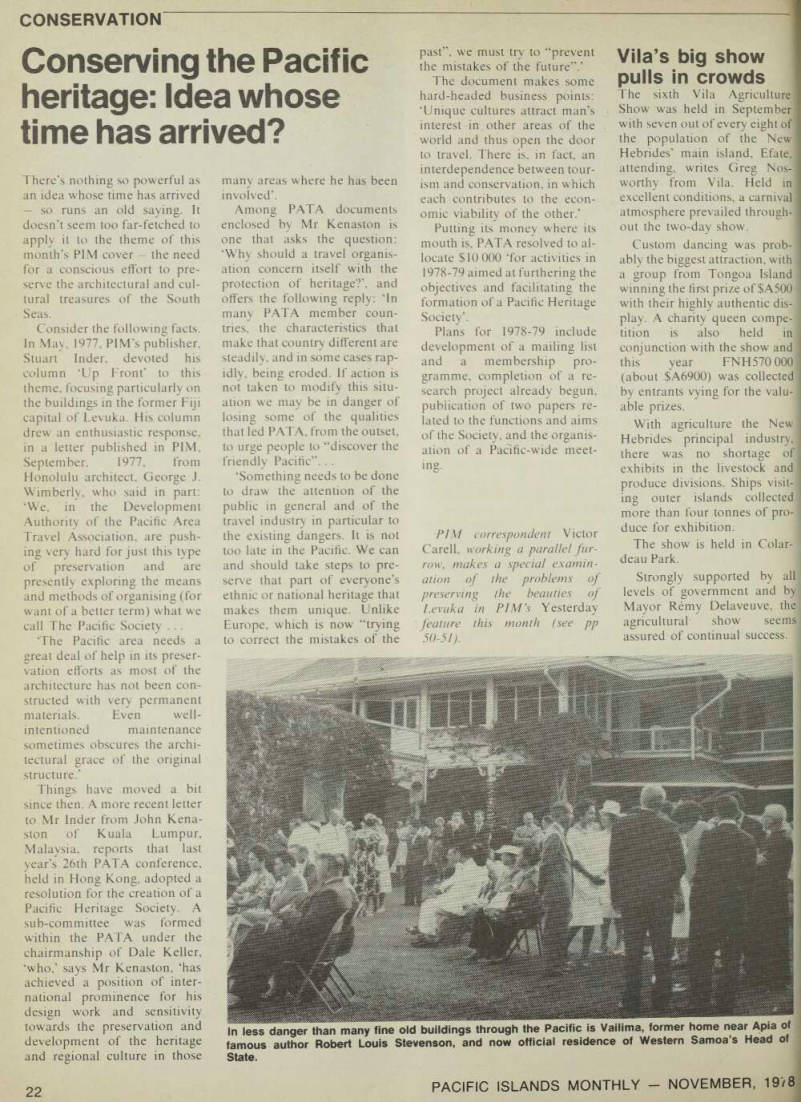
In less danger than many fine old buildings through the Pacific is Vailima, former home near Apia of famous author Robert Louis Stevenson, and now official residence of Western Samoa’s Head of State.