Galapagos
pp. 23-25 · Read in the full issue
Tropicalities
Treasuring the
The leading French daily Le Monde has just carried a series of three long articles by French journalist Yvonne Rebeyrol on the Galapagos Islands, 1100 km off the coast of South America, which form part of the Republic of Ecuador. . Entitled ‘ The Enchanted Noah’s Ark\ the articles pro vide vivid descriptions of the unique flora and fauna of the Galapagos which, in 1835, pro vided Charles Darwin with im portant elements of his then
revolutionary theory of the
evolution of the species
through natural selection. The Ecuadorian Government has
proposed that the Galapagos
)e included in the world cul ural and natural heritage insti ution whose establishment
vas proposed last January by
he United Nations Edu
:ational and Scientific Organ
sation.
Rebeyrol provides details of
he strict measures taken by the icuadorian Government to
irotect this heritage, which
ould be of interest to other Pa ific governments with natural
reasures to be guarded.
She writes: The Galapagos /ere opened to tourists in 1969.
Tey have since become acreasingly popular. In 1977 here were 6790 tourists, 18.5% f them Ecuadorians. But it has ow been decided that under o circumstances will more lan 12 000 tourists be ccepted in any year. ‘Tourists cannot move about lone. Either they go on an rganised trip headed by one f the 25 official guides, or they ike one of the guides aboard
ieir yacht, or, thirdly, they can
•avel in one of the 20 fishing
oats captained by authorised
uides. All guides must do a aining course at the ialapagos’ Darwin Station be- Dre being approved by the ark service.
‘Twenty-seven itineraries
ave been planned on several f the islands (5% of the park’s irface) so that visitors may see 5 much interesting flora and luna as possible. But, accord ig to the itineraries, the num er of tourists is limited in
some cases to 80, and in others to as few as 15, a day. No dom estic animals may be taken on these trips. No food may be given to the native animals, and it is forbidden to touch them. Visitors are asked not to drop paper, fruit, plastic bags or cigarette butts (though smoking is permitted) during their walks on the islands or the sea crossings between them . . .’
Then she makes the follow ing comments, which will have a familiar ring for those who have come in contact with a certain type of tourist: ‘One
wonders why some foreigners
come from so far away to the
Galapagos. Guides welcoming
their groups sometimes hear aggressive statements like the following, made by way of introduction, by some tourists; “I don’t believe in evolution anyway .. .” Some visitors also protest: “These islands aren’t interesting at all. You can see the sea anywhere. Animals too.
Anyway, if I wanted photos, I could buy them in Quito.”
Some don’t even get out of the boats. You can also hear idiotic quesions such as: “Those birds flying over there, are they the local cormorants that can’t fly?” ...
Call for ‘million
PNG soldiers’
There is not enough money available to increase the yearly
recruitment of soldiers, Papua New Guinea’s Defence Force Minister, Mr Louis Mona has said. Mr Mona told parliament that at present the defence force was recruiting 100 men a year. He was replying to Mr Ibne Kor (Nipa-Kutubu) dur ing question time in parlia ment.
Mr Kor said he was con cerned about the size of the de fence force in comparison to Indonesia and feared that another country may invade PNG. He said there are three million people in Papua New Guinea, and at least a million of these should be soldiers. Mr Kor said many Grade 10 school leavers who did not have jobs should join the defence force.
Mr Mona said he too was concerned about the size of the defence force but could not do anything at this stage due to
financial problems.
The Club Med
puts to sea ...
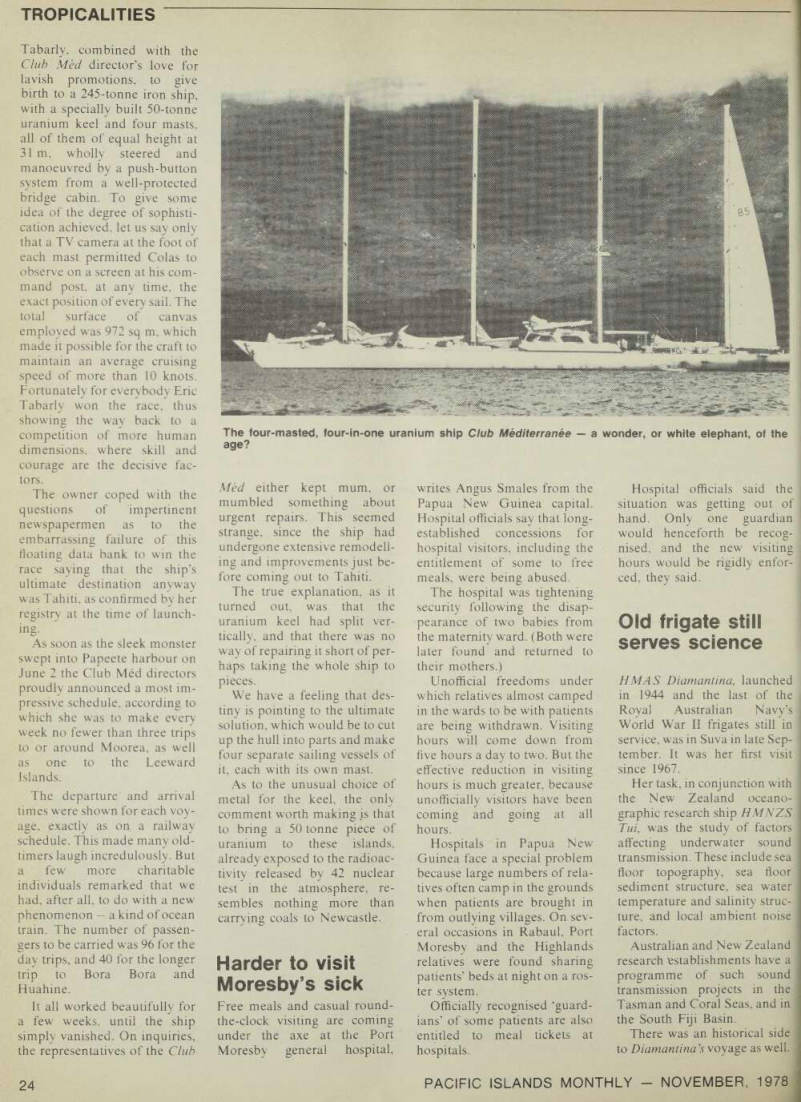
The Club Mediterranee is the name, not only of a French company which has been highly successful in the tourist business, but also of one of the strangest ships to be launched since the classical iron monster, the Great Eastern, write Marie- Therese and Bengt Danielsson from Papeete. Although this magnificent, 72 m long, four-
masted ship, which cost .more than SA2 million to build, arrived here in Tahiti to a great fanfare as recently as June this year, she has already been hid den away in the local naval
yard and seemingly forgotten.
We have delved into this mys tery and have discovered what
has happened.
It should first be said that from whatever point of view we look at this extraordinary vessel, she should never have been built at all. But built she was, and for the sole purpose of allowing the famous French navigator Alain Colas (who, you might remember, in 1974 raced alone around the world in 169 days in his Polynesian catamaran Manureva) to win the trans-Atlantic race in 1976.
The organising committee did not bother to impose any re strictions on the size of par
ticipating craft, probably
thinking that common sense and limitations of finance would form a natural barrier to the entry of sea-going extravaganzas like the Club Mediterranee.
As it happened, Alain Colas’s consuming desire to beat his arch-rival Eric
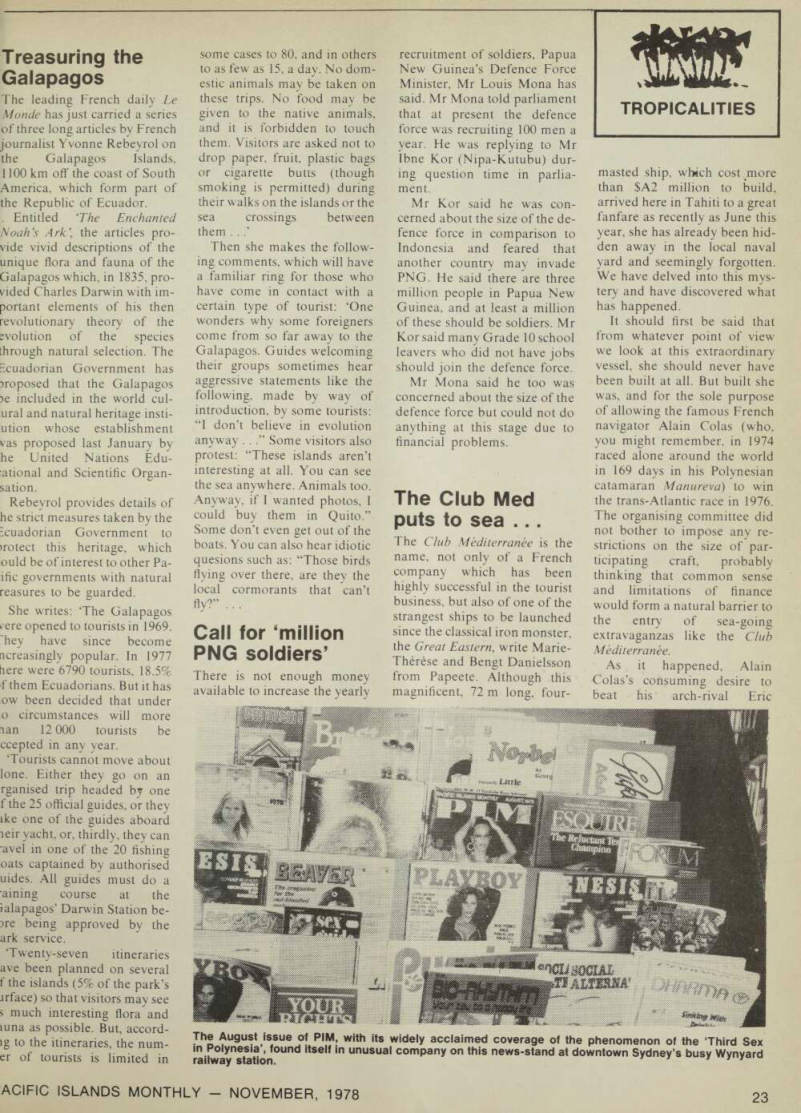
The August issue of PIM, with its widely acclaimed coverage of the phenomenon of the Third Sex in Polynesia , found itself in unusual company on this news-stand at downtown Sydney’s busy Wvnvard railway station.
Tabarly, combined with the Club Med director’s love for
lavish promotions, to give
birth to a 245-tonne iron ship, with a specially built 50-tonne uranium keel and four masts, all of them of equal height at 31 m, wholly steered and manoeuvred by a push-button system from a well-protected bridge cabin. To give some idea of the degree of sophisti cation achieved, let us say only that a TV camera at the foot of each mast permitted Colas to observe on a screen at his com mand post, at any time, the exact position of every sail. The total surface of canvas employed was 972 sq m, which made it possible for the craft to maintain an average cruising speed of more than 10 knots.
Fortunately for everybody Eric
Tabarly won the race, thus showing the way back to a competition of more human dimensions, where skill and courage are the decisive fac tors.
The owner coped with the
questions of impertinent
newspapermen as to the embarrassing failure of this floating data bank to win the race saying that the ship’s ultimate destination anyway was Tahiti, as confirmed by her registry at the time of launch
ing.
As soon as the sleek monster swept into Papeete harbour on June 2 the Club Med directors proudly announced a most im
pressive schedule, according to
which she was to make every week no fewer than three trips to or around Moorea, as well as one to the Leeward Islands.
The departure and arrival times were shown for each voy age, exactly as on a railway schedule. This made many old
timers laugh incredulously. But
a few more charitable individuals remarked that we had, after all, to do with a new phenomenon a kind of ocean train. The number of passen gers to be carried was 96 for the day trips, and 40 for the longer trip to Bora Bora and Huahine.
It all worked beautifully for a few weeks, until the ship
simply vanished. On inquiries,
the representatives of the Club
Med either kept mum, or mumbled something about urgent repairs. This seemed strange, since the ship had undergone extensive remodell
ing and improvements just be
fore coming out to Tahiti.
The true explanation, as it turned out, was that the uranium keel had split ver tically, and that there was no way of repairing it short of per
haps taking the whole ship to
pieces.
We have a feeling that des tiny is pointing to the ultimate solution, which would be to cut up the hull into parts and make four separate sailing vessels of it, each with its own mast.
As to the unusual choice of metal for the keel, the only comment worth making is that to bring a 50 tonne piece of uranium to these islands, already exposed to the radioac tivity released by 42 nuclear test in the atmosphere, re sembles nothing more than carrying coals to Newcastle.
Harder to visit
Moresby’s sick
Free meals and casual round the-clock visiting are coming under the axe at the Port Moresby general hospital.
writes Angus Smales from the
Papua New Guinea capital.
Hospital officials say that long established concessions for
hospital visitors, including the
entitlement of some to free meals, were being abused.
The hospital was tightening
security following the disap
pearance of two babies from the maternity ward. (Both were later found and returned to their mothers.) Unofficial freedoms under which relatives almost camped in the wards to be with patients are being withdrawn. Visiting hours will come down from five hours a day to two. But the effective reduction in visiting hours is much greater, because unofficially visitors have been coming and going at all hours.
Hospitals in Papua New Guinea face a special problem because large numbers of rela tives often camp in the grounds when patients are brought in from outlying villages. On sev eral occasions in Rabaul, Port
Moresby and the Highlands
relatives were found sharing patients’ beds at night on a ros ter system.
Officially recognised ‘guard
ians’ of some patients are also entitled to meal tickets at
hospitals.
Hospital officials said the situation was getting out of hand. Only one guardian would henceforth be recog nised. and the new visiting hours would be rigidly enfor ced, they said.
Old frigate still
serves science
HMAS Diamantina, launched in 1944 and the last of the
Royal Australian Navy’s
World War II frigates still in service, was in Suva in late Sep tember. It was her first visit since 1967.
Her task, in conjunction with the New Zealand oceano
graphic research ship HMNZS
Tui, was the study of factors affecting underwater sound transmission. These include sea floor topography, sea floor sediment structure, sea water temperature and salinity struc ture, and local ambient noise factors.
Australian and New Zealand research establishments have a programme of such sound transmission projects in the Tasman and Coral Seas, and in the South Fiji Basin.
There was an historical side to Diamantina’s voyage as well.
The four-masted, four-in-one uranium ship Club Mediterranee a wonder, or white elephant, of the age?
Her visit to Suva almost coin cided with the 33rd anniversary of the surrender of Japanese occupation forces in Nauru (September 13, 1945), and Ocean Island (October 1). Sur render ceremonies in these places took place on Diaman
tina’s quarterdeck.
Record fund for
Leper Man Appeal
Far-reaching plans for
developing the Twomey Mem orial Hospital in Fiji into a lep rosy training centre are now well under way. A joint agree ment for the project has been signed on behalf of the Lepers’
Trust Board of New Zealand by the chairman, Mr A. H. T.
Rose, in Suva. Participants are the Lepers’ Trust Board, the Fijian Government and the
World Health Organisation.
The Twomey Memorial
Hospital, the Leper Man
Appeal’s pioneering contri
bution to leprosy treatment and prevention in the Pacific Islands, will become a training centre for the whole of the
South Pacific. Proposed train
ing programmes and other activities include a his
topathology service, laboratory
indentification of drug resist
ance, drug trials, immun
ilogical studies and
epidemiological work.
Such ambitious and compre
hensive planning was good to
see, Dr W.J. Smith, chairman if the Board’s Medical Advis ory Committee, told the Lepers’ Trust Board’s Annual
General Meeting recently.
Various planned consultant
services requested by territories
vere already progressing, he
said.
More than $2l 000 for the irst year of development was approved by the board. In the following year the Lepers’
Frust Board will contribute 8 12 760 annually to the pro ect.
About $34 000 was also
allocated for the Hospital’s
lew activities area being
Manned by the Fiji Govern nent and the Fiji Lepers’ Trust Board. This would meet a need evident for some years, Dr smith told the meeting. Rooms
for sewing, handcrafts, such as
printing and bookbinding, a
studio for Semisi Maya and a showroom, the workshop and shoe shop, will replace the pre sent cramped quarters.
The total grants announced came to a record $406 500 as a result of the 1977 Leper Man Appeal. All grants are for the South Pacific area which is the
Board’s special responsibility.
PNG man warns
Australia
Sweet talk was in short supply at the September reception in Papua New Guinea House, Sydney, to mark the third anni
versary of the country’s
independence.
PNG Consul-General Aus tin Sapias told the assembled 150 Australian businessmen and government officials; ‘Australia will have to get up north and sell or lose its market supremacy in PNG. ‘Australia is losing its hold over the $5OO million-a-year PNG market to Japan, the US and New Zealand. ‘We know what we want and that is quality with quantity.
We are looking for the right
price.’
Mr Sapias told newsmen later that although Australia still supplied half the country’s
needs and PNG was its sixth best market, other nations were
making inroads.
‘We don’t want to discrimi nate against Australia, but it is up to Australian businessmen to supply the right goods at the right price. Australia is pricing itself out of our market. We know you have industrial troubles, but your costs are eroding your position in the PNG market.'
Diseases, too,
go ‘Western’
The South Pacific Commission and the World Health Organis ation have joined forces to stage a conference on meta bolic diseases in the Pacific.
Venue was the Republic of Nauru.
According to Nauru’s official news bulletin: ‘The meeting was organised as a re sult of growing concern at the emergence of diabetes and other chronic diseases, such as high blood pressure, gout and heart disease in certain Pacific countries. ‘While these diseases appear to be uncommon in the coun tries of Melanesia and tradi tional-living Polynesian and Micronesian societies, there has been a dramatic increase in their incidence as Polynesian and Micronesian populations move from their traditional way of life to one of Western
style dietary and physical
activity patterns.’
Opening the meeting,
Nauruan Health Minister Joseph Audoa said that in the past the main emphasis of medical programmes in the Pa cific had been on infectious diseases malaria, leprosy, tuberculosis, filariasis, and so on. Medical science had done much to reduce the impact of these diseases, even though some remained problems.
But a new pattern of disease had now emerged in the related disorders of obesity, diabetes, gout, hypertension and heart disease.
He said; ‘Our health prob lems are obviously related to
important changes which have
been taking place in our lifes tyle, in the structure of our so ciety, our modes of work.’
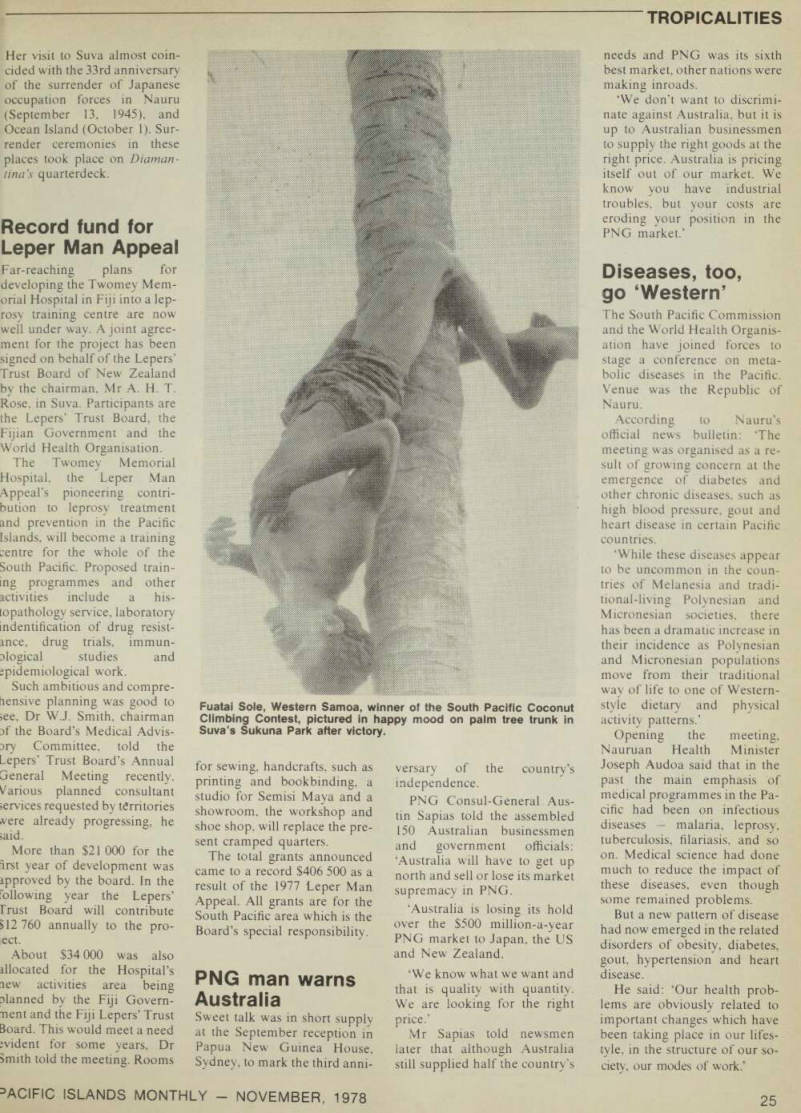
Fuatai Sole, Western Samoa, winner of the South Pacific Coconut Climbing Contest, pictured in happy mood on palm tree trunk in Suva’s Sukuna Park after victory.