Tuvalu: For Britain not
p. 21 · Read in the full issue
just a sunset but a total eclipse
Says Bob HAWKINS ;
English and unimpressed
1953 London; Coronation time. It’s pouring.
Tonga’s irrepressible Queen Salote rides the city streets in an open carriage. Britons love it. 1078 Tuvalu: Independence time. It’s raining on Funafuti. Princess Margaret, reportedly with a 104 degree F temperature, stays confined on the HMNZS Otago.
Tuvaluans do not love it.
It may not be a fair comparison. But it seems that the one and only characteristic of empire I could ever admire a refusal to surrender to whatever adversary is dead in the Briton’s soul. Or, perhaps, royal flu, penumonia, or whatever, is much more serious than the common variety.
English-born, and with residual pride, I waited in the hope that Princess Margaret would rise from her sick bed, make an eleventh hour dash ashore, and appear dra matically falteringly, if necessary at the
September 30 midnight switching hour
(Tuvalu’s flag for Britain’s). Sure, there were three cheers for Queen Elizabeth 11. But Tuvaluans, who know just how tough living can be, were nol impressed at Meg’s frailty.
One British official observed: ‘lf Margaret is not up to the job, she should say so and give it up.’
Somehow, royalty’s non-appearance fit ted the occasion. It is clear that both Tuvalu politicians and some British officials serving on Funafuti are disgruntled at the UK’s part ing attitude. Britain is finished in Tuvalu.
Prime Minister Toalipi Lauti said he was ‘disappointed’ at the outcome of London negotiations on assistance for Tuvalu after
independence. It seemed he would have liked to have come on stronger. This large man of imposing presence seemed more hurt at UK’s demeanour than its lack of gen erosity. He’s not worried about other aid sources several other nations and agen cies are willing to stand by Tuvalu. In his speech to a parting Britain, Prime Minister Lauti pointedly observed that Tuvalu had moved into constitutional and political independence; economic independence was yet to come.
All in all, it was hard to find a good word from anybody for Britain. So little it seems had been done on the ‘Brits’ part to learn about Tuvalu: so much had been done on the Tuvaluans’ part to cope with the influx of visitors on an island hard-pressed to feed its own people without a heavy import bill, let alone a crowd of hard-drinking diplo mats, officials, soldiers and sailors off five vessels, and various other interested par ties.
Tuvalu with a combination of throbbing traditional music and dancing, a ready smile, traditional hospitality, and a superb dignity personified in the presence of Prime Minister Lauti had no problem matching up to the occasion. But for the Brits, it all seemed to be summed up in Lord Napier’s pronunciation when he read Princess Mar garet’s speech for her on October 1. It just made him seem so very alien when he talked
of ‘Fun-uff-at-ee’ (say it fast).
Bob
Hawkins
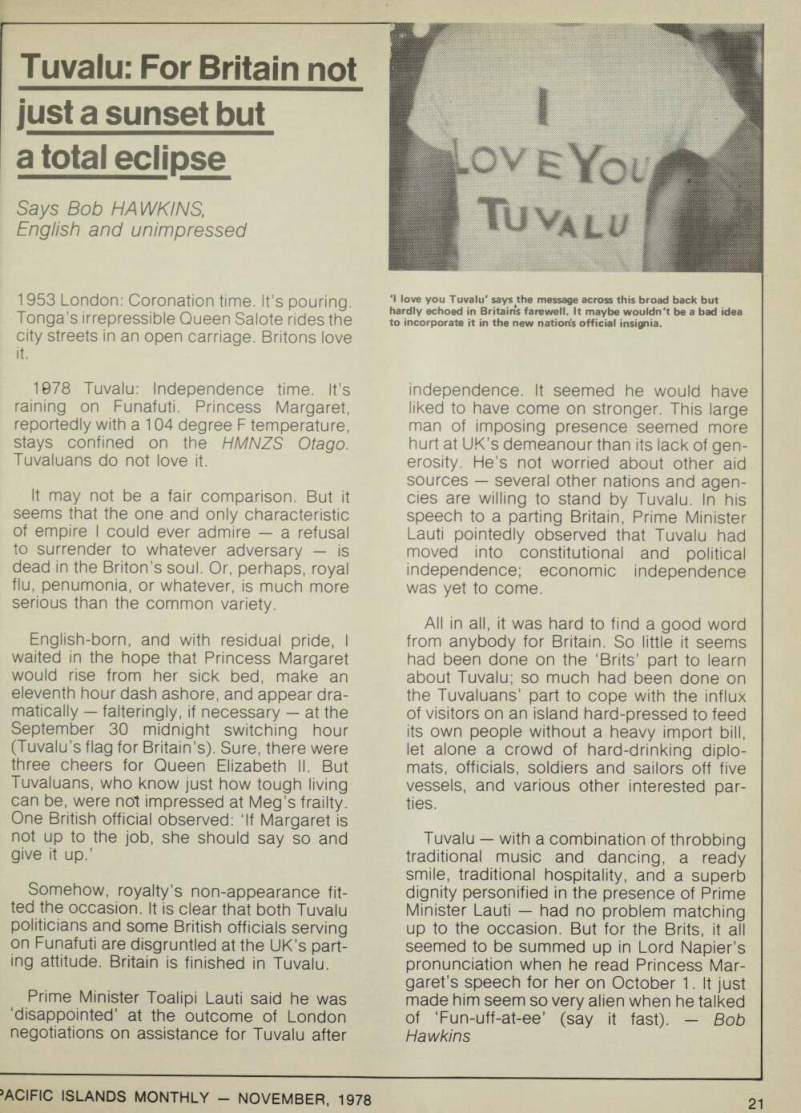
I love you Tuvalu' says the message across this broad back but hardly echoed in Britain's farewell. It maybe wouldn't be a bad idea to incorporate it in the new nation's official insignia.