Andrew Jakeo, The
p. 20 · Read in the full issue
Reluctant Elder
Of Bikini Atoll
A merican journalist Mike Malone covered the September
relocation of Bikinians from
their home atoll to Kili made necessarry by Bikini’s continu ing high radiation levels. In par ticular he investigated the case of Andrew Jakeo, a man who, with some 30 followers, refused to make the move to Kili. He filed the following exclusive re port, with the accompanying pictures, for PIM: Andrew Jakeo was a young man of 36 when the Americans first asked him to leave his homeland in 1946. In Sep tember on Bikini, the site of 23 nuclear tests that ended in
1958, history repeated itself.
Jakeo, now a Bikini elder and traditional leader of 68 years, and about 140 other islanders, reluctantly left their coral-and-sand atoll for the second time, after learning that they were absorbing levels of radioactive cesium-137 at an
alarmingly high rate.
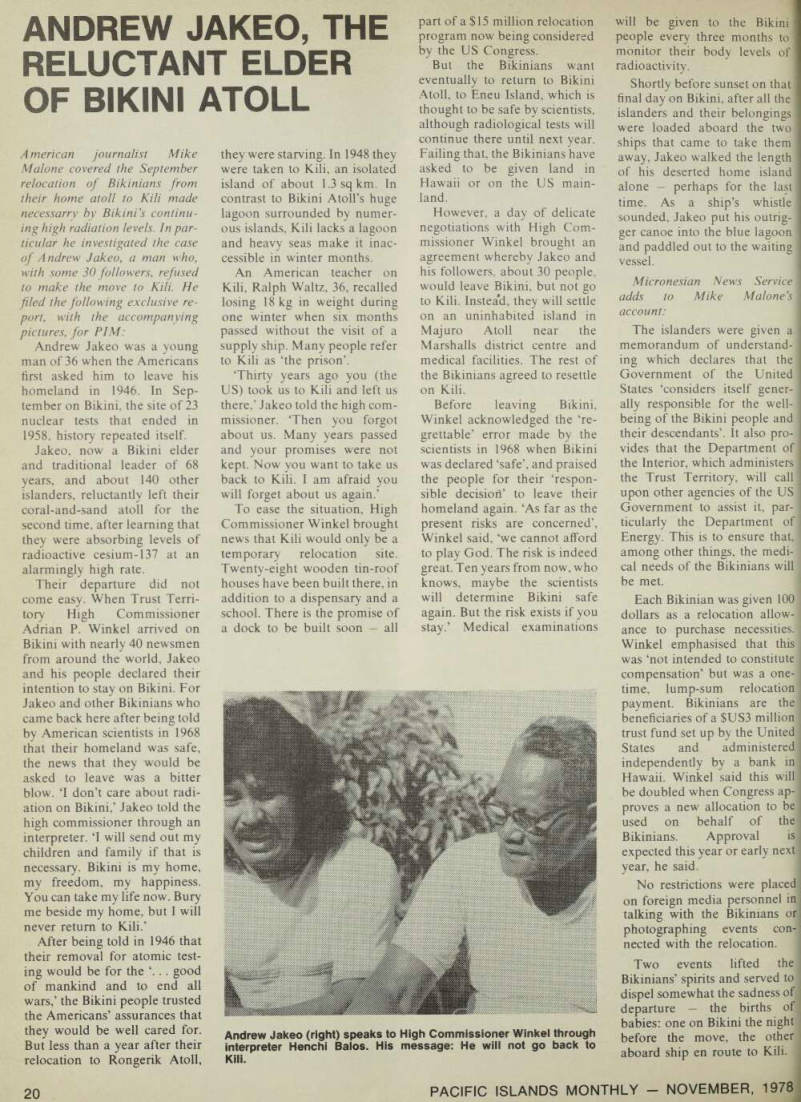
Their departure did not come easy. When Trust Terri tory High Commissioner Adrian P. Winkel arrived on Bikini with nearly 40 newsmen from around the world, Jakeo and his people declared their intention to stay on Bikini. For Jakeo and other Bikinians who came back here after being told by American scientists in 1968 that their homeland was safe, the news that they would be asked to leave was a bitter blow. T don’t care about radi ation on Bikini,’ Jakeo told the
high commissioner through an
interpreter. T will send out my children and family if that is necessary. Bikini is my home, my freedom, my happiness.
You can take my life now. Bury me beside my home, but I will never return to Kili.’
After being told in 1946 that their removal for atomic test ing would be for the ‘.. . good of mankind and to end all wars,’ the Bikini people trusted the Americans’ assurances that they would be well cared for.
But less than a year after their relocation to Rongerik Atoll,
they were starving. In 1948 they were taken to Kili, an isolated island of about I.3sqkm. In contrast to Bikini Atoll’s huge
lagoon surrounded by numer
ous islands, Kili lacks a lagoon and heavy seas make it inac cessible in winter months.
An American teacher on Kili, Ralph Waltz, 36, recalled
losing 18 kg in weight during
one winter when six months passed without the visit of a
supply ship. Many people refer
to Kili as ‘the prison’. ‘Thirty years ago you (the US) took us to Kili and left us there,’ Jakeo told the high com missioner. ‘Then you forgot about us. Many years passed and your promises were not kept. Now you want to take us back to Kili. I am afraid you will forget about us again.’
To ease the situation. High Commissioner Winkel brought news that Kili would only be a temporary relocation site.
Twenty-eight wooden tin-roof houses have been built there, in addition to a dispensary and a school. There is the promise of a dock to be built soon all
part of a $l5 million relocation program now being considered by the US Congress.
But the Bikinians want eventually to return to Bikini Atoll, to Eneu Island, which is thought to be safe by scientists,
although radiological tests will
continue there until next year.
Failing that, the Bikinians have asked to be given land in Hawaii or on the US main land.
However, a day of delicate negotiations with High Com missioner Winkel brought an agreement whereby Jakeo and his followers, about 30 people, would leave Bikini, but not go to Kili. Instea'd, they will settle on an uninhabited island in Majuro Atoll near the Marshalls district centre and medical facilities. The rest of the Bikinians agreed to resettle on Kili.
Before leaving Bikini, Winkel acknowledged the ‘re grettable’ error made by the scientists in 1968 when Bikini was declared ‘safe’, and praised the people for their ‘respon sible decisiofi’ to leave their homeland again. ‘As far as the present risks are concerned’, Winkel said, ‘we cannot afford to play God. The risk is indeed great. Ten years from now, who knows, maybe the scientists will determine Bikini safe again. But the risk exists if you stay.’ Medical examinations
will be given to the Bikini people every three months to I monitor their body levels of
radioactivity.
Shortly before sunset on that final day on Bikini, after all the islanders and their belongings were loaded aboard the two I ships that came to take them ] away, Jakeo walked the length 1 of his deserted home island I alone perhaps for the last] time. As a ship’s whistle sounded, Jakeo put his outrig ger canoe into the blue lagoon I and paddled out to the waiting 1 vessel.
Micronesian News Service I adds to Mike Malone’s \ account: The islanders were given a I memorandum of understand-1 ing which declares that the I Government of the United States ‘considers itself gener ally responsible for the well being of the Bikini people and their descendants’. It also pro vides that the Department of the Interior, which administers 1 the Trust Territory, will call I upon other agencies of the US j Government to assist it, par ticularly the Department of Energy. This is to ensure that, I among other things, the medi cal needs of the Bikinians will be met.
Each Bikinian was given 100 • dollars as a relocation allow-] ance to purchase necessities. Winkel emphasised that this j was ‘not intended to constitute j compensation’ but was a one time, lump-sum relocation payment. Bikinians are the i
beneficiaries of a SUS 3 million]
trust fund set up by the United States and administered 1 independently by a bank in Hawaii. Winkel said this will be doubled when Congress ap- j proves a new allocation to be j used on behalf of the Bikinians. Approval is expected this year or early next year, he said.
No restrictions were placed \ on foreign media personnel in talking with the Bikinians or
photographing events con- j
nected with the relocation.
Two events lifted the j Bikinians’ spirits and served to dispel somewhat the sadness of departure the births of babies: one on Bikini the night before the move, the other aboard ship en route to Kili. ■
Andrew Jakeo (right) speaks to High Commissioner Winkel through interpreter Henchi Balos. His message: He will not go back to Kili.