Currents
pp. 53-57 · Read in the full issue

Political
Hebrides: Back
O Square Two
fhree steps forward, two steps ack’ seems a fair summing-up f the present state of play in le tangled and troubled New
lebridean political scene.
The Vanuaaku Pary (VP) in Lugust decided not to accept le three ministerial posts ffered to it by the Kalsakau
ovemment. Main ground for
ffusal was the failure of the
Lepresentative Assembly to
pprove the date for an early lection proposed by the ad oc committee on electoral re :>rm on which the VP had worked side by side with mem ers of the Kalsakau govern icnt.
But the VP refusal has not leant a re-establishment of
le VP’s People’s Provisional
jovernment (PPG), set up late ist year, which gave rise to cute tension in the months wading up to the detente of Lpril when the two sides sttled down to work together n the ad hoc committee. The T’s August statement did not ule out the possibility of re stablishment of the PPG, say ig that a decision on this uestion could only be made
•y a meeting of its political
ommissars, due to be held in )ctober. So, it was back to quare two, rather than all the /ay to square one.
The VP statement claimed hat the assembly and govern nent had shown a lack of sin erity in working for peace and mity in the country. It had herefore to repeat its earlier xpressions of mistrust towards
he government and assembly,
t said it believed that this atti ude was shared by more and nore people in the New
debrides, including many of
noderate political opinions,
ncluding some members of the
issembly.
The VP said it could not uarantee that it would respect
all decisions of the assembly and administration, mention ing in particular decisions on business contracts entered into by the government, the future of non-New Hebrideans employed by it, and the con ditions laid down by it for ac quisition of New Hebrides citizenship.
The party insisted, however, that its position should not be construed as a threat to expatri ates or to the progress of the country. It was simply a matter of letting the administration know that stability and pro gress could only be secured after the establishment of
genuinely representative insti
tutions. Hence the need for new elections as soon as poss ible as the only guarantee of
lasting peace and unity.
Addressing the French and British residencies, the VP statement called upon the Bri tish administration to be more assertive with the approach of independence, and to play a
more responsible role along
side its French counterpart,
particularly in remedying the
disorganisation and uncer tainty at present reigning in the fields of education and health.
The party deplored what it called the ‘domination of the French administration over the
political development of the
country’. In its view, this domi nation could affect future re lations between the New Hebrides and France.
The party said it believed it had done enough from its side
for an improvement in the pol itical climate. Since the as sembly, in the VP view, had undermined the spirit of co
operation which had prevailed
since April, it was now up to the government to act in such a way as to re-establish that
spirit.
Commenting on the VP statement, the French/Bislama fortnightly, Nabanga , said: ‘Does this negative position of the Vanuaaku Party reopen the path to political discord, or is it a signal for new negotiations?
It is certainly too early to tell.’
The paper expressed the view that the then expected visit of the new Minister for Overseas Departments and Territories, Paul Dijoud, and the consultations he would have with all political parties, could foster the pursuit of dia logue between the two sides.
Hopes were high on the eve of Mr Dijoud’s visit that he would have some positive things to say, especially in view of the sweeping reshuffle of top French officials in the New Hebrides which had taken
place shortly before (PIM Sep
tember). An Australian source suggested that one result of Dijoud’s visit would be that the Kalsakau government would come up with an offer of four ministerial posts for the VP, instead of three as before. With four seats, the VP would have parity with other parties in the
eight-member cabinet, pend
ing the holding of elections.
Guam’S Hot
Gubernatorial
With three strong candidates running against him. Governor Ricardo J. Bordallo, 50, faces an uphill battle to remain in Guam’s highest elected post after November’s election, writes Paul Addison.
No one candidate opposed to Bordallo’s re-election bid has yet emerged as favourite.
Much depends on the showing of Guam’s lieutenant governor. Rudy Sablan, once Bordallo’s close friend, now a bitter political opponent.
Sablan was squeezed out of power early in Bordallo’s ad ministration and has remained largely ineffective. But he now hopes to gain the vote of Democrats dissatisfied with Democrat Bordallo’s often er
ratic political performance.
Republican hopes lie in the hands of island millionaire and business entrepreneur Paul Calvo who was defeated in the
Republican primary in 1974.
At the time the Republicans were split between Calvo and the then governor, Carlos Camacho. Today, he is desper
ately trying to unite the Repub
licans behind him but he met with early resistance from a splinter group that hoped to re nominate Camacho. Camacho, 53. declined the nomination and has said he is resigning from politics forever.
The fourth candidate is Guam senator, and former chairman of the Guam Consti tutional Convention, Carl Gutierrez.
Gutierrez, the owner of a construction company, is the dark horse. He can perhaps rely only on a split vote be tween Democrats and dissatis faction with Calvo to gain the title. An early bid to gain sup port was dashed in late May when union leaders told him they were withholding an en dorsement until he had cleared up charges that he had mis treated alien workers.
The issues in the election race have not been clearly delineated. But there are signs of the platform strategy that each candidate will take. Bor dallo is stressing his success at attracting federal funds for
capital improvement projects,
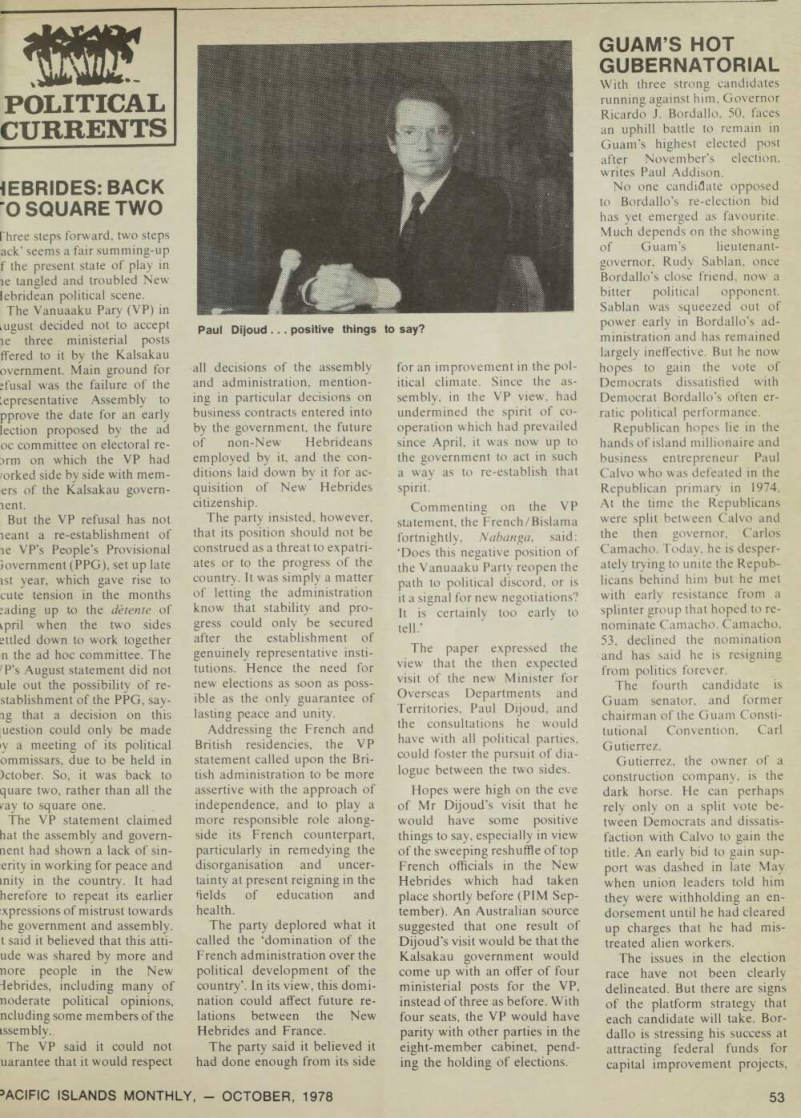
Paul Dijoud . . . positive things to say?
and pointing to recent great strides in improving the island’s road, sewer, power, and telephone systems.
Calvo has been stressing his business expertise. With the government of Guam in virtual
bankruptcy, saddled by a
SUS4O million deficit, Calvo thinks bringing more private industry to the island could re sult in more employment and government revenues. If selec ted, Calvo, 44. says he will di vest himself of his wide business interests.
All candidates promise to reduce the deficit and note that an austerity program will be needed for reduction to be feasible.
Guam, as an American terri tory with a third of its 120 000 population in the mili
tary or military dependants
is forced to dance to Washing ton DC’s tune in many pressing matters. The politicians see the Jones Act which says all goods shipped between Guam and the mainland must be car ried in US vessels - as forcing up prices and stifling compe tition. They say federal refusal to relocate an ammunition wharf at Guam’s port has stunted port development. And Gutierrez decries federal attempts to change the recently written constitution, the first written by Guam’s people.
As the fund-raising dinners get under way, the campaign headquarters open up and the candidates develop their stra tegies, interest in the island’s future is keen. Over the years Guam has had an average turn out of more than 90% of regis tered voters for elections. This year, with a variety of guberna torial candidates to choose
from, politics is already firmly
in the minds of Guam’s people.
Their decision in November will come after many thou sands of hours of political dis cussions, rallies, fiestas and more than a little family press ure.
Media Debate
Goes On
The media debate goes on in the South Pacific. In Papua New Guinea, politicians, including Prime Minister
Michael Somare, and Oppo sition Leader lambakey Okuk, and senior journalists aired their views at a ‘freedom of the press’ seminar in Port
Moresby. Predictably, Messrs
Somare and Okuk had political axes to grind in their presen tations but clearly, each had a common welcome view: free dom of the press in PNG must be maintained. In September PIM. Robert Keith-Reid, chief reporter of the Fiji Times , com mented that ‘the Fiji press is probably more free than in any other third world country’. In the light of the Fiji Ministry of Information’s infliction of the Press Correction Act on the Fiji Sun , PNG might argue that it enjoys even greater freedom; certainly, the steady flow of Opposition statements from the presses of the PNG Office of Information as a balance to the equally busy flow of government statements bears witness to the conscious desire to present both sides of the coin to Papua New Guineans.
Prime Minister Somare, in characteristic pose as head of a government, took a defensive line in his comments on the national press: ‘lt almost seems that the press believes that it has a duty to give non-govern ment views a better run than ours perhaps because of the natural sympathy the press feels for the underdog.’ Oppo sition Leader Okuk, by virtue of his job, was on the attack; ‘lt takes a courageous spirit to
put the opposition case in a sys tem which sees only in one direction. The remarkable re sult is that though we may not have a one-party state in Papua New Guinea, we may very well have a one-party press.’ So, both leaders saw themselves badly done-by at the hands of the press. But let them con tinue. Mr Somare: ‘The free dom of the press is essential to
any true democratic situation.’
Mr Okuk; ‘We must be ever watchful of threats from with out and within to our security and our love of democracy and the free enterprise system.
Only a free press reaching to the people and telling them the facts can be this watchdog.’ In their disagreement, both,
obviously, agree entirely.
A Far-Flung
51St State?
With the ratification of the Micronesian constitution by four districts in the July refer endum (PIM September), and the formation of a Federated States of Micronesia (FSM) now a certainty, some hard thinking is going on about the future of the new grouping.
One option already being
considered is the seeking of a still closer relationship with the United States than the ‘free as sociation’ link provided for in the constitution.
Senior Micronesian nego tiator Lazarus Salii is one leader who has raised this
perspective. Interviewed by the New York weekly, US News and World Report , in August, Salii said that one reason Micronesians are drawn to as sociation with the US was that ‘we need the money’. ‘Some people here talk about self sufficiency, but it will never come,’ he said. ‘lf we didn’t need US help, we would have gone for complete indepen dence and not just free associ ation.’
Salii added; ‘For Micronesia to be safe in this world, we have to be connected with some larger power, and that is the United States. Free association by itself is probably not enough. I think eventually we may ask to become part of a state.’
One idea floated in the weeks following the refer endum of July 12 is that the new FSM could seek statehood in a joint bid with Guam and American Samoa, both long established US possessions, and the three breakaway Micronesian districts of North ern Marianas, Palau and Marshall Islands. Such a 51st state would be a far-flung affair indeed, with more than 5 000 kilometres of ocean be tween its western and eastern ends. But, in politics, anything
is possible.
Salii cited the more than three decades of close links be tween Micronesians and US servicemen, teachers, mis sionaries and administrators as a strong inducement to choos ing an American connection.
But US News and World Re port recalled other, less rosy, sides of the relationship, say ing; ‘Americans .. . have been criticised for treatment of the Bikini Islanders, whose atoll was smashed by nuclear tests more than two decades ago.
Attempts to clean up radiation on Bikini failed, and the people must leave and face an uncer tain future on other isles. ‘lll will was created, too, by attempts on the part of the Central Intelligence Agency to monitor conversations among Micronesian delegates to the negotiations over free associ ation.’
Salii tried to sum up a highly
complex relationship when he
said: ‘The majority of
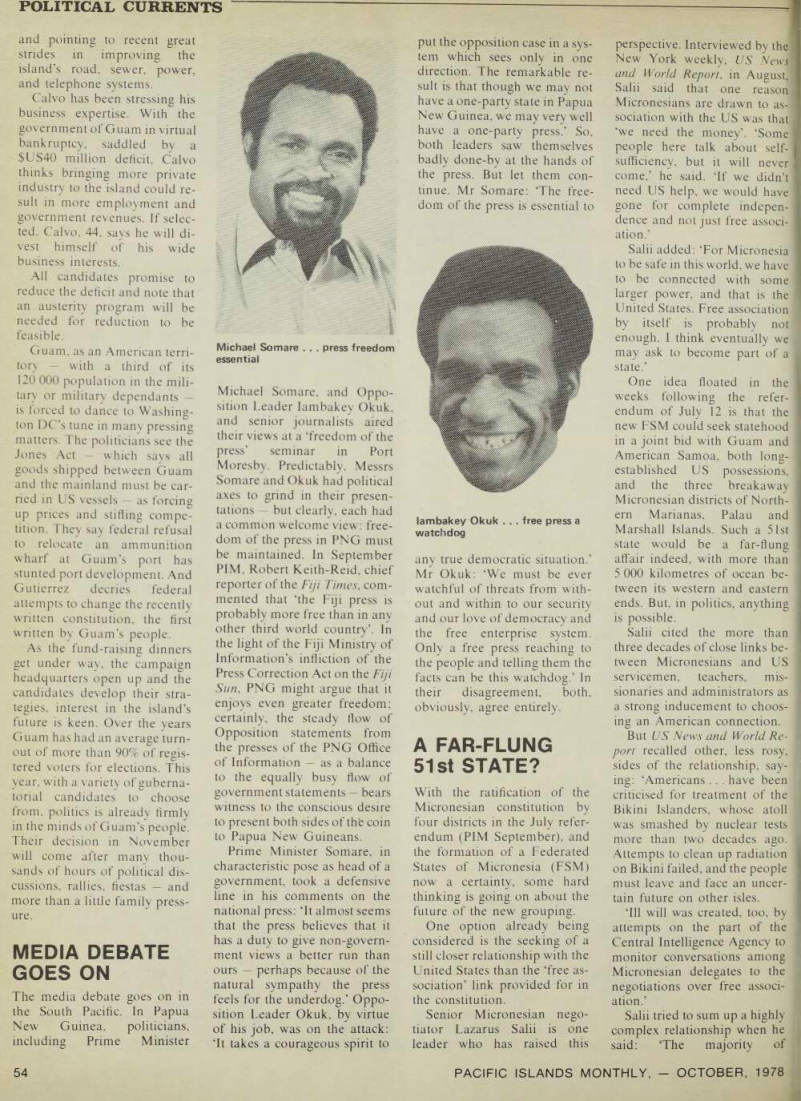
Michael Somare . . . press freedom essential
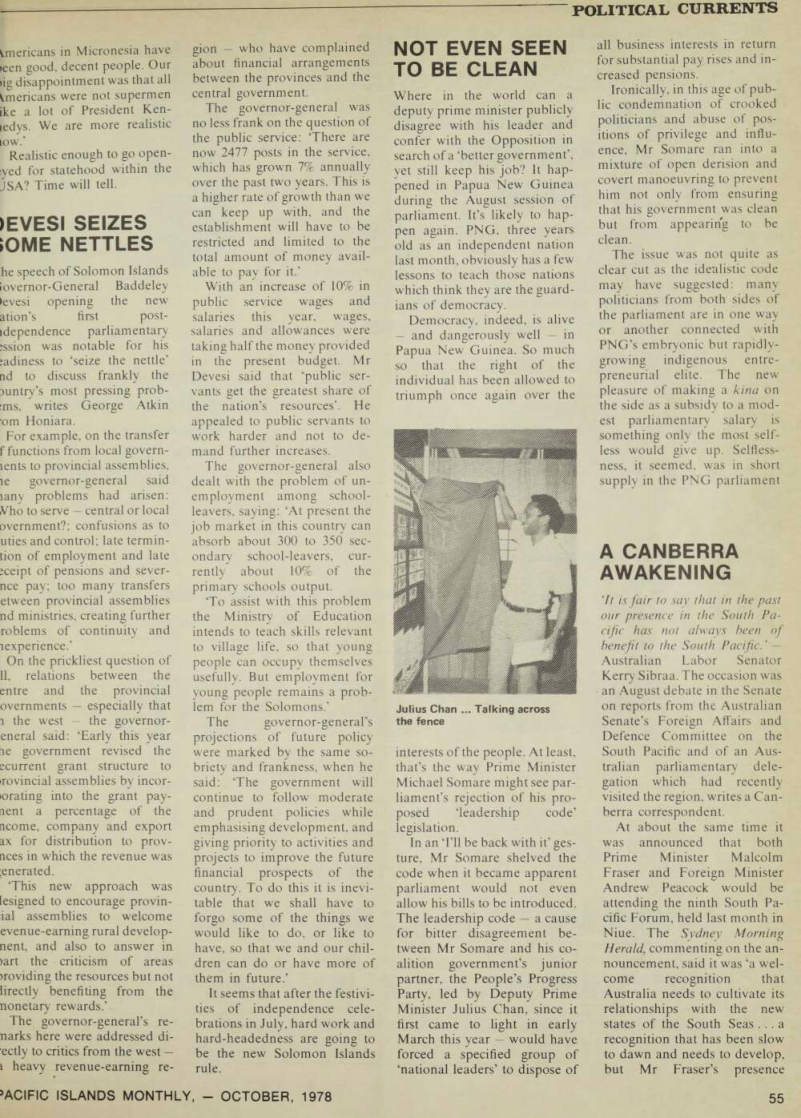
Iambakey Okuk . . . free press a watchdog
Americans in Micronesia have
>een good, decent people. Our
ug disappointment was that all Americans were not supermen ike a lot of President Ken ledys. We are more realistic iow.’
Realistic enough to go open :yed for statehood within the JSA? Time will tell.
Levesi Seizes
>Ome Nettles
he speech of Solomon Islands rovernor-General Baddeley levesi opening the new ation’s first post
idependence parliamentary
;ssion was notable for his ;adiness to ‘seize the nettle’ ad to discuss frankly the auntry’s most pressing prob ans, writes George Atkin om Honiara.
For example, on the transfer f functions from local govern
lents to provincial assemblies,
le governor-general said
lany problems had arisen; Vho to serve central or local overnment?; confusions as to uties and control; late termin tion of employment and late jceipt of pensions and sever nce pay; too many transfers etween provincial assemblies nd ministries, creating further roblems of continuity and
lexperience.’
On the prickliest question of 11, relations between the
entre and the provincial
overnments especially that
i the west the governor eneral said; ‘Early this year ic government revised the ecurrent grant structure to provincial assemblies by incor porating into the grant pay lent a percentage of the icome, company and export ax for distribution to prov ices in which the revenue was ;enerated. ‘This new approach was
lesigned to encourage provin
ial assemblies to welcome evenue-earning rural develop nent, and also to answer in >art the criticism of areas >roviding the resources but not
lirectly benefiting from the
nonetary rewards.’
The governor-general’s re narks here were addressed di ectly to critics from the west
i heavy revenue-earning re
gion who have complained
about financial arrangements between the provinces and the central government.
The governor-general was no less frank on the question of the public service: ‘There are now 2477 posts in the service, which has grown 7% annually over the past two years. This is a higher rate of growth than we can keep up with, and the establishment will have to be restricted and limited to the total amount of money avail able to pay for it.’
With an increase of 10% in public service wages and salaries this year, wages, salaries and allowances were taking half the money provided in the present budget. Mr Devesi said that ‘public ser vants get the greatest share of the nation’s resources’. He appealed to public servants to work harder and not to de mand further increases.
The governor-general also dealt with the problem of un employment among school leavers, saying: ‘At present the job market in this country can absorb about 300 to 350 sec ondary school-leavers, cur rently about 10% of the primary schools output. ‘To assist with this problem the Ministry of Education intends to teach skills relevant to village life, so that young people can occupy themselves
usefully. But employment for
young people remains a prob lem for the Solomons.’
The governor-general’s
projections of future policy
were marked by the same so briety and frankness, when he said: ‘The government will continue to follow moderate
and prudent policies while
emphasising development, and
giving priority to activities and projects to improve the future financial prospects of the country. To do this it is inevi table that we shall have to forgo some of the things we would like to do, or like to have, so that we and our chil dren can do or have more of them in future.’
It seems that after the festivi ties of independence cele brations in July, hard work and hard-headedness are going to be the new Solomon Islands rule.
Not Even Seen
To Be Clean
Where in the world can a
deputy prime minister publicly
disagree with his leader and confer with the Opposition in search of a ‘better government’, yet still keep his job? It hap pened in Papua New Guinea during the August session of
parliament. It’s likely to hap
pen again. PNG, three years old as an independent nation last month, obviously has a few lessons to teach those nations which think they are the guard ians of democracy.
Democracy, indeed, is alive and dangerously well in Papua New Guinea. So much so that the right of the individual has been allowed to triumph once again over the
interests of the people. At least, that’s the way Prime Minister Michael Somare might see par liament’s rejection of his pro
posed ‘leadership code’
legislation.
In an ‘l’ll be back with it’ ges ture. Mr Somare shelved the code when it became apparent parliament would not even allow his bills to be introduced.
The leadership code a cause for bitter disagreement be tween Mr Somare and his co
alition government’s junior
partner, the People’s Progress
Party, led by Deputy Prime Minister Julius Chan, since it first came to light in early March this year would have forced a specified group of ‘national leaders’ to dispose of
all business interests in return for substantial pay rises and in
creased pensions.
Ironically, in this age of pub lic condemnation of crooked politicians and abuse of pos itions of privilege and influ ence, Mr Somare ran into a mixture of open derision and covert manoeuvring to prevent him not only from ensuring that his government was clean but from appearing to be clean.
The issue was not quite as clear cut as the idealistic code may have suggested; many politicians from both sides of the parliament are in one way or another connected with
PNG’s embryonic but rapidly
growing indigenous entre
preneurial elite. The new pleasure of making a kina on the side as a subsidy to a mod
est parliamentary salary is
something only the most self less would give up. Selfless ness, it seemed, was in short supply in the PNG parliament
A Canberra
Awakening
7/ is fair to say that in the past our presence in the South Pa
cific has not always been of
benefit to the South Pacific. ’
Australian Labor Senator Kerry Sibraa. The occasion was an August debate in the Senate on reports from the Australian Senate’s Foreign Affairs and Defence Committee on the South Pacific and of an Aus tralian parliamentary dele
gation which had recently
visited the region, writes a Can
berra correspondent.
At about the same time it was announced that both Prime Minister Malcolm Fraser and Foreign Minister Andrew Peacock would be attending the ninth South Pa cific Forum, held last month in Niue. The Sydney Morning Herald, commenting on the an nouncement, said it was ‘a wel come recognition that Australia needs to cultivate its relationships with the new states of the South Seas ... a recognition that has been slow to dawn and needs to develop, but Mr Fraser’s presence
Julius Chan ... Talking across the fence
lould be a convincing earnest
r good intentions’.
In recent years Australia’s jvelopment assistance com itment to the South Pacific is grown considerably but, as e senate committee report ressed, ‘money alone cannot
isure friendship, win respect
necessarily promote
welopment’.
Not surprisingly, the debate velt on the poor image of ustralian commercial iterprises in the Pacific. Gen ally it was felt the image was iproving. There were bou lets for the Bank of New )uth Wales and Burns Philp, hich both gave evidence to e committee, for their localis ion programmes and their
weloping acknowledgement
‘ a commitment to the coun ts in which they were operat g. But of W. R. Carpenters, riich made no submission and d not appear before the com ittee. Senator Sibraa said; ecause it did not, I am afraid has left us with the opinion at its attitude is not the right ie for the South Pacific at the esent time.’
Committee chairman Lib al Senator Peter Sim laid •ess on the need for ‘part ;rship’ in Australia’s ap oach to South Pacific entries and for exchanges at 1 levels, not just among aders.
Predictably, Japanese,
hinese and Russian interest in e region, had sparked height
led parliamentary interest in
e subject.
Senator Sim summed up the
•mmittee reports by saying
at they ‘represent not an :ecutive or a government ew but more importantly a
irliamentary view of foreign
)licy and of the way in which should develop’. In other ords, Australian government terest in the region, which is been intensifying since the of the seventies, is >w being shared by members
parliament generally
hich might even suggest that e consciousness of the Aus
alian public is being stirred,
that happens, Australia can jrhaps look forward to /erhauling the long lead New ealand enjoys in the South
acific goodwill stakes.
Fiji Mps Are
Mike-Shy
Fiji politicians are not anxious that their words should be broadcast to the nation at least those on the government side are not. The government has used its huge majority in the House of Representatives to defeat a motion calling for
the broadcasting of parliamen
tary debates.
Prime Minister Ratu Sir Kamisese Mara suggested a survey might be worthwhile to see if the people really wanted ‘such an assault on their ears by Members of Parliament’. He argued that in the UK, the BBC
had just started broadcasting
debates, and that what went over the air did not always make MPs sound too good.
The Fiji opposition argued
that electors should be educa ted in parliamentary affairs to arouse political and national consciousness, and help end
ignorance and misconceptions
about MPs. Australia and New Zealand had all their debates broadcast, and the British House of Commons had now followed a similar line.
New Zealand pioneered
broadcasting of parliamentary
debates during the first Labour Government (1935-38), and Australia later followed suit.
Experience in both countries has shown that the way many
MPs speak is hardly uplifting
‘assault on the ears’, to use Ratu Sir Kamisese’s phrase, describes it well.
The Majuro, Marshall Islands, newspaper Micronesian Independent, makes this car toon comment on the extreme
political fragmentation of the
various parts of the US Trust Territory of the Pacific Islands.
The Northern Marianas gained separate status in 1976; the dis tricts of Palau and Marshall Islands are now seeking separ ate status for themselves; the four districts of Truk, Yap, Ponape and Kosrae recently ap proved a constitution which will lead them into a Federated States of Micronesia; Guam, at the southern end of the Marianas chain, is in a different situation again it is an unin
corporated territory of the USA.
The idea has now been raised that they should all get together, along with American Samoa, to form the 51st state of the
Usa.
‘Expats’ Get
Some Advice
PNG Office of Information chief, Brian Amini, took a
gentle sideswipe at ‘overseas
people’ employed on the local press when he delivered his paper to a Port Moresby press freedom seminar. Simul taneously he conceded recog nition of the problem that it will be ‘years before Papua New Guinean journalists have
the knowledge and experience
of the world ... or even of our own country ... to write auth
oritatively and objectively on
what is happening from day to day to our nation’.
Noting that a number of young people had already
passed through the University
of PNG’s course for the dip loma of journalism, he remarked: ‘But a certificate does not make a journalist any more than it makes a plumber or a carpenter.’ PNG’s news papers, he said, ‘already suffer from obscure phraseology and the smart headline. Amusing to the educated but largely unin telligible to the average man in the street’.
PNG, he said, in the mean time, would have to continue to employ overseas people ‘to teach and guide our young writers in the ways of the printed media’. He appealed to them ‘not to take advantage of our inexperience’ and for them to ‘learn from the situation they find themselves in. It could be that they too can benefit from our own situation and their writings will be better under stood when they finally leave us’.
Examples he gave: ‘lf by “bi lateral discussions” you mean “talks between two different groups”, then say so. If you are “concerned about the impli cations of some things” and you mean you are “worried about them”; if you are “work
ing out contingency measures”
and you are actually “looking at other ways of doing things”, then isn’t it better to put it that way so more people are able to understand what you are
writing or talking about?’
The Office of Information chief is chairman of a com mittee set up by Media Minis ter Tom Koraea, to look at the feasibility of another national daily newspaper as compe tition for the PNG Post- Courier. One of the terms of reference for the committee is that it is working on the prem ise that no private body or or ganisation is in a position to successfully launch a second daily national newspaper and therefore special consideration must be given to ‘costs involved to the PNG government should it decide to meet initial costs of
establishing a daily news
paper’.