Sland Tattoo



Pacific Islands Monthly.
Pim
October, 1978
American Samoa USSI.2S
Australia ASI.OO*
Fiji FSI.OO
Hawaii US$l.5O New Cal. A Fr Pol CFP 140 New Hebrides ASI.OO NZ. Cook Is. A NiueNZSI 00 Norfolk Island ASI.OO Papua New Guinea Kl.oo Solomons SSI.OO forif a PI.OO USTT A Guam USsl.2s Western Samoa ...11.00 Regnitred for posting as a publication
He Fal. And
- Of The
Sland Tattoo
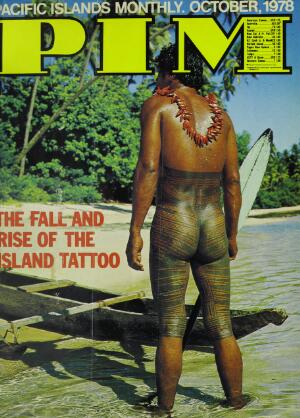
Cover: Western Samoan Makesi Tito photographed by Bruce Moss on Fagamalo Bay near his home in Avao, Savaii. At his feet is his paupau (canoe) which he made himself.
Advertisements & other items, pp. 2-4 (1 item)
Toyota
How to find a REAL economy car* When you look at a car billed as an economy model, ask yourself a few questions.
What sort of fuel consumption can be expected?
Low? Good.
What about other operating costs? Oil, lubrication, that kind of thing. Low again? Great.
How about maintenance? The car has a low-breakdown record? You are definitely on the right track.
What is the average life of the car? Is it better than the average in your area? Super. That’s important in an economy car.
Now. How is the after service? Buying a car is not all in the price you know. Plenty of service outlets?
One economy car coming up. All you have to do is check the price. Then you can tell if you are really getting an economy car.
You will probably find, after asking these questions about town, that REAL economy cars come down to Toyota, the world’s economy car builder.
See Toyota first. Then you won’t have to shop around.
IHE HAPPY ECONOMIZER
TOYOTA STARLET
The car that says economy in every way And you will be happy for it. Big inside Small outside. Miserly with petrol.
Without sacrificing comfort. A good buy in an economy car even for Toyota. k .
' m
PAPUA NEW GUINEA;
ELA MOTORS LIMITED,
Scratchley Rd., Badili, P.O. Box 75, Port Moresby.
U.S. TRUST
TERRITORY; MICROL
CORPORATION,
P.O. Box 267, Saipan.
FIJI ISLANDS:
AUTOMOTIVE
SUPPLIES CO., LTD.,
G.P.O. Box 355, Suva.
AMERICAN SAMOA;
BURNS PHILP
(SOUTHSEA) CO., LTD.,
P.O. 1057, Pago Pago.
WESTERN SAMOA;
BURNS PHILP
(SOUTHSEA) LTD.,
P.O. Box 188, Apia.
GUAM: ATKINS, KROLL
(GUAM) LTD., P.O. Box
6248, Tamuning.
NEW HEBRIDES:
NEW HEBRIDES
MOTORS LTD.,
P.O. Box 18, Vila.
SOLOMON ISLANDS:
MENDANA
TOYOTA
SERVICE
TOYOTA
ENTERPRISES (5.1.)
LTD., P.O. Box 174,
Honiara.
TAHITI: NIPPON
AUTOMOTO, B.P. 342,
Papeete.
COOK ISLANDS:
COOK ISLANDS
TRADING
CORPORATION LTD.,
P.O. Box 92, Rarotonga.
NAURU ISLAND:
NAURU COOPERATIVE
SOCIETY.
GILBERT ISLANDS:
TARAWA MOTORS,
Box 36, Bairjki Tarawa.
NORFOLK ISLAND;
MOUNT PITT
(ENTERPRISES) LTD.,
P.O. Box 169
NEW CALEDONIA;
SOCIETE
IMPORTATION
AUTOMOBILE DE
PACIFIQUE,
Rond-Point du Pacific (Station Total) B.P. 438, Noumea.
The Toyota range includes: Toyota 1000, Toyota Starlet, Toyota Corolla, Toyota Cellca, Toyota Corona, Toyota Cressida, Toyota Crown
Vi \ s«f^5 3 73 • ':' Gel in step with Sony’s F-515 Audio Formula. \ %' ... & ■ c..„. ■,
ea a p
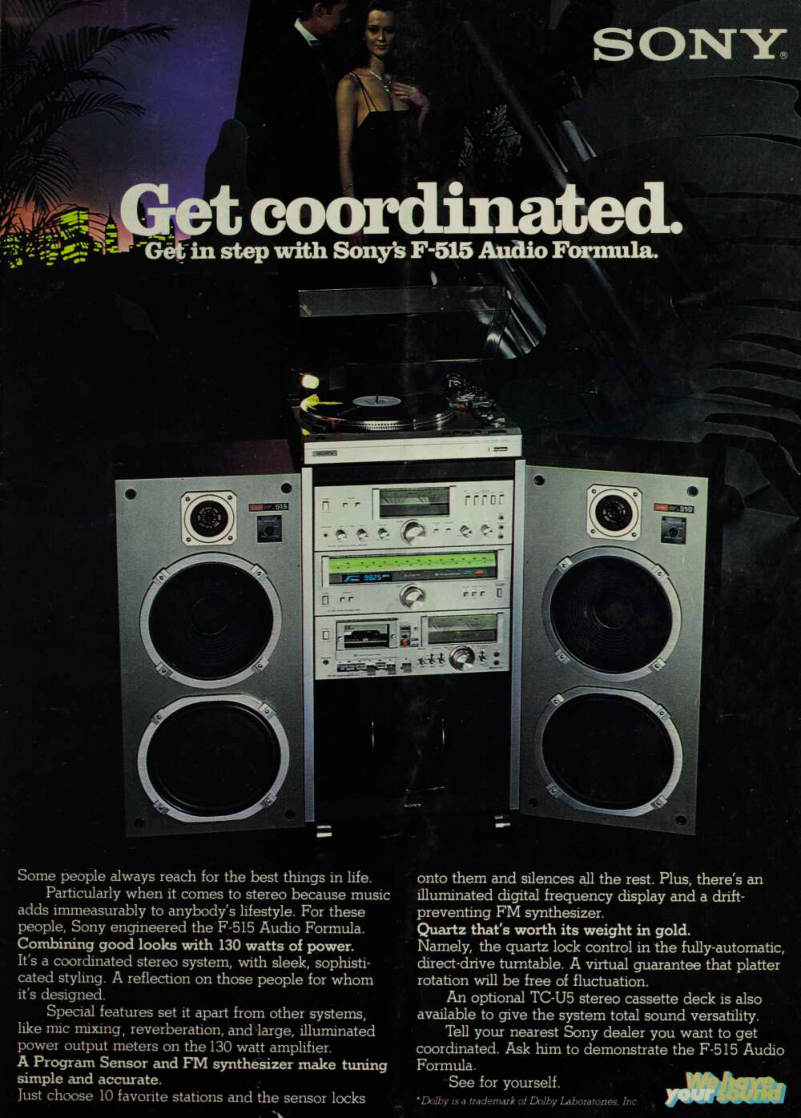
r r * 3£?S Some people always reach for the best things in life.
Particularly when it comes to stereo because music adds immeasurably to anybody's lifestyle. For these people, Sony engineered the F-515 Audio Formula.
Combining good looks with 130 watts of power.
It's a coordinated stereo system, with sleek, sophisticated styling. A reflection on those people for whom it's designed.
Special features set it apart from other systems, like mic mixing, reverberation, and large, illuminated power output meters on the 130 watt amplifier.
A Program Sensor and FM synthesizer make tuning simple and accurate.
Just choose 10 favorite stations and the sensor locks "v onto them and silences all the rest. Plus, there's an illuminated digital frequency display and a driftpreventing FM synthesizer.
Quartz that's worth its weight in gold.
Namely, the quartz lock control in the fully-automatic, direct-drive turntable. A virtual guarantee that platter rotation will be free of fluctuation.
An optional TC-U 5 stereo cassette deck is also available to give the system total sound versatility.
Tell your nearest Sony dealer you want to get coordinated. Ask him to demonstrate the F-515 Audio Formula.
See for yourself. * Dolby is a trademark of Dolby Laboratories, Inc.
wr* m 4
ill
M V r 9 f I
This page tells a lot about
Mazda technology.
Just a few of the searching tests a Mazda has to pass before it ever goes into production. Many more follow, both during manufacture and after. The result. Superior, highquality products. Cars like the Mazda 323. A car everyone’s talking about because of its versatile, economical performance and stylish good looks.
And like all Mazdas, a car that you can own and drive with confidence.
Because Mazdas are made right.
Right from the beginning.
Sound Testing Laboratories Nobody likes noise. Least of all Mazda. That’s why we are working hard to make our cars quieter —from the outside and the inside. The car (right) is in our anechoic test chamber. Here the whole car is subjected to vibration through a machine that creates a variety of different shakes and thumps. Ultra-sensitive microphones pick up every sound made, then amplifies it for thorough analysis. This way we can get rid of excessive noise and vibration before they annoy you and your passengers.
The Climatic Testing Laboratories (top, far right) Here a range of driving conditions can be simulated, from stop-start city driving to sustained high-speed highway running.
The tests are conducted in a wide range of temperatures and under different atmospheric conditions. So you can be sure your Mazda will be expertly tuned to run smoothly in the country where you live.
Body Testing Laboratories(bottom.farhght) This is one of the facilities that crash tests our car bodies. Impact and torsional effects can be accurately measured by computers simulating collisions at 30-60 m.p.h. Dummies electronically wired tell us what happens to passengers —and as a result —provide our design engineers with valuable information about the safest interiors and bodies. Tests such as these helped us to design the light, crash resistant, semi-monocoque body found on all Mazda passenger cars.
mazoa
Quality through superior technology
Tr'ii!
in; ;
Illul
Lil
mt 1- 5T u
Jjf
\ FIJI ISLS Niranjans Autoport Ltd. G.P.O. Box 450. Suva TEL: 381555 NAURUTim John P.O. Box 101, Rep. of Nauru TEL; 471 NEW CALEDONIA Joseph Cheval & Cie 3, Rue Jean-Jaures, Noumea TEL; 731-01 NEW ZEALAND Mazda Motors of New Zealand Ltd. Otahuhu, Auckland P.O. Box 22-472 TEL: 69-099 NORFOLK I Duncombe Bay Garage. P.O. Box 220. Norfork Ist. TEL; 2097 PAPUA NEW GUINEAP.N.G. Associated Industries Ltd. P.O. Box 1394, BorokoTEL: 255788 SAIPAN Latte Motors Inc. P.O. Box 206. Saipan, Mariana Ist. TEL; 6142 SOLOMON ISLS. Solomon Motors Ltd. P.O. Box 20, Honiara TEL: 313 TAHITI Comptoir Polynesien B.P. 628, Papeete TEL: 2. 80. 27 TONGA Prema & Sons P.O. Box 20, Nukualofa WESTERN SAMOA Mazda Services (Samoa) Ltd. P.O. Box 576, Apia TEL; 825 The trademark MAZDA in this advertisement stands for AUTOMOBILES MAZDA.as far as France and her territories are concerned.
Pacific Islands Monthly
Pim
i 1.49 No. 10
Octobe. 1978
Elsewhere: SAI6 ment by personal cheque is accepted in Australian, New Zealand, UK and Fiji currency. For other remit tee please obtain a bank draft in Australian dollars le payable to the ANZ Banking Group, 88 Wentworth nue, Sydney, Australia.
Representatives
ITRALIA: Distribution Gordon & Gotch (A/asia) Box 40, PO, Rosebery. NSW 2018. Advertising bourne Pacific Publications (Aust) Pty Ltd, 2nd ir, Herald and Weekly Times Building, 61 Flinders e, Melbourne 3000, telephone 652 1565; Brisbane food, Anday Agency, Box 1918, GPO, Brisbane 4001, Dhone 44 3485, 44 1546; Adelaide Harry Hastwell lia, PO Box 30, 399 Glen Osmond Rd, Glen Osmond, laide 5064, telephone 79 1869, 79 5956; cables Hast lia, Adelaide.
Distribution and subscriptions Desai Bookshops, Box 160, Suva, Fiji, telephone Suva 23036. Advertis - Fiji Times & Herald Ltd, 20 Gordon St, Suva, tele ne 312 111, telex FJ2124 NCH POLYNESIA: Distribution - Hachette ifique, 10 Ave Bruat, Papeete, telephone 2 5610.
If All, UNITED STATES: Distribution - PIM, Hawaii, I Kahawai St, Honolulu, Hawaii 96822.
AN: Advertising and subscriptions Universal ia Corporation, CPO Box 46, Tokyo, telephone 3036.
If CALEDONIA: Distribution Depot Centre de >se Michel Pentecost, BPC2, Noumea, telephone 434, 27 4729.
If ZEALAND; Distribution Gordon & Gotch. PO Box 2 Carr Road, Mt. Roskill, Auckland 4 Advertising ternational Media Representatives Ltd. PO Box 2313, kland, telephone 795 487; 493 389. Subscriptions ific Publications, CPO Box 2229, Auckland.
UA NEW GUINEA: Distribution - Robert Brown & DC, PO Box 3395, Port Moresby, telephone 2 5855. ertising PNG Post-Courier, PO Box 85, Port esby, telephone 212577.
TED KINGDOM: The Herald and Weekly Times Ltd, i Clifford's Inn, Fetter Lane, London EC4A IBU, tele ne 01 831 6041, telex London 21989.
TED STATES MAINLAND: Advertising - Joshua B ( ers Jr, Powers International Inc, 551 Fifth Ave, New <, New York 100 017, telephone 867 9580, telex 514 Subscriptions PIM, Hawaii, 2812 Kahawai St, olulu, Hawaii 96822. lished monthly by Pacific Publications (Aust) Pty Ltd d printed in Australia by Kralco, Flemington, NSW. tralian cover price is recommended retail only. Regis d at the GPO Sydney for transmission by post as a lication category B. Second class postage paid at olulu, Hawaii, Pub. 952480. Copyright © 1978 Pacific Publications (Aust) Pty Ltd.
Subscriptions
\A is airfreighted to most subscribers and agents in the Pacific Islands and the United States.
Aust.
Other lerican Samoa $13 $US16 stralia $12 nada $14 $US18 ok Islands $13 $12 $F12 snch Polynesia $14
Cfp 1700
am $13 $US16 bert Islands $13 waii $13 $US16 >an $16 Y4500 :ronesia $13 $US16 uru $13 « Caledonia $14
Cfp 1700
n Hebrides $13 n Zealand $12 $NZ13.50 e $13 ■folk Island $12 ■them Marianas $13 $US16 )ua New Guinea $13 K12 omon Islands $13 >ga $13 r alu $13 ted Kingdom $15 £10 Mainland $14 $US18 stern Samoa $13
Advertisements & other items, pp. 5-7 (3 items)
5
kCIFIC ISLANDS MONTHLY, - OCTOBER, 1978
Founded 1930 by R. W. Robson jblisher Stuart Inder Jitor Bob Hawkins iitorial Adviser John Carter anager John Berry Jvertising Manager Steve Gray A Pacific Publications production 76 Clarence Street, Sydney 2000 GPO Box 3408 Sydney 2001 Cables: PACPUB Sydney Telex; 21242 Telephone; Sydney 29 6693
SiSfe
© v v? v>
MM MONTHLY AUGUST, 1878
* <0 .\0 v „ -c
.0> Jfe
• v <o *® % e*
A& >c& *v*
I PIM SUBSCRIPTIONS
See the lefthand column for the cost of a 12-month subscription to PIM mailed direct to your home.
PACIFIC ISLANDS COOKBOOK
Hundreds of practical recipes using ingredients found in most parts of the South Pacific, including a big section on fish, and fish selection. Interesting recipes with taro, yams, kumala, breadfruit, cassava, tropical fruit, coconut, ferns, shellfish and raw fish, as well as rice, meat, poultry, breadmaking, etc.
Nutritionists Susan Parkinson and Peggy Stacy, provide practical advice on meal planning, kitchen budgeting. 120 pages, with colour illustrations. 5A7.00 (SUSS.SO) Posted anywhere
THE TONGANS
Leading South Pacific writer Olaf Ruhen and photographer Jozef Vissel capture the lifestyle of the people of the last Polynesian kingdom.
Brilliant prose and 96 sparkling full-colour photographs depict today’s Tongans at work, in church, at play. 5A9.00 (SUSIO.SO) Posted anvwhere
PNG HANDBOOK & TRAVEL GUIDE
For businessmen, schools, libraries and local residents, this up-to-the-minute handbook covers everything!
Includes an accommodation tariff guide and useful maps, including a large coloured fold-out map of Papua New Guinea. 5A8.50 (SUS 10.00) Posted anywhere
SiSfe
also ask us for our full mail order book list of great Pacific titles. .a"' mm? i m \v' i x \.n" 5® v , A 1 *' n m c°' &
I * k . «.
Just
released!
The Full,
fascinating
story of
New
Guinea
aviation!
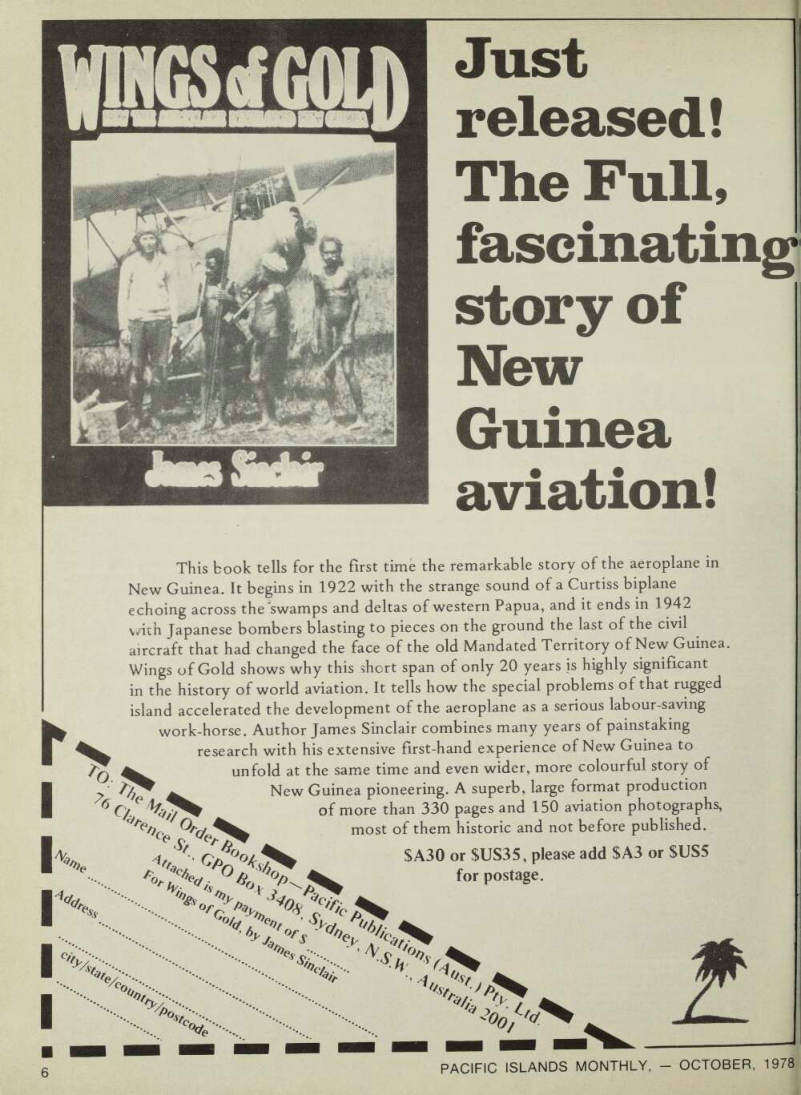
r This book tells for the first time the remarkable story of the aeroplane in New Guinea. It begins in 1922 with the strange sound of a Curtiss biplane echoing across the swamps and deltas of western Papua, and it ends in 1942 wdth Japanese bombers blasting to pieces on the ground the last of the civil aircraft that had changed the face of the old Mandated Territory of New Guinea.
Wings of Gold shows why this short span of only 20 years is highly significant in the history of world aviation. It tells how the special problems of that rugged island accelerated the development of the aeroplane as a serious labour-saving work-horse. Author James Sinclair combines many years of painstaking research with his extensive first-hand experience of New Guinea to unfold at the same time and even wider, more colourful story of y New Guinea pioneering. A superb, large format production e 0 f more than 330 pages and 150 aviation photographs, %S % fi. % , s, r <& l'-hn n, ( ir °* c /a A /> , most of them historic and not before published.
SA3O or SUS3S, please add SA3 or SUSS for postage.
VNr
v &0 V,
Pim
PACIFIC ISKLANDS MONTHLY
This Month
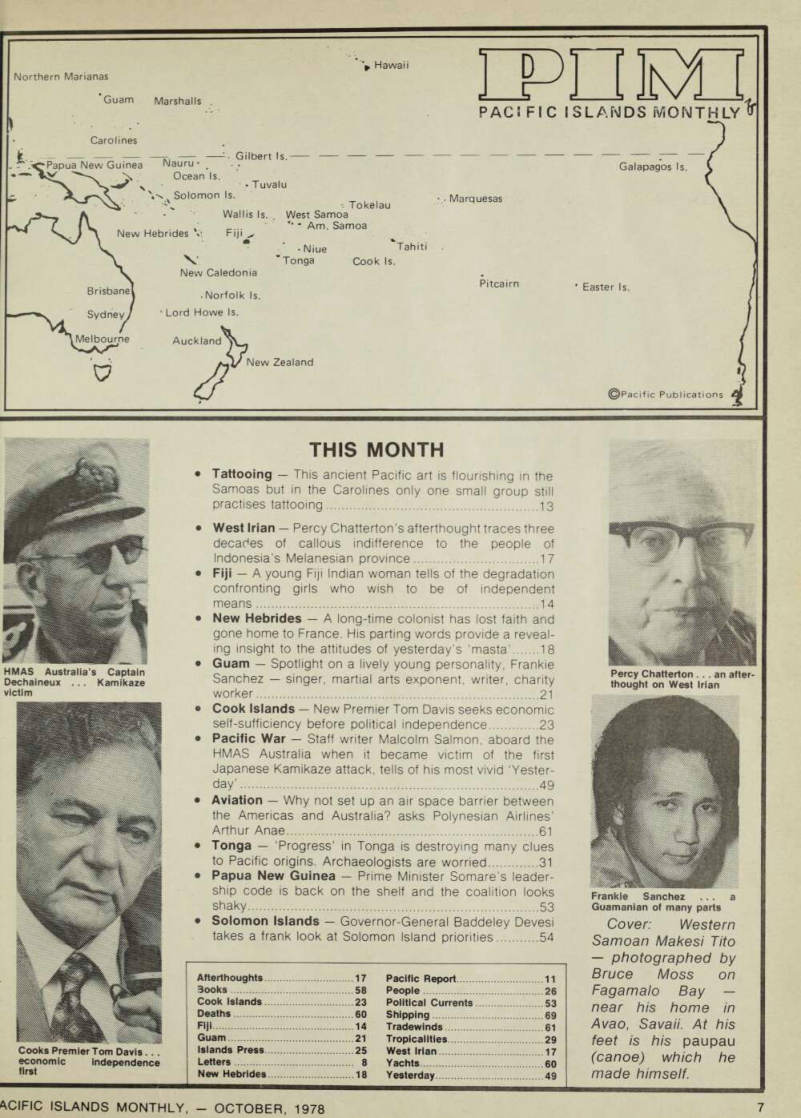
• Tattooing This ancient Pacific art is flourishing in the Samoas but in the Carolines only one small group still practises tattooing 13 • West Irian Percy Chatterton’s afterthought traces three decades of callous indifference to the people of Indonesia’s Melanesian province 17 • Fiji-A young Fiji Indian woman tells of the degradation confronting girls who wish to be of independent means 14 • New Hebrides A long-time colonist has lost faith and gone home to France. His parting words provide a reveal ing insight to the attitudes of yesterday’s ‘masta’ 18 • Guam Spotlight on a lively young personality, Frankie Sanchez singer, martial arts exponent, writer, charity worker 21 • Cook Islands New Premier Tom Davis seeks economic self-sufficiency before political independence 23 • Pacific War Staff writer Malcolm Salmon, aboard the HMAS Australia when it became victim of the first Japanese Kamikaze attack, tells of his most vivid ‘Yester day’ 49 • Aviation Why not set up an air space barrier between the Americas and Australia? asks Polynesian Airlines’
Arthur Anae 61 • Tonga ‘Progress’ in Tonga is destroying many clues to Pacific origins. Archaeologists are worried 31 • Papua New Guinea Prime Minister Somare’s leader ship code is back on the shelf and the coalition looks shaky 53 • Solomon Islands Governor-General Baddeley Devesi takes a frank look at Solomon Island priorities 54
Afterthoughts 17 Books 58 Cook Islands 23 Deaths 60
Fiji 14
Guam 21 Islands Press 25 Letters 8 New Hebrides 18
Pacific Report 11 People 26 Political Currents 53 Shipping 69 Tradewinds 61 Tropicallties 29 West Irian 17 Yachts 60 Yesterday 49
HMAS Australia’s Captain Dechaineux ... Kamikaze victim
Percy Chatterton ... an after thought on West Irian
Frankie Sanchez ... a Guamanian of many parts
Cooks Premier Tom Davis . . . economic independence first
Advertisements & other items, p. 7 (1 item)
7
GIFIC ISLANDS MONTHLY, - OCTOBER, 1978
Letters
Holy Mama
The article in your July issue on the Holy Mama is inac curate and patronising, a dis grace to the writer and to your magazine. It does no service either to the Holy Mama, the Christian Fellowship Church of which he is leader, or to the Solomon Islands people.
Mistakes abound. ‘Mama’ means ‘Father’ not priest. Silas Eto received training in the conduct of worship like every other Methodist pastor of his day no more and no less.
Menekasapa was an outstand
ing village long before the war.
In the 19305, under the leader ship of the late Josaia Alim bete, the village leaders and people won much acclaim.
W.C. Groves (later Director of Education in Papua New Guinea) considered it edu cationally and socially an out
standing place and suggested
that it should be a model for the whole of the Solomons. Dr A. G. Rutter (later Senior Medical Officer for the Protec torate) noted that its hygiene was among the best in the area and its health problems among the lowest. Visitors several times commented on the plan ning and design of the vil
lage.
The Kusaghe people may
have been despised in the past they were also feared. In one battle their warriors are re puted to have killed 400 of the enemy in one day. If in years that followed they chose to keep themselves to themselves, they were not alone in this. The Christian Fellowship Church which owes its immediate ori gin to Silas Eto, has some of the same tendencies to keep itself to itself.
Silas and I have had our dis agreements, and when the C.F.C. was formed in the 1960 s (not 19505) we were on opposite sides, but I have far more respect for him as a per
son and for his followers than is shown by the careless writer of this slick, shoddy article.
G.G. Carter
(Chairman, Solomon Islands Methodist Church 1959-65) 5 Miriona Grove Paekakariki New Zealand Dr Richard Chester’s article was shown to Mr Sam Kuku, a prominent supporter of the Holy Mama, while he was in Sydney.
He pronounced it as “very good” and added that Silas would be very pleased with it. He took a copy back to the Solomons and, presumably, Silas Eto has since read it. Nowhere in the article is the date given for the forma tion of the Christian Fellowship Church. Editor.
The Banabans
On Rabi
We see the Banaban leaders here a lot and we are very pleased about this as they are our brothers and sisters but I am very confused about one
thing.
With all the compensation they have been given recently why do they not develop Rabi Island into a pleasant place to live in? I was so amazed after working on Banaba, when I took my leave on Rabi, to find it green and fertile with all kinds of fruits, vegetables and fish. To me it seemed a para dise. But the main villages were neglected with none of the modern buildings I expected to see. The roads were bad and the housing seemed uncom fortable and old-fashioned. I could not understand this as I expected to see a high standard of living and welfare state.
What has happened to the money that was given so that everyone could live comfort ably in a modem way?
I am going back to Banaba (Ocean Island) in a few weeks and can assure all Banabans that when the phosphate has gone the island will resemble a desert with only the fish in the sea as food. Many people seem to think that it is no use developing Rabi as everyone will settle in Banaba again. I suggest that these people come out and take a look at what is
left of the island before they leave their present tropical paradise.
Temaaka Naumata
T arawa
More Power
I sympathise with the Bishop of
Aipo Kongo (PIM July) in his
frustration vis-a-vis the Simbai hydro-electric power station.
However, the purpose of my article was to contrast maxi
hydro-electric projects, which
are potentially destructive of rural life, with mini projects, which are potentially ben eficial to it.
The operative word, in both cases, is “potentially”. Whether the potential is realised, for harm in one case and for good in the other, depends on where the projects are sited and how they are used. It should be obvious that a mini power station will not give satisfaction if everyone connected to it rushes off and buys an electric stove. In this connection I can only suggest that Papua New Guinea’s Minister for Public Utilities should sack his speech writer and hire one with better clues.
But there are plenty of less current-consuming ways in which such a power supply can be used to improve the quality of rural living. At least, I think so. And evidently Bishop Jeremy thinks so too; otherwise he wouldn’t be so upset over his difficulty in getting his mission station and school hitched up to the Simbai power.
Percy Chatterton
Port Moresby
Papua New Guinea
On The Track
Of History
I am carrying out a study of the railways and tramways that have been built in Papua New Guinea since the coming of the white man to find out the suc cess or failure of these rail ways.
By railway I mean any set of rails (wood or steel) that were used to transport goods, no matter how insignificant it may seem to be. These range from
what is normally considered a i railway to small plantation tramways and trolleyways from warehouse to wharf, around plantation factories, at sawmills and in mines, man or animal powered to locomotive powered.
I know of the existence of many of these railways (built by the Germans, Australians and Japanese) but have very little detailed information about any of them and I am sure there are more that I do not know about.
If old residents of Papua New Guinea could write and tell me as much as they can of such railways it would be
highly appreciated. Also I
would appreciate photo
graphs.
Michael R. Pearson
PO Box 93 Dam, PNG
Fakaleiti
In Tonga
For the social scientist, there remain a great many blanks to be filled in about the phenom enon of the transvestite in Pa cific culture which was extensively treated in PIM, August.
What is the developmental sequence of the fa’a fefine in Samoa? Are Tongan fakaleitis necessarily also homosexual?
What specific social roles do transvestites perform in their various Pacific situations?
Major populations of such
people exist in Tahiti, Samoa and Tonga, but little study has been done to date.
Dr Stephen Garrigues, who
teaches anthropology and soci ology at Atenisi University near Nukualofa, uses his obser vations of fakaleitis in Tonga to illustrate certain social con cepts to his students. He now hopes to begin a more serious study of the fakaleiti com munity, involving some of his students in the research
phases.
In Tonga, particularly, little study has been done. The fakaleiti needs to be carefully studied. Dr Garrigues believes.
He says: ‘We need to have life histories, recording what their childhood years were like, their feelings, things like the order of
ons and daughters in the famly. Then we can start to look
t sociological causes. Nobody,
d my knowledge, has done any
►f this yet.’
The developmental se- [uence for a young fakaleiti annot be cleared up until this ype of study can be done, he laims. ‘You can go to a school ere and see a boy with long air and ribbons and ask somene “Will that boy be a :ikaleitiT ’ But the answer isn’t Iways yes. Tongans don’t see
hat as necessarily a develop-
lental sequence. It may be, ut you have to check into the amily histories to find outl’
Although there is still some seling that transvestism can be
■aced to physiological or
ledical causes, no proof of this as yet emerged. Although this as not been ruled out, even in Western cultures such henomena as homosexuality enerally fall into the sphere of
ic phychologist, rather than
le physiologist. Dr Garrigues
otes. ‘Because of this lack of tedical evidence, maybe it is tore valid for us to look cross-
ulturally for comparative so-
iological causes,’ he says.
There are two clear ategories of fakaleitis in onga, Dr Garrigues notes. 3ne is the really expressive
;minine, outgoing trend-setter
fho affects modern styles and 1 very visible. The other is a lild type of individual who as a few more feminine ehavioural characteristics, but
dresses generally as a man and quite often has a family and children. Both are clearly con
sidered fakaleiti by Tongans.’
This leads to the question of homosexuality. ‘Because many marry or have girl friends, we have to ask are all, or most, homosexual? We need to do more research on this. This would be a ticklish area of in quiry in many societies. But one of the beauties of research here is that there really are no
tabu questions.’
It is this type of Polynesian openness that seems to affect the attitudes of Tongans toward fakaleitis , Dr Garrigues said. ‘lt’s not a very negative thing at all here. People joke about it, but it’s not a fighting accusation to say someone is a fakaleiti. On the other hand, it’s not something you’re ever going to call someone in America, because it’s such a
negative thing there.’
‘There’s a definite silent male macho-type role called for in Tonga, but on the other hand there’s nothing wrong with men wearing flowers in their hair or dancing to express gaiety. I suppose this makes it easier for the fakaleiti com munity to be accepted here, The Tongans accept them be cause they present colour and interest and style, which are all appreciated. For a male, not able to command the macho type of personality demanded by Tongans, there is this outlet in a role as a fakaleiti.
The tendency of Tongan fakaleitis to associate with the papalangi , or white outsider, and to enjoy sewing and laun dry work, points to specific social functions now being per formed in Tongan society by this group. Dr Garrigues says.
The fakaleiti group functions as a style or trendsetter group, not only in fashion, but in language as well. ‘They wear modern clothes and like to blaze the trail for new styles. Often you find they like to wash and iron and look at women’s clothes, so that when they work, they tend to do these kinds of things. Also because of their emphasis on
stylishness, they’re interested
in different things and so nat urally they’d be attracted to outsiders. ‘Their impact on kananga, or slang, is important and this is a very clear phenomenon.
Many new words or new uses of old words are entering the
Tongan vocabulary through
the fakaleitis. One of the reasons Tongans seem to like them is because they’re fun, be
cause they’re so expressive.
First one will pick up a word, then the group will start using it and then it goes on into the
general vocabulary.’
Will Keener
Nukualofa, Tonga
Our Air Crash
In the interests of historical accuracy I feel sure that you will want to correct a factual error in “Yesterday”, PIM, June. Lindbergh was not the first person to fly the Atlantic.
The first non-stop flight was by Alcock and Brown, in 1919, eight years before.
(Signature Illegible.)
Gizo, Solomon Islands RIM was wrong. Editor.
The Islanders
Don’T Reply!
Having had an interest in the South Pacific for many years, I have attempted to be of genu ine help to Pacific countries and Island groups. We have
tried to promote the Islands and their investment possibili ties among business interests in West Germany. We succeeded in interesting quite a number of continental business people in
investing or creating employ
ment in the Pacific for the Islanders’ benefit. These businesses are all private and offer opportunities on a me dium scale.
It is most unfortunate how ever that, despite the goodwill displayed towards the Islanders, they, their govern ments and their business or
ganisations, hardly ever answer
letters written to them from
Europe.
There have been many angry remarks from business people here who are surprised at the lack of common courtesy of
Island people in failing to reply
- even if such a reply were negative. Some of these disap pointed continental business people have gone as far as say ing that all the multi-million dollar handouts to the Islanders from richer nations should not blind them to the fact that “we are rich because we do not mind hard work”. In fact, these business people feel that their small-scale contri bution to the Islands is just not
appreciated. They wonder
whether the Island people pre fer to collect the “handouts” and avoid the work associated with business people’s small ventures.
Some Islanders may charge overseas businesses with the same fault of not replying to
correspondence. However,
from my own experience, I notice that these Island letter
writers often completely forget
to mention their address, or write it in unreadable pencil.
Often, too, the destination ad dress is unreadable and con tinental post offices have stacks of letters from the Pacific which cannot be delivered be cause of this. While, no doubt, some continental business people do not reply I think it would be of assistance for the Pacific correspondent to ensure that all his letters carry a clear address, written in block let ters, and the correct postage.
Continental
West Germany
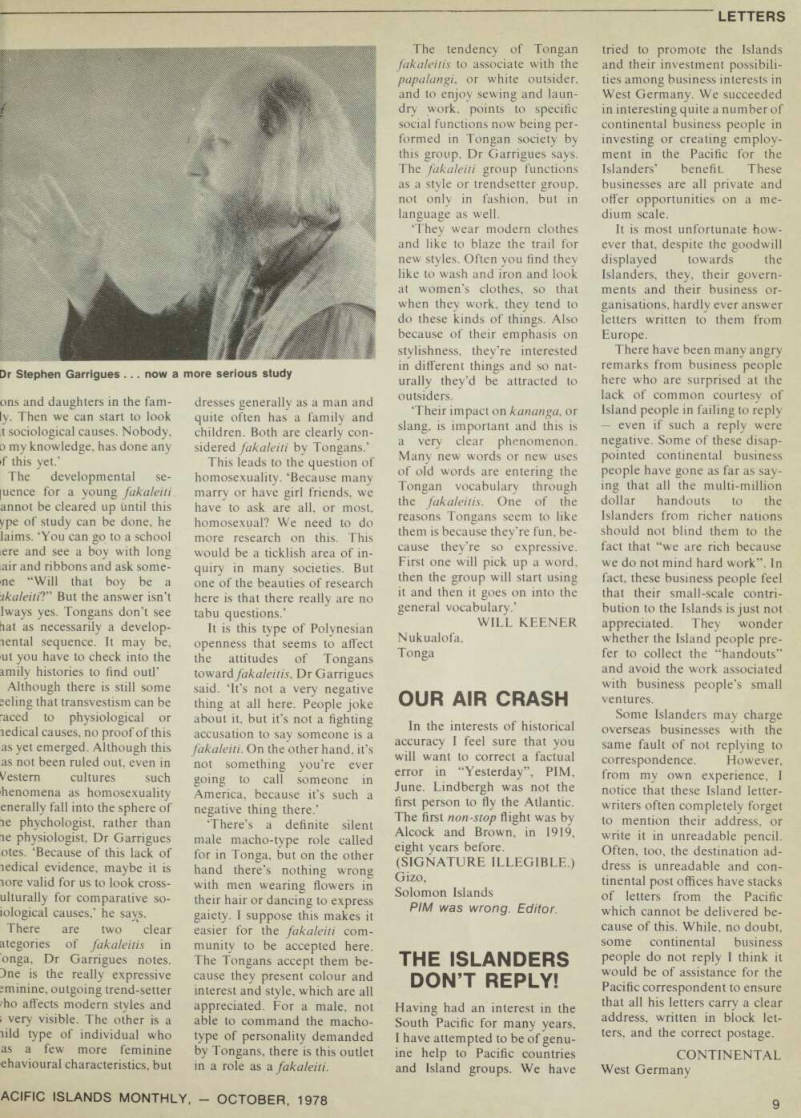
Dr Stephen Garrigues . . . now a more serious study
Advertisements & other items, pp. 9-10 (2 items)
Letters
Fly the world's largest fleet...
Pan Am 747'5.
7 AD a
SW^AM
■s* m /Wt /W «£* /37 7^7
P^V/^Vf
g^/-v*3 W 747 If you're like us, you know a great thing when you see it.
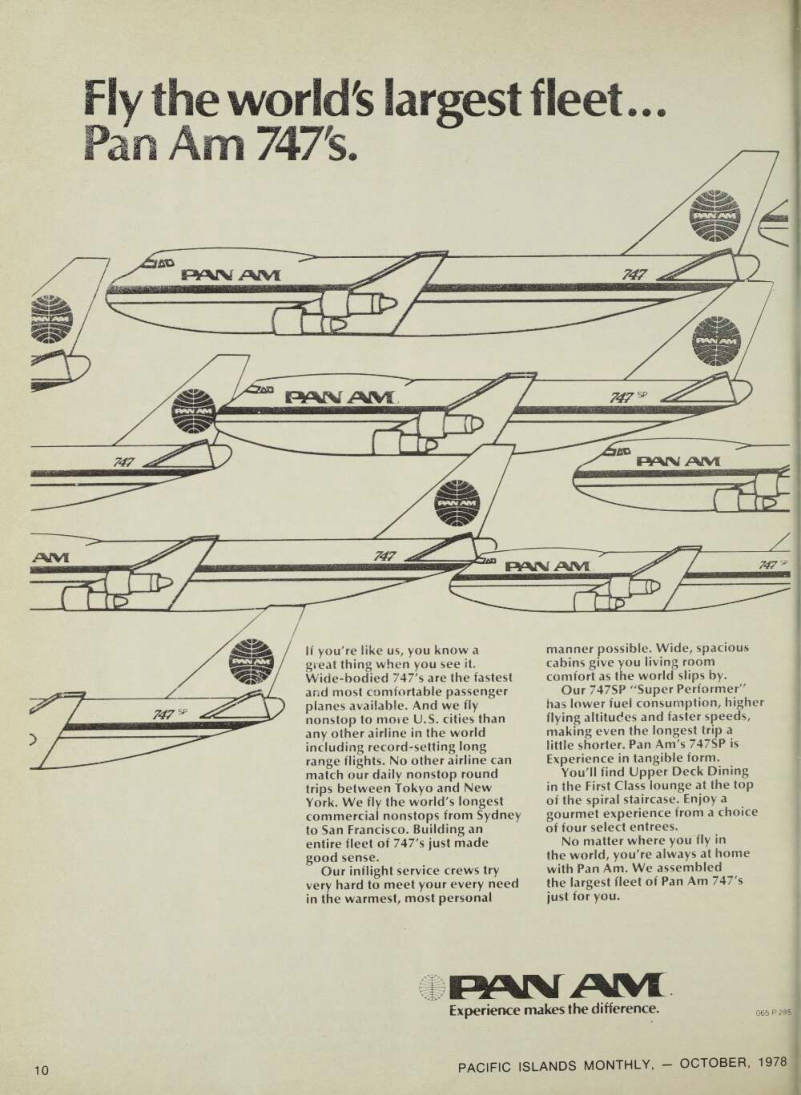
Wide-bodied 747's are the fastest and most comfortable passenger planes available. And we fly nonstop to more U.S. cities than any other airline in the world
including record-setting long
range flights. No other airline can match our daily nonstop round trips between Tokyo and New York. We fly the world's longest commercial nonstops from Sydney to San Francisco. Building an entire fleet of 747's just made
good sense.
Our inflight service crews try very hard to meet your every need in the warmest, most personal
manner possible. Wide, spacious
cabins give you living room comfort as the world slips by.
Our 7475 P "Super Performer"
has lower fuel consumption, higher flying altitudes and faster speeds, making even the longest trip a little shorter. Pan Am's 7475 P is Experience in tangible form.
You'll find Upper Deck Dining in the First Class lounge at the top of the spiral staircase. Enjoy a gourmet experience from a choice of four select entrees.
No matter where you fly in the world, you're always at home with Pan Am. We assembled the largest fleet of Pan Am 747's just for you.
Experience makes the difference. 065.P.285
Pacific Report
: Our Cabinet Seats For Vanuaaku?
ranee’s new Minister of Overseas Departments and Territories, flr Paul Dijoud, was in the New Hebrides from August 11-15. ks foreshadowed in PlM’s report (see Political Currents) he sug lested that the Vanuaaku Party should have four places in the resent cabinet instead of three as previously offered. This /ould give the VP half the places in the eight-member cabinet.
Wien Mr Dijoud left the country neither the Kalsakau govern lent nor the VP had commented officially on his proposal.
Remier Davis On Sir Albert
he Premier of the Cook Islands, Dr Tom Davis, sees no political iture for his deposed predecessor, Sir Albert Henry. ‘His future 3S with the police and the courts,’ he told New Zealand journal t William Gasson who interviewed him for PIM (p 23).
Ikinians Leave Island Again
kini residents in August were removed from their atoll for the jeond time because of unsafe radiation levels stemming from B nuclear testing in the mid-fifties. They went to Kili Atoll.
Omare Plays Rift Talk Cool
apua New Guinea’s Prime Minister Michael Somare refused be flapped by revelations that his deputy, Julius Chan, had aen in private talks with the parliamentary opposition on his avernment’s future (Political Currents).
Ore Refugees Cross To Png
apua New Guinea was caring for about 1400 Irianese refugees (lowing a mass border crossing by about 700 men, women id children in August (Afterthoughts p 17).
&Cific ‘First’ For Western Samoa
estern Samoa has stolen a march on Australia and every )dy else by issuing a set of commemorative coins in honour the first trans-Pacific flight by Australian airmen Kingsford nith and Ulm in June, 1928. The three-coin set was a sell-out. ) rub salt into the wounds, Western Samoa hired the Royal jstralian Mint to strike the coins.
:S, They Too Have Bananas
ipua New Guinea will not attempt to develop a banana export Justry, according to Minister for Primary Industry Julius Chan, jeensland and South Pacific countries could not be looked as markets as they had their own banana industries, he id.
31 At Work In Samoa
II men from Honolulu have been in American Samoa instruct -3 local cops. The Feds schooled the Samoans in interview :hniques, collection and preservation of evidence, and crimi- I law and procedure.
Ontinental Plan May Launching
intinental Airlines is planning services from San Francisco to
the South Pacific from May 1979. Plans are for three services a week, via Honolulu and American Samoa to Auckland, and four a week from San Francisco to Sydney two via Honolulu and Nadi, and two via Honolulu and Pago Pago.
Bougainville Link With Ex-Cia Man
Bechtel Corporation, construction contractor for Papua New Guinea’s Bougainville copper mine, in August appointed Richard Helms, former director of the US Central Intelligence Agency, as a consultant. The appointment coincided with publi cation in the US of a magazine story alleging extensive cross hiring between Bechtel and the CIA, the use of Bechtel operations as cover for the CIA in countries like Libya, and con tinuing close relations ‘at the top’ between company and agency.
Cannibalism Charge: Gaol For Two
Three young Papua New Guinean men who ate part of a dead man were sentenced to 15 months’ gaol in August. They pleaded not guilty to the charge that they ‘jointly and without justification interfered improperly or indecently with the dead body of a man’.
Sentencing the men at Daru in Western Province, Australian born Judge Wilson said: ‘I can think of nothing more flavoured with impropriety than the interference with a dead body by cut ting it with a knife with the intention of eating it.’
Wl Rebels Free Last Of Hostages
September saw the release of the last four Indonesian hostages held by rebel forces in Irian Jaya. The hostages were reported in good health, and said they had been well treated.
Papeete Plans Coconut Drive
French Polynesia could soon have a flourishing export trade in whole coconuts. Prominent Papeete personality Louis Tama is investigating possibilities of airfreighting coconuts at the rate of 300 000 a month to the USA, Japan and Canada. Prices on these markets could be highly attractive.
Oil Evidence In North Fiji
Exploration in the Bligh Water area, north of Viti Levu, Fiji, showed geological features similar to a rich oil field in Indonesia, the Minister for Lands and Mineral Resources, Livai Nasilivata, has told the Fiji Parliament. ‘lndications are that this country may be witnessing the beginning of an oil era,’ said he.
Capital Move For Tahiti Airline
A leading US West Coast entrepreneur, Virachal Vannukul, an American of Thai extraction, is planning to put up capital for French Polynesia’s long-discussed international airline (PIM July).
AIR NIUGINI’S SUB ‘A FARCE’ - MINISTER Air Niugini’s proposed purchase of a submarine for tourist pur poses (PIM September) has been branded ‘a farce’ by Papua
New Guinea’s Transport Minister Bruce Jephcott. Claiming the idea came from ‘two people talking in a pub over a glass of beer’, Mr Jephcott said the government would never be pre pared to fund such a scheme. Cost of the submarine was esti mated at K 2.5 million.
Gaol On Marihuana Count In Tonga
American Merle Anders, 32, has been sentenced to six months gaol in Tonga for possession of marihuana, and fined $lOO for growing it. Anders, who has appealed, is manager of a fish farm on Tongatapu.
Cavers Escape Drowning In Png
Four members of the caving party exploring the Atea Kanada cave system in Papua New Guinea narrowly escaped death in August when the cave chamber they were in filled rapidly with water.
Dengue Bearers Reach Tokelau
A variety of mosquito known as a bearer of dengue fever has been identified for the first time in Tokelau by a US Peace Corps volunteer who has been studying the atolls’ mosquitoes.
Trust Territory Chief In Air Crash
Adrian P. Winkel, High Commissioner of the US Trust Territory, escaped injury when a US Navy aircraft crashed in the sea off Guam in August.
Fiji Police Out For Blood
Offending Fiji motorists may soon be obliged to provide blood samples to police. Lack of police powers to secure blood samples was regretted by Chief Justice Sir Clifford Grant in re cent remarks on what he called the ‘deplorable’ standard of driv ing in Fiji.
Fiji Parliamentarians Go Without
Fiji MPs could make the Guinness Book of Records. They have refused a pay rise ranging from about 4% to 16% in order to set an example of restraint to the community. The rises were recommended by an independent committee.
Rum Deal Upsets Methodist
‘Another death trap for the people of Fiji,’ said the Rev Daniel Mustapha, president of the Methodist Church, condemning a proposal by the Fiji Sugar Corporation to set up a rum distillery at Lautoka.
Massacre Claim By Wl Refugee
A refugee from West Irian, according to sources sympathetic to the Free Papua rebel movement, claimed that an Indonesian helicopter had attacked Wambis, 50 km inside West Irian from the PNG border, killing more than 100 villagers.
‘No Confidence’ Charge Dropped
A motion of no confidence, moved by John Talasala, in Solomon Islands Prime Minister Peter Kenilorea, was withdrawn. Mr Talasala had claimed that the prime minister had re-hired his personal secretary, Francis Saemala just released from gaol after a two-month sentence for disorderly behaviour against his cabinet’s wishes.
A Winjeel To Learn On
Australia has given a Winjeel aircraft to the Port Moresby Tech nical College for use in training apprentices in aeronautical en gineering. The aircraft was flown to Port Moresby by Royal Australian Air Force pilots. When it landed at Jackson’s Airport, the wings were removed and it was then taken to the college by road.
Amnesty At Work In Png
A branch of Amnesty International has been established in Papua New Guinea.
Move For Better Bureaucrats
American Territories in the Pacific have launched a project aimed at lifting the standard of the bureaucracy. Representatives from the Nothern Marianas, Guam and American Samoa attended a meeting in Hawaii, at which the Governor of Hawaii, George R. Ariyoshi, announced formation of the Pacific Basin Personnel Council. The council will provide a forum in which the experiences and expertise of all members may be shared to improve the personnel systems of each member govern ment.
Japan-Solomons Fishing Deal
Agreement was reached last month in Honiara with Japanese fishing associations for fishing rights within Solomon Islands 200-mile zone.
Nz Firms’ Island Subsidiaries
The New Zealand Government has given approval to a number of companies to set up subsidiary operations in the Pacific Islands. The companies will operate in Tonga, Western Samoa, the Cook Islands and Fiji.
New Png Tax On Miners
Papua New Guinea announced an ‘additional profits tax’ on mining ventures that earn more than 20% after tax on total funds employed. The tax became law with the passing in August of the Income Tax (Mining and Petroleum) Bill.
Fiji Plans Trade Trip To China
A Fiji trade mission will soon go to China to see what can be sold there, according to Governor-General Ratu Sir George Cakobau, who was opening a Chinese trade fair in Suva.
Nuclear Waste Dump For Micronesia?
Dr Ted Greenwood, a senior White House scientific adviser, has said that the US Government is considering establishing a dump for the world’s nuclear waste somewhere in the US Trust Terri tory of the Pacific Islands. (PIM August).
Us Policy Rounding Cape ‘Horne ?
The current goodwill visits to Pacific Island countries of the USS Horne are only a small part of an all-round revamping of US policy in the region. (See Tropicalities).
Australian Fishing: 40 Want Access
Japan, Russia, Poland, South Korea and Taiwan were among countries which applied to Australia for access to its 200nautical mile fishing zone.
An Old ‘Colon’ Loses Faith
After 47 years, prominent French settler Rene Thevenin left the New Hebrides for France in August, firing a broadside at Aus tralian Presbyterian missions on his way out (p 18).
Hostility’ Drives Brych Out
Speaking in Los Angeles, controversial cancer therapist Milan Brych, formerly of the Cook Islands, said he had left the Cooks because ‘the hostility of the new government and particularly the Premier, Dr Tom Davis, towards the clinic and me personally, left me with no alternative’. All Mr Brych’s patients have now left the Cook Islands, most for their homes in Australia. A cancer seminar in October in Honolulu, at which Mr Byrch planned to present details of his treatment, has been cancelled.
Advertisements & other items, p. 11 (1 item)
11
ISLANDS MONTHLY, OCTOBER, 1978
Island Tattoo
The Fall And
Rise Of The
ustom-tattooing, a traditional t, tribal symbol or merely as coration, has been practised r centuries. In the Samoas, here tattooing is a status sym l, the art lives on. Leulu Felisi la describes the 'pattern ’. But the Carolines, says the Cu tor of the Tattoo A rt Museum, n Francisco, Leo Brereton, ly one small group of tat lists remains.
i Carolines
’s a dying
edition
ne is running out on Fais the Western Carolines for e of the last visual links with icronesia’s past, the art of tat
)ing. Young people, set
rift in a cultural sea of tran on, are no longer being tat >ed, and only a handful of
1 traditionally-tattooed
Dple remain.
Dnce, the practice was com mplace among most of the rific Islands with the Maoris New Zealand being, per ps, the most well-known for ir beautiful Moko or facial toos. Today, Samoans are ong the few who continue to ictise the art as they did in past.
iiarly Pacific explorers
yed an important role in the
tory of tattooing. Spanish
mals referring to “painted” ives are common, but it was ptain Cook who, in the 3- 18th century, introduced Polynesian word Tatau to Western world,
n Europe, where tattooing
In’t been practised for cen
ies, the ensuing exhibition
tattooed natives as well as ors, who had been tattooed ing their travels, rekindled ervent interest in the art. md explorers were soon fol red by traders, colonists and isionaries, the last named
bably finding tattoos and
ceremonies accompanying
their application the very zen ith of paganism.
The interaction of one cul tural set of values with another is today, as in the past, running its course throughout the Islands. The areas of Micronesia that did not fall on the trade routes had little direct outside influence, and it is on these islands where one can expect to see traditional art forms surviving. Fais, which lies south-east of Ulithi Atoll in Yap District, is just such a
place.
I spent a few weeks on Fais
documenting through photo
graphs and interviews the state of the art as it exists today. The old chief, a former tattoo artist himself, explained the tra ditions which dictated the ap propriate age, the designs used, as well as the parts of the body to be tattooed.
From the mid-thigh up to the neck the men are covered front and back with geometric
designs, each having a special
name and significance. Unlike other areas of Oceania, where a full set of tattoos might be started at an early age, here the work wouldn’t begin until the man’s body had reached
maturity. Changes in muscle
tone or weight could adversely affect the line quality of the de
sign.
The women were tattooed primarily on the legs from knee to ankle and on the arms from elbow to wrist. This work was done by the male artist. How ever, the lovers’ tattoos, which were worn under the lava lavas, were done by females.
The techniques involved were simple, but the artist had to be highly skilled since one cannot erase mistakes. A sharp edged tool coated with the pig ment, a mixture of soot and water, was tapped by a wooden striker making the design per manent. The process was lengthy and dangerous, the risk of infection high. This factor,
along with the subject’s ability
to endure pain, determined the pace.
In addition, the operation was costly with payment usually in the form of lava lavas, pigs or money.
What with the pain and the cost, one begins to wonder about the motivations invol ved. In addition to showing social rank or military prowess, traditional tattoos have always fulfilled one of man’s more basic needs, that of decorating
his body.
The disappearance of tattoo ing and other traditional art forms are the reflection of a
change in cultural, religious
and political attitudes. And these factors are instruments in the hands of the one thing which changes us all, time.
But Samoans
still do
their thing
Samoans take their tattooing seriously. It’s not merely a mat ter of adornment for the body.
It is in essence a status symbol.
Traditionally, it is the Samoan form of initiation into adult hood. If a young man did not have pe’a (tattoo), he was not worthy to serve the matai (chiefs). And chiefs who did not have a tatau (chiefly name for tattoo) were often ridiculed.
Traditionally, that has been the case. Even today, it is largely true.
The first man to have a tat too in Samoa was Tuiaana Tamaalelagi, one of the most
important personalities in the
history of Samoa. It is said that when his tattoo was completed, the event was celebrated for many weeks, and the most beautiful virgins from all parts of Samoa came to Tamaalelagi’s house to see the tattoo and to offer proposals of
marriage.
It is not surprising, therefore, that Tamaalelagi came to be one of the most married chiefs in Samoa. His last wife, a Ton gan, bore him Salamasina, who eventually became Queen of all Samoa. Her reign was the
most peaceful and productive
in Samoan history.
According to Samoan
legend, tattooing was originally
imported from the Fiji Islands.
Apparently, in ancient times, as today, many Samoans used to visit Fiji. A couple of Samoan women were among these visi tors. They were impressed with the Fijian custom of tattooing for the women. They decided that they would transplant this custom to Samoa. So they swam all the way from Fiji to Samoa.
During their swim, they sang to remind themselves of the details of the tattoing custom in
Fiji.
The song went something like this: “Women alone are tattooed, but not men.” When
they neared Samoa, perhaps
because of the cold and the strain of the journey, they for got the original words of the
song and began to sing: “Only
men are tattooed, but not women.” So that is why, today, only men are tattooed and not women.
The craft of tattooing requires exceptional skill on the part of the tufuga (tattooist). As a craft, it tends to be handed on from father to son the secrets are
jealously guarded. And tufuga
in general are people of high status in the community they enjoy the same status as house-
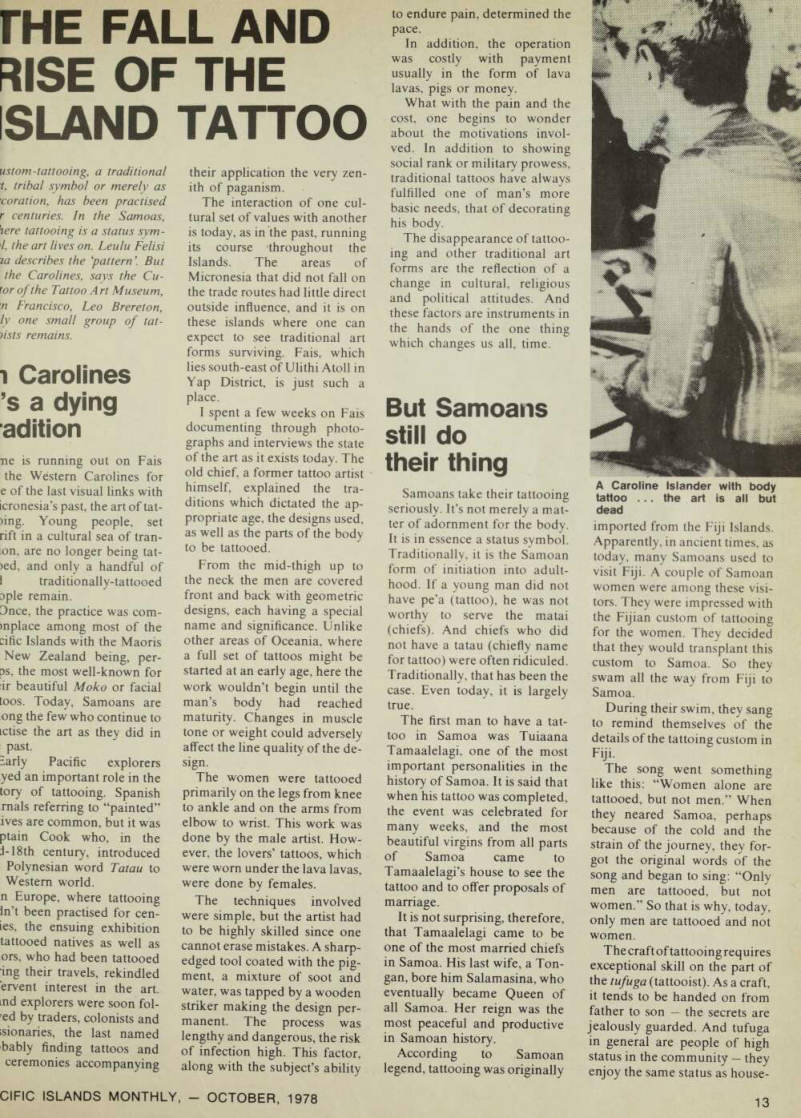
A Caroline Islander with body tattoo ... the art is all but dead
builders, also called tufuga.
And they also receive generous rewards for their efforts. Many such tufuga still exist in Samoa, one of the most famous of whom is Faafetai of Manono.
When the London Mission ary Society missionaries came in the 1830 s, they tried to stop
tattooing. They were against it
because it involved the shed ding of blood.
On the other hand, the Roman Catholics were not
against tattooing, seeing in it
just a peculiar custom. Perhaps,
largely because the various re ligious denominations in Samoa are not agreed as to the
correct theological policy
towards tattooing, it is still as popular as ever in Samoa. Even a number of Peace Corps volunteers are reportedly tat tooed Samoan style and dur ing World War 11, some US marines were similarly tat tooed.
Recently, there has been an
upsurge in the popularity of Samoan tattooing. It is taking place daily in all parts of Samoa and people with tattoos are a common sight these
days.
It is not hard to recognise tat tooed people because people here are tattooed from the waist on down to the knees. It is a pity that there is no registry of tattooed people, but the number certainly runs into the thousands and continues to in crease despite the LMS Church’s old ban. If a member of the LMS Church has viola ted the anti-tattoo rule, he is banned from Holy , Com munion, but only for a short time. For Catholics, there is no worry.
A famous example of how Samoans would go to any length to have a tattoo is that of a Samoan king of the late 1800 s, Malietoa Laupepa.
Malietoa was about 70. Many of his people did not give him their total allegiance because he did not have a tattoo. So, despite his age, he finally agreed to go through the ordeal.
Tattooing, Samoan style, is
far from being a picnic. It is a very painful process. Common
reactions during tattooing are
crying, screaming, cursing, sob
bing and so on. Some feel the pain more than others. To help relieve the pain, the tattooing is usually done on as many young men as possible simul taneously. And, in the old days, pretty village maidens used to soothe the young men with their touch, smiles and songs.
The late Sir Peter Buck, the noted Maori anthropologist, has made a study of Samoan tattooing. (Lots of other highly scientific studies have been made since.) According to Sir Peter, tattooing implements in clude a wooden container called the tunuma; tattooing combs made of human bone or boar’s tusk lashed to a turtle shell plate fastened to a handle, and the mallet called sausau
made of dry lapalapa (dry, hard
part of coconut leaf). There are four different types of combs, each used for a specific func tion. One is for making dots, one for fine lines, one for thick lines and one for filling in the dark parts.
The pigment, Sir Peter said, is made from the soot of the candlenut and is kept in a coco nut shell called pupu lama. The lama (soot) is ground in the coconut shell and water is added to it. The resultant mix ture is placed in the ipu tuu lama, which is half a coconut shell covered with a taro leaf.
Towels of siapo are used for stretching the skin and wiping off the blood.
At the end of the tattooing ceremony, the subject is sprin kled with coconut milk to re move the tabu he has been under for many weeks or months.
Nowadays, even children as young as nine are being tat tooed, and there is a milder form of tattooing for women called the malu. Who says Samoan custom is dying out?
This is certainly not true in the case of tattooing, of having a pe’a, tatau, malofie.
Samoans aie doing their thing and they are not ashamed of it. How long this trend will continue is hard to say. When it is no longer practised, that will mark the decline and fall of the Samoan cultural
empire.
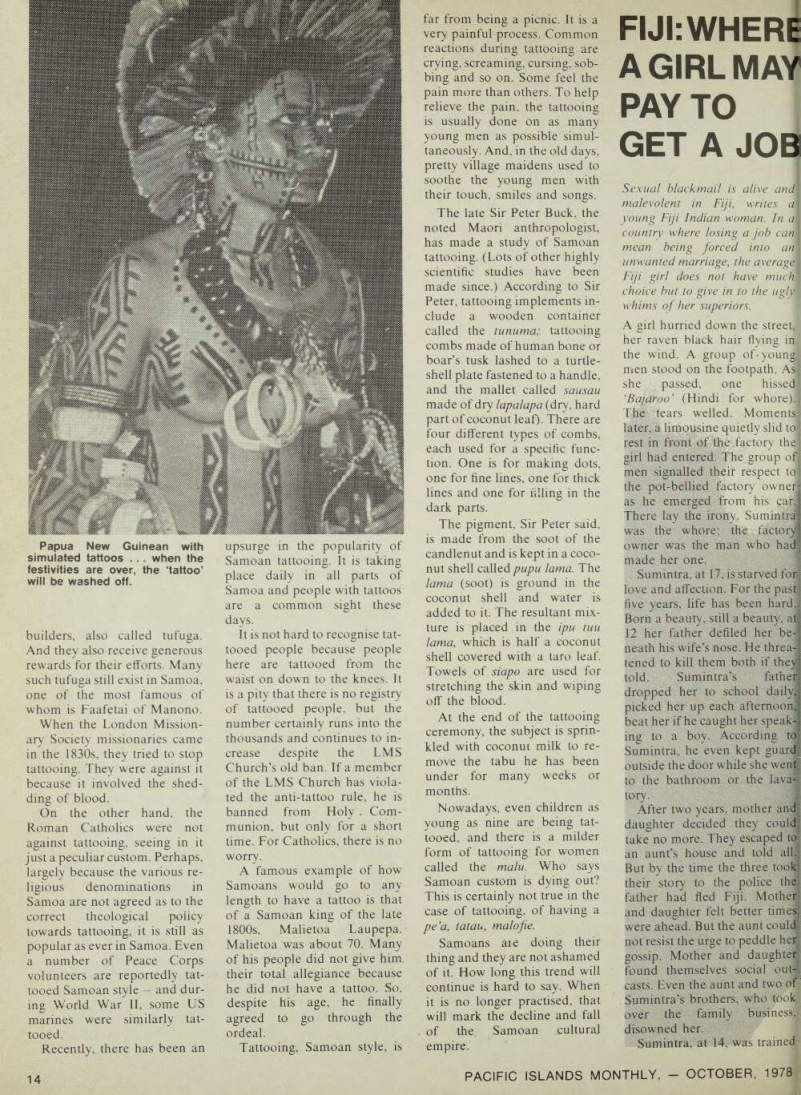
Papua New Guinean with simulated tattoos . . . when the festivities are over, the ‘tattoo’ will be washed off.
Advertisements & other items, p. 13 (1 item)
13
IFIC ISLANDS MONTHLY, - OCTOBER, 1978
Fiji: Where
A Girl May
Pay To
Get A Job
Sexual blackmail is alive and l malevolent in Fiji, writes a young Fiji Indian woman. In a\ country where losing a job cam mean being forced into am unwanted marriage, the average Fiji girl does not have much i choice but to give in to the ugly whims of her superiors.
A girl hurried down the street, her raven black hair flying in the wind. A group of-young men stood on the footpath. As;
she passed, one hissed]
I Bajaroo ’ (Hindi for whore).|
The tears welled. Moments later, a limousine quietly slid to rest in front of the factory the girl had entered. The group of men signalled their respect to
the pot-bellied factory owner
as he emerged from his carl There lay the irony. Sumintra; was the whore; the factory owner was the man who had made her one.
Sumintra, at 17, is starved for love and affection. For the past five years, life has been hard.
Born a beauty, still a beauty, at 12 her father defiled her be neath his wife’s nose. He threa tened to kill them both if they told. Sumintra’s father dropped her to school dailyj picked her up each afternoonj beat her if he caught her speaks
ing to a boy. According to
Sumintra, he even kept guard outside the door while she went to the bathroom or the lava tory.
After two years, mother and
daughter decided they could
take no more. They escaped to an aunt’s house and told all.
But by the time the three took their story to the police the father had fled Fiji. Mother and daughter felt better times were ahead. But the aunt could not resist the urge to peddle her
gossip. Mother and daughter
found themselves social out casts. Even the aunt and two of Sumintra’s brothers, who took over the family business, disowned her.
Sumintra, at 14. was trained
for nothing. Mother was an un educated ex-housewife. Both tried to get jobs. The ‘news’ always kept ahead of them. In desperation, the two resorted to prostitution. No one wanted to know how or why they had been reduced to this age-old
profession.
They became rolling stones, moving from town to town as soon as their reputations caught up with them. Eventu ally they reached Nadi, home
3f Fiji’s international airport.
\ factory wanted cleaners,
fhey applied. The owner noted
sumintra’s beauty, her
nother’s handsome profile, fhey were hired.
Within a month the owner nade clear his intentions, fheir duties, he informed hem, also involved sleeping vith him. They had little iption but to agree. Sumintra nd mother joined the ranks of iundreds of women and girls a Fiji who every day have to uccumb to sexual blackmail to old their jobs.
Working women are still in
i minority in Fiji. Any female
Hio finds a job is considered ucky because it gives her a per onal security. But the difficult cs do not lie only is getting a oh. Keeping it is often more
lifficult. Sumintra’s case high
ights the agony. Abortion in r iji is illegal. In two years she nderwent three abortions.
Women who work for the : iji civil service, the Fiji Sugar ’orporation and the various anks, are the lucky ones. In
lese jobs there are no strings
ttached. They only have to
fork efficiently and diligently
nd their jobs -are usually se
ure. Sexual blackmail is sually the practice of usinessmen and some poli cians. It is the female who 'orks for the smaller concern 'ho is the most likely victim.
Girls who try to get work
;raight after leaving high
:hool are hopelessly inex
erienced in dealing with the pposite sex. Despite the grow ig influence of Western cul ire, Fiji is still a basically Dnservative country, par cularly in its attitude toward omen. Though 50% of the opulation is female, women njoy no equality in the true mse of the word.
There are some women’s or
ganisations working toward the idea of equality and a few women who can boast they have it. But, generally, women are subordinate to men.
The conservatism is most marked in the Fiji Indian com
munity. Boy-girl relations are
openly discouraged. A girl
caught with a boy is severely reprimanded. High schools are remarkably narrow in their attitude toward boy-girl friend ships in school. One school a few months ago, banned girls and boys from talking to one
another except, when necess ary, in the classroom. One boy complained in the local press that he could not even wish a girl ‘Good morning’.
This senior school separation hardly prepares a girl for what is to follow on leaving school.
Experience of social contact between boy and girl, even tol erance of puppy love, would help build a girl’s resistance to the schemings of lecherous old men.
Some sexual blackmail is
subtle. Other approaches are horrifyingly blunt. A senior male staff member or a boss might keep a female late in the office. Then he will drop her home. Along the way he will compliment her which she may find pleasant, knowing that when she gets home her relatives won’t give a damn whether she’s had a good day or not, or what she looks like.
During one of these trips he will invite her to a dinner. The first invitation is usually turned down. He plays it cool and re peats the invitation. To ward off suspicions he might even invite the woman to bring her
husband. The dinner, he will tell her, is a gesture of his ap preciation for her work. Then the boss will tell her of his problems with his wife, how she doesn’t understand him.
And so on. She is being lured by the ‘soft sell’.
Others don’t beat about the bush. Kasturi, a typist, worked for a small company. She never got a rise. She asked the boss for one. Shamelessly, he offered her SFSO plus fringe benefits such as driving lessons, the use of his car and some pieces of furniture, if shre would become his mistress. Kasturi,
recently married, fled, leaving
the office staff agape.
But her problems were only
just beginning. Because she
had left her job, her husband’s attitude changed. She no longer had any money of her own to buy items for herself.
Quarrels began. Bitterness set in. Separation was the result.
But not every female is reluctant to play along. Kirtan was happy to sell her body for money, jewelry and clothes.
The rot set in when she found herself being set aside for a newcomer. The crunch finally came when, in a fury, she stormed into her union office saying her boss had bribed her to leave the union. Kirtan was fired. The union failed to get her reinstated. The scandal spread far and wide. Kirtan’s husband kicked her out.
Ironically, some of the men who indulge in sexual black mail are part of a group of fathers who will go to any length to ensure that their daughters remain chaste. One wealthy man, a well-known Casanova, came across a letter his teenage daughter had received from her boyfriend.
An SOS went out to friends in Canada. Soon the daughter was on her way out of temp tation.
Women have few voices fighting for them. An indi cation that unions by and large have male needs on their minds more than female came in a log of claims by the Fiji Mineworkers’ union some years back. It wanted a ‘sex break’ for its members.
Of course, there are excep tions. Some bosses genuinely care for their staff. But for the victims the agony tends to go on long after the first degra dation. Sometimes the situ ation arises where a young woman’s parents hold her boss, who already has the daughter sleeping with him, in high esteem. They may even ask his opinion about whom their
.daughter should marry. Young
women in this situation find it difficult to communicate with their parents.
In a country like Fiji, where at the beginning of 1978 there were 17 000 registered jobless, where losing a job can mean being forced into an unwanted
marriage or being deprived of
the simple luxuries of life, the average girl does not have much choice but to give in to the ugly whims of her su
perior.
Advertisements & other items, pp. 15-16 (2 items)
15
ACIFIC ISLANDS MONTHLY, - OCTOBER, 1978
Goodfvear
CONVEYOR BELTS
DOCK FENDERS
PILLOW TANKS
HOSE
H 1
% Mil
POSITIVE DRIVE BELTS
DONAGE BAGS
INDUSTRIAL V-BELTS
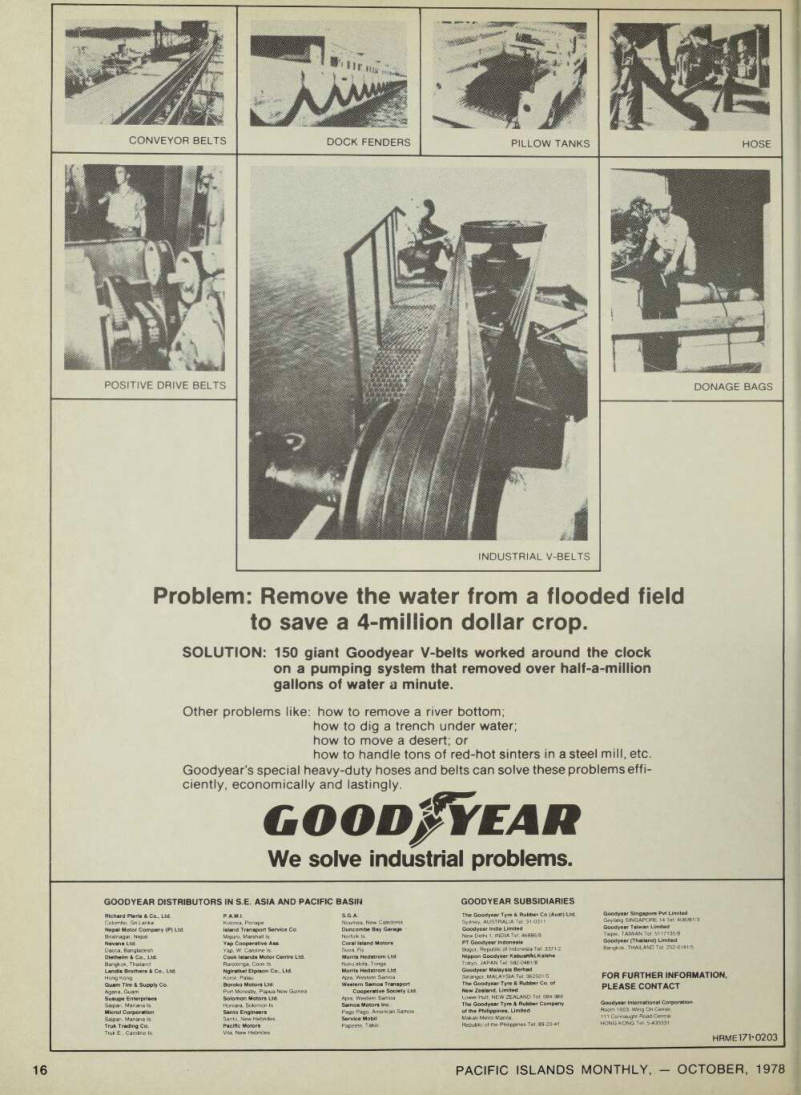
Problem: Remove the water from a flooded field
to save a 4-million dollar crop.
SOLUTION: 150 giant Goodyear V-belts worked around the clock on a pumping system that removed over half-a-million
gallons of water a minute.
Other problems like: how to remove a river bottom; how to dig a trench under water;
how to move a desert; or
how to handle tons of red-hot sinters in a steel mill, etc.
Goodyear’s special heavy-duty hoses and belts can solve these problems effi-
ciently, economically and lastingly.
GOODfVEAR
We solve industrial problems.
GOODYEAR DISTRIBUTORS IN S.E. ASIA AND PACIFIC BASIN
GOODYEAR SUBSIDIARIES
Richard Pleris & Co.. Ltd.
Colombo. Sri Lanka Nepal Motor Company (P) Ltd.
Biratnagar. Nepal Navana Ltd.
Dacca. Bangladesh Diet helm & Co., Ltd.
Bangkok. Thailand Landis Brothers & Co., Ltd.
Hong Kong Guam Tire & Supply Co.
Agana, Guam Susupe Enterprises Saipan, Mariana Is Mlcrol Corporation Saipan, Manana Is.
Truk Trading Co.
Truk E., Caroline Is.
P.A.M.I.
Kolonia, Ponape Island Transport Service Co.
Majuro. Marshall Is.
Yap Cooperative Ass.
Yap, W. Caroline Is.
Cook Islands Motor Centre Ltd.
Rarotonga. Cook Is.
Ngiratkel Etpison Co., Ltd.
Koror. Palau Boroko Motors Ltd.
Port Moresby. Papua New Guinea Solomon Motors Ltd.
Honiara. Solomon Is.
Santo Engineers Santo. New Hebndes Pacific Motors Vila. New Hebrides
S.G.A.
Noumea. New Caledonia Duncombe Bay Garage Norfolk Is.
Coral Island Motors Suva. Fiji Morris Hedstrom Ltd.
Nukualofa. Tonga Morris Hedstrom Ltd.
Apia. Western Samoa Western Samoa Transport Cooperative Society Ltd.
Apia, Western Samoa Samoa Motors Inc.
Pago Pago. Amencan Samoa Service Mobil Papeete, Tahiti The Goodyear Tyre & Rubber Co (Aust) Ltd.
Sydney. AUSTRALIA Tel: 31-0311 Goodyear India Limited New Delhi 1. INDIA Tel: 46886/9 PT Goodyear Indonesia Bogor, Republic of Indonesia-Tel: 3371/2 Nippon Goodyear KabushfkLKaisha Tokyo. JAPAN Tel; 582-0481/8 Goodyear Malaysia Berhad Selangor, MALAYSIA Tel: 362501/5 The Goodyear Tyre & Rubber Co. of New Zealand, Limited Lower Hutt, NEW ZEALAND Tel; 684-389 The Goodyear Tyre & Rubber Company of the Philippines, Limited Makati-Metro Manila, Republic of the Philippines Tel; 89-20-41 Goodyear Singapore Pvt Limited Geylang SINGAPORE 14 Tel; 408281/3 Goodyear Taiwan Limited Taipei. TAIWAN Tel: 5117135/8 Goodyear (Thailand) Limited Bangkok. THAILAND Tel; 252-6141/5
FOR FURTHER INFORMATION,
PLEASE CONTACT
Goodyear International Corporation Room 1603, Wing On Center. 111 Connaught Road Central
HONG KONG Tel; 5-433331
HRMEI7I-0203
[?]Diotic
Of All The Borders
- Not One So
AFTERTHOUGHTS with Percy Chatterton in Port Moresby.
The Australian Government does not consider that Indonesia has my valid claim to Dutch New Guinea . ’ So, in 1950, declared the hen Australian Minister for External Affairs, Sir Percy
Ipender.
Seven years later, during a United Nations debate on West New Guinea, the Australian representative struck the same note. The epresentative of Indonesia had reiterated Indonesia’s claim to overeignty over what he preferred to call ‘West Irian’, as having >een an integral part of the former Netherlands East Indies, and iad rejected the idea that the people of that territory had any ight to self-determination.
The Dutch representative reaffirmed Holland’s intention to etain control of the territory and to honour the promise which ; had made to the people of West New Guinea that they would e given an opportunity to determine their own political Liture.
The Australian representative warmly supported his Dutch ollegue. The policy of their two governments, he said, was to repare the people of New Guinea for the time when they would e able determine their own future.
With very few exceptions the nations of the Third World sup orted Indonesia. They appear to have based their support on vo rather odd beliefs first that oppression of dark-skinned eople by whites is very very wicked, but oppression of dark cinned people by other dark-skinned people is quite okay; sec nd, that the colonial boundaries bequeathed to the new nations y their former colonial masters, however ridiculous and illogical lose boundaries may be, are sacrosanct, and must be maintained t all costs.
The implementation of this fanatically held belief, while in
some cases it may have inhibited overfragmentation, has been achieved only at an enormous cost in terms of human suffer
ing.
During the next five years (1957-62) the situation deteriorated.
Indonesia’s assurance that it would not use force to press her claims to West New Guinea was followed by the dropping of Indonesian paratroopers there. Australia, apparently deciding that her ‘image’ in Southeast Asia and the Third World was more important to it than loyalty to friends or justice for a handful of Melanesians, did an abrupt volte-face, and in 1962 supported the transfer of West New Guinea from Holland to Indonesia. The United States, which disapproved of white colonialism anywhere in the world except in Micronesia, brought pressure to bear. Hol land, deserted by Australia and pressured by the USA, had no choice but to give way. West New Guinea was handed over to an interim UN Administration, which in turn handed it over to Indonesia without any attempt to ascertain the wishes of the
indigenous people.
True, Indonesia was required to hold an ‘act of free choice’ not later than 1969, but it was not stipulated what form that ‘act’ should take. In 1969, after six years of Indonesian rule, the only kind of act of choice which could properly have revealed the true wishes of the people would have been a referendum by secret ballot. The method actually chosen, that of reaching a decision by consultation and consensus (bermusjawarah) would only have been meaningful if the participants had been free to express their views without the constraint of fear. In a situation in which the Indonesian head of state had denounced one of the two alterna tives as treason, this could hardly be the case.
So the saga of betrayal was consummated, the people of West New Guinea were deprived of any hope of present or future self determination, and ‘West Irian’ became a province of the for merly federated but by this time unitary Republic of Indonesia.
The subsequent decade has seen the migration to ‘lrian Jaya’ of large numbers of people from other parts of Indonesia to com pete with the indigenes for a very limited number of jobs; and a regime of which Professor Ron Crocombe of the University of the South Pacific has written: i would not have believed the extent of the brutality, misunderstanding or incompetence of
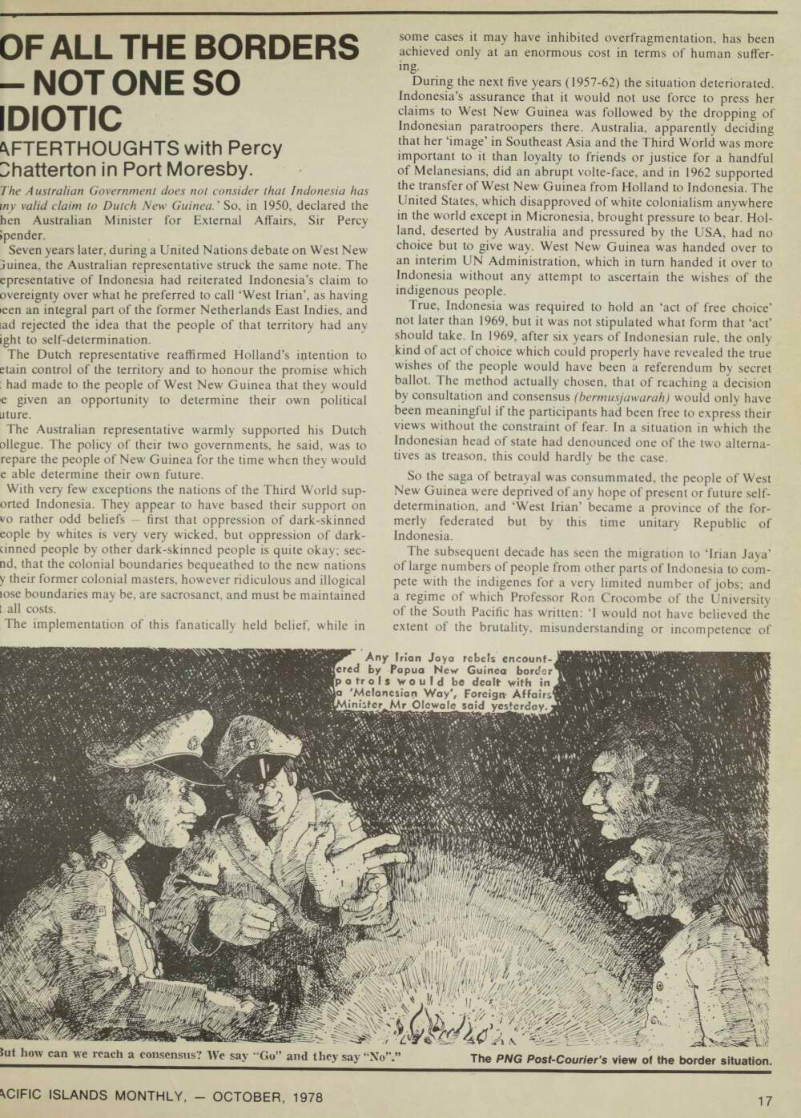
"But how can we reach a consensus? We say “Go” and they say “No”.”
The PNG Post-Courier’s view of the border situation.
Indonesian officials there if I had not seen it with my own
eyes.’
It is against this background of events that the Free Papua Movement (OPM) has grown up and for a decade resisted all the attempts of the Indonesian authorities to suppress it. Recent much-publicised events on the PNG-Irian Jaya border are just the latest of many attempts to flush out and destroy the military arm of the movement, and to free hostages said to be held by it.
The attempt does not appear to have been successful.
Indonesian officialdom is no doubt right in saying that the num ber of active guerrillas is quite small. But this fact makes it all the clearer that they could not have survived for so long unless they enjoyed the sympathy and covert support of a large pro portion of their fellow countrymen.
Of all the boundaries inherited from the colonial era, none can be quite so idiotic as that between Papua New Guinea and Irian Jaya. Except for a small bulge where it accommodates itself to the meanderings of the Fly River, it runs straight down a meridian of longitude, with a fine disregard for the convenience and well being of the people whose homes and tribal lands lie on or near it. Much of it is unmarked and runs through very difficult ter rain.
During recent border events the PNG Government has been in a very difficult position. It has been a good deal criticised. But in my opinion, bearing in mind its inexperience in handling inter national affairs, it has done pretty well. It has been conscious of the fact that the majority of the people of Papua New Guinea sympathise with their ‘Melanesian brothers’ of the Free Papua Movement, and regard the guerrillas as ‘freedom fighters’ rather than as ‘rebels’. At the same time it has been conscious of the fact that it is the government of a nation of three million people sharing a border with a nation of 120 million people, and that national security cannot be achieved by recruiting an extra bat talion for the defence force or establishing compulsory military training, as some of its critics have advocated.
It has realised that if it allows the OPM to establish and operate from bases in PNG it will give Indonesia an excuse for forays
across the border similiar to those which the Rhodesians have carried out in Mozambique, and that this must be prevented.
Finally, it has taken a compassionate attitude toward the hun dreds of frightened villagers who have fled across the border, and while it naturally hopes that most of them will go back when the present military activity has subsided, it has stated categori cally that it will not compel them to go back against their will.
Foreign Affairs Minister Ebia Olewale has even gone on record as saying that the OPM men will be dealt with ‘in a Melanesian way’. Just what he meant by this is not quite clear. But the remark inspired the PNG Post-Courier’s cartoonist to depict an eyeball to eyeball confrontation between the two PNG Defence Force men and two freedom fighters. Says one defence force man to the other: ‘How do we reach a consensus? We say “Go” and they say “No”.’
How will it all end? Will the Free Papua Movement be wiped out or fade away, or will it continue to be a thorn in Indoneia’s flesh and an embarrassment to Papua New Guinea? My guess is that even if the OPM is destroyed, the desire for freedom from Indonesian rule will live on in the hearts of the people of West New Guinea.
But is there any hope that they will one day realise their dream of independence? Certainly the present Indonesian regime will not concede it. It could only come as a result of a general break-up of the Indonesian Republic into a cluster of smaller states. This cannot be written off as an impossibility. If it did happen, it wouldn’t be the first time that a Javanese empire has disinte
grated.
Advertisements & other items, p. 17 (1 item)
17
\CIFIC ISLANDS MONTHLY, - OCTOBER, 1978
New Hebrides - past
and present - by a veteran ‘colon’
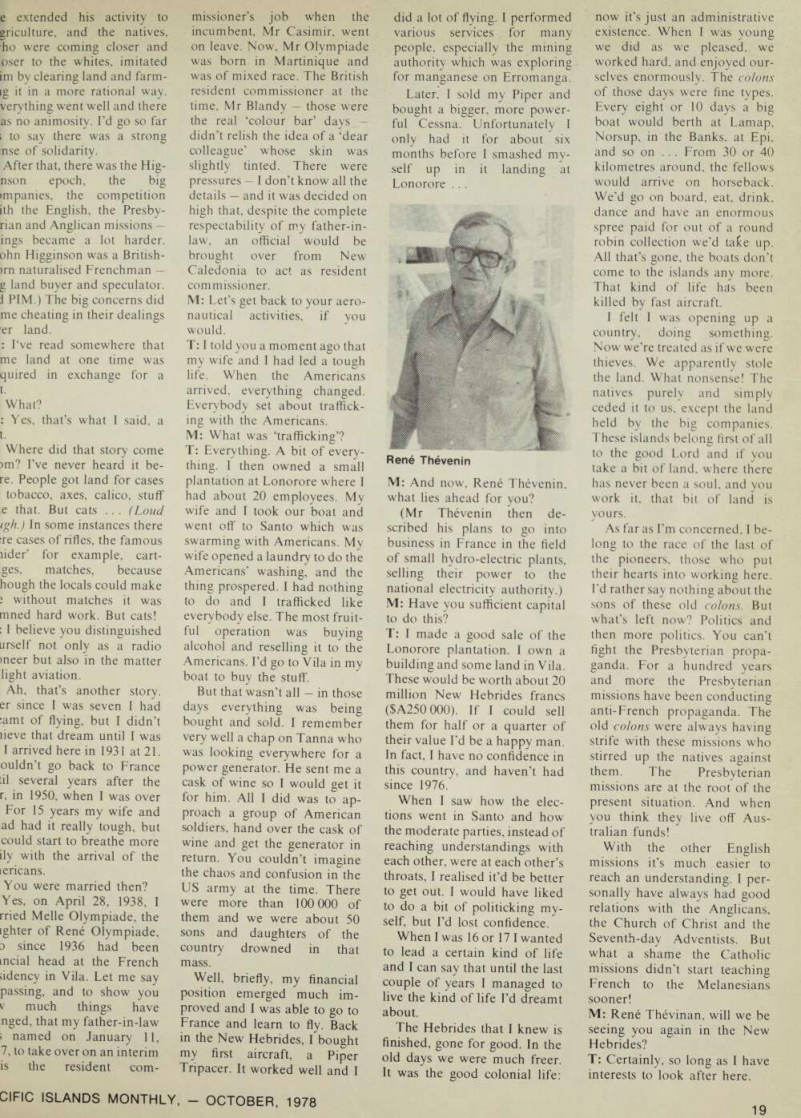
Rene Thevenin, 69 planter, pioneer of radio and aviation in the New Hebrides, and one of the best known French settlers in the condominium has gone home. He arrived in the New Hebrides in 1931. He was inter viewed on the eve of his depar ture by the director of the
French/Bislama fortnightly
newspaper Nabanga, Jean Mas sias. With independence approaching in a situation still far from calm, Mr Thevenin’s view of New Hebrides’ history, how the present situation came about and why he has decided to leave, is worth recording.
The interview began with Mr
Thevenin recounting his early
days as a radio pioneer. As a youth he trained as a merchant marine radio operator and
while doing military service in New Caledonia in 1931, found himself detached to do radio work in the New Hebrides. His
early duties included relaying
information in morse to planters about times of arrival of boats at their islands. Later in the thirties he provided lis teners with a rudimentary world news service. He even broadcast music by playing re cords on a hand-cranked phonograph placed next to the
microphone.
Mr Massias asked: Was there
anything comparable on the
English side? Were there also broadcasts in Bislama?
Thevenin: In English there was nothing at all and as for Bislama nobody ever gave it a thought. I personally was in the
New Hebrides for 10 years without speaking a word of Bislama. At the Compagnie Cotonniere des Nouvelles- Hebrides (whose radio he once operated Ed PIM), there were 700 Tonkinese (North Vietnamese Ed PIM) and 25
Europeans. The boys (New
Hebrideans Ed PIM) were never sighted. Don’t forget it was the Tonkinese who built the New Hebrides. If one had had to speak a language other than French, it would have been Tonkinese.
Today, people seem to have forgotten the history of the New Hebrides. They go around
saying anything that comes
into their heads. The very first colons to come here and I’m speaking of a time well before I was bom did not meet the hostility on the part of the natives about which people are so happy to talk today. At that time the Melanesians were
engaged in never-ending guer
rilla fighting oh, by mis chance, some chap’d get killed
once every six months or so and this fighting was con ducted with stone age weapons.
If you do a bit of clearing in the islands today you’ll still find stone axes that are not all that old.
If a European passed by they’d give him a bit of copra or, more particularly, some trochus shells, in exchange for tools and steel axes. Some Europeans even handed over to the natives knives and rifles.
So the natives soon understood that having a European within reach meant having a source of supplies which rendered them less vulnerable to the attacks of enemy tribes. It was purely in this way, and for these reasons, that at the beginning there was a very good understanding be tween Europeans and Melane sians. Later on, the big companies set themselves up here, and things were dif ferent ...
When a European came to the islands, it was first of all to engage in trade. Then, rapidly,
e extended his activity to griculture. and the natives, ho were coming closer and oser to the whites, imitated
im by clearing land and farm
ig it in a more rational way. verything went well and there as no animosity. I'd go so far ; to say there was a strong nse of solidarity.
After that, there was the Hig
nson epoch, the big
unpanies, the competition
ith the English, the Presby
rian and Anglican missions
ings became a lot harder, ohn Higginson was a British >m naturalised Frenchman g land buyer and speculator, i PIM.) The big concerns did
me cheating in their dealings
er land. : Tve read somewhere that me land at one time was quired in exchange for a t.
What? : Yes, that’s what I said, a t.
Where did that story come )m? I’ve never heard it he re. People got land for cases tobacco, axes, calico, stuff e that. But cats ... (Loud igh.) In some instances there tc cases of rifles, the famous lider’ for example, cart ges, matches, because hough the locals could make ; without matches it was mned hard work. But cats! ; I believe you distinguished arself not only as a radio meer but also in the matter
light aviation.
Ah, that’s another story, er since I was seven I had :amt of flying, but I didn’t lieve that dream until I was I arrived here in 1931 at 21. ouldn’t go back to France il several years after the r, in 1950, when I was over For 15 years my wife and ad had it really tough, but could start to breathe more ily with the arrival of the tericans.
You were married then?
Yes, on April 28, 1938, I
rried Melle Olympiade, the
ighter of Rene Olympiade,
3 since 1936 had been mcial head at the French ;idency in Vila. Let me say passing, and to show you
v much things have
nged, that my father-in-law ; named on January 11, 7, to take over on an interim is the resident com
missioner’s job when the incumbent, Mr Casimir, went on leave. Now. Mr Olympiade was born in Martinique and was of mixed race. The British resident commissioner at the time, Mr Blandy those were the real ‘colour bar’ days didn’t relish the idea of a ‘dear colleague’ whose skin was slightly tinted. There were pressures I don’t know all the details and it was decided on high that, despite the complete respectability of my father-in law, an official would be brought over from New Caledonia to act as resident commissioner.
M: Let’s get back to your aero nautical activities, if you would.
T: I told you a moment ago that my wife and I had led a tough life. When the Americans
arrived, everything changed.
Everybody set about traffick ing with the Americans.
M: What was ‘trafficking’?
T: Everything. A bit of every thing. I then owned a small plantation at Lonorore where I had about 20 employees. My wife and I took our boat and went off to Santo which was
swarming with Americans. My
wife opened a laundry to do the Americans’ washing, and the
thing prospered. I had nothing
to do and I trafficked like everybody else. The most fruit ful operation was buying alcohol and reselling it to the Americans. I'd go to Vila in my boat to buy the stuff.
But that wasn’t all in those
days everything was being
bought and sold. I remember very well a chap on Tanna who was looking everywhere for a power generator. He sent me a cask of wine so I would get it for him. All I did was to ap proach a group of American soldiers, hand over the cask of wine and get the generator in return. You couldn’t imagine the chaos and confusion in the US army at the time. There were more than 100 000 of them and we were about 50 sons and daughters of the country drowned in that mass.
Well, briefly, my financial position emerged much im proved and I was able to go to France and learn to fly. Back in the New Hebrides, I bought my first aircraft, a Piper Tripacer. It worked well and I
did a lot of flying. I performed various services for many people, especially the mining
authority which was exploring
for manganese on Erromanga.
Later. I sold my Piper and bought a bigger, more power ful Cessna. Unfortunately I only had it for about six months before I smashed my self up in it landing at Lonorore . . .
M: And now, Rene Thevenin. what lies ahead for you? (Mr Thevenin then de scribed his plans to go into business in France in the field
of small hydro-electric plants,
selling their power to the
national electricity authority.)
M: Have you sufficient capital to do this?
T: I made a good sale of the Lonorore plantation. I own a building and some land in Vila.
These would be worth about 20 million New Hebrides francs (SA2SO 000). If I could sell them for half or a quarter of their value I’d be a happy man.
In fact, I have no confidence in this country, and haven’t had since 1976.
When I saw how the elec tions went in Santo and how the moderate parties, instead of
reaching understandings with
each other, were at each other’s throats, I realised it’d be better to get out. I would have liked to do a bit of politicking my self, but I’d lost confidence.
When I was 16 or 17 I wanted to lead a certain kind of life and I can say that until the last couple of years I managed to live the kind of life I’d dreamt about.
The Hebrides that I knew is finished, gone for good. In the old days we were much freer.
It was the good colonial life:
now it’s just an administrative existence. When I was young we did as we pleased, we worked hard, and enjoyed our selves enormously. The colons of those days were fine types.
Every eight or 10 days a big boat would berth at Lamap.
Norsup. in the Banks, at Epi. and so on .. . From 30 or 40 kilometres around, the fellows would arrive on horseback.
We’d go on board, eat, drink, dance and have an enormous spree paid for out of a round robin collection we’d take up.
All that’s gone, the boats don’t come to the islands any more.
That kind of life has been killed by fast aircraft.
I felt I was opening up a
country, doing something.
Now we're treated as if we were thieves. We apparently stole the land. What nonsense! The natives purely and simply ceded it to us, except the land
held by the big companies.
These islands belong first of all to the good Lord and if you take a bit of land, where there has never been a soul, and you work it, that bit of land is yours.
As far as I’m concerned. I be long to the race of the last of the pioneers, those who put their hearts into working here.
I'd rather say nothing about the sons of these old colons. But what’s left now? Politics and then more politics. You can’t
fight the Presbyterian propa
ganda. For a hundred years and more the Presbyterian missions have been conducting anti-French propaganda. The old colons were always having strife with these missions who stirred up the natives against them. The Presbyterian missions are at the root of the present situation. And when you think they live off Aus tralian funds!
With the other English missions it’s much easier to reach an understanding. I per
sonally have always had good
relations with the Anglicans, the Church of Christ and the Seventh-day Adventists. But what a shame the Catholic missions didn’t start teaching French to the Melanesians sooner!
M: Rene Thevinan, will we be seeing you again in the New Hebrides?
T: Certainly, so long as I have interests to look after here.
René Thévenin
Advertisements & other items, pp. 19-20 (2 items)
19
IFIC ISLANDS MONTHLY, OCTOBER, 1978
Air Niugini
Fly our birds
to paradise and beyond
Look below for all the details on when and where our “birds of paradise” fly. Then call your travel agent or Air Niugini in the following areas: .f/* *fiU <?/ IP If you’re flying to Papua New Guinea, it’s only natural to think of Air Niugini. But have you ever thought of taking our big jet “birds of paradise” on to Australia, The Philippines, Hong Kong and Japan. From there we can connect you on to anywhere in the world.
Every week we can take you to any of these exciting destinations, and on the way, treat you to the friendly, relaxed Melanesian service you can expect from Air Niugini.
And of course, who better to start you off on the holiday of a lifetime in Papua New Guinea.
BUKA: Wong You (Buka) Pty. Ltd. Phone Sohano 46 HONIARA: Guadalcanal Travel Service. Phone 589 HOSKINS: Logging & Trading Co Pty. Ltd.
Phone 935013 KAVIENG: Air Niugini.
Phone 942135 KIETA: Air Niugini.
Phone 951866 LOSUIA: Kirawina Lodge MANUS: Air Niugini.
Phone Lorengau 9 RABAUL: Air Niugini.
Phone 921133
AIR NIUGINI
THE NATIONAL AIRLINE OF PAPUA NEW GUINEA
Frankie Sanchez,
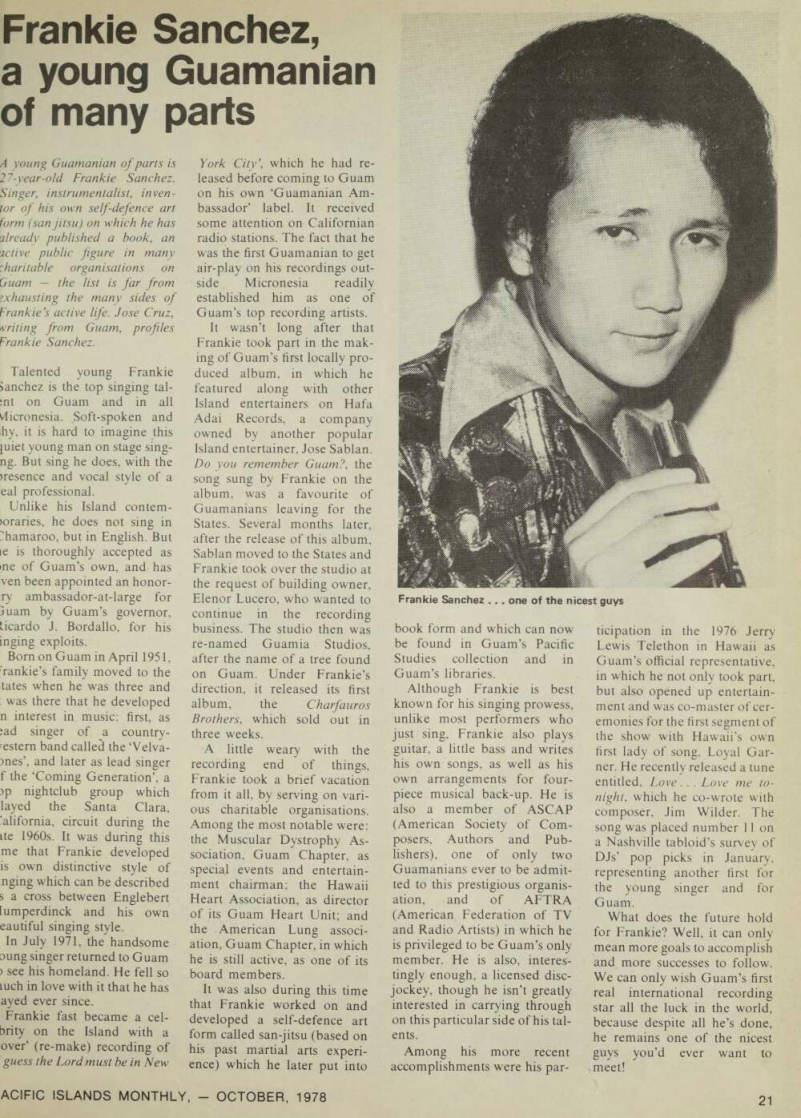
a young Guamanian of many parts
A young Guamanian of parts is 27-year-old Frankie Sanchez.
Singer, instrumentalist, inven tor of his own self-defence art form (san jitsu) on which he has already published a book, an active public figure in many charitable organisations on
Guam the list is far from
exhausting the many sides of Frankie’s active life. Jose Cruz,
writing from Guam, profiles
Frankie Sanchez.
Talented young Frankie Sanchez is the top singing tal mt on Guam and in all
Micronesia. Soft-spoken and
hy, it is hard to imagine this juiet young man on stage sing ng. But sing he does, with the >resence and vocal style of a
eal professional.
Unlike his Island contem >oraries, he does not sing in rhamaroo, but in English. But
ic is thoroughly accepted as
•ne of Guam’s own, and has ven been appointed an honor ry ambassador-at-large for
}uam by Guam’s governor,
Licardo J. Bordallo, for his
inging exploits.
Bom on Guam in April 1951, Tankie’s family moved to the tates when he was three and was there that he developed n interest in music: first, as jad singer of a country western band called the ‘Velva )nes’, and later as lead singer f the ‘Coming Generation’, a
)p nightclub group which
layed the Santa Clara,
'alifomia, circuit during the
ite 19605. It was during this me that Frankie developed is own distinctive style of nging which can be described s a cross between Englebert lumperdinck and his own
eautiful singing style.
In July 1971, the handsome Dung singer returned to Guam ) see his homeland. He fell so mch in love with it that he has ayed ever since.
Frankie fast became a cel brity on the Island with a over’ (re-make) recording of guess the Lord must be in New
York City’, which he had re leased before coming to Guam on his own ‘Guamanian Am bassador’ label. It received some attention on Californian radio stations. The fact that he was the first Guamanian to get air-play on his recordings out side Micronesia readily established him as one of Guam’s top recording artists.
It wasn’t long after that Frankie took part in the mak ing of Guam’s first locally pro duced album, in which he featured along with other Island entertainers on Hafa Adai Records, a company
owned by another popular
Island entertainer, Jose Sablan.
Do you remember Guam?, the song sung by Frankie on the album, was a favourite of Guamanians leaving for the States. Several months later, after the release of this album, Sablan moved to the States and Frankie took over the studio at the request of building owner, Elenor Lucero, who wanted to continue in the recording business. The studio then was re-named Guamia Studios, after the name of a tree found on Guam. Under Frankie’s direction, it released its first album, the Charfauros Brothers, which sold out in three weeks.
A little weary with the
recording end of things,
Frankie took a brief vacation from it all, by serving on vari ous charitable organisations.
Among the most notable were: the Muscular Dystrophy As sociation, Guam Chapter, as special events and entertain ment chairman; the Hawaii Heart Association, as director of its Guam Heart Unit; and the American Lung associ ation, Guam Chapter, in which he is still active, as one of its board members.
It was also during this time that Frankie worked on and developed a self-defence art form called san-jitsu (based on his past martial arts experi ence) which he later put into
book form and which can now be found in Guam’s Pacific Studies collection and in Guam’s libraries.
Although Frankie is best known for his singing prowess, unlike most performers who
just sing, Frankie also plays
guitar, a little bass and writes his own songs, as well as his own arrangements for four piece musical back-up. He is also a member of ASCAP (American Society of Com posers, Authors and Pub lishers), one of only two Guamanians ever to be admit ted to this prestigious organis ation, and of AFTRA (American Federation of TV and Radio Artists) in which he is privileged to be Guam’s only member. He is also, interes tingly enough, a licensed disc
jockey, though he isn’t greatly
interested in carrying through
on this particular side of his tal ents.
Among his more recent accomplishments were his par
ticipation in the 1976 Jerry Lewis Telethon in Hawaii as Guam’s official representative, in which he not only took part, but also opened up entertain ment and was co-master of cer emonies for the first segment of the show with Hawaii’s own first lady of song. Loyal Gar ner. He recently released a tune entitled. Love. . . Love me to night, which he co-wrote with composer, Jim Wilder. The song was placed number 11 on a Nashville tabloid’s survey of DJs’ pop picks in January, representing another first for the young singer and for Guam.
What does the future hold for Frankie? Well, it can only mean more goals to accomplish and more successes to follow.
We can only wish Guam’s first real international recording star all the luck in the world, because despite all he’s done, he remains one of the nicest guys you’d ever want to meet!
Frankie Sanchez . . . one of the nicest guys
Advertisements & other items, pp. 21-22 (2 items)
21
ACIFIC ISLANDS MONTHLY, - OCTOBER, 1978
Welcome aboard the Philippines.
m m r m m mm > m i rm.
Wf: K*i % ■"■ -i: ' fc ifc' ,■.•'••■ rmm
W'.* X'M
i. I
tay
m m % ■ :>■ ■ t% "4 :f t j 1.1 :-i l» va v. • £
iiiii
A mm aftS mmmM ■ *: 1- ■:
afc £<,■:,*:
Discover the grace of old Spain
in the Philippines.
Sense it first
on Philippine Airlines.
The subtle blend of Spain and Asia is our heritage in delightful harmony with the 20th century.
Four centuries of Spanish culture lends a very special beauty to The Philippines.
Like the special smile found only on Philippine Airlines.
Where our flight attendants hospitality is a 1,000 year-old Philippine tradition. 7?
AMSTERDAM
On Philippine Airlines’ wide-bodied jets, you’ll get centuries-old charm, the latest movies, the tastiest international menus.
Flights depart for Manila each Friday from Port Moresby. Also three times each j>an francis'co wee k f ro m Sydney; Monday, Thursday or Friday, or twice each week from Melbourne;
SINGAPORE 4*
JAKARTA
J SYDNEY
- Melbourne Monday or Friday.
So when you’re flying to Europe or the Orient, fly to The Philippines first.
Philippine Airlin
Welcome aboard the Philippines.
PAL2SOO
Davis: Economic
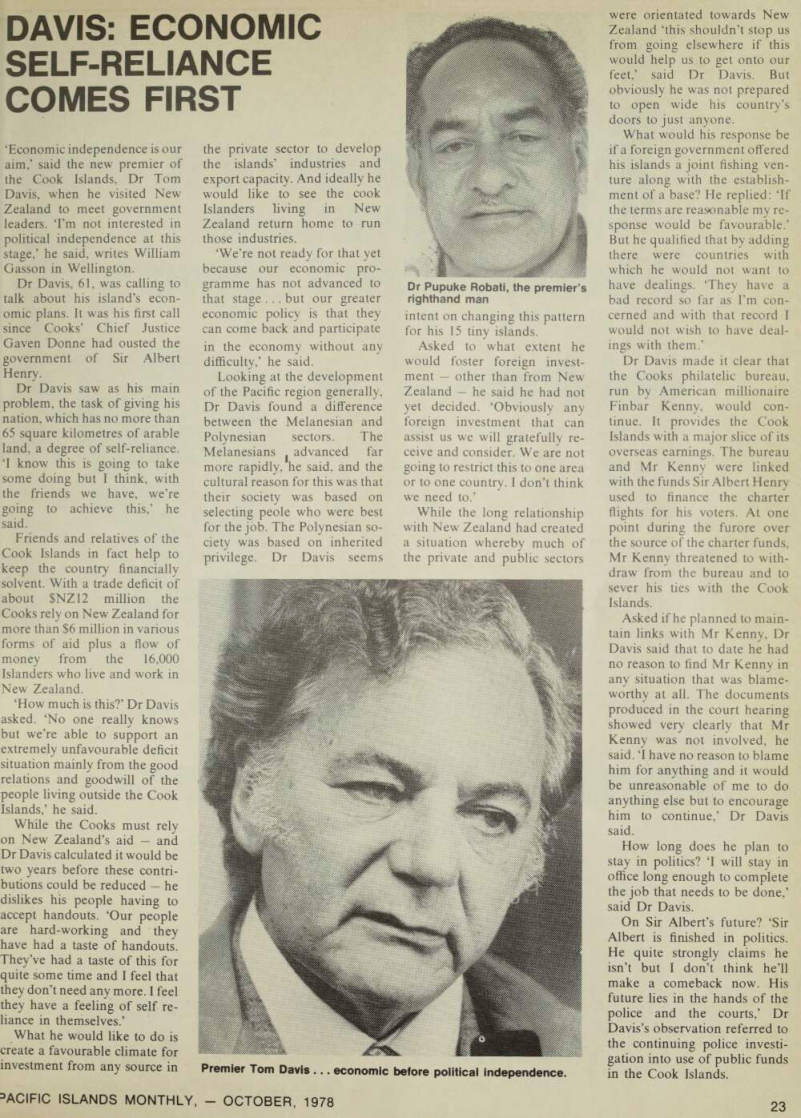
Self-Reliance
Comes First
‘Economic independence is our aim,’ said the new premier of the Cook Islands, Dr Tom Davis, when he visited New Zealand to meet government leaders. ‘l’m not interested in
political independence at this
stage,’ he said, writes William Gasson in Wellington.
Dr Davis, 61, was calling to talk about his island’s econ omic plans. It was his first call since Cooks’ Chief Justice Gaven Donne had ousted the government of Sir Albert Henry.
Dr Davis saw as his main problem, the task of giving his nation, which has no more than 65 square kilometres of arable land, a degree of self-reliance.
T know this is going to take some doing but I think, with the friends we have, we’re going to achieve this,’ he said.
Friends and relatives of the Cook Islands in fact help to
keep the country financially
solvent. With a trade deficit of about SNZI2 million the Cooks rely on New Zealand for more than $6 million in various forms of aid plus a flow of money from the 16,000 Islanders who live and work in New Zealand. ‘How much is this?’ Dr Davis asked. ‘No one really knows but we’re able to support an extremely unfavourable deficit situation mainly from the good relations and goodwill of the people living outside the Cook Islands,’ he said.
While the Cooks must rely on New Zealand’s aid and Dr Davis calculated it would be two years before these contri butions could be reduced he dislikes his people having to accept handouts. ‘Our people
are hard-working and they
have had a taste of handouts.
They’ve had a taste of this for quite some time and I feel that they don’t need any more. I feel they have a feeling of self re liance in themselves.’
What he would like to do is create a favourable climate for investment from any source in
the private sector to develop the islands’ industries and export capacity. And ideally he would like to see the cook Islanders living in New Zealand return home to run those industries. ‘We’re not ready for that yet because our economic pro gramme has not advanced to that stage ... but our greater economic policy is that they can come back and participate in the economy without any difficulty,’ he said.
Looking at the development
of the Pacific region generally.
Dr Davis found a difference between the Melanesian and Polynesian sectors. The Melanesians ( advanced far more rapidly, he said, and the cultural reason for this was that their society was based on selecting peole who were best for the job. The Polynesian so ciety was based on inherited privilege. Dr Davis seems
intent on changing this pattern for his 15 tiny islands.
Asked to what extent he would foster foreign invest ment other than from New Zealand he said he had not yet decided. ‘Obviously any foreign investment that can assist us we will gratefully re ceive and consider. We are not going to restrict this to one area or to one country. I don’t think we need to.’
While the long relationship
with New Zealand had created a situation whereby much of the private and public sectors
were orientated towards New Zealand ‘this shouldn’t stop us from going elsewhere if this would help us to get onto our feet,’ said Dr Davis. But obviously he was not prepared to open wide his country’s doors to just anyone.
What would his response be if a foreign government offered his islands a joint fishing ven ture along with the establish ment of a base? He replied: ‘lf the terms are reasonable my re sponse would be favourable.’
But he qualified that by adding there were countries with which he would not want to have dealings. ‘They have a bad record so far as I’m con cerned and with that record I would not wish to have deal ings with them.’
Dr Davis made it clear that the Cooks philatelic bureau, run by American millionaire Finbar Kenny, would con tinue. It provides the Cook Islands with a major slice of its overseas earnings. The bureau and Mr Kenny were linked with the funds Sir Albert Henry used to finance the charter flights for his voters. At one point during the furore over the source of the charter funds, Mr Kenny threatened to with draw from the bureau and to sever his ties with the Cook Islands.
Asked if he planned to main tain links with Mr Kenny, Dr Davis said that to date he had no reason to find Mr Kenny in any situation that was blame worthy at all. The documents produced in the court hearing showed very clearly that Mr Kenny was not involved, he said. ‘I have no reason to blame him for anything and it would be unreasonable of me to do anything else but to encourage him to continue,’ Dr Davis said.
How long does he plan to stay in politics? ‘I will stay in
office long enough to complete
the job that needs to be done,’ said Dr Davis.
On Sir Albert’s future? ‘Sir Albert is finished in politics.
He quite strongly claims he isn’t but I don’t think he’ll make a comeback now. His future lies in the hands of the police and the courts,’ Dr Davis’s observation referred to
the continuing police investi
gation into use of public funds in the Cook Islands.
Premier Tom Davis ... economic before political independence.
Dr Pupuke Robati, the premier’s righthand man
Advertisements & other items, p. 24 (1 item)
advantage
Our greatest
is behind closed drawers
and doors.
Hrownbuilr storage cupboards and filing cabinets are designed to be clean, modern and colourful on the outside... inside, totally practical. Whatever your requirements we have the versatility inside our storage cupboards and filing cabinets to meet your specific need.
Brownbuilt vertical filing cabinets feature a sturdy construction and are available in two, three and four drawer configurations. The basic storage cupboards have three point security locking (top, bottom and centre) and vertical shelves which can be adjusted at 25 mm intervals to suit particular requirements. We also have a comprehensive selection of horizontal plan files, upright storage cupboards, commercial and industrial lockers and specialised equipment for audio, visual and educational applications. The colours available are designed to complement your office decor and range from the standard “Carnarvon” warm mid-brown through a selection of colour co-ordinated single and duo-tones.
If you’d like further information on the great advantages behind the drawers and doors of Brownbuilt Storage equipment visit the nearest Brownbuilt showroom, contact a Brownbuilt Distributor in l your State or send the coupon.
Brownbuilt “Versatile” Storage
Advice and service is all part of our service.
Steel Storage Equipment and Furniture.
Made in Australia with Australian steel.
Brownbuilt
Brownbuilt Ltd,, Cnr. Bath Rd. and Waratah St., Sutherland, N.S.W., Australia 2232.
Agents Hawaii: Records Management Services, Honolulu Fiji: Lysaght Brownbuilt Ind., Suva New Caledonia: NCR Corporation, Noumea - New Hebrides: NCR Corporation, Vila - Papua New Guinea: Brownbuilt (PNG) Pty. Ltd.
Port Moresby and Lae.
Press
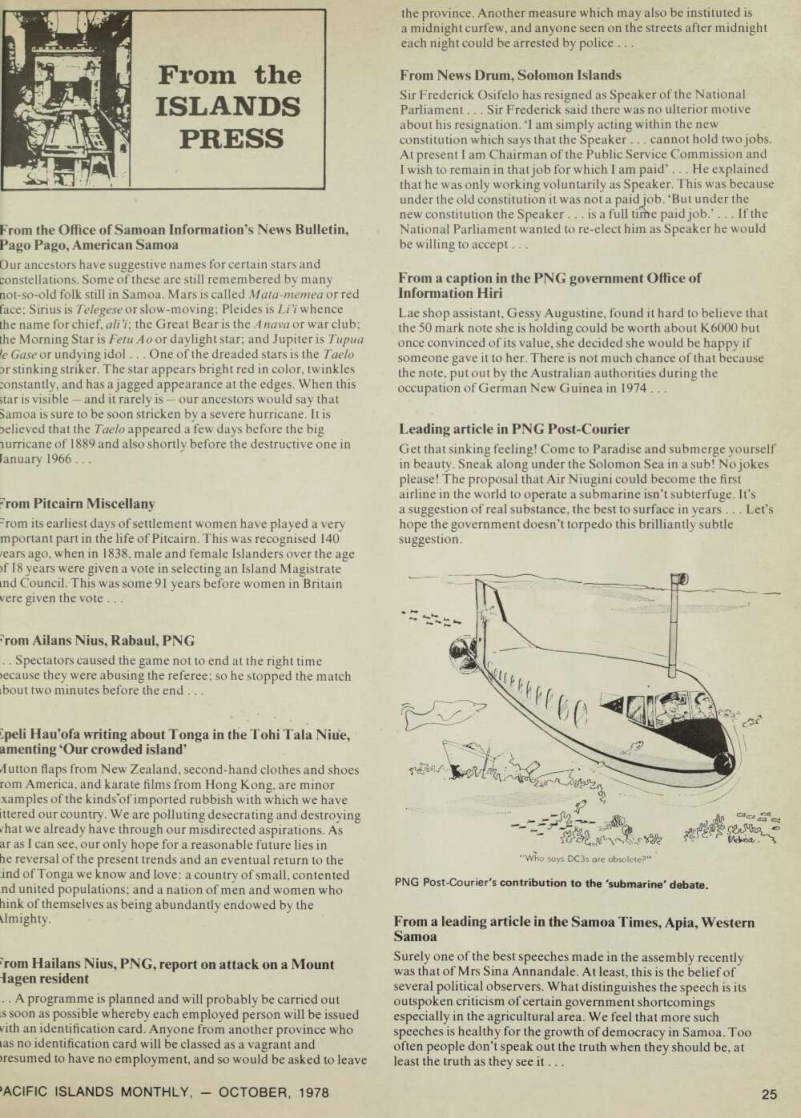
From the
Islands
From the Office of Samoan Information’s News Bulletin,
Pago Pago, American Samoa
Our ancestors have suggestive names for certain stars and constellations. Some of these are still remembered by many not-so-old folk still in Samoa. Mars is called Mata-memea or red face; Sirius is Telegese or slow-moving; Pleides is LVi whence the name for chief, ali’i; the Great Bear is the A nava or war club; the Morning Star is Fetu Aoot daylight star; and Jupiter is Tupua !e Case or undying idol.. . One of the dreaded stars is the Taelo :>r stinking striker. The star appears bright red in color, twinkles constantly, and has a jagged appearance at the edges. When this star is visible and it rarely is our ancestors would say that Samoa is sure to be soon stricken by a severe hurricane. It is relieved that the Taelo appeared a few days before the big lurricane of 1889 and also shortly before the destructive one in lanuary 1966 ...
Tom Pitcairn Miscellany
Tom its earliest days of settlement women have played a very mportant part in the life of Pitcairn. This was recognised 140 fears ago, when in 1838, male and female Islanders over the age )f 18 years were given a vote in selecting an Island Magistrate ind Council. This was some 91 years before women in Britain
vere given the vote ...
Tom Ailans Nius, Rabaul, PNG . . Spectators caused the game not to end at the right time >ecause they were abusing the referee; so he stopped the match ibout two minutes before the end ...
Lpeli Hau’ofa writing about Tonga in the Tohi Tala Niue, amenting ‘Our crowded island’ dutton flaps from New Zealand, second-hand clothes and shoes rom America, and karate films from Hong Kong, are minor xamples of the kinds’of imported rubbish with which we have ittered our country. We are polluting desecrating and destroying /hat we already have through our misdirected aspirations. As ar as I can see, our only hope for a reasonable future lies in fie reversal of the present trends and an eventual return to the ind of Tonga we know and love: a country of small, contented nd united populations; and a nation of men and women who fiink of themselves as being abundantly endowed by the
dmighty.
Tom Hailans Nius, PNG, report on attack on a Mount
lagen resident
. . A programme is planned and will probably be carried out is soon as possible whereby each employed person will be issued vith an identification card. Anyone from another province who las no identification card will be classed as a vagrant and resumed to have no employment, and so would be asked to leave
the province. Another measure which may also be instituted is a midnight curfew, and anyone seen on the streets after midnight each night could be arrested by police . ..
From News Drum, Solomon Islands Sir Frederick Osifelo has resigned as Speaker of the National Parliament... Sir Frederick said there was no ulterior motive about his resignation, i am simply acting within the new constitution which says that the Speaker . . . cannot hold two jobs.
At present I am Chairman of the Public Service Commission and I wish to remain in that job for which lam paid’... He explained that he was only working voluntarily as Speaker. This was because under the old constitution it was not a paid job. ‘But under the new constitution the Speaker ... is a full time paid job.’ ... If the National Parliament wanted to re-elect him as Speaker he would
be willing to accept. ..
From a caption in the PNG government Office of Information Hiri Lae shop assistant, Gessy Augustine, found it hard to believe that the 50 mark note she is holding could be worth about K6OOO but once convinced of its value, she decided she would be happy if someone gave it to her. There is not much chance of that because the note, put out by the Australian authorities during the occupation of German New Guinea in 1974 . . .
Leading article in PNG Post-Courier Get that sinking feeling! Come to Paradise and submerge yourself in beauty. Sneak along under the Solomon Sea in a sub! No jokes please! The proposal that Air Niugini could become the first airline in the world to operate a submarine isn’t subterfuge. It’s a suggestion of real substance, the best to surface in years .. . Let’s hope the government doesn’t torpedo this brilliantly subtle
suggestion.
From a leading article in the Samoa Times, Apia, Western Samoa Surely one of the best speeches made in the assembly recently was that of Mrs Sina Annandale. At least, this is the belief of several political observers. What distinguishes the speech is its outspoken criticism of certain government shortcomings especially in the agricultural area. We feel that more such speeches is healthy for the growth of democracy in Samoa. Too often people don’t speak out the truth when they should be, at least the truth as they see it...
PNG Post-Courier's contribution to the 'submarine' debate.
People
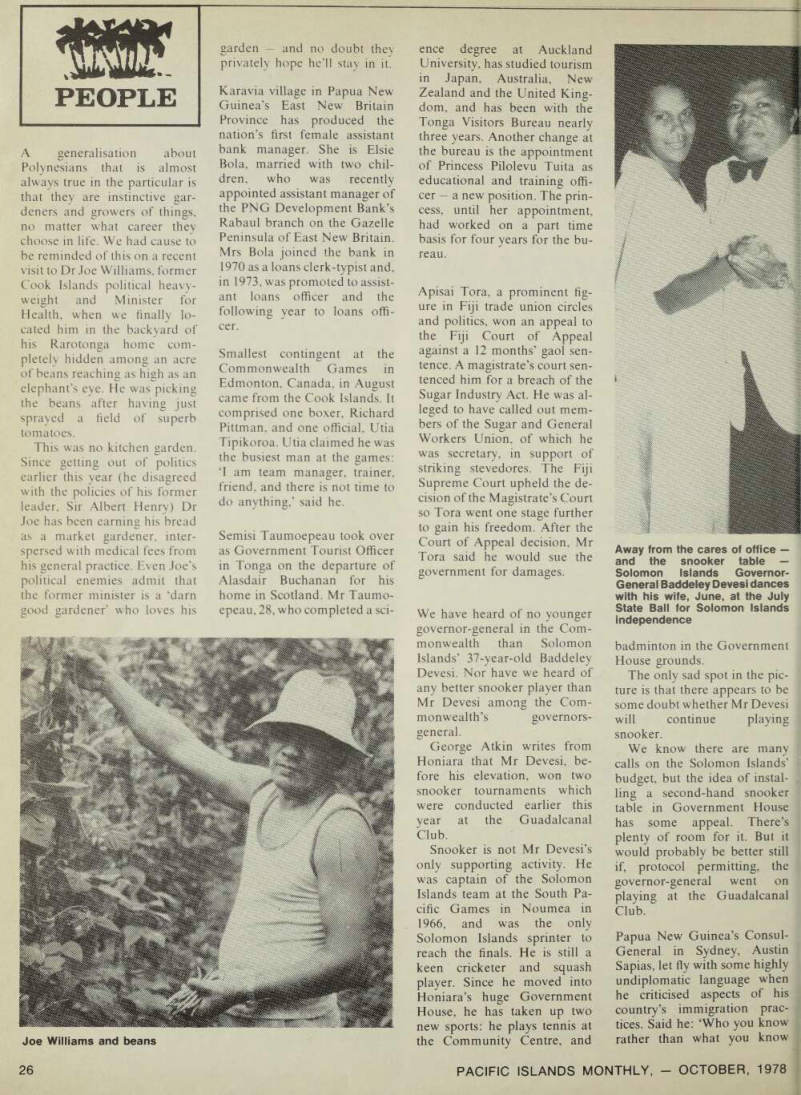
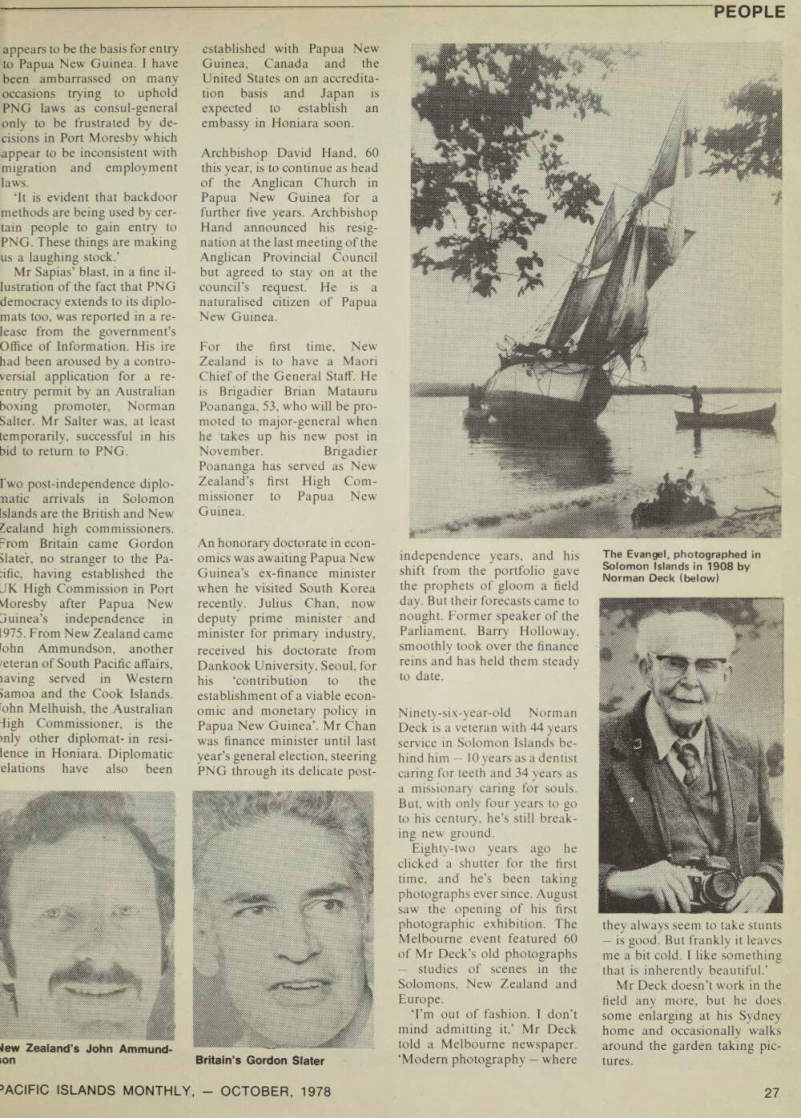
A generalisation about Polynesians that is almost always true in the particular is that they are instinctive gar deners and growers of things, no matter what career they choose in life. We had cause to be reminded of this on a recent visit to Dr Joe Williams, former
Cook Islands political heavy
weight and Minister for Health, when we finally lo cated him in the backyard of his Rarotonga home com pletely hidden among an acre of beans reaching as high as an elephant’s eye. He was picking the beans after having just sprayed a field of superb tomatoes.
This was no kitchen garden.
Since getting out of politics earlier this year (he disagreed with the policies of his former leader. Sir Albert Henry) Dr Joe has been earning his bread as a market gardener, inter spersed with medical fees from his general practice. Even Joe’s political enemies admit that the former minister is a ‘darn good gardener’ who loves his
garden and no doubt they privately hope he’ll stay in it.
Karavia village in Papua New Guinea’s East New Britain Province has produced the nation’s first female assistant bank manager. She is Elsie Bola, married with two chil dren, who was recently appointed assistant manager of the PNG Development Bank’s Rabaul branch on the Gazelle Peninsula of East New Britain.
Mrs Bola joined the bank in 1970 as a loans clerk-typist and. in 1973, was promoted to assist ant loans officer and the following year to loans offi cer.
Smallest contingent at the Commonwealth Games in Edmonton, Canada, in August came from the Cook Islands. It comprised one boxer, Richard Pittman, and one official, Utia Tipikoroa. Utia claimed he was the busiest man at the games: T am team manager, trainer, friend, and there is not time to do anything,’ said he.
Semisi Taumoepeau took over as Government Tourist Officer in Tonga on the departure of Alasdair Buchanan for his home in Scotland. Mr Taumo epeau, 28, who completed a sci-
ence degree at Auckland University, has studied tourism in Japan, Australia, New Zealand and the United King dom, and has been with the Tonga Visitors Bureau nearly three years. Another change at the bureau is the appointment of Princess Pilolevu Tuita as educational and training offi cer a new position. The prin cess, until her appointment, had worked on a part time basis for four years for the bu reau.
Apisai Tora, a prominent fig ure in Fiji trade union circles and politics, won an appeal to the Fiji Court of Appeal against a 12 months’ gaol sen tence. A magistrate’s court sen tenced him for a breach of the Sugar Industry Act. He was al leged to have called out mem bers of the Sugar and General Workers Union, of which he was secretary, in support of
striking stevedores. The Fiji
Supreme Court upheld the de cision of the Magistrate’s Court so Tora went one stage further to gain his freedom. After the Court of Appeal decision, Mr Tora said he would sue the government for damages.
We have heard of no younger governor-general in the Com monwealth than Solomon
Islands’ 37-year-old Baddeley
Devesi. Nor have we heard of any better snooker player than Mr Devesi among the Com monwealth’s governors
general.
George Atkin writes from Honiara that Mr Devesi, be fore his elevation, won two snooker tournaments which were conducted earlier this year at the Guadalcanal Club.
Snooker is not Mr Devesi’s
only supporting activity. He
was captain of the Solomon Islands team at the South Pa cific Games in Noumea in 1966, and was the only Solomon Islands sprinter to reach the finals. He is still a keen cricketer and squash player. Since he moved into Honiara’s huge Government House, he has taken up two new sports: he plays tennis at the Community Centre, and
badminton in the Government
House grounds.
The only sad spot in the pic ture is that there appears to be some doubt whether Mr Devesi will continue playing snooker.
We know there are many calls on the Solomon Islands’ budget, but the idea of instal ling a second-hand snooker table in Government House has some appeal. There’s plenty of room for it. But it would probably be better still
if, protocol permitting, the
governor-general went on playing at the Guadalcanal Club.
Papua New Guinea’s Consul- General in Sydney, Austin
Sapias, let fly with some highly
undiplomatic language when he criticised aspects of his
country’s immigration prac
tices. Said he: ‘Who you know rather than what you know
Joe Williams and beans
Away from the cares of office and the snooker table - Solomon Islands Governor- General Baddeley Devesi dances with his wife, June, at the July State Ball for Solomon Islands independence
appears to be the basis for entry to Papua New Guinea. I have been ambarrassed on many
occasions trying to uphold
PNG laws as consul-general only to be frustrated by de cisions in Port Moresby which to be inconsistent with
migration and employment
laws. ‘lt is evident that backdoor methods are being used by cer tain people to gain entry to PNG. These things are making us a laughing stock.’
Mr Sapias’ blast, in a fine il lustration of the fact that PNG democracy extends to its diplo mats too, was reported in a re
lease from the government’s
Office of Information. His ire had been aroused by a contro versial application for a re
entry permit by an Australian
boxing promoter, Norman Salter. Mr Salter was, at least temporarily, successful in his bid to return to PNG.
fwo post-independence diplo
natic arrivals in Solomon Islands are the British and New
Zealand high commissioners.
~rom Britain came Gordon Plater, no stranger to the Pa
cific, having established the
JK High Commission in Port Vloresby after Papua New
juinea’s independence in
1975. From New Zealand came lohn Ammundson, another veteran of South Pacific affairs, laving served in Western >amoa and the Cook Islands, ohn Melhuish, the Australian Jigh Commissioner, is the inly other diplomat- in resi
lence in Honiara. Diplomatic
elations have also been
established with Papua New Guinea, Canada and the United States on an accredita tion basis and Japan is expected to establish an embassy in Honiara soon.
Archbishop David Hand, 60 this year, is to continue as head of the Anglican Church in Papua New Guinea for a further five years. Archbishop Hand announced his resig nation at the last meeting of the Anglican Provincial Council but agreed to stay on at the council’s request. He is a naturalised citizen of Papua New Guinea.
For the first time, New Zealand is to have a Maori Chief of the General Staff. He is Brigadier Brian Matauru Poananga, 53, who will be pro moted to major-general when he takes up his new post in
November. Brigadier
Poananga has served as New Zealand’s first High Com missioner to Papua New Guinea.
An honorary doctorate in econ omics was awaiting Papua New Guinea’s ex-finance minister when he visited South Korea recently. Julius Chan, now
deputy prime minister and
minister for primary industry,
received his doctorate from Dankook University, Seoul, for his ‘contribution to the establishment of a viable econ omic and monetary policy in Papua New Guinea’. Mr Chan was finance minister until last
year’s general election, steering
PNG through its delicate post-
independence years, and his shift from the portfolio gave the prophets of gloom a field day. But their forecasts came to nought. Former speaker of the
Parliament, Barry Holloway,
smoothly took over the finance reins and has held them steady to date.
Ninety-six-year-old Norman
Deck is a veteran with 44 years service in Solomon Islands be hind him 10 years as a dentist caring for teeth and 34 years as a missionary caring for souls.
But, with only four years to go to his century, he’s still break
ing new ground.
Eighty-two years ago he clicked a shutter for the first time, and he’s been taking photographs ever since. August saw the opening of his first photographic exhibition. The Melbourne event featured 60 of Mr Deck’s old photographs studies of scenes in the Solomons, New Zealand and Europe.
T’m out of fashion. I don’t mind admitting it,’ Mr Deck told a Melbourne newspaper. ‘Modern photography where
they always seem to take stunts is good. But frankly it leaves me a bit cold. I like something that is inherently beautiful.’
Mr Deck doesn’t work in the field any more, but he does some enlarging at his Sydney home and occasionally walks around the garden taking pic tures.
New Zealand’s John Ammund son
Britain’s Gordon Slater
The Evangel, photographed in Solomon Islands in 1908 by Norman Deck (below)
Advertisements & other items, pp. 27-48 (2 items)
27
PEOPLE
ACIFIC ISLANDS MONTHLY, - OCTOBER, 1978
Irdueuinc
to misnmun
soon?
(lie tan supply
business contacts
Businessmen travelling to Australia can call on the services of the Australian Trade Commissioner.
He can provide introductions to the Regional Offices of the Department of Trade and Resources located in all Australian capitals.
These offices have been established to directly introduce overseas businessmen to Australian manufacturers and trading companies.
He maintains a comprehensive register system of goods and services available from Australia. If it is available from Australia he can tell you who supplies it.
Easy communications and rapid shipping services make Australia a logical trading partner, and the Australian Trade Commissioner is here to assist development of two way trade. * Quality and value that’s only hours away The Australian Trade Commissioner can give you details of suppliers. He can also advise Pacific Islands exporters on ways to research or develop markets in Australia You can contact him at:— FIJI: 7th Floor, Dominion House, Thomson Street, Suva. (Post Office Box 1252.) Telephone: 312844.
PAPUA NEW GUINEA:
Australian High Commission, P.O. Box 9129, Hohola.
Telephone: 259333.
Ask the Australian Trade Commissioner
A I I
S 4/LM AKERS TO rhlE
HOOD RACING and CRUISING SAILS
In World Famous Hood Sailcloth Hood Racing Sails have the top international race-winning record. Recent successes include: Half Ton Cup, One Ton Cup, Southern Cross Cup, Whitbread Round-the-World Race, World Ocean Racing Championship, > Sydney- Hobart Race, N.Z. to Vila /c^ Ocean Race, Single-handed Transtasman, / etc., etc. / Hood Cruising Sails in Hood Wide Panel Sailcloth are soft, easy to handle and stow, and longer lasting.
Hood Service. We regularly service the Pacific Hood Managing Director Tony Bouzaid calls frequently through the area; sailing seminars for clubs and associations by arrangement. / v, ,v $ .0' Deliveries. Improved air services bring New Zealand closer to you we can offer speedy deliveries at short notice.
Hoods have representatives in Noumea
SPAR
and
RIGGIN
Papeete, Port Moresby, Rabaul, Suva, Singapore.
Write to Hood Sail Consultants in New Zealand for quotes, advice and for prompt answers to your sails queries. vV £
HOOD
NEW ZEALAND
LIMITED
23 Poore St.. St. Marys Bay, Phone 794-060, P.O. Box 415 Auckland, / A New Zealand. / Cables:Hoodsa Telex: / ✓>.
NZ21200 —/
HOODNZ / bo
Whether you have a racing or cruising yacht and require full new rigs or replacements, contact us for prompt and efficient service. We offer Spars, Rigging, Halyards, Accessories from Quarter Ton to Maxis. For immediate service, write, phone or telex giving fullest details including sketches for replacements, and sail plans with yacht’s leading dimensions, including displacements and ballast, for new rigs.
Write for our very comprehensive catalogue.
YACHTSR4RS
NEW ZEALAND LIMITED
P.O. Box 1492, Auckland. Phone 485-955, 485-536 Telex: Hood 21200. Cables: Yachts Auckland.
/ / XI 41 */ - ‘ f /z n v / S I UJ: ,< ✓ a >/ \\s S' i. i \ X-\X « v -*> \ df v t\\ ■ Vi w> k 1
Shell helps unearth new wealth
Shell has played a vital role in the Pacific for 50 years now.
And part of that role has been in assisting, aiding and developing the local mining industry. Helping to create jobs, money and new opportunities. Shell has also aided development in aviation, fish-
ing, tourism, sugar cane, ships’ bunkering
and other vital areas.
It’s development that has benefited the Pacific region and its people as a whole.
Shell Papua New Guinea Pty. Limited, P.O. Box 169, Port Moresby, Papua New Guinea.
Shell Company (Pacific Islands) Limited, Box 168, Suva, Fiji.
Societe des Petroles Shell des lies du Pacifique Boite postale L 2, Noumea, New Caledonia.
II
SHI77
c? 3 © 55 With Yamaha, the sky’s not the limit.
If you think soaring is just for the birds, think again. Today, thousands of adventurous sportsmen (and sportswomen) are trying themselves to kites and making the wild blue yonder just a little bit wilder.
To get up and stay there you need a long rope, a lot of spirit and the kind of hard charging and totally reliable power that you get from one of Yamaha’s big twins. Kiting is certainly not for the timid and it does take some practice. But once you master it, you’ll discover a sense of freedom that before only eagles enjoyed.
Yamaha ... the only way to fly If you’re bold enough to try kiting, your first stop should be your nearby Yamaha dealer. Let him show you Yamaha’s great line of performance and feature packed new outboards and help you choose the one that best fits your boat and budget.
And even if you’re one of the man who like more down to earth enjoyment, a Yamaha outboard can still offer you*a lot of fun.
Because'with Yamaha, the sky is definitely not the limit. ■■■l
rUMIM
♦ 60 mm '* 55
YAMAHA
40
Outboard
From 2 to 60. Power for any purpose.
with
YAMAHA
YAMAHA MOTOR CO., LTD
2500 SHINGAI IWATA SHI SHIZUOKA KEN JAPAN
IfJIRAH
28 25 20
i'.
SA ■s S’ 1 £
SONY
*l*o TAIUKC IVMM w
’mam 111*0 camcivi j.
I 1 f ‘ SONYWiumk '•'4 1 -ae V SI: —^ Mow you call have big.’frdsh stereo sound from a ' ' % ‘ the same.quality characteristics as free standing speakers.
Theres also ample power (7.2 watts) and all the electronic extras that make this Sony the most elaborate portable stereo you could buy. , If you take it to the country or if if never leaves your Hi-Fi acoustics are enhanced thanks to wood cabinetry. home, you'll get true stereo fidelity enhanced iiv wood
nut with Sony's CFS9OS.
,t> a four band radio(FM/ T , S/tys/ SW i /SW?) and cassette recorder tjpmbination .^l t's the wood, after all, that gives the 4-speaker system cabinetry. It's a Sony. Naturally. • - ' fX - * - ■ A* ■■ v ' “ .vj ■■ ' if i I ■WE ' A MI
I I 1, UP obels M ..I*. j| jHj - 59 Abels
LV'"'#>W
Abels SnoW&iF Abels Ab® !s r| AbelJ |pss* vj Ab#*« i A^ els s ejs Abels AbejJ . > ) —| Abels! Abels Abejfll ■* S>J m
Better baking, all
through the Pacific
begins in this test bakery.
This is Abels Test Bakery in Auckland. Everything we make and export is tested here.
We maintain a comprehensive testing programme throughout the year to ensure that our products give optimum performance under tropical conditions.
That’s why you can use these Abels products with total confidence:
IN MARGARINE
MORAH for cakes and pastry
IN SHORTENINGS
OLEO for general purposes CHEFADE for frying HI-MIX for High-ratio SNOWWHIP for creaming WE MAKE BETTER PRODUCTS SO YOU MAKE BETTER PROFITS Don’t hesitate to get in touch if Abels can help in any way. Write with any enquiries to: Abels Limited, P.O. Box 9573, Auckland, New Zealand.
bels
THE PROFIT IMPROVERS
Casiotron
Setting a new standard
in digital electronic timepieces.
The world of Casiotron digital electronic timepieces —an incredibly fully automatic world of precision not found in conventional watches.
It starts with fully automatic Time/Date/Calendar readouts, and electronic accuracy to within ±lO~ 15 seconds a month. Performance and accuracy that's backed by Casio's 20 years of technologicallyadvanced digital electronics know-how.
A world also of choice. Featuring World Time digital readout watches, for example, indicating 11 time zones, or Casiotrons with stopwatch functions to within 1/ 100th of a second, and even pre-set alarm functions. Or, maybe you want a compact— like our super-slim Casiotron that's only 6.omm thick.
Think it over. Casiotron—the revolutionary new digital electronic watch, that's also a complete mini time-data systerA.
CASIOTRON
■ ■ SbS . I 10:5 S
CASIO
3SSB
<=ASIQTBDI\J
«• A * r I ■ /-T - 'Or \ Casio.Computer Co, Ltd., Tokyo, Japan
MARSHALL
ISLANDS
JAPAN
TOKYO
KAGOSHIMA
30°
CHINA
OKINAWA
TA PEI
AIWAN
HONG KONG
PHILIPPINES
M A NI L A £
GUAM
fcTSS
CAROLINE ISLANDS
PONAPE
MAJURO
TARAWA
NAURU
GILBERT
ISLANDS*
o o
PAPUA
NEW
GUINEA
s> GUADALCANAL .*
HONIARA
SOLOMON
ISLANDS
* NEW
HEBRIDES
LA V
NEW
CALEDONIA
NOUMEA
SYDNEY
MELBOURNE
• .V ’so°
NEW ZEALAti
1 70°E
PEOPLE KEEP ASKMG US
ii
HAWAII
£>
WHERE DOES
AIR NAURU FLY?
99
WESTERN SAMOA
Until recently, modesty and a rather small size had compelled us to keep our airline and our routes pretty much to ourselves, sharing them only with a few friends and neighbors who still maintain that the only way to fly is from island to island.
But as we ascertained that there’s really not an unpleasant island in the lot, and that our all-jet airline is the only one in the world linking the great Asian nations with Micronesia, Melanesia and Polynesia, it dawned that we might be on to something in the way of unique travel possibilities.
Say, from Hong Kong to Western Samoa. Or from Japan to Fiji.
Or Melbourne to Guam. All via our home island of Nauru.
As well as a lot of fine places in between, most of them, fortunately, blessed by pleasant weather, hospitable people, and surrounded by warm and invigorating waters.
Indeed, some travelers already think of Air Nauru as the unhurried alternative route through Nauru from Hong Kong or Taipei or Japan to Australia. Via a world of beautiful islands—both scenic and human.
While others think of us as the fastest and most direct route to such places as Majuro, Nauru, Western Samoa, Tarawa, Guadalcanal and the Solomon Islands. Or Fiji, New Caledonia and the New Hebrides.
However you choose to fly with us, along the way our promise is simple: Big airline efficiency, small airline congeniality, some genuine, unpretentious inflight cheer, delightful stopovers, an occasional Pacific feast, French wines and champagnes.
Oh yes, ladies and gentlemen, on Air Nauru-wherever we fly in our beautiful island world-we are used to doing things in style. •yr
WflW NAURU
AIRLINE OF THE CENTRAL PACIFIC
For ticketing, reservations and flight information, telephone: 740 in Apia, Western Samoa; 477-7106 in Guam; 595 or 727 in Honiara, Solomon Islands; 229 in Majuro, Marshall Islands; 312-377 in Suva, Fiji; 27-33-22 in Noumea, New Caledonia; 458 in Ponape, Caroline Islands; 27-39 in Vila, New Hebrides; 72795 in Nadi, Fiji; 448 in Tarawa, Gilbert Islands; and 653-5709 in Melbourne, Australia.
«ia*»
*Z7CC
Sansui! Who else could present su exciting array of spectacular stereo?
Sansui! Who else but the hi-fi special could assure you of outstanding and relrabi performance for every model on this pac mm %3CC R ; \y ■ @ ** m K a * r.. ■ m ■ -
SANSUI ELECTRIC CO., LTD.
14-1 Izumi 2-chome, Suginami-ku, Tokyo 168, Japan • Australia VAN FI (Aust.) Pty. Ltd. 162, Albert Road, South Melbourne, Victoria 3205, Australia Phone: 699-5473/Suite 5. Uniline House, 5 Northcliff Street. Milson Point, N.S.W. 2061, Australia Phone: 929-0293 • Fiji Prabhu Brothers Ltd. P.O. Box 183, Nadi Phone: 70183/4
Performers by bansui!
Sansui means sound that’s clean and •owerful. It means stereo that touches your oul. And it means even the subtle nuances f music sources are crisp.
Here is proof that Sansui is dedicated to excellent sound quality for everyone.
If you put sound quality first, it's Sansui all the way!
S v mm ©o I; ■■ © ■> rs ns ■ .
'A WM FI w * kk H s « r SB Sa-n*uL
Dnly hi-fi, everything hi-fi.
• Papua New Guinea Oceania Indent Agency (P.N.G.) Pty. Ltd. Box 5518, Boroko, Port Moresby Phone: PM 256406 • New Zealand David Reid Electronics .td.C.P.O. Box 2630. Auckland. 1 Phone:492-189 • New Caledonia Ets Michel MERCiER B.P. 1123, Noumea Phone: 27. 59. 11 • South Pacific Miltons Department Stores Limited P.O. Box 146, Norfolk Island 2899 • Central Pacific Nauru Co-operative Society Republic of Nauru • New Hebrides The Sound Centre P.O. Box 434, Port Villa • Cook Island United Island Traders Ltd. P.O. Box 1& 2, Rarotonga • Tahiti DIMECO P.O. Box 2622
In cooking
SPEED-E-GAS
is fast, efficient
and reliable.
Terminals throughout the Pacific.
For more information write Boral Gas Limited, 221 Miller Street, JL I North Sydney 2060 DWKMU *Speed-E-Gas is known in Papua New Guinea, as Guinea Gas. In Tonga as Tonga Speed-E-Gas, and in Fiji as Fiji Gas.
SPEEDEGAS
ur Q
HOLT GS 13
PACKED BY:
NIPPON SUISAN KAISHA, LTD.
EXPORTED BY:
UNITRADE COMPANY, LIMITED
11-12 3-chome Hachobori Chuo-ku Tokyo
TELEX NO.: “252-4665 KANDK J”
CABLE ADDRESS: “KAYANDKAY TOKYO”
A
Designed for Freedom
Arrange it any way you want.
With Onkyo’s UC-100 you get high fidelity sound and more.
Stack up the amp, tuner, and turntable, lay them flat between the speakers, or use the optional floor rack. You choose the design, and let Onkyo technology take care of the music.
Then sit back and enjoy. The powerful integrated amplifier and sensitive AM/FM stereo tuner feature a full range of front panel controls. And the UCTOO comes complete with a precision fully automatic turntable and 3-way semi-bass reflex speakers.
Visit your Onkyo dealer and discover the exciting freedom of designing your own component system.
Using the optional floor rack and with the addition of a stereo cassette deck, this vertical setup offers added space for your record collection.
The turntable fits> right on top of the amp/tuner cabinet in this space-saving layout.
Put all your components right on the floor for a sleek modern look.
Artistry in Sound International Division: No. 24 Mori Bldg., 23-5, 3-chome, Nishi-shinbashi, Minato-ku, Tokyo, Japan.
Telex 242-3551 ONKYO J Tel. 03-432-6981 X 1 ■ . ' WE ARE LOOKING FOR: distributors in South Pacific Territories except Australia and Tahiti Contact Onkyo Corp. in Tokyo.
© & ss IS 1 '1
You’ll like our money-saving
ways to speed products.
Importer export, the faster you move merchandise, the less it can cost. Air Cargo does it not only quicker, but safer too. Talk Air Cargo convenience and savings with Air New Zealand. 4= air new zEatano The economic move
ANZ 78/6
o o .. m ' VW >. n. ■ ® . * * ' v. *.
Vxw * • > \ Hs e . * * V, ." uV " \ x <' /T ✓ . s'j^ ?p i t ✓ / ’M
ism
i : Z*i . - - •-' - --. .. - - ■■<■■-,
COUNT ON VICIA
TO TURN GRASS INTO LAWN
VICTA
UTILITY 160
MOWER
VICTA
SUPER 24
MOWER
Tough, rugged, lightweight and low priced, a mower without grass-catcher designed to handle the full range of grass cutting jobs from heavily weeded and long grass areas to fine lawns. Cuts close to trees and fences and new side chute sends the cut grass safely to the side. Powered by 160 cc Mark 4 2-stroke Victa engine with the easy pull-Zip Starter, multiposition height adjuster, fold-down handles and many more exclusive Victa features make the Utility a popular lightweight mower.
The big mower for big grass with a giant 61 cm (24") cut. It’s the mower for the big grass cutting jobs and municipal parks and gardens, sports grounds, roadside growth control as well as property owners with large areas of land. Solid construction, easy manoeuvrability and giant rear wheels handle rough ground effortlessly. Two free-swinging blades on the cutting disc absorb shock when hard objects are encountered, protecting the engine from damage.
Powered by a special power-boosted Victa 160 cc 2-stroke engine with the exclusive easy pull Zip Starter and many more features to make the big mowing jobs easier.
When you want tough reliable grass cutting, Victa has the mower for any job. And every Victa mower is backed by the widest service and spare parts network in the business.
L 83.8646
TURNS GRASS INTO LAWN
WWW
Kenwood’s specialist r T components are for people who want only the very best that modem life can offer. Like pure
tonal quality in reproduced music.
:■ mm 4 .
There's proof in the performance data. Ask your Kenwood dealer for a test listening. And discover what sound quality really means! •KA-5700 Stereo integrated
amplifier
♦KX-520 Cassette deck with
Dolby* N.R.
• KD-2000 Automatic return turntable • LS-770 MKH Coaxial passive cone speaker system— • Trademark of Dolby Labs Inc.
LS-770 mkD KX-520 n i KA 5700 £ - * KD-2000 ■ fiE ; v*, <^s»
I , U : n
TRIO-KENWOOD CORPORATION 6-17, 3-chome, Aobadai, Meguro-ku, Tokyo 153 Japan Auckland Tel* 3CF839 * 4 * M322 ,SLAND > LTD TAHITI MAISON AURORE *»**» Tel 29703 FIJI THE DOMINION IMPORT & EXPORT PROMOTIONS Nadi Tel 72-165 k? UE RA P I °S CENTRE LTD Honiara Tel 416 AMERICAN SAMOA ISLAND PACIFIC AGENCIES, INC Pago Pago Tel 633- PAPUA NEW GUINEA S O SVENSSON (N G ) LTD Port Moresby' NEW CALEDONIA HI-FI VOX Noumea Tel 27-2466 NEW HEBRIDES RUE HIGGINSON Vila Tel 26RR
REPUBLIC OF NAURU NAURU CO-OPERATIVE SOCIETY
m \ v
'mgask
■safio
Parker presents
The Classics,
in more ways
than one
Weßm*
'WzK
W . V %\
Enduring, both in style and writing
skills, these are the Parker International Classics.
Lean and light, yet each one of these slender ball point pens has the ink capacity for up to 80,000 words between refills. That's the standard for Parker refills.
We feature the sterling silver model.
Others are in 22ct gold plate. Vermeil, t - and stainless steel.
Each one...a classic. ;.V. - v *4'2v jfe* ;• . a£N x ms ym
*PARKER
World's most wanted pens "< , *-> 'y v, •V •. w -Vf_ ■ .v VT-tv.\ 'm-, ■wr -v> ■ N T •* • -■
msttk
V. * V.:i- ■ Vr-*' ■■■,■- -■ *v-" • *?' :v. & c# %V V .V' - ' V Vi > V 4 ■ V V N. V M \ , v - CV° V ***•& V •» r. :.*y) .V H. . ' ' < 066 P 491
Doing what
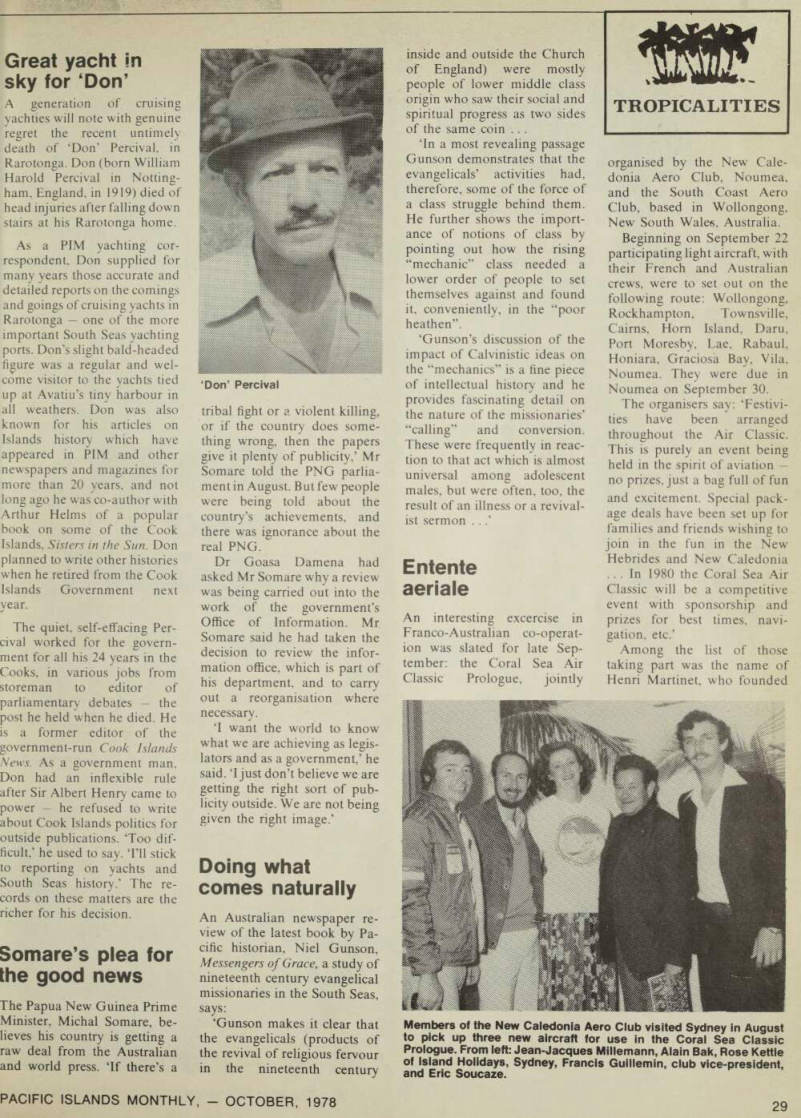
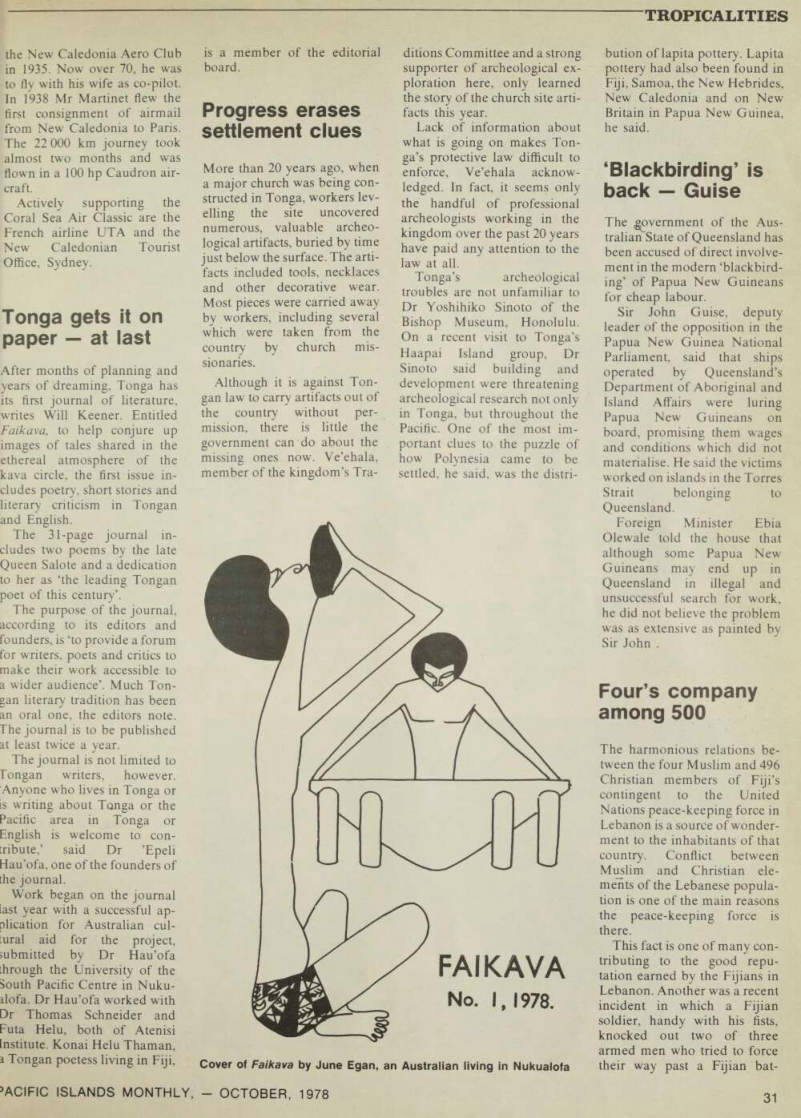
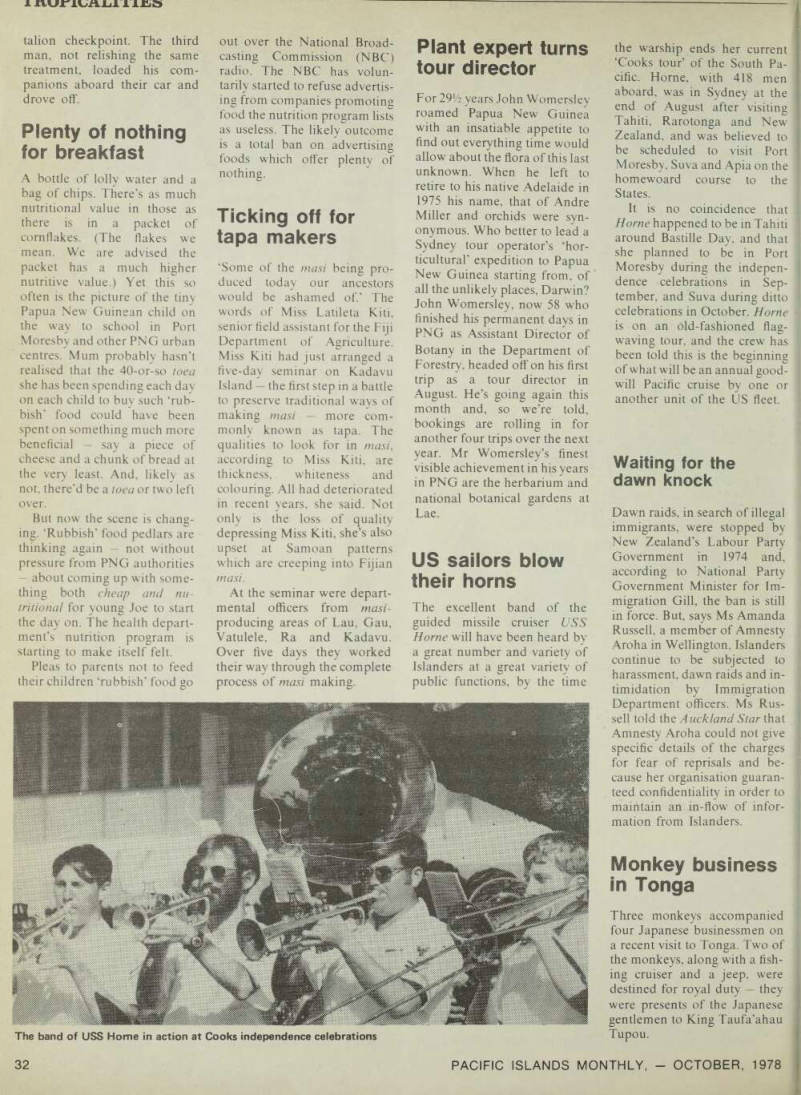
Tropicalities
Great yacht in
sky for ‘Don’
A generation of cruising
yachties will note with genuine regret the recent untimely death of ‘Don’ Percival. in Rarotonga. Don (born William Harold Percival in Notting ham, England, in 1919) died of head injuries after falling down stairs at his Rarotonga home.
As a PIM yachting cor respondent, Don supplied for many years those accurate and detailed reports on the comings
and goings of cruising yachts in
Rarotonga one of the more important South Seas yachting ports. Don’s slight bald-headed figure was a regular and wel come visitor to the yachts tied up at Avatiu’s tiny harbour in all weathers. Don was also known for his articles on Islands history which have appeared in PIM and other newspapers and magazines for more than 20 years, and not long ago he was co-author with Arthur Helms of a popular book on some of the Cook Islands, Sisters in the Sun. Don planned to write other histories when he retired from the Cook Islands Government next year.
The quiet, self-effacing Per cival worked for the govern ment for all his 24 years in the Cooks, in various jobs from storeman to editor of parliamentary debates the post he held when he died. He is a former editor of the government-run Cook Islands News. As a government man, Don had an inflexible rule after Sir Albert Henry came to power he refused to write about Cook Islands politics for
outside publications. ‘Too dif
ficult,’ he used to say. ‘l’ll stick to reporting on yachts and South Seas history.’ The re cords on these matters are the richer for his decision.
Somare’s plea for
the good news
The Papua New Guinea Prime Minister, Michal Somare, be lieves his country is getting a raw deal from the Australian and world press. ‘lf there’s a
tribal fight or a violent killing, or if the country does some thing wrong, then the papers
give it plenty of publicity,’ Mr
Somare told the PNG parlia ment in August. But few people were being told about the country’s achievements, and there was ignorance about the real PNG.
Dr Goasa Damena had asked Mr Somare why a review was being carried out into the work of the government’s Office of Information. Mr Somare said he had taken the decision to review the infor mation office, which is part of his department, and to carry out a reorganisation where necessary.
T want the world to know what we are achieving as legis lators and as a government,’ he said, i just don’t believe we are getting the right sort of pub licity outside. We are not being
given the right image.’
Doing what
comes naturally
An Australian newspaper re view of the latest book by Pa cific historian, Niel Gunson,
Messengers of Grace, a study of
nineteenth century evangelical missionaries in the South Seas, says: ‘Gunson makes it clear that
the evangelicals (products of
the revival of religious fervour in the nineteenth century
inside and outside the Church
of England) were mostly
people of lower middle class origin who saw their social and spiritual progress as two sides of the same coin . . . ‘ln a most revealing passage Gunson demonstrates that the evangelicals’ activities had, therefore, some of the force of a class struggle behind them.
He further shows the import ance of notions of class by pointing out how the rising “mechanic” class needed a lower order of people to set themselves against and found it, conveniently, in the “poor heathen”. ‘Gunson’s discussion of the impact of Calvinistic ideas on the “mechanics” is a fine piece of intellectual history and he
provides fascinating detail on
the nature of the missionaries’
“calling” and conversion.
These were frequently in reac tion to that act which is almost universal among adolescent males, but were often, too, the result of an illness or a revival ist sermon ...’
Entente
aeriale
An interesting excercise in Franco-Australian co-operat ion was slated for late Sep tember: the Coral Sea Air
Classic Prologue, jointly
organised by the New Cale donia Aero Club, Noumea, and the South Coast Aero Club, based in Wollongong, New South Wales, Australia.
Beginning on September 22
participating light aircraft, with
their French and Australian crews, were to set out on the
following route: Wollongong,
Rockhampton, Townsville,
Cairns, Horn Island, Daru, Port Moresby, Lae, Rabaul, Honiara, Graciosa Bay, Vila, Noumea. They were due in Noumea on September 30.
The organisers say: ‘Festivi ties have been arranged throughout the Air Classic.
This is purely an event being held in the spirit of aviation no prizes, just a bag full of fun
and excitement. Special pack
age deals have been set up for families and friends wishing to join in the fun in the New Hebrides and New Caledonia ... In 1980 the Coral Sea Air Classic will be a competitive event with sponsorship and prizes for best times, navi
gation, etc.’
Among the list of those taking part was the name of Henri Martinet, who founded
‘Don’ Percival
Members of the New Caledonia Aero Club visited Sydney in August to pick up three new aircraft for use in the Coral Sea Classic Prologue. From left: Jean-Jacques Millemann, Alain Bak, Rose Kettle of Island Holidays, Sydney, Francis Guillemin, club vice-president, and Eric Soucaze.
ffic New Caledonia Aero Club in 1935. Now over 70, he was to fly with his wife as co-pilot.
In 1938 Mr Martinet flew the first consignment of airmail from New Caledonia to Paris.
The 22 000 km journey took almost two months and was flown in a 100 hp Caudron air craft.
Actively supporting the Coral Sea Air Classic are the French airline UTA and the New Caledonian Tourist
Office, Sydney.
Tonga gets it on
paper at last
After months of planning and years of dreaming, Tonga has its first journal of literature, writes Will Keener. Entitled Faikava, to help conjure up images of tales shared in the ethereal atmosphere of the kava circle, the first issue in cludes poetry, short stories and
literary criticism in Tongan
and English.
The 31-page journal in
cludes two poems by the late Queen Salote and a dedication
to her as ‘the leading Tongan
poet of this century’.
The purpose of the journal, according to its editors and founders, is ‘to provide a forum for writers, poets and critics to make their work accessible to a wider audience’. Much Ton gan literary tradition has been an oral one, the editors note.
The journal is to be published at least twice a year.
The journal is not limited to Fongan writers, however.
Anyone who lives in Tonga or
is writing about Tonga or the
Pacific area in Tonga or English is welcome to con
tribute,’ said Dr ’Epeli
Hau’ofa, one of the founders of
the journal.
Work began on the journal last year with a successful ap plication for Australian cul tural aid for the project,
submitted by Dr Hau’ofa
through the University of the South Pacific Centre in Nuku alofa. Dr Hau’ofa worked with Dr Thomas Schneider and Futa Helu, both of Atenisi Institute. Konai Helu Thaman,
a Tongan poetess living in Fiji,
is a member of the editorial board.
Progress erases
settlement clues
More than 20 years ago, when a major church was being con structed in Tonga, workers lev elling the site uncovered numerous, valuable archeo logical artifacts, buried by time just below the surface. The arti facts included tools, necklaces and other decorative wear.
Most pieces were carried away
by workers, including several
which were taken from the country by church mis sionaries.
Although it is against Ton gan law to carry artifacts out of the country without per mission, there is little the government can do about the missing ones now. Ve’ehala, member of the kingdom’s Tra
ditions Committee and a strong supporter of archeological ex
ploration here, only learned
the story of the church site arti facts this year.
Lack of information about what is going on makes Ton ga’s protective law difficult to enforce, Ve’ehala acknow ledged. In fact, it seems only the handful of professional
archeologists working in the
kingdom over the past 20 years have paid any attention to the law at all.
Tonga’s archeological
troubles are not unfamiliar to Dr Yoshihiko Sinoto of the Bishop Museum, Honolulu.
On a recent visit to Tonga’s Haapai Island group. Dr Sinoto said building and
development were threatening
archeological research not only
in Tonga, but throughout the Pacific. One of the most im portant clues to the puzzle of how Polynesia came to be settled, he said, was the distri-
bution of lapita pottery. Lapita pottery had also been found in Fiji, Samoa, the New Hebrides, New Caledonia and on New Britain in Papua New Guinea, he said.
‘Blackbirding’ is
back Guise
The government of the Aus tralian State of Queensland has been accused of direct involve ment in the modern ‘blackbird ing’ of Papua New Guineans for cheap labour.
Sir John Guise, deputy leader of the opposition in the Papua New Guinea National Parliament, said that ships
operated by Queensland’s
Department of Aboriginal and
Island Affairs were luring Papua New Guineans on board, promising them wages and conditions which did not materialise. He said the victims worked on islands in the Torres Strait belonging to Queensland.
Foreign Minister Ebia Olewale told the house that
although some Papua New
Guineans may end up in Queensland in illegal and unsuccessful search for work, he did not believe the problem was as extensive as painted by Sir John .
Four’s company
among 500
The harmonious relations be tween the four Muslim and 496 Christian members of Fiji’s contingent to the United Nations peace-keeping force in Lebanon is a source of wonder ment to the inhabitants of that country. Conflict between Muslim and Christian ele ments of the Lebanese popula tion is one of the main reasons the peace-keeping force is there.
This fact is one of many con tributing to the good repu tation earned by the Fijians in Lebanon. Another was a recent incident in which a Fijian soldier, handy with his fists, knocked out two of three armed men who tried to force their way past a Fijian bat
Cover of Faikava by June Egan, an Australian living in Nukualofa
talion checkpoint. The third man, not relishing the same treatment, loaded his companions aboard their car and drove off.
Plenty of nothing
fr»r Kroakfaef lUI UicdMdbl A bottle of lolly water and a bag of chips. There’s as much nutritional value in those as there is in a packet of cornflakes. (The flakes we mean. We are advised the packet has a much higher nutritive value.) Yet this so often is the picture of the tiny Papua New Guinean child on the way to school in Port Moresby and other PNG urban centres. Mum probably hasn’t realised that the 40-or-so toea she has been spending each day on each child to buy such ‘rubbish’ food could have been spent on something much more beneficial say a piece of cheese and a chunk of bread at the very least. And, likely as not, there’d be a toea or two left over.
But now the scene is changing. ‘Rubbish’ food pedlars are
thinking again not without
pressure from PNG authorities about coming up with something both cheap and nutritional for young Joe to start the day on. The health department’s nutrition program is starting to make itself felt.
Pleas to parents not to feed their children ‘rubbish’ food go
out over the National Broad casting Commission (NBC) radio. The NBC has volun tarily started to refuse advertis
ing from companies promoting
food the nutrition program lists as useless - The like iy outcome is a total ban on advertisin g foods which offer plenty of
nothing,
t^
Ticking Off fO X
tapa makers
‘Some of the masi being pro duced today our ancestors would be ashamed of.’ The words of Miss Latileta Kiti, senior field assistant for the Fiji
Department of Agriculture,
Miss Kiti had just arranged a five-day seminar on Kadavu Island the first step in a battle to preserve traditional ways of making masi more corn monly known as tapa. The qualities to look for in masi , according to Miss Kiti, are thickness, whiteness and colouring. All had deteriorated in recent years, she said. Not only is the loss of quality depressing Miss Kiti, she’s also upset at Samoan patterns which are creeping into Fijian masi.
At the seminar were depart mental officers from masi producing areas of Lau, Gau, Vatulele, Ra and Kadavu.
Over five days they worked their way through the complete process of masi making.
Plant expert turns
tour director
For 29 Vi years John Womersley roamed Papua New Guinea with an insatiable appetite to find out everything time would allow about the flora of this last unknown. When he left to retire to his native Adelaide in 1975 his name, that of Andre Miller and orchids were syn onymous. Who better to lead a Sydney tour operator’s ‘hor
ticultural’ expedition to Papua
New Guinea starting from, of all the unlikely places, Darwin?
John Womersley, now 58 who finished his permanent days in PNG as Assistant Director of Botany in the Department of Forestry, headed off on his first trip as a tour director in August. He’s going again this month and, so we’re told, bookings are rolling in for another four trips over the next year. Mr Womersley’s finest visible achievement in his years in PNG are the herbarium and national botanical gardens at Lae.
US sailors blow
their horns
The excellent band of the guided missile cruiser USS Horne will have been heard by a great number and variety of Islanders at a great variety of public functions, by the time
the warship ends her current ‘Cooks tour’ of the South Pa cific. Horne, with 418 men aboard, was in Sydney at the end of August after visiting Tahiti, Rarotonga and New Zealand, and was believed to be scheduled to visit Port Moresby, Suva and Apia on the homewoard course to the States.
It is no coincidence that Horne happened to be in Tahiti around Bastille Day, and that she planned to be in Port
Moresby during the indepen
dence celebrations in Sep tember, and Suva during ditto celebrations in October. Horne is on an old-fashioned flag waving tour, and the crew has been told this is the beginning of what will be an annual good will Pacific cruise by one or another unit of the US fleet.
Waiting for the
dawn knock
Dawn raids, in search of illegal
immigrants, were stopped by
New Zealand’s Labour Party Government in 1974 and,
according to National Party
Government Minister for Im migration Gill, the ban is still in force. But, says Ms Amanda Russell, a member of Amnesty Aroha in Wellington, Islanders continue to be subjected to harassment, dawn raids and in
timidation by Immigration
Department officers. Ms Rus sell told the Auckland Star that Amnesty Aroha could not give specific details of the charges for fear of reprisals and be cause her organisation guaran teed confidentiality in order to maintain an in-flow of infor mation from Islanders.
Monkey business
in Tonga
Three monkeys accompanied four Japanese businessmen on a recent visit to Tonga. Two of the monkeys, along with a fish ing cruiser and a jeep, were
destined for royal duty they
were presents of the Japanese gentlemen to King Taufa’ahau Tupou.
The band of USS Home in action at Cooks independence celebrations
Advertisements & other items, pp. 31-32 (2 items)
31
TROPICALITIES
ACIFIC ISLANDS MONTHLY, - OCTOBER, 1978
x nuriLALi i iHiO
paradise lost
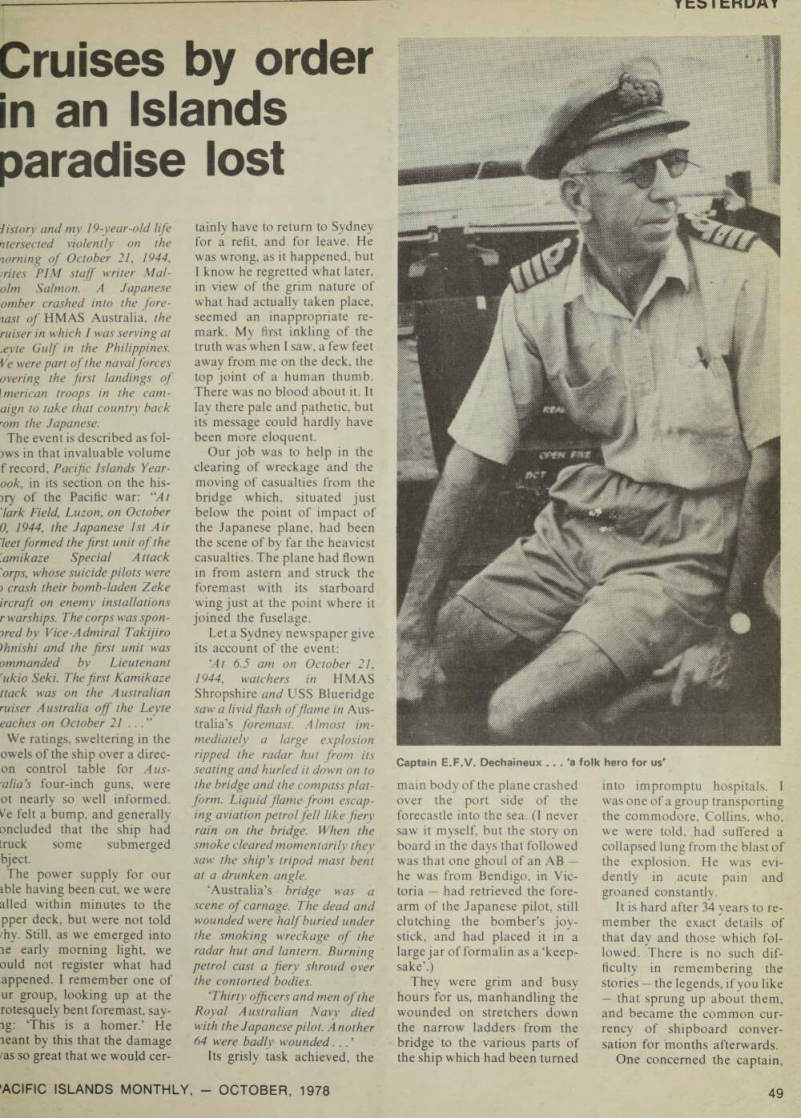
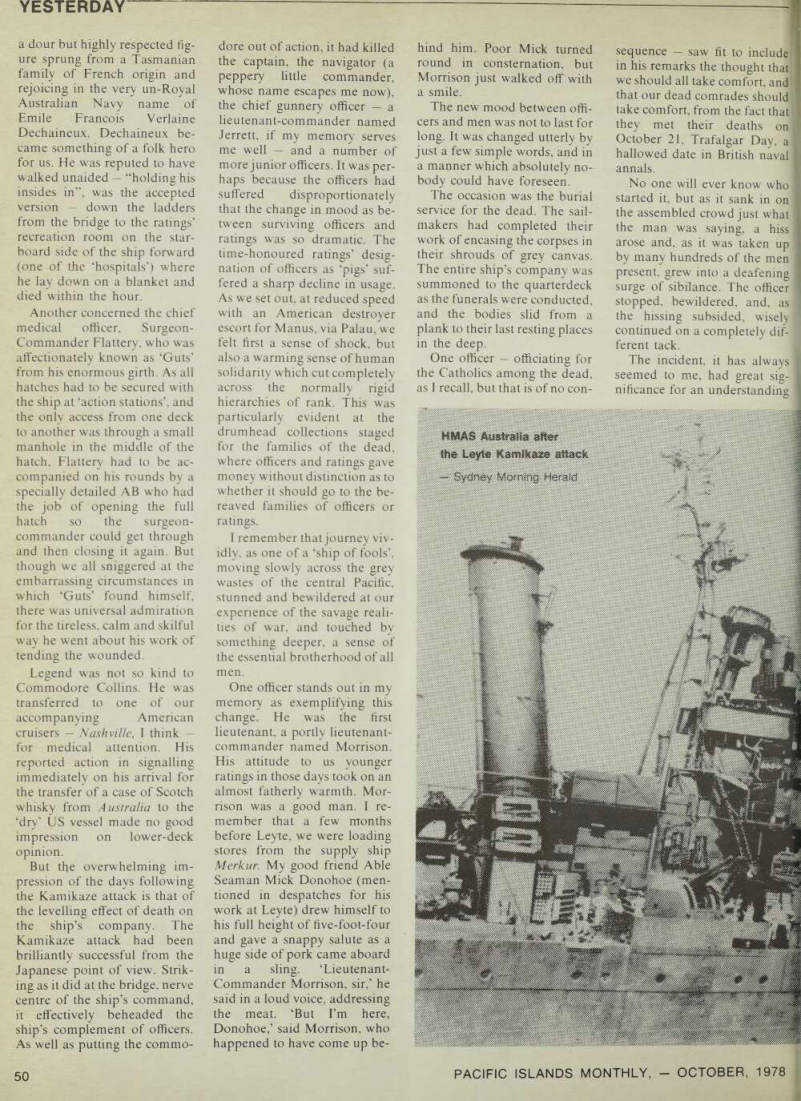
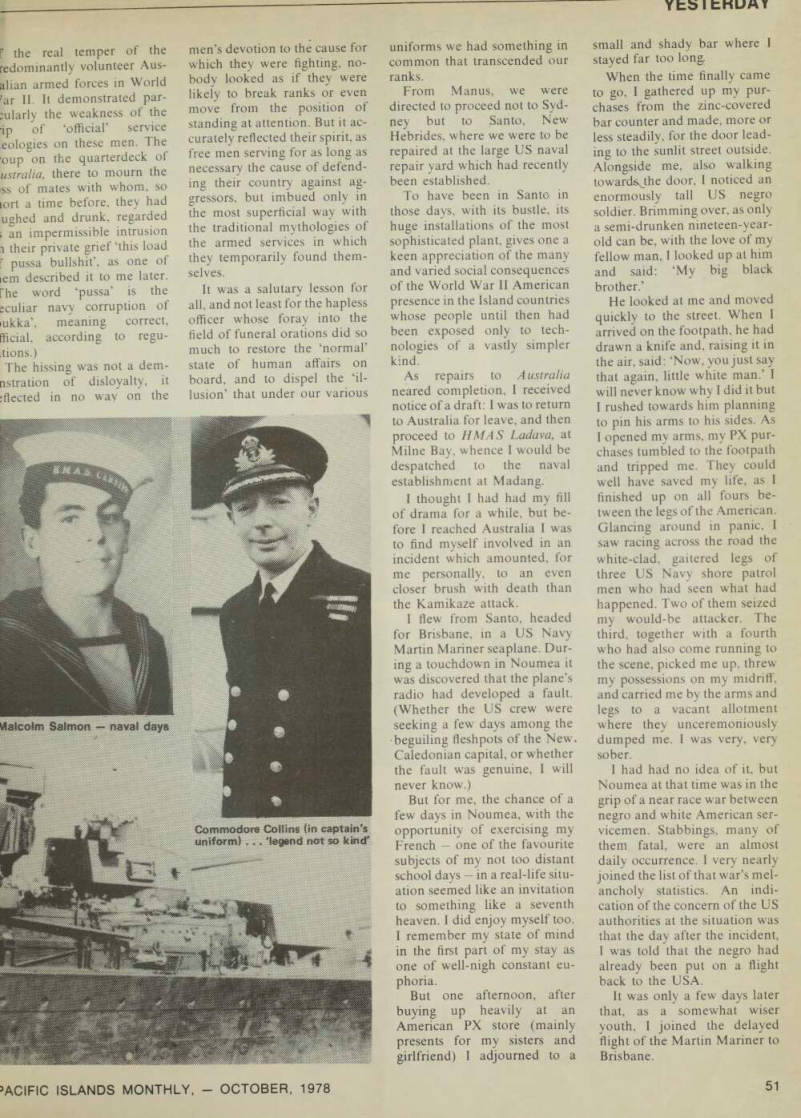
Cruises by order in an Islands paradise lost
listory and my 19-year-old life
ntersected violently on the
corning of October 21, 1944, writes PIM staff writer Mal olm Salmon. A Japanese omber crashed into the fore cast of HMAS Australia, the ruiser in which I was serving at
aeyte Gulf in the Philippines.
Ve were part of the naval forces
overing the first landings of
Imerican troops in the cam aign to take that country back
-om the Japanese.
The event is described as fol )ws in that invaluable volume f record, Pacific Islands Year ook, in its section on the his )ry of the Pacific war; “At ’lark Field, Luzon, on October 0, 1944, the Japanese Ist Air leet formed the first unit of the
[amikaze Special A Hack
’ orps, whose suicide pilots were i crash their bomb-laden Zeke ircraft on enemy installations r warships. The corps was spon
ired by Vice-Admiral Takijiro
ihnishi and the first unit was
ommanded by Lieutenant
r ukio Seki. The first Kamikaze Hack was on the Australian ruiser Australia off the Leyte caches on October 21 ...”
We ratings, sweltering in the owels of the ship over a direc on control table for Aus "alia’s four-inch guns, were ot nearly so well informed, felt a bump, and generally oncluded that the ship had
truck some submerged
bject.
The power supply for our tble having been cut, we were ailed within minutes to the pper deck, but were not told fhy. Still, as we emerged into
le early morning light, we
ould not register what had appened. I remember one of ur group, looking up at the rotesquely bent foremast, say ig: This is a homer.’ He
leant by this that the damage
fas so great that we would cer
tainly have to return to Sydney for a refit, and for leave. He was wrong, as it happened, but I know he regretted what later, in view of the grim nature of what had actually taken place, seemed an inappropriate re mark. My first inkling of the truth was when I saw, a few feet away from me on the deck, the top joint of a human thumb.
There was no blood about it. It
lay there pale and pathetic, but
its message could hardly have been more eloquent.
Our job was to help in the clearing of wreckage and the moving of casualties from the
bridge which, situated just
below the point of impact of the Japanese plane, had been the scene of by far the heaviest casualties. The plane had flown in from astern and struck the foremast with its starboard wing just at the point where it
joined the fuselage.
Let a Sydney newspaper give its account of the event: ‘At 6.5 am on October 21, 1944, watchers in HMAS
Shropshire and USS Blueridge
saw a livid flash offlame in Aus tralia’s foremast. Almost im
mediately a large explosion
ripped the radar hut from its seating and hurled it down on to the bridge and the compass plat
form. Liquid flame from escap
ing aviation petrol fell like fiery rain on the bridge. When the smoke cleared momentarily they saw the ship’s tripod mast bent at a drunken angle. ‘Australia’s bridge was a scene of carnage. The dead and wounded were half buried under
the smoking wreckage of the
radar hut and lantern. Burning petrol cast a fiery shroud over the contorted bodies.
‘Thirty officers and men of the
Royal Australian Navy died with the Japanese pilot. Another
64 were badly wounded. . .’
Its grisly task achieved, the
main body of the plane crashed over the port side of the forecastle into the sea. (I never saw it myself, but the story on board in the days that followed was that one ghoul of an AB he was from Bendigo, in Victoria had retrieved the forearm of the Japanese pilot, still
clutching the bomber’s joy-
stick, and had placed it in a
largejarofformalinasa‘keep-
sake’.)
They were grim and busy
hours for us, manhandling the wounded on stretchers down the narrow ladders from the bridge to the various parts of the ship which had been turned
into impromptu hospitals. I
was one of a group transporting the commodore, Collins, who, we were told, had suffered a collapsed lung from the blast of the explosion. He was evi dently in acute pain and
groaned constantly,
It is hard after 34 years to re member the exact details of that day and those which fol lowed. There is no such dif
ficulty in remembering the
stories - the legends, if you like - that sprung up about them, and became the common cur rency of shipboard conver sation for months afterwards, One concerned the captain,
Captain E.F.V. Dechaineux ... 'a folk hero for us'
a dour but highly respected fig
ure sprung from a Tasmanian family of French origin and rejoicing in the very un-Royal Australian Navy name of Emile Francois Verlaine Dechaineux. Dechaineux be came something of a folk hero for us. He was reputed to have walked unaided “holding his insides in’’, was the accepted version down the ladders from the bridge to the ratings’ recreation room on the star board side of the ship forward (one of the ‘hospitals’) where he lay down on a blanket and died within the hour.
Another concerned the chief medical officer, Surgeon- Commander Flattery, who was affectionately known as ‘Guts’ from his enormous girth. As all hatches had to be secured with the ship at ‘action stations’, and the only access from one deck to another was through a small manhole in the middle of the hatch, Flattery had to be ac companied on his rounds by a specially detailed AB who had the job of opening the full hatch so the surgeon commander could get through and then closing it again. But though we all sniggered at the embarrassing circumstances in which ‘Guts’ found himself, there was universal admiration for the tireless, calm and skilful way he went about his work of tending the wounded.
Legend was not so kind to Commodore Collins. He was transferred to one of our
accompanying American
cruisers Nashville, I think for medical attention. His
reported action in signalling
immediately on his arrival for the transfer of a case of Scotch whisky from Australia to the ‘dry’ US vessel made no good impression on lower-deck
opinion.
But the overwhelming im
pression of the days following
the Kamikaze attack is that of the levelling effect of death on the ship’s company. The Kamikaze attack had been brilliantly successful from the Japanese point of view. Strik ing as it did at the bridge, nerve centre of the ship’s command, it effectively beheaded the
ship’s complement of officers.
As well as putting the commo
dore out of action, it had killed the captain, the navigator (a peppery little commander, whose name escapes me now), the chief gunnery officer a lieutenant-commander named Jerrett, if my memory serves me well and a number of more junior officers. It was per haps because the officers had
suffered disproportionately
that the change in mood as be tween surviving officers and ratings was so dramatic. The
time-honoured ratings’ desig
nation of officers as ‘pigs’ suf fered a sharp decline in usage.
As we set out, at reduced speed with an American destroyer escort for Manus, via Palau, we felt first a sense of shock, but also a warming sense of human
solidarity which cut completely
across the normally rigid
hierarchies of rank. This was particularly evident at the drumhead collections staged for the families of the dead, where officers and ratings gave money without distinction as to whether it should go to the be reaved families of officers or
ratings.
I remember that journey viv idly, as one of a ‘ship of fools’, moving slowly across the grey wastes of the central Pacific, stunned and bewildered at our experience of the savage reali ties of war, and touched by something deeper, a sense of the essential brotherhood of all men.
One officer stands out in my memory as exemplifying this change. He was the first lieutenant, a portly lieutenant commander named Morrison.
His attitude to us younger ratings in those days took on an almost fatherly warmth. Mor rison was a good man. I re member that a few months before Leyte, we were loading stores from the supply ship Merkur. My good friend Able Seaman Mick Donohoe (men tioned in despatches for his work at Leyte) drew himself to his full height of five-foot-four and gave a snappy salute as a huge side of pork came aboard in a sling. ‘Lieutenant- Commander Morrison, sir,’ he said in a loud voice, addressing the meat. ‘But I’m here, Donohoe,’ said Morrison, who happened to have come up be
hind him. Poor Mick turned round in consternation, but Morrison just walked off with a sm il e - The new mood between officers and men was not to last for
long. It was changed utterly by
just a few simple words, and in a manner which absolutely nobody could have foreseen.
The occasion was the burial service for the dead. The sailmakers had completed their work of encasing the corpses in their shrouds of grey canvas.
The entire ship’s company was summoned to the quarterdeck as the funerals were conducted, and the bodies slid from a
plank to their last resting places
in the deep.
One officer - officiating for the Catholics among the dead, as I recall, but that is of no con-
sequence - saw fit to include in his remarks the thought that we should all take comfort, and that our dead comrades should take comfort, from the fact that they met their deaths on October 21, Trafalgar Day, a hallowed date in British naval annals.
No one will ever know who started it, but as it sank in on the assembled crowd just what the man was saying, a hiss arose and, as it was taken up by many hundreds of the men present, grew into a deafening surge of sibilance. The officer stopped, bewildered, and, as
the hissing subsided, wisely
continued on a completely dif ferent tack.
The incident, it has always seemed to me, had great sig nificance for an understanding
HMAS Australia after the Leyte Kamikaze attack - Sydney Morning Herald
f the real temper of the redominantly volunteer Aus alian armed forces in World r ar 11. It demonstrated par :ularly the weakness of the ip of ‘official’ service eologies on these men. The oup on the quarterdeck of ustralia, there to mourn the ss of mates with whom, so lort a time before, they had
ughed and drunk, regarded
; an impermissible intrusion
i their private grief ‘this load
f pussa bullshit’, as one of icm described it to me later, fhe word ‘pussa’ is the gculiar navy corruption of iukka’, meaning correct, fficial, according to regu tions.) The hissing was not a dem nstration of disloyalty, it ffiected in no way on the
men’s devotion to the cause for which they were fighting, no body looked as if they were likely to break ranks or even move from the position of standing at attention. But it ac curately reflected their spirit, as free men serving for as long as necessary the cause of defend mg their country against ag gressors, but imbued only m the most superficial way with the traditional mythologies of the armed services m which they temporarily found them selves.
It was a salutary lesson for all, and not least for the hapless officer whose foray into the field of funeral orations did so much to restore the ‘normal’ state of human affairs on board, and to dispel the il lusion’ that under our various
uniforms we had something in common that transcended our ranks.
From Manus, we were directed to proceed not to Syd ney but to Santo, New Hebrides, where we were to be repaired at the large US naval
repair yard which had recently
been established.
To have been in Santo in those days, with its bustle, its huge installations of the most
sophisticated plant, gives one a
keen appreciation of the many and varied social consequences of the World War II American presence in the Island countries whose people until then had been exposed only to tech
nologies of a vastly simpler
kind.
As repairs to Australia neared completion, I received notice of a draft; I was to return to Australia for leave, and then proceed to HMAS Ladava, at Milne Bay, whence I would be despatched to the naval establishment at Madang.
I thought I had had my fill of drama for a while, but be fore I reached Australia I was to find myself involved in an incident which amounted, for me personally, to an even closer brush with death than the Kamikaze attack.
I flew from Santo, headed for Brisbane, in a US Navy Martin Mariner seaplane. Dur ing a touchdown in Noumea it was discovered that the plane’s radio had developed a fault. (Whether the US crew were seeking a few days among the beguiling fleshpots of the New.
Caledonian capital, or whether the fault was genuine, I will never know.) But for me, the chance of a few days in Noumea, with the
opportunity of exercising my
French one of the favourite subjects of my not too distant school days in a real-life situ ation seemed like an invitation to something like a seventh heaven. I did enjoy myself too.
I remember my state of mind in the first part of my stay as one of well-nigh constant eu
phoria.
But one afternoon, after buying up heavily at an American PX store (mainly presents for my sisters and girlfriend) I adjourned to a
small and shady bar where I stayed far too long.
When the time finally came to go, I gathered up my pur chases from the zinc-covered bar counter and made, more or less steadily, for the door lead ing to the sunlit street outside.
Alongside me, also walking towardsjhe door, I noticed an enormously tall US negro soldier. Brimming over, as only a semi-drunken nineteen-year old can be, with the love of my fellow man, 1 looked up at him and said: ‘My big black brother.’
He looked at me and moved quickly to the street. When I arrived on the footpath, he had drawn a knife and, raising it in the air, said: ‘Now, you just say that again, little white man.’ I will never know why I did it but I rushed towards him planning to pin his arms to his sides. As I opened my arms, my PX pur chases tumbled to the footpath and tripped me. They could well have saved my life, as I finished up on all fours be tween the legs of the American.
Glancing around in panic, 1 saw racing across the road the
white-clad, gaitered legs of
three US Navy shore patrol men who had seen what had happened. Two of them seized my would-be attacker. The third, together with a fourth who had also come running to the scene, picked me up, threw my possessions on my midriff, and carried me by the arms and legs to a vacant allotment
where they unceremoniously
dumped me. I was very, very sober.
I had had no idea of it, but Noumea at that time was in the grip of a near race war between negro and white American ser vicemen. Stabbings, many of them fatal, were an almost daily occurrence. I very nearly joined the list of that war’s mel ancholy statistics. An indi cation of the concern of the US authorities at the situation was that the day after the incident, I was told that the negro had already been put on a flight back to the USA.
It was only a few days later that, as a somewhat wiser
youth, I joined the delayed
flight of the Martin Mariner to Brisbane.
Commodore Collins (in captain's uniform) ... 'legend not so kind'
Malcolm Salmon naval days
Advertisements & other items, pp. 49-52 (2 items)
49
T CO IChUMT
•ACIFIC ISLANDS MONTHLY, - OCTOBER, 1978
Chloride
for all applications
Jr V .1 ip i *
IHRR PUpT
n Chloride is the largest and only manufacturer of both lead acid and nickel cadmium alkaline batteries in Australia.
The Company is equipped and qualified to offer advice, guidance and service on any battery requirement no matter how large or small.
On the question of size, it could be as small as a battery for a hearing aid the dimensions of a coat button or a power station battery weighing as much as 40 tonnes.
Again it could be a no break D.C Power System for a computor or emergency lighting for a hospital The Chloride Company operates in 40 countries throughout the world, and when you consider that in Australia alone its production is approaching VA million batteries per year, it gives some idea of the far reaching role that batteries play in our lives.
Chloride Batteries Australia Limited
P.O. Box 141, Bankstown. N.S.W. 2200. Australia. Telephone; 77 0177. Telex: 21262
Currents
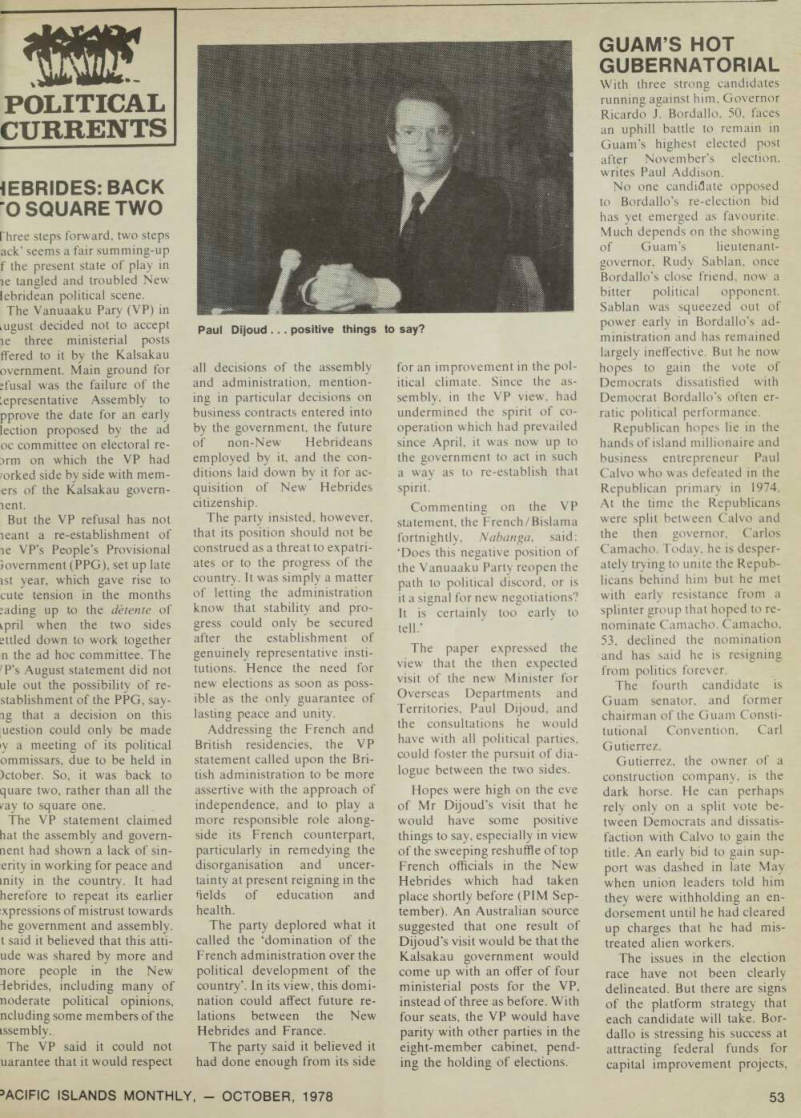
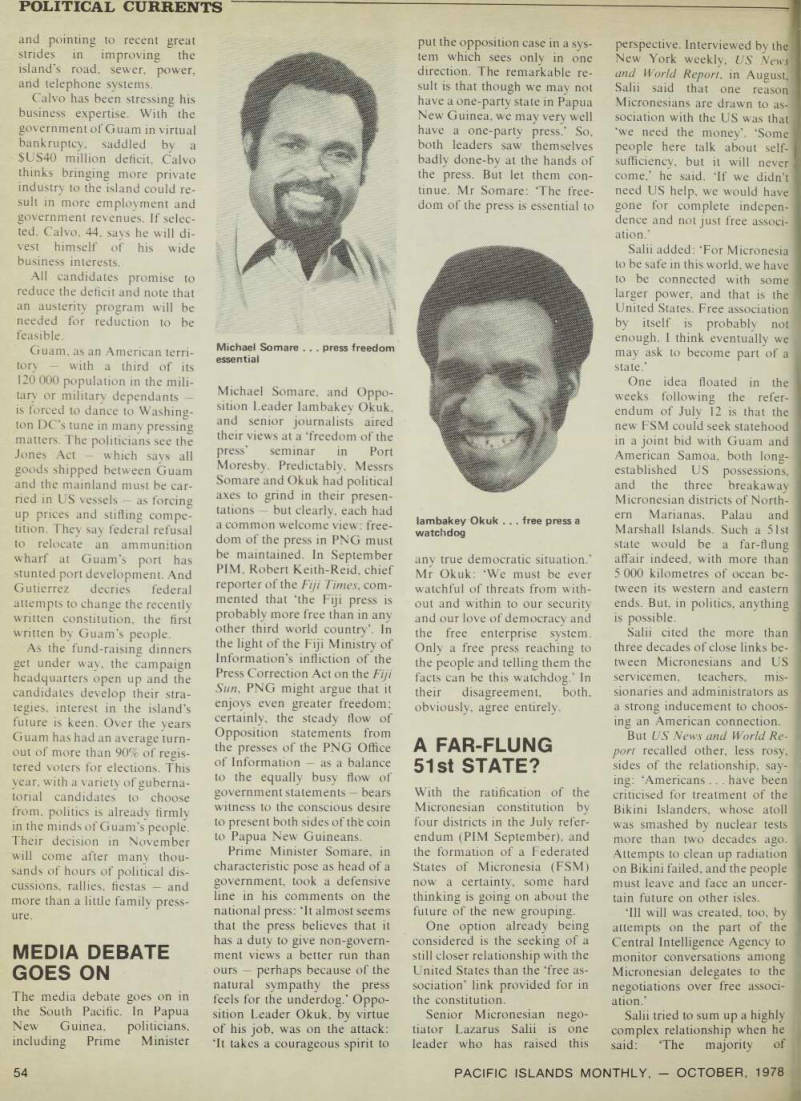
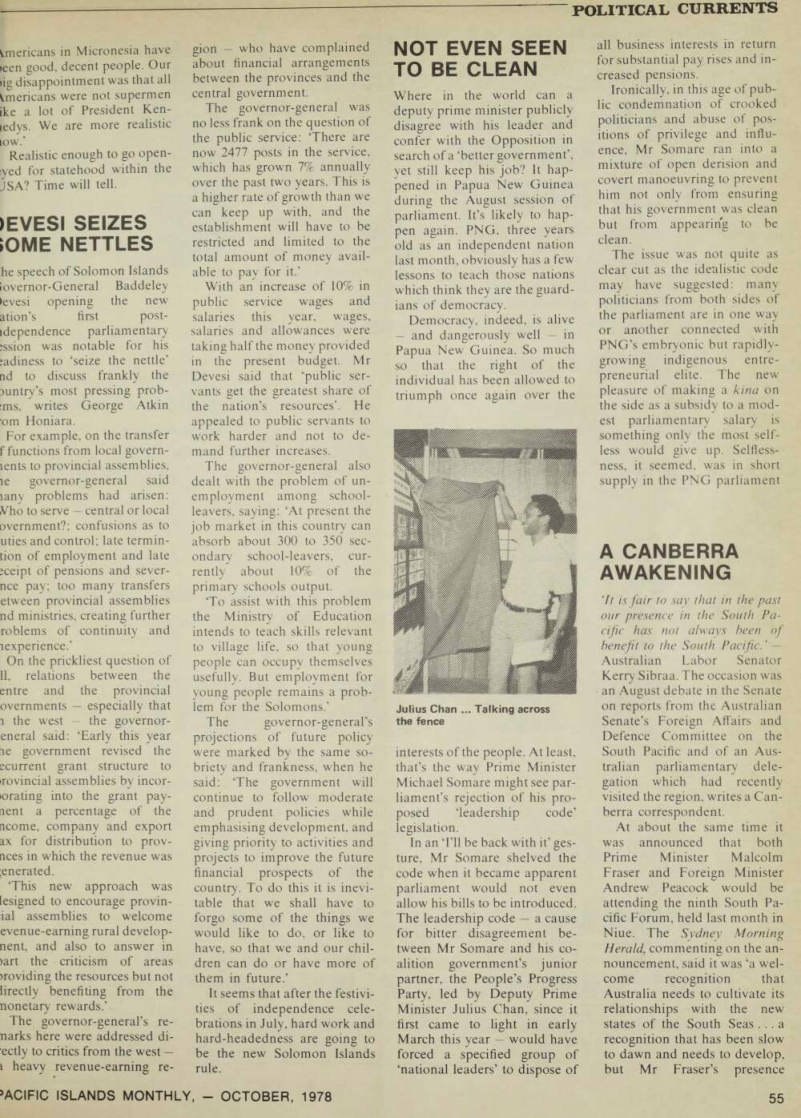

Political
Hebrides: Back
O Square Two
fhree steps forward, two steps ack’ seems a fair summing-up f the present state of play in le tangled and troubled New
lebridean political scene.
The Vanuaaku Pary (VP) in Lugust decided not to accept le three ministerial posts ffered to it by the Kalsakau
ovemment. Main ground for
ffusal was the failure of the
Lepresentative Assembly to
pprove the date for an early lection proposed by the ad oc committee on electoral re :>rm on which the VP had worked side by side with mem ers of the Kalsakau govern icnt.
But the VP refusal has not leant a re-establishment of
le VP’s People’s Provisional
jovernment (PPG), set up late ist year, which gave rise to cute tension in the months wading up to the detente of Lpril when the two sides sttled down to work together n the ad hoc committee. The T’s August statement did not ule out the possibility of re stablishment of the PPG, say ig that a decision on this uestion could only be made
•y a meeting of its political
ommissars, due to be held in )ctober. So, it was back to quare two, rather than all the /ay to square one.
The VP statement claimed hat the assembly and govern nent had shown a lack of sin erity in working for peace and mity in the country. It had herefore to repeat its earlier xpressions of mistrust towards
he government and assembly,
t said it believed that this atti ude was shared by more and nore people in the New
debrides, including many of
noderate political opinions,
ncluding some members of the
issembly.
The VP said it could not uarantee that it would respect
all decisions of the assembly and administration, mention ing in particular decisions on business contracts entered into by the government, the future of non-New Hebrideans employed by it, and the con ditions laid down by it for ac quisition of New Hebrides citizenship.
The party insisted, however, that its position should not be construed as a threat to expatri ates or to the progress of the country. It was simply a matter of letting the administration know that stability and pro gress could only be secured after the establishment of
genuinely representative insti
tutions. Hence the need for new elections as soon as poss ible as the only guarantee of
lasting peace and unity.
Addressing the French and British residencies, the VP statement called upon the Bri tish administration to be more assertive with the approach of independence, and to play a
more responsible role along
side its French counterpart,
particularly in remedying the
disorganisation and uncer tainty at present reigning in the fields of education and health.
The party deplored what it called the ‘domination of the French administration over the
political development of the
country’. In its view, this domi nation could affect future re lations between the New Hebrides and France.
The party said it believed it had done enough from its side
for an improvement in the pol itical climate. Since the as sembly, in the VP view, had undermined the spirit of co
operation which had prevailed
since April, it was now up to the government to act in such a way as to re-establish that
spirit.
Commenting on the VP statement, the French/Bislama fortnightly, Nabanga , said: ‘Does this negative position of the Vanuaaku Party reopen the path to political discord, or is it a signal for new negotiations?
It is certainly too early to tell.’
The paper expressed the view that the then expected visit of the new Minister for Overseas Departments and Territories, Paul Dijoud, and the consultations he would have with all political parties, could foster the pursuit of dia logue between the two sides.
Hopes were high on the eve of Mr Dijoud’s visit that he would have some positive things to say, especially in view of the sweeping reshuffle of top French officials in the New Hebrides which had taken
place shortly before (PIM Sep
tember). An Australian source suggested that one result of Dijoud’s visit would be that the Kalsakau government would come up with an offer of four ministerial posts for the VP, instead of three as before. With four seats, the VP would have parity with other parties in the
eight-member cabinet, pend
ing the holding of elections.
Guam’S Hot
Gubernatorial
With three strong candidates running against him. Governor Ricardo J. Bordallo, 50, faces an uphill battle to remain in Guam’s highest elected post after November’s election, writes Paul Addison.
No one candidate opposed to Bordallo’s re-election bid has yet emerged as favourite.
Much depends on the showing of Guam’s lieutenant governor. Rudy Sablan, once Bordallo’s close friend, now a bitter political opponent.
Sablan was squeezed out of power early in Bordallo’s ad ministration and has remained largely ineffective. But he now hopes to gain the vote of Democrats dissatisfied with Democrat Bordallo’s often er
ratic political performance.
Republican hopes lie in the hands of island millionaire and business entrepreneur Paul Calvo who was defeated in the
Republican primary in 1974.
At the time the Republicans were split between Calvo and the then governor, Carlos Camacho. Today, he is desper
ately trying to unite the Repub
licans behind him but he met with early resistance from a splinter group that hoped to re nominate Camacho. Camacho, 53. declined the nomination and has said he is resigning from politics forever.
The fourth candidate is Guam senator, and former chairman of the Guam Consti tutional Convention, Carl Gutierrez.
Gutierrez, the owner of a construction company, is the dark horse. He can perhaps rely only on a split vote be tween Democrats and dissatis faction with Calvo to gain the title. An early bid to gain sup port was dashed in late May when union leaders told him they were withholding an en dorsement until he had cleared up charges that he had mis treated alien workers.
The issues in the election race have not been clearly delineated. But there are signs of the platform strategy that each candidate will take. Bor dallo is stressing his success at attracting federal funds for
capital improvement projects,
Paul Dijoud . . . positive things to say?
and pointing to recent great strides in improving the island’s road, sewer, power, and telephone systems.
Calvo has been stressing his business expertise. With the government of Guam in virtual
bankruptcy, saddled by a
SUS4O million deficit, Calvo thinks bringing more private industry to the island could re sult in more employment and government revenues. If selec ted, Calvo, 44. says he will di vest himself of his wide business interests.
All candidates promise to reduce the deficit and note that an austerity program will be needed for reduction to be feasible.
Guam, as an American terri tory with a third of its 120 000 population in the mili
tary or military dependants
is forced to dance to Washing ton DC’s tune in many pressing matters. The politicians see the Jones Act which says all goods shipped between Guam and the mainland must be car ried in US vessels - as forcing up prices and stifling compe tition. They say federal refusal to relocate an ammunition wharf at Guam’s port has stunted port development. And Gutierrez decries federal attempts to change the recently written constitution, the first written by Guam’s people.
As the fund-raising dinners get under way, the campaign headquarters open up and the candidates develop their stra tegies, interest in the island’s future is keen. Over the years Guam has had an average turn out of more than 90% of regis tered voters for elections. This year, with a variety of guberna torial candidates to choose
from, politics is already firmly
in the minds of Guam’s people.
Their decision in November will come after many thou sands of hours of political dis cussions, rallies, fiestas and more than a little family press ure.
Media Debate
Goes On
The media debate goes on in the South Pacific. In Papua New Guinea, politicians, including Prime Minister
Michael Somare, and Oppo sition Leader lambakey Okuk, and senior journalists aired their views at a ‘freedom of the press’ seminar in Port
Moresby. Predictably, Messrs
Somare and Okuk had political axes to grind in their presen tations but clearly, each had a common welcome view: free dom of the press in PNG must be maintained. In September PIM. Robert Keith-Reid, chief reporter of the Fiji Times , com mented that ‘the Fiji press is probably more free than in any other third world country’. In the light of the Fiji Ministry of Information’s infliction of the Press Correction Act on the Fiji Sun , PNG might argue that it enjoys even greater freedom; certainly, the steady flow of Opposition statements from the presses of the PNG Office of Information as a balance to the equally busy flow of government statements bears witness to the conscious desire to present both sides of the coin to Papua New Guineans.
Prime Minister Somare, in characteristic pose as head of a government, took a defensive line in his comments on the national press: ‘lt almost seems that the press believes that it has a duty to give non-govern ment views a better run than ours perhaps because of the natural sympathy the press feels for the underdog.’ Oppo sition Leader Okuk, by virtue of his job, was on the attack; ‘lt takes a courageous spirit to
put the opposition case in a sys tem which sees only in one direction. The remarkable re sult is that though we may not have a one-party state in Papua New Guinea, we may very well have a one-party press.’ So, both leaders saw themselves badly done-by at the hands of the press. But let them con tinue. Mr Somare: ‘The free dom of the press is essential to
any true democratic situation.’
Mr Okuk; ‘We must be ever watchful of threats from with out and within to our security and our love of democracy and the free enterprise system.
Only a free press reaching to the people and telling them the facts can be this watchdog.’ In their disagreement, both,
obviously, agree entirely.
A Far-Flung
51St State?
With the ratification of the Micronesian constitution by four districts in the July refer endum (PIM September), and the formation of a Federated States of Micronesia (FSM) now a certainty, some hard thinking is going on about the future of the new grouping.
One option already being
considered is the seeking of a still closer relationship with the United States than the ‘free as sociation’ link provided for in the constitution.
Senior Micronesian nego tiator Lazarus Salii is one leader who has raised this
perspective. Interviewed by the New York weekly, US News and World Report , in August, Salii said that one reason Micronesians are drawn to as sociation with the US was that ‘we need the money’. ‘Some people here talk about self sufficiency, but it will never come,’ he said. ‘lf we didn’t need US help, we would have gone for complete indepen dence and not just free associ ation.’
Salii added; ‘For Micronesia to be safe in this world, we have to be connected with some larger power, and that is the United States. Free association by itself is probably not enough. I think eventually we may ask to become part of a state.’
One idea floated in the weeks following the refer endum of July 12 is that the new FSM could seek statehood in a joint bid with Guam and American Samoa, both long established US possessions, and the three breakaway Micronesian districts of North ern Marianas, Palau and Marshall Islands. Such a 51st state would be a far-flung affair indeed, with more than 5 000 kilometres of ocean be tween its western and eastern ends. But, in politics, anything
is possible.
Salii cited the more than three decades of close links be tween Micronesians and US servicemen, teachers, mis sionaries and administrators as a strong inducement to choos ing an American connection.
But US News and World Re port recalled other, less rosy, sides of the relationship, say ing; ‘Americans .. . have been criticised for treatment of the Bikini Islanders, whose atoll was smashed by nuclear tests more than two decades ago.
Attempts to clean up radiation on Bikini failed, and the people must leave and face an uncer tain future on other isles. ‘lll will was created, too, by attempts on the part of the Central Intelligence Agency to monitor conversations among Micronesian delegates to the negotiations over free associ ation.’
Salii tried to sum up a highly
complex relationship when he
said: ‘The majority of
Michael Somare . . . press freedom essential
Iambakey Okuk . . . free press a watchdog
Americans in Micronesia have
>een good, decent people. Our
ug disappointment was that all Americans were not supermen ike a lot of President Ken ledys. We are more realistic iow.’
Realistic enough to go open :yed for statehood within the JSA? Time will tell.
Levesi Seizes
>Ome Nettles
he speech of Solomon Islands rovernor-General Baddeley levesi opening the new ation’s first post
idependence parliamentary
;ssion was notable for his ;adiness to ‘seize the nettle’ ad to discuss frankly the auntry’s most pressing prob ans, writes George Atkin om Honiara.
For example, on the transfer f functions from local govern
lents to provincial assemblies,
le governor-general said
lany problems had arisen; Vho to serve central or local overnment?; confusions as to uties and control; late termin tion of employment and late jceipt of pensions and sever nce pay; too many transfers etween provincial assemblies nd ministries, creating further roblems of continuity and
lexperience.’
On the prickliest question of 11, relations between the
entre and the provincial
overnments especially that
i the west the governor eneral said; ‘Early this year ic government revised the ecurrent grant structure to provincial assemblies by incor porating into the grant pay lent a percentage of the icome, company and export ax for distribution to prov ices in which the revenue was ;enerated. ‘This new approach was
lesigned to encourage provin
ial assemblies to welcome evenue-earning rural develop nent, and also to answer in >art the criticism of areas >roviding the resources but not
lirectly benefiting from the
nonetary rewards.’
The governor-general’s re narks here were addressed di ectly to critics from the west
i heavy revenue-earning re
gion who have complained
about financial arrangements between the provinces and the central government.
The governor-general was no less frank on the question of the public service: ‘There are now 2477 posts in the service, which has grown 7% annually over the past two years. This is a higher rate of growth than we can keep up with, and the establishment will have to be restricted and limited to the total amount of money avail able to pay for it.’
With an increase of 10% in public service wages and salaries this year, wages, salaries and allowances were taking half the money provided in the present budget. Mr Devesi said that ‘public ser vants get the greatest share of the nation’s resources’. He appealed to public servants to work harder and not to de mand further increases.
The governor-general also dealt with the problem of un employment among school leavers, saying: ‘At present the job market in this country can absorb about 300 to 350 sec ondary school-leavers, cur rently about 10% of the primary schools output. ‘To assist with this problem the Ministry of Education intends to teach skills relevant to village life, so that young people can occupy themselves
usefully. But employment for
young people remains a prob lem for the Solomons.’
The governor-general’s
projections of future policy
were marked by the same so briety and frankness, when he said: ‘The government will continue to follow moderate
and prudent policies while
emphasising development, and
giving priority to activities and projects to improve the future financial prospects of the country. To do this it is inevi table that we shall have to forgo some of the things we would like to do, or like to have, so that we and our chil dren can do or have more of them in future.’
It seems that after the festivi ties of independence cele brations in July, hard work and hard-headedness are going to be the new Solomon Islands rule.
Not Even Seen
To Be Clean
Where in the world can a
deputy prime minister publicly
disagree with his leader and confer with the Opposition in search of a ‘better government’, yet still keep his job? It hap pened in Papua New Guinea during the August session of
parliament. It’s likely to hap
pen again. PNG, three years old as an independent nation last month, obviously has a few lessons to teach those nations which think they are the guard ians of democracy.
Democracy, indeed, is alive and dangerously well in Papua New Guinea. So much so that the right of the individual has been allowed to triumph once again over the
interests of the people. At least, that’s the way Prime Minister Michael Somare might see par liament’s rejection of his pro
posed ‘leadership code’
legislation.
In an ‘l’ll be back with it’ ges ture. Mr Somare shelved the code when it became apparent parliament would not even allow his bills to be introduced.
The leadership code a cause for bitter disagreement be tween Mr Somare and his co
alition government’s junior
partner, the People’s Progress
Party, led by Deputy Prime Minister Julius Chan, since it first came to light in early March this year would have forced a specified group of ‘national leaders’ to dispose of
all business interests in return for substantial pay rises and in
creased pensions.
Ironically, in this age of pub lic condemnation of crooked politicians and abuse of pos itions of privilege and influ ence, Mr Somare ran into a mixture of open derision and covert manoeuvring to prevent him not only from ensuring that his government was clean but from appearing to be clean.
The issue was not quite as clear cut as the idealistic code may have suggested; many politicians from both sides of the parliament are in one way or another connected with
PNG’s embryonic but rapidly
growing indigenous entre
preneurial elite. The new pleasure of making a kina on the side as a subsidy to a mod
est parliamentary salary is
something only the most self less would give up. Selfless ness, it seemed, was in short supply in the PNG parliament
A Canberra
Awakening
7/ is fair to say that in the past our presence in the South Pa
cific has not always been of
benefit to the South Pacific. ’
Australian Labor Senator Kerry Sibraa. The occasion was an August debate in the Senate on reports from the Australian Senate’s Foreign Affairs and Defence Committee on the South Pacific and of an Aus tralian parliamentary dele
gation which had recently
visited the region, writes a Can
berra correspondent.
At about the same time it was announced that both Prime Minister Malcolm Fraser and Foreign Minister Andrew Peacock would be attending the ninth South Pa cific Forum, held last month in Niue. The Sydney Morning Herald, commenting on the an nouncement, said it was ‘a wel come recognition that Australia needs to cultivate its relationships with the new states of the South Seas ... a recognition that has been slow to dawn and needs to develop, but Mr Fraser’s presence
Julius Chan ... Talking across the fence
lould be a convincing earnest
r good intentions’.
In recent years Australia’s jvelopment assistance com itment to the South Pacific is grown considerably but, as e senate committee report ressed, ‘money alone cannot
isure friendship, win respect
necessarily promote
welopment’.
Not surprisingly, the debate velt on the poor image of ustralian commercial iterprises in the Pacific. Gen ally it was felt the image was iproving. There were bou lets for the Bank of New )uth Wales and Burns Philp, hich both gave evidence to e committee, for their localis ion programmes and their
weloping acknowledgement
‘ a commitment to the coun ts in which they were operat g. But of W. R. Carpenters, riich made no submission and d not appear before the com ittee. Senator Sibraa said; ecause it did not, I am afraid has left us with the opinion at its attitude is not the right ie for the South Pacific at the esent time.’
Committee chairman Lib al Senator Peter Sim laid •ess on the need for ‘part ;rship’ in Australia’s ap oach to South Pacific entries and for exchanges at 1 levels, not just among aders.
Predictably, Japanese,
hinese and Russian interest in e region, had sparked height
led parliamentary interest in
e subject.
Senator Sim summed up the
•mmittee reports by saying
at they ‘represent not an :ecutive or a government ew but more importantly a
irliamentary view of foreign
)licy and of the way in which should develop’. In other ords, Australian government terest in the region, which is been intensifying since the of the seventies, is >w being shared by members
parliament generally
hich might even suggest that e consciousness of the Aus
alian public is being stirred,
that happens, Australia can jrhaps look forward to /erhauling the long lead New ealand enjoys in the South
acific goodwill stakes.
Fiji Mps Are
Mike-Shy
Fiji politicians are not anxious that their words should be broadcast to the nation at least those on the government side are not. The government has used its huge majority in the House of Representatives to defeat a motion calling for
the broadcasting of parliamen
tary debates.
Prime Minister Ratu Sir Kamisese Mara suggested a survey might be worthwhile to see if the people really wanted ‘such an assault on their ears by Members of Parliament’. He argued that in the UK, the BBC
had just started broadcasting
debates, and that what went over the air did not always make MPs sound too good.
The Fiji opposition argued
that electors should be educa ted in parliamentary affairs to arouse political and national consciousness, and help end
ignorance and misconceptions
about MPs. Australia and New Zealand had all their debates broadcast, and the British House of Commons had now followed a similar line.
New Zealand pioneered
broadcasting of parliamentary
debates during the first Labour Government (1935-38), and Australia later followed suit.
Experience in both countries has shown that the way many
MPs speak is hardly uplifting
‘assault on the ears’, to use Ratu Sir Kamisese’s phrase, describes it well.
The Majuro, Marshall Islands, newspaper Micronesian Independent, makes this car toon comment on the extreme
political fragmentation of the
various parts of the US Trust Territory of the Pacific Islands.
The Northern Marianas gained separate status in 1976; the dis tricts of Palau and Marshall Islands are now seeking separ ate status for themselves; the four districts of Truk, Yap, Ponape and Kosrae recently ap proved a constitution which will lead them into a Federated States of Micronesia; Guam, at the southern end of the Marianas chain, is in a different situation again it is an unin
corporated territory of the USA.
The idea has now been raised that they should all get together, along with American Samoa, to form the 51st state of the
Usa.
‘Expats’ Get
Some Advice
PNG Office of Information chief, Brian Amini, took a
gentle sideswipe at ‘overseas
people’ employed on the local press when he delivered his paper to a Port Moresby press freedom seminar. Simul taneously he conceded recog nition of the problem that it will be ‘years before Papua New Guinean journalists have
the knowledge and experience
of the world ... or even of our own country ... to write auth
oritatively and objectively on
what is happening from day to day to our nation’.
Noting that a number of young people had already
passed through the University
of PNG’s course for the dip loma of journalism, he remarked: ‘But a certificate does not make a journalist any more than it makes a plumber or a carpenter.’ PNG’s news papers, he said, ‘already suffer from obscure phraseology and the smart headline. Amusing to the educated but largely unin telligible to the average man in the street’.
PNG, he said, in the mean time, would have to continue to employ overseas people ‘to teach and guide our young writers in the ways of the printed media’. He appealed to them ‘not to take advantage of our inexperience’ and for them to ‘learn from the situation they find themselves in. It could be that they too can benefit from our own situation and their writings will be better under stood when they finally leave us’.
Examples he gave: ‘lf by “bi lateral discussions” you mean “talks between two different groups”, then say so. If you are “concerned about the impli cations of some things” and you mean you are “worried about them”; if you are “work
ing out contingency measures”
and you are actually “looking at other ways of doing things”, then isn’t it better to put it that way so more people are able to understand what you are
writing or talking about?’
The Office of Information chief is chairman of a com mittee set up by Media Minis ter Tom Koraea, to look at the feasibility of another national daily newspaper as compe tition for the PNG Post- Courier. One of the terms of reference for the committee is that it is working on the prem ise that no private body or or ganisation is in a position to successfully launch a second daily national newspaper and therefore special consideration must be given to ‘costs involved to the PNG government should it decide to meet initial costs of
establishing a daily news
paper’.
Advertisements & other items, pp. 53-57 (5 items)
53
3 ACIFIC ISLANDS MONTHLY, - OCTOBER, 1978
Political Currents
55
POLITICAL CURRENTS
ACIFIC ISLANDS MONTHLY, - OCTOBER, 1978
frigid[oolrooms
Save hundreds of dollars
on Australia's most efficient
WALK IN, ALUMINIUM
COOLROOMS AND
FREEZE ROOMS!!
Hundreds already installed! The most economical supplementary coolrooms for bottles and food, providing the largest storage capacity of any comparable coolrooms of the same exterior dimensions. Five sizes—from 90-360 cu. ft. capacity; 16 models offering normal temp., two temp., deep freeze, or for pastry and ice storage applications. White vinyl interior, embossed rustproof aluminium exterior.
Q SUPPLIED IN EASY-TO-ERECT, DO-IT-YOURSELF KIT FORM.
AVAILABLE FROM:
AUSTRALIAN NEW CALEDONIA EXPORTS. 363 George St, Sydney,2ooo BRECKWOLDT & CO., Cnr King & George St., Sydney,2ooo HAGEMEYER (A'SIA). 59 Anzac Pde., Kensington,2o33.
GEOFFREY HUGHES & CO., 167 Macquarie St., Sydney,2ooo NELSON & ROBERTSON PTY.LTD., 197 Clarence St., Sydney.2ooo E. RABOT (EXPORTS) PTY. LTD., 67 Castlereagh St., Sydney,2ooo RABTRAD NIUGINI PTY. LTD., PO Box 1406, Lae.
A. RIETTE (PACIFIC) PTY.LTD., 300 George St., Sydney,2ooo C. SULLIVAN (EXPORT) PTY.LTD., GPO Box 3373, Sydney,2ool W.S. TAIT & CO., pty.ltd., 31 Macquarie Place, Sydney,2ooo
Manufactured by:
frigid[oolrooms
FRIGID CABINETS PTY. LTD.,
14A Puffy Ave., Thornleigh, N.S.W. 2120 Aust. Ph. 848 8292. FCI
|Q|B|E
offers expert insurance service
throughout the Islands.
QBE INSURANCE LIMITED
Central Office: 82 Pitt Street, Sydney.
NEW CALEDONIA T.A. Hagen, Ste. lA/.A. Johnston, S.A.R.L. - Noumea.
NEW HEBRIDES District Manager: G.F. Donnelly, Vila; Santo Santo: Burns Phi/p (New Hebrides) Ltd.
TAHITI Arthur Chung: Immeuble B.L, Front de Mer, Papeete.
NIUE, NORFOLK ISLAND, SAMOA, TONGA and other South Sea Islands Burns Phi Ip (South Sea) Company Ltd.
QUEENSLAND INSURANCE (FIJI) LIMITED
Head Office, 34 Usher St., SUVA. General Manager: L.G. Liddell. A.A.1.1.
Assistant Managers: V.J. Lai and J.T. Laidlaw. LAUTOKA Office, Burns Philp Bldg. District Manager: J. Dalton.
QUEENSLAND INSURANCE (P.N.G.) LIMITED
PAPUA NEW GUINEA -
Head Office, PORT MORESBY. General Manager; J.M. Dawe. Assistant Manager: R.V. Masked.
District Managers at: LAE; I.R. Martin. MOUNT HAGEN; D.F. Carroll. ARAWA: J. Longbut. MADANG; R.W.V. Ceilings. RABAUL; W.F. Tinker.
57
x uxii x ivnjj u x o
ACIFIC ISLANDS MONTHLY, - OCTOBER, 1978
Such Ungracious
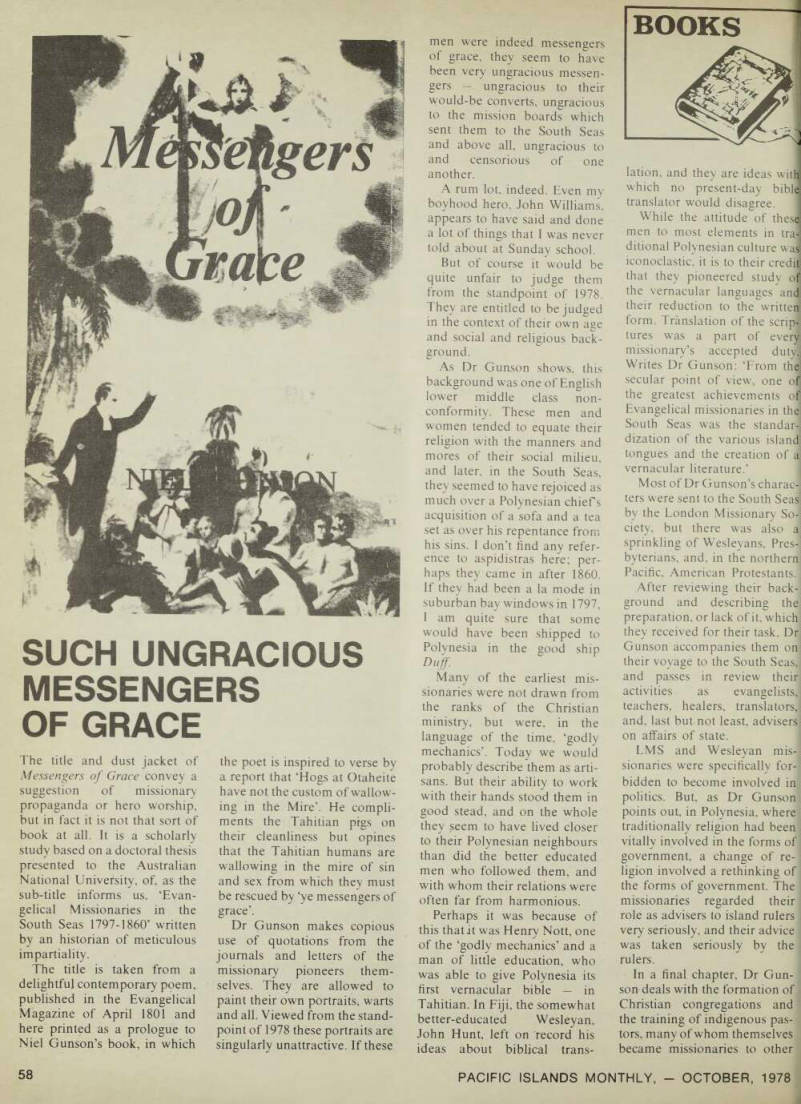
Messengers
Of Grace
The title and dust jacket of Messengers of Grace convey a
suggestion of missionary
propaganda or hero worship,
but in fact it is not that sort of book at all. It is a scholarly study based on a doctoral thesis presented to the Australian National University, of, as the sub-title informs us, ‘Evangelical Missionaries in the South Seas 1797-1860’ written by an historian of meticulous
impartiality.
The title is taken from a delightful contemporary poem,
published in the Evangelical
Magazine of April 1801 and here printed as a prologue to Niel Gunson’s book, in which
the poet is inspired to verse by a report that ‘Hogs at Otaheite have not the custom of wallow ing in the Mire’. He compli ments the Tahitian pigs on their cleanliness but opines that the Tahitian humans are wallowing in the mire of sin and sex from which they must be rescued by ‘ye messengers of
grace’.
Dr Gunson makes copious use of quotations from the journals and letters of the
missionary pioneers them
selves. They are allowed to paint their own portraits, warts and all. Viewed from the stand point of 1978 these portraits are singularly unattractive. If these
men were indeed messengers of grace, they seem to have been very ungracious messen gers ungracious to their would-be converts, ungracious to the mission boards which sent them to the South Seas and above all, ungracious to and censorious of one another.
A rum lot, indeed. Even my boyhood hero, John Williams, appears to have said and done a lot of things that I was never told about at Sunday school.
But of course it would be quite unfair to judge them from the standpoint of 1978.
They are entitled to be judged in the context of their own age and social and religious back ground.
As Dr Gunson shows, this background was one of English lower middle class non conformity. These men and women tended to equate their religion with the manners and mores of their social milieu, and later, in the South Seas, they seemed to have rejoiced as much over a Polynesian chiefs acquisition of a sofa and a tea set as over his repentance from his sins. I don’t find any refer ence to aspidistras here; per haps they came in after 1860.
If they had been a la mode in suburban bay windows in 1797, I am quite sure that some would have been shipped to Polynesia in the good ship
Duff.
Many of the earliest mis sionaries were not drawn from the ranks of the Christian ministry, but were, in the language of the time, ‘godly mechanics’. Today we would probably describe them as arti sans. But their ability to work with their hands stood them in good stead, and on the whole they seem to have lived closer
to their Polynesian neighbours
than did the better educated men who followed them, and with whom their relations were often far from harmonious.
Perhaps it was because of this that it was Henry Nott, one of the ‘godly mechanics’ and a man of little education, who was able to give Polynesia its first vernacular bible in Tahitian. In Fiji, the somewhat better-educated Wesleyan, John Hunt, left on record his ideas about biblical trans-
Books
lation, and they are ideas witJ which no present-day bible translator would disagree.
While the attitude of thesa men to most elements in tral ditional Polynesian culture was iconoclastic, it is to their credit that they pioneered study of the vernacular languages and their reduction to the written form. Translation of the scripi tures was a part of every
missionary’s accepted duty!
Writes Dr Gunson; ‘From the secular point of view, one of the greatest achievements of Evangelical missionaries in the South Seas was the standard dization of the various island tongues and the creation of a vernacular literature.’
Most of Dr Gunson’s charac-l ters were sent to the South Sead by the London Missionary Son ciety, but there was also a
sprinkling of Wesleyans, Pres-I
byterians, and, in the northern Pacific, American Protestants.
After reviewing their back-!
ground and describing the
preparation, or lack of it, which] they received for their task. Dr Gunson accompanies them on their voyage to the South Seas, and passes in review their activities as evangelists, teachers, healers, translators, and, last but not least, advisers on affairs of state.
LMS and Wesleyan mis sionaries were specifically for bidden to become involved in politics. But, as Dr Gunson points out, in Polynesia, where
traditionally religion had been
vitally involved in the forms of' government, a change of re ligion involved a rethinking of the forms of government. The missionaries regarded their role as advisers to island rulers very seriously, and their advice was taken seriously by the rulers.
In a final chapter, Dr Gun son deals with the formation of , Christian congregations and the training of indigenous pas tors, many of whom themselves became missionaries to other
land groups, and later on to
iraway Melanesia.
‘lt was in training up a native *ency,’ concludes Dr Gunson, nd in extending the churches irough these men, that the iissionaries both established leir work and enabled the lurch to take more of its
laracter from the indigenous
>ciety.’
Messengers of Grace is a sub antial and stoutly bound vol ne of more than 300 pages.
plus some well-produced illus
trations and maps, and a further 100 pages of appen dices. notes, bibliography and index. Its recommended Aus tralian price of $25 may deter some, but I hope that it will find its way into libraries throughout the Pacific and be yond. It is much to be corn
mended.
Percy Chatterton
(Messengers of Grace. Niel Gunson. Pub lished by Oxford University Press, Mel bourne. 5A25.)
Who’S Who In Png’S
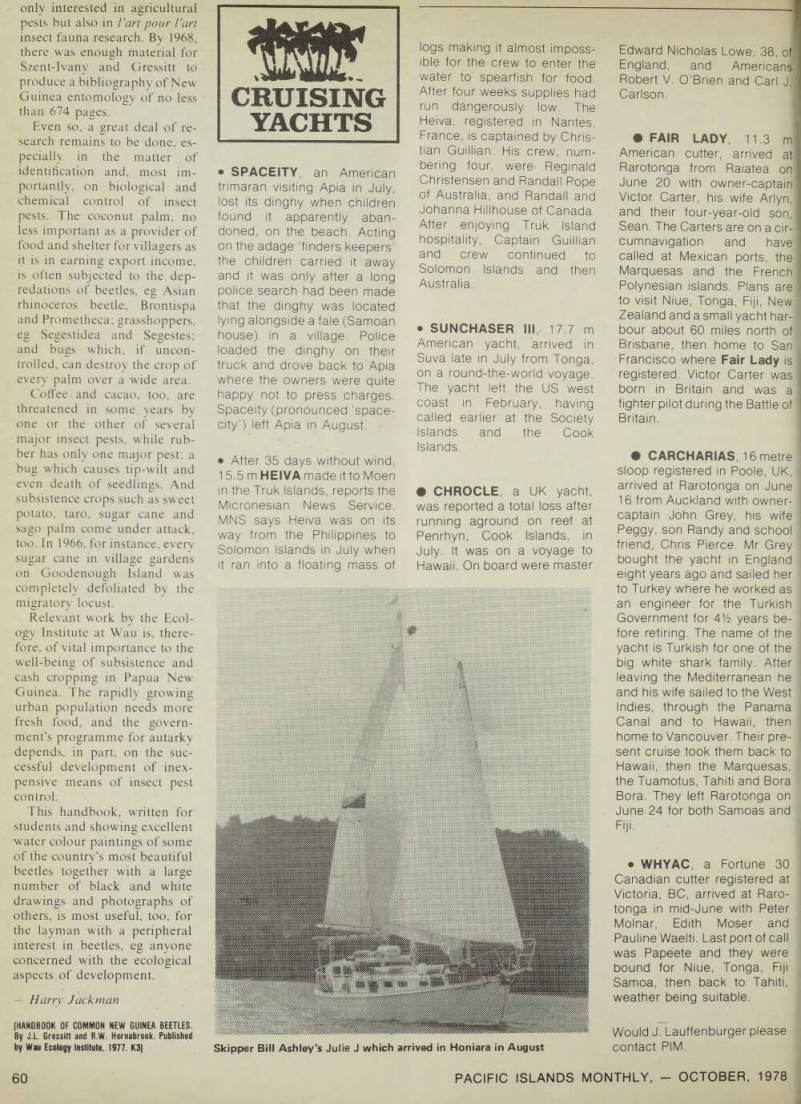
World Of Bugs
And Beetles
Sponsored by the Bishop
[useum of Honululu. the Wau oology Institute, situated in e highlands of the Morobe rovince of Papua New uinea, promotes education
ir ecology and conservation,
here is a large arboretum of itive plants, a zoo, a small useum, and some facilities •r research. Members and col borators of the Institute
idertake ecological studies.
One of the Institute’s recent Liblications is the Handbook of ommon New Guinea Beetles, >mpiled by J.L. Gressitt, the istitute’s director, and R.W. omabrook, one-time director f the Institute of Medical Re :arch and then professor of icdicine in the University of apua New Guinea.
The handbook covers the itire island of New Guinea id nearby islands but it deals tily with selected represen itives of the more than 25 000 )ecies. About one-third of the ell over 100 families of the
rder Coleoptera (beetles)
ave been selected, but they in ude about 90% of the kinds of eetles that the average student
light find without using
lecial methods for the very
nail species.
The authors point out that mch of the work on New Guinea’s beetles has been done n collections by German, Bri sh, Hungarian, French and
talian expeditions, and that
ustralians, Americans, Japan
ese. New Zealanders, Indo nesians and Papua New Guineans are relative new comers in the field.
Entomology got off to a splendid start through the field work of D’Albertis, Denton and a handful of intrepid people in the 1870 s and Ger man scientists prior to 1914.
Apart from Evelyn Cheesman, an incredible Englishwoman whose biography is long over due, little of note was accomplished between the two World Wars, except for J.L.
Froggett and B.A. O’Connor and a few others who were
engaged in commercially
orientated research, eg on coconut pests.
Since 1945, there has been an upsurge in entomological activities, with J.J.H. Szent- Ivany the first government entomologist, who was not
only interested in agricultural pests but also in Van pour Vart insect fauna research. By 1968, there was enough material for Szent-Ivany and Gressitt to produce a bibliography of New Guinea entomology of no less than 674 pages.
Even so, a great deal of re search remains to be done, es pecially in the matter of identification and, most im
portantly, on biological and
chemical control of insect pests. The coconut palm, no less important as a provider of food and shelter for villagers as it is in earning export income, is often subjected to the dep redations of beetles, eg Asian rhinoceros beetle, Brontispa and Prometheca; grasshoppers, eg Segestidea and Segestes; and bugs which, if uncon trolled, can destroy the crop of every palm over a wide area.
Coffee and cacao, too, are threatened in some years by one or the other of several major insect pests, while rub ber has only one major pest; a bug which causes tip-wilt and even death of seedlings. And subsistence crops such as sweet potato, taro, sugar cane and sago palm come under attack, too. In 1966, for instance, every sugar cane in village gardens on Goodenough Island was
completely defoliated by the
migratory locust.
Relevant work by the Ecol ogy Institute at Wau is, there fore, of vital importance to the well-being of subsistence and cash cropping in Papua New
Guinea. The rapidly growing
urban population needs more fresh food, and the govern ment’s programme for autarky depends, in part, on the suc cessful development of inex pensive means of insect pest control.
This handbook, written for students and showing excellent water colour paintings of some of the country’s most beautiful beetles together with a large number of black and white
drawings and photographs of
others, is most useful, too, for the layman with a peripheral interest in beetles, eg anyone concerned with the ecological aspects of development.
Harry Jackman
(Handbook Of Common New Guinea Beetles.
By J.L Gressitt and R.W. Hornabrook. Published by Wau Ecology Institute. 1977. K 3)
Advertisements & other items, p. 59 (2 items)
59
ACIFIC ISLANDS MONTHLY, - OCTOBER, 1978
your costs.
Put up
Tanalised Pine Poles
and down come
your costs.
Clean, durable, rot and termite protected power, telegraph and building poles. Pressure treated in depth with Tanalith’ C.C.A. wood preservative to give unequalled durability and service.
N.Z.’s largest pole and pile producer can offer prompt delivery ex-stock for standard sizes or within weeks meet special orders, ready for shipping to all South Pacific Islands.
analised
imber
Send now for more details to: Hickson’s Timber Impregnation Co. (N.Z.) Ltd P.O. Box 37-240, Auckland, N.Z.
Tanalith’ and Tanalised’ Timber are registered trademarks.
HENRY LAWSON'S
BOOKSHOP
531 Royal Arcade, (Beneath Sydney Hilton) Pitt through to George St.,
SYDNEY, 2000.
Phone; 61 2365.
WE STOCK ONLY
AUSTRALIAN BOOKS
AND BOOKS ON
OCEANIA!
Write to us for sp-ac’ralist atte n iion
Cruising
Yachts
• SPACEITY an American trimaran visiting Apia in July, lost its dinghy when children found it apparently aban doned, on the beach. Acting on the adage ‘finders keepers’ the children carried it away and it was only after a long police search had been made that the dinghy was located lying alongside a fale (Samoan house) in a village. Police loaded the dinghy on their truck and drove back to Apia where the owners were quite happy not to press charges.
Spaceity (pronounced ‘space city’) left Apia in August. • After 35 days without wind, 15.5 m HEIVA made it to Moen in the Truk Islands, reports the Micronesian News Service.
MNS says Heiva was on its way from the Philippines to Solomon Islands in July when it ran into a floating mass of
logs making it almost imposs ible for the crew to enter the water to spearfish for food.
After four weeks supplies had run dangerously low. The Heiva, registered in Nantes, France, is captained by Chris tian Guillian. His crew, num bering four, were Reginald Christensen and Randall Pope of Australia, and Randall and Johanna Hillhouse of Canada.
After enjoying Truk Island hospitality, Captain Guillian and crew continued to Solomon Islands and then Australia.
• Sunchaser 111, 17.7 M
American yacht, arrived in Suva late in July from Tonga, on a round-the-world voyage.
The yacht left the US west coast in February, having called earlier at the Society Islands and the Cook Islands. • CHROCLE, a UK yacht, was reported a total loss after running aground on reef at Penrhyn, Cook Islands, in July. It was on a voyage to Hawaii. On board were master
Edward Nicholas Lowe, 38, of England, and Americans Robert V. O’Brien and Carl J.
Carlson.
• Fair Lady, 113 M
American cutter, arrived at Rarotonga from Raiatea on June 20 with owner-captain Victor Carter, his wife Arlyn, and their four-year-old son, Sean. The Carters are on a cir cumnavigation and have called at Mexican ports, the Marquesas and the French Polynesian islands. Plans are to visit Niue, Tonga, Fiji, New Zealand and a small yacht har bour about 60 miles north of Brisbane, then home to San Francisco where Fair Lady is registered. Victor Carter was born in Britain and was a fighter pilot during the Battle of Britain. • CARCHARIAS, 16 metre sloop registered in Poole, UK, arrived at Rarotonga on June 16 from Auckland with owner captain John Grey, his wife Peggy, son Randy and school friend, Chris Pierce. Mr Grey bought the yacht in England eight years ago and sailed her to Turkey where he worked as an engineer for the Turkish Government for AVz years be fore retiring. The name of the yacht is Turkish for one of the big white shark family. After leaving the Mediterranean he and his wife sailed to the West Indies, through the Panama Canal and to Hawaii, then home to Vancouver, Their pre sent cruise took them back to Hawaii, then the Marquesas, the Tuamotus, Tahiti and Bora Bora. They left Rarotonga on June 24 for both Samoas and Fiji. • WHYAC, a Fortune 30 Canadian cutter registered at Victoria, BC, arrived at Raro tonga in mid-June with Peter Molnar, Edith Moser and Pauline Waelti. Last port of call was Papeete and they were bound for Niue, Tonga, Fiji Samoa, then back to Tahiti, weather being suitable.
Would J. Lauffenburger please contact PIM.
Skipper Bill Ashley's Julie J which arrived in Honiara in August
Let’S Use
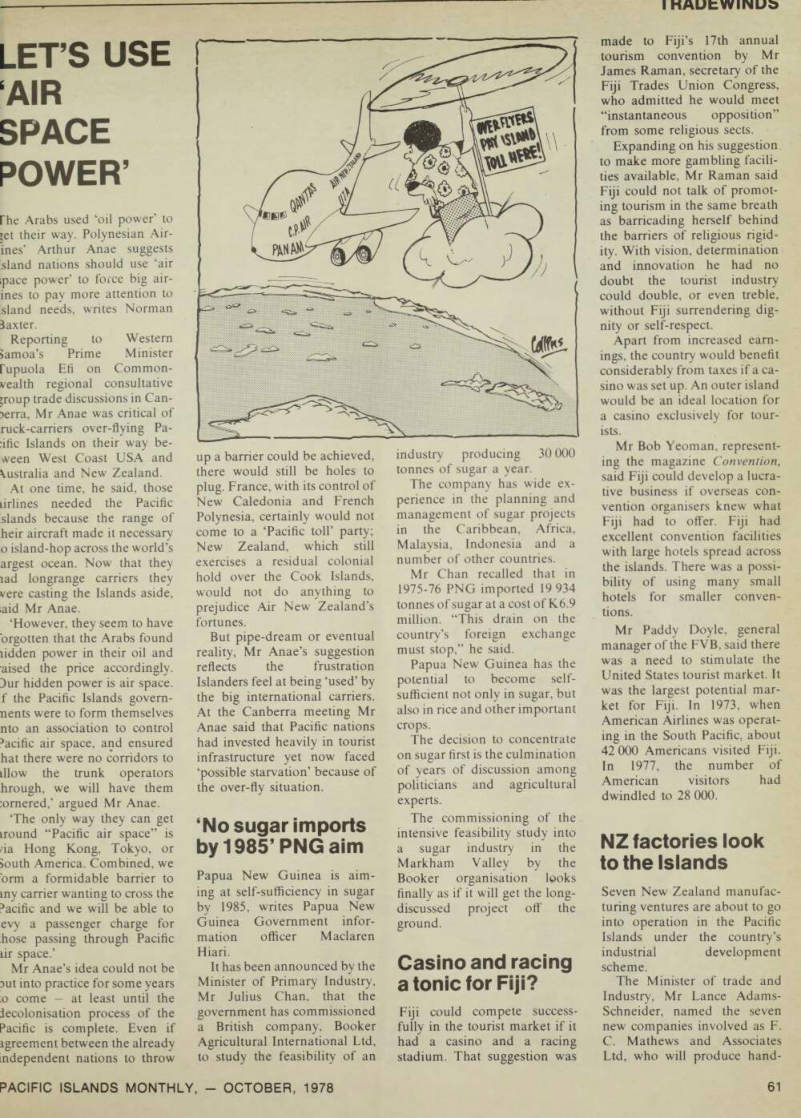

[?]'Air
Space
Power’
fhe Arabs used ‘oil power’ to jet their way. Polynesian Air ines’ Arthur Anae suggests island nations should use ‘air ipace power’ to force big air ines to pay more attention to island needs, writes Norman Jaxter.
Reporting to Western Samoa’s Prime Minister fupuola Efi on Common
vealth regional consultative
jroup trade discussions in Can berra, Mr Anae was critical of ruck-carriers over-flying Pa cific Islands on their way be ween West Coast USA and Australia and New Zealand.
At one time, he said, those drlines needed the Pacific slands because the range of heir aircraft made it necessary o island-hop across the world’s argest ocean. Now that they
lad longrange carriers they
vere casting the Islands aside, ;aid Mr Anae. ‘However, they seem to have brgotten that the Arabs found ridden power in their oil and
aised the price accordingly.
Dur hidden power is air space, f the Pacific Islands govern nents were to form themselves nto an association to control s acific air space, and ensured hat there were no corridors to illow the trunk operators hrough, we will have them
xbmered,’ argued Mr Anae.
‘The only way they can get iround “Pacific air space” is
n a Hong Kong, Tokyo, or
South America. Combined, we brm a formidable barrier to my carrier wanting to cross the Pacific and we will be able to evy a passenger charge for
hose passing through Pacific
dr space.’
Mr Anae’s idea could not be but into practice for some years ;o come at least until the decolonisation process of the Pacific is complete. Even if
igreement between the already
independent nations to throw
up a barrier could be achieved, there would still be holes to plug. France, with its control of New Caledonia and French
Polynesia, certainly would not
come to a ‘Pacific toll’ party; New Zealand, which still exercises a residual colonial hold over the Cook Islands, would not do anything to prejudice Air New Zealand’s fortunes.
But pipe-dream or eventual
reality, Mr Anae’s suggestion
reflects the frustration Islanders feel at being ‘used’ by the big international carriers.
At the Canberra meeting Mr Anae said that Pacific nations had invested heavily in tourist infrastructure yet now faced ‘possible starvation’ because of the over-fly situation.
‘No sugar imports
by 1985’ PNG aim
Papua New Guinea is aim ing at self-sufficiency in sugar by 1985, writes Papua New Guinea Government infor mation officer Maclaren Hiari.
It has been announced by the Minister of Primary Industry, Mr Julius Chan, that the government has commissioned a British company, Booker Agricultural International Ltd, to study the feasibility of an
industry producing 30 000
tonnes of sugar a year.
The company has wide ex perience in the planning and management of sugar projects in the Caribbean, Africa, Malaysia, Indonesia and a number of other countries.
Mr Chan recalled that in 1975-76 PNG imported 19 934 tonnes of sugar at a cost of K 6.9 million. “This drain on the
country’s foreign exchange
must stop,” he said.
Papua New Guinea has the potential to become self sufficient not only in sugar, but also in rice and other important crops.
The decision to concentrate on sugar first is the culmination of years of discussion among
politicians and agricultural
experts.
The commissioning of the intensive feasibility study into a sugar industry in the
Markham Valley by the
Booker organisation looks finally as if it will get the long discussed project off the
ground.
Casino and racing
a tonic for Fiji?
Fiji could compete success fully in the tourist market if it had a casino and a racing stadium. That suggestion was
made to Fiji’s 17th annual tourism convention by Mr James Raman, secretary of the Fiji Trades Union Congress, who admitted he would meet
“instantaneous opposition”
from some religious sects.
Expanding on his suggestion
to make more gambling facili ties available, Mr Raman said Fiji could not talk of promot ing tourism in the same breath as barricading herself behind the barriers of religious rigid ity. With vision, determination and innovation he had no doubt the tourist industry could double, or even treble,
without Fiji surrendering dig
nity or self-respect.
Apart from increased earn ings, the country would benefit considerably from taxes if a ca sino was set up. An outer island would be an ideal location for a casino exclusively for tour ists.
Mr Bob Yeoman, represent
ing the magazine Convention,
said Fiji could develop a lucra tive business if overseas con vention organisers knew what Fiji had to offer. Fiji had excellent convention facilities with large hotels spread across the islands. There was a possi bility of using many small hotels for smaller conven tions.
Mr Paddy Doyle, general
manager of the FVB, said there was a need to stimulate the United States tourist market. It was the largest potential mar ket for Fiji. In 1973, when American Airlines was operat ing in the South Pacific, about 42 000 Americans visited Fiji.
In 1977, the number of American visitors had dwindled to 28 000.
NZ factories look
to the Islands
Seven New Zealand manufac turing ventures are about to go into operation in the Pacific Islands under the country’s
industrial development
scheme.
The Minister of trade and Industry, Mr Lance Adams- Schneider, named the seven new companies involved as F.
C. Mathews and Associates Ltd, who will produce hand
wn soccer balls in Tonga, >tter Brown Ltd, opening an [hesive manufacturing oper ion in Fiji, Mortco Holdings d, assisting a venture in the X)k Islands that will make rrugated roofing iron and
her metal products, Butland
dustries Ltd, which is form g a joint venture with ilthan International Ltd, in ji, to process ginger, Roth ans Industries Ltd, which will tablish a cigarette industry in estem Samoa, W. F. Tucker id Co Ltd, which will be volved in food processing in ji, and SMI (New Zealand (port Promotions Ltd) which ill operate a dairy foods louring process in Western imoa.
barter for Guam
orkers’ rights
aited States Department of ibor officials and the Inter
itional Union of Operating
igineers have signed a con
)versial training contract
signed to give construction
dustry skills to Guam’s Drkers.
About SUS4SO 000 in federal nds will be used to mount the ng-delayed programme. The ntract signing marked the ilmination of an 11-month in stigation into abuse of immi ation regulations and work les on the island by a group Hawaiian and Asian con actors.
Guam’s construction indus y, which is booming in the ce of millions of dollars of ist-Typhoon Pamela recon
ruction, employs mostly alien
orkers from the Philippines
id Korea. The training pro amme is designed to increase ie number of local workers in instruction and to phase out ie alien labourers.
“The present situation in uam has been an embarrass icnt for the United States rovemment in light of our irrent concern on human ghts,” said Jay Turner, gen ral president of the Inter
ational Union of Operating
ngineers, at the signing cer mony in San Francisco in lay. “It’s difficult to press for uman rights on an inter
national level when some of those very same violations are occurring in our own back
yard.”
Besides the training pro gramme contracts, the US Labor Department has introduced a scheme that hikes construction workers’ wages every six months until Sep tember, 1979. Construction workers on the island now earn a minimum of $4 an hour.
Sea Princess
infer Arcadia
The Sea Princess, the newest ship in the P&O cruise fleet will go into service next Feb ruary. It will take over the pro
gramme previously planned
for the Arcadia which will be laid up temporarily in Hong
Kong.
The Sea Princess can accom modate 840 passengers. Each cabin has a private bathroom,
air-conditioning, a telephone
and two music channels. There are three swimming pools, one indoors. Other facilities in clude sauna baths and massage
services, a gymnasium, golf
driving range, cinema theatre, night club, card room, shop,
boutique, casino, beauty salon,
barber shop, bars, lounges,
children’s playroom and a
wading pool.
Defence role for
trainee pilots
There are still deficiencies in
training Papuan New Guinea
aircraft pilots, the PNG Minis ter for Transport, Bruce,Jeph cott, said in Parliament in reply
to questions by lambakey
Okuk, Leader of the Oppo sition. Mr Jephcott said one of the main problems was the environment in which pilots trained.
The Australian environment was different from that of PNG and PNG pilots who com pleted their course found it hard to adjust to the environ ment of their own country, he said. An approach would be made to the Defence Minister, Mr Louis Mona, about setting up combined Defence Force- Civil Aviation training for
pilots.
Advertisements & other items, pp. 62-66 (3 items)
Portals
Houseman Service to Industry
w~ ■jSt'sv- .
BoUer systems
The highest standard of Water Treatment is essential.
For both external and Internal water needs, Houseman Hegro has an unrivalled range and coupled with our dosing and control equipment ensures trouble free and efficient boiler systems operation.
Cooling systems
Corrosion, scale deposition and microbiological growth can seriously reduce the efficency of cooling systems and with inadequate treatment can ultimately cause shutdowns and consequent loss of production.
The Houseman Hegro range of chemical treatments are specifically formulated to suit any conditions of water and cooling system design, whether open or closed.
Air Conditioning Systems
Air conditioning systems are becoming increasingly sophisticated. Houseman Hegro's technology and experience have kept pace with this progress so that we provide a total range of treatments for the prevention and control of scale, corrosion and biological contamination within all the complex open and closed water circuits of the modern plant.
Other Requirements
Potable Water Supplies
Sewage & Effluent
Industrial Water
Reverse Osmosis
Ultra-filtration,Chemical Dosing
Demineralisers, Softeners. Etc. etc.
IN SHORT - - - TOTAL SERVICE.
Portals
Portals Water Treatment (NZ) Ltd P.O. Box 13-558. Auckland 6. New Zealand Candy House, 11 Spring Street, Onehunga, Auckland Telephone: 661-079 (7 lines) Telex: NZ 21175 Telegrams: Portals Auckland.
PCI-PATERSON CANDY, PERMUTIT, BOBY, STELLA-MET A
PORTACEL* HOUSEMAN - ALL PORTALS GROUP.
3396
PARKER & CO. LTD.
BOX 12545
AUCKLAND, N.Z
METAL FASTENER SPECIALISTS
A
CABLES 'HYLPARK'
i & Mk a & I t * o © © a v o
World Wide
Finance
Corporation
PTY. LTD.
FOR;
EQUITY PARTICIPATION
DEVELOPMENT FUNDING
RE FINANCE, OFF-SHORE FUNDING
JOINT VENTURES
COMPETITIVE INTEREST RATES
INQUIRIES:
P.O. BOX 2397, BRISBANE.
PHONE: (07) 221 7151.
A.H. 378 3341.
, y;
FOR SALE
nA>vrEScucr i mi
i < ai \
(FREEHOLD PROPERTY)
Residence Flat Shop Workshop Slipway Pontoons & Jetties Moorings Cruisers & Hire Boats Work Barge
PLANT AND STOCK
For more particulars, write or phone
HAWKESBURY RIVER BOATS
McKell Park, Brooklyn, N.S.W. 2253.
Telephone (02) 455 1252.
Our Kitset Houses manufactured to your design or requirements are available for
delivery and local assembly competitively
anywhere in the Pacific,, Units can come complete with plumbing and electrical wiring and be manpacked into the most inaccessible areas if required.
We can also cater for classrooms, hospital wards, dispensaries, etc. Our precut colour coded and numbered framing units means less skilled labour on site as initial cutting, fitting, etc., has been done in our factory.
We will design and/or help you to set up your own manufacturing facilities utilising local labour and resources on a joint venture basis.
FOR FURTHER INFORMATION WRITE TO:—
STEWART
TIMBER & HARDWARE LTD.
EXPORT DIVISION
P.O. BOX 488, WHANGAREI. NEW ZEALAND.
GOULBURN VALLEY CANNERS
PTY. LTD.
'it’s your choice! Ardmona orS.P.C., where the good fruit comes from!” ’
Suppliers of a full range of S.P.C. and ARDMONA brand canned fruit.
S.P.C. canned vegetables, canned Abalone and
MONBULK jam.
ORDERS RECEIVED THROUGH YOUR
LOCAL AGENT
SPC
i V The full range is continuously promoted by radio & press advertising throughout Papua New Guinea, Noumea and other island markets, with full backup of instore merchandising material.
FOR ENQUIRIES CONTACT
GOULBURN VALLEY CANNERS
PTY. LTD.
124 EXHIBITION STREET, MELBOURNE 3000,
AUSTRALIA
HENRY CUMINES
PTY. LTD.
EXPORTERS o GENERAL MERCHANTS
428 GEORGE ST., SYDNEY
CABLES: HENCO SYDNEY. G.P.O. Box 3949. PHONE: 25-3383.
For specialised and personalised buying service
throughout the Pacific Islands and the East.
LOCAL AGENTS AND REPRESENTATION:
PAPUA NEW GUINEA.
PORT MORESBY: Mr. Tan
P.O. Box 5445, Boroko.
Telephone 25 2542.
RABAUL: M. & C. Seeto, P.O. Box 131, Rabaul.
Telephone 92 2902.
MADANG: W. Double, P.O. Box 22, Madang.
Telephone 82 2696.
NEW HEBRIDES.
John Lum & Associates, P.O. Santo.
Telephone 329.
K. Witherington Ltd P.O. Box 293, Suva.
Telephone 22 356.
FIJI.
SOLOMON ISLANDS.
Lo See War Ltd., P.O. Box 327, Honiara.
Telephone 399.
Resident Agents in other Pacific Territories. •-
TRADEWINDS INTELLIGENCE
IR Freddie Laker, cheap charter operator who has airlines all ver the world looking to their efficiencies, is considering flying > Fiji. Transport Minister Tomasi Vakatora is willing to listen
> his proposals ...
0 ‘provide services and employment for Tongan people Hale ete of Nukualofa has bought a 460-tonne freezer cargo vessel, le Choryo Maru No 5 to service Island ports from New ealand ...
INGAPORE Airlines wants to operate into Papua New Guinea, rime Minister Lee raised the topic in Singapore with Prime linister Somare who is giving it positive thought. . . [ALF-price Air Nauru tickets via Nauru, against full fare trough Honolulu, are attracting more Japanese tourists to Westm Samoa. About 150 turned up in July and August and half f them went on to Fiji and Tonga on Polynesian Airlines . . .
OFRAGENCE, closely linked with the Sofrana shipping line ad agent in Noumea for Thai International, has opened tourist Rices in Paris and Nice ...
IR Pacific now flies five times a week direct from Nadi to aickland...
RIVATE sector imports in American Samoa, in 1976 valued at U 550.7 million, have increased by 22.5% a year since 1970, while er capita imports have risen from $579 in 1970 to $1 689 in ?76 ...
NDER Department of Primary Industry eyes, the Gulf and Cenal Province governments in Papua New Guinea have been talkig over the most efficient way of exploiting their joint fishing ;sources...
USTRALIAN Opposition leader Bill Hayden says Australia and ipan should lead the way in setting up an organisation for Pacific
id, trade and development...
V PURSUIT of clear thought and effective action, the Asian development Bank has approved a technical assistance grant to elp Papua New Guinea improve its capacity to plan and im-
lement economic development projects ...
FTER a fire scare at Kings Wharf, Suva, the Fiji Government as decided to build an oil tanker birth at Lami to avoid future sk. Work is to start within a year... . VARIETY of light industrial projects have been given the gohead in Tonga. Among them, leather goods, footwear, hessian ags, opal cutting, stationery, sausages, automobile assembly,
tothing...
'HE EUROPEAN Economic Community will lend Western amoa SWS2 million to build a satellite earth station as Afiamalu, 120-circuit microwave radio link between the station and ,alovaea telephone exchange, and to install switching equipment ) allow ISD calls ...
'HE BANK of Tonga made a net profit of ST32B 370 in 1977 ip $34 940 on 1976). A 20% dividend is being paid. Assets stood 1 .$12.1 million, a record, and deposits totalled $9.6 million )BE Insurance Limited (formerly Queensland Insurance) has beome Queensland Insurance (Fiji). Manager Lloyd Liddell says tie people of Fiji had become familiar with the names Queensland Insurance’ or simply ‘QT, hence the reversion ... f APUA New Guinea, is moving to tighten its laws allowing □reigners to be employed. Only specialists are likely to penetrate tie new rules ...
UNGAPORE-registered Oai Maru, based at Funafuti, Tuvalu, 5 to be used on a twice-monthly cargo service to Suva. Oai Maru > owned by Seafreight Proprietors of PNG ...
LJLITI UATA, Ha’apai No 1 People’s Representative in the tonga Legislative Assembly, is a partner with Wayne Fowler of
GENCE...TRADEWINDS INTELLIC
FARM & ENGINEERING
WORKSHOP
EQUIPMENT
PREFABRICATED CATTLE AND SHEEP YARDS AND CRUSHES • HAY FEEDERS • FARM GATES • FENCING WIRE UNWIND ERS • POST DRIVERS AND LIFTERS ETC • HYDRAULIC PIPE BENDER • POWER HACKSAWS • SHEARS • FLAT AND ROD BENDERS • PIPE NOTCHERS • CRIMPERS • GARAGE PRESS-
ES • FARM MEAT SAWS ETC.
CONTACT
R.P.M. MANNING LTD. AUCKLAND N.Z.
SOUTH PACIFIC MACHINERY PTY. LTD.
BOROKO, NEW GUINEA.
PACIFIC AUSTRALIAN TRADING, SYDNEY
AUSTRALIA-NEW CALEDONIA EXPORTS, SYDNEY.
AGQUIP MACHINERY PTY. LTD. NEW GUINEA.
P*ty. Ltd. 218 GRANGE ROAD, FAIRFIELD, VICTORIA, 3078, AUSTRALIA.
Telephone 497-1844
...TRADEWINDS INTELLIGENCE...TRADEWINDS INTELLIGENCE...
Seattle, US, in Tonga Air Lines Limited, recently formed, which is to operate inter-island services with a six-seater Beechcraft B-50 and a 16-seater de Havilland Dove . . .
AIR PACIFIC’S third BAC 11 jet, bought for SF3 million from a German airline, is to be used on the Nadi-Pago Pago, Honiara- Port Moresby (serviced for some time on Air Pacific’s behalf by Air Niugini) and the Brisbane and Auckland runs A MARINE training school is to be built at Funafuti, Tuvalu, with a $A434 000 grant form Australia . . .
ARAB interests in the South Pacific continue to grow. Triad Holdings Corporation, headed by a Saudi Arabia multi-millionaire, Adnan Khashoggi, is moving to take over all Travelodge hotels in Australia, New Zealand, Tahiti, Papua New Guinea and
Fiji. . .
NO RELIEF in sight for motorists on Fiji’s south coast Viti Levu bone-shaker, the Queen’s Road, between Deuba and Korotoga.
The government has put off work on this section until the start of Development Plan Eight in 1981.
A NATIONAL lottery has been started in Western Samoa with a SWSIO 000 first prize. Charitable, cultural, sports and educational institutions will benefit...
ORYCTES, a virus disease which kills only the rhinoceros beetle, is to be introduced into Papua New Guinea’s New Ireland province to combat an outbreak of the pest which plays havoc with
copra plantations ...
TONGA is going metric and the Ha’amonga trilithon, in a design created by Princess Taone, has been chosen as the metrication campaign symbol. The trilithon, many years ago, showed the seasons ...
NEW owners of Fiji trader Lawedua have decided to drop the Suva-Wallis-Futuna run in favour of a domestic Suva-Levuka- Savusavu service. Lawedua Shipping sold the vessel to Leo Smith and Captains Paras Ram and Stan Smith US GULF Oil is to join the search for oil in the Western Province of Papua New Guinea through its subsidiary, New Guinea Gulf Oil Pty Ltd, in partnership with Australasian Petroleum (APC) and BP Petroleum Development Australia. An agreement has been signed with the PNG Government to carry out drilling and field work ...
POLYNESIAN Airlines is introducing a Britten Norman Islander to the Upolu-Savaii service. The nine-seater aircraft, costing SUSI7S 000, joins two other Islanders A STEEL-hull sounding ship for the Fiji Naval Squadron is being built at Suva. It will be equippped with hydrographic instruments and will join another hydrographic vessel, the HMFS Ruve SOFRANA Unilines will replace the Tui Cakau on the New Zealand-Fiji run with the ro-ro ship Blida THE Rigon has launched Papua New Guinea’s Pacific Line Pty Ltd New Zealand-PNG service. A small freighter, the Rigon was delivered from Europe early in July . ..
FREIGHT rates between Port Moresby and Australian ports rose by 15% for general cargo and 7% for cocoa and coffee on August I, the first rise in southbound rates since July 1976 DAVID Koffel Australia’s supervisor in Port Moresby, Norman Steele, has been appointed associate director of the company’s
operations in the Islands .. .
AGREEMENT between the government and the Communications Satellite Corporation (COMSTAT) paves the way for satellite communication between American Samoa and the rest of the world . . .
TRADEWINDS INTELLIGENCE...TRADEWINDS INTELLIGENCE...TRAD
Epiglass Everdure Timber preservative and sealer.
Hardens, protects and densities timber.
Kills all mould spores and permanently seals out moisture.
feRVATTVE
SEALER o
Epiglass 90 Epoxy Resin and glass cloth.
Easy to apply.
Strengthens hulls, eliminates water absorption and rot and increases the value and life of your boat. i
63
ACIFIC ISLANDS MONTHLY, - OCTOBER, 1978
65
ACIFIC ISLANDS MONTHLY, - OCTOBER, 1978
Deaths
of Islands People
Mano Togamau
4ano Togamau, Minister of .ands in Western Samoa, has lied from injuries he received n a freak accident. He was 77. ie died in an aircraft on the yay to New Zealand for pecialist treatment. Mano was »om at Vaiee, Safata and ducated at the Marist Brothers Ichool, Pago Pago, and at dalifa.
He graduated from the aedical school in Fiji in 1933, iter which he worked as a nedical officer in the Western lamoa national hospital till his etirement in 1964. He entered tarliament in 1964 and was re jected at each subsequent lection. He leaves a widow ,nd five children.
It was reported from Apia
hat a youth was playing
round a small truck outside dano’s office and started it.
Tie truck sped forward
hrough the wall of the office ind hit a desk, which was ap
>arently pushed forward, pin
ling Mano to the wall.
Mr R.V. Chetty Mr R.V. (Matthew) Chetty, ormer Mayor of Savusavu,
Fiji, has died, aged 73. He was a builder and furniture maker.
Mr Chetty was an active mem ber of St Leonard’s Anglican Church. He left a widow, 11 sons and four daughters.
Captain J. McK. Araott Captain John McKenzie Amott, well known in the Pa cific particularly the Gilbert Islands and Tavalu, as master of LMS ship John Williams, has died in England. He was cremated and his ashes were sent to the LMS at Tarawa, where they were scattered in
the lagoon.
Mr N. Reddy Mr Narsimullu Reddy, the eldest of five brothers in the Fiji building firm of Reddy Construction Co, has died, aged 55. He was an active sup porter of the Suva branch of the India Sanmarga Ikya
Sangam.
S. K. Havea Setaleki Kaveinga Havea, as sistant director of extension services of University of the Pacific, has died at Kolomo tu’a, Tonga, after a long illness.
He was 47. He was educated at Tupou College, Tonga, and in New Zealand, the US and Canada. He became principal of Tonga College in 1969 and in 1972 was transferred to a senior position in the Tonga Ministry of Education. Mr Havea was seconded to the USP in 1975 as director of the Tonga campus. He went to the USP in Fiji in 1976 to hold senior posts in conjunction with his work at the USP centre in Tonga.
Mrs E. Tiden Ethel Tiden, wife of Papua New Guinea’s Police Com missioner, Bill Tiden.
Mrs M. S. Mallett Pianist Mercia Sybelle (Met) Mallett, of Norfolk Island, aged 74. A direct descendant of Lieutenant P. G. King who came to Australia in the First Fleet, she lived in Sydney and Auckland for some time before returning to Norfolk Island about six years ago.
Mr Wong You A Chinese who worked with coastwatcher Paul Mason on
Bougainville in the Pacific War has died in Sydney aged 86. Mr Wong spent 71 years in Papua New Guinea, 65 of them in the North Solomons, where he had business interests at Buka and Kieta. He left Papua New Guinea three years ago to live
in Sydney.
Senator M. P. Talio Senator Magalei P. Talio of American Samoa has died aged 60. He was in his third term as a senator. Before becoming a politician he served as a village judge and as a temporary judge of the High Court. From 1941 to 1943 he was a medical sur veyor with the US Marine
Corps.
Mr E. Robert Elias Robert, a member of the US Trust Territory House of Representatives from 1965 to 1967, aged 46.
Advertisements & other items, pp. 67-68 (1 item)
Racing Red,
[ EPIGLAS S
PACIFIC AREA STOCKISTS
COOK ISLANDS: Cook Island Trading Corporation Ltd FIJIAN ISLANDS: Burns Philp (SS) Co. Ltd NEW HEBRIDES: Burns Philp (NH) Ltd NOUMEA: Guy Limousin. Pacific Yachting NUIE ISLAND: Nuie Island United PAGO PAGO: Max Haleck Inc, Burns Philp (SS) Ltd PAPUA NEW GUINEA: KIETA; Nikana Wholesalers. LAE; Faulkner-Tait (NG) Pty Ltd. MADANG; Burns Philp (NG) Co.
Ltd, PORT MORESBY: S.A Heath Co. Ltd. RABAUL; Elvee Trading Pty Ltd. WEWAK; Burns Philp (P.N.G.).
SOLOMON ISLANDS; P.K.R. Pacific Sales Ltd TAHITI: Marine Corail. Tahiti Sport.
TONGA: Burns Philp (SS) Co Ltd WESTERN SAMOA: Burns Philp (SS) Co. Ltd. E. A. Coxon Ltd, Gold Star Transport Co. Ltd. Morris Hedstrom Ltd. 290
Epiglass E-Type Antifouling.
Gives up to 12 months growth-free performance.
Racing Red, Blue, Green and Gold.
TRY RE-CONDITIONED
VEHICLES AND EQUIPMENT
ECONOMICAL AND RELIABLE
All Inspected by Government Authorities for Export Passenger Cars, Trucks, Buses, Tractors, Fork Lifts, Cranes, Rock Crushers, Tug Boats / Generators, Pile Hammers, Graders.
YOU NAME IT. WE HAVE IT.
INCLUDING ALL SPARE PARTS.
& DL P.0.80X 1983 CENTRA! POST OFFICE, TOKYO, JAPAN
NIUE
/ COOK ISLANDS \
„ ' TAHITI
to and from
NEW ZEALAND
Regular service using pallet load ships TIARE MOANA and FETU MOANA. Refrigerated and general cargo between Auckland and Niue, Rarotonga, Aitutaki, Papeete. Other nearby ports by inducement.
AREA AGENTS
Niue; Government Shipping Office, Alofi.
Cook Islands; Waterfront Commission, PO Box 61 Rarotonga Telex Shipping RG 2002 Tahiti: Agence Maritime et de Voyage, B P 131, Papeete Telex AMAV 251 FP
The Shipping Corporation
of New Zealand Limited
Sea carrier to the nation © AUCKLAND: Phone 379-430. PO Box 3420. Telex; NZ2822 WELLINGTON: Phone 728-500. PO Box 3344 Telex: NZ3495 CHRISTCHURCH: Phone 795-760. PO Box 777. Telex; 4434 DUNEDIN; Phone 76-076. PO Box 904. Telex: 5228.
WSm I? ..
KYOWA LINE
YOUR TRADING PARTNER
Monthly Services
Hong Kong, Taiwan, S. Korea, Japan
To: Solomon Islands New Caledonia, Fiji, W Samoa, A. Samoa Tahiti, Cook -Is., Tonga, New Hebrides.
Ellice Is.,
Taiwan,Hong Kong,Singapore,Jakarta,
Philippine
To: Australia, Papua New Guinea, Sabah & Sarawak.
Hong Kong, Taiwan, S. Korea, Japan
To: Guam, Saipan, Truk, Ponape, Other Pacific Islands.
Taiwan: Royal Steamship Corp., Ltd, Taipei S. Korea; Dong Sue Shipping Co.. Ltd., Seoul Hong Kong: Dahzun Enterprises Ltd Singapore: Ocean Shipping & Enterprises Pte, Ltd Guam: Maritime Agencies of Pacific Ltd , Guam Saipan; Saipan Shipping Co., Inc, Saipan 8.5.1. P.: Solomon Taiyo Ltd, Honiara Tahiti: JA. Cowan & Fils, Papeete Cooks: Eastern Associates Ltd . Rarotonga Tonga: E M. Jones Ltd . Nukualofa New. Hebrides: Agence Maritime Raymond Velicite, Port Vila A.Samoa: Island Pacific Agencies Inc, Pago Pago W. Samoa: Morns Hedstrom - Ltd . Apia Fiji: Carpenter Shipping, Suva & Lautoka PNG: Carpenter Shipping Agencies, Port Moresby, Rabaul New Caledonia: Agence Maritime Du Rond Point Du Pacific, Noumea Indonesia; P.T. Porodisa Raya Shipping Lines, Jakarta Sabah; KOH Han Ming Shipping & Forwarding Agent, Kotakmabalu Sarawak: Pan Sarawak Agencies Sdn Bhd , Sibu & Kuchim Australia: Hethenngton Kingsbury Pty Ltd. Sydney. NSW Newzealand; Sofrana Umlmes S A, Auckland
KYOWA SHIPPING CO., LTD.
HEAD OFFICE
sth FI., Suzumaru Bldg. 39-8, 2-chome, Nishi-Shinbashi, Minafo-ku, Tokyo, Japan.
Phone : 03(437)2885(Rep.) Cables : “MARIQUEEN” Tokyo. Telex : 242-4651 Kyowa J.
OSAKA OFFICE
Frontier Bldg., 3-13 Hirano-cho, Higashi-ku, Osaka, Japan.
Phone : 06(227)0422(Rep.) Cables : “MARIQUEEN" Osaka. Telex : 522-3896 Kyowa 0.
Shipping
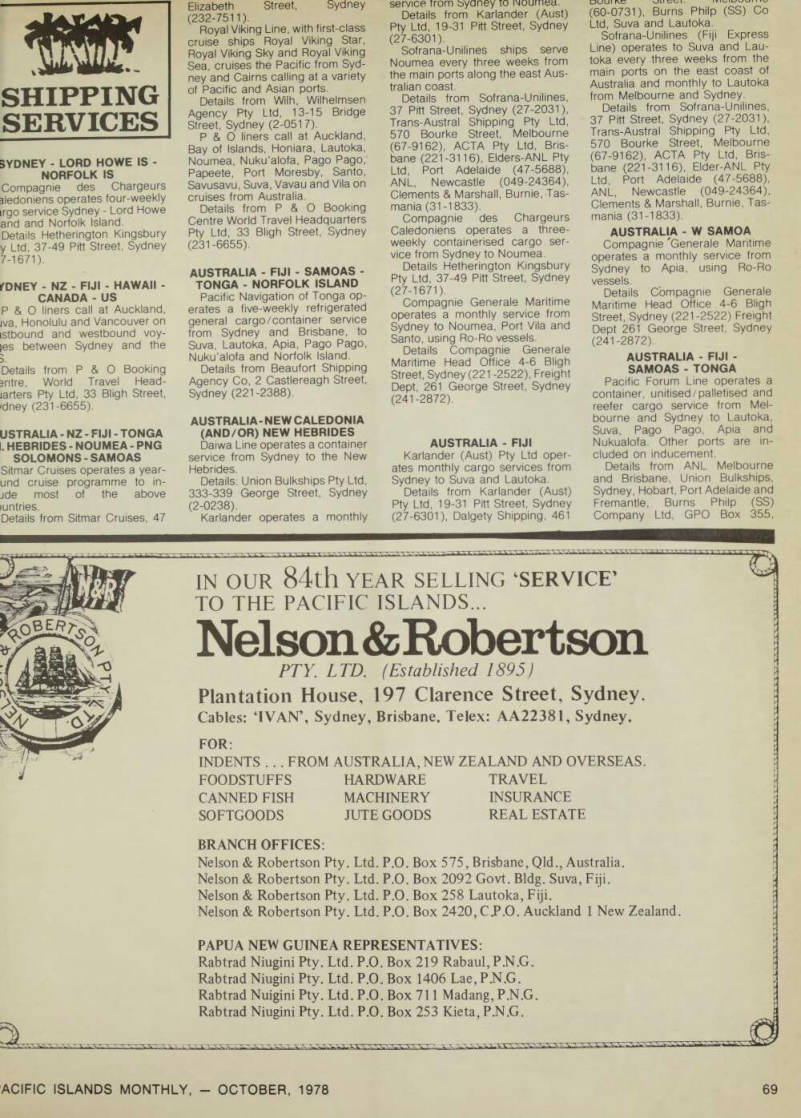
Services
Sydney - Lord Howe Is -
Norfolk Is
Compagnie des Chargeurs aledoniens operates four-weekly irgo service Sydney - Lord Howe and and Norfolk Island.
Details Hetherington Kingsbury y Ltd, 37-49 Pitt Street, Sydney 7-1671). rDNEY - NZ - FIJI - HAWAII -
Canada - Us
P & O liners call at Auckland, iva, Honolulu and Vancouver on istbound and westbound voy ies between Sydney and the 5.
Details from P & O Booking jntre, World Travel Head larters Pty Ltd, 33 Bligh Street,
'dney (231-6655).
USTRALIA - NZ - FIJI - TONGA
I. Hebrides - Noumea - Png
Solomons-Samoas
Sitmar Cruises operates a year und cruise programme to in jde most of the above »untries.
Details from Sitmar Cruises, 47
Elizabeth Street, Sydney (232-7511).
Royal Viking Line, with first-class cruise ships Royal Viking Star, Royal Viking Sky and Royal Viking Sea, cruises the Pacific from Syd ney and Cairns calling at a variety of Pacific and Asian ports.
Details from Wilh, Wilhelmsen Agency Pty Ltd, 13-15 Bridge Street, Sydney (2-0517).
P & O liners call at Auckland, Bay of Islands, Honiara, Lautoka, Noumea, Nuku’alofa, Pago Pago, Papeete, Port Moresby, Santo, Savusavu, Suva, Vavau and Vila on cruises from Australia.
Details from P & O Booking Centre World Travel Headquarters Pty Ltd, 33 Bligh Street, Sydney (231-6655).
Australia - Fiji - Samoas -
Tonga - Norfolk Island
Pacific Navigation of Tonga op erates a five-weekly refrigerated general cargo/container service from Sydney and Brisbane, to Suva, Lautoka, Apia, Pago Pago, Nuku’alofa and Norfolk Island.
Details from Beaufort Shipping Agency Co, 2 Castlereagh Street, Sydney (221-2388).
Australia- New Caledonia
(And/Or) New Hebrides
Daiwa Line operates a container service from Sydney to the New Hebrides.
Details: Union Bulkships Pty Ltd, 333-339 George Street, Sydney (2-0238).
Karlander operates a monthly
service rrom byoney to Noumea.
Details from Karlander (Aust) Pty Ltd, 19-31 Pitt Street, Sydney (27-6301).
Sofrana-Unilines ships serve Noumea every three weeks from the main ports along the east Aus tralian coast.
Details from Sofrana-Unilines, 37 Pitt Street, Sydney (27-2031), Trans-Austral Shipping Pty Ltd, 570 Bourke Street, Melbourne (67-9162), ACTA Pty Ltd, Bris bane (221-3116), Elders-ANL Pty Ltd, Port Adelaide (47-5688), ANL, Newcastle (049-24364), Clements & Marshall, Burnie, Tas mania (31-1833).
Compagnie des Chargeurs Caledoniens operates a three weekly containerised cargo ser vice from Sydney to Noumea.
Details Hetherington Kingsbury Pty Ltd, 37-49 Pitt Street, Sydney (27-1671).
Compagnie Generate Maritime operates a monthly service from Sydney to Noumea, Port Vila and Santo, using Ro-Ro vessels.
Details Compagnie Generate Maritime Head Office 4-6 Bligh Street, Sydney (221 -2522), Freight Dept, 261 George Street, Sydney (241-2872).
Australia - Fiji
Karlander (Aust) Pty Ltd oper ates monthly cargo services from Sydney to Suva and Lautoka.
Details from Karlander (Aust) Pty Ltd, 19-31 Pitt Street, Sydney (27-6301), Dalgety Shipping, 461
uuui r\o i w (60-0731), Burns Philp (SS) Co Ltd, Suva and Lautoka.
Sofrana-Unilines (Fiji Express Line) operates to Suva and Lau toka every three weeks from the main ports on the east coast of Australia and monthly to Lautoka from Melbourne and Sydney.
Details from Sofrana-Unilines, 37 Pitt Street, Sydney (27-2031), Trans-Austral Shipping Pty Ltd, 570 Bourke Street, Melbourne (67-9162), ACTA Pty Ltd, Bris bane (221-3116), Elder-ANL Pty Ltd, Port Adelaide (47-5688), ANL, Newcastle (049-24364), Clements & Marshall, Burnie, Tas
mania (31-1833).
Australia - W Samoa
Compagnie 'Generate Maritime operates a monthly service from Sydney to Apia, using Ro-Ro vessels.
Details Compagnie Generate Maritime Head Office 4-6 Bligh Street, Sydney (221-2522) Freight Dept 261 George Street, Sydney (241-2872).
Australia - Fiji -
Samoas - Tonga
Pacific Forum Line operates a container, unitised/palletised and reefer cargo service from Mel bourne and Sydney to Lautoka, Suva, Pago Pago, Apia and Nukualofa. Other ports are in cluded on inducement.
Details from ANL Melbourne and Brisbane, Union Bulkships, Sydney, Hobart, Port Adelaide and Fremantle, Burns Philp (SS) Company Ltd, GPO Box 355,
va, Fiji (311-777) or Pacific rum Line, PC Box 655, Apia, W moa.
Istralia Northern
Marianas - Micronesia
Nauru Pacific Line operates a jular container service from Hbourne to Saipan, Truk, nape and Kosrai.
Details Nauru Pacific Line, uru House, 80 Collins Street, ilbourne (653-5709), Nedlloyd ire, 8 Spring Street, Sydney 0522).
Australia - Tonga -
Samoas - Tahiti
Karlander operates a monthly rgo service from Melbourne and dney to Nukualofa, Apia, Pago go, Papeete, US west coast.
Details: Karlander (Aust) Pty I, 19-31 Pitt Street, Sydney r -6301).
Australia - Tahiti
Daiwa Line offers a six-weekly vice from Australia to peete.
Details: Union Bulkships Pty Ltd, 3-339 George Street, Sydney 0238).
Dompagnie Generate Maritime erates a monthly service from dney to Papeete using Ro-Ro >sels.
Details Compagnie Generate iritime Head Office 4-6 Bligh eet, Sydney (221-2522) Freight pt 261 George Street. Sydney U -2872).
Australia - Png
Dontainers Pacific Express jrns Philp and AWP Line) and IAL/PNGL Operate chief Con ner Service from Australia to IG-Solomon Islands ports on nt slot sharing basis. Three Con ner vessels operate on 28-day n-around from Melbourne, Syd / and Brisbane to Port Moresby, b, Rabaul, Kavieng, Wewak, idang, Kieta and Honiara.
Details from Burns Philp & Co I, 51 Pitt Street, Sydney )-547) and Interocean Swire, 8 ring Street, Sydney (2-0522). -arrell Lines operates a service Bry month from Tasmania, Mel urne, Sydney and Brisbane to e and Rabaul.
Details from Wilh Wilhelmsen ency Pty Ltd, 13 Bridge Street, dney (2-0517), 60 Market Street ‘lbourne (61-3031), J. C. Walter abaul) Pty Ltd, Rabaul, Robert urie-Carpenter (NG) Pty Ltd, e.
New Guinea Express Lines op ites three-weekly conventional d container services Melbourne, dney, Brisbane, Port Moresby, e, Rabaul, Alotau.
Details from New Guinea Ex bss Lines, PC Box R 73, Royal change PC, Sydney (241 -3991) icArthur Shipping Agency Co, -92 Eagle Street, Brisbane 29-3777), New Guinea Express les, 327 Collins Street, Mel iurne (61 -3053), Niugini Express les in Port Moresby (214436), e (42-1536), Rabtrad Niugini y Ltd. Rabaul (92-2911).
Karlander New Guinea Line’s rgo vessels call at Melbourne, dney, Port Moresby, Lae,
Madang, Wewak, Manus, Kimbe, Rabaul.
Details from Karlander (Aust) Pty Ltd, 19-31 Pitt Street, Sydney (27-6301), Dalgety Shipping, 461 Bourke Street Melbourne (60-0731).
Australia - Solomons -
Gilbert Is - Micronesia
Daiwa Line operates a container service every 30 days from Sydney to Honiara, Kieta, Tarawa and Guam. Gizo cargoes transhipped at Honiara, Saipan, Majuro, car goes transhipped at Guam.
Details from Union-Bulkships Pty Ltd, 333-339 George Street, Sydney (2-0238, telex AA20397).
Australia - Nauru -
Majuro
Nauru Pacific Line operates reg ular cargo /passenger service from Melbourne to Nauru and Majuro.
Details Nauru Pacific Line, Nauru House, 80 Collins Street, Melbourne (653-5709), Nedlloyd Swire, 8 Spring Street, Sydney (2-0522)
Us-Png
Farrell Lines operates regular services from all US west coast ports to Lae and Rabaul.
Details from Wilh, Wilhelmsen Agency Pty Ltd, 13 Bridge Street, Sydney (2-0517), Farrell Lines, 1 Market Plaza, San Francisco. L.A. (9-4105). J. C. Waller (Rabaul) Pty Ltd, Rabaul, Burns Philp (NG) Ltd, Kieta, Robert Laurie-Carpenter (PNG) Pty Ltd, Lae.
Png - Us - Canada
Farrell Lines operates regular services from Lae and Rabaul to US west coast ports and Van couver.
Details from J. G. Waller (Rabaul) Pty Ltd, Rabaul, Robert Laurie-Carpenter (PNG) Pty Ltd, Lae, Farrell Lines, 1 Market Plaza, San Francisco, L.A. (9-4105), Wilh, Wilhelmsen Agency Pty Ltd, 13 Bridge Street, Sydney (2-0517).
Png - Uk/Continent
Bank Line operates regular cargo service from Kieta, Rabaul, Kimbe, Madang and Lae to Liver pool, Hamburg, Rotterdam, Ant werp and London.
Details from Bank Line (A’asia) Pty Ltd, 1 York Street, Sydney (27-2041), Burns Philp (PNG) Ltd, PNG ports.
Png - Us
Bank Line operates regular cargo service from Kieta, Rabaul, Kimbe, Madang and Lae direct to San Francisco: calls at US Gulf and East Coast ports on inducement.
Details from Bank Line (A’asia) Pty Ltd, 1 York Street, Sydney (27-2041); Burns Philp (PNG) Ltd.
PNG ports.
Solomons - Fiji - Tonga -
W. Samoa - Uk/Continent
Bank Line operates regular cargo service from Honiara, Suva, Nukualofa and Apia to Liverpool, Hamburg, Rotterdam and Ant werp.
Details from Bank Line (A’asia) Pty Ltd, 1 York Street, Sydney
-2041)- Burns Philp (SS) Co Fiii jonaa W Samoa; Trading
Honiara '
Far East - Fiji - New
Zealand
view Zealand Unit Express vjC MNOL, RIL) operates a ee-weekly cargo service from nq Konq to Lautoka, Suva, NZ Is Manila, Kaoshiung, elung, Hong Kong.
Details from Nedlloyd. 8 Spring eet, Sydney (2-0522). sledlloyd operates monthly xio service with three ships from rabaya, Jakarta, Bangkok, Port lano and Singapore to Suva and ■ po rts Details from Nedlloyd (Aust) Pty I 8 Spring Street, Sydney r -3801); Burns Philp (SS) Co I. Suva and Lautoka.
Japan - Nz - Png
Shina Navigation Co, with three ps operates a monthly cargo vice from Japan to New aland calling at Lae on return ,rney - o Cnrinn
Details N^J(9V d - ® Spnng
eet, Sydney (2-0522).
Ar East - Mid-S. Pacific
China Navigation Co’s vessels erate a regular cargo service im Hong Kong, Taiwan and Sinpore to Rabaul, Wewak, idanq, Lae. Port Moresby, miara New Hebrides, Noumea, ipeete and Samoa.
Details from Nedlloyd. 8 Spring eet Sydney (2-0522).
Kyowa Shipping Co. Ltd, oper ates monthly services from Hong Kong, Taiwan S. Korea and Japan, to Guam, Siapan, Solomons, New Caledonia, Fiji, Western and American Samoa, Tahiti, Cook Is., Tonga and New Hebrides and 45-day con tainer/break bulk cargo service from Kobe, Nagoya and Yokohama to Guam, Suva, Lau toka and Noumea.
Details; Hethenngton Kingsbury Pty Ltd, 37-49 Pitt Street, Sydney (27-1671).
NYK Line, in conjunction with Daiwa Line, with container ships operates 30-day service from Moji, Kobe, Nagoya and Yokohama to Papeete. Pago Pago, Apia. Suva, Lautoka, Noumea, Sydney, Honiara, Kieta, Tarawa, Guam and Taiwan.
Details: Union Bulkships Pty Ltd, 333-339 Geor 9 e Street ' S V dne V (t-vtooj.
North Europe - Tahiti -
New Caledonia
Hamburg-Sued operates
monthly cargo services from Ham burg, Dunkirk and Le Havre to Papeete, Noumea, via Panama.
Details from Columbus Over seas Services Pty Ltd, 333 George street, Sydney (290-2966), Columbus Maritime Services, 17 Albert Street, Auckland (77-3460).
Europe - Pacific Islands
Compagnie Generate Maritime operates services from Europe and Mediterranean ports to
Papeete and Noumea using three Ro-Ro and three multi-purpose vessels thus ensuring a bi-monthly sailing to and from.
Details Compagnie Generale Maritime, 4-6 Bligh Street, Sydney (221-2522).
Europe-Tahiti-W. Samoa
Fiji-N. Caledonia
Nedlloyd offers regular cargo services from Northern Europe and UK to Papeete, Apia, Fiji and New Caledonia.
Details Nedlloyd (Aust) Pty Ltd, 8 Spring Street, Sydney (27-3801).
JAPAN - GUAM - FIJI - TAHITI -
Samoa - N. Caledonia -
Solomons - Gilberts
Daiwa Lines runs a monthly cargo service from Japan via Guam to Lautoka, Suva, Papeete, Pago Pago, Apia, Sydney, Noumea, Honiara, Tarawa, Guam.
Details from Burns Philp (SS) Co Ltd, Suva.
NZ - FIJI - TONGA - SAMOAS Union Steam Ship Co of NZ op erates a roll-on, roll-off, unitised service from Auckland to Lautoka-
Suva-Pago Pago-Apia-Nuku’alofa
on a 14 day frequency.
Details from Union Steam Ship Co of NZ Ltd, PO Box 12.
Auckland or from Branch offices/agents in Fiji, Tonga and the Samoas.
Nz - N. Caledonia -
N. Hebrides - Png -
Solomons
Sofrana Unilines with three ships
operates to Vila and Santo, to Honiara and Papua New Guinea and to Noumea.
Details from Sotrana Unilines, 18 Customs Street, Auckland (773-279), PO Box 3614, Telex NZ2313.
Nz - Australia -
New Caledonia -
Solomons - Gilberts -
Micronesia
Union Co/Daiwa Line operate a container service from New Zealand through Sydney to Noumea, Honiara, Tarawa and Guam, Transhipment to Saipan, Majuro and Gizo.
Details: Union Steam Ship Co of NZ Ltd, PO Box 12, Auckland, or Union Bulkships Pty Ltd, 333-339 George Street, Sydney, (2-0238).
Nz- Png
Farrell Lines operates regular service every 30 days from Auckland to Lae and Rabaul.
Details from Dalgety NZ Ltd, 41-45 Albert Street, Auckland (7-1859) J. C. Waller (Rabaul) Pty Ltd, Rabaul, Robert Laurie (NG) Pty Ltd, Lae.
Nz - Fiji - North America
(WC) Blue Star Line Crusader service to West Coast North America. Only direct service to and from New Zealand. Blue Star vessels call at Suva and Honolulu on NZ-US- West Coast voyages.
Details from Blueport ACT (NZ) Ltd, PO Box 192, Wellington (739-029), Burns Philp (SS) Co
J GPO Box 355, Suva. Fiji 11 -777).
Nz - Fiji
Reef operates a regular 18-day rvice from Auckland to Suva and utoka.
Details from Reef Shipping (encies Ltd, PO Box 3382, ickland, NZ (77-1221-3).
Pacific Line with one ship oper »s monthly cargo service New aland, Lautoka, Suva.
Details: Sofrana Unilines, 18 istoms Street, Auckland 73-279) PO Box 3614, Telex: [2313.
Nz - Fiji - Gilberts -
Solomons - Png
Pacific Forum Line operates a ntainer, unitised/palletised and sfer cargo service from Lyttelton d Auckland to Lautoka, Suva, rawa, Honiara, Madang, Lae d Moresby. Other ports are in jded on inducement.
Details from Shipping Corpor on of NZ Ltd, Auckland, iristchurch, Lyttelton, Welling i. Burns Philp (SS) Company j, GPO Box 355, Suva, Fiji 11-777) or Pacific Forum Line, ) Box 655, Apia, W. Samoa
Nz - Fiji - Samoas -
Tonga - Australia
Pacific Forum Line operates a •ntainer, unitised/palletised and efer cargo service from Timaru id Auckland to Lautoka, Suva, igo Pago, Apia, Nukualofa and slbourne. Other ports are in jded on inducement.
Details from Shipping Corpor on of NZ Ltd, Auckland, iristchurch, Lyttelton, Welling i, Burns Philp (SS) Company j, GPO Box 355, Suva, Fiji 11-777) or Pacific Forum Line, ) Box 655, Apia, W. Samoa.
Nz- Samoa - Tonga
Pacific Navigation of Tonga op ates a four-weekly cargo ser ;e, Auckland - Nukualofa - Pago igo - Apia - Auckland.
Details from McKay Shipping d, Downtown House, Queen reet, Auckland (33-656).
Warner Pacific Line services nehunga - Nukualofa - Vavau rtnightly, and Timaru - Nukualofa monthly and Onehunga - Dia and Pago Pago every 21 days irrying general and freezer car ies and Timaru - Apia every 21 lys carrying freezer cargo.
Details from Air Marine Services JZ) Ltd, PO Box 2505, Auckland 96- NZ - COOK IS - NIUE -
Tahiti
Shipping Corporation of NZ Ltd jerates cargo services based on illets and similar units from jckland to Niue, Cook Islands id Tahiti.
Details from the Shipping Corp NZ Ltd, PO Box 3420, Auckland 97- Waterfront Com ission, PO Box 61, Rarotonga, ghterage and Stevedoring Co, tutaki, Niue Govt Offices, Niue
land Compagnie Maritime
Dlynesienne, B’P’ 368, apeete.
Uk/N. Continent - Tahiti -
N. Caledonia - N. Hebrides
Bank Line operates regular cargo service from Hull, Hamburg, Bremen, Antwerp and Rotterdam to Papeete, Noumea and Vila.
Details from Bank Line (A’asia) Pty Ltd, 1 York Street. Sydney (27-2041); Ets A M Fare UTE, Papeete; Ets Ballande, Noumea.
Burns Philp (NH) Ltd. Vila.
Uk/N. Continent - Png -
Solomons
Bank Line operates regular cargo service from Hull, Hamburg, Bremen, Antwerp and Rotterdam to Port Moresby, Lae, Madang, Kimbe, Rabaul, Kieta and Honiara and on inducement to Yandina, Tarawa and Nauru.
Details from Bank Line (A’asia) Pty Ltd, 1 York Street, Sydney (27-2041); Burns Philp (PNG) Ltd.
PNG ports; Trading Co Honiara.
San Francisco - Honolulu -
Nauru-Micronesia
Nauru Pacific Line operates reg ular conventional/container ser vice from San Francisco and Honolulu to Majuro, Nauru, Ponape, Truk and Saipan.
Details from Nauru Pacific Line, Nauru House, 80 Collins Street, Melbourne (653-5709); North American Maritime Agencies, 100 California Street, San Francisco, California 9411 (981 -0343).
US - FIJI - TAHITI - NZ -
Australia
Bank and Savill Line Ltd, oper ates regular cargo services from US Gulf ports to Australia and NZ.
Calls at Suva, Lautoka and Papeete on demand.
Details from Bank Line (A’asia) Pty Ltd, 1 York Street, Sydney (27-2041) or Howard Smith Indus tries Pty Ltd, 1 York Street, Sydney (27-5611).
US - A. SAMOA - NZ -
Aust
Farrell Lines LASH ships operate regularly from US to Australia, via Pago Pago and Auckland and Canada.
Details from Wilh, Wilhelmsen Agency Pty Ltd, 13 Bridge St., Syd ney (2-0517); 60 Market Street, Melbourne (61-0301); Farrell Lines, 1 Market Plaza, San Fran cisco, L.A. (415-777-3300); Dal gety NZ Ltd, Auckland (7-1859); Kneubuhl Maritime Services, Pago
Pago (633-5121).
Us - Tahiti - Samoa
Pacific Islands Transport oper ates a five/six weekly cargo ser vice from North America west coast ports to Papeete, Pago Pago, Apia.
Details from Trans-Austral Ship ping Pty Ltd, 19 Pitt Street, Sydney (27-2441).
Polynesia Line operates con tainer and general cargo service from US west coast ports to Papeete and Pago Pago.
Details from Polynesia Shipping Services Inc,. PO Box 1478, Pago Pago (9-6799).
Advertisements & other items, pp. 69-80 (5 items)
69
ACIFIC ISLANDS MONTHLY, - OCTOBER, 1978
Nelson &Robertson
IN OUR 84th YEAR SELLING ‘SERVICE’
TO THE PACIFIC ISLANDS...
PTY.LTD. (Established 1895)
Plantation House, 197 Clarence Street, Sydney.
Cables: ‘IVAN’, Sydney, Brisbane. Telex: AA22381, Sydney.
INDENTS . . . FROM AUSTRALIA, NEW ZEALAND AND OVERSEAS.
BRANCH OFFICES:
Nelson & Robertson Pty. Ltd. P.O. Box 575, Brisbane, Qld., Australia.
Nelson & Robertson Pty. Ltd. P.O. Box 2092 Govt. Bldg. Suva, Fiji.
Nelson & Robertson Pty. Ltd. P.O. Box 258 Lautoka, Fiji.
Nelson & Robertson Pty. Ltd. P.O. Box 2420, CP.O. Auckland 1 New Zealand
PAPUA NEW GUINEA REPRESENTATIVES:
Rabtrad Niugini Pty. Ltd. P.O. Box 219 Rabaul, P.N.G.
Rabtrad Niugini Pty. Ltd. P.O. Box 1406 Lae, P.N.G.
Rabtrad Nuigini Pty. Ltd. P.O. Box 711 Madang, P.N.G.
Rabtrad Niugini Pty. Ltd. P.O. Box 253 Kieta, P.N.G.
FOR:
FOODSTUFFS
CANNED FISH
SOFTGOODS
HARDWARE
MACHINERY
JUTE GOODS
TRAVEL
INSURANCE
REAL ESTATE
DAIWA LIME
JAPAN-SOUTH PACIFIC REGULAR SERVICE
AUSTRALIA-SOUTH PACIFIC CONTAINER SERVICE
JAPAN-TAIWAN-GUAM-SAIPAN REGULAR SERVICE
DAIWA LINE BRIDGES SOUTH PACIFIC
WITH RO/RO CAR &, CONTAINER CARRIER
JAPAN GUAM LAUTOKA SUVA PAPEETE PAGO PAGO APIA NOUMEA
SYDNEY HONIARA TARAWA-GUAM TAIWAN JAPAN
JAPAN MAJURO RAROTONGA VILA SANTO NAURU JAPAN
JAPAN TAIWAN GUAM SAIPAN JAPAN
THE DAIWA MITIGATION CO., LTD.
OSAKA: “DAILINE”
HEAD OFFICE
DAIICHI KYOGYO BLDG.,
45.2-CHOME, AWAZAMINAMI-DORI,
NISHI-KU. OSAKA. JAPAN
TELEPHONE: 'O6; 531-0471'9
TELEX: 525-6324 & 525-6325
TOKYO: “FUNEDAILINE"
TOKYO OFFICE
SHIN-DAIICHI BLDG.,
4-13, NIHONBASHI 3-CHOME, CHUO-KU'
TOKYO, JAPAN
TELEPHONE: (03; 274-3251-8
TELEX: 222-3343. J 23559
;iLk
Pacific Navigation of Tonga Limited
SFR VING THE PACIFIC FROM AUSTRALIA AND NEW ZEALAND
NUKUALOFA:
PACIFIC NAVIGATION
OF TONGA LTD.
THE ADMINISTRATOR
NORFOLK ISLAND
SUVA, LAUTOKA, APIA,
PAGO PAGO AGENTS:
BURNS PHILP (S.S.) CO. LTD.
VILA, SANTO AGENT;
BURNS PHILP
(NEW HEBRIDES) LIMITED
BEAUFORT SHIPPING
G.P.O. Box 3988, Sydney N.S.W Australia
McKAY SHIPPING LIMITED
P.O. Box 1372, Auckland New Zealand
• REGULAR SAILINGS
• OWNED TONNAGE
• CONTAINERS
• FREEZER
• DEEP TANKS
• CONTINUOUS PRE-RECEIVING
• HEA VY LIFTS
■llll ■V Hi mm Mi
gp* imimM
Sr - ’*** F <■'
GO FOR
THE BIG ONE
The enormous wealth in the Pacific must be tapped by Pacific nations themselves. But it needs power; cheap, dependable power: diesel power.
The great diesel power in the world is Detroit Diesel Allison the big one.
These diesel engines work the longest, hardest hours; their power-delivery is impressive; their cost efficiency unequalled.
Detroit Diesel Allison is the world’s largest manufacturer of heavy-duty diesel engines with gas turbines and automatic and power shift transmissions, plus torque converters. A complete line of power products, trucks, work boats and heavy equipment. DDA engines range in power from 50 HP to 1600 HP, diesel-powered generator sets from 30 KW to 1100 KW and gasturbine engines upto 5,300 KW for marine and industrial use. We’ve got what you need to get the job done.
DETROIT DIESEL ALLISON
NOW AVAILABLE THROUGH NEW ZEALAND
For further information forward this coupon to: DETROIT DIESEL ALLISON INTERNATIONAL NEW ZEALAND DIVISION OF GENERAL MOTORS NEW ZEALAND LTD PRIVATE BAG UPPER HUTT.
Tick box for required brochure |\Jgppo □ Automotive diesel □ Industrial diesel □ Marine diesel AddreSS □ Generator set □ Transmissions □ Turbines
Detroit Diesel Allison
Division of General Motors Corporation
4 "Ttft 3
GLOBAL SERVICE FOR SHIPPERS
1
THE BANK LINE
Papua New Guinea & Pacific Islands
USA- UK /Continent Service
Regular direct monthly sailings PAPUA NEW GUINEA to: NORTH AMERICA • UNITED KINGDOM & CONTINENT * SOLOMONS • FIJI • TONGA • SAMOA and TARAWA to;
UNITED KINGDOM and CONTINENT
For particulars apply:
THE BANK LINE (AUSTRALASIA) PTY LTD.
18th Floor 1 York Street Sydney N.S.W. 2000 Australia Telephone: 272041 • Telex: 24063
PISCES DIESEL
GM's ANSWER TO THE
SMALL DIESEL MARKET!
• 27 hp. 2 cylinder. • 40 hp. 3 cylinder. • 60 hp. 4 cylinder, also; 27-10 kW Generator sets 40-25 kW Generator sets 60-37.5 kW Generator sets • Mechanical and Borg Warner gear-boxes. • Complete with heat exchangers and instrument wiring looms no extra.
Australian Distributors:
DIABLO DIESEL
212 Haldon Street, Lakemba, NSW 2195.
Phone 759 5306 759 0463.
Note: Export service available.
ALSO IN STOCK:
• Borg Warner reductions V/Drive Boxes. New & used parts service. • Fresh water heat exchangers. • Babbit disc shaft couplings.
To eliminate misalignment. • Alarm systems for flooding fire overheating low oil pressure.
Manama.
The South Seas Express.
The first regular roll-on roll-off express
service between N. the Islands.
The introduction of Marama to the Islands trade will enable exporters to greatly increase their export potential by providing faster, more frequent sailings as well as the greater cargo handling flexibility which a roll-on roll-off service can provide.
Lduto*a / ' / Departures every 14 days from Auckland to Lautoka. Suva Pago Pago Apia. Nukualofa 4 Nukualofa Co-ordinated transhipment facilities from other N.Z. centres Intermodal coastal roll-on roll-off services as well as rail and road services can be utilised by shippers in other New Zealand centres to take advantage of the new Marama schedule. Your nearest Union Company office can assist you in organising the most efficient transhipment method.
International Transhipment Facilities Flexibility in cargo modules catered by this new service can provide for shipping operators and exporters the advantage of reaching international markets using
onforwarding services through Union Company contacts
and expertise.
Additionally Union can also arrange for cargoes originating from overseas sources to be transhipped at ports covered by Marama to their final destination to the benefit of the importer m New Zealand or the Islands. m.v. Marama Your new export incentive 6350 deadweight tonnes. 9# Capacity 340 seafreighter units or their equivalent, plus space for wheeled vehicles, livestock, etc
Greater Flexibility
Means a more satisfactory and versatile way to ship your
consignment.
The following equipment is provided free to shippers Standard dry general cargo ISO containers 20' xB' x B'6" box container 20' x 8' x B'6"Opensided container.
Seafreighter Units
For movement of general and bulk cargoes (Internal) Length 13'9" (4.24 M) width 7'6" (2 29M) height 5' (1.52 M) N.B. Units are fully collapsible and open topped to facilitate loading cargoes in excess of 1.52 M height. A shower-proof cover is also provided free with every
seafreighter.
Newsprint Flats These units are specifically designed for carnage of forest industry cargo but are also suitable for the carriage of other specified types of cargoes (Internal) Length 15'6"(4.77M) Width 6' (1.830 M) W. Containers These containers are totally enclosed suitable for the movement of smaller consignments or valuable ones (Internal) Length 5 7"(1.75M) Width 4' (1.22 M) Height 5'6" (1.70 M) Unit Loads Thiscovers cargo that is unable to be containerised or is not covered by the term mobile equipment These unit loadings must be of a secure nature to facilitate handling by a forklift with 5” gluts (loading forks).
Refrigerated Cargo
The following containers will be available Cold wrap containers 20' x 8' x 8' Integral containers 20' x 8' x B'6"
Livestock Livestock stalls are available for the carriage of all types of stock.
Wheeled Cargo
The versatility of Marama means that all types of wheeled cargoes including cars, trucks, tractors, scrapers, machinery on mobile tracks, cranes, trailers etc can.be catered for.
Hazardous Cargo
The majority of hazardous cargoes will be accommodated on the vessels upper deck either in seafreighters, ISO containers or W. Containers. Full details are available on application.
union
compnnq
u moving
Regular Monthly Liner Services
from Australia and New Zealand
to the South and Central Pacific
OWNED BY THE PEOPLE
OF THE PACIFIC ISLANDS
PACIFIC
FORUm
Line
FOR INFORMATION CONTACT AGENTS:
AMERICAN SAMOA:
Polynesian Shipping Services Inc. P.O. Box 1478, Pago Pago.
AUSTRALIA:
The Australian National Line, 50 Queen Street, Melbourne.
Union Bulkships Pty.Ltd., 333-339 George Street, Sydney.
GILBERT ISLANDS:
Gilbert Islands Shipping Corp. P.O. Box 495, Tarawa.
FIJI:
Burns Philp South Sea Co. Ltd. GPO Box 355, Suva.
NEW CALEDONIA:
ETS Ballande, BP. C 4, Noumea.
NEW HEBRIDES:
Burns Philp New Hebrides Limited, Vila.
NEW ZEALAND:
The Shipping Corp. of N.Z. Ltd. P.O. Box 3344, Wellington.
PAPUA NEW GUINEA:
Steamships Trading Co. Ltd. P.O. Box 1, Port Moresby.
SOLOMON ISLANDS;
Sullivans S.l. Ltd. GPO Box 3, Honiara.
TONGA:
Union Steam Ship Co. P.O. Box 4, Nukualofa.
PACIFIC
ISLANDS
TRANSPORT
LINE
MS CAMELLIA VENTURE
Express Freight Service between Pacific Coast Ports of U.S.A. and...
Tahiti 6 Samoa
PAPEETE - APIA - PAGO PAGO
Full container service including reefers.
GENERAL STEAMSHIP CORPORATION LTD.
General Agents 400 California Street, San Francisco, California, U.S.A.
APIA: Bums Philp (South Sea) Company Ltd.
PAPEETE: Agence Maritime Internationale, Tahiti, PAGO PAGO: Polynesia Shipping Services Inc.
CLASSIFIED ADVERTISEMENTS
Per Line $5.00 Aust. Minimum 4 lines.
WANTED TO PURCHASE
Vila, New Hebrides — businesses, houses, land, flats. Write to: PO Box 672, Cairns Old 4872.
WANTED
30/40 ft. Timber Motor launch for interisland trading, to carry 4/5 tons cargo, 4/6 passengers.
Reply: George Daniel, c/o Burns Philp (N.H.) Ltd, Vila, New Hebrides.
WANTED
For recycling for charities old used stamp collections. Postage paid on all parcels. Miss E. M. Hoskins, 740 Torrens Road, Rosewater SA 5013.
FOR SALE
57 ft. Carvel solid construction GN Diesel Volvo aux., large freezer, su cargo, 500 gal. fuel. $57,000.
Phone (07) 396 4803. J. M. Tickle, 7‘ Nelson Parade, Manly, Bris, Old.
WE BUY
•“Used Postage Stamps” of your Islani or Territory. Top prices paid. Alsi interested in contacting seriou; collectors Allan G. Hughes, 13 Nelson Street, Wallsend NSW 228 Australia.
FLEETS: Strongly built 55 ft trawler, built 1966 in survey, 6LX Gardner, 7000 lbs refrig.
Radar, S.S.B. radio, heavy winch and trawl gear. $BO,OOO.
FLEETS, 221 Esplanade, Wynnum Central, Brisbane.
Cables: FLEETS, BRISBANE.
FOR SALE
Ex Taiwanese Long Liner 70 ft. x 17 ft. x 8 ft. 42.25 Gross tonnage. Timber built 1967.
Yoshide main, Yanmar Aux.
Engines; all refrigerated, Shanyand compressors. Very good condition. What offers, consider exchange yacht etc.
K. Meyer & Co. Diesel Engineers, Wharf St, Maryborough 4650 Qld.
THE
UNIVERSITY
OF SYDNEY
Walter Mersh Strong
Scholarships
Applications are invited from Papua New Guineans for the above scholarships, which are available either as (a) undergraduate scholarships open to Papua New Guineans who are qualified to matriculate in the University of Sydney or (b)
postgraduate scholarships
open to Papua New Guinean graduates for postgraduate research or course work at the
University of Sydney.
Further information and applications are available from the Registrar, University of Sydney, NSW 2006.
Applications close on 30 November 1978.
Students applying for undergraduate scholarships must also apply for admission to the University through the Metropolitan Universities Admission Centre by 3 October. (Late applications are accepted up to January on payment of a late fee).
POSITION WANTED
Englishman, 39, with Foreign- Going Master’s Certificate and twenty-one years experience in Asia and Pacific regions seeks active position where he can enjoy family life. A small partnership would be considered.
Please write: The Advertiser, 10, Jalan Lekub, Seletar Hills, Singapore 28.
Stay at Aggie Grey's
the South Pacific's
legendary hotel.
Situated right in the heart of Western Samoa. Enjoy Polynesian-style friendliness and service, in cool surroundings, superb entertainment and food. Magnificent white sand beaches only a short drive away. Airconditioned rooms, swimming pool and full bar facilities.
Bookings through Union Steamship Company of NZ, Pan Am, Air New Zealand or direct to Aggie Grey's, Apia, Western Samoa.
Cables: AGGIES, APIA.
PETER FISHER
TRADING
Pty Ltd
321 PITT St., SYDNEY, AUSTRALIA 2000
Telephone: 261109 Cables: "FISHERION" SYDNEY
EXPORTERS TO THE
PACIFIC ISLANDS
THE PAPUA HOTEL
PORT MORESBY
o • Right in the business centre • A tradition for comfort and fine food • All rooms air conditioned • Restaurant • Bars • Banquet Hall Telephone 21 2622 Cables PAPTEL
A. C. NEUMANN
Manager
IT
sellers:
WHITEMETAL
TYPEMETAL
SOLDERS
LEAD
TIN
BERJAK & PARTNERS
PHONE: (03) 26-1756
492 ST. KILOA ROAD, MELBOURNE, 3004.
Cobia; MCI JAR MELBOURNE TaWx: 30334.
buyers:
SCRAP
DROSS
RESIDUES
“WAIKIKI”
Vacation Apartments. 2 bedroom, clean, air-conditioned, near beach, bus, zoo, and entertainment.
For more information write to:
LEALEA HALE HOTEL
2423 Cleghorn Street
HONOLULU,
HAWAII 96815
EEB f
0
AKAI C-90ln
m 9 6 E
AKA I STEREO CASSETTE DECK Cfll-70aZ»fl
Audio & Video
AKAI
CS-702Dn
Unbeatable cost/perform-
ance. Front loading convenience with dependable mechanism-full release auto stop, Dolby* nojse reduction and speed controlled DC motor.
AKAI
STEREO CASSE T
o 90 LN
AKAI
0 0 0
® L Mfc ®
11 "
AKAI «,
0 9
IIIPOWSCTWM
90 N
AKAI
» « 0 © 0
AKAI
0 C-90'.
AKAI
GXC-709D
Reliable mechanism insures constant tape pas% and Akai's GX-head provides the best recording possibility.
GXC-725D
3-head advantage with economized cost. Individual recording and playback heads give reel-to-reel per- , formance with cassette tape ©
-fll
> e © QOO •<
o
GXC-750D
• 3-head, 3-motor, illuminated feather-touch function
control. Top quality recording
with operating ease.
"Dolby is a trademark of Dolby Laboratories tnown for quality in every detail, Akai decks
nake superb sound that audiophiles demand.
sson (M G ) Ltd. ’O5, Port Moresby Tel: 2275 i Company Ltd. 1175, Nadi International Airport Consumer Products Sector len Rd., Mt. Eden, Auckland 37 New Caledonia Menard Freres Ville B.P. H 2, Noumea Tel: 275222 Tahiti Etablissements Comimpex P.O. Box 200. Papeete Tel: 20477 Now Hebrides (Islands) Burns Philp (New Hebrides) Co., Ltd P.O. Box 27, Port Vila, New Hebrides Islands Norfolk Island Burns Philp (Norfolk Island) Co., Ltd.
P.O. Box 21, Norfolk Island Samoa Islands Burns Philp (South Sea) Co., Ltd.
P.O. Box 129, Pago Pago. American Samoa Mariana Islands J.C. Tenorio Enterprises P.O. Box 137, Saipan Tel: 6444/8 British Solomon Islands Security Electrical Co., Ltd.
P.O. Box 174, Honiara Tel: 881 Cook Islands JPS Enterprises Ltd.
P.O. Box 15. Rarotonga Tel 2150, 2176 For more information, please send ■ this coupon to our distributor in , your country or to AKAI ELECTRIC
■ CO., LTD.
I 12-14, 2-Chome, Higashi-Kojiya, I Ohta-ku, Tokyo, Japan I Name Address.
Only Pioneer could call its
lowest priced cassette deck
"high performance”
mm #1 m - »
©TDK
060 SA
IVBC «
powe r o-n cassette (U) piotveer* pjP[7S5YSviTiM]
CT-F5OO
Our new CT-F5OO stereo cassette deck is not the best model we make.
It’s not our second best, either. But, even coming from the bottom of our line, Pioneer s CT-F5OO offers some of the same features that are found on our more costlier models. So, whether you’re starting from scratch or as an addition to your present stereo system, the CT-F5OO is perfect as the basic stereo cassette deck.
Basically outstanding in tonal quality and basically designed for mechanical precision.
With the tape compartment in the front, loading a cassette is as easy as slipping your hand in your pocket.
While front access design makes it easy to use, advanced Pioneer features make it great to listen to. A longlife permalloy-solid head and built-in Dolby-B* noise reduction system join to increase the S/N ratio to a hushed 68.5d8 (chrome tape over skHz). An electronically controlled DC motor with independent drive system reduces wow and flutter to no more than 0.05% (WRMS). And separate BIAS and EQ selection enables you to obtain maximum frequency response and lowest distortion from virtually any type of tape.
Pioneer’s CT-F5OO helps you stretch your stereo budget. And to protect your valuable tapes, the fully automatic Stop Mechanism functions in all modes disengaging the tape transport mechanism and returning all levers to neutral.
Pioneer’s new CT-F5OO stereo cassette deck. The added enjoyment of cassette tape versatility via access to the front and at a rock-bottom price. *Dolby is a trademark of Dolby Laboratories, Inc.
diOpiOIMEER
Australia Pioneer Electronics Australia Pty.Ltd., 178-184 Boundary Road, Braeside, Victoria 3195. Tel: 90-9011, Sydney 93-0246, Brisbane 59-7457, Adelaide 433379. Perth 24-9899 Fiji Islands Brijlal & Company, G.P.O. Box No. 362, Suva, Fiji Islands Tel: 22258 New Zealand Fountain Marketing Ltd., Maidstone Street, Auckland.
New Zealand Tel; 763-064 Norfolk island B6rns Philp (Norfolk Island) Ltd., Norfolk Island, South Pacific New Hebrides Burns Philp (New Hebrides) Ltd., Vila. New Hebrides Nauru Island Jacob Enterprises, P.O. Box No. 4 Republic of Nauru Tahiti Est. PERFECT. B.P. 594, Papeete, Tahiti Tel: 20 407 New Caledonia Menard Freres Vide.
B.P. H 2 Cedex, Noumea, New Caledonia Tel: 27.52.22 American Samoa Traspac Corporation. P.O. Box 1477, Pago Pago. American Samoa 96799 Tel: 633-5224 Rarotonga South Seas International Ltd., P.O. Box 49, Rarotonga Cook Islands Tel: 2327 Papua New Guinea Bali Merchants Pty. Ltd., P.O. Box 6103 Boroko Tel; 254887
- FOR PO
• ;i ).'u O m o
SUZUKI
X «r* *? ■ P B » - - Doking for handy, reliable transport from home to town ?
Forgoing on atrip?
For performing everyday tasks?
Go with a Suzuki! choose one of our rugged,
high-performing 4-wheel drive vehicles,
just meeting your transport needs.
md.. FOR MORE MOTORING POWER
Dok into the traditional excellence of Suzuki’s
performance-proven motorcycles and fleet
of outboard motors something to
satisfy your every motoring need.
Going by land or by sea... go with a Suzuki VI
DT6S
SUZUKI IS 125
SUZUKI
SUZUKI MOTOR CO, LTD
Hamamatsu, Japan )LOMON ISLANDS SOLOMON ISLAND SERVICE STATION LTD. • FIJI M.H. MOTORS • NEW CALEDONIA STE. SUPERCAL • PAPUA EW GUINEA TUTT BRYANT PACIFIC LTD. • NEW HEBRIDES HENRI LEROUX • NIUE ISLAND BURNS PHILP (SOUTH SEA) CO., "D. • PONAPE LEO ETSCHEIT • TAHITI NIPPON AUTOMOTO • ELLICE ISLAND TUVALU COOPERATIVE WHOLESALE SOCIETY "D. • GUAM ISLAND CYCLERY, INC. • NORFOLK MARTIN'S AGENCIES LTD. • AMERICAN SAMOA PACIFIC PRODUCTS, INC.
TARAWA GILBERT ISLANDS COOPERATIVE FEDERATION LIMITED • TONGA MORRIS HEDSTROM LTD. • WESTERN CAROLINES ECHESRRAK T. COMPANY • AMBROSE D. MINGINFEL'S WHOLESALER • EASTERN CAROLINES KIOMASA STORE
The Datsun platform:
a smoother ride for everyone.
When you see a big hole in the road ahead of you, you try to avoid it, right? Of course. But what about all the little bumps—surface joints, uneven repair finishes or cobbles—that you can’t avoid? Riding over those for long periods can end up rattling even the calmest driver.
Rugged 4-link coil suspension i;s Datsun’s answer here. Out of roughly 100 different suspension configurations* we choose the likeliest-looking half dozen and give them a thorough shaking on our vibration platform. Altering the speed and intensity to simulate different road surfaces. And making continuous examinations of every part of each suspension system as well as its resilience, durability and balance characteristics. Naturally, the one that performs best is the one we put into your Datsun.
Because Datsun aims to make your car journeys—with or without a load—as smooth and comfortable as possible. With tough suspension that won’t shake you down for costly repairs.
And that’s a platform that wins everyone’s vote.
Tough tests: the Datsun way to total economy.
DATSUN
NISSAN
Datsun Distributors: Boroko Motors Ltd. P.O. Box 1259, Boroko, Port Moresby, P.N.G./Suva Motors Ltd. G.P.O. Box 34, Suva, Fiji/ Morris Hedstrom Ltd. P.O. Box 189, Apia, Western Samoa/ United Enterprises Ltd. P.O. Box 262, Honiara, British Solomon Islands/ Sirius Motors P.O. Box 34, Norfolk Island, South Pacific/ Jacob Enterprises P.O. Box 4, Republic of Nauru/ Cook Islands Motor Center Ltd. P.O. Box 74, Rarotonga, Cook Islands, South Pacific/ Pentecost Pacific S.A. P.O. Box 119, Port Vila, New Hebrides/Agence Alma S.A.
B.P. A 3, Noumea Cedex, New Caledonia/TAHITIBULL S.A.R.L. B.P. 359, Papeete, Tahiti/Gilbert Islands Government, Supply Division P.O. Box 71, Bairiki, Tarawa, Gilbert Islands
71
\CIFIC ISLANDS MONTHLY, - OCTOBER, 1978
73
CIFIC ISLANDS MONTHLY, - OCTOBER, 1978
75
ACIFIC ISLANDS MONTHLY, - OCTOBER, 1978