paradise lost
pp. 49-51 · Read in the full issue
Cruises by order in an Islands paradise lost
listory and my 19-year-old life
ntersected violently on the
corning of October 21, 1944, writes PIM staff writer Mal olm Salmon. A Japanese omber crashed into the fore cast of HMAS Australia, the ruiser in which I was serving at
aeyte Gulf in the Philippines.
Ve were part of the naval forces
overing the first landings of
Imerican troops in the cam aign to take that country back
-om the Japanese.
The event is described as fol )ws in that invaluable volume f record, Pacific Islands Year ook, in its section on the his )ry of the Pacific war; “At ’lark Field, Luzon, on October 0, 1944, the Japanese Ist Air leet formed the first unit of the
[amikaze Special A Hack
’ orps, whose suicide pilots were i crash their bomb-laden Zeke ircraft on enemy installations r warships. The corps was spon
ired by Vice-Admiral Takijiro
ihnishi and the first unit was
ommanded by Lieutenant
r ukio Seki. The first Kamikaze Hack was on the Australian ruiser Australia off the Leyte caches on October 21 ...”
We ratings, sweltering in the owels of the ship over a direc on control table for Aus "alia’s four-inch guns, were ot nearly so well informed, felt a bump, and generally oncluded that the ship had
truck some submerged
bject.
The power supply for our tble having been cut, we were ailed within minutes to the pper deck, but were not told fhy. Still, as we emerged into
le early morning light, we
ould not register what had appened. I remember one of ur group, looking up at the rotesquely bent foremast, say ig: This is a homer.’ He
leant by this that the damage
fas so great that we would cer
tainly have to return to Sydney for a refit, and for leave. He was wrong, as it happened, but I know he regretted what later, in view of the grim nature of what had actually taken place, seemed an inappropriate re mark. My first inkling of the truth was when I saw, a few feet away from me on the deck, the top joint of a human thumb.
There was no blood about it. It
lay there pale and pathetic, but
its message could hardly have been more eloquent.
Our job was to help in the clearing of wreckage and the moving of casualties from the
bridge which, situated just
below the point of impact of the Japanese plane, had been the scene of by far the heaviest casualties. The plane had flown in from astern and struck the foremast with its starboard wing just at the point where it
joined the fuselage.
Let a Sydney newspaper give its account of the event: ‘At 6.5 am on October 21, 1944, watchers in HMAS
Shropshire and USS Blueridge
saw a livid flash offlame in Aus tralia’s foremast. Almost im
mediately a large explosion
ripped the radar hut from its seating and hurled it down on to the bridge and the compass plat
form. Liquid flame from escap
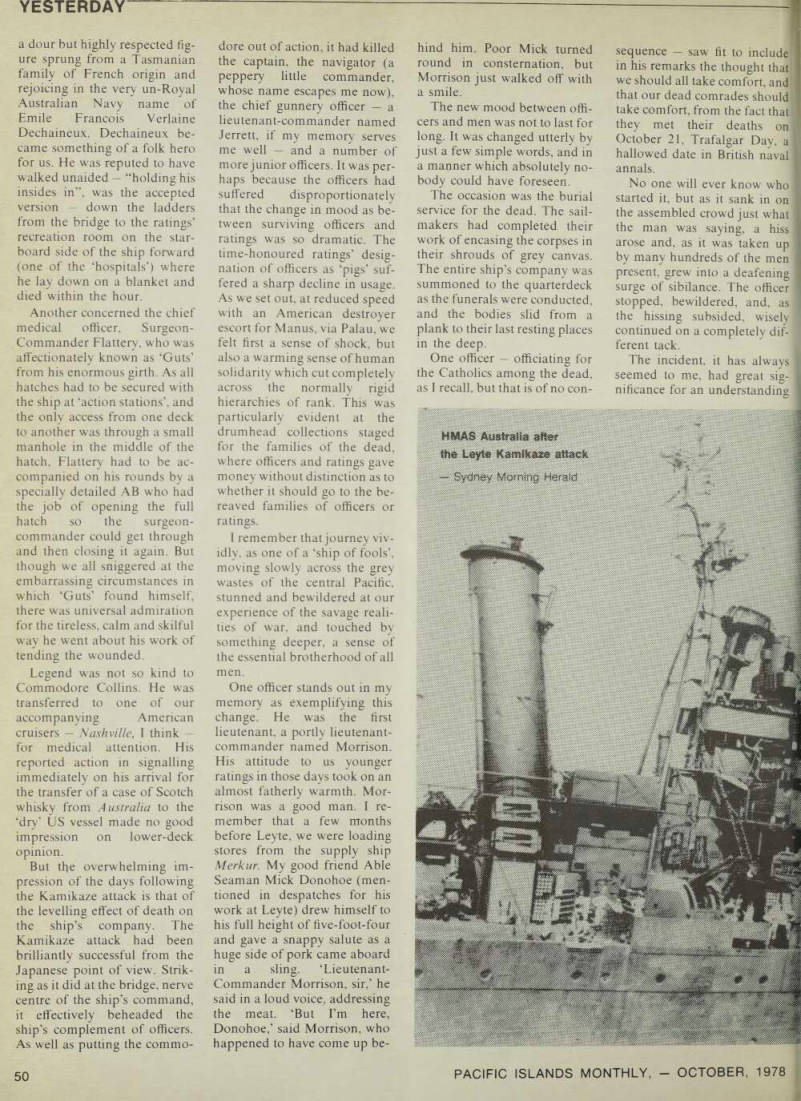
ing aviation petrol fell like fiery rain on the bridge. When the smoke cleared momentarily they saw the ship’s tripod mast bent at a drunken angle. ‘Australia’s bridge was a scene of carnage. The dead and wounded were half buried under
the smoking wreckage of the
radar hut and lantern. Burning petrol cast a fiery shroud over the contorted bodies.
‘Thirty officers and men of the
Royal Australian Navy died with the Japanese pilot. Another
64 were badly wounded. . .’
Its grisly task achieved, the
main body of the plane crashed over the port side of the forecastle into the sea. (I never saw it myself, but the story on board in the days that followed was that one ghoul of an AB he was from Bendigo, in Victoria had retrieved the forearm of the Japanese pilot, still
clutching the bomber’s joy-
stick, and had placed it in a
largejarofformalinasa‘keep-
sake’.)
They were grim and busy
hours for us, manhandling the wounded on stretchers down the narrow ladders from the bridge to the various parts of the ship which had been turned
into impromptu hospitals. I
was one of a group transporting the commodore, Collins, who, we were told, had suffered a collapsed lung from the blast of the explosion. He was evi dently in acute pain and
groaned constantly,
It is hard after 34 years to re member the exact details of that day and those which fol lowed. There is no such dif
ficulty in remembering the
stories - the legends, if you like - that sprung up about them, and became the common cur rency of shipboard conver sation for months afterwards, One concerned the captain,
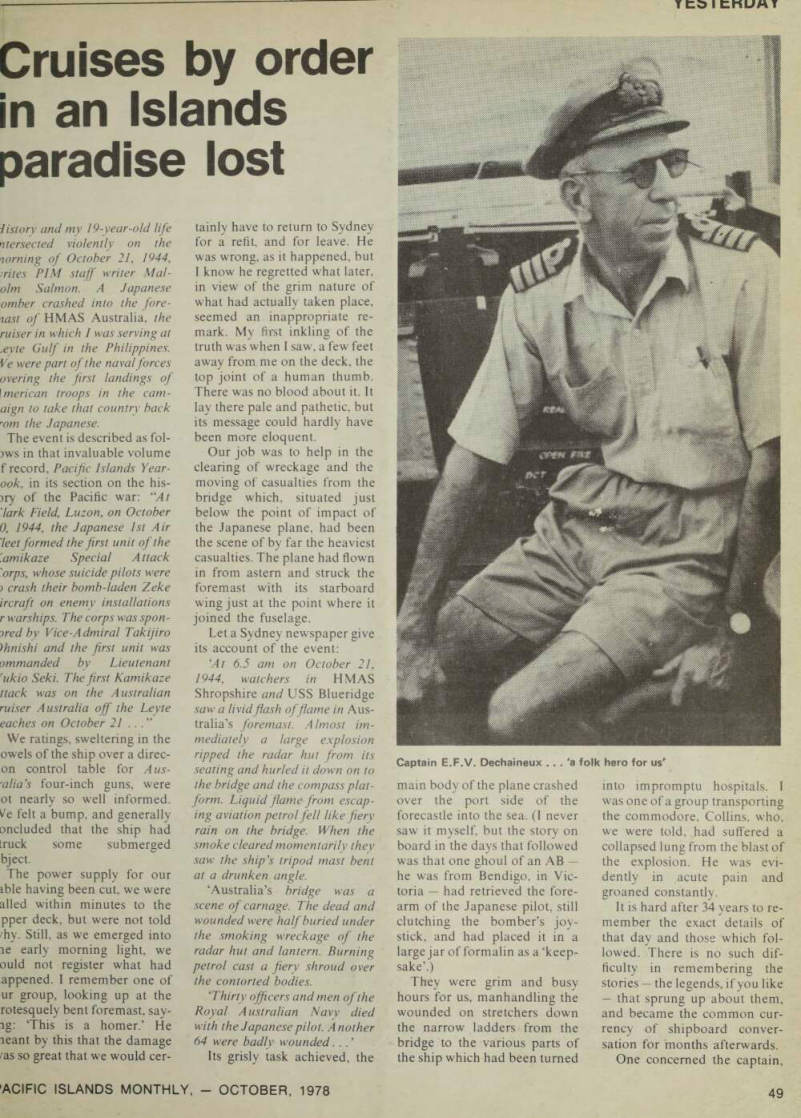
Captain E.F.V. Dechaineux ... 'a folk hero for us'
a dour but highly respected fig
ure sprung from a Tasmanian family of French origin and rejoicing in the very un-Royal Australian Navy name of Emile Francois Verlaine Dechaineux. Dechaineux be came something of a folk hero for us. He was reputed to have walked unaided “holding his insides in’’, was the accepted version down the ladders from the bridge to the ratings’ recreation room on the star board side of the ship forward (one of the ‘hospitals’) where he lay down on a blanket and died within the hour.
Another concerned the chief medical officer, Surgeon- Commander Flattery, who was affectionately known as ‘Guts’ from his enormous girth. As all hatches had to be secured with the ship at ‘action stations’, and the only access from one deck to another was through a small manhole in the middle of the hatch, Flattery had to be ac companied on his rounds by a specially detailed AB who had the job of opening the full hatch so the surgeon commander could get through and then closing it again. But though we all sniggered at the embarrassing circumstances in which ‘Guts’ found himself, there was universal admiration for the tireless, calm and skilful way he went about his work of tending the wounded.
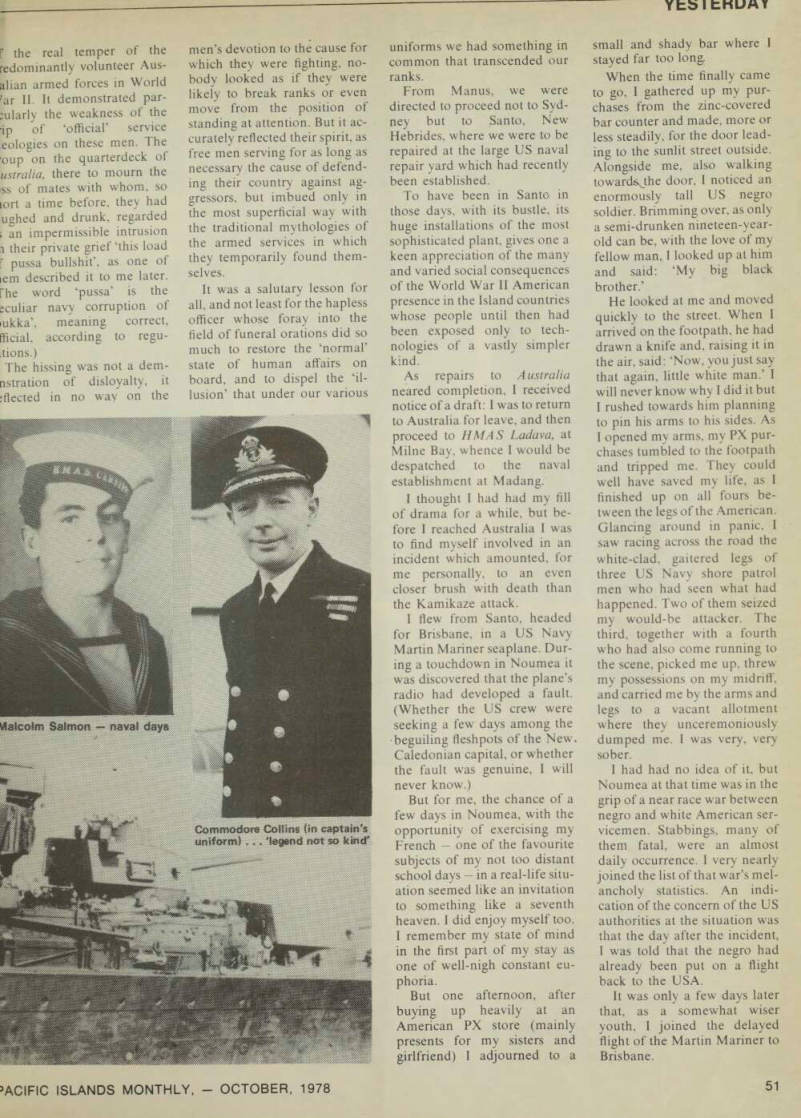
Legend was not so kind to Commodore Collins. He was transferred to one of our
accompanying American
cruisers Nashville, I think for medical attention. His
reported action in signalling
immediately on his arrival for the transfer of a case of Scotch whisky from Australia to the ‘dry’ US vessel made no good impression on lower-deck
opinion.
But the overwhelming im
pression of the days following
the Kamikaze attack is that of the levelling effect of death on the ship’s company. The Kamikaze attack had been brilliantly successful from the Japanese point of view. Strik ing as it did at the bridge, nerve centre of the ship’s command, it effectively beheaded the
ship’s complement of officers.
As well as putting the commo
dore out of action, it had killed the captain, the navigator (a peppery little commander, whose name escapes me now), the chief gunnery officer a lieutenant-commander named Jerrett, if my memory serves me well and a number of more junior officers. It was per haps because the officers had
suffered disproportionately
that the change in mood as be tween surviving officers and ratings was so dramatic. The
time-honoured ratings’ desig
nation of officers as ‘pigs’ suf fered a sharp decline in usage.
As we set out, at reduced speed with an American destroyer escort for Manus, via Palau, we felt first a sense of shock, but also a warming sense of human
solidarity which cut completely
across the normally rigid
hierarchies of rank. This was particularly evident at the drumhead collections staged for the families of the dead, where officers and ratings gave money without distinction as to whether it should go to the be reaved families of officers or
ratings.
I remember that journey viv idly, as one of a ‘ship of fools’, moving slowly across the grey wastes of the central Pacific, stunned and bewildered at our experience of the savage reali ties of war, and touched by something deeper, a sense of the essential brotherhood of all men.
One officer stands out in my memory as exemplifying this change. He was the first lieutenant, a portly lieutenant commander named Morrison.
His attitude to us younger ratings in those days took on an almost fatherly warmth. Mor rison was a good man. I re member that a few months before Leyte, we were loading stores from the supply ship Merkur. My good friend Able Seaman Mick Donohoe (men tioned in despatches for his work at Leyte) drew himself to his full height of five-foot-four and gave a snappy salute as a huge side of pork came aboard in a sling. ‘Lieutenant- Commander Morrison, sir,’ he said in a loud voice, addressing the meat. ‘But I’m here, Donohoe,’ said Morrison, who happened to have come up be
hind him. Poor Mick turned round in consternation, but Morrison just walked off with a sm il e - The new mood between officers and men was not to last for
long. It was changed utterly by
just a few simple words, and in a manner which absolutely nobody could have foreseen.
The occasion was the burial service for the dead. The sailmakers had completed their work of encasing the corpses in their shrouds of grey canvas.
The entire ship’s company was summoned to the quarterdeck as the funerals were conducted, and the bodies slid from a
plank to their last resting places
in the deep.
One officer - officiating for the Catholics among the dead, as I recall, but that is of no con-
sequence - saw fit to include in his remarks the thought that we should all take comfort, and that our dead comrades should take comfort, from the fact that they met their deaths on October 21, Trafalgar Day, a hallowed date in British naval annals.
No one will ever know who started it, but as it sank in on the assembled crowd just what the man was saying, a hiss arose and, as it was taken up by many hundreds of the men present, grew into a deafening surge of sibilance. The officer stopped, bewildered, and, as
the hissing subsided, wisely
continued on a completely dif ferent tack.
The incident, it has always seemed to me, had great sig nificance for an understanding
HMAS Australia after the Leyte Kamikaze attack - Sydney Morning Herald
f the real temper of the redominantly volunteer Aus alian armed forces in World r ar 11. It demonstrated par :ularly the weakness of the ip of ‘official’ service eologies on these men. The oup on the quarterdeck of ustralia, there to mourn the ss of mates with whom, so lort a time before, they had
ughed and drunk, regarded
; an impermissible intrusion
i their private grief ‘this load
f pussa bullshit’, as one of icm described it to me later, fhe word ‘pussa’ is the gculiar navy corruption of iukka’, meaning correct, fficial, according to regu tions.) The hissing was not a dem nstration of disloyalty, it ffiected in no way on the
men’s devotion to the cause for which they were fighting, no body looked as if they were likely to break ranks or even move from the position of standing at attention. But it ac curately reflected their spirit, as free men serving for as long as necessary the cause of defend mg their country against ag gressors, but imbued only m the most superficial way with the traditional mythologies of the armed services m which they temporarily found them selves.
It was a salutary lesson for all, and not least for the hapless officer whose foray into the field of funeral orations did so much to restore the ‘normal’ state of human affairs on board, and to dispel the il lusion’ that under our various
uniforms we had something in common that transcended our ranks.
From Manus, we were directed to proceed not to Syd ney but to Santo, New Hebrides, where we were to be repaired at the large US naval
repair yard which had recently
been established.
To have been in Santo in those days, with its bustle, its huge installations of the most
sophisticated plant, gives one a
keen appreciation of the many and varied social consequences of the World War II American presence in the Island countries whose people until then had been exposed only to tech
nologies of a vastly simpler
kind.
As repairs to Australia neared completion, I received notice of a draft; I was to return to Australia for leave, and then proceed to HMAS Ladava, at Milne Bay, whence I would be despatched to the naval establishment at Madang.
I thought I had had my fill of drama for a while, but be fore I reached Australia I was to find myself involved in an incident which amounted, for me personally, to an even closer brush with death than the Kamikaze attack.
I flew from Santo, headed for Brisbane, in a US Navy Martin Mariner seaplane. Dur ing a touchdown in Noumea it was discovered that the plane’s radio had developed a fault. (Whether the US crew were seeking a few days among the beguiling fleshpots of the New.
Caledonian capital, or whether the fault was genuine, I will never know.) But for me, the chance of a few days in Noumea, with the
opportunity of exercising my
French one of the favourite subjects of my not too distant school days in a real-life situ ation seemed like an invitation to something like a seventh heaven. I did enjoy myself too.
I remember my state of mind in the first part of my stay as one of well-nigh constant eu
phoria.
But one afternoon, after buying up heavily at an American PX store (mainly presents for my sisters and girlfriend) I adjourned to a
small and shady bar where I stayed far too long.
When the time finally came to go, I gathered up my pur chases from the zinc-covered bar counter and made, more or less steadily, for the door lead ing to the sunlit street outside.
Alongside me, also walking towardsjhe door, I noticed an enormously tall US negro soldier. Brimming over, as only a semi-drunken nineteen-year old can be, with the love of my fellow man, 1 looked up at him and said: ‘My big black brother.’
He looked at me and moved quickly to the street. When I arrived on the footpath, he had drawn a knife and, raising it in the air, said: ‘Now, you just say that again, little white man.’ I will never know why I did it but I rushed towards him planning to pin his arms to his sides. As I opened my arms, my PX pur chases tumbled to the footpath and tripped me. They could well have saved my life, as I finished up on all fours be tween the legs of the American.
Glancing around in panic, 1 saw racing across the road the
white-clad, gaitered legs of
three US Navy shore patrol men who had seen what had happened. Two of them seized my would-be attacker. The third, together with a fourth who had also come running to the scene, picked me up, threw my possessions on my midriff, and carried me by the arms and legs to a vacant allotment
where they unceremoniously
dumped me. I was very, very sober.
I had had no idea of it, but Noumea at that time was in the grip of a near race war between negro and white American ser vicemen. Stabbings, many of them fatal, were an almost daily occurrence. I very nearly joined the list of that war’s mel ancholy statistics. An indi cation of the concern of the US authorities at the situation was that the day after the incident, I was told that the negro had already been put on a flight back to the USA.
It was only a few days later that, as a somewhat wiser
youth, I joined the delayed
flight of the Martin Mariner to Brisbane.
Commodore Collins (in captain's uniform) ... 'legend not so kind'
Malcolm Salmon naval days