Doing what
pp. 29-32 · Read in the full issue
Tropicalities
Great yacht in
sky for ‘Don’
A generation of cruising
yachties will note with genuine regret the recent untimely death of ‘Don’ Percival. in Rarotonga. Don (born William Harold Percival in Notting ham, England, in 1919) died of head injuries after falling down stairs at his Rarotonga home.
As a PIM yachting cor respondent, Don supplied for many years those accurate and detailed reports on the comings
and goings of cruising yachts in
Rarotonga one of the more important South Seas yachting ports. Don’s slight bald-headed figure was a regular and wel come visitor to the yachts tied up at Avatiu’s tiny harbour in all weathers. Don was also known for his articles on Islands history which have appeared in PIM and other newspapers and magazines for more than 20 years, and not long ago he was co-author with Arthur Helms of a popular book on some of the Cook Islands, Sisters in the Sun. Don planned to write other histories when he retired from the Cook Islands Government next year.
The quiet, self-effacing Per cival worked for the govern ment for all his 24 years in the Cooks, in various jobs from storeman to editor of parliamentary debates the post he held when he died. He is a former editor of the government-run Cook Islands News. As a government man, Don had an inflexible rule after Sir Albert Henry came to power he refused to write about Cook Islands politics for
outside publications. ‘Too dif
ficult,’ he used to say. ‘l’ll stick to reporting on yachts and South Seas history.’ The re cords on these matters are the richer for his decision.
Somare’s plea for
the good news
The Papua New Guinea Prime Minister, Michal Somare, be lieves his country is getting a raw deal from the Australian and world press. ‘lf there’s a
tribal fight or a violent killing, or if the country does some thing wrong, then the papers
give it plenty of publicity,’ Mr
Somare told the PNG parlia ment in August. But few people were being told about the country’s achievements, and there was ignorance about the real PNG.
Dr Goasa Damena had asked Mr Somare why a review was being carried out into the work of the government’s Office of Information. Mr Somare said he had taken the decision to review the infor mation office, which is part of his department, and to carry out a reorganisation where necessary.
T want the world to know what we are achieving as legis lators and as a government,’ he said, i just don’t believe we are getting the right sort of pub licity outside. We are not being
given the right image.’
Doing what
comes naturally
An Australian newspaper re view of the latest book by Pa cific historian, Niel Gunson,
Messengers of Grace, a study of
nineteenth century evangelical missionaries in the South Seas, says: ‘Gunson makes it clear that
the evangelicals (products of
the revival of religious fervour in the nineteenth century
inside and outside the Church
of England) were mostly
people of lower middle class origin who saw their social and spiritual progress as two sides of the same coin . . . ‘ln a most revealing passage Gunson demonstrates that the evangelicals’ activities had, therefore, some of the force of a class struggle behind them.
He further shows the import ance of notions of class by pointing out how the rising “mechanic” class needed a lower order of people to set themselves against and found it, conveniently, in the “poor heathen”. ‘Gunson’s discussion of the impact of Calvinistic ideas on the “mechanics” is a fine piece of intellectual history and he
provides fascinating detail on
the nature of the missionaries’
“calling” and conversion.
These were frequently in reac tion to that act which is almost universal among adolescent males, but were often, too, the result of an illness or a revival ist sermon ...’
Entente
aeriale
An interesting excercise in Franco-Australian co-operat ion was slated for late Sep tember: the Coral Sea Air
Classic Prologue, jointly
organised by the New Cale donia Aero Club, Noumea, and the South Coast Aero Club, based in Wollongong, New South Wales, Australia.
Beginning on September 22
participating light aircraft, with
their French and Australian crews, were to set out on the
following route: Wollongong,
Rockhampton, Townsville,
Cairns, Horn Island, Daru, Port Moresby, Lae, Rabaul, Honiara, Graciosa Bay, Vila, Noumea. They were due in Noumea on September 30.
The organisers say: ‘Festivi ties have been arranged throughout the Air Classic.
This is purely an event being held in the spirit of aviation no prizes, just a bag full of fun
and excitement. Special pack
age deals have been set up for families and friends wishing to join in the fun in the New Hebrides and New Caledonia ... In 1980 the Coral Sea Air Classic will be a competitive event with sponsorship and prizes for best times, navi
gation, etc.’
Among the list of those taking part was the name of Henri Martinet, who founded
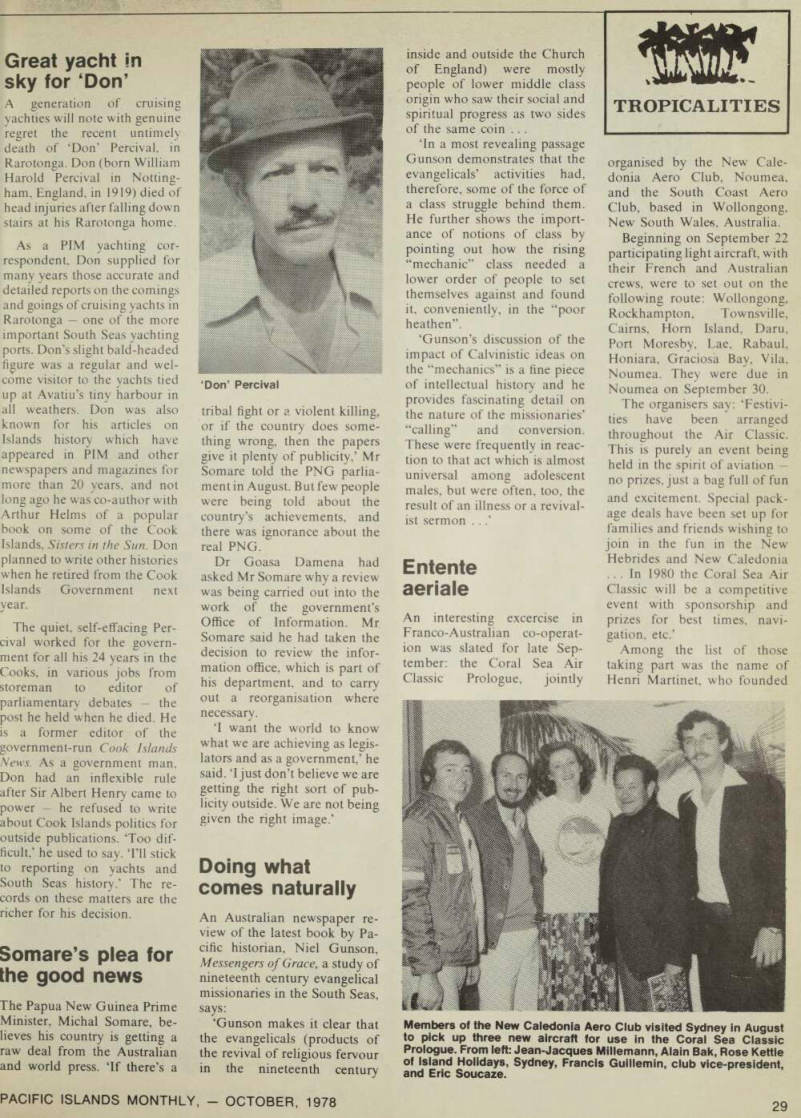
‘Don’ Percival
Members of the New Caledonia Aero Club visited Sydney in August to pick up three new aircraft for use in the Coral Sea Classic Prologue. From left: Jean-Jacques Millemann, Alain Bak, Rose Kettle of Island Holidays, Sydney, Francis Guillemin, club vice-president, and Eric Soucaze.
ffic New Caledonia Aero Club in 1935. Now over 70, he was to fly with his wife as co-pilot.
In 1938 Mr Martinet flew the first consignment of airmail from New Caledonia to Paris.
The 22 000 km journey took almost two months and was flown in a 100 hp Caudron air craft.
Actively supporting the Coral Sea Air Classic are the French airline UTA and the New Caledonian Tourist
Office, Sydney.
Tonga gets it on
paper at last
After months of planning and years of dreaming, Tonga has its first journal of literature, writes Will Keener. Entitled Faikava, to help conjure up images of tales shared in the ethereal atmosphere of the kava circle, the first issue in cludes poetry, short stories and
literary criticism in Tongan
and English.
The 31-page journal in
cludes two poems by the late Queen Salote and a dedication
to her as ‘the leading Tongan
poet of this century’.
The purpose of the journal, according to its editors and founders, is ‘to provide a forum for writers, poets and critics to make their work accessible to a wider audience’. Much Ton gan literary tradition has been an oral one, the editors note.
The journal is to be published at least twice a year.
The journal is not limited to Fongan writers, however.
Anyone who lives in Tonga or
is writing about Tonga or the
Pacific area in Tonga or English is welcome to con
tribute,’ said Dr ’Epeli
Hau’ofa, one of the founders of
the journal.
Work began on the journal last year with a successful ap plication for Australian cul tural aid for the project,
submitted by Dr Hau’ofa
through the University of the South Pacific Centre in Nuku alofa. Dr Hau’ofa worked with Dr Thomas Schneider and Futa Helu, both of Atenisi Institute. Konai Helu Thaman,
a Tongan poetess living in Fiji,
is a member of the editorial board.
Progress erases
settlement clues
More than 20 years ago, when a major church was being con structed in Tonga, workers lev elling the site uncovered numerous, valuable archeo logical artifacts, buried by time just below the surface. The arti facts included tools, necklaces and other decorative wear.
Most pieces were carried away
by workers, including several
which were taken from the country by church mis sionaries.
Although it is against Ton gan law to carry artifacts out of the country without per mission, there is little the government can do about the missing ones now. Ve’ehala, member of the kingdom’s Tra
ditions Committee and a strong supporter of archeological ex
ploration here, only learned
the story of the church site arti facts this year.
Lack of information about what is going on makes Ton ga’s protective law difficult to enforce, Ve’ehala acknow ledged. In fact, it seems only the handful of professional
archeologists working in the
kingdom over the past 20 years have paid any attention to the law at all.
Tonga’s archeological
troubles are not unfamiliar to Dr Yoshihiko Sinoto of the Bishop Museum, Honolulu.
On a recent visit to Tonga’s Haapai Island group. Dr Sinoto said building and
development were threatening
archeological research not only
in Tonga, but throughout the Pacific. One of the most im portant clues to the puzzle of how Polynesia came to be settled, he said, was the distri-
bution of lapita pottery. Lapita pottery had also been found in Fiji, Samoa, the New Hebrides, New Caledonia and on New Britain in Papua New Guinea, he said.
‘Blackbirding’ is
back Guise
The government of the Aus tralian State of Queensland has been accused of direct involve ment in the modern ‘blackbird ing’ of Papua New Guineans for cheap labour.
Sir John Guise, deputy leader of the opposition in the Papua New Guinea National Parliament, said that ships
operated by Queensland’s
Department of Aboriginal and
Island Affairs were luring Papua New Guineans on board, promising them wages and conditions which did not materialise. He said the victims worked on islands in the Torres Strait belonging to Queensland.
Foreign Minister Ebia Olewale told the house that
although some Papua New
Guineans may end up in Queensland in illegal and unsuccessful search for work, he did not believe the problem was as extensive as painted by Sir John .
Four’s company
among 500
The harmonious relations be tween the four Muslim and 496 Christian members of Fiji’s contingent to the United Nations peace-keeping force in Lebanon is a source of wonder ment to the inhabitants of that country. Conflict between Muslim and Christian ele ments of the Lebanese popula tion is one of the main reasons the peace-keeping force is there.
This fact is one of many con tributing to the good repu tation earned by the Fijians in Lebanon. Another was a recent incident in which a Fijian soldier, handy with his fists, knocked out two of three armed men who tried to force their way past a Fijian bat
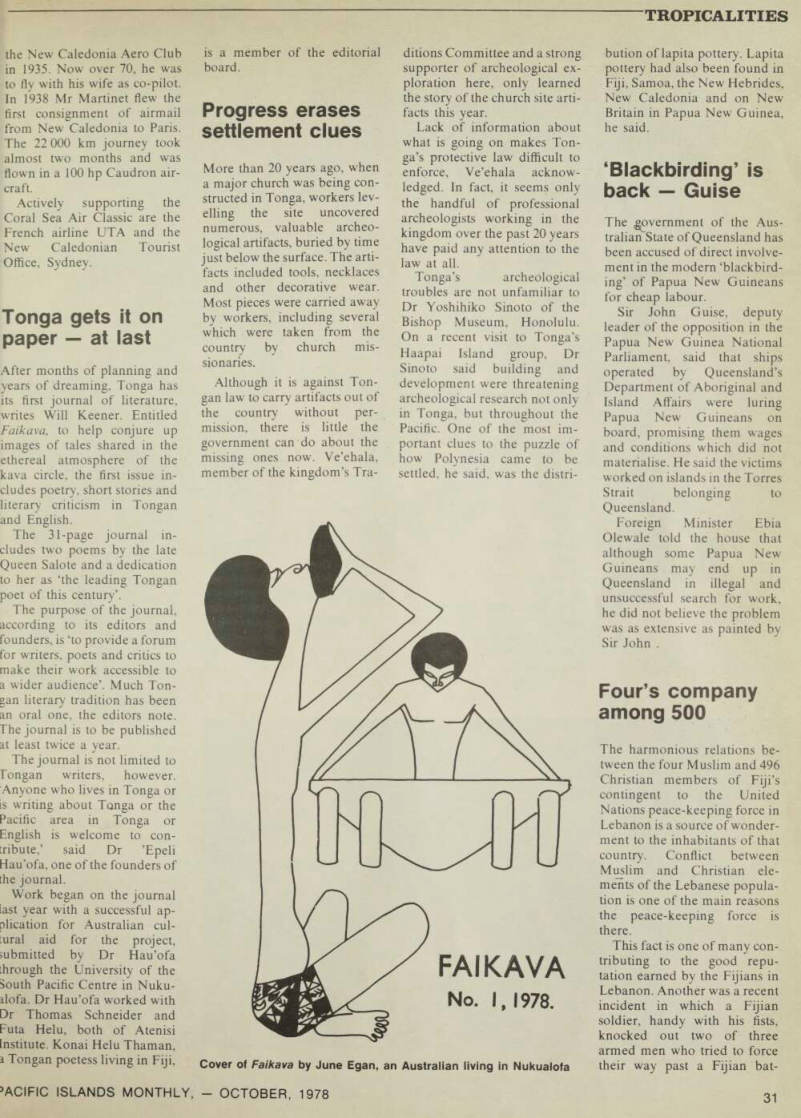
Cover of Faikava by June Egan, an Australian living in Nukualofa
talion checkpoint. The third man, not relishing the same treatment, loaded his companions aboard their car and drove off.
Plenty of nothing
fr»r Kroakfaef lUI UicdMdbl A bottle of lolly water and a bag of chips. There’s as much nutritional value in those as there is in a packet of cornflakes. (The flakes we mean. We are advised the packet has a much higher nutritive value.) Yet this so often is the picture of the tiny Papua New Guinean child on the way to school in Port Moresby and other PNG urban centres. Mum probably hasn’t realised that the 40-or-so toea she has been spending each day on each child to buy such ‘rubbish’ food could have been spent on something much more beneficial say a piece of cheese and a chunk of bread at the very least. And, likely as not, there’d be a toea or two left over.
But now the scene is changing. ‘Rubbish’ food pedlars are
thinking again not without
pressure from PNG authorities about coming up with something both cheap and nutritional for young Joe to start the day on. The health department’s nutrition program is starting to make itself felt.
Pleas to parents not to feed their children ‘rubbish’ food go
out over the National Broad casting Commission (NBC) radio. The NBC has volun tarily started to refuse advertis
ing from companies promoting
food the nutrition program lists as useless - The like iy outcome is a total ban on advertisin g foods which offer plenty of
nothing,
t^
Ticking Off fO X
tapa makers
‘Some of the masi being pro duced today our ancestors would be ashamed of.’ The words of Miss Latileta Kiti, senior field assistant for the Fiji
Department of Agriculture,
Miss Kiti had just arranged a five-day seminar on Kadavu Island the first step in a battle to preserve traditional ways of making masi more corn monly known as tapa. The qualities to look for in masi , according to Miss Kiti, are thickness, whiteness and colouring. All had deteriorated in recent years, she said. Not only is the loss of quality depressing Miss Kiti, she’s also upset at Samoan patterns which are creeping into Fijian masi.
At the seminar were depart mental officers from masi producing areas of Lau, Gau, Vatulele, Ra and Kadavu.
Over five days they worked their way through the complete process of masi making.
Plant expert turns
tour director
For 29 Vi years John Womersley roamed Papua New Guinea with an insatiable appetite to find out everything time would allow about the flora of this last unknown. When he left to retire to his native Adelaide in 1975 his name, that of Andre Miller and orchids were syn onymous. Who better to lead a Sydney tour operator’s ‘hor
ticultural’ expedition to Papua
New Guinea starting from, of all the unlikely places, Darwin?
John Womersley, now 58 who finished his permanent days in PNG as Assistant Director of Botany in the Department of Forestry, headed off on his first trip as a tour director in August. He’s going again this month and, so we’re told, bookings are rolling in for another four trips over the next year. Mr Womersley’s finest visible achievement in his years in PNG are the herbarium and national botanical gardens at Lae.
US sailors blow
their horns
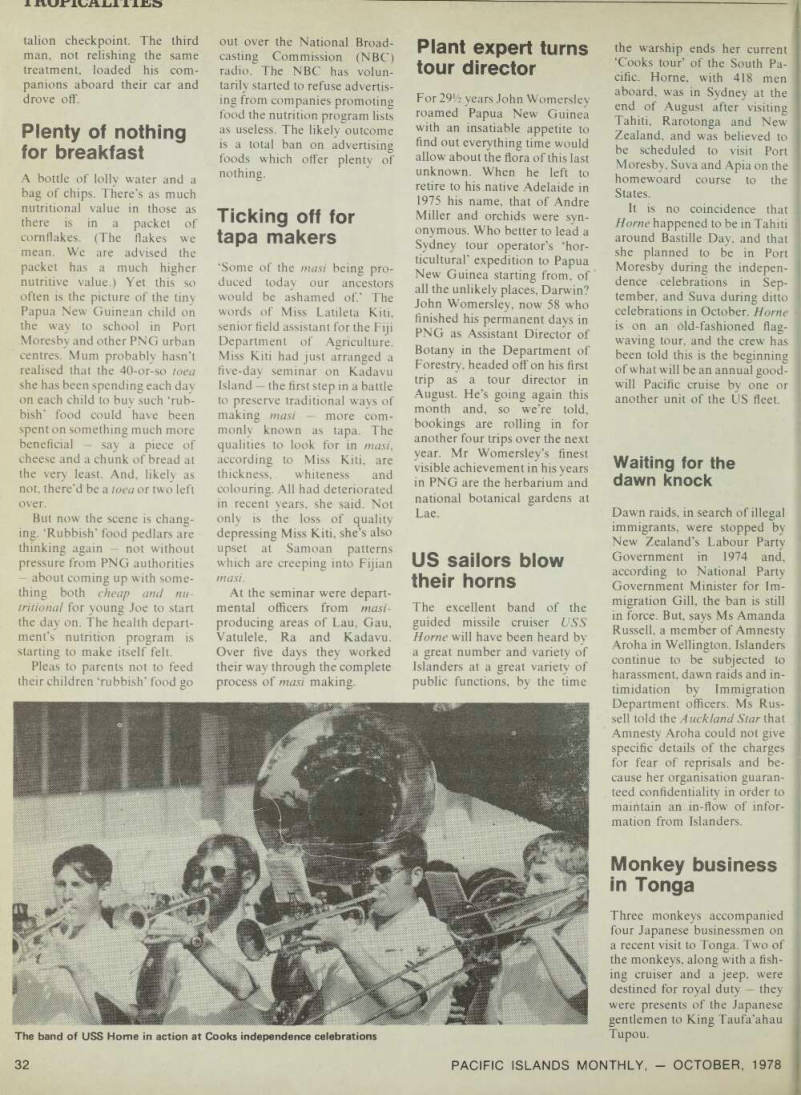
The excellent band of the guided missile cruiser USS Horne will have been heard by a great number and variety of Islanders at a great variety of public functions, by the time
the warship ends her current ‘Cooks tour’ of the South Pa cific. Horne, with 418 men aboard, was in Sydney at the end of August after visiting Tahiti, Rarotonga and New Zealand, and was believed to be scheduled to visit Port Moresby, Suva and Apia on the homewoard course to the States.
It is no coincidence that Horne happened to be in Tahiti around Bastille Day, and that she planned to be in Port
Moresby during the indepen
dence celebrations in Sep tember, and Suva during ditto celebrations in October. Horne is on an old-fashioned flag waving tour, and the crew has been told this is the beginning of what will be an annual good will Pacific cruise by one or another unit of the US fleet.
Waiting for the
dawn knock
Dawn raids, in search of illegal
immigrants, were stopped by
New Zealand’s Labour Party Government in 1974 and,
according to National Party
Government Minister for Im migration Gill, the ban is still in force. But, says Ms Amanda Russell, a member of Amnesty Aroha in Wellington, Islanders continue to be subjected to harassment, dawn raids and in
timidation by Immigration
Department officers. Ms Rus sell told the Auckland Star that Amnesty Aroha could not give specific details of the charges for fear of reprisals and be cause her organisation guaran teed confidentiality in order to maintain an in-flow of infor mation from Islanders.
Monkey business
in Tonga
Three monkeys accompanied four Japanese businessmen on a recent visit to Tonga. Two of the monkeys, along with a fish ing cruiser and a jeep, were
destined for royal duty they
were presents of the Japanese gentlemen to King Taufa’ahau Tupou.
The band of USS Home in action at Cooks independence celebrations