Such Ungracious
pp. 58-59 · Read in the full issue
Messengers
Of Grace
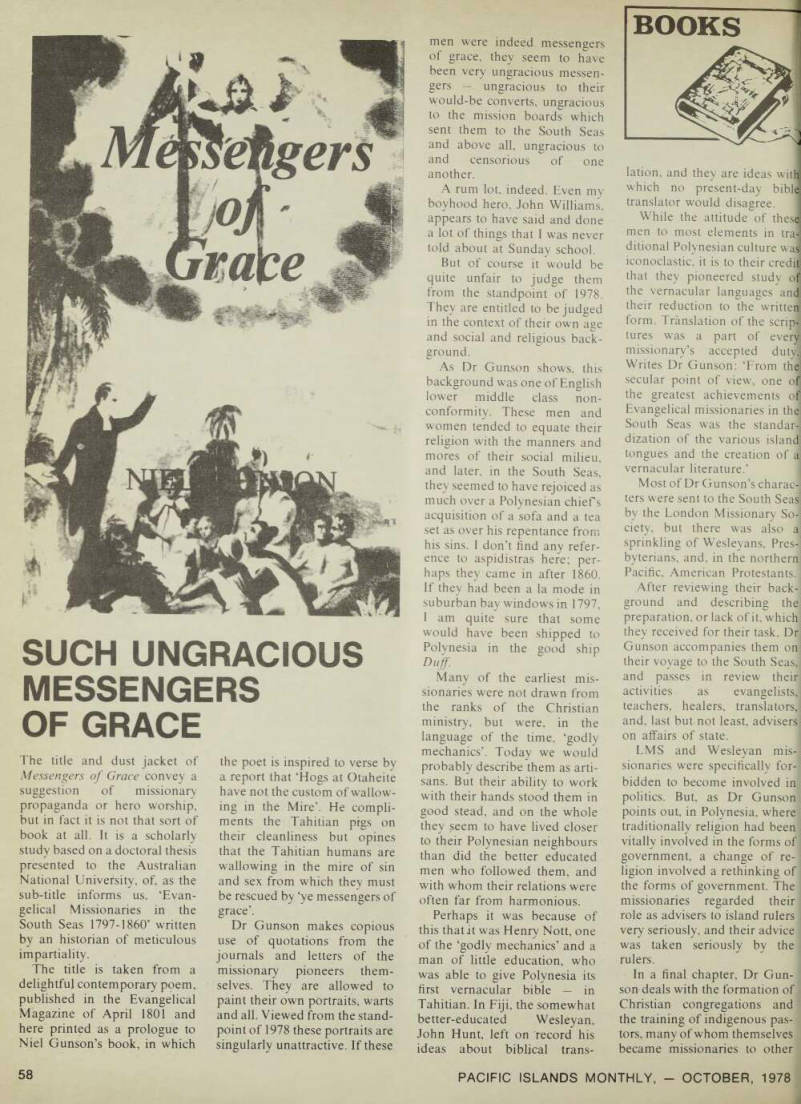
The title and dust jacket of Messengers of Grace convey a
suggestion of missionary
propaganda or hero worship,
but in fact it is not that sort of book at all. It is a scholarly study based on a doctoral thesis presented to the Australian National University, of, as the sub-title informs us, ‘Evangelical Missionaries in the South Seas 1797-1860’ written by an historian of meticulous
impartiality.
The title is taken from a delightful contemporary poem,
published in the Evangelical
Magazine of April 1801 and here printed as a prologue to Niel Gunson’s book, in which
the poet is inspired to verse by a report that ‘Hogs at Otaheite have not the custom of wallow ing in the Mire’. He compli ments the Tahitian pigs on their cleanliness but opines that the Tahitian humans are wallowing in the mire of sin and sex from which they must be rescued by ‘ye messengers of
grace’.
Dr Gunson makes copious use of quotations from the journals and letters of the
missionary pioneers them
selves. They are allowed to paint their own portraits, warts and all. Viewed from the stand point of 1978 these portraits are singularly unattractive. If these
men were indeed messengers of grace, they seem to have been very ungracious messen gers ungracious to their would-be converts, ungracious to the mission boards which sent them to the South Seas and above all, ungracious to and censorious of one another.
A rum lot, indeed. Even my boyhood hero, John Williams, appears to have said and done a lot of things that I was never told about at Sunday school.
But of course it would be quite unfair to judge them from the standpoint of 1978.
They are entitled to be judged in the context of their own age and social and religious back ground.
As Dr Gunson shows, this background was one of English lower middle class non conformity. These men and women tended to equate their religion with the manners and mores of their social milieu, and later, in the South Seas, they seemed to have rejoiced as much over a Polynesian chiefs acquisition of a sofa and a tea set as over his repentance from his sins. I don’t find any refer ence to aspidistras here; per haps they came in after 1860.
If they had been a la mode in suburban bay windows in 1797, I am quite sure that some would have been shipped to Polynesia in the good ship
Duff.
Many of the earliest mis sionaries were not drawn from the ranks of the Christian ministry, but were, in the language of the time, ‘godly mechanics’. Today we would probably describe them as arti sans. But their ability to work with their hands stood them in good stead, and on the whole they seem to have lived closer
to their Polynesian neighbours
than did the better educated men who followed them, and with whom their relations were often far from harmonious.
Perhaps it was because of this that it was Henry Nott, one of the ‘godly mechanics’ and a man of little education, who was able to give Polynesia its first vernacular bible in Tahitian. In Fiji, the somewhat better-educated Wesleyan, John Hunt, left on record his ideas about biblical trans-
Books
lation, and they are ideas witJ which no present-day bible translator would disagree.
While the attitude of thesa men to most elements in tral ditional Polynesian culture was iconoclastic, it is to their credit that they pioneered study of the vernacular languages and their reduction to the written form. Translation of the scripi tures was a part of every
missionary’s accepted duty!
Writes Dr Gunson; ‘From the secular point of view, one of the greatest achievements of Evangelical missionaries in the South Seas was the standard dization of the various island tongues and the creation of a vernacular literature.’
Most of Dr Gunson’s charac-l ters were sent to the South Sead by the London Missionary Son ciety, but there was also a
sprinkling of Wesleyans, Pres-I
byterians, and, in the northern Pacific, American Protestants.
After reviewing their back-!
ground and describing the
preparation, or lack of it, which] they received for their task. Dr Gunson accompanies them on their voyage to the South Seas, and passes in review their activities as evangelists, teachers, healers, translators, and, last but not least, advisers on affairs of state.
LMS and Wesleyan mis sionaries were specifically for bidden to become involved in politics. But, as Dr Gunson points out, in Polynesia, where
traditionally religion had been
vitally involved in the forms of' government, a change of re ligion involved a rethinking of the forms of government. The missionaries regarded their role as advisers to island rulers very seriously, and their advice was taken seriously by the rulers.
In a final chapter, Dr Gun son deals with the formation of , Christian congregations and the training of indigenous pas tors, many of whom themselves became missionaries to other
land groups, and later on to
iraway Melanesia.
‘lt was in training up a native *ency,’ concludes Dr Gunson, nd in extending the churches irough these men, that the iissionaries both established leir work and enabled the lurch to take more of its
laracter from the indigenous
>ciety.’
Messengers of Grace is a sub antial and stoutly bound vol ne of more than 300 pages.
plus some well-produced illus
trations and maps, and a further 100 pages of appen dices. notes, bibliography and index. Its recommended Aus tralian price of $25 may deter some, but I hope that it will find its way into libraries throughout the Pacific and be yond. It is much to be corn
mended.
Percy Chatterton
(Messengers of Grace. Niel Gunson. Pub lished by Oxford University Press, Mel bourne. 5A25.)