Uncle Sam’S Heavy Boot Leaves
p. 51 · Read in the full issue
Footprints In Micronesia
During World War II it took the Japanese but a day to occupy Guam. Hundreds of American servicemen lost their lives in the capture of military bases in the Japanese administered League of Nations mandate in Micronesia. It is therefore not surprising that the United
States sought a strategic
trusteeship over the islands.
The Trust Territory of the Pacific Islands, the last remain ing UN trusteeship, is close to being ‘wound up’, but it is highly likely that Uncle Sam’s strategic presence will con tinue, no matter how frag mented the Micronesian body politic may become. The islanders may achieve self government or, as those in the Northern Marianas have already done, opt for a direct political association with the US, but Washington will retain control of their defence and foreign affairs. Indeed, the more fragmented Micronesia’s internal government, the better will the Pentagon like it.
We need to keep all this in mind when reading The American Touch in Micronesia, a strongly critical account of US education policy and prac tice in the islands. After all, Uncle Sam did not become a trustee to promote the islanders’ development he sought to strengthen his stra
tegic position.
David Nevin, a journalist, observes that US efforts in educating Micronesians have been a disaster, a reproduction of a mediocre American urban system, not adapted to Micronesia’s ecology and cul tures. Only the Pacific Islands Central School (PICS), a junior high school, and Father Cos
tigan’s Ponape Agriculture and
Trade School (PATS) have done something to equip the islanders to cope with the
socio-economic problems
caused by the German, Japanese and American invasions of their islands.
In 1972, the year of the stat istics quoted in this book, the Trust Territory’s exports were
a paltry US$2.4 million whilst imports amounted to $26.3 million and much of those imports went on tinned foods,
alcoholic beverages, juke boxes
and other consumer goods of little, if any, value in building up a self-sufficient and bal anced economy. Of the annual budget, $7O million came from US subsidies but only $2 million was raised internally, an annual subsidy of $6OO a man, woman and child. This situation has worsened since then because of an annual
population growth of about
3.5%, among the highest in the world. If continued, this rate of growth will result in 250 000 islanders in 20 years from now.
On July 20, 1962, President Kennedy announced that edu cation was the key to all further progress, political, economic and social. Government and other teachers began to pour in from the States. In 1966, at its peak, the Peace Corps had over 900 volunteers its highest per
capita programme in the world; one volunteer for every 90 Micronesians, of which 300 teachers, and many of those were social activists rather than educators. The whole effort be came counter-productive: it raised the islanders’ expec tations even further beyond their capacity to satisfy them.
During my six months’ work with the Trust Territory’s staff economist in 1963 I told the
then-Director of Education, Dr Robert Gibson, that his pro gramme of teaching grades 1 to 4 in the vernacular might turn out to be a better way of
introducing an appropriate
amalgam of Micronesian- Western education than an all out assault in English.
However, as the author men tions, Gibson’s policy was discontinued and the all- American approach taken since then has not produced anything of value to the islanders.
There are now far too many
poorly-prepared high school
graduates and college alumni.
Of course, David Nevin is right
in saying that Washington’s
endeavours in the education field have been a dreadful mis take; but there is no facile sol ution perhaps, none at all in a situation where US stra tegic interests have been, are, and continue to be the fore most consideration. If ever the big nations begin to see that
peaceful co-operation, not ‘de
fensive strategy’ (a misnomer of preparing lor war), is the best way to conduct inter national relations, then the Micronesians will get an
opportunity to develop edu
cation and other systems to meet their particular needs.
Harry Jackman
(The American Touch in Micronesia. David Nevin Published by W. W. Norton. New York.
US 59.95.)
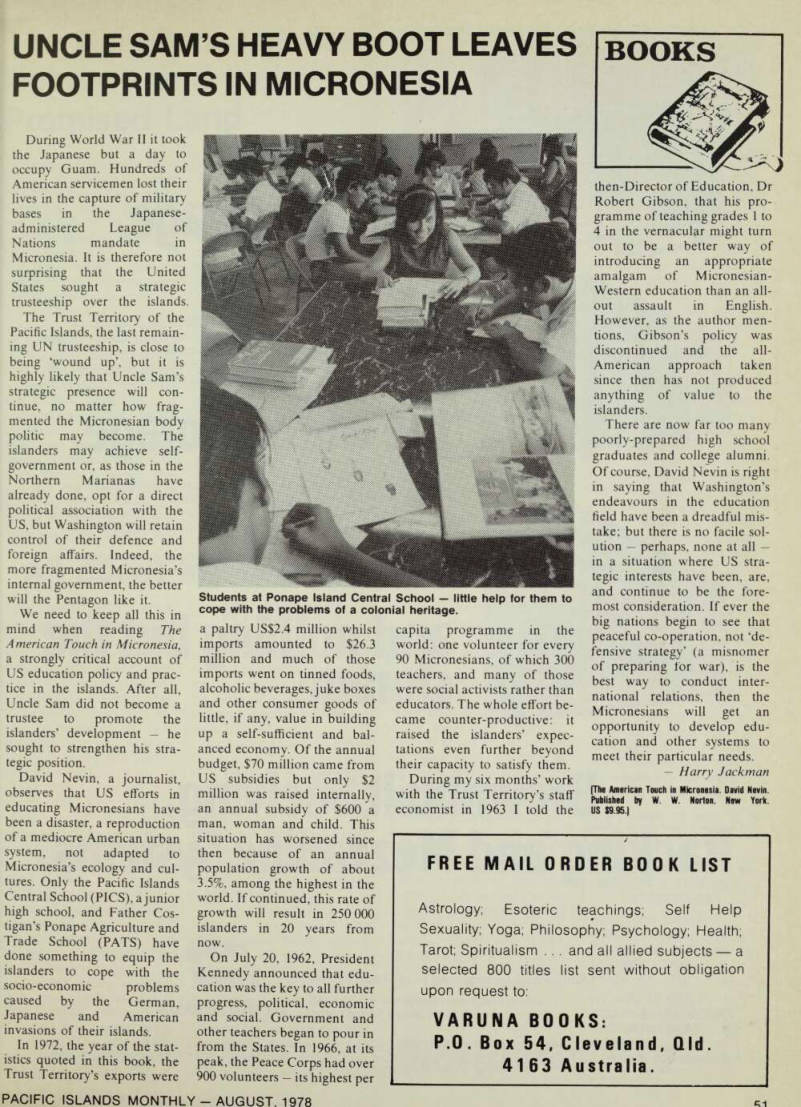
Students at Ponape Island Central School little help for them to cope with the problems of a colonial heritage.