Currents
pp. 37-41 · Read in the full issue


Political
Png: Politics
Is Border Key
Predictably, Papua New Guinea’s first real life military
operation since independence
has occurred along the Indonesian border, writes Angus Smales from Port
Moresby.
At one point in June about 480 members of the PNG De fence Force and 30 police were deployed in the northern area of the border on a search-and arrest mission against anti- Indonesian rebels who may have sought refuge in PNG ter ritory. The rebels were be lieved to be holding a number
of hostages, including senior
Indonesian officials. (PIM, Jul, p5l).
Tensions were aggravated by the crossing of about 100 Indonesian soldiers into PNG
territory during the search.
Confronted with PNG diplo matic representations, Indone sian authorities claimed the crossing was “accidental”. The troops quickly went back into Irian Jaya, but not before claims were made by PNG vil
lages that they had destroyed
food gardens during their
stay.
From the PNG side, the op eration had the trappings of a political exercise more than anything else. The real conflict was not soldiers versus rebels (none had even been sighted at last report) but international obligations versus home-front
politics.
It was not the rebels who were in the hot seat but the PNG Government itself, faced with the need to balance inter national policies with an emotional ethnic and human
rights issue.
The real extent to which human rights and freedoms may be involved is very much open to interpretation, but that doesn’t make the conflict of issues any less real.
The border where the troops
went rebel-hunting separates PNG from Irian Jaya, the most
easterly province of Indonesia
where separatist native-born
guerrillas are calling for
independence. Politically, the
native-born people of Irian are Indonesians. The United Nations accepts this. So does
Png.
But a big proportion of the native-born Islanders, certainly towards the border, are eth nically part of the Melanesians of PNG, distinct from South east Asian people.
Indonesians themselves, for all their official line of “one country, one people”, oc casionally let the cat out of the bag. In Jakarta, for instance, it is not uncommon to hear the
expression “our aboriginal
people in the east”.
PNG came to nationhood less than three years ago on the edges of this largely inherited political situation, and estab lished formal ties with Indonesia. The affairs of Irian were accepted as purely Indo nesian-domestic, and Indo nesia’s sovereignty up to the border was not disputed.
At home, the PNG Govern ment has walked a tightrope ever since because of the in herent sympathy of many of its constituents for “the cause of our brothers across the border”.
If Indonesia were phleg matic towards the situation, the
problem facing PNG would be far less pressing. But Indonesia’s border and rebel sensitivity is so intense that PNG has been forced by its diplomatic ties to act in a more decisive manner than it other
wise might.
In return it has had to suffer the condemnation of many of its own people in a situation which is fast becoming another example of the skin colour game, and which extends to other parts of the Pacific.
Increasingly vitriolic literature is being circulated from so called Black Unity groups in the Pacific, labelling the PNG Government a traitor to “the black brotherhood of the world”.
Australian Aboriginals have
joined Fijians and New
Hebrideans in signing some of the circulated material, and student bodies in PNG are quick to back it.
The decision by the PNG Cabinet to conduct a military search and arrest operation on its own side of the border in the north has created a new spate of criticism at home.
The government no doubt expected this and was prepared to wear it.
But more importantly the move seemed to be a calculated
political action to display
clearly the government’s colours for the benefit of long term relations with Indonesia.
Whether any rebels were found or arrested didn’t matter very much. What seemed the most important factor was that PNG was out to desensitise its border relations with Indonesia
by demonstrating a strong
commitment to the policies it has talked about for long
enough.
10 000 March
In Noumea
Nearly 10 000 people marched through the streets of Noumea in June in a massive
union-organised protest
against the effects of the econ omic crisis, writes Andre Chaville from Noumea.
There were many reasons for their anger. The workers at Societe le Nickel had been on strike since June 1 in protest
against a 12% cut in their wages since employers put them on a 35-hour week. Employees claimed that savings could have been effected elsewhere in the company, and con demned the import tax exemp
tions enjoyed by it.
Public servants joined the demonstration, announcing an indefinite strike from the fol lowing day. The strike had only limited success. Most public servants were back at work 48 hours later.
The public servants’ griev
ance was that Vice-President Caillard had unilaterally an nounced a cutback in the “cor rective index” from 2.02 to 1.95. (This is the index by which the salary of a civil ser vant in France is multiplied to arrive at the salary of his Caledonian counterpart.) Andre Caillard is a very unpopular man yet, if he is to obtain subsidies from France, he has been warned that the territory must raise new taxes and cut back on spending.
The public service, grossly
overpaid in the opinion of pri
vate enterprise, was the obvious target.
In fact, the public servants’ salaries will not be reduced, as the cut in the corrective index will be compensated by an in crease in the consumer price index. Since the end of the
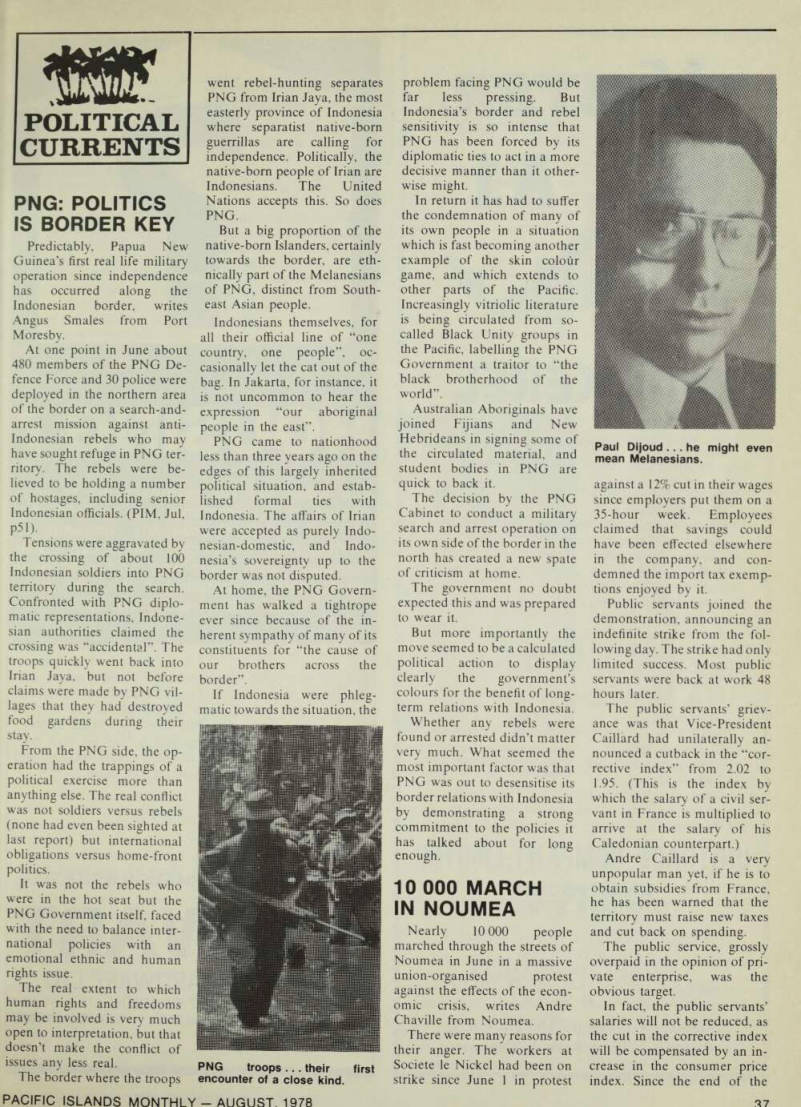
PNG troops... their first encounter of a close kind.
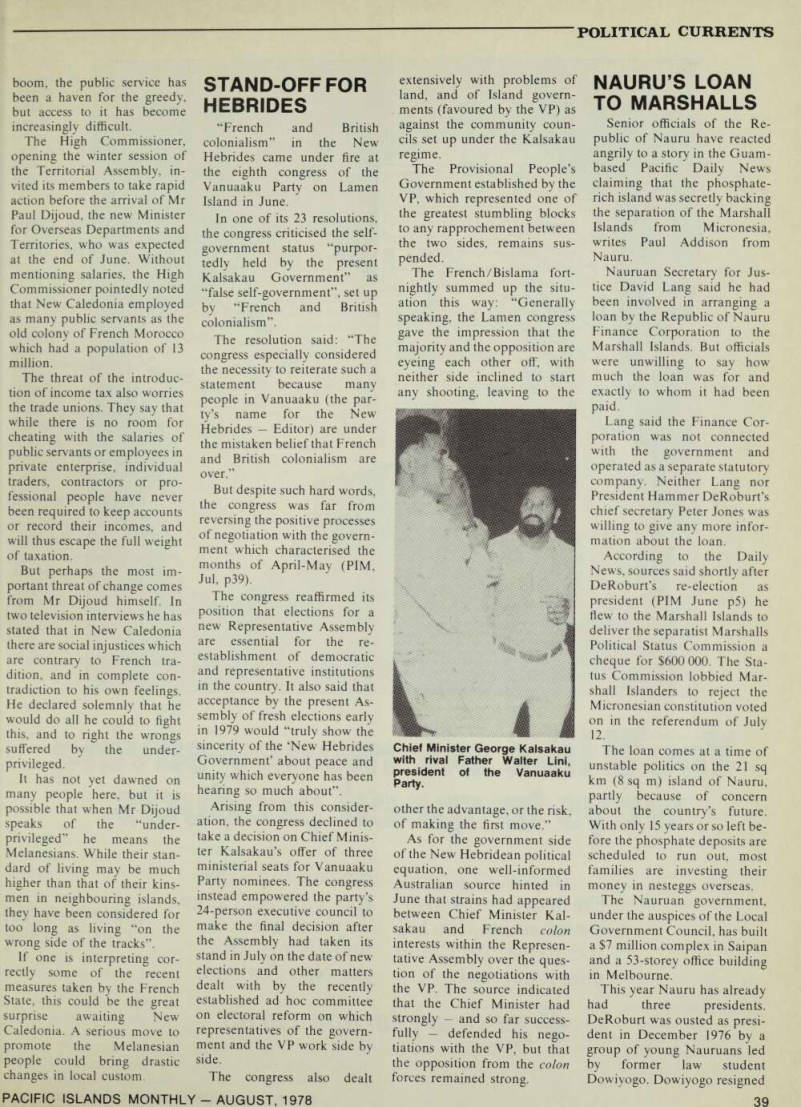
Paul Dijoud... he might even mean Melanesians.
boom, the public service has been a haven for the greedy, but access to it has become
increasingly difficult.
The High Commissioner, opening the winter session of the Territorial Assembly, in vited its members to take rapid action before the arrival of Mr Paul Dijoud, the new Minister for Overseas Departments and Territories, who was expected at the end of June. Without
mentioning salaries, the High
Commissioner pointedly noted that New Caledonia employed as many public servants as the old colony of French Morocco which had a population of 13 million.
The threat of the introduc tion of income tax also worries the trade unions. They say that while there is no room for cheating with the salaries of public servants or employees in
private enterprise, individual
traders, contractors or pro fessional people have never been required to keep accounts or record their incomes, and will thus escape the full weight of taxation.
But perhaps the most im portant threat of change comes from Mr Dijoud himself. In two television interviews he has stated that in New Caledonia there are social injustices which are contrary to French tra dition, and in complete con tradiction to his own feelings.
He declared solemnly that he would do all he could to fight this, and to right the wrongs suffered by the under
privileged.
It has not yet dawned on many people here, but it is possible that when Mr Dijoud speaks of the “under privileged” he means the Melanesians. While their stan dard of living may be much higher than that of their kins men in neighbouring islands, they have been considered for too long as living “on the wrong side of the tracks”.
If one is interpreting cor rectly some of the recent measures taken by the French State, this could be the great
surprise awaiting New
Caledonia. A serious move to promote the Melanesian people could bring drastic changes in local custom.
Stand-Off For
Hebrides
“French and British colonialism” in the New Hebrides came under fire at the eighth congress of the Vanuaaku Party on Lamen Island in June.
In one of its 23 resolutions, the congress criticised the self government status “purpor tedly held by the present Kalsakau Government” as “false self-government”, set up by “French and British colonialism”.
The resolution said: “The congress especially considered the necessity to reiterate such a statement because many people in Vanuaaku (the par ty’s name for the New Hebrides Editor) are under the mistaken belief that French and British colonialism are over.”
But despite such hard words, the congress was far from
reversing the positive processes
of negotiation with the govern ment which characterised the months of April-May (PIM,
Jul, p 39).
The congress reaffirmed its position that elections for a
new Representative Assembly
are essential for the re establishment of democratic and representative institutions in the country. It also said that acceptance by the present As sembly of fresh elections early in 1979 would “truly show the sincerity of the ‘New Hebrides Government’ about peace and unity which everyone has been hearing so much about”.
Arising from this consider ation, the congress declined to take a decision on Chief Minis ter Kalsakau’s offer of three ministerial seats for Vanuaaku Party nominees. The congress instead empowered the party’s 24-person executive council to make the final decision after the Assembly had taken its stand in July on the date of new elections and other matters dealt with by the recently established ad hoc committee on electoral reform on which representatives of the govern ment and the VP work side by side.
The congress also dealt
extensively with problems of
land, and of Island govern ments (favoured by the VP) as against the community coun cils set up under the Kalsakau regime.
The Provisional People’s Government established by the VP. which represented one of the greatest stumbling blocks to any rapprochement between the two sides, remains sus
pended.
The French/Bislama fort nightly summed up the situ ation this way: “Generally speaking, the Lamen congress gave the impression that the majority and the opposition are eyeing each other off, with neither side inclined to start any shooting, leaving to the
other the advantage, or the risk, of making the first move.”
As for the government side of the New Hebridean political equation, one well-informed Australian source hinted in June that strains had appeared between Chief Minister Kal sakau and French colon interests within the Represen tative Assembly over the ques tion of the negotiations with the VP. The source indicated that the Chief Minister had strongly and so far success fully defended his nego tiations with the VP, but that the opposition from the colon forces remained strong.
Nauru’S Loan
To Marshalls
Senior officials of the Re public of Nauru have reacted angrily to a story in the Guam based Pacific Daily News
claiming that the phosphate
rich island was secretly backing the separation of the Marshall Islands from Micronesia, writes Paul Addison from Nauru.
Nauruan Secretary for Jus tice David Lang said he had been involved in arranging a loan by the Republic of Nauru Finance Corporation to the Marshall Islands. But officials were unwilling to say how much the loan was for and exactly to whom it had been
paid.
Lang said the Finance Cor poration was not connected with the government and operated as a separate statutory company. Neither Lang nor President Hammer Deßoburt’s chief secretary Peter Jones was willing to give any more infor mation about the loan.
According to the Daily
News, sources said shortly after Deßoburt’s re-election as
president (PIM June p 5) he
flew to the Marshall Islands to deliver the separatist Marshalls Political Status Commission a cheque for $6OO 000. The Sta tus Commission lobbied Mar shall Islanders to reject the Micronesian constitution voted on in the referendum of July 12.
The loan comes at a time of unstable politics on the 21 sq km (8 sq m) island of Nauru, partly because of concern about the country’s future.
With only 15 years or so left be fore the phosphate deposits are scheduled to run out, most families are investing their money in nesteggs overseas.
The Nauruan government, under the auspices of the Local Government Council, has built a $7 million complex in Saipan and a 53-storey office building in Melbourne.
This year Nauru has already had three presidents.
Deßoburt was ousted as presi dent in December 1976 by a group of young Nauruans led by former law student
Dowiyogo. Dowiyogo resigned
Chief Minister George Kalsakau with rival Father Walter Lini, president of the Vanuaaku Party.
in April this year, after his budget failed to win govern ment support. He was suc ceeded by Lagumot Harris whose budget also failed.
Deßoburt again became Presi dent of the island’s 4 000 Nauruans in May.
Png Aloof
On Torres
Papua New Guinea is stay ing out of the dispute over the Torres Strait border question between Australian Prime Minister Malcolm Fraser and Queensland Premier Joh
Bjelke-Petersen.
PNG Prime Minister Michael Somare told Angus Smales in Port Moresby that negotiations leading up to a proposed settlement of the border question had been car ried out on a country-to country basis between his government and the Australian Government.
Any discontent felt by Queensland was an internal matter for Australia to settle, said Mr Somare. PNG could
recognise only the Australian
Government as the legitimate
authority to negotiate Aus
tralian border arrangements with PNG, he said.
Mr Somare would not com ment on whether he believed the attitude taken by Queensland was sufficiently strong to upset arrangements already reached by Australia.
He could not comment on Aus tralian internal issues, Mr Somare said.
Mr Bjelke-Petersen at first welcomed the terms of the agreement, but then changed his mind, possibly after sensing mutterings from black Queenslanders in the strait.
Russia: Mara
Speaks Out
Warnings about a Russian presence in the South Pacific were voiced late in June by the Fiji Prime Minister, Ratu Sir Kamisese Mara, and the vice president of the New Zealand Labour Party, Mr Michael Moore. At the same time the first resident United States
Ambassador to Fiji, Mr John Condon, said his country intended to strengthen its ties with Pacific Island countries.
Ratu Sir Kamisese, speaking after his return from a visit to China and South Korea, said he feared the Russians’ objec tive in Fiji was to upset him and get him out of government.
He said he did not harbour the same fears about the Chinese.
The Prime Minister said he would be “pretty scared” to have a Russian embassy in Fiji.
He had spoken to the Russians, through their ambassador to New Zealand, three or four years ago, telling them it was disturbing to him as head of government to see that, with out consulting him, they had gone to Fiji and selected
people from the opposition
camp to be trained in Russia.
“I will not have a govern ment which will be of that mood established here,” he said.
Ratu Sir Kamisese said he did not think Fiji workers would be influenced by the
political ideologies of any
Chinese advisers who went to
Fiji to help to improve agricul
ture and industry.
The main interest of the Chinese in the South Pacific was to see that the Russians did not intrude into the area. The Chinese had mentioned to him that perhaps Fiji would be bet ter olf to be friendly with the Americans than with the Rus sians.
In New Zealand. Mr Moore said that the danger of super power rivalry in the South Pa cific was very real. Echoing the sentiments of Prime Minister Muldoon, he said that the Rus sian courtship of Fiji, Western Samoa and other Pacific coun tries spelled danger for New Zealand.
Mr Condon, speaking to the Nadi Rotary Club in his first formal speech in Fiji, said the freedom of the sealanes in the Pacific was vital to the security and well-being of the US and all maritime powers. “We will protect them,” he said.
He described the Pacific Basin as the most dynamic economic zone in the world. Its prosperity was shared by all
except those nations who re jected the market system.
He said US trade with the Pacific nations was crucial to the health of its economy and would be expanded. Multi lateral trade agreements should be concluded.
Mr Condon said the US mission was preparing to inten sify the exchange of people and ideas with Fiji.
On other matters, the US envoy expressed admiration for Fiji’s respect for democratic rule and human rights; reported that a survey team from the University of Hawaii had submitted an analysis of the region’s future food needs; and voiced the hope for joint projects in the region to meet the challenge of finding new ways to use US technology in
development of indigenous Pa
cific sources of energy.
Png: New-Look
Action
Students at the University of Papua New Guinea in Port Moresby staged an often viol ent fortnight-long strike in
May against the two-year
suspension of a student for striking a lecturer.
In a close analysis of the strike written for PIM, PNG
journalist Andy Supeke finds
that it contained a number of features new to student politi cal action at the UPNG.
He writes: “This was the first strike by students at the univer sity that displayed real student
solidarity.
“The question was asked re
peatedly: ‘Why should
students fight over only one
student’s problem?’ Many said:
‘lf Vincent Toliman got fired for striking a lecturer, he got fired tough luck for him.’
“Such attitudes were charac teristic of similar situations in the past, but they were not the dominant ones this time.
“In the first place, the students were unimpressed with the degree of assault on the lecturer. (T expected to see the lecturer all messed up. but surprisingly he didn’t even have a scratch on his face or anywhere,’ said one student.) “The vice-president of the
Student’s Representative Council, Joe Mac Teine, ex pressed a general view when he said that what mattered was that the principle of justice should be maintained.
Students did not dispute that Vincent should be punished, but believed that the decision of Vice-chancellor Renagi Lohia was ‘arbitrary and ex cessive’.
“He said: ‘lf we just sit back and watch Vincent get fired, anyone of us could well be in the same boat next time for not so serious an assault’.”
Another unusual aspect of the strike, writes Supeke, was that its development cut across many conventional ideas of re
gional loyalties. “Probably the
biggest surprise was the sup
port given by the Highlands
United Front on the campus to the Students’ Representative Council.
“The Front is one of the most politically sensitive groups ever formed on the campus, representing students from the five highlands prov inces who make up more than a third of the student popu lation.
“Only about a month before the strike, the Front said it would not support any SRC strikes or demonstrations be cause an application for its af filiation with the SRC was
rejected.
“For one thing the president of the Highlands United Front, Malipu Balakau, and Vincent Toliman, both political acti vists on the campus, have been very good friends.
“Since they met in 1975, Vin cent has been associated with the highlands students more than he has with students from his own area. (Vincent
Toliman, a third-year political
science student, is a Tolai from New Britain, son of the late United Party leader, Mathias Toliman.) “Asked whether Vincent’s friendship with him and the highlands students had any thing to do with the support they gave to the SRC, Balakau said: ‘Friendship played a part in our support, but we were fighting for a basic principle that was at stake. Justice was at stake’.”