by-night operators
p. 35 · Read in the full issue
An end to the PNG butterfly by-night operators
Papua New Guineans are cashing in on a natural asset the colourful and spectacular butterfly and insect life. Some people have made fortunes out of butterflies, but no more. The government has taken over through a commercial venture with the responsibility of see ing that local people instead of black market operators get the benefit.
No up-to-date lists of these fauna have been recorded.
However, there are about 1 000 known species of butterflies, and about 35 000 species of beetles.
The butterflies include the largest birdwing in the world, which is found near Popon detta. Up to SUSI 800 has been paid for birdwings on the inter national black market.
In 1974, the PNG Govern ment set up the Insect Farming and Trading Project under the control of the wildlife branch of the Department of Primary Industry. This is not only a commercial venture; it is also a promotional exercise de
signed to attract village people
into a viable industry.
Under the scheme villagers collect and export insects and
benefit from the prices paid by
overseas dealers.
Before the scheme came into operation the trade was mainly in the hands of foreign businessmen who monopolised the large scale export of beetles and butterflies, particularly the larger and more colourful
birdwings.
The villagers were exploited
there is no other word for it.
They were paid lOt to 20t a but terfly. Prices on the overseas market ranged from 50t to KlO for an unprotected butterfly, and KBO-K2OO for a protected one.
When the government set up the scheme in 1974 there were less than 30 Papua New Guineans, from three of 20 provinces, involved in the trade at village level. Wildlife offi cers, to promote the govern ment project, told the villagers which local insects and but terflies were valuable, and how
to farm collect, prepare and sell
them. They taught villagers
control and harvesting methods, and how to avoid over-collecting and habitat de struction.
Villagers who wished to di
versify into profitable butterfly
farming were encouraged to
grow more of the food plants required by the larvae and adult butterfly and then to har vest the pupae from the plant.
Farms were usually located round food gardens, in the scrub close to the village, or in old garden sites.
Today, more than 500 Papua New Guineas are involved in
collecting and exporting
unprotected butterflies and other insects. There are about
10 villages actively farming
unprotected butterflies as a business, and more villages are expected to join in. New York
dealers’ prices for unprotected
butterflies range from 30c for common species to SUSSO for rarer types.
The 1978 net earnings of
families engaged in butterfly
and insect farming should be from K7OO to Kl5OO. Farm gate value of the project should be more than K6O 000 - a small amount perhaps, in a national context, but exceedingly useful in the vil
lages.
A central marketing agency at Bulolo is convenient for most farmers and collectors.
The agency ensures that the quality of insects exported is maintained at a high standard.
Assistance is given to producer/ collectors to negotiate fair
prices from overseas buyers.
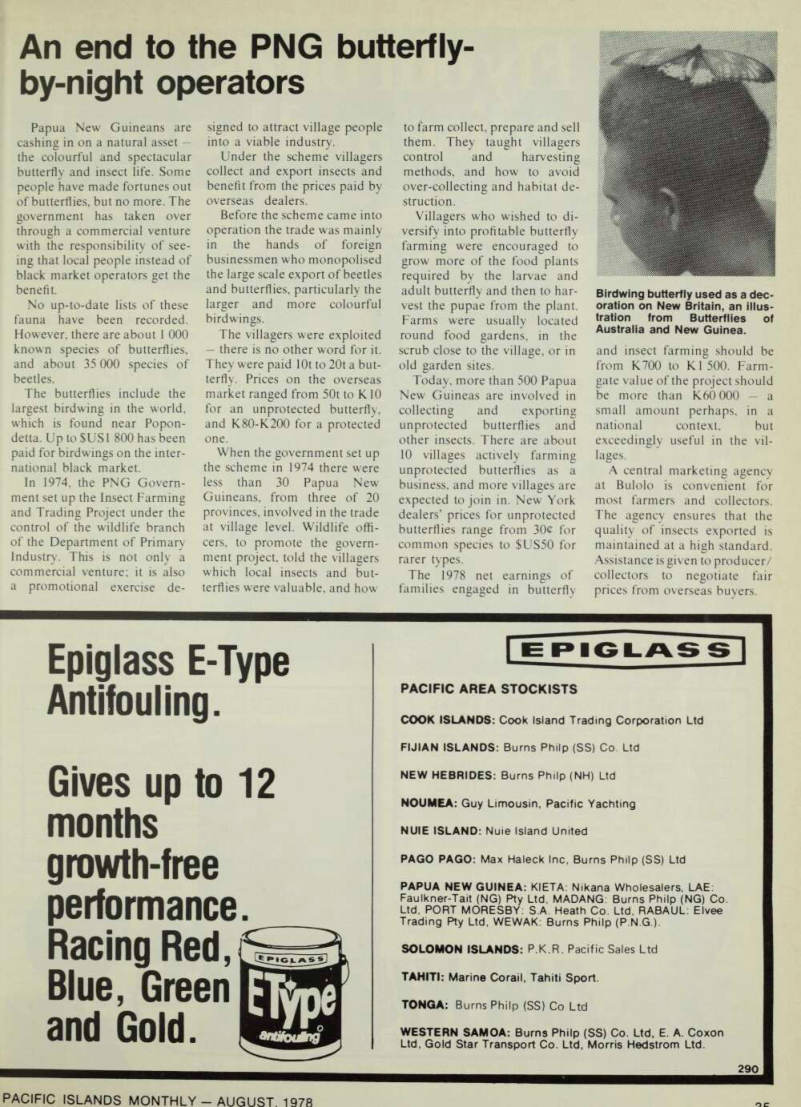
Birdwing butterfly used as a dec oration on New Britain, an illus tration from Butterflies of Australia and New Guinea.