Pacific Islands Monthly



Pim
r i ivli >1W
American Simoi USSI.2S Australia ASI.OO Fiji FJI.OO Hawaii US J 1.50 New Cal. S Fr. PoI.CFP 140 New Hebrides AS).OO NZ. Cook Is. & HiueNZSI .OO Norfolk Island A J 1.00 Papua New Guinea Kl.OO Solomons SSI. 00
Tonga PI.OO
Ush A Guam Usji.2S
Western Samoa 11.00 Ragattarmd for posting as a publication
r
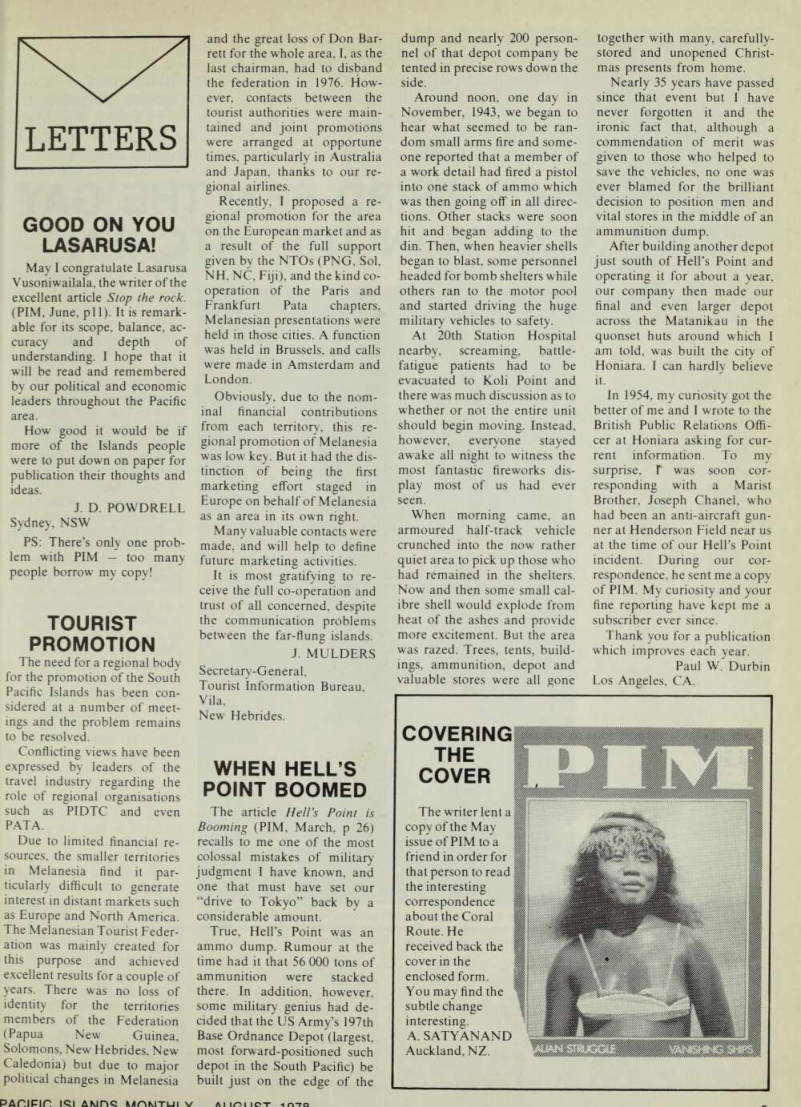
Covering
The
Cover
The writer lent a copy of the May issue of PIM to a friend in order for that person to read
the interesting
correspondence
about the Coral Route. He received back the cover in the enclosed form.
You may find the
subtle change
interesting.
A. Satyanand
Auckland, NZ.
Advertisements & other items, pp. 2-4 (1 item)
Toyota
How tofinda REAL economy car.
When you look at a car billed as an economy
model, ask yourself a few questions.
What sort of fuel consumption can be expected?
Low? Good.
What about other operating costs? Oil, lubrication, that kind of thing. Low again? Great.
How about maintenance? The car has a low-breakdown record? You are definitely on the right track.
What is the average life of the car? Is it better than the average in your area? Super. That’s important in an economy car. how. How is the after service? Buying a car is not all in the price you know. Plenty of service outlets?
One economy car coming up. All you have to do is check the price. Then you can tell if you are really getting an economy car.
You will probably find, after asking these questions about town, that REAL economy cars come down to Toyota, the world’s economy car builder.
See Toyota first. Then you won’t have to shop around.
IHE HAPPY ECONOMIZER
TOYOTA STARLET
The car that says economy in every way.
And you will be happy for it. Big inside.
Small outside. Miserly with petrol.
Without sacrificing comfort. A good buy in an economy car even for Toyota.
W
PAPUA NEW GUINEA:
ELA MOTORS LIMITED,
Scratchley Rd., Badili, P.O. Box 75, Port Moresby.
U.S. TRUST
TERRITORY: MICROL
CORPORATION,
P.O. Box 267, Saipan.
FIJI ISLANDS:
AUTOMOTIVE
SUPPLIES CO., LTD.,
G.P.O. Box 355, Suva.
AMERICAN SAMOA:
BURNS PHILP
(SOUTHSEA) CO., LTD.,
P.O. 1057, Pago Pago.
WESTERN SAMOA:
BURNS PHILP
(SOUTHSEA) LTD.,
P.O. Box 188, Apia.
GUAM: ATKINS, KROLL
(GUAM) LTD., P.O. Box
6248, Tamuning.
NEW HEBRIDES;
NEW HEBRIDES
MOTORS LTD.,
P.O. Box 18, Vila.
SOLOMON ISLANDS:
MENDANA
TOYOTA
SERVICE
TOYOTA
ENTERPRISES (5.1.)
LTD., P.O. Box 174,
Honiara.
TAHITI: NIPPON
AUTOMOTO, B.P. 342,
Papeete.
COOK ISLANDS:
COOK ISLANDS
TRADING
CORPORATION LTD.,
P.O. Box 92, Rarotonga.
NAURU ISLAND:
NAURU COOPERATIVE
SOCIETY.
GILBERT ISLANDS:
TARAWA MOTORS,
Box 36, Bairjki Tarawa.
NORFOLK ISLAND:
MOUNT PITT
(ENTERPRISES) LTD.,
P.O. Box 169
NEW CALEDONIA;
SOCIETE
IMPORTATION
AUTOMOBILE DE
PACIFIQUE,
Rond-Point du Pacific (Station Total) B.P. 438, Noumea.
The Toyota range includes: Toyota 1000, Toyota Starlet, Toyota Corolla, Toyota Celica, Toyota Corona, Toyota Cressida, Toyota Crown
/ \ * * 0 \ *' ■ ♦ A
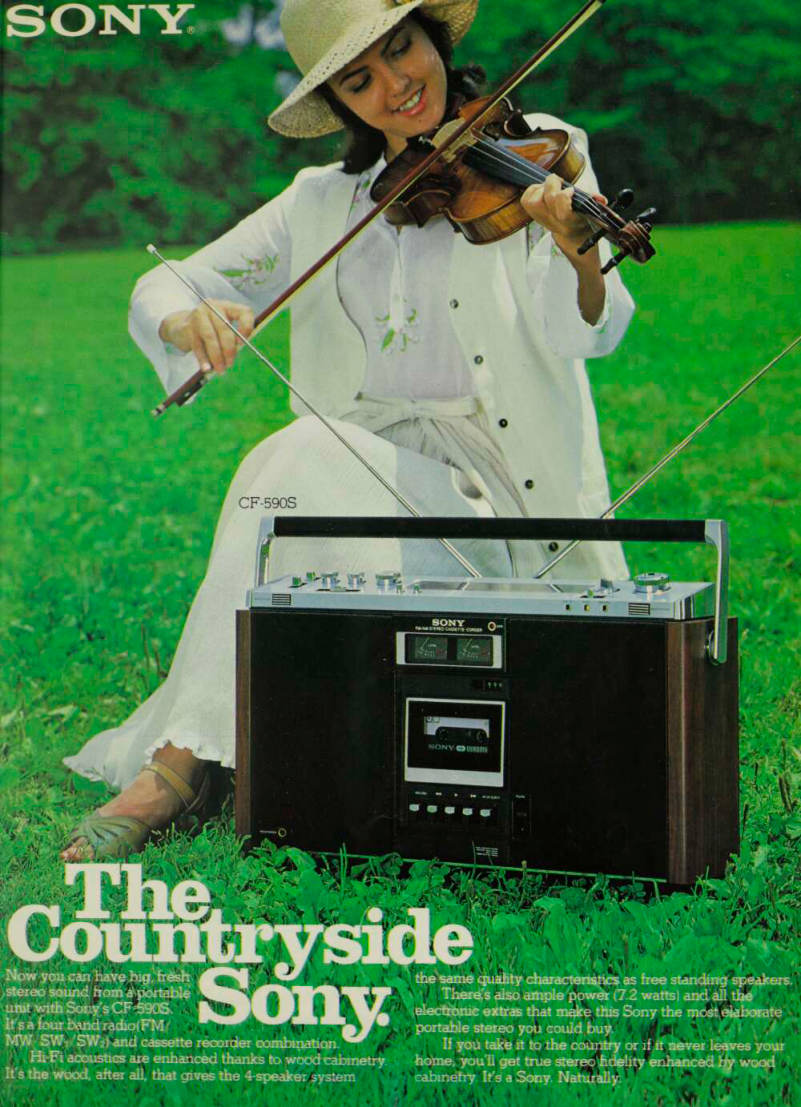
CF-590S
y x r\ ■I . y 4 !- ■ ■* <*yv> U ■ :A Vi g *v £lB P f. ■ •/ r ft KM \ I ' > j i' v.' %fc V> >' 4 /' A aC I , * ■«»*■&• • ■ S, I ** ,1 w , (C Now you can have t stereo sound from a unit with Sony's CF- It s a four band radio(FM MW SWi SW2) and cassette recorder combination Hi-Fi acoustics are enhanced thanks to wood cabinetry.
It's the wood, after all. that gives the 4-speaker system
r
Kenwood’s specialist-designed separate audio
components are for people who want only the very best that modem life can offer. Like ;; ■'■■■
tonal quality in reproduced music.
W S % ; ■ There's proof in the performance data. Ask your Kenwood dealer for a test listening. And discover what sound quality really means!
KA-5700 Stereo integrated amplifier •KX-520 Cassette deck with Dolby* N.R. • KD-2000 Automatic return turntable
• LS-770 MKD
• LS-770 MKI Coaxial passive cone speaker system Trademark of Doiby Labs Inc.
LS-770 mkII KX-520 i \'T^ n Hi* KA-5700 »S| KD-2000 ■ • TRIO-KENWOOD CORPORATION 6-17, 3-chome, Aobadai, Meguro-ku, Tokyo 153, Japan
TAHITI MAISON AURORE Papeete Tel 29703
AMERICAN SAMOA ISLAND PACIFIC AGENCIES, INC Pago Pago Tel 633-4687
REPUBLIC OF NAURU NAURU CO-OPERATIVE SOCIETY
MARIANA ISLANDS J C TENORIO ENTERPRISES Saipan Tel 6445
Pacific Report
Jimmy Carter’S Nuclear Plan
US President Jimmy Carter in June unveiled a plan for a nu clear fuel storage and reprocessing plant in the Pacific for use by Australia, Japan and South-east Asian nations. He wants the plant built on the Marshall or Caroline Islands. He believes such a plant would discourage construction of nuclear facilities by many countries, and would make international surveillance easier.
Conference Planned On Nuclear Issues
With reports that further French nuclear testing in French Polynesia is imminent, the Pacific Conference of Churches and the Pacific People’s Action Front announced they are jointly sponsoring two conferences to be held in Micronesia in Sep tember. Subjects will be: Nuclear issues in the Pacific; and independence and people’s movements in the Pacific.
Nauru’S Denial On Marshalls Loan Claim
Nauruan officials have emphatically denied a claim by the Guam-based Pacific Daily News that their phosphate-rich island lent a sum of $6OO 000 to bolster separatist forces in the Marshall Islands. (See PIM, p 39.)
Independence Clash
A shadow over the Solomons’ independence celebrations (pages 14/15) was a clash between Malaitans and men from the Western District at Gizo. Two were taken to hospital and 43 arrested on drunk and disorderly charges. It was reported that the fight began when Malaitans attempted to raise the Solomon Islands flag. Gizo boycotted the celebrations.
Pacific Art Pays Bolivian Criminals
Two treasures of early Pacific art a scowling wooden war rior believed to have been acquired during one of Captain Cook’s expeditions, and a wooden face mask from Pentecost Island, New Hebrides fetched a total of £430 000 (about SA7OO 000) at a June 30 art auction in London. The£2so 000 paid for the warrior was said to be a record price for a piece of primitive art. The pieces were from the collection of Bolivian tin tycoon, Mr Jorge Ortiz. He was obliged to sell them to recoup a $2 million ransom paid to kidnappers of his five-year-old daughter.
Russians Reply To Fiji’S Mara
The only sign of a Russian interest in Fiji had been a recent visit by the Soviet Ambassador in Australia, who is responsible for Soviet diplomatic relations with Fiji, according to an official of the Soviet Embassy in Canberra. He was commenting on re marks by the Fiji Prime Minister, Ratu Sir Kamisese Mara (see PIM, p4l). Ratu Sir Kamisese had said he would be “pretty scared” to have a Soviet embassy in Fiji. The Soviet spokesman said it appeared the Prime Minister had been over-impressed by anti-Soviet statements he had heard on his recent visit to China. Russia never took sides against legitimate governments in other countries, and her contacts with Fiji were “very small and not well developed”.
Finbar Kenny Threatens Sir Albert
American millionaire Finbar Kenny has threatened in a telex message and a letter to withdraw from the Cook Islands Phila telic Bureau and sever all ties with the country. His ultimatum was revealed in correspondence placed before the Chief Justice
of the Cook Islands in Rarotonga during the July hearing of pet itions alleging bribery and corruption in the Cook Islands’ March general elections. Mr Kenny asked the Premier, Sir Albert Henry, to clear him and the bureau of all connection with Sir Albert’s election campaign and funding. Sir Albert refused. (See Sir Albert in a Corner, (pi 7).
Islands To Fore At Coastal Talks
Sydney was the venue for a major international symposium in June on problems of coastal protection in the light of national proclamations of 200-mile exclusive economic zones. Among more than 20 countries represented were Papua New Guinea, Fiji, Tonga, Gilbert Islands and Nauru. The South Pacific Com mission and the South Pacific Bureau of Economic Co-operation also sent representatives.
Sir Albert, Bjelke Confer On Brych
Two controversial and colourful political figures huddled in Brisbane in July with the declared aim of settling “once and for all” whether Milan Brych is a cancer-curing wizard or a quack. They were the Premier of the Cook Islands, Sir Albert Henry, and the Premier of the Australian State of Queensland, Mr Joh Bjelke-Petersen. Brych practices cancer therapy in the Cook Islands, and recently visited Queensland at the invitation of Mr Bjelke-Petersen. Sir Albert paid a four-day visit to Queensland, also at the invitation of the State Premier.
Torres Border For International Court?
Rejection by the Queensland Government of the Torres Strait border negotiated between Papua New Guinea and Australia (PIM, July, p4l) could go to the International Court of Justice if the question cannot be settled privately. This announcement was made in June by the Acting Prime Minister of Australia, Mr Anthony, in response to a statement by Queensland Premier, Mr. Bjelke-Petersen, that he would hold a referendum if the exist ing border was not recognised. (See PIM, p 41.)
The Spirit Of Enterprise (I)
Showing commendable Gallic initiative, a New Hebrides firm is treating and canning for sale large quantities of the Great African Snail. Transforming a major pest into a major delicacy will be a profitable exercise, according to the company. Export markets to which it is looking include Australia.
The Spirit Of Enterprise (Ii)
The Anglo-Saxons were not far behind. Not quite so dramatic, but still full of the spirit of enterprise, was the action of a firm of Australian wine and spirit merchants who marketed well in time for the celebration of Solomon Islands’ independence in July a range of wines known as Independence Claret, Indepen dence Riesling, and Independence Demi Sec. Labels bore an attractive and colourful version of the new flag of Solomon Islands.
Tonga’S Space-Age Communications
Telecommunications to and from Tonga stepped into the space age in June with the inauguration of the Cable and Wire less satellite earth station in Nukualofa. The station was formally opened by King Taufa’ahau Tupou IV as part of a four-day pro gramme of celebrations of his 60th birthday. Among foreign guests present were the Governor-General of Fiji, Ratu Sir George Cakobau, and President Hammer Deßoburt of Nauru.
The monarch’s birthday was also marked by the issue of four commemorative coins.
Looking For Cannabis On Pocklington
Cannabis worth S4O million was seized from a yacht near Port Macquarie on Australia’s New South Wales coast in June. Aus tralian narcotics agents believed that the total hoard from which the seized cannabis came was so big that some of it had to be left behind at a trans-shipment point. So they joined with Papua New Guinea Customs authorities in a search of rusty hulks on Pocklington Reef, a graveyard of wrecked shipping.
The reef is in PNG waters, 180 km from the nearest land, Rossel Island, and 600 km from the most easterly tip of the PNG main land.
HEBRIDES FREE BY ’BO - PLEDGE AT U.N.
A British United Nations delegate, Mr lan Woods, has told the sub-committee on small territories of the General Assembly’s Special Committee on Decolonisation that France and Britain are determined to bring the New Hebrides to independence in 1980. He said the two governments were now making efforts to ensure the territory’s economic viability.
Fiji’S New Gold Prospect
Another gold prospect is opening up in Fiji, near Balevuto, in western Viti Levu. The prospect, covering 240 ha, is close to Atherton Antimony porphyry gold prospect in the Vuda Valley.
Siberia Nickel NL has joined the Greenvale Mining group to ex plore the prospect, paying $155 000 in cash and issuing 250 000 30$ shares for a 25% interest.
Caning For Png’S Account Methods
Gross misuse of public money, losses, wastages, inefficien cies and failure to observe statutory financial reporting pro cedures were among criticisms made by a parliamentary committee set up to study Papua New Guinea’s national book keeping. The strong words were uttered by the committee chair man, Mr Warren Dutton. * “HEBRIDES WILL STAY A TAX HAVEN” - C.M.
The Chief Minister of the New Hebrides, M; George Kalsakau, has reassured Australian and other companies taking advantage of the New Hebrides as a tax haven that his government is fully committed to “fostering and advancing” the tax haven sys tem.
Labor To Kill Norfolk Accord?
A change of government in Australia could jeopardise the agreement reached on the future of Norfolk Island (PIM, July, psl), according to Australia’s Minister for Home Affairs, Mr. R.
J. Ellicott, QC. He quoted a Labor Party spokesman as voicing hardline support for the provisions of the Nimmo Royal Com mission into Norfolk Island.
Fiji Extends Oil Search
The Fiji Government has approved a new oil exploration agreement for the US-based Pacific Energy and Minerals Ltd.
It will extend the search to the Yasawa Islands off the northwest of the main island of Viti Levu and to the Great Sea Reef area, north of the second largest island in the group, Vanua Levu.
“Three-Tier Us Policy” Call By Coleman
A three-tier Pacific policy has been recommended to the United States by the Governor of American Samoa, Mr Peter
Tali Coleman. He said in Hawaii that the policy should be divided three ways: to take care of Japan and other highly populated areas, such as China and India; then the Philippines and other South-east Asian countries; and finally the South Pacific Islands and countries. He said he believed the recent interest of China and the Soviet Union in the South Pacific was “primarily econ omic”. Unless the US had a policy for economic development in the region, the “other offers” would attract interest.
Ex-Ministers Crash In Png Polls
Three former Ministers in the Papua New Guinea Government made unsuccessful bids in June to regain seats in parliament.
They were the former Deputy Prime Minister and Foreign Minis ter, Sir Maori Kiki, the former Minister for Police, Mr Patterson Lowa, and the former Minister for Labour, Mr Gavera Rea. They stood in by-elections for two seats in the capital, Port Moresby.
Indonesia’S “Overkill” On Border
The “informally co-ordinated” border operation by Indonesian and Papua New Guinean armed forces on the Irian Jaya border in June (PIM, Jul, p 5) involved the use on the Indonesian side of OV 10F jet aircraft fitted with rockets and Sidewinder missiles.
Revealing this, an Australian correspondent in July described the use of such planes against about 150 guerillas as “an exer cise in overkill”. He said it made a difficult situation less control lable and worse for all concerned, “the Indonesian and PNG Governments in particular, and the Australian Government at the end of the line”. It could also create difficulties for Indonesia in securing further aircraft from the US Government. The OV lOFs were made in the US specially for Indonesia and were delivered in 1976.
MORE RUSSIAN SHIPS TO CALL AT FIJI Fiji will see more Russian ships, mainly trawlers, in the next few months, according to Seatrans (Fiji) Ltd, agents for Russian ships. They will call mainly for provisions. The number of Russian fishing vessels in the South Pacific has increased, following an agreement which allows Russian ships to fish in NZ waters.
According to a Seatrans representative, the Russians like Fiji as a port of call because of efficient services and good oppor tunities for the crews to enjoy themselves.
Cards, Drink Under Highlands Siege
A group of Papua New Guinea highlands leaders believe that drinking and card playing should be “weekend occupations only”. On behalf of their eight village communities in the Lufa region of the Eastern Highlands Province, they have asked for a provincial government law banning drinking and card-playing in their area on weekdays.
Two Tongan Seamen Die
Two Tongan seamen died as a result of a fire which gutted a freighter, the Kemphaan, 5 000 tonnes, off Banks Peninsula, New Zealand. They were Samisolia Palu, 19, who was burnt to death in the ship, and Vili Vavafisi, who died later in a Christchurch hospital. The Kemphaan was owned by Mr Peter Warner, who operates a cargo fleet from Tonga.
White Women Looters At Mt Hagen
White women were among looters when fire swept through shops and offices in the Papua New Guinea highlands town of Mount Hagen in June. They took furniture, glassware and stain less steel goods. The fire, which caused $1.5 million damage, destroyed the offices of Queensland Insurance and Remingtons, and Burns Philp’s wholesale trading section.
COVER PHOTO: Going gay in a Papeete night club a modern ‘raerae’, or ‘mahu’ does his thing. The picture vividly illustrates the feature on Polynesia’s third sex, which opens on page 10.
Advertisements & other items, p. 7 (1 item)
Pim
PACIFIC ISLAND MONTHLY
Pacific Islands Monthly
Vol 49 No 8 AUG. 1978
Editor: John Carter
Publisher: Stuart Inder
Pacific Report 5
the month’s news in brief
Letters 9
bouquet for a PIM correspondent, tourism, Hell’s Point
Third Sex In Polynesia 10
the gay life begins in the kitchen
Solomons Independence 14
photo feature.
Sir Albert In A Corner 17
the Cooks’ Premier unburdens himself in Hawaii
Islands Press 21
the things they’re saying, Pacific-wide
Tropicalities 23
VD in Lae, snails in Vila, Hebrides sentinels
Afterthoughts 27
Percy Chatterton on education in PNG
Letter From Tahiti 29
of trials and a talkative Minister
Reconstructing The Bounty 31
a New Zealand project reviewed
People 33
more jottings on Pacific notables
Butterflies 35
an end to Butterfly-by-night operators
Political Currents 37
PNG’s Irian border operation, stand-off in Hebrides
Books 51
Uncle Sam’s footprints in Micronesia, Banabans, Islands aid AUDIO-VISUAL GEAR TAKES OFF IN PACIFIC 55 is PNG TV-free? The answer’s yes and no
Agriculture 61
experts look at aspects of Pacific farming
Yesterday 67
Bert Weston recalls stirring times on New-Guinea’s early gold fields
Deaths Of Islands People 73
the Grim Reaper’s recent activities recorded
Cruising Yachts 75
Stuvwyx, Leedezan, Merry Maiden, Ocarina, Rimuimata, Suzy-Q
Transport 77
government dithering hits American Samoa, Pacific Forum Line’s modest aim.
Pacific Islands Monthly was founded by R. W. Robson in 1930. It is published monthly by Pacific Publications (Aust.) Pty Ltd, 76 Clarence Street, Sydney, 2000. Post Address: G.P.O.
Box 3408, Sydney, N.S.W. 2001. Telegraphic Address: PACPUB, Sydney, Telex: 21242. Telephone: 29 6693. Publisher: Stuart Inder. Manager; John Berry Advertising Manager: Steve Gray.
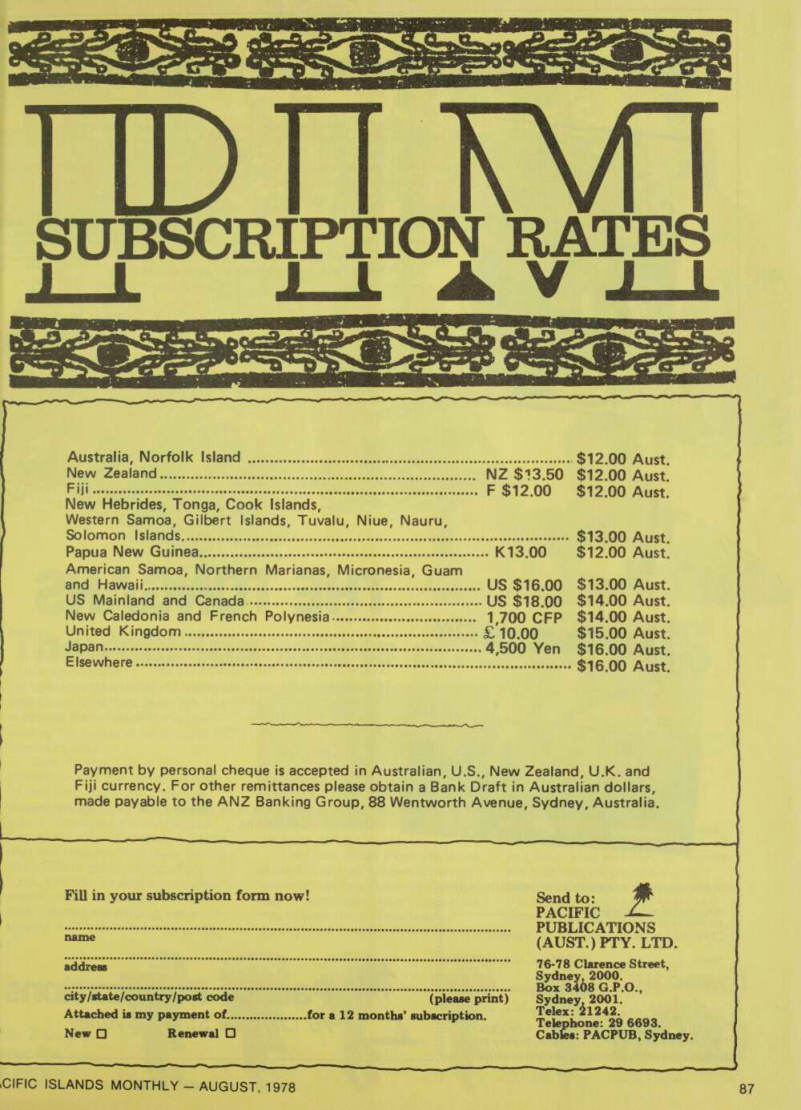
SUBSCRIPTION RATES Pacific Islands Monthly" is airfreighted to the majority of subscribers and agents in the Pacific islands and the USA. Australia, $12 Aust; Norfolk Island, $12 Aust; New Zealand, $13.50 NZ, $12 Aust; Fiji, $12 Fijian, $12 Aust; New Hebrides, Tonga, Cook Islands, Western Samoa, Gilbert Islands, Tuvalu, Niue, Nauru and Solomon Islands, $13 Aust; PNG, K13, $12 Aust; American Samoa, Northern Marianas, Guam and Hawaii, $16 US, $13 Aust; US Mainland and Canada $18 US, $14 Aust; New Caledonia and French Polynesia 1,700 CFP, $14 Aust; UK, £10, $15 Aust; Japan 4,500 Yen, $16 Aust; Elsewhere $16 Aust. Note: Overseas remittances in Australian dollars should be by bankdraft payable at Sydney, Aus- REPRESENTAT1VES. FIJI: Distribution and subscriptions — Desai Bookshops, P.O. Box 160, Suva. Fiji. Telephone: Suva 23036. Advertising, Fiji Times & Herald Ltd., 20 Gordon Street, Suva. Telephone: 312 111. Telex: FJ2124 Papua New Guinea: Advertising — PNG Post-Courier, P.O. Box 85, Port Moresby. Distribution — Robert Brown & Assoc. P.O. Box 3395 Port Moresby, telephone 2 5855. French Polynesia: Distribution — Hachette Pacifique, 10 Ave Bruat, Papeete. New Caledonia: Distribution — Depot Centre de Presse Michel Pentecost, B.P.C2 Noumea. United Kingdom: The Herald and Weekly Times Limited, 8-10 Clifford's Inn, Fetter Lane, London EC4A 1BU. Telephone: 01 831 6041, Telex; London 21989 Japan: Advertising — Universal Media Corporation, C.P.O. Box 46, Tokyo. Telephone: 666 3036. New Zealand; Pacific Publications, C.P.O. Box 2229, Auckland. Advertising inquiries; International Media Represen tatives Ltd, P.O. Box 3880 Auckland. Tel. 73 880. Telex: NZ21157. (Auck. 40) Hawaii and U.S. Mainland only: PIM, Hawaii, 2812, Kahawai St., Honolulu, Hawaii, 96822. Second class postage paid at Honolulu, Hawaii, US Advertising Representative, Joshua B. Powers Jr. Powers International Inc. 551 Fifth Ave, New York, New York 100 017. Telephone 867 9580 Telex 236514. Pub #952480 Victoria: Advertising - Pacific Publications (Aust.) Pty. Ltd., Herald and Weekly Times Building, 2nd Floor, 61 Finders Lane, Melbourne, 3000. Telephone 652 1565.
Brisbane: D Wood, Anday Agency, Box 1918 G.P.O., Brisbane, 4001. Telephone: 44 3485; 44 1546.
Copyright © 1978 Pacific Publications (Aust.) Pty, Ltd. Printed in Australia by Paramac, Mitchell Rd, Alexandria. PIM is distributed in Australia and New Zealand by Gordon & Gotch.
Australian cover price is recommended retail only. Registered at the G.P.O. Sydney for transmission by post as a publication — category B.
Advertisements & other items, p. 8 (2 items)
8
PAP.IFir, ISLANDS MONTHLY AUGUST, 1970
We build grip
into all our
■H f 1 r ft f *
GBOO+S
GBOO
Grand Rally
GBOO+S
Grand Prix7o
You can trust Goodyear technology
to give you grip. World champion
racing drivers do. So drive on steel
belted radial car tyres developed by
Goodyear. Built for grip in any
weather. Extra high mileage too.
OOODfVEAR
The Choice of Champions
GOODYEAR DISTRIBUTORS IN S.E. ASIA AND PACIFIC BASIN Richard Pieris & Co.. Ltd.
Colombo, Sri Lanka Nepal Motor Company (P) Ltd Biratnagar. Nepal Navana Ltd.
Dacca. Bangladesh Oiethelm & Co.. Ltd.
Bangkok. Thailand Landis Brothers & Co.. Ltd.
Hong Kong Guam Tire & Supply Co.
Agana, Guam Susupe Enterprises Saipan, Mariara Is Mlcrol Corporation Saipan. Mariana Is Truk Trading Co.
Truk E . Caroline Is.
PAM.I.
Kolonia, Ponape Island Transport Service Co.
Majuro, Marshall Is Yap Cooperative Ass.
Yap, W Caroline Is Cook Islands Motor Centre Ltd.
Rarotonga, Cook Is Ngiratkel Elpison Co. Ltd.
Koror, Palau Boroko Motors Ltd.
Port Moresby, Papua New Guinea Solomon Motors Ltd.
Honiara, Solomon Is Santo Engineers Santo, New Hebrides Pacific Motors Vila, New Hebrides
S.G.A.
Noumea. New Caledonia Duncombe Bay Garage Norfolk Is Coral Island Motors Suva. Fiji Morris Hedstrom Ltd.
Nukualofa, Tonga Morris Hedstrom Ltd.
Apia, Western Samoa Western Samoa Transport Cooperative Society Ltd.
Apia, Western Samoa Samoa Motors Inc Pago Pago, American Samoa Service Mobil Papeete. Tahiti
GOODYEAR SUBSIDIARIES
The Goodyear Tyre & Rubber Co (Aust.) Ltd.
Sydney, AUSTRALIA Tel: 31-0311 Goodyear India Limited New Delhi 1. INDIA Tel: 46886/9 PT Goodyear Indonesia Bogor. Republic of Indonesia Tel: 337V2 Nippon Goodyear Kabushiki Kaisha Tokyo. JAPAN Tel: 582-048V8 Goodyear Malaysia Berhad Selangor, MALAYSIA Tel: 362501/5 The Goodyear Tyre & Rubber Co. of New Zealand. Limited Lower Hutt. NEW ZEALAND Tel 684-389 The Goodyear Tyre & Rubber Company of the Philippines, Limited Makati-Metro Manila Republic of the Philippines Tel: 89-20-41 Goodyear Singapore Pvt Limited Geylang SINGAPORE 14 Tel: 408281/3 Goodyear Taiwan Limited Taipei. TAIWAN Tel: 5117135/8 Goodyear (Thailand) Limited Bangkok. THAILAND Tel: 252-6141/5
FOR FURTHER INFORMATION
PLEASE CONTACT
Goodyear International Corporation Room 1603. Wing On Center 111 Connaught Road Central
HONGKONG Tel: 5-433331
HRME171.0252
Letters
Good On You
Lasarusa!
May I congratulate Lasarusa Vusoniwailala, the writer of the excellent article Stop the rock. (PIM, June, p 11). It is remark able for its scope, balance, ac curacy and depth of understanding. I hope that it will be read and remembered by our political and economic leaders throughout the Pacific area.
How good it would be if more of the Islands people were to put down on paper for
publication their thoughts and
ideas.
J. D. Powdrell
Sydney, NSW
PS: There’s only one prob lem with PIM too many
people borrow my copy!
Tourist
Promotion
The need for a regional body for the promotion of the South Pacific Islands has been con sidered at a number of meet ings and the problem remains to be resolved.
Conflicting views have been expressed by leaders of the
travel industry regarding the
role of regional organisations
such as PIDTC and even
Pata.
Due to limited financial re sources, the smaller territories in Melanesia find it par ticularly difficult to generate interest in distant markets such as Europe and North America.
The Melanesian Tourist Feder ation was mainly created for this purpose and achieved excellent results for a couple of years. There was no loss of identity for the territories members of the Federation (Papua New Guinea, Solomons, New Hebrides, New Caledonia) but due to major political changes in Melanesia
and the great loss of Don Bar rett for the whole area, I, as the last chairman, had to disband the federation in 1976. How ever, contacts between the tourist authorities were main
tained and joint promotions
were arranged at opportune times, particularly in Australia and Japan, thanks to our re
gional airlines.
Recently, I proposed a re gional promotion for the area on the European market and as a result of the full support given by the NTOs (PNG, Sol, NH, NC, Fiji), and the kind co operation of the Paris and Frankfurt Pata chapters, Melanesian presentations were held in those cities. A function was held in Brussels, and calls were made in Amsterdam and London.
Obviously, due to the nom inal financial contributions from each territory, this re
gional promotion of Melanesia
was low key. But it had the dis tinction of being the first
marketing effort staged in
Europe on behalf of Melanesia as an area in its own right.
Many valuable contacts were made, and will help to define future marketing activities.
It is most gratifying to re ceive the full co-operation and trust of all concerned, despite the communication problems between the far-flung islands.
J. Mulders
Secretary-General,
Tourist Information Bureau, Vila, New Hebrides.
When Hell’S
Point Boomed
The article Hell's Point is Booming (PIM, March, p 26) recalls to me one of the most colossal mistakes of military judgment I have known, and one that must have set our “drive to Tokyo” back by a considerable amount.
True, Hell’s Point was an ammo dump. Rumour at the time had it that 56 000 tons of ammunition were stacked there. In addition, however, some military genius had de cided that the US Army’s 197th
Base Ordnance Depot (largest,
most forward-positioned such depot in the South Pacific) be built just on the edge of the
dump and nearly 200 person nel of that depot company be tented in precise rows down the side.
Around noon, one day in November, 1943, we began to hear what seemed to be ran dom small arms fire and some one reported that a member of a work detail had fired a pistol into one stack of ammo which was then going off in all direc tions. Other stacks were soon hit and began adding to the din. Then, when heavier shells began to blast, some personnel headed for bomb shelters while others ran to the motor pool and started driving the huge
military vehicles to safety.
At 20th Station Hospital
nearby, screaming, battle
fatigue patients had to be evacuated to Koli Point and there was much discussion as to whether or not the entire unit
should begin moving. Instead,
however, everyone stayed awake all night to witness the most fantastic fireworks dis play most of us had ever seen.
When morning came, an armoured half-track vehicle crunched into the now rather quiet area to pick up those who had remained in the shelters.
Now and then some small cal ibre shell would explode from heat of the ashes and provide more excitement. But the area was razed. Trees, tents, build
ings, ammunition, depot and
valuable stores were all gone
together with many, carefully
stored and unopened Christ mas presents from home.
Nearly 35 years have passed since that event but I have never forgotten it and the ironic fact that, although a commendation of merit was given to those who helped to save the vehicles, no one was ever blamed for the brilliant decision to position men and vital stores in the middle of an
ammunition dump.
After building another depot
just south of Hell’s Point and operating it for about a year, our company then made our final and even larger depot across the Matanikau in the quonset huts around which I am told, was built the city of Honiara. I can hardly believe it.
In 1954, my curiosity got the better of me and I wrote to the British Public Relations Offi cer at Honiara asking for cur rent information. To my surprise, T was soon cor responding with a Marist Brother, Joseph Chanel, who had been an anti-aircraft gun ner at Henderson Field near us at the time of our Hell’s Point incident. During our cor respondence, he sent me a copy of PIM. My curiosity and your fine reporting have kept me a subscriber ever since.
Thank you for a publication which improves each year.
Paul W. Durbin
Los Angeles, CA.
Advertisements & other items, p. 9 (1 item)
Pacifip. I.Qi Am Hq Momtui V In7O
Polynesia’S Third Sex: The Gay
Life Starts In The Kitchen
They are called ‘Mahu’ in French Polynesia, ‘Fakaleitis’ in Tonga and 'Fa’a Fafines’ in the Samoas They are the true transvestites, the Third Sex of Polynesia, with a life-style which, in the case of the Samoans, has been thrust upon them from birth through custom. PIM prints their story, not as a sideways glance at a situation which has been the butt of comedians for years, but as a serious study of a phase of life in the Islands, Flusband and wife authors Bengt and Marie Therese Danielsson in Tahiti write about the Mahu, Robin Pierson tells the Samoans’ story and a Tonga correspondent brings out both the sad and the glad side of the Third Sex.
In Tahiti
Ever since its discovery Tahiti has enjoyed a world wide reputation for being the Island of Love, and the earliest European visitors all describe in the most glowing terms the islanders’ untram meled promiscuity, their un ashamed public intercourses and their artful strip-tease shows. Another amusing
example of this general permis
siveness was recorded in 1789
by Lieutenant George Mor
timer of the British ship Mer cury which, on her way to the American Northwest coast to engage in the fur trade, made a short call at Tahiti.
As Mortimer himself tells the story, during a heiva show, one of the mates, “took it into his head to be very much smit ten with a dancing girl, went up to her, made her a present of some beads and other trifles, and rather interrupted the per formance by his attentions. But what was his surprise, when the performance was ended, and after he had been endeavour ing to persuade her to go with him on board our ship, which she consented to, to find that this supposed damsel, when stripped of her theatrical para phernalia, was a smart, dapper lad! The Otaheiteans on their part enjoyed the mistake so much that they followed us to the beach with shouts and re
peated peals of laughter”.
This anecdote from Mor timer’s Observations and Re marks made during a Voyage to the Islands, which appeared in 1791, is the first published account we have of a Tahitian mahu transvestite.
Shortly afterwards a group of ministers and brethren from the London Missionary Society
arrived on the scene and suc
ceeded gradually in converting
the Tahitians to their puritan and sectarian form of the Prot estant faith.
Yet today, 180 years later, in spite of all the attempts made by the church and civilian authorities to stamp out all the
obscene and lascivious prac tices that delighted the early navigators, the mahu is still a popular and honoured mem ber of every village throughout the Society Islands. Similar comedies of error where love’s labour is definitely lost are also constantly being re
enacted, and produce always bursts of laughter among the Tahitian spectators.
Under other names, true transvestites have existed from immemorial times in most other Polynesian islands. The most complete and detailed coverage of this fascinating subject can be found in a book which we wrote in the early 1950 s and which has often been reprinted since then Love in the South Seas.
A typical Tahitian mahu begins at an early age to associ ate and play with girls and stays at home to do household chores, while the other boys go fishing with their fathers.
When reaching puberty, he will start wearing women’s clothes, including brassiere. The use of jewellery and cosmetics is also common today in more sophis
ticated places like Papeete.
An adult mahu will gladly do the cooking and look after babies. But above all he loves to sew, mend, wash and iron clothes. He will spend most of his considerable leisure time in the company of the womenfolk whose manners and voices he will imitate. If he dances which he usually does with consummate skill and grace he is invariably a member of the female team.
Although nobody will object
if a mahu chooses to live alone, most individuals belonging to this distinct social category pre fer to be inmates of a family household. As a matter of fact, the mahu transvestites are much sought after as maids.
Europeans often take for granted that they are all homo sexuals which is not the case.
Those who are (and they may form the majority) observe as a rule great discretion and modesty. Lasting liaisons are
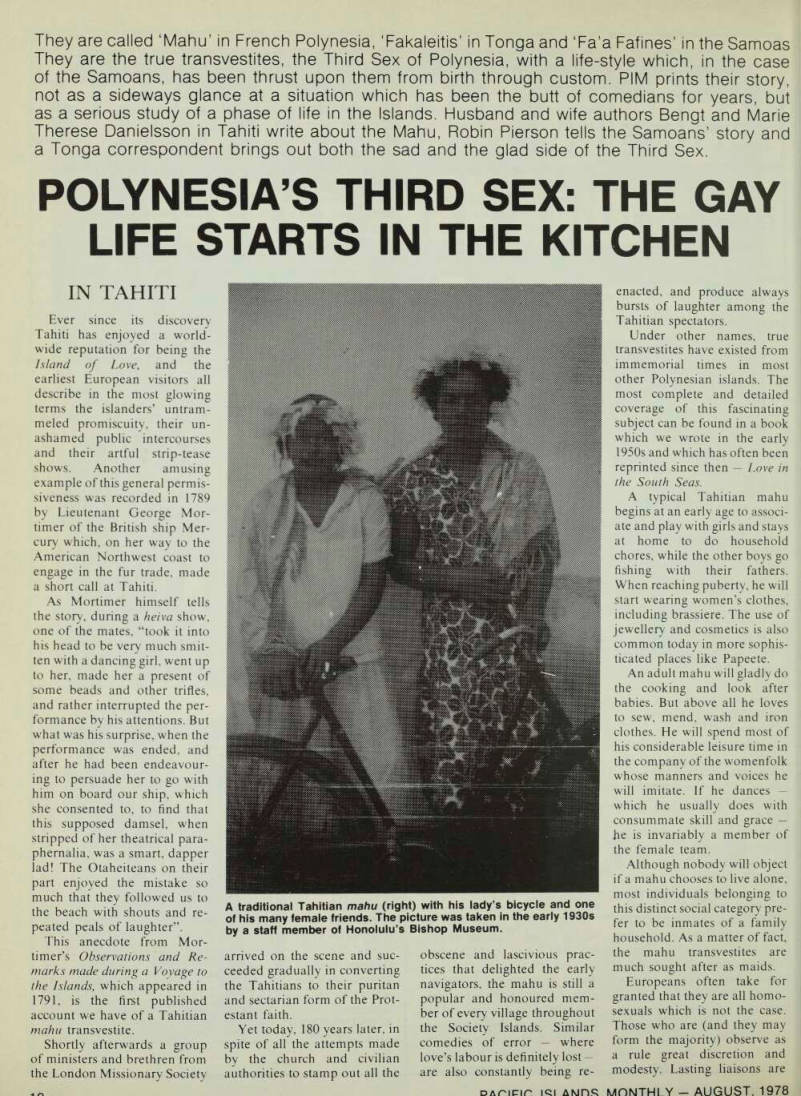
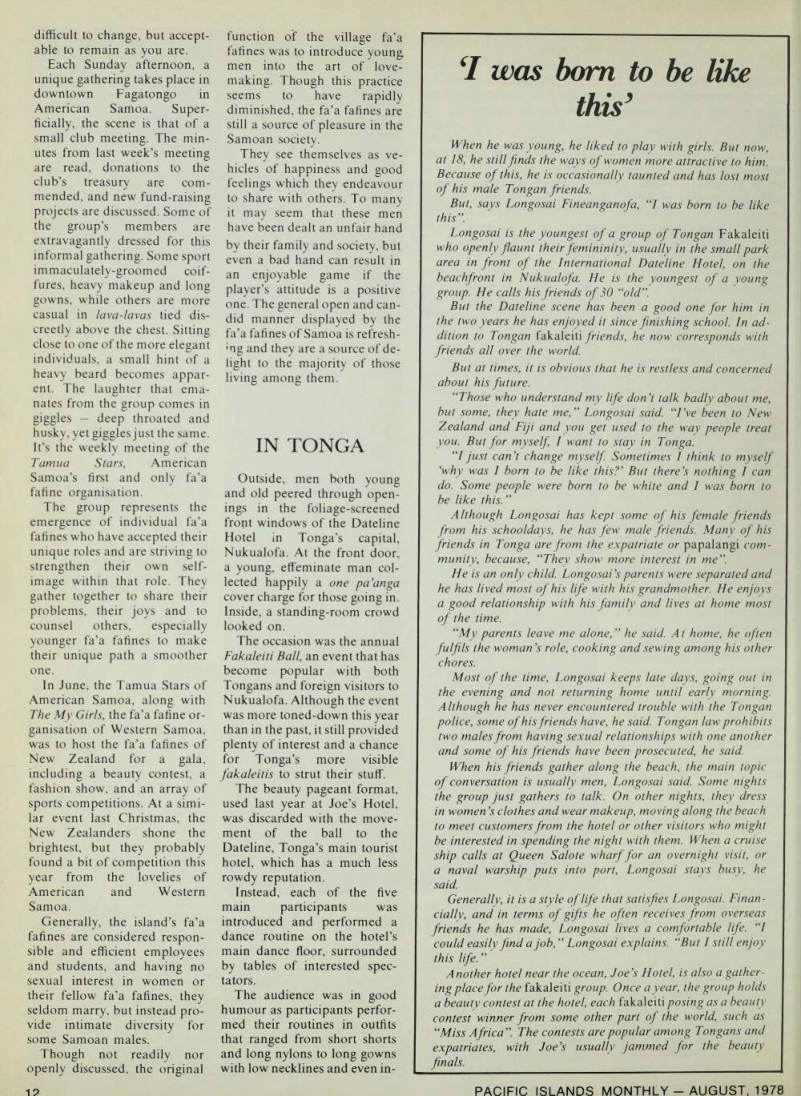
A traditional Tahitian mahu (right) with his lady’s bicycle and one of his many female friends. The picture was taken in the early 1930s by a staff member of Honolulu’s Bishop Museum.
rare and the most common pat tern for a mahu is to have occasional, furtive contacts, usually with adolescents still at
an experimenting, exploratory
stage of their sexual develop ment.
This leaves, however, a small number of mahu transvestites who must be described as indif ferent or asexual. Bisexual individuals are not totally un known, and some have even sired children, but all available evidence indicates that such blatantly heterosexual behav iour represents only short epi sodes in their lives.
In sharp contrast to the basi
cally negative attitude towards
homosexuals in our Western societies, the individuals in Polynesia who follow the tra ditional mahu way of life are not only tolerated but meet
with general approval and
praise. We can even go one step farther and say that there exists a definite social pressure to produce individuals with this deviant behaviour.
However, a very important point here which should be bom in mind is that there must never be more than one mahu in each village or community.
This unwritten law, as well as the fact that a new mahu will always emerge in the case of a vacancy due to death or depar ture, show even more clearly that we have to do with a socio logical and not a biological
phenomenon.
How it all started, we shall, of course, never learn, since there are no scientifically-valid
traditions or legends, explain
ing the origin of this time honoured institution. The only thing we can do, therefore, is to speculate about its possible
psychological significance and
social implications. The best hypothesis will be found in Professor Robert L. Levy’s excellent study Tahitians, Mind and Experience in the Society
Islands (University of Chicago
Press, 1973), based on several years of intensive field work in Tahiti and Huahine, carried out in the native language.
His conclusions are briefly that the Polynesians, like all other peoples, need models and that a mahu is a sort of
negative image that helps the
boys to become men, or real males, by showing them in a
particularly striking manner
the sex role which they must not choose.
Although the venerable mahu institution survived for almost 200 years, in spite of the constant ppprobrium of all church and government digni taries, there are now many signs that it will eventually disappear as a result of the brutal modernisation process also called “progress” to which Tahiti and the other So ciety Islands have been exposed during the last 15 years, or so. What is happen ing, ironically enough, is that the rising tide of Western type homosexual prostitution is rap
idly engulfing the native style
mahu transvestites. Like thou sands of other Polynesians they have migrated to the Sodom and Gomorra called Papeete, where they are all bewildered and lost, since the French laws and European customs which prevail there are utterly incom
prehensible. Having no other
means of making a living in this new harsh environment, the mahu transvestites sooner or later resort to the expediency of selling their favours to the numerous foreign homosexual tourists.
Several bars and night clubs now openly cater to this special category for which the special word raerae has been coined even to the point of
organising beauty contests for
the title of Miss Tane, or Miss Male. The ultimate stage in this westernisation of the Tahitian sexual customs is the recent emergence of lesbian prosti tutes whose behaviour all real mahu transvestites, of course, disapprove of as being defi
nitely abnormal . . .
In Samoa
Mention the words fa’a fafine, and most Samoans giggle. Ask them what the words mean, and they’ll tell you, “like a lady, you know, 50-50”. Many think this defi nition is sufficient in explain ing the large fellows who speak so sweetly, dress so finely, and carry a purse, but it doesn’t, not quite. For the Third Sex in Samoa is unique fa’a fafines don’t choose to be gay, they are raised that way.
It so happens, that the chil dren of Samoa are their famil ies’ work force, and a
continuous stream of tasks are bestowed upon them from the time they cease being babies, until they have children of their own.
Boys and girls tasks are
segregated, integrating chil
dren into an accepted role within their community and family at an early age. Oc casionally, a family may have an abundance of male chil dren. which means there is a disparity in the work-load, and, basically, that the woman of the household needs more
help.
At times like this, Samoan parents often find that little
boys can do girls’ work quite
adequately, hence, the prob
lem is solved the labour re mains equally distributed, and most importantly, it gets done.
So the young boys grow up doing women’s work, associat
ing primarily with women,
therefore picking up feminine mannerisms and traits, and
gradually they develop into
fa’a fafines - like a lady, while at the same time, being very different from a lady.
Yet, an effeminate young man, who reaches maturity
wearing women’s clothing, is
often disconcerting to the male members of his family, to the village priests he is sinful, and it is usually the school authori ties who exert pressure on the individual to tone down his
style while attending high
school. But having been raised as a woman from day one onward, the individual’s ident ity is established, and a tran sition at this stage would be
difficult to make. Besides, re gardless of the changes the young man may make out wardly or inwardly, he has already been labelled as a fa’a fafine, making it extremely dif ficult to be anyone else in the eyes of his community and family. So, even though pres sured during adolescence, most fa’a fafines continue to emerge and grow into the role they have been placed in. In other words, the fa’a fafine traits in most of these individuals do not die, but rather come into full bloom.
Many of the fa’a fafines of Samoa have lived, attended school or have been employed in the United States, and the general consensus is that it’s a lot easier to be a fa’a fafine in Samoa. The practice of raising a boy child as a girl is accepted in Samoa and generally the end product is accepted also, as long as the individual isn’t too blatant about it. But many are
blatant. Feeling quite comfort
able masquerading as women, and doing remarkably well at
it, they’re bucking powerful
family and societal pressures, which is something that not many Samoans have the cour age to do.
Others, who hold high pos itions within the community, have acquired a subdued fa’a fafine-type appearance, mak ing them more acceptable to the general populus. Yet even these people will most prob ably stay within their role as fa’a fafines for the rest of their lives, for as with many things on the island, everyone knows
your background, making it
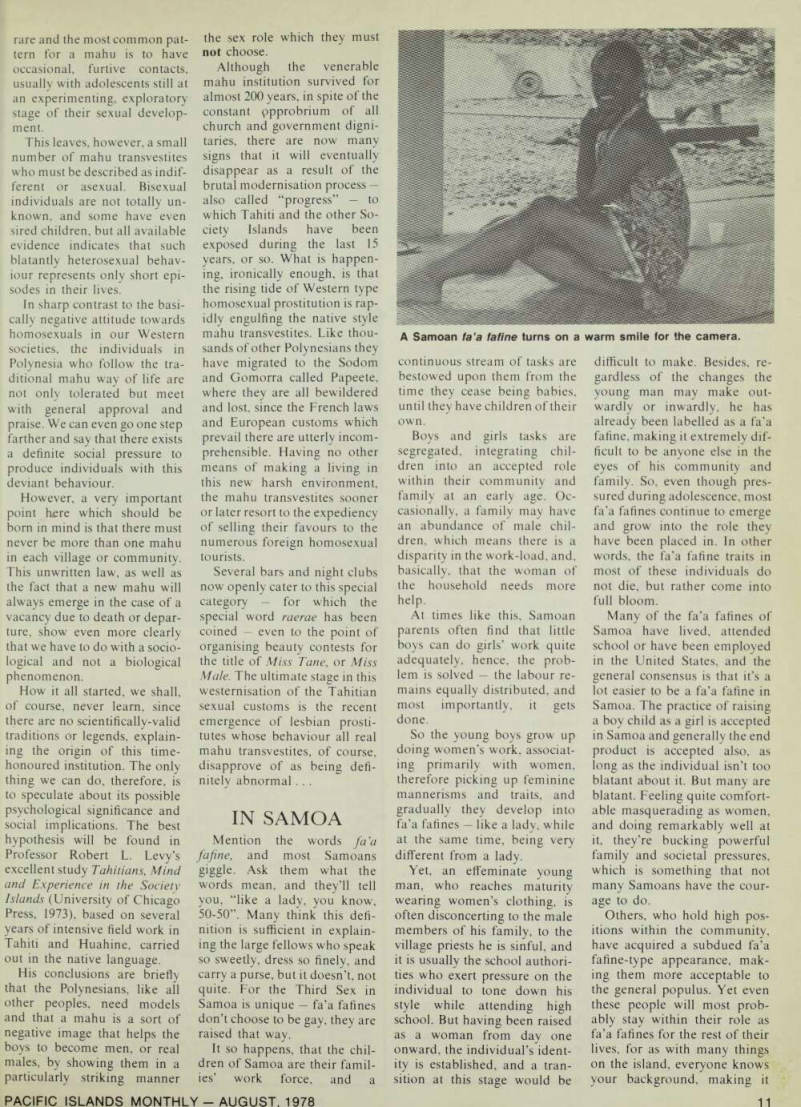
A Samoan fa’a fafine turns on a warm smile for the camera.
difficult to change, but accept able to remain as you are.
Each Sunday afternoon, a
unique gathering takes place in
downtown Fagatongo in American Samoa. Super ficially, the scene is that of a small club meeting. The min utes from last week’s meeting are read, donations to the club’s treasury are com mended, and new fund-raising projects are discussed. Some of the group’s members are extravagantly dressed for this informal gathering. Some sport
immaculately-groomed coif
fures, heavy makeup and long
gowns, while others are more casual in lava-lavas tied dis creetly above the chest. Sitting close to one of the more elegant individuals, a small hint of a heavy beard becomes appar ent. The laughter that ema nates from the group comes in
giggles deep throated and
husky, yet giggles just the same.
It’s the weekly meeting of the Tamua Stars, American Samoa’s first and only fa’a
fafine organisation.
The group represents the emergence of individual fa’a fafines who have accepted their unique roles and are striving to strengthen their own self image within that role. They gather together to share their problems, their joys and to counsel others, especially younger fa’a fafines to make their unique path a smoother one.
In June, the Tamua Stars of American Samoa, along with The My Girls, the fa’a fafine or ganisation of Western Samoa, was to host the fa’a fafines of New Zealand for a gala, including a beauty contest, a fashion show, and an array of sports competitions. At a simi lar event last Christmas, the New Zealanders shone the
brightest, but they probably
found a bit of competition this year from the lovelies of American and Western Samoa.
Generally, the island’s fa’a fafines are considered respon sible and efficient employees and students, and having no sexual interest in women or their fellow fa’a fafines, they seldom marry, but instead pro vide intimate diversity for some Samoan males.
Though not readily nor
openly discussed, the original
function of the village fa’a fafines was to introduce young men into the art of love
making. Though this practice
seems to have rapidly diminished, the fa’a fafines are still a source of pleasure in the
Samoan society.
They see themselves as ve hicles of happiness and good
feelings which they endeavour
to share with others. To many it may seem that these men have been dealt an unfair hand
by their family and society, but
even a bad hand can result in an enjoyable game if the player’s attitude is a positive one. The general open and can did manner displayed by the fa’a fafines of Samoa is refresh ing and they are a source of de light to the majority of those living among them.
In Tonga
Outside, men both young and old peered through open
ings in the foliage-screened
front windows of the Dateline
Hotel in Tonga’s capital,
Nukualofa. At the front door, a young, effeminate man col lected happily a one pa'anga cover charge for those going in.
Inside, a standing-room crowd looked on.
The occasion was the annual Fakaleiti Ball, an event that has become popular with both Tongans and foreign visitors to Nukualofa. Although the event was more toned-down this year than in the past, it still provided plenty of interest and a chance for Tonga’s more visible fakaleitis to strut their stuff.
The beauty pageant format, used last year at Joe’s Hotel, was discarded with the move ment of the ball to the Dateline, Tonga’s main tourist hotel, which has a much less
rowdy reputation.
Instead, each of the five main participants was introduced and performed a dance routine on the hotel’s main dance floor, surrounded by tables of interested spec tators.
The audience was in good
humour as participants perfor
med their routines in outfits that ranged from short shorts
and long nylons to long gowns
with low necklines and even in-
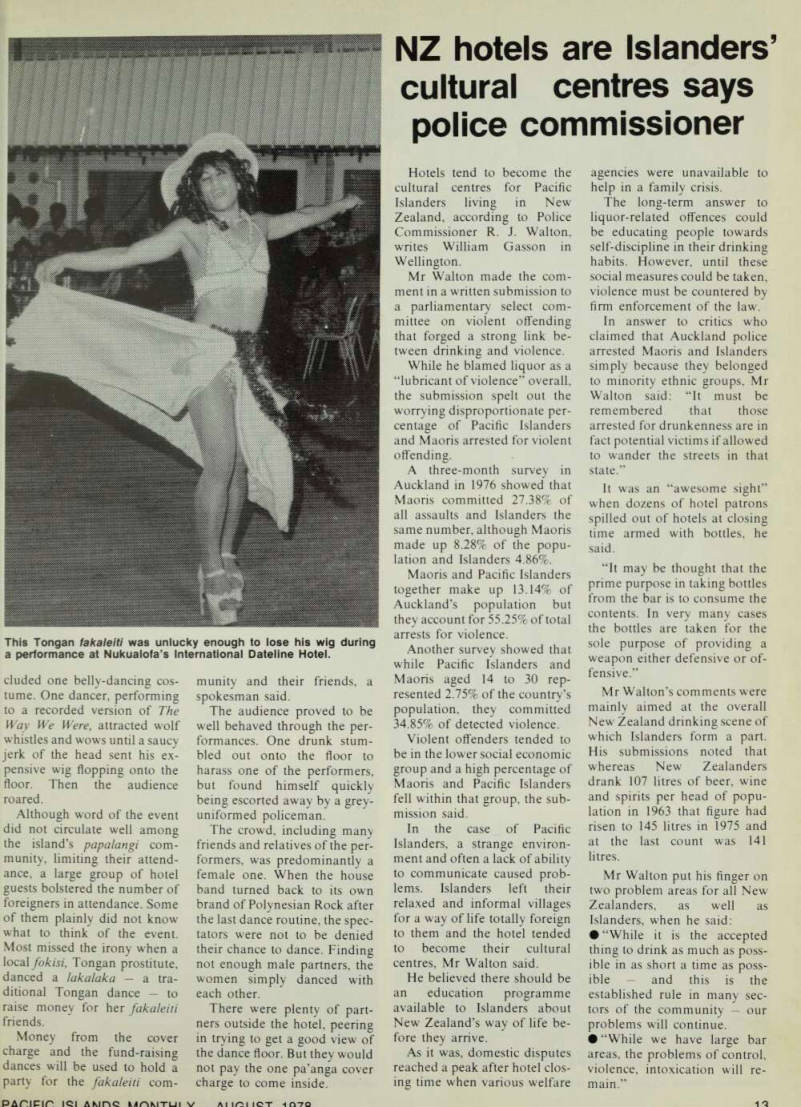
eluded one belly-dancing costume. One dancer, performing to a recorded version of The Way We Were, attracted wolf whistles and wows until a saucy jerk of the head sent his ex-
pensive wig flopping onto the
floor. Then the audience roared.
Although word of the event did not circulate well among the island’s papalangi com-
munity, limiting their attend-
ance, a large group of hotel guests bolstered the number of foreigners in attendance. Some of them plainly did not know what to think of the event, Most missed the irony when a
local fokisi, Tongan prostitute,
danced a lakalaka a traditional Tongan dance to raise money for her fakaleiti friends.
Money from the cover
charge and the fund-raising
dances will be used to hold a party for the fakaleiti com-
munity and their friends, a
spokesman said,
The audience proved to be well behaved through the per formances. One drunk stum bled out onto the floor to harass one of the performers, but found himself quickly being escorted away by a grey
uniformed policeman,
The crowd, including many friends and relatives of the per formers, was predominantly a female one. When the house band turned back to its own brand of Polynesian Rock after the last dance routine, the spec tators were not to be denied their chance to dance. Finding not enough male partners, the women simply danced with each other, There were plenty of part ners outside the hotel, peering in trying to get a good view of the dance floor. But they would not pay the one pa’anga cover charge to come inside.
This Tongan fakaleiti was unlucky enough to lose his wig during a performance at Nukualofa’s International Dateline Hotel.
Advertisements & other items, p. 10 (1 item)
10
DAmpir iqi MONTHLY AUGUST. 1978
'I was born to he like
this'
When he was young, he liked to play with girls. But now, at 18, he still finds the ways of women more attractive to him.
Because of this, he is occasionally taunted and has lost most
of his male Tongan friends.
But, says Longosai Fineanganofa, “I was born to be like this”
Longosai is the youngest of a group of Tongan Fakaleiti who openly flaunt their femininity, usually in the small park area in front of the International Dateline Hotel, on the beachfront in Nukualofa. He is the youngest of a young group. He calls his friends of 30 “old”.
But the Dateline scene has been a good one for him in the two years he has enjoyed it since finishing school. In ad dition to Tongan fakaleiti friends, he now corresponds with friends all over the world.
But at times, it is obvious that he is restless and concerned about his future.
“Those who understand my life don't talk badly about me, but some, they hate me,” Longosai said. “I’ve been to New Zealand and Fiji and you get used to the way people treat you. But for myself, I want to stay in Tonga.
“I just can't change myself. Sometimes I think to myself ‘why was I born to be like this?' But there's nothing I can do. Some people were born to be white and I was born to be like this.”
Although Longosai has kept some of his female friends from his schooldays, he has few male friends. Many of his friends in Tonga are from the expatriate or papalangi com munity, because, “They show more interest in me”.
He is an only child. Longosai's parents were separated and he has lived most of his life with his grandmother. He enjoys a good relationship with his family and lives at home most of the time.
“My parents leave me alone,” he said. At home, he often fulfils the woman's role, cooking and sewing among his other chores.
Most of the time, Longosai keeps late days, going out in the evening and not returning home until early morning.
Although he has never encountered trouble with the Tongan police, some of his friends have, he said. Tongan law prohibits two males from having sexual relationships with one another and some of his friends have been prosecuted, he said.
When his friends gather along the beach, the main topic of conversation is usually men, Longosai said. Some nights the group just gathers to talk. On other nights, they dress in women's clothes and wear makeup, moving along the beach to meet customers from the hotel or other visitors who might be interested in spending the night with them. When a cruise ship calls at Queen Salote wharf for an overnight visit, or a naval warship puts into port, Longosai stays busy, he said.
Generally, it is a style of life that satisfies Longosai. Finan cially, and in terms of gifts he often receives from overseas friends he has made, Longosai lives a comfortable life. “I could easily find a job, ” Longosai explains. “But I still enjoy
this life.”
Another hotel near the ocean, Joe’s Hotel, is also a gather ing place for the fakaleiti group. Once a year, the group holds a beauty contest at the hotel, each fakaleiti posing as a beauty contest winner from some other part of the world, such as “Miss Africa”. The contests are popular among Tongans and expatriates, with Joe's usually jammed for the beauty
finals.
police commissioner
NZ hotels are Islanders’ cultural centres says police commissioner
Hotels tend to become the cultural centres for Pacific Islanders living in New Zealand, according to Police Commissioner R. J. Walton, writes William Gasson in
Wellington.
Mr Walton made the com ment in a written submission to a parliamentary select com mittee on violent offending that forged a strong link be tween drinking and violence.
While he blamed liquor as a “lubricant of violence” overall, the submission spelt out the
worrying disproportionate per
centage of Pacific Islanders and Maoris arrested for violent
offending.
A three-month survey in Auckland in 1976 showed that Maoris committed 27.38% of all assaults and Islanders the same number, although Maoris made up 8.28% of the popu lation and Islanders 4.86%.
Maoris and Pacific Islanders together make up 13.14% of Auckland’s population but they account for 55.25% of total arrests for violence.
Another survey showed that while Pacific Islanders and Maoris aged 14 to 30 rep resented 2.75% of the country’s
population, they committed
34.85% of detected violence.
Violent offenders tended to be in the lower social economic group and a high percentage of Maoris and Pacific Islanders fell within that group, the sub mission said.
In the case of Pacific Islanders, a strange environ ment and often a lack of ability to communicate caused prob lems. Islanders left their relaxed and informal villages for a way of life totally foreign to them and the hotel tended to become their cultural centres, Mr Walton said.
He believed there should be an education programme available to Islanders about New Zealand’s way of life be fore they arrive.
As it was, domestic disputes reached a peak after hotel clos ing time when various welfare
agencies were unavailable to help in a family crisis.
The long-term answer to liquor-related offences could
be educating people towards
self-discipline in their drinking
habits. However, until these social measures could be taken, violence must be countered by firm enforcement of the law.
In answer to critics who claimed that Auckland police arrested Maoris and Islanders
simply because they belonged
to minority ethnic groups, Mr Walton said: “It must be remembered that those arrested for drunkenness are in fact potential victims if allowed to wander the streets in that state.”
It was an “awesome sight” when dozens of hotel patrons spilled out of hotels at closing time armed with bottles, he said.
“It may be thought that the prime purpose in taking bottles from the bar is to consume the contents. In very many cases the bottles are taken for the sole purpose of providing a weapon either defensive or of fensive.”
Mr Walton’s comments were mainly aimed at the overall New Zealand drinking scene of which Islanders form a part.
His submissions noted that whereas New Zealanders drank 107 litres of beer, wine and spirits per head of popu lation in 1963 that figure had risen to 145 litres in 1975 and at the last count was 141 litres.
Mr Walton put his finger on two problem areas for all New Zealanders, as well as Islanders, when he said: • “While it is the accepted thing to drink as much as poss ible in as short a time as poss ible and this is the established rule in many sec tors of the community our problems will continue. • “While we have large bar areas, the problems of control, violence, intoxication will re main.”
Advertisements & other items, p. 13 (1 item)
13
PAPIPIP ICI AKinc MrtKi~rui v Aiirii ict iq?o
The Solomons’Big Day.
July 7 : Independe
Pictures by S.I. Information
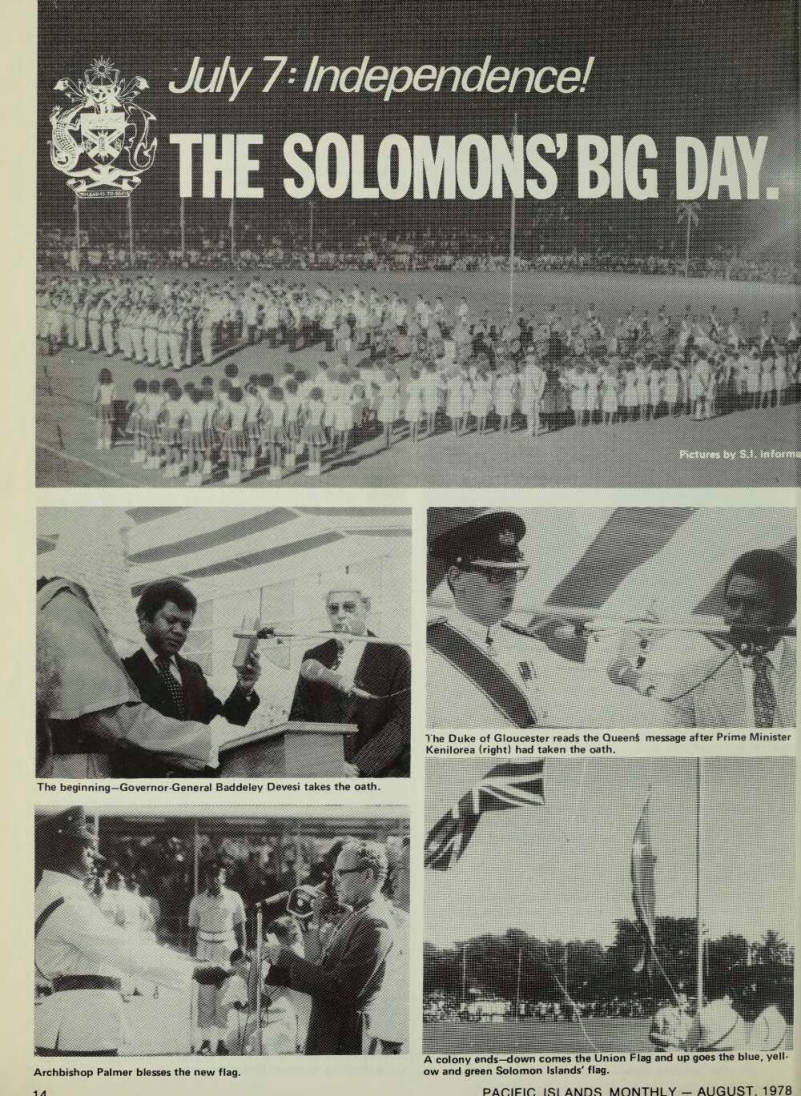
The beginning—Governor-General Baddeley Devesi takes the oath.
Archbishop Palmer blesses the new flag.
The Duke of Gloucester reads the Queens message after Prime Minister Kenilorea (right) had taken the oath.
A colony ends—down comes the Union Flag and up goes the blue, yell ow and green Solomon Islands' flag.
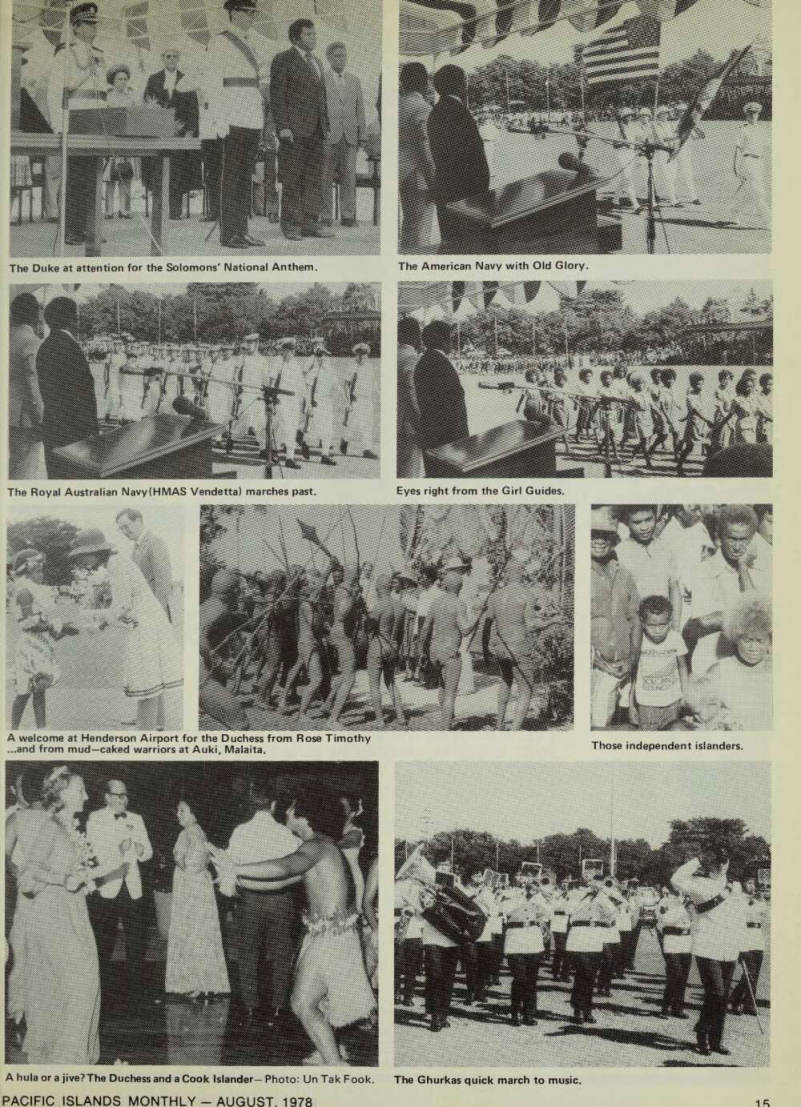
The Duke at attention for the Solomons' National Anthem.
The Royal Australian Navy (HMAS Vendetta) marches past.
A welcome at Henderson Airport for the Duchess from Rose Timothy ...and from mud—caked warriors at Auki, Malaita.
A hula or a jive? The Duchess and a Cook Islander— Photo: Un Tak Fook.
The American Navy with Old Glory.
Eyes right from the Girl Guides.
Those independent islanders.
The Ghurkas quick march to music.
Advertisements & other items, p. 16 (1 item)
Pacific Islands.
S.E. TATH AM & CO. PTY. LTD
BEEHIVE BUILDING,
94 ELIZABETH STREET.
G.P.O. BOX 8,
MELBOURNE 3001,
AUSTRALIA.
CABLES: “SET”
TELEX: AA34552.
TELEPHONE; 63 5094
r. <5 *
...BUYERS for the
PACIFIC ISLANDS.
PAPUA NEW GUINEA:
S. E. TATHAM (P N G.) PTY. LTD.
LAE: MALAITA ST. (P.O. BOX 1562).
PORT MORESBY: Cm. GOROA & MANAHU Sts.,
GORDON (P.O. BOX 6733 , BOROKO).
TELEGRAMS: ALL OFFICES (( SET\
YOUR GUARANTEE
FOR SERVICE
SINCE 1924
Sir Albert
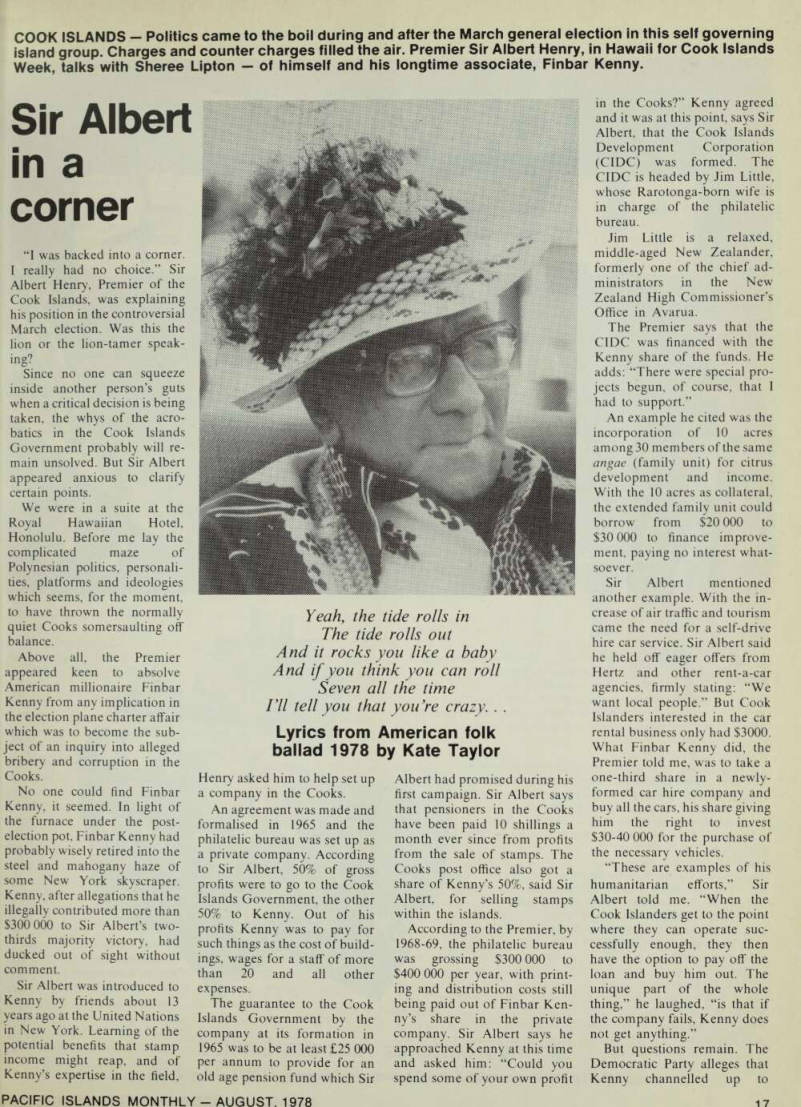

in a coner
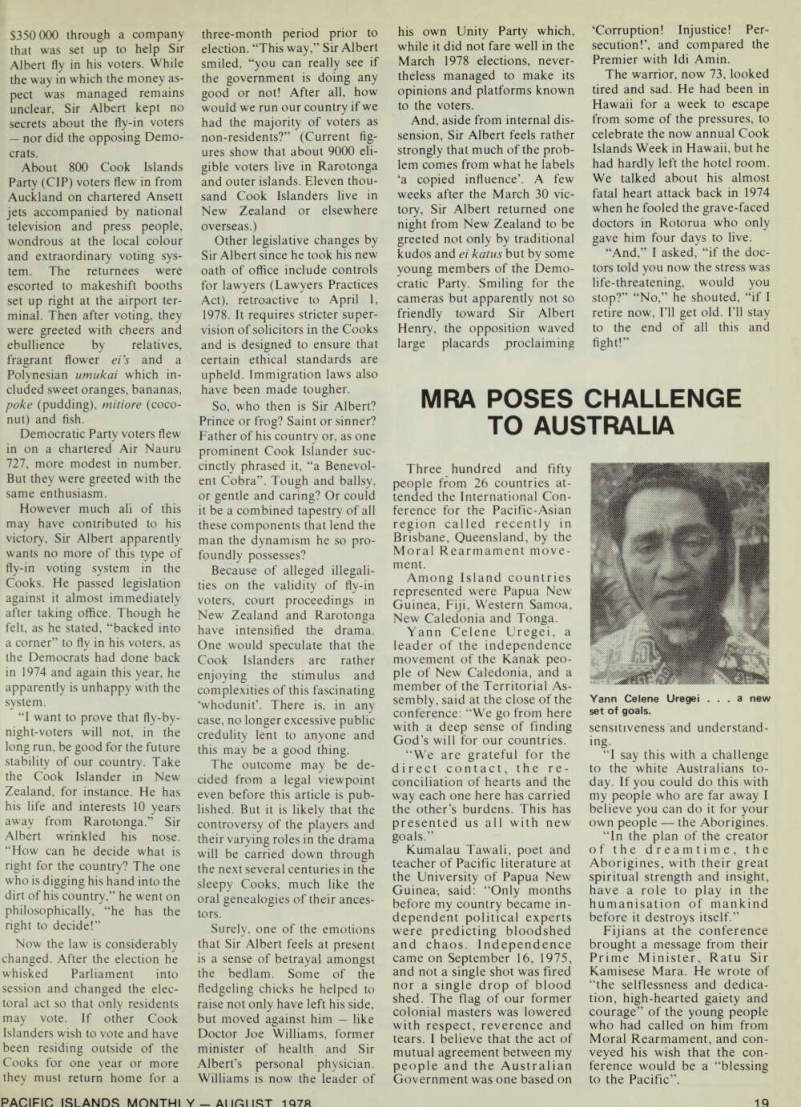
COOK ISLANDS Politics came to the boil during and after the March general election in this self governing island group. Charges and counter charges filled the air. Premier Sir Albert Henry, in Hawaii for Cook Islands Week, talks with Sheree Lipton of himself and his longtime associate, Finbar Kenny.
“I was backed into a comer.
I really had no choice.” Sir Albert Henry, Premier of the Cook Islands, was explaining his position in the controversial March election. Was this the lion or the lion-tamer speak
ing?
Since no one can squeeze inside another person’s guts when a critical decision is being taken, the whys of the acro batics in the Cook Islands Government probably will re main unsolved. But Sir Albert
appeared anxious to clarify
certain points.
We were in a suite at the Royal Hawaiian Hotel, Honolulu. Before me lay the complicated maze of
Polynesian politics, personali
ties, platforms and ideologies
which seems, for the moment, to have thrown the normally
quiet Cooks somersaulting off
balance.
Above all, the Premier appeared keen to absolve American millionaire Finbar Kenny from any implication in the election plane charter affair which was to become the sub
ject of an inquiry into alleged
bribery and corruption in the Cooks.
No one could find Finbar Kenny, it seemed. In light of the furnace under the post election pot, Finbar Kenny had probably wisely retired into the steel and mahogany haze of some New York skyscraper.
Kenny, after allegations that he illegally contributed more than $3OO 000 to Sir Albert’s two
thirds majority victory, had
ducked out of sight without comment.
Sir Albert was introduced to Kenny by friends about 13 years ago at the United Nations in New York. Learning of the potential benefits that stamp income might reap, and of Kenny’s expertise in the field,
Henry asked him to help set up a company in the Cooks.
An agreement was made and formalised in 1965 and the philatelic bureau was set up as
a private company. According
to Sir Albert, 50% of gross profits were to go to the Cook Islands Government, the other 50% to Kenny. Out of his profits Kenny was to pay for such things as the cost of build ings, wages for a staff of more than 20 and all other expenses.
The guarantee to the Cook Islands Government by the company at its formation in 1965 was to be at least £25 000 per annum to provide for an old age pension fund which Sir
Albert had promised during his first campaign. Sir Albert says that pensioners in the Cooks have been paid 10 shillings a month ever since from profits from the sale of stamps. The Cooks post office also got a share of Kenny’s 50%, said Sir Albert, for selling stamps within the islands.
According to the Premier, by 1968-69, the philatelic bureau was grossing $3OO 000 to $4OO 000 per year, with print ing and distribution costs still being paid out of Finbar Ken ny’s share in the private company. Sir Albert says he approached Kenny at this time and asked him: “Could you spend some of your own profit
in the Cooks?” Kenny agreed and it was at this point, says Sir Albert, that the Cook Islands
Development Corporation
(CIDC) was formed. The CIDC is headed by Jim Little, whose Rarotonga-born wife is in charge of the philatelic bureau.
Jim Little is a relaxed, middle-aged New Zealander, formerly one of the chief ad ministrators in the New Zealand High Commissioner’s Office in Avarua.
The Premier says that the CIDC was financed with the Kenny share of the funds. He adds: “There were special pro jects begun, of course, that I had to support.”
An example he cited was the incorporation of 10 acres among 30 members of the same angae (family unit) for citrus development and income.
With the 10 acres as collateral, the extended family unit could borrow from $2O 000 to $3O 000 to finance improve ment, paying no interest what soever.
Sir Albert mentioned another example. With the in crease of air traffic and tourism came the need for a self-drive hire car service. Sir Albert said he held off eager offers from Hertz and other rent-a-car
agencies, firmly stating: “We
want local people.” But Cook Islanders interested in the car rental business only had $3OOO.
What Finbar Kenny did, the Premier told me, was to take a one-third share in a newly formed car hire company and buy all the cars, his share giving him the right to invest $3O-40 000 for the purchase of the necessary vehicles.
“These are examples of his humanitarian efforts,” Sir Albert told me. “When the Cook Islanders get to the point where they can operate suc
cessfully enough, they then
have the option to pay off the loan and buy him out. The unique part of the whole thing,” he laughed, “is that if the company fails, Kenny does not get anything.”
But questions remain. The Democratic Party alleges that Kenny channelled up to
Yeah, the tide rolls in The tide rolls out And it rocks you like a baby And if you think you can roll Seven all the time Til tell you that you ’re crazy.. .
Lyrics from American folk ballad 1978 by Kate Taylor
$350 000 through a company that was set up to help Sir Albert fly in his voters. While the way in which the money as pect was managed remains unclear, Sir Albert kept no secrets about the fly-in voters nor did the opposing Demo crats.
About 800 Cook Islands Party (CIP) voters flew in from Auckland on chartered Ansett
jets accompanied by national
television and press people, wondrous at the local colour
and extraordinary voting sys
tem. The returnees were escorted to makeshift booths set up right at the airport ter minal. Then after voting, they were greeted with cheers and ebullience by relatives, fragrant flower eVs and a Polynesian umukai which in cluded sweet oranges, bananas,
poke (pudding), mitiore (coco
nut) and fish.
Democratic Party voters flew in on a chartered Air Nauru 727, more modest in number.
But they were greeted with the same enthusiasm.
However much ah of this may have contributed to his
victory. Sir Albert apparently
wants no more of this type of fly-in voting system in the
Cooks. He passed legislation
against it almost immediately
after taking office. Though he felt, as he stated, “backed into a corner” to fly in his voters, as the Democrats had done back in 1974 and again this year, he apparently is unhappy with the system.
“I want to prove that fly-by night-voters will not, in the long run, be good for the future stability of our country. Take the Cook Islander in New Zealand, for instance. He has his life and interests 10 years away from Rarotonga.” Sir Albert wrinkled his nose.
“How can he decide what is right for the country? The one who is digging his hand into the dirt of his country,” he went on philosophically, “he has the right to decide!”
Now the law is considerably changed. After the election he whisked Parliament into session and changed the elec toral act so that only residents may vote. If other Cook Islanders wish to vote and have been residing outside of the Cooks for one year or more they must return home for a
three-month period prior to
election. “This way,” Sir Albert smiled, “you can really see if the government is doing any good or not! After all, how would we run our country if we had the majority of voters as non-residents?” (Current fig ures show that about 9000 eli gible voters live in Rarotonga and outer islands. Eleven thou sand Cook Islanders live in New Zealand or elsewhere overseas.)
Other legislative changes by
Sir Albert since he took his new oath of office include controls for lawyers (Lawyers Practices Act), retroactive to April 1, 1978. It requires stricter super vision of solicitors in the Cooks and is designed to ensure that certain ethical standards are
upheld. Immigration laws also
have been made tougher.
So, who then is Sir Albert?
Prince or frog? Saint or sinner?
Father of his country or, as one prominent Cook Islander suc cinctly phrased it, “a Benevol ent Cobra”. Tough and ballsy, or gentle and caring? Or could it be a combined tapestry of all these components that lend the man the dynamism he so pro
foundly possesses?
Because of alleged illegali
ties on the validity of fly-in voters, court proceedings in New Zealand and Rarotonga have intensified the drama.
One would speculate that the Cook Islanders are rather enjoying the stimulus and
complexities of this fascinating
‘whodunit’. There is, in any case, no longer excessive public credulity lent to anyone and this may be a good thing.
The outcome may be de cided from a legal viewpoint even before this article is pub lished. But it is likely that the controversy of the players and their varying roles in the drama will be carried down through the next several centuries in the sleepy Cooks, much like the oral genealogies of their ances tors.
Surely, one of the emotions that Sir Albert feels at present is a sense of betrayal amongst the bedlam. Some of the fledgeling chicks he helped to raise not only have left his side, but moved against him like Doctor Joe Williams, former minister of health and Sir
Albert’s personal physician.
Williams is now the leader of
his own Unity Party which, while it did not fare well in the March 1978 elections, never theless managed to make its
opinions and platforms known
to the voters.
And, aside from internal dis sension, Sir Albert feels rather strongly that much of the prob lem comes from what he labels ‘a copied influence’. A few weeks after the March 30 vic tory, Sir Albert returned one night from New Zealand to be
greeted not only by traditional
kudos and ei katus but by some young members of the Demo cratic Party. Smiling for the cameras but apparently not so friendly toward Sir Albert Henry, the opposition waved
large placards proclaiming
‘Corruption! Injustice! Per
secution!’, and compared the Premier with Idi Amin.
The warrior, now 73, looked tired and sad. He had been in Hawaii for a week to escape from some of the pressures, to celebrate the now annual Cook Islands Week in Hawaii, but he had hardly left the hotel room.
We talked about his almost fatal heart attack back in 1974 when he fooled the grave-faced doctors in Rotorua who only gave him four days to live.
“And,” I asked, “if the doc tors told you now the stress was life-threatening, would you stop?” “No,” he shouted, “if I retire now, I’ll get old. I’ll stay to the end of all this and
fight!”
Mra Poses Challenge
To Australia
Three hundred and fifty people from 26 countries at tended the International Con ference for the Pacific-Asian region called recently in Brisbane, Queensland, by the Moral Rearmament move ment.
Among Island countries represented were Papua New Guinea, Fiji, Western Samoa, New Caledonia and Tonga.
Yann Celene Uregei, a leader of the independence movement of the Kanak peo ple of New Caledonia, and a member of the Territorial As sembly, said at the close of the conference: “We go from here with a deep sense of finding God’s will for our countries.
“We are grateful for the direct contact, the re conciliation of hearts and the way each one here has carried the other’s burdens. This has presented us all with new goals.”
Kumalau Tawali, poet and teacher of Pacific literature at the University of Papua New Guinea-, said; “Only months before my country became in dependent political experts were predicting bloodshed and chaos. Independence came on September 16, 1975, and not a single shot was fired nor a single drop of blood shed. The flag of our former colonial masters was lowered with respect, reverence and tears. I believe that the act of mutual agreement between my people and the Australian Government was one based on
sensitiveness and understand ing.
“I say this with a challenge to the white Australians to day. If you could do this with my people who are far away I believe you can do it for your own people the Aborigines.
“In the plan of the creator of the dreamtime, the Aborigines, with their great spiritual strength and insight, have a role to play in the humanisation of mankind before it destroys itself.”
Fijians at the conference brought a message from their Prime Minister, Ratu Sir Kamisese Mara. He wrote of “the selflessness and dedica tion, high-hearted gaiety and courage” of the young people who had called on him from Moral Rearmament, and con veyed his wish that the con ference would be a “blessing to the Pacific”.
Yann Celene Uregei... a new set of goals.
Advertisements & other items, pp. 18-20 (3 items)
Chloride
A I f P • • •/% .
Lvjin# m Chloride is the largest and only manufacturer of both lead acid and nickel cadmium alkaline batteries in Australia.
The Company is equipped and qualified to offer advice, guidance and service on any battery requirement no matter how large or small.
On the question of size, it could be as small as a battery for a hearing aid the dimensions t of a coat button or a power station battery weighing as much as 40 tonnes.
Again it could be a no break D.C. Power System for a computor or emergency lighting for a hospital.
The Chloride Company operates in 40 countries throughout the world, and when you consider that in Australia alone its production is approaching 1% million batteries per year, it gives some idea of the far reaching role that batteries play in our lives. © i rnsm i ■ A selection of Chloride Automotive and Industrial Batteries.
Chloride Batteries Australia Limited
P.O. Box 141, Bankstown. N.S.W. 2200. Australia. Telephone: 77 0177. Telex: 21262
NOW!
New Kodak
Colorburst
cameras.
At last a camera to capture the fun times instantly with rich and vibrant color by Kodak.
With the Colorburst cameras instant color picture fun has never been so easy indoors or out, with flash or natural light, you just aim, frame, focus and shoot, and the new Colorburst instant camera automatically produces clean, dry prints that develop right before your very eyes. Within minutes you have a superb color picture with beautiful Satinluxe finish from Kodak PRIO Instant Print Film.
Kodak Colorburst cameras feature: • Adjustable focus control with special ‘zooming circle’, focusing symbols, and distance scale • Electronic shutter 1 /3000 sec. to 1/20 sec. • Eyecup on viewfinder • Flash socket •Tripod socket • Automatic motor-driven print ejection • Red low-light signal warns you when to use flash • Lighten/darken print control • Exposure counter • Neckstrap and monograms • Kodak 3 year warranty.
See your photo dealer for a free demonstration. *suggested retail price.
New Kodak Instant Cameras and Film.
IC>§
t*ST AIuT ,
• i • r; Kodak (Australasia) Pty. Ltd. ‘Kodak’, ‘Colorburst’ and Satinluxe’ are trademarks. 345 0091
19
PACIFIC ISLANDS MONTHI Y - At IGI IST IQ7R
Pap.Ifin Isi Amds Monthly August, 1978
Islands
From the
Press
From the Cook Islands News, quoting Premier Sir Albert
Henry:
Yesterday morning, Tuesday, in the Assembly, the Premier made a statement, that as he said, “I want to record in this House as my statement as Head of this Government. I raise a strong objection as Head of this government, this country and of the Public Service of this country to a member of the New Zealand bar, a high-ranking lawyer of New Zealand, Mr Paul T emms, Queen’s Counsel, coming into the Cook Islands and entering government offices without the proper etiquette of requesting permission from the Head of this government, and because of his position as Queen’s Counsel, using that position to try and intimidate a Government official into making statements to him ... a Queen’s Counsel walking uninvited into the offices of a
Knight of the British Empire ...”
From Uni Tavur, the University of Papua New Guinea student newspaper: The health services at UPNG should help students to overcome their problems and miseries, the student counsellor, Mrs Parames said. She said, in institutions individuals are away from parental guidance and supervisions and they are now free to meet the opposite sex. We all know that students will be making love so why not prevent the miseries resulting from unplanned and sometimes unwanted pregnancies. She said also that it would be an act of responsibility for couples to approach the health clinics, family planning clinics or to the student counselling service for
contraceptive advice.
From a letter by Denise Lachance in the Tonga Chronicle
on problems experienced by visiting females:
... I can cite the experience of three acquaintances of mine from three different countries other than my own. On a recent boat trip to Ha’apai they were shamelessly harassed by young men attempting to crawl under their blankets with them, among other things. Perhaps the vigorous protests of the young women were interpreted as perfunctory coyness but they certainly were not...
From the American Samoa News Bulletin: If you sometimes feel that you are knee-deep in dogs, or you curse every morning when you discover that a dog pack has raided your garbage can, scattering debris in all directions, there’s something else to think about. Public Health Officer Nofo Siliga reports that 38 dog bite victims were treated by the Department of Health during the month of May and 146 have been treated in the first five months of 1978. In addition, there is no way of knowing how many dog bite victims did NOT report to Public Health nurses or dispensaries.
From the Lae Nius: The Morobe People’s Association (MODIPE) during its meeting last month unanimously agreed to express opposition to the proposed overseas trip of Lae City Councillors .. .If the councillors insist on undertaking the proposed trip, the Modipe Association demanded that the K2O 000 grant by the Provincial Government for drainage work in Lae city should be returned
to the Government for use on other projects in the province. “We believe that if Lae City Council can afford to go overseas, then they also can afford to finance drainage works in Lae,” a
spokesman said.
From the Tohi, Tala Niue: “Niueans are eating a lot of rubbish they eat apple, pears and vegetables both fresh and tinned from overseas”, said the Minister for Agriculture, Mr Young Vivian. “What’s wrong with our pawpaws and a lot of other fruit and vegetables grown locally,” he said.
From the Lae Nius reporting on a speech by PNG Minister for Health Wiwa Korowi at the 31st World Health Assembly at Geneva: .. .“Here, I must state that Papua New Guinea may differ from many recently independent states. We feel no shame in acknowledging our debt to our previous colonial administrator, Australia.”
From the Papua New Guinea Post-Courier reporting a speech by Sir Maori Kiki at a University of Papua New Guinea forum: ... Sir Maori said that by sacking the two employees of J. C.
Waller Pty Ltd, the employers had insulted the unions. The two employees did not steal but borrowed six cans of beer, he said.
An announcement from Salt Lake City (USA) and reported in the American Samoa News Bulletin: Mormon Church President Spencer Kimball announced today that black men will, for the first time, be admitted to the Mormon priesthood. The announcement ends a 148-year church policy of excluding blacks from the Mormon priesthood, which is open to all male church members in good standing over the age of 12.
From a letter on bride price by G. Walkersville in the Solomon Islands News Drum: . .. This custom no longer plays its main role, that of the sealing of the marriage. Rather it has become a commercial venture for the girl’s relatives. Thus, it is not uncommon these days to hear a girl’s relatives claiming that the amount paid is not enough.
How the hell do they measure the girl’s worth. Back home I have frequently asked the question “Why do men have to pay bride price?” And the most frequent answer I get is “to repay the parents for bringing the girl up”. What about the boy, was he not also brought up by his parents?
From Tohi Tala Niue on the travels of Niuean Toeono Tongatule, in Italy on a training course: ... Tonio seems to be settling in alright in Turin and is developing a taste for spaghetti and wine; perhaps when he returns he will start the first spaghetti plantation on our island.
From The Fiji Times, commenting on the current stagnant state of the tourist industry: To some extent we ourselves are to blame for the unhappy state of affairs. During the boom years, some of us were too busy making fortunes to worry about the poor tourist.
From an article in the Tonga Chronicle by Minister of Police ‘Akau’ola on passport offences: According to Australian Immigration records ... the MV Tauloto has now taken on the status of cruise ship. Some Tongans legally entering Australia with a passport and subsequently found overstaying, have resorted to hiding their passports, giving a false name and alleging to have arrived as stowaways on the MV Tauloto. When deported, they can easily apply for re-entry under their correct name with a valid passport. This cover story has been used so often that the MV Tauloto is theoretically alleged to carry at least 20 stowaways on each voyage!
Advertisements & other items, pp. 21-22 (2 items)
21
PACIFIC ISI MHMTMI V AlirillQT IQ7Q
The World
<*■ If <1 I v„ 4>
Listens to Clarion
On the Go.
% The reason? Clarion offers so much more.
Superb entertainment created by advanced, highly reliable electronics. Easy, custom-fit dash installation. A super-wide selection of car radios and stereo units. Professional servicing by local dealers. An international reputation for superior quality and > performance. Clarion—another word for the best. The very best.
V - ..V
•OW-VOL/PRO
HIGH
.OW
LEFT
PE-663 Clarion Co., Ltd. Tokyo, Japan Australia: Amalgamated Wireless (Australasia) Ltd. 554 Parramatta Road Ashfield N.S.W., 2131 1 New Zealand: AWA New Zealand Limited. P.O. Box 50-248 Porirua/ Fiji Islands: Brijlal & Co., Ltd. G.P.O. Box 362 Suva / Tahiti: ETS. Comimpex. B.P. 200 Papeete / New Caledonia: Caldis. 8.P.M1 Noumea Cedex I Guam: Guam Radio &TV Shop. P.O. Box 1939 Agana, Guam 96910 1 New Hebrides: The Sound Centre P.O. Box 434 Vila / Cook Islands: South Seas International Ltd. P.O. Box 49 Rarotonga.
Fiji is
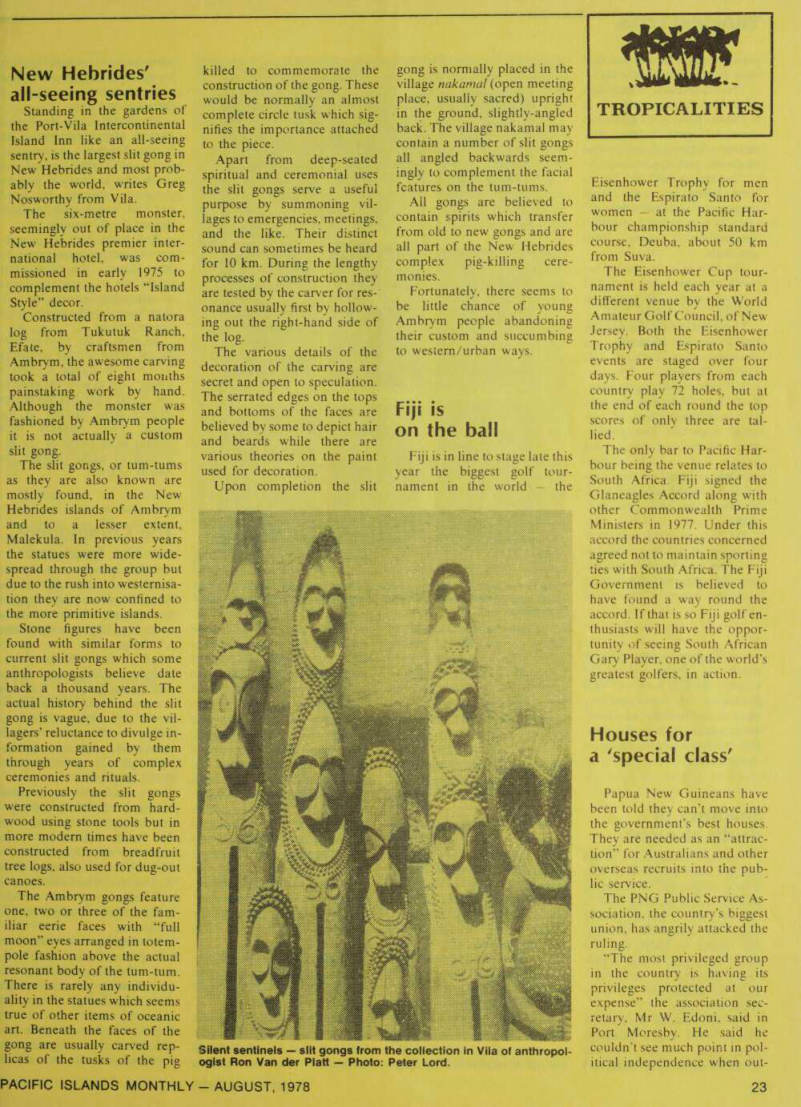
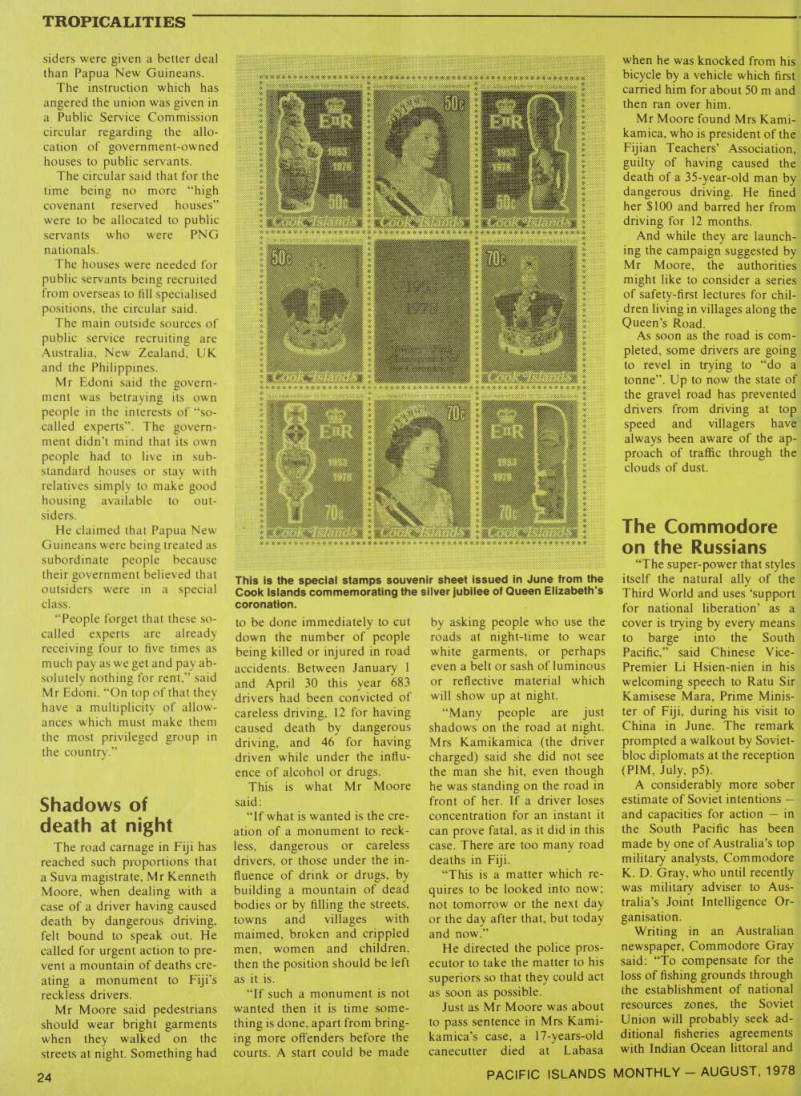
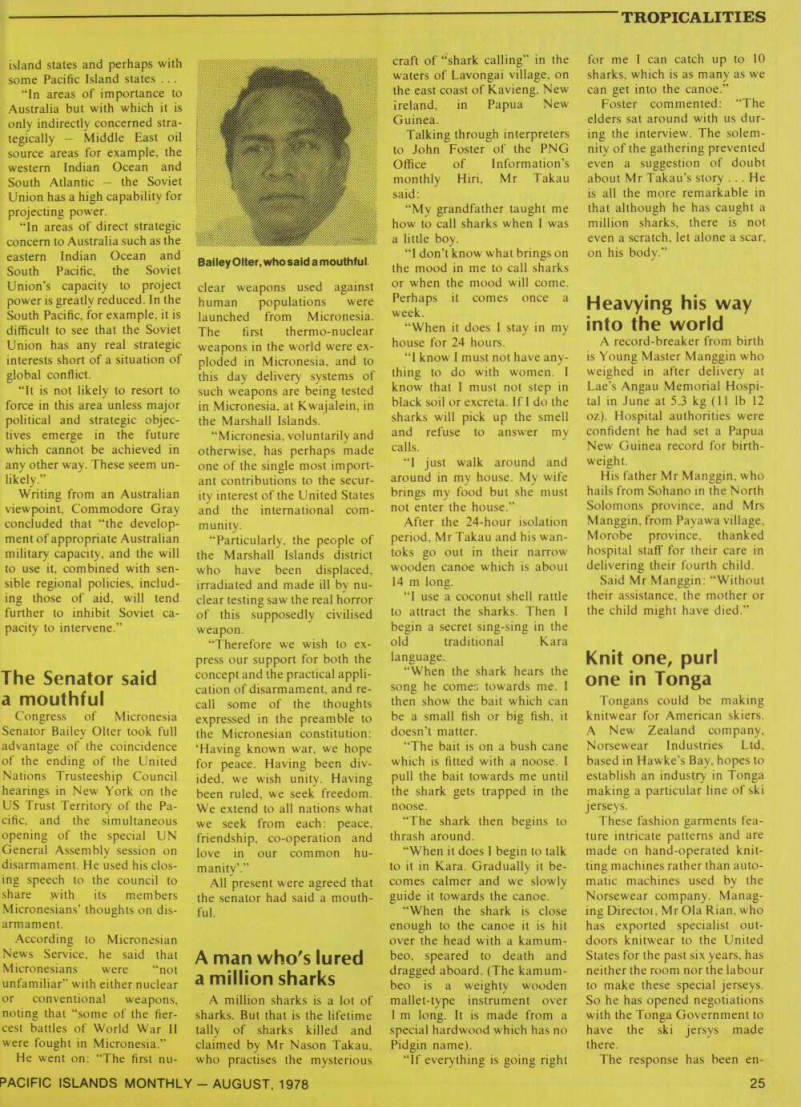
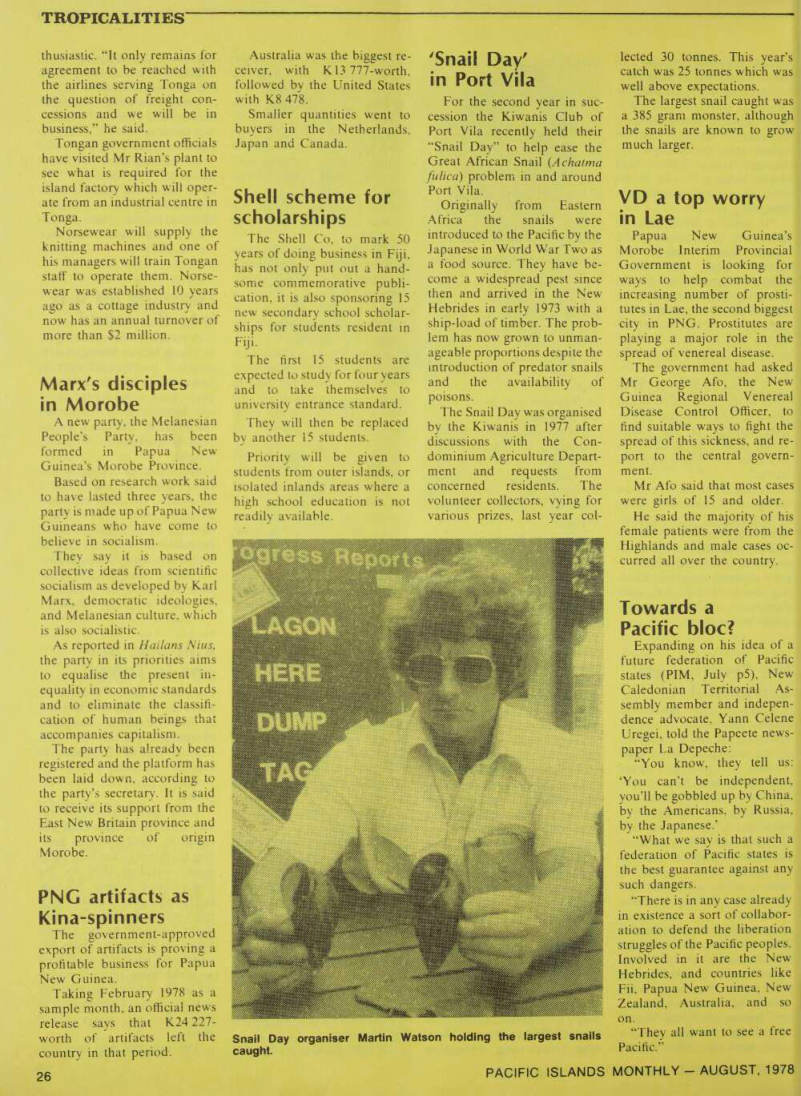
Tropicalities
New Hebrides'
all-seeing sentries
Standing in the gardens of the Port-Vila Intercontinental Island Inn like an all-seeing sentry, is the largest slit gong in New Hebrides and most prob ably the world, writes Greg Nosworthy from Vila.
The six-metre monster, seemingly out of place in the New Hebrides premier inter national hotel, was com missioned in early 1975 to complement the hotels “Island
Style” decor.
Constructed from a natora log from Tukutuk Ranch, Efate, by craftsmen from
Ambrym, the awesome carving
took a total of eight months painstaking work by hand.
Although the monster was
fashioned by Ambrym people
it is not actually a custom slit gong.
The slit gongs, or tum-tums as they are also known are mostly found, in the New Hebrides islands of Ambrym and to a lesser extent, Malekula. In previous years the statues were more wide spread through the group but due to the rush into westernisa tion they are now confined to the more primitive islands.
Stone figures have been found with similar forms to current slit gongs which some anthropologists believe date back a thousand years. The actual history behind the slit gong is vague, due to the vil lagers’ reluctance to divulge in
formation gained by them
through years of complex
ceremonies and rituals.
Previously the slit gongs were constructed from hard wood using stone tools but in more modern times have been constructed from breadfruit tree logs, also used for dug-out canoes.
The Ambrym gongs feature one, two or three of the fam iliar eerie faces with “full moon” eyes arranged in totem pole fashion above the actual resonant body of the tum-tum.
There is rarely any individu ality in the statues which seems true of other items of oceanic art. Beneath the faces of the gong are usually carved rep licas of the tusks of the pig
killed to commemorate the construction of the gong. These would be normally an almost complete circle tusk which sig nifies the importance attached to the piece.
Apart from deep-seated spiritual and ceremonial uses the slit gongs serve a useful purpose by summoning vil
lages to emergencies, meetings,
and the like. Their distinct sound can sometimes be heard for 10 km. During the lengthy processes of construction they are tested by the carver for res onance usually first by hollow ing out the right-hand side of
the log.
The various details of the decoration of the carving are secret and open to speculation.
The serrated edges on the tops and bottoms of the faces are believed by some to depict hair and beards while there are various theories on the paint used for decoration.
Upon completion the slit
gong is normally placed in the
village nakamal (open meeting
place, usually sacred) upright
in the ground, slightly-angled
back. The village nakamal may contain a number of slit gongs all angled backwards seem ingly to complement the facial features on the tum-tums.
Ail gongs are believed to contain spirits which transfer from old to new gongs and are all part of the New Hebrides
complex pig-killing cere
monies.
Fortunately, there seems to be little chance of young
Ambrym people abandoning
their custom and succumbing to western/urban ways.
Fiji is
on the ball
Fiji is in line to stage late this year the biggest golf tour nament in the world the
Eisenhower Trophy for men and the Espirato Santo for women at the Pacific Har bour championship standard course, Deuba, about 50 km from Suva.
The Eisenhower Cup tour nament is held each year at a different venue by the World Amateur Golf Council, of New Jersey. Both the Eisenhower
Trophy and Espirato Santo
events are staged over four days. Four players from each country play 72 holes, but at the end of each round the top scores of only three are tal lied.
The only bar to Pacific Har bour being the venue relates to South Africa. Fiji signed the
Glaneagles Accord along with
other Commonwealth Prime Ministers in 1977. Under this accord the countries concerned agreed not to maintain sporting ties with South Africa. The Fiji Government is believed to have found a way round the accord. If that is so Fiji golf en thusiasts will have the oppor tunity of seeing South African Gary Player, one of the world’s greatest golfers, in action.
Houses for
a 'special class'
Papua New Guineans have been told they can’t move into the government’s best houses.
They are needed as an “attrac tion” for Australians and other overseas recruits into the pub lic service.
The PNG Public Service As
sociation, the country’s biggest
union, has angrily attacked the
ruling.
“The most privileged group in the country is having its
privileges protected at our
expense” the association sec retary, Mr W. Edoni, said in Port Moresby. He said he couldn’t see much point in pol itical independence when out
Silent sentinels slit gongs from the collection in Vila of anthropol ogist Ron Van der Platt- Photo: Peter Lord.
siders were given a better deal than Papua New Guineans.
The instruction which has angered the union was given in a Public Service Commission circular regarding the allo cation of government-owned houses to public servants.
The circular said that for the time being no more “high covenant reserved houses” were to be allocated to public servants who were PNG nationals.
The houses were needed for
public servants being recruited
from overseas to fill specialised positions, the circular said.
The main outside sources of
public service recruiting are
Australia, New Zealand, UK and the Philippines.
Mr Edoni said the govern ment was betraying its own people in the interests of “so called experts”. The govern ment didn’t mind that its own people had to live in sub standard houses or stay with relatives simply to make good housing available to out siders.
He claimed that Papua New Guineans were being treated as subordinate people because their government believed that outsiders were in a special class.
“People forget that these so called experts are already receiving four to five times as much pay as we get and pay ab solutely nothing for rent,” said Mr Edoni. “On top of that they have a multiplicity of allow ances which must make them the most privileged group in
the country.”
Shadows of
death at night
The road carnage in Fiji has reached such proportions that a Suva magistrate, Mr Kenneth Moore, when dealing with a case of a driver having caused
death by dangerous driving,
felt bound to speak out. He called for urgent action to pre vent a mountain of deaths cre ating a monument to Fiji’s reckless drivers.
Mr Moore said pedestrians should wear bright garments when they walked on the streets at night. Something had
to be done immediately to cut down the number of people being killed or injured in road accidents. Between January 1 and April 30 this year 683 drivers had been convicted of careless driving, 12 for having caused death by dangerous driving, and 46 for having driven while under the influ ence of alcohol or drugs.
This is what Mr Moore said: “If what is wanted is the cre ation of a monument to reck less, dangerous or careless drivers, or those under the in fluence of drink or drugs, by building a mountain of dead bodies or by filling the streets, towns and villages with maimed, broken and crippled men, women and children, then the position should be left as it is.
“If such a monument is not wanted then it is time some thing is done, apart from bring ing more offenders before the courts. A start could be made
by asking people who use the roads at night-time to wear white garments, or perhaps even a belt or sash of luminous or reflective material which will show up at night.
“Many people are just
shadows on the road at night.
Mrs Kamikamica (the driver charged) said she did not see the man she hit, even though he was standing on the road in front of her. If a driver loses concentration for an instant it can prove fatal, as it did in this case. There are too many road deaths in Fiji.
“This is a matter which re quires to be looked into now; not tomorrow or the next day or the day after that, but today and now.”
He directed the police pros ecutor to take the matter to his superiors so that they could act as soon as possible.
Just as Mr Moore was about to pass sentence in Mrs Kami kamica’s case, a 17-years-old canecutter died at Labasa
when he was knocked from his bicycle by a vehicle which first carried him for about 50 m and then ran over him.
Mr Moore found Mrs Kami kamica, who is president of the Fijian Teachers’ Association, guilty of having caused the death of a 35-year-old man by
dangerous driving. He fined
her $lOO and barred her from driving for 12 months.
And while they are launch ing the campaign suggested by Mr Moore, the authorities might like to consider a series of safety-first lectures for chil dren living in villages along the Queen’s Road.
As soon as the road is com pleted, some drivers are going to revel in trying to “do a tonne”. Up to now the state of the gravel road has prevented drivers from driving at top
speed and villagers have
always been aware of the ap proach of traffic through the clouds of dust.
The Commodore
on the Russians
“The super-power that styles itself the natural ally of the Third World and uses ‘support for national liberation’ as a cover is trying by every means to barge into the South Pacific,” said Chinese Vice- Premier Li Hsien-nien in his welcoming speech to Ratu Sir Kamisese Mara, Prime Minis ter of Fiji, during his visit to China in June. The remark prompted a walkout by Soviet bloc diplomats at the reception
(PIM, July, p 5).
A considerably more sober estimate of Soviet intentions and capacities for action in the South Pacific has been made by one of Australia’s top
military analysts, Commodore
K. D. Gray, who until recently was military adviser to Aus tralia’s Joint Intelligence Or
ganisation.
Writing in an Australian newspaper, Commodore Gray said: “To compensate for the
loss of fishing grounds through
the establishment of national resources zones, the Soviet Union will probably seek ad ditional fisheries agreements with Indian Ocean littoral and
This is the special stamps souvenir sheet issued in June from the Cook Islands commemorating the silver jubilee of Queen Elizabeth’s coronation.
island states and perhaps with some Pacific Island states ...
“In areas of importance to Australia but with which it is only indirectly concerned stra tegically Middle East oil source areas for example, the western Indian Ocean and South Atlantic - the Soviet Union has a high capability for
projecting power.
“In areas of direct strategic concern to Australia such as the eastern Indian Ocean and South Pacific, the Soviet
Union’s capacity to project
power is greatly reduced. In the South Pacific, for example, it is difficult to see that the Soviet Union has any real strategic interests short of a situation of
global conflict.
“It is not likely to resort to force in this area unless major
political and strategic objec
tives emerge in the future which cannot be achieved in any other way. These seem un
likely.”
Writing from an Australian
viewpoint, Commodore Gray
concluded that “the develop ment of appropriate Australian military capacity, and the will to use it, combined with sen
sible regional policies, includ
ing those of aid, will tend further to inhibit Soviet ca pacity to intervene.”
The Senator said
a mouthful
Congress of Micronesia Senator Bailey Offer took full advantage of the coincidence of the ending of the United Nations Trusteeship Council hearings in New York on the US Trust Territory of the Pa cific, and the simultaneous opening of the special UN General Assembly session on disarmament. He used his clos ing speech to the council to share yvith its members Micronesians’ thoughts on dis armament.
According to Micronesian News Service, he said that Micronesians were “not unfamiliar” with either nuclear or conventional weapons, noting that “some of the fier cest battles of World War II were fought in Micronesia.”
He went on: “The first nu-
clear weapons used against human populations were launched from Micronesia.
The first thermo-nuclear weapons in the world were ex ploded in Micronesia, and to this day delivery systems of such weapons are being tested in Micronesia, at Kwajalein, in the Marshall Islands.
“Micronesia, voluntarily and otherwise, has perhaps made one of the single most import ant contributions to the secur ity interest of the United States and the international com
munity.
“Particularly, the people of
the Marshall Islands district who have been displaced, irradiated and made ill by nu clear testing saw the real horror of this supposedly civilised weapon.
“Therefore we wish to ex press our support for both the concept and the practical appli cation of disarmament, and re call some of the thoughts expressed in the preamble to the Micronesian constitution: ‘Having known war, we hope for peace. Having been div ided, we wish unity. Having been ruled, we seek freedom.
We extend to all nations what we seek from each: peace,
friendship, co-operation and
love in our common hu
manity’.”
All present were agreed that the senator had said a mouth ful.
A man who's lured
a million sharks
A million sharks is a lot of sharks. But that is the lifetime tally of sharks killed and claimed by Mr Nason Takau, who practises the mysterious
craft of “shark calling” in the waters of Lavongai village, on the east coast of Kavieng, New Ireland, in Papua New Guinea.
Talking through interpreters
to John Foster of the PNG Office of Information’s monthly Hiri, Mr Takau said:
“My grandfather taught me
how to call sharks when I was a little boy.
“I don’t know what brings on the mood in me to call sharks or when the mood will come.
Perhaps it comes once a week.
“When it does I stay in my house for 24 hours.
“I know I must not have any thing to do with women. I know that I must not step in black soil or excreta. If I do the sharks will pick up the smell and refuse to answer my calls.
“I just walk around and around in my house. My wife brings my food but she must not enter the house.”
After the 24-hour isolation period, Mr Takau and his wan toks go out in their narrow wooden canoe which is about 14 m long.
“I use a coconut shell rattle to attract the sharks. Then I begin a secret sing-sing in the old traditional Kara
language.
“When the shark hears the song he comes towards me. I then show the bait which can be a small fish or big fish, it doesn’t matter.
“The bait is on a bush cane which is fitted with a noose. I pull the bait towards me until the shark gets trapped in the noose.
“The shark then begins to thrash around.
“When it does I begin to talk to it in Kara. Gradually it be comes calmer and we slowly guide it towards the canoe.
“When the shark is close enough to the canoe it is hit over the head with a kamum beo, speared to death and dragged aboard. (The kamum beo is a weighty wooden mallet-type instrument over 1 m long. It is made from a special hardwood which has no
Pidgin name).
“If everything is going right
for me I can catch up to 10 sharks, which is as many as we can get into the canoe.”
Foster commented: “The elders sat around with us dur ing the interview. The solem
nity of the gathering prevented
even a suggestion of doubt about Mr Takau’s story ... He is all the more remarkable in that although he has caught a million sharks, there is not even a scratch, let alone a scar, on his body.”
Heavying his way
into the world
A record-breaker from birth is Young Master Manggin who weighed in after delivery at Lae’s Angau Memorial Hospi tal in June at 5.3 kg (11 lb 12 oz). Hospital authorities were confident he had set a Papua New Guinea record for birth
weight.
His father Mr Manggin, who hails from Sohano in the North Solomons province, and Mrs
Manggin, from Payawa village,
Morobe province, thanked hospital staff for their care in delivering their fourth child.
Said Mr Manggin: “Without their assistance, the mother or the child might have died.”
Knit one, purl
one in Tonga
Tongans could be making
knitwear for American skiers.
A New Zealand company, Norsewear Industries Ltd, based in Hawke’s Bay, hopes to establish an industry in Tonga making a particular line of ski
jerseys.
These fashion garments fea ture intricate patterns and are made on hand-operated knit ting machines rather than auto matic machines used by the Norsewear company. Manag ing Directoi, Mr Ola Rian, who
has exported specialist out
doors knitwear to the United States for the past six years, has neither the room nor the labour to make these special jerseys.
So he has opened negotiations with the Tonga Government to have the ski jersys made there.
The response has been en
Bailey Olter, who said a mouthful
thusiaslic. “It only remains for agreement to be reached with the airlines serving Tonga on the question of freight con cessions and we will be in business,” he said.
Tongan government officials have visited Mr Rian’s plant to see what is required for the island factory which will oper ate from an industrial centre in
Tonga.
Norsewear will supply the knitting machines and one of his managers will train Tongan staff to operate them. Norse wear was established 10 years ago as a cottage industry and now has an annual turnover of more than $2 million.
Marx's disciples
in Morobe
A new party, the Melanesian
People’s Party, has been
formed in Papua New Guinea’s Morobe Province.
Based on research work said to have lasted three years, the party is made up of Papua New Guineans who have come to believe in socialism.
They say it is based on collective ideas from scientific socialism as developed by Karl Marx, democratic ideologies, and Melanesian culture, which is also socialistic.
As reported in Hailans Nius, the party in its priorities aims to equalise the present in equality in economic standards and to eliminate the classifi cation of human beings that
accompanies capitalism.
The party has already been registered and the platform has been laid down, according to the party’s secretary. It is said to receive its support from the East New Britain province and
its province of origin
Morobe.
PNG artifacts as
Kina-spinners
The government-approved
export of artifacts is proving a profitable business for Papua New Guinea.
Taking February 1978 as a sample month, an official news release says that K 24 227worth of artifacts left the country in that period.
Australia was the biggest re ceiver, with Kl 3 777-worth, followed by the United States with K 8 478.
Smaller quantities went to buyers in the Netherlands, Japan and Canada.
Shell scheme for
scholarships
The Shell Co, to mark 50 years of doing business in Fiji, has not only put out a hand some commemorative publi cation, it is also sponsoring 15 new secondary school scholar ships for students resident in
Fiji.
The first 15 students are expected to study for four years and to take themselves to university entrance standard.
They will then be replaced by another 15 students.
Priority will be given to students from outer islands, or isolated inlands areas where a high school education is not
readily available.
'Snail Day'
in Port Vila
For the second year in suc cession the Kiwanis Club of Port Vila recently held their “Snail Day” to help ease the Great African Snail {Achatma fulica) problem in and around Port Vila.
Originally from Eastern Africa the snails were introduced to the Pacific by the Japanese in World War Two as a food source. They have be come a widespread pest since then and arrived in the New Hebrides in early 1973 with a ship-load of timber. The prob lem has now grown to unman
ageable proportions despite the
introduction of predator snails and the availability of
poisons.
The Snail Day was organised by the Kiwanis in 1977 after discussions with the Con
dominium Agriculture Depart
ment and requests from concerned residents. The volunteer collectors, vying for various prizes, last year col-
lected 30 tonnes. This year’s catch was 25 tonnes which was well above expectations.
The largest snail caught was a 385 gram monster, although the snails are known to grow
much larger.
VD a top worry
in Lae
Papua New Guinea’s Morobe Interim Provincial Government is looking for ways to help combat the
increasing number of prosti
tutes in Lae, the second biggest city in PNG. Prostitutes are playing a major role in the spread of venereal disease.
The government had asked Mr George Afo, the New Guinea Regional Venereal Disease Control Officer, to find suitable ways to fight the spread of this sickness, and re port to the central govern ment.
Mr Afo said that most cases were girls of 15 and older.
He said the majority of his female patients were from the Highlands and male cases oc curred all over the country.
Towards a
Pacific bloc?
Expanding on his idea of a future federation of Pacific states (PIM, July p 5), New Caledonian Territorial As
sembly member and indepen
dence advocate, Yann Celene Uregei, told the Papeete news paper La Depeche: “You know, they tell us: ‘You can’t be independent,
you’ll be gobbled up by China,
by the Americans, by Russia,
by the Japanese.’
“What we say is that such a federation of Pacific states is the best guarantee against any
such dangers.
“There is in any case already in existence a sort of collabor ation to defend the liberation struggles of the Pacific peoples.
Involved in it are the New Hebrides, and countries like Fii, Papua New Guinea, New Zealand, Australia, and so on.
“They all want to see a free Pacific.”
Snail Day organiser Martin Watson holding the largest snails caught.
Advertisements & other items, p. 24 (1 item)
Tropicalities
Afterthoughts
The current system of primary/secondary education in Papua New Guinea provides for 12 years of schooling, starting at the age of seven and progressing through 12 grades, graduation from Grade 12 constituting matricu lation for .entry to university.
Grades/! to 6 are provided for in “community schools”; grades l,io 10 in “provincial high schools”, of which there are nearly 100 scattered across the country; while grades 11 and 12 are handled in “national high schools”, of which there are currently only four. Due to shortage of places at the higher levels, there is a process of weeding out the less promising students at grades six, eight and 10.
It will be noticed that the first weed-out takes place at the age of 13, and at that tender age thousands of PNG primary school pupils are tossed out of the system. The entry age for the vocational centres which are intended to provide for them is 15, and they can’t get a job, except with special permission from the Department of Labour, till they are 16. Not that that matters much, because most of them haven’t a hope of getting a job anyway.
It has been suggested that the primary range provided by community schools should be extended to cover grades 1 to 8 instead of grades I to 6. This proposal seems to me to make a lot of sense. It would mean that the first weed-out would be of 15 year-olds, and at this age those not eligible for high school would at least be able to enter vocational centres.
Incidentally this is not such a revolutionary proposal as might be supposed. In the early post-war years the primary course was an eight-year one, though this fact was masked by the nomenclature used two “preparatory classes” fol lowed by six “standard”. Regrettably, the course was later pruned down to six years by the elimination of the prepara tory classes. The comment made to me by one experienced primary school teacher at the time was: “We are now being asked to achieve in six years what we have so far been un able to achieve in eight.”
Education Minister Oscar Tammur, himself a teacher of proved ability and originality, has suggested that national high schools should be phased out and that provincial high schools should include grades 11 and 12 in their range. This seems to me to be sound in principle, but probably difficult to implement in practice for reasons both of finance and
staffing.
Even more difficult of implementation is another of the minister’s proposals, namely, that the performance of our mainstream schools should be upgraded to a level of inter national acceptance which would render the existence of the present “international schools”, to which I referred in a previous article, unnecessary.
This would be a very neat solution to one of our thorniest problems. Is it practicable? This brings us to the question of the teaching of English.
I do not think that there can be much doubt that the standard of high-school English in PNG has deteriorated during the last decade, or that this deterioration is related to the progressive localisation of the teaching service. To say this is not to criticise or denigrate our national teachers or those who have trained them. But it is unrealistic to sup pose that teachers who speak English as a second language, however well-trained and however dedicated, can do as well, as teachers of English, as others, equally well-trained and dedicated, who speak English as their first
language.
If international acceptability is our aim, the only way to
get it is to provide every high school with at least one specialist English language teacher who speaks English as his mother tongue. Such a teacher should teach English language as a subject throughout the school. Such teachers need not necessarily be palefaces. It might be possible to recruit West Indian teachers who speak English as their mother-tongue for this purpose. Although West Indian English may not be BBC English, it is at least as acceptable
internationally as Australian English and perhaps
pleasanter to the ear.
But is international acceptability what we want? Many people in the rural areas would probably say “no”, and go on to demand a less academic and more practical slant.
That’s fair enough too, so long as they understand that they can’t have it both ways.
How effective is our present teaching of English? To judge from the “Letters to the Editor” page of our national newspaper, “The Papua New Guinea Post-Courier”, it is not very effective. True, there are some excellent letters from nationals, clear, concise and to the point. But there are many, some of them signed by young people who claim to be, and no doubt are, high school or university students, which just don’t make any sense at all. With a sincere desire to know what these young people are thinking, I find myself at a complete loss to understand what they are trying to say.
Often this is because they use pretentious phrases and currently popular “in-words” the meaning of which they obviously don’t understand. Sometimes they trot out inter national conference style gobbledegook which doesn’t mean anything anyway. If our teachers at secondary and tertiary level could encourage their students to express themselves in plain, simple English and not to show off, much good would accrue.
But some of the difficulty one has in making sense of these letters is that their writers are muddled thinkers, and for this I blame the Department of Education’s “English
only” policy.
It is too often overlooked that language is not only a me dium of communication. It is also a medium of thought.
I myself speak two Papuan languages reasonably well. I have been speaking one for over 50 years and the second for nearly 40.1 can, and often do, think in them. But I would not like to have to do all my thinking in them. Like every body else, I can think best in my mother tongue.
The strongest argument in favour of including a ver nacular segment in Papua New Guinea’s education system is that it gives the students an opportunity to think, and to express their thoughts, in the medium in which they can most easily do so, their mother tongue.
This does not mean that English is not important in PNG education. It is, very important. But our system of edu cation, and particularly of primary education, has suffered too long and too deeply from making the parroting of English the be-all and end-all of schooling.
Let’s give the kids a chance to think.
Advertisements & other items, p. 28 (1 item)
Long Lasting
Look atthese advantages:— r. • C-:’
No maintenance
Corrosion resistant
Economical in price
Long Lasting
Economies in freight
Light in weight
No expensive foundation
No tainting of wafer
Can be re-sifed
TOP: 450,000 litre Heron tank being installed in Micronesia.
BOTTOM LEFT: 9.000 litre ribbed tank.
BOTTOM RIGHT: 2,000 litre mini tank.
Fontana has supplied the Pacific area for over fifteen years with fibreglass storage tanks proven to be most resistant to cyclonic winds, tidal waves and earthquakes.
The quality workmanship of Fontana is renowned throughout the Pacific. No particular skills are required for the erection of fontana tanks up to 200m 3 , however Fontana can offer their services to assemble when quantity and size make this economical.
Enquiries for Fontana tanks contact
SUNNY ISLANDS MANUFACTURERS LTD.
BOX 301 INTERNATIONAL BUILDING TEL. 2957
RUE HIGGINSON, VILA, NEW HEBRIDES TELEX NHSS OR: GLOBAL ASSOCIATES, P.O. Box 8228, Tamuning, Guam. 96911.
Of trials in Tahiti, and
a talkative Minister
For months, French Polynesia’s procureur (attorney general) built up his case against the toto tupuna activists who bombed the Papeete telephone exchange and mur dered a French businessman in August-September last year (PIM, Nov, p 16).
Eventually, the date for the big trial was set for May 10, and it seemed a foregone conclusion that the accused would all suffer the death penalty.
At the same time, the ‘bothersome’ Charlie Ching, presi dent of the Polynesian Independence Party, was to be disposed of for good with a life sentence for his alleged crime of consorting with these politically-motivated young Tahitians (PIM, MAY, p3l).
Then, in a great anti-climax, on the day before it was to open, the whole trial was postponed. What had happened was that friends and relatives of the accused had taken the unprecedented step of engaging as defence lawyers four outsiders well-known for their espousal of civil and human
rights causes.
Two of them, de Felice and Sarda, were metropolitan Frenchmen, one was the famous Swiss barrister Nicolet, and the fourth a Tahitian barrister, Tehio, a resident of New Caledonia.
It took this quartet only a few hours to discover anomalies in the local judicial system and in the pre-trial procedures so serious that they decided to lodge an appeal to a higher court in France.
Especially revolting, in their opinion, was the biased selection of the jury, still based on a colonial decree of 1933 which disqualifies from jury service persons who cannot read or write French, as well as “servants”.
Accordingly, without even bothering to apply any language proficiency tests, all procureurs have ever since consistently selected as jurors French and part-French businessmen and government employees, although the solid majority of the population, 80%, consists of
Polynesians.
The French court of appeal is bound to hand down a decision within three months. However, legal experts here consider it most unlikely that the defence lawyers’ request to have the accused tried in France will be granted. Such a decision would constitute a potentially dangerous breach in the present legal system here.
The chances are equally slim that the trial of the accused toto tupuna will be transferred, as requested by them, to the Special State Security Tribunal, permitting them to be judged not as common criminals but as politically motivated freedom fighters.
Another example of the survival of colonial-type justice is offered by a trial that did take place a few weeks ago in Raiatea.
Nano Tanoa, the 22-year-old man in the dock, is a typical product of the vicious, new social and economic forces at work in the islands, since the nuclear era began 15 years ago.
Tanoa’s difficulties began when, at the age of 18, he moved from his home island of Huahine to Papeete. Like thousands of lads from the outer islands, he felt lost and bewildered in the harsh new urban environment, and soon took to drinking. But it was not until he had completed his military service in France that he began committing assaults and robberies.
He was sentenced first to six months, and then to two years, the latter term to be served in Raiatea.
In accordance with long-established practice, Polynesian, but not French, prisoners are often employed in the house holds and gardens of high-ranking French officials. Which explains why, on French National Day last year, Tanoa was hauled out of prison and entrusted with the rather pleasant task of mixing drinks for the guests of the French adminis trator of the Leeward Islands, at the glittering garden party he gave at his residency on Raiatea.
Naturally, Tanoa also served himself rather generously.
This kindled a fire that soon spread to his whole body, and, without anyone noticing, he sneaked away from the party and began looking for a female companion with whom he might share his euphoria. Having entered a house where he saw a Polynesian girl of adult years, according to the local standard (she was 15), he grabbed a kitchen knife and invited the girl to come outside. She was not particularly scared or unwilling, and intercourse took place in the gar den. In the end, Tanoa let a warder lead him peacefully back to the prison.
Appearing in court 11 months later, Tanoa was sentenced to 13 years at hard labour for rape. Nobody should now be surprised if Tanoa one day joins a toto tupuna gang and takes to mixing much stronger stuff than whiskies and rum punches Molotov cocktails, for example.
The most important event in French Polynesia during recent months (or so at least the local administration would have us believe) has been the visit of the new minister for French overseas departments and territories, Mr Paul
Dijoud.
The minister turned out to be an exact replica of his nu merous predecessors, all wearing dark suits and ties and all making practically identical speeches.
It must be admitted, however, that from the quantitative viewpoint Mr Dijoud’s performance was particularly im pressive. As he was coming down the steps of the plane that brought him from France he started talking. He didn’t stop for the next five days, until the very minute he disap peared into the plane that took him back to Paris.
The message he had to convey differed in no way from that of his predecessors; the French army and administra tion are here to stay, for the great benefit of the whole popu lation.
The only aspect of Dijoud’s marathon oratorical effort not reported by the local mass media was his speech to the special conference of French ambassadors accredited to Pacific countries which took place during his visit.
Enough is known, however, to enable us to affirm that the main aim of this closely guarded conference was to co ordinate the often arduous tasks faced by these diplomats in defending French nuclear testing and colonial rule in the Pacific against rude critics, especially in New Zealand and Australia.
Personally, we two feel rather proud that our own small efforts excited some comment at this august assembly.
Very honourably, the participants seem to have concluded that nothing can be done to punish us for our insolent books and articles, short of expelling us from the island that is our home.
But expelling writers simply because of their non conformist opinions and their habit of telling unpleasant truths is, after all, a totalitarian method that has been repudiated time and again in the strongest terms by most democratic countries, including France.
Marie-Therese and Bengt Danielsson.
Advertisements & other items, pp. 30-32 (2 items)
You name it, Mono pumps it.
I m % u
Tell us your needs, we’llshowyouthepump. Forover 30 years, we’ve been pumping liquids of every viscosity, under all kinds of conditions. Fresh water, sand and water, food ingredients, chemicals, acids, corrosives and abrasives, sludges and waste, effluent and sewage, even solids in suspension.
If it can be conveyed through a pipeline, we can move it, meter it or mix it, as quickly or slowly as you wish.
And we can provide pumps that run on petrol, kerosene, diesel, electricity, or PTO tractor drive (in fact even bicycle drive).
If there’s anything you want to know about pumping, write to us at Mono. We’ve got the pumps and the experience.
Please send me details of your pumps for (describe purposes): Name: Address: Send coupon to Head Office & Works (address below).
MONO
AA PUMPS
AUSTRALIA PTY. LTD.
MOVE IT WITH MONO
Head Office & Works: “Mono House”, 338-348 Lower Dandenong Rd., Mordialloc, Vic. 3195, Australia.
Agents in: Papua and New Guinea, Indonesia, Fiji, The Philippines. 344-P-7177
NZ firm to build
Bounty replica
The mutiny led by Fletcher Christian on April 28, 1789, when he took command of HMS Bounty, remains a landmark in nautical history and has inspired many books.
Captain William Bligh's subsequent voyage in the ship's launch, w hich he commenced w ith 18 loyal crew' members, w as a remarkable feat. His detailed log of these experiences makes
fascinating reading.
A further book, entitled Captain Bligh and Mr Christian, has been written by Richard Hough and published in 1972.
This book has led to plans for the making of tw o films w hich will be called The Lawbreakers and The Long Arm.
David Lean will direct the films to be made by the Dino de Laurentiis corporation of California. David Lean's earlier films include Law'rence of Arabia and Ryan's Daughter. Phil Kellogg is the producer for the project. An investigation team led by Phil Kellogg commenced research w ork early in 1977.
One of their main tasks was to obtain an authentic replica of HMS Bounty and consideration w as given to building this either in Europe, the Far East or New' Zealand. This team first visited New' Zealand in September of last year and consulted Whangarei Engineering and Construction Ltd as one of the possible builders.
WECO submitted a budget price of approximately $NZ1 500 000 early in October and a contract to build the replica of HMS Bounty was signed with the Dino de Laurentiis corporation on December 8, 1977. It is interesting to note that this contract w as obtained by WECO in competition with several other shipyards and is a significant export order. The masts, rigging and sails will be supplied and installed by Spencer Thetis Wharf Ltd from the Isle of Wight.
Whangarei Engineering and Construction Ltd have accepted the project as a “design and build" contract, and a detailed technical analysis, together with w'orking drawings, are now' being prepared.
The Dino de Laurentiis corporation have appointed Mr J.
McGuire as owner's representative at the shipyard and he has been seconded as senior surveyor from Lloyds Register of Shipping for the duration of the contract. Mr McGuire is at present supervising the design work and coordinating the procurement of machinery and materials. He has been directed by David Lean to ensure the complete external authenticity of the replica. This will require considerable ingenuity on the part of all concerned.
The building time for the replica of HMS Bounty is approximately 12 months and she is scheduled to sail for the filming location in Tahiti early in 1979.
c 0 &iuar*OrvLoUtl i/Julok
TRY RE-CONDITIONED
VEHICLES AND EQUIPMENT
ECONOMICAL AND RELIABLE
All Inspected by Government Authorities for Export Passenger Cars, Trucks, Buses, Tractors, Fork Lifts, Cranes, Rock Crushers, Tug Boats, Generators, Pile Hammers, Graders.
YOU NAME IT. WE HAVE IT.
INCLUDING ALL SPARE PARTS.
WRITE TO:
& Dl P.O.BOX 1983 CENTRAL POST OFFICE, TOKYO, JAPAN.
Polynesian Airlines spreads its wings
Now weekly flights between Western Samoa
Tonga and New Zealand.
WESTERN SAMOA
FIJI
For further information see your Travel Agent or write to
AMERICAN
SAMOA
K RAROTON
TONGA
NIUE
NIUE
Cj polynesian/airlines
pn n« v coo M Serving the heart of Polynesia P.O. Box 599, Apia, Western Samoa.
AUCKLAND
8230
Designed for Freedom
Arrange it any way you want.
With Onkyo’s UC-100 you get high fidelity sound and more.
Stack up the amp, tuner, and turntable, lay them flat between the speakers, or use the optional floor rack. You choose the design, and let Onkyo technology take care of the music.
Then sit back and enjoy. The powerful integrated amplifier and sensitive AM/FM stereo tuner feature a full range of front panel controls. And the UC-100 comes complete with a precision fully automatic turntable and 3-way semi-bass reflex speakers.
Visit your Onkyo dealer and discover the exciting freedom of designing your own component system.
Using the optional floor rack and with the addition of a stereo cassette deck, this vertical setup offers added space for your record collection.
The turntable fits right on top of the amp/tuner cabinet in this space-saving layout.
Put all your components right on the floor for a sleek modern look.
I Artistry in Sound International Division; No. 24 Mori Bldg., 23-5, 3-chome, Nishi-shinbashi, Minato-ku, Tokyo, Japan.
Telex 242-3551 ONKYO J Tel. 03-432-6981 1 mm ■ ! * -A 9 'V ss ; ml §m WE ARE LOOKING FOR: distributors in South Pacific Territories except Australia and Tahiti.
Contact Onkyo Corp. in Tokyo.
32
PAriPir: isi AMDS MONTHLY AUGUST. 1978
People
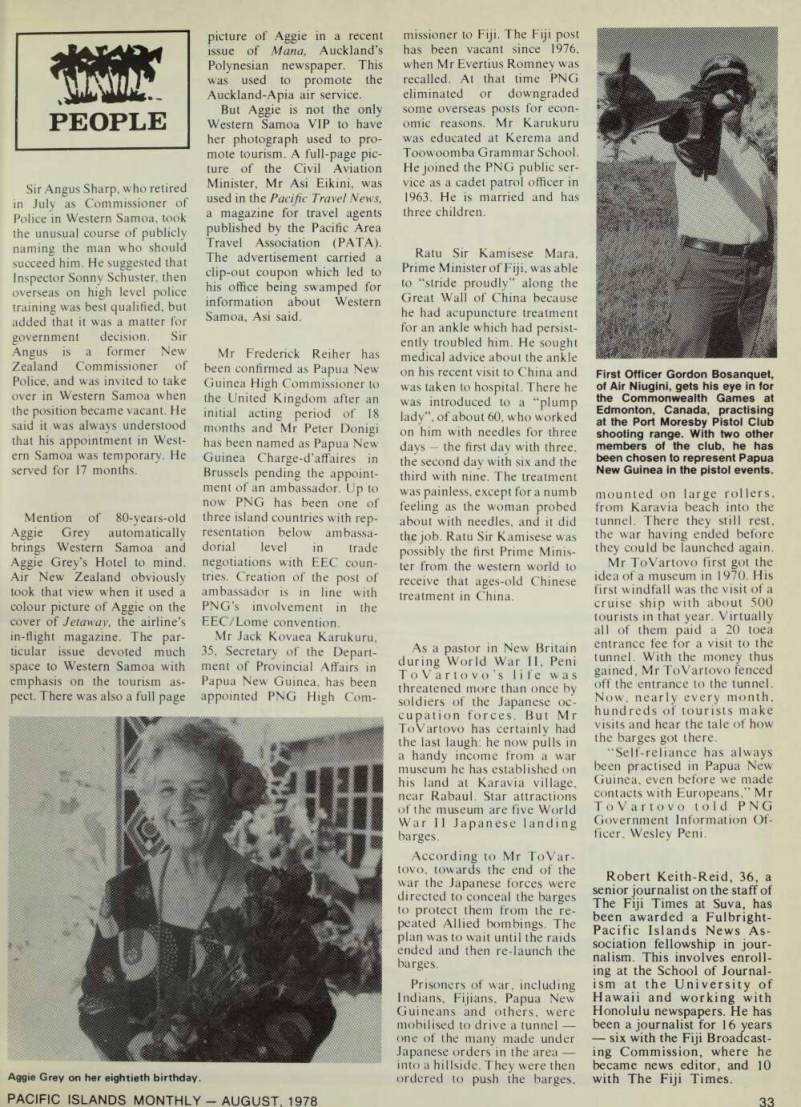
picture of Aggie in a recent issue of Mana, Auckland’s Polynesian newspaper. This was used to promote the Auckland-Apia air service.
But Aggie is not the only Western Samoa VIP to have her photograph used to pro mote tourism. A full-page pic ture of the Civil Aviation Minister, Mr Asi Eikini, was used in the Pacific Travel News, a magazine for travel agents published by the Pacific Area Travel Association (PATA).
The advertisement carried a clip-out coupon which led to his office being swamped for information about Western Samoa, Asi said.
Mr Frederick Reiher has been confirmed as Papua New Guinea High Commissioner to the United Kingdom after an initial acting period of 18 months and Mr Peter Donigi has been named as Papua New Guinea Charge-d’affaires in
Brussels pending the appoint
ment of an ambassador. Up to now PNG has been one of three island countries with rep resentation below ambassa dorial level in trade negotiations with EEC coun tries. Creation of the post of ambassador is in line with PNG’s involvement in the EEC/Lome convention.
Mr Jack Kovaea Karukuru, 35, Secretary of the Depart ment of Provincial Affairs in Papua New Guinea, has been appointed PNG High Corn-
Sir Angus Sharp, who retired in July as Commissioner of Police in Western Samoa, took the unusual course of publicly naming the man who should succeed him. He suggested that Inspector Sonny Schuster, then overseas on high level police training was best qualified, but added that it was a matter for government decision. Sir Angus is a former New Zealand Commissioner of Police, and was invited to take over in Western Samoa when the position became vacant. He said it was always understood that his appointment in West ern Samoa was temporary. He served for 17 months.
Mention of 80-years-old
Aggie Grey automatically
brings Western Samoa and Aggie Grey’s Hotel to mind.
Air New Zealand obviously took that view when it used a colour picture of Aggie on the cover of Jetaway, the airline’s in-flight magazine. The par ticular issue devoted much space to Western Samoa with emphasis on the tourism as pect. There was also a full page
missioner to Fiji. The Fiji post has been vacant since 1976, when Mr Evertius Romney was recalled. At that time PNG eliminated or downgraded some overseas posts for econ omic reasons. Mr Karukuru was educated at Kerema and Toowoomba Grammar School.
He joined the PNG public ser vice as a cadet patrol officer in 1963. He is married and has three children.
Ratu Sir Kamisese Mara, Prime Minister of Fiji, was able to “stride proudly” along the Great Wall of China because he had acupuncture treatment for an ankle which had persist ently troubled him. He sought medical advice about the ankle on his recent visit to China and was taken to hospital. There he was introduced to a “plump lady”, of about 60, who worked on him with needles for three days the first day with three, the second day with six and the third with nine. The treatment was painless, except for a numb feeling as the woman probed about with needles, and it did the job. Ratu Sir Kamisese was possibly the first Prime Minis ter from the western world to receive that ages-old Chinese treatment in China.
As a pastor in New Britain during World War 11, Peni ToVartovo's life was threatened more than once by soldiers of the Japanese oc cupation forces. But Mr ToVartovo has certainly had the last laugh; he now pulls in a handy income from a war museum he has established on his land at Karavia village, near Rabaul. Star attractions of the museum are five World War II Japanese landing barges.
According to Mr ToVar tovo, towards the end of the war the Japanese forces were directed to conceal the barges to protect them from the re peated Allied bombings. The plan was to wait until the raids ended and then re-launch the barges.
Prisoners of war, including Indians, Fijians, Papua New Guineans and others, were mobilised to drive a tunnel one of the many made under Japanese orders in the area into a hillside. They were then ordered to push the barges.
mounted on large rollers, from Karavia beach into the tunnel. There they still rest, the war having ended before they could be launched again.
Mr ToVartovo first got the idea of a museum in 1970. His first windfall was the visit of a cruise ship with about 500 tourists in that year. Virtually all of them paid a 20 toea entrance fee for a visit to the tunnel. With the money thus gained, Mr ToVartovo fenced off the entrance to the tunnel.
Now, nearly every month, hundreds of tourists make visits and hear the tale of how the barges got there.
“Self-reliance has always been practised in Papua New Guinea, even before we made contacts with Europeans,” Mr ToVartovo told PNG Government Information Of ficer, Wesley Peni.
Robert Keith-Reid, 36, a senior journalist on the staff of The Fiji Times at Suva, has been awarded a Fulbright- Pacific Islands News As sociation fellowship in jour nalism. This involves enroll ing at the School of Journal ism at the University of Hawaii and working with Honolulu newspapers. He has been a journalist for 16 years six with the Fiji Broadcast ing Commission, where he became news editor, and 10 with The Fiji Times.
Aggie Grey on her eightieth birthday.
First Officer Gordon Bosanquet, of Air Niugini, gets his eye in for the Commonwealth Games at Edmonton, Canada, practising at the Port Moresby Pistol Club shooting range. With two other members of the club, he has been chosen to represent Papua New Guinea in the pistol events.
Advertisements & other items, p. 34 (1 item)
and permanently
Save hundreds of dollars
on Australia's most efficient
WALK IN, ALUMINIUM
COOLROOMS AND
FREEZE ROOMS!!
Hundreds already installed! The most economical supplementary coolrooms for bottles and food, providing the largest storage capacity of any comparable coolrooms of the same exterior dimensions. Five sizes—from 90-360 cu. ft. capacity; 16 models offering normal temp., two temp., deep freeze, or for pastry and ice storage applications. White vinyl interior, embossed rustproof aluminium exterior.
Q SUPPLIED IN EASY-TO-ERECT, DO-IT-YOURSELF KIT FORM.
AVAILABLE FROM: Manufactured by:
AUSTRALIAN NEW CALEDONIA EXPORTS. 363 George St, Sydney, 2000.
BRECKWOLDT & CO., 276 Pitt St., Sydney, 2000, HAGEMEVER (A’SIA), 59 Anzac Pde, Kensington, 2033.
GEOFFREY HUGHES & CO, 167 Macquarie St, Sydney, 2000.
NELSON & ROBERTSON PTV. LTD, 197 Clarence St, Sydney, 2000.
PETER FISHER TRADING PTY.LTD, 321 Pitt St, Sydney 2000.
E. RABOT (EXPORTS) PTY. LTD, 67 Castlereagh St, Sydney. 2000.
RABTRAD NIUGINI PTY. LTD., PO Box 1406, Lae A. RIETTE (PACIFIC) PTY. LTD., 300 George St., Sydney, 2000.
H. Y. KWAN (AUST) PTY. LTD. Box 2713, GPO , Sydney, 2001 C. SULLIVAN (EXPORT) PTY. LTD., GPO Box 3373, Sydney, 2001.
W.S. TAIT & CO, PTY. LTD, 31 Macquarie Place, Sydney, 2000. 14A
FCI
* ~TI
FRIGID CABINETS PTY. LTD.,
Duffy Ave., Thornleigh, N.S.W. 2120 Aust. Ph. 848 8292.
Epiglass Everdure Timber preservative and sealer.
Hardens, protects and densities timber.
Kills all mould spores and permanently seals out moisture.
Epiglass 90 Epoxy Resin and glass doth.
Easy to apply.
Strengthens hulls, eliminates water absorption and rot and increases the value and life of your boat. »
by-night operators
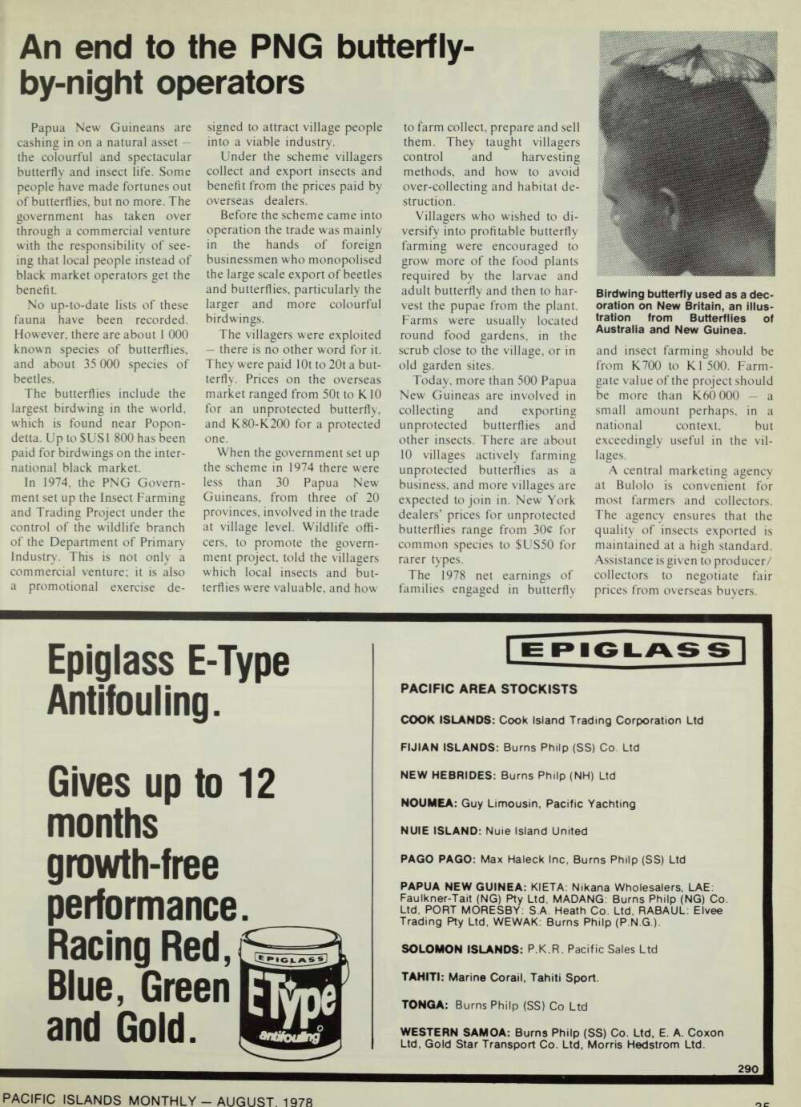
An end to the PNG butterfly by-night operators
Papua New Guineans are cashing in on a natural asset the colourful and spectacular butterfly and insect life. Some people have made fortunes out of butterflies, but no more. The government has taken over through a commercial venture with the responsibility of see ing that local people instead of black market operators get the benefit.
No up-to-date lists of these fauna have been recorded.
However, there are about 1 000 known species of butterflies, and about 35 000 species of beetles.
The butterflies include the largest birdwing in the world, which is found near Popon detta. Up to SUSI 800 has been paid for birdwings on the inter national black market.
In 1974, the PNG Govern ment set up the Insect Farming and Trading Project under the control of the wildlife branch of the Department of Primary Industry. This is not only a commercial venture; it is also a promotional exercise de
signed to attract village people
into a viable industry.
Under the scheme villagers collect and export insects and
benefit from the prices paid by
overseas dealers.
Before the scheme came into operation the trade was mainly in the hands of foreign businessmen who monopolised the large scale export of beetles and butterflies, particularly the larger and more colourful
birdwings.
The villagers were exploited
there is no other word for it.
They were paid lOt to 20t a but terfly. Prices on the overseas market ranged from 50t to KlO for an unprotected butterfly, and KBO-K2OO for a protected one.
When the government set up the scheme in 1974 there were less than 30 Papua New Guineans, from three of 20 provinces, involved in the trade at village level. Wildlife offi cers, to promote the govern ment project, told the villagers which local insects and but terflies were valuable, and how
to farm collect, prepare and sell
them. They taught villagers
control and harvesting methods, and how to avoid over-collecting and habitat de struction.
Villagers who wished to di
versify into profitable butterfly
farming were encouraged to
grow more of the food plants required by the larvae and adult butterfly and then to har vest the pupae from the plant.
Farms were usually located round food gardens, in the scrub close to the village, or in old garden sites.
Today, more than 500 Papua New Guineas are involved in
collecting and exporting
unprotected butterflies and other insects. There are about
10 villages actively farming
unprotected butterflies as a business, and more villages are expected to join in. New York
dealers’ prices for unprotected
butterflies range from 30c for common species to SUSSO for rarer types.
The 1978 net earnings of
families engaged in butterfly
and insect farming should be from K7OO to Kl5OO. Farm gate value of the project should be more than K6O 000 - a small amount perhaps, in a national context, but exceedingly useful in the vil
lages.
A central marketing agency at Bulolo is convenient for most farmers and collectors.
The agency ensures that the quality of insects exported is maintained at a high standard.
Assistance is given to producer/ collectors to negotiate fair
prices from overseas buyers.
Birdwing butterfly used as a dec oration on New Britain, an illus tration from Butterflies of Australia and New Guinea.
Advertisements & other items, pp. 35-36 (1 item)
Epiglass E-Type
Antifouling.
|E PIGLAS 3
PACIFIC AREA STOCKISTS
COOK ISLANDS: Cook Island Trading Corporation Ltd
Gives up to
months
growth-free
performance
Racing Red,
Blue, Green
and Gold.
12 3- CL FIJIAN ISLANDS: Burns Philp (SS) Co. Ltd NEW HEBRIDES: Burns Philp (NH) Ltd NOUMEA: Guy Limousin. Pacific Yachting NUIE ISLAND; Nuie Island United PAGO PAGO; Max Haleck Inc, Burns Philp (SS) Ltd PAPUA NEW GUINEA: KIETA: Nikana Wholesalers. LAE; Faulkner-Tait (NG) Pty Ltd, MADANG: Burns Philp (NG) Co.
Ltd, PORT MORESBY: S.A. Heath Co. Ltd. RABAUL: Elvee Trading Pty Ltd, WEWAK: Burns Philp (P.N.G.).
SOLOMON ISLANDS: P.K.R. Pacific Sales Ltd TAHITI: Marine Corail, Tahiti Sport.
TONGA: Burns Philp (SS) Co Ltd WESTERN SAMOA: Burns Philp (SS) Co. Ltd, E. A. Coxon Ltd, Gold Star Transport Co. Ltd, Morris Hedstrom Ltd. 290
Fly our birds
to paradise and beyond.
**/u I* • * 9 If you’re flying to Papua New Guinea, it’s only natural to think of Air Niugini. But have you ever thought of taking our big jet “birds of paradise” on to Australia, The Philippines, Hong Kong and Japan. From there we can connect you on to anywhere in the world.
Every week we can take you to any of these exciting destinations, and on the way, treat you to the friendly, relaxed Melanesian service you can expect from Air Niugini.
And of course, who better to start you off on the holiday of a lifetime in Papua New Guinea.
Look below for all the details on when and where our “birds of paradise” fly. Then call your travel agent or Air Niugini in the following areas: BUKA: Wong You (Buka) Pty. Ltd. Phone Sohano 46 HONIARA: Guadalcanal Travel Service. Phone 589 HOSKINS: Logging & Trading Co Pty. Ltd.
Phone 93 5013 KAVIENG: Air Niugini.
Phone 942135 KIETA: Air Niugini.
Phone 951866 LOSUIA: Kirawina Lodge MANUS: Air Niugini.
Phone Lorengau 9 RABAUL: Air Niugini.
Phone 921133 %
airniuginA
THE NATIONAL AIRLINE OF PAPUA GUINEA
821. P. 090
Currents
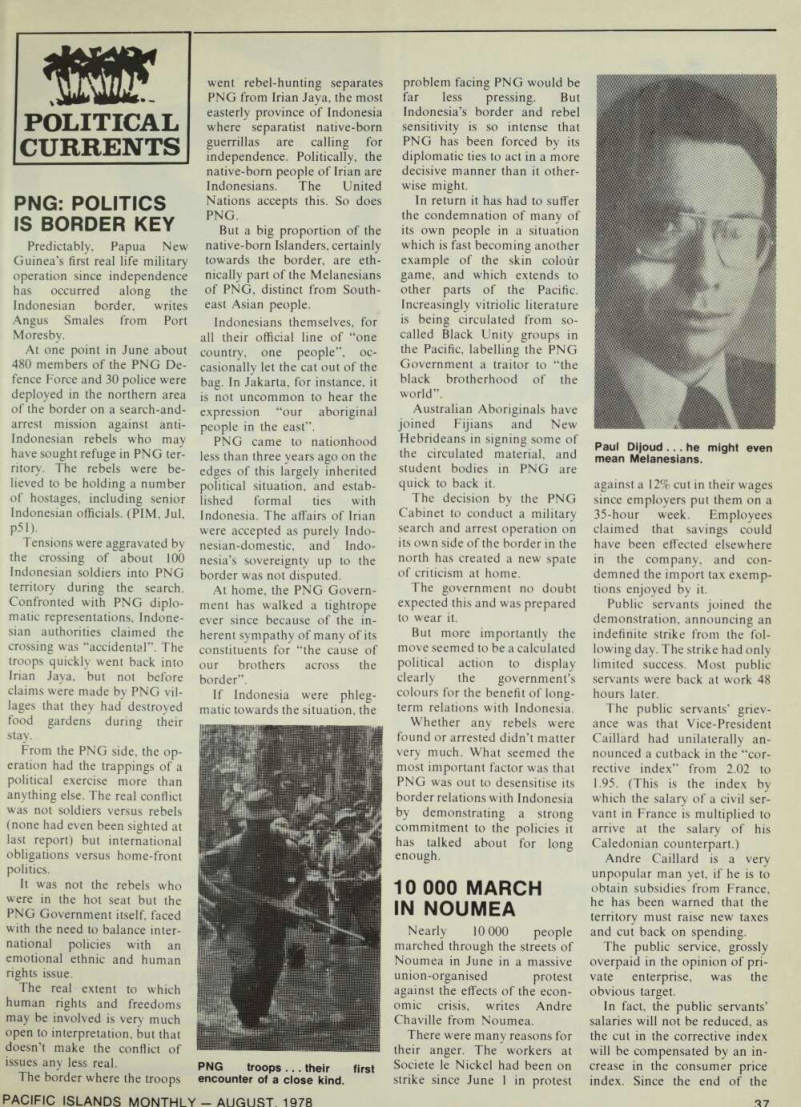

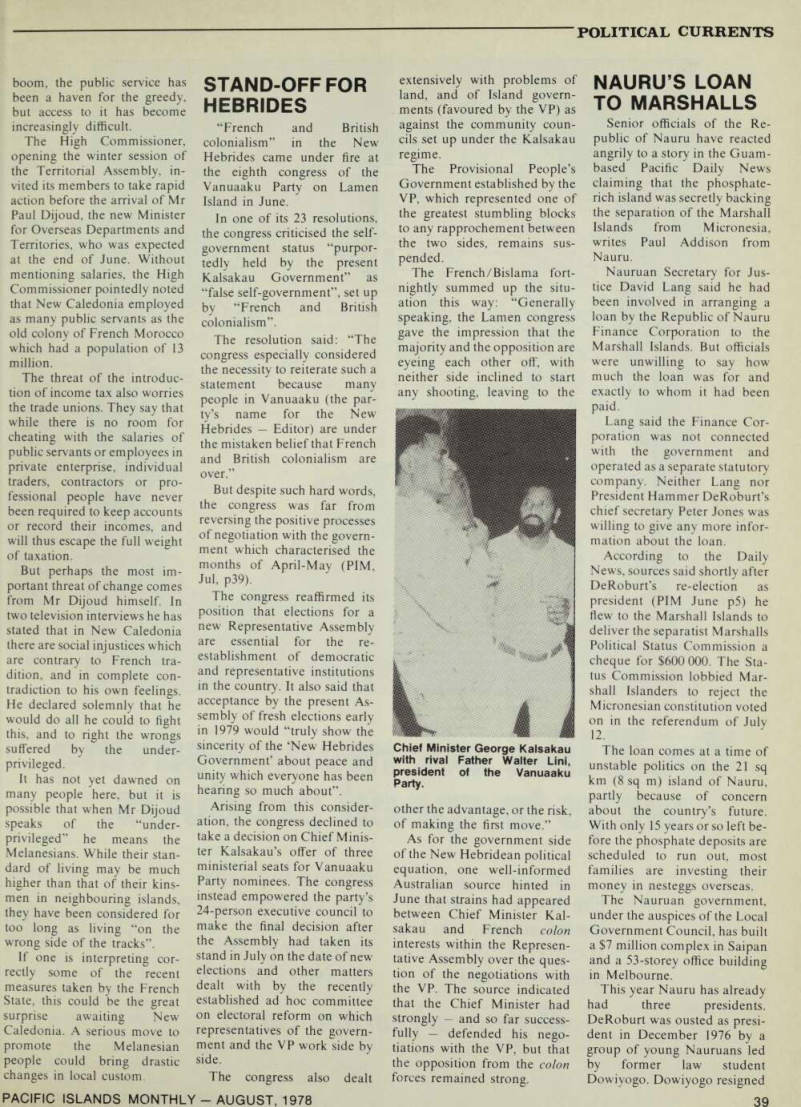

Political
Png: Politics
Is Border Key
Predictably, Papua New Guinea’s first real life military
operation since independence
has occurred along the Indonesian border, writes Angus Smales from Port
Moresby.
At one point in June about 480 members of the PNG De fence Force and 30 police were deployed in the northern area of the border on a search-and arrest mission against anti- Indonesian rebels who may have sought refuge in PNG ter ritory. The rebels were be lieved to be holding a number
of hostages, including senior
Indonesian officials. (PIM, Jul, p5l).
Tensions were aggravated by the crossing of about 100 Indonesian soldiers into PNG
territory during the search.
Confronted with PNG diplo matic representations, Indone sian authorities claimed the crossing was “accidental”. The troops quickly went back into Irian Jaya, but not before claims were made by PNG vil
lages that they had destroyed
food gardens during their
stay.
From the PNG side, the op eration had the trappings of a political exercise more than anything else. The real conflict was not soldiers versus rebels (none had even been sighted at last report) but international obligations versus home-front
politics.
It was not the rebels who were in the hot seat but the PNG Government itself, faced with the need to balance inter national policies with an emotional ethnic and human
rights issue.
The real extent to which human rights and freedoms may be involved is very much open to interpretation, but that doesn’t make the conflict of issues any less real.
The border where the troops
went rebel-hunting separates PNG from Irian Jaya, the most
easterly province of Indonesia
where separatist native-born
guerrillas are calling for
independence. Politically, the
native-born people of Irian are Indonesians. The United Nations accepts this. So does
Png.
But a big proportion of the native-born Islanders, certainly towards the border, are eth nically part of the Melanesians of PNG, distinct from South east Asian people.
Indonesians themselves, for all their official line of “one country, one people”, oc casionally let the cat out of the bag. In Jakarta, for instance, it is not uncommon to hear the
expression “our aboriginal
people in the east”.
PNG came to nationhood less than three years ago on the edges of this largely inherited political situation, and estab lished formal ties with Indonesia. The affairs of Irian were accepted as purely Indo nesian-domestic, and Indo nesia’s sovereignty up to the border was not disputed.
At home, the PNG Govern ment has walked a tightrope ever since because of the in herent sympathy of many of its constituents for “the cause of our brothers across the border”.
If Indonesia were phleg matic towards the situation, the
problem facing PNG would be far less pressing. But Indonesia’s border and rebel sensitivity is so intense that PNG has been forced by its diplomatic ties to act in a more decisive manner than it other
wise might.
In return it has had to suffer the condemnation of many of its own people in a situation which is fast becoming another example of the skin colour game, and which extends to other parts of the Pacific.
Increasingly vitriolic literature is being circulated from so called Black Unity groups in the Pacific, labelling the PNG Government a traitor to “the black brotherhood of the world”.
Australian Aboriginals have
joined Fijians and New
Hebrideans in signing some of the circulated material, and student bodies in PNG are quick to back it.
The decision by the PNG Cabinet to conduct a military search and arrest operation on its own side of the border in the north has created a new spate of criticism at home.
The government no doubt expected this and was prepared to wear it.
But more importantly the move seemed to be a calculated
political action to display
clearly the government’s colours for the benefit of long term relations with Indonesia.
Whether any rebels were found or arrested didn’t matter very much. What seemed the most important factor was that PNG was out to desensitise its border relations with Indonesia
by demonstrating a strong
commitment to the policies it has talked about for long
enough.
10 000 March
In Noumea
Nearly 10 000 people marched through the streets of Noumea in June in a massive
union-organised protest
against the effects of the econ omic crisis, writes Andre Chaville from Noumea.
There were many reasons for their anger. The workers at Societe le Nickel had been on strike since June 1 in protest
against a 12% cut in their wages since employers put them on a 35-hour week. Employees claimed that savings could have been effected elsewhere in the company, and con demned the import tax exemp
tions enjoyed by it.
Public servants joined the demonstration, announcing an indefinite strike from the fol lowing day. The strike had only limited success. Most public servants were back at work 48 hours later.
The public servants’ griev
ance was that Vice-President Caillard had unilaterally an nounced a cutback in the “cor rective index” from 2.02 to 1.95. (This is the index by which the salary of a civil ser vant in France is multiplied to arrive at the salary of his Caledonian counterpart.) Andre Caillard is a very unpopular man yet, if he is to obtain subsidies from France, he has been warned that the territory must raise new taxes and cut back on spending.
The public service, grossly
overpaid in the opinion of pri
vate enterprise, was the obvious target.
In fact, the public servants’ salaries will not be reduced, as the cut in the corrective index will be compensated by an in crease in the consumer price index. Since the end of the
PNG troops... their first encounter of a close kind.
Paul Dijoud... he might even mean Melanesians.
boom, the public service has been a haven for the greedy, but access to it has become
increasingly difficult.
The High Commissioner, opening the winter session of the Territorial Assembly, in vited its members to take rapid action before the arrival of Mr Paul Dijoud, the new Minister for Overseas Departments and Territories, who was expected at the end of June. Without
mentioning salaries, the High
Commissioner pointedly noted that New Caledonia employed as many public servants as the old colony of French Morocco which had a population of 13 million.
The threat of the introduc tion of income tax also worries the trade unions. They say that while there is no room for cheating with the salaries of public servants or employees in
private enterprise, individual
traders, contractors or pro fessional people have never been required to keep accounts or record their incomes, and will thus escape the full weight of taxation.
But perhaps the most im portant threat of change comes from Mr Dijoud himself. In two television interviews he has stated that in New Caledonia there are social injustices which are contrary to French tra dition, and in complete con tradiction to his own feelings.
He declared solemnly that he would do all he could to fight this, and to right the wrongs suffered by the under
privileged.
It has not yet dawned on many people here, but it is possible that when Mr Dijoud speaks of the “under privileged” he means the Melanesians. While their stan dard of living may be much higher than that of their kins men in neighbouring islands, they have been considered for too long as living “on the wrong side of the tracks”.
If one is interpreting cor rectly some of the recent measures taken by the French State, this could be the great
surprise awaiting New
Caledonia. A serious move to promote the Melanesian people could bring drastic changes in local custom.
Stand-Off For
Hebrides
“French and British colonialism” in the New Hebrides came under fire at the eighth congress of the Vanuaaku Party on Lamen Island in June.
In one of its 23 resolutions, the congress criticised the self government status “purpor tedly held by the present Kalsakau Government” as “false self-government”, set up by “French and British colonialism”.
The resolution said: “The congress especially considered the necessity to reiterate such a statement because many people in Vanuaaku (the par ty’s name for the New Hebrides Editor) are under the mistaken belief that French and British colonialism are over.”
But despite such hard words, the congress was far from
reversing the positive processes
of negotiation with the govern ment which characterised the months of April-May (PIM,
Jul, p 39).
The congress reaffirmed its position that elections for a
new Representative Assembly
are essential for the re establishment of democratic and representative institutions in the country. It also said that acceptance by the present As sembly of fresh elections early in 1979 would “truly show the sincerity of the ‘New Hebrides Government’ about peace and unity which everyone has been hearing so much about”.
Arising from this consider ation, the congress declined to take a decision on Chief Minis ter Kalsakau’s offer of three ministerial seats for Vanuaaku Party nominees. The congress instead empowered the party’s 24-person executive council to make the final decision after the Assembly had taken its stand in July on the date of new elections and other matters dealt with by the recently established ad hoc committee on electoral reform on which representatives of the govern ment and the VP work side by side.
The congress also dealt
extensively with problems of
land, and of Island govern ments (favoured by the VP) as against the community coun cils set up under the Kalsakau regime.
The Provisional People’s Government established by the VP. which represented one of the greatest stumbling blocks to any rapprochement between the two sides, remains sus
pended.
The French/Bislama fort nightly summed up the situ ation this way: “Generally speaking, the Lamen congress gave the impression that the majority and the opposition are eyeing each other off, with neither side inclined to start any shooting, leaving to the
other the advantage, or the risk, of making the first move.”
As for the government side of the New Hebridean political equation, one well-informed Australian source hinted in June that strains had appeared between Chief Minister Kal sakau and French colon interests within the Represen tative Assembly over the ques tion of the negotiations with the VP. The source indicated that the Chief Minister had strongly and so far success fully defended his nego tiations with the VP, but that the opposition from the colon forces remained strong.
Nauru’S Loan
To Marshalls
Senior officials of the Re public of Nauru have reacted angrily to a story in the Guam based Pacific Daily News
claiming that the phosphate
rich island was secretly backing the separation of the Marshall Islands from Micronesia, writes Paul Addison from Nauru.
Nauruan Secretary for Jus tice David Lang said he had been involved in arranging a loan by the Republic of Nauru Finance Corporation to the Marshall Islands. But officials were unwilling to say how much the loan was for and exactly to whom it had been
paid.
Lang said the Finance Cor poration was not connected with the government and operated as a separate statutory company. Neither Lang nor President Hammer Deßoburt’s chief secretary Peter Jones was willing to give any more infor mation about the loan.
According to the Daily
News, sources said shortly after Deßoburt’s re-election as
president (PIM June p 5) he
flew to the Marshall Islands to deliver the separatist Marshalls Political Status Commission a cheque for $6OO 000. The Sta tus Commission lobbied Mar shall Islanders to reject the Micronesian constitution voted on in the referendum of July 12.
The loan comes at a time of unstable politics on the 21 sq km (8 sq m) island of Nauru, partly because of concern about the country’s future.
With only 15 years or so left be fore the phosphate deposits are scheduled to run out, most families are investing their money in nesteggs overseas.
The Nauruan government, under the auspices of the Local Government Council, has built a $7 million complex in Saipan and a 53-storey office building in Melbourne.
This year Nauru has already had three presidents.
Deßoburt was ousted as presi dent in December 1976 by a group of young Nauruans led by former law student
Dowiyogo. Dowiyogo resigned
Chief Minister George Kalsakau with rival Father Walter Lini, president of the Vanuaaku Party.
in April this year, after his budget failed to win govern ment support. He was suc ceeded by Lagumot Harris whose budget also failed.
Deßoburt again became Presi dent of the island’s 4 000 Nauruans in May.
Png Aloof
On Torres
Papua New Guinea is stay ing out of the dispute over the Torres Strait border question between Australian Prime Minister Malcolm Fraser and Queensland Premier Joh
Bjelke-Petersen.
PNG Prime Minister Michael Somare told Angus Smales in Port Moresby that negotiations leading up to a proposed settlement of the border question had been car ried out on a country-to country basis between his government and the Australian Government.
Any discontent felt by Queensland was an internal matter for Australia to settle, said Mr Somare. PNG could
recognise only the Australian
Government as the legitimate
authority to negotiate Aus
tralian border arrangements with PNG, he said.
Mr Somare would not com ment on whether he believed the attitude taken by Queensland was sufficiently strong to upset arrangements already reached by Australia.
He could not comment on Aus tralian internal issues, Mr Somare said.
Mr Bjelke-Petersen at first welcomed the terms of the agreement, but then changed his mind, possibly after sensing mutterings from black Queenslanders in the strait.
Russia: Mara
Speaks Out
Warnings about a Russian presence in the South Pacific were voiced late in June by the Fiji Prime Minister, Ratu Sir Kamisese Mara, and the vice president of the New Zealand Labour Party, Mr Michael Moore. At the same time the first resident United States
Ambassador to Fiji, Mr John Condon, said his country intended to strengthen its ties with Pacific Island countries.
Ratu Sir Kamisese, speaking after his return from a visit to China and South Korea, said he feared the Russians’ objec tive in Fiji was to upset him and get him out of government.
He said he did not harbour the same fears about the Chinese.
The Prime Minister said he would be “pretty scared” to have a Russian embassy in Fiji.
He had spoken to the Russians, through their ambassador to New Zealand, three or four years ago, telling them it was disturbing to him as head of government to see that, with out consulting him, they had gone to Fiji and selected
people from the opposition
camp to be trained in Russia.
“I will not have a govern ment which will be of that mood established here,” he said.
Ratu Sir Kamisese said he did not think Fiji workers would be influenced by the
political ideologies of any
Chinese advisers who went to
Fiji to help to improve agricul
ture and industry.
The main interest of the Chinese in the South Pacific was to see that the Russians did not intrude into the area. The Chinese had mentioned to him that perhaps Fiji would be bet ter olf to be friendly with the Americans than with the Rus sians.
In New Zealand. Mr Moore said that the danger of super power rivalry in the South Pa cific was very real. Echoing the sentiments of Prime Minister Muldoon, he said that the Rus sian courtship of Fiji, Western Samoa and other Pacific coun tries spelled danger for New Zealand.
Mr Condon, speaking to the Nadi Rotary Club in his first formal speech in Fiji, said the freedom of the sealanes in the Pacific was vital to the security and well-being of the US and all maritime powers. “We will protect them,” he said.
He described the Pacific Basin as the most dynamic economic zone in the world. Its prosperity was shared by all
except those nations who re jected the market system.
He said US trade with the Pacific nations was crucial to the health of its economy and would be expanded. Multi lateral trade agreements should be concluded.
Mr Condon said the US mission was preparing to inten sify the exchange of people and ideas with Fiji.
On other matters, the US envoy expressed admiration for Fiji’s respect for democratic rule and human rights; reported that a survey team from the University of Hawaii had submitted an analysis of the region’s future food needs; and voiced the hope for joint projects in the region to meet the challenge of finding new ways to use US technology in
development of indigenous Pa
cific sources of energy.
Png: New-Look
Action
Students at the University of Papua New Guinea in Port Moresby staged an often viol ent fortnight-long strike in
May against the two-year
suspension of a student for striking a lecturer.
In a close analysis of the strike written for PIM, PNG
journalist Andy Supeke finds
that it contained a number of features new to student politi cal action at the UPNG.
He writes: “This was the first strike by students at the univer sity that displayed real student
solidarity.
“The question was asked re
peatedly: ‘Why should
students fight over only one
student’s problem?’ Many said:
‘lf Vincent Toliman got fired for striking a lecturer, he got fired tough luck for him.’
“Such attitudes were charac teristic of similar situations in the past, but they were not the dominant ones this time.
“In the first place, the students were unimpressed with the degree of assault on the lecturer. (T expected to see the lecturer all messed up. but surprisingly he didn’t even have a scratch on his face or anywhere,’ said one student.) “The vice-president of the
Student’s Representative Council, Joe Mac Teine, ex pressed a general view when he said that what mattered was that the principle of justice should be maintained.
Students did not dispute that Vincent should be punished, but believed that the decision of Vice-chancellor Renagi Lohia was ‘arbitrary and ex cessive’.
“He said: ‘lf we just sit back and watch Vincent get fired, anyone of us could well be in the same boat next time for not so serious an assault’.”
Another unusual aspect of the strike, writes Supeke, was that its development cut across many conventional ideas of re
gional loyalties. “Probably the
biggest surprise was the sup
port given by the Highlands
United Front on the campus to the Students’ Representative Council.
“The Front is one of the most politically sensitive groups ever formed on the campus, representing students from the five highlands prov inces who make up more than a third of the student popu lation.
“Only about a month before the strike, the Front said it would not support any SRC strikes or demonstrations be cause an application for its af filiation with the SRC was
rejected.
“For one thing the president of the Highlands United Front, Malipu Balakau, and Vincent Toliman, both political acti vists on the campus, have been very good friends.
“Since they met in 1975, Vin cent has been associated with the highlands students more than he has with students from his own area. (Vincent
Toliman, a third-year political
science student, is a Tolai from New Britain, son of the late United Party leader, Mathias Toliman.) “Asked whether Vincent’s friendship with him and the highlands students had any thing to do with the support they gave to the SRC, Balakau said: ‘Friendship played a part in our support, but we were fighting for a basic principle that was at stake. Justice was at stake’.”
Advertisements & other items, pp. 38-50 (1 item)
•Master.
BRAND
A 1
MACKEREL
PACKED BY :
NIPPON SUISAN KAISHA, LTD,
* “Master” Brand Canned Mackerel, Canned Sardines and other Canned Fish. * “House” Brand Instant Noodle, Soup & Desserts, all kinds of Spices and Japanese Soy Sauce. * Groceries, Confectionary, Beverage, etc. *Hand Tools, Builders & Cabinet Hardware, Plasticware, Chinaware, Kitchenware. * Building Materials, Plywood, Hardbord, Formica, Tiles, Wall Paper, etc. * Steel Products: Round, Square, Flat, Angle, Channel Bars, Iron Sheet, Pipes & Fitting. * Machinery, Motor Spare Parts, Batteries and Accessories. * Electric Household Appliances & “Daikin” Air Conditioners. * Sporting Goods, Fishing Rods & Reel, Accessories for Boat & Yacht. * “Hadson” Pocket & Table Lighters, Disposable Butane Lighters. * Soaps, Hair Shampoo, Detergents. ToUetmc. * Various Novelties, Ornaments, Souvenir Items. * “New Jet Type” Labeler & Other Daily Stuff.
UNITRADE COMPANY,LIMITED
GENERAL MERCHANTS
EXPORTERS & IMPORTERS
Sanritsu Building 11-12 3-chome Hachobori Chuo-ku Tokyo (104)
TELEX NO. : “252-4665 KANDK J”
CABLE ADDRESS *. “KAYANDKAY TOKYO”
TELEPONE NO. I 03-553-9520
Resident Representives in Fiji, P.N.G., Philippines, Hong Kong & Singapore
HOUSING ?
Our Kitset Houses manufactured to your design or requirements are available for delivery and local assembly competitively anywhere in the Pacific. Units can come complete with plumbing and electrical wiring and be manpacked into the most inaccessible areas if required.
We can also cater for classrooms, hospital wards, dispensaries, etc. Our precut colour coded and numbered framing units means less skilled labour on site as initial cutting, fitting, etc., has been done in our factory.
We will design and/or help you to set up your own manufacturing facilities utilising local labour and resources on a joint venture basis.
FOR FURTHER INFORMATION WRITE TO:—
STEWART
TIMBER & HARDWARE LTD.
EXPORT DIVISION
P.O. BOX 488, WHANGAREI. NEW ZEALAND.
i~n <® rrm TT 7 " m 1 IS n 1 1
You’ll like our money-saving
ways to speed products.
Import or export, quicker, but safer the faster you move too. Talk Air Cargo merchandise, the less convenience it can cost. Air Cargo and savings with does it not only Air New Zealand. air new zeaian ear go The economic move.
ANZ 78/6
Fly the world's largest fleet...
Pan Am 747'5.
747 %
F¥W ATVI
747 flO AM
FW\J
747 747 L AM 747
RANAM
747 If you're like us, you know a great thing when you see it.
Wide-bodied 747's are the fastest and most comfortable passenger planes available. And vye fly nonstop to more U.S. cities than any other airline in the world
including record-setting long
range flights. No other airline can match our daily nonstop round trips between Tokyo and New York. We fly the world's longest commercial nonstops from Sydney to San Francisco. Building an entire fleet of 747's just made
good sense.
Our inflight service crews try very hard to meet your every need in the warmest, most personal
manner possible. Wide, spacious
cabins give you living room comfort as the world slips by.
Our 7475 P "Super Performer"
has lower fuel consumption, higher flying altitudes and faster speeds, making even the longest trip a little shorter. Pan Am's 7475 P is
Experience in tangible form.
You'll find Upper Deck Dining in the First Class lounge at the top of the spiral staircase. Enjoy a gourmet experience from a choice of four select entrees.
No matter where yoiTfly in the world, you're always at home with Pan Am. We assembled the largest fleet of Pan Am 747's just for you.
F¥W^MVi;
Experience makes the difference. 065. P 285
AKAI
akai
*Vv~i^
- . ■•, *■*“■ •■ T *‘ ’*"'l sm
ll^asaaS
AKAI Portables, For the Creates
PNG.
S O Svensson (N.G.) Ltd.
PO. Bo* 705, Port Moresby Tel; 2275 Fiji (stands Motibhai & Company Ltd.
P.O. Box 9175, Nadi International Airport Tel; 72-165 New Zealand P-ye Ltd., Consumer Products Sector 110 Mt Eden Rd, Mt, Eden, Auckland Tel: New Caledonia Menard Fr6res ViHe B P. H 2, Noumea Tel: 275222 Tahiti Etablissements Comimpex P.O. Box 200, Papeete Tel: 20477 New Hebrides (Islands) Burns PhHp (New Hebrides) Co., Ltd.
P.O. Box 27, Port Vila, New Hebrides Islands Norfolk Island Bums Pbitp (Norfolk Island) Co., Ltd.
P.O. Box 21, Norfolk Island Samoa Islands Bums Phtlp (South Sea) Co:, Ltd.
PO. Box 129, Pago Pago, American Samoa Mariana Islands J.C. Tenorio Enterprises P.O. Box 137, Saipan Tel: 6444/8 British Solomon Islands Security Electrical Co., Ltd.
PO, Box 174. Honiara Tel; 881 Cook Islands JPS Enterprises Ltd.
P.O. Box 15, Rarotonga Tel: 2150, 2176
4-Band Stereo AJ-370
5,000mW of powerful stereo beauty,
2-way 4-speaker system, dual micro
phones, feature-loaded for complete
sound versatility.
3-Band
Dynamic 5,000mW of power through
2-way hi-fi speakers, for crystal clear
sound, full-featured for total convenience.
3- Band
Unsurpassable cost/performance in
a versatile power portable. 3,000mW output plus a host of other deluxe
recording features.
i 'j>nz r,v>
AKAI ELECTRIC CO., LTD. Tokyo, japan
Now, the other
can be covered with
• , 4 S M t Wi m n *5 305 RK m SK-1
music.
On the land or on the sea you will never be far away from great stereo music with Pioneer’s new stereo radio cassette recorder. The 3-way power source lets you use internal batteries, house current or your car’s power supply (with adaptor).
Pioneer created to sound as great as it looks, the SK-1 delivers a hefty 3,000mW (Music Power). More than enough to handle the “heavy” sounds, yet designed compact for those who like to travel light.
Radio fans will have a ball with 2 shortwave bands, plus MW and FM. Naturally, the tuner section uses advanced Pioneer Integrated Circuitry for stable reception even in out-of-theway places.
Of course, the cassette recorder is what you would expect from Pioneer. A wide-range Permalloy record/playback head, pause, cue and review functions. Variable Monitor switch, Loudness Contour switch and fully-automatic Stop. And for easy recording, left and rightchannel microphones. Or plug in a turntable and build an entire stereo system around the SK-1.
And on the output side, a pair of 12cm (4% inch) hi-fi speakers. Perfectly balanced for exciting stereo reproduction.
Pioneer’s new SK-1 stereo radio cassette recorder. Component-like performance plus the go-anywhere convenience of portability. And, for those who want big Pioneer performance on a smaller budget, we’re pleased to offer the RK-305 and RK-355. They’re not stereo, but they are Pioneer. And that means a lot, no matter where your music takes you.
Portable hi-fi... from the audio company.
CiD PIONEER
Australia Pioneer Electronics Australia Pty. Ltd., 178-184 Boundary Road, Braeside, Victoria 3195, Tel: 90-9011, Sydney 93-0246, Brisbane 59-7457, Adelaide 433379, Perth 24-9899 Fiji Islands Brijlal & Company, G.P.O. Box No. 362, Suva, Fiji Islands Tel: 22258 New Zealand Fountain Marketing Ltd., Maidstone Street, Auckland, New Zealand Tel: 763-064 Norfolk Island Burns Philp (Norfolk Island) Ltd., Norfolk Island, South Pacific New Hebrides Burns Philip (New Hebrides) Ltd., Vila, New Hebrides Nauru Island Jacob Enterprises. P.O. Box No. 4, Republic of Nauru Tahiti Est, PERFECT, B.P. 594, Papeete, Tahiti Tel; 20 407 New Caledonia Menard Freres Ville, B.P. H 2 Cedex, Noumea. New Caledonia Tel: 27.52.22 American Samoa Traspac Corporation, P.O. Box 1477, Pago Pago, American Samoa 96799 Tel: 633-5224 Rorotonga South Seas International Ltd., P.O. Box 49, Rarotonga Cook Islands Tel: 2327 Papua New Guinea Bali Merchants Pty. Ltd., P.O. Box 6103 BorokoTel: 254887
SiSi
Who else could present such an
ray of spectacular stereo?
Who else but the hi-fi specialist
re you of outstanding and reliable'
ce for every model on this page! ■
”ULBOO
14 TOO
'VJSO
xm wM •tejx
•£JSO
•OX) mm i ll* * * m .. .■ -.A ~ssr i •
SANSUI ELECTRIC CO., LTD.
• Australia VANFI (Aust.) Pty. Ltd. 162, Albert Road, South Melbourne, Victoria 3205, Australia Phone: 699-5473/Suite 5, Uniline House, 5 Northcliff Street. Milson Point, N.S.W. 2061, Australia Phone: 929-0293 • Fiji Prabhu Brothers Ltd. P.O. Box 183, Nadi Phone: 70183/4
w Sansui means sound that’s clean and Hare is proof that Sansui is dedicated to powerful. It means stereo that touches your excellent sound quality for everyone, soul. And it means even the subtle nuances If you put sound quality first, it’s Sansui all of music sources are crisp. \ v X X I © Q Gi
I 'TT.
0 ■it.
' SM i d y* me oo ■ X\ V V
A\\\V\o\v\\i
•i-
-x\\\VxYAvJ
XxXXmxxX
■ >v-v A \ w\\\ \ \ \\ p i ft saw*. mm* 1 i *
Only hi-fi, everything hi-fi.
Guinea oceania Indent Agency (P.N.G.) Pty. Ltd. Box 5518, Boroko, Port Moresby Phone: PM 256406 • New Zealand David Reid Electronics Ltd. C.P.O. Box 2630, Auckland, 1 Phone: 492-189 • New Caledonia Ets Michel MERCIER B.P. 1123, Noumea Phone: 27. 59. 11 • South Pacific Miltons rln* St0 D ri n p m,t !l P 2- n 146 - Norfolk lsland 2899 • Central Pacific Nauru Co-operative Society Republic of Nauru • New Hebrides The Sound Centre P.O. Box 434. Port Villa • Cook Island United Island Traders Ltd. P.O. Box 1& 2. Rarotonga • Tahiti DIMECO P.O. Box 2622
»v * i m 1 -■ f^L *% •* <■> JS* ,M» • . -i A, V * y> ' /,' < \ X A , v *r m : >r,v Hw 3« ✓ ✓ xsj *
ils
-f ii£ X 69|^
s f ‘A, o /I I S' w £ W: IV x cr Z\ M i “7 \ X \ rT X Vv *». -n
Shell helps land the big ones
Shell has played a vital role in the Pacific for 50 years now.
And part of that role has been in assisting, aiding and developing the local fish-
ing industry. Helping harvest more from
beneath the sea. Shell has also aided development in mining, aviation, tourism, sugar cane, ships’ bunkering and other vital areas.
It’s development that has benefited the Pacific region and its people as a whole.
Shell Papua New Guinea Pty. Limited, P.O. Box 169, Port Moresby, Papua New Guinea.
Shell Company (Pacific Islands) Limited, Box 168, Suva, Fiji.
Societe des Petroles Shell des lies du Pacifique Boite postale L 2, Noumea, New Caledonia.
Shell
PACIFIC ISLANDS MONTHLY - AUGUST, 1978
SHI77
QBE
throughout the Islands.
081 INSURANCE UNITED
(FORMERLY - QUEENSLAND INSURANCE COMPANY)
Central Office: 82 Pitt Street, Sydney.
FIJI - Branch Office, Suva, Manager for Fiji: L.G. Liddell A.A.1.1.
LAUTOKA Sub-Branch Office: Burns Phi Ip Bldg.
NEW CALEDONIA T.A. Hagen, Ste. W.A. Johnston, SA.R.L. - Noumea.
NEW HEBRIDES - District Manager: G.F. Donnelly, Vila; Santo Santo: Burns Philp (New Hebrides) Ltd.
TAHITI - Arthur Chung: Immeuble 8.1., Front de Mer, Papeete.
NIUE, NORFOLK ISLAND, SAMOA, TONGA and other South Sea Islands Burns Philp (South Sea) Company L td.
QUEENSLAND INSURANCE (P.H.G) LTD
PAPUA NEW GUINEA - Head Office, PORT MORESBY.
General Manager: J.M. Dawe. Assistant Manager: R.V. Maskell.
District Managers at: LAE: I.R. Martin MOUNT HAGEN: D.F. Carroll ARAWA: J. Longbut MADANG: R.W.V. Collings RABAUL: W.F. Tinker
In the home
SPEED-E-GAS
is fast, efficient
and reliable.
Terminals throughout the Pacific.
For more information write Boral Gas Limited, 221 Miller Street, Jk I North Sydney 2060 DURML *Speed-E-Gas is known Hin Papua New Guinea, as Guinea Gas. In Tonga as Tonga Speed-E-Gas, and in Fiji as Fiji Gas.
SPEED-EGAS
4c.
V ft A Kb M n
HOLT GS 14
Uncle Sam’S Heavy Boot Leaves
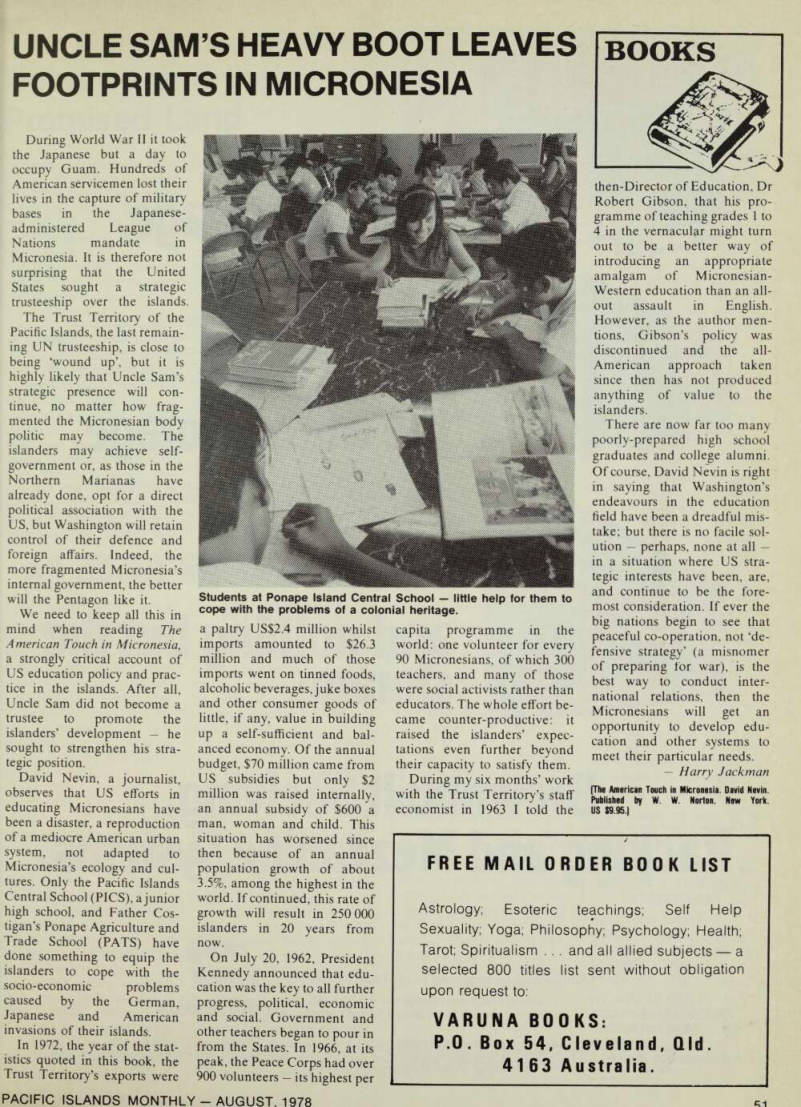
Footprints In Micronesia
During World War II it took the Japanese but a day to occupy Guam. Hundreds of American servicemen lost their lives in the capture of military bases in the Japanese administered League of Nations mandate in Micronesia. It is therefore not surprising that the United
States sought a strategic
trusteeship over the islands.
The Trust Territory of the Pacific Islands, the last remain ing UN trusteeship, is close to being ‘wound up’, but it is highly likely that Uncle Sam’s strategic presence will con tinue, no matter how frag mented the Micronesian body politic may become. The islanders may achieve self government or, as those in the Northern Marianas have already done, opt for a direct political association with the US, but Washington will retain control of their defence and foreign affairs. Indeed, the more fragmented Micronesia’s internal government, the better will the Pentagon like it.
We need to keep all this in mind when reading The American Touch in Micronesia, a strongly critical account of US education policy and prac tice in the islands. After all, Uncle Sam did not become a trustee to promote the islanders’ development he sought to strengthen his stra
tegic position.
David Nevin, a journalist, observes that US efforts in educating Micronesians have been a disaster, a reproduction of a mediocre American urban system, not adapted to Micronesia’s ecology and cul tures. Only the Pacific Islands Central School (PICS), a junior high school, and Father Cos
tigan’s Ponape Agriculture and
Trade School (PATS) have done something to equip the islanders to cope with the
socio-economic problems
caused by the German, Japanese and American invasions of their islands.
In 1972, the year of the stat istics quoted in this book, the Trust Territory’s exports were
a paltry US$2.4 million whilst imports amounted to $26.3 million and much of those imports went on tinned foods,
alcoholic beverages, juke boxes
and other consumer goods of little, if any, value in building up a self-sufficient and bal anced economy. Of the annual budget, $7O million came from US subsidies but only $2 million was raised internally, an annual subsidy of $6OO a man, woman and child. This situation has worsened since then because of an annual
population growth of about
3.5%, among the highest in the world. If continued, this rate of growth will result in 250 000 islanders in 20 years from now.
On July 20, 1962, President Kennedy announced that edu cation was the key to all further progress, political, economic and social. Government and other teachers began to pour in from the States. In 1966, at its peak, the Peace Corps had over 900 volunteers its highest per
capita programme in the world; one volunteer for every 90 Micronesians, of which 300 teachers, and many of those were social activists rather than educators. The whole effort be came counter-productive: it raised the islanders’ expec tations even further beyond their capacity to satisfy them.
During my six months’ work with the Trust Territory’s staff economist in 1963 I told the
then-Director of Education, Dr Robert Gibson, that his pro gramme of teaching grades 1 to 4 in the vernacular might turn out to be a better way of
introducing an appropriate
amalgam of Micronesian- Western education than an all out assault in English.
However, as the author men tions, Gibson’s policy was discontinued and the all- American approach taken since then has not produced anything of value to the islanders.
There are now far too many
poorly-prepared high school
graduates and college alumni.
Of course, David Nevin is right
in saying that Washington’s
endeavours in the education field have been a dreadful mis take; but there is no facile sol ution perhaps, none at all in a situation where US stra tegic interests have been, are, and continue to be the fore most consideration. If ever the big nations begin to see that
peaceful co-operation, not ‘de
fensive strategy’ (a misnomer of preparing lor war), is the best way to conduct inter national relations, then the Micronesians will get an
opportunity to develop edu
cation and other systems to meet their particular needs.
Harry Jackman
(The American Touch in Micronesia. David Nevin Published by W. W. Norton. New York.
US 59.95.)
Students at Ponape Island Central School little help for them to cope with the problems of a colonial heritage.
Advertisements & other items, pp. 51-52 (1 item)
Free Mail Order Book List
Astrology; Esoteric teachings: Self Help Sexuality: Yoga; Philosophy: Psychology; Health; Tarot: Spiritualism .. . and all allied subjects a selected 800 titles list sent without obligation upon request to:
VARUNA BOOKS:
P.O. Box 54, Cleveland, Old. 4163 Australia.
r li ft s
The full storage
Whatever your requirements Brownbuilt Shelving, Racking and Mezzanine Systems can provide a practical, cost-saving answer. Because of the wide range of standard products and accessories available, the varying load capacities, and versatility of applications, Brownbuilt can design a system for you that makes maximum use of available cube space.
the whole storage,
Quality is the primary consideration in the interchangeable, high strength welded frame racking. It is also extremely safe and versatile with its range of types and sizes. This enables you to save on floor area and cut costs by installing mezzanine and hi-rise structures in your existing storage area.
For further information on the complete storage system designed to keep pace with your expansion, contact Brownbuilt in your State or send the coupon.
and nothing but the
storage.
Brownbuilt Shelving,
Racking and Mezzanine Systems.
Advice and service is all part of our service.
Steel Storage Equipment and Furniture.
Made in Australia with Australian steel.
Brownbuilt
Brownbuilt Limited, Export Department, Cnr. Bath Road & Waratah Street Sutherland NSW -232. Australia- Telex AA^27s^ Agents: PNG-Brownbuilt (PNG) Pty Ltd, Port Moresby; Fiji - Lysaght - Brownbuilt Ind. (Fiji) Ltd., Suva; New Caledonia - NCR, Noumea, New Hebrides - NCR, Vila.
Hawaii - Records Management Services, Honolulu.
Promised Land
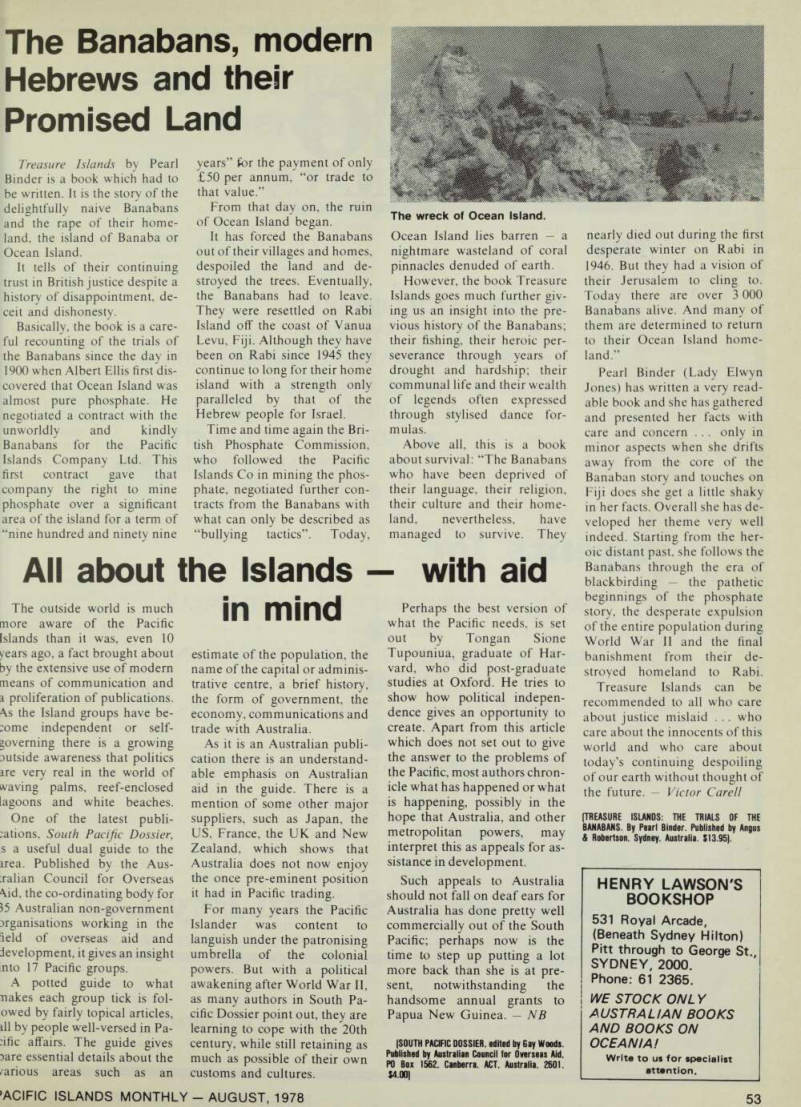
The Banabans, modern Hebrews and their Promised Land
Treasure Islands by Pearl Binder is a book which had to be written. It is the story of the delightfully naive Banabans and the rape of their home land, the island of Banaba or Ocean Island.
It tells of their continuing trust in British justice despite a history of disappointment, de ceit and dishonesty.
Basically, the book is a care ful recounting of the trials of the Banabans since the day in 1900 when Albert Ellis first dis covered that Ocean Island was almost pure phosphate. He negotiated a contract with the
unworldly and kindly
Banabans for the Pacific Islands Company Ltd. This first contract gave that company the right to mine
phosphate over a significant
area of the island for a term of “nine hundred and ninety nine
years” for the payment of only £5O per annum, “or trade to that value.”
From that day on, the ruin of Ocean Island began.
It has forced the Banabans out of their villages and homes, despoiled the land and de
stroyed the trees. Eventually,
the Banabans had to leave.
They were resettled on Rabi Island off the coast of Vanua
Levu, Fiji. Although they have
been on Rabi since 1945 they continue to long for their home island with a strength only paralleled by that of the Hebrew people for Israel.
Time and time again the Bri tish Phosphate Commission, who followed the Pacific Islands Co in mining the phos
phate, negotiated further con
tracts from the Banabans with what can only be described as
“bullying tactics”. Today,
Ocean Island lies barren a nightmare wasteland of coral pinnacles denuded of earth.
However, the book Treasure Islands goes much further giv ing us an insight into the pre vious history of the Banabans; their fishing, their heroic per severance through years of
drought and hardship; their
communal life and their wealth
of legends often expressed
through stylised dance for
mulas.
Above all, this is a book about survival: “The Banabans who have been deprived of
their language, their religion,
their culture and their home land. nevertheless, have
managed to survive. They
nearly died out during the first desperate winter on Rabi in 1946. But they had a vision of their Jerusalem to cling to.
Today there are over 3 000 Banabans alive. And many of them are determined to return to their Ocean Island home land.”
Pearl Binder (Lady Elwyn Jones) has written a very read able book and she has gathered and presented her facts with care and concern . . . only in minor aspects when she drifts away from the core of the Banaban story and touches on Fiji does she get a little shaky in her facts. Overall she has de veloped her theme very well indeed. Starting from the her oic distant past, she follows the Banabans through the era of
blackbirding the pathetic
beginnings of the phosphate
story, the desperate expulsion
of the entire population during World War II and the final banishment from their de stroyed homeland to Rabi.
Treasure Islands can be recommended to all who care about justice mislaid ... who care about the innocents of this world and who care about
today’s continuing despoiling
of our earth without thought of
the future.
Victor Carell
(Treasure Islands: The Trials Of The
BANABANS. By Pearl Binder. Published by Angus & Robertson. Sydney. Australia. 51 3.95).
The wreck of Ocean Island.
in mind
All about the Islands-with aid
The outside world is much more aware of the Pacific Islands than it was, even 10 /ears ago, a fact brought about by the extensive use of modem means of communication and
a proliferation of publications.
As the Island groups have be
come independent or self
governing there is a growing Dutside awareness that politics are very real in the world of waving palms, reef-enclosed lagoons and white beaches.
One of the latest publi :ations. South Pacific Dossier, s a useful dual guide to the area. Published by the Aus ;ralian Council for Overseas Aid, the co-ordinating body for 15 Australian non-government
organisations working in the
ield of overseas aid and development, it gives an insight nto 17 Pacific groups.
A potted guide to what makes each group tick is fol owed by fairly topical articles, ill by people well-versed in Pa cific affairs. The guide gives oare essential details about the various areas such as an
estimate of the population, the name of the capital or adminis trative centre, a brief history, the form of government, the economy, communications and trade with Australia.
As it is an Australian publi cation there is an understand able emphasis on Australian aid in the guide. There is a mention of some other major suppliers, such as Japan, the US, France, the UK and New Zealand, which shows that Australia does not now enjoy the once pre-eminent position it had in Pacific trading.
For many years the Pacific Islander was content to
languish under the patronising
umbrella of the colonial powers. But with a political awakening after World War 11, as many authors in South Pa cific Dossier point out, they are learning to cope with the 20th century, while still retaining as much as possible of their own customs and cultures.
Perhaps the best version of what the Pacific needs, is set
out by Tongan Sione
Tupouniua, graduate of Har
vard, who did post-graduate studies at Oxford. He tries to
show how political indepen
dence gives an opportunity to create. Apart from this article which does not set out to give the answer to the problems of the Pacific, most authors chron icle what has happened or what is happening, possibly in the hope that Australia, and other metropolitan powers, may interpret this as appeals for as sistance in development.
Such appeals to Australia should not fall on deaf ears for Australia has done pretty well commercially out of the South Pacific; perhaps now is the time to step up putting a lot more back than she is at pre sent, notwithstanding the handsome annual grants to
Papua New Guinea.
NB
(SOUTH PACIFIC DOSSIER, edited by Gay Woods.
Published by Australian Council for Overseas Aid.
P 0 Box 1562. Canberra. ACT. Australia. 2601. $4,001
Advertisements & other items, pp. 53-54 (1 item)
Henry Lawson's
BOOKSHOP
531 Royal Arcade, (Beneath Sydney Hilton) Pitt through to George St
SYDNEY, 2000.
Phone: 61 2365.
WE STOCK ONLY
AUSTRALIAN BOOKS
AND BOOKS ON
OCEANIA!
Write to us for specialist attention.
THE
VIDEO
PROFESSIONALS
for
• VIDEO FILM LIBRARY
• CABLE TV SYSTEMS
• MICROWAVE TV DISTRIBUTION
• HOTEL IN ROOM TV
• EQUIPMENT SERVICE
• SOFTWARE PRODUCTION
• STANDARD CONVERSION
• DUPLICATING
agents for
SONY VIDEO SYSTEM - HILLS ANTENNAS
BELL TV PRODUCTS - LINK TELEVISION
SINGER 16mm and 35mm PROJECTORS 6
TELEVISION BROADCAST EQUIPMENT
call
New Guinea Sohbu Pty Ltd
PO. Box 3402, Port Moresby, Papua New Guinea. Telex NE22112. Phone 25 8254. Cables SOBUCO.
JUST RELEASED Many new films for our library
Is PNG TV-free? Well, yes, and then again no
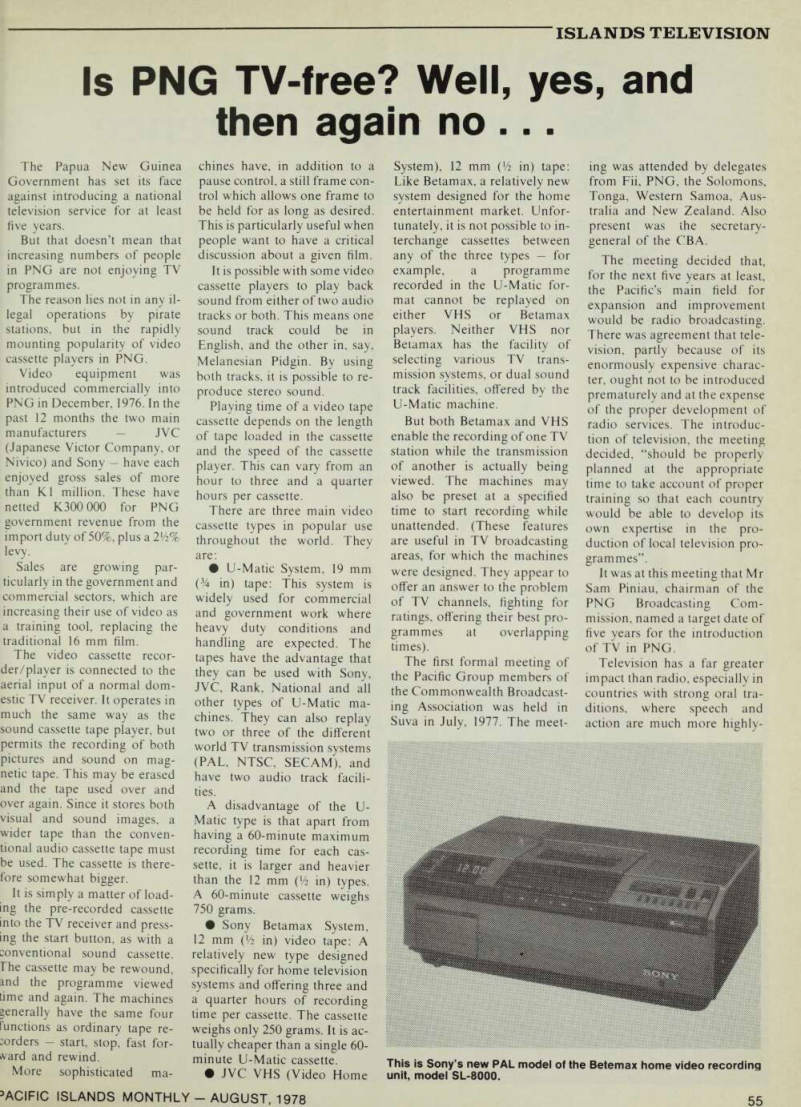


then again no...
The Papua New Guinea Government has set its face
against introducing a national
television service for at least five years.
But that doesn’t mean that
increasing numbers of people
in PNG are not enjoying TV programmes.
The reason lies not in any il
legal operations by pirate
stations, but in the rapidly
mounting popularity of video
cassette players in PNG.
Video equipment was introduced commercially into PNG in December, 1976. In the past 12 months the two main manufacturers JVC
(Japanese Victor Company, or
Nivico) and Sony have each enjoyed gross sales of more than K 1 million. These have netted K3OO 000 for PNG government revenue from the import duty of 50%, plus a 2Vi%
levy.
Sales are growing par ticularly in the government and commercial sectors, which are increasing their use of video as a training tool, replacing the traditional 16 mm film.
The video cassette recor der/player is connected to the aerial input of a normal dom estic TV receiver. It operates in much the same way as the sound cassette tape player, but permits the recording of both pictures and sound on mag netic tape. This may be erased and the tape used over and over again. Since it stores both visual and sound images, a wider tape than the conven tional audio cassette tape must be used. The cassette is there
fore somewhat bigger.
It is simply a matter of load ing the pre-recorded cassette into the TV receiver and press ing the start button, as with a conventional sound cassette.
The cassette may be rewound, and the programme viewed time and again. The machines generally have the same four functions as ordinary tape re corders - start, stop, fast for ward and rewind.
More sophisticated ma
chines have, in addition to a pause control, a still frame con trol which allows one frame to be held for as long as desired.
This is particularly useful when people want to have a critical discussion about a given film.
It is possible with some video cassette players to play back sound from either of two audio tracks or both. This means one sound track could be in English, and the other in. say,
Melanesian Pidgin. By using
both tracks, it is possible to re produce stereo sound.
Playing time of a video tape cassette depends on the length of tape loaded in the cassette and the speed of the cassette player. This can vary from an hour to three and a quarter hours per cassette.
There are three main video cassette types in popular use
throughout the world. They
are: • U-Matic System, 19 mm (Va in) tape: This system is widely used for commercial and government work where
heavy duty conditions and
handling are expected. The
tapes have the advantage that they can be used with Sony, JVC, Rank, National and all other types of U-Matic ma chines. They can also replay two or three of the different world TV transmission systems
(Pal, Ntsc, Secam), And
have two audio track facili ties.
A disadvantage of the U- Matic type is that apart from having a 60-minute maximum recording time for each cas sette, it is larger and heavier than the 12 mm (Vi in) types.
A 60-minute cassette weighs 750 grams.
• Sony Betamax System,
12 mm (Vi in) video tape: A
relatively new type designed
specifically for home television systems and offering three and a quarter hours of recording time per cassette. The cassette weighs only 250 grams. It is ac
tually cheaper than a single 60-
minute U-Matic cassette. • JVC VHS (Video Home
System), 12 mm (Vi in) tape: Like Betamax, a relatively new system designed for the home entertainment market. Unfor tunately, it is not possible to in terchange cassettes between any of the three types for example, a programme recorded in the U-Matic for mat cannot be replayed on either VHS or Betamax players. Neither VHS nor Betamax has the facility of selecting various TV trans mission systems, or dual sound track facilities, offered by the U-Matic machine.
But both Betamax and VHS enable the recording of one TV station while the transmission of another is actually being viewed. The machines may also be preset at a specified time to start recording while unattended. (These features are useful in TV broadcasting areas, for which the machines were designed. They appear to offer an answer to the problem of TV channels, fighting for ratings, offering their best pro grammes at overlapping times).
The first formal meeting of the Pacific Group members of the Commonwealth Broadcast ing Association was held in Suva in July, 1977. The meet
ing was attended by delegates
from Fii, PNG, the Solomons, Tonga, Western Samoa, Aus tralia and New Zealand. Also present was the secretary general of the CBA.
The meeting decided that, for the next five years at least, the Pacific’s main field for
expansion and improvement
would be radio broadcasting.
There was agreement that tele vision, partly because of its
enormously expensive charac
ter, ought not to be introduced prematurely and at the expense of the proper development of radio services. The introduc tion of television, the meeting decided, “should be properly
planned at the appropriate
time to take account of proper training so that each country would be able to develop its own expertise in the pro duction of local television pro
grammes”.
It was at this meeting that Mr Sam Piniau, chairman of the PNG Broadcasting Com mission, named a target date of five years for the introduction of TV in PNG.
Television has a far greater impact than radio, especially in countries with strong oral tra ditions, where speech and action are much more highly-
This is Sony’s new PAL model of the Betemax home video recording unit, model SL-8000.
developed than print. Its combination of sounds and images can be used to “extend people’s eyes and ears” much more
effectively than in large,
anonymous, urban societies, People who are good at communicating by speech, music
and dance are more likely to find they can use television eas ily and profitably than are
those with strongly developed
reading and writing communi
cation patterns.
Although American Samoa has for some years operated its
own TV station, which in gen eral is easily received in West ern Samoa, it seems that it will be some time before broadcast television is generally available throughout the South Pacific.
But owners of video equip ment in many remote areas have reported that at various times they have received broadcast TV programmes from distant countries follow ing the installation of a rela
tively cheap high-gain antenna
system.
Reception reports have been received from Vanimo, Wewak, Manua and Kimbe in PNG of TV transmissions from Malaysia, Indonesia and Guam, while Port Moresby often receives Queensland tele vision.
New Zealand and Australian transmissions have been reported from Norfolk Island and Fiji in the latter almost
daily during day-time in the
summer months.
Unfortunately, there is no magic formula to ascertain if a particular area can receive
long-distance TV broadcasts but the chance is always there.
The largest distributor of pre-recorded video cassette programmes in the South Pa cific is the Sohbu Group, based in Port Moresby and Sydney, who handle the Sony pro duct.
Following the growth of de mand in PNG, Sohbu recently established a video cassette li brary in the Solomons, Sohbu-Australia staffer, Mr Fraser Hickox, told PIM that the company hoped to expand throughout the Pacific wher ever video equipment is sold.
Sohbu also represents Link Television Pty Ltd, a subsidiary of the Sydney TV station TCN9. Link Television pro duces specialised programmes such as “Medilink”, a monthly medical video programme of continuing education for doc tors, “Race Link”, a weekly re view of horse races for punters and bookmakers, and “News Link”, a weekly review of news services.
The Sony VP-2030 U-Matic colour videocassette player. It is capable of replaying two or three of the different world TV transmission sys
Tems-Pal, Secam, Ntsc.
Advertisements & other items, pp. 55-58 (2 items)
55
ISLANDS TELEVISION
’ACIFIC ISLANDS MONTHLY - AUGUST, 1978
to Tonga’s communications.
We’ve made the
world of difference
With the opening of the Cable & Wireless earth station, the people of Tonga can enjoy the benefits of the fastest, most efficient and reliable telephone, telex and telegraph links to the rest of the world. Via satellite.
At Cable & Wireless we have over a century of experience in the design, installation and maintenance of communications systems throughout the world. To date we have been involved with over 30 earth stations, each designed to meet their individual climatic and geographic conditions.
So, for more information, do a little communicating yourself. Contact us. ■ Cs % m -f fcgr* C Road iad ofjodayis communications. ; TakailMPeiloadJKongoloa, Tonga. 1, London WO* |gx. Tel: 01-242 4433 Telex 23181
PRE RECORDED VIDEO TAPES
0 FEATURE FILMS (G) (R) etcetera
SPORT
% DOCUMENTARIES
We also sell equipment and television antennas for long distance reception, design and commission cable systems for hotels and company townships, production facilities telecine transfers.
SOHBU AUSTRALIA Pty Ltd
P.O. BOX 1757 G.P.O. SYDNEY 2001
TELEPHONE 231 3594 TELEX AA26903
Beta max starts
your television set
working-right now!
iljetamax
What Is it. Basically Betamax is a Home Video Recording System. It works on similar principles to a regular music cassette recorder but as well as sound, the Betamax records colour pictures. And it can be connected to any television receiver to record and play back cassettes of up to 3 1 /4 hours duration.
Iljetamax
How to use it. Betamax lets you buy your favourite pre-recorded programs and replay them in the privacy and comfort of your own home and of course you get perfect full colour and sound. And together with the Video Camera, Betamax lets you make home movies. Record the kids at play, the party in progress - and keep the happy memories forever on colour video.
ÜBetamax
A few details. Betamax is the most advanced concept in home video recording. Video cassettes can be erased and re-recorded time and time again. Your initial investment is never wasted. As an optional extra, the Betamax Video Camera allows you to make home movies.
The Betamax Home Video Recording System. Starts your television set
working - right now.
SONY
beyond the fringe
Stray images from beyond the fringe
All over the world, optimistic viewers and enthusiastic ama teurs are regularly obtaining television signals from sources far beyond the recognised limit of individual transmitters.
To understand these phenomena one needs a basic comprehension of television propagation and reception. This is an extremely technical subject which requires more space than is available. However, we can suggest a few ways in which South Pacific viewers, normally regarded as ‘beyond the fringe’ of television viewing, can take advantage of these quirks of nature which break the general rule.
Though there are a number of television stations in the South Pacific in American Samoa, New Caledonia, Tahiti and Micronesia because they are generally served by low powered units, for practical purposes the stations likely to prove useful to island viewers are those transmitting from Aus tralia’s east coast and from New Zealand’s North Island.
Both countries have the 625-line PAL system and high pow ered transmitters and both transmit at VHF (very high fre quency) within a range of 45-225 MHz (megahertz).
The secret to television reception ‘beyond the fringe’ lies in the way in which the signals in the VHF frequency spectrum strike various layers of the atmosphere. Long distance recep tion becomes possible when the signals are reflected back to earth off certain layers.
The layers which reflect can be likened to a cloud which in some cases are only tiny in area while others can be hun dreds of square kilom-etres.
These ‘clouds’ can drift with prevailing winds and when they are about depending on the climatic conditions - signals are reflected over distances up to 2 500 kilometres.
The reflective layers are in the ionosphere which starts at about 760 mefres. Below this is the troposphere which, accord ing to climatic conditions, can also affect long distance trans mission.
Some viewers in the South Pacific may have noticed that during very settled, warm, anti-cyclonic weather, normally weak signals from distant transmitters improve, providing very viewable pictures. In both cases, viewing is better at night.
Having skipped the details of ‘why’, it is more valuable for
viewers to know ‘how’ to take advantage of these phenom ena.
Since lower frequencies are invariably most successful in long distance penetration, these sources may be useful to people in the South Pacific region: New Zealand: Auckland Ch 2 (55.25/60.75 MHz); Welling ton Ch I (45.25/50.75); Christchurch Ch 3 (62.75/67.75).
Australia: Brisbane Ch 0 (46.25/51.75); Brisbane Ch 2 (64.25/69.75); Sydney Ch 2 (64.25/69.75); Coffs Harbour Ch 2 (64.25/69.75); Stanthorpe (Qld) Ch I (57.25/62.75); Rockhampton Ch 3 (86.25/91.75); Townsville Ch 3 (86.25/91.75).
One problem which may well be encountered, since two pro grammes on the same channel may be roughly in the same direction, is that of cross-viewing one channel adversely affecting the other at the receiver.
Anyone seeking regularly viewable pictures should fit low band yagi type antennae on a mast which can be oriented by a ‘rotator’ unit. The antenna could be pointed in one direction most of the time but variations, due to climatic conditions, can necessitate periodic realignment of the antenna for
optimum effect.
As ‘over the horizon’ signals are hardly affected by antenna height, the use of very high towers would not produce startling effects. However, the antenna should be well clear of ground clutter. A mast of approximately 12 to 15 metres would serve you best. Use of a rotator permits one to ‘search’ over a wide area for the best possible pictures.
For the real enthusiast with some technical knowledge, con siderable room exists for experimentation with various types of receiving antennae. Certainly it is worthwhile fitting more than one type of antennae. For example a broadband antenna or phased array type of antenna would be useful to seek out the periodic Band 111 signals. Whatever is used, it is recom mended that suitable mast head amplifiers are incorpor ated.
People who wish to go into this matter should contact, via their local radio and television suppliers, one of the reputable antennae equipment manufacturers.
Advertisements & other items, pp. 59-60 (2 items)
59
ISLANDS TELEVISION
ACIFIC ISLANDS MONTHLY AUGUST IQ7R
Sohbu Australia Pty Ltd St.Ssssss
LONG DISTANCE TV AERIAL KITS
ULTRA DEEP FRINGE KIT $698.21
50ft telescopic mast—remote control aerial rotator high powered mast head amplifier
JUNIOR LONG DISTANCE KIT $447.21
50ft telescopic mast—this is the bare essential kit which can be added to as desired SIMPLE TO ERECT - NO TECHNICAL KNOWLEDGE NEEDED - STEP BY STEP PLANS
SOHBU AUSTRALIA PTY LTD ST.SSSSSS
Before you buy
just any video equipment
put JVC to tire test
The GC4BOOE Colour Camera The main feature is if s easy to use, simply select the lighting selector and record.
Complete with inbuilt microphone. 6 x zoom lens with macro position enabling up to 1" close up video pictures. Useful colour pictures under normal lighting.
CR44OOE Portable Recorder A unique feature of the 0R4400E %" U-Format is the can be operated locally, or with the addition of the optional Control Unit, can be operated remotely.
Can be used with a TU2OE Tuner Timer. Additionally, NTSC colour signals can be played back at the touch of a button.
GC4BOOE
Automatic Edit Function which allows the user to avoid the need for elaborate studio editing equipment, as each pause during recording is automatically assemble edited on to that already recorded. This compact, lightweight colour video recorder accepts power from three sources - battery pack, or car battery, for complete outdoor mobility, or 240 V. AC. It records and plays back video cassette tapes in the %" U-Format.
The colour amplifier is built-in, and the extensive use of IC's enable JVC to build-in functions normally found on much larger units. To complement its compact design, TE Colour 6 we have the GC4BOOE Colour camera.
The main feature is its ease of use.
Simply select the Lighting Selector and record. Complete with inbuilt microphone CR6OOOE Recorder Important features are the feather-touch controls which protect both machine and tape from operator error: Optional remote control over playback functions; an instant stop and auto search/ repeat facility; two audio channels, and compact
lightweight design.
CPSO6OED
m
CR44OOE
CPSO6OED Colour Video Cassette Player CP5060 JVC 3/4" U-format PAL/NTSC player only with remote control optionally available. Features FF, REW, PLAY, STOP, STILL FRAME and FRAME ADVANCE, Eminently suitable for product promotion as the machine can be setup for constant playback.
NTSC playback on all JVC 3/4" machines is selected by one push button on the front panel of the machine. The monitor then switches automatically to whichever signal, either PAL or NTSC, is being played by the machine. Remote control unit RM6O controls the functions listed above FF, REW, ETC.
7765AUM/D
All JVC %" U-Format recorders feature the advanced E-to-E mode. 7765AUM/D TV Monitor A 48cm (20") colour monitor
AGON'
CR6O6OE/ED
with APACOhI-a feature usually found only in professional studio monitors. This feature allows you to choose soft, standard, or extra-clear picture definition Picture quality is also enhanced by the automatic picture tune control.
"R6060E/D Recorder fhe CR6O6OE is a Full Remote Control %“ , J-Format with full solenoid control. 8 functions - =ast Forward, Play, Stop, Rewind, Record, Audio Dub (CH-1), Pause/Still and Frame Advance-
the right choice
The Test...
This is just a small part of the JVC Video range.
Just contact the JVC representative in your area.
He'll discuss your specific requirements and arrange for you to put JVC to the test.
PAPUA NEW GUINEA...
HAGEMEYER (P.N.G.) PTY LTD
Post Office Box 90, Lae Post Office box 673, Madang Post Office Box 1428, Boroko Post Office Box 63, Rabaul Post Office Box 11, Mount Hagen WT596/78
Cash cropping or subsistence farming
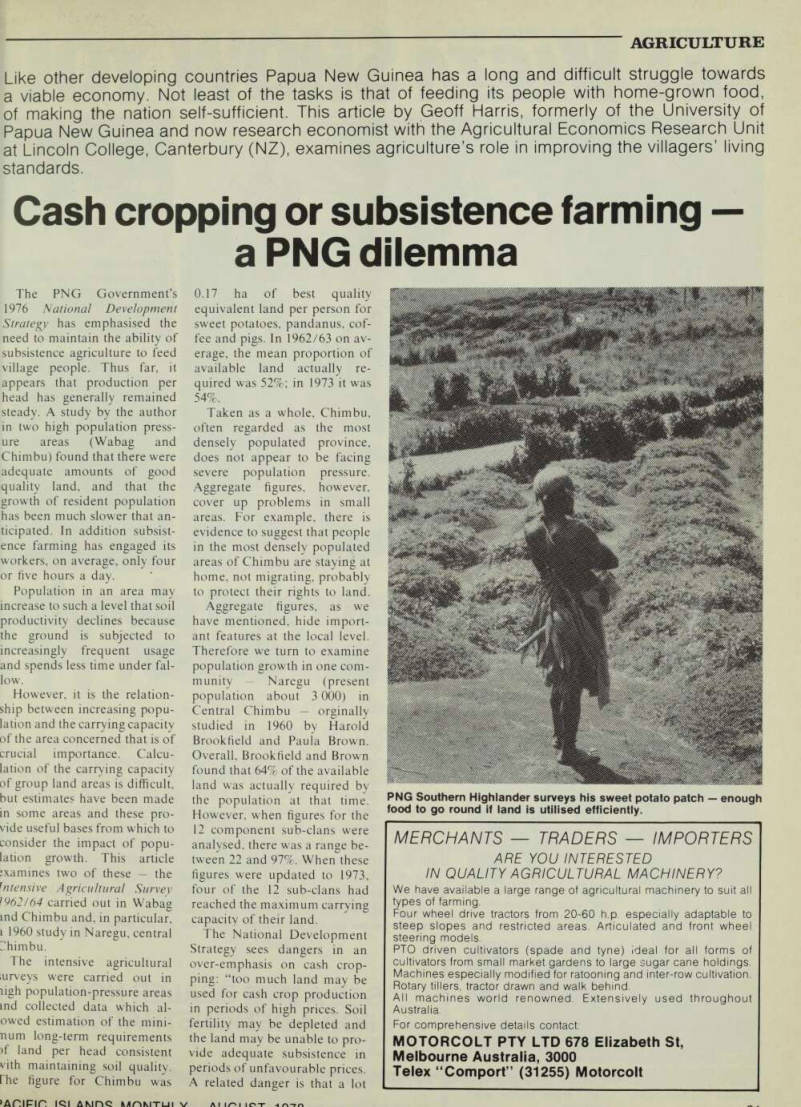

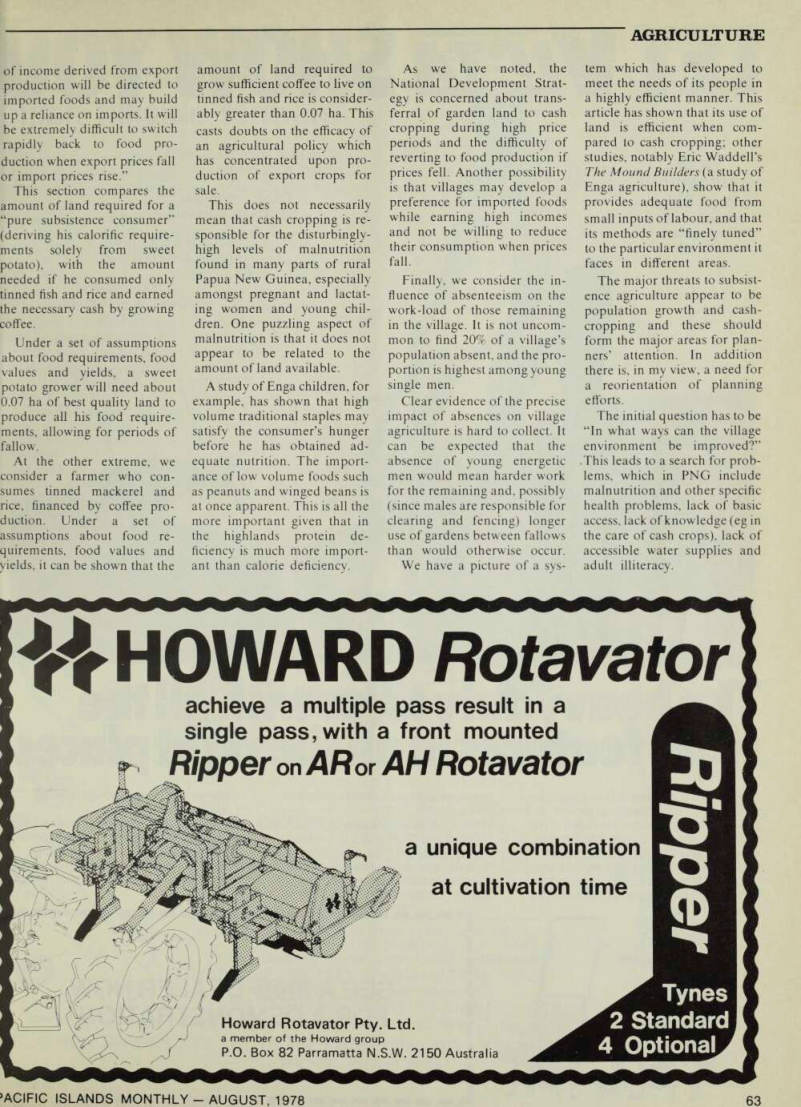
a PNG dilemma
Like other developing countries Papua New Guinea has a long and difficult struggle towards a viable economy. Not least of the tasks is that of feeding its people with home-grown food, of making the nation self-sufficient. This article by Geoff Harris, formerly of the University of Papua New Guinea and now research economist with the Agricultural Economics Research Unit at Lincoln College, Canterbury (NZ), examines agriculture’s role in improving the villagers’ living standards.
The PNG Government’s 1976 National Development Strategy has emphasised the need to maintain the ability of subsistence agriculture to feed village people. Thus far, it appears that production per head has generally remained steady. A study by the author in two high population press ure areas (Wabag and Chimbu) found that there were adequate amounts of good quality land, and that the growth of resident population has been much slower that an ticipated. In addition subsist ence farming has engaged its workers, on average, only four or five hours a day.
Population in an area may increase to such a level that soil productivity declines because the ground is subjected to increasingly frequent usage and spends less time under fal low.
However, it is the relation ship between increasing popu lation and the carrying capacity of the area concerned that is of
crucial importance. Calcu
lation of the carrying capacity of group land areas is difficult, but estimates have been made in some areas and these pro vide useful bases from which to consider the impact of popu lation growth. This article examines two of these - the intensive Agricultural Survey 1962/64 carried out in Wabag ind Chimbu and, in particular, i 1960 study in Naregu, central Thimbu.
The intensive agricultural ;urveys were carried out in
ligh population-pressure areas
ind collected data which al owed estimation of the mini
num long-term requirements
)f land per head consistent
vith maintaining soil quality,
fhe figure for Chimbu was
0.17 ha of best quality equivalent land per person for sweet potatoes, pandanus, cof fee and pigs. In 1962/63 on av erage, the mean proportion of available land actually re quired was 52%; in 1973 it was 54%.
Taken as a whole, Chimbu, often regarded as the most
densely populated province,
does not appear to be facing severe population pressure.
Aggregate figures, however, cover up problems in small areas. For example, there is evidence to suggest that people in the most densely populated areas of Chimbu are staying at
home, not migrating, probably
to protect their rights to land.
Aggregate figures, as we have mentioned, hide import ant features at the local level.
Therefore we turn to examine population growth in one com
munity Naregu (present
population about 3 000) in Central Chimbu orginally studied in 1960 by Harold Brookfield and Paula Brown.
Overall, Brookfield and Brown found that 64% of the available land was actually required by the population at that time.
However, when figures for the 12 component sub-clans were analysed, there was a range be tween 22 and 97%. When these figures were updated to 1973, four of the 12 sub-clans had reached the maximum carrying capacity of their land.
The National Development Strategy sees dangers in an over-emphasis on cash crop ping: “too much land may be used for cash crop production
in periods of high prices. Soil
fertility may be depleted and the land may be unable to pro vide adequate subsistence in periods of unfavourable prices.
A related danger is that a lot
PNG Southern Highlander surveys his sweet potato patch-enough food to go round if land is utilised efficiently.
of income derived from export production will be directed to imported foods and may build up a reliance on imports. It will be extremely difficult to switch rapidly back to food pro duction when export prices fall
or import prices rise.”
This section compares the amount of land required for a “pure subsistence consumer”
(deriving his calorific require
ments solely from sweet potato), with the amount needed if he consumed only tinned fish and rice and earned
the necessary cash by growing
coffee.
Under a set of assumptions about food requirements, food values and yields, a sweet potato grower will need about 0.07 ha of best quality land to produce all his food require ments, allowing for periods of fallow.
At the other extreme, we consider a farmer who con sumes tinned mackerel and rice, financed by coffee pro duction. Under a set of assumptions about food re quirements, food values and yields, it can be shown that the
amount of land required to grow sufficient coffee to live on tinned fish and rice is consider ably greater than 0.07 ha. This casts doubts on the efficacy of an agricultural policy which has concentrated upon pro duction of export crops for sale.
This does not necessarily mean that cash cropping is re
sponsible for the disturbingly
high levels of malnutrition found in many parts of rural Papua New Guinea, especially amongst pregnant and lactat ing women and young chil dren. One puzzling aspect of malnutrition is that it does not appear to be related to the amount of land available.
A study of Enga children, for example, has shown that high volume traditional staples may
satisfy the consumer’s hunger
before he has obtained ad equate nutrition. The import ance of low volume foods such as peanuts and winged beans is at once apparent. This is all the more important given that in
the highlands protein de
ficiency is much more import ant than calorie deficiency.
As we have noted, the National Development Strat egy is concerned about trans ferral of garden land to cash
cropping during high price
periods and the difficulty of reverting to food production if prices fell. Another possibility is that villages may develop a
preference for imported foods
while earning high incomes
and not be willing to reduce
their consumption when prices
fall.
Finally, we consider the in fluence of absenteeism on the work-load of those remaining in the village. It is not uncom mon to find 20% of a village’s population absent, and the pro portion is highest among young
single men.
Clear evidence of the precise impact of absences on village agriculture is hard to collect. It can be expected that the absence of young energetic men would mean harder work for the remaining and, possibly (since males are responsible for
clearing and fencing) longer
use of gardens between fallows than would otherwise occur.
We have a picture of a sys
tem which has developed to meet the needs of its people in a highly efficient manner. This article has shown that its use of land is efficient when com pared to cash cropping; other studies, notably Eric Waddell’s The Mound Builders (a study of Enga agriculture), show that it
provides adequate food from
small inputs of labour, and that its methods are “finely tuned” to the particular environment it faces in different areas.
The major threats to subsist ence agriculture appear to be
population growth and cash
cropping and these should form the major areas for plan ners’ attention. In addition there is, in my view, a need for a reorientation of planning efforts.
The initial question has to be “In what ways can the village environment be improved?” .This leads to a search for prob lems, which in PNG include malnutrition and other specific health problems, lack of basic access, lack of knowledge (eg in the care of cash crops), lack of accessible water supplies and
adult illiteracy.
Advertisements & other items, pp. 61-64 (3 items)
IQI A Mnc MHMTUI V AlirilPT -t mn
AGRICULTURE
Merchants Traders Importers
ARE YOU INTERESTED
IN QUALITY AGRICULTURAL MACHINERY?
We have available a large range of agricultural machinery to suit all types of farming.
Four wheel drive tractors from 20-60 h.p. especially adaptable to steep slopes and restricted areas. Articulated and front wheel steering models.
PTO driven cultivators (spade and tyne) ideal for all forms of cultivators from small market gardens to large sugar cane holdings.
Machines especially modified for ratooning and inter-row cultivation.
Rotary tillers, tractor drawn and walk behind.
All machines world renowned. Extensively used throughout Australia.
For comprehensive details contact: MOTORCOLT PTY LTD 678 Elizabeth St,
Melbourne Australia, 3000
Telex “Comport” (31255) Motorcolt
LET Vtm SHOW YOU
r "m / « iX\ mo* Automatic Hydrostatic Transaxle transmission with limited slip differential.
Speed ranges 0-4 and 0-8 m.p.h.
'ft : » V * v ' \ ‘ *» Rear Hydraulic Lift Linkage and rear drawbar sets tools to pre-selected height.
Thecompact tractor that ploughs,
cultivates, mows ana doesn't
cost the earth.
OPTIONAL ATTACHMENTS
Moldboard Plough Attachment. Rolling coulter slices a big 31 cm (12") furrow.
Rotary Tiller. Tills 84 cm (33") wide. Cast iron wheel weights available to increase penetration. 1.27 m (50") Triple Blade Cutting Head is PTO driven, follows ground contours for closer, more ftven mnwinn Spring Shank Cultivator.
Shank position adjustable for crop width. 4 gang, 16 disc, Tandem harrow, also ava ilahlA Meet the Victa 16 h.p. heavy duty Compact Tractor. It gives you advanced labour saving features and versatile job capabilities at a price and running cost that are right for the casual farmer or smallholder. Features include: 16 h.p. Briggs & Stratton 4-stroke engine and electric key start. Safety interlock switching. Hydraulic rear lift linkage and automatic transmission with two speed ranges. Alternator charging and dual sealed beam headlights allow for after-dark working.
Rear drawbar with power take-off to drive rotary attachment.
Victa After Sales Service and Spare Parts are available throughout Australia and the Pacific Islands. r i L
SEE A Victa DEALER NOW
FOR A DEMONSTRATION.
L 84.0082
VJ-HOWARD Rotavator
achieve a multiple pass result in a single pass, with a front mounted
Ripper on AR or AH Rotavator
a unique combination at cultivation time Howard Rotavator Pty. Ltd. a member of the Howard group P.O. Box 82 Parramatta N.S.W. 2150 Australia Tynes 2 Standard 4 Optional
i SHOW YOU
Victa
Professional
5 h.p. Tiller
Model 370 SlJ w tetail 2 forward speeds neutral and reverse Depth control bar swings up to travel 5 h.p. B & S 4-stroke engine, easy pull start.
Long-life bevel
gearbox cast iron
housing.
u .if-B ‘
'li . / Adjustable cultivating widths 305 mm to 660 mm (12"-26").
The heavy duty tiller with all the right features in all the right places.
The Victa 5 h.p. Tiller is built rugged and versatile for the professional grower, at a price that brings it within the reach of the home gardeners and weekend farmers.
A dependable time and money saver backed by Victa after sales service and spares. Optional attachments include a 203 mm (8") furrow opener, 380 mm (15") sweep plough; cultivating points and hilling plough.
Victa 3 1 /2 h.p. single speed Tiller Model 100 features 3 1 /2 h.p. B& S 4-stroke engine, easy pull start, cast iron gearbox, housing, and simple tine adjustment.
Alternative cultivation widths from 305 mm to 660 mm (12"-26"). Furrow opener and sweep plough optional attarhmpntQ NEW Victa 2 h.p. Till-it Portable Tiller Model 020. Designed specially for the home grower, folds to car-boot size, weighs only 27 kg (60 lb) and cultivates from 254 mm (10") to 457 mm (18") wide. 2 h.p.
Model 020 3Va h.p.
Model 100
SEE A Vim DEALER NOW
FOR A DEMONSTRATION.
L 84.0167
63
AGRICULTURE
‘ACIFIC ISLANDS MONTHLY - AUGUST, 1978
Back to the land for Fijian hillside farmers
Fijian hillside farmers
About 24 300 ha of hilly and
largely undeveloped Fijian
owned land is gradually being
brought into production at
Yalavou. in south-west Viti Levu under an Australian aid project. The aim is to establish 103 individual farm holdings,
with emphasis on livestock
grazing.
The project is the largest agricultural development pro posal for which Australian aid has been sought in the South
Pacific. Initially, it is expected
that about 500 people will benefit directly from the pro ject. The ultimate carrying ca pacity is expected to reach about 8 400 head of cattle and 1 400 goats.
Fiji has been aiming at self ;ufficiency in beef for many /ears, and Yalavou will go some of the way towards ichieving that aim. There are housands of hectares of hilly
:ountry in Fiji, chiefly Viti
and Vanua Levu suitable
for cattle grazing, but little else.
Aerial fertilisation would ensure an adequate supply of feed.
One of the principal objec tives at Yalavou is to increase rural participation in the
national economy by involving
Fijian landholders in cattle raising. Yalavou could be the
pilot project (on a huge scale)
for other parts of Fiji. It is
expected to bring important
social benefits.
A firm of Australian consult ants engaged to investigate the
project completed its surveying
in May, 1976. Following a study of the recommendations and explanation to the com munal landholders of the development benefits and their
obligations, the Fiji Govern
ment asked Australia to im plement the project and
emphasised the high priority
and critical importance it had in Fiji’s overall development.
Important components of
the project will be the establishment of a local farm and service centre devoted to farmer training and super vision, and construction of 90 km of access roads, together with other infrastructure.
Although the project’s econ
omic rate of return is not high, and the number of farmers taking part is necessarily lim ited. the Fiji Government be lieves success will encourage the development of other areas of Fijian land.and will assist in
accelerating the divergence in
rural and urban incomes.
The project is estimated to involve an investment of 5A7.522 million over 10 years, of which Australia’s share will be about $3.83 million, prin cipally for consultant manage ment fees, plant and equipment, road construction, farm and other infrastructure
development, and the purchase
and shipment of cattle from Australia and within Fiji. The Fiji Government will meet local costs, estimated at $2,037 million, and the Fiji Develop ment Bank is expected to advance loans of $1,655 million over the life of the project.
Care has been taken to ensure that development takes account of social and environ mental factors. The pilot farm will be established first, with work on basic community facilities simultaneously with individual farm development.
Watershed protection and development will take place in the fourth year of the project.
About 2 830 ha will be devel oped and managed as a water shed protection reserve.
Because of the need to ensure that implementation of the project is responsive to lessons learned in the early
phases, progress in achieving
planned objectives will be monitored. The evaluation will be quite independent from the management of the project and will be undertaken by an insti tution or consultant firm in conjunction with the Aus tralian Development Assist ance Bureau.
The Yalavou Rural Devel opment Board, consisting of representatives of landowners and the Fiji Government, was established in January. The project general manager also started work in January.
Advertisements & other items, pp. 65-66 (2 items)
65
AGRICULTURE
ISLANDS MONTHLY - AUGUST. 1978
High Quality replacement
% A
BLADE
& BUSH SETS
High Quality replacement
parts for Rotary Slashers
SAVE DOLLARS
OIM MOST MAKES!
CHECK THIS SHORT LIST OF BLADE PRICES:
BLUELINE (See PAGE)
GOLD SEAL (MARINO)
HOWARD 4' & 5'
MOBILCO EDGCLIFFE
MASSE Y-McLEOD
-SHEARER 4'
AND MANY MORE!
SLASHER
Prices per blade with bush where fitted, as at 1/6/77.
All Prices F.O.R. BRISBANE.
Prices subject to change without prior notice*.
TOP QUALITY BLADES IN HIGH GRADE STEEL Specially heat treated and Tempered.
PRICE RIGHT - QUALITY RIGHT
See your local Machinery Dealer or send Direct to: SPARES PTY. LTD., 782 FAIRFIELD RD., YEERONGPILLY, OLD. 4105.
PHONE: (07) 48 5554.
0“
wmm ■M It's another step ahead towards more profitable, more efficient logging operations: Cat 528 Skidder with major improvements.
Now rear wheel caliper disc brakes increase service braking pad contact surface by 78%, thereby extending brake life. There are three master cylinders, one each for front, rear and driveline systems. All four wheel brakes engage first; additional pedal depression engages driveline brake.
Caterpillar 528 Winch has power control design to allow "winching on-the-go". Winch and skidder can be operated simultaneously.
Other features include oil disc clutch and brake to extend service life; complete sealing maintains rated capacity; winch brake accumulator allows load release from dead engine; adjustable free spool drag lets operator pull line uphill or down without cable balling. Other helpful features too!
Send for literature or talk to your Caterpillar representative.
Caterpillar Dealers in South-West Pacific.
HASTINGS DEERING
Lae: Milford Haven Rd.
Phone 42 2355.
Port Moresby: Phone 21 2122.
Bougainville: Itakara Industrial Park, Arrrwrr Phone 9S 9077.
carptrac
a division Of CkyBSEKI Lautoka: Labasa: Veitari Lautoka Vulovi Labasa RIR77 Phone ft 1 888 Suva: Carptrac Carpenter Street Raiwai Suva !
Phone 381622 < Telex FJ2190 Cables CARPTRAC
fields-or gold dust in the sky
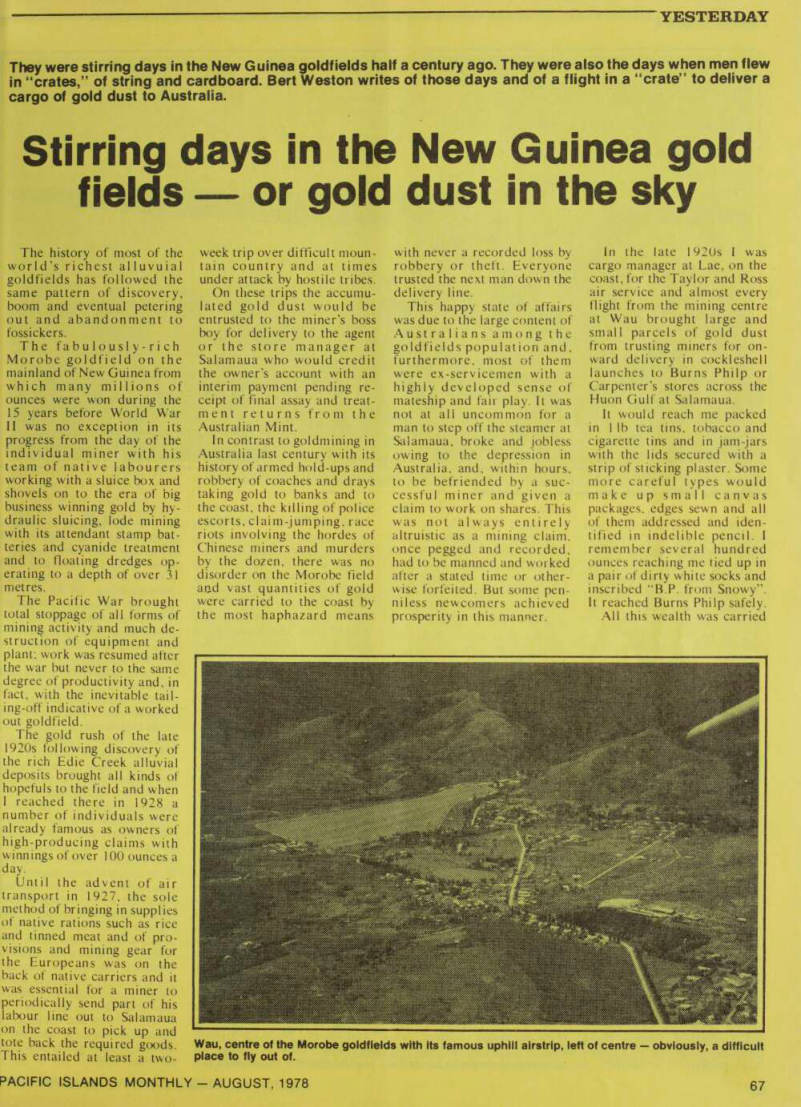
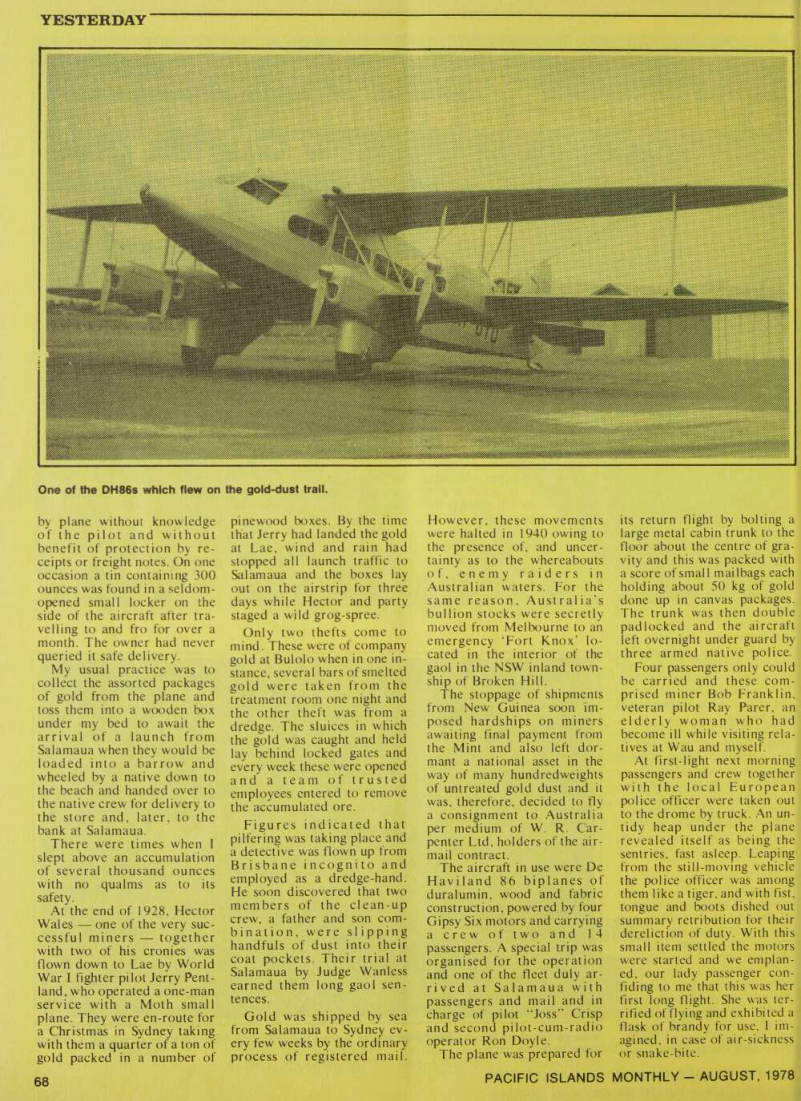
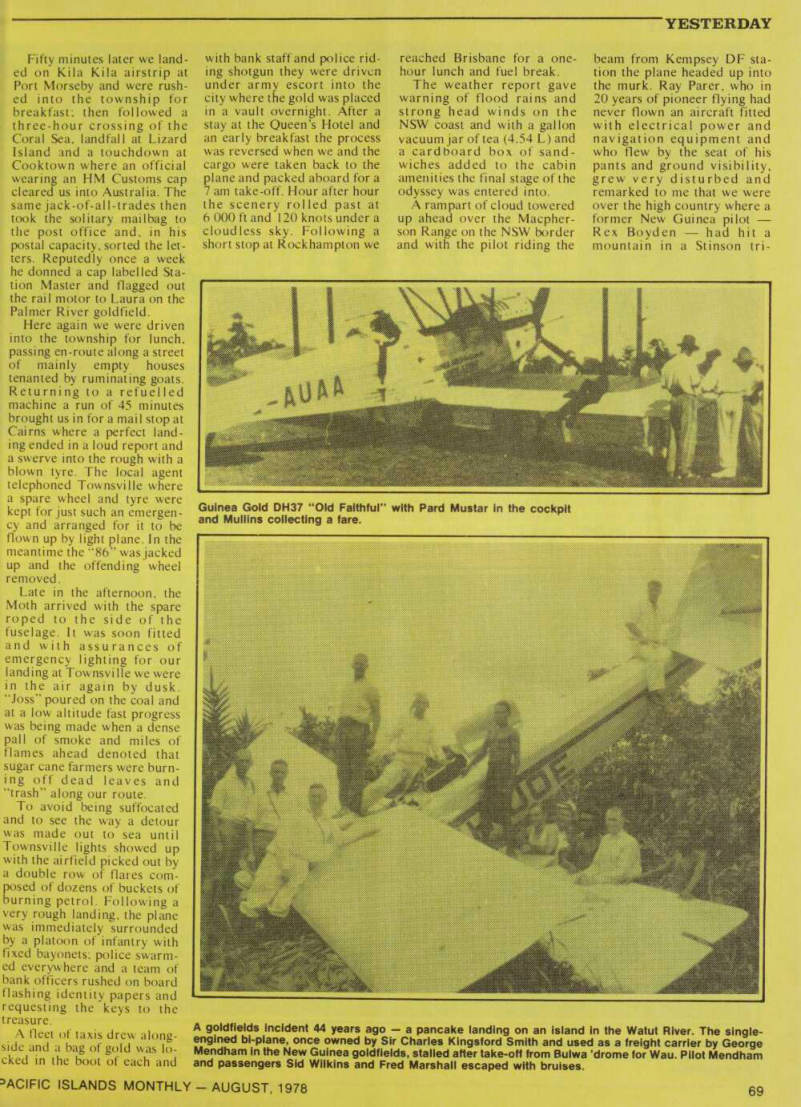
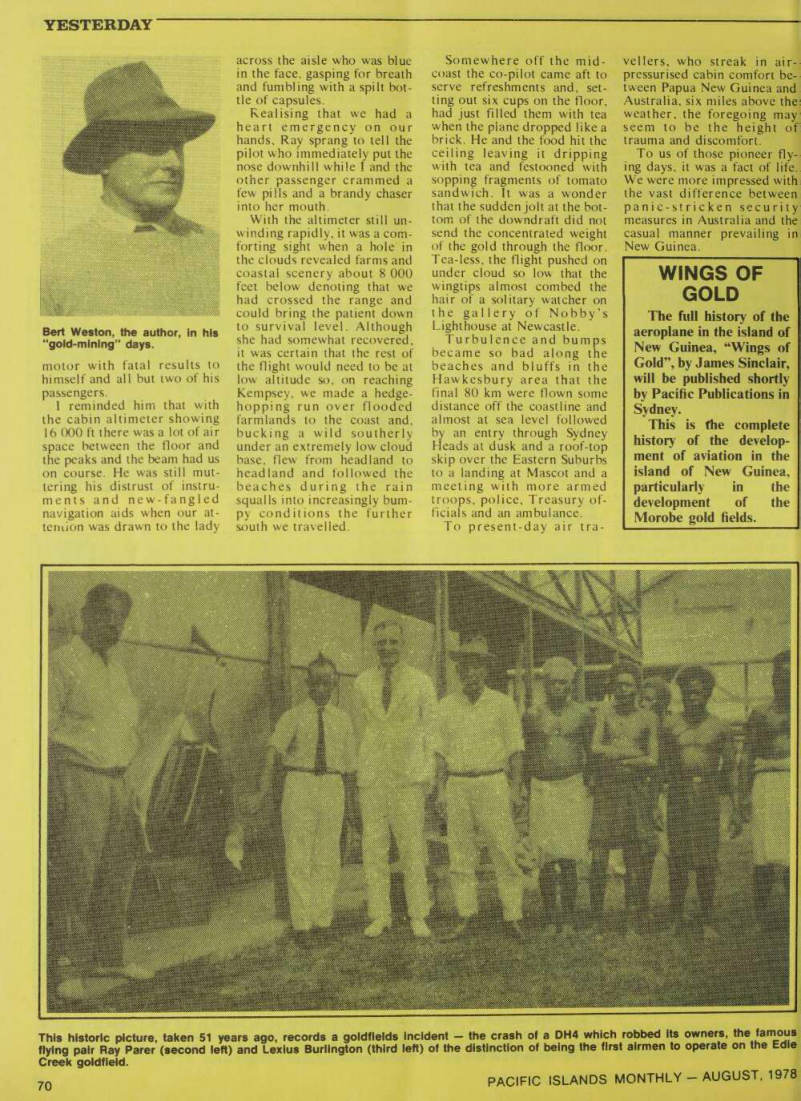
Stirring days in the New Guinea gold fields-or gold dust in the sky
They were stirring days in the New Guinea goldfields half a century ago. They were also the days when men flew in “crates,” of string and cardboard. Bert Weston writes of those days and of a flight in a “crate” to deliver a cargo of gold dust to Australia.
The history of most of the world’s richest alluvuial goldfields has followed the same pattern of discovery, boom and eventual petering out and abandonment to fossickers.
The fabulously- rich Morobe goldfield on the mainland of New Guinea from which many millions of ounces were won during the 15 years before World War II was no exception in its progress from the day of the individual miner with his team of native labourers working with a sluice box and shovels on to the era of big business winning gold by hy draulic sluicing, lode mining with its attendant stamp bat teries and cyanide treatment and to floating dredges op erating to a depth of over 31 metres.
The Pacific War brought total stoppage of all forms of mining activity and much de struction of equipment and plant: work was resumed after the war but never to the same degree of productivity and, in fact, with the inevitable tail ing-off indicative of a worked out goldfield.
The gold rush of the late
1920 s following discovery of
the rich Edie Creek alluvial deposits brought all kinds of hopefuls to the field and when I reached there in 1928 a number of individuals were already famous as owners of high-producing claims with winnings of over 100 ounces a day.
Until the advent of air transport in 1927, the sole method of bringing in supplies of native rations such as rice and tinned meat and of pro visions and mining gear for the Europeans was on the back of native carriers and it was essential for a miner to periodically send part of his labour line out to Salamaua on the coast to pick up and tote back the required goods.
This entailed at least a two
week trip over difficult moun tain country and at times under attack by hostile tribes.
On these trips the accumu lated gold dust would be entrusted to the miner’s boss boy for delivery to the agent or the store manager at Salamaua who would credit the owner’s account with an interim payment pending re ceipt of final assay and treat ment returns from the Australian Mint.
In contrast to goldmining in Australia last century with its history of armed hold-ups and robbery of coaches and drays taking gold to banks and to the coast, the killing of police escorts, claim-jumping, race riots involving the hordes of Chinese miners and murders by the dozen, there was no disorder on the Morobe field and vast quantities of gold were carried to the coast by the most haphazard means
with never a recorded loss by robbery or theft. Everyone trusted the next man down the delivery line.
This happy state of affairs was due to the large content of Australians among the goldfields population and, furthermore, most of them were ex-servicemen with a highly developed sense of mateship and fair play. It was not at all uncommon for a man to step off the steamer at Salamaua. broke and jobless owing to the depression in Australia, and, within hours, to be befriended by a suc cessful miner and given a claim to work on shares. This
was not always entirely
altruistic as a mining claim, once pegged and recorded, had to be manned and worked after a stated time or other wise forfeited. But some pen niless newcomers achieved prosperity in this manner.
In the late 1920 s I was cargo manager at Lae, on the coast, for the Taylor and Ross air service and almost every flight from the mining centre at Wau brought large and small parcels of gold dust from trusting miners for on ward delivery in cockleshell launches to Burns Philp or Carpenter’s stores across the Huon Gulf at Salamaua.
It would reach me packed in 1 lb tea tins, tobacco and cigarette tins and in jam-jars with the lids secured with a strip of sticking plaster. Some more careful types would make up small canvas packages, edges sewn and all of them addressed and iden tified in indelible pencil. 1 remember several hundred ounces reaching me tied up in a pair of dirty white socks and inscribed ”B P from Snowy”.
It reached Burns Philp safely.
All this wealth was carried
Wau, centre of the Morobe goldfields with its famous uphill airstrip, left of centre-obviously, a difficult place to fly out of.
by plane without knowledge of the pilot and without benefit of protection by receipts or freight notes. On one occasion a tin containing 300 ounces was found in a seldomopened small locker on the side of the aircraft after traveiling to and fro for over a month. The owner had never queried it safe delivery.
My usual practice was to collect the assorted packages of gold from the plane and toss them into a wooden box under my bed to await the arrival of a launch from Salamaua when they would be loaded into a barrow and wheeled by a native down to the beach and handed over to the native crew for delivery to the store and, later, to the bank at Salamaua.
There were times when I slept above an accumulation of several thousand ounces with no qualms as to its safetv At the end of 1928, Hector Wales - one of the very suecessful miners - together with two of his cronies was flown down to Lae by World War I fighter pilot Jerry Pentland, who operated a one-man service with a Moth small plane. They were en-route for a Christmas in Sydney taking with them a quarter of a ton of gold packed in a number of
pinewood boxes. By the time that Jerry had landed the gold at Lae, wind and rain had stopped all launch traffic to Salamaua and the boxes lay out on the airstrip for three days while Hector and party staged a wild grog-spree, Q nly two thefts come to mind These were of company gold at Bulolo when in one in stance, several bars of smelted go ld wer e taken from the treatment room one night and t h e other theft was from a dredge. The sluices in which the gold was caught and held j ay behind locked gates and every week these were opened and a team of trusted employees entered to remove t he accumulated ore. ... . .
F'g ures ‘" d ' cat « d ,ha ' P dfe , rl "B was tak '"8 P lace and a dete h ct,ve was flown up from Brtsbane incognito and
employed as a dredge-hand,
He soon discovered that two members of the clean-up a father and s . on com ’ were slipping handfuls of dust into t ei “at pockets. Their tr,a at Salamaua by udge Wanless f arned them lon g B aol sen ‘
tences -
Gold was shipped by sea from Salamaua to Sydney ev cry few weeks by the ordinary process of registered mail.
However, these movements were halted in 1940 owing to the presence of, and uncertainty as to the whereabouts of, enemy raiders in Australian waters. For the same reason, Australia’s bullion stocks were secretly moved from Melbourne to an emergency ‘Fort Knox’ located in the interior of the gaol in the NSW inland township of Broken Hill.
The stoppage of shipments from New Guinea soon imposed hardships on miners awaiting final payment from the Mint and also left dormant a national asset in the way of many hundredweights of untreated gold dust and it was, therefore, decided to fly a consignment to Australia per medium of W. R. Carpenter Ltd, holders of the airmail contract.
The aircraft in use were De Haviland 86 biplanes of duralumin, wood and fabric construction, powered by four Gipsy Six motors and carrying a crew of two and 14 passengers. A special trip was organised for the operation and one of the fleet duly arrived at Salamaua with passengers and mail and in charge of pilot “Joss” Crisp and second pilot-cum-radio operator Ron Doyle.
The plane was prepared for
its return flight by bolting a large metal cabin trunk to the floor about the centre of gra vity and this was packed with a score of small mailbags each holding about 50 kg of gold done up in canvas packages, The trunk was then double padlocked and the aircraft left overnight under guard by three armed native police, Four passengers only could be carried and these com prised miner Bob Franklin, veteran pilot Ray Parer, an elderly woman who had become ill while visiting rela tives at Wau and myself, At first-light next morning passengers and crew together with the local European police officer were taken out to the drome by truck. An un tidy heap under the plane revealed itself as being the sentries, fast asleep. Leaping from the still-moving vehicle the police officer was among them like a tiger, and with fist, tongue and boots dished out summary retribution for their dereliction of duty. With this small item settled the motors were started and we emplan ed, our lady passenger con fiding to me that this was her first long flight. She was ter rified of flying and exhibited a flask of brandy for use, I im agined, in case of air-sickness or snake-bite.
One of the DHB6s which flew on the gold-dust trail.
Fifty minutes later we land ed on Kila Kila airstrip at Port Morseby and were rush ed into the township for breakfast; then followed a three-hour crossing of the Coral Sea, landfall at Lizard Island and a touchdown at Cooktown where an official wearing an HM Customs cap cleared us into Australia. The same jack-of-all-trades then took the solitary mailbag to the post office and, in his postal capacity, sorted the let ters. Reputedly once a week he donned a cap labelled Sta tion Master and flagged out the rail motor to Laura on the Palmer River goldfield.
Here again we were driven into the township for lunch, passing en-route along a street of mainly empty houses tenanted by ruminating goats.
Returning to a refuelled machine a run of 45 minutes brought us in for a mail stop at Cairns where a perfect land ing ended in a loud report and a swerve into the rough with a blown tyre. The local agent telephoned Townsville where a spare wheel and tyre were kept for just such an emergen cy and arranged for it to be flown up by light plane. In the meantime the “86” was jacked up and the offending wheel removed.
Late in the afternoon, the Moth arrived with the spare roped to the side of the fuselage. It was soon fitted and with assurances of emergency lighting for our landing at Townsvilie we were in the air again by dusk.
“Joss” poured on the coal and at a low altitude fast progress was being made when a dense pall of smoke and miles of flames ahead denoted that sugar cane farmers were burn ing off dead leaves and “trash” along our route.
To avoid being suffocated and to see the way a detour was made out to sea until Townsville lights showed up with the airfield picked out by a double row of flares com posed of dozens of buckets of burning petrol. Following a very rough landing, the plane was immediately surrounded by a platoon of infantry with fixed bayonets; police swarm ed everywhere and a team of bank officers rushed on board
flashing identity papers and
requesting the "keys to the treasure.
A fleet of taxis drew along side and a bag of gold was lo cked in the boot of each and
with bank staff and police rid ing shotgun they were driven under army escort into the city where the gold was placed in a vault overnight. After a stay at the Queen’s Hotel and an early breakfast the process was reversed when we and the cargo were taken back to the plane and packed aboard for a 7 am take-off. Hour after hour the scenery rolled past at 6 000 ft and 120 knots under a cloudless sky. Following a short stop at Rockhampton we
reached Brisbane for a onehour lunch and fuel break.
The weather report gave warning of flood rains and strong head winds on the NSW coast and with a gallon vacuum jar of tea (4.54 L) and a cardboard box of sandwiches added to the cabin amenities the final stage of the odyssey was entered into.
A rampart of cloud towered up ahead over the Macpherson Range on the NSW border and with the pilot riding the
beam from Kempsey DF sta tion the plane headed up into the murk. Ray Parer, who in 20 years of pioneer flying had never flown an aircraft fitted with electrical power and navigation equipment and who flew by the seat of his pants and ground visibility, grew very disturbed and remarked to me that we were over the high country where a former New Guinea pilot Rex Boyden had hit a mountain in a Stinson tri-
Guinea Gold DH37 “Old Faithful" with Pard Mustar in the cockpit and Mullins collecting a fare.
A goldfields Incident 44 years ago-a pancake landing on an island In the Watut River. The single engined bi-plane, once owned by Sir Charles Kingsford Smith and used as a freight carrier by George Mendham In the New Guinea goldfields, stalled after take-off from Bulwa ’drome for Wau. Pilot Mendham and passengers Sid Wilkins and Fred Marshall escaped with bruises.
motor with fatal results to himself and all but two of his passengers.
I reminded him that with the cabin altimeter showing 16 000 ft there was a lot of air space between the floor and the peaks and the beam had us on course. He was still mut tering his distrust of instru ments and new-fangled navigation aids when our at tention was drawn to the lady
across the aisle who was blue in the face, gasping for breath and fumbling with a spilt bot tle of capsules.
Realising that we had a heart emergency on our hands, Ray sprang to tell the pilot who immediately put the nose downhill while I and the other passenger crammed a few pills and a brandy chaser into her mouth.
With the altimeter still un winding rapidly, it was a com forting sight when a hole in the clouds revealed farms and coastal scenery about 8 000 feet below denoting that we had crossed the range and could bring the patient down to survival level. Although she had somewhat recovered, it was certain that the rest of the flight would need to be at low altitude so, on reaching Kempsey, we made a hedge hopping run over flooded farmlands to the coast and. bucking a wild southerly under an extremely low cloud base, flew from headland to headland and followed the beaches during the rain squalls into increasingly bum py conditions the further south we travelled.
Somewhere off the mid coast the co-pilot came aft to serve refreshments and, set ting out six cups on the floor, had just filled them with tea when the plane dropped like a brick. He and the food hit the ceiling leaving it dripping with tea and festooned with sopping fragments of tomato sandwich. It was a wonder that the sudden jolt at the bot tom of the downdraft did not send the concentrated weight of the gold through the floor.
Tea-less, the flight pushed on under cloud so low that the wingtips almost combed the hair of a solitary watcher on the gallery of Nobby’s Lighthouse at Newcastle.
Turbulence and bumps became so bad along the beaches and bluffs in the Hawkesbury area that the final 80 km were flown some distance off the coastline and almost at sea level followed by an entry through Sydney Heads at dusk and a roof-top skip over the Eastern Suburbs to a landing at Mascot and a meeting with more armed troops, police. Treasury of ficials and an ambulance.
To present-day air tra
vellers, who streak in air pressurised cabin comfort be tween Papua New Guinea and Australia, six miles above the weather, the foregoing may seem to be the height of trauma and discomfort.
To us of those pioneer fly ing days, it was a fact of life.
We were more impressed with the vast difference between panic-stricken security measures in Australia and the casual manner prevailing in New Guinea.
Bert Weston, the author, in his “gold-mining” days.
This historic picture, taken 51 years ago, records a goldfields Incident-the crash of a DH4 which robbed Its owners, the famous flying pair Ray Parer (second left) and Lexius Burlington (third left) of the distinction of being the first airmen to operate on the Edle Creek goldfield.
Advertisements & other items, pp. 70-72 (2 items)
Wings Of
GOLD
The full history of the aeroplane in the island of New Guinea, “Wings of Gold”, by Janies Sinclair, will be published shortly by Pacific Publications in Sydney.
This is the complete history of the development of aviation in the island of New Guinea, particularly in the development of the Morobe gold fields.
Get amongst
it with a Stihl
Chain Saw.
o OB
SJjJtJ-
w
STIHL OSS
The really professional saw for the farmer or contractor to get amongst heavy timber. Plus, a variety of power tools - Earth augers; Cutquik; Brushcutter; etc - to simply attach to your 08S power head (56 c.c.) Weight: 7-9 Kgs.
Bar lengths: 35, 43, 53cms.
STIHL
STIHL 051 AV (Anti - Vibration)
Easy to handle with plenty of power. Fitted with electronic ignition and safety hand guard. Weighs 10.5 kgs; 89cc power unit. Bar lengths 43, 53,
63, 75, 90cms.
For further information on these models or any of the Stihl range contact the Stihl Distributor in your area.
STIHL
PAPUA NEW GUINEA
BOUGAINVILLE.
Morgan Equipment Pty. Ltd., P.O. Box 252, Arawa.
RABAUL
Morgan Equipment Pty. Ltd., P.O. Box 1234.
LAE
Morgan Equipment Pty. Ltd., P.O. Box 1729.
FIJI
SUVA
Carpenters Motors Fiji Limited, P.O. Box 299.
SOLOMON ISLAND
HONIARA
Foxwood (8.5.1. Timbers) Ltd., P.O. Box 8.
NEW HEBRIDES
PORT VILA
Roy Gallimore & Associates, P.O. Box 179.
AUSTRALIA
Stihl Chain Saw (Aust) Pty. Ltd., 41 Barry St., Bayswater. Victoria.
BOROKO
Morgan Equipment Pty. Ltd., P.O. Box 5243.
NEW ZEALAND
WELLINGTON
C.M. Malfroy & Co. Ltd., Courtenay Place.
NORFOLK ISLAND
Cameralines Limited, P.O. Box 29.
SC7O
LINCOLN
There have to be reasons for
our dominant position
in the arc welding industry
Arc welding is the one and only interest to which we have always devoted our total resources.
For every arc welding procedure, we are continually evolving products that are recognised world wide for their rugged construction and reliability.
These are just a few of them Portable welders with 240 V auxiliary power A range of models. Petrol and diesel engines.
Maximum outputs 130-225 amps. DC and AC.
Undercarriages and trailers available.
Low cost automatic power sources R3S series of machines for Innershield, MIG, submerged arc gouging. Ai power for wire feeders. Models welding and arc auxiliary from 300 amps to 750 amps max.
Heavy-duty diesel site welders The famous Shield-Arc AS series of machines.
Optional range of auxiliary power. Current optional range or auxiliary power, uurreni ranges 40-400 amps DC, 60-500 amps DC.
Diesels 35 hp to 64 hp. Optional trailers. -O Heavy-duty AC/DC transformer/rectifier welders Idealarc TM series. Current ranges 40-600 amps AC, 60-500 amps DC and 50-750 amps AC, 75-625 amps DC. Options include power factor condenser, arc booster, remote current control.
Wire feed systems Wire feeders for automatic and semi-automatic applications with Innershield, MIG and submerged arc.
LINCOLN
77.18/1 THE LINCOLN ELECTRIC COMPANY (AUSTRALIA) PTY. LIMITED n 35 Bryant Street, Padstow, Sydney 2211, Australia. Telex AA22792.
ELECTRIC J
FIJI CORAL ISLAND MOTORS, P.O. Box4B, Suva.
P.N.G. TUTT BRYANT PACIFIC LTD., P.O. Box 326, Port Moresby.
\Cifih Isi Amds Mhnthi V _ Al Mi Iqt Iq7B
\CIFIH ISI AMDS MHNTHI V Al mi IQT IQ7B
Deaths

of Islands People
High Chief Soliai High Chief Pinemua Muliufi Soliai, of Nu’uuli, American Samoa, has died, aged 93. He joined the Fita Fita Guard in 1906 and retired in 1926 when he became a matai. He is sur vived by five of his eight chil
dren, 50 grand-children, 46
great grand-children, and one
great-great-grandchild. One of
his surviving sons is
Suaavamuli Po’u Pine Soliai, a member of the Fono.
K. Weqas
Keith Weqas, an assistant ;uperintendent in the British iivision of the New Hebrides
constabulary, has died, aged
!9. He became a policeman in 1958 and reached com nissioned rank 10 years later, n 1977 he received the Col
mial Police Long Service
vledal. He attended a number >f overseas courses for police.
VSP Weqas is survived by his
vife and four children.
Mrs H. S. Aidney Mrs Helen Smith Aidney,
lother of Fiji businessmen
)on and Basil Aidney, has ied, aged 87. She went to Fiji om New Zealand in 1912 and larried the late Mr Cyril
/illiam Aidney. In her
ounger days she played
ockey, golf and tennis.
Mr J. Loughry The death has occurred in ort Moresby of Mr John oughry, Auditor-General of apua New Guinea. Mr oughry, 58, was an Australian ho earlier had represented ic Australian Auditor eneral in PNG. When PNG
scame self-governing it
Dpointed him as its first uditor-General.
Dr G. Mukherji Dr Girin Mukherji, a sur on at Nadi, Fiji, has died at elbourne. He was in his 70s. r Mukherji was born in Cal itta and went to Fiji to prac
tise medicine after graduating from a German university.
Outside his profession he was a member of the Ramakrishna Mission and Rotary and was an amateur photographer. He leaves a widow and a daugh ter.
Mary Young
Mary Young, of the
American Samoa Office of In formation, has died. She was in her 30s. She was 18 years in the Fono as administrative assist ant in the Legislative Refer ence Bureau.
Mr R. Farquhar Mr Robert (Bob) Farquhar, the man who finally convinced the Governor of Fiji that the Southern Cross had left Honolulu for Fiji on the first trans-Pacific and that it would be necessary to quickly cut down a row of trees in Albert Park, Suva, so the aircraft could land there, has died, aged 97. He was born in the UK.and went to Fiji as a radio operator before World War I.
After the war he returned to Fiji to continue his radio ca reer, and served in several centres. Soon after World War II broke out he went to Nauru and Ocean islands to advise on radio communications. On his retirement from the radio ser vice he worked for the Car penter organisation in Fiji for some years.
In 1928 he was the radio op erator who guided Charles
Kingsford Smith, captain of
the Southern Cross, to a land ing on Albert Park.
Mr E. Thomsen Mr Edward Thomsen, a pub lic accountant and tax consult ant in American Samoa, has died, aged 61. For 20 years he was assistant manager for the Western Samoa Trust Estates Corporation. He left Western Samoa in 1958 to take a pos ition with B. F. Kneubuhl in American Samoa and in 1963 set up his own practice. He leaves a widow, three sons and
two daughters.
Dr Ram Lakhan Dr Ram Lakhan, a Suva dental surgeon and a promi nent figure in sporting and civic affairs in Suva, has died, aged 63. He was the first Fiji born Indian to go into private practice as a dentist.
Advertisements & other items, pp. 73-74 (3 items)
\Cific Islands Monthly - Al Igiist 107 Ft
73
Slower
Try World Famous
§un
BRAND
CANNED FISH
13
Packer
IN NATURAL OIL
light meatJ
OTHER LINES: Steel & Wooden Desks & Chairs-Lockers & Cabinets-Slotted Angles & Shelves—Lighting Fixtures
CENTENARY 1878-1978
Sahara & Co., Ltd.
Sumitomo Seimei Kawaramachi Building, 37-5 Chome, Kawaramachi Higashi-ku, Osaka, Japan Telephone: Osaka (06) 202-2171. Telex: 5224820 HINODE J Cable Address: “HERMES OSAKA”
See the experts
for business anywhere in the South-West Pacific For comprehensive service and advice on trade, both inter-island and with Australia and New Zealand, see the experienced staff at your nearest ANZ branch or agency. We can help you with importing and exporting, business transactions and personal banking. Offices are located at; Suva 128 Victoria Parade and Waimanu Road. Lautoka Naviti Street. Nadi Queen’s Road. Nausori Kings Road. Boroko Hubert Murray Highway. Lae Cnr. Coronation Drive and 7th Street. Madang Lightfoot Arcade, Kasagten Road. Mount Hagen Hagen Drive. Port Moresby ANG House, Hunter Street. Rabaul Mango Avenue. Waigani.
Honiara Mendana Avenue. Vila Rue Higginson.
AXK
BANK
AN7‘ QQD
PISCES DIESEL
GM's ANSWER TO THE
SMALL DIESEL MARKET!
• 27 hp. 2 cylinder. • 40 hp. 3 cylinder. • 60 hp. 4 cylinder, also: 27-10 kW Generator sets 40-25 kW Generator sets 60-37.5 kW Generator sets • Mechanical and Borg Warner gear-boxes. • Complete with heat exchangers and instrument wiring looms no extra.
Australian Distributors:
DIABLO DIESEL
212 Haldon Street, Lakemba, NSW 2195.
Phone 759 5306 759 0463.
Note: Export service available.
ALSO IN STOCK:
• Borg Warner reductions V/Drive Boxes. New & used parts service. • Fresh water heat exchangers. • Babbit disc shaft couplings.
To eliminate misalignment. • Alarm systems for flooding fire overheating low oil pressure.
74
PAr.iPir. ISIANDS MONTHLY AUGUST, 1971
Cruising
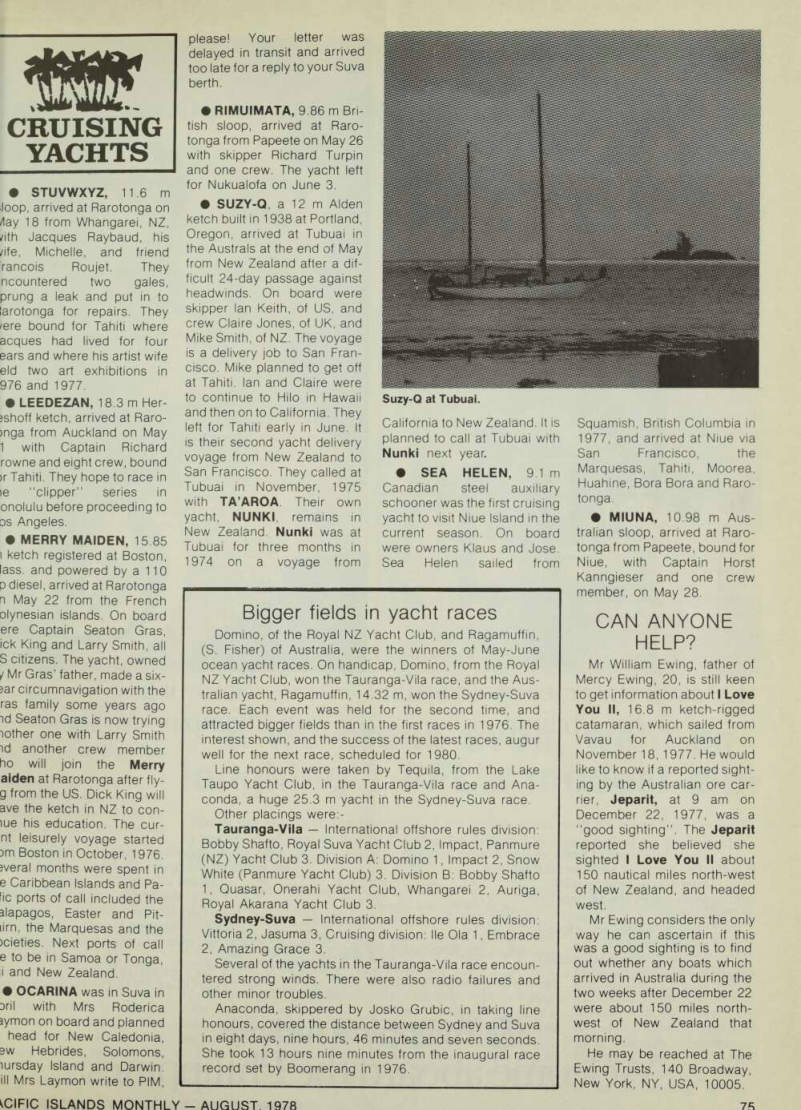
Yachts
• Stuvwxyz, 11.6 M
loop, arrived at Rarotonga on /lay 18 from Whangarei, NZ, /ith Jacques Raybaud, his /ife, Michelle, and friend rancois Roujet. They ncountered two gales, prung a leak and put in to larotonga for repairs. They /ere bound for Tahiti where acques had lived for four ears and where his artist wife eld two art exhibitions in 976 and 1977.
• Leedezan, 18.3 M Her
jshoff ketch, arrived at Raro >nga from Auckland on May 1 with Captain Richard rowne and eight crew, bound >r Tahiti. They hope to race in le “clipper” series in onolulu before proceeding to os Angeles.
• Merry Maiden, 15.85
i ketch registered at Boston, lass, and powered by a 110 p diesel, arrived at Rarotonga n May 22 from the French olynesian islands. On board ere Captain Seaton Gras, ick King and Larry Smith, all S citizens. The yacht, owned / Mr Gras’ father, made a six jar circumnavigation with the ras family some years ago id Seaton Gras is now trying lother one with Larry Smith id another crew member ho will join the Merry alden at Rarotonga after fly g from the US. Dick King will ave the ketch in NZ to con ice his education. The cur nt leisurely voyage started im Boston in October, 1976. jveral months were spent in e Caribbean Islands and Pa fic ports of call included the alapagos, Easter and Pit iirn, the Marquesas and the icieties. Next ports of call e to be in Samoa or Tonga, i and New Zealand. • OCARINA was in Suva in 3ril with Mrs Roderica lymon on board and planned head for New Caledonia, Hebrides, Solomons, lursday Island and Darwin, ill Mrs Laymon write to PIM,
please! Your letter was delayed in transit and arrived too late for a reply to your Suva berth.
• Rimuimata, 9 86 M Bri
tish sloop, arrived at Raro tonga from Papeete on May 26 with skipper Richard Turpin and one crew. The yacht left for Nukualofa on June 3. • SUZY-Q, a 12 m Alden ketch built in 1938 at Portland, Oregon, arrived at Tubuai in the Australs at the end of May from New Zealand after a dif ficult 24-day passage against headwinds. On board were skipper lan Keith, of US, and crew Claire Jones, of UK, and Mike Smith, of NZ. The voyage is a delivery job to San Fran cisco. Mike planned to get off at Tahiti. lan and Claire were to continue to Hilo in Hawaii and then on to California. They left for Tahiti early in June. It is their second yacht delivery voyage from New Zealand to San Francisco. They called at Tubuai in November, 1975 with TA’AROA Their own yacht, NUNKI , remains in New Zealand Nunki was at Tubuai for three months in 1974 on a voyage from
California to New Zealand. It is planned to call at Tubuai with Nunki next year.
• Sea Helen, 9 1 M
Canadian steel auxiliary schooner was the first cruising yacht to visit Niue Island in the current season. On board were owners Klaus and Jose.
Sea Helen sailed from
Squamish, British Columbia in 1977, and arrived at Niue via San Francisco, the Marquesas, Tahiti, Moorea, Huahine, Bora Bora and Raro tonga. • MIUNA, 10.98 m Aus tralian sloop, arrived at Raro tonga from Papeete, bound for Niue, with Captain Horst Kanngieser and one crew member, on May 28.
Can Anyone
Help?
Mr William Ewing, father of Mercy Ewing, 20, is still keen to get information about I Love You 11, 16.8 m ketch-rigged catamaran, which sailed from Vavau for Auckland on November 18, 1977. He would like to know if a reported sight ing by the Australian ore car rier, Jeparit, at 9 am on December 22, 1977, was a “good sighting”. The Jeparit reported she believed she sighted I Love You II about 150 nautical miles north-west of New Zealand, and headed west.
Mr Ewing considers the only way he can ascertain if this was a good sighting is to find out whether any boats which arrived in Australia during the two weeks after December 22 were about 150 miles north west of New Zealand that morning.
He may be reached at The Ewing Trusts, 140 Broadway, New York, NY, USA, 10005.
Suzy-Q at Tubuai.
Bigger fields in yacht races
Domino, of the Royal NZ Yacht Club, and Ragamuffin, (S. Fisher) of Australia, were the winners of May-June ocean yacht races. On handicap, Domino, from the Royal NZ Yacht Club, won the Tauranga-Vila race, and the Aus tralian yacht, Ragamuffin, 14.32 m, won the Sydney-Suva race. Each event was held for the second time, and attracted bigger fields than in the first races in 1976. The interest shown, and the success of the latest races, augur well for the next race, scheduled for 1980.
Line honours were taken by Tequila, from the Lake Taupo Yacht Club, in the Tauranga-Vila race and Ana conda, a huge 25.3 m yacht in the Sydney-Suva race.
Other placings were:- Tauranga-Vila International offshore rules division: Bobby Shafto, Royal Suva Yacht Club 2, Impact, Panmure (NZ) Yacht Club 3. Division A: Domino 1, Impact 2, Snow White (Panmure Yacht Club) 3. Division B: Bobby Shafto 1, Quasar, Onerahi Yacht Club, Whangarei 2, Auriga, Royal Akarana Yacht Club 3.
Sydney-Suva International offshore rules division: Vittoria 2, Jasuma 3, Cruising division: lie Ola 1, Embrace 2, Amazing Grace 3.
Several of the yachts in the Tauranga-Vila race encoun tered strong winds. There were also radio failures and other minor troubles.
Anaconda, skippered by Josko Grubic, in taking line honours, covered the distance between Sydney and Suva in eight days, nine hours, 46 minutes and seven seconds.
She took 13 hours nine minutes from the inaugural race record set by Boomerang in 1976.
Advertisements & other items, pp. 75-76 (2 items)
75
<CIFIC ISLANDS MONTHLY - AUGUST. 1978
Welcome aboard the Philippines.
m iwii ri * m * *
Discover the grace of old Spain
in the Philippines.
Sense it first
on Philippine Airlines.
The subtle blend of Spain and Asia is our heritage in delightful harmony with the 20th century.
Four centuries of Spanish culture lends a very special beauty to The Philippines.
Like the special smile found only on Philippine Airlines.
Where our flight attendants’ hospitality is a 1,000 year-old Philippine tradition. /a
AMSTERDAM
<^V*^FRANKFURT
VROME
On Philippine Airlines’ wide-bodied jets, you’ll get centuries-old charm, the latest movies, the tastiest international menus.
Flights depart for Manila each Friday from Port Moresby. Also three times eacl:
DHAHRAN
JEDDAH
KARACHI TAIPEI.
HONG KONC '
/J£ KY ° ANF^£i£ ISCO week from Sydney; Monday, Thursday or"
BANGKOK 1
KUALA LUMPUR*
SINGAPORE
JAKARTA
Friday, or twice each week from Melbourne; Monday or Friday.
So when you’re flying to Europe or SYDNEY / the Orient, fly to The Philippines first
3 ORT MORESBY
1 SYDNEY
MELBOURNE
® Philippine Airlines
Welcome aboard the Philippines.
PAL2SOO
Governments dither and American
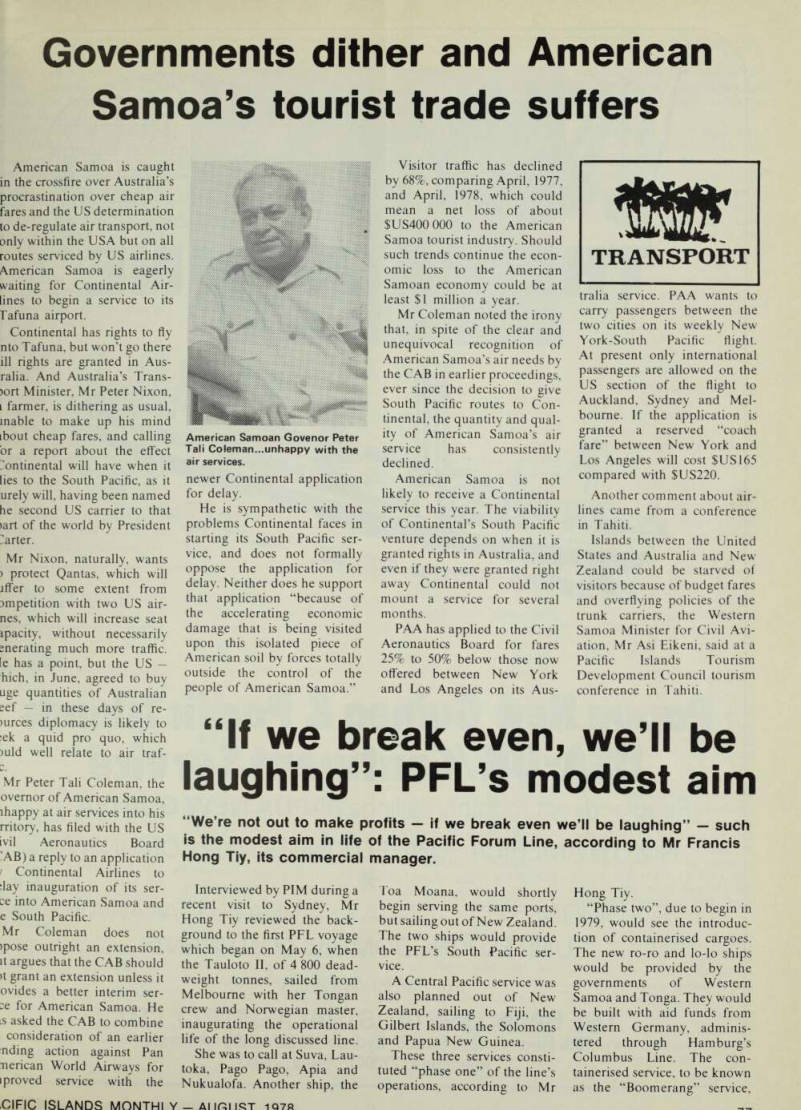
Samoa’s tourist trade suffers
American Samoa is caught in the crossfire over Australia’s
procrastination over cheap air
fares and the US determination to de-regulate air transport, not only within the USA but on all routes serviced by US airlines.
American Samoa is eagerly
waiting for Continental Air lines to begin a service to its
Fafuna airport.
Continental has rights to fly nto Tafuna, but won’t go there ill rights are granted in Aus ralia. And Australia’s Trans >ort Minister, Mr Peter Nixon, i farmer, is dithering as usual, mable to make up his mind
ibout cheap fares, and calling
or a report about the effect Continental will have when it lies to the South Pacific, as it urely will, having been named he second US carrier to that >art of the world by President Carter.
Mr Nixon, naturally, wants ) protect Qantas, which will jffer to some extent from with two US air nes, which will increase seat
ipacity, without necessarily
uncrating much more traffic, le has a point, but the US hich, in June, agreed to buy
uge quantities of Australian
eef in these days of re
mrces diplomacy is likely to
:ek a quid pro quo, which )uld well relate to air traf- Mr Peter Tali Coleman, the overnor of American Samoa, ihappy at air services into his rritory, has filed with the US ivil Aeronautics Board
'AB) a reply to an application
' Continental Airlines to Jay inauguration of its scr ee into American Samoa and e South Pacific.
Mr Coleman does not
)pose outright an extension,
it argues that the CAB should >t grant an extension unless it ovides a better interim scr ee for American Samoa. He is asked the CAB to combine consideration of an earlier
nding action against Pan
Tierican World Airways for
iproved service with the
newer Continental application
for delay.
He is sympathetic with the problems Continental faces in starting its South Pacific ser vice, and does not formally oppose the application for delay. Neither does he support that application “because of the accelerating economic damage that is being visited upon this isolated piece of American soil by forces totally outside the control of the people of American Samoa.”
Visitor traffic has declined by 68%, comparing April, 1977, and April, 1978, which could mean a net loss of about SUS4OO 000 to the American Samoa tourist industry. Should such trends continue the econ omic loss to the American Samoan economy could be at least $1 million a year.
Mr Coleman noted the irony that, in spite of the clear and
unequivocal recognition of
American Samoa’s air needs by the CAB in earlier proceedings, ever since the decision to give South Pacific routes to Con tinental, the quantity and qual ity of American Samoa’s air service has consistently declined.
American Samoa is not likely to receive a Continental service this year. The viability of Continental’s South Pacific venture depends on when it is granted rights in Australia, and
even if they were granted right
away Continental could not mount a service for several months.
PAA has applied to the Civil Aeronautics Board for fares 25% to 50% below those now offered between New York and Los Angeles on its Aus-
Transport
tralia service. PAA wants to carry passengers between the two cities on its weekly New York-South Pacific flight.
At present only international passengers are allowed on the US section of the flight to Auckland, Sydney and Mel bourne. If the application is granted a reserved “coach fare” between New York and Los Angeles will cost SUSI6S compared with SUS22O.
Another comment about air lines came from a conference in Tahiti.
Islands between the United States and Australia and New Zealand could be starved of visitors because of budget fares and overflying policies of the trunk carriers, the Western Samoa Minister for Civil Avi ation, Mr Asi Eikeni, said at a Pacific Islands Tourism Development Council tourism conference in Tahiti.
American Samoan Govenor Peter Tali Coleman...unhappy with the air services.
laughing”: PFL’s modest aim
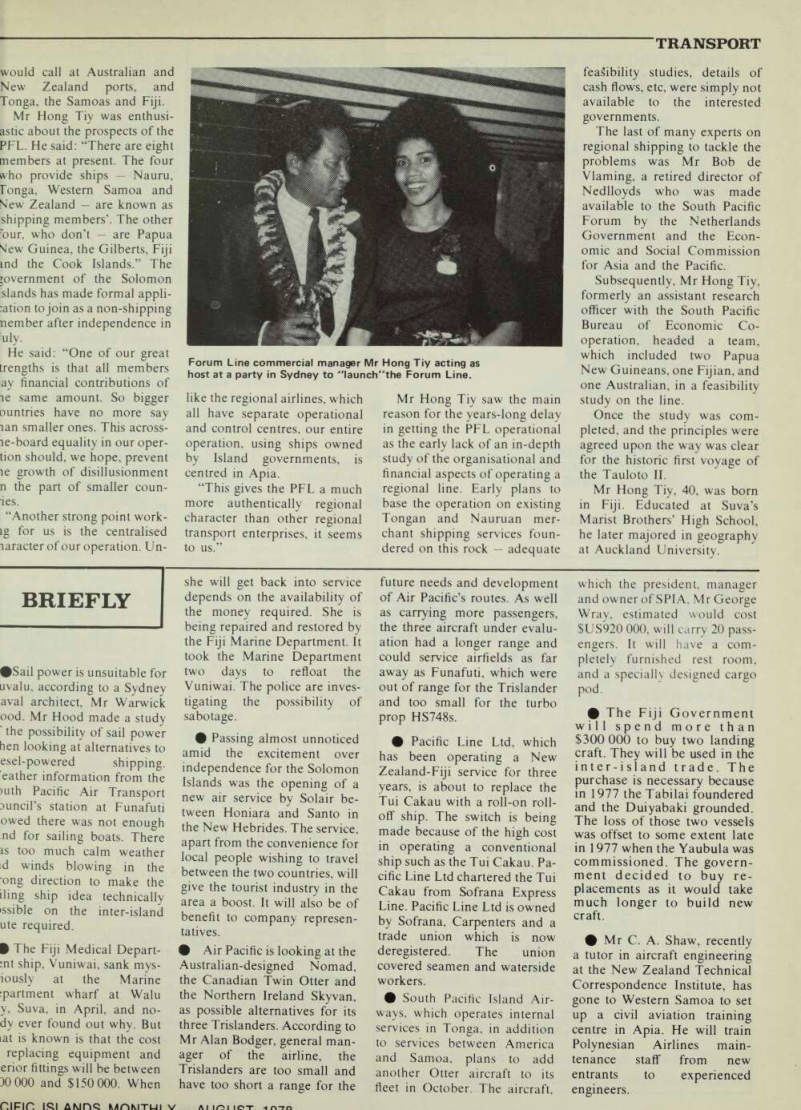
“If we break even, we’ll be laughing”: PFL’s modest aim
“We’re not out to make profits if we break even we’ll be laughing” such is the modest aim in life of the Pacific Forum Line, according to Mr Francis Hong Tiy, its commercial manager.
Interviewed by PIM during a recent visit to Sydney, Mr Hong Tiy reviewed the back ground to the first PFL voyage which began on May 6, when the Tauloto 11, of 4 800 dead weight tonnes, sailed from Melbourne with her Tongan crew and Norwegian master, inaugurating the operational life of the long discussed line.
She was to call at Suva, Lau
toka, Pago Pago, Apia and
Nukualofa. Another ship, the
Toa Moana, would shortly begin serving the same ports, but sailing out of New Zealand.
The two ships would provide the PFL’s South Pacific ser vice.
A Central Pacific service was also planned out of New Zealand, sailing to Fiji, the Gilbert Islands, the Solomons and Papua New Guinea.
These three services consti tuted “phase one” of the line’s operations, according to Mr
Hong Tiy.
“Phase two”, due to begin in 1979, would see the introduc tion of containerised cargoes.
The new ro-ro and 10-lo ships would be provided by the governments of Western Samoa and Tonga. They would be built with aid funds from Western Germany, adminis
tered through Hamburg’s
Columbus Line. The con tainerised service, to be known as the “Boomerang” service,
would call at Australian and New Zealand ports, and Tonga, the Samoas and Fiji.
Mr Hong Tiy was enthusi astic about the prospects of the PFL. He said; “There are eight members at present. The four
who provide ships Nauru,
Longa, Western Samoa and New Zealand are known as shipping members’. The other “our, who don’t are Papua New Guinea, the Gilberts, Fiji md the Cook Islands.” The government of the Solomon slands has made formal appli
:ation to join as a non-shipping
nember after independence in
uly.
He said; “One of our great trengths is that all members ay financial contributions of te same amount. So bigger ountries have no more say lan smaller ones. This across ic-board equality in our oper tion should, we hope, prevent
le growth of disillusionment
n the part of smaller coun ies.
“Another strong point work ig for us is the centralised laracter of our operation. Un-
like the regional airlines, which all have separate operational and control centres, our entire operation, using ships owned by Island governments, is centred in Apia.
“This gives the PFL a much more authentically regional character than other regional transport enterprises, it seems to us.’’
Mr Hong Tiy saw the main reason for the years-long delay in getting the PFL operational as the early lack of an in-depth study of the organisational and financial aspects of operating a
regional line. Early plans to
base the operation on existing Tongan and Nauruan mer chant shipping services foun dered on this rock adequate
feasibility studies, details of cash flows, etc, were simply not available to the interested governments.
The last of many experts on regional shipping to tackle the problems was Mr Bob de Vlaming, a retired director of Nedlloyds who was made available to the South Pacific Forum by the Netherlands Government and the Econ omic and Social Commission for Asia and the Pacific.
Subsequently, Mr Hong Tiy,
formerly an assistant research officer with the South Pacific Bureau of Economic Co operation, headed a team, which included two Papua New Guineans, one Fijian, and one Australian, in a feasibility study on the line.
Once the study was com pleted, and the principles were agreed upon the way was clear for the historic first voyage of the Tauloto 11.
Mr Hong Tiy, 40, was born in Fiji. Educated at Suva’s Marist Brothers’ High School, he later majored in geography at Auckland University.
Forum Line commercial manager Mr Hong Tiy acting as host at a party in Sydney to "launch”the Forum Line.
Advertisements & other items, pp. 77-78 (2 items)
77
CIFIC ISLANDS MONTHI Y Al mi I.QT -iota
Line
THE
a i Aft
GLOBAL SERVICE FOR SHIPPERS
V
LINE
«S^
Papua New Guinea & Pacific Islands
USA- UK /Continent Service
Regular direct monthly sailings PAPUA NEW GUINEA to: NORTH AMERICA • UNITED KINGDOM & CONTINENT SOLOMONS • FIJI • TONGA • SAMOA and TARAWA to:
UNITED KINGDOM and CONTINENT
For particulars apply:
THE BANK LINE (AUSTRALASIA) PTY LTD.
18th Floor 1 York Street Sydney N.S.W. 2000 Australia Telephone: 272041 Telex: 24063
Briefly
•Sail power is unsuitable for
uvalu, according to a Sydney
aval architect, Mr Warwick ood. Mr Hood made a study ‘ the possibility of sail power hen looking at alternatives to
esel-powered shipping,
eather information from the
>uth Pacific Air Transport
Duncil’s station at Funafuti owed there was not enough nd for sailing boats. There is too much calm weather d winds blowing in the •ong direction to make the
ding ship idea technically
•ssible on the inter-island
ute required.
t The Fiji Medical Depart
mt ship, Vuniwai, sank mys iously at the Marine :partment wharf at Walu y, Suva, in April, and no dy ever found out why. But lat is known is that the cost
replacing equipment and
erior fittings will be between 30 000 and $l5O 000. When
she will get back into service depends on the availability of the money required. She is
being repaired and restored by
the Fiji Marine Department. It took the Marine Department two days to refloat the Vuniwai. The police are inves
tigating the possibility of
sabotage.
• Passing almost unnoticed amid the excitement over independence for the Solomon Islands was the opening of a new air service by Solair be tween Honiara and Santo in the New Hebrides. The service, apart from the convenience for local people wishing to travel between the two countries, will give the tourist industry in the area a boost. It will also be of benefit to company represen tatives. • Air Pacific is looking at the
Australian-designed Nomad,
the Canadian Twin Otter and the Northern Ireland Skyvan, as possible alternatives for its three Trislanders. According to Mr Alan Bodger, general man ager of the airline, the Trislanders are too small and have too short a range for the
future needs and development of Air Pacific’s routes. As well as carrying more passengers, the three aircraft under evaluation had a longer range and could service airfields as far away as Funafuti, which were out of range for the Trislander and too small for the turbo prop HS74Bs. • Pacific Line Ltd, which has been operating a New Zealand-Fiji service for three vears is about to renlace the years, is about to replace the Tm Cakau with a roll-on rolloff ship. The switch is being made because of the high cost in operating a conventional ship such as the Tui Cakau. Pacific Line Ltd chartered the Tui Cakau from Sofrana Express Line. Pacific Line Ltd is owned by Sofrana, Carpenters and a trade union which is now deregistered. The union covered seamen and waterside workers. South Pacific Island Airways, which operates internal services in Tonga, in addition to services between America and Samoa, plans to add another Otter aircraft to its fleet in October. The aircraft,
which the president, manager and owner of SPI A. Mr George Wray, estimated would cost SUS92O 000, will carry 20 pass engers. It will have a com pletely furnished rest room, and a specially designed cargo
pod.
• The Fl Ji Government will spend more than $3OO 000 to buy two landing 9 raft • The y will be 1156(1 in the inter-is land trade. The P urchase 15 necessary because m 1977 the Tasilai foundered and the Duiyabaki grounded .
The j oss G f those two vessels was offset to some extent late in 1977 when the Yaubula was commissioned. The govern ment decided to buy re placements as it would take mu Jr h lon B er to build new cra t -0 Mr C. A. Shaw, recently a tutor in aircraft engineering a t the New Zealand Technical Correspondence Institute, has gone to Western Samoa to set up a civil aviation training centre in Apia. He will train Polynesian Airlines main tenance staff from new entrants to experienced
engineers.
Advertisements & other items, p. 79 (1 item)
C'llPir'l I.QI iMHQ V ai iot ■imn
TRANSPORT
Services
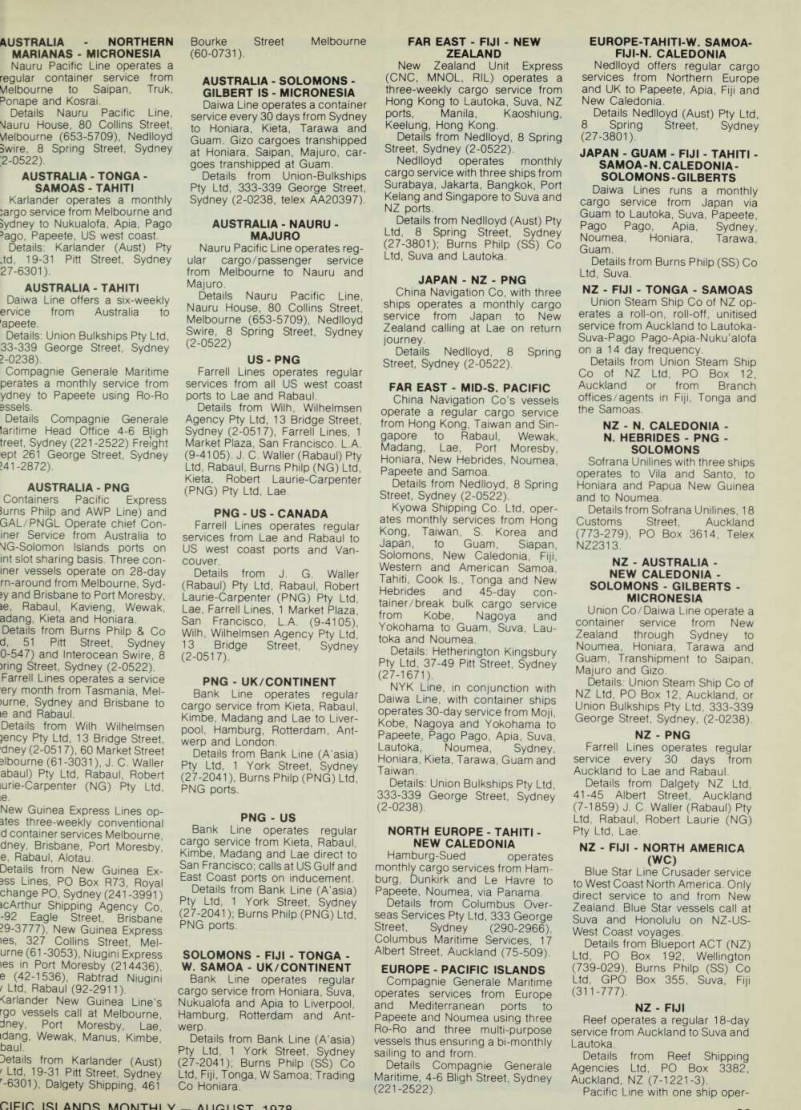
Shipping
Sydney - Lord Howe Is -
Norfolk Is
Compagnie des Chargeurs Caledoniens operates four-weekly cargo service Sydney - Lord Howe Island and Norfolk Island.
Details Hetherington Kingsbury Pty Ltd, 37-49 Pitt Street, Sydney (27-1671).
SYDNEY - NZ - FIJI - HAWAII -
Canada - Us
P & O liners call at Auckland, Suva, Honolulu and Vancouver on eastbound and westbound voy ages between Sydney and the US.
Details from P & O Booking Centre, World Travel Head quarters Pty Ltd, 33 Bligh Street,
Sydney (231-6655).
AUSTRALIA - NZ - FIJI - TONGA
N. Hebrides - Noumea - Png
Solomons-Samoas
Sitmar Cruises operates a year round cruise programme to in clude most of the above countries.
Details from Sitmar Cruises, 47 Elizabeth Street, Sydney (232-7511).
Royal Viking Line, with first-class cruise ships Royal Viking Star, Royal Viking Sky and Royal Viking Sea, cruises the Pacific from Syd ney and Cairns calling at a variety of Pacific and Asian ports.
Details from Wilh, Wilhelmsen Agency Pty Ltd, 13-15 Bridge Street, Sydney (2-0517).
P & O liners call at Apia, Auckland, Bay of Islands, Honiara, Lautoka, Noumea, Nuku’alofa, Pago Pago, Papeete, Port Moresby, Santo, Savusavu, Suva, Vavau and Vila on cruises from Australia.
Details from P & O Booking Centre World Travel Headquarters Pty Ltd, 33 Bligh Street, Sydney (231-6655).
Australia - Fiji - Samoas -
Tonga - Norfolk Island
Pacific Navigation of Tonga op erates a five-weekly refrigerated
general cargo/container service
from Sydney and Brisbane, to Suva, Lautoka, Apia, Pago Pago, Nuku’alofa and Norfolk Island.
Details from Beaufort Shipping Agency Co, 2 Castlereagh Street,
Sydney (221-2388).
Australia-Newcaledonia
(And/Or) New Hebrides
Daiwa Line operates a container service from Sydney to the New Hebrides.
Details: Union Bulkships Pty Ltd, 333-339 George Street, Sydney (2-0238).
Karlander operates a monthly service from Sydney to Noumea.
Details from Karlander (AustX Pty Ltd, 19-31 Pitt Street, (27-6301).
Sofrana-Unilines ships serves Noumea every three weeks fronm the main ports along the east Aus-. tralian coast.
Details from Sofrana-Unilines,; 37 Pitt Street, Sydney (27-2031),( Trans-Austral Shipping Pty Ltd,l 570 Bourke Street, Melbournes (67-9162), ACTA Pty Ltd, Bris bane (221-3116), Elders-ANL Pty Ltd, Port Adelaide (47-5688),!
ANL, Newcastle (049-24364)1 Clements & Marshall, Burnie, Tas mania (31-1833).
Compagnie des Chargeurs Caledoniens operates a three weekly containerised cargo ser vice from Sydney to Noumea.
Details Hetherington Kingsbury Pty Ltd, 37-49 Pitt Street, Sydney (27-1671).
Compagnie Generale Maritime operates a monthly service from Sydney to Noumea, Port Vila anc Santo, using Ro-Ro vessels.
Details Compagnie Generale Maritime Head Office 4-6 Bligh Street, Sydney (221 -2522), Freighi Dept, 261 George Street, Sydney (241-2872).
Australia - Fiji
Karlander (Aust) Pty Ltd oper ates monthly cargo services from Sydney to Suva and Lautoka.
Details from Karlander (Aust) Pty Ltd, 19-31 Pitt Street, Sydney (27-6301), Dalgety Shipping, 4611 Bourke Street. Melbourne (60-0731), Burns Philp (SS) Cc Ltd, Suva and Lautoka.
Sofrana-Unilines (Fiji Express Line) operates to Suva and Lau toka every three weeks from the main ports on the east coast o< Australia and monthly to Lautoka from Melbourne and Sydney.
Details from Sofrana-Unilines; 37 Pitt Street, Sydney (27-2031)1 Trans-Austral Shipping Pty Ltdl 570 Bourke Street, Melbourne (67-9162), ACTA Pty Ltd, Bris; bane (221-3116), Elder-ANL Pty Ltd, Port Adelaide (47-5688)(
ANL, Newcastle (049-24364 X
Clements & Marshall, Burnie. Tas;
mania (31-1833).
Australia - W Samoa
Compagnie Generale Maritime operates a monthly service from Sydney to Apia, using Ro-Ro vessels.
Details Compagnie Generale Maritime Head Office 4-6 BligH Street, Sydney (221-2522) Freighr Dept 261 George Street, Sydne* (241-2872).
Australia - Fiji -
Samoas- Tonga
Pacific Forum Line operates i container, unitised/palletised ano reefer cargo service from Mel bourne and Sydney to Lautokas Suva, Pago Pago, Apia ano Nukualofa. Other ports are inr eluded on inducement.
Details from ANL Melbourne and Brisbane, Union Bulkshipa Sydney, Hobart, Port Adelaide ano Fremantle, Burns Philp (SS Company Ltd, GPO Box 35E Suva, Fiji (311-777) or Pacifiti Forum Line, PO Box 655, Apia, V\ Samoa.
Australia - Northern
Marianas - Micronesia
Nauru Pacific Line operates a regular container service from Melbourne to Saipan, Truk, Ponape and Kosrai.
Details Nauru Pacific Line, Mauru House, 80 Collins Street, Melbourne (653-5709), Nedlloyd Swire, 8 Spring Street, Sydney '2-0522).
Australia - Tonga -
Samoas - Tahiti
Karlander operates a monthly ;argo service from Melbourne and sydney to Nukualofa, Apia, Pago 3 ago, Papeete, US west coast.
Details: Karlander (Aust) Pty _td, 19-31 Pitt Street, Sydney 27-6301).
Australia - Tahiti
Daiwa Line offers a six-weekly ervice from Australia to ’apeete.
Details: Union Bulkships Pty Ltd, 33-339 George Street, Sydney 2-0238).
Compagnie Generale Maritime perates a monthly service from ydney to Papeete using Ro-Ro sssels.
Details Compagnie Generale laritime Head Office 4-6 BJigh treet, Sydney (221-2522) Freight ept 261 George Street, Sydney >4l-2872).
Australia - Png
Containers Pacific Express lurns Philp and AWP Line) and GAL/PNGL Operate chief Con iner Service from Australia to 'JG-Solomon Islands ports on int slot sharing basis. Three con iner vessels operate on 28-day rn-around from Melbourne, Syd jy and Brisbane to Port Moresby, ie, Rabaul, Kavieng, Wewak, adang, Kieta and Honiara.
Details from Burns Philp & Co d, 51 Pitt Street, Sydney 0-547) and Interocean Swire, 8 )ring Street, Sydney (2-0522).
Farrell Lines operates a service ery month from Tasmania, Mel >urne, Sydney and Brisbane to le and Rabaul.
Details from Wilh Wilhelmsen jency Pty Ltd, 13 Bridge Street, dney (2-0517), 60 Market Street albourne (61-3031), J. C. Waller abaul) Pty Ltd, Rabaul, Robert lurie-Carpenter (NG) Pty Ltd, ie.
New Guinea Express Lines op ates three-weekly conventional d container services Melbourne, dney, Brisbane, Port Moresby, e, Rabaul, Alotau.
Details from New Guinea Ex ass Lines, PO Box R 73, Royal change PO, Sydney (241 -3991) icArthur Shipping Agency Co, -92 Eagle Street, Brisbane 29-3777), New Guinea Express les, 327 Collins Street, Mel urne (61 -3053), Niugini Express les in Port Moresby (214436), e (42-1536), Rabtrad Niugini f Ltd, Rabaul (92-2911).
Karlander New Guinea Line’s rgo vessels call at Melbourne, dney, Port Moresby, Lae, idang, Wewak, Manus, Kimbe, haul.
Details from Karlander (Aust) ' Ltd, 19-31 Pitt Street, Sydney '-6301), Dalgety Shipping, 461
Bourke Street Melbourne (60-0731).
Australia - Solomons -
Gilbert Is - Micronesia
Daiwa Line operates a container service every 30 days from Sydney to Honiara, Kieta, Tarawa and Guam. Gizo cargoes transhipped at Honiara, Saipan, Majuro, car goes transhipped at Guam.
Details from Union-Bulkships Pty Ltd, 333-339 George Street, Sydney (2-0238, telex AA20397).
Australia - Nauru -
Majuro
Nauru Pacific Line operates reg ular cargo/passenger service from Melbourne to Nauru and Majuro.
Details Nauru Pacific Line, Nauru House, 80 Collins Street, Melbourne (653-5709), Nedlloyd Swire, 8 Spring Street, Sydney (2-0522)
Us-Png
Farrell Lines operates regular services from all US west coast ports to Lae and Rabaul.
Details from Wilh, Wilhelmsen Agency Pty Ltd, 13 Bridge Street, Sydney (2-0517), Farrell Lines, 1 Market Plaza, San Francisco. L A. (9-4105). J. C. Waller (Rabaul) Pty Ltd, Rabaul, Burns Philp (NG) Ltd, Kieta, Robert Laurie-Carpenter (PNG) Pty Ltd, Lae.
Png-Us-Canada
Farrell Lines operates regular services from Lae and Rabaul to US west coast ports and Van couver.
Details from J. G. Waller (Rabaul) Pty Ltd, Rabaul, Robert Laurie-Carpenter (PNG) Pty Ltd, Lae, Farrell Lines, 1 Market Plaza, San Francisco, L.A. (9-4105).
Wilh, Wilhelmsen Agency Pty Ltd, 13 Bridge Street, Sydney (2-0517).
Png - Uk/Continent
Bank Line operates regular cargo service from Kieta, Rabaul, Kimbe, Madang and Lae to Liver pool, Hamburg, Rotterdam, Ant werp and London.
Details from Bank Line (A’asia) Pty Ltd, 1 York Street, Sydney (27-2041), Burns Philp (PNG) Ltd, PNG ports.
Png - Us
Bank Line operates regular cargo service from Kieta, Rabaul, Kimbe, Madang and Lae direct to San Francisco; calls at US Gulf and East Coast ports on inducement.
Details from Bank Line (A’asia) Pty Ltd, 1 York Street, Sydney (27-2041); Burns Philp (PNG) Ltd, PNG ports.
Solomons - Fiji - Tonga -
W. Samoa - Uk/Continent
Bank Line operates regular cargo service from Honiara, Suva, Nukualofa and Apia to Liverpool, Hamburg, Rotterdam and Ant werp.
Details from Bank Line (A’asia) Pty Ltd, 1 York Street, Sydney (27-2041); Burns Philp (SS) Co Ltd, Fiji, Tonga, W Samoa; Trading Co Honiara.
Far East - Fiji - New
Zealand
New Zealand Unit Express (CNC, MNOL, RIL) operates a three-weekly cargo service from Hong Kong to Lautoka, Suva, NZ ports, Manila, Kaoshiung, Keelung, Hong Kong.
Details from Nedlloyd, 8 Spring Street, Sydney (2-0522).
Nedlloyd operates monthly cargo service with three ships from Surabaya, Jakarta, Bangkok, Port Kelang and Singapore to Suva and NZ ports.
Details from Nedlloyd (Aust) Pty Ltd, 8 Spring Street, Sydney (27-3801); Burns Philp (SS) Co Ltd, Suva and Lautoka.
Japan - Nz - Png
China Navigation Co, with three ships operates a monthly cargo service from Japan to New Zealand calling at Lae on return journey.
Details Nedlloyd, 8 Spring Street, Sydney (2-0522),
Far East - Mid-S. Pacific
China Navigation Co’s vessels operate a regular cargo service from Hong Kong, Taiwan and Sin gapore to Rabaul, Wewak, Madang, Lae, Port Moresby, Honiara, New Hebrides, Noumea, Papeete and Samoa.
Details from Nedlloyd, 8 Spring Street, Sydney (2-0522).
Kyowa Shipping Co, Ltd, oper ates monthly services from Hong Kong, Taiwan, S. Korea and Japan, to Guam, Siapan, Solomons, New Caledonia, Fiji, Western and American Samoa, Tahiti, Cook Is., Tonga and New Hebrides and 45-day con tainer/break bulk cargo service from Kobe, Nagoya and Yokohama to Guam, Suva, Lau toka and Noumea.
Details. Hetherington Kingsbury Pty Ltd, 37-49 Pitt Street, Sydney (27-1671).
NYK Line, in conjunction with Daiwa Line, with container ships operates 30-day service from Moji, Kobe, Nagoya and Yokohama to Papeete, Pago Pago, Apia, Suva, Lautoka, Noumea, Sydney, Honiara, Kieta, Tarawa, Guam and Taiwan.
Details; Union Bulkships Pty Ltd, 333-339 George Street, Sydney (2-0238).
North Europe - Tahiti -
New Caledonia
Hamburg-Sued operates monthly cargo services from Ham burg, Dunkirk and Le Havre to Papeete, Noumea, via Panama, Details from Columbus Over seas Services Pty Ltd, 333 George Street, Sydney (290-2966), Columbus Maritime Services, 17 Albert Street, Auckland (75-509).
Europe - Pacific Islands
Compagnie Generale Maritime operates services from Europe and Mediterranean ports to Papeete and Noumea using three Ro-Ro and three multi-purpose vessels thus ensuring a bi-monthly sailing to and from.
Details Compagnie Generale Maritime, 4-6 Bligh Street, Sydney (221-2522).
Europe-Tahiti-W. Samoa
Fiji-N. Caledonia
Nedlloyd offers regular cargo services from Northern Europe and UK to Papeete, Apia, Fiji and New Caledonia.
Details Nedlloyd (Aust) Pty Ltd, 8 Spring Street, Sydney (27-3801).
JAPAN - GUAM - FIJI - TAHITI -
Samoa-N. Caledonia
Solomons-Gilberts
Daiwa Lines runs a monthly cargo service from Japan via Guam to Lautoka, Suva, Papeete, Pago Pago, Apia, Sydney, Noumea, Honiara, Tarawa, Guam.
Details from Burns Philp (SS) Co Ltd, Suva.
NZ - FIJI - TONGA - SAMOAS Union Steam Ship Co of NZ op erates a roll-on, roll-off, unitised service from Auckland to Lautoka- Suva-Pago Pago-Apia-Nuku’alofa on a 14 day frequency.
Details from Union Steam Ship Co of NZ Ltd, PC Box 12, Auckland or from Branch offices/agents in Fiji, Tonga and the Samoas.
Nz - N. Caledonia -
N. Hebrides - Png -
Solomons
Sofrana Unilines with three ships operates to Vila and Santo, to Honiara and Papua New Guinea and to Noumea.
Details from Sofrana Unilines, 18 Customs Street, Auckland (773-279), PC Box 3614, Telex NZ2313.
Nz - Australia -
New Caledonia -
Solomons - Gilberts -
Micronesia
Union Co/Daiwa Line operate a container service from New Zealand through Sydney to Noumea, Honiara, Tarawa and Guam, Transhipment to Saipan, Majuro and Gizo.
Details: Union Steam Ship Co of NZ Ltd, PC Box 12, Auckland, or Union Bulkships Pty Ltd, 333-339 George Street, Sydney, (2-0238).
Nz - Png
Farrell Lines operates regular service every 30 days from Auckland to Lae and Rabaul.
Details from Dalgety NZ Ltd, 41-45 Albert Street, Auckland (7-1859) J. C. Waller (Rabaul) Pty Ltd, Rabaul, Robert Laurie (NG) Pty Ltd, Lae.
Nz - Fiji - North America
(WC) Blue Star Line Crusader service to West Coast North America. Only direct service to and from New Zealand. Blue Star vessels call at Suva and Honolulu on NZ-US- West Coast voyages.
Details from Blueport ACT (NZ) Ltd, PO Box 192, Wellington (739-029), Burns Philp (SS) Co Ltd, GPO Box 355, Suva, Fiji (311-777).
Nz - Fiji
Reef operates a regular 18-day service from Auckland to Suva and Lautoka.
Details from Reef Shipping Agencies Ltd, PO Box 3382, Auckland, NZ (7-1221-3).
Pacific Line with one ship oper
ites monthly cargo service New Zealand, Lautoka, Suva.
Details: Sofrana Unilines, 18 Customs Street, Auckland 773-279) PO Box 3614, Telex: JZ2313.
Nz - Fiji - Gilberts -
Solomons - Png
Pacific Forum Line operates a ontainer, unitised/palletised and sefer cargo service from Lyttelton nd Auckland to Lautoka, Suva, arawa, Honiara, Madang, Lae nd Moresby. Other ports are in luded on inducement.
Details from Shipping Corpor tion of NZ Ltd, Auckland, tiristchurch, Lyttelton, Welling >n. Burns Philp (SS) Company td, GPO Box 355, Suva, Fiji 111-777) or Pacific Forum Line, 0 Box 655, Apia, W. Samoa
Nz - Fiji - Samoas -
Tonga - Australia
Pacific Forum Line operates a Dntainer, unitised/palletised and iefer cargo service from Timaru id Auckland to Lautoka, Suva, ago Pago, Apia, Nukualofa and elbourne. Other ports are in uded on inducement.
Details from Shipping Corpor ion of NZ Ltd, Auckland, iristchurch, Lyttelton, Welling n, Burns Philp (SS) Company d, GPO Box 355, Suva, Fiji 11-777) or Pacific Forum Line, ) Box 655, Apia, W. Samoa.
Nz - Samoa - Tonga
Pacific Navigation of Tonga op ates a four-weekly cargo ser :e, Auckland - Nukualofa - Pago igo - Apia - Nukualofa ickland.
Details from McKay Shipping J, Downtown House, Queen eet, Auckland (33-656).
Warner Pacific Line services lehunga - Nukualofa - Vavau tnightly, and Timaru - Nukualofa 'avau monthly and Onehunga ia and Pago Pago every 21 days frying general and freezer car es and Timaru - Apia every 21 /s carrying freezer cargo.
Details from Air Marine Services Z) Ltd, PO Box 2505, Auckland 16-841).
NZ - COOK IS - NIUE -
Tahiti
shipping Corporation of NZ Ltd crates cargo services based on lets and similar units from :kland to Niue, Cook Islands J Tahiti.
Details from the Shipping Corp vIZ Ltd, PO Box 3420, Auckland 7-210); Waterfront Com ;sion, PO Box 61, Rarotonga, hterage and Stevedoring Co, jtaki, Niue Govt Offices, Niue nd Compagnie Maritime ynesienne, B’P' 368, )eete.
:/N. Continent - Tahiti -
Caledonia - N. Hebrides
lank Line operates regular go service from Hull, Hamburg, men, Antwerp and Rotterdam 3 apeete, Noumea and Vila. )etails from Bank Line (A’asia) Ltd, 1 York Street, Sydney -2041); Ets A M Fare UTE, >eete; Ets Ballande, Noumea ns Philp (NH) Ltd, Vila.
Uk/N. Continent - Png -
Solomons
Bank Line operates regular cargo service from Hull, Hamburg, Bremen, Antwerp and Rotterdam to Port Moresby, Lae, Madang, Kimbe, Rabaul, Kieta and Honiara and on inducement to Yandina, Tarawa and Nauru.
Details from Bank Line (A’asia) Pty Ltd, 1 York Street, Sydney (27-2041); Burns Philp (PNG) Ltd, PNG ports; Trading Co Honiara.
San Francisco - Honolulu -
Nauru - Micronesia
Nauru Pacific Line operates reg ular conventional/container ser vice from San Francisco and Honolulu to Majuro, Nauru, Ponape, Truk and Saipan.
Details from Nauru Pacific Line, Nauru House, 80 Collins Street, Melbourne (653-5709); North American Maritime Agencies, 100 California Street, San Francisco, California 9411 (981-0343).
Us -Fiji -Tahiti -Nz
Australia
Bank and Savill Line Ltd, oper ates regular cargo services from US Gulf ports to Australia and NZ.
Calls at Suva, Lautoka and Papeete on demand.
Details from Bank Line (A’asia) Pty Ltd, 1 York Street, Sydney (27-2041) or Howard Smith Indus tries Pty Ltd, 1 York Street, Sydney (27-5611).
US - A. SAMOA - NZ -
Aust
Farrell Lines LASH ships operate regularly from US to Australia, via Pago Pago and Auckland and Canada.
Details from Wilh, Wilhelmsen Agency Pty Ltd, 13 Bridge St., Syd ney (2-0517); 60 Market Street, Melbourne (61-0301); Farrell Lines, 1 Market Plaza, San Fran cisco. L.A. (415-777-3300); Dal gety NZ Ltd, Auckland (7-1859); Kneubuhl Maritime Services, Pago Pago (633-5121).
Us - Tahiti - Samoa
Pacific Islands Transport oper ates a five/six weekly cargo ser vice from North America west coast ports to Papeete, Pago Pago, Apia.
Details from Trans-Austral Ship ping Pty Ltd, 19 Pitt Street, Sydney (27-2441).
Polynesia Line operates con tainer and general cargo service from US west coast ports to Papeete and Pago Pago.
Details from Polynesia Shipping Services Inc,, PC Box 1478, Pago Pago (9-6799). • South Pacific Island Air ways has added a Vavau- Nukualofa shuttle service to its schedules. The shuttle is sandwiched into regular Pago
Pago-Vavau-Nukualofa
return services to make four Vavau-Nukualofa return flights a week. The airline also
operates Pago Pago-Apia and
Pago Pago-Niue services, and
a domestic service in American Samoa.
Advertisements & other items, pp. 80-92 (9 items)
DAr'icir. i.qi ANDfi MONTHLY AUGUST, 197^
Henry Cumines
GENERATING SETS BY
BRAYBON
DIESEL POWER
4 KVA to 65
KVA.
Manual.
Electric start.
Remote start stop.
Automatic.
Mains failure.
4 KVA
illustrated.
BROCHURES A VAILABLE.
BRAYBON BROS. PTY, LTD.
P.O. BOX 63, CONCORD WEST.
SYDNEY. PHONE (02) 73-3246.
ESTABLISHED 43 YEARS
HENRY CUMINES
PTY. LTD.
EXPORTERS o GENERAL MERCHANTS
428 GEORGE ST., SYDNEY
CABLES: HENCO SYDNEY. G.P.O. Box 3949. PHONE: 25-3383.
For specialised and personalised buying service
throughout the Pacific Islands and the East.
-• LOCAL AGENTS AND REPRESENTATION: •-
PAPUA NEW GUINEA.
PORT MORESBY: Mr. Tan,
P.O. Box 5445, Boroko.
Telephone 25 2542.
RABAUL: M. & C. Seeto, P.O. Box 131, Rabaul.
Telephone 92 2902.
MADANG: W. Double, P.O. Box 22, Madang.
Telephone 82 2696.
FIJI.
K. Witherington Ltd., P.O. Box 293, Suva.
Telephone 22 356,
NEW HEBRIDES.
John Lum & Associates, P.O. Santo.
Telephone 329.
SOLOMON ISLANDS.
Lo See War Ltd., P.O. Box 327, Honiara.
Telephone 399. -• Resident Agents in other Pacific Territories. •-
Cific Islands Monthi Y Ai
Nelson&Robertson
Pacific Navigation of Tonga Limited
SERVING THE PACIFIC FROM AUSTRALIA AND NEW ZEALAND
NUKU’ALOFA:
PACIFIC NAVIGATION •
OF TONGA LTD.
THE ADMINISTRATOR •
NORFOLK ISLAND
SUVA, LAUTOKA, APIA,
PAGO PAGO AGENTS: •
BURNS PHILP
(S.S.) CO. LTD.
BEAUFORT SHIPPING
G.P.O. Box 3988, Sydney, N.S.W. • Australia.
McKAY SHIPPING LIMITED •
P.O. Box 1372, Auckland, New Zealand.
REGULAR SAILINGS
OWNED TONNAGE
CONTAINERS
FREEZER
DEEP TANKS
CONTINUOUS PRE-RECEIVING
HE A VY LIFTS
-o o ~..I 1,. >.i 1 1 XA.S '.U u.mi u J.IA l:.lv n' u \ tt-. \ i w.t A i i xx „
IN OUR 84th YEAR SELLING ‘SERVICE’
TO THE PACIFIC ISLANDS...
Nelson&Robertson
PTY. LTD. (Established 1895) Plantation House, 197 Clarence Street, Sydney.
Cables: ‘IVAN’, Sydney, Brisbane. Telex: AA22381, Sydney.
FOR:
INDENTS
FOODSTUFFS
SOFTGOODS
HARDWARE
MACHINERY
SHIPPING
TRAVEL
INSURANCE
REAL ESTATE
...FROM AUSTRALIA & OVERSEAS.
BRANCH OFFICES:
Nelson & Robertson Pty. Ltd., 303 Adelaide Street, Brisbane, Qld.
Nelson & Robertson Pty. Ltd., P.O. Box 2092, Gout. Bldg., Suva, Fiji.
Nelson & Robertson Pty. Ltd., P.O. Box 258, Lautoka, Fiji.
PAPUA NEW GUINEA
REPRESENTATIVES:
Rabtrad Niugini Pty. Ltd.
RABAUL
LAE
MADANG
KIETA
World Wide
Finance
Corporation
PTY. LTD.
FOR.
EQUITY PARTICIPATION
DEVELOPMENT FUNDING
RE FINANCE, OFF-SHORE FUNDING
JOINT VENTURES
COMPETITIVE INTEREST RATES
t
INQUIRIES:
P.O. BOX 2397, BRISBANE.
PHONE: (07) 221 7151.
A.H. 378 3341.
NIUE
COOK ISLANDS
TAHITI
to and from
NEW ZEALAND
Regular service using pallet load ships TIARE MOANA and FETU MOANA. Refrigerated and general cargo between Auckland and Niue, Rarotonga, Aitutaki, Papeete. Other nearby ports by inducement.
AREA AGENTS
Niue; Government Shipping Office, Alofi.
Cook Islands: Waterfront Commission, PO Box 61, Rarotonga.
Telex Shipping RG 2002 Tahiti: Agence Maritime et de Voyage, B P 131, Papeete.
Telex AMAV 251 FP
The Shipping Corporation
of New Zealand Limited
Sea carrier to the nation © AUCKLAND: Phone 379-430. PO Box 3420. Telex: NZ2822 WELLINGTON: Phone 728-500. PO Box 3344. Telex: NZ3495 CHRISTCHURCH: Phone 795-760. PO Box 777, Telex; 4434 DUNEDIN: Phone 76-076. PO Box 904. Telex: 5228.
KVCfS
KYOWA LINE
YOUR TRADING PARTNER
Monthly Services
Hong Kong, Taiwan, S. Korea, Japan
To; British Solomon, New Caledonia, Fiji, W Samoa, A. Samoa Tahiti, Cook Is., Tonga, New Hebrides.
Ellice Is.,
Taiwan,Hong Kong,Singapore,Jakarta,
Philippine
To: Australia, Papua New Guinea, Sabah & Sarawak.
AGENTS
Taiwan: Royal Steamship Corp , Ltd., Taipei S. Korea: Dong Sue Shipping Co, Ltd, Seoul Hong Kong: Dahzun Enterprises Ltd.
Singapore: Ocean Shipping & Enterprises Pte.. Ltd Guam: Maritime Agencies of Pacific Ltd , Guam Saipan: Saipan Shipping Co, Inc,, Saipan 8.5.1. P.: Solomon Taiyo Ltd., Honiara Tahiti: J.A. Cowan & Fils, Papeete Cooks: Eastern Associates Ltd . Rarotonga Tonga: EM Jones Ltd, Nukualofa New Hebrides: Agence Maritime Raymond Velicite, Port Vila A.Samoa: Island Pacific Agencies Inc.. Pago Pago W. Samoa: Morris Hedstrom Ltd , Apia Fiji: Carpenter Shipping, Suva & Lautoka PNG: Carpenter Shipping Agencies, Port Moresby, Rabaul New Caledonia: Agence Maritime Du Rond Point Du Pacific,
Hong Kong, Taiwan, S. Korea, Japan
To; Guam, Saipan, Truk, Ponape, Other Pacific Islands.
Noumea Indonesia: P T Porodisa Raya Shipping Lines. Jakarta Sabah: KOH Han Ming Shipping & Forwarding Agent, Kotakinabalu Sarawak: Pan Sarawak Agencies Sdn Bhd , Sibu & Kuching Australia: Hethenngton Kingsbury Pty Ltd, Sydney, NSW Newzealand: Sofrana Umlmes SA, Auckland
KYOWA SHIPPING CO., LTD.
HEAD OFFICE
sth FI., Suzumaru Bldg. 39-8, 2-chome, Nishi-Shinbashi, Minato-ku, Tokyo, Japan.
Phone : 03(437)2885(Rep.) Cables : "MARIQUEEN” Tokyo. Telex : 242-4651 Kyowa J.
OSAKA OFFICE
Frontier Bldg., 3-13 Hirano-cho, Higashi-ku, Osaka, Japan.
Phone : 06 (227) 0422 (Rep.) Cables : "MARIQUEEN” Osaka. Telex : 522-3896 Kyowa 0.
Mamma .
The South Seas Express.
The first regular roll-on roll-offexpress
service between N. the Islands.
The introduction of Marama to the Islands trade will enable exporters to greatly increase their export potential by providing faster, more frequent sailings as well as the greater cargo handling flexibility which a roll-on roll-off service can provide J Departures every 14 days from Auckland to: Lautoka, Suva. Pago Pago Apia Nukualofa f \ Pago Pago Co-ordinated transhipment facilities from other N.Z. centres Intermodal coastal roll-on roll-off services as well as rail and road services can be utilised by shippers in other New Zealand centres to take advantage of the new Marama schedule. Your nearest Union Company office can assist you in organising the most efficient transhipment method.
International Transhipment Facilities Flexibility in cargo modules catered by this new service can provide for shipping operators and exporters the advantage of reaching international markets using onforwarding services through Union Company contacts and expertise.
Additionally Union can also arrange for cargoes originating from overseas sources to be transhipped at ports covered by Marama to their final destination to the benefit of the importer in New Zealand or the Islands. m.v. Marama Your new export incentive 6350 deadweight tonnes. r> % » Capacity 340 seafreighter units or their equivalent, plus space for wheeled vehicles, livestock, etc.
Greater Flexibility Means a more satisfactory and versatile way to ship your consignment.
The following equipment is provided free to shippers Standard dry general cargo ISO containers 20' x 8' x B'6" box container 20' x 8' x B'6"Opensided container.
Seafreighter Units For movement of general and bulk cargoes. (Internal) Length 13'9" (4.24 M) width 7'6" (2.29 M) height 5' (1.52 M) N.B. Units are fully collapsible and open topped to facilitate loading cargoes in excess of 1.52 M height. A shower-proof cover is also provided free with every seafreighter.
Newsprint Flats These units are specifically designed for carriage of forest industry cargo but are also suitable for the carriage of other specified types of cargoes. (Internal) Length 15'6" (4.77 M) Width 6' (1 830 M) W. Containers These containers are totally enclosed suitable for the movement of smaller consignments or valuable ones. (Internal) Length 5'7"(1.75M) Width 4' (1.22 M) Height 5'6"{1.70M) Unit Loads This covers cargo that is unable to be containerised or is not covered by the term mobile equipment , These unit loadings must be of a secure nature to facilitate handling by a forklift with s'' gluts (loading forks).
Refrigerated Cargo The following containers will be available: Cold wrap containers 20' x 8' xB' Integral containers 20' x 8' x B'6"
Livestock Livestock stalls are available for the carriage of all types of stock.
Wheeled Cargo The versatility of Marama means that all types of wheeled cargoes including cars, trucks, tractors, scrapers, machinery on mobile tracks, cranes, trailers etc can be catered for Hazardous Cargo The majority of hazardous cargoes will be accommodated on the vessels upper deck either in seafreighters. ISO containers or W. Containers. Full details are available on application.
union
compnnii
u moving
ISLANDS
TRANSPORT
LINE
MS CAMELLIA VENTURE
Express Freight Service between Pacific Coast Ports of U.S.A. and...
Tahiti 6 Samoa
PAPEETE - APIA - PAGO PAGO
Full container service including reefers.
GENERAL STEAMSHIP CORPORATION LTD.
General Agents 400 California Street, San Francisco, California, U.S.A.
APIA: Bums Philp (South Sea) Company Ltd.
PAPEETE: Agence Maritime Internationale, Tahiti.
PAGO PAGO: Polynesia Shipping Services Inc.
PACIFIC
FORUm
Line
OWNED BY THE PEOPLE
OF THE PACIFIC ISLANDS
Regular Monthly Liner Services
from Australia and New Zealand
to the South and Central Pacific
FOR INFORMATION CONTACT AGENTS:
i
AMERICAN SAMOA:
Polynesian Shipping Services Inc. P.O. Box 1478, Pago Pago.
AUSTRALIA:
The Australian National Line, 50 Queen Street, Melbourne.
Union Bulkships Pty.Ltd., 333-339 George Street, Sydney.
GILBERT ISLANDS:
Gilbert Islands Shipping Corp. P.O. Box 495, Tarawa,
FIJI:
Burns Philp South Sea Co. Ltd. GPO Box 355, Suva.
NEW CALEDONIA;
ETS Ballande, BP. C 4, Noumea.
NEW HEBRIDES:
Burns Philp New Hebrides Limited, Vila.
NEW ZEALAND:
The Shipping Corp. of N.Z. Ltd. P.O. Box 3344, Wellington.
PAPUA NEW GUINEA:
Steamships Trading Co, Ltd. P.O. Box 1, Port Moresby.
SOLOMON ISLANDS;
Sullivans S.l. Ltd. GPO Box 3, Honiara.
TONGA:
Union Steam Ship Co. P.O. Box 4, Nuku'alofa.
CLASSIFIED
ADVERTISEMENTS
Per Line $5.00 Aust. Minimum 4 tines.
MAPS AND PRINTS
OF THE OLD
PACIFIC
Regular catalogues issued listing a large stock of original antiquarian views and maps of Australia.
New Zealand, Papua New Guinea and all island groups of the Pacific. Write today for your free coov.
COLIN HINCHCLIFFE
7 Royd Avenue, Heckmondwike, West Yorkshire, WF 16 9aL
UNITED KINGDOM
MARINE
MOTORS
MARINE SURVEYED
RECONDITIONED
100 to 300 h.p.
mostly General
Motors
PRICES
EXTREMELY
COMPETITIVE
Inquiries to:
EUROSPARES
NEW ZEALAND LIMITED
P.O. BOX 116
WAITARA,
NEW ZEALAND
TELEX
EUROSPARES
NUPUBTX 31383
FLEETS 80 ft Twin Diesel general purpose Cruiser, profess, bit. 1947, coppered, 4 w.t. bulkheads, 10 berths, $65,000.
FLEETS, 221 Esplanade, Wynnum Central, Brisbane. Cable
FLEETS BRISBANE.
THE PAPUA HOTEL
PORT MORESBY
• Right in the business centre • A tradition for comfort and fine food • All rooms air conditioned • Restaurant • Bars • Banquet Hall Telephone 21 2622 Cables PAPTEL
A. C. NEUMANN
Manager
Stay at Aggie Grey's
the South Pacific's
legendary hotel.
Situated right in the heart of Western Samoa. Enjoy Polynesian-style friendliness and service, in cool surroundings, superb entertainment and food. Magnificent white sand beaches only a short drive away. Airconditioned rooms, swimming pool and full bar facilities.
Bookings through Union Steamship Company of N 2, Pan Am, Air New Zealand or direct to Aggie Grey's, Apia, Western Samoa.
Cables; AGGIES, APIA.
POLYNESIAN
EXPORTS LTD
10 Highland Rd, Auckland 3 New Zealand Ph NZ 86 4645 Purchasing Agents in New Zealand for Polynesian Islands needs.
Items bought and shipped on commission. • Machines and Parts • Shop and Office Equipment • Hotel Requirements • Furniture Research and brochures, prices quoted Air-freight a speciality, 10 years’ experience
FARM & ENGINEERING WORKSHOP EQUIPMENT
Prefabricated Cattle and Sheep Yards and Crushes • Hay Feeders • Farm Gates • Fencing Wire Unwinders • Post Drivers and Lifters, etc • Hydraulic Pipe Benders • Power Hacksaws • Shears • Flat and Rod Benders • Pipe Notchers • Crimpers • Garage Presses • Farm Meat Saws, etc.
Contact: R.P.M. Manning Ltd. Auckland N.Z. / South Pacific Machinery Pty. Ltd. / Boroko, New Guinea / Pacific Australian Trading, Sydney / Australia-New Caledonia Exports, Sydney / Agquip Machinery Pty. Ltd. New Guinea.
STEER ENGINEERING PTY. LTD.
218 Grange Road, Fairfield, Vic., 3078, Aust. Phone 497-1844
ŕ
WANTED TO
BUY
ISLAND OR COASTAL
PROPERTY
20 to 1000 acres with fresh water supply, agricultural purposes. Prefer land never treated with chemical pesticides Information and photos to
C. J. PUKANECZ
R.D. 2 Allentown Pennsylvania 18103 USA
JOIN THE CLUB
Send today for our magazine containing descriptions and pictures of lonely and sincere ladies and gentlemen wishing companionship and marriage. Order Now! Send $2.00 to Civic Center Services, 205 South Broadway, Room 100, Los Angeles, CA 90012.
SOUTH PACIFIC DOSSIER
A comprehensive, up-to-date guide to 17 countries in the region.
Published 1978 by the Australian Council foi Overseas Aid, P.O. Box 1562 Canberra City Australia 2601.
PRICE: $A4.00.
TTDTT
SUBSCRIPTION RATES
Australia, Norfolk Island New Zealand Fiji New Hebrides, Tonga, Cook Islands, Western Samoa, Gilbert Islands, Tuvalu, Niue, Nauru, Solomon Islands Papua New Guinea American Samoa, Northern Marianas, Micronesia, Guam and Hawaii US Mainland and Canada New Caledonia and French Polynesia United Kingdom Japan Elsewhere 512.00 Aust.
NZ $13.50 $12.00 Aust.
F $12.00 $12.00 Aust. .. K 13.00 US $16.00
US $lB.OO
1,700 CFP
£ 10.00 4,500 Yen $13.00 Aust. $12.00 Aust. $13.00 Aust. $14.00 Aust. $14.00 Aust. $15.00 Aust. $16.00 Aust. $16.00 Aust.
Payment by personal cheque is accepted in Australian, U.S., New Zealand, U.K. and Fiji currency. For other remittances please obtain a Bank Draft in Australian dollars, made payable to the ANZ Banking Group, 88 Wentworth Avenue, Sydney, Australia.
Fill in your subscription form now! name Send to:
PACIFIC
PUBLICATIONS
(AUST.) PTY. LTD.
address city/state/country/post code '(please’print) Attached is my payment of for a 12 months’ subscription.
New □ Renewal □ 76-78 Clarence Street, Sydney. 2000.
Box 3408 G.P.0., Sydney. 2001.
Telex: 21242.
Telephone: 29 6693.
Cables: PACPUB, Sydney.
‘J 11 11 1 11 11II 1 11 11 11 11 11 1 11 1 i Ml 11 1 11 1 U
PACIFIC ISLANDS COOKBOOK!
PACIFIC
parkiJasoß
Busan sta^y
Peggy
At last, a real cookbook for the South Seas! Hundreds of practical recipes using ingredients found in most parts of the South Pacific, including a big section on fish, and fish selection. Interesting recipes with taro, yams, kumala, breadfruit, cassava, tropical fruit, coconut, ferns, shellfish and raw fish, as well as rice, meat, poultry, breadmaking, etc. There's a list of the names of important South Pacific food plants. Nutritionists Susan Parkinson and Peggy Stacy, with years of first-hand experience in the South Seas, also provide practical advice on meal planning, kitchen budgeting, children's diets, etc, in their unusual cookbook.
Large format, 120 pages, with colour illustrations.
AT BOOKSHOPS, OR $A7.00 (SUSB.SO) POSTED ANYWHERE,
FROM THE PUBLISHERS
THETONGANS
Leading South Pacific writer Olaf Ruhen ('Minerva Reef'} and photographer Jozef Vissel capture the lifestyle of the people of the last Polynesian Kingdom. Brilliant prose and 96 sparkling full-colour photographs depict today's Tongans at work, in church, at play tell of their traditions, crafts, homelife, loyalties and hopes. This splendid book gets to the heart of the real Tonga.
AT BOOKSHOPS, OR $A9.00 (SUSIO.SO) POSTED ANYWHERE,
FROM THE PUBLISHERS
imiiiiiiiiiiiiiiiimmiiimimmiiiiiiiiimmimiiiiiif Attached is my payment of $ E for the books indicated: □ Pacific Islands Cookbook □ The Tongans Name ...
Address city/state/country/postcode
PACIFIC PUBLICATIONS (AUST) PTY LTD
76 Clarence Street, GPO Box 3408, Sydney 2001 1111111111111111
11111111111111111111111111M111II111111M111111 r:
Pacific Publications
76 Clarence Street, Sydney.
£ Li : r ■‘i < 1 ■ M The real fun starts after the race.
One of the best things about power boat racing is the post-race festivities, when who won is often lost in the madcap merriment of participants and spectators alike.
Sure, it takes a lot of skill, preparation and raw nerve, but don’t let that keep you away. There are classes for everyone, from beginner to expert. But expect the unexpected.
Few sports offer as exacting a test of man and machine. And fewer still the same kind of gut-pounding excitement. Whether it’s over a competition course or just “across-the-lake-andback”, there’s a gratifying, nervetingling thrill that remains long after "... the finish line is crossed.
Hard core fanatics can talk hours about hull design, exhaust scavenging and hydroplaning. But even if you’re only a “sometimes” recer, it’s a great way to learn more about boats, develop your boating skills and join a fast growing fraternity of fellow enthusiasts.
And one of the best ways to become a winner - in this or any other kind of pleasure boating - is to start with a Yamaha. Yamaha’s big bore twins offer such sophisticated performance features as capacitor discharge ignition, aluminum cylinders, Dual Thrust Exhausts and Reed Valve intakes. And to make sure you finish what you start, all Yamaha’s are built rugged, under one of the most rigid quality control systems in the industry, to give you knots and knots of trouble-free performance. 3m 2 to 60. wer for y purpose. mm i 28 25/20
Outboard
with
YAMAHA
YAMAHA MOTOR CO.. LTD.
2500 SHINGAI IWATA-SHI SHIZUOKA KEN JAPAN
Only Pioneer could pack this much performance
into a speaker system this size.
Usually tiny means “tinny.” But, when
you’ve been in the audio business as long as we have, you know how to
build a compact speaker system that’s
all performance and no nonsense.
Featuring two speakers laid out two
ways, the power-handling ability of
Pioneer’s CS-X 3 is 50 watts. Incredible for a unit of these proportions. And the
4-inch (10cm) woofer uses an extra-
large magnet to ensure big system
response in the all-important bass
range. Mounted on a separate baffle
and suspended in a tough diecast
frame to reduce resonance is the
1-inch (2.5 cm) soft-dome tweeter.
The results are truly low distortion and
clear, transparent highs.
So, drop by any of the distributors
listed below and hear for yourself.
At really affordable prices and in
an easy-to-carry home size, Pioneer’s
CS-X 3 speaker systems are one of the
truly big bargains in sound.
(^PIONEER
American Samoa Traspac Corporation, RO. Box 1477, Pago Pago, American Samoa 96799 Tel: 633-5224 Rarotonga South Seas International Ltd., PO. Box 49, Rarotonga Cook Islands Tel: 2327 Papua New Guinea Bali Merchants Pty. Ltd., PO. Box 6103 Boroko Tel: 254887 Australia Pioneer Electronics Australia Pty.
Ltd., 178-184 Boundary Road, Braeside, Victoria 3195, Tel: 90-9011, Sydney 93-0246, Brisbane 59-7457, Adelaide 433379, Perth 24-9899 Fiji Islands Brijlal & Company, G.P.O. Box No. 362, Suva. Fiji Islands Tel: 22258 New Zealand Fountain Marketing Ltd., Maidstone Street, Auckland, New Zealand Tel: 763-064 Norfolk Island Burns Philp (Norfolk Island) Ltd., Norfolk Island, South Pacific New Hebrides Burns Philp (New Hebrides) Ltd., Vila, New Hebrides Nauru Island Jacob Enterprises, PO. Box No. 4 Republic of Nauru Tahiti Est. PERFECT, B.P. 594, Papeete, Tahiti Tel: 20 407 New Caledonia Menard Freres Ville, B.P. H 2 Cedex, Noumea, New Caledonia Tel; 27.52.22
The smallest may be the best.
Pentax ME. The smallest strongest lightest 35mm SLR in the world. The easiest to use, too.
All you do is focus and shoot. MB's advanced automatic exposure system does all the calculating for you.
But if you'd prefer to pick the exposure yourself, then you'd probably like the Pentax MX. The world's other smallest, strongest, lightest 35mm SLR. With all the shooting information you need right in the viewfinder.
Both offer such compact carrying and superb handling you'll probably wind up with the best photos of your life. The most varied, too. From close-ups to telephotos to all the full-system choices.
Pentax ME and MX. They're the littlest anyone can offer. And the best.
ASAHI
PENTAX
Feel the Pentax difference.
IMo.
v
’ iisiH'i'zsi. l
*- -r . > - •- .* : \ 53
Dat sun’s victory
in the big dust-up.
You don’t need to drive through the Sahara to see what a dust cloud looks like. If you’ve ever followed another car down a dry, unpaved road, you know already. You probably remember what a job you had cleaning the car out, too; dust has a way of staying around for a long, long time. $ Datsun’s approach to the dust problem is to run two cars through a 60-meter tunnel whose floor is covered with 20~50mm of super-fine, highly penetrative fly ash. The blinding cloud thrown up by the first car then tests the dustproofing qualities of the second to the limit. Of course, no car is completely airtight; ventilation intakes can never be closed off altogether. So the design we were after was one that would let air flow in normally while keeping dust penetration * to a minimum.
And that’s what we got. With the very welcome result that your Datsun can go through even the thickest dust clouds without its interior needing so much as a brush-off.
Which means you don’t get taken to the cleaner’s either.
Tough tests: the Datsun way to total economy.
DATSUN
NISSAN
Datsun Distributors: Boroko Motors Ltd. P.O. Box 1259. Boroko, Port Moresby, PM.GVSuva Motors Ltd. GPO.Box 34 Suva.
Samoa/ United Enterprises Ltd. P.O. Box 262, Honiara, British Solomon Islands/Slnut: Motors PO Alma SM Supply revision P.O. Box 71, Bairiki. Tarawa, Qiiberi isiandt,
83
DlFir, 1551 AMn.<s MOMTUI V ai \n\ ICT 1070
ruoinr ioi AMHC unMTMI V Al ICSIJST. 197
84
85
3IFIC ISLANDS MONTHI Y ai \a\ iqt iqtq
87
CIFIC ISLANDS MONTHLY - AUGUST, 1978
91
'IFIC ISLANDS MONTHLY AUGUST, 1978