Advertisements & other items, pp. 1-6 (2 items)
Bigd^^V
PACIFIC ISLANDS MONTHLY
PIM
JULY, 1978
bo
THE SOkmit INS’
BIGD^^V
t CR^R T OADS
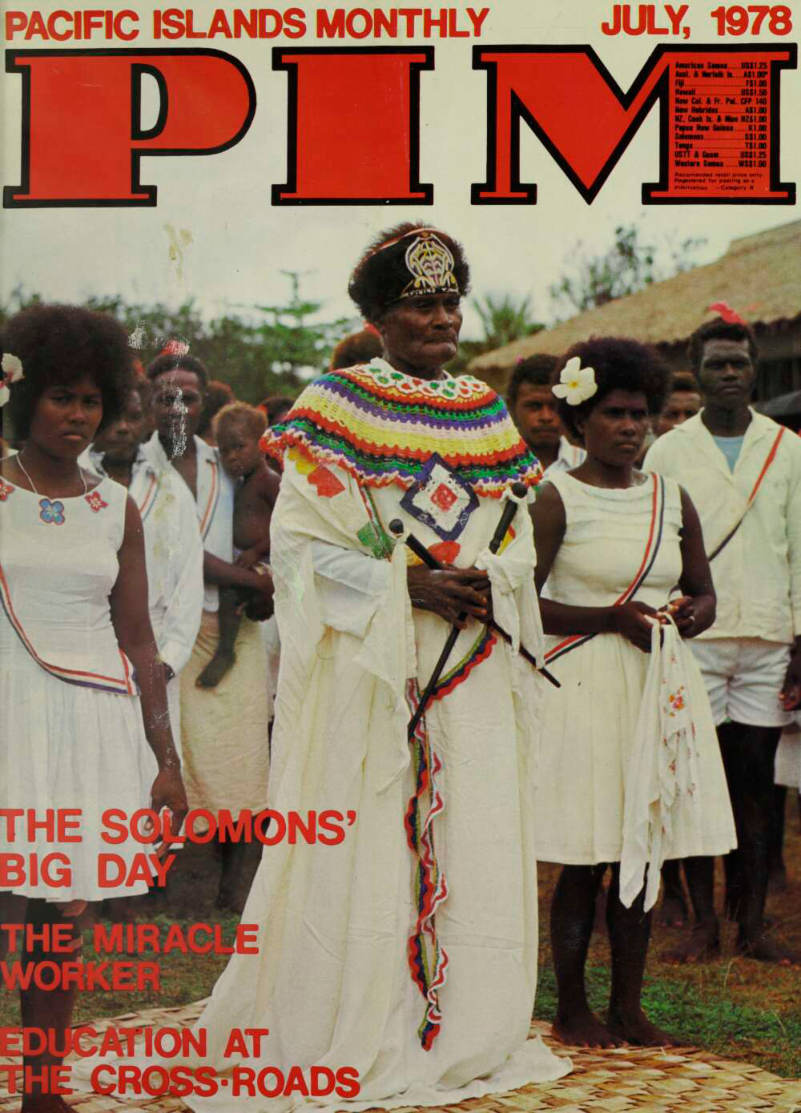
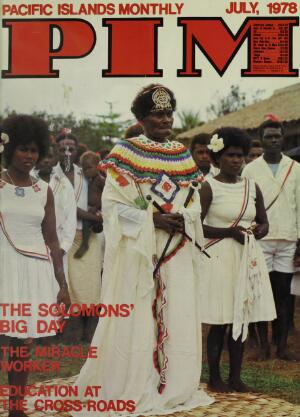
COVER PHOTO: Robed and holding his wands of office, which are modelled on the symbols of office In biblical times, Silas Eto, the Solomons prophet, stands before his people in the vlMage of Paradise Ini New Georgia. Hailed by the people as the Holy Mama (Holy Priest), his story is told In this issue, a special Indepen dence issue, by Dr R. H. Chesher, of Cairns, Queensland, who also took the photograph.
Akai
P.N.G.
S O. Svensson (N.G.) Ltd.
P.O. Box 705, Port Moresby Tel: 2275 Fiji Islands Motibhai & Company Ltd.
P.O. Box 9175, Nadi International Airport Tel: 72-165 New Zealand Pye Ltd., Consumer Products Sector 110 Mt. Eden Rd , Mt Eden, Auckland Tel: 686-437
New Caledonia
Menard Freres Ville B.P. H 2, Noumea Tel: 275222 Tahiti
Etablissements Comimpex
P.O, Box 200, Papeete Tel: 20477 New Hebrides (Islands) Burns Philp (New Hebrides) Co., Ltd.
P.O, Box 27, Bort Vila, New Hebrides Islands Norfolk Island Burns Philp (Norfolk Island) Co., Ltd.
P.O Box 21, Norfolk Island Samoa Islands Burns Philp (South Sea) Co., Ltd P.O. Box 129, Pago Pago, American Samoa Mariana Islands J.C. Tenorio Enterprises P.O. Box 137, Saipan Tel: 6444/8 British Solomon Islands Security Electrical Co., Ltd.
P.O. Box 174, Honiara Tel: 881 Cook Islands JPS Enterprises Ltd.
AJ-480 4-Band Stereo S.OOOmW of powerful stereo beauty, 2-way 4-speaker system, dual micro-
phones, feature-loaded for complete
sound versatility.
AJ-370 3-Band
Dynamic 5,000mW of power through
2-way hi-fi speakers, for crystal clear sound, full-featured for total
convenience.
AJ-350 3-Band
Unsurpassable cost/performance in
a versatile power portable. 3,000mW
output plus a host of other deluxe
recording features.
AJ-480
Audio & Video
AKAI
A 4-WHEE
FOR PO
* • \ r :i i.-uk i o o ■
SUZUKI
X Ski ft "" 9nsx f* at* Looking for handy, reliable transport from home to town?
Forgoing on atrip?
For performing everyday tasks?
Go with a Suzuki! choose one of our rugged,
high-performing 4-wheel drive vehicles,
just meeting your transport needs.
and.. .FOR MORE MOTORING POWER
Look into the traditional excellence of Suzuki’s
performance-proven motorcycles and fleet
of outboard motors something to satisfy your every motoring need.
Going by land or by sea... go with a Suzuki.
DT6S
SUZUKI TS 125
SUZUKI
SUZUKI MOTOR CO., LTD.
Hamamatsu, Japan SOLOMON ISLANDS SOLOMON ISLAND SERVICE STATION LTD. • FIJI M.H. MOTORS • NEW CALEDON IA STE. SUPERCAL • PAPUA NEW GUINEA TUTT BRYANT PACIFIC LTD. • NEW HEBRIDES HENRI LEROUX • NIUE ISLAND BURNS PHILP (SOUTH SEA) CO., LTD. • PONAPE LEO ETSCHEIT • TAHITI NIPPON AUTOMOTO • ELLICE ISLAND TUVALU COOPERATIVE WHOLESALE SOCIETY LTD. • GUAM ISLAND CYCLERY, INC. • NORFOLK MARTIN'S AGENCIES LTD. • AMERICAN SAMOA PACIFIC PRODUCTS, INC. •TARAWA GILBERT ISLANDS COOPER ATIVE FEDERATION LIMITED • TONGA MORRIS HEDSTROM LTD. • WESTERN CAROLINES BECHESRRAK T. COMPANY • AMBROSE D. MINGINFEL'S WHOLESALER • EASTERN CAROLINES KIOMASA STORE
'i - Or
SO i£L—
k '
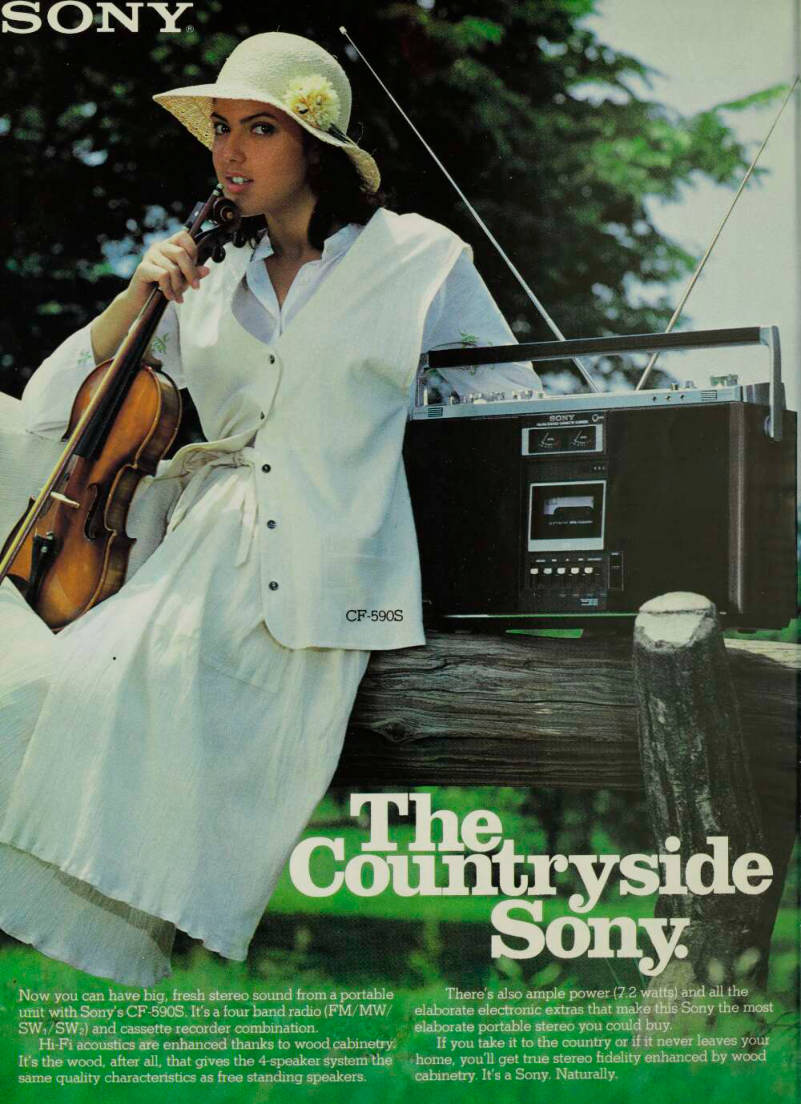
CF-590S
% H . tv mm Now you can have big, fresh stereo sound from a portable unit with Sony's CF-5905. It's a four band radio (FM/MW/ SWI/SW2) and cassette recorder combination.
Hi-Fi acoustics are enhanced thanks to wood cabinetry.
It's the wood, after all, that gives the 4-speaker System the same quality characteristics as free standing speakers.
There's also ample power (7.2 watts) and all the elaborate electronic extras that make this Sony the most elaborate portable stereo you could buy.
If you take it to the country or if it never leaves your home, you'll get true stereo fidelity enhanced by wood cabinetry. It's a Sony. Naturally.
Pacific Report
Png, Indonesia Co-Ordinate ‘ Informally”
“Informal co-ordination” was the careful phrase used by one correspondent to describe the simultaneous despatch in June by Papua New Guinea and Indonesia of extra border patrol forces to their respective sides of the border in an area where Irian Jaya rebel forces were reported to have taken a number of Indonesian hostages (see earlier report, PIM p5l). PNG took action on reports that the rebels had brought their hostages across the border into PNG. Prime Minister Somare said one of the tasks of PNG forces would be to release Indonesian hos tages, if they should be found on PNG soil.
Ok Tuvalu, Go Aheadi
The way is now legally open for Tuvalu’s Big Day, Indepen dence Day, October 1, 1978. The British House of Commons said, “Go ahead” when the Bill giving effect to the regulations establishing an independent Tuvalu passed its second reading on June 13. The third reading is a mere formality. Tuvalu could get into some book of records. On October 1, it will have been self-governing, as distinct from independent, for only five months, the shortest-ever for a British colony. In one year, it will have been governed under three different constitutions.
Independence celebrations begin on September 29 and end on the day. October 1.
Mara Sees A Peking Walkout
Fiji’s Prime Minister, Ratu Sir Kamisese Mara, witnessed one of the now celebrated walkouts by Soviet-bloc diplomats in China at a banquet held in his honour in Peking in June. The Chinese Vice-Premier, Li Hsien-nien, had accused the Russians in his welcoming speech of “trying by every means to barge into the Pacific”. One correspondent speculated that the incident took the Fijian leader by surprise. He wrote: "His pre pared response to Mr Li’s speech was an elegantly worded thank-you in which be referred to the place held in Fijian society by people of Chinese origin.”
Deadly Drinking Party
Fifteen men died in the village of Takekekel, near Kokopo on the Gazelle Peninsula late in May after a drinking party. Three others became blind. The men, most of them Tolais, had been drinking home-made liquor believed to contain surgical or methylated spirits.
Uregei Talks To Papeete Paper
The Papeete newspaper, La Depeche, has carried a full-page interview with New Caledonian independence advocate and Ter ritorial Assembly member Yann Celene Uregei. Mr Uregei was In French Polynesia, in his own words, “for independence, and for the Charlie Ching affair” (PIM, Apr, pi 5). He became a friend of Charlie Ching’s when the latter lived in New Caledonia. Mr Uregei predicted the formation of a federation of Pacific states in the future. He said he thought New Caledonia would become independent by 1982 “even before if the Kanak people are truly united".
Cholera Killed 21 Gilbertese
Since last year’s outbreak of cholera in the Gilbert Islands (PIM, Dec, p 22), 1 339 cases have been reported, and 21 people have died of the disease.
Hebrides Chiefs Say “No” To Junket
The Malvatumauri (Council of Chiefs) of the New Hebrides has rejected an invitation from Chief Minister George Kalsakau
for some of them to make a study tour of Pacific Islands. Among reasons cited by the chiefs were that many things at home needed doing, and that if they were to make a tour at all they would sooner tour the New Hebrides “to get to know our own peoples and our custom before going out from the New Hebrides”.
Hebrides Women Slam Beauty Contest
A group of New Hebridean women has protested strongly against the “Miss New Hebrides” contest, from which the country’s entrant in the "Miss Universe” contest in Mexico in July, will be chosen. They said the contest was “degrading to women and the nation”, and suggested that money spent on it should go to rural development projects, especially projects designed to help women.
Nz, Asian Unions’ Slanging Match
New Zealand unions’ intervention in last year’s dock strike in Fiji (PIM, Sep, p 65) brought implied criticism from the Asian regional organisation of the International Confederation of Free Trade Unions, meeting in Bangkok. The New Zealanders’ reac tion was swift and sharp. Said Federation of Labour president, Sir Tom Skinner: “If the Asian organisation does not give us value for our money then we will have to look at our mem bership.” Singapore labour leader Devan Nair, who is a top official of the ICFTU Asian regional organisation, responded in kind. “New Zealand trade unions do not belong to Asia. We will not tolerate their big white brother syndrome,” he said. He sug gested the FOL join the European trade unions congress.
World’S Deepest Hole In Png?
Is Papua New Guinea the home of the world’s deepest hole?
This is the question 50 speleologists cave explorers, or "cavers”, to the uninitiated will be seeking the answer to in July-August. The group, mostly Australians, but including Papua New Guineans, Spaniards, Americans, New Zealanders and Bri tons, will attempt to explore the Atea Kanada river caves on the Muller Plateau, between the peaks of the Muller Range and the Strickland Gorge in the Southern Highlands of PNG. The 1978 expedition follows on two less elaborate attempts to explore Atea Kanada in 1973 and 1976. The world’s deepest explored cave so far is the Pierre St Martin, which goes to a depth of 1.33 km under the Pyrenees. Organisers of the current Atea Kanada expedition hope to kick Pierre St Martin out of the record books by proving their hunch that the Atea Kanada caves go as deep as 1.5 km over a length of about 9 km.
Webb Tonga Strikes A Snag
An early hitch stopped oil drilling operations by Webb Tonga at the Kumimonu site No. 3, behind Nukualofa’s Free Wesleyan Centenary Church. The drive gear on the rotary table, which turns the drill, broke. A Tonga Webb spokesman said flying in a replacement unit from the United States would cost the company about $3O 000.
AIR CRASH KILLS 11 IN W. SAMOA All 11 people aboard a Cessna aircraft of South Pacific Island Airways died when it crashed into Mt Fito, on Upolu, Western Samoa. All the victims except the captain Rick Jensen, of Los Angeles were Samoans from New Zealand.
Fiji’S 500 In Lebanon
Fiji’s contribution to the peace-keeping force in Lebanon (PIM, June. p 6), is made up of 500 soldiers: 200 regulars and 300 from territorial or reserve forces. The initial cost to Fiji of
$793 000 will be reimbursed by the United States on a percent age basis over four years. The men arrived in Lebanon on June 1 by a special UN-organised airlift.
Suva’S Administrators Stay On
Fiji’s capital, Suva, will not have an elected council for another year or more. The city has been run by administrators since the government dismissed the old council in 1977 (PIM, Dec, pi 2) after an inquiry had revealed evidence of widespread malprac tice in its work. The administrators’ term has now been extended.
When they took over the council had an overdraft of $1.5 million.
Now it is in the black to the tune of $250 000.
Mountain Lake A Threat To Lae
Geologists fear that Lake Wanum, a mountain-top lake in Papua New Guinea high above the Markham Valley, may burst, pouring tens of millions of cubic metres of water into the valley leading to Lae, second largest city in PNG. Their report says that the trouble has been caused by earth movements in the mountain chain bordering the Markham Valley, and urges the government to take corrective action in one of two ways: strengthening a low saddle in the lake’s containing walls, or using siphons to lower the water level.
Fine On Suva Editor Upheld
The Fiji Supreme Court has confirmed a fine of $1 000 imposed on a former acting editor of the Fiji Sun, Stafford Guest, for having illegally published committal proceedings in which a man was charged with murder. The Chief Justice, Sir Clifford Grant, said it was difficult to believe that the fine, the maximum that could be imposed, would act as a meaningful deterrent in the case of a daily newspaper with a country-wide circu lation.
Pacific Export Drive By Micronesia
A drive to boost exports to Pacific countries has been approved by the Congress of Micronesia. Its Committee on Resources and Development, chaired by Representative Sasauo Haruo of Truk, planned a fact-finding visit in July and August to Nauru, Fiji, the Solomons, Papua New Guinea, the Samoas and Hawaii.
Aussies On The Run?
New public service pay scales announced by the Papua New Guinea Government are expected to lead to a mass exodus among the 1 700 Australians remaining in the service. The scales provide standard salaries for all expatriates, wiping out the substantial advantage previously enjoyed by Australians over Britons, New Zealanders and Filipinos.
The Taiwan-Tonga Love Affair
The Taiwan Government has upgraded its diplomatic rep resentation in Tonga to that of fulltime resident ambassador. Pre viously the post was held concurrently by a diplomat serving also as ambassador to Colombia. Announcing the appointment of Mr Cheng Kao to the new job, Taiwan’s Foreign Ministry said the appointment showed that Taiwan recognised Tonga as a nation on the same footing as the United States, “even though they are different in size”.
Suva’S Lady Snooper
Fiji now has a female “private eye”, Mrs Savita Devi Singh, who is in her early 20s. Behind her, as she opens her Suva-based Ace Investigations, are four years study of criminology by cor respondence with the Institute of Applied Sciences, Chicago.
In the process she sat for no fewer than 54 examinations. She will investigate thefts and murders, collect evidence for divorce cases, and provide general security services.
Caledonian Unions Strike
Five trade unions in New Caledonia on June 12 called “a gen eral and unlimited” strike against the rising cost of living. This was just after 8 000 trade unionists marched on the Territorial Assembly to present a petition about their protest. The strike was expected to affect postal services, airlines and public trans port.
Diarrhoeal Diseases Workshop
A three-day workshop in Port Moresby studied techniques of oral rehydration in treating diarrhoea! diseases in young chil dren, the major killer of children in developing countries. Oral fluid therapy reduces the need for expensive intravenous fluid treatments and hospitalisation. It can be used safely by aid-post orderlies or village health aides to reduce deaths among young children in remote areas. The workshop was sponsored by the World Health Organisation.
Catholic Bishops On Png “Materialism”
Roman Catholic bishops have criticised what they called “the greedy materialism of the new Papua New Guinea”. At a con ference on Bougainville they referred to what they saw as an upsurge in extortion, dishonesty, shady business dealings, drunken brawling and tribal fighting. They said that money, or other forms of material gain, were now entering into almost every social relationship.
Winkel Backs Palau Strikers
A lengthy strike by 44 workers at the Continental Hotel, Palau’s only international class hotel, is receiving support from unlikely places. The High Commissioner for the US Trust Terri tory of the Pacific, Adrian P. Winkel, has approved a $4 000 appropriation by the Congress of Micronesia to help defray strike expenses, and a visiting member of the US Congress, Phillip Burton (D-Calif), made a personal donation of $5O to strike funds. The hotel is owned by Continental Airlines, which also operates Air Micronesia. The company has been sharply cri ticised by Mr Winkel, who has said that only the lack of a Trust Territory labour law prevents him from doing anything legally to settle the strike.
PNG SCRAPS HONOURS - BUT NOT YET Papua New Guinea has announced it will be phasing out imperial honours and introducing a system of national honours.
But for 1978 at least the imperial system was still well and truly in. In the Queen’s Birthday honours list announced in June Prime Minister Somare became a CH (Companion of Honour), the Speaker of the National Parliament, Mr Kingsford Dibela, a CMG (Companion of the Order of St Michael and St George), and Transport and Civil Aviation Minister, Mr Bruce Jephcott, a CBE (Commander, Order of the British Empire). Over in Fiji, main honours went to the auditor-general, Mr Tamesar Bhim (CBE), and to Dr George Hemming, welfare worker and parish minister at St Luke’s Church of England, an OBE, Order of the British Empire.
Boys And Girls Neck And Neck
American Samoa has a population of about 30 600, according to a sample census survey. This figure is about 5% higher than the 1974 census. Sharpest increase has been in the female population: in 1974 there were two males for every female, but the latest figures put the ratio at one to one 15 251 males to 15 350 females. An official suggested that this may indicate that since 1974 more males have left the territory, either to search for economic opportunity by joining the armed forces, or to further their education.
Pacific Islands Monthly
Vol 49 No 7 JULY 1978
Publisher: Stuart Inder
Editor: John Carter
Pacific Report 5
encapsulated news
Letters 8
free Micronesia, free advice and power in PNG
The Solomons’ Big Day 9
what’s happening on Independence Day
Clouds In The Sky 9
not all sunshine for the Solomons
The Modest Prime Minister 11
the rise of Peter Kenilorea
Solomons’ Economic Future 16
"first four years quite good’’ says Kinika
The Holy Mama 18
miracles in New Georgia
Solomons’ Education 21
end of a great experiment?
Tropicalities 23
butterfly on a flag, Somare on education.
Solomons’ News 29
hanging, pirating, farming and the National Anthem
Fiji’S Culture Centre 31
dancing with the spirit behind you
Australian Senate Report 35
blueprint for total involvement in the Islands
Afterthoughts 38
Percy Chatterton and the problems of youth in
Png
Political Currents 39
PNG honesty code, New Hebrides’ new calm, Micronesia breakthrough, reaction in the Cooks, Torres Strait
People 52
Capt ‘Frog’ Evans, French minister replaced, a hero in New Caledonia
Books 55
Secret Discovery of Australia, Pacific’s modern migrants
Tradewinds 62
money is a bad smell, PNG’s deal with Japan, Fiji’s ‘pig-headed’ hospital administrators
Yesterday 67
Kakamora on the Whiteman’s impact on the Solomons
Cruising Yachts 73
Sarabande, Boomerang, Mata Moana, Wayward Wind, Shearwater and others
Transport 75
Fiji-New Zealand row, Tonga’s new airport and air line, Fiji towns battle for status
by R W Robson in 1930 - 11 is published monthly by Pacific Publications (Aust.) Pty Ltd, 76 Clarence Street, Sydney, 2000. Post Address: G.P.O.
Box 5408, Sydney, N.S.W. 2001. Telegraphic Address: PACPUB, Sydney, Telex: 21242. Telephone; 29 6693 Publisher: Stuart Inder Manager: John Berry. Advertising Manager: Steve •fo if i C 5* a^ S Mo nt £'.y is^'« r ? i9hted t0 the ma i ority of subscribers and agents in the Pacific Islands and the USA. Australia, $12 Aust; Norfolk Island, $12 Aust; owr a! 5°a NZ ’ 512 £ ust; F|JI ;, $1 ? Fl)l ®?’ $12 Aust: New Hebndes . Tonga, Cook Islands, Western Samoa, Gilbert Islands, Tuvalu, Niue, Nauru and Solomon Islands, $13 Aust; PCD' A..i. mJ* / ; n^n^c S A am . 0a ', North fT^® r,ana l’ Guam and Hawaii ’ $16 us ’ $13 Aust; us Mainland and Canada $18 US, $14 Aust; New Caledonia and French Polynesia 1,700 tralia Aust ’ U *' Aus *’ Japan 4,500 Yen, $16 Aust; Elsewhere $16 Aust. Note: Overseas remittances in Australian dollars should be by bankdraft payable at Sydney, Aus- STrSKfilf'S? W Distrihution and subscriptions - Desai Bookshops, P.O. Box 160, Suva, Fiji. Telephone: Suva 23036. Advertising, Fiji Times & Herald Ltd., 20 Gordon Street, c 1 JJc P . apu r? H V Gu,naa: Advertising - PNG Post-Courier, P.O. Box 85, Port Moresby. Distribution - Robert Brown & Assoc. P.O, Box 3395 Port i.K v-- 2 -^ 55 Distribution - Hachette Pacifique, 10 Ave Bruat, Papeete New Caledonia: Distribution - Depot Centre de Presse Michel Pentecost, B.P.C2 _7i^rc^?^ Q K r?^? ,n 4 : o an ,o W -? e 1 kly T ' mes Limited - ®- 10 Clifford’s Inn, Fetter Lane, London EC4A 1BU. Telephone: 01 831 6041. Telex: London 21989. Japan: Advertising P wStonS■ ?°. x t* I?^™?;^ 6 / 3 * N#w Zaaland: Paci,ic Publications, C.P.O. Box 2229, Auckland. Advertising inquiries: International Media Represen ok II L 3880 D Telex NZ21157. (Auck. 40) Hawaii and U.S. Mainland only: RIM, Hawaii, 2812, Kahawai St., Honolulu, Hawaii, 96822. Second class H? Kf ? at^n^ lu .'.. Haw . an - . u ? Advertising Representative, Joshua B. Powers Jr. Powers International Inc. 551 Fifth Ave, New York, New York 100 017. Telephone: 867 9580. Telex BrW»an«-D F^ ,l ? ,, 1 p atlon s (Aust) Pty. Ltd., Herald and Weekly Times Building, 2nd Floor, 61 Finders Lane, Melbourne, 3000. Telephone: 652 1565. ontoan*. u wood, Anday Agency, Box 1918 G.P.O., Brisbane, 4001. Telephone: 44 3485; 44 1546.
AuSrai?fl h n o td Prin, ® d in Australia by Paramac, Mitchell Rd, Alexandria, PIM is distributed in Australia and New Zealand by Gordon & Gotch.
Australian cover price is recommended retail only. Registered at the G.P.O. Sydney for transmission by post as a publication — category B. AA
Letters
Free
Micronesia!
It is now more than 30 years ago since the American troops occupied Micronesia and they are still there! For what reason? Naturally to incor porate the territory into the USA. Similar has happened before to Hawaii.
In 1899 just 15 years be fore the outbreak of World War I American troops occupied Hawaii and de stroyed the freedom and independence of the small Hawaiian kingdom forever.
The Americans spread the rumour that the royal family was insane an old trick used by the Americans against those who oppose them and the
royal family was disposed of.
And that leads us to Pearl Harbour, 1941. The Japanese did not attack an American ter ritory but an island illegally
occupied and colonised by
Americans. The crime per petuated by the Americans in 1899 was so much worse than Pearl Harbour. Of the original 100 000 true Hawaiians only a few hundred have survived.
To acquire Micronesia the Americans do not hesitate to use varying tactics. Micronesia is, of course, a potentially very rich country, possibly much richer than any Arab country.
There could be vast oil fields and on the sea bottom large de posits of manganese nodules, all of which the Americans
want to grab. So they spread
the rumour that Micronesia is a very poor country unable to support itself. They also direct its economy so that it will be dependent on America. The Americans are using propa
ganda, brainwashing, coercion
of different kinds, as well as traitors and immigrants to
achieve their goal incorpora
tion of Micronesia into the
USA and ultimately hegemony
of all the Pacific. An act of self determination would be like
the one in Irian Jaya.
We know that Micronesia has been under colonial rule for more than 300 years, first under the Spanish, then the Germans and Japanese, last named treating it as part of Japan, and now the Americans.
Have the people of Micronesia developed into a race of serfs some kind of serfs of the Pa cific willing to be ruled by their white, colonial masters 15 000 km away or are they as proud and independent as the Ton gans and Western Samoans?
Only by demanding full free
dom and complete indepen
dence can the people of Micronesia show that they are a noble people.
There should be in the United Nations Charter a law that any people under UN Trusteeship must attain absol
ute independence. Rights to
exploration and exploitation
should be carefully supervised
directly by the United Nations.
Then what is happening in Micronesia could not happen.
Never has a UN Trusteeship been treated in such a shocking way as Micronesia. One need only mention Bikini with its radioactive bomb craters and its people suffering from dis eases of radioactivity, or the slum areas of Kwajalein, the only one in the Pacific beside
Pago Pago’s.
It is a dark page in the his tory of mankind when a country of 200 million Americans are trying to bull doze 100 000 Micronesians from the surface of the earth as they did to the Red Indians.
The book “ Bury My Heart at Wounded Knee” could then in dicate the fate of the Micronesian people too!
France and England have a fine record of decolonisation, and Australia can be proud of the way they handled the
independence of Niugini:
“Niugini must get indepen
dence whether they want it or not.” It has proved a great suc cess.
In Niugini only persons with at least two grandparents born in the Territory were automati cally considered citizens a very clever move by the Pan ginians. For Micronesia it should be similar, but with an addition. Anyone who has or has had American or other foreign citizenship should be
forthwith excluded from citi zenship rights for at least 10 years.
The independence of Micronesia is the most import ant issue in the Pacific of today.
Let us insist that no other country be granted indepen dence until Micronesia has got its place as a free and indepen dent nation among the brother hood of free nations.
Noumea
Kaliou
New Caledonia
Free Advice
On Engines!
PIM may remember me in the Sixties as the Marine Man ager of Thornycroft (Aust) Pty Ltd until taken over in ’62 by AEC Ltd. I cannot remember or trace the name of the then advertising manager for PIM but we often commented on the fact that I started advertis ing marine engines etc years ago very beneficially and the opposition soon followed suit not that I worried much.
I am now “more or less” retired and living in Queensland. I occasionally see PIM and sometimes a letter from BSIP. As I have plenty of time now, perhaps a little para graph or note in PIM may help any reader who has a Thor nycroft or Stuart Turner engine and finds difficulty in solving any relevant problems.
A governing factor in my ap proach is that I retained all my personal records of all engines sent to the Territories, and all books, details, drawings, etc.
They would be the only ones in Australia. In addition, I introduced Stuart Turner engines to Australia as I had known them with our Singa pore branch. I still correspond with the Stuart works. Thor
nycroft’s marine engines are
still manufactured by the AEC- Leyland company but from enquiries and contacts, the number coming to Australia is small. Before the company take-over I visited the Islands every two years Norfolk Island, Vila, Santo, the Solomon Islands, Rabaul, Wewak, Madang, Lae, Samarai and some of the missions.
Whether the business is as good nowadays would be bet ter known to you. I am not interested in any financial
angle but there may be people in the Islands wanting to know engine or marine information.
I would be happy to endeavour to clear up any problems for them. After a lifetime in this field one does not lose interest.
I am still retaining membership of the Institute of Marine
Engineers, UK, which keeps
me up-to-date.
T. G. Lashmar
6/21 First Avenue Broadbeach. Qld. 4207. • PIM does indeed remember Mr Lashmar, who knows his stuff. His offer no doubt will be appreciated by many Islands people, who should write to him direct.
Power In Png
Reading Percy Chatterton’s
reference to the establishment in Papua New Guinea of mini
hydro-electric projects (PIM,
May, p 27), makes me ask, “For whose benefit?”. I hap pened to be at Simbai in the highlands of the Madang Prov ince when the first of these schemes was opened by the Minister for Public Utilities.
In his speech, he mentioned how the people would be able to use electricity for cooking and ironing and keeping their beer cold. Good in theory, but the output is not sufficient for cooking. But who are the
people who have electricity?
Only those who live on the government station. We have a mission station with a level four community school next door, but no power goes there.
We have asked for it and a sur vey is being done now. The estimated cost is Kl 2 000 to bring the power to us and there is no certainty of any help
coming from Rural Improve
ment funds. The Local Government Council offices are also next door, but they do not have power either. Not far away the local people have a large bulk store no power there either. No village ben efits. Certainly the scheme is small; it is beautiful - no pol lution, it fits into the landscape.
But it is not improving the quality of rural life, except for those who live on the govern ment station.
Jeremy Ashton (Rt Rev’D)
Bishop of Aipo Kongo Anglican Church of PNG Lae, PNG
Advertisements & other items, p. 8 (1 item)
8
PAnnr iqi AMn.c; momthi y_.ini y IQ7R
The Big Day: The Solomons Celebrate
Honiara did not exist before World War 11. At best, American servicemen who served in that war remember it as a nondescript collection of Quonset huts on the island of Guadalcanal, control of which they bitterly contested with the Japanese. But Honiara will live through its finest hour on July 7. At the end of that day, it will have thrown off most memories of its humble beginnings to emerge as the capital of the world’s newest independent nation, the Solomon Islands. Plans for the Solomons’ “Big Day”, and the immediate political background and problems of Solomons’ independence, are sketched out in the articles which follow.
The almost 200 000 people of the Solomon Islands, largest
remaining British dependency
in the South Pacific, will attain
their political independence on
July 7.
Plans for what has become known in the Solomons as “the Big Day” are well up to the measure of the occasion.
As reported earlier (PIM, May, p 5), 26 countries, 13 in ternational organisations and three Pacific universities have been invited to the cele brations. The United States, Australia and New Zealand are expected each to send a war ship to honour the occasion.
The Queen will be represented by her cousin Prince Richard, Duke of Gloucester, who will be accompanied by the Duch ess.
Central celebrations in the capital, Honiara, once a Quon set hut complex, will take place during the week July 3-8, with the key symbolic event occur ing at Lawson Tama on July 7 when the Union Jack will be lowered and the Solomon Islands flag in the national colours of blue, green and yellow, run up.
Honiara’s crowded week will include a national display, fol lowed by a fireworks display, on July 6, a national show, based on Home Ground, run ning from July 5-8, a series of receptions and a State Ball, sports events, a regatta, an ecu menical service staged by the Solomon Islands Christian As sociation, and a final carnival float parade on July 8.
Celebrations in the districts will mostly take place in the following week, with Gizo the venue for independence events in the Western District (July 5-10), Kira Kira in Makira/Ulawa District (main
celebrations starting on July
12), Graciosa Bay in Santa Cruz District (main cele brations from July 12), and Auki in Malaita District (main celebrations from July 11).
Main reason for the time dif ference is to give time for senior representatives of the districts to get back home after the central celebrations in Honiara.
A feature of the celebration plans is the attention given to the participation of the young.
It is planned to provide every child in the Solomons with a
ballpoint pen bearing the
national colours, and with a leaflet carrying the text of the new national anthem (see else where in PIM).
Celebrations will not be con fined to the Solomons; in far off London there will be a special service in Westminster Abbey on July 7, at which it is expected that a member of the royal family will represent the
Queen. This will be followed by a reception for prominent Solomon Islanders and other
distinguished guests.
The Solomons celebrations will be the subject of a 90minute film made by the Aus
tralian Government-run Film Australia. The crew spent sev eral weeks in the Solomons be
fore the “Big Day”, shooting
and soaking up atmosphere. To be presented as a gift to the Solomon Islands, the film fol lows similar productions made
by Film Australia covering
independence celebrations in Fiji (1970), and Papua New Guinea (1975). It is to be com
pleted by Christmas.
Choice of the royal represen tatives has caused a stir in the Solomons, where there is a feeling that a personality closer to the Queen, such as Prince Charles, if not the Queen her self, should have come for the
independence celebrations
(PIM. May, p 5).
Replying in April to a
suggestion along these lines by
the Leader of the Opposition, Mr Ulufa’alu, Chief Minister Kenilorea emphasised that it was entirely up to the Queen to choose her representative. But he added that “the dissatis faction of the people” on this matter had been conveyed to
her Majesty.
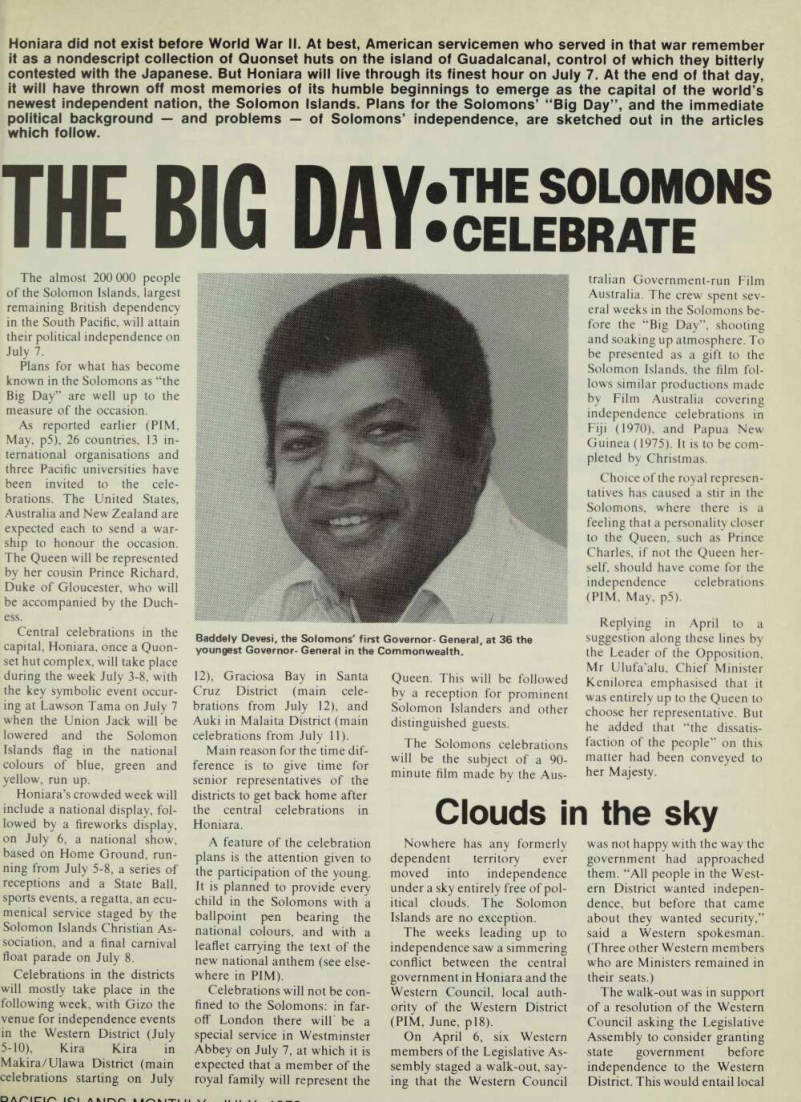
Baddely Devesi, the Solomons' first Governor-General, at 36 the youngest Governor-General in the Commonwealth.
Clouds in the sky
Nowhere has any formerly
dependent territory ever
moved into independence under a sky entirely free of pol itical clouds. The Solomon Islands are no exception.
The weeks leading up to
independence saw a simmering
conflict between the central government in Honiara and the Western Council, local auth ority of the Western District (PIM, June, p 18).
On April 6, six Western members of the Legislative As sembly staged a walk-out, say ing that the Western Council
was not happy with the way the government had approached them. “All people in the West ern District wanted indepen dence, but before that came
about they wanted security,”
said a Western spokesman. (Three other Western members who are Ministers remained in their seats.) The walk-out was in support of a resolution of the Western
Council asking the Legislative
Assembly to consider granting
state government before independence to the Western District. This would entail local
control of natural resources, finance, administration, lands,
internal migration and legis
lation.
The Westerners’ action was at once supported by the oppo sition National Democratic Party, whose leader, Bartholomew Ulufa’alu, led his party members in a second walk-out.
There followed a busy round of talks in Honiara and the Western centre of Gizo. Chief burden on the government side was carried by the Minister of Home Affairs, Mr Francis Hilly, himself a Western rep resentative.
There were claims and counterclaims as to whether the Western Council would accept the $2O 000 offered by the central government for the expenses of independence cel ebrations in Gizo.
The Western District even went to the lengths of sending a delegation to Australia for discussion with a firm of law yers. The three members of the group were the council’s presi dent, Mr Jerry Buare, and two former politicians, Mr Peter Salaka, former member of the Governing Council, and Mr Sam Kuku, former member of the Legislative Council.
While the dispute seemed far from resolved, Mr Hilly was conciliatory. He said the government “fully under stood” the Western resolution, and “in no way was attempting to confront the council”.
He added: “Ways of accom modating such wishes as ex pressed in the Western Council resolution are being seriously considered in the context of the
present set-up.”
However things turn out on July 7, the problem of Western dissidence will certainly stay with the central government well into independence.
If there were clouds in the West, there seemed to be gen eral satisfaction with the
independence constitution,
worked out at tough bargaining sessions in London earlier in the year.
Chief Minister, Mr Peter Kenilorea, described the con stitution as “largely a measure of our own making”.
Main differences had centred on the questions of citi zenship and land.
Mr Kenilorea said; “We
knew that we had to negotiate and press hard for the points we believed very strongly in.
“Overall we adopted a very realistic stand which paid good dividends in the end.”
But a nagging problem
remained; would it not have been possible for the consti tution to deal more specifically with the problem of the powers of provincial government, the question at the root of the troubles with the Western Dis trict?
This problem, too, awaits its
thrashing out in the early days
of the newly independent nation.
It can be pointed out, how ever, that Britain, in all such
negotiations for independence
in the past, both in the South Pacific and in other places notably in Africa has tended to leave such considerations, as the degree of power provincial governments should have, to
the particular country going
independent.
It seems that Britain has felt that such matters should be tackled by the people them selves; that she did not want to influence them in matters which would only become im portant after independence.
The cynic would say that Bri tain didn’t want to be blamed for the mistakes her ex colonies made when they began to paddle their own canoe.
In like fashion, Australia left such matters severely alone.
Provincial government was something that was clearly left to the Papua New Guineans to sort out.
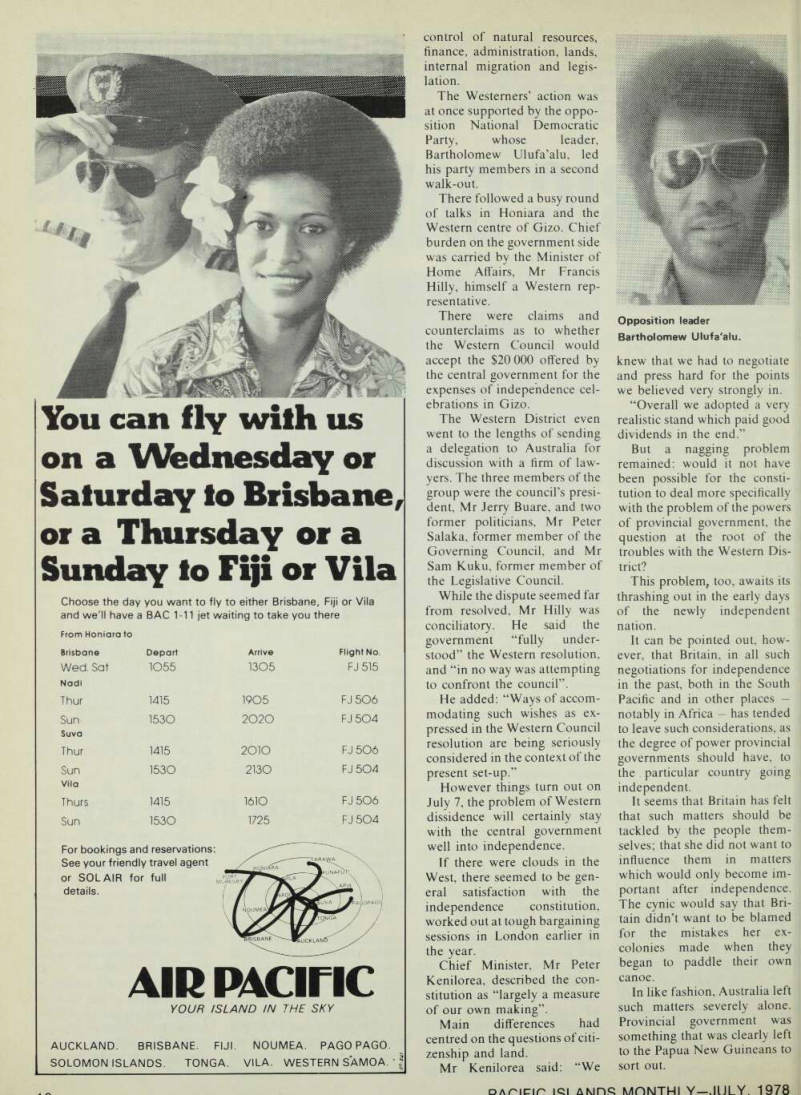
Opposition leader Bartholomew Ulufa'alu.
Advertisements & other items, pp. 9-10 (3 items)
D A P ICI IO I aki r\ o i i /~\ k i -i- ill \ / 11 11 « / . A
10
DAncrir IQI ANin.q MDNTHI Y—JULY. 1978
Air Pacific
% is
You can fly with us
on a Wednesday or
Saturday to Brisbane,
or a Thursday or a
Sunday to Fiji or Vila
Choose the day you want to fly to either Brisbane, Fiji or Vila and we'll have a BAC 1-11 jet waiting to take you there From Honiara to For bookings and reservations: See your friendly travel agent or SOL AIR for full details.
AIR PACIFIC
YOUR ISLAND IN THE SKY
AUCKLAND. BRISBANE. FIJI. NOUMEA. PAGO PAGO.
SOLOMON ISLANDS. TONGA. VILA. WESTERN SAMOA. ’
Prime Minister
CHE RISE AND RISE OF A MODEST
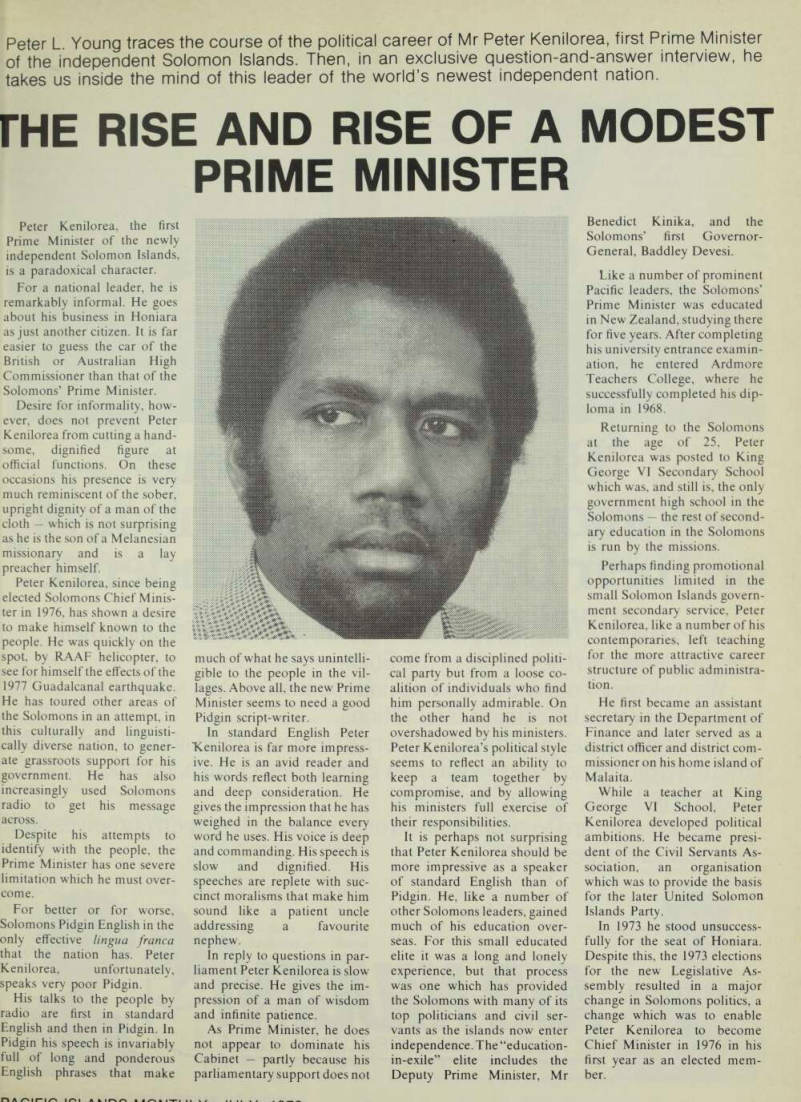
Peter L. Young traces the course of the political career of Mr Peter Kenilorea, first Prime Minister of the independent Solomon Islands. Then, in an exclusive question-and-answer interview, he takes us inside the mind of this leader of the world’s newest independent nation.
Peter Kenilorea, the first Prime Minister of the newly independent Solomon Islands, is a paradoxical character.
For a national leader, he is remarkably informal. He goes about his business in Honiara as just another citizen. It is far easier to guess the car of the British or Australian High Commissioner than that of the Solomons’ Prime Minister.
Desire for informality, how ever, does not prevent Peter Kenilorea from cutting a hand
some, dignified figure at
official functions. On these occasions his presence is very much reminiscent of the sober, upright dignity of a man of the cloth which is not surprising as he is the son of a Melanesian missionary and is a lay
preacher himself.
Peter Kenilorea, since being elected Solomons Chief Minis ter in 1976, has shown a desire to make himself known to the people. He was quickly on the spot, by RAAF helicopter, to see for himself the effects of the 1977 Guadalcanal earthquake.
He has toured other areas of the Solomons in an attempt, in
this culturally and linguisti
cally diverse nation, to gener ate grassroots support for his government. He has also increasingly used Solomons radio to get his message across.
Despite his attempts to identify with the people, the Prime Minister has one severe limitation which he must over come.
For better or for worse, Solomons Pidgin English in the
only effective lingua franca
that the nation has. Peter
Kenilorea, unfortunately,
speaks very poor Pidgin.
His talks to the people by radio are first in standard English and then in Pidgin. In Pidgin his speech is invariably full of long and ponderous
English phrases that make
much of what he says unintelli gible to the people in the vil lages. Above all, the new Prime Minister seems to need a good
Pidgin script-writer.
In standard English Peter Xenilorea is far more impress ive. He is an avid reader and his words reflect both learning and deep consideration. He gives the impression that he has weighed in the balance every word he uses. His voice is deep and commanding. His speech is slow and dignified. His speeches are replete with suc cinct moralisms that make him sound like a patient uncle addressing a favourite
nephew.
In reply to questions in par liament Peter Kenilorea is slow and precise. He gives the im pression of a man of wisdom and infinite patience.
As Prime Minister, he does not appear to dominate his Cabinet partly because his parliamentary support does not
come from a disciplined politi cal party but from a loose co alition of individuals who find him personally admirable. On the other hand he is not overshadowed by his ministers.
Peter Kenilorea’s political style
seems to reflect an ability to
keep a team together by
compromise, and by allowing
his ministers full exercise of
their responsibilities.
It is perhaps not surprising that Peter Kenilorea should be more impressive as a speaker of standard English than of Pidgin. He, like a number of other Solomons leaders, gained much of his education over seas. For this small educated elite it was a long and lonely experience, but that process was one which has provided the Solomons with many of its top politicians and civil ser vants as the islands now enter independence. The “education in-exile” elite includes the Deputy Prime Minister, Mr
Benedict Kinika, and the Solomons’ first Governor- General, Baddley Devesi.
Like a number of prominent Pacific leaders, the Solomons’
Prime Minister was educated in New Zealand, studying there for five years. After completing his university entrance examin ation, he entered Ardmore Teachers College, where he
successfully completed his dip
loma in 1968.
Returning to the Solomons at the age of 25, Peter Kenilorea was posted to King
George VI Secondary School
which was, and still is, the only government high school in the Solomons the rest of second ary education in the Solomons is run by the missions.
Perhaps finding promotional
opportunities limited in the small Solomon Islands govern ment secondary service, Peter Kenilorea, like a number of his
contemporaries, left teaching
for the more attractive career structure of public administra tion.
He first became an assistant secretary in the Department of Finance and later served as a district officer and district com missioner on his home island of Malaita.
While a teacher at King George VI School, Peter
Kenilorea developed political
ambitions. He became presi dent of the Civil Servants As sociation, an organisation which was to provide the basis for the later United Solomon
Islands Party.
In 1973 he stood unsuccess fully for the seat of Honiara.
Despite this, the 1973 elections for the new Legislative As sembly resulted in a major change in Solomons politics, a change which was to enable Peter Kenilorea to become Chief Minister in 1976 in his first year as an elected mem ber.
The 1973 elections changed the character of the Solomons legislature. Only five out of 14 members of the previous body, the Governing Council, were returned to the newly constituted Legislative As
sembly.
Entering the new legislature
were 10 new members who had been active in the Civil Ser vants Association. Their com mon outlook brought to the
legislature a comparatively
unified bloc that later formed the United Solomon Islands
Party.
The then Chief Minister, Solomon Mamaloni, although
not favouring political parties,
rallied the experienced mem bers of the legislature into the
People’s Progressive Party.
The PPP was increasingly at Loggerheads with USIP Mam
aloni, previously regarded by
the colonial administration as a radical, now seemed cast by USIP as a conservative on the independence issue. Mamaloni was for going slowly towards independence. USIP were
seeking independence as soon
as possible.
Mamaloni resigned in 1976 after the elections. He gave no
reasons for his resignation but was clearly fed up with politics and the inability of the PPP and USIP to work well
together.
Peter Kenilorea had stood for his home East ‘Are ‘Are dis trict on the island of Malaita in 1976 and was successful in win ning the seat. With Mamaloni’s resignation, Kenilorea was elected Chief Minister by the
Legislative Assembly on July
14, 1976.
Peter Kenilorea’s rapid rise is explicable if it is remem bered that the base of his sup port, was from members of the Civil Servants Association, who had been elected three
years previously.
Although the base of Mr Kenilorea’s support was the United Solomon Islands Party, he has often said that he does not believe in political parties.
He regards the advent of party politics in the Solomons as premature and potentially divisive.
Two weeks after his election to the post of Chief Minister, Mr Kenilorea was on his way to Nauru to address the South Pacific Conference where he acquitted himself well in a speech arguing for an end to
the confusion and waste caused by overlapping Pacific
development organisations.
After this conference, Peter Kenilorea played host to Papua New Guinea’s Prime Minister, Michael Somare.
This did something to better re lations between the two coun tries, which had become strained after the previous Solomons’ Chief Minister, Solomon Mamaloni, was credited with making indiscreet remarks in support of Father John Momis’
Bougainville separatist move
ment. Peter Kenilorea realises that just as the view of the Solomons Government, on the question of Bougainville, is im portant to the Somare Govern ment, so the attitude of Port Moresby to the Solomons’ own separatists in the west is im portant to Honiara.
Peter Kenilorea is, on his re cord, a democrat and a cau tious moderniser. While he does not like everything he sees in modern society, he equally scorns those who bemoan the passing of traditional culture, while taking advantage of all that Western technology has to offer.
His point of view was well
expressed in an article he wrote for a recent issue of Pacific Perspective in which he said: “Was it really the colonialists’ fault that mini-skirts became the idol of our Honiara girls?
Did colonialists come to the Solomons with the doctrine that man’s value is found in mini-skirts and that girls in
ankle-length apparel would be
punished? No. Are we our selves sure what cultural value in traditional dressing is being devalued by mini-skirts? Re member that the birthday suit was the dress norm of our traditional culture.”
Peter Kenilorea is above all a man of principle. He is a tee totaller and a sincere Christian.
He sees debate as inevitable, and says that he welcomes con structive criticism.
He has no illusions about the future. He has said: “Indepen dence means the transfer of power and responsibility. It does not mean immediate per sonal benefits. It brings its obli gations as well as its rewards, its problems as well as its
joys.”
Or, as he put it in his Christ mas message to the people of the Solomons, “The only thing we have to fear is ourselves.”
Advertisements & other items, pp. 11-12 (3 items)
m a in i io i a k a i iii \ / ••■• % < . _
m a in i io i a k a i iii \ / ••■• % < .
12
PAniFir |C| ANns MONTHLY-JULY. 1978
Air Niugini
m * Piiiil
Best wishes to our
Solomon Islands neighbours
on their Day of Independence.”
As Papua New Guinea’s National Airline, Air Niugini extends their congratulations to the people of the Solomon Islands.
We welcome your move towards independence, and share your excitement over the coming celebrations.
We would like all Solomon Islanders to feel welcome aboard Air Niugini, whether you are coming to visit us in Papua New Guinea, or when you’re flying on to Japan, Asia or Australia.
We look forward to continuing strong relations between ourselves and wish you all the best for the future. ■a*
AIR NIUGINI
THE NATIONAL AIRLINE OF PAPUA NEW GUINEA 821.P.085
A Christian’s political testimony
Q. You had to go to New Zealand for your senior high school and -teacher training.
How did you feel at that age leaving the Solomons for a
foreign land?
A. I started my primary
schooling at King George VI
School, Aligegeo, at 14. By the
time I completed secondary
schooling there I was already 19. So that when I left for my upper sixth form and sub sequent teacher training in New Zealand I was already reasonably mature. I realised what a strange land and people I would find in New Zealand.
I already had a fair idea from my geography lessons that New Zealand would be different from home.
Q. What were your im pressions of New Zealand after spending a number of years there?
A. My impressions of New Zealand during my stay there,
in the late 60s, were, to be frank, very good. There was a
homely atmosphere and racial
harmony in a multi-racial and multi-cultural situation. There was no sense of that imper sonality which sometimes undermines the society of man in the crowded cities of the world. It may be different now of course.
Q. Were there any other Solomon Islanders at Ardmore Teachers’ College while you were there? If so, who were
they and what are they doing
now?
A. Yes, there were two Solomon Islanders who shared my years at Ardmore Teachers’
College. They were Levi Laka and Matthias Ramoni. lam pleased to say that they are doing very well for themselves and for this country at present.
Mr Laka is the deputy prin cipal of the Solomons Teacher
Training College and Mr
Ramoni, who was also a lec turer at that college, is now the president of Makira/Ulawa Council. He will be the first Premier of that province after
independence in July.
Q. Why did you leave teach ing for the public service?
A. Frankly speaking, I was invited to join the public ser vice in the interest of the Solomon Islands localisation programme at that time.
Q. Why did you leave the
public service for politics?
A. As a committed Christian I was convinced that that’s where the Lord would have me best serve my people and country at this time in our
nation building. Although the
administration invited me in May 1975 to become the first Solomon Islands diplomat trainee, I opted to be a poli tician instead.
Q. You are a committed Christian. Is there any passage
in the Bible that you find par ticularly applicable to your life as a politician?
A. As a committed Chris tian, I have more than one Bible passage that serves as a source of encouragement to me. The first 23 verses of Chap ter 3 of Daniel are a source of
strength. When politics is
encouraged to be dirty and cor
ruptive by politicians I am
comforted by the 37th Chapter of Psalms. When some of my strongly held beliefs on policy issues do not meet with the ap proval of the Legislature, my consolation would come from the 28th verse of the Bth Chap ter of Paul’s letter to the Romans.
Moreover, as a Christian leader I am very conscious of the Biblical claim that “God resisteth the proud and giveth grace to the humble”. This
principle was demonstrated by
our Lord in St John’s Gospel Chapter 13, verses 1-15.
Furthermore, our Lord per
sonally taught his disciples,
according to St Mark’s Gospel, Chapter 9, verse 35, that who ever wants to be first must be the servant of all.
Q. Do you find it hard to be a Christian and a politician are the two things compat ible?
A. I do find that as a Chris tian it helps me to be a sincere, honest and concerned poli tician. And if I am to interpret politician as an elected rep resentative of the people whose responsibility is to ensure that the interests and betterment of his people are fostered and protected, then I see no conflict between being a Christian and
a politician.
If on the other hand politics is to be interpreted as a delus ive game of sound and fury aimed at the emotional com ponent of man for the security and benefit of the individual
politician, then only Christian
hypocrites would enjoy it.
Q. In your Christmas mess age, you said, “the only thing we have to fear is ourselves”.
Could you elaborate on exactly what you meant by that?
A. My reason for saying so
was that whilst the Solomons may have an eloquent system of governmental structure, it is only as effective, useful and beneficial as the people who would be responsible for its im
plementation.
Q. A lot of Melanesian poli ticians seem to talk about the “Melanesian Way” what does this mean to you?
A. To me “Melanesian Way” refers to the humane characteristic of the
Melanesian society and people,
which is not selfish but selfless.
It is a Melanesian trait that encourages the Melanesian to have respect for man above money or material things, an inbuilt and innate part of Melanesian society which accounts for the unsolicited
generosity of that society.
Q. Papua New Guinea is talking of introducing a rep resentative of the churches into
the parliament. Could you see such a thing happening in the Solomons?
A. My personal view on this issue is that the government must respect the churches’ role in the society. But this does not necessarily mean that the churches would be more influential as members of a
democratically elected body
than any other elected mem ber. Effective and positive con tributions to proper devel opment of the society of which they are members can be made by churches in their own right. In the Solomons of course we occasionally have ministers of the church elected as members of the parliament.
There is no restriction here.
Q. How will you deal with the problem of the separatists who are reported to be active in the Western Solomons?
A. My personal belief as
leader of this country is that we should have a high regard for the honourable principle of
“unity in diversity”. The
Solomon Islands by their nature require this. I shall deal with the issue in question ac
cordingly.
Q. Do you find that politics interferes with your family life?
A. Yes, and no, to be frank.
“Yes” because in my position as Chief Minister, and there fore head and leader of the government, there are times when my duty to the nation must take priority over my
family responsibility. “No” be
cause “politics” itself does not interfere with my own personal convictions or my family obli
gations.
Q. What do you look for ward to doing when you leave
politics?
A. No one individual is in dispensable in our world of human limitations. In the event, however, of my political involvement in this country coming to an end, I may return to where I came from public service, if not home sweet home!
Advertisements & other items, p. 13 (1 item)
r* A In I i i a t i r> & i ai-r ■ ■ ■ v / ■■■■ \ /
r* A In I i i a t i r> & i ai-r ■ ■ ■ v / ■■■ \ /
A Source Of Encouragement
And we know that all things work together for good to them that love God, to them who are called accord ing to His purpose. -Romans, Ch. 8, Verse 28.
Advertisements & other items, p. 14 (2 items)
14
DAnnr ici a Nine momtui v_ n n v IQ7B
Sullivans
CONGRATULATIONS
GOOD LUCK AND
PROSPERITY
SULLIVANS
FOR SERVICE
THE MANAGEMENT AND STAFF OF
OUR BRANCH IN HONIARA WISH
THE PEOPLE OF THE SOLOMONS
A BRIGHT FUTURE
A MEMBER
OF SCOA
the Solomons’ economic future
A Minister’s clear-eyed look at the Solomons’ economic future
Peter L. Young in Honiara has talked to Mr Benedict Kinika, Deputy Prime Minister and Minister of Finance in the first government of the independent Solomon Islands. The interview, exclusive to PIM, provides a number of rare insights into the economic thinking of the new leaders of the Solomons.
YOUNG: Mr Kinika, how do you see the economic future of the independent Solomon Islands?
KINIKA: According to the information I have at the mo ment that is, for the first four years after independence
they will be quite good years
and I don’t think we will run into any major difficulties. In our economic negotiations with London, the British Government agreed with us that they would give us aid for four years immediately after independence, and that’s where the $43 million post independence financial settle ment comes into the picture. It remains to be seen how we use the money made available to us
during the four-year post
independence period.
PLY: What about the aid sources available to the Solomons other than the UK?
BK: Even at the moment, we are drawing on multilateral aid from the Asian Development Bank who have already ap proved loans to us for a cattle
project, improvements to the
port of Honiara and one of our fishery projects. The last two loans were for $2Vi million each. And there are others in the pipeline which are not yet approved such as the hydro electric dam scheme for the
Lunga River. Recently,
through the UK, we have been getting aid from the European Economic Community. We are getting Stabex money already this year we have received SIV4 million in aid through this scheme. We will also be getting aid through the
European Development Fund,
which we hope to use to im prove our telephone system.
Also through the UK we have been gaining assistance from the International Monetary Fund in Washington.
Another form of aid, or stimulus to our economy, is the fact that the South Pacific
Forum has agreed that a fish ery development agency should be set up for the South Pacific with its headquarters in Honiara, our capital.
We are also getting scholar ships for our students to study at various regional institutions such as the University of the South Pacific, the University of Papua New Guinea, and other institutions such as the Univer sity of Technology at Lae and Goroka Teachers’ College.
Also our students get some
scholarships for overseas study
from Australia, New Zealand, and of course the UK.
The World Bank is another future source of aid, but we will have to join formally before we can make use of it. We have been getting assistance from various world bodies through the UK but after indepen dence, we are on our own.
PLY: What is the place of Japan in the economic development of the Solomons?
BK: Their emphasis is on
fishery development, naturally,
and we feel that this is an area
where they can play a major
part. I must say that our fishery development is ahead of other Pacific countries. We have shore bases, a localisation pro gramme, and training schemes.
Another area in which the Japanese have indicated that they would help is in com munications. They are also looking at our inter-island
shipping problems.
So far, the Japanese have only been able to give us tech nical assistance. Normal Japanese aid, according to their rules, cannot be granted until a country becomes indepen dent.
Japanese private companies
have been here. The Taiyo Company operates in our waters and has a canning fac tory here. It is obviously the most important to us at pre sent.
PLY: What about aid from other countries?
BK: The UK, Australia and New Zealand have been our mainstays. As for others, we are being cautious. We know that all aid has strings attached. We are wanting to get the type of aid that is most beneficial to us.
In the Prime Minister’s office we have an international econ omic adviser, who came to us from the Commonwealth Sec retariat. We have received offers from other countries and we are looking at them closely.
We are tending to look more at multilateral aid.
PLY: What do you see as the
major problem facing the
Solomons immediately after
independence?
BK: The problem I see my self is not an economic one, but it will certainly have an econ omic effect. This is regionalist loyalty in the Solomons. Vari ous areas in the Solomon Islands want to take more power into their own hands.
This regionalism is gathering
momentum. In the past the power was with the central government. Only since 1974 has local government been
encouraged.
The local areas now have more power than ever. A recent
bill ensures that the money we give to the local councils is no longer tied. We just give it in a lump sum and it is up to them to do with it what they like according to their own priori ties. They have more autonomy now than they seem to re alise.
However, we must all be re alistic about this. What tasks we give to the local authorities they must be able to perform.
If we give too much then they
just can’t do it. They might
have the money, but not the manpower.
We have democracy here, a traditional kind of consensus, a rather extreme kind of democ racy sometimes. Solomon Islanders want a say in every thing. The decisions made by the central government will
always be questioned.
Solomon Islanders are very critical of their politicians and their government and we are aware of this.
I think that when the people in the districts are satisfied with what we have given them, they will not break away altogether.
I think myself that this regionalism will only be a tem
porary thing.
PLY: After independence there will be three levels of government national, provincial and local. How does the new provincial government set-up fit in with the national and local governments operat
ing here at present?
BK: The provincial govern ments will simply take the place of what we now call local government. These councils will become known as provin cial assemblies after indepen dence. What we now call area committees, which at present operate at sub-local council level, will then become known as local governments. It’s only a name change, really.
PLY: What are the economic priorities of your govern ment?
BK: We are trying to
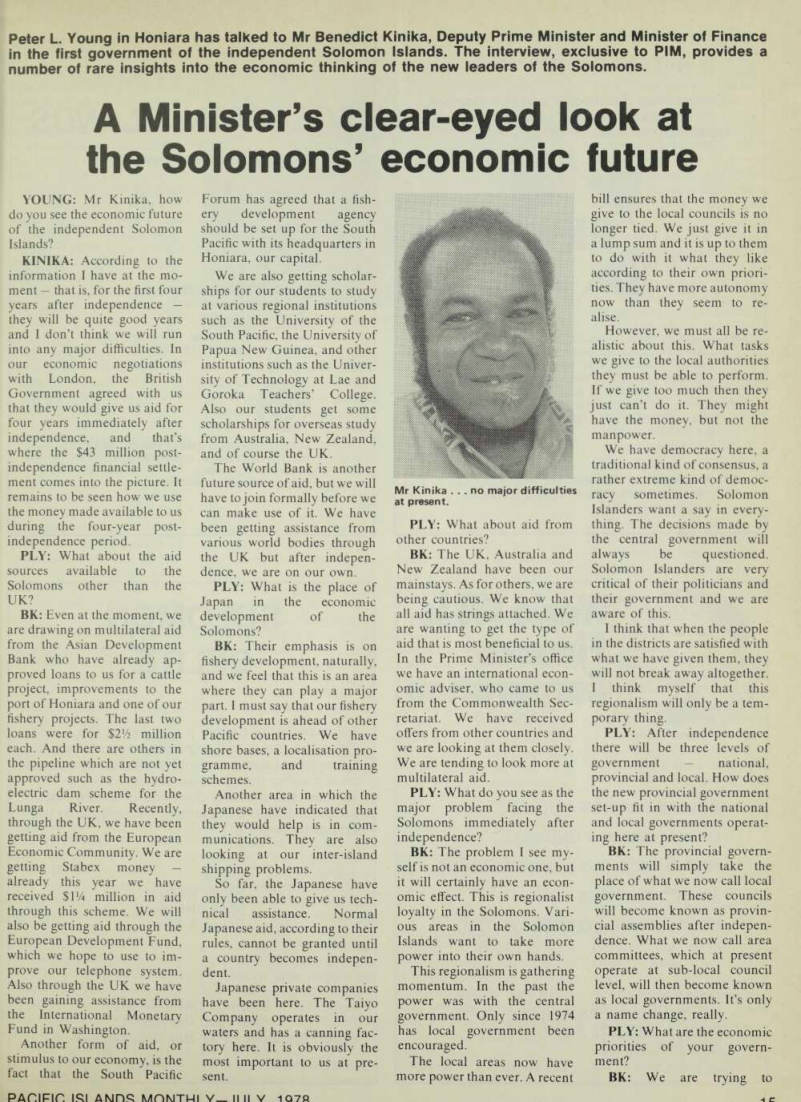
Mr Kinika... no major difficulties at present.
encourage development that will not be unduly detrimental to our society or environment.
This is why our emphasis is on
rural development and agricul
ture. We are trying to decen tralise development. We do not want to encourage too much of the kind of development that leads to the drift to the city.
We are trying to diversify our economy. There was a time when our only export was copra. New industries develop ing are oil palm, fisheries, beef cattle, chillies and a rice pro ject. There are also a number
of timber-logging operations in
our islands, and a certain
amount of light industry
developing nails, corrugated
iron, soap, bread, biscuits which is in keeping with our needs. Maybe later on mining will come bauxite on Rennell Island for example.
PLY: What of the social costs of this development?
BK: Economic development, no matter how gradual, will disturb our society, we know. I think we’ll have to face that fact, but we are learning a lot from other countries. We are quite aware of the dangers of industrialisation, such as pol lution. Our politicians when they have gone overseas have seen the costs of industrialisa tion.
PLY: What are the prospects for logging in the Solomons?
There seems to have been some local opposition to logging op erations.
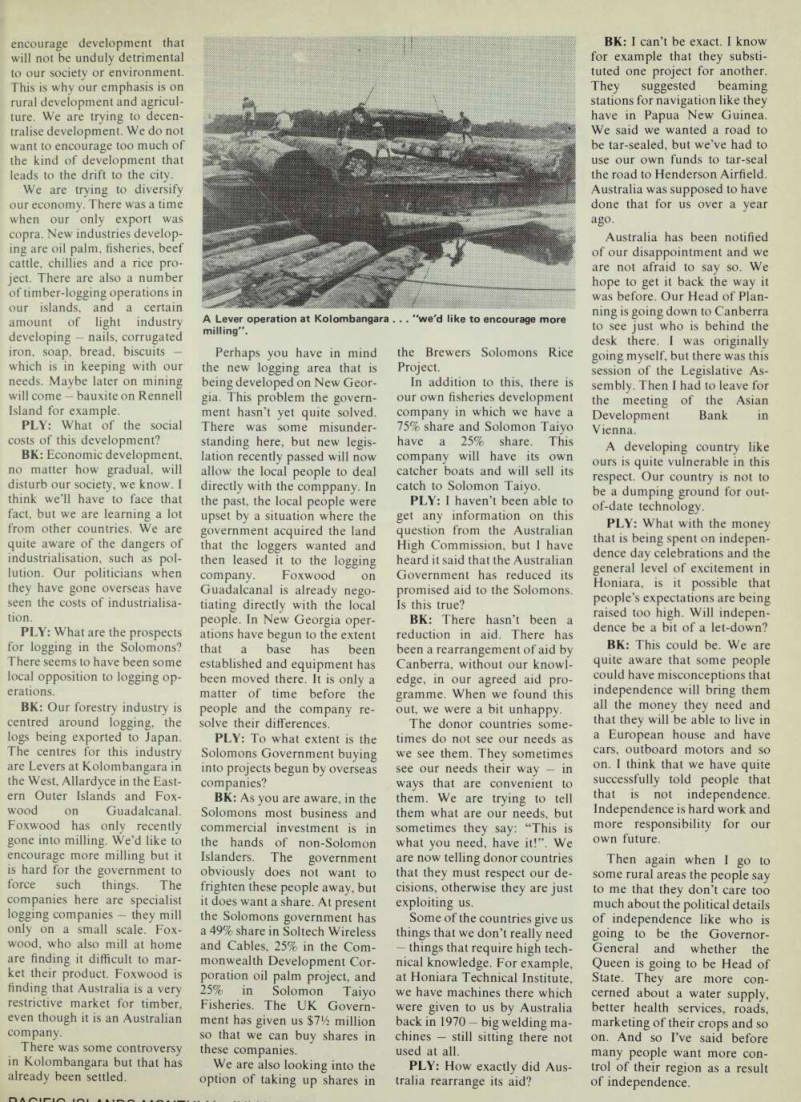
BK: Our forestry industry is centred around logging, the
logs being exported to Japan.
The centres for this industry are Levers at Kolombangara in the West, Allardyce in the East ern Outer Islands and Fox wood on Guadalcanal.
Foxwood has only recently
gone into milling. We’d like to encourage more milling but it is hard for the government to force such things. The
companies here are specialist
logging companies they mill
only on a small scale. Fox wood, who also mill at home are finding it difficult to mar ket their product. Foxwood is finding that Australia is a very restrictive market for timber, even though it is an Australian company.
There was some controversy in Kolombangara but that has already been settled.
Perhaps you have in mind the new logging area that is being developed on New Geor gia. This problem the govern ment hasn’t yet quite solved.
There was some misunder standing here, but new legis lation recently passed will now allow the local people to deal directly with the comppany. In the past, the local people were upset by a situation where the government acquired the land that the loggers wanted and then leased it to the logging company. Foxwood on Guadalcanal is already nego tiating directly with the local people. In New Georgia oper ations have begun to the extent that a base has been established and equipment has been moved there. It is only a matter of time before the people and the company re solve their differences.
PLY: To what extent is the Solomons Government buying
into projects begun by overseas
companies?
BK: As you are aware, in the Solomons most business and commercial investment is in the hands of non-Solomon Islanders. The government obviously does not want to frighten these people away, but it does want a share. At present the Solomons government has a 49% share in Soltech Wireless and Cables, 25% in the Com monwealth Development Cor
poration oil palm project, and
25% in Solomon Taiyo Fisheries. The UK Govern ment has given us $7!/2 million so that we can buy shares in these companies.
We are also looking into the option of taking up shares in
the Brewers Solomons Rice
Project.
In addition to this, there is our own fisheries development company in which we have a 75% share and Solomon Taiyo have a 25% share. This company will have its own catcher boats and will sell its catch to Solomon Taiyo.
PLY: I haven’t been able to get any information on this question from the Australian High Commission, but I have heard it said that the Australian Government has reduced its promised aid to the Solomons.
Is this true?
BK: There hasn’t been a reduction in aid. There has been a rearrangement of aid by Canberra, without our knowl edge, in our agreed aid pro gramme. When we found this out, we were a bit unhappy.
The donor countries some times do not see our needs as we see them. They sometimes see our needs their way in ways that are convenient to them. We are trying to tell them what are our needs, but sometimes they say: “This is what you need, have it!”. We are now telling donor countries that they must respect our de cisions, otherwise they are just
exploiting us.
Some of the countries give us things that we don’t really need things that require high tech
nical knowledge. For example,
at Honiara Technical Institute, we have machines there which were given to us by Australia back in 1970 big welding ma chines still sitting there not used at all.
PLY: How exactly did Aus tralia rearrange its aid?
BK: I can’t be exact. I know for example that they substi tuted one project for another.
They suggested beaming
stations for navigation like they have in Papua New Guinea.
We said we wanted a road to be tar-sealed, but we’ve had to use our own funds to tar-seal the road to Henderson Airfield.
Australia was supposed to have done that for us over a year ago.
Australia has been notified of our disappointment and we are not afraid to say so. We hope to get it back the way it was before. Our Head of Plan ning is going down to Canberra to see just who is behind the desk there. I was originally going myself, but there was this session of the Legislative As sembly. Then I had to leave for the meeting of the Asian Development Bank in Vienna.
A developing country like ours is quite vulnerable in this respect. Our country is not to be a dumping ground for out
of-date technology.
PLY: What with the money that is being spent on indepen dence day celebrations and the general level of excitement in Honiara, is it possible that
people’s expectations are being
raised too high. Will indepen dence be a bit of a let-down?
BK: This could be. We are quite aware that some people could have misconceptions that
independence will bring them
all the money they need and that they will be able to live in a European house and have cars, outboard motors and so on. I think that we have quite
successfully told people that
that is not independence.
Independence is hard work and more responsibility for our own future.
Then again when I go to some rural areas the people say to me that they don’t care too much about the political details of independence like who is going to be the Governor- General and whether the Queen is going to be Head of State. They are more con cerned about a water supply, better health services, roads, marketing of their crops and so on. And so I’ve said before many people want more con trol of their region as a result
of independence.
A Lever operation at Kolombangara... "we'd like to encourage more milling".
Advertisements & other items, pp. 15-17 (4 items)
15
PACIFIC ISI AMDS MDMTHI Y_ II II V IQ7R
16
d a r'imr' ici a mhc v ll ll V IQ7P
Corporation
KHY GROUP OF COMPANIES
Congratulate The People and Government
of Solomon Islands on achieving
Independence Nationhood on 7th July 1978
KHV
KHY— a leading name in the EXPORTS of JBM No. 1 NAVY CABIN BISCUITS; all kinds of MARINE SHELLS; Bechede-Mer, Sharkfins, sawn timbers and wooden ships.
KHY— a leading IMPORTER, WHOLESALER FOR ALL VARIE- TIES of goods from all over the world.
KHY— serving and developing hand in hand with the PEOPLE and GOVERNMENT for the progress and prosperity of our NATION.
ENQUIRIES - P.O. BOX 192 HONIARA. S.l.
TELEX: HQ2O4 CABLE: KHYCO HONIARA.
Congratulations and Success
to
SOLOMON ISLANDS
MITSUI MINING & SMELTING CO., LTD.
2-1-1 Nihonbashi-Muromachi, Chuo-ku, Tokyo, Japan.
Telephone: 03-279-3411
Telex: J 28512, MITUIKIN
Cable: MITSUIMETAL TOKYO
MITSUI MINING & SMELTING CO. (5.1.) LTD.
P.O. Box 323, Honiara, Solomon Islands Telephone: 288 Honiara.
Cable: MITSUIMETAL HONIARA
on
Your Independence
World Wide
Finance
Corporation
PTY. LTD.
FOR:
EQUITY PARTICIPATION
DEVELOPMENT FUNDING
RE-FINANCE, OFF-SHORE FUNDING
JOINT VENTURES
COMPETITIVE INTEREST RATES
INQUIRIES:
P.O. BOX 2397, BRISBANE.
PHONE: (07) 221 7151.
A.H. 378 3341.
SOLOMON
DELITE
Solomon Delite Bakery a member of the Fielder Gillespies Group of Companies congratulates the Government and people of the Solomon Islands on achieving their Independence.
To meet the growing demands of a new Nation Solomon Delite is expanding its facilities to provide even better Bread Sweet Biscuits Navy Biscuits Cakes & Pies Solomon Delite Bakery ‘We Feed the Nation”
Export Enquiries:- P.O. Box 502, Honiara.
Ij A I I I I I At! R-V /■% ■ A K■ —— ...
Holy Mama, Solomons Prophet
Built A Paradise For His People
RELIGION - Amazing things have been happening in the villages of little-known New Georgia in the Western Solomons, writes Dr Richard H. Chesher, of Cairns, North Queensland, who has visited the area and met a 20th century prophet, Silas Eto. His matter-of-fact, almost racy story of that meeting tells of villagers and villages transformed, of miracles and of a man who people believe is “next to God, his Son and the Holy Spirit”. 7
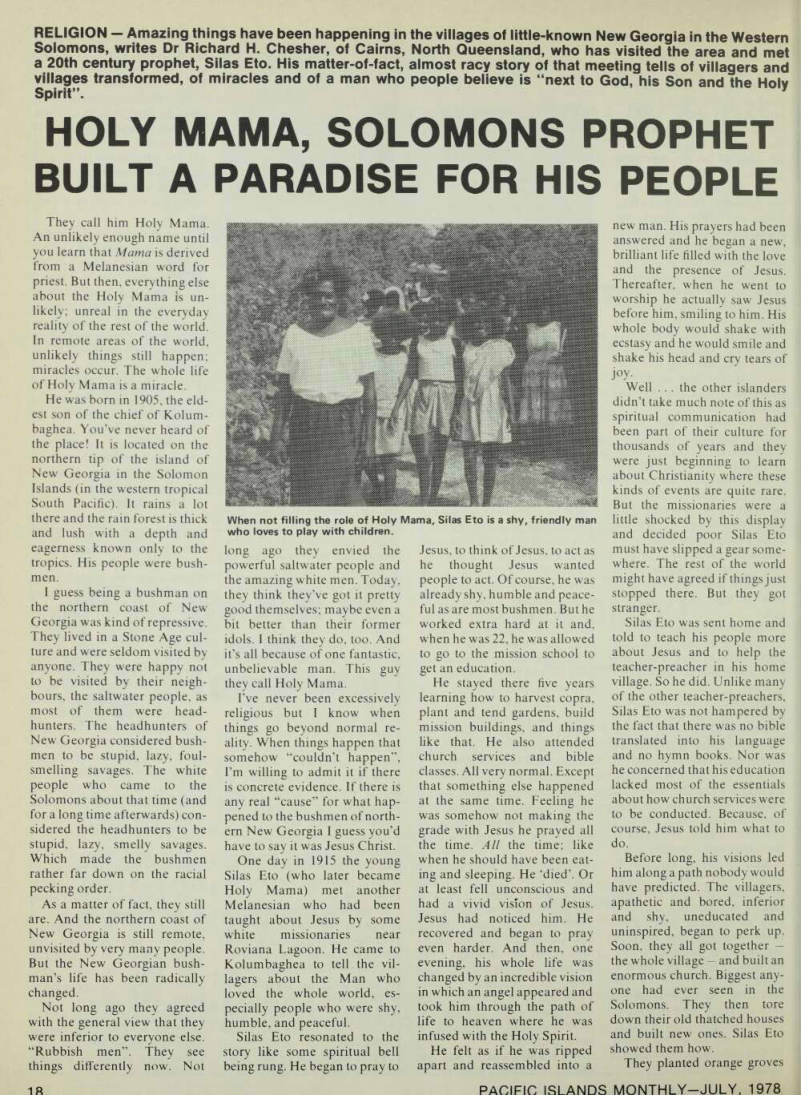
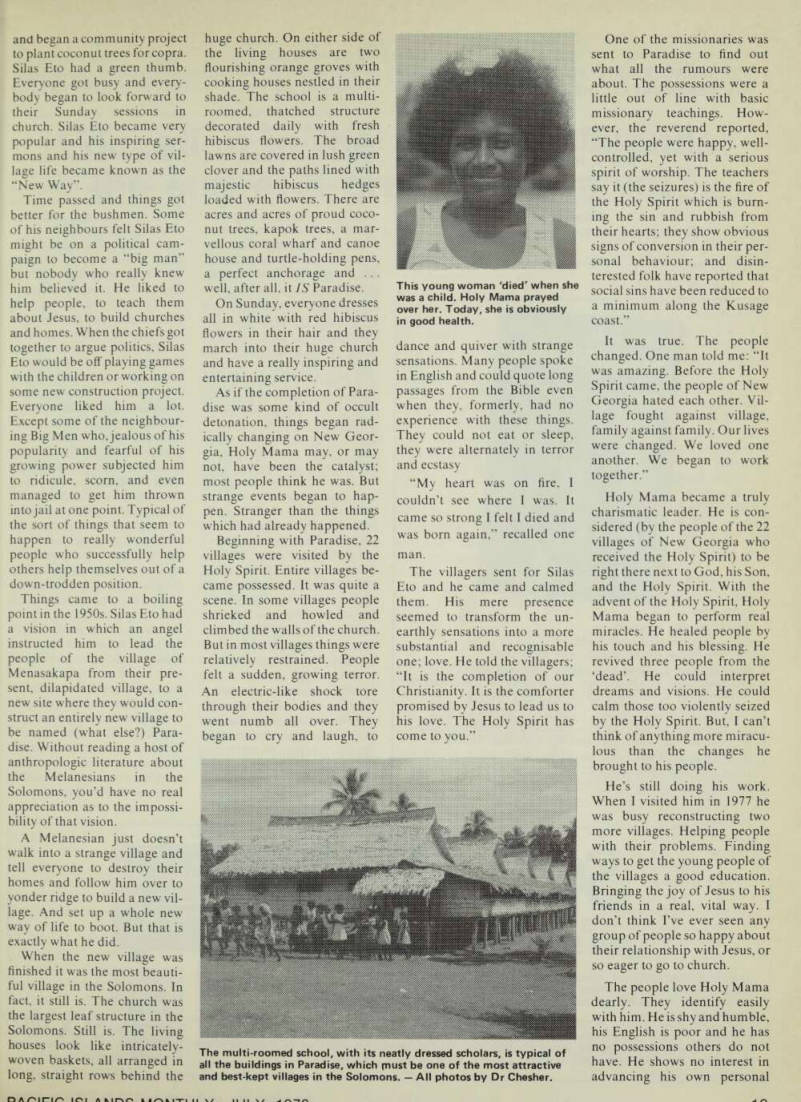
They call him Holy Mama.
An unlikely enough name until you learn that Mama is derived from a Melanesian word for priest. But then, everything else about the Holy Mama is un likely; unreal in the everyday reality of the rest of the world.
In remote areas of the world,
unlikely things still happen;
miracles occur. The whole life of Holy Mama is a miracle.
He was born in 1905, the eld est son of the chief of Kolum baghea. You’ve never heard of the place! It is located on the northern tip of the island of New Georgia in the Solomon Islands (in the western tropical South Pacific). It rains a lot there and the rain forest is thick and lush with a depth and eagerness known only to the tropics. His people were bush men.
I guess being a bushman on the northern coast of New Georgia was kind of repressive.
They lived in a Stone Age cul ture and were seldom visited by anyone. They were happy not to be visited by their neigh bours, the saltwater people, as most of them were head hunters. The headhunters of New Georgia considered bush men to be stupid, lazy, foul smelling savages. The white people who came to the Solomons about that time (and for a long time afterwards) con sidered the headhunters to be
stupid, lazy, smelly savages.
Which made the bushmen rather far down on the racial
pecking order.
As a matter of fact, they still are. And the northern coast of New Georgia is still remote, unvisited by very many people.
But the New Georgian bush man’s life has been radically
changed.
Not long ago they agreed
with the general view that they were inferior to everyone else.
“Rubbish men”. They see
things differently now. Not
long ago they envied the
powerful saltwater people and
the amazing white men. Today, they think they’ve got it pretty good themselves; maybe even a bit better than their former idols. I think they do, too. And it’s all because of one fantastic, unbelievable man. This guy
they call Holy Mama.
I’ve never been excessively religious but I know when things go beyond normal re ality. When things happen that somehow “couldn’t happen”, I’m willing to admit it if there is concrete evidence. If there is any real “cause” for what hap pened to the bushmen of north ern New Georgia I guess you’d have to say it was Jesus Christ.
One day in 1915 the young Silas Eto (who later became Holy Mama) met another Melanesian who had been taught about Jesus by some white missionaries near Roviana Lagoon. He came to Kolumbaghea to tell the vil lagers about the Man who loved the whole world, es
pecially people who were shy,
humble, and peaceful.
Silas Eto resonated to the story like some spiritual bell being rung. He began to pray to
Jesus, to think of Jesus, to act as he thought Jesus wanted people to act. Of course, he was already shy, humble and peace ful as are most bushmen. But he worked extra hard at it and, when he was 22, he was allowed to go to the mission school to get an education.
He stayed there five years learning how to harvest copra, plant and tend gardens, build
mission buildings, and things
like that. He also attended church services and bible classes. All very normal. Except
that something else happened
at the same time. Feeling he was somehow not making the grade with Jesus he prayed all the time. All the time; like when he should have been eat ing and sleeping. He ‘died’. Or at least fell unconscious and had a vivid vision of Jesus.
Jesus had noticed him. He recovered and began to pray even harder. And then, one evening, his whole life was changed by an incredible vision in which an angel appeared and took him through the path of life to heaven where he was infused with the Holy Spirit.
He felt as if he was ripped apart and reassembled into a
new man. His prayers had been answered and he began a new, brilliant life filled with the love and the presence of Jesus.
Thereafter, when he went to worship he actually saw Jesus before him, smiling to him. His whole body would shake with ecstasy and he would smile and shake his head and cry tears of j°y- Well ... the other islanders didn’t take much note of this as spiritual communication had been part of their culture for thousands of years and they were just beginning to leam about Christianity where these kinds of events are quite rare.
But the missionaries were a little shocked by this display and decided poor Silas Eto must have slipped a gear some where. The rest of the world
might have agreed if things just
stopped there. But they got stranger.
Silas Eto was sent home and told to teach his people more about Jesus and to help the teacher-preacher in his home village. So he did. Unlike many of the other teacher-preachers, Silas Eto was not hampered by the fact that there was no bible translated into his language and no hymn books. Nor was he concerned that his education lacked most of the essentials about how church services were to be conducted. Because, of course, Jesus told him what to do.
Before long, his visions led him along a path nobody would
have predicted. The villagers,
apathetic and bored, inferior and shy, uneducated and
uninspired, began to perk up.
Soon, they all got together the whole village and built an enormous church. Biggest any one had ever seen in the Solomons. They then tore down their old thatched houses and built new ones. Silas Eto showed them how.
They planted orange groves
When not filling the role of Holy Mama, Silas Eto is a shy, friendly man who loves to play with children.
and began a community project to plant coconut trees for copra.
Silas Eto had a green thumb.
Everyone got busy and every body began to look forward to their Sunday sessions in church. Silas Eto became very popular and his inspiring ser mons and his new type of vil lage life became known as the
“New Way”.
Time passed and things got better for the bushmen. Some of his neighbours felt Silas Eto might be on a political cam paign to become a “big man” but nobody who really knew him believed it. He liked to help people, to teach them about Jesus, to build churches and homes. When the chiefs got together to argue politics, Silas Eto would be off playing games with the children or working on some new construction project.
Everyone liked him a lot.
Except some of the neighbour ing Big Men who, jealous of his popularity and fearful of his
growing power subjected him
to ridicule, scorn, and even managed to get him thrown into jail at one point. Typical of the sort of things that seem to happen to really wonderful
people who successfully help
others help themselves out of a
down-trodden position.
Things came to a boiling point in the 19505. Silas Eto had a vision in which an angel instructed him to lead the people of the village of Menasakapa from their pre sent, dilapidated village, to a new site where they would con struct an entirely new village to be named (what else?) Para dise. Without reading a host of anthropologic literature about the Melanesians in the Solomons, you’d have no real appreciation as to the impossi bility of that vision.
A Melanesian just doesn’t walk into a strange village and tell everyone to destroy their homes and follow him over to yonder ridge to build a new vil lage. And set up a whole new way of life to boot. But that is exactly what he did.
When the new village was finished it was the most beauti ful village in the Solomons. In fact, it still is. The church was the largest leaf structure in the Solomons. Still is. The living houses look like intricately woven baskets, all arranged in long, straight rows behind the
huge church. On either side of the living houses are two flourishing orange groves with cooking houses nestled in their shade. The school is a multi roomed, thatched structure decorated daily with fresh hibiscus flowers. The broad lawns are covered in lush green clover and the paths lined with
majestic hibiscus hedges
loaded with flowers. There are acres and acres of proud coco nut trees, kapok trees, a mar vellous coral wharf and canoe house and turtle-holding pens, a perfect anchorage and . . . well, after all, it IS Paradise.
On Sunday, everyone dresses all in white with red hibiscus flowers in their hair and they march into their huge church and have a really inspiring and
entertaining service.
As if the completion of Para dise was some kind of occult
detonation, things began rad
ically changing on New Geor gia, Holy Mama may, or may not, have been the catalyst; most people think he was. But strange events began to hap pen. Stranger than the things
which had already happened.
Beginning with Paradise, 22 villages were visited by the
Holy Spirit. Entire villages be
came possessed. It was quite a scene. In some villages people shrieked and howled and climbed the walls of the church.
But in most villages things were
relatively restrained. People
felt a sudden, growing terror.
An electric-like shock tore through their bodies and they went numb all over. They began to cry and laugh, to
dance and quiver with strange
sensations. Many people spoke
in English and could quote long passages from the Bible even when they, formerly, had no
experience with these things.
They could not eat or sleep, they were alternately in terror and ecstasy “My heart was on fire, I couldn’t see where I was. It came so strong I felt I died and was born again,” recalled one man.
The villagers sent for Silas Eto and he came and calmed them. His mere presence seemed to transform the un earthly sensations into a more substantial and recognisable one; love. He told the villagers; “It is the completion of our Christianity. It is the comforter promised by Jesus to lead us to his love. The Holy Spirit has come to you.”
One of the missionaries was sent to Paradise to find out what all the rumours were about. The possessions were a little out of line with basic missionary teachings. How ever, the reverend reported, “The people were happy, well controlled, yet with a serious spirit of worship. The teachers say it (the seizures) is the fire of the Holy Spirit which is burn ing the sin and rubbish from their hearts; they show obvious signs of conversion in their per sonal behaviour; and disin terested folk have reported that social sins have been reduced to a minimum along the Kusage coast.”
It was true. The people changed. One man told me; “It was amazing. Before the Holy Spirit came, the people of New Georgia hated each other. Vil
lage fought against village,
family against family. Our lives
were changed. We loved one another. We began to work
together.”
Holy Mama became a truly charismatic leader. He is con sidered (by the people of the 22 villages of New Georgia who received the Holy Spirit) to be right there next to God, his Son, and the Holy Spirit. With the advent of the Holy Spirit, Holy Mama began to perform real miracles. He healed people by his touch and his blessing. He revived three people from the ‘dead’. He could interpret dreams and visions. He could calm those too violently seized by the Holy Spirit. But, I can’t think of anything more miracu lous than the changes he
brought to his people.
He’s still doing his work.
When I visited him in 1977 he
was busy reconstructing two
more villages. Helping people
with their problems. Finding
ways to get the young people of the villages a good education.
Bringing the joy of Jesus to his friends in a real, vital way. I don’t think I’ve ever seen any group of people so happy about their relationship with Jesus, or so eager to go to church.
The people love Holy Mama
dearly. They identify easily
with him. He is shy and humble, his English is poor and he has no possessions others do not have. He shows no interest in
advancing his own personal
The multi-roomed school, with its neatly dressed scholars, is typical of all the buildings in Paradise, which must be one of the most attractive and best-kept villages in the Solomons.-All photos by Dr Chesher.
This young woman 'died' when she was a child. Holy Mama prayed over her. Today, she is obviously in good health.
power and never pushes him self on anyone. Yet, he’s right there to help anyone who needs him. He talks of brotherly love and he loves everyone; no mat ter who. He tells the villagers to work together and when it comes time to do the work he’s right in there sweating away with his friends. He tells every one to live in peace and he lives that way; never criticising or
arguing or condemning any
one. Not even in his sermons.
He has a strange dual per
sonality. During his everyday
life he is just plain old Silas Eto;
quiet, shy, reserved, always
busy on some projects to help
others. He goes barefoot, like everyone else, and wears only a piece of old calico around his waist. But when he marches into church he changes. Maybe it is the people who change him. He really seems to take on
another personality.
He dresses in snowy-white robes with colourful decor ations and a strange fire lights his eyes. He strides through his congregation casting love like a glowing net over everyone. He ascends the pulpit with a weightless step and speaks in a deep, resonant voice. His ser mons are simple and beautiful.
He is a brilliant speaker. His messages are straightforward.
He tells of his love for Jesus and the beauty of the Holy Spirit.
He asks the people to love one another, be of one mind, to
work together.
Somehow, the way he says it, it makes you really want to do it. What’s more, with the help
of the Holy Spirit, he’s actually
got his villagers to really live that way.
I don’t know what to make of the reports about people
coming back from the ‘dead’.
Maybe the spiritual healing is
partly the power of suggestion.
There are lots of people who say they’ve had visions of Jesus Christ. But I know a miracle when I’ve seen one. I’ve been to the area where Silas Eto was born. I know the obstacles set before him by fate and man.
I’ve visited a lot of villages in the Solomons who do not know about this man and have seen how those people live.
Knowing these things, I saw Jesus Christ’s hand at work when I visited the beautiful vil lage of Paradise and talked to those people. I saw something
phenomenal happen when I
attended Holy Mama’s service.
I could feel it in the air and see it on the faces of the people. I could see it in Holy Mama’s eyes. His love of Jesus has done something to Silas Eto. I’m not exactly sure, but I think I know what that something is. When I talked with him, it seemed he lacked something most people have. Negative emotions.
Somehow, he’s been freed of hate, envy, selfishness, arro gance, greed and worry. All the common life-destroyers. I got the feeling he didn’t even recognise these things in me, even though I’ve got at least my normal human share of them. It was a very good feeling.
If this is his reward, if Jesus has taken these evils from him I think it is another miracle.
Like I said to begin with, his whole life is a miracle. Some thing which is too improbable to happen without some expla nation outside the normal levels of reality. These things still happen in some parts of the world. In fact, it’s all happening right now in Paradise.
Advertisements & other items, pp. 19-20 (3 items)
19
oaoi r i r> io i a k i r~\ o 11 k i -T- ■ ■ ■ v / iiii w j a-ia
20
PAniFin LSI AMDS MONTHLY-JULY. 1978
Somir
CONGRATULATIONS TO THE PEOPLE AND
GOVERNMENT OF THE SOLOMON ISLANDS
from Coral Seas Ltd Box 9, Honiara Operators of M.V. Independence & M.V. Compass Rose H The vessels serving the Solomons
the story of the
SOLOMONS
* "A < W * Charles E. Fox “Refreshingly frank..."
“Admirably simple and lucid..."
“A rare blend of objectivity and affection... ”
That is what some of the critics have said about this unusual book which outlines the history of the Solomon Islands from the point of view of the people who live there. The Reverend C.E.Fox CBE MA Litt.D, spent more than 70 years in the Pacific Islands 65 of them in the Solomon Islands, and no person was better qualified to write of the Solomons and the Solomon Islanders.
At Solomons Bookshops, or $3 posted
from PACIFIC PUBLICATIONS,
GPO Box 3408, Sydney 2001.
SOMIR
-a vital link within
the Solomons chain
Keeping pace with the rapid social growth of the Solomon Islands could be daunting to any airline.
But with more than 300 scheduled flights a month, serving twenty-four airports throughout the Solomons, we like to feel that we are contributing much to this growth.
We provide a vital link with near neighbours as well, through our three services a week between the Solomons and Bougainville, Papua New Guinea; and a new weekly flight between Honiara and Santo, New Hebrides. Executive charters throughout the South Pacific, and an expert Travel Division, are other features of our comprehensive service.
Solair - we’re at home in the Solomons.
SOMIR
THE SOLOMON ISLANDS'
REGIONAL AIRLINE
TSO 184
the end of a great experiment?
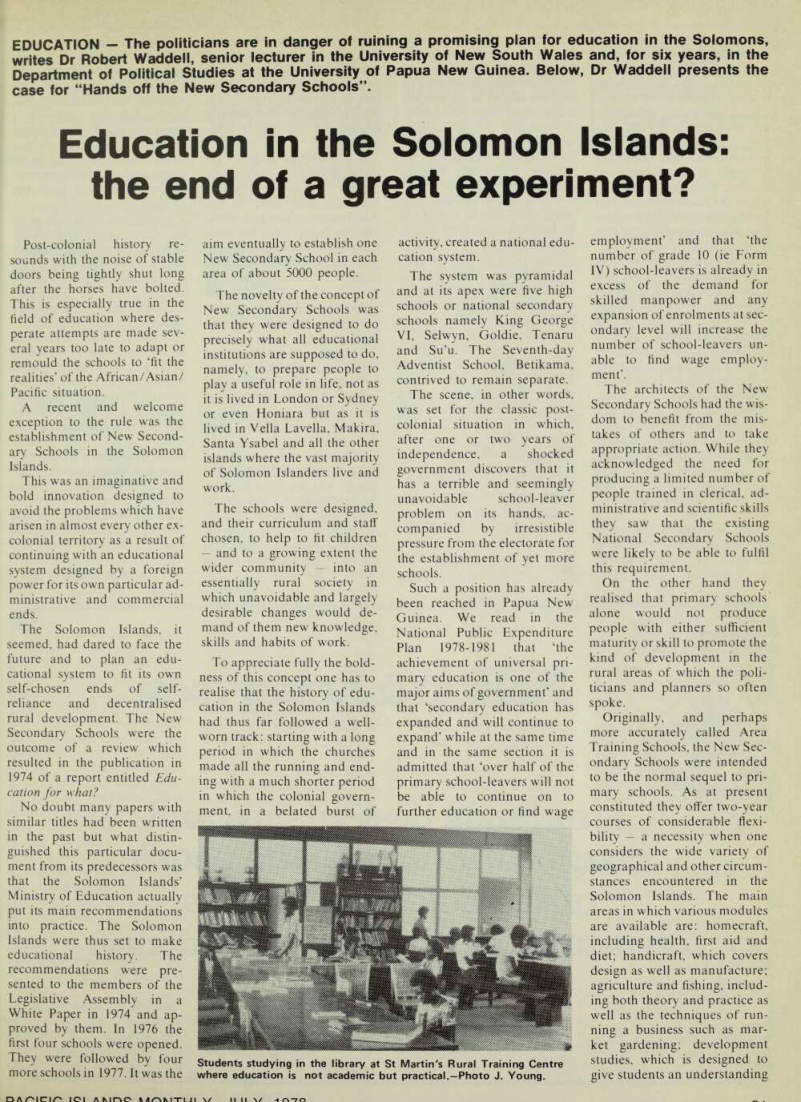
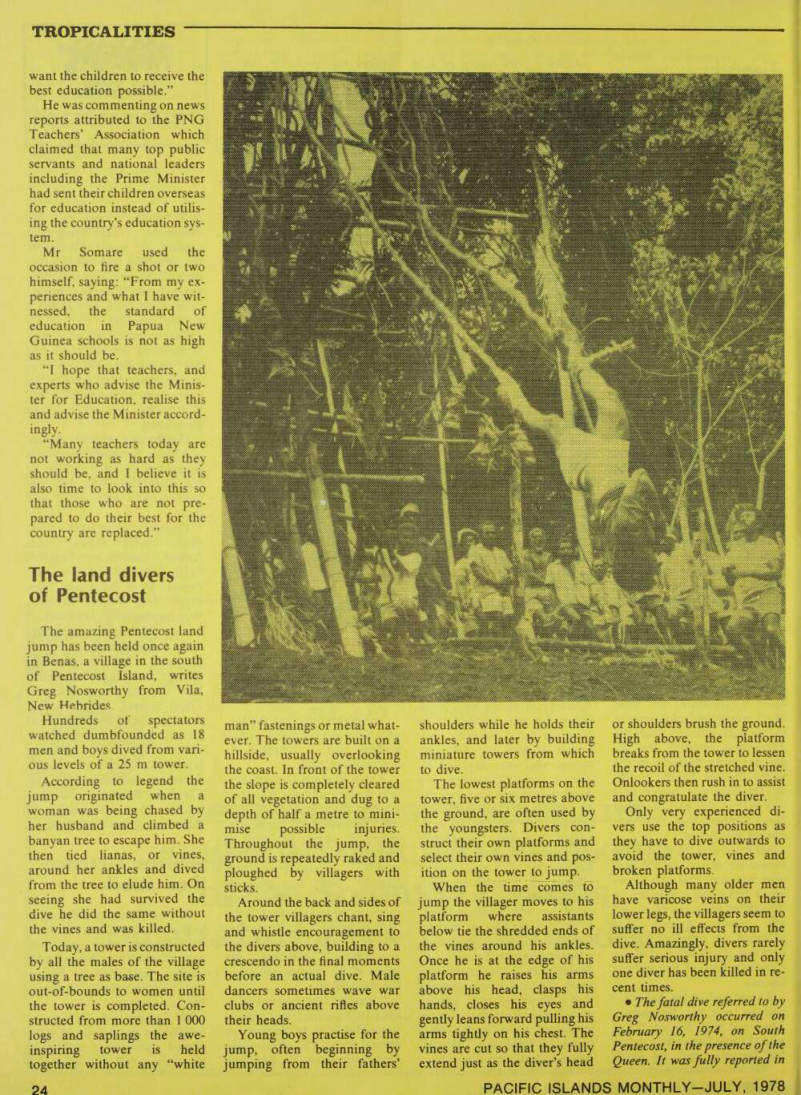
Education in the Solomon Islands: the end of a great experiment?
EDUCATION The politicians are in danger of ruining a promising plan for education in the Solomons, writes Dr Robert Waddell, senior lecturer in the University of New South Wales and, for six years, in the Department of Political Studies at the University of Papua New Guinea. Below, Dr Waddell presents the case for “Hands off the New Secondary Schools”.
Post-colonial history re sounds with the noise of stable doors being tightly shut long after the horses have bolted.
This is especially true in the field of education where des perate attempts are made sev eral years too late to adapt or remould the schools to ‘fit the realities’ of the African/Asian/ Pacific situation.
A recent and welcome exception to the rule was the establishment of New Second ary Schools in the Solomon Islands.
This was an imaginative and bold innovation designed to avoid the problems which have arisen in almost every other ex colonial territory as a result of continuing with an educational
system designed by a foreign
power for its own particular ad ministrative and commercial ends.
The Solomon Islands, it seemed, had dared to face the future and to plan an edu cational system to fit its own self-chosen ends of self reliance and decentralised rural development. The New Secondary Schools were the outcome of a review which resulted in the publication in 1974 of a report entitled Edu cation for what?
No doubt many papers with similar titles had been written in the past but what distin
guished this particular docu
ment from its predecessors was that the Solomon Islands’
Ministry of Education actually
put its main recommendations into practice. The Solomon Islands were thus set to make educational history. The recommendations were pre sented to the members of the
Legislative Assembly in a
White Paper in 1974 and ap proved by them. In 1976 the first four schools were opened.
They were followed by four more schools in 1977. It was the
aim eventually to establish one New Secondary School in each area of about 5000 people.
The novelty of the concept of New Secondary Schools was that they were designed to do precisely what all educational institutions are supposed to do, namely, to prepare people to play a useful role in life, not as it is lived in London or Sydney or even Honiara but as it is lived in Vella Lavella, Makira, Santa Ysabel and all the other islands where the vast majority of Solomon Islanders live and work.
The schools were designed, and their curriculum and staff chosen, to help to fit children and to a growing extent the wider community into an
essentially rural society in
which unavoidable and largely desirable changes would de mand of them new knowledge, skills and habits of work.
To appreciate fully the bold ness of this concept one has to realise that the history of edu cation in the Solomon Islands had thus far followed a well worn track: starting with a long period in which the churches made all the running and end ing with a much shorter period in which the colonial govern ment, in a belated burst of
activity, created a national edu cation system.
The system was pyramidal and at its apex were five high schools or national secondary
schools namely King George
VI, Selwyn, Goldie, Tenaru and Su’u. The Seventh-day Adventist School, Betikama, contrived to remain separate.
The scene, in other words, was set for the classic post colonial situation in which, after one or two years of independence, a shocked government discovers that it has a terrible and seemingly unavoidable school-leaver problem on its hands, ac
companied by irresistible
pressure from the electorate for the establishment of yet more schools.
Such a position has already been reached in Papua New Guinea. We read in the National Public Expenditure Plan 1978-1981 that ‘the achievement of universal pri mary education is one of the major aims of government’ and that ‘secondary education has expanded and will continue to expand’ while at the same time and in the same section it is admitted that ‘over half of the primary school-leavers will not be able to continue on to further education or find wage
employment’ and that ‘the number of grade 10 (ie Form IV) school-leavers is already in excess of the demand for skilled manpower and any expansion of enrolments at sec ondary level will increase the number of school-leavers un able to find wage employ ment’.
The architects of the New Secondary Schools had the wis dom to benefit from the mis takes of others and to take appropriate action. While they acknowledged the need for producing a limited number of people trained in clerical, ad ministrative and scientific skills they saw that the existing National Secondary Schools were likely to be able to fulfil
this requirement.
On the other hand they realised that primary schools alone would not produce people with either sufficient maturity or skill to promote the kind of development in the rural areas of which the poli ticians and planners so often
spoke.
Originally, and perhaps
more accurately called Area Training Schools, the New Sec ondary Schools were intended to be the normal sequel to pri mary schools. As at present constituted they offer two-year courses of considerable flexi bility a necessity when one considers the wide variety of geographical and other circum stances encountered in the Solomon Islands. The main areas in which various modules are available are: homecraft, including health, first aid and diet; handicraft, which covers design as well as manufacture;
agriculture and fishing, includ
ing both theory and practice as
well as the techniques of run ning a business such as mar
ket gardening; development
studies, which is designed to give students an understanding
Students studying in the library at St Martin's Rural Training Centre where education is not academic but practical. Photo J. Young.
of local and national develop ment plans, the ability to exam ine proposals critically, and an awareness of the various other options which may be open to them; physical education, including the arts of refereeing and organising games and competitions; and, most im portantly in the Solomonese context, religious studies in which the local churches play an important part, although no school is attached to any par ticular church.
It can be seen from this all too-brief summary of the cur riculum that these schools are no mere vocational schools but places which are designed to
produce intelligent citizens
with practical skills, equipped
to play a useful part in both the economic and political life of the country. ‘We must ask the people what they think’ is a common cry in Solomonese politics; people trained in New Second ary Schools are able to give informed answers and advice to their elected represen tatives.
Two important principles
are that the schools should be practical and local. To ensure that the schools remain prac
tical the staffs have been chosen for their practical rather than their academic abilities; they have been chosen because they are skilled in the arts and crafts which they are required to teach and not, for instance for their ability to teach the conventional staples of the academic schools, English, mathematics and science.
This is not to say that such subjects will not be learned as by-products of subjects such as
agriculture and development
studies. Teachers are, however,
required to undergo a training
course in teaching methods and a certain amount of instruction
in key subjects before they are
sent out to join their schools.
The principle that schools should be local is very import ant. The intention here was to break with the tradition that children were sent away from their home environment to school, as if school was some thing exotic and far removed,
both physically and psycho
logically, from everyday life.
The new schools were intended to be part and parcel of the local scene, as indeed the best of the church schools had been. It was envisaged that when the new schools were
spread throughout the country
and there were plans for at least 20 of them on the drawing board they would serve not just as schools but as meeting places, libraries, and resource centres for the whole com
munity.
It is important to point out that because the schools did not prepare people for further schooling there were no ter minal examinations and, there fore, no failures. On the other hand the schools did profess to prepare people for the real world and it was, therefore, im portant that there should be opportunities for them to exer cise their talents in the vil
lages.
The provision of such oppor tunities was not the responsi bility of the schools, since they lacked the resources for a proper follow-up programme, but it was or should have been the responsibility of the government, both central and local, in co-operation with the schools and the parents. From the beginning the Ministry of Education made strenuous attempts to see that as many people as possible in the com munity were involved in the affairs of the schools.
Whatever dreams the edu cational planners may have had about their new schools were shattered in the closing weeks of April when the Legis lative Assembly debated a paper put out by the Council of Ministers in which the whole educational scene came under review and certain recommen dations for change were put forward.
Among the most important of these recommendations were that all secondary schools should be officially called Sec ondary Schools, with no prefix such as ‘New’ or ‘National’; that the former New Secondary Schools should provide a three year course; that there should be a nation-wide examination at the end of the third year to determine who should proceed to Form IV at one of the former National Secondary Schools; and that all schools should pro vide a common-core curric ulum, which was almost certain to be the familiar trinity of sci ence, mathematics and
English.
As the debate progressed, it became apparent to at least one observer that few of the par
• Continued on page 27
ticipants were aware that what they were about to approve was not some kind of ‘fine tuning’ but a fundamental change; they were, in fact, about to strangle, almost at its birth, one of the few progressive edu cational experiments to have appeared in recent times.
While it is impossible to forecast all the consequences which will flow from this de cision, some of the more obvious can be readily predicted. The almost inevi table introduction of a conven tional academic curriculum means that the (New) Second ary Schools will become a mere link (and an inferior one at that) in the primary-secondary tertiary chain; the change in curriculum will mean the im portation of new teachers since the existing teachers are in no way suitably qualified to teach ‘straight’ science, mathematics and English; the new teachers will almost certainly have to come from abroad which will be an expensive and from the point of view of both the local isation programme and the de sire to make the schools ‘local’ in every sense of the word a
retrograde step; the existing
staff, who have hitherto been
inspired by the thought that
they were taking part in a great and worthwhile experiment in education for rural develop ment, may well lose heart and wish to abandon their posts; the introduction of a national examination at the end of the third year will mean that the great majority of the pupils predominantly those from the (New) Secondary Schools will not only fail because the number of places available in Form IV will remain un changed for some time but will come to regard themselves as failures instead of, as pre viously, people who have been educated to make a practical and valuable contribution to the development of their home areas.
The addition of a third year to the (New) Secondary Schools will mean a reduction in the number of people who can receive post-primary edu cation since the schools are only designed to house and cater for 210 pupils each.
The new scheme will involve great additional expenditure both because the new teachers.
whether national or expatriate, will have higher salaries than the existing ones and because if there is to be any semblance of parity between (New) and (National) Secondary Schools the facilities of the former will have to be vastly upgraded how many expatriate teachers, for example, would be pre pared to live in a leaf house in a remote area lacking any mod ern conveniences?
The extra cost of upgrading the existing schools will prob ably mean the indefinite post ponement of plans to cover the whole country with secondary schools; the new scheme may also involve the government in delicate and possibly embar
rassing negotiations with the
principal aid-givers who, one
understands, made substantial financial contributions to the costs of establishing New Sec ondary Schools on the under standing that the latter would retain their essentially rural and local character; and, finally, there is the under mining of the whole admirable concept of an education truly suited to local needs.
Why have the parliamen
tarians voted in favour of this
drastic change? Perhaps be
cause the full implications were not made clear to them or be cause in their inner hearts they, like so many before them, be lieve that the only worthwhile jobs are those very few which lie at the end of the old familiar academic trail or because they believe that the town and not the country is where all pro gress and modernisation are to be found. And perhaps people everywhere will continue to make this choice until some en
ergetic and far-seeing govern
ment puts its whole weight behind the promotion of genu ine rural development instead of hoping that it will somehow come about as the by-product of capital-intensive, foreign run, large-scale, industrialised agriculture, mineral extraction,
fishery and timber mining.
It is a great pity that such a fate should seemingly be in store for the Solomon Islands, one of the most attractive and tranquil countries in the world.
Corruptio optimi pessima. But perhaps even now it is not too late to follow an established Solomonese custom and to ‘ask the people what they think’.
Advertisements & other items, pp. 21-22 (3 items)
21
ICI AKIHC MAMTUI \y II II V/ H 070
22
PAP.IPin I.QI AMRS MOMTHI V—.llll Y IQ7B
congratulations to the people
* $ O -o 2: o V * G
Nelson & Robertson
PTY. LTD. (Established 1895)
...extends best wishes and
congratulations to the people
of the Solomon Islands
on attaining their Independence.
nostalgic round
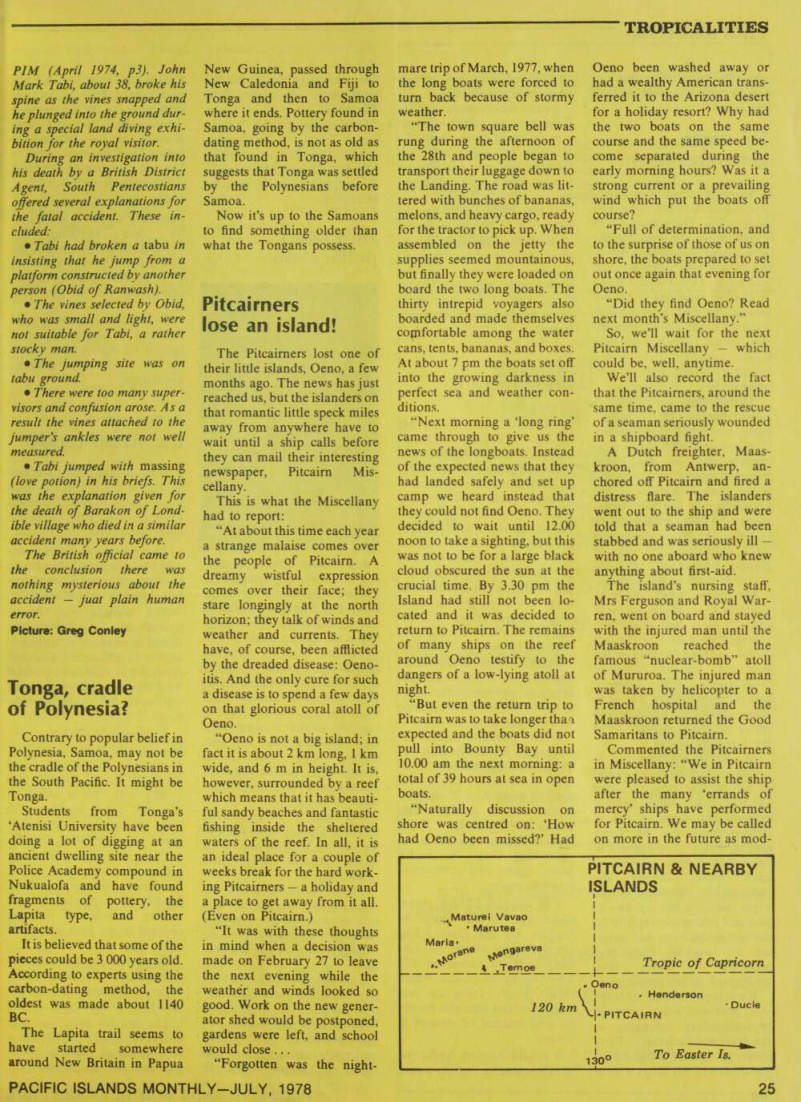
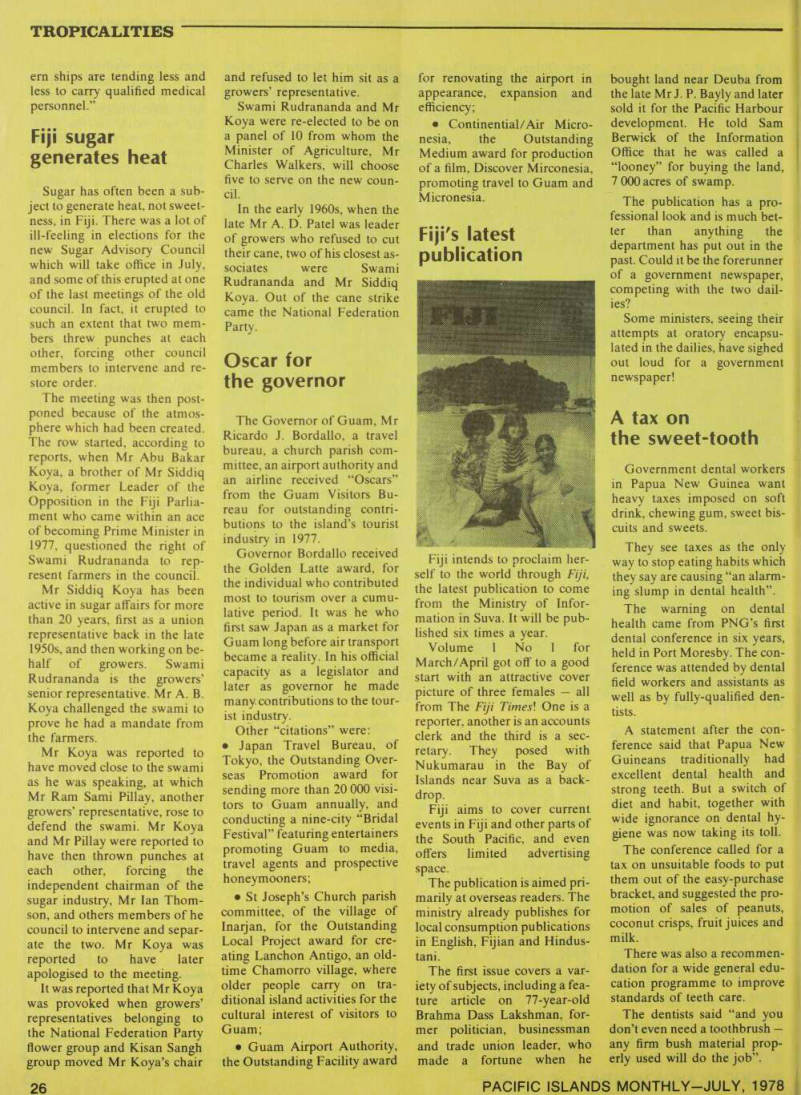
Tropicalities
Tigers in
the Cooks!!!
The things people say when they’re hot and bothered like when the Cooks had a visit from Hurricane Charles.
The radio announcer came out with these two gems: • Police remind all motorists using the Takuvaine Valley Road to be careful of the three tigers outside the meeting house (pause) oh! that should read ‘fighters’. • The report from Palmerston says the seas were rough in the la goon but not on the land.
It’s a bit late but worth record
ing.
A butterfly
on a flag Papua New Guinea’s most beautiful and rarest birdwing butterfly, the Alexandrae, is one of the two main features of
the flag adopted by the Oro
Provincial Government.
The green-coloured flag fea
tures the Alexandrae butterfly in the middle and the tra
ditional tapa-cloth design
lining on the margin on its end.
The Premier of the Oro Provincial Government, Mr Edric Eupu, said the Provincial Executive Council accepted the green colour of the flag, be cause it symbolised the prov ince’s wealth and prosperity in the oil palm industry while the Alexandrae butterfly, the lar gest birdwing butterfly in the world, showed that the North ern Province was famous as it was only in this part of Papua New Guinea that this rare species was found.
Mr Eupu said the traditional
tapa-cloth design in the flag
also signified that the prov ince’s links and continuity in the artifact while the black and red colours showed that although the province has its own flag, it was still part of the sovereign state of Papua New Guinea.
The winner of the flag com petition was the Popondetta Provincial High School. It had won the first and second prizes for designing the flag which
carried a prize money of K5O and K 23 respectively.
The final design of the flag was the combination of the two
prize-winning designs. The flag
competition was organised by
the Oro Provincial Govern ment and all the schools in the Northern Province took part in
the competition.
"Forgotten war"
on film?
A group of Australian film makers has been travelling around Papua New Guinea and the Solomons looking for possible locations for a film, writes Peter L. Young from Honiara. The film is to be based on a story entitled The Ridge and the River by West Australian author Tom Hun
gerford.
Hungerford’s story is based
on his experiences during
World War II when he was part of the Australian contingent on Bougainville. The film will look at this aspect of what has become, for Australia, “the for gotten war”.
By the middle of 1944 US forces were beginning to probe deep into the Pacific. New Guinea had ceased to be a vital front. From this time on Aus tralian forces were confined to
mopping up Japanese resist
ance in this backwater.
Although it would have been easier for the Australians to have set up a defensive per imeter around the Japanese forces, who were depleted by disease and malnutrition, the Australian troops were ordered to attack. As Captain Robert O’Neill, now head of the Aus tralian National University’s Institute of Strategic Studies, has written: “For a number of reasons, all of which are both
comprehensible and compli
cated, but with which it is dif ficult to agree, the Australian Government decided to follow
a vigorous, aggressive policy in
dealing with the Japanese rem nants. Perhaps it was thought that a display of great activity would give Australia a more important voice in the final surrender settlement.” The de cision to leave the Australians
behind was probably that of MacArthur who is said to have
had great difficulty working
with them and to have regarded Australians as unre liable troops.
Hungerford’s story describes the fate of a patrol of Aus
tralians on Bougainville during
“the forgotten war”. The story is about an ill-fated patrol which finds itself pursued by the Japanese and slowed down by a wounded comrade. It tells of the thoughts of these soldiers as they make their “life and death” decisions.
The “forgotten war” on Bougainville cost 516 Aus tralian dead.
After looking at sites near Port Moresby, Kieta, Honiara and Madang, the film company, Ridgeriver Films (based in Perth), went on to survey locations in Queensland. The result of their study seems to be that Queensland sites or Madang offer the best locations in terms of availability of communi cations and transport.
The crew is expected to
begin shooting in August.
At present it seems that the film will have a British director and will include Australia’s major movie star of the pre sent, Jack Thompson.
Ex-Fiji expats'
nostalgic round
The nineteenth took the lon gest time to play when ex-Fiji golfers had a reunion in Auckland in May.
About 40 players, mostly for mer members of the Fiji Golf Club in Suva, who now live in NZ, renewed old friendships over 18 holes of golf at Pukekohe Club where ex-PWD divisional engineer “Sandy” Sims was assistant secretary until recently. A nos talgic social get-together at the club afterwards lasted longer than the game. A number of
non-golfers, including the
wives of the players, joined in
the socialising.
It was the first reunion of its kind in Auckland and was so successful it is to become an annual event. The idea origin ated with John Cooper who
with “Sandy” Sims and Joe Shephard, ex-Teal flying-boat captain, did most of the work in organising and running the event. John and Joe are hoping to take some of the players and their wives back to Fiji for a golfing holiday.
Top scorer in the event was Tom Stout, several times Fiji golf champion. However, so many prizes were donated by supporters, including Air NZ, that every player received something.
During the day an appeal was made for clubs and other equipment to help caddies at Fiji Golf Club who are now encouraged to play golf there.
Competitors in the event were: David Crowe, John Aitken, Jim Jury, “Sandy”
Sims, “Boots” Oliver, Neil Freear, Dave Edmonds, John Maplesdon, Marcia Rickard, Wendy Cooper, Mary Dell, Audrey Jordan, Murray Blyth, Jack Colclough, Paddy Wad dingham, Jim Aitkenhead, George Jordan, Joe Shephard, Eric Chivers, John Wisdom, Tricia Sawyer, Jackie Nichol son, Tom Stout, Ron Cox, Basil Heath, John Cooper, Shona Rickard, Pat Riley, Doreen Nash, Rae Shephard, George Rawnsley, Bill Bygrave, John Claydon, “Buster” Jordan, Reg Smith, Don Waddell, Al Reimer and lan Nicholson.
Somare: Defence,
then attack
Parents alone have the right to decide where their children should be educated, and what type of education they should receive, according to Papua New Guinea’s Prime Minister, Michael Somare.
Mr Somare said: “It is quite natural for parents to be con cerned about their children’s education, and the majority
want the children to receive the best education possible.”
He was commenting on news reports attributed to the PNG Teachers’ Association which claimed that many top public servants and national leaders including the Prime Minister had sent their children overseas for education instead of utilis ing the country’s education sys tem.
Mr Somare used the occasion to fire a shot or two himself, saying: “From my ex periences and what I have wit nessed, the standard of education in Papua New Guinea schools is not as high as it should be.
“I hope that teachers, and experts who advise the Minis ter for Education, realise this and advise the Minister accord
ingly.
“Many teachers today are
not working as hard as they should be, and I believe it is also time to look into this so that those who are not pre pared to do their best for the country are replaced.”
The land divers
of Pentecost
The amazing Pentecost land jump has been held once again in Benas, a village in the south of Pentecost Island, writes
Greg Nosworthy from Vila,
New Hebrides Hundreds of spectators watched dumbfounded as 18 men and boys dived from vari ous levels of a 25 m tower.
According to legend the
jump originated when a
woman was being chased by her husband and climbed a banyan tree to escape him. She then tied lianas, or vines, around her ankles and dived from the tree to elude him. On seeing she had survived the dive he did the same without the vines and was killed.
Today, a tower is constructed by all the males of the village using a tree as base. The site is out-of-bounds to women until the tower is completed. Con structed from more than 1 000 logs and saplings the awe inspiring tower is held together without any “white
man” fastenings or metal what ever. The towers are built on a hillside, usually overlooking the coast. In front of the tower the slope is completely cleared of all vegetation and dug to a depth of half a metre to mini
mise possible injuries.
Throughout the jump, the
ground is repeatedly raked and
ploughed by villagers with
sticks.
Around the back and sides of the tower villagers chant, sing and whistle encouragement to the divers above, building to a crescendo in the final moments before an actual dive. Male dancers sometimes wave war clubs or ancient rifles above their heads.
Young boys practise for the
jump, often beginning by
jumping from their fathers’
shoulders while he holds their ankles, and later by building miniature towers from which to dive.
The lowest platforms on the tower, five or six metres above the ground, are often used by the youngsters. Divers con struct their own platforms and select their own vines and pos ition on the tower to jump.
When the time comes to jump the villager moves to his platform where assistants below tie the shredded ends of the vines around his ankles.
Once he is at the edge of his platform he raises his arms above his head, clasps his hands, closes his eyes and gently leans forward pulling his arms tightly on his chest. The vines are cut so that they fully extend just as the diver’s head
or shoulders brush the ground.
High above, the platform
breaks from the tower to lessen the recoil of the stretched vine.
Onlookers then rush in to assist and congratulate the diver.
Only very experienced di vers use the top positions as they have to dive outwards to avoid the tower, vines and broken platforms.
Although many older men have varicose veins on their lower legs, the villagers seem to suffer no ill effects from the dive. Amazingly, divers rarely suffer serious injury and only one diver has been killed in re cent times. • The fatal dive referred to by Greg Nosworthy occurred on February 16, 1974, on South Pentecost, in the presence of the Queen. It was fully reported in
PIM (April 1974, p 3). John Mark Tabi, about 38, broke his spine as the vines snapped and he plunged into the ground dur ing a special land diving exhi bition for the royal visitor.
During an investigation into his death by a British District Agent, South Pentecostians offered several explanations for the fatal accident. These in cluded: • Tabi had broken a tabu in insisting that he jump from a platform constructed by another person (Obid of Ran wash). • The vines selected by Obid, who was small and light, were not suitable for Tabi, a rather stocky man. • The jumping site was on
tabu ground.
• There were too many super visors and confusion arose. Asa result the vines attached to the jumper's ankles were not well measured. • Tabi jumped with massing (love potion) in his briefs. This was the explanation given for the death of Barakon of Lond ible village who died in a similar accident many years before.
The British official came to the conclusion there was nothing mysterious about the accident juat plain human error.
Picture: Greg Conley
Tonga, cradle
of Polynesia?
Contrary to popular belief in Polynesia, Samoa, may not be the cradle of the Polynesians in the South Pacific. It might be Tonga.
Students from Tonga’s ‘Atenisi University have been doing a lot of digging at an ancient dwelling site near the
Police Academy compound in
Nukualofa and have found fragments of pottery, the Lapita type, and other artifacts.
It is believed that some of the pieces could be 3 000 years old.
According to experts using the carbon-dating method, the oldest was made about 1140 BC.
The Lapita trail seems to have started somewhere around New Britain in Papua
New Guinea, passed through
New Caledonia and Fiji to Tonga and then to Samoa where it ends. Pottery found in Samoa, going by the carbon dating method, is not as old as that found in Tonga, which suggests that Tonga was settled
by the Polynesians before
Samoa.
Now it’s up to the Samoans to find something older than what the Tongans possess.
Pitcairners
lose an island!
The Pitcairners lost one of their little islands, Oeno, a few months ago. The news has just reached us, but the islanders on that romantic little speck miles away from anywhere have to wait until a ship calls before they can mail their interesting newspaper, Pitcairn Mis
cellany.
This is what the Miscellany had to report: “At about this time each year a strange malaise comes over the people of Pitcairn. A
dreamy wistful expression
comes over their face; they stare longingly at the north horizon; they talk of winds and weather and currents. They have, of course, been afflicted by the dreaded disease: Oeno itis. And the only cure for such a disease is to spend a few days on that glorious coral atoll of Oeno.
“Oeno is not a big island; in fact it is about 2 km long, 1 km wide, and 6 m in height. It is, however, surrounded by a reef which means that it has beauti ful sandy beaches and fantastic fishing inside the sheltered waters of the reef. In all, it is an ideal place for a couple of weeks break for the hard work ing Pitcairners a holiday and a place to get away from it all. (Even on Pitcairn.) “It was with these thoughts in mind when a decision was made on February 27 to leave the next evening while the weather and winds looked so good. Work on the new gener ator shed would be postponed, gardens were left, and school would close ..,
“Forgotten was the night
mare trip of March, 1977, when the long boats were forced to turn back because of stormy weather.
“The town square bell was rung during the afternoon of the 28th and people began to transport their luggage down to the Landing. The road was lit tered with bunches of bananas, melons, and heavy cargo, ready for the tractor to pick up. When assembled on the jetty the supplies seemed mountainous, but finally they were loaded on board the two long boats. The
thirty intrepid voyagers also
boarded and made themselves comfortable among the water cans, tents, bananas, and boxes.
At about 7 pm the boats set off into the growing darkness in perfect sea and weather con ditions.
“Next morning a ‘long ring’
came through to give us the news of the longboats. Instead of the expected news that they had landed safely and set up camp we heard instead that they could not find Oeno. They decided to wait until 12.00 noon to take a sighting, but this was not to be for a large black cloud obscured the sun at the crucial time. By 3.30 pm the Island had still not been lo cated and it was decided to return to Pitcairn. The remains of many ships on the reef around Oeno testify to the dangers of a low-lying atoll at
night.
“But even the return trip to Pitcairn was to take longer tha i expected and the boats did not
pull into Bounty Bay until
10.00 am the next morning: a total of 39 hours at sea in open boats.
“Naturally discussion on shore was centred on: ‘How had Oeno been missed?’ Had
Oeno been washed away or had a wealthy American trans ferred it to the Arizona desert for a holiday resort? Why had the two boats on the same course and the same speed be
come separated during the
early morning hours? Was it a strong current or a prevailing wind which put the boats off course?
“Full of determination, and to the surprise of those of us on shore, the boats prepared to set out once again that evening for Oeno.
“Did they find Oeno? Read next month’s Miscellany.”
So, we’ll wait for the next Pitcairn Miscellany which could be, well, anytime.
We’ll also record the fact that the Pitcairners, around the same time, came to the rescue of a seaman seriously wounded
in a shipboard fight.
A Dutch freighter, Maas kroon, from Antwerp, an chored off Pitcairn and fired a distress flare. The islanders went out to the ship and were told that a seaman had been stabbed and was seriously ill with no one aboard who knew anything about first-aid.
The island’s nursing staff, Mrs Ferguson and Royal War ren, went on board and stayed with the injured man until the Maaskroon reached the famous “nuclear-bomb” atoll of Mururoa. The injured man was taken by helicopter to a French hospital and the Maaskroon returned the Good Samaritans to Pitcairn.
Commented the Pitcairners in Miscellany: “We in Pitcairn were pleased to assist the ship after the many ‘errands of
mercy’ ships have performed
for Pitcairn. We may be called on more in the future as mod-
em ships are tending less and less to carry qualified medical
personnel.”
Fiji sugar
generates heat
Sugar has often been a sub ject to generate heat, not sweet ness, in Fiji. There was a lot of ill-feeling in elections for the new Sugar Advisory Council which will take office in July, and some of this erupted at one of the last meetings of the old council. In fact, it erupted to such an extent that two mem bers threw punches at each other, forcing other council members to intervene and re store order.
The meeting was then post poned because of the atmos phere which had been created.
The row started, according to reports, when Mr Abu Bakar Koya, a brother of Mr Siddiq Koya, former Leader of the Opposition in the Fiji Parlia ment who came within an ace of becoming Prime Minister in 1977, questioned the right of Swami Rudrananda to rep resent farmers in the council.
Mr Siddiq Koya has been active in sugar affairs for more than 20 years, first as a union representative back in the late 19505, and then working on be half of growers. Swami Rudrananda is the growers’ senior representative. Mr A. B.
Koya challenged the swami to prove he had a mandate from the farmers.
Mr Koya was reported to have moved close to the swami as he was speaking, at which Mr Ram Sami Pillay, another
growers’ representative, rose to
defend the swami. Mr Koya and Mr Pillay were reported to have then thrown punches at each other, forcing the independent chairman of the sugar industry, Mr lan Thom son, and others members of he council to intervene and separ ate the two. Mr Koya was reported to have later
apologised to the meeting.
It was reported that Mr Koya
was provoked when growers’
representatives belonging to
the National Federation Party flower group and Kisan Sangh group moved Mr Koya’s chair
and refused to let him sit as a
growers’ representative.
Swami Rudrananda and Mr Koya were re-elected to be on a panel of 10 from whom the Minister of Agriculture, Mr Charles Walkers, will choose five to serve on the new coun cil.
In the early 19605, when the late Mr A. D. Patel was leader of growers who refused to cut their cane, two of his closest as sociates were Swami Rudrananda and Mr Siddiq Koya. Out of the cane strike came the National Federation
Party.
Oscar for
the governor
The Governor of Guam, Mr Ricardo J. Bordallo, a travel bureau, a church parish com mittee, an airport authority and an airline received “Oscars” from the Guam Visitors Bu reau for outstanding contri butions to the island’s tourist industry in 1977.
Governor Bordallo received the Golden Latte award, for the individual who contributed most to tourism over a cumu lative period. It was he who first saw Japan as a market for Guam long before air transport became a reality. In his official capacity as a legislator and later as governor he made many contributions to the tour
ist industry.
Other “citations” were: • Japan Travel Bureau, of
Tokyo, the Outstanding Over
seas Promotion award for sending more than 20 000 visi tors to Guam annually, and
conducting a nine-city “Bridal
Festival” featuring entertainers promoting Guam to media, travel agents and prospective
honeymooners;
• St Joseph’s Church parish committee, of the village of
Inarjan, for the Outstanding
Local Project award for cre ating Lanchon Antigo, an old time Chamorro village, where older people carry on tra ditional island activities for the cultural interest of visitors to Guam; • Guam Airport Authority,
the Outstanding Facility award
for renovating the airport in appearance, expansion and
efficiency;
• Continential/Air Micro nesia, the Outstanding Medium award for production of a film, Discover Mirconesia, promoting travel to Guam and Micronesia.
Fiji's latest
publication
Fiji intends to proclaim her self to the world through Fiji, the latest publication to come from the Ministry of Infor mation in Suva. It will be pub lished six times a year.
Volume 1 No 1 for March/April got off to a good start with an attractive cover picture of three females all from The Fiji Times'. One is a reporter, another is an accounts clerk and the third is a sec
retary. They posed with
Nukumarau in the Bay of Islands near Suva as a back
drop.
Fiji aims to cover current events in Fiji and other parts of the South Pacific, and even offers limited advertising space.
The publication is aimed pri marily at overseas readers. The
ministry already publishes for
local consumption publications
in English, Fijian and Hindus tani.
The first issue covers a var
iety of subjects, including a fea
ture article on 77-year-old Brahma Dass Lakshman, for mer politician, businessman and trade union leader, who made a fortune when he
bought land near Deuba from the late Mr J. P. Bayly and later sold it for the Pacific Harbour development. He told Sam Berwick of the Information Office that he was called a “looney” for buying the land, 7 000 acres of swamp.
The publication has a pro fessional look and is much bet ter than anything the department has put out in the past. Could it be the forerunner of a government newspaper, competing with the two dail ies?
Some ministers, seeing their attempts at oratory encapsu lated in the dailies, have sighed out loud for a government
newspaper!
A tax on
the sweet-tooth
Government dental workers in Papua New Guinea want heavy taxes imposed on soft drink, chewing gum, sweet bis cuits and sweets.
They see taxes as the only way to stop eating habits which they say are causing “an alarm ing slump in dental health”.
The warning on dental health came from PNG’s first dental conference in six years, held in Port Moresby. The con ference was attended by dental field workers and assistants as well as by fully-qualified den tists.
A statement after the con ference said that Papua New Guineans traditionally had excellent dental health and strong teeth. But a switch of diet and habit, together with wide ignorance on dental hy giene was now taking its toll.
The conference called for a tax on unsuitable foods to put them out of the easy-purchase bracket, and suggested the pro motion of sales of peanuts, coconut crisps, fruit juices and milk.
There was also a recommen dation for a wide general edu cation programme to improve standards of teeth care.
The dentists said “and you don’t even need a toothbrush any firm bush material prop erly used will do the job”.
Advertisements & other items, pp. 23-28 (3 items)
23
PACIFIC ISLANDS MONTHI Y-.INI Y IQ7ft
"Friendlv
THE TOURIST AUTHORITY WELCOMES VISITORS TO THE SOLOMON ISLANDS - THE PACIFIC’S NEWEST NATION For General Information Contact Mr. B. Buchanan, Manager, Solomon Islands Tourist Authority, Box 321. Honiara.
“THE HAPPY ISLES "
Congratulations to the people of the
Solomon Islands on Independence,
"FrIeNDLV
datsun
V
UNITED
ENTERPRISES LTD.
Importers & Exporters
KUKUM, P.O. BOX
P.O. BOX 262,
HONIARA.
TELEPHONE 06 - 29.
Sale Dealers for: Massey Fergusson (U.K.) Australia Ltd.
Tractors, Trailers and Farm Implements.
Datsun, Nissan vehicles.
Dunlop Tyres (Scotland) Ltd.
Howard Rotavator Pty.Ltd.
Hitachi Batteries.
HIBISCUS HOTELS LIMITED
congratulate
THE SOLOMON ISLANDS
on their
INDEPENDENCE
As we continue to provide first class accommodation with • Private facilities • Air conditioning • Fully licensed restaurant set in tropical surroundings Phone P.O. Box 268 /
V*OT£T t
5 I & O mi •I > 205 Honiara O/v
FOR INVESTMENTS IN THE SOLOMONS
please contact
RC SYMES PTY. LTD.
GPO Box Honiara, Guadalcanal Solomon Islands
CABLE: MELCH
TELEPHONE 679
Ship owner & shipping agents
Both bred for the bush-
m It's another step ahead towards more profitable, more efficient logging operations: Cat 528 Skidder with major improvements.
Now rear wheel caliper disc brakes increase service braking pad contact surface by 78%, thereby extending brake life. There are three master cylinders, one each for front, rear and driveline systems. All four wheel brakes engage first; additional pedal depression engages driveline brake.
Caterpillar 528 Winch has power control design to allow "winching on-the-go". Winch and skidder can be operated simultaneously.
Other features include oil disc clutch and brake to extend service life; complete sealing maintains rated capacity; winch brake accumulator allows load release from dead engine; adjustable free spool drag lets operator pull line uphill or down without cable balling. Other helpful features too!
Send for literature or talk to your Caterpillar representative.
Caterpillar Dealers in South-West Pacific.
HASTINGS DEERING
Lae: Milford Haven Rd.
Phone 42 2355.
Port Moresby: Phone 21 2122.
Bougainville: Itakara Industrial Park, Arawa. Phone 95 9077. c
carptrac
Lautoka: Labasa: Veitari Lautoka Vulovi Labasa Phone 61877 Phone 81888 Suva: Carptrac Carpenter Street Raiwai Suva i Phone 381622 c Telex FJ2190 Cables CARPTRAC
28
i—> a /"* 11 - 1 z"'* Io i A unr> t kit i 11 \ / iiii 4 rv-?n
Carming - Hanging-Pirating and Writing
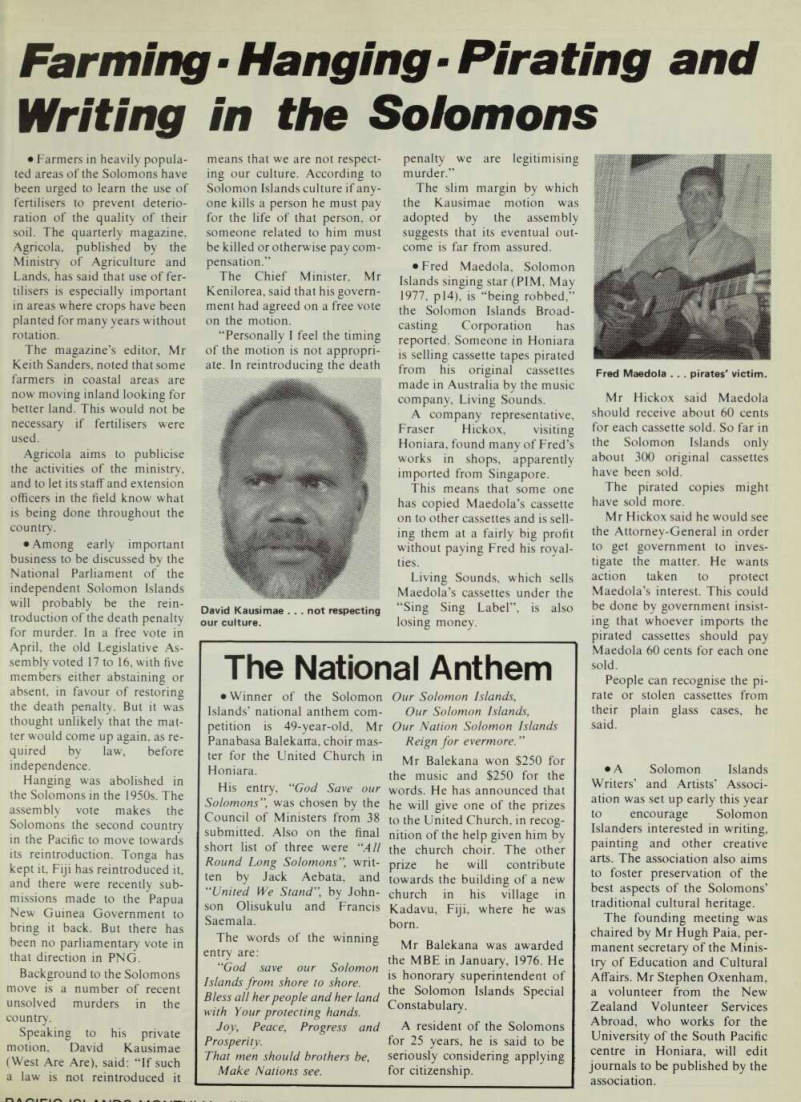
Writing in the Solomons
• Farmers in heavily popula ted areas of the Solomons have been urged to learn the use of fertilisers to prevent deterio ration of the quality of their soil. The quarterly magazine.
Agricola, published by the
Ministry of Agriculture and
Lands, has said that use of fer
tilisers is especially important
in areas where crops have been planted for many years without rotation.
The magazine’s editor, Mr Keith Sanders, noted that some farmers in coastal areas are now moving inland looking for better land. This would not be necessary if fertilisers were used.
Agricola aims to publicise
the activities of the ministry, and to let its staff and extension officers in the field know what is being done throughout the country.
• Among early important
business to be discussed by the National Parliament of the independent Solomon Islands will probably be the rein troduction of the death penalty for murder. In a free vote in April, the old Legislative As sembly voted 17 to 16, with five members either abstaining or absent, in favour of restoring the death penalty. But it was thought unlikely that the mat ter would come up again, as re
quired by law, before
independence.
Hanging was abolished in the Solomons in the 19505. The assembly vote makes the Solomons the second country in the Pacific to move towards its reintroduction. Tonga has kept it, Fiji has reintroduced it, and there were recently sub missions made to the Papua New Guinea Government to bring it back. But there has been no parliamentary vote in that direction in PNG.
Background to the Solomons move is a number of recent unsolved murders in the country.
Speaking to his private
motion, David Kausimae (West Are Are), said: “If such a law is not reintroduced it
means that we are not respect ing our culture. According to Solomon Islands culture if any one kills a person he must pay for the life of that person, or someone related to him must be killed or otherwise pay com pensation.”
The Chief Minister, Mr Kenilorea, said that his govern ment had agreed on a free vote on the motion.
“Personally I feel the timing of the motion is not appropri ate. In reintroducing the death
penalty we are legitimising murder.”
The slim margin by which the Kausimae motion was adopted by the assembly suggests that its eventual out come is far from assured. • Fred Maedola, Solomon Islands singing star (PIM. May 1977, p 14), is “being robbed,” the Solomon Islands Broad casting Corporation has reported. Someone in Honiara is selling cassette tapes pirated from his original cassettes made in Australia by the music company, Living Sounds.
A company representative, Fraser Hickox, visiting Honiara, found many of Fred’s works in shops, apparently
imported from Singapore.
This means that some one has copied Maedola’s cassette on to other cassettes and is sell ing them at a fairly big profit without paying Fred his royal ties.
Living Sounds, which sells Maedola’s cassettes under the “Sing Sing Label”, is also
losing money.
Mr Hickox said Maedola should receive about 60 cents for each cassette sold. So far in the Solomon Islands only about 300 original cassettes have been sold.
The pirated copies might
have sold more.
Mr Hickox said he would see the Attorney-General in order to get government to inves tigate the matter. He wants action taken to protect Maedola’s interest. This could be done by government insist ing that whoever imports the pirated cassettes should pay Maedola 60 cents for each one sold.
People can recognise the pi
rate or stolen cassettes from their plain glass cases, he said. • A Solomon Islands Writers’ and Artists’ Associ ation was set up early this year to encourage Solomon Islanders interested in writing, painting and other creative arts. The association also aims to foster preservation of the best aspects of the Solomons’ traditional cultural heritage.
The founding meeting was
chaired by Mr Hugh Paia, per manent secretary of the Minis try of Education and Cultural Affairs. Mr Stephen Oxenham, a volunteer from the New Zealand Volunteer Services Abroad, who works for the University of the South Pacific centre in Honiara, will edit
journals to be published by the
association.
David Kausimae... not respecting our culture.
Fred Maedola... pirates' victim.
The National Anthem
• Winner of the Solomon Islands’ national anthem com
petition is 49-year-old, Mr
Panabasa Balekana, choir mas ter for the United Church in Honiara.
His entry, “ God Save our Solomons”, was chosen by the Council of Ministers from 38 submitted. Also on the final short list of three were “ All Round Long Solomons”, writ ten by Jack Aebata, and “United We Stand”, by John son Olisukulu and Francis Saemala.
The words of the winning entry are: God save our Solomon Islands from shore to shore.
Bless all her people and her land with Your protecting hands.
Joy, Peace, Progress and
Prosperity.
That men should brothers be.
Make Nations see.
Our Solomon Islands, Our Solomon Islands, Our Nation Solomon Islands Reign for evermore. ”
Mr Balekana won $250 for the music and $250 for the words. He has announced that he will give one of the prizes to the United Church, in recog nition of the help given him by the church choir. The other prize he will contribute towards the building of a new church in his village in Kadavu, Fiji, where he was born.
Mr Balekana was awarded the MBE in January, 1976. He
is honorary superintendent of
the Solomon Islands Special
Constabulary.
A resident of the Solomons for 25 years, he is said to be
seriously considering applying
for citizenship.
Advertisements & other items, pp. 29-30 (3 items)
F 1 A Ii - I I I A K ■ A > A A . . ......
f 1 A II - I I I A k ■ A > A a . . ...
30
. > I i 11 w 4 rt7Q
Colorburst
NOW!
New Kodak
cameras.
At last a camera to capture the fun times instantly with rich and vibrant color by Kodak.
With the Colorburst cameras instant color picture fun has never been so easy indoors or out, with flash or natural light, you just aim, frame, focus and shoot, and the new Colorburst instant camera automatically produces clean, dry prints that develop right before your very eyes. Within minutes you have a superb color picture with beautiful Satinluxe finish from Kodak PR 10 Instant Print Film.
Kodak Colorburst cameras feature: special ‘zooming circle’, focusing symbols, and distance scale • Electronic shutter — 1/3000 sec. to 1/20 sec. • Eyecup on viewfinder • Flash socket • Tripod socket • Automatic motor-driven print ejection • Red low-light signal warns you when to • Lighten/darken print control • Exposure and monograms • Kodak 3' See your photo dealer for a free demonstration. ‘Suggested retail price
New Kodak Instant Cameras and Film.
• Adjustable focus control with j Kodak (Australasia) Pty. Ltd. ‘Kodak’, ‘Colorburst’ and Satinluxe’ are trademarks 345 0091
‘With the spirit behind you’-Fijians
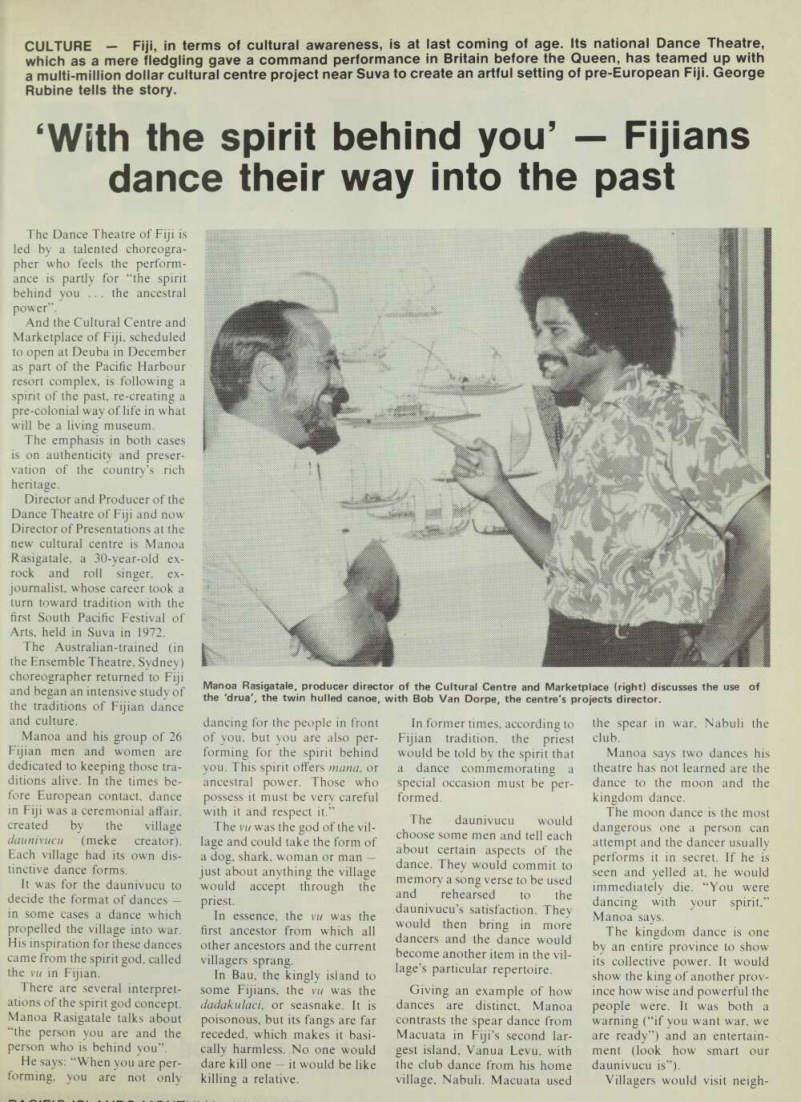

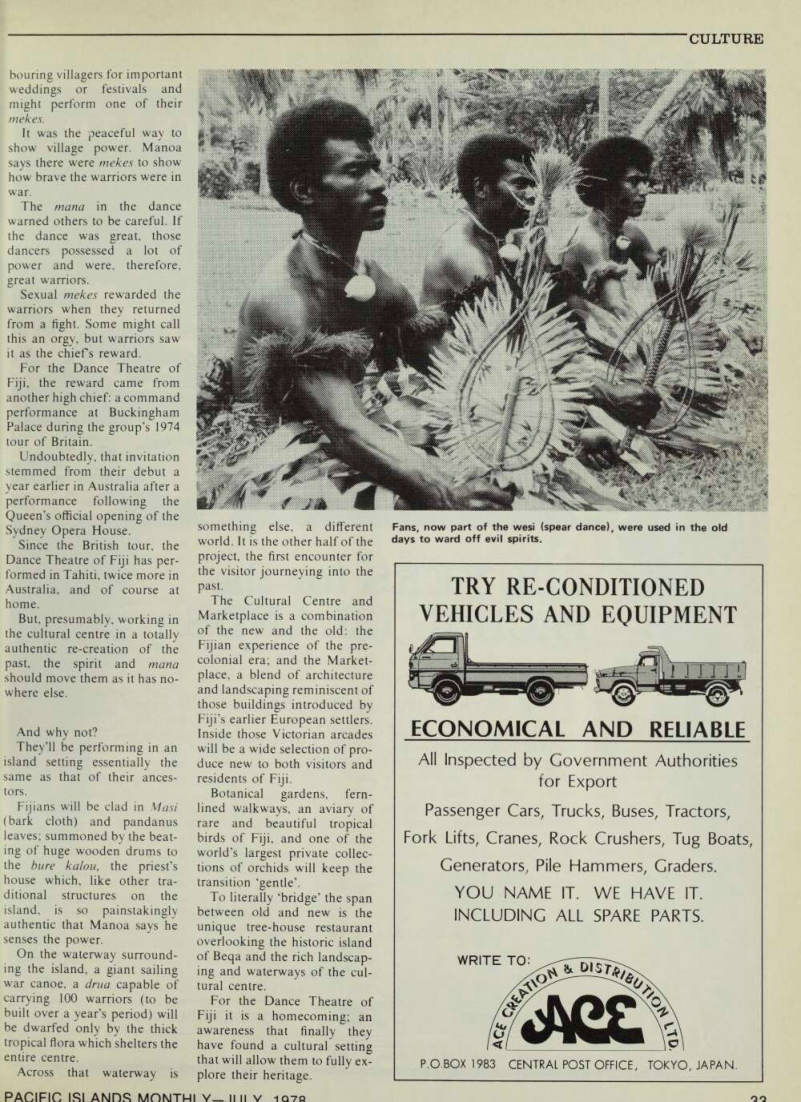
dance their way into the past
CULTURE - Fiji, in terms of cultural awareness, is at last coming of age. Its national Dance Theatre, which as a mere fledgling gave a command performance in Britain before the Queen, has teamed up with a multi-million dollar cultural centre project near Suva to create an artful setting of pre-European Fiji. George Rubine tells the story.
The Dance Theatre of Fiji is led by a talented choreogra pher who feels the perform ance is partly for “the spirit behind you .. . the ancestral
power”.
And the Cultural Centre and Marketplace of Fiji, scheduled to open at Deuba in December as part of the Pacific Harbour resort complex, is following a spirit of the past, re-creating a pre-colonial way of life in what will be a living museum.
The emphasis in both cases is on authenticity and preser vation of the country’s rich
heritage.
Director and Producer of the Dance Theatre of Fiji and now Director of Presentations at the new cultural centre is Manoa
Rasigatale, a 30-year-old ex
rock and roll singer, ex journalist, whose career took a turn toward tradition with the first South Pacific Festival of Arts, held in Suva in 1972.
The Australian-trained (in the Ensemble Theatre, Sydney)
choreographer returned to Fiji
and began an intensive study of the traditions of Fijian dance and culture.
Manoa and his group of 26 Fijian men and women are dedicated to keeping those tra ditions alive. In the times be fore European contact, dance in Fiji was a ceremonial affair,
created by the village
daunivucu (meke creator).
Each village had its own dis tinctive dance forms.
It was for the daunivucu to decide the format of dances in some cases a dance which propelled the village into war.
His inspiration for these dances came from the spirit god, called the vu in Fijian.
There are several interpret ations of the spirit god concept.
Manoa Rasigatale talks about “the person you are and the person who is behind you”.
He says: “When you are per forming, you are not only
dancing for the people in front of you, but you are also per forming for the spirit behind you. This spirit offers mana, or ancestral power. Those who possess it must be very careful with it and respect it.”
The vu was the god of the vil lage and could take the form of a dog, shark, woman or man
just about anything the village
would accept through the
priest.
In essence, the vu was the first ancestor from which all other ancestors and the current
villagers sprang.
In Bau, the kingly island to some Fijians, the vu was the dadakulaci, or seasnake. It is poisonous, but its fangs are far receded, which makes it basi cally harmless. No one would dare kill one it would be like killing a relative.
In former times, according to Fijian tradition, the priest would be told by the spirit that a dance commemorating a special occasion must be per formed.
The daunivucu would choose some men and tell each about certain aspects of the dance. They would commit to memory a song verse to be used and rehearsed to the daunivucu’s satisfaction. They would then bring in more dancers and the dance would become another item in the vil lage’s particular repertoire.
Giving an example of how dances are distinct, Manoa contrasts the spear dance from Macuata in Fiji’s second lar gest island, Vanua Levu, with the club dance from his home village, Nabuli. Macuata used
the spear in war, Nabuli the club.
Manoa says two dances his theatre has not learned are the dance to the moon and the
kingdom dance.
The moon dance is the most dangerous one a person can attempt and the dancer usually performs it in secret. If he is seen and yelled at, he would immediately die. “You were
dancing with your spirit,”
Manoa says.
The kingdom dance is one by an entire province to show its collective power. It would show the king of another prov ince how wise and powerful the people were. It was both a warning (“if you want war, we are ready”) and an entertain ment (look how smart our daunivucu is”).
Villagers would visit neigh
Manoa Rasigatale, producer director of the Cultural Centre and Marketplace (right) discusses the use of the 'drua', the twin hulled canoe, with Bob Van Dorpe, the centre's projects director.
bouring villagers for important
weddings or festivals and might perform one of their mekes.
It was the peaceful way to show village power. Manoa says there were mekes to show how brave the warriors were in war.
The mana in the dance warned others to be careful. If the dance was great, those dancers possessed a lot of power and were, therefore, great warriors.
Sexual mekes rewarded the warriors when they returned from a fight. Some might call this an orgy, but warriors saw it as the chiefs reward.
For the Dance Theatre of Fiji, the reward came from another high chief: a command
performance at Buckingham
Palace during the group’s 1974 tour of Britain.
Undoubtedly, that invitation stemmed from their debut a year earlier in Australia after a
performance following the
Queen’s official opening of the
Sydney Opera House.
Since the British tour, the Dance Theatre of Fiji has per formed in Tahiti, twice more in Australia, and of course at home.
But, presumably, working in
the cultural centre in a totally authentic re-creation of the past, the spirit and mana should move them as it has no where else.
And why not?
They’ll be performing in an
island setting essentially the
same as that of their ances tors.
Fijians will be clad in Masi (bark cloth) and pandanus leaves; summoned by the beat ing of huge wooden drums to the bare kalou , the priest’s house which, like other tra ditional structures on the island, is so painstakingly authentic that Manoa says he senses the power.
On the waterway surround
ing the island, a giant sailing
war canoe, a drua capable of carrying 100 warriors (to be built over a year’s period) will be dwarfed only by the thick tropical flora which shelters the entire centre.
Across that waterway is
something else, a different world. It is the other half of the project, the first encounter for the visitor journeying into the past.
The Cultural Centre and Marketplace is a combination of the new and the old: the Fijian experience of the pre colonial era; and the Market place, a blend of architecture and landscaping reminiscent of
those buildings introduced by
Fiji’s earlier European settlers.
Inside those Victorian arcades will be a wide selection of pro duce new to both visitors and residents of Fiji.
Botanical gardens, fern lined walkways, an aviary of rare and beautiful tropical birds of Fiji, and one of the
world’s largest private collec
tions of orchids will keep the transition ‘gentle’.
To literally ‘bridge’ the span between old and new is the unique tree-house restaurant overlooking the historic island of Beqa and the rich landscap ing and waterways of the cul tural centre.
For the Dance Theatre of Fiji it is a homecoming; an
awareness that finally they
have found a cultural setting that will allow them to fully ex
plore their heritage.
Fans, now part of the wesi (spear dance), were used in the old days to ward off evil spirits.
Advertisements & other items, pp. 31-34 (5 items)
Pacific Island Monthly
32
DAz-lcir IQI AMHQ MOMTHI Y—JULY 1978
Chloride
for all applications
. i iT t A* 12
t/M-j
h*/'" 1 P B *1 Chloride is the largest and only manufacturer of both lead acid and nickel cadmium alkaline batteries in Australia.
The Company is equipped and qualified to offer advice, guidance and service on any battery requirement no matter how large or small.
On the question of size, it could be as small as a battery for a hearing aid the dimensions of a coat button or a power station battery weighing as much as 40 tonnes.
Again it could be a no break D.C Power System for a computer or emergency lighting for a hospital The Chloride Company operates in 40 countries throughout the world, and when you consider that in Australia alone its production is approaching 1% million batteries per year, it gives some idea of the far reaching role that batteries play in our lives.
Chloride Batteries Australia Limited
P.O. Box 141, Bankstown. N.S.W. 2200. Australia. Telephone: 77 0177. Telex: 21262
TRY RE-CONDITIONED
VEHICLES AND EQUIPMENT
ECONOMICAL AND RELIABLE
All Inspected by Government Authorities for Export Passenger Cars, Trucks, Buses, Tractors, Fork Lifts, Cranes, Rock Crushers, Tug Boats, Generators, Pile Hammers, Graders.
YOU NAME IT. WE HAVE IT.
INCLUDING ALL SPARE PARTS.
WRITE TO:
X> A Dl P.0.80X 1983 CENTRAL POST OFFICE, TOKYO, JAPAN.
S.E. TATH AM & CO. PTY. LTD
BEEHIVE BUILDING.
94 ELIZABETH STREET.
G.P.O. BOX 8,
MELBOURNE 3001,
AUSTRALIA.
CABLES: “SET':
TELEX: AA34552.
TELEPHONE: 63 5094.
r. > T
...BUYERS for the
PACIFIC ISLANDS.
PAPUA NEW GUINEA:
S. E. TATHAM (P N G.) PTY. LTD.
LAE: MALAITA ST. (P.O. BOX 1562).
PORT MORESBY: Cm. GOROA & MANAHU Sts.,
GORDON (P.O. BOX 6733, BOROKO).
TELEGRAMS: ALL OFFICES “SET.’
YOUR GUARANTEE
\1
FOR SERVICE
SINCE 1924
33
PACIFIC ISLANDS MONTHI Y_.ll II V IQ7«
CULTURE
34
101 AMRC MrtKITUI V II II Y IQ7B
Australia and the Islands: a blueprint
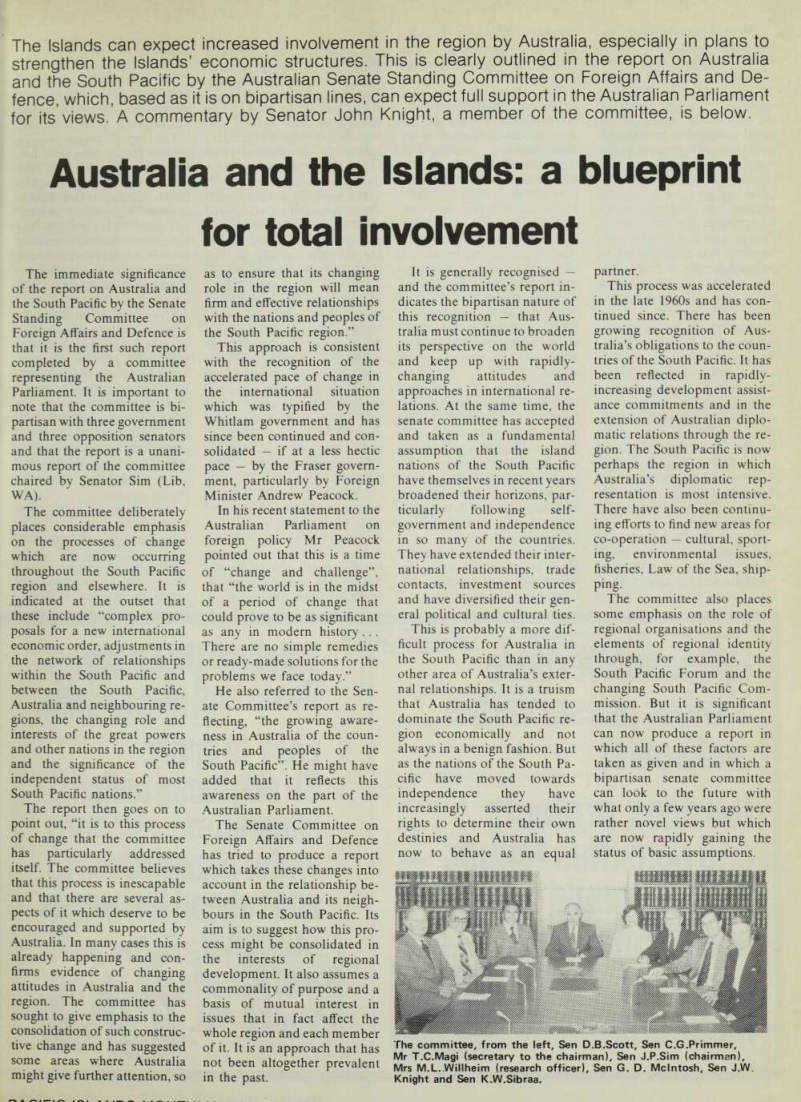


for total involvement
The Islands can expect increased involvement in the region by Australia, especially in plans to strengthen the Islands’ economic structures. This is clearly outlined in the report on Australia and the South Pacific by the Australian Senate Standing Committee on Foreign Affairs and De fence, which, based as it is on bipartisan lines, can expect full support in the Australian Parliament for its views. A commentary by Senator John Knight, a member of the committee, is below.
The immediate significance of the report on Australia and the South Pacific by the Senate Standing Committee on Foreign Affairs and Defence is that it is the first such report
completed by a committee
representing the Australian Parliament. It is important to note that the committee is bi partisan with three government and three opposition senators and that the report is a unani mous report of the committee chaired by Senator Sim (Lib, WA).
The committee deliberately
places considerable emphasis
on the processes of change which are now occurring throughout the South Pacific region and elsewhere. It is indicated at the outset that these include “complex pro posals for a new international economic order, adjustments in the network of relationships within the South Pacific and between the South Pacific, Australia and neighbouring re gions, the changing role and interests of the great powers and other nations in the region and the significance of the independent status of most South Pacific nations.”
The report then goes on to point out, “it is to this process of change that the committee has particularly addressed itself. The committee believes that this process is inescapable and that there are several as pects of it which deserve to be
encouraged and supported by
Australia. In many cases this is
already happening and con
firms evidence of changing attitudes in Australia and the region. The committee has
sought to give emphasis to the
consolidation of such construc tive change and has suggested some areas where Australia might give further attention, so
as to ensure that its changing role in the region will mean firm and effective relationships with the nations and peoples of the South Pacific region.”
This approach is consistent with the recognition of the accelerated pace of change in the international situation which was typified by the Whitlam government and has since been continued and con solidated if at a less hectic pace by the Fraser govern
ment, particularly by Foreign
Minister Andrew Peacock.
In his recent statement to the Australian Parliament on
foreign policy Mr Peacock
pointed out that this is a time
of “change and challenge”,
that “the world is in the midst of a period of change that could prove to be as significant as any in modem history .. .
There are no simple remedies or ready-made solutions for the
problems we face today.”
He also referred to the Sen ate Committee’s report as re
flecting, “the growing aware
ness in Australia of the coun tries and peoples of the South Pacific”. He might have added that it reflects this awareness on the part of the Australian Parliament.
The Senate Committee on Foreign Affairs and Defence has tried to produce a report which takes these changes into account in the relationship be tween Australia and its neigh bours in the South Pacific. Its aim is to suggest how this pro cess might be consolidated in the interests of regional development. It also assumes a commonality of purpose and a basis of mutual interest in issues that in fact affect the whole region and each member of it. It is an approach that has not been altogether prevalent in the past.
It is generally recognised
and the committee’s report indicates the bipartisan nature of this recognition - that Australia must continue to broaden its perspective on the world and keep up with rapidlychanging attitudes and approaches in international relations. At the same time, the senate committee has accepted and taken as a fundamental assumption that the island nations of the South Pacific have themselves in recent years broadened their horizons, par-
ticularly following self-
government and independence in so many of the countries, They have extended their international relationships, trade contacts, investment sources and have diversified their general political and cultural ties, This is probably a more difficult process for Australia in the South Pacific than in any other area of Australia’s external relationships. It is a truism that Australia has tended to dominate the South Pacific re-
gion economically and not
always in a benign fashion. But as the nations of the South Pacific have moved towards
independence they have
increasingly asserted their rights to determine their own destinies and Australia has now to behave as an equal
partner, This process was accelerated in the late 1960 s and has con tinued since. There has been
growing recognition of Aus
tralia’s obligations to the coun tries of the South Pacific. It has been reflected in rapidly
increasing development assist
ance commitments and in the extension of Australian diplo matic relations through the re gion. The South Pacific is now perhaps the region in which Australia’s diplomatic rep resentation is most intensive, There have also been continu ing efforts to find new areas for co-operation cultural, sport ing, environmental issues, fisheries, Law of the Sea, ship
ping.
The committee also places some emphasis on the role of
regional organisations and the
elements of regional identity
through, for example, the
South Pacific Forum and the changing South Pacific Com mission. But it is significant that the Australian Parliament can now produce a report in which all of these factors are taken as given and in which a bipartisan senate committee can look to the future with what only a few years ago were rather novel views but which are now rapidly gaining the status of basic assumptions.
The committee, from the left, Sen D.B.Scott, Sen C.G.Primmer, Mr T.C.Magi (secretary to the chairman). Sen J.P.Sim (chairman), Mrs M.L. Willheim (research officer), Sen G. D. Mclntosh, Sen J.W.
Knight and Sen K.W.Sibraa.
The senate committee’s re port could do a good deal to consolidate these basic views.
That in itself would be import ant. Whatever contribution it
might make towards assuring
the continuing reality, of an
equal partnership between all
nations of the region will be the measure of its additional sig nificance. It will, of course, de pend to a great extent on the response of the Australian
Government. But only recently
Prime Minister Fraser an nounced that ministers are to
respond directly to parliamen
tary committee reports within six months of their presen tation to Parliament.
In its report, the committee has sought to put into perspec tive the relative roles of politi cal and economic relationships.
Economic matters have tra ditionally tended to dominate relationships and the percep tion of them. The report
deliberately begins by looking
at the region in its historical context and its relevance to Australia in that perspective, then at political and diplomatic relations.
It goes on to examine the many issues involved in econ omic relationships between Australia and the countries of the South Pacific, then to
examine regionalism and Aus tralia’s participation in it, and
finally development assist
ance.
The committee has not sought to suggest that econ omic relations are not still the most pervasive element in the links between Australia and the countries of the South Pa cific. In fact the bulk of the re port still deals with economic matters and development as sistance. What it has done, however, is to suggest that these can only be built on
effective political and diplo
matic links and stronger re
gional relationships.
It is this emphasis which has been emerging in Australian policy since about 1970 and which the committee has stressed.
The growth of Australia’s extensive diplomatic and rep resentative network in the South Pacific since about 1968 has been dramatic and in the last few years posts have been set up in Papua New Guinea, the Solomon Islands, the New Hebrides, Western Samoa and posts in Fiji and elsewhere have been expanded.
The committee, however, places some emphasis on the importance to Australia of having more representatives of
island countries in Australia and suggests that Australia should actively encourage this and give it support where ap propriate and if island govern ments seek it. At present Fiji and Papua New Guinea are represented in Canberra, Nauru in Melbourne and Tonga has an “honourary” rep resentative in Sydney.
The need for adequate staff within Australia’s Department of Foreign Affairs is also stressed. In fact, the report suggests that staffing in the Foreign Affairs section which deals with the South Pacific and in the Development Assist ance Bureau might now have become inadequate to handle the extensive network of rep resentatives and the growing
complexity of relationships
within the region. It is recom mended that this whole ques tion be reviewed both in the
department and the Develop
ment Assistance Bureau to assess staffing needs and priorities.
These points are all made in the context of the need to con tinue to strengthen Australia’s identity with the region and it is this emphasis on recent trends towards a more mature
relationship within the region
which pervades the report. It
reflects the importance which members of the committee attach to this process.
The concept of regionalism and a growing sense of regional identity are important in this process.
The report begins with a chapter giving some brief his torical background on the South Pacific region. The
fourth chapter refers specifi
cally to “regionalism and co operation”. This gives, in the Australian context, unusual prominence to regionalism and that an Australian parliamen tary committee should do so is significant in itself.
The report, by outlining the extent of existing and develop
ing regional arrangements, em
phasises the need for improved communications and consul tations at a multitude of levels.
The committee endorses the
development of regionalism
and suggests that transport and communications in the region
“must be improved through
closer co-operation within the
region”.
In this section the committee refers to the potential future role of fisheries and problems related to the 200 miles “exclusive economic zones”.
No specific recommendations are made as action is already
being taken in an effort to ensure practical co-operation.
By its comments, the com mittee makes it clear that it be lieves this should be Australia’s objective in these two very im portant issues.
Perhaps inevitably, the re port gives a lot of attention to development assistance. This programme is a manifestation of Australia’s changing atti tudes and acceptance of cer tain obligations towards its South Pacific neighbours. Be cause of the scale of the pro gramme it is likely to have an
increasing impact on many
facets of life in South Pacific countries and it was to this, in particular, that the committee gave attention. Its emphasis is on ensuring that assistance is provided in accordance with the priorities of South Pacific countries and that it is extended into new areas where it is relevant to the people’s needs.
The committee itself suggests some issues to which attention might be directed.
These include environmental matters, urbanisation and South Pacific cultures and tra ditions. At the same time there is in the report (as there is
among members of the com mittee) a clear recognition that when it comes to economic growth, development assist ance is not necessarily the panacea.
It is in this context, in par ticular, that the committee sought to suggest ways in which trade between Australia and the countries of the region might be extended. A number of recommendations are made, aimed at improving accessi bility to the Australian market for South Pacific products. For example, it is suggested that quarantine restrictions should be re-examined; that the Aus tralian system of Tariff Prefer ences be emphasised; that the services of the Market Advis ory Section of the Department of Trade and Resources be encouraged to ensure that South Pacific countries make use of its services; and that co operation be extended to South Pacific countries to improve their trade representation where Australia is able to pro vide such assistance.
On the question of tariffs the committee notes that close to 100% of exports from South Pacific countries to Australia
already enter duty-free. Thus,
measures to improve accessi
bility through revised
quarantine regulations, for
example - are of special relevance.
Consideration was given to the . activities of Australian business in the region. The committee (while commenting on Carpenter’s failure to pro vide a submission or give evi dence to the committee) expressed the view that the reputation of Australia’s business enterprises in the re gion seems much better than in the recent past. It was concluded that they are gener ally “working within the re quirements of host governments and are trans forming their operations in a manner which shows an increasing awareness of the need to localise if they are to remain viable and welcome in these countries”.
During the committee’s preparation of this report three of its members were able to visit several countries of the re gion. However, because funds are not available for overseas
visits by parliamentary com
mittees, the committee as a whole was not able to obtain first-hand evidence, though considerable efforts were made to involve people from the
South Pacific countries. Diplo matic representatives in Aus tralia were consulted and a Tongan post-graduate scholar at the Australian National University acted as committee consultant.
There are gaps and inadequacies in the report.
That is inevitable. Perhaps the most fundamental and sig nificant points are that the Aus tralian Parliament has finally got around to addressing itself to the South Pacific as a region of great importance to Aus tralia (and a parliamentary
delegation though not the
committee visited 11 coun tries and territories in the re gion in June and July last year); the committee has assumed a period of change and has sought to suggest con structive directions for Aus
tralian policy including that
of private and commerical groups to consolidate recent developments; and the com mittee has assumed a relation
ship of equality, looking for
ways for Australia, not just to protect its interests in the re
gion though that is a legit
imate purpose which all governments must pursue but to meet its obligations to its near-neighbours in the South Pacific.
Advertisements & other items, pp. 35-37 (4 items)
Pacific Island Monthly
36
PAP.IFin IRI AMDS MONTHLY-JULY. 1978
Epiglass Everdure
Timber preservative and sealer.
Hardens, protects and densities timber.
Kills all mould spores and permanently seals out moisture.
IG LAS
1 Epiglass 90 Epoxy Resin and glass cloth.
Easy to apply.
Strengthens hulls, eliminates water absorption and rot and increases the value and life of your boat. »
PACIFIC AREA STOCKISTS
COOK ISLANDS: Cook Island Trading Corporation Ltd FIJIAN ISLANDS: Burns Philp (SS) Co. Ltd NEW HEBRIDES: Burns Philp (NH) Ltd NOUMEA: Guy Limousin, Pacific Yachting NUIE ISLAND: Nuie Island United PAGO PAGO: Max Haleck Inc, Burns Philp (SS) Ltd PAPUA NEW GUINEA: KIETA: Nikana Wholesalers, LAE: Faulkner-Tait (NG) Pty Ltd, MADANG: Burns Philp (NG) Co.
Ltd, PORT MORESBY; S.A. Heath Co. Ltd, RABAUL: Elvee Trading Pty Ltd, WEWAK: Burns Philp (P N G.).
SOLOMON ISLANDS: Man Sang Co
TAHITI: Marine Corail, Tahiti Sport.
TONGA: Riechelmann Bros.
WESTERN SAMOA: Burns Philp (SS) Co. Ltd, E. A. Coxon Ltd, Gold Star Transport Co. Ltd, Morris Hedstrom Ltd.
Epiglass E-Type Antifouling.
Gives up to 12 months growth-free performance.
Racing Red, Blue, Green and Gold.
37
M A A■•— ■ A ■A • * a. •m. A m a A & a v ill \ / ■ ■ II \ / U C\ T H
Afterthoughts
Recently, there was a get-together of interested organis ations in Port Moresby to discuss the problems of youth.
One of the speakers put forward the view that Papua New Guinea should be looking for “home-grown” solutions to these problems instead of using imported solutions “like scouting and guiding”, as he put it.
The first thing I would like to say about this, as one of those responsible for introducing scouting and guiding to pre-war Papua back in the 19205, is that these movements were not introduced to solve the problems of youth. In those days youth was not a problem, either to itself or anyone else. Scouting and guiding were introduced simply as a use ful and enjoyable supplement to the system of schooling which had already been imported and in which I had be come involved.
Over five decades the scout and guide movements have proved themselves both useful, educative and enjoyable to thousands of young people in Papua New Guinea; and while it is true that in the first place they were imported, it is also true that no effort has been spared to adapt what is, in essence, a very flexible scheme to meet the needs of the youth of Papua New Guinea. The basic aim in PNG, as in Baden-Powell’s turn-of-the-century England, has been to help young people to be self-reliant and unselfish in a decreasingly self-reliant and increasingly-selfish world.
But to get back to the problems of youth. As I have said, youth in pre-war Papua, where PNG’s scouting and guiding began, didn’t have any problems. They weren’t a problem to the communities into which they had been born and in which they grew up. There was, of course, the odd misfit, but the communal system of the time could generally pull him into line.
Most of our post-war problems, including the problems of youth, are imported problems, so there doesn’t seem to be anything too inappropriate in importing solutions for them.
Of course, if we can think up some home-grown solutions that will be fine, and will enhance Papua New Guinea’s prestige in the world community. We shall then be able to listen with less embarrassment to that smug little song which the National Broadcasting Commission never tires of inflicting on us in which Papua New Guinea is apos trophised with the words “nations shall learn from you”.
To some of us, listening to the local news, it has not been quite clear what the world’s nations were learning from us.
But if we came up with a cure for the world’s youth prob lems we would really be putting ourselves on the inter national map.
In the meantime, what’s wrong with importing cures for
imported ills?
But let’s distinguish clearly between cures and pain killers. Things like scouting, guiding, youth clubs and even the much-advocated National Youth Corps, are not sol utions at all; they are only palliatives. Whatever may be true of the rural countryside into which the problems of youth have spilled, in the urban areas there is only one real cure, and that is a cash income for every school leaver.
And for most of them this means a wage-earning job and
a fortnightly pay-packet.
The efforts of people like Sir John Guise and of insti tutions like the Makana Vocational Centre on the outskirts of Port Moresby to re-ruralise urban youth cannot be too highly praised. But this is an uphill task, and we cannot hope that it will be successful in more than a small number of cases.
Equally praiseworthy are the schemes for setting up some
of these young people in cottage industries and small-scale businesses. The vocational centres have played a notable part in this exercise. These centres, which take in primary school “dropouts” at 15 for a one or two year course are probably giving better value for less expenditure than any other Education Department-sponsored institution. But their ability to put young people into income-earning situ ations is limited.
For the vast majority of urban school leavers it may be said that there is no cure for their condition other than a
pay-packet.
This is not to say of course that the pain-killers are value less. Scouts, guides, youth clubs, church or community sponsored school-leaver centres these are all of great value, provided they are recognised as palliatives, not solutions.
The proposed para-military National Youth Corps is another matter. As I see it, this could be a very dangerous exercise indeed.
The idea appeals to many of our politicians because they envisage it as a way of getting public works done on the cheap. Actually, it would not be cheap at all. It would be very, very expensive; and if it were just a question of getting public works carried out, it would be cheaper to have them
done by day-labour or by contract.
We are told that the discipline and comradeship of such a corps would do the young people in it a lot of good.
Ideally, this may be so, but the ideal would only be realised if you had the right kind of people as leaders, instructors, supervisors, or whatever you choose to call them. They would be hard to come by, and you would need a lot of them one for every 30 boys if the corps were a voluntary one; one for every 10 if it were compulsory.
Furthermore, what happens to these youths when they have completed their two or three years service in the corps?
Many of them will be primary school toss-outs already frus trated and bitter at being unable to get jobs. If, after their stint in the corps, they still can’t get jobs, their frustration and bitterness will be increased tenfold. They will be fruit ripe for the plucking by communist or other agitators.
I have heard it put forward as an argument for a youth corps that these young people owe the cummunity some thing. This is a two-edged sword. They may well retort, “Right. We’ve paid the debt. Now the community owes us
something a job.”
No, there is no cure for the problems of youth in urban Papua New Guinea other than a pay-packet or some other kind of reliable cash income for every school-leaver. And that is something we seem to be getting further and further away from.
This is, basically, an economic problem. But education comes into it. Last month, for lack of space, I ended with a question; “Where do we go from here?” Lest I should be thought to be dodging, I will take up this question again next month.
Currents

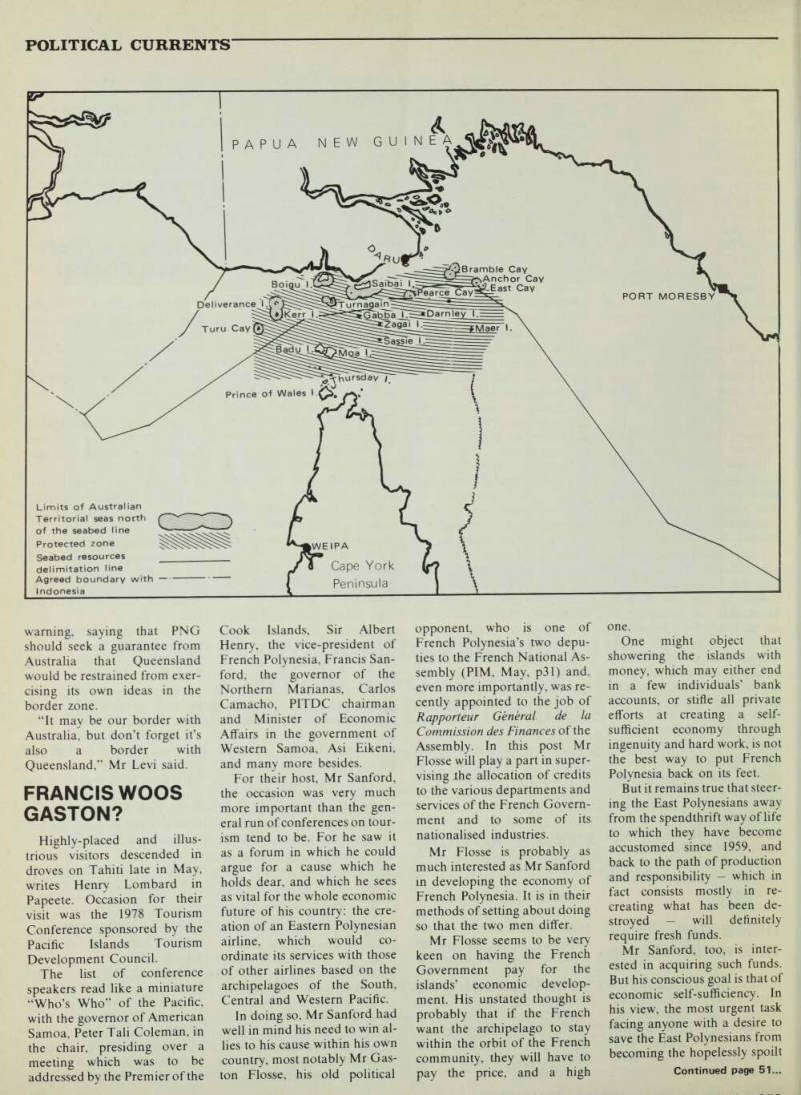
Political
Png Honesty’
Code Shelved
PNG Prime Minister Michael Somare’s Leadership Code, under which parliamen tary and public service leaders would have to shed their pri vate holdings in companies, or resign, has been shelved.
Mr Somare’s announcement in parliament that he had de cided to postpone further con sideration of the measure while a “non-political committee” advises him was hailed by the Opposition as the end of the move in its present form.
The Opposition believes the shelving will become per manent, and that the new pro
posals which may eventually
emerge will bear little resem blance to the original, writes Gus Smales from Port
Moresby.
There are strong suggestions, too, that Mr Somare pulled the legislation out of the present sitting of parliament to save his government.
Rifts between the coalition partnership and unrest from backbenchers have been part of the contentious background to the legislation. Mr Somare has played down the dif ferences, claiming that the strength of the coalition is suf ficient to overcome differing
opinions.
But the shelving of the bill suggests he has now realised the potential for a really serious rift is much stronger than he had acepted.
Under the leadership code legislation, all men and women defined as “National Policy Makers” would have to sell all their business interests and shareholdings. This would apply to every interest, no matter how longstanding, how small or how non contentious.
The move would have effec tively prevented any person from even a “comfortable”
financial family background
from holding important politi
cal, public service or statutory office.
The proposed legislation
banned any trust arrangements which would allow leaders to return to their private interests after a term in public life. The
proposed legislation would
have affected between 150 and 200 men and women, including the Cabinet itself.
In the wave of criticism which arose, Mr Somare’s motives were generally
accepted as being straight
forward, but the legislation was attacked on the grounds of
being impractical. There were
fears that it would be imposs ible to administer honestly, and that it could lose PNG the ser vices of some of its best leaders and potential leaders.
Some criticism accused Mr Somare of deliberately want ing to surround himself with nonentities, to bolster his own personal influence.
Announcing the shelving of
the legislation for the time being, Mr Somare said there was no suggestion that he was
deviating from his previously
expressed objective. He was
still determined to present the code, and he believed the code was in the national interest to
prevent corruption.
However, he believed it would be unwise to introduce the legislation at the current sit tings of parliament, as had been planned. This was be cause parliament was in a “somewhat volatile state” at present, and not in the best pos ition for a reasoned debate on a vital issue.
In the meantime, he would
appoint a non-political com
mittee to advise him on certain aspects of the bills and the form of their presentation.
But there was no suggestion the legislation, or its concept, was being dropped, Mr Somare said.
The Hebrides’
New Calm
An atmosphere of calm and co-operation between rival Melanesian political forces, unthinkable a few short months ago, has made its timid
entry into the New Hebridean scene.
The new, more hopeful, pol itical climate stems from a series of discussions between the government of Chief Minister George Kalsakau and top representatives of the
Vanuaaku Party.
Beginning at the end of March, the talks continued through April into May and culminated in: •An agreement that both sides would participate in an ad hoc committee on electoral re form, whose work should be completed in 10 to 15 months; • That on completion of the committee’s work, fresh elec tions will be held these should go far to removing the difficulties created by the fact that the Vanuaaku Party boy cotted the proposed November 29, 1977, poll which gave rise to the present Representative Assembly, and the Kalsakau government, neither of which was in fact elected by popular vote; • That following the start of the work of the ad hoc com mittee, scheduled for May 8, the Vanuaaku Party would sus
pend indefinitely the activities
of its People’s Provisional Government this removes the main government objection to Vanuaaku Party tactics, since the PPG was seen as a di rect challenge to its own auth ority over New Hebridean territory as a whole.
The French/Bislama fort
nightly Nabanga commented
in its May 13 issue: “From March 31 onwards a meeting which seemed to be a last-ditch effort brought together in the Chief Minister’s office Mr Maxime Carlot, chairman of
the Representative Assembly,
all ministers of the govern ment, and seven of the main leaders of the Vanuaaku Party, Father Lini, and Messrs Sope, Matas, Kalkao, Naupa, Abil and Bice.
“From one effort at com munication to another, from one concession to another, the participants found themselves relaxing, smiles began to appear on their faces, and it be came clear that, despite the confrontations of the past, they
were, when all was said and done, among brothers.
“The event showed how true it is that in the New Hebrides and often enough in other places as well the white man’s presence does not make it easier to have a fruitful ‘tok tok’.”
Micronesia
Breakthrough
The 1978 annual hearing of the United Nations Trustee ship Council on conditions in the US Trust Territory of the Pacific was considerably more relaxed than in some earlier years due to recent improved understanding between the
parties.
In a major breakthrough in the tortured and torrid nego tiations between the US and Micronesia on future political status, the US has agreed that the proposed constitution of the Federated States of Micronesia is “compatible” with Micronesia’s status of free association with the US.
The Micronesians have long sought to win a public commit ment from the US that the pro posed constitution was
compatible with the principle
of free association.
The US had previously refused to make such a com mitment.
The change in position was announced by President Carter’s personal represen tative, Ambassador Peter R.
Rosenblatt, following talks in Hilo, Hawaii, in April with negotiators from the Micronesian Commission on Future Political Status and Transition, the Palau Political Status Commission and the Marshall Islands Political Status Commission.
The compatibility question
is especially important in the
period, leading up to the July
12 referendum on the consti
tution (PIM, May, p 6) because
of the possible public miscon ception that approval of the constitution would mean that Micronesia would become independent. The spectre of independence, and lower levels of US financial assistance than could be extended under a status of free association, has
often been given as a reason for a “No” vote on the consti tution.
The US concession on “com patibility” was matched on the Micronesian side by agreement that the US would have “full authority and responsibility for security and defence matters in or relating to Micronesia”, and that “this authority and re sponsibility will be assured for
15 years”.
The previous Micronesian
negotiating position has been
that such authority would rest with the US for only five years.
A major bombshell was
dropped during the Trustee
ship Council proceedings when
Mr Roman Tmetuchl, chair man of the Palau Political Status Commission, an nounced that he opposed the proposed superport for Palau.
He said his new-found oppo sition to the superport was based on his understanding that “reasonable economic ar rangement with the United States is forthcoming”.
A key to the Palauan spokes man’s change of heart on the issue may be found in the rev elation by the Los Angeles Times that “all references to the proposal (for a superport) had been mysteriously dropped from the final draft of a study on the economic future of Micronesia done last year by the United Nations” (PIM, May, p 13).
It is reasonable to assume that if the UN report ignored the proposal, those who com piled it had information that Washington itself wanted it shelved. It would be surprising if such an important piece of information had not found its way to the ear of Tmetuchl dur ing his visit to the United States for the Trusteeship Council
meeting.
Those War
Time Hangings
Papua New Guinea has de cided not to make any official comment on circumstances
surrounding wartime hangings
carried out by Australian Mili tary Tribunals. (PIM, June, P 5)
Mr Barry Jones (Labor Vic) said in the Australian Parlia ment early in May that more than 30 Papua New Guineans were executed by Australia for collaborating with Japanese invaders in PNG.
Although the executions are historically documented, Mr Jonfcs claimed the official re cords had been destroyed to
protect people in high places.
The historical records show that the executions were for murder and rape, and not for collaboration with Japanese forces.
The newspaper, The Aus tralian, published a report towards the end of May claim ing that the PNG Government had castigated Mr Jones for attempting to embarrass re lations between PNG and Aus tralia, or for trying to gain
personal glory.
The report said the PNG De fence Minister, Mr Mona, had made the statement in National Parliament in Port
Moresby several days earlier.
However, no statement on the affair was made in the PNG National Parliament, although newsmen were shown an embargoed copy of a planned statement which was with drawn before being given to
parliament.
It is understood that the PNG Government sees the issue, in the form raised by Mr Jones, as a purely Australian domestic matter.
This is because the contro versy does not concern the hangings themselves, but involves what happened to official sets of Australian docu ments.
Cooks: Action,
Reaction
An inquiry into alleged brib ery and corruption in the Cook Islands’ March 30 elections has been told that the Premier, Sir Albert Henry, has asked for $327 000 from the Cooks’
philatelic bureau “to help
finance a major project for the islands”.
The inquiry is being con ducted in Auckland by Mr Jus tice Donne, Chief Justice of the Cook Islands.
The general manager of the Cook Islands Development Co Ltd, Mr James Little, told the inquiry that his company ran the philatelic bureau with the Cook Islands Government.
He produced two letters from Sir Albert requesting money from the bureau.
The first letter, written in February, asked for $4 000 towards the cost of setting up a new company, the Cook Islands Government New Pro jects Co Ltd, whose aim would be to attract outside capital for
the development of projects
within the Cook Islands.
The second letter, dated March 13, said the new company wanted to help “in
the financing of a major project
for the Cook Islands”, adding: “Substantial finance will be re quired and I would be pleased if you would forward to me a cheque in external funds for SNZ327 000 made out to the
above company.”
Earlier, the hearing had been told of a series of bank trans fers involving the New Projects Co had been carried out before six charter flights to Rarotonga for Cook Islands Party sup porters were paid for.
Sir Albert announced in late May that he planned to strengthen his grip on the islands by holding an election for three newly created seats within the next couple of months. The new Legislative Assembly seats are all on the main island of Rarotonga. Sir Albert said he was confident his party would win them all.
Other plans announced in the May speech from the throne to the Cooks’ Legislat ive Assembly by Mr Justice Donne, acting in his capacity as the Queen’s representative in the Cooks, could also radically
change the Cooks political
scene.
The first of two amendments designed to “remove the col onial or neo-colonial flavour from the constitution” pro poses “a change in the manner by which her Majesty the Queen will be represented in the Cook Islands from an offi cer of the Ministry of Foreign Affairs in New Zealand to a representative appointed on the recommendation of the
Government of the Cook Islands”.
The Legislative Assembly
voted at the middle of May to change the Constitution,
providing for the appointment
of a Head of State (Kauono) by the Queen on the recommen dation of the Premier after con sultation with the Cabinet.
Torres Strait
Lines Drawn
Neither Australia nor Papua New Guinea have made any
significant concessions or gains
in the international boundary arrangements which will apply between the two countries, writes Gus Smales in Port
Moresby.
The boundary arrangements will take in three main lines on the map, and here is how they will be drawn: • There will be an inter national seabed boundary which will separate one country from the other; • A protected zone in which both countries will be involved, irrespective of the inter national boundary which the protected zone will straddle, and • A collection of eight Aus tralian islands and reef en claves inside the PNG
boundary.
The protected zone is seen by both governments as the most vital part of the boundary arrangements. It will be about 180 nautical miles from east to west and about 70 nautical miles from north to south in the Torres Strait Sea region. This is the area between the most northerly part of Australia and the southwest coast of the PNG mainland.
The protected zone will take in almost every island, reef and cay within the Torres Strait
zone, excluding only the big
Australian offshore group of islands centred on Thursday Island.
The PNG Government was told later, “beware of Queensland” when PNG and Australia implement their border arrangements.
Mr Noel Levi, a government back-bencher and a former Secretary for Defence, gave the
warning, saying that PNG
should seek a guarantee from Australia that Queensland would be restrained from exer cising its own ideas in the border zone.
“It may be our border with Australia, but don’t forget it’s also a border with Queensland,” Mr Levi said.
Francis Woos
Gaston?
Highly-placed and illus trious visitors descended in droves on Tahiti late in May, writes Henry Lombard in Papeete. Occasion for their visit was the 1978 Tourism Conference sponsored by the Pacific Islands Tourism
Development Council.
The list of conference speakers read like a miniature “Who’s Who” of the Pacific, with the governor of American Samoa, Peter Tali Coleman, in the chair, presiding over a meeting which was to be addressed by the Premier of the
Cook Islands, Sir Albert
Henry, the vice-president of
French Polynesia, Francis San ford, the governor of the Northern Marianas, Carlos Camacho, PITDC chairman and Minister of Economic Affairs in the government of Western Samoa, Asi Eikeni, and many more besides.
For their host, Mr Sanford, the occasion was very much more important than the gen eral run of conferences on tour ism tend to be. For he saw it as a forum in which he could argue for a cause which he holds dear, and which he sees as vital for the whole economic future of his country: the cre ation of an Eastern Polynesian airline, which would co ordinate its services with those of other airlines based on the archipelagoes of the South, Central and Western Pacific.
In doing so, Mr Sanford had well in mind his need to win al lies to his cause within his own country, most notably Mr Gas ton Flosse, his old political
opponent, who is one of
French Polynesia’s two depu
ties to the French National As
sembly (PIM, May, p3l) and,
even more importantly, was re
cently appointed to the job of
Rapporteur General de la Commission des Finances of the Assembly. In this post Mr Flosse will play a part in super vising Ihe allocation of credits to the various departments and services of the French Govern ment and to some of its nationalised industries.
Mr Flosse is probably as much interested as Mr Sanford in developing the economy of French Polynesia. It is in their methods of setting about doing so that the two men differ.
Mr Flosse seems to be very keen on having the French Government pay for the islands’ economic develop ment. His unstated thought is probably that if the French want the archipelago to stay within the orbit of the French community, they will have to pay the price, and a high
one.
One might object that
showering the islands with money, which may either end in a few individuals’ bank accounts, or stifle all private efforts at creating a self sufficient economy through ingenuity and hard work, is not the best way to put French Polynesia back on its feet.
But it remains true that steer ing the East Polynesians away from the spendthrift way of life to which they have become accustomed since 1959, and back to the path of production and responsibility which in fact consists mostly in re creating what has been de stroyed will definitely require fresh funds.
Mr Sanford, too, is inter ested in acquiring such funds.
But his conscious goal is that of economic self-sufficiency. In his view, the most urgent task facing anyone with a desire to save the East Polynesians from
becoming the hopelessly spoilt
Continued page 51...
children of a super-welfare state is to use what money is available on sound invest ments, such as the Eastern
Polynesian airline project.
Hence his anxiety to win a resounding endorsement from the tourism conference for the project. Mr Flosse could thus be obliged to climb on the bandwagon and to plead, in Paris, the need for capital to get the airline started.
It may seem strange to think of these two long-standing pol itical foes working in tandem in such a cause. But in politics, perhaps more than in any other human activity, one’s enemy of today may be one’s best friend and ally of tomorrow.
The Relief
Of Norfolk
The Norfolk pines swayed
visibly with the sighs of relief of Norfolk Island inhabitants following the May visit of Aus tralia’s Minister for Home Affairs, Mr R. J. Ellicott, QC.
For Mr Ellicott had presented them with what amounted to a bonanza of con cessions in terms of Australian Government policy towards the island. The most important of these were: • Australian laws will not be extended automatically to Nor folk, which will continue to have its own peculiar mixture of laws. • Australian taxes will not be extended to Norfolk. • Australian social service benefits will not be extended to Norfolk. • Any decision on represen tation for Norfolk in the Aus tralian Parliament will be put off for at least a year, and con sidered by a proposed “Nor folk Island Legislative
Assembly.”
One local commentator wrote jubilantly; “Mr Ellicott mentioned various minor as pects of the Nimmo Report, as though the government is accepting some parts of it while not accepting other parts but with its main recommenda tions rejected the report is now a dead letter.”
The report of the 1976 Royal
Commission presided over by
Sir John Nimmo had recom
mended sweeping measures of integration of Norfolk with the Australian mainland.
So the muskets which some had been threatening to take from their racks (PIM, June, p 19) can stay on the wall. For the time being at least, life on Norfolk Island can return to the leisurely pace for which it is renowned.
Mr Ellicott’s visit was the culminating point of 18 months of sometimes feverish political activity in Norfolk affairs.
Among the more spectacular recent gestures of the Islanders was the despatch of a dele gation to American Samoa by the Society of Descendants of the Pitcairn Settlers. The dele
gation comprised Mr Ken
Nobbs, president of the society, Mr Greg Quintal, a member of the society and the longest-serving member of the Norfolk Island Council, and Mr Ed Howard, American born editor of the Norfolk Island News, who acted as dele
gation secretary.
Society members, whose ancestors were part-Tahitian, had taken careful note of the inaugural address in January of American Samoa’s first elected governor, Mr Peter Tali Coleman, in which he said: “Mindful that we are Polynesians, as well as Samoans, we reach out our hands for our brothers and sis ters who live in Western Samoa, Tonga, Niue, Tuvalu, the Cook Islands, and in other neighbouring island communi ties in the Pacific. As we share a common past, so we share a common future, so must we
voyage together.”
In April the Pitcairners set out on a voyage to take the hand of kinship that had thus been offered them. They were not disappointed. Mr Coleman and his government greeted them as long-separated mem bers of the family. As the governor said in greeting them; “We have been expecting you for a long time.”
While Norfolk Islanders are breathing more easily since the Ellicott visit, in view of their past experience they are un likely to relax their vigilance against attempts by Australian
politicians to find loopholes in the new arrangements.
Such vigilance will only be
sharpened by the fact, angrily
noted on Norfolk, that the re port, Australia and the Pacific, prepared by the Senate Stand ing Committee on Defence and Foreign Affairs, has been writ ten as if Norfolk Island had
already been integrated into
Australia. Norfolk Island simply does not appear in the report’s list of countries and territories in the Pacific re
gion.
One further question about the status of Norfolk might be asked.
The amended Canberra Agreement of 1975, which is virtually the charter of the South Pacific Commission, says (Article V): “Australia (in respect of itself and its terri tories) 2 votes with the pro viso that Australia will not exercise the second vote until such time as Norfolk Island participates in the Con ference.”
The next South Pacific Con ference meets in Noumea in October. Will there be a Nor folk Island representative seated at the conference table?
Hostages: A
Tangled Tale
‘Confused’ seems as good a word as most to describe re ports in late May-early June of the alleged capture of a num ber of Indonesian officials who
were being held hostage by
rebels in jungle country in Irian Jaya north of the border with Papua New Guinea.
First reports said that the nine hostages included the commander of the Jayapura military district. Colonel Ismaeil, the intelligence chief in the province of Irian Jaya, Colonel Ameral, and the chair man of the provincial parlia ment, Mr Domine Nalaole.
The reports said that the rebel Free West Papua Move ment (OPM) was demanding an international conference, including Australia and Papua New Guinea, to negotiate their claims for independence from Indonesia, as a condition of re lease of the hostages. Other
wise they would be killed.
The reports added that a senior PNG provincial official had claimed to have received a duplicate of the rebels’ letter to Papua New Guinea’s Foreign Minister. Mr Ebia Olewale. outlining their demands.
But Mr Olewale later denied that there had been any com munication with him from the rebels. He was echoed by Aus tralia’s Acting Foreign Minis ter. Mr lan Sinclair, who said Australia had received no approaches, and was not in volved.
Entering the fray, Mr Jus
peth Siregar. information offi
cer at the Indonesian embassy in Port Moresby, denied that the “rebels” were really rebels at all. They had been at one lime, he said, but had surren dered.
They had been co-operating
with the government until this “hot-headed action brought on
by dissatisfaction”.
Later, a letter received in
Port Moresby by a family with
relatives in Jayapura. the Irian
Jaya capital, accused Indone
sian officials of inventing a story that a ransom was being demanded for the hostages.
The rebels are not mercenaries interested in money, the letters said, but want an acknowledge ment that the independence of Irian Jaya will be recognised and implemented. The letters claimed that if the hostages who are officials acknowledge
this by signing documents, they
will be released.
Sources in Port Moresby in June reported that a “huge” military operation had been launched by Indonesian forces to rescue the hostages.
But this was immediately de
nied by a military spokesman
in Jakarta who said; “There was no such operation ... if
there were operations, they
were only of a routine nature and by small units.”
The claims and counter claims will no doubt be sorted out with time. All that can now be said with confidence is that Indonesia’s problem with rebels in Irian Jaya, and Papua New Guinea’s problem in re lation both to the rebels and to Indonesia, are refusing to go away.
Advertisements & other items, pp. 39-51 (6 items)
39
IOI AKIPVO Ik il/'"'V MTL 11 \/ II II w -< mn
40
A /"> 1 I /~> IPI A Kino V 111 l Y 1978
Brownbuilt kMkB
Ten four drawer filing cabinets take up this much office space.
The Brownbuilt office file occupies less than half the space.
One Brownbuilt mobile office file
can hold the contents of
10 four drawer filing cabinets
For most companies, floor space devoted to storage is unprofitable. The Brownbuilt mobile filing system provides the same storage capacity of 10 four drawer filing cabinets in one attractive unit.
Just roll the individual cabinets apart. Everything that was once scattered in bulky cabinets or cupboards is consolidated. The office space you’ve saved can be put to better use.
Adjustable steel shelving accommodates most types of office filing, including lateral, or box, and general storage with lockable security The unit may be relocated wherever required. The base can be extended to accommodate additional cabinets. Available in standard “Canarvon” mid brown or alternatively a range of environmental colours to blend with contemporary office surroundings.
Brownbuilt kMkB
LIMITED
can take waste out of space
Brownbuilt Ltd., Cnr. Bath Rd. and Waratah St., Sutherland, NSW 2232, Australia.
Agents Hawaii: Records Management Services, Honolulu Fiji: Lysaght Brownbuilt Ind., Suva New Caledonia: NCR Corporation, Noumea New Hebrides: NCR Corporation, Vila Papua New Guinea: Brownbuilt (PNG) Pty. Ltd., Port Moresby and Lae.
DAIHATSU Continues To Press Forward
In Its Quest For A Harmonious “Automobile Society”
A new car born of logic
created to meet
the practical need
of today’s world
■ 4 model XG P
charade
The Daihtsu Qiarade is a car in which a family of 5 can travel in comfort. A car with a special functionality, thanks to its hatch-back door, and with plenty of power for excellent maneuverability under a wide variety of conditions ranging from crowded cities to fast highways. Very definitely a car of economy . . . but still a car in which all of these attributes have been concentrated into a compact a r- J J body in a very logical way.
Today we no longer live in an age in which we can afford the luxury of determining a car’s worth by its luxurious fittings and its great engine displacement. The Daihatsu Qiarade is therefore a new - and most logical - alternative for those who will enjoy the simple life and its simple pleasures.
4-Wheel Drive...ideal for highways,
sand, rocks or mountain trails
Because it can go “almost anywhere”. And that includes highways, rocky trails, sand, river sides. Dry, wet, rocky, sandy surfaces.
That’s what sets this 4-Wheel Drive so far apart - and ahead - when the going gets tough. Excellent acceleration superb hill climbing, amazing tenacity . . . that’s the story of Daihatsu 4-Wheel Drive!
DAIHATSU
4 WHEEL DRIVE
DAIHATSU
DAIHATSU IVIOTOR CO, LTD.
DAIHATSU fVIOTOR
Head Office: 1, D AI H ATSU-CHO, IKEDA CITY, OSAKA PREFECTURE, JAPAN
PHONE: IKEDA (0727) 51-8811
CABLE ADDRESS: TLX5322224 DAIHATSU IKEDA OSAKA
TELEX NO.: 0-5322-251 JAPAN, 0-5322-224 JAPAN
Tokyo Office:
7, NIHONBASHI-HONCHO 2-CHOME, CHUO-KU, TOKYO.
PHONE: TOKYO (03) 279-0811
CABLE ADDRESS: DAIHATSU TOKYO
TELEX NO.: 0-222-3377 JAPAN
PAPUA NEW GUINEA: AGQUIP NEW GUINEA, P.O. Box 1121, Rabaul/ FIJI; PRAKASH MOTORS LIMITED, P.O. Box 370, Suva/ TAHITI: ETS. ROBERT, B.P. 1047, Papeete/ NEW CALEDONIA: 5.1.D.A., B.P. 2548, Noumea/ NEW HEBRIDES: SANTO BUS COMPANY, P.O. Box 45, Santo, GARAGE RANTY & JAMMES, B.P. 627, Port Vila/ SOLOMON ISLANDS: HERTZ CAR RENTALS LIMITED, P.O. Box 333, Honiara/ REPUBLIC OF NAURU: NAURU COOPERATIVE SOCIETY/ NIUE ISLAND: NIUE ISLAND UNITED ENTERPRISES, P.O. Box 4/ NORFOLK ISLAND: W.W. SANDERS & SONS LTD., P.O. Box 86, Burnt Pine/ GILBERT ISLANDS: JONG KUM KEE BROTHERS' STORE, P.O. Box 504 Betio Tarawa
Come uptokool The cool refreshing taste of menthol.
6?
Q Q
a %^ir
ci 0 o '= S C^ 0, □i <c* o < & O m It s easy to go overboard under water.
Ask just about any diver and he’ll tell you the lower he goes the higher he gets.
So forget about Jaws and get into the swim of things underwater, where there’s a lot more happening than you’d ever expect.
To start, you don’t need much money or skill, either. The basic snorkel-mask-fin combination is enough to take you—and your favorite mermaid—into a whole new world of excitement and beauty. Explore a coral reef, or hunt for buried treasure even if the treasure is only a lost tackle box. It’s all fun. And the deeper you get into diving, the more you’ll get out of it. Graduate to scuba gear and discover what real freedom-of-movement is all about. When you’re good enough, you can try spear fishing or experiment in the delicate art of underwater photography. And if you’re lucky, you might even find Atlantis.
And on the surface, put your trust In Yamaha Once you leave Neptune’s domain you’ll want a quick trip back to shore to tell all your landlubbing friends just how much they’ve missed. For that, you want the reliable power of a Yamaha outboard and the peace of mind that comes from owning one.
Yamahas come in a complete range of powers and there’s options enough to please even the most fanatical purist. So whether you use canoe or a big cruiser as your diving “platform”, there’s a Yamaha for you.
Advanced features like. Dual Thrust Exhaust, improved trolling and cleaner, quieter operation have made Yamaha one of the most sought-after outboards on the market.
See you local dealer soon for the full story or write us at the address below for your free, full-color catalogue.
From 2 to 60.
Power for
any purpose.
rmu
YAMAHA
YAMAHA
YAMAHA
40 28 25/20
Outboard
with
YAMAHA
YAMAHA MOTOR CO.. LTD.
2500 SHINGAI IWATA-SMI SHIZUOKA KEN JAPAN
( A\\ * I 'A c (* i *
ns \ : MB r • % The Toyota truck range. Built to be unbeatable.
Bad weather conditions, no problem.
Bad roads and driving surfaces, eaten up.
Difficult loads, no contest. Built tough. Built to take it.
There's a Toyota truck built for you. 4 TOYOTA Land Cruiser Pickup TOYOTA Stout
TOYOTA Hi-Lux
U
TOYOTA Dyna
TOYOTA Toyo-Ace TOYOTA Truck
TOYOTA
For unbeatable after service: PAPUA NEW GUINEA: ELA MOTORS LIMITED, Scratchley Rd., Badili, P.O. Box 75, Port Moresby U.S. TRUST TERRITORY: MICROL CORPORATION, ™ ?T X^ 26 Ju Sa ' Pan FUI ,SLANDS: AUTOMOTIVE SUPPLIES CO., LTD., G.P.O. Box 355, Suva AMERICAN SAMOA: BURNS PHILP (SOUTH SEA) J 05 7 Pa 9°- WESTERN SAMOA: BURNS PHILP (SOUTH SEA) LTD., P.O. Box 188, Apia. GUAM: ATKINS, KROLL (GUAM) LTD,, f B ° X ® 4 „ B, Ta [^ unin 9- NEW HEBRIDES: NEW HEBRIDES MOTORS LTD., P.O. Box 18, Vila. SOLOMON ISLANDS: MENDANA ENTERPRISES (5.1.), on a non 174, Honiara TAHITI: NIPPON AUTOMOTO, B.P. 342, Papeete. COOK ISLANDS: COOK ISLANDS TRADING CORPORATION LTD., P.O. Box 92, Rarotonga. NAURU ISLAND: NAURU COOPERATIVE SOCIETY. GILBERT & ELLICE ISLANDS COLONY; TARAWA MOTORS, Box RF °o LK ,SLAND: MAR| E’S NORFOLK TOURS, LTD., P.O. Box 276. NEW CALEDONIA: SOCIETE IMPORTATION AUTOMOBILE DU PACIFIQUE, Rond-Point du Pacific (Station Total) B.P, 438, Noumea.
m a ■ a ivi m «s I r : . *t I
You’ll like our style to all
our destinations.
We have many flights to many destinations, but on each and every one you can be sure of one thing: attentive and friendly service. Plus of course good food and fine wines served in big jet comfort.
Today this special style of Air New Zealand is yours to enjoy on direct flights to New Zealand, or on your way around the Pacific; even to the East now that the fast, friendly way there is first to fly south with us! And of course to Honolulu, Los Angeles and on to Canada, London or Europe.
Your travel agent or Air New Zealand is ready now to help you plan the trip and the fares that suit you best wherever you want to fly.
air /if w
” We fly the Pacific.
ANZ7B/3
Only Pioneer could pack this much performance
into a speaker system this size.
Usually tiny means “tinny.” But, when
you’ve been in the audio business as long as we have, you know how to
build a compact speaker system that’s
all performance and no nonsense.
Featuring two speakers laid out two
ways, the power-handling ability of
Pioneer’s CS-X 3 is 50 watts. Incredible for a unit of these proportions. And the 4-inch (10cm) woofer uses an extra-
large magnet to ensure big system
response in the all-important bass
range. Mounted on a separate baffle
and suspended in a tough diecast
frame to reduce resonance is the
1-inch (2.5 cm) soft-dome tweeter.
The results are truly low distortion and
clear, transparent highs.
So, drop by any of the distributors
listed below and hear for yourself.
At really affordable prices and in
an easy-to-carry home size, Pioneer’s
CS-X 3 speaker systems are one of the
truly big bargains in sound.
(IDpioimeer
American Samoa Traspac Corporation, P.O. Box 1477, Pago Pago, American Samoa 96799 Tel: 633-5224 Rarotonga South Seas International Ltd., P.O. Box 49, Rarotonga Cook Islands Tel: 2327 Papua New Guinea Bali Merchants Pty. Ltd., P.O. Box 6103 Boroko Tel; 254887 Australia Pioneer Electronics Australia Pty.
Ltd., 178-184 Boundary Road.
Braeside, Victoria 3195, Tel: 90-9011, Sydney 93-0246, Brisbane 59-7457, ’
Adelaide 433379, Perth 24-9899 Fiji Islands Brijlal & Company, G.P.O. Box No. 362, Suva, Fiji Islands Tel: 22258 New Zealand Fountain Marketing Ltd., Maidstone Street, Auckland. New Zealand Tel: 763-064 Norfolk Island Burns Philp (Norfolk Island) Ltd., Norfolk Island, South Pacific New Hebrides Burns Philp (New Hebrides) Ltd., Vila, New Hebrides Nauru Island Jacob Enterprises, P.O. Box No. 4 Republic of Nauru Tahiti Est. PERFECT, B.P. 594, Papeete, Tahiti Tel: 20 407 New Caledonia Menard Freres Ville, B.P. H 2 Cedex, Noumea, New Caledonia Tel: 27.52.22
A Kenwood Hi-Fi System Makes
a Wonderfully Sound Investment!
Pure tonal quality is only one of the benefits of investing in a Kenwood component system.
For one thing, you can move on up to better things as budget permits. One component at a time.
For another, you get top performance from each individually engineered component. And flexibility, too.
Ask anyone who’s ever owned a music center what that means.
The fine Kenwood quartet you see here is built around our KA-5500. A powerful, low-distortion integrated amplifier packed with advanced circuitry.
For your main sound source—records—there’s the KD-2070.
Its direct-drive system uses a new smooth-running DC servo-motor to drive a heavyweight platter.
So wow-and-flutter stays below 0.04% (WRMS).
The KX-520 lets you record and play cassettes like a pro.
And just wait till you get your ears in front of our linear-response LS-880 speaker system.
It’s so transparent and natural-sounding, you won’t even know it’s there.
Invest in Kenwood. Famous for tonal quality.
For tourists: ONE YEAR WARRANTY in Asia, and Oceania.
Also applicable in U.S.A., France, Belgium and West Germany.
$ KENWOOD
tl • •IP II N t t f * w TRIO-KEN WOOD CORPORATION 6-17, 3-chome, Aobadai, Meguro-ku, Tokyo 153, Japan AUSTRALIA TRIOKENWOOD (AUSTRALIA) PTY. LTD. 30 Whiting St., Artarmon, N.S.W. 2064. Tel; 439-4322 NEW ZEALAND JOHN GILBERT & CO., LTD. Auckland Tel. 30-839 FIJI THE DOMINION IMPORT & EXPORT PROMOTIONS Nadi Tel. 72-165 PAPUA NEW GUINEA S O. SVENSSON (N.G ) LTD. Port Moresby Tel. 24-2275/2285 NORFOLK ISLAND BURNS PHILP (NORFOLK ISLAND) LTD.
SOLOMON ISLANDS TECHNIQUE RADIOS CENTRE LTD. Honiara Tel. 416 NEW CALEDONIA HI-FI VOX Noumea Tel. 27-2466 NEW HEBRIDES RUE HIGGINSON Vila Tel 2556 TAHITI MAI SON AURORE Papeete Tel. 29703 AMERICAN SAMOA ISLAND PACIFIC AGENCIES, INC Pago Pago Tel. 633-4687
REPUBLIC OF NAURU NAURU CO-OPERATIVE SOCIETY
MARIANA ISLANDS J.C. TENORIO ENTERPRISES Saipan Tel. 6445
Political Currents
Political Currents
Pacific Island Monthly
POLITICAL CURRENTS
People
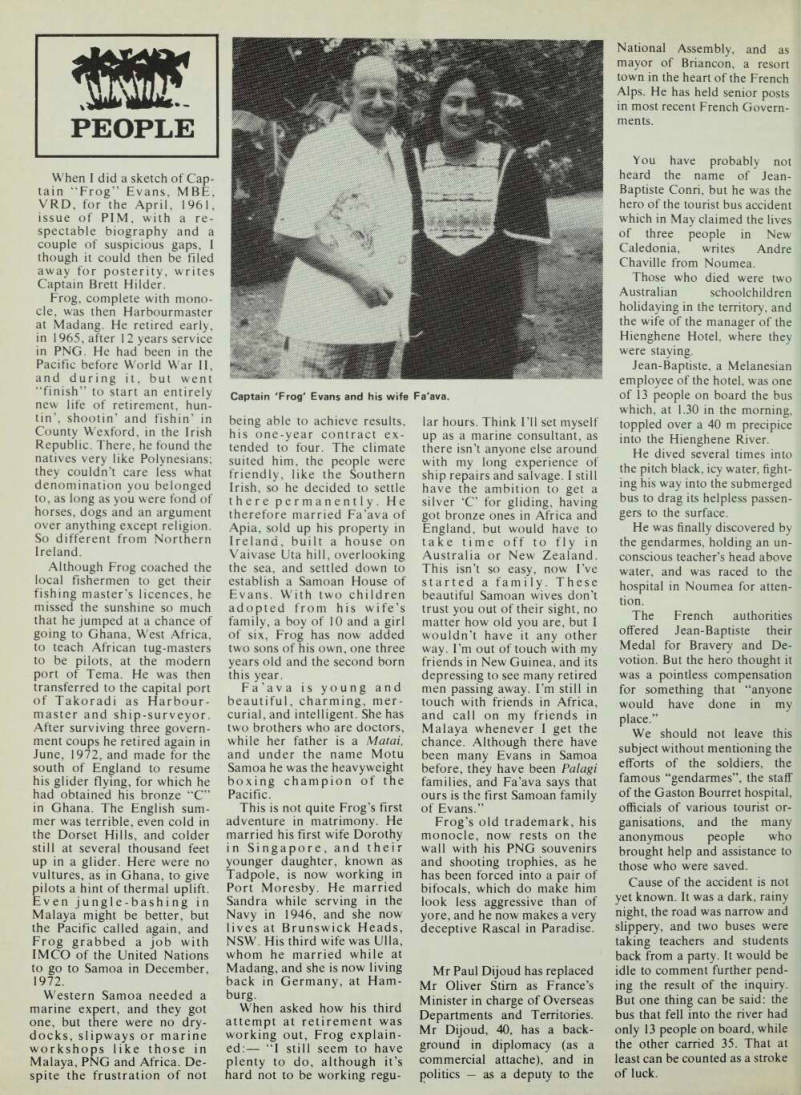
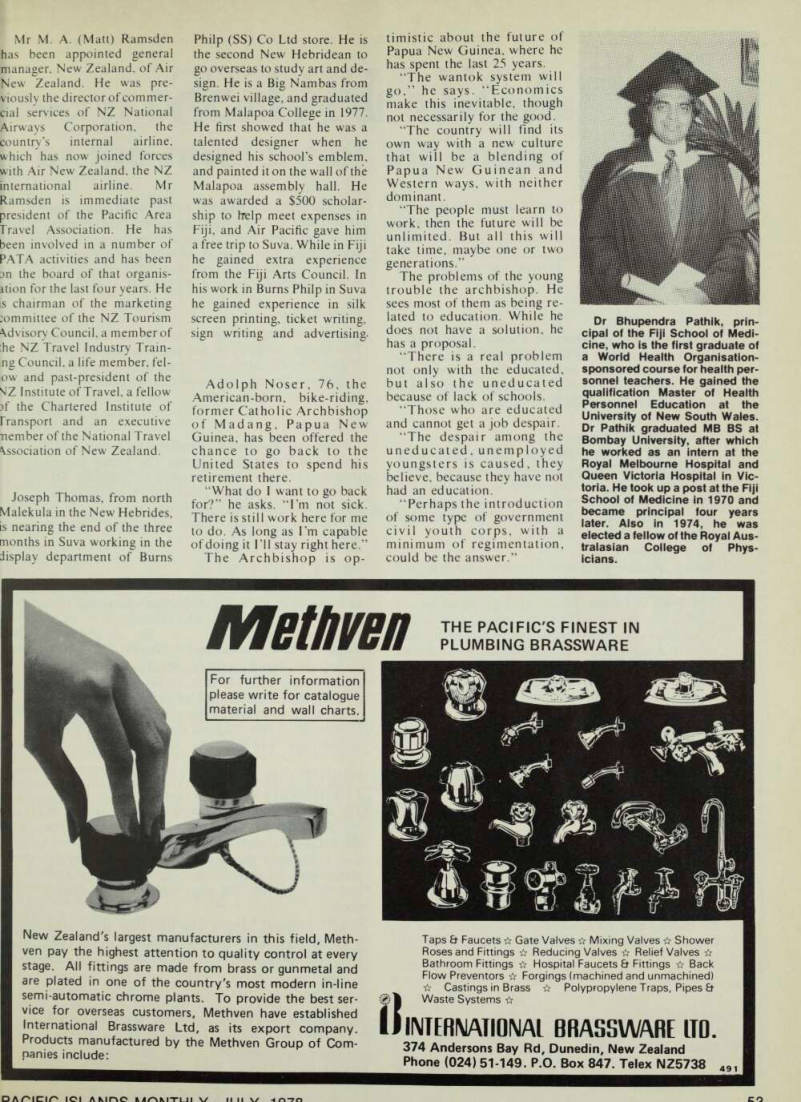
When I did a sketch of Cap tain “Frog” Evans, MBE, VRD, for the April, 1961, issue of PIM, with a re spectable biography and a couple of suspicious gaps, I though it could then be filed away for posterity, writes Captain Brett Hilder.
Frog, complete with mono cle, was then Harbourmaster at Madang. He retired early, in 1965, after 12 years service in PNG. He had been in the Pacific before World War 11, and during it, but went “finish” to start an entirely new life of retirement, hun tin’, shootin’ and fishin’ in County Wexford, in the Irish Republic. There, he found the natives very like Polynesians; they couldn’t care less what denomination you belonged to, as long as you were fond of horses, dogs and an argument over anything except religion.
So different from Northern Ireland.
Although Frog coached the local fishermen to get their fishing master’s licences, he missed the sunshine so much that he jumped at a chance of going to Ghana, West Africa, to teach African tug-masters to be pilots, at the modern port of Tema. He was then transferred to the capital port of Takoradi as Harbour master and ship-surveyor.
After surviving three govern ment coups he retired again in June, 1972, and made for the south of England to resume his glider flying, for which he had obtained his bronze “C” in Ghana. The English sum mer was terrible, even cold in the Dorset Hills, and colder still at several thousand feet up in a glider. Here were no vultures, as in Ghana, to give pilots a hint of thermal uplift.
Even jungle-bashing in Malaya might be better, but the Pacific called again, and Frog grabbed a job with IMCO of the United Nations to go to Samoa in December, 1972.
Western Samoa needed a marine expert, and they got one, but there were no dry docks, slipways or marine workshops like those in Malaya, PNG and Africa. De spite the frustration of not
being able to achieve results, his one-year contract ex tended to four. The climate suited him, the people were friendly, like the Southern Irish, so he decided to settle the re per m anen 11 y. He therefore married Fa’ava of Apia, sold up his property in Ireland, built a house on Vaivase Uta hill, overlooking the sea, and settled down to establish a Samoan House of Evans. With two children adopted from his wife’s family, a boy of 10 and a girl of six, Frog has now added two sons of his own, one three years old and the second born this year.
Fa'ava is young and beautiful, charming, mer curial, and intelligent. She has two brothers who are doctors, while her father is a Matai, and under the name Motu Samoa he was the heavyweight boxing champion of the Pacific.
This is not quite Frog’s first adventure in matrimony. He married his first wife Dorothy in Singapore, and their younger daughter, known as Tadpole, is now working in Port Moresby. He married Sandra while serving in the Navy in 1946, and she now lives at Brunswick Heads, NSW. His third wife was Ulla, whom he married while at Madang, and she is now living back in Germany, at Ham burg.
When asked how his third attempt at retirement was working out, Frog explain ed;— “I still seem to have plenty to do, although it’s hard not to be working regu
lar hours. Think I’ll set myself up as a marine consultant, as there isn’t anyone else around with my long experience of ship repairs and salvage. I still have the ambition to get a silver ‘C’ for gliding, having got bronze ones in Africa and England, but would have to take time off to fly in Australia or New Zealand.
This isn’t so easy, now I’ve started a family. These beautiful Samoan wives don’t trust you out of their sight, no matter how old you are, but I wouldn’t have it any other way. I’m out of touch with my friends in New Guinea, and its depressing to see many retired men passing away. I’m still in touch with friends in Africa, and call on my friends in Malaya whenever I get the chance. Although there have been many Evans in Samoa before, they have been Palagi families, and Fa’ava says that ours is the first Samoan family of Evans.”
Frog’s old trademark, his monocle, now rests on the wall with his PNG souvenirs and shooting trophies, as he has been forced into a pair of bifocals, which do make him look less aggressive than of yore, and he now makes a very deceptive Rascal in Paradise.
Mr Paul Dijoud has replaced Mr Oliver Stim as France’s Minister in charge of Overseas Departments and Territories.
Mr Dijoud, 40, has a back ground in diplomacy (as a commercial attache), and in politics as a deputy to the
National Assembly, and as mayor of Briancon, a resort town in the heart of the French Alps. He has held senior posts in most recent French Govern ments.
You have probably not heard the name of Jean- Baptiste Conri, but he was the hero of the tourist bus accident which in May claimed the lives of three people in New Caledonia, writes Andre Chaville from Noumea.
Those who died were two Australian schoolchildren holidaying in the territory, and the wife of the manager of the
Hienghene Hotel, where they
were staying.
Jean-Baptiste, a Melanesian employee of the hotel, was one of 13 people on board the bus which, at 1.30 in the morning, toppled over a 40 m precipice into the Hienghene River.
He dived several times into
the pitch black, icy water, fight
ing his way into the submerged bus to drag its helpless passen gers to the surface.
He was finally discovered by the gendarmes, holding an un conscious teacher’s head above water, and was raced to the hospital in Noumea for atten tion.
The French authorities offered Jean-Baptiste their Medal for Bravery and De votion. But the hero thought it
was a pointless compensation
for something that “anyone would have done in my
place.”
We should not leave this
subject without mentioning the
efforts of the soldiers, the famous “gendarmes”, the staff of the Gaston Bourret hospital, officials of various tourist or ganisations, and the many anonymous people who brought help and assistance to those who were saved.
Cause of the accident is not yet known. It was a dark, rainy night, the road was narrow and slippery, and two buses were taking teachers and students back from a party. It would be idle to comment further pend ing the result of the inquiry.
But one thing can be said: the bus that fell into the river had only 13 people on board, while the other carried 35. That at least can be counted as a stroke of luck.
Captain 'Frog' Evans and his wife Fa'ava.
Mr M. A. (Matt) Ramsden
has been appointed general
manager. New Zealand, of Air New Zealand. He was pre viously the director of commer cial services of NZ National
Airways Corporation, the
country’s internal airline, which has now joined forces with Air New Zealand, the NZ international airline. Mr Ramsden is immediate past president of the Pacific Area Travel Association. He has been involved in a number of PATA activities and has been Dn the board of that organis ation for the last four years. He is chairman of the marketing :ommittee of the NZ Tourism Advisory Council, a member of ;he NZ Travel Industry Train ng Council, a life member, fel ow and past-president of the lnstitute of Travel, a fellow )f the Chartered Institute of Fransport and an executive nember of the National Travel Association of New Zealand.
Joseph Thomas, from north Malekula in the New Hebrides, is nearing the end of the three months in Suva working in the
display department of Bums
Philp (SS) Co Ltd store. He is the second New Hebridean to go overseas to study art and de sign. He is a Big Nambas from
Brenwei village, and graduated
from Malapoa College in 1977.
He first showed that he was a talented designer when he designed his school’s emblem, and painted it on the wall of the
Malapoa assembly hall. He
was awarded a $5OO scholar ship to Irelp meet expenses in Fiji, and Air Pacific gave him a free trip to Suva. While in Fiji
he gained extra experience
from the Fiji Arts Council. In his work in Burns Philp in Suva he gained experience in silk
screen printing, ticket writing,
sign writing and advertising.
Adolph Noser, 76, the American-born, bike-riding, former Catholic Archbishop of Madang, Papua New Guinea, has been offered the chance to go back to the United States to spend his retirement there.
“What do I want to go back for?” he asks. “Fm not sick.
There is still work here for me to do. As long as Fm capable of doing it I’ll stay right here.”
The Archbishop is op
timistic about the future of Papua New Guinea, where he has spent the last 25 years.
“The wantok system will go,” he says. “Economics make this inevitable, though not necessarily for the good.
“The country will find its own way with a new culture that will be a blending of Papua New Guinean and Western ways, with neither dominant.
“The people must learn to work, then the future will be unlimited. But all this will take time, maybe one or two generations.”
The problems of the young trouble the archbishop. He sees most of them as being re lated to education. While he does not have a solution, he has a proposal.
“There is a real problem not only with the educated, but also the uneducated because of lack of schools.
“Those who are educated and cannot get a job despair.
“The despair among the
uneducated, unemployed
youngsters is caused, they believe, because they have not had an education.
“Perhaps the introduction of some type of government civil youth corps, with a minimum of regimentation, could be the answer.”
Dr Bhupendra Pathik, prin cipal of the Fiji School of Medi cine, who is the first graduate of a World Health Organisation sponsored course for health per sonnel teachers. He gained the qualification Master of Health Personnel Education at the University of New South Wales.
Dr Pathik graduated MB BS at
Bombay University, after which
he worked as an intern at the Royal Melbourne Hospital and Queen Victoria Hospital in Vic toria. He took up a post at the Fiji School of Medicine in 1970 and became principal four years later. Also in 1974, he was elected a fellow of the Royal Aus
tralasian College of Phys
icians.
Advertisements & other items, pp. 53-54 (2 items)
53
D IOI A Kinc UAMTUI \/ II II \/ A mn
Methuen
For further information please write for catalogue material and wall charts.
THE PACIFIC'S FINEST IN
PLUMBING BRASSWARE
c 0 New Zealand's largest manufacturers in this field, Methven pay the highest attention to quality control at every stage. All fittings are made from brass or gunmetal and are plated in one of the country's most modern in-line semi-automatic chrome plants. To provide the best service for overseas customers, Methven have established International Brassware Ltd, as its export company.
Products manufactured by the Methven Group of Companies include: Taps & Faucets ☆ Gate Valves ☆ Mixing Valves ☆ Shower Roses and Fittings ☆ Reducing Valves ☆ Relief Valves ☆ Bathroom Fittings ☆ Hospital Faucets & Fittings ☆ Back Flow Preventors ☆ Forgings (machined and unmachined) ☆ Castings in Brass ☆ Polypropylene Traps, Pipes & Waste Systems ☆
lIMTERMATIONAI BRASSWARE LTD.
374 Andersons Bay Rd, Dunedin, New Zealand Phone (024) 51-149. P.O. Box 847. Telex NZ5738
iANU PRESS
Robert Trumbull Tin Roofs and Palm Trees: A report on the New South Seas An authoritative and readable introduction to the South Seas today from a former New York Times correspondent in the South-west Pacific. Tremendous reviews. A bestseller in America. $16.95 cloth Caroline Ralston Grass Huts and Warehouses: A study of five Pacific beach communities of the nineteenth century The development of trade and commerce, race relations and daily fife in Honolulu, Papeete, Kororareka, Levuka and Apia. $10.95 cloth Klaus-Friedrich Koch (ed.) Logs in the Current of the Sea: Neli Likuka's Story of Kioa and the Vaitupu Colonists Delightful reminiscences of an old Polynesian villager and the story of the conflict between island life and modern society in the time of its social and political transition. $9.50 cloth John L. Fischer, Saul H. Riesenberg and Marjorie G. Whiting (eds.) The Book of Luelen (Pacific History Series No. 8) Luelen Bemart was a Ponapean who was converted to Christianity. He recorded the wealth of his traditional knowledge in this comprehensive account of Ponape from its creation to the First European contact. A unique inside view of Ponapean history, a classic of Oceanic literature. $12.95 cloth John L. Fischer, Saul H. Riesenberg and Marjorie G. Whiting (eds.) Annotations to the Book of Luelen (Pacific History Series No. 9) A supplement to the above volume. $6.95 cloth Albert J. Schutz (ed.) The Diaries and Correspondence of David Cargill, 1832-1843 (Pacific History Series No. 10) David Cargill was the first European missionary to live in Fiji. He devised the Fijian orthography and despite his tragic life, it has long been recognised that his diaries contain a wealth of valuable data to linguists, anthropologists and historians. $17.50 cloth K. L. Gillion The Fiji Indians: Challenge to European dominance 1920-1946: Indian migration to Fiji, their settlement there, and their subsequent problems. Based on research into original unpublished documents in Fiji, London, India, and Australia, and on information gathered orally in Fiji. $9.95 paper Ernst Loffler Geomorphology of Papua New Guinea This is the first major synthesis of our present knowledge of Papua New Guinea’s landforms, their distribution, origin and development, and the processes that act upon them. $16.95 cloth R. J. May Change and Movement: Readings on Internal Migration in Papua New Guinea The fifteen contributions to this volume represent a significant part of the data at present available on internal migration in PNG, which is presenting serious problems for social and economic policy makers. $10.95 cloth John H. Winslow (ed.) The Melanesian Environment: Papers presented at and arising from the Ninth Waigani Seminar, Port Moresby, 28 May 1975. $12.50 cloth Virginia Drew Watson and J. Davie Cole Prehistory of the Eastern Highlands of New Guinea From artifacts collected from seventy-six sites a paradigmatic classification of stone tools has been constructed to examine the prehistory of Eastern Highlands of New Guinea through a study of its archaeology. $19.50 cloth Horace F. Clay and James C. Hubbard
THE HA WAIT GARDEN series
The most comprehensive and complete source of information on tropical and subtropical plants for the home gardener.
Vol. I Tropical Exotics More than 100 striking plants, grown for their colourful or exotic flowers and foilage. 109 full-page colour illus. $35.00 cloth Vol. II Tropical Shrubs The first fully illustrated book on tropical shrubs to be published in the U.S. 103 full-page colour illus. $35.00 cloth Available from all good booksellers, or from Desai Book Shops Box 160 Suva Fiji; Robert Brown and Associates Pty Ltd PO Box 3395 Port Moresby Papua New Guinea; ANU Press PO Box 4 Canberra ACT 2600 Recommended Australian retail prices.
Secret Discovery of Australia,
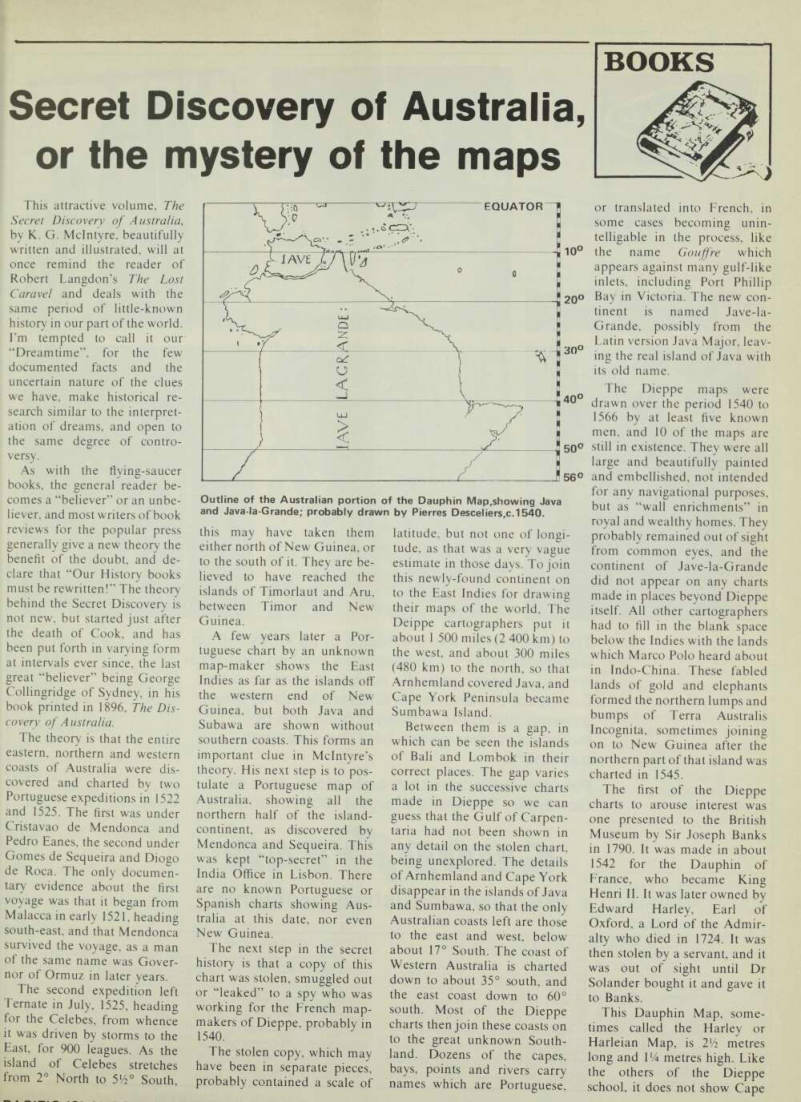

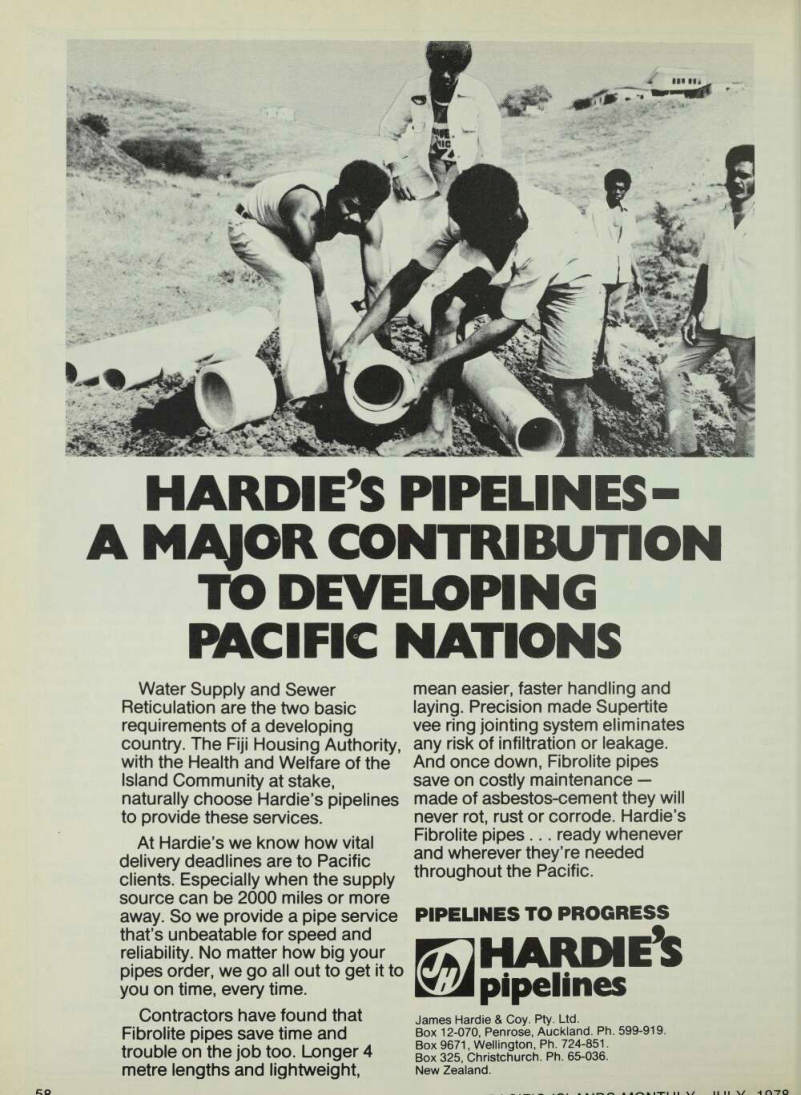
or the mystery of the maps
This attractive volume, The Secret Discovery of Australia, by K. G. Mclntyre, beautifully written and illustrated, will at once remind the reader of Robert Langdon’s The Lost Caravel and deals with the same period of little-known history in our part of the world.
Em tempted to call it our “Dreamtime”, for the few documented facts and the uncertain nature of the clues we have, make historical re search similar to the interpret ation of dreams, and open to the same degree of contro versy.
As with the flying-saucer books, the general reader be comes a “believer” or an unbe liever, and most writers of book reviews for the popular press
generally give a new theory the
benefit of the doubt, and de clare that “Our History books must be rewritten!” The theory behind the Secret Discovery is not new, but started just after the death of Cook, and has been put forth in varying form at intervals ever since, the last
great “believer” being George
Collingridge of Sydney, in his book printed in 1896, The Dis covery of Australia.
The theory is that the entire eastern, northern and western coasts of Australia were dis covered and charted by two Portuguese expeditions in 1522 and 1525. The first was under Cristavao de Mendonca and Pedro Eanes, the second under Gomes de Sequeira and Diogo de Roca. The only documen tary evidence about the first voyage was that it began from Malacca in early 1521, heading south-east, and that Mendonca survived the voyage, as a man of the same name was Gover nor of Ormuz in later years.
The second expedition left Ternate in July, 1525, heading for the Celebes, from whence it was driven by storms to the East, for 900 leagues. As the island of Celebes stretches from 2° North to s Vi° South,
this may have taken them either north of New Guinea, or to the south of it. They are be lieved to have reached the islands of Timorlaut and Aru, between Timor and New Guinea.
A few years later a Por tuguese chart by an unknown map-maker shows the East Indies as far as the islands off the western end of New Guinea, but both Java and Subawa are shown without southern coasts. This forms an
important clue in Mclntyre’s
theory. His next step is to pos tulate a Portuguese map of Australia, showing all the northern half of the island continent, as discovered by Mendonca and Sequeira. This was kept “top-secret” in the India Office in Lisbon. There are no known Portuguese or
Spanish charts showing Aus
tralia at this date, nor even New Guinea.
The next step in the secret history is that a copy of this chart was stolen, smuggled out or “leaked” to a spy who was working for the French map makers of Dieppe, probably in 1540.
The stolen copy, which may have been in separate pieces, probably contained a scale of
latitude, but not one of longi tude, as that was a very vague estimate in those days. To join this newly-found continent on to the East Indies for drawing their maps of the world. The
Deippe cartographers put it
about 1 500 miles (2 400 km) to the west, and about 300 miles (480 km) to the north, so that Arnhemland covered Java, and Cape York Peninsula became Sumbawa Island.
Between them is a gap, in which can be seen the islands of Bali and Lombok in their correct places. The gap varies a lot in the successive charts made in Dieppe so we can guess that the Gulf of Carpen taria had not been shown in any detail on the stolen chart,
being unexplored. The details
of Arnhemland and Cape York disappear in the islands of Java and Sumbawa, so that the only Australian coasts left are those to the east and west, below about 17° South. The coast of Western Australia is charted down to about 35° south, and the east coast down to 60° south. Most of the Dieppe charts then join these coasts on to the great unknown South land. Dozens of the capes, bays, points and rivers carry names which are Portuguese,
Books
or translated into French, in some cases becoming unin telligable in the process, like the name Gouffre which
appears against many gulf-like
inlets, including Port Phillip
Bay in Victoria. The new con tinent is named Jave-la- Grande, possibly from the Latin version Java Major, leav ing the real island of Java with its old name.
The Dieppe maps were drawn over the period 1540 to 1566 by at least five known men, and 10 of the maps are still in existence. They were all
large and beautifully painted
and embellished, not intended for any navigational purposes, but as “wall enrichments” in
royal and wealthy homes. They
probably remained out of sight from common eyes, and the continent of Jave-la-Grande did not appear on any charts
made in places beyond Dieppe
itself. All other cartographers had to fill in the blank space below the Indies with the lands which Marco Polo heard about in Indo-China. These fabled lands of gold and elephants formed the northern lumps and bumps of Terra Australis
Incognita, sometimes joining
on to New Guinea after the northern part of that island was charted in 1545.
The first of the Dieppe charts to arouse interest was one presented to the British Museum by Sir Joseph Banks in 1790. It was made in about 1542 for the Dauphin of France, who became King Henri 11. It was later owned by Edward Harley, Earl of Oxford, a Lord of the Admir alty who died in 1724. It was then stolen by a servant, and it was out of sight until Dr Solander bought it and gave it to Banks.
This Dauphin Map, some
times called the Harley or Harleian Map, is 2 Vi metres long and VA metres high. Like the others of the Dieppe school, it does not show Cape
Outline of the Australian portion of the Dauphin Map,showing Java and Java-la-Grande; probably drawn by Pierres Desceliers,c.1540.
York, Torres Strait or New Guinea. Well off the east coast of Jave-la-Grande is a large island, variously identified by “Believers” as New Caledonia, New Zealand, Furneax Islands in Bass Strait, or Tasmania.
Just pay your money and take
your pick.
Although everyone knew there was open sea to the south of Java, the Dieppe men eliminated this by raising Jave la-Grande northwards by about 4° of latitude, about 250 miles (400 km). I don’t know why this was done, for the new land could have been drawn in its correct latitude and in any longitude between America and Africa, or just below the islands of the East Indies withou touching any of them.
But having buried Arnhem land into Java, and Cape York into Subawa, they were faced with the problem arising from the voyage of Magellan around the world in 1522.
After Magellan was killed in the Philippines the survivors came down to the Spice Islands, and the flagship Vic toria sailed down to Timor, and then westwards, well south of Java. Mclntyre tells us that the Dieppe men drew a canal or river from the Gulf of Carpen taria to the west coast to allow the Victoria to pass through and called this canal the Rio Grande. Unfortunately, this superhuman work, like the Great Wall of China, was not a success, as the maps show the islands of Timor and Sumba to the south-east of their Sumbawa-Cape York so there should have been a canal
through that peninsula as
well.
The piece of Arnhemland- Java cut off by the canal is far too big for Java, but true be lievers can take that in their stride.
Mclntyre assures us several times that Jave-la-Grande is a very good map of Australia, and quotes many great authori ties who have seen the correct ness of the shape and detail of both east and west coasts. The 10 known Dieppe maps by the five different cartographers all
vary in shape, detail and nomenclature quite a bit, but that is understandable, like dif ferent witnesses’ drawings of
flying saucers.
Mclntyre says there is no need to pull the maps out of shape to make them look more like Australia as we know it, as many apologists and believers have done. He then proceeds to
do just that, by describing three
errors which insidiously pulled
the coastlines out of shape.
The first of these he calls magnetic Deviation, by which he means Variation of the compass due to the earth’s field. This pushed the east coast further and further east as Mendonca sailed southwards.
The next error is Erration, of which I had not heard before, and this is a further push to the east because of the map projec tion in use at the time.
The third error arose be cause the Dieppe men drew the chart on a paper-covered sphere, then sliced it into “quarters” like an orange and peeled it off. The resultant “gores” when laid out flat only touch in the tropics, and open out progressively north and south. When tracing the coast lines on to the final map the gaps in the lines were joined up and this resulted in Cape Howe (Cape Fremose on Jave-la- Grande) being charted I 500 miles (2 400 km) too far to the
east compared with Cape
York; in other words it arrives in about the modern position of Cape Howe. The western coastline does not receive any treatment, as no known or un known errors could pull that into the correct shape.
While Mclntyre was completing his book, another believer in the theory was at work on the Dieppe maps with a lot of cartographical skill and some scissors and paste. He is
Brigadier Lawrence Fitzgerald,
OBE, who was head of the
Army Survey Corps for many
years. He saw that the Dieppe men had to juggle a lot of dif ferent pieces of maps, about 12 in all, drawn on different scales and on unknown orientations.
By cutting up a copy of two ver sions of Jave-la-Grande, he
found that he could fit them together into a map of Aus tralia by changing the scales and tilting the coastlines around as necessary.
The Brigadier presented a paper to the Royal Historical Society of Victoria on the sub
ject in February, 1977, prob
ably too late for Mclntyre to give a mention of his work in the book. Only a skeptic or un believer could say that by using the same method one could produce a likeness to the map of Ireland, or a profile of our present Prime Minister.
Mclntyre’s book is packed
with excellent scholarship and research into the little-known
period of Portuguese su
premacy in discovery and navi gation right around the world.
Between 1500 and 1600 the best navigators were all Por tuguese, but many of their dis coveries were kept secret owing to the rivalry of Spain. There are photographs of four of the Dieppe maps, and of some of the well or less known relics which are proofs of Portuguese voyages on our coasts. Two of these figured in the Lost Caravel, the Tamil Bell and the
piece of Spanish helmet;
another two are in Victoria, the
Mahogany Ship at Warrnam
bool and the Geelong keys; then we have the carronades found in north-west Australia, and the broken stone walls near Twofold Bay, NSW.
Mclntyre asserts that our old friends, Torres, Tasman and Cook, all had knowledge of the Dieppe maps, in fact Cook had a copy aboard the Endeavour, kept in a secret drawer for his eyes alone. How else, after get ting his ship off the reef, could he have made straight for the Endeavour River? And when he reached it he wrote in his journal that the harbour was smaller than he had been told!
He was actually told about the harbour by an officer whom he had sent ahead in a boat to search for a suitable haven, while Cook remained at anchor for the night.
It is true that a good harbour is shown on the east coast of Jave-la-Grande, in about the right latitude, but that was just
south of Timor, and over I 000 miles (I 600 km) west of the present Cooktown. At the nearby Hope Islands, named by Cook because he was hoping hard that he would be able to save his ship, the steep, mountainous coast of Queensland is only four miles away. Mclntyre says that from these islands the coast is in
sight, but only just.
He also writes, while follow ing Mendonca’s track down the coast, that he sailed down from Cape York to Princess Charlotte Bay out of sight of land, quite regardless of the Great Barrier Reef. Then puts us right (?) by saying that the Barrier Reef begins at Cook town ! In some needless pass ages Mclntyre gives us an insight into Cook’s and Torres’ secret thoughts, and gives us conversations between Cook and Banks which are both unfounded and misleading.
The official Portuguese car tographer of the Indies, whose title was later confirmed by the King of Spain, was Manuel Godinho de Eredia, who is given a well-deserved place in the book. He was born in Ma cassar of a native mother, and so gained access to both Indonesian and Portuguese re cords. For many years prior to his death in 1623 he devoted his researches into trying to prove that the Portuguese were the first to discover Australia. But strangely he knew nothing of Jave-la-Grande, nor of Men donca’s great discoveries. He knew about the rich island of Zanzibar on the coast of Africa, in about the same latitude as Java, but he knew nothing of
the large fortified island called Zanzibar shown on the Dieppe maps due west of Perth.
The Dieppe map by Des celiers in 1550 shows the usual continent but without the name “Jave-la-Grande”, but perhaps there wasn’t room for that as the land is well covered with decorations; a coat of arms, two compass roses, trees, houses, pagans and cannibals, and four types of animal,
including elephants and
camels. There are also seven square cartouches containing information about other lands, Java, Sumatra, Zanzibar,
Ceylon, Malaya, Pegu and
“Anganie”. Not a word about Jave-la-Grande, nor is any mention to be found on any other maps, documents or in books.
Cook has been accused of making use of some of the
place-names on the Dieppe
maps, but as Mclntyre points
out, he was unlikely to do this intentionally, as that would have given away his secret pos session of one of the maps. The most quoted examples of these coincidences of names are (a) Cost des Herbaiges (Coast of Pastures), which became Bot any Bay: (b) Coste dangerouse for the Great Barrier Reef, and (C) R.de beaucoup d’isles, for the Bay of Islands. These are all very flimsy coincidences on which to make charges of plagiarism. The French and Portuguese names only occur on the east and west coasts, those on the north coasts are the correct Indonesian names belonging to Java and Sum bawa. We must remember that we only have Mclntyre’s word to assure us that the stolen Por tuguese map showed Amhem land and Cape York Peninsula, with a blank gap for the Gulf of Carpentaria.
In any case the last Dieppe
map is dated 1566. So that after the first appearance of Jave-la- Grande in 1541 to the last in 1566, it slipped back into the mists of the dreamtime, only to be seen at intervals, like the
“Flying Dutchman”, by the
true believers.
In conclusion, I must say that this fine book by a very learned and gifted writer forces us to believe that a small party of
map-makers in Dieppe, with
international reputations for being accurate and up to date, believed that an authentic copy of an original map of the newly charted land of Java Major had been stolen or “leaked” from the impregnable India Office in Lisbon.
The fact that they had obtained the copy fraudulently did not deter them from using it to improve the accuracy of their lovely world maps, made for an exclusive market, often as royal commissions. But how
honest was the secret agent in the India Office who made the map or copy and leaked it out for monetary gain?
Being nameless, his repu tation as a cartographer could not suffer, and if he had been caught by the authorities in Lisbon he couldn’t be charged with treason for selling a fic titious map to the French as a practical joke. We must admire his nerve and his wit, for his tilt at the French lasted for 25 years, and has kept echoing through the centuries. He could not have guessed that a serious book on his clever hoax would be written 437 year later, and in a city by the bay which he named Gouffre on his land of
Java Major!
Brett Milder
Pe Secret Discovery Of Australia: For
tuguese Ventures 200 years before Captain Cook.
By K. G. Mclntyre, published by the Souvenir Press (Australia) Pty Ltd. Adelaide. 59.95).
Advertisements & other items, pp. 56-58 (4 items)
r-> a ir>i s n inn i irvuri 11 \/ 11 1 1 \/ -ic\~ra
OOODjfrCAR
The world over, more vehicles of all kinds roll on Goodyear tyres ... more planes land on Goodyear tyres . . . more synthetic rubber is produced by Goodyear.. . and more different kinds of hose,
transmission belts, conveyor belts and other
industrial rubber goods bear the Goodyear
trademark.
For leadership in rubber technology, look to
Goodyear. The world’s largest rubber company.
OOODjfrCAR
We solve industrial problems.
GOODYEAR DISTRIBUTORS IN S.E. ASIA AND PACIFIC BASIN
GOODYEAR SUBSIDIARIES
Richard Pieris & Co., Ltd.
Colombo. Sri Lanka Nepal Motor Company (P) Ltd.
Biratnagar, Nepal Dacca, Bangladesh Diethelm & Co.. Ltd.
Bangkok, Thailand Kolonia, Ponape Island Transport Service Co.
Majuro Marshall Is.
Yap Cooperative Ass.
Yap. W. Carolone Is.
Cook Islands Motor Centre Ltd.
Rarotonga. Cook Is.
Ngiratkel Etpison Co.. Ltd.
Koror. Palau Coral Island Motors Suva. F iji
S.G.A.
Noumea. New Caledonia Duncombe Bay Garage The Goodyear Tyre & Rubber Co (Aust) Ltd.
Sydney. AUSTRALIA Tel 31-0311 Goodyear Indio Limited New Delhi 1. INDIA Tel 46886/9 PT Goodyear Indonesia Bogor, Republic of Indonesia Tel: 3371/2 Nippon Goodyear Kabushiki Kaisha Tokyo.JAPAN Tel 582-0481/8 Goodyear Malaysia Berhad Selangor. MALAYSIA Tel 362501/5 The Goodyear Tyre & Rubber Co. of New Zealand. Limited Lower Hutt. NEW ZEALAND Tel 684 389 The Goodyear Tyre & Rubber Company of the Philippines, Limited Goodyear Singapore Pvt Limited Geylang, Singapore 14 Teh 408281/3 Goodyear Taiwan Limited Taipei, TAIWAN Tel; 5117135/8 Goodyear (Thailand) Limited Bangkok. THAILAND Tel: 252-6141/5 Landis Brothers & Co., Ltd.
Hong Kong Guam Tire & Supply Co.
Agana, Guam Nukualofa. Tonga Morris Hedstrom Ltd.
Apia. Western Samoa Western Samoa Transport
FOR FURTHER INFORMATION,
PLEASE CONTACT
Port Moresby. Papua New Guinea Cooperative Society Ltd.
Susupe Enterprises Saipan, Mariana Is Microl Corporation Saipan. Mariana Is.
Truk Trading Co.
Truk E. Caroline Is.
Solomon Motors Ltd.
Honiara, Solomon Is.
Santo Engineers Samoa Motors Inc.
Pago Paqo. American Samo Goodyear International Corporation Room 1603. Wing On Center 111 Connaught Road Central
HONG KONG Tel: 5 433331
Republic of the Philippines Tel 89 20-41
HRME 171*0204
HENRY LAWSON'S
BOOKSHOP
531 Royal Arcade, (Beneath Sydney Hilton) Pitt through to George St
SYDNEY, 2000.
Phone: 61 2365.
WE STOCK ONLY
AUSTRALIAN BOOKS
AND BOOKS ON
OCEANIA!
Write to us for specialist attention.
111 lit * * . m f k OS 4m m. 4 9lm
HARDIE’S PIPELINES -
A MAJOR CONTRIBUTION
TO DEVELOPING
PACIFIC NATIONS
Water Supply and Sewer Reticulation are the two basic requirements of a developing country. The Fiji Housing Authority, with the Health and Welfare of the Island Community at stake, naturally choose Hardie’s pipelines to provide these services.
At Hardie’s we know how vital delivery deadlines are to Pacific clients. Especially when the supply source can be 2000 miles or more away. So we provide a pipe service that’s unbeatable for speed and reliability. No matter how big your pipes order, we go all out to get it to you on time, every time.
Contractors have found that Fibrolite pipes save time and trouble on the job too. Longer 4 metre lengths and lightweight, mean easier, faster handling and laying. Precision made Supertite vee ring jointing system eliminates any risk of infiltration or leakage.
And once down, Fibrolite pipes save on costly maintenance made of asbestos-cement they will never rot, rust or corrode. Hardie’s Fibrolite pipes... ready whenever and wherever they’re needed throughout the Pacific.
PIPELINES TO PROGRESS
HARNESS
pipelines
James Hardie & Coy. Pty. Ltd.
Box 12-070, Penrose, Auckland. Ph. 599-919.
Box 9671. Wellington, Ph. 724-851.
Box 325, Christchurch. Ph. 65-036.
New Zealand.
Books
57
SI AMDS MOMTMI V_ II II V IQ7Q
58
. , n , . >mn • M iiti II \/ 111 l \/ H 070
How fared the modern exiles
and migrants in the Pacific?
Henry Kissinger, comment
ing upon the problems of the peoples of the American Trust Territory; once remarked, “Who gives a damn”. The 10 authors and editor of Exiles and Migrants in Oceania clearly do, even if their studies
are obscured occasionally by
the technical language of their
anthropological craft.
Unlike many such edited volumes, the co-authors of this one seem to have consulted one another prior to publication so that a good deal of cross fertilisation is evident through out the book’s 417 pages,
supplemented by 14 excellent
maps, six tables and biographi cal data on the contributors.
An 11-page Field Guide pro vides advice to future re searchers on what to look for when they study resettled com munities in the Pacific and, I suggest, elsewhere.
Movement has been a part of the South Pacific scene from
the beginning when sturdy
islanders ventured forth in canoes of wood and sinew to populate the thousands of square miles of territory that sprinkles out of southeast Asia’s peninsular underbelly.
Islands as stepping stones was not a concept of World War II vintage, but an integral part of the thinking of the prehistoric inhabitants of
those pleasant places.
The reasons for modern mi gration, also, are not so dif ferent from what must have motivated the ancient islanders. Among the 10 case studies of migration, seven was the result of some sort of natu ral disaster, such as storm or
drought, volcanic explosion or
dwindling natural resources.
Banaba, Bikini, and Rotuma are the three exceptional cases.
In the case of Banaba, Europeans wanted the rich
phosphate deposits to enrich
the cultivated fields of Aus tralia, New Zealand, Europe,
and America. While, for the people of lonely Bikini, it was the American desire for a nu clear testing place that exiled the local inhabitants from their home. Contrary to this case, were the Rotumans, who sought to exploit labour pos sibilities in Fiji and whose mi gration seems to have been
largely self-motivated.
Kissinger’s remarks were apropos the small numbers liv ing in Micronesia and were the basis for his disdain. He would be even more scornful of con cern for the small populations described in this volume. The Banabans number “about 2000” and are the largest group, while 300 to 400 is the usual number involved in these
mini-migrations.
This does not mean, how ever, that the circumstances of migration are made any easier.
Some of the stories, told in often microscopic detail, suggest that great hardship has been endured by the hapless
victims of 20th century colonialism or timeless natural disaster, as editor Lieber shows in his summary chapter.
Knudson writes about the South Gilbertese who were transplanted to isolated Phoenix Island before World War 11, only to be relocated again to the Solomons. The
community again migrated,
splitting this time over prefer ences for their imported Chris
tian religions.
Australian readers will be particularly interested in the
long piece by Erik Schwimmer,
in which he discusses the ex ecutions at Orokaiva in World War 11, a subject of much de bate in the Sydney Press re cently. Schwimmer’s article concentrates on the events sur rounding the disastrous erup tion of Mount Lamington, in Northeast Papua, in 1951, where as many as 4000 people may have perished, their lungs seared by molten volcanic ash.
Some of the migrants like
Ambrym’s Maat villagers,
seemed to have settled well in their new homes. They go back and forth between adopted and traditional home, exploiting to the full the options open to them. For the Maat villagers on Efate, their new home is one
without the traditional fear of
sorcery, though they recognise
that there is more leisure time back home on Ambrym.
The Kapinga on Ponape seem well settled and the Rotumans in Fiji are much sought-after workers in Fiji
primary industry.
Kiste’s Bikinians, who did regain their atoll for a time, must now face resettlement once again, for the level of radioactivity is too high to per mit human habitation.
Banabans, resettled on Rabi Island, are still negotiating with the British Government for a better deal on their phosphate resources.
Most of the groups, such as the Tikopians on Russell or the south-west islanders on Palau, remain as a community, seek
ing their identity as having
come from a particular place.
The exception to this are the Nukuoro on Ponape, who seem to refrain from forming com munity associations and exist as scattered families or individuals.
In this regard, the people of Nukuoro are the most success ful migrants, if we consider mi gration in its larger context.
Debates still rage in the mi grant countries of the Pacific rim, such as Australia and the United States, about how over seas migrants ought to be treated. Some take the view, as do the Nukuoro, that migrants ought to assimilate, giving up their past homeland and adopt ing their new one.
Integration, however, is the
increasingly prevalent cry and
is exemplified by most of the cases in this book. Integration means that each migrant group contributes to the formation of a new society, reflecting the different cultures of both mi grants and host.
Australian experience is that assimilation usually does not occur. Like the Maat villagers who live and work on Efate, they may take on many of the local customs; even dress and live like their hosts outwardly.
Migrants in metropolitan
countries, as on the islands, often see themselves as tem porary residents, who may return home at any time. Most often fail to appreciate this component of the migrant world view.
Readers in non-Pacific
Island countries will find that the problems of migrant com munities in Ponape have much in common with those in San Francisco or Sydney. Aside from such a self-interested motive, readers will find also the stories of the resettled mi grants and relocated exiles of intrinsic interest.
If there is anyone casting about for ideas for novels or films about the modern South Pacific, the dramatic events told in such depth and detail
here will provide ample
inspiration.
Unlike the blase former US Secretary of State, readers will find that they do give a damn.
Grant McCall
(Exiles And Migrants In Oceania. Association
(or Social Anthropology in Oceania Monograph No. 5. Edited by Michael 0. Lieber Published by The University Press of Hawaii. Honolulu. January. 1978. U 5517.50)
A must for
PNG stamp buffs
Papua New Guinea Stamps 1971-76: by Rex Lingard, is a profusely illustrated account of the country’s philatelic development over the period, which covers its accession to self-government in 1973 and independence in 1975.
The book is a must for all interested in philately in the Pacific, and clearly bears out the distinctive features of PNG’s stamp issue policies.
These are outlined in a foreword by Mr I. Edoni, secretary of the Department of Public Utilities, Post and Telecommunications Ser vices, and include: issuing sufficient stamps each year to make PNG worthy of the peo ple who collect its stamps, but not so many that the collector feels exploited; depicting only PNG subjects and topics, stay ing clear of gimmicky issues, imperforate specimens, sub jects foreign to the country and other unethical practices; and having the stamps printed by the world’s leading stamp printers.
Mr Edoni pledges that “col lectors may look to a stable, conservative stamp issue poli cy in PNG in the future”
This last claim is certainly borne out by the many fine colour reproductions of PNG stamps contained in this small book which is soon to be available from PlM’s mail order bookshop. F.L.S.
(Papua New Guinea Stamps: 1971-76.
By Rax Lingard. Publishad by Robart Brown & Associatat, Port Morosby. 1A2.25.)
Advertisements & other items, pp. 59-61 (3 items)
Books
©Clarion
a % i
The World
Listens to Clarion
On the Go.
X> V ■ The reason? Clarion offers so much more.
Superb entertainment created by advanced, highly reliable electronics. Easy, custom-fit dash installation. A super-wide selection of car radios and stereo units. Professional servicing by local dealers. An international reputation for superior quality and performance. Clarion—another word ' for the best. The very best.
V
•ON-VOt/PRO
PE-663
©Clarion
Clarion Co., Ltd. Tokyo, Japan Australia: Amalgamated Wireless (Australasia) Ltd. 554 Parramatta Road Ashfield N.S.W., 2131 1 New Zealand: AWA New Zealand Limited. P.O. Box 50-248 Porirua I Fiji Islands: Brijlal & Co., Ltd. G.P.O. Box 362 Suva I Tahiti: ETS. Comimpex. B.P. 200 Papeete I New Caledonia: Caldis. 8.P.M1 Noumea Cedex I Guam: Guam Radio & TV Shop. P.O. Box 1939 Agana, Guam 96910 / New Hebrides: The Sound Centre P.O. Box 434 Vila / Cook Islands: South Seas International Ltd. P.O. Box 49 Rarotonga.
ir a
LOW
h -~mr 1» 'T> ! ..
AM
•Master,
MACKEREL
PACKED BY :
NIPPON SUISAN KAISHA, LTD,
* “Master” Brand Canned Mackerel, Canned Sardines and other Canned Fish. * “House” Brand Instant Noodle, Soup & Desserts, all kinds of Spices and Japanese Soy Sauce. * Groceries, Confectionary, Beverage, etc. * Hand Tools, Builders & Cabinet Hardware, Plasticware, Chmaware, Kitchenware. * Building Materials, Plywood, Hardbord, Formica, Tiles, Wall Paper, etc. * Steel Products: Round, Square, Flat, Angle, Channel Bars, Iron Sheet, Pipes & Fitting. * Machinery, Motor Spare Parts, Batteries and Accessories. * Electric Household Appliances & “Daikm” Air Conditioners. * Sporting Goods, Fishing Rods & Reel, Accessories for Boat & Yacht. *“Hadson” Pocket & Table Lighters, Disposable Butane Lighters. * Soaps, Hair Shampoo, Detergents. Truletnec. * Various Novofties, Ornaments, Souvenir Items. * “New Jet Type” Labeler & Other Daily Stuff.
UNITRADE COMPANY,LIMITED
Sanritsu Building 11-12 3-chome Hachobori Chuo-ku Tokyo (104)
TELEX NO. : “252-4665 KANDK J”
CABLE ADDRESS : “KAYANDKAY TOKYO"
TELEPONE NO. : 03-553-9520
Resident Representives in Fiji, P.N.G., Philippines, Hong Kong & Singapore
BRAND
GENERAL MERCHANTS
EXPORTERS & IMPORTERS
61
D A Cir' ICI A MHC KiIHKITUI V II 11 \/ HO-70
Money For The Samoans
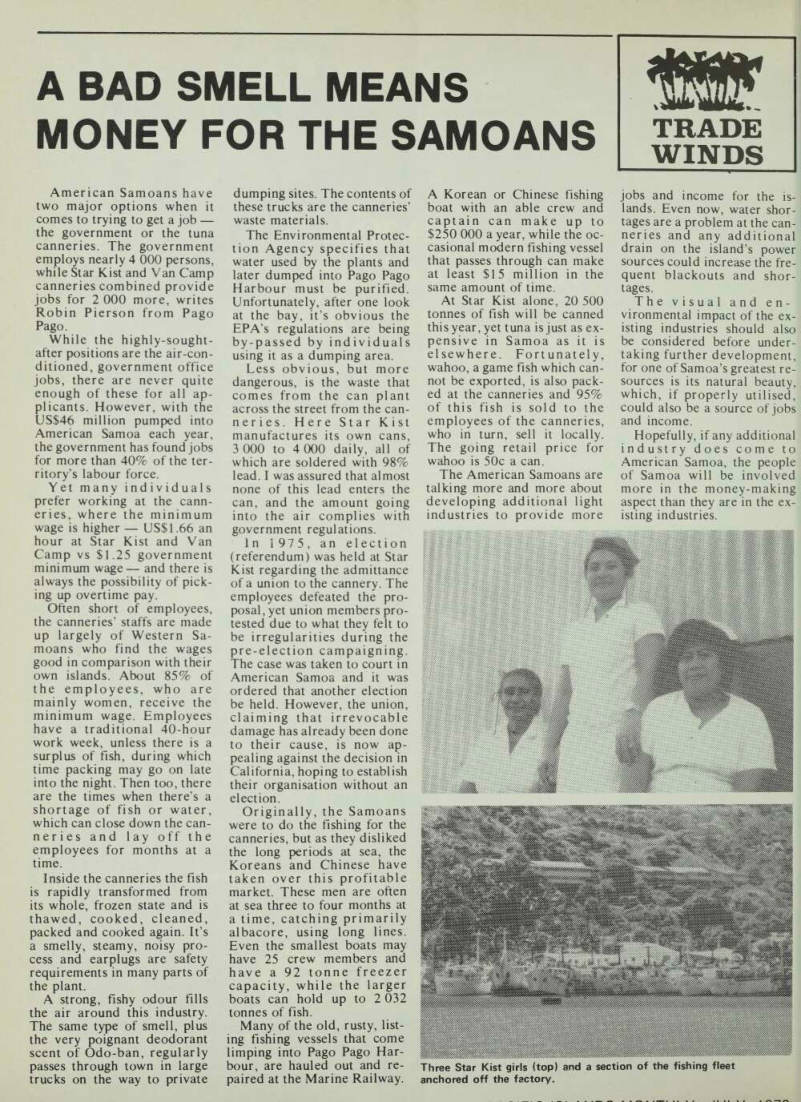
A Bad Smell Means
™ade
American Samoans have two major options when it comes to trying to get a job the government or the tuna canneries. The government employs nearly 4 000 persons, while Star Kist and Van Camp canneries combined provide jobs for 2 000 more, writes Robin Pierson from Pago Pago.
While the highly-sought after positions are the air-con ditioned, government office jobs, there are never quite enough of these for all ap plicants. However, with the US$46 million pumped into American Samoa each year, the government has found jobs for more than 40% of the ter ritory’s labour force.
Yet many individuals prefer working at the cann eries, where the minimum wage is higher US$l.66 an hour at Star Kist and Van Camp vs $1.25 government minimum wage— and there is always the possibility of pick ing up overtime pay.
Often short of employees, the canneries’ staffs are made up largely of Western Sa moans who find the wages good in comparison with their own islands. About 85% of the employees, who are mainly women, receive the minimum wage. Employees have a traditional 40-hour work week, unless there is a surplus of fish, during which time packing may go on late into the night. Then too, there are the times when there’s a shortage of fish or water, which can close down the can ner ies and lay off the employees for months at a time.
Inside the canneries the fish is rapidly transformed from its whole, frozen state and is thawed, cooked, cleaned, packed and cooked again. It’s a smelly, steamy, noisy pro cess and earplugs are safety requirements in many parts of the plant.
A strong, fishy odour fills the air around this industry.
The same type of smell, plus the very poignant deodorant scent of Odo-ban, regularly passes through town in large trucks on the way to private
dumping sites. The contents of these trucks are the canneries’ waste materials.
The Environmental Protec tion Agency specifies that water used by the plants and later dumped into Pago Pago Harbour must be purified.
Unfortunately, after one look at the bay, it’s obvious the EPA’s regulations are being by-passed by individuals using it as a dumping area.
Less obvious, but more dangerous, is the waste that comes from the can plant across the street from the can neries. Here Star Kist manufactures its own cans, 3 000 to 4 000 daily, all of which are soldered with 98% lead. I was assured that almost none of this lead enters the can, and the amount going into the air complies with government regulations.
In 1 975, an election (referendum) was held at Star Kist regarding the admittance of a union to the cannery. The employees defeated the pro posal, yet union members pro tested due to what they felt to be irregularities during the pre-election campaigning.
The case was taken to court in American Samoa and it was ordered that another election be held. However, the union, claiming that irrevocable damage has already been done to their cause, is now ap pealing against the decision in California, hoping to establish their organisation without an election.
Originally, the Samoans were to do the fishing for the canneries, but as they disliked the long periods at sea, the Koreans and Chinese have taken over this profitable market. These men are often at sea three to four months at a time, catching primarily albacore, using long lines.
Even the smallest boats may have 25 crew members and have a 92 tonne freezer capacity, while the larger boats can hold up to 2 032 tonnes of fish.
Many of the old, rusty, list ing fishing vessels that come limping into Pago Pago Har bour, are hauled out and re paired at the Marine Railway.
A Korean or Chinese fishing boat with an able crew and captain can make up to $250 000 a year, while the occasional modern fishing vessel that passes through can make at least $l5 million in the same amount of time.
At Star Kist alone, 20 500 tonnes of fish will be canned this year, yet tuna is just as expensive in Samoa as it is elsewhere. Fortunately, wahoo, a game fish which cannot be exported, is also packed at the canneries and 95% of this fish is sold to the employees of the canneries, who in turn, sell it locally.
The going retail price for wahoo is 50c a can.
The American Samoans are talking more and more about developing additional light industries to provide more
jobs and income for the is lands. Even now, water shor tages are a problem at the can neries and any additional drain on the island’s power sources could increase the fre quent blackouts and shor tages.
The visual and en vironmental impact of the ex isting industries should also be considered before under taking further development, for one of Samoa’s greatest re sources is its natural beauty, which, if properly utilised, could also be a source of jobs and income, Hopefully, if any additional industry does come to American Samoa, the people of Samoa will be involved more in the money-making aspect than they are in the ex isting industries.
Three Star Kist girls (top) and a section of the fishing fleet anchored off the factory.
Advertisements & other items, p. 62 (1 item)
Pacific Island Monthly
It’ll be a good year
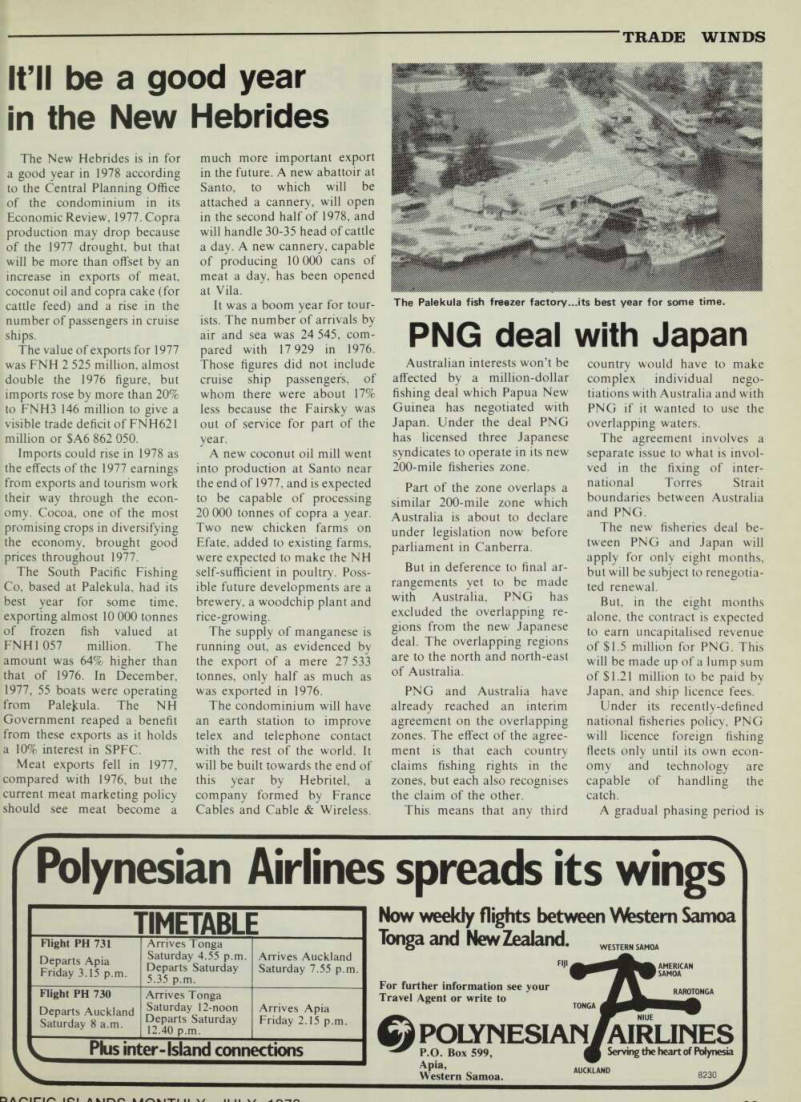
in the New Hebrides
The New Hebrides is in for a good year in 1978 according to the Central Planning Office of the condominium in its Economic Review, 1977. Copra
production may drop because
of the 1977 drought, but that will be more than offset by an increase in exports of meat, coconut oil and copra cake (for cattle feed) and a rise in the number of passengers in cruise
ships.
The value of exports for 1977 was FNH 2 525 million, almost double the 1976 figure, but imports rose by more than 20% to FNH3 146 million to give a visible trade deficit of FNH62I million or SA6 862 050.
Imports could rise in 1978 as the effects of the 1977 earnings from exports and tourism work their way through the econ omy. Cocoa, one of the most
promising crops in diversifying
the economy, brought good
prices throughout 1977.
The South Pacific Fishing Co, based at Palekula, had its best year for some time, exporting almost 10 000 tonnes of frozen fish valued at FNH 1 057 million. The amount was 64% higher than that of 1976. In December, 1977, 55 boats were operating from Palekula. The NH Government reaped a benefit from these exports as it holds a 10% interest in SPFC.
Meat exports fell in 1977, compared with 1976, but the
current meat marketing policy
should see meat become a
much more important export in the future. A new abattoir at Santo, to which will be attached a cannery, will open in the second half of 1978, and will handle 30-35 head of cattle a day. A new cannery, capable of producing 10 000 cans of meat a day, has been opened at Vila.
It was a boom year for tour ists. The number of arrivals by air and sea was 24 545, com pared with 17 929 in 1976.
Those figures did not include cruise ship passengers, of whom there were about 17% less because the Fairsky was out of service for part of the year.
A new coconut oil mill went into production at Santo near the end of 1977, and is expected to be capable of processing 20 000 tonnes of copra a year.
Two new chicken farms on Efate, added to existing farms, were expected to make the NH self-sufficient in poultry. Poss ible future developments are a
brewery, a woodchip plant and
rice-growing.
The supply of manganese is running out, as evidenced by the export of a mere 27 533 tonnes, only half as much as was exported in 1976.
The condominium will have an earth station to improve telex and telephone contact with the rest of the world. It will be built towards the end of this year by Hebritel, a company formed by France Cables and Cable & Wireless.
PNG deal with Japan
Australian interests won’t be affected by a million-dollar fishing deal which Papua New Guinea has negotiated with Japan. Under the deal PNG has licensed three Japanese syndicates to operate in its new 200-mile fisheries zone.
Part of the zone overlaps a similar 200-mile zone which Australia is about to declare under legislation now before parliament in Canberra.
But in deference to final ar rangements yet to be made with Australia, PNG has excluded the overlapping re gions from the new Japanese
deal. The overlapping regions
are to the north and north-east of Australia.
PNG and Australia have already reached an interim agreement on the overlapping zones. The effect of the agree ment is that each country claims fishing rights in the zones, but each also recognises the claim of the other.
This means that any third
country would have to make complex individual nego tiations with Australia and with PNG if it wanted to use the
overlapping waters.
The agreement involves a separate issue to what is invol ved in the fixing of inter national Torres Strait boundaries between Australia and PNG.
The new fisheries deal be tween PNG and Japan will
apply for only eight months,
but will be subject to renegotia ted renewal.
But, in the eight months alone, the contract is expected to earn uncapitalised revenue of $1.5 million for PNG. This will be made up of a lump sum of $1.21 million to be paid by Japan, and ship licence fees.
Under its recently-defined national fisheries policy, PNG
will licence foreign fishing
fleets only until its own econ omy and technology are
capable of handling the
catch.
A gradual phasing period is
The Palekula fish freezer factory...its best year for some time.
anticipated as PNG takes over from foreign operators.
The bulk of the fish re sources in PNG’s 800 000 sq. miles of ocean is tuna.
The agreement came under heavy fire from the Opposition in the National Parliament towards the end of May.
The Deputy Opposition
Leader, Sir John Guise, and
Opposition finance spokesman
Mr Michael Pondros led the attack. Sir John telling parlia ment to “beware of Japanese
fishing policies”.
Accusing the government of allowing itself to be exploited.
Sir John said that provincial governments controlling the PNG coastline, and the National Parliament itself, should have been consulted be fore the contracts were
signed.
He believed PNG could get a better deal if it diversified its fishing contracts to include countries other than Japan.
The finance spokesman, Mr Pondros, said another real fear was that fishing resources would be depleted. He urged PNG to establish its own fish canneries without delay.
The Natural Resources Minister. Mr Julius Chan, told parliament that there was no fear of depletion under con trols agreed to. The contracts with Japanese interests were only interim arrangements while PNG developed its own technology to fish its own waters.
Mr Chan undertook, how ever, to take note of all criti cism as part of current research to prepare a national fisheries
policy.
Advertisements & other items, p. 63 (2 items)
Trade Winds
63
IOI A UAkITI II w II II v/ A-»n
Polynesian Airlines spreads its wings
Now weekly flights between V\festem Samoa
Tonga and New Zealand. WESTERKSAMOA
. AMERICAN
> SAMOA
For further information see your Travel Agent or write to
POIYNESIAN/AIRLINES
P.O. Box 599, £ Serving the heart of Polynesia Apia, Western Samoa. 8230
PNG’s new Parliament House
like an open village
Papua New Guinea has adopted a design for its $8.5 million Parliament House to be built over three years. As sessors, who accepted the
prize-winning design from 14
entries, said the building would be of local timbers and would “reflect the concept of an open
Papua New Guinea village.”
The designer is Mr Bill Phillips, a senior architect with the Department of Public Works headquarters in Port Moresby. He wins an award of more than $8 000 for the de
sign.
The two placings in the com petition also went to Depart ment of Works architects, Mr Brian Catchpole, a senior ar chitect, who won the second prize of $6 000 and Mr Gregory
Forgan-Smith, the depart
ment’s area architect in Rabaul, who won the third
prize of S 3 500.
The competition was restric ted to architects working in PNG, but the limited develop ment of a home-grown archi tectural profession meant that most of the entries came from non-nationals.
Parliament meets in a con verted building which was once the Port Moresby General Hospital, near the centre of the oldest part of Port Moresby.
The new building will be at Waigani, the civic centre sub urb of Port Moresby which already contains the central government executive offices
and national buildings.
The winning design will use a laminated timber frame rather than steel or concrete, employing modern wood tech
nology and PNG-grown tim
bers. Timber will also be used for other structural com ponents, for the cladding, the
internal finishings and even in the retaining walls of the sur
rounding landscaping.
The panel of judges,
presided over by the Speaker of parliament, Mr Dibela, in cluded the Prime Minister, Mr Somare, and the then Oppo sition Leader, Sir Tei Abal.
Headed’ Says Surgeon
Fiji Medical Dept ‘Pig
Mr Deo Datt Sharma, con sultant surgeon in Fiji, has re signed from the public service because he is not satisfied with the way things are run. In his letter of resignation Mr Sharma said that since joining the staff of the CWM Hospital in 1974 he had noted things which rose out of bigotry and gross administrative inad equacy. He said administrators had been so pig-headed in the past that it was impossible to impress any change on them.
“Now, with amateurs in schoolboys’ uniforms in
charge, things have reached
ridiculous proportions,” he said.
Mr Sharma said the posting of doctors to the surgical unit was a big joke. Almost any Tom, Dick or Harry was con sidered fit to do surgery. There were many examples of lack of drugs and instruments. Nurs ing care was worse now.
Mr Sharma intends to go
into private practice in Suva.
He spent a year at the Fiji School of Medicine before going to Bombay on an Indian government scholarship. There he obtained a medical degree, after which he spent four years in New Zealand, then two in the UK at his own expense. He became a fellow of the Royal
College of Surgeons of
England and a Fellow of the
Royal College of Surgeons of
Edinburgh. In 1974 he returned to Fiji to work at the CWM Hospital in Suva.
Mr Sharma’s resignation and
other complaints about general
laxity in health care led to de mands for an inquiry into Fiji’s medical services. The Minister for Health, Mr Ted Beddoes, said there would be no inquiry, but he would study carefully all points raised and act on them if necessary. A few days later the government changed its mind and agreed to an
independent inquiry into Fiji’s
health services.
Advertisements & other items, p. 64 (2 items)
64
A ini a nmo i jrvMTI II \/ ill! \y Hf>7Q
TRADE WINDS
For Sale
Cargo-Passenger vessel “Taoniu”
Specifications: G.R.T. 500.
Capacity: Grain 27,160 C.F.
Bale 25,350 C.F. 2 McGregor Hatches. Speed 9 1 /> knots.
Built Holland 1957-56. Lloyds Class A 1.16 Saloon passengers. Current refit and overhaul almost complete (over $lOO,OOO already spent). PRICE $220,000 at Suva. ■ ALTERNATIVELY: Consideration will be given to charter or introduction into shipping run with assured tonnages All enquiries to Williams Shipping Co. Ltd., 20 Matua Street, Suva. Tel. 31 2100. Cable “Wilco.”
Briefly
• The Nauruans, who have no buildings above nine metres on their own island but own the highest building in Mel bourne opened a new high
rise building recently,
eight-storey Nauru House on Saipan in the Northern Marianas. The building, cost ing US$6.B million, is in the Susupe area and has a revolv ing restaurant, the only one in Micronesia, on top of the 39m building. More than 200 Nauruans flew to the opening ceremony, including 44 council officials, a school choir and a rock band. Also in the party was the Fiji Military Forces Band. Speeches were by Marianas Governor Carlos Camacho and Head Chief Hammer Deßoburt, who, at that time, had not resumed the
Nauruan presidency.
• The Agriculture Depart ment in Western Samoa has received numerous reports from around the country about a new pest which is attacking taro plantations, the army worm. The worm eats taro leaves, taro shoots and attacks the roots of the plant, destroy ing it completely. It has a life cycle of six weeks. The Agricul
ture Department is advising
planters to examine their crops at least once a week for signs of eggs and young caterpillars which are found on the under surfaces of the plants.
The pest is kept under some control by flies and other insects which attack it but the Department is looking into its breeding habits, and is recom
mending a spraying pro
gramme for the planters. • CIG (Fiji) Ltd is investing $1 million in a liquid oxygen
manufacturing operation in
Fiji. It is one of the biggest investments in Fiji by an Aus tralian company for some time. • Fiji had an export trade ot $162 822 000 in 1977, which in cluded $123 048 000 for local products. The remainder came from re-exports. Against that, however, the import bill was $2BO 960 000, leaving a deficit of $llB 138 000 in visible trade.
Offsetting that of course, were
the invisibles such as loans, transfer funds, capital inflows and income from tourism.
Overseas reserves at the end of 1977 were $l2B 090 000. Raw sugar exports of 322 422 tonnes earned $93 574 000 - an aver age of $290 a tonne, compared with $271 a tonne in 1976.
Coconut oil exports totalled 17 551 tonnes, worth $8 865 000, and 1 393 000 grams of gold earned $4 936 000.
Exports of canned fish were worth $3 728 000. • Australia has given Tonga
a quantity of agricultural
equipment including 14 trac
tors, 29 disc harrows and ploughs, 16 peanut harvesters, threshers and shellers, and four maize, peanut and soybean planters. A number of vehicles are included in the gift utili ties and lorries, and six motor cycles. As most farms in Tonga are too small for farmers to buy
such equipment, the machinery
will go into the Ministry of
Agriculture farm machinery
pools. Farmers will hire the
machinery required. Australia
will train Tongans to use and maintain the machinery. • Fiji Forest Industries has opened a plant at Malau, near Labasa, to make a new type of composite board known as blockboard. The blockboard is made from timber previously burnt. Ratu Josaia Tavaiqia, Minister for Forests, opening the plant, said the government had been concerned about the waste of timber from forest logs, where land had to be cleared for other projects.
Through technological de
velopment, Fiji Forest Indus
tries was able to set up the
blockboard industry and help
to eliminate waste. • Australia will give $2 650 000 under its South Pacific aid pro gramme to construct and fur nish the School of Social and Economic Development and the associated Institute of Ad ministrative Studies at the University of the South Pacific in Fiji. This will enable the school to move into its own buildings and will provide the university with its second major block of lecture rooms.
The project will be one of the
largest in Fiji financed by Aus
tralia.
Advertisements & other items, pp. 65-66 (1 item)
Special
Announcement
BERNINA CITY
We are pleased to be able to offer you a new and complete sewing service.
At the request of our many friends in the Pacific we are pleased to inform you of the creation of a direct sewing service.
Mr. Henri Dubois has been appointed, and is responsible for this new service in your a&ea, and we suggest you write to him for any information you may require about Bernina Sewing machines.
As from the 13th July 1978 Henri will be available to answer any of your sewing inquiries, with the cooperation of our very experienced staff, each one a specialist in their own field.
Les Service and spare parts, all repairs to any brand sewing machines, accessories, etc.
Kathy Sewing hints, your sewing problems, how to go about your sewing, etc.
Peggy All you’ve wanted to know about materials, where to get it, prices, etc.
Claude Despatch, shipping, insurance, deliveries, etc.
Also available from this new service Sales of new Bernina Sewing Machines, colour brochures and prices will be sent to you with no obligation, Domestic Overlocking and Hemming machines, a good selection of sewing cabinets, guaranteed reconditioned trade-ins (over 200 to choose from) from $4O.
When writing to Henri let him know the brand you require as well as your price bracket.
When writing address your correspondence to: Henri Dubois Bernina GPO Box 3654
SYDNEY, AUSTRALIA 2001
We look forward to being of service to you and your needs and assure you of our best attention at all
In catering
is fast, efficient
and reliable.
Terminals throughout the Pacific.
For more information write Boral Gas Limited, 221 Miller Street, BORAL 2? rth^ d r ey 2< 1 60 *Speed-E-Gas is known in Papua New Guinea, as Guinea Gas. In Tonga as Tonga Speed-E-Gas, and in Fiji as Fiji Gas. i—l^l
SPEED-EGAS
HOLT GS 15
The Chief salutes
the Solomons on your
coming-of-age!
Independence for the Solomon Islands a milestone in your history. Here at Chief Container Service, we’re proud to be a part of this achievement.
Chief Container Service is providing an efficient and regular cargo link between Honiara and Australia, Our fleet of three self-sustained, fully-containerised vessels ‘‘Papuan Chief”, ‘‘Coral Chief” and ‘‘Nimos” serve as a valuable link to your most important markets.
This is our contribution to your emergence as an independent nation. rr#
CHIEF
CONTAINER
SERVICE
AGENTS FOR
CHIEF CONTAINER SERVICE:
Sullivans (Solomon Islands) Ltd., G.P.O. Box 3, Honiara. 15093
Islands history
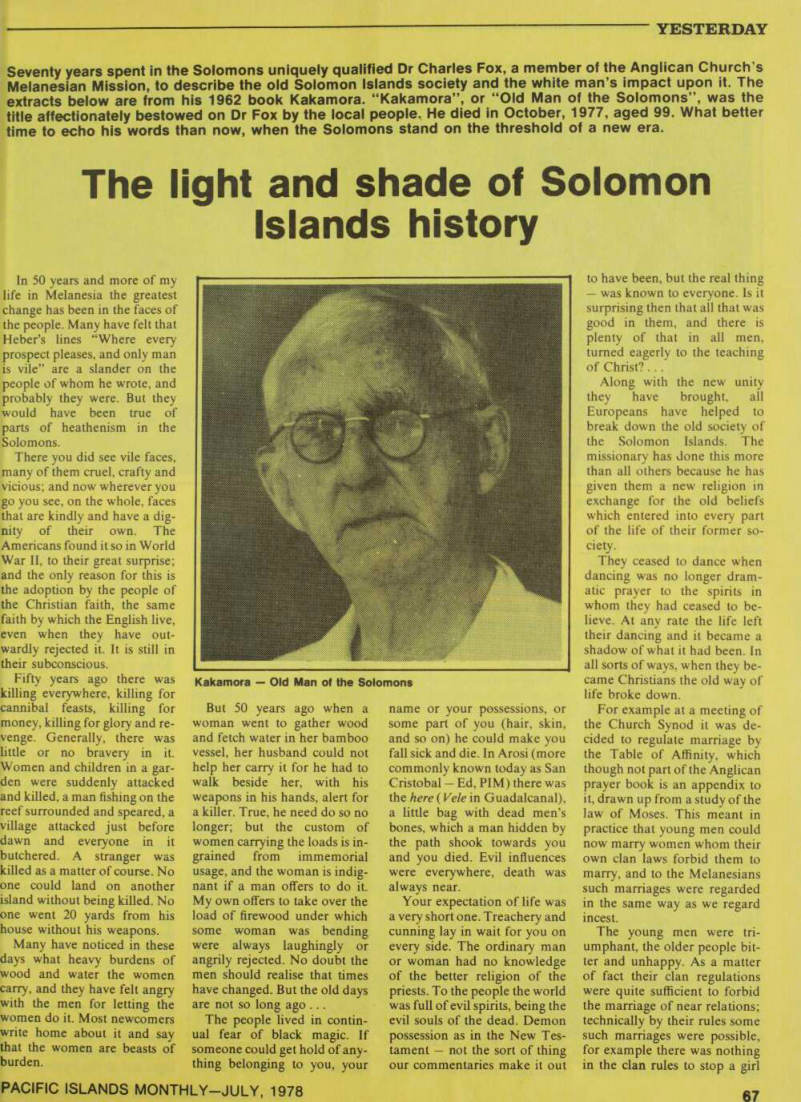
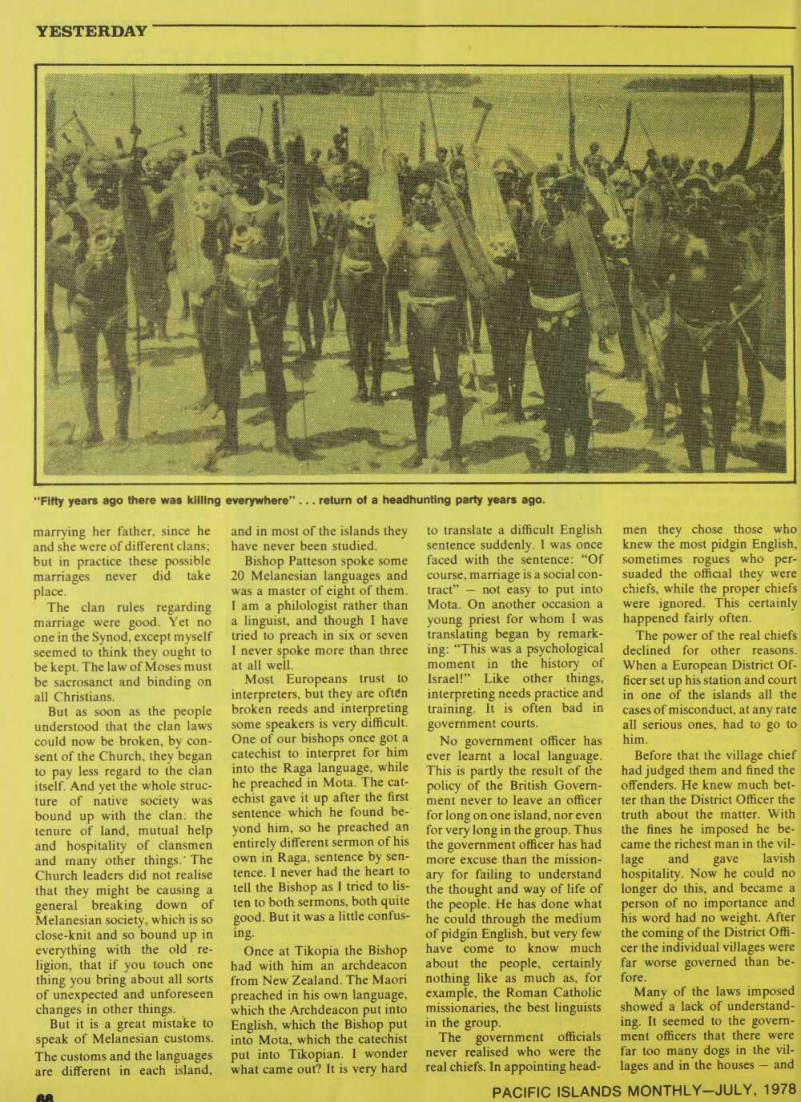
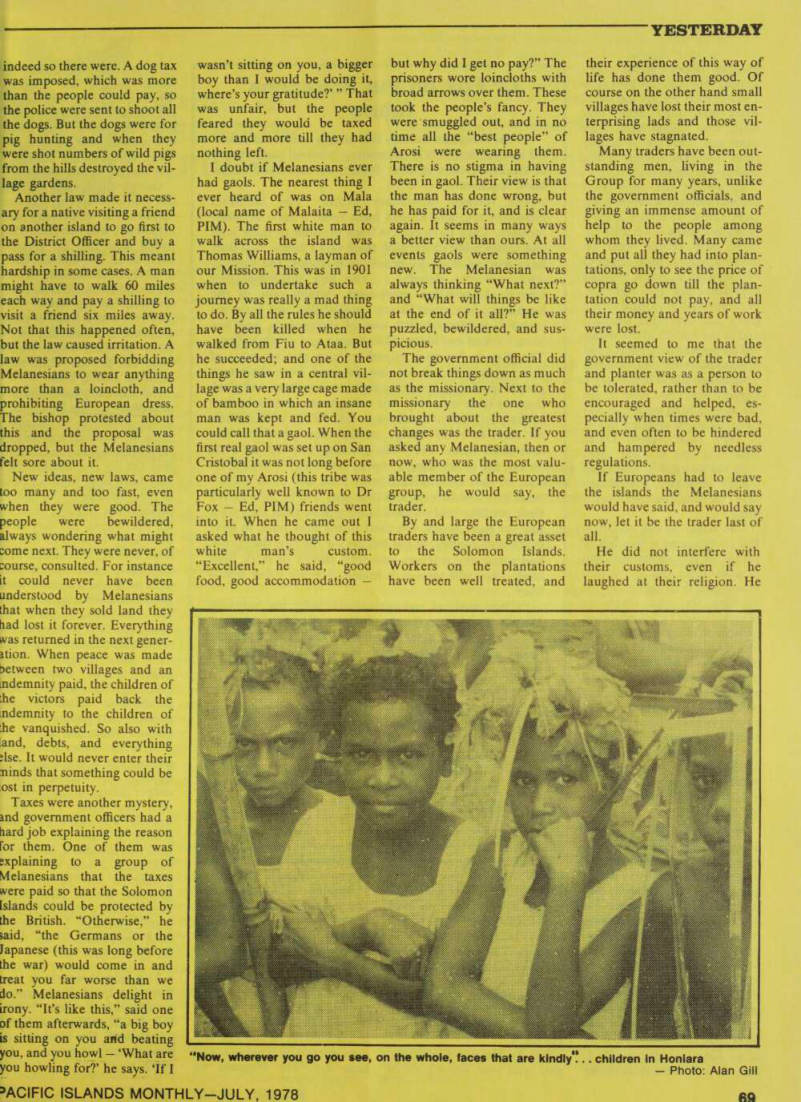
The light and shade of Solomon Islands history
Seventy years spent In the Solomons uniquely qualified Dr Charles Fox, a member of the Anglican Church's Melanesian Mission, to describe the old Solomon Islands society and the white man’s impact upon it. The extracts below are from his 1962 book Kakamora. “Kakamora”, or “Old Man of the Solomons”, was the title affectionately bestowed on Dr Fox by the local people. He died in October, 1977, aged 99. What better time to echo his words than now, when the Solomons stand on the threshold of a new era.
In 50 years and more of my life in Melanesia the greatest change has been in the faces of the people. Many have felt that Heber’s lines “Where every prospect pleases, and only man is vile” are a slander on the people of whom he wrote, and
probably they were. But they
would have been true of parts of heathenism in the Solomons.
There you did see vile faces, many of them cruel, crafty and vicious; and now wherever you go you see, on the whole, faces that are kindly and have a dig nity of their own. The Americans found it so in World War 11, to their great surprise; and the only reason for this is
the adoption by the people of
the Christian faith, the same faith by which the English live, even when they have out wardly rejected it. It is still in their subconscious.
Fifty years ago there was
killing everywhere, killing for
cannibal feasts, killing for money, killing for glory and re venge. Generally, there was little or no bravery in it.
Women and children in a gar den were suddenly attacked and killed, a man fishing on the reef surrounded and speared, a
village attacked just before
dawn and everyone in it butchered. A stranger was killed as a matter of course. No one could land on another island without being killed. No one went 20 yards from his house without his weapons.
Many have noticed in these days what heavy burdens of wood and water the women carry, and they have felt angry with the men for letting the women do it. Most newcomers write home about it and say that the women are beasts of burden.
But 50 years ago when a woman went to gather wood and fetch water in her bamboo vessel, her husband could not help her carry it for he had to walk beside her, with his weapons in his hands, alert for a killer. True, he need do so no longer; but the custom of women carrying the loads is in grained from immemorial usage, and the woman is indig nant if a man offers to do it.
My own offers to take over the load of firewood under which some woman was bending
were always laughingly or
angrily rejected. No doubt the men should realise that times have changed. But the old days are not so long ago ...
The people lived in contin ual fear of black magic. If someone could get hold of any thing belonging to you, your
name or your possessions, or some part of you (hair, skin, and so on) he could make you fall sick and die. In Arosi (more commonly known today as San Cristobal Ed, PIM) there was the here (Vele in Guadalcanal), a little bag with dead men’s bones, which a man hidden by the path shook towards you and you died. Evil influences were everywhere, death was
always near.
Your expectation of life was a very short one. Treachery and cunning lay in wait for you on every side. The ordinary man or woman had no knowledge of the better religion of the priests. To the people the world was full of evil spirits, being the evil souls of the dead. Demon possession as in the New Tes tament not the sort of thing our commentaries make it out
to have been, but the real thing was known to everyone. Is it surprising then that all that was good in them, and there is plenty of that in all men, turned eagerly to the teaching of Christ? ...
Along with the new unity
they have brought, all
Europeans have helped to
break down the old society of the Solomon Islands. The missionary has done this more than all others because he has given them a new religion in exchange for the old beliefs which entered into every part of the life of their former so
ciety.
They ceased to dance when dancing was no longer dram atic prayer to the spirits in whom they had ceased to be lieve. At any rate the life left their dancing and it became a shadow of what it had been. In all sorts of ways, when they be came Christians the old way of life broke down.
For example at a meeting of the Church Synod it was de
cided to regulate marriage by
the Table of Affinity, which though not part of the Anglican prayer book is an appendix to it, drawn up from a study of the law of Moses. This meant in practice that young men could now marry women whom their own clan laws forbid them to many, and to the Melanesians
such marriages were regarded
in the same way as we regard incest.
The young men were tri umphant, the older people bit ter and unhappy. As a matter of fact their clan regulations were quite sufficient to forbid the marriage of near relations; technically by their rules some
such marriages were possible,
for example there was nothing in the clan rules to stop a girl
Kakamora-Old Man of the Solomons
marrying her father, since he and she were of different clans; but in practice these possible marriages never did take
place.
The clan rules regarding marriage were good. Yet no one in the Synod, except myself seemed to think they ought to be kept. The law of Moses must be sacrosanct and binding on all Christians.
But as soon as the people understood that the clan laws could now be broken, by con sent of the Church, they began to pay less regard to the clan itself. And yet the whole struc ture of native society was bound up with the clan; the tenure of land, mutual help and hospitality of clansmen and many other things. ' The Church leaders did not realise that they might be causing a
general breaking down of
Melanesian society, which is so close-knit and so bound up in everything with the old re ligion, that if you touch one thing you bring about all sorts of unexpected and unforeseen changes in other things.
But it is a great mistake to speak of Melanesian customs.
The customs and the languages are different in each island,
and in most of the islands they have never been studied.
Bishop Patteson spoke some
20 Melanesian languages and was a master of eight of them.
I am a philologist rather than a linguist, and though I have tried to preach in six or seven I never spoke more than three at all well.
Most Europeans trust to interpreters, but they are often broken reeds and interpreting some speakers is very difficult.
One of our bishops once got a catechist to interpret for him into the Raga language, while he preached in Mota. The cat echist gave it up after the first sentence which he found be yond him, so he preached an entirely different sermon of his own in Raga, sentence by sen tence. I never had the heart to tell the Bishop as I tried to lis ten to both sermons, both quite good. But it was a little confus
ing.
Once at Tikopia the Bishop had with him an archdeacon from New Zealand. The Maori preached in his own language, which the Archdeacon put into English, which the Bishop put into Mota, which the catechist put into Tikopian. I wonder what came out? It is very hard
to translate a difficult English sentence suddenly. I was once faced with the sentence: “Of course, marriage is a social con tract” not easy to put into Mota. On another occasion a young priest for whom I was
translating began by remark
ing: “This was a psychological moment in the history of Israel!” Like other things,
interpreting needs practice and
training. It is often bad in government courts.
No government officer has ever leamt a local language.
This is partly the result of the policy of the British Govern ment never to leave an officer for long on one island, nor even for very long in the group. Thus the government officer has had more excuse than the mission ary for failing to understand the thought and way of life of the people. He has done what he could through the medium of pidgin English, but very few have come to know much
about the people, certainly
nothing like as much as, for example, the Roman Catholic missionaries, the best linguists in the group.
The government officials never realised who were the real chiefs. In appointing head
men they chose those who knew the most pidgin English, sometimes rogues who per suaded the official they were chiefs, while the proper chiefs
were ignored. This certainly
happened fairly often.
The power of the real chiefs declined for other reasons.
When a European District Of ficer set up his station and court in one of the islands all the cases of misconduct, at any rate all serious ones, had to go to him.
Before that the village chief had judged them and fined the offenders. He knew much bet ter than the District Officer the truth about the matter. With the fines he imposed he be came the richest man in the vil lage and gave lavish hospitality. Now he could no longer do this, and became a person of no importance and his word had no weight. After the coming of the District Offi cer the individual villages were far worse governed than be fore.
Many of the laws imposed showed a lack of understand ing. It seemed to the govern ment officers that there were far too many dogs in the vil lages and in the houses and
“Fifty years ago there was killing everywhere”... return of a headhunting party years ago.
indeed so there were. A dog tax was imposed, which was more than the people could pay, so the police were sent to shoot all the dogs. But the dogs were for pig hunting and when they were shot numbers of wild pigs from the hills destroyed the vil
lage gardens.
Another law made it necess ary for a native visiting a friend on another island to go first to the District Officer and buy a pass for a shilling. This meant hardship in some cases. A man might have to walk 60 miles each way and pay a shilling to visit a friend six miles away.
Not that this happened often, but the law caused irritation. A
law was proposed forbidding
Melanesians to wear anything more than a loincloth, and prohibiting European dress.
The bishop protested about
this and the proposal was dropped, but the Melanesians felt sore about it.
New ideas, new laws, came too many and too fast, even when they were good. The people were bewildered,
always wondering what might
come next. They were never, of course, consulted. For instance it could never have been understood by Melanesians
that when they sold land they
iiad lost it forever. Everything ivas returned in the next gener ation. When peace was made between two villages and an indemnity paid, the children of the victors paid back the indemnity to the children of the vanquished. So also with and, debts, and everything ;lse. It would never enter their ninds that something could be ost in perpetuity.
Taxes were another mystery, and government officers had a
hard job explaining the reason
for them. One of them was explaining to a group of Melanesians that the taxes were paid so that the Solomon Islands could be protected by the British. “Otherwise,” he iaid, “the Germans or the Japanese (this was long before the war) would come in and treat you far worse than we
do.” Melanesians delight in
irony. “It’s like this,” said one of them afterwards, “a big boy
is sitting on you and beating
you, and you howl ‘What are you howling for?’ he says. ‘lf I
wasn’t sitting on you, a bigger boy than I would be doing it, where’s your gratitude?’ ” That was unfair, but the people feared they would be taxed more and more till they had
nothing left.
I doubt if Melanesians ever had gaols. The nearest thing I ever heard of was on Mala (local name of Malaita Ed, PIM). The first white man to walk across the island was Thomas Williams, a layman of our Mission. This was in 1901 when to undertake such a
journey was really a mad thing
to do. By all the rules he should have been killed when he walked from Fiu to Ataa. But he succeeded; and one of the things he saw in a central vil lage was a very large cage made of bamboo in which an insane man was kept and fed. You could call that a gaol. When the first real gaol was set up on San Cristobal it was not long before one of my Arosi (this tribe was particularly well known to Dr Fox - Ed, PIM) friends went into it. When he came out I asked what he thought of this white man’s custom.
“Excellent,” he said, “good food, good accommodation
but why did I get no pay?” The prisoners wore loincloths with broad arrows over them. These
took the people’s fancy. They
were smuggled out, and in no time all the “best people” of Arosi were wearing them.
There is no stigma in having been in gaol. Their view is that the man has done wrong, but he has paid for it, and is clear again. It seems in many ways a better view than ours. At all
events gaols were something
new. The Melanesian was
always thinking “What next?”
and “What will things be like at the end of it all?” He was puzzled, bewildered, and sus-
picious.
The government official did not break things down as much as the missionary. Next to the missionary the one who brought about the greatest changes was the trader. If you asked any Melanesian, then or now, who was the most valuable member of the European group, he would say, the trader.
By and large the European
traders have been a great asset to the Solomon Islands.
Workers on the plantations have been well treated, and
their experience of this way of life has done them good. Of course on the other hand small villages have lost their most en terprising lads and those vil
lages have stagnated.
Many traders have been out standing men, living in the Group for many years, unlike the government officials, and giving an immense amount of help to the people among whom they lived. Many came and put all they had into plan tations, only to see the price of copra go down till the plan tation could not pay, and all their money and years of work were lost, It seemed to me that the government view of the trader and planter was as a person to be tolerated, rather than to be
encouraged and helped, es
pecially when times were bad, and even often to be hindered
and hampered by needless
regulations,
If Europeans had to leave the islands the Melanesians would have said, and would say now, Jet it be the trader last of all.
He did not interfere with their customs, even if he laughed at their religion. He
“Now, wherever you go you see, on the whole, faces that are kindly"... children in Honiara Photo: Alan Gill
brought them goods they
needed. He was fair and just.
Their respect for the justice of white men, their belief that white men always keep their word and don’t lie, is largely from their knowledge of the
trader and planter . ..
Fifty years ago, the way of life was full of excitement. On Gela (more generally known today as Florida Ed, PIM) in those days people went on
dancing parties from village to
village, and it was a thrilling experience for the audience, because sometimes the dancing party had concealed weapons and in the middle of the dance fell on the watching people and massacred every one of them.
You never knew what might happen when you went to see the dance! Men went into ter rible rages and sweated blood.
A Gela chief named Dikea went into one of these rages with his wife for a very small matter, and beat her with a club till she was a bloody mess.
Life could be full of terror.
But all the same it was full of colour, of rich ceremonial and of adventure; and to many it now seems drab and grey, just working for white men on plantations, or making copra or perhaps working in a mine. As for excitement nothing much. This is why many of the
present generation, knowing
nothing now of what life was really like 50 years ago, but hearing of the old customs, cer emonial, adventure and excite ment, sometimes think wistfully of the old ways and wonder if European civilis ation has been for them a bless ing or a curse.
They know that with the
coming of the Europeans they
themselves have been rapidly dying out, and that this is still going on in some islands, that the population is static on others, and that it is increasing in only a few. Europeans know, from what has happened else where in the Pacific, that more medical help and more preven tive medicine, better food crops and more variety of food, can bring about a healthy and increasing race. The great work of an American doctor (Dr S.
M. Lambert, of the Rockefeller
Foundation Ed, PIM) who conceived the idea of a medical school in Suva for Pacific Islanders, and brought it about, is bearing fruit. Mission hospi tals are producing nurses.
There is plenty of hope for the people. But they have not much faith yet, though it is growing, in their own future.
Europeans have been bring ing unity to the people. Fifty years ago there was none. The people of one island, or even one district, knew little of any others, except that they were enemies. The great number of different languages kept them all apart from one another.
But missionary, government official and trader have all helped to bring about a grow
ing unity.
On the coconut plantations, year after year, some 2 000 of
the men from different islands came together, and got to know one another. They all spoke pidgin English. I am no be liever in pidgin English as the future language of the whole people, it is too clumsy a me dium of thought, but it has served a very useful purpose in
thus drawing together people
of different islands who had no
common language.
Wishing to try everything
and to know what it was like I was once allowed by a friendly trader to become for a time one of his plantation boys and live their life. We were up at 5.30 am and after a cup of tea and a hard biscuit went out
“brushing” the plantation, or
making copra. We had a spell in the middle of the day and then worked till 5 pm a nine hour day. The evenings we
spent in talk, boys from dif ferent islands all friendly together. It was a good life. The plantations have done as much as anything else to bring about the unity of the people, and break down the old hostilities and distrust of one another.
One government for all, with one law for everyone, has also
helped. The missionary has
helped too, with one faith. This would have had the greatest effect of all if it had not been a divided Christianity which we brought them, making fresh divisions among them, div isions for which many of them could see no reason, and which many of them think would cease but for the white mis sionaries among them.
But like the plantations, the missionary schools have been a strong influence for bringing them all together, and getting rid of the suspicion and distrust they felt for one another. Not only have boys lived together in these schools for far longer periods than they ever spent on the plantations, but they have been able, because of this, to
form lifelong friendships with
boys from other islands than their own, and hundreds have gone as missionaries, often for life, to other parts of Melanesia. The great work the schools have done for unity has never been recognised. They ought to be helped and encouraged, for with a merely materialistic education the people any people will in the end wither and die.
With the coming of girls’ schools a new era is opening, because the women have a deeper influence in the village than the men. The white women who kept this aim always in view and worked their way towards it, have done more than anyone else in this generation for the Solomon Islanders. One of these, Sister Nellie Stead, a highly qualified
nurse, especially in maternity
work, well deserved the MBE the Queen gave her ... • The above extracts are from the book Kakamora, by Charles E. Fox, MBE, MA, D Litt, which was first published by Hodder & Stoughton, London, in 1962.
Advertisements & other items, p. 69 (1 item)
69
YESTERDAY
3 ACIFIC ISLANDS MONTHLY—JULY, 1978
Dr Fox on the Solomons’
future
As the Solomon Islands this month accede to politi cal independence, it is interesting to recall some facets of Dr Fox’s view of their future, as expressed in his book Kakamora.
The veteran missionary wrote: “The Solomon Islanders are, and always have been, a race of small farmers. They have always been devoted to their land and taken pride in working their small farms. But they have worked them by primitive methods, the digging stick, not the plough ... The new self-supporting Church Association movement, though only at the beginning, has great future possibilities, not least be cause it originated with one of themselves, and has been worked out along Melanesian and original lines.
The plan is for each island to have one or more of these church farms, leasing the land from their own people, paying their own people to run them and work them in their own way, but using better methods than in the past, and so spreading a knowledge of these bet ter ways to every village on the island, and to every individual farm. They are growing new crops: rice, cocoa, and other things, hoping the villagers will follow suit, so that all will have more food and more variety than they had before, and that they will be able to sell their produce and so have more money than they once had for their needs. On their farms they hope to have cattle and poultry, to get hullers for the rice they grow, and some day tractors and such things to work their land. They will also, it is hoped, develop other indus tries ...
“Given medical and agricultural help, the Solomon Islands people can be saved. But not by big schemes, nor by spending a lot of money. They can work out their own salvation, and it is better that they should ...”
Advertisements & other items, p. 70 (1 item)
Yesterday
Islands
From the
Press
From the Pitcairn Miscellany:
Vlaurice, our town personality and head coconut opener, was turning the rubbish from Ben’s office in a drum at the square vhen an empty fly spray canister went into the burning drum vith the rest of the paper. A tremendous explosion echoed around ;he square which nearly blasted poor old Maurice into tomorrow, md even old Albert was heard to remark that the duck shooting vas early this year. In any case Maurice is now much more careful ibout what he burns.
From the New Hebrides News: \nother Namele tree must be planted outside the Condominium milding to replace the one removed last year, says the Vlalvattumauri. The Chiefs expressed their regret at the uprooting )f the tree. They felt the removal of the Namele tree was like lestroying all nakamals in the islands. Another must be planted o signify the power and the true identity of the people of this :ountry. To properly settle the matter, a custom ceremony should >e held between the Chiefs and the people who removed the tree. <Tom a speech at Honolulu by the Governor of American Samoa reported in the American Samoa News Bulletin: .. The Pacific island peoples are awakening to the obvious need o co-ordinate their efforts towards economic development. This s especially important now that big powers like Red China and he Soviet Union, outsiders until now in the Pacific region’s )olitical sphere, are making serious efforts to penetrate the :conomic and social order of the Pacific islands. No island immunity or nation can “go it alone” in the face of increasing nvolvement by large industrial powers, for they neither have the eources nor the economic base to unilaterally safeguard their >articular interests or the Pacific region’s interests in general. It s therefore imperative that the Pacific island peoples co-ordinate heir efforts to ensure an orderly economic growth and safeguard heir collective interests in the region ... vlr John Chipper, president of the Rabaul Town Council, :astigates the “National” people in an interview reported nthe AilansNius: . . The National Government gives the people millions of kina )er year. The Australian taxpayer has given the Papua New fuinea Government over two thousand million kina since the ast war, and yet it would seem that most National people take werything and give nothing. You are looked after from the time r our mother begins to carry you until you die. You are the spoilt hildren of God in this world. The name of the country should )e YU GIMI not New Guinea, for you take all the time and ay thank you by grumbling, asking for more and not looking ifter your country and things in it which belong to you . . .
'om the Solomons News Drum: ndependence meant “freedom to solve our own problems”, the Minister, Mr Kenilorea, told the Legislative Assembly in us winding-up speech on the constitutional debate. He said that ndependence did not mean an end to problems or running away rom problems. If man was the main source of problems then nan, too, was the main source of solutions . . . Some members, le said, were concerned about the security of their people. People
were frightened of what lay ahead. “It is not the system or the constitution that will disrupt the country,” he said. “It is the human force which should be considered as the enemy. If we face tomorrow with fear, we face ourselves. But, if we face it with a clear mind, there shouldn’t be any fear.”
From the Papua New Guinea Post-Courier: The Commerce Minister, Mr Lus, has warned Papua New Guineans not to go into business with expatriate partners without checking out the deals. He said foreigners were often taking nationals “for a ride” and were having a “wonderful party” with the country’s economy.
From the New Hebrides News: Saturday, May 6, will be Snail Day in Vila. This is the second attempt to slow down the spread of the Giant African Snail in Vila. Over 30 tons were collected by schools, youth clubs, Scouts and Guides, communities and individuals last year . . . Prizes totalling 60 000 FNH have already been drawn up, including a special prize for the largest snail collected ...
A placard photographed outside the Majuro International Airport and appearing on the front page of the Micronesian
Independent:
Long live Marshalls. Hell is a place for C.O.M. (Congress of Micronesia) and Devils. Uninvited guests keep out. C.O.M. go to hell.
From a letter in the Arawa Bulletin signed by Constable Martin Kepa “and the Traffic Constables, Arawa Police” in reply to a protest from a motorist at being singled out for a parking offence: ... “Unjust” lady you were booked for parking at the “No Parking” sign when Police “saw” you committing the offence.
But your male counterparts of whom you are complaining were not seen by us (duty traffic men). If we don’t see someone committing an offence and if no one reports them, how the hell do you think we could go about establishing the facts to present a case?
From the Coconut Telegraph, a monthly published at Savusavu, Vanua Levu, Fiji: ... The per capital income of Fiji’s people is said to be $920 per year about $lB a week. With great care, many people, including families, manage to live on this amount, plainly, honestly and decently, paying their way and owing nothing, though, of course, there’s no allowance for luxuries. The success of such an exercise needs a special kind of intelligence and expertness seldom understood or acknowledged by a person living on, say, $2O 000 per year.
From the Solomons News Drum: An attempt to secure the release of all prisoners on Independence Day was rejected by the Legislative Assembly at its recent meeting . . . Opposing the motion, the Chief Minister, Peter Kenilorea, said that already there was confusion among people about independence. Some people in the rural areas thought independence meant free goods in the shops and if prisoners were
released, people wouldmisinterpret independence as freedom
from law and justice and the rate of crime would be inevitably
high.
From The Fiji Times: Throwing down rubbish wherever you happen to be standing may have been a tolerable process years ago when most rubbish was of a different type and there was simply not so many people throwing it around. But to see today a mother quite calmly letting a child hurl a plastic bag or food wrapper on to the city footpath or back step does not bode well for the future of this green and
pleasant land.
Advertisements & other items, pp. 71-72 (3 items)
Ar 4 1 1 - 1 0 IO I A L irNrt ft m « fti-r-iii > < .... . .
Ar 4 1 1 - 1 0 IO I A L irNrt ft m « fti-r-iii > < ... . .
72
D ATICIP ICI AMHC MrtMTUI V_ II II V 1 Q7ft
Henry Cumenes
Jlsllx
HEAT
SEALING.
SHRINK
PACKAGING.
CONTACT A USTRA LIA'S
FOREMOST MANUFACTURERS
OF HE A T SEALING EQUIPMENT
SERVING INDUSTRY
IN AUSTRALIA & THE PACIFIC ISLANDS
FOR OVER 25 YEARS.
HELIX ELECTRICAL PRODUCTS PTY. LTD.
27 Rosebery Avenue, Rosebery, NSW 2018, Australia. 663 0487.
HENRY CUMENES
PTY. LTD.
EXPORTERS o GENERAL MERCHANTS
428 GEORGE ST., SYDNEY
CABLES; HENCO SYDNEY. G.P.O. Box 3949. PHONE: 25-3383.
For specialised and personalised buying service
throughout the Pacific Islands and the East.
LOCAL AGENTS AND REPRESENTATION: *
PAPUA NEW GUINEA.
PORT MORESBY: Mr. Tan,
P.O. Box 5445, Boroko.
Telephone 25 2542.
RABAUL: M. & C. Seeto, P.O. Box 131, Rabaul.
Telephone 92 2902.
MADANG: W. Double, P.O. Box 22, Madang.
Telephone 82 2696.
FIJI.
K, Witherington Ltd., P.O. Box 293, Suva.
Telephone 22 356.
NEW HEBRIDES.
John Lum & Associates, P.O. 65, Santo, Telephone 329.
SOLOMON ISLANDS.
Lo See War Ltd., P.O. Box 327, Honiara.
Telephone 399. -• Resident Agents in other Pacific Territories.
Mm
n»GfD COLO DRINKS
* LOW COST
* LARGE CAPACITY
UPRIGHT DISPLAY
REFRIGERATORS
* BOTTLE & FOOD DISPLAY
* 2& 3 DOOR MODELS AVAILABLE
Large capacity small floor space Maximum visual display Gleaming white, vinyl coated aluminium interior for better reflection of light within cabinet Fluorescent lighting 2" Frigidfoam insulation (equivalent to 4" Polystyrene or 6" cork!) Powered by heavy-duty Kelvinator sealed unit warranteed for 5 years I Attractive timber grain Marviplate exterior I Automatic frost-free, fan-assisted cooling gives even and faster cooling of stored products 1 4 rows adjustable plastic-coated, hygenic, white shelves and floor tray LOW MAINTENANCE, the only maintenance required being periodic cleaning of condenser Illuminated sign in top panel optional extra.
AVAILABLE FROM:
AUSTRALIAN NEW CALEDONIA EXPORTS. 363 George St, Sydney, 2000 BREGKWOLOT & CO., 276 Pitt St., Sydney, 2000 HAGEMEYER (A'SIA), 59 Anzac Pde, Kenaington, 2033.
GEOFFREY HUGHES ft CO, 167 Macquarte St, Sydney, 2000 NELSON & ROBERTSON PTY. LTD, 197 Clerenoe St, Sydney, 2000 PETER FISHER TRADING PTY.LTD. 321 Pitt St, Sydney 2000.
E. RABOT (EXPORTS) PTY. LTD, 67 Ceetlereagh St, Sydney. 2000 RABTRAD NIUGINI PTY. LTD., PO Box 1406, Lae.
A. RIETTE (PACIFIC) PTY. LTD., 300 George St., Sydney, 2000 H. Y. KWAN (AUSTI PTY. LTD. Box 2713, GPO , Sydney, 2001.
C. SULLIVAN (EXPORT) PTY. LTD., GPO Box 3373, Sydney. 2001.
W.S. TAIT & CO, PTY. LTD, 31 Macquarie Place, Sydney, 2000.
Manufactured by: 0 ~ri
FRIGID CABINETS PTY. LTD.,
14A Duffy Ave., Thornleigh, N.S.W. 2120 Aust. Ph. 848 8292.
FC2
Yachts
Cruising
• Sarabande, 11 Rn
A/oollocott ketch built in New Zealand, at present in the /Vest Indies, may return to Pacific cruising. The owner, Dr 3. Diethelm, writing to PIM rom Antigua where, inciden ally, he received PIM for Movember and December, 1977, said that with his wife md children he spent several /ears in SE Asia, the Indian Dcean, the Seychelles, Arabia md the Mediterranean before jailing for the Caribbean and lopefully, for the Pacific. The >arabande has been Dr Diethelm’s home for about 11 /ears. He set out on his cruis ng from Sydney in 1967, eturning in 1970 and setting )ut again in 1973. The last ime Sarabande’s movements vere recorded in PIM was in 1973. ‘‘lt was indeed a thrill to )e reading PIM again and cer ainly makes one feel close to he Pacific again,” Dr Diethelm wrote.
• Boomerang, 15 24 M
Swedish ketch registered in kSkero, arrived at Rarotonga n May 10 from Raoul Island, le first yacht to visit that iso ited NZ weather station for ix months. Previous ports of all were Sydney and Lord lowe Island. On board were 'er W. Hallin (master), Ken lallin, Urban Svedung, Lars iaether and Bob Fox. Next orts of call were to be Bora lora, Tahiti, Pitcairn and Eas -3r Islands and Panama, fol ded by the Atlantic crossing, nd then back home to iweden.
• Mata Moana, 5 6 M
loop, Caprice class, arrived t Rarotonga from Papeete nd Moorea on May 8 with ongan owner-skipper Viliami ehoko and one girl crew lember. Viliami is an ex lerchant marine cadet who /as trained and taught navi ation under Captain Michael lailes in the Tongan lIFOFUA, and was in Rare- Dnga with MATA MOANA in
June last year (PIM, Sept 77, p 75), having sailed single handed from Auckland. • Also in Rarotonga in early May were EOS, an American ketch registered in Portland, Oregon; IDIOT WIND, a Canadian sloop registered in Vancouver which arrived from Papeete with Peter Powell and one crew, and ROSIII, 6.75 m German sloop which arrived from Moorea with single hander Mr A. F. W. Volzer.
• Wayward Wind And
SHEARWATER, both staysail schooners and each 19.8 m on deck and 25.3 m overall, were visitors to Tubuai in April.
On board Wayward Wind were Walter and Carolyn Kiefer and son John, Bruce Lussin, of Canada, who joined as a member of the crew in Tahiti, and guests Annie Levy and her daughter Rava, who also joined the yacht in Tahiti.
Wayward Wind left Newport, California in June, 1977, for the Marquesas, then to Ran giroa, Tahiti and the Leeward Group of the Society Islands, then back to Tahiti before leav ing for Australia. Shearwater also started her cruise from Newport, but in November, 1977, and visited the Marquesas, Ahe, Rangiroa and Tahiti. On board where she arrived at Tubuai were Ernie and Carrie Minney and their young children, Ernie and Alice, Chip Cahill, a crew member, who had been on board since Shearwater left California, and LaVonne Hilschner, a retired school teacher, also of California, who joined the yacht in Tahiti.
Both yachts spent some time at Taravao Peninsula, Tahiti, then sailed together to Rurutu, west of Tubuai, where Annie Levy has relatives, then to Tubuai where they stayed for a week before returning to Tahiti. Plans were for the Shearwater to sail to the Lee ward Islands, including Bora Bora, before continuing west to New Zealand. Future plans of the Wayward Wind were uncertain.
• Mele Makani, 12.8 M
ketch registered in Honolulu, arrived at Rarotonga on April 23 from Bora Bora with skip per R. A. Colven and two crew. • GISELLE, 37m cutter
registered at Houston, US, arrived at Rarotonga on April 23 from Bora Bora with James Parker and two crew. • CRABBY, 16.76 m motor yacht registered in Coos Bay, Oregon, US, arrived at Raro tonga on April 25 from Papeete with owner-skipper B.
C. Crabtree and his wife, Alex andra. They left Oregon last June on a leisurely world cruise and when at Los Angeles the yacht acted as chief communications vessel for the 1977 Trans-Pacific yacht race from Los Angeles to Honolulu. The vessel is equipped with two radar sets,two Ham radios, one UHF radio, two high-seas band radios, a citizen band radio and two direction finders.
Crabby also has an auto-pilot and a water distilling plant which can produce 90 litres of fresh water an hour. Ports of call included Christmas Island, the Line Islands of Malden, Starbuck, Vostok, Caroline and Flint and the French Polynesian islands. Next port of call will be Pago Pago.
• Witchcraft, 10 66M
American sloop, also arrived at Rarotonga on April 25 from Raiatea with Dr Art Biehl and two crew. Witchcraft is a world-famous racer in the one ton class. Brisbane will be the next port of call. • XANGO, a French ketch, arrived at Rarotonga from Tahiti on April 28 bound for New Caledonia. On board was skipper M. Blanc and one crew member.
• Moonshadow Iv, A
Westsail 9.75 m cutter rig, with Jim and Verna Gallup, arrived May 5 at Tubuai after a fast
16-day voyage from New Zealand. They are on a return trip to Canada which they left over a year ago on a cruise through French Polynesia, the Cook Islands, Niue and Tonga, to New Zealand: They built their yacht from a kit at their home in Calgary, Alberta, Canada. It was trucked to the Pacific Coast and registered at Vancouver, BC. They sailed for Raivavae on May 9, arriving the following day. From there they will leave for Tahiti, the Tuamotus, Hawaii and Van couver.
• Epaminondas, A 13.71
m Herreshoff ketch (Mobjack) with owner/builder Rick Cran dall of New Zealand was at Raivavae in May. Also on board were crew members Dennis Marra and James Gandy, both of NZ, Peter Ward of the UK, and Hank Grimshaw, the navigator, from Hawaii. Epaminondas had made an 18-day passage from New Zealand to Raivavae.
Pot in yacht
An American yachtsman, stopping over in Suva for maintenance and repairs to his boat, was arrested by the police and charged with having marihuana in his pos session. The American, Gary Edward Danielson, 30, of San Francisco, pleaded guilty, but said he had no idea where the marihuana or pipes containing marihuana had come from.
The magistrate, Mr Kenneth Moore, fining Danielson $l5O, said he was concerned with tourists bringing drugs into Fiji with them. However, there was no allegation of any sort that Danielson was a pusher.
Shearwater (left) and Wayward Wind at anchor at Tubuai.
Advertisements & other items, pp. 73-74 (3 items)
■> A i<->i • > •pn » . .
74
IQI AMHQ MfIMTHI V II II Y IQ7R,
Qbe Insurance Limited
Q E
offers expert insurance
throughout the Islands.
QBE INSURANCE LIMITED
(FORMERLY - QUEENSLAND INSURANCE COMPANY)
Central Office: 82 Pitt Street, Sydney.
FIJI Branch Office, Suva, Manager for Fiji: L.G. Liddell A.A.1.1.
LAUTOKA Sub-Branch Office: Burns Philp Bldg.
NEW CALEDONIA T.A. Hagen, Ste. W.A. Johnston, S.A.R.L. - Noumea.
NEW HEBRIDES District Manager: G.F. Donnelly, Vila; Santo Santo: Burns Philp (New Hebrides) Ltd.
TAHITI Arthur Chung: Immeuble 8.1., Front de Mer, Papeete.
NIUE, NORFOLK ISLAND, SAMOA, TONGA and other South Sea Islands Burns Philp (South Sea) Company L td.
QUEENSLAND INSURANCE (RN.G.) LTD.
PAPUA NEW GUINEA - Head Office, PORT MORESBY.
General Manager: J.M. Dawe. Assistant Manager: R.V. Maskell.
District Managers at: LAE: I.R. Martin MOUNT HAGEN: D.F. Carroll ARAWA: J. Longbut MADANG: R.W.V. Collings RABAUL: W.F. Tinker
To Future Generations,
Security
w* IS i / Horyuji Japan's 7th century \ temple links the past to the present with the solemn beauty.
Social welfare is a subject of serious consideration in most modern societies. Man in the twentieth century accepts his responsibility to bequeath to the next generation a society better than his own.
Daiwa Bank is not unique in accepting this responsibility, but Daiwa is unique in making acceptance of this role in society an integral part of their banking service.
Daiwa is the only Japanese city bank to combine banking and trust business. Daiwa is thus a fully integrated banking institution, comprising banking, international financing, trust, pension trust, and real estate business. This integration is part of our effort to fulfil our social responsibility consistent with society's needs in a contemporary environment. a fully integrated banking service
DAIWA BANK
Head Office: Osaka, Japan London and Frankfurt Branches New York and Los Angeles Agencies Singapore, Sydney, Sao Paulo, Hong Kong and Houston Representative Offices Subsidiary: Daiwa Bank Trust Company, New York Joint Venture Banks; P.T. Bank Perdania, Jakarta, International Credit Alliance, Ltd., Hong Kong
A Sore Fiji Plans To Clip
New Zealand’S Wings
Transport
The Fiji Government, fed up at the apparent raw deal Air Pacific
is getting on Fiji-New Zealand
routes, has given notice that it will ;nd all Air New Zealand flights 0 Fiji in 12 months. The 12 nonths will expire about the end
)f April, 1979.
This sudden, unilateral move aught New Zealand by surprise is negotiations of routes were in >rogress between the two coun ties, and New Zealand under tood there were to be further
iiscussions. Whatever happens,
towever. Air New Zealand will
>e flying to Fiji throughout 1979
md for many years thereafter!
The effect of Fiji’s move is to pve both countries time to rethink heir attitudes and come up with 1 completely new agreement. And riji will expect any new agree nent to remove what are, in Fiji’s
:yes, some glaring anomalies.
The Fiji Minister for Civil Avi tion, Mr Tomasi Vakatora, nnouncing the Fiji decision, said le move had been taken “with Dme regret” because of the
notorious” and “glaring” restric
ons placed on Air Pacific flights ) NZ by both the NZ Govem lent and Air NZ. He had moved ) cancel the agreement because f the failure of negotiations be veen the two countries’ civil avi tion officials trying to reach an greement on a new arrangement Dr air services.
The current agreement, Ithough of the Bermuda type, nposed severe restrictions on Air 'acific operations, while Air NZ njoyed freedom to operate as it dshed. (Under the Bermuda greement between the US and le UK in 1946, countries have le right to carry their own zmntry’s passengers to another 3untry. This principle is still ap
lied generally, although there
ave been many changes in civil viation since then.) Mr Vakatora complained that te most notorious of the restric ons was a requirement that Air acific be forced to stop at inter lediate points on its NZ route.
Jiother glaring restriction affect
ig Air Pacific was the frequency f services. Air NZ could operate nlimited frequencies with DC 10
aircraft, while Air Pacific with BAC 1-1 Is was at the mercy of the NZ civil aviation authorities.
But the most unpalatable de cision dictated by New Zealand was that Air Pacific flights to and from NZ had to originate and fin ish at Nausori, and not at Nadi.
Air Pacific has five direct flights a week to New Zealand, while three are via Fua’amotu in
Tonga.
A week after Mr Vakatora’s an nouncement Air Pacific withdrew its proposed weekly BAC 1-11 service from Nadi to Auckland.
The flights were proposed earlier in 1978 under the Fiji-NZ agree ment "which then existed. This
weekly flight was designed to give
Air Pacific a bigger slice of the traffic between Nadi and Auckland.
Air Pacific was keen to operate the service but could not go ahead with it because of talks between Fiji and NZ civil aviation auth orities in March. Permission to operate the flights was withdrawn after those talks.
The NZ Minister of Transport, Mr Colin McLachlan, admitted he was surprised at the NZ de cision, but cancellation of the agreement would give both coun tries time to consider their
options.
The air services agreement between the two countries was negotiated in 1973, and at that time Air Pacific seemed to place great importance on its role in
connecting regional island terri
tories. Air Pacific was then granted rights to Auckland, via several intermediate points, and to Rarotonga and Niue, and beyond to Tahiti and South America.
But since 1973, Air Pacific had been changing its view of its future. The NZ Government had been sympathetic to the needs of Air Pacific. Even though direct services to NZ were not included in the existing agreement, the NZ Government had licensed Air Pa cific to fly direct from Suva (Nausori) to Auckland, as well as
via Tonga.
Early in 1977, Air Pacific was
operating only three direct flights
a week, but during recent nego tiations the number of flights was increased to six, even though the agreement as a whole had not
been renegotiated.
Mr McLachlan said it was not correct to say that the formula insisted on by NZ for rights to cer tain traffic was based on the premise that any national carrier was entitled to carry its own nationals. Nor was it true that NZ dictated restrictions on the depar ture and landing point in Fiji for Air Pacific services coming within the air services agreement.
Mr. McLachlan.
and its own airline
Tonga wants a new airport and its own airline
Tonga, with help from the newly-created Bank of the South Pacific, has started to up
grade Fua’amotu airport, near
Nukualofa, to international standard. King Taufa’ahau
Tupou has performed a
groundbreaking ceremony for the airport extension and an industrial estate.
The Governor of the Bank of the South Pacific, Mr John Meier, said construction work on both projects would take about three years. Many local jobs would be created.
When the airport reaches in ternational standards, the bank will help Tonga to finance a national airline to be started sometime in the next 12 months.
“The problem with airlines is that many have no choice but
to land in Fiji and other points in the South Pacific,” Mr Meier said. “I have spoken to officials of other major airlines who said they felt Tonga was better location and weather wise.”
He said several airline officials feared the political cli mate in Fiji and would wel come Tonga as an alternate location.
The industrial estate in cludes a hotel, which may have as many as 500 units. It was expected a final decision would be made soon.
Mr Meier said he believed enough tourism would be generated to make all the
bank’s projects economically
viable in the long run.
King Taufa’ahau Tupou,
speaking some days before Mr
Meier, said a Taiwanese group might be involved with the air line.
The king was asked if he had any reservations about Mr Meier, who has been involved in legal action in the United States over alleged tax evasion and financial deals made when he was an employee in Howard Hughes’ empire. He now lives in Canada.
The king replied: “His back ground is, of course, unfor tunate. The point is he is in a
position, and is willing, to help
Tonga in a way nobody else is
willing to help Tonga.”
An Australian proposal was that the airport should not be upgraded till 1995 at the earliest. The Australian plan
did not envisage Tonga having
its own airline.
Advertisements & other items, pp. 75-76 (3 items)
Ar'ICIP lo I Am n o uAkin ■■ v/ ii
76
. „ . k l l/MITI II \/ MU V 1 Q7R
Stewart
. • 7 Our Kitset Houses manufactured to your design or requirements are available for delivery and local assembly competitively anywhere in the Pacific. Units can come complete with plumbing and electrical wiring and be manpacked into the most inaccessible areas if required.
We can also cater for classrooms, hospital wards, dispensaries, etc. Our precut colour coded and numbered framing units means less skilled labour on site as initial cutting, fitting, etc., has been done in our factory.
We will design and/or help you to set up your own manufacturing facilities utilising local labour and resources on a joint venture basis.
FOR FURTHER INFORMATION WRITE TO:—
STEWART
TIMBER & HARDWARE LTD.
EXPORT DIVISION
P.O. BOX 488, WHANGAREI. NEW ZEALAND.
Try World Famous
§un
Slower
BRAND
CANNED FISH
Packer
•N NATURAL OIL
p ANcy
light meat T
OTHER LINES: Steel & Wooden Desks & Chairs—Lockers & Cabinets—Slotted Angles & Shelves—Lighting Fixtures
CENTENARY 1878-1978
Saihara & Co., Ltd.
Sumitomo Seimei Kawaramachi Building, 37-5 Chome, Kawaramachi Higashi-ku, Osaka, Japan Telephone: Osaka (06) 202-2171. Telex: 5224820 HINODE J Cable Address: “HERMES OSAKA
for top port status
Two Fiji towns battle for top port status
Mr Loh Heng-kee brought
the wrath of Labasa on his head when he suggested Savusavu instead of Labasa as the practical site for a port of entry for Vanua Levu, the sec ond biggest island in Fiji. Civic leaders criticised Mr Loh, who is director of the Ports Auth ority of Fiji, and had visited both towns to assess port needs and prospects.
The Mayor of Labasa, Cr Shiromani Madhavan, said it would be illogical and ill considered to declare Savusavu as a port of entry. Savusavu did not have the population, infra structure, communications and other facilities to support a port of entry. He said importers
would boycott Savusavu and
would have their goods sent to either Suva or Lautoka.
If the transinsular road be tween Savusavu and Labasa was not under construction
Labasa would have a good ar gument, say observers. But the road will make all the dif ference. Savusavu has handled some big tourist liners, and is the centre for copra, timber, cocoa and other primary indus tries.
Savusavu could be reached 24 hours a day, and is a deep water harbour. The way into Malau, which serves as an off
shore loading point for the big
ger ships going to Labasa, is strewn with reefs and rocks,
and is navigable only in day
light.
Mr Loh met people representing a variety of interests when he visited Savusavu and Labasa, with other PAF officials. These were some of the points made at Savusavu: • With completion of the transinsular road and develop ment of a deepwater port at
Savusavu there would be obvious time-saving advan tages for Labasa also; • Savusavu was only 50 km from the overseas shipping lane; • Overseas ships could call at Savusavu to pick up exports, saving the expense of a trans-shipment to Suva; • Savusavu would open up
possibilities for exporting tim
ber, cocoa, yaqona, pineapples, root crops, etc and could lead to a revival of the banana export trade.
At Labasa Mr Loh and his party were told there could be ports of entry on the Labasa (northern) side of the island at either Naduri or Korotubu.
Alternatively, there could be ports of entry at both Labasa and Savusavu.
However, a port of entry for Vanua Levu is still a long way away. It is a matter for the government to decide, and when it makes a decision for a port at a particular place it will be up to the PAF to develop the harbour.
Savusavu township and its deep-water harbour. Photo: A.G.Shearer.
traps Koreans
Tokelau reef traps Koreans
The people of Atafu in Tokelau have pumped 50 44gallon drums of diesel from the Korean fishing boat Nam Hae No 217 which ran aground on the reef in April. While there is still some diesel on board, there is no longer an immediate pollution threat to Atafu. The Nam Hae carried a tank full of 17 000 gallons (77 300 L) of diesel, and originally it was feared that the tanks might rupture.
Shortly after the accident, the Tokelau Affairs Office in Apia contacted the firm in c u u u Amencan Samoa which charters (he boat Starkist Samoa - as well as the insurance company. There was to be an attempt to pull the boat off the reef, when the salvage boat arrived from Papua New Guinea The Nam Hae was badly ~, . J damaged but there were no casualties. She was drifting offshore about 275 m north-west of the reef channel when the accident occurred. The crew
was later taken aboard other
fishing boats,
The Nam Hae is the second Korean fishing boat to run aground on the reef at Atafu within two months. The strand ing was on April 9, just seven weeks after another vessel the Tae Yang ran aground as she was sailing to her fishing
grounds.
The Nam Hae was taking the captain of the Tae Yang back to Atafu for talks with the Council of Elders when the ac cident occurred. 0 „ ._ . , . A . • South Pacific Island Air ways and Ajr Pacific have launched a new tourist fare covering five islands Viti Levu, Tongatapu, Vavau, Upolu and Tutuila for $246. Qantas services,ter minating at Nadi four times a week or Air Pacific’s four a we f k to Nukualofa may be used as entry points, Th > (our js known * £ (he - Five-Island Festival Fare”, it allows stopovers on each is land. There are no minimum stay requirements.
his is Nei Nimanoa, a 22.7m ramped transporter and the largest hip built in the Gilberts. She has just been completed at the Tarawa hipyard under a UK-funded aid scheme. Designed by Impala Marine td, she has a light displacement of 54 tonnes and has space for 9 tonnes of cargo. Accommodation includes two four-berth cabins Dr the crew, a two-berth cabin for the master and chief engineer, galley and toilet-shower. The wheelhouse is at the forward end of the deckhouse on top of the engine-room. A Decca 101 radar and Kelvin Hughes Pentland Bravo radio are fitted in the wheelhouse. the main engines are twin Kelvin T4 diesels, each developing 20BHP at 1 OOOrpm, fitted 2:1 reduction gearboxes. The two aux aries are identical Lister HR 2M air-cooled diesels driving a 7.5 [?]VA generator and a GGG pumps with a capacity of 172.7L a minute. [?]he fuel tanks are just forward of the engine-room under the landing leek and have a total capacity of 11 365 L. On the 13.1 m landing leck are two 2-tonne derricks, fitted port and starboard to facilitate cargo handling at islands where it is not possible to beach the craft.
The Gilbert Islands Shipping Corporation is already operating a simi ar type of craft. With the Gilberts going independent, probably in [?]he next 12 months anything that will provide income and employ nent, especially as phosphate royalties from Ocean Island will soon [?]ry up, will be welcomed. So, Tarawa shipyard will welcome orders or new ships from anywhere.
Advertisements & other items, p. 77 (1 item)
Transport
Briefly
• Maeda Construction Co Ltd. of Japan, has been awarded a contract to construct an international airport on Truk. Maeda’s tender was $l6 490 000. Other tenders from Japanese, Korean and Hawaiian firms ranged up to more than $24 million. The air port will be next to the present runway. An area about 2 130 m long needs to be filled. The paved length of the runway will be 1 830 m. Maeda has been given a little more than two years to complete the project.
• Air Tungaru Corporation
of the Gilbert Islands, which became a separate legal entity on April 1, has taken over the operation of domestic services from Air Pacific. Air Pacific’s only involvement with Air
Tungaru is providing engineer
ing and maintenance services.
Solair, of the Solomon
Islands, provided consultancy
assistance to Air Tungaru lead ing up to, and after the takeover, and has helped to train Air Tungaru staff in air
line operations. Air Tungaru
aircraft have five colours a white fuselage with a horizon tal blue stripe, white wings with red tips, a red tail, a gold half sun and bird emblem on the engine covers and a red and black nose. • A shipping corporation will be set up in the Gilbert Is lands to take control of ship ping from the Gilbert Islands Development Authority. The authority’s marine division is now operating as a separate body, reporting to the Minister of Communications and Transport. The shipping corporation will have full legal status when the House of Assembly enacts an ap propriate bill. The cor poration is divided into five sections shipping, ports, ferries, marine engineering and accounts. The shipping section is responsible for the local fleet which comprises the Moanaaroi, Temauri, Tautunu and the landing craft Makambo. The ports section handles wharfage, lighterage and stevedoring for both local and overseas ships. Captain T.
D. Murdoch is managing the corporation and is also acting
as operations manager. Mr 1 Kokoria B. Etuare heads thei ports section. Mr Teibuakoc Burentarawa directs ferry op erations and Mr Manraoii Kaiea is marine engineerings manager. • A shipping service op erated by Williams Shippings Co (Fiji) Ltd from Suva tO( Rotuma has been extended to< take in Funafuti in Tuvalu.
Using the Komaiwai, 406 ton nes, Williams Shipping is aim ing at a fortnightly service, but whether that frequency can be maintained depends on the amount of copra available at Rotuma for return voyages.
To make the service economic on a fortnightly basis 3 000 bags of copra are needed. If that amount is not available the service will be on a three weekly or monthly basis.
Apart from cargo, the Komaiwai can carry 70 deck passengers, 15 in saloons and six in shakedowns. • The cruise ship industry brings in a lot of foreign exchange to the New Hebrides.
In fact, it is fifth in the list as a source of foreign money, following copra, fish, air visi tors and cocoa. In 1977 it was; worth $1 472 000 gross. Thir teen ships carrying 10,974 pass engers visited Vila in November and December, 1977 and January, 1978.
According to a survey each visi tor spent 5A47.53. The govern ment picked up $222 000' through port duties and import: duties on purchases by passen gers. The survey showed that; passengers spent 39.6% of their 1 money on duty free goods such as radios, cameras, etc, 22% on. clothing, 13.3% on tours bought; on the ship, and 10.2% on. meals, drinks and refresh ments. • Lautoka Yacht Club Ltd,, of Fiji, has been deregistered! and may lose about a hectare: of reclaimed land on the water-front. Deregistration followed! a decision of the Registrar of Companies that the club was; defunct. Membership of the: club has dispersed over the: years. The club secured a lease: of land some years ago and! planned to erect a clubhouse; on it. The clubhouse was never built. The remaining members; of the club had hoped to buildJ it, but because of financial! problems relating to the lease,, have no means yet of putting’ up a clubhouse.
Advertisements & other items, p. 78 (2 items)
78
DArinr. iqi AMn.q momti-ii v—.iiii v iQ7fti
Braybon
TRADE MARK
CAUTIONARY NOTICE:
Dynamit Nobel A ktiengeseiischaft of Postbox 1209, 521 Troisdorf, West Germany , wish it to be known that they are the owners of the trade mark ROTTWE/L (as shown) and that the ROTTWEIL mark is used by Dynamit Nobel Aktiengese/ischaft on or in connection with ammunition and projectiles , explosive substances , fire-works, firearms for hunting and sporting purposes.
Proceedings will be taken against any third party found to be using the ROTTWEIL mark or any closely similar mark on or in connection with ammunition and projectiles, explosive substances , fire-works , firearms for hunting and sporting purposes.
GENERATING SETS BY
BRAYBON
ister.
DIESEL POWER
4 KVA to 65
KVA.
Manual.
Electric start.
Remote start stop.
Automatic.
Mains failure.
4 KVA
illustrated.
BROCHURES A VA/LABLE.
BRAYBON BROS. PTY. LTD.
P.O. BOX 63, CONCORD WEST.
SYDNEY. PHONE (02) 73-3246.
ESTABLISHED 43 YEARS
Shipping
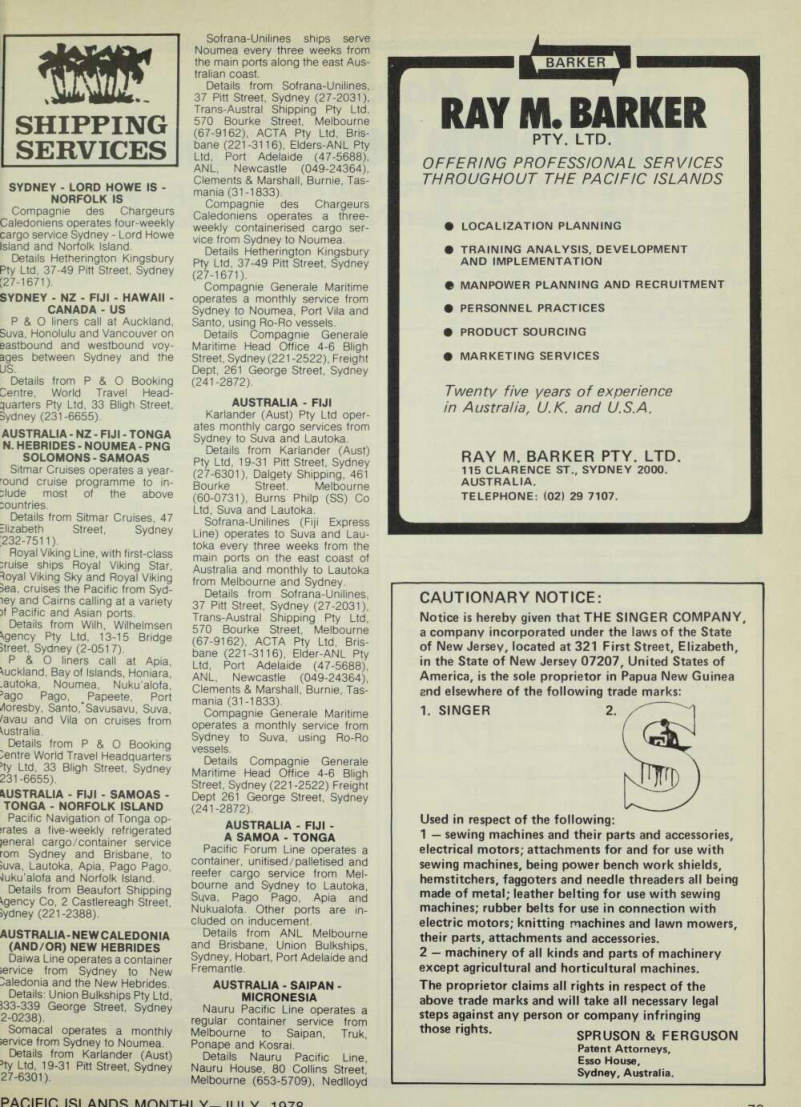
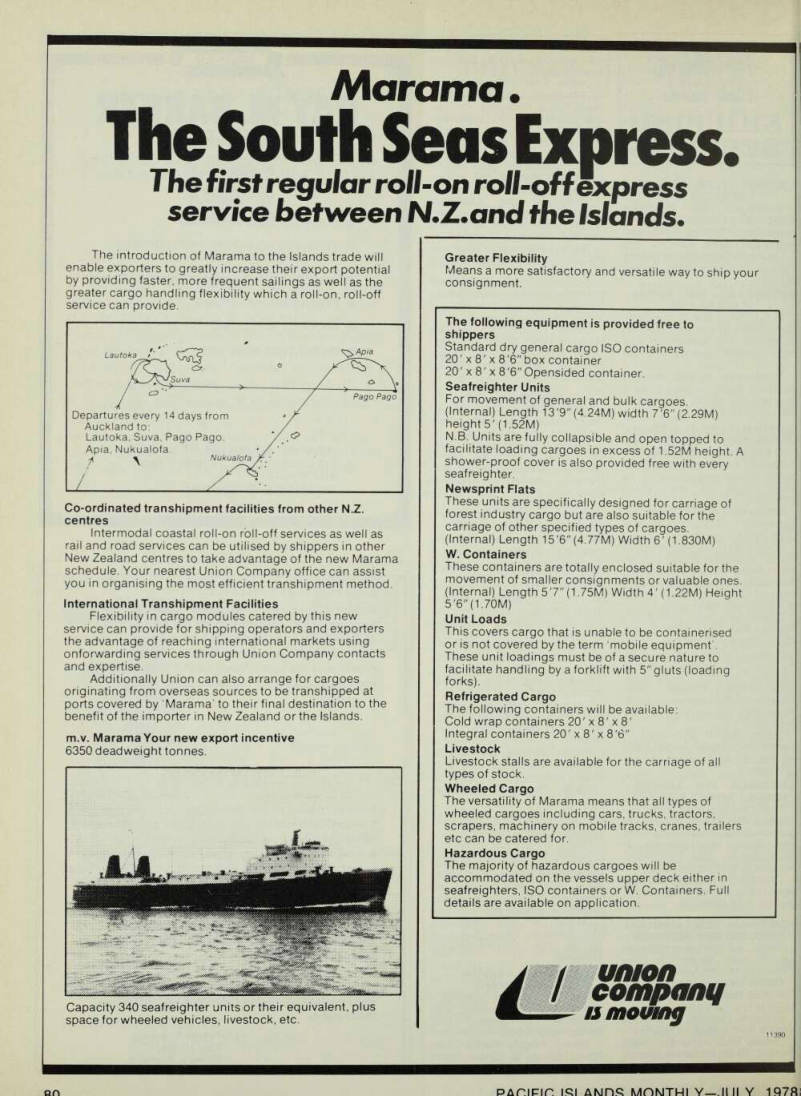
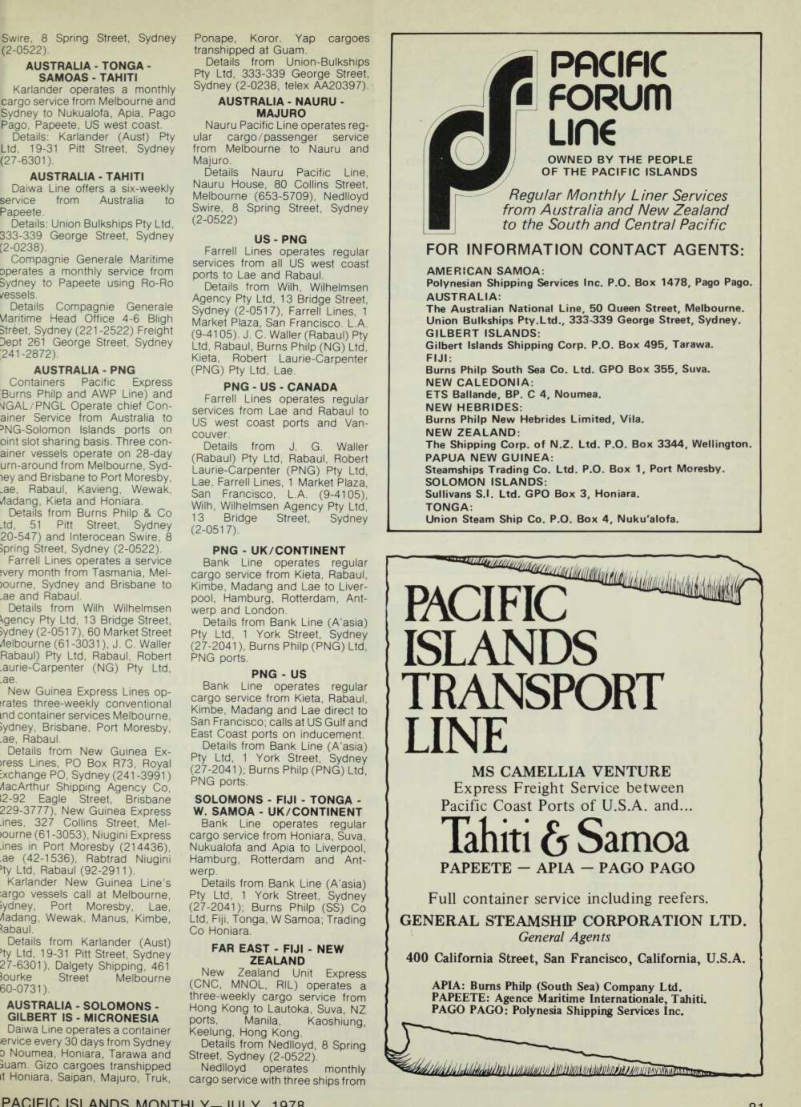
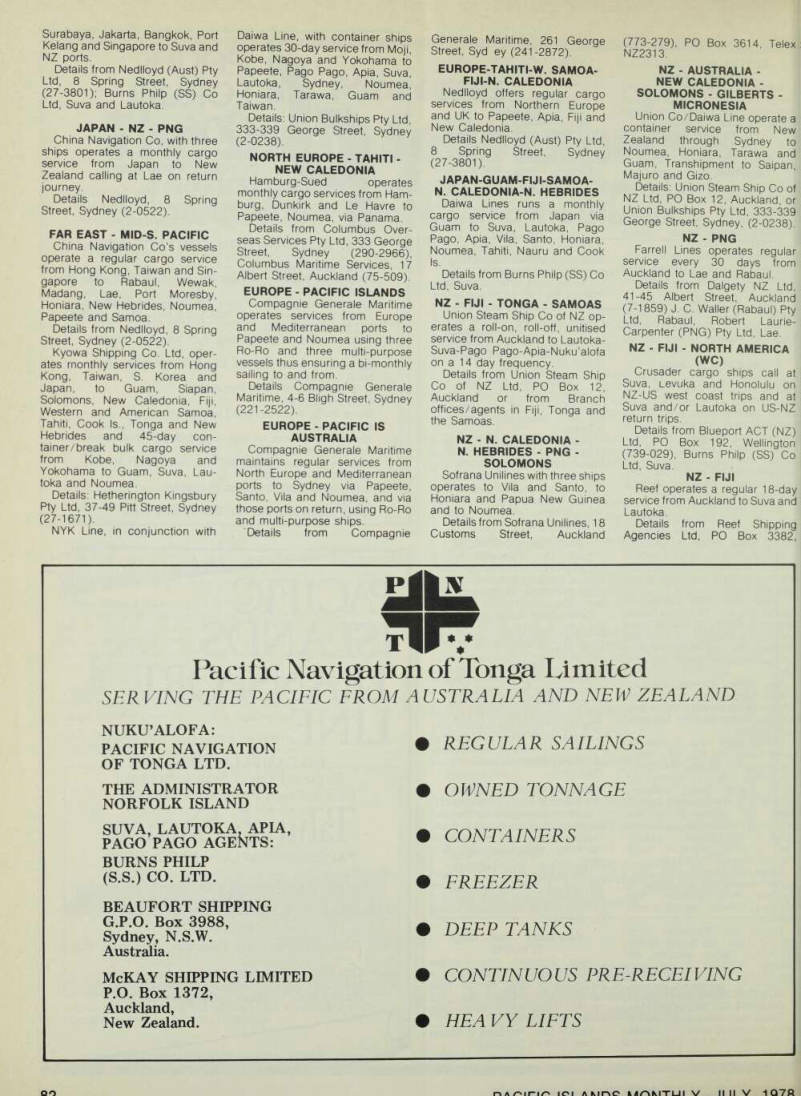
Services
Sydney - Lord Howe Is -
Norfolk Is
Compagnie des Chargeurs Caledoniens operates four-weekly cargo service Sydney - Lord Howe Island and Norfolk Island.
Details Hetherington Kingsbury Pty Ltd, 37-49 Pitt Street, Sydney [27-1671).
SYDNEY - NZ - FIJI - HAWAII -
Canada - Us
P & O liners call at Auckland, Suva, Honolulu and Vancouver on eastbound and westbound voy ages between Sydney and the US.
Details from P & O Booking Centre, World Travel Head quarters Pty Ltd, 33 Bligh Street, Sydney (231-6655).
AUSTRALIA - NZ - FIJI - TONGA
N. Hebrides - Noumea - Png
Solomons-Samoas
Sitmar Cruises operates a year round cruise programme to in clude most of the above :ountries.
Details from Sitmar Cruises, 47 Elizabeth Street, Sydney '232-7511).
Royal Viking Line, with first-class cruise ships Royal Viking Star, ;toyal Viking Sky and Royal Viking Bea, cruises the Pacific from Syd ley and Cairns calling at a variety )f Pacific and Asian ports.
Details from Wilh, Wilhelmsen Agency Pty Ltd, 13-15 Bridge street. Sydney (2-0517).
P & O liners call at Apia, ~nd, Bay of Islands, Honiara, .autoka, Noumea, Nukualofa, s ago Pago, Papeete, Port Moresby, Santo,’Savusavu, Suva, tevau and Vila on cruises from Australia.
Details from P & O Booking Centre World Travel Headquarters ty Ltd, 33 Bligh Street, Sydney 231-6655).
Australia - Fiji - Samoas -
Tonga - Norfolk Island
Pacific Navigation of Tonga op iates a five-weekly refrigerated jeneral cargo/container service rom Sydney and Brisbane, to Suva, Lautoka, Apia, Pago Pago, Juku’alofa and Norfolk Island.
Details from Beaufort Shipping Agency Co, 2 Castlereagh Street, Sydney (221-2388).
Australia-New Caledonia
(And/Or) New Hebrides
Daiwa Line operates a container service from Sydney to New Caledonia and the New Hebrides.
Details; Union Bulkships Pty Ltd, J 33-339 George Street, Sydney 2-0238).
Somacal operates a monthly service from Sydney to Noumea.
Details from Karlander (Aust) 3 ty Ltd, 19-31 Pitt Street, Sydney 27-6301).
Sofrana-Unilines ships serve Noumea every three weeks from the main ports along the east Aus tralian coast.
Details from Sofrana-Unilines, 37 Pitt Street, Sydney (27-2031), Trans-Austral Shipping Pty Ltd, 570 Bourke Street, Melbourne (67-9162), ACTA Pty Ltd, Bris bane (221-3116), Elders-ANL Pty Ltd, Port Adelaide (47-5688), ANL, Newcastle (049-24364), Clements & Marshall, Burnie, Tas mania (31-1833).
Compagnie des Chargeurs Caledoniens operates a three weekly containerised cargo ser vice from Sydney to Noumea.
Details Hetherington Kingsbury Pty Ltd, 37-49 Pitt Street, Sydney (27-1671).
Compagnie Generate Maritime operates a monthly service from Sydney to Noumea, Port Vila and Santo, using Ro-Ro vessels.
Details Compagnie Generate Maritime Head Office 4-6 Bligh Street, Sydney (221 -2522), Freight Dept, 261 George Street, Sydney (241-2872).
Australia - Fiji
Karlander (Aust) Pty Ltd oper ates monthly cargo services from Sydney to Suva and Lautoka.
Details from Karlander (Aust) Pty Ltd, 19-31 Pitt Street, Sydney (27-6301), Dalgety Shipping, 461 Bourke Street. Melbourne (60-0731), Burns Philp (SS) Co Ltd, Suva and Lautoka.
Sofrana-Unilines (Fiji Express Line) operates to Suva and Lau toka every three weeks from the main ports on the east coast of Australia and monthly to Lautoka from Melbourne and Sydney.
Details from Sofrana-Unilines, 37 Pitt Street, Sydney (27-2031).
Trans-Austral Shipping Pty Ltd, 570 Bourke Street, Melbourne (67-9162), ACTA Pty Ltd, Bris bane (221-3116), Elder-ANL Pty Ltd, Port Adelaide (47-5688), ANL, Newcastle (049-24364), Clements & Marshall, Burnie, Tas mania (31-1833).
Compagnie Generate Maritime operates a monthly service from Sydney to Suva, using Ro-Ro vessels.
Details Compagnie Generate Maritime Head Office 4-6 Bligh Street, Sydney (221 -2522) Freight Dept 261 George Street, Sydney (241-2872).
Australia - Fiji -
A Samoa - Tonga
Pacific Forum Line operates a container, unitised/palletised and reefer cargo service from Mel bourne and Sydney to Lautoka, Suva, Pago Pago, Apia and Nukualofa. Other ports are in cluded on inducement.
Details from ANL Melbourne and Brisbane, Union Bulkships, Sydney, Hobart, Port Adelaide and Fremantle.
Australia - Saipan -
Micronesia
Nauru Pacific Line operates a regular container service from Melbourne to Saipan, Truk, Ponape and Kosrai.
Details Nauru Pacific Line, Nauru House, 80 Collins Street, Melbourne (653-5709), Nedlloyd
Swire, 8 Spring Street, Sydney (2-0522).
Australia - Tonga -
Samoas - Tahiti
Karlander operates a monthly cargo service from Melbourne and Sydney to Nukualofa, Apia, Pago Pago, Papeete, US west coast.
Details: Karlander (Aust) Pty Ltd, 19-31 Pitt Street, Sydney (27-6301).
Australia - Tahiti
Daiwa Line offers a six-weekly service from Australia to Papeete.
Details; Union Bulkships Pty Ltd, 333-339 George Street, Sydney [2-0238).
Compagnie Generale Maritime operates a monthly service from Sydney to Papeete using Ro-Ro /essels.
Details Compagnie Generale Maritime Head Office 4-6 Bligh Street, Sydney (221-2522) Freight Dept 261 George Street, Sydney '241 -2872).
Australia - Png
Containers Pacific Express Burns Philp and AWP Line) and sIGAL/PNGL Operate chief Con ainer Service from Australia to 3 NG-Solomon Islands ports on oint slot sharing basis. Three con ainer vessels operate on 28-day urn-around from Melbourne, Syd ley and Brisbane to Port Moresby, .ae, Rabaul, Kavieng, Wewak, /ladang, Kieta and Honiara.
Details from Burns Philp & Co .td, 51 Pitt Street, Sydney 20-547) and Interocean Swire, 8 Spring Street, Sydney (2-0522).
Farrell Lines operates a service jvery month from Tasmania, Mel )ourne, Sydney and Brisbane to .ae and Rabaul.
Details from Wilh Wilhelmsen Agency Pty Ltd, 13 Bridge Street, Sydney (2-0517), 60 Market Street Melbourne (61-3031), J. C. Waller Rabaul) Pty Ltd, Rabaul, Robert .aurie-Carpenter (NG) Pty Ltd, .ae.
New Guinea Express Lines op iates three-weekly conventional md container services Melbourne, Sydney, Brisbane, Port Moresby, .ae, Rabaul.
Details from New Guinea Ex cess Lines, PC Box R 73, Royal ixchange PC, Sydney (241 -3991) /lac Arthur Shipping Agency Co, 12-92 Eagle Street, Brisbane 229-3777), New Guinea Express .ines, 327 Collins Street, Mel »ourne (61 -3053), Niugini Express .ines in Port Moresby (214436), .ae (42-1536), Rabtrad Niugini »ty Ltd, Rabaul (92-2911).
Karlander New Guinea Line’s ;argo vessels call at Melbourne, Sydney, Port Moresby, Lae, /ladang, Wewak, Manus, Kimbe, tebaul.
Details from Karlander (Aust) *ty Ltd, 19-31 Pitt Street, Sydney 27-6301), Dalgety Shipping, 461 Sourke Street Melbourne 60-0731).
Australia - Solomons -
Gilbert Is - Micronesia
Daiwa Line operates a container ervice every 30 days from Sydney d Noumea, Honiara, Tarawa and auam. Gizo cargoes transhipped it Honiara, Saipan, Majuro, Truk,
Ponape, Koror. Yap cargoes transhipped at Guam.
Details from Union-Bulkships Pty Ltd, 333-339 George Street, Sydney (2-0238, telex AA20397).
Australia - Nauru -
Majuro
Nauru Pacific Line operates reg ular cargo/passenger service from Melbourne to Nauru and Majuro.
Details Nauru Pacific Line, Nauru House, 80 Collins Street, Melbourne (653-5709), Nedlloyd Swire, 8 Spring Street, Sydney (2-0522)
Us-Png
Farrell Lines operates regular services from all US west coast ports to Lae and Rabaul.
Details from Wilh, Wilhelmsen Agency Pty Ltd, 13 Bridge Street, Sydney (2-0517), Farrell Lines, 1 Market Plaza, San Francisco. L.A. (9-4105). J. C. Waller (Rabaul) Pty Ltd, Rabaul, Burns Philp (NG) Ltd, Kieta, Robert Laurie-Carpenter (PNG) Pty Ltd. Lae.
Png - Us - Canada
Farrell Lines operates regular services from Lae and Rabaul to US west coast ports and Van couver.
Details from J. G. Waller (Rabaul) Pty Ltd, Rabaul, Robert Laurie-Carpenter (PNG) Pty Ltd, Lae, Farrell Lines, 1 Market Plaza, San Francisco, L.A. (9-4105), Wilh, Wilhelmsen Agency Pty Ltd, 13 Bridge Street, Sydney (2-0517).
Png - Uk/Continent
Bank Line operates regular cargo service from Kieta, Rabaul, Kimbe, Madang and Lae to Liver pool, Hamburg, Rotterdam, Ant werp and London.
Details from Bank Line (A’asia) Pty Ltd, 1 York Street, Sydney (27-2041), Burns Philp (PNG) Ltd, PNG ports.
Png - Us
Bank Line operates regular cargo service from Kieta, Rabaul, Kimbe, Madang and Lae direct to San Francisco; calls at US Gulf and East Coast ports on inducement.
Details from Bank Line (A’asia) Pty Ltd, 1 York Street, Sydney (27-2041); Burns Philp (PNG) Ltd, PNG ports.
Solomons - Fiji - Tonga -
W. Samoa - Uk/Continent
Bank Line operates regular cargo service from Honiara, Suva, Nukualofa and Apia to Liverpool, Hamburg, Rotterdam and Ant werp.
Details from Bank Line (A’asia) Pty Ltd, 1 York Street, Sydney (27-2041); Burns Philp (SS) Co Ltd, Fiji, Tonga, W Samoa; Trading Co Honiara.
Far East - Fiji - New
Zealand
New Zealand Unit Express (CNC, MNOL, RIL) operates a three-weekly cargo service from Hong Kong to Lautoka, Suva, NZ ports, Manila, Kaoshiung, Keelung, Hong Kong.
Details from Nedlloyd, 8 Spring Street, Sydney (2-0522).
Nedlloyd operates monthly cargo service with three ships from
Surabaya, Jakarta, Bangkok, Port Kelang and Singapore to Suva and NZ ports.
Details from Nedlloyd (Aust) Pty Ltd, 8 Spring Street, Sydney (27-3801); Burns Philp (SS) Co Ltd, Suva and Lautoka.
Japan - Nz - Png
China Navigation Co, with three ships operates a monthly cargo service from Japan to New Zealand calling at Lae on return journey.
Details Nedlloyd, 8 Spring Street, Sydney (2-0522).
Far East - Mid-S. Pacific
China Navigation Co's vessels operate a regular cargo service from Hong Kong, Taiwan and Sin gapore to Rabaul, Wewak, Madang, Lae, Port Moresby, Honiara, New Hebrides, Noumea, Papeete and Samoa.
Details from Nedlloyd, 8 Spring Street, Sydney (2-0522).
Kyowa Shipping Co. Ltd, oper ates monthly services from Hong Kong, Taiwan, S. Korea and Japan, to Guam, Siapan, Solomons, New Caledonia, Fiji, Western and American Samoa, Tahiti, Cook Is., Tonga and New Hebrides and 45-day con tainer/ break bulk cargo service from Kobe, Nagoya and Yokohama to Guam, Suva, Lau toka and Noumea.
Details: Hetherington Kingsbury Pty Ltd, 37-49 Pitt Street, Sydney (27-1671).
NYK Line, in conjunction with
Daiwa Line, with container ships operates 30-day service from Moji, Kobe, Nagoya and Yokohama to Papeete, Pago Pago, Apia, Suva, Lautoka, Sydney, Noumea, Honiara, Tarawa, Guam and Taiwan.
Details: Union Bulkships Pty Ltd, 333-339 George Street, Sydney (2-0238).
North Europe - Tahiti -
New Caledonia
Hamburg-Sued operates monthly cargo services from Ham burg, Dunkirk and Le Havre to Papeete, Noumea, via Panama.
Details from Columbus Over seas Services Pty Ltd, 333 George Street, Sydney (290-2966), Columbus Maritime Services, 17 Albert Street, Auckland (75-509).
Europe - Pacific Islands
Compagnie Generate Maritime operates services from Europe and Mediterranean ports to Papeete and Noumea using three Ro-Ro and three multi-purpose vessels thus ensuring a bi-monthly sailing to and from.
Details Compagnie Generate Maritime, 4-6 Bligh Street, Sydney (221-2522).
Europe - Pacific Is
Australia
Compagnie Generate Maritime maintains regular services from North Europe and Mediterranean ports to Sydney via Papeete, Santo, Vila and Noumea, and via those ports on return, using Ro-Ro and multi-purpose ships.
Details from Compagnie
Generate Maritime, 261 George
Street, Syd ey (241-2872).
Europe-Tahiti-W. Samoa
Fiji-N. Caledonia
Nedlloyd offers regular cargo services from Northern Europe and UK to Papeete, Apia, Fiji and New Caledonia.
Details Nedlloyd (Aust) Pty Ltd, 8 Spring Street, Sydney (27-3801).
Japan-Guam-Fiji-Samoa-
N. Caledonia-N. Hebrides
Daiwa Lines runs a monthly cargo service from Japan via Guam to Suva, Lautoka, Pago Pago, Apia, Vila, Santo, Honiara, Noumea, Tahiti, Nauru and Cook Is.
Details from Burns Philp (SS) Co Ltd, Suva.
NZ - FIJI - TONGA - SAMOAS Union Steam Ship Co of NZ op erates a roll-on, roll-off, unitised service from Auckland to Lautoka-
Suva-Pago Pago-Apia-Nuku’alofa
on a 14 day frequency.
Details from Union Steam Ship Co of NZ Ltd, PO Box 12, Auckland or from Branch offices/agents in Fiji, Tonga and the Samoas.
Nz - N. Caledonia -
N. Hebrides - Png -
Solomons
Sofrana Unilines with three ships operates to Vila and Santo, to Honiara and Papua New Guinea and to Noumea.
Details from Sofrana Unilines, 18 Customs Street, Auckland
(773-279), PO Box 3614, Telex NZ2313.
Nz - Australia -
New Caledonia -
Solomons - Gilberts -
Micronesia
Union Co/Daiwa Line operate a container service from New Zealand through Sydney to Noumea, Honiara, Tarawa and Guam, Transhipment to Saipan, Majuro and Gizo.
Details: Union Steam Ship Co of NZ Ltd, PO Box 12, Auckland, or Union Bulkships Pty Ltd, 333-339
George Street, Sydney, (2-0238).
Nz - Png
Farrell Lines operates regular service every 30 days from Auckland to Lae and Rabaul.
Details from Dalgety NZ Ltd, 41-45 Albert Street, Auckland (7-1859) J. C. Waller (Rabaul) Pty Ltd, Rabaul, Robert Laurie- Carpenter (PNG) Pty Ltd, Lae.
Nz - Fiji - North America
(WC) Crusader cargo ships call at Suva, Levuka and Honolulu on NZ-US west coast trips and at Suva and/or Lautoka on US-NZ return trips.
Details from Blueport ACT (NZ) Ltd, PO Box 192, Wellington (739-029), Burns Philp (SS) Co Ltd, Suva.
Nz - Fiji
Reef operates a regular 18-day service from Auckland to Suva and Lautoka.
Details from Reef Shipping Agencies Ltd, PO Box 3382,
Auckland, NZ (7-1221-3).
Pacific Line with one ship oper ates monthly cargo service New Zealand, Lautoka, Suva.
Details: Sofrana Unilines, 18 Customs Street, Auckland (773-279) PC Box 3614, Telex- NZ2313.
Nz - Fiji - Gilberts -
Solomons - Png
Pacific Forum Line operates a container, unitised/palletised and reefer cargo service from Lyttelton and Auckland to Lautoka, Suva, Tarawa, Honiara, Madang, Lae and Moresby. Other ports are in cluded on inducement.
Details from Shipping Corpor ation of NZ Ltd, Auckland, Christchurch, Lyttelton, Welling ton.
NZ - FIJI - A SAMOA -
Tonga - Australia
Pacific Forum Line operates a container, unitised/palletised and reefer cargo service from Timaru and Auckland to Lautoka, Suva, Pago Pago, Apia, Nukualofa and Melbourne. Other ports are in cluded on inducement.
Details from Shipping Corpor ation of NZ Ltd, Auckland, Christchurch, Lyttelton, Welling ton.
Nz - Samoa - Tonga
Pacific Navigation of Tonga op erates a four-weekly cargo ser vice, Auckland - Nukualofa - Pago Pago - Apia - Nukualofa - Auckland.
Details from McKay Shipping Ltd, Downtown House, Queen Street, Auckland (33-656).
Warner Pacific Line services Onehunga - Nukualofa - Vavau fortnightly, and Timaru - Nukualofa - Vavau monthly and Onehunga - Apia and Pago Pago every 21 days carrying general and freezer car goes and Timaru - Apia every 21 days carrying freezer cargo.
Details from Air Marine Services (NZ) Ltd, PO Box 2505, Auckland (796-841).
NZ - COOK IS - NIUE -
Tahiti
Shipping Corporation of NZ Ltd operates cargo services based on pallets and similar units from Auckland to Niue, Cook Islands and Tahiti.
Details from the Shipping Corp of NZ Ltd, PO Box 3420, Auckland (797-210); Waterfront Com mission, PO Box 61, Rarotonga, Lighterage and Stevedoring Co, Aitutaki, Niue Govt Offices, Niue Island Compagnie Maritime Polynesienne, B’P’ 368, Papeete.
Uk - Panama - Samoa -
Fiji
The Fiji Direct Service, cargo only, is maintained by Conference vessels, sailing at regular monthly intervals out of Avonmouth, via Panama, for Apia, Suva and Lau toka.
Details from Burns Philp (SS) Co Ltd, Suva.
Uk/N. Continent - Tahiti -
N. Caledonia - N. Hebrides
Bank Line operates regular cargo service from Hull, Hamburg, Bremen, Antwerp and Rotterdam to'Papeete, Noumea and Vila.
Details from Bank Line (A’asia Y Pty Ltd, 1 York Street, Sydney (27-2041); Ets A M Fare LITE?
Papeete; Ets Ballande, Noumea.i Burns Philp (NH) Ltd, Vila.
Uk/N. Continent - Png -
Solomons
Bank Line operates regular! cargo service from Hull, Hamburg,.
Bremen, Antwerp and to Port Moresby, Lae, Madang,, Kimbe, Rabaul, Kieta and Honiarat and on inducement to Yandina,, Tarawa and Nauru.
Details from Bank Line (A’asia)( Pty Ltd, 1 York Street, Sydney (27-2041); Burns Philp (PNG) Ltd,, PNG ports; Trading Co Honiara.
San Francisco -
Honolulu - Micronesia
Nauru Pacific Line operates reg ular conventional/container ser vice from San Francisco andl Honolulu to Majuro, Nauru,, Ponape, Truk and Saipan.
Details from Nauru Pacific Line, Nauru House, 80 Collins Street, Melbourne (653-5709); North American Maritime Agencies, 100 California Street, San Francisco, California 9411 (981-0343).
US - FIJI - TAHITI - NZ -
Australia
Bank and Savill Line Ltd, oper ates regular cargo services from US Gulf ports to Australia and NZ.
Calls at Suva, Lautoka and Papeete on demand.
Details from Bank Line (A’asia) Pty Ltd, 1 York Street, Sydney (27-2041) or Howard Smith Indus tries Pty Ltd, 1 York Street, Sydney (27-5611).
US - A. SAMOA - NZ -
Aust
Farrell Lines LASH ships operate regularly from US to Australia, via Pago Pago and Auckland and Canada.
Details from Wilh, Wilhelmsen Agency Pty Ltd, 13 Bridge St., Syd ney (2-0517); 60 Market Street, Melbourne (61-0301); Farrell Lines, 1 Market Plaza, San Fran cisco. L.A. (415-777-3300), Dal-i gety NZ Ltd, Auckland (7-1859); Kneubuhl Maritime Services, Pago Pago (633-5121).
Us - Tahiti - Samoa
Pacific Islands Transport oper ates a five/six weekly cargo ser vice from North America west coast ports to Papeete, Pago Pago, Apia.
Details from Trans-Austral Ship ping Pty Ltd, 19 Pitt Street, Sydney (27-2441).
Polynesia Line operates con tainer and general cargo service from US west coast ports to Papeete and Pago Pago.
Details from Polynesia Shipping Services Inc,. PC Box 1478, Pago Pago (9-6799).
Fiji - Tahiti
Compagnie Generale Maritime operates a monthly service from Suva to Papeete using Ro-Ro vessels.
Details Compagnie Generale Maritime, 4-6 Bligh Street, Sydney (221-2522); Williams & Gosling.
PC Box 79, Suva (31-2633).
Advertisements & other items, pp. 79-92 (9 items)
79
PACIFIC ISI AMDS MOMTWI V_ II II V i Q7Q
Ray M. Barker
PTY. LTD.
OFFERING PROFESSIONAL SERVICES
THROUGHOUT THE PACIFIC ISLANDS
• LOCALIZATION PLANNING
• TRAINING ANALYSIS, DEVELOPMENT
AND IMPLEMENTATION
• MANPOWER PLANNING AND RECRUITMENT
• PERSONNEL PRACTICES
• PRODUCT SOURCING
• MARKETING SERVICES
Twenty five years of experience
in Australia , U.K. and U.S.A.
RAY M. BARKER PTY. LTD.
115 CLARENCE ST., SYDNEY 2000.
AUSTRALIA.
TELEPHONE: (02) 29 7107.
CAUTIONARY NOTICE:
Notice is hereby given that THE SINGER COMPANY, a company incorporated under the laws of the State of New Jersey, located at 321 First Street, Elizabeth, in the State of New Jersey 07207, United States of America, is the sole proprietor in Papua New Guinea and elsewhere of the following trade marks:
1. SINGER 2.
Used in respect of the following: 1 sewing machines and their parts and accessories, electrical motors; attachments for and for use with sewing machines, being power bench work shields, hemstitchers, faggoters and needle threaders all being made of metal; leather belting for use with sewing machines; rubber belts for use in connection with electric motors; knitting machines and lawn mowers, their parts, attachments and accessories. 2 machinery of all kinds and parts of machinery except agricultural and horticultural machines.
The proprietor claims all rights in respect of the above trade marks and will take all necessary legal steps against any person or company infringing those rights.
SPRUSON & FERGUSON
Patent Attorneys, Esso House, Sydney, Australia.
Marama .
The South Seas Express.
The first regular roll-on roll-off express
service between N. the Islands.
The introduction of Marama to the Islands trade will enable exporters to greatly increase their export potential by providing faster, more frequent sailings as well as the greater cargo handling flexibility which a roll-on, roll-off service can provide.
Laufoka!‘ / Departures every 14 days from Auckland to; Lautoka, Suva, Pago Pago, Apia, Nukualofa. y Nukualofa L Pago Pago Co-ordinated transhipment facilities from other N.Z. centres Intermodal coastal roll-on rbll-off services as well as rail and road services can be utilised by shippers in other New Zealand centres to take advantage of the new Marama schedule. Your nearest Union Company office can assist you in organising the most efficient transhipment method.
International Transhipment Facilities Flexibility in cargo modules catered by this new service can provide for shipping operators and exporters the advantage of reaching international markets using onforwarding services through Union Company contacts and expertise.
Additionally Union can also arrange for cargoes originating from overseas sources to be transhipped at ports covered by Marama' to their final destination to the benefit of the importer in New Zealand or the Islands. m.v. Marama Your new export incentive 6350 deadweight tonnes. m Capacity 340 seafreighter units or their equivalent, plus space for wheeled vehicles, livestock, etc.
Greater Flexibility Means a more satisfactory and versatile way to ship your consignment.
The following equipment is provided free to shippers Standard dry general cargo ISO containers 20' xB' x B'6" box container 20' x 8' x B'6"Opensided container.
Seafreighter Units
For movement of general and bulk cargoes. (Internal) Length 13'9"(4.24M) width 7'6"(2.29M) height 5'(1.52M) N.B. Units are fully collapsible and open topped to facilitate loading cargoes in excess of 1.52 M height. A shower-proof cover is also provided free with every seafreighter.
Newsprint Flats These units are specifically designed for carriage of forest industry cargo but are also suitable for the carriage of other specified types of cargoes. (Internal) Length 15'6"(4.77M) Width 6'(1.830M) W. Containers These containers are totally enclosed suitable for the movement of smaller consignments or valuable ones. (Internal) Length 5 7"(1.75M) Width 4' (1.22 M) Height 5'6" (170 M) Unit Loads This covers cargo that is unable to be containerised or is not covered by the term mobile equipment'.
These unit loadings must be of a secure nature to facilitate handling by a forklift with 5" gluts (loading forks).
Refrigerated Cargo The following containers will be available: Cold wrap containers 20' x 8' x 8' Integral containers 20' x 8' x B'6"
Livestock Livestock stalls are available for the carriage of all types of stock.
Wheeled Cargo The versatility of Marama means that all types of wheeled cargoes including cars, trucks, tractors, scrapers, machinery on mobile tracks, cranes, trailers etc can be catered for.
Hazardous Cargo The majority of hazardous cargoes will be accommodated on the vessels upper deck either in seafreighters, ISO containers or W. Containers. Full details are available on application.
company
amoving
Regular Monthly Liner Services
from Australia and New Zealand
to the South and Central Pacific
OWNED BY THE PEOPLE
OF THE PACIFIC ISLANDS
PACIFIC
FORUfn
Line
FOR INFORMATION CONTACT AGENTS:
AMERICAN SAMOA:
Polynesian Shipping Services Inc. P.O. Box 1478, Pago Pago
AUSTRALIA:
The Australian National Line, 50 Queen Street, Melbourne.
Union Bulkships Pty.Ltd., 333-339 George Street, Sydney.
GILBERT ISLANDS:
Gilbert Islands Shipping Corp. P.O. Box 495, Tarawa,
FIJI:
Burns Philp South Sea Co. Ltd. GPO Box 355, Suva.
NEW CALEDONIA:
ETS Ballande, BP. C 4, Noumea.
NEW HEBRIDES:
Burns Philp New Hebrides Limited, Vila.
NEW ZEALAND:
The Shipping Corp. of N.Z, Ltd. P.O. Box 3344, Wellington
PAPUA NEW GUINEA;
Steamships Trading Co. Ltd. P.O. Box 1, Port Moresby.
SOLOMON ISLANDS;
Sullivans S.l. Ltd. GPO Box 3, Honiara.
TONGA;
Union Steam Ship Co. P.O. Box 4, Nukualofa.
Mil illtiiUlliiiJLiLl.:, i'<A
PACIFIC
ISLANDS
TRANSPORT
LINE
MS CAMELLIA VENTURE
Express Freight Service between Pacific Coast Ports of U.S.A. and...
Tahiti 6 Samoa
PAPEETE - APIA - PAGO PAGO
Full container service including reefers.
GENERAL STEAMSHIP CORPORATION LTD.
General Agents 400 California Street, San Francisco, California, U.S.A.
APIA: Bums Philp (South Sea) Company Ltd.
PAPEETE: Agence Maritime Internationale, Tahiti.
PAGO PAGO: Polynesia Shipping Services Inc.
Pacific Navigation of Tonga Limited SERVING THE PACIFIC FROM AUSTRALIA AND NEW ZEALAND
7
GLOBAL SERVICE FOR SHIPPERS
V
THE BANK LINE
*** I ftj f?
Papua New Guinea & Pacific Islands
USA- UK /Continent Service
Regular direct monthly sailings PAPUA NEW GUINEA to: NORTH AMERICA • UNITED KINGDOM & CONTINENT •¥: SOLOMONS • FIJI • TONGA • SAMOA and TARAWA to:
UNITED KINGDOM and CONTINENT
For particulars apply:
THE BANK LINE (AUSTRALASIA) PTY LTD.
18th Floor 1 York Street Sydney N.S.W. 2000 Australia Telephone: 272041 Telex: 24063
HEW
TIT"
Breckwoldt & Co
P ij Ltd
276 Pitt Street, Box 5027, G.P.O. Sydney 2001
CABLE ADDRESS: BREWO SYDNEY
TELEX: AA22890
TELEPHONES: 233-2366, 233-1460, 233-1462
PACIFIC ISLAND OFFICES
BRECKWOLDT & CO (PNG) PTY. LTD.
PO BOX 1549, BOROKO, PORT MORESBY.
PO BOX 222, RABAUL
PO BOX 72, KIETA
PO BOX 178, WEWAK
PO BOX 185, MADANG
PO BOX 237, MT. HAGEN
PO BOX 1188, LAE
BRECKWOLDT & CO., PO BOX 47, APIA BRECKWOLDT & CO. (SI) LTD. PO BOX 140, HONIARA
BRECKWOLDT SARL BP 2369, NOUMEA
OFFICES IN:
HAMBURG
LONDON
MILAN
& WEST AFRICA
ALSO AT:
SINGAPORE
KUALA LUMPUR
BANGKOK
& HONG KONG
ENQUIRIES
FROM OVERSEAS MANUFACTURERS INVITED.
Express Freight Service between U S. Pacific Coast Ports &
PAPEETE • APIA • PAGO PAGO
Full Container Service including Refrigeration
GENERAL AGENTS
ft POLYNESIA LINE, Lift
AGENTS
PAPEETE - MORGAN; Vernex Boite Postale 449. Papeete Phone; 309 Cables: MOREX PAGO PAGO • POLYNESIA SHIPPING SERVICES. INC.. Pago Pago Phone; 633-5169 Cables; POLYSHIP APIA - UNION S.S. CO., of N.Z. Ltd.. P.O. Box 50. Apia. Western Samoa Phone; 570 Cables: UNION
fURNESS INTEROCE4N
CORPOR4TION
465 CALIFORNIA STREET. SAN FRANCISCO. CA 94104 Cable INTERCO • TWX 910-372 7350 • RCA 278 207
TEL 1415) 398 2000
NIUE
''n
/COOK ISLANDS V
I 1 "
TAHITI
to and from
NEW ZEALAND
Regular service using pallet load ships TIARE MOANA and FETU MOANA. Refrigerated and general cargo between Auckland and Niue, Rarotonga, Aitutaki, Papeete. Other nearby ports by inducement.
AREA AGENTS
Niue: Government Shipping Office, Alofi.
Cook Islands; Waterfront Commission, PO Box 61, Rarotonga.
Telex Shipping RG 2002 Tahiti: Agence Maritime et de Voyage, B P 131, Papeete.
Telex AMAV 251 FP
The Shipping Corporation
of New Zealand Limited
Sea carrier to the nation © AUCKLAND: Phone 379-430. PO Box 3420. Telex: NZ2822 WELLINGTON: Phone 728-500. PO Box 3344. Telex: NZ3495 CHRISTCHURCH: Phone 795-760. PO Box 777. Telex: 4434 DUNEDIN: Phone 76-076. PO Box 904. Telex: 5228.
KYOWA LINE
YOUR TRADING RARTNER
Monthly Services
AGENTS
Hong Kong, Taiwan, S. Korea, Japan
To; British Solomon, New Caledonia, Fiji, W Samoa, A. Samoa. Tahiti, Cook Is., Tonga, New Hebrides.
Ellice Is.,
Taiwan,Hong Kong,Singapore,Jakarta,
Philippine
To: Australia, Papua New Guinea, Sabah & Sarawak.
Hong Kong, Taiwan, S. Korea, Japan
To: Guam, Saipan, Truk, Ponape, Other Pacific Islands.
Taiwan: Royal Steamship Corp. Ltd, Taipei S. Korea: Dong Sue Shipping Co, Ltd, Seoul Hong Kong: Dahzun Enterprises Ltd.
Singapore: Ocean Shipping & Enterprises Pte, Ltd.
Guam: Maritime Agencies of Pacific Ltd . Guam Saipan: Saipan Shipping Co, Inc, Saipan 8.5.1. P.: Solomon Taiyo Ltd, Honiara Tahiti: JA Cowan & Fils, Papeete Cooks: Eastern Associates Ltd , Rarotonga Tonga: EM Jones Ltd, Nukualofa New Hebrides: Agence Maritime Raymond Velicite, Port Vila A.Samoa: Island Pacific Agencies Inc., Pago Pago W. Samoa: Morris Hedstrom Ltd , Apia Fiji: Carpenter Shipping, Suva & Lautoka PNG; Carpenter Shipping Agencies, Port Moresby, Rabaul New Caledonia: Agence Maritime Du Rond Point Du Pacific, Noumea Indonesia: PT Porodisa Raya Shipping Lines, Jakarta Sabah: KOH Han Ming Shipping & Forwarding Agent, Kotakmabalu Sarawak: Pan Sarawak Agencies Sdn Bhd , Sibu & Kuching Australia: Hethenngton Kingsbury Pty Ltd, Sydney, NSW Newzealand: Sofrana Unilines SA , Auckland.
KYOWA SHIPPING CO., LTD.
HEAD OFFICE OSAKA OFFICE
sth FI., Suzumaru Bldg. 39-8, 2-chome, Nishi-Shinbashi, Minato-ku, Tokyo, Japan. Frontier Bldg., 3-13 Hirano-cho, Higashi-ku, Osaka, Japan.
Phone : 03(437)2885(Rep.) Cables : “MARIQUEEN” Tokyo. Telex : 242-4651 Kyowa J. Phone : 06(227)0422(Rep.) Cables : “MARIQUEEN” Osaka. Telex : 522-3896 Kyowa 0.
IF YOU WANT A
JOURNALIST
MAYBE I AM YOUR
MAN
I am 37, come from New Zealand and have extensive media experience in Europe, Canada, United States, New Zealand and Australia.
Yes, I have a young family who I would like to see grow up in an honest environment.
I am multi-lingual, and as a journo, I’ve done everything, seen a lot and maybe learned a little.
God’s gift to Journalism?
I doubt it. But there must be someone, somewhere who’s prepared to try and find out.
ANYWHERE ANYTIME!!!
Enquiries Welcome to Journalist’ C/- Pacific Islands Monthly, GPO 3408, Sydney 2001.
Stay at Aggie Grey's
the South Pacific's
legendary hotel.
Situated right in the heart of Western Samoa. Enjoy Polyneslan-style friendliness and service, in cool surroundings, superb entertainment and food. Magnificent white sand beaches only a short drive away. Airconditioned rooms, swimming pool and full bar facilities.
Bookings through Union Steamship Company of NZ, Pan Am, Air New Zealand or direct to Aggie Grey's, Apia, Western Samoa.
Cables: AGGIES, APIA.
FOR SALE
Yacht. . . 50ft. Cruising Yawl “EAST WIND’’
Leanord Hedges “Canopus” design, professionally built ferro. 1973. Sleeps 7 adults; 3 children; carpet: dinette: hot shower; two toilets: air conditioned: stereo: pressurised water system. 12 volt and 240 volt systems. Fridge 8 cu. ft. and deep freezer.
Engines: Lees Ford diesel, 60 h.p. Main engine. Yanmar T.S. 130 14 h.p. diesel auxiliary, driving 240 volts. 4 kva Dunlite alternator plus 12 v. 60 amp Niehoff alternator.
Nav: AWA Radio. Echo sounder.
Gear: Full sails, plus spares; immaculate rigging. Laminated Oregon masts and booms varnished. Complete new Herculite awnings, 8 man RED life-raft. 10 ft. alum, dinghy. All life jackets, plus flares, etc. Roller reefing and Bermuda rig.
BRITISH REGISTERED SHIP
Owner must sell well below true value $45,000 or reasonable offer located at Cairns, Queensland, Australia, Phone Cairns 55 4212 or write Miss L.M. Bondeson, P.O. Box 44, White Rock via Cairns, Old. 4871, Aust.
Papua New Guinea Enquiries Mrs. E. F. Bondeson, P.O. Box 1129, Boroko. Phone Home 25 3438.
THE PAPUA HOTEL
PORT MORESBY
• Right in the business centre • A tradition for comfort and fine food • All rooms air conditioned • Restaurant • Bars • Banquet Hall Telephone 21 2622 Cables PARTE L
A. C. NEUMANN
Manager
PACIFICANA
BOOKS OF THE
PACIFIC
We have issued our first comprehensive list of new, used and rare books, government reports, theses, maps, charts, flags, etc, of the South and Central Pacific Islands particularly Melanesia (New Guinea, Fiji, Solomons) and Micronesia (Marshall, Mariana and Caroline Islands Nauru and Guam) of interest to university libraries private collections, research institutions, Pacific Studies, etc.
Write to: Bill McGrath, Pacific Islands Book and Map Centre 17 Park Ave, P.O. Box 1010 Surfers Paradise, Gold Coast, Australia, Old 4217.
Tel: (075)39 0446.
®/ w
WHANGAREI ENGINEERING & CONSTRUCTION
LTD.
A. Dillingham Affiliate
SHIPBUILDERS & GENERAL ENGINEERS
Port Road, Whangarei, New Zealand - P.O. BOX 24
TELEPHONE 82-219-TELEX N.Z. 21578.
FISHING BOATS
TUGS
PASSENGER SHIPS
CARGO VESSELS
DREDGERS ETC
WECO, Wangarei, New Zealand, offers a complete Design, Build and Ship Repair Service.
MAPS AND PRINTS
OF THE OLD
PACIFIC
Regular catalogues issued listing a large stock of original antiquarian views and maps of Australia.
New Zealand, Papua New Guinea and all island groups of the Pacific. Write today for your free coov.
COLIN HINCHCLIFFE
7 Royd Avenue, Heckmondwike, West Yorkshire, WF 16 9aL
UNITED KINGDOM
FOR SALE: 45ft. ketch, Norwegian built 1960, CMC 3-71 diesel, freezer, complete and ready for sea, $A55,000.
R. BITGOOD, Tradewinds Hotel, Suva, Fijr.
FOR SALE
113’ Steel Ship registered tonnage 213 tons, 500 hp diesel, freezing plant, good accommodation MAWO LTD PO
BOX 177 HONIARA, SOLOMON IS-
LANDS
POSITION WANTED
Qualified Bandmaster. Trainer, Music Teacher, seeks position on Pacific Islands in forming/training Police, Army or School Band Write to P. N. Jones F.T.C.L 7 Broome Crescent Wonthaggi 3995. Vic. Australia
FOR SALE
New BLXB Gardner Marine Engine with twin Disc Marine Gear. Inquiries to W Uetz, Burns Philp (NG) Ltd, P.O. Box 75 Port Moresby PNG. Ph. 21 4915.
FOR SALE
FLEETS 59ft. Carvel passenger boat, profess, bit. 1971, licenced 150 passengers, some dry hold space, suit river run. $BO,OOO.
FLEETS: 221 Esplanade, Wynnum Central, Brisbane.
Cable: 'FLEETS BRISBANE'
5r Jw? to sx
r* c £®avel
m
TRAVEL
THE ISLANDS
a oetmueo* apOF The Kingdom ot
TONGA
with
EPOKO’s
MAILORDER BOOKSHOP
(YOU CAN ORDER OVERLEAF)
*>y*r ...and. meanwhile, here's your pim subscription form:
PACIFIC ISLANDS MONTHLY
Postal Address: Box 3408. G.P.0., Sydney 2001.
N.S.W., Australia.
SUBSCRIPTION FORM:
city /state/cou ntry /postcode Attached it my payment of., New □ Renewal □ (please print) .for e 12 month*' subscription.
SUBSCRIPTION RATES:
Australia (including Norfolk Island) .$10.60 Aust.
New Zealand NZ$ll5O $10.50 Aust.
Fiji F $10.75 $10,50 Aust.
Papua New Guinea |k 9.00 $10.50 Aust.
Tonga, New Hebrides, Cook Islands, Western Samoa, Tuvalu, Gilbert Islands, Niue, Nauru, Solomon Island* $10.50 Aust.
American Samoa, Northern Marianas, Micronesia, Guam and Hawaii US $15.00 $12.00 Aust.
US Mainland and Canada US $17.00 $14.00 Aust.
New Caledonia and French Polynesia 1,600 CFP $13.50 Aust.
United Kingdom £9.50 $12.50 Aust. 4,500 Yen $12.50 Aust.
Elsewhere - $14.50 Aust.
Payment by personal cheque is accepted in Australia, U.S., New Zealand, U.K., Papua New Guinea and Fiji currency. For other remittances plaaaa obtain a Bank Draft in Australian dollars, made payable to ANZ Banking Group, 88 Wentworth Ave., Sydney, Australia.
ORDER FORM FOR PI MS MAIL ORDER BOOKSHOP D jThe Lost Caravel. Robert Langdon shatters traditionally-held views on the Polynesians in this controversial, historical whodunnit described by Prof. Ron Crocombe as a “masterpiece as fascinating as it is important”.
Also invaluable as a record of early Pacific exploration. 368 pp. Profusely illustrated with maps and plates.
SAIB or SUS 26.
□- JThe Story of the Solomons. Simple, lucid outline of the history of the Solomon Islands, from a refreshingly frank and affectionate point of view, by Dr. C.
E. Fox. 88 pp. SA3 or SUS 4. □.
I Port Moresby, Yesterday and Today. In what is even more than a history of Papua New Guinea’s capital, Canon lan Stuart takes us on an entertaining, personalised tour of the city. Soft cover, 368 pp. Maps, illustrations. $A3.50 or SUS4.SO.
EH Holy
Torture in Fiji. Firewalking and other sacred, ancient rituals of Fiji’s Hindus, described in text and colour photographs. Large format, 64 pp. illustrated.
5A4.50 or SUS6.SO.
□. New Hebrides. One of the supeib Islands in the Sun series of brilliant full-colour plates, maps and text, tills volume describes the unique British-French Condominium of New Hebrides. A guide for travellers, or for collectors. 128 pp. Fully illustrated. SAIO or SUSI 3.
D |New Caledonia. French New Caledonia, superbly depicted in full colour photographs, with informative text and maps giving history, geography and daily life.
An Islands in the Sun guide, with 128 pp. Fully illustrated. SAIO or SUSI 3.
I I Bora Bora. One of the French Pacific’s fascinating, colourful high islands, reached from Tahiti, here presented in sparkling full colour pictures for visitors or mere armchair travellers. Another Islands in the Sun guide, with 128 pp. Fully illustrated. SAIO or SUSI 3. □< I Easter Island. At last, a new book on fascinating Easter Island history, daily life and the mysterious giant statues. All in full colour with maps and information for travellers, as one of the Islands in the Sun series. Half of this splendid book is devoted to descriptions and photographs of the statues that made the island famous. 128 pp. Fully illustrated. SAIO or SUSI 3.
I I Tahiti and its Islands. New revised edition, just released, of this popular title in the Islands in the Sun series. Sparkling new colour plates, new information, new maps. Includes the Leeward Islands, the Tuamotus, the Gambiers, Marquesas, the Australs. Has hotel lists and places to see. 128 pp. Fully illustrated. SAIO or SUSI 3.
I I Rarotonga. In his Rarotonga, James Siers for the first time introduces to a wider public the main island of the Cooks group. With its international airport now linking it readily with the outside world, the beauty, charm and friendliness of Rarotonga’s people are wide open for others to share. 128 pp. Fully illustrated. SAIO or SUSI 3. □.
I Moorea. Of all the beautiful islands of the Pacific perhaps none has captured the imagination of visitors - including French painter Paul Gauguin, English writer W. Somerset Maugham, and many thousands of people of lesser fame - than Moorea, a few miles off Tahiti, main island of French Polynesia. Few people would deny that James Siers does the subject justice in his beautifully illustrated Moorea. Parallel texts in English and French. 128 pp. SAIO or SUSI 3. □. 1 Little Chimbu in Bougainville. For the young and young-at-heart, lovable Little Chimbu and his friends visit Panguna, and get into awfpl trouble in what could be the biggest hole in the world, the Bougainville copper mine. Nancy Curtis, who used to live there, tells the story in full colour drawings which are also accurate and instructive. 48 pp. Illustrated. $A3.50 or SUS4.SO. 1 I Percy Chatterton’s Papua: Day That I Have Loved. Charming evocative account of changing Papua as Rev. Percy Chatterton knew it for 50 years. 144 pp.
Illustrated. $A6.50 or SUSB.SO. a I Asimba. A collection of 20 colourful designs by young artists from PNG’s Sogeri High School. Each is 42cm x 28cm and suitable for framing. “A collection of outstanding merit - one day they’ll be collectors’ items,” says reviewer Dr W G. Coppell. $A 12.50 at SUS 14.50.
EH Grassroots Art Of New Guinea. E.F. Hannemann’s invaluable collection of authentic traditional designs from the north coast of the Papua New Guinea mainland, mainly from actual rubbings. $A3.50 or SUS4.SO. o I Underwater Guide of Tahiti. Roger Bagnis and photographer Erwin Christian take you to a wonderful world. 152 pp. Fully illustrated. SAS or SUS 7.
JColonial Era Cemetery of Norfolk Island.
Former Administrator of the island, R. Nixon Dalkin, describes life and death in what was Britain’s harshest Pacific penal colony. There are illuminating, often moving stories in these photographs, charts and inscriptions that describe the historic cemetery. Large format, 92 pp. Illustrated. SA4 or SUSS.SO. 1 I Rust in Peace. A 238 page hard cover text with colour and black and white pictures of the relics left over from the battlegrounds of the South Pacific war. New Guinea, New Ireland, New Britain, Bougainville, Guadalcanal, Tulagi and Tarawa
SAI2 or SUSIS.
Marine Shells of the Pacific Volume 11.
Walter Cemohorsky carries on where his first book left off, with a further 600 species fully described and illustrated. Some of the 68 full page plates are in colour. 412 pp. illustrated. SAI7 or SUS2S.
EH Friendly Island. Warm account of life in Tonga, sunlit South Pacific island kingdom, by Patricia Ledyard, ■who lived in a Tongan harbourside village for more than 20 years. Paperback, 215 pp. SA3 or SUS4.SO.
I 1 Plants and Flowers of Tahiti. Full colour photographs of the rich and beautiful Tahitian flora classified by scientific names and by French, English and Tahitian common names. 144 pp. Fully illustrated. SAS or SUS 7.
I Birds of Tahiti. A companion volume to Plants and Flowers of Tahiti. Full colour photographs and descriptions, for collectors or amateur birdwatchers, visitors and students needing easy identification. 112 pp. Fully illustrated. SAS or SUS 7. 1 I Log of the Mahina: A Tale of the South Pacific. Young American John Neal took his 27 ft. yacht from Seattle on an 18 months cruise through Polynesia and then wrote about it. This delightfully refreshing book abounds with information on how to get there and what to do when you are there. John Neal learned it the hard way and shares his experiences with enthusiasm. Required reading for all yachties venturing into Polynesia’s dangers and pleasures, physical and romantic, 280 pp.
Illustrated. SA6 or SUS7.SO.
I Say it in Fijian. Dr. A. J. Schutz presents a pocket sized, entertaining guide to the Fijian language for those making their first contact with Fiji.
$A2.50 or SUS3.SO.
I I Say it in Motu. In the same series Dr. Percy Chatterton provides an instant introduction to one of the three official languages of Papua New Guinea; the common tongue of the streets and markets of Port Moresby. SA2 or SUS 3. □.
J Say it in Fiji Hindi. Jeff Siegel continues the the series with an easy introduction to the “other language” of Fiji. $A2.50 or SUS3.SO.
EH Say it in Tahitian. Dr. Darrell Tryon Fellow in Linguistics at Australian National University Canberra introduces the language of French Polynesia in a simple pleasurable way. $A2.50 or SUS3.SO. □.
Fold-out maps of the Pacific! Large size, in colour. Norfolk Island, Lord Howe Island, the Tonga group. Others in preparation, including a general map of the Pacific Ocean. $A2.50 or SUS 3.
A ttached is my payment of
for the books indicated.
Name
Address
city /state/country/postcode
PACIFIC PUBLICATIONS (AUST) PTY. LTD.
76 Clarence Street, SYDNEY 2000, N.S.W. (Postal Address: Box 3408, GPO, Sydney 2001)
JUST OUT!
1 I The Tongans. Writer Olaf Ruhen and photographer Jozef Vissel capture the lifestyle of the people of the Kingdom of Tonga. 96 mil-colour photographs and brilliant descriptive proae. $A8.50 or SUSIO.OO. n Pacific Islands Cookbook. Nutritionists Susan ftSki inson and Peggy Stacy produce a practical cookbook of South Seas recipes, using local ingredients. 120 pp., with colour illustrations. $A7.00 or SUSB.SO.
I I Papua New Guinea Handbook and Travel Guide. 1978 edition, crammed with facts, figures and maps. For businessmen, libraries, tourists. Includes full accommodation guide. 280 pp. $A8.50 or SUS 10.00.
THE SMALL CAR
FULL OF
/- ■ * mi
ISUZU
m'y : ’
ISUZU GEMINI
The rugged little Isuzu Gemini! All the style, features and comfort you expect from the Japanese plus General Motors parts, service and unbeatable 12 fnonths or 20,000 km warranty.
Its got the looks, the style, the performance and handling ... the reliability to set it way ahead of its competitors. Check out Gemini now!
O Four-on-the-floor O 1600 cc engine O Flow-through ventilation O Power assisted disc brakes O Hazard warning light O Radio O Bucket seats O 2-speed wipers O Electric clock O Headlight flasher O Anti-theft steering lock O Cigar lighter O Optional air conditioning available \ Ocean Is - Gilbert Is. •^TV B Papua New Guinea Wamp Nga Motors, Mt. Hagen Dawapia Motors, Rabaul
Fiji
Burns Philp (South Sea) Co. Ltd.
Western Samoa O. F. Nelson and Co. Ltd.
General Motors Serving you in the South Pacific HI G 149
From conquering new peaks to sailing windy seas, there’s a rugged companion for your adventurous life:
Seiko Quartz
SPORTS 100
mm S m w % <z> 1 T m \ Designed for today's men of action by the world leader in quartz technology. Sailing, swimming or mountain climbing, these watches are rugged enough to meet their active lifestyles, handsome enough to reflect their good taste, accurate enough to meet their high standards.
Every Seiko Quartz SPORTS 100 is water-tested tc 100 meters, and so efficiently designed that it can run five years on a single ordinary battery. All are shock resistant and feature day/date calendars.
Hardlex scratch-protected crystal, stainless steel cases and bracelets. Seiko Quartz.
SEIKO
V,
WED
S 3 / DC
SEIKO
Someday all watches will be made this way.
The smallest may be the best.
Pentax ME. The smallest strongest lightest 35mm SLR in the world. The easiest to use, too.
All you do is focus and shoot. MB's advanced automatic exposure system does all the calculating for you.
But if you'd prefer to pick the exposure yourself, then you'd probably like the Pentax MX. The world's other smallest, strongest, lightest 35mm SLR. With all the shooting information you need right in the viewfinder.
Both offer such compact carrying and superb handling you'll probably wind up with the best photos of your life. The most varied, too. From close-ups to telephotos to all the full-system choices.
Pentax ME and MX. They're the littlest anyone can offer. And the best.
ASMI
PENTAX
jmli
Feel the Pentax difference.
"I ■it i k » V it 9: M
III
mam
I:*-?.:'**- \ 1 I \ , * - \
If j
I Izi mm ; ; Us
tHV S*
d J m 3 a* “* -a. as
SSKS
yny
“J £2®s ■> ■ : ■
At Datsun, we’re delighted
to have the wind <m our side.
You’ve probably had the experience of emerging from the stillness of a tunnel into turbulent air outside. Or, when driving down an open highway, of getting an unexpected buffet from a side wind.
If so, you kfew the unpleasant feeling of being abruptly jolted off course.
Datsun can’t stop the wind. But we can build cars that stand up to it. Here’s how. First, we set up a wind machine alongside our test course. Each time our car comes abreast of the machine, it runs into sudden, sharp gusts—up to 22m/sec. in strength.
That’s when we check it for deviation and its ability to get quickly back on course. And the data we collect tells us if we need to make modifications to the suspension, shock absorbers, tires or styling.
Using wind to defeat wind might sound a bit like setting a thief to catch a thief. Still, it helps us to achieve our aims—greater stability, increased safety and more economy for every Datsun.
So we’re delighted to have the wind on our side.
Tough tests: the Datsun way to total economy. ■■
DATSUN
THE NAME OF QUALITY
NISSAN
NISSAN MOTOR CO LTD
Datsun Distributors: Boroko Motors Ltd. P.O. Box 1259, Boroko, Port Moresby, P.N.G./Suva Motors Ltd. G.P.O. Box 34, Suva, Rji/Morris Hedstrom Ltd. P.O. Box 189, Apia, Western Samoa/United Enterprises Ltd. P.O. Box 262, Honiara, British Solomon Islands/Sirius Motors P.O. Box 34, Norfolk Island, South Pacific/Jacob Enterprises P.O. Box 4, Republic of Nauru/Cook Islands Motor Center Ltd. P.O. Box 74, Rarotonga, Cook Islands, South Pacific/Pentecost Pacific S.A. P.O. Box 119, Port Vila, New Hebrides/Agence Alma S.A.
B.P. A 3, Noumea Cedex, New Caledonia/TAHITIBULL S.A.R.L. B.P. 359, Papeete, Tahiti/Gilbert Islands Government, Supply Division P.D. Box 71, Bairiki, Tarawa, Gilbert Islands
80
PAniPin i.qi and?; monthi v—.ini y 1978;
81
PACIFIC 1.91 AND. 9 MHMTMI V_ II II V IQ7B
82
101 AMRO UAKITUI V II II V 1 Q7fi
83
’ACIFIC ISLANDS MONTHLY-JULV. 1978
85
AniFir ISI AMDS MOMTHI Y_ II II V IQ7«
86
PAP.IPIP. I.QI AMD.9 MONTHI Y—.INI Y 1978
87
ACIFIC ISLANDS MONTHLY-JULY, 1978