Advertisements & other items, pp. 1-6 (2 items)
rVllrCHra
PACIFIC ISLAND MONTHLY
PIM
EMmoHla
Amricaa SaaaaUS$1.25 Ant. « Narfalk Is A$l 00* Fiji FS1.00 Hawaii US$1.50 Haw Cal. ft Fr. Pal. CFP 140 Haw Habndas AS1.00 NZ. Cook Is. « Was NZ$1 00 Papai Now Gains HI .00 Soiowons SSI 00
Taa|a TS1.00
USTT « Gaaa US$1.25
Wastara Sana WSS1.00 Racomendad retail price only.
Ragastarad for potting as a publication -Category B
y J J J -J —■-—y v vJ x ,-^^yfp W I C / p : f- •% %
§f JP* ■
rVllrCHra
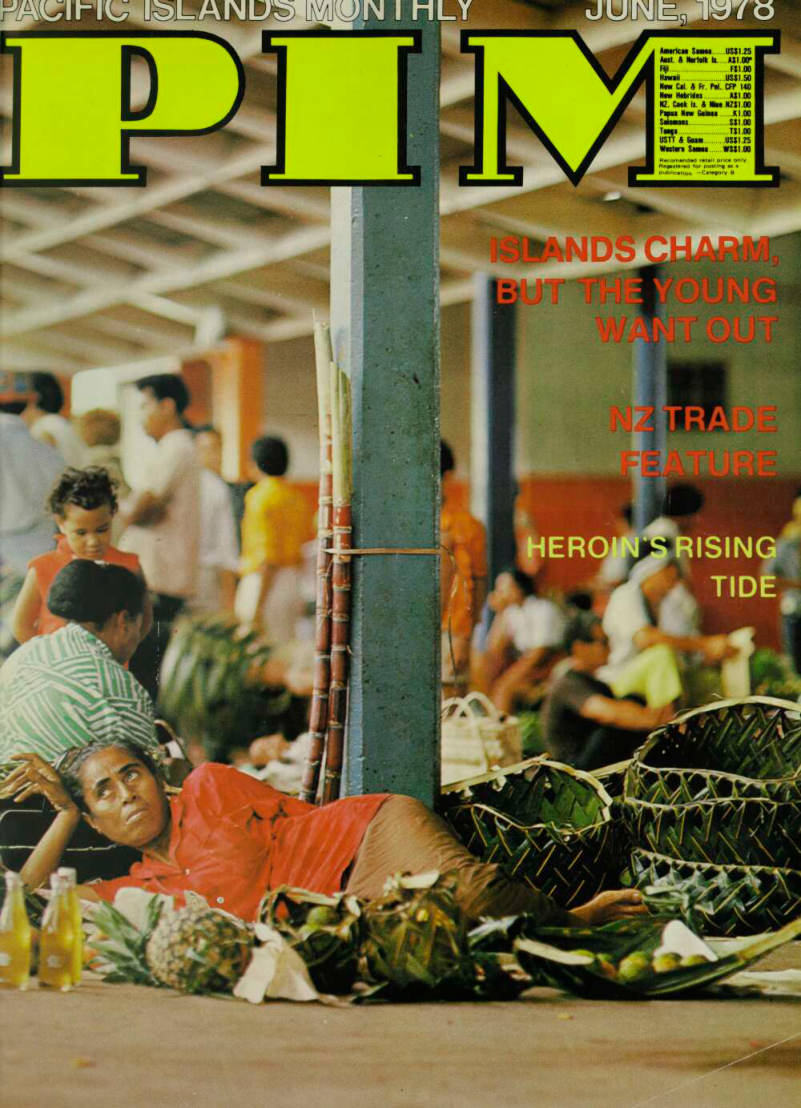
COVER PHOTO: This colourful shot of the market in Western Samoa’s capital, Apia, from photographer Martin Jeffery, of Australia, demonstrates the Islander’s knack of being able to relax at any old time. Next month’s cover will be a striking one of a Solomon Islands prophet, Silas Eto, a fitting introduction to the issue which will be a special Solomon Islands Independence number.
Toyota
How to find a REAL economy car.
When you look at a car billed as an economy
model, ask yourself a few questions.
What sort of fuel consumption can be expected?
Low? Good.
What about other operating costs? Oil, lubrication, that kind of thing. Low again? Great.
How about maintenance? The car has a low-breakdown record? You are definitely on the right track.
What is the average life of the car? Is it better than the average in your area? Super. That’s important in an economy car.
Now. How is the after service? Buying a car is not all in the price you know. Plenty of service outlets?
One economy car coming up. All you have to do is check the price. Then you can tell if you are really getting an economy car.
You will probably find, after asking these questions about town, that REAL economy cars come down to Toyota, the world’s economy car builder.
See Toyota first. Then you won’t have to shop around.
IHE HAPPY ECONOMIZER
TOYOTA STARLET
The car that says economy in every way.
And you will be happy for it. Big inside.
Small outside. Miserly with petrol.
Without sacrificing comfort. A good buy in an economy car even for Toyota. i r
PAPUA NEW GUINEA:
ELA MOTORS LIMITED,
Scratchley Rd., Badili, P.O. Box 75, Port Moresby.
U.S. TRUST
TERRITORY: MICROL
CORPORATION,
P.O. Box 267, Saipan.
FIJI ISLANDS;
AUTOMOTIVE
SUPPLIES CO., LTD.,
G.P.O. Box 355, Suva.
AMERICAN SAMOA:
BURNS PHILP
(SOUTHSEA) CO., LTD.,
P.O. 1057, Pago Pago.
WESTERN SAMOA:
BURNS PHILP
(SOUTHSEA) LTD.,
P.O. Box 188, Apia.
GUAM; ATKINS, KROLL
(GUAM) LTD., P.O. Box
6248, Tamuning.
NEW HEBRIDES:
NEW HEBRIDES
MOTORS LTD.,
P.O. Box 18, Vila.
SOLOMON ISLANDS:
MENDANA
TOYOTA
SERVICE
TOYOTA
ENTERPRISES (5.1.)
LTD., P.O. Box 174,
Honiara.
TAHITI: NIPPON
AUTOMOTO, B.P. 342,
Papeete.
COOK ISLANDS:
COOK ISLANDS
TRADING
CORPORATION LTD.,
P.O. Box 92, Rarotonga.
NAURU ISLAND:
NAURU COOPERATIVE
SOCIETY.
GILBERT ISLANDS:
TARAWA MOTORS,
Box 36, Bairiki Tarawa.
NORFOLK ISLAND;
MOUNT PITT
(ENTERPRISES) LTD.,
P.O. Box 169
NEW CALEDONIA:
SOCIETE
IMPORTATION
AUTOMOBILE DE
PACIFIQUE,
Rond-Point du Pacific (Station Total) B.P. 438, Noumea.
The Toyota range includes; Toyota 1000, Toyota Starlet, Toyota Corolla, Toyota Celica, Toyota Corona, Toyota Cressida, Toyota Crown
I f
CF-95C
" SONY
& : 'A - •-* > - M =o A, w i^r.
X 4r%k B i / •■
-urn
wsm
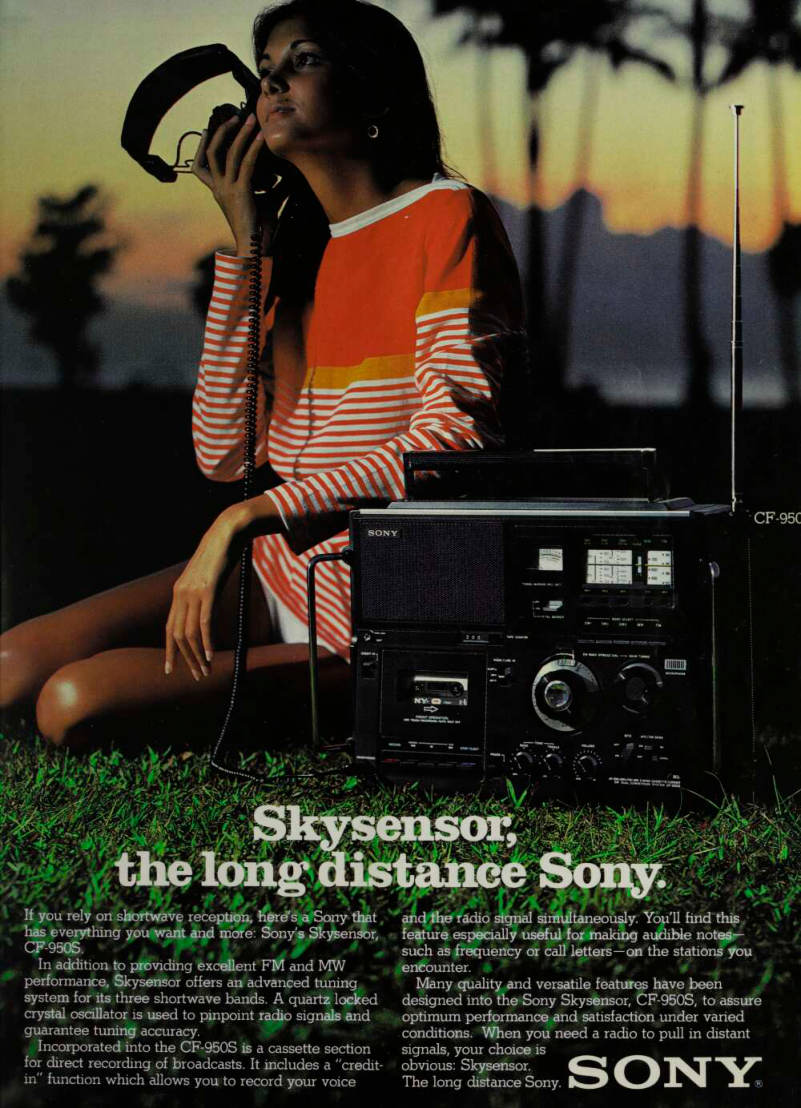
% \n J If you rely on shortwave reception, here s a Sony that has everything you want and more: Sony's Skysensor, CF-9505.
In addition to providing excellent FM and MW performance, Skysensor offers an advanced tuning system for its three shortwave bands. A quartz locked crystal oscillator is used to pinpoint radio signals and guarantee tuning accuracy.
Incorporated into the CF-950S is a cassette section for direct recording of broadcasts. It includes a "creditin'' function which allows you to record your voice , . .. and the radio signal simultaneously. You'll find this feature especially useful for making audible notes— such as frequency or call letters—on the stations you encounter.
Many quality and versatile features have been designed into the Sony Skysensor, CF-9505, to assure optimum performance and satisfaction under varied conditions. When you need a radio to pull in distant signals, your choice is obvious: Skysensor.
The long distance Sony.
If m HI » A J SWr, Sit a ga > ■ T mssMswm ■Hi :U>-
This page tells a lot about
Mazda technology.
Just a few of the searching tests a Mazda has to pass before it ever goes into production. Many more follow, both during manufacture and after. The result. Superior, highquality products. Cars like the Mazda 323. A car everyone’s talking about because of its versatile, economical
performance and stylish good looks.
And like all Mazdas, a car that you can own and drive with confidence.
Because Mazdas are made right.
Right from the beginning.
Sound Testing Laboratories Nobody likes noise. Least of all Mazda. That’s why we are working hard to make our cars quieter —from the outside and the inside. The car (right) is in our anechoic test chamber. Here the whole car is subjected to vibration through a machine that creates a variety of different shakes and thumps. Ultra-sensitive microphones pick up every sound made, then amplifies it for thorough analysis. This way we can get rid of excessive noise and vibration before they annoy you and your passengers.
The Climatic Testing Laboratories (top, far right) Here a range of driving conditions can be simulated, from stop-start city driving to sustained high-speed highway running.
The tests are conducted in a wide range of temperatures and under different atmospheric conditions. So you can be sure your Mazda will be expertly tuned to run smoothly in the country where you live.
Body Testing Laboratories(bottom.famght) This is one of the facilities that crash tests our car bodies. Impact and torsional effects can be accurately measured by computers simulating collisions at 30-60 m.p.h. Dummies electronically wired tell us what happens to passengers —and as a result —provide our design engineers with valuable information about the safest interiors and bodies. Tests such as these helped us to design the light, crash resistant, semi-monocoque body found on all Mazda passenger cars.
mazoa
Quality through superior technology 11 i * m ■ <4 FIJI ISLS. Nlranjans Autoport Ltd. G.P.O. Box 450, Suva TEL: 381555 NAURU Tim John P.O. Box 101, Rep. of Nauru TEL: 471 NEW CALEDONIA Joseph Cheval & Cle 3, Rue Jean-Jaures, Noumea TEL: 731-01 NEW ZEALAND Mazda Motors of New Zealand Ltd. Otahuhu, Auckland P.O. Box 22-472 TEL: 69-099 NORFOLK ISL. Duncombe Bay Garage. P.O. Box 220, Norfolk Isl. TEL: 2097 PAPUA NEW GUINEA P.N.G. Associated Industries Ltd. P.O. Box 1394, BorokoTEL: 255788 SAIPAN Latte Motors Inc. P.O. Box 206, Saipan. Mariana Isl. TEL: 6142 SOLOMON ISLS. Solomon Motors Ltd. P.O. Box 20, Honiara TEL: 313 TAHITI Comptolr Polyneslen B.P. 628, Papeete TEL: 2. 80. 27 TONGA Prema & Sons P.O. Box 20, Nukualofa WESTERN SAMOA Mazda Services (Samoa) Ltd. P.O. Box 576, Apia TEL:B2S The trademark MAZDA in this advertisement stands for AUTOMOBILES MAZDA as far as France and her territories are concerned.
Pacific Report
Its President Hammer Again!
Chief Hammer Deßoburt, deposed as president of Nauru six teen months ago, became president again the second week in May, successfully ending a bitter battle against the Nauru Party, a battle which has had the Republic in a turmoil. Several weeks =kjo his supporters, for the second time, forced the resignation Df President Bernard Dowiyogo, defeating a bill in Parliament jealing with phosphate royalties. Mr Lagumot Harris succeeded Mr Dowiyogo but he resigned after only a couple of weeks in Dffice when Parliament rejected an appropriations bill designed :o finance the republic until the end of this year. Chief Hammer /vas elected in the ballot that followed, a Nauru Party supporter obviously transferred his allegiance because voting in the last hree elections was in the Nauru Party’s favour by 9 votes to 3. The Party strength, however, is expected to remain the same n Parliament. President Hammer becomes Nauru’s third presi dent inside a month, establishing an international record un •ivalled by even the South American republics.
Forres Strait Border Agreed
Papua New Guinea and Australia have agreed on how they A/ill position and define the Torres Strait International borders, t was announced early in May. Details were not given, however, as both Cabinets have to examine the agreement. It is believed that some of the islands in the Torres Strait will be inside the PNG boundary but Papua New Guinea’s jurisdiction will be con fined to the seabed. The islands will remain Australian territory existing as enclaves with three-mile limits around their beaches.
Some fishing rights will be shared.
Lapanese Ambassador For Fiji
Japan will have an embassy in Fiji in January, 1979, if the lapanese Parliament approves. This was stated by the Japanese Ambassador to Australia and Fiji, Mr Yoshio Okawara, on a visit o Fiji. He said Japan would be aiming for an increase in scope >f economic and technical co-operation with Pacific coun ries.
‘No Neutron Bomb Test” - France
France has firmly denied press reports that it has tested the controversial neutron bomb at Mururoa Atoll in French Polynesia. Demonstrators in Melbourne against the alleged tests nvaded the offices of the French Consulate-General, and seized md burnt a French flag. Apologising for the incident, Australian icting Minister for Foreign Affairs, Mr lan Sinclair, said, “Acts )f vandalism and violence as expressions of those views (against luclear tests) are to be totally deplored.” He added that the xjrning of the flag of a friendly country was a particularly odious gesture.
Vestern Samoa’S Leader On Tour
Western Samoa’s head of state, His Highness Malietoa anumafili 11, paid state visits to New Zealand, Australia and Jauru in April. In Auckland he laid the foundation stone of >amoa House, a five-storey business block that will house consular offices, Polynesian Airlines, and shops selling Pacific Blands handicrafts.
Rhe ‘Darkest-Kept Secret’
The Australian Parliament was electrified early in May by a claim by a Labor backbencher, Mr Barry Jones, that he had jncovered one of the “darkest-kept secrets of the war” the execution by the Australian authorities in Papua New Guinea during the war in the Pacific of more than 30 Papua New
Guineans for alleged treason and atrocities. The Australian press, radio and television took up the story, obviously under the impression that it was being told for the first time. In fact, the full story was told in PIM in May, 1971, by the late Tom Grahamslaw who for 45 years was with the Administration in Papua and New Guinea. During World War II he was an Officer of the Australian New Guinea Administration Unit (ANGAU). Mr Grahamslaw described the executions and of one such ex ecution wrote “It was a grim experience which I shall never for get.” It was reported from Port Moresby in May by the RSL branch that the sons of at least three of the men executed had tried to get Australian ex-service pensions but had been turned down.
Solomons: Governor-General Devesi
The first Governor-General of the Solomon Islands will be Mr Baddeley Devesi, formerly the permanent secretary for Utilities and Public Works. Mr Devesi, 37, will take office when the Solomons gain independence on July 7. He won the post in a vote of the Legislative Assembly to choose a G-G from six can didates. His closest rival was Mr Geoffrey Beti, member for Roviana and North New Georgia in the Western District. As he is in his early 20s many considered he is too young for the job.
Mr Devesi is from Guadalcanal. Mr Peter Kenilorea, who will be come Prime Minister on independence, is from Malaita.
Trans-Pacific Swing For Sanford
Mr Francis Sanford, vice-president of French Polynesia, visi ted the Cook Islands, American Samoa, Western Samoa, Tonga and Fiji in April. Among his party was a Canadian business con sultant, Mr Timothy Howard. It is understood that Mr Sanford is interested in developing tour packages that would take in the islands visited, as well as French Polynesia.
Lady Cleland’S Bright Idea
Lady Cleland, widow of a former Administrator of Papua New Guinea, has criticised the new leadership super code planned for the country’s leaders (PIM, May, p 5). In a letter published in a Port Moresby newspaper, she said that the government would be better advised to punish heavily the Australians, Japanese and others who extend the temptations to leading PNG officials. Lady Cleland lives in retirement in Port Moresby, and generally steers clear of political issues. Her late husband, Sir Donald Cleland, was the Australian Administrator of PNG from 1952 to 1967.
Gloomy News For Fiji Workers
The outlook for employment in Fiji is not good. A survey by the Fiji Employers’ Consultative Association revealed that 800 people could lose their job before the end of 1978. That figure did not include 145 retrenchments planned by the Carpenter group. Among those who will become unemployed are workers on the Queen’s Road construction project, which is nearing its end.
Still Looking For Long-Lost Amelia
A search for the remains of famed aviatrix Amelia Earhart who disappeared in 1937 during an unsuccessful attempt to fly around the world has begun in the Marshall Islands. Moving spirit in the effort is former US air force pilot, Vincent Loomis, who believes he knows where the wreck of Earhart’s plane lies. Dur ing Loomis’ service with the air force in the Marshalls, he found a weather-beaten shoe near the shoreline on one atoll. In the middle of the same atoll he sighted the wreck of an aircraft, covered with dense jungle growth. Loomis, who is leading a
seven-member party in the search, believes it was the plane flown by Earhart and her navigator, Fred Noonan. Among earlier theories was one that Earhart and Noonan were captured by Japanese forces during World War II and were seen on Saipan, but this has never been positively confirmed.
Delay On Red Embassies
The Papua New Guinea Government has decided to defer the establishment of Soviet and Chinese embassies in Port Moresby (PIM, May p 5) for at least 12 months. Shortages of staff and accommodation were offered as the reasons. But closer to the bone were the strong public criticism of the decision to invite them, and dissent on the question within the Department of Foreign Affairs. France and West Germany, invited at the same time as the Russians and the Chinese to set up embassies, are continuing with plans to do so.
Fiji Fixes Its 200-Mile Zone
The Fiji Parliament, early in April, approved a law setting up a 200-nautical mile economic zone covering the ocean round the group. The law was gazetted soon after.
FISHING NZ WATERS - DOWN TO SPECIFICS New Zealand, and partners the Soviet Union and South Korea, are among the first to get down to specifics on the question of fishing rights in a national 200-mile economic zone. Under recently signed agreements, New Zealand’s waters may be fished by the other two countries on the following terms: licence to fish for squid by jigging or trawling: $BO a tonne of fish that the craft is permitted to take; licence to fish by trawling $l7 a tonne; licence to fish by bottom-lining $25 a tonne; licence to fish for albacore and yellowfin tuna by long-lining $1 500 a year; licence to fish for southern bluefin tuna by long-lining $9 000 a year.
Stowaways, All 25 Of Them
Twenty-five young Tongans were arrested in Auckland after stowing away in the freighter Marama at Nukualofa. New Zealand Customs officials said it was the largest group of stow aways they had come across. Mr Liufau Salala, Tongan Govern ment liaison officer in Auckland, said the incident underlined an increasingly desperate employment situation in Tonga. Only about 10% of school-leavers could find jobs. The New Zealand work permit scheme for Tongans had almost dried up, with only about a dozen permits issued since January.
Meet “Commerciogenic Malnutrition”
“Commerciogenic malnutrition’’ is the name applied by two medical authorities in Western Samoa to a new disease brought about by the use of milk powder for feeding babies. Dr V. Annan dale, medical officer at the Family Welfare Centre, and Miss Christine Guested, nutritionist at the Health Department, write in a report opposing the use of Western-style infant milk and urging the merits of breast feeding: “The vicious cycle of malnu trition and disease repeats itself, increasingly each year, in spite of greater knowledge and understanding.’’
The Grey Shark Of Enewetak
Two Americans, skin-diving in a lagoon near Enewetak atoll in the Marshalls, were attacked by a 1.5 m grey shark 15 m below the surface. The men, Michael Degruy and Philip Light, received wounds to the arms and hands. They are employees of a firm supporting scientists studying marine life and the effects of former nuclear tests on Enewetak.
Anzac Day In Png
April 25, Anzac Day, was the occasion for a number of cer emonies in Papua New Guinea. PNG contained a small, short lived but historic battleground for Australia in World War I, and: was a major theatre of Australian operations in World War lIJ The main ceremonies were at Lae, at Bomana, near Port Moresby, and at Bita Paka, near Rabaul. The Bita Paka services was close to the site where the first action in history was fought by an Australian national force. Costing the lives of four merr and over in a day, the fighting resulted in the take-over of Ger man New Guinea.
Fiji International Rugby Win
Fiji won the international rugby seven-a-side in Hong Kong,, beating the New Zealand team, Manawatu, 14-10 in the final..
Fiji’s was a full international team, while the NZ team came fromr a small area of the country. In future, NZ may field full inter national teams in this annual seven-a-side tournament.
Daddy And Granpa Were So Proud
Oxford University student Howard Henry, son of Cook Islandss Minister Tupui Ariki Henry and grandson of Premier Sir Albert Henry, was chosen as captain of an English Universities Rugby* League team which played a French Universities side in Paris in April.
Fiji Forces For Mid-East?
The Fiji Government in April announced its readiness to sendi: troops to the Middle East as part of the United Nations peace keeping force.
Olewale In East Timor
Papua New Guinea’s Foreign Minister, Mr Ebia Olewale, spent a day in East Timor during an eight-day visit to Indonesia in May.
East Timor was included in his itinerary at Indonesia’s initiative.
Indonesia’s presence there has been recognised by PNG as anr Indonesian domestic issue. Speaking before his departure fromr Port Moresby Mr Olewale said PNG would reject a proposal fon joint PNG-Indonesian forces to patrol the border between the two countries if, as expected, the idea was revived by Indonesia during his visit.
Three Die In Fire
Jagdish Prasad, 33, his son Janan Ditendra 2, and daughter!
Samjila 4, died in their store in the village of Vugalei, Tailevu, Fiji, when benzine blew up and set the building ablaze. Prasad’s wife and a six-year-old daughter were outside when the fires swept through the store.
Bands Across The Ocean
Former members of the US Marine Corps, and the US-basecr Guadalcanal Campaign Veterans’ Association, have fulfilled: their promise to equip with new instruments the Solomon Islands Police Band. The last of the 50 instruments provided has been handed over at a ceremony at Honiara’s police parade ground i Solomon Islander World War II hero, Sergeant-Major Jacob Vouza, was honoured with the presentation of a ceremoniaf sword by retired Brigadier-General Samuel Griffith, commander 1 of the last Raider Battalion on Guadalcanal. Solomons Police Commissioner, Mr John Holloway, said the shared experiences of the war had created an active interest among American ser vicemen in the welfare and progress of the Solomon Islands * “I’m sure this will be continued,’’ he said.
Advertisements & other items, pp. 5-6 (2 items)
5
ACIFIC ISLAND MONTHLY - JUNE. 1978
6
PACIFIC ISLAND MONTHLY - JUNE. 1978
Pacific Islands Monthly
Vol 49 No 6 JUNE 1978
Editor: John Carter
Publisher: Stuart Inder
Pacific Report 5
all the news In a nutshell
Letters 8
slugged yachtie again, the underhanded British
The Young Islanders 11
they want to get away
Censorship In Tonga 13
double vision and cut films
Guam’S Dilemma 15
to the pure all things are mixed up
The Dope Scene 17
the fight on Guam
Political Currents 18
rumbles in the Solomons, new opposition in PNG, those elections in the Cooks, ‘bloodshed’ warning in Fiji
Islands Press 21
a whole lot of angles
People 22
Tonga’s first woman MR, a PNG beauty
Archaeology 27, 29
uncovering ancient history in Truk and Saipan, and, maybe, destroying it
Books 31
Loyalty Islanders exploiters, no visa for Christmas
Afterthoughts 37
Percy Chatterton on education problems
New Zealand’S Export Year 39
a big drive for the Islands’ markets
Tradewinds 75
the Islands in the electronic age, union rivalry in Fiji
Yesterdayb3
50 years back Smithy flew the Pacific
Odyssey Of The Hokule’A 91
a tragedy not a triumph
Cruising Yachts 92
Maudi Marie, Talou, Lady Lee, Con Tina and others
Transport 93
Japanese economic expert attacks air fares
Pacific Islands Monthly W3s founded by R. W. Robson in 1930. It is published monthly by Pacific Publications (Aust.) Pty Ltd, 76 Clarence Street, Sydney, 2000. Post Address: G.P.O.
Box 3408, Sydney, N.S.W. 2001. Telegraphic Address: PACPUB, Sydney, Telex: 21242. Telephone: 29 6693. Publisher: Stuart Inder. Manager: John Berry Advertising Manager: Steve f U^ S m I R,P 7 I ? N S " Paci , f i c ' slands Monthly” is airfreighted to the majority of subscribers and agents in the Pacific Islands and the USA. Australia (including Norfolk Island) $10.50 Aust New Zealand, $ll-50 NZ ($10.50 Aust), Fiji $10.75 Fijian ($10.50 Aust), Papua New Guinea, K 9.00 ($10.50 Aust), New Hebrides, Tonga, Cook Islands, Western Samoa, Gilbert Islands, a .'Niue, Nauru and Solomon Islands $10.50 Aust. American Samoa, Northern Marianas, Micronesia, Guam and Hawaii, $15.00 US or $12.00 Aust. US Mainland and Canada $17.00 Aust New Caledonia and French Polynesia 1,600 CFP or $13.50 Aust. United Kingdom £9.50 or $12.50 Aust. Japan 4.500 Yen or $12.50 Aust. Elsewhere $14.00 Aust. Note: Overseas remittances in Australian dollars should be by bankdraft payable at Sydney, Australia.
REPRESENTATIVES. FIJI: Distribution and subscriptions Desai Bookshops, P.O. Box 160, Suva, Fiji. Telephone: Suva 23036. Advertising, Fiji Times & Herald Ltd., 20 Gordon Street, buva. leiephone; 312 111. Telex: FJ2124 Papua New Guinea: Advertising - PNG Post-Courier, P.O. Box 85, Port Moresby. Distribution - Robert Brown & Assoc. P.O. Box 3395 Port Moresby, telephone 2 5855. French Polynesia: Distribution - Hachette Pacifique, 10 Ave Bruat, Papeete New Caledonia: Distribution - Depot Centre de Presse Michel Pentecost, 8.P.C2 Noumea. United Kingdom: The Herald and Weekly Times Limited, 8-10 Clifford's Inn, Fetter Lane, London EC4A IBU. Telephone: 01 831 6041. Telex: London 21989 Japan; Advertising Universal Media Corporation, C.P.O. Box 46, Tokyo. Telephone: 666 3036 New Zealand; Pacific Publications, C.P.O. Box 2229, Auckland. Advertising inquiries: International Media Represen tatives Ltd, P.O. Box 3880 Auckland. Tel. 73 880. Telex: NZ21157. (Auck. 40) Hawaii and U.S. Mainland only: PIM, Hawaii, 2812, Kahawai St., Honolulu, Hawaii 96822 Second class postage paid at Honolulu, Hawaii. US Advertising Representative, Joshua B. Powers Jr. Powers International Inc. 551 Fifth Ave, New York, New York 100 017 Telephone 867 9580 Telex 236514. Pub #952480 Victoria: Advertising - Pacific Publications (Aust.) Pty. Ltd., Herald and Weekly Times Building, 2nd Floor, 61 Finders Lane, Melbourne 3000 Telephone 652 1565 Brisbane: D. Wood, Anday Agency, Box 1918 G.P.0., Brisbane, 4001. Telephone: 44 3485; 44 1546. ® 1978 Pacific Publications (Aust.) Pty. Ltd. Printed in Australia by Paramac, Mitchell Rd, Alexandria. PIM is distributed in Australia and New Zealand by Gordon & Gotch Australian cover price is recommended retail only. Registered at the G.P.O. Sydney for transmission by post as a publication category B. a
Advertisements & other items, p. 7 (1 item)
7
PACIFIC ISLAND MONTHLY .lIJNF IQ7R
Letters
Radio Links
We were very interested to read the article (PIM, Jan, p 25) about the first issue of PIM (August, 1930), and which produced a copy of the face page of Volume 1 issue No 1 in which one article was entitled —“Radio Links The Pacific.”
The New Zealand Post Of fice has a particular interest in the radio services in this area, as we have been involved with their installation and op eration since before World War I through to the present time when they are being progressively replaced by satellite operation.
A. Turpie,
(for Director of Overseas Telecommunications) Post Office HQ, Wellington
A Png History
The Papua New Guinea Department of Primary In dustry is sponsoring the re search and writing of a His tory of Agriculture in Papua New Guinea.
I would be grateful if any readers could assist this pro ject by means of first-hand ac counts, documents, photo graphs or case histories. They can contact me at the Depart ment of History, University of Papua New Guinea, Box 4820, University Post Office.
Catherine Snowden,
(Research Officer, History of Agriculture) Port Moresby
Underhanded
PIM received this “open” letter which has been sent to the Governor and Chief Minis ter of the Gilberts, the Hawaii
Congressional Delegation in
Washington and the Honour able US Senators Daniel
Inouye, Sparky Matsunaga and
Daniel Akaka.
It appears that the US and UK plan to agree on sover eignty of many, or all, of the equatorial islands whose status
has been in dispute for decades (including islands in the Phoenix and Line groups). It also appears that the purpose of carrying out such nego tiations at the present time is to
present the emerging indepen
dent government of the Gilbert Islands with a fait accompli, according to which some of these islands will have passed,
probably irrevocably, to US
jurisdiction.
This seems to be an under handed way to handle the mat ter. It is the Gibertese who live, or have lived, on many of these islands. Many others are poten
tially inhabitable. Beset by
overpopulation and fickle rain fall, the Gilbertese people could use these islands for a much more noble purpose (eg, colonisation, economic
development) than the prob
ably utilisation under the US.
Furthermore, the US (or other Western powers) would prob ably be able to obtain use of some of these islands for legit imate defence needs by nego tiation directly with the Gilbertese.
Past events in the Phoenix Islands have aroused suspicion that such secret arrangements between the big powers are car ried out to the detriment of the islanders. It is recalled that the Phoenix Islands settlers were induced to move en masse to the Solomon Islands in the 1950 s and 19605, for reasons not obviously related to the mild drought conditions prevailing in the Phoenix Islands at the time. Shortly thereafter, the US military established observation posts on some of these islands.
The fate of the displaced population is still unsettled.
There is no assurance that they will be allowed to remain in the Solomon Islands after independence there, and a Uganda-type tragedy is not an
impossibility. Some people are
wondering if US-UK collusion
might have been responsible
for this ill-fated mass migration of islanders. Such a suspicion would not be too far-fetched, as recent events on Diego Gar cia can bear out.
These Equatorial Pacific islands should not be alienated from the Gilbert Islands nation at this time. Such an action might tend to impair relations of this government with the
US, UK and Commonwealth.
Furthermore, future plans as well as past actions of the US and UK in these matters should no longer be kept secret from the public.
Gordon W. Groves
Kaneoke, Hawaii • All Gilbertese in the Solomons are now assured of
automatic citizenship if appli
cation is made within two years.
Editor.
Slugged
Yachtie
From the launching of the Slugged Yachtie, by Ray Quint (PIM, Feb, 1977, p 25), I have viewed with intrepid interest, the numerous and oft times wondrous waves of thought, that have been slapping the
topsides of Slugged Yachtie.
Indeed the Rev Brown and his complement of caustic comments, in his ship The Racist is well adrift, and I trust he and his like are not too long
in sinking .
Certainly it is the prerogative of any country to impose levies of their own choice and like wise also of a ‘yachtie’ to lay his own courses; however I am of the opinion the Solomon Islands Government may have holed a section of one of their own ships namely the useful little ship Foreign Exchange.
The average ‘yachtie’ is a
gregarious person, and usually
spends, while in a foreign country, far more than the two or three-day tourist type, as be
yond his normal daily require
ments of food, he purchases fuel and oils, spare parts,
imports a seemingly endless
variety of bits and pieces, slips
his yacht etc, and is renowned for his efforts in satiating his thirst. In most cases his recruit ment of services and purchases are paid for in Foreign Exchange.
I know of a cruising family, who while in Madang, Papua New Guinea, spent
US$lO 000; additionally they
purchased, through our
national airline, return and intra air fares to the US. I will concede, there are a number of Bully Hayes types among the
floating fraternity, neverthe
less, the ‘yachtie’, is for this part of the Pacific of sound percent
age potential for any country’s tourist department and should be encouraged. He is, after all, a tourist, and differs in no other respects, other than he has chosen his own mode of trans port.
From my own experience, I shall always retain fond feel ings for the officials of the Solomon Islands, particularly for their effectual and cour teous services afforded me; however, at that particular time, Slugged Yachtie was still on the drawing boards.
Happy to be here ‘Yachtie’
in Madang, Papua New
Guinea.
Sayan Marr
Crown Agents
Your reference to the Crown Agents (Pacific Report, p 5 PIM, March) is not entirely ac curate. The Crown Agents have
never supervised production of
postage stamps for the Repub lic of Nauru.
The Crown Agents’ Stamp
Bureau sold Nauru stamps to the philatelic trade until January 31 this year, but ar rangements for the design and production of the stamps have been in the hands of the Nauru Government, which employs its own philatelic adviser in London. The adviser has now taken over sales of the stamps.
Your article also refers to an inquiry into a AS36O million deficit in the Crown Agents’ accounts. The report of the Fay Committee of Inquiry was published in the United King dom in December, 1977; it was a post-mortem report, re quested by the present man agement of the Crown Agents, to investigate the circum stances which led to the Crown
Agents requesting financial as
sistance from the British Government in 1974. A sub sequent inquiry will examine whether there were any breaches of duty in relation to the Crown Agents’ affairs in UK Government Departments and other institutions.
The losses made by the Crown Agents relate to a period which ended decisively in October, 1974, prior to which the Crown Agents had been making large investments on their own account. The tra ditional agency role of the
Crown Agents as an impar tial public service to Govern ments throughout the
developing world, including
many Pacific countries is in no way affected by their own account losses. The losses themselves have been made good by British Government grants and guarantees. The ser vices. not confined to the UK
and including engineering and
other professional advice, investment, procurement and shipping as well as philatelic services, continue to expand and flourish.
Ivan Alexander
Crown Agents’ Representative for the Pacific
Stevenson’S
“The’’
In reference to the dis cussion of the Robert Louis Stevenson “misquotation” on the Stevenson tomb (PIM, Dec, 1977, p 49) here is a fur ther note of possible interest.
First of all, your quotation of Stevenson’s Requiem is in correct; the last line has no “is”: it should read “And the hunter, home from the hill”, but I assume this is but a typo.
The two bronze plaques were made in 1897 (not 1900) and were designed by long time Stevenson friend, Gelett Burgess, remembered today as the author of the Jingle The Purple Cow. There is justification for the “extra the” in the penultimate line of Requiem. Earlier printed ver sions of the poem were thus written. For example, in a 1905 printing by Robert Louis Stevenson’s official USA publisher, Charles Scribner’s Sons, of a little volume entitled The Pocket Robert Louis Stevenson: Being Favourite Passages from the Works of Stevenson, p 196, the line reads “Home is the sailor, home from the sea”.
Students of the works of Robert Louis Stevenson will testify that he frequently revised his works; often original printings in periodi cals were completely re-writ ten for book publication, and changes were often made in different editions. At least it can be said that the rendering on the tomb agreed with the
wording of an authorised edi tion of the author’s works, and was not merely an error.
The Requiem is also preserved in bronze in both Samoan and English at the foot of the Vaea trail: on the English version of these pla ques, the line in question reads “... home from sea”.
One more minor correction to your article: Isobel Field was the step-daughter, not the daughter of Robert Louis Stevenson as stated.
W. R Moran
La Canada Calif, USA
U.K.’S Papers
I too was sorry to read (PIM, Feb p3l) that J.K. McCarthy’s papers were to go to the National Library of Australia, but I was pleased to see G.M.P.
Gray’s reply in PIM, April.
p 9.
Yes, it is appropriate that items of an historical nature be presented to the country they are all about. We have in Papua New Guinea our own National Museum and our newly-established National Li brary, both of which are anxious to collect all materials relevant to the historical development of our country.
We would rather see these in our country where they are di rectly relevant, than scattered through the world at large where they become harder of access to Papua New Guinea citizens.
I can assure you that both in stitutions mentioned accept the responsibility of their national roles and will register and curate materials to world stan dards.
If any ex-residents of Papua New Guinea, especially from the colonial times, wish to do nate their collections of trivia, memorabilia etc to us we would be most grateful.
Geoffrey
Mosuwadoga
Director, National Museum and Art Gallery,
Boroko, Png.
• Would the writer of the letter signed “Truthful Nauruan” please send PlM’s Editor his name and address, which will not be published but as evidence of good faith.
Advertisements & other items, pp. 8-10 (4 items)
8
PACIFIC ISLAND MONTHLY - JUNE, 1978
9
PACIFIC ISLAND MONTHLY - JUNE, 1978
youthful looking
Advertisement
How to capture the
bloom of a more
youthful looking
complexion
Not everyone is blessed with a beautiful skin, but, with the simple daily smoothing on of a scientifically developed skin care fluid, your complexion can take on a noticeable new softness and a more attractive, younger look. v MANY women have taken the opportunity of holding back the effect of the passing years on the complexion with a
remarkable tropically
moist oil blend that assists the natural skin fluids in their task of keeping the skin soft and
lovely.
SOFTER, SMOOTHER
LOOKING AND
MORE SUPPLE SKIN.
As you grow older, it becomes necessary to help restore and maintain the vital balance of oil and moisture in your skin because the y S natural supplies / . v that emanate AV\ v from tiny reservoirs beneath your skin begin to diminish with the result that your skin can become dry and show signs of looking prematurely older.
By smoothing on the tropically moist oil blend, you bring to your skin benefits similar to those of the natural fluids, with which it has an affinity and by supplying essential elements the keratinizing cells in the outer layer of your skin are able to exist in an oil-moist environment similar to that which existed when you were younger, helping to produce a softer, smoother looking, more supple skin.
PROTECTION FROM
CLIMATE EVERY DAY.
Another advantage of pampering your skin with A * * the tropically moist oil blend is that, each day harsh climate exposes your skin to the rigors of evaporation of skin fluid from its surface; left unprotected, your skin could therefore become excessively dry and coarse in texture and also suffer the accentuation of tiny lines and wrinkles.
By smoothing on your Oil of jjL. V\
Ulan each yjl® f\
morning before ■ * you go out, M you can help h* vft keep your skin as soft and pretty as possible through the protection of fluid loss.
The remarkable beautifying fluid is available in Australia from chemists and beauty counters as Oil of Ulan moist oil blend. Many thousands of women, in many parts of the world, living in a variety of different climates, have found their answer to protecting against premature growing older signs in the daily pampering of the complexion with their Oil of Ulan.
A SIMPLE WAY
TO MORE
BEAUTIFUL SKIN.
Each morning and at night, take a little Oil of Ulan onto your finger tips and smooth a film over your face and neck. The remarkable fluid may be lavished on, particularly around the wrinkle prone areas of the eyes and mouth because it has extraordinary powers of penetration. It is absorbed completely and quickly by the outer skin layer and leaves a fresh, natural, non-greasy feeling that is incidentally, ideal as a foundation under make-up
Total service 0n...
plumbing supplies fast
WATSON & CRANE
are organised to fulfil your needs
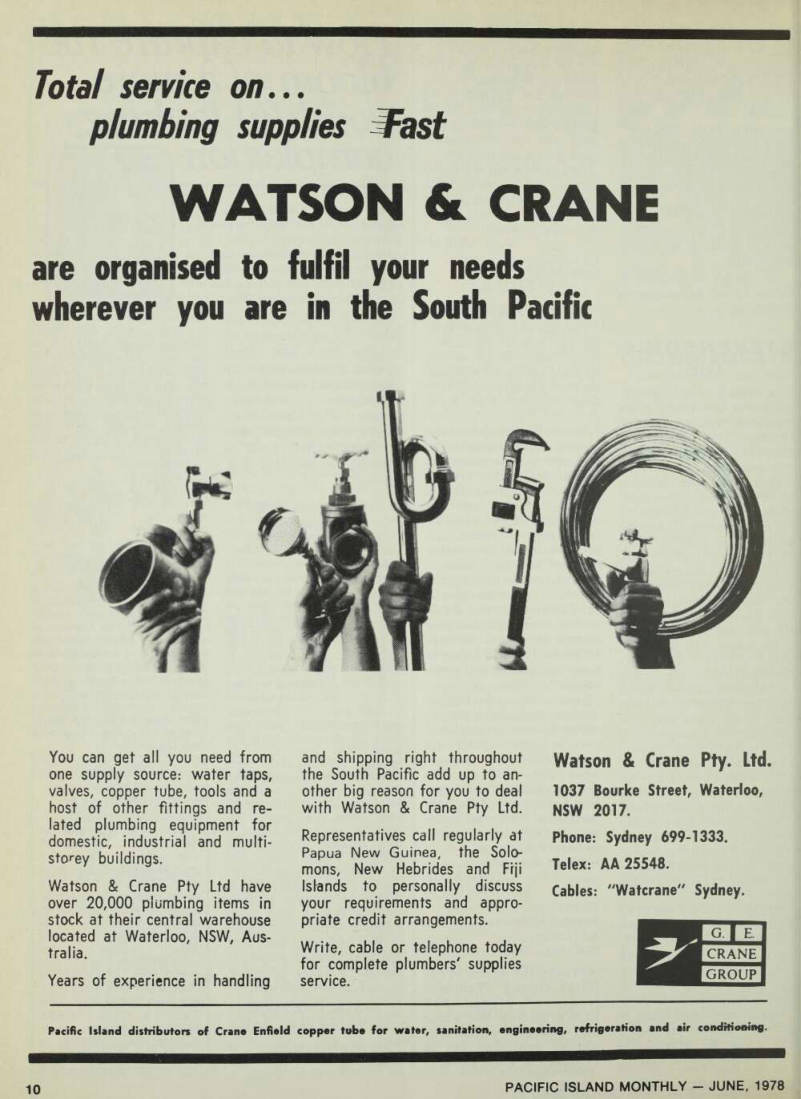
wherever you are in the South Pacific fcl V You can get all you need from one supply source: water taps, valves, copper tube, tools and a host of other fittings and related plumbing equipment for domestic, industrial and multistorey buildings.
Watson & Crane Pty Ltd have over 20,000 plumbing items in stock at their central warehouse located at Waterloo, NSW, Australia.
Years of experience in handling and shipping right throughout the South Pacific add up to another big reason for you to deal with Watson & Crane Pty Ltd.
Representatives call regularly at Papua New Guinea, the Solomons, New Hebrides and Fiji Islands to personally discuss your requirements and appropriate credit arrangements.
Write, cable or telephone today
for complete plumbers' supplies
service.
Watson & Crane Pty. Ltd. 1037 Bourke Street, Waterloo,
NSW 2017.
Phone: Sydney 699-1333.
Telex: AA 25548.
Cables: "Watcrane" Sydney.
G. I E.
CRANE
GROUP
Pacific Island distributors of Crane Enfield copper tube for water, sanitation, engineering, refrigeration and air conditioning.
10
PACIFIC ISLAND MONTHLY - JUNE. 1978
Stop The
Rock!
Young Islanders
Want To Get Off
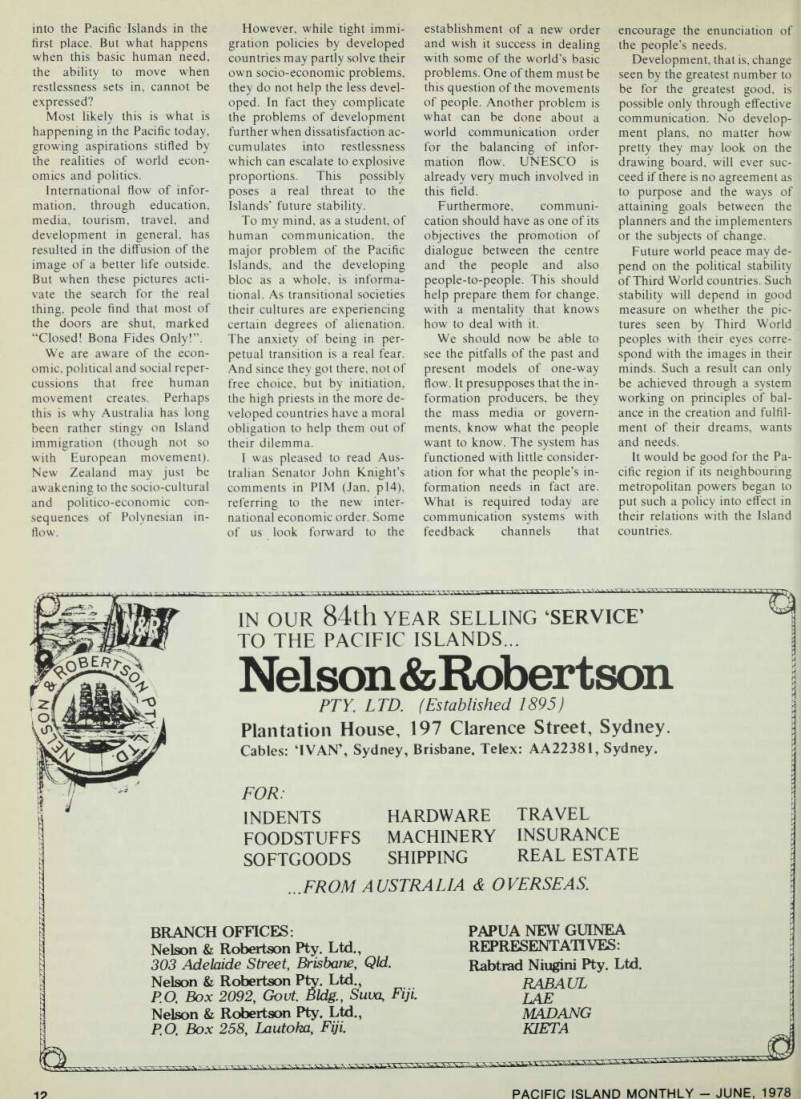
There is restlessness in the Pacific. Islanders are beginning to see their rocks and atolls as cramped, confin ing places. They want to spread their wings and fly, to see the outside world. In the article bejow Lasarusa Vusonlwallala, a Fijian scholar in the field of communication who is now working at Hawaii s East-West Center, takes a close look at the problem.
There is no easy solution to the present migration fever in the Pacific: if the desire to move out is satisfied for large numbers of people, stresses and strains will appear in the host countries to which they go; if it is not satisfied, their countries of origin will be
increasingly troubled by their
desire to leave.
Discovery of the region by the outside world led to the slow disintegration of tra ditional societies and cultures.
As technology improved and
communication increased, the tempo of disintegration quickened. The inflow of infor mation spelt the end of same ness and consistency the end of the era of certainty.
We all wanted to be modern.
It was a practical consideration.
A steel knife certainly beats hacking away for days at a piece of rock just to sharpen it into some cutting tool. Flying here to Hawaii certainly beats sailing up by canoe. And it’s consoling to have a high con fidence in the chances of Mum’s baby surviving, of sister not having to die from dysen tery, or big brother from tetanus. There was now a dis
pensary nearby.
These improvements to life’s
“physical quality” have social
costs. Unfortunately, we have not yet learned to accept them.
Instead we are torn between two loves in our yearning for the physical comforts of the new and the psychological cer tainty of the old. We suffer from ambivalence.
Let us try to recreate three “Pacific Scenes”.
First Contact: He
looks strange, so white! Is he not from the sky? Must be the god our forefathers talked about. He must be for his tech
nology is superior. Whoever
sent him here must be an able provider. I want those nails, steel knives, axes and guns oh yes, those guns. Maybe, if I worship him, and his culture, boats will come with more car goes. Perhaps, one day I will go to see where all these treasures are, and maybe dig some out
myself. I think I’m getting white!
Colonialism: And So
we went to classrooms, grew up to put on ties and sweat in jackets, to pull white socks over our black shins. We looked around and took stock. We could tell those with still some way to go, for they walked barefoot. We changed our pol itical systems and tried adopt
ing foreign economic
principles.
“Hey! You there, stop think ing in Pacifican!”
Told to be rational, that human emotions stunt GNP growth, we become unreason
able, forgetting that rationality
is culturally relative. We leave the old and infirm in the vil lages and rush to the towns.
Some are employed, how lucky
they are! Many more keep
searching, looking for the jobs
they may never find.
Modernisation: There
is that boy in the village. He turns on his radio, hears Elvis and dreams of becoming another Presley. Will he never realise? He walks to town to gape at tourists. They look so affluent. Does he know that they are not all that rich back home? Who will tell him?
The above scenarios try to convey a very brief socio history of a fermentation which is often the seed for change. If
given time and opportunities
societies evolve, otherwise they
just revolve.
Just what alternatives for change are there open to the Islands? By their nature islands have limited resources. What then are their chances for
development?
An economist faced with this question may “Ooh!” and “Aah!” and say, “Well, aah!
Tourism?” An individual living the situation may whimper an Island version of the Broadway hit, “Stop this rock! I wanna get off!”
Where can an Islander go if and when he gets the urge? The system which spelt stability for his forefathers is spinning off balance. How does one hold on to things that may not be there tomorrow? How does one handle new situations? These are some of the musings that may be going through the minds of Pacific people, es pecially those with whom the education toward “mod
ernity”, and
has been successful. Their dip loma of achievement is spelt in capital letters FRUS
Tration.
As I see it, a major problem with developing countries is the one-way flow of infor mation emanating from the more developed. This centre to-periphery direction is just as true within the developing countries where it is from the urban to the rural. All this re sults in the creation of dissatis faction in the low-information sectors as seen in the rural-to urban drift in the less developed countries and the increasing desire to go one step further, to migrate to the
metropolis, to the developed
societies. Unfortunately, this is not possible under present world conditions.
Immigration laws are based on the rationale that the econ omies of any given country cannot support a liberal inflow
of all sorts of people. This makes the recently announced intentions of the North Solomons provincial govern ment in Papua New Guinea to control free movement of their
people an interesting test
case in international under
standing.
“People who wanted to leave their communities to visit towns or urban settlements would have to obtain written permission. The scheme was in the overall interest of the people and their economy. We don’t want to stop people with special skills going to an area
where they can get good jobs,
but as a principle we want to stop people with less skills from moving around. We want to keep them on their land where they are of most value to the community in general, and where no special certificate of trade is necessary” says Prem ier Dr Alexis Sarei (PIM, Jan, 1978, p 6).
The above words could eas ily be those of President Carter, of Prime Ministers Fraser or Muldoon, on laws regulating
migration into their respective
countries because their econ omies cannot sustain the influx into their markets of unskilled “Third Worlders.”
However, Dr Sarei may have to prepare a line of defence
against possible accusations of
“human rights” violations.
Something like, “Liberty
begins at home”?
When a man’s prospects in life appear dim his natural instinct in the past has been to uproot himself and move. In fact, that is believed to be a
probable cause of migration
Lasarusa
into the Pacific Islands in the first place. But what happens when this basic human need, the ability to move when restlessness sets in, cannot be
expressed?
Most likely this is what is happening in the Pacific today,
growing aspirations stifled by
the realities of world econ omics and politics.
International flow of infor mation. through education, media, tourism, travel, and
development in general, has
resulted in the diffusion of the image of a better life outside.
But when these pictures acti vate the search for the real thing, peole find that most of the doors are shut, marked “Closed! Bona Fides Only!”.
We are aware of the econ omic, political and social reper cussions that free human movement creates. Perhaps this is why Australia has long been rather stingy on Island
immigration (though not so
with European movement).
New Zealand may just be awakening to the socio-cultural and politico-economic con sequences of Polynesian in flow.
However, while tight immi
gration policies by developed
countries may partly solve their own socio-economic problems, they do not help the less devel oped. In fact they complicate
the problems of development
further when dissatisfaction ac cumulates into restlessness which can escalate to explosive
proportions. This possibly
poses a real threat to the Islands’ future stability.
To my mind, as a student, of human communication, the major problem of the Pacific Islands, and the developing bloc as a whole, is informa tional. As transitional societies their cultures are experiencing certain degrees of alienation.
The anxiety of being in per petual transition is a real fear.
And since they got there, not of free choice, but by initiation, the high priests in the more de veloped countries have a moral obligation to help them out of their dilemma.
I was pleased to read Aus tralian Senator John Knight’s comments in PIM (Jan, p 14), referring to the new inter national economic order. Some of us look forward to the
establishment of a new order and wish it success in dealing with some of the world’s basic problems. One of them must be this question of the movements of people. Another problem is what can be done about a world communication order for the balancing of infor mation flow. UNESCO is already very much involved in this field.
Furthermore, communi cation should have as one of its
objectives the promotion of
dialogue between the centre and the people and also people-to-people. This should help prepare them for change, with a mentality that knows how to deal with it.
We should now be able to see the pitfalls of the past and present models of one-way flow. It presupposes that the in
formation producers, be they
the mass media or govern ments, know what the people want to know. The system has functioned with little consider ation for what the people’s in formation needs in fact are.
What is required today are communication systems with feedback channels that
encourage the enunciation of the people’s needs.
Development, that is, change
seen by the greatest number to be for the greatest good, is
possible only through effective
communication. No develop ment plans, no matter how pretty they may look on the drawing board, will ever suc ceed if there is no agreement as to purpose and the ways of
attaining goals between the
planners and the implementers
or the subjects of change.
Future world peace may de
pend on the political stability
of Third World countries. Such
stability will depend in good
measure on whether the pic tures seen by Third World peoples with their eyes corre spond with the images in their minds. Such a result can only be achieved through a system working on principles of bal ance in the creation and fulfil ment of their dreams, wants and needs.
It would be good for the Pa cific region if its neighbouring metropolitan powers began to put such a policy into effect in their relations with the Island countries.
Advertisements & other items, pp. 11-12 (3 items)
11
PACIFIC ISLAND MONTHLY - JUNE IQ7ft
12
PACIFIC ISLAND MONTHLY - JUNE, 1978
Nelson & Robertson
O 2: o V A/
IN OUR 84th YEAR SELLING ‘SERVICE’
TO THE PACIFIC ISLANDS...
Nelson & Robertson
PTY.LTD. (Established 1895)
Plantation House, 197 Clarence Street, Sydney.
Cables: ‘IVAN 1 , Sydney, Brisbane. Telex: AA22381, Sydney.
FOR:
INDENTS HARDWARE TRAVEL ,
FOODSTUFFS MACHINERY INSURANCE
SOFTGOODS SHIPPING REAL ESTATE
...FROM AUSTRALIA & O VERSE AS.
BRANCH OFFICES:
Nelson & Robertson Pty. Ltd., 303 Adelaide Street, Brisbane, Qld.
Nelson & Robertson Pty. Ltd., RO. Box 2092, Gout. Bldg., Suva, Fiji.
Nelson & Robertson Pty. Ltd., RO. Box 258, Lautoka, Fiji.
PAPUA NEW GUINEA
REPRESENTATIVES:
Rabtrad Niugini Pty. Ltd.
RABAUL
LAE
MADANG
KIETA
o
What’s pure, what isn’t? Guam and Tonga
Tonga on the horns of a dilemma
PUBLIC MORALS Before contact with western ideas and morals the Islanders had their own moral codes and knew what was tabu and what was not. Today they’re not so> sure. The p ® r ™■ s s|y , inroads. Below, Dan Gibson writes of the problems new obscenity codes have created on Guam, and Will Keener, in Nukualofa, deals with the vagaries off film censorship in Tonga.
Friday night in Nuku’alofa
and Silver Streak, an American-made film of intrigue and comedy on a con tinental railroad trip, appears to be the main attraction among the capital city’s film offerings, writes Will Keener.
The plot moves rapidly
along and even those Tongans who can’t follow the fast
English and American slang
appear to know what’s going on. Then the picture turns to chaos: men chase each other, shoot at each other and the hero is thrown off the train. But
nobody can say why.
The reason is simple. A key scene, in which the body of a
distinguished art professor is
dumped off the moving train, has been censored. Too viol ent? No, the action was viewed by the hero and his woman friend, who were discreetly covered, but nevertheless in bed together. As a result of the cut, the plot becomes incom
prehensible.
A few weeks later at another theatre, an English-made film, The Bawdy Adventures of Tom Jones , gets an entirely different treatment. Rarely, it seems, does a scene pass without por traying the hero in or around the bed with a different woman, whose bare bottom or breasts are clearly visible.
Why the differences? The fact that the films played at dif ferent theatres does not seem to be the underlying cause.
Instead, the answer lies with a small group of men and women in Tonga, who com
prise the kingdom’s Cinemato
graphic Censorship Board.
The board, described as “authoritarian” and “Vic torian” by some critics and defended by others, has been under mounting pressure to reconsider its approach to film censorship, members admit. At last, the pressure has resulted in a call by the board’s chairman,
Minister of Police ’Akau’ola, for at least some sharpening of vague clauses in the 58-year old film law, which has not even been amended since 1953.
When the censorship regu lations were first drafted they were similar to many guidelines used in British Empire countries in the 19305, ’Akau’ola noted in a recent newspaper article addressing
the censorship problem in
Tonga. “But the extent of change in entertainment con cepts and public demand (has)
greatly widened the gap .. .
leaving Tonga adhering to the
original, very strict code dis carded by other commonwealth countries,” he explained.
At the heart of the matter lies the question of whether or not censors should admit any film to the kingdom which cannot be viewed comfortably by all members of the extended fam
ily. However, interpretation of
just what is “comfortable” for the extended family members
obviously varies greatly among
members of the committee, who sit in groups of three to re view and clip films brought into the kingdom.
Two trends appear to have developed among the nine members of the full committee, leading the Minister of Police to call for more sharply defined
and updated legislation. The
first trend is a growing aware ness that censorship cannot be used as a tool to shield the
mostly young Tongan audi
ences from the ethics and depravities of the outside world. The idea of protecting
Tongan audiences, quipped
’Akau’ola, “is receding in val idity as quickly as the value of
the pa’anga.”
“There is too much contact through radio, travel, overseas study and tourism to prevent Tongans from being exposed to these ideas,” one censorship
board member said. “If they don’t get the ideas from the movies, they’ll get them from somewhere else.”
A second trend is the tend ency to curtail violence in films, which has often been al lowed to run rampant in the past while sexual passages were
being clipped left and right.
This is partly the result of an influx of increasingly violent karate and kung fu films, made in Japan and China, which have been very popular with young audiences. But, violent, western-made films have also been subject to increased scru
tiny.
One board member de scribed a “balance” that has been shifting in recent years to a more permissive attitude about some sexual scenes and a more militant view of screen violence.
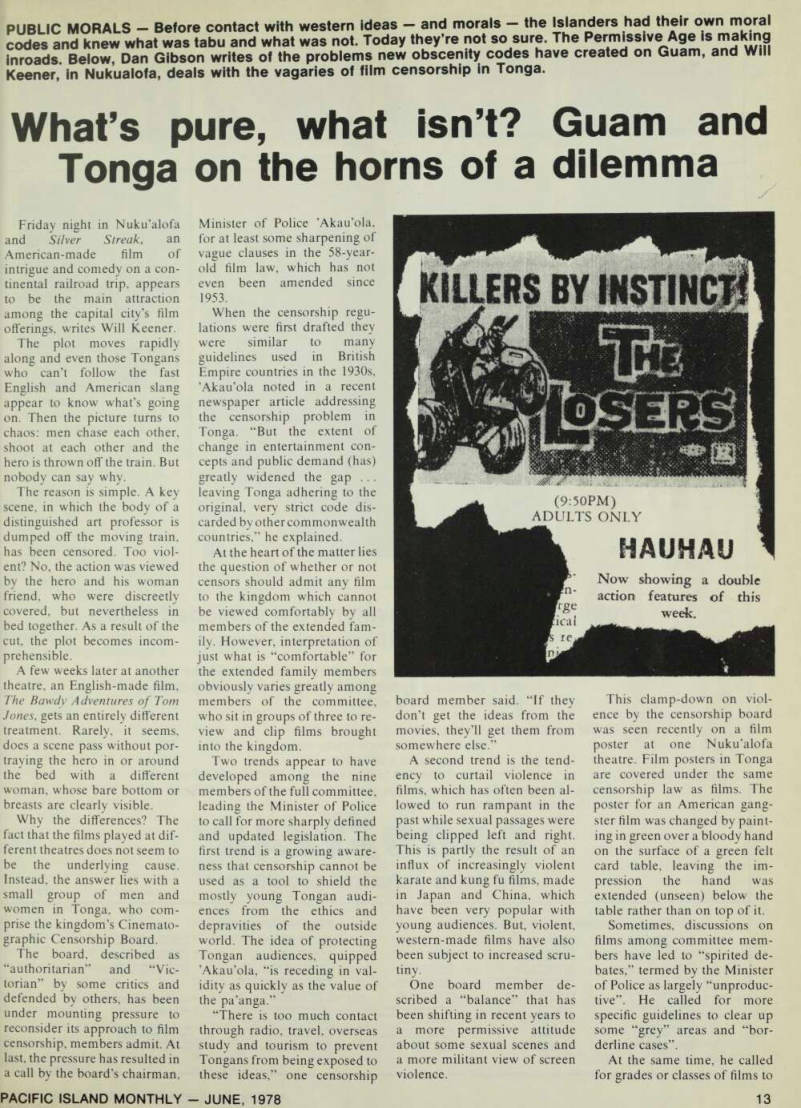
This clamp-down on viol ence by the censorship board was seen recently on a film poster at one Nuku’alofa theatre. Film posters in Tonga are covered under the same censorship law as films. The poster for an American gang
ster film was changed by paint
ing in green over a bloody hand on the surface of a green felt card table, leaving the im pression the hand was extended (unseen) below the table rather than on top of it.
Sometimes, discussions on films among committee mem bers have led to “spirited de bates,” termed by the Minister of Police as largely “unproduc tive”. He called for more specific guidelines to clear up some “grey” areas and “bor derline cases”.
At the same time, he called for grades or classes of films to
be introduced, including those suitable for general exhibition and others restricted to “adults only”. At first, highly-restricted films might only be shown by theatres in Nuku’alofa or Neiafu, the main city in the Vava’u group, he suggested.
Since films are often taken from village to village on the smaller islands along with projectors and electric gener ators, the need for family-type films remains real. At the same time, tastes in the area of the capital city can differ widely, ’Akau’ola recognised.
Describing a “vociferous minority, who become more insistent day by day,” the Minister of Police urged other members of the Tongan com munity to register their opinions on any future policy changes. Included in this min ority, he said, are expatriates in Tonga, Tongans exposed to overseas entertainment and widely-read residents of Nuku’alofa and Neiafu.
It is obvious, however, that this is not the main group being affected by foreign films in the kingdom. Theatre owners de scribe a young, 15-30 year-old audience, interested in fast paced, highly-visual films.
What they carry away from the film affects superficial changes in styles and clothing, while also causing some shifts in deeper cultural patterns of the kingdom, some observers be lieve.
Films affect Tongans in a variety of ways ranging from their attitudes about traditional architecture to their opinions about the family structure and other long-standing social tra ditions. And just what kinds of films are doing these things?
The answer is films that are often rejected by other audi ences as failures. Theatre owners in the kingdom deal with Australian and New Zealand distributors, who send films aimed at meeting local demands of both the audience and the censors. Explains ’Akau’ola: “The end result is a
series of low-priced, insipient,
flaccid and outrageous tech nical flops screened in the kingdom under the guise of entertainment.”
Will new censorship rules change any of this? “They can only help,” one member of the
board suggested.
Advertisements & other items, pp. 13-14 (3 items)
13
PACIFIC ISLAND MONTHLY - JUNE, 1978
14
PACIFIC ISLAND MONTHLY - JUNE, 1978
Good/Year
till r
CONVEYOR BELTS
DOCK FENDERS
PILLOW TANKS
HOSE
POSITIVE DRIVE BELTS
DONAGE BAGS
INDUSTRIAL V-BELTS
Problem: Remove the water from a flooded field
to save a 4-million dollar crop.
SOLUTION: 150 giant Goodyear V-belts worked around the clock on a pumping system that removed over half-a-million
gallons of water a minute.
Other problems like: how to remove a river bottom; how to dig a trench under water;
how to move a desert; or
how to handle tons of red-hot sinters in a steel mill, etc.
Goodyear’s special heavy-duty hoses and belts can solve these problems effi-
ciently, economically and lastingly.
GOOD/yEAR
We solve industrial problems.
GOODYEAR DISTRIBUTORS IN S.E. ASIA AND PACIFIC BASIN
GOODYEAR SUBSIDIARIES
Richard Plans A Co., Ltd.
Colombo, Sn Lanka Nopal Motor Company (P) Ltd.
Biratnagar. Nepal Navana Ltd.
Dacca. Bangladesh Dlefholm & Co., Ltd.
Bangkok. Thailand Landla Brothers A Co., Ltd.
Hong Kong Guam Tire A Supply Co.
Agana, Guam Suaupe Enterprises Saipan. Manana Is.
Mlcrol Corporation Saipan. Manana Is.
Truk Trading Co.
Truk E.. Caroline Is.
P.A.M.I.
Kolonia. Ponape Island Transport Service Co.
Majuro. Marshall Is Yap Cooperative Asa.
Yap, W. Caroline Is.
Cook Islands Motor Centre Ltd.
Rarotonga, Cook Is Ngiratkel Etplson Co., Ltd.
Koror. Palau Boroko Motors Ltd.
Port Moresby, Papua New Guinea Solomon Motors Ltd.
Honiara, Solomon Is.
Santo Engineers Santo, New Hebrtdes Pacific Motors Vila, New Hebrtdes
S.G.A
Noumea New Caledonia Ouncombe Bay Garage Norfolk Is.
Coral Island Motors Suva, Fiji Mortis Hedstrom Ltd.
Nukualofa, Tonga Morris Hedstrom Ltd.
Apia, Western Samoa Western Samoa T ran sport Cooperative Society Ltd.
Apia Western Samoa Samoa Motors Inc.
Pago Pago. Amertcan Samoa Service Mobil Papeete, Tahiti The Goodyear Tyre A Rubber Co (Aust) Ltd.
Sydney, AUSTRALIA Tel: 31 -0311 Goodyear India Limited New Delhi 1. INDIA Tel: 46886/9 PT Goodyear Indonesia Bogor, Republic of Indonesia Tel: 3371/2 Nippon Goodyear Kabushlkl Kalsha Tokyo. JAPAN Tel: 582-0481/8 Goodyear Malaysia Berhad Selangor, MALAYSIA Tel: 362501/5 The Goodyear Tyre A Rubber Co. of New Zealand. Limited Lower Hutt, NEW ZEALAND Tel: 684-389 The Goodyear Tyre A Rubber Company of the Philippines, Limited Makati-Metro Manila.
Republic of the Philippines Tel: 89-20-41 Goodyear Singapore Pvt Limited Geylang SINGAPORE 14 Tel: 408281/3 Goodyear Taiwan Limited Taipei, TAIWAN Tel: 5117135/8 Goodyear (Thailand) Limited Bangkok, THAILAND Tel: 252-6141/5
FOR FURTHER INFORMATION,
PLEASE CONTACT
Goodyear International Corporation Room 1603, Wing On Center. 1 1 1 Connaught Road Central
HONG KONG Tel: 5-433331
HRMEI7I-0203
A Veil Is Drawn Over Guam’S
‘Skin-Flicks’ And Girlie Books
Three months after new ob scenity codes have taken effect, Guam businesses engaging in “adult entertainment” remain in legal confusion, Dan Gibson writes from Agana.
A new set of criminal codes took effect here on January 1, replacing codes enacted as early as 1953 based on Califor nia codes from 1923.
The effect of the revision was to liberalise laws governing many activities. But it also attempts to bring Guam ob scenity law into line with recent
rulings by the US Supreme
Court.
Obscenity, according to the
new codes, is “any act, per formance or material which, when applying contemporary
community standards, appeals
primarily to prurient interests,
goes beyond customary limits of candour, or is utterly with
out redeeming social import
ance.”
Such guidelines are very broad generalities. Whether specific acts or materials are to
be adjudged obscene depends
upon many factors. First, it will depend upon the whims of police officers not armed with specific guidelines who are to make the arrests. Then it de pends upon the prosecutors.
Finally it depends upon the tastes and values of individual jurors who must vote for con viction.
And, in multi-cultural
Guam, finding an acceptable
definition for “community” may be difficult, yet alone determining a set of acts and materials offensive to it.
The uncertainty has chilled many activities. Fewer X-rated films are shown, a number of major national men’s maga zines are no longer available, and many nightclubs have had to dilute their stage perform ances.
The law, thus far, has caused the major businesses to shy away from obscenity issues.
The owners have said the small amount of income involved isn’t worth the potential for bad publicity and legal woes that could result.
Meanwhile, the small businessmen who make their living in adult bookstores and
nightclubs have proved more
willing to challenge the law.
The new code has thrust ob scenity issues upon three gen eral kinds of business
enterprise.
The Agana Theater, the only unit in a chain of theatres that showed X-rated films, no longer shows them.
“We aren’t qualified to be censors and we don’t think the police are,” said Leo Slotnick of Universal Pacific Theaters.
“Right now, we don’t know what we can show in any of our theatres.”
The theatre chain is tied to wealthy businessman Paul Calvo, a candidate for the Re
publican Party gubernatorial
ticket later this year.
“Frankly, they can censor us
by saying they might raid us,”
Slotnick said.
The theatre closed tem porarily when the law first took effect, then reopened with gen eral films. In late January, it announced that In The Realm Of The Senses, a blockbuster X-rated film would start that week. As of late March, it had not been shown.
The Johnston Theater, the
only indpendent theatre on
Guam, has continued to show X-rated films. It has not been raided.
The effect in this sector of business has been bizarre.
While reputable national magazines have been frozen from the market, the more explicit adult bookstores have gone unchecked.
Immediately after the new codes took effect, J&G Dis tributors, part of the largest local corporation, announced it would no longer sell or dis tribute such nationally-known
(and internationally-known)
magazines as Playboy and
Penthouse. Several other titles also were discontinued.
At present, the only places those magazines are available are in military exchanges and in transient shops for tourists.
“These magazines are
national magazines; they’re
not smut,” said one business man who now intends to assume distribution for the
magazines.
None of the adult bookstores has been raided. But on March 13, police confiscated 36 maga zines and 10 films from a music shop sidelining in adult read ing. The owner was issued a criminal citation for trafficking
obscenity.
Police officers issued formal notices to massage parlours
and nightclubs, warning that
the new codes would be en forced. But the notice did not specifically define what would constitute violation of the law.
“We’re making the assump tion that they are legitimate businessmen and we’re giving them the chance to clean their acts up,” said one police official.
So far one conviction has resulted from eight arrests
involving nightclub dancers
and owners. Lady Scorpio,
whose legal name is Mary Gary, was found guilty on March 20 on obscenity charges.
Police arrested her on February 2 for inserting a
lighted cigarette into her geni
tal area on stage.
She was fined $3OO. She faced maximum penalties of a $1 000 fine and a year imprison ment. The jury reached its ver dict in about 90 minutes. The conviction was the first to result from the new obscenity codes.
Some bar owners have said they are losing as much as 70% of their business because of the new codes. Without the wilder forms of entertainment, the customers find it cheaper and just as entertaining to stay closer to home, the owners con
tend. Massage parlours and
bookstores have also reported substantial drops in income.
While the uncertainty con tinues, Guam Acting Attorney- General Phil Jacobsen has agreed that some people have over-reacted to the new codes which, he said, are actually less stringent than the former law.
Advertisements & other items, pp. 15-16 (3 items)
15
>ACIFIC ISLAND MONTHLY - JUNE, 1978
16
PACIFIC ISLAND MONTHLY - JUNE, 1978
Welcome aboard the Philippines.
11 9 ■ . N. \ i-r X 9& r ‘ W M- '* t.;>£ iyr
Discover the grace of old Spain
in the Philippines.
Sense it first
on Philippine Airlines.
The subtle blend of Spain and Asia is in delightful harmony with the 20th century.
Four centuries of Spanish culture lends a very special beauty to The Philippines.
Like the special smile found only on Philippine Airlines.
Where our flight attendants’ hospitality is a 1,000 year-old Philippine tradition. our heritage, On Philippine Airlines’ wide-bodied jets, you’ll get centuries-old charm, the latest movies, the tastiest international menus.
Flights depart for Manila each Friday from Port Moresby. Also three times each 0 week from Sydney; Monday, Thursday or Friday, or twice each week from Melbourne; Monday or Friday.
So when you’re flying to Europe or the Orient, fly to The Philippines first.
Welcome aboard the Philippines.
Task Force To Stem Guam’S
Rising Tide Of Heroin
Concerned about the mer curial rise in heroin addiction and its attendant rise in crime, the Guam Government has persuaded the US Federal Government to attempt a crackdown, writes Dan Gib son.
A federal drug strike force,
patterned after those operating
on the US mainland, was to be operating on Guam in April, US Drug Enforcement Admin istration boss Peter Bensinger said here.
The federal assistance was
requested by Guam Governor
Ricky Bordallo. Bensinger an
nounced the strike force plans at the International Drug En forcement Alumni annual Asia conference, attended by rep resentatives of 12 nations here on March 6-9. It was the first time the conference had ever been held on US soil.
The formation of the strike force followed release of sev eral drug-related statistics, de
scribed as “staggering” by
Guam officials: • There has been an esti mated 200% increase in heroin addiction on Guam from 1975-1977; • An estimated 86% increase in property crimes from 1970-1976. The crimes are be lieved to be predominantly
drug-related;
• An estimated 404% in crease in robberies from 1970-1975. Those crimes are also believed to be primarily the work of addicts needing large sums of money to support
their daily drug habits.
• Drug-abuse officials now estimate a total addict popu lation of 600-800 for the island, of which 77% are male and 73% are 18-25 years old. • An estimated 39% of the addicts spend $5O-$99 daily to support their habits. Another 37% spend even more than that daily some as much as $3OO or more.
“Let’s blow our minds on the reality (that) ... as of December 1977, Guam re corded 19 heroin-related deaths,” Governor Bordallo said at a four-day local drug
abuse conference that drew as many as 500 participants to some sessions.
After that conference, Bor dallo established a cabinet level State Agency for Mental Health and Substance Abuse, required by the federal govern ment as a conduit for federal funds.
And Legislature Speaker Joe
Ada announced intentions to
introduce legislation creating a
“Turn In A Pusher Pro gramme,” in which residents would receive rewards for
revealing the identity of drug
sellers.
An addiction-rehabilitation
programme, using the drug
methadone, has seen a steady rise in clientele, from 50 in 1975 to 152 in 1977. But metha done itself is highly addictive.
Many Guam health officials believe a large segment of the heroin addicts are using methadone as a supplement to, rather than a substitute for, heroin. And a full third of the
urinalysis tests performed on
Methadone clients are “dirty” with traces of heroin.
Guam Police Major Robert Cutts said Guam ranks fifth in the entire United States in per
capita drug abuse, behind only
San Francisco, New York, and Washington (DC) and Los Angeles, which are tied for third.
The increase in addiction and heroin sales is believed re sponsible for an increase in vi olent crimes, as well. There has been a spate of gangland-style executions believed to be drug related.
While fighting the rising tide of heroin on Guam, the federal task force may simultaneously be easing heroin problems on the US mainland.
Guam has been called a
major heroin trans-shipment
centre for South-east Asian heroin headed for junkies in other American cities. As much as US$2OO million worth of heroin goes through Guam an nually, officials have esti mated.
“Drugs are an international problem that cross borders,
jurisdictions, geographical territories and datelines,” US drug chief Bensinger said. “We believe the (strike-force) anproach, which has been patr , . r , terned after 19 others in the US, will have an impact.
And Guam’s role as a nexus for drugs “could become more
important if additional efforts and resources were not brought to bear,” he said.
The international seminar was attended by represen tatives from the United States, Australia, Thailand, Japan,
Indonesia, Hong Kong, Egypt,
Chile, France, Malaysia, South Korea and the Philippines.
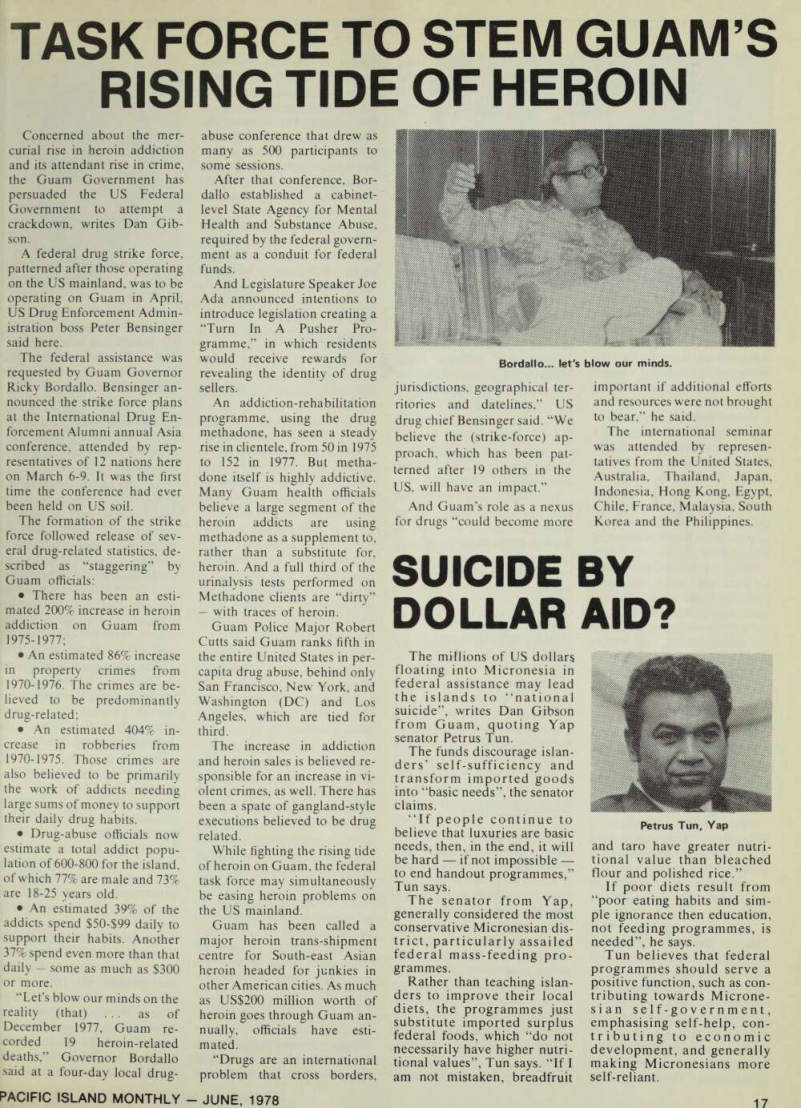
Bordallo... let's blow our minds.
Suicide By
Dollar Aid?
The millions of US dollars floating into Micronesia in federal assistance may lead the islands to “national suicide”, writes Dan Gibson from Guam, quoting Yap senator Petrus Tun.
The funds discourage islan ders’ self-sufficiency and transform imported goods into “basic needs”, the senator claims.
“If people continue to believe that luxuries are basic needs, then, in the end, it will be hard if not impossible to end handout programmes,”
Tun says.
The senator from Yap, generally considered the most conservative Micronesian dis trict, particularly assailed federal mass-feeding pro grammes.
Rather than teaching islan ders to improve their local diets, the programmes just substitute imported surplus federal foods, which “do not necessarily have higher nutri tional values”, Tun says. “If I am not mistaken, breadfruit
and taro have greater nutri tional value than bleached flour and polished rice.”
If poor diets result from “poor eating habits and sim ple ignorance then education, not feeding programmes, is needed”, he says.
Tun believes that federal programmes should serve a positive function, such as con tributing towards Microne sian self-government, emphasising self-help, con tributing to economic development, and generally making Micronesians more self-reliant.
Petrus Tun,Yap
Advertisements & other items, p. 17 (1 item)
17
PACIFIC ISLAND MONTHLY - JUNE. 1978
Political
Currents
Solomons:
West Rumbles
As the Solomons’ indepen dence day looms on July 7, re newed calls are being heard for independent, or semi independent, status for the Western Solomons, writes Peter L. Young from Honiara.
Following earlier murmur ings of discontent from some Western members of the Legis lative Assembly, it had been widely assumed that those re sponsible had had second
thoughts after discovering that
their autonomist ideas were not as popular at home as they had believed.
But the Western Local Council, the local government body for these islands, has re vived the whole issue by voic ing support for some measure of independence for their area.
The council’s move was soon backed by a walkout by five Western members of the Legis lative Assembly. The members said in a prepared statement that they wished to see the details of the country’s pro
posed provincial government
set-up clearly worked out be
fore independence.
Their demand reflects a widespread confusion in the Solomons as to what provincial government actually means a confusion the Kenilorea government has done little to clear up.
According to Deputy Chief
Minister Benedict Kinika, the new provincial governments will be very much the present local governments under a new name, and with a few ad ditional powers. The area com mittees which function at present under the local govern ments will be renamed as local governments. This will give the
Solomons a three-tiered governmental set-up: central
government, provincial
governments and local govern ments.
It seems that in introducing what seems to amount to little more than a change of name the Kenilorea government may
have caused regional political
expectations to rise far more than was intended, or than is
justified.
It is notable that Mr Kenilorea, so far at least, appears not to be giving the Western issue top political pri ority. He is dealing with the Western Council through the normal channels, specifically,
through Mr Francis Hilly,
Minister for Home Affairs. Mr Hilly himself represents a Western electorate.
The West Solomons is the most commercialised part of the country, with both large
copra plantations and large
scale logging operations.
Partly as a result of this, it also has the greatest area of alienated land of any part of the Solomons. Melanesian atti tudes towards land alienation
being traditionally strong, this
issue continues to be a sensitive one.
There is the further compli cation that it is the area of the controversial settlement by the former British administration of Micronesians from the Gil bert and Phoenix Islands dur ing the 19505. Whether any of the mutual antipathy felt be tween some Micronesians and some Melanesians in the West is widely based is not clear. But the tip of a possible iceberg of
racial disharmony has certainly
been sighted more than once.
Westerners are also upset that despite the fact that theirs is the most commercially pro ductive area, they have not
been receiving the develop
ment funds they feel they need.
They complain that although
they bear a greater share of the tax burden, their taxes are going to develop other areas. (A recent government survey showed that the average West ern Solomon Islander in em ployment earned close to twice as much as the national aver
age.)
The dispute has led to hasty
rounds of meetings between the government, the Western Council executive and the boy cotting Western members of
the Legislative Assembly.
There have been threats that the Western Council would boycott the independence cel ebrations, and that it might even make a unilateral declar ation of independence.
It is clear that no matter what immediate measures are taken, the basis for Western dis sidence will continue long after
independence.
New Png
Opposition
Papua New Guinea had a new Opposition when the National Parliament resumed on May 23.
The Opposition the Peoples United Front has de fined its responsibilities as “to oppose, to expose and to de pose,” and announced immediate planning for an alternative national develop
ment policy.
But there is already some questioning of how well the controversial new Opposition leader, Mr lambakey Okuk, will be able to maintain unity and control in what is a very mixed political group.
There is speculation, too, on the extent to which the
obviously aggressive attitude
being planned by the Oppo
sition could influence govern
ment policies.
Mr Okuk, 35, a former motor mechanic, comes from the Chimbu area of the PNG Highlands and has been an MP since 1972. He has ousted Sir Tei Abal from the leadership.
The nucleus of the new Op position is drawn from former United Party members, from Mr Okuk’s own United Front, from the Papua Besena group and from an assorted collection
of independents. The previous
political attitudes of some of these members were often poles apart, and this has con tributed to speculation that Mr Okuk may strike trouble hold
ing the group together.
Personally and politically, he
is one of the most controversial figures in parliament. He was
a former minister in the Somare Government first for agriculture and later for trans port but he was dropped from cabinet after falling out with the leadership.
This drove him by fairly gradual stages into hard oppo sition, culminating in his suc cessful bid for leadership of a new look opposition.
Another controversial figure in the new Opposition is Sir John Guise, once a govern ment minister and who later re signed as Governor-General to re-enter politics. Mr Okuk and Sir John both tend to be at odds with Prime Minister Somare, in contrast to the friendship-in opposition which marked re lations between Mr Somare and Sir Tei Abal.
The complexity of the group is heightened by the inclusion
of Miss Josephine Abaijah’s
Papua Besena, a group inherently out of step with
highland-inspired politics.
Mr Okuk believes he will produce “the first effective Op position this country has known”. His supporters said this soon after his appointment was confirmed.
They said he was concerned
that the previous opposition
had bowed too often to govern ment policies and had been ineffective in its watchdog role.
Sir Tei Abal has described as
“outrageous” his displacement
from leadership. He claimed the speaker, Mr Dibela, has; made a serious error in recog nising Mr Okuk as the new Leader of the Opposition.
Sir Tei said he would test the matter in parliament. He would also demonstrate the
Mr. Okuk
support available from mem bers which he believed entitled him to retain leadership of the
opposition.
Norfolk Talks
Gunpowder
There is more than a whiff of gunpowder to a statement forwarded in April to the Nor folk Island Council by the So ciety of the Descendants of the Pitcairn Settlers.
The statement is peppered with phrases like “campaign of resistance”, “any confrontation that may be necessary”, and “all means at members’ dis
posal”.
In one of the latest moves in the campaign against the per ceived threat of an Australian take-over of Norfolk, the so
ciety declared:
“Following the visit of the Minister for Home Affairs, Mr R. J. Ellicott, QC, MP, mem bers of the Society of the De scendants of the Pitcairn Settlers wish to make known to Council their reactions to state ments made by the Minister with regard to the future of Norfolk Island.
“Firstly, we object strongly
to the refusal of the Minister to
acknowledge:
1) That the Pitcairn people are an ethnically distinct race of people. 2) That the Norfolk Island
community is historically and
politically distinct from the Australian mainland com
munity.
“Secondly we note with con siderable alarm the apparent intention of the Minister to rec ommend the integration of Norfolk Island into Australia without the prior consent and endorsement of the people of Norfolk Island.
“Our society has resolved to resist any such action by all the means at the members’ dis posal. We intend to call upon the Norfolk Island community to begin immediate prep aration for any confrontation that may be necessary with the Australian authorities.”
For his part, Mr Ellicott has
expressed his “surprise” and
“disappointment” at a report he had received of an April 5
resolution of the Norfolk Island Council.
The resolution had noted “a sharp increase in community anxiety that Norfolk Island will be denied a fair role in deter mining its future”, “a strong apprehension that our his torical and political rights are about to be brushed aside”, and “a deep and widespread determination in the com munity to resist to the full the implementation of any Aus tralian government decisions about the Island’s future incon sistent with the solemn declar ation and lacking the community’s prior formal con sent”. (The “solemn declar ation” referred to was made in May 1977. In it a claimed 67% of Norfolk electors declared for a “distinct and separate” status for the island in relation to Australia.) Mr Ellicott claimed the res olution and debate on it “mis
interpreted” and “misrepre
sented” his comments during his March visit. He promised to make an early return visit to the island “to announce the government’s views”.
True to his promise, Mr Ellicott returned to the island on May 9 and announced that the government had de cided to give Norfolk limited self-government. The island would also be excluded from Australian taxation and social service and there would be no income tax, sales tax and cus toms duties.
Some hailed this as a de cision to allow the island to continue as a tax haven but, so far as overseas companies not
genuinely operating from the
island are concerned, they are barred, in accordance with the government’s decision some time ago to close down the tax haven.
The island will be governed
by a locally-elected legislative
assembly and the federal government will pay for main tenance of the Administrator and his staff.
Mr Ellicott said the govern
ment recognised the special
situation at Norfolk, including the special relationship of the Pitcairn Island descendants to the island, its traditions and
culture. The government was prepared, over a period, to move towards a substantial measure of self-government for the island though it would remain part of Australia. That, however, did not require Nor folk to be regulated by the same laws as regulate other parts of Australia.
So it looks as if Norfolk folk can breathe again almost.
A Cooks-Nz
Showdown?
It is not the officially con firmed Cook Islands Party ma jority of 15-7 in the House of
Assembly (PIM, May, p 6) that
is challenged by the bitterly
disappointed Democratic
Party, but the methods used to obtain it, writes a PIM cor
respondent on Rarotonga.
Before the March 30 election the CIP held 14 seats and the
DP eight.
DP supporters in Rarotonga are savage about the election results, claiming that if Premier Sir Albert Henry’s CIP had not brought in six planeloads of CIP supporters from New Zealand the Democrats would have won.
The DP itself flew in two planeloads of their people who had to pay their fares in full, while the CIP passengers paid only a nominal $2O each, the balance being met by the CIP from as yet unknown financial sources.
On April 1, a Saturday and
a busy shopping day in Raro
tonga, DP supporters staged a 350-vehicle motorcade that travelled from the Arorangi
district to Avarua in a show of force. They tried to show Sir Albert and his CIP supporters that the CIP was not a popular government.
According to the DP weekly news-sheet, Weekender, this demonstration was “probably the largest demonstration of support for any political party in the history of the Cook Islands.”
Weekender added: “Be cause the Democratic Party has to raise its funds with honesty and pride, it has been denied its rightful place in govern ment.
“Because the CIP can run to its rich American friend. Fin bar Kenny (the financial power behind the Cooks philatelic op erations Ed) it can fly its free voters around the Pacific at its
pleasure.”
Taking up the story from the New Zealand end, William Gasson writes from Welling ton: In the wake of the Cook Islands poll, ripples of contro versy are spreading like tsunamis between the shores of the Cooks and New Zealand.
At the heart of the contro versy is the question: where did the estimated $3OO 000 spent on Sir Albert Henry’s special voter flights come from, out of the Cooks’ population of 20 000?
Prime Minister Muldoon is concerned that the money might have come from the $6 million his country gives each year in various forms of aid.
About $3 million is given in di rect grant form to help the Islanders balance their budget.
The remainder is in the form of technical types of assist ance.
An anti-Henry demonstration
The New Zealand Cabinet has already made a close exam ination of the 1973 exchange of papers between the late Prime Minister Norman Kirk and Sir
Albert outlining the principles
of the relationship of free as sociation between the Cooks and New Zealand.
A key element in the docu ments is Sir Albert’s undertak ing that the Cooks would “uphold in their laws and poli cies a standard of values gener
ally acceptable to New
Zealanders.” It was in some part in return for this undertak ing that Cook Islanders were granted New Zealand citizen
ship.
Mr Muldoon has said he was sure there were people who would argue that the 1973 undertaking had been breached by the action involv
ing the special voters’ flights.
He said this matter would be
given formal consideration by
Cabinet.
On the question of the
financial inquiry being con
ducted in the Cook Islands by New Zealand’s Auditor- General, Mr Muldoon said: “I intend to go ahead with this inquiry, and as far as Sir Albert is concerned he knows the position. It has been put to
him by MrTalboys, the Deputy
Prime Minister, that if he has
any complaint against New
Zealand there is an open invi tation for him to declare the
Cook Islands totally indepen
dent.
“He keeps making inflam
matory statements. The sol ution is for him to declare the
Cook Islands totally indepen
dent and we would put that in train the next day.”
Sir Albert responded with another “inflammatory state ment”. Said he, in a television interview in New Zealand; “I am sick and tired of it. I am not a colonial bum.
“If he (Mr Muldoon) wants to keep his $3 million, let him keep it. I can get $3 million from somebody else.”
He said Mr Muldoon would not be allowed to investigate anything in the Cook Islands other than New Zealand
money, adding emphatically:
“He won’t be allowed to inves tigate the Philatelic Bureau.”
Mara Warns
Of Bloodshed
Better racial relations could be achieved in Fiji if there was a frank and honest revelation of the fears held by various racial groups, Prime Minister Ratu Sir Kamisese Mara said
when revealing a four-point
plan to foster multi-racialism.
Although nowhere in the world had a blueprint for a solution to racial problems been found, there had been some suc cesses.
Ratu Sir Kamisese said he
believed that given develop
ments such as outlined in his plan, everyone could look for ward to a better Fiji for all. The four points were: • A completely frank and honest revelation of the fears of each racial group, and tolerant
listening by all parties;
• Better distribution of the use of resources and wealth; • Increased opportunities in agricultural and industrial investment leading to job cre ation and worldwide markets; • A genuine readiness to give and take by all races in promot
ing racial harmony through
their leaders in politics and re
ligion.
Ratu Sir Kamisese avoided any reference to an earlier statement he made in parlia ment that “blood will flow,” when speaking during a debate on a motion to give financial help of more than $1 million to the Native Land Trust Board.
He was reflecting the feelings
of the Fijian people who regard
their land as their most
precious asset. (Fijians own
about 83% of the land in Fiji, much of it mountainous and of little use. Much of the best agricultural land has been alienated.) In that speech Ratu Sir Kamisese raised points about Fijian land, which had been the subject of public debate for many years.
Ratu Sir Kamisese asked: “Why do Fijians feel so emotional when the question of their land is discussed in this House?”
Answering it himself, he said that the Fijians had given everything away at Cession in 1874 when they gave all their
land to Queen Victoria. They expected nothing more than to be subjects of the Queen, and she had every right to do what she wanted with the land. But she gave it all back.
“If people, citizens of this nation, do not understand the deep emotional feeling of the Fijians, they should know now because if they tread on it and hurt it blood will flow in this country,” he said.
“Whether it’s Fijian blood, Indian blood, Chinese blood or anyone’s blood it’s wrong it shouldn’t happen,” he said.
The Prime Minister’s re marks drew fire from several quarters. He defended himself later at a news conference, say ing it was his duty to warn of the danger of bloodshed in Fiji over the land issue.
Ratu Sir Kamisese could possibly have chosen other words. But he was only saying what many Fijians have been
saying privately and. indirectly,
in public, for years about land.
An Opening
In Hebrides?
New internal and inter national developments have
brought significant changes to
the New Hebrides’ long
simmering political crisis.
Most important, meetings in
early April between the
government of Chief Minister George Kalsakau and the
Vanuaaku Party leadership
resulted in a series of agree ments which could lead to new elections and settlement of the unresolved question of which
parties have majority political
support in the country.
It was agreed at the talks that there should be an electoral
registration process lasting 10
to 15 months. (Some elements within the Kalsakau ministry believe that the present govern ment should run its three-year course, and should only go to the polls after a full demo graphic census, which would take at least three years).
It was also announced that the Vanuaaku Party had agreed to join an ad hoc com mittee on electoral reform, and would consider joining the Kalsakau ministry.
Png: Again
That Border
Papua New Guinea has threatened to burn down anti- Indonesian rebel camps which it concedes are established inside its borders, writes Gus Smales from Port Moresby.
But it has given the rebels time to shift out first pro vided they move in a hurry.
The ultimatum was delivered at secret talks in Port Moresby in April with two rebel leaders who were specially flown from the border airport at Vanimo. The men were Jacob Prai, who calls him self president of “the new de facto government of West Papua”, and Seth Rumkorem,
self-styled brigadier-general,
once known as president of “the provisional government of
West Papua”.
Whatever may be the rights or wrongs of the rebel cause, it is small wonder that PNG, anxious to keep happy re lations with Indonesia, has found itself in continual bother. On the home front there is the emotionalism bred by a real sympathy for the rebel cause, by a degree of family re lationships along the border, and by a grassroots distrust of
Indonesian strength.
To top it all off, PNG is con
sistently subject to the
pinpricks of Indonesian diplo
macy if something happens along the border for which Indonesia expects an expla nation.
There are two recent examples of this. One was a formal request from Indonesia that seven PNG residents named as ministers of the rebel government of Jacob Prai should publicly declare the direction of their loyalties.
The Indonesian requests were dealt with by PNG’s Foreign Minister, Mr Ebia Olewale, in early May.
Of the West Irianese “minis ters,” he said that they had
already affirmed their loyalties
to PNG when they were first permitted to live in the country.
He did not believe they should have to reaffirm their pos itions.
Advertisements & other items, pp. 18-20 (3 items)
18
PACIFIC ISLAND MONTHLY JUNE, 19783
19
POLITICAL CURRENTS
3 ACIFIC ISLAND MONTHLY - JUNE, 1978
Political Currents
Islands
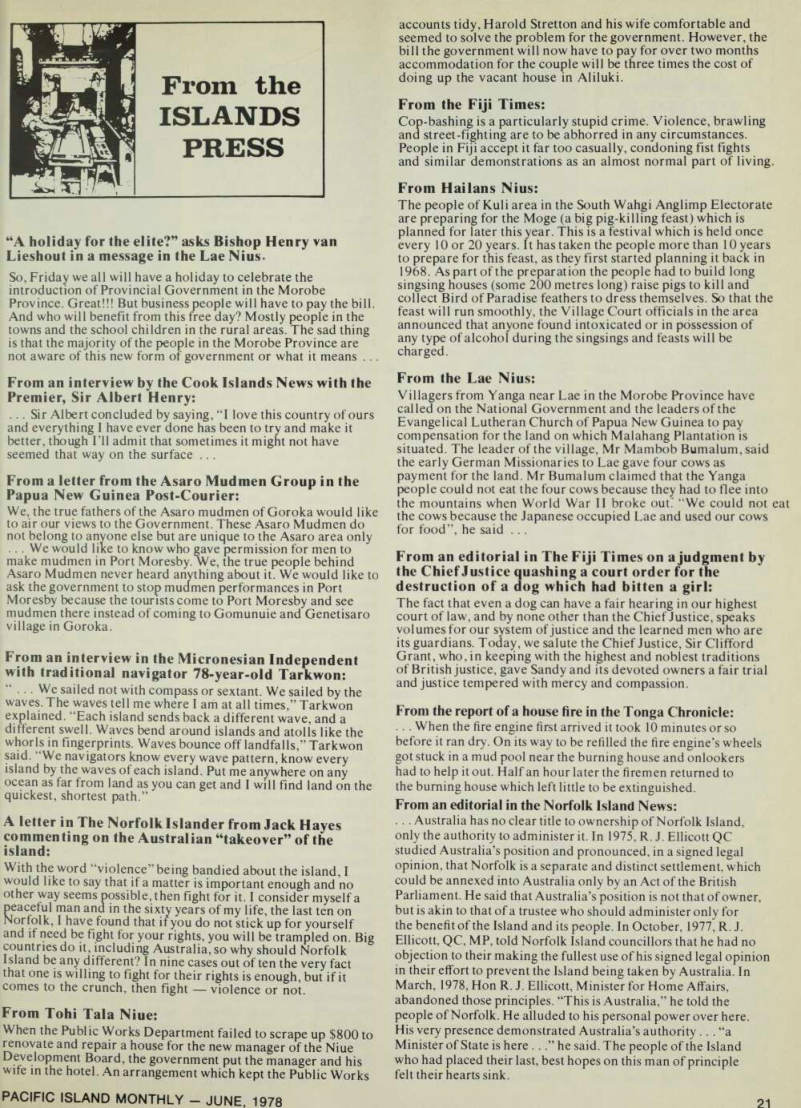
From the
Press
“A holiday for the elite?” asks Bishop Henry van Lieshout in a message in the Lae Nius.
So, Friday we all will have a holiday to celebrate the introduction of Provincial Government in the Morobe Province. Great!!! But business people will have to pay the bill.
And who will benefit from this free day? Mostly people in the towns and the school children in the rural areas. The sad thing is that the majority of the people in the Morobe Province are not aware of this new form of government or what it means ...
From an interview by the Cook Islands News with the
Premier, Sir Albert Henry:
... Sir Albert concluded by saying, “I love this country of ours and everything I have ever done has been to try and make it better, though I’ll admit that sometimes it might not have seemed that way on the surface ...
From a letter from the Asaro Mudmen Group in the Papua New Guinea Post-Courier: We, the true fathers of the Asaro mudmen of Goroka would like to air our views to the Government. These Asaro Mudmen do not belong to anyone else but are unique to the Asaro area only .. . We would like to know who gave permission for men to make mudmen in Port Moresby. We, the true people behind Asaro Mudmen never heard anything about it. We would like to ask the government to stop mudmen performances in Port Moresby because the tourists come to Port Moresby and see mudmen there instead of coming to Gomunuie and Genetisaro village in Goroka.
From an interview in the Micronesian Independent with traditional navigator 78-year-old Tarkwon: “ ... We sailed not with compass or sextant. We sailed by the waves. The waves tell me where I am at all times,” Tarkwon explained. “Each island sends back a different wave, and a different swell. Waves bend around islands and atolls like the whorls in fingerprints. Waves bounce off landfalls,” Tarkwon said. “We navigators know every wave pattern, know every island by the waves of each island. Put me anywhere on any ocean as far from land as you can get and I will find land on the quickest, shortest path.”
A letter in The Norfolk Islander from Jack Hayes commenting on the Australian “takeover” of the island: With the word “violence” being bandied about the island, I would like to say that if a matter is important enough and no other way seems possible, then fight for it. I consider myself a peaceful man and in the sixty years of my life, the last ten on Norfolk, I have found that if you do not stick up for yourself and if need be fight for your rights, you will be trampled on. Big countries do it, including Australia, so why should Norfolk Island be any different? In nine cases out of ten the very fact that one is willing to fight for their rights is enough, but if it comes to the crunch, then fight violence or not.
From Tohi Tala Niue: When the Public Works Department failed to scrape up $BOO to renovate and repair a house for the new manager of the Niue Development Board, the government put the manager and his wife in the hotel. An arrangement which kept the Public Works
accounts tidy, Harold Stretton and his wife comfortable and seemed to solve the problem for the government. However, the bill the government will now have to pay for over two months accommodation for the couple will be three times the cost of doing up the vacant house in Aliluki.
From the Fiji Times: Cop-bashing is a particularly stupid crime. Violence, brawling and street-fighting are to be abhorred in any circumstances.
People in Fiji accept it far too casually, condoning fist fights and similar demonstrations as an almost normal part of living.
From Hailans Nius: The people of Kuli area in the South Wahgi Anglimp Electorate are preparing for the Moge (a big pig-killing feast) which is planned for later this year. This is a festival which is held once every 10 or 20 years. 11 has taken the people more than 10 years to prepare for this feast, as they first started planning it back in 1968. As part of the preparation the people had to build long singsing houses (some 200 metres long) raise pigs to kill and collect Bird of Paradise feathers to dress themselves. So that the feast will run smoothly, the Village Court officials in the area announced that anyone found intoxicated or in possession of any type of alcohol during the singsings and feasts will be
charged.
From the Lae Nius: Villagers from Yanga near Lae in the Morobe Province have called on the National Government and the leaders of the Evangelical Lutheran Church of Papua New Guinea to pay compensation for the land on which Malahang Plantation is situated. The leader of the village, Mr Mambob Bumalum, said the early German Missionaries to Lae gave four cows as payment for the land. Mr Bumalum claimed that the Yanga people could not eat the four cows because they had to flee into the mountains when World War II broke out' “We could not eat the cows because the Japanese occupied Lae and used our cows for food”, he said . ..
From an editorial in The Fiji Times on a judgment by the Chief Justice quashing a court order for the destruction of a dog which had bitten a girl: The fact that even a dog can have a fair hearing in our highest court of law, and by none other than the Chief Justice, speaks volumes for our system of justice and the learned men who are its guardians. Today, we salute the Chief Justice, Sir Clifford Grant, who, in keeping with the highest and noblest traditions of British justice, gave Sandy and its devoted owners a fair trial and justice tempered with mercy and compassion.
From the report of a house fire in the Tonga Chronicle: . . . When the fire engine first arrived it took 10 minutes or so before it ran dry. On its way to be refilled the fire engine’s wheels got stuck in a mud pool near the burning house and onlookers had to help it out. Half an hour later the firemen returned to the burning house which left little to be extinguished.
From an editorial in the Norfolk Island News: ... Australia has no clear title to ownership of Norfolk Island, only the authority to administer it. In 1975, R. J. Ellicott QC studied Australia’s position and pronounced, in a signed legal opinion, that Norfolk is a separate and distinct settlement, which could be annexed into Australia only by an Act of the British Parliament. He said that Australia’s position is not that of owner, but is akin to that of a trustee who should administer only for the benefit of the Island and its people. In October, 1977, R. J.
Ellicott, QC, MP, told Norfolk Island councillors that he had no objection to their making the fullest use of his signed legal opinion in their effort to prevent the Island being taken by Australia. In March, 1978, Hon R. J. Ellicott, Minister for Home Affairs, abandoned those principles. “This is Australia,” he told the people of Norfolk. He alluded to his personal power over here.
His very presence demonstrated Australia’s authority... “a Minister of State is here .. .” he said. The people of the Island who had placed their last, best hopes on this man of principle felt their hearts sink.
Advertisements & other items, p. 21 (1 item)
21
PACIFIC ISLAND MONTHLY JUNE, 1978
People
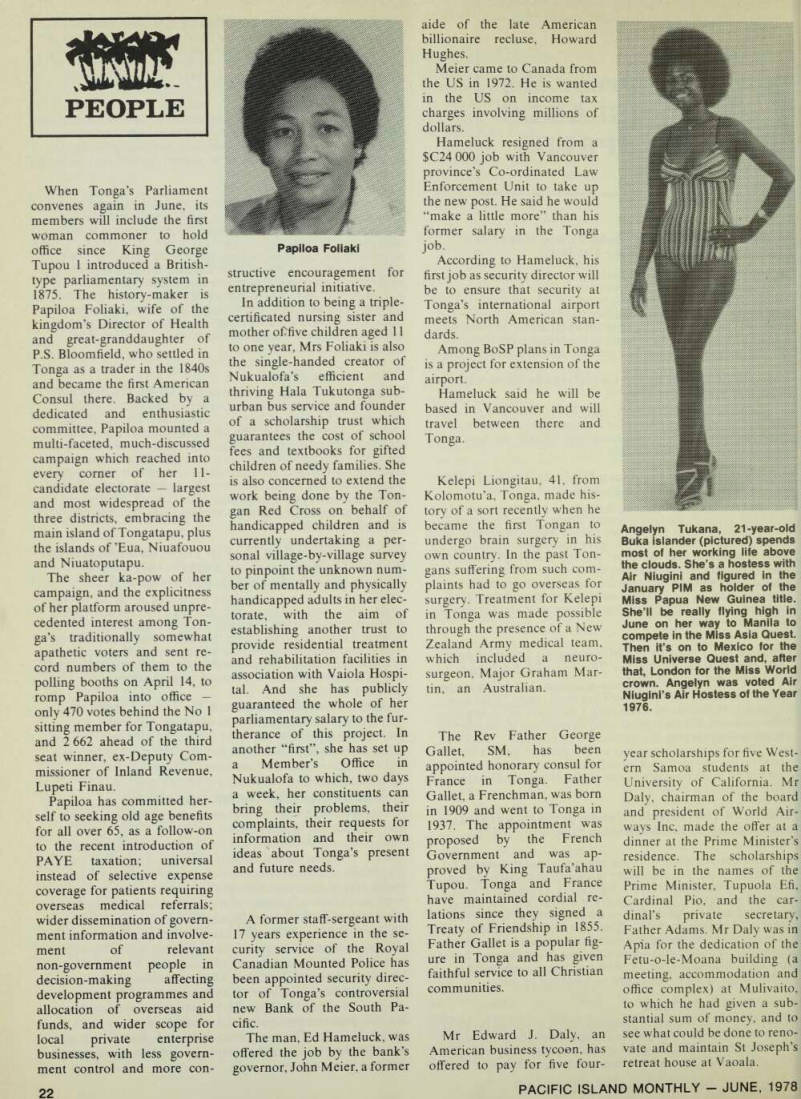
When Tonga’s Parliament convenes again in June, its members will include the first woman commoner to hold office since King George Tupou 1 introduced a British type parliamentary system in 1875. The history-maker is Papiloa Foliaki, wife of the kingdom’s Director of Health and great-granddaughter of P.S. Bloomfield, who settled in Tonga as a trader in the 1840 s and became the first American Consul there. Backed by a dedicated and enthusiastic committee, Papiloa mounted a multi-faceted, much-discussed campaign which reached into every comer of her 11candidate electorate largest and most widespread of the three districts, embracing the main island of Tongatapu, plus the islands of’Eua, Niuafouou
and Niuatoputapu.
The sheer ka-pow of her
campaign, and the explicitness
of her platform aroused unpre cedented interest among Ton
ga’s traditionally somewhat
apathetic voters and sent re cord numbers of them to the polling booths on April 14, to romp Papiloa into office only 470 votes behind the No 1 sitting member for Tongatapu, and 2 662 ahead of the third seat winner, ex-Deputy Com missioner of Inland Revenue,
Lupeti Finau.
Papiloa has committed her self to seeking old age benefits for all over 65, as a follow-on to the recent introduction of PAYE taxation; universal instead of selective expense coverage for patients requiring overseas medical referrals; wider dissemination of govern ment information and involve ment of relevant non-govemment people in decision-making affecting development programmes and allocation of overseas aid funds, and wider scope for local private enterprise businesses, with less govern ment control and more con-
structive encouragement for
entrepreneurial initiative.
In addition to being a triple certificated nursing sister and mother oTfive children aged 11 to one year, Mrs Foliaki is also the single-handed creator of Nukualofa’s efficient and thriving Hala Tukutonga sub urban bus service and founder of a scholarship trust which guarantees the cost of school fees and textbooks for gifted children of needy families. She is also concerned to extend the work being done by the Ton gan Red Cross on behalf of handicapped children and is
currently undertaking a per
sonal village-by-village survey to pinpoint the unknown num ber of mentally and physically handicapped adults in her elec torate, with the aim of establishing another trust to provide residential treatment and rehabilitation facilities in association with Vaiola Hospi tal. And she has publicly guaranteed the whole of her parliamentary salary to the fur therance of this project. In another “first”, she has set up a Member’s Office in Nukualofa to which, two days a week, her constituents can
bring their problems, their
complaints, their requests for information and their own ideas about Tonga’s present and future needs.
A former staff-sergeant with 17 years experience in the se curity service of the Royal Canadian Mounted Police has
been appointed security direc
tor of Tonga’s controversial new Bank of the South Pa cific.
The man, Ed Hameluck, was offered the job by the bank’s governor, John Meier, a former
aide of the late American billionaire recluse, Howard
Hughes.
Meier came to Canada from the US in 1972. He is wanted in the US on income tax
charges involving millions of
dollars.
Hameluck resigned from a SC24 000 job with Vancouver province’s Co-ordinated Law Enforcement Unit to take up the new post. He said he would “make a little more” than his former salary in the Tonga
job.
According to Hameluck, his first job as security director will be to ensure that security at
Tonga’s international airport
meets North American stan dards.
Among BoSP plans in Tonga is a project for extension of the
airport.
Hameluck said he will be based in Vancouver and will travel between there and
Tonga.
Kelepi Liongitau, 41. from
Kolomotu’a, Tonga, made his tory of a sort recently when he became the first Tongan to undergo brain surgery in his own country. In the past Ton gans suffering from such com plaints had to go overseas for surgery. Treatment for Kelepi in Tonga was made possible through the presence of a New Zealand Army medical team, which included a neuro surgeon, Major Graham Mar tin, an Australian.
The Rev Father George Gallet, SM, has been appointed honorary consul for France in Tonga. Father Gallet, a Frenchman, was bom in 1909 and went to Tonga in 1937. The appointment was
proposed by the French
Government and was ap
proved by King Taufa’ahau
Tupou. Tonga and France have maintained cordial re lations since they signed a Treaty of Friendship in 1855.
Father Gallet is a popular fig ure in Tonga and has given faithful service to all Christian communities.
Mr Edward J. Daly, an American business tycoon, has offered to pay for five four-
year scholarships for five West ern Samoa students at the University of California. Mr Daly, chairman of the board and president of World Air ways Inc, made the offer at a dinner at the Prime Minister’s residence. The scholarships will be in the names of the Prime Minister, Tupuola Efi, Cardinal Pio, and the car dinal’s private secretary, Father Adams. Mr Daly was in Apia for the dedication of the Fetu-o-le-Moana building (a meeting, accommodation and office complex) at Mulivaito, to which he had given a sub stantial sum of money, and to see what could be done to reno vate and maintain St Joseph’s retreat house at Vaoala.
Papiloa Foliaki
Angelyn Tukana, 21-year-old Buka islander (pictured) spends most of her working life above the clouds. She’s a hostess with Air Niugini and figured in the January PIM as holder of the Miss Papua New Guinea title.
She’ll be really flying high in June on her way to Manila to compete in the Miss Asia Quest.
Then it’s on to Mexico for the Miss Universe Quest and, after that, London for the Miss World crown. Angelyn was voted Air Niugini’s Air Hostess of the Year 1976.
Advertisements & other items, p. 22 (1 item)
22
PACIFIC ISLAND MONTHLY - JUNE, 1978
Fingering the
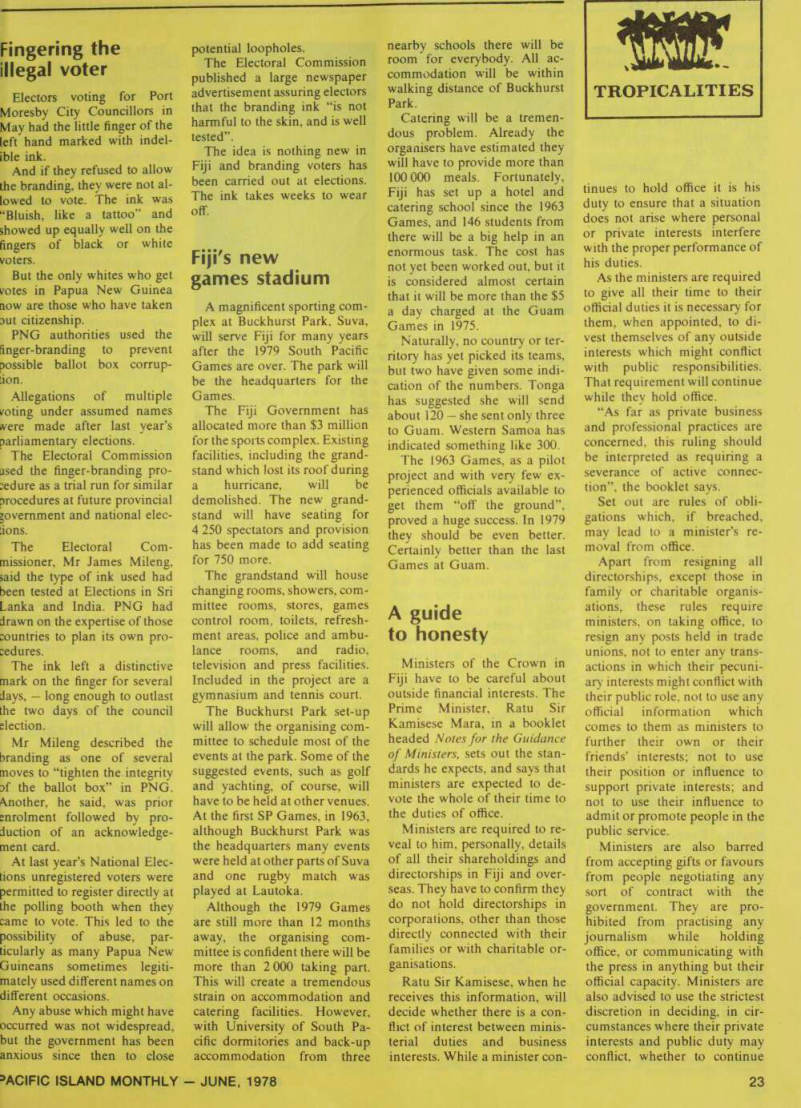
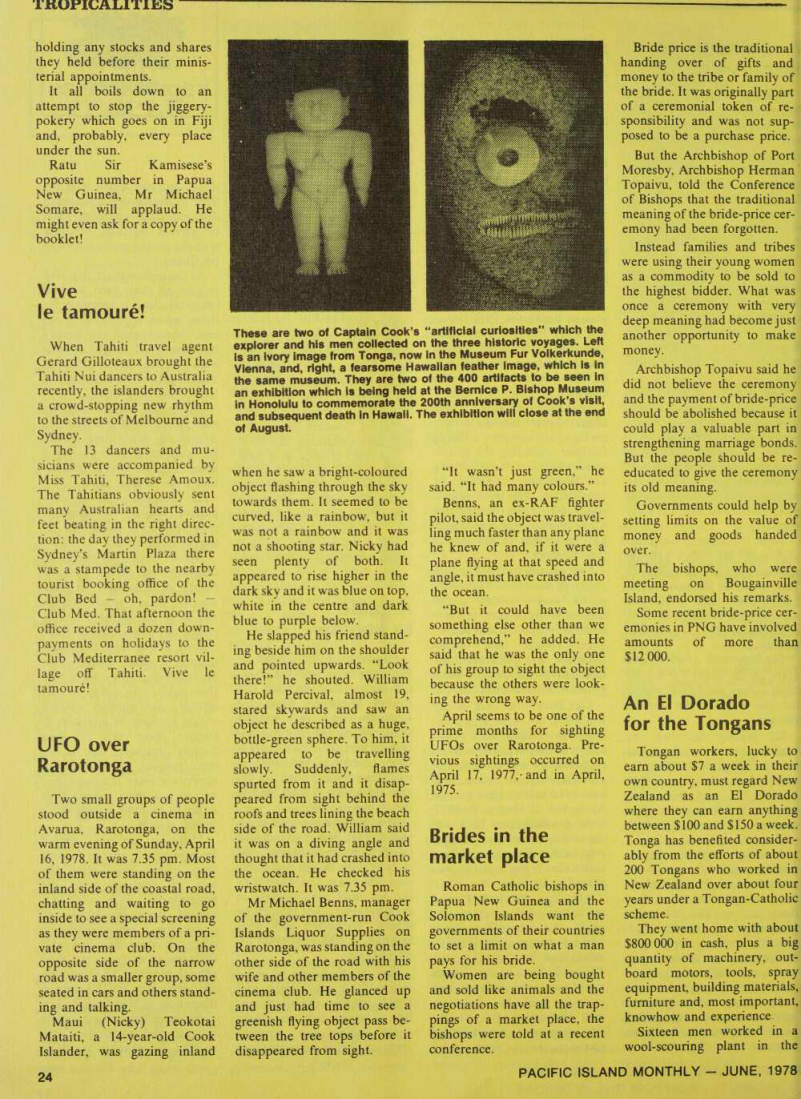
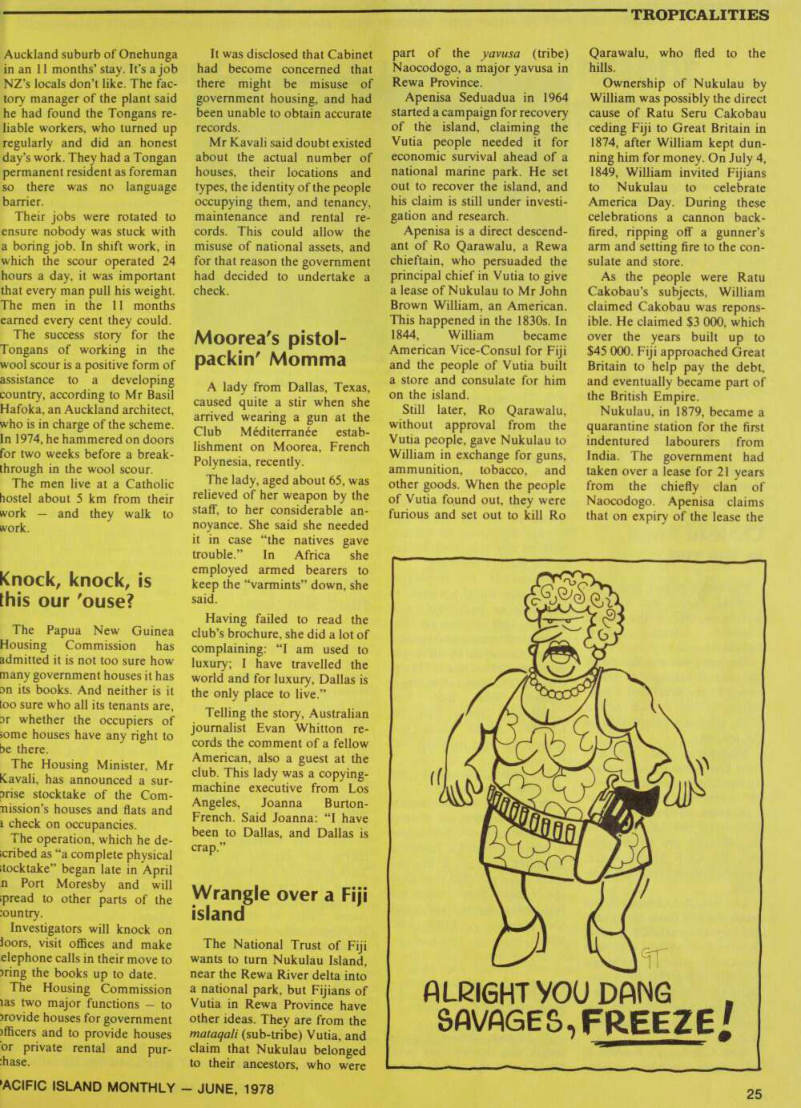
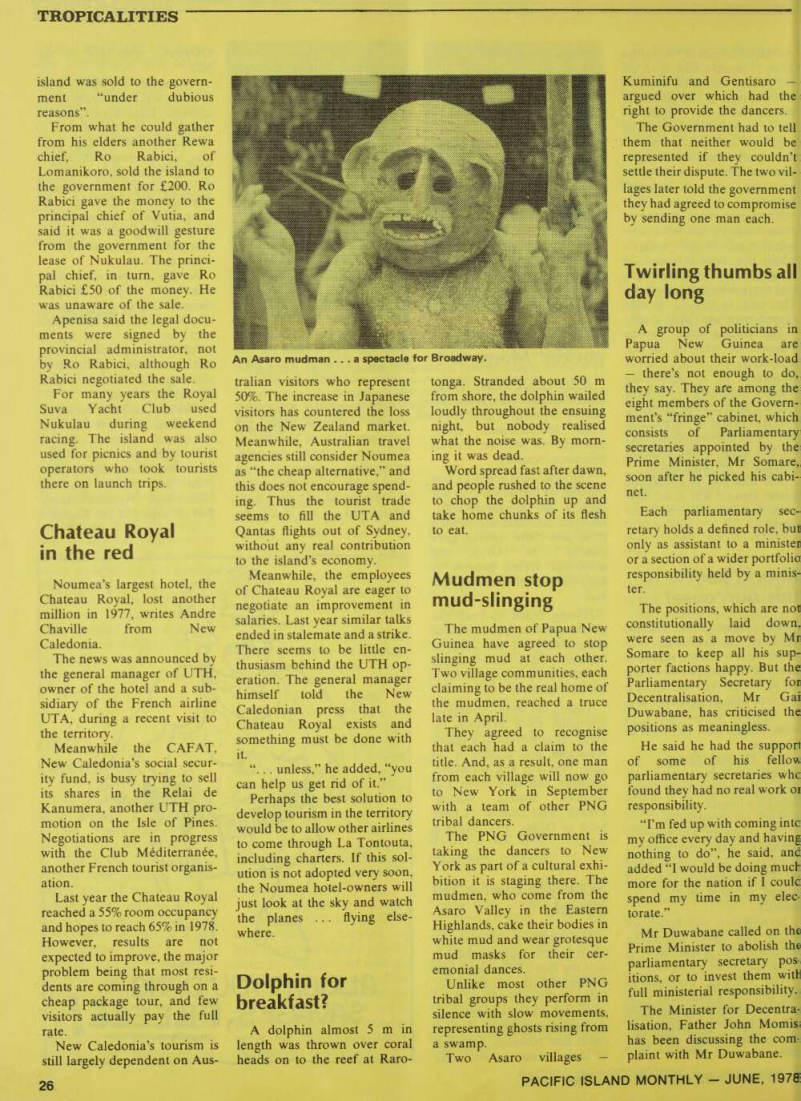
Tropicalities
illegal voter
Electors voting for Port Moresby City Councillors in May had the little finger of the left hand marked with indel ible ink.
And if they refused to allow the branding, they were not al lowed to vote. The ink was “Bluish, like a tattoo” and showed up equally well on the fingers of black or white voters.
But the only whites who get votes in Papua New Guinea now are those who have taken Dut citizenship.
PNG authorities used the finger-branding to prevent possible ballot box corrup tion.
Allegations of multiple
voting under assumed names were made after last year’s
parliamentary elections.
The Electoral Commission
ased the finger-branding pro
cedure as a trial run for similar
procedures at future provincial
government and national elec tions.
The Electoral Com
missioner, Mr James Mileng,
said the type of ink used had been tested at Elections in Sri Lanka and India. PNG had drawn on the expertise of those countries to plan its own pro cedures.
The ink left a distinctive mark on the finger for several days, long enough to outlast the two days of the council election.
Mr Mileng described the branding as one of several moves to “tighten the integrity af the ballot box” in PNG.
Another, he said, was prior
enrolment followed by pro
duction of an acknowledge
ment card.
At last year’s National Elec
tions unregistered voters were
permitted to register directly at the polling booth when they came to vote. This led to the possibility of abuse, par ticularly as many Papua New
Guineans sometimes legiti
mately used different names on different occasions.
Any abuse which might have
occurred was not widespread,
but the government has been anxious since then to close
potential loopholes.
The Electoral Commission
published a large newspaper
advertisement assuring electors that the branding ink “is not harmful to the skin, and is well tested”.
The idea is nothing new in Fiji and branding voters has been carried out at elections.
The ink takes weeks to wear off.
Fiji's new
games stadium
A magnificent sporting com
plex at Buckhurst Park, Suva, will serve Fiji for many years after the 1979 South Pacific Games are over. The park will be the headquarters for the Games.
The Fiji Government has allocated more than $3 million for the sports complex. Existing
facilities, including the grand
stand which lost its roof during a hurricane, will be demolished. The new grand stand will have seating for 4 250 spectators and provision has been made to add seating for 750 more.
The grandstand will house changing rooms, showers, com mittee rooms, stores, games control room, toilets, refresh ment areas, police and ambu lance rooms, and radio, television and press facilities.
Included in the project are a gymnasium and tennis court.
The Buckhurst Park set-up will allow the organising com mittee to schedule most of the events at the park. Some of the suggested events, such as golf and yachting, of course, will have to be held at other venues.
At the first SP Games, in 1963, although Buckhurst Park was the headquarters many events were held at other parts of Suva and one rugby match was played at Lautoka.
Although the 1979 Games are still more than 12 months away, the organising com mittee is confident there will be more than 2 000 taking part.
This will create a tremendous strain on accommodation and catering facilities. However, with University of South Pa cific dormitories and back-up accommodation from three
nearby schools there will be room for everybody. All ac commodation will be within walking distance of Buckhurst Park.
Catering will be a tremen
dous problem. Already the
organisers have estimated they
will have to provide more than 100 000 meals. Fortunately, Fiji has set up a hotel and catering school since the 1963 Games, and 146 students from there will be a big help in an enormous task. The cost has not yet been worked out, but it is considered almost certain that it will be more than the $5 a day charged at the Guam Games in 1975.
Naturally, no country or ter ritory has yet picked its teams, but two have given some indi cation of the numbers. Tonga has suggested she will send about 120 - she sent only three to Guam. Western Samoa has indicated something like 300.
The 1963 Games, as a pilot project and with very few ex perienced officials available to get them “off the ground”, proved a huge success. In 1979 they should be even better.
Certainly better than the last Games at Guam.
A guide
to honesty
Ministers of the Crown in Fiji have to be careful about outside financial interests. The Prime Minister, Ratu Sir Kamisese Mara, in a booklet headed Notes for the Guidance of Ministers, sets out the stan dards he expects, and says that ministers are expected to de vote the whole of their time to the duties of office.
Ministers are required to re veal to him, personally, details of all their shareholdings and directorships in Fiji and over seas. They have to confirm they do not hold directorships in corporations, other than those directly connected with their families or with charitable or
ganisations.
Ratu Sir Kamisese, when he receives this information, will decide whether there is a con flict of interest between minis terial duties and business interests. While a minister con
tinues to hold office it is his duty to ensure that a situation does not arise where personal or private interests interfere with the proper performance of his duties.
As the ministers are required to give all their time to their official duties it is necessary for them, when appointed, to di vest themselves of any outside interests which might conflict
with public responsibilities.
That requirement will continue while they hold office.
“As far as private business
and professional practices are
concerned, this ruling should be interpreted as requiring a severance of active connec tion”, the booklet says.
Set out are rules of obli gations which, if breached, may lead to a minister’s re moval from office.
Apart from resigning all directorships, except those in
family or charitable organis
ations, these rules require ministers, on taking office, to resign any posts held in trade unions, not to enter any trans actions in which their pecuni ar}' interests might conflict with their public role, not to use any official information which comes to them as ministers to further their own or their friends’ interests; not to use their position or influence to support private interests; and not to use their influence to admit or promote people in the
public service.
Ministers are also barred from accepting gifts or favours
from people negotiating any
sort of contract with the government. They are pro hibited from practising any
journalism while holding
office, or communicating with the press in anything but their official capacity. Ministers are also advised to use the strictest discretion in deciding, in cir cumstances where their private interests and public duty may conflict, whether to continue
holding any stocks and shares they held before their minis
terial appointments.
It all boils down to an attempt to stop the jiggery pokery which goes on in Fiji
and, probably, every place
under the sun.
Ratu Sir Kamisese’s opposite number in Papua New Guinea, Mr Michael Somare, will applaud. He might even ask for a copy of the booklet!
Vive
le tamoure!
When Tahiti travel agent Gerard Gilloteaux brought the Tahiti Nui dancers to Australia
recently, the islanders brought
a crowd-stopping new rhythm
to the streets of Melbourne and
Sydney.
The 13 dancers and mu
sicians were accompanied by
Miss Tahiti, Therese Amoux.
The Tahitians obviously sent many Australian hearts and feet beating in the right direc
tion: the day they performed in
Sydney’s Martin Plaza there was a stampede to the nearby tourist booking office of the Club Bed oh, pardon!
Club Med. That afternoon the office received a dozen down payments on holidays to the Club Mediterranee resort vil lage off Tahiti. Vive le tamoure!
UFO over
Rarotonga
Two small groups of people stood outside a cinema in Avarua, Rarotonga, on the
warm evening of Sunday, April
16, 1978. It was 7.35 pm. Most of them were standing on the inland side of the coastal road, chatting and waiting to go inside to see a special screening as they were members of a pri vate cinema club. On the opposite side of the narrow road was a smaller group, some seated in cars and others stand
ing and talking.
Maui (Nicky) Teokotai Mataiti, a 14-year-old Cook Islander, was gazing inland
when he saw a bright-coloured
object flashing through the sky
towards them. It seemed to be curved, like a rainbow, but it was npt a rainbow and it was not a shooting star. Nicky had seen plenty of both. It appeared to rise higher in the dark sky and it was blue on top, white in the centre and dark blue to purple below.
He slapped his friend stand ing beside him on the shoulder
and pointed upwards. “Look
there!” he shouted. William Harold Percival, almost 19, stared skywards and saw an object he described as a huge, bottle-green sphere. To him, it
appeared to be travelling
slowly. Suddenly, flames
spurted from it and it disap peared from sight behind the roofs and trees lining the beach side of the road. William said it was on a diving angle and thought that it had crashed into the ocean. He checked his wristwatch. It was 7.35 pm.
Mr Michael Benns, manager of the government-run Cook
Islands Liquor Supplies on
Rarotonga, was standing on the other side of the road with his wife and other members of the cinema club. He glanced up and just had time to see a
greenish flying object pass be
tween the tree tops before it
disappeared from sight.
“It wasn’t just green,” he said. “It had many colours.”
Benns, an ex-RAF fighter pilot, said the object was travel ling much faster than any plane he knew of and, if it were a
plane flying at that speed and
angle, it must have crashed into the ocean.
“But it could have been something else other than we comprehend,” he added. He said that he was the only one of his group to sight the object because the others were look ing the wrong way.
April seems to be one of the
prime months for sighting
UFOs over Rarotonga. Pre vious sightings occurred on April 17, 1977,-and in April, 1975.
Brides in the
market place
Roman Catholic bishops in Papua New Guinea and the Solomon Islands want the governments of their countries to set a limit on what a man pays for his bride.
Women are being bought
and sold like animals and the negotiations have all the trap pings of a market place, the bishops were told at a recent conference.
Bride price is the traditional handing over of gifts and money to the tribe or family of the bride. It was originally part of a ceremonial token of re sponsibility and was not sup
posed to be a purchase price.
But the Archbishop of Port
Moresby, Archbishop Herman
Topaivu, told the Conference of Bishops that the traditional meaning of the bride-price cer emony had been forgotten.
Instead families and tribes were using their young women as a commodity to be sold to the highest bidder. What was once a ceremony with very
deep meaning had become just
another opportunity to make money.
Archbishop Topaivu said he
did not believe the ceremony and the payment of bride-price should be abolished because it could play a valuable part in
strengthening marriage bonds.
But the people should be re educated to give the ceremony its old meaning.
Governments could help by
setting limits on the value of money and goods handed over.
The bishops, who were
meeting on Bougainville
Island, endorsed his remarks.
Some recent bride-price cer emonies in PNG have involved amounts of more than $l2 000.
An El Dorado
for the Tongans
Tongan workers, lucky to
earn about $7 a week in their own country, must regard New Zealand as an El Dorado where they can earn anything between $lOO and $l5O a week.
Tonga has benefited consider ably from the efforts of about 200 Tongans who worked in New Zealand over about four years under a Tongan-Catholic scheme.
They went home with about $BOO 000 in cash, plus a big
quantity of machinery, out
board motors, tools, spray
equipment, building materials,
furniture and, most important, knowhow and experience Sixteen men worked in a
wool-scouring plant in the
These are two of Captain Cook’s “artificial curiosities” which the explorer and his men collected on the three historic voyages. Left is an Ivory image from Tonga, now in the Museum Fur Volkerkunde, Vienna, and, right, a fearsome Hawaiian feather image, which is in the same museum. They are two of the 400 artifacts to be seen in an exhibition which is being held at the Bernice P. Bishop Museum in Honolulu to commemorate the 200th anniversary of Cook’s visit, and subsequent death In Hawaii. The exhibition will close at the end of August.
Auckland suburb of Onehunga in an 11 months’ stay. It’s a job NZ’s locals don’t like. The fac tory manager of the plant said he had found the Tongans re liable workers, who turned up regularly and did an honest
day’s work. They had a Tongan
permanent resident as foreman so there was no language barrier.
Their jobs were rotated to ensure nobody was stuck with a boring job. In shift work, in which the scour operated 24 hours a day, it was important that every man pull his weight.
The men in the 11 months earned every cent they could.
The success story for the Tongans of working in the wool scour is a positive form of
assistance to a developing
country, according to Mr Basil Hafoka, an Auckland architect, who is in charge of the scheme.
In 1974, he hammered on doors for two weeks before a break through in the wool scour.
The men live at a Catholic liostel about 5 km from their work and they walk to work.
Knock, knock, is
this our 'ouse?
The Papua New Guinea Housing Commission has admitted it is not too sure how many government houses it has an its books. And neither is it too sure who all its tenants are, 3r whether the occupiers of some houses have any right to be there.
The Housing Minister, Mr fCavali, has announced a sur prise stocktake of the Com mission’s houses and flats and
i check on occupancies.
The operation, which he de
icribed as “a complete physical
stocktake” began late in April
n Port Moresby and will spread to other parts of the country.
Investigators will knock on loors, visit offices and make elephone calls in their move to )ring the books up to date.
The Housing Commission las two major functions to )rovide houses for government )fficers and to provide houses or private rental and pur :hase.
It was disclosed that Cabinet had become concerned that there might be misuse of government housing, and had been unable to obtain accurate records.
Mr Kavali said doubt existed about the actual number of houses, their locations and types, the identity of the people occupying them, and tenancy, maintenance and rental re cords. This could allow the misuse of national assets, and for that reason the government had decided to undertake a check.
Moorea's pistol
packin' Momma
A lady from Dallas, Texas, caused quite a stir when she arrived wearing a gun at the Club Mediterrande estab lishment on Moorea, French Polynesia, recently.
The lady, aged about 65, was relieved of her weapon by the staff, to her considerable an noyance. She said she needed it in case “the natives gave trouble.” In Africa she employed armed bearers to keep the “varmints” down, she said.
Having failed to read the club’s brochure, she did a lot of complaining: “I am used to luxury; I have travelled the world and for luxury, Dallas is the only place to live.”
Telling the story, Australian journalist Evan Whitton re cords the comment of a fellow American, also a guest at the club. This lady was a copying machine executive from Los Angeles, Joanna Burton- French. Said Joanna: “I have been to Dallas, and Dallas is
crap.”
Wrangle over a Fill
Island
The National Trust of Fiji wants to turn Nukulau Island, near the Rewa River delta into a national park, but Fijians of Vutia in Rewa Province have other ideas. They are from the mataqali (sub-tribe) Vutia, and claim that Nukulau belonged to their ancestors, who were
part of the yavusa (tribe) Naocodogo, a major yavusa in Rewa Province.
Apenisa Seduadua in 1964 started a campaign for recovery of the island, claiming the Vutia people needed it for economic survival ahead of a national marine park. He set out to recover the island, and his claim is still under investi gation and research.
Apenisa is a direct descend ant of Ro Qarawalu, a Rewa chieftain, who persuaded the principal chief in Vutia to give a lease of Nukulau to Mr John Brown William, an American.
This happened in the 1830 s. In 1844, William became American Vice-Consul for Fiji and the people of Vutia built a store and consulate for him on the island.
Still later, Ro Qarawalu, without approval from the Vutia people, gave Nukulau to William in exchange for guns, ammunition, tobacco, and other goods. When the people of Vutia found out, they were furious and set out to kill Ro
Qarawalu, who fled to the hills.
Ownership of Nukulau by William was possibly the direct cause of Ratu Seru Cakobau ceding Fiji to Great Britain in 1874, after William kept dun ning him for money. On July 4, 1849, William invited Fijians to Nukulau to celebrate America Day. During these celebrations a cannon back fired, ripping off a gunner’s arm and setting fire to the con sulate and store.
As the people were Ratu Cakobau’s subjects, William claimed Cakobau was repons ible. He claimed $3 000, which over the years built up to $45 000. Fiji approached Great Britain to help pay the debt, and eventually became part of the British Empire.
Nukulau, in 1879, became a quarantine station for the first indentured labourers from India. The government had taken over a lease for 21 years from the chiefly clan of Naocodogo. Apenisa claims that on expiry of the lease the
island was sold to the govern ment “under dubious reasons”.
From what he could gather from his elders another Rewa chief, Ro Rabici, of Lomanikoro, sold the island to the government for £2OO. Ro Rabici gave the money to the principal chief of Vutia, and said it was a goodwill gesture from the government for the lease of Nukulau. The princi pal chief, in turn, gave Ro Rabici £5O of the money. He was unaware of the sale.
Apenisa said the legal docu ments were signed by the provincial administrator, not by Ro Rabici, although Ro Rabici negotiated the sale.
For many years the Royal Suva Yacht Club used Nukulau during weekend racing. The island was also used for picnics and by tourist operators who took tourists there on launch trips.
Chateau Royal
in the red
Noumea’s largest hotel, the Chateau Royal, lost another million in 1977, writes Andre Chaville from New Caledonia.
The news was announced by the general manager of UTH, owner of the hotel and a sub sidiary of the French airline UTA, during a recent visit to
the territory.
Meanwhile the CAFAT, New Caledonia’s social secur ity fund, is busy trying to sell its shares in the Relai de Kanumera, another UTH pro motion on the Isle of Pines.
Negotiations are in progress with the Club MediterranSe, another French tourist organis ation.
Last year the Chateau Royal reached a 55% room occupancy and hopes to reach 65% in 1978.
However, results are not
expected to improve, the major
problem being that most resi dents are coming through on a cheap package tour, and few visitors actually pay the full rate.
New Caledonia’s tourism is still largely dependent on Aus-
tralian visitors who represent 50%. The increase in Japanese visitors has countered the loss on the New Zealand market.
Meanwhile, Australian travel agencies still consider Noumea as “the cheap alternative,” and this does not encourage spend ing. Thus the tourist trade seems to fill the UTA and Qantas flights out of Sydney, without any real contribution to the island’s economy.
Meanwhile, the employees of Chateau Royal are eager to
negotiate an improvement in
salaries. Last year similar talks ended in stalemate and a strike.
There seems to be little en thusiasm behind the UTH op eration. The general manager himself told the New Caledonian press that the Chateau Royal exists and something must be done with it.
“... unless,” he added, “you can help us get rid of it.”
Perhaps the best solution to develop tourism in the territory would be to allow other airlines to come through La Tontouta, including charters. If this sol ution is not adopted very soon, the Noumea hotel-owners will just look at the sky and watch
the planes ... flying else
where.
Dolphin for
breakfast?
A dolphin almost 5 m in length was thrown over coral heads on to the reef at Raro
tonga. Stranded about 50 m from shore, the dolphin wailed
loudly throughout the ensuing
night, but nobody realised
what the noise was. By morn ing it was dead.
Word spread fast after dawn, and people rushed to the scene to chop the dolphin up and take home chunks of its flesh to eat.
Mudmen stop
mud-slinging
The mudmen of Papua New Guinea have agreed to stop slinging mud at each other.
Two village communities, each claiming to be the real home of the mudmen, reached a truce late in April.
They agreed to recognise
that each had a claim to the title. And, as a result, one man from each village will now go to New York in September with a team of other PNG tribal dancers.
The PNG Government is taking the dancers to New York as part of a cultural exhi bition it is staging there. The mudmen, who come from the Asaro Valley in the Eastern Highlands, cake their bodies in white mud and wear grotesque mud masks for their cer emonial dances.
Unlike most other PNG tribal groups they perform in silence with slow movements,
representing ghosts rising from
a swamp.
Two Asaro villages
Kuminifu and Gentisaro argued over which had the; right to provide the dancers.
The Government had to tell them that neither would be
represented if they couldn’t;
settle their dispute. The two vil lages later told the government they had agreed to compromise by sending one man each.
Twirling thumbs all
day long
A group of politicians in Papua New Guinea are worried about their work-load there’s not enough to do,, they say. They are among the eight members of the Govern ment’s “fringe” cabinet, which i
consists of Parliamentary 1
secretaries appointed by the
Prime Minister, Mr Somare,, soon after he picked his cabi net.
Each parliamentary sec retary holds a defined role, buti only as assistant to a ministen or a section of a wider portfolio responsibility held by a minis ter.
The positions, which are not! constitutionally laid down, were seen as a move by Mn Somare to keep all his sup porter factions happy. But the Parliamentary Secretary fon Decentralisation, Mr Gai Duwabane, has criticised the
positions as meaningless.
He said he had the support of some of his fellow parliamentary secretaries whc found they had no real work oi
responsibility.
“I’m fed up with coming into my office every day and having nothing to do”, he said, and added “I would be doing much more for the nation if I could spend my time in my elec torate.”
Mr Duwabane called on the Prime Minister to abolish the parliamentary secretary pos-. itions, or to invest them with full ministerial responsibility.
The Minister for Decentra lisation, Father John Momis< has been discussing the com plaint with Mr Duwabane.
An Asaro mudman... a spectacle for Broadway.
Advertisements & other items, pp. 23-26 (4 items)
23
3 ACIFIC ISLAND MONTHLY - JUNE, 1978
24
PACIFIC ISLAND MONTHLY - JUNE, 1978
iKUPICALITIIfiS
25
PACIFIC ISLAND MONTHLY - JUNE, 1978
TROPICALITIES
26
PACIFIC ISLAND MONTHLY - JUNE, 1978:
TROPICALITIES
history in Truk and Saipan
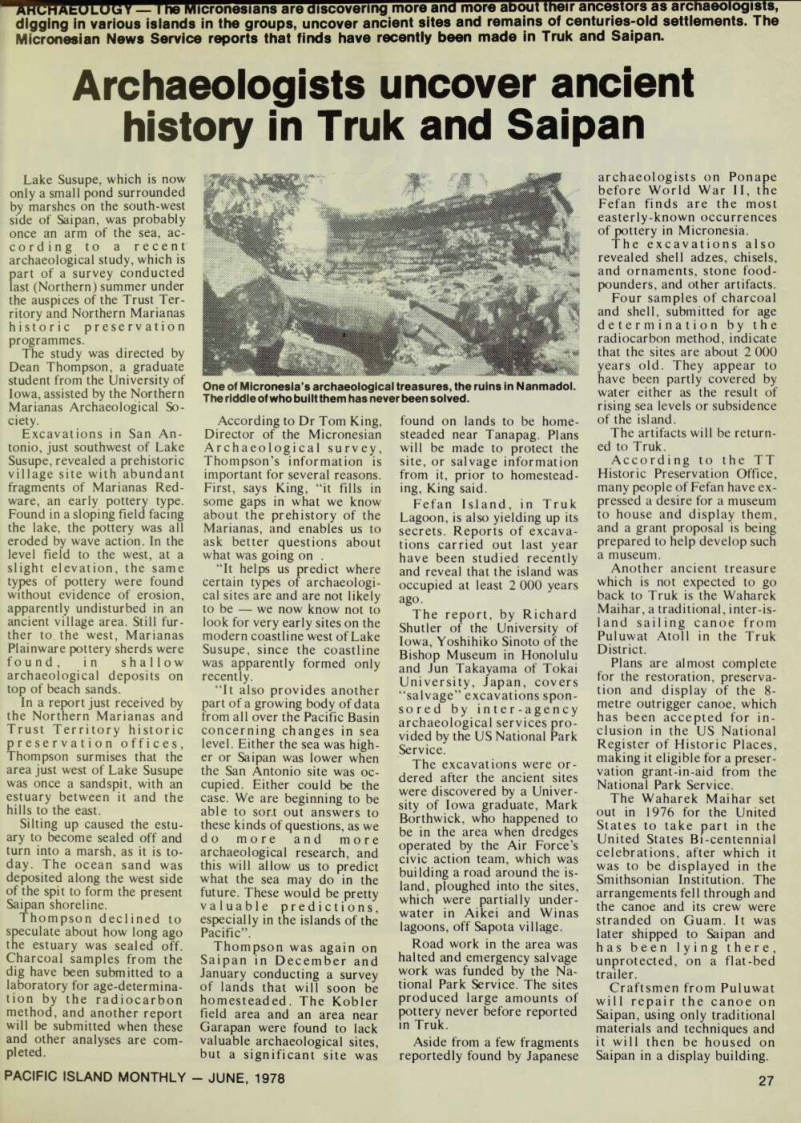
Archaeologists uncover ancient history in Truk and Saipan
are discovering more and more about tneir ancestors as archaeologists, digging in various islands in the groups, uncover ancient sites and remains of centuries-old settlements. The Micronesian News Service reports that finds have recently been made in Truk and Saipan.
Lake Susupe, which is now only a small pond surrounded by marshes on the south-west side of Saipan, was probably once an arm of the sea, ac cording to a recent archaeological study, which is part of a survey conducted last (Northern) summer under the auspices of the Trust Ter ritory and Northern Marianas
historic preservation
programmes.
The study was directed by Dean Thompson, a graduate student from the University of lowa, assisted by the Northern Marianas Archaeological So ciety.
Excavations in San An tonio, just southwest of Lake Susupe, revealed a prehistoric village site with abundant fragments of Marianas Red ware, an early pottery type.
Found in a sloping field facing the lake, the pottery was all eroded by wave action. In the level field to the west, at a slight elevation, the same types of pottery were found without evidence of erosion, apparently undisturbed in an ancient village area. Still fur ther to. the west, Marianas Plainware pottery sherds were found, in shall ow archaeological deposits on top of beach sands.
In a report just received by the Northern Marianas and Trust Territory historic preservation offices, Thompson surmises that the area just west of Lake Susupe was once a sandspit, with an estuary between it and the hills to the east.
Silting up caused the estu ary to become sealed off and turn into a marsh, as it is to day. The ocean sand was deposited along the west side of the spit to form the present Saipan shoreline.
Thompson declined to speculate about how long ago the estuary was sealed off.
Charcoal samples from the dig have been submitted to a laboratory for age-determina tion by the radiocarbon method, and another report will be submitted when these and other analyses are com pleted.
According to Dr Tom King, Director of the Micronesian Archaeological survey, Thompson’s information is important for several reasons.
First, says King, “it fills in some gaps in what we know about the prehistory of the Marianas, and enables us to ask better questions about what was going on .
“It helps us predict where certain types of archaeologi cal sites are and are not likely to be we now know not to look for very early sites on the modern coastline west of Lake Susupe, since the coastline was apparently formed only recently.
“It also provides another part of a growing body of data from all over the Pacific Basin concerning changes in sea level. Either the sea was high er or Saipan was lower when the San Antonio site was oc cupied. Either could be the case. We are beginning to be able to sort out answers to these kinds of questions, as we do more and more archaeological research, and this will allow us to predict what the sea may do in the future. These would be pretty valuable predictions, especially in the islands of the Pacific”.
Thompson was again on Saipan in December and January conducting a survey of lands that will soon be homesteaded. The Kobler field area and an area near Garapan were found to lack valuable archaeological sites, but a significant site was
archaeologists on Ponape before World War 11, the Fefan finds are the most easterly-known occurrences of pottery in Micronesia.
The excavations also revealed shell adzes, chisels, and ornaments, stone food pounders, and other artifacts.
Four samples of charcoal and shell, submitted for age determination by the radiocarbon method, indicate that the sites are about 2 000 years old. They appear to have been partly covered by water either as the result of rising sea levels or subsidence of the island.
The artifacts will be return ed to Truk.
According to the TT Historic Preservation Office, many people of Fefan have ex pressed a desire for a museum to house and display them, and a grant proposal is being prepared to help develop such a museum.
Another ancient treasure which is not expected to go back to Truk is the Waharek Maihar, a traditional, inter-is land sailing canoe from Puluwat Atoll in the Truk District.
Plans are almost complete for the restoration, preserva tion and display of the 8metre outrigger canoe, which has been accepted for in clusion in the US National Register of Historic Places, making it eligible for a preser vation grant-in-aid from the National Park Service.
The Waharek Maihar set out in 1976 for the United States to take part in the United States Bi-centennial celebrations, after which it was to be displayed in the Smithsonian Institution. The arrangements fell through and the canoe and its crew were stranded on Guam. It was later shipped to Saipan and has been lying there, unprotected, on a flat-bed trailer.
Craftsmen from Puluwat will repair the canoe on Saipan, using only traditional materials and techniques and it will then be housed on Saipan in a display building.
found on lands to be home steaded near Tanapag. Plans will be made to protect the site, or salvage information from it, prior to homestead ing, King said.
Fefan Island, in Truk Lagoon, is also yielding up its secrets. Reports of excava tions carried out last year have been studied recently and reveal that the island was occupied at least 2 000 years ago.
The report, by Richard Shutler of the University of lowa, Yoshihiko Sinoto of the Bishop Museum in Honolulu and Jun Takayama of Tokai University, Japan, covers “salvage” excavations spon sored by inter-agency archaeological services pro vided by the US National Park Service.
The excavations were or dered after the ancient sites were discovered by a Univer sity of lowa graduate, Mark Borthwick, who happened to be in the area when dredges operated by the Air Force’s civic action team, which was building a road around the is land, ploughed into the sites, which were partially under water in Aikei and Winas lagoons, off Sapota village.
Road work in the area was halted and emergency salvage work was funded by the Na tional Park Service. The sites produced large amounts of pottery never before reported in Truk.
Aside from a few fragments reportedly found by Japanese
One of Micronesia’s archaeological treasures, the ruins in Nanmadol.
The riddle of who built them has never been solved.
Advertisements & other items, pp. 27-28 (3 items)
27
PACIFIC ISLAND MONTHLY - JUNE, 1978
28
PACIFIC ISLAND MONTHLY - JUNE, 1978
Count On Vigta
TOTURN GRASS INTO LAWN
VICTA
UTILITY 160
MOWER
\ Tough, rugged, lightweight and low priced, a mower without grass-catcher designed to handle the full range of grass cutting jobs from heavily weeded and long grass areas to fine lawns. Cuts close to trees and fences and new side chute sends the cut grass safely to the side. Powered by 160 cc Mark 4 2-stroke Victa engine with the easy pultZip Starter, multiposition height adjuster, fold-down handles and many more exclusive Victa features make the Utility a popular lightweight mower.
VICTA
SUPER 24
MOWER
The big mower for big grass with a giant 61 cm (24") cut. It’s the mower for the big grass cutting jobs and municipal parks and gardens, sports grounds, roadside growth control as well as property owners with large areas of land. Solid construction, easy manoeuvrability and giant rear wheels handle rough ground effortlessly. Two free-swinging blades on the cutting disc absorb shock when hard objects are encountered, protecting the engine from damage.
Powered by a special power-boosted Victa 160 cc 2-stroke engine with the exclusive easy pull Zip Starter and many more features to make the big mowing jobs easier.
When you want tough reliable grass cutting, Victa has the mower for any job. And every Victa mower is backed by the widest service and spare parts network in the business.
L 83.8646
TURNS GRASS INTO LAWN
Truk airport expansion
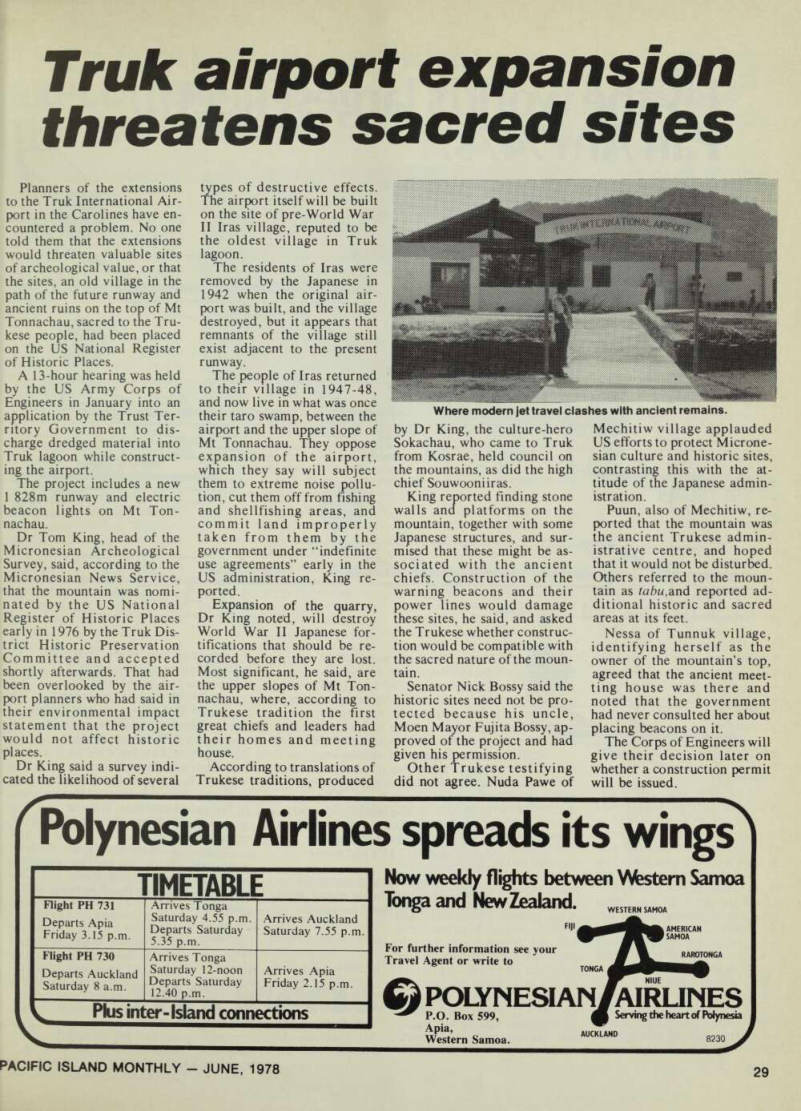
threatens sacred sites
Planners of the extensions to the Truk International Air port in the Carolines have en countered a problem. No one told them that the extensions would threaten valuable sites of archeological value, or that the sites, an old village in the path of the future runway and ancient ruins on the top of Mt Tonnachau, sacred to the Tru kese people, had been placed on the US National Register of Historic Places.
A 13-hour hearing was held by the US Army Corps of Engineers in January into an application by the Trust Ter ritory Government to dis charge dredged material into Truk lagoon while construct ing the airport.
The project includes a new
1 828 m runway and electric
beacon lights on Mt Ton nachau.
Dr Tom King, head of the Micronesian Archeological Survey, said, according to the Micronesian News Service, that the mountain was nomi nated by the US National Register of Historic Places early in 1976 by the Truk Dis trict Historic Preservation Committee and accepted shortly afterwards. That had been overlooked by the air port planners who had said in their environmental impact statement that the project would not affect historic places.
Dr King said a survey indi cated the likelihood of several
types of destructive effects, The airport itself will be built on the site of pre-World War II Iras village, reputed to be the oldest village in Truk lagoon.
The residents of Iras were removed by the Japanese in 1942 when the original air port was built, and the village destroyed, but it appears that remnants of the village still exist adjacent to the present runway.
The people of Iras returned to their village in 1947-48, and now live in what was once their taro swamp, between the airport and the upper slope of Mt Tonnachau. They oppose expansion of the airport, which they say will subject them to extreme noise pollu tion, cut them off from fishing and shellfishing areas, and commit land improperly taken from them by the government under “indefinite use agreements” early in the US administration, King re ported, Expansion of the quarry, Dr King noted, will destroy World War II Japanese for tifications that should be re corded before they are lost, Most significant, he said, are the upper slopes of Mt Ton nachau, where, according to Trukese tradition the first great chiefs and leaders had their homes and meeting house.
According to translations of Trukese traditions, produced
by Dr King, the culture-hero Sokachau, who came to Truk from Kosrae, held council on the mountains, as did the high chief Souwooniiras.
King reported finding stone walls ana platforms on the mountain, together with some Japanese structures, and sur mised that these might be as sociated with the ancient chiefs. Construction of the warning beacons and their power lines would damage these sites, he said, and asked the Trukese whether construc tion would be compatible with the sacred nature of the moun tain.
Senator Nick Bossy said the historic sites need not be pro tected because his uncle, Moen Mayor Fujita Bossy, ap proved of the project and had given his permission.
Other Trukese testifying did not agree. Nuda Pawe of
Mechitiw village applauded US efforts to protect Microne sian culture and historic sites, contrasting this with the at titude of the Japanese admin istration.
Puun, also of Mechitiw, re ported that the mountain was the ancient Trukese admin istrative centre, and hoped that it would not be disturbed, Others referred to the moun tain as tabu, and reported ad ditional historic and sacred areas at its feet, Nessa of Tunnuk village, identifying herself as the owner of the mountain’s top, agreed that the ancient meet ting house was there and noted that the government had never consulted her about placing beacons on it.
The Corps of Engineers will give their decision later on whether a construction permit will be issued.
Where modern jet travel clashes with ancient remains.
Advertisements & other items, pp. 29-30 (3 items)
29
PACIFIC ISLAND MONTHLY - JUNE, 1978
Polynesian Airlines spreads its wings
Now weekly flights between Western Samoa
Tonga and New Zealand. WESTERMSIMOA
AMERICAN
SAMOA
K RAROTONGA
TONGA
@ Polynesian Airlines
P n Rav COO Wvina fhp nf Mvnocci For further information see your Travel Agent or write to P.O. Box 599, Apia, Western Samoa.
£ Serving the heart of Polynesia
8230
Fly the world's largest fleet...
Pan Am 747'5.
AO 747
F¥WAM
ss
F¥VMAM
747 flO
F¥MVAM
747 747 AM 747
PANAM
Z 747 If you're like us, you know a great thing when you see it.
Wide-bodied 747's are the fastest and most comfortable passenger planes available. And vye fly nonstop to more U.S. cities than any other airline in the world
including record-setting long
range flights. No other airline can match our daily nonstop round trips between Tokyo and New York. We fly the world's longest commercial nonstops from Sydney to San Francisco. Building an entire fleet of 747's just made
good sense.
Our inflight service crews try very hard to meet your every need in the warmest, most personal
manner possible. Wide, spacious
cabins give you living room comfort as the world slips by.
Our 7475 P "Super Performer"
has lower fuel consumption, higher flying altitudes and faster speeds, making even the longest trip a little shorter. Pan Am's 7475 P is
Experience in tangible form.
You'll find Upper Deck Dining in the First Class lounge at the top of the spiral staircase. Enjoy a gourmet experience from a choice of four select entrees.
No matter where you fly in the world, you're always at home with Pan Am. We assembled the largest fleet of Pan Am 747's just for you.
Experience makes the difference. 065. P 285
Pacific Island Montfily June, 1978!
Exploiters Of
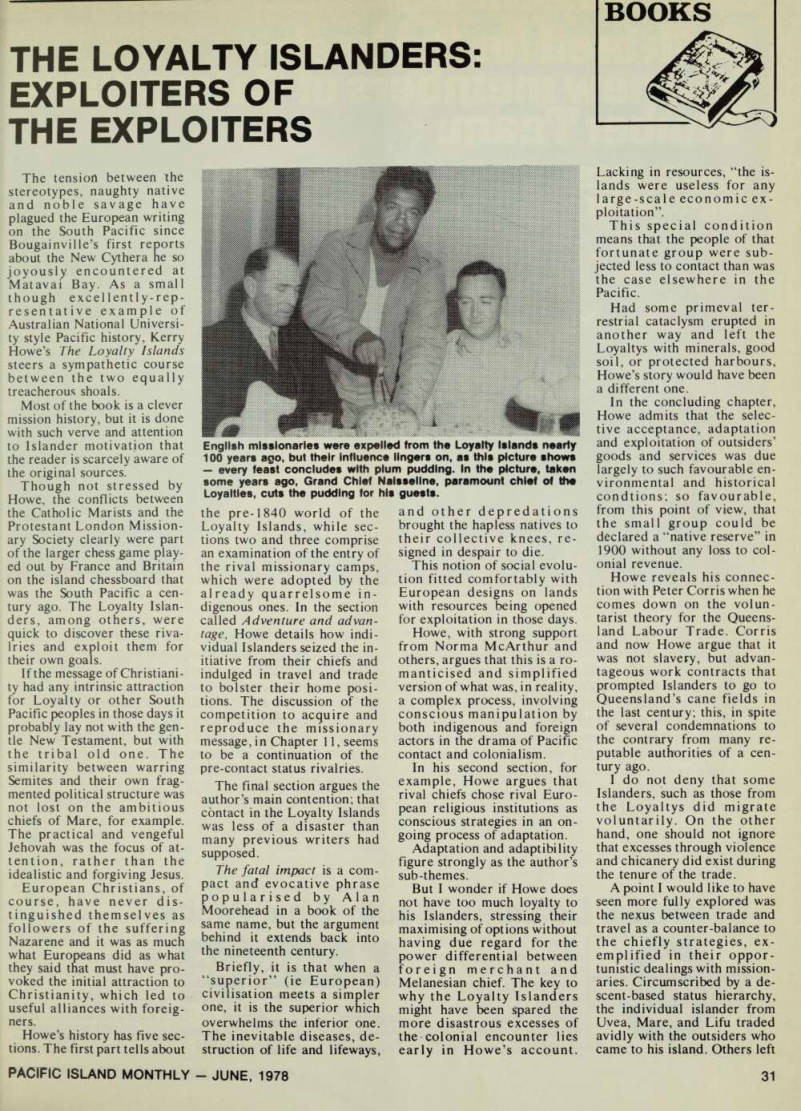
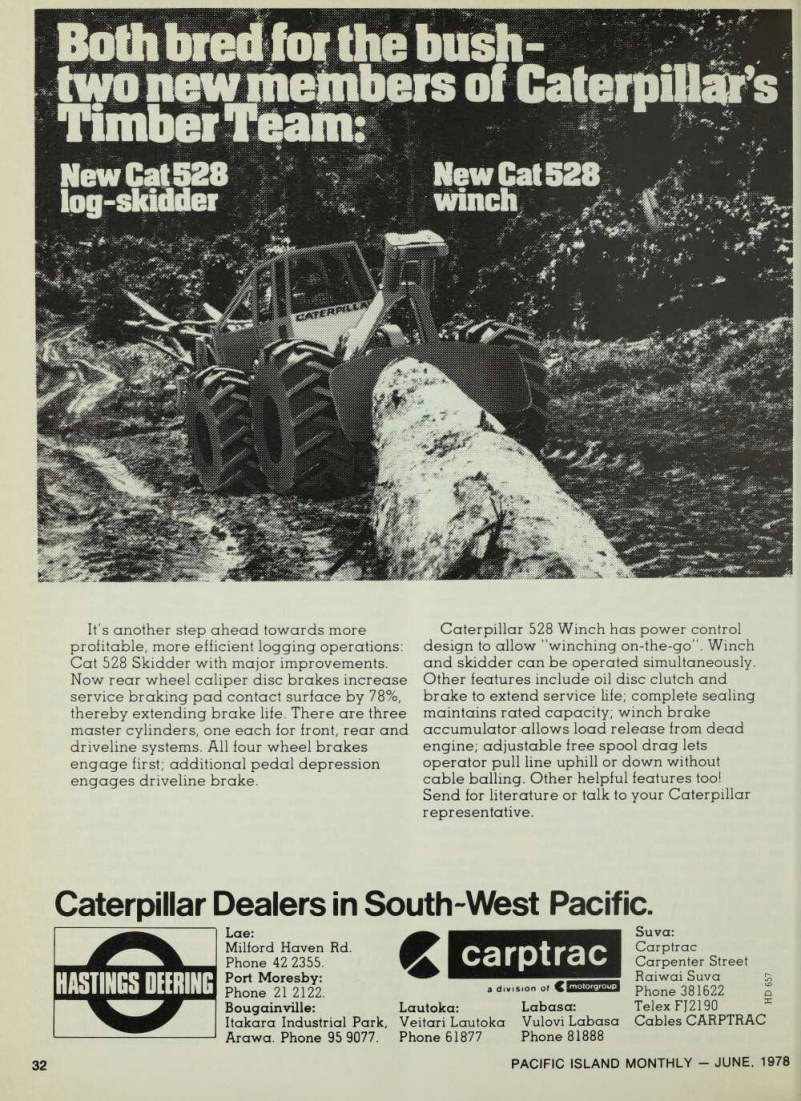
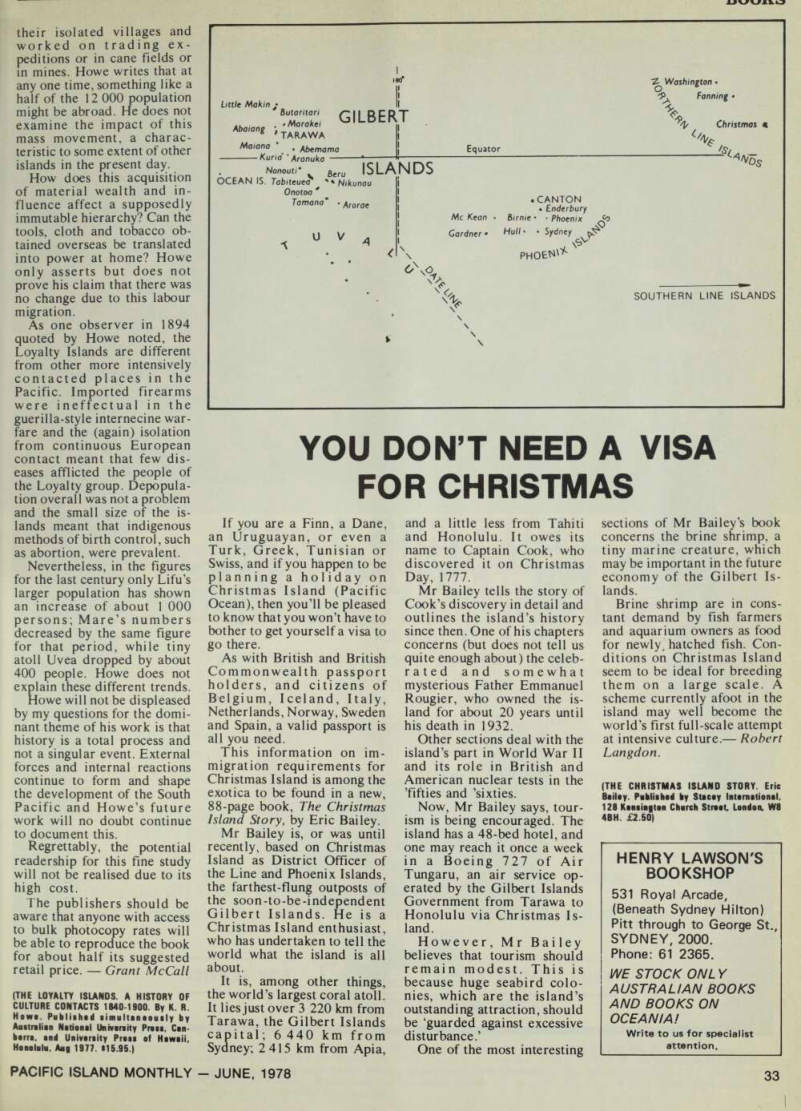
Books
The Loyalty Islanders:
The Exploiters
The tension between the stereotypes, naughty native and noble savage have plagued the European writing on the South Pacific since Bougainville’s first reports about the New Cythera he so joyously encountered at Matavai Bay. As a small though excel lently-rep resentative example of Australian National Universi ty style Pacific history, Kerry Howe’s The Loyalty Islands steers a sympathetic course between the two equally treacherous shoals.
Most of the book is a clever mission history, but it is done with such verve and attention to Islander motivation that the reader is scarcely aware of the original sources.
Though not stressed by Howe, the conflicts between the Catholic Marists and the Protestant London Mission ary Society clearly were part of the larger chess game play ed out by France and Britain on the island chessboard that was the South Pacific a cen tury ago. The Loyalty Islan ders, among others, were quick to discover these riva lries and exploit them for their own goals.
If the message of Christiani ty had any intrinsic attraction for Loyalty or other South Pacific peoples in those days it probably lay not with the gen tle New Testament, but with the tribal old one. The similarity between warring Semites and their own frag mented political structure was not lost on the ambitious chiefs of Mare, for example.
The practical and vengeful Jehovah was the focus of at tention, rather than the idealistic and forgiving Jesus.
European Christians, of course, have never dis tinguished themselves as followers of the suffering Nazarene and it was as much what Europeans did as what they said that must have pro voked the initial attraction to Christianity, which led to useful alliances with foreig ners.
Howe’s history has five sec tions. The first part tells about
the pre-1840 world of the Loyalty Islands, while sec tions two and three comprise an examination of the entry of the rival missionary camps, which were adopted by the already quarrelsome in digenous ones. In the section called Adventure and advan tage, Howe details how indi vidual Islanders seized the in itiative from their chiefs and indulged in travel and trade to bolster their home posi tions. The discussion of the competition to acquire and reproduce the missionary message, in Chapter 11, seems to be a continuation of the pre-contact status rivalries.
The final section argues the author’s main contention; that contact in the Loyalty Islands was less of a disaster than many previous writers had supposed.
The fatal impact is a com pact and evocative phrase popularised by Alan Moorehead in a book of the same name, but the argument behind it extends back into the nineteenth century.
Briefly, it is that when a “superior” (ie European) civilisation meets a simpler one, it is the superior which overwhelms the inferior one.
The inevitable diseases, de struction of life and lifeways,
and other depredations brought the hapless natives to their collective knees, re signed in despair to die.
This notion of social evolu tion fitted comfortably with European designs on lands with resources being opened for exploitation in those days.
Howe, with strong support from Norma McArthur and others, argues that this is a ro manticised and simplified version of what was, in reality, a complex process, involving conscious manipulation by both indigenous and foreign actors in the drama of Pacific contact and colonialism.
In his second section, for example, Howe argues that rival chiefs chose rival Euro pean religious institutions as conscious strategies in an on going process of adaptation.
Adaptation and adaptibility figure strongly as the author’s sub-themes.
But I wonder if Howe does not have too much loyalty to his Islanders, stressing their maximising of options without having due regard for the power differential between foreign merchant and Melanesian chief. The key to why the Loyalty Islanders might have been spared the more disastrous excesses of the colonial encounter lies early in Howe’s account.
Lacking in resources, “the is lands were useless for any large-scale economic ex ploitation”.
This special condition means that the people of that fortunate group were sub jected less to contact than was the case elsewhere in the Pacific.
Had some primeval ter restrial cataclysm erupted in another way and left the Loyaltys with minerals, good soil, or protected harbours, Howe’s story would have been a different one.
In the concluding chapter, Howe admits that the selec tive acceptance, adaptation and exploitation of outsiders’ goods and services was due largely to such favourable en vironmental and historical condtions; so favourable, from this point of view, that the small group could be declared a “native reserve” in 1900 without any loss to col onial revenue.
Howe reveals his connec tion with Peter Corns when he comes down on the volun tarist theory for the Queens land Labour Trade. Corris and now Howe argue that it was not slavery, but advan tageous work contracts that prompted Islanders to go to Queensland’s cane fields in the last century; this, in spite of several condemnations to the contrary from many re putable authorities of a cen tury ago.
I do not deny that some Islanders, such as those from the Loyaltys did migrate voluntarily. On the other hand, one should not ignore that excesses through violence and chicanery did exist during the tenure of the trade.
A point I would like to have seen more fully explored was the nexus between trade and travel as a counter-balance to the chiefly strategies, ex emplified in their oppor tunistic dealings with mission aries. Circumscribed by a de scent-based status hierarchy, the individual islander from Uvea, Mare, and Lifu traded avidly with the outsiders who came to his island. Others left
English missionaries were expelled from the Loyalty Islands nearly 100 years ago, but their influence lingers on, as this picture shows - every feast concludes with plum pudding. In the picture, taken some years ago, Grand Chief Nalsseline, paramount chief of the Loyalties, cuts the pudding for his guests.
their isolated villages and worked on trading ex peditions or in cane fields or in mines. Howe writes that at any one time, something like a half of the 12 000 population might be abroad. He does not examine the impact of this mass movement, a charac teristic to some extent of other islands in the present day.
How does this acquisition of material wealth and in fluence affect a supposedly immutable hierarchy? Can the tools, cloth and tobacco ob tained overseas be translated into power at home? Howe only asserts but does not prove his claim that there was no change due to this labour migration.
As one observer in 1894 quoted by Howe noted, the Loyalty Islands are different from other more intensively contacted places in the Pacific. Imported firearms were ineffectual in the guerilla-style internecine war fare and the (again) isolation from continuous European contact meant that few dis eases afflicted the people of the Loyalty group. Depopula tion overall was not a problem and the small size of the is lands meant that indigenous methods of birth control, such as abortion, were prevalent.
Nevertheless, in the figures for the last century only Lifu’s larger population has shown an increase of about 1 000 persons; Mare’s numbers decreased by the same figure for that period, while tiny atoll Uvea dropped by about 400 people. Howe does not explain these different trends.
Howe will not be displeased by my questions for the domi nant theme of his work is that history is a total process and not a singular event. External forces and internal reactions continue to form and shape the development of the South Pacific and Howe’s future work will no doubt continue to document this.
Regrettably, the potential readership for this fine study will not be realised due to its high cost.
The publishers should be aware that anyone with access to bulk photocopy rates will be able to reproduce the book for about half its suggested retail price. Grant McCall
(The Loyalty Islands. A History Of
Culture Contacts 1840-1900. By K. R.
Howi. Published simultaneously by Australian National University Press, Can berra, and University Press of Hawaii, Honolulu, Aug 1977. 115.95.)
Advertisements & other items, pp. 31-32 (3 items)
31
PACIFIC ISLAND MONTHLY - JUNE, 1978
32
PACIFIC ISLAND MONTHLY - JUNE. 1978
carptrac
It's another step ahead towards more profitable, more efficient logging operations: Cat 528 Skidder with major improvements.
Now rear wheel caliper disc brakes increase service braking pad contact surface by 78%, thereby extending brake life. There are three master cylinders, one each for front, rear and driveline systems. All four wheel brakes engage first; additional pedal depression engages driveline brake.
Caterpillar 528 Winch has power control design to allow "winching on-the-go''. Winch and skidder can be operated simultaneously.
Other features include oil disc clutch and brake to extend service life; complete sealing maintains rated capacity; winch brake accumulator allows load release from dead engine; adjustable free spool drag lets operator pull line uphill or down without cable balling. Other helpful features too!
Send for literature or talk to your Caterpillar representative.
Caterpillar Dealers in South-West Pacific.
Lae: Milford Haven Rd.
Phone 42 2355. €
carptrac
Bougainville: Itakara Industrial Park, Arawa. Phone 95 9077.
Lautoka: Veitari Lautoka Phone 61877 Labasa: Vulovi Labasa Phone 81888 Suva: Carptrac Carpenter Street Raiwai Suva Phone 381622 Telex FJ2190 Cables CARPTRAC HD 657
For Christmas
You Don’T Need A Visa
If you are a Finn, a Dane, an Uruguayan, or even a Turk, Greek, Tunisian or Swiss, and if you happen to be planning a holiday on Christmas Island (Pacific Ocean), then you’ll be pleased to know that you won’t have to bother to get yourself a visa to go there.
As with British and British Commonwealth passport holders, and citizens of Belgium, Iceland, Italy, Netherlands, Norway, Sweden and Spain, a valid passport is all you need.
This information on im migration requirements for Christmas Island is among the exotica to be found in a new, 88-page book, The Christmas Island Story, by Eric Bailey.
Mr Bailey is, or was until recently, based on Christmas Island as District Officer of the Line and Phoenix Islands, the farthest-flung outposts of the soon-to-be-independent Gilbert Islands. He is a Christmas Island enthusiast, who has undertaken to tell the world what the island is all about.
It is, among other things, the world’s largest coral atoll.
It lies just over 3 220 km from Tarawa, the Gilbert Islands capital; 6 440 km from Sydney; 2 415 km from Apia,
and a little less from Tahiti and Honolulu. It owes its name to Captain Cook, who discovered it on Christmas Day, 1777.
Mr Bailey tells the story of Cook’s discovery in detail and outlines the island’s history since then. One of his chapters concerns (but does not tell us quite enough about) the celeb rated and somewhat mysterious Father Emmanuel Rougier, who owned the is land for about 20 years until his death in 1932.
Other sections deal with the island’s part in World War II and its role in British and American nuclear tests in the ’fifties and ’sixties.
Now, Mr Bailey says, tour ism is being encouraged. The island has a 48-bed hotel, and one may reach it once a week in a Boeing 727 of Air Tungaru, an air service op erated by the Gilbert Islands Government from Tarawa to Honolulu via Christmas Is land.
However, Mr Bailey believes that tourism should remain modest. This is because huge seabird colo nies, which are the island’s outstanding attraction, should be ‘guarded against excessive disturbance.’
One of the most interesting
sections of Mr Bailey’s book concerns the brine shrimp, a tiny marine creature, which may be important in the future economy of the Gilbert Is lands.
Brine shrimp are in cons tant demand by fish farmers and aquarium owners as food for newly, hatched fish. Con ditions on Christmas Island seem to be ideal for breeding them on a large scale. A scheme currently afoot in the island may well become the world’s first full-scale attempt
at intensive culture.—
Langdon.
Robert
(The Christmas Island Story. Eric
Bailey. Published by Stacey Intemetional, 128 Keasiu|tea Church Street London. W 8 4BH. £2.50)
Advertisements & other items, pp. 33-36 (3 items)
Pacific Island Monthly - June, 1978
uv/vyikkj
33
Henry Lawson's
BOOKSHOP
531 Royal Arcade, (Beneath Sydney Hilton) Pitt through to George St.,
SYDNEY, 2000.
Phone: 61 2365.
WE STOCK ONLY
AUSTRALIAN BOOKS
AND BOOKS ON
OCEANIA!
Write to us for specialist attention.
S.E. TATHAM & CO. PTY. LTD
BEEHIVE BUILDING.
94 ELIZABETH STREET
G.P.O. BOX 8.
MELBOURNE 3001,
AUSTRALIA.
CABLES: “SET’:
TELEX: AA34552.
TELEPHONE; 63 5094.
* X
...BUYERS for the
PACIFIC ISLANDS.
PAPUA NEW GUINEA:
S. E. TATHAM (P N G.) PTY. LTD.
LAE: MALAITA ST. (P.O. BOX 1562).
PORT MORESBY: Cm. GOROA & MANAHU Sts.,
GORDON (P.O. BOX 6733, BOROKO).
TELEGRAMS: ALL OFFICES “SET’!
FOR SERVICE
YOUR GUARANTEE
SINCE 1924
itegrated Amplifier
AU-717
—Filters —j
Subsonic H '9 h -26 -28 -30 -32 -34 -36 -38 -40 -43 -47 Volume " 52 60 TO 2 . ! f Loudness 0 ' dB Balance o . Muting 0 r Tape Play - Copy off 1 u 1 off 16Hz - off 10kHz Tff on a tape-1 f tape-2 r left right i Do you hear a big sonic smear?
Or individual instruments?
Now you can clearly hear individual of "straight gain" with a THD that's an instruments of the biggest orchestra with unbelievably low 0.025%! This is the new Sansui's new DC integrated amplifier, the DC amplifier that's so advanced, so good beautiful AU-717. A that you must hear it to
special Sansui-developed
DC power amplifier
circuit (PAT. PEND.)
brings out instruments so
sharply that you distinctly
sense the piano's scales,
the drum's attack, the bite of the brass. Free of coloration, the AU-717 delivers 85 RMS watts x 2
Soji^um-
Only hi-fi,everything hi-fi.
believe it.
Our AU-517 is virtually the same but with a bit less power and easier on the pocket. Our super TU-717 FM/AM tuner is the perfect
matching component.
a TU-717 ◄ AU-517
ELECTRIC CO., LTD. 14-1 Izumi 2-chome, Suginami-ku, Tokyo 168, Japan • Fiji Prabhu Brothers Ltd. P.0.80x 183, Nadi Phone: 70183/4 • Papua New Guinea Oceania Indent Agency (P.N.G.) Pty. Ltd. Box 5518, Boroko Port Moresby Phone; PM 256406 • New Zealand David Reid Electronics Ltd. C.P.O. Box 2630, Auckland, 1 Phone: 492-189 • New Caledonia Ets Michel MERCIER B.P. 1123, Noumea Phone: 27. 59. 11 • South Pacific Miltons Department Stores Limited P.O. Box 146, Norfolk Island 2899 • Central Pacific Nauru Co-operative Society Republic of Nauru • New Hebrides The Sound Centre P.O. Box 434, Port Villa • Cook Island United Island Traders Ltd. P.O. Box 1& 2, Rarotonga • Tahiti DIMECO P.O. Box 2622
Shell’s first tanker. Even after this vehicle came into use, most motor spirit was supplied in 44-gallon drums or in cases of two 4-gallon tins.
A * * ••
CWtASIS
A WIT
AT m /> A X 551 I * r» f f’ ' ✓ * Hi Suva in 1978. Beyond the Walu Bay industrial area are the wharves and the city’s commercial centre. 1926-1976
34
PACIFIC ISLAND MONTHLY - JUNE, 1978
Afterthoughts
Education in Papua New Guinea, if we define the word to mean the preparation of the young for adult life, began some 50 000 years ago, when, if the archaeologists are to be believed, man first arrived in this part of the world.
In its narrower sense of European-style schooling, edu cation in Papua New Guinea began with the arrival of the first missionaries a hundred years ago.
The basis of this schooling, at any rate in what later be came the Australian Territory of Papua, was the teaching of vernacular literacy. Those of the missionaries who came from Protestant churches held that Christianity should be Bible-based, and that their primary task was to translate the Bible, or such parts of it as they regarded as the most important, into the languages of the people among whom they worked and to teach them to read it for themselves.
Their motives were therefore utilitarian, but most educa tionists today would probably regard the adoption of the language of the home as the primary language of the school
as being educationally sound.
In the inter-war period (1920-1940) many mission schools, with the encouragement of the government of the day, introduced a slowly increasing amount of English into their curricular, without abandoning their basis of ver nacular literacy. English was taught in varying degrees in schools where teachers were competent to teach it, and I am afraid sometimes, with the carrot of government grants in-aid dangling before them, in schools where they were not.
The mission schools of that period have sometimes been criticised for not doing more than they did in the field of education. In my opinion, perhaps a biased one, they achieved as much as could be achieved with the very limited resources, both in money and trained personnel, available to them. Furthermore, those who criticised the missions for destroying the traditional cultures overlook the fact that it was the missionaries, more than anyone else, who kept alive the use of and respect for the traditional languages, which after all lie at the heart of the traditional cultures.
Came the 1942-45 war and its aftermath. For the first time the Government, now of the whole of Papua New Guinea, established a Department of Education, and as time went on more and more government schools were established side by side with the existing mission schools.
Finally in 1970, a National Education System brought the two kinds of schools together under one umbrella and within one curriculum.
Language-wise this curriculum was based on English as the sole language of the school. There was to be no place for the traditional languages, even at the earliest stages of schooling. In framing it thus, the Education Department’s motives were as utilitarian as those of the missionaries a century earlier, though less well-based educationally. It made the system much easier to run, enabled teachers to become apostles of national unity, and on the whole it gav« the pupils and their parents what they wanted a foothold in the white man’s world. One by one recalcitrant missions were brought into line.
But even with a common language it was not possible to adopt a common curriculum for all schools. Two" types of schools emerged. There were schools which catered for the children of expatriates. They followed an Australian curriculum and so were referred to as “A” schools. Schools which followed a home-grown curriculum were known as “T” schools, “Territory” not as yet having become a dirty word.
As time went on the “A” schools tried to divest them selves of their racial overtones by enrolling a few local chil dren. The rationale was that “A” schools were for children from English-speaking homes while “T” schools were for children for whom English was a second language; which was sound enough pedagogically, though perhaps an after thought. And in practice it was perhaps dad’s ability to make a favourable impression on the head teacher rather than any other factor which secured his son’s or daughter’s admission.
Came Independence; and in education as in many other fields decolonisation took the form of giving new names to old things. “T” schools became “community schools”.
“A” schools became “international schools”, and in doing so became much more expensive, in terms of fees, for the pupils’ parents. Nevertheless, affluent nationals continued to send their children to them.
Currently, this system is being challenged. Why should some children, it is being asked, get a “better” education than others just because their parents are wealthy?
Prime Minister Somare, who has come under fire be cause one of his daughters is at school in Australia, has vigorously defended the right of parents to choose the kind of education they want for their children and the kind of school to which they will send them. Which sounds fair enough. But in practice all but a very few of Papua New Guinea’s parents have no real choice at all. All they can afford to do is to take their children along to the nearest community school and hope they’ll get in.
Of course, the use of the word “better” in this connection is question begging, and immediately provokes the question “Better for what?” Papua New Guinea parents who send their children to international schools or to schools in Aus tralia will, if they are honest, answer “better for success in the rat race for affluence and power”.
Better for what? At this point the rival voices become clamorous. Education Minister Oscar Tammur, himself a teacher, wants a school system which will compare favour ably with overseas systems and so make the continuation of international schools unnecessary, even for expatriate children. But even if everyone was agreed on this aim, it would have to be questioned whether, mediated by teachers for most of whom English is a second language, it could be achieved.
But all are not agreed. Other voices are raised. Some want “rural bias” in the curriculum to prepare children for a rural adulthood. Others want the children to be taught their “tra ditional culture”, though it is not clear what they mean by this; and while the government pays lip service to the idea it is noteworthy that when the Department of Education proposed to reinstate the traditional languages in the com munity school curriculum the proposal was vetoed by the National Executive Council.
But one thing’s for sure. There just aren’t enough hours in the school week to include in the curriculum all the things that the rival clamorers want.
So where do we go from here?
Advertisements & other items, p. 38 (1 item)
tcimujc
'mm?. * m m A
Stdnmo
y ,9 cr l l» i v %
tcimujc
International Beer
From New Zealand
The Export Division of New Zealand Breweries Limited P.O. Box 23 Auckland. New Zealand.
Cables. “Breweries’' Auckland. Telex NZ2980 Telephone 78-840
This is 'Export Year' for New Zealand
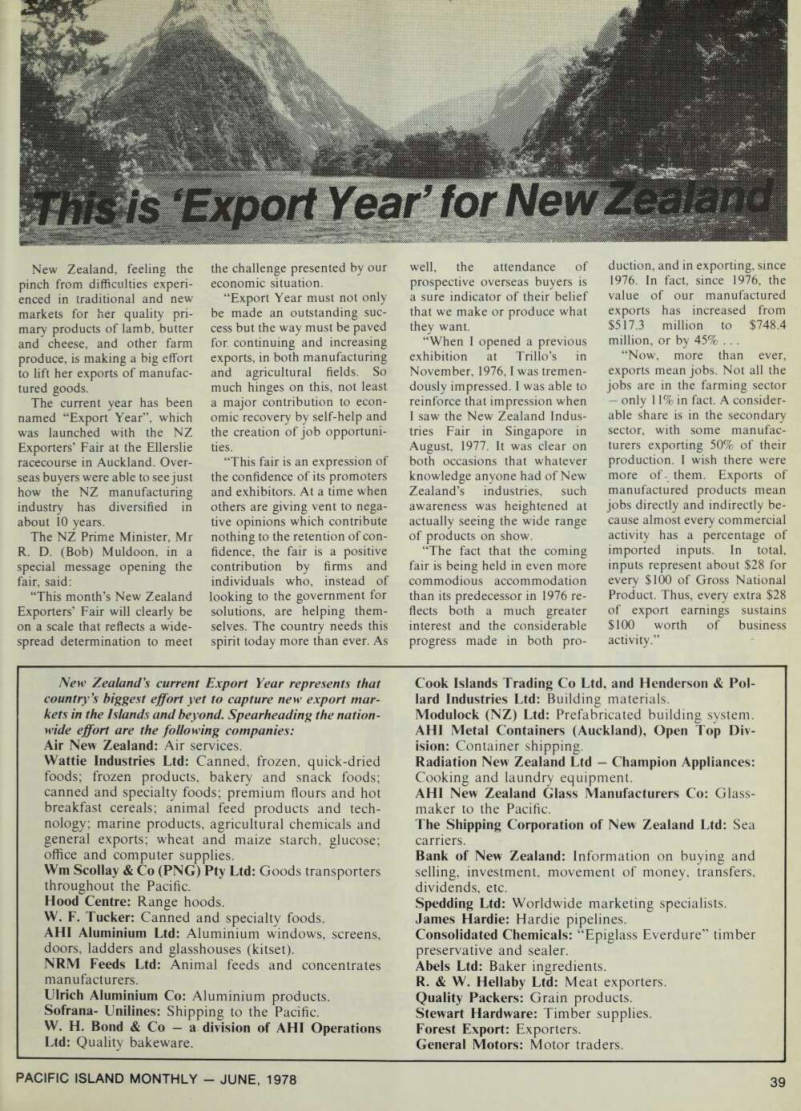
New Zealand, feeling the
pinch from difficulties experi
enced in traditional and new markets for her quality pri mary products of lamb, butter and cheese, and other farm
produce, is making a big effort
to lift her exports of manufac
tured goods.
The current year has been named “Export Year”, which was launched with the NZ Exporters’ Fair at the Ellerslie racecourse in Auckland. Over seas buyers were able to see just how the NZ manufacturing industry has diversified in about 10 years.
The NZ Prime Minister, Mr R. D. (Bob) Muldoon, in a
special message opening the
fair, said: “This month’s New Zealand Exporters’ Fair will clearly be on a scale that reflects a wide spread determination to meet
the challenge presented by our
economic situation.
“Export Year must not only be made an outstanding suc cess but the way must be paved for continuing and increasing exports, in both manufacturing and agricultural fields. So much hinges on this, not least a major contribution to econ omic recovery by self-help and the creation of job opportuni ties.
“This fair is an expression of the confidence of its promoters and exhibitors. At a time when others are giving vent to nega tive opinions which contribute nothing to the retention of con fidence, the fair is a positive contribution by firms and individuals who, instead of looking to the government for solutions, are helping them selves. The country needs this spirit today more than ever. As
well, the attendance of
prospective overseas buyers is
a sure indicator of their belief that we make or produce what
they want.
“When I opened a previous exhibition at Trillo’s in November, 1976,1 was tremen dously impressed. I was able to reinforce that impression when I saw the New Zealand Indus tries Fair in Singapore in August, 1977. It was clear on both occasions that whatever knowledge anyone had of New Zealand’s industries, such awareness was heightened at actually seeing the wide range of products on show.
“The fact that the coming fair is being held in even more commodious accommodation than its predecessor in 1976 re flects both a much greater interest and the considerable progress made in both pro
duction, and in exporting, since 1976. In fact, since 1976, the value of our manufactured exports has increased from $517.3 million to $748.4 million, or by 45% ...
“Now, more than ever, exports mean jobs. Not all the jobs are in the farming sector only 11% in fact. A consider able share is in the secondary sector, with some manufac turers exporting 50% of their production. I wish there were more of- them. Exports of manufactured products mean
jobs directly and indirectly be
cause almost every commercial activity has a percentage of
imported inputs. In total,
inputs represent about $2B for every $lOO of Gross National Product. Thus, every extra $2B of export earnings sustains $lOO worth of business
activity.”
New Zealand's current Export Year represents that country's biggest effort yet to capture new export mar kets in the Islands and beyond . Spearheading the nation wide effort are the following companies: Air New Zealand: Air services.
Wattie Industries Ltd: Canned, frozen, quick-dried foods; frozen products, bakery and snack foods; canned and specialty foods; premium flours and hot breakfast cereals; animal feed products and tech
nology; marine products, agricultural chemicals and
general exports; wheat and maize starch, glucose; office and computer supplies.
Wm Scollay & Co (PNG) Pty Ltd: Goods transporters throughout the Pacific.
Hood Centre: Range hoods.
W. F. Tucker: Canned and specialty foods.
AHI Aluminium Ltd: Aluminium windows, screens, doors, ladders and glasshouses (kitset).
NRM Feeds Ltd: Animal feeds and concentrates manufacturers.
Ulrich Aluminium Co: Aluminium products.
Sofrana- Unilines: Shipping to the Pacific.
W. H. Bond & Co a division of AHI Operations Ltd: Quality bakeware.
Cook Islands Trading Co Ltd, and Henderson & Pol lard Industries Ltd: Building materials.
Modulock (NZ) Ltd: Prefabricated building system.
AHI Metal Containers (Auckland), Open Top Div ision: Container shipping.
Radiation New Zealand Ltd - Champion Appliances:
Cooking and laundry equipment.
AHI New Zealand Glass Manufacturers Co: Glass maker to the Pacific.
The Shipping Corporation of New Zealand Ltd: Sea carriers.
Bank of New Zealand: Information on buying and selling, investment, movement of money, transfers, dividends, etc.
Spedding Ltd: Worldwide marketing specialists.
James Hardie: Hardie pipelines.
Consolidated Chemicals: “Epiglass Everdure” timber preservative and sealer.
Abels Ltd: Baker ingredients.
R. & W. Hellaby Ltd: Meat exporters.
Quality Packers: Grain products.
Stewart Hardware: Timber supplies.
Forest Export: Exporters.
General Motors: Motor traders.
Advertisements & other items, pp. 39-40 (3 items)
39
PACIFIC ISLAND MONTHLY - JUNE, 1978
40
PACIFIC ISLAND MONTHLY - JUNE, 1978
You’ll like our profit-making
3? 4 s.
way with cargo.
Importers and exporters benefit from Air New Zealand Cargo Services in many ways. It’s far quicker, it’s very much safer. Your goods are handled with care.
Temperature controlled facilities are available. Find out more. Contact Air New Zealand Air Cargo. air hell i ZEatann caroo The economic move.
ANZ 78/5
New Zealand: A growing effort

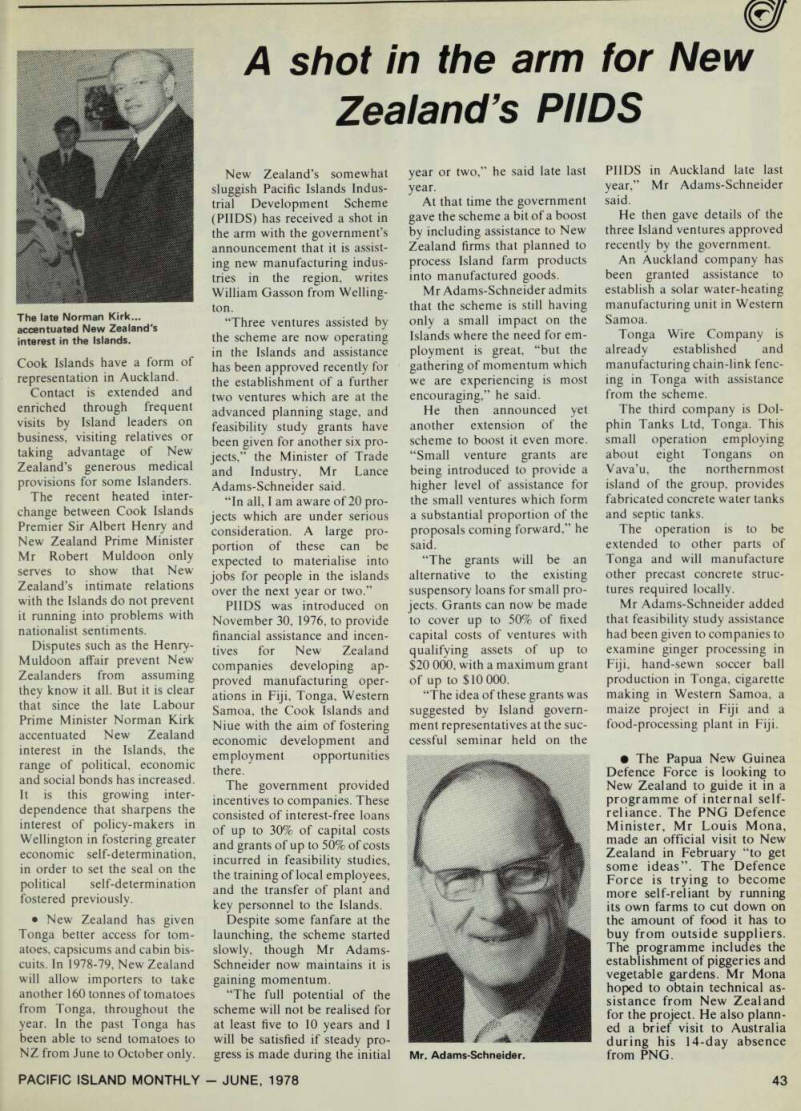
in the Islands
New Zealand today is putting more and more effort into becoming a genuinely Pa cific nation, writes Bob Thompson of the Asia Pacific Research Unit.
Three per cent of the country’s population is drawn from the Islands. Ten per cent of the population has a Polynesian ancestry. More than 20% of the inner city populations of Auckland and
Wellington is Polynesian.
Auckland today is the world’s
largest Polynesian city.
The social imperatives are strong. So are the economic.
Islands states that are not economically viable are a greater charge on New Zealand aid, and more prone to become politically unstable and unpre dictably active in pursuit of in
ternational options.
Viable Island economies are also growth markets for New Zealand, and with possible in creased emphasis on restruc turing of the New Zealand economy, the Islands can be come suppliers of a specialised range of tropical goods to the New Zealand market.
There are other important
links, especially political co
operation, immigration and
educational and health ser vices, but New Zealand’s situ ation and the aspirations of the Islands press trade and invest ment questions to the top of the list of priorities.
Immigration from countries like Western Samoa and Tonga to Auckland has slowed in re cent times, causing Island ad ministrations to place greater
emphasis on expanding their
own agricultural and manufac
turing bases.
New Zealand’s relatively
high unemployment rate, and
the scarcity of jobs for manual workers, has also slowed immi gration from the Cooks, Niue and Tokelau. While these Islanders are New Zealand citi zens and may freely enter, they tend not to move until relatives
already settled tell them of jobs
arranged.
While immigration will no doubt resume its former levels when the New Zealand econ omy picks up, it will probably do so on a more planned basis, with more specific orientation being provided for new settlers than was the case during the big migrant influx earlier this decade.
In education. New Zealand continues to provide edu cational opportunities for
scholarship and private
students from the Islands.
New Zealand aid provides support for efforts to localise school curricula, to develop technical training in the Islands, and to strengthen the University of the South Pacific as an aid to regional develop ment.
USP is to receive additional New Zealand funds to help it to develop its consultant capabilities. This will enable local and expatriate staff employed not only in Suva but on other campuses throughout the region to tackle develop ment projects for which their
academic training equips
them.
New Zealand research sup port goes into the agricultural research stations in the Cooks and Western Samoa, working toward the evolution of poten tially new Island exports such as dried bananas or a range of coconut-based foods.
Due to the state of New Zealand’s economy there has been a substantial effective reduction in the levels of grant aid through direct cash or tech nical assistance. For several years now, the New Zealand annual aid vote has been held at around SNZSO million a year which, with inflation running at around 17%, means a drastic cut in aid.
But the impact has been least on aid to the South Pacific re gion, which maintains its top priority.
One of the New Zealand Government’s biggest hopes for development assistance to the Islands is vested in the rela tively young Pacific Islands
Industrial Development
Scheme (see story elsewhere in
Pim).
It is true that several Islands have shown no great interest in the PUDS scheme. By com
parison with Samoa, Tonga
and Fiji, the Cook Islands and Niue, for example, have made only a limited response to the scheme and given only limited encouragement to potential New Zealand investors.
But some Island states that are actually outside the scheme’s ambit have put sig nificant pressure on New Zealand to be given advantages at least similar to those enjoyed by the PUDS countries.
Significant among these is the Solomon Islands, whose Labour and Industry Minister, Mr P. Ghemu, is keenly
interested in possible develop
ment of his country’s hard woods and fish resources, and New Zealand investment and
privately operated manage
ment service contracts, to get industrial development mov
ing.
With the Solomons’ independence scheduled for July 7, New Zealand aid and a
diplomatic mission will prob
ably mark the occasion.
New Zealand’s economic ties with Papua New Guinea
are growing, especially as
Papua New Guinea pursues alternatives to an over concentration on the Aus
tralian relationship.
The country is increasingly attractive to New Zealand exporters, and a greater range of products is likely to find a place in that market especially as shipping services between the countries improve. The Pa cific Forum Line, which New Zealand has supported, is likely to launch an early service
between Port Moresby, Honiara and new Zealand ports. This would lead prob ably to more active trade pro motion by Papua New Guinea in the New Zealand market.
Fishing represents a big
potential growth sector for the Islands. As New Zealand puts more emphasis on realising the potential of her own 200-mile economic zone, joint oper ations involving the Islands
may develop.
New Zealand co-operated closely with the South Pacific Forum members in developing a common approach to the for mation of 200-mile zones. If
the same co-operation persists
in their exploitation, some very
large commercial projects
could follow.
There is also an untapped potential in underseas min erals. However, this may re quire the participation of even stronger partners than New Zealand or the Islands can pro vide themselves.
Tuvalu is one Island which demonstrates that one need not be large to have commercial attractions. Chief Minister Lauiti has an interest in
ecouraging foreign vessels to
restock with water and other supplies at the port Tuvalu
wants to upgrade. Similarly,
Niue is looking for growth
through its limes, passionfruit
and tourist resorts.
It is noticeable that New Zealand is becoming more of an information centre for Island affairs than ever before.
Diplomatic missions in
Wellington are taking over
from Canberra the task of
representing foreign interests
in, and monitoring trends in, the economic and political affairs of Island nations.
Similarly, the number of Island diplomatic missions in
Wellington is steadily growing,
with Fiji recently joining West
ern Samoa and Papua New Guinea, while Tonga and the
Cook Islands have a form of representation in Auckland.
Contact is extended and enriched through frequent visits by Island leaders on business, visiting relatives or taking advantage of New Zealand’s generous medical provisions for some Islanders.
The recent heated inter change between Cook Islands Premier Sir Albert Henry and New Zealand Prime Minister Mr Robert Muldoon only serves to show that New Zealand’s intimate relations with the Islands do not prevent it running into problems with nationalist sentiments.
Disputes such as the Henry- Muldoon affair prevent New Zealanders from assuming they know it all. But it is clear that since the late Labour Prime Minister Norman Kirk accentuated New Zealand interest in the Islands, the range of political, economic and social bonds has increased.
It is this growing inter
dependence that sharpens the
interest of policy-makers in
Wellington in fostering greater
economic self-determination, in order to set the seal on the
political self-determination
fostered previously.
• New Zealand has given Tonga better access for tom atoes, capsicums and cabin bis cuits. In 1978-79, New Zealand will allow importers to take another 160 tonnes of tomatoes from Tonga, throughout the year. In the past Tonga has been able to send tomatoes to NZ from June to October only.
The late Norman Kirk... accentuated New Zealand's interest in the Islands.
Advertisements & other items, pp. 41-42 (2 items)
41
PACIFIC ISLAND MONTHLY - JUNE, 1978
Better baking, all
K Sjpyngc<cS i Sps^gzieS Ab^ls Abels m I Abell Abets 8 ' ’ "*’ a ,! ’
S AUC«k**
N£W *.***• els Abe' 6 Abels laU* <u,(.*!.««>
NSW It,*!** 8
O .
Abell Abels MSftKL4Hm »&W gg#UM* *V> * Abet Ab#fe Abelf si i
Better baking, all
through the Pacific
begins in this test bakery.
This is Abels Test Bakery in Auckland. Everything we make and export is tested here.
We maintain a comprehensive testing programme throughout the year to ensure that our products give optimum performance under tropical conditions.
That’s why you can use these Abels products with total confidence:
IN MARGARINE
MORAH for cakes and pastry
IN SHORTENINGS
OLEO for general purposes CHEFADE for frying HI-MIX for High-ratio SNOWWHIP for creaming WE MAKE BETTER PRODUCTS SO YOU MAKE BETTER PROFITS Don’t hesitate to get in touch if Abels can help in any way. Write with any enquiries to: Abels Limited, P.O. Box 9573, Auckland, New Zealand.
bels
THE PROFIT IMPROVERS
Zealand’s PUDS
A shot in the arm for New Zealand’s PUDS
New Zealand’s somewhat sluggish Pacific Islands Indus trial Development Scheme (PUDS) has received a shot in the arm with the government’s announcement that it is assist
ing new manufacturing indus
tries in the region, writes William Gasson from Welling ton.
“Three ventures assisted by the scheme are now operating in the Islands and assistance has been approved recently for the establishment of a further two ventures which are at the advanced planning stage, and
feasibility study grants have
been given for another six pro jects,” the Minister of Trade and Industry, Mr Lance Adams-Schneider said.
“In all, I am aware of 20 pro jects which are under serious consideration. A large pro portion of these can be expected to materialise into jobs for people in the islands over the next year or two.”
PUDS was introduced on November 30, 1976, to provide financial assistance and incen tives for New Zealand
companies developing ap
proved manufacturing oper
ations in Fiji, Tonga, Western Samoa, the Cook Islands and Niue with the aim of fostering economic development and
employment opportunities
there.
The government provided incentives to companies. These consisted of interest-free loans of up to 30% of capital costs and grants of up to 50% of costs incurred in feasibility studies, the training of local employees, and the transfer of plant and key personnel to the Islands.
Despite some fanfare at the launching, the scheme started
slowly, though Mr Adams-
Schneider now maintains it is
gaining momentum.
“The full potential of the scheme will not be realised for at least five to 10 years and I will be satisfied if steady pro gress is made during the initial
year or two,” he said late last year.
At that time the government gave the scheme a bit of a boost by including assistance to New Zealand firms that planned to process Island farm products into manufactured goods.
Mr Adams-Schneider admits that the scheme is still having only a small impact on the Islands where the need for em ployment is great, “but the gathering of momentum which we are experiencing is most encouraging,” he said.
He then announced yet another extension of the scheme to boost it even more.
“Small venture grants are being introduced to provide a higher level of assistance for the small ventures which form a substantial proportion of the
proposals coming forward,” he
said.
“The grants will be an alternative to the existing suspensory loans for small pro jects. Grants can now be made to cover up to 50% of fixed capital costs of ventures with qualifying assets of up to $2O 000, with a maximum grant of up to $lO 000.
“The idea of these grants was
suggested by Island govern
ment representatives at the suc cessful seminar held on the
PUDS in Auckland late last year,” Mr Adams-Schneider said.
He then gave details of the three Island ventures approved
recently by the government.
An Auckland company has been granted assistance to establish a solar water-heating manufacturing unit in Western Samoa.
Tonga Wire Company is already established and manufacturing chain-link fenc ing in Tonga with assistance from the scheme.
The third company is Dol phin Tanks Ltd, Tonga. This
small operation employing
about eight Tongans on Vava’u, the northernmost island of the group, provides fabricated concrete water tanks and septic tanks.
The operation is to be extended to other parts of Tonga and will manufacture other precast concrete struc
tures required locally.
Mr Adams-Schneider added
that feasibility study assistance
had been given to companies to
examine ginger processing in
Fiji, hand-sewn soccer ball
production in Tonga, cigarette
making in Western Samoa, a maize project in Fiji and a
food-processing plant in Fiji.
• The Papua New Guinea Defence Force is looking to New Zealand to guide it in a programme of internal self reliance. The PNG Defence Minister, Mr Louis Mona, made an official visit to New Zealand in February “to get some ideas”. The Defence Force is trying to become more self-reliant by running its own farms to cut down on the amount of food it has to buy from outside suppliers.
The programme includes the establishment of piggeries and vegetable gardens. Mr Mona hoped to obtain technical as sistance from New Zealand for the project. He also plann ed a brief visit to Australia during his 14-day absence from PNG.
Mr. Adams-Schneider.
Advertisements & other items, pp. 43-44 (3 items)
43
PACIFIC ISLAND MONTHLY - JUNE, 1978
44
PACIFIC ISLAND MONTHLY - JUNE, 1978
Pacific
Favourites
from
New Zealand
The Sunshine name has proven popularity in New Zealand and throughout the Pacific. A fine range of foods made from the very best New Zealand and the world has to offer.
PEANUT BUTTER, SANDWICH SPREADS, RICE
RISOTTO, NOODLE DINNER, MUSHROOMS
CURRY POWDER, STUFFING, KRUMMIES,
FRUIT EXTRACTS, JELLY, CORDIALS,
ICE-CREAM TOPPING
'BeitZf
CfockeA.
The world famous Betty Crocker products are made under license to General Mills (U.S.A.)
CAKE MIX, SNACKIN' CAKE, CHEESECAKE,
SPONGE PUDDING MIX, CANNED ROLLS.
ST. CCEDIEIITS
Quality products from New Zealand and around the world.
CUT PEEL, CANDIED PEEL, GINGER, GLACE
CHERRIES, CRYSTALISED CHERRIES,
COCKTAIL CHERRIES. DESSERT CHERRIES,
MIXED FRUIT.
Flemings
Famous natural grain products, CREAMOTA’,
MILK OATIES’, THISTLE' ROLLED OATS,
‘HEART O’ WHEAT, ‘SEMOLINA, BRAN
FLAKES, FLAKED RICE
mmm
Convenient liquid bars, ready for freezing and eating.
Trade enquiries to
WE TUCKER & CO. LTD.
P.O. Box 14-449, Auckland, New Zealand.
Telephone 576-024,
Telex Crops NZ2521 Att Sunshine, Cables; Sunshine 6676
HOUSING 7
Our Kitset Houses manufactured to your design or requirements are available for delivery and local assembly competitively anywhere in the Pacific. Units can come complete with plumbing and electrical wiring and be manpacked into the most inaccessible areas if required.
We can also cater for classrooms, hospital wards, dispensaries, etc. Our precut colour coded and numbered framing units means less skilled labour on site as initial cutting, fitting, etc., has been done in our factory.
We will design and/or help you to set up your own manufacturing facilities utilising local labour and resources on a joint venture basis.
FOR FURTHER INFORMATION WRITE TO:—
STEWART
TIMBER & HARDWARE LTD.
EXPORT DIVISION
P.O. BOX 488, WHANGAREI. NEW ZEALAND.
The ladies of Pacifica hear
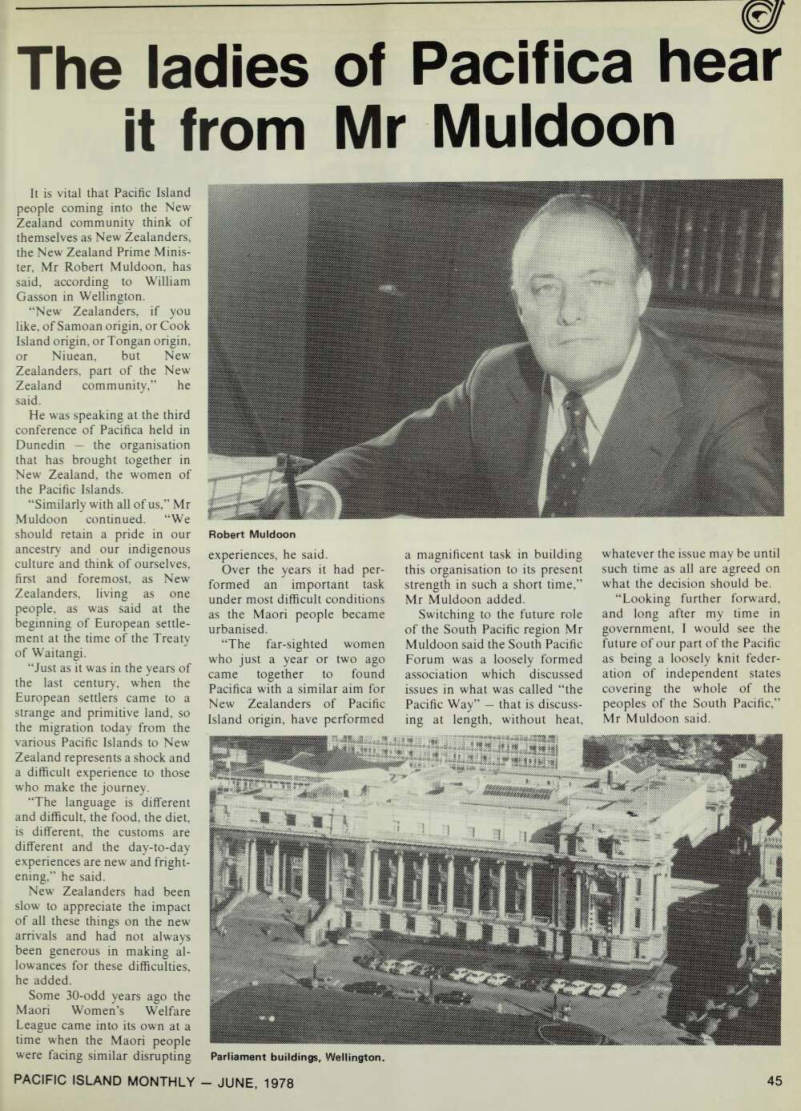
it from Mr Muldoon
It is vital that Pacific Island people coming into the New Zealand community think of themselves as New Zealanders, the New Zealand Prime Minis ter, Mr Robert Muldoon, has said, according to William Gasson in Wellington.
“New Zealanders, if you like, of Samoan origin, or Cook
Island origin, or Tongan origin,
or Niuean, but New Zealanders, part of the New Zealand community,” he said.
He was speaking at the third conference of Pacifica held in Dunedin the organisation that has brought together in New Zealand, the women of the Pacific Islands.
“Similarly with all of us,” Mr Muldoon continued. “We should retain a pride in our ancestry and our indigenous culture and think of ourselves, first and foremost, as New Zealanders, living as one people, as was said at the
beginning of European settle
ment at the time of the Treaty
of Waitangi.
“Just as it was in the years of the last century, when the European settlers came to a strange and primitive land, so the migration today from the various Pacific Islands to New Zealand represents a shock and a difficult experience to those who make the journey.
“The language is different and difficult, the food, the diet, is different, the customs are different and the day-to-day experiences are new and fright ening,” he said.
New Zealanders had been slow to appreciate the impact of all these things on the new arrivals and had not always been generous in making al lowances for these difficulties, he added.
Some 30-odd years ago the Maori Women’s Welfare League came into its own at a time when the Maori people
were facing similar disrupting
experiences, he said.
Over the years it had per formed an important task under most difficult conditions as the Maori people became urbanised.
“The far-sighted women who just a year or two ago came together to found Pacifica with a similar aim for New Zealanders of Pacific
Island origin, have performed
a magnificent task in building this organisation to its present strength in such a short time,”
Mr Muldoon added.
Switching to the future role of the South Pacific region Mr Muldoon said the South Pacific Forum was a loosely formed association which discussed issues in what was called “the Pacific Way” that is discussing at length, without heat,
whatever the issue may be until such time as all are agreed on what the decision should be.
“Looking further forward, and long after my time in government, I would see the future of our part of the Pacific as being a loosely knit feder ation of independent states covering the whole of the peoples of the South Pacific,”
Mr Muldoon said.
Robert Muldoon
Parliament buildings, Wellington.
Advertisements & other items, pp. 45-46 (3 items)
45
PACIFIC ISLAND MONTHLY - JUNE. 1978
46
PACIFIC ISLAND MONTHLY - JUNE, 1978
Rylock
m ii Kin
i
AHI Aluminium Limited
MARKET LEADERS IN ALUMINIUM WINDOWS & DOORS
Rylock
4 LYTE
Manufactured throughout the Pacific Exterior & Interior Sliding Doors Wardrobe Doors Hinged Doors (open in and out) Hinged French Doors (double) Shower Doors (folding, hinged or sliding) Awning Windows Sliding Windows Louvre Windows Double Glazed Windows and Doors Insect Screens (hinged and sliding for doors and windows) Porch Screens Ladders Glasshouses (Kitset) ■
DEALERSHIPS AVAILABLE
FOR FURTHER INFORMATION CONTACT
AHI ALUMINIUM FRANCHISING COMPANY
P.O. BOX 18299, AUCKLAND, NEW ZEALAND
TELEPHONE: 580 704 CABLES: AHIAL TELEX: 2222
weird and wonderful things
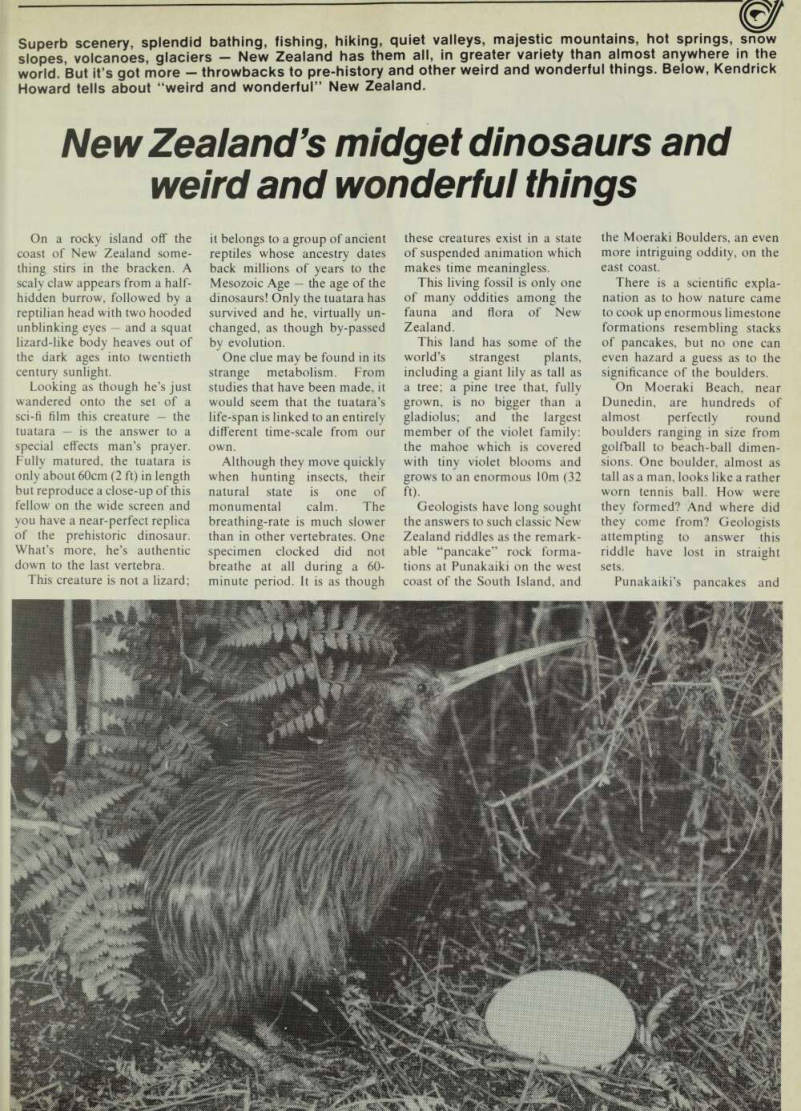
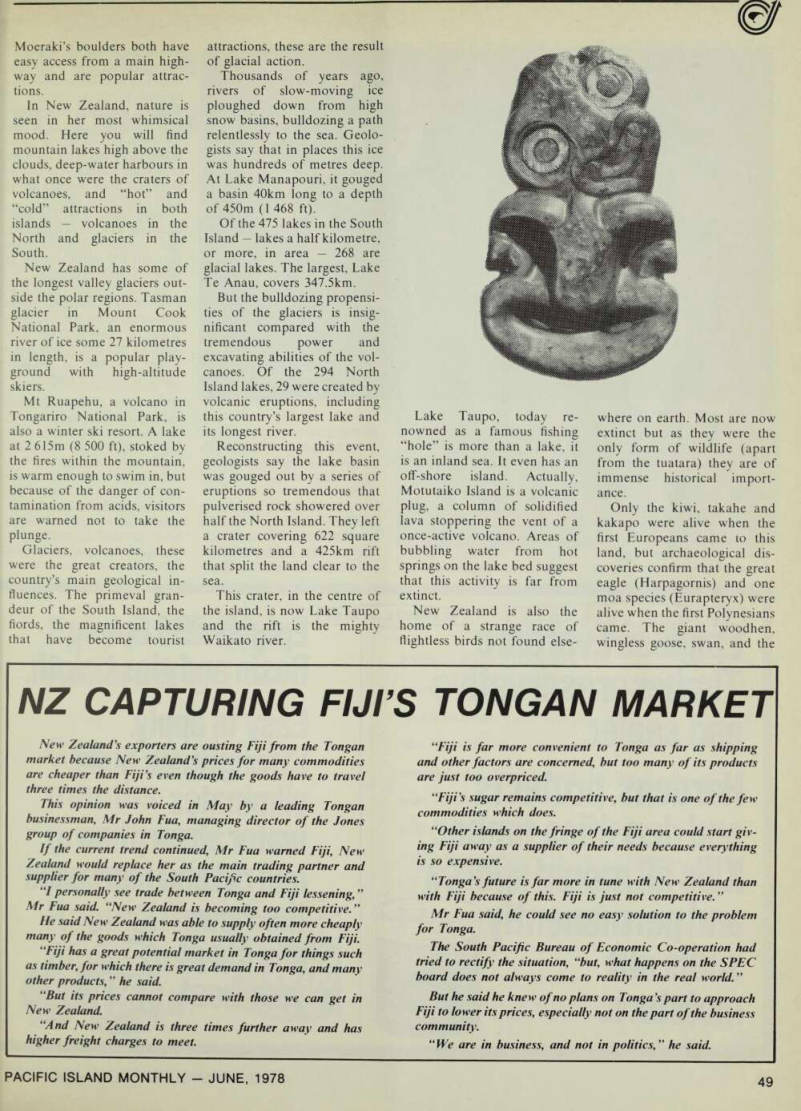
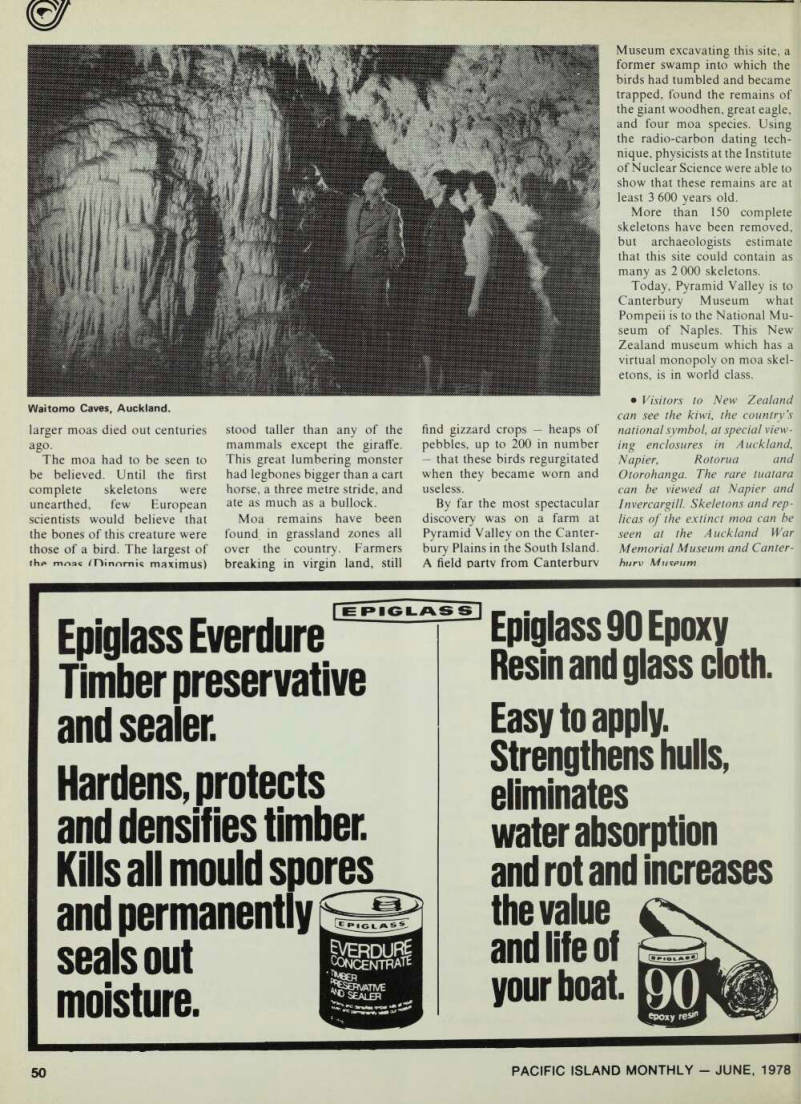
New Zealand’s midget dinosaurs and weird and wonderful things
Superb scenery, splendid bathing, fishing, hiking, quiet valleys, majestic mountains, hot springs, snow slopes, volcanoes, glaciers - New Zealand has them all, in greater variety than almost anywhere in the world. But it’s got more throwbacks to pre-history and other weird and wonderful things. Below, Kendrick Howard tells about “weird and wonderful” New Zealand.
On a rocky island off the coast of New Zealand some thing stirs in the bracken. A scaly claw appears from a half hidden burrow, followed by a reptilian head with two hooded unblinking eyes and a squat lizard-like body heaves out of the dark ages into twentieth
century sunlight.
Looking as though he’s just
wandered onto the set of a sci-fi film this creature the tuatara is the answer to a special effects man’s prayer.
Fully matured, the tuatara is only about 60cm (2 ft) in length but reproduce a close-up of this fellow on the wide screen and you have a near-perfect replica of the prehistoric dinosaur.
What’s more, he’s authentic down to the last vertebra.
This creature is not a lizard;
it belongs to a group of ancient reptiles whose ancestry dates back millions of years to the Mesozoic Age the age of the dinosaurs! Only the tuatara has survived and he, virtually un
changed, as though by-passed
by evolution.
One clue may be found in its strange metabolism. From studies that have been made, it would seem that the tuatara’s life-span is linked to an entirely different time-scale from our own.
Although they move quickly
when hunting insects, their natural state is one of monumental calm. The breathing-rate is much slower than in other vertebrates. One specimen clocked did not breathe at all during a 60minute period. It is as though
these creatures exist in a state of suspended animation which makes time meaningless.
This living fossil is only one of many oddities among the fauna and flora of New Zealand.
This land has some of the world’s strangest plants, including a giant lily as tall as a tree; a pine tree that, fully grown, is no bigger than a
gladiolus; and the largest
member of the violet family: the mahoe which is covered with tiny violet blooms and grows to an enormous 10m (32 ft).
Geologists have long sought
the answers to such classic New Zealand riddles as the remark able “pancake” rock forma tions at Punakaiki on the west coast of the South Island, and
the Moeraki Boulders, an even more intriguing oddity, on the east coast.
There is a scientific expla nation as to how nature came to cook up enormous limestone formations resembling stacks of pancakes, but no one can even hazard a guess as to the significance of the boulders.
On Moeraki Beach, near Dunedin, are hundreds of almost perfectly round boulders ranging in size from golfball to beach-ball dimen sions. One boulder, almost as tall as a man, looks like a rather worn tennis ball. How were they formed? And where did
they come from? Geologists
attempting to answer this riddle have lost in straight sets.
Punakaiki’s pancakes and
Moeraki’s boulders both have easy access from a main high way and are popular attrac tions.
In New Zealand, nature is seen in her most whimsical mood. Here you will find mountain lakes high above the clouds, deep-water harbours in what once were the craters of volcanoes, and “hot” and “cold” attractions in both islands volcanoes in the North and glaciers in the South.
New Zealand has some of
the longest valley glaciers out
side the polar regions. Tasman glacier in Mount Cook National Park, an enormous river of ice some 27 kilometres
in length, is a popular play
ground with high-altitude
skiers.
Mt Ruapehu, a volcano in Tongariro National Park, is also a winter ski resort. A lake at 2 615 m (8 500 ft), stoked by the fires within the mountain, is warm enough to swim in, but because of the danger of con tamination from acids, visitors are warned not to take the
plunge.
Glaciers, volcanoes, these were the great creators, the
country’s main geological in
fluences. The primeval gran deur of the South Island, the fiords, the magnificent lakes that have become tourist
attractions, these are the result of glacial action.
Thousands of years ago, rivers of slow-moving ice ploughed down from high snow basins, bulldozing a path relentlessly to the sea. Geolo gists say that in places this ice was hundreds of metres deep.
At Lake Manapouri, it gouged a basin 40km long to a depth of 450 m (1 468 ft).
Of the 475 lakes in the South Island lakes a half kilometre, or more, in area 268 are glacial lakes. The largest, Lake Te Anau, covers 347.5 km.
But the bulldozing propensi
ties of the glaciers is insig nificant compared with the tremendous power and excavating abilities of the vol canoes. Of the 294 North Island lakes, 29 were created by
volcanic eruptions, including
this country’s largest lake and its longest river.
Reconstructing this event, geologists say the lake basin was gouged out by a series of eruptions so tremendous that pulverised rock showered over half the North Island. They left a crater covering 622 square kilometres and a 425 km rift that split the land clear to the sea.
This crater, in the centre of the island, is now Lake Taupo and the rift is the mighty Waikato river.
Lake Taupo, today re
nowned as a famous fishing “hole” is more than a lake, it is an inland sea. It even has an olf-shore island. Actually, Motutaiko Island is a volcanic plug, a column of solidified lava stoppering the vent of a once-active volcano. Areas of bubbling water from hot springs on the lake bed suggest that this activity is far from extinct.
New Zealand is also the home of a strange race of flightless birds not found else
where on earth. Most are now extinct but as they were the only form of wildlife (apart from the tuatara) they are of immense historical import ance.
Only the kiwi, takahe and kakapo were alive when the first Europeans came to this land, but archaeological dis coveries confirm that the great eagle (Harpagornis) and one
moa species (Eurapteryx) were
alive when the first Polynesians came. The giant woodhen, wingless goose, swan, and the
larger moas died out centuries ago.
The moa had to be seen to be believed. Until the first complete skeletons were unearthed, few European scientists would believe that the bones of this creature were those of a bird. The largest of thp mnas rHinomic maximUS)
stood taller than any of the mammals except the giraffe.
This great lumbering monster had legbones bigger than a cart horse, a three metre stride, and ate as much as a bullock.
Moa remains have been found in grassland zones all over the country. Farmers breaking in virgin land, still
find gizzard crops heaps of pebbles, up to 200 in number that these birds regurgitated when they became worn and useless.
By far the most spectacular discovery was on a farm at Pyramid Valley on the Canter bury Plains in the South Island.
A field partv from Canterbury
Museum excavating this site, a former swamp into which the birds had tumbled and became trapped, found the remains of the giant woodhen, great eagle, and four moa species. Using the radio-carbon dating tech nique, physicists at the Institute of Nuclear Science were able to show that these remains are at least 3 600 years old.
More than 150 complete skeletons have been removed, but archaeologists estimate that this site could contain as many as 2 000 skeletons.
Today, Pyramid Valley is to Canterbury Museum what Pompeii is to the National Mu seum of Naples. This New Zealand museum which has a virtual monopoly on moa skel etons, is in world class. • Visitors to New Zealand can see the kiwi, the country's national symbol, at special view ing enclosures in Auckland, Napier, Rotorua and Otorohanga. The rare tuatara can be viewed at Napier and Invercargill. Skeletons and rep licas of the extinct moa can be seen at the Auckland War Memorial Museum and Canter bury Muspum.
Waitomo Caves, Auckland.
Advertisements & other items, p. 48 (2 items)
48
PACIFIC ISLAND MONTHLY - JUNE, 1978
C6cissuo*e
Glassmakers
to the
Pacific
Bottles by the million - wine, beer, soft drink. Glass containers in hundreds of shapes and sizes. New Zealand Glass Manufacturers can do it!
We offer glass container design and technical design facilities, mould manufacturing, custom packaging and end use cartons. New Zealand Glass Manufacturers, glassmakers to the Pacific.
For further information contact.
MSB
Private Bag, Auckland.
NEW ZEALAND.
New Zealand Glass Manufacturers Company
XGMB
C6cissuo*e
Commander
Rangehood
An exciting new rangehood from Classique.
This European styled hood offers efficiency and styling unmatched by other compact rangehoods. Featuring a retractable perspex scoop, the Commander gives maximum storetop coverage yet easy access to rear cooking elements. Available in multiple colour choice and can be either back or top ducted.
Manufactured by Classique Manufacturing a division of Hoodsiffiteg lw - -104 Parnell Road, Auckland, N.Z.
Phone 32 109.
Nz Capturing Fiji’S Tongan Market
New Zealand’s exporters are ousting Fiji from the Tongan market because New Zealand’s prices for many commodities are cheaper than Fiji’s even though the goods have to travel three times the distance.
This opinion was voiced in May by a leading Tongan businessman, Mr John Fua, managing director of the Jones group of companies in Tonga.
If the current trend continued, Mr Fua warned Fiji, New Zealand would replace her as the main trading partner and supplier for many of the South Pacific countries.
“I personally see trade between Tonga and Fiji lessening, ”
Mr Fua said. “New Zealand is becoming too competitive.”
He said New Zealand was able to supply often more cheaply many of the goods which Tonga usually obtained from Fiji.
“Fiji has a great potential market in Tonga for things such as timber, for which there is great demand in Tonga, and many other products, ” he said.
“But its prices cannot compare with those we can get in New Zealand.
“And New Zealand is three times further away and has higher freight charges to meet.
“Fiji is far more convenient to Tonga as far as shipping and other factors are concerned , but too many of its products
are just too overpriced.
“Fiji's sugar remains competitive, but that is one of the few commodities which does.
“Other islands on the fringe of the Fiji area could start giv ing Fiji away as a supplier of their needs because everything is so expensive.
“Tonga’s future is far more in tune with New Zealand than with Fiji because of this. Fiji is just not competitive. ”
Mr Fua said, he could see no easy solution to the problem for Tonga.
The South Pacific Bureau of Economic Co-operation had tried to rectify the situation, “but, what happens on the SPEC board does not always come to reality in the real world. ”
But he said he knew of no plans on Tonga’s part to approach Fiji to lower its prices, especially not on the part of the business
community.
“We are in business, and not in politics,” he said.
Advertisements & other items, pp. 49-50 (3 items)
49
PACIFIC ISLAND MONTHLY - JUNE, 1978
50
PACIFIC ISLAND MONTHLY - JUNE, 1978
Epiglass Everdure
Timber preservative and sealer.
Hardens, protects and densities timber.
Kills all mould spores and permanently seals out moisture. 1 Epiglass 90 Epoxy Resin and glass cloth.
Easy to apply.
Strengthens hulls, eliminates water absorption and rot and increases the value and life of your boat. i
‘IT was a romantic thing
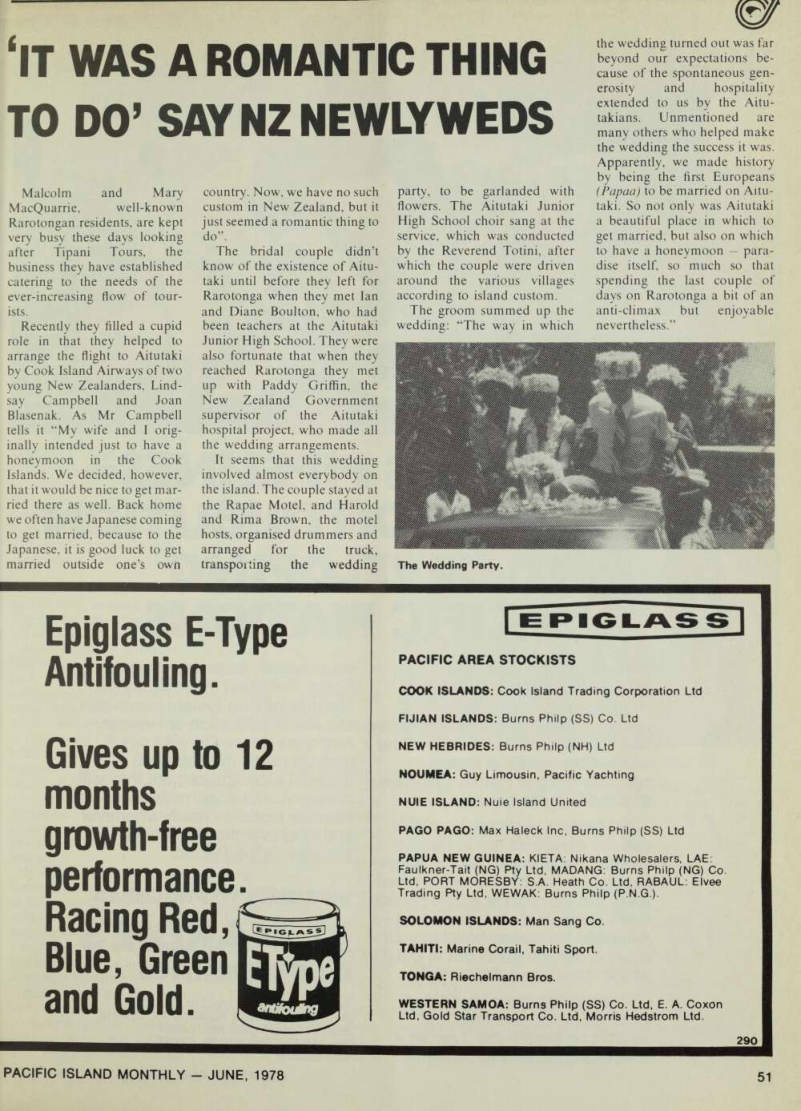
To Do’ Say Nz Newlyweds
Malcolm and Mary MacQuarrie, well-known Rarotongan residents, are kept very busy these days looking after Tipani Tours, the business they have established catering to the needs of the ever-increasing flow of tour ists.
Recently they filled a cupid
role in that they helped to arrange the flight to Aitutaki by Cook Island Airways of two young New Zealanders, Lind say Campbell and Joan Blasenak. As Mr Campbell tells it “My wife and I orig inally intended just to have a honeymoon in the Cook Islands. We decided, however, that it would be nice to get mar ried there as well. Back home we often have Japanese coming to get married, because to the Japanese, it is good luck to get married outside one’s own
country. Now, we have no such custom in New Zealand, but it just seemed a romantic thing to do”.
The bridal couple didn’t know of the existence of Aitu taki until before they left for Rarotonga when they met lan and Diane Boulton, who had been teachers at the Aitutaki Junior High School. They were also fortunate that when they
reached Rarotonga they met
up with Paddy Griffin, the New Zealand Government supervisor of the Aitutaki hospital project, who made all the wedding arrangements.
It seems that this wedding involved almost everybody on the island. The couple stayed at the Rapae Motel, and Harold and Rima Brown, the motel hosts, organised drummers and arranged for the truck,
transporting the wedding
party, to be garlanded with flowers. The Aitutaki Junior High School choir sang at the service, which was conducted by the Reverend Totini, after which the couple were driven around the various villages according to island custom.
The groom summed up the wedding: “The way in which
the wedding turned out was far
beyond our expectations be
cause of the spontaneous gen
erosity and hospitality
extended to us by the Aitu takians. Unmentioned are many others who helped make the wedding the success it was.
Apparently, we made history
by being the first Europeans
(Papaa) to be married on Aitu taki. So not only was Aitutaki a beautiful place in which to get married, but also on which to have a honeymoon para dise itself, so much so that spending the last couple of days on Rarotonga a bit of an anti-climax but enjoyable nevertheless.”
The Wedding Party
Advertisements & other items, pp. 51-52 (2 items)
51
PACIFIC ISLAND MONTHLY - JUNE, 1978
Racing Red,
PACIFIC AREA STOCKISTS
COOK ISLANDS: Cook Island Trading Corporation Ltd FIJIAN ISLANDS: Burns Philp (SS) Co. Ltd NEW HEBRIDES; Burns Philp (NH) Ltd NOUMEA: Guy Limousin, Pacific Yachting NUIE ISLAND: Nuie Island United PAGO PAGO: Max Haleck Inc, Burns Philp (SS) Ltd PAPUA NEW GUINEA: KIETA; Nikana Wholesalers, LAE: Faulkner-Tait (NG) Pty Ltd, MADANG; Burns Philp (NG) Co.
Ltd, PORT MORESBY: S.A. Heath Co. Ltd, RABAUL: Elvee Trading Pty Ltd, WEWAK: Burns Philp (P.N.G.).
SOLOMON ISLANDS: Man Sang Co
TAHITI: Marine Corail, Tahiti Sport.
TONGA: Riechelmann Bros.
WESTERN SAMOA: Burns Philp (SS) Co. Ltd. E. A. Coxon Ltd, Gold Star Transport Co. Ltd, Morris Hedstrom Ltd. 290
Epiglass E-Type Antifouling.
Gives up to 12 months growth-free performance.
Racing Red, Blue, Green and Gold.
d •••»i* w • - ■
Bs-'l ■
k dm w. ¥ -*% A *. m ■’v ■ / ?S> •.V .- 1
hardie’s PIPELINES-
A MAJOR CONTRIBUTION
TO DEVELOPING
PACIFIC NATIONS
Water Supply and Sewer Reticulation are the two basic requirements of a developing country. The Fiji Housing Authority, with the Health and Welfare of the Island Community at stake, naturally choose Hardie’s pipelines to provide these services.
At Hardie’s we know how vital delivery deadlines are to Pacific clients. Especially when the supply source can be 2000 miles or more away. So we provide a pipe service that’s unbeatable for speed and reliability. No matter how big your pipes order, we go all out to get it to you on time, every time.
Contractors have found that Fibrolite pipes save time and trouble on the job too. Longer 4 metre lengths and lightweight, mean easier, faster handling and laying. Precision made Supertite vee ring jointing system eliminates any risk of infiltration or leakage.
And once down, Fibrolite pipes save on costly maintenance made of asbestos-cement they will never rot, rust or corrode. Hardie’s Fibrolite pipes ... ready whenever and wherever they’re needed throughout the Pacific.
PIPELINES TO PROGRESS
$
hardie’s
pipelines
James Hardie & Coy. Pty. Ltd.
Box 12-070, Penrose, Auckland. Ph. 599-919.
Box 9671, Wellington, Ph. 724-851.
Box 325, Christchurch. Ph. 65-036.
New Zealand.
‘By Golly,’ Said The American, And
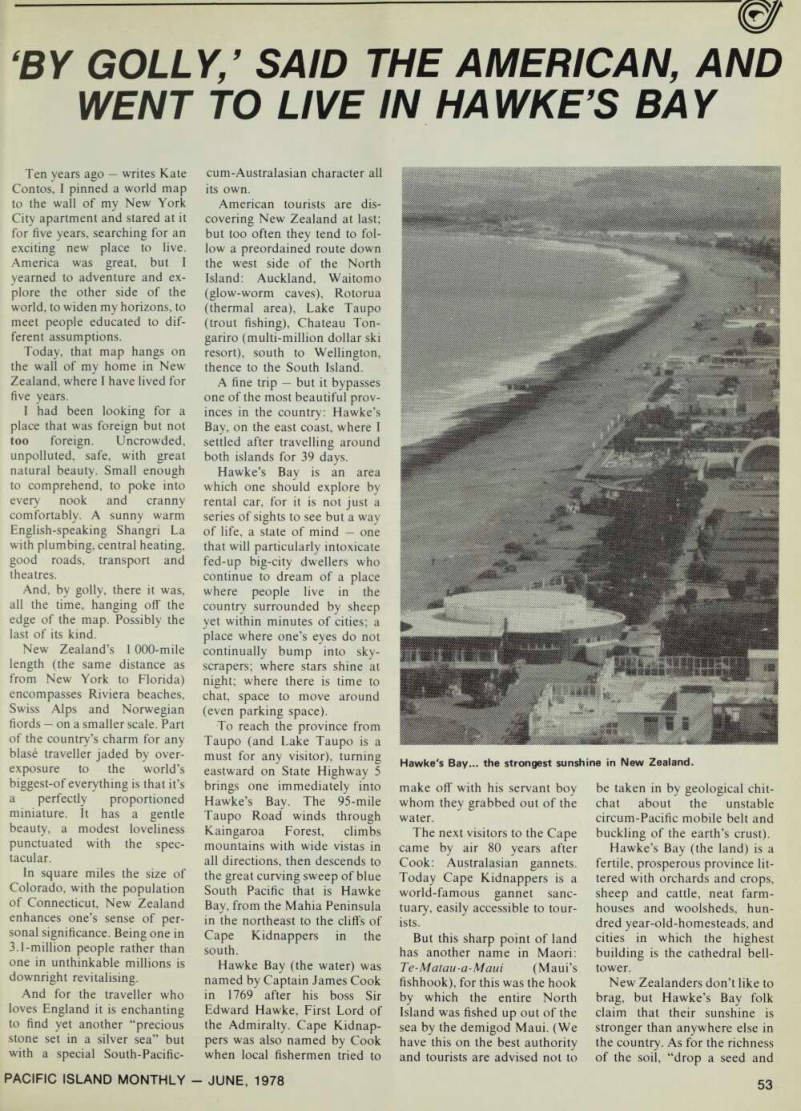
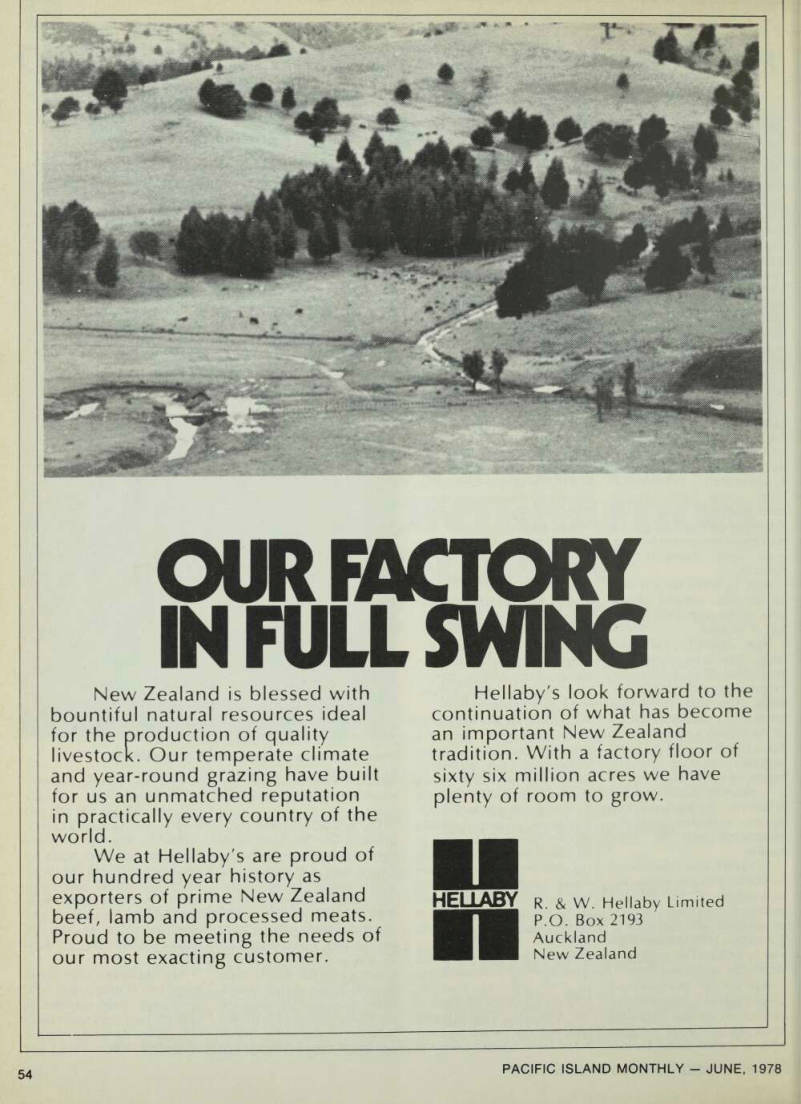
WENT TO LIVE IN HA WKE’S BAY
Ten years ago writes Kate Contos, I pinned a world map to the wall of my New York City apartment and stared at it for five years, searching for an exciting new place to live.
America was great, but I yearned to adventure and ex plore the other side of the world, to widen my horizons, to meet people educated to dif
ferent assumptions.
Today, that map hangs on the wall of my home in New Zealand, where I have lived for five years.
I had been looking for a place that was foreign but not too foreign. Uncrowded, unpolluted, safe, with great
natural beauty. Small enough
to comprehend, to poke into every nook and cranny comfortably. A sunny warm
English-speaking Shangri La
with plumbing, central heating,
good roads, transport and theatres.
And, by golly, there it was, all the time, hanging off the edge of the map. Possibly the last of its kind.
New Zealand’s 1 000-mile length (the same distance as from New York to Florida) encompasses Riviera beaches,
Swiss Alps and Norwegian
fiords on a smaller scale. Part of the country’s charm for any blase traveller jaded by over exposure to the world’s biggest-of everything is that it’s
a perfectly proportioned
miniature. It has a gentle beauty, a modest loveliness punctuated with the spec tacular.
In square miles the size of Colorado, with the population of Connecticut, New Zealand enhances one’s sense of per sonal significance. Being one in 3.1-million people rather than one in unthinkable millions is
downright revitalising.
And for the traveller who loves England it is enchanting to find yet another “precious stone set in a silver sea” but with a special South-Pacific
cum-Australasian character all its own.
American tourists are dis covering New Zealand at last; but too often they tend to fol low a preordained route down the west side of the North Island: Auckland, Waitomo (glow-worm caves), Rotorua (thermal area), Lake Taupo (trout fishing). Chateau Ton gariro (multi-million dollar ski resort), south to Wellington, thence to the South Island.
A fine trip but it bypasses one of the most beautiful prov inces in the country: Hawke’s Bay, on the east coast, where I settled after travelling around both islands for 39 days.
Hawke’s Bay is an area which one should explore by rental car, for it is not just a series of sights to see but a way of life, a state of mind one that will particularly intoxicate
fed-up big-city dwellers who
continue to dream of a place where people live in the
country surrounded by sheep
yet within minutes of cities; a place where one’s eyes do not
continually bump into sky
scrapers; where stars shine at night; where there is time to chat, space to move around (even parking space).
To reach the province from Taupo (and Lake Taupo is a must for any visitor), turning eastward on State Highway 5
brings one immediately into
Hawke’s Bay. The 95-mile
Taupo Road winds through
Kaingaroa Forest, climbs mountains with wide vistas in all directions, then descends to the great curving sweep of blue South Pacific that is Hawke Bay, from the Mahia Peninsula in the northeast to the cliffs of
Cape Kidnappers in the
south.
Hawke Bay (the water) was named by Captain James Cook in 1769 after his boss Sir Edward Hawke, First Lord of
the Admiralty. Cape Kidnap
pers was also named by Cook when local fishermen tried to
make off with his servant boy whom they grabbed out of the water.
The next visitors to the Cape came by air 80 years after Cook: Australasian gannets.
Today Cape Kidnappers is a
world-famous gannet sanc tuary, easily accessible to tour ists.
But this sharp point of land has another name in Maori: Te-Matau-a-Maui (Maui’s fishhook), for this was the hook by which the entire North Island was fished up out of the sea by the demigod Maui. (We have this on the best authority and tourists are advised not to
be taken in by geological chit chat about the unstable circum-Pacific mobile belt and buckling of the earth’s crust).
Hawke’s Bay (the land) is a fertile, prosperous province lit tered with orchards and crops, sheep and cattle, neat farm houses and woolsheds, hun dred year-old-homesteads, and cities in which the highest building is the cathedral bell tower.
New Zealanders don’t like to brag, but Hawke’s Bay folk claim that their sunshine is stronger than anywhere else in the country. As for the richness of the soil, “drop a seed and
Hawke's Bay... the strongest sunshine in New Zealand.
jump back.” Sheep grow fat, woolly and tasty on lush grass “but of course we feed them mint and garlic as well,” farmers will tell you with
straight faces.
A string of cities runs
through the province from
Wairoa in the north to Wood ville in the south, connected by State Highway 2: Napier, Hast
ings, Waipawa, Waipukurau,
Norsewood and Dannevirke 176 miles then south to the capital of Wellington. A fast modern train, the Endeavour, runs the same route from Napier to Wellington, a
s‘/2-hour trip.
Napier is the largest city
(pop 47 000) and provincial
capital. A sunny, leisurely,
clean town, it rises like an island from the sea. Once called Scinde Island, its Bluff Hill was cut off from the sur rounding flat by marshes and
lagoons.
But in 1931 a devastating earthquake razed the city, and raised the land six feet, drain ing the marshes and providing acres of new land for homes.
Napier doggedly rebuilt
itself, burying its rubble under the seafront and covering it up with a fine Marine Parade lined with pines from Norfolk
Island. Today this promenade
is nationally known as Napier’s “Golden Mile” of entertain ments, to which the city con tinually adds. The latest building is a modern
aquarium, largest in the
southern hemisphere, opened
one year ago.
But Napier is also a commer cial and government centre,
airport, shipping port, import
ant wool exchange, home of
the country’s first community
college and a centre for the arts.
Twelve miles south of Napier is its sister city and vig
orous competitor, Hastings,
pop 34 000. When both cities
acquired concert grand pianos
in the same year, newspaper
headlines happily proclaimed
that Hastings’ piano was three
inches longer than Napier’s.
Besides being a busy farming
service centre with good shops and a gusto for horse-racing,
Hastings enthusiastically pro
motes itself with three names: City of Parks, Hive of Industry and Fruit Bowl of New Zealand all of which are
quite true.
Lush and green all year round, watered by pure under
ground aquifer, these Here
taunga Plains are the largest fruit-growing area in New Zealand. In September and October, Hastings almost disappears in a sea of blossoms.
Roadside stands offer fruits and vegetables fresh out of the ground all year a particular bonus for travellers who like to prepare their own meals in motor camps as a change from hotel and restaurant fare.
Hastings and Napier, indeed
all Hawke’s Bay cities and towns, welcome foreign visitors (“Where in Canada are you from? How do you like New Zealand? Have a cup of tea.”) but this attitude has not
resulted in spurious hospitality
or false fronts.
Unlike many small countries forced to revamp their per sonalities, customs, and way of life to suit tourists, in order to survive, New Zealand is genu ine, building for its own people
and coming generations.
Admittedly some of the smaller villages look like Hollywood western movie frontages, but they too are
genuine, having changed little
from pioneer days. After all, New Zealand is a relatively new country, younger than the USA. There are still general
stores selling everything im
aginable, corner dairies with penny candies, toy-like post offices all of which trigger a nostalgia, a sudden whiff of childhood.
The natives are friendly and if any should be discovered waltzing around in “native cos tume” it is not by arrangement with Walt Disney but more likely the town’s centenary cel ebration, with descendants of the original settlers having a
great time wearing their great grandparents’ Victorian cloth
ing.
Or Maoris might be per forming a serious ritual haka to welcome an important guest to their marae.
Scandinavian costumes would mean the traveller has found his or her way to Norse wood, near Dannevirke, where Olsens and Jensens’ and Maoris are celebrating some
anniversay, perhaps that of
their delightful local museum in which they have lovingly collected artifacts from the last hundred years, including some
brought from Norway and
Sweden in the Hovding in 1872.
Where such museums have been established, with enor mous patience and labour on the part of local citizens, where fine old homesteads have been preserved and there are
many throughout Hawke’s Bay
- where gold-mining towns have been restored, as in the South Island, it is not for love of the tourist buck but because New Zealanders are urgently
occupied with capturing and
preserving their history before
the old folk with their memor ies and cherished souvenirs pass away.
But such serendipitous sights
and places are likely to reveal themselves only to the seren dipitous traveller who takes time to poke into corners, invite conversation, ask the way, exchange stories.
Such a traveller cruising around in the northwest country of Hawke’s Bay will come upon a place called Puketitiri and screech to a halt at the sight of three windmills and invitation to visit a fine pri vate museum, miles from any where.
Or in the southwest a sign will appear pointing to
Taumatawhakatangihang
akoauauotamateaturipuka-
kapikimaungahoronukupo-
kaiwhenuakitanatahu.
“This region,” wrote the French explorer Dumont D’Urville about Hawke’s Bay in his diary for Feb 3, 1827, “is undoubtedly the one which I found the richest and most at tractive scenery in the whole of New Zealand.”
Advertisements & other items, pp. 53-54 (2 items)
53
PACIFIC ISLAND MONTHLY - JUNE. 1978
Infullswmg
I T~' «'■ m . m »* ■ m I r^. i * E ! V ’ ■f K ...
Mm ! 1„ -
OUR FACTORY
INFULLSWMG
New Zealand is blessed with bountiful natural resources ideal for the production of quality livestock. Our temperate climate and year-round grazing have built for us an unmatched reputation in practically every country of the world.
We at Hellaby's are proud of our hundred year history as exporters of prime New Zealand beef, lamb and processed meats.
Proud to be meeting the needs of our most exacting customer.
Hellaby's look forward to the continuation of what has become an important New Zealand tradition. With a factory floor of sixty six million acres we have plenty of room to grow.
HELLABY R & W. Hellaby Limited nP.O. Box 2193 Auckland New Zealand
How To Get There
Several air lines operate regular services to New Zealand, including Air New Zealand, Qantas, Pan Am, British Air ways, UTA French Airlines, Air Pacific and Singapore Air lines.
From Australia daily services by Air New Zealand and Qantas. Regular services to Auckland also by Pan Am, Bri tish Airways and UTA French Airlines.
From the Pacific daily services available from Fiji operated by Air New Zealand and Air Pacific. Regular ser vices from New Caledonia, American Samoa, Western Samoa, Tahiti, Hawaii and the Cook Islands. These services are operated by Air New Zealand, Polynesian Airlines, UTA French Airlines and Pan Am.
From North America daily services available from West Coast USA operated by Air New Zealand. Pan Am and UTA French Airlines provide regular services.
From Asia regular services by Air New Zealand, Sin gapore Airlines, British Airways and UTA French Airlines.
Connections available via Australia.
Extensive airline networks link all cities, major towns and resorts. Services are operated by Air New Zealand, Mount Cook Airlines and several commuter air lines.
Modem motor coaches and trains operate on scheduled services throughout the country. Inter-island Ferry services link the North and South Islands. Modern motor vehicles and motor caravans are available for hire.
Several reliable tour companies offer “Inclusive pack ages” for coach tours and self-drive holidays. Tour pro grammes range from short 4-day packages to 3-week
holidays covering all the scenic highlights.
A wide range of accommodation from deluxe hotels to economy style motels and motor camps is available throughout New Zealand.
Advertisements & other items, pp. 55-56 (3 items)
55
PACIFIC ISLAND MONTHLY - JUNE. 1978
56
PACIFIC ISLAND MONTHLY - JUNE. 1978
Flour
The
Modulock
System.
A unique building method.
w Modulock is a high quality, low maintenance building system. It allows an infinite variety of designs ideal for homes, offices, schools indeed all low rise buildings.
Modulock is quick to deliver and assemble, low on labour, compact, easy to ship and particularly suited to conditions in the Pacific: For further information contact
MODULOCK
Modulock (N.Z.) Limited, P.O. Box 51-099, Pakuranga, Auckland, New Zealand.
Telephone 47-069 Papatoetoe, Telex N.Z. 2290-
mar
Bain
FLOUR
KB7 c Plaiii
NOW AVAILABLE IN
31b POLYTHENE PACKS
REGULAR SUPPLIES ARE GUARANTEED
for further details contact:
QUALITY PACKERS LTD.
HAYMARKET FOODS DIVISION
P.O. Box 13-011, Onehunga, Auckland 6, New Zealand also suppliers of:
• NATURAL CITRUS PEEL
• ICING SUGAR
• RICES
•SAUCES
AND OTHER GROCERY PRODUCTS
PLUS“NEVERONG” —
NEW ZEALAND’S LEADING ANT KILLER
NIUE
COOK ISLANDS
TAHITI
to and from
NEW ZEALAND
Regular service using pallet load ships TIARE MOANA and FETU MOANA. Refrigerated and general cargo between Auckland and Niue, Rarotonga, Aitutaki, Papeete. Other nearby ports by inducement.
AREA AGENTS
Niue: Government Shipping Office, Alofi.
Cook Islands; Waterfront Commission, PO Box 61, Rarotonga.
Telex Shipping RG 2002 Tahiti: Agence Maritime et de Voyage, B P 131, Papeete.
Telex AMAV 251 FP
The Shipping Corporation
of New Zealand Limited
Sea carrier to the nation AUCKLAND: Phone 379-430. PO Box 3420. Telex: NZ2822 WELLINGTON: Phone 728-500. PO Box 3344. Telex: NZ3495 CHRISTCHURCH: Phone 795-760. PO Box 777. Telex; 4434 DUNEDIN; Phone 76-076. PO Box 904. Telex; 5228. 1436
NZ vs. Japan: The midget and
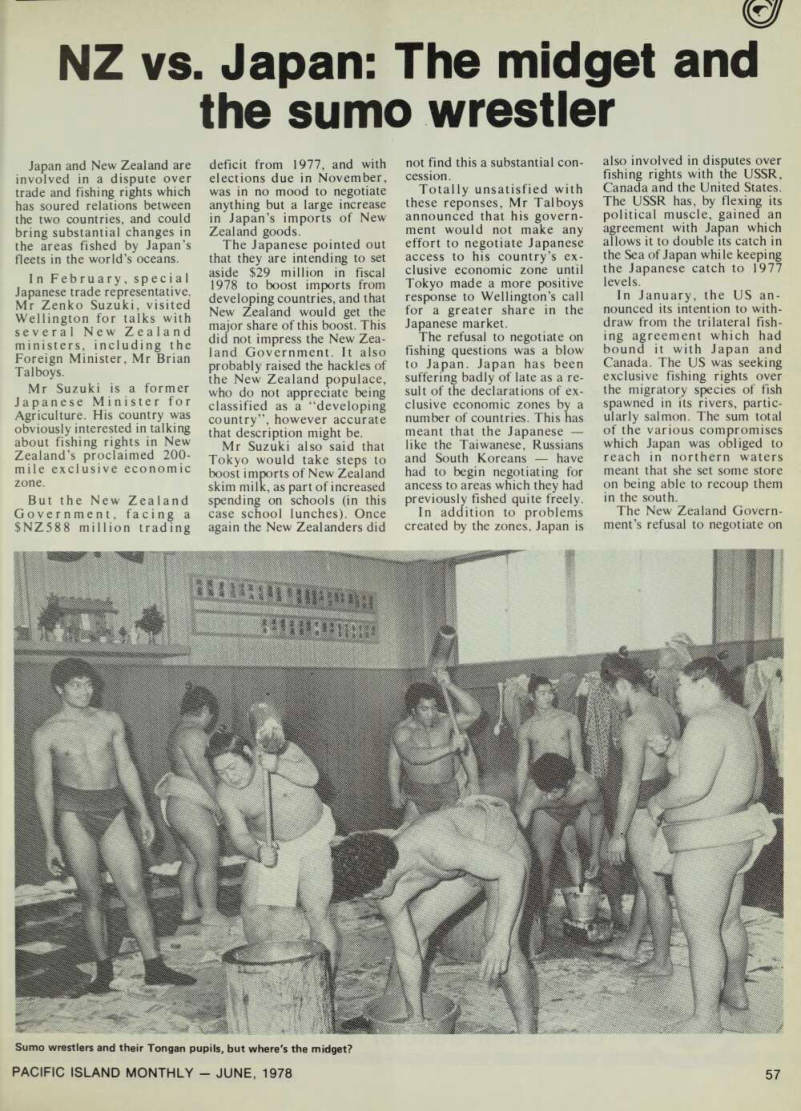
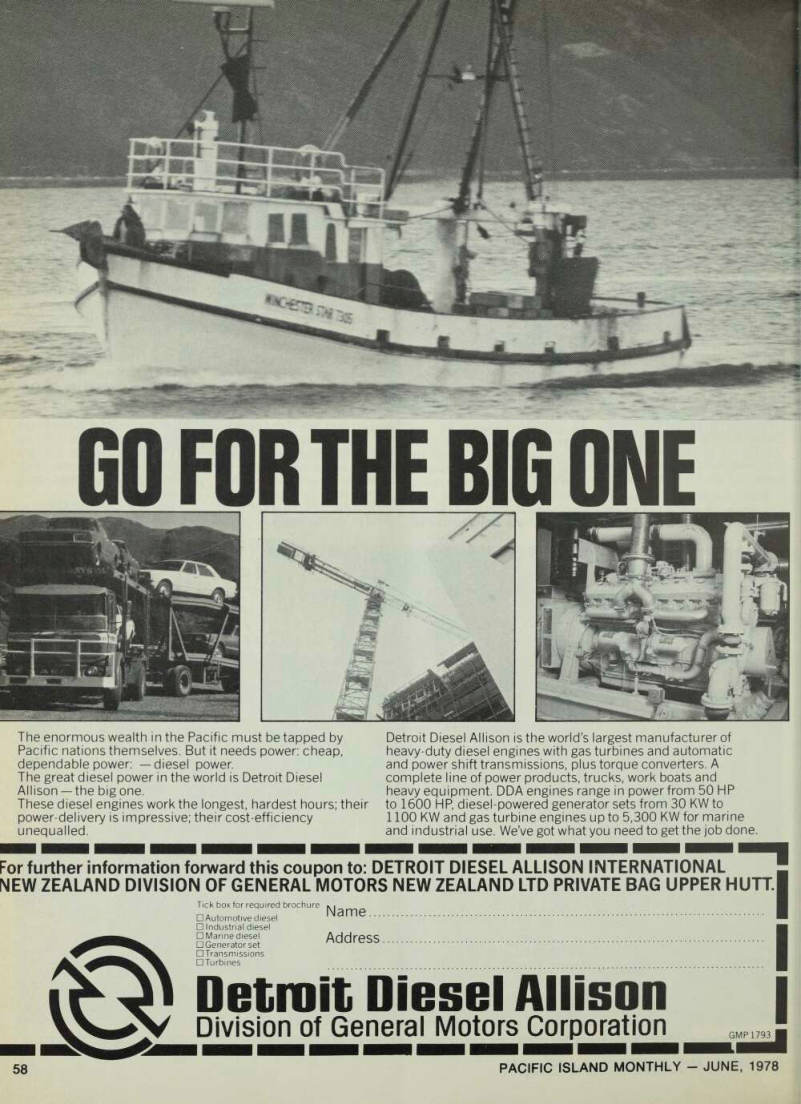
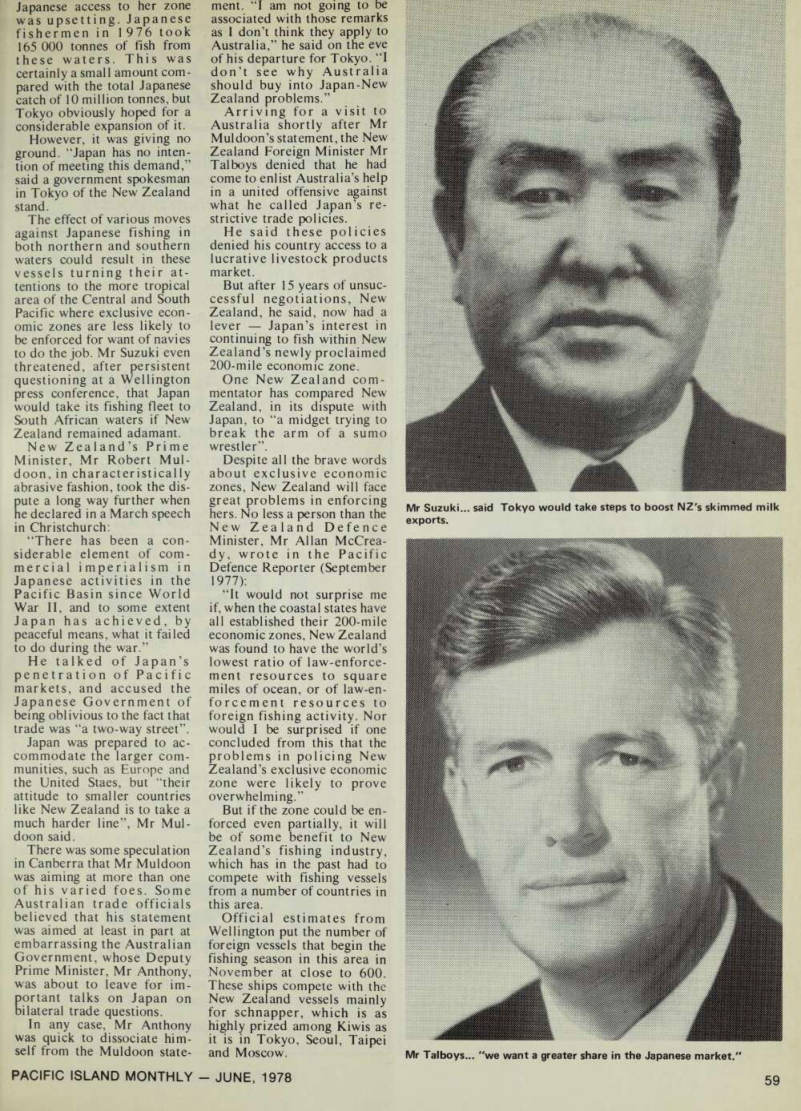
the sumo wrestler
Japan and New Zealand are involved in a dispute over trade and fishing rights which has soured relations between the two countries, and could bring substantial changes in the areas fished by Japan’s fleets in the world’s oceans.
In February, special Japanese trade representative.
Mr Zenko Suzuki, visited Wellington for talks with several New Zealand ministers, including the Foreign Minister, Mr Brian Talboys.
Mr Suzuki is a former Japanese Minister for Agriculture. His country was obviously interested in talking about fishing rights in New Zealand’s proclaimed 200mile exclusive economic zone.
But the New Zealand Government, facing a SNZSBB million trading
deficit from 1977, and with elections due in November, was in no mood to negotiate anything but a large increase in Japan’s imports of New Zealand goods.
The Japanese pointed out that they are intending to set aside $ 29 in fiscal 1978 to boost im P° rts from developing countries, and that
Kt P , ,
New Z ? aland ' ,*P u ‘ d B , et * maior share of this boost. This did not tmpress the New Zea land Government I ‘ als ° probably raised the hackles of the New Zealand populace, w h Q do no t appreciate being classified as a “developing country”, however accurate that desC ription might be.
Mr s uzu kj a j so sa j d that Tokyo would take steps to boost imports of New Zealand skim milk, as part of increased spending on schools (in this case school lunches). Once again the New Zealanders did
not find this a substantial con cession.
Totally unsatisfied with these reponses, Mr Talboys announced that his govern ment would not make any effort to negotiate Japanese access to his country’s ex clusive economic zone until Tokyo made a more positive response to Wellington’s call for a greater share in the Japanese market.
The refusal to negotiate on fishing questions was a blow to Japan. Japan has been suffering badly of late as a re sult of the declarations of ex clusive economic zones by a number of countries. This has meant that the Japanese like the Taiwanese, Russians and South Koreans have had to begin negotiating for ancess to areas which they had previously fished quite freely.
In addition to problems created by the zones, Japan is
also involved in disputes over fishing rights with the USSR, Canada and the United States, The USSR has, by flexing its political muscle, gained an agreement with Japan which allows it to double its catch in the Sea of Japan while keeping the Japanese catch to 1977 levels.
In January, the US an nounced its intention to with draw from the trilateral fish ing agreement which had bound it with Japan and Canada. The US was seeking exclusive fishing rights over the migratory species of fish spawned in its rivers, partic ularly salmon. The sum total of the various compromises which Japan was obliged to reach in northern waters meant that she set some store on being able to recoup them in the south.
The New Zealand Govern ment’s refusal to negotiate on
Sumo wrestlers and their Tongan pupils, but where's the midget?
Japanese access to her zone was upsetting. Japanese fishermen in 1976 took 165 000 tonnes of fish from these waters. This was certainly a small amount com pared with the total Japanese catch of 10 million tonnes, but Tokyo obviously hoped for a considerable expansion of it.
However, it was giving no ground. “Japan has no inten tion of meeting this demand,” said a government spokesman in Tokyo of the New Zealand stand.
The effect of various moves against Japanese fishing in both northern and southern waters could result in these vessels turning their at tentions to the more tropical area of the Central and South Pacific where exclusive econ omic zones are less likely to be enforced for want of navies to do the job. Mr Suzuki even threatened, after persistent questioning at a Wellington press conference, that Japan would take its fishing fleet to South African waters if New Zealand remained adamant.
New Zealand’s Prime Minister, Mr Robert Mul doon, in characteristically abrasive fashion, took the dis pute a long way further when he declared in a March speech in Christchurch: “There has been a con siderable element of com mercial imperialism in Japanese activities in the Pacific Basin since World War 11, and to some extent Japan has achieved, by peaceful means, what it failed to do during the war.”
He talked of Japan’s penetration of Pacific markets, and accused the Japanese Government of being oblivious to the fact that trade was “a two-way street”.
Japan was prepared to ac commodate the larger com munities, such as Europe and the United Staes, but “their attitude to smaller countries like New Zealand is to take a much harder line”, Mr Mul doon said.
There was some speculation in Canberra that Mr Muldoon was aiming at more than one of his varied foes. Some Australian trade officials believed that his statement was aimed at least in part at embarrassing the Australian Government, whose Deputy Prime Minister, Mr Anthony, was about to leave for im portant talks on Japan on bilateral trade questions.
In any case, Mr Anthony was quick to dissociate him self from the Muldoon state
ment. “I am not going to be associated with those remarks as I don’t think they apply to Australia,” he said on the eve of his departure for Tokyo. “I don’t see why Australia should buy into Japan-New Zealand problems.”
Arriving for a visit to Australia shortly after Mr Muldoon’s statement, the New Zealand Foreign Minister Mr Talboys denied that he had come to enlist Australia’s help in a united offensive against what he called Japan’s re strictive trade policies.
He said these policies denied his country access to a lucrative livestock products market.
But after 15 years of unsuc cessful negotiations, New Zealand, he said, now had a lever Japan’s interest in continuing to fish within New Zealand’s newly proclaimed 200-mile economic zone.
One New Zealand com mentator has compared New Zealand, in its dispute with Japan, to “a midget trying to break the arm of a sumo wrestler”.
Despite all the brave words about exclusive economic zones, New Zealand will face great problems in enforcing hers. No less a person than the New Zealand Defence Minister, Mr Allan McCrea dy, wrote in the Pacific Defence Reporter (September 1977): “It would not surprise me if, when the coastal states have all established their 200-mile economic zones, New Zealand was found to have the world’s lowest ratio of law-enforce ment resources to square miles of ocean, or of law-en forcement resources to foreign fishing activity. Nor would I be surprised if one concluded from this that the problems in policing New Zealand’s exclusive economic zone were likely to prove overwhelming.”
But if the zone could be en forced even partially, it will be of some benefit to New Zealand’s fishing industry, which has in the past had to compete with fishing vessels from a number of countries in this area.
Official estimates from Wellington put the number of foreign vessels that begin the fishing season in this area in November at close to 600.
These ships compete with the New Zealand vessels mainly for schnapper, which is as highly prized among Kiwis as it is in Tokyo, Seoul, Taipei and Moscow.
Mr Suzuki... said Tokyo would take steps to boost NZ's skimmed milk exports.
Mr Talboys... "we want a greater share in the Japanese market."
Advertisements & other items, pp. 57-60 (5 items)
57
PACIFIC ISLAND MONTHLY - JUNE, 1978
58
PACIFIC ISLAND MONTHLY - JUNE, 1978
Goforthebigone
iii ■ i as
* BWBBbS^SSI
<>r* -X' '"»*«««.< T .. ' llir 9 1 I m % m a iKi®
GOFORTHEBIGONE
y%.~ x : x m The enormous wealth in the Pacific must be tapped by Pacific nations themselves. But it needs power: cheap, dependable power: —diesel power.
The great diesel power in the world is Detroit Diesel Allison —the big one.
These diesel engines work the longest, hardest hours; their power-delivery is impressive; their cost-efficiency unequalled.
For further information forward this coupon to: DETROIT DIESEL ALLISON INTERNATIONAL NEW ZEALAND DIVISION OF GENERAL MOTORS NEW ZEALAND LTD PRIVATE BAG UPPER HUTT.
Detroit Diesel Allison is the world’s largest manufacturer of heavy-duty diesel engines with gas turbines and automatic and power shift transmissions, plus torque converters. A complete line of power products, trucks, work boats and heavy equipment. DDA engines range in power from 50 HP to 1600 HP, diesel-powered generator sets from 30 KW to 1100 KW and gas turbine engines up to 5,300 KW for marine and industrial use. We’ve got what you need to get the job done.
Tick box for required brochure □ Automotive diesel □ Industrial diesel □ Marine diesel □ Generator set □ Transmissions □ Turbines Name Address
Detroit Diesel Allison
Division of General Motors Corporation
II I I
Two Great Names
in the Building
Industry.
Cook Islands
Trading
Company Ltd.
and
Henderson & Pollard
Industries Ltd.
Take our Coreboard. A laminated solid core of kiln dried Radiata faced with selected wood veneers of Rimu. Its natural attractive colour and grain make Coreboard ideal for interior fitted furniture and panelling.
Or our Plywood Doors. A whole range of hollow core interior doors available in a beautiful variety of finishes and timbers. Light, strong and good-looking.
And our Construction Plywood that combines strength with economy and is also treated with an insecticide to prevent insect attack.
You can’t miss the quality in either of these versatile Henderson & Pollard products.
And you’ll find them at Cook Islands Trading
Company Ltd.
E Henderson & Pollard Industries Ltd Enfield St; Mt. Eden, Auckland, New Zealand P.O. Box 8551, Symonds St, Auckland, New Zealand Telephone: 689-929.
Cook Islands Trading Co. 9.
ULLRICH ALUMINIUM COMPANY LTD.
EXPORT DEPARTMENT
For all aluminium products Roofing; Sheets; Sections; Profiles; Ladders; Steps; Boats; Dinghies; C.K.D. Truck Bodies; C.K.D. Truck Trays; C.K.D. Boat Trailers: Insect Screening: Rivets: Fastenings: Screws; Fabrication Work.
Phone, Write or Call:
ULLRICH ALUMINIUM
COMPANY LTD.
PO BOX 22244, 33 GREAT SOUTH ROAD,
OTAHUHU, AUCKLAND, NEW ZEALAND
TELEX: “2901 ULLRICHAL”
CABLES: “ULLRICHAL”
l\Rl\fl
FEEDS LTD
Exporters to the Pacific
NRM manufactures a complete range of animal feeds and concentrates, including: Poultry layer, broiler, duck, turkey, pigeon pig horse dairy fish.
NRM Group is the largest feed milling organisation in New Zealand and has established a high reputation for quality and service in New Zealand and the Pacific. Our export range is: • formulated for tropical conditions • fortified with vitamins and trace minerals • medicated on request.
IXRIMI
FEEDS LTD
For further information, contact The Manager, NRM Feeds Ltd, P.O. Box 20, Auckland, New Zealand Cables: “Millroll”, Auckland. Telephone: 33 119.
Telex: 2 956 (“NRM”)
59
PACIFIC ISLAND MONTHLY - JUNE, 1978
60
PACIFIC ISLAND MONTHLY - JUNE, 1978
Only the crumbs from the PNG table
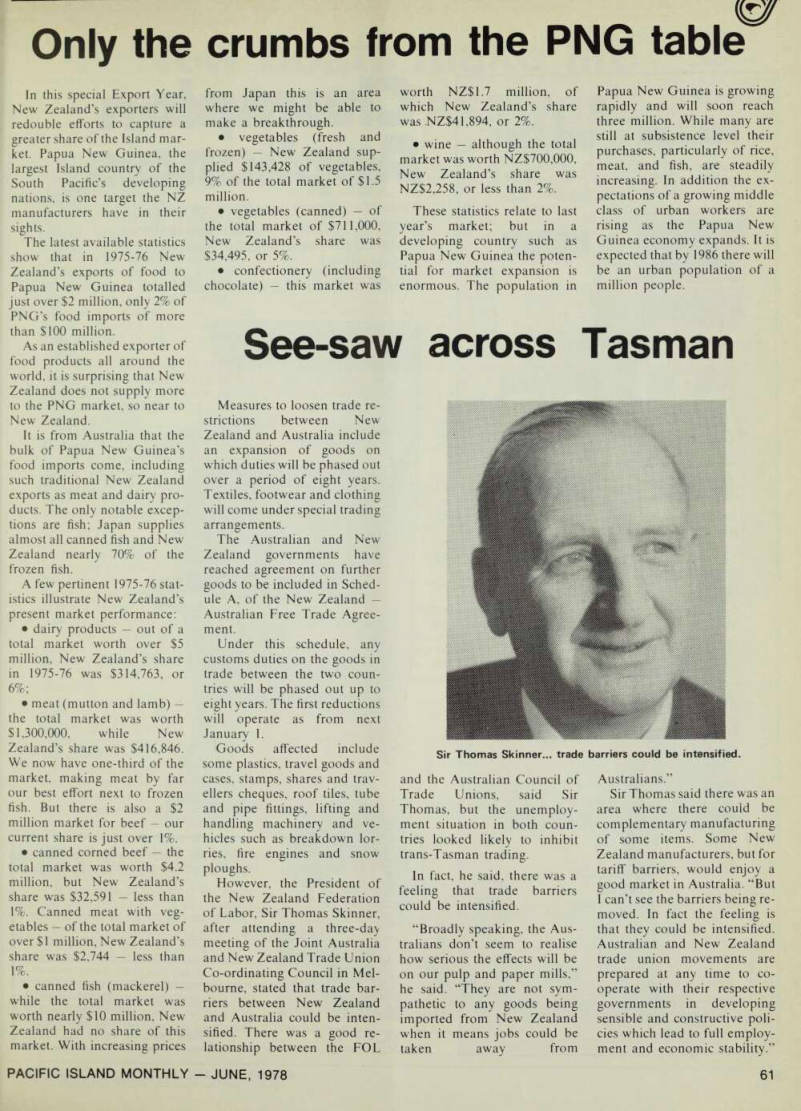
In this special Export Year, New Zealand’s exporters will redouble efforts to capture a greater share of the Island mar ket. Papua New Guinea, the largest Island country of the South Pacific’s developing nations, is one target the NZ manufacturers have in their
sights.
The latest available statistics show that in 1975-76 New Zealand’s exports of food to Papua New Guinea totalled just over $2 million, only 2% of PNG’s food imports of more than $lOO million.
As an established exporter of food products all around the world, it is surprising that New Zealand does not supply more to the PNG market, so near to New Zealand.
It is from Australia that the bulk of Papua New Guinea’s
food imports come, including
such traditional New Zealand exports as meat and dairy pro ducts. The only notable excep tions are fish; Japan supplies almost all canned fish and New Zealand nearly 70% of the frozen fish.
A few pertinent 1975-76 stat istics illustrate New Zealand’s present market performance: • dairy products out of a total market worth over $5 million. New Zealand’s share in 1975-76 was $314,763, or 6%; • meat (mutton and lamb) the total market was worth $1,300,000, while New Zealand’s share was $416,846.
We now have one-third of the market, making meat by far our best effort next to frozen fish. But there is also a $2 million market for beef our current share is just over 1%. • canned corned beef the total market was worth $4.2 million, but New Zealand’s share was $32,591 less than 1%. Canned meat with veg etables of the total market of over $1 million. New Zealand’s share was $2,744 less than 1%. • canned fish (mackerel) while the total market was worth nearly $lO million. New Zealand had no share of this
market. With increasing prices
from Japan this is an area where we might be able to make a breakthrough. • vegetables (fresh and frozen) New Zealand sup
plied $143,428 of vegetables,
9% of the total market of $1.5 million. • vegetables (canned) of the total market of $711,000, New Zealand’s share was $34,495, or 5%. • confectionery (including chocolate) this market was
worth NZ$l.7 million, of which New Zealand’s share was NZ541,894, or 2%. • wine although the total market was worth NZ$7OO,OOO, New Zealand’s share was NZ52,258, or less than 2%.
These statistics relate to last year’s market; but in a developing country such as Papua New Guinea the poten tial for market expansion is enormous. The population in
Papua New Guinea is growing rapidly and will soon reach three million. While many are still at subsistence level their
purchases, particularly of rice,
meat, and fish, are steadily increasing. In addition the ex pectations of a growing middle class of urban workers are rising as the Papua New Guinea economy expands. It is expected that by 1986 there will be an urban population of a
million people.
See-saw across Tasman
Measures to loosen trade re strictions between New Zealand and Australia include an expansion of goods on which duties will be phased out over a period of eight years.
Textiles, footwear and clothing will come under special trading arrangements.
The Australian and New Zealand governments have reached agreement on further goods to be included in Sched ule A, of the New Zealand - Australian Free Trade Agree ment.
Under this schedule, any customs duties on the goods in trade between the two coun tries will be phased out up to eight years. The first reductions will operate as from next
January 1.
Goods affected include some plastics, travel goods and cases, stamps, shares and trav ellers cheques, roof tiles, tube
and pipe fittings, lifting and
handling machinery and ve
hicles such as breakdown lor ries, fire engines and snow
ploughs.
However, the President of the New Zealand Federation of Labor, Sir Thomas Skinner,
after attending a three-day
meeting of the Joint Australia and New Zealand Trade Union Co-ordinating Council in Mel bourne, stated that trade bar riers between New Zealand and Australia could be inten sified. There was a good re lationship between the FOL
and the Australian Council of Trade Unions, said Sir Thomas, but the unemploy ment situation in both coun tries looked likely to inhibit
trans-Tasman trading.
In fact, he said, there was a feeling that trade barriers could be intensified.
“Broadly speaking, the Aus
tralians don’t seem to realise how serious the effects will be on our pulp and paper mills,” he said. “They are not sym
pathetic to any goods being
imported from New Zealand when it means jobs could be taken away from
Australians.”
Sir Thomas said there was an area where there could be
complementary manufacturing
of some items. Some New Zealand manufacturers, but for tariff barriers, would enjoy a good market in Australia. “But I can’t see the barriers being re moved. In fact the feeling is that they could be intensified.
Australian and New Zealand trade union movements are prepared at any time to co operate with their respective governments in developing sensible and constructive poli cies which lead to full employ ment and economic stability.”
Sir Thomas Skinner... trade barriers could be intensified.
Advertisements & other items, pp. 61-62 (3 items)
61
PACIFIC ISLAND MONTHLY - JUNE, 1978
62
PACIFIC ISLAND MONTHLY - JUNE, 1978
Champion
COOKERS
& sg pi' Topline‘O’
Autoline‘D’
Champion
Appliances
A completely new range of cookers and laundry equipment with unique features designed for easier and better cooking and cleaning.
TRADE ENQUIRIES WELCOME.
■C3?
'-s^a Valiant Timeline Benchline
LAUNDRY
r_\ n I am interested in your Champion appliances Please direct me to your nearest stockist.
NAME
ADDRESS
Washing Machine Dner Export Division Radiation N.Z. Ltd Jutland ST,Dunedin New Zealand. Telex N.Z. 5289.
New boats make life
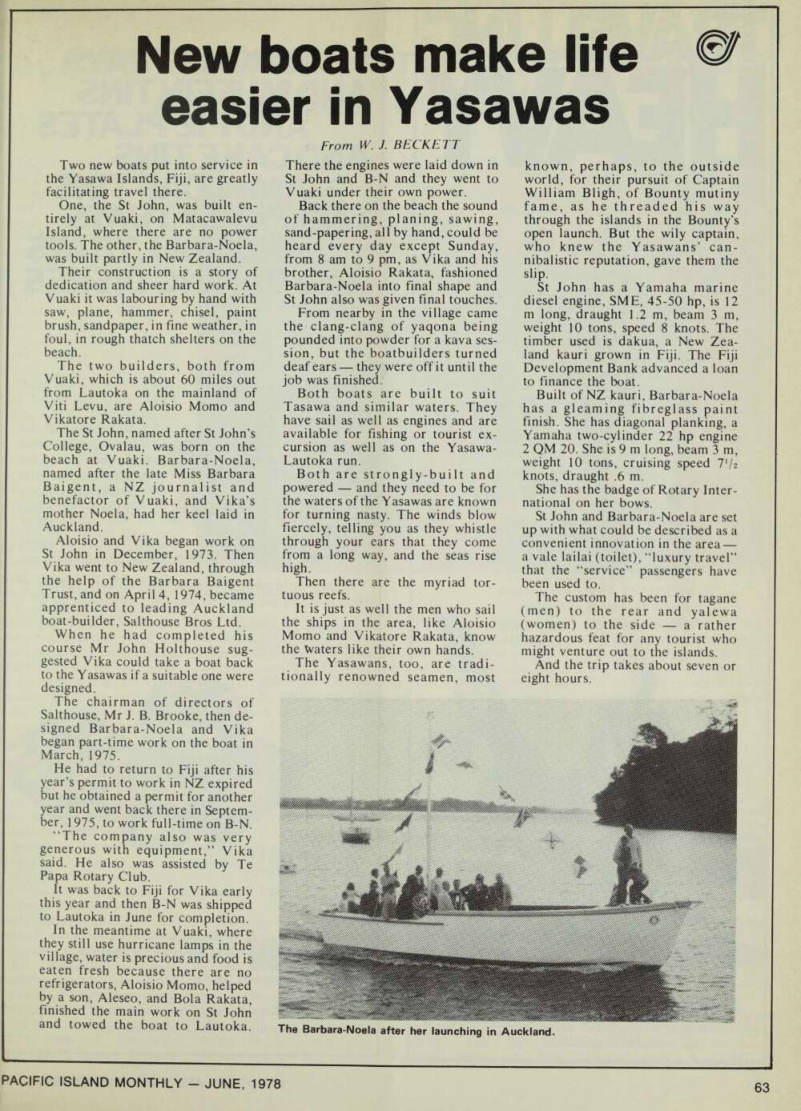
easier in Yasawas
From W. J. Beckett
Two new boats put into service in the Yasawa Islands, Fiji, are greatly facilitating travel there.
One, the St John, was built en tirely at Vuaki, on Matacawalevu Island, where there are no power tools. The other, the Barbara-Noela, was built partly in New Zealand.
Their construction is a story of dedication and sheer hard work. At Vuaki it was labouring by hand with saw, plane, hammer, chisel, paint brush, sandpaper, in fine weather, in foul, in rough thatch shelters on the beach.
The two builders, both from Vuaki, which is about 60 miles out from Lautoka on the mainland of Viti Levu, are Aloisio Momo and Vikatore Rakata.
The St John, named after St John’s College, Ovalau, was born on the beach at Vuaki. Barbara-Noela, named after the late Miss Barbara Baigent, a NZ journalist and benefactor of Vuaki, and Vika’s mother Noela, had her keel laid in Auckland.
Aloisio and Vika began work on St John in December, 1973. Then Vika went to New Zealand, through the help of the Barbara Baigent Trust, and on April 4, 1974, became apprenticed to leading Auckland boat-builder, Salthouse Bros Ltd.
When he had completed his course Mr John Holthouse sug gested Vika could take a boat back to the Yasawas if a suitable one were designed.
The chairman of directors of Salthouse, Mr J. B. Brooke, then de signed Barbara-Noela and Vika began part-time work on the boat in March, 1975.
He had to return to Fiji after his year’s permit to work in NZ expired but he obtained a permit for another year and went back there in Septem ber, 1975, to work full-time on B-N.
“The company also was very generous with equipment,” Vika said. He also was assisted by Te Papa Rotary Club.
It was back to Fiji for Vika early this year and then B-N was shipped to Lautoka in June for completion.
In the meantime at Vuaki, where they still use hurricane lamps in the village, water is precious and food is eaten fresh because there are no refrigerators, Aloisio Momo, helped by a son, Aleseo, and Bola Rakata, finished the main work on St John and towed the boat to Lautoka.
There the engines were laid down in St John and B-N and they went to Vuaki under their own power.
Back there on the beach the sound of hammering, planing, sawing, sand-papering, all by hand, could be heard every day except Sunday, from 8 am to 9 pm, as Vika and his brother, Aloisio Rakata, fashioned Barbara-Noela into final shape and St John also was given final touches.
From nearby in the village came the clang-clang of yaqona being pounded into powder for a kava ses sion, but the boatbuilders turned deaf ears they were off it until the job was finished.
Both boats are built to suit Tasawa and similar waters. They have sail as well as engines and are available for fishing or tourist ex cursion as well as on the Yasawa- Lautoka run.
Both are strongly-built and powered and they need to be for the waters of the Yasawas are known for turning nasty. The winds blow fiercely, telling you as they whistle through your ears that they come from a long way, and the seas rise high.
Then there are the myriad tor tuous reefs.
It is just as well the men who sail the ships in the area, like Aloisio Momo and Vikatore Rakata, know the Waters like their own hands.
The Yasawans, too, are tradi tionally renowned seamen, most
known, perhaps, to the outside world, for their pursuit of Captain William Bligh, of Bounty mutiny fame, as he threaded his way through the islands in the Bounty’s open launch. But the wily captain, who knew the Yasawans’ can nibalistic reputation, gave them the
slip.
St John has a Yamaha marine diesel engine, SME, 45-50 hp, is 12 m long, draught 1.2 m, beam 3 m, weight 10 tons, speed 8 knots. The timber used is dakua, a New Zea land kauri grown in Fiji. The Fiji Development Bank advanced a loan to finance the boat.
Built of NZ kauri, Barbara-Noela has a gleaming fibreglass paint finish. She has diagonal planking, a Yamaha two-cylinder 22 hp engine 2 QM 20. She is 9 m long, beam 3 m, weight 10 tons, cruising speed 7Vz knots, draught .6 m.
She has the badge of Rotary Inter national on her bows.
St John and Barbara-Noela are set up with what could be described as a convenient innovation in the area a vale lailai (toilet), “luxury travel” that the “service” passengers have been used to.
The custom has been for tagane (men) to the rear and yalewa (women) to the side a rather hazardous feat for any tourist who might venture out to the islands.
And the trip takes about seven or eight hours.
The Barbara-Noela after her launching in Auckland.
Advertisements & other items, pp. 63-64 (3 items)
63
PACIFIC ISLAND MONTHLY JUNE, 1978
64
PACIFIC ISLAND MONTHLY - JUNE, 1978
Heavy
BAKING TRAYS
AND MUFFIN TINS
AND PIE PLATES
AND CAKE TINS
AND LOAF TINS
AND PATTY TRAYS
ANDROLLTRAYS
AND BAKING DISHES
T O f® And that’s just the beginning of our vast range of fine bakeware and decorated ware, in just about every size and shape you can imagine.
To meet all domestic and commercial requirements.
Durable, attractive. With superior heat conductivity that ensures excellent baking results. Everytime.
We make everything that goes in your oven so that what you make bakes better. rs If it’s quality bakeware you want, look for our name.
WE ID W H. Bond & Company A Division of AH I Operations Ltd.
Exporters of fine bakeware throughout the Pacific Islands.
TRAVELLING
HEAVY
Last year Spedding Ltd people, ‘travelling heavy’ covered large chunks of the world, selling New Zealand products. From relatively complex items like Typhoon electric garbage disposers and range hoods through to something simple like the ‘Zappa Splatta’, the soft drink container that kids use as a water pistol (after they’ve drunk the soft drink).
We sold aluminium boats in the Pacific, petfood in South East Asia, Coverall vinyl in the Middle East, and a lot of other products to all of them.
And most of the products we sold, we made ourselves.
This year we’ll be doing it again, selling against other manufacturers from other countries.
Most of the products you’ll recognise, because we sell them in your country too.
Good products, competitive with anything in the world we’ve proven it. w
SPEDDING LTD
WORLDWIDE MARKETING SPECIALISTS
P.0.80x 13-166, Auckland, Phone 661-279, New Zealand,
mysterious ‘Lost World’
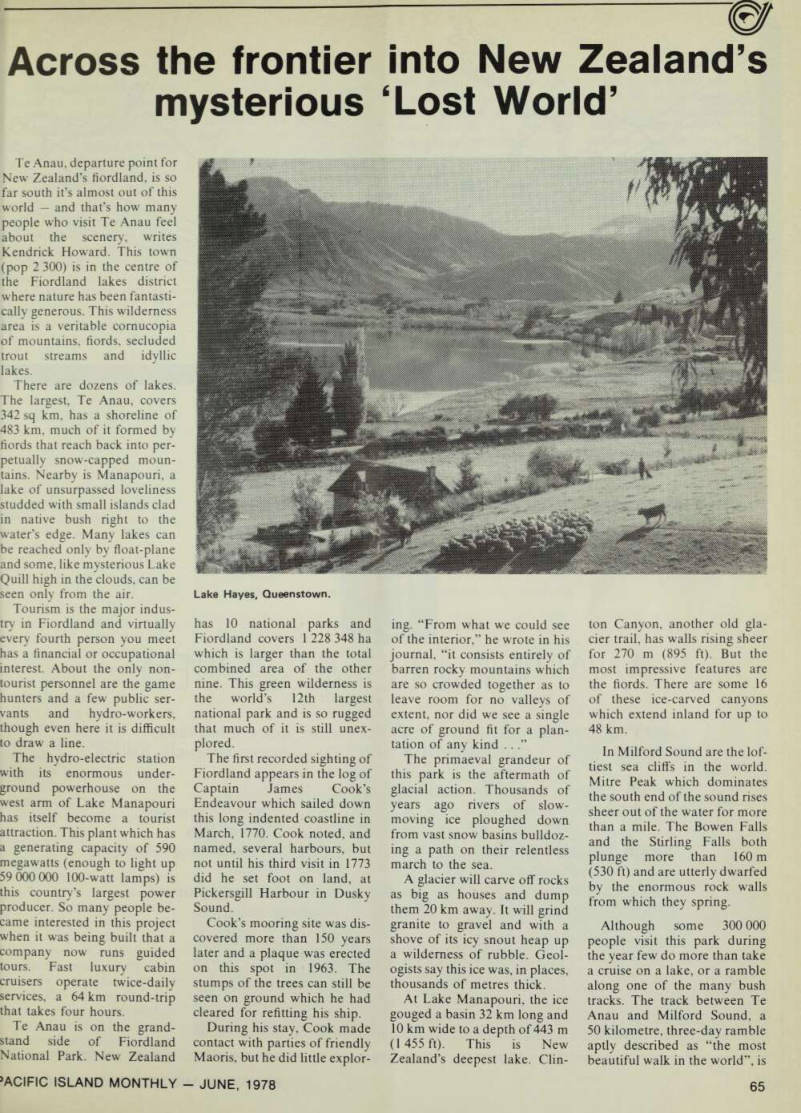

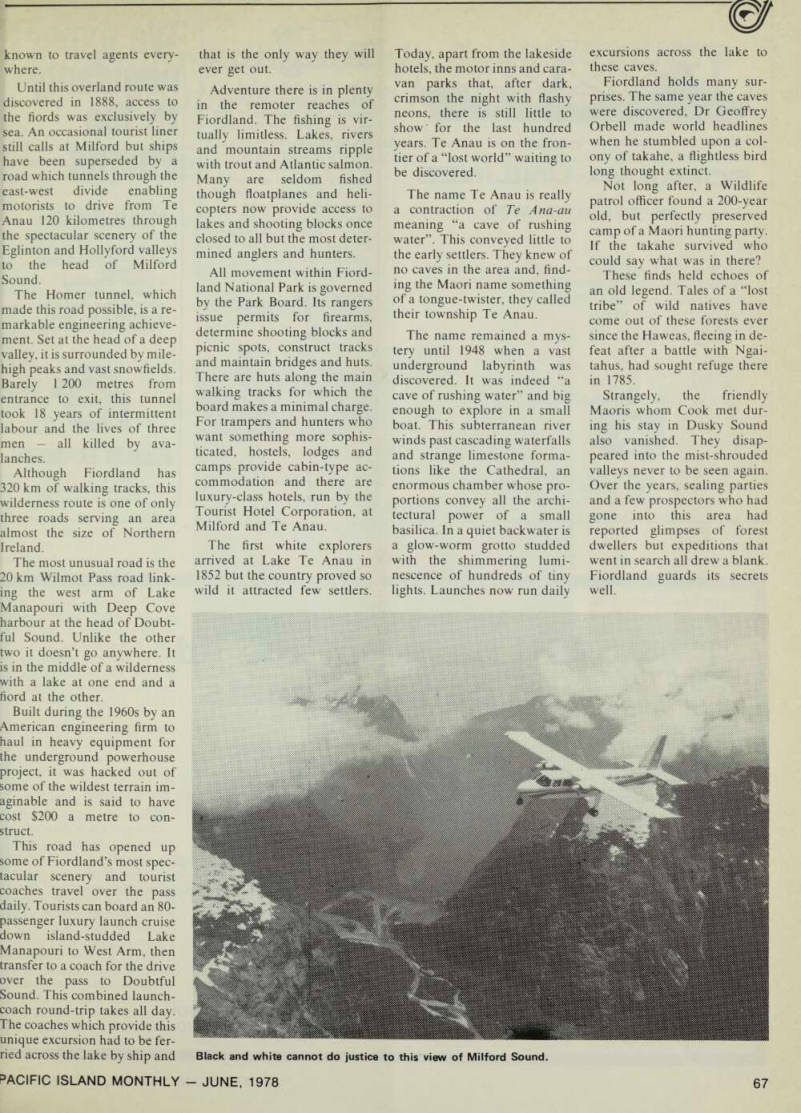
Across the frontier into New Zealand’s mysterious ‘Lost World’
Te Anau, departure point for New Zealand’s fiordland, is so far south it’s almost out of this world and that’s how many people who visit Te Anau feel about the scenery, writes Kendrick Howard. This town (pop 2 300) is in the centre of the Fiordland lakes district where nature has been fantasti cally generous. This wilderness area is a veritable cornucopia of mountains, fiords, secluded trout streams and idyllic lakes.
There are dozens of lakes.
The largest, Te Anau, covers 342 sq km, has a shoreline of 483 km, much of it formed by fiords that reach back into per
petually snow-capped moun
tains. Nearby is Manapouri, a lake of unsurpassed loveliness studded with small islands clad in native bush right to the water’s edge. Many lakes can
be reached only by float-plane
and some, like mysterious Lake Quill high in the clouds, can be seen only from the air.
Tourism is the major indus try in Fiordland and virtually every fourth person you meet has a financial or occupational interest. About the only non tourist personnel are the game hunters and a few public ser
vants and hydro-workers,
though even here it is difficult to draw a line.
The hydro-electric station with its enormous under ground powerhouse on the west arm of Lake Manapouri has itself become a tourist attraction. This plant which has
a generating capacity of 590
megawatts (enough to light up
59 000 000 100-watt lamps) is
this country’s largest power
producer. So many people be came interested in this project when it was being built that a
company now runs guided
tours. Fast luxury cabin
cruisers operate twice-daily
services, a 64 km round-trip that takes four hours.
Te Anau is on the grand stand side of Fiordland National Park. New Zealand
has 10 national parks and Fiordland covers 1 228 348 ha which is larger than the total combined area of the other nine. This green wilderness is the world’s 12th largest national park and is so rugged that much of it is still unex
plored.
The first recorded sighting of Fiordland appears in the log of Captain James Cook’s Endeavour which sailed down this long indented coastline in March, 1770. Cook noted, and named, several harbours, but not until his third visit in 1773 did he set foot on land, at
Pickersgill Harbour in Dusky
Sound.
Cook’s mooring site was dis covered more than 150 years later and a plaque was erected on this spot in 1963. The stumps of the trees can still be seen on ground which he had cleared for refitting his ship.
During his stay, Cook made contact with parties of friendly Maoris, but he did little explor
ing. “From what we could see of the interior,” he wrote in his journal, “it consists entirely of barren rocky mountains which are so crowded together as to leave room for no valleys of extent, nor did we see a single acre of ground fit for a plan tation of any kind ..
The primaeval grandeur of
this park is the aftermath of glacial action. Thousands of years ago rivers of slow
moving ice ploughed down
from vast snow basins bulldoz ing a path on their relentless march to the sea.
A glacier will carve off rocks as big as houses and dump them 20 km away. It will grind granite to gravel and with a shove of its icy snout heap up a wilderness of rubble. Geol ogists say this ice was, in places, thousands of metres thick.
At Lake Manapouri, the ice gouged a basin 32 km long and 10 km wide to a depth of 443 m (1 455 ft). This is New Zealand’s deepest lake. Clin
ton Canyon, another old gla cier trail, has walls rising sheer for 270 m (895 ft). But the most impressive features are the fiords. There are some 16 of these ice-carved canyons which extend inland for up to 48 km.
In Milford Sound are the lof tiest sea cliffs in the world.
Mitre Peak which dominates the south end of the sound rises sheer out of the water for more than a mile. The Bowen Falls and the Stirling Falls both plunge more than 160 m (530 ft) and are utterly dwarfed by the enormous rock walls
from which they spring.
Although some 300 000
people visit this park during
the year few do more than take a cruise on a lake, or a ramble along one of the many bush tracks. The track between Te Anau and Milford Sound, a 50 kilometre, three-day ramble aptly described as “the most beautiful walk in the world”, is
Lake Hayes, Queenstown.
known to travel agents every where.
Until this overland route was discovered in 1888, access to the fiords was exclusively by sea. An occasional tourist liner still calls at Milford but ships have been superseded by a road which tunnels through the east-west divide enabling motorists to drive from Te Anau 120 kilometres through the spectacular scenery of the
Eglinton and Hollyford valleys
to the head of Milford Sound.
The Homer tunnel, which made this road possible, is a re markable engineering achieve ment. Set at the head of a deep valley, it is surrounded by mile high peaks and vast snowfields.
Barely 1 200 metres from entrance to exit, this tunnel took 18 years of intermittent labour and the lives of three men all killed by ava lanches.
Although Fiordland has 320 km of walking tracks, this wilderness route is one of only three roads serving an area almost the size of Northern Ireland.
The most unusual road is the 20 km Wilmot Pass road link ing the west arm of Lake
Manapouri with Deep Cove
harbour at the head of Doubt ful Sound. Unlike the other two it doesn’t go anywhere. It is in the middle of a wilderness with a lake at one end and a fiord at the other.
Built during the 1960 s by an
American engineering firm to
haul in heavy equipment for
the underground powerhouse
project, it was hacked out of some of the wildest terrain im aginable and is said to have cost $2OO a metre to con struct.
This road has opened up some of Fiordland’s most spec tacular scenery and tourist coaches travel over the pass daily. Tourists can board an 80-
passenger luxury launch cruise
down island-studded Lake Manapouri to West Arm, then transfer to a coach for the drive over the pass to Doubtful Sound. This combined launch
coach round-trip takes all day.
The coaches which provide this unique excursion had to be fer ried across the lake by ship and
that is the only way they will ever get out.
Adventure there is in plenty in the remoter reaches of Fiordland. The fishing is vir tually limitless. Lakes, rivers and mountain streams ripple with trout and Atlantic salmon.
Many are seldom fished
though floatplanes and heli
copters now provide access to lakes and shooting blocks once closed to all but the most deter mined anglers and hunters.
All movement within Fiord land National Park is governed by the Park Board. Its rangers issue permits for firearms, determine shooting blocks and picnic spots, construct tracks and maintain bridges and huts.
There are huts along the main walking tracks for which the board makes a minimal charge.
For trampers and hunters who
want something more sophis
ticated, hostels, lodges and
camps provide cabin-type ac
commodation and there are luxury-class hotels, run by the Tourist Hotel Corporation, at Milford and Te Anau.
The first white explorers arrived at Lake Te Anau in 1852 but the country proved so wild it attracted few settlers.
Today, apart from the lakeside hotels, the motor inns and cara van parks that, after dark, crimson the night with flashy neons, there is still little to show' for the last hundred years. Te Anau is on the fron tier of a “lost world’’ waiting to be discovered.
The name Te Anau is really a contraction of Te Ana-au meaning “a cave of rushing water”. This conveyed little to the early settlers. They knew of no caves in the area and, find ing the Maori name something of a tongue-twister, they called their township Te Anau.
The name remained a mys tery until 1948 when a vast
underground labyrinth was
discovered. It was indeed “a cave of rushing water” and big enough to explore in a small boat. This subterranean river winds past cascading waterfalls and strange limestone forma tions like the Cathedral, an enormous chamber whose pro portions convey all the archi tectural power of a small basilica. In a quiet backwater is a glow-worm grotto studded with the shimmering lumi nescence of hundreds of tiny lights. Launches now run daily
excursions across the lake to these caves.
Fiordland holds many sur prises. The same year the caves were discovered, Dr Geoffrey Orbell made world headlines when he stumbled upon a col ony of takahe, a flightless bird
long thought extinct.
Not long after, a Wildlife patrol officer found a 200-year
old, but perfectly preserved
camp of a Maori hunting party.
If the takahe survived who could say what was in there?
These finds held echoes of an old legend. Tales of a “lost tribe’’ of wild natives have come out of these forests ever since the Haweas, fleeing in de feat after a battle with Ngai tahus, had sought refuge there in 1785.
Strangely, the friendly
Maoris whom Cook met dur ing his stay in Dusky Sound
also vanished. They disap
peared into the mist-shrouded valleys never to be seen again.
Over the years, sealing parties and a few prospectors who had gone into this area had
reported glimpses of forest
dwellers but expeditions that went in search all drew a blank.
Fiordland guards its secrets well.
Black and white cannot do justice to this view of Milford Sound.
Advertisements & other items, pp. 65-68 (5 items)
65
> ACIFIC ISLAND MONTHLY - JUNE. 1978
66
PACIFIC ISLAND MONTHLY - JUNE, 1978
Over forty markets
A
UNITED''
mn^arab
\BIA \
HONG KONG
(a
4YSIA
7 I
GAPOREI
r \ wcoitruN aucdipa
\,Sds sam 7;“™^
\n // / 30N1A \| 7 0N J G / / m - ] y S 1
a NEW\
HEBRIDES
\ : W <9 c
Over forty markets
world-wide
WATTIE INDUSTRIES LIMITED
J. WATTIE CANNERIES LTD canned, frozen, quick dried foods GENERAL FOODS CORPORATION (NZ) LTD frozen products, bakery and snack foods W. F. TUCKER & CO LTD canned and specialty foods NRM GROUP: FOODS premium flours and hot breakfast cereals FEEDS animal feed products and technology NEILL, CROPPER & CO LTD marine products, agricultural chemicals and general export house NZ STARCH PRODUCTS LTD wheat and maize starch, glucose COPYING PRODUCTS LTD office and computer supplies
P.O. BOX 439, HASTINGS. NEW ZEALAND
TELEX NZ3257 TELEPHONE: 65-299
„The
Tongans
Writer Olaf Ruhen and photographer Jozef Vissel capture the lifestyle of the people of the last Polynesian Kingdom. Brilliant prose and sparkling fullcolour pictures depict today's Tongans at work, in church, at play tell of their traditions, crafts, houses, and hopes. 96 colour photographs in an 84-page large format volume. $A8.50 or SUSIO.OO posted.
The Toucans
Published by:
PACIFIC PUBLICATIONS
76 Clarence St., Sydney 2000.
Postal Address: Box 3408 G.P.O. Sydney 2001.
We export
regularly
to the
Pacific
■ Meat fish (Mackeral) vegetables groceries ■ Chemicals - agricultural industrial ■ New and second hand machinery ■ Timber & building materials, hardware ■ Iron & steel products ■ Textiles & soft goods Cosmetics & toiletries &
FORREST EXPORT CO.
32 Hillside Rd. P.O. Box 33853 Takapuna, Phone 449-602 Auckland New Zealand Cable Address: EXCEL
SOFR ANA-UNI LINES
SHIPPING TO THE PACIFIC
FROM NEW ZEALAND TO PAPUA NEW GUINEA, HONIARA, NEW CALEDONIA, NEW HEBRIDES. FIJI, NORFOLK IS.
AND SOUTH EAST ASIA
SOFRANA-UNILINES
P.O. BOX 3614, AUCKLAND, N.Z.
TELEPHONE 73-279
TELEX N.Z. 2313
AHI have put the lid
on canning costs
(the collapsed can story)
Collapsed cans are shipped in compacted form before using, the bodies are reformed and flanged, and one end seamed on. The can is now ready for filling.
Advantages of this method of transportation ★ Saves 75% on freight costs ★ Ease of handling ★ Saves storage space ★ Cannery uses its own labour to reform cans. AHI metal containers - open top division offer a full technical advisory service and provides reforming equipment that can be rented for approximately $5OO/$7OO per year.
MSIQ
METAL CONTAINERS (AUCKLAND)
OPEN TOP DIVISION.
ALEX HARVEY METAL CONTAINERS - OPEN TOP DIVISION P O BOX 14-443, PANMURE, AUCKLAND, NEW ZEALAND
67
PACIFIC ISLAND MONTHLY - JUNE, 1978
68
PACIFIC ISLAND MONTHLY - JUNE, 1978
Savouring the heady delights of the South Island’s Mt Luxmore
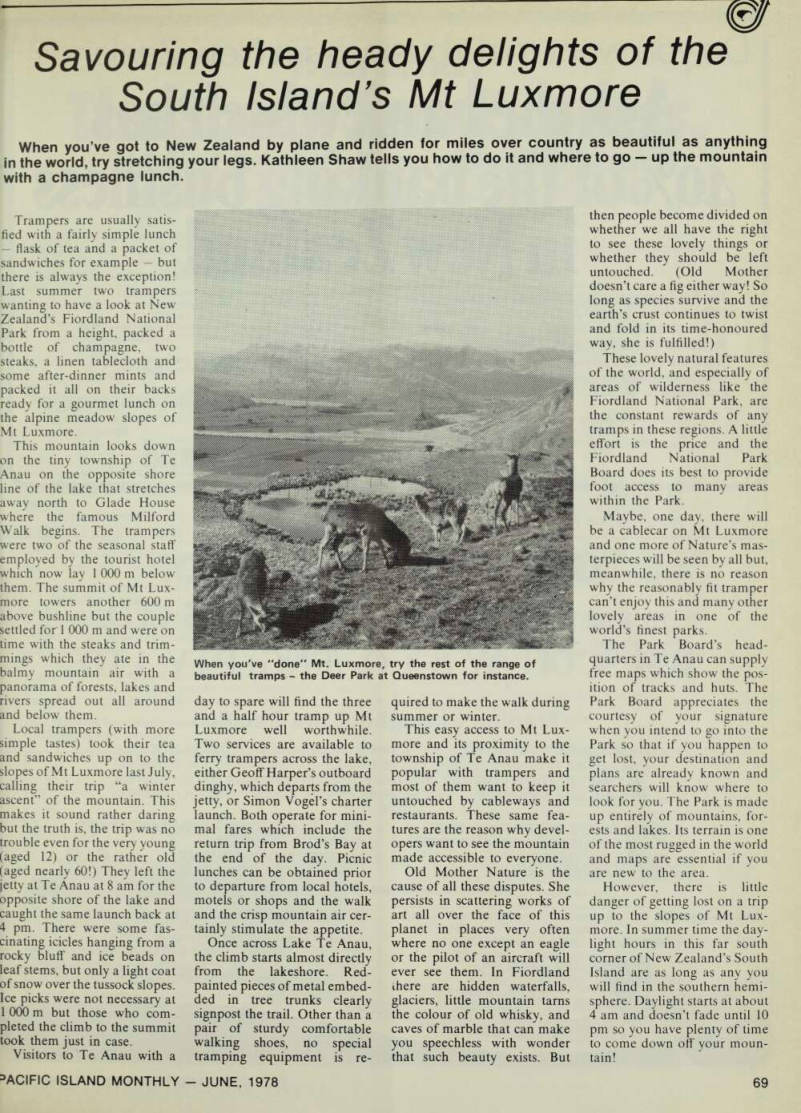
South Island’s Mt Luxmore
When you’ve got to New Zealand by plane and ridden for miles over country as beautiful as anything in the world, try stretching your legs. Kathleen Shaw tells you how to do it and where to go - up the mountain with a champagne lunch.
Trampers are usually satis fied with a fairly simple lunch flask of tea and a packet of sandwiches for example but there is always the exception!
Last summer two trampers wanting to have a look at New Zealand’s Fiordland National Park from a height, packed a bottle of champagne, two steaks, a linen tablecloth and some after-dinner mints and packed it all on their backs ready for a gourmet lunch on the alpine meadow slopes of Mt Luxmore.
This mountain looks down
on the tiny township of Te
Anau on the opposite shore line of the lake that stretches away north to Glade House where the famous Milford
Walk begins. The trampers
were two of the seasonal staff employed by the tourist hotel which now lay 1 000 m below them. The summit of Mt Lux more towers another 600 m above bushline but the couple settled for 1 000 m and were on time with the steaks and trim mings which they ate in the balmy mountain air with a panorama of forests, lakes and rivers spread out all around and below them.
Local trampers (with more simple tastes) took their tea and sandwiches up on to the slopes of Mt Luxmore last July, calling their trip “a winter ascent” of the mountain. This makes it sound rather daring but the truth is, the trip was no trouble even for the very young (aged 12) or the rather old
(aged nearly 60!) They left the
jetty at Te Anau at 8 am for the opposite shore of the lake and caught the same launch back at 4 pm. There were some fas cinating icicles hanging from a rocky bluff and ice beads on leaf stems, but only a light coat of snow over the tussock slopes.
Ice picks were not necessary at 1 000 m but those who com pleted the climb to the summit took them just in case.
Visitors to Te Anau with a
day to spare will find the three and a half hour tramp up Mt Luxmore well worthwhile.
Two services are available to ferry trampers across the lake, either Geoff Harper’s outboard dinghy, which departs from the jetty, or Simon Vogel’s charter launch. Both operate for mini mal fares which include the return trip from Brod’s Bay at the end of the day. Picnic lunches can be obtained prior to departure from local hotels, motels or shops and the walk and the crisp mountain air cer
tainly stimulate the appetite.
Once across Lake Te Anau, the climb starts almost directly from the lakeshore. Red painted pieces of metal embed ded in tree trunks clearly signpost the trail. Other than a
pair of sturdy comfortable
walking shoes, no special
tramping equipment is re
quired to make the walk during summer or winter.
This easy access to Mt Lux more and its proximity to the township of Te Anau make it popular with trampers and most of them want to keep it
untouched by cableways and
restaurants. These same fea tures are the reason why devel opers want to see the mountain made accessible to everyone.
Old Mother Nature is the cause of all these disputes. She persists in scattering works of art all over the face of this planet in places very often where no one except an eagle or the pilot of an aircraft will ever see them. In Fiordland there are hidden waterfalls, glaciers, little mountain tarns the colour of old whisky, and caves of marble that can make you speechless with wonder that such beauty exists. But
then people become divided on whether we all have the right to see these lovely things or whether they should be left untouched. (Old Mother doesn’t care a fig either way! So long as species survive and the earth’s crust continues to twist and fold in its time-honoured way, she is fulfilled!) These lovely natural features of the world, and especially of areas of wilderness like the Fiordland National Park, are the constant rewards of any tramps in these regions. A little effort is the price and the Fiordland National Park Board does its best to provide foot access to many areas within the Park.
Maybe, one day, there will be a cablecar on Mt Luxmore and one more of Nature’s mas terpieces will be seen by all but, meanwhile, there is no reason why the reasonably fit tramper can’t enjoy this and many other lovely areas in one of the world’s finest parks.
The Park Board’s head quarters in Te Anau can supply free maps which show the pos ition of tracks and huts. The Park Board appreciates the courtesy of your signature when you intend to go into the Park so that if you happen to get lost, your destination and plans are already known and searchers will know where to look for you. The Park is made up entirely of mountains, for ests and lakes. Its terrain is one of the most rugged in the world and maps are essential if you are new to the area.
However, there is little danger of getting lost on a trip up to the slopes of Mt Lux more. In summer time the day light hours in this far south corner of New Zealand’s South Island are as long as any you will find in the southern hemi sphere. Daylight starts at about 4 am and doesn’t fade until 10 pm so you have plenty of time to come down off your moun tain!
When you've “done" Mt. Luxmore, try the rest of the range of beautiful tramps - the Deer Park at Queenstown for instance.
Advertisements & other items, pp. 69-74 (3 items)
69
3 ACIFIC ISLAND MONTHLY - JUNE, 1978
70
PACIFIC ISLAND MONTHLY - JUNE, 1978
40% of the banking business
Do you want to do business in New Zealand ?
Ask the bank which has
in New Zealand
The BNZ can give you full information on buying or selling in New Zealand and overseas. Full information on investment, movement of money, transfers of dividends etc., is also readily available.
There are offices everywhere, more than 400 in fact.
Whatever your financial or trade needs, the BNZ can
help you.
Wellington— Head Office, International Division, Box 2392.
Sydney— GPO Box 507, Sydney, N.S.W. 2001.
Melbourne— GPO Box 528 E, Melbourne, Vic. 3001.
Tokyo— Mr.E.L.Banks, Bank of New Zealand Representative Office, Japan. Suite 240, Shin Tokyo Bldg, 3-1,3-Chrome, Marunouchi, Chiyoda-ku, Tokyo 100.
Singapore— Mr.R.F.Warren, Bank of New Zealand Representative Office, South East Asia. Suite 230, 23rd Floor, Ocean Bldg.
Collyer Quay, Singapore 1.
London-PO Box 402, LondonEC4P.4.H.E.
Fiji, Suva— 2s Victoria Parade. Also at Labasa, Lautoka, Nadi, Sigatoka, Associated Banks in the South Pacific.
Bank of Western Samoa. Bank of Tonga. |PI bank or western Samoa, bank or i onga.
S&S Bank of New Zealand
GRAY TRADING LTD,
in association with C.W. SALES LTD.
WM.SCOLLAY & CO. (PNG) PTY. LTD.
Trading throughout the Pacific
The combination of experience of these three companies provides an invaluable service to anyone moving goods throughout the Pacific - any product from dairy products to building hardware-handled with ease and confidence.
Why not take advantage of their services for your goods - and your peace of mind . . . ★ WORLDWIDE TELEX FACILITIES ★ MANUFACTURERS REPRESENTATIVES ★ FULL DOCUMENTATION SERVICE ★ SHIPPING DIVISION
★ TOTAL SECURITY ★ MARKET DEVELOPMENT
★ FULLY TRAINED STAFF
Call now for on-the-spot advice and service WM Scollay & Co. Ltd (Auckland P.O. Box 2111 Telex NZ2437 Cable WISCOL Phone 794-960) WM Scollay & Co. (PNG) PTY. Ltd . P.O. Box 6517 Boroko, Port Moresby. Telex NE22231 Cables WISCOL C. W. Sales Ltd (Suva P.O. Box 1079 Telex 2343 Cables FJSALES Phone 27158) Gray Trading Ltd (Auckland P.O. Box 2010 Cables GRAYTRAD Phone 794-963)
Manama .
The South Seas Express.
The first regular roll-on roll-offexpress
service between N.Z.and the
The introduction of Marama to the Islands trade will enable exporters to greatly increase their export potential by providing faster, more frequent sailings as well as the greater cargo handling flexibility which a roll-on, roll-off service can provide.
Lautoka <2r- Suva Departures every 14 days from Auckland to: Lautoka. Suva, Pago Pago.
Apia, Nukualofa. f \ Nukualofa L Pago Pago Co-ordinated transhipment facilities from other N.Z. centres Intermodal coastal roll-on roll-off services as well as rail and road services can be utilised by shippers in other New Zealand centres to take advantage of the new Marama schedule. Your nearest Union Company office can assist you in organising the most efficient transhipment method.
International Transhipment Facilities Flexibility in cargo modules catered by this new service can provide for shipping operators and exporters the advantage of reaching international markets using onforwarding services through Union Company contacts and expertise.
Additionally Union can also arrange for cargoes originating from overseas sources to be transhipped at ports covered by ‘Marama’ to their final destination to the benefit of the importer in New Zealand or the Islands. m.v. Marama Your new export incentive 6350 deadweight tonnes.
Capacity 340 seafreighter units or their equivalent, plus space for wheeled vehicles, livestock, etc.
Greater Flexibility Means a more satisfactory and versatile way to ship your consignment.
The following equipment is provided free to shippers Standard dry general cargo ISO containers 20' xB' x B'6" box container 20' xB' x B'6" Opensided container.
Seafreighter Units For movement of general and bulk cargoes. (Internal) Length 13'9"(4.24M) width 7'6"(2.29M) height 5'(1.52M) N.B. Units are fully collapsible and open topped to facilitate loading cargoes in excess of 1.52 M height. A shower-proof cover is also provided free with every seafreighter.
Newsprint Flats These units are specifically designed for carriage of forest industry cargo but are also suitable for the carriage of other specified types of cargoes. (Internal) Length 15'6"(4.77M) Width 6'(1.830M) W. Containers These containers are totally enclosed suitable for the movement of smaller consignments or valuable ones. (Internal) Length 5'7"(1.75M) Width 4' (1.22 M) Height 5'6"(1.70M) Unit Loads This covers cargo that is unable to be containerised or is not covered by the term ‘mobile equipment’.
These unit loadings must be of a secure nature to facilitate handling by a forklift with 5" gluts (loading forks).
Refrigerated Cargo The following containers will be available: Cold wrap containers 20' x 8' x 8' Integral containers 20' x 8' x B'6"
Livestock Livestock stalls are available for the carriage of all types of stock.
Wheeled Cargo The versatility of Marama means that all types of wheeled cargoes including cars, trucks, tractors, scrapers, machinery on mobile tracks, cranes, trailers etc can be catered for.
Hazardous Cargo The majority of hazardous cargoes will be accommodated on the vessels upper deck either in seafreighters, ISO containers or W. Containers. Full details are available on application.
company
amoving
m HP ■8 ' I : * ■ & WiSifiM
PNG.
S O. Svensson (N.G.) Ltd.
P.O Box 705, Port Moresby Tel: 2275 Fiji Islands Motibhai & Company Ltd.
P.O, Box 9175, Nadi International Airport Tel: 72-165
New'Zealand
Pye Ltd., Consumer Products Sector 110 Mt. Eden Rd . Ml Eden, Auckland Tel; 686-437
New Caledonia
Menard Freres Ville B.P. H 2, Noumea Tel: 275222 Tahiti
Etabllssements Comimpex
P.O. Box 200, Papeete Tel: 20477 New Hebrides (Islands) Burns Philp (New Hebrides) Co., Ltd.
P.O Box 27, Port Vila, New Hebrides Islands Norfolk Island Burns Philp (Norfolk Island) Co., Ltd P.O. Box 21, Norfolk Island Samoa Islands Burns Philp (South Sea) Co., Ltd.
P.O. Box 129, Pago Pago, American Samoa Mariana Islands J.C. Tenorio Enterprises P.O Box 137, Saipan Tel: 6444/8 British Solomon Islands Security Electrical Co., Ltd.
P.O. Box 174, Honiara Tel: 881 Cook Islands JPS Enterprises Ltd.
AJ-480 4-Band Stereo 5,000m W of powerful stereo beauty, 2-way 4-speaker system, dual micro-
phones, feature-loaded for complete
sound versatility.
AJ-370 3-Band
Dynamic 5,000mW of power through
2-way hi-fi speakers, for crystal clear sound, full-featured for total
convenience.
AJ-350 3-Band
Unsurpassable cost/performance in
a versatile power portable. 3,000mW
output plus a host of other deluxe
recording features.
AJ-480
Audio & Video
AKAI
Watch out for fishing fever.
It's catching.
Remember when you were a kid? Those lazy days in the sun with a cane pole, a can of worms and a couple of friends.
Great, wasn’t it?
Well, fishing’s still a grand sport, and one that often lasts a lifetime. Whether you’re fighting 400 kilograms of blue marlin or matching wits with a wily bass, the excitement’s always first class, the outdoors bracing and the challenge a welcome relief to land-bound humdrum.
Little wonder so many are returning to the simple, satisfying pleasures of this ancient and honorable pasttime. It’s easy to join the fun, too. All you need is some time, some basic tackle and a little luck.
But be careful. Once you start, you’ll probably get hooked yourself.
Let Yamaha take you there There’s no better way to get to your favorite spot than with a Yamaha. From chasing the big ones offshore to inland trolling, there’s a reliable, hard working Yamaha that can put more pleasure in
fishing.
And since Yamahas run cleaner and quiter, you won’t disturb the environment ... or the fish. Models are available from 2 to 60hp, for any kind of fishing, from quiet afternoons on a nearby lake to high-speed
trolling offshore.
Plus you get features to make fishing more fun like anti-fouling props, adjustable tilt, extra long (or short) transoms, improved low-speed running and the kind of reliability that lets you concentrate all your energies on hooking a big one.
So hurry on down to your local Yamaha dealer and find yourself the finest fishing partners ever built ... the reliable, responsive Yamaha outboards.
From 2 to 60.
Power for
any purpose.
mum
YAMAHA
tAM AHA
rAMAHA
rAMAHA
60 55 40 28 25/20
Outboard
with
YAMAHA
YAMAHA MOTOR CO.. LTD.
2500 SHINOAI IWATASHI SHIZUOKA.KEN JAPAN
Save hundreds of dollars
on Australia's most efficient
WALK IN, ALUMINIUM
COOLROOMS AND
FREEZE ROOMS!!
Hundreds already installed! The most economical supplementary coolrooms for bottles and food, providing the largest storage capacity of any comparable coolrooms of the same exterior dimensions. Five sizes—from 90-360 cu. ft. capacity; 16 models offering normal temp., two temp., deep freeze, or for pastry and ice storage applications. White vinyl interior, embossed rustproof aluminium exterior.
Q SUPPLIED IN EASY-TO-ERECT, DO-IT-YOURSELF KIT FORM.
AVAILABLE FROM: Manufactured by:
AUSTRALIAN NEW CALEDONIA EXPORTS. 363 George St, Sydney, 2000.
BRECKWOLDT & CO., 276 Pitt St., Sydney, 2000.
HAGEMEVER (A'SIA), 59 Anzac Pde, Kensington, 2033.
GEOFFREY HUGHES & CO, 167 Macquarie St, Sydney, 2000 NELSON & ROBERTSON PTY. LTD, 197 Clarence St, Sydney, 2000.
PETER FISHER TRADING PTY.LTD, 321 Pitt St, Sydney 2000.
E. RABOT (EXPORTS) PTY. LTD, 67 Castlereagh St, Sydney. 2000.
RABTRAD NIUGINI PTY. LTD., PO Box 1406, Lae A. RIETTE (PACIFIC) PTY. LTD., 300 George St„ Sydney 2000 H. Y. KWAN (AUST) PTY. LTD. Box 2713, GPO , Sydney 2001 C. SULLIVAN (EXPORT) PTY. LTD., GPO Box 3373, Sydney, 2001.
W.S. TAIT & CO, PTY. LTD, 31 Macquarie Place, Sydney, 2000. n <
FCI
77
FRIGID CABINETS PTY. LTD.,
14A Puffy Ave., Thornleigh, N.S.W. 2120 Aust. Ph. 848 8292.
In catering
SPEED-E-GAS
is fast, efficient
and reliable.
Terminals throughout the Pacific.
For more information write Boral Gas Limited, 221 Miller Street,
BORAL
North Sydney 2060 *Speed-E-Gas is known in Papua New Guinea, as Guinea Gas. In Tonga as Tonga Speed-E-Gas, and in Fiji as Fiji Gas.
SPEED-E-GAS
tr
HOLT GS 15
Electronic Winds Of Change
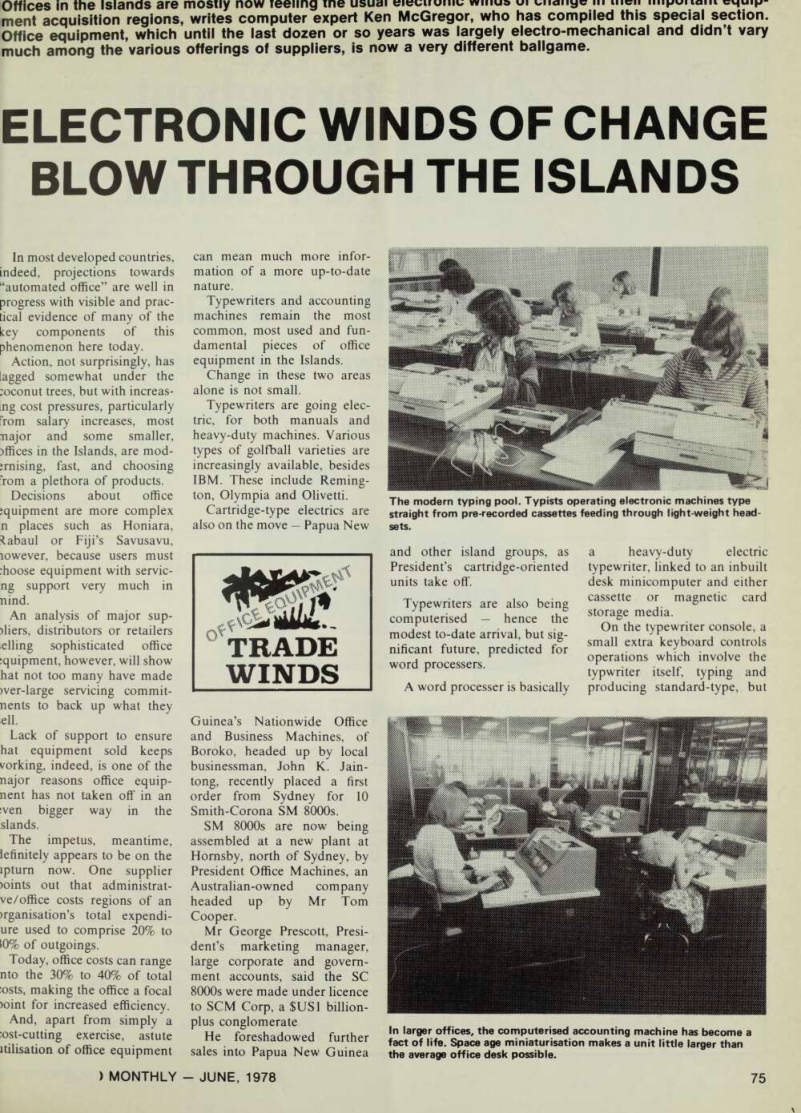
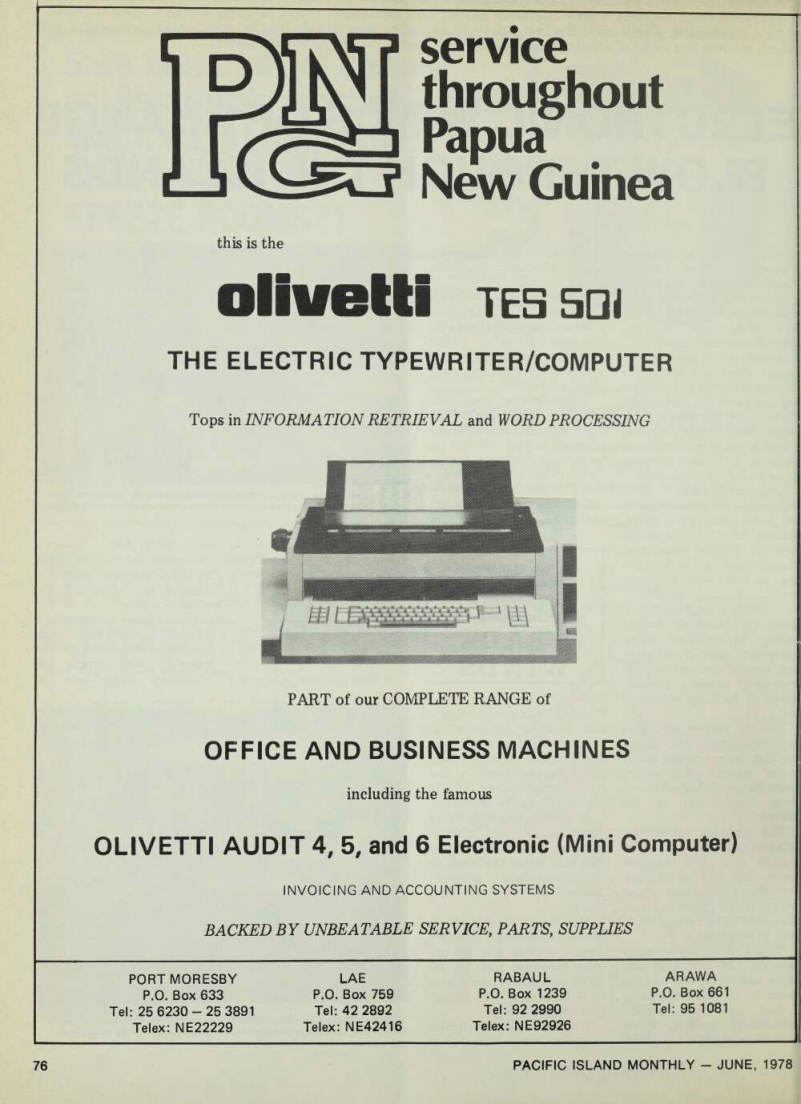
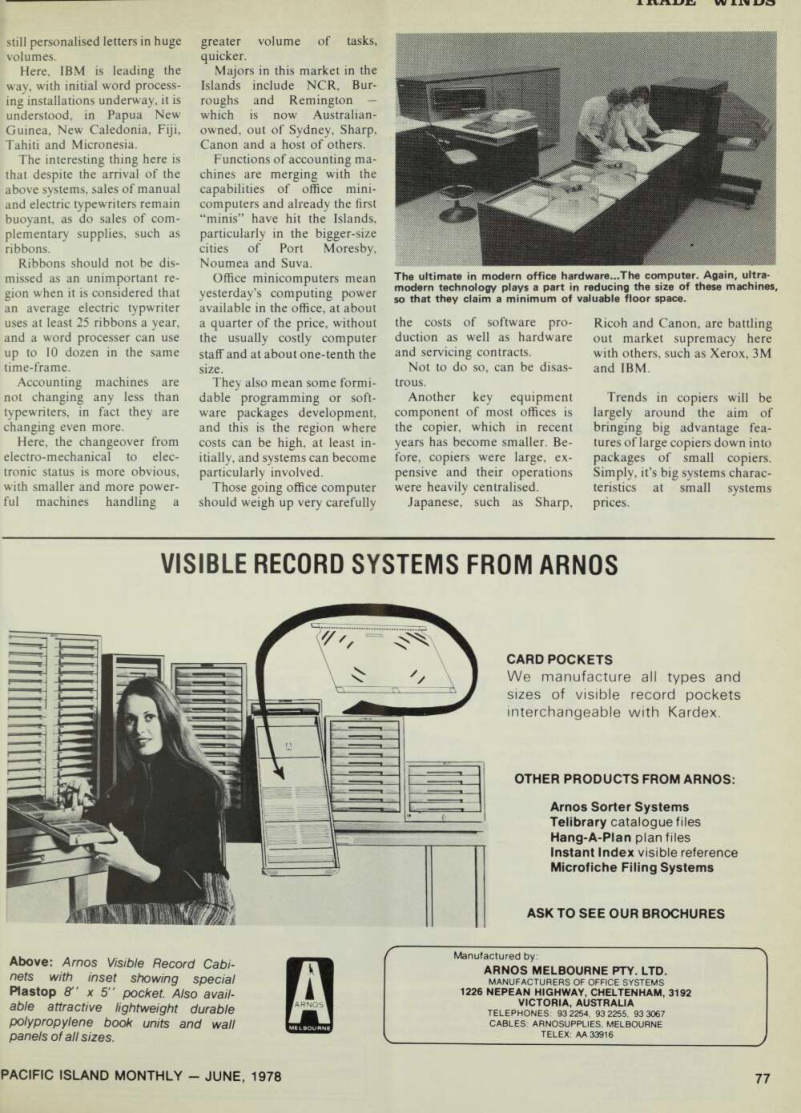
Blow Through The Islands
Offices in the Islands are mosny now reeling me usual eiccuumt wmus ui anyc ■■■ merit acquisition regions, writes computer expert Ken McGregor, who has compiled this special section.
Office equipment, which until the last dozen or so years was largely electro-mechanical and didn’t vary much among the various offerings of suppliers, is now a very different ballgame.
In most developed countries,
indeed, projections towards
“automated office” are well in progress with visible and prac tical evidence of many of the key components of this
phenomenon here today.
Action, not surprisingly, has lagged somewhat under the :oconut trees, but with increas ing cost pressures, particularly Tom salary increases, most najor and some smaller, offices in the Islands, are mod
jmising, fast, and choosing
Tom a plethora of products.
Decisions about office jquipment are more complex n places such as Honiara, or Fiji’s Savusavu, lowever, because users must
dioose equipment with servic
ng support very much in nind.
An analysis of major sup )liers, distributors or retailers
elling sophisticated office
:quipment, however, will show hat not too many have made >ver-large servicing commit nents to back up what they ell.
Lack of support to ensure hat equipment sold keeps vorking, indeed, is one of the
najor reasons office equip
nent has not taken off in an :ven bigger way in the slands.
The impetus, meantime, lefinitely appears to be on the
ipturn now. One supplier
>oints out that administrat ve/office costs regions of an >rganisation’s total expendi ure used to comprise 20% to 10% of outgoings.
Today, office costs can range nto the 30% to 40% of total :osts, making the office a focal
)oint for increased efficiency.
And, apart from simply a :ost-cutting exercise, astute itilisation of office equipment
can mean much more infor mation of a more up-to-date nature.
Typewriters and accounting
machines remain the most common, most used and fun damental pieces of office equipment in the Islands.
Change in these two areas alone is not small.
Typewriters are going elec
tric, for both manuals and heavy-duty machines. Various types of golfball varieties are increasingly available, besides IBM. These include Reming ton, Olympia and Olivetti.
Cartridge-type electrics are also on the move Papua New
Trade
Winds
Guinea’s Nationwide Office and Business Machines, of Boroko, headed up by local businessman, John K. Jain tong, recently placed a first order from Sydney for 10 Smith-Corona SM 8000 s.
SM 8000 s are now being
assembled at a new plant at Hornsby, north of Sydney, by President Office Machines, an Australian-owned company headed up by Mr Tom Cooper.
Mr George Prescott, Presi dent’s marketing manager, large corporate and govern ment accounts, said the SC 8000 s were made under licence to SCM Corp, a SUSI billion
plus conglomerate
He foreshadowed further sales into Papua New Guinea
and other island groups, as
President’s cartridge-oriented
units take off.
Typewriters are also being
computerised - hence the , r , . , , * , . modest to-date arrival, but sie- . e t . , rP mficant future, predicted for , r word processers. r A word processer is basically
a heavy-duty electric typewriter, linked to an inbuilt desk minicomputer and either casse,te ° r . ma g netic card media.
On the typewriter console, a .. . T . . . , small extra keyboard controls . .7 operations which involve the t r . . ir . , typwnter itself, typing and
producing standard-type, but
The modern typing pool. Typists operating electronic machines type straight from pre-recorded cassettes feeding through light-weight head sets.
In larger offices, the computerised accounting machine has become a fact of life. Space age miniaturisation makes a unit little larger than the average office desk possible.
still personalised letters in huge volumes.
Here, IBM is leading the way, with initial word process ing installations underway, it is understood, in Papua New Guinea, New Caledonia, Fiji, Tahiti and Micronesia.
The interesting thing here is that despite the arrival of the above systems, sales of manual and electric typewriters remain buoyant, as do sales of com
plementary supplies, such as
ribbons.
Ribbons should not be dis missed as an unimportant re gion when it is considered that an average electric typwriter uses at least 25 ribbons a year, and a word processer can use up to 10 dozen in the same time-frame.
Accounting machines are not changing any less than typewriters, in fact they are changing even more.
Here, the changeover from electro-mechanical to elec tronic status is more obvious, with smaller and more power ful machines handling a
greater volume of tasks,
quicker.
Majors in this market in the Islands include NCR, Bur
roughs and Remington
which is now Australian owned, out of Sydney, Sharp, Canon and a host of others.
Functions of accounting ma chines are merging with the capabilities of office mini computers and already the first “minis” have hit the Islands,
particularly in the bigger-size
cities of Port Moresby, Noumea and Suva.
Office minicomputers mean
yesterday’s computing power
available in the office, at about a quarter of the price, without
the usually costly computer
staff and at about one-tenth the size.
They also mean some formi dable programming or soft
ware packages development,
and this is the region where costs can be high, at least in itially, and systems can become
particularly involved.
Those going office computer should weigh up very carefully
the costs of software pro duction as well as hardware and servicing contracts.
Not to do so, can be disas trous.
Another key equipment
component of most offices is the copier, which in recent years has become smaller. Be fore, copiers were large, ex
pensive and their operations
were heavily centralised.
Japanese, such as Sharp,
Ricoh and Canon, are battling out market supremacy here with others, such as Xerox, 3M and IBM.
Trends in copiers will be largely around the aim of
bringing big advantage fea
tures of large copiers down into
packages of small copiers.
Simply, it’s big systems charac teristics at small systems prices.
The ultimate in modern office hardware... The computer. Again, ultra modern technology plays a part in reducing the size of these machines, so that they claim a minimum of valuable floor space.
Advertisements & other items, pp. 75-78 (3 items)
75
) MONTHLY - JUNE, 1978
throughout
m
service
Papua
New Guinea
this is the
Olivetti TES SGI
THE ELECTRIC TYPEWRITER/COMPUTER
Tops in INFORMATION RETRIEVAL and WORD PROCESSING
J II
I
PART of our COMPLETE RANGE of
OFFICE AND BUSINESS MACHINES
including the famous OLIVETTI AUDIT 4,5, and 6 Electronic (Mini Computer)
INVOICING AND ACCOUNTING SYSTEMS
BACKED BY UNBEATABLE SERVICE, PARTS , SUPPLIES
PORT MORESBY LAE RABAUL ARAWA
P.O. Box 633 P.O. Box 759 P.O. Box 1239 P.O. Box 661 Tel: 25 6230 - 25 3891 Tel: 42 2892 Tel: 92 2990 Tel: 95 1081 Telex: NE22229 Telex: NE42416 Telex: NE92926
VISIBLE RECORD SYSTEMS FROM ARNOS
v m Ir
CARD POCKETS
We manufacture all types and sizes of visible record pockets interchangeable with Kardex.
OTHER PRODUCTS FROM ARNOS:
Arnos Sorter Systems Telibrary catalogue files Hang-A-Plan plan files Instant Index visible reference Microfiche Filing Systems
ASK TO SEE OUR BROCHURES
Above: Arnos Visible Record Cabinets with inset showing special Plastop 8" x 5" pocket. Also available attractive lightweight durable polypropylene book units and wall panels of all sizes.
Manufactured by:
ARNOS MELBOURNE PTY. LTD.
MANUFACTURERS OF OFFICE SYSTEMS
1226 NEPEAN HIGHWAY, CHELTENHAM, 3192
VICTORIA, AUSTRALIA
TELEPHONES: 93 2254, 93 2255, 93 3067
CABLES: ARNOSUPPLIES, MELBOURNE
TELEX: AA 33916
Abacus. IE
The calculator with both printer and display with 14 steps programming function.
TRADE ENQUIRIES TO:
President Office Machines IM.SW Pty Ltd.
113 A WILLOUGHBY ROAD
CROWS NEST 2065,
N.S.W. AUSTRALIA.
PHONE: SYDNEY 439-6331
439-6445
The Minolta RP4OS.
The Minolta RP4OS is a compact, table top assistant. One that retrieves 1 all kinds of information quickly and easily because it is designed to handle all kinds of microfilm, microfiche and aperture cards. It handles COM, NMA and COSATI microfiche. Microfilm rolls of 16mm and 35mm size. Any microinformation output need your office, laboratory, manufacturing plant or financial institution can provide.
It uses our electrostatic bi-charge printing system to reproduce from
Minolta
Minolta Camera Co., Ltd. negative and positive film. And it has an easy-to-read, non-glare screen that produces uniformly bright and sharp images with clear, crisp detail.
There's a lot more that makes the RP4OS a versatile and efficient office assistant. Like, an auto-cutter to reduce copy cost by eliminating paper waste.
Fast accurate focusing. Useful optional accessories and much more.
The Minolta RP4OS. If you already know the safer, more efficient way to store large amounts of information, this is the precise way to get it. 30, 2-Chome, Azuchi-Machi, Higashi-Ku, Osaka 541, Japan
OZAPAPER
Head Office 101 Tulip St., Cheltenham, Vic. 3192. 5501011.
Sales & Service branches at: A C T.: Unit F, 66-70 Maryborough St., Fyshwick, 2609. 806200.
N.S.W.: 64 Chapel St., Marrickville, 2204.5607399 VIC.: 55 ABeckett St., Melbourne. 3000. 3475011.
OLD.: 30 Edmondstone St„ Mayne, Old. 4006. 528055.
S.A.: 130-134 Burbridge Rd., Hilton, Adelaide, 5033.3524011 W.A.: 164 Lord St., Perth, 6000. 328 7899.
TAS.: 141 Murray St., Hobart, 7000. 237484 For detailed information, send to: OZAPAPER LIMITED 101 Tulip St., Cheltenham, Victoria, 3192.
Name: Company: Address: Post Code;
77
PACIFIC ISLAND MONTHLY - JUNE, 1978
Fancy Ha Vinga Machine On Your
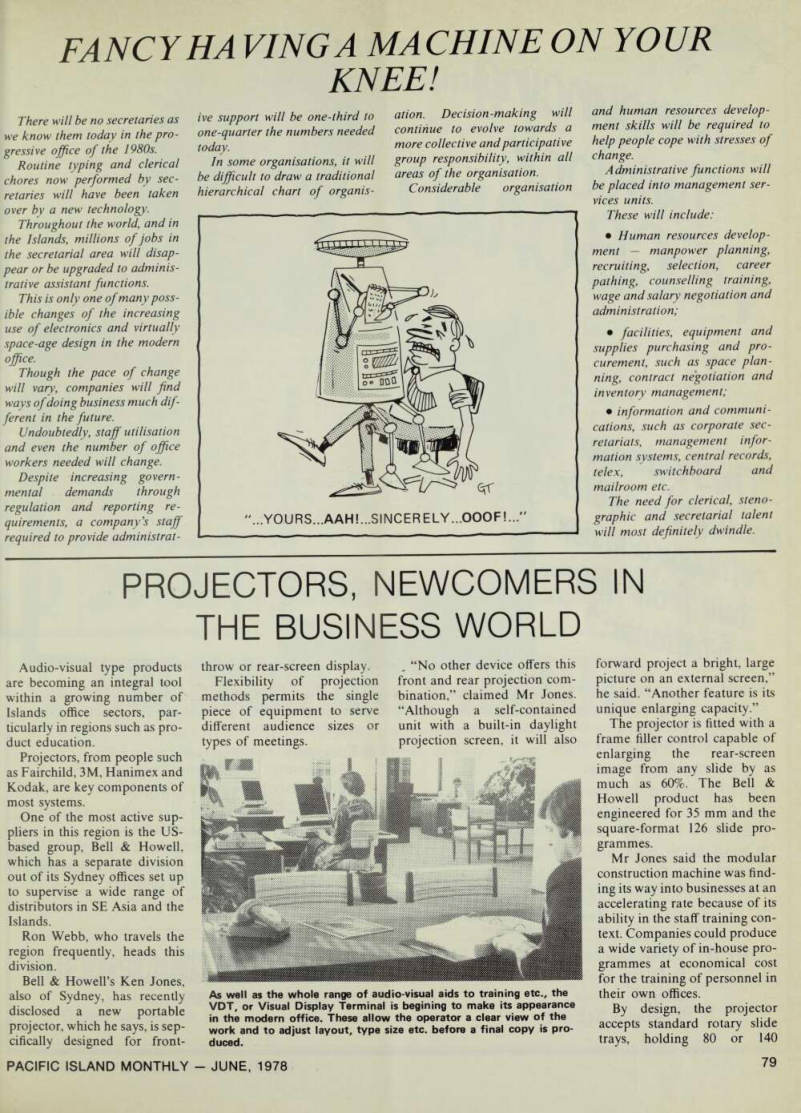
Knee!
There will be no secretaries as we know them today in the pro gressive office of the 1980 s.
Routine typing and clerical chores now performed by sec retaries will have been taken over by a new technology.
Throughout the world, and in the Islands, millions of jobs in the secretarial area will disap pear or be upgraded to adminis trative assistant functions.
This is only one of many poss ible changes of the increasing use of electronics and virtually space-age design in the modern office.
Though the pace of change will vary, companies will find ways of doing business much dif ferent in the future.
Undoubtedly, staff utilisation
and even the number of office workers needed will change.
Despite increasing govern mental demands through regulation and reporting re quirements, a company's staff
required to provide administrat
ive support will be one-third to one-quarter the numbers needed today.
In some organisations, it will be difficult to draw a traditional hierarchical chart of organis-
ation. Decision-making will continue to evolve towards a more collective and participative group responsibility, within all areas of the organisation.
Considerable organisation
and human resources develop ment skills will be required to help people cope with stresses of change.
Administrative functions will be placed into management ser vices units.
These will include: • Human resources develop ment manpower planning, recruiting, selection, career pathing, counselling training, wage and salary negotiation and administration; • facilities, equipment and supplies purchasing and pro curement, such as space plan ning, contract negotiation and inventory management; • information and communi cations, such as corporate sec retariats, management infor mation systems, central records, telex, switchboard and mailroom etc.
The need for clerical, steno graphic and secretarial talent will most definitely dwindle.
"... Yours...Aah!...Singerely...Ooof!..."
Projectors, Newcomers In
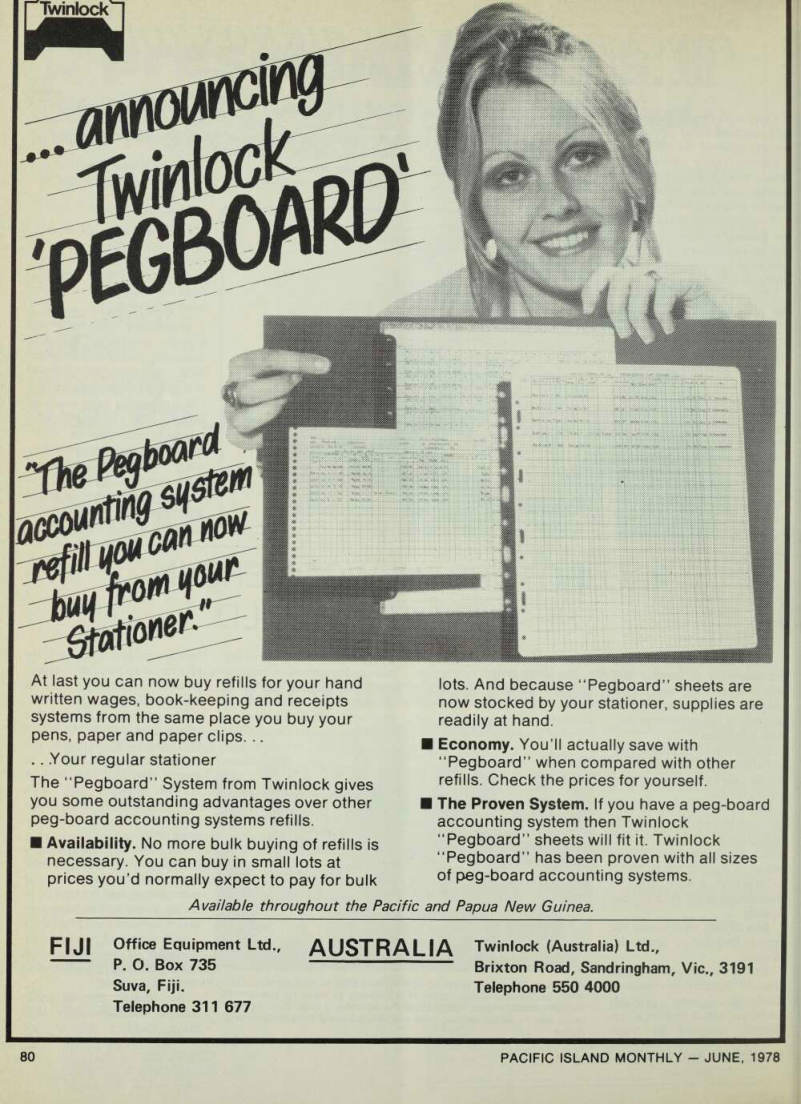

The Business World
Audio-visual type products are becoming an integral tool within a growing number of Islands office sectors, par ticularly in regions such as pro duct education.
Projectors, from people such
as Fairchild, 3M, Hanimex and Kodak, are key components of most systems.
One of the most active sup pliers in this region is the US based group, Bell & Howell, which has a separate division out of its Sydney offices set up to supervise a wide range of distributors in SE Asia and the Islands.
Ron Webb, who travels the
region frequently, heads this
division.
Bell & Howell’s Ken Jones, also of Sydney, has recently disclosed a new portable projector, which he says, is sep cifically designed for front
throw or rear-screen display.
Flexibility of projection methods permits the single piece of equipment to serve different audience sizes or types of meetings.
“No other device offers this front and rear projection com bination,” claimed Mr Jones.
“Although a self-contained unit with a built-in daylight projection screen, it will also
forward project a bright, large
picture on an external screen,” he said. “Another feature is its
unique enlarging capacity.”
The projector is fitted with a frame filler control capable of enlarging the rear-screen image from any slide by as much as 60%. The Bell & Howell product has been engineered for 35 mm and the square-format 126 slide pro grammes.
Mr Jones said the modular construction machine was find ing its way into businesses at an accelerating rate because of its ability in the staff training con
text. Companies could produce
a wide variety of in-house pro grammes at economical cost for the training of personnel in their own offices.
By design, the projector
accepts standard rotary slide trays, holding 80 or 140
As well as the whole range of audio-visual aids to training etc., the VDT, or Visual Display Terminal is begining to make its appearance in the modern office. These allow the operator a clear view of the work and to adjust layout, type size etc. before a final copy is pro duced.
lounted transparencies, and
tandard audio cassettes. It also as a tape pause control allow ig the automatic programme 3 be interrupted at any time.
“Model 796 X plays pre
ecorded pulsed tapes and
dvances the slides automati
ally, and model 797 X enables
ic exhibitor to make his own aund-track and put the pulses n without the need of ad
itional equipment,”
xplained Mr Jones.
For its light source, the
rojector uses the recently
itroduced DDM lamp
laimed to be a highly efficient 9v, 80w tungsten-halogen nth a multi-faceted dichroic lirror.
“It has a remarkable life ex ectancy of 500 hours in the sar-projection mode when it is nder-run,” said Mr Jones, and 100 hours in front projec on when operating at full ower.”
Another innovative feature the internal tray storage rea.
Advertisements & other items, p. 80 (2 items)
80
PACIFIC ISLAND MONTHLY - JUNE, 1978
Twinlock
\ i 253 10 At last you can now buy refills for your hand written wages, book-keeping and receipts systems from the same place you buy your pens, paper and paper clips. .. .. Your regular stationer The “Pegboard” System from Twinlock gives you some outstanding advantages over other peg-board accounting systems refills. ■ Availability. No more bulk buying of refills is necessary. You can buy in small lots at prices you’d normally expect to pay for bulk lots. And because “Pegboard” sheets are now stocked by your stationer, supplies are readily at hand. ■ Economy. You’ll actually save with “Pegboard” when compared with other refills. Check the prices for yourself. ■ The Proven System. If you have a peg-board accounting system then Twinlock “Pegboard” sheets will fit it. Twinlock “Pegboard” has been proven with all sizes of peg-board accounting systems.
A vailable throughout the Pacific and Papua New Guinea.
FIJI Office Equipment Ltd., AUSTRALIA Twinlock (Australia) Ltd., P. O. Box 735 Brixton Road, Sandringham, Vic., 3191 Suva, Fiji. Telephone 550 4000 Telephone 311 677
office machines

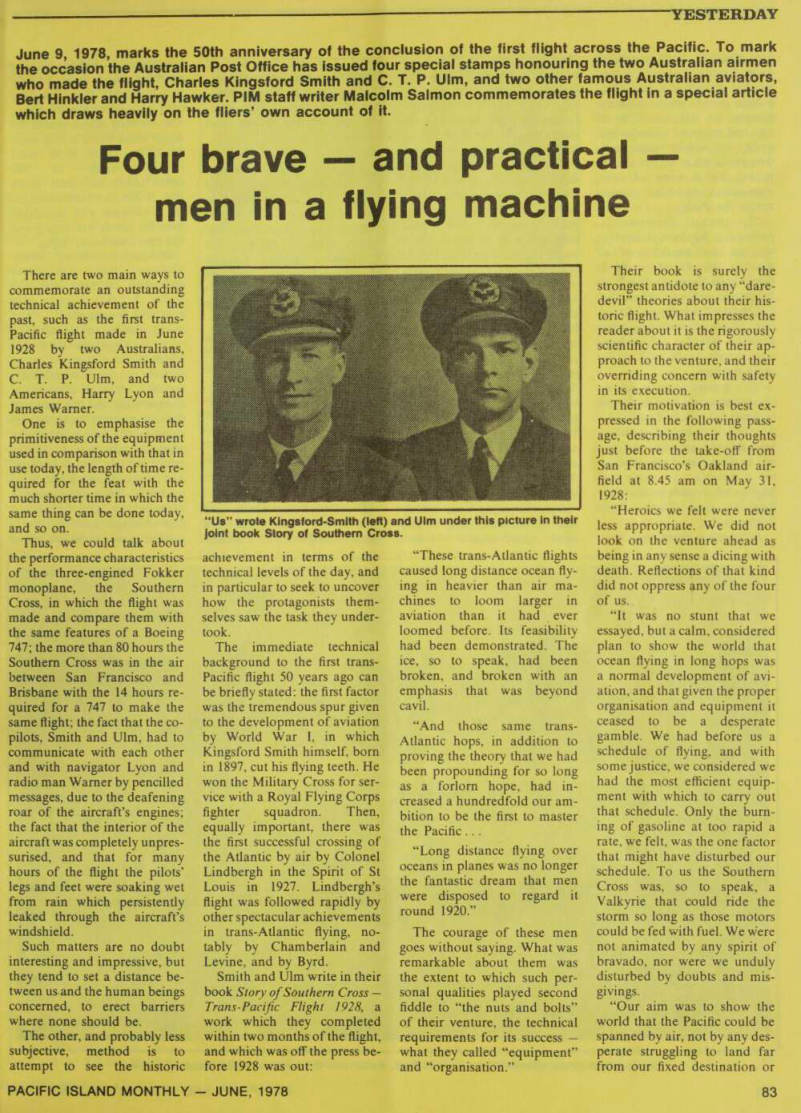
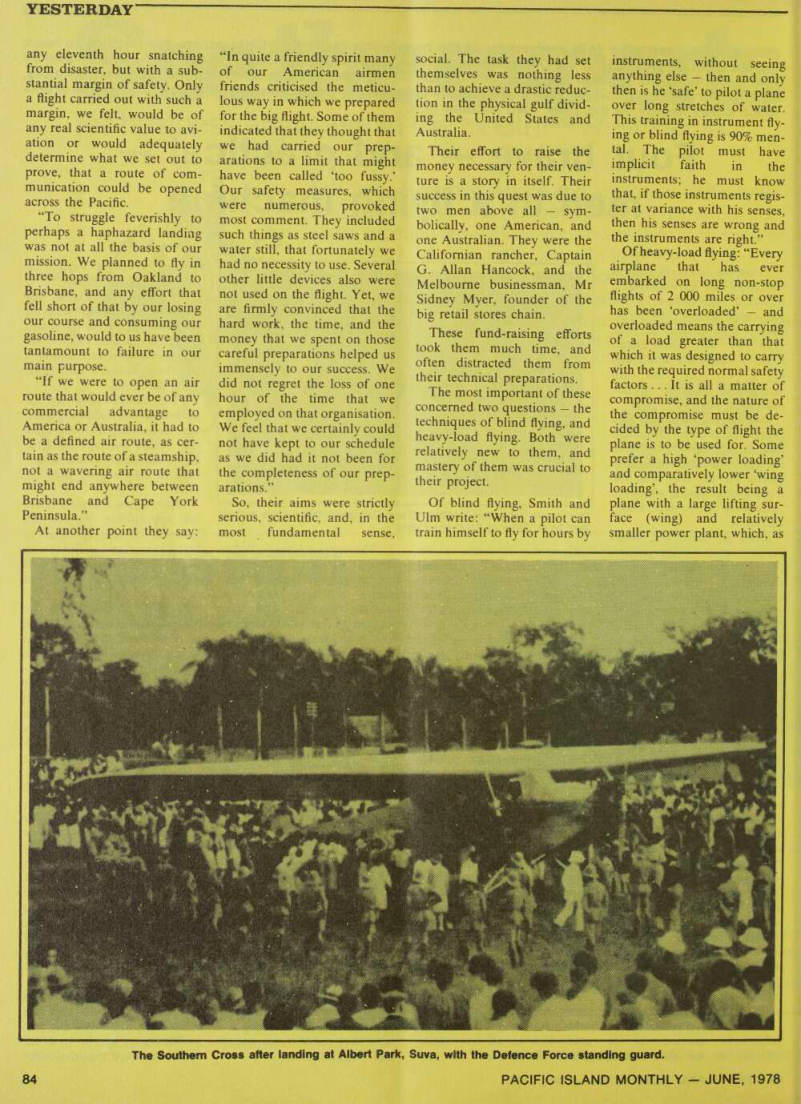
PNG man markets office machines
A significant new enterprise owned by Papua New Gui nean nationals has made its bow in Port Moresby Na tion-wide Office and Business Machine Consultants.
Executive director of the company is Mr John Jaintong, 28, of Lae, in the Morobe Pro vince. Mr Jaintong has several years experience in marketing and administration in the of fice and business machines in dustry.
The company will retail Swiss and Swedish equipment (Hermes and Facit electric and manual typewriters, and other items), as well as Ameri can and Japanese photo copiers, offset printing machines, electronic and electro-mechanical cash registers and calculators.
New Zealander Mr William Vassilieff, who has 25 years’ experience in the industry, will be general manager and technical consultant to the company. His special task will
be to design and co-ordinate training programmes for the company’s technical employees. The firm already employs 10 national trainee
servicemen, who are expected to do training on the job and abroad with the manufac turers. The company hopes to increase staff to 50 by June, 1978.
Mr Jaintong said it was the first time nationals had become involved in this kind of business.
He shares the hope of other nationally-owned firms that the central government will “decentralise” spending by in creasingly patronising ser vices provided by them. • Western Samoa is to set up a computer centre to cater for the needs of government
departments and private cor
porations. Government
departments at present have their computer processing done in Fiji or American Samoa. Mr Barry Davies, a NZ computer consultant, is in charge of the project. He will recruit staff, find a suitable place for the centre, and ad vise on the building required.
The computers will be sup plied by Burroughs Ltd, of NZ.
Continued on page 87.
• Mr Jaintong is pictured (standing) with Mr Vassilieff.
Taking The Sour Taste Out Of
The Customer’S Mouth
“Papua New Guinea has been used by other countries’ ‘briefcase salesmen’ as a venue for making the fast and easy sale ... This has contributed to all different types of office and
business machines flooding the
country without honest con
sideration of ‘service back-up
and spare parts’.
“It is a major factor con tributing to the present nerve cracking dilemma of unavailability of spare parts
and high service fees.”
The words of PNG’s office
equipment heavy, John Jain
tong could apply to Fiji, the
Solomons, New Hebrides, Norfolk Island or any other
Islands territory equally as
well.
Fact is, efforts in recent years
of non-islanders trying to flog
most every conceivable piece
of office equipment without
any thought of support or parts for hapless users, has left a sour taste in the mouth of many.
It is not surprising, then, that
many key office administrators
in the Islands are sceptical of much of the newer type of sys tems and opt to stay with the “evil we know”.
Thus, these people are stay ing with what is often out moded equipment, such as
electro-mechanical accounting
machines and manual type writers, etc., rather than plunge into the unknown and ques tionable expertise of many
office equipment suppliers to
support what they sell these
days.
Support and availability of
parts is really what office equipment is all about, par ticularly in regions such as the Islands where machine exper tise is not exactly plentiful.
It is thus somewhat re assuring to see entrepreneurs such as Mr Jaintong, and others like John Scott, at Remington, and the formidable PNG Print ing effort out of Port Moresby, invest heavily in this area.
Whereas the trend in office equipment supply in the South Seas is for increasing local con
trol of distributorships, moves are also well underway for very serious training indeed of Islanders in servicing a wide range of office equipment.
At Mr Jaintong’s Nation wide Office and Business Ma chines Consultants, for example, the emphasis is very much on service, directed by senior executives such as tech nical consultant. Bill Vass.
The Vass team includes Albert Madek, Sarufa Mari, Moroba Buari, Jonah Eliap and Sam Ezekiel.
At competitor, PNG Print
ing, important alliances are
consummated and well established with overseas majors, such as Olivetti, where
Sydney-based distributor
superviser Jack Mole is in volved.
This company has invested condsiderably in service train ing for its support staff. Its in volvement with equipment, particularly from Olivetti, is wide.
Equipment can range from manual and portable type writers, through electric
typewriters and simple elec
tronic accounting machines, to
sophisticated banking ter
minals, word processors, office minicomputers and data com munications concentrators.
Other major names which come to mind in PNG and indeed Fiji and several other countries in the region include Burroughs, NCR, 3M, Oza paper, Brownbuilt, Arnos, Bell & Howell and New Zealand’s
übiquitous Rotascan filing sys
tem.
Ozapaper, currently set to
merge with the Oce-Crosby Group in Australia, is a big name in copiers, microfilm and
the engineering drawing area.
Bell & Howell, through Syd ney heavy Ron Webb, has an active network of distributors in towns such as Apia, Honiara, Port Moresby, Suva, etc., and is heavily into audio-visual
equipment, particularly projec
tors, and micrographics.
Two Australian magazines,
incidentally, keep users and
suppliers well in touch with latest applications and pro ducts. They are “Micro graphics Australasia”, Box 414, PO Artarmon, NSW, 2064, and “Modern Office”, Box 3337, GPO, Sydney, NSW, 2001.
American Group, 3M, now has a staff office in Port Moresby, and competes with Bell & Howell in micro graphics, but also supplies a much wider range of supplies, such as copiers, tapes, etc.
Arnos, based in Melbourne, is an active filing systems maker which is vigorously exporting to several countries.
NCR, with major offices in Port Moresby and Suva, has also a most active operation out of Noumea, of an agency basis covering New Caledonia and the New Hebrides.
IBM remains a key supplier of office equipment in most countries, and of larger, mainframe computers in New Caledonia and Tahiti. Bur roughs has secured computer sales in Fiji and the Japanese have their first computer mainframe in the Islands, within the Computing for Commerce-associated bureau in Port Moresby, involved with New Guinea Motors.
Here involved is a low-end $ 100,000-range Facom 230/15 system.
In PNG, British supplier ICL remains in control of the local computer mainframe
market, with a bevy of instal lations virtually controlling the entire market for this class of machine.
A plethora of far bigger com puter number-crunchers are in use on US military sites in Micronesia, such as at
Kwajalein, Saipan and Guam,
and the French have some big machines in French Polynesia, involved with recently revived H-bomb testing, but unsur prisingly, little details are avail able on these!
Nationwide Office, of Port
Moresby, recently ordered
some 10 SC 8000 cartridge
electric typewriters from Syd
ney’s President Office Ma chines, a move seen as a pointer to an already wide range of products it is involved with.
Here, Nationwide’s agencies are not unusual for an organis ation which has invested
heavily on support throughout
the Islands’ largest land mass.
Other Nationwide agencies include Hermes 808 golfball electric typewriters, Facit 1601
portable typewriters, A. B.
Dick copiers, duplicators, off
set printers and A. B. Dick Magna I word processors.
Nationwide is also heavily into the electronic cash register region, with agreements with
Hugin, Citizen, Sanyo and
Casio.
The company sells itself strongly on its local control and its investment in local staff.
Advertisements & other items, pp. 81-82 (2 items)
81
3 ACIFIC ISLAND MONTHLY - JUNE, 1978
Qbe Insurance United
Q E
offers expert insurance
throughout the Islands.
QBE INSURANCE UNITED
(FORMERLY - QUEENSLAND INSURANCE COMPANY)
Central Office: 82 Pitt Street, Sydney.
FIJI - Branch Office, Suva, Manager for Fiji: L.G. Liddell A.A.1.1.
LAUTOKA Sub-Branch Office: Burns Phi/p Bldg.
NEW CALEDONIA T.A. Hagen, Ste. W.A. Johnston, S.A.R.L. - Noumea.
NEW HEBRIDES District Manager: G.F. Donnelly, Vila; Santo Santo: Burns Phi/p (New Hebrides) Ltd.
TAHITI Arthur Chung: Immeuble 8.1., Front de Mer, Papeete.
NIUE, NORFOLK ISLAND, SAMOA, TONGA and other South Sea Islands Burns Phi/p (South Sea) Company L td.
QUEENSLAND INSURANCE (RNjG.) LTD.
PAPUA NEW GUINEA - Head Office, PORT MORESBY.
General Manager: J.M. Dawe. Assistant Manager: R.V. Maskell.
District Managers at: LAE: I.R. Martin MOUNT HAGEN: D.F. Carroll ARAWA: J. Longbut MADANG: R.W.V. Collings RABAUL: W.F. Tinker
See the experts
for business anywhere in the South-West Pacific For comprehensive service and advice on trade, both inter-island and with Australia and New Zealand, see the experienced staff at your nearest ANZ branch or agency. We can help you with importing and exporting, business transactions and personal banking. Offices are located at; Suva 128 Victoria Parade and Waimanu Road. Lautoka Naviti Street. Nadi Queen’s Road. Nausori Kings Road. Boroko Hubert Murray Highway. Lae Cnr. Coronation Drive and 7th Street. Madang Lightfoot Arcade, Kasagten Road. Mount Hagen Hagen ▲mm Dnve. Port Moresby AMG House, Hunter Street. Rabaul Mango Avenue. Waigani, Honiara Mendana Avenue. Vila Rue Higginson.
BANK
AN7' QQO
PISCES DIESEL
GM's ANSWER TO THE
SMALL DIESEL MARKET!
• 27 hp. 2 cylinder. • 40 hp. 3 cylinder. • 60 hp. 4 cylinder, also: 27-10 kW Generator sets 40-25 kW Generator sets 60-37.5 kW Generator sets • Mechanical and Borg Warner gear-boxes. • Complete with heat exchangers and instrument wiring looms no extra.
Australian Distributors:
DIABLO DIESEL
212 Haldon Street, Lakemba, NSW 2195.
Phone 759 5306 759 0463.
Note: Export service available.
ALSO IN STOCK:
• Borg Warner reductions V/Drive Boxes. New & used parts service. • Fresh water heat exchangers. • Babbit disc sha couplings.
To eliminate misalignment. • Alarm systems flooding fire overheating low oil pressure
Four brave and practical
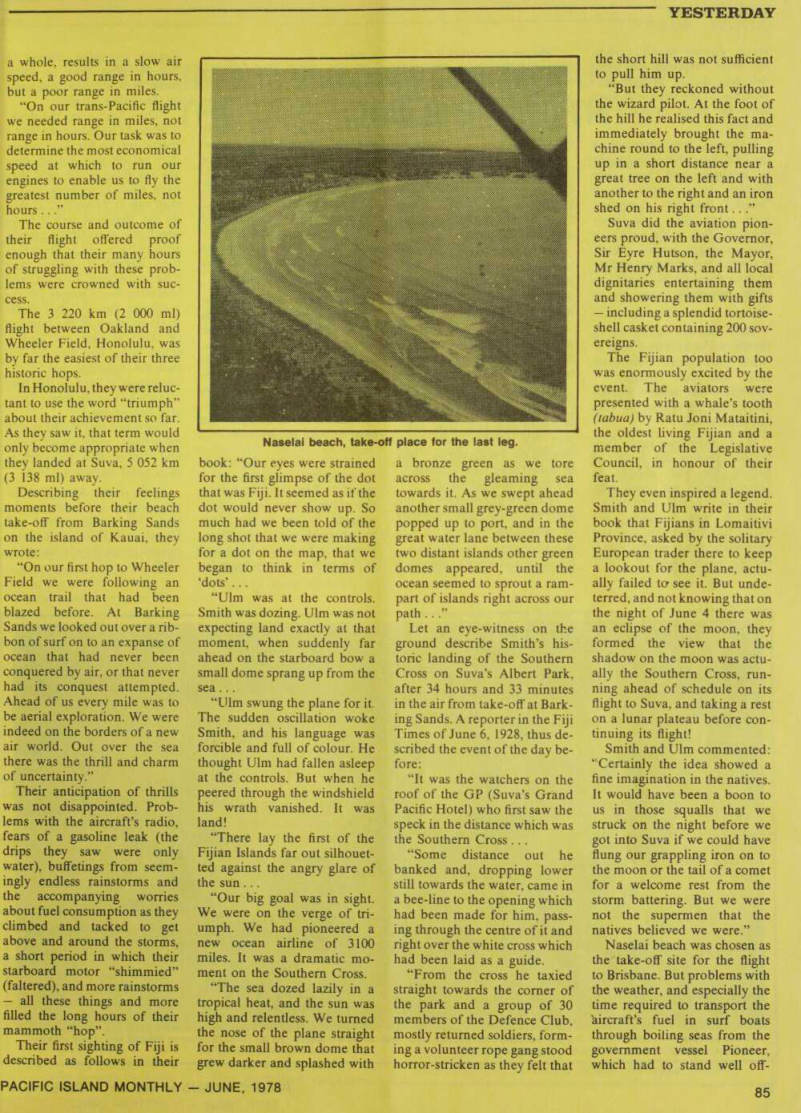
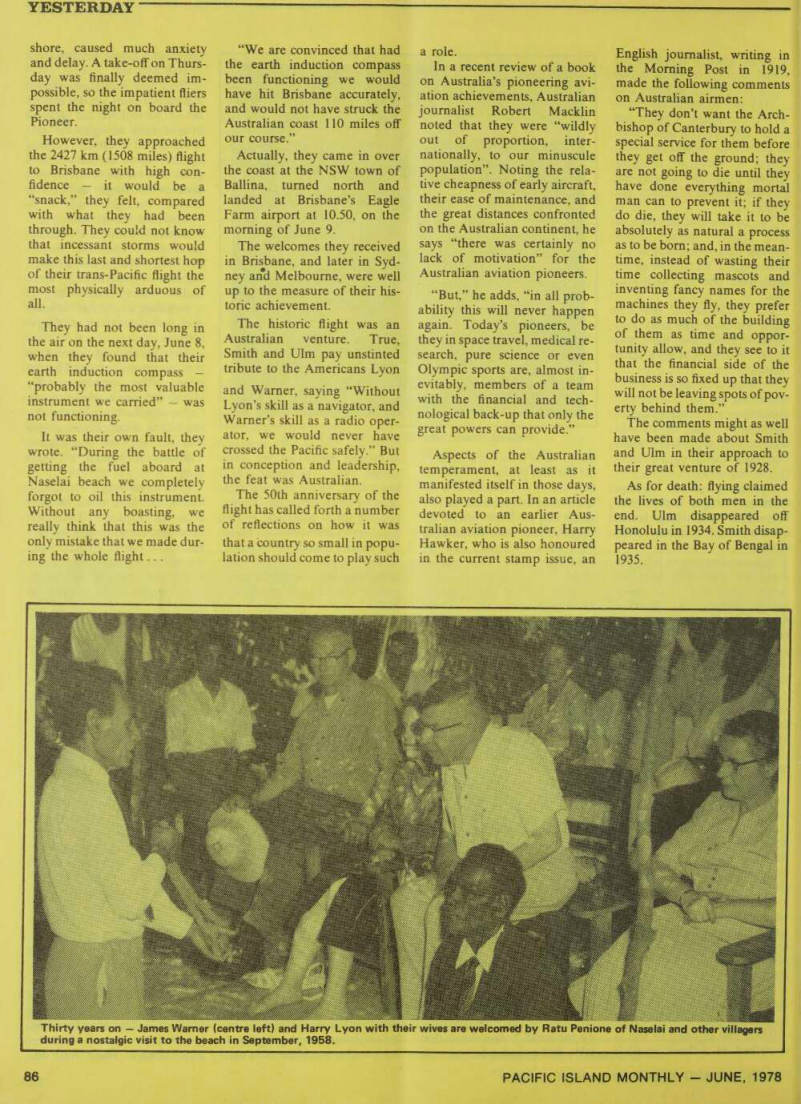
men in a flying machine
June 9 1978, marks the 50th anniversary of the conclusion of the first flight across the Pacific. To mark the occasion the Australian Post Office has issued four special stamps honouring the two Australian airmen who made the flight, Charles Kingsford Smith and C. T. P. Ulm, and two other famous Australian aviators, Bert Hinkler and Harry Hawker. PIM staff writer Malcolm Salmon commemorates the flight in a special article which draws heavily on the fliers’ own account of it.
There are two main ways to commemorate an outstanding technical achievement of the past, such as the first trans pacific flight made in June 1928 by two Australians, Charles Kingsford Smith and C. T. P. Ulm, and two Americans, Harry Lyon and James Warner.
One is to emphasise the
primitiveness of the equipment
used in comparison with that in use today, the length of time re quired for the feat with the much shorter time in which the same thing can be done today, and so on.
Thus, we could talk about the performance characteristics of the three-engined Fokker monoplane, the Southern Cross, in which the flight was made and compare them with the same features of a Boeing 747; the more than 80 hours the Southern Cross was in the air between San Francisco and Brisbane with the 14 hours re quired for a 747 to make the same flight; the fact that the co pilots, Smith and Ulm, had to communicate with each other and with navigator Lyon and radio man Warner by pencilled messages, due to the deafening roar of the aircraft’s engines; the fact that the interior of the aircraft was completely unpres surised, and that for many hours of the flight the pilots’ legs and feet were soaking wet from rain which persistently leaked through the aircraft’s windshield.
Such matters are no doubt
interesting and impressive, but
they tend to set a distance be tween us and the human beings concerned, to erect barriers where none should be.
The other, and probably less subjective, method is to attempt to see the historic
achievement in terms of the technical levels of the day, and in particular to seek to uncover how the protagonists them selves saw the task they under took.
The immediate technical background to the first trans pacific flight 50 years ago can be briefly stated; the first factor was the tremendous spur given to the development of aviation by World War I, in which Kingsford Smith himself, born in 1897, cut his flying teeth. He won the Military Cross for ser vice with a Royal Flying Corps fighter squadron. Then, equally important, there was the first successful crossing of the Atlantic by air by Colonel Lindbergh in the Spirit of St Louis in 1927. Lindbergh’s flight was followed rapidly by other spectacular achievements in trans-Atlantic flying, no tably by Chamberlain and Levine, and by Byrd.
Smith and Ulm write in their book Story of Southern Cross
Trans-Pacific Flight 1928, a
work which they completed within two months of the flight, and which was off the press be fore 1928 was out;
“These trans-Atlantic flights caused long distance ocean fly ing in heavier than air ma chines to loom larger in aviation than it had ever loomed before. Its feasibility had been demonstrated. The ice, so to speak, had been broken, and broken with an
emphasis that was beyond
cavil.
“And those same trans- Atlantic hops, in addition to proving the theory that we had been propounding for so long as a forlorn hope, had in creased a hundredfold our am bition to be the first to master the Pacific ...
“Long distance flying over
oceans in planes was no longer the fantastic dream that men were disposed to regard it round 1920.”
The courage of these men goes without saying. What was remarkable about them was the extent to which such per
sonal qualities played second
fiddle to “the nuts and bolts” of their venture, the technical requirements for its success
what they called “equipment”
and “organisation.”
Their book is surely the strongest antidote to any “dare devil” theories about their his toric flight. What impresses the reader about it is the rigorously scientific character of their ap proach to the venture, and their
overriding concern with safety
in its execution.
Their motivation is best ex pressed in the following pass
age, describing their thoughts
just before the take-off from San Francisco’s Oakland air field at 8.45 am on May 31, 1928: “Heroics we felt were never less appropriate. We did not look on the venture ahead as being in any sense a dicing with death. Reflections of that kind did not oppress any of the four of us.
“It was no stunt that we essayed, but a calm, considered plan to show the world that
ocean flying in long hops was
a normal development of avi ation, and that given the proper
organisation and equipment it
ceased to be a desperate gamble. We had before us a schedule of flying, and with some justice, we considered we had the most efficient equip ment with which to carry out that schedule. Only the burn ing of gasoline at too rapid a rate, we felt, was the one factor that might have disturbed our schedule. To us the Southern Cross was, so to speak, a Valkyrie that could ride the storm so long as those motors could be fed with fuel. We were not animated by any spirit of bravado, nor were we unduly disturbed by doubts and mis
givings.
“Our aim was to show the world that the Pacific could be spanned by air, not by any des perate struggling to land far from our fixed destination or
“Us” wrote Kingsford-Smith (left) and Ulm under this picture In their Joint book Story of Southern Cross.
any eleventh hour snatching from disaster, but with a sub
stantial margin of safety. Only
a flight carried out with such a margin, we felt, would be of any real scientific value to avi ation or would adequately determine what we set out to prove, that a route of com munication could be opened across the Pacific.
“To struggle feverishly to
perhaps a haphazard landing
was not at all the basis of our mission. We planned to fly in three hops from Oakland to Brisbane, and any effort that fell short of that by our losing our course and consuming our gasoline, would to us have been tantamount to failure in our main purpose.
“If we were to open an air route that would ever be of any commercial advantage to America or Australia, it had to be a defined air route, as cer tain as the route of a steamship, not a wavering air route that
might end anywhere between
Brisbane and Cape York Peninsula.”
At another point they say:
“In quite a friendly spirit many
of our American airmen friends criticised the meticu lous way in which we prepared for the big flight. Some of them indicated that they thought that we had carried our prep arations to a limit that might have been called ‘too fussy.’
Our safety measures, which were numerous, provoked most comment. They included such things as steel saws and a water still, that fortunately we had no necessity to use. Several other little devices also were not used on the flight. Yet, we are firmly convinced that the hard work, the time, and the money that we spent on those
careful preparations helped us
immensely to our success. We did not regret the loss of one hour of the time that we
employed on that organisation.
We feel that we certainly could not have kept to our schedule as we did had it not been for the completeness of our prep arations.”
So, their aims were strictly serious, scientific, and, in the most fundamental sense,
social. The task they had set themselves was nothing less than to achieve a drastic reduction in the physical gulf dividing the United States and Australia.
Their effort to raise the money necessary for their venture is a story in itself. Their success in this quest was due to two men above all symbolically, one American, and one Australian. They were the Californian rancher, Captain G. Allan Hancock, and the Melbourne businessman, Mr Sidney Myer, founder of the big retail stores chain.
T . f These fund-raising efforts took them much time, and often distracted them from their technical preparations. f 4 , The most important of these r , concerned two questions the . , ■ , techniques of blind flying, and . \ • D*. 5 heavy-load flying. Both were relatively new to them, and mastery of them was crucial to ... J 4 the,r P r °J ect Of blind flying, Smith and Ulm write: “When a pilot can train himself to fly for hours by
instruments, without seeing anything else then and only then is he ‘safe’ to pilot a plane over long stretches of water.
This training in instrument fly ing or blind flying is 90% men fal. The pilot must have implicit faith in the instruments; he must know that, if those instruments regis ter at variance with his senses, then his senses are wrong and the instruments are right.”
Of heavy-load flying: “Every
airplane that has ever embarked on long non-stop flights of 2 000 miles or over has been ‘overloaded’ and overloaded means the carrying 5 & T h c h it was designed to carry " T factors ... It is all a matter of r compromise, and the nature of • , , the compromise must be de j , , . rn- i i cided hy the type of flight the . u r 6 C
t,Z lh„h ‘ T
P . • P° wer oa ln S and comparatively lower wing loading’ the result being a plane with a large lifting sur
face (wing) and relatively
smaller power plant, which, as
The Southern Cross after landing at Albert Park, Suva, with the Defence Force standing guard.
a whole, results in a slow air speed, a good range in hours, but a poor range in miles.
“On our trans-Pacific flight we needed range in miles, not range in hours. Our task was to determine the most economical speed at which to run our engines to enable us to fly the greatest number of miles, not hours...”
The course and outcome of
their flight offered proof
enough that their many hours of struggling with these prob lems were crowned with suc cess.
The 3 220 km (2 000 ml) flight between Oakland and Wheeler Field, Honolulu, was by far the easiest of their three
historic hops.
In Honolulu, they were reluc tant to use the word “triumph” about their achievement so far.
As they saw it, that term would
only become appropriate when
they landed at Suva, 5 052 km (3 138 ml) away.
Describing their feelings
moments before their beach take-off from Barking Sands on the island of Kauai, they wrote: “On our first hop to Wheeler Field we were following an ocean trail that had been blazed before. At Barking Sands we looked out over a rib bon of surf on to an expanse of ocean that had never been conquered by air, or that never had its conquest attempted.
Ahead of us every mile was to be aerial exploration. We were indeed on the borders of a new air world. Out over the sea there was the thrill and charm
of uncertainty.”
Their anticipation of thrills was not disappointed. Prob lems with the aircraft’s radio, fears of a gasoline leak (the
drips they saw were only
water), bufferings from seem ingly endless rainstorms and the accompanying worries about fuel consumption as they climbed and tacked to get above and around the storms, a short period in which their starboard motor “shimmied” (faltered), and more rainstorms all these things and more filled the long hours of their
mammoth “hop”.
Their first sighting of Fiji is described as follows in their
book: “Our eyes were strained for the first glimpse of the dot that was Fiji. It seemed as if the dot would never show up. So much had we been told of the long shot that we were making for a dot on the map, that we began to think in terms of ‘dots’...
“Ulm was at the controls.
Smith was dozing. Ulm was not expecting land exactly at that moment, when suddenly far ahead on the starboard bow a small dome sprang up from the sea...
“Ulm swung the plane for it The sudden oscillation woke Smith, and his language was forcible and full of colour. He thought Ulm had fallen asleep at the controls. But when he
peered through the windshield
his wrath vanished. It was land!
“There lay the first of the Fijian Islands far out silhouet ted against the angry glare of the sun ...
“Our big goal was in sight.
We were on the verge of tri umph. We had pioneered a new ocean airline of 3100 miles. It was a dramatic mo ment on the Southern Cross.
“The sea dozed lazily in a tropical heat, and the sun was high and relentless. We turned the nose of the plane straight for the small brown dome that grew darker and splashed with
a bronze green as we tore across the gleaming sea towards it. As we swept ahead another small grey-green dome popped up to port, and in the great water lane between these two distant islands other green domes appeared, until the ocean seemed to sprout a ram part of islands right across our path ...”
Let an eye-witness on the ground describe Smith’s his toric landing of the Southern Cross on Suva’s Albert Park, after 34 hours and 33 minutes in the air from take-off at Bark ing Sands. A reporter in the Fiji Times of June 6, 1928, thus de scribed the event of the day be fore: “It was the watchers on the roof of the GP (Suva’s Grand Pacific Hotel) who first saw the speck in the distance which was the Southern Cross ...
“Some distance out he banked and, dropping lower still towards the water, came in a bee-line to the opening which had been made for him, pass ing through the centre of it and right over the white cross which had been laid as a guide.
“From the cross he taxied straight towards the comer of the park and a group of 30 members of the Defence Club, mostly returned soldiers, form ing a volunteer rope gang stood horror-stricken as they felt that
the short hill was not sufficient to pull him up.
“But they reckoned without the wizard pilot. At the foot of the hill he realised this fact and immediately brought the ma chine round to the left, pulling up in a short distance near a great tree on the left and with another to the right and an iron shed on his right front...”
Suva did the aviation pion eers proud, with the Governor, Sir Eyre Hutson, the Mayor, Mr Henry Marks, and all local
dignitaries entertaining them
and showering them with gifts
including a splendid tortoise
shell casket containing 200 sov ereigns.
The Fijian population too was enormously excited by the event. The aviators were presented with a whale’s tooth (tabua) by Ratu Joni Mataitini, the oldest living Fijian and a member of the Legislative Council, in honour of their feat.
They even inspired a legend.
Smith and Ulm write in their book that Fijians in Lomaitivi Province, asked by the solitary European trader there to keep a lookout for the plane, actu ally failed ter see it. But unde terred, and not knowing that on the night of June 4 there was an eclipse of the moon, they formed the view that the shadow on the moon was actu ally the Southern Cross, run ning ahead of schedule on its flight to Suva, and taking a rest on a lunar plateau before con tinuing its flight!
Smith and Ulm commented: “Certainly the idea showed a fine imagination in the natives.
It would have been a boon to us in those squalls that we struck on the night before we got into Suva if we could have flung our grappling iron on to the moon or the tail of a comet for a welcome rest from the storm battering. But we were not the supermen that the natives believed we were.”
Naselai beach was chosen as the take-off site for the flight to Brisbane. But problems with the weather, and especially the time required to transport the aircraft’s fuel in surf boats through boiling seas from the government vessel Pioneer, which had to stand well off
Naselai beach, take-off place for the last leg.
shore, caused much anxiety and delay. A take-off on Thurs day was finally deemed im possible, so the impatient fliers spent the night on board the Pioneer.
However, they approached the 2427 km (1508 miles) flight to Brisbane with high con fidence it would be a “snack,” they felt, compared with what they had been through. They could not know that incessant storms would make this last and shortest hop of their trans-Pacific flight the most physically arduous of all.
They had not been long in the air on the next day, June 8, when they found that their earth induction compass “probably the most valuable instrument we carried” was
not functioning.
It was their own fault, they wrote. “During the battle of getting the fuel aboard at Naselai beach we completely forgot to oil this instrument.
Without any boasting, we really think that this was the only mistake that we made dur
ing the whole flight...
“We are convinced that had the earth induction compass been functioning we would have hit Brisbane accurately, and would not have struck the Australian coast 110 miles off our course.”
Actually, they came in over the coast at the NSW town of Ballina, turned north and landed at Brisbane’s Eagle Farm airport at 10.50, on the morning of June 9.
The welcomes they received in Brisbane, and later in Syd ney and Melbourne, were well up to the measure of their his toric achievement.
The historic flight was an Australian venture. True, Smith and Ulm pay unstinted tribute to the Americans Lyon and Warner, saying “Without Lyon’s skill as a navigator, and Warner’s skill as a radio oper ator, we would never have crossed the Pacific safely.” But
in conception and leadership,
the feat was Australian.
The 50th anniversary of the flight has called forth a number of reflections on how it was that a country so small in popu lation should come to play such
a role.
In a recent review of a book on Australia’s pioneering avi ation achievements, Australian journalist Robert Macklin noted that they were “wildly out of proportion, inter nationally, to our minuscule population”. Noting the rela tive cheapness of early aircraft, their ease of maintenance, and the great distances confronted on the Australian continent, he says “there was certainly no lack of motivation” for the Australian aviation pioneers.
“But,” he adds, “in all prob ability this will never happen
again. Today’s pioneers, be
they in space travel, medical re search, pure science or even Olympic sports are, almost in evitably, members of a team with the financial and tech
nological back-up that only the
great powers can provide.”
Aspects of the Australian temperament, at least as it manifested itself in those days, also played a part. In an article devoted to an earlier Aus
tralian aviation pioneer, Harry
Hawker, who is also honoured in the current stamp issue, an
English journalist, writing in
the Morning Post in 1919, made the following comments on Australian airmen: “They don’t want the Arch bishop of Canterbury to hold a special service for them before
they get olf the ground; they
are not going to die until they have done everything mortal man can to prevent it; if they do die, they will take it to be absolutely as natural a process as to be bom; and, in the mean time, instead of wasting their time collecting mascots and inventing fancy names for the
machines they fly, they prefer
to do as much of the building of them as time and oppor tunity allow, and they see to it that the financial side of the business is so fixed up that they will not be leaving spots of pov erty behind them.”
The comments might as well have been made about Smith and Ulm in their approach to their great venture of 1928.
As for death: flying claimed the lives of both men in the end. Ulm disappeared off Honolulu in 1934. Smith disap peared in the Bay of Bengal in 1935.
Thirty years on James Warner (centre left) and Harry Lyon with their wives are welcomed by Ratu Penione of Nasetai and other villagers during a nostalgic visit to the beach in September, 1958.
Advertisements & other items, pp. 83-88 (7 items)
83
YESTERDAY
PACIFIC ISLAND MONTHLY - JUNE, 1978
84
PACIFIC ISLAND MONTHLY - JUNE, 1978
YESTERDAY
85
YESTERDAY
PACIFIC ISLAND MONTHLY - JUNE. 1978
86
PACIFIC ISLAND MONTHLY - JUNE, 1978
YESTERDAY
87
TRADE WINDS
PACIFIC ISLAND MONTHLY - JUNE, 1978
J\/Ttc^Og^^Pi~N^S~~Austratasj_A
The only monthly newsmagazine covering the micrographics and office equipment-related action in the Pacific and S.E. Asia. A must for interested office users and distributors.
Write for free single copy or subscribe immediately. Annual subscription outside Australia , airmail , $0345, or SUS2O, seamail.
For readers inside Australia , $A 15.
Inquiries or cheques to:
KOTAM WRITING,
Box 414, P.O. Artarmon, N.S.W. Australia, 2064.
Try World Famous
Sun
Slower
BRAND
CANNED FISH
Packer
IN NATURAL OIL
LIGHT MEATI
OTHER LINES: Steel & Wooden Desks & Chairs—Lockers & Cabinets—Slotted Angles & Shelves—Lighting Fixtures
CENTENARY 1878-1978
Sahara & Co., Ltd.
Sumitomo Seimei Kawaramachi Building, 37-5 Chome, Kawaramachi Higashi-ku, Osaka, Japan Telephone; Osaka (06) 202-2171. Telex: 5224820 HINODE J Cable Address: “HERMES OSAKA
FARM & ENGINEERING
WORKSHOP
EQUIPMENT
PREFABRICATED CATTLE AND SHEEP YARDS AND CRUSHES • HAY FEEDERS FARM GATES • FENCING WIRE UNWIND- ERS • POST DRIVERS AND LIFTERS ETC • HYDRAULIC PIPE BENDER • POWER HACKSAWS • SHEARS • FLAT AND ROD BENDERS • PIPE NOTCHERS • CRIMPERS • GARAGE PRESS-
ES • FARM MEAT SAWS ETC.
CONTACT
R.P.M. MANNING LTD. AUCKLAND N.Z.
SOUTH PACIFIC MACHINERY PTY. LTD.
BOROKO, NEW GUINEA.
PACIFIC AUSTRALIAN TRADING, SYDNEY
AUSTRALIA-NEW CALEDONIA EXPORTS, SYDNEY.
AGQUIP MACHINERY PTY. LTD. NEW GUINEA.
218 GRANGE ROAD, FAIRFIELD, VICTORIA, 3078, AUSTRALIA.
Telephone 497-1844 m. JL ml sf I>ty. Ltd.
NOTICE: KIKKOMAN TRADE MARKS
Notice is hereby given that Kikkoman Shoyu Co. Ltd., a corporation duly organised and existing under the laws of Japan, of 339, Noda, Noda City, Chiba, Japan, is the sole proprietor in Papua New Guinea and Nauru and elsewhere of the following Trade Marks: Used in respect of the following: Coffee, tea, cocoa, sugar, rice, tapioca, sago, coffee substitutes; flour, and preparations made from cereals; bread, biscuits, cakes, pastry and confectionery, ices; honey, treacle; yeast, baking-powder; salt, mustard; pepper, vinegar, sauces, spices; ice.
The proprietor claims all rights in respect of the above Trade Marks and will take all necessary legal steps against any person or company infringing those rights.
F. B. RICE & CO.
Patent Attorneys, Sydney, Australia.
1. KIKKOMAN 2.
88
PACIFIC ISLAND MONTHLY - JUNE, 1978
Coconut oil will flow in Tonga
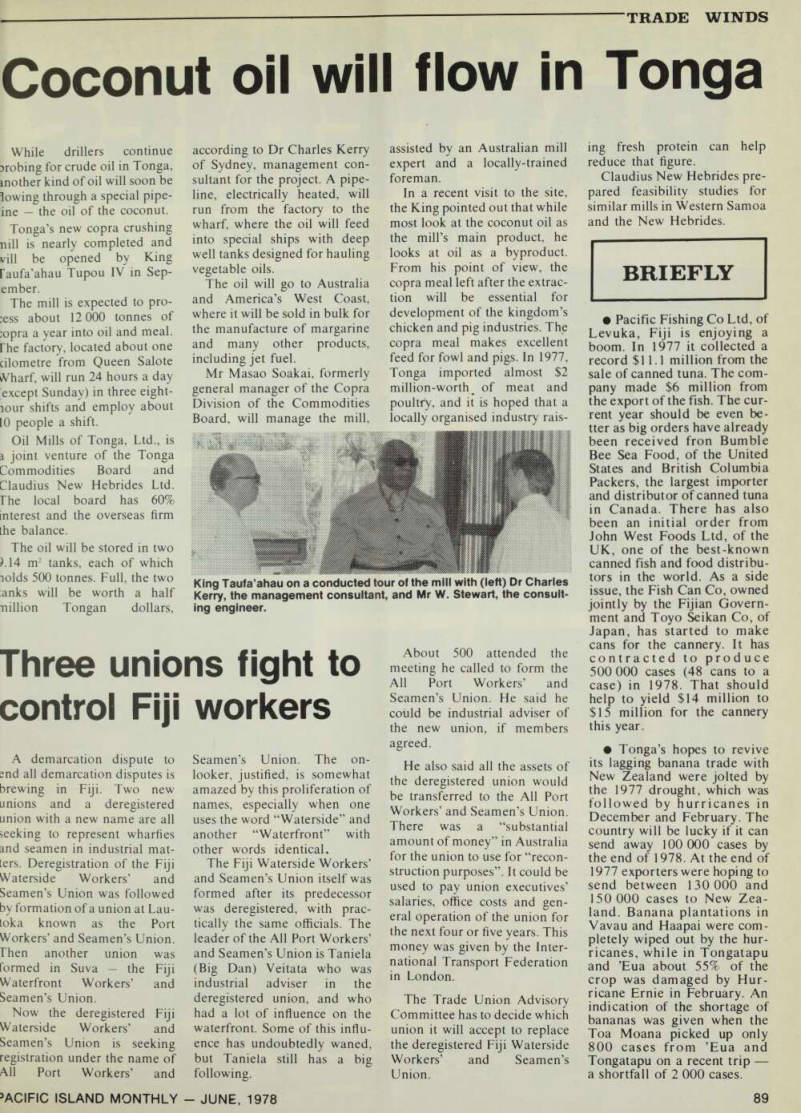
While drillers continue jrobing for crude oil in Tonga, mother kind of oil will soon be
lowing through a special pipe
ine - the oil of the coconut.
Tonga’s new copra crushing
nill is nearly completed and
vill be opened by King faufa’ahau Tupou IV in Sep ember.
The mill is expected to pro cess about 12 000 tonnes of x)pra a year into oil and meal, fhe factory, located about one cilometre from Queen Salote Wharf, will run 24 hours a day except Sunday) in three eight lour shifts and employ about
10 people a shift.
Oil Mills of Tonga, Ltd., is a joint venture of the Tonga Commodities Board and Claudius New Hebrides Ltd.
The local board has 60% interest and the overseas firm the balance.
The oil will be stored in two M 4 m 2 tanks, each of which aolds 500 tonnes. Full, the two anks will be worth a half nillion Tongan dollars,
according to Dr Charles Kerry of Sydney, management con sultant for the project. A pipe line, electrically heated, will run from the factory to the wharf, where the oil will feed into special ships with deep well tanks designed for hauling vegetable oils.
The oil will go to Australia and America’s West Coast, where it will be sold in bulk for the manufacture of margarine and many other products,
including jet fuel.
Mr Masao Soakai, formerly general manager of the Copra Division of the Commodities Board, will manage the mill,
assisted by an Australian mill expert and a locally-trained foreman.
In a recent visit to the site, the King pointed out that while most look at the coconut oil as the mill’s main product, he looks at oil as a byproduct.
From his point of view, the copra meal left after the extrac tion will be essential for
development of the kingdom’s
chicken and pig industries. The copra meal makes excellent feed for fowl and pigs. In 1977, Tonga imported almost $2 million-worthy of meat and poultry, and it is hoped that a
locally organised industry dis-
ing fresh protein can help reduce that figure.
Claudius New Hebrides pre pared feasibility studies for similar mills in Western Samoa and the New Hebrides.
King Taufa'ahau on a conducted tour of the mill with (left) Dr Charles Kerry, the management consultant, and Mr W. Stewart, the consult
ing engineer.
Three unions fight to control Fiji workers
control Fiji workers
A demarcation dispute to snd all demarcation disputes is brewing in Fiji. Two new
unions and a deregistered
union with a new name are all seeking to represent wharfies and seamen in industrial mat ters. Deregistration of the Fiji Waterside Workers’ and Seamen’s Union was followed by formation of a union at Lau toka known as the Port Workers’ and Seamen’s Union.
Then another union was formed in Suva the Fiji Waterfront Workers’ and Seamen’s Union.
Now the deregistered Fiji Waterside Workers’ and Seamen’s Union is seeking registration under the name of All Port Workers’ and
Seamen’s Union. The on looker, justified, is somewhat amazed by this proliferation of names, especially when one uses the word “Waterside” and another “Waterfront” with other words identical.
The Fiji Waterside Workers’ and Seamen’s Union itself was formed after its predecessor was deregistered, with prac tically the same officials. The leader of the All Port Workers’ and Seamen’s Union is Taniela (Big Dan) Veitata who was industrial adviser in the deregistered union, and who had a lot of influence on the waterfront. Some of this influ ence has undoubtedly waned, but Taniela still has a big
following.
About 500 attended the meeting he called to form the All Port Workers’ and Seamen’s Union. He said he could be industrial adviser of the new union, if members
agreed.
He also said all the assets of the deregistered union would be transferred to the All Port Workers’ and Seamen’s Union.
There was a “substantial amount of money’’ in Australia for the union to use for “recon struction purposes’’. It could be used to pay union executives’ salaries, office costs and gen eral operation of the union for the next four or five years. This money was given by the Inter national Transport Federation in London.
The Trade Union Advisory Committee has to decide which union it will accept to replace
the deregistered Fiji Waterside
Workers’ and Seamen’s Union.
Briefly
• Pacific Fishing Co Ltd, of Levuka, Fiji is enjoying a boom. In 1977 it collected a record $ll.l million from the sale of canned tuna. The com pany made $6 million from the export of the fish. The cur rent year should be even be tter as big orders have already been received fron Bumble Bee Sea Food, of the United States and British Columbia Packers, the largest importer and distributor of canned tuna in Canada. There has also been an initial order from John West Foods Ltd, of the UK, one of the best-known canned fish and food distribu tors in the world. As a side issue, the Fish Can Co, owned jointly by the Fijian Govern ment and Toyo Seikan Co, of Japan, has started to make cans for the cannery. It has contracted to produce 500 000 cases (48 cans to a case) in 1978. That should help to yield $l4 million to $l5 million for the cannery this year. • Tonga’s hopes to revive its lagging banana trade with New Zealand were jolted by the 1977 drought, which was followed by hurricanes in December and February. The country will be lucky if it can send away 100 000 cases by the end of 1978. At the end of 1977 exporters were hoping to send between 130 000 and 150 000 cases to New Zea land. Banana plantations in Vavau and Haapai were com pletely wiped out by the hur ricanes, while in Tongatapu and ’Eua about 55% of the crop was damaged by Hur ricane Ernie in February. An indication of the shortage of bananas was given when the Toa Moana picked up only 800 cases from ’Eua and Tongatapu on a recent trip a shortfall of 2 000 cases.
Advertisements & other items, pp. 89-90 (3 items)
89
TRADE WINDS
PACIFIC ISLAND MONTHLY - JUNE, 1978
90
PACIFIC ISLAND MONTHLY - JUNE, 1978
Chloride
for all applications
J I a Wl i I Chloride is the largest and only manufacturer of both lead acid and nickel cadmium alkaline batteries in Australia.
The Company is equipped and qualified to offer advice, guidance and service on any battery requirement no matter how large or small.
On the question of size, it could be as small as a battery for a hearing aid the dimensions of a coat button or a power station battery weighing as much as 40 tonnes.
Again it could be a no break D.C Power System for a computer or emergency lighting for a hospital The Chloride Company operates in 40 countries throughout the world, and when you consider that in Australia alone its production is approaching VA million batteries per year, it gives some idea of the far reaching role that batteries play in our lives. % I
Chloride Batteries Australia Limited
P.O. Box 141, Bankstown. M.S.W. 2200. Australia. Telephone: 77 0177. Telex; 21262
A Tragic Chapter In The Odyssey
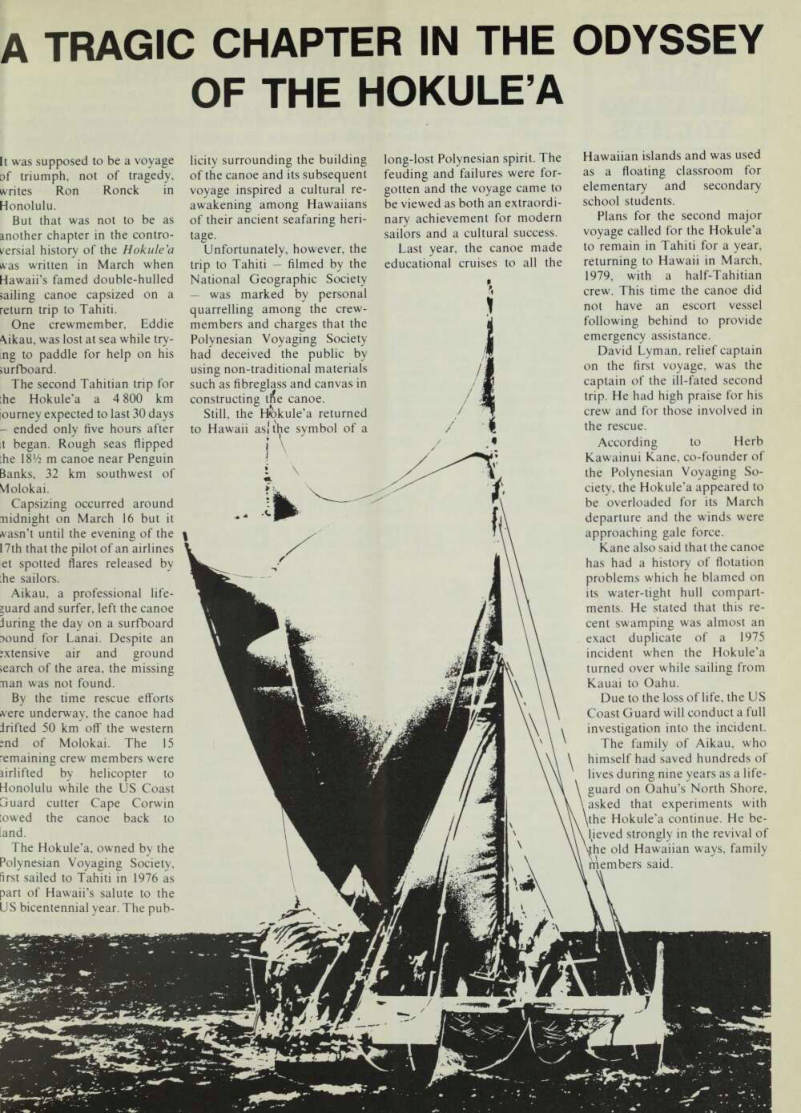
Of The Hokule’A
It was supposed to be a voyage of triumph, not of tragedy, writes Ron Ronck in Honolulu.
But that was not to be as another chapter in the contro versial history of the Hokule’a was written in March when Hawaii’s famed double-hulled jailing canoe capsized on a
return trip to Tahiti.
One crewmember, Eddie \ikau, was lost at sea while try ing to paddle for help on his surfboard.
The second Tahitian trip for :he Hokule’a a 4 800 km oumey expected to last 30 days - ended only five hours after
X began. Rough seas flipped
the 18'/2 m canoe near Penguin Banks, 32 km southwest of Molokai.
Capsizing occurred around nidnight on March 16 but it wasn’t until the evening of the 17th that the pilot of an airlines et spotted flares released by ;he sailors.
Aikau, a professional life guard and surfer, left the canoe during the day on a surfboard sound for Lanai. Despite an
jxtensive air and ground
search of the area, the missing nan was not found.
By the time rescue efforts were underway, the canoe had drifted 50 km off the western ;nd of Molokai. The 15 remaining crew members were
airlifted by helicopter to
Honolulu while the US Coast
Guard cutter Cape Corwin
towed the canoe back to land.
The Hokule’a, owned by the
Polynesian Voyaging Society,
first sailed to Tahiti in 1976 as part of Hawaii’s salute to the US bicentennial year. The pub
licity surrounding the building
of the canoe and its subsequent voyage inspired a cultural re awakening among Hawaiians of their ancient seafaring heri tage.
Unfortunately, however, the trip to Tahiti filmed by the
National Geographic Society
was marked by personal
quarrelling among the crew members and charges that the
Polynesian Voyaging Society
had deceived the public by using non-traditional materials such as fibreglass and canvas in constructing tne canoe.
Still, the Hfekule’a returned to Hawaii aslthe symbol of a ? \
long-lost Polynesian spirit. The feuding and failures were for gotten and the voyage came to be viewed as both an extraordi nary achievement for modern sailors and a cultural success.
Last year, the canoe made educational cruises to all the
Hawaiian islands and was used as a floating classroom for elementary and secondary school students.
Plans for the second major voyage called for the Hokule’a to remain in Tahiti for a year, returning to Hawaii in March, 1979, with a half-Tahitian crew. This time the canoe did not have an escort vessel
following behind to provide
emergency assistance.
David Lyman, relief captain on the first voyage, was the captain of the ill-fated second trip. He had high praise for his crew and for those involved in the rescue.
According to Herb Kawainui Kane, co-founder of
the Polynesian Voyaging So
ciety, the Hokule’a appeared to be overloaded for its March departure and the winds were
approaching gale force.
Kane also said that the canoe has had a history of flotation problems which he blamed on its water-tight hull compart ments. He stated that this re cent swamping was almost an exact duplicate of a 1975 incident when the Hokule’a turned over while sailing from Kauai to Oahu.
Due to the loss of life, the US Coast Guard will conduct a full investigation into the incident.
The family of Aikau, who himself had saved hundreds of lives during nine years as a life guard on Oahu’s North Shore, \ asked that experiments with \the Hokule’a continue. He be \ lieved strongly in the revival of \the old Hawaiian ways, family I members said.
Cruising
Yachts
• TALOU, 15 m ferro cement ketch from Toronto (see PIM, Oct, 1977) with owner-skipper John Taylor and wife Brenda was on her way at the end of April to Samarai and other PNG ports after spending a few days at Lizard Island, off Cairns in Queensland. By June the Taylors hope to be on their way to South Africa. They spent two months in Aus tralia.
• Sansouci, 11M
American ketch, arrived at Rarotonga on April 9 from Bora Bora with owner-skipper Gerard Henry and Linda Fos ter. Mr Henry is on a circum navigaton and his next ports of call will be Tonga, Fiji, New Hebrides and Port Moresby.
• Sea Helen, 914 M
Canadian schooner, arrived at Rarotonga on March 29 from Bora Bora with Captain Klaus and friend. They left for Niue on April 13.
• Chandalar, 10 45 M
American sloop with single hander Alan David arrived at Rarotonga on April 9 from Papeete, bound for Auckland. • RANGER, Canadian ketch with owner-captain G.A.
Williams, arrived at Rarotonga from Papeete on April 6, bound for Nukualofa.
• Takutotem, 12 5 M
American sloop, arrived at Rarotonga from Tahiti on April 13, bound for Tonga. On board were owner-skipper Verne Elliott, his wife Sheila and children Stuart, 15, Shane, 12 and Lisa, 11. The yacht is registered at Sitka, Alaska, from where the voyage started and plans are to visit New Zealand, Japan and the Aleutian Islands before return ing home to Washington. • CON TINA, American CAL 13.9 m ketch-rigged motor sailer registered at Newport Beach, arrived at Rarotonga on April 16 from Tahiti. On board were owner captain Dr Peter Eastman, his wife, Betty, their son Peter and Mark Mowery, They had called at the Marquesas, Tuamotus and Society Islands and
planned to visit Aitutaki, American Samoa and prob ably New Zealand and Aus tralia.
• Manukura, An
American yacht, arrived at Butaritari in the Gilbert Islands early in March with skipper Richard Musick and a crew of three. The yacht reached safety after surviving a storm which badly damaged the rrtest and riggings.
• Runestaff, 9 M Aus
tralian cutter which arrived at Rarotonga late last September left on April 6 for Aitutaki and Tahiti with owner-skipper builder, lan Hancock and three crew. • TUTOKO, 15.55 m British cutter-rigged catamaran, arrived at Rarotonga on April 5 from Raiatea. On board were owner-skipper John Martyn Roberts, Valerie Roberts, George and Margaret Smith, and children Martyn and Fina Roberts and Steven and Nicholas Smith. They left on April 11 for Tonga and Auckland. • LADY LEE, 12.11 m ketch registered in Los Angeles, arrived at Rarotonga from Bora Bora on April 15 with Truman Schmidt (captain) and Jean.ne Schmidt. Next port of call will be Pago Pago, American Samoa.
• Maudi Marie, 15 24 M
yawl, arrived at Tubuai in the Austral Islands in mid-March after a 16-day voyage from New Zealand, carrying Willy and Herta Binsfield and their children, Mike, 13, and Susi 12. They were on their way home to Half Moon Bay, California, which they hoped to reached by June 1. They planned to visit Makamo in the Tuamotus, the Marquesas and Hawaii. They had left Half Moon Bay in June, 1977, and visited the Marquesas, the Tuamotus, Tahiti, Rarotonga, Niue, Samoa and Fiji before arriving in NZ.
It’s a race from
Sydney to Suva
About 20 entries are expected for the second Sydney-Suva yacht race which will start from Middle Harbour, Sydney, on June 4.
The race will be held in three divisions the International Offshore Racing division, a division for yachts not up to that class and given an arbi trary handicap, and a cruis ing division for yachtsmen who plan to cruise later in the islands.
Deaths
of Islands People
The Death Of
A Legend
Taripwakato is dead. He was much better known in Tahiti and New Caledonia than in the New Hebrides, but he was in fact a Tongoa man, one of the great custom figures of the Shepherd Is lands.
He visited New Caledonia several times, his expenses paid by those he went there to treat. In Tahiti, he was well known in herbal medicine cir cles. On his own island of Tongoa, he was respected and even feared. He had received from his ancestors in Matangi, his native village, the wisdom of the ancients. This retired member of the British police force knew both how to treat the sick with herbs and to tell the stories of the past.
We had the great pleasure of having him at the microphone on Radio Vila.
We were discussing the legend of Kuwae, which had just been recounted over the radio.
Taripwakoto was not very talkative. We were speaking French and he was a little in timidated. Then he was asked to reply to a question which he found too important, one not to be replied to in public.
Chief Tipoloamata had re lated the legend of Kuwae, but had stopped short at the point of the eruption of the volcano.
So we did not hear the ac count of the resettlement of shattered Kuwae, which was to create the islands of Tongoa, Tongariki, Emae and Falea.
So I asked Taripwakoto what happened afterwards.
Who was Matanauretong?
Who was Tarifegit?
Taripwakoto knew the answers, but said nothing. As he left the studio, he took me aside and said: “Some other time you come and see me, and I will tell you. But some other time ..."
The legend of Matan auretong is widely spoken of throughout the Shepherd Is lands. It should be recalled that after the eruption of the great Kuwae volcano, the is
land was resettled, and eachr village and clan claims re sponsibility for the re settlement.
The Tongariki people told I me recently that the; Matanauretong legend was; theirs. Taripwakoto, who re cited legends so well, could i have given me his version of the resettlement of his island.
Now he is gone. He is a spirit,, transformed into a Na Etamat.
He is dead and his sons know nothing. With the death of Taripwakoto, oral tradition has lost a legend. (Obituary tribute by P.G., in Nabanga, Vila, New Hebrides.) T. H. G. Elkington Thomas Harold George
(Tommy) Elkington, an old
identity in the Solomon Islands, has died in Brisbane, aged 70. He was born at Samarai, where his father. Old Tom, ran the Cosmopolitan Hotel. The family moved to Tulagi in 1917 taking over a new hotel, and lived there till 1931, when Old Tom died and the hotel was sold to “Butcher Johnno”.
Tommy Elkington was ed
ucated in Brisbane. After his father’s death, he went into business with Ernie Palmer, as recruiter and trader. In 1941, Tommy joined the 2nd AIF in Sydney, training as a com mando. In 1942 and 1943 he served in “Z” Special Unit in NW Australia. From there he went to the AIF in New Guinea, serving under Phil Palmer in HMS Paluma. Even though he was an AIF sergeant, he was later given command of
this ship.
In 1945, he married. He re turned to the Solomons with the first civilians in the Southern Cross in 1946, spent two years on Tulagi, working for Carpenters, and then did a spell at Yandina. He joined R.C. Symes and then worked in the group in the Ambon.
He leaves a widow, a son and
two daughters.
Mr H. R. Cooper Mr Harold Roy Cooper, Direc tor of Nelson & Robertson Pty Ltd, Island Merchants until his retirement in May 1970, has died. Mr Cooper joined what
was originally the partnership
of Nelson & Robertson at 16 years of age and his association with the company was a very active one.
Advertisements & other items, p. 92 (1 item)
92
PACIFIC ISLAND MONTHLY - JUNE, 1978
Japanese economist
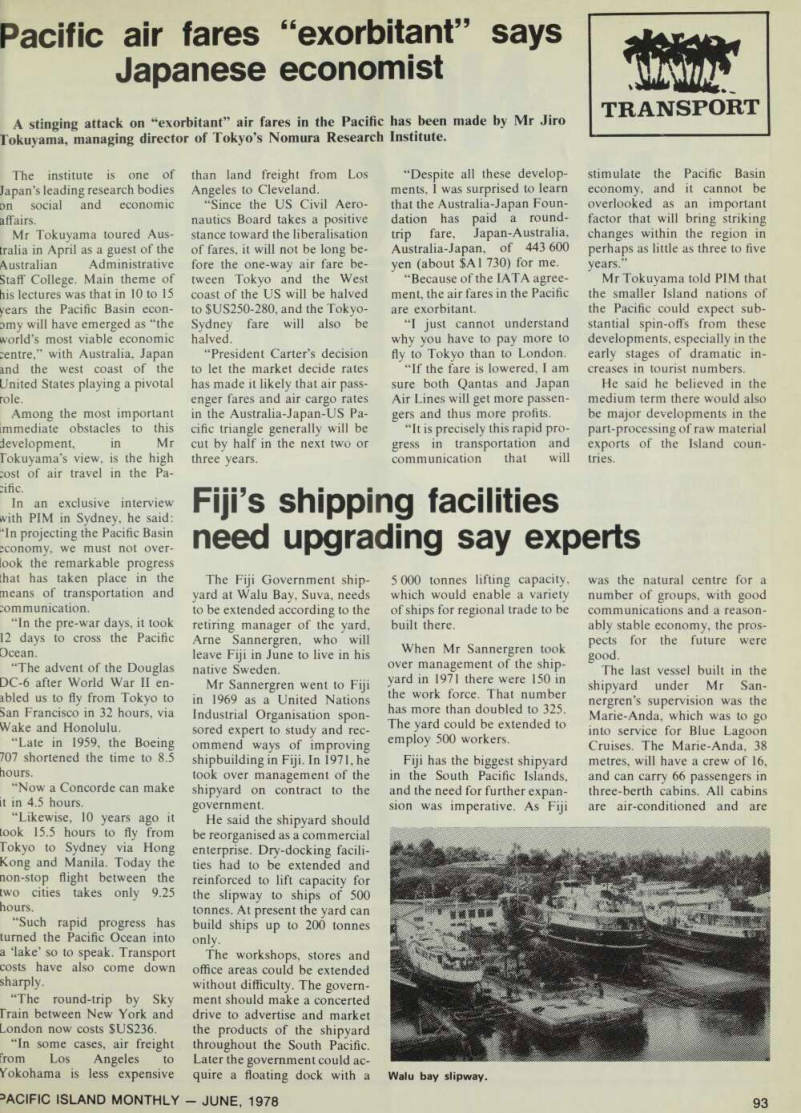
Pacific air fares “exorbitant” says Japanese economist
A stinging attack on “exorbitant” air fares in the Pacific has been made by Mr Jiro Tokuyama, managing director of Tokyo’s Nomura Research Institute.
The institute is one of
Japan’s leading research bodies
on social and economic affairs.
Mr Tokuyama toured Aus tralia in April as a guest of the Australian Administrative Staff College. Main theme of his lectures was that in 10 to 15 years the Pacific Basin econ omy will have emerged as “the world’s most viable economic
:entre,” with Australia, Japan
and the west coast of the
United States playing a pivotal
role.
Among the most important immediate obstacles to this development, in Mr fokuyama’s view, is the high :ost of air travel in the Pa :ific.
In an exclusive interview with PIM in Sydney, he said: ‘ln projecting the Pacific Basin economy, we must not over look the remarkable progress that has taken place in the
means of transportation and
:ommunication.
“In the pre-war days, it took 12 days to cross the Pacific Ocean.
“The advent of the Douglas DC-6 after World War II en abled us to fly from Tokyo to San Francisco in 32 hours, via Wake and Honolulu.
“Late in 1959, the Boeing 707 shortened the time to 8.5 hours.
“Now a Concorde can make it in 4.5 hours.
“Likewise, 10 years ago it took 15.5 hours to fly from
Tokyo to Sydney via Hong
Kong and Manila. Today the
non-stop flight between the
two cities takes only 9.25 hours.
“Such rapid progress has turned the Pacific Ocean into
a ‘lake’ so to speak. Transport
costs have also come down
sharply.
“The round-trip by Sky
Train between New York and London now costs SUS 236.
“In some cases, air freight
from Los Angeles to
Yokohama is less expensive
than land freight from Los Angeles to Cleveland.
“Since the US Civil Aero nautics Board takes a positive stance toward the liberalisation of fares, it will not be long be fore the one-way air fare be tween Tokyo and the West coast of the US will be halved to SUS2SO-280, and the Tokyo- Sydney fare will also be halved.
“President Carter’s decision to let the market decide rates has made it likely that air pass enger fares and air cargo rates in the Australia-Japan-US Pa cific triangle generally will be cut by half in the next two or three years.
“Despite all these develop ments, I was surprised to learn that the Australia-Japan Foun dation has paid a round
trip fare, Japan-Australia,
Australia-Japan, of 443 600 yen (about SAI 730) for me.
“Because of the lATA agree ment, the air fares in the Pacific are exorbitant.
“I just cannot understand why you have to pay more to fly to Tokyo than to London.
“If the fare is lowered, I am sure both Qantas and Japan Air Lines will get more passen gers and thus more profits.
“It is precisely this rapid pro gress in transportation and communication that will
Transport
stimulate the Pacific Basin economy, and it cannot be overlooked as an important factor that will bring striking changes within the region in perhaps as little as three to five
years.”
MrTokuyama told PIM that the smaller Island nations of the Pacific could expect sub stantial spin-offs from these
developments, especially in the
early stages of dramatic in creases in tourist numbers.
He said he believed in the medium term there would also be major developments in the part-processing of raw material exports of the Island coun tries.
Fiji’s shipping facilities

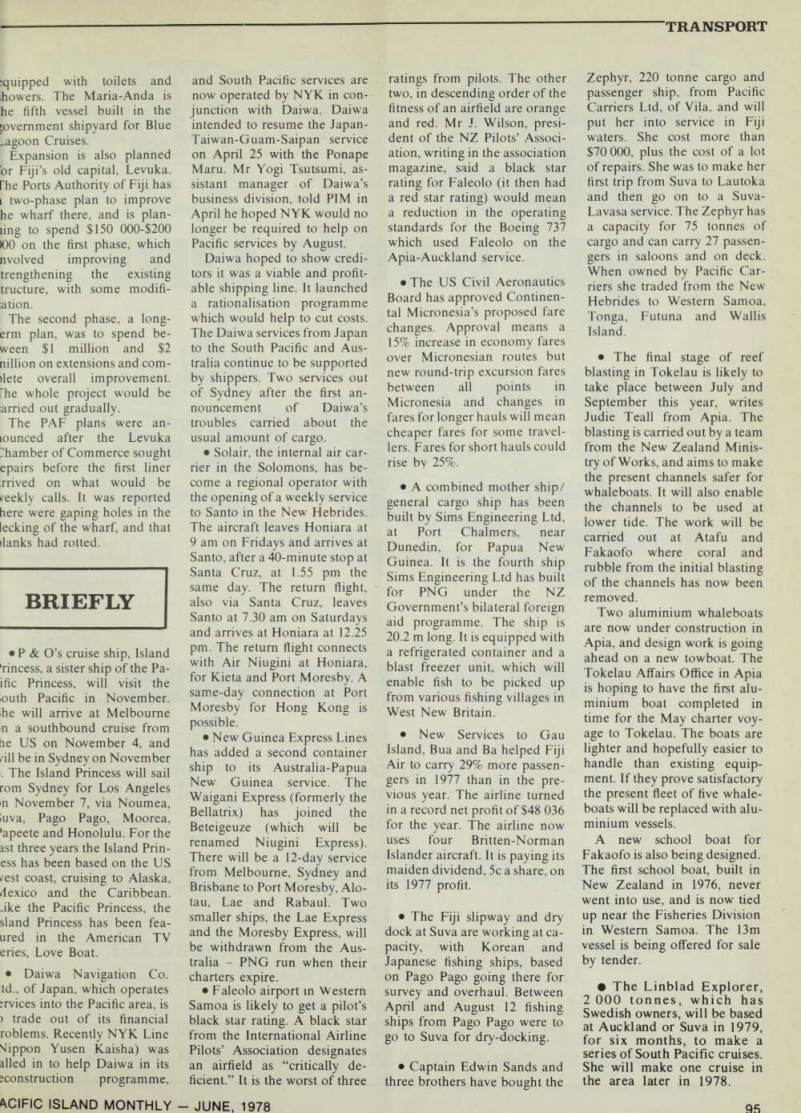
need upgrading say experts
The Fiji Government ship
yard at Walu Bay, Suva, needs to be extended according to the retiring manager of the yard, Ame Sannergren, who will leave Fiji in June to live in his native Sweden.
Mr Sannergren went to Fiji in 1969 as a United Nations Industrial Organisation spon sored expert to study and rec ommend ways of improving shipbuilding in Fiji. In 1971, he took over management of the shipyard on contract to the government.
He said the shipyard should be reorganised as a commercial
enterprise. Dry-docking facili
ties had to be extended and reinforced to lift capacity for the slipway to ships of 500 tonnes. At present the yard can build ships up to 200 tonnes
only.
The workshops, stores and office areas could be extended without difficulty. The govern ment should make a concerted drive to advertise and market the products of the shipyard throughout the South Pacific.
Later the government could ac quire a floating dock with a
5 000 tonnes lifting capacity, which would enable a variety of ships for regional trade to be built there.
When Mr Sannergren took over management of the ship yard in 1971 there were 150 in the work force. That number has more than doubled to 325.
The yard could be extended to employ 500 workers.
Fiji has the biggest shipyard
in the South Pacific Islands, and the need for further expan sion was imperative. As Fiji
was the natural centre for a number of groups, with good communications and a reason ably stable economy, the pros pects for the future were
good.
The last vessel built in the shipyard under Mr San
nergren’s supervision was the
Marie-Anda, which was to go into service for Blue Lagoon Cruises. The Marie-Anda, 38 metres, will have a crew of 16, and can carry 66 passengers in three-berth cabins. All cabins are air-conditioned and are
Walu bay slipway.
iquipped with toilets and bowers. The Maria-Anda is he fifth vessel built in the jovemment shipyard for Blue
_agoon Cruises.
Expansion is also planned
or Fiji’s old capital, Levuka. fhe Ports Authority of Fiji has i two-phase plan to improve he wharf there, and is plan ting to spend $l5O 000-$2OO K)0 on the first phase, which nvolved improving and lengthening the existing tructure, with some modifi ation.
The second phase, a long
erm plan, was to spend be
ween $1 million and $2 nillion on extensions and com pete overall improvement, fhe whole project would be arried out gradually.
The PAF plans were an lounced after the Levuka Chamber of Commerce sought epairs before the first liner rrived on what would be weekly calls. It was reported here were gaping holes in the lecking of the wharf, and that ►lanks had rotted.
Advertisements & other items, pp. 93-94 (3 items)
93
=>ACIFIC ISLAND MONTHLY - JUNE, 1978
94
PACIFIC ISLAND MONTHLY - JUNE, 1978
Colorburst
NOW!
New Kodak
cameras.
At last a camera to capture the fun times instantly with rich and vibrant color by Kodak.
With the Colorburst cameras instant color picture fun has never been so easy indoors or out, with flash or natural light, you just aim, frame, focus and shoot, and the new Colorburst instant camera automatically produces clean, dry prints that develop right before your very eyes. Within minutes you have a superb color picture with beautiful Satinluxe finish from Kodak PR 10 Instant Print Film.
Kodak Colorburst cameras feature; • Adjustable focus control with special ‘zooming circle’, focusing symbols, and distance scale • Electronic shutter —1/3000 sec. to 1/20 sec. • Eyecup on viewfinder • Flash socket • Tripod socket • Automatic motor-driven print ejection • Red low-light signal warns you when to use flash • Lighten/darken print control • Exposure counter • Neckstrap and monograms • Kodak 3 year warranty.
See your photo dealer for a free demonstration. ‘Suggested retail price.
New Kodak Instant Cameras and Film.
.s•* Kodak (Australasia) Pty. Ltd. ‘Kodak’, ‘Colorburst’ and ‘Satinluxe’ are trademarks. 345 0091
Briefly
• P & O’s cruise ship, Island 'rincess, a sister ship of the Pa ific Princess, will visit the outh Pacific in November, he will arrive at Melbourne n a southbound cruise from tie US on November 4, and /ill be in Sydney on November . The Island Princess will sail
rom Sydney for Los Angeles
n November 7, via Noumea,
tuva, Pago Pago, Moorea,
•apeete and Honolulu. For the ast three years the Island Prin ess has been based on the US zest coast, cruising to Alaska, Mexico and the Caribbean, dke the Pacific Princess, the sland Princess has been fea ured in the American TV cries, Love Boat. • Daiwa Navigation Co. td., of Japan, which operates jrvices into the Pacific area, is ) trade out of its financial
roblems. Recently NYK Line
Vippon Yusen Kaisha) was ailed in to help Daiwa in its
;construction programme,
and South Pacific services are now operated by NYK in con junction with Daiwa. Daiwa intended to resume the Japan-
Taiwan-Guam-Saipan service
on April 25 with the Ponape Maru. Mr Yogi Tsutsumi, as sistant manager of Daiwa’s business division, told PIM in April he hoped NYK would no
longer be required to help on
Pacific services by August.
Daiwa hoped to show credi tors it was a viable and profit able shipping line. It launched a rationalisation programme which would help to cut costs.
The Daiwa services from Japan to the South Pacific and Aus tralia continue to be supported by shippers. Two services out of Sydney after the first an nouncement of Daiwa’s troubles carried about the usual amount of cargo. • Solair, the internal air car rier in the Solomons, has be come a regional operator with the opening of a weekly service to Santo in the New Hebrides.
The aircraft leaves Honiara at 9 am on Fridays and arrives at Santo, after a 40-minute stop at Santa Cruz, at 1.55 pm the same day. The return flight, also via Santa Cruz, leaves Santo at 7.30 am on Saturdays and arrives at Honiara at 12.25 pm. The return flight connects with Air Niugini at Honiara, for Kieta and Port Moresby. A same-day connection at Port
Moresby for Hong Kong is
possible.
• New Guinea Express Lines has added a second container
ship to its Australia-Papua
New Guinea service. The
Waigani Express (formerly the
Bellatrix) has joined the Beteigeuze (which will be
renamed Niugini Express).
There will be a 12-day service from Melbourne, Sydney and Brisbane to Port Moresby, Alo tau, Lae and Rabaul. Two smaller ships, the Lae Express and the Moresby Express, will be withdrawn from the Aus tralia - PNG run when their charters expire. • Faleolo airport in Western Samoa is likely to get a pilot’s black star rating. A black star from the International Airline Pilots’ Association designates an airfield as “critically de ficient.” It is the worst of three
ratings from pilots. The other two, in descending order of the fitness of an airfield are orange and red. Mr J. Wilson, presi dent of the NZ Pilots’ Associ ation, writing in the association magazine, said a black star rating for Faleolo (it then had a red star rating) would mean a reduction in the operating standards for the Boeing 737 which used Faleolo on the
Apia-Auckland service.
• The US Civil Aeronautics Board has approved Continen tal Micronesia’s proposed fare
changes. Approval means a
15% increase in economy fares over Micronesian routes but new round-trip excursion fares between all points in Micronesia and changes in fares for longer hauls will mean cheaper fares for some travel lers. Fares for short hauls could rise by 25%. • A combined mother ship/ general cargo ship has been built by Sims Engineering Ltd, at Port Chalmers, near Dunedin, for Papua New Guinea. It is the fourth ship Sims Engineering Ltd has built for PNG under the NZ Government’s bilateral foreign aid programme. The ship is 20.2 m long. It is equipped with a refrigerated container and a blast freezer unit, which will enable fish to be picked up from various fishing villages in West New Britain. • New Services to Gau Island, Bua and Ba helped Fiji Air to carry 29% more passen gers in 1977 than in the pre vious year. The airline turned in a record net profit of $4B 036 for the year. The airline now uses four Britten-Norman Islander aircraft. It is paying its maiden dividend, 5c a share, on its 1977 profit.
• The Fiji slipway and dry
dock at Suva are working at ca pacity, with Korean and
Japanese fishing ships, based
on Pago Pago going there for
survey and overhaul. Between
April and August 12 fishing
ships from Pago Pago were to
go to Suva for dry-docking. • Captain Edwin Sands and three brothers have bought the
Zephyr, 220 tonne cargo and passenger ship, from Pacific Carriers Ltd, of Vila, and will put her into service in Fiji waters. She cost more than $7O 000, plus the cost of a lot of repairs. She was to make her first trip from Suva to Lautoka and then go on to a Suva- Lavasa service. The Zephyr has a capacity for 75 tonnes of cargo and can carry 27 passen gers in saloons and on deck.
When owned by Pacific Car riers she traded from the New Hebrides to Western Samoa, Tonga, Futuna and Wallis Island. • The final stage of reef blasting in Tokelau is likely to take place between July and September this year, writes Judie Teall from Apia. The blasting is carried out by a team from the New Zealand Minis try of Works, and aims to make the present channels safer for whaleboats. It will also enable the channels to be used at lower tide. The work will be carried out at Atafu and Fakaofo where coral and rubble from the initial blasting of the channels has now been removed.
Two aluminium whaleboats are now under construction in
Apia, and design work is going
ahead on a new towboat. The Tokelau Affairs Office in Apia is hoping to have the first alu minium boat completed in time for the May charter voy age to Tokelau. The boats are lighter and hopefully easier to
handle than existing equip
ment. If they prove satisfactory the present fleet of five whale boats will be replaced with alu minium vessels.
A new school boat for Fakaofo is also being designed.
The first school boat, built in New Zealand in 1976, never went into use, and is now tied up near the Fisheries Division in Western Samoa. The 13m vessel is being offered for sale
by tender.
• The Linblad Explorer, 2 000 tonnes, which has Swedish owners, will be based at Auckland or Suva in 1979, for six months, to make a series of South Pacific cruises.
She will make one cruise in the area later in 1978.
Advertisements & other items, pp. 95-96 (3 items)
95
TRANSPORT
ACIFIC ISLAND MONTHLY - JUNE, 1978
96
PACIFIC ISLAND MONTHLY - JUNE, 1978
Monthly Services
■i o O
GLOBAL SERVICE FOR SHIPPERS
V-Jk
THE
LINE
Monthly Services
United Kingdom and Continent to:
PAPEETE • NOUMEA • NEW HEBRIDES
PAPAU NEW GUINEA and SOLOMON ISLANDS
* Papua New Guinea to: NORTH AMERICA • UNITED KINGDOM and CONTINENT Solomons - Fiji • Tonga • Samoa and Tarawa to:
UNITED KINGDOM and CONTINENT
For particulars apply:
THE BANK LINE (AUSTRALASIA) PTY. LTD.
18th Floor 1 York Street SYDNEY N.S.W 2000 Australia Tel; 272041 Telex: 24063
Shipping
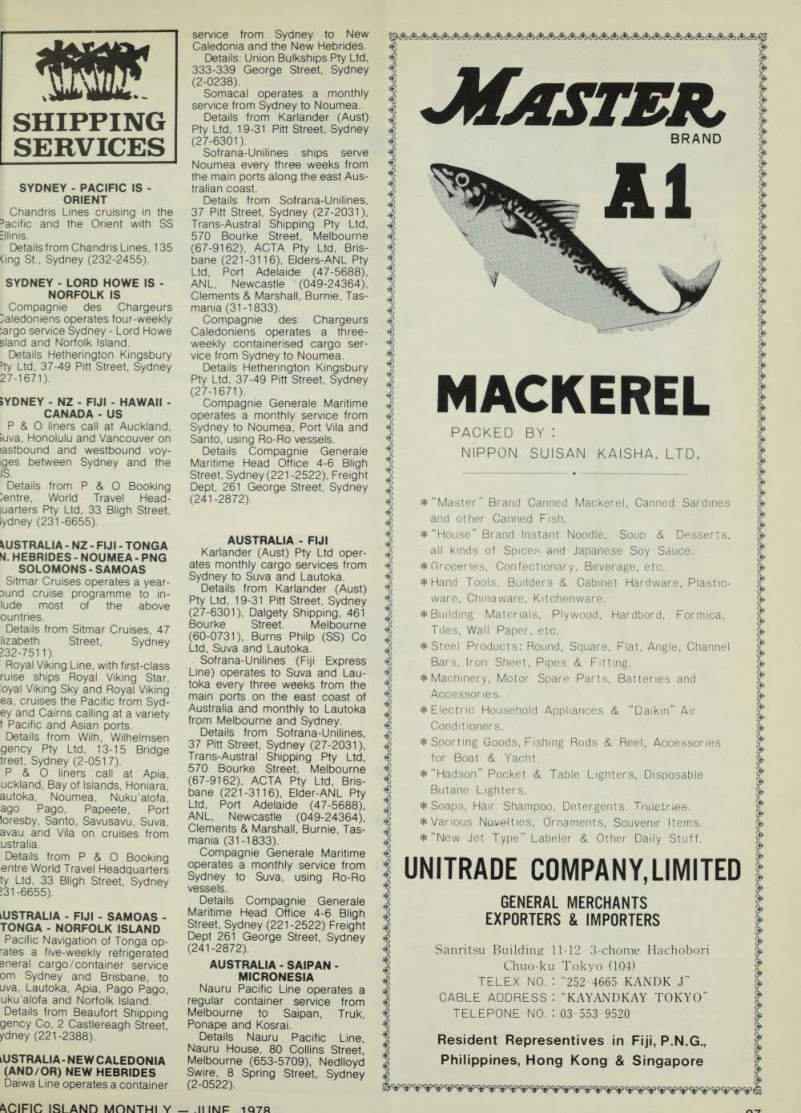
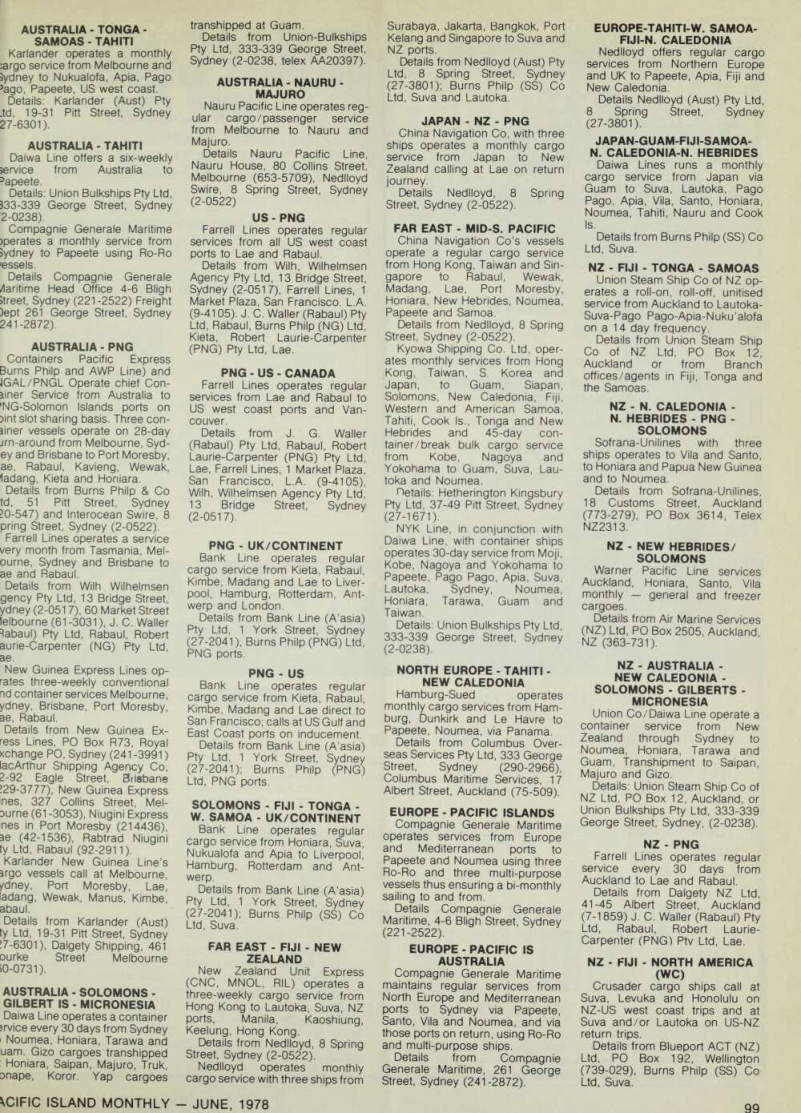
Services
Sydney - Pacific Is -
Orient
Chandris Lines cruising in the 3 acific and the Orient with SS Ellinis.
Details from Chandris Lines, 135 <ing St., Sydney (232-2455).
Sydney - Lord Howe Is -
Norfolk Is
Compagnie des Chargeurs operates four-weekly :argo service Sydney - Lord Howe sland and Norfolk Island.
Details Hetherington Kingsbury >ty Ltd, 37-49 Pitt Street, Sydney 27-1671).
SYDNEY - NZ - FIJI - HAWAII -
Canada - Us
P & O liners call at Auckland, >uva, Honolulu and Vancouver on lastbound and westbound voy iges between Sydney and the JS.
Details from P & O Booking Centre, World Travel Head uarters Pty Ltd, 33 Bligh Street,
iydney (231-6655).
AUSTRALIA - NZ - FIJI - TONGA
N. Hebrides - Noumea - Png
Solomons-Samoas
Sitmar Cruises operates a year- Dund cruise programme to in lude most of the above ountries.
Details from Sitmar Cruises, 47 lizabeth Street, Sydney 232-7511).
Royal Viking Line, with first-class ruise ships Royal Viking Star,
loyal Viking Sky and Royal Viking
ea, cruises the Pacific from Syd ey and Cairns calling at a variety f Pacific and Asian ports.
Details from Wilh, Wilhelmsen gency Pty Ltd, 13-15 Bridge
treet, Sydney (2-0517).
P & O liners call at Apia, uckland, Bay of Islands, Honiara, autoka, Noumea, Nuku’alofa, ago Pago, Papeete, Port loresby, Santo, Savusavu, Suva, avau and Vila on cruises from ustralia.
Details from P & O Booking entre World Travel Headquarters ty Ltd, 33 Bligh Street, Sydney >3l-6655).
Australia - Fiji - Samoas -
Tonga - Norfolk Island
Pacific Navigation of Tonga op
rates a five-weekly refrigerated
sneral cargo/container service om Sydney and Brisbane, to uva, Lautoka, Apia, Pago Pago, uku’alofa and Norfolk Island.
Details from Beaufort Shipping gency Co, 2 Castlereagh Street,
/dney (221-2388).
Australia-New Caledonia
(And/Or) New Hebrides
Daiwa Line operates a container
service from Sydney to New Caledonia and the New Hebrides.
Details: Union Bulkships Pty Ltd, 333-339 George Street, Sydney (2-0238).
Somacal operates a monthly service from Sydney to Noumea.
Details from Karlander (Aust) Pty Ltd, 19-31 Pitt Street, Sydney (27-6301).
Sofrana-Unilines ships serve Noumea every three weeks from the main ports along the east Aus tralian coast.
Details from Sofrana-Unilines, 37 Pitt Street, Sydney (27-2031), Trans-Austral Shipping Pty Ltd, 570 Bourke Street, Melbourne (67-9162), ACTA Pty Ltd, Bris bane (221-3116), Elders-ANL Pty Ltd, Port Adelaide (47-5688), ANL, Newcastle (049-24364), Clements & Marshall, Burnie, Tas mania (31-1833).
Compagnie des Chargeurs Caledonians operates a three weekly containerised cargo ser vice from Sydney to Noumea.
Details Hetherington Kingsbury Pty Ltd, 37-49 Pitt Street, Sydney (27-1671).
Compagnie Generale Maritime operates a monthly service from Sydney to Noumea, Port Vila and Santo, using Ro-Ro vessels.
Details Compagnie Generale Maritime Head Office 4-6 Bligh Street, Sydney (221 -2522), Freight Dept, 261 George Street, Sydney (241 -2872).
Australia - Fiji
Karlander (Aust) Pty Ltd oper ates monthly cargo services from Sydney to Suva and Lautoka.
Details from Karlander (Aust) Pty Ltd, 19-31 Pitt Street, Sydney (27-6301), Dalgety Shipping, 461 Bourke Street. Melbourne (60-0731), Burns Philp (SS) Co Ltd, Suva and Lautoka.
Sofrana-Unilines (Fiji Express Line) operates to Suva and Lau toka every three weeks from the main ports on the east coast of Australia and monthly to Lautoka from Melbourne and Sydney.
Details from Sofrana-Unilines, 37 Pitt Street, Sydney (27-2031), Trans-Austral Shipping Pty Ltd, 570 Bourke Street, Melbourne (67-9162), ACTA Pty Ltd. Bris bane (221-3116), Elder-ANL Pty Ltd, Port Adelaide (47-5688), ANL, Newcastle (049-24364), Clements & Marshall, Burnie, Tas mania (31-1833).
Compagnie Generale Maritime operates a monthly service from Sydney to Suva, using Ro-Ro vessels.
Details Compagnie Generale Maritime Head Office 4-6 Bligh Street. Sydney (221-2522) Freight Dept 261 George Street, Sydney (241-2872).
Australia - Saipan -
Micronesia
Nauru Pacific Line operates a regular container service from Melbourne to Saipan, Truk, Ponape and Kosrai.
Details Nauru Pacific Line, Nauru House, 80 Collins Street, Melbourne (653-5709), Nedlloyd Swire, 8 Spring Street, Sydney (2-0522).
Australia - Tonga -
Samoas - Tahiti
Karlander operates a monthly :argo service from Melbourne and Sydney to Nukualofa, Apia, Pago ’ago, Papeete, US west coast.
Details: Karlander (Aust) Pty .td, 19-31 Pitt Street, Sydney 27-6301).
Australia - Tahiti
Daiwa Line offers a six-weekly service from Australia to Papeete.
Details: Union Bulkships Pty Ltd, J 33-339 George Street, Sydney 2-0238).
Compagnie Generale Maritime >perates a monthly service from Sydney to Papeete using Ro-Ro 'esse Is.
Details Compagnie Generale Maritime Head Office 4-6 Bligh Street, Sydney (221 -2522) Freight )ept 261 George Street, Sydney 241-2872).
Australia - Png
Containers Pacific Express Burns Philp and AWP Line) and JGAL/PNGL Operate chief Con ainer Service from Australia to 'NG-Solomon Islands ports on lint slot sharing basis. Three con liner vessels operate on 28-day jrn-around from Melbourne, Syd ey and Brisbane to Port Moresby, ae, Rabaul, Kavieng, Wewak, ladang, Kieta and Honiara.
Details from Burns Philp & Co td, 51 Pitt Street, Sydney 20-547) and Interocean Swire, 8 pring Street, Sydney (2-0522).
Farrell Lines operates a service very month from Tasmania, Mel ourne, Sydney and Brisbane to ae and Rabaul.
Details from Wilh Wilhelmsen gency Pty Ltd, 13 Bridge Street, ydney (2-0517), 60 Market Street lelbourne (61-3031), J. C. Waller Rabaul) Pty Ltd, Rabaul, Robert aurie-Carpenter (NG) Pty Ltd, ae.
New Guinea Express Lines op rates three-weekly conventional nd container services Melbourne, ydney, Brisbane, Port Moresby, ae, Rabaul.
Details from New Guinea Ex ress Lines, PO Box R 73, Royal xchange PO, Sydney (241 -3991) lac Arthur Shipping Agency Co, 2-92 Eagle Street, Brisbane 129-3777), New Guinea Express nes, 327 Collins Street, Mel aurne (61 -3053), Niugini Express nes in Port Moresby (214436), ae (42-1536), Rabtrad Niugini ty Ltd, Rabaul (92-2911).
Karlander New Guinea Line’s argo vessels call at Melbourne, /dney, Port Moresby, Lae, adang, Wewak, Manus, Kimbe, abaul.
Details from Karlander (Aust) ty Ltd, 19-31 Pitt Street, Sydney 17-6301), Dalgety Shipping, 461 ourke Street Melbourne 10-0731).
Australia - Solomons -
Gilbert Is - Micronesia
Daiwa Line operates a container jrvice every 30 days from Sydney i Noumea, Honiara, Tarawa and uam. Gizo cargoes transhipped Honiara, Saipan, Majuro, Truk, anape, Koror. Yap cargoes
transhipped at Guam.
Details from Union-Bulkships Pty Ltd, 333-339 George Street, Sydney (2-0238, telex AA20397).
Australia - Nauru -
Majuro
Nauru Pacific Line operates reg ular cargo/passenger service from Melbourne to Nauru and Majuro.
Details Nauru Pacific Line, Nauru House, 80 Collins Street, Melbourne (653-5709), Nedlloyd Swire, 8 Spring Street, Sydney (2-0522)
Us-Png
Farrell Lines operates regular services from all US west coast ports to Lae and Rabaul.
Details from Wilh, Wilhelmsen Agency Pty Ltd, 13 Bridge Street, Sydney (2-0517), Farrell Lines, 1 Market Plaza, San Francisco. L.A. (9-4105). J. C. Waller (Rabaul) Pty Ltd, Rabaul, Burns Philp (NG) Ltd, Kieta, Robert Laurie-Carpenter (PNG) Pty Ltd, Lae.
Png - Us - Canada
Farrell Lines operates regular services from Lae and Rabaul to US west coast ports and Van couver.
Details from J. G. Waller (Rabaul) Pty Ltd, Rabaul, Robert Laurie-Carpenter (PNG) Pty Ltd, Lae, Farrell Lines, 1 Market Plaza, San Francisco, L.A. (9-4105), Wilh, Wilhelmsen Agency Pty Ltd, 13 Bridge Street, Sydney (2-0517).
Png - Uk/Continent
Bank Line operates regular cargo service from Kieta, Rabaul, Kimbe, Madang and Lae to Liver pool, Hamburg, Rotterdam, Ant werp and London.
Details from Bank Line (A’asia) Pty Ltd, 1 York Street, Sydney (27-2041), Burns Philp (PNG) Ltd, PNG ports.
Png - Us
Bank Line operates regular cargo service from Kieta, Rabaul, Kimbe, Madang and Lae direct to San Francisco; calls at US Gulf and East Coast ports on inducement.
Details from Bank Line (A’asia) Pty Ltd, 1 York Street, Sydney (27-2041); Burns Philp (PNG) Ltd, PNG ports.
Solomons - Fiji - Tonga -
W. Samoa - Uk/Continent
Bank Line operates regular cargo service from Honiara, Suva, Nukualofa and Apia to Liverpool, Hamburg, Rotterdam and Ant werp.
Details from Bank Line (A’asia) Pty Ltd, 1 York Street, Sydney (27-2041); Burns Philp (SS) Co Ltd, Suva.
Far East - Fiji - New
Zealand
New Zealand Unit Express (CNC, MNOL, RIL) operates a three-weekly cargo service from Hong Kong to Lautoka, Suva, NZ ports, Manila, Kaoshiung, Keelung, Hong Kong.
Details from Nedlloyd, 8 Spring Street, Sydney (2-0522).
Nedlloyd operates monthly cargo service with three ships from
Surabaya, Jakarta, Bangkok, Port Kelang and Singapore to Suva and NZ ports.
Details from Nedlloyd (Aust) Pty Ltd, 8 Spring Street, Sydney (27-3801); Burns Philp (SS) Co Ltd, Suva and Lautoka.
Japan - Nz - Png
China Navigation Co, with three ships operates a monthly cargo service from Japan to New Zealand calling at Lae on return journey.
Details Nedlloyd, 8 Spring Street, Sydney (2-0522).
Far East - Mid-S. Pacific
China Navigation Co’s vessels operate a regular cargo service from Hong Kong, Taiwan and Sin gapore to Rabaul, Wewak, Madang, Lae, Port Moresby, Honiara, New Hebrides, Noumea, Papeete and Samoa.
Details from Nedlloyd, 8 Spring Street, Sydney (2-0522).
Kyowa Shipping Co. Ltd, oper ates monthly services from Hong Kong, Taiwan, S. Korea and Japan, to Guam, Siapan, Solomons, New Caledonia, Fiji, Western and American Samoa, Tahiti, Cook Is., Tonga and New Hebrides and 45-day con tainer/break bulk cargo service from Kobe, Nagoya and Yokohama to Guam, Suva, Lau toka and Noumea. retails; Hetherington Kingsbury Pty Ltd, 37-49 Pitt Street, Sydney (27-1671).
NYK Line, in conjunction with Daiwa Line, with container ships operates 30-day service from Moji, Kobe, Nagoya and Yokohama to Papeete, Pago Pago, Apia, Suva, Lautoka, Sydney, Noumea, Honiara, Tarawa, Guam and Taiwan.
Details: Union Bulkships Pty Ltd, 333-339 George Street, Sydney (2-0238).
North Europe - Tahiti -
New Caledonia
Hamburg-Sued operates monthly cargo services from Ham burg, Dunkirk and Le Havre to Papeete, Noumea, via Panama.
Details from Columbus Over seas Services Pty Ltd, 333 George Street. Sydney (290-2966), Columbus Maritime Services, 17 Albert Street, Auckland (75-509).
Europe - Pacific Islands
Compagnie Generale Maritime operates services from Europe and Mediterranean ports to Papeete and Noumea using three Ro-Ro and three multi-purpose vessels thus ensuring a bi-monthly sailing to and from.
Details Compagnie Generale Maritime, 4-6 Bligh Street, Sydney (221-2522).
Europe - Pacific Is
Australia
Compagnie Generale Maritime maintains regular services from North Europe and Mediterranean ports to Sydney via Papeete, Santo, Vila and Noumea, and via those ports on return, using Ro-Ro and multi-purpose ships.
Details from Compagnie Generale Maritime, 261 George Street, Sydney (241-2872).
Europe-Tahiti-W. Samoa
Fiji-N. Caledonia
Nedlloyd offers regular cargo services from Northern Europe and UK to Papeete, Apia, Fiji and New Caledonia.
Details Nedlloyd (Aust) Pty Ltd, 8 Spring Street, Sydney (27-3801).
Japan-Guam-Fiji-Samoa-
N. Caledonia-N. Hebrides
Daiwa Lines runs a monthly cargo service from Japan via Guam to Suva, Lautoka, Pago Pago, Apia, Vila, Santo, Honiara, Noumea, Tahiti, Nauru and Cook Is.
Details from Burns Philp (SS) Co Ltd, Suva.
NZ - FIJI - TONGA - SAMOAS Union Steam Ship Co of NZ op erates a roll-on, roll-off, unitised service from Auckland to Lautoka- Suva-Pago Pago-Apia-Nuku’alofa on al4 day frequency.
Details from Union Steam Ship Co of NZ Ltd, PC Box 12, Auckland or from Branch offices/agents in Fiji, Tonga and the Samoas.
Nz - N. Caledonia -
N. Hebrides - Png -
Solomons
Sofrana-Unilines with three ships operates to Vila and Santo, to Honiara and Papua New Guinea and to Noumea.
Details from Sofrana-Unilines, 18 Customs Street, Auckland (773-279), PC Box 3614, Telex NZ2313.
Nz - New Hebrides/
Solomons
Warner Pacific Line services Auckland, Honiara, Santo, Vila monthly general and freezer cargoes.
Details from Air Marine Services (NZ) Ltd, PO Box 2505, Auckland, NZ (363-731).
Nz - Australia -
New Caledonia -
Solomons - Gilberts -
Micronesia
Union Co/Daiwa Line operate a container service from New Zealand through Sydney to Noumea, Honiara, Tarawa and Guam, Transhipment to Saipan, Majuro and Gizo.
Details: Union Steam Ship Co of NZ Ltd, PO Box 12, Auckland, or Union Bulkships Pty Ltd, 333-339 George Street, Sydney, (2-0238).
Nz - Png
Farrell Lines operates regular service every 30 days from Auckland to Lae and Rabaul.
Details from Dalgety NZ Ltd, 41-45 Albert Street, Auckland (7-1859) J. C. Waller (Rabaul) Pty Ltd, Rabaul, Robert Laurie- Carpenter (PNG) Ptv Ltd, Lae.
Nz - Fiji - North America
(WC) Crusader cargo ships call at Suva, Levuka and Honolulu on NZ-US west coast trips and at Suva and/or Lautoka on US-NZ return trips.
Details from Blueport ACT (NZ) Ltd, PO Box 192, Wellington (739-029), Burns Philp (SS) Co Ltd, Suva.
Nz - Fiji
Reef operates a regular 18-day iervice from Auckland to Suva and .autoka.
Details from Reef Shipping Agencies Ltd, PO Box 3382, Auckland, NZ (7-1221-3).
Pacific Line with one ship oper ites monthly cargo service New Zealand, Lautoka, Suva.
Details; Sofrana-Unilines, 18 Customs Street, Auckland 773-279) PO Box 3614, Telex: JZ2313.
Nz - Samoa - Tonga
Pacific Navigation of Tonga op rates a four-weekly cargo ser ice, Auckland - Nukualofa - Pago 'ago - Apia - Nukualofa - Auckland.
Details from McKay Shipping td, Downtown House, Queen treet, Auckland (33-656).
Warner Pacific Line services inehunga - Nukualofa - Vavau irtnightly, and Timaru - Nukualofa Vavau monthly and Onehunga pia and Pago Pago every 21 days arrying general and freezer car oes and Timaru - Apia every 21 ays carrying freezer cargo.
Details from Air Marine Services MZ) Ltd, PO Box 2505, Auckland 362-731).
NZ - COOK IS - NIUE -
Tahiti
Shipping Corporation of NZ Ltd aerates cargo services based on illets and similar units from uckland to Niue, Cook Islands id Tahiti.
Details from the Shipping Corp NZ Ltd, PO Box 3420, Auckland 79-430): Waterfront Com ission, PO Box 61, Rarotonga, ghterage and Stevedoring Co, tutaki, Niue Govt Offices, Niue
land Compagnie Maritime
Dlynesienne, B’P’ 368, apeete.
Uk - Panama - Samoa -
Fiji
The Fiji Direct Service, cargo ily, is maintained by Conference >ssels, sailing at regular monthly tervals out of Avonmouth, via anama, for Apia, Suva and Lau ka.
Details from Burns Philp (SS) Co d, Suva.
Ik/N. Continent - Tahiti -
. Caledonia - N. Hebrides
Bank Line operates regular argo service from Hull, Hamburg, r emen, Antwerp and Rotterdam Papeete, Noumea and Vila.
Details from Bank Line (A’asia) ty Ltd, 1 York Street, Sydney 17-2041); Ets AMAV, Papeete; s Ballande, Noumea, Burns Philp JH) Ltd, Vila.
Uk/N. Continent - Png -
Solomons
Bank Line operates regular irgo service from Hull, Hamburg, remen, Antwerp and Rotterdam • Port Moresby, Lae, Madang, imbe, Rabaul, Kieta and Honiara id on inducement to Yandina, arawa and Nauru.
Details from Bank Line (A’asia) ty Ltd, 1 York Street, Sydney 17-2041); Burns Philp (PNG) Ltd, NG ports.
San Francisco -
Honolulu - Micronesia
Nauru Pacific Line operates reg ular conventional/container ser vice from San Francisco and Honolulu to Majuro, Nauru, Ponape, Truk and Saipan.
Details from Nauru Pacific Line, Nauru House, 80 Collins Street, Melbourne (653-5709); North American Maritime Agencies, 100 California Street, San Francisco, California 9411 (981-0343).
US - FIJI - TAHITI - NZ -
Australia
Bank and Savill Line Ltd, oper ates regular cargo services from US Gulf ports to Australia and NZ.
Calls at Suva, Lautoka and Papeete on demand.
Details from Bank Line (A’asia) Pty Ltd, 1 York Street, Sydney (27-2041) or Howard Smith Indus tries Pty Ltd, 1 York Street, Sydney (27-5611).
US - A. SAMOA - NZ -
Aust
Farrell Lines LASH ships operate regularly from US to Australia, via Pago Pago and Auckland and Canada.
Details from With, Wilhelmsen Agency Pty Ltd, 13 Bridge St., Syd ney (2-0517); 60 Market Street, Melbourne (61-0301); Farrell Lines, 1 Market Plaza, San Fran cisco, L.A. (415-777-3300); Dal gety NZ Ltd, Auckland (7-1859); Kneubuhl Maritime Services, Pago Pago (633-5121).
Us - Tahiti - Samoa
Pacific Islands Transport oper ates a five/six weekly cargo ser vice from North America west coast ports to Papeete, Pago Pago, Apia.
Details from Trans-Austral Ship ping Pty Ltd, 19 Pitt Street, Sydney (27-2441).
Polynesia Line operates con tainer and general cargo service from US west coast ports to Papeete and Pago Pago.
Details from Polynesia Shipping Services Inc,. PC Box 1478, Pago Pago (9-6799).
Fiji - Tahiti
Compagnie Generate Maritime operates a monthly service from Suva to Papeete using Ro-Ro vessels.
Details Compagnie Generate Maritime, 4-6 Bligh Street, Sydney (221-2522); Williams & Gosling, PC Box 79, Suva (31-2633). • Fiji is discussing air trans port agreements with a number of countries, which could help Air Pacific to extend its ser vices, the Secretary for Trans port, Mr Bob Dods, told a recent meeting of the Fiji Hotel Association. The tourist indus try could suffer if international airlines continue to bypass Fiji on the way to Australia and the US. Fiji had air transport agreements with Chile, India, Singapore, New Zealand, Tonga, Canada and the UK.
Advertisements & other items, pp. 97-108 (9 items)
97
ACIFIC ISLAND MONTHI Y .11 INF lQ7ft
Master,
MACKEREL
PACKED BY :
NIPPON SUISAN KAISHA, LTD,
* “Master” Brand Canned Mackerel, Canned Sardines and other Canned Fish. * “House” Brand Instant Noodle, Soup & Desserts, all kinds of Spices and Japanese Soy Sauce. * Grocer ies, Confectionary, Beverage, etc. * Hand Tools, Builders & Cabinet Hardware, Plasticware, Chmaware, Kitchenware. * Building Materials, Plywood, Hardbord, Formica, Tiles, Wall Paper, etc. * Steel Products: Round, Square, Flat, Angle, Channel Bars, Iron Sheet, Pipes & Fitting. * Machinery, Motor Spare Parts, Batteries and Accessories. * Electric Household Appliances & “Daikm” Air Conditioners. * Sporting Goods, Fishing Rods & Reel, Accessories for Boat & Yacht. * “Hadson” Pocket & Table Lighters, Disposable Butane Lighters. * Soaps, Hair Shampoo, Detergents. Toiletries. * Various Novelties, Ornaments, Souvenir Items. * “New Jet Type” Labeler & Other Daily Stuff.
UNITRADE COMPANY, LIMITED
Sanritsu Building 11-12 3-chome Hachobori Chuo-ku Tokyo (104)
TELEX NO. : “252-4665 KANDK J”
CABLE ADDRESS : “KAYANDKAY TOKYO"
TELEPONE NO. : 03-553-9520
Resident Representives in Fiji, P.N.G., Philippines, Hong Kong & Singapore
BRAND
GENERAL MERCHANTS
EXPORTERS & IMPORTERS
Superior
WE COVER YOUR SLASHING
REQUIREMENTS
QUALITY RIGHT - PRICE RIGHT
CHECK OUR RANGE OF MACHINES
FOR THE ONE TO SUIT YOUR NEEDS EXTRA BOTTOM SEAL PROTECTION IN EVERY MODEL SLASHER MOWERS to suit Kubota/Mitsubishi □ 33" L 33 T.P.L. $6OB □ 36" L 36 T.P.L $620 ECONOMY SLASHERS 75 h.p. Box. 2 1/16" Shaft □ 48" LL4 $745 □ 54" LL4.5 $785
□ 60" LLS $825
MULTI PURPOSE SLASHERS
□ 10' LXIO $3348 □ 10 TX 10 $3722 □ 12' TXI2 $4llO □2O TX2O $6288
GRASS SLASHERS
□ 42" L 42 s63on 48" L4B $B2O
HEAVY DUTY SLASHERS SlOO Gear Box
□ 60" LXS $1240 □ 72" LX6 $1390 □ 84" LX7 $1866 □ 15' Trail TXIS $5315 PRICES INCLUDE CLUTCH & DRIVESHAFT ON ALL MODELS ALL UNITS SOLD WITH FULL FACTORY WARRANTY SUPERIOR’S EXTRA SEAL
PROTECTION ON EVERY SLASHER
FROM ..
T 0... 20'
SUPPLIERS TO: GOVT. DEPTS, LOCAL AUTHORITIES,
CONTRACTORS and the MAN on the LAND Tick Ef the machine you are interested in and send this advert for FREE brochure to:
SUPERIOR ROTARY SLASHERS PTY. LTD.,
782 Fairfield Road, Yeerongpilly, Brisbane. Old. 4105, Phone: (07) 48 5554.
NAME
ADDRESS
POSTCODE
fgf
ISLANDS
TRANSPORT
LINE
MS CAMELLIA VENTURE
Express Freight Service between Pacific Coast Ports of U.S.A. and...
Tahiti 6 Samoa
PAPEETE - APIA - PAGO PAGO
Full container service including reefers.
GENERAL STEAMSHIP CORPORATION LTD.
General Agents 400 California Street, San Francisco, California, U.S.A.
APIA: Bums Philp (South Sea) Company Ltd.
PAPEETE: Agence Maritime Internationale, Tahiti PAGO PAGO: Polynesia Shipping Services Inc. /Uiu i j j
PTC LTD.
EXPORTERS o GENERAL MERCHANTS
428 GEORGE ST. f SYDNEY
CABLES: HENCO SYDNEY. G.P.O. Box 3949. PHONE: 25-3383.
For specialised and personalised buying service
throughout the Pacific Islands and the East.
LOCAL AGENTS AND REPRESENTATION: •-
PAPUA NEW GUINEA.
PORT MORESBY: Mr. Tan,
P.O. Box 5445, Boroko.
Telephone 25 2542.
RABAUL: M. & C. Seeto, P.O. Box 131, Rabaul.
Telephone 92 2902.
MADANG; W. Double, P.O. Box 22, Madang.
Telephone 82 2696.
FIJI.
K. Witherington Ltd., P.O. Box 293, Suva.
Telephone 22 356,
NEW HEBRIDES.
John Lum & Associates, P.O. Santo.
Telephone 329.
SOLOMON ISLANDS.
Lo See War Ltd., P.O. Box 327, Honiara.
Telephone 399.
Resident Agents in other Pacific Territories.
KYOWA LINE
YOUR TRADING PARTNER
Monthly Services
mmmwA GENTs
Hong Kong, Taiwan, S. Korea, Japan
To; British Solomon, New Caledonia, Fiji, W Samoa, A. Samoa. Tahiti, Cook Is., Tonga, New Hebrides.
Ellice Is.,
Taiwan,Hong Kong,Singapore,Jakarta,
Philippine
To. Australia, Papua New Guinea, Sabah & Sarawak.
Hong Kong, Taiwan, S. Korea, Japan
To: Guam, Saipan, Truk, Ponape, Other Pacific Islands.
Taiwan: Royal Steamship Corp , Ltd., Taipei S. Korea: Dong Sue Shipping Co., Ltd.. Seoul Hong Kong: Dahzun Enterprises Ltd.
Singapore: Ocean Shipping & Enterprises Pte.. Ltd.
Guam: Maritime Agencies of Pacific Ltd.. Guam Saipan: Saipan Shipping Co,, Inc,, Saipan 8.5.1. P.: Solomon Taiyo Ltd., Honiara Tahiti: J A Cowan & Fils, Papeete Cooks: Eastern Associates Ltd, Rarotonga Tonga: EM. Jones Ltd., Nukualofa New Hebrides: Agence Maritime Raymond Velicite, Port Vila A.Samoa: Island Pacific Agencies Inc., Pago Pago W. Samoa: Morris Hedstrom Ltd , Apia Fiji: Carpenter Shipping,. Suva & Lautoka PNG: Carpenter Shipping Agencies, Port Moresby, Rabaul New Caledonia: Agence Maritime Du Rond Point Du Pacific, Noumea Indonesia: P.T Porodisa Raya Shipping Lines, Jakarta Sabah: KOH Han Ming Shipping & Forwarding Agent, Kotakinabalu Sarawak: Pan Sarawak Agencies Sdn Bhd . Sibu & Kuching Australia: Hethenngton Kingsbury Pty Ltd, Sydney, NSW Newzealand: Sofrana Umlmes SA, Auckland
KYOWA SHIPPING CO., LTD.
HEAD OFFICE OSAKA OFFICE
sth FI., Suzumaru Bldg. 39-8, 2-chome, Nishi-Shinbashi, Minato-ku, Tokyo, Japan. Frontier Bldg., 3-13 Hirano-eho, Higashi-ku, Osaka, Japan.
Phone : 03(437)2885(Rep.) Cables : “MARIQUEEN” Tokyo. Telex : 242-4651 Kyowa J. Phone : 06(227)0422(Rep.) Cables : “MARIQUEEN” Osaka. Telex : 522-3896 Kyowa 0.
nrfnwiro
YOUR DIRECT LINK WITH THE
WEST COAST NORTH AMERICA
V
Quick &
Dependable
LASH
Service
REFRIGERATED
& GENERAL
CARGO IN
BARGES. BULK
LIQUIDS IN
VESSEL DEEP
TANKS.
• FROM UNITED STATES WEST COAST
& CANADA TO PAPEETE, PAGO PAGO,
AUCKLAND, LAE & RABAUL.
• PAPUA NEW GUINEA TO VANCOUVER B C
TACOMA, PORTLAND, SAN FRANCISCO
LOS ANGELES.
• SYDNEY, MELBOURNE, BURNIE, HOBART,
BRISBANE TO LAE & RABAUL.
THE AMERICAN
FLAG LINE
INCORPORATED
MANAGING AGENTS: Wilh. Wilhelmsen Agency P/L., 13-15 Bridge Street, Sydney 2000-Phone 20517-60 Market Street, Melbourne, 3000-Phone 613031-344 Queen Street, Brisbane, 4000-Phone 2213316. MANAGING AGENTS N.Z.: Dalgety N.Z.
Ltd., 98 Lambton Quay, Wellington - Phone 72 4099 - 41/45 Albert Street Auckland—Phone 71859. ISLAND AGENTS: Robert Laurie (NG) P/L, P.O. Box ' 1032, Lae, PNG - Phone 423811. J.C. Waller (Rabaul) Pty. Ltd. P.O Box 606 Rabaul, PNG. - Phone 921997.
CLASSIFIED ADVERTISEMENTS
Per Line $5.00 Aust. Minimum 4 lines.
APPOINTMENT WANTED:
MANAGEMENT
German Hotelier (Australian Nationality) 42, married, 2 children, seeks: Senior Management Position.
Graduate of International Hotel School. Experience in Europe (Germany, France, Britain), Australia, Papua New Guinea and Fiji, all in luxury hotels.
Excellent references. Fluent English, French and German.
Prepared to work anywhere.
Available from Ist August, 1978 or earlier. Reply to: G. Buczynski, Regent of Fiji Hotel, Box 441, Nadi, Fiji. Telephone: 70700.
FOR SALE: 45ft. ketch, Norwegian built 1960, CMC 3-71 diesel, freezer, complete and ready for sea. $A55,000.
R. BITGOOD, Tradewinds Hotel, Suva, Fiji.
WANTED: Information about railways and tramways of Papua New Guinea. Mr. R. Pearson, C/- P.O. Box 93, Daru, Papua New Guinea.
WANTED TO BUY
Early postcards, Books, Maps, Photos, New Caledonia, New Hebrides Wallis and Futuna Offers to Maxwell Shekleton BP 362 Noumea NEW
CALEDONIA.
FOR SALE:
FLEETS 30 ft. Carvel general purpose boat, profess, bit. 1973, 85 h.p. diesel, pilot, radio, sounder. 2500 lb. freezer, 2 W.T. bulkheads, good accom. $31,000.
FLEETS: 221 Esplanade, Wynnum Central, Brisbane, Cable: “FLEETS
BRISBANE”. Key A.
WANTED: STAMPS
We are buying stamps on paper good prices offered. Mail bundles of 50, 100 or more. Immediately paying on arrival. Mail Direct to: Captain Anders, 45 The Avenue, Rose Bay, NSW 2029. Aust.
THE PAPUA HOTEL
PORT MORESBY
• Right in the business centre • A tradition for comfort and fine food • All rooms air conditioned • Restaurant • Bars • Banquet Hall Telephone 21 2622 Cables PARTEL
A. C. NEUMANN
Manager
Stay at Aggie Grey's
the South Pacific's
legendary hotel.
Situated right in the heart of Western Samoa. Enjoy Polyneslan-style friendliness and service, in cool surroundings, superb entertainment and food. Magnificent white sand beaches only a short drive away. Airconditioned rooms, swimming pool and full bar facilities.
Bookings through Union Steamship Company of NZ, Pan Am, Air New Zealand or direct to Aggie Grey's, Apia, Western Samoa.
Cables: AGGIES, APIA.
TO* KAYA AUSTRALIA
For all your YAQONA needs, supplied direct from Suva.
ENQUIRIES: 18 BAMFIELD ROAD, WEST HEIDELBERG 3081.
PHONE; NINO DETRESS 45-3272.
MAPS AND PRINTS
OF THE OLD
PACIFIC
Regular catalogues issued listing a large stock of original antiquarian views and maps of Australia.
New Zealand, Papua New Guinea and all island groups of the Pacific. Write today for your free coov.
COLIN HINCHCLIFFE
7 Royd Avenue, Heckmondwike, West Yorkshire, WF 16 9aL
UNITED KINGDOM
WANTED PLANTATION
Anywhere in South Pacific.
PNG to Tahiti, Management, Partnership or Lease by qual. competent Scotsman . 17 yrs. tropical agricultural , processing engineering, trading experience coconuts, copra, cocoa, coffee , citrus, cattle, pigs, bananas, pineapple, ginger & pyretherum. Age 45 years.
Polynesian wife speaks Pidgin French. Isolation no problem.
R.W. THOMSON
19 Bay Grove , Rotorua.
New Zealand.
NOTICE TRADE MARK:
Notice is hereby given that Aiwa Co., Ltd., a corporation duly organised and existing under the laws of Japan of 2-3, 5-chrome, Sotokanda, Chiyodaku, Tokyo, Japan, is the sole proprietor in Papua New Guinea and Nauru and elsewhere of the following Trade Mark:
AIWA
Used in respect of the following: Radio and television equipments; sound amplifying apparatus and instruments and parts thereof; microphones, loud-speakers, tuners, record players, turntables, pickups, tape recorders, video recorders, phonograph records, tapes and other sound and/or image recording and/or reproducing apparatus, articles and implements; cassette tape recorders, combined radio receivers and cassette tape recorders, phonomotors; parts and accessories of foregoing goods.
The Proprietor claims all rights in respect of the above Trade Mark and wilt take all necessary legal steps against any person or company infringing those rights.
F. B. RICE & CO.
Patent Attorneys, Sydney, Australia.
w
LEAD
TIN
BERJAK & PARTNERS
PHONE: (03) 34-1756
492 ST. KILOA ROAD, MELBOURNE, 3004.
Cobb: MfTJAK MELBOURNE T«bi: 30334.
sellers:
WHITEMETAL
TYPEMETAL
SOLDERS
BUYERS:
SCRAP
DROSS
RESIDUES
new m m
TRAVEL
THE ISLANDS
with \ detailed mapoe The Kingdom ot
TONGA
LPOKQ's
MAIL ORDER BOOKSHOP
(YOU CAN ORDER OVERLEAF)
...and, meanwhile, here's your pim subscription form:
PACIFIC ISLANDS MONTHLY
Postal Address: Box 3408, G.P.0., Sydney 2001, SUBSCRIPTION FORM: subscription rates:
f Pi
city/stata/country/post code (please print) Attached is my payment of.„ .for . 12 months' subscription.
New Q Renewal □ Australia (including Norfolk Island) .$lO 50 Aust New Zealand !".."...".Nz ’slT.6b $10.50 Aust. *l o -75 *10.50 Aust.
Papua New Guinea ... |k 9.00 $10.50 Aust.
Tonga, New Hebrides, Cook Islands, Western Samoa, Tuvalu, Gilbert Islands, Niue, Nauru, Solomon Islands $10.50 Aust.
American Samoa, Northern Marianas, Micronesia, Guam and Hawaii $l5 00 US Mainland and Canada US $17.00 New Caledonia and French Polynesia i 600 CFP United Kingdom £ 9.50 4,500 Yen Elsewhere $12.00 Aust. $14.00 Aust. $13.50 Aust. $12.50 Aust. $12.50 Aust. $14.50 Aust.
ORDER FORM FOR PIMS
Ll-Thc Lost Caravel. Robert Langdon shatters traditionally-held views on the Polynesians in this controversial, historical whodunnit described by Prof. Ron Crocombe as a “masterpiece as fascinating as it is important”.
Also invaluable as a record of early Pacific exploration. 368 pp. Profusely illustrated with maps and plates.
SAIB or SUS 26.
1 I The Story of the Solomons. Simple, lucid outline of the history of the Solomon Islands, from a refreshingly frank and affectionate point of view, by Dr C E. Fox. 88 pp. SA3 or SUS 4.
EH Port Moresby, Yesterday and Today. In what is even more than a history of Papua New Guinea’s capital, Canon lan Stuart takes us on an entertaining, personalised tour of the city. Soft cover, 368 pp. Maps, illustrations. 5A3.50 or SUS4.SO. 1 I Holy Torture in Fiji. Firewalking and other sacred, ancient rituals of Fiji’s Hindus, described in text and colour photographs. Large format, 64 pp. illustrated.
$A4.50 or SUS6.SO.
I 1 New Hebrides. One of the superb Islands in the Sun series of brilliant full-colour plates, maps and text, this volume describes the unique British-French minium of New Hebrides. A guide for travellers, or for collectors. 128 pp. Fully illustrated. SAIO or SUSI 3.
I I New Caledonia. French New Caledonia, superbly depicted in full colour photographs, with informative text and maps giving history, geography and daily life.
An Islands in the Sun guide, with 128 pp. Fully illustrated. SAIO or SUSI 3.
I I Bora Bora. One of the French Pacific’s fascinating, colourful high islands, reached from Tahiti, here presented in sparkling full colour pictures for visitors or mere armchair travellers. Another Islands in the Sun guide, with 128 pp. Fully illustrated. SAIO or SUSI 3. 1 I Easter Island. At last, a new book on fascinating Easter Island history, daily life and the mysterious giant statues. All in full colour with maps and information for travellers, as one of the Islands in the Sun series. Half of this splendid book is devoted to descriptions and photographs of the statues that made the island famous. 128 pp. Fully illustrated. SAIO or SUSI 3.
I I Tahiti and its Islands. New revised edition, just released, of this popular title in the Islands in the Sun series. Sparkling new colour plates, new information, new maps. Includes the Leeward Islands, the Tuamotus, the Gambiers, Marquesas, the Australs. Has hotel lists and places to see. 128 pp. Fully illustrated. SAIO or SUSI 3.
I i Rarotonga. In his Rarotonga, James Siers for the first time introduces to a wider public the main island of the Cooks group. With its international airport now linking it readily with the outside world, the beauty, charm and friendliness of Rarotonga’s people are wide open for others to share. 128 pp. Fully illustrated. SAIO or SUSI 3.
I I Moorea. Of all the beautiful islands of the Pacific perhaps none has captured the imagination of visitors - including French painter Paul Gauguin, English writer W. Somerset Maugham, and many thousands of people of lesser fame - than Moorea, a few miles off Tahiti, main island of French Polynesia. Few people would deny that James Siers does the subject justice in his beautifully illustrated Moorea. Parallel texts in English and French. 128 pp. SAIO or SUSI 3.
I I Little Chimbu in Bougainville. For the young and young-at-heart, lovable Little Chimbu and his friends visit Panguna, and get into awfpl trouble in what could be the biggest hole in the world, the Bougainville copper mine. Nancy Curtis, who used to live there, tells the story in full colour drawings which are also accurate and instructive. 48 pp. Illustrated. $A3.50 or SUS4.SO.
I 1 Percy Chatterton’s Papua: Day That I Have Loved. Charming evocative account of changing Papua as Rev. Percy Chatterton knew it for 50 years. 144 pp.
Illustrated. $A6.50 or SUSB.SO.
MAIL ORDER BOOKSHOP:
□. Asimba. A collection of 20 colourful designs by voune its from PNG’s Sogeri High School. Each is 42cm x 28cm and suitable for framing. “A collection of outstanding merit one day they’ll be collectors’ items,” says reviewer Dr W G. Coppell. $A 12.50 or $U514.50.
EH Grassroots Art of New Guinea. E.F. Hannemann’s invaluable collection of authentic traditional designs from the north coast of the Papua New Guinea mainland mainly from actual rubbings. $A3.50 or SUS4.SO a J Underwater Guide of Tahiti. Roger Bagnis and photographer Erwin Christian take you to a wonderful world 152 pp. Fully illustrated. SAS or SUS 7.
EH Colonial Era Cemetery of Norfolk Island.
Former Administrator of the island, R. Nixon Dalkin, describes life and death in what was Britain’s harshest Pacific penal colony. There are illuminating, often moving stories in these photographs, charts and inscriptions that describe the historic cemetery. Large format, 92 pp. Dlustrated. SA4 or SUSS.SO. □ .
Rust in Peace. A 238 page hard cover text with colour and black and white pictures of the relics left over from the battlegrounds of the South Pacific war. New Guinea, New Ireland, New Britain, Bougainville, Guadalcanal, Tulagi and Tarawa.
SAI2 or SUSIS.
□ Marine Shells of the Pacific Volume 11.
Walter Cemohorsky carries on where his first book left off, with a further 600 species fully described and illustrated. Some of the 68 full page plates are in colour. 412 pp. illustrated. SAI7 or SUS2S.
EH Friendly Island. Warm account of life in Tonga, sunlit South Pacific island kingdom, by Patricia Ledyard, ■who lived in a Tongan harbourside village for more than 20 years. Paperback, 215 pp. SA3 or SUS4.SO.
I I Plants and Flowers of Tahiti. Full colour photographs of the rich and beautiful Tahitian flora classified by scientific names and by French, English and Tahitian common names. 144 pp. Fully illustrated. SAS or SUS 7.
I I Birds of Tahiti. A companion volume to Plants and Flowers of Tahiti. Full colour photographs and descriptions, for collectors or amateur birdwatchers, visitors and students needing easy identification. 112 pp. Fully illustrated. SAS or SUS 7. □ Log of the Mahina; A Tale of the South Pacific. Young American John Neal took his 27 ft. yacht from Seattle on an 18 months cruise through Polynesia and then wrote about it. This delightfully refreshing book abounds with information on how to get there and what to do when you are there. John Neal learned it the hard way and shares his experiences with enthusiasm. Required reading for all yachties venturing into Polynesia’s dangers and pleasures, physical and romantic, 280 pp.
Dlustrated. SA6 or SUS7.SO.
I Say it in Fijian. Dr. A. J. Schutz presents a pocket sized, entertaining guide to the Fijian language for those making their first contact with Fiji.
$A2.50 or SUS3.SO.
EH Say it in Motu. In the same series Dr. Percy Chatterton provides an instant introduction to one of the three official languages of Papua New Guinea; the common tongue of the streets and markets of Port Moresby. SA2 or SUS 3.
I I Say it in Fiji Hindi. Jeff Siegel continues the the series with an easy introduction to the “other language” of Fiji. $A2.50 or SUS3.SO.
I I Say it in Tahitian. Dr. Darrell Tryon Fellow in Linguistics at Australian National University Canberra introduces the language of French Polynesia in a simple pleasurable way. $A2.50 or SUS3.SO.
I I Fold-out maps of the Pacific! Large size, in colour. Norfolk Island, Lord Howe Island, the Tonga group. Others in preparation, including a general map of the Pacific Ocean. $A2.50 or SUS 3.
A ttached is my payment of
for the books indicated.
Name
Address
city /state/country/postcode
PACIFIC PUBLICATIONS (AUST) PTY. LTD.
76 Clarence Street. SYDNEY 2000, N.S.W, (Postal Address: Box 3408, GPO, Sydney 2001)
JUST OUT!
EH The Tongans. Writer Olaf Ruhen and photographer Jozef Vissel capture the lifestyle of the people of the Kingdom of Tonga. 96 fuU-colour photographs and brilliant descriptive prose. $A8.50 or SUSIO.OO.
I I Pacific Islands Cookbook. Nutritionists Susan Parkinson and Peggy Stacy produce a practical cookbook of South Seas recipes, using local ingredients. 120 pp., with colour illustrations. $A7.00 or SUSB.SO.
I I Papua New Guinea Handbook and Travel Guide. 1978 edition, crammed with facts, figures and maps. For businessmen, libraries, tourists. Includes full accommodation guide. 280 pp. $A8.50 or SUSIO.OO.
Three great new books
from Pacific Publications!
m trll#
■fit Send to PI M's Mail Order Bookshop for these titles. Prices include postage anywhere in the world. See also the other Pacific titles on the buff-coloured coupon in the back of this issue of PIM.
PACIFIC ISLANDS COOKBOOK. At last, a real cookbook for and about the South Seas! Hundreds of recipes using ingredients found in most parts of the South Pacific, including a big section on fish. Practical recipes with taro, yams, breadfruit, cassava, ferns, shellfish and raw fish, as well as rice, meat, fruits, poultry, etc. But nutritionists Susan Parkinson and Peggy Stacy (who wrote 'A Taste of the Tropics') go further in their big new book and use their first-hand experience to provide help for home-makers on meal planning, kitchen budgeting, children's diets, etc. 120 pages, illustrated. $A7.00 or SUSB.SO posted.
Susaa FmMusoh THE TONGANS. Writer Olaf Ruhen and photographer Jozef Vissel capture the lifestyle of the people of the last Polynesian Kingdom. Brilliant prose and sparkling full-colour pictures depict today's Tongans at work, in church, at play tell of their traditions, crafts, houses, and hopes. 96 colour photographs in a 84-page large format volume. $A8.50 or SUS 10.00 posted.
PAPUA NEW GUINEA HANDBOOK AND TRAVEL GUIDE. The 1978 edition just out! 280 pages of facts, figures and a map on Papua New Guinea, including a large coloured up-to-the-minute foldout map. Geography, history, government, finance, commerce, transport, land use, social services, etc., etc. Detailed reports on every province together with full lists of accommodation and tariffs. For businessmen, schools, libraries, residents, tourists...everybody needing the latest information on Papua New Guinea. $A8.50 or SUS 10.00 posted.
Published by.
publications
76 Clarence Street, Sydney 2000.
Postal Address: Box 3408 G.P.O. Sydney 2001.
m . m O -r V ■
SS«I
- • £7% \ Vl A *&£■< * W-?.
V \ i , v * A ' 1* • " ‘ . W* VN » I SNk r fjV rx ° fj % yr'< v v 10V \ \ m 2?®* ✓ ✓ % * ■ - *> <0 i £,2 i •>// Pks
Taking to the open sea or to calmer waters?
Going for sport or for labor?
Get there and back in style with dependability.
Go with a Suzuki! choose that outboard motor among our powerful fleet, just matching your
boating needs.
and... FOR POWER ON LAND
9 .
Look into the traditional excellence of Suzuki’s
performance-proven motorcycles and 4-wheel
( drive vehicles something to satisfy your every motoring need.
Going by sea or by land... go with a Suzuki.
SUZUKI 4 WHEEL
DRIVE VEHICLE
SUZUKI TSI2S
SUZUKI
SUZUKI MOTOR CO, LTD.
Hamamatsu, Japan SOLOMON ISLANDS SOLOMON ISLAND SERVICE STATION LTD. • FIJI M.H. MOTORS • NEW CALEDON!A STE. SUPERCAL • PAPUA NEW GUINEA TUTT BRYANT PACIFIC LTD. • NEW HEBRIDES HENRI LEROUX • NIUE ISLAND BURNS PHILP (SOUTH SEA) CO., LTD. • PONAPE LEO ETSCHEIT • TAHITI NIPPON AUTOMOTO • ELLICE ISLAND TUVALU COOPERATIVE WHOLESALE SOCIETY LTD. • GUAM ISLAND CYCLERY, INC. • NORFOLK MARTIN'S AGENCIES LTD. • AMERICAN SAMOA PACIFIC PRODUCTS, INC. •TARAWA GILBERT ISLANDS COOPERATIVE FEDERATION LIMITED • TONGA MORRIS HEDSTROM LTD. • WESTERN CAROLINES BECHESRRAK T. COMPANY • AMBROSE D. MINGINFEL'S WHOLESALER • EASTERN CAROLINES KIOMASA STORE
m Nnr u 30 Z&t/
ight hairpins that
your pocket a good turn.
Few things tire you out as much as threading in and out of heavy traffic. In fact, when you add up all the corners you go round in a day, there are enough twists and turns to make you dizzy. And when you think of the mechanical strain, it’s no wonder so many cars end up on the sick list.
For a Datsun, however, tough cornering is nothing new. Our special test course sees to that. Because there’s just no way round those eight long hairpin bends without responsive steering, sure handling and a fine sense of balance—qualities that make for good health when you get your Datsun out on the road. And to give us a clear idea of specific user requirements, we use six different drivers, of widely-varying experience, to conduct each of our tests. You’d be surprised how many of our best refinements were suggested by them.
What’s more, the Datsun combination f| of outstanding performance and solid reliability means extra economy as well as
extra safety.
And that does your pocket a pretty good turn.
Tough tests: the Datsun way to total economy.
DATSUN
m & mm m
THE NAME Of OUAUTY
WSSAW MOTOW CO. LTD
Datsun Distributors: Boroko Motors Ltd. P.O. Box 1259. Boroko, Port Moresby, P.N.G./Suva Motors Ltd. G.P.O. Box 34, Suva, Rji/Morrls Hedstrom Ltd. P.O. Box 189, Apia, Western Samoa/United Enterprises Ltd. P.O. Box 262, Honiara, British Solomon Islands/Sirius Motors P.O. Box 34, Norfolk Island. South Pacific/Jacob Enterprises P.O. Box 4, Republic of Nauru/Cook islands Motor Center Ltd. P.O. Box 74, Rarotonga, Cook Islands, South Pacific/Pentecost Pacific S.A. P.O. Box 119, Port Vila, New Hebrides/Agence Alma S.A. B.P. A 3, Noumea Cedex, New Caledonia/TAHITIBULL S.A.R.L. B.P. 359, Papeete, Tahiti/Gilbert Islands Development Authority (Supply Division) P.O. Box 488, Betio Tarawa. Gilbert Islands
98
PACIFIC ISLAND MONTHLY - JUNE. 1978
99
\CIFIC ISLAND MONTHLY - JUNE, 1978
100
PACIFIC ISLAND MONTHLY - JUNE, 1978
101
ISLAND MONTHLY - .IIINF IQ7ft
102
PACIFIC ISLAND MONTHLY - JUNE, 19781
103
'ACIFIC ISLAND MONTHLY - JUNE, 1978
104
PACIFIC ISLAND MONTHLY - JUNE, 1978