Malian Struggle


Pacific Islands Monthly
Pim
May, 1978
American Samoa USS1 25 Aust & Norfolk Is AS1 00* Fi|i FS100 Hawaii USS1 SO New Cal & F. Pol CFP 140 New Hebrides AS1 00 NZ Cook Is & Niue NZSl 00 Papua New Guinea K100 Solomons SSI 00 Tonga TS1 00
Ustt & Guam Uss1 25
Western Samoa WSS1 00 - Cataeory B
Malian Struggle
Vanishing Ships
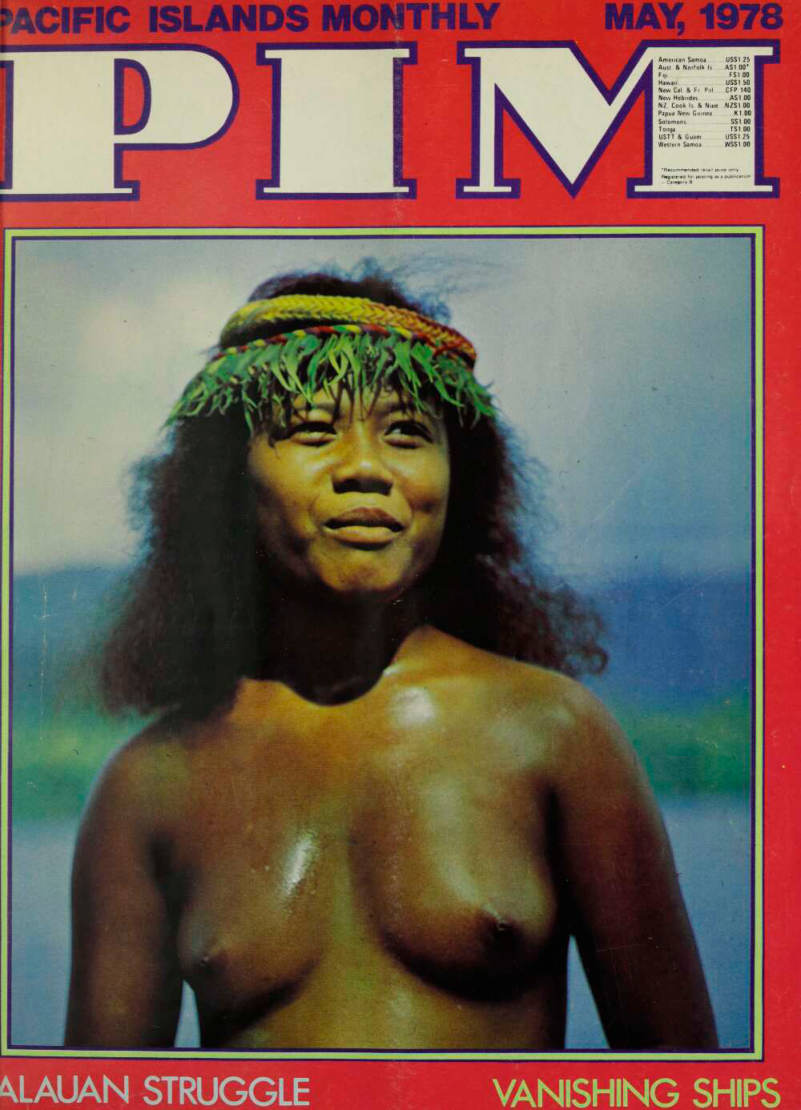
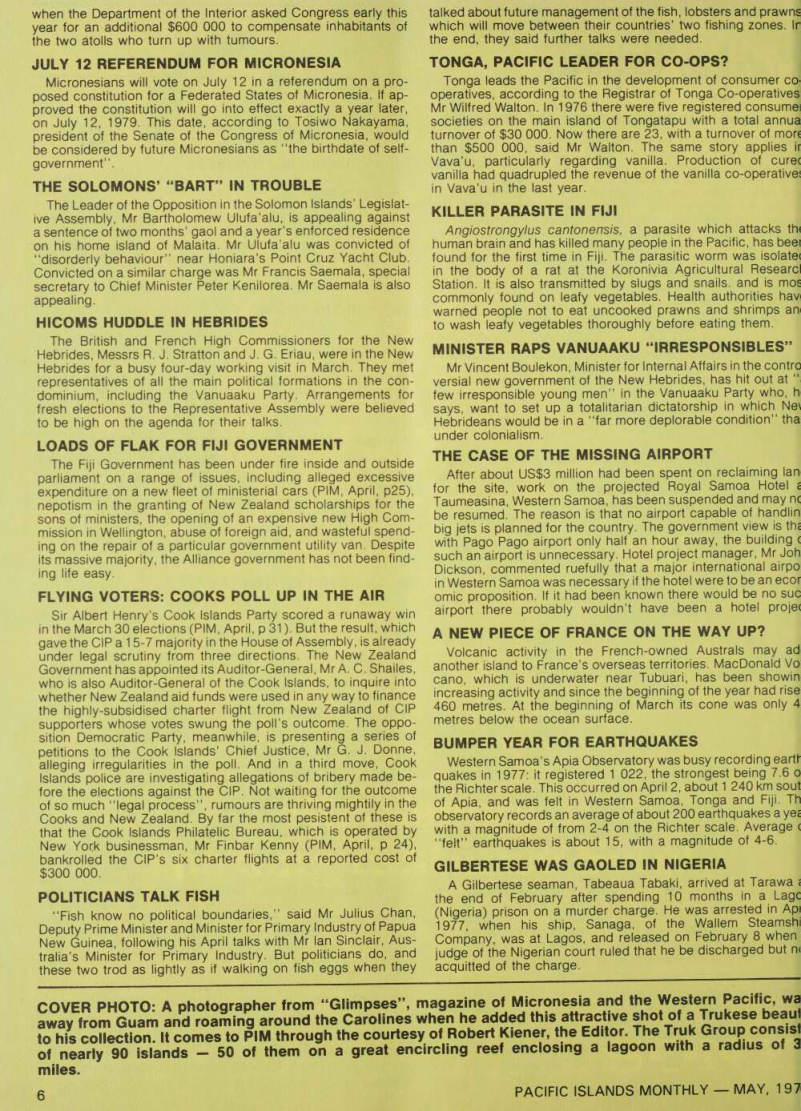
COVER PHOTO: A photographer from “Glimpses”, magazine of Micronesia and the Western Pacific, wa away from Guam and roaming around the Carolines when he added this attractive shot ® u * I ruk ®Consist to his collection. It comes to PIM through the courtesy of Robert Kiener. the Editor The Truk Group cons'st of nearly 90 islands - 50 of them on a great encircling reef enclosing a lagoon with a radius of 3 miles.
Advertisements & other items, pp. 2-4 (1 item)
m
m if v/:
P.N.G.
S O. Svensson (N.G.) Ltd.
P.O Box 705. Port Moresby Tel: 2275 Fiji Islands Motibhai & Company Ltd.
P.O. Box 9175, Nadi International Airport Tel: 72-165 New Zealand Pye Ltd .Consumer Products Sector 110 Mt. Eden Rd . Ml Eden. Auckland Tel: 686-437 New Caledonia Menard Freres Ville B.P. H 2, Noumea Tel: 275222 Tahiti Et§bli§§gmgnts Comimoex New Hebrides (Islands) Burns Philp (New Hebrides) Co., Ltd.
P.O. Box 27, Port Vila, New Hebrides Islands Norfolk Island Burns Philp (Norfolk Island) Co., Ltd.
P.O. Box 21, Norfolk Island Samoa Islands Burns Philp (South Sea) Co., Ltd P.O. Box 129, Pago Pago. American Samoa Mariana Islands J.C. Tenorio Enterprises P.O. Box 137, Saipan Tel: 6444/8 British Solomon Islands Security Electrical Co.. Ltd.
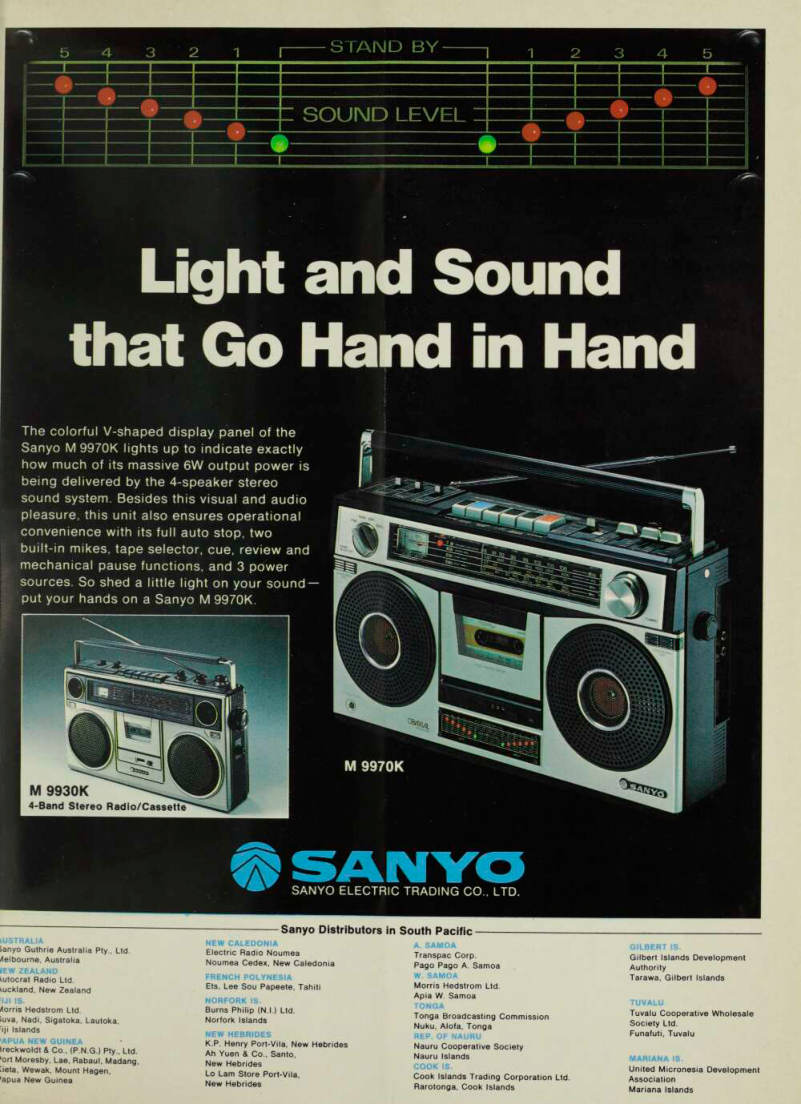
P.O. Box 174, Honiara Tel: 881 AJ-480 4-Band Stereo 5,000mW of powerful stereo beauty. 2-way 4-speaker system, dual microphones, feature-loaded for complete sound versatility.
AJ-370 3-Band Dynamic S.OOOmW of power through 2-way hi-fi speakers, for crystal clear sound, full-featured for total convenience.
AJ-350 3-Band Unsurpassable cost/performance in a versatile power portable. 3,000mW AJ-480 Audio & Video
DAIHATSU Continues To Press Forward
In Its Quest For A Harmonious “Automobile Society”
A new car born of logi
created to meet
the practical
of today’s world /
ic m model XG ■395391
charade
The Daihtsu Charade is a car in which a family of 5 can travel in comfort. A car with a special functionality, thanks to its hatch-back door, and with plenty of power for excellent maneuverability under a wide variety of conditions ranging from crowded cities to fast highways. Very definitely a car of economy ... but still a car in which all of these attributes have been concentrated into a compact body in a very logical way.
Today we no longer live in an age in which we can afford the luxury of determining a car’s worth by its luxurious fittings and its great engine displacement. The Daihatsu Charade is therefore a new - and most logical - alternative for those who will enjoy the simple life and its simple pleasures.
4-Wheel Drive...ideal for highways
sand, rocks or mountain trails
Because it can go “almost anywhere”. And that includes highways, rocky trails, sand, river sides. Dry, wet, rocky, sandy surfaces.
That’s what sets this 4-Wheel Drive so far apart - and ahead - when the going gets tough. Excellent acceleration superb hill climbing, amazing tenacity . . . that’s the story of Daihatsu 4-Wheel Drive!
DAIHATSU
4 WHEEL DRIVE
DAIHATSU
DAIHATSU MOTOR CO., LTD.
DAIHATSU MOTOR SALES CO, LTD.
Head Office:
1, DAIHATSU-CHO. IKEDA CITY, OSAKA
PHONE: IKEDA (0727) 51-8811
PREFECTURE, JAPAN
I" "Jr"- I su I Is. tUA
TELEX NO.: 0-5322-251 JAPAN, 0-5322-224 JAPAN
Tokyo Office:
7, NIHONBASHI-HONCHO 2-CHOME, CHUO-KU, TOKYO.
PHONE: TOKYO (03) 279-0811
CABLE ADDRESS; DAIHATSU TOKYO
TELEX NO.: 0-222-3377 JAPAN
TAmTI- N ETS G ROBERTp GU c™.!,'. ? abaul/F ,J 1 : PRAKASH MOTORS LIMITED, P.O. Box 370, Suva/ company Po R 2 n B !J'c B ' ‘ O AoK , c ee n / F V ' l CALEDONIA: 5.1.D.A., B.P. 2548, Noumea/ NEW HEBRIDES: SANTO BUS B 45 ' Santo < GARAGE RANTY 81 JAMMES, B.P. 627, Port Vila/ SOLOMON ISLANDS: HERTZ CAR RENTALS ENTERPRISE?' Pn ni ß a/ P wnocni°if NAURU COOPERATIVE SOCIETY/ NIUE ISLAND: NIUE ISLAND ki M e?S2t K D '5 LAND: WW SANDERS & SONS LTD., P.O. Box 86, Burnt Pine/ GILBERT IoLAIMUb, JONG KUM KEE BROTHERS' STORE, P.O. Box 504, Betio, Tarawa
* J / d £ rrr CF
SOMY
v'\J^ SE r*. \ s 1 -r *T a =£> “""■Su *V- - ■ • £*i* ' j 1 Lr« 4 mt. ■ > i ♦’
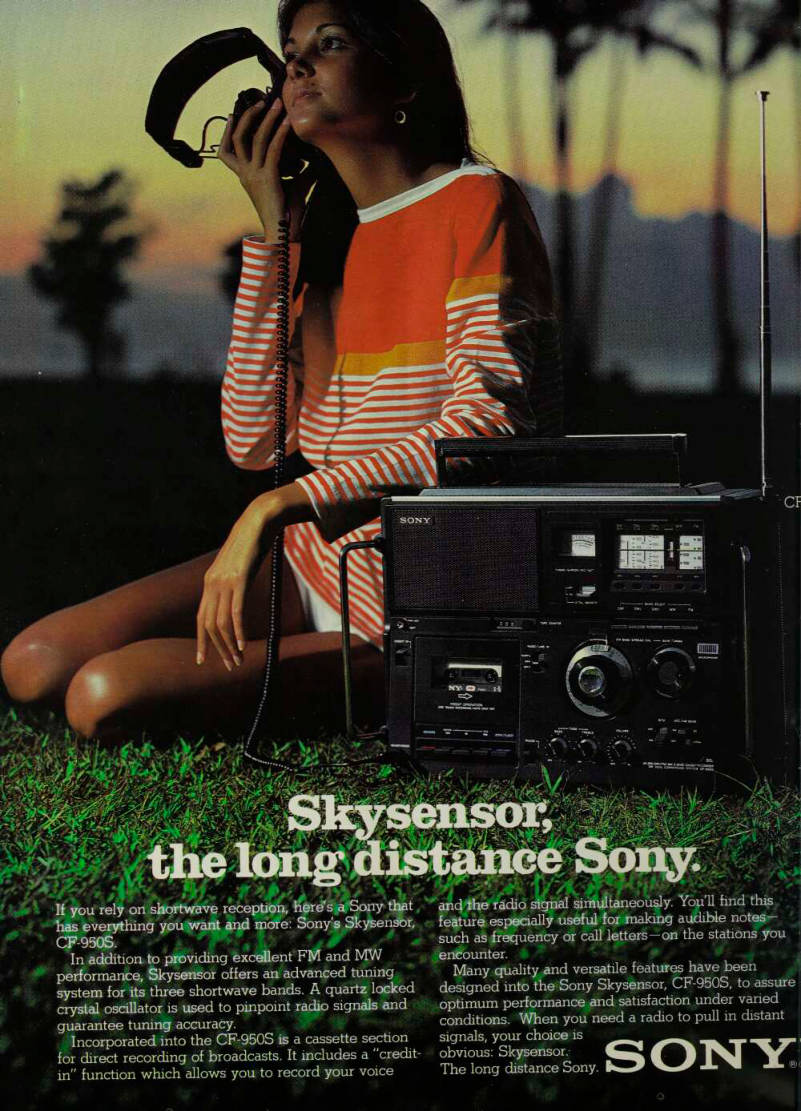
J > ■V » 4 &** 4 m; .m* If you rely on shortwave reception, here s a Sony that has everything you want and more; Sony's Skysensor, CF-9505.
In addition to providing excellent FM and MW performance. Skysensor offers an advanced tuning system for its three shortwave bands. A quartz locked crystal oscillator is used to pinpoint radio signals and guarantee tuning accuracy.
Incorporated into the CF-950S is a cassette section „ for direct recording of broadcasts. It includes a "credit- obvious: Skysensor in" function which allows you to record your voice The long distance Sony. and the radio signal simultaneously. You 11 find this feature especially useful for making audible notes such as frequency or call letters—on the stations you encounter.
Many quality and versatile features have been designed into the Sony Skysensor, CF-9505, to assure optimum performance and satisfaction under varied conditions. When you need a radio to pull in distant signals, your choice is
Pacific Report
Solomons: The Gloucesters Are Coming
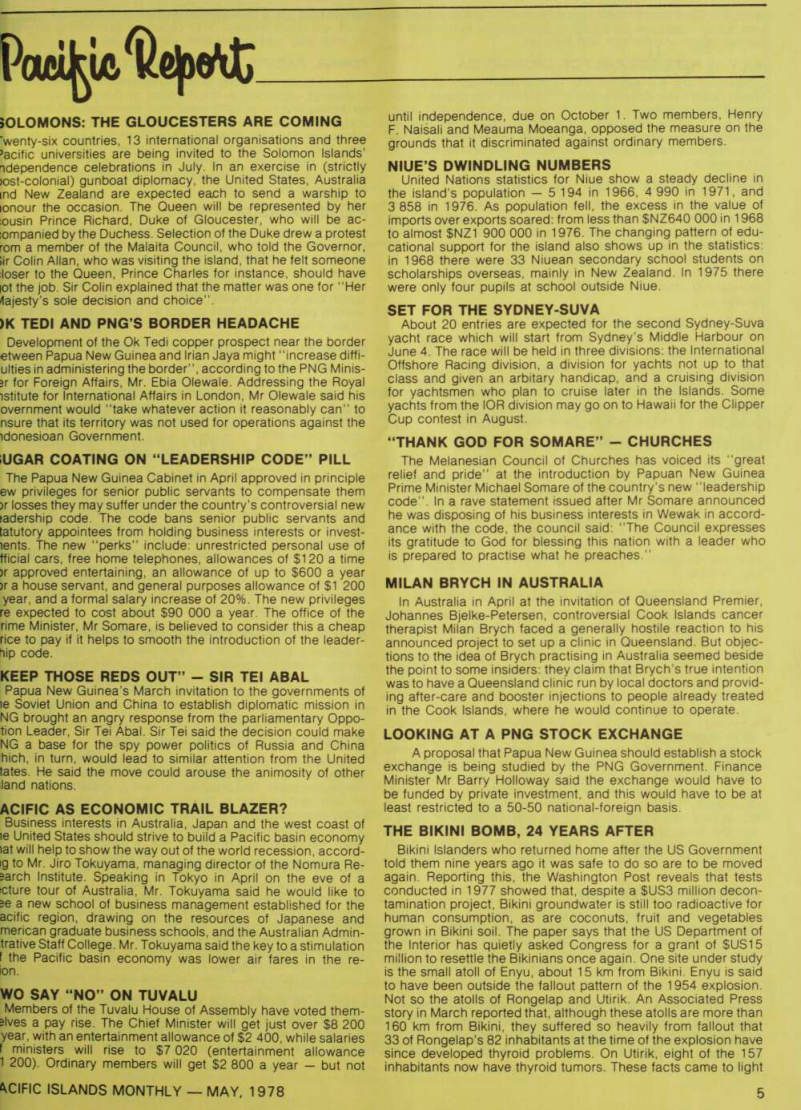
wenty-six countries, 13 international organisations and three >acific universities are being invited to the Solomon Islands’ celebrations in July. In an exercise in (strictly >ost-colonial) gunboat diplomacy, the United States, Australia md New Zealand are expected each to send a warship to lonour the occasion. The Oueen will be represented by her ;ousin Prince Richard, Duke of Gloucester, who will be ac cmpanied by the Duchess. Selection of the Duke drew a protest rom a member of the Malaita Council, who told the Governor, lir Colin Allan, who was visiting the island, that he felt someone loser to the Oueen, Prince Charles for instance, should have lot the job. Sir Colin explained that the matter was one for “Her Majesty’s sole decision and choice”.
)K Tedi And Png’S Border Headache
Development of the Ok Tedi copper prospect near the border etween Papua New Guinea and Irian Jaya might “increase diffi ulties in administering the border’ ’, according to the PNG Minis ?r for Foreign Affairs, Mr. Ebia Olewale. Addressing the Royal istitute for International Affairs in London, Mr Olewale said his overnment would “take whatever action it reasonably can” to nsure that its territory was not used for operations against the idonesioan Government.
Lugar Coating On “Leadership Code’’ Pill
The Papua New Guinea Cabinet in April approved in principle ew privileges for senior public servants to compensate them )r losses they may suffer under the country’s controversial new sadership code. The code bans senior public servants and tatutory appointees from holding business interests or invest lents. The new “perks” include: unrestricted personal use of fficial cars, free home telephones, allowances of $l2O a time >r approved entertaining, an allowance of up to S6OO a year >r a house servant, and general purposes allowance of $1 200 year, and a formal salary increase of 20%. The new privileges re expected to cost about S9O 000 a year. The office of the rime Minister, Mr Somare, is believed to consider this a cheap rice to pay if it helps to smooth the introduction of the leader hip code.
KEEP THOSE REDS OUT” - SIR TEI ABAL Papua New Guinea’s March invitation to the governments of le Soviet Union and China to establish diplomatic mission in NG brought an angry response from the parliamentary Oppo tion Leader, Sir Tei Abal. Sir Tei said the decision could make NG a base for the spy power politics of Russia and China hich, in turn, would lead to similar attention from the United lates. He said the move could arouse the animosity of other land nations.
Acific As Economic Trail Blazer?
Business interests in Australia, Japan and the west coast of le United States should strive to build a Pacific basin economy lat will help to show the way out of the world recession, accord ig to Mr. Jiro Tokuyama, managing director of the Nomura Re sarch Institute. Speaking in Tokyo in April on the eve of a >cture tour of Australia, Mr. Tokuyama said he would like to 3e a new school of business management established for the acific region, drawing on the resources of Japanese and merican graduate business schools, and the Australian Admin trative Staff College. Mr. Tokuyama said the key to a stimulation f the Pacific basin economy was lower air fares in the re ion.
Wo Say “No” On Tuvalu
Members of the Tuvalu House of Assembly have voted them 3lves a pay rise. The Chief Minister will get just over $8 200 year, with an entertainment allowance of $2 400, while salaries f ministers will rise to $7 020 (entertainment allowance 1 200). Ordinary members will get $2 800 a year but not
until independence, due on October 1. Two members, Henry F. Naisali and Meauma Moeanga, opposed the measure on the grounds that it discriminated against ordinary members.
Niue’S Dwindling Numbers
United Nations statistics for Niue show a steady decline in the island’s population 5 194 in 1966, 4 990 in 1971, and 3 858 in 1976. As population fell, the excess in the value of imports over exports soared: from less than SNZ64O 000 in 1968 to almost SNZI 900 000 in 1976. The changing pattern of edu cational support for the island also shows up in the statistics: in 1968 there were 33 Niuean secondary school students on scholarships overseas, mainly in New Zealand. In 1975 there were only four pupils at school outside Niue.
Set For The Sydney-Suva
About 20 entries are expected for the second Sydney-Suva yacht race which will start from Sydney’s Middle Harbour on June 4. The race will be held in three divisions; the International Offshore Racing division, a division for yachts not up to that class and given an arbitary handicap, and a cruising division for yachtsmen who plan to cruise later in the Islands. Some yachts from the IOR division may go on to Hawaii for the Clipper Cup contest in August.
“Thank God For Somare’’ - Churches
The Melanesian Council of Churches has voiced its “great relief and pride’’ at the introduction by Papuan New Guinea Prime Minister Michael Somare of the country’s new “leadership code". In a rave statement issued after Mr Somare announced he was disposing of his business interests in Wewak in accord ance with the code, the council said. “The Council expresses its gratitude to God for blessing this nation with a leader who is prepared to practise what he preaches.’’
Milan Brych In Australia
In Australia in April at the invitation of Oueensland Premier, Johannes Bjelke-Petersen, controversial Cook Islands cancer therapist Milan Brych faced a generally hostile reaction to his announced project to set up a clinic in Oueensland. But objec tions to the idea of Brych practising in Australia seemed beside the point to some insiders: they claim that Brych’s true intention was to have a Oueensland clinic run by local doctors and provid ing after-care and booster injections to people already treated in the Cook Islands, where he would continue to operate.
Looking At A Png Stock Exchange
A proposal that Papua New Guinea should establish a stock exchange is being studied by the PNG Government. Finance Minister Mr Barry Holloway said the exchange would have to be funded by private investment, and this would have to be at least restricted to a 50-50 national-foreign basis.
The Bikini Bomb, 24 Years After
Bikini Islanders who returned home after the US Government told them nine years ago it was safe to do so are to be moved again. Reporting this, the Washington Post reveals that tests conducted in 1977 showed that, despite a SUS 3 million decon tamination project, Bikini groundwater is still too radioactive for human consumption, as are coconuts, fruit and vegetables grown in Bikini soil. The paper says that the US Department of the Interior has quietly asked Congress for a grant of SUSIS million to resettle the Bikinians once again. One site under study is the small atoll of Enyu, about 15 km from Bikini. Enyu is said to have been outside the fallout pattern of the 1954 explosion.
Not so the atolls of Rongelap and Utirik. An Associated Press story in March reported that, although these atolls are more than 160 km from Bikini, they suffered so heavily from fallout that 33 of Rongelap’s 82 inhabitants at the time of the explosion have since developed thyroid problems. On Utirik, eight of the 157 inhabitants now have thyroid tumors. These facts came to light
when the Department of the Interior asked Congress early this year for an additional S6OO 000 to compensate inhabitants of the two atolls who turn up with tumours.
July 12 Referendum For Micronesia
Micronesians will vote on July 12 in a referendum on a pro posed constitution for a Federated States of Micronesia. If ap proved the constitution will go into effect exactfy a year later, on July 12, 1979. This date, according to Tosiwo Nakayama, president of the Senate of the Congress of Micronesia, would be considered by future Micronesians as “the birthdate of self
government”.
The Solomons’ “Bart” In Trouble
The Leader of the Opposition in the Solomon Islands’ Legislat ive Assembly, Mr Bartholomew Ulufa’alu, is appealing against a sentence of two months’ gaol and a year’s enforced residence on his home island of Malaita. Mr Ulufa’alu was convicted of “disorderly behaviour” near Honiara’s Point Cruz Yacht Club.
Convicted on a similar charge was Mr Francis Saemala, special secretary to Chief Minister Peter Kenilorea. Mr Saemala is also appealing.
Hicoms Huddle In Hebrides
The British and French High Commissioners for the New Hebrides, Messrs R. J. Stratton and J. G. Eriau, were in the New Hebrides for a busy four-day working visit in March. They met representatives of all the main political formations in the con dominium, including the Vanuaaku Party. Arrangements for fresh elections to the Representative Assembly were believed to be high on the agenda for their talks.
Loads Of Flak For Fiji Government
The Fiji Government has been under fire inside and outside parliament on a range of issues, including alleged excessive expenditure on a new fleet of ministerial cars (PIM, April, p 25), nepotism in the granting of New Zealand scholarships for the sons of ministers, the opening of an expensive new High Com mission in Wellington, abuse of foreign aid, and wasteful spend ing on the repair of a particular government utility van. Despite its massive majority, the Alliance government has not been find ing life easy.
FLYING VOTERS: COOKS POLL UP IN THE AIR Sir Albert Henry’s Cook Islands Party scored a runaway win in the March 30 elections (PIM, April, p 31). But the result, which gave the CIP a 15-7 majority in the House of Assembly, is already under legal scrutiny from three directions. The New Zealand Government has appointed its Auditor-General, Mr A. C. Shailes, who is also Auditor-General of the Cook Islands, to inquire into whether New Zealand aid funds were used in any way to finance the highly-subsidised charter flight from New Zealand of CIP supporters whose votes swung the poll’s outcome. The oppo sition Democratic Party, meanwhile, is presenting a series of petitions to the Cook Islands’ Chief Justice, Mr G. J. Donne, alleging irregularities in the poll. And in a third move, Cook Islands police are investigating allegations of bribery made be fore the elections against the CIP. Not waiting for the outcome of so much “legal process”, rumours are thriving mightily in the Cooks and New Zealand. By far the most pesistent of these is that the Cook Islands Philatelic Bureau, which is operated by New York businessman, Mr Finbar Kenny (PIM, April, p 24), bankrolled the ClP’s six charter flights at a reported cost of
S3Oo 000.
Politicians Talk Fish
“Fish know no political boundaries,” said Mr Julius Chan, Deputy Prime Minister and Minister for Primary Industry of Papua New Guinea, following his April talks with Mr lan Sinclair, Aus tralia’s Minister for Primary Industry. But politicians do, and these two trod as lightly as if walking on fish eggs when they
talked about future management of the fish, lobsters and prawns which will move between their countries’ two fishing zones. Ir the end, they said further talks were needed.
Tonga, Pacific Leader For Co-Ops?
Tonga leads the Pacific in the development of consumer co operatives, according to the Registrar of Tonga Co-operativesi Mr Wilfred Walton. In 1976 there were five registered consumei societies on the main island of Tongatapu with a total annua turnover of S3O 000. Now there are 23, with a turnover of more than SSOO 000, said Mr Walton. The same story applies ir Vava’u, particularly regarding vanilla. Production of curec vanilla had quadrupled the revenue of the vanilla co-operative; in Vava’u in the last year.
Killer Parasite In Fiji
Angiostrongylus cantonensis, a parasite which attacks the human brain and has killed many people in the Pacific, has beer found for the first time in Fiji. The parasitic worm was isolator in the body of a rat at the Koronivia Agricultural Researcl Station. It is also transmitted by slugs and snails, and is mos commonly found on leafy vegetables. Health authorities hav< warned people not to eat uncooked prawns and shrimps am to wash leafy vegetables thoroughly before eating them.
Minister Raps Vanuaaku “Irresponsibles”
Mr Vincent Boulekon, Minister for Internal Affairs in the contro versial new government of the New Hebrides, has hit out at “j few irresponsible young men” in the Vanuaaku Party who, hi says, want to set up a totalitarian dictatorship in which Ne\ Hebrideans would be in a “far more deplorable condition” tha under colonialism.
The Case Of The Missing Airport
After about US$3 million had been spent on reclaiming lam for the site, work on the projected Royal Samoa Hotel e Taumeasina, Western Samoa, has been suspended and may nc be resumed. The reason is that no airport capable of handlin big jets is planned for the country. The government view is the with Pago Pago airport only half an hour away, the building c such an airport is unnecessary. Hotel project manager, Mr Joh Dickson, commented ruefully that a major international airpo in Western Samoa was necessary if the hotel were to be an ecor omic proposition. If it had been known there would be no sue airport there probably wouldn’t have been a hotel projec A NEW PIECE OF FRANCE ON THE WAY UP?
Volcanic activity in the French-owned Australs may ad' another island to France’s overseas territories. MacDonald Vol cano, which is underwater near Tubuari, has been showim increasing activity and since the beginning of the year had rise 460 metres. At the beginning of March its cone was only 4 metres below the ocean surface.
Bumper Year For Earthquakes
Western Samoa’s Apia Observatory was busy recording earth quakes in 1977: it registered 1 022, the strongest being 7.6 o the Richter scale. This occurred on April 2, about 1 240 km sout of Apia, and was felt in Western Samoa, Tonga and Fiji. Th observatory records an average of about 200 earthquakes a yea with a magnitude of from 2-4 on the Richter scale. Average c “felt” earthquakes is about 15, with a magnitude of 4-6.
Gilbertese Was Gaoled In Nigeria
A Gilbertese seaman, Tabeaua Tabaki, arrived at Tarawa c the end of February after spending 10 months in a Lagc (Nigeria) prison on a murder charge. He was arrested in Api 1977, when his ship, Sanaga, of the Wallem Steamshi Company, was at Lagos, and released on February 8 when judge of the Nigerian court ruled that he be discharged but no acquitted of the charge.
Advertisements & other items, p. 5 (1 item)
5
ISLANDS MONTHLY MAY, 1978
Pacific Islands Monthly
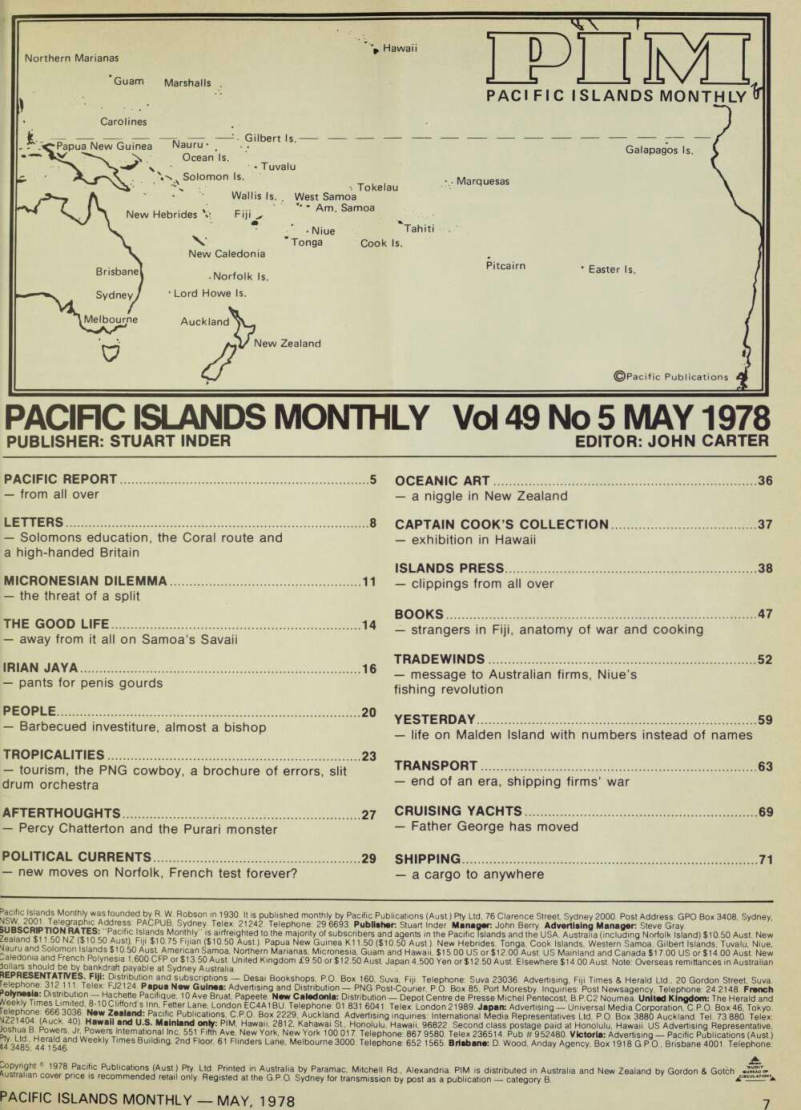
Vol 49 No 5 MAY 1978
Publisher: Stuart Inder
Editor: John Carter
Pacific Report 5
from all over
Letters 8
Solomons education, the Coral route and a high-handed Britain
Micronesian Dilemma 11
the threat of a split
The Good Life 14
away from it all on Samoa’s Savaii
Irian Jaya 16
pants for penis gourds
People 20
Barbecued investiture, almost a bishop
Tropicalities 23
tourism, the PNG cowboy, a brochure of errors, slit drum orchestra
Afterthoughts 27
Percy Chatterton and the Purari monster
Political Currents 29
new moves on Norfolk, French test forever?
Oceanic Art 36
a niggle in New Zealand
Captain Cook’S Collection 37
exhibition in Hawaii
Islands Press3B
clippings from all over
Books 47
strangers in Fiji, anatomy of war and cooking
Tradewinds 52
message to Australian firms, Niue’s fishing revolution
Yesterdays 9
life on Malden Island with numbers instead of names
Transport 63
end of an era, shipping firms’ war
Cruising Yachts 69
Father George has moved
Shipping 71
a cargo to anywhere
S C onmr S Monthly was; founded by R. W. Robson in 1930 It is published monthly by Pacific Publications (Aust) Pty Ltd, 76 Clarence Street Sydney 2000. Post Address: GPO Box 3408, Sydney, SQ? D i^Sc Ad D dre T : , p A CPUB ; Sydney Telex 21242 Tele P h one: 29 6693 Publisher Stuart Inder Manager John Berry. Advertising Manager Steve Gray.
V InMTjJrn L* * l sla * d ® Month| y *s airfreighted to the majority of subscribers and agents in the Pacific Islands and the USA. Australia (including Norfolk Island) $10.50 Aust. New - aa ld lie , ,i j s l ® Fijian ($10.50 Aust). Papua New Guinea K 11.50 ($10.50 Aust.) New Hebrides, Tonga, Cook Islands, Western Samoa, Gilbert Islands. Tuvalu, Niue, VTd, 55 o .^ s ir-^ me * c^ nSamoa ' Nor,h ern Marianas, Micronesia, Guam and Hawaii, $l5 00 US or $12.00 Aust US Mainland and Canada $17.00 US or $14.00 Aust. New iniiaro c l ai m k °i y^e l ia CFP or $13.50 Aust. United Kingdom £9.50 or $12.50 Aust. Japan 4,500 Yen or $l2 50 Aust. Elsewhere $l4 00 Aust. Note: Overseas remittances in Australian dollars should be by bankdraft payable at Sydney Australia and subscriptions Desai Bookshops, PO. Box 160, Suva, Fiji Telephone: Suva 23036 Advertising, Fiji Times & Herald Ltd, 20 Gordon Street, Suva n; 1 iL k V Te ' ex - FJ 21 24 Papua New Guinea: Advertising and Distribution PNG Post-Courier, P O Box 85. Port Moresby Inquiries: Post Newsagency, Telephone: 24 2148 French Irin^^. p ? c,,iq r uei 10 Ave Bruat Pa P ee,e Naw Caledonia: Distribution— Depot Centre de Presse Michel Pentecost. B P C 2 Noumea United Kingdom: The Herald and 8- I °C |lff p r ds Inn, Fetter Lane, London EC4AIBU. Telephone: 01 831 6041 Telex: London 21989 Japan: Advertising Universal Media Corporation, C.P.O Box 46, Tokyo \179?a02' u ew n ea : o Pa « f, . c Pub i lca,lon s. C.P.O. Box 2229, Auckland. Advertising inquiries International Media Representatives Ltd. P.O. Box 3880 Auckland. Tel. 73 880. Telex: inchna d I ” awa '' Mainland only: PIM, Hawaii, 2812, Kahawai St, Honolulu, Hawaii. 96822 Second class postage paid at Honolulu, Hawaii. US Advertising Representative, ltn B Hp P °rT n em f lO u a n o' l s r Flfth Ave ' New York ' New York 1 00 017 Tele Phone: 867 9580 Telex 236514 Pub 952480 Victoria: Advertising Pacific Publications (Aust.) 14 3485 44 1546 ° W k y T ' mes Bulldm 9’ 2nd Floor ' 61 Flinders Lane, Melbourne 3000. Telephone: 652 1565. Brisbane; D Wood, Anday Agency, Box 1918 G.P.O , Brisbane 4001. Telephone:
'fi C Publica,i °ns (Aust ) Pty Ltd Printed in Australia by Paramac, Mitchell Rd, Alexandria. PIM is distributed in Australia and New Zealand by Gordon & Gotch an cover price is recommended retail only Registed at the G.P.O. Sydney for transmission by post as a publication category B -
Letters
Solomons
Education
1 refer to the 'tropicalities' section (p. 25) of the March. 1978. issue of PIM dealing with Education in the Solomon Islands. 1 agree in general with the tenor of your comments with regard to G.
E. Saunder's article in Melbourne Studies in Educa tion 1977. As far as I can see it relied solely on the Educa tion for What 0 Report, ignor ing among other things the archives available in the Solomons, the developments in the Legislative Assembly and the submissions to the Educational Policy Review Committee (EPRC).
However, while I agree that the involvement of the Islan ders with the EPRC meant that the people of the Solomons were incorporated into the decision-making pro cess. the importance of many submssions from Europeans and the role of certain Churches should not be un derestimated. Yet to see the Education for What? Report as a political statement and not to see the EPRC as a political instrument is a failure to realise that the two are inextricably intertwined, the rejection of the White Paper No 2 of 1974 was a political decision (even taking into consideration the possibility that the rejection was related in part to a clash of European-M el anesian values) as was the acceptance of the 1975-1979 policy. The same may be said for the 'Eight Principles’of Develop ment (and education is an im portant component) and perhaps even 'the Melanesian Way’ has become a political slogan!
Those who are interested in education in the South-West Pacific in general, and the Solomons in particular, may be interested in my recently completed doctoral thesis at the University of New Eng land, Armidale, entitled Op tions for the Development of Education on the Solomon Islands: A Critical Analysis.
Copies are lodged with
MECA in Honiara, the old Controlling Authorities of Education in the Solomons, the Western Pacific Archives in Suva (the Solomons section at present in transit to Honiara), the Methodist Overseas Mission in Auck land. and the Mitchell Libr ary in Sydney. Part 11, Chapter 1, is closed for reasons of copyright. Papers on attempts at educational reform in the Solomons by W.
C. Groves (1938-1939) and F.
N. Ashley (1930-1938) are to be found at these sources also.
Hopefully aspects of the thesis will be published soon but readers may be especially in terested in Part HI of the thesis which deals with the 1973-1974 phase of educa tional reform plus an analysis of future trends.
Bruce S. Palmer.
(Lecturer in Department of Education.) Bendigo College of Advanced Education.
Vic.
The Coral
Route
The article in the December issue of PIM (p 42) on the TEAL Coral Route between Fiji and Tahiti recalled to mind a trip that I made on the Solent flying-boat in 1957.
I had arrived in Papeete in March. 1957. on the Matson liner Mariposa as a member of a team of biologists from the Smithsonian Institution in Washington. DC. After spend ing six weeks collecting speci mens in the principal islands of the Society Group and on two of the Tuamotus we were scheduled to leave for Fiji and then home by the TEAL Coral Route.
At that time the plane arriv ed on the morning of every other Thursday and three days later, early on Sunday morning, the flying-boat took off again for Fiji. The little motor-sailer Mareva that our group had chartered was moored close to the old wooden post-office (long since replaced by the present modernistic concrete struc ture), and I well recall seeing on those Thursday mornings, when the plane arrived, the crowds gathering in front of the post-office and waiting tor the clerks to sort the mail that had been brought in from the: plane. It was a great fortnightly social occasion! when people from out of towm came in, most of them on bicy cles, and met and gossipedl
with friends from Papeete.
When the doors finally open ed there was a great rush to get inside and much jostling before everyone obtained their letters or packages.
Twice during our stay, early on Sunday morning, I walked to the commercial dock to watch the departure of the launch that took the passengers out to the flying boat moored in the lagoon. I saw friends leaving with heavy hearts, and bidding tearful farewells to friends and vahines they were leaving behind. Nevertheless there was a gay. informal party-like atmosphere to these depar tures with champagne corks popping and couronne- laden passengers stepping into the launch carefully holding champagne-filled glasses.
We ourselves left on a lovely May morning, depart ing from the dock in the launch after saying our good byes to friends we had made during our stay. The take-off from the lagoon, with the water spraying the cabin win dows was a novel experience.
As the plane turned westward we looked down on Tahiti and Moorea bathed in the morn ing sunlight with a mixture of a sudden awareness of their enchanting beauty and of regret at leaving these lovely islands.
At eleven, the plane landed in the magnificent lagoon of Aitutaki where a launch took the passengers to the islet of Akaimi. In a small thatch roofed resthouse we were served orange juice and a sandwich. Some of us wan dered over to the ocean-reef side of Akaiama. With the plane refuelled we took off again and late in the afternoon we landed in Satapuala bay on Upolu. By VW bus the passengers were driven to Apia where some of us were lodged at Aggie Grey’s, and the others were put up at the White Horse Inn. On my last visit to Apia a few years ago we, of course, stopped in at Aggie’s but I was unable to find the White Horse Inn where I had stayed some 20 years earlier. Can some reader tell me what became of
this hostelry?
The following morning we were driven back to Satapuala very early through a beautiful tropical morning enhanced by a magnificent sunrise, past villages with the people begin ning to stir about their fates with morning activities. At seven we left Samoa and at
eleven we came down in Laucala Bay and our flight was over.
I am grateful to George Lynch for evoking these memories from my first visit to the South Pacific, and I hope that my brief account may.recall to some readers those pre-airstrip days of Tahiti, when, between the Bights of the flying-boat and the arrivals and departures of tour boats or Messageries Maritimes liners, Papeete reverted to a rather quiet tro pical town.
Harald A Render
Bethesda, Maryland, USA.
C’Est Si Bon!
Readers of your magazine may study every month arti cles dealing with the life of the English-speaking islands of the South Pacific. But the in formation offered about the French-speaking islands ap pears to me to be incomplete.
In fact, your readers could even get an incorrect im pression about the life of the people of Wallis and Futuna.
French Polynesia, and New Caledonia that is. an in correct impression of the lives of 300 000 people. I am therefore taking the liberty of offering some facts about their situation.
Certain people are irritated by the fact that these French territories have not yet acced ed to independence. This situ ation arises from the fact that in none of them has a majority yet appeared in favour of changing their status in the direction of independence.
This is the case in French Polynesia. New Caledonia and Wallis and Futuna. The most recent elections held in March have again confirmed this situation.
The standard of living in these territories is high: for example, in New Caledonia, gross national product amounts to more than SA4 740 per head of popula tion. For many years now the French Government has been granting these populations financial aid of more than AS2OO million per year. In spite of the general economic crisis, which has also affected these countries, the level of employment remains high. In New Caledonia the annual in flation rate is only 6.5% . and salaries remain at a level which may stand comparison with the level in Australia.
There are 34 000 wage-ear
ners and 4 000 unemployed persons in the territory.
In these French territories there are some 100 000 pri vate and commercial motor vehicles and more than 50 000 television sets, a few thousand of which are colour sets. Television was introduc ed 13 years ago and costs the inhabitants nothing. On the other hand, the transmissions to the territories cost France SAI2 000 a day. In the even ing TV viewers can see by satellite, like most Australians and New Zealanders, up-to the-minute world news.
Young people of the English-speaking Pacific Is lands must stay in their coun tries because the doors of Australia and New Zealand are closed to them. New Caledonians and Tahitians on the other hand may find employment in France because they are full French citizens.
Three scientific institutions in New Caledonia and Tahiji employ 400 persons, half of them locals, and three scien tific research vessels, all financed by France, sail the South Seas.
The 200-mile exclusive economic zones of these ter ritories are now protected by French naval and air forces based in Papeete and Noumea.
Noting the content of this letter your readers will no doubt appreciate why the op tion of independence, in one or other of these territories, has not yet gathered as much support as may be the case elsewhere. In their present status, they benefit from a high degree of social progress, and they see no reason why they should change this status which, incidentally, provides them with wide powers over local and budgetary affairs.
The technical progress from which the French people benefit due to their country’s industrial and scientific capacities is also of great benefit to Caledonians. Walli sians and Tahitians.
May this situation endure.
Noumea.
H. Wright
High-Handed
When the government of the Gilbert Islands met for the first time after the election of February 1, this year, one of the first pieces of business dealt with was about the post ot Governor. In a unique ac
tion for a colonial country the Gilbertese Government pass ed unanimously a motion re questing the British Govern ment to retain the present Governor in office until inde pendence.
The Secretary of State for Foreign and Commonwealth Affairs has rejected this re quest outright.
This high-handed action of the British Government has happened just before the Gilbert Islands gets its inde pendence. Why must this young country continue to re ceive orders from its colonial masters in this tactless manner right up to independence?
Clearly the Gilbertese Government had strong reasons for wishing Governor Smith to remain in office until independence. Is it not possi ble for Whitehall to recognise the unanimous wishes of this government at this late stage in the colonial game?
It is this type of thoughtless action which high-lights the colonial status of the Gilberts and the ugly role of colonial master, of the British. A num ber of expatriates living in the Gilberts are embarrassed by the way the British Govern ment has behaved on this mat
ter.
R G Brown.
P R Dreaver,
King George V School.
Tarawa.
Infertility
I read with interest your in formation concerning my sec ond visit to the Solomon Is lands in the issue of PI M (Feb. p 5, A problem in the Solomons).
On the second visit I had the privilege of visiting more centres than on the first and the women came forward in greater numbers at each centre, possibly because they learned that I was a woman doctor (gynaecologist). It would appear that infertility is no more frequent than in other similar countries, but it is highlighted by the obvious fecundity and joy of parent hood apparent in the majority of the community.
The Australian Aid to Developing Countries Bureau, now part of the Department of External Affairs, sponsored my visits and the great pleasure in mak ing so many Solomon Islands friends will remain with me.
Del Puflett (Dr)
229 Macquarie St,
Sydney.
Advertisements & other items, pp. 8-10 (2 items)
of the passing
Advertisement
Soften the effect
on your complexion
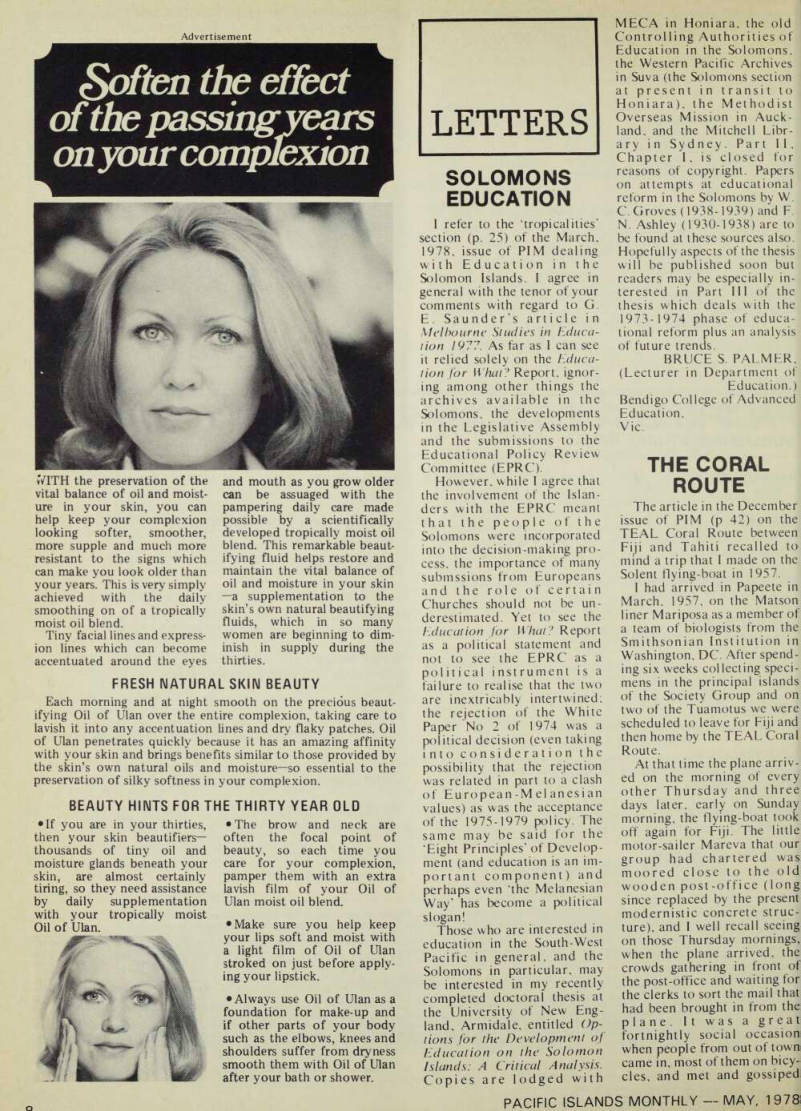
X. vVITH the preservation of the vital balance of oil and moisture in your skin, you can help keep your complexion looking softer, smoother, more supple and much more resistant to the signs which can make you look older than your years. This is very simply achieved with the daily smoothing on of a tropically moist oil blend.
Tiny facial lines and expression lines which can become accentuated around the eyes and mouth as you grow older can be assuaged with the pampering daily care made possible by a scientifically developed tropically moist oil blend. This remarkable beautifying fluid helps restore and maintain the vital balance of oil and moisture in your skin —a supplementation to the skin’s own natural beautifying fluids, which in so many women are beginning to diminish in supply during the thirties.
FRESH NATURAL SKIN BEAUTY
Each morning and at night smooth on the precious beautifying Oil of Ulan over the entire complexion, taking care to lavish it into any accentuation lines and dry flaky patches. Oil of Ulan penetrates quickly because it has an amazing affinity with your skin and brings benefits similar to those provided by the skin’s own natural oils and moisture—so essential to the preservation of silky softness in your complexion.
BEAUTY HINTS FOR THE THIRTY YEAR OLD •If you are in your thirties, then your skin beautifiers— thousands of tiny oil and moisture glands beneath your skin, are almost certainly tiring, so they need assistance by daily supplementation with your tropically moist Oil of Ulan. • The brow and neck are often the focal point of beauty, so each time you care for your complexion, pamper them with an extra lavish film of your Oil of Ulan moist oil blend. •Make sure you help keep your lips soft and moist with a light film of Oil of Ulan stroked on just before applying your lipstick. • Always use Oil of Ulan as a foundation for make-up and if other parts of your body such as the elbows, knees and shoulders suffer from dryness smooth them with Oil of Ulan after your bath or shower.
Clarion
A ** * v 1 i i: V
The World
Listens to Clarion
On the Go.
* The reason? Clarion offers so much more.
Superb entertainment created by advanced, highly reliable electronics. Easy, custom-fit dash installation. A super-wide selection of car radios and stereo units. Professional servicing by local dealers. An international reputation for superior quality and performance. Clarion —another word for the best. The very best. \ v \ X' I * £ 0
Clarion
Clarion Co., Ltd. Tokyo, Japan Australia: Amalgamated Wireless (Australasia) Ltd. 554 Parramatta Road Ashfield N.S.W., 2131/ New Zea la nd : AWA New Zealand Limited. P.O. Box 50-248 Porirua/ Fiji Islands: Brijlal & Co., Ltd. G.P.O. Box 362 Suva / Tahiti: ETS. Comimpex. B.P. 200 Papeete / New Caledonia: Caldis. 8.P.M1 Noumea Cedex I Guam: Guam Radio & TV Shop. P.O. Box 1939 Agana, Guam 96910 / New Hebrides: The Sound Centre P.O. Box 434 Vila / Cook Islands: South Seas International Ltd. P.O. Box 49 Rarotonga.
Micronesia:

Superport Plan A
Threat To Unity?
PIM staff writer Malcolm Salmon reviews recent developments in the long-running story of Palau’s proposed superport, including the sacking of a Palauan senator by the Congress of Micronesia, the emergence of new facts on the background of the superporf s most active American promoter, and the interplay between the superport plan and the delicate question of Micronesia’s future political unity.
Before it is even in ex istence, Palau’s proposed new superport. Port Pacific, has had its first “oil spill”: the political “spill” has seen the superport’s most ardent Micronesian advocate, Palau Senator Roman Tmetuchl, poured out of the Senate of the Congress of Micronesia.
The Senate has voted 8-2 to “censure and expel’’ Mr Tmetuchl. The expulsion re solution, the first of its kind in the history of the Congress of Micronesia, high lighted Tmetuchl’s consistent failure to attend Congress sessions, and charged him with “neglecting and violating his oath of office”, thus “denying the people of Palau full rep resentation in the Senate at this critical period of our history”.
In the hour-long debate on the resolution, Senator Hirosi Ismael of Kosrae said that while he respected Tmetuchl, “I’m swayed to cast an affir mative vote by the many messages I have received”, especially a cable sent by the two paramount chiefs of Palau.
The chiefs, Ibedul and Rekali, said in their message: “We fully concur that the peo ple of Palau are unjustly deprived of representation in the Congress of Micronesia . . . We guarantee the unanimous support of the peo ple of Palau.”
Only Senators Kaleb Udui of Palau and Wilfed Kendall of the Marshalls voted against the resolution.
For his part, Mr Tmetuchl, in a long open letter to Senate President Tosiwo Nakayama, branded his sponsorship of the expulsion resolution “ir responsible and illegal”.
He said: “While I continue daily in my duties as chairman of the Palau Political Status Commission to prepare and expedite a just termination of the trusteeship agreement for my people, you have the ar rogance to state that my first responsibility lies in Ponape (seat of the COM), not in Palau.”
Perhaps it was congres sional convention that led members to tread lightly in debate on the issue of the superport. But it was well and truly in the back of their minds, and certainly looms
large in the thinking of Palauans whenever the name of Roman Tmetuchl comes up.
A few days before the para mount chiefs took their stand against Tmetuchl, 32 promi nent Palauan citizens, in an open letter to CCKM House Speaker, Mr Bethwel Henry, had tied together some politi cal events of 1974, the super port project, and the separate status negotiations to mount a withering attack on Tmetuchl and his Palauan colleague in the House of Representatives, Polycarp Basilius.
Published in the Microne sian Independent, the letter said in part: “The rhetoric of separatism on the part of our delegation began to be heard in the COM’s councils after the congressional election of 1974 when the Liberal Party of Palau lost all seats in the House and one seat in the -Senate.
“This configuration within the Palauan delegation left the Liberal Party, in the person of Senator Roman Tmetuchl practically powerless in in fluencing Palau’s programmes and goals in the Congress.
“By then the proposed oil facility for Palau known as Port Pacific was meeting serious public opposition in side and outside Palau. It should be said here that no leader in Palau is more closely associated with this proposal than the good sena tor. Certainly no one stands to profit more from the success of this venture.
“Unable to push this oil project through the Congress, Senator Tmetuchl, through means highly suspected of
seriously abusing public of fice, manipulated other mem bers of Palau’s delegation, notably Congressman Polycarp Basilius, to come out openly against Micronesian unity in favour of separate political status for Palau.
Thus it was no accident when Basilius stood on the floor of the House and made certain utterances to the effect that Palau would get out of the Congress of Micronesia with in 18 months ...
“The idea of separate political status for Palau as we have said is clearly tied with the proposed oil facility for Palau.
“Tmetuchl and Basilius pushed for separation because in Palau Tmetuchl and his Liberal Party control the dis trict legislature where such a project meets no opposition.
“Thus the just right and aspiration of the Palauans for a political future in unity with their brethren Micronesian people were blunted and otherwise jeopardised in favour of oil interests whose chief beneficiaries would be Tmetuchl, his political mouthpiece Basilius, and others.”
The American conservation magazine, Audubon, in a re cent study of the superport proposal, presented Roman Tmetuchl as the wealthiest in habitant of Palau, and re putedly the most important.
“When Roman moves, the earth shakes,” the magazine said. Tim e will tell whether it will shake quite as much as before following Roman’s sacking from the Senate.
While new light was being shed on the superport scheme
and its political background in Micronesia, something similar was happening to the United States side of the op eration.
To the names of Messrs Oliver, Peacock and Meier (of Bank of the South Pacific fame), connoisseurs of the ac tivities of energetic (if some times dubious) American entrepreneurs in the Pacific can now add another one, and he may well turn out to be the daddy of them all. He is Mr Robert B. Panero, and his giant “baby” is nothing less than the proposed “Port Pacific” plan for Palau.
Writing from San Francisco recently, jounal ist Roger Allebone said: “It was Panero who first conceived the ‘Port Pacific’ scheme in 1974 after concluding that Palau’s natural deepwater harbour would be ideal for an oil transhipment port.
“In May 1975, Panero in formed the Pacific newspapers that Palau was a natural crossroads of the western Pacific. It offered a ‘wide vaiety of port facility alternatives, including subs tantial land areas, offshore platforms, which are among the world’s broadest and strongest reefs, shoal areas which can be filled with dredged material from the lagoon bottoms or crushed rock from the limestone hills of Babelthuap island’ ...
“According to the American businessman’s plan, initial construction of the port would cost $3OO million but Palau would then be ready to take advantage of the trade routes carrying iron ore from Western Australia, copper
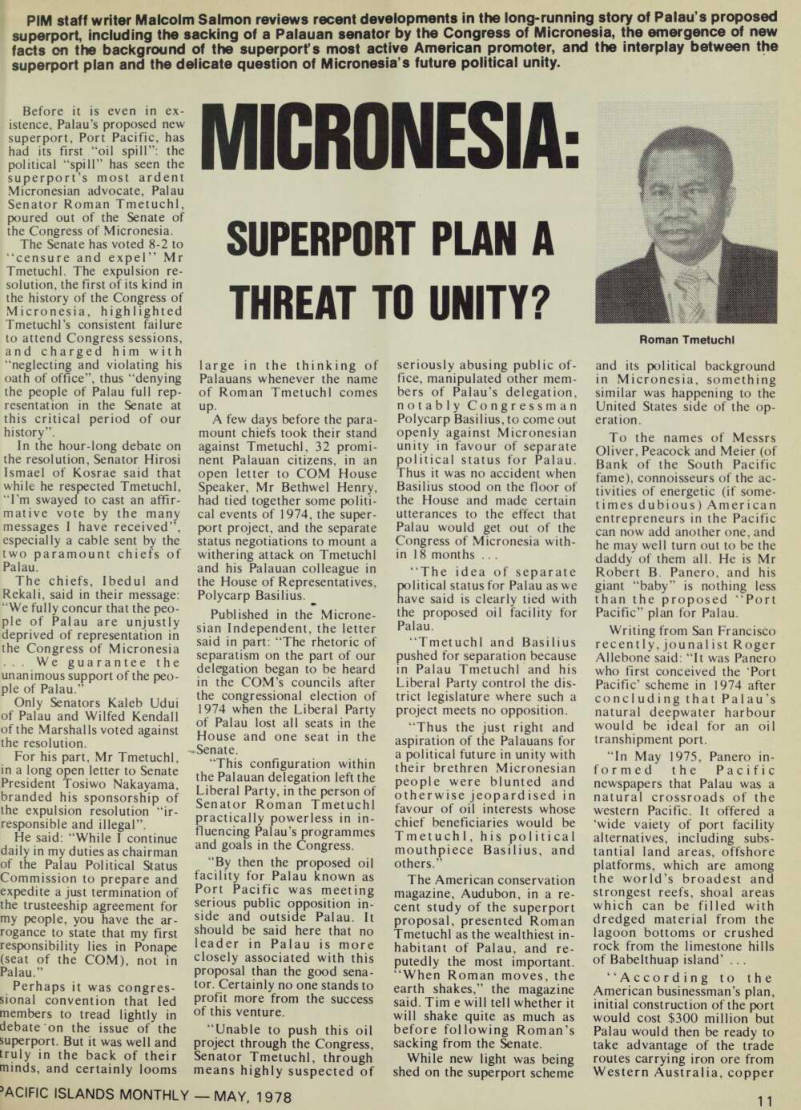
Roman Tmetuchl
from Bougainville, iron fron India, zinc and tin from Africa. Next would come refineries, oil-fired power plants, and petro-chemical in stallations.”
Allebone went on: “Whatever the truth of the re port, there was no doubt about Panero’s skill as a supersalesman on the interna tional huckster circuit.
Twelve months ago, the Los Angeles Times ran a series of front page features on the Palau superport scheme which included a detailed investiga tion of Panero’s business background. The Times Quoted federal records in icating Panero had filed for bankruptcy in 1965; ‘With an estate consisting largely of a 1962 Volkswagen, Panero’s bankruptcy file listed claims of nearly $BOO 000 from cre ditors around the world.’
“Panero’s business past ap parently didn’t concern the Texas-based millionare, Fred M. Zeder 11, who was ap pointed by President Ford in 1975 to head the US admin istration in Micronesia. Soon
Panero and Zeder were tra velling the world together to develop the superport scheme. The Times asked: ‘Was it a proper role for a US government official oversee ing Micronesia to globetrot at his own expense with someone promoting a private venture in Micronesia?’ Zeder de fended his travels as simply part of the job.”
Allebone wrote: “Conspira cy theorists can find a wealth of evidence to support fears that the superport is destined to become an enormous boon doggle.
“The Times discovered that all references to the proposal had been mysteriously drop ped from the final draft of a study on the economic future of Micronesia done last year by the United Nations.
“A specialist in environ mental and Japanese law at Harvard, Julian Gressner, was alarmed that essential infor mation about the proposal was being kept from the Palauans.
He maintains the issue goes far beyond Palau and will set an international precedent
especially in regard to the ethics of multi-national activities.
“A leading opponent of the project, the US Environment Defence Fund's attorney, David Rowe, found that an agreement had already been signed between the US Trust Territory and a worldwide Japanese trading company, N.ssho-Iwail Co in which the Americal officials had pledged^ support for the scheme before anything was known about the superport s social and environmental impact, or even the actual size and scope of the project ”
One man in a good position to try to pull the whole thing together is Stewart Beck, a New York attorney hired by the Palau legislature to represent them in the status negotiations.
Of the superport project, Beck told journalist Allebone: “The Palauan legislature has asked the US tor $2OO 000 to conducl feasibility studies tor the port. But the rest of it is just the ludicrous fantasy of some promoter.
“If the Americans, the Japanese and Iran have certain plans for Palau, I can assure you that those plans will not be implemented with out the consent of the Palauan people who have taken on Professor J. K. Galbraith as their adviser in these mat ters.”
The 69 . y e ar-old Professor Galbraith served as a key economic adviser to the late President John F. Kennedy, n e has been US Ambassador to ndia and is the author of books, „ „ . , Professor Galbraith visited P a l aua n capital, Koror, in April.
According to Micronesian News Service, he had earlier told the press in Guam his purpose was to “give the problems facing Micronesia visibility in the United States”.
He acknowledged knowing very little about the Microne sian situation and generally refrained from discussing economic problems concern ing Guam and Micronesia.
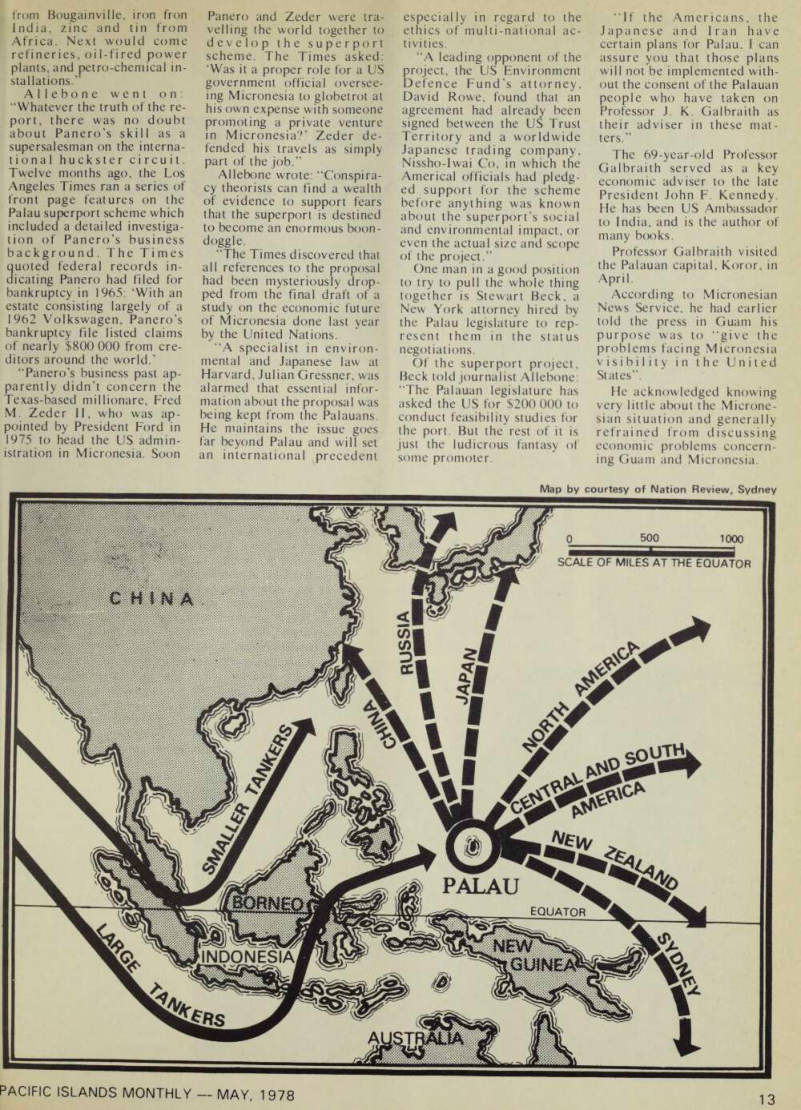
Map by courtesy of Nation Review, Sydney
Advertisements & other items, pp. 11-12 (3 items)
11
ACIFIC ISLANDS MONTHLY MAY. 1978
12
PACIFIC ISLANDS .MONTHLY MAY, 1978
Welcome aboard the Philippines.
lA W ' 1 W ~~r • r'f ’ . ’*x "'a
Discover the grace of old Spain
in the Philippines.
Sense it first
on Philippine Airlines.
The subtle blend of Spain and Asia is our in delightful harmony with the 20th century.
Four centuries of Spanish culture lends a very special beauty to The Philippines.
Like the special smile found only on Philippine Airlines Where our flight attendants’ hospitality is a 1,000 year-old Philippine tradition. heritage,
MELBOURNE
On Philippine Airlines’ wide-bodied jets, you’ll get centuries-old charm, the latest movies, the tastiest international menus.
Flights depart for Manila each Friday from Port Moresby. Also three times each week from Sydney; Monday, Thursday or Friday, or twice each week from Melbourne; Monday or Friday.
So when you’re flying to Europe or the Orient, fly to The Philippines first.
® Philippine Airlines
Welcome aboard the Philippines.
PAL 2059
The good life for Samoans
in a “rather special place”
TRAVEL- When people talk about “going to Samoa” they usually mean to Apia or to Pago Pago. Few people spare a thought for Western Samoa’s “big island ”, little-known Savai’i, nearly twice the size of the main island of Upolu and with less than half the population. Recently, Mike Field, of Apia, spent three weeks sampling the quiet life on Savai’i. This is his story.
The roads are not very good, the bus service is preposterous, the mosquitos bile like sharks and such luxuries as piped water and electricity are received by only a lucky few. But for all that, Savai’i.
Samoa's biggest island, is a rather special place and. as a
purely subjective judgment,
the better half of Western Samoa.
Savai'i is considerably less "developed” than its sister island of Upolu, although this year should see the start of major road improvements. making life easier for people.
But then life on Savai'i is not all that hard anyway.
Savai’i is 1 820 square kilometres with a population of 40 572 people. Upolu is 1 100 square kilometres with a population of 106 063.
The origins of the Polynesian people are still the subject of much debate and many scholars believe that Savai’i is the Hawaiki of Polynesian
legends. “The cradle of Polynesia” as one expression has it.
Most people in Savai’i live on the coast and cultivate the flat land which, because of its volcanic origins, is very rich.
With little effort taro and ta'amu can be grown in quan tity enough to feed an aiga (extended family). This can be supplemented with breadfruit. coconuts, pork and fish. And for those who like struggling through bush there are tasty wild pigeon. Flying foxes, which some people eat. can be had any evening by casually pointing a shotgun in the general direction of the sky.
Chances are a flying fox. which looks like a rat with wings, will head towards the
ground.
Inland Savai'i speaks of its mysterious origins. Rugged and wild with volcanic peaks and cliffs, Savai'i keeps its heart almost always shrouded in cloud. It is a lucky person
who catches a glimpse of Mt Silisili. at 1 859 metres the highest point in Samoa.
The fury of Savai’i can be seen on the north coast.
Kilometre after kilometre has been laid waste by lava flows, some as recent as the turn of this century. And on the spec tacular south coast the sea crashes into the base of massive cliffs rising straight up for nearly 200 metres. A rough road runs along the lop giving bus passengers some unforgettable sights.
Oddly, amid the evidence of nature’s violence, quiet and beautiful villages nestle on white sand beaches and man age to give a sense of order to the wildness of the mountains and the greenness of the forest.
If fa’a Samoa (the tradi tional way) and the matai (family head) system are under attack in Upolu. as some claim, the pressures of modern development have yet
to become evident in Savai’i.
The Apolima Strait seems to act as a barrier between two different limes and only the occasional ferry or the small Polynesian aircraft makes the time trip.
Samoan culture is a living daily event in Savai'i. and in village life, ceremonies are common events. Yet they re tain their importance. Re cently. I spent three weeks in the village of Neiafu. On the south coast of Savai’i. and at its western end. Neiafu is about 20 minutes driving from the timber town of Asau.
The road from Neiafu to Asau is rough and over a small range of mountains, but the view is worth it.
Neiafu is really two villages. Neiafu-uta is settled about two kilometres off the main road on a long sweeping piece of coast line made up of solid lava with sea caves, and white sand. Most fates (open sided houses) are built along the traditional lines. Neiafu tai is the other half of the village stretched out thinly on the main road up the main hill from the beach.
The Neiafu village council meets weekly. Made up of the matai of the village, the coun cil is the authority over the people of the village. Their rule is wide, but benign. Some of the rules include a ban on women wearing short dresses or trousers, men from wearing long hair and beards. And they set rules for vespers, and rules for when everybody has to settle down and sleep.
For the palagi (foreigner) these rules may sound silly, or even an invasion of the right of the individual. In Neiafu. and all other villages, with everybody living in tales and close together, such rules are necessary for harmony and peace. The village councill also settles any disputes and a policeman is an especially rare sight in Neiafu.
If some of the young people who have been to Apia, and.
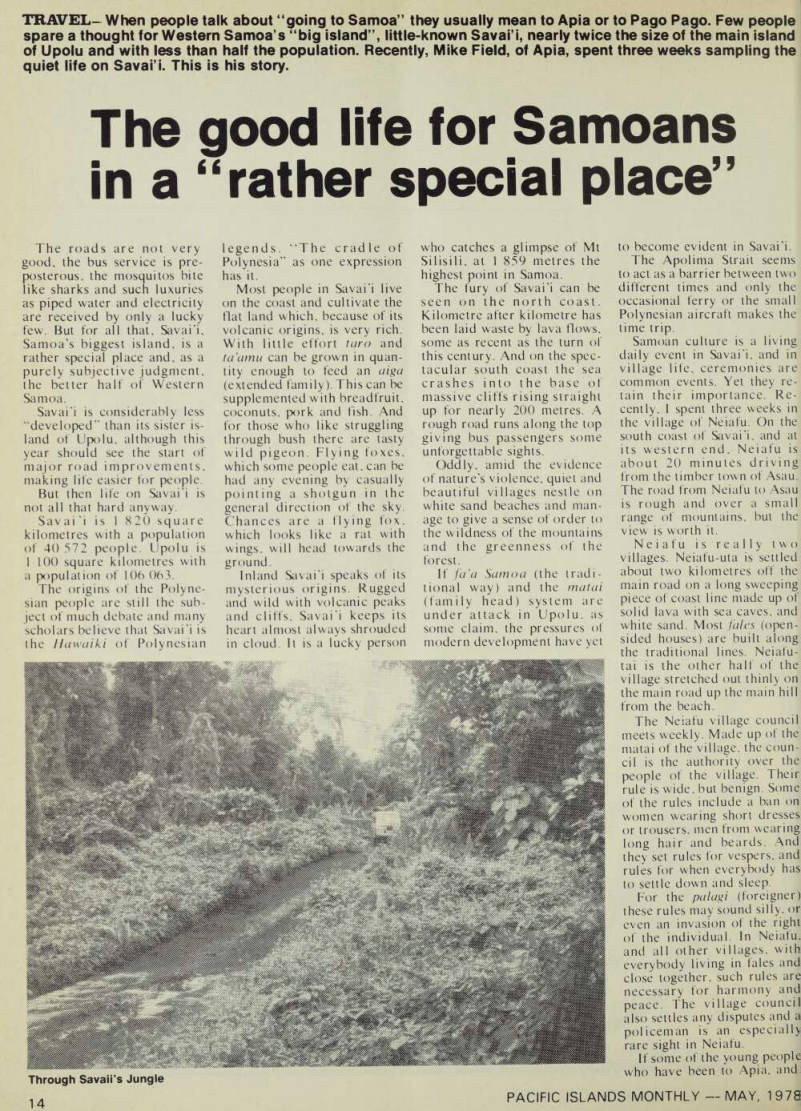
Through Savaii’s Jungle
perhaps, even New Zealand, resist the rules a bit. as they grow older they conform. On assuming a title they may even see the value of such order.
For people in the villages one day can be fairly much like the next.
People rise early, around six, when it is not so hot. The women do the usual sort of housekeeping work while the men go off to tend the taro, cocoa or whatever. Pigs need to be fed, or perhaps a new fale is to be built.
During the day older women make mats, or sit around and chat with other people. The children, when they are not at school, more or less take care of themselves.
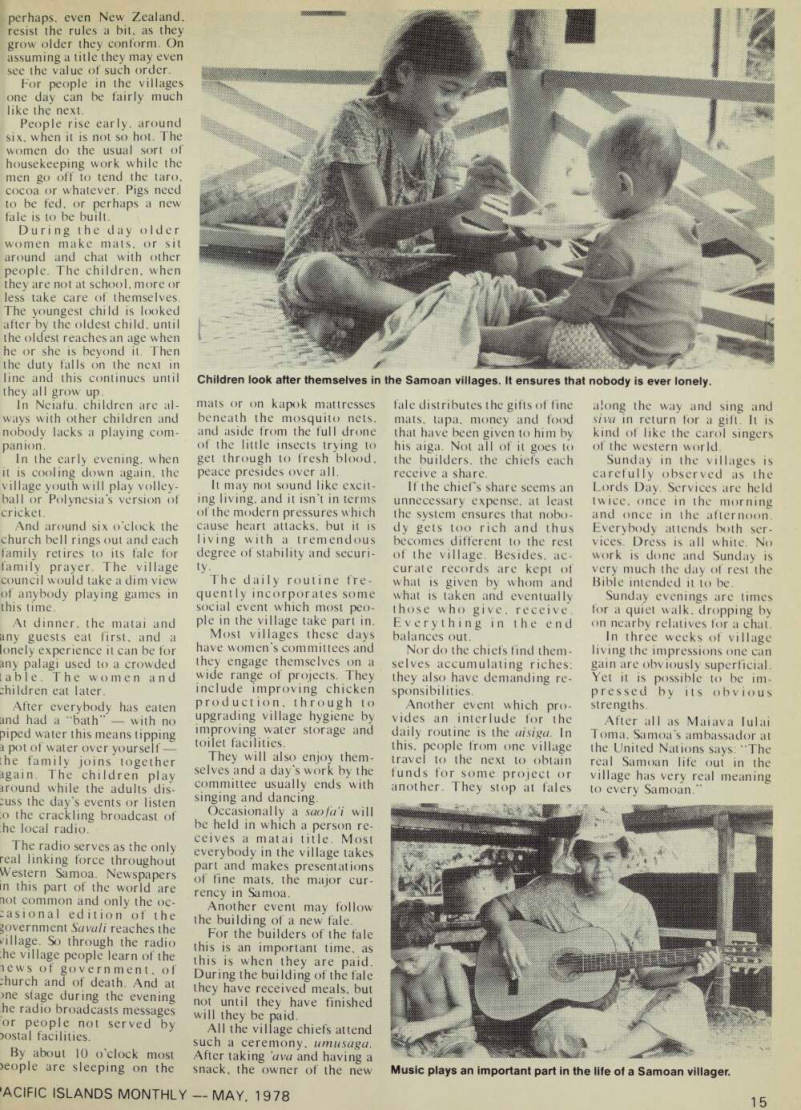
The youngest child is looked after by the oldest child, until the oldest reaches an age when he or she is beyond it. Then the duty falls on the next in line and this continues until they all grow up.
In Neiafu. children are al ways with other children and nobody lacks a playing com panion.
In the early evening, when it is cooling down again, the village youth w ill play volley ball or Polynesia's version of cricket.
And around six o'clock the church bell rings out and each family retires to its fale for family prayer. The village council would take a dim view of anybody playing games in this time.
At dinner, the matai and any guests eat first, and a lonely experience it can be for any palagi used to a crowded table. The women and children eat later.
After everybody has eaten and had a “bath” with no piped water this means tipping a pot of water over yourself
the family joins together
again. The children play around while the adults dis cuss the day’s events or listen to the crackling broadcast of he local radio.
The radio serves as the only
real linking force throughout
Western Samoa. Newspapers
in this part of the world are not common and only the oc casional edition of the government Sava I i reaches the tillage. So through the radio the village people learn of the aews of government, of church and of death. And at )ne stage during the evening .he radio broadcasts messages or people not served by )ostal facilities.
By about 10 o’clock most )eople are sleeping on the
along the way and sing and siva in return tor a gill. It is kind of like the carol singers of the western world.
Sunday in the villages is carefully observed as the Lords Day. Services are held twice, once in the morning and once in the afternoon.
Everybody attends both ser vices. Dress is all white. No work is done and Sunday is very much the day of rest the Bible intended it to be.
Sunday evenings arc times tor a quiet walk, dropping by on nearby relatives for a chat.
In three weeks of village living the impressions one can gain are obviously superficial.
Yet it is possible to be im pressed by its obvious strengths.
After all as Maiava lulai Toma, Samoa's ambassador at the United Nations says; "The real Samoan life out in the village has very real meaning to every Samoan."
mats or on kapok mattresses beneath the mosquito nets, and aside from the full drone of the little insects trying to gel through to fresh blood, peace presides over all.
It may not sound like excit ing living, and it isn't in terms of the modern pressures which cause heart attacks, but it is living with a tremendous degree of stability and securi ty- The daily routine fre quently incorporates some social event which most peo ple in the village take part in.
Most villages these days have women’s committees and they engage themselves on a wide range of projects. They include improving chicken production, through to upgrading village hygiene by improving water storage and toilet facilities.
They will also enjoy them selves and a day’s work by the committee usually ends with
singing and dancing.
Occasionally a saofa’i will be held in which a person re ceives a matai title. Most everybody in the village takes part and makes presentations of fine mats, the major cur rency in Samoa.
Another event may follow the building of a new fale.
For the builders of the fale this is an important time, as this is when they are paid.
During the building of the fale they have received meals, but not until they have finished will they be paid.
All the village chiefs attend such a ceremony, umusaga.
After taking ’ava and having a snack, the owner of the new
tale distributes the gifts of fine mats. tapa. money and food that have been given to him by his aiga. Not all of it goes to the builders, the chiefs each receive a share.
If the chiefs share seems an unnecessary expense, at least the system ensures that nobo dy gets too rich and thus becomes different to the rest of the village. Besides, ac curate records are kept of what is given by whom and what is taken and eventually those who give, receive.
Everything in the end balances out.
Nor do the chiefs find them selves accumulating riches, they also have demanding re sponsibilities.
Another event which pro vides an interlude for the daily routine is the aisiga. In this, people from one village travel to the next to obtain funds for some project or another. They stop at tales
Children look after themselves in the Samoan villages. It ensures that nobody is ever lonely
Music plays an important part in the life of a Samoan villager.
Advertisements & other items, p. 15 (1 item)
15
ACIFIC ISLANDS MONTHLY MAY, 1978
Pants for penis gourds: Indonesia’s

cultural plan for West Irianese
IRIAN JAVA The Indonesian’s plan to bring the people of Irian Jaya into the 20th century is meeting with several obstacles. Dr R. S. Roosman, senior lecturer in Indonesian Studies at the University of Papua New Guinea, gives the background to events of the last few years.
The first disaster was in mid-1976 when a severe tremor rocked Irian Jaya’s Highlands causing massive landslides along the Balim (formerly spelled Baliem) valley, burying villages and killing an estimated 2 000 people. In less than a year another disaster of a different character and magnitude struck the area taking an even heavier toll among its inhabi tants.
On the eve of the Indone sian general elections in March, 1977, warriors of the local Dani tribes the in habitants of the Balim valley armed with axes, spears, bows and arrows went on a rampage, destroying air strips, schools, polyclinics and government offices, kill ing or wounding a number of Indonesian police, military and administrative personnel.
One foreign missionary was severely wounded.
All this happened i n Karubaga, Bokondini, Kelila, Asologima, Tiom, Magi and Kurulu villages or hamlets in the Jayawijaya district bor dering Papua New Guinea.
And 547 Indonesian officials together with their families fled to the district capital of Wamena, leaving everything behind. The rebellion spilled over to neighbouring Paniai district to the West. The mili tary retaliated with planes, rockets and other modern weapons.
One June 6, 1977, an eight man team flew from the prov incial capital Jayapura to Wamena and some other trou ble spots to assess the situ ation. They produced a first hand report for the governor.
Despite the carefully formu lated phrases commonly used in Indonesian official newscoverage this report unmistakeably disclosed a political tragedy which had befallen one of the most pri mitive tribes on earth.
According to the report, the troubles started at the begin ning of 1976 when a break down of authority occurred
after Indonesian authorities hesitated to take firm steps to contain a series of incidents taking place in the area a tribal war between the Kimbin and Piramid clans; an attempt of local villagers to cross the Papua New Guinea-Indone sian border, during which some of them were caught at Lereh near the border; the en tering of the rebel leader Marthen Tabu of the OPM (an Indonesian acronym for “Free Papua Movement”) into the Highland area; the opposition of local villagers to tactless policies imposed by civilian and military authorities and clashes over the selection of local representatives during the general election campaign which was used by the OPM to provoke incidents.
On April 7 a large number of villagers under Marthen Tabu, armed with spears, bows and arrows, attacked the
spread over an extensive area and involved numerous tribes, the government’s statemement proved to be too simplistic. Meanwhile,several hundred Irianese villagers at tempted to cross the border into Papua New Guinea but were halted by the Papua New Guinea border authorities.
The United Nations Rep resentative for Refugee Affairs flew in from Port Moresby for a first-hand look into the troubles. After reassurances of a safe passage home, the villagers were ad vised to return to their villages.
Political developments in Irian Jaya and government policies for in the area over the last seven years lead us to believe that the cause of the rebellion in the Jayawijaya Highland district is of a more complex character than sug gested initially.
The practice of Indonesian government policies in Irian Jaya dated back to the early 1960 s when a confrontation occurred between the Nether lands, which, at the time, held West New Guinea, now Irian Jaya, and Indonesia, which claimed the territory was an integral part of the country.
To pave the way for transfer of West New Guinea to In donesia, an agreement be tween Indonesia and the Netherlands on West New Guinea was signed on August 15, 1962.
Under the chapter “Indone sian Administration and Self Determination” Article XIV which is of significance for understanding further In donesian policies in Irian Jaya, says, “After the transfer of full administrative re sponsibility to Indonesia, In donesian national laws and regulations will, in principle, be applicable in the territory, it being understood that they be consistent with the rights and freedoms guaranteed to the inhabitants under the terrm of the present Agreement”, and also: “After the transfer
Pagai police post, snatched their firearms and incited people to rebel against the In donesian Government. On April 20, about 800 OPM followers attacked the Kobak ma post killing three soldiers; in the melee 10 civilians died, and a missionary was severely wounded. As soon as the troops were called in, people fled into the bush. They dare not return to their villages for fear that they would be suspected of “being a spy for or collaborating with the rebels”.
The cause of the unrest, said the Indonesian Government was “a soccer match which developed into a tribal war”.
Since there have been no tribal wars in the Highlands for the last five years as they are prohibited by the In donesian administration and judging from the mag nitude of the unrest which
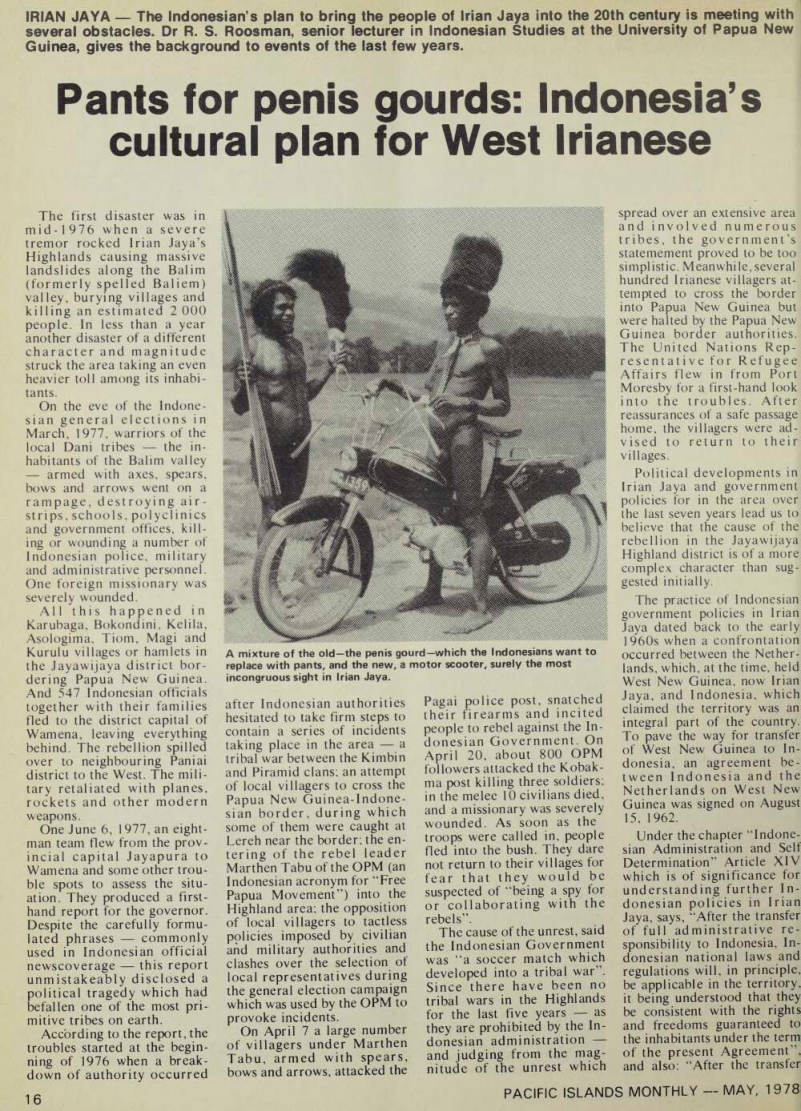
A mixture of the old—the penis gourd—which the Indonesians want to replace with pants, and the new, a motor scooter, surely the most incongruous sight in Irian Jaya.
of full administrative re sponsibility to Indonesia, the primary task of Indonesia will be further intensification of the education of the people, of the combating of illiteracy, and of the advancement of their social, cultural and economic development.
Efforts also will be made in accordance with present In donesian practice to ac celerate the participation of the people in local govern ment through periodic elec tions”.
After an interim period during which the United Na tions took over administration of the area, under the PePeßa an Indonesian acronym for Penentuan Pendapat Rakyat (Determination of People’s Opinion) commonly and probably inaccurately trans lated as the “Act of Free Choice”, West New Guinea in 1969 was incorporated into the Republic of Indonesia as its most eastern province.
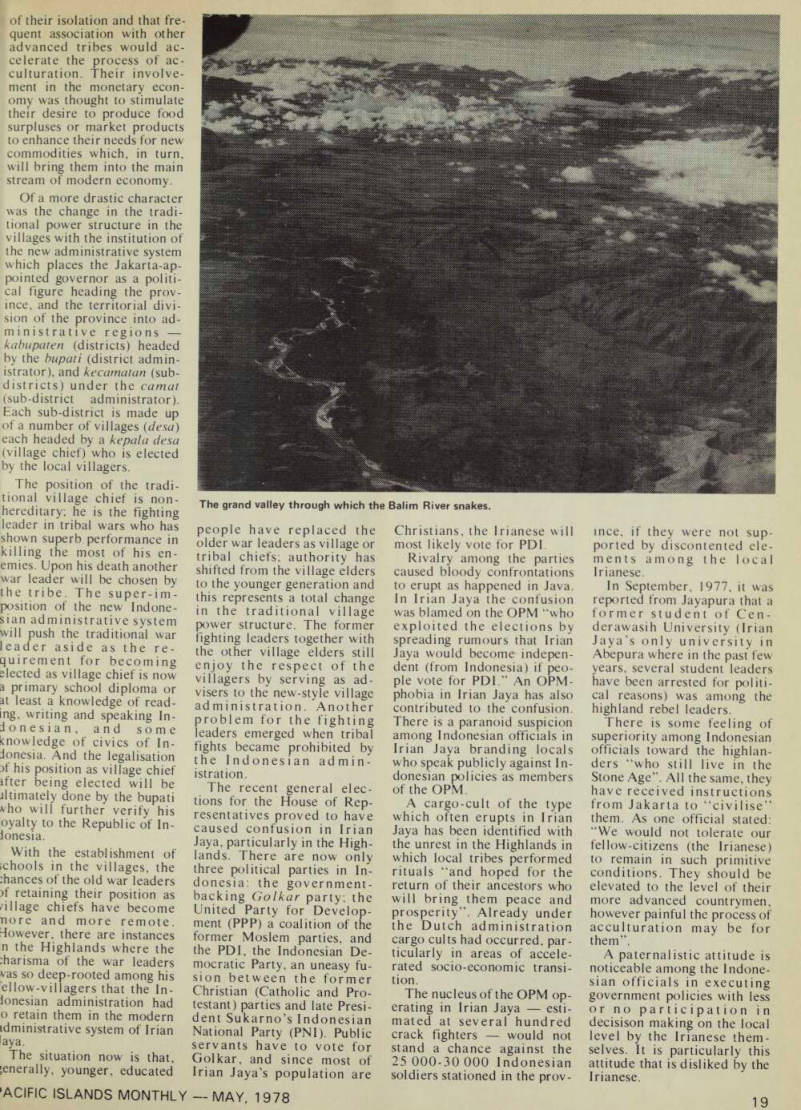
The Balim Valley was “dis covered” by an American ex pedition in 1938. Outsiders first thought there were no in habitants in the deep interior of West New Guinea and the Dani tribes the autochthones of the valley first thought “they were the only people on earth”. World War II had left the Danis in their traditional isolation.
After the war, when the Dutch reoccupied their former col
onial territory, administration
was set up in the Highlands in the 1950 s after the mission
aries had moved into the in terior.
On September 16, 1969, President Suharto flew to the provincial capital Jayapura, to address the Irian Jaya House of Representatives and urged “full participation of Irian Jaya’s population in the development programme”, stressing that Irian Jaya’s ad ministrative apparatus would be directed towards re construction. He then visited several inland areas including Womena, the Jayawijaya Highland district capital and instituted the Task Force with the sole aim of developing Irian Jaya’s rural sector. Irian Jaya’s governor functions also as chairman of the Task Force Programme with the military commander as his co-chair man.
Meanwhile, the Repelita five-year national develop ment programme was insti gated in 1969 for the whole of Indonesia; due to technical difficulties it could only be started in Irian Jaya in 1970.
The priorities of the program me lie differently for the re spective provinces; for Irian Jaya the emphasis was placed on the reconstruction of its in fra-structure, roads, air and sea transport, and telecom munications. The longest road in Irian Jaya passable for ve hicles is only 150 km long.
Practically all transport has to be by air.
The less than one million population of Irian Jaya lives on a land surface of 413 000 square kilometres giving a
population density figure of two people to a square kilometre, and 80% of the population lives in an archaic state in the jungle covered in terior. Only the coastal population had been in con tact with the outside world for the last hundred years.
It was unfortunate that Acub Zainal —then governor had emphasised urban development and neglected the rural sector. This caused criticism and discontent among the population.
One cause was the Koteka Operation which was aimed at replacing the penis gourds (koteka ) of the highlanders with short pants for the males, and giving sarongs to the females. It proved to be a failure, and had to be aban doned. The distribution of clothes was not well organ ised: most of the highlanders received only one piece and had to wear it for some time; the dirty clothes were thrown away and people returned to their former habit of wearing kotekas and mini-grass skirts.
Local administrators, who were too officious in follow ing the instructions, imposed the wearing of clothes by the highlanders forcefully, caus ing a general resentment against the officials to
develop.
However, clothes distribu tion has been continued with the difference that now Presi dent Suharto’s portrait and the Indonesian red-and-white flag are inserted in each
package with the obvious message of “who is in power”, for most of the highlanders live in scattered and often iso lated hamlets in the rugged mountain areas where govern ment patrols come once in three months at the most, or never at all.
There are still tribes in the deep interior of Irian Jaya who have never seen an In donesian or a representative of the Indonesian Govern ment, and who recognise the traditional authority of their war-leaders as the sole authority in their villages.
With the policy of estab lishing its administration and reinforcing its authority in Irian Jaya, the Indonesian Government aims at resettling the so-called suku terasing , an Indonesian term for “isolated or alienated tribes” many of whom are nomads practising hunting and slash-and-burn food cultivation, along main roads leading to district capitals as has happened around Jayapura, Biak.
Manokwari, Sorong and Merauke. It is anticipated that “the new settlers will end their nomadic life and start practising permanent agriculture; subsequently they will bring their produce to the local or district markets which will bring them into regular contact with other tribes and furthermore will enhance the earning of money”.
It was speculated that these contacts would take them out
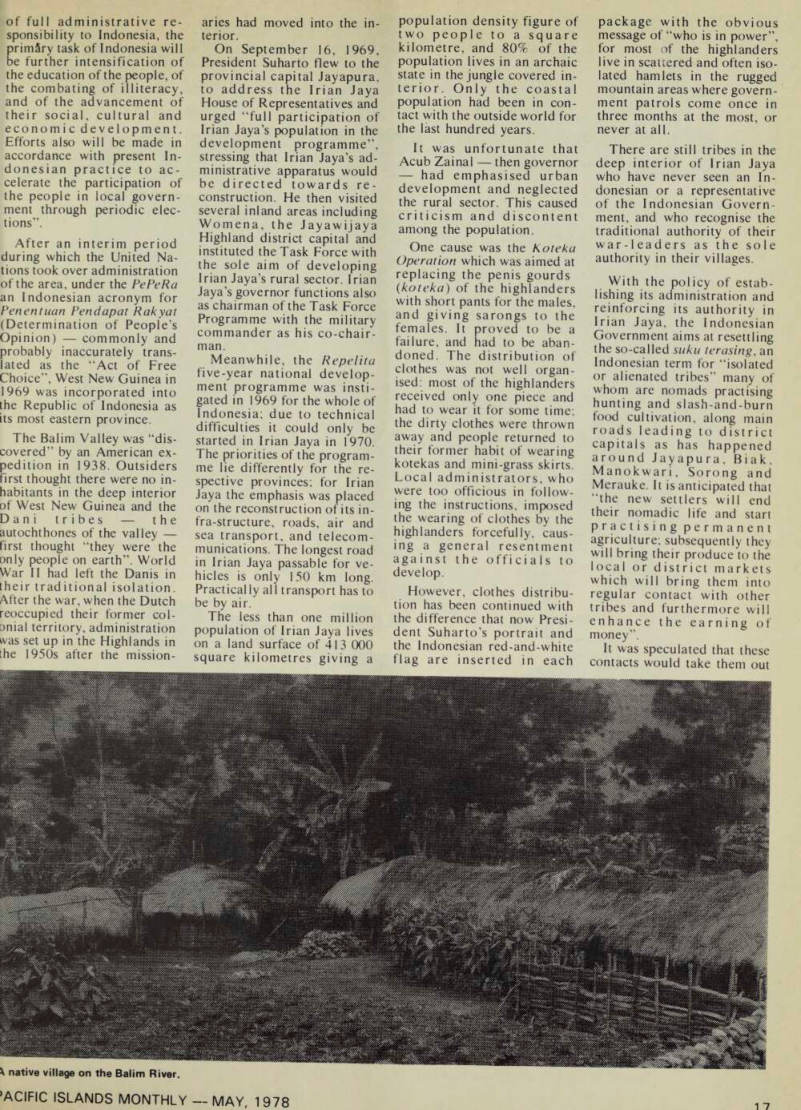
A native village on the Balim River.
of their isolation and that fre quent association with other advanced tribes would ac celerate the process of ac culturation. Their involve ment in the monetary econ omy was thought to stimulate their desire to produce food surpluses or market products to enhance their needs for new commodities which, in turn, will bring them into the main stream of modern economy.
Of a more drastic character was the change in the tradi tional power structure in the villages with the institution of the new administrative system which places the Jakarta-ap pointed governor as a politi cal figure heading the prov ince, and the territorial divi sion of the province into ad ministrative regions kabupaten (districts) headed by the bupati (district admin istrator), and kecamatan (sub districts) under the camat (sub-district administrator).
Each sub-district is made up of a number of villages ( desa) each headed by a kepala desa (village chief) who is elected by the local villagers.
The position of the tradi tional village chief is non hereditary; he is the fighting leader in tribal wars who has shown superb performance in killing the most of his en emies. Upon his death another war leader will be chosen by the tribe. The super-im position of the new Indone sian administrative system will push the traditional war leader aside as the re quirement for becoming sleeted as village chief is now a primary school diploma or at least a knowledge of read ing, writing and speaking In- Jonesian, and some knowledge of civics of In donesia. And the legalisation af his position as village chief ifter being elected will be iltimately done by the bupati vho will further verify his oyalty to the Republic of In lonesia.
With the establishment of ichools in the villages, the Tiances of the old war leaders )f retaining their position as dllage chiefs have become nore and more remote, however, there are instances n the Highlands where the diarisma of the war leaders vas so deep-rooted among his ellow-villagers that the In lonesian administration had o retain them in the modern idministrative system of Irian [ aya.
The situation now is that, generally, younger, educated
people have replaced the older war leaders as village or tribal chiefs; authority has shifted from the village elders to the younger generation and this represents a total change in the traditional village power structure. The former fighting leaders together with the other village elders still enjoy the respect of the villagers by serving as ad visers to the new-style village administration. Another problem for the fighting leaders emerged when tribal fights became prohibited by the Indonesian admin istration.
The recent general elec tions for the House of Rep resentatives proved to have caused confusion in Irian Jaya, particularly in the High lands. There are now only three political parties in In donesia: the government backing Golkar party; the United Party for Develop ment (PPP) a coalition of the former Moslem parties, and the PDI, the Indonesian De mocratic Party, an uneasy fu sion between the former Christian (Catholic and Pro testant) parties and late Presi dent Sukarno’s Indonesian National Party (PNI). Public servants have to vote for Golkar, and since most of Irian Jaya’s population are
Christians, the Irianese will most likely vote for PDI.
Rivalry among the parties caused bloody confrontations to erupt as happened in Java.
In Irian Jaya the confusion was blamed on the OPM “who exploited the elections by spreading rumours that Irian Jaya would become indepen dent (from Indonesia) if peo ple vote for PDI ” An OPM phobia in Irian Jaya has also contributed to the confusion.
There is a paranoid suspicion among Indonesian officials in Irian Jaya branding locals who speak publicly against In donesian policies as members of the OPM.
A cargo-cult of the type which often erupts in Irian Jaya has been identified with the unrest in the Highlands in which local tribes performed rituals “and hoped for the return of their ancestors who will bring them peace and prosperity”. Already under the Dutch administration cargo cults had occurred, par ticularly in areas of accele rated socio-economic transi tion.
The nucleus of the OPM op erating in Irian Jaya esti mated at several hundred crack fighters would not stand a chance against the 25 000-30 000 Indonesian soldiers stationed in the prov
mce, if they were not sup ported by discontented ele ments among the local Irianese.
In September, 1977, it was reported from Jayapura that a former student of Cen derawasih University (Irian Jaya’s only university in Abepura where in the past few years, several student leaders have been arrested for politi cal reasons) was among the highland rebel leaders.
There is some feeling of superiority among Indonesian officials toward the highlan ders “who still live in the Stone Age”. All the same, they have received instructions from Jakarta to “civilise” them. As one official stated; “We would not tolerate our fellow-citizens (the Irianese) to remain in such primitive conditions. They should be elevated to the level of their more advanced countrymen, however painful the process of acculturation may be for them”.
A paternalistic attitude is noticeable among the Indone sian officials in executing government policies with less or no participation in decisison making on the local level by the Irianese them selves. It is particularly this attitude that is disliked by the Irianese.
The grand valley through which the Balim River snakes.
Advertisements & other items, pp. 17-18 (2 items)
17
’ACIFIC ISLANDS MONTHLY MAY, 1 978
into memories
4 Turn moments
■ if m\ m
C 0U0"* E
I oot c A* T * /70& COi°* no
FOP
*0
take your pictures
on Kodak film.
See your photo dealer now.
K6l-5076
People
Captain John Francis O’Connor, 55, well-known ship’s master in the South Pacific, has retired after 29 years with China Navigation and associate companies. He was born in Portsmouth, Eng land, and joined China Navigation in Hong Kong in 1949. He was transferred to Australia in 1958, and cap tained China Navigation, NGAL and Swire ships on many routes in the South Pacific and Far East. His work took him to Papua New Guinea ports, the Solomons, Nauru, and the Gilbert and Ellice Islands in ships carry ing cargo and/or passengers.
He saw the transition of cargo from break bulk to pallets and containers. His last command was the NGAL container ship, Papuan Chief, which went into service in 1977. He speaks of good-natured rivalry with masters of other lines, and delights in telling a story about Captain Bill Wilding, who was once master of the Bulolo. If the Bulolo happen ed to arrive at Port Moresby and found a China Navigation ship at the dock, he would call out “Get off the wharf, you pirates”. Captain O’Connor is now living at Roseville, Sydney, doing a “bit of gar dening”. He does not intend to think of another sort of job for a couple of years.
David Aingamea. 20, is the youngest postmaster ever on Nauru. He qualified as an ac countant at the Gordon In stitute in Australia and work ed in the Nauru Treasury before becoming acting depu ty postmaster in 1976. He has just completed several months in Fiji working in the data processing computer centre under the South Pacific Bureau for Economic Co-op eration fellowship scheme.
While in Fiji he learned three “computer” languages.
Two new overseas diplomats have been ap pointed to represent their countries in Papua New Guinea. They are Mr Othman Wok, as High Commissioner
for Singapore, and Mr Jose Bazan. as Ambassador for Mexico. PNG only recently entered into diplomatic rela tions with Mexico.
Mr Justice Raine, a former New South Wales barrister, has been appointed Deputy Chief Justice in Papua New Guinea. He was appointed to the PNG Supreme Court as a puisne judge in 1970. In his new post he succeeds Sir William Prentice, who was appointed PNG Chief Justice in 1977.
After 50 years of sailing in the Islands I’ve got to know many missionaries of different denominations, some of whom became my very good friends, writes Captain Brett Hilder in a memoir of the late Dr Charles Fox of the Solomons.
Of these, some have been saintly, some earthly, and while all have been devoted men, some have been most remarkable for their great commonsense. Most of them didn’t waste time talking religion, and Dr Fox was no exception. He told me humorous tales of playing cricket in the islands, and we also talked about conchology and history. For he had a new shell from Malaita called after him, and it was he who found sherds of strange pot tery which later proved to be from the settlement of Spanish survivors of the Santa Isabel, lost from Mendana’s ex pedition of 1595. The site was at Pumua, on San Cristobal.
Writing from memory, I think it was in 1954 that I had my strangest encounter with Dr Fox, when 1 was master, under God, of the Malaita.
Upon our arrival at Honiara a deputation from the Melane sian Mission headed by Dr Fox and some archdeacons, called upon me aboard the ship. At the time they had no bishop, as the last one had just retired back to New Zealand after a brief tenure of office. I did wonder why such a big party should be necessary, but Dr Fox came to the point very directly. THEY WANTED
To Nominate Me As
Their New Bishop!
I burst out laughing with astonishment, and then ex plained that as I had never been a priest or even a deacon in the Church, I wasn’t in any way qualified. Dr Fox then asked me if I was an Anglican, to which 1 said “Yes”, and had
I been confirmed? Which I was also able to reply to in the affirmative. “Then” said Dr Fox, “that’s all that’s re quired, as by the rules of the Church a layman can be elected bishop.” This 1 didn’t believe, so one of the party was sent to their headquarters to get the book of rules, and I was shown the procedure for the choice of a bishop.
Dr Fox was right of course, and he also assured me that the rules of the Church of Rome were identical, so that a layman could be elected Bishop of Rome, in other words the Pope. He told me that a layman was elected Pope at least once in history.
By this time the shock was wearing off a bit, when the next surprise came out. The salary of the Bishop of Melanesia was £stgl2s a year! 1 didn’t feel the “call” to become a missionary, let alone a bishop, and as I had a
wife and four starving children in Sydney, I thought that I should remain in Burns Philp ships to earn as much as I could. The deputation was disappointed that 1 declined their offer, though I thanked them sincerely for the honour they had done me. But with out a private income, or an army of former parishioners to support me, even the chance of martyrdom or im
mortality did not tempt my heart.
The next question was, who could they now choose as bishop? I had a good answer to that, for apart from Dr Fox, who would not consider becoming “My Lord Bishop”, the very best choice was Alfred Hill, who had been on the mission for many years.
Alfred had gone to sea for many years, and, like myself, had obtained his extra master’s certificate. He rose to become a passenger ship cap tain in the North Atlantic, then swallowed the anchor to be a lay missionary in the Port of London. He was next asked to go to the Solomons to look after the Southern Cross and smaller vessels of the mission.
For several years he had been running the mission high school for boys on Ugi Island (now Uki) and he had it mov ing at the double like a naval college. After proposing him for nomination with great haste, 1 was informed by Dr Fox that Alfred had already been approached, and had declined very firmly, as he wanted to remain with his school.
“You just tell him from me”
I said, “that he’s the only man for the job, and that he must accept the nomination”. And he eventually did, after trying to pass the buck to me, and served for several years as bishop in an unexpectedly difficult period, before retir ing and dying.
Dr Fox and I remained good friends, and I had the greatest admiration for his ut ter humility, and his devotion to the native people of the Solomons. His efforts were best illustrated by his found ing the native brotherhood, and his constant endeavour to feel and think like the least advanced of his brethren and followers.
Captain John Harrison, 50, Director of Marine in Fiji, has retired. London-born John Harrison spent 22 years at sea and 12 years ashore during his career. When only 14 years old he started sea training with the Royal Navy, later joining Shaw Savill merchant service, in which he became a chief officer. From 1956 to 1965 he was in the Royal New Zealand Navy, in which he commanded a research ship for four years. Captain Har rison went to Fiji in 1966, serving as Harbour Master, first at Suva, then at Lautoka, then at Suva again before he
'Bishop’ Milder
became Assistant Director of Marine. He became head of his department in 1972. He will live about 30 km from Suva in his retirement. Once a quarter he will attend meet ings of the Pacific Forum Line of which he is a director.
Papua New Guinea’s Governor-General, Sir Tore Lokoloko, paid an official visit to Australia in March.
He was able to relax within a short time of his arrival when the PNG Consul-General in Sydney, Mr Austin Sapias, put on a welcome barbecue for him at his attractive home in the Sydney suburb of Gordon.
Sir Tore was able to let his hair down surrounded as he was by some old friends.
Among them were Sir “Hor rie” Niall, ex-speaker of PNG’s House of Assembly and now living retired in Sydney, and Fred Kaad, a familiar figure at all functions where old PNG hands foregather. But Sir Tore was not able to shed his important role all the time. He had an investiture in the garden while the odour of sizzling steaks wafted around. A surprised guest, ex-PNG hand Mr Harry Jackman, found himself on the receiving end when the Governor-General pinned on to him the insignia of the MBE which Harry was award ed in the Queen’s New Year’s Honours list. Harry was one of the people responsible for
the now flourishing co-op
erative movement in Papua New Guinea. The tears weren’t far away from Harry’s eyes when Sir Tore did the job.
In many of the more developed countries there is still a great deal of debate going on about ways and
means of introducing FM
radio, which gives a far superior level of musical rep roduction than the older AM system. In his electrical workshop at Avarua, Rarotonga, Gordon Brereton has set up his own FM station.
Gordon for many years was a technician with the radio sec tion of the Post Office in the Cook Islands and at one time fell foul of the New Zealand authorities for operating an unlicensed transmitting sta tion.
The Cook Islands Govern ment has now given Gordon permission to broadcast in the FM band so long as he does not operate for commercial returns. The station provides a very useful service for the duty-free shops which wish to demonstrate the FM capacity of the radios they sell.
This FM station is pro viding a musical fare that is new to listeners in the Cook Islands, who have been limited in the past to the programmes provided by Radio Cook Islands. Now, for those who prefer it, there is the opportunity to listen to modern jazz, the classics, or musical comedy. And at times Gordon has added to the spice of the Cook Islands air waves by broadcasting segments of “Steptoe and Son”.
Duncan Justus Seko, 27, is believed to be the youngest secondary school inspector in Papua New Guinea. He is also a phenomenally good golfer.
Mr Seko had the first golf game of his life just two years ago. He now plays off a han dicap of seven.
For the uninitiated, it is considered very good for a golfer of such short ex perience to have a handicap in the 20s. To get down to be tween 20 and 10 in such a short time is rare. To get under 10, and closer to five, is astounding.
Now based at Madang, Duncan says: “Although I still haven’t had any lessons, I did have the good luck to be able to attend a clinic conducted by John Sullivan, the Australian professional who won the 1977 Rabaul Open.”
His success, like success in any field, called for hard work. “When I am in town, which is only every second week because of my school duties, I play at least nine holes three times during the week and 18 on Saturdays. I always carry 100 balls in my bag and hit 250 practice shots twice a week.
“My only regret is that I do not have more time to play and practise, as I would dearly like to represent PNG in the next South Pacific Games. I would also like to get my handicap down to two or three by the end of this year.”
Mr Seko has another hope: he would like to see golf in troduced into the schools.
“Golf is a game that assists character development, is challenging and requires hard work,” he says. “All these things are necessary for our youth.
“Papua New Guineans are naturally athletic. I have seen 10 and 1 1-year-olds in Goroka, Lae and Madang swinging naturally and sweetly with ‘clubs’ they’d made from limbs of trees.
“There is, at least, one of these youngsters who could go on and become a successful professional on the interna tional circuit if given the op portunity.”
Although he is well aware of the problems partic ularly the cost of golfing equipment Mr Seko is op timistic about the growth of the game in PNG. Says he: “When Papua New Guinea produces an international, the game will start booming throughout the country.”
Two years ago Hyan Sirrup, 28, a charge hand operator at Madang, Papua New Guinea, was cutting down a tree. The
tree veered as it fell. As a re sult, Hyan had both legs am putated.
Hyan, in due course, re ceived compensation of K 5 000. This amount soon shrank to K 2 000. John Pur vis, the then manager of the local branch of the PNG Banking Corporation, agreed to grant Hyan a loan to buy a truck, provided someone at Jants, the woodchip indus trialists, would supervise the truck’s operation.
Jants not only agreed, they gave Hyan a contract to con vey employees to and from logging sites.
Today, with the aid of wan toks (relatives and friends) as drivers, Hyan is surviving
financially.
Industrialists and bankers are not always associated with humanitarian attitudes. But there are cases . . .
Despite an appeal from Gilbert Islanders to the Bri tish Government to allow retiring Governor Mr John Smith to stay until after Inde pendence this year, Mr Smith has to leave in May. London turned down the appeal. His successor will be Mr R. O.
Wallace, who has been dog
ging Mr Smith’s footsteps
somewhat. Mr Smith was Financial Secretary in the Solomons until his ap pointment as Governor of the Gilberts. Mr Wallace has also served in the Solomons as Financial Secretary.
Harry Jackman MBE
Adi Margaret Mara (centre), daughter of Fiji Prime Minister Ratu Sir Kamisese Mara, photographed on Australia's Gold Coast after presenting a Fiji flag to Miss Lyn Moore (left), of Seaworld Marine Park, to add to other national flags flying at the Qantas International Pavilion at the park. At right is Mr Russ Gribble, Fiji Visitors Bureau man in Queensland.
Advertisements & other items, p. 22 (1 item)
Fly the world's largest fleet...
Pan Am 7475.
AO 747
RWAM
F¥WAM
747 AO
RAM AM
747 747 747
RANAIVf
/ n 2 If you're like us, you know a great thing when you see it.
Wide-bodied 747's are the fastest and most comfortable passenger planes available. And vye fly nonstop to more U.S. cities than any other airline in the world including record-setting long range flights. No other airline can match our daily nonstop round trips between Tokyo and New York. We fly the world's longest commercial nonstops from Sydney to San Francisco. Building an entire fleet of 747's just made good sense.
Our inflight service crews try very hard to meet your every need in the warmest, most personal manner possible. Wide, spacious cabins give you living room comfort as the world slips by.
Our 7475 P "Super Performer"
has lower fuel consumption, higher flying altitudes and faster speeds, making even the longest trip a little shorter. Pan Am's 7475 P is
Experience in tangible form.
You'll find Upper Deck Dining in the First Class lounge at the top of the spiral staircase. Enjoy a gourmet experience from a choice of four select entrees.
No matter where yotTfly in the world, you're always at home with Pan Am. We assembled the largest fleet of Pan Am 747's just for you.
Exneri makes the difference. 065. P 285
Pineapples, and
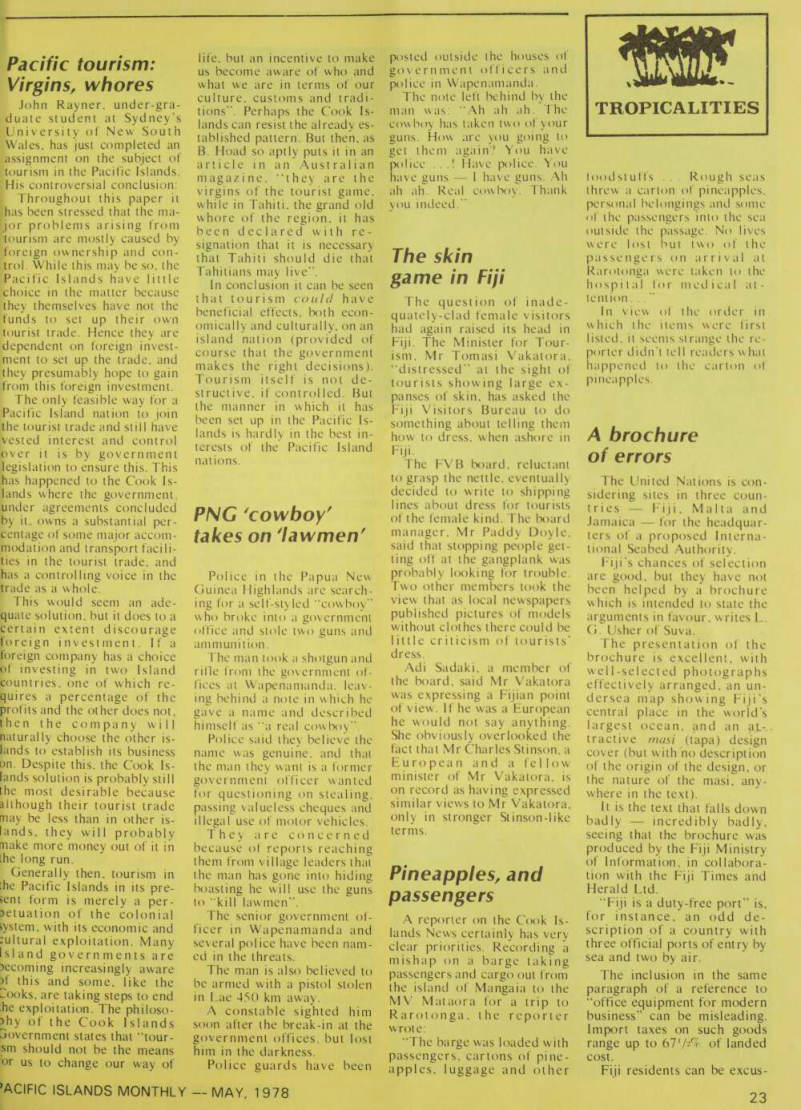
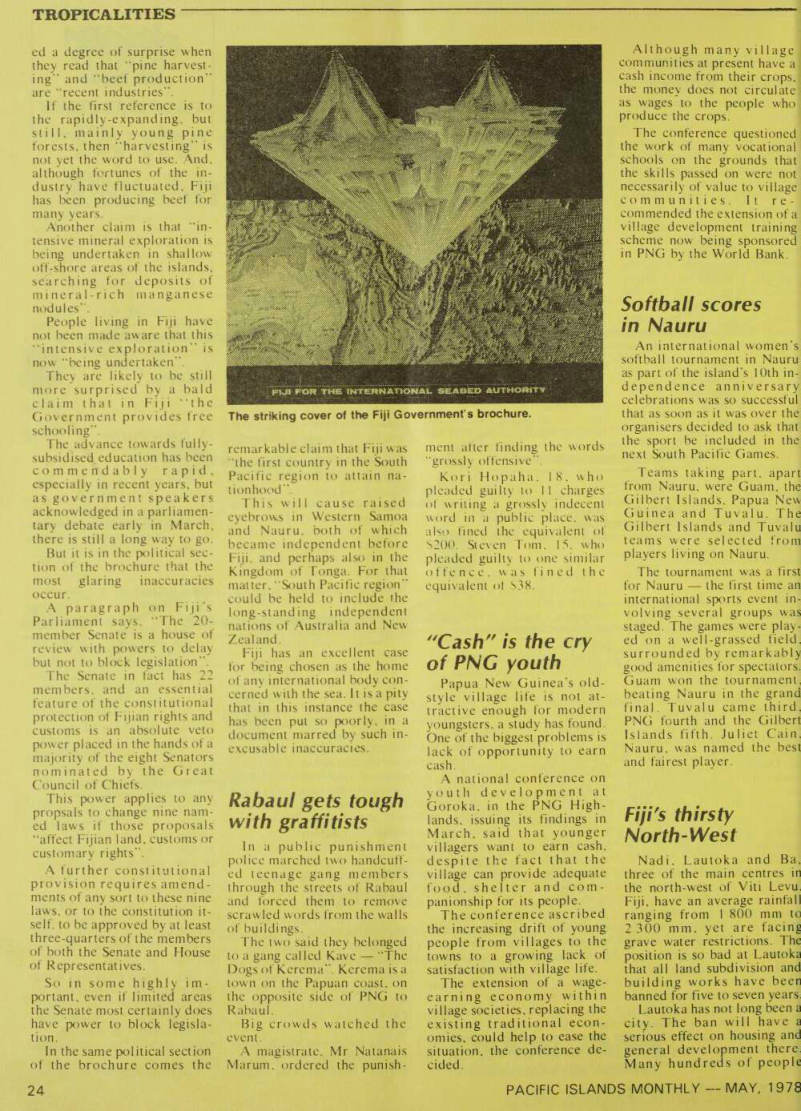
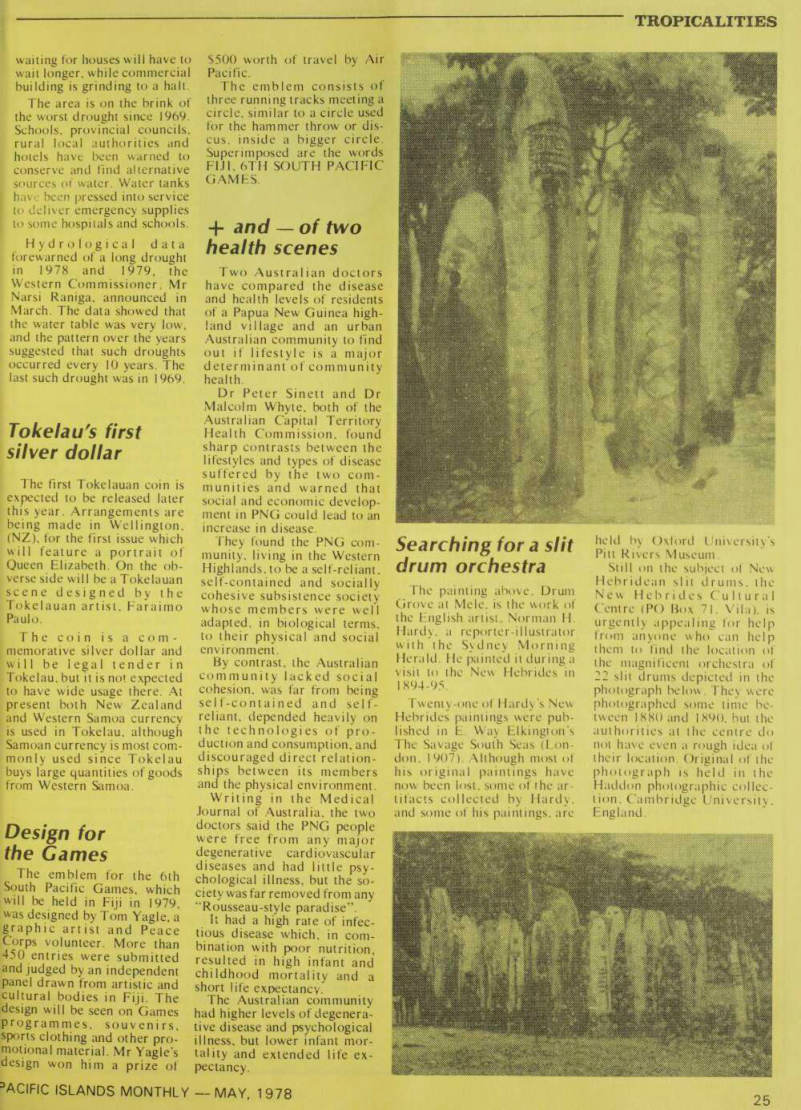
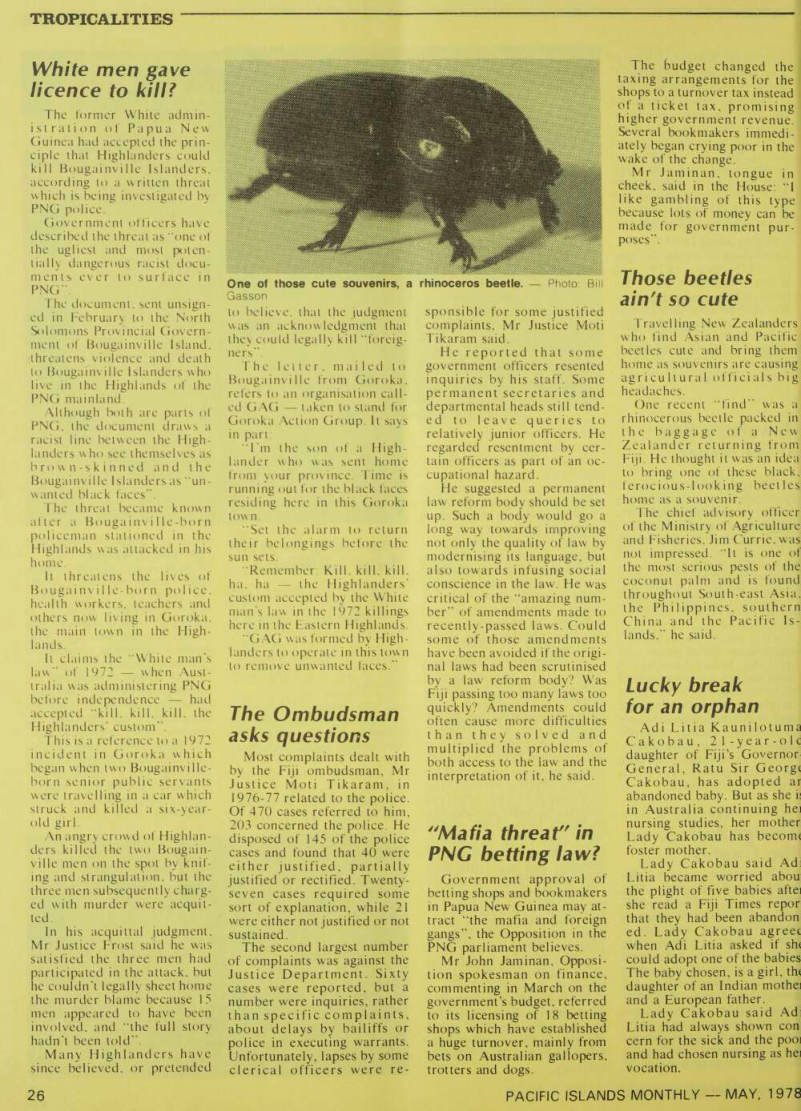
Tropicalities
Pacific tourism:
Virgins, whores
John Rayner, under-gra duate student at Sydney's University of New South Wales, has just completed an assignment on the subject of tourism in the Pacific Islands.
His controversial conclusion: Throughout this paper it has been stressed that the ma jor problems arising from tourism are mostly caused by foreign ownership and con trol. While this may be so, the Pacific Islands have little choice in the matter because they themselves have not the funds to sel up their own tourist trade. Hence they are dependent on foreign invest ment to set up the trade, and they presumably hope to gain from this foreign investment.
The only feasible way for a Pacific Island nation to join the tourist trade and still have vested interest and control over it is by government legislation to ensure this. This has happened to the Cook Is lands where the government, under agreements concluded by it. owns a substantial per centage of some major accom modation and transport facili ties in the tourist trade, and has a controlling voice in the trade as a whole.
This would seem an ade quate solution, but it does to a certain extent discourage foreign investment. If a foreign company has a choice of investing in two Island countries, one of which re quires a percentage of the profits and the other does not, then the company will naturally choose the other is lands to establish its business on. Despite this, the Cook Is lands solution is probably still the most desirable because although their tourist trade may be less than in other is
lands, they will probably
make more money out of it in
the long run.
Generally then, tourism in the Pacific Islands in its pre sent form is merely a per petuation of the colonial system, with its economic and
cultural exploitation. Many
Island governments are
pecoming increasingly aware
Pf this and some, like the -ooks, are taking steps to end he exploitation. The philoso phy of the Cook Islands government states that “tour sm should not be the means or us to change our way of
life, but an incentive to make us become aware of who and what we are in terms of our culture, customs and tradi tions". Perhaps the Cook Is lands can resist the already es tablished pattern. But then, as B. Hoad so aptly puts it in an article in an Australian magazine, “they are the virgins of the tourist game, while in Tahiti, the grand old whore of the region, it has been declared with re signation that it is necessary that Tahiti should die that Tahitians may live".
In conclusion it can be seen that tourism could have beneficial effects, both econ omically and culturally, on an island nation (provided of course that the government makes the right decisions).
Tourism itself is not de structive, if controlled. But the manner in which it has been set up in the Pacific Is lands is hardly in the best in terests of the Pacific Island nations.
PNG 'cowboy'
takes on 'lawmen'
Police in the Papua New Guinea Highlands are search ing for a self-styled “cowboy" who broke into a government office and stole two guns and ammunition.
The man took a shotgun and rifle from the government of fices at Wapenamanda. leav ing behind a note in which he gave a name and described himself as “a real cowboy".
Police said they believe the name was genuine, and that the man they want is a former government officer wanted for questioning on stealing, passing valueless cheques and illegal use of motor vehicles.
They are concerned because of reports reaching them from village leaders that the man has gone into hiding boasting he will use the guns to "kill lawmen".
The senior government of ficer in Wapenamanda and several police have been nam ed in the threats.
The man is also believed to be armed with a pistol stolen in Lae 450 km away.
A constable sighted him soon after the break-in at the government offices, but lost him in the darkness.
Police guards have been
posted outside the houses ot government officers and police in Wapenamanda.
The note left behind by the man was; “Ah ah ah. The cowboy has taken two of your guns. How are you going to gel them again? You have police ...! Have police. You have guns I have guns. Ah ah ah. Real cowboy. Thank you indeed."
The skin
game in Fiji
The question of inade quately-clad female visitors had again raised its head in Fiji. The Minister for Tour ism. Mr Tomasi Vakatora.
“distressed" at the sight of tourists showing large ex panses of skin, has asked the Fiji Visitors Bureau to do something about telling them how to dress, when ashore in Fiji.
The FVB board, reluctant to grasp the nettle, eventually decided to write to shipping lines about dress for tourists of the female kind. The board manager. Mr Paddy Doyle, said that stopping people get ting off at the gangplank was probably looking for trouble.
Two other members took the view that as local newspapers published pictures of models without clothes there could be little criticism of tourists' dress.
Adi Sadaki. a member of the board, said Mr Vakatora was expressing a Fijian point of view. If he was a European he would not say anything.
She obviously overlooked the fact that Mr Charles Stinson, a European and a fellow minister of Mr Vakatora, is on record as having expressed similar views to Mr Vakatora, only in stronger Stinson-like terms.
Pineapples, and
passengers
A reporter on the Cook Is lands News certainly has very clear priorities. Recording a mishap on a barge taking passengers and cargo out from the island of Mangaia to the MV Mataora for a trip to Rarotonga, the reporter wrote: “The barge was loaded with passengers, cartons of pine apples. luggage and other
foodstuffs . . . Rough seas threw a carton of pineapples, personal belongings and some of the passengers into the sea outside the passage. No lives were lost but two of the passengers on arrival at Rarotonga were taken to the hospital for medical at tention ..."
In view of the order in which the items were first listed, it seems strange the re porter didn't tell readers what happened to the carton of pineapples.
A brochure
of errors
The United Nations is con sidering sites in three coun tries Fiji, Malta and Jamaica for the headquar ters of a proposed Interna tional Seabed Authority.
Fiji’s chances of selection are good, but they have not been helped by a brochure which is intended to state the arguments in favour, writes L.
G. Usher of Suva.
The presentation of the brochure is excellent, with
wel 1 -selected photographs
effectively arranged, an un
dersea map showing Fiji's
central place in the world’s largest ocean, and an at tractive masi (tapa) design cover (but with no description of the origin of the design, or the nature of the masi, any where in the text).
It is the text that falls down
badly incredibly badly,
seeing that the brochure was produced by the Fiji Ministry of Information, in collabora tion with the Fiji Times and Herald Ltd.
“Fiji is a duty-free port" is, for instance, an odd de scription of a country with three official ports of entry by sea and two by air.
The inclusion in the same paragraph of a reference to “office equipment for modern business” can be misleading.
Import taxes on such goods range up to 67 1 of landed cost.
Fiji residents can be excus
ed a degree of surprise when they read that “pine harvest ing" and "beef production" are "recent industries".
If the first reference is to the rapidly-expanding, but still, mainly young pine forests, then "harvesting" is not yet the word to use. And, although fortunes of the in dustry have fluctuated. Fiji has been producing beef for many years.
Another claim is that "in tensive mineral exploration is being undertaken in shallow off-shore areas of the islands, searching for deposits of mineral-rich manganese nodules'.
People living in Fiji have not been made aware that this "intensive exploration" is now "being undertaken".
They are likely to be still more surprised by a bald claim that in Fiji “the Government provides free schooling".
The advance towards fully subsidised education has been commendably rapid, especially in recent years, but as government speakers acknowledged in a parliamen tary debate early in March, there is still a long way to go.
But it is in the political sec tion of the brochure that the most glaring inaccuracies occur.
A paragraph on Fiji's Parliament says. "The 20member Senate is a house of review with powers to delay but not to block legislation".
The Senate in fact has 22 members, and an essential feature of the constitutional protection of Fijian rights and customs is an absolute veto power placed in the hands of a majority of the eight Senators nominated by the Great Council of Chiefs.
This power applies to any propsals to change nine nam ed laws if those proposals "affect Fijian land, customs or customary rights".
A further constitutional provision requires amend ments of any sort to these nine laws, or to the constitution it self. to be approved by at least three-quarters of the members of both the Senate and House of Representatives.
So in some highly im portant, even if limited areas the Senate most certainly does have power to block legisla tion.
In the same political section of the brochure comes the
remarkable claim that Fiji was "the first country in the South Pacific region to attain na tionhood".
This will cause raised eyebrows in Western Samoa and Nauru, both of which became independent before Fiji, and perhaps also in the Kingdom of Tonga. For that matter, "South Pacific region" could be held to include the
long-standing independent
nations of Australia and New Zealand.
Fiji has an excellent case for being chosen as the home of any international body con cerned with the sea. It is a pity that in this instance the case has been put so poorly, in a document marred by such in excusable inaccuracies.
Rabaul gets tough
with graffiti st
In a public punishment police marched two handcuff ed teenage gang members through the streets of Rabaul and forced them to remove scrawled words from the walls of buildings.
The two said they belonged to a gang called Kave "The Dogs of Kerema". Kerema is a town on the Papuan coast, on the opposite side of PNG to Rabaul.
Big crowds watched the event.
A magistrate. Mr Natanais Marum. ordered the punish
ment after finding the words "grossly offensive".
Kori Ho pah a. 18. who pleaded guilty to 11 charges of writing a grossly indecent word in a public place, was also fined the equivalent of S2OO. Steven Tom. 15. who pleaded guilty to one similar offence, was lined the equivalent ot S3B.
"Cash" is the cry
of PNG youth
Papua New Guinea’s old style village life is not at tractive enough for modern youngsters, a study has found.
One of the biggest problems is lack of opportunity to earn cash.
A national conference on youth development at Goroka, in the PNG High lands, issuing its findings in March, said that younger villagers want to earn cash, despite the fact that the village can provide adequate food, shelter and com panionship for its people.
The conference ascribed the increasing drift of young people from villages to the towns to a growing lack of satisfaction with village life.
The extension of a wage earning economy within village societies, replacing the existing traditional econ omies, could help to ease the situation, the conference de cided.
Although many village j communities at present have a cash income from their crops, the money does not circulate ' as wages to the people who produce the crops.
The conference questioned the work of many vocational schools on the grounds that the skills passed on were not necessarily of value to village communities. It re commended the extension of a village development training scheme now being sponsored in PNG by the World Bank.
Softball scores
in Nauru
An international women's softball tournament in Nauru as part of the island's 10th in dependence anniversary celebrations was so successful that as soon as it was over the organisers decided to ask that the sport be included in the next South Pacific Games.
Teams taking part, apart from Nauru, were Guam, the Gilbert Islands. Papua New Guinea and Tuvalu. The Gilbert Islands and Tuvalu teams were selected from players living on Nauru.
The tournament was a first for Nauru the first time an international sports event in volving several groups was staged. The games were play ed on a well-grassed field, surrounded by remarkably good amenities for spectators.
Guam won the tournament, beating Nauru in the grand final. Tuvalu came third, PNG fourth and the Gilbert Islands fifth. Juliet Cain.
Nauru, was named the best and fairest player.
Fiji's thirsty
North-West
Nadi, Lautoka and Ba, three of the main centres in the north-west of Viti Levu, Fiji, have an average rainfall ranging from 1 800 mm to 2 300 mm, yet are facing grave water restrictions. The position is so bad at Lautoka that all land subdivision and building works have been banned for five to seven years.
Lautoka has not long been a city. The ban will have a serious effect on housing and general development there.
Many hundreds of people
The striking cover of the Fiji Government’s brochure.
waiting for houses will have to wait longer, while commercial building is grinding to a halt.
The area is on the brink of the worst drought since 1969.
Schools, provincial councils, rural local authorities and hotels have been warned to conserve and find alternative j sources of water. Water tanks [ have been pressed into service I to deliver emergency supplies to some hospitals and schools.
Hydrological data forewarned of a long drought in 1978 and 1979, the Western Commissioner, Mr Narsi Raniga, announced in March. The data showed that the water table was very low, and the pattern over the years suggested that such droughts occurred every 10 years. The last such drought was in 1969.
Tokelau's first
silver dollar
The first Tokelauan coin is expected to be released later this year. Arrangements are being made in Wellington, (NZ). for the first issue which will feature a portrait of Queen Elizabeth. On the ob verse side will be a Tokelauan scene designed by the Tokelauan artist, Farairno Paulo.
The coin is a com memorative silver dollar and will be 1 egal tender in Tokelau, but it is not expected to have wide usage there. At present both New Zealand and Western Samoa currency is used in Tokelau, although Samoan currency is most com monly used since Tokelau buys large quantities of goods from Western Samoa.
Design for
the Games
The emblem for the 6th South Pacific Games, which will be held in Fiji in 1979, was designed by Tom Yagle, a graphic artist and Peace Corps volunteer. More than 450 entries were submitted and judged by an independent panel drawn from artistic and cultural bodies in Fiji. The design will be seen on Games programmes, souvenirs, sports clothing and other pro motional material. Mr Yagle’s design won him a prize of
$5OO worth of travel by Air Pacific.
The emblem consists of three running tracks meeting a circle, similar to a circle used for the hammer throw or dis cus, inside a bigger circle.
Superimposed are the words
Fiji, 6Th South Pacific
Games.
-I- and of two
health scenes
Two Australian doctors have compared the disease and health levels of residents of a Papua New Guinea high land village and an urban Australian community to find out if lifestyle is a major determinant of community health.
Dr Peter Sinett and Dr Malcolm Whyte, both of the Australian Capital Territory Health Commission, found sharp contrasts between the lifestyles and types of disease suffered by the two com munities and warned that social and economic develop ment in PNG could lead to an increase in disease.
They found the PNG com munity, living in the Western Highlands, to be a self-reliant, self-contained and socially cohesive subsistence society whose members were well adapted, in biological terms, to their physical and social environment.
By contrast, the Australian community lacked social cohesion, was far from being self-contained and self reliant, depended heavily on the technologies of pro duction and consumption, and discouraged direct relation ships between its members and the physical environment.
Writing in the Medical Journal of Australia, the two doctors said the PNG people were free from any major degenerative cardiovascular diseases and had little psy chological illness, but the so ciety was far removed from any
"Rousseau-style paradise”.
It had a high rate of infec tious disease which, in com bination with poor nutrition, resulted in high infant and childhood mortality and a short life expectancy.
The Australian community had higher levels of degenera tive disease and psychological illness, but lower infant mor tality and extended life ex pectancy.
Searching for a slit
drum orchestra
The painting above. Drum Grove at Mele. is the work of the English artist. Norman H Hardy, a reporter-illustrator with the Sydney Morning Herald. He painted it during a visit to the New Hebrides in 1894-95.
Twenty-one of Hardy's New Hebrides paintings were pub lished in E. Way Elkington's The Savage South Seas (Lon don. 1907). Although most of his original paintings have now been lost, some of the ar tifacts collected by Hardy, and some of his paintings, are
held by Oxford University's Pill Rivers Museum Still on the subject of New Hebridean slit drums, the New Hebrides Cultural Centre (PO Box 71. Vila), is urgently appealing for help from anyone who can help them to find the location of the magnificent orchestra of 22 slit drums depicted in the photograph below. They were photographed some time be tween 1880 and 1890. but the authorities at the centre do not have even a rough idea ot their location. Original of the photograph is held in the Haddon photographic collec tion. Cambridge University.
England.
White men gave
licence to kill?
The former White admin istration of Papua New Guinea had accepted the prin ciple that Highlanders could kill Bougainville Islanders, according to a written threat which is being investigated by PNG police.
Government officers have described the threat as “one of the ugliest and most poten tially dangerous racist docu ments ever to surface in
Png'
The document, sent unsign ed in February to the North Solomons Provincial Govern ment of Bougainville Island, threatens violence and death to Bougainville Islanders who live in the Highlands of the PNG mainland Although both arc parts of PNG. the document draws a racist line between the High landers who sec themselves as brown- skinned and the Bougainville Islanders as "un wanted black faces”.
The threat became known after a Bougainville-born policeman stationed in the Highlands was attacked in his home.
It threatens the lives of Bougainville-born police, health workers, teachers and others now living in Goroka. the main town in the High lands.
It claims the "White man's law” of 1972 when Aust ralia was administering PNG before independence had accepted “kill. kill. kill, the Highlanders' custom”.
This is a reference to a 1972 incident in Goroka which began when two Bougainville born senior public servants were travelling in a car which struck and killed a six-year old girl.
An angry crowd of Highlan ders killed the two Bougain ville men on the spot by knif ing and strangulation, but the three men subsequently charg ed with murder were acquit ted.
In his acquittal judgment.
Mr Justice Frost said he was satisfied the three men had participated in the attack, but he couldn't legally sheet home the murder blame because 15 men appeared to have been involved, and ““the full story hadn't been told”.
Many Highlanders have since believed, or pretended
to believe, that the judgment was an acknowledgment that the> could legally kill “foreig ners".
The letter, mailed to Bougainville from Goroka, refers to an organisation call ed GAG taken to stand for Goroka Action Group. It says in part; I'm the son of a High lander who was sent home from your province. Time is running out for the black faces residing here in this Goroka town.
“Set the alarm to return their belongings before the sun sets.
"Remember: Kill. kill. kill, ha. ha the Highlanders' custom accepted by the While man's law in the 1972 killings here in the Eastern Highlands.
“GAG was formed by High landers to operate in this town to remove unwanted faces.”
The Ombudsman
asks questions
Most complaints dealt with by the Fiji ombudsman, Mr Justice Moti Tikaram, in 1976-77 related to the police.
Of 470 cases referred to him, 203 concerned the police. He disposed of 145 of the police cases and found that 40 were either justified, partially justified or rectified. Twenty seven cases required some sort of explanation, while 21 were either not justified or not sustained.
The second largest number of complaints was against the Justice Department. Sixty cases were reported, but a number were inquiries, rather
than specific complaints,
about delays by bailiffs or police in executing warrants.
Unfortunately, lapses by some clerical officers were re
sponsible for some justified complaints, Mr Justice Moti Tikaram said.
He reported that some government officers resented inquiries by his staff. Some permanent secretaries and departmental heads still tend ed to leave queries to relatively junior officers. He regarded resentment by cer tain officers as part of an oc cupational hazard.
He suggested a permanent law reform body should be set up. Such a body would go a long way towards improving not only the quality of law by modernising its language, but also towards infusing social conscience in the law. He was critical of the “amazing num ber” of amendments made to recently-passed laws. Could some of those amendments have been avoided if the origi nal laws had been scrutinised by a law reform body? Was Fiji passing too many laws too quickly? Amendments could often cause more difficulties than they solved and multiplied the problems of both access to the law and the interpretation of it, he said.
"Mafia threat" in
PNG betting law?
Government approval of betting shops and bookmakers in Papua New Guinea may at tract “the mafia and foreign gangs”, the Opposition in the PNG parliament believes.
Mr John Jaminan, Opposi tion spokesman on finance, commenting in March on the government’s budget, referred to its licensing of 18 betting shops which have established a huge turnover, mainly from bets on Australian gallopers, trotters and dogs.
The budget changed the taxing arrangements for the shops to a turnover tax instead of a ticket tax, promising higher government revenue.
Several bookmakers immedi ately began crying poor in the wake of the change.
Mr Jaminan, tongue in cheek, said in the House; “I like gambling of this type because lots of money can be made for government pur poses".
Those beetles
ain't so cute
Travelling New Zealanders who find Asian and Pacific beetles cute and bring them home as souvenirs are causing agricultural officials big headaches.
One recent ‘find" was a rhinocerous beetle packed in the baggage of a New Zealander returning from Fiji. He thought it was an idea to bring one of these black, ferocious-looking beetles home as a souvenir.
The chief advisory officer of the Ministry of Agriculture and Fisheries. Jim Currie, was not impressed. “It is one of the most serious pests of the coconut palm and is found throughout South-east Asia, the Philippines, southern China and the Pacific Is lands." he said.
Lucky break
for an orphan
Adi Litia Kaunilotuma
Cakobau, 2 1 -year-old
daughter of Fiji’s Governor- General, Ratu Sir Georgt Cakobau. has adopted ar abandoned baby. But as she i: in Australia continuing hei nursing studies, her mother Lady Cakobau has becorm foster mother.
Lady Cakobau said Adi Litia became worried abou the plight of five babies aftei she read a Fiji Times repor that they had been abandon ed. Lady Cakobau agreec when Adi Litia asked if sh< could adopt one of the babies The baby chosen, is a girl, the daughter of an Indian mothei and a European father.
Lady Cakobau said Adi Litia had always shown con cern for the sick and the pool and had chosen nursing as hei vocation.
One of those cute souvenirs, a rhinoceros beetle. Photo Bill Gasson
Advertisements & other items, p. 23 (1 item)
23
’ACIFIC ISLANDS MONTHLY MAY, 1978
Afterthoughts
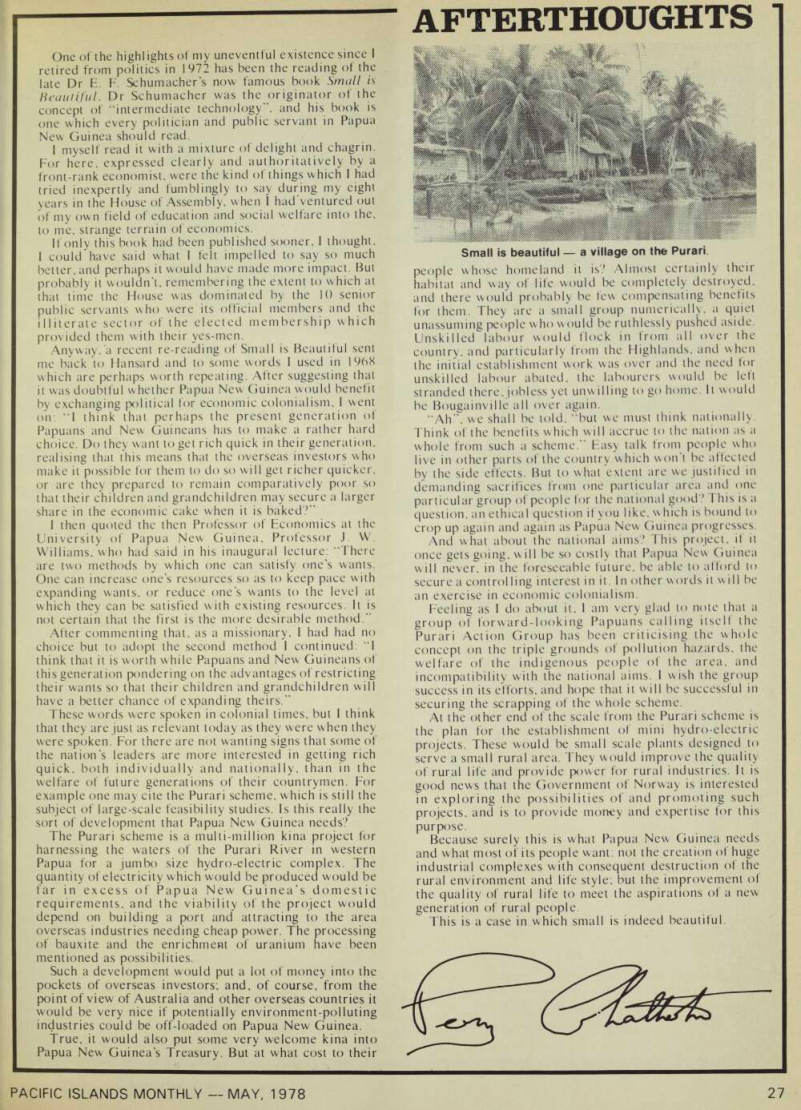
One of the highlights of my uneventful existence since I retired from politics in 1972 has been the reading of the late Dr E. F. Schumacher's now famous book Small is Beautiful. Dr Schumacher was the originator of the concept of “intermediate technology”, and his book is one which every politician and public servant in Papua New Guinea should read. 1 myself read it with a mixture of delight and chagrin.
For here, expressed clearly and authoritatively by a front-rank economist, were the kind of things which I had tried inexpertly and fumblingly to say during my eight years in the House of Assembly, when 1 had ventured out of my own field of education and social welfare into the. to me. strange terrain of economics.
If only this book had been published sooner. I thought.
I could have said what I felt impelled to say so much better, and perhaps it would have made more impact. But probably it wouldn't, remembering the extent to which at that time the House was dominated by the 10 senior public servants who were its official members and the illiterate sector of the elected membership which provided them with their yes-men.
Anyway, a recent re-reading of Small is Beautiful sent me back to Hansard and to some words I used in 1968 which are perhaps worth repeating. After suggesting that it was doubtful whether Papua New Guinea would benefit by exchanging political for economic colonialism. I went on: “I think that perhaps the present generation of Papuans and New Guineans has to make a rather hard choice. Do they want to get rich quick in their generation, realising that this means that the overseas investors who make it possible for them to do so will get richer quicker, or are they prepared to remain comparatively poor so that their children and grandchildren may secure a larger share in the economic cake when it is baked?”
I then quoted the then Professor of Economics at the University of Papua New Guinea, Professor J W Williams, who had said in his inaugural lecture; “There are two methods by which one can satisfy one’s wants.
One can increase one’s resources so as to keep pace with expanding wants, or reduce one’s wants to the level at which they can be satisfied with existing resources. It is not certain that the first is the more desirable method.”
After commenting that, as a missionary. I had had no choice but to adopt the second method I continued: “1 think that it is worth while Papuans and New Guineans of this generation pondering on the advantages of restricting their wants so that their children and grandchildren will have a better chance of expanding theirs.”
These words were spoken in colonial times, but I think that they are just as relevant today as they were when they were spoken. For there are not wanting signs that some of the nation’s leaders are more interested in getting rich quick, both individually and nationally, than in the welfare of future generations of their countrymen. For example one may cite the Purari scheme, which is still the subject of large-scale feasibility studies. Is this really the sort of development that Papua New Guinea needs?
The Purari scheme is a multi-million kina project for harnessing the waters of the Purari River in western Papua for a jumbo size hydro-electric complex. The quantity of electricity which would be produced would be far in excess of Papua New Guinea’s domestic requirements, and the viability of the project would depend on building a port and attracting to the area overseas industries needing cheap power. The processing of bauxite and the enrichment of uranium have been mentioned as possibilities.
Such a development would put a lot of money into the pockets of overseas investors; and, of course, from the point of view of Australia and other overseas countries it would be very nice if potentially environment-polluting industries could be off-loaded on Papua New Guinea.
True, it would also put some very welcome kina into Papua New Guinea’s Treasury. But at what cost to their
people whose homeland it is? Almost certainly their habitat and way of life would be completely destroyed, and there would probably be tew compensating benefits for them. They are a small group numerically, a quiet unassuming people who would be ruthlessly pushed aside.
Unskilled labour would flock in from all over the country, and particularly from the Highlands, and when the initial establishment work was over and the need tor unskilled labour abated, the labourers would be left stranded there, jobless yet unwilling to go home. It would be Bougainville all over again.
“Ah”, we shall be told, “but we must think nationally.
Think of the benefits which will accrue to the nation as a whole from such a scheme." Easy talk from people who live in other parts of the country which won't be affected by the side effects. But to what extent are we justified in demanding sacrifices from one particular area and one particular group of people for the national good? This is a question, an ethical question it you like, which is bound to crop up again and again as Papua New Guinea progresses.
And what about the national aims? This project, if it once gets going, will be so costly that Papua New Guinea will never, in the foreseeable future, be able to afford to secure a controlling interest in it. In other words it will be an exercise in economic colonialism.
Feeling as I do about it. 1 am very glad to note that a group of forward-looking Papuans calling itself the Purari Action Group has been criticising the whole concept on the triple grounds of pollution hazards, the welfare of the indigenous people of the area, and incompatibility with the national aims. 1 wish the group success in its efforts, and hope that it will be successful in securing the scrapping of the whole scheme.
At the other end of the scale from the Purari scheme is the plan for the establishment of mini hydro-electric projects. These would be small scale plants designed to serve a small rural area. They would improve the quality of rural life and provide power for rural industries. It is good news that the Government of Norway is interested in exploring the possibilities of and promoting such projects, and is to provide money and expertise for this purpose.
Because surely this is what Papua New Guinea needs and what most of its people want; not the creation of huge industrial complexes with consequent destruction of the rural environment and life style: but the improvement of the quality of rural life to meet the aspirations of a new generation of rural people.
This is a case in which small is indeed beautiful.
Small is beautiful-a village on the Purari.
Advertisements & other items, p. 28 (1 item)
Pacific Islands.
S.E. TATHAM & CO. PTY. LTD
BEEHIVE BUILDING.
94 ELIZABETH STREET
G.P.O. BOX 8,
AUSTRALIA
CABLES: “SET”
TELEX: AA34552.
TELEPHONE: 63 5094.
r.
G *
... BUYERS for the
PACIFIC ISLANDS.
PAPUA NEW GUINEA:
S. E. TATHAM (P N G.) PTY. LTD.
LAE: MALAITA ST. (P.O. BOX 1562).
PORT MORESBY: Cm. GOROA & MANAHU Sts.
GORDON (P.O. BOX 6733 , BOROKOJ.
TELEGRAMS: ALL OFFICES t( SET[
YOUR GUARANTEE
FOR SERVICE
SINCE 1924
Currents
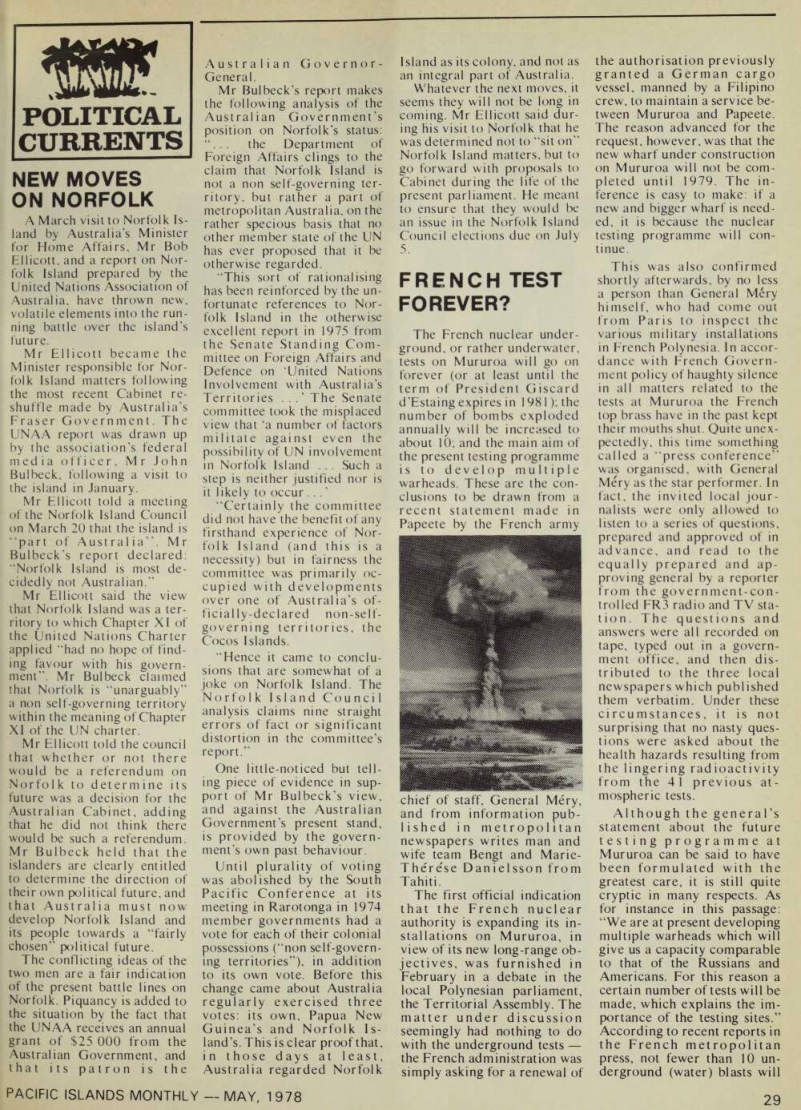

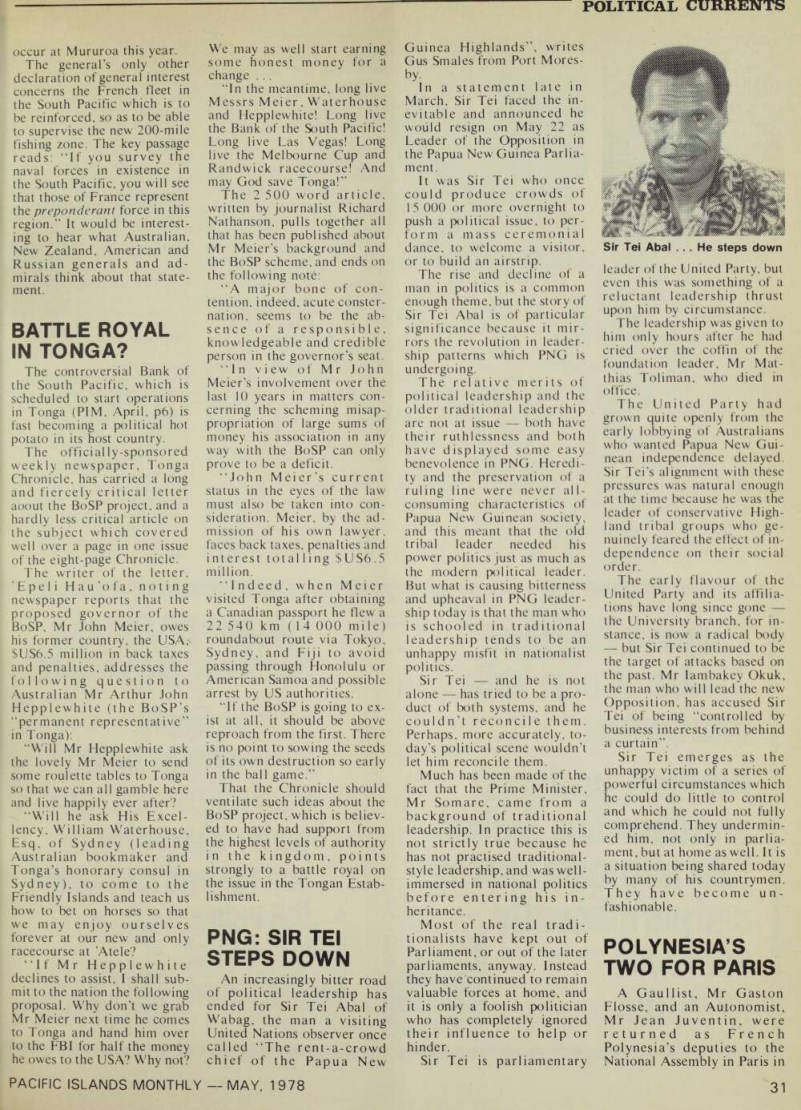

Political
New Moves
On Norfolk
A March visit to Norfolk Is land by Australia’s Minister for Home Affairs, Mr Bob Ellicott. and a report on Nor folk Island prepared by the United Nations Association of Australia, have thrown new, volatile elements into the run ning battle over the island’s future.
Mr Ellicott became the Minister responsible for Nor folk Island matters following the most recent Cabinet re shuffle made by Australia’s Fraser Government. The UNAA report was drawn up by the association’s federal media officer, Mr John Bulbeck, following a visit to the island in January.
Mr Ellicott told a meeting of the Norfolk Island Council on March 20 that the island is “part of Australia”. Mr Bulbeck's report declared: “Norfolk Island is most de cidedly not Australian.”
Mr Ellicott said the view that Norfolk Island was a ter ritory to which Chapter XI of the United Nations Charter applied “had no hope of find ing favour with his govern ment”. Mr Bulbeck claimed that Norfolk is “unarguably” a non self-governing territory within the meaning of Chapter XI of the UN charter.
Mr Ellicott told the council that whether or not there would be a referendum on Norfolk to determine its future was a decision for the Australian Cabinet, adding that he did not think there would be such a referendum.
Mr Bulbeck held that the islanders are clearly entitled to determine the direction of their own political future, and that Australia must now develop Norfolk Island and its people towards a “fairly chosen” political future.
The conflicting ideas of the two men are a fair indication of the present battle lines on Norfolk. Piquancy is added to the situation by the fact that the UNAA receives an annual grant of $25 000 from the Australian Government, and that its patron is the
Australian Governor- General.
Mr Bulbeck's report makes the following analysis of the Australian Government’s position on Norfolk's status: the Department of Foreign Affairs clings to the claim that Norfolk Island is not a non self-governing ter ritory, but rather a part of metropolitan Australia, on the rather specious basis that no other member state of the UN has ever proposed that it be otherwise regarded. ‘This sort of rationalising has been reinforced by the un fortunate references to Nor folk Island in the otherwise excellent report in 1975 from the Senate Standing Com mittee on Foreign Affairs and Defence on ‘United Nations Involvement with Australia's Territories . . .' The Senate committee took the misplaced view that ‘a number of factors militate against even the possibility of UN involvement in Norfolk Island ... Such a step is neither justified nor is it likely to occur “Certainly the committee did not have the benefit of any firsthand experience of Nor folk Island (and this is a necessity) but in fairness the committee was primarily oc cupied with developments over one of Australia’s of ficially-declared non-self governing territories, the Cocos Islands.
“Hence it came to conclu sions that are somewhat of a joke on Norfolk Island. The Norfolk Island Council analysis claims nine straight errors of fact or significant distortion in the committee’s report.”
One little-noticed but tell ing piece of evidence in sup port of Mr Bulbeck’s view, and against the Australian Government’s present stand, is provided by the govern ment’s own past behaviour.
Until plurality of voting was abolished by the South Pacific Conference at its meeting in Rarotonga in 1974 member governments had a vote for each of their colonial possessions (“non self-govern ing territories”), in addition to its own vote. Before this change came about Australia regularly exercised three votes; its own, Papua New Guinea’s and Norfolk Is land’s. This is clear proof that, in those days at least, Australia regarded Norfolk
Island as its colony, and not as an integral part of Australia.
Whatever the next moves, it seems they will not be long in coming. Mr Ellicott said dur ing his visit to Norfolk that he was determined not to “sit on”
Norfolk Island matters, but to go forward with proposals to Cabinet during the life of the present parliament. He meant to ensure that they would be an issue in the Norfolk Island Council elections due on July 5.
French Test
Forever?
The French nuclear under ground, or rather underwater, tests on Mururoa will go on forever (or at least until the term of President Giscard d’Estaing expires in 1981); the number of bombs exploded annually will be increased to about 10. and the main aim of the present testing programme is to develop multiple warheads. These are the con clusions to be drawn from a recent statement made in Papeete by the French army
chief of staff. General Mery, and from information pub lished in metropolitan newspapers writes man and wife team Bengt and Marie- The're'se Danielsson from Tahiti.
The first official indication that the French nuclear authority is expanding its in stallations on Mururoa, in view of its new long-range ob jectives, was furnished in February in a debate in the local Polynesian parliament, the Territorial Assembly. The matter under discussion seemingly had nothing to do with the underground tests the French administration was simply asking for a renewal of
the authorisation previously granted a German cargo vessel, manned by a Filipino crew, to maintain a service be tween Mururoa and Papeete.
The reason advanced for the request, however, was that the new wharf under construction on Mururoa will not be com pleted until 1979. The in ference is easy to make: if a new and bigger wharf is need ed, it is because the nuclear testing programme will con tinue.
This was also confirmed shortly afterwards, by no less a person than General M6ry himself, who had come out from Paris to inspect the various military installations in French Polynesia. In accor dance with French Govern ment policy of haughty silence in all matters related to the tests at Mururoa the French top brass have in the past kept their mouths shut. Quite unex pectedly, this time something called a “press conference” was organised, with General Mery as the star performer. In fact, the invited local jour nalists were only allowed to listen to a series of questions, prepared and approved of in advance, and read to the equally prepared and ap proving general by a reporter from the government-con trolled FR3 radio and TV sta tion. The questions and answers were all recorded on tape, typed out in a govern ment office, and then dis tributed to the three local newspapers which published them verbatim. Under these circumstances, it is not surprising that no nasty ques tions were asked about the health hazards resulting from the lingering radioactivity from the 41 previous at
mospheric tests.
Although the general’s statement about the future testing programme at Mururoa can be said to have been formulated with the greatest care, it is still quite cryptic in many respects. As for instance in this passage: “We are at present developing multiple warheads which will give us a capacity comparable to that of the Russians and Americans. For this reason a certain number of tests will be made, which explains the im portance of the testing sites.”
According to recent reports in the French metropolitan press, not fewer than 10 un derground (water) blasts will
occur at Mururoa this year.
The general’s only other declaration of general interest concerns the French fleet in the South Pacific which is to be reinforced, so as to be able to supervise the new 200-mile fishing zone. The key passage reads: "If you survey the naval forces in existence in the South Pacific, you will see that those of France represent the preponderant force in this region,” It would be interest ing to hear what Australian, New Zealand, American and Russian generals and ad mirals think about that state ment.
Battle Royal
In Tonga?
The controversial Bank of the South Pacific, which is scheduled to start operations in Tonga (PIM, April, p 6) is fast becoming a political hot potato in its host country.
The officially-sponsored
weekly newspaper, Tonga Chronicle, has carried a long and fiercely critical letter aoout the BoSP project, and a hardly less critical article on the subject which covered well over a page in one issue of the eight-page Chronicle.
The writer of the letter, ’Epeli Hau’ofa, noting newspaper reports that the proposed governor of the BoSP, Mr John Meier, owes his former country, the USA, SUS6.S million in back taxes and penalties, addresses the following question to Australian Mr Arthur John Hepplewhite (the BoSP’s “permanent representative” in Tonga): “Will Mr Hepplewhite ask the lovely Mr Meier to send some roulette tables to Tonga so that we can all gamble here and live happily ever after?
“Will he ask His Excel lency, William Waterhouse, Esq, of Sydney (leading Australian bookmaker and Tonga’s honorary consul in Sydney), to come to the Friendly Islands and teach us how to bet on horses so that we may enjoy ourselves forever at our new and only racecourse at ’Atele?
"If Mr Hepplewhite declines to assist, I shall sub mit to the nation the following proposal. Why don’t we grab Mr Meier next time he comes to Tonga and hand him over to the FBI for half the money he owes to the USA? Why not?
We may as well start earning some honest money for a change . ..
“In the meantime, long live Messrs Meier. Waterhouse and Hepplewhite! Long live the Bank of the South Pacific!
Long live Las Vegas! Long live the Melbourne Cup and Randwick racecourse! And may God save Tonga!”
The 2 500 word article, written by journalist Richard Nathanson, pulls together all that has been published about Mr Meier’s background and the BoSP scheme, and ends on the following note: “A major bone of con tention, indeed, acute conster nation. seems to be the ab sence of a responsible, knowledgeable and credible person in the governor's seat.
"In view of Mr John Meier’s involvement over the last 10 years in matters con cerning the scheming misap propriation of large sums of money his association in any way with the BoSP can only prove to be a deficit.
"John Meier’s current status in the eyes of the law must also be taken into con sideration. Meier, by the ad mission of his own lawyer, faces back taxes, penalties and interest totalling SUS6.S million.
"Indeed, when Meier visited Tonga after obtaining a Canadian passport he Hew a 22 540 km (14 000 mile) roundabout route via Tokyo, Sydney, and Fiji to avoid passing through Honolulu or American Samoa and possible arrest by US authorities.
“If the BoSP is going to ex ist at all, it should be above reproach from the first. There is no point to sowing the seeds of its own destruction so early in the ball game.”
That the Chronicle should ventilate such ideas about the BoSP project, which is believ ed to have had support from the highest levels of authority in the kingdom, points strongly to a battle royal on the issue in the Tongan Estab lishment.
Png: Sir Tei
Steps Down
An increasingly bitter road of political leadership has ended for Sir Tei Abal of Wabag, the man a visiting United Nations observer once called "The rent-a-crowd chief of the Papua New
Guinea Highlands”, writes Gus Smales from Port Mores by.
In a statement late in March, Sir Tei faced the in evitable and announced he would resign on May 22 as Leader of the Opposition in the Papua New Guinea Parlia ment.
It was Sir Tei who once could produce crowds of 15 000 or more overnight to push a political issue, to per form a mass ceremonial dance, to welcome a visitor, or to build an airstrip.
The rise and decline of a man in politics is a common enough theme, but the story of Sir Tei Abal is of particular significance because it mir rors the revolution in leader ship patterns which PNG is undergoing.
The relative merits of political leadership and the older traditional leadership are not at issue both have their ruthlessness and both have displayed some easy benevolence in PNG. Heredi ty and the preservation of a ruling line were never all consuming characteristics of Papua New Guinean society, and this meant that the old tribal leader needed his power politics just as much as the modern political leader.
But what is causing bitterness and upheaval in PNG leader ship today is that the man who is schooled in traditional leadership tends to be an unhappy misfit in nationalist politics.
Sir Tei and he is not alone has tried to be a pro duct of both systems, and he couldn’t reconcile them.
Perhaps, more accurately, to day’s political scene wouldn’t let him reconcile them.
Much has been made of the fact that the Prime Minister, Mr Somare, came from a background of traditional leadership. In practice this is not strictly true because he has not practised traditional style leadership, and was well immersed in national politics before entering his in heritance.
Most of the real tradi tionalists have kept out of Parliament, or out of the later parliaments, anyway. Instead they have continued to remain valuable forces at home, and it is only a foolish politician who has completely ignored their influence to help or hinder.
Sir Tei is parliamentary
leader of the United Party, but even this was something of a reluctant leadership thrust upon him by circumstance.
The leadership was given to him only hours after he had cried over the coffin of the foundation leader. Mr Mat thias Toliman, who died in office.
The United Party had grown quite openly from the early lobbying of Australians who wanted Papua New Gui nean independence delayed.
Sir Tei's alignment with these pressures was natural enough at the time because he was the leader of conservative High land tribal groups who ge nuinely feared the effect of in dependence on their social order.
The early flavour of the United Party and its affilia tions have long since gone the University branch, for in stance, is now a radical body but Sir Tei continued to be the target of attacks based on the past. Mr lambakey Okuk, the man who will lead the new Opposition, has accused Sir Tei of being “controlled by business interests from behind a curtain”.
Sir Tei emerges as the unhappy victim of a series of powerful circumstances which he could do little to control and which he could not fully comprehend. They undermin ed him, not only in parlia ment, but at home as well. It is a situation being shared today by many of his countrymen.
They have become un fashionable.
Polynesia’S
Two For Paris
A Gaullist, Mr Gaston Flosse, and an Autonomist, Mr Jean Juventin, were returned as French Polynesia’s deputies to the National Assembly in Paris in
Sir Tei Abal... He steps down
the March general elections, report Marie-Therese and Bengt Danielsson from Papeete.
Both were elected in the first round on March 12, with Mr Flosse receiving 51% of the votes in the eastern constituency. and Mr Juventin 52% in the western.
It was the first election in which French Polynesia has returned two deputies to the Assembly.
The way in which the decision was taken to increase the parliamentary representation of the territory.— the population stands at 140 000 from one to two was a good illustration of where the real power still lies in its affairs, No political bodies or leaders in French Polynesia had anything to do with this “reform" or were even consulted. If they had been asked for their opinion, the Autonomist leaders at least would certainly have objected strongly to the gerrymandering of which the French Government was guilty.
Of the two constituencies created. the first comprised the eastern half of Tahiti plus the Tuamotu and Marquesas Islands, where only 25 154 voters live, whereas the sec-
ond. comprising the western half of Tahiti, plus the Leeward and Austral Islands, had twice as many voters, or 46 817. The explanation for this outrageously unequal way of slicing up the electoral cake was obvious to all. It was made to order for the pro- French Mr Flosse. who has al ways polled a majority of votes in the heavily Roman Catholic Marquesas and Tuamotu groups, as well as on the east coast and the penin sula of Tahiti, In Mr Juventin's consti tuency. on the other hand, Protestant Polynesians make up between and 90 r r of the voters in each and every township and island and rep resent the power base of his Autonomist party, the Pupu here aia.
Voting choices in French Polynesia are still, as in the past, largely determined by membership in religions and ethnic groups, with few can didates bothering to present any political programme at all. relying instead on a single basic slogan, like “indepen dence”. or on personal ap peal. These are combined with vague election promises of the classical pork barrel type: encouragement of local
industries, for example, and higher wages and child allowances.
No fewer than 12 candidates contested the two seats. Five were for independence, two represented the big Autonomist parties (fairly well satisfied with the amount of self-government they have recently been granted), one represented the Gaullist RPR party, two were “Liberal Centrists” (whatever that means), and two were Socialists.
Pro-independence and
Socialist candidates each recorded 7% of the total vote.
That so many candidates cared to stand was surprising, considering the extremely limited possibilities a poor overseas deputy has to make himself heard in or influence the decisions of the French Parliament. There are of course certain material rewards, like many tree trips to Paris, and a monthly salary of about SA2 000.
Formally, the 17 overseas deputies have exactly the same privileges and powers as their metropolitan colleagues.
The trouble is that they are too few to form an influential group. and that the metropolitan members have
no interest in or sympathy with their specific, colonial problems.
Almost the only occasion when a deputy for French Polynesia is allowed to make a speech is during the annual budget debate, and the time alloted to him rarely exceeds seven minutes. If by a stroke of luck he is given a second chance in the same year, he has the privilege of addressing empty benches, The reason why in the past responsible political leaders like Francis Sanford have bothered to occupy this mainly ceremonial office is that by going to the polls and winning, they have been able to claim another, much more important title that of of ficial spokesman for the Polynesian people in all non
parliamentary discussions
with the French Government, Revealingly enough, since the new territorial statute which came into force last year provides for a vice-presi dent of French Polynesia with considerable prerogatives, Francis Sanford has chosen to give up his deputy’s seat in order to occupy this new post, In addition to the gerry mander descri bed above, there were many other, more
subtle ways in which progovernment candidates were favoured in the election. The most universally condemned of these was the complete veto imposed by the French Government on the use of the one and only local TV station for campaign purposes.
No such ban existed, of course, in metropolitan France where, on the contrary, all existing political parties, and a few more ereated especially for the circumstances in order to support a worthy pro-government candidate, were allotted generous radio and TV time every day. What was especially ironic was that all these metropolitan politicians regularly appeared on the TV screens and radio programmes here in French Polynesia, althouth they never had anything to say about local issues, but kept babbling about typically French problems like wine prices, nationalisations, trade union conflicts and export indices.
The TV-radio ban was the more unfair if the special topography of French Polynesia, with more than 100 isolated islands scattered over an area almost as large as Australia, is taken into con-
sideration. The candidates hardest hit were, of course, the poorest, who could not afford expensive island-hop ping operations by plane and boat. Incidentally, these were the ones who were advocating independence, A very special case was that of Charlie Ching whose Inde pendence party made a surprisingly good showing in the poll. As reported earlier (PIM, April, p 16), Charlie Ching was locked up in Sep tember, 1977, accused of con sorting with the Te toto tupuna, political activists who had planted bombs in the Papeete telephone exchange, and murdered a French busi nessman. Ching was still awaiting trial, in prison, and therefore unable to appear at his own campaign meetings, although nothing legally pre vented him from standing as a candidate, The election campaign’s most ambitious effort in the elaboration of a political programme for French Polynesia came from a new local party, the la mana to nunaa (Power to the People), which is made up mostly of young Polynesian intellec tuals. They produced an ex tremely detailed blueprint for
a Socialist society, whose salient characteristic was that it was not merely a slavish copy of the French Socialist Party's programme, but an earnest attempt to devise solu tions to specific local problems and needs.
It might have been expected that such a programme would appeal to all those young Polynesian men and women who are becoming in creasingly disgusted by the continued inflow of French settlers, and the firm deter mination of the French Government to maintain its domination and pursue its nuclear-testing programme.
There is little doublt, however, that these young voters found the programme proposed by the la mana te nunaa so theoretical and ab stract in other words, so unintelligible that they chose instead to vote for can didates who were preaching independence.
Across The
Hebrides Gap
Stalemate continues be tween the two centres of Melanesian political power now existing in the New Hebrides: on the one hand the new government of Chief Minister George Kalsakau and the Representative As sembly from which it sprang, and on the other the People’s Provisional Government sponsored by the Vanuaaku Party.
The small hope there was for a measure of re conciliation disappeared with the flat rejection by the February meeting of the Vanuaaku Party’s Council of Political Commissars (PIM, April, p 6) of an offer by Chief Minister Kalsakau of three seats in his Cabinet for VP
Gaston Flosse
nominees. The council de cided the offer was unaccepta ble on a number of grounds, including the fact that the Representative Assembly and the ministers, were not elected, that the assembly in cluded “terrorist elements”, and that it did not in any case possess “true powers of self government”.
The issue was clearly the subject of heated debate at the VP meeting.
A VP press release on the meeting went out of its way to point out that the decision taken was “more forthright than previous responses to the same invitation forwarded to the Condominium Chief Minister by the president of the VP, Fr Walter Lini”. This refers to relatively conciliato ry replies sent earlier by Fr Lini.
Commenting on the obvious divergence of views within the VP, a well-informed Australian source speaks of Fr Lini as representing the “moderate church group" in the party, as against “the radi cal faction”.
The same source says that Fr Lini made a specific pro posal at the February meeting that the VP agree to join the Cabinet on condition that it be given five out of 10 portfolios, but that the meet ing rejected this idea. The of ficial VP releases make no reference to such a proposal.
The meeting decided that “the only proper way to set Vanuaaku (the New Hebrides) on the road to a peaceful independence is to hold new elections as soon as possible”. It branded as “a mere excuse” Mr Kalsakau’s view that a census was necess ary before elections could be held. It was claimed in dis cussion that the real reason for Mr Kalsakau’s refusal of elections was because he knew that with an election he him self would not be Chief Minister and would probably not even be in the Cabinet.
The VP press release said: “Although the meeting had a lot to say about the present unelected minority asserhbly, in fact most of its time was spent on looking at ways to es tablish the People’s Govern ment on a stronger footing.
“Particular attention was given to the establishment of ‘village courts’ on the lines of
previous VP proposals . . .
“Special attention was also given to the build-up of self
defence groups in the islands and districts. Specific pro posals were also outlined in the area of foreign investment, and, in this respect, the meet ing agreed that all indepen dent sources of help and aid should be pursued vigorously.”
It was not only the VP which was having problems with differences of opinion among its members: as early as January, Jimmy Moli Stevens, whose Na-Griamel Movement, with seven mem bers in the assembly, was the second biggest group in that body, declared that he was pulling his members out.
He was understood to be upset that Chief Minister Kalsakau had not seen fit to allocate a portfolio to Na- Griamel.
Mr Stevens refused to meet Mr Kalsakau when the Chief Minister visited the island of Santo in February.
Png Province
Set-Up Rapped
Papua New Guinea’s pro vincial government system came under strong fire in March as a potential source of
national disunity.
In separate developments; a report from the subsidiary of the Australian Bank of New South Wales warned of the need for the central govern ment to contain developments in provincial administration; a parliamentary Opposition front-bencher indicated he would move for the abolition of provincial governments; and other members of the Op position expressed concern in parliament at the speed and
trend of political devejop
ments in provincial govern ments.
The Somare government es tablished a provincial govern ment structure in a direct at tempt to counter regional pressures which were
threatening national unity.
Regions were given the option of a degree of autonomy which falls short of statehood, but involves an elected government under a premier and with some taxing powers.
Almost all of the 19 regions now have provincial govern ments, or are in the process of getting them.
In his annual report to shareholders, the chairman of the Bank of NSW (PNG) Ltd,
Sir John Cadwallader, said there was a need to safeguard national unity as the system developed. The bank is a wholly-owned subsidiary of the Australian parent com pany and is PNG’s biggest pri vate bank.
Sir John said that although the provincial governments were established to safeguard regional interests, a need ex isted to safeguard national uni ty- The avoidance ot political fragmentation could present one of the greatest challenges to the Somare government, he said. Regional interests had to be contained and regulated.
Sir John predicted five years of stable central govern ment provided the Somare coalition held firm.
The Opposition spokesman on finance, Mr John Jaminan, told parliament he believed any more moves towards de centralisation would “pitch the country into turmoil”.
The Decentralisation Min ister, Father John Momis, fac ed a series of criticisms from members of the Opposition.
Mr Parua Kuri, a Highlands member, claimed that the central government and its members were being in creasingly cold-shouldered as provincialism gained momen tum.
Fr Momis told the House he was well aware of the fears which existed. He believed however that the country could no longer be run on a highly-centralised basis with out risking opposition close to rebellion.
Us Upgrades
Its Fiji Post
It might be because Soviet Russia and Red China, West Germany and others are mak ing overtures to the South Pacific Islands. It might be because all the Island states are declaring 200-mile econ omic zones, or , maybe, because Fiji is growing in im portance in world affairs.
Whatever the reason, the United States has decided to upgrade its diplomatic mis sion in Fiji from a Charge d’Affaires to a full embassy.
The first US Ambassoador to Fiji will be Mr John P. Con don, aged 58 and, until re cently on the faculty of one of
the military colleges in
Washington.
Vote Splits
Caledonia
The March elections left New Caledonia, like France itself, split down the middle, writes Andre Chaville from Noumea.
New Caledonia’s two depu ties will face each other across the floor of the Palais Bour bon in Paris, Mr Lafleur on the government benches, and Mr Pidjot with the opposition.
The second round of voting for the electorate representing the East Coast, the Loyalty Is lands and French residents of the New Hebrides, was fought out between Mr Rock Pidjot of Union Caledonienne, and Mr Dick Ukeiwe of the “na tional majority”.
The other candidates who had taken part in the first round Messrs Naisseline and Uregei, who favoured im mediate independence, and Mr Goupea, independence in the longer term had with drawn. Mr Naisseline specifically asked his sup porters to abstain from voting in the second round.
In the light of the election result, with Mr Pidjot polling 8 416 votes to Mr Ukeiwe’s 5 732, it seems clear that sup porters of Mr Naisseline did not unanimously respect his instructions. Mr Pidjot is a supporter of independence for New Caledonia, but in the longer term, rather than im mediately, as advocated by Mr Naisseline.
Already Mr Lafleur is mak ing public suggestions in favour of close co-operation between the two members in the overall interests of the Territory. Obviously the West Coast member is eager to bring about some re conciliation between the diverse political movements, and is happy not to have to face a more radical member from the East Coast.
Mr Naisseline is the son of one of the most important tra ditional leaders on the island of Mare in the Loyalty group.
The voting patterns in the two rounds on that island sug gest that Uregei voters backed Pidjot in the second round, while the fans of Mr Naisseline refused to vote, in accordance with his request.
A general analysis also seems to indicate that Naisseline’s influence, like that of Uregei, is very much confined to the Loyalty Is lands.
Advertisements & other items, pp. 30-34 (2 items)
that makes your home
a healthier place
How effectively you protect your family from the dangers of disease carrying insects, may well depend on the insect spray you choose.
Powerful Insect Killing Ingredients.
Concentrated Pea Beu is one of the most powerful household insect sprays in the world. Its principal insect killing ingredients have been selected to ensure rapid knock down and kill of all common disease carrying insects.
Rigid Testing. Through every stage of manufacture. Pea Beu is rigidly tested.
There are ingredient tests, spray droplet tests, pack tests, many forms of tests, some carried out three times over.
When you spray this remarkable aerosol insecticide, you can be sure that its ingredients have met with the most exacting standards enabling you to spray it safely with confidence in your home.
Family Health and Well Being. The common housefly carries up to half a billion germs and, when you realize that disease carrying insects enter even the best regulated households, you can understand why you can't be too careful about the effectiveness of your insect spray. Remember,-even the tiniest droplet / / % *<Xsmr Ls i of concentrated Pea Beu kills flies, mosquitoes, all common disease carrying Concentrated Pea Beu. Even the tiniest droplet
kills flies, mosquitoes, gN common
disease carrying insects fast.
111 insects fast, so it is indeed a worthy guardian of your family's health and well being.
Such is the effectiveness of Pea Beu's insect killing ingredient, that no common disease carrying insect can survive it. nor develop an immunity to it. When you spray Concentrated Pea Beu, it's nice to know that no common disease carrying insect can survive.
Pea Beu The strong one, makes your home a healthier place.
Epiglass Everdure Timber preservative and sealer.
Hardens, protects and densities timber.
Kills all mould spores and permanently seals out moisture.
Epiglass 90 Epoxy Resin and glass cloth.
Easy to apply.
Strengthens hulls, eliminates water absorption and rot and increases the value and life of your boat. »
Epiglass E-Type
Antifouling.
Gives up to 12
months
growth-tree
performance.
Racing Red,
Blue, Green
and Gold.
PACIFIC AREA STOCKISTS
COOK ISLANDS: Cook Island Trading Corporation Ltd FIJIAN ISLANDS: Burns Philp (SS) Co. Ltd NEW HEBRIDES: Burns Philp (NH) Ltd NOUMEA: Guy Limousin, Pacific Yachting NUIE ISLAND: Nuie Island United PAGO PAGO: Max Haleck Inc, Burns Philp (SS) Ltd PAPUA NEW GUINEA: KIETA: Nikana Wholesalers. LAE: Faulkner-Tait (NG) Pty Ltd, MADANG: Burns Philp (NG) Co.
Ltd. PORT MORESBY: S.A. Heath Co. Ltd. RABAUL; Elvee Trading Pty Ltd, WEWAK; Burns Philp (P N G.).
SOLOMON ISLANDS: Man Sang Co.
TAHITI: Marine Corail, Tahiti Sport.
TONGA: Riechelmann Bros.
WESTERN SAMOA; Burns Philp (SS) Co. Ltd. E. A. Coxon Ltd, Gold Star Transport Co. Ltd, Morris Hedstrom Ltd.
good Wear
TRACTION HI-MILER HI-MILER G 8
For rugged ‘stop-go’ delivery work. Gives longer mileage and easier
steering.
Round shoulder tyre for highway trucks.
Assures extra traction on all surfaces, wet and dry.
CUSTOM XTRA
GRIP HI-MILER
To give trucks extra grip in mud. snow, or over slippery highways. Built with exclusive 3T processed cord, triple-tempered to make the tyre body extra strong.
SUPER ROAD LUG
Abrasion resistant extra-thick tread and deep-
grooved, sharp angle lugs
assure positive traction on all types of road surfaces.
GlOO
An over-the-road Cross Rib tyre designed for rear and drive axle application.
Deep Tracsyn tread assures maximum tread life and lowest cost per kilometer.
THE RIGHT TYRE FOR EVERY JOB
HIGHWAY - ON/OFF THE ROAD - CROSS COUNTRY Goodyear Singapore Pvt Limited Geylang SINGAPORE 14 Tel: 408281/3 Goodyear Taiwan Limited Taipei, TAIWAN Tel: 5117135/8 Goodyear (Thailand) Limited Bangkok. THAILAND Tel; 252-6141/5
FOR FURTHER INFORMATION,
PLEASE CONTACT
Goodyear International Corporation Room 1603, Wing On Center, 111 Connaught Road Central
HONG KONG Tel: 5-433331 H RMEI7I*O2OS
32
x wui x ivnij u ivn£ji\ x o
PACIFIC ISLANDS MONTHLY MAY, 1 978
Oceanic art: Experts find bright
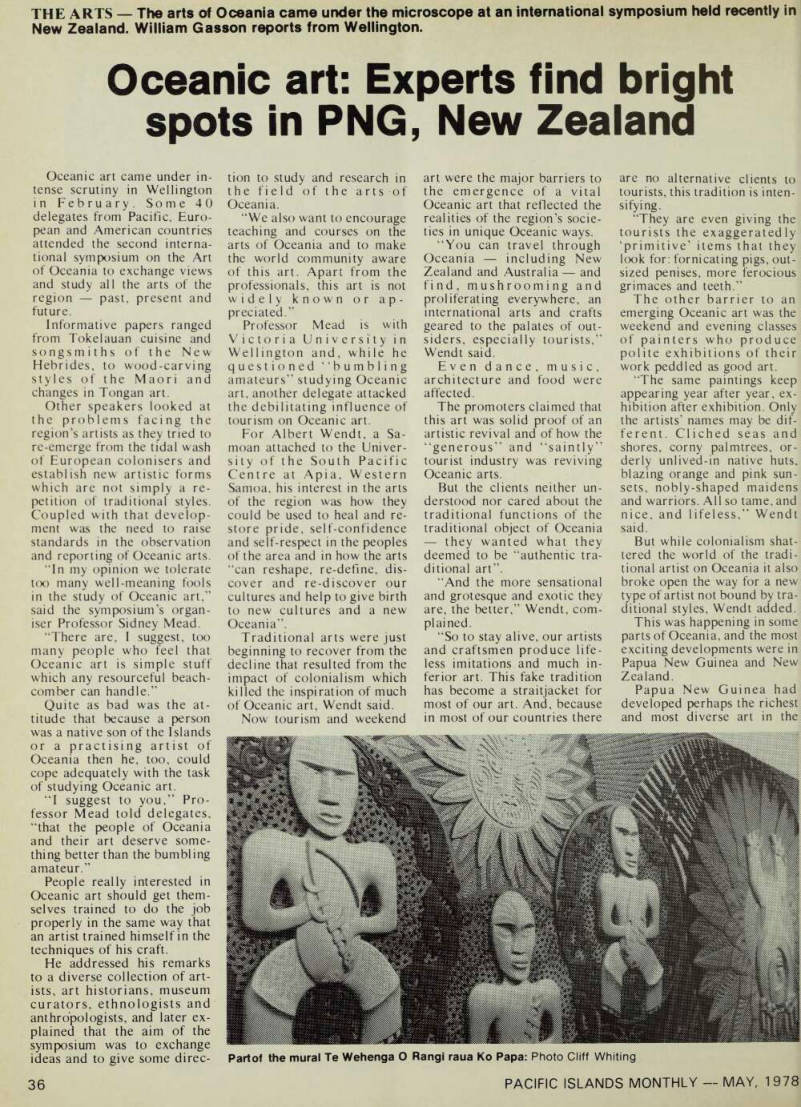
spots in PNG, New Zealand
THE ARTS The arts of Oceania came under the microscope at an international symposium held recently in New Zealand. William Gasson reports from Wellington.
Oceanic art came under in tense scrutiny in Wellington in February. Some 40 delegates from Pacific, Euro pean and American countries attended the second interna tional symposium on the Art of Oceania to exchange views and study all the arts of the region past, present and future.
Informative papers ranged from Tokelauan cuisine and songsmiths of the New Hebrides, to wood-carving styles of the Maori and changes in Tongan art.
Other speakers looked at the problems facing the region’s artists as they tried to re-emerge from the tidal wash of European colonisers and establish new artistic forms which are not simply a re petition of traditional styles.
Coupled with that develop ment was the need to raise standards in the observation and reporting of Oceanic arts.
“In my opinion we tolerate too many well-meaning fools in the study of Oceanic art,” said the symposium’s organ iser Professor Sidney Mead.
“There are, I suggest, too many people who feel that Oceanic art is simple stuff which any resourceful beach comber can handle.”
Quite as bad was the at titude that because a person was a native son of the Islands or a practising artist of Oceania then he, too, could cope adequately with the task of studying Oceanic art.
“I suggest to you,” Pro fessor Mead told delegates, “that the people of Oceania and their art deserve some thing better than the bumbling amateur.”
People really interested in Oceanic art should get them selves trained to do the job properly in the same way that an artist trained himself in the techniques of his craft.
He addressed his remarks to a diverse collection of art ists, art historians, museum curators, ethnologists and anthropologists, and later ex plained that the aim of the symposium was to exchange ideas and to give some direc
tion to study and research in the field of the arts of Oceania.
“We also want to encourage teaching and courses on the arts of Oceania and to make the world community aware of this art. Apart from the professionals, this art is not widely known or ap preciated.’’
Professor Mead is with Victoria University in Wellington and, while he
questioned “bumbling
amateurs” studying Oceanic art, another delegate attacked the debilitating influence of tourism on Oceanic art.
For Albert Wendt, a Sa moan attached to the Univer sity of the South Pacific Centre at Apia, Western Samoa, his interest in the arts of the region was how they could be used to heal and re store pride, self-confidence and self-respect in the peoples of the area and in how the arts “can reshape, re-defme, dis cover and re-discover our cultures and help to give birth to new cultures and a new Oceania”.
Traditional arts were just beginning to recover from the decline that resulted from the impact of colonialism which killed the inspiration of much of Oceanic art, Wendt said.
Now tourism and weekend
art were the major barriers to the emergence of a vital Oceanic art that reflected the realities of the region’s socie ties in unique Oceanic ways.
“You can travel through Oceania including New Zealand and Australia and find, mushrooming and proliferating everywhere, an international arts and crafts geared to the palates of out siders, especially tourists,”
Wendt said.
Even dance, music, architecture and food were affected.
The promoters claimed that this art was solid proof of an artistic revival and of how the “generous” and “saintly” tourist industry was reviving Oceanic arts.
But the clients neither un derstood nor cared about the traditional functions of the traditional object of Oceania they wanted what they deemed to be “authentic tra ditional art’’.
“And the more sensational and grotesque and exotic they are, the better,’’ Wendt, com
plained.
“So to stay alive, our artists and craftsmen produce life less imitations and much in ferior art. This fake tradition has become a straitjacket for most of our art. And, because in most of our countries there
are no alternative clients to tourists, this tradition is inten sifying.
“They are even giving the tourists the exaggeratedly ‘primitive’ items that they look for: fornicating pigs, out sized penises, more ferocious grimaces and teeth.’’
The other barrier to an emerging Oceanic art was the weekend and evening classes of painters who produce polite exhibitions of their work peddled as good art.
“The same paintings keep
appearing year after year, ex hibition after exhibition. Only the artists’ names may be dif ferent. Cliched seas and shores, corny palmtrees, or derly unlived-in native huts, blazing orange and pink sun sets, nobly-shaped maidens and warriors. All so tame, and nice, and lifeless,” Wendt said.
But while colonialism shat tered the world of the tradi tional artist on Oceania it also broke open the way for a new type of artist not bound by tra ditional styles, Wendt added.
This was happening in some parts of Oceania, and the most exciting developments were in Papua New Guinea and New Zealand.
Papua New Guinea had developed perhaps the richest and most diverse art in the
Partof the mural Te Wehenga O Rangi raua Ko Papa: Photo Cliff Whiting
world, Wendt said. The num ber of artists was growing.
Most had little formal educa tion and knew little of Western art or art history.
“A rich and distinctively Papua New Guinea imagery and symbolism, which trans cends the hundreds of indi vidual PNG cultures, has emerged,” he said. “The new artist is Papua New Guinea,”
Apart from the Australian Aborigines, he believed that the Maori people had suffered more from colonialisation than other Oceanic peoples.
Maori art had declined but, since World War 11, there had seen a dynamic rebirth of Maori art “a flowering of major talent using both tradi ional and new media and ex jloring themes, ideas and ityles”.
He spoke of the work of Cliff Whiting whose mural Te Wehenga o Rangi raua Ko
Papa took pride of place in a National Art Gallery exhibi tion of contemporary Maori artists while the symposium was on.
Whiting took more than three years to construct the mural, which is taken from a Maori myth. He developed it with the aid of his local Maori community, using tra ditional and new materials.
Whiting saw himself as a catalyst to inspire and guide the community which was directly involved in creating the mural.
He said; “The theme was selected because it is known and accepted by all tribes in New Zealand and by many of our Pacific neighbours. It is also the base of all things Maori; The Beginning’.”
Three artists working out side New Zealand and PNG to whom Wendt drew attention were: Aloi Pilioko of Wallis,
working in New Hebrides; losau Toafa of Western Samoa; and Kuai Maueha of the Solomons.
Pilioko’s most striking works are his needlework tapestries. He was discovered by the Russian artist Nikolai Michoutouchkine. Wendt said it was doubtful whether Pilioko, the artist, would have existed without the friendship of the Russian.
Toafa was the only Samoan artist who had developed a contemporary style of his own.
“The flavour of his work is Samoan: his artistic language heralds the start of a new Samoan imagery,” said Wendt.
However, rather than work ing on a major exhibition as he should be doing now, money pressures kept him selling his works as he pro duced them to supplement his
meagre teaching salary to feed his wife and three children.
Maueha, a carver, was one of the most remarkable per sonalities in Oceania, Wendt said. He also considered him one of the region’s major art ists.
“He has, through the un tutored simplicity of his genius, taken Solomon Is lands’ sculpture into the realms of the purely imagina tive, from the stale, stereotyped known into the unknown.”
The Betikama Carying Centre near Honiara is Maueha’s patron but in Wendt’s view it was vitally important that he be accorded a wider patronage.
“The art of our forefathers was for a time past; it is not and should not be the art of today. Let us study it as that, and not use it to dismiss to day’s art,” Wendt concluded.
Captain Cook’S‘Artificial Curiosities’
While Captain James Cook vas exploring the Pacific two centuries ago, he and his men :ollected many items of native nanufacture, writes Ronn in Honolulu.
Most of these man-made )bjects baskets, wood carv ngs and masks, for example were acquired through lading with the various Islan lers and eventually taken jack to England. The Euro jeans, who had never seen inch objects before, called hem “artificial curiosities”.
This year, to celebrate the iOOth anniversary of Cook’s dsit (and subsequent death) n Hawaii, the Bernice P. bishop Museum in Honolulu las opened a special exhibit eaturing over 400 artifacts lathered by Cook on his three
listoric voyages.
It is the first time these >ieces have been brought ogether since the 18th cen ury and the first return of the najority to the Pacific area, fhe museum reports that this s the most important single ;xhibition ever held in Jawaii.
The Bishop Museum, ap propriately enough, is calling ts display, “Artificial Curiosities”, and will keep the [allery open daily until the nd of August.
According to Dr Adrienne Caeppler, a museum mthropqlogist who organised he exhibition, the exhibited terns are not meant to honour
Cook but to present the achievements of Pacific peo ples before their contact with Europeans.
Objects on loan from over 30 different museums and many private collections in clude specimens from Hawaii, Tonga, Tahiti, New Zealand, New Caledonia, New Hebrides and the Marquesas.
Kaeppler, who spent eight years tracking down these ethnographic objects, con ceived the exhibit idea while she was working on a monograph about the evolu tion of native art in Tonga.
Many of the Tongan artifacts picked up by Cook were uni dentified and she began to catalogue them herself.
Her project on Tonga gra dually expanded to include all of the man-made objects gathered on the three Cook voyages. This meant exhaus tive research with old docu ments, newspaper accounts, museum reports and auction catalogues.
She found out that Captain Cook gave valuable souvenirs to both his royal patron. King George 111, and to his naval patron, the Earl of Sandwich.
The king’s collection is still owned by his heirs while much of Lord Sandwich’s treasures ended up at Cambridge University. The Bishop Museum, itself, has the re mainder of his priceless objec ts.
David Samwell, surgeon’s
mate on the third voyage, accumulated a large variety of “artificial curiosities” on his trip and sold the entire collection at auction in 1781. Dr Kaeppler traced many of Samwell’s specimens through an old museum catalogue that only recorded the last names of the buyers. Learning their entire identities required extensive detectve work.
At the end of the 18th century the most important private museum in England was owned by Sir Ashton Lever.
He purchased Cook’s own private stock and much of Samwell’s. Sir Ashton’s entire collection was sold in 1806.
There was so much to auction that the sale took 65 days!
Mrs Cook had her private collection as well and this was inherited by a cousin. It was later donated to the Colonial and Indian Exhibit in London in 1886. Today much of it belongs to the Australian Museum in Sydney.
Another significant group of Cook objects can be seen at the Museum of Anthropology and Ethnology in Leningrad, Following Cook’s death, the
expedition ships stopped at
Kamchatka where they underwent repairs. The English sailors thanked the Russian crew-members for their help by presenting them with still more artifacts.
These were eventually turned over to the Empress of Russia. She stored them in St
Petersburg where they have stayed unharmed until the present day.
Nearly all the museums contacted, Kaeppler said, agreed to lend pieces in their possession to the Bishop Museum for the present ex hibition. Kaeppler and John Wright, the museum’s historian, personally went to all the lending institutions and packed the rare speci mens for shipment to Honolulu, The US Government under wrote the cost of the insurance for the exhibit which was funded through a matching grant from the National En dowment for the Arts. Ad ditional money was provided from various other founda tions, corporations and indi viduals.
A complete illustrated catalogue by Kaeppler entitl ed Artificial Curiosities has been published by the Bishop Museum. It includes photo graphs of all exhibit items plus an inventory of all the documented Cook voyage ob jects located to date.
The 292-page catalogue is available from the Bishop Museum Press, PO Box 6037, Honolulu, Hawaii, 96818, USA. The cost is U 5527.50.
The exhibition, will be open seven days a week from 8 am to 7 pm for the duration of the showing. Special lectures are also planned. Adult admission is US$2.
Advertisements & other items, p. 37 (1 item)
37
ACIFIC ISLANDS MONTHLY MAY, 1 978
Islands
From the
Press
From the American Samoa News Bulletin: Seven new laws passed during the Fifth Special Session of the 1 sth Legislature of American Samoa and approved by the administration of former Governor H. Rex Lee became effective yesterday. They included. Public Law 15-61, which provides that, in addition to standing in a roadway for the purpose of soliciting rides from vehicles, it is illegal to sit, lie or loiter in a roadway in a manner as to constitute a hazard to himself or to vehicular traffic Public Law 1 5-63, which provides that the operators of motor vehicles AND anyone who rides with their bodies extended beyond the interior portion shall be subject to fines and possible imprisonment.
From the North Solomons Provincial Government’s policy and priorities statement as reported in the A raw a Bulletin: . . . Unless the government of this prov ince controls the economy and various economic activities, economic growth will lead to social injustice and increase inequalitv. It is a fact that investment which controls a man’s livelihood also controls the whole man; his freedom is empty and meaningless; his self-reliance is a myth; and his dignity is denie .. .
From the Tuvalu News Sheet: A bird known as the noddy was caught by Sakula Opeta on the island of Vaitupu. A telegram from the District Executive Officer on the island staled that a silver copper was tied to the bird’s leg with the words “Write F and W Service 933-59146 Washington DC USA”, written on.
From a letter by ex-Cook Islands minister Dr Joe Williams in the Cook Islands News on why he resigned from the government: ... In my letter of resignation I specified certain fundamental reasons, namely “The Premier’s increasing tendencies towards nepotism and authoritarianism. Nepotism means favouritism shown to relatives especially in conferring high offices. In the Cook Islands it is referred to by many people as ‘family government' . . . Authoritarianism has the same meaning as dictatorship or a one-man rule.”
From the Tohi Tala Niue: Difficulties in getting local labour and local building materials is seriously hampering progress on the new Assembly building and may mean Niue will not be able to host the South Pacific Forum in it this August, as planned. The main problem at present, says Mr Heaven, is the obtaining of chips and makatea for concreting from the Public Works Department . . . The other obstacle to completing the building for the Forum is that of obtaining sufficient men to work on the site. Mr Heaven has had considerable difficulty in getting Niueans to work, and in keeping them working.
From The Fiji Times: A 75-year-old man, appearing in court for the first time in his life, yesterday received a conditional discharge . . . the condition being that he does not appear in court again for another 75 years.
From a letter by D. Bentley, Papatoetoe (NZ) in The Norfolk Islander: . . Why do the public on Norfolk Island think we, as tourists, owe them something? We owe you nothing (after we have paid our accommodation etc as most of us do, coming on package tours) ... You are one of the more expensive places to visit from either New Zealand or Australia in the South Pacific, so people really have to want to visit Norfolk Island or they can easily be persuaded to go to Fiji for less outlay.
From the New Hebrides News: The US flag, the Stars and Stripes, was raised by John Frum followers on February 1 5 at Sulphur Bay. Among the crowd who watched the flag-raising ceremony were the FRC, Mr Bernard Pettier, Chief Minister George Kalsakau and other Ministers. Visitors were entertained by a parade by the John Frum Guard of Honour carrying sharpened bamboo poles, symbolising guns, and the letters USA written across their chests and backs ... A Vanuaaku Party flag hoisted at Laminu, near Lenakel School on Saturday February 11 was pulled down and burnt the next day by UCNH, John Frum and Kapiel supporters while VP supporters were at church. A nakamal and a house were also set on fire.
From a speech by the Gilberts Governor, IVIr John Smith, at the opening of the new House of Assembly reported in the Atoll Pioneer: . . . The composition of this House is further proof of the political maturity of the Gilbert Islands. You represent not only the many islands which make up our country but a wide range of experience and talent. There are among you those who can speak on behalf of the elders and those who can speak on behalf of youth. I have but one regret, there is no lady member ...
From the Tonga Chronicle: METRIC HINTS. Every time you pick up a coconut you can be learning the metric system. The average green coconut, dehusked, weighs about one kilogram. Easy, isn’t it?
Remember; one coconut, about one kilogram. But don’t use it as a weight.
A Samoan on life in Seattle (USA) as reported in the American Samoa News Bulletin: “Samoans come to the United States for opportunity,” said Galumalemana Vaiinupo Ala'ilima, co-ordinator of the Samoan Community Center. “In Samoa they prepare us to be parasites. Some Samoans (here) are lucky enough to make the grade. But they are exceptions. The rest are floating in a sea of troubles . . . The Samoan Community Center co-ordinates a number of social service programs, including a day-care program for the elderly and a Samoan grocery.” Ala’ilima said state and federal bureaucracies have made it difficult to run these programs. “Every time we try to raise our heads,” he said, “it seems somebody tries to push us down.”
From the Samoa Times: A funeral service at sea is expected to be held some time today for a father and son lost during a fishing expedition off Apolima, Thursday of last week. Informed sources said that Mr Werner E. Jahnke, a middle-aged resident of Mulifanua, and his son David, who was in his twenties, went fishing with another Mulifanua man, said to be a cripple . . . Sources said David had tied a fishing line around his wrist and that, as he was relaxing, a fish took the line and David was whisked overboard.
When he failed to reappear for some time, Mr Jahnke Jumped overboard apparently to look for his son. The crippled man waited on the boat for a long time but neither Mr Jahnke nor David returned.
From the Solomons News Drum: The villagers who sew their own clothes, buy a cheap radio and an umbrella but don’t drink or smoke, will do best under the new tax changes Minister of Finance Benedict Kinika.
Advertisements & other items, pp. 39-46 (1 item)
Or individual instruments?
I —Filters —|
* a ••
Subsonic
High -26 -2A 22 ' 20 -28 ~30 '32 -34 r -40 “43 -47 Volume ” 52 Loudness 60 Balance i 0 f r Off 16Hz ' off
IOKHz
tff on left right f dB Tape Play- Muting source tape-1 f tape-2 Copy oh tuner • Do you hear a big sonic smear?
Or individual instruments?
Now you can clearly hear individual of "straight gain" with a THD that's an instruments of the biggest orchestra with unbelievably low 0.025%! This is the new Sansui's new DC integrated amplifier, the DC amplifier that's so advanced, so good beautiful AU-717. A that you must hear it to
special Sansui-developed
DC power amplifier circuit (PAT. PEND.) brings out instruments so
sharply that you distinctly
sense the piano's scales,
the drum's attack, the bite of the brass. Free of coloration, the AU-717 delivers 85 RMS watts x 2
Sansui.
Only hi-fi, every thing hi-fi.
believe it.
Our AU-517 is virtually the same but with a bit less power and easier on the pocket. Our super TU-717 FM/AM tuner is the perfect
matching component.
A TU-717 ◄ AU-517
SANSUI ELECTRIC CO., LTD. 14-1 Izumi 2-chome, Suginami-ku, Tokyo 168, Japan • Fiji Prabhu Brothers Ltd. P.0.80x 183, Nadi Phone: 70183/4 • Papua New Guinea Oceania Indent Agency (P.N.G.) Pty. Ltd. Box 5518, Boroko. Port Moresby Phone: PM 256406 • New Zealand David Reid Electronics Ltd. C.P.O. Box 2630, Auckland, 1 Phone: 492-189 • New Caledonia Ets Michel MERCIER B.P. 1123, Noumea Phone; 27. 59. 11 • South Pacific Miltons Department Stores Limited P.O. Box 146, Norfolk Island 2899 • Central Pacific Nauru Co-operative Society Republic of Nauru • New Hebrides The Sound Centre P.O. Box 434, Port Villa • Cook Island United Island Traders Ltd. P.O. Box 1& 2, Rarotonga • Tahiti DIMECO P.O. Box 2622
T'v V\f dfciG 4k «^v« -■, ,y rv * 4 % 4 X\'\ -its.
V > 'v, O >V* \ \ V v v‘ /r. m V-y'-
cfi
✓ ✓ K 5^ ‘*t -/ \k Wi , * ;sz - ; l O ifl * & ..
* t* k * *** cl
When you build great solo performers,
it’s easy to create a great Music Center.
Pioneer is the total audio company.
For over 40 years, we’ve concentrated our skills on the reproduction of sound.
From individual components to complete systems. From diamond styli to cabinet material for speakers. So it’s only natural that our KH-5522A Music Center reflects this commitment to hi-fi excellence.
Advanced features include an AM/FM receiver with a continuous power output of 12 watts per channel (8 ohms, IkHz, T.H.D. I%)and PLL (Phase-Locked Loop) circuitry in the FM section for definitive separation of left and right channels. Creative management of subtle nuances in musical reproduction is possible with separate BASS and TREBLE. Tape enthusiasts will find added versatility through the recording output terminal
(REC OUT).
For easy handling of records the full-size component type turntable offers automatic return, cut and shutoff. The cassette deck is the new frontloading style and provides automatic STOP in any mode for dependable tape and mechanism protection.
Of course, the speakers blend perfectly. Big 2-way speaker system with a 20cm (8-inch) woofer for rich, luxuriant bass and a 6.6 cm (2%-inch) cone tweeter for brilliant highs.
Also available is the KH-525A Music Center. No turntable, but the same great quality and the added bonus of short-wave.
Pioneer’s KH-5522A and KH-525A Music Centers. More outstanding contributions to your musical enjoyment from the audio company.
(U) PIONEER
Australia Pioneer Electronics Australia Pty.
Ltd., 178-184 Boundary Road, Braeside, Victoria 3195, Tel: 90-9011, Sydney 93-0246, Brisbane 59-7457, Adelaide 433379, Perth 24-9899 Fiji Islands Brijlal & Company, G.P.O. Box No. 362, Suva, Fiji Islands Tel: 22258 New Zealand Fountain Marketing Ltd., Maidstone Street, Auckland, New Zealand Tel: 763-064 Norfolk Island Burns Philp (Norfolk Island) Ltd., Norfolk Island, South Pacific New Hebrides Burns Philp (New Hebrides) Ltd., Vila. New Hebrides Nauru Island Jacob Enterprises, P.O. Box No. 4 Republic of Nauru Tahiti Est, PERFECT, B.P. 594, Papeete, Tahiti Tel: 20 407 New Caledonia Menard Freres Ville, B.P. H 2 Cedex, Noumea, New Caledonia Tel: 27.52.22 American Samoa Traspac Corporation, P.O. Box 1477, Pago Pago, American Samoa 96799 Tel: 633-5224 Rarotonga South Seas International Ltd., P.O. Box 49, Rarotonga Cook Islands Tel: 2327 Papua Newguinea Bali Merchants Pty. Ltd., P.O. Box 6103 Boroko
Z’ JMtA
U f r-- The Toyota truck range. Built to be unbeatable.
Bad weather conditions, no problem.
Bad roads and driving surfaces, eaten up.
Difficult loads, no contest. Built tough. Built to take it.
There's a Toyota truck built for you. * ttUbl I TOYOTA Land Cruiser Pickup
TOYOTA Dyna
J TOYOTA Stout TOYOTA Toyo-Ace 111
TOYOTA Hi-Lux
TOYOTA Truck
TOYOTA
For unbeatable after service: P O PU Btx N 2r7 G^a!Da E n A Awnc S * hl ® V Rd '’ Badili ' Po ' B ° X 75 ’ P ° rt Moresbv US TRUST TERRITORY: MICROL CORPORATION, CO ' LTD PO 057 pL 'p SUPPLIES C 0 - LTD - GP 0 355, Suva. AMERICAN SAMOA: BURNS PHILP (SOUTH SEA) Po" 80x 6428 Tamunin ' PH ' LP (S ° U ™ SEA) LTD ' P °' B ° X 188 ' Apia ' GUAM: ATKINS - KROLL (GUAM) LTD., LTD P O rl' fTu B ’- N f HEBRIDES MOTORS LTD., P.O. Box 18, Vila. SOLOMON ISLANDS: MENDANA ENTERPRISES (S I ) • p ° ■“ 276 new cal
Worldwide Nobody knows more about lifts than
OTIS
When someone tries water skiing,
something happens.
Something happens to people who try water skiing. They talk water ski. Think water ski. Dream water ski. Outsiders those who never tried it say water skiers seem to lose their balance. Not on the skis, though that's part of the fun too. But they just never seem to be the same again.
Right! And after your first trip (oops) on the ripples, beware! Learn the basic knack of getting up it usually comes the first day and you're into it And each new technique you master will lift you further into fantasy... And you too will talk water ski. Think water ski. Dream ...
What are you waiting for???
The Why Behind The Y Set out to test your skill on water skis and you want to follow in the wake of solid engineering. That's where Yamaha takes the lead. Clock-like precision control pours out smooth thrust to get you up on top quickly. Throw a rooster tail to make the cock crow and your Yamaha keeps pulling with no faltering, no slackening of spirit.
And to make it easier to keep your mind on skiing, Yamaha's reliability is your greatest asset Features such as thermostatcontrolled cooling and hot-sparking, capacitor discharge ignition keep you going in
style.
These are just some of the reasons why so many of the world's skiers are trained by Yamaha.
From 2 to 60.
Power for
any purpose.
60 mm »»•»•» y 55 40 28 20
Outboard
with
YAMAHA MOTOR CO. LTD.
2500 SHINCAI IWATA-SHI SHIZUOKA-KEN JAPAN
Trojan tools dig it, scoop it, fork it, rake it, hoe it, chop it and you name it.
Trojan tools are designed for efficiency and made from materials tough enough to handle any job.
Shovels, scoops and spades: The whole range.
Scientifically designed, hardened and tempered for toughness, durability and resilience. Light and balanced to make light work in industry, on the farm or in the home garden.
Forks and drags: Every head is roll-forged from a single bar of special steel for extra strength and so that both head and tine are properly shaped and drawn to the correct taper for the job in hand.
Rakes, garden tools, hoes and cultivators: All scientifically designed with typical Trojan strength and efficiency built in. Made stronger to last longer.
Axes, hatchets, picks and mattocks: Axes for winning wood-chops, felling tall timber or just chopping wood at home. The Trojan/Hytest range has them all, from the famous Hytest Racing Axe right through.
Trojan, Australia’s leading manufacturer of garden and Agricultural tools. Stocked by all good hardware retailers
CtfTROJAN
7 AUSTRALIA
For further information contact; Trojan Pty. Ltd. Box 139, Footscray, Victoria, Australia, 3011 Telephone 689 3377.
Telegrams and cables “Trojantools,” Melbourne.
TJI6
Fiji Island
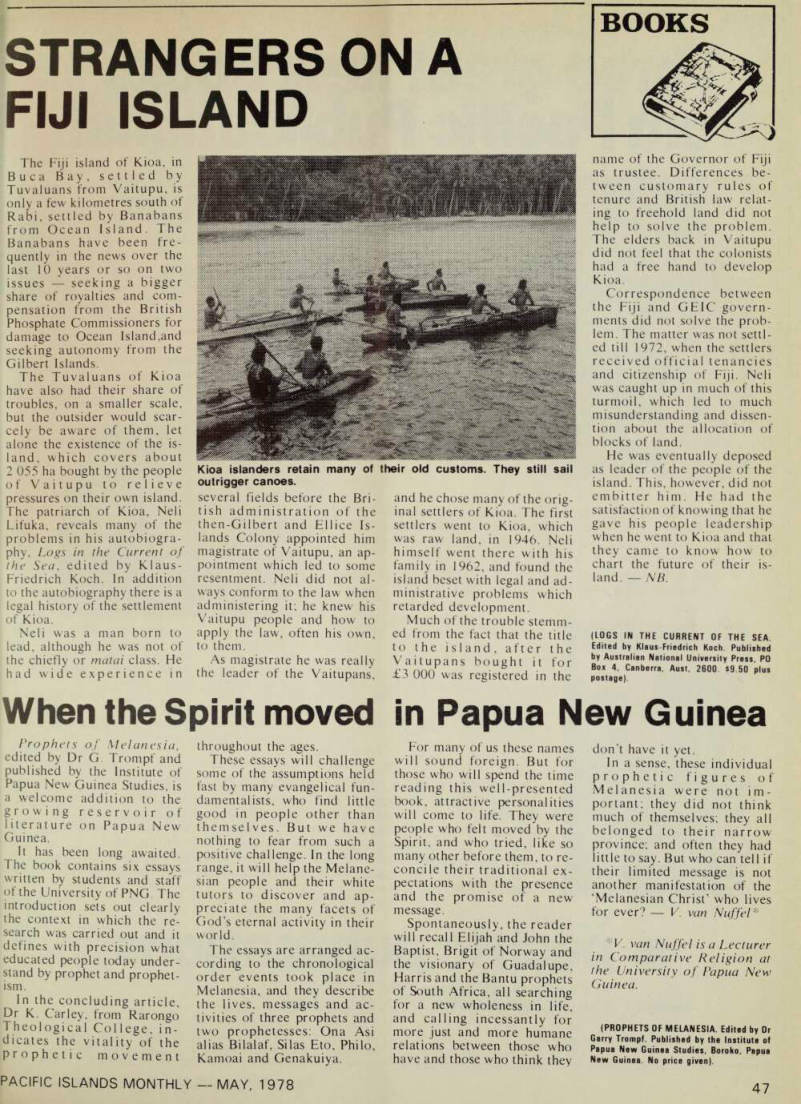
Strangers On A
Books
The Fiji island of Kioa, in Buca Bay, settled by Tuvaluans from Vaitupu, is only a few kilometres south of Rabi, settled by Banabans from Ocean Island. The Banabans have been fre quently in the news over the last 10 years or so on two issues seeking a bigger share of royalties and com pensation from the British Phosphate Commissioners for damage to Ocean Island,and seeking autonomy from the Gilbert Islands.
The Tuvaluans of Kioa have also had their share of troubles, on a smaller scale, but the outsider would scar cely be aware of them, let alone the existence of the is land, which covers about 2 055 ha bought by the people of Vaitupu to relieve pressures on their own island.
The patriarch of Kioa, Neli Lifuka, reveals many of the problems in his autobiogra phy, Logs in the Current of the Sea , edited by Klaus- Friedrich Koch. In addition to the autobiography there is a legal history of the settlement of Kioa.
Neli was a man born to lead, although he was not of the chiefly or matai class. He had wide experience in
several fields before the Bri tish administration of the then-Gilbert and Ellice Is lands Colony appointed him magistrate of Vaitupu, an ap pointment which led to some resentment. Neli did not al ways conform to the law when administering it; he knew his Vaitupu people and how to apply the law, often his own, to them.
As magistrate he was really the leader of the Vaitupans,
and he chose many of the orig inal settlers of Kioa. The first settlers went to Kioa, which was raw land, in 1946. Neli himself went there with his family in 1962, and found the island beset with legal and ad ministrative problems which retarded development.
Much of the trouble stemm ed from the fact that the title to the island, after the Vaitupans bought it for £3 000 was registered in the
name of the Governor of Fiji as trustee. Differences be tween customary rules of tenure and British law relat ing to freehold land did not help to solve the problem.
The elders back in Vaitupu did not feel that the colonists had a free hand to develop Kioa.
Correspondence between the Fiji and GEIC govern ments did not solve the prob lem. The matter was not settl ed till 1972, when the settlers received official tenancies and citizenship of Fiji. Neli was caught up in much of this turmoil, which led to much misunderstanding and dissen tion about the allocation of blocks of land.
He was eventually deposed as leader of the people of the island. This, however, did not embitter him. He had the satisfaction of knowing that he gave his people leadership when he went to Kioa and that they came to know how to chart the future of their is
land.
NB.
(LOGS IN THE CURRENT OF THE SEA.
Edited by Klaus Friedrich Koch. Published by Australian National University Press, PO Box 4, Canberra. Aust, 2600 $9,50 plus postage).
Kioa islanders retain many of their old customs. They still sail outrigger canoes.
When the Spirit moved in Papua New Guinea
Prophets of Melanesia, edited by Dr G. Trompt and published by the Institute of Papua New Guinea Studies, is a welcome addition to the growing reservoir of literature on Papua New Guinea.
It has been long awaited, The book contains six essays written by students and staff of the University of PNG. The introduclion sets out clearly the context in which the research was carried out and it detines with precision what educated people today understand by prophet and prophet-
,sr J l -
conc l ud i n g article, Dr K. Carley, from Rarongo I heological Col lege, indicates the vitality of the prophetic movement
throughout the ages, These essays will challenge some of the assumptions held fast by many evangelical fun damentalists, who find little good in people other than themselves. But we have nothing to fear from such a positive challenge. In the long range, it will help the Melane sian people and their white tutors to discover and ap preciate the many facets of God’s eternal activity in their world.
The essays are arranged ac cording to the chronological order events took place in Melanesia, and they describe the lives, messages and ac tivities of three prophets and two prophetesses: Ona Asi alias Bilalaf, Silas Eto, Philo, Kamoai and Genakuiya.
For many of us these names will sound foreign. But for those who will spend the time reading this well-presented book, attractive personalities will come to life. They were people who felt moved by the Spirit, and who tried, like so many other before them, to reconcile their traditional expectations with the presence and the promise of anew message.
Spontaneously, the reader Ri l n,U. Ca ßHaii i T h fM and J ° hn Bapust, Bngit of Norway and the visionary of Guadalupe, Hams and the Bantu prophets of South Africa, all searching for anew wholeness in life, and calling incessantly for more iust and more humane
rpiL;£ kT.. numane
relations between those who have and those who think they
don’t have it yet.
In a sense, these individual prophetic figures of Melanesia were not im portant; they did not think much of themselves; they all belonged to their narrow province; and often they had little to say. But who can tell if their limited message is not another manifestation of the 'Melanesian Christ’ who lives for ever? — V. van Nuffel * *V. van Nuffel is a Lecturer in Comparative Religion at the University of Papua New Guinea.
(Prophets Of Melanesia. Edited By Dr
Garry Trompf. Published by the Institute of Papua New Guinea Studies, Boroko, Papua New Guinea. No price given).
Advertisements & other items, p. 48 (1 item)
Three great new books
from Pacific Publications!
iSi sos
Send to PI M's Mail Order Bookshop for these titles. Prices include postage anywhere in the world. See also the other Pacific titles on the buff-coloured coupon in the back of this issue of PIM.
PACIFIC ISLANDS COOKBOOK. At last, a real cookbook for and about the South Seas! Hundreds of recipes using ingredients found in most parts of the South Pacific, including a big section on fish. Practical recipes with taro, yams, breadfruit, cassava, ferns, shellfish and raw fish, as well as rice, meat, fruits, poultry, etc. But nutritionists Susan Parkinson and Peggy Stacy (who wrote 'A Taste of the Tropics') go further in their big new book and use their first-hand experience to provide help for home-makers on meal planning, kitchen budgeting, children's diets, etc. 120 pages, illustrated. $A7.00 or$USB.5O posted.
FarMmscm
Peggy Stacy
THE TONGANS. Writer Olaf Ruhen and photographer Josef Vissel capture the lifestyle of the people of the last Polynesian Kingdom. Brilliant prose and sparkling full-colour pictures depict today's Tongans at work, in church, at play tell of their traditions, crafts, houses, and hopes. 96 colour photographs in a 84-page large format volume. $A8.50 or SUSIO.OO posted.
Ibngaiis
o pmmmwmmmmms PAPUA NEW GUINEA HANDBOOK AND TRAVEL GUIDE. The 1978 edition just out! 280 pages of facts, figures and a map on Papua New Guinea, including a large coloured up-to-the-minute foldout map. Geography, history, government, finance, commerce, transport, land use, social services, etc., etc. Detailed reports on every province together with full lists of accommodation and tariffs. For businessmen, schools, libraries, residents, tourists...everybody needing the latest information on Papua New Guinea. $A8.50 or SUS 10.00 posted.
Published b/ a
publications
76 Clarence Street, Sydney 2000.
Postal Address: Box 3408 G.P.O. Sydney 2001
Anatomy Of War In
Png Highlands
The recent report that the Papua New Guinea National Parliament had adopted new laws to curb tribal fighting in the Highlands (PIM, Jan, p 6) makes a new book, Blood Is Their Argument (Warfare among the Mae Enga Tribes men of the New Guinea High lands) particularly apposite.
The author, Professor Mer vyn Meggitt, began his in vestigations of the Mae Enga people during a 15-month stay, 1955-57. Five other visits followed between 1960 and 1973 and during these, mostly with his wife, he lived with the Mae Enga people.
The results of his research have varied from works with relatively popular-sounding titles such as Studies in Enga History to much more specific and technical papers on lineage systems, male-female relationships, and others on the people’s techniques of salt-making and house-build ing.
In this latest monograph, the subject is warfare among Highlanders who view them selves, the author says, “as fairly violent people, people for whom ‘blood is their argu ment’ ” for consistent and per petuated conflict between the various groups.
Despite the editors’ claim that “special pains have been taken in editing to make each book [in this series] lively and readable to an intelligent freshman”, this lay reader cannot agree that they suc ceeded in their aim.
It is not sufficient for Meg gitt to outline the scope of fighting and the relationship of groups of combatants; he must initially revert to such basics as defining “warfare”, even to the extent of citing such unexpected sources as Hobbes, and Scott’s Ivanhoe.
Nevertheless, the situation, despite various minor ex cuses, is that Mae groups feel that they need more land and they maintain that violence is a fairly effective means of ac quiring territory.
It is also interesting to note that the scale of such disputes was, until recent times, con ducted according to well defined rules regarding com pensation for death and inj ury; and of mutual obligations
of related groups to accom modate (temporarily or per manently) weaker relatives who were dispossessed.
The upshot of this con tinuous “warfare” in the days before administration intru sion into the area was that force was the means whereby dominant and expanding groups acquired more land to allow them to survive (more land making it possible to grow more crops and raise more pigs). At the same time, injuries and deaths in such fighting acted as a form of population control and the intricate system of com pensation also ensured that some sort of “honour” was effectively maintained both in warfare (especially ceremonial affrays) and towards relatives of victims.
Of course, it is stupid to at tempt to be wise after the event, but, according to the author, these matters of land dispute and compensation were pretty well managed before European incursion into the area.
Then fighting became an “offence”, and when “peace” was established, coupled with improvements in medical facilities in the region, there was a population explosion.
Despite well-meaning at tempts by administrators to arbitrate on boundaries which had always been flexible, and to attempt to define what had always been undefined, other schemes also went wrong. The present PNG legislation against fighting that is said to have cost Highland tribes about $lOO 000 in lost coffee trees and housing, might ask whether or not it really is necessary for these people to be concerned with producing cash crops; or if it might not be better for them to maintain their traditional gardens whose size was determined by traditional factors.
In some of Meggitf s reveal ing footnotes, he remarks that exotic crops which well meaning agronomists tried to introduce (eg potatoes and turnips) “offered no ap preciable advantages in pro ductivity (nor perhaps nutri tion) over the existing com binations of sweet potatoes, taro and other indigenous
plants”. Elsewhere surveyors with no knowledge of local tradition or law, have come in by helicopter and “fixed” ar bitrary boundaries, only to have their bench marks de stroyed once the “choppers” were beyond the next moun tain.
In this book, Meggitt gives obviously valid explanations for matters which were cause for concern among past ad ministrators and, still pose problems for the present government. His ex planations, unfortunately, are far too often over-detailed to be considered light reading; and as a cautious if wise academic, his comments con sist more of qualifications than possible solutions to the problems that have been caus ed, and will recur in this area.
Only once does Meggitt ap proach the readability of Gardner and Heider’s Gar dens of War when he con cedes that not only is there no restriction barring friends and kinsmen from participation in a fight, but that “younger bachelors do join in . . . just for the hell of it”. His defini tion of the problem (and of the many issues which com plicate this tradition of war fare, land shortage and over population) is detailed and valid. The pity is that it is so much easier to define the problems than to formulate
cures.
John Goode
(Blood Is Their Argument: Warfare
Among The Mae Enga Tribesmen Of
The New Guinea Highlands Mervyn
Meggitt. Published by Mayfield Publishing Company, Pelo Alto, Calif. $4 95.)
Cooks’ discovery of the South Pacific Islands

South Pacific Islands
I was raised in the belief that the way to a man's heart is through his stomach. After a recent browse through several larger book stores I felt that the old adage needs updating.
Irrespective of sex, the hearts (and pockets) ot today’s readers are being wooed by a plethora of books dealing with gastronomic delights. In each store a sizeable proportion of available floor space was devoted to cookbooks dealing with every conceivable aspect. except perhaps the culinary triumphs of the Eskimo.
There were books dealing with the art of cooking in countries around the world, from Russia to Indonesia, Israel to Mexico.
Yet, strangely, some of our nearer neighbours appear to have been neglected. Thus it was with pleasure that recently I perused two new cookbooks, both dealing with food in the Pacific Islands countries, or, more correctly food for Pacific Islanders.
The Papua New Guinea Cookbook is a no-nonsense titie which might deter some people because it sounds prosaic and localised, and, accordingly, of no interest to those unlucky enough to have neither lived in nor visited Papua New Guinea. But inside the covers is a very readable little book packed with information, not only
about local foodstuffs and food preparation, but also about the lives of the people, We read about planting and harvesting methods, and the ceremonies and rituals as sociated with food in Papua New Guinea. There is even a small section warning against “mockery foods”, which may look palatable but which could be disastrous for the un wary food sampler, The writer of this book, Anne McGregor, has lived for seven years in Papua New Guinea, and records in her in troduction the time and effort she spent getting the recipes and information about local foods and food customs. She deplores the passing of many old-time slow-cooking pro cesses which preserved the natural goodness of the food but she also grants that many modern utensils and new foodstuffs have given variety to the dietary patterns of to day’s Papua New Guinea, One of her reasons for writ ing the book is to help local women prepare food that looks and tastes better and is more nutritious. She also aims to preserve, where possible, what is traditional and to im prove it by modern means and the use of a greater variety of now-available foodstuffs, seasonings and spices, Enhanced by excellent photographs, many in colour,
the book is clearly set out and easy to follow, as every good cookbook should be. Instruc tions for individual recipes are kept as simple as possible.
Vegetarian recipes pre dominate. The author gives us the very logical explanation that animal protein can be a scarce luxury for many people in Papua New Guinea, although the coastal people fare better, having a wealth of fish and other forms of sea life to utilise to the fullest. In the entire book there is only one recipe using that delightfully named ingredient. hulumakan, which most of us know as beef.
Other Pidgin delights well worth mentioning are Fainap Long Fig (using boiled sliced ham, and not that notorious “long pig" of Captain Cook’s time). Mango M aunt in , achieving the peaks of success that every mousse should and Bikhets (big heads), which is basically chocolate-covered frozen bananas.
The author has surely achieved her objective of making people aware of good food in Papua New Guinea and my only quarrel with the book lies in its brevity. Here's hoping for further fascinating recipes in an enlarged edition at some future date.
The second book, the Facific Islands Cookbook . is larger, both in format and content.
The co-authors. Susan Parkinson and Peggy Stacy, have been collaborating in writing about cookery for a number of years and this is their second book. Their first, A Taste of the Tropics, is well known in the Islands. The Pacific Islands Cook Book, pertains particularly to Fiji, where both writers have lived, and where, in fact, Susan Parkinson has now made her home.
To some extent I feel that the title of the book is perhaps rather too generalised, although it can be claimed, quite justifiably, that many of the basic ingredients are com mon throughout the South Pacific area. Anyone familiar with different South Pacific countries will entirely agree that, although the names differ, there are many com mon recipes. I have sampled the delectable rourou in Fiji, but also in Apia, Pago Pago and Rarotonga, the only dif ference being in the name.
The common names of the Is
land foodstuffs are handily listed as an appendix.
This is an ambitious book with a number of objectives, the predominant one being to improve the standards of nutrition and cookery among Island housewives. Both authors are experienced nutri tionists.
It offers help in budgeting and meal planning, and sam ple menus listed would have met with the unqualified ap proval of Mrs Beeton.
As I read these menus I found my mind making in teresting comparisons be tween the listed goodies and the many Island feasts in which I have participated over a number of years, hav ing kept a home at different limes in the Cook Islands and Fiji.
The Pacific Islands Cook book begins with a very readable section on family health and nutrition, in cluding a clear diagram of the three basic food groups to be found in good meals. This could well be enlarged to poster size and hung in all Is lands kitchens for constant reference.
The chapters which follow are like those of most cook books soups, eggs, vegeta bles, meats and so on. right through to preserves and pickles. There is even a chapter on freezing show ing beyond doubt that Island housewives move with the times. I feel that the section devoted to alcoholic drinks strikes a discordant note and I hope that the opening state ment will be well noted “All alcoholic drinks are ex pensive”.
Apart from the attractive four-colour cover there are two glowing pages of colour photographs, and how 1 wish there had been many more such illustrations to embellish the book. The various black and white sketches at the beginnings of the chapters are simply and effectively drawn, although the variant spellings of mackerel on one of the “fish” pages are somewhat
disconcerting.
As I browsed through the Pacific Islands Cookbook I found my memories stirred and my taste buds tingling at the mention of delectable foods such as baked pawpaw, stuffed dalo leaves, turtle, bread fruit chips, and the fleeting duruka, which we an ticipated all year, enjoyed for
several glorious meals then mourned its passing from the scene for another year.
It is fascinating too, to realise the impact of other countries, notably India and China, on South Pacific cuisine. Their contributions have extended and enriched the diet and added extra zest and spice (a fact undoubtedly appreciated by anyone who has sampled a good, hot local curry).
This cookbook deserves a place on Island kitchen shelves and it could be safely predicted that many copies will find their way to bookshelves in Australia, New Zealand and further afield.
What better momento of a visit to the South Pacific than a practical volume about the foods one sampled? What a challenge to, say the Sydney or Auckland hostess, than to try some of its dishes, w ith her own adaptations where necessary? Pacific Islands Cookbook may be likened to a classic dish well prepared, attractively presented and easily digested. Merle //.
Coppell.
(Papua New Guinea Cookbook. By Anne
McGregor. Published by Jacaranda Press, Queensland $2 95. PACIFIC ISLANDS COOKBOOK By Susan Parkinson and Peggy Stacy. Published by Pacific Publications, Sydney. $5.95.)
What to eat
and why
Most islands of the South Pacific can produce enough nutritious food for their own requirements. They can get all they require in the way of pro tein, vitamins, minerals and carbohydrates from their own fruit and vegetables, fish, pigs and cattle.
But in spite of repeated ex hortations to do more of “their own thing” and con serve overseas exchange, the trend to processed imported food persists.
Well known Fiji nutri tionist, Susan Parkinson, in co-operation with the Fiji YWCA Nutrition Committee, has revised the South Pacific Handbook of Nutrition, first published by the South Pacific Health Service in 1964. It is now right up-to-date and ex panded where necessary to cater for changing needs. It is a practical reference for nutri tionists.
Traumatic NZ
Who’s Who
The latest edition of Who's Who in New Zealand has just been published, giving detail ed biographies of more than 3 000 people.
The book is welcomed because of the long seven-year gap since the 10th edition emerged.
The publishers. A. H. & A.
W. Reed, hope that in future the “Who's Who" might emerge every two years. The difficulty is finding an editor.
At present the “Who's Who" is compiled on a part-time basis.
Jim Traue. chief librarian of the Turnbull Library in Wellington, handled the task for this latest edition for five years, but feels that amateur editorship should end. “To do the job New Zealand de serves. we need a full time editor." he said.
His biggest surprise in com piling the names was the num ber of New Zealanders who refused to go in it. About 200 people had refused.
“There's something about the New Zealand attitude to pedigree the smell of the studbook that puts people off." Traue said.
Some people fought shy of appearing because of the num ber of Who's Who pub lications that want you to pay to appear in their editions, he said.
However, the book is a badly-needed mine of infor mation on most of the im portant people in New Zea
land.
William Gasson.
(Who's Who In New Zealand. 11Th
edition. Edited by J. E. Traue Pub lished by A. H & A. W. Reed. 65/67 Taranaki Street, Wellington. 300 pp
Snz 16.40.)
Advertisements & other items, pp. 50-51 (1 item)
You name it, Mono pumps it.
I ■ 9© m 7Q m % > r &
Tell us your needs, we’llshowyouthepump. Forover 30 years, we’ve been pumping liquids of every viscosity, under all kinds of conditions. Fresh water, sand and water, food ingredients, chemicals, acids, corrosives and abrasives, sludges and waste, effluent and sewage, even solids in suspension.
If it can be conveyed through a pipeline, we can move it, meter it or mix it, as quickly or slowly as you wish.
And we can provide pumps that run on petrol, kerosene, diesel, electricity, or PTO tractor drive (in fact even bicycle drive).
If there’s anything you want to know about pumping, write to us at Mono. We’ve got the pumps and the experience.
Please send me details of your pumps for (describe purposes): Name: Address: i Send coupon to Head Office & Works (address below).
MONO
AAPUMPS
AUSTRALIA PTY. LTD.
MOVE IT WITH MONO
Head Office & Works: “Mono House”, 338-348 Lower Dandenong Rd., Mordialloc, Vic. 3195, Australia.
Agents in: Papua and New Guinea, Indonesia, Fiji, The Philippines. 344-P-7177
HENRY LAWSON'S
BOOKSHOP
531 Royal Arcade, (Beneath Sydney Hilton) Pitt through to George St
SYDNEY, 2000.
Phone; 61 2365.
WE STOCK ONL Y
AUSTRALIAN BOOKS
AND BOOKS ON
OCEANIA!
Write to u» for specialist attention.
How Australian firms can burnish
their image in the Islands
Trade
Winds
Working, usually without the sound of trumpets, a group of voluntary agencies, some of them world-wide, are giving aid to the Islands. One such group is the Australian Council for Overseas Aid, of which the Foundation for the Peoples of the South Pacific Inc is a member. Already, these agencies have given valuable aid to the Islands, but much more is needed. Below, Lurline Price, executive officer for the foundation, pricks the consciences of Australian companies who benefit from their trade with the Islands but give little, or nothing in return.
Recent research carried out by the Australian Council for Overseas Aid into Australian trade with South Pacific coun tries showed that the most striking feature of such trade is the massive imbalance in favour of Australian com panies. Australian imports amount to only one-third of its total exports to the region, and this extremely favourable balance of payments position for Australia has many im portant effects on economic patterns throughout the Pacific. Almost without ex ception the individual coun tries in the South Pacific have large and continuing trade deficits. The exceptions are the few resource-rich islands such as Nauru.
The effects of world-wide inflation have hit the South Pacific countries hard. Most with large scale deficits are now paying much more for imports from countries such as Australia. This has been ex perienced particularly in manufacturing and industrial goods.
However, the price of ex ports from the few South Pacific countries engaged in such trade with Australia has not risen so sharply, thus ad ding an increased percentage to the trade deficit as a direct result of the flow-on inflation.
Relatively little of Australia’s imports from the Islands are agricultural, a disturbing fact for them considering the subs tantial role of agriculture in their economies.
Tariffs, quotas and preferences have, to a large extent, played an important role in the overall limitations of South Pacific exports to Australia especially in this sector. Rigid protection of primary industry in Australia has ensured a very limited amount of agricultural pro duce being imported. The amount of manufactured or semi-manufactured goods
from the South Pacific im ported into Australia is negligible, and opportunities exist for the expansion of this component of Australian trade.
Australian exports to the South Pacific take two major forms. The increase in tour ism and the growth of “western" style consumer societies has been accom panied by an expansion of Australian manufactured goods and processed Australian primary products exported to the South Pacific.
This rise has had profound effects including the open ing of many supermarkets with canned and frozen Australian products and in dustrial goods.
Particularly striking is the volume from Australia of light manufactured goods, such as soap, plastics, paint, paper products and fibres.
Heavy industrial materials such as iron and steel, pipes, aluminium, concrete, engines, coal and other fuels are another important group of export items. Electrical goods, automobiles and clothing are also exported in
rapidly-increasing quantities.
Most of these exports are directed towards the urban areas in the South Pacific which are growing in numbers of population, due to the drift from the rural areas in search of employment.
The Australian Council for
Overseas Aid has expressed concern at these trends and certain of its member agencies are working towards some possible solutions to the problems, in partnership with organisations within the Pacific itself. They feel that there must be a preparedness by all Australians to challenge the relationship with South Pacific countries as it now ex ists.
One of these agencies is the Foundation for the Peoples of the South Pacific, whose role is that of a “catalyst” for the needs of the people at grass roots level, who are the main victims of such a system. It has recently been carrying out a campaign to alert Australian companies trading in the South Pacific to the thinking among many of the Islanders themselves, as well as Australians concerned with issues for social justice.
It is hoped to build up an effective body to assist in reversing the present im balance of trade by a change in present attitudes. Mean while, the Foundation is seek ing active sponsorship of self help programmes designed to improve the socio-economic condition of Pacific Islanders, particularly in the rural areas.
A considerable number of such business-houses has re sponded to the appeal with enthusiasm. Burns, Philp & Cos Ltd has a proposal where by SIOO 000 will be raised for
specific projects, approved by
the Fiji Government: the Shell Cos of the Pacific Islands has a programme of support for education through the villages to which $35 000 has already been allocated: Hawker de Havilland Australia Pty Ltd has a scholarship at the Der rick Technical Institute in Fiji for the training of young Fiji technicians in more advanced technical studies: the Bank of NSW is sponsoring two pro jects, one for the training of
unemployed youths in carpen try at village level, and the other for providing agricultural tools for graduat ing students from the Com munity Education Training Centre in Suva, which is a centre for the entire region.
The ANZ Bank. Mobil Oil Australia Ltd and Boral Gas Ltd are also giving financial support to the work of the Foundation. It is anticipated that such support will in crease.
While the amount raised by non-government organ isations such as the foundation is small in relation to govern ment aid to the region, the Pacific Islanders themselves have testified to its effective ness in a recent report com missioned by the South Pacific Bureau for Economic Co-op eration. The staff in the foun dation is voluntary and highly motivated, the overheads are small, and the projects tend to be concentrated upon areas ignored or deemed as inap plicable by governments.
Small-scale rural farming, low-cost housing, rural train ing and community work, nutrition programmes, voca tional training, are some of the categories of assistance for which active sponsorship is sought.
If such giving is matched by a change in attitudes, in creased concern for these near-neighbours, and a willingness to look at struc tural changes, particularly in trade and investment, Australia could become a strong partner for economic stability in the islands of the South Pacific, many countries of which have now gained their independence or are on the threshold of such indepen dence, and are holding out the hand of friendship to those who are willing to co-operate in what to them is seen to be an enormous task for the future.
A one-boat fishing revolution
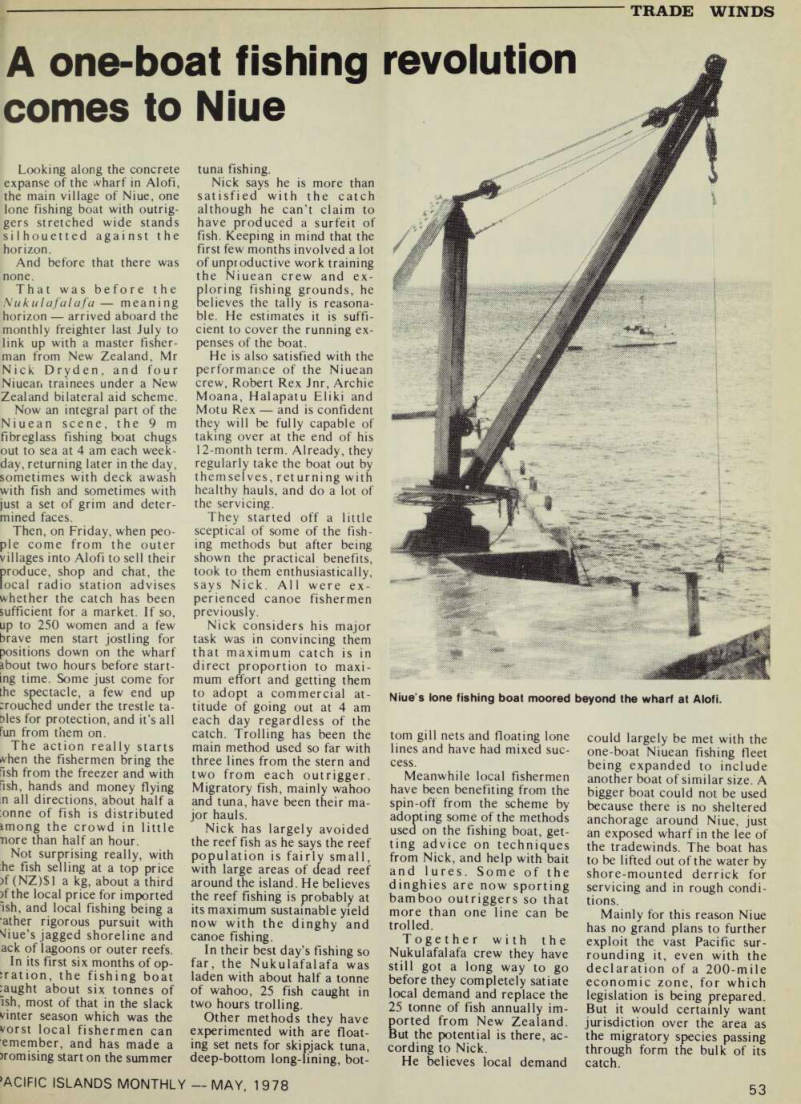
comes to Niue
Looking along the concrete expanse of the wharf in Alofi, the main village of Niue, one lone fishing boat with outrig gers stretched wide stands silhouetted against the horizon.
And before that there was none.
That was before the Nukulafalafa meaning horizon arrived aboard the monthly freighter last July to link up with a master fisher man from New Zealand, Mr Nick Dryden, and four Niuean trainees under a New Zealand bilateral aid scheme.
Now an integral part of the Niuean scene, the 9 m fibreglass fishing boat chugs out to sea at 4 am each week day, returning later in the day, sometimes with deck awash with fish and sometimes with just a set of grim and deter mined faces.
Then, on Friday, when peo ple come from the outer villages into Alofi to sell their produce, shop and chat, the local radio station advises whether the catch has been sufficient for a market. If so, up to 250 women and a few brave men start jostling for positions down on the wharf about two hours before start ing time. Some just come for the spectacle, a few end up touched under the trestle ta bles for protection, and it’s all fun from them on.
The action really starts when the fishermen bring the fish from the freezer and with fish, hands and money flying n all directions, about half a ;onne of fish is distributed among the crowd in little tiore than half an hour.
Not surprising really, with he fish selling at a top price )f (NZ)$l a kg, about a third )f the local price for imported ish, and local fishing being a ather rigorous pursuit with Niue’s jagged shoreline and ack of lagoons or outer reefs.
In its first six months of op- Jration, the fishing boat caught about six tonnes of ish, most of that in the slack vinter season which was the vorst local fishermen can emember, and has made a )romising start on the summer
tuna fishing.
Nick says he is more than satisfied with the catch although he can’t claim to have produced a surfeit of fish. Keeping in mind that the first few months involved a lot of unproductive work training the Niuean crew and ex ploring fishing grounds, he believes the tally is reasona ble. He estimates it is suffi cient to cover the running ex penses of the boat.
He is also satisfied with the performance of the Niuean crew, Robert Rex Jnr, Archie Moana, Halapatu Eliki and Motu Rex and is confident they will be fully capable of taking over at the end of his 12-month term. Already, they regularly take the boat out by themselves, returning with healthy hauls, and do a lot of the servicing.
They started off a little sceptical of some of the fish ing methods but after being shown the practical benefits, took to them enthusiastically, says Nick. All were ex perienced canoe fishermen previously.
Nick considers his major task was in convincing them that maximum catch is in direct proportion to maxi mum effort and getting them to adopt a commercial at titude of going out at 4 am each day regardless of the catch. Trolling has been the main method used so far with three lines from the stern and two from each outrigger.
Migratory fish, mainly wahoo and tuna, have been their ma jor hauls.
Nick has largely avoided the reef fish as he says the reef population is fairly small, witn large areas of dead reef around the island. He believes the reef fishing is probably at its maximum sustainable yield now with the dinghy and canoe fishing.
In their best day’s fishing so far, the Nukulafalafa was laden with about half a tonne of wahoo, 25 fish caught in two hours trolling.
Other methods they have experimented with are float ing set nets for skipjack tuna, deep-bottom long-lining, bot-
tom gill nets and floating lone lines and have had mixed suecess - Meanwhile local fishermen have been benefiting from the spin-off from the scheme by adopting some of the methods used on the fishing boat, getting advice on techniques from Nick, and help with bait and lures. Some of the dinghies are now sporting bamboo outriggers so that more than one line can be trolled.
Together with the Nukulafalafa crew they have still got a long way to go before they completely satiate local demand and replace the 25 tonne of fish annually imported from New Zealand, But the potential is there, according to Nick.
He believes local demand
could largely be met with the one-boat Niuean fishing fleet being expanded to include another boat of similar size A bigger boat could not be used because there is no sheltered anchorage around Niue, just an exposed wharf in the lee of the tradewinds. The boat has to be lifted out of the water by shore-mounted derrick for servicing and in rough condi tions.
Mainly for this reason Niue has no grand plans to further exploit the vast Pacific sur rounding it, even with the declaration of a 200-mile economic zone, for which legislation is being prepared.
But it would certainly want jurisdiction over the area as the migratory species passing through form the bulk of its catch.
Niue’s lone fishing boat moored beyond the wharf at Alofi.
Advertisements & other items, pp. 53-54 (2 items)
53
TRADE WINDS
ACIFIC ISLANDS MONTHLY MAY, 1978
Henry Ermines
h_eJjjc.
HEAT
smm«.
SHRINK
PACILM SING.
CONTACT A USTRA LI A'S
FOREMOST MANUFACTURERS
OF HE A T SEA LING EQUIPMENT
SERVING INDUSTRY
IN AUSTRALIA & THE PACIFIC ISLANDS
FOR OVER 25 YEARS.
HELIX ELECTRICAL PRODUCTS PTY. LTD.
27 Rosebery Avenue, Rosebery, NSW 2018, Australia. 663 0487.
HENRY ERMINES
PTY. LTD.
EXPORTERS o GENERAL MERCHANTS
428 GEORGE ST., SYDNEY
CABLES: HENCO SYDNEY. G.P.O. Box 3949. PHONE: 25-3383. • «
For specialised and personalised buying service
throughout the Pacific Islands and the East.
LOCAL AGENTS AND REPRESENTATION: •-
PAPUA NEW GUINEA.
PORT MORESBY: Mr. Tan,
P.O. Box 5445, Boroko.
Telephone 25 2542.
RABAUL: M. & C. Seeto, P.O. Box 131, Rabaul.
Telephone 92 2902.
MADANG: W. Double, P.O. Box 22, Madang.
Telephone 82 2696.
FIJI.
K. Witherington Ltd., P.O. Box 293, Suva.
Telephone 22 356.
NEW HEBRIDES.
John Lum & Associates, P.O. Santo.
Telephone 329.
SOLOMON ISLANDS.
Lo See War Ltd., P.O. Box 327, Honiara.
Telephone 399.
Resident Agents in other Pacific Territories. •-
To Future Generations,
Security
.; K> ' Horyuji Japan's 7th century “Vij temple links the past to the present with the solemn beauty.
Social welfare is a subject of serious consideration in most modern societies. Man in the twentieth century accepts his responsibility to bequeath to the next generation a society better than his own.
Daiwa Bank is not unique in accepting this responsibility, but Daiwa is unique in making acceptance of this role in society an integral part of their banking service.
Daiwa is the only Japanese city bank to combine banking and trust business. Daiwa is thus a fully integrated banking institution, comprising banking, international financing, trust, pension trust, and real estate business. This integration is part of our effort to fulfil our social responsibility consistent with society's needs in a contemporary environment. a fully integrated banking service
DAIWA BANK
Head Office: Osaka, Japan London and Frankfurt Branches New York and Los Angeles Agencies Singapore, Sydney, Sao Paulo, Hong Kong and Houston Representative Offices Subsidiary: Daiwa Bank Trust Company, New York Joint Venture Banks: P.T. Bank Perdania, Jakarta, International Credit Alliance, Ltd., Hong Kong
preserve”-Trade man
“PNG market no Aussie preserve”-Trade man
Australian exporters must recognise that Papua New Guinea is no longer an extension of the Australian market but is an individual market with its own problems and prospects, warns Mr R. J.
Barcham. Australian trade commissioner in Port Moresby. in a recent issue of the Australian government publication Overseas Trading.
Mr Barcham noted: "In the year ended June 1960.
Australia supplied 63*7 of PNG's total imports. By 1973-74. our share of the market had fallen to 52*7 and. according to the latest figures available, which are for the seven months ended February 1 977. our share had further declined to 50*7 .”
Mr Barcham pointed out that in 1974-75. major suppliers of PNG imports, apart trom Australia, were Japan (1 srr5 r r ). USA (8 ( ( ). Singapore (B*7 ). and Britain (4*7 ).
He also pointed to dramatic changes in the expatriate market in PNG. and to changes in the character of PNG's national population, which affected Australia's export prospects.
He wrote: "During the period October 197 1 to mid-1976 the expatriate population fell from 53 000 to 35 000. The final level of expatriates is difficult to assess and will be influenced by the
number of large developmen tal projects which are planned for the future, “Another significant factor is the changes occurring in the nationality of expatriates, “Whereas in 1971 there were 30 000 Austral ians. 9 000 Europeans. 7 000 Chinese and mixed races. there are now fewer than 15 (X)0 Australians and possi bly 6 000 Filipinos. This is ex pected to increase the demand for non-Australian products.
“The nature of the national population is also changing, “In 1973 it was estimated that there were 2.6 million Papua New Guineans of whom roughly 20*7 were part of the cash economy. In June 1976. estimates pul the total popula tion at near 2.8 million with 28*7 in the cash economy, “Government policies, aim ed at increasing opportunities for urban Papua New Gui neans in a broad range of positions in government and commerce, have led to the creation of a new 'middle class' consumer group in the urban centres. This group has. to a large extent, offset the decline in consumer ex pendilure brought about by the reduction of the expatriate population since 1971.
"In the future this group will constitute the major growth sector of the market for consumer goods.”
loss to a profit
Air Pacific flies from a loss to a profit
Air Pacific has just enjoyed i record year with an opcrating profit of about £750 000, three times higher han the previous best op- "rating profit. The profit :ame hard on a loss of $l.l ni 11 ion in 1976-77, and exneeded by more than £7OO 000 an expected modest profit of $2l 000.
The chairman, Suva ac- :ountant Don Aidney, said a growth in tourist and lomestic traffic and increased Tficiency in operations led to he increased profit. For 1978-79 the airline is budgetng for a profit of $640 000.
In the current year (Air
Pacific’s financial year ends on March 31) a third BAG 1 1 1 will be added to the fleet, and there will be increased landing and service costs. Air Pacific also has two HS74Bs and one Trislander to cope with domestic and interna tional traffic. Mr Aidney said the third BAG 111 was looked on as a short-term investment, to cover a gap till the board could decide which were the best larger aircraft for regional and international flights.
Mr Aidney said it was ex pected Air Pacific would not have to increase fares on the majority of the domestic
routes. The number of staff would be increased by 33 this year to take the total number of employees to 518. Two cadet pilots would be trained at Newcastle, NSW.
A new general manager, Mr Alan Bodger, will replace Mr Stan Quigg, who is retiring.
Mr Quigg will stay with the
airline till June to July to help Mr Bodger to settle in. Mr Bodger, 56, retired in Febru ary as general manager of Gulf Air. an Arabian airline.
Before taking a ground posi tion, Mr Bodger was a pilot with BOAC, Aden Airways (a BOAC subsidiary), Arab Air ways and Hong Kong Air ways.
Japan plans to spend
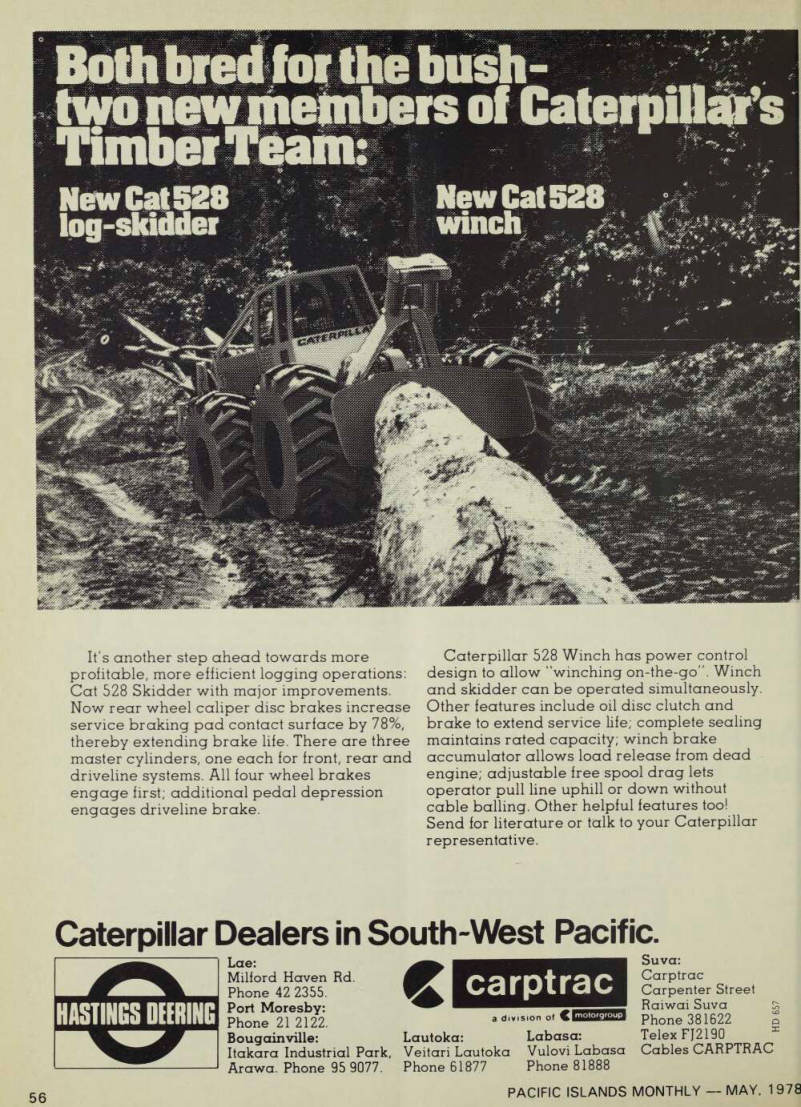
millions in Solomons
The Solomons Islands will be seeking about $5 million a year in aid from the Japanese over the next few years, writes George Atkin from Honiara.
This was announced after the visit of a seven -man Japanese economic mission to the Solomon Islands in Febru ary. The mission met govern ment officials and toured various parts of the country during their five-day visit.
The leader of the mission, Mr Hiroshi Ohtaka, deputy director-general of the Japanese Ministry of Foreign Affairs’ economic co-op eration bureau, said, as they were leaving the country, that the visit had been a “great success”.
He said his team was im pressed with the extent of the natural resources of the Solomon Islands and in his view, Solomon Islanders are disciplined and hard-work ing.
Two main impressions that stood out in talks with govern ment officials and others “are the spirit of self-reliance and efficiency”, he said.
The mission, which arrived in the Solomons to plan the Japanese aid programme to the Solomons after indepen dence visited Makira, Auki and Lau Lagoon in Malaita, the North Guadalcanal Plains and Marau on Guadalcanal, the Noro Base, Kolombangara and Munda in the Western District.
The Japanese should be in terested in Noro because it is there that the Solomon Taiyo, a joint fishing venture be tween the Solomons and Japan, has set up its second largest base. Noro is also being made into a larger base to replace Gizo, the second largest town in the country.
And there is timber poten
tial around the Munda area in North New Georgia.
The Solomons Chief Minis ter’s spokesman said that dur ing the visit considerable progress was made in identify ing the possible size and make-up of a programme of Japanese aid to the Solomons after independence.
At the talks, the Solomons Government proposed that Japanese financial and techni cal assistance should go to important projects in agriculture, fisheries, ship ping, telecommunications, health services and develop ing credit financing.
It emphasised the im portance of developing and small-scale projects at the same time, and the need for balanced development be tween economic sectors.
The government indicated a programme of Japanese as sistance at around $5 million a year over the next few years.
The Japanese mission ex pressed interest in all the pro jects put forward and said it is likely that one or two im portant projects could be im plemented very quickly after independence, probably in the training and development of internal Solomon Islands fish eries.
At the same time, detailed studies will be made of other projects, with a view to build ing up to a substantial level of assistance as soon as practica ble.
The statement said that no commitment to a level of aid could be made at this stage, but provided the Solomons is able, after detailed studies, to justify its proposals, the Japanese Government will be glad to consider programmes of assistance to fit the Solomons’ needs.
Both sides agreed on the
need for practical and effec tive projects, with levels of technology appropriate to the Solomon Islands and realistic programmes of expenditure.
The helpful role which suitable Japanese volunteers can play in ensuring the effec tiveness of rural projects was stressed by the Solomons Government.
The two countries will hold further talks before indepen dence both about an overall programme of Japanese aid, and to ensure that a prompt start is made on the first pro jects after independence.
Mr Ohtaka said, “The Japanese Government has not undertaken to make any com mitments as yet but I think that the fisheries project is virtually assured.”
He explained that Japanese Government policy is not to give aid until a country is in dependent bqt once this is achieved “I feel that the Japanese will be ready to make an agreement with the Solomons Government on fisheries.
“Our policy is to begin modestly,” he said.
Advertisements & other items, pp. 55-56 (2 items)
55
TRADE WINDS
ACIFIC ISLANDS MONTHLY - MAY, 1 978
Both bred for the bush-
New Cat 528
winch j
New Cat 528
log-skidder
W** It's another step ahead towards more profitable, more efficient logging operations: Cat 528 Skidder with major improvements.
Now rear wheel caliper disc brakes increase service braking pad contact surface by 78%, thereby extending brake life. There are three master cylinders, one each for front, rear and driveline systems. All four wheel brakes engage first; additional pedal depression engages driveline brake.
Caterpillar 528 Winch has power control design to allow "winching on-the-go". Winch and skidder can be operated simultaneously.
Other features include oil disc clutch and brake to extend service life; complete sealing maintains rated capacity; winch brake accumulator allows load release from dead engine; adjustable free spool drag lets operator pull line uphill or down without cable balling. Other helpful features too!
Send for literature or talk to your Caterpillar representative.
Caterpillar Dealers in South-West Pacific.
HASTINGS DEERING
Lae: Milford Haven Rd.
Phone 42 2355.
Port Moresby: Phone 21 2122.
Bougainville: Itakara Industrial Park, Arawa. Phone 95 9077.
carptrac
a division of Cl Lautoka: Labasa: Veitari Lautoka Vulovi Labasa Phone 61877 Phone 81888 Suva: Carptrac Carpenter Street Raiwai Suva Phone 381622 Telex FJ2190 Cables CARPTRAC
kitty
No gold in the Fiji Goldminers’ Union kitty
The Fiji Mineworkers’
Union is in financial trouble, sitting on assets of about $6O 000, but with little li quidity. Three officials of the union and the manager of the union’s club, have tem porarily suspended their pay, totalling $253 a week, pend ing the government takeover of the mine at Vatukoula.
The union’s two telephones have been cut off because of a $7OO debt, being repaid at the rate of $5O a month. A $4 000 bank overdraft is being reduc ed by $2OO a week. The union secretary, Mr Navitalai Ra qona, one of those going with out pay, said he fully accepted :he situation because the events which caused it were to ead to the possible take-over )f the Emperor Gold Mining :o Ltd by the government.
The union’s ranks were sud
lenly depleted when Emperor
aid men off. Many of the men vent to other industries, leav ng a financial membership of ibout 600; 1 100 were needed o enable the union to meet all commitments.
However, the coming change of ownership of the nine did not prevent the in ion from serving a log of laim on Emperor. Some of hese c.laims were of more )enefit to the union itself, han to members. These were or the company to: Totally urrender a block of land on vhich the union office was ituated; Supply free electrici y to the union office and club; tore a 48.7 m hole for union
water stores; Supply free materials to the union for four 9.14 mby 7.32 m houses; And to pay $5O 000 to the Mineworkers’ Credit Union.
Other claims were for a 15% wage rise for all hourly paid workers, 18 extra paid days annual leave for shift workers, and five extra days for others. But whether Em peror or the new owner of the mines is expected to meet the claims is not exactly clear.
Meanwhile, the govern ment, recognising that Vatukoula has an uncertain future as a goldmining town, has offered special incentives for new industries. Land will be available at cost, interest free, to cover development expenditure over 10 years in equal instalments with a grace period of five years when no payment will have to be made, income tax concessions for a maximum period of eight years, duty free entry of plant and machinery and raw materials, accelerated depreciation allowance and export incentives.
The concessions will be available to manufacturing and food processing indus tries in approved cases, and only in the case of new com panies or subsidiaries. They will not apply to industries trying to shift all or part of their operations to Vatukoula.
Income tax concessions will be available as long as all company activities are in the Vatukoula industrial area.
Briefly
• Burns Philp (SS) Co Ltd plans to spend about $3 million in 18 months to boost its continuing development programme and assist Fiji’s ailing building industry. The company announced this at the same time as it disclosed that the profit for the six months to December 31, 1977, was $1 497 000, an in crease of 6.9% on the return for the six months to Decem ber 31, 1976. The sales revenue for the period was $23 959 000. Mr R. J. Row land, general manager, said he envisaged a brighter future for Fiji in the 1980 s. Trading in Fiji in the six months was static, but growth in the four other Pacific Island branches allowed the Fiji branch to maintain employment oppor tunities. • An external telephone and telecommunications to be installed in Honiara will give the Solomon Islands a direct link with the outside world.
At present, international calls from the Solomons have to be made through Suva or Sydney.
The system will be run by Soltel Ltd, a joint Solomons- Cable & Wireless Ltd en terprise. The project will cost about $2 million and is ex pected to be in operation by Independence Day on July 7.
Initially, the Solomons Is lands Government will hold a 49% interest in Soltel and Cable & Wireless will hold 51%. Cable & Wireless will, in time, sell its interest to the Solomons Government. • The oil palm industry in Papua New Guinea could be worth K4O million a year at today’s prices when it is in full production. Oil palm pro jects at Hoskins, Bialla and Popondetta will involve 26 000 ha producing 120 ton nes of oil and 18 000 tonnes of kernel a year. • A strike by Air Niugini pilots in March brought all services in Papua New Guinea to a halt for about a day. The dispute was over pay scales and arrangements for crews of the Boeing 707 which Air Niugini uses on its trunk inter national routes. Also ground ed were two Fokker Fellow
ship jets and 1 1 Fokker
Friendship turbo-prop
aircraft. The pilots went back to work late on the day of the strike. After talks with Air Niugini management and the Department of Labour they agreed to take their dispute to arbitration. • Fiji could be producing 400 000 tonnes of sugar from three million tonnes of cane by 1980 which should enable the Fiji Sugar Commission to meet without difficulty long term commitments to Europe, New Zealand, Malaysia and Singapore. Sugar production in the current year is expected to be about 362 375 tonnes from 2 674 1 72 tonnes of cane. • The Pacific division of Burns Philp & Co Ltd re corded improved profits overall, largely because of im proved efficiencies for Burns Philp (SS) Co Ltd, improved trading in the New Hebrides and Papua New Guinea and increased coca production in the six months to December 31, 1977. This is revealed in the company’s half-yearly re port, which recorded a net profit of $4,634 million, an increase of $467 000 on the six months to December 31, 1976. The group’s Australian operations continued to be affected by the generally depressed level of economic activity. The interim dividend is steady at 7.5 c a share. • Papua New Guinea Government moves to reduce the consumption of alcohol had little effect on the earn ings of brewer San Miguel and Swan Holdings Ltd in the year to December 31. Revenue was up by 63% to K 7.8 million and the loss was reduced by 46% to K 392 000 compared with the previous year. But if the people drank more beer there was nothing in it for shareholders for no dividend was declared. • A 28-bed hospital will be built in the Haapai group in Tonga from funds made available by New Zealand.
The cost, which will include some staff housing, is ex pected to be about $615 000.
The new hospital will replace a 70-year-old building, which no longer meets the needs of the group.
Advertisements & other items, pp. 57-58 (2 items)
57
TRADE WINDS
ACIFIC ISLANDS MONTHLY MAY, 1 978
hardie’s
m s k \ “C M
WKF ,
V':. :V Hr tX*
HARDIE’S PIPELINES-
A MAJOR CONTRIBUTION
TO DEVELOPING
PACIFIC NATIONS
Water Supply and Sewer Reticulation are the two basic requirements of a developing country. The Fiji Housing Authority, with the Health and Welfare of the Island Community at stake, naturally choose Hardie’s pipelines to provide these services.
At Hardie’s we know how vital delivery deadlines are to Pacific clients. Especially when the supply source can be 2000 miles or more away. So we provide a pipe service that’s unbeatable for speed and reliability. No matter how big your pipes order, we go all out to get it to you on time, every time.
Contractors have found that Fibrolite pipes save time and trouble on the job too. Longer 4 metre lengths and lightweight, mean easier, faster handling and laying. Precision made Supertite vee ring jointing system eliminates any risk of infiltration or leakage.
And once down, Fibrolite pipes save on costly maintenance made of asbestos-cement they will never rot, rust or corrode. Hardie’s Fibrolite pipes ... ready whenever and wherever they’re needed throughout the Pacific.
PIPELINES TO PROGRESS
hardie’s
pipelines
ames Hardie & Coy. Pty. Ltd. lox 12-070, Penrose, Auckland. Ph. 599-919. lox 9671, Wellington, Ph. 724-851. !ox 325, Christchurch. Ph. 65-036.
Jew Zealand.
had numbers instead of names
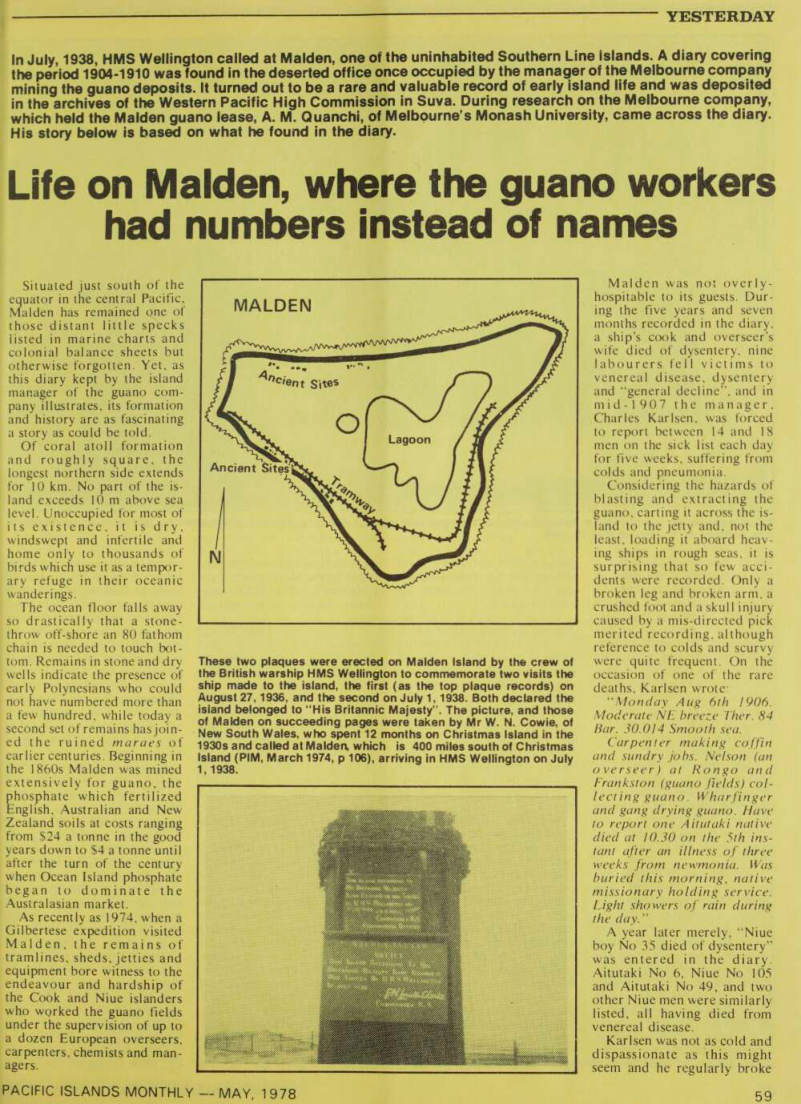
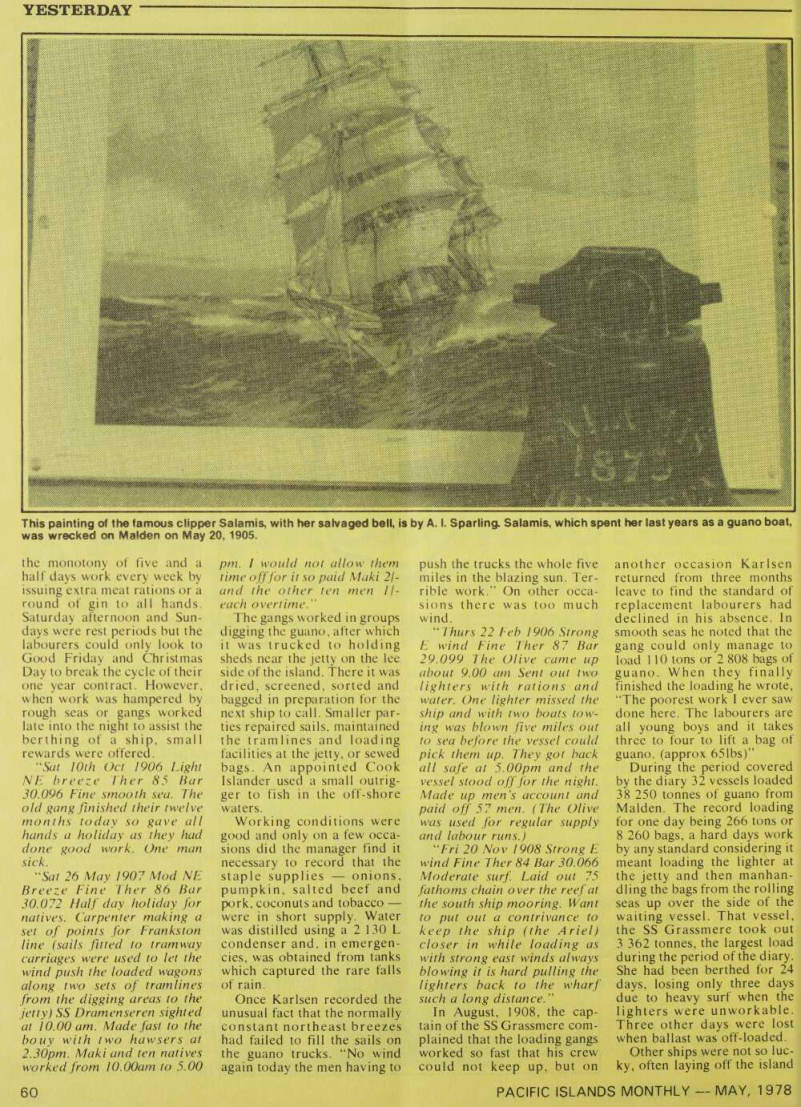
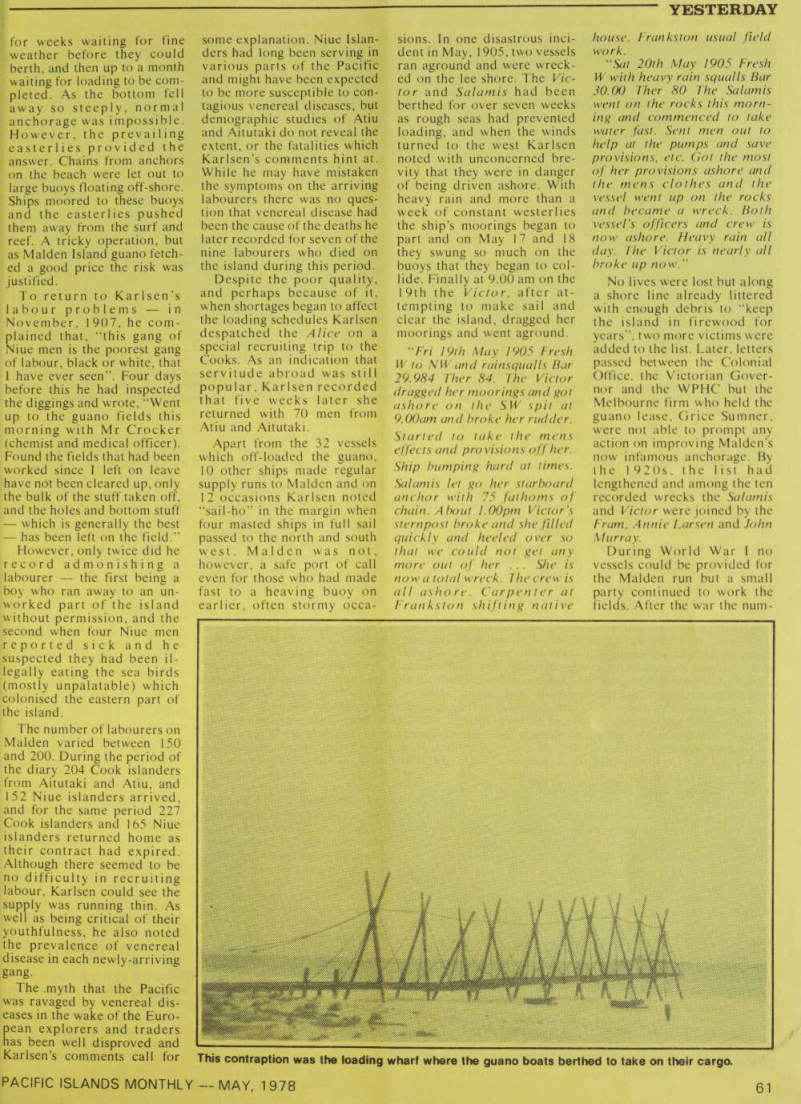
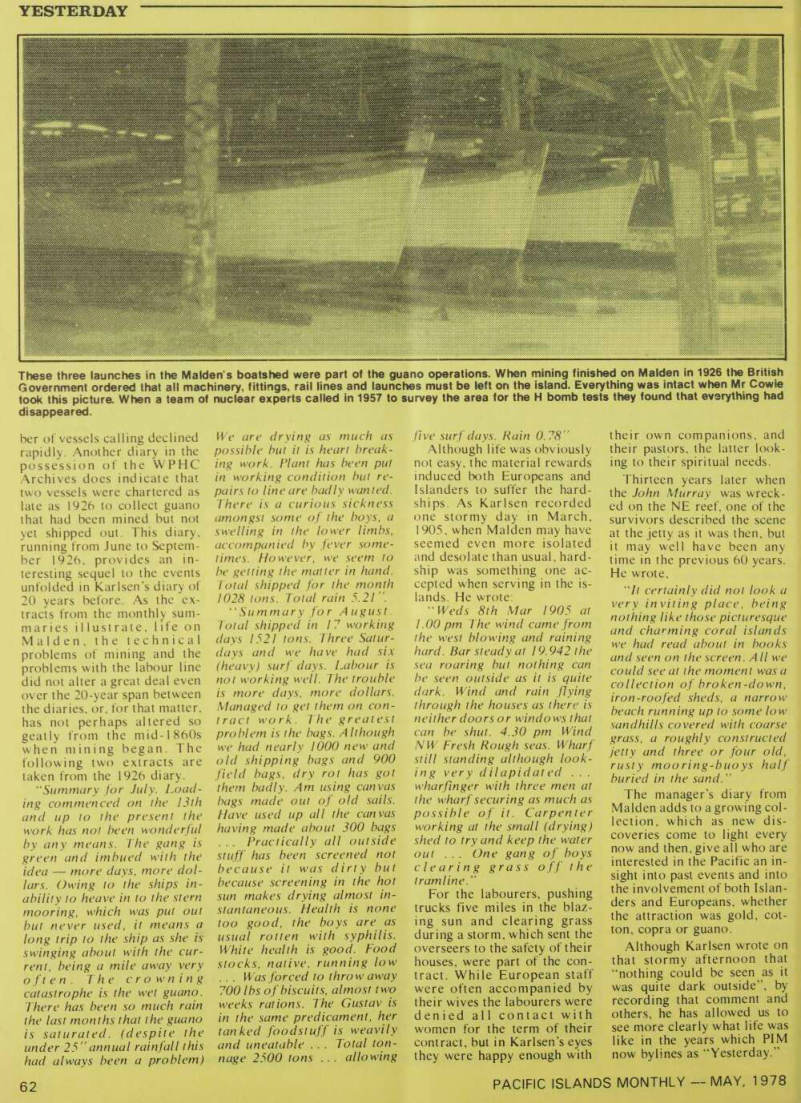
Life on Malden, where the guano workers had numbers instead of names
In July, 1938, HMS Wellington called at Malden, one of the uninhabited Southern Line islands. A diary covering the period 1904-1910 was found in the deserted office once occupied by the manager of the Melbourne company mining the guano deposits. It turned out to be a rare and valuable record of early island life and was deposited in the archives of the Western Pacific High Commission in Suva. During research on the Melbourne company, which held the Malden guano lease, A. M. Quanchi, of Melbourne’s Monash University, came across the diary.
His story below is based on what he found in the diary.
Situated just south of the equator in the central Pacific, Malden has remained one of those distant little specks listed in marine charts and colonial balance sheets but otherwise forgotten. Yet, as this diary kept by the island manager of the guano com pany illustrates, its formation and history are as fascinating a story as could be told.
Of coral atoll formation and roughly square, the longest northern side extends for 10 km. No part of the is land exceeds 10 m above sea level. Unoccupied for most of its existence, it is dry, windswept and infertile and home only to thousands of birds which use it as a tempor ary refuge in their oceanic wanderings.
The ocean floor falls away so drastically that a stone throw off-shore an 80 fathom chain is needed to touch bot tom. Remains in stone and dry wells indicate the presence of early Polynesians who could not have numbered more than a few hundred, while today a second set of remains has join ed the ruined maraes of earlier centuries. Beginning in the 1860 s Malden was mined extensively for guano, the phosphate which fertilized English, Australian and New Zealand soils at costs ranging from $24 a tonne in the good years down to $4 a tonne until after the turn of the century when Ocean Island phosphate began to dominate the Australasian market.
As recently as 1974, when a Gilbertese expedition visited Malden, the remains of tramlines, sheds, jetties and equipment bore witness to the endeavour and hardship of the Cook and Niue islanders who wqrked the guano fields under the supervision of up to a dozen European overseers, carpenters, chemists and man agers.
Malden was not overly hospitable to its guests. Dur ing the five years and seven months recorded in the diary, a ship’s cook and overseer’s wife died of dysentery, nine labourers fell victims to venereal disease, dysentery and “general decline”, and in mid-1 907 the manager, Charles Karlsen, was forced to report between 14 and 18 men on the sick list each day for five weeks, suffering from colds and pneumonia.
Considering the hazards of blasting and extracting the guano, carting it across the is land to the jetty and, not the least, loading it aboard heav ing ships in rough seas, it is surprising that so few acci dents were recorded. Only a broken leg and broken arm, a crushed foot and a skull injury caused by a mis-directed pick merited recording, although reference to colds and scurvy were quite frequent. On the occasion of one of the rare deaths, Karlsen wrote “Monday Aug 6th 1906.
Moderate NE breeze Ther. 84 Bar. 30.014 Smooth sea.
Carpenter making coffin and sundry Jobs. Nelson (an overseer) at Rongo and Frankston (guano fields) col lect ing guano. Wharfinger and gang drying guano. Have to report one Aitutaki native died at 10.30 on the sth ins tant after an illness of three weeks from newmonia. Was buried this morning, native missionary holding service.
Light showers of rain during the day. ”
A year later merely, “Niue boy No 35 died of dysentery” was entered in the diary.
Aitutaki No 6, Niue No 105 and Aitutaki No 49, and two other Niue men were similarly listed, all having died from venereal disease.
Karlsen was not as cold and dispassionate as this might seem and he regularly broke
These two plaques were erected on Malden Island by the crew of the British warship HMS Wellington to commemorate two visits the ship made to the island, the first (as the top plaque records) on August 27, 1936, and the second on July 1, 1938. Both declared the island belonged to “His Britannic Majesty”. The picture, and those of Malden on succeeding pages were taken by Mr W. N. Cowie, of New South Wales, who spent 12 months on Christmas Island in the 1930 s and called at Malden, which is 400 miles south of Christmas Island (PIM, March 1974, p 106), arriving in HMS Wellington on July 1, 1938.
the monotony of five and a half days work every week by issuing extra meat rations or a round of gin to all hands, Saturday afternoon and Sundays were rest periods but the labourers could only look to Good Friday and Christmas Day to break the cycle of their one year contract. However, when work was hampered by rough seas or gangs worked late into the night to assist the berthing of a ship, small rewards were offered.
“Sat 10th Oct 1906 Light NE breeze Ther 85 Bar 30.096 Fine smooth sea. The old gang finished their twelve months today so gave all hands a holiday as they had done good work. One man sick.
“Sat 26 May 1907 Mod NE Breeze Fine Ther 86 Bar 30.072 Flalf day holiday for natives. Carpenter making a set of points for Frankston line (sails fitted to tramway carriages were used to let the wind push the loaded wagons along two sets of tramlines from the digging areas to the Jetty) SS Dramenseren sighted at 10.00 am. Made fast to the bouy with two hawsers at 2.30 pm. Maki and ten natives worked from 10.00 am to 5.00
pm. I would not allow them time off for it so paid Maki 21and the other ten men ll each overtime.”
The gangs worked in groups digging the guano, after which it was trucked to holding sheds near the jetty on the lee side of the island. There it was dried, screened, sorted and bagged in preparation for the next ship to call. Smaller par ties repaired sails, maintained the tramlines and loading facilities at the Jetty, or sewed bags. An appointed Cook Islander used a small outrig ger to fish in the off-shore waters.
Working conditions were good and only on a few occa sions did the manager find it necessary to record that the staple supplies onions. pumpkin, salted beef and pork, coconuts and tobacco were in short supply. Water was distilled using a 2 130 L condenser and. in emergen cies, was obtained from tanks which captured the rare falls of rain.
Once Karlsen recorded the unusual fact that the normally constant northeast breezes had failed to fill the sails on the guano trucks. “No wind again today the men having to
push the trucks the whole five miles in the blazing sun. Ter rible work.” On other occa sions there was too much wind.
“ Thurs 22 Feb 1906 Strong E wind Fine Ther 87 Bar 29.099 The Olive came up about 9.00 am Sent out two lighters with rations and water. One lighter missed the ship and with two boats tow ing was blown five miles out to sea before the vessel could pick them up. They got back all safe at 5.00 pm and the vessel stood off for the night.
Made up men’s account and paid off 57 men. (The Olive was used for regular supply and labour runs.) “Fri 20 Nov 1908 Strong E wind Fine Ther 84 Bar 30.066 Moderate surf. Laid out 75 fathoms chain over the reef at the south ship mooring. Want to put out a contrivance to keep the ship (the Ariel) closer in while loading as with strong east winds always blowing it is hard pulling the lighters back to the wharf such a long distance.”
In August, 1908, the cap tain of the SS Grassmere com plained that the loading gangs worked so fast that his crew could not keep up, but on
another occasion Karlsen returned from three months leave to find the standard of replacement labourers had declined in his absence. In smooth seas he noted that the gang could only manage to load 110 tons or 2 808 bags of guano. When they finally finished the loading he wrote, “The poorest work I ever saw done here. The labourers are all young boys and it takes three to four to lift a bag of guano, (approx 651bs)”
During the period covered by the diary 32 vessels loaded 38 250 tonnes of guano from Malden. The record loading for one day being 266 tons or 8 260 bags, a hard days work by any standard considering it meant loading the lighter at the jetty and then manhan dling the bags from the rolling seas up over the side of the waiting vessel. That vessel, the SS Grassmere took out 3 362 tonnes, the largest load during the period of the diary.
She had been berthed for 24 days, losing only three days due to heavy surf when the lighters were unworkable.
Three other days were lost when ballast was off-loaded.
Other ships were not so luc ky, often laying off the island
This painting of the famous clipper Salamis, with her salvaged bell, is by A. I. Sparling. Salamis, which spent her last years as a guano boat, was wrecked on Malden on May 20, 1905.
for weeks waiting for fine weather before they could berth, and then up to a month waiting for loading to be com pleted. As the bottom fell away so steeply, normal anchorage was impossible.
However, the prevailing easterlies provided the answer. Chains from anchors on the beach were let out to large buoys floating off-shore.
Ships moored to these buoys and the easterlies pushed them away from the surf and reef. A tricky operation, but as Malden Island guano fetch ed a good price the risk was justified.
To return to Karlsen’s labour problems in November, 1907, he com plained that, “this gang of Niue men is the poorest gang of labour, black or white, that I have ever seen”. Four days before this he had inspected the diggings and wrote, “Went up to the guano fields this morning with Mr Crocker (chemist and medical officer).
Found the fields that had been worked since I left on leave have not been cleared up, only the bulk of the stuff taken off, and the holes and bottom stuff which is generally the best has been left on the field.”
However, only twice did he record admonishing a labourer the first being a boy who ran away to an un worked part of the island without permission, and the second when four Niue men reported sick and he suspected they had been il legally eating the sea birds (mostly unpalatable) which colonised the eastern part of the island.
The number of labourers on Malden varied between 150 and 200. During the period of the diary 204 Cook islanders from Aitutaki and Atiu, and 152 Niue islanders arrived, and for the same period 227 Cook islanders and 165 Niue islanders returned home as their contract had expired.
Although there seemed to be no difficulty in recruiting labour, Karlsen could see the supply was running thin. As well as being critical of their youthfulness, he also noted the prevalence of venereal disease in each newly-arriving gang.
The .myth that the Pacific was ravaged by venereal dis eases in the wake of the Euro pean explorers and traders has been well disproved and Karlsen’s comments call for
some explanation. Niue Islan ders had long been serving in various parts of the Pacific and might have been expected to be more susceptible to con tagious venereal diseases, but demographic studies of Atiu and Aitutaki do not reveal the extent, or the fatalities which Karlsen’s comments hint at.
While he may have mistaken the symptoms on the arriving labourers there was no ques tion that venereal disease had been the cause of the deaths he later recorded for seven of the nine labourers who died on the island during this period.
Despite the poor quality, and perhaps because of it, when shortages began to affect the loading schedules Karlsen despatched the Alice on a special recruiting trip to the Cooks. As an indication that servitude abroad was still popular, Karlsen recorded that five weeks later she returned with 70 men from Atiu and Aitutaki.
Apart from the 32 vessels which off-loaded the guano, 10 other ships made regular supply runs to Malden and on 12 occasions Karlsen noted “sail-ho” in the margin when four masted ships in full sail passed to the north and south west. Malden was not, however, a safe port of call even for those who had made fast to a heaving buoy on earlier, often stormy occa
sions. In one disastrous incident in May, 1905, two vessels ran aground and were wrecked on the lee shore. The Victor and Salamis had been berthed for over seven weeks as rough seas had prevented loading, and when the winds turned to the west Karlsen noted with unconcerned brevity that they were in danger of being driven ashore. With heavy rain and more than a week of constant westerlies the ship’s moorings began to part and on May 17 and 18 they swung so much on the buoys that they began to collide. Finally at 9.00 am on the 19th the Victor , after attempting to make sail and clear the island, dragged her moorings and went aground.
"Fri 19th May 1905 Fresh W to NW and rainsqualls Bar 29.984 Ther 84. The Victor dragged her moorings and got ashore on the S W spit at 9.00 am and broke her rudder. c , . , , , , , m JMr Started to take the mens , r , , rr I effects and provisions off her.
Ship bumping hard at times.
Salamis let go her starboard anchor with 75 fathoms of chain. Alwul I.oopm Victor’s sternpost broke and she filled quickly and heeled over so that we could not get any more out of her .. . She is now a total wreck. Ihe crew is all ashore. Carpenter at Frankston shifting native
house. Frcmkston usual field work. ”Sat 20th May 1905 Fresh W with heavy rain squalls Bar 30.00 7 her 80 The Salamis went on the rocks this morn ing and commenced to take water fast. Sent men out to help at the pumps and save provisions, etc. Got the most of her provisions ashore and the mens clothes and the vessel went up on the rocks and became a wreck. Both vessel’s officers and crew is now ashore. Heavy rain all day. The Victor is nearly all broke up now.”
No lives were lost but along a shore line already littered w i t h enough debris to “keep t h e island in firewood for years”, two more victims were added to the list. Later, letters passed between the Colonial Office, the Victorian Gover nor and the WPHC but the Melbourne firm who held the guano lease. Grice Sumner. were not able to prompt any . K .. K , / action on improving Ma den s * ® D now infamous anchorage. By the i9 2 os. the list had lengthened and among the ten recorded wrecks the Salamis and Victor were joined by the Fram, Annie Larsen and John Murray.
During World War I no vessels could be provided for the Malden run but a small party continued to work the fields. After the war the num-
This contraption was the loading wharf where the guano boats berthed to take on their cargo.
her of vessels calling declined rapidly. Another diary in the possession of the WPHC Archives does indicate that two vessels were chartered as late as 1926 to collect guano that had been mined but not yet shipped out. This diary, running from June to Septem ber 1926, provides an in teresting sequel to the events unfolded in Karlsen's diary of 20 years before. As the ex tracts from the monthly sum maries illustrate, life on Malden, the technical problems of mining and the problems with the labour line did not alter a great deal even over the 20-year span between the diaries, or. for that matter, has not perhaps altered so geatly from the mid-1860s when mining began. The following two extracts are taken from the 1926 diary.
“Summary for July. Load ing commenced on the 13th and up to the present the work has not been wonderful by any means. The gang is green and imbued with the idea more days, more dol lars. Owing to the ships in ability to heave in to the stern mooring, which was put out but never used, it means a long trip to the ship as she is swinging about with the cur rent, being a mile away very often. The crowning catastrophe is the wet guano.
There has been so much rain the last months that the guano is saturated, (despite the under 25" annual rainfall this had always been a problem)
We are drying as much as possible hut it is heart break ing work. Plant has been put in working condition hut re pairs to line are badly wanted.
There is a curious sickness amongst some of the boys, a swelling in the lower limbs, accompanied by fever some times. However, we seem to be getting the matter in hand.
Total shipped for the month 1028 tons. Total rain 5.21".
"Summary for August.
Total shipped in 17 working days 1521 tons. Three Satur days and we have had six (heavy) surf days. Labour is not working well. The trouble is more days, more dollars.
Managed to get them on con tract work. The greatest problem is the bags. Although we had nearly 1000 new and old shipping bags and 900 field bags, dry rot has got them badly. Am using canvas bags made out of old sails.
Have used up all the canvas having made about 300 bags .. . Practically all outside stuff has been screened not because it was dirty but because screening in the hot sun makes drying almost in stantaneous. Health is none too good, the boys are as usual rotten with syphilis.
White health is good. Food stocks, native. running low .. . Was forced to throw away 700 lbs of biscuits, almost two weeks rations. The Gustav is in the same predicament, her tanked foodstuff is weavily and uneatable .. . Total ton nage 2500 tons .. . allowing
five surf days. Rain 0.78"
Although life was obviously not easy, the material rewards induced both Europeans and Islanders to suffer the hardships. As Karlsen recorded one stormy day in March, 1905, when Malden may have seemed even more isolated and desolate than usual, hardship was something one accepted when serving in the isw a o!?' ,ons , i n n Vi. -7 t 0 1.00 pm The wind came from y 4 i, . ' ■ the west blowing and raining hard. Bar steady a, 19.942 the sea roaring hut nothing can be seen outside as if is quite <? rk 7 ,n ‘‘ ‘ md ram flymg through,he houses as there is neither doors or windows,hat c ™ b J sbu '- 4 {° pm f' nd f NtA Fresh Rough seas. Wharf sttll standing although lookmg very d,lap,dated . . wharfinger with three men at the wharf securing as much as possible of it. Carpenter working a, the small (drying) shed to try and keep the water out ... One gang of boys clearing grass off the tramline ’’
For the labourers, pushing trucks five miles in the blazing sun and clearing grass during a storm, which sent the overseers to the safety of their houses, were part of the contract. While European staff were often accompanied by their wives the labourers were denied all contact with women for the term of their contract, but in Karlsen’s eyes they were happy enough with
their own companions, and their pastors, the latter look ing to their spiritual needs, Thirteen years later when t he John Murray was wreck ed on the NE reef, one of the survivors described the scene a t the jetty as it was then, but i t m ay well have been any time in the previous 60 years, He wrote .., did no , , ook „ very inviting place, being nothing like those picturesque ~, • , and charming coral islands w read * ahou , books am{ A „ we cou/rf J<J£ , a , , he mome „, a colleclion of hro ken-down. sheds, a narrow , Q some , ow cov * r< £ wilh coarse grass, a roughly constructed » ,* > u J / ntooring-huoys half huri > d . , h J nd „ , .
The manager s diary from Malden adds to a growing col leetlon - whlch as ,. n^. w dlS ‘ coveries come to light every now and then give all who are interested in the Pacific an in sight into P ast events anc * into ‘ he involvement of both Islan ders and Europeans, whether the attraction was gold, cot ton> co P ra or guano, Although Karlsen wrote on that stormy afternoon that “nothing could be seen as it was quite dark outside’. by recording that comment and others, he has allowed us to see more clearly what life was like in the years which PIM now bylines as “Yesterday.
These three launches in the Malden's boatshed were part of the guano operations. When mining finished on Malden in 1926 the British Government ordered that all machinery, fittings, rail lines and launches must be left on the island. Everything was intact when Mr Cowie took this picture. When a team of nuclear experts called in 1957 to survey the area for the H bomb tests they found that everything had disappeared.
The last liner sails-end of
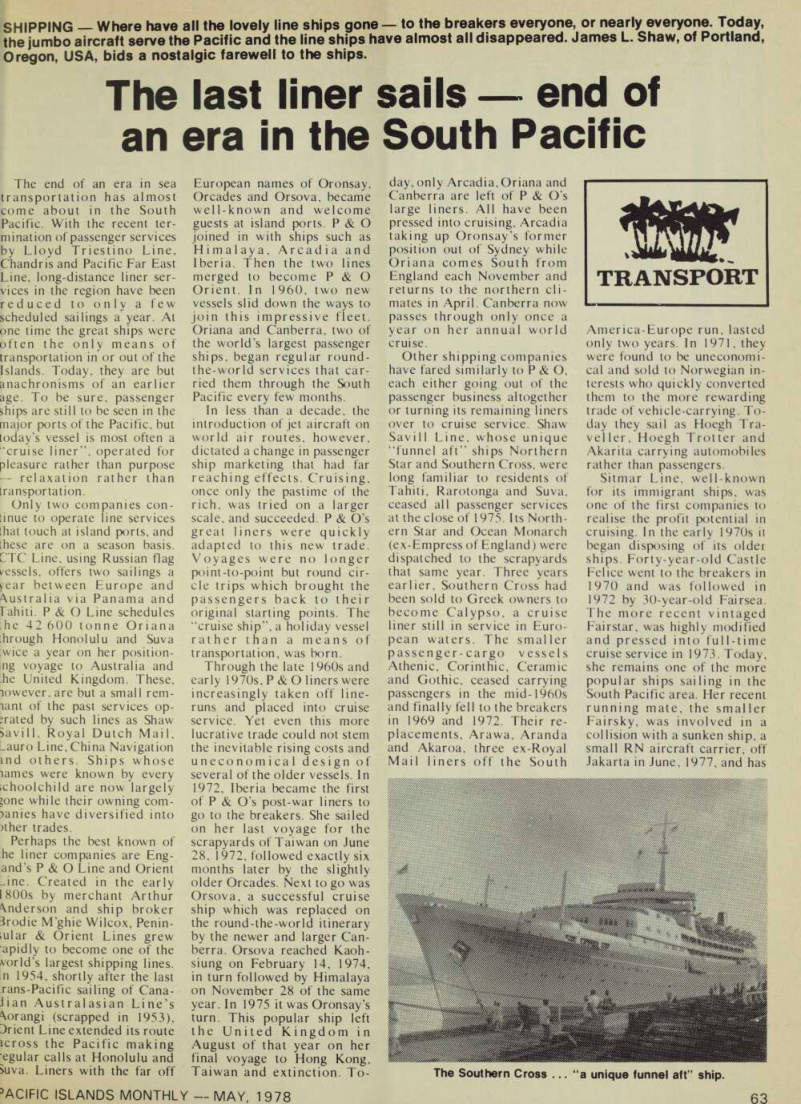

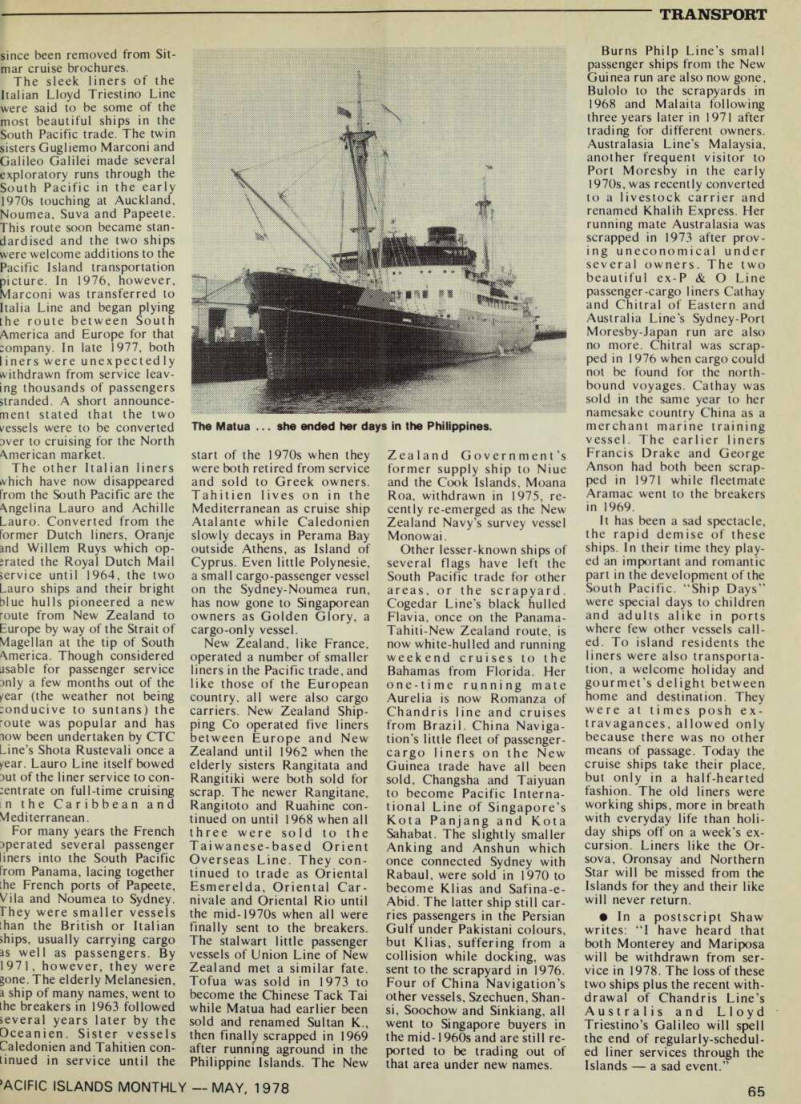
an era in the South Pacific
Transport
SHIPPING Where have all the lovely line ships gone to the breakers everyone, or nearly everyone. Today, the jumbo aircraft serve the Pacific and the line ships have almost all disappeared. James L. Shaw, of Portland, Oregon, USA, bids a nostalgic farewell to the ships.
The end of an era in sea transportation has almost come about in the South Pacific. With the recent ter mination of passenger services by Lloyd Triestino Line, Chandris and Pacific Far East Line, long-distance liner ser vices in the region have been reduced to only a few scheduled sailings a year. At one time the great ships were often the only means of transportation in or out of the Islands. Today, they are but anachronisms of an earlier age. To be sure, passenger ships are still to be seen in the major ports of the Pacific, but today’s vessel is most often a “cruise liner’’, operated for pleasure rather than purpose relaxation rather than transportation.
Only two companies con tinue to operate line services that touch at island ports, and these are on a season basis.
CTC Line, using Russian flag vessels, offers two sailings a year between Europe and Australia via Panama and Fahiti. P & O Line schedules he 42 600 tonne Oriana hrough Honolulu and Suva wice a year on her position ng voyage to Australia and he United Kingdom. These, lowever, are but a small rem nant of the past services op erated by such lines as Shaw Savill. Royal Dutch Mail, Line, China Navigation tnd others. Ships whose names were known by every ichoolchild are now largely »one while their owning com lanies have diversified into )ther trades.
Perhaps the best known of he liner companies are Eng and’s P & O Line and Orient -ine. Created in the early 1800 s by merchant Arthur
\nderson and ship broker
3rodie M’ghie Wilcox, Penin mlar & Orient Lines grew apidly to become one of the
vorld’s largest shipping lines,
n 1954, shortly after the last rans-Pacific sailing of Cana iian Australasian Line’s \orangi (scrapped in 1953), Orient Line extended its route tcross the Pacific making Regular calls at Honolulu and Suva. Liners with the far off
European names of Oronsay, Orcades and Orsova, became well-known and welcome guests at island ports. P & O joined in with ships such as Himalaya, Arcadia and Iberia. Then the two lines merged to become P & O Orient. In 1960, two new vessels slid down the ways to join this impressive fleet.
Oriana and Canberra, two of the world’s largest passenger ships, began regular round the-world services that car ried them through the South Pacific every few months.
In less than a decade, the introduction of jet aircraft on world air routes, however, dictated a change in passenger ship marketing that had far reaching effects. Cruising, once only the pastime of the rich, was tried on a larger scale, and succeeded. P & O's great liners were quickly adapted to this new trade.
Voyages were no longer point-to-point but round cir cle trips which brought the passengers back to their original starting points. The “cruise ship”, a holiday vessel rather than a means of transportation, was born.
Through the late 1960 s and early 19705, P & O liners were increasingly taken off line runs and placed into cruise service. Yet even this more lucrative trade could not stem the inevitable rising costs and uneconomical design of several of the older vessels. In 1972, Iberia became the first of P & O’s post-war liners to go to the breakers. She sailed on her last voyage for the scrapyards of Taiwan on June 28, 1972, followed exactly six months later by the slightly older Orcades. Next to go was Orsova, a successful cruise ship which was replaced on the round-the-world itinerary by the newer and larger Can berra. Orsova reached Kaoh siung on February 14, 1974, in turn followed by Himalaya on November 28 of the same year. In 1975 it was Oronsay’s turn. This popular ship left the United Kingdom in August of that year on her final voyage to Hong Kong, Taiwan and extinction. To
day, only Arcadia,Oriana and Canberra are left of P & O's large liners. All have been pressed into cruising. Arcadia taking up Oronsay’s former position out of Sydney while Oriana comes South from England each November and returns to the northern cli mates in April. Canberra now passes through only once a year on her annual world cruise.
Other shipping companies have fared similarly to P & O, each either going out of the passenger business altogether or turning its remaining liners over to cruise service. Shaw Savill Line, whose unique “funnel aft” ships Northern Star and Southern Cross, were long familiar to residents of Tahiti, Rarotonga and Suva, ceased all passenger services at the close of 1975. Its North ern Star and Ocean Monarch (ex-Empress of England) were dispatched to the scrapyards that same year. Three years earlier. Southern Cross had been sold to Greek owners to become Calypso, a cruise liner still in service in Euro pean waters. The smaller passenger-cargo vessels Athenic, Corinthic, Ceramic and Gothic, ceased carrying passengers in the mid-1960s and finally fell to the breakers in 1969 and 1972. Their re placements, Arawa, Aranda and Akaroa, three ex-Royal Mail liners off the South
America-Europe run. lasted only two years. In 1971, they were found to be uneconomi cal and sold to Norwegian in terests who quickly converted them to the more rewarding trade of vehicle-carrying. To day they sail as Hoegh Tra veller. Hoegh Trotter and Akarita carrying automobiles rather than passengers.
Sitmar Line, well-known for its immigrant ships, was one of the first companies to realise the profit potential in cruising. In the early 1970 s il began disposing of its older ships. Forty-year-old Castle Felice went to the breakers in 1970 and was followed in 1972 by 30-year-old Fairsea.
The more recent vintaged Fairstar, was highly modified and pressed into full-time cruise service in 1973. Today, she remains one of the more popular ships sailing in the South Pacific area. Her recent running mate, the smaller Fairsky, was involved in a collision with a sunken ship, a small RN aircraft carrier, off Jakarta in June, 1977, and has
The Southern Cross... “a unique funnel aft” ship.
since been removed from Sit mar cruise brochures.
The sleek liners of the Italian Lloyd Triestino Line were said to be some of the most beautiful ships in the South Pacific trade. The twin sisters Gugliemo Marconi and Galileo Galilei made several exploratory runs through the South Pacific in the early
1970 s touching at Auckland,
Noumea, Suva and Papeete.
This route soon became stan dardised and the two ships were welcome additions to the Pacific Island transportation picture. In 1976, however, Marconi was transferred to Italia Line and began plying the route between South America and Europe for that :ompany. In late 1977, both liners were unexpectedly withdrawn from service leav ing thousands of passengers stranded. A short announce ment stated that the two vessels were to be converted aver to cruising for the North American market.
The other Italian liners which have now disappeared from the South Pacific are the 'Xngelina Lauro and Achille Lauro. Converted from the former Dutch liners, Oranje and Willem Ruys which op erated the Royal Dutch Mail service until 1964, the two Lauro ships and their bright blue hulls pioneered a new route from New Zealand to Europe by way of the Strait of Magellan at the tip of South America. Though considered usable for passenger service ?nly a few months out of the /ear (the weather not being :onducive to suntans) the •oute was popular and has low been undertaken by CTC Line’s Shota Rustevali once a /ear. Lauro Line itself bowed lut of the liner service to con :entrate on full-time cruising n the Caribbean and Mediterranean.
For many years the French taperated several passenger liners into the South Pacific from Panama, lacing together the French ports of Papeete, Vila and Noumea to Sydney.
They were smaller vessels than the British or Italian ships, usually carrying cargo as well as passengers. By 1971, however, they were gone. The elderly Melanesien, a ship of many names, went to the breakers in 1963 followed several years later by the Oceanien. Sister vessels Caledonien and Tahitien con tinued in service until the
start of the 1970 s when they were both retired from service and sold to Greek owners.
Tahitien lives on in the Mediterranean as cruise ship Atalante while Caledonien slowly decays in Perama Bay outside Athens, as Island of Cyprus. Even little Polynesie, a small cargo-passenger vessel on the Sydney-Noumea run, has now gone to Singaporean owners as Golden Glory, a cargo-only vessel.
New Zealand, like France, operated a number of smaller liners in the Pacific trade, and like those of the European country, all were also cargo carriers. New Zealand Ship ping Co operated five liners between Europe and New Zealand until 1962 when the elderly sisters Rangitata and Rangitiki were both sold for scrap. The newer Rangitane, Rangitoto and Ruahine con tinued on until 1968 when all three were sold to the Taiwanese-based Orient Overseas Line. They con tinued to trade as Oriental Esmerelda, Oriental Car nivale and Oriental Rio until the mid-1970s when all were finally sent to the breakers.
The stalwart little passenger vessels of Union Line of New Zealand met a similar fate.
Tofua was sold in 1973 to become the Chinese Tack Tai while Matua had earlier been sold and renamed Sultan K., then finally scrapped in 1969 after running aground in the Philippine Islands. The New
Zealand Government’s former supply ship to Niue and the Cook Islands, Moana Roa, withdrawn in 1975, re cently re-emerged as the New Zealand Navy’s survey vessel Monowai.
Other lesser-known ships of several flags have left the South Pacific trade for other areas, or the scrapyard.
Cogedar Line’s black hulled Flavia, once on the Panama- Tahiti-New Zealand route, is now white-hulled and running weekend cruises to the Bahamas from Florida. Her one-time running mate Aurelia is now Romanza of Chandris line and cruises from Brazil. China Naviga tion’s little fleet of passenger cargo liners on the New Guinea trade have all been sold, Changsha and Taiyuan to become Pacific Interna tional Line of Singapore’s Kota Panjang and Kota Sahabat. The slightly smaller Anking and Anshun which once connected Sydney with Rabaul, were sold in 1970 to become Klias and Safina-e- Abid. The latter ship still car ries passengers in the Persian Gulf under Pakistani colours, but Klias, suffering from a collision while docking, was sent to the scrapyard in 1976.
Four of China Navigation’s other vessels, Szechuen, Shan si, Soochow and Sinkiang, all went to Singapore buyers in the mid-1960s and are still re ported to be trading out of that area under new names.
Burns Philp Line’s small passenger ships from the New Guinea run are also now gone, Bulolo to the scrapyards in 1968 and Malaita following three years later in 1971 after trading for different owners.
Australasia Line’s Malaysia, another frequent visitor to Port Moresby in the early 19705, was recently converted to a livestock carrier and renamed Khalih Express. Her running mate Australasia was scrapped in 1973 after prov ing uneconomical under several owners. The two beautiful ex-P & O Line passenger-cargo liners Cathay and Chitral of Eastern and Australia Line’s Sydney-Port Moresby-Japan run are also no more. Chitral was scrap ped in 1976 when cargo could not be found for the north bound voyages. Cathay was sold in the same year to her namesake country China as a merchant marine training vessel. The earlier liners Francis Drake and George Anson had both been scrap ped in 1971 while fleetmate Aramac went to the breakers in 1969.
It has been a sad spectacle, the rapid demise of these ships. In their time they play ed an important and romantic part in the development of the
South Pacific. “Ship Days’’
were special days to children and adults alike in ports where few other vessels call ed. To island residents the liners were also transporta tion, a welcome holiday and gourmet’s delight between home and destination. They were at times posh ex travagances, allowed only because there was no other means of passage. Today the cruise ships take their place, but only in a half-hearted fashion. The old liners were working ships, more in breath with everyday life than holi day ships off on a week’s ex cursion. Liners like the Or sova, Oronsay and Northern Star will be missed from the Islands for they and their like will never return. • In a postscript Shaw writes: “I have heard that both Monterey and Mariposa will be withdrawn from ser vice in 1978. The loss of these two ships plus the recent with drawal of Chandris Line’s Australis and Lloyd Triestino’s Galileo will spell the end of regularly-schedul ed liner services through the Islands a sad event.”
The Matua... she ended her days in the Philippines.
Advertisements & other items, pp. 63-66 (3 items)
63
>ACIFIC ISLANDS MONTHLY MAY, 1 978
Equipment
Australian Safely
for security and protection
Safety equipment means protection for people, buildings and the environment. And Australia makes a wide range that covers the many special requirements of Government, industry, business or domestic and leisure activities.
Strict Australian standards in design and manufacture ensures maximum protection and maximum security. The same manufacturing quality guarantees reliable, accurate performance from detection equipment and safety systems.
What kind of protection do you need?
Australia’s product range includes-Signals and sirens.
Warning systems. Fire-fighting equipment. Industrial, leisure and sporting safety clothing.
Respirators. Decompression chambers. Filtering systems and pollution-detection devices.
Life-jackets and rafts. Anti-skid floor applications. First-aid kits and road safety signs.
For personal safety or protection of property and equipment, Australia can offer a maximum range for maximum security.
Quality and value that’s only hours away The Australian Trade Commissioner can give you details of suppliers. He can also advise Pacific Islands exporters on ways to research or develop markets in Australia.
You can contact him at: — FIJI: 7th Floor. Dominion House. Thomson Street, Suva. (Post Office Box 1252.) Telephone: 312844.
PAPUA NEW GUINEA:
Australian High Commission, P.O. Box 9129, Hohola.
Telephone: 259333. *
Ask the Australian Ifrade Commissioner
COUNT ON VIGTA
TO TURN GRASS INTO LAWN
VICTA
UTILITY 160
MOWER
\ Wo* Tough, rugged, lightweight and low priced, a mower without grass-catcher designed to handle the full range of grass cutting jobs from heavily weeded and long grass areas to fine lawns. Cuts close to trees and fences and new side chute sends the cut grass safely to the side. Powered by 160 cc Mark 4 2-stroke Victa engine with the easy pull-Zip Starter, multiposition height adjuster, fold-down handles and many more exclusive Victa features make the Utility a popular lightweight mower.
VICTA
SUPER 24
MOWER
The big mower for big grass with a giant 61 cm (24") cut. It’s the mower for the big grass cutting jobs and municipal parks and gardens, sports grounds, roadside growth control as well as property owners with large areas of land. Solid construction, easy manoeuvrability and giant rear wheels handle rough ground effortlessly. Two free-swinging blades on the cutting disc absorb shock when hard objects are encountered, protecting the engine from damage.
Powered by a special power-boosted Victa 160 cc 2-stroke engine with the exclusive easy pull Zip Starter and many more features to make the big mowing jobs easier.
When you want tough reliable grass cutting, Victa has the mower for any job. And every Victa mower is backed by the widest service and spare parts network in the business.
Micta
TURNS GRASS INTO LAWN
L 83.8646
65
■ACIFIC ISLANDS MONTHLY MAY, 1978
Shipping firms’ war hits New Caledonia
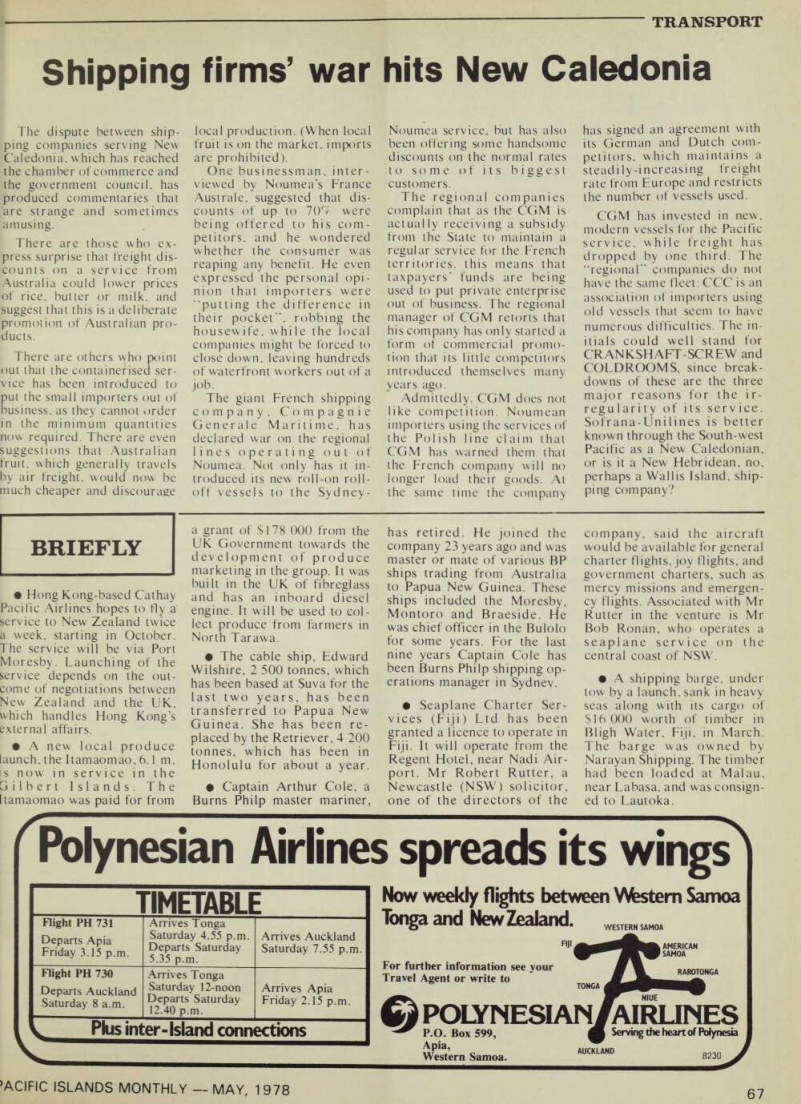
The dispute between ship ping companies serving New Caledonia, which has reached the chamber of commerce and the government council, has produced commentaries that are strange and sometimes amusing.
There are those who ex press surprise that freight dis counts on a service from Australia could lower prices of rice, butter or milk, and suggest that this is a deliberate promotion of Australian pro ducts.
There are others who point out that the containerised ser vice has been introduced to pul the small importers out of business, as they cannot order in the minimum quantities now required. There are even suggestions that Australian fruit, which generally travels by air freight, would now be
much cheaper and discourage
local production. (When local fruit is on the market, imports are prohibited).
One businessman, inter viewed by Noumea's France Australe. suggested that dis counts of up to 70 r/ ( were being offered to his com petitors. and he wondered whether the consumer was reaping any benefit. He even expressed the personal opi nion that importers were “putting the difference in their pocket", robbing the housewife, while the local companies might be forced to close down, leaving hundreds of waterfront workers out of a job.
The giant French shipping company, Compagnie Generale Maritime, has declared war on the regional lines operating out of Noumea. Not only has it in troduced its new roll-on roll off vessels to the Sydney-
Noumea service, but has also been offering some handsome discounts on the normal rates to some of its biggest customers.
The regional companies complain that as the CGM is actually receiving a subsidy from the State to maintain a regular service for the French territories, this means that taxpayers' funds are being used to put private enterprise out of business. The regional manager of CGM retorts that his company has only started a form of commercial promo tion that its little competitors introduced themselves many years ago.
Admittedly. CGM does not like competition. Noumean importers using the services of the Polish line claim that CGM has warned them that the French company will no longer load their goods. At the same time the company
has signed an agreement with its German and Dutch com petitors, which maintains a
steadily-increasing freight
rate from Europe and restricts the number of vessels used.
CGM has invested in new. modern vessels for the Pacific service, while freight has dropped by one third. The “regional" companies do not have the same fleet: CCC is an association of importers using old vessels that seem to have numerous difficulties. The in itials could well stand for
Crankshaft-Screw And
COLDROOMS, since break downs of these are the three major reasons for the ir regularity of its service.
Sofrana-Unilines is better known through the South-west Pacific as a New Caledonian, or is it a New Hebridean, no, perhaps a Wallis Island, ship
ping company?
Briefly
• Hong Kong-based Cathay Pacific Airlines hopes to fly a service to New Zealand twice a week, starting in October.
The service will be via Port Moresby. Launching of the service depends on the out come of negotiations between New Zealand and the UK. which handles Hong Kong's external affairs. • A new local produce launch, the Itamaomao, 6.1 m. is now in service in the Gilbert Islands. The Itamaomao was paid for from
a grant of SI7B 000 from the UK Government towards the development of produce marketing in the group. It was built in the UK of fibreglass and has an inboard diesel engine. It will be used to col lect produce from farmers in North Tarawa. • The cable ship, Edward Wilshire, 2 500 tonnes, which has been based at Suva for the last two years, has been transferred to Papua New Guinea. She has been re placed by the Retriever, 4 200 tonnes, which has been in Honolulu for about a year. • Captain Arthur Cole, a Burns Philp master mariner,
has retired. He joined the company 23 years ago and was master or mate of various BP ships trading from Australia to Papua New Guinea. These ships included the Moresby, Montoro and Braeside. He was chief officer in the Bulolo for some years. For the last nine years Captain Cole has been Burns Philp shipping op erations manager in Sydney. • Seaplane Charter Services (Fiji) Ltd has been granted a licence to operate in Fiji. It will operate from the Regent Hotel, near Nadi Airport. Mr Robert Rutter, a Newcastle (NSW) solicitor, one of the directors of the
company, said the aircraft would be available for general charter flights, joy flights, and government charters, such as mercy missions and emergen cy flights. Associated with Mr Rutter in the venture is Mr Bob Ronan, who operates a seaplane service on the central coast of NSW. • A shipping barge, under tow by a launch, sank in heavy seas along with its cargo of Sl6 000 worth of timber in Bligh Water. Fiji, in March.
The barge was owned by Narayan Shipping. The timber had been loaded at Malau. near Labasa, and wasconsign ed to Lautoka.
Advertisements & other items, pp. 67-68 (2 items)
67
TRANSPORT
’ACIFIC ISLANDS MONTHLY MAY, 1978
Polynesian Airlines spreads its wings
Now weekly flights between Western Samoa
Tonga and New Zealand. WKIERKS#HOA
AMERICAN
SAMOA
K RAROTONGA
TONGA
Cj Polynesian Airlines
P n Pav COO Wvino I+IP nf PrJvr^ci^ For further information see your Travel Agent or write to P.O. Box 599, Apia, Western Samoa.
Serving the heart of Polynesia
AUCKLAND
8230
AUSTRALIAN NATIONAL UNIVERSITY
HnS CENTRE FOR CONTINUING EDUCATION
Preliminary Notice
A Conference Cruise on the Pacific Community
September/October 1979
Trade, aid, the Law of the Sea, tourism and defence: some of the things making dearly won independence into interdependence for the Pacific nations, larger and smaller, scattered over vast areas of the Pacific. These peoples are neighbours and could be partners. How can we best sensitise our people and others to the problems while informing each other and increasing in-depth understanding in a memorable environment.
The conference at sea is the answer we are providing.
The Centre for Continuing Education, in collaboration with ANSETT Airlines of Australia and SITMAR cruises, and in continuation of its own programme of studies in this area, is planning a series of On-Board conferences on the Pacific Community. In September/October, 1979 the first of our Conference Cruises will visit New Hebrides, Fiji, Tonga, New Zealand and perhaps Western Samoa, American Samoa and the Solomon Islands Voyages will be of either 20 or 21 days’ duration. We think it not altogether unfortunate that we have to offer only limited numbers of places for this first conference around two hundred participants plus their families and friends We invite you now to respond in two ways: (1) ask one of us to talk to you or your colleagues to ensure that matters of concern to your organisation are included; (2) indicate to us now, provisionally, without obligation, how many persons you may be nominating to attend the conference in 1979. Both responses are important to our preparations but some indifcation of participation is urgent if you wish tohave places provisionally reserved Further details of the Conference Cruise are available from Dr Nicolas Haines (062)49 4038 or one of the Administrative Officers (062)49 4417/49 2889 at the Centre for Continuing Education, A.N.U., P.O. Box 4, Canberra,
A.C.T. 2600,
TRADE MARK CAUTIONARY NOTICE:
Notice is hereby given that THERMOS LIMITED of Ongar Road, Brentwood, Essex, England, carrying on business as Manufacturers and Merchants, are the Owners and sole proprietors of the following Trade Mark:
THERMOS
The said Trade Mark is used or proposed to be used, in Papua New Guinea and other South West Pacific territories exclusively by the said THERMOS LIMITED or any of their Authorised Agents or Licensees in respect of: Glassware, ice chests and ice containers; insulated bags, containers, flasks and bottles; domestic utensils and containers: picnic baskets and picnic cases; stoppers made of glass or other materials: tea infusers, tea urns and coffee jugs and urns; and parts and fittings for all the aforesaid goods.
Any imitation or fraudulent use of the said Trade Mark THERMOS in Papua New Guinea or any other territories falling within the South West Pacific area by any third party, other than the said Authorised Agents or Licensees, will be dealt with according to the laws of Papua New Guinea or according to the laws of any other relevant jurisdictions in the South West Pacific by the said
THERMOS LIMITED.
offers expert insurance service
throughout the Islands.
QBE INSURANCE UNITED
(FORMERLY - QUEENSLAND INSURANCE COMPANY)
Central Office: 82 Pitt Street, Sydney.
FIJI Branch Office, Suva, Manager for Fiji: L.G. Liddell A. A. 1.1.
LAUTOKA - Sub-Branch Office: Burns Philp Bldg.
NEW CALEDONIA - T.A. Hagen, Ste. W.A. Johnston, S.A.R.L. - Noumea.
NEW HEBRIDES - District Manager: G.F. Donnelly, Vila; Santo Santo: Burns Philp (New Hebrides) Ltd.
TAHITI - Arthur Chung: Immeuble 8.1., Front de Mer, Papeete.
NIUE, NORFOLK ISLAND, SAMOA, TONGA and other South Sea Islands Burns Philp (South Sea) Company Ltd.
|Q|B|E
QUEENSLAND INSURANCE (RN.G.) LTD.
PAPUA NEW GUINEA - Head Office, PORT MORESBY.
General Manager: J.M. Dawe. Assistant Manager: R.V. Maskell.
District Managers at: LAE: I.R. Martin MOUNT HAGEN: D.F. Carroll ARAWA: J. Longbut MADANG: R.W.V. Ceilings RABAUL: W.F. Tinker
Cruising
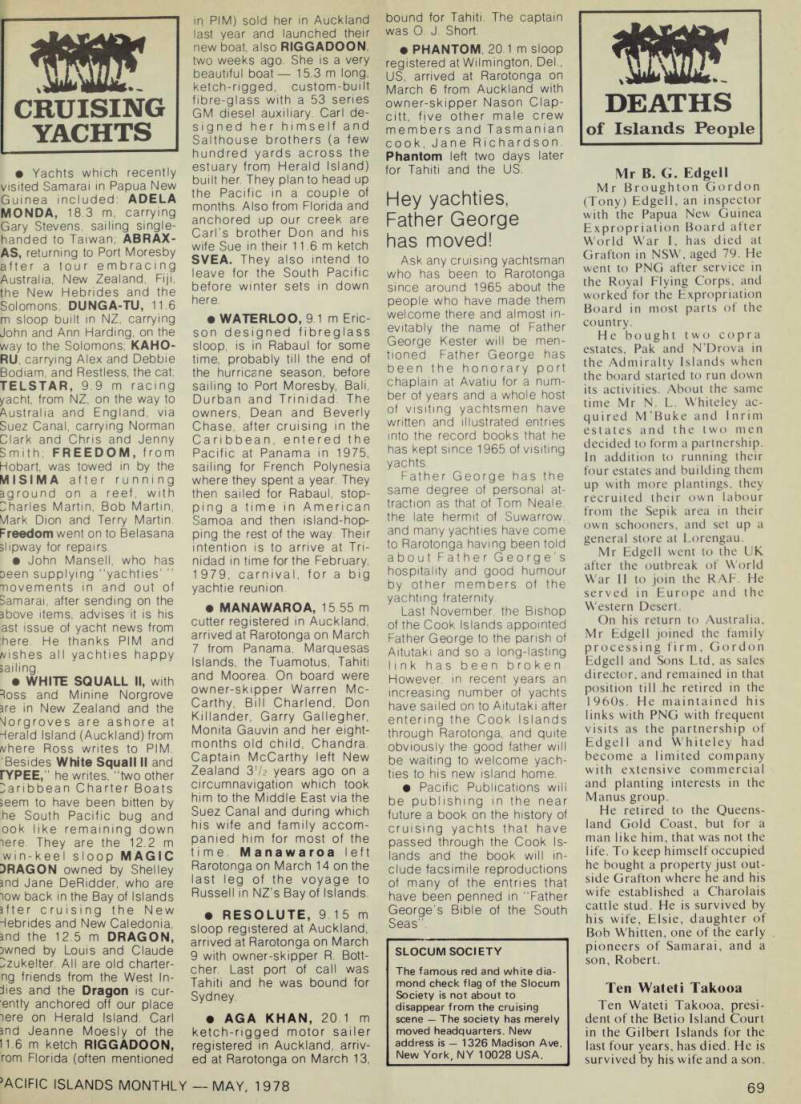
Yachts
• Yachts which recently visited Samarai in Papua New Guinea included: ADELA MONDA, 18.3 m, carrying Gary Stevens, sailing single handed to Taiwan; ABRAX AS, returning to Port Moresby after a tour embracing Australia, New Zealand, Fiji, the New Hebrides and the Solomons: DUNGA-TU, 11.6 m sloop built in NZ, carrying John and Ann Harding, on the way to the Solomons; KAHO RU, carrying Alex and Debbie Bodiam, and Restless, the cat; TELSTAR, 9.9 m racing yacht, from NZ, on the way to Australia and England, via Suez Canal, carrying Norman Clark and Chris and Jenny Smith; FREEDOM, from Hobart, was towed in by the MISIMA after running aground on a reef, with Charles Martin, Bob Martin, Mark Dion and Terry Martin.
Freedom went on to Belasana slipway for repairs. • John Mansell, who has oeen supplying “yachties' ’’ movements in and out of Samarai, after sending on the above items, advises it is his ast issue of yacht news from :here He thanks PIM and A/ishes all yachties happy sailing.
• White Squall 11, With
Ross and Minine Norgrove are in New Zealand and the Morgroves are ashore at Herald Island (Auckland) from where Ross writes to PIM.
Besides White Squall II and TYREE,” he writes, “two other Caribbean Charter Boats seem to have been bitten by he South Pacific bug and ook like remaining down aere. They are the 12.2 m win-keel sloop MAGIC DRAGON owned by Shelley and Jane Deßidder, who are low back in the Bay of Islands after cruising the New Hebrides and New Caledonia, and the 12.5 m DRAGON, awned by Louis and Claude All are old charter ng friends from the West In dies and the Dragon is cur ently anchored off our place aere on Herald Island. Carl and Jeanne Moesly of the 11.6 m ketch RIGGADOON, rom Florida (often mentioned
in PIM) sold her in Auckland last year and launched their new boat, also RIGGADOON. two weeks ago. She is a very beautiful boat— 15.3 m long, ketch-rigged, custom-built fibre-glass with a 53 series GM diesel auxiliary. Carl de signed her himself and Salthouse brothers (a few hundred yards across the estuary frorrj Herald Island) built her. They plan to head up the Pacific in a couple of months. Also from Florida and anchored up our creek are Carl’s brother Don and his wife Sue in their 11.6 m ketch SVEA. They also intend to leave for the South Pacific before winter sets in down here. • WATERLOO, 9 1 m Eric son designed fibreglass sloop, is in Rabaul for some time, probably till the end of the hurricane season, before sailing to Port Moresby, Bali, Durban and Trinidad. The owners, Dean and Beverly Chase, after cruising in the Caribbean, entered the Pacific at Panama in 1975, sailing for French Polynesia where they spent a year. They then sailed for Rabaul, stop ping a time in American Samoa and then island-hop ping the rest of the way. Their intention is to arrive at Tri nidad in time for the February, 1 979, carnival, for a big yachtie reunion.
• Manawaroa, 15 55 M
cutter registered in Auckland, arrived at Rarotonga on March 7 from Panama, Marquesas Islands, the Tuamotus, Tahiti and Moorea. On board were owner-skipper Warren Mc- Carthy, Bill Charlend, Don Killander, Garry Gallegher, Monita Gauvin and her eight months old child, Chandra.
Captain McCarthy left New Zealand 3'h years ago on a circumnavigation which took him to the Middle East via the Suez Canal and during which his wife and family accom panied him for most of the time. Manawaroa left Rarotonga on March 14 on the last leg of the voyage to Russell in NZ’s Bay of Islands.
• Resolute, 9 15 M
sloop registered at Auckland, arrived at Rarotonga on March 9 with owner-skipper R. Bott cher. Last port of call was Tahiti and he was bound for Sydney.
• Aga Khan, 20 1 M
ketch-rigged motor sailer registered in Auckland, arriv ed at Rarotonga on March 13,
bound for Tahiti. The captain was 0. J. Short. • PHANTOM, 20.1 m sloop registered at Wilmington, Del., US, arrived at Rarotonga on March 6 from Auckland with owner-skipper Nason Clap citt, five other male crew members and Tasmanian cook, Jane Richardson.
Phantom left two days later for Tahiti and the US.
Hey yachties,
Father George
has moved!
Ask any cruising yachtsman who has been to Rarotonga since around 1965 about the people who have made them welcome there and almost in evitably the name of Father George Kester will be men tioned. Father George has been the honorary port chaplain at Avatiu for a num ber of years and a whole host of visiting yachtsmen have written and illustrated entries into the record books that he has kept since 1965 of visiting yachts.
Father George has the same degree of personal at traction as that of Tom Neale, the late hermit of Suwarrow, and many yachties have come to Rarotonga having been told about Father George’s hospitality and good humour by other members of the yachting fraternity.
Last November, the Bishop of the Cook Islands appointed Father George to the parish of Aitutaki and so a long-lasting link has been broken However, in recent years an increasing number of yachts have sailed on to Aitutaki after entering the Cook Islands through Rarotonga, and quite obviously the good father will be waiting to welcome yach ties to his new island home, • Pacific Publications will be publishing in the near future a book on the history of cruising yachts that have passed through the Cook Is lands and the book will in clude facsimile reproductions of many of the entries that have been penned in ‘‘Father George’s Bible of the South Seas”.
Deaths
of Islands People
Mr B. G. Edgell Mr Broughton Gordon (Tony) Edgell, an inspector with the Papua New Guinea Expropriation Board after World War I, has died at Grafton in NSW, aged 79. He went to PNG after service in the Royal Flying Corps, and worked for the Expropriation Board in most parts of the country.
He bought two copra estates, Pak and N'Drova in the Admiralty Islands when the board started to run down its activities. About the same time Mr N. L. Whiteley ac quired M'Buke and Inrim estates and the two men decided to form a partnership.
In addition to running their four estates and building them up with more plantings, they recruited their own labour from the Sepik area in their own schooners, and set up a general store at Lorengau.
Mr Edgell went to the UK after the outbreak of World War II to join the RAF He served in Europe and the Western Desert.
On his return to Australia, Mr Edgell joined the family processing firm, Gordon Edgell and Sons Ltd, as sales director, and remained in that position till he retired in the 19605. He maintained his links with PNG with frequent visits as the partnership of Edgell and Whiteley had become a limited company with extensive commercial and planting interests in the Manus group.
He retired to the Queens land Gold Coast, but for a man like him, that was not the life. To keep himself occupied he bought a property just out side Grafton where he and his wife established a Charolais cattle stud. He is survived by his wife, Elsie, daughter of Bob Whitten, one of the early pioneers of Samarai, and a son, Robert.
Ten Wateti Takooa Ten Wateti Takooa, presi dent of the Betio Island Court in the Gilbert Islands for the last four years, has died. He is survived by his wife and a son.
Advertisements & other items, pp. 69-70 (2 items)
Slocum Society
The famous red and white diamond check flag of the Slocum Society is not about to disappear from the cruising scene The society has merely moved headquarters. New address is 1326 Madison Ave.
New York, NY 10028 USA.
Pvc Fabrications
ALL TYPES OF TANKS, VALVES AND
SPECIAL APPLICATIONS OUT OF P.V.C.
TO YOUR DESIGN - OR OURS.
let us have
your problems.
WE ARE MANUFACTURERS
& DISTRIBUTORS OF:
• GASKETS
• RUBBER MOULDINGS & SHEETING
• HOSE OF ALL DESCRIPTIONS
• PULLEYS
• VEE BELTS
• KAM LOCKS
• NON-MAINTENANCE HIGHWAY GUIDE POST
• POWER TRANSMISSION REQUIREMENTS
GARFIELD & COt
(CASKETS)
ITO 1 69 MILITARY ROAD,
r I bl GUILDFORD, N.S.W. 2161.
Phone: 632 0322 (14 lines)
FOR FREE QUOTATIONS.
Shipping
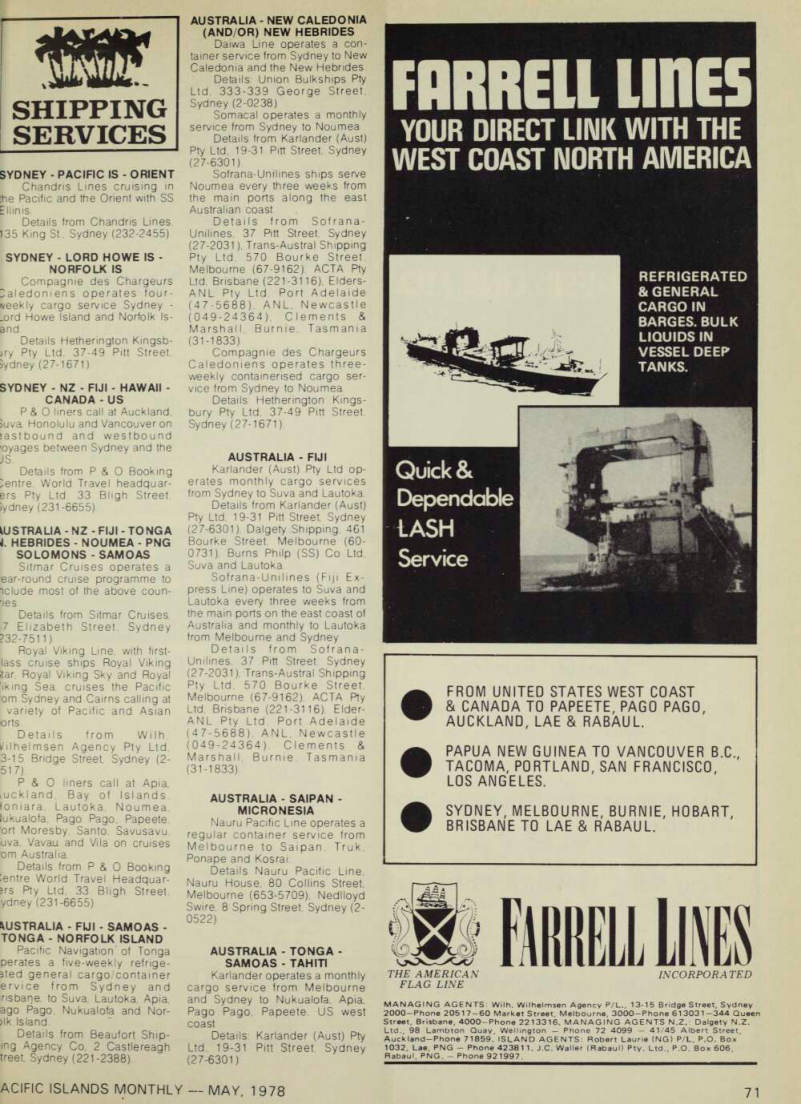
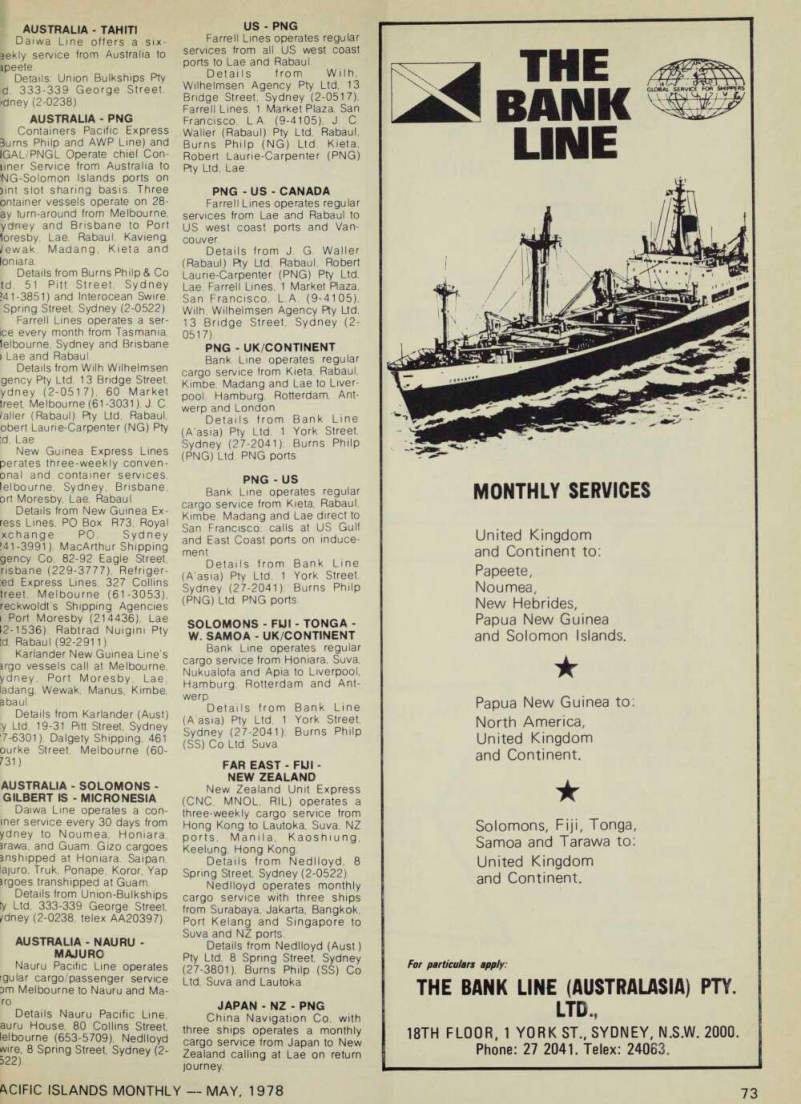
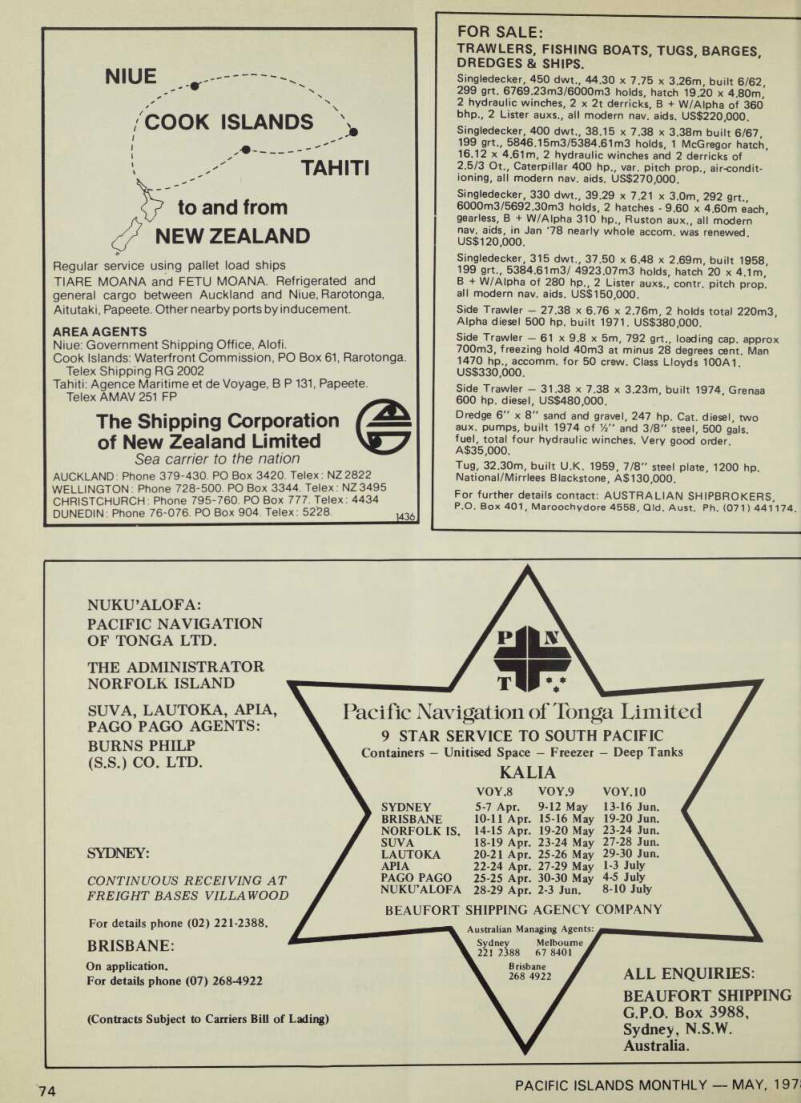
Services
Sydney - Pacific Is - Orient
Chandris Lines cruising in the Pacific and the Orient with SS Ellinis Details from Chandris Lines, 135 King St.. Sydney (232-2455)
Sydney - Lord Howe Is -
Norfolk Is
Compagnie des Chargeurs 3aledoniens operates four weekly cargo service Sydney - .ord Howe Island and Norfolk Is and Details Hetherington Kmgsb jry Pty Ltd. 37-49 Pitt Street.
Sydney (27-1671) SYDNEY - NZ - FIJI - HAWAII -
Canada - Us
P & O liners call at Auckland.
Suva Honolulu and Vancouver on jastbound and westbound r oyages between Sydney and the JS Details from P & O Booking Centre World Travel headquar ers Pty Ltd 33 Bligh Street Sydney (231 -6655) AUSTRALIA - NZ - FIJI - TONGA
J. Hebrides - Noumea - Png
Solomons - Samoas
Sitmar Cruises operates a ear-round cruise programme to iclude most of the above coun ts Details from Sitmar Cruises, 7 Elizabeth Street, Sydney 232-7511) Royal Viking Line, with first lass cruise ships Royal Viking Star, Royal Viking Sky and Royal 'iking Sea, cruises the Pacific om Sydney and Cairns calling at variety of Pacific and Asian orts Details from With, Yilhelmsen Agency Pty Ltd, 3-15 Bridge Street, Sydney (2- 517) P & O liners call at Apia, luckland, Bay of Islands, loniara, Lautoka, Noumea, lukualofa, Pago Pago, Papeete 'ort Moresby, Santo, Savusavu, uva, Vavau and Vila on cruises om Australia.
Details from P & O Booking lentre World Travel Headquar jrs Pty Ltd. 33 Bligh Street ydney (231-6655).
Australia - Fui - Samoas -
Tonga - Norfolk Island
Pacific Navigation’ of Tonga perates a five-weekly refrige ated general cargo/container ervice from Sydney and nsbane, to Suva, Lautoka. Apia, ago Pago, Nukualofa and Nor )lk Island Details from Beaufort Ship ing Agency Co, 2 Castlereagh
treet. Sydney (221-2388)
Australia - New Caledonia
(And/Or) New Hebrides
Daiwa Line operates a con tainer service from Sydney to New Caledonia and the New Hebrides Details: Union Bulkships Pty Ltd, 333-339 George Street.
Sydney (2-0238) Somacal operates a monthly service from Sydney to Noumea Details from Karlander (Aust) Pty Ltd, 19-31 Pitt Street, Sydney (27-6301) Sofrana-Unilines ships serve Noumea every three weeks from the main ports along the east Australian coast Details from Sofrana- Unilines, 37 Pitt Street, Sydney (27-2031). Trans-Austral Shipping Pty Ltd, 570 Bourke Street, Melbourne (67-9162). ACTA Pty Ltd Brisbane (221-3116), Elders- ANL Pty Ltd Port Adelaide (47-5688), ANL, Newcastle (049-24364) Clements & Marshall, Burnie, Tasmania (31-1833) Compagnie des Chargeurs Caledoniens operates three weekly containerised cargo ser vice from Sydney to Noumea.
Details Hetherington Kings bury Pty Ltd, 37-49 Pitt Street,
Sydney (27-1671)
Australia - Fiji
Karlander (Aust) Pty Ltd op erates monthly cargo services from Sydney to Suva and Lautoka Details from Karlander (Aust) Pty Ltd, 19-31 Pitt Street. Sydney (27-6301), Dalgety Shipping 461 Bourke Street, Melbourne (60- 0731), Burns Philp (SS) Co Ltd, Suva and Lautoka Sofrana-Unilines (Fiji Ex press Line) operates to Suva and Lautoka every three weeks from the main ports on the east coast of Australia and monthly to Lautoka from Melbourne and Sydney Details from Sofrana- Unilines. 37 Pitt Street. Sydney (27-2031), Trans-Austral Shipping Pty Ltd, 570 Bourke Street, Melbourne (67-9162). ACTA Pty Ltd Brisbane (221-3116), Elder- ANL Pty Ltd, Port Adelaide (47-5688), ANL, Newcastle (049-24364) Clements & Marshall, Burnie. Tasmania (31-1833)
Australia - Saipan -
Micronesia
Nauru Pacific Line operates a regular container service from Melbourne to Saipan Truk, Ponape and Kosrai Details Nauru Pacific Line, Nauru House, 80 Collins Street, Melbourne (653-5709), Nedlloyd Swire, 8 Spring Street, Sydney (2- 0522)
Australia - Tonga -
Samoas - Tahiti
Karlander operates a monthly cargo service from Melbourne and Sydney to Nukualofa, Apia, Pago Pago, Papeete, US west coast Details: Karlander (Aust) Pty Ltd, 19-31 Pitt Street, Sydney (27-6301)
Australia - Tahiti
Daiwa Line offers a six eekly service from Australia to ipeete Details: Union Bulkships Pty d 333-339 George Street, /dney (2-0238)
Australia - Png
Containers Pacific Express 3urns Philp and AWP Line) and IGAL/PNGL Operate chief Con liner Service from Australia to 'NG-Solomon Islands ports on )int slot sharing basis Three ontainer vessels operate on 28ay turn-around from Melbourne, ycmey and Brisbane to Port loresby, Lae, Rabaul, Kavieng, /ewak, Madang, Kieta and loniara.
Details from Burns Philp & Co td, 51 Pitt Street. Sydney Ml-3851) and Interocean Swire, Spring Street, Sydney (2-0522) Farrell Lines operates a ser ice every month from Tasmania, lelbourne. Sydney and Brisbane » Lae and Rabaul Details from Wilh Wilhelmsen gency Pty Ltd, 13 Bridge Street, ydney (2-051 7), 60 Market tree! Melbourne (61 -3031), J. C. faller (Rabaul) Pty Ltd, Rabaul, obert Laurie-Carpenter (NG) Pty [d. Lae New Guinea Express Lines perates three-weekly conven onal and container services, lelbourne, Sydney, Brisbane, ort Moresby, Lae, Rabaul Details from New Guinea Ex ress Lines, PO Box R 73, Royal xchange PO, Sydney 141-3991), MacArthur Shipping gency Co, 82-92 Eagle Street, nsbane (229-3777), Refriger :ed Express Lines, 327 Collins treet, Melbourne (61-3053), reckwoldt's Shipping Agencies i Port Moresby (214436), Lae 12-1536) Rabtrad Nuigini Pty td, Rabaul (92-2911) Karlander New Guinea Line’s jrgo vessels call at Melbourne, ydney, Port Moresby, Lae, ladang, Wewak. Manus, Kimbe, a haul Details from Karlander (Aust) :y Ltd. 19-31 Pitt Street, Sydney ’7-6301), Dalgety Shipping, 461 ourke Street, Melbourne (60f3l)
Australia - Solomons -
Gilbert Is - Micronesia
Daiwa Line operates a con iner service every 30 days from ydney to Noumea, Honiara, irawa, and Guam Gizo cargoes anshipped at Honiara. Saipan, lajuro, Truk, Ponape, Koror, Yap irgoes transhipped at Guam Details from Union-Bulkships ty Ltd, 333-339 George Street, /dney (2-0238, telex AA20397)
Australia - Nauru -
Majuro
Nauru Pacific Line operates igular cargo/passenger service Dm Melbourne to Nauru and Ma ro Details Nauru Pacific Line, auru House, 80 Collins Street, lelbourne (653-5709), Nedlloyd wire, 8 Spring Street, Sydney (2- 522).
Us - Png
Farrell Lines operates regular services from all US west coast ports to Lae and Rabaul.
Details from Wilh, Wilhelmsen Agency Pty Ltd, 13 Bridge Street, Sydney (2-0517), Farrell Lines, 1 Market Plaza, San Francisco, L A (9-4105), J. C.
Waller (Rabaul) Pty Ltd, Rabaul, Burns Philp (NG) Ltd, Kieta, Robert Laurie-Carpenter (PNG) Pty Ltd, Lae
Png - Us - Canada
Farrell Lines operates regular services from Lae and Rabaul to US west coast ports and Van couver Details from J. G. Waller (Rabaul) Pty Ltd, Rabaul, Robert Laurie-Carpenter (PNG) Pty Ltd, Lae, Farrell Lines, 1 Market Plaza, San Francisco, L A. (9-4105), Wilh, Wilhelmsen Agency Pty Ltd, 13 Bridge Street, Sydney (2- 0517)
Png - Uk/Continent
Bank Line operates regular cargo service from Kieta, Rabaul, Kimbe, Madang and Lae to Liver pool, Hamburg Rotterdam, Ant werp and London Details from Bank Line (A’asia) Pty Ltd 1 York Street, Sydney (27-2041); Burns Philp (PNG) Ltd, PNG ports
Png - Us
Bank Line operates regular cargo service from Kieta, Rabaul, Kimbe. Madang and Lae direct to San Francisco: calls at US Gulf and East Coast ports on induce ment Details from Bank Line (A'asia) Pty Ltd, 1 York Street, Sydney (27-2041); Burns Philp (PNG) Ltd, PNG ports
Solomons - Fui - Tonga -
W. Samoa - Uk/Continent
Bank Line operates regular cargo service from Honiara, Suva, Nukualofa and Apia to Liverpool, Hamburg, Rotterdam and Ant werp Details from Bank Line (A'asia) Pty Ltd. 1 York Street, Sydney (27-2041); Burns Philp (SS) Co Ltd, Suva
Far East - Fui
New Zealand
New Zealand Unit Express (CNC, MNOL, RIL) operates a three-weekly cargo service from Hong Kong to Lautoka, Suva, NZ ports, Manila, Kaoshiung, Keelung, Hong Kong Details from Nedlloyd, 8 Spring Street, Sydney (2-0522) Nedlloyd operates monthly cargo service with three ships from Surabaya, Jakarta, Bangkok, Port Kelang and Singapore to Suva and NZ ports.
Details from Nedlloyd (Aust.) Pty Ltd, 8 Spring Street, Sydney (27-3801), Burns Philp (SS) Co Ltd, Suva and Lautoka
Japan - Nz - Png
China Navigation Co, with three ships operates a monthly cargo service from Japan to New Zealand calling at Lae on return journey
Details Nedlloyd, 8 Spring (Street, Sydney (2-0522)
Far East - Mid-S. Pacific
China Navigation Co’s vessels operate a regular cargo service from Hong Kong, Taiwan and Singapore to Rabaul, Wewak, Madang. Lae, Port Moresby, Honiara, New Hebrides, Noumea, Papeete and Samoa.
Details from Nedlloyd, 8 Spring Street, Sydney (2-0522).
Kyowa Shipping Co Ltd op erates monthly services from Hong Kong, Taiwan, S. Korea and Japan, to Guam, Saipan Solomons, New Caledonia, Fiji, Western and American Samoa, Tahiti, Cook Is., Tonga and New Hebrides and 45-day con :amer/break bulk cargo service tom Kobe, Nagoya and Yokohama to Guam. Suva, r autoka and Noumea Details: Hetherington (mgsbury Pty Ltd, 37-49 Pitt Street. Sydney (27-1671) NYK Line, in conjunction with Daiwa Line, with container ships jperates 30-day service from doji. Kobe, Nagoya and Yokohama to Papeete, Pago ’ago, Apia, Suva, Lautoka, Sydney Noumea, Honiara, arawa, Guam and Taiwan.
Details: Union Bulkships Pty ,td 333-339 George Street, lydney (2-0238)
North Europe - Tahiti -
New Caledonia
Hamburg-Sued operates monthly cargo services from famburg, Dunkirk and Le Havre ) Papeete, Noumea, via Panama Details from Columbus Over eas Services Pty Ltd, 333 Seorge Street, Sydney 290-2966): Columbus Maritime ervices, 17 Albert Street, Auck md (75-509)
Europe - Pacific Is
Australia
Compagnie Generale laritime maintains regular ser ices from North Europe and lediterranean ports to Sydney via apeete, Santo, Vila and Noumea, nd via those ports on return, sing ro-ro and multi-purpose nips Details from Compagnie enerale Maritime, 261 George treet, Sydney (241-2872) UROPE - TAHITI - W. SAMOA -
Fui - N. Caledonia
Nedlloyd offers regular cargo ervices from Northern Europe nd UK to Papeete, Apia, Fiji and lew Caledonia Details Nedlloyd (Aust) Pty td, 8 Spring Street, Sydney ?7-3801) fVPAN - GUAM - FIJI -SAMOA -
I. Caledonia - N. Hebrides
Daiwa Lines runs a monthly argo service from Japan via uam to Suva, Lautoka, Pago ago. Apia, Vila, Santo, Honiara, oumea, Tahiti, Nauru and Cook Details from Burns Philp (SS) o Ltd, Suva
NZ - FUI - TONGA - SAMOAS Union Steam Ship Co of NZ operates a roll-on, roll-off, unitised service from Auckland to Lautoka- Suva-Pago Pago- Apia-Nuku'alofa on a 14 day frequency.
Details from Union Steam Ship Co of NZ Ltd , PC Box 12, Auckland or from Branch of fices/agents in Fiji, Tonga and the Samoas
Nz - N. Caledonia -
N. Hebrides - Png -
Solomons
Sofrana-Unilines with three ships operates to Vila and Santo, to Honiara and Papua New Guinea and to Noumea Details from Sofrana- Unilines, 18 Customs Street, Auckland (7-3279), PO Box 3614, Telex: NZ2313
Nz - New Hebrides/
Solomons
Warner Pacific Line services Auckland, Honiara, Santo, Vila monthly general and freezer cargoes Details from Air Marine Ser vices (NZ) Ltd, PO Box 2505, Auckland, NZ(363-731)
Nz - Australia -
New Caledonia -
Solomons - Gilberts -
Micronesia
Union Co/Daiwa Line operate a container service from New Zea land through Sydney to Noumea, Honiara, Tarawa and Guam Trans-shipment to Saipan, Majuro and Gizo Details. Union Steam Ship Co of NZ Ltd, PO Box 12, Auckland, or Union Bulkships Pty Ltd, 333-339 George Street Sydney, (2-0238)
Nz - Png
Farrell Lines operates regular service every 30 days from Auck land to Lae and Rabaul.
Details from Dalgety NZ Ltd, 41-45 Albert Street, Auckland (7-1859), J. C. Waller (Rabaul) Pty Ltd, Rabaul, Robert Laurie-Car penter (PNG) Pty Ltd, Lae
Nz - Fui - North America
(WC) Crusader cargo ships call at Suva, Levuka and Honolulu on NZ-US west coast trips and at Suva and/or Lautoka on US-NZ return trips Details from Blueport ACT (NZ) Ltd, PO Box 192, Wellington (739-029); Burns Philp (SS) Co Ltd, Suva.
Nz - Fiji
Reef operates a regular 18day service from Auckland to Suva and Lautoka Details from Reef Shipping Agencies Ltd, PO Box 3382, Auckland, NZ (7-1221-3) Pacific Line with one ship op erates monthly cargo service New Zealand, Lautoka, Suva Details: Sofrana-Unilines, 18 Customs Street, Auckland (7-3279) PO Box 3614, Telex: NZ2313
Nz- Samoa - Tonga
Pacific Navigation of Tonga
Iperates a four-weekly cargo ser iice, Auckland - Nukualofa - Pago tego - Apia - Nukualofa - Auck and Details from McKay Shipping td, Downtown House, Queen ;treet. Auckland (33-656) Warner Pacific Line services )nehunga - Nukualofa - Vavau Drtmghtly, and Timaru - Nukualofa Vavau monthly and Onehunga vpia and Pago Pago every 21 lays carrying general and freezer argoes and Timaru - Apia every 1 days carrying freezer cargo Details from Air Marine Ser ices (NZ) Ltd, PO Box 2505 Auckland (362-731) NZ - COOK IS - NIUE -
Tahiti
Shipping Corporation of NZ Id operates cargo services bas d on pallets and similar units om Auckland to Niue, Cook Is mds and Tahiti Details from the Shipping orp of NZ Ltd, PO Box 3420, uckland (379-430): Waterfront ommission PO Box 61, arotonga Lighterage and tevedoring Co. Aitutaki, Niue ovt Offices Niue Island or Com agme Maritime Polynesienne, ’P’ 368, Papeete
Nz - American Samoa
Farrell Lines operates regular srvice every 30 days from Auck nd to Pago Pago Details from Dalgety (NZ) Ltd, 1-45 Albert St. Auckland 71859. neubuhl Maritime Services Box 3, Pago Pago 633-5121 JK - PANAMA - SAMOA - FIJI The Fiji Direct Service, cargo nly. is maintained by Conference jssels, sailing at regular monthly tervals out of Avonmouth, via anama, for Apia. Suva and lutoka.
Details from Burns Philp (SS) o Ltd, Suva
Jk/N. Continent - Tahiti -
I. Caledonia - N. Hebrides
Bank Line operates regular argo service from Hull, Ham jrg, Bremen, Antwerp and Rot rdam to Papeete. Noumea and la Details from Bank Line Lasia) Ry Ltd, 1 York Street, /dney (27-2041): Ets AMAV, apeete: Ets Ballande, Noumea, urns Philp (NH) Ltd, Vila
Uk/N. Continent - Png -
Solomons
Bank Line operates regular
cargo service from Hull, Ham burg, Bremen, Antwerp and Rot terdam to Port Moresby, Lae, Madang, Kimbe, Rabaul, Kieta and Honiara and, on inducement to Yandina, Tarawa and Nauru.
Details from Bank Line (A'asia) Pty Ltd, 1 York Street.
Sydney (27-2041): Burns Philp (PNG) Ltd, PNG ports
San Francisco - Honolulu
Micronesia
Nauru Pacific Line operates regular conventional/container service from San Francisco and Honolulu to Majuro. Nauru, Ponape, Truk and Saipan Details from Nauru Pacific Line, Nauru House, 80 Collins Street. Melbourne (653-5709), North American Maritime Agen cies, 100 California Street, San Francisco, California 9411 (981- 0343) US - FIJI - TAHITI - NZ -
Australia
Bank and Savill Line Ltd op erates regular cargo services from US Gulf ports to Australia and NZ.
Calls at Suva. Lautoka and Papeete on demand Details from Bank Line (A/asia) Pty Ltd. 1 York Street, Sydney (27-201 1) or Howard Smith Industries Ry Ltd, 1 York Street Sydney (27-5611).
US - A. SAMOA - NZ - AUST Farrell Lines LASH ships op erate regularly from US to Australia, via Pago Pago and Auckland and Canada Details from Wilh, Wilhelmsen Agency Pty Ltd. 13 Bridge Street, Sydney (2-0517), 60 Market Street, Melbourne (61- 0301); Farrell Lines, 1 Market Plaza, San Francisco L A (415-777-3300): Dalgety NZ Ltd, Auckland (7-1859): Kneubuhl Maritime Services. Pago Pago (633-5121)
Us - Tahiti - Samoa
Pacific Islands Transport op erates a five/six weekly cargo ser vice from North American west coast ports to Papeete, Pago Pago, Apia.
Details from Trans-Austral Shipping Ry Ltd, 19 Pitt Street,
Sydney (27-2441)
Polynesia Line operates con tainer and general cargo service from US west coast ports to Papeete and Pago Pago.
Details from Polynesia Ship ping Services Inc, PC Box 1478, Pago Pago (9-6799)
Advertisements & other items, pp. 71-84 (5 items)
71
ACIFIC ISLANDS MONTHLY MAY, 1978
Farrell Uiies
YOUR DIRECT LINK WITH THE
WEST COAST NORTH AMERICA
« m!
Quick &
Dependable
iASH
Service
REFRIGERATED
& GENERAL
CARGO IN
BARGES. BULK
LIQUIDS IN
VESSEL DEEP
TANKS.
i
• FROM UNITED STATES WEST COAST
& CANADA TO PAPEETE, PAGO PAGO,
AUCKLAND, LAE & RABAUL.
• PAPUA NEW GUINEA TO VANCOUVER 8.C.,
TACOMA, PORTLAND, SAN FRANCISCO,
LOS ANGELES.
• SYDNEY, MELBOURNE, BURNIE, HOBART,
BRISBANE TO LAE & RABAUL.
THE AMERICAN
FLAG LINE
INCORPORATED
MANAGING AGENTS: Wilh. Wilhelmsen Agency P/L., 13-15 Bridge Street, Sydney 2000—Phone 20517—60 Market Street, Melbourne, 3000—Phone 61 3031 —344 Queen Street, Brisbane, 4000-Phone 2213316. MANAGING AGENTS N.Z.: Dalgety N. 2.
Ltd., 98 Lambton Quay, Wellington Phone 72 4099 41/45 Albert Street, Auckland —Phone 71859. ISLAND AGENTS: Robert Laurie (NG) P/L, P.O. Box 1032, Lae, PNG - Phone 423811. J.C. Waller (Rabaul) Pty. Ltd., P.O. Box 606, Rabaul. PNG. - Phone 921997.
Express Freight Service between U S. Pacific Coast Ports &
PAPEETE ■ APIA ■ PAGO PAGO
Full Container Service including Refrigeration
GENERAL AGENTS
« fURNESS INTEROCE4N
CORPORATION
465 CALIFORNIA STREET, SAN FRANCISCO CA 94104 Cable INTERCO • TWX 910-3727350 • RCA 278 207
POLYNESIA LINE, LTD.
AGENTS
PAPEETE - MORGAN; Vernex Boite Postale 449. Papeete Phone; 309 Cables: MOREX PAGO PAGO - POLYNESIA SHIPPING SERVICES. INC.. Pago Pago Phone; 633-5169 Cables; POLYSHIP APIA - UNION S.S. CO., of N.Z. Ltd.. P.O. Box 50. Apia, Western Samoa Phone; 570 Cables: UNION
PACIFIC
ISLANDS
TRANSPORT
I JVJ I*4 Owners: Thor Dahls Hvalfangerseiskap >1 i 4 A/S - Sandefjord, Norway.
MS CAMELLIA VENTURE
Express Freight Service between Pacific Coast Ports of U.S.A. and...
Tahiti 6 Samoa
Full container service including reefers.
GENERAL STEAMSHIP CORPORATION LTD.
General Agents 400 California Street, San Francisco, California, U.S.A.
APIA: Burns Philp (South Sea) Company Ltd.
PAPEETE: Agence Maritime Internationale, Tahiti.
PAGO PAGO: Polynesia Shipping Services Inc.
NOUMEA: Establissements Ballande.
SYDNEY: Trans-Austral Shipping Pty. Ltd SUVA: Bums Philp (South Sea) Company Ltd.
LAE/RABAUL: Bums Philp (New Guinea) Ltd.
PORT VILA: Comptoirs Francais de Nouvelles Hebrides.
KYOWA LINE
YOUR TRADING PARTNER
Monthly Services
A GENTSmm
Hong Kong, Taiwan, S. Korea, Japan
To: British Solomon, New Caledonia, Fiji, W Samoa, A. Samoa. Tahiti. Cook Is., Tonga, New Hebrides.
Ellice Is.,
Taiwan,Hong Kong,Singapore,Jakarta,
Philippine
To: Australia, Papua New Guinea, Sabah & Sarawak.
Taiwan: Royal Steamship Corp., Ltd., Taipei S. Korea; Dong Sue Shipping Co., Ltd , Seoul Hong Kong: Dahzun Enterprises Ltd.
Singapore: Ocean Shipping & Enterprises Pte., Ltd.
Guam: Maritime Agencies of Pacific Ltd.. Guam Saipan: Saipan Shipping Co.. Inc.. Saipan 8.5.1. P.: Solomon Taiyo Ltd.. Honiara Tahiti: J A. Cowan & Fils, Papeete Cooks: Eastern Associates Ltd , Rarotonga Tonga: E.M. Jones Ltd., Nukualofa New Hebrides: Agence Maritime Raymond Velicite, Port Vila A.Samoa: Island Pacific Agencies Inc.. Pago Pago W. Samoa: Morris Hedstrom Ltd , Apia Fiji: Carpenter Shipping, Suva & Lautoka PNG: Carpenter Shipping Agencies, Port Moresby. Rabaul New Caledonia: Agence Maritime Du Rond Point Du Pacific,
Hong Kong, Taiwan, S. Korea, Japan
To; Guam, Saipan, Truk, Ponape, Other Pacific Islands.
Noumea Indonesia: P.T. Porodis'a Raya Shipping Lines, Jakarta Sabah: KOH Han Ming Shipping & Forwarding Agent , Kotakinabalu Sarawak: Pan Sarawak Agencies Sdn. Bhd.. Sibu & Kuching Australia: Hethenngton Kingsbury Pty. Ltd.. Sydney. N.S.W Newzealand: Sofrana Unilines S.A., Auckland.
KYOWA SHIPPING CO., LTD.
HEAD OFFICE
sth FL, Suzumaru Bldg. 39-8, 2-chome, Nishi-Shinbashi, Minato-ku, Tokyo, Japan.
Phone : 03(437)2885(Rep.) Cables : “MARIQUEEN” Tokyo. Telex : 242-4651 Kyowa J.
OSAKA OFFICE
Frontier Bldg., 3-13 Hirano-cho, Higashi-ku, Osaka, Japan.
Phone : 06(227)0422(Rep.) Cables : “MARIQUEEN” Osaka. Telex : 522-3896 Kyowa O.
THE
BANK
LINE
GLOBAL SERVICE TOR SHIPPERS
MONTHLY SERVICES
United Kingdom and Continent to: Papeete, Noumea, New Hebrides, Papua New Guinea and Solomon Islands.
Papua New Guinea to; North America, United Kingdom and Continent. ★ Solomons, Fiji, Tonga, Samoa and Tarawa to: United Kingdom and Continent.
For particulars apply
THE BANK LINE (AUSTRALASIA) PTY.
LTD.,
18TH FLOOR, 1 YORK ST., SYDNEY, N.S.W. 2000.
Phone: 27 2041. Telex: 24063.
NIUE
COOK ISLANDS
TAHITI
to and from
NEW ZEALAND
Regular service using pallet load ships TIARE MOANA and FETU MOANA. Refrigerated and general cargo between Auckland and Niue, Rarotonga, Aitutaki, Papeete. Other nearby ports by inducement.
AREA AGENTS
Niue: Government Shipping Office, Alofi.
Cook Islands: Waterfront Commission, PO Box 61, Rarotonga.
Telex Shipping RG 2002 Tahiti: Agence Maritime et de Voyage, B P 131, Papeete.
Telex AMAV 251 FP
The Shipping Corporation
of New Zealand Limited
Sea carrier to the nation AUCKLAND; Phone 379-430. PO Box 3420. Telex; NZ2822 WELLINGTON: Phone 728-500. PO Box 3344. Telex: NZ3495 CHRISTCHURCH: Phone 795-760. PO Box 777. Telex: 4434 DUNEDIN: Phone 76-076. PO Box 904. Telex: 5228. 1436
FOR SALE:
TRAWLERS, FISHING BOATS, TUGS, BARGES
DREDGES & SHIPS.
Singledecker, 450 dwt., 44.30 x 7.75 x 3.26 m, built 6/62 299 grt. 6769.23m3/6000m3 holds, hatch 19.20 x 4.80m,' 2 hydraulic winches, 2 x 2t derricks, B + W/Alpha of 360 bhp., 2 Lister auxs., all modern nav. aids. U 55220,000.
Singledecker, 400 dwt., 38.15 x 7.38 x 3.38 m built 6/67 199 grt., 5846.15m3/5384.61m3 holds, 1 McGregor hatch, 16.12 x 4.61 m, 2 hydraulic winches and 2 derricks of 2,5/3 Ot., Caterpillar 400 hp., var. pitch prop., air-conditioning, all modern nav. aids. U 55270,000.
Singledecker, 330 dwt., 39.29 x 7.21 x 3.0 m, 292 grt., 6000m3/5692.30m3 holds, 2 hatches - 9.60 x 4.60 m each, gearless, B + W/Alpha 310 hp., Ruston aux., all modern nav, aids, in Jan '7B nearly whole accom. was renewed
US$l2O,OOO.
Singledecker, 315 dwt., 37.50 x 6.48 x 2.69 m, built 1958 199 grt., 5384.61m3/ 4923.07m3 holds, hatch 20 x 4 Im' B + W/Alpha of 280 hp., 2 Lister auxs., contr. pitch prop, all modern nav. aids. US$l5O,OOO.
Side Trawler - 27.38 x 6.76 x 2.76 m, 2 holds total 220m3 Alpha diesel 500 hp. built 1971. US$3BO,OOO.
Side Trawler 61 x 9.8 x sm, 792 grt., loading cap. approx 700m3, freezing hold 40m3 at minus 28 degrees cent. Man 1470 hp., accomm. for 50 crew. Class Lloyds 100A1.
U 55330,000.
Side Trawler - 31.38 x 7.38 x 3.23 m, built 1974, Grenaa 600 hp. diesel, US$4BO,OOO.
Dredge 6" x 8" sand and gravel, 247 hp. Cat. diesel, two aux. pumps, built 1974 of 1 / 2 " and 3/8” steel, 500 gals, fuel, total four hydraulic winches. Very good order A 535,000.
Tug, 32.30 m, built U.K. 1959, 7/8” steel plate, 1200 hp.
National/Mirrlees Blackstone, A 5130,000.
For further details contact: AUSTRALIAN SHIPBROKERS, P.O. Box 401, Maroochydore 4558, Qld. Aust. Ph. (071) 441174,
NUKU’ALOFA:
PACIFIC NAVIGATION
OF TONGA LTD.
THE ADMINISTRATOR
NORFOLK ISLAND
SUVA, LAUTOKA, APIA,
PAGO PAGO AGENTS:
BURNS PHILP
(S.S.) CO. LTD.
SYDNEY:
CONTINUOUS RECEIVING AT
FREIGHT BASES VILLAWOOD
For details phone (02) 221-2388.
BRISBANE:
On application.
For details phone (07) 268-4922 (Contracts Subject to Carriers Bill of Lading) P T
Pacific Navigation of Tonga Limited
9 STAR SERVICE TO SOUTH PACIFIC
Containers - Unitised Space - Freezer - Deep Tanks
KALI A
VOY.9
9-12 May 15-16 May 19-20 May 23-24 May 25-26 May 27-29 May 30-30 May 2-3 Jun.
VOY.B
5-7 Apr. 10-11 Apr 14-15 Apr 18-19 Apr 20-21 Apr 22-24 Apr 25-25 Apr 28-29 Apr
SHIPPING
VOY.IO
13-16 Jun. 19-20 Jun. 23-24 Jun. 27-28 Jun. 29-30 Jun. 1-3 July 4-5 July 8-10 July
SYDNEY
BRISBANE
NORFOLK IS.
SUVA
LAUTOKA
APIA
PAGO PAGO
NUKU’ALOFA
AGENCY
COMPANY
BEAUFORT
Australian Managing Agents: Sydney Melbourne A 221 2388 67 840 Brisbane 268 4922
ALL ENQUIRIES:
BEAUFORT SHIPPING
G.P.O. Box 3988,
Sydney, N.S.W.
Australia.
EXPgflS^
THE
TO
Unaviif
B reck wold t & Co
Ply Ltd
276 Pitt Street, Box 5027, G.P.O. Sydney 2001
CABLE ADDRESS: BREWO SYDNEY
TELEX: AA22890
TELEPHONES: 233-2366, 233-1460, 233-1462
PACIFIC ISLAND OFFICES
BRECKWOLDT & CO (PNG) PTY. LTD.
PO BOX 1549, BOROKO, PORT MORESBY.
PO BOX 222, RABAUL
PO BOX 72, KIETA
PO BOX 178, WEWAK
PO BOX 185, MADANG
PO BOX 237, MT. HAGEN
PO BOX 1188, LAE
BRECKWOLDT & CO., PO BOX 47, APIA BRECKWOLDT & CO. (SI) LTD. PO BOX 140, HONIARA
BRECKWOLDT SARL BP 2369, NOUMEA
OFFICES IN:
HAMBURG
LONDON
MILAN
& WEST AFRICA
ALSO AT:
SINGAPORE
KUALA LUMPUR
BANGKOK
& HONG KONG
ENQUIRIES
FROM OVERSEAS MANUFACTURERS INVITED.
nBE/?7> o 2: o lP V 'I/ •*4
IN OUR 84th YEAR SELLING ‘SERVICE’
TO THE PACIFIC ISLANDS...
Nelson«& Robert son
PTY.LTD. (Established 1895)
Plantation House, 197 Clarence Street, Sydney.
Cables: ‘IVAN 1 , Sydney, Brisbane. Telex: AA22381, Sydney.
FOR:
INDENTS
FOODSTUFFS
SOFTGOODS
HARDWARE
MACHINERY
SHIPPING
TRAVEL
INSURANCE
REAL ESTATE
...FROM AUSTRALIA & OVERSEAS.
BRANCH OFFICES;
Nelson & Robertson Pty. Ltd., 303 Adelaide Street, Brisbane, Qld.
Nelson & Robertson Pty. Ltd., P.O. Box 2092, Gout. Bldg., Suva, Fiji.
Nelson & Robertson Pty. Ltd., P. O. Box 258, Lautoka, Fiji.
PAPUA NEW GUINEA
REPRESENTATIVES:
Rabtrad Niugini Pty. Ltd.
RABAUL
LAE
MADANG
KIETA
VQ A. x-crr-vxr x x. vvt x .x x x v
BL
rara
UIOJD
FMCIO COLD DRINKS
* LOW COST
* LARGE CAPACITY
UPRIGHT DISPLAY
REFRIGERATORS
* BOTTLE & FOOD DISPLAY
* 2& 3 DOOR MODELS AVAILABLE
Large capacity small floor space Maximum visual display Gleaming white, vinyl coated aluminium interior for better reflection of light within cabinet Fluorescent lighting 2" Frigidfoam insulation (equivalent to 4" Polystyrene or 6" cork!) Powered by heavy-duty Kelvinator sealed unit warranteed for 5 years
AVAILABLE FROM:
AUSTRALIAN NEW CALEDONIA EXPORTS. 363 George St, Sydney, 2000 BREGKWOLOT & CO.. 276 Pitt St., Sydney, 2000.
HAGEME YER (A'SIA), 59 Anzac Pde, Kensington, 2033.
GEOFFREY HUGHES A CO. 167 Meoquerie St. Sydney, 2000 NELSON & ROBERTSON PTY. LTD, 197 Clerence St, Sydney, 2000.
PETER FISHER TRADING PTY.LTD, 321 Pitt St, Sydney 2000.
E. RABOT (EXPORTS) PTY. LTD, 67 Castlereagh St, Sydney. 2000 RABTRAD NIUGINI PTY, LTD., PO Box 1406, Lae.
A. RIETTE (PACIFIC) PTY. LTD., 300 George St., Sydney, 2000.
H. Y. KWAN (AUST) PTY. LTD. Box 2713, GPO , Sydney, 2001.
C. SULLIVAN (EXPORT) PTY. LTD., GPO Box 3373, Sydney, 2001.
W.S. TAIT & CO, PTY. LTD, 31 Macquarie Place, Sydney, 2000.
I Attractive timber grain Marviplate exterior I Automatic frost-free, fan-assisted cooling gives even and faster cooling of stored products I 4 rows adjustable plastic-coated, hygenic, white shelves and floor tray > LOW MAINTENANCE, the only maintenance required being periodic cleaning of condenser > Illuminated sign in top panel optional extra.
Manufactured by: 0 xl
FRIGID CABINETS PTY. LTD.,
]4A Puffy Ave., Thornleigh, N.S.W. 2120 Aust. Ph. 848 8292.
Master.
MACKEREL
PACKED BY :
NIPPON SUISAN KAISHA, LTD,
♦ “Master ” Brand Canned Mackerel, Canned Sardines and other Canned Fish. ♦ “House” Brand Instant Noodle, Soup & Desserts, all kinds of Spices and Japanese Soy Sauce. ♦ Groceries, Confectionary, Beverage, etc. ♦ Hand Tools, Builders & Cabinet Hardware, Plasticware, Chmaware, Kitchenware. ♦ Building Materials, Plywood, Hardbord, Formica, Tiles, Wall Paper, etc. ♦ Steel Products: Round, Square, Flat, Angle, Channel Bars, Iron Sheet, Pipes & Fitting. ♦ Machinery, Motor Spare Parts, Batteries and Accessories. ♦ Electric Household Appliances & “Daikm” Air Conditioners. ♦ Sporting Goods, Fishing Rods & Reel, Accessories for Boat & Yacht. ♦ “Hadson” Pocket & Table Lighters, Disposable Butane Lighters. ♦ Soaps, Hair Shampoo, Detergents. Truletr+ec. ♦ Various Nsvdties, Ornaments, Souvenir Items. ♦ “New Jet Type” Labeler & Other Daily Stuff.
UNITRADE COMPANY,LIMITED
Sanritsu Building 11-12 3-chome Hachobori Chuo-ku Tokyo (104)
TELEX NO. : “252-4665 KANDK J”
CABLE ADDRESS : “KAYANDKAY TOKYO”
TELEPONE NO. : 03-553-9520
Resident Representives in Fiji, P.N.G., Philippines, Hong Kong & Singapore
BRAND
GENERAL MERCHANTS
EXPORTERS & IMPORTERS
FOR SALE: BALI HAI
BLUE WATER CRUISE SHIP
L.O.A. 75 ft. Beam 20 ft. Draft 7 ft.
Air-conditioned.
Refrigeration. Flying bridge. All navigational aids. Owners and guests' suites. Crew's quarters.
Builc by Norman Wright Pty. Ltd Brisbane and powered by Gardner diesels. This well-known and exceptionally wellfound vessel is complete in every way for offshore cruising.
Inquiries contact
GREG BANWELL:
Widgiewa Rd.
Northbridge, NSW 2063.
SYDNEY 95 1326.
CLASSIFIED ADVERTISEMENTS
Per Line $5.00 Aust. Minimum 4 lines.
We export
regularly
to the
Pacific
■ Meat fish (Mackerel) vegetables groceries ■ Chemicals - agricultural industrial ■ New and second hand machinery ■ Timber & building materials, hardware ■ Iron & steel products ■ Textiles & soft goods Cosmetics & toiletries &
FORREST EXPORT CO.
32 Hillside Rd P 0 Box 33853 TaKapuna, Phone 449-602 Auckland New Zealand Cable Address: EXCEL
PACIFICANA
We are about to issue our first list of new, used and rare books.
Government reports, commercial reports, theses, maps, charts, flags, etc, of the Pacific Islands particularly Melanesia (New Guinea, Fiji, Solomons) and Micronesia (Marshalls, Marianas and Caroline Islands, Nauru and Guam) of interest to university libraries, private collections, research institutions.
Pacific studies, etc.
Write to:
PACIFIC ISLANDS BOOK
AND MAP CENTRE
P.O. BOX 1010,
SURFERS PARADISE,
GOLD COAST,
OLD, 4217, AUST.
TEL (075) 390446.
FOR SALE PERKINS 4 cyl. 36-40 hp diesels heat exchanger cooled with 2 to 1 reduction boxes. Instruments.
Rebuilt engines with all new marinisation 52500. DIABLO
MOTORS PTY LTD. 212 HaMon Si,
Lakemba, 2195, NSW Australia.
MAPS AND PRINTS
OF THE OLD
PACIFIC
Regular catalogues issued listing a large stock of original antiquarian views and maps of Australia.
New Zealand, Papua New Guinea and all island groups of the Pacific. Write today for your free coov.
COLIN HINCHCLIFFE
7 Royd Avenue, Heckmondwike, West Yorkshire, WF 16 9aL
UNITED KINGDOM
FOR SALE: FLEETS 54'Steel
workboat, profess built. 1974 200 hp diesel, radar, radio, sounder, approx 900 cu ft hold, good accom $94,500.
FLEETS: 221 Esplanade Wynnum Central Brisbane. Cable: FLEETS
BRISB. (KEY C)
CATERPILLAR MARINE
ENGINE
DB, 6cyl, 3:1 Gearbox Heat exchange, compressor air start, matched propeller, Air conditioned - completely overhauled any inspection invited; Aust $ 12,000 (ONO) The Manager, P'O' Box 816 Port Vila New Hebrides..
C*Ass kQQTS
AW OF NEW GUINEA
From PlM's Mail Order Bookshop, $3.00 or $3.50 posted anywhere.
For information on Canadian Lottery tickets contact: C. W. Daniels, P.O.
Box 165 Orangeville Ontario,
CANADA L9W 2Z6.
WANTED TO BUY
Early postcards, Books, Maps, Photos, New Caledonia, New Hebrides Wallis and Futuna Offers to Maxwell Shekleton BP 362 Noumea NEW
CALEDONIA.
BLADE &
BUSH SETS
High Quality replacements SAVE DOLLARS
parts for Rotary Slashers ON MOST MAKES!!!
CHECK THIS SHORT LIST OF BLADE PRICES:
ANDYS 5'
FORD 505 5'
BLUELINE (See PAGE)
GOLD SEAL (MAR INO).. $9.80
HOWARD 4' & 5' $7.00
HOWARD 6' $8.20
MOBILCO EDGCLIFFE ~$lO.OO
MOBILCO WALLACE $ll.OO
MASSE Y-McLEOD
-SHEARER 4' $12.80
MASSE Y-McLEOD
-SHEARER 5' $13.75
MASSE Y-McLEOD
-SHEARER 6' $17.00
PAGE (BLUELINE) 4 6 $ll.OO
PAGE (BLUELINE) 5' $12.80
PAGE (BLUELINE) 6' $14.20
PAGE 10', 12', 20' $15.50
NEW HOLLAND 60-72 ..$16.00
WOODS $lO.BO
$10.50 $12.40
. . . AND MANY MORE!
Prices per blade with bush where fitted
ALL PRICES F.O.R. BRISBANE
Prices subject to change without prior notice TOP QUALITY BLADES IN HIGH GRADE STEEL Specially heat treated and Tempered
Price right Quality right
See your local Machinery Dealer or send Direct to:
SLASHER SPARES PTY. LTD.
782 FAIRFIELD ROAD, YEERONGPILLY, Old. 4105.
PHONE: (07) 48 5554.
THE PAPUA HOTEL
PORT MORESBY
• Right in the business centre • A tradition for comfort and fine food • All rooms air conditioned • Restaurant • Bars • Banquet Hall Telephone 21 2622 Cables PARTE L
A. C. NEUMANN
Manager
Stay at Aggie Grey's
the South Pacific's
legendary hotel.
Situated right in the heart of Western Samoa. Enjoy Polynesian-style friendliness and service, in cool surroundings, superb entertainment and food. Magnificent white sand beaches only a short drive away. Airconditioned rooms, swimming pool and full bar facilities.
Bookings through Union Steamship Company of N 2, Pan Am, Air New Zealand or direct to Aggie Grey's, Apia, Western Samoa.
Cables: AGGIES, APIA.
FARM & ENGINEERING WORKSHOP EQUIPMENT
Prefabricated Cattle and Sheep Yards and Crushes • Hay Feeders 9 Farm Gates • Fencing Wire Unwinders • Post Drivers and Lifters, etc • Hydraulic Pipe Benders • Power Hacksaws • Shears 9 Flat and Rod Benders 9 Pipe Notchers 9 Crimpers 9 Garage Presses 9 Farm Meat Saws, etc.
Contact: R.P.M. Manning Ltd. Auckland N.Z. / South Pacific Machinery Pty. Ltd. / Boroko, New Guinea / Pacific Australian Trading, Sydney / Australia-New Caledonia Exports, Sydney / AgQuip Machinery Pty. Ltd. New Guinea.
STEER ENGINEERING PTY. LTD.
218 Grange Road, Fairfield, Vic., 3078, Aust. Phone 497-1844
ROOTS
op r*ev/v csu«^6 A
IS lost
C £* t AVEL
m
TRAVEL
THE ISLANDS
with The Kit'S" 0 ” 1
TONGA
EPnßO’s
MAILORDER BOOKSHOP
(YOU CAN ORDER OVERLEAF)
...and, meanwhile, here's your PIM subscription form:
SUBSCRIPTION FORM:
dty/steteteountry/postcode print) Attached it my payment of .for a 12 months' tubtcription.
New □ Renewal □
4* PACIFIC ISLANDS MONTHLY
/" Postal Address: Box 3408. G.P.0., Sydney 2001, *- N.S.W., Australia.
SUBSCRiPTION RATES;
Australia (including Norfolk Island) $10.50 Autt.
New Zealand N 2 $11.50 $10.50 Aust.
Fiji F $10.75 $10.50 Autt.
Papua New Guinea IK 9.00 $10.50 Aust.
Tonga, New Hebrides, Cook Islands, Western Samoa, Tuvalu, Gilbert Islands, Niue, Nauru, Solomon Islands $10.50 Aust.
American Samoa, Northern Marianas, Micronesia, Guam and Hawaii US $15.00 $12.00 Aust.
US Mainland and Canada - US $17.00 $14.00 Aust.
New Caledonia and French Polynesia 1,600 CFP $13.50 Autt.
United Kingdom €9.50 $12.50 Autt.
Japan 4,500 Yen $12.50 Aust.
Elsewhere - $14.50 Aust.
Payment by personal cheque is accepted in Australia, U.S., New Zealand, U.K., Papua New Guinea and Fiji currency. For other remittances please obtain a Bank Draft in Australian dollars, made payable to ANZ Banking Group, 88 Wentworth Ave., Sydney, Australia.
ORDER FORM FOR RIMS
I I The Lost Caravel. Robert Langdon shatters traditionally-held views on the Polynesians in this controversial, historical whodunnit described by Prof. Ron Crocombe as a “masterpiece as fascinating as it is important”.
Also invaluable as a record of early Pacific exploration. 368 pp. Profusely illustrated with maps and plates.
SAIB or SUS 26.
I I The Story of the Solomons. Simple, lucid outline of the history of the Solomon Islands, from a refreshingly frank and affectionate point of view, by Dr. C.
E. Fox. 88 pp. SA3 or SUS 4.
I I Port Moresby, Yesterday and Today. In what is even more than a history of Papua New Guinea’s capital, Canon lan Stuart takes us on an entertaining, personalised tour of the city. Soft cover, 368 pp. Maps, illustrations. 5A3.50 or SUS4.SO.
I I Holy Torture in Fiji. Firewalking and other sacred, ancient rituals of Fiji’s Hindus, described in text and colour photographs. Large format, 64 pp. illustrated.
5A4.50 or SUS6.SO.
I I New Hebrides. One of the superb Islands in the Sun series of brilliant full-colour plates, maps and text, this volume describes the unique British-French Condominium of New Hebrides. A guide for travellers, or for collectors. 128 pp. Fully illustrated. SAIO or SUSI 3.
I Incw Caledonia. French New Caledonia, superbly depicted in full colour photographs, with informative text and maps giving history, geography and daily life.
An Islands in the Sun guide, with 128 pp. Fully illustrated. SAIO or SUSI 3.
I I Bora Bora. One of the French Pacific’s fascinating, colourful high islands, reached from Tahiti, here presented in sparkling full colour pictures for visitors or mere armchair travellers. Another Islands in the Sun guide, with 128 pp. Fully illustrated. SAIO or SUSI 3.
I I Easter Island. At last, a new book on fascinating Easter Island - history, daily life and the mysterious giant statues. All in full colour with maps and information for travellers, as one of the Islands in the Sun series. Half of this splendid book is devoted to descriptions and photographs of the statues that made the island famous. 128 pp. Fully illustrated. SAIO or SUSI 3. 1 I Tahiti and its Islands. New revised edition, just released, of this popular title in the Islands in the Sun series. Sparkling new colour plates, new information, new maps. Includes the Leeward Islands, the Tuamotus, the Gamblers, Marquesas, the Australs. Has hotel lists and places to see. 128 pp. Fully illustrated. SAIO or SUSI 3.
I Rarotonga. In his Rarotonga, James Siers for the first time introduces to a wider public the main island of the Cooks group. With its international airport now linking it readily with the outside world, the beauty, charm and friendliness of Rarotonga’s people are wide open for others to share 128 pp. Fully illustrated. SAIO or SUSI 3. □ Moorea. Of all the beautiful islands of the Pacific perhaps none has captured the imagination of visitors - including French painter Paul Gauguin, English writer W. Somerset Maugham, and many thousands of people of lesser fame - than Moorea, a few miles off Tahiti, main island of French Polynesia. Few people would deny that James Siers does the subject justice in his beautifully illustrated Moorea. Parallel texts in English and French. 128 pp. SAIO or SUSI 3. Little Chimbu in Bougainville. For the young and young-at-heart, lovable Little Chimbu and his friends visit Panguna, and get into awfpl trouble in what could be the biggest hole in the world, the Bougainville copper mine. Nancy Curtis, who used to live there, tells the story in full colour drawings which are also accurate and instructive. 48 pp. Illustrated. $A3.50 or SUS4.SO. (Percy Chatterton’s Papua: Day That I Have Loved. Charming evocative account of changing Papua as Rev, Percy Chatterton knew it for 50 years. 144 pp.
Illustrated. $A6.50 or SUSB.SO.
MAIL ORDER BOOKSHOP:
1 I Asimba. A collection of 20 colourful designs by young artists from PNG’s Sogeri High School. Each is 42cm x 28cm and suitable for framing. “A collection of outstanding merit one day they’ll be collectors’ items,” says reviewer Dr W G. Coppell. $A 12.50 at SUS 14.50.
I I Grassroots Art of New Guinea. E.F. Hannemann’s invaluable collection of authentic traditional designs from the north coast of the Papua New Guinea mainland, mainly from actual rubbings. $A3.50 or SUS4.SO.
I I Underwater Guide of Tahiti. Roger Bagnis and photographer Erwin Christian take you to a wonderful world. 152 pp. Fully illustrated. SAS or SUS 7.
I I Colonial Era Cemetery of Norfolk Island.
Former Administrator of the island, R. Nixon Dalkin, describes life and death in what was Britain’s harshest Pacific penal colony. There are illuminating, often moving stories in these photographs, charts and inscriptions that describe the historic cemetery. Large format, 92 pp. Illustrated. SA4 or SUSS.SO.
I I Rust in Peace. A 238 page hard cover text with colour and black and white pictures of the relics left over from the battlegrounds of the South Pacific war. New Guinea, New Ireland, New Britain, Bougainville, Guadalcanal, Tulagi and Tarawa.
SAI2 or SUSIS.
I I Marine Shells of the Pacific Volume 11.
Walter Cemohorsky carries on where his first book left off, with a further 600 species fully described and illustrated. Some of the 68 full page plates are in colour. 412 pp. illustrated. SAI7 or SUS2S. □ Friendly Island. Warm account of life in Tonga, sunlit South Pacific island kingdom, by Patricia Ledyard, ■who lived in a Tongan harbourside village for more than 20 years. Paperback, 215 pp. SA3 or SUS4.SO.
I I Plants and F lowers of Tahiti. Full colour photographs of the rich and beautiful Tahitian flora classified by scientific names and by French, English and Tahitian common names. 144 pp. Fully illustrated. SAS or SUS 7.
I I Birds of Tahiti. A companion volume to Plants and Flowers of Tahiti. Full colour photographs and descriptions, for collectors or amateur birdwatchers, visitors and students needing easy identification. 112 pp. Fully illustrated. SAS or SUS 7.
I I Log of the Mahina: A Tale of the South Pacific. Young American John Neal took his 27 ft. yacht from Seattle on an 18 months cruise through Polynesia and then wrote about it. This delightfully refreshing book abounds with information on how to get there and what to do when you are there. John Neal learned it the hard way and shares his experiences with enthusiasm. Required reading for all yachties venturing into Polynesia’s dangers and pleasures, physical and romantic, 280 pp.
Illustrated. SA6 or SUS7.SO.
Isay it in Fijian. Dr. A. J. Schutz presents a pocket sized, entertaining guide to the Fijian language for those making their first contact with Fiji.
$A2.50 or SUS3.SO.
I I Say it in Motu. In the same series Dr. Percy Chatterton provides an instant introduction to one of the three official languages of Papua New Guinea; the common tongue of the streets and markets of Port Moresby. SA2 or SUS 3.
I I Say it in Fiji Hindi. Jeff Siegel continues the the series with an easy introduction to the “other language” of Fiji. $A2.50 or SUS3.SO.
I I Say it in Tahitian. Dr. Darrell Tryon Fellow in Linguistics at Australian National University Canberra introduces the language of French Polynesia in a simple pleasurable way. $A2.50 or SUS3.SO. maps of the Pacific! Large size, in colour. Norfolk Island, Lord Howe Island, the Tonga group. Others in preparation, including a general map of the Pacific Ocean. $A2.50 or SUS 3.
A ttached is my payment of
for the books indicated.
Name
Address
city/state/country/postcode
PACIFIC PUBLICATIONS (AUST) PTY, LTD.
76 Clarence Street, SYDNEY 2000, N.S.W. (Postal Address: Box 3408, GPO, Sydney 2001)
JUST OUT!
I The Tongans. Writer Olaf Ruhen and photographer Josef Vissel capture the lifestyle of the people of the Kingdom of Tonga. 96 full-colour photographs and brilliant descriptive
□e. $A8.50 or SUSIO.OO.
Pacific Islands Cookbook. Nutritionists Susan Parkinson and Peggy Stacy produce a practical cookbook of South Seas recipes, using local ingredients. 120 pp., with colour illustrations. $A7.00 or SUSB.SO.
I I Papua New Guinea Handbook and Travel Guide. 1978 edition, crammed with facts, figures and maps. For businessmen, libraries, tourists. Includes full accommodation guide. 280 pp. $A8.50 or SUSIO.OO.
Now you con hove convenience combined with superb quartz accuracy in o watch of slim elegance.
SEIKO ULTRA-THIN DAY/DATE QUARTZ
\ % V \ sr-* \ Sbl * • ■* / \ • - V r^- % ®K« m ?«• *#l r>- 4 / r. •> 1 v AtfAV'V-^ ■ 0 v W-A ' ■■' Seiko maintains its world leadership in quartz by continually developing innovative and advanced precision timepieces. The renowned Seiko superiority in micro-technology means that Seiko can incorporate many advanced features, including Seiko's famous day/date calendar, within a case of outstanding slimness. This means that Seiko can bring you a watch of impressive dependability and accuracy that also offers incomparable elegance.
In brief, Seiko Ultra-Thin Day/Date Quartz brings you all you could hope to find in a quartz watch. All the accuracy. All the Seiko quality and dependability. All the good looks. Seiko Quartz.
SEIKO
Someday all watches will be made this way.
THE SMALL CAR
FULL OF
il -i mm s' K.
** ISUZU
ISUZU GEMINI
The rugged little Isuzu Gemini! All the style, features and comfort you expect from the Japanese plus General Motors parts, service and unbeatable 12 hvonths or 20,000 km warranty.
Its got the looks, the style, the performance and handling ... the reliability to set it way ahead of its competitors. Check out Gemini now!
O Four-on-the-floor O 1600 cc engine O Flow-through ventilation O Power assisted disc brakes O Hazard warning light O Radio O Bucket seats O 2-speed wipers O Electric clock O Headlight flasher O Anti-theft steering lock O Cigar lighter O Optional air conditioning available & i m 0 Ocean Is.'“Gilbert Is.
Solomons ’•.Ellice Is.
' Wollis. West S V !
Hebfides*v Fiji N„V * Caledonia Tonga * Papua New Guinea Wamp Nga Motors, Mt. Hagen Dawapia Motors, Rabaiil
Fiji
Burns Philp (South Sea) Co. Ltd.
General Motors Serving you in the South Pacific Western Samoa O. F. Nelson and Co. Ltd.
G 149 m
STAND BY
SOUND LEVEL
Light and Sound
that Go Hand in Hand
The colorful V-shaped display panel of the Sanyo M 9970 K lights up to indicate exactly how much of its massive 6W output power is
being delivered by the 4-speaker stereo
sound system. Besides this visual and audio
pleasure, this unit also ensures operational
convenience with its full auto stop, two built-in mikes, tape selector, cue, review and
mechanical pause functions, and 3 power
sources. So shed a little light on your soundput your hands on a Sanyo M 9970 K.
M 9930 K 4-Band Stereo Radio/Cassette ■ t * s M 9970 K
SANYO ELECTRIC TRADING CO.. LTD.
AUSTRALIA
ianyo Guthrie Australia Pty., Ltd.
Melbourne. Australia
lEW ZEALAND
autocrat Radio Ltd.
Auckland, New Zealand
IJI IS.
Morris Hedstrom Ltd. iuva. Nadi. Sigatoka, Lautoka, iji Islands
APUA NEW GUINEA
Ireckwoldt & Co., (P.N.G.) Pty.. Ltd.
'ort Moresby, Lae, Rabaul, Madang, :ieta, Wewak, Mount Hagen, *apua New Guinea
—Sanyo Distributors
NEW CALEDONIA
Electric Radio Noumea Noumea Cedex, New Caledonia
FRENCH POLYNESIA
Ets, Lee Sou Papeete, Tahiti
NORFORK IS.
Burns Philip (N. 1.) Ltd.
Norfork Islands
NEW HEBRIDES
K.P. Henry Port-Vila, New Hebrides Ah Yuen & Co., Santo, New Hebrides Lo Lam Store Port-Vila, New Hebrides in South Pacific
A. SAMOA
Transpac Corp.
Pago Pago A. Samoa
W. SAMOA
Morris Hedstrom Ltd.
Apia W. Samoa
TONGA
Tonga Broadcasting Commission Nuku, Alofa, Tonga
REP. OF NAURU
Nauru Cooperative Society Nauru Islands
COOK IS.
Cook Islands Trading Corporation Ltd.
Rarotonga, Cook Islands
GILBERT IS.
Gilbert Islands Development Authority Tarawa, Gilbert Islands
TUVALU
Tuvalu Cooperative Wholesale Society Ltd.
Funafuti, Tuvalu
MARIANA IS.
United Micronesia Developmen Association Mariana Islands
Soaked to the skin.
And no further.
Fortunately, the problem doesn’t arise when you buy a Datsun. We’ve proved it in tests that simulate rainfall a whole lot harder than anything you’re likely to find yourself facing.
The toughest test of all dishes out a soaking of major typhoon proportion; but even that’s no more than skin deep to a Datsun.
Of course, we vary the force of our rain showers as well as their amount.
Because that’s the effect on your car when you speed up in wet conditions. driving visibility stays up to the mark.
And the rain stays where it belongs—outside.
So the next time you see a rainstorm brewing up, stay safe and dry by driving with Datsun.
That way, it won’t be your pocket that Tough tests: the Datsun way to total economy.
There’s no secret about what would happen if your car started leaking in a rainstorm. You’d have plenty to feel fed up about. Ruined seats, waterlogged carpets and repair bills growing from a trickle to a torrent.
And we’ve found that however hard it rains, gets the soaking.
Noumea Cedex, New Caledonia/TAHITIBCILL S.A.R.L. B.
73
4CIFIC ISLANDS MONTHLY MAY, 1978
75
ISLANDS MONTHLY MAY, 1 978
77
ACIFIC ISLANDS MONTHLY MAY, 1978