Japan Puts Its Case

Pacific Islands Monthly
Pim
eSiiEBE^
American Samoa USS1 25 Aust & Norfolk Is AS1 00* Fiji FS1 00 Hawaii USS 1 50 New Cal & Fr Pol CFP 140 New Hebrides AS1 00 NZ Cook Is & Niue NZS1 00 Papua New Guinea K1 00 Solomons SSI.00 Tonga TS1 00
Ustt & Guam Uss1 25
Western Samoa WSS1 00 •Recommended retail puce only.
Registered for posting as a publication
Japan Puts Its Case
A West Mumr
i^EMCs©yf
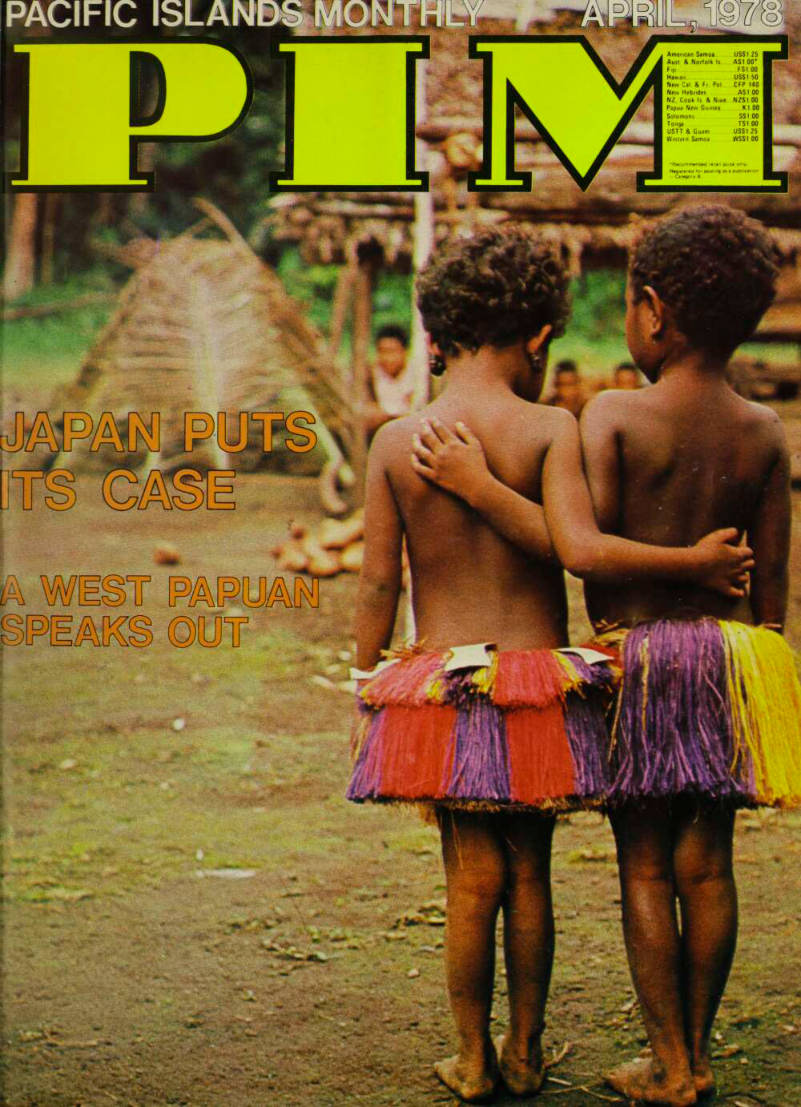
COVER PHOTO: Bruce Adams called at this village, Bodela, on Kiriwina, main island in the these two little girls were camera-shy and turned their backs. Bruce is well known for his pictures of rusty w* relics in his book Rust in Peace.
Advertisements & other items, pp. 2-4 (1 item)
Toyota
When you buy a Toyota
we promise you much more than
one of the world’s finest cars.
V O We'll be the first to admit that at Toyota we make some of the world's finest cars.
You only have to look at them to see that.
And driving them just goes to confirm your first opinions.
But there's more to buying a car than buying a good one. You also have to be sure you can keep it that way.
Which is why Toyota have always insisted that their after-sales service be as good as the cars themselves.
In the Pacific Islands area alone we have over fifty designated outlets to provide everything you might need, from a simple service to a major overhaul. So get yourself a Toyota and get a lot more than a car.
And that's a promise.
TOYOTA
SERVICE
W
TOYOTA
he Toyota range includes: Toyota 1000, Toyota Corolla, Toyota Celica, Toyota Corona, Toyota Cressida Toyota Crown o. on P„rt Mnr«hv U.S. TRUST TERRITORY: MICROL CORPORATION. P.O. Box 267 Saipan FIJI ISLANDS. he Toyota range includes: loyotaiuuu, i oyoia uorui.d, ■ ww., • D ' e . MIANDS . tPUA NEW GUINEA: ELA MOTORS LIMITED. Scratchley R d. Box ‘BURNS PHI LP (SOUTH :^o A n“NAURU S^ S ND; SKSS, bo. 36, Bairiki Tarawa. NOREOLK ISLAND: MOUNT P.TT (ENTERPRISES) D., P.O. Box 169. NEW CALEDONIA; SERVICE IMPORTATION AUTOMOBILE DU PACIFIQUE Rond donri Pnint riii Parifir (Station Total) B.P. 438, Noumea.
CF-951 N\ / 1 1 (L /
SONY
m i mw I v * rn n NY-t{ - \M'>j Ay »j . . *1 V .
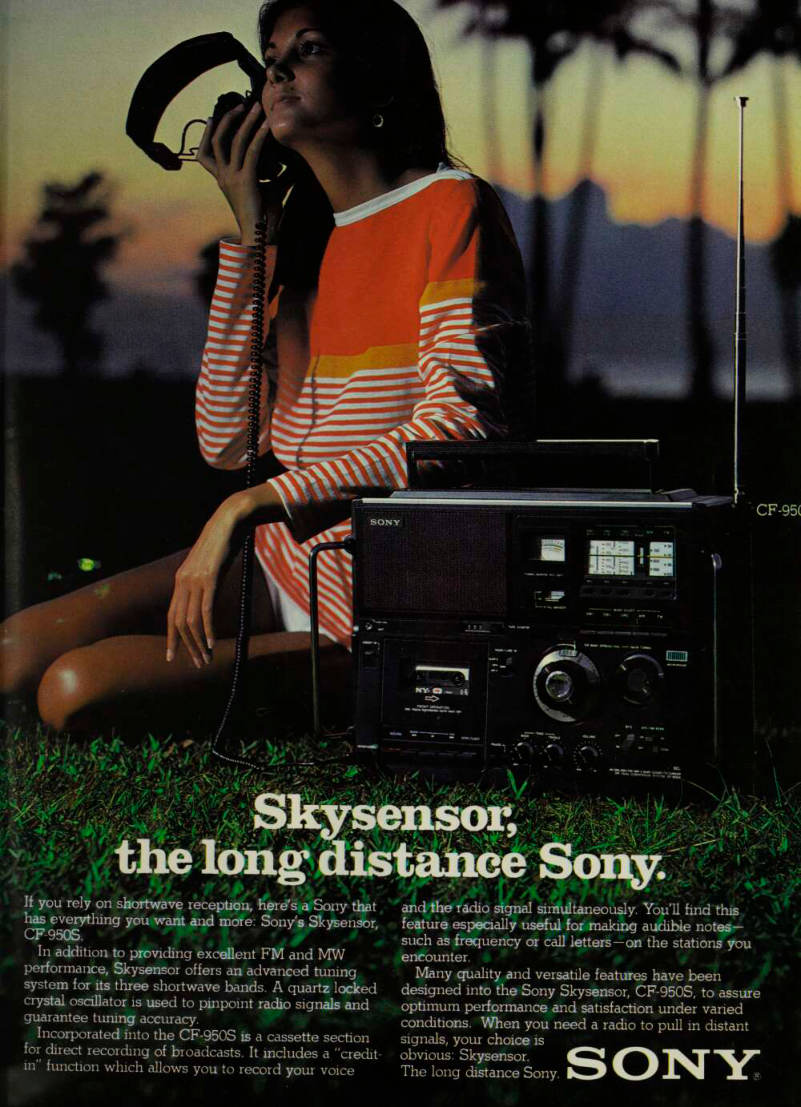
If you rely on shortwave reception, here's a Sony that has everything you want and more: Sony's Skysensor CF-9505.
In addition to providing excellent FM and MW performance, Skysensor offers an advanced tuning system for its three shortwave bands. A quartz locked crystal oscillator is used to pinpoint radio signals and guarantee tuning accuracy.
Incorporated into the CF-950S is a cassette section WIUI^C for direct recording of broadcasts. It includes a 'credit- obvious: Skysensor, in function which allows you to record your voice The long distance Sony and the radio signal simultaneously. You'll find this feature especially useful for making audible notes— such as frequency or call letters—on the stations you encounter.
Many quality and versatile features have been designed into the Sony Skysensor, CF-9505, to assure optimum performance and satisfaction under varied conditions. When you need a radio to pull in distant signals, your choice is
Set a course for pleasure
srs?
SB i ■
* ; t Men who understand the water best, often choose Yamaha first.
Because they know how important reliability is, and they know they have it with a Yamaha outboard. For more than 16 years, in more than 100 countries around the world, Yamaha has been trusted for its responsive,
trouble-free performance.
And even if you’re just a weekend sailor, you need this kind
dependable power.
It takes the worry out of boating to let you relax and really enjoy those good times on the water.
Outboard
with
YAMAHA
YAMAHA MOTOR CO.. LTD.
MARINE ENGINE DIVISION
2500 SHINGAI IWATA-SHI SHIZUOKA-KEN JAPAN
YAMAHA
8B
YAMAHA
40A With 14 different models, you have a choice of power ratings and accessories to make any , enthusiast happy. See them soon at your nearby Yamaha dealership.
Write or call your nearest dealer for complete
YAP
Family Chain Store Inc.
Box 70 Tel: 425
Pacific Report
Hurricane Hits Rarotonga
Rarotonga’s harbour at Avarua was badly damaged by Hurricane Charles at the end of February. Seafront buildings and tanker facilities were badly damaged but there was little damage inland. Palmerston, Aitutaki, Mltiaro, Mauke and Atiu islands reported severe damage to crops. RNZAF planes flew emergency fuel oil to Rarotonga to keep the island’s electric power generators running.
Malaria Upsurge In Png
Malaria is reported on the upsurge in Papua New Guinea because the Health Department has been forced to curtail patrols and a drug-resistant strain of the disease has appeared.
The number of cases confirmed by patrols in 1977 was double the 1976 total. The drug-resistant strain was worst in the Western Province, resistance at Kiunga being as high as 40%.
A New Nius
A new newspaper appeared in Papua New Guinea on February 17, Hailans Nius, stable companion to Ray Thurecht’s Lae Nius and Ailans Nius. The new Nius says that it intends “to fill a real need in our highlands regions ... Hailans Nius hopes to play a part in breaking down these communications barriers”. Home of Hailans Nius is at Mt Hagen, Ailans Nius at Rabaul and Lae Nius at Lae.
Tuvalu’S Golden Handshake
Tuvalu will get $ll million as a “farewell” gift from Britain when the nine islands (only eight occupied) become an independent country on October 1. Talks between Britain and the Tuvaluans in London ended with what, Chief Minister Toalipi Lauti said, "we had hoped for”, a special $4.7 million development grant a $4.9 million general development aid grant for a three-year period and budgetary aid for 1979/80 of $1.7 million. Come 1980, there’ll be further talks on the level of aid from 1981 Tuvalu had sounded out Britain over chances of getting a share of the reserve fund built up from Ocean Island phosphate revenues as a nest-egg for the Gilbert and Ellice Islands Colony when the phosphate ran out but Britain said no When Tuvalu (ex-Ellice) opted out of a future independent GEI the Tuvaluans were told they would lose their share.
Leader Ousted
Mr Naboua Ratieta, Chief Minister in the last Gilberts aovernment has lost nomination for the leadership, and, sventually, for Prime Minister. Five candidates were nominated, ane more than the constitution allows. A secret ballot of members ousted Mr Ratieta. Candidates for election on March 17 were Mr leremia Tabai, Mr Babera Kirata, Mr Ronti Teiwaki and Mr Taomati luta.
Port Moresby Commotion
PNG's Government faced a threat of a split early in March Amen Prime Minister Somare announced moves to force national leaders” to dispose of their business interests. The loldi ng of shares and business interests by leaders and their amihes will be banned if legislation goes through. Mr Julius an, Deputy Prime Minister and leader of the People’s regressive Party, said he would oppose the measure.
Gilberts’ Governor Going
Mr John Smith, Governor of the Gilbert Islands since leaving ne Solomon Islands, where he was Financial Secretary, will eave the Gilberts in May on retirement, on the eve of the colony’s independence. His appointment in 1973 was for three 'ears and, when he arrived in Tarawa in July of that year, he emarked that there was something both unreal and out of time n being appointed a colonial governor in 1973. “Some of you
may have noticed,” he said, “that I acn not boasting the plumage under which a governor customarily puts into port.
Happily, there is little demand for such splendour these days and those once responsible for its manufacture have passed with empire.”
Came To Grief On Tokelau Reef
A Korean fishing vessel was said to be a total loss after it ran aground on a reef at Atafu, Tokelau, in February. The Tokelau Affairs Office in Apia, Western Samoa, said there were no fish on board the wrecked ship.
Pacific Adult Education Hives Off
A South Pacific office to oversee adult education in the region will be set up following a conference jointly sponsored by the South Pacific Commission and the Asian-South Pacific Bureau for Adult Education. Held in Noumea in February, the conference decided that because of special problems in the Pacific Islands, a separate adult education office should be set up, headquartered in Suva. Among priorities would be the training of community radio producers, and exchange of tapes throughout the region.
Guam’S Ricky To Pressure Jimmy
Guam Governor Ricky Bordallo flew to Washington late in February in an effort to persuade US President Carter to reconsider his decision not to build a new navy ammunition wharf in Guam’s Apra harbour. Carter cut the SUS4O million wharf request from the 1979 federal budget. The present wharf is near Guam’s commercial port. Within the blast zone, should an explosive accident occur at the ammunition wharf, are SUS4SO million in property, and 4 600 workers not employed at the ammunition wharf. Nearest facilities to the present ammunition wharf are Mobil and Esso fuel storages
Making It To Manila?
Ten Papua New Guinea politicians from the Eastern Highlands Province who were planning an $lB 000 “study tour” to the Philippines late in March ran into trouble from their constituents early in the piece. In a February statement, protesters threatened to sit on Goroka airstrip to prevent their plane taking off because they regarded the tour as “a junket”.
The Philippines, with two airlines running direct flights from Port Moresby, is fast gaining a reputation in PNG as a holiday bright spot.
A By-Election In Fui
Mr Koresi Matatolu is Fiji’s newest MP after winning a by election caused by the sudden death of Ratu Julian Toganivalu.
Mr Matatolu was put up by the flower faction of the deeply divided National Federation Party. He polled 5 227 votes against 4 409 by Alliance Party candidate Mr Navitalai Raqona and 2 835 by dove faction NFP candidate, Mr Apisai Tora, who is at present in gaol. Mr Matatolu is secretary of the Electricity Employees’ Union. The by-election was for the North-West Fijian National Constituency, which failed to get warmed up by the contest. Only 39% of the voters turned out a little more than 12 000 out of more than 30 000 eligible.
Samoan Students Riot
Almost 100 students of the Teachers Training College in Apia rioted late in February as a protest against alleged strict measures imposed by the school’s disciplinarian, Fuimaono Faatitipa. The riot, which had apparently been simmering for some time, erupted when Fuimaono allegedly assaulted a student in front of a school gathering. The students threw stones at windows, breaking the glass, and, storming inside, damaged chairs, tables and other furniture. The police were called to restore order. Eighty-one students were taken to the police
station, where some were detained till next day, while others were taken to prison. They were all charged with rioting.
Fuimaono was charged with assault.
Sir Albert: “I’Ll Sue...”
The spirited run-up to the Cook Islands elections of March 30 was further enlivened by a threat of legal action by incumbent Premier, Sir Albert Henry, against Dr Tom Davis, leader of the Opposition Democratic Party. Dr Davis had charged that Sir Albert was using New Zealand aid funds to finance the election campaign of his Cook Islands Party.
Chief Minister Goes “Cargo”?
Chief Minister of the New Hebrides. Mr George Kalsakau. attended celebrations by the John Frum cargo cult movement on Tanna Island in February. He was accompanied by the new French Resident Commissioner in the New Hebrides, Mr Bernard Pettier.
Fiji: Australian Union Will Talk
Mr Tas Bull, an official of the Waterside Workers’ Federation of Australia, said in February his union would be keen to take part in discussions designed to clear the air on alleged intervention by Australian and New Zealand trade unions in the internal affairs of Fiji. The allegations arose from events during Fiji’s 1977 dock strikes.
New Dockers’ Union In Fiji?
Application has been made in Fiji for the registration of a new dock workers’ union in the main sugar port of Lautoka, the Port Workers’ and Seamen’s Union. The move follows the deregistration of the former Fiji Waterside Workers and Seamen’s Union for failure to produce its accounts. The leader of the old union, Taniele Veitata, freed in February after a six months gaol term for Trade Disputes Act offences in Fiji’s 1977 dock strikes, has vowed he will revive his organisation.
Paying For World War Ii
The Pafsua New Guinea National Parliament in February established a committee to investigate damage, responsibilities, and compensation claims to be made against the governments of Australia, the United States and Japan the three countries which “brought World War II to the country Committee members said outside the House the greatest long term damage caused by the war had come from the removal of topsoil for the building of airstrips and installations. This had ruined large areas of land for agriculture. Two other attempts to look into war damage compensation in PNG have been made in recent years but produced no formal action.
More On Miraculous Mr Meier
Mr John Meier, controversial governor of the Bank of the South Pacific, slated to start operations soon in Tonga, was once a business associate of former US President Nixon s younger brother, F. Donald Nixon. Donald's business activities had more than once embarrassed the President in the past, and his association with Meier was abruptly ended on the President’s orders in 1973. Go-between was the president’s close personal friend, millionaire Charles G. (Bebe) Rebozo, who put pressure on senior members in the organisation of billionaire recluse, Howard Hughes, Meier’s then employer, to keep him away from Donald.
Air Niugini’S Chief Stays
Mr Bryan Grey, general manager of Air Niugini, is back at work after running foul of Papua New Guinea’s stringent “national leadership’’ code through lateness in submitting a statement of his financial affairs. Mr Grey was first suspended from membership of the country’s Airlines Commission in
February, and immediately resigned both from that job and from Air Niugini. After days of busy political manoeuvring, a three suspended on the same grounds as Grey. They are Dr Akotoua Toua, chairman of the Electricity Commission, and secretary of the Department of Works and Supply, Mr Leo Morgan.
Dowiyogo In New Zealand
Nauru’s President Bernard Dowiyogo paid a goodwill visit to New Zealand in February. Topping the agenda for the visit were New Zealand’s sagging purchases of Nauruan phosphate, and a request for landing rights in New Zealand for Air Nauru. The President said phosphate exports declined by sll million last year. It was the second deficit recorded and another, but smaller, one was expected for 1978.
The Forum Sails
The Pacific Forum Line will start operations in May with three services. They will be: A, New Zealand-Fiji-Western and American Samoa-Tonga-NZ; B. NZ-Fiji-Gilbert Islands- Solomons-Papua New Guinea; C, Melbourne-Sydney-Fiji-W. and A. Samoa-Tonga-Melbourne. Captain G. R. Dewsnap, general manager of the Forum Line, said that initially the ships would carry a mixture of unit loads, break bulk and some container. Early in 1979, new ro-ro container ships would be progressively introduced.
Corned Beef As Catalyst
The flavour of a particular brand of corned beef in their rations was the spark for a strike by Gilbertese and Tuvaluan workers employed by the Nauru Phosphate Corporation. Following a flying visit to Nauru in February by a high-level Gilbertese Government delegation, not only were workers’ taste buds mollified, but other strike issues were settled and work was resumed. The corporation’s use of non-union labour during the strike is, however, likely to leave a lingering bad taste.
Horse-Racing In Fiji
Hofse-racing may be resumed in Suva at Vatuwaqa, barely steeplechase jump from the old Suva Point racecourse, where the sport thrived in the days before World War 11. The course wil also cater for greyhound racing. Mr Karsangi Bhindi, of Bhind Bros Ltd, is planning the horse-racing project with a Canadian company, which is providing financial backing. He plans to use 43 ha (106 acres) of land for the project, and to include twc hotels, a beer garden, a mini golf-course and a car park. M Bhindi ran into two snags plans for the hotels were rejected and the Methodist Church voiced a strong protest. Mr Bhind hopes to be able to remove objections to the hotels by the Town and Country Planning Department and the Suva City Council.
Vanuaaku Party Calls For New Poll
Among major decisions of the leadership of the Nev\ Hebrides’ Vanuaaku Party at its February 13-20 meeting (PIN/ March, p 29), was to call for “new elections as soon a possible’’. This call was explicitly supported by.the Australia Minister for External Affairs, Mr Peacock, in Parliament o Febtuary 28. Mr Peacock said fresh elections in the Nev Hebrides could help “to take the process of reconciliation step further”.
A Deliberate Intruder
A Japanese fishing boat after squid had deliberately intrude inside Australia’s 12-mile limit, a Devonport (Tasmania) cou was told in February. Captain Mitsuyoshi Nakame, master of tb Eikyu Maru 71, was fined S3OO and the fishing maste Matsutaro Omichi, S2OO. The magistrate also ordere confiscation of all fishing equipment and fish found on boaro He was told the Japanese Government had expressed regret the ship’s intrusion and intended to suspend the master certificates and the ship’s licence.
Advertisements & other items, p. 5 (1 item)
5
’ACIRC ISLANDS MONTHLY APRIL, 1978
Pacific Islands Monthly
Publisher: Stuart Inder
Vol 49 No 4 Apr. 1978
Editor: John Carter
Pacific Report 5
—happenings in a nutshell
Letters 9
bananas and New Zealand
Japan S Plea 10
an offer of full co-operation in the Islands
Irian Jaya 12
the case against Indonesia
Tahiti Gaol Riot 15
and its influence on the political scene
The American Dream 19
Guam, warts and all
A Solomons Village 21
war and culture side by side
Tropicalities 23
the stamp racket and a galloping crocodile
Afterthoughts 27
Percy Chatterton on the preservation of custom
Political Currents 29
CHOGRM assessed, polarisation in the Cooks
People 34
Gilbertese reunion in the snow, missionary extraordinary
On The Karawari River 37
there you can see for ever
Books 47
Tin roofs and palm trees, fallout over Mururoa
Islands Press 51
as local newshounds see things
Tradewinds 53
PNG's budget and its spending plan
Cruising Yachts 53
some sail, one sinks
Yesterday 59
old New Guinea days, village of beautiful girls and a shattered legend
Transport 63
special aviation feature
Shipping 73
if you want to go by sea
Sydney Te'lef 2? o™pJbwS-T « ! !iT L ' d 76 F'«S“ Sl ™> =»«"«» 2000 Pos, Add,ess GPO Box 3408, Sydney, sssr7Sf!gwg fe «« „ o ,so
So^rn^yne-^
dollars should be by bankdraft payable at Sydney Australia 9 S Japan 4,500 Yen or $l2 50 Aust Elsewhere $14.00 Aust. Note: Overseas remittances in Australian reS^n^S In 2 W*» Fl " Times4HeraldLM 20G °- d °"a™**«• >olyn*«la; Distribution Hachette Pacifique, lOAve Bruat Papeete 9 Naw Caledonia- ! ort M M ° re S^ y n quines Post Newsagency, Telephone 24 2148 French Weekly Times Limited, 8-10Clitford's Inn, Fetter Lane London EC4AIBU Telephone 01 831 6041 TPipyf^onrtnn^ufnQ^il 56 MlC A h ,f p ® n,ec ost. B p C 2 Noumea United Kingdom: The Herald and relephone: 666 3036 New Zealand: Pacific Pubhca ions London 21989 Japan: Advertising Universal Media P O. Box 46, Tokyo Z 21404 (Auck 40) Hawaii and U.S. Mainlands*:rim' Hawai? 2Bl2 kaSSa' Represen,a,lves L,d p ° Box 3880 Auckland Tel 73 880 Telex: toshuaß Powers, Jr, Powers International Inc. 551 Fifth Ave, New York. New York 100 017 Telephone- 867 958Q 2 t|?m 23651 ? 3 Vtetnrt.' a h H 3 * a '' US A s v ®? S b 9 Re P resentatlve H 44 e TS 6 and WeeMy T ' meS BuMdinS - 2nd Fl °° r ' 61 F " nderS Lane ' Melbo - ne 3000 telephone: 111 *s°s ISustrahan cover price is Sly at'the a " d N ® W Zealand by Gordon & Go,ch
Advertisements & other items, pp. 7-8 (3 items)
Pacific Isi Amhq Momtui V A Ddk 1 Q~7Q
DAr'icir iqi amdc; MONTHLY APRIL, 19a
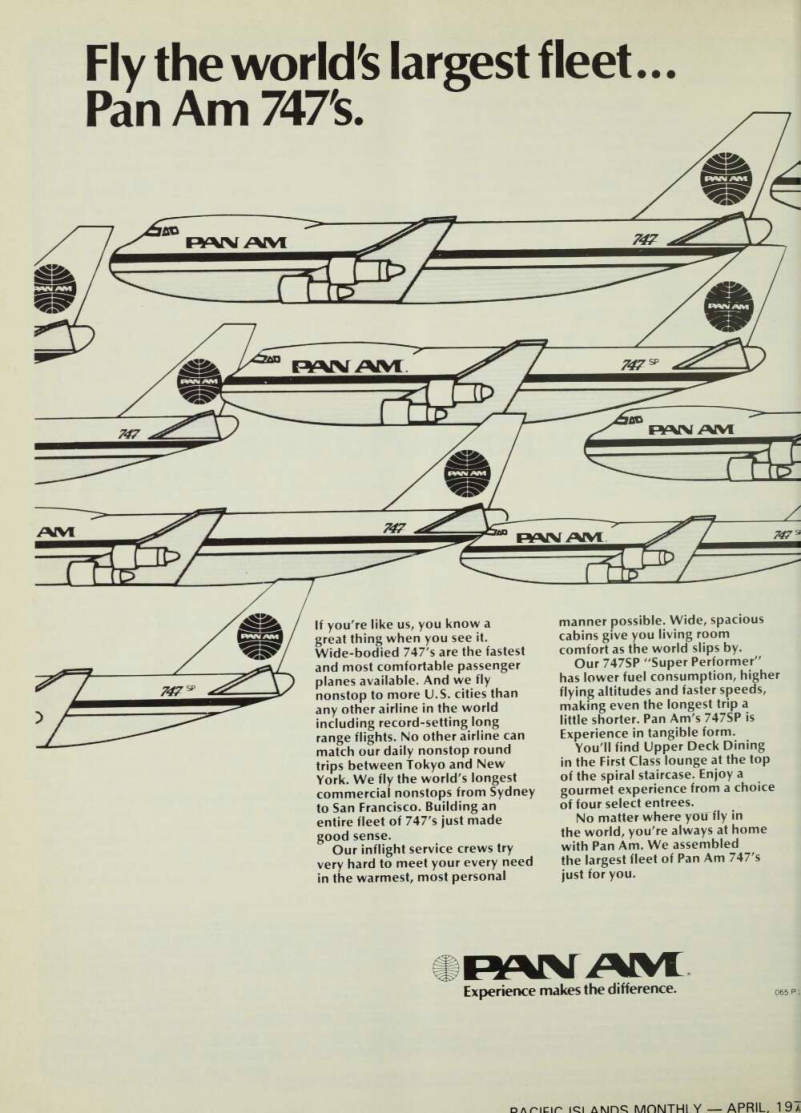
Fly the world's largest fleet...
Pan Am 7475.
AO 747
F¥W AM
SR 25S
RAN AM
747
F¥V\AM
747 99 % 747 747
F¥WAM
/ 747 If you're like us, you know a great thing when you see it.
Wide-bodied 747's are the fastest and most comfortable passenger planes available. And we fly nonstop to more U.S. cities than any other airline in the world including record-setting long range flights. No other airline can match our daily nonstop round trips between Tokyo and New York. We fly the world's longest commercial nonstops from Sydney to San Francisco. Building an entire fleet of 747's just made good sense.
Our inflight service crews try very hard to meet your every need in the warmest, most personal manner possible. Wide, spacious cabins give you living room comfort as the world slips by.
Our 7475 P "Super Performer"
has lower fuel consumption, higher flying altitudes and faster speeds, making even the longest trip a little shorter. Pan Am's 7475 P is Experience in tangible form.
You'll find Upper Deck Dining in the First Class lounge at the top of the spiral staircase. Enjoy a gourmet experience from a choice of four select entrees.
No matter where yoiTfly in the world, you're always at home with Pan Am. We assembled the largest fleet of Pan Am 747's just for you.
Experience makes the difference. 065 p.:.
Letters
Bananas
I wish to refer to Mr Dossor’s letter (PIM, Jan, p 9) in which he claims that the ar ticle on the banana export in dustry of the Pacific Islands contained “many inaccura cies”.
There is only one error, which I believe is a typing error, in the whole article; and that is, the freight rate should, as Mr Dosser points out, be 5.5 cents/pound and not 3c. As to the rest of the ar ticle, it conveys a fairly ac curate and unbiased outline of
the industry.
Until recently, as the article in question correctly points out, the management of Fruit Distributors Limited had re peatedly told the Islanders that they could not produce good bananas. Management was not keen to co-operate with the Pacific Island authorities in trying to im prove the industry. As the ar ticle points out, there is for tunately a change in this nega tive attitude of Fruit Distribu tors Limited. The Pacific Islanders would have lost the NZ market to Ecuador were it not for the fact that Fruit Dis tributors Limited is bound by its charter to buy island bananas. In addition, the company would not have Jared to reject supplies for the Islands in favour of Ecuadorian bananas.
Politically, that would not be icceptable to the NZ Govern ment irrespective of what party was in power.
As to the price, is it not a fact that the premium price of & cents a pound originally came about through a NZ jovernment directive, and not hrough any initiative on the Part of the company?
Mr Dosser is correct about i fixed price being paid. But should it be different?
Why should bananas be ex ported on a consignment Pasis? And as for the inference hat the price being paid for sland bananas is one of the lighest in the world, one can Pnly say that that may be so in comparison with bananas for Pther poor countries. The
price of bananas throughout the world is far too low, even at 6c/lb the price paid for most of the island bananas im ported into NZ and is a clear example of the poor being ex ploited by the rich. The NZ consumers can afford to pay more than they are now pay ing for bananas. And Fruit Distributors Limited can make them pay a higher price by reducing the current levels of quantities being imported from Ecuador. A few cents more per pound is not going to mean much to the NZ housewife, but is going to mean a big difference to the island producer.
Has Mr Dosser ever com pared the price of hothouse tomatoes and that of bananas in the NZ market? How does the price of bananas compare with that received by the NZ farmer?
Fruit Distributors Limited has a monopoly in banana im ports into NZ which it can and should use to pay the island farmers a fair price. Perhaps this is the time for Fruit Dis tributors Limited to prove that it is now working in co operation with the Island authorities towards a better deal for the producers.
Sione Tupou
Nukualofa, Tonga.
J. K’S Papers
I was sorry to read (PIM Feb, p 31) that the widow of the late J. K. McCarthy has given many of her late hus band’s ‘papers’ to the National Library of Australia. With all due respect to Mrs McCarthy and the memory of the late ‘J.
K. I believe it would have been more appropriate to have given the ‘papers’ to Papua New Guinea. After all, ‘J. K.’ spent a lifetime in PNG with its people. Surely therefore, PNG deserves to have his ‘papers’ rather than Australia!
G. M. P. Gray
(ex-PNG)
Western Australia
Tahiti Guide
Would anyone having a file of the Tahiti Tourist Guide, especially those published in the early 1930’s please con tact the undersigned at 152 Burgess Avenue, Westwood, Mass. 02090, USA, and accept my thanks for so doing.
Lestor Gaynor
complexion beauty
Guard against fading complexion beauty
It is with mixed feeling that many women enter their middle years because they suspect their complexion beauty will deteriorate and make them look older than they really are.
These days, many women have overcome this con cern through the daily smoothing on of a scien tifically developed tropic ally moist oil blend which helps restore and maintain the vital balance of moist ure and oil in the skin and so assist the complexion in the maintenance of its fresh radiant beauty.
The natural oils and moisture which cherish your skin and help keep it in a soft, smooth, supple state are supplied from within the skin itself by thousands of tiny glands which continuously create a moist environment in the stratum comeum or outer layer of your skin.
As you enter the thirties you should supplement these supplies with the moist oil blend because at about that age the tiny glands are diminished in number and cannot norm ally produce more fluid than is taken as a result of normal daily wear and tear.
Fresher, more natural
skin softness
One of the greatest haz ards to retaining a smooth and flower-fresh complex ion is a harsh environment which can rob the skin every moment it is exposed to drying wind, depleting it of its supplies of natural oils and moisture. Effect ive protection is therefore most important if you are to keep your skin at the balanced state where it can resist these deleterious influences. Smoothed over the entire complexion each day Oil of Ulan penetrates quickly into the stratum corneum, acting in a sim ilar way to Nature’s own oils and moisture, soften ing and smoothing dry skin and helping to over come the onset of wrinkle dryness. Tropically moist Oil of Ulan brings even to a tired-looking and neg lected complexion, bene fits similar to those prov ided by the skin’s own natural fluids helping to create a fresher, more natural complexion rad iance.
In many parts of the world women have found their complexion blooming to a softer new neauty through the daily care the gentle Oil of Ulan moist oil blend helps to provide and have achieved the sat isfaction of attaining once again true complexion beauty.
Advertisements & other items, p. 9 (1 item)
9
PACIFIC ISLANDS MONTHI Y APRII i Q7R
Japan’S Plea: Give Is Access Tp Your Waters
The big powers are wooing the Pacific Islands. The Islands are feeling their strength, more particularly sincei they decided to parcel up the ocean Into fishing and economic zones, and Invite the fishing nations to make bids for their favours. Japan is vitally interested and, below, the Japanese Ambassador to Australia and hia country’s spokesman in the Islands, Mr Yoshio Okawara puts Japan’s case at PlM’s invitation.
The South Pacific, which has long been a remote place in the minds of the Japanese, is now attracting many Japanese, especially the younger generation, as a paradise of sparkling seas, colourful wildflowers and friendly, warm-hearted in habitants.
As soon as the Pacific na tions gained independence, Japan entered into diplomatic relations and has since been maintaining close and cordial relations with them. We are highly impressed by the efforts being made by the Pacific peoples towards econ omic and social development, and Japan, as a member of the Asia-Pacific community, wishes to make due con tribution towards their welfare and prosperity.
In accordance with this wish, the Japanese Govern ment has been extending bilateral co-operation to the Pacific nations, when re quested to do so, mainly in the form of technical assistance.
At the same time, Japan has collaborated in multilateral aid programmes such as the Skipjack Tuna Tagging Programme of the South Pacific Commission, and has participated in the interna tional co-operation schemes of the United Nations Development Programme, Asian Development Bank and other similar organisations of which Japan is a member.
Among the development efforts of the Pacific coun tries, particular note should be taken of their active in terests in fisheries develop ment in the vast sea areas which will come under their jurisdiction through the re cent development of an inter national order of the sea. We, in Japan, are following this re cent development with great interest.
Rice and fish have been the staple foods of the Japanese since time immemorial. In the
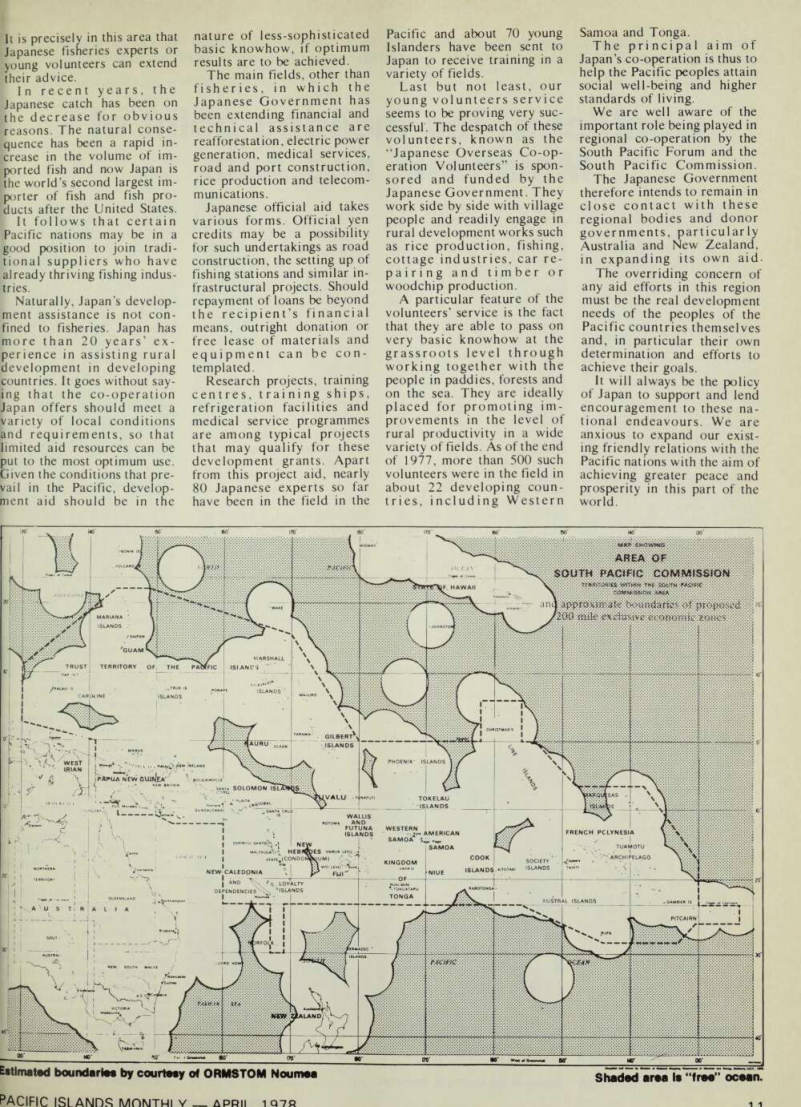
case of rice, we attained more than complete self-reliance many years ago. But as far as fish is concerned, Japan has had to look outside her own coastal waters for almost 40% of her annual consumption of 10 million tonnes. Now, with the establishment of a 200mile zone, Japanese fishing fleets are increasingly anxious to seek the agreement of the coastal states so that Japan’s fishing activities can be main tained • Pacific plan to establish a 200-mile zone by the end of March this year and, parallel to that, active consideration is being given to an interna tional management scheme of highly migratory species.
Against the background of these recent developments, we see greater awareness on the part of the Pacific nations of their own resources and of the need to develop their in digenous prosperity. We sup port the Pacific peoples’ aspirations in this field. In so doing we wish to emphasise two aspects of the issue which will bring about closer co-op eration between the Pacific nations and Japan.
The first aspect is that of Japan’s fishing activities. As the Japanese observer stated at the 17th South Pacific Con ference in Pago Pago last Sep tember, we would very much like to be given access to fish eries resources when and where a surplus exists. We put forward this request on the basis of the clear consensus achieved at the Law of the Sea Conference. Of course, we will have to have mutually ac ceptable arrangements with the coastal nations.
Naturally, we are well aware of the complexity of the problem of highly migratory species. We feel that, in the light of the highly migratory nature of fish and the mobility of fisheries, some form of in ternational management is
necessary to overcome practi cal difficulties. It goes without saying that such management should be based on objective statistical and biological data covering the whole range of migration, which in turn would require the co-op eration of all the countries concerned.
It is on the basis of this belief that we are co-op erating in the Skipjack Tag ging Programme initiated by the SPC. Indeed, Japan’s voluntary contribution towards this research programme indicates its readiness to co-operate wherever viable projects are undertaken. It is our desire to continue to participate in this and other programmes aimed at rational management of highly migratory species. We will be happy to extend our co-operation, if requested to do so, to such fields as re search, data collection and analysis. I am sure that our past experience and expertise in these fields could be of help in any prospective man agement schemes.
This leads me to elaborate on the second aspect on which Japan is to commit itself. In addition to extending our co operation in the field of re search and management as I referred to earlier, we also welcome the opportunity to help develop the fishing in dustries of the countries in the region. This includes the development of coastal fish eries, aquaculture and the processing of fishery pro ducts. Our assistance in the field of fishery takes the following form; • We accept about 100 fish eries trainees annually from abroad. Among them about 30 are accepted into three group training courses, one for coastal fishery, one for aquaculture and one for a fishery co-operative course.
The remaining 70 are ac cepted into individual train
ing courses at various labora tories, plants and factories.
All the expenses are borne by the Japanese Government. • We send approximately 100 fishery experts abroad to work with local experts or fishermen in various fields.
Despite language barriers, their work has been greatly esteemed by recipient govern ments including those in the Pacific region. • We have also a projeci aid system wherein a group ol experts with vessels and equipment are sent out to as sist in establishing research laboratories, exploratory fish ing, processing centres and sc on. One unique example ol this kind is the Southeast Asia Fishery Development Centre which comprises three depart ments, one for training, based in Bangkok, one for research in Singapore, and one foi aquaculture in the Philip pines. • The last category of fish ery aid is bilateral grants anc soft loans for such projects a research vessels, model pro cessing plants, fishery school and other similar schemes.
More importantly, we an aware of the fact that, quit apart from those relativel; large-scale fishing Industrie which are supplying fish 01 fish products to Japan, there ii a strong need on the part c local populations to catch fisi for their own consumption Up till the present, Island na tions have imported a largi proportion of the fish the: consume from outside fishini nations who operate fleets ii the Pacific.
It is easy to appreciate th concern of the Island nation at having had to purchase large quantity of the fis< caught just off their fish-abun dant coasts. The task ahead o us is very simple. It is essen tial that the Island peopl themselves should learn ti catch fish in the most efficien and yet optimum way cousin tent with their requirement]
It is precisely in this area that Japanese fisheries experts or young volunteers can extend their advice.
In recent years, the Japanese catch has been on the decrease for obvious reasons. The natural conse quence has been a rapid in crease in the volume of im ported fish and now Japan is the world’s second largest im porter of fish and fish pro ducts after the United States.
It follows that certain Pacific nations may be in a good position to join tradi tional suppliers who have already thriving fishing indus tries.
Naturally, Japan’s develop ment assistance is not con fined to fisheries. Japan has more than 20 years’ ex perience in assisting rural development in developing countries. It goes without say ing that the co-operation Japan offers should meet a variety of local conditions and requirements, so that limited aid resources can be put to the most optimum use.
Given the conditions that pre vail in the Pacific, develop ment aid should be in the
nature of less-sophisticated basic knowhow, if optimum results are to be achieved.
The main fields, other than fisheries, in which the Japanese Government has been extending financial and technical assistance are reafforestation, electric power generation, medical services, road and port construction, rice production and telecom munications.
Japanese official aid takes various forms. Official yen credits may be a possibility for such undertakings as road construction, the setting up of fishing stations and similar in frastructural projects. Should repayment of loans be beyond the recipient’s financial means, outright donation or free lease of materials and equipment can be con templated.
Research projects, training centres, training ships, refrigeration facilities and medical service programmes are among typical projects that may qualify for these development grants. Apart from this project aid, nearly 80 Japanese experts so far have been in the field in the
Pacific and about 70 young Islanders have been sent to Japan to receive training in a variety of fields.
Last but not least, our young volunteers service seems to be proving very suc cessful. The despatch of these volunteers, known as the “Japanese Overseas Co-op eration Volunteers” is spon sored and funded by the Japanese Government. They work side by side with village people and readily engage in rural development works such as rice production, fishing, cottage industries, car re pairing and timber or
woodchip production.
A particular feature of the volunteers’ service is the fact that they are able to pass on very basic knowhow at the grassroots level through working together with the people in paddies, forests and on the sea. They are ideally
placed for promoting im
provements in the level of rural productivity in a wide variety of fields. As of the end of 1977, more than 500 such volunteers were in the field in about 22 developing coun tries, including Western
Samoa and Tonga.
The principal aim of Japan’s co-operation is thus to help the Pacific peoples attain social well-being and higher standards of living.
We are well aware of the important role being played in regional co-operation by the South Pacific Forum and the South Pacific Commission.
The Japanese Government therefore intends to remain in close contact with these regional bodies and donor
governments, particularly
Australia and New Zealand, in expanding its own aid.
The overriding concern of any aid efforts in this region must be the real development needs of the peoples of the Pacific countries themselves and, in particular their own determination and efforts to achieve their goals.
It will always be the policy of Japan to support and lend encouragement to these na tional endeavours. We are anxious to expand our exist ing friendly relations with the Pacific nations with the aim of achieving greater peace and prosperity in this part of the world.
Estimated boundaries by courtesy of ORMSTOM Noumea
Shaded area It “free” ocean.
Advertisements & other items, pp. 10-11 (2 items)
10
PAniFir ISLANDS MONTHLY APRIL, 197
Pacific Islands Monthi V Aprii Iq7R
Melanesia and Asia
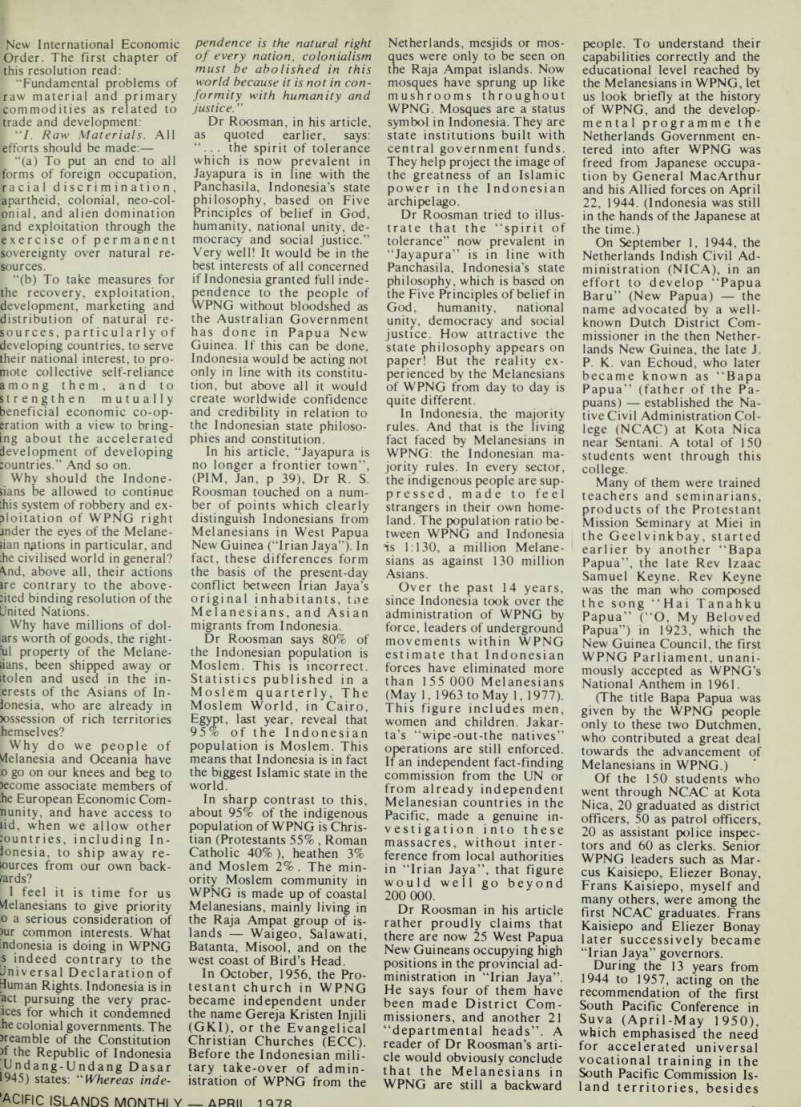

Conflict at the meeting point of Melanesia and Asia
IRIAN JAVA —Nicolaas Jouwe delivers a sharp Melanesian response to a recent PIM article on Irian Jaya b) Indonesian scholar Dr R. S. Roosman. Mr Jouwe is president of the National Liberation Council of West Papuj New Guinea.
On October 19, 1961, the National Congress met in Hollandia. The 75 delegates, representing the entire ter ritory of WPNG, unaminously agreed and accepted the na tional flag (the Morning Star), national anthem (Hai Tanahku Papua, O, My Belov ed Papua), the state seal (Crowned Pigeon), and West Papua (New Guinea) as the name of the country. The flag and the state seal were de signed by me.
On October 18, 1961, the Government of Netherlands New Guinea, acting on the re commendation of the New Guinea Council, gazetted decrees relating to the two na tional emblems, the national anthem and the national name. Thus they became legal and were officially put into use on December 1, 1961. The Morning Star flew side by side with the Dutch flag and Hai Tanahku Papua was sung along with Wilhelmus, the Dutch national anthem. On February 16, 1962, the New Guinea Council informed Queen Juliana and the Dutch Government that the people of WPNG had chosen Decem ber /, 1970 as the target date for its independence.
While the Melanesians and the Dutch Government in WPNG were implementing educational and development programmes as preparations for independence, Indonesia, on the other hand, was at an advanced stage of negotia tions with the Soviet Govern ment to secure arms valued at more than US$2 billion in order to take WPNG by force.
The transfer of WPNG to the Indonesian Republic, through the intermediary of the United Nations Tempor ary Executive Authority (UNTEA) on May 1, 1963, signified the Indonesian Government’s success in crushing the hopes and aspira tions of the WPNG people, and-their preparations for in dependence by December 1, 1970 (just under two months after Fiji’s independence day, October 10, 1970).
Today, the Indonesian
Government, and individuals such as Dr Roosman, are ob viously putting out propagan da to discredit the Melanesian people in WPNG, and to pre sent an image of them as a bunch of primitive people still living in the Stone Age. And besides, the Indonesians are currently engaged in moves to persuade other Melanesian countries, particularly Papua New Guinea, through a fine exercise in political intimida tion, to recognise and accept WPNG as an integral part of Asia, and its people as Asians.
But the whole world knows that ethnically, geographi cally, culturally and by religion, WPNG is in direct contrast to Indonesia, or Asia for that matter. The truth is; WPNG should not and must not be separated from its natural environment, that c is Melanesia and/or Oceania.
Today, we the Melanesian people of WPNG, are not really so concerned so much with the artificial philoso phies and propaganda created by the Indonesians. We are
trying and will continue to try to upgrade our capabilities to be independent and to rehabilitate our traditional, ethnic, cultural, geographical and economic ties with Melanesians living east of WPNG. Indonesia is ap parently maintaining this forced separation by harsh and brutal means. During the past 15 years we, the Melane sian people of WPNG, have been successful in expanding our intellectual elite by more than 100 university graduates.
If one asks whether we, the Melanesian people of WPNG, are capable of running our own affairs, our answer is a positive yes. We are capable of ruling a country of our own. Starting at the top with the position of a Governor- General, a Prime Minister, Government Ministers and right on down to office clerks all these jobs could be held by Melanesians of WPNG themselves. A corps of 50 people to serve in the diplomatic service is even now ready to assume duty
when the time comes.
Economically, WPNG has a great potential to generate its own revenue. Its resources in clude oil, copper, nickel, natural gas, timber, fish, copra and so on. Apart from oil and copper, other natural resources have not yet been tapped or exploited. The In donesian Government has ir fact put WPNG’s timber re sources at the disposal ol Japanese firms for ex ploitation, almost at will. Oil exported out of WPNG dur ing last year alone was more than 50 million barrels wort! more than SUS7OO million The value of copper fluctu ated between SUS3OO tc SUS4OO million. The Indone sian Government receive: 35% royalty from WPNG ex ports. From these figures, ont can see clearly just how mucl of the Melanesian people’ wealth is being taken out o WPNG annually by Indonesi; and other countries, namel; Japan, the United States am Western European countries.
A most brutal, unjust am inhuman thing, quite contrar to the laws and regulations o the United Nations, was tha WPNG was forced to cut ol its links with its natural sur roundings, and Indonesia wa given the freedom to suppres and eliminate the original in habitants of WPNG and roi them of their wealth an natural resources. Accordin to reliable sources in Jakarta the Indonesian Government i at present enlisting suppoi from its near neighbours ti co-operate with her militaril to wipe out the liberatia movement in WPNG.
In 1973, newly independen countries, commonly know\ as the Third World group, le by Algeria, called on th United Nations to hold special session to determin rules and regulations for th protection of the natural r< sources of backward people; From April 9 to May 2, 197the UN General Assembly, i its Sixth Special Sessioi adopted Resolution 3202 (!
IV), called Programme of A>. tion on the Establishment of
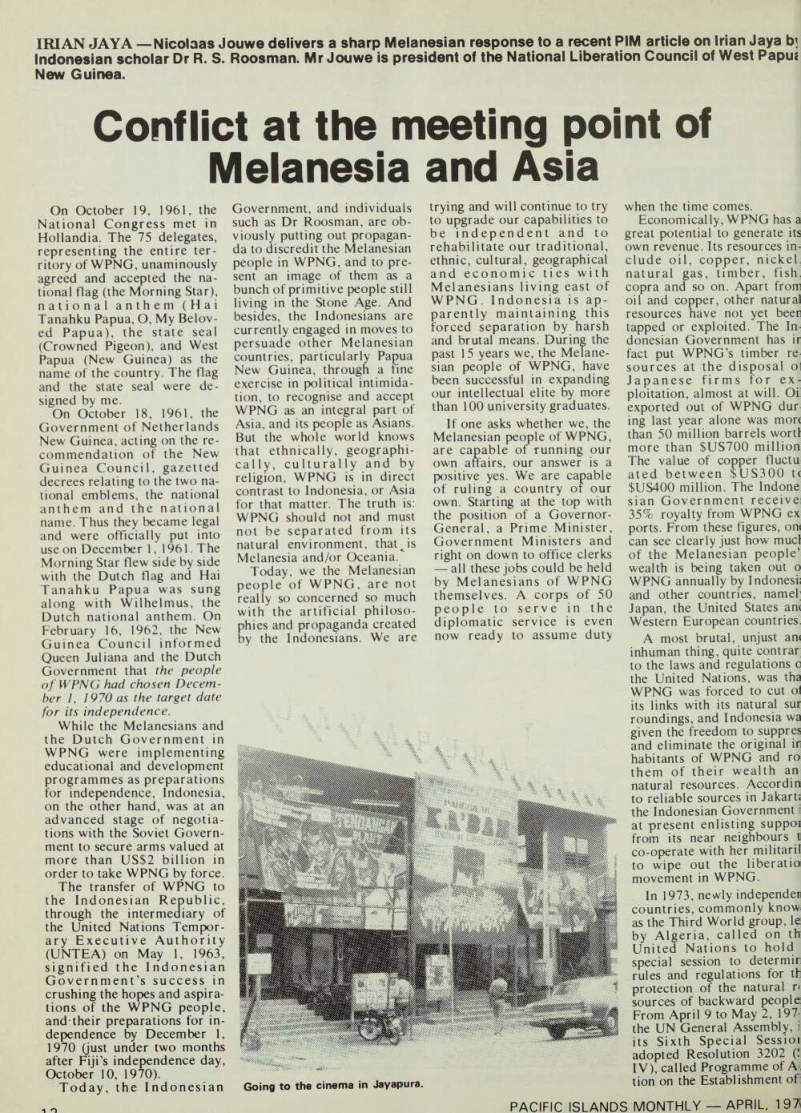
Going to the cinema in Jayapura.
New International Economic Order. The first chapter of this resolution read: “Fundamental problems of raw material and primary commodities as related to trade and development: “/. Raw Materials. All efforts should be made;— “(a) To put an end to all forms of foreign occupation, racial discrimination, apartheid, colonial, neo-col onial, and alien domination and exploitation through the exercise of permanent sovereignty over natural re sources.
“(b) To take measures for the recovery, exploitation, development, marketing and distribution of natural re sources, particularly of developing countries, to serve their national interest, to pro mote collective self-reliance among them, and to strengthen mutually beneficial economic co-op eration with a view to bring ing about the accelerated development of developing countries.” And so on.
Why should the Indone sians be allowed to continue this system of robbery and ex ploitation of WPNG right jnder the eyes of the Melane sian nations in particular, and the civilised world in general? \nd, above all, their actions ire contrary to the above cited binding resolution of the United Nations.
Why have millions of dol lars worth of goods, the right fill property of the Melane sians, been shipped away or stolen and used in the in terests of the Asians of In lonesia, who are already in jossession of rich territories hemselves?
Why do we people of Melanesia and Oceania have o go on our knees and beg to Jecome associate members of he European Economic Com munity, and have access to lid, when we allow other countries, including In lonesia, to ship away re sources from our own back wards?
I feel it is time for us Melanesians to give priority o a serious consideration of )ur common interests. What Indonesia is doing in WPNG s indeed contrary to the Universal Declaration of tfuman Rights. Indonesia is in act pursuing the very prac ices for which it condemned he colonial governments. The Jreamble of the Constitution )f the Republic of Indonesia
'Undang-Undang Dasar
1945) states: “ Whereas inde
pendence is the natural right of every nation, colonialism must be abolished in this world because it is not in con formity with humanity and justice. ”
Dr Roosman, in his article, as quoted earlier, says: ”... the spirit of tolerance which is now prevalent in Jayapura is in line with the Panchasila, Indonesia’s state philosophy, based on Five Principles of belief in God, humanity, national unity, de mocracy and social justice.”
Very well! It would be in the best interests of all concerned if Indonesia granted full inde pendence to the people of WPNG without bloodshed as the Australian Government has done in Papua New Guinea. If this can be done, Indonesia would be acting not only in line with its constitu tion, but above all it would create worldwide confidence and credibility in relation to the Indonesian state philoso phies and constitution.
In his article, “Jayapura is no longer a frontier town”, (PIM, Jan, p 39), Dr R. S.
Roosman touched on a num ber of points which clearly distinguish Indonesians from Melanesians in West Papua New Guinea (“Irian Jaya”). In fact, these differences form the basis of the present-day conflict between Irian Jaya’s original inhabitants, the Melanesians, and Asian migrants from Indonesia.
Dr Roosman says 80% of the Indonesian population is Moslem. This is incorrect.
Statistics published in a Moslem quarterly, The Moslem World, in Cairo, Egypt, last year, reveal that 95% of the Indonesian population is Moslem. This means that Indonesia is in fact the biggest Islamic state in the world.
In sharp contrast to this, about 95% of the indigenous population of WPNG is Chris tian (Protestants 55%, Roman Catholic 40% ), heathen 3% and Moslem 2% . The min ority Moslem community in WPNG is made up of coastal Melanesians, mainly living in the Raja Ampat group of is lands Waigeo, Salawati, Batanta, Misool, and on the west coast of Bird’s Head.
In October, 1956, the Pro testant church in WPNG became independent under the name Gereja Kristen Injili (GKI), or the Evangelical Christian Churches (ECC).
Before the Indonesian mili tary take-over of admin istration of WPNG from the
Netherlands, mesjids or mos aues were only to be seen on the Raja Ampat islands. Now mosques have sprung up like mushrooms throughout WPNG. Mosques are a status symbol in Indonesia. They are state institutions built with central government funds.
They help project the image of the greatness of an Islamic power in the Indonesian archipelago.
Dr Roosman tried to illus trate that the “spirit of tolerance” now prevalent in “Jayapura” is in line with Panchasila, Indonesia’s state philosophy, which is based on the Five Principles of belief in God, humanity, national unity, democracy and social justice. How attractive the state philosophy appears on paper! But the reality ex perienced by the Melanesians of WPNG from day to day is quite different.
In Indonesia, the majority rules. And that is the living fact faced by Melanesians in WPNG; the Indonesian ma jority rules. In every sector, the indigenous people are sup pressed, made to feel strangers in their own home land. The population ratio be tween WPNG and Indonesia 4s 1:130, a million Melane sians as against 130 million Asians.
Over the past 14 years, since Indonesia took over the administration of WPNG by force, leaders of underground movements within WPNG estimate that Indonesian forces have eliminated more than 155 000 Melanesians (May 1, 1963 to May 1, 1977).
This figure includes men, women and children. Jakar ta’s “wipe-out-the natives” operations are still enforced.
If an independent fact-finding commission from the UN or from already independent Melanesian countries in the Pacific, made a genuine in vestigation into these massacres, without inter ference from local authorities in “Irian Jaya”, that figure would well go beyond 200 000.
Dr Roosman in his article rather proudly claims that there are now 25 West Papua New Guineans occupying high positions in the provincial ad ministration in ‘ Irian Jaya”.
He says four of them have been made District Com missioners, and another 21 “departmental heads”. A reader of Dr Roosman’s arti cle would obviously conclude that the Melanesians in WPNG are still a backward
people. To understand their capabilities correctly and the educational level reached by the Melanesians in WPNG, let us look briefly at the history of WPNG, and the develop mental programme the Netherlands Government en tered into after WPNG was freed from Japanese occupa tion by General MacArthur and his Allied forces on April 22, 1944. (Indonesia was still in the hands of the Japanese at the time.) On September 1, 1944, the Netherlands Indish Civil Ad ministration (NICA), in an effort to develop “Papua Baru” (New Papua) the name advocated by a well known Dutch District Com missioner in the then Nether lands New Guinea, the late J.
P. K. van Echoud, who later became known as “Bapa Papua” (father of the Pa puans) established the Na tive Civil Administration Col lege (NCAC) at Kota Nica near Sentani. A total of 150 students went through this college.
Many of them were trained teachers and seminarians, products of the Protestant Mission Seminary at Miei in the Geelvinkbay, started earlier by another “Bapa Papua”, the late Rev Izaac Samuel Keyne. Rev Keyne was the man who composed the song “Hai Tanahku Papua” (“O, My Beloved Papua”) in 1923, which the New Guinea Council, the first WPNG Parliament, unani mously accepted as WPNG’s National Anthem in 1961. (The title Bapa Papua was given by the WPNG people only to these two Dutchmen, who contributed a great deal towards the advancement of Melanesians in WPNG.) Of the 150 students who went through NCAC at Kota Nica, 20 graduated as district officers, 50 as patrol officers, 20 as assistant police inspec tors and 60 as clerks. Senior WPNG leaders such as Mar cus Kaisiepo, Eliezer Bonay, Frans Kaisiepo, myself and many others, were among the first NCAC graduates. Frans Kaisiepo and Eliezer Bonay later successively became “Irian Jaya” governors.
During the 13 years from 1944 to 1957, acting on the recommendation of the first South Pacific Conference in Suva (April-May 1950), which emphasised the need for accelerated universal vocational training in the South Pacific Commission Is land territories, besides
NCAC, the Dutch Govern ment established the follow ing educational institutions to provide professional or
specialist training;
• 1947 a police college in Hollandia. • 1948 a seminary to train teachers and semi narians in Serui, Japen. • 1950 a college for as sistant medical officers, pathologists, dentists and nurses in Hollandia. • 1953 —agriculture and forestry college at Kota Nica. • 1954 nautical and meteorological college in Hollandia. • 1954 technical col leges in Hollandia and Sorong. • 1952-1955 —six junior high schools, one in each province, and a senior high school in Hollandia.
In November 1957, Australia and the Netherlands reached the Goroka Agree ment. Under this agreement, the two Governments agreed to carry out educational and development programmes in the then Territory of Papua and New Guinea and Nether lands New Guinea until such time as the Melanesian people of the two territories were prepared to determine their
own future. They would be given the opportunity to de cide this for themselves. The agreement also provided for possible unification of the two territories.
In mid- 1958 and early 1959, the Dutch Government introduced a “Papuanisation Programme”, or localisation, in WPNG. By the end of the decade, all positions in the civil administration, ranging from assistant district com missioner to clerk, were held by Melanesians. In the Department of Health, for ex ample, about 90% of the posi tions of assistant medical of ficers, assistant pathologists, assistant dentists and nurses, were held by Melanesians.
In the Agriculture and Forestry Department, 85% of the positions of agricultural and horticultural officer, and assistant agricultural and forestry officer, were held by
Melanesians. They included West Papua New Guineans who had studied at agriculture and horticulture colleges in Holland. Eighty five per cent of all coastal vessels, with tonnages of up to 500 tons, were run by Melane sians. Perhaps the only posi tions which Melanesians had not reached at that time were those of air pilots.
In 1959-1960, 100 students from junior and senior high schools were selected to study abroad on government scholarships. Those with high marks in English were sent to study at medical and technical colleges in Fiji and Papua New Guinea. The majority went to study in Holland and other European countries.
After Indonesia’s successful 1963-64 take-over if WPNG by force, most of these stu dents were persuaded to return to Indonesia and even tually to ‘lrian Jaya”. For tunately, a handful who went to Fiji and Papua New Guinea chose to continue their stu dies. They are now working as doctors, dentists and techni cians in Papua New Guinea, Fiji and Australia.
In early 1961, for the first time in the history of the whole island of New Guinea, a
one-man-one-vote secret ballot was conducted in WPNG to elect its first Parlia ment. It was called Nieuw Guinea Raad (th.e New Guinea Council), and was in augurated on April 5, 1961.
Its membership consisted of 23 elected Members and five nominated Members. At the inaugural ceremony in Hollandia, which was also at tended by the Australian and New Zealand Foreign Ministers, representatives of the United Kingdom, France and Papua New Guinea, and Her Majesty Queen Juliana, Queen of the Kingdom of the Netherlands, through the Dutch under-secretary for Home Affairs, invited the Melanesian people of WPNG to choose a target date for the realisation of independence. • It was reported in late February from Port Moresby that two senior members of a West Irian freedom fighters" movement were being held there for questioning. Papua\ New Guinea’s Foreign Affairs : Minister, Mr Ebia Olewale,, said the men, Mr Amos Indey and Dr Dorius Maury, had given themselves up to the authorities after crossing into
Png.
Mr Jouwe.
Advertisements & other items, pp. 13-14 (2 items)
’Acific Islands Monthi V Aprii Iq7«
in communist prisons comes
From the depth of 14 years spent
this remarkable book!
Rev. Richard Wurmbrand who was imprisoned and tortured by the communists for 14 years.
In 1945 following the Communist seizure of Romania, Wurmbrand began a secret "underground” ministry both to captive Romanians and to Soviet soldiers in the invasion force. ■■ ■■ Arrested in 1948, he was committed to prison where he served three years in solitary confinement and five additional years in "mass” cells, during which time he was subjected to medieval tortures.
Following his 1957 release, Wurmbrand resumed his underground work, rearrested in 1959 he was sentenced to 25 years in prison. A general amnesty in 1964 again brought his release and resumption of his underground work. Finally in 1965, in great danger of a third arrest and imprisonment, he was 'ransomed' out of Romania by Christian friends in Norway.
Reverend Wurmbrand is pursuing his support of the Underground Church activities, which are being continued vigorously in Communist countries.
Through the international Christian Missions to the Communist World, he helps the Underground Church by smuggling Bibles, Christian literature, and relief to families of martyrs through secret couriers.
V n_ & Clip and mail to: VOICE OF THE MARTYRS PO Box 315, Lautoka, Fiji Name Address
P.I.M
P/Code I have not read the book Tortured for Christ. Please send one FREE copy printed in English. (Enclose 10 cents to cover postage and handling. Only one copy will be sent per coupon received.)
Papeete: The complex anatomy of
a prison riot
POLITICAL VIOLENCE —Well-known authors Marie-Therese and Bengt Danielsson, writing from Tahiti, sort out the tangled threads leading up to the January riot in Papeete’s central prison which left two people dead, and point to its implications for the future.
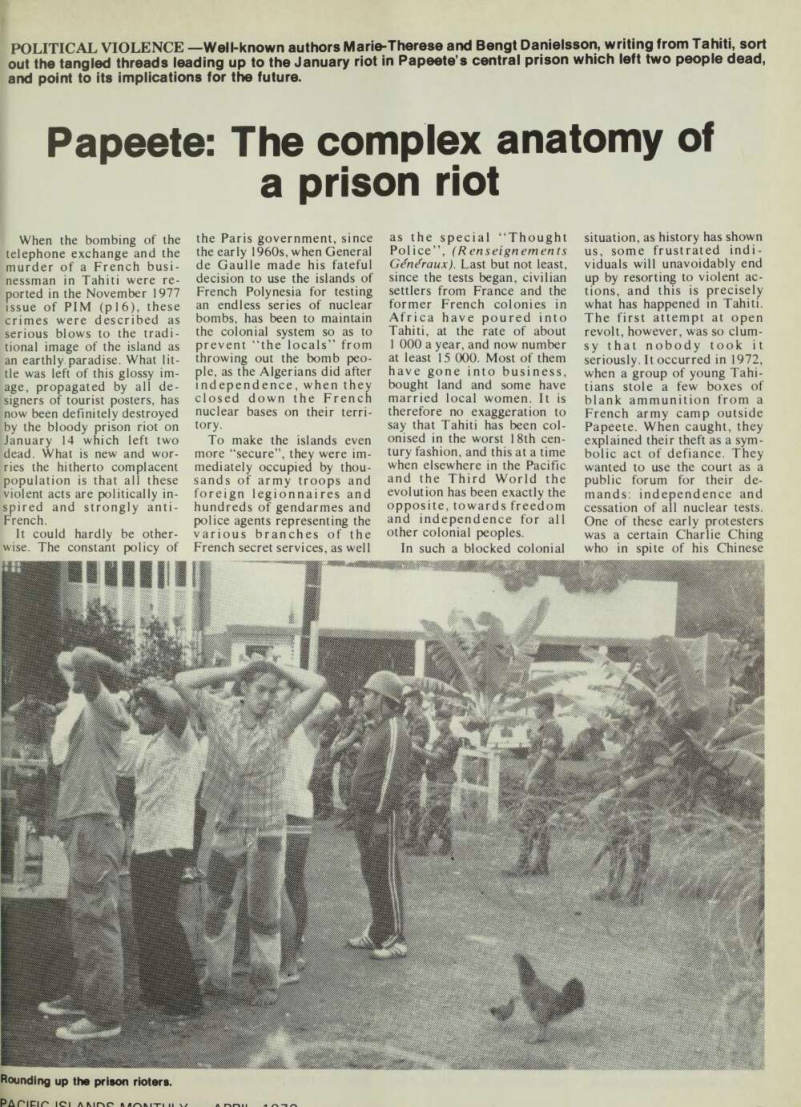
When the bombing of the telephone exchange and the murder of a French businessman in Tahiti were reported in the November 1977 issue of PIM (pi 6), these crimes were described as serious blows to the traditional image of the island as an earthly paradise. What little was left of this glossy image, propagated by all designers of tourist posters, has now been definitely destroyed by the bloody prison riot on January 14 which left two dead. What is new and worries the hitherto complacent population is that all these violent acts are politically inspired and strongly anti- French.
It could hardly be otherwise. The constant policy of
the Paris government, since the early 19605, when General de Gaulle made his fateful decision to use the islands of French Polynesia for testing an endless series of nuclear bombs, has been to maintain the colonial system so as to prevent “the locals” from throwing out the bomb peo pie, as the Algerians did after independence, when they closed down the French nuclear bases on their terri tory.
To make the islands even more “secure”, they were im mediately occupied by thou sands of army troops and foreign legionnaires and hundreds of gendarmes and police agents representing the various branches of the French secret services, as well
as the special “Thought Police”, (Renseignements Last but not least, since the tests began, civilian settlers from France and the former French colonies in Africa have poured into Tahiti, at the rate of about 1 000 a year, and now number at least 15 000. Most of them have gone into business, bought land and some have married local women. It is therefore no exaggeration to say that Tahiti has been colonised in the worst 18th century fashion, and this at a time when elsewhere in the Pacific and the Third World the evolution has been exactly the opposite, towards freedom and independence for all other colonial peoples.
In such a blocked colonial
situation, as history has shown us, some frustrated indi viduals will unavoidably end up by resorting to violent ac tions, and this is precisely what has happened in Tahiti.
The first attempt at open revolt, however, was so clum sy that nobody took it seriously. It occurred in 1972, when a group of young Tahi tians stole a few boxes of blank ammunition from a French army camp outside Papeete. When caught, they explained their theft as a sym bolic act of defiance. They wanted to use the court as a public forum for their de mands: independence and cessation of all nuclear tests, One of these early protesters was a certain Charlie Ching who in spite of his Chinese
Rounding up the prison rioters.
name is culturally a Polyne sian. His greatest political asset is his close kinship tie with Pouvanaa a Oopa: he is a nephew of the old Tahitian freedom fighter who, in 1959, was sentenced, on trumped-up charges, to eight years in prison of which he had to serve seven and a half in France.
Benefiting from the general amnesty that traditionally follows the election of a new president of the French Re public, Charlie Ching was liberated in 1974, when Giscard d’Estaing’s term began. On his return home, he founded a new political party whose whole programme was immediate and complete in dependence from France. His first attempt to win support was at the polls, when Francis Sanford was re-elected depu ty, in September, 1976. Ching got only 676 votes, or 1.66% of the total votes cast.
But his real influence was greater and widening, for he appealed to an increasing number of poor and bewildered Polynesians who felt like strangers in their own land. Those who listened most eagerly to Charlie Ching’s simple message were the young, unemployed boys, who had been rejected by a society which they did not understand or care for. From a sociologi cal point of view, they rep resent a whole lost generation,
for they do not any longer believe in the traditional values of their parents'and grandparents and, on the other hand, European values are still foreign and unattaina ble to them. Most of ihem had by then formed gangs, some of which had adopted Ching’s political programme.
In June and July, 1977, one such gang called Te toto tupuna, “The blood of our an cestors”, decided to act. Not content with a symbolic act they decided to steal more useful stuff than blank muni tions dynamite. With the same ease, they entered the storerooms, first of a private construction firm and then of the Public Works Depart ment, and carried off more than 300 kg of dynamite. The perfect occasion to use it came in the middle of August, when the minister for the French overseas territories, Olivier Stirn, visited Tahiti.
Probably deterred by the strong protective guard which surrounded him, the Te toto tupuna commando chose to blow up the telephone ex change, situated in central Papeete, opposite the gover nor’s residence. If they had succeeded fully, the ensuing lack of this vital means of communication would prob ably have allowed them to commit other acts of sabotage.
As it was, they went about it in such an inept manner that
only the first of the four
charges exploded, producing
structural damage to the building, but none to the ap paratus. When searching the debris, the police found a message worded. “Take your flag, your people and your statute, Stirn, and go home!”
Since this first political bombing in Tahiti caused no casualties, it seemed quite unreal to most people, who did not feel seriously concern ed. The next attack by a Te toto tupuna commando, however, shocked everybody deeply. It occurred two weeks later, on the night of August 27, and the site was a villa in the swank residential section in Punaauia called the Lotus.
A former French navy officer turned businessman, Pierre d’Anglejean, was shot as he lay asleep in his bed. On a sheet of paper pasted on the wall was written in capital let
Ters. We Do Not Want
Any More Frenchmen
In Our Country. It Was
signed Te toto tupuna. Mrs d’Anglejean, sleeping in the same bed, was spared, ob viously because she was of Tahitian and Chinese ex traction. The only possible implication of all this was that Mr d’Anglejean had been murdered for no other reason than that he was French.
Nobody can keep a secret in Tahiti, and this time, with the help of a couple of informers,
the police managed to arrest 13 members of Te toto tupuna. A 14th member was brought back from Rarotonga, where he had believed himself safe from ex tradition. For good measure Charlie Ching was also ar rested, although he declared himself innocent and certainl> had not participated in any ol the commando raids. The of ficial charge brought againsi him was that he was the brains behind the gangs.
The significant fact here i; that the arrested members o the Te toto tupuna gangs, al in their late teens or early 20s had not previously committee any crimes and coulc therefore not be classified a juvenile delinquents. made no secret of their politi cal motives and only seemec to regret that they had no< been able to carry out mon than a small portion of thei action programme which ini eluded the blowing up oi French military planes ant navy ships serving the nucleai testing base on Mururoa They had also seriously coni sidered shooting down thi aircraft on which the ministe: for the French overseas ten ritories, Olivier Stirn, travel! ed, but had eventuall refrained, because there wer
numerous Polynesia
passengers.
With the arrival of the T toto tupuna gangs, the number
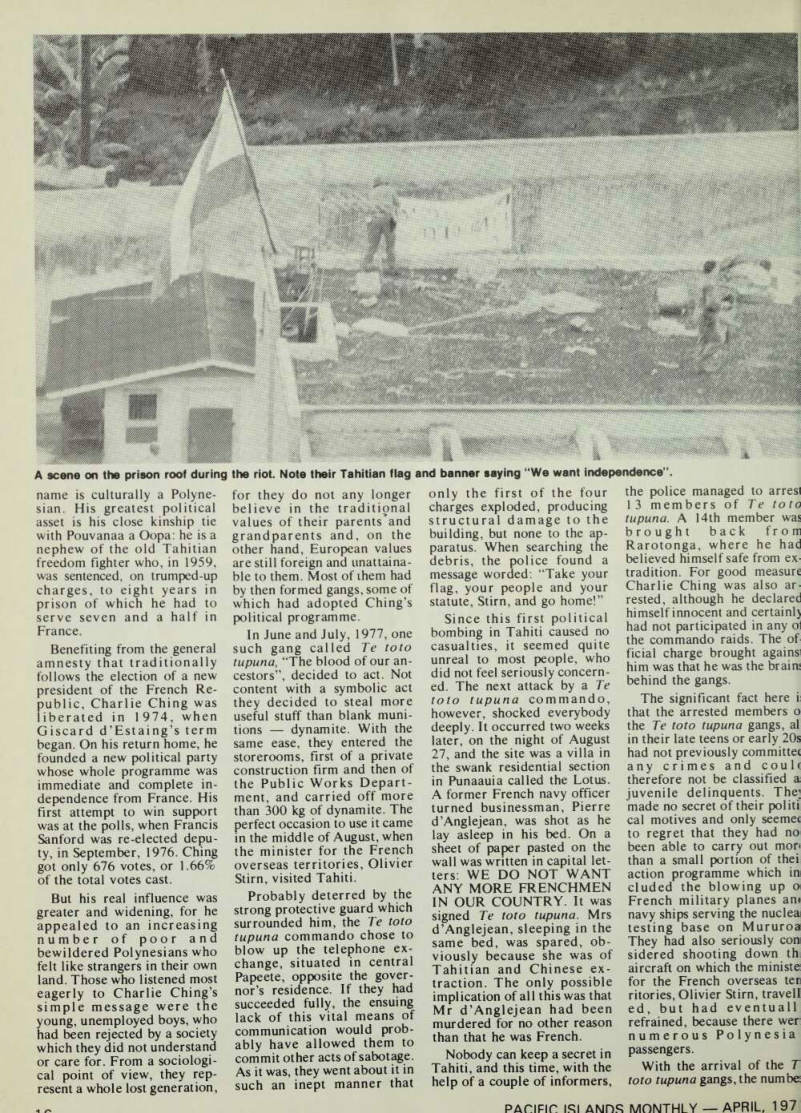
A scene on the prison roof during the riot. Note their Tahitian flag and banner saying “We want independence”.
of inmates in the new, modern prison building at Nuutania, west of Papeete, rose to 173.
Out of these 169 were Polyne sians, two foreign legion naires, one an Italian burglar and the other a French em bezzler. These figures show better than anything else how particularly vulnerable the Polynesians are to the viruses of crime introduced during the past decade.
The only previous prison riot in Tahiti took place in 1972 and resulted only in some material damage. The main request then made by the rioters was to have TV sets in stalled in the prison, and it was promptly granted by the governor. It is not unlikely that tlte inmates over the years have picked up a few ideas by watching the numerous crime movies and newscasts about prison riots in France, fre quently shown on our local TV programmes. However this may be, the riot which oc curred in the afternoon on January 14, was a much bloodier and more savage affair.
Some of the most hardened prisoners enticed a warder into their block, by pretend ing that one of them was sick.
They then fell upon the un suspecting warder and literally beat him to death with table legs. With keys taken from their unfortunate victim, they then opened the doors in the adjacent blocks.
When the other warders arriv ed on the scene, they were overpowered, in some in stances beaten, and thrown into empty cells. The only re maining warder tried in the meantime frantically to alert the gendarmerie stations in Papeete and at the airport, connected with the prison by a special line. But incredibly enough there was no answer probably because it was Saturday afternoon. The fran tic warder finally tried the or dinary telephone and man aged, without difficulty, to dial the Tahitian town police in Papeete who transmitted the chilling news to the authorities.
The first to arrive on the scene were the prison direc tor, Nedo Salmon, and the deputy director, his son Teina. They found the prison gate wide open and about 50 prisoners standing in the yard inside, apparently without any thought of escaping. The ex planation for this strange behaviour is very simple: they had not participated in the
murder of the warder and were still too surprised by their liberation to know what to do. Among them were prac tically all the members of the Te toto tupuna gangs. On the other hand, the murderers and some other hardened cri minals, altogether 14 men, had immediately escaped.
Nedo Salmon, who is a con summate politician and fine orator in Tahitian, tried to
persuade the prisoners to
return to their cells and declared himself ready to listen to any complaints they might have. They chose as their spokesmen four mem bers of the Te toto tupuna gangs who immediately delivered their demands.
They were: immediate inde pendence; send home all Frenchmen; stop poisoning us with your bombs.
The poor director, who had expected them to ask for better food, more frequent leave or perhaps a colour TV, could only promise to transmit their requests to the proper authorities.
By then the new High Com missioner, Paul Cousseran, had installed his headquarters opposite the prison, and the only answer he cared to give was, of course, to send for a company of foreign legion naires by air from Mururoa.
At the same time he ordered the 50 available gendarmes to encircle the prison building.
In spite of this, Nedo Salmon managed to extract a promise from the mutineers to hand over the dead and wounded warders on condition that those who came to fetch them were Tahitians and not Frenchmen.
As soon as this was done, the 50-odd prisoners who took an active part in the mutiny gave it an even more political character. First they searched the prison until they found a Tahitian red-white red flag, then they took it up to the roof and stuck it up on a
pole. Next they painted
streamers, made of bed sheets, with anti-French and anti bomb slogans. By then some of the mutineers had dis covered the warders’ beer supplies and collected all the bottles of spirits they could find in the dispensary.
A Tahitian party without music and dancing is no real party, and a record player was therefore brought up. Soon
everybody was wildly dancing
and singing. But now and then shouts were heard, mostly in French for the comprehension
of the journalists and the gen darmes: Vive Tindependance!
A has la bombe! Les Franqais dehors! The shouts were often accompanied by projectiles of various kinds aimed at the besiegers.
There is no doubt that the easiest solution, technically, would have been to cut off the water, food and electricity and wait for the mutineers to give up. But a drawn-out and successful defiance of the French authorities would have far-reaching re percussions, especially to be feared in view of the forthcoming general elections on March 12. The High Com missioner therefore decided (or had received orders from Paris) to use force.
The first attempt, made at midnight, was preceded by a volley of teargas grenades. As soon as the first exploded, however, the mutineers brought up three hostages to the roof and threatened to throw them down to certain death in the courtyard.
Their choice of hostages was again highly revealing of their general frame of mind: they consisted of the Italian burglar and the two Spanish legionnaires, locked up God knows what for and why in this civilian prison. The fourth European prisoner, the Frenchman, had hidden him self so well that the mutineers could not find him, which was probably very lucky for him.
The mutineers made the hostages sit on the edge of the roof so they could easily be pushed off it. This momen tarily stopped the barrage of teargas grenades.
The only thing for the High Commissioner to do was to wait for the mutineers to fall asleep, in good Tahitian tradi tion. By 4 am only half a dozen men were still on the roof and most were resting.
The hostages had also been allowed to stretch out. At 4.30 the High Commissioner gave the order for the assault to take place. A truck smashed down the main gate, and 50 gendarmes with weapons drawn rushed into the com
pound and placed dynamite
charges at all locked doors.
As soon as the prisoners on the roof realised what was going on, two of them grabbed one of the legionnaires and
began carrying him towards
the edge of the roof. The next moment three shots rang out.
One of the Tahitians staggered and fell, mortally wounded in the head and chest. The shots
had been fired by two of the best marksmen among the gendarmes, posted on a hill behind the prison. To avenge the death of his comrade, one of the other mutineers slashed the leg of their Italian with an axe, before disappearing into the building.
In the meantime, the gen darmes had advanced cautiously from block to block, throwing large num bers of teargas grenades into all rooms and corridors.
Nobody seemed to have the slightest inclination to resist, least of all those prisoners who, during all these goings on, had been sitting quietly in their cells, either locked or unlocked. Among them was, for instance, Charlie Ching.
Two hours after the signal to invest the prison building had been given, the last coughing, sneezing prisoner came out with his arms over his head or handcuffed behind his back.
A head count revealed that 14 prisoners were missing, and these were, of course, pre cisely the instigators of the break-out, who all had spent years behind the bars for “or dinary” crimes like theft, burglary, assault and rape and therefore were desperate enough to commit a murder in order to regain their freedom.
In a heavily populated is land like Tahiti, however, good hide-outs are extremely rare, and, like all other escaped prisoners in the past, these, too, were gradually re captured, until at the time of writing only three are still on the loose. Whereas, as we have already mentioned, the members of the two Te toto tupuna groups stayed within the prison walls, and took ad vantage of the opportunity that was offered them to pub licise their political ideas which evidently were shared by at least 40 or 50 of their fellow inmates.
The French authorities have ever since made spec tacular efforts to confuse the issues and deny all political significance to the telephone exchange bombing, the murder of Mr d’Anglejean and the prison riot. In a press conference, the High Com missioner went so far as to say that the nuclear tests and the military occupation of the is lands have absolutely nothing to do with recent events. In his view, the growth of violence in Tahiti, these last months, is simply a worldwide phenomenon from which no country can escape .. .
Advertisements & other items, pp. 15-18 (4 items)
PAncir IO I A MHO It «AMTI ii \ / A nnn amn
16
PACIFIC LSI AMDS MONTHLY APRIL, 197
PArici r' ICI AMHP AMTI II \/ A nnn i
Gboo*S
GOOD-YEAR
G&OO
RADIAL PLY TYRE
You get extra tyre toughness, longer tread life and more fuel economy from Goodyear GBOO, Custom GBOO Rib or GBOO Grand Prix. r r /
GOODWYEAR
GBOO*S
STEEL BELTED RADIAL TYRE
A high-performance steel belted radial tyre with a polyester cord body that offers excellent stability and driving response on wet or dry highway surfaces. Safe, sure, durable and extra long-wearing.
GOODYEAR
G 8
CROSS PLY TYRE
G 8 offers you improved wetskid protection smoother handling and quieter softer ride. Three choices: G 8 Custom G 8 Super Cushion G 8 ttt IS i 1 I lIL
GOODYEAR DISTRIBUTORS IN S.E. ASIA AND PACIFIC BASIN Richard Plena & Co., Ltd.
Colombo, Sri Lanka Nepal Motor Company (P) Ltd.
Biratnagar, Nepal Havana Ltd.
Dacca. Bangladesh Dlethelm & Co.. Ltd.
Bangkok. Thailand Landis Brothers & Co., Ltd.
Hong Kong Guam Tire & Supply Co.
Agana, Guam Susupe Enterprises Saipan, Manana Is Mlcrol Corporation Saipan. Manana Is Truk Trading Co.
Truk E . Caroline Is.
P.A.M.I.
Kolonla, Ponape Island Transport Service Co.
Majuro, Marshall Is Yap Cooperative Ass.
Yap. W Caroline Is.
Cook Islands Motor Centre Ltd.
Rarotonga. Cook Is.
Nglratkel Etplaon Co., Ltd.
Koror, Palau Boroko Motors Ltd.
Port Moresby. Papua New Guinea Solomon Motors Ltd.
Honiara, Solomon Is Santo Engineers Santo, New Hebrides Pacific Motors Vila, New Hebndes
S.G.A.
Noumea. New Caledonia Duncombe Bay Garage Norfolk Is Coral Island Motors Suva. Fiji Morris Hedatrom Ltd.
Nukualofa, Tonga Morris Hedatrom Ltd.
Apia, Western Samoa Western Samoa Transport Cooperative Society Ltd.
Apia, Western Samoa Samoa Motors Inc.
Pago Pago. American Samoa Service Mobil Papeete. Tahiti
GOODYEAR SUBSIDIARIES
N The Goodyear Tyre & Rubber Co (Ai/st) Ltd.
Sydney, AUSTRALIA Tel: 31-0311 Goodyear India Limited New Delhi 1. INDIA Tel 46006/9 PT Goodyear Indoneala Bogor, Republic of Indonesia Tel: 3371/2 Nippon Goodyear Kabuahlkl Kalaha Tokyo. JAPAN Tel: 502-0401/0 Goodyear Malaysia Berhad Selangor. MALAYSIA Tel: 362501/5 The Goodyear Tyre & Rubber Co. of New Zealand. Limited Lower Hutt. NEW ZEALAND Tel 604-309 The Goodyear Tyre & Rubber Company of the Philippines, Limited Makati-Metro Manila.
Republic of the Philippines Tel: 09-20-41 Goodyear Singapore Pvt Limited Geylang SINGAPORE 14 Tel 400201/3 Goodyear Taiwan Limited Taipei, TAIWAN Tel: 5117135/0 Goodyear (Thailand) Limited Bangkok, THAILAND Tel: 252-6141/5
FOR FURTHER INFORMATION,
PLEASE CONTACT
Goodyear International Corporation Room 1603, Wing On Center. 111 Connaught Road Central
HONG KONG Tel: 5-433331
HRME 171*
020 tA
Agana And The American Dream
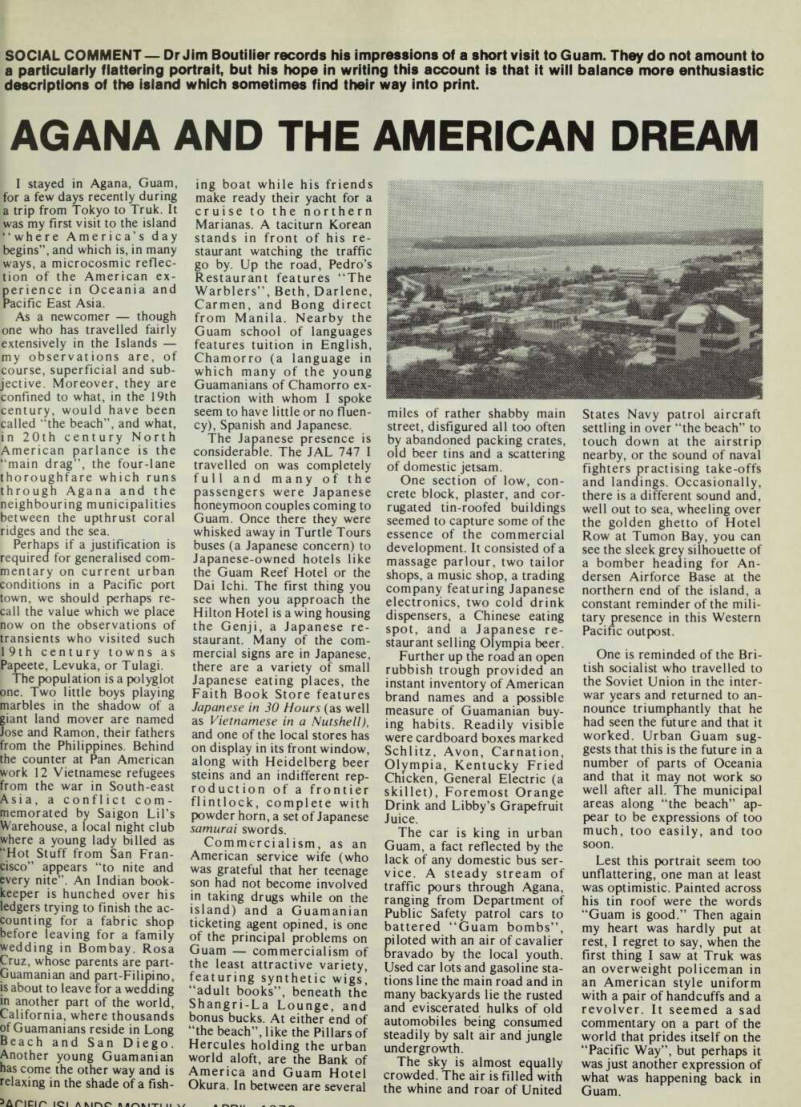
SOCIAL COMMENT Dr Jim Boutilier records his impressions of a short visit to Guam. They do not amount to a particularly flattering portrait, but his hope in writing this account is that it will balance more enthusiastic descriptions of the island which sometimes find their way into print.
I stayed in Agana, Guam, for a few days recently during a trip from Tokyo to Truk. It was my first visit to the island “where America’s day begins”, and which is, in many ways, a microcosmic reflec tion of the American ex perience in Oceania and Pacific East Asia.
As a newcomer though one who has travelled fairly extensively in the Islands my observations are, of course, superficial and sub jective. Moreover, they are confined to what, in the 19th century, would have been called “the beach”, and what, in 20th century North American parlance is the “main drag”, the four-lane thoroughfare which runs through Agana and the neighbouring municipalities between the upthrust coral ridges and the sea.
Perhaps if a justification is required for generalised com mentary on current urban conditions in a Pacific port town, we should perhaps re call the value which we place now on the observations of transients who visited such 19th century towns as Papeete, Levuka, or Tulagi.
The population is a polyglot one. Two little boys playing marbles in the shadow of a giant land mover are named Jose and Ramon, their fathers from the Philippines. Behind the counter at Pan American work 12 Vietnamese refugees from the war in South-east Asia, a conflict com memorated by Saigon Lil’s Warehouse, a local night club where a young lady billed as “Hot Stuff from San Fran cisco” appears “to nite and every nite”. An Indian book keeper is hunched over his ledgers trying to finish the ac counting for a fabric shop before leaving for a family wedding in Bombay. Rosa Cruz, whose parents are part-
Guamanian and part-Filipino,
is about to leave for a wedding in another part of the world, California, where thousands of Guamanians reside in Long Beach and San Diego.
Another young Guamanian has come the other way and is relaxing in the shade of a fish
ing boat while his friends make ready their yacht for a cruise to the northern Marianas. A taciturn Korean stands in front of his re staurant watching the traffic go by. Up the road, Pedro’s Restaurant features “The Warblers’’, Beth, Darlene, Carmen, and Bong direct from Manila. Nearby the Guam school of languages features tuition in English, Chamorro (a language in which many of the young Guamanians of Chamorro ex traction with whom I spoke seem to have little or no fluen cy), Spanish and Japanese.
The Japanese presence is considerable. The JAL 747 I travelled on was completely full and many of the passengers were Japanese honeymoon couples coming to Guam. Once there they were whisked away in Turtle Tours buses (a Japanese concern) to Japanese-owned hotels like the Guam Reef Hotel or the Dai Ichi. The first thing you see when you approach the Hilton Hotel is a wing housing the Genji, a Japanese re staurant. Many of the com mercial signs are in Japanese, there are a variety of small Japanese eating places, the Faith Book Store features Japanese in 30 Hours (as well as Vietnamese in a Nutshell), and one of the local stores has on display in its front window, along with Heidelberg beer steins and an indifferent rep roduction of a frontier flintlock, complete with powder horn, a set of Japanese samurai swords.
Commercialism, as an American service wife (who was grateful that her teenage son had not become involved in taking drugs while on the island) and a Guamanian ticketing agent opined, is one of the principal problems on Guam commercialism of the least attractive variety, featuring synthetic wigs, “adult books’’, beneath the Shangri-La Lounge, and bonus bucks. At either end of “the beach’’, like the Pillars of Hercules holding the urban world aloft, are the Bank of America and Guam Hotel Okura. In between are several
miles of rather shabby main street, disfigured all too often by abandoned packing crates, old beer tins and a scattering of domestic jetsam.
One section of low, con crete block, plaster, and cor rugated tin-roofed buildings seemed to capture some of the essence of the commercial development. It consisted of a massage parlour, two tailor shops, a music shop, a trading company featuring Japanese electronics, two cold drink dispensers, a Chinese eating spot, and a Japanese re staurant selling Olympia beer.
Further up the road an open rubbish trough provided an instant inventory of American brand names and a possible measure of Guamanian buy ing habits. Readily visible were cardboard boxes marked Schlitz, Avon, Carnation, Olympia, Kentucky Fried Chicken, General Electric (a skillet), Foremost Orange Drink and Libby’s Grapefruit Juice.
The car is king in urban Guam, a fact reflected by the lack of any domestic bus ser vice. A steady stream of traffic pours through Agana, ranging from Department of Public Safety patrol cars to battered “Guam bombs’’, piloted with an air of cavalier bravado by the local youth.
Used car lots and gasoline sta tions line the main road and in many backyards lie the rusted and eviscerated hulks of old automobiles being consumed steadily by salt air and jungle undergrowth.
The sky is almost equally crowded. The air is filled with the whine and roar of United
States Navy patrol aircraft settling in over “the beach” to touch down at the airstrip nearby, or the sound of naval fighters practising take-offs and landings. Occasionally, there is a different sound and, well out to sea, wheeling over the golden ghetto of Hotel Row at Turnon Bay, you can see the sleek grey silhouette of a bomber heading for An dersen Airforce Base at the northern end of the island, a constant reminder of the mili tary presence in this Western Pacific outpost, One is reminded of the Bri tish socialist who travelled to the Soviet Union in the inter war years and returned to an nounce triumphantly that he had seen the future and that it worked. Urban Guam sug gests that this is the future in a number of parts of Oceania and that it may not work so well after all. The municipal area s a long “the beach” ap pear to be expressions of too much, too easily, and too soon.
Lest this portrait seem too unflattering, one man at least was optimistic. Painted across his tin roof were the words “Guam is good.” Then again my heart was hardly put at rest, I regret to say, when the first thing I saw at Truk was an overweight policeman in an American style uniform with a pair of handcuffs and a revolver. It seemed a sad commentary on a part of the world that prides itself on the “Pacific Way”, but perhaps it was just another expression of what was happening back in Guam.
Advertisements & other items, pp. 19-20 (3 items)
Ici Ampko V, • Nm. . „ ~
ICI AMPkO V, • nm. . „
DAriPir iqi akihq MONTHLY APRIL. 1 97
Hardie’S Pipelines"
4 H k m. s X 11
A MAJOR CONTRIBUTION
TO DEVELOPING
PACIFIC NATIONS
Water Supply and Sewer Reticulation are the two basic requirements of a developing country. The Fiji Housing Authority, with the Health and Welfare of the Island Community at stake, naturally choose Hardie’s pipelines to provide these services.
At Hardie’s we know how vital delivery deadlines are to Pacific clients. Especially when the supply source can be 2000 miles or more away. So we provide a pipe service that’s unbeatable for speed and reliability. No matter how big your pipes order, we go all out to get it to you on time, every time.
Contractors have found that Fibrolite pipes save time and trouble on the job too. Longer 4 metre lengths and lightweight, mean easier, faster handling and laying. Precision made Supertite vee ring jointing system eliminates any risk of infiltration or leakage.
And once down, Fibrolite pipes save on costly maintenance made of asbestos-cement they will never rot, rust or corrode. Hardie’s Fibrolite pipes ... ready whenever and wherever they’re needed throughout the Pacific.
PIPELINES TO PROGRESS
hardie’s
pipelines
ames Hardie & Coy. Pty. Ltd. lox 12-070, Penrose, Auckland. Ph. 599-919. lox 9671, Wellington, Ph. 724-851. iox 325, Christchurch. Ph. 65-036. lew Zealand.
In The Solomons Bush
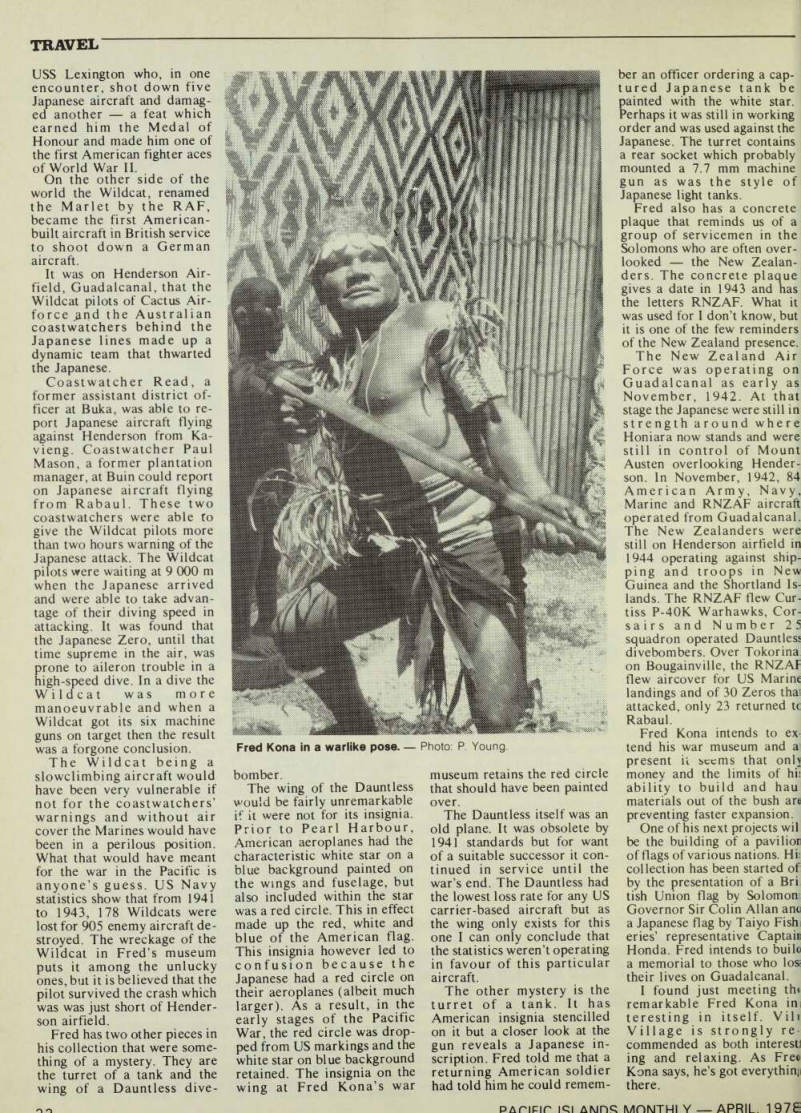
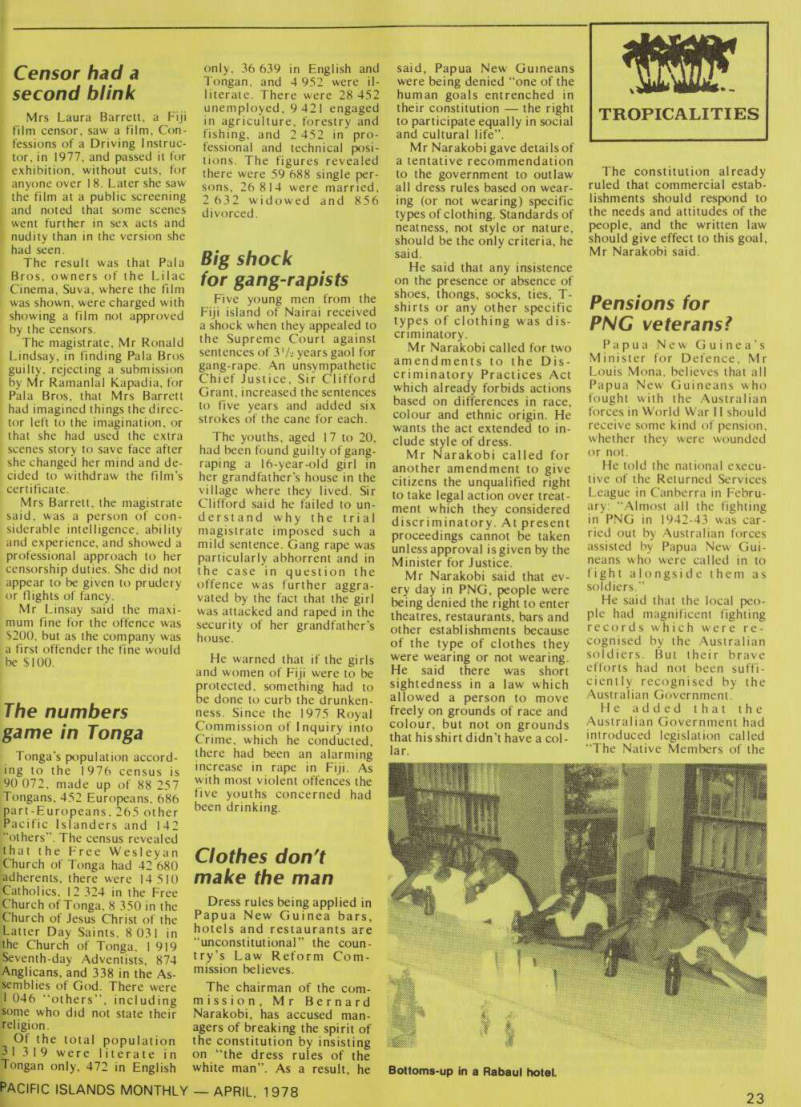
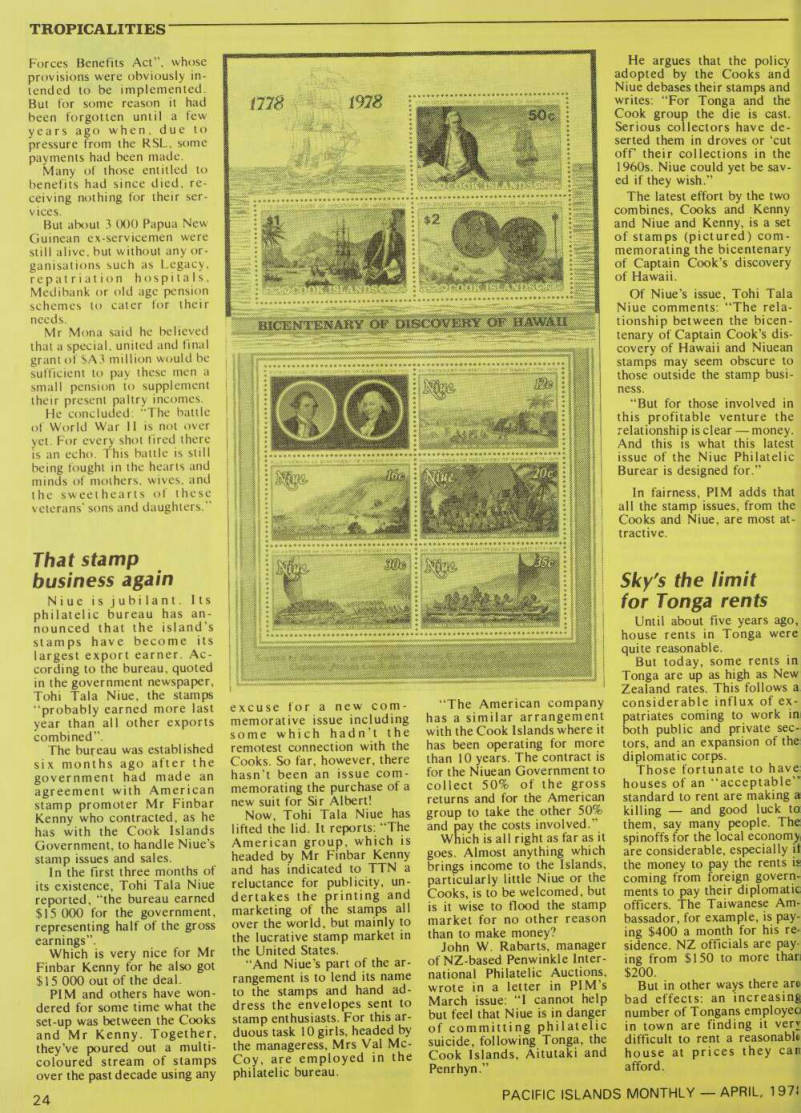
War And Culture Side By Side
Thirteen miles out of Honiara, capital of the Solomon Islands, over road that is not too bumpy by island standards, is Vilu Villaga It is owned by Fred Kona, whose intention it is to make his cultural and war museum one of the main tourist attractions of the Solomons. Peter L. Young tells the story.
Fred is quite a character.
Usually dressed in a pair of shorts and perhaps an open shirt, he hails you with his booming, “Welcome friend” and grabs your hand with a strong grip. He is a master ra conteur in his superior mix ture of English and Pidgin.
Fred is a remarkable man.
He is paramount chief for this area of Guadalcanal which is no mean achievement con sidering he was born on another island, Malaita. He originally came to Guadal canal to work on a plantation.
While on the plantation, Fred set about learning English by talking to the plan tation manager’s children. He eventually became an over seer.
Fred .will tell you proudly that he is a self-made man. He never went to school but he has learned to read. He now studies what he calls “the three laws” in his spare time; these laws are God’s Law, King’s Law and Custom Law.
He has sat as an adviser in local courts, and because of his knowledge of custom he was able to become a para mount chief.
Vilu Village seems to have everything and Fred will as sure you that it has. It contains a war museum, houses built in custom style, and Fred’s own agricultural pursuits in cluding a copra dryer, cocoa,
pineapples, Malay apples and
various other crops. In ad dition to this he is cultivating various orchids.
As Fred says, he never went to school but he knows how to grow first-grade copra and
first-grade cocoa.
On the day I visited Vilu I had given Fred Kona a few days notice by leaving a note for him at his post-office box (559 Honiara). This meant that he was well prepared to welcome my party with a group of traditional dancers from Visale, a Roman Catholic mission settlement further up the coast.
We sat down while the dan cers performed. Two men
sang unaccompanied with the verve and natural harmony that ensures modern Solomon Island choirs a future place among the best in the world.
The bare-breasted women, young and old, danced, wear ing grass skirts and creating a rhythm from rattling nuts tied around their ankles.
We talked with the dancers and discovered they were all relatives. I was interested to see that, on finishing each dance, the women immedi ately covered up their breasts this return to custom was for the dance only. I have often noticed Melanesian women, generally the older ones, going around Honiara market bare breasted. Some, when they see me approaching, put their hands across their breasts no doubt to avoid offending my European sensibilities.
After the dancing, Fred conducted us on a tour of the custom-style houses that he has built telling us what each section of the house was used for, giving us an introduction to Melanesian etiquette and regaling us with custom sto ries about the origins of various things in the hut. In side one of the houses is an ar ray of Solomon Island war weapons all of which appear quite old but have been beautifully constructed and preserved.
Later Fred was to delight my photographer wife by dressing up as a warrior.
There is no doubt about Fred’s ability to act the part as he demonstrated the use of the long spear, the axe and the club. His friends from Visale found that this rather amusing and we had to take a break ev ery few minutes when the hilarity started preventing Fred from looking ap propriately menacing for the camera. The whole photo graphic session was a light hearted romp but the pictures obtained were magnificent.
After that, we visited the war museum.
By far the most impressive
pieces in the museum are two Japanese 150 mm howitzers.
From my knowledge of the various types of guns used in the Guadalcanal campaign I concluded that the howitzer with the gun-shield was a model 96 cannon and like most of the other guns left around the island was prob ably constructed in Japan’s Osaka arsenal in 1942. The howitzer nearby is probably an earlier model of the 150 mm gun constructed in 1937.
These types of guns were used to bombard the thinly-held marine perimeter around Henderson airfield in 1942 and 1943. The Japanese had the advantage of an artillery observation post on Mount Austen which overlooks Hen ddtson. The 150 mm cannon could hurl a high explosive shell 10 365 m.
Not far from the cannon is a house full of helmets and guns. The guns are fairly rusted but there are two Japanese machine guns in quite good condition. Both are of a type that was standard with the Japanese forces dur ing World War 11, having been originally copied from the French Hotchkiss machine gun.
On a not-so-happy note, Fred told me that he had had an underwing cannon from an American fighter in his possession, but that fell victim to some marauding European gun-hunters who cut the gun out of its pod and took it out of the country. Fred accepts the loss philosophically, say ing that as Europeans brought Christianity to the Solomons then some Europeans can have something of his. The matter obviously still is a sore point but he won’t pursue the thieves.
Various other Japanese light guns are about including a Nambu anti-tank gun which is also in good condition.
Further along is the still re cognisable wreckage of an American Chance Vought Corsair, its white star on the fuselage and number “16”
still clearly outlined. Fred believes that it was the first Corsair shot down over Guadalcanal.
The Corsair with its power ful engine and dipping, gull wing had a long and dis tinguished history. It was one of the fastest aircraft of its time attaining what was then the remarkable speed of 670 kmh. Both American and New Zealand pilots operated the Corsair from Henderson Air field. In Europe, the Royal Navy used Corsairs to cover bombers attacking the giant German Battleship Tirpitz.
The aircraft later served in Korea and was also flown by pilots of the French Navy dur ing the war in Indo-China when France was unsuc cessfully trying to retain con trol of that part of south-east Asia.
Fred Kona has also salvag ed the wreckage of a Grum man Wildcat. The remarkable thing about this piece is that one wing still easily folds up as it would have on board an aircraft carrier.
Although later US pilots swore by the Wildcat, at first American navy pilots swore at the plane. The early models required the pilot to crank up the undercarriage himself.
This manual retraction re quired 30 turns of a crank near the pilot’s right hand and usually resulted in a porpoise like flight path after take off as the pilot battled to retract his undercarriage and carry on normal flying.
The Wildcat started off its combatant life inauspiciously.
Nine out of 11 stationed at Pearl Harbour were destroyed on the ground as were seven out of 10 at Wake. Captain Henry T Elrod USMC, however, evened up the score, sinking a Japanese destroyer by using his Wildcat as a dive bomber but that wasn’t sufficient to stop Wake falling after heroic defence.
The capabilities of the Wildcat were shown in the early days of the Pacific War by Lt “Butch” O’Hare of the
USS Lexington who, in one encounter, shot down five Japanese aircraft and damag ed another a feat which earned him the Medal of Honour and made him one of the first American fighter aces of World War 11.
On the other side of the world the Wildcat, renamed the Marlet by the RAF, became the first American built aircraft in British service to shoot down a German aircraft.
It was on Henderson Air field, Guadalcanal, that the Wildcat pilots of Cactus Air force the Australian coastwatchers behind the Japanese lines made up a dynamic team that thwarted the Japanese.
Coastwatcher Read, a former assistant district of ficer at Buka, was able to re port Japanese aircraft flying against Henderson from Ka vieng. Coastwatcher Paul Mason, a former plantation manager, at Buin could report on Japanese aircraft flying from Rabaul. These two coastwatchers were able to give the Wildcat pilots more than two hours warning of the Japanese attack. The Wildcat pilots were waiting at 9 000 m when the Japanese arrived and were able to take advan tage of their diving speed in attacking. It was found that the Japanese Zero, until that time supreme in the air, was prone to aileron trouble in a high-speed dive. In a dive the Wildcat was more manoeuvrable and when a Wildcat got its six machine guns on target then the result was a forgone conclusion.
The Wildcat being a slowclimbing aircraft would have been very vulnerable if not for the coastwatchers’ warnings and without air cover the Marines would have been in a perilous position.
What that would have meant for the war in the Pacific is anyone’s guess. US Navy statistics show that from 1941 to 1943, 178 Wildcats were lost for 905 enemy aircraft de stroyed. The wreckage of the Wildcat in Fred’s museum puts it among the unlucky ones, but it is believed that the pilot survived the crash which was was just short of Hender son airfield.
Fred has two other pieces in his collection that were some thing of a mystery. They are the turret of a tank and the wing of a Dauntless dive-
bomber.
The wing of the Dauntless would be fairly unremarkable if it were not for its insignia.
Prior to Pearl Harbour, American aeroplanes had the characteristic white star on a blue background painted on the wings and fuselage, but also included within the star was a red circle. This in effect made up the red, white and blue of the American flag.
This insignia however led to confusion because the Japanese had a red circle on their aeroplanes (albeit much larger). As a result, in the early stages of the Pacific War, the red circle was drop ped from US markings and the white star on blue background retained. The insignia on the wing at Fred Kona’s war
museum retains the red circle that should have been painted over.
The Dauntless itself was an old plane. It was obsolete by 1941 standards but for want of a suitable successor it con tinued in service until the war’s end. The Dauntless had the lowest loss rate for any US carrier-based aircraft but as the wing only exists for this one I can only conclude that the statistics weren’t operating in favour of this particular aircraft.
The other mystery is the turret of a tank. It has American insignia stencilled on it but a closer look at the gun reveals a Japanese in scription. Fred told me that a returning American soldier had told him he could remem
her an officer ordering a cap tured Japanese tank be painted with the white star.
Perhaps it was still in working order and was used against the Japanese. The turret contains a rear socket which probably mounted a 7.7 mm machine gun as was the style of Japanese light tanks.
Fred also has a concrete plaque that reminds us of a group of servicemen in the Solomons who are often over looked the New Zealan ders. The concrete plaque gives a date in 1943 and has the letters RNZAF. What it was used for I don’t know, but it is one of the few reminders of the New Zealand presence.
The New Zealand Air Force was operating on Guadalcanal as early as November, 1942. At that stage the Japanese were still in strength around where Honiara now stands and were still in control of Mount Austen overlooking Hender son. In November, 1942, 84 American Army, Navy, Marine and RNZAF aircraft operated from Guadalcanal.
The New Zealanders were still on Henderson airfield in 1944 operating against ship ping and troops in New Guinea and the Shortland Is lands. The RNZAF flew Cur tiss P-40K Warhawks, Cor sairs and Number 25 squadron operated Dauntless divebombers. Over Tokorina on Bougainville, the RNZAF flew aircover for US Marine landings and of 30 Zeros that attacked, only 23 returned tc Rabaul.
Fred Kona intends to ex tend his war museum and a present it seems that onh money and the limits of hi: ability to build and hau materials out of the bush are preventing faster expansion.
One of his next projects wil be the building of a pavilior of flags of various nations. Hi: collection has been started of by the presentation of a Bri tish Union flag by Solomon; Governor Sir Colin Allan anc a Japanese flag by Taiyo Fish cries’ representative Captain Honda. Fred intends to builc a memorial to those who los; their lives on Guadalcanal.
I found just meeting th* remarkable Fred Kona in teresting in itself. Vih Village is strongly re commended as both interest! ing and relaxing. As Freo Kona says, he’s got everythin] there.
Fred Kona in a warlike pose.- Photo: P. Young.
Censor had a
second blink
Mrs Laura Barrett, a Fiji film censor, saw a film, Con [ fessions of a Driving Instruc tor, in 1977, and passed it for I exhibition, without cuts, for anyone over 18. Later she saw [ the film at a public screening f and noted that some scenes [ went further in sex acts and nudity than in the version she had seen.
The result was that Pala Bros, owners of the Lilac Cinema, Suva, where the film was shown, were charged with showing a film not approved by the censors.
The magistrate, Mr Ronald Lindsay, in finding Pala Bros guilty, rejecting a submission by Mr Ramanlal Kapadia, for Pala Bros, that Mrs Barrett had imagined things the direc tor left to the imagination, or that she had used the extra scenes story to save face after she changed her mind and de cided to withdraw the film’s certificate.
Mrs Barrett, the magistrate said, was a person of con siderable intelligence, ability and experience, and showed a professional approach to her censorship duties. She did not appear to be given to prudery or flights of fancy.
Mr Linsay said the maxi mum fine for the offence was $2OO, but as the company was a first offender the fine would be $lOO.
The numbers
game in Tonga
Tonga’s population accord ing to the 1976 census is 90 072, made up of 88 257 Tongans, 452 Europeans, 686 part-Europeans, 265 other Pacific Islanders and 142 “others”. The census revealed that the Free Wesleyan Church of Tonga had 42 680 adherents, there were 14 510 Catholics, 12 324 in the Free Church of Tonga, 8 350 in the Church of Jesus Christ of the Latter Day Saints, 8 03 1 in the Church of Tonga, 1 919 Seventh-day Adventists, 874 Anglicans, and 338 in the As semblies of God. There were 1 046 “others”, including some who did not state their religion.
Of the total population 3 13 19 were literate in Tongan only, 472 in English
only, 36 639 in English and Tongan, and 4 952 were il literate. There were 28 452 unemployed, 9 421 engaged in agriculture, forestry and fishing, and 2 452 in pro fessional and technical posi tions. The figures revealed there were 59 688 single per sons, 26 814 were married, 2 632 widowed and 856 divorced.
Big shock
for gang-rapists
Five young men from the Fiji island of Nairai received a shock when they appealed to the Supreme Court against sentences of 3'A years gaol for gang-rape. An unsympathetic Chief Justice, Sir Clifford Grant, increased the sentences to five years and added six strokes of the cane for each.
The youths, aged 17 to 20, had been found guilty of gang raping a 16-year-old girl in her grandfather’s house in the village where they lived. Sir Clifford said he failed to un derstand why the trial magistrate imposed such a mild sentence. Gang rape was particularly abhorrent and in the case in question the offence was further aggra vated by the fact that the girl was attacked and raped in the security of her grandfather’s house.
He warned that if the girls and women of Fiji were to be protected, something had to be done to curb the drunken ness. Since the 1975 Royal Commission of Inquiry into Crime, which he conducted, there had been an alarming increase in rape in Fiji. As with most violent offences the five youths concerned had been drinking.
Clothes don't
make the man
Dress rules being applied in Papua New Guinea bars, hotels and restaurants are “unconstitutional” the coun try’s Law Reform Com mission believes.
The chairman of the com mission, Mr Bernard Narakobi, has accused man agers of breaking the spirit of the constitution by insisting on “the dress rules of the white man”. As a result, he
said, Papua New Guineans were being denied “one of the human goals entrenched in their constitution the right to participate equally in social and cultural life”.
Mr Narakobi gave details of a tentative recommendation to the government to outlaw all dress rules based on wear ing (or not wearing) specific types of clothing. Standards of neatness, not style or nature, should be the only criteria, he said.
He said that any insistence on the presence or absence of shoes, thongs, socks, ties, T shirts or any other specific types of clothing was dis
criminatory.
Mr Narakobi called for two amendments to the Dis criminatory Practices Act which already forbids actions based on differences in race, colour and ethnic origin. He wants the act extended to in clude style of dress.
Mr Narakobi called for another amendment to give citizens the unqualified right to take legal action over treat ment which they considered discriminatory. At present proceedings cannot be taken unless approval is given by the Minister for Justice.
Mr Narakobi said that ev ery day in PNG, people were being denied the right to enter theatres, restaurants, bars and other establishments because of the type of clothes they were wearing or not wearing.
He said there was short sightedness in a law which allowed a person to move freely on grounds of race and colour, but not on grounds that his shirt didn’t have a col lar.
Tropicalities
The constitution already ruled that commercial estab lishments should respond to the needs and attitudes of the people, and the written law should give effect to this goal, Mr Narakobi said.
Pensions for
PNG veteran ?
Papua New Guinea’s Minister for Defence, Mr Louis Mona, believes that all Papua New Guineans who fought with the Australian forces in World War 11 should receive some kind of pension, whether they were wounded or not.
He told the national execu tive of the Returned Services League in Canberra in Febru ary: "Almost all the fighting in PNG in 1942-43 was car ried out by Australian forces assisted by Papua New Gui neans who were called in to fight alongside them as soldiers.”
He said that the local peo ple had magnificent fighting records which were re cognised by the Australian soldiers. But their brave efforts had not been suffi ciently recognised by the Australian Government.
He added that the Australian Government had introduced legislation called “The Native Members of the
Bottoms-up in a Rabaul hotel.
Forces Benefits Act”, whose provisions were obviously in tended to be implemented.
But for some reason it had been forgotten until a few years ago when, due to pressure from the RSL, some payments had been made.
Many of those entitled to benefits had since died, re ceiving nothing for their ser vices.
But about 3 000 Papua New Guinean ex-servicemen were still alive, but without any or ganisations such as Legacy,
repatriation hospitals,
Medibank or old age pension schemes to cater for their needs.
Mr Mona said he believed that a special, united and final grant of SA3 million would be sufficient to pay these men a small pension to supplement their present paltry incomes.
He concluded; “The battle of World War II is not over yet. For every shot fired there is an echo. This battle is still being fought in the hearts and minds of mothers, wives, and the sweethearts ot these veterans’ sons and daughters.”
That stamp
business again
Niue is jubilant. Its philatelic bureau has an nounced that the island’s stamps have become its largest export earner. Ac cording to the bureau, quoted in the government newspaper, Tohi Tala Niue, the stamps “probably earned more last year than all other exports combined”.
The bureau was established six months ago after the government had made an agreement with American stamp promoter Mr Finbar Kenny who contracted, as he has with the Cook Islands Government, to handle Niue’s stamp issues and sales.
In the first three months of its existence, Tohi Tala Niue reported, “the bureau earned $l5 000 for the government, representing half of the gross earnings”.
Which is very nice for Mr Finbar Kenny for he also got $l5 000 out of the deal.
PIM and others have won dered for some time what the set-up was between the Cooks and Mr Kenny. Together, they’ve poured out a multi coloured stream of stamps over the past decade using any
excuse for a new com memorative issue including some which hadn’t the remotest connection with the Cooks. So far, however, there hasn’t been an issue com memorating the purchase of a new suit for Sir Albert!
Now, Tohi Tala Niue has lifted the lid. It reports: “The American group, which is headed by Mr Finbar Kenny and has indicated to TTN a reluctance for publicity, un dertakes the printing and marketing of the stamps all over the world, but mainly to the lucrative stamp market in the United States.
“And Niue’s part of the ar rangement is to lend its name to the stamps and hand ad dress the envelopes sent to stamp enthusiasts. For this ar duous task 10 girls, headed by the manageress, Mrs Val Mc- Coy, are employed in the philatelic bureau.
“The American company has a similar arrangement with the Cook Islands where it has been operating for more than 10 years. The contract is for the Niuean Government to collect 50% of the gross returns and for the American group to take the other 50% and pay the costs involved.”
Which is all right as far as it goes. Almost anything which brings income to the Islands, particularly little Niue or the Cooks, is to be welcomed, but is it wise to flood the stamp market for no other reason than to make money?
John W. Rabarts, manager of NZ-based Penwinkle Inter national Philatelic Auctions, wrote in a letter in PlM’s March issue; “I cannot help but feel that Niue is in danger of committing philatelic suicide, following Tonga, the Cook Islands, Aitutaki and Penrhyn.”
He argues that the policy adopted by the Cooks and Niue debases their stamps and writes: “For Tonga and the Cook group the die is cast.
Serious collectors have de serted them in droves or ‘cut off’ their collections in the 19605. Niue could yet be sav ed if they wish.”
The latest effort by the two combines, Cooks and Kenny and Niue and Kenny, is a set of stamps (pictured) com memorating the bicentenary of Captain Cook’s discovery of Hawaii.
Of Niue’s issue, Tohi Tala Niue comments: “The rela tionship between the bicen tenary of Captain Cook’s dis covery of Hawaii and Niuean stamps may seem obscure to those outside the stamp busi ness.
“But for those involved in this profitable venture the relationship is clear money.
And this is what this latest issue of the Niue Philatelic Burear is designed for.”
In fairness, PIM adds that all the stamp issues, from the Cooks and Niue, are most at tractive.
Sky's the limit
for Tonga rents
Until about five years ago, house rents in Tonga were quite reasonable.
But today, some rents in Tonga are up as high as New Zealand rates. This follows a. considerable influx of ex patriates coming to work ini both public and private sec tors, and an expansion of the; diplomatic corps.
Those fortunate to have; houses of an “acceptable’” standard to rent are making a killing and good luck to; them, say many people. The spinoffs for the local economy are considerable, especially it the money to pay the rents is coming from foreign govern ments to pay their diplomatic officers. The Taiwanese Am bassador, for example, is pay ing $4OO a month for his re sidence. NZ officials are pay ing from $l5O to more than $2OO.
But in other ways there are bad effects: an increasing number of Tongans employee in town are finding it very difficult to rent a reasonable house at prices they can afford.
The high rents are also hav ing their effects on land prices. (While the land laws of the kingdom forbid the sale or purchase of land, the practice ; is rather different.) A section of farmland of the traditional size of 3.2 ha (8 acres) today commands a price of no less than $1 500. A few years ago it could have been bought for less than half that price.
One of the churches in Tonga is noted for the part that it has played and is still playing in pushing up the price of land to an exorbitant degree.
It is also understood that an overseas government has just paid $5O 000 for a piece of land in the heart of Nukualofa. The money was paid to get the owner to agree to leasing the land, and is quite apart from the annual lease payments. It does not and will not appear in the of ficial lease documents.
There is a growing local opinion that an immediate stop should be put to such practices.
Jumbo caused
a sensation
A Boeing 747 jet making its first landing in Papua New Guinea in mid-February drew a bigger crowd at Jackson field, Port Moresby’s airport than the Queen got last year.
More than 7 000 people crowded the public enclosures and roads at the airport, and police worked for two hours handling traffic and clearing traffic jams.
Qantas, which first op erated into PNG 33 years ago, flew the Jumbo from Sydney on a proving and de monstration flight. The jet will go into regular service on the route in April, sup plementing 707 services
already operated by Qantas
and Air Niugini.
The new arrival got bigger and better as excited radio an nouncers described the ar rival over a national radio hook-up it went from four storeys high to five and even tually to six in the space of a few minutes.
And one radio com mentator made air traffic of ficials gulp when he said “it’s now about to fly over the city at one hundred feet”.
Actually, it made a slow pass at about 3 000 ft, ap proaching over the sea. Before returning to Sydney, the jet made a demonstration flight over the north-eastern PNG mainland.
Luxury on
the cheap
Fiji has not yet reached the stage of providing a fleet of Rolls Royce cars for cabinet ministers, but is just short of it. The fleet of Holdens, bought in 1970, has reached the end of its economic life, and will be replaced by 12 air-conditioned Mercedes Benz, worth about $2O 000 each, but which will cost Fiji about $ll 000 each because the government gets them duty-free.
Mr Tomasi Vakatora, Minister for Communications, Works and Tourism, ex plaining the decision to buy Mercedes Benz, said they were longer lasting than Holdens, and would have a good resale value when the government wanted to sell them. The government ex pected to use them in the car pool for at least 10 years before considering a change.
The Mercedes Benz on order would run more cheaply than other cars because they used diesel fuel.
Happy ending to
Suwarrow story
The sad story (PIM, Nov 1977, p 11) of the disap pearance of the visitors’ book, post office box and other effects of the late Tom Neale from his island home of Suwarrow in the Cooks has a happy ending.
Tom’s friend of many years, Don O’Bryan, manager of the Cook Islands Trading Com pany, has set out the facts in a letter to another friend of Tom’s, Byron Hart. From his home in Boulder, Colorado, US, Mr Hart has sent PIM a copy of Mr O’Bryan’s letter, which says in part: “Now about the PIM story...
“To put you in the picture, a yacht did take Tom’s post of fice box, outboard motor, radio set, visitors’ book and some hand tools. But this yacht did not make
Rarotonga, but put into Bora Bora. The crew then handed over Tom’s property to another yacht (American) which came to Raro, con tacted me, and handed all the goods over to me.
“The post office box has been handed by me to the Rarotonga Post Office.
“I understand that the yacht crews that have called at Suwarrow since Tom left have been very good. They have kept the place cleaned, painted the shack and even remembered to feed the cat (cats? one only reported). The chickens have been looked after, too.
“The Catholic Mission vessel, which recently went to Suwarrow, should now be back in Raro. I have asked them to hand over to my staff all of Tom’s gear that was left on the island. As the skipper and engineer were all well known to Tom, I have no wor ries on that score.
“I expect to go back to Raro from my short stay on Mitiaro in the last week in January.
“Your guess is as good as mine what I’ll be getting from Suwarrow. Under Tom’s will I
am to dispose of it as best I can. Tom’s two children and four grandchildren share the estate (small as it is). I’ll do my best for the children ...”
A village with
all mod cons
Saturday, February 4, was power day for the small Fijian village of Vatukarasa, in in land Viti Levu, about an hour’s drive from Suva and then another 45 minutes up the Rewa River in a putt putt’.
In a government-assisted operation, the University of the South Pacific and British Volunteer Service Abroad engineers harnessed a small waterfall near the village to give an assured power supply for fans, drills, bright lights and hot water.
The villagers supplied the labour. They built a dam, which fell down, so they had to start all over again. They laid more than 90 m of pipe, most of it about 4.5 m under ground. The carried more than 100 bags of cement, and
This picture from the Western Samoa Prime Minister’s Department newspaper Savali shows an enterprising piglet at Tafaigata Prison Farm outside Apia helping itself to a meal, and it’s been going on for weeks. The piglet happened to pass the ruminating cow one day when it felt it had been squeezed out of its fair share of sow’s milk.
Here was another supply absolutely on tap. The cow didn’t object so the piglet made it a daily habit. It might seem to be a clever pig but as it’s growing faster and bigger than the rest of the litter its enterprise could land it in the soup.
other raw materials up a 400 m steep muddy track from a river bank. The USP pro duced the turbine in an ex perimental workshop. One of the BVSA engineers was Hil ary Wyper, from Glasgow, who has been in Fiji for about two years. Along with another volunteer, Mike Watkins, and government experts, she started work on the scheme, in October, 1977, and was on hand at Vatukarasa to see the Deputy Prime Minister, Ratu Sir Penaia Ganilau, com mission the plant.
It was no ordinary opening.
The villagers turned on full Fijian ceremonial to welcome Ratu Sir Penaia and his party.
Ratu Sir Penaia’s tasks in commissioning the plant were to turn on a tap to release water into the turbine, and to flick a switch to turn on the power. He “cut” his way into the powerhouse by snipping a ribbon across the door with a special pair of scissors.
The total cost of the scheme was about $lO 000, a com paritively small sum to spend to give people a major ameni ty of modern living. Excess power during the day is used to heat water. At night the power is used for lighting ev ery bure, the church and the village shop. The women may use a power point in the powerhouse for ironing. An electric refrigerator in the
shop will give villagers a much wider choice of food.
As a bonus the villagers may swim in the dam which stores the water for the tur bine.
A caning for NT's
curatorial ways
When New Zealand was selected to host the Second In ternational Symposium on Oceanic Art in February, one immediate reaction was prob ably not foreseen, the dismay of some delegates at the storage conditions of Maori artifacts and other treasures at the National Museum in Wellington, writes William Gasson in Wellington.
Two delegates from the Bishop Museum in Honolulu, Dr Anthony Werner, who is director of the Pacific Region Conservation Centre there, and Dr Roger Rose, Curator of Ethnology, were appalled.
“1 am very surprised that you have no conservation facility attached tothe museum," Dr Werner said.
In his view the museum’s Curator of Ethnology, Mrs Betty McFadgen, and her staff, “are doing the best job under appalling conditions they are so extremely over crowded".
“It just doesn’t seem that
the National Museum is given the consideration it deserves in view of the importance of its collection,” Dr Rose addec p Dr Werner toured the dingy basements in the museum, fingered the stacked carvings, spears, arrows and bows. He saw Maori canoes piled in a
courtyard under a tarpaulin,
fingered mould on a New Guinea arrow and said: “All this damage is insidious and it progresses over time. The aim of conservation is to prevent this type of damage, not to restore artifacts once they are
damaged.”
The symposium formed a Pacific Arts Association. It then promptly criticised the rapid deterioration and loss of Maori and Pacific artifacts, adopting a resolution calling on the New Zealand Government to provide conservation facilities in viewjof their almost total lack mthe country.
One delegate commented pointedly: “Pdynesian artifacts were brought here from the Islands for safekeeping.
Now some of the Islands have better preservation facilities than New Zealand, bo logically all the Polynesia items should be returned to the islands where they can be keDt ”
For good measure the association sent copies of its re-
solution to Prime Mmister Muldoon and the Minister for the Arts, Mr Alan Highet.
The museum’s director. Dr R. K. Dell, welcomed the at tention overseas visitors gave to the inadequate facilities at the museum, For some 20 years the museum has been trying to get the government to provide money to allow better facili ties to be built, jbe Ministry of Works is now prepar i ng working draw j f or a massive extension fo ® air .conditioned storage: and work room s. “The plans; are very good,” said Dr Dell..
“i t ’ s the execution of the plans; t hat worries me.” He doubtedl he wou be around to see them translated into build ■ when asked to put a price
museum’s gradually
treasures Di d could Qn f that , h 6 contents of the Maori Hall t u e major showroom:: «ot men«U wou , d b( , million dollars Arts Asa soc °° l on ? s international secretary Roger Meisch Nationae Museum Wellington. The presi, dent is Mr Geoffrey Musul wo( joga, director of the Nations Art Gallery and Museum at Pon Moresby. Papua New Guinea be P
Have you ever seen a crocodile at full gallop? This picture, a rare one indeed, was taken by Bob Hawkins while visiting the Bensbach area of PNG's Western Province. As a matter of fact crocodiles can gallop at 42 kmh but only when they are in a panic. Bob was the information counsellor with the Australian High Commission when he took the picture. The reptile panicked when it was wakened by Hawkins. Had it galloped the other way Bob would have panicked.
Advertisements & other items, pp. 21-22 (2 items)
Travel
DAPinr> in Annr> x/Mi-nn .
Travel
22
PAriPir iqi amds momthi y APRIL. 197£
Afterthoughts
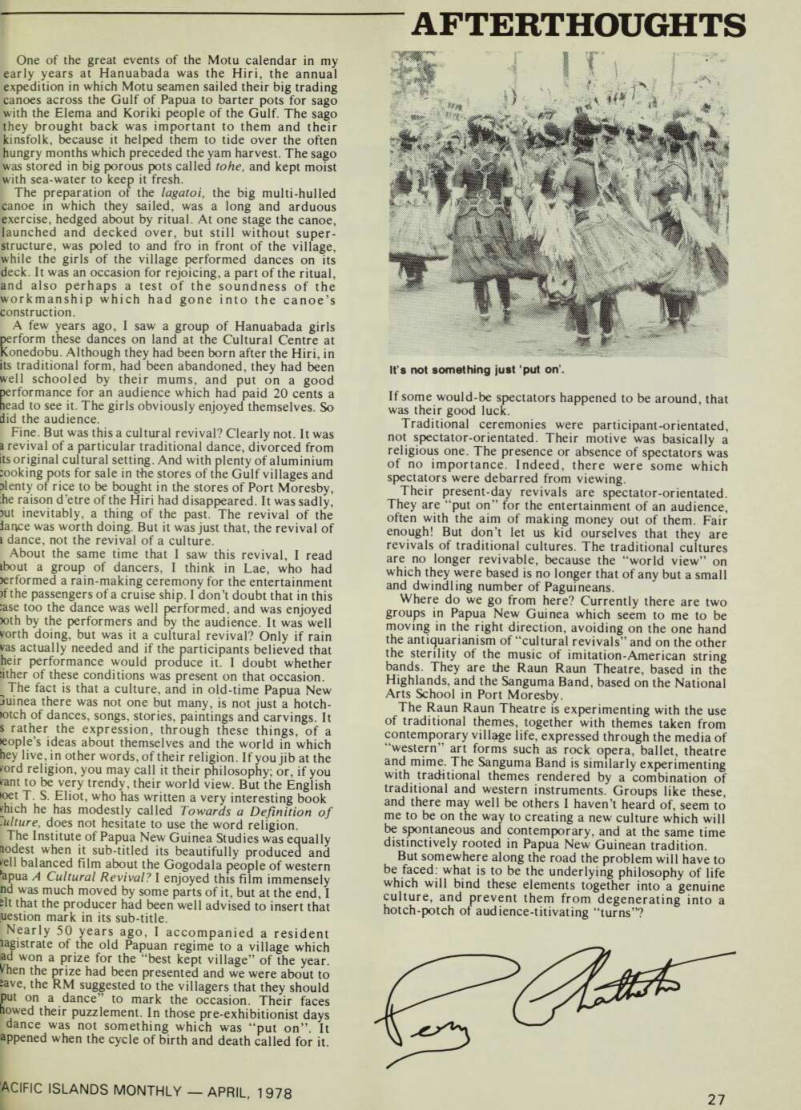
One of the great events of the Motu calendar in my early years at Hanuabada was the Hiri, the annual expedition in which Motu seamen sailed their big trading canoes across the Gulf of Papua to barter pots for sago with the Elema and Koriki people of the Gulf. The sago they brought back was important to them and their kinsfolk, because it helped them to tide over the often hungry months which preceded the yam harvest. The sago was stored in big porous pots called tohe, and kept moist with sea-water to keep it fresh.
The preparation of the lagatoi, the big multi-hulled canoe in which they sailed, was a long and arduous exercise, hedged about by ritual. At one stage the canoe, launched and decked over, but still without super structure, was poled to and fro in front of the village, while the girls of the village performed dances on its deck. It was an occasion for rejoicing, a part of the ritual, and also perhaps a test of the soundness of the workmanship which had gone into the canoe’s construction.
A few years ago, I saw a group of Hanuabada girls perform these dances on land at the Cultural Centre at Konedobu. Although they had been born after the Hiri, in its traditional form, had been abandoned, they had been well schooled by their mums, and put on a good performance for an audience which had paid 20 cents a head to see it. The girls obviously enjoyed themselves. So did the audience.
Fine. But was this a cultural revival? Clearly not. It was a revival of a particular traditional dance, divorced from its original cultural setting. And with plenty of aluminium looking pots for sale in the stores of the Gulf villages and plenty of rice to be bought in the stores of Port Moresby, he raison d’etre of the Hiri had disappeared. It was sadly, aut inevitably, a thing of the past. The revival of the lance was worth doing. But it was just that, the revival of i dance, not the revival of a culture.
About the same time that I saw this revival, I read ibout a group of dancers, I think in Lae, who had jerformed a rain-making ceremony for the entertainment )f the passengers of a cruise ship. I don’t doubt that in this ;ase too the dance was well performed, and was enjoyed x)th by the performers and by the audience. It was well vorth doing, but was it a cultural revival? Only if rain vas actually needed and if the participants believed that heir performance would produce it. I doubt whether sither of these conditions was present on that occasion.
I The fact is that a culture, and in old-time Papua New juinea there was not one but many, is not just a hotch- K)tch of dances, songs, stories, paintings and carvings. It s rather the expression, through these things, of a (eople’s ideas about themselves and the world in which hey live, in other words, of their religion. If you jib at the K>rd religion, you may call it their philosophy; or, if you rant to be very trendy, their world view. But the English >oet T. S. Eliot, who has written a very interesting book diich he has modestly called Towards a Definition of Mlture, does not hesitate to use the word religion.
The Institute of Papua New Guinea Studies was equally aodest when it sub-titled its beautifully produced and rcll balanced film about the Gogodala people of western *apua A Cultural Revival? I enjoyed this film immensely nd was much moved by some parts of it, but at the end, I sit that the producer had been well advised to insert that [uestion mark in its sub-title.
Nearly 50 years ago, I accompanied a resident magistrate of the old Papuan regime to a village which ad won a prize for the “best kept village” of the year, vhen the prize had been presented and we were about to save, the RM suggested to the villagers that they should put on a dance” to mark the occasion. Their faces bowed their puzzlement. In those pre-exhibitionist days dance was not something which was “put on”. It appened when the cycle of birth and death called for it.
If some would-be spectators happened to be around, that was their good luck.
Traditional ceremonies were participant-orientated, not spectator-orientated. Their motive was basically a religious one. The presence or absence of spectators was of no importance. Indeed, there were some which spectators were debarred from viewing.
Their present-day revivals are spectator-orientated.
They are “put on” for the entertainment of an audience, often with the aim of making money out of them. Fair enough! But don’t let us kid ourselves that they are revivals of traditional cultures. The traditional cultures are no longer revivable, because the “world view” on which they were based is no longer that of any but a small and dwindling number of Paguineans.
Where do we go from here? Currently there are two groups in Papua New Guinea which seem to me to be moving in the right direction, avoiding on the one hand the antiquarianism of “cultural revivals” and on the other the sterility of the music of imitation-American string bands. They are the Raun Raun Theatre, based in the Highlands, and the Sanguma Band, based on the National Arts School in Port Moresby.
The Raun Raun Theatre is experimenting with the use of traditional themes, together with themes taken from contemporary village life, expressed through the media of “western” art forms such as rock opera, ballet, theatre and mime. The Sanguma Band is similarly experimenting with traditional themes rendered by a combination of traditional and western instruments. Groups like these, and there may well be others I haven’t heard of, seem to me to be on the way to creating a new culture which will be spontaneous and contemporary, and at the same time distinctively rooted in Papua New Guinean tradition.
But somewhere along the road the problem will have to be faced: what is to be the underlying philosophy of life which will bind these elements together into a genuine culture, and prevent them from degenerating into a
hotch-potch of audience-titivating “turns”?
It’s not something just put on’.
Advertisements & other items, pp. 27-28 (2 items)
27
ACIFIC ISLANDS MONTHLY APRIL, 1978
Appucat
I m r I
■ * ■■Ml , t . * * * * V> ■MM*' ««* • Mil * Chloride is the largest and only manufacturer of both lead acid and nickel cadmium alkaline batteries in Australia.
The Company is equipped and qualified to offer advice, guidance and service on any battery requirement no matter how large or small.
On the question of size, it could be as small as a battery for a hearing aid the dimensions of a coat button or a power station battery weighing as much as 40 tonnes.
Again it could be a no break D.C. Power System for a computer or emergency lighting for a hospital.
The Chloride Company operates in 40 countries throughout the world, and when you consider that in Australia alone its production is approaching 1% million batteries per year, it gives some idea of the far reaching role that batteries play in our lives. selection of Chloride Automotive and Industrial Batteries.
Chloride Batteries Australia Limited
P.O. Box 141 Bankstown. IM.S.W. 2200. Australia. Telephone; 77 0177. Telex; 21262
Currents
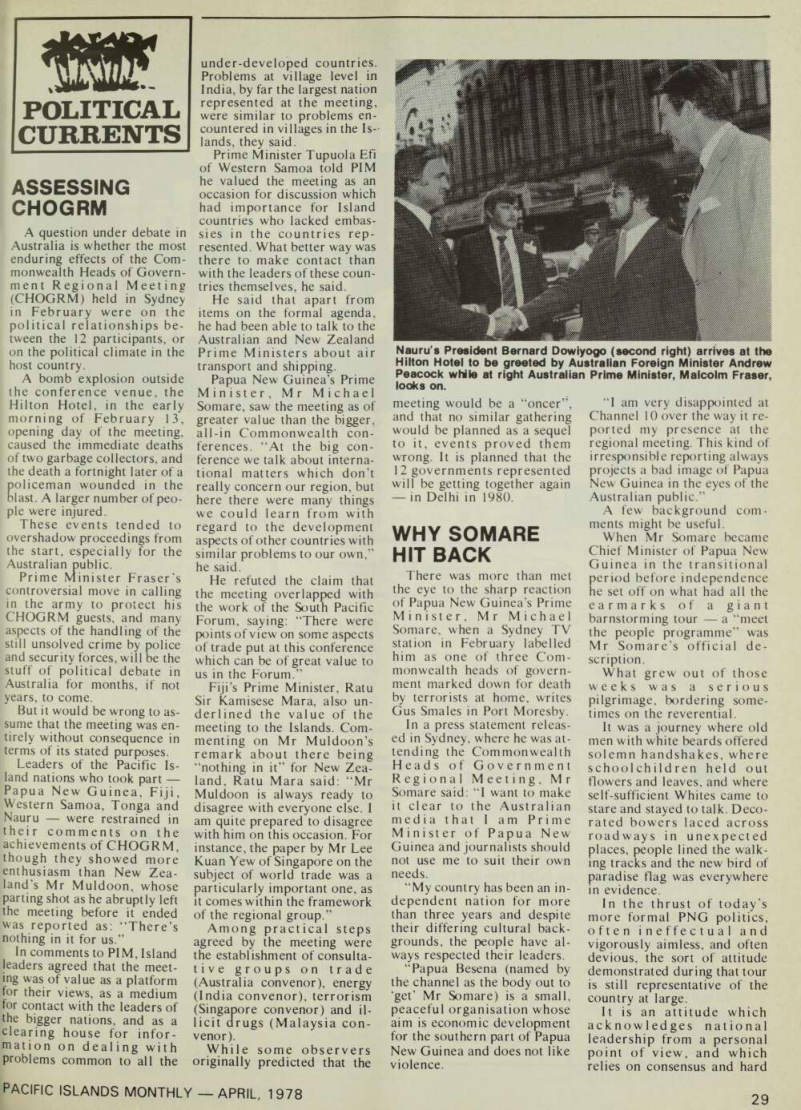

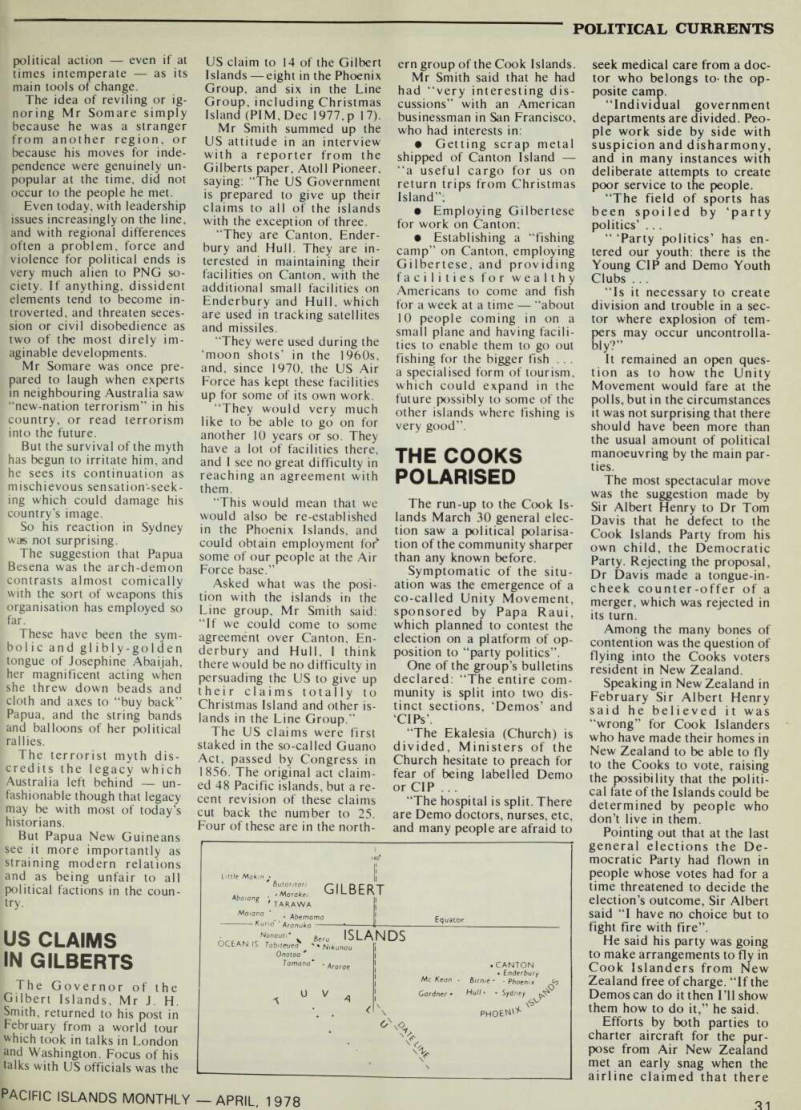
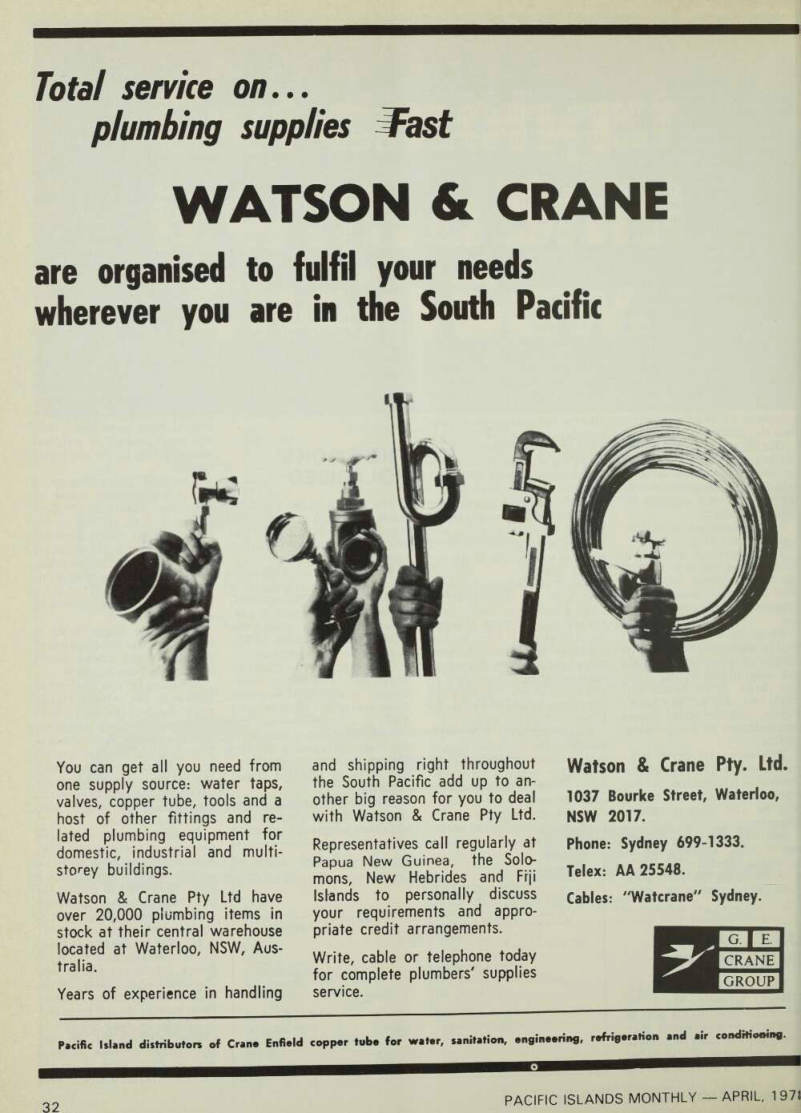
Political
under-developed countries.
Problems at village level in India, by far the largest nation represented at the meeting, were similar to problems en countered in villages in the Is lands, they said.
Prime Minister Tupuola Efi of Western Samoa told PIM he valued the meeting as an occasion for discussion which had importance for Island countries who lacked embas sies in the countries rep resented. What better way was there to make contact than with the leaders of these coun tries themselves, he said.
He said that apart from items on the formal agenda, he had been able to talk to the Australian and New Zealand Prime Ministers about air transport and shipping.
Papua New Guinea’s Prime Minister, Mr Michael Somare, saw the meeting as of greater value than the bigger, all-in Commonwealth con ferences. “At the big con ference we talk about interna tional matters which don’t really concern our region, but here there were many things we could learn from with regard to the development aspects of other countries with similar problems to our own,” he said.
He refuted the claim that the meeting overlapped with the work of the South Pacific Forum, saying: “There were points of view on some aspects of trade put at this conference which can be of great value to us in the Forum.”
Fiji’s Prime Minister, Ratu Sir Kamisese Mara, also un derlined the value of the meeting to the Islands. Com menting on Mr Muldoon’s remark about there being “nothing in it” for New Zea land, Ratu Mara said: “Mr Muldoon is always ready to disagree with everyone else. I am quite prepared to disagree with him on this occasion. For instance, the paper by Mr Lee Kuan Yew of Singapore on the subject of world trade was a
particularly important one, as
it comes within the framework of the regional group.”
Among practical steps agreed by the meeting were the establishment of consulta tive groups on trade (Australia convenor), energy (India convenor), terrorism (Singapore convenor) and il licit drugs (Malaysia con venor).
While some observers originally predicted that the
Assessing
Chogrm
A question under debate in Australia is whether the most enduring effects of the Com monwealth Heads of Govern ment Regional Meeting (CHOGRM) held in Sydney in February were on the political relationships be tween the 12 participants, or on the political climate in the host country.
A bomb explosion outside the conference venue, the Hilton Hotel, in the early morning of February 13, opening day of the meeting, caused the immediate deaths of two garbage collectors, and the death a fortnight later of a policeman wounded in the blast. A larger number of peo ple were injured.
These events tended to overshadow proceedings from the start, especially for the
Australian public.
Prime Minister Fraser’s controversial move in calling in the army to protect his CHOGRM guests, and many aspects of the handling of the still unsolved crime by police and security forces, will be the stuff of political debate in Australia for months, if not years, to come.
But it would be wrong to as sume that the meeting was en tirely without consequence in terms of its stated purposes.
Leaders of the Pacific Is land nations who took part
Papua New Guinea, Fiji,
Western Samoa, Tonga and Nauru were restrained in their comments on the achievements of CHOGRM,
though they showed more
enthusiasm than New Zea land’s Mr Muldoon, whose parting shot as he abruptly left the meeting before it ended was reported as: “There’s nothing in it for us.”
In comments to PIM, Island leaders agreed that the meet ing was of value as a platform for their views, as a medium for contact with the leaders of the bigger nations, and as a clearing house for infor mation on dealing with problems common to all the
meeting would be a “oncer”, and that no similar gathering would be planned as a sequel to it, events proved them wrong. It is planned that the 12 governments represented will be getting together again in Delhi in 1980.
Why Somare
Hit Back
There was more than met the eye to the sharp reaction of Papua New Guinea’s Prime Minister, Mr Michael Somare, when a Sydney TV station in February labelled him as one of three Com monwealth heads of govern ment marked down for death by terrorists at home, writes Gus Smales in Port Moresby.
In a press statement releas ed in Sydney, where he was at tending the Commonwealth Heads of Government Regional Meeting, Mr Somare said; “I want to make it clear to the Australian media that I am Prime Minister of Papua New Guinea and journalists should not use me to suit their own needs.
“My country has been an in dependent nation for more than three years and despite their differing cultural back grounds, the people have al ways respected their leaders.
“Papua Besena (named by the channel as the body out to ‘get’ Mr Somare) is a small, peaceful organisation whose aim is economic development for the southern part of Papua New Guinea and does not like violence.
“I am very disappointed at Channel 10 over the way it re ported my presence at the regional meeting. This kind of irresponsible reporting always projects a bad image of Papua New Guinea in the eyes of the
Australian public.”
A few background com ments might be useful.
When Mr Somare became Chief Minister of Papua New Guinea in the transitional period before independence he set off on what had all the earmarks of a giant barnstorming tour —a “meet the people programme” was Mr Somare’s official de
scription.
What grew out of those weeks was a serious pilgrimage, bordering some times on the reverential.
It was a journey where old men with white beards offered solemn handshakes, where schoolchildren held out flowers and leaves, and where self-sufficient Whites came to stare and stayed to talk. Deco rated bowers laced across roadways in unexpected places, people lined the walk ing tracks and the new bird of paradise flag was everywhere in evidence.
In the thrust of today’s more formal PNG politics, often ineffectual and vigorously aimless, and often devious, the sort of attitude demonstrated during that tour is still representative of the country at large.
It is an attitude which
acknowledges national
leadership from a personal point of view, and which relies on consensus and hard
Nauru’s President Bernard Dowlyogo (second right) arrives at the Hilton Hotel to be greeted by Australian Foreign Minister Andrew Peacock while at right Australian Prime Minister, Malcolm Fraser, looks on.
political action even if at times intemperate as its main tools of change.
The idea of reviling or ig noring Mr Somare simply because he was a stranger from another region, or because his moves for inde pendence were genuinely un popular at the time, did not occur to the people he met.
Even today, with leadership issues increasingly on the line, and with regional differences often a problem, force and violence for political ends is very much alien to PNG so ciety. If anything, dissident elements tend to become in troverted, and threaten seces sion or civil disobedience as two of the most direly im aginable developments.
Mr Somare was once pre pared to laugh when experts in neighbouring Australia saw “new-nation terrorism” in his country, or read terrorism into the future.
But the survival of the myth has begun to irritate him, and he sees its continuation as mischievous sensation-seek ing which could damage his country’s image.
So his reaction in Sydney was not surprising.
The suggestion that Papua Besena was the arch-demon contrasts almost comically with the sort of weapons this organisation has employed so far.
These have been the sym bol ic and glibly-golden tongue of Josephine Abaijah, her magnificent acting when she threw down beads and cloth and axes to “buy back”
Papua, and the string bands and balloons of her political rallies.
The terrorist myth dis credits the legacy which Australia left behind un fashionable though that legacy may be with most of today’s historians.
But Papua New Guineans see it more importantly as straining modern relations and as being unfair to all political factions in the coun try.
Us Claims
In Gilberts
The Governor of the Gilbert Islands, Mr J. H.
Smith, returned to his post in February from a world tour which took in talks in London and Washington. Focus of his talks with US officials was the
US claim to 14 of the Gilbert Islands— eight in the Phoenix Group, and six in the Line Group, including Christmas Island (PIM, Dec 1977, p 17).
Mr Smith summed up the US attitude in an interview with a reporter from the Gilberts paper. Atoll Pioneer, saying: “The US Government is prepared to give up their claims to all of the islands with the exception of three, “They are Canton, Ender bury and Hull. They are in terested in maintaining their facilities on Canton, with the additional small facilities on Enderbury and Hull, which are used in tracking satellites and missiles, “They were used during the ‘moon shots’ in the 19605, and, since 1970. the US Air Force has kept these facilities U p for some of its own work, “They would very much like to be able to go on for another 10 years or so. They have a lot of facilities there, and I see no great difficulty in reaching an agreement with them.
“This would mean that we would also be re-established in the Phoenix Islands, and could obtain employment for* some of our people at the Air Force base.”
Asked what was the posi tion with the islands in the Line group, Mr Smith said: “If we could come to some agreement over Canton, En derbury and Hull, I think there would be no difficulty in persuading the US to give up their claims totally to Christmas Island and other is lands in the Line Group.”
The US claims were first staked in the so-called Guano Act, passed by Congress in 1856. The original act claim ed 48 Pacific islands, but a re cent revision of these claims cut back the number to 25.
Four of these are in the north
ern group of the Cook Islands.
Mr Smith said that he had had “very interesting dis cussions” with an American businessman in San Francisco, who had interests in: • Getting scrap metal shipped of Canton Island “a useful cargo for us on return trips from Christmas Island”; • Employing Gilbertese for work on Canton; • Establishing a “fishing camp” on Canton, employing Gilbertese, and providing facilities for wealthy Americans to come and fish for a week at a time “about 10 people coming in on a small plane and having facili ties to enable them to go out fishing for the bigger fish . . . a specialised form of tourism, which could expand in the future possibly to some of the other islands where fishing is very good”.
The Cooks
Polarised
The run-up to the Cook Is lands March 30 general elec tion saw a political polarisa tion of the community sharper than any known before.
Symptomatic of the situ ation was the emergence of a co-called Unity Movement, sponsored by Papa Raui, which planned to contest the election on a platform of op position to “party politics”.
One of the group’s bulletins declared: “The entire com munity is split into two dis tinct sections, ‘Demos’ and ClPs’.
“The Ekalesia (Church) is divided, Ministers of the Church hesitate to preach for fear of being labelled Demo or CIP . .
“The hospital is split. There are Demo doctors, nurses, etc, and many people are afraid to
seek medical care from a doc tor who belongs to- the op posite camp.
“Individual government departments are divided. Peo ple work side by side with suspicion and disharmony, and in many instances with deliberate attempts to create poor service to the people.
“The field of sports has been spoiled by ‘party politics’ ...
“ ‘Party politics’ has en tered our youth: there is the Young CIP and Demo Youth Clubs . . .
“Is it necessary to create division and trouble in a sec tor where explosion of tem pers may occur uncontrolla bly?”
It remained an open ques tion as to how the Unity Movement would fare at the polls, but in the circumstances it was not surprising that there should have been more than the usual amount of political manoeuvring by the main par ties.
The most spectacular move was the suggestion made by Sir Albert Henry to Dr Tom Davis that he defect to the Cook Islands Party from his own child, the Democratic Party. Rejecting the proposal, Dr Davis made a tongue-in cheek counter-offer of a merger, which was rejected in its turn.
Among the many bones of contention was the question of flying into the Cooks voters resident in New Zealand.
Speaking in New Zealand in February Sir Albert Henry said he believed it was “wrong” for Cook Islanders who have made their homes in New Zealand to be able to fly to the Cooks to vote, raising the possibility that the politi cal fate of the Islands could be determined by people who don’t live in them.
Pointing out that at the last general elections the De mocratic Party had flown in people whose votes had for a time threatened to decide the election’s outcome, Sir Albert said “I have no choice but to fight fire with fire”.
He said his party was going to make arrangements to fly in Cook Islanders from New Zealand free of charge. “If the Demos can do it then I’ll show them how to do it,” he said.
Efforts by both parties to charter aircraft for the pur pose from Air New Zealand met an early snag when the airline claimed that there
were enough vacant seats on normal flights to accom modate intending voters, and that no special charter flights would be made.
One of the main reasons for Sir Albert’s New Zealand visit was to discuss with the New Zealand Government the matter of including the waters of the Cook Islands with those of New Zealand as a valuable package for nations seeking to fish their waters in these times of 200-mile exclusive econ omic zones. A successful out come to these talks could have been a big vote-catcher.
Although nations such as Holland had expressed in terest, early signs were that the highest bidder for the fish ing rights would be none other than the Soviet Union. The Cook Islands News com mented: “The question is: Whose boats will we see around our islands? Will it be the big red flag of communist Russia?”
Senate’S
Report Due
The Australian Senate’s Standing Committee on Foreign Affairs and Defence has completed its report on Australia and the South Pacific. It is expected to be made public in April, and to contain a number of new re commendations on the future direction of Australian policy in the region.
The committee received submissions and held hearings over a period of about 12 months. Submissions were re ceived from 50 individuals and organisations and the committee examined 24 wit nesses. They heard evidence from a number of Com monwealth Departments, from people involved in voluntary overseas assistance programmes, health services, education and business.
It was the first major inqu iry of its kind completed by the Australian Parliament. It was also the most extensive public inquiry ever held in Australia on relations with the South Pacific. It could therefore have a significant impact on the future direction of Australian policy in the region and on Australia’s relations with the South Pacific.
The chairman of the com mittee, Senator Sim (Lib,
WA), said recently that the committee took as its starting point the fact that Australia is now moving into a new era in its relations with the South Pacific. Senator Sim pointed out that since 1960 10 coun tries in the region have gained independence or self-govern ment, and that this required significant changes in Australia’s approach to the region.
At the same time, the new nations of the South Pacific have begun to widen their diplomatic, political, econ omic and commercial horizons and are participating in an increasing number of in ternational organisations.
In a recent edition of PIM (Jan, p 14), a member of the committee, Senator Knight (Lib, ACT), pointed out that new factors, such as proposals for a new international econ omic order and a changing emphasis towards social and economic issues amongst the ANZUS partners, have sug gested changing attitudes on the part of Australia.
Another member of the committee. Senator Mclntosh (Lab, WA), said at a recent meeting in Tasmania that the committee would proceed to an inquiry on the implications for Australia of the proposed “new international economic order’’, indicating that the committee itself is well aware of the implications of these new ideas and proposals often now being assertively put forward by developing countries. (It has since been confirmed in the Australian Senate by Senator Sim that the committee will inquire into “the implications for Australia’s foreign policy and national security of proposals for a new international econ omic order’’.) It therefore seems likely that the committee will re commend increasing attention by Australia to such interna tional developments, giving special attention to their relevance to the South Pacific and Australia’s role with those countries.
One of the areas where it has seemed that Australia could take more positive ac tion is in assistance with trad ing efforts of South Pacific countries and the committee gave some attention to this in its hearings. If they follow a good deal of the evidence pre sented to them, they will re commend that Australia co
operate more effectively and extensively in assisting its South Pacific neighbours in their trading efforts on im portant issues such as, for ex ample, marketing, quarantine and tariffs.
The committee also gave a good deal of attention to the immigration question and they might well make some re commendations as to more sensitive handling of migra tion and visa matters relating to citizens of South Pacific countries.
While Australia can now argue that its policy is non discriminatory there is, nevertheless, a lot to be de sired about the handling of many individual cases of South Pacific Islanders. The vexed question of a “guest worker’’ scheme in Australia might well be avoided by the committee, but it is to be hoped that they do not dismiss it altogether. Asked about this, the chairman of the com mittee, Senator Sim, said re cently that the committee had directed its attention to the issue and might well make some recommendations as to how Australia should ap proach it in future.
In recent years, Australia has extended its diplomatic representation in the South Pacific, probably more than in any other area. Senator Sim has made it clear that he, and it seems other members of the committee, believe that Australia should be giving in creasing attention to diplomatic and political rela tionships as well as social and cultural issues, to balance the traditional economic/com mercial orientation of Australia’s role in the South Pacific. On this basis the com mittee seems likely to support the continuing consolidation of Australia’s representation throughout the region, and it may well urge continuing or increasing high-level ministerial contacts.
Throughout its hearings, the committee took con siderable interest in Australia’s development as sistance programme in the region, while generally giving the impression that it is now believed the level of as sistance is commensurate with Australia’s responsibilities in the region. Members of the committee frequently showed interest in possible new areas for development assistance, or
new angles of approach. This is consistent with the attitude more recently taken by the Australia Development As sistance Bureau but in its re commendations, the com mittee could look to possible new avenues of development assistance.
With the evidence received by the committee and the acknowledgement by its chairman of new trends in the development of Australia’s relationships with its South Pacific neighbours, it seems the committee is likely to generally endorse those trends and perhaps suggest some measures to consolidate and extend them. That in it self would be a useful con tribution.
Tokelauans
Look Ahead
Tokelau’s relations with New Zealand have been dis cussed during a three-day general fono in Fakaofo.
The territory was once ad ministered as part of the Gilbert and Ellice Islands Colony, but has been under New Zealand administration for 52 years.
In June, 1976, at the time of the United Nations mission to Tokelau, the general fono ex pressed a desire to maintain a close link with New Zealand, while at the same time taking on an increasing re sponsibility for decisions affecting the territory’s econ omic and social development and the welfare of the people.
It was to meet this request that New Zealand has taken steps to strengthen the Tokelau public service over the last two years. The reorganisation of the public service has now been com pleted and new positions have been added increasing the permanent staff from 100 to 143. The main change in volves the establishment of public works teams on each of the three atolls to carry out building construction and maintenance, as well as boat repairs and mechanical work.
The Tokelauans are also looking outward to other Pacific nations to learn more about their experiences in
self-government, particularly
Niue and Tuvalu. The Pre mier of Niue, Mr Robert Rex, has been invited to Tokelau this year.
Advertisements & other items, pp. 30-32 (1 item)
Get amongst
it with a Stihl
Chain Saw.
5 aa
SJjJvL
STIHL OSS
The really professional saw for the farmer or contractor to get amongst heavy timber. Plus, a variety of power tools - Earth augers; Cutquik; Brushcutter; etc - to simply attach to your OSS power head (56 c.c.) Weight: 7-9 Kgs.
Bar lengths: 35, 43, 53cms.
STIHL
Q 0
STIHL 051 AV (Anti - Vibration)
Easy to handle with plenty of power. Fitted with electronic ignition and safety hand guard. Weighs 10.5 kgs; 89cc power unit. Bar lengths 43, 53,
63, 75, 90cms.
For further information on these models or any of the Stihl range contact the Stihl Distributor in your area.
STIHL
PAPUA NEW GUINEA
BOUGAINVILLE.
Morgan Equipment Pty. Ltd.
P.O. Box 252, Arawa.
RABAUL
Morgan Equipment Pty.
P.O. Box 1234.
Ltd
LAE
Morgan Equipment Pty. Ltd.
P.O. Box 1729.
FIJI
SUVA
Coral Island Motors, P.O. Box 48, Walu Bay.
BOROKO
Morgan Equipment Pty. Ltd.
P.O. Box 5243.
NEW ZEALAND
WELLINGTON
C.M. Malfroy & Co.
P.O. Box 1031.
Ltd.
SOLOMON ISLAND
HONIARA
Foxwood (8.5.1. Timbers) Ltd., P.O. Box 8.
NEW HEBRIDES
PORT VILA
Roy Gallimore & Associates, P.O. Box 179.
NORFOLK ISLAND
Cameralines Limited, P.O. Box 29.
AUSTRALIA
Stihl Chain Saw (Aust) Pty. Ltd., 41 Barry St., Bayswater. Victoria.
SC7O
Total service 0n...
plumbing supplies
WATSON & CRANE
are organised to fulfil your needs
wherever you are in the South Pacific m You can get all you need from one supply source: water taps, valves, copper tube, tools and a host of other fittings and related plumbing equipment for domestic, industrial and multistorey buildings.
Watson & Crane Pty Ltd have over 20,000 plumbing items in stock at their central warehouse located at Waterloo, NSW, Australia.
Years of experience in handling and shipping right throughout the South Pacific add up to another big reason for you to deal with Watson & Crane Pty Ltd.
Representatives call regularly at Papua New Guinea, the Solomons, New Hebrides and F'rji Islands to personally discuss your requirements and appropriate credit arrangements.
Write, cable or telephone today for complete plumbers' supplies service.
Watson & Crane Pty. Ltd, 1037 Bourke Street, Waterloo,
NSW 2017.
Phone: Sydney 699-1333.
Telex: AA 25548.
Cables: "Watcrane" Sydney.
Pacific Island distributors of Cran. Enfi.ld coppor tub. for waf.r, sanitation, .ngin..ring, refri 9 .r.ti08 and air conditioning.
People
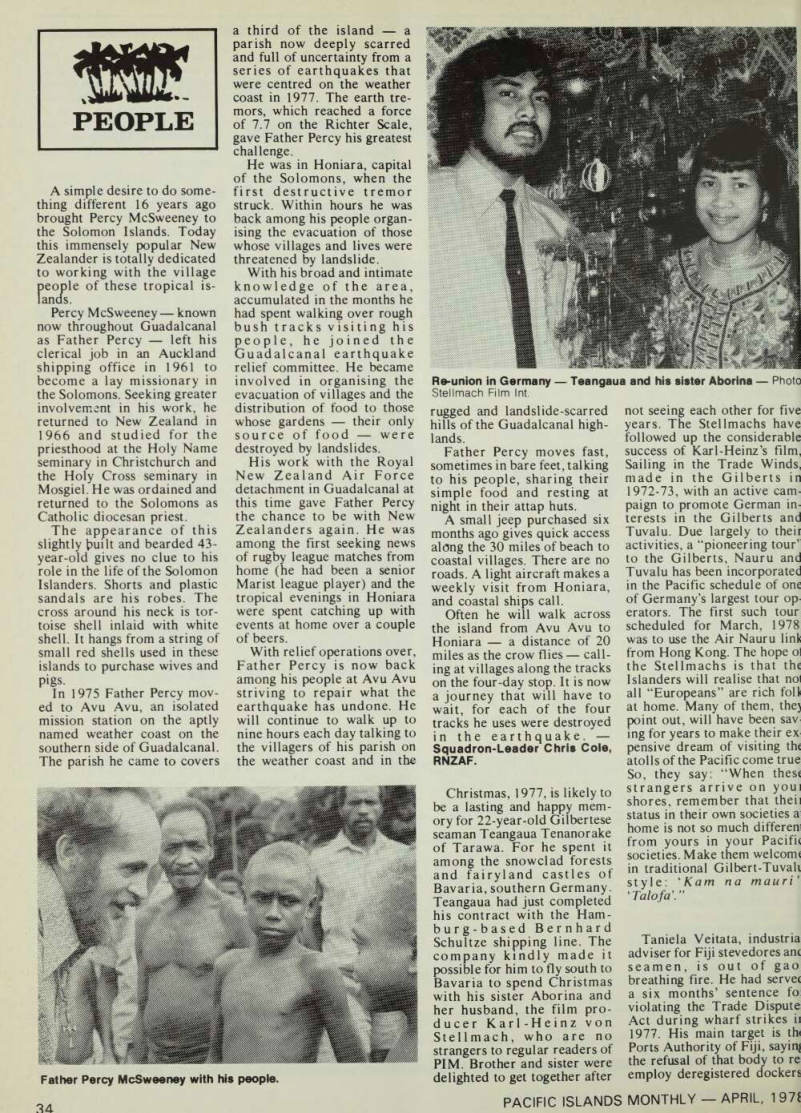
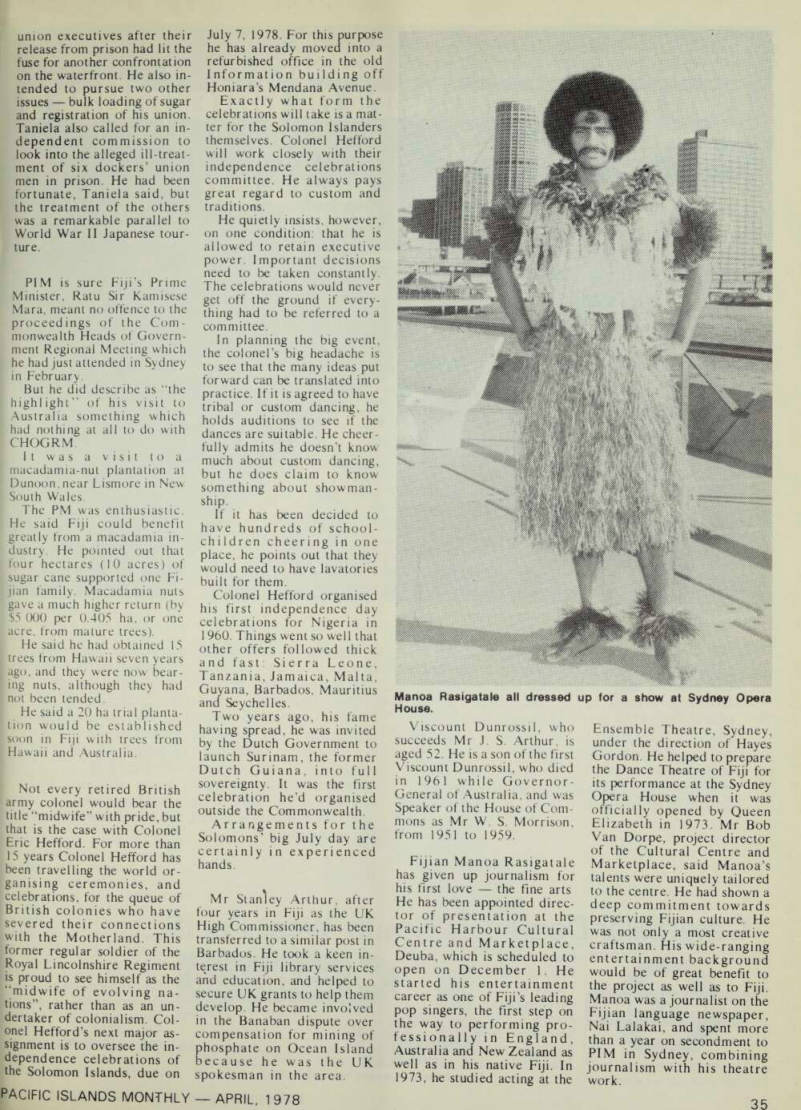
A simple desire to do some thing different 16 years ago brought Percy McSweeney to the Solomon Islands. Today this immensely popular New Zealander is totally dedicated to working with the village people of these tropical is lands.
Percy McSweeney— known now throughout Guadalcanal as Father Percy left his clerical job in an Auckland shipping office in 1961 to become a lay missionary in the Solomons. Seeking greater involvement in his work, he returned to New Zealand in 1966 and studied for the priesthood at the Holy Name seminary in Christchurch and the Holy Cross seminary in Mosgiel. He was ordained and returned to the Solomons as Catholic diocesan priest.
The appearance of this slightly built and bearded 43year-old gives no clue to his role in the life of the Solomon Islanders. Shorts and plastic sandals are his robes. The cross around his neck is tor toise shell inlaid with white shell. It hangs from a string of small red shells used in these islands to purchase wives and pigs.
In 1975 Father Percy mov ed to Avu Avu, an isolated mission station on the aptly named weather coast on the southern side of Guadalcanal.
The parish he came to covers
a third of the island a
parish now deeply scarred
and full of uncertainty from a series of earthquakes that were centred on the weather coast in 1977. The earth tre mors, which reached a force of 7.7 on the Richter Scale, gave Father Percy his greatest challenge.
He was in Honiara, capital of the Solomons, when the first destructive tremor struck. Within hours he was back among his people organ ising the evacuation of those whose villages and lives were threatened by landslide.
With his broad and intimate knowledge of the area, accumulated in the months he had spent walking over rough bush tracks visiting his people, he joined the Guadalcanal earthquake relief committee. He became involved in organising the evacuation of villages and the distribution of food to those whose gardens their only source of food were
destroyed by landslides.
His work with the Royal New Zealand Air Force detachment in Guadalcanal at this time gave Father Percy the chance to be with New Zealanders again. He was among the first seeking news of rugby league matches from home (he had been a senior Marist league player) and the tropical evenings in Honiara were spent catching up with events at home over a couple of beers.
With relief operations over, Father Percy is now back among his people at Avu Avu striving to repair what the earthquake has undone. He will continue to walk up to nine hours each day talking to the villagers of his parish on the weather coast and in the
rugged and landslide-scarred hills of the Guadalcanal high lands.
Father Percy moves fast, sometimes in bare feet, talking to his people, sharing their simple food and resting at night in their attap huts.
A small jeep purchased six months ago gives quick access along the 30 miles of beach to coastal villages. There are no roads. A light aircraft makes a weekly visit from Honiara, and coastal ships call.
Often he will walk across the island from Avu Avu to Honiara a distance of 20 miles as the crow flies— call ing at villages along the tracks on the four-day stop. It is now a journey that will have to wait, for each of the four tracks he uses were destroyed in the earthquake.
Squadron-Leader Chris Cole,
Rnzaf.
Christmas, 1977, is likely to be a lasting and happy mem ory for 22-year-old Gilbertese seaman Teangaua Tenanorake of Tarawa. For he spent it among the snowclad forests and fairyland castles of Bavaria, southern Germany.
Teangaua had just completed his contract with the Ham burg-based Bernhard Schultze shipping line. The company kindly made it possible for him to fly south to Bavaria to spend Christmas with his sister Aborina and her husband, the film pro ducer Karl-Heinz von Stellmach, who are no strangers to regular readers of PIM. Brother and sister were delighted to get together after
not seeing each other for five years. The Stellmachs have followed up the considerable success of Karl-Heinz’s film, Sailing in the Trade Winds, made in the Gilberts in 1972-73, with an active cam paign to promote German in terests in the Gilberts and Tuvalu. Due largely to their activities, a “pioneering tour’ to the Gilberts, Nauru and Tuvalu has been incorporated in the Pacific schedule of one of Germany’s largest tour op erators. The first such tour scheduled for March, 1978 was to use the Air Nauru link from Hong Kong. The hope ol the Stellmachs is that the Islanders will realise that nol all “Europeans” are rich folk at home. Many of them, the) point out, will have been sav ing for years to make their ex pensive dream of visiting the atolls of the Pacific come true So, they say; “When these strangers arrive on youi shores, remember that theii status in their own societies ai home is not so much different from yours in your Pacific societies. Make them welcome in traditional Gilbert-Tuvah style: ‘ Karri n a mauri’ ‘Talofa Taniela Veitata, industria adviser for Fiji stevedores anc seamen, is out of gao breathing fire. He had servec a six months’ sentence fo: violating the Trade Dispute Act during wharf strikes ii 1977. His main target is th« Ports Authority of Fiji, saying the refusal of that body to re employ deregistered dockers
Father Percy McSweeney with his people.
Re-union in Germany Teangaua and his sister Aborina- Photo Stellmach Film Int.
union executives after their release from prison had lit the fuse for another confrontation on the waterfront. He also in tended to pursue two other issues bulk loading of sugar and registration of his union.
Taniela also called for an in dependent commission to look into the alleged ill-treat ment of six dockers’ union men in prison. He had been fortunate, Taniela said, but the treatment of the others was a remarkable parallel to World War II Japanese tour ture.
PIM is sure Fiji’s Prime Minister, Ratu Sir Kamisese Mara, meant no offence to the proceedings of the Com monwealth Heads of Govern ment Regional Meeting which he had just attended in Sydney in February.
But he did describe as “the f highlight” of his visit to Australia something which had nothing at all to do with
I Chogrm
It was a visit to a macadamia-nut plantation at Dunoon,near Lismore in New South Wales.
The PM was enthusiastic.
He said Fiji could benefit greatly from a macadamia in dustry. He pointed out that i four hectares (10 acres) of sugar cane supported one Fi jian family. Macadamia nuts gave a much higher return (by $5 000 per 0.405 ha. or one i acre, from mature trees).
He said he had obtained 15 ! trees from Hawaii seven years I ago, and they were now bear ing nuts, although they had not been tended.
He said a 20 ha trial planta tion would be established soon in Fiji with trees from Hawaii and Australia.
Not every retired British army colonel would bear the title “midwife” with pride, but that is the case with Colonel Eric Hefford. For more than 15 years Colonel Hefford has been travelling the world or ganising ceremonies, and celebrations, for the queue of British colonies who have severed their connections with the Motherland. This former regular soldier of the Royal Lincolnshire Regiment is proud to see himself as the ‘‘midwife of evolving na tions”, rather than as an un dertaker of colonialism. Col onel Hefford’s next major as signment is to oversee the in dependence celebrations of the Solomon Islands, due on
July 7, 1978. For this purpose he has already moved into a refurbished office in the old Information building off Honiara’s Mendana Avenue.
Exactly what form the celebrations will take is a mat ter for the Solomon Islanders themselves. Colonel Hefford will work closely with their
independence celebrations
committee. He always pays great regard to custom and traditions.
He quietly insists, however, on one condition: that he is allowed to retain executive power. Important decisions need to be taken constantly.
The celebrations would never gel off the ground if every thing had to be referred to a committee.
In planning the big event, the colonel’s big headache is to see that the many ideas put forward can be translated into practice. If it is agreed to have tribal or custom dancing, he holds auditions to see if the dances are suitable. He cheer fully admits he doesn’t know much about custom dancing, but he does claim to know something about showman ship.
If it has been decided to have hundreds of school children cheering in one place, he points out that they would need to have lavatories built for them.
Colonel Hefford organised his first independence day celebrations for Nigeria in 1960. Things went so well that other offers followed thick and fast: Sierra Leone, Tanzania, Jamaica, Malta, Guyana, Barbados, Mauritius and Seychelles.
Two years ago, his fame having spread, he was invited by the Dutch Government to launch Surinam, the former Dutch Guiana, into full sovereignty. It was the first celebration he’d organised outside the Commonwealth.
Arrangements for the Solomons’ big July day are
certainly in experienced
hands. % Mr Stanley Arthur, after four years in Fiji as the UK High Commissioner, has been transferred to a similar post in Barbados. He took a keen in terest in Fiji library services and education, and helped to secure UK grants to help them develop. He became involved in the Banaban dispute over compensation for mining of phosphate on Ocean Island because he was the UK spokesman in the area.
Viscount Dunrossil, who succeeds Mr J. S, Arthur, is aged 52. He is a son of the first Viscount Dunrossil, who died in 1961 while Governor- General of Australia, and was Speaker of the House of Com mons as Mr W. S. Morrison, from 1951 to 1959.
Fijian Manoa Rasigatale has given up journalism for his first love the fine arts He has been appointed direc tor of presentation at the Pacific Harbour Cultural Centre and Marketplace, Deuba, which is scheduled to open on December 1. He started his entertainment career as one of Fiji’s leading pop singers, the first step on the way to performing pro fessionally in England, Australia and New Zealand as well as in his native Fiji. In 1973, he studied acting at the
Ensemble Theatre, Sydney, under the direction of Hayes Gordon. He helped to prepare the Dance Theatre of Fiji for its performance at the Sydney Opera House when it was officially opened by Queen Elizabeth in 1973. Mr Bob Van Dorpe, project director of the Cultural Centre and Marketplace, said Manoa’s talents were uniquely tailored to the centre. He had shown a deep commitment towards preserving Fijian culture. He was not only a most creative craftsman. His wide-ranging entertainment background would be of great benefit to the project as well as to Fiji, Manoa was a journalist on the Fijian language newspaper Nai Lalakai, and spent more than a year on secondment to PIM in Sydney, combining journalism with his theatre work.
Manoa Rasigatale all dressed up for a show at Sydney Opera House.
Advertisements & other items, p. 36 (1 item)
carptrac
It's another step ahead towards more profitable, more efficient logging operations: Cat 528 Skidder with major improvements.
Now rear wheel caliper disc brakes increase service braking pad contact surface by 78%, thereby extending brake life. There are three master cylinders, one each for front, rear and driveline systems. All four wheel brakes engage first; additional pedal depression engages driveline brake.
Caterpillar 528 Winch has power control design to allow "winching on-the-go". Winch and skidder can be operated simultaneously.
Other features include oil disc clutch and brake to extend service life; complete sealing maintains rated capacity; winch brake accumulator allows load release from dead engine; adjustable free spool drag lets operator pull line uphill or down without cable balling. Other helpful features too!
Send for literature or talk to your Caterpillar representative.
Caterpillar Dealers in South-West Pacific.
Lae: Milford Haven Rd.
Phone 42 2355.
Port Moresby: Phone 21 2122.
Bougainville: Itakara Industrial Park, Arawa. Phone 95 9077. c
carptrac
Lautoka: Labasa: Veitari Lautoka Vulovi Labasa Phone 61877 Phone 81888 Suva: Carptrac Carpenter Street Raiwai Suva Phone 381622 Telex FJ2190 Cables CARPTRAC HD 657
At Amboin, On The Karawari, You
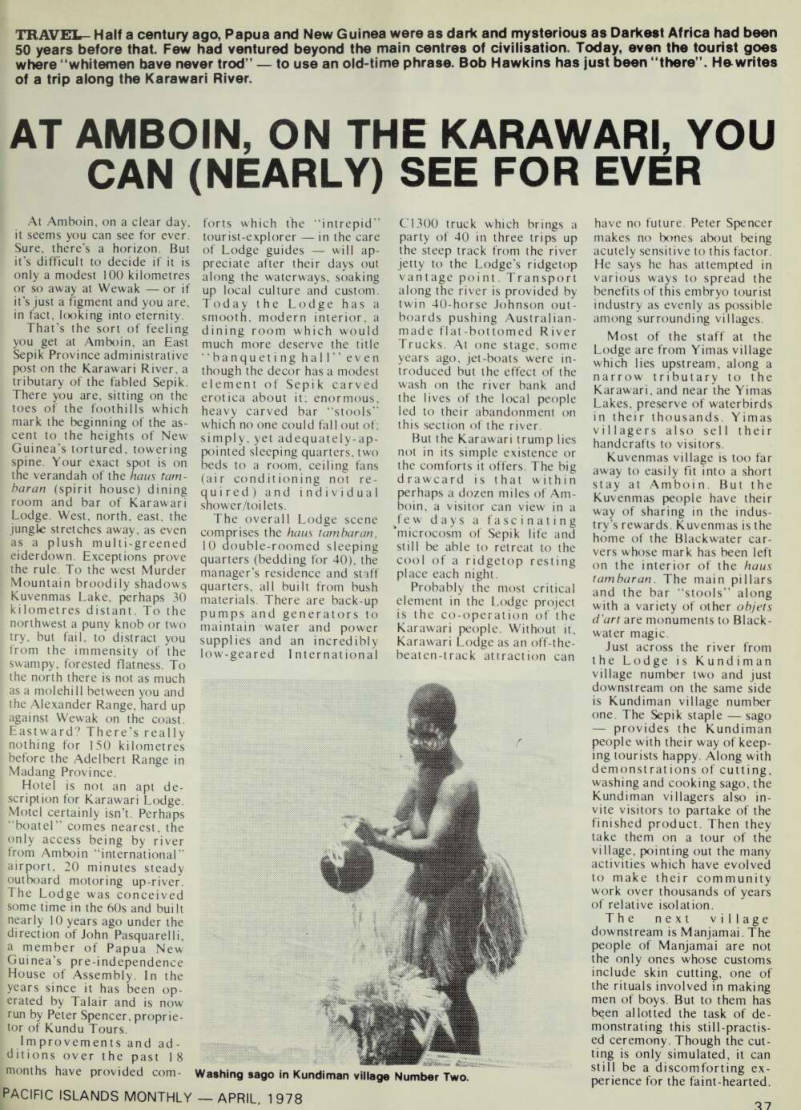

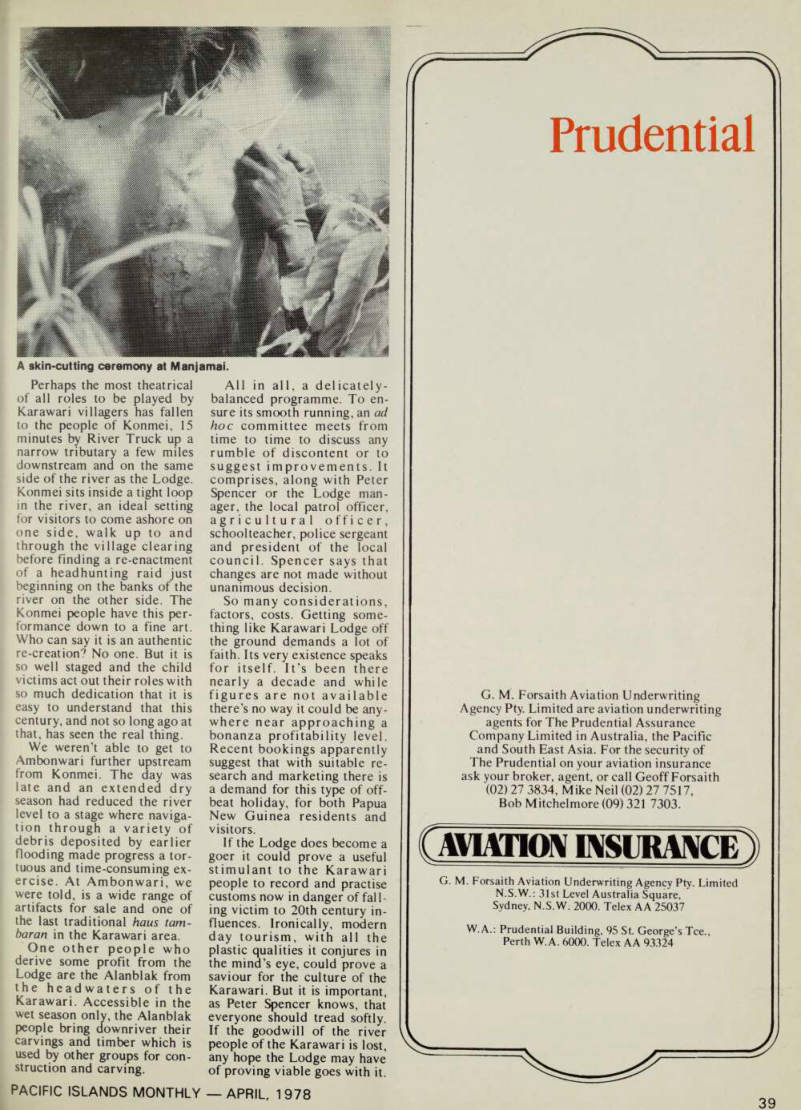
Can (Nearly) See For Ever
TRAVEL- Half a century ago, Papua and New Guinea were as dark and mysterious as Darkest Africa had been 50 years before that. Few had ventured beyond the main centres of civilisation. Today, even the tourist goes where “whitemen have never trod” to use an old-time phrase. Bob Hawkins has just been “there”. Hewrites of a trip along the Karawari River.
At Amboin, on a clear day, it seems you can see for ever.
Sure, there's a horizon. But it’s difficult to decide if it is only a modest 100 kilometres or so away at Wewak or if it's just a figment and you are, in fact, looking into eternity.
That’s the sort of feeling you get at Amboin, an East Sepik Province administrative post on the Karawari River, a tributary of the fabled Sepik.
There you are, sitting on the toes of the foothills which mark the beginning of the as cent to the heights of New Guinea's tortured, towering spine. Your exact spot is on the verandah of the haus tam baran (spirit house) dining room and bar of Karawari Lodge. West, north, east, the jungle stretches away, as even as a plush multi-greened eiderdown. Exceptions prove the rule. To the west Murder Mountain broodily shadows Kuvenmas Lake, perhaps 30 kilometres distant. To the northwest a puny knob or two try, but fail, to distract you from the immensity of the swampy, forested flatness. To the north there is not as much as a molehill between you and the Alexander Range, hard up against Wewak on the coast.
Eastward? There’s really
nothing for 150 kilometres before the Adelbert Range in
Madang Province.
Hotel is not an apt de scription for Karawari Lodge.
Motel certainly isn't. Perhaps
“boatel” comes nearest, the only access being by river from Amboin “international" airport, 20 minutes steady outboard motoring up-river.
The Lodge was conceived some time in the 60s and built nearly 10 years ago under the direction of John Pasquarelli, a member of Papua New
Guinea’s pre-independence
House of Assembly. In the years since it has been op erated by Talair and is now run by Peter Spencer, proprie tor of Kundu Tours.
Improvements and ad ditions over the past 1 8 months have provided com
forts which the “intrepid" tourist-explorer in the care of Lodge guides will ap preciate after their days out along the waterways, soaking up local culture and custom.
Today the Lodge has a smooth, modern interior, a dining room which would much more deserve the title ‘‘banqueting hall" even though the decor has a modest element of Sepik carved erotica about it. enormous, heavy carved bar “stools" which no one could fall out of; simply, yet adequately-ap pointed sleeping quarters, two beds to a room, ceiling fans (air conditioning not re quired) and individual shower/toilets.
The overall Lodge scene comprises the haus tamharan, 10 double-roomed sleeping quarters (bedding for 40), the manager's residence and staff quarters, all built from bush materials. There are back-up pumps and generators to maintain water and power supplies and an incredibly low-geared International
Cl3oo truck which brings a party of 40 in three trips up the steep track from the river jetty to the Lodge's ridgetop vantage point. Transport along the river is provided by twin 40-horse Johnson out boards pushing Australian made flat-bottomed River Trucks. At one stage, some years ago, jet-boats were in troduced but the effect of the wash on the river bank and the lives of the local people led to their abandonment on this section of the river.
But the Karawari trump lies not in its simple existence or the comforts it offers. The big drawcard is that within perhaps a dozen miles of Am boin, a visitor can view in a
days a fascinating
'microcosm of Sepik life and still be able to retreat to the cool of a ridgetop resting place each night.
Probably the most critical element in the Lodge project is the co-operation of the Karawari people. Without it, Karawari Lodge as an off-the bealen-track attraction can
have no future. Peter Spencer makes no bones about being acutely sensitive to this factor.
He says he has attempted in various ways to spread the benefits of this embryo tourist industry as evenly as possible among surrounding villages.
Most of the staff at the Lodge are from Yimas village which lies upstream, along a narrow tributary to the Karawari, and near the Yimas Lakes, preserve of waterbirds in their thousands. Yimas villagers also sell their handcrafts to visitors.
Kuvenmas village is too far away to easily fit into a short stay at Amboin. But the Kuvenmas people have their way of sharing in the indus try's rewards. Kuvenmas is the home of the Blackwater car vers whose mark has been left on the interior of the haus tamharan. The main pillars and the bar “stools" along with a variety of other objets ci'art are monuments to Black water magic.
Just across the river from the Lodge is Kundiman village number two and just downstream on the same side is Kundiman village number one. The Sepik staple sago provides the Kundiman people with their way of keep ing tourists happy. Along with demonstrations of cutting, washing and cooking sago, the Kundiman villagers also in vite visitors to partake of the finished product. Then they take them on a tour of the village, pointing out the many activities which have evolved to make their community work over thousands of years of relative isolation.
The next village downstream is Manjamai. The people of Manjamai are not the only ones whose customs include skin cutting, one of the rituals involved in making men of boys. But to them has been allotted the task of de
monstrating this still-practis
ed ceremony. Though the cut ting is only simulated, it can still be a discomforting ex perience for the faint-hearted.
Washing sago in Kundiman village Number Two.
Perhaps the most theatrical of all roles to be played by Karawari villagers has fallen to the people of Konmei, 15 minutes by River Truck up a narrow tributary a few miles downstream and on the same side of the river as the Lodge, Konmei sits inside a tight loop in the river, an ideal setting for visitors to come ashore on one side, walk up to and through the village clearing before finding a re-enactment of a headhunting raid just beginning on the banks of the river on the other side. The Konmei people have this performance down to a fine art.
Who can say it is an authentic re-creation? No one. But it is so well staged and the child victims act out their roles with so much dedication that it is easy to understand that this century, and not so long ago at that, has seen the real thing.
We weren’t able to get to Ambonwari further upstream from Konmei. The day was late and an extended dry season had reduced the river level to a stage where navigation through a variety of debris deposited by earlier flooding made progress a tortuous and time-consuming exercise. At Ambonwari, we were told, is a wide range of artifacts for sale and one of the last traditional haus tambaran in the Karawari area.
One other people who derive some profit from the Lodge are the Alanblak from the headwaters of the Karawari. Accessible in the wet season only, the Alanblak people bring downriver their carvings and timber which is used by other groups for construction and carving.
All in all, a delicately balanced programme. To en sure its smooth running, an ad hoc committee meets from time to time to discuss any rumble of discontent or to suggest improvements. It comprises, along with Peter Spencer or the Lodge man ager, the local patrol officer, agricultural officer, schoolteacher, police sergeant and president of the local council. Spencer says that changes are not made without unanimous decision.
So many considerations, factors, costs. Getting some thing like Karawari Lodge off the ground demands a lot of faith. Its very existence speaks for itself. It’s been there nearly a decade and while figures are not available there’s no way it could be any where near approaching a bonanza profitability level.
Recent bookings apparently suggest that with suitable re search and marketing there is a demand for this type of off beat holiday, for both Papua New Guinea residents and visitors.
If the Lodge does become a goer it could prove a useful stimulant to the Karawari people to record and practise customs now in danger of fall ing victim to 20th century in fluences. Ironically, modern day tourism, with all the plastic qualities it conjures in the mind’s eye, could prove a saviour for the culture of the Karawari. But it is important, as Peter Spencer knows, that everyone should tread softly.
If the goodwill of the river people of the Karawari is lost, any hope the Lodge may have of proving viable goes with it.
A skin-cutting ceremony at Manjamai.
Advertisements & other items, pp. 38-46 (2 items)
Turn moments
into memories
i
wsss^ 1
m c olO r qo£ poso^ rtP' C a c'N 20 e* pplK^ CO^ 'lO
FOP
*0
take your pictures
on Kodak film.
See your photo dealer now K6l-5076
Prudential
G. M. Forsaith Aviation Underwriting Agency Pty. Limited are aviation underwriting agents for The Prudential Assurance Company Limited in Australia, the Pacific and South East Asia. For the security of The Prudential on your aviation insurance ask your broker, agent, or call Geoff Forsaith (02) 27 3834, Mike Neil (02) 27 7517, Bob Mitchelmore (09) 321 7303.
C AVIATION INSURANCE 1
G. M. Forsaith Aviation Underwriting Agency Pty. Limited N.S.W.: 31st Level Australia Square, Sydney. N.S.W. 2000. Telex A A 25037 W. A.: Prudential Building, 95 St. George’s Tee., Perth W.A. 6000. Telex AA 93324
- 31 f
1 ' yv~m
is
PilS
m * r-
i®i»a
: !i I -
This page tells a lot about
Mazda technology.
Just a few of the searching tests a Mazda has to pass before it ever goes into production. Many more follow, both during manufacture and after. The result. Superior, highquality products. Cars like the Mazda 323. A car everyone’s talking about because of its versatile, economical
performance and stylish good looks.
And like all Mazdas, a car that you can own and drive with confidence.
Because Mazdas are made right.
Right from the beginning.
Sound Testing Laboratories Nobody likes noise. Least of all Mazda. That’s why we are working hard to make our cars quieter —from the outside and the inside. The car (right) is in our anechoic test chamber. Here the whole car is subjected to vibration through a machine that creates a variety of different shakes and thumps. Ultra-sensitive microphones pick up every sound made, then amplifies it for thorough analysis. This way we can get rid of excessive noise and vibration before they annoy you and your passengers.
The Climatic Testing Laboratories (top, far right) Here a range of driving conditions can be simulated, from stop-start city driving to sustained high-speed highway running.
The tests are conducted in a wide range of temperatures and under different atmospheric conditions. So you can be sure your Mazda will be expertly tuned to run smoothly in the country where you live.
Body Testing Laboratories(bottom.farnght)
This is one of the facilities that crash tests our car bodies. Impact and torsional effects can be accurately measured by computers simulating collisions at 30-60 m.p.h. Dummies electronically wired tell us what happens to passengers —and as a result —provide our design engineers with valuable information about the safest interiors and bodies. Tests such as these helped us to design the light, crash resistant, semi-monocoque body found on all Mazda passenger cars.
mazoa
Quality through superior technology ii - — , y r \ FIJI ISLS. Niranjans Autoport Ltd. G.P.O. Box 450. Suva TEL: 381555 NAURUTIm John P.O. Box 101 Nauru 7*1=471 NEW ZEALAND Mazda Motors of New Zealand Ltd. Otahuhu, Auckland P.O. Box 22-472 TEL. 69 099 PAPUA NEW GUINEA P.N.G. Associated Industries Ltd. P.O. Box 1394. Boroko TEL: 255788 NEW CALEDONIA Joseph Cheval & Cie 3, Rue Jean-Jaures, Noumea TEL: 731-01 NORFOLK ISL.Duncombe Bay Garage. P.O. Box 220, Norfolk Isl. TEL: 2097 „ . ... , D r.n™ on Honiara TFI • 113 SAIPAN Latte Motors Inc. P.O. Box 206. Saipan. Mariana Is.JEL: TAHITI Comptoir Polynesien B.P. 628. Papeete TEL: 2. 80. 27 The trademark MAZDA in this advertisement stands for AUTOMOBILES MAZDA far as France and her territories are concerned.
kT ■ Trojan tools dig it, scoop it, fork it, rake it, hoe it, chop it and you name it.
Trojan tools are designed for efficiency and made from materials tough enough to handle any job.
Shovels, scoops and spades: The whole range.
Scientifically designed, hardened and tempered for toughness, durability and resilience. Light and balanced to make light work in industry, on the farm or in the home garden.
Forks and drags: Every head is roll-forged from a single bar of special steel for extra strength and so that both head and tine are properly shaped and drawn to the correct taper for the job in hand.
Rakes, garden tools, hoes and cultivators: All scientifically designed with typical Trojan strength and efficiency built in. Made stronger to last longer.
Axes, hatchets, picks and mattocks: Axes for winning wood-chops, felling tall timber or just chopping wood at home. The Trojan/Hytest range has them all, from the famous Hytest Racing Axe right through.
Trojan, Australia’s leading manufacturer of garden and Agricultural tools. Stocked by all good hardware retailers.
C^TROJAN
AUSTRALIA
For further information contact: Trojan Pty. Ltd. Box 139, Footscray, Victoria, Australia 3011 Telephone 689 3377.
Telegrams and cables “Trojantools,” Melbourne
TJI6
PNG.
S O Svensson (N.G.) Ltd.
PO Box 705, Port Moresby Tel; 2275 New Hebrides (Islands) Burns Philp (New Hebrides) Co.. Ltd.
PO Box 27. Port Vila, New Hebrides Islands Fiji Islands Motibhai & Company Ltd P.O. Box 9175. Nadi International Airport Tel; 72-165 New Zealand Pye Ltd., Consumer Products Sector 110 Mt. Eden Rd.. Mt. Eden, Auckland Tel: 686-437
New Caledonia
Mdnard Freres Ville B P H 2. Noumea Tel; 275222 Tahiti
Etablissements Comimpex
PO Box 200. Papeete Tel: 20477 Norfolk Island Burns Philp (Norfolk Island) Co., Ltd.
P.O. Box 21, Norfolk Island Samoa Islands Burns Philp (South Sea) Co., Ltd.
P.O. Box 129, Pago Pago. American Samoa Mariana Islands
J.C.Tenorio Enterprises
P.O Box 137, Saipan Tel: 6444/B British Solomon Islands Security Electrical Co.. Ltd.
P.O Box 174, Honiara Tel; 881
Cookjslands
AJ-480 4-Band Stereo S.OOOmW of powerful stereo beauty. 2-way 4-speaker system, dual micro-
phones, feature-loaded for complete
sound versatility.
AJ-370 3-Band
Dynamic S.OOOmW of power through
2-way hi-fi speakers, for crystal clear sound, full-featured for total
convenience.
AJ-350 3-Band
Unsurpassable cost/performance in
a versatile power portable. 3,000mW
output plus a host of other deluxe tnofl iroc AJ-480
Audiq&Video
AKAI
Now you con hove convenience combined with superb quartz accuracy in a watch of slim elegance.
SEIKO ULTRA-THIN DAY/DATE QUARTZ
PCs p.; IS ■; * \
SEIKO
TL V
r *■ i / \ ■ . •* - !• saT — * A iJC.
V •m “ " fm y 1 51 A i. W Seiko maintains its world leadership in quartz by continually developing innovative and advanced precision timepieces. The renowned Seiko superiority in micro-technology means that Seiko can incorporate many advanced features, including Seiko's famous day/date calendar, within a case of outstanding slimness. This means that Seiko can bring you a watch of impressive dependability and accuracy that also offers incomparable elegance.
In brief, Seiko Ultra-Thin Day/Date Quartz brings you all you could hope to find in a quartz watch. All the accuracy. All the Seiko quality and dependability. All the good looks. Seiko Quartz.
SEIKO
Someday all watches will be made this way.
m JA w A i // 3m %
tins
All HEINZ products
are produced with the
experience gained from
more than one hundred
years of making fine foods.
In the Pacific islands
HEINZ has been on the
menu since 1925.
8^
SELLING AND CONSULTANT
AGENTS FOR:
ANDRONICUS COFFEE PTY. LTD.
COUNTRY MAID WHITENER.
DIPLOMAT RAZOR BLADES.
MEADOWSWEET CONFECTIONERY.
ERIN FOODS LTD.
EPICURE CONTINENTAL FOODS.
BALTIC IMPORT COMPANY.
GREENSEAS TUNA.
FOR FURTHER INFORMATION
CONTACT:
H.J. HEINZ CO. AUST. LTD.
Export Branch, Princes Highway, Dandenong, 31/5, Victoria, Australia.
Telephone: 792 0631.
Telex: AA32125.
Cable: Heinz Melbourne.
HEINZ
tomato sauce HEim*
STRAINED
HEINZ
hginneps
taked heart
tomato sauce veget** 1 * 1 '
spaghetti
l °niaio sauce & chec^ S 4
if your excuse for not enjoying
great hi-fi is on this page,
you’ve just run out of excuses.
ym 9 ■sm * •» r 0t 7k J * & * V f “The low bankroll blues”
“The which goes with what butterflys” “The where to get a good deal shuffle’
“The low bankroll blues”
The Rondo 5000 offers fantastic value for your stereo budget.
Pioneer’s the audio pro, so our advanced production techniques enable us to give you the quality you want at a price you can afford.
“The where to get a good deal shuffle”
And for easy, one-stop shopping, just look for the Rondo 5000 display at a store near you. It’s a sure sign you’re getting the performance and value only Pioneer can deliver.
“The which goes with what butterflys”
The new Rondo 5000 System stereo takes the guesswork out of enjoying great hi-fi. Designed for easy use and built tough for dependability because every component is system created by Pioneer. A name you can trust.
Main Specifications Receiver Amp section: Continuous power output is 15 watts per channel, min. at 8 ohms from 20 to 20,000 Hz with no more than 0.5% THD Tuner section: Usable sensitivity: Mono 10.7d8f (1.9/iV) Signal-to-noise ratio: Mono 73d8 (at 65dBf) Alternate channel selectivity 60dB
TRottda-3000
No-excuse hi-fi.
Pioneer’s new Rondo 5000 System stereo. If you're still not enjoying great hi-fi, you’ve finally run out of excuses.
So, run out and buy one today.
Turntable Belt-drive, auto-return, and auto-shutoff.
Wow and flutter: 0.055% (WRMS) Speaker 20cm woofer, 6.6 cm midrange, 6.6 cm tweeter. Maximum input power: 30W
AD PIONEER
Australia Pioneer Electronics Australia Pty.
Ltd., 178-184 Boundary Road, Braeside, Victoria 3195, Tel: 90-9011 Sydney 93-0246, Brisbane 59-7457 ' Adelaide 433379, Perth 24-9899 Fiji Islands Brijlal & Company. G.P.O. Box No. 362, Suva, Fiji Islands Tel: 22258 New Zealand Fountain Marketing Ltd., Maidstone Street, Auckland, New Zealand Tel: 763-064 Norfolk Island Burns Philp (Norfolk Island) Ltd., Norfolk Island, South Pacific New Hebrides Burns Philp (New Hebrides) Ltd., Vila, New Hebrides Nauru Island Jacob Enterprises, P.O, Box No. 4 Republic of Nauru Tahiti Est. PERFECT, B.P. 594, Papeete, Tahiti Tel: 20 407 New Caledonia Menard Freres Ville, B.P. H2Cedex, Noumea, New Caledonia Tel: 27.52.22 American Samoa Traspac Corporation, P.O. Box 1477, Pago Pago, American Samoa 96799 Tel: 633-5224 Rarotonga South Seas International Ltd., P.O. Box 49, Rarotonga Cook Islands Tel: 2327
Come up to kool The cool refreshing taste of menthol.
PAniFir iqi AMn.q monthi y APRIL. 197 S
Or Fallout Over Mururoa
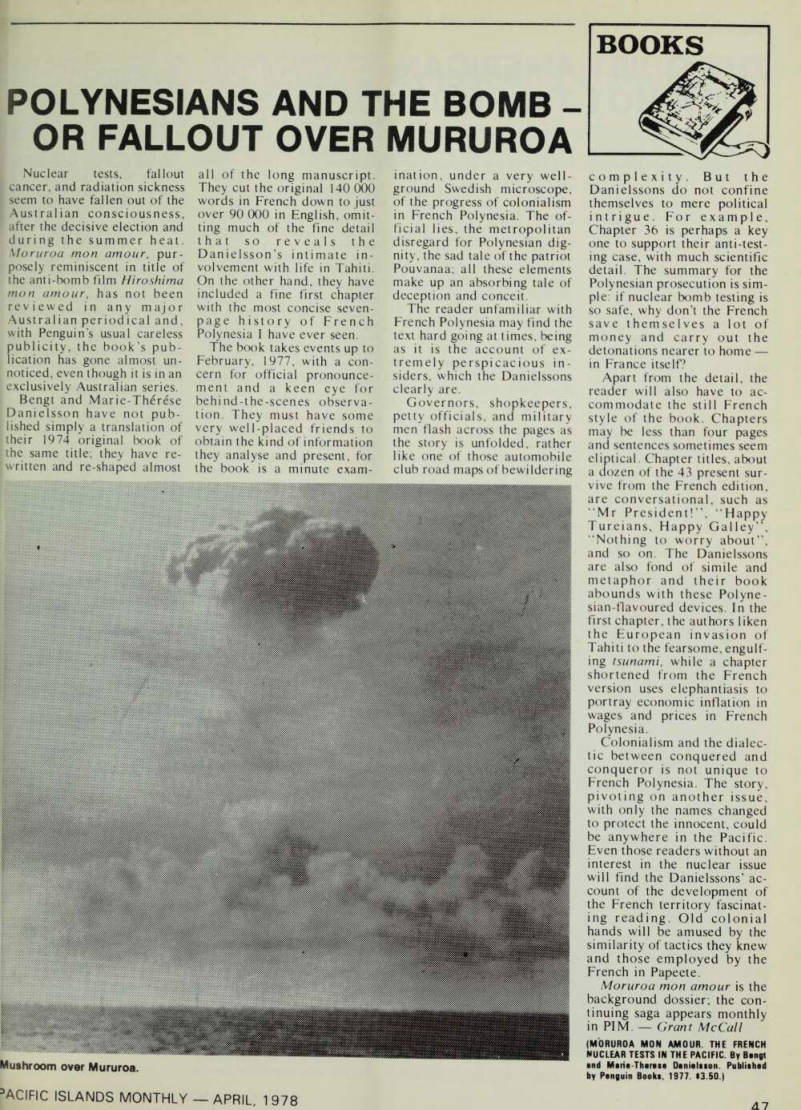
Polynesians And The Bomb -
Nuclear tests, fallout cancer, and radiation sickness seem to have fallen out of the Australian consciousness, after the decisive election and during the summer heat, Moruroa mon amour, purposely reminiscent in title of the anti-bomb film Hiroshima mon amour, has not been reviewed in any major Australian periodical and. with Penguin’s usual careless publicity, the book’s publication has gone almost unnoticed, even though it is in an exclusively Australian series, Bengt and Danielsson have not published simply a translation of their 1974 original book of the same title; they have rewritten and re-shaped almost
all of the long manuscript.
They cut the original 140 000 words in French down to just over 90 000 in English, omit ting much of the fine detail that so reveals the Danielsson’s intimate in volvement with life in Tahiti.
On the other hand, they have included a fine first chapter with the most concise seven page history of French Polynesia 1 have ever seen.
The book takes events up to February, 1977, with a con cern for official pronounce ment and a keen eye for behind-the-scenes observa tion. They must have some very well-placed friends to obtain the kind of information they analyse and present, for the book is a minute exam
ination, under a very well ground Swedish microscope, of the progress of colonialism in French Polynesia. The of ficial lies, the metropolitan disregard for Polynesian dig nity, the sad tale of the patriot Pouvanaa; all these elements make up an absorbing tale of deception and conceit.
The reader unfamiliar with French Polynesia may find the text hard going at times, being as it is the account of ex tremely perspicacious in siders, which the Danielssons
clearly are.
Governors, shopkeepers,
petty officials, and military men flash across the pages as the story is unfolded, rather like one of those automobile club road maps of bewildering
complexity. But the Danielssons do not confine themselves to mere political intrigue. For example.
Chapter 36 is perhaps a key one to support their anti-test ing case, with much scientific detail. The summary for the Polynesian prosecution is sim ple; if nuclear bomb testing is so safe, why don’t the French save themselves a lot of money and carry out the detonations nearer to home in France itself?
Apart from the detail, the reader will also have to ac commodate the still French style of the book. Chapters may be less than four pages and sentences sometimes seem eliptical. Chapter titles, about a dozen of the 43 present sur vive from the French edition, are conversational, such as “Mr President!”, “Happy Tureians, Happy Galley”, “Nothing to worry about”, and so on. The Danielssons are also fond of simile and metaphor and their book abounds with these Polyne sian-flavoured devices. In the first chapter, the authors liken the European invasion of Tahiti to the fearsome, engulf ing tsunami, while a chapter shortened from the French version uses elephantiasis to portray economic inflation in wages and prices in French Polynesia.
Colonialism and the dialec tic between conquered and conqueror is not unique to French Polynesia. The story, pivoting on another issue, with only the names changed to protect the innocent, could be anywhere in the Pacific.
Even those readers without an interest in the nuclear issue will find the Danielssons’ ac count of the development of the French territory fascinat ing reading. Old colonial hands will be amused by the similarity of tactics they knew and those employed by the French in Papeete.
Moruroa mon amour is the background dossier, the con tinuing saga appears monthly
in PIM
Grant McCall
Mushroom over Mururoa.
(Moruroa Mon Amour. The French
NUCLEAR TESTS IN THE PACIFIC. By Bengt and Marie-Theraaa Danielsson. Published by Penguin Books, 1977. $3.50.)
Advertisements & other items, p. 47 (1 item)
47
d ACIFIC ISLANDS MONTHLY APRIL, 1 978
The Quiet American
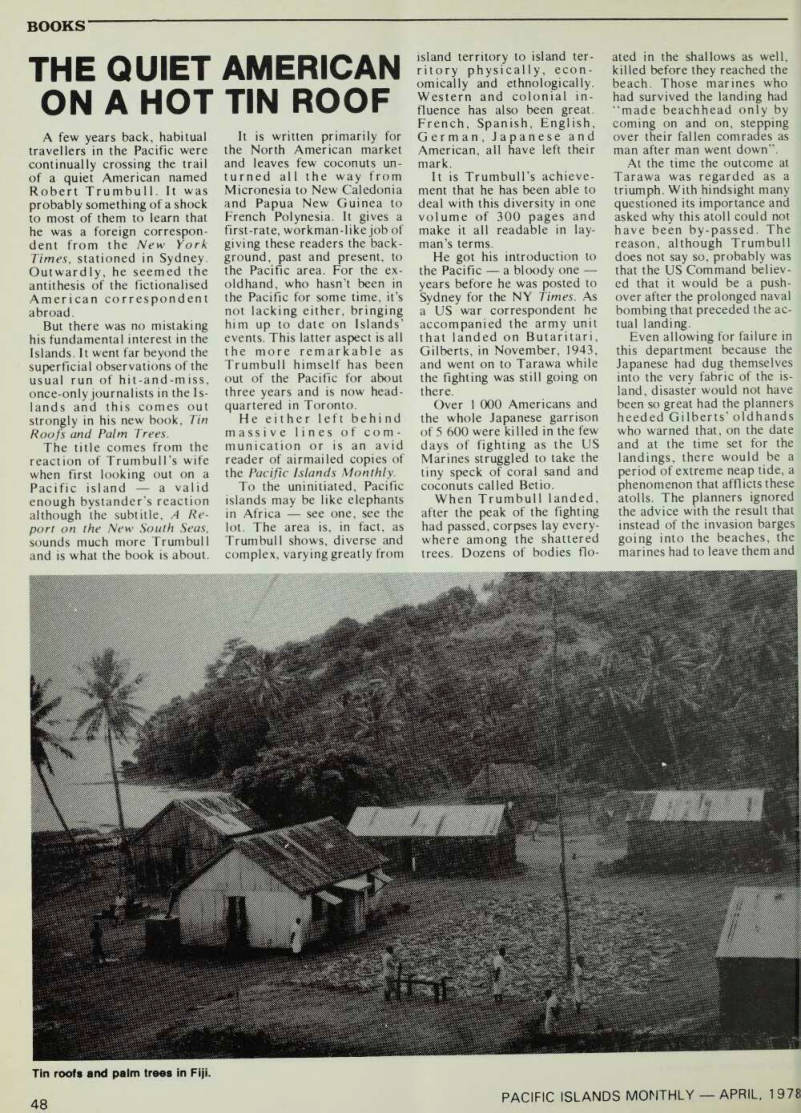
On A Hot Tin Roof
A few years back, habitual travellers in the Pacific were continually crossing the trail of a quiet American named Robert Trumbull. It was probably something of a shock to most of them to learn that he was a foreign correspon dent from the New York Times, stationed in Sydney Outwardly, he seemed the antithesis of the fictionalised American correspondent abroad.
But there was no mistaking his fundamental interest in the Islands. It went far beyond the superficial observations of the usual run of hit-and-miss, once-only journalists in the Is lands and this comes out strongly in his new book, Tin Roofs and Palm Trees.
The title comes from the reaction of Trumbull’s wife when first looking out on a Pacific island a valid enough bystander’s reaction although the subtitle, A Re port on the New South Seas, sounds much more Trumbull and is what the book is about.
It is written primarily for the North American market and leaves few coconuts un turned all the way from Micronesia to New Caledonia and Papua New Guinea to French Polynesia. It gives a first-rate, workman-like job of giving these readers the back ground, past and present, to the Pacific area. For the ex oldhand, who hasn’t been in the Pacific for some time, it’s not lacking either, bringing him up to date on Islands' events. This latter aspect is all the more remarkable as Trumbull himself has been out of the Pacific for about three years and is now head quartered in Toronto.
He either left behind massive lines of com munication or is an avid reader of airmailed copies of the Pacific Islands Monthly.
To the uninitiated. Pacific islands may be like elephants in Africa see one, see the lot. The area is, in fact, as Trumbull shows, diverse and complex, varying greatly from
island territory to island ter ritory physically, econ omically and ethnologically.
Western and colonial in fluence has also been great.
French, Spanish, English, German, Japanese and American, all have left their mark.
It is Trumbull’s achieve ment that he has been able to deal with this diversity in one volume of 300 pages and make it all readable in lay man’s terms.
He got his introduction to the Pacific a bloody one years before he was posted to Sydney for the NY Times. As a US war correspondent he accompanied the army unit that landed on Butaritari, Gilberts, in November, 1943, and went on to Tarawa while the fighting was still going on there.
Over 1 000 Americans and the whole Japanese garrison of 5 600 were killed in the few days of fighting as the US Marines struggled to take the tiny speck of coral sand and coconuts called Betio.
When Trumbull landed, after the peak of the fighting had passed, corpses lay every where among the shattered trees. Dozens of bodies flo
ated in the shallows as well, killed before they reached the beach. Those marines who had survived the landing had “made beachhead only by coming on and on, stepping over their fallen comrades as man after man went down”.
At the time the outcome at Tarawa was regarded as a triumph. With hindsight many questioned its importance and asked why this atoll could not have been by-passed. The reason, although Trumbull does not say so, probably was that the US Command believ ed that it would be a push over after the prolonged naval bombing that preceded the ac tual landing.
Even allowing for failure in this department because the Japanese had dug themselves into the very fabric of the is land, disaster would not have been so great had the planners heeded Gilberts’ oldhands who warned that, on the date and at the time set for the landings, there would be a period of extreme neap tide, a phenomenon that afflicts these atolls. The planners ignored the advice with the result that instead of the invasion barges going into the beaches, the marines had to leave them and
Tin roofs and palm trees in Fiji.
wade the last half-mile over almost exposed reef, directly into the fire of the dug-in Japanese guns.
On the 25th anniversary of the battle for Tarawa, Trum bull returned to Betio and the Gilberts, this time by Fiji Air ways (later Air Pacific), to find plenty of old war relics I still decorating Betio but that urbanisation had by then ' overtaken the area, with the usual mixed results.
“What does the future hold for these atoll people,” he asks. “The limited ex pectation of their tiny, spar sely-endowed islets, coupled with expanding awareness of a larger world, unquestionably dictate a steady emigration of the young to lands of greater opportunity, like the blacks from numerous small Carib bean islands whom one meets in Miami, New York and Montreal.”
What he does not say is that there are few places where the surplus Gilbertese now get free entry, all other island ter ritories operating as closed a shop, migrant-wise, as Australia and New Zealand.
By contrast to the poverty stricken Gilberts there are the lucky people of the “smallest and richest” island Nauru.
Trumbull describes how, at the South Pacific Conference held there in 1975, the hotel was enlarged to 56 rooms, a Honolulu firm built a $5 million airconditioned civic centre for the conference: a Japanese contractor widened and repaved the road and a fleet of minibuses was im ported to whisk delegates from hotel to conference hall.
The local airline, Air Nauru, flew in a jazz band from Rarotonga, dance teams from Truk, the Gilberts and the Marshalls, souvenir T shirts from Hong Kong, oysters from Australia, strawberries from Japan and steaks from Honolulu. There was a drought on at the time so a Japanese tanker was char tered to bring Nauru 30 000 tonnes of fresh water. The delegates, remarks Trumbull, voted it the best SPC ever.
Even the more work-a-day life on Nauru sounds, as he describes it, like a socialist’s dream of paradise. “All the necessities of life and some luxuries were free or
ridiculously cheap,” he re
ports. Families had two or
more cars and “enough cameras, radios and other toys ... to stock a small shop.”
When these things broke down there were plenty more to be bought where they came from. Government-built houses rented for $5 a month and there wasn’t any taxation.
Nor is the good life likely to end when the phosphate, which now provides all these goodies, runs out at the end of the century. By that time, ac cording to Nauru’s financial advisers, they will have enough stashed away in long term investment funds for all the Nauruans then in ex istence to continue to live in the manner to which Hammer deßoburt and the other founding fathers of the re public had accustomed their fathers and grandfathers.
Cargo cults in Papua New Guinea and the New Hebrides, attempted land grabs and tax havens in the latter: the shenanigins of the CIA in the US Trusteeship is land of Saipan in the fifties: nepotism in the Cooks: copper in Bougainville: nickel in New Caledonia: and, of course, burgeoning politics every where. You name it and if it’s Pacific, this diligent author had probably said something about it somewhere.
Nonetheless, this is not a very personal story, as no doubt befits a major effort on the part of a foreign corres pondent. But because of its usual objective approach it does lack that feeling of hap py-go-lucky, out-of-this worldiness that is still charac teristic of Pacific Islanders.
This is something that we have learned to do without anyway, since writers like Nancy Phelan stopped us laughing with our South Seas friends, and went off to write about Turkey or South America.
In spite of being god fathered by no less than two universities, Washington and Australian National, Tin Roofs and Palm Trees is in teresting, easy to read and as similate without even one academic, numbered footnote
to distract the mind.
Tudor.
Judy
(TIN ROOFS AND PALM TREES. By Robert Trumbull. Published by Austrelien Netionel University Press, PO Box 4, Cenberre. end University of Weshington Press. AI16.95.)
Colour and Catholicism
The French-controlled is lands of Wallis and Futuna, which lie several hundred kilometres north-east of New Caledonia and north of Fiji, are little known even to New Caledonian Frenchmen.
Nothing ever seems to hap pen there to gel them into the news. The “Come to Wallis and Futuna Movement" has not yet begun. And there is lit tle readily available literature on them.
But times are changing. In 1972, this reviewer had the unaccustomed task of review ing two books on Wallis in the same year, and now we have a book dealing with both Wallis and Futuna.
The new book is by Philippe Godard, a Frenchman, who has made the Pacific his home since 1968. It is an attractive, large-format production, whose text combines a tra veller's impressions of the is lands with sketches of their histories and general infor mation about them. The whole is strikingly illustrated by many coloured photo graphs. old maps, sketches and photographs in black and white.
Unfortunately for English speaking readers, the text is in French. But the captions for the illustrations, which are printed at the back of the book, are in French, English, Wallisian and Futunan.
Both Wallis and Futuna (plus Futuna’s sister island, Alofi) are inhabited by Polynesians. The language of the first closely resembles Tongan, while that of Futuna is akin to Samoan. “Neverthe less," Godard tells us, “Walli sians and Futunans appear to have little difficulty in under standing one another."
Wallis, otherwise known as Uvea, received its European name from Captain Samuel Wallis, who came upon it in HMS Dolphin in 1767,
following his discovery of
Tahiti. Despite Wallis’ fame in connection with Tahiti, Godard is the first author. 1 believe, to discover and rep roduce the portrait of him in the National Portrait Gallery, London.
For many years, Wallis Is land was dominated by a for midable, bearded Marist,
Bishop Bataillon, who went there in 1837 and turned the island into a virtual theocra cy. He was largely responsible for its becoming a French Protectorate.
A colleague of Bataillon, Father Pierre Chanel, who was sent to Futuna in 1837, achieved celebrity as the first Christian martyr in the South Pacific. He was murdered in 1841. Despite this unpromis ing start, Futuna, too, even tually came under the strong influence of the Roman Catholic Church.
The Catholicism of Wallis and Futuna is strongly reflected, in its Polynesian way, in Godard's book. A notable example is a specially-executed painting of Chanel’s death by the inimita ble Wallisian artist Aloisio Pilioko.
Besides the Catholicity of the two islands. Godard's book reveals them to be places of brilliant colours and clear blue skies: places where much of the old-style, pre tourism Polynesia is still to be found.
There are still thatched roofs and outrigger canoes aplenty, not to mention pigs that root for shells in the shallows when the tide goes out.
On the other hand, the papalangi who have sojourned in the islands over the years such as the Americans who had a base on Wallis during World War II have done their bit to alter the local genotype. At least, that’s the impression that I get from studying some of Godard’s portraits, particularly of
children.
Robert Langdon.
(WALLIS and FUTUNA. By Philippa Godard.
Published by Editions Melanesia, 27 Rue Sebastopol, Noumea. Price not available.)
Advertisements & other items, pp. 49-50 (2 items)
49
BOOKS
3 ACIFIC ISLANDS MONTHLY —APRIL, 1978
Henry Lawson's
BOOKSHOP
531 Royal Arcade, (Beneath Sydney Hilton) Pitt through to George St.
SYDNEY, 2000.
Phone: 61 2365.
WE STOCK ONL Y
AUSTRALIAN BOOKS
AND BOOKS ON
OCEANIA!
Write to us for specialist attention.
To V * a i
IN OUR 84th YEAR SELLING ‘SERVICE’
TO THE PACIFIC ISLANDS...
Nelson&Robertson
PTY.LTD. (Established 1895)
Plantation House, 197 Clarence Street, Sydney.
Cables: ‘IVAN’, Sydney, Brisbane. Telex: AA22381, Sydney.
FOR:
INDENTS
FOODSTUFFS
SOFTGOODS
HARDWARE
MACHINERY
SHIPPING
TRAVEL
INSURANCE
REAL ESTATE
...FROM AUSTRALIA & OVERSEAS.
y.
R b
BRANCH OFFICES:
Nelson & Robertson Pty. Ltd., 303 Adelaide Street, Brisbane, Qld.
Nelson & Robertson Pty. Ltd., RO. Box 2092, Gout, Bldg., Suva, Fiji.
Nelson & Robertson Pty. Ltd., RO. Box 258, Lautoka, Fiji.
PAPUA NEW GUINEA
REPRESENTATIVES;
Rabtrad Niugini Pty. Ltd,
RABAUL
LAE
MADANG
KIETA
Do you want to do business in New Zealand ?
Ask the bank which has
40% of the banking business
in New Zealand
The BNZ can give you full information on buying or selling in New Zealand and overseas. Full information on investment, movement of money, transfers of
dividends etc., is also readily available.
There are offices everywhere, more than 400 in fact.
Whatever your financial or trade needs, the BNZ can
help you.
Wellington-Head Office, International Division, Box 2392.
Sydney—GPO Box 507, Sydney, N.S.W. 2001.
Melbourne—GPO Box 528 E, Melbourne, Vic. 3001.
Tokyo -Mr E L Banks, Bank of New Zealand Representative Office, Japan. Suite 240, Shin Tokyo Bldg, 3-1, 3-Chrome, Marunouchi, Chiyoda-ku, Tokyo 100.
Singapore-Mr.R.F.Warren, Bank of New Zealand Representative Office, South East Asia. Suite 230, 23rd Floor, Ocean Bldg.
Co I Iyer Quay, Singapore 1.
London-PO Box 402, LondonEC4P.4.H.E Fiji, Suva-25 Victoria Parade. Also at Labasa, Lautoka, Nadi, Sigatoka, Ba.
Associated Banks in the South Pacific.
Bank of Western Samoa. Bank of Tonga.
M Bank of New Zealand
Islands
From the
Press
From The Fiji Times: How does a destitute widow on $4 a month welfare payments buy a coffin for her husband’s funeral. This was the problem which faced Bayly Clinic almoner, Mrs Shirley Hemming, yesterday just two hours before the funeral was due to take place ... the husband died of a heart attack and his widow ordered a coffin from a construction firm. When they told her it would cost $5O the already distressed woman broke down. She turned to the Bayly Clinic for help. “We could not find $5O for a coffin so I asked the construction firm if they could donate one. They could not and appeals to the Commissioner Central and Nausori welfare department were unable to solve the problem either,” Mrs Hemming said. “Meanwhile, the widow and a small group of friends and relatives were waiting at the hospital to claim the body when they got a coffin. Finally, a really kind businessman in Toorak donated a coffin and the funeral could go ahead.”
From the Arawa Bulletin The President of the Honiara Boxing Association, Mr George Abana,.complimented the members of the North Solomons boxing team on good bouting display, although the Honiara officials were sorry to see their boxers knocked about and knocked down in either the first or second round. He said it was unbelievable that even their two most promising boxers, Saro and Takerebu, went down too. Mr Abana followed on by saying that the North Solomons boxers did not fight using normal “human powers” and instead used “black magic”. He said one ot the boxers admitted this was being used and “the magic was passed around so that everyone had a look at it”. It was reported that one parcel contains a substance resembling lime and another contains material believed to have been dug up from a dead man’s grave.
From a House of Assembly debate on a proposal to raise members’ salaries, as reported by the Tuvalu News Sheet: • • • Mr Moeanga maintained that government claims not to have sufficient funds available to raise the price of copra, but there is always enough money to increase its officials’ salaries .. .
From the Lae Nius: A man has been convicted and sentenced by the Morobe Provincial Court to six months in jail with hard labour for committing adultery. He is Anton Bebeim Buka, aged 23.
From the Solomon Islands News Drum: A taxi driver who was in the police station reporting an assault made upon himself, found his vehicle missing when he returned to where he had left it. This was at White River, on Saturday.
From the Papua New Guinea Post-Courier: A Filipino woman was warned in the Goroka Court last week u F u? a T 8 in coffee - Aroa Masive < of Bena, in the Eastern appeared on a charge of being a person other than a riNO cmzen dealing in unprocessed coffee. The magistrate, Mr Stephen Awagasi, found Mrs Masive guilty of the charge, and cautioned and discharged her.
From an article by Richard Nathanson in the Tonga Chronicle: ... If the Bank of the South Pacific is going to exist at all, it should be above reproach from the first. There is no point in sowing the seeds of its own destruction early in the ball game.
After all they have 99 years to practise . ..
Opening gambit in an interview by an Atoll Pioneer (Gilberts) reporter with the Governor, Mr John Smith: Reporter: Sir, did you have a good time going again overseas for some weeks? H E.: Well, I don’t call it a good time to have to go from here to Europe and back inside a couple of weeks and in this particular two weeks I encountered snowstorms, floods, fog and even the aftermath of an earthquake in Guam .. .
From a letter by Policeman Bilong PNG in the Lae Nius protest against the new Summary Offences Act: .The new acts are not really good at all and I’d say they help the people to commit more crimes and give the police a hard time nowadays in carrying out their duties and to maintain law and order . . . I think the old laws made by the Colonial Administration are good and why don’t we obey the laws made by them and make amendments only to the ones that are not suited to the people of Papua New Guinea . . .
From The Fiji Times: In the interests of justice, scheduled court cases are often stood down by magistrates for a short while for various reasons witnesses are late, an accused wants to brief his lawyer, prosecution wants to amend the charges. Just as pressing a reason wasgiven the other morning when Suva lawyer Mr Vijay Parmanandam asked that cases in which he appeared be stood down for half an hour in Suva Court. His fly zipper had failed in its duty and he had to go home and change his trousers. He went otit of court holding hisjacket in front of him but returned later with his “briefs” and trousers intact.
From the Tonga Chronicle: It was vital that, as Pacific Islands people came into the New Zealand community, they thought of themselves as New Zealanders, the Prime Minister (Mr Muldoon) told a Conference of Pacifica in Dunedin recently. “New Zealanders if you like, of Samoan, Cook Island, Tongan, or Niuean origin, but New Zealanders, part of the New Zealand community,” he added. All should retain a pride in their ancestry and indigenous culture, but think of themselves, first and foremost, as New Zealanders living as one people.
From the Papua New Guinea Post-Courier: The Mogei people of the Kimininga sub-clan are frightened by the mysterious death of one of their clansmen. Six clansmen have cut off fingers to show their grief at two recent deaths. This is customary but unusual in such numbers. Joseph Rumints died recently after a long illness which his people said originated from a painful leg. Sim Pup, in his 30s, with four young children, joined the village mourning group circling Rumints’ close relatives after the man’s death. A spokesman from the village said Pup suddenly fell out from the circle and died. He said there was no indication of ill health. The youngsters in the village are whispering of poison and sorcery.
From The Fiji Times: Seven long years of dreams and hard saving by a young Nasinu family came to nothing within a few minutes this week, and almost claimed the life of their young son. Without warning, Khalid Dean’s $l2 000 house simply fell down ... On Wednesday morning, the almost-completed contractor-built house collapsed on its foundation on their block of land in Secala Road,Nasinu. Their son Omar, 3, the youngest of the Dean s three children, was playing under the house throughout the morning, and narrowly escaped serious injury when his mother called him out only seconds before the collapse ... Mr Dean said support piles “just gave way under the weight of the concrete floor”.
Advertisements & other items, p. 52 (1 item)
Qbe Insurance Limited
Save hundreds of dollars
on Australia's most efficient
WALK IN, ALUMINIUM
COOLROOMS AND
FREEZE ROOMS!!
Hundreds already installed! The most economical supplementary coolrooms for bottles and food, providing the largest storage capacity of any comparable coolrooms of the same exterior dimensions. Five sizes-from 90-360 cu. ft. capacity, 16 models offering normal temp., two temp., deep freeze, or for pastry and '<* storage applications. White vinyl interior, embossed rustproof aluminium exterior, O SUPPLIED IN EASY-TO-ERECT, DO-IT-YOURSELF KIT FORM.
Manufactured by:
AVAILABLE FROM:
AUSTRALIAN NEW CALEDONIA EXPORTS. 363 George St, Sydney, 2000.
BRECKWOLDT & CO., 276 Pitt St., Sydney, 2000.
HAGEMEVER (A’SIA), 59 Anzac Pde, Kensington,J 2OJJ - GEOFFREY HUGHES & CO, 167 Macquarie St, Sydney. 2000 NELSON & ROBERTSON PTV. LTD. 197 Clarence St Sydne^2ooo.
PETER FISHER TRADING PTV.LTD, 321 Pitt St, Sydney 2000 E RABOT (EXPORTS) PTY. LTD, 67 Castlereagh St, Sydney. 2000.
RABTRAD NIUGINI PTY. LTD.. PO Box 1406. Lae.
A RIETTE (PACIFIC) PTY. LTD., 300 George St,, Sydney, 2000.
H Y KWAN (AUST) PTY. LTD, Box 2713, GPO , Sydney, 2001.
C. SULLIVAN (EXPORT) PTY. LTD., GPO Box 3373, Sydney, 2001.
W S. TAIT & CO, PTY. LTD, 31 Macquarie Place, Sydney, 2000. * ~TI
FRIGID CABINETS PTY. LTD.,
14A Puffy Ave., Thornleigb, N.S.W. 2120 Aust. Ph
offers expert insurance service
throughout the Islands.
QBE INSURANCE LIMITED
(FORMERLY QUEENSLAND INSURANCE COMPANY)
Central Office: 82 Pitt Street, Sydney.
FIJI - Branch Office, Suva, Manager for Fiji: L.G. Liddell A.A.1.1.
LAUTOKA - Sub-Branch Office: Burns Philp Bldg.
NEW CALEDONIA - T.A. Hagen, Ste. W.A. Johnston, S.A.R.L. - Noumea.
NEW HEBRIDES - District Manager: G.F. Donnelly, Vila; Santo Santo: Burns Philp (New Hebrides) Ltd.
TAHITI Arthur Chung: Immeuble 8.1., Front de Mer, Papeete.
NIUE NORFOLK ISLAND, SAMOA, TONGA and other South Sea Islands Burns Philp (South Sea) Company Ltd.
QUEENSLAND INSURANCE (RN.G.) LTD.
PAPUA NEW GUINEA - Head Office, PORT MORESBY.
General Manager; J.M. Dawe. Assistant Manager: R.V. Maskell.
District Managers at; LAE: I.R. Martin MOUNT HAGEN: D.F. Carroll ARAWA: J. Longbut MADANG: R.W.V. Ceilings RABAUL: W.F. Tinker
PNG plans to erase tax dodgers
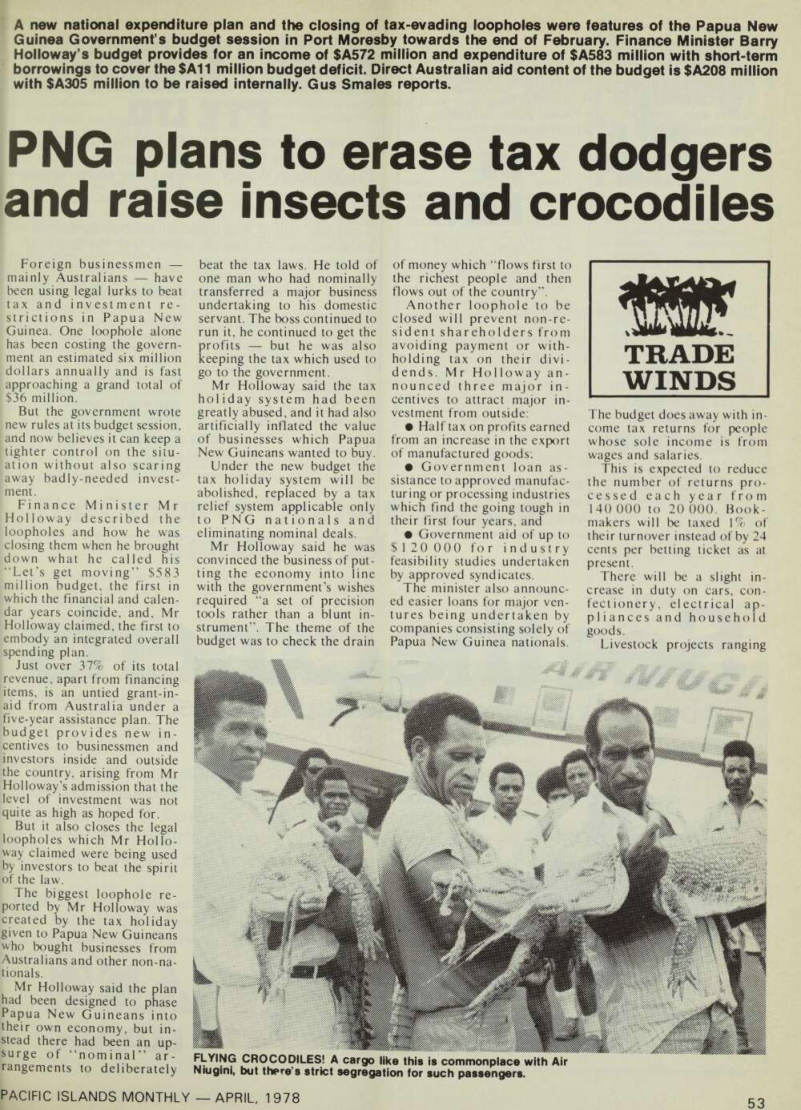

and raise insects and crocodiles
Trade
Winds
A new national expenditure plan and the closing of tax-evading loopholes were features of the Papua New Guinea Government s budget session in Port Moresby towards the end of February. Finance Minister Barry Holloway s budget provides for an income of $A572 million and expenditure of SASB3 million with short-term borrowings to cover thesAll million budget deficit. Direct Australian aid content of the budget is SA2OB million with SA3OS million to be raised internally. Gus Smales reports.
Foreign businessmen mainly Australians have been using legal lurks to beat tax and investment re strictions in Papua New Guinea. One loophole alone has been costing the govern ment an estimated six million dollars annually and is fast approaching a grand total of $36 million.
But the government wrote new rules at its budget session, and now believes it can keep a tighter control on the situ ation without also scaring away badly-needed invest ment.
Finance Minister Mr Holloway described the loopholes and how he was closing them when he brought down what he called his “Let’s get moving” $583 million budget, the first in which the financial and calen dar years coincide, and, Mr Holloway claimed, the first to embody an integrated overall spending plan.
Just over 37% of its total revenue, apart from financing items, is an untied grant-in aid from Australia under a five-year assistance plan. The budget provides new in centives to businessmen and investors inside and outside the country, arising from Mr Holloway’s admission that the level of investment was not quite as high as hoped for.
But it also closes the legal loopholes which Mr Hollo way claimed were being used by investors to beat the spirit of the law.
The biggest loophole re ported by Mr Holloway was created by the tax holiday given to Papua New Guineans who bought businesses from Australians and other non-na tionals.
Mr Holloway said the plan had been designed to phase Papua New Guineans into their own economy, but in stead there had been an up surge of “nominal” ar rangements to deliberately
beat the tax laws. He told of one man who had nominally transferred a major business undertaking to his domestic servant. The boss continued to run it, he continued to get the profits but he was also keeping the tax which used to go to the government.
Mr Holloway said the tax holiday system had been greatly abused, and it had also artificially inflated the value of businesses which Papua New Guineans wanted to buy.
Under the new budget the tax holiday system will be abolished, replaced by a tax relief system applicable only to PNG nationals and eliminating nominal deals.
Mr Holloway said he was convinced the business of put ting the economy into line with the government’s wishes required “a set of precision tools rather than a blunt in strument”. The theme of the budget was to check the drain
of money which “flows first to the richest people and then flows out of the country”.
Another loophole to be closed will prevent non-re sident shareholders from avoiding payment or with holding tax on their divi dends. Mr Holloway an nounced three major in centives to attract major in vestment from outside: • Half tax on profits earned from an increase in the export of manufactured goods: • Government loan as sistance to approved manufac turing or processing industries which find the going tough in their first four years, and • Government aid of up to $l2O 000 for industry feasibility studies undertaken by approved syndicates.
The minister also announc ed easier loans for major ven tures being undertaken by companies consisting solely of Papua New Guinea nationals.
The budget does away with in come tax returns for people whose sole income is from wages and salaries.
This is expected to reduce the number of returns pro cessed each year from 140 000 to 20 000. Book makers will be taxed 1% of their turnover instead of by 24 cents per betting ticket as at present.
There will be a slight in crease in duty on cars, con fectionery, electrical ap pliances and household goods.
Livestock projects ranging
FLYING CROCODILES! A cargo like this is commonplace with Air Niugini, but there’s strict segregation for such passengers.
from insect farming to crocodile farming are among commercial ventures listed for development under the ex-
penditure plan.
The insect-farming is for an expenditure of $l3O 000 over the next four years to encourage some village communities to breed beetles and butterflies. The beetles and butterflies will be sold to collectors as part of a small but fast-developing industry.
Agricultural projects listed
:As"i: '■.'i'irx-
Rice-growing projects are an attempt to cut down PNG's heavy dependence on rice supplies from Australia, and orchid-farming is a fast-growing industry which could earn substantial money for PNG.
J The National Expenditure Plan was tabled by the Prime Minister, Mr Somare. It lays down expend iture projects which will serve as guidelines for the preparation of the annual budget.
It deals with capital ex-
penditure which is considered of a national developmental nature, ranging from some roads and bridges, through primary and secondary pro duction projects to specialised training courses, The guidelines in the plan the specific expenditure projects and the amount they will be allocated each year for four years ahead. The four year plan will be reassessed every year, and consultation between cabinet, parliament 3 changes and ad dl''°ns dunn 8 the reassess
cs’ e
Som t e . of , ' he expenditure P °J ect * llsted ln , lhe P lan ln ' clude deer farming, dugong courses 'n Pidgin at the PNG University, overseas police training, a w i de range of agricultural development absorbing large sums, radio station ex tensions, specialised services on matters ranging from con servation to public man agement and mineral ex
ploration, medical projects, youth training and sports development.
Total expenditure listed in the four-year plan is about $lOO million, of which about $24 million is allocated for spending this year.
It will represent just under 5% of the total budget ex penditure, and places special emphasis on rural develop ment.
Politically, the plan has had a mixed reception. The op position spokesman on finance, Mr Jaminan, said he considered the expenditure plan was “a good document” but he had doubts of how the government could keep to it.
And Sir John Guise, the in fluential independent in parliament, described the plan as “a great academic ex ercise by people who have a way with words”. He said that, although the plan went to lengths to set out how PNG should best spend its money, it failed to indicate how the money spent would im plement the aims.
Advertisements & other items, pp. 54-55 (1 item)
See the experts
HENRY CUMINES
PTC LTD.
EXPORTERS o GENERAL MERCHANTS
428 GEORGE ST., SYDNEY
CABLES; HENCO SYDNEY. G.P.O. Box 3949. PHONE. 25-3383,
For specialised and personalised buying service
throughout the Pacific Islands and the East.
LOCAL AGENTS AND REPRESENTATION: *-
PAPUA NEW GUINEA.
PORT MORESBY: Mr. Tan,
P.O. Box 5445, Boroko.
Telephone 25 2542.
RABAUL: M. & C. Seeto, P.O. Box 131, Rabaul.
Telephone 92 2902.
MADANG: W. Double, P.O. Box 22, Madang.
Telephone 82 2696.
FIJI.
K. Witherington Ltd., P.O. Box 293, Suva.
Telephone 22 356.
NEW HEBRIDES.
John Lum & Associates, P.O, 65, Santo, Telephone 329.
SOLOMON ISLANDS.
Lo See War Ltd., P.O. Box 327, Honiara.
Telephone 399.
Resident Agents in other Pacific Territories. •-
Notice is hereby given that
MOORGATE TOBACCO CO. LIMITED,
a British Company, of Westminster House, 7 Millbank, London, SWI, England, is the sole proprietor in Papua New Guinea and elsewhere of the following trade marks:- Used in respect of the following:- - tobacco and tobacco products including cigarettes, cigars and pipe tobacco The proprietor claims all rights in respect of the above trade marks and will take all necessary legal steps against any person or company infringing those rights.
1. LORILLARD
2 i£i
KENT
Cno rien
ts
SPRUSON & FERGUSON
Patent Attorneys Esso House, Sydney, Australia
See the experts
for business anywhere in the South-West Pacific For comprehensive service and advice on trade, both inter-island and with Australia and New Zealand, see the experienced staff at your nearest ANZ branch or agency. We can help you with importing and exporting, business transactions and personal banking. Offices are located at: Suva 128 Victoria Parade and Waimanu Road. Lautoka Naviti Street. Nadi Queen’s Road. Nausori Kings Road. Boroko Hubert Murray Highway. Lae Cnr. Coronation Drive and 7th Street. Madang Lightfoot Arcade, . W&Bt.
Kasagten Road. Mount Hagen Hagen ■Mj M Drive. Port Moresby ANG House, Hunter Street. Rabaul Mango Avenue. Waigani.
Honiara Mendana Avenue. Vila Rue Higginson.
A
BANK
We export
regularly
to the
Pacific
■ Meat fish (Mackeral) vegetables groceries ■ Chemicals - agricultural industrial ■ New and second hand machinery ■ Timber & building materials, hardware ■ Iron & steel products ■ Textiles & soft goods Cosmetics & toiletries &
FORREST EXPORT CO.
32 Hillside Rd P 0 Box 33853 Takapuna, Phone 449-602 Auckland New Zealand Cable Address: EXCEL >
The Crown of Thorns threatens
Samoa’s reefs
The Crown of Thorns star fish which has threatened cor al reefs all over the South Pacific is reported to be caus ing severe damage to the reefs of American Samoa and may constitute a threat to the en tire reef system.
The infestation of these dark red starfish in American Samoa has been relatively sudden, for at the beginning of 1976 very few starfish were reported by divers around the main island of Tutuila. Since that time, however, severe damage caused by the starfish has been reported on the Taema Banks, an off-shore reef extending across Pago Pago Harbour entrance. Up to 70% of the coral in the deeper water is dead, and the starfish are moving on to the live cor al that remains on the reef.
Some fishing experts have gone so far as to predict that the starfish would continue its damage until all the living :oral around American Samoa had been eaten, and :ompared the present situ ation with the extensive damage which the starfish had caused in some of the Micronesian islands in the
early 19605.
But in Western Samoa, it has been some time since the starfish has caused any real alarm. In the early 19705, the Fisheries Division in Apia campaigned to control the starfish and offered small cash rewards to people who cap tured them.
Villagers caught more than 13 000, but later inspections of Western Samoa’s south coast reefs reveal that the starfish is still abundant. But on a more optimistic note, new corals have grown over the areas which were pre viously grazed by the starfish.
There have been no further campaigns to control the star fish in Western Samoa, but fishermen on the reefs around American Samoa are being urged to spear the starfish and carry them up on the land where they will dry out and die. The fishermen are warn ed not to cut the starfish into pieces, because each piece will grow back into a whole starfish.
They are known to grow as large as two feet in diameter, with 15 arms radiating from the central portion of the
body which is described as about the size of a dinner plate.
Fishermen are warned to be careful when handling the starfish, as the spines are poisonous and can cause a painful wound. People stung by the starfish, however, are advised to place the underside of the animal against the wound, as this is supposed to neutralise the poison. But the Samoans put it this way, E fofo e le alamea le alamea. (The starfish is the treatment of its own wound). Judie Teall in Apia.
The latest news was that the government is offering a bounty of 15c for dead star fish. The Office of Marine Re sources warned potential col lectors that as the thorns on the starfish are poisonous, care was needed in handling them. The starfish can be kill ed by slashing with a bush knife or similar instrument.
To ensure a “kill” it is necess ary to pick the starfish up with a stick or spear and carry it to land where it will dry out and die. If cut to pieces in the water each piece will grow back into a whole starfish.
Advertisements & other items, p. 55 (1 item)
For Sale
Excellent opportunity for familly returning to live in Australia. 9 Unit Motel in Bowen N.Q. 2 b/room Managers accomodation.
Run by husband & wife (no labour worries)
NETT PROFIT
$26,000 yearly Approx. 3 1 / 2 hours work per day.
PRICE
$145,000 cash (freehold) Enquiries to:- Manager
PEARLY SHELL
MOTEL
Don Street, Bowen. Old. 4805
New sea-wall for American Samoa
Construction of 1 734 metres of seawall has already begun on the southern shore of Tutuila, American Samoa, Six separate sections are to be built within the next year at a cost of nearly $2 million or over $9OO a metre. The 7-11 metre wide, 3-4 metre high wall is designed to protect Samoa’s only existing road and major water line from nothing less than waves generated by hurricane force winds.
In planning the construetion of such an extensive seawall, the US Army Corps of Engineers conducted a study costing $76 300.
Though the road that the seawall is designed to protect is in no danger from the nearby sea, the study dealt expansively with the chaos that could ensue if portions of the road were ever destroyed, and with the estimated cost of coping with such a disaster situation.
About 3 525 persons commute daily upon this 9 km stretch of road that provides them with their only link to
the town centre, the hospital, the Community College, and two out of the three high schools.
The flow of agricultural products, fuel, water, etc., is also heavy on this stretch of coastline. But, unless a hur ricane of a force that is esti mated to hit only once every 100 years, comes within the next year, American Samoa will escape all the envisioned inconveniences and expenses for centuries to come.
An area of 1.782 ha of nearshore land will be used for the materials consisting of stones weighing up to 1.814 tonnes. Portions of the coastal reef will be destroyed with the construction of this seawall, Erosion caused by wave ac tion now causes only minimal reef damage. The new seawall will halt this erosion, but at the same time, with its very existence, 7-11 metres of reef will be completely wiped out.
This seawall is one of many construction projects in progress on American Samoa, These projects create local jobs and the American Samoa
Government usually pays only half of the project’s cost yet the value of such projects is questionable, for the effect they have upon the fragile en vironment, the beauty of the island, and the way of life in Samoa is often massive and irrevocable.
But the Department of Pub lic Works, together with local labour, is involved in a pro ject which will benefit all seg ments of the population. A distance of 4.8 km of sidewalks already stretch around the island with another 3.048 km planned to be laid. Federal safety funds of $lBO 000 have been granted for this project. Safety for school children and for anyone walking along the busy road has been increased.
A warship
to Niue's rescue
The Canadian destroyer HMCS Restigouche sailed into Apia Harbour on Febru ary 8 a fight machine, and
three days later sailed out as a civilian cargo ship, writes Mike Field from Apia.
This was the result of an unusual link-up between the Canadian Government and the Western Samoa Govern ment to get urgently-needed food supplies to drought striken Niue.
Niue had appealed to Western Samoa for bananas, taro and taro shoots, and New Zealand agreed to provide the shipping transport. However, this could not be done in time, and the Restigouche appeared to be the only answer. So, with the approval of Ottawa 420 cases of taro and bananas were loaded onto the after deck of the destroyer in an area usually used for anti-sub marine work.
On February 11, the ship sailed and on February 12 hove to off Alofi, Niue, to unload the cargo. The ship had only four hours to get the cargo over the side and into lighters, before having to sail on to meet New Zealand Navy units.
A larger consignment of taro and bananas will go to Niue on board the Upolu- Savai’i ferry Queen Salamasina.
Advertisements & other items, p. 56 (1 item)
[ E Pig
Epiglass Everdure Timber preservative and sealer.
Hardens, protects and densities timber.
Kills all mould spores and permanently seals out g moisture. ii Epiglass 90 Epoxy Resin and glass cloth.
Easy to apply.
Strengthens hulls, eliminates water absorption and rot and increases the value and life of your boat.
I i
finance 0 Master"
Briefly
• The development of tuna “waste” as a pig food in the Solomon Islands gave the pig industry a boost and an export industry may not be too far away. Tuna have been canned on Tulagi since 1973 by a Japanese company on a com mercial basis. But only about 45% by weight of the fish went into the cans. Pig rearing had reached a stage where it became necessary to import protein concentrates in the form of fish meal from Australia. A technologist from the Tropical Products Institute of London visited the Solomons and developed a process of fish meal preserva tion through adding formic acid to the cooked fish. This was mixed with rice bran or meal and fed to the pigs’.
Feeding trials were satis
factory.
A TPI animal nutritionist estimated in 1976 that silage production could reach a stage where 16 000 pigs could be fed, far more than the local demand. Now there are possi
ble export markets, nearby in Bougainville, and further afield. As the cost of the Australian product was $6O a tonne, fish meal has become an economic proposition for the Solomons. • Last year was a good year for tourism on Guam. There were 245 828 visitors, an in crease of about 20% on 1976.
Japan provided 63% of the visitors, 13% came from North America and Hawaii, 8% from Micronesia and 2% from Asia, other than Japan.
With expenditure per head estimated at $450, the tourism revenue was close to $llO million. • Mr Barry Fennell has been appointed manager of CIG Bougainville Pty Ltd, and will be based at Kieta. He was formerly CIG customer services supervisor with the South Queensland branch. • Mr E. A. Ryan has been appointed general manager of Pagini Brambles Transport Pty Ltd in Papua New Guinea.
Mr Ryan, who was controller.
Brambles Transport Group at the company’s Sydney head quarters, succeeds Mr F. J.
Cook, who resigned to take up
a senior appointment with Namasu, which is based in Lae. Mr Ryan is no stranger to PNG. Before joining Pagini Brambles, then Gordoka Road Transport, as com mercial manager in April, 1972, Mr Ryan had spent two years as company accountant for Collins and Leahy Pty Ltd, a large PNG company with interests in trade stores, transport, hotels and coffee.
He was in Australia from 1973, with Seatainer Ter minals Ltd and with Bram bles. • Officials from US Pacific territories have made positive moves towards setting up an agency to regulate a proposed 200 nautical mile fishing zone agreement for the Pacific.
These officials met the US En vironmental Secretary of State, Mrs Patsy Mink, in Honolulu, and agreed that regulation of a zone agree ment should be done through a multi-national body to be known as the South Pacific Regional Fisheries Agency.
Mrs Mink said later the con clusions of the meeting would be referred to Washington for final policy decision-making before the next round of talks, tentatively scheduled for Suva. Apart from Mrs Mink,
those at the meeting were Peter Coleman, Governor of American Samoa, Carlos Camacho, Governor of the Northern Marianas, Guam Cabinet members and Robert Law, Trust Territory liaison officer. Past heavy investments by the pijj Government in a pine sch eme, hydro-electricity development, cane farming expansion, cattle schemes and commercial fishing should start to bear fruit in about three years, and the economy
finance 0 Master"
Mr Charles Stinson, made that forecas , in an address to F iji accountants. He did not ex J pect a rapid upturn jn the economy for two years, but that he was confident.
The impact of the investments he men Uted would be subs tantial, and Fiji’s sensitivity to outside economic forces wou|d be reduced • Ten African students from Rhodesia are spending 1978 at the University of the South Pacific, Suva. They are studying under a Corn monwealth programme aimed at helping African Rhodesians to prepare to take over ad ministration of the country.
Advertisements & other items, pp. 57-58 (1 item)
Racing Red,
Epiglass E-Type
Antifouling.
Gives up to
months
growth-free
performance
Racing Red,
Blue, Green
and Gold.
12
PACIFIC AREA STOCKISTS
COOK ISLANDS: Cook Island Trading Corporation Ltd FIJIAN ISLANDS: Burns Philp (SS) Co. Ltd NEW HEBRIDES: Burns Philp (NH) Ltd NOUMEA: Guy Limousin, Pacific Yachting NUIE ISLAND: Nuie Island United PAGO PAGO: Max Haleck Inc, Burns Philp (SS) Ltd PAPUA NEW GUINEA: KIETA: Nikana Wholesalers. LAE: Faulkner-Tait (NG) Pty Ltd, MADANG: Burns Philp (NG) Co.
Ltd. PORT MORESBY: S.A. Heath Co. Ltd, RABAUL; Elvee Trading Pty Ltd, WEWAK: Burns Philp (P N G ).
SOLOMON ISLANDS: Man Sang Co.
TAHITI: Marine Corail, Tahiti Sport.
TONGA: Riechelmann Bros.
WESTERN SAMOA: Burns Philp (SS) Co. Ltd, E. A. Coxon Ltd, Gold Star Transport Co. Ltd, Morris Hedstrom Ltd. 290
•Master,
BRAND
A 1
MACKEREL
PACKED BY :
NIPPON SUISAN KAISHA, LTD,
* “Master” Brand Canned Mackerel, Canned Sardines and other Canned Fish. * “House” Brand Instant Noodle, Soup & Dessefts, all kinds of Spices and Japanese Soy Sauce. * Groceries, Confectionary, Beverage, etc. * Hand Tools, Builders & Cabinet Hardware, Plasticware, Chinaware, Kitchenware. * Building Materials, Plywood, Hardbord, Formica, Tiles, Wall Paper, etc. * Steel Products: Round, Square, Flat, Angle, Channel Bars, Iron Sheet, Pipes & Fitting. * Machinery, Motor Spare Parts, Batteries and Accessories. * Electric Household Appliances & “Daikin” Air Conditioners. * Sporting Goods, Fishing Rods & Reel, Accessories for Boat & Yacht. 5k “Hadson” Pocket & Table Lighters, Disposable Butane Lighters. 5k Soaps, Hair Shampoo, Detergents. Tmictr*ec. 5k Various Novelties, Ornaments, Souvenir Items. 5k “New Jet Type” Labeler & Other Daily Stuff.
UNITRADE COMPANY,LIMITED
GENERAL MERCHANTS
EXPORTERS & IMPORTERS
Sanritsu Building 11-12 3-chome Hachobori Chuo-ku Tokyo (104)
TELEX NO. : “252-4665 KANDK J'
CABLE ADDRESS : “KAYANDKAY TOKYO”
TELEPONE NO. : 03-553-9520
Resident Representives in Fiji, P.N.G., Philippines, Hong Kong & Singapore
Cruising
Yachts
• KESTREL, 9.5 m Brown A-frame trimaran, carrying Ted Judd, of San Diego, sail ing single-handed, arrived at Tubuai from Tahiti early in February. He left San Diego in April, 1977, and after a brief stop in Hawaii sailed on to Tahiti. He cruised through the Society Islands before going on to Tubuai. On the way back to Tahiti he intended to visit Huahine and the Marquesas.
In 1975 he made a return trip from California to Hawaii in Kestrel. e WIND BIRD, cutter, with skipper William B. Johnson and three crew, arrived at Rarotonga from Papeete on February 2. They sailed for Auckland two days later.
E Flught Passat, A
yacht with Captai n P.
Fellestad, a Norwegian, and three crew, arrived at Rarotonga on January 1 from Bora Bora. They sailed a few days later for Auckland.
E Third Sea, 21.3 M
schooner, visited Rabaul re cently under the command of Harold Stephens, from California. Harold, who writes for several South-East Asia publications, planned in the peace and quiet of Rabaul to conclude his book, Asian Portraits. With him as first mate was Don Maclean, an engineer from Montana, US.
Don has been with Third Sea for five years. Harold signs on his crew in various ports, sometimes sailing with as many as eight or nine. His schooner has capacity for 15 tonnes of cargo and accom modation for a crew of 12. • FAITH, 19.8 m motor vessel built in Scotland in 1 936 and registered in Fal mouth, arrived at Rarotonga from Bora Bora on February 12. On board were owner-captain Roy Ryan, a New Zealander retuning home from Venezuela with his Japanese wife, Kiyoko, and their daughter, Satani. From Venezuela, Roy Ryan, aged 70. sailed to Caracao, Panama, the Marquesas and Bora Bora. He expected to be
in Auckland about mid-March with his wife, daughter, and motor vessel Faith. • BRAVURA, US sloop-rig ged 14.9 m ocean racing yacht registered at Lahaina, Hawaiian Islands, arrived at Rarotonga from Hobart and Auckland, bound for San Francisco, on February 12.
The yacht had taken part in the last Trans-Pacific race. On board were Captain Arthur Mersereau and five other crew members. Bravura is Spanish for “ferocity”, ‘‘courage’’ and “bravado”.
• Tabaitha,I 3. 71 M
ketch, which has been at Rabaul since December, 1977, is expected to sail in #pril for the Trobriands, South Africa and the US, via the Car ribean. Owners Jim and Carol Moore, from Connecticut, USA, who had their first ex perience of cruising in US coastal waters in 1946, started their present voyage in 1973.
They have been in the Pacific since 1974, spending several months in different areas.
They flew home in January, and were to return to Rabaul in March. Both have developed an interest in amateur radio during their cruising and this helps them to keep in touch with many “yachtie” friends. The Tabaitha is equipped with radar, refrigeration and a diesel generator. The Moores never have to steer as the Tabiatha has wind-vane self steering and an electric auto pilot. • QUEST, IS.BS m motor sailer, owned by Charles H.
Carter, a US lawyer, has sunk in the Adriatic. Mr Carter, his wife Vann, daughter Charla, Evan Evans and Lisa Blandi, both 14, were on board and were saved. The Carter family had been sailing round the world in Quest since 1971 and planned to stay at sea for another four years. Quest was in Sydney during the 1974 Pacific hurricane season, after having cruised through Micronesia and several South Pacific groups. After leaving Sydney she sailed east, aim ing for Tahiti, then back through Tonga Fiji, and New Caledonia to the Australian coast, thence north and west to Singapore and beyond.
Charla Carter who left Quest for a short time took a “temp’s” job in Sydney as PlM’s receptionist. She then intended to fly from Australia to rejoin her family in Greece.
In Papua and New Guinea we differed
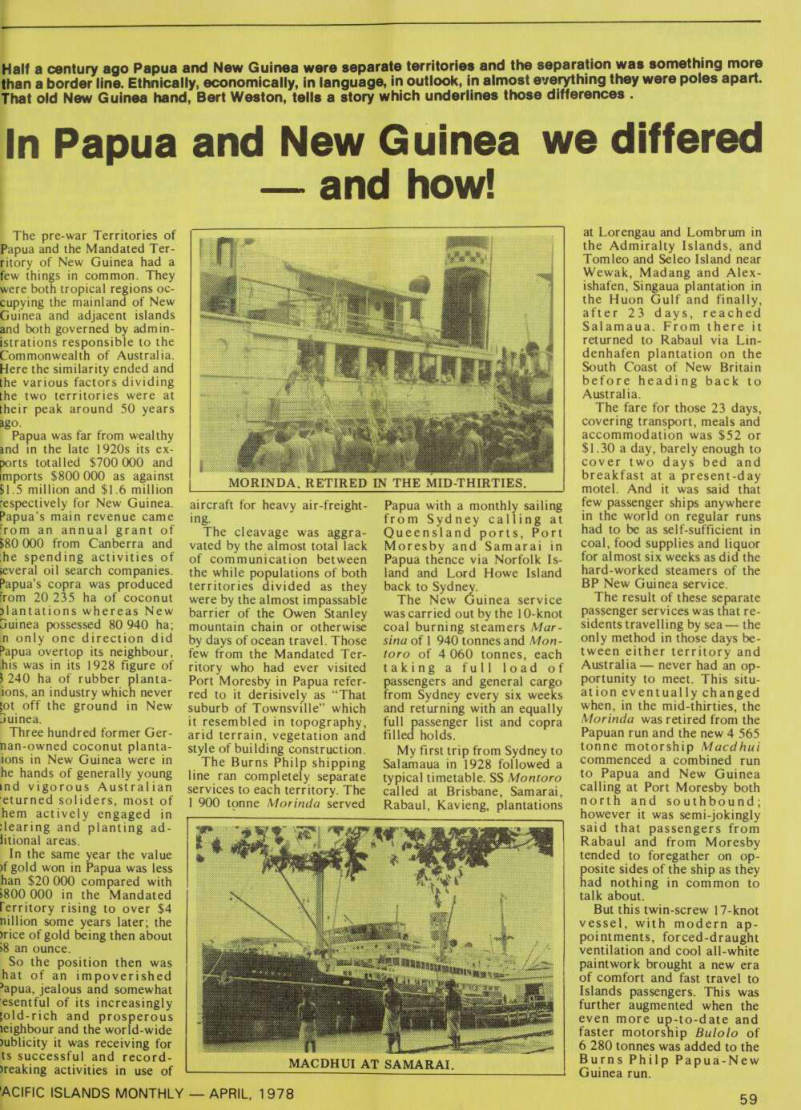
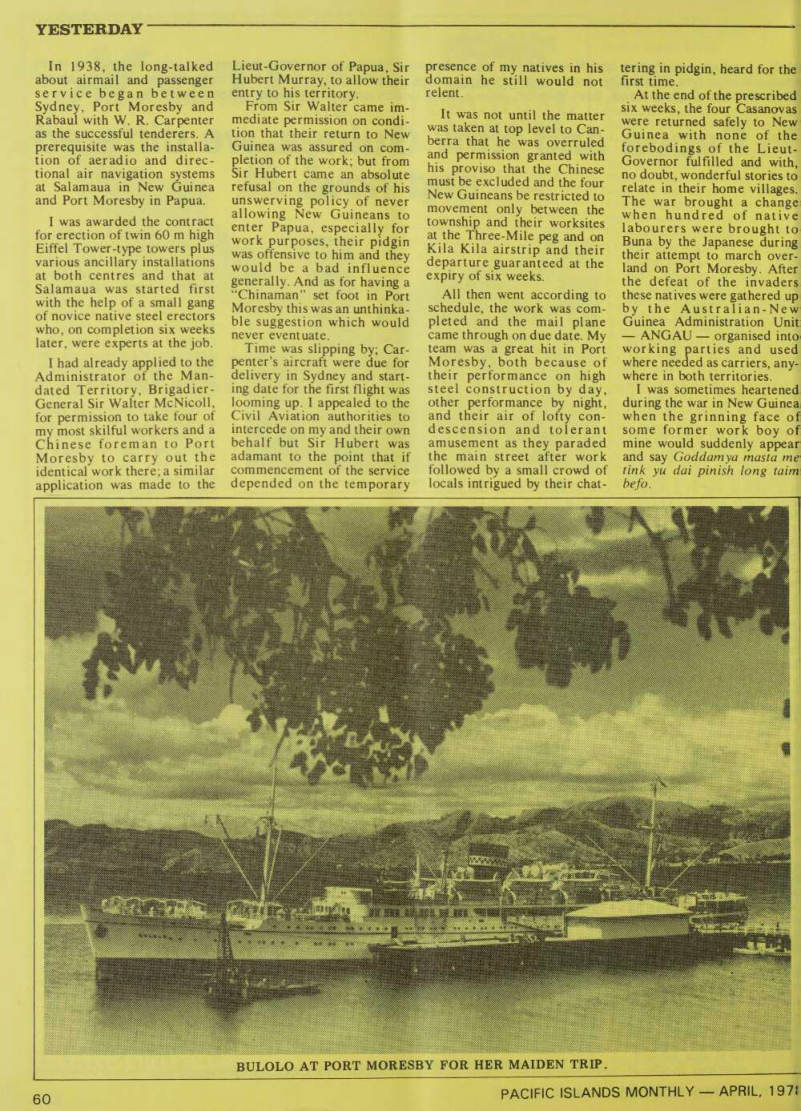
and how!
lalf a century ago Papua and New Guinea were separate territories and the separation was something more nan a border line. Ethnically, economically, in language, in outlook, in almost everything they were poles apart, hat old New Guinea hand, Bert Weston, tells a story which underlines those differences .
The pre-war Territories of Papua and the Mandated Ter ritory of New Guinea had a few things in common. They were both tropical regions oc cupying the mainland of New Guinea and adjacent islands and both governed by admin istrations responsible to the Commonwealth of Australia.
Here the similarity ended and the various factors dividing the two territories were at their peak around 50 years ago.
Papua was far from wealthy and in the late 1920 s its ex ports totalled $7OO 000 and imports $BOO 000 as against &1.5 million and $1.6 million respectively for New Guinea.
Papua’s main revenue came Torn an annual grant of &80 000 from Canberra and he spending activities of jeveral oil search companies.
Papua’s copra was produced from 20 235 ha of coconut jlantations whereas New Guinea possessed 80 940 ha; n only one direction did Papua overtop its neighbour, his was in its 1928 figure of 1 240 ha of rubber planta ions, an industry which never lot off the ground in New juinea.
Three hundred former Ger nan-owned coconut planta ions in New Guinea were in he hands of generally young ind vigorous Australian eturned soliders, most of hem actively engaged in bearing and planting ad litional areas.
In the same year the value )f gold won in Papua was less han $2O 000 compared with >BOO 000 in the Mandated ferritory rising to over $4 nillion some years later; the )rice of gold being then about >8 an ounce.
So the position then was hat of an impoverished J apua, jealous and somewhat esentful of its increasingly lold-rich and prosperous leighbour and the world-wide mblicity it was receiving for ts successful and record leaking activities in use of
aircraft for heavy air-freight ing.
The cleavage was aggra vated by the almost total lack of communication between the while populations of both territories divided as they were by the almost impassable barrier of the Owen Stanley mountain chain or otherwise by days of ocean travel. Those few from the Mandated Ter ritory who had ever visited Port Moresby in Papua refer red to it derisively as “That suburb of Townsville” which it resembled in topography, arid terrain, vegetation and style of building construction.
The Burns Philp shipping line ran completely separate services to each territory. The 1 900 tonne Morinda served
Papua with a monthly sailing from Sydney calling at Queensland ports, Port Moresby and Samarai in Papua thence via Norfolk Is land and Lord Howe Island back to Sydney.
The New Guinea service was carried out by the 10-knot coal burning steamers Mar sina of 1 940 tonnes and Mon toro of 4 060 tonnes, each taking a full load of passengers and general cargo from Sydney every six weeks and returning with an equally full passenger list and copra fillea holds.
My first trip from Sydney to Salamaua in 1928 followed a typical timetable. SS Montoro called at Brisbane, Samarai, Rabaul, Kavieng, plantations
at Lorengau and Lombrum in the Admiralty Islands, and Tomleo and Seleo Island near Wewak, Madang and Alex ishafen, Singaua plantation in the Huon Gulf and finally, after 23 days, reached Salamaua. From there it returned to Rabaul via Lin denhafen plantation on the South Coast of New Britain before heading back to Australia.
The fare for those 23 days, covering transport, meals and accommodation was $52 or $1.30 a day, barely enough to cover two days bed and breakfast at a present-day motel. And it was said that few passenger ships anywhere in the world on regular runs had to be as self-sufficient in coal, food supplies and liquor for almost six weeks as did the hard-worked steamers of the BP New Guinea service.
The result of these separate passenger services was that re sidents travelling by sea— the only method in those days be tween either territory and Australia— never had an op portunity to meet. This situ ation eventually changed when, in the mid-thirties, the Morinda was retired from the Papuan run and the new 4 565 tonne motorship Macdhui commenced a combined run to Papua and New Guinea calling at Port Moresby both north and southbound; however it was semi-jokingly said that passengers from Rabaul and from Moresby tended to foregather on op posite sides of the ship as they had nothing in common to talk about.
But this twin-screw 17-knot vessel, with modern ap pointments, forced-draught ventilation and cool all-white paintwork brought a new era of comfort and fast travel to Islands passengers. This was further augmented when the even more up-to-date and faster motorship Bulolo of 6 280 tonnes was added to the Burns Philp Papua-New Guinea run.
Morinda, Retired In The Mid-Thirties.
Macdhui At Samarai.
In 1938, the long-talked about airmail and passenger service began between Sydney, Port Moresby and Rabaul with W. R. Carpenter as the successful tenderers. A prerequisite was the installa tion of aeradio and direc tional air navigation systems at Salamaua in New Guinea and Port Moresby in Papua.
I was awarded the contract for erection of twin 60 m high Eiffel Tower-type towers plus various ancillary installations at both centres and that at Salamaua was started first with the help of a small gang of novice native steel erectors who, on completion six weeks later, were experts at the job.
I had already applied to the Administrator of the Man dated Territory, Brigadier- General Sir Walter McNicoll, for permission to take four of my most skilful workers and a Chinese foreman to Port Moresby to carry out the identical work there; a similar application was made to the
Lieut-Governor of Papua, Sir Hubert Murray, to allow their entry to his territory.
From Sir Walter came im mediate permission on condi tion that their return to New Guinea was assured on com pletion of the work; but from Sir Hubert came an absolute refusal on the grounds of his unswerving policy of never allowing New Guineans to enter Papua, especially for work purposes, their pidgin was offensive to him and they would be a bad influence generally. And as for having a “Chinaman” set foot in Port Moresby this was an unthinka ble suggestion which would never eventuate.
Time was slipping by; Car penter’s aircraft were due for delivery in Sydney and start ing date for the first flight was looming up. I appealed to the Civil Aviation authorities to intercede on my and their own behalf but Sir Hubert was adamant to the point that if commencement of the service depended on the temporary
presence of my natives in his domain he still would not relent.
It was not until the matter was taken at top level to Can berra that he was overruled and permission granted with his proviso that the Chinese must be excluded and the four New Guineans be restricted to movement only between the township and their worksites at the Three-Mile peg and on Kila Kila airstrip and their departure guaranteed at the expiry of six weeks.
All then went according to schedule, the work was com pleted and the mail plane came through on due date. My team was a great hit in Port Moresby, both because of their performance on high steel construction by day, other performance by night, and their air of lofty con descension and tolerant amusement as they paraded the main street after work followed by a small crowd of locals intrigued by their chat
tering in pidgin, heard for the first time.
At the end of the prescribed six weeks, the four Casanovas were returned safely to New Guinea with none of the forebodings of the Lieut- Governor fulfilled and with, no doubt, wonderful stories to relate in their home villages.
The war brought a change when hundred of native labourers were brought to Buna by the Japanese during their attempt to march over land on Port Moresby. After the defeat of the invaders these natives were gathered up by the Australian-New Guinea Administration Unit: ANGAU organised into* working parties and used where needed as carriers, any where in both territories.
I was sometimes heartened during the war in New Guineai when the grinning face of some former work boy of mine would suddenly appear and say God dam ya mast a me tink yu dai pinish long taim befo.
BULOLO AT PORT MORESBY FOR HER MAIDEN TRIP.
Advertisements & other items, p. 59 (1 item)
59
ACIFIC ISLANDS MONTHLY APRIL, 1 978
Why Tiva’s maidens are ‘very beautiful
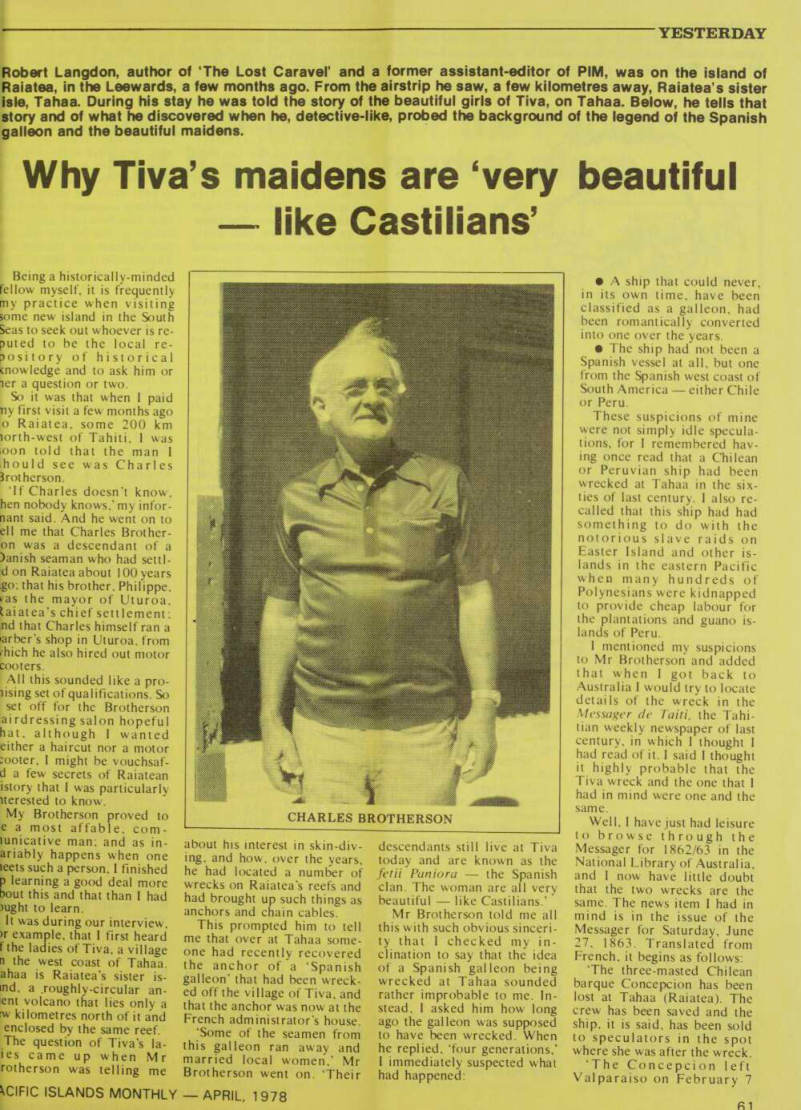
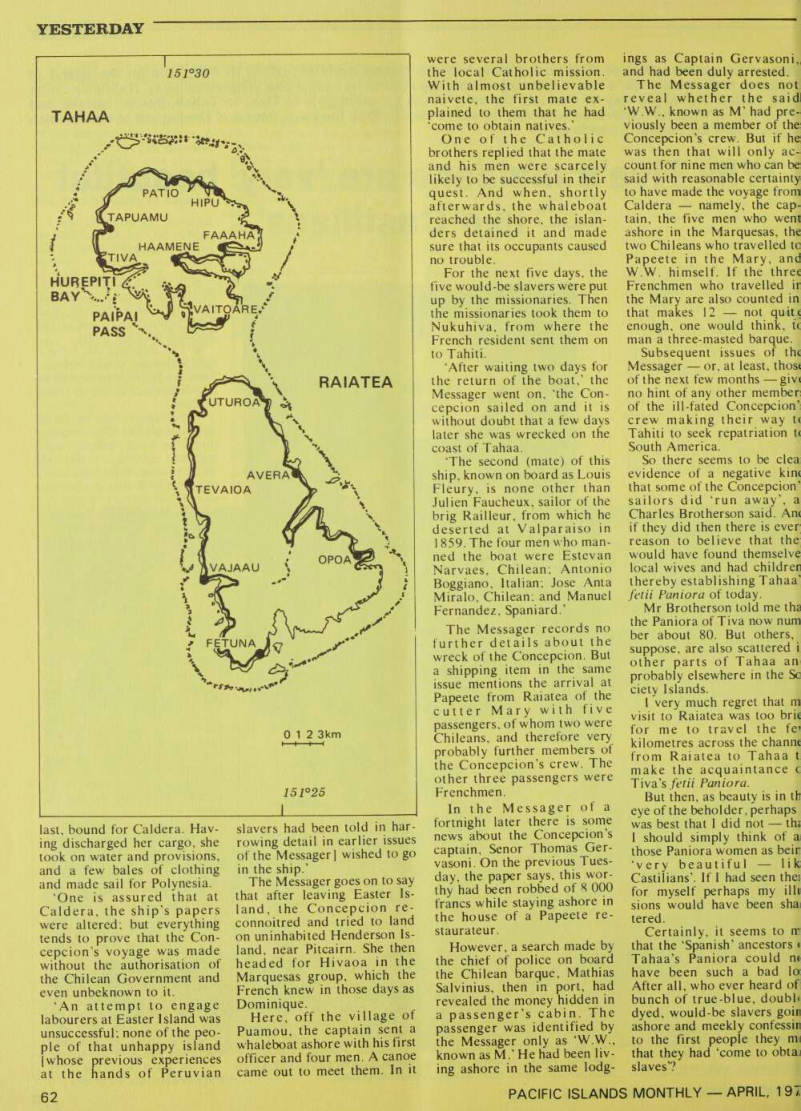
like Castilians’
Robert Langdon, author of ‘The Lost Caravel’ and a former assistant-editor of RIM, was on the island of Raiatea, in the Leewards, a few months ago. From the airstrip he saw, a few kilometres away, Raiatea’s sister isle, Tahaa. During his stay he was told the story of the beautiful girls of Tiva, on Tahaa. Below, he tells that story and of what he discovered when he, detective-like, probed the background of the legend of the Spanish qalleon and the beautiful maidens.
Being a historically-minded fellow myself, it is frequently
my practice when visiting
some new island in the South Seas to seek out whoever is re puted to be the local re pository of hi stor ical knowledge and to ask him or ler a question or two.
So it was that when I paid ny first visit a few months ago o Raiatea, some 200 km lorth-west of Tahiti, I was icon told that the man I hould see was Charles Jrotherson. ‘lf Charles doesn’t know, hen nobody knows,' my infor nant said. And he went on to ell me that Charles Brother on was a descendant of a )anish seaman who had settl don Raiatea about 100 years go: that his brother. Philippe, yas the mayor of Uturoa, Uiatea's chief settlement: nd that Charles himself ran a iarber’s shop in Uturoa, from fhich he also hired out motor coolers.
All this sounded like a pro mising set of qualifications. So set off for the Brotherson
airdressing salon hopeful
hat. although I wanted
either a haircut nor a motor :ooter, I might be vouchsaf d a few secrets of Raiatean istory that I was particularly iterested to know.
My Brotherson proved to e a most affable, com lunicative man, and as in
ariably happens when one
»eets such a person, I finished p learning a good deal more bout this and that than I had )ught to learn.
It was during our interview. )r example, that I first heard f the ladies of Tiva, a village fi the west coast of Tahaa. ahaa is Raiatea’s sister is
md, a .roughly-circular an
ent volcano that lies only a w kilometres north of it and enclosed by the same reef.
The question of Tiva’s la ies came up when Mr rotherson was telling me
about his interest in skin-div ing, and how, over the years, he had located a number of wrecks on Raiatea’s reefs and had brought up such things as anchors and chain cables.
This prompted him to tell me that over at Tahaa some one had recently recovered the anchor of a Spanish galleon’ that had been wreck ed off the village of Tiva, and that the anchor was now at the French administrator's house. ‘Some of the seamen from this galleon ran away and married local women,' Mr Brotherson went on. Their
descendants still live at Tiva today and are known as the fetii Paniora the Spanish clan. The woman are all very beautiful like Castilians.’
Mr Brotherson told me all this with such obvious sinceri ty that I checked my in clination to say that the idea of a Spanish galleon being wrecked at Tahaa sounded rather improbable to me. In stead, I asked him how long ago the galleon was supposed to have been wrecked. When he replied, ‘four generations,' I immediately suspected what had happened;
• A ship that could never, in its own time, have been classified as a galleon, had been romantically converted into one over the years. • The ship had not been a Spanish vessel at all, but one from the Spanish west coast of South America either Chile or Peru.
These suspicions of mine were not simply idle specula tions, for I remembered hav ing once read that a Chilean or Peruvian ship had been wrecked at Tahaa in the six ties of last century. I also re called that this ship had had something to do with the notorious slave raids on Easter Island and other is lands in the eastern Pacific when many hundreds of Polynesians were kidnapped to provide cheap labour for the plantations and guano is lands of Peru.
I mentioned my suspicions to Mr Brotherson and added that when I got back to Australia I would try to locate details of the wreck in the Messager cie Taiti, the Tahi tian weekly newspaper of last century, in which I thought I had read of it. I said I thought it highly probable that the Tiva wreck and the one that I had in mind were one and the same.
Well, I have just had leisure to browse through the Messager for 1862/63 in the National Library of Australia, and I now have little doubt that the two wrecks are the same. The news item I had in mind is in the issue of the Messager for Saturday, June 27, 1863. Translated from French, it begins as follows: The three-masted Chilean barque Concepcion has been lost at Tahaa (Raiatea). The crew has been saved and the ship, it is said, has been sold to speculators in the spot where she was after the wreck.
The Concepcion left Valparaiso on February 7
Charles Brotherson
last, bound for Caldera. Hav ing discharged her cargo, she took on water and provisions, and a few bales of clothing and made sail for Polynesia. ‘One is assured that at Caldera, the ship’s papers were altered; but everything tends to prove that the Con cepcion’s voyage was made without the authorisation of the Chilean Government and even unbeknown to it. ‘An attempt to engage labourers at Easter Island was unsuccessful; none of the peo ple of that unhappy island [whose previous experiences at the hands of Peruvian
slavers had been told in har rowing detail in earlier issues of the Messager] wished to go in the ship.' The Messager goes on to say that after leaving Easter Is land, the Concepcion re connoitred and tried to land on uninhabited Henderson Is land, near Pitcairn. She then headed for Hivaoa in the Marquesas group, which the French knew in those days as Dominique.
Here, off the village of Puamou, the captain sent a whaleboat ashore with his first officer and four men. A canoe came out to meet them. In it
were several brothers from the local Catholic mission.
With almost unbelievable naivete, the first mate ex plained to them that he had ‘come to obtain natives.’
One of the Catholic brothers replied that the mate and his men were scarcely likely to be successful in their quest. And when, shortly afterwards, the whaleboat reached the shore, the islan ders detained it and made sure that its occupants caused no trouble.
For the next five days, the five would-be slavers were pul up by the missionaries. Then the missionaries took them to Nukuhiva, from where the French resident sent them on to Tahiti. ‘After waiting two days for the return of the boat,' the Messager went on, ‘the Con cepcion sailed on and it is without doubt that a few days later she was wrecked on the coast of Tahaa. ‘The second (mate) of this ship, known on board as Louis Fleury, is none other than Julien Faucheux, sailor of the brig Railleur, from which he deserted at Valparaiso in 1859. The four men who man ned the boat were Estevan Narvaes, Chilean; Antonio Boggiano, Italian; Jose Anta Miralo, Chilean; and Manuel
Fernandez, Spaniard.’
The Messager records no further details about the wreck of the Concepcion. But a shipping item in the same issue mentions the arrival at Papeete from Raiatea of the cutter Mary with five passengers, of whom two were Chileans, and therefore very probably further members of the Concepcion’s crew. The other three passengers were Frenchmen.
In the Messager of a fortnight later there is some news about the Concepcion’s captain, Senor Thomas Ger vasoni. On the previous Tues day, the paper says, this wor thy had been robbed of 8 000 francs while staying ashore in the house of a Papeete re staurateur.
However, a search made by the chief of police on board the Chilean barque, Mathias Salvinius, then in port, had revealed the money hidden in a passenger’s cabin. The passenger was identified by the Messager only as ‘W.W., known as M.'He had been liv ing ashore in the same lodg
ings as Captain Gervasoni,, and had been duly arrested.
The Messager does not reveal whether the saidl ‘W.W., known as M' had pre viously been a member of the Concepcion’s crew. But if he was then that will only ac count for nine men who can be said with reasonable certainty to have made the voyage from Caldera namely, the cap tain, the five men who went ashore in the Marquesas, the two Chileans who travelled to Papeete in the Mary, and WAV. himself. If the three Frenchmen who travelled ir the Mary are also counted in that makes 12 not quite enough, one would think, tc man a three-masted barque.
Subsequent issues of the Messager or, at least, those of the next few months —give no hint of any other member; of the ill-fated Concepcion’; crew making their way tc Tahiti to seek repatriation tc South America.
So there seems to be clea evidence of a negative kinc that some of the Concepcion” sailors did ‘run away’, a Charles Brotherson said. Anc if they did then there is ever reason to believe that the would have found themselve local wives and had children thereby establishing Tahaa” fetii Paniora of today.
Mr Brotherson told me tha the Paniora of Tiva now num ber about 80. But others, suppose, are also scattered i other parts of Tahaa an probably elsewhere in the Sc ciety Islands.
I very much regret that mi visit to Raiatea was too brie for me to travel the fe* kilometres across the channe from Raiatea to Tahaa t make the acquaintance c Tiva’s fetii Paniora.
But then, as beauty is in th eye of the beholder, perhaps was best that I did not th* I should simply think of ai those Paniora women as beitr ‘very beautiful lik; Castilians’. If 1 had seen thei for myself perhaps my illv sions would have been shai tered.
Certainly, it seems to nr that the ‘Spanish’ ancestors » Tahaa’s Paniora could nc have been such a bad la After all, who ever heard of] bunch of true-blue, doubb dyed, would-be slavers goin ashore and meekly confessin to the first people they mi that they had ‘come to obtai slaves’?
Advertisements & other items, p. 61 (1 item)
61
YESTERDAY
\CIFIC ISLANDS MONTHLY APRIL, 1 978
but it’s in the market place
A new air battle for the Pacific, but it’s in the market place
Transport
There’s an air war going on over the Pacific the prize, not territory but people, the travelling public; the combatants, the national flag carriers Qantas (Australia), Pan-Am (United States) and Air New Zealand, with Continental Airlines (United States) and cheaper fares advocate Englishman Freddie Laker waiting in the wings. The story is told by PlM’s aviation correspondents in this special aviation feature.
That 1940 s phenomenon known as the “air war over the Pacific” hasn’t really ended.
Of course, the shooting stop ped in 1945 and we don’t see many fatal results any more.
The protagonists have changed too. In fact, the former allies have become combatants dedicated to claiming a large chunk of the Pacific in terms of passenger traffic anyway as their own.
These days the battle for the Pacific is being waged by the national airlines. It’s a game nf marketing ploys and adver tising campaigns which, in Santas’ case, have involved ‘we’re the fastest” adver tisements in such prestige xiblications as the Wall Street hurnal.
While 1978 is the 50th an liversary of the first aerial :rossing of the Pacific by Cingsford Smith and Charles Jim, it seems also that 1978 is tself going to slide into the listory books as a significant r ear in its own right.
The storm clouds have been gathering for some months low as the route’s big op erators limber up for a contest vhich is to come to a head this ('ear.
The tactical battle was join id more than two years ago vhen Pan-Am fired the first hot with the introduction of he long-range, though mailer version of the Boeing H 7 known as the Special Per ormance, or SP, late in 1976.
The introduction of the SP narked the first really sig lificant change in Pacific oute patterns for some years.
Jntil then the traditional outing had involved stops at iji and/or Pago Pago in Patt ern’s case, while Qantas’ ser ices included a call at Fiji efore Honolulu and then San rancisco.
The initial Pan-Am SP op ration was two a week one irect between Australia and ydney and the other via Auckland.
In April, 1977, Qantas egan operating three of its x weekly services over the
top of Fiji direct to Honolulu and then on to San Francisco.
There was much talk around the industry about who was the fastest. A study of the flight times however, in dicates that while the Sunday Pan-Am SP service direct from Sydney to San Francisco was the fastest for the week, Qantas was faster in every other service in both direc tions.
Both airlines began to build up a determined “We’re the fastest” theme in their market ing battle. Pan-Am was pitch ing hard for the businessman while Qantas obviously plac ed importance on the Honolulu market which had been successfully developed as part of their Explorer Package holiday range.
The flying range of the aircraft used also had a bear ing on the type of patterns the two airlines were operating.
While the SP was a proved long-range performer and could achieve Australia/US mainland non-stop, it paid a passenger penalty in that it was capable of carrying only 260 or 270 passengers against the 400 passenger capability of the 7478 version operated by the Australian airline.
Developing the “We’re the fastest” theme, further, Qan tas now flies direct Sydney/Honolulu on each of its services to the United States. This followed the airline’s decision to increase the number of weekly flights by one, thus providing a daily service.
Qantas’ decision to service Fiji with four terminators each week underlines the airline’s obvious belief that the US long-haul market and the Fiji market have grown to a point where it considers the best interests of each market would be better served by
separate development.
Qantas wasn’t the only piece moving on the Pacific chess board however.
Pan-Am began to prepare itself for operations out of Los Angeles instead of San Fran cisco with the promise of five of their services each week to
be operated by the SP. This move was seen as a counter to the imminent arrival on the Pacific scene of a second US carrier, Continental, which plans to operate out of Los Angeles.
While Qantas and Pan-Am had been locked in combat over their long-range, direct flight operations, the US Government had approved the introduction of Con tinental in the Pacific much to the disdain of the Australian authorities and the airlines already servicing the route.
The introduction of a sec ond carrier would mean an in crease of 1 000 seats a week on the Pacific route. Both the Minister for Transport, Mr Peter Nixon, and Qantas Chairman, Sir Lenox Hewitt, warned that the risk of over capacity on the trans-Pacific route could jeopardise the in troduction of lower fares on the Pacific.
Sir Lenox said there would be cheaper air fares on the Pacific route this year pro vided there was not an over capacity situation brought about by the projected in crease in American capacity.
He said that Qantas was not worried about a threat to its position, but was concerned about the substantial increase in capacity in the Pacific.
“It is a matter that is now the subject of discussions be tween the two governments and these talks will commence this month,” Sir Lenox said.
“We think at the moment the Pacific route has an adequate supply of seats together with the increase that will be made in the ordinary course this year by the two existing car riers, Pan-American and Qan tas.”
Transport Minister Nixon said the Continental ap plication to serve the route had increased the number of weekly frequencies of the American airlines to 13. This was almost double the seven Qantas weekly services.
Talks between the US and Australian government were held in February-March.
Industry sources suggested that the introduction of Con tinental could see history re peat itself. In 1970, the US gave approval for American Airlines to operate on the Pacific. Three years later the American operator withdrew after suffering losses and ex periencing an over-capacity situation on the route which had a devastating effect on all the operators.
Meanwhile, the Continental introduction could also pre sent some problems for Air New Zealand which will find itself in direct competition with Pan-Am and Con tinental out of Los Angeles.
Meanwhile, a related issue, but one which has prompted a great deal of discussion in the press in recent weeks, is the proposal for budget fares on the Pacific.
The Australian Govern ment rejected a Pan-Am ap plication for the introduction of the fare on the grounds that the matter should be con sidered as part of the govern ment’s international civil aviation policy was received.
Although Qantas has gone on record as saying that it does not oppose the Pan-Am budget fare and in fact sup ported it at an International Air Transport Association meeting last year, it believes that conditions attached to the fare which call for 21 days ad vance booking and knowledge of the date of travel only seven days before departure, are too stingent and would benefit only a small propor tion of travellers.
What with direct flights, a second American carrier, ter minator services to Fiji and budget fare proposals, the Pacific “pot” is really boiling in this 50th anniversary year.
Advertisements & other items, pp. 63-64 (3 items)
APICir ICI A Mr\C K/K'Mll-ri n w Ann..
- . . > 1/Miitui V/ Appii 1 Qt
Welcome aboard the Philippines.
Discover the grace of old Spain
in the Philippines.
Sense it first
on Philippine Airlines.
The subtle blend of Spain and Asia is our heritage, in delightful harmony with the 20th century Four centuries of Spanish culture lends a very special beauty to The Philippines.
Like the special smile found only on Philippine Airlines.
Where our flight attendants’ hospitality is a 1,000 year-old Philippine tradition.
ROME
On Philippine Airlines’ wide-bodied jets, you’ll get centuries-old charm, the latest movies, the tastiest international menus.
Flights depart for Manila each Friday from Port Moresby. Also three times eai week from Sydney; Monday, Thursday a Friday, or twice each week from Melbourne; Monday or Friday.
So when you’re flying to Europe or the Orient, fly to The Philippines fir-
Philippine Airlines
Welcome aboard the Philippines.
pal;
against cheaper air fares...
Australia ‘protects’ its public against cheaper air fares...
Cheap air fares across the Pacific from the North American west coast to New Zealand, via places like Fiji, American Samoa and Tahiti, are receiving close attention from airlines and governments. The stumbling block to cheaper fares is the Australian Government which, through Transport Minister Peter Nixon, gives lip service to the principle, but through the bureaucracy, says a cheaper fare is not in the public inist.
Apparently Australia does his to protect Qantas, the country’s international tirline. Not that Qantas needs protection; in fact to suggest protection is almost an insult o Qantas management.
Air New Zealand and Pan \merican World Airways, the nain competitors of Qantas m the Pacific route, have adused of cheaper fares across he Pacific. Some of these serdices will be via Pacific Is-
lands and of direct interest to places like Fiji, American Samoa, and Hawaii, and to a lesser extent to Tahiti. True there are a number of strings, such as pre-payment of fares, limitation of aircraft capacity to these fares to something like 15% , and having to travel vvhen the airline says so.
The incredible Australian reaction was to ban adver- Using, promoting or selling these fares in Australia, even though they represent a subs tantial saving to passengers on whom airlines depend for their bread and butter, From a practical point of view Australia could not stop such advertising in Australian newspapers. But as the Australian Government con trols the licences of television and radio stations it could “lean on” that media to stop cheap fare advertising. But what the Australian Depart ment of Transport did was in voke a section of the Air
Traffic Regulations to prevent any undercutting of an exist ing bilateral fare agreement between Australia and the United States. This prevents Air NZ from advertising the cheap fare if it is combined with the cross-Tasman fare.
The cheap fares Air NZ and PAA want to apply between NZ and North America are about $5BO return, compared with $951 as the cheapest return fare between Australia and North America. When the trans-Tasman fare of $202 and the NZ Government’s travel tax of 10% are added, the return fare from Australia via NZ comes to only $842, still $lO9 below Australia’s cheapest fare.
PAA would like the cheap fares to be established before Continental Airlines starts flying to the South Pacific.
Australia, fighting hard for Qantas, claims there will be an excess US over-capacity on
the route. It will point to the failure of American Airlines, which lost $32 million over three years on the South Pacific route. However, American could only fly from the eastern part of the US, whereas Continental will fly from California. American was unable to generate suffi cient traffic in a new market area.
Australia would probably be quite happy with the four Continental services a week, provided there was a cut-back in PAA services. But Presi dent Carter and his admin istration in their approach to civil aviation lean to an “open skies” policy, with more inter nal and international com petition. That could lead to cut-throat competition and a survival of the fittest, which might not be a bad thing in the long run if it led to cheaper fares and more efficient ser vices.
...And Pan-Am Puts Its Case
For A Budget Fares Plan
Since late in 19 77, Pan American World Airways has
>een progressively introduc-
ng a new type of fare a ►udget fare— on its scheduld routes around the world, /lore recently, it has been oncentrating on extending he fare to the South Pacific.
Air fare reductions averagng 50% are at present ennyed by travellers in the US, everal European countries, he UK, the Philippines, Hong
Singapore, Taiwan,
hailand, American Samoa, iji and New Zealand. A PAA udget fare is also being conidered by the governments of ndonesia and Japan.
However, the airline’s fareat proposal has been stalled i Canberra. Present indicaons are that it will be some me probably not before ie middle of the year etore Australians can enjoy ie same cheap air travel as ieir Pacific neighbours.
For example, the budget ire now enables New Zealan-
ders to fly to any one of the four US West Coast cities (Los Angeles, San Francisco, Portland and Seattle) and return for only $582. They pay 21 days in advance and have no minimum or maxi mum stay limitations while in the US.
However, the cheapest fare for Australians is $951 and they must pay 60 days in ad vance for a visit restricted to not less than 14 days and no more than 45 days.
Pan-Am sought to reduce this fare by almost $250.
The airline told Canberra it was prepared to fly Australians to the US and back for only $706, under the same conditions as those ap plying to the New Zealanders.
Canberra said no and rejected the budget fare proposal.
Pan-Am has since re submitted the fare to the government committee, ap pointed last year to review Australia’s international avia tion policies. One important
area of the committee’s in vestigation is low fares.
However, the committee was not scheduled to complete its investigations till March 31 and industry observers agree that no major decisions on in ternational aviation are likely to be made before the middle of the year.
Pan-Am tried again.
As an interim measure the airline proposed combining the cheapest trans-Tasman fare of $lBl with the New Zealand budget fare. The re sulting fare, $762, would ena ble Australians to travel to the US and back for a saving of $lBB.
Again, Canberra gave the thumbs down. And there the matter rests for the moment.
It’s ironic that the low-fare initiative has been stalled in Australia because it was Can berra’s reaction to Freddie Laker’s plans for cheap fares on the Kangaroo route that in fluenced Pan-Am to propose its budget fare concept.
Responding to the Laker move. Transport Minister Peter Nixon said the Australian Government would welcome any form of innovative low fare, Airline fares are frequently described as confusing, com plex and irrational, and some times they are. Pricing is a deadly serious matter in any business. However, the budget fare is none of these things, Here’s how it works.
A passenger simply buys his ticket 21 days in advance nominating the week in which he wants to travel. The airline comfirms the exact date and flight number at least seven days before the start of the week nominated.
Pan-Am designed the budget fare to fill seats that otherwise would go empty on the basic theory that in the airline business it’s easier to make money and, at the same time, give the public a break on.fares when aircraft fly full.
Advertisements & other items, pp. 65-66 (3 items)
<VriFir I.QI AMHQ \/ A nn„
TRANSPORT
a i <"» i » kirvP KyiAMTUI V APR 11 1 Q7'
Forrestair
Now that’s our short field performance..
.. and look what
else you get'"
iff! >9
Max. A.U. Weight 1960 kg Cruise speed (65% power) 296km/h Cruise range (65% power) 1656 km Fuel consumption (65% power) 69L/h Minimum control speed lllkm/h Service ceiling 6100 m Single engine climb 1.55m/sec You get a high wing. Twin 200 HP Lycomings, up where they can breathe; 800 mm propellor clearance: exceptional visibility.
You get 6 comfortable seats, and a 20 cu.ft. (0.5m 3 ) baggage space, accessible in flight. You can carry more freight by quickly removing the seats.
You get a safe aeroplane, exceptionally easy to fly. With Max. AUW, take off is 228 m (344 to clear 15m), and with one engine out you can climb at over 1.5m/s (310fpm).
You get economy when you buy it, and when you fly it. We'll prove it to you, as we proved it to around 30 other operators, some of whom have already bought their second Partenavia.
The information wallet contains: • Brochure. • Specifications. • Operating costs. • Flight test and performance reports by independent experts. £- H Sole distributors for Australia • Papua New Guinea • New Zealand < Pacific Islands •
FORRESTAIR
A DIVISION OF H. C SLEIGH LIMITED Bulla Road, Essendon Airport Victoria, Australia 3041 Cables & Telegrams: Forrestair Melbourne Telex AA33015 Telephone (03)3798929.
After hours (03) 7254430 SFPB
Pacific Islands Services
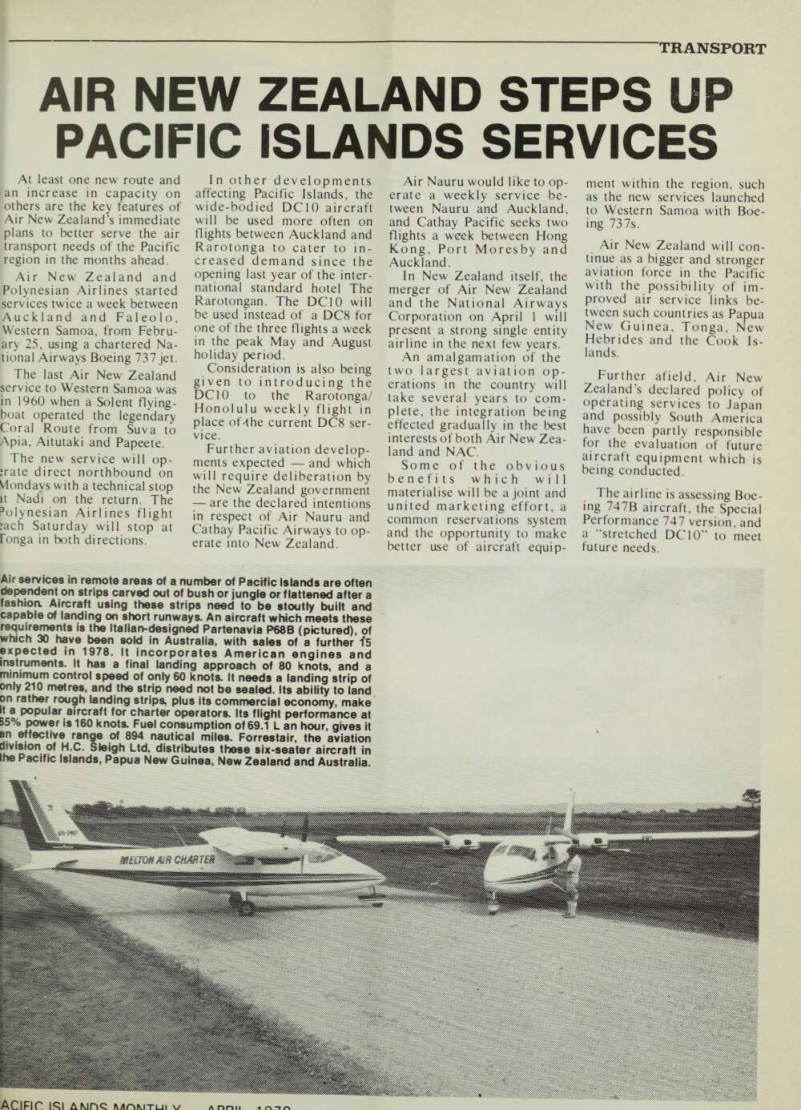
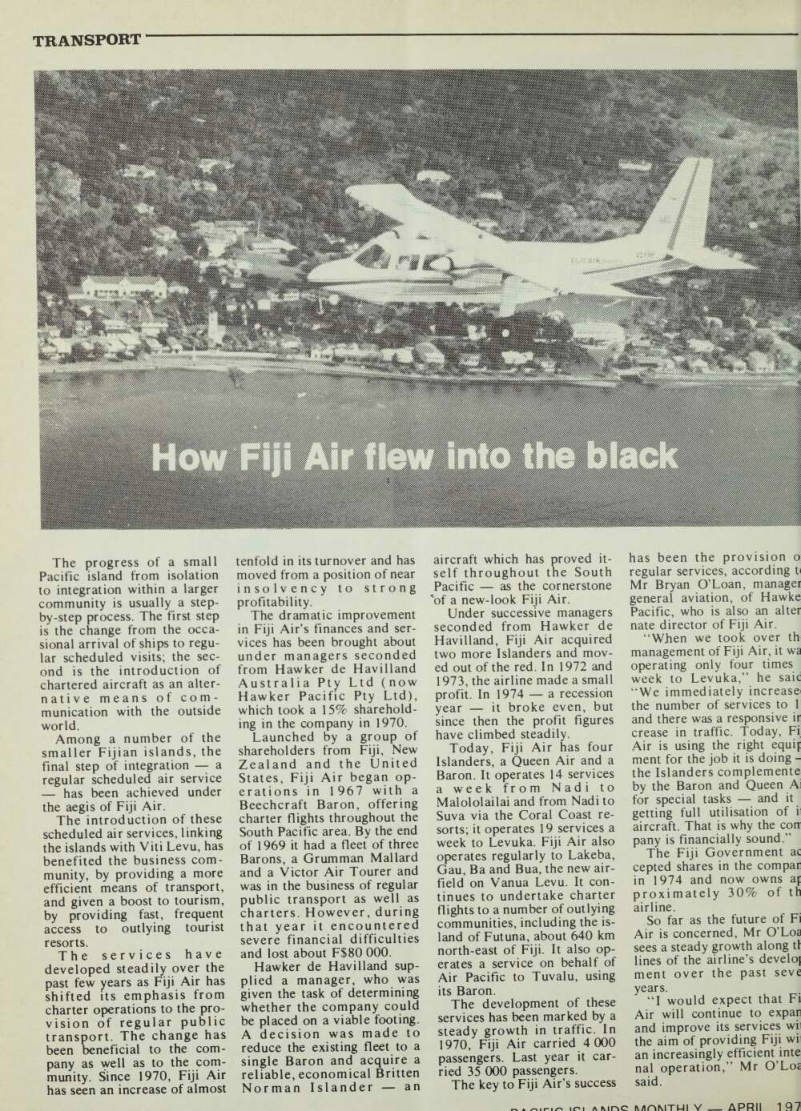
Air New Zealand Steps Up
At least one new route and an increase in capacity on others are the key features of Air New Zealand’s immediate plans to better serve the air transport needs of the Pacific region in the months ahead.
Air New Zealand and Polynesian Airlines started services twice a week between Auckland and Faleolo, Western Samoa, from Febru ary 25, using a chartered Na tional Airways Boeing 737 jet.
The last Air New Zealand service to Western Samoa was in 1960 when a Solent flying boat operated the legendary Coral Route from Suva to Apia, Aitutaki and Papeete.
The new service will op irate direct northbound on Mondays with a technical stop it Nadi on the return. The Polynesian Airlines flight ;ach Saturday will stop at fonga in both directions.
In other developments affecting Pacific Islands, the wide-bodied DCIO aircraft will be used more often on flights between Auckland and Rarotonga to cater to in creased demand since the opening last year of the inter national standard hotel The Rarotongan. The DCIO will be used instead of a DCS for one of the three flights a week in the peak May and August holiday period.
Consideration is also being given to introducing the DC 10 to the Rarotonga/ Honolulu weekly flight in place of'the current DCS ser vice.
Further aviation develop ments expected and which will require deliberation by the New Zealand government are the declared intentions in respect of Air Nauru and Cathay Pacific Airways to op erate into New Zealand.
Air Nauru would like to operate a weekly service between Nauru and Auckland, and Cathay Pacific seeks two flights a week between Hong Kong, Port Moresby and Auckland.
In New Zealand itself, the merger of Air New Zealand and the National Airways Corporation on April 1 will present a strong single entity airline in the next few years.
An amalgamation of the two largest aviation operations in the country will take several years to com- P‘ ete ' , the integration being effected gradually in the best interests of both Air New Zealand and NAC Some of the obvious benefits which will materialise will be a joint and united marketing effort, a common reservations system and the opportunity to make better use of aircraft equip-
ment within the region, such as the new services launched to Western Samoa with Boe ing 7375. . ,r ew Zealand will con tinue as a bigger and stronger a ytetion force in the Pacific Wlt * l the possibility of inl- P rove d air service links be tween such countries as Papua Guinea, Tonga, New Hebrides and the Cook Is tends, Further afie|d- Ajr New Zealand's declared policy of operating services to Japan and possib y South Amer P ica have been partly responsible f or ,h e evaluation of future aircraft equ ip m en, which is
being conducted,
The airline is assessing Boe ing 7478 aircraft, the Special Performance 747 version, and a “stretched DC 10” to meet future needs.
Air services in remote areas of a number of Pacific Islands are often dependent on strips carved out of bush or jungle or flattened after a fashion. Aircraft using these strips need to be stoutly built and capable of landing on short runways. An aircraft which meets these requirements is the Italian-designed Partenavia P68B (pictured), of which 30 have been sold in Australia, with sales of a further f5 expected in 1978. It incorporates American engines and instruments. It has a final landing approach of 80 knots, and a minimum control speed of only 60 knots. It needs a landing strip of only 210 metres, and the strip need not be sealed. Its ability to land on rather rough landing strips, plus its commercial economy, make ® popular aircraft for charter operators. Its flight performance at 55 power is 160 knots. Fuel consumption of 69.1 L an hour, gives it an effective range of 894 nautical miles. Forrestair, the aviation amsion of H.C. Sleigh Ltd, distributes those six-seater aircraft in the Pacific Islands, Papua New Guinea, New Zealand and Australia.
How Fiji Air flew into the black
The progress of a small Pacific island from isolation to integration within a larger community is usually a step by-step process. The first step is the change from the occa sional arrival of ships to regu lar scheduled visits; the sec ond is the introduction of chartered aircraft as an alter native means of com munication with the outside world.
Among a number of the smaller Fijian islands, the final step of integration a regular scheduled air service has been achieved under the aegis of Fiji Air.
The introduction of these scheduled air services, linking the islands with Viti Levu, has benefited the business com munity, by providing a more efficient means of transport, and given a boost to tourism, by providing fast, frequent access to outlying tourist resorts.
The services have developed steadily over the past few years as Fiji Air has shifted its emphasis from charter operations to the pro vision of regular public transport. The change has been beneficial to the com pany as well as to the com munity. Since 1970, Fiji Air has seen an increase of almost
tenfold in its turnover and has moved from a position of near insolvency to strong profitability.
The dramatic improvement in Fiji Air’s finances and ser vices has been brought about under managers seconded from Hawker de Havilland Australia Pty Ltd (now Hawker Pacific Pty Ltd), which took a 15% sharehold ing in the company in 1970.
Launched by a group of shareholders from Fiji, New Zealand and the United States, Fiji Air began op erations in 1 967 with a Beechcraft Baron, offering charter flights throughout the South Pacific area. By the end of 1969 it had a fleet of three Barons, a Grumman Mallard and a Victor Air Tourer and was in the business of regular public transport as well as charters. However, during that year it encountered severe financial difficulties and lost about FSBO 000.
Hawker de Havilland sup plied a manager, who was given the task of determining whether the company could be placed on a viable footing.
A decision was made to reduce the existing fleet to a single Baron and acquire a reliable, economical Britten Norman Islander an
aircraft which has proved it self throughout the South Pacific as the cornerstone of a new-look Fiji Air.
Under successive managers seconded from Hawker de Havilland, Fiji Air acquired two more Islanders and mov ed out of the red. In 1972 and 1973, the airline made a small profit. In 1974 a recession year it broke even, but since then the profit figures have climbed steadily.
Today, Fiji Air has four Islanders, a Queen Air and a Baron. It operates 14 services a week from Nadi to Malololailai and from Nadi to Suva via the Coral Coast re sorts; it operates 19 services a week to Levuka. Fiji Air also operates regularly to Lakeba, Gau, Ba and Bua, the new air field on Vanua Levu. It con tinues to undertake charter flights to a number of outlying communities, including the is land of Futuna, about 640 km north-east of Fiji. It also op erates a service on behalf of Air Pacific to Tuvalu, using its Baron.
The development of these services has been marked by a steady growth in traffic. In 1970, Fiji Air carried 4 000 passengers. Last year it car ried 35 000 passengers.
The key to Fiji Air’s success
has been the provision o regular services, according t( Mr Bryan O’Loan, manager general aviation, of Hawke Pacific, who is also an alter nate director of Fiji Air.
“When we took over th management of Fiji Air, it wa operating only four times week to Levuka,” he said “We immediately increase the number of services to 1 and there was a responsive in crease in traffic. Today, Fi Air is using the right equip ment for the job it is doing the Islanders complemente by the Baron and Queen Ai for special tasks and it getting full utilisation of ii aircraft. That is why the con: pany is financially sound.”
The Fiji Government ac cepted shares in the compar in 1974 and now owns ap proximately 30% of th airline.
So far as the future of Fi Air is concerned, Mr O’Loa sees a steady growth along tl lines of the airline’s develoj ment over the past seve years.
“I would expect that Fi Air will continue to expan and improve its services wii the aim of providing Fiji wi an increasingly efficient inte nal operation,” Mr O’Loa said.
Advertisements & other items, pp. 67-70 (3 items)
Transport
ACIFIT I.QI AMHQ IViirkMTLJi \/ A non *r\-t r\
■
s f IF ■ * F ■P' its? ■ 1 mi W IP > » R I , m m m mm f :■ W m Hi 0 W -4
ewn
Who
Hawks( Pacific Is a new pmpany that takes its name bm the Australian aviation ioneer, Harry Hawker, and le Pacific Basin area in tiich it will operate, ssentially a merchant pipany, Hawker Pacific 111 specialise in aerospace, ecfronic and consumer oducts sales, service id support facilifies. The )mpany was created by a sparation of the activities ithin Hawker de Havilland istralia Ply. Limited which II continue its role of repair id overhaul of military and /il aircraft and engines us the manufacture of frame assemblies.
What
Hawker Pacific holds a mprehensive and versified range of
encies, distributorships
d dealerships including
r following:
fence and Airline Aircraft d Helicopters, rget Aircraft and Systems, neral Aviation Aircraft.
A strangely ftimiliar
uniquely dramatic
new force
Aircraft Spare Parts.
Aircraft Engines.
Aircraft Handling Equipment Naval Vessels.
Simulators.
Radars.
Ground and Airborne electronic equipment and systems.
TV Equipment.
Aerial and Scientific Cameras.
Industrial Chemicals.
Consumer Chemicals and Products.
Where
The Company will operate in Australia, New Zealand, Papua New Guinea, India, Singapore, Malaysia, Philippines, Thailand, Indonesia, Burma, Sri Lanka, China, Japan, New Caledonia New Hebrides, Fiji and other customer areas. Its subsidiary companies and offices are located in Hong Kong, Singapore, Queensland, New South Wales, Western Australia, South Australia, Victoria and the A C T, Technical representatives are stationed in Hong Kong, Indonesia, Singapore, Philippines and Thailand.
Why
Hawker Pacific was formed to separate and centralise the marketing services of Hawker de Havilland Australia. To streamline the sales of defence, airline and general aviation aircraft, engines and electronics throughout Australia and the Pacific Basin and to provide comprehensive after sales service and technical support to its customers.
The Team
Hawker Pacific will encompass the current sales teams from each sphere of activity, led by a Board of Directors with extensive experience in marketing to the Pacific and Asian areas.
Thafs the who, what, where and why of Hawker Pacific a strangely familiar new name, a uniquely dramatic new force.
BIRNIE AVENUE. LIDCOMBE 649 0111. BANKSTOWN AIRPORT 700041 Parofleld ® arto A A C T - 2600; 268 Heidelberg Road. Fairfield, Victoria. 3078; Aerodrome aratieid, Parafleld. South Australia. 5106, Perth Airport. South Guildford, Western Australia. 6055; Beatty Road. Archerfleld Airport, Queensland. 4108.
HAWKER PACIFIC PTE. LTD.. Singapore. Tel; 48-12-109. HAWKER PACIFIC LTD., Hong Kong. Tel: Kowloon 67-3025/6/7
~ in a MPkC iv/inMTi-ll V APRII 197
in a MPkC iv/inMTi-ll V APRII 197
TRANSPORT
Tonga and Columbus sign
on the dotted line
Tonga expects a number of advantages for her maritime industry under a contract sig ned on February 7 by the Prime Minister, Prince Tu’ipelehake, and Hamburg based Columbus Line. Col umbus, as agent for the West German Government, will provide the expertise and in frastructure for various maritime ventures, made possible under that country’s economic co-operation programme.
The contract was signed on behalf of Columbus by the line president, Mr Erwin Ludewig, and Mr Achim Drescher, Columbus regional director in the South Pacific.
Under the contract a new shipping line. Shipping Cor poration of Polynesia Ltd (SCP), was set up with Tonga holding a 60% interest and Columbus 40%.
Mr Ludewig made a special rip to Nukualofa from West Germany to sign the contract n the palace office. King Paula'ahau Tupou cut short a state visit to Nauru to return o Nukualofa to receive Mr in audience after the contract was signed. They dis :ussed shipping matters.
Under the contract West jermany’s economic co-op- Tation expenditure for Tonga v'i\\ be $A6.5 million in 1978 $A5.9 million in capital aid nd SA6OO 000 for technical ssistance).
This is what Tonga will ain: • A 4 000 tonne lift-on-lift •ff roll-on-roll-off (1010-roro) essel, which Tonga will
charter to the Pacific Forum Line; • Appointment of Colum bus Line as a consultant on domestic and overseas ship ping matters; • Re-establishment of domestic services covering the main groups of Tongatapu, Haapai and Vavau; • Financial aid from West Germany to refit and re-struc ture the Inter-island vessel, Olovaha; • A marine training school at Nukualofa and • A technical workshop at Nukualofa.
Columbus Line will man age, maintain and arrange crews for ships West Germany supplies to Tonga under the economic co-operation programme. The first ship is likely to be the one to be char tered to the Forum Line and is expected to be delivered early in 1979.
This ship will be owned by Tonga, registered in Tonga, crewed by Tongans and sail under the Tongan flag. When chartered to the Forum Line it will operate between various South Pacific coun tries and to New Zealand and/or Australia. The object is to supply Tonga with a regular frequent service for both export and import cargoes. The ship will be used in an effort to revive Tonga’s banana trade.
Another vessel will be pro vided by West Germany to ca rry about 100 passengers and cargo on inter-island services in Tonga. This will run in con
junction with the Olovaha, which is under refit at Suva.
The Olovaha will be fitted with new auxiliary engines and will be provided with other new marine engine parts. The object is to extend the life of the Olovaha by two or three years, after which a new ferry may be provided.
The Olovaha is being brought up to accepted international safety standards.
The training school will turn out seamen to crew Tongan ships, and will be staffed by West German and Tongan instructors. The school will be similar to the school which West Germany is providing for Western Samoa.
The technical workshop is a joint New Zealand-West Ger many project, which will pro vide technical equipment and maintenance for ships on Tonga's internal service. The concept of the workshop was developed by the NZ High Commissioner in Tonga, Mr Donald Hunn, and West Ger many.
The board to conduct the operations of SCP comprises Baron Vaea, Tonga’s Minister for Economics, Tevita Tupou, Tonga's Crown Solicitor. Mr Cecil Cocker. Tonga’s Direc tor of Economics, Mr Drescher and Mr Rex Brown, director and general manager, Columbus Maritime Services, New Zealand. The alternate directors are Mr Albin Johansson, general manager of the International Dateline Hotel and a chartered ac countant (for Tonga) and Mr
Ralph Sanft, Tonga busi nessman and honorary consul for West Germany in Tonga (for Columbus).
Discussions between Tonga and Columbus on establishing West German economic co operation with Tonga, started in January, 1977, at the high est level King Taufa’ahau Tupou on one side and Mr Ludewig on the other.
Having established links with Columbus, the Tonga Government has withdrawn from Pacific Navigation of Tonga (PIM, March, p 63), and is offering its interest in that line to the J. Lauritzen group, of Denmark. PNT will be free to continue trading under their present name as long as they wish.
However, there seems to be an inconsistency or conflict of interests. Baron Vaea, as well as being on the board of SCP, is also chairman of PNT. Mr Cocker is a director of both companies, and Tevita Tupou, as well as being on the SCP board is an alternate director of PNT. • Marine Pacific Ltd, of Fiji has increased its tug fleet to four with the purchase of the Pacific Salvor, 340 tonnes, in Bahrain. It will be used for salvage work and ocean tow ing, Marine Pacific has also acquired another barge, which has been named MPL4, of 510 tonnes. This replaces the GM 10 barge which sank of Yanuca Island in 1977.
Advertisements & other items, pp. 71-72 (3 items)
ACIFir 1.91 AMHQ MnMTUi v a nnn -i o-»r>
Polynesian Airlines spreads its wings
Now weekly flights between Western Samoa
Tonga and New Zealand.
WESTERN SAMOA
For further information see your Travel Agent or write to
.AMERICAN
1 SAMOA
NIUE
POLYNESIAN/AIRLINES
Serving the heart of Polynesia J P.O. Box 599, Apia, Western Samoa.
AUCKLAND
8230
PACIFIC
ISLANDS
TRANSPORT
LINE
Owners: Thor Dahls Hvalfangerseiskap A/S - Sandefjord, Norway.
MS CAMELLIA VENTURE
Express Freight Service between Pacific Coast Ports of U.S.A. and...
Tahiti 6 Samoa
Full container service including reefers.
GENERAL STEAMSHIP CORPORATION LTD.
General Agents 400 California Street, San Francisco, California, U.S.A.
APIA: Burns Philp (South Sea) Company Ltd.
PAPEETE: Agence Maritime Internationale, Tahiti.
PAGO PAGO: Polynesia Shipping Services Inc.
NOUMEA: Establissements Ballande.
SYDNEY: Trans-Austral Shipping Pty. Ltd SUVA- Bums Philp (South Sea) Company Ltd LAE/RABAUL: Burns Philp (New Guinea) Ltd PORT VILA: Comptoirs Francais de Nouvelles Hebrides.
Regular
Pacific Services
"Union South Pacific", cellular container vessel. Reefer and general cargo from Auckland at approximately fortnightly intervals. Calls at Suva, Pago Pago, Apia and Nukualofa before returning to Auckland.
"Luhesand", conventional reefer and general cargo. Monthly sailings from Auckland, calls at Suva, Apia, Papeete and Nukualofa.
jmimwuon
JUmcompann
Branches at all main Australian. New Zealand and Pacific Island ports.
KVO^
YOWA LINE
YOUR TRADING PARTNER
Monthly Services
Hong Kong, Taiwan, S. Korea, Japan
To: British Solomon, New Caledonia, Fiji, W Samoa, A. Samoa. Tahiti, Cook Is., Tonga, New Hebrides.
■■■M GENTS
Taiwan: Royal Steamship Corp , Ltd, Taipei S. Korea: Dong Sue Shipping Co, Ltd . Seoul Hong Kong: Dahzun Enterprises Ltd Singapore: Ocean Shipping & Enterprises Pte, Ltd, Guam: Maritime Agencies of Pacific Ltd , Guam Saipan; Saipan Shipping Co, Inc, Saipan 8.5.1. P.: Solomon Taiyo Ltd, Honiara
Ellice Is.,
Taiwan,Hong Kong,Singapore,Jakarta,
Philippine
To; Australia, Papua New Guinea, Sabah & Sarawak.
Tahiti: J.A. Cowan & Fils, Papeete Cooks: Eastern Associates Ltd, Rarotonga Tonga: EM Jones Ltd, Nukualofa New Hebrides: Agence Maritime Raymond Velicite, Port Vila A.Samoa: Island Pacific Agencies Inc., Pago Pago W. Samoa: Morris Hedstrom Ltd.. Apia Fiji: Carpenter Shipping, Suva & Lautoka PNG: Carpenter Shipping Agencies, Port Moresby, Rabaul New Caledonia: Agence Maritime Du Rond Point Du Pacific,
Hong Kong, Taiwan, S. Korea, Japan
To: Guam, Saipan, Truk, Ponape, Other Pacific Islands.
Noumea Indonesia: P.T Porodisa Raya Shipping Lines, Jakarta Sabah: KOH Han Ming Shipping & Forwarding Agent, Kotakmabalu .
Sarawak: Pan Sarawak Agencies Sdn Bhd , Sibu & Kuching Australia: Hetherington Kingsbury Pty Ltd, Sydney. NSW Newzealand: Sofrana Umlmes S.A, Auckland.
KYOWA SHIPPING CO., LTD.
HEAD OFFICE
sth FI., Suzumaru Bldg. 39-8, 2-chome, Nishi-Shinbashi, Minato-ku, Tokyo, Japan.
Phone : 03(437)2885(Rep.) Cables : “MARIQUEEN” Tokyo. Telex : 242-4651 Kyowa J.
JSAKA OFFICE
frontier Bldg., 3-13 Hirano-cho, Higashi-ku, Osaka, Japan. =hon. : 06(227) 0422 (Rep.) Cables '■ ‘MARIQUEEN* Osaka. Tala. ■ 522-3896 Kyo». 0.
72
pAriPir IQI AMDS MONTHLY APRIL, 1 97
Shipping
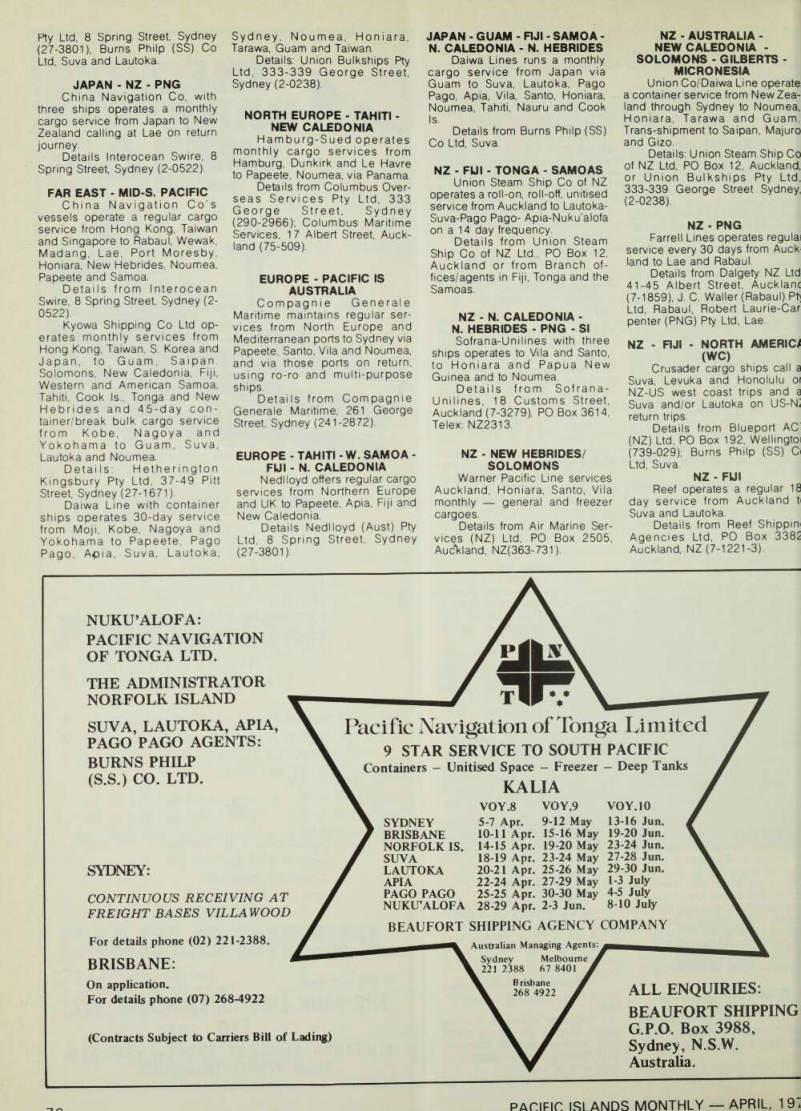
Services
Sydney - Pacific Is - Orient
Chandris Lines cruising in the Pacific and the Orient with SS Ellinis Details from Chandris Lines, 135 King St, Sydney (232-2455).
Sydney-Lord Howe Is -
Norfolk Is
Compagnie des Chargeurs Caledoniens operates four weekly cargo service Sydney - Lord Howe Island and Norfolk Is land.
Details Hetherington Kingsb jry Pty Ltd, 37-49 Pitt Street, Sydney (27-1671).
SYDNEY - NZ - FIJI - HAWAII -
Canada - Us
P & O liners call at Auckland, Suva, Honolulu and Vancouver on jastbound and westbound royages between Sydney and the JS.
Details from P & O Booking Centre, World Travel headquar ers Pty Ltd, 33 Bligh Street, Sydney (231-6655).
AUSTRALIA - NZ - FIJI - TONGA
4. Hebrides - Noumea - Png
Solomons - Samoas
Sitmar Cruises operates a 'ear-round cruise programme to nclude most of the above coun ries Details from Sitmar Cruises, 17 Elizabeth Street, Sydney 232-7511).
Royal Viking Line, with first lass cruise ships Royal Viking tar, Royal Viking Sky and Royal iking Sea, cruises the Pacific om Sydney and Cairns calling at variety of Pacific and Asian orts.
Details from Wilh, /ilhelmsen Agency Pty Ltd, 3-15 Bridge Street, Sydney (2- P & O liners call at Apia, uckland, Bay of Islands, loniara, Lautoka, Noumea, lukualofa, Pago Pago, Papeete, ort Moresby, Santo, Savusavu, uva, Vavau and Vila on cruises om Australia Details from P & O Booking entre World Travel Headquar srs Pty Ltd, 33 Bligh Street, ydney (231-6655).
Australia - Fui - Samoas -
Tonga - Norfolk Island
Pacific Navigation of Tonga Derates a five-weekly refrige ited general cargo/container Brvice from Sydney and risbane, to Suva, Lautoka, Apia, ago Pago, Nukualofa and Nor ik Island.
Details from Beaufort Ship mg Agency Co, 2 Castlereagh :reet, Sydney (221-2388).
Australia - New Caledonia
(And/Or) New Hebrides
Daiwa Line operates a con tainer service from Sydney to New Caledonia and the New Hebrides.
Details: Union Bulkships Pty Ltd, 333-339 George Street, Sydney (2-0238).
Somacal operates a monthly service from Sydney to Noumea.
Details from Karlander (Aust) Pty Ltd, 19-31 Pitt Street, Sydney (27-6301).
Sofrana-Unilines ships serve Noumea every three weeks from the main ports along the east Australian coast.
Details from Sofrana- Unilines, 37 Pitt Street. Sydney (27-2031), Trans-Austral Shipping Pty Ltd, 570 Bourke Street, Melbourne (67-9162). ACTA Pty Ltd, Brisbane (221-3116), Elders- ANL Pty Ltd, Port Adelaide (47-5688), ANL, Newcastle (049-24364), Clements & Marshall. Burnie, Tasmania (31-1833).
Compagnie des Chargeurs Caledoniens operates three weekly containerised cargo ser vice from Sydney to Noumea Details Hetherington Kings bury Pty Ltd, 37-49 Pitt Street, Sydney (27-1671).
Australia - Fiji
Karlander (Aust) Pty Ltd op erates monthly cargo services from Sydney to Suva and Lautoka.
Details from Karlander (Aust) Pty Ltd, 19-31 Pitt Street, Sydney (27-6301), Dalgety Shipping, 461 Bourke Street. Melbourne (60- 0731), Burns Philp (SS) Co Ltd, Suva and Lautoka Sofrana-Unilines (Fiji Ex press Line) operates to Suva and Lautoka every three weeks from the main ports on the east coast of Australia and monthly to Lautoka from Melbourne and Sydney.
Details from Sofrana- Unilines, 37 Pitt Street, Sydney (27-2031), Trans-Austral Shipping Pty Ltd, 570 Bourke Street, Melbourne (67-9162). ACTA Pty Ltd, Brisbane (221-3116), Elder- ANL Pty Ltd, Port Adelaide (47-5688), ANL, Newcastle (049-24364), Clements & Marshall, Burnie, Tasmania (31-1833).
Australia - Saipan -
Micronesia
Nauru Pacific Line operates a regular container service from Melbourne to Saipan, Truk, Ponape and Kosrai.
Details Nauru Pacific Line, Nauru House, 80 Collins Street, Melbourne (653-5709), Nedlloyd Swire, 8 Spring Street, Sydney (2- 0522).
Australia - Tonga -
Samoas - Tahiti
Karlander operates a monthly cargo service from Melbourne and Sydney to Nukualofa, Apia, Pago Pago, Papeete, US west coast Details: Karlander (Aust) Pty Ltd, 19-31 Pitt Street, Sydney (27-6301).
Australia - Tahiti
Daiwa Line offers a six weekly service from Australia to Papeete Details. Union Bulkships Pty _td, 333-339 George Street, Sydney (2-0238).
Australia - Png
Containers Pacific Express Burns Philp and AWP Line) and nJGAL/PNGL Operate chief Con ainer Service from Australia to 3 NG-Solomon Islands ports on oint slot sharing basis. Three :ontainer vessels operate on 28lay turn-around from Melbourne, Sydney and Brisbane to Port Moresby, Lae, Rabaul, Kavieng, Vewak, Madang, Kieta and toniara.
Details from Burns Philp & Co .td, 51 Pitt Street, Sydney 241-3851) and Interocean Swire, I Spring Street, Sydney (2-0522) Farrell Lines operates a ser 'ice every month from Tasmania, /lelbourne, Sydney and Brisbane 3 Lae and Rabaul.
Details from Wilh Wilhelmsen agency Pty Ltd, 13 Bridge Street, lydney (2-051 7), 60 Market treet Melbourne (61-3031), J. C. l/aller (Rabaul) Pty Ltd, Rabaul, lobert Laurie-Carpenter (NG) Pty td, Lae.
New Guinea Express Lines perates three-weekly conven onal and container services, lelbourne, Sydney, Brisbane, ort Moresby, Lae, Rabaul.
Details from New Guinea Ex ress Lines, PO Box R 73, Royal xchange PO, Sydney MI-3991), MacArthur Shipping gency Co, 82-92 Eagle Street, risbane (229-3777), Refriger ted Express Lines, 327 Collins treet. Melbourne (61-3053), reckwoldt's Shipping Agencies i Port Moresby (24-2525), Lae 12-1536), Rabtrad Nuigini Pty td. Rabaul (92-2911).
Karlander New Guinea Line's argo vessels call at Melbourne, ydney, Port Moresby, Lae, adang, Wewak, Manus, Kimbe, abaul.
Details from Karlander (Aust) Y Ltd, 19-31 Pitt Street, Sydney 7-6301), Dalgety Shipping, 461 ourke Street, Melbourne (60f3l).
Australia - Solomons -
Gilbert Is - Micronesia
Daiwa Line operates a con iiner service every 30 days from ydney to Noumea, Honiara, arawa, and Guam. Gizo cargoes anshipped at Honiara. Saipan, ajuro, Truk, Ponape, Koror, Yap irgoes transhipped at Guam.
Details from Union-Bulkships y Ltd, 333-339 George Street rdney (2-0238, telex AA20397).
Australia - Nauru -
Majuro
Nauru Pacific Line operates gular cargo/passenger service >m Melbourne to Nauru and Ma ro.
Details Nauru Pacific Line, iuru House, 80 Collins Street
Melbourne (653-5709), Nedlloyd Swire, 8 Spring Street, Sydney (2- 0522).
Us - Png
Farrell Lines operates regular services from all US west coast ports to Lae and Rabaul.
Details from Wilh, Wilhelmsen Agency Pty Ltd, 13 Bridge Street, Sydney (2-0517), Farrell Lines, 1 Market Plaza, San Francisco, L A. (9-4105), J. C.
Waller (Rabaul) Pty Ltd, Rabaul, Burns Philp (NG) Ltd, Kieta, Robert Laurie-Carpenter (PNG) Pty Ltd, Lae.
Png - Us - Canada
Farrell Lines operates regular services from Lae and Rabaul to US west coast ports and Van couver Details from J. G. Waller (Rabaul) Pty Ltd, Rabaul, Robert Laurie-Carpenter (PNG) Pty Ltd, Lae, Farrell Lines, 1 Market Plaza, San Francisco, L A. (9-4105), Wilh, Wilhelmsen Agency Pty Ltd, 13 Bridge Street, Sydney (2- 0517).
Png - Uk/Continent
Bank Line operates regular cargo service from Kieta, Rabaul, Kimbe, Madang and Lae to Liver pool, Hamburg, Rotterdam, Ant werp and London.
Details from Bank Line (A’asia) Pty Ltd, 1 York Street, Sydney (27-2041); Burns Philp (PNG) Ltd, PNG ports
Png - Us
Bank Line operates regular cargo service from Kieta, Rabaul, Kimbe, Madang and Lae direct to San Francisco: calls at US Gulf and East Coast ports on induce ment.
Details from Bank Line (A'asia) Pty Ltd. 1 York Street, Sydney (27-2041); Burns Philp (PNG) Ltd, PNG ports or Howard Smith Industries Pty Ltd, 1 York Street, Sydney (27-5611).
Solomons - Fiji - Tonga -
W. Samoa - Uk/Continent
Bank Line operates regular cargo service from Honiara, Suva, Nukualofa and Apia to Liverpool, Hamburg, Rotterdam and Ant werp.
Details from Bank Line (A’asia) Pty Ltd, 1 York Street.
Sydney (27-2041); Burns Philp (SS) Co Ltd, Suva.
Far East - Fui -
New Zealand
New Zealand Unit Express (CNC, MNOL, RIL) operates a three-weekly cargo service from Hong Kong to Lautoka, Suva, NZ ports, Manila, Kaoshiung, Keelung, Hong Kong.
Details from Interocean Swire, 8 Spring Street, Sydney (2- 0522).
Nedlloyd operates monthly cargo service with three ships from Surabaya, Jakarta, Bangkok, Port Kelang and Singapore to Suva and NZ ports.
Details from Nedlloyd (Aust.)
Pty Ltd, 8 Spring Street, Sydney (27-3801), Burns Philp (SS) Co Ltd, Suva and Lautoka.
Japan - Nz - Png
China Navigation Co, with three ships operates a monthly cargo service from Japan to New Zealand calling at Lae on return journey.
Details Interocean Swire, 8 Spring Street, Sydney (2-0522).
Far East - Mid-S. Pacific
China Navigation Co's vessels operate a regular cargo service from Hong Kong, Taiwan and Singapore to Rabaul, Wewak, Madang, Lae, Port Moresby, Honiara, New Hebrides, Noumea, Papeete and Samoa.
Details from Interocean Swire, 8 Spring Street, Sydney (2- 0522).
Kyowa Shipping Co Ltd op erates monthly services from Hong Kong, Taiwan, S. Korea and Japan, to Guam, Saipan Solomons, New Caledonia, Fiji, Western and American Samoa, Tahiti, Cook Is., Tonga and New Hebrides and 45-day con tainer/break bulk cargo service from Kobe, Nagoya and Yokohama to Guam, Suva, Lautoka and Noumea.
Details: Hetherington Kingsbury Pty Ltd, 37-49 Pitt Street, Sydney (27-1671).
Daiwa Line with container ships operates 30-day service from Moji, Kobe, Nagoya and Yokohama to Papeete, Pago Pago, Apia, Suva, Lautoka,
Sydney, Noumea, Honiara, Tarawa, Guam and Taiwan.
Details: Union Bulkships Pty Ltd, 333-339 George Street, Sydney (2-0238).
North Europe - Tahiti -
New Caledonia
Hamburg-Sued operates monthly cargo services from Hamburg, Dunkirk and Le Havre to Papeete, Noumea, via Panama.
Details from Columbus Over seas Services Pty Ltd, 333 George Street, Sydney (290-2966); Columbus Maritime Services, 17 Albert Street, Auck land (75-509).
Europe - Pacific Is
Australia
Compagnie Generale Maritime maintains regular ser vices from North Europe and Mediterranean ports to Sydney via Papeete, Santo, Vila and Noumea, and via those ports on return, using ro-ro and multi-purpose ships.
Details from Compagnie Generale Maritime, 261 George Street, Sydney (241-2872).
EUROPE - TAHITI - W. SAMOA -
Fui - N. Caledonia
Nedlloyd offers regular cargo services from Northern Europe and UK to Papeete, Apia, Fiji and New Caledonia.
Details Nedlloyd (Aust) Pty Ltd, 8 Spring Street, Sydney (27-3801).
JAPAN - GUAM - FIJI • SAMOA -
N. Caledonia - N. Hebrides
Daiwa Lines runs a monthly cargo service from Japan via Guam to Suva, Lautoka, Pago Pago, Apia, Vila, Santo, Honiara, Noumea, Tahiti, Nauru and Cook Is.
Details from Burns Philp (SS) Co Ltd, Suva.
NZ - FUI - TONGA - SAMOAS Union Steam Ship Co of NZ operates a roll-on, roll-off, unitised service from Auckland to Lautoka- Suva-Pago Pago- Apia-Nuku’alofa on a 14 day frequency Details from Union Steam Ship Co of NZ Ltd., PO Box 12, Auckland or from Branch of fices/agents in Fiji, Tonga and the Samoas.
Nz - N. Caledonia -
N. Hebrides - Png - Si
Sofrana-Unilines with three ships operates to Vila and Santo, to Honiara and Papua New Guinea and to Noumea.
Details from Sofrana- Unilines, 18 Customs Street, Auckland (7-3279), PO Box 3614, Telex: NZ2313.
Nz - New Hebrides/
Solomons
Warner Pacific Line services Auckland, Honiara, Santo, Vila monthly general and freezer cargoes.
Details from Air Marine Ser vices (NZ) Ltd, PO Box 2505, Auckland, NZ(363-731).
Nz • Australia -
New Caledonia -
Solomons - Gilberts -
Micronesia
Union Co/Daiwa Line operate! a container service from New Zea land through Sydney to Noumea, Honiara, Tarawa and Guam.
Trans-shipment to Saipan, Majuro and Gizo.
Details; Union Steam Ship Co of NZ Ltd, PO Box 12, Auckland, or Union Bulkships Pty Ltd, 333-339 George Street Sydney, (2-0238).
Nz - Png
Farrell Lines operates regulai service every 30 days from Auck land to Lae and Rabaul.
Details from Dalgety NZ Ltd 41-45 Albert Street, Aucklanc (7-1859), J. C. Waller (Rabaul) Ptj Ltd, Rabaul, Robert Laurie-Car penter (PNG) Pty Ltd, Lae.
Nz - Fiji - North Americ/
(WC) Crusader cargo ships call a Suva, Levuka and Honolulu or NZ-US west coast trips and a Suva and/or Lautoka on US-Ni return trips.
Details from Blueport AC (NZ) Ltd, PO Box 192, Wellingtoi (739-029); Burns Philp (SS) C Ltd, Suva.
Nz - Fui
Reef operates a regular 18 day service from Auckland ti Suva and Lautoka.
Details from Reef Shipping Agencies Ltd, PO Box 3382 Auckland, NZ (7-1221-3).
Pacific Line with one ship op erates monthly cargo service New Zealand. Lautoka, Suva.
Details: Sofrana-Unilines, 18 Customs Street, Auckland (7-3279) PC Box 3614, Telex; NZ2313
Nz- Samoa - Tonga
Pacific Navigation of Tonga operates a four-weekly cargo ser vice, Auckland - Nukualofa - Pago Pago - Apia - Nukualofa - Auck land.
Details from McKay Shipping Ltd, Downtown House, Queen Street, Auckland (33-656).
Warner Pacific Line services Onehunga - Nukualofa - Vavau fortnightly, and Timaru - Nukualofa - Vavau monthly and Onehunga - Apia and Pago Pago every 21 days carrying general and freezer cargoes and Timaru - Apia every 21 days carrying freezer cargo Details from Air Marine Ser /ices (NZ) Ltd, PC Box 2505.
Auckland (362-731).
NZ - COOK IS - NIUE -
Tahiti
Shipping Corporation of NZ .td operates cargo services bas jd on pallets and similar units rom Auckland to Niue, Cook Is ands and Tahiti.
Details from the Shipping Corp of NZ Ltd, PC Box 3420, Auckland (379-430); Waterfront Commission, PC Box 61, Rarotonga, Lighterage and Itevedoring Co, Aitutaki, Niue aovt Offices, Niue Island or Com lagnie Maritime Polynesienne, J'P’ 368, Papeete
Nz - American Samoa
Farrell Lines operates regular ervice every 30 days from Auck ■md to Pago Pago.
Details from Dalgety (NZ) Ltd, 1-45 Albert St, Auckland 71859 meubuhl Maritime Services Box 9, Pago Pago 633-5121.
UK - PANAMA - SAMOA - FUI The Fiji Direct Service, cargo nly, is maintained by Conference essels, sailing at regular monthly itervals out of Avonmouth, via anama, for Apia, Suva and autoka.
Details from Burns Philp (SS) 0 Ltd, Suva.
Uk/N. Continent - Tahiti -
I. Caledonia - N. Hebrides
Bank Line operates regular argo service from Hull, Ham urg, Bremen, Antwerp and Rot srdam to Papeete, Noumea and ila.
Details from Bank Line Vasia) Pty Ltd, 1 York Street, ydney (27-2041); Ets AMAV, apeete; Ets Ballande, Noumea, urns Philp (NH) Ltd, Vila.
Uk/N. Continent - Png -
Solomons
Bank Line operates regular argo service from Hull, Ham urg, Bremen, Antwerp and Rot srdam to Port Moresby, Lae, ladang, Kimbe, Rabaul, Kieta id Honiara and, on inducement 1 Yandina, Tarawa and Nauru.
Details from Bank Line
(A’asia) Ry Ltd, 1 York Street, Sydney (27-2041); Burns Philp (PNG) Ltd, PNG ports.
San Francisco - Honolulu
Micronesia
Nauru Pacific Line operates regular conventional/container service from San Francisco and Honolulu to Majuro, Nauru, Ponape, Truk and Saipan.
Details from Nauru Pacific Line, Nauru House, 80 Collins Street, Melbourne (653-5709), North American Maritime Agen cies, 100 California Street, San Francisco, California 9411 (981- 0343).
US - FIJI - TAHITI - NZ -
Australia
Bank and Savill Line Ltd op erates regular cargo services from US Gulf ports to Australia and NZ.
Calls at Suva, Lautoka and Papeete on demand Details from Bank Line (A/asia) Pty Ltd, 1 York Street, Sydney (27-201 1) or Howard Smith Industries Pty Ltd, 1 York Street, Sydney (27-5611) US - A. SAMOA - NZ - AUST Farrell Lines LASH ships op erate regularly from US to Australia, via Pago Pago and Auckland and Canada.
Details from Wilh, Wilhelmsen Agency Ry Ltd, 13 Bridge Street, Sydney (2-0517), 60 Market Street, Melbourne (61- 0301); Farrell Lines, 1 Market Plaza, San Francisco, L A. (415-777-3300); Dalgety NZ Ltd, Auckland (7-1859); Kneubuhl Maritime Services, Pago Pago (633-5121).
Us - Tahiti - Samoa
Pacific Islands Transport op erates a five/six weekly cargo ser vice from North American west coast ports to Papeete, Pago Pago, Apia.
Details from Trans-Austral Shipping Pty Ltd, 19 Pitt Street, Sydney (27-2441).
Polynesia Line operates con tainer and general cargo service from US west coast ports to Papeete and Pago Pago.
Details from Polynesia Ship ping Services Inc, PC Box 1478 Pago Pago (9-6799).
Advertisements & other items, pp. 73-84 (6 items)
\CIFIC ISI MDMTWI V addii imo
Farrell Mies
YOUR DIRECT LINK WITH THE
WEST COAST NORTH AMERICA
Quick &
Dependable
LASH
Service
REFRIGERATED
& GENERAL
CARGO IN
BARGES. BULK
LIQUIDS IN
VESSEL DEEP
TANKS.
FROM UNITED STATES WEST COAST
& CANADA TO PAPEETE, PAGO PAGO,
AUCKLAND,LAE & RABAUL.
PAPUA NEW GUINEA TO VANCOUVER B.C.
TACOMA, PORTLAND, SAN FRANCISCO,
LOS ANGELES.
SYDNEY, MELBOURNE, BURNIE, HOBART,
BRISBANE TO LAE & RABAUL.
X
THE AMERICAN
FLAG LINE
INCORPORATED
MANAGING AGENTS: Wilh. Wilhelmsen Agency P/L., 13-15 Bridge Street, Sydney 2000-Phone 20517-60 Market Street, Melbourne, 3000-Phone 613031-344 Queen Street, Brisbane, 4000-Phone 2213316. MANAGING AGENTS N.Z. Dalgety N. 2.
Ltd., 98 Lambton Quay, Wellington Phone 72 4099 41/45 Albert Street, Auckland —Phone 71859. ISLAND AGENTS: Robert Laurie (NG) P/L, P.O. Box ' 1032, Lae, PNG - Phone 423811. J.C. Waller (Rabaul) Pty. Ltd. P.O Box 606 Rabaul, PNG. - Phone 921997.
FOR
SALE
106 ft Luxury twin screw motor cruising vessel, 230 gross registered tons.
Operating range 2 500 nautical miles; service speed 12 knots; brand new systems throughout and all modern conveniences. Sleeping capacity of 21; Fully air-conditioned with large open deck area.
Powered by (2) Caterpillar 343 marine diesels with twin disc reduction gearboxes (not installed); (2) Caterpillar 3306 auxiliary diesel generating sets, supplying 415 volts, 3-phase, 50 cycle, at 187kVa.
Undergoing current survey certificate for unrestricted passenger coaster.
For all other information and inspection, ring Sydney 929-5850 business hours or write:
CRUISING VESSEL
BOX W2l, P.O.
NEUTRAL BAY, NSW 2089.
FOR SALE:
TRAWLERS, FISHING BOATS, TUGS, BARGES,
DREDGES & SHIPS.
Singledecker, 450 dwt., 44.30 x 7.75 x 3.26 m, built 6/62, 299 grt. 6769.23m3/6000m3 holds, hatch 19.20 x 4.80 m, 2 hydraulic winches, 2 x 2t derricks, B + W/Alpha of 360 bhp., 2 Lister auxs., all modern nav. aids. U 55220,000.
Singledecker, 400 dwt., 38.15 x 7.38 x 3.38 m built 6/67, 199 grt., 5846.15m3/5384.61 m 3 holds, 1 McGregor hatch, 16.12 x 4.61 m, 2 hydraulic winches and 2 derricks of 2.5/3 Ot., Caterpillar 400 hp., var. pitch prop., air-conditioning, all modern nav. aids. U 55270,000.
Singledecker, 330 dwt., 39.29 x 7.21 x 3.0 m, 292 grt., 6000m3/5692.30m3 holds, 2 hatches - 9.60 x 4.60 m each, gearless, B + W/Alpha 310 hp., Ruston aux., all modern nav, aids, in Jan '7B nearly whole accom. was renewed,
US$l2O,OOO.
Singledecker, 315 dwt., 37.50 x 6.48 x 2.69 m, built 1958, 199 grt., 5384.61 m 3/ 4923.07m3 holds, hatch 20 x 4.1 m, B + W/Alpha of 280 hp., 2 Lister auxs., contr. pitch prop, all modern nav. aids. US$l5O,OOO.
Side Trawler - 27.38 x 6.76 x 2.76 m, 2 holds total 220m3, Alpha diesel 500 hp, built 1971. US$3BO,OOO.
Side Trawler - 61 x 9.8 x sm, 792 grt., loading cap. approx 700m3, freezing hold 40m3 at minus 28 degrees cent. Man 1470 hp., accomm. for 50 crew. Class Lloyds 100A1.
U 55330,000.
Side Trawler - 31.38 x 7.38 x 3.23 m, built 1974, Grenaa 600 hp. diesel, US$4BO,OOO.
Dredge 6" x 8” sand and gravel, 247 hp. Cat. diesel, two aux. pumps, built 1974 of Vs-" and 3/8" steel, 500 gals, fuel, total four hydraulic winches. Very good order.
A 535,000.
Tug, 32.30 m, built U.K. 1959, 7/8" steel plate, 1200 hp.
National/Mirrlees Blackstone, A 5130,000, For further details contact: AUSTRALIAN SHIPBROKERS, P.O. Box 401, Maroochydore 4558, Qld. Aust. Ph. (071) 441174
PISCES DIESEL
GM's ANSWER TO THE
SMALL DIESEL MARKET!
• 27 hp. 2 cylinder. • 40 hp. 3 cylinder. • 60 hp. 4 cylinder, also; 27-10 kW Generator sets 40-25 kW Generator sets 60-37.5 kW Generator sets • Mechanical and Borg Warner gear-boxes. • Complete with heat exchangers and instrument wiring looms no extra.
Australian Distributors:
DIABLO DIESEL
212 Haldon Street, Lakemba, NSW 2195.
Phone 759 5306 759 0463.
Note: Export service available.
ALSO IN STOCK:
• Borg Warner reductions V/Drive Boxes. New & used parts service. • Fresh water heat exchangers. • Babbit disc shaft couplings.
To eliminate misalignment. • Alarm systems for flooding fire overheating low oil pressure.
THE
BANH
LINE
urn i 12e
MONTHLY SERVICES
United Kingdom and Continent to: Papeete, Noumea, New Hebrides, Papua New Guinea and Solomon Islands. ★ Papua New Guinea to: North America, United Kingdom and Continent. ★ Solomons, Fiji, Tonga, Samoa and Tarawa to: United Kingdom and Continent.
For particulars apply:
THE BANK LINE (AUSTRALASIA) PTY.
LTD.,
18TH FLOOR, 1 YORK ST., SYDNEY, N.S.W. 2000.
Phone: 27 2041. Telex; 24063.
NUKUALOFA:
PACIFIC NAVIGATION
OF TONGA LTD.
THE ADMINISTRATOR
NORFOLK ISLAND
SUVA, LAUTOKA, APIA,
PAGO PAGO AGENTS:
BURNS PHILP
(S.S.) CO. LTD.
SYDNEY:
CONTINUOUS RECEIVING AT
FREIGHT BASES VILLAWOOD
For details phone (02) 221-2388.
BRISBANE:
On application.
For details phone (07) 268-4922 (Contracts Subject to Carriers Bill of Lading) P m T
Pacific Navigation of Tonga Limited
9 STAR SERVICE TO SOUTH PACIFIC
Containers - Unitised Space - Freezer - Deep Tanks
L KALI A
VOY.9
9-12 May 15-16 May 19-20 May 23-24 May 25-26 May 27-29 May 30-30 May 2-3 Jun.
VOY.IO
13-16 Jun. 19-20 Jun. 23-24 Jun. 27-28 Jun. 29-30 Jun. 1-3 July 4-5 July 8-10 July
VOY.B
5-7 Apr. 10-11 Apr 14-15 Apr 18-19 Apr 20-21 Apr 22-24 Apr 25-25 Apr 28-29 Apr
SYDNEY
BRISBANE
NORFOLK IS.
SUVA
LAUTOKA
APIA
PAGO PAGO
NUKUALOFA
AGENCY
COMPANY
SHIPPING
BEAUFORT
Australian Managing Agents: Sydney Melbourne A 221 2388 67 8401 Brisbane L 268 4922 A
ALL ENQUIRIES:
BEAUFORT SHIPPING
G.P.O. Box 3988,
Sydney, N.S.W.
Australia.
FOR SALE: Passenger Cargo Ship "Taoniu".
The best of its type beautifully built V.I.P. suite, etc.
Representing an excellent capital investment for the future. Dimens. 177' x 28' x 10'6''. Speed 10 knots. Now lying Suva. At no extra cost there is an accompanying opportunity to enter local and International shipping trade through own Fiji Co. with established clientele. Ideal for GROUP ownership and development of untapped cargopassenger tourist trade. Close to $lOO,OOO already spent on improvements. Following present overhaul and refit this really beautiful vessel is to be sold as under Lloyds class. PRICE: $220,000 (replacement cost around $2,000,000). Prospective local or overseas buyers should contact "Taoniu” Shipping Co. or their agents, Williams Shipping Co. Ltd., Suva, Fiji. Tel. 31 2928 or Sydney 98 8547, 98 7865.
NIUE —^
x N / S
/ COOK ISLANDS \
I * -"
, TAHITI
to and from
NEW ZEALAND
Regular service using pallet load ships TIARE MOANA and FETU MOANA. Refrigerated and general cargo between Auckland and Niue, Rarotonga, Aitutaki, Papeete. Other nearby ports by inducement.
AREA AGENTS
Niue: Government Shipping Office, Alofi.
Cook Islands: Waterfront Commission, PO Box 61, Rarotonga.
Telex Shipping RG 2002 Tahiti; Agence Maritime et de Voyage, B P 131, Papeete Telex AMAV 251 FP
The Shipping Corporation
of New Zealand Limited
Sea carrier to the nation AUCKLAND; Phone 379-430. PO Box 3420. Telex: NZ2822 WELLINGTON: Phone 728-500. PO Box 3344. Telex: NZ3495 CHRISTCHURCH: Phone 795-760. PO Box 777. Telex: 4434 DUNEDIN: Phone 76-076. PO Box 904. Telex: 5228.
WANTED PLANTATION
Anywhere in South Pacific.
PNG to Tahiti, Management, Partnership or Lease by qual. competent Scotsman . 17 yrs. tropical agricultural, processing engineering, trading experience coconuts, copra, cocoa, coffee , citrus, cattle, pigs, bananas, pineapple, ginger & pyretherum. Age 45 years.
Polynesian wife speaks Pidgin French. Isolation no problem.
R.W. THOMSON
19 Bay Grove , Rotorua.
New Zealand.
THE PAPUA HOTEL
PORT MORESBY
• Right in the business centre • A tradition for comfort and fine food • All rooms air conditioned • Restaurant • Bars • Banquet Hall Telephone 21 2622 Cables PARTEL
A. C. NEUMANN
Manager
CLASSIFIED ADVERTISEMENTS
Per Line $5.00 Aust. Minimum 4 lines.
MAPS ANQ PRINTS OF THE OLD
PACIFIC: Regular catalogues issued listing a large stock of original antiquarian views and maps of Australia, New Zealand, Papua New Guinea and all island groups of the Pacific. Write today for your free copy. COLIN HINCHCLIFFE, 7 Royd Avenue, Heckmondwike, West Yorkshire, WF 16 9aL
UNITED KINGDOM.
Would JAMES GREENWALD of
WESTERN SAMOA, or his superiors, please contact me urgently before further action is taken. Kelvin Cole, 95 Glenlyon Road, Brunswick, 3056, Australia.
FOR SALE
FLEETS 59ft. Carvel passenger boat, profess, bit. 1971, licenced 150 passengers, some dry hold space, suit river run. $BO,OOO.
FLEETS: 221 Esplanade, Wynnum Central, Brisbane.
Cable: 'FLEETS BRISBANE'
FOR SALE PERKINS 4 cyl. 36-40 hp diesels heat exchanger cooled with 2 to 1 reduction boxes. Instruments.
Rebuilt engines with all new marinisation $2500 DIABLO
MOTORS PTY LTD. 212 HaWon St,
Lakemba, 2195, NSW Australia.
WANTED TO BUY -
ISLAND, 20 to 1,000 ACRES.
WITH FRESH WATER
SUPPLY. AGRICULTURAL
PURPOSES; PREFER LAND
NEVER TREATED WITH
CHEMICAL PESTICIDES.
FORWARD ALL
INFORMATION AND PHOTOS
TO:
C.J. PUKANECZ
RD NO 2
ALLENTOWN,
PENNSYLVANIA 18103, USA
Mechanic, Construction Foreman, Executive, Tradesman, wants work anywhere in Pacific. Keen to meet locals not missionaries wife is trained nurse, sailmaker and can teach small school will take six weeks to sail own yacht there and needs mooring water depth 7ft 4ins. Contact: John Welk, PO Box 242, Footscray, Vic.
Aust 3011.
CASH for HUMAN HAIR plaits black or near from 20 cm up Mail to
HAIRBUYERS OF AUST. 899 GPO
Sydney 2001. Post Paid.
Stay at Aggie Grey's
the South Pacific's
legendary hotel.
Situated right in the heart of Western Samoa. Enjoy Polyneslan-style friendliness and service, in cool surroundings, superb entertainment and food. Magnificent white sand beaches only a short drive away. Airconditioned rooms, swimming pool and full bar facilities.
Bookings through Union Steamship Company of NZ, Pan Am, Air New Zealand or direct to Aggie Grey's, Apia, Western Samoa.
Cables: AGGIES, APIA.
LEAD
TIN
BERJAK & PARTNERS
PHONE: (03) 26-1756
492 ST. KIIOA ROAD, MELBOURNE 3004.
Gobi*; METJAK MELBOURNE Telex; 30334.
sellers:
WHITEMETAL
TYPEMETAL
SOLDERS
buyers:
SCRAP
DROSS
RESIDUES
OUTSTANDING OPPORTUNITY IN THE SOUTH PACIFIC.
SALES & MARKETING MANAGER.
THE COMPANY
We are a multi-national corporation who manufactures and markets a large range of personal care products and personal use items for men and women. Most of our products are leaders in their categories.
THE JOB
We are looking for an experienced expatriate to represent us in the South Pacific markets as Sales & Marketing Manager.
REQUIREMENTS
• Preferably at least 5 years experience in selling & marketing of consumer packaged goods, with a solid track record of achievements. • Age between 25-40 years. • Preferably bachelor, or your personal circumstances allow you to travel 80% of your time. • Willing to commit yourself to the area and the job for at least 5 years. • A sound education.
Able to express very well in English, some knowledge of French preferred. • Possess the necessary personal presence to work well with Sales Agents, and be able to obtain results working through other people. • Must have the composure to remain unruffled despite frustrations of business and travel. • Must be efficient, businesslike and persuasive. • Willing to take large responsibility in orderto carve a permanent career with our organization, who looks after its people.
REWARDS
In return for all these attributes, we will pay you an attractive salary with excellent benefits applicable to an expatriate.
We will also give you a free hand to run the operation, after you have proven yourself.
If you think you have the necessary drive and enthusiasn to take this exciting challenge, send us your complete particulars including details of your achievements in the past jobs. Write in confidence to: General Manager Newton P.O. Box 24 (Twenty Foi Singapore 11
HRME 633*0(
GRASS
BOOTS
r% m
TRAVEL
THE ISLANDS
A DETAILED
The Kingd° m ot
TONGA
with
□POROfc
MAIL ORDER BOOKSHOP
(YOU CAN ORDER OVERLEAF)
mm* .and, meanwhile, here's your PIM subscription form:
SUBSCRIPTION FORM;
It
PACIFIC ISLANDS MONTHLY
Postal Address: Box 3408, G.P.O., Sydney 2001, N.S.W., Australia.
SUBSCRIPTION RATES
Australia (including Norfolk Island) $10.50 Aust.
New Zealand .'..n’z '$lT.50 ”$10.50 Aust.
F 'i' F $10.75 $10.50 Aust.
Papua New Guinea |k 9.00 $10.50 Aust.
Tonga, New Hebrides, Cook Islands, Western Samoa, Tuvalu, Gilbert Islands, Niue, Nauru, Solomon Islands $10.50 Aust.
American Samoa, Northern Marianas, Micronesia, Guam and Hawaii US $15.00 $12.00 Aust.
US Mainland and Canada US $17.00 $14.00 Aust.
New Caledonia and French Polynesia 1 600 CFP $13 50 Aust United Kingdom £9.50 $12.50 Aust! 4.500 Yen $12.50 Aust.
Elsewhere $14.50 Aust.
I" r U S - J New Z “' and -U.K., Papua New Guinea and Fiji currency. For other remittancos please obtain a Bank Draft in Australian dollars, made payable to ANZ Banking Group, 88 Wentworth Ave., Sydney Australia city/its ts/country/postcode (please print) Attached is my payment of.„ .for a 12 months' subscription.
New □ Renewal □
ORDER FORM FOR PI MS MAIL ORDER BOOKSHOP:
I I The Lost Caravel. Robert Langdon shatters traditionally-held views on the Polynesians in this controversial, historical whodunnit described by Prof. Ron Crocombe as a “masterpiece as fascinating as it is important”.
Also invaluable as a record of early Pacific exploration. 368 pp. Profusely illustrated with maps and plates. $A18 or $US26.
I I The Story of the Solomons. Simple, lucid outline of the history of the Solomon Islands, from a refreshingly frank and affectionate point of view, by Dr. C.
E. Fox. 88 pp. $A3 or $US4.
I I Port Moresby, Yesterday and Today. In what is even more than a history of Papua New Guinea’s capital, Canon Ian Stuart takes us on an entertaining, personalised tour of the city. Soft cover, 368 pp. Maps, illustrations. SA3.50 or $US4.50.
I I Holy Torture in Fiji. Firewalking and other sacred, ancient rituals of Fiji’s Hindus, described in text and colour photographs. Large format, 64 pp. illustrated.
SA4.50 or SUS6.50.
I I New Hebrides. One of the superb Islands in the Sun series of brilliant full-colour plates, maps and text, this volume describes the unique British-French Condominium of New Hebrides. A guide for travellers, or for collectors. 128 pp. Fully illustrated. $A10 or $US13.
I Incw Caledonia. French New Caledonia, superbly depicted in full colour photographs, with informative text and maps giving history, geography and daily life.
An Islands in the Sun guide, with 128 pp. Fully illustrated. $A10 or $US13.
I I Bora Bora. One of the French Pacific’s fascinating, colourful high islands, reached from Tahiti, here presented in sparkling full colour pictures for visitors or mere armchair travellers. Another Islands in the Sun guide, with 128 pp. Fully illustrated. $A10 or $US13.
I I Easter Island. At last, a new book on fascinating Easter Island — history, daily life and the mysterious giant statues. All in full colour with maps and information for travellers, as one of the Islands in the Sun series. Half of this splendid book is devoted to descriptions and photographs of the statues that made the island famous. 128 pp. Fully illustrated. $A10 or $US13. □ Tahiti and its Islands. New revised edition, just released, of this popular title in the Islands in the Sun series. Sparkling new colour plates, new information, new maps. Includes the Leeward Islands, the Tuamotus, the Gambiers, Marquesas, the Australs. Has hotel lists and places to see. 128 pp. Fully illustrated. $A10 or $US13.
I I Rarotonga. In his Rarotonga, James Siers for the first time introduces to a wider public the main island of the Cooks group. With its international airport now linking it readily with the outside world, the beauty, charm and friendliness of Rarotonga’s people are wide open for others to share. 128 pp. Fully illustrated. $A10 or $US13. □ Moorea. Of all the beautiful islands of the Pacific perhaps none has captured the imagination of visitors - including French painter Paul Gauguin, English writer W, Somerset Maugham, and many thousands of people of lesser fame - than Moorea, a few miles off Tahiti, main island of French Polynesia. Few people would deny that James Siers does the subject justice in his beautifully illustrated Moorea. Parallel texts in English and French. 128 pp. $A10 or $US13. 1 Little Chimbu in Bougainville. For the young and young-at-heart, lovable Little Chimbu and his friends visit Panguna, and get into awfpl trouble in what could be the biggest hole in the world, the Bougainville copper mine. Nancy Curtis, who used to live there, tells the story in full colour drawings which are also accurate and instructive. 48 pp. Illustrated. $A3.50 or $US4.50.
I I Percy Chatterton’s Papua: Day That I Have Loved. Charming evocative account of changing Papua as Rev. Percy Chatterton knew it for 50 years. 144 pp.
Illustrated. $A6.50 or $US8.50.
I I Asimba. A collection of 20 colourful designs by you artiste from PNG’s Sogeri High School. Each is 42cm x 28c and suitable for framing. “A collection of outstanding mer - one day they’ll be collectors’ items,” says reviewer Dr V G. Coppell. $A12.50 at $US14.50.
I I Grassroots Art of New Guinea. E.F. Hannemann invaluable collection of authentic traditional designs from the north coast of the Papua New Guinea mainland, mainlj from actual rubbings. $A3.50 or $US4.50.
I I Underwater Guide of Tahiti. Roger Bagnis and photographer Erwin Christian take you to a wonderful wo 152 pp. Fully illustrated. $A5 or $US7.
I I Colonial Era Cemetery of Norfolk Island.
Former Administrator of the island, R. Nixon Dalkin, describes life and death in what was Britain’s harshest Pacific penal colony. There are illuminating, often moving stories in these photographs, charts and inscriptions that describe the historic cemetery. Large format, 92 pp. Illustrated. $A4 or $US5.50.
I I Rust in Peace. A 238 page hard cover text with colour and black and white pictures of the relics left over from the battlegrounds of the South Pacific war. New Guinea, New Ireland, New Britain, Bougainville, Guadalcanal, Tulagi and Tarawa. $A12 or $US15. □ Marine Shells of the Pacific Volume II.
Walter Cemohorsky carries on where his first book left off, with a further 600 species fully described and illustrated. Some of the 68 full page plates are in colour. 412 pp. illustrated. $A17 or $US25.
Friendly Island. Warm account of life in Tonga, sunlit South Pacific island kingdom, by Patricia Ledyard, who lived in a Tongan harbourside village for more than 20 years. Paperback, 215 pp. $A3 or $US4.50.
I I Plants and Flowers of Tahiti. Full colour photographs of the rich and beautiful Tahitian flora classified by scientific names and by French, English and Tahitian common names. 144 pp. Fully illustrated. $A5 or $US7.
I I Birds of Tahiti. A companion volume to Plante and Flowers of Tahiti. Full colour photographs and descriptions, for collectors or amateur birdwatchers, visitors and students needing easy identification. 112 pp. Fully illustrated. $A5 or $US7. 1 I Log of the Mahina: A Tale of the South Pacific. Young American John Neal took his 27 ft. yacht from Seattle on an 18 months cruise through Polynesia and then wrote about it. This delightfully refreshing book abounds with information on how to get there and what to do when you are there. John Neal learned it the hard way and shares his experiences with enthusiasm. Required reading for all yachties venturing into Polynesia’s dangers and pleasures, physical and romantic, 280 pp.
Illustrated. $A6 or $US7.50.
I Say it in Fijian. Dr. A. J. Schutz presents a pocket sized, entertaining guide to the Fijian language for those making their first contact with Fiji. $A2.50 or $US3.50.
I I Say it in Motu. In the same series Dr. Percy Chatterton provides an instant introduction to one of the three official languages of Papua New Guinea; the common tongue of the streets and markets of Port Moresby. $A2 or $US3.
I I Say it in Fiji Hindi. Jeff Siegel continues the the series with an easy introduction to the “other language” of Fiji. $A2.50 or SUS3.50.
I I Say it in Tahitian. Dr. Darrell Tryon Fellow in Linguistics at Australian National University Canberra introduces the language of French Polynesia in a simple pleasurable way. $A2.50 or $US3.50. □ Fold-out maps of the Pacific! Large size, in colour. Norfolk Island, Lord Howe Island, the Tonga group. Others in preparation, including a general map of the Pacific Ocean. $A2.50 or $US3.
AVAILABLE SOON!...
I I Pacific Islands Year Book: 13th Edition.
Up to the minute complete reference to the Pacific (12th Edition sold out). A must for tourists, yachties, businessmen. Hundreds of pages of facts and maps on all the Pacific Islands. Includes large fold out map. (Available May 1978).
I I Papua New Guinea Handbook and Travel Guide: 9th Edition. Completely revised. Invaluable reference for travellers, businessmen. Contains town maps and fold out map of PNG. (Available April 1978).
A ttached is my payment of for the books indicated.
Name Address city/state/country/postcode
PACIFIC PUBLICATIONS (AUST) PTY. LTD.
76 Clarence Street. SYDNEY 2000, N.S.W. (Postal Address: Box 3408, GPO, Sydney 2001)
When you build great solo performers,
it’s easy to create a great Music Center.
Pioneer is the total audio company.
For over 40 years, we’ve concentrated our skills on the reproduction of sound.
From individual components to complete systems. From diamond styli to cabinet material for speakers. So it’s only natural that our KH-5522A Music Center reflects this commitment to hi-fi excellence.
Advanced features include an AM/FM receiver with a continuous power output of 12 watts per channel (8 ohms, IkHz, T.H.D. I%)and PLL (Phase-Locked Loop) circuitry in the FM section for definitive separation of left and right channels. Creative management of subtle nuances in musical reproduction is possible with separate BASS and TREBLE. Tape enthusiasts will find added versatility through the recording output terminal
(REC OUT).
For easy handling of records the full-size component type turntable offers automatic return, cut and shutoff. The cassette deck is the new frontloading style and provides automatic STOP in any mode for dependable tape and mechanism protection.
Of course, the speakers blend perfectly. Big 2-way speaker system with a 20cm (8-inch) woofer for rich, luxuriant bass and a 6.6 cm (2%-inch) cone tweeter for brilliant highs.
Also available is the KH-525A Music Center. No turntable, but the same great quality and the added bonus of short-wave.
Pioneer’s KH-5522A and KH-525A Music Centers. More outstanding contributions to your musical enjoyment from the audio company.
fliO PIONEER
Australia Pioneer Electronics Australia Pty.
Ltd., 178-184 Boundary Road, Braeside, Victoria 3195, Tel: 90-9011 Sydney 93-0246, Brisbane 59-7457, Adelaide 433379, Perth 24-9899 Fiji Islands Brijlal & Company, G.P.O. Box No. 362, Suva, Fiji Islands Tel: 22258 New Zealand Fountain Marketing Ltd., Maidstone Street, Auckland, New Zealand Tel: 763-064 Norfolk Island Burns Philp (Norfolk Island) Ltd., Norfolk Island, South Pacific Now Hebrides Burns Philp (New Hebrides) Ltd., Vila, New Hebrides Nauru Island Jacob Enterprises, P.O. Box No. 4 Republic of Nauru Tahiti Est. PERFECT, B.P. 594, Papeete, Tahiti Tel: 20 407 New Caledonia Menard Freres Ville, B.P. H 2 Cedex, Noumea, New Caledonia Tel: 27.52.22 American Samoa Traspac Corporation, P.O. Box 1477, Pago Pago, American Samoa 96799 Tel: 633-5224 Rarotonga South Seas International Ltd., P.O. Box 49, Rarotonga Cook Islands Tel: 2327 Papua Newgulnea Bali Merchants Pty. Ltd., P.O. Box 6103 Boroko
S.E. TATH AM & CO. PTY. LTD
BEEHIVE BUILDING,
94 ELIZABETH STREET.
G.P.O. BOX 8.
MELBOURNE 3001.
AUSTRALIA
CABLES: ‘SET’:
TELEX; AA34552.
TELEPHONE: 63 5094
r
...BUYERS for the
PACIFIC ISLANDS.
PAPUA NEW GUINEA:
S. E. TATHAM (P N G.) PTY. LTD.
LAE: MALAITA ST. (P.O. BOX 1562).
PORT MORESBY: Cm. CORO A & MANAHU Sts.,
GORDON (P.O. BOX 6733, BOROKO).
TELEGRAMS: ALL OFFICES “SET’.’
FOR SERVICE
YOUR GUARANTEE
SINCE 1924
STAND BY
SOUND LEVEL
Light and Sound
that Go Hand in Hand
The colorful V-shaped display panel of the Sanyo M 9970 K lights up to indicate exactly how much of its massive 6W output power is
being delivered by the 4-speaker stereo
sound system. Besides this visual and audio
pleasure, this unit also ensures operational
convenience with its full auto stop, two built-in mikes, tape selector, cue, review and
mechanical pause functions, and 3 power
sources. So shed a little light on your soundput your hands on a Sanyo M 9970 K. 9 M 9930 K 4-Band Stereo Radio/Cassette* « M 9970 K
SANYO ELECTRIC TRADING CO., LTD.
ISTRALIA
nyo Guthrie Australia Pty., Ltd.
Jlbourne, Australia
■W ZEALAND
tocrat Radio Ltd. ckland, New Zealand
II IS.
)rris Hedstrom Ltd. va, Nadi. Sigatoka, Lautoka, i Islands
iPUA NEW GUINEA
eckwoldt & Co.. 4P.N.G.) Pty., Ltd. rt Moresby, Lae, Rabaul, Madang, sta, Wewak, Mount Hagen, pua New Guinea Sanyo Distributors in South Pacific
A. SAMOA
Transpac Corp.
Pago Pago A. Samoa
W. SAMOA
NEW CALEDONIA
Electric Radio Noumea Noumea Cedex, New Caledonia
FRENCH POLYNESIA
Ets. Lee Sou Papeete, Tahiti
NORFORK IS.
Burns Philip (N. 1.) Ltd.
Norfork Islands
NEW HEBRIDES
K.P. Henry Port-Vila, New Hebrides Ah Yuen & Co., Santo, New Hebrides Lo Lam Store Port-Vila, New Hebrides Morris Hedstrom Ltd.
Apia W. Samoa
TONGA
Tonga Broadcasting Commission Nuku, Alofa, Tonga
REP. OF NAURU
Nauru Cooperative Society Nauru Islands
COOK IS.
Cook Islands Trading Corporation Ltd.
Rarotonga, Cook Islands
GILBERT IS.
Gilbert Islands Development Authority Tarawa. Gilbert Islands
TUVALU
Tuvalu Cooperative Wholesale Society Ltd.
Funafuti, Tuvalu
MARIANA IS.
United Micronesia Development Association Mariana Islands
Sometimes even a hurricane
can whip up
some great ideas.
If you’ve ever driven down a highway in gusty weather, you know how frustrating and alarming it can be. And when the car looks like losing control, you know what a fight you’ve got on your hands to keep it.
That’s why stability is so important. And at Datsun, we’ve built a wind tunnel where we can put you on the right course to get it.
We use an eight-meter-diameter propeller that can create anything from a gentle zephyr to a 120 k.p.h. hurricane. And a turntable, which lets us test the car in head winds, following winds, cross winds—every kind you’ll ever meet. Plus a few we hope you won’t.
The result is the clean styling and aerodynamic design you can see on every Datsun. Making them faster, smoother, safer and quieter.
More economical too. That’s why we say that Datsun is styled for value as well as performance.
And that’s not just a puff of wind.
Tough tests: the Datsun way to total economy. m $ i
DATSUN
NISSAN MOTOR O
Nauru/Cook Islands Motor Center Ltd. P.O. Box 74, Rarotonga. Cook Islands, South Pacific SA n „.„’ Div ic ion )’p Q Box 488 Betio Tarawa. Gilbert Islands Noumea Cedex, New Caledonia/TAHITIBULL S.A.R.L. B.P. 359, Papeete. Tahiti/Gilbert Islands Development Authonty (Supply Division) P.U. box 400, beno