Advertisements & other items, pp. 1-6 (2 items)
hfghfg
PACIFIC ISLANDS MONTHLY
PIM
MARCH,I97B
American Samoa USS1 25 A 11st & Norfolk Is AS1 00* Fi)i FS100 Hainan USS1 50 New Cal 8. f i Pol CFP 140 Nesv Hebrides AS1 00 NZ Cook I, & Niue NZSt 00 Papua New Guinea K1 00 Solomons SSI 00 Tonga 1ST CO
USTT & Guam USS1 25
Western Samoa WSSI 00 •RecomnwfHUd i«|nl pt cr only.
R*9>tt»rcd *Oi potting m * publication - Category 8
hfghfg
the island locally named Rapanul on which he stayed for two years.
Akai
. * si
PNG
S O Svensson (N G ) Ltd PO Box 705, Port Moresby Tel 2275 Fiji Islands Motibhai & Company Ltd P O Box 9175 Nadi International Airport Tel 72-165 New Zealand Pye Lid , Consumer Products Sector 110 Ml Eden Rd Mi Eden Auckland Tel 686-437
New Caledonia
Menard Freres Ville B P H2 Noumea Tel 275222 Tahiti
Etablissements Comimpex
New Hebrides (Islands) Burns Philp (New Hebrides) Co . Ltd PO Box 27 Ftort Vila New Hebrides Islands Norfolk Island Burns Phtlp (Norfolk Island) Co.. Ltd P O Box 21 Norfolk Island Samoa Islands Burns Philp (South Sea) Co , Ltd PO Box 129, Pago Pago American Samoa Mariana Islands
J.C.Tenorio Enterprises
PO Box 137, Saipan Tel 6444/8 British Solomon islands Security Electrical Co , Ltd PO Box 174. Honiara Tel 881 AJ-480 4-Band Stereo S.OOOmW of powerful stereo beauty, 2-way 4-speaker system, dual micro-
phones, feature-loaded for complete
sound versatility
AJ-370 3-Band
Dynamic 5.000mW of power through
2-way hi-fi speakers, for crystal clear sound, full-featured for total
convenience.
AJ-350 3-Band
Unsurpassable cost/performance in
a versatile power portable. 3,000mW
nntnu* nlu§ a host of other deluxe
AJ-480 .■MwwwBwmwnwM
r : 111$$ m AJ 370 m AJ-350
Audio & Video
AKAI
m w. ■ a ■*» 0 a iU' \ i 35 <* m 9 % i— » ■ ?? , ts
IMHHiI
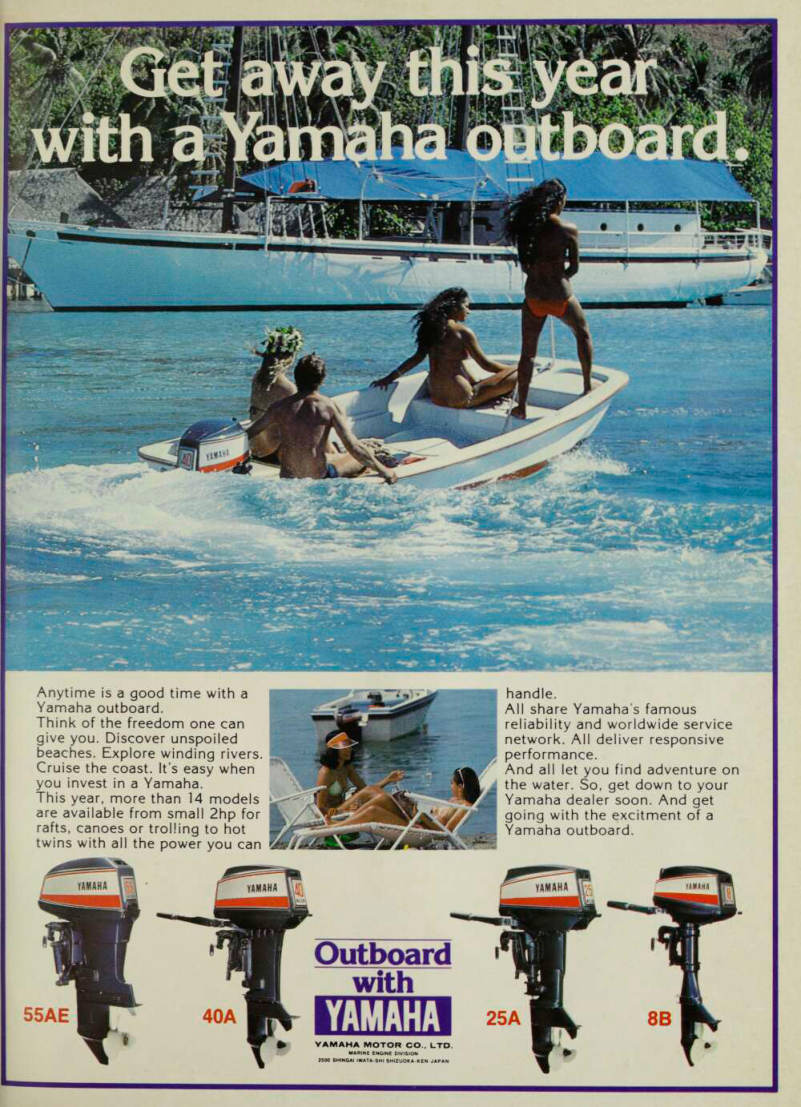
s> Yl« l r»« Anytime is a good time with a Yamaha outboard.
Think of the freedom one can give you. Discover unspoiled beaches. Explore winding rivers Cruise the coast. It’s easy when you invest in a Yamaha.
This year, more than 14 models ‘ are available from small 2hp for rafts, canoes or trolling to hot twins with all the power you can handle.
All share Yamaha’s famous reliability and worldwide service network. All deliver responsive performance.
And all let you find adventure on the water. So, get down to your Yamaha dealer soon. And get going with the excitment of a Yamaha outboard.
YAMAHA
YAMAHA
40A
Outboard
55AE
with
YAMAHA
YAMAHA MOTOR CO.. LTD
MARINE ENGINE DIVISION
2SM SHINGAI IWATASHI SMIZUORAREN JAPAN
YAMAHA
25A 8B
/ - 0 0 . xN ; / A : -T777 777 ' cf- 7 7777 7’■ 7- £*777 *: < ■: •*: •: ■*: •:
- SONY
ss r. *5 35 *■ *
MV. 0« H
<=C>
odt
Wi > /i 4 as *> m 9
ptp
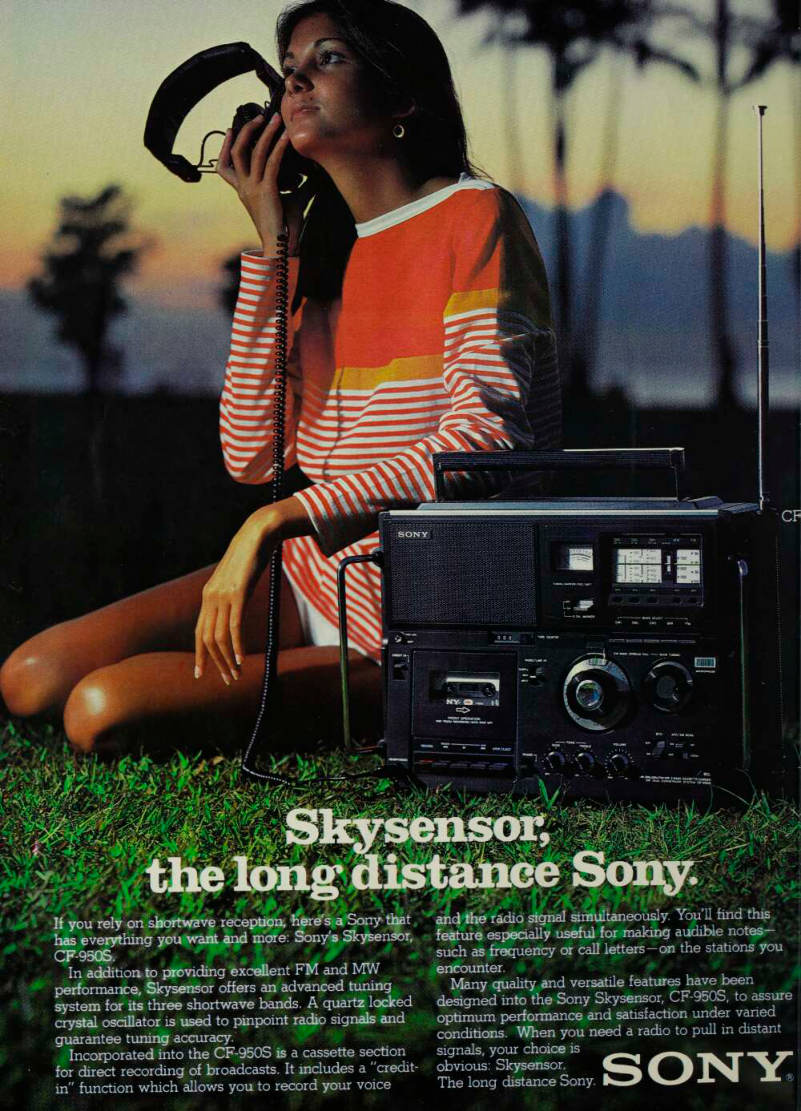
- If you rely on shortwave reception, Here s a Sony that has everything you want and more: Sony s Skysensor, CF-9505.
In addition to providing excellent FM and MW performance. Skysensor offers an advanced tuning and the radio signal simultaneously. You'll find this feature especially useful for making audible notes— such as frequency or call letters—on the stations you encounter.
Many quality and versatile features have been SSSTteSn A quartz locked designed into the Sony Skysensor CF-9505, crystal oscillator is used to pinpoint radio signals and optimum performance and satisfaction under vaned guarantee tuning accuracy. conditions. When you need a radio to pull m distant Incorporated into the CF-950S is a cassette section signals, your choice is for direct recording of broadcasts. It includes a "credit- obvious: Skysensor in" function which allows you to record your voice The long distance Sony.
Pacific Report
Tongan Hanging Stirs Png Cops
Tonga’s use of the death penalty against a convicted murderer (PIM, Pacific Report, Feb) has been cited by the Papua New Guinea Police Association in support of a call for its temporary reintroduction in their country. There were 68 recorded murders in PNG in 1976-77, compared with 37 in the previous 12 months. The association also asked that police be trained in the use of weapons.
Nauru’S 10 Republican Years
Nauru celebrated her 10th anniversary as a republic on February 9 with the issue of two new stamps. The issue, totalling 100 000, is expected to earn about S6O 000. The two vertical designs on the 15c blue and the 60c green feature Nauru’s coat of arms the chemical symbol for phosphate supported by feathers of a frigate bird, a flower and the motto "God’s Will First". Since the Crown Agents who had been supervising production of the stamps find themselves facing an inquiry into a $360 million deficit in their accounts, sale of the stamps will this time be handled by the Nauru Philatelic Bureau.
Western Samoa Acts On Energy
Western Samoa has appointed an energy committee to examine alternative sources of power in an effort to cut its huge Dill for imported fuels, now supplying 75% of its energy needs.
Heading the list of alternative sources of energy to be examined s hydro power, which already supplies 25% of the country’s energy. Then come solar energy, wind, and wood from forest ind coconut plantations.
Somare Advises Hebrides
i Papua New Guinea told a delegation of the New Hebrides’
Council of Ministers which visited Port Moresby in January not o delay any longer in fixing a date for political independence.
S NG Prime Minister Michael Somare told them: "The only way 0 handle your responsibilities is without delay." He said he was ipeaking from his own experience as a political leader )repared to accept PNG nationhood when many Australians md Papua New Guineans themselves said it couldn’t be done
-Awyers Rap Anti-Graft Bill
The Fiji Government’s proposed anti-corruption bill has come inder fire from the nation’s Law Society on the grounds it would endanger innocent citizens. "There is nothing to prevent the mscrupulous from using this statute as a pretext for building up 1 dossier on citizens . which could be used for any political, lusiness or other end,” the Society said. Responding, former Forney-General Sir John Falvey said there was far more corruption in the country than he had ever imagined. Any measure designed to combat it had to be tough.
O. Language Tests Attract Flak
Language tests given to foreign students applying to study in Jew Zealand are "a farce", according to prominent Fiji lawyer nd former MP, Mr Kishor Govind. Mr Govind said the English anguage tape recordings used test memory rather than anguage, and even he could possibly fail. In his home town of |a only five out of 80 eligible students had passed the test. New ■ealand’s Deputy High Commissioner to Fiji, Mr John •pringford, said the test was for all Asian and Pacific students nd had been designed by an independent university ommittee. His comments did not stop scores of students and fcrents in Fiji from continuing their protests.
Scurrilous Leaflets In Fiji
The Fiji police are investigating the source of anti jovernment handbills circulating in the country They arrived in envelopes bearing a Sydney postmark, but carried no address ! r signature. Five different handbills, typewritten and then luphcated, had been circulated by the middle of January.
Some contained crowd pictures, and others pictures of the Governor-General, Ratu Sir George Cakobau, and the Prime Minister, Ratu Sir Kamisese Mara. The pamphlets were said to contain inflammatory but ridiculous racist comments. They also defamed government leaders, church ministers and members of the business community. They were scurrilous publications, evidently issued by people with deranged minds.
Fiji Consumer Head Drops Out
The chairperson of Fiji’s Consumer Council, Mrs Anaseini Qionibaravi, has resigned because she found she could not function effectively. Said she: “I don’t think those responsible for the council’s budget are serious enough about it, or they would give it a budget on which it could operate."
Mr Somare’S Near-Big Bang
A squad from Papua New Guinea’s Defence Force in February removed more than 4 000 rounds of corroded but live ammunition found buried about 1 km from the PNG Central Government Offices in Port Moresby. The offices include that of Prime Minister Michael Somare. During World War II the area was part of an extensive complex involving artillery units and aircraft dispersal bays.
Forum Line Under Way
The Forum Line will start shipping services on May 1 with three ships, one given by New Zealand, one by Nauru and one chartered, the line’s general manager, Mr G. R. Dewsnap, announced in Apia. By mid-1979 the line will have five ships in operation, he added. The line is still in the process of recruiting staff. After hiring, many of them will be sent to New Zealand and Australia for intensive training in various aspects of handling the documentation of cargo.
Different Fates Of Stowaways
Two young Tongans, Tevita Teutau and Pea Kamosi, who stowed away in the Kalia before she left Nukualofa on January 13, disappeared from the ship when it was off the north coast of New South Wales nine days later. The two, with two others, were found when the Kalia reached Sydney and were being returned to Tonga. Well-known South Pacific master mariner, Captain Brett Milder, who took over command of the Kalia in Sydney for the return trip to Tonga, via Brisbane, said there had been a complete search of the ship after the youths were reported missing. They had been allowed to walk about because it was not expected they would jump overboard. Another young Tongan stowaway was not so lucky: he was killed when he fell into the forward funnel of the liner Ellinis while trying to escape apprehension by ship’s officers.
Fire Fighters On Fire Water
Two senior firemen on duty near Fiji's Nadi airport were so drunk one recent Sunday morning they couldn’t walk, according to Nadi’s mayor, Cr Mannu Patel. He said he shuddered to think what would have happened if there’d been a fire at the time. The firemen are shuddering to think about the problems they’ll face finding new jobs.
Bougainville’S Profit Dips
Bougainville Copper Ltd turned in a profit of $34.21 million in the year ended December 31, 1977, compared with $49.6 million in 1976. The return, mainly because of a depressed world copper market, was a far cry from the $l4B million profit of 1973, which caused the Papua New Guinea Government to press for a larger share of the profits from the mine, and win its point. The final dividend is 4t a share, making a payout of 8t a share for the year. Only bright spot in the directors’ report was that Japanese copper buyers returned to the full level of contractual deliveries in 1977, and indicated their desire to take some tonnages deferred in previous years. The PNG
Government and the PNG Investment Corporation will receive about K 28.3 million from Bougainville Copper for 1977, compared with about K 28.5 million in 1976. The government shares K 4.3 million in dividends with the Investment Corporation. It receives K 2.4 million, in withholding tax on dividends paid to non-residents of PNG, K 13.7 million in tax and about K 2.5 million in royalties.
Trades University In Hebrides?
United Nations experts are studying a proposal for establishment of a technical university in the New Hebrides to serve/train skilled tradesmen for all Pacific Islands. The idea was first put up by Australian and New Zealand representatives from the International Labour Organisation who visited the New Hebrides late last year.
A World First For Png?
Papua New Guinea’s entire trunk telecommunications system will be running on solar power by the end of the year, following award of a $750 000 contract to convert the system from battery to solar power to the Sydney company, Amalgamated Wireiess (Australasia) Ltd. PNG is believed to be the world’s first country to power its trunk system in this way, narrowly ahead of Australia itself where a similar conversion will begin in 1979.
Sir Albert Plugs The Gaps
Cook Islands Premier, Sir Albert Henry, has been quick to appoint new Ministers to replace those who have resigned (PIM Political Currents). He has appointed his son, the Hon Tupui Ariki Henry to be Minister of Education, the Hon George Ellis as Minister of Agriculture, Marine and Scientific and Industrial Research, and the Hon Apenera Short as Minister of Health.
Tahiti’S Prison Revolt
Revolt swept Tahiti’s central prison in Papeete late in January, leaving two dead and 20 wounded. The 11 -hour mutiny had strong political overtones, with pro-independence detainees leading the prisoners’ negotiating team, and mutineers shouting slogans in favour of a complete break with France and against France’s nuclear testing in the region. The two major spokesmen for the prisoners were Marcel Tautini, 25, and his brother Jonas, 21. The two are charged, along with two other men, with the slaying of a French businessman, Pierre Chatillon-d’Anglejean, in Papeete last August (PIM, Nov 1977, p 16) The brothers are alleged to be members of the pro independence Pett Party led by Charlie Ching, who is also in Papeete gaol on charges of associating with criminals. Ching has denied any links with the mutiny.
Betting Shop For Agnes And Bill
Mrs Agnes Taureka of Port Moresby, a Fijian, who is honorary consul for her country in Papua New Guinea, and well-known Australian bookmaker, Mr Bill Waterhouse, are going into partnership in a Port Moresby betting shop. Mr Waterhouse also has bookmaking interests in Fiji. As the new partnership was announced, it was reported that PNG’s 18 previously licensed bookmakers had a turnover of $31.7 million in the 13 months since betting shops were first made legal.
A Break With Tradition
Sir Tei Abal, Papua New Guinea’s Opposition Leader, plans to sue a Highlands tribal group for spurning his compensation gift of 65 pigs and four cows offered to the tribe following the death of a tribesman, a police motor-cyclist, in a collision with a car driven by Sir Tei. Sir Tei, who faces a manslaughter charge over the fatality, was to make the payment at a peace feast in Enga Province, but the tribesmen, all of the Wapo tribe, waked out after most of the animals had been slaughtered and cookecT The tribe had demanded KBO 000 and 100 pigs, but accepted Sir Tei’s offer. The walk-out from the formal handover ceremony is unprecedented, and described by Sir Tei s tribe as a “deliberate insult, breaking with all tradition . He will sue for breach of a recognised contract.
“Tighten Belts” Winkel
High Commissioner Adrian Wmkel of the US Trust Territory a the Pacific, in his first “State of the Territory” message to the Congress of Micronesia, revealed that the TT operating budge for 1979 has been cut by SUSS million. At the same time, he said, the cost of government and the rate of inflation were increasing by 7% a year. Calling for belt-tightening measure: throughout the administration, he warned of further cuts ii coming years.
Png For Big League?
The possibility of Papua New Guinea playing Rugby Leagui at international level comes closer. The British Rugby Leagui has agreed that the Papua New Guinea Rugby League shoul have full membership of the international Rugby League Boarc The board secretary, Mr Bill Fallowfield, has circulated the othe three members of the board, Australia, France and Ne' Zealand, asking for a “yes” or “no” vote. Membership of th board would automatically give PNG the right to play Te; matches against the other member countries.
Nadi Hotel Fire
The Mocambo Hotel at Nadi suffered severely from fir damage during January. The fire, which started in the kitcher spread to and destroyed the restaurant, coffee shop, bar an kitchen. Firemen spent two and a half hours fighting the blaz and prevented it from spreading to guests’ rooms. There wer about 250 guests staying in the hotel at the time and the chu fire officer at Nadi paid tribute to them for not panicking and fc removing all their belongings to a safe place. The poolsid restaurant was undamaged and guests are being served mea there until the damage is repaired.
Australia, Png, Talk Economic Zones
Australia and Papua New Guinea will either negotiate a joi management agreement over areas where their new 200-mi economic zones overlap, or curtail their limits in the affecte areas, drawing a firm line in the middle. Australian Foreic Affairs Minister, Mr Peacock, had talks in February on tf matter with a PNG delegation headed by Foreign Minister, N Olewale It was indicated unofficially in Port Moresby that joint management in the overlapping zones will be favourec
Bombing Opens Conference
The Regional Conference of Commonwealth Heads Government, attended by Papua New Guinea. Fiji, Tone Western Samoa and Nauru along with Asian governme leaders, opened dramatically and tragically at Sydney’s Hilt Hotel on February 13. A few hours before the formal opening bomb exploded in a garbage truck outside the hotel, killing t\ council workmen and seriously injuring several other m including a police constable. There were several bomb scar later Prime Minister Ratu Sir Kamisese Mara, of Fiji, had early success. He and Australian Prime Minister Malco Fraser reached agreement in private talks on Australian tra union intervention in Fiji’s affairs. It was decided to set up a jo committee of government officials to negotiate with Australu and Fiji trade unions when the need arose. Mr Fraser al assured Ratu Mara that, of S3O million to be given in aid to \ by Australia over the next three years, $lO million would earmarked for the Nadrau hydro-electric scheme on the upp reaches of the Sigatoka River.
Japan Floating Fair 78
Japan is coming to the Pacific in a big way in September: floating fair will visit Papua New Guinea and Fiji to give I o: traders a firsthand view of the latest that Japan has to offer in market place. Japan Floating Fair ’7B will do a three-month t. taking in, as well as the countries named New Zealai Australia, Indonesia, Malaysia, Singapore, Thailand and Philippines.
Advertisements & other items, p. 7 (1 item)
Pim
PACIFIC ISLANDS MONTHLY
VOl 49 NO 3
Mar. 1978
EDITOR: JOHN CARTER
Pacific Islands Monthly
Publisher: Stuart Inder
Pacific Report 5
[ the news in brief
Letters 8
l — three pages of readers' views
Special On Island Aid H
— as two islanders see it
Easter Island 14
mysterious and lonely no longer
Sir Albert Henry 18
did he read Machiavelli?
New Caledonia’S Indonesians 20
shadow over a silent community
Tropicalities 23
variety is the spice
Afterthoughts 27
Percy Chatterton and the unmelanesian way
Political Currents 28
Niue’s elections, a new era in New Hebrides and a new party in the Solomons
People 34
names make news
Milan Brych 36
Cook Islanders call it a brych-yard
Islands Press 47
what the papers say
Books 48
from Maui to Cook, Britain in the Pacific War and banana ships
Archaeology 51
stone treasures
Trade Winds 53
development in the New Hebrides and that Tongan bank
Yesterday 59
last days of the Runic
Transport 63
a king's dream ship
Yachts 69
calling all yachties
A Boat Baby-Sitter 70
about Fiji's Sayandra and others
Shipping 73
getting around the Islands
SUBSCmPTION R*TE| l -p raP h,C AddVress PACPUft Sydney Teto: U 2^242 d Te°ephoIle , 21 art Ind LI< M 76 Cla,erice S, ' ee ' Sydney 2000 Post Address G.PO. Box 3408, rem« renCh p °!y °a s *a am/French Ausr^nit^'^n^do^^gTo and ri a $°12 9 W)'ausI A^us^Ne^v^atedon^ BEPREsInwtoeI 1 ' Pm d °n a S, ould be b * ba " kd ' a " Payable a?Sydney Sato 9 f9 50 °' *' 2 50 Aust Japan 4 500 Ye " d ' 1,2 50 Aaa > Elsewhere •*« 00Ausf Note: Ove?seal Advertising. Fiji Times 4 Herald Ltd . 20 Gordon Street Suva y Agency, Box 1918 G.P.O., Brisbane 4001 Telephone: 44 3485, 44 1545* 9 ' H °° 6 Flmders Lane Melbourne, 3000 Telephone 652 1565 Brisbane: D, Wood,
Australian cover and New Zealand by Gordon & Gotch
Advertisements & other items, p. 7 (1 item)
S ACIFir iqi a Nine V mninr., . . „
Letters
Nauruan Leaders
It is definitely true that the demands of the young blood in Nauru’s political circle have become more and more adamant. Twice, they have won political elections for Parliament. But, nevertheless, they have made independent Nauru a haven for Europeans who wish to come to Nauru for work to fill their bellies with gold.
Many expatriate workers or advisers here at the moment have been spreading rumours that because the young leaders are very young and un qualified, they are more or less insensitive to their ex patriate advisers' distasteful advice on many important policy matters.
What I think of the present young Nauruan leaders is that they are in the same boat as their expatriate advisers.
They are really out not to let Nauru progress as was the case with the former Presi dent. They are going to run Nauru for their own bellies and other kinds of luxuries for their families. This may sound absurd to many people from outside, but the truth remains as evidence. Before these young leaders had abruptly cut short the reign of Mr Deßoburt, they really had nothing planned or forecast in case Mr Deßoburt stepped down, as is the case with regard to the political plat forms of every political party in the world. (Once a party is campaigning for leadership, it must have a political platform to enable the people to decide whether such platforms are good for the country or not.) I believe these young Nauruan leaders, though well educated, have lacked this most important ingredient in the creation of a stable politi cal party. Instead, they had a political excuse about the former government, that some of its ministers were not good and should be sacked.
They have only paid lip service to their families, friends and many other Nauruans to have Mr Deßoburt thrown out of
government. Most, if not all of them, are not the true sons of Nauru. (In fact, they are il legitimate sons of Nauru.) They'have not seen and wit nessed how Nauru painfully struggled to survive the col onial era and achieve its most dear independence. They have not seen and felt how our former leaders during the many round-table negotia tions with the Australian Government for indepen dence, left their sick wives and children, to attend these many meetings on behalf of the Nauruan people. They have never seen or felt how our former leaders have made sacrifices with their families for the Nauruans to be Nauruans in the real sense.
These young leaders are Nauruans, but to what extent?
These are sad days for me to remember. And I would hate to become the immoral sup porter of a new government which is out to fill its belly with Nauruan monies and of ficial cars which can be used by their families for personal convenience and occupy posi tions of power.
I would appeal to those true Nauruans who wish to see their cultures preserved and, perhaps most important, their land properties which the pre sent government is looking at for nationalisation.
True Nauruan
Nauru.
Help Wanted
I am writing to ask the as sistance of any of your readers who may remember three authors of short stories and novels with Papuan settings; Beatrice Grimshaw, Gilbert Munro Turnbull, and Alys Brown. This is in connection with my thesis concerning Australian fiction about Papua and the Mandated Ter ritory of New Guinea between the wars.
Beatrice Grimshaw lived in Papua for 27 years and then in Bathurst, NSW. She was a close friend of the Lieutenant- Governor, Sir Hubert Mur ray, and wrote over 30 novels with South Seas settings, as well as tourist literature and reportage.
Turnbull wrote a number of stories with Papuan settings for the Bulletin in the 20s and 30s, as well as several novels.
He retired from the Papuan civil service to live at Wollombi near Armidale and died there in 1938. I have
very little biographical infor mation about him.
Lou Brown was a resident magistrate in Papua, and his wife Alys, in addition to being a doctor, wrote short stories with Papuan settings for the Bulletin in the 1920 s and early 19305. The last I know of the two of them is when they came to live in Manly in 1929.
I would be pleased to cor respond, and if possible to visit, with anyone who has in formation concerning these authors. I may be contacted c/o the English Dept, Univer sity of Queensland, St Lucia, Queensland 4067 Australia.
Susan Gardner
Brisbane, Q.
Dr Fox
The Church of Melanesia is hoping to produce a book in honour of the Reverend Dr Charles Fox of the Melane sian Brotherhood who died on October 28 last year at the age of 99. As he served in Melanesia for over 70 years, there must be many people who have memories of him and of what he said and did.
He was also a great letter writer, and it would be in teresting for many people to be able to read what he him self wrote.
The Archbishop of Melanesia has asked me to try to contact as many people as possible who have letters or other papers from Dr Fox in order that copies of these may be collected in one place, and then used in the preparation of a book about him. If people are willing to give the letters to the Church, they will be kept safely at provincial head quarters in Honiara.
However, if they want to keep the letters, photo-copies of them can be sent to us instead.
Or, if people would like us to make photo-copies of the let ters and then return the originals to them, this could be done in Honiara.
We hope many people will co-operate with us in making it possible to produce an in teresting book in honour of this great man. If you are sending letters, please let us know whether the Church can keep them or whether you want the letter sent back after photo-copies have been made.
We hope most people who have letters will be willing to give them to the Church to be kept together in safety, so that
they do not get lost or de
stroyed.
Any persons who have memories of things Dr Fox said or did and who would be willing to pass these on to us, should write them down or re cord them on a cassette tape and send them to us as soon as possible, so that the book can be prepared before too long.
The address to send them to is; Dr Fox Memorial Book, c/o Rev Brian Macdonald- Milne, Church of Melanesia, PO Box 19, Honiara, Solomon Islands.
We hope this book will be an inspiration and encourage ment to those whom God will call to follow up the many works which Brother Charles carried out in his long and fruitful life.
(Rev) Brian
Macdonald-Milne
Solomon Islands
Yachties
As a long-time resident ol the Solomons 1 have been in terested to read the extensive correspondence arising frorr the decision of the Solomon!
Government to impose a $ IOC levy on “yachties” visiting thii country. It is possible tha some of your correspondent: have misjudged the situatioi here, because of the unfor tunate experiences they hav< had and the difficulties the; have encountered.
I was surprised to read tha some of them thought th( Solomon Islanders racist o naive, or both. That is not m experience, after spending third of my life here.
I believe that a great deal o the recent legislation and th rules and regulations accom panying it is to prove a poin that our Solomon Islam legislators and civil servant are in control.
Maybe, some of the legisla tion is an over-reaction to to much foreign influence am control in the past, but it i understandable that when country is approaching indt pendence it wants to show tha it means business. Anythin] therefore, which might sugge the continuance of foreign ir fluence and control has bee under scrutiny, to discove whether this represents a fori of hidden exploitation or no This does not, however, i dicate a racist attituc towards those who come fro overseas to work for the is digenous government and ii digenous churches here
most cases, we are warmly ac cepted if we show that we can identify ourselves with the legitimate aims of the Solomon Island people.
This may explain the ap parent contradiction between legislation which some call discriminatory and the general harmony between racial groups here. It could also explain how “yachties”, while appearing to be dis criminated against, have often experienced a warm welcome from individual Solomon Islanders.
The same is true in other fields. Foreign investment is welcomed, but under strict conditions which make it ob viously beneficial to the Solomons; tourists are re ceived, but only in such a way and in such numbers as will not unduly disrupt the values and way of life of the people; researchers are allowed to op erate, but only if their re searches will be of some use to the people of the Solomon Is lands. There has been some suspicion of groups coming to settle here from overseas, in cluding Chinese, Gilbertese and people of European race, because it has not been clear to most Solomon Islanders how far these people really identify themselves with the Solomons and wish to help in its development. One hopes that after independence, it will become clear who are the people who really want to belong, and that the doubts in some people’s minds will be overcome.
Unfortunately, there is still a widely-held conviction that most foreigners are rich, and that some of them are out to exploit the Islanders for their own selfish purposes. In a few zases, these suspicions may be justified, but it is sometimes hard for academic researchers who are suspected of getting rich on the books and records hey produce! However, if hese people do make a profit, t is surely not unreasonable hat this be shared with the )eople who have assisted the researcher. It is not naive of ocal people to ask: “What is there in this for us?”
The attitude of Solomon slanders to those from out side appears to depend very nuch on how the outsiders sehaye towards them. If certain people and racial groups are in disfavour at the moment, this may be largely because of the way they are suspected of having taken ad
vantage of Solomon Islanders in the past.
My experience here is that people are normally judged on their individual merits, and not condemned because of their racial and national origins. It would be a tragedy if the Solomons got a false im age abroad of being “racist” or if actions taken by govern ment ministries were suspected of being largely a result of advice preferred by disgruntled expatriate ad visers! Criticisms from out side are unlikely to be heeded unless the critics show more understanding of why Solomon Islanders today think and act as they do.
(Rev) Brian
Macdonald-Milne
Honiara.
Devaluation
I am surprised there has been no mention of the effects in the New Hebrides of the Australian Government’s devaluation of their dollar.
They have been expensive for users of dollars.
I was in the New Hebrides in August, shortly after the of ficial rate had been declared to be $l.OO AUS = 85 FNH.
The effect was that all goods started costing 15% more in dollars, whatever their origin, instead of imports from Australia being sold for 15% less in francs.
On New Year’s Eve I was informed that the difference is now 20%, and still the dollar is falling. But if Australian ex porters think that this should give them a competitive edge in the New Hebrides, let them go there and find out how it doesn’t.
John Allan
Spring Hill, Brisbane.
Such Is Fame
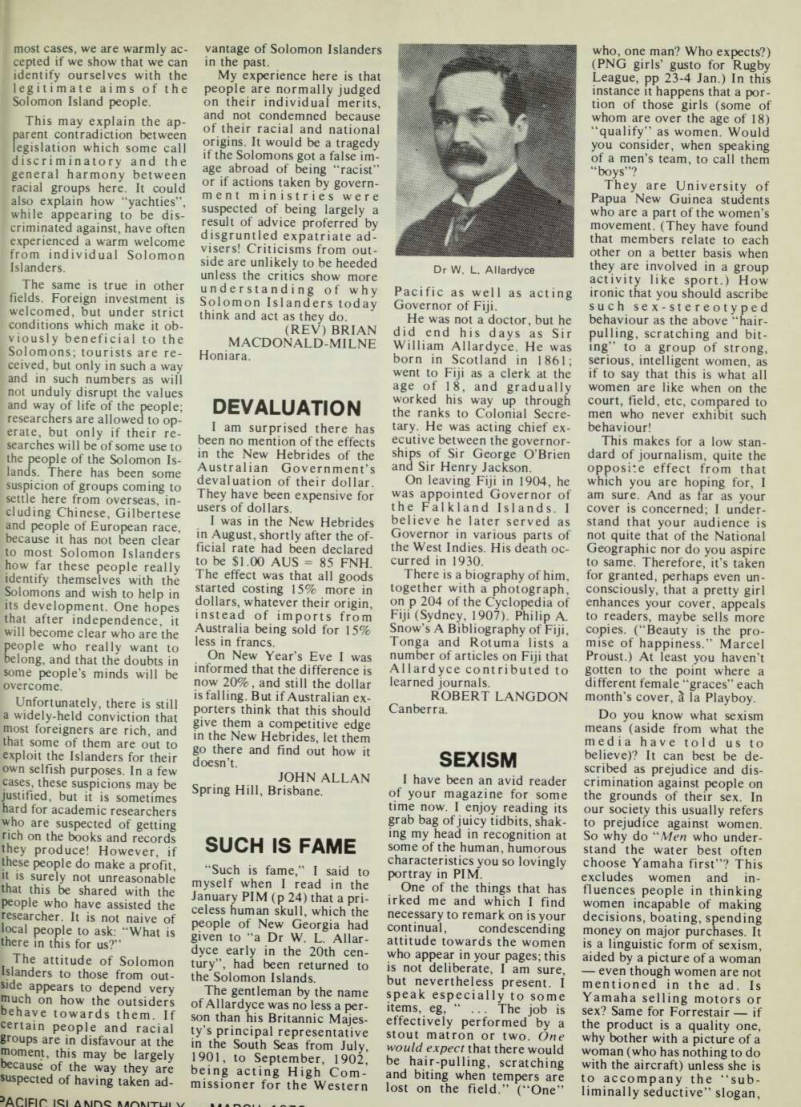
“Such is fame,” I said to myself when I read in the January PIM (p 24) that a pri celess human skull, which the people of New Georgia had given to “a Dr W. L. Allar dyce early in the 20th cen tury”, had been returned to the Solomon Islands.
The gentleman by the name of Allardyce was no less a per son than his Britannic Majes ty's principal representative in the South Seas from July, 1901, to September, 1902, being acting High Com missioner for the Western
Pacific as well as acting Governor of Fiji.
He was not a doctor, but he did end his days as Sir William Allardyce. He was born in Scotland in 1861; went to Fiji as a clerk at the age of 18, and gradually worked his way up through the ranks to Colonial Secre tary. He was acting chief ex ecutive between the governor ships of Sir George O’Brien and Sir Henry Jackson.
On leaving Fiji in 1904, he was appointed Governor of the Falkland Islands. I believe he later served as Governor in various parts of the West Indies. His death oc curred in 1930.
There is a biography of him, together with a photograph, on p 204 of the Cyclopedia of Fiji (Sydney, 1907). Philip A.
Snow’s A Bibliography of Fiji, Tonga and Rotuma lists a number of articles on Fiji that Allardyce contributed to learned journals.
Robert Langdon
Canberra.
Sexism
I have been an avid reader of your magazine for some time now. I enjoy reading its grab bag of juicy tidbits, shak ing my head in recognition at some of the human, humorous characteristics you so lovingly portray in PIM.
One of the things that has irked me and which I find necessary to remark on is your
continual, condescending
attitude towards the women who appear in your pages; this is not deliberate, I am sure, but nevertheless present, I speak especially to some items, eg, “ ... The job is effectively performed by a stout matron or two. One would expect that there would be hair-pulling, scratching and biting when tempers are lost on the field.” (“One”
who, one man? Who expects?) (PNG girls’ gusto for Rugby League, pp 23-4 Jan.) In this instance it happens that a por tion of those girls (some of whom are over the age of 18) “qualify” as women. Would you consider, when speaking of a men’s team, to call them “boys”?
They are University of Papua New Guinea students who are a part of the women’s movement. (They have found that members relate to each other on a better basis when they are involved in a group activity like sport.) How ironic that you should ascribe such se x-stere o t y p e d behaviour as the above “hair pulling, scratching and bit ing” to a group of strong, serious, intelligent women, as if to say that this is what all women are like when on the court, field, etc, compared to men who never exhibit such behaviour!
This makes for a low stan dard of journalism, quite the opposite effect from that which you are hoping for, I am sure. And as far as your cover is concerned; I under stand that your audience is not quite that of the National Geographic nor do you aspire to same. Therefore, it’s taken for granted, perhaps even un consciously, that a pretty girl enhances your cover, appeals to readers, maybe sells more copies. (“Beauty is the pro mise of happiness.” Marcel Proust.) At least you haven’t gotten to the point where a different female “graces” each month’s cover, a la Playboy.
Do you know what sexism means (aside from what the media have told us to believe)? It can best be de scribed as prejudice and dis crimination against people on the grounds of their sex. In our society this usually refers to prejudice against women.
So why do “Men who under stand the water best often choose Yamaha first”? This excludes women and in fluences people in thinking women incapable of making decisions, boating, spending money on major purchases. It is a linguistic form of sexism, aided by a picture of a woman even though women are not mentioned in the ad. Is Yamaha selling motors or sex? Same for Forrestair if the product is a quality one, why bother with a picture of a woman (who has nothing to do with the aircraft) unless she is to accompany the “sub liminally seductive” slogan,
Dr W. L. Allardyce
“Fill ’er up”. That is what is meant by a sex object, if you are wondering what some women are beginning to ob ect to. (Of course, after we reach the age of 35 we are no longer thought of in this role and don’t appear in any ads except those showing one suffering from migraine.) “From Stan Ritova’s Here and There column in The Fiji Times” (PIM, Jan, p 37) is that really worth repeating in your magazine? Is it funny that Fijian women (or the women of any country) find it necessary to first degrade themselves by becoming prostitutes, then hoisting the price for the European (or so she thought) out-of-towner who can supposedly pay more? Let’s face it, a prostitute will make more on the street to support herself (and probably her family) than she could as a factory worker or secretary.
I could go on and on so many seemingly petty details that add up to the way we learn to see women, without thinking about the whys and wherefores of these socially imposed values and attitudes.
Yes, I actually do have a sense of humour, but not when women are being shown to be the butt of the joke. On the other hand, one does not see women mentioned nearly enough when it comes to government, medicine, law, education, banking, church, etc, because, of course, these powerful professions are still male-dominated. Women won’t have a chance to alter the laws to fit our needs until they enter government. But only if attitudes begin to change and women are condi tioned to begin to think that they can go to school, excel, and make it. It’s a vicious cycle.
In comparison with past months, January’s issue is not as insulting to women as its predecessors. The only reason that 1 bother to take the time to write is that I think PIM is a damned good, important jour nal, a communication linkup for this part of the world.
It might be your natural in clination to show this letter to one of the distaff members of your office, to ask her (if you yourself are not a woman) whether or not she finds my thoughts to be a load of rub bish. The expression “women are their own worst enemies” is sadly true. They do not realise that when they “side” with a man (an approval-seek
ing device all too often, “look at me, I’m one of the boys’’) they insult themselves in the long run. When they criticise another woman, it has the same effect. It is like the man who hates his boss, so he comes home from work and takes it out on his wife the oppressed attacking the op pressed, instead of siding together in strength.
If you think about it, it’s a mighty awesome task put ting together such a valuable magazine and making sure to watch whose toes you don’t step on. As such, it ought to be handled as it deserves with dignity and responsibility on the part of staff and subject.
Joan Weinberg (Ms.)
Cremorne Point,
Nsw.
• My right-hand girl agrees with every word of it Edi tor.
Philatelic
Suicide
With reference to the arti cle “Stamping on Little Niue” under Tropicalities (PIM, Sept, p 31), you quoted from an article in the Mail Coach which was justly deploring the apparent takeover of Niue’s philatelic bureau by an American-backed agency.
The whole tone of the article reveals an unfortunate lack of understanding of the
philatelic implications. I can
not help but feel that Niue is in danger of committing philatelic suicide, following Tonga, the Cook Islands, Aitutaki and Penrhyn.
It is well known that a simi lar situation arose in the early 1970 s in the Arab Gulf States.
For a few years we faced a deluge of what are little better than pretty labels, of interest mainly to those who collect thematic stamps those showing a particular subject in the design such as ships, space, birds, flowers etc. This flood of stamps has found a market, at a few cents or less per stamp, but I doubt that they will ever receive serious acceptance among phil atelists.
None of this is new. Older philatelists will remember the debacle of the so-called “Seeback” issues which ema nated from Salvador, Nicaragua and Honduras dur ing the 1890 s. These were agency type issues. Check a catalogue for the current mint value of those stamps. Few are
worth more than 10c. Even today few collectors bother to collect even current issues of those countries. Can the Arab States and Pacific Islands afford to ignore that lesson, still apparent 80 years later?
Some Pacific Islands follow a sensible and relevant stamp issuing policy. Papua New Guinea is a shining example.
By modern standards they produce a small number of issues, they are well designed and printed. Quality control is excellent and unsold remain ders are destroyed, not dumped on the philatelic market at a discount a few years after they are withdrawn from use.
A further important feature of PNG issues is their subject matter. Every stamp relates to the issuing country. Have you seen any PNG issues com memorating moon landings, American bicentenary, Vik ing long ships or Spanish cathedrals? It is for these reasons that PNG is popular among collectors and will re main so as long as the stamp policy remains the same.
For Tonga and the Cook group the die is cast. Serious collectors have deserted them in droves, or “cut off’ their collections in the 19605. Niue could yet be saved if they wish. Others are walking on dangerous ground, and could well review their policies along the lines of those of
Png.
John W Rabarts
(Manager, Penwinkle International Philatelic Auctions) Coromandel, NZ.
The Cooks’
Problems
I have lived here in the Cook Islands for almost four months, and during this period I have observed some very serious problems con fronting the people of these is lands (mainly Rarotonga) which I have discussed with many prominent and ordinary citizens here (quite a few have read the enclosed letter). The disgusting neglect of the pre sent government has inspired me to write the enclosed letter to the Premier, which illus trates some of the most serious ones and offers some proven and well thought out solu tions.
Regarding the section on litter, President Carter is about to present a bill to Con gress requiring a deposit on
all “flip-top” beverage cans.
The problem on Rarotonga is much more acute than in the USA. Unless something is done very soon about un controlled shabby develop ment, traffic (speed and num bers) and litter, Rarotonga will very soon become the “trash-heap” of the South Pacific. Most people here are afraid to speak out, except through the normal political process (far too slow and cumbersome), because of past record of government harass ment and loss of jobs to dis senters.
Some other areas neglected by the government are: • Government-controlled radio and newspaper both used for propaganda pur poses. During the election the radio reminds one of Radio Peking; at least one of the two should be independent. • Many educational facili ties are neglected. • Commercial chicken farming should be attempted to reduce dependence om
imported protein. Most:
Rarotongans eat tinned fishi and canned beef. • A current survey of the reef and lagoon areas with conservation recommen dations, results to be made public. • A current study of the use (or overuse) of pesticides and their effect to and presence in marine life; results to be made
public.
• An adequate water supply system.
Currently, a lot oi Australian aid is pouring into these islands and a rep resentative of the Australian High Commission ii Wellington has just been her< to investigate the use o misuse of this aid. A copy a the letter is going to him.
Everyone I’ve talked u here believes corruption i the government is widespread
Peter R. Wallbridgi
Santa Barbara, Calif. • In his letter to the Pre mier Mr Wall bridge suggest that Sir Albert should attem to the urgent problems cor? fronting Rarotonga's peopi before he involves himself i\ “topics such as enforcing 200-mile fishing zone am projects like construction o new adminstration building and fancy 50 metre swimmim pools.”
Jhe writer asks why they was no public debate o referendum before beginnin the enormous project, t A Rarotonga Hotel.
Advertisements & other items, pp. 8-10 (3 items)
nAr'icir' iqi AMOS MONTHLY MARCH, 19a
ghgfhf
dAriPir iqi AMDS MONTHLY MARCH, 19
Island Aid: The Other Side
Of The Coin
Australia and New Zealand look at the Islands these days with far more generous eyes than they did a few years ago. By the decade’s end, all the island territories are expected to be independent— free to choose their own friends. Which is one reason why aid to the Islands is increasing. But the ideal is to help the Islands to develop their own economies. PIM looks at this aid from more than one angle.
The New Zealand Govern ment recently hosted a semi nar in Auckland on the Pacific Islands Industrial Develop ment Scheme (commonly referred to as the PHD Scheme). Invited to the semi nar were government and business representatives from Fiji, Tonga, Western Samoa, Niue and the Cook Islands, as well as a fairly wide cross-sec tion of NZ manufacturers.
The PHD Scheme was set up, on a bilateral basis, to en courage NZ firms to set up in dustries in the Pacific Islands on a joint basis. The major ob jective is to improve the Is land economies by diversify ing and increasing their pro duction and employment op portunities.
Incentives are available from both the NZ and Island Governments for those who want to take advantage of the scheme. Unfortunately, the one crucial incentive of easy access to an assured market is far from being guaranteed.
The Island local markets are small, and thus ventures that may be set up under the scheme must look to overseas outlets as well. NZ’s advice in this respect is to look for markets other than NZ’s. The NZ market is rather limited.
In addition, unless the Manufacturers’ Association and the Federation of Labour are agreeable, there is no way in the world in which the NZ Government could throw open the local market to manufactured commodities from the Pacific Islands which are also produced in NZ. The NZ Minister of Trade and In
dustry, Mr Adams-Schneider,
m opening the seminar, ad mitted this much though, in
qualification, he implied that
this was not a protectionist stance on the part of his Government.
Well said, Mr Minister!
Wuh such logical reasoning, it is no wonder that the Japanese cannot see anything wrong with their keeping a tight con
trol on the amount of NZ farm products being imported so as to protect the interests of their own farmers. And no wonder either that the scheme has wit nessed only one venture estab lished under its auspices since it was introduced about a year ago. Even then the venture, established in Western Samoa, encountered extreme difficul ties in trying to export its products to NZ because of opposition from vested in terests, and only some delicate behind-the-scenes manouevres by the NZ Government averted disaster.
There is no denying that the scheme holds great potential for the Pacific Islands. But unless the question of market
accessibility is clearly thought
out, discussed and resolved realistically, this great poten tial will not be realised.
The trade deficit between NZ and each of its Southwest Pacific Island neighbours has been and is overwhelmingly in NZ’s favour. And while the deficits are increasing, formal representations from the Is lands have not produced much joy. To be fair, some concessions have been granted, but these have been insufficient to materially nar row the widening trade deficit gaps and to reconcile NZ’s at titudes to imports from her poor Pacific neighbours and her tough stand on the need for Japan and other developed countries to buy more from NZ.
The NZ Government spon sored a Fiji trade mission to NZ in 1976 in an effort, so it was officially publicised, to bridge the trade deficit gap and to give greater credibility to NZ’s declared aim of as sisting her Pacific neighbours as much as possible. NZ has oyer the past few years directed its overseas aid more and more to the Pacific Is lands. During the visit NZ im porters gave the mission or ders for Fiji-produced goods to the value of about
$5OO 000. Unfortunately for Fiji, owing to NZ’s protec tionist import policies, only about 10% of the total orders were finally exported from Fiji.
Looking at the prospects for agricultural exports from the Islands to NZ, one finds tre mendous potential. NZ’s con sumption of fresh tomatoes, for example, during its winter season is of the order of $l5 to $2O million. It is no secret that all this can be supplied, and at much cheaper costs by the Cook Islands and Tonga, if only they are given the chance. As a matter of fact either one of these two island groups could do it.
But what these two coun tries, and Fiji and Western Samoa, are permitted to ex port to the NZ market is to the order of less than $5OO 000, and informed sources both in the Islands and NZ have ad mitted that they could not en visage any significant conces sion by NZ in this respect. The NZ glasshouse tomato growers are too influential a group to be ignored by the government. The fact that ex pensive imported fuel, among other things, really push up the costs of producing hothouse tomatoes, and hence the price to consumers, is only a secondary consideration.
The NZ market for cap sicums, cabbages, lettuces, beans, etc, during her off season also presents very real development potential for the Islands. But, like tomatoes, the extent to which this poten tial can be realised depends very much on the goodwill of the NZ farmers rather than on comparative economic advan tage or other considerations.
The amount of mandarines and grapefruit being imported from the Cook Islands has dwindled over the past few years in line with the amount being produced by NZ farmers.
Competition from the more ad vantageous and more wealthy Kiwi farmers has brought with
it a rather gloomy future for an industry that once promised so much development for the poverty-stricken Cook Islands.
In this day and age of trade rather-than-aid, a philosophy to which NZ also subscribes, such a situation is difficult to comprehend on realistic and honest grounds. NZ’s aid to the Pacific is underlined to an important degree by the need to boost the productive sec tors vis-a-vis the non-pro ductive sectors; and the really firoductive sectors in these Is and economies are undoub tedly the agricultural sectors.
In this connection, access to markets is crucial. It will pro vide the catalyst required by these economies, leading in the long run to a lessening of the aid burden on the NZ tax payers and a lessening of the reeling of dependence of Islanders in having to accept “handouts”.
Is it not a fact that the ulti mate objective of aid to the developing countries is to help them to become more, if
not fully, independent econ
omically? Is this not the path which NZ wishes to see the Cook Islands eventually follow? Or, is this not the way to view the issue? Perhaps the philosophy of aid is not to be understood in simple logic nor to be viewed through the eyes of a simple and poor man. Is it not the result of frustration with the Western world’s philosophy of aid that has caused some Pacific na tions to seek communist friends? Between them NZ and Australia do have the means and resources to sig
nificantly improve the stan
dards of living of the Pacific Islanders without adversely affecting those of their own citizens. What is required is a more genuine and honest con cern for the welfare of the Islanders by a greater propor tion of both the NZ and the Australian public.
Advertisements & other items, p. 11 (1 item)
hfghfg
Through A Glass, Darkly
Aid To The Islands-
The dialogue recorded below by one of PlM’t special Islander writers represents a lypteal conversation between an aid consultant-cum-expert and one of his Tongan counterparts regarding the aid his government is going to assist In, or, at least, thinks of assisting In. It is reproduced here for the benefit of other consultants/experts who should know what their colleagues are doing In Tonga and other places and how they should conduct their discussions. Names have been altered to protect the innocent.
JENKINS (NZ Govt Treas ury); Good morning, Mr Semisi.
SEMI SI: Good morning. How are you enjoying your stay in Tonga?
JENKINS: Very well indeed.
Didn’t get to sleep till four this morning. Met up with some of my Kiwi mates and sheilas and a dozen other aid consultants from other coun tries at our High Com missioner’s place; good swing ing party there, then we finish ed off the party in my room back at the hotel. Then we hopped into bed and listened to tne 2nd Test. Wasn’t that great stuff, our beating the stuffing out of the Frogs? That proves once and for all we are the champions, doesn’t it?
SEMISI: How many runs did
they make?
JENKINS: It’s rugby, not cricket! Haven’t you heard?
SEMISI: Listen, I’m sorry to interrupt you, but I haven’t got much time this morning, as in an hour’s time I have an appointment with the third team, in as many months, from the Asian Development Bank, followed by someone from the Australian Government, a couple from SPEC and Mr Abdul from the UNDP.
JENKINS: Gee, that’s a fairly full programme. Tell me, do you nave many of their types calling here? And what is this third team from the ADB that Pom from the British Overseas Development Minis try was saying something about them last night.
SEMISI: Well, it’s like this; I get your type here practically every month sometimes ev ery day. As for the ADB team, month before last we had a team of four here doing a preliminary economic survey of the kingdom. UNDP did one last year but apparently ADB is rather suspicious of
reports produced by others.
Hence their first team. Then last month, another team of four came to check on some areas of that report that were
still rather hazy. Now this team is coming this morning to finally verify the report, in case circumstances have changed, and to see whether Tonga really needs the pro ject. You see, it is going to cost ADB a lot of money and they have to make sure that what money they put in will be
well-spent.
JENKINS: But, of course; like what our High Com missioner is doing here keeping a watch on how you spend our sheep farmers’ money. But, these teams and their travels and entertain ment etc must cost a fortune!
SEMISI: Well, that is not the way ADB looks at it. Anyway, it comes out of the project vote itself; just like the way the Australians are doing it.
JENKINS: Talk of the blink ing arrogant Aussies! They are getting as smart as the Japanese. Hey, I believe they have promised you millions for the next three years.
SEMISI: Yes, but that’s mostly what they do pro mising and the emphasis is on making sure that the projects will be for the benefit of the nation. So feasibility studies and supplementary studies figure rather prominently in their budget. Generally, about one-third of the total voted for any project will pay the fees etc of the visiting Australian experts, a sixth for the supplementary study that normally follows, a sixth will be taken care of by inflation, and the remaining one-third held in abeyance awaiting the results of the annual federal election in case there is a change in government and, hence, a chance in aid policy.
Anyway, whatever happens that one-third will stay in Australia as part of the aid policy is to give first preference for the supply of management experts and materials and equipment to Australian firms.
JENKINS: The stingy Aus sies! They always win, as they
do with their NAFTA aid programme to New Zealand.
They give it to you with one hand and take it away (and more if possible) with the other like the way those Maoris did our pakeha ances tors. As for us, I’m sure you will understand the little we do for your people. What with our balance of payments deficits reaching record levels, our farmers’ products being rejected by the rest of the world (which forget they owe us a living), our Pommy dominated unions kicking us in the rumps and taking over the Promised Land, the Japanese and the Koreans stealing our fish from under our very nose, our solo mums, with their high social benefits, getting as numerous as our married mums you name it, we have got it! So, what can we do? Surely, you can under stand.
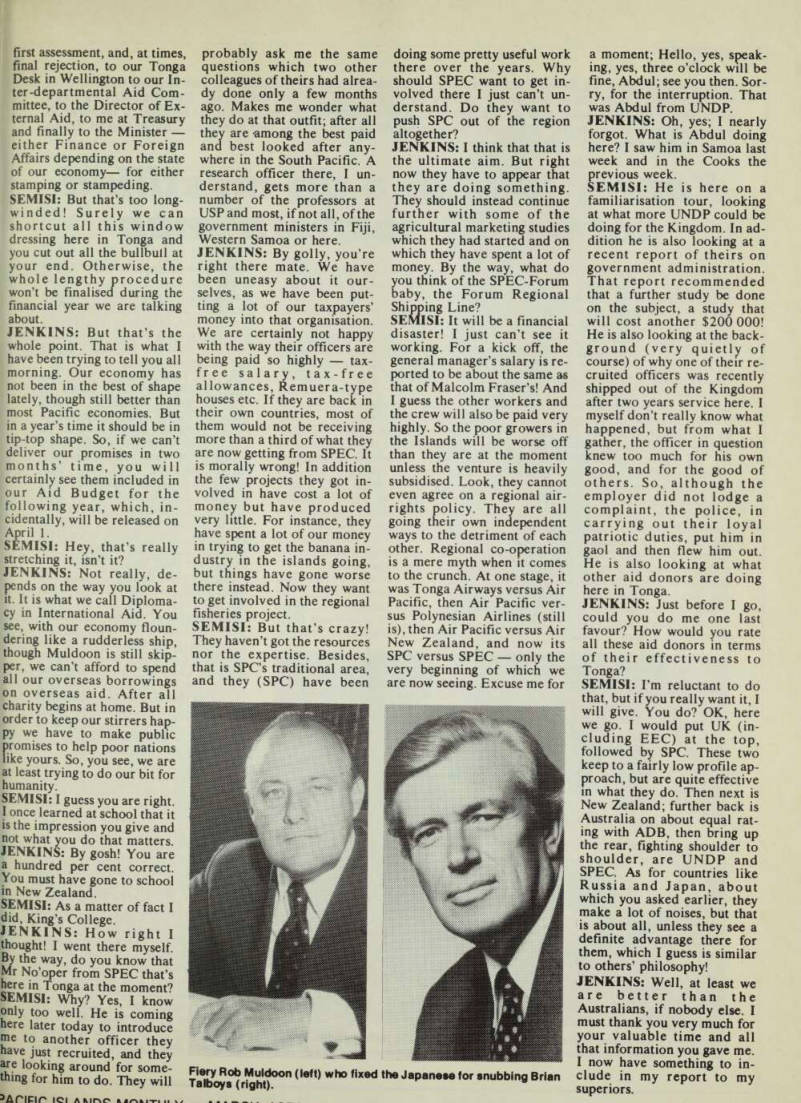
SEMISI: Sure, of course, we do. We have heard how your fiery Rob Muldoon has fixed the Japanese for snubbing Brian Talboys by banning all their fishermen from New Zealand waters (those parts which you can police), and in viting the Russians to come and fish in your waters, or at least legalise their poaching.
That is a very good move, very good move indeed. You first objected violently, but at long last you are agreeing with our opening our shores to our Russian comrades. It shows that your country is now beginning to mature
politically.
JENKINS: No! No! You na tives, I’m sorry, I mean you people are missing the point altogether. This is what we have wanted all the time. We and our ANZUS partners had to object to your wanting the Russians to come here, hence our prompt promises to in crease all our aid to you severalfold so that you would give up your flirtation with those comrades which you have now done. Once you
have given them up, we hose in and invite them to our shores so that we, together with our Yankee mates, can keep an eye on them. You see, our Muldoon may appear to put his foot into it every time he opens his mouth, but in reality he doesn’t. He would be the most courageous and shrewdest statesman of modern times; did you hear what he called President Carter? a mere boy of a peanut farmer! What about his description of Malcolm Fraser the Prime Receiver of a usurped government that needs an election each year to be given a mandate!
SEMISI: But what about his calling the Islanders mere coconuts whom nobody wants?
JENKINS: Now, now, that is being unkind. Sure, he did sa> that but that is not what he meant. Being a shrewd politi cian he wants to make people merely wonder at the possible meanings of his statements sc that no one can catch him out even though the court has caught him out and a few o his ministers on libel cases. Ir ministerial terminology, tha is called the Licence of beinj a Minister, as the taxpayer; always pay; at least in Nev Zealand!
SEMISI: Now, coming bad to the point; what about ou requests for the next financia year?
JENKINS: Well, we hav promised you about $ million. We have had preliminary look at your pro posals and they seem OK. I re peat they seem OK. Now wha you now have to do is to for mally submit them throug your proper official channels that is, through your depart mental committee to you minister, to your plannim cotomittee, to your aid com mittee, to your Cabinet; the; to our aid secretary here fc processing to His Excellenc our High Commissioner fc
first assessment, and, at times, final rejection, to our Tonga Desk in Wellington to our In ter-departmental Aid Com mittee, to the Director of Ex ternal Aid, to me at Treasury and finally to the Minister either Finance or Foreign Affairs depending on the state of our economy— for either stamping or stampeding.
SEMISI: But that’s too long winded! Surely we can shortcut all this window dressing here in Tonga and you cut out all the bullbull at your end. Otherwise, the whole lengthy procedure won’t be finalised during the financial year we are talking about.
JENKINS: But that’s the whole point. That is what I have been trying to tell you all morning. Our economy has not been in the best of shape lately, though still better than most Pacific economies. But in a year’s time it should be in tip-top shape. So, if we can’t deliver our promises in two months’ time, you will certainly see them included in our Aid Budget for the following year, which, in cidentally, will be released on April 1.
SEMISI: Hey, that’s really stretching it, isn’t it?
JENKINS: Not really, de pends on the way you look at it. It is what we call Diploma cy in International Aid. You see, with our economy floun dering like a rudderless ship, though Muldoon is still skip per, we can’t afford to spend all our overseas borrowings on overseas aid. After all charity begins at home. But in order to keep our stirrers hap py we have to make public promises to help poor nations like yours. So, you see, we are at least trying to do our bit for
humanity.
SEMISI: I guess you are right.
I once learned at school that it is the impression you give and not what you do that matters.
JENKINS: By gosh! You are a hundred per cent correct.
You must have gone to school in New Zealand.
SEMISI; As a matter of fact I did, King’s College.
JENKINS: How right I thought! I went there myself.
By the way, do you know that Mr No’oper from SPEC that’s here in Tonga at the moment?
SEMISI: Why? Yes, I know only too well. He is coming here later today to introduce jpe to another officer they have just recruited, and they are looking around for some thing for him to do. They will
probably ask me the same questions which two other colleagues of theirs had alrea dy done only a few months ago. Makes me wonder what they do at that outfit; after all they are -among the best paid and best looked after any where in the South Pacific. A research officer there, I un derstand, gets more than a number of the professors at USP and most, if not all, of the government ministers in Fiji, Western Samoa or here.
JENKINS: By golly, you’re right there mate. We have been uneasy about it our selves, as we have been put ting a lot of our taxpayers’ money into that organisation.
We are certainly not happy with the way their officers are being paid so highly tax free salary, tax-free
allowances, Remuera-type
houses etc. If they are back in their own countries, most of them would not be receiving more than a third of what they are now getting from SPEC. It is morally wrong! In addition the few projects they got in volved in have cost a lot of money but have produced very little. For instance, they have spent a lot of our money in trying to get the banana in dustry in the islands going, but things have gone worse there instead. Now they want to get involved in the regional fisheries project.
SEMISI: But that’s crazy!
They haven’t got the resources nor the expertise. Besides, that is SPC’s traditional area, and they (SPC) have been
doing some pretty useful work there over the years. Why should SPEC want to get in volved there I just can’t un derstand. Do they want to push SPC out of the region altogether?
JENKINS: I think that that is the ultimate aim. But right now they have to appear that they are doing something.
They should instead continue further with some of the agricultural marketing studies which they had started and on which they have spent a lot of money. By the way, what do you think of the SPEC-Forum baby, the Forum Regional
Shipping Line?
SEMISI: It will be a financial disaster! I just can’t see it working. For a kick off, the general manager’s salary is re ported to be about the same as that of Malcolm Fraser’s! And 1 guess the other workers and the crew will also be paid very highly. So the poor growers in the Islands will be worse off than they are at the moment unless the venture is heavily subsidised. Look, they cannot even agree on a regional air rights policy. They are all going their own independent ways to the detriment of each other. Regional co-operation is a mere myth when it comes to the crunch. At one stage, it was Tonga Airways versus Air Pacific, then Air Pacific ver sus Polynesian Airlines (still is), then Air Pacific versus Air New Zealand, and now its SPC versus SPEC only the very beginning of which we are now seeing. Excuse me for
a moment; Hello, yes, speak ing, yes, three o’clock will be fine, Abdul; see you then. Sor ry, for the interruption. That was Abdul from UNDP.
JENKINS: Oh, yes; I nearly forgot. What is Abdul doing here? I saw him in Samoa last week and in the Cooks the previous week.
SEMISI: He is here on a familiarisation tour, looking at what more UNDP could be doing for the Kingdom. In ad dition he is also looking at a recent report of theirs on government administration.
That report recommended that a further study be done on the subject, a study that will cost another $2OO 000!
He is also looking at the back ground (very quietly of course) of why one of their re cruited officers was recently shipped out of the Kingdom after two years service here. I myself don’t really know what happened, but from what I gather, the officer in question knew too much for his own good, and for the good of others. So, although the employer did not lodge a complaint, the police, in carrying out their loyal patriotic duties, put him in gaol and then flew him out.
He is also looking at what other aid donors are doing here in Tonga.
JENKINS: Just before I go, could you do me one last favour? How would you rate all these aid donors in terms of their effectiveness to Tonga?
SEMISI; I’m reluctant to do that, but if you really want it, I will give. You do? OK, here we go. I would put UK (in cluding EEC) at the top, followed by SPC. These two keep to a fairly low profile ap proach, but are quite effective m what they do. Then next is New Zealand; further back is Australia on about equal rat ing with ADB, then bring up the rear, fighting shoulder to shoulder, are UNDP and SPEC. As for countries like Russia and Japan, about which you asked earlier, they make a lot of noises, but that is about all, unless they see a definite advantage there for them, which I guess is similar to others’ philosophy!
JENKINS: Well, at least we are better than the Australians, if nobody else. I must thank you very much for your valuable time and all that information you gave me.
I now have something to in clude in my report to my superiors.
Fiery Rob Muldoon (left) who fixed the Japanese for snubbing Brian Talboys (right).
Advertisements & other items, pp. 12-13 (2 items)
DArimr iqi ANnS MONTHLY MARCH, 197
3 Ancir ici AMHP mAUTiii v/ .. . . .
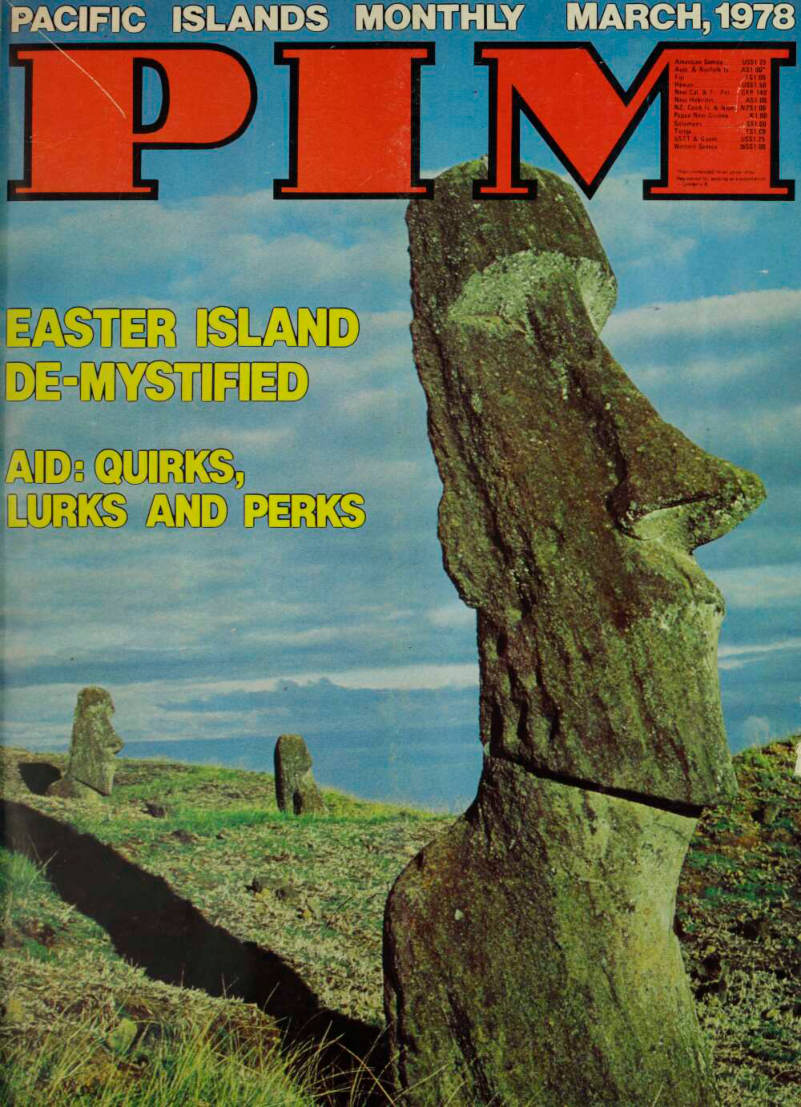
Easter Island, a de-mystified
Travel
Easter Island, a de-mystified dot on the tourists’ map
Easter Island, a speck in the South Pacific, so far away from its neighbours, has always ranked with the pyramids, with Stonehenge and others as one of the ancient mysteries. But the tourists have discovered Easter Island and its statues and it is a mystery no longer. Grant McCall, a lecturer in social anthropology at the University of New South Wales, spent two years on Easter Island doing field work for his PhD. This is his story.
The son of Robert McNamara liv ed on Easter Island from 1972 to 1973, milking cows and selling his dairy produce from door to door, while the Vietnam war, in which his father played such an influential role, raged. I once asked Craig (in his 20s) why the son of a former United States Secretary of Defence and now President of the World Bank should wish to live in a dilapi dated shack that even the Rapanui, as the Easter Islanders call them selves, would not consider inhabit ing. He replied that he was doing it to escape; to hide out on the world’s most remote inhabited island.
Easter Island lies about mid-way between the Chilean coast and the Eastern Polynesian capital, Papeete, surrounded by thousands of square kilometres of blue Pacific, speckled only occasionally by rocky islets, such as Dude and Sala-y-Gomez, the nearest inhabited neighbour being the sparsely-populated Pit cairn Island, over two thousand kilometres distant.
But even in Craig McNamara’s time, there was a weekly air service, operated by LAN-Chile, between Santiago de Chile and Tahiti. And, especially during the Presidency of Salvador Allende, something like half a dozen ships called each year, where, formerly, an annual supply ship had been the only interruption to life on one of the most startling monuments to human ingenuity ever organised and constructed.
It was a Dutchman, Jacob Rogge veen, who was the first European to land on that eastern most vertice of the Polynesian triangle. He was searching for the great South Land, but on Easter Day, 1722, he found instead a rocky island, populated by red-haired, tattooed people, who fought and traded sweet potatoes beneath huge basalt statues, some weighing more than 80 tons.
Roggeveen, during his brief visit, could not have known that the red hair was due to the use of cosmetic red ochre, but this report and those of others fired European imagina-
tion to pay subsequent visits. James Cook, the Comte de La Perouse the Spanish expedition, Captain Beechey, and many of the other famous and infamous navigators who charted the Pacific spent their hours or days off Rapanui’s rocky and dangerous coasts.
In the 19th century, with the development of whaling, Easter Is land became a frequent calling place to renew ship’s stores, with sweet potatoes and bananas. In 1821, four different ships called within a few months of one another.
In all, between 1722 and 1862, nearly 60 different ships stopped at Rapanui, most of them in the 19th century. The islanders learned the art of barter with the Europeans, often specifying which manufac tured products they wanted in ex change for their local produce.
Slave raids, disease, depopula tion, missionaries, traders, com mercial exploitation, and all of the other benefits of contact with Euro pean civilisation that other parts of Polynesia have enjoyed were also the pattern on Rapanui. The annex ation by Chile in 1888 merely com pleted the inevitable process. The islanders themselves had petitioned France for a protectorate many times and, in the 1880 s, were even promised a gendarme, though the order was never carried out.
Today, Easter Island is still remote, but hardly isolated. Twice weekly, a Boeing 707 roars over the island’s only town, Hangaroa, where 1500 Rapanui and about 500 Chileans live and work, mostly for the government services. Tourist parties can now experience in a few days what intrepid seafarers had to invest months of arduous sea travel to achieve; the sacred settlement of Orongo, perched on a volcano rim, the colossal statues, lying like fallen chess pieces about the island’s land scape, and the cyclopean ceremonial altars, which mark the prehistoric settlements of the ancient clans around the island’s perimeter.
A few weeks ago, I received the tiny Easter Island telephone direc tory, listing about 100 subscribers. I reflected that I could now ring my
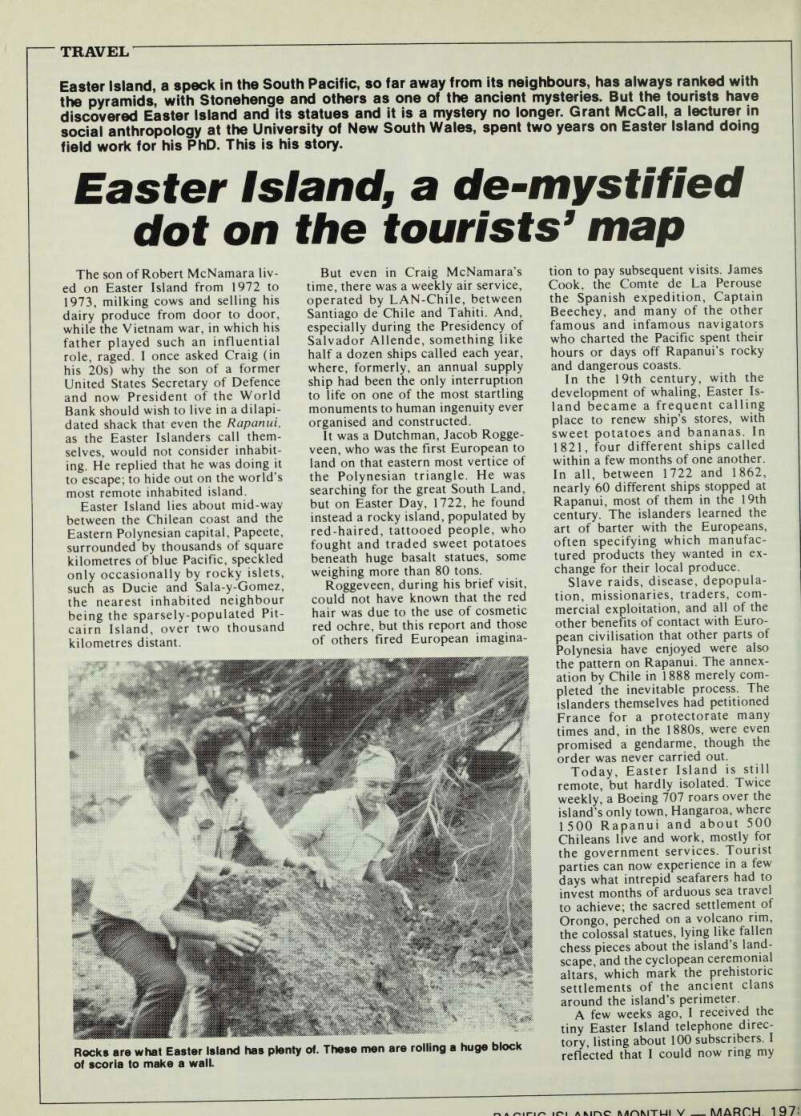
Rocks are what Easter Island has plenty of. These men are rolling a huge block of scoria to make a wall.
friends on Easter Island, from the comfort of my own home, should I wish to clear up any points of kin ship or custom that I neglected dur ing my two years’ field research there in 1972-1974.
I wonder, though, if they would now have as much time to speak with me. It was usually easy to get them to turn off their short-wave radios to answer my questions, but how could I compete with the two hours of closed circuit television programming that they have each night?
Can social anthropology (or a people) withstand the onslaught of Spanish-dubbed versions of Perry Mason, The Pink Panther, or Kung fu? “Civilisation” has really come to Rapanui.
While no evidence exists to de monstrate that Easter Islanders ever left their island in the pre-contact period, several of them took advan tage of European vessels to travel.
In 1795, two young men begged to be taken to Britanniee , on a merchant ship commanded by Charles Bishop. Australia might have had its first Rapanui tourist in 1821, if Sydney merchant, Captain Thomas Raine, had acceded to a re quest by a young islander. Instead, Raine left some seeds and gave the disappointed adventurer a bottle on a string as a souvenir. The first documented Rapanui traveller was lire Hina ’a Tuke, who left his island in 1806, in the company of Captain Benjamin Page, on the Adventure.
Five years later, the islander was baptised Henry Easter , at Rotherhithe Church, near the Lon don docks. According to tradition, Ure Hina returned to his home with many tales of his adventures and brought with him new ideas for house construction.
In the 20th century, many islan ders have travelled to various parts, verifying that the spirit of adventure which drove the Polynesians to set tle on Rapanui, still lives on. Many have been to Mainland Chile and some own property there, while others have travelled to North America and Europe. Several have paid visits to Tahiti, where there is Rapanui land at Pamata’i, purchas ed in the last century from the Catholic Church. Others have been to distant New Zealand. One young islander is studying for a PhD at the East-West Center in Honolulu.
While most Rapanui travellers travel by jet today, there are also those who have taken a more dangerous way. Between 1944 and 1958, largely due to the strict Chilean controls on off-island movement, 40 islanders tried, in
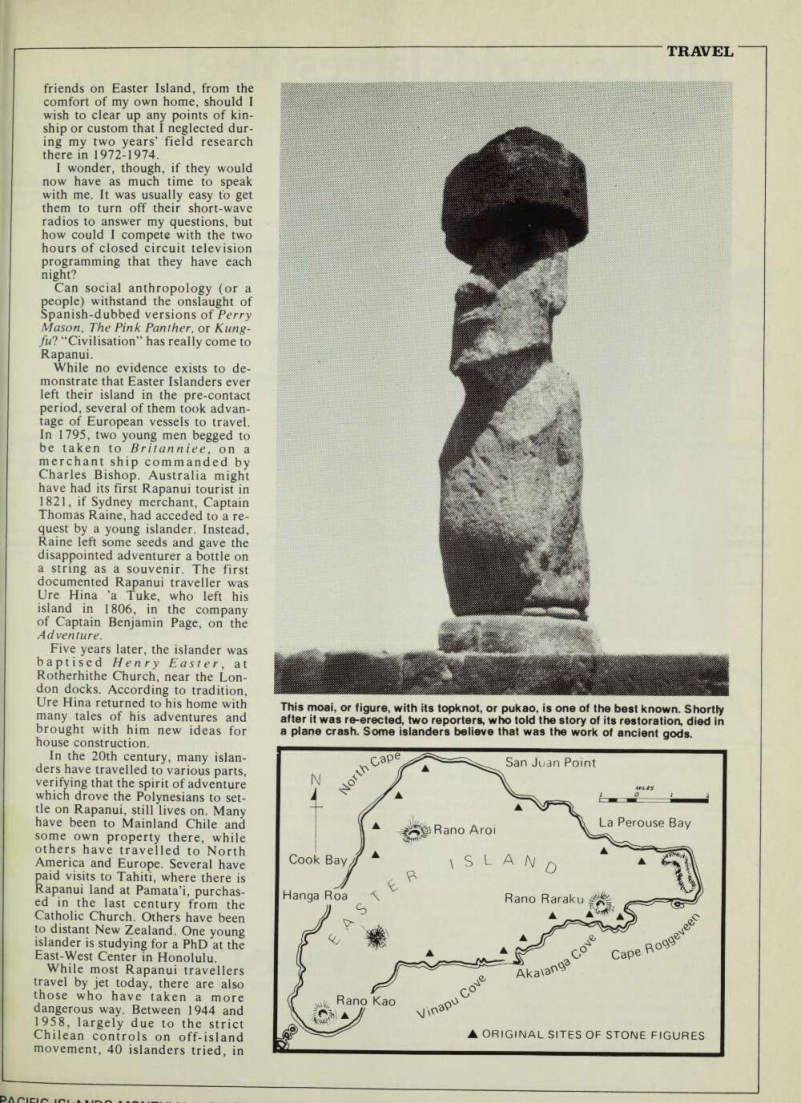
This moai, or figure, with its topknot, or pukao, is one of the best known. Shortly after it was re-erected, two reporters, who told the story of its restoration, died in a plane crash. Some islanders believe that was the work of ancient gods.
eight different trips, to sail or drift in small boats to other destinations.
With the exception of one group, all of the voyagers were headed for Tahiti. Over half were never heard from again. Since 1958, when that series of voyages ended in an unsuc cessful one, the Rapanui have used ships and planes. However, in April of this year, five young men tried again to take a small yacht to Tahiti.
Two of them were known to me and I recall their questions about life in Australia and their desire to come here to work. As far as I know, they failed in their desperate attempt to realise the freedom that they cannot enjoy in today’s Chile.
Dissatisfaction with their Chilean overlords varies amongst the Rapanui population, depending upon current economic cir cumstances. On a personal level, there are more marriages today be tween islanders and Chileans than there are between islanders. Many islanders have positive feelings about Chileans as individuals, but do not admire Chile as a country.
Occasionally, cargo cult- type revolts have occurred against Chile in this century. The first one involv ed the last King of Rapanui, Simeon Riroroko, who was taken to Chile and never returned to his island.
Another, in 1915, involved a Rapanui prophetess, trained as a catechist in Mangareva, who led a revolt based upon messages from God. She was also unsuccessful and some of her supporters were taken to Chile, never to be seen again.
The last outbreak occurred in 1964-1965, when a charismatic young man, trained as a school teacher in Chile, presented demands to bring about an end to military rule on the island. In the ensuing furore, a troop ship was sent from Chile, shots were fired, though no one was seriously injured. Perhaps the presence of a Canadian medical expedition saved the young leader’s life, for the requested reforms were implemented and, in 1966, the is land became an official part of Chile. For the first time, the Rapanui could vote as full citizens of their metropolitan country.
If visitors have come to Rapanui in the last two centuries because of its mysterious monuments, the Islanders leave their remote home to escape from them. All around them are reminders of a glorious heritage; but only a few old men and women can now recount the ancient stories. People told me that an in fluenza epidemic in the 1920 s took most of the islanders with true knowledge of their past.
Since then, Juan Tepano (infor mant to Alfred Metraux) and Pedro Atan (the wily Mayor during the visit of Thor Heyerdahl) have died.
The last son of the King of Rapanui died, only, in 1976. Those remain ing, such as Victoria Rapahango, Luis Pate, Leon Tuki, and Jose Fati notice that their eyesight is failing and their step becoming more un sure each day.
Those others who do tell the old stories have often learned them from Spanish translations of one of the European works on Easter Is land. The local carvers, with few ex ceptions as they have done for most of this century copy their statuettes from published photo graphs of figures traded by their an cestors and now in European museums.
Recently, three Rapanui wood household idols, obtained from the last century, were sold in New York for more than $2OO 000. Prices for modern copies, the prospective visi
tor will be relieved to know, go for much less.
Trading statues with outsiders and guiding them around the monu ments have been Rapanui activities for over two centuries and so has the spinning of inventive stories to en tertain ingenuous foreigners.
Most of the Rapanui today speak Spanish and many know French and English, the latter with a heavy yan qui accent, derived from contact with an American Air Force Base on the island between 1966 and 1971.
The modern visitors will find that the vivacity and friendliness remarked upon by many an early visitor will still characterise the islanders he will meet today.
Even with the improved com munications and frequency of air links, I am certain that the feeling that I had when I saw the LAN- Chile plane disappear into the clouds is still one the present visitor would have; of peace, calm, and, even, contentment at being on the world’s most remote island.
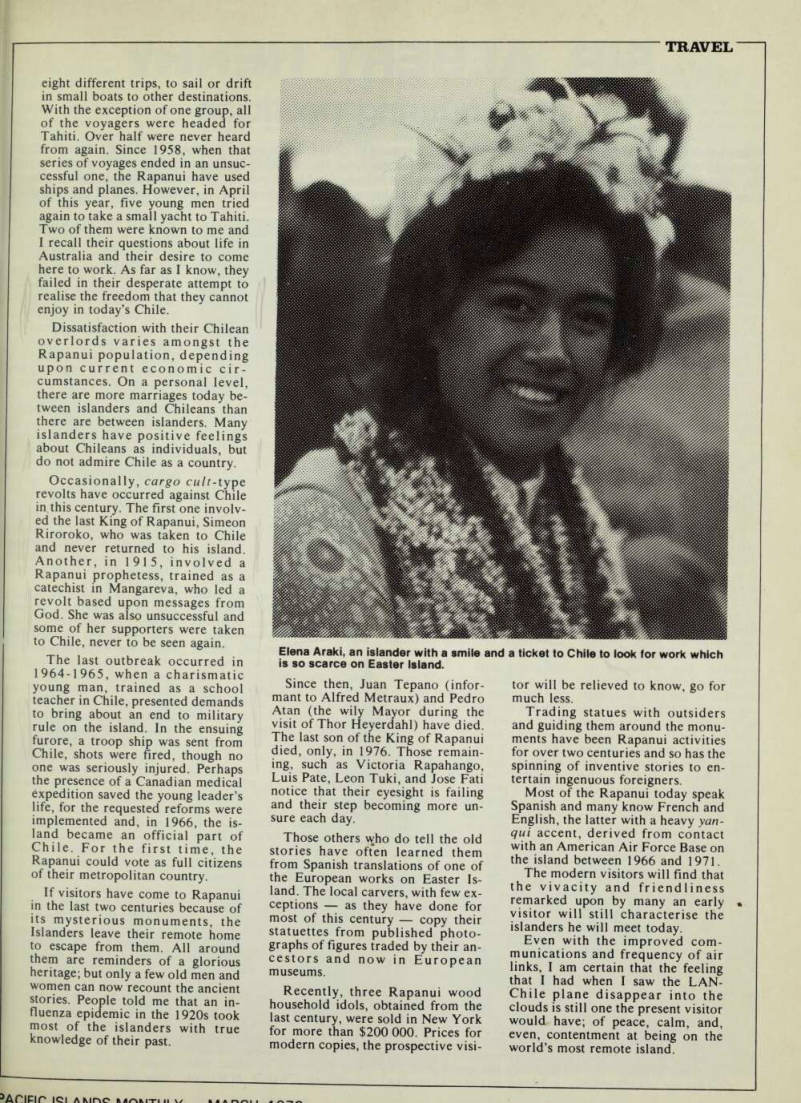
Elena Araki, an islander with a smile and a ticket to Chile to look for work which is so scarce on Easter Island.
Advertisements & other items, pp. 14-17 (5 items)
r-, A mnr' ioi AMrvC V MARCH 1 97<‘
Travel
PA Pin P IO I AA I r-s. /-N * a .
ioi ampvc i\/ir>MTWi v MARCH 197'
Fly the world's largest fleet...
Pan Am 747'5.
flO 747 747
PWVAM
RAMAM
747 98 747 AM /W
IWIAM
Z n. 747 If you're like us, you know a great thing when you see it.
Wide-bodied 747's are the fastest and most comfortable passenger planes available. And vve fly nonstop to more U.S. cities than any other airline in the world including record-setting long range flights. No other airline can match our daily nonstop round trips between Tokyo and New York. We fly the world's longest commercial nonstops from Sydney to San Francisco. Building an entire fleet of 747's just made
good sense.
Our inflight servke crews try very hard to meet your every need in the warmest, most personal
manner possible. Wide, spacious
cabins give you living room comfort as the world slips by.
Our 7475 P "Super Performer"
has lower fuel consumption, higher flying altitudes and faster speeds, making even the longest trip a little shorter. Pan Am's 7475 P is
Experience in tangible form.
You'll find Upper Deck Dining in the First Class lounge at the top of the spiral staircase. Enjoy a gourmet experience from a choice of four select entrees.
No matter where you fly in the world, you're always at home with Pan Am. We assembled the largest fleet of Pan Am 747's just for you.
Experience makes the difference. 065 P 28
Travel
3 APIPir ici A MPkO kJirvk ITI ■■ w >a * n/M I . n
Sir Albert Henry
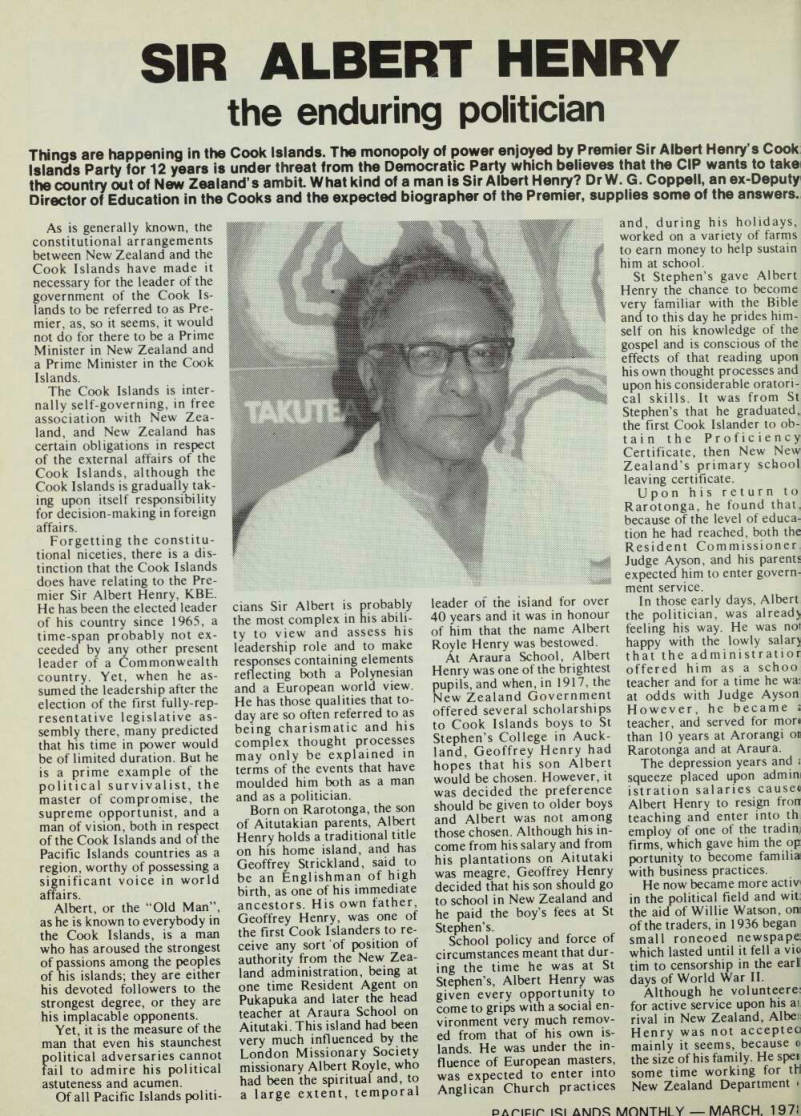
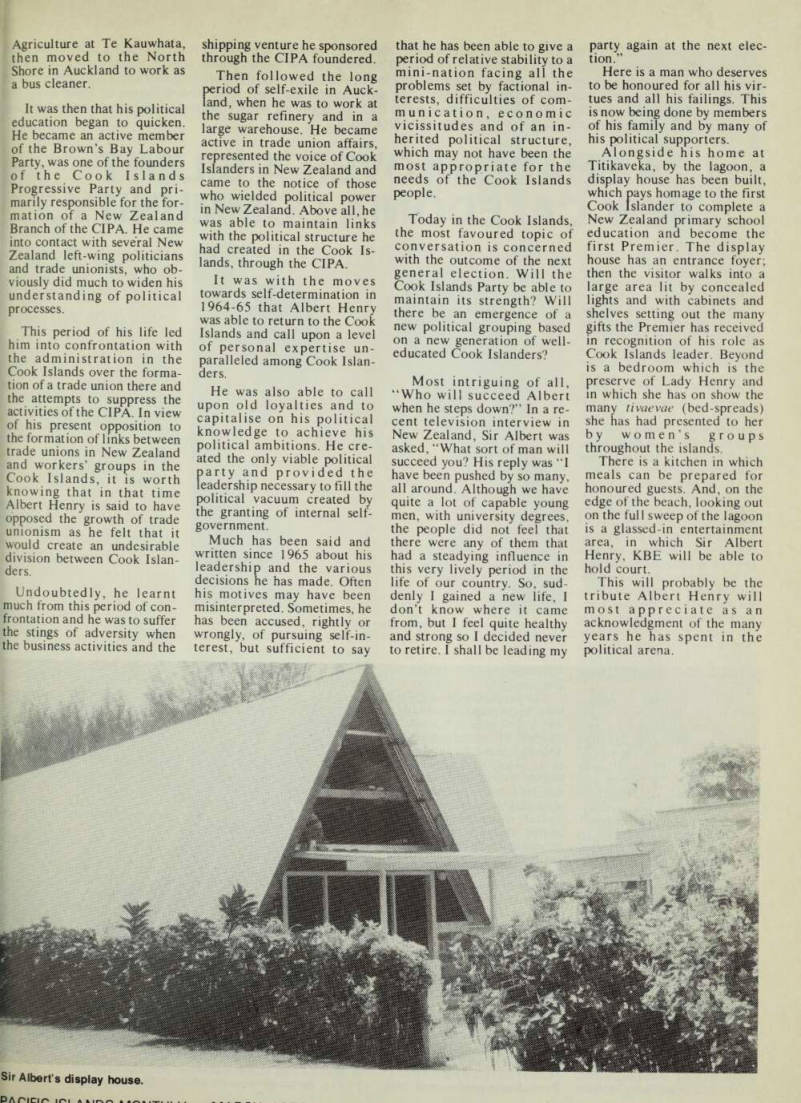
the enduring politician
Things are happening in the Cook Islands. The monopoly of power enjoyed by Premier Sir Albert Henry’s Cook Islands Party for 12 years is under threat from the Democratic Party which believes that the CIP wants to take the country out of New Zealand’s ambit. What kind of a man is Sir Albert Henry? Dr W. G. Coppell, an ex-Depufy Director of Education in the Cooks and the expected biographer of the Premier, supplies some of the answers.
As is generally known, the constitutional arrangements between New Zealand and the Cook Islands have made it necessary for the leader of the government of the Cook Is lands to be referred to as Pre mier, as, so it seems, it would not do for there to be a Prime Minister in New Zealand and a Prime Minister in the Cook Islands.
The Cook Islands is inter nally self-governing, in free association with New Zea land, and New Zealand has certain obligations in respect of the external affairs of the Cook Islands, although the Cook Islands is gradually tak ing upon itself responsibility for decision-making in foreign affairs.
Forgetting the constitu tional niceties, there is a dis tinction that the Cook Islands does have relating to the Pre mier Sir Albert Henry, KBE.
He has been the elected leader of his country since 1965, a time-span probably not ex ceeded by any other present leader of a Commonwealth country. Yet, when he as sumed the leadership after the election of the first fully-rep resentative legislative as sembly there, many predicted that his time in power would be of limited duration. But he is a prime example of the political survivalist, the master of compromise, the supreme opportunist, and a man of vision, both in respect of the Cook Islands and of the Pacific Islands countries as a region, worthy of possessing a significant voice in world affairs Albert, or the “Old Man’’, as he is known to everybody in the Cook Islands, is a man who has aroused the strongest of passions among the peoples of nis islands; they are either his devoted followers to the strongest degree, or they are his implacable opponents.
Yet, it is the measure of the man that even his staunchest political adversaries cannot fail to admire his political astuteness and acumen.
Of all Pacific Islands politi-
cians Sir Albert is probably the most complex in his abili ty to view and assess his leadership role and to make responses containing elements reflecting both a Polynesian and a European world view.
He has those qualities that to day are so often referred to as being charismatic and his complex thought processes may only be explained in terms of the events that have moulded him both as a man and as a politician.
Born on Rarotonga, the son of Aitutakian parents, Albert Henry holds a traditional title on his home island, and has Geoffrey Strickland, said to be an Englishman of high birth, as one of his immediate ancestors. His own father, Geoffrey Henry, was one of the first Cook Islanders to re ceive any sort of position of authority from the New Zea land administration, being at one time Resident Agent on Pukapuka and later the head teacher at Araura School on Aitutaki. This island had been very much influenced by the London Missionary Society missionary Albert Royle, who had been the spiritual and, to a large extent, temporal
and, during his holidays, worked on a variety of farms to earn money to help sustain him at school.
St Stephen’s gave Albert Henry the chance to become very familiar with the Bible ana to this day he prides him self on his knowledge of the gospel and is conscious of the effects of that reading upon his own thought processes and upon his considerable oratori cal skills. It was from St Stephen’s that he graduated, the first Cook Islander to ob tain the Proficiency Certificate, then New New Zealand’s primary school leaving certificate.
Upon his return to Rarotonga, he found that, because of the level of educa tion he had reached, both the Resident Commissioner.
Judge Avson, and his parents expected him to enter govern ment service.
In those early days, Albert the politician, was already feeling his way. He was not happy with the lowly salary that the administratior offered him as a schoo teacher and for a time he wai at odds with Judge Ayson However, he became 2 teacher, and served for mort than 10 years at Arorangi on Rarotonga and at Araura.
The depression years and ; squeeze placed upon admim istration salaries causeo Albert Henry to resign front teaching and enter into th employ of one of the trading firms, which gave him the op portunity to become familial with business practices.
He now became more activ' in the political field and wit; the aid of Willie Watson, om of the traders, in 1936 began small roneoed newspaper which lasted until it fell a vio tim to censorship in the earM days of World War 11.
Although he volunteere; for active service upon his ai rival in New Zealand, Albei Henry was not accepteo mainly it seems, because o the size of his family. He spei some time working for tH New Zealand Department <
leader of the island for over 40 years and it was in honour of him that the name Albert Royle Henry was bestowed.
At Araura School, Albert Henry was one of the brightest pupils, and when, in 1917, the New Zealand Government offered several scholarships to Cook Islands boys to St Stephen’s College in Auck land, Geoffrey Henry had hopes that his son Albert would be chosen. However, it was decided the preference should be given to older boys and Albert was not among those chosen. Although his in come from his salary and from his plantations on Aitutaki was meagre, Geoffrey Henry decided that his son should go to school in New Zealand and he paid the boy’s fees at St
Stephen’s.
School policy and force of circumstances meant that dur ing the time he was at St
Stephen’s, Albert Henry was
given every opportunity to come to grips with a social en vironment very much remov ed from that of his own is lands. He was under the in fluence of European masters, was expected to enter into Anglican Church practices
Agriculture at Te Kauwhata, then moved to the North Shore in Auckland to work as a bus cleaner.
It was then that his political education began to quicken.
He became an active member of the Brown’s Bay Labour Party, was one of the founders of the Cook Islands Progressive Party and pri marily responsible for the for mation of a New Zealand Branch of the CIPA. He came into contact with several New Zealand left-wing politicians and trade unionists, who ob viously did much to widen his understanding of political processes.
This period of his life led him into confrontation with the administration in the Cook Islands over the forma tion of a trade union there and the attempts to suppress the activities of the CIPA. In view of his present opposition to the formation of links between trade unions in New Zealand and workers’ groups in the Cook Islands, it is worth knowing that in that time Albert Henry is said to have opposed the growth of trade unionism as he felt that it would create an undesirable division between Cook Islan ders.
Undoubtedly, he learnt much from this period of con frontation and he was to suffer the stings of adversity when the business activities and the
shipping venture he sponsored through the CIPA foundered.
Then followed the long period of self-exile in Auck land, when he was to work at the sugar refinery and in a large warehouse. He became active in trade union affairs, represented the voice of Cook Islanders in New Zealand and came to the notice of those who wielded political power in New Zealand. Above all, he was able to maintain links with the political structure he had created in the Cook Is lands, through the CIPA.
It was with the moves towards self-determination in 1964-65 that Albert Henry was able to return to the Cook Islands and call upon a level of personal expertise un paralleled among Cook Islan ders.
He was also able to call upon old loyalties and to capitalise on his political knowledge to achieve his political ambitions. He cre ated the only viable political party and provided the leadership necessary to fill the political vacuum created by the granting of internal self government.
Much has been said and written since 1965 about his leadership and the various decisions he has made. Often his motives may have been misinterpreted. Sometimes, he has been accused, rightly or wrongly, of pursuing self-in terest, but sufficient to say
that he has been able to give a period of relative stability to a mini-nation facing all the problems set by factional in terests, difficulties of com munication, economic vicissitudes and of an in herited political structure, which may not have been the most appropriate for the needs of the Cook Islands people.
Today in the Cook Islands, the most favoured topic of conversation is concerned with the outcome of the next general election. Will the Cook Islands Party be able to maintain its strength? Will there be an emergence of a new political grouping based on a new generation of well educated Cook Islanders?
Most intriguing of all, “Who will succeed Albert when he steps down?” In a re cent television interview in New Zealand, Sir Albert was asked, “What sort of man will succeed you? His reply was “I have been pushed by so many, all around. Although we have quite a lot of capable young men, with university degrees, the people did not feel that there were any of them that had a steadying influence in this very lively period in the life of our country. So, sud denly I gained a new life, I don’t know where it came from, but I feel quite healthy and strong so I decided never to retire. I shall be leading my
party again at the next elec tion.”
Here is a man who deserves to be honoured for all his vir tues and all his failings. This is now being done by members of his family and by many of his political supporters.
Alongside his home at Titikaveka, by the lagoon, a display house has been built, which pays homage to the first Cook Islander to complete a New Zealand primary school education and become the first Premier. The display house has an entrance foyer; then the visitor walks into a large area lit by concealed lights and with cabinets and shelves setting out the many gifts the Premier has received in recognition of his role as Cook Islands leader. Beyond is a bedroom which is the preserve of Lady Henry and in which she has on show the many tivaevae (bed-spreads) she has had presented to her by women’s groups throughout the islands.
There is a kitchen in which meals can be prepared for honoured guests. And, on the edge of the beach, looking out on the full sweep of the lagoon is a glassed-in entertainment area, in which Sir Albert Henry, KBE will be able to hold court.
This will probably be the tribute Albert Henry will most appreciate as an acknowledgment of the many years he has spent in the political arena.
Sir Albert’s display house.
Advertisements & other items, pp. 18-19 (2 items)
Papipir Iqi Amd S Monthly March, 1 97?
Pa Picio 101 A Nr\R» ■ .. ...
New Caledonia Community
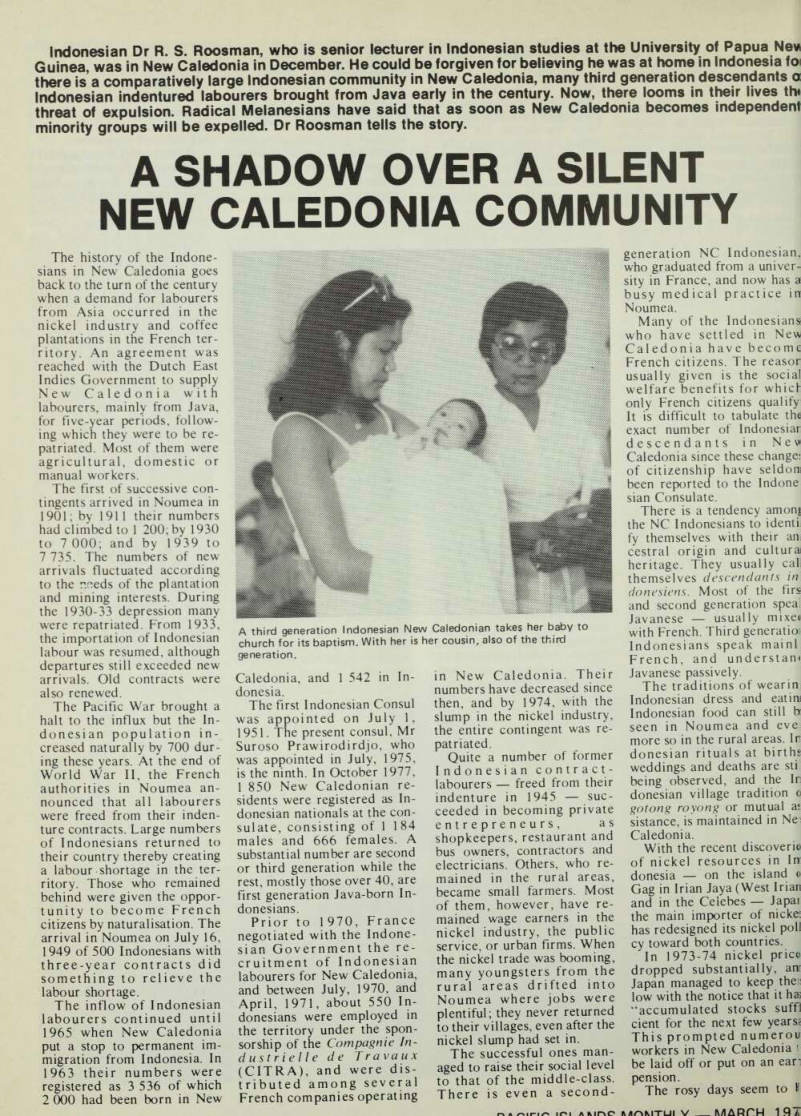
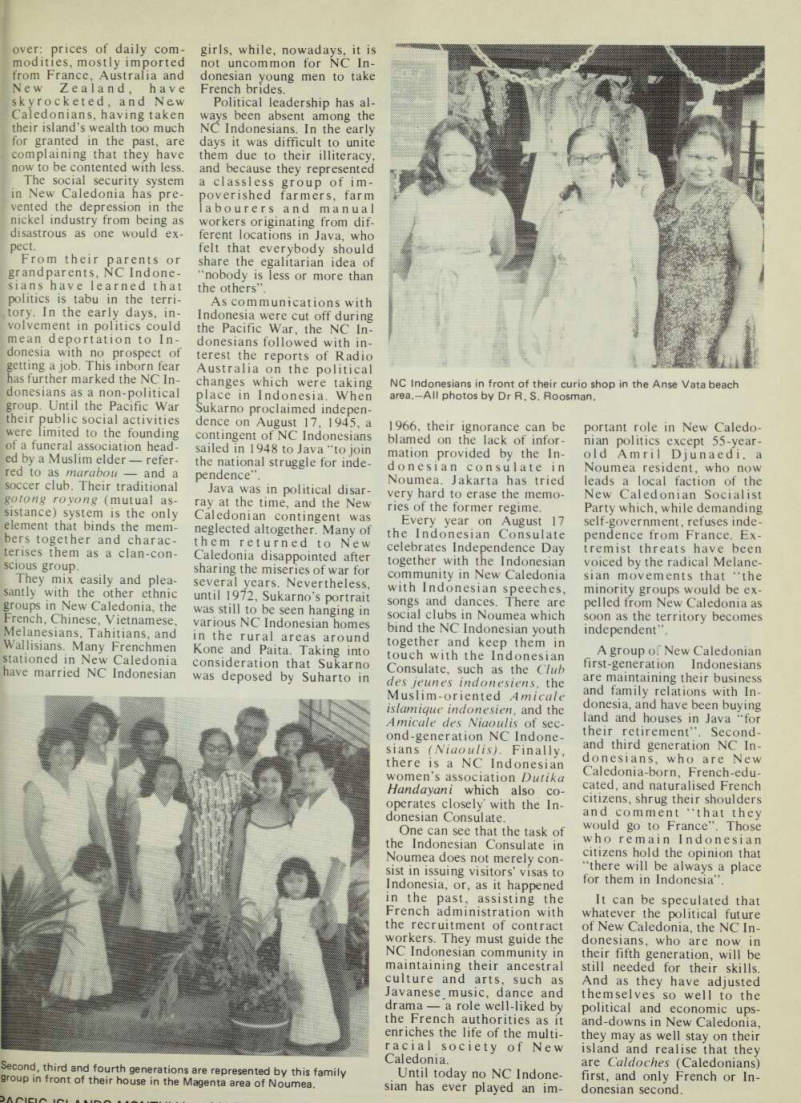
A Shadow Over A Silent
Indonesian Dr R. S. Roosman, who is senior lecturer in Indonesian studies at the University of Papua Nev Guinea, was in New Caledonia in December. He could be forgiven for believing he was at home in Indonesia fo there is a comparatively large Indonesian community in New Caledonia, many third generation descendants c Indonesian indentured labourers brought from Java early in the century. Now, there looms in their lives th threat of expulsion. Radical Melanesians have said that as soon as New Caledonia becomes independent minority groups will be expelled. Dr Roosman tells the story.
The history of the Indone sians in New Caledonia goes back to the turn of the century when a demand for labourers from Asia occurred in the nickel industry and coffee plantations in the French ter ritory. An agreement was reached with the Dutch East Indies Government to supply New Caledonia with labourers, mainly from Java, for five-year periods, follow ing which they were to be re patriated. Most of them were agricultural, domestic or manual workers.
The first of successive con tingents arrived in Noumea in 1901; by 1911 their numbers had climbed to 1 200; by 1930 to 7 000; and by 1939 to 7 735. The numbers of new arrivals fluctuated according to the needs of the plantation and mining interests. During the 1930-33 depression many were repatriated. From 1933, the importation of Indonesian labour was resumed, although departures still exceeded new arrivals. Old contracts were also renewed.
The Pacific War brought a halt to the influx but the In donesian population in creased naturally by 700 dur ing these years. At the end of World War 11, the French authorities in Noumea an nounced that all labourers were freed from their inden ture contracts. Large numbers of Indonesians returned to their country thereby creating a labour shortage in the ter ritory. Those who remained behind were given the oppor tunity to become French citizens by naturalisation. The arrival in Noumea on July 16, 1949 of 500 Indonesians with three-year contracts did something to relieve the labour shortage.
The inflow of Indonesian labourers continued until 1965 when New Caledonia put a stop to permanent im migration from Indonesia. In 1963 their numbers were registered as 3 536 of which 2 000 had been born in New
Caledonia, and 1 542 in In donesia.
The first Indonesian Consul was appointed on July 1, 1951. The present consul, Mr Suroso Prawirodirdjo, who was appointed in July, 1975, is the ninth. In October 1977, 1 850 New Caledonian re sidents were registered as In donesian nationals at the con sulate, consisting of 1 184 males and 666 females. A substantial number are second or third generation while the rest, mostly those over 40, are first generation Java-born In donesians.
Prior to 1 970, France negotiated with the Indone sian Government the re cruitment of Indonesian labourers for New Caledonia, and between July, 1970, and April, 1971, about 550 In donesians were employed in the territory under the spon sorship of the Compagnie In dustr i e 11 e d e Trav a u x (CITRA), and were dis tributed among several
French companies operating
in New Caledonia. Their numbers have decreased since then, and by 1974, with the slump in the nickel industry, the entire contingent was re
patriated.
Quite a number of former Indonesian contract labourers freed from their indenture in 1945 suc ceeded in becoming private entrepreneurs, as shopkeepers, restaurant and bus owners, contractors and electricians. Others, who re mained in the rural areas, became small farmers. Most of them, however, have re mained wage earners in the nickel industry, the public service, or urban firms. When the nickel trade was booming, many youngsters from the rural areas drifted into Noumea where jobs were plentiful; they never returned to their villages, even after the nickel slump had set in.
The successful ones man aged to raise their social level to that of the middle-class.
There is even a second
generation NC Indonesian, who graduated from a univer sity in France, and now has a busy medical practice in Noumea.
Many of the Indonesians who have settled in New Caledonia have become French citizens. The reasor usually given is the social welfare benefits for which only French citizens qualify It is difficult to tabulate the exact number of Indonesiar descendants in Nev Caledonia since these change: of citizenship have seldom been reported to the Indone sian Consulate.
There is a tendency amon| the NC Indonesians to identi fy themselves with their an cestral origin and cultura heritage. They usually cal themselves descendants in donesiens. Most of the firs and second generation speai Javanese usually mixeo with French. Third generatioi Indonesians speak mainl French, and understand
Javanese passively.
The traditions of wearin Indonesian dress and eatim Indonesian food can still b seen in Noumea and eve more so in the rural areas. In donesian rituals at births weddings and deaths are sti being observed, and the In donesian village tradition o gotong royong or mutual a; sistance, is maintained in Ne Caledonia.
With the recent discoverie of nickel resources in Irr donesia on the island o Gag in Irian Jaya (West Irian and in the Celebes Japai the main importer of nicke: has redesigned its nickel poll cy toward both countries.
In 1973-74 nickel price dropped substantially, anr Japan managed to keep the:; low with the notice that it ha “accumulated stocks suffl cient for the next few years* This prompted numerou workers in New Caledonia i be laid off or put on an ear pension.
The rosy days seem to F
A third generation Indonesian New Caledonian takes her baby to church for its baptism. With her is her cousin, also of the third generation.
over: prices of daily commodities, mostly imported from France, Australia and New Zealand, have skyrocketed, and N&w . Caledonians, having taken their island’s wealth too much for granted in the past, are I complaining that they have now to be contented with less, The social security system in New Caledonia has pref vented the depression in the nickel industry from being as disastrous as one would ex- P ect - From their parents or grandparents, NC Indonesians have learned that politics is tabu in the territ tory. In the early days, involvement in politics could mean deportation to Indonesia with no prospect of getting a job. This inborn fear . has further marked the NC Indonesians as a non-political group. Until the Pacific War their public social activities were limited to the founding of a funeral association headed by a Muslim elder referred to as marabou and a soccer club. Their traditional gotong royong (mutual assistance) system is the only element that binds the members together and characterises them as a clan-conscious group.
They mix easily and pleasantly with the other ethnic groups in New Caledonia, the French, Chinese, Vietnamese, Melanesmns, Ta hitians, and Walhsians. Many Frenchmen stationed in New Caledonia have married NC Indonesian
girls, while, nowadays, it is not uncommon for NC In donesian young men to take French brides, Political leadership has al ways been absent among the NC Indonesians. In the early days it was difficult to unite them due to their illiteracy, and because they represented a classless group of im poverished farmers, farm labourers and manual workers originating from dif ferent locations in Java, who felt that everybody should share the egalitarian idea of “nobody is less or more than the others”, As communications with Indonesia were cut off during the Pacific War, the NC In donesians followed with In terest the reports of Radio Australia on the political changes which were taking place in Indonesia. When Sukarno proclaimed indepen dence on August 17, 1945, a contingent of NC Indonesians sailed in 1948 to Java “to join the national struggle for inde pendence”.
Java was in political disar ray at the time, and the New Caledonian contingent was neglected altogether. Many of them returned to New Caledonia disappointed after sharing the miseries of war for several years. Nevertheless until 1972, Sukarno’s portrait was still to be seen hanging in various NC Indonesian homes in the rural areas around Kone and Paita. Taking into consideration that Sukarno was deposed by Suharto in
1966, their ignorance can be blamed on the lack of infor mation provided by the In donesian consulate in Noumea. Jakarta has tried very hard to erase the memo ries of the former regime.
Every year on August 17 the Indonesian Consulate celebrates Independence Day together with the Indonesian community in New Caledonia with Indonesian speeches, songs and dances. There are social clubs in Noumea which bind the NC Indonesian youth together and keep them in touch with the Indonesian Consulate, such as the Club des jeunes indonesiens, the Muslim-oriented Amicale islamique indonesien, and the Amicale des Niaoulis of sec ond-generation NC Indone sians (Niaoulis). Finally, there is a NC Indonesian women’s association Dutika Handayani which also co operates closely' with the In donesian Consulate.
One can see that the task of the Indonesian Consulate in Noumea does not merely con sist in issuing visitors’ visas to Indonesia, or, as it happened in the past, assisting the French administration with the recruitment of contract workers. They must guide the NC Indonesian community in maintaining their ancestral culture and arts, such as Javanese music, dance and drama— a role well-liked by the French authorities as it enriches the life of the multi racial society of New Caledonia.
Until today no NC Indone sian has ever played an im
portant role in New Caledo nian politics except 55-year old Amril Djunaedi, a Noumea resident, who now leads a local faction of the New Caledonian Socialist Party which, while demanding self-government, refuses inde pendence from France. Ex tremist threats have been voiced by the radical Melane sian movements that “the minority groups would be ex pelled from New Caledonia as soon as the territory becomes
independent”.
A group of New Caledonian first-generation Indonesians are maintaining their business and family relations with In donesia, and have been buying land and houses in Java “for their retirement”. Second and third generation NC In donesians, who are New Caledonia-born, French-edu cated, and naturalised French citizens, shrug their shoulders and comment “that they would go to France”. Those who remain Indonesian citizens hold the opinion that “there will be always a place for them in Indonesia”.
It can be speculated that whatever the political future of New Caledonia, the NC In donesians, who are now in their fifth generation, will be still needed for their skills.
And as they have adjusted themselves so well to the political and economic ups and-downs in New Caledonia, they may as well stay on their island and realise that they are Caldoches (Caledonians) first, and only French or In donesian second.
Second, third and fourth generations are represented by this family group in front of their house in the Magenta area of Noumea.
NC Indonesians in front of their curio shop in the Anse Vata beach area.—All photos by Dr R. S. Roosman.
Advertisements & other items, pp. 20-22 (3 items)
In Amhc Aarimtui V Marth 19X
Dar'icm Ici Amhq Mhmthi V — March, 1 97!
Clarion Fits Any Car
General Motors NSU BMW Ford Mercedes Benz O, Chrysler Austin ' n aimler M .all Alfa anch era Leylan azda Toyota * nera h y, er Foru .ab Skoda Audi i\ou divi w i ord ivickcucs ueiiz Opel Porshe Volkswc^.
Renault Chrysler Austin Morris Jaguar Daimler M.G Rover Triumph Vau,. ord Vauxhall Alfa Romeo Autobianchi Fiat Lancia Leyland-lnnocenti Mazda Toyota >atsun Mazda Toyota Mitsubishi General Motors Chrysler Ford Seat DAF Skoda Audi NS dvo Saab Skoda Audi NSU BMW Ford Mercedes Benz Opel Porshe Volkswagen Benz Opel i Peugeot Renault Chrysler Austin Morris Jaguar Daimler M.G Rover Triumph Jaguar/DaimL. * irysler Ford Vauxhall Alfa Romeo Autobianchi Fiat Lancia Leyland-lnnocenti Lancia Leyland-Innoce Datsun Mazda Toyota Mitsubishi General Motors Chrysler Ford Seat DAF Chrysler Seat DAF 1 ida Volvo Saab Skoda Audi NSU BMW Ford Mercedes Benz Opel Porsche Volkswagen Opel Por- 1 frnpn P^..^ ot Renault Chrysler Austin Morris Jaguar Daimler M.G Rover Triumph Triumph C Vauxhall Alfa R " ' Ford Mercedes Mazda Toyota 17 Mercedes Be Skoda A- C-
Like It Was Born There.
•ON-VOL/PRO
•TUNING
' .■ <6.
Auto reverse cassette stereo OClarion M ► I
AM-FM-ST-J
PE-663 The brand of car or model you own makes no difference.
Clarion fits any dashboard like the unit was installed at the factory.
Once in position, the real fun begins.
Every drive becomes more enjoyable.
Advanced Clarion electronics create dynamic sound quality and assure
superb reliability.
Clarion - respected and listened to by motorists worldwide.
Clarion Co., Ltd. Tokyo Japan \ustralia- Amalgamated Wireless (Australasia) Ltd. 554 Parramatta Road Ashfieid N.S.W., 2131 / New Zealand: AWA New "ealand tfm™ed P.O. Box 50-248 Porirua / Fiji Islands: Brijlal & Co.. Ltd. G.P.O. Box 362 Suva / Tahiti: ETS. Comimpex B.pc >00 Papeete / New Caledonia: Caldis. B.P.M 1 Noumea Cedex /Guam: Guam Radio&TV Shop. P.O. Box U39 Agana. —u
Germany notices
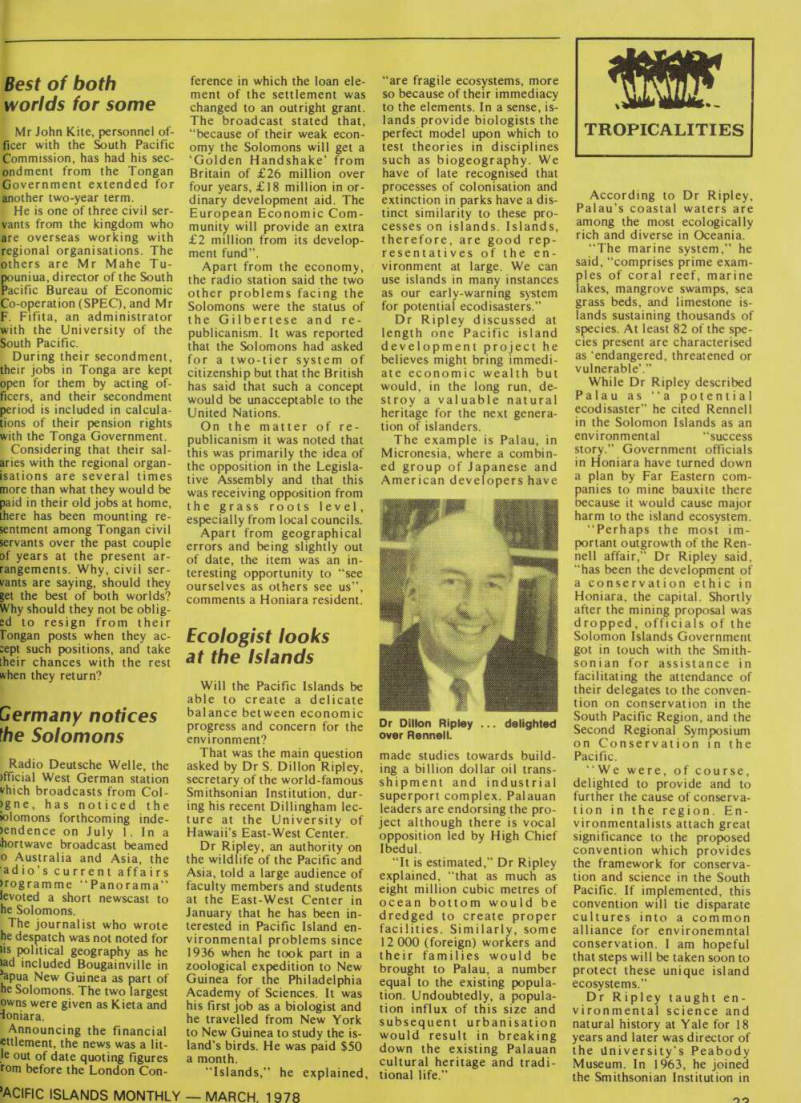
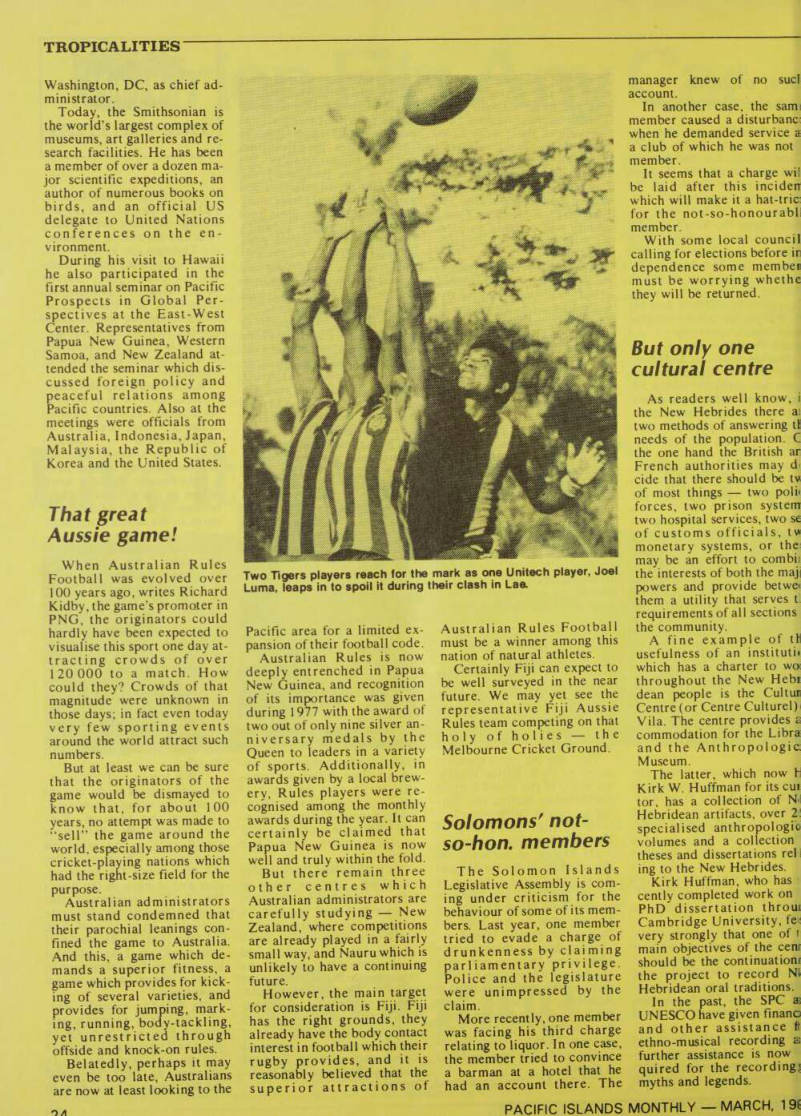
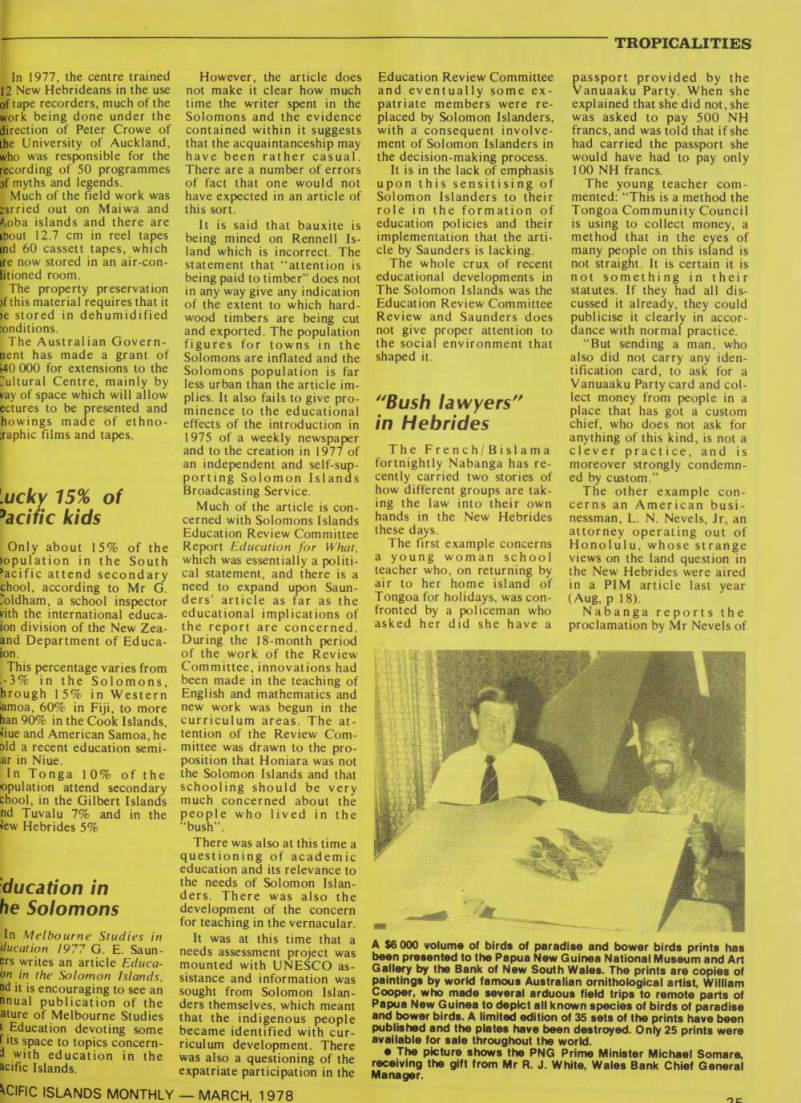
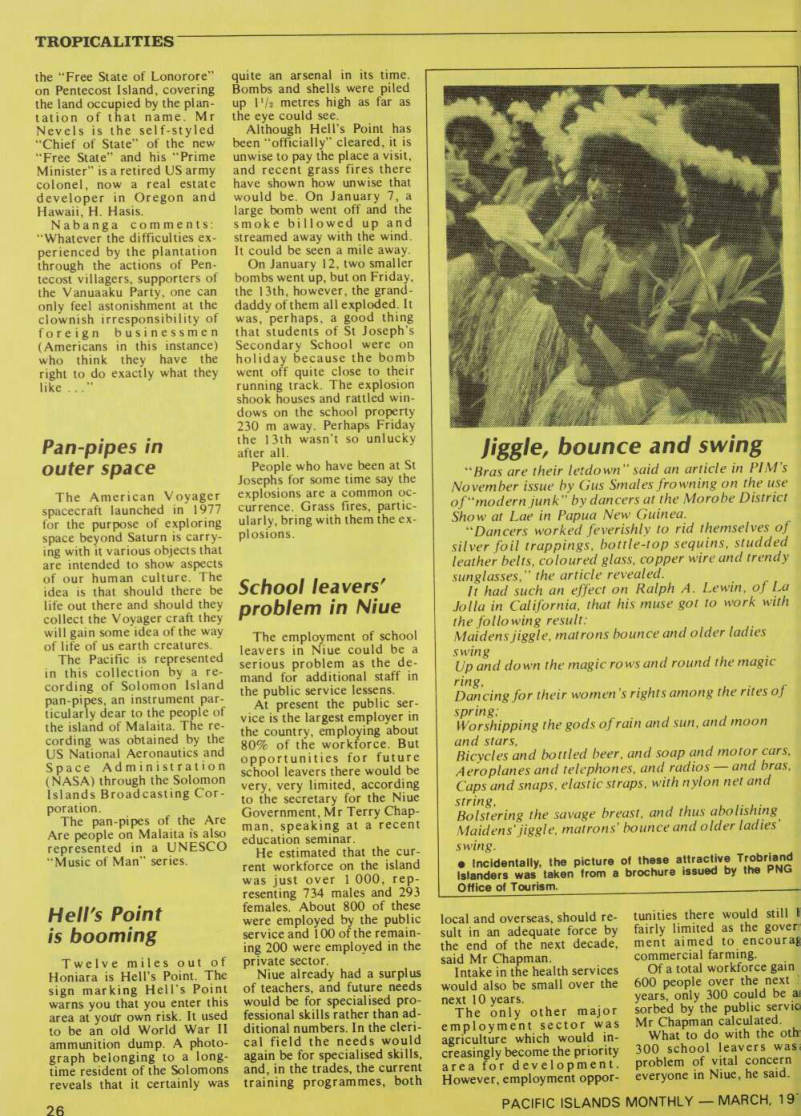
Tropicalities
Best of both
worlds for some
Mr John Kite, personnel of ficer with the South Pacific Commission, has had his sec ondment from the Tongan Government extended for another two-year term.
He is one of three civil ser vants from the kingdom who are overseas working with regional organisations. The others are Mr Mahe Tu pouniua, director of the South Pacific Bureau of Economic Co-operation (SPEC), and Mr F. Fifita, an administrator with the University of the South Pacific.
During their secondment, their jobs in Tonga are kept open for them by acting of ficers, and their secondment period is included in calcula tions of their pension rights with the Tonga Government.
Considering that their sal aries with the regional organ isations are several times more than what they would be paid in their old jobs at home, there has been mounting re sentment among Tongan civil servants over the past couple of years at the present ar rangements. Why, civil ser vants are saying, should they get the best of both worlds?
Why should they not be oblig ed to resign from their Tongan posts when they ac cept such positions, and take their chances with the rest when they return?
Germany notices
the Solomons
Radio Deutsche Welle, the )fficial West German station vhich broadcasts from Col >gne, has noticed the
Jolomons forthcoming inde
>endence on July 1. In a hortwave broadcast beamed o Australia and Asia, the adio’s current affairs programme “Panorama” levoted a short newscast to he Solomons.
The journalist who wrote he despatch was not noted for lis political geography as he lad included Bougainville in >a pua New Guinea as part of he Solomons. The two largest owns were given as Kieta and Joniara.
Announcing the financial ettlement, the news was a tit le out of date quoting figures rom before the London Con
ference in which the loan ele ment of the settlement was changed to an outright grant.
The broadcast stated that, “because of their weak econ omy the Solomons will get a ‘Golden Handshake’ from Britain of £26 million over four years, £lB million in or dinary development aid. The European Economic Com munity will provide an extra £2 million from its develop ment fund”.
Apart from the economy, the radio station said the two other problems facing the Solomons were the status of the Gilbertese and re publicanism. It was reported that the Solomons had asked for a two-tier system of citizenship but that the British has said that such a concept would be unacceptable to the United Nations.
On the matter of re publicanism it was noted that this was primarily the idea of the opposition in the Legisla tive Assembly and that this was receiving opposition from the grass roots level, especially from local councils.
Apart from geographical errors and being slightly out of date, the item was an in teresting opportunity to “see ourselves as others see us”, comments a Honiara resident.
Ecologist looks
at the Islands
Will the Pacific Islands be able to create a delicate balance between economic progress and concern for the environment?
That was the main question asked by Dr S. Dillon Ripley, secretary of the world-famous Smithsonian Institution, dur ing his recent Dillingham lec ture at the University of Hawaii’s East-West Center.
Dr Ripley, an authority on the wildlife of the Pacific and Asia, told a large audience of faculty members and students at the East-West Center in January that he has been in terested in Pacific Island en vironmental problems since 1936 when he took part in a zoological expedition to New Guinea for the Philadelphia Academy of Sciences. It was his first job as a biologist and he travelled from New York to New Guinea to study the is land’s birds. He was paid $5O a month.
“Islands,” he explained,
“are fragile ecosystems, more so because of their immediacy to the elements. In a sense, is lands provide biologists the perfect model upon which to test theories in disciplines such as biogeography. We have of late recognised that processes of colonisation and extinction in parks have a dis tinct similarity to these pro cesses on islands. Islands, therefore, are good rep resentatives of the en vironment at large. We can use islands in many instances as our early-warning system for potential ecodisasters.”
Dr Ripley discussed at length one Pacific island development project he believes might bring immedi ate economic wealth but would, in the long run, de stroy a valuable natural heritage for the next genera tion of islanders.
The example is Palau, in Micronesia, where a combin ed group of Japanese and American developers have
made studies towards build ing a billion dollar oil trans shipment and industrial superport complex. Palauan leaders are endorsing the pro ject although there is vocal opposition led by High Chief Ibedul.
“It is estimated,” Dr Ripley explained, “that as much as eight million cubic metres of ocean bottom would be dredged to create proper facilities. Similarly, some 12 000 (foreign) workers and their families would be brought to Palau, a number equal to the existing popula tion. Undoubtedly, a popula tion influx of this size and subsequent urbanisation would result in breaking down the existing Palauan cultural heritage and tradi tional life.”
According to Dr Ripley, Palau’s coastal waters are among the most ecologically rich and diverse in Oceania.
“The marine system,” he said, “comprises prime exam ples of coral reef, marine lakes, mangrove swamps, sea grass beds, and limestone is lands sustaining thousands of species. At least 82 of the spe cies present are characterised as ‘endangered, threatened or vulnerable’.”
While Dr Ripley described Palau as “a potential ecodisaster” he cited Rennell in the Solomon Islands as an environmental “success story.” Government officials in Honiara have turned down a plan by Far Eastern com panies to mine bauxite there because it would cause major harm to the island ecosystem.
“Perhaps the most im portant outgrowth of the Ren nell affair,” Dr Ripley said, “has been the development of a conservation ethic in Honiara, the capital. Shortly after the mining proposal was dropped, officials of the Solomon Islands Government got in touch with the Smith sonian for assistance in facilitating the attendance of their delegates to the conven tion on conservation in the South Pacific Region, and the Second Regional Symposium on Conservation in the Pacific.
“We were, of course, delighted to provide and to further the cause of conserva tion in the region. En vironmentalists attach great significance to the proposed convention which provides the framework for conserva tion and science in the South Pacific. If implemented, this convention will tie disparate cultures into a common alliance for environemntal conservation. I am hopeful that steps will be taken soon to protect these unique island ecosystems.”
Dr Ripley taught en vironmental science and natural history at Yale for 18 years and later was director of the University’s Peabody Museum. In 1963, he joined the Smithsonian Institution in
Dr Dillon Ripley ... delighted over Rennell.
Washington, DC, as chief ad ministrator.
Today, the Smithsonian is the world’s largest complex of museums, art galleries and re search facilities. He has been a member of over a dozen ma jor scientific expeditions, an author of numerous books on birds, and an official US delegate to United Nations conferences on the en vironment.
During his visit to Hawaii he also participated in the first annual seminar on Pacific Prospects in Global Per spectives at the East-West Center. Representatives from Papua New Guinea, Western Samoa, and New Zealand at tended the seminar which dis cussed foreign policy and peaceful relations among Pacific countries. Also at the meetings were officials from Australia, Indonesia, Japan, Malaysia, the Republic of Korea and the United States.
That great
Aussie game!
When Australian Rules Football was evolved over 100 years ago, writes Richard Kidby, the game’s promoter in PNG, the originators could hardly have been expected to visualise this sport one day at tracting crowds of over 120 000 to a match. How could they? Crowds of that magnitude were unknown in those days; in fact even today very few sporting events around the world attract such numbers.
But at least we can be sure that the originators of the game would be dismayed to know that, for about 100 years, no attempt was made to “sell” the game around the world, especially among those cricket-playing nations which had the right-size field for the purpose.
Australian administrators must stand condemned that their parochial leanings con fined the game to Australia.
And this, a game which de mands a superior fitness, a game which provides for kick ing of several varieties, and provides for jumping, mark ing, running, body-tackling, yet unrestricted through offside and knock-on rules.
Belatedly, perhaps it may even be too late, Australians are now at least looking to the
Pacific area for a limited ex pansion of their football code.
Australian Rules is now deeply entrenched in Papua New Guinea, and recognition of its importance was given during 1977 with the award of two out of only nine silver an niversary medals by the Queen to leaders in a variety of sports. Additionally, in awards given by a local brew ery, Rules players were re cognised among the monthly awards during the year. It can certainly be claimed that Papua New Guinea is now well and truly within the fold.
But there remain three other centres which Australian administrators are carefully studying New Zealand, where competitions are already played in a fairly small way, and Nauru which is unlikely to have a continuing future.
However, the main target for consideration is Fiji. Fiji has the right grounds, they already have the body contact interest in football which their rugby provides, and it is reasonably believed that the superior attractions of
Australian Rules Football must be a winner among this nation of natural athletes.
Certainly Fiji can expect to be well surveyed in the near future. We may yet see the representative Fiji Aussie Rules team competing on that holy of holies the Melbourne Cricket Ground.
Solomons' not
so-hon. members
The Solomon Islands Legislative Assembly is com ing under criticism for the behaviour of some of its mem bers. Last year, one member tried to evade a charge of drunkenness by claiming parliamentary privilege.
Police and the legislature were unimpressed by the claim.
More recently, one member was facing his third charge relating to liquor. In one case, the member tried to convince a barman at a hotel that he had an account there. The
manager knew of no sucl account.
In another case, the sami member caused a disturbanc: when he demanded service a a club of which he was not member.
It seems that a charge wil be laid after this inciden which will make it a hat-tric: for the not-so-honourabl member.
With some local council calling for elections before in dependence some member must be worrying whethe they will be returned.
But only one
cultural centre
As readers well know, i the New Hebrides there ai two methods of answering tt needs of the population. C the one hand the British ar French authorities may d cide that there should be tv of most things two poli« forces, two prison system two hospital services, two se of customs officials, tv monetary systems, or the may be an effort to combii the interests of both the maji powers and provide betwei them a utility that serves t! requirements of all sections the community.
A fine example of tH usefulness of an institute which has a charter to woi throughout the New Hebe dean people is the Cultur Centre (or Centre Culturel) Vila. The centre provides a commodation for the Libra and the Anthropologic Museum.
The latter, which now hi Kirk W. Huffman for its cui tor, has a collection of N«1 Hebridean artifacts, over 2;
specialised anthropologic
volumes and a collection theses and dissertations reL ing to the New Hebrides.
Kirk Huffman, who has cently completed work on PhD dissertation throui Cambridge University, fe; very strongly that one of f main objectives of the cent should be the continuation! the project to record Nl Hebridean oral traditions.
In the past, the SPC as UNESCO have given finano and other assistance ft ethno-musical recording s further assistance is now quired for the recording' myths and legends.
Two Tigers players roach for the mark as one Unitech player, Joel Luma, leaps in to spoil it during their clash in Lae.
In 1977, the centre trained 12 New Hebrideans in the use of tape recorders, much of the work being done under the direction of Peter Crowe of the University of Auckland, who was responsible for the recording of 50 programmes of myths and legends.
Much of the field work was :arried out on Maiwa and A,oba islands and there are ibout 12.7 cm in reel tapes ind 60 cassett tapes, which ire now stored in an air-con litioned room.
The property preservation >f this material requires that it >e stored in dehumidified :onditions.
The Australian Govern nent has made a grant of >4O 000 for extensions to the Cultural Centre, mainly by vay of space which will allow ectures to be presented and howings made of ethno iraphic films and tapes.
.ucky 15% of
Pacific kids
Only about 15% of the mpulation in the South
> acific attend secondary
chool, according to Mr G. loldham, a school inspector jrith the international educa ion division of the New Zea and Department of Educa ion.
This percentage varies from • -3% in the Solomons, hrough I 5% in Western lamoa, 60% in Fiji, to more ban 90% in the Cook Islands, Jiue and American Samoa, he old a recent education semi ar in Niue.
In Tonga 10% of the opulation attend secondary chool, in the Gilbert Islands nd Tuvalu 7% and in the Jew Hebrides 5%
ducation in
he Solomons
In Melbourne Studies in ducation 1977 G. E. Saun as writes an article Educa on in the Solomon Islands, nd it is encouraging to see an nnual publication of the ature of Melbourne Studies 1 Education devoting some f its space to topics concernwith education in the acific Islands.
However, the article does not make it clear how much time the writer spent in the Solomons and the evidence contained within it suggests that the acquaintanceship may have been rather casual.
There are a number of errors of fact that one would not have expected in an article of this sort.
It is said that bauxite is being mined on Rennell Is land which is incorrect. The statement that “attention is being paid to timber” does not in any way give any indication of the extent to which hard wood timbers are being cut and exported. The population figures for towns in the Solomons are inflated and the Solomons population is far less urban than the article im plies. It also fails to give pro minence to the educational effects of the introduction in 1975 of a weekly newspaper and to the creation in 1977 of an independent and self-sup porting Solomon Islands Broadcasting Service.
Much of the article is con cerned with Solomons Islands Education Review Committee Report Education for What, which was essentially a politi cal statement, and there is a need to expand upon Saun ders’ article as far as the educational implications of the report are concerned.
During the 18-month period of the work of the Review Committee, innovations had been made in the teaching of English and mathematics and new work was begun in the curriculum areas. The at tention of the Review Com mittee was drawn to the pro position that Honiara was not the Solomon Islands and that schooling should be very much concerned about the people who lived in the “bush”.
There was also at this time a questioning of academic education and its relevance to the needs of Solomon Islan ders. There was also the development of the concern for teaching in the vernacular.
It was at this time that a needs assessment project was mounted with UNESCO as sistance and information was sought from Solomon Islan ders themselves, which meant that the indigenous people became identified with cur riculum development. There was also a questioning of the expatriate participation in the
Education Review Committee and eventually some expatriate members were replaced by Solomon Islanders, with a consequent involvement of Solomon Islanders in the decision-making process.
It is in the lack of emphasis upon this sensitising of Solomon Islanders to their role in the formation of education policies and their implementation that the article by Saunders is lacking.
The whole crux of recent educational developments in The Solomon Islands was the Education Review Committee Review and Saunders does not give proper attention to the social environment that shaped it.
"Ruch • bL !s n * a y\Y erS
If! Hebrides
The Fren c h / Bi si am a fortnightly Nabanga has recently carried two stories of how different groups are taking the law into their own hands in the New Hebrides these days.
The first example concerns a young woman school teacher who, on returning by air to her home island of Tongoa for holidays, was confronted by a policeman who asked her did she have a
passport provided by the Vanuaaku Party. When she explained that she did not, she was asked to pay 500 NH francs, and was told that if she had carried the passport she would have had to pay only 100 NH francs, The young teacher com mented: “This is a method the Tongoa Community Council is using to collect money, a method that in the eyes of many people on this island is not straight. It is certain it is not something in their statutes. If they had all dis cussed it already, they could publicise it clearly in accor dance with normal practice, “But sending a man, who also did not carry any iden tification card, to ask for a Vanuaaku Party card and col lect money from people in a place that has got a custom chief, who does not ask for anything of this kind, is not a clever practice, and is moreover strongly condemn ed by custom.”
The other example con cerns an American busi nessman, L. N. Nevels, Jr, an attorney operating out of Honolulu, whose strange views on the land question in the New Hebrides were aired in a PIM article last year (Aug, p 18).
Nabanga reports the proclamation by Mr Nevels of
A $6 000 volume of birds of paradise and bower birds prints has been presented to the Papua New Guinea National Museum and Art Gallery by the Bank of New South Wales. The prints are copies of paintings by world famous Australian ornithological artist, William Cooper, who made several arduous field trips to remote parts of Papua Now Guinea to depict all known species of birds of paradise and bower birds. A limited edition of 35 sets of the prints have been published and the plates have been destroyed. Only 25 prints were available for sale throughout the world.
The picture shows the PNG Prime Minister Michael Somare, receiving the gift from Mr R. J. White, Wales Bank Chief General
Manager.
the “Free State of Lonorore” on Pentecost Island, covering the land occupied by the plan tation of that name. Mr Nevels is the self-styled “Chief of State” of the new “Free State” and his “Prime Minister” is a retired US army colonel, now a real estate developer in Oregon and Hawaii, H. Hasis.
Nabanga comments; “Whatever the difficulties ex perienced by the plantation through the actions of Pen tecost villagers, supporters of the Vanuaaku Party, one can only feel astonishment at the clownish irresponsibility of foreign businessmen (Americans in this instance) who think they have the right to do exactly what they like ...”
Pan-pipes in
outer space
The American Voyager spacecraft launched in 1977 for the purpose of exploring space beyond Saturn is carry ing with it various objects that are intended to show aspects of our human culture. The idea is that should there be life out there and should they collect the Voyager craft they will gain some idea of the way of life of us earth creatures.
The Pacific is represented in this collection by a re cording of Solomon Island pan-pipes, an instrument par ticularly dear to the people of the island of Malaita. The re cording was obtained by the US National Aeronautics and Space Administration (NASA) through the Solomon Islands Broadcasting Cor poration.
The pan-pipes of the Are Are people on Malaita is also represented in a UNESCO “Music of Man” series.
Hell's Point
is booming
Twelve miles out of Honiara is Hell’s Point. The sign marking Hell’s Point warns you that you enter this area at yodr own risk. It used to be an old World War II ammunition dump. A photo graph belonging to a long time resident of the Solomons reveals that it certainly was
quite an arsenal in its time.
Bombs and shells were piled up I'/z metres high as far as the eye could see.
Although Hell’s Point has been “officially” cleared, it is unwise to pay the place a visit, and recent grass fires there have shown how unwise that would be. On January 7, a large bomb went off and the smoke billowed up and streamed away with the wind.
It could be seen a mile away.
On January 12, two smaller bombs went up, but on Friday, the 13th, however, the grand daddy of them all exploded. It was, perhaps, a good thing that students of St Joseph’s Secondary School were on holiday because the bomb went off quite close to their running track. The explosion shook houses and rattled win dows on the school property 230 m away. Perhaps Friday the 13th wasn’t so unlucky after all.
People who have been at St Josephs for some lime say the explosions are a common oc currence. Grass fires, partic ularly, bring with them the ex plosions.
School leavers'
problem in Niue
The employment of school leavers in Niue could be a serious problem as the de mand for additional staff in the public service lessens.
At present the public ser vice is the largest employer in the country, employing about 80% of the workforce. But opportunities for future school leavers there would be very, very limited, according to the secretary for the Niue Government, Mr Terry Chap man, speaking at a recent education seminar.
He estimated that the cur rent workforce on the island was just over 1 000, rep resenting 734 males and 293 females. About 800 of these were employed by the public service and 100 of the remain ing 200 were employed in the
private sector.
Niue already had a surplus of teachers, and future needs would be for specialised pro fessional skills rather than ad ditional numbers. In the cleri cal field the needs would again be for specialised skills, and, in the trades, the current training programmes, both
local and overseas, should re sult in an adequate force by the end of the next decade, said Mr Chapman.
Intake in the health services would also be small over the next 10 years.
The only other major employment sector was agriculture which would in creasingly become the priority area for development.
However, employment oppor
tunities there would still I fairly limited as the gover merit aimed to encourag commercial farming.
Of a total workforce gain 600 people over the next years, only 300 could be ai sorbed by the public servio Mr Chapman calculated.
What to do with the oth' 300 school leavers was; problem of vital concern everyone in Niue, he said.
Advertisements & other items, pp. 23-25 (2 items)
23
‘ACIFIC ISLANDS MONTHLY MARCH. 1978
25
TROPICALITIES
XCIFIC ISLANDS MONTHLY MARCH, 1978
Jiggle , bounce and swing
“Bras are their letdown” said an article in Ms November issue by Gus Smales frowning on the use of “modern junk” by dancers at the Morobe District Show at Lae in Papua New Guinea.
“Dancers worked feverishly to rid themselves of silver foil trappings, bottle-top sequins, studded leather belts, coloured glass, copper wire and trendy sunglasses,” the article revealed.
It had such an effect on Ralph A. Lewin, of La Jolla in California, that his muse got to work with the following result: Maidens jiggle, matrons bounce and older ladies swing Up and down the magic rows and round the magic ring, f Dancing for their women’s rights among the rites oj spring; Worshipping the gods of rain and sun, and moon and stars, Bicycles and bottled beer, and soap and motor cars, Aeroplanes and telephones, and radios and bras, Caps and snaps, elastic straps, with nylon net and Bolstering the savage breast, and thus abolishing Maidens’jiggle, matrons’ bounce and older ladies’ swine.
Incidentally, the picture of these attractive Trobriand Islanders was taken from a brochure issued by the PNG Office of Tourism.
Afterthoughts
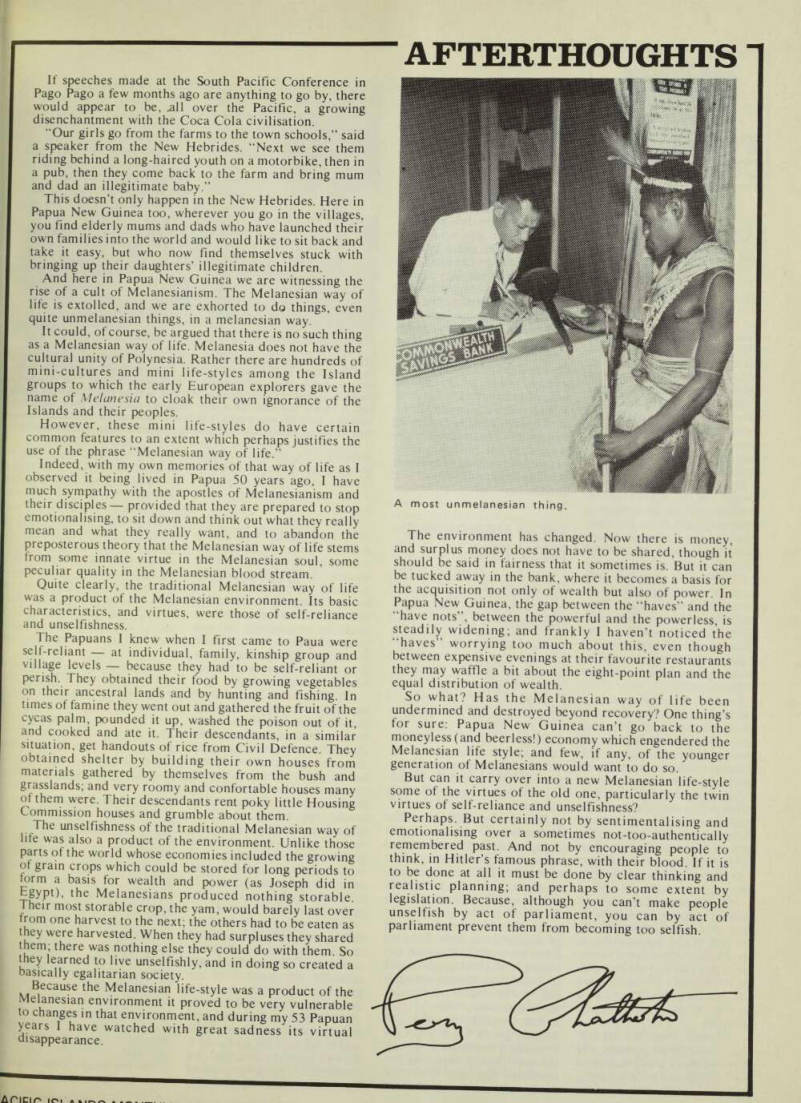
If speeches made at the South Pacific Conference in Pago Pago a few months ago are anything to go by, there would appear to be, ,all over the Pacific, a growing disenchantment with the Coca Cola civilisation.
“Our girls go from the farms to the town schools,” said a speaker from the New Hebrides. “Next we see them riding behind a long-haired youth on a motorbike, then in a pub, then they come back to the farm and bring mum and dad an illegitimate baby.”
This doesn’t only happen in the New Hebrides. Here in Papua New Guinea too, wherever you go in the villages, you find elderly mums and dads who have launched their own families into the world and would like to sit back and take it easy, but who now find themselves stuck with bringing up their daughters’ illegitimate children.
And here in Papua New Guinea we are witnessing the rise of a cult of Melanesianism. The Melanesian way of life is extolled, and we are exhorted to do things, even quite unmelanesian things, in a melanesian way.
It could, of course, be argued that there is no such thing as a Melanesian way of life. Melanesia does not have the cultural unity of Polynesia. Rather there are hundreds of mini-cultures and mini life-styles among the Island groups to which the early European explorers gave the name of Melanesia to cloak their own ignorance of the Islands and their peoples.
However, these mini life-styles do have certain common features to an extent which perhaps justifies the use of the phrase “Melanesian way of life.”
Indeed, with my own memories of that way of life as I observed it being lived in Papua 50 years ago, I have much sympathy with the apostles of Melanesianism and their disciples— provided that they are prepared to stop emotionalising, to sit down and think out what they really mean and what they really want, and to abandon the preposterous theory that the Melanesian way of life stems from some innate virtue in the Melanesian soul, some peculiar quality in the Melanesian blood stream.
Quite clearly, the traditional Melanesian way of life was a product of the Melanesian environment. Its basic characteristics, and virtues, were those of self-reliance and unselfishness.
The Papuans I knew when I first came to Paua were self-reliant at individual, family, kinship group and village levels because they had to be self-reliant or perish. They obtained their food by growing vegetables on their ancestral lands and by hunting and fishing. In times of famine they went out and gathered the fruit of the cycas palm, pounded it up, washed the poison out of it, and cooked and ate it. Their descendants, in a similar situation, get handouts of rice from Civil Defence. They obtained shelter by building their own houses from materials gathered by themselves from the bush and grasslands; and very roomy and confortable houses many of them were. Their descendants rent poky little Housing Commission houses and grumble about them.
The unselfishness of the traditional Melanesian way of life was also a product of the environment. Unlike those parts of the world whose economies included the growing of grain crops which could be stored for long periods to torm a basis for wealth and power (as Joseph did in Egypt), the Melanesians produced nothing storable. 1 heir most storable crop, the yam, would barely last over trom one harvest to the next; the others had to be eaten as they were harvested. When they had surpluses they shared them; there was nothing else they could do with them So they learned to live unselfishly, and in doing so created a
basically egalitarian society.
Because the Melanesian life-style was a product of the Melanesian environment it proved to be very vulnerable to changes in that environment, and during my 53 Papuan years I have watched with great sadness its virtual disappearance.
The environment has changed. Now there is money, and surplus money does not have to be shared, though it should be said in fairness that it sometimes is. But it can be tucked away in the bank, where it becomes a basis for the acquisition not only of wealth but also of power. In Papua New Guinea, the gap between the “haves” and the “have nots”, between the powerful and the powerless is steadily widening; and frankly I haven’t noticed the “haves” worrying too much about this, even though between expensive evenings at their favourite restaurants they may waffle a bit about the eight-point plan and the equal distribution of wealth.
So what? Has the Melanesian way of life been undermined and destroyed beyond recovery? One thing’s for sure; Papua New Guinea can’t go back to the moneyless (and beerless!) economy which engendered the Melanesian life style; and few, if any, of the younger generation of Melanesians would want to do so.
But can it carry over into a new Melanesian life-style some of the virtues of the old one, particularly the twin virtues of self-reliance and unselfishness?
Perhaps. But certainly not by sentimentalising and emotionalising over a sometimes not-too-authentically remembered past. And not by encouraging people to think, in Hitler’s famous phrase, with their blood. If it is to be done at all it must be done by clear thinking and realistic planning; and perhaps to some extent by legislation. Because, although you can’t make people unselfish by act of parliament, you can by act of parliament prevent them from becoming too selfish.
A most unmelanesian thing.
Advertisements & other items, p. 27 (1 item)
Io I A & Irv/N . . A
Currents
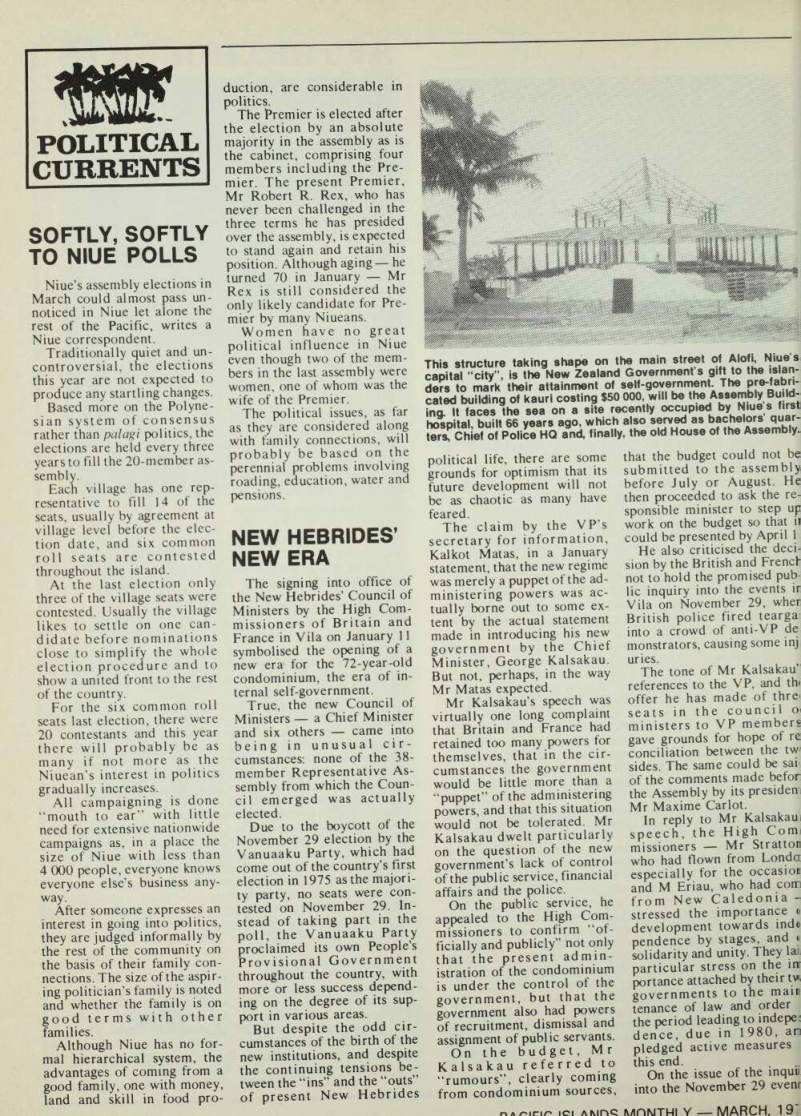

Political
Softly, Softly
To Niue Polls
Niue’s assembly elections in March could almost pass un noticed in Niue let alone the rest of the Pacific, writes a
Niue correspondent.
Traditionally quiet and un controversial, the elections this year are not expected to produce any startling changes.
Based more on the Polyne sian system of consensus rather than palagi politics, the elections are held every three years to fill the 20-member as sembly.
Each village has one rep resentative to fill 14 of the seats, usually by agreement at village level before the elec tion date, and six common roll seats are contested throughout the island.
At the last election only three of the village seats were contested. Usually the village likes to settle on one can didate before nominations close to simplify the whole election procedure and to show a united front to the rest of the country.
For the six common roll seats last election, there were 20 contestants and this year there will probably be as many if not more as the Niuean’s interest in politics gradually increases.
All campaigning is done “mouth to ear’’ with little need for extensive nationwide campaigns as, in a place the size of Niue with less than 4 000 people, everyone knows everyone else’s business any way.
After someone expresses an interest in going into politics, they are judged informally by the rest of the community on the basis of their family con nections. The size of the aspir ing politician’s family is noted and whether the family is on good terms with other families.
Although Niue has no for mal hierarchical system, the advantages of coming from a good family, one with money, land and skill in food pro
duction, are considerable in
politics.
The Premier is elected after the election by an absolute majority in the assembly as is the cabinet, comprising four members including the Pre mier. The present Premier, Mr Robert R. Rex, who has never been challenged in the three terms he has presided over the assembly, is expected to stand again and retain his position. Although aging he turned 70 in January Mr Rex is still considered the only likely candidate for Pre mier by many Niueans.
Women have no great political influence in Niue even though two of the mem bers in the last assembly were women, one of whom was the wife of the Premier.
The political issues, as far as they are considered along with family connections, will probably be based on the perennial problems involving reading, education, water and
pensions.
New Hebrides’
New Era
The signing into office of the New Hebrides’ Council of Ministers by the High Com missioners of Britain and France in Vila on January 11 symbolised the opening of a new era for the 72-year-old condominium, the era of in ternal self-government.
True, the new Council of Ministers a Chief Minister and six others came into being in unusual cir cumstances; none of the 38member Representative As sembly from which the Coun cil emerged was actually elected.
Due to the boycott of the November 29 election by the Vanuaaku Party, which had come out of the country’s first election in 1975 as the majori ty party, no seats were con tested on November 29. In stead of taking part in the poll, the Vanuaaku Party proclaimed its own People’s Provisional Government throughout the country, with more or less success depend ing on the degree of its sup port in various areas.
But despite the odd cir cumstances of the birth of the new institutions, and despite the continuing tensions be tween the “ins” and the “outs” of present New Hebrides
political life, there are some grounds for optimism that its future development will not be as chaotic as many have feared.
The claim by the VP’s secretary for information, Kalkot Matas, in a January statement, that the new regime was merely a puppet of the ad ministering powers was ac tually borne out to some ex tent by the actual statement made in introducing his new government by the Chief Minister, George Kalsakau.
But not, perhaps, in the way Mr Matas expected.
Mr Kalsakau’s speech was virtually one long complaint that Britain and France had retained too many powers for themselves, that in the cir cumstances the government would be little more than a “puppet” of the administering powers, and that this situation would not be tolerated. Mr Kalsakau dwelt particularly on the question of the new government’s lack of control of the public service, financial affairs and the police.
On the public service, he appealed to the High Com missioners to confirm of ficially and publicly” not only that the present admin istration of the condominium is under the control of the government, but that the government also had powers of recruitment, dismissal and assignment of public servants.
On the budget, Mr Kalsakau referred to “rumours”, clearly coming from condominium sources,
that the budget could not be submitted to the assembly before July or August. He then proceeded to ask the re sponsible minister to step up work on the budget so that it could be presented by April 1 He also criticised the deci sion by the British and French not to hold the promised pub lic inquiry into the events ir Vila on November 29, wher British police fired tearga: into a crowd of anti-VP de monstrators, causing some inj uries.
The tone of Mr Kalsakau references to the VP, and th< offer he has made of thre< seats in the council o< ministers to VP members gave grounds for hope of re conciliation between the tw' sides. The same could be sai of the comments made befor the Assembly by its president Mr Maxime Carlot.
In reply to Mr Kalsakauj speech, the High Comi missioners Mr Stratton who had flown from Londo especially for the occasion and M Eriau, who had conn from New Caledonia stressed the importance o development towards indo pendence by stages, and <• solidarity and unity. They laij particular stress on the m portance attached by their tw governments to the main tenance of law and order the period leading to indepe; dence, due in 1980, an pledged active measures this end.
On the issue of the inqun into the November 29 event
This structure taking shape on the mam street of Alofi, Niue's capital “city”, is the New Zealand Government s gift to the islan ders to mark their attainment of self-government The Pre-fabri cated building of kauri costing $50 000, will be the Assembly Build ing. It faces the sea on a site recently occupied b Y Niue s first hospital built 66 years ago, which also served as bachelors quar ters, Chief of Police HQ and, finally, the old House of the Assembly.
Mr Stratton explained that the decision not to hold it had been reached only after long consideration. The decision was designed to maintain calm. The two governments had decided it would not be opportune to revive dissen sions which had died down over the Christmas period.
From the side of the Vanuaaku Party, the letter ad dressed to the responsible British and French Ministers by VP President, Fr Walter Lini, in January was also con ciliatory in tone. It said in part: “We have come to re cognise the circumstances in which the present assembly was set up. We therefore can not complain too much. In the same way, the honourable ministers and their rep resentatives, as well as the present condominium as sembly, should not complain too much against the Vanuaaku People’s Pro visional Government because of the circumstances in which it was created. Therefore, although we may consider ourselves as partners in progress, our organisation thinks that it would not be correct for us to take part in the affairs of the present con dominium assembly. The only way that our organisation can participate in the duties of an assembly is to be elected into an assembly.”
Even this last position of refusal to participate was un derstood to be slated for review at a meeting of top VP leaders to be held from
February 13-20.
An intriguing aspect of Fr -ini’s letter was the hope he expressed that the new as sembly would “be allowed to
work for its normal three years”. The possibility of this happening, especially in the light of the policy of the ad ministering powers for New Hebridean independence by 1980, is thought by most ob servers to be extremely slight.
Soon after their swearing in, Mr Kalsakau and three of his fellow ministers set out on a series of visits to Fiji, New Zealand, Australia, Papua New Guinea and the Solomon Islands, to explain the new situation in their country.
A week before their arrival in Suva, the vice-chairman of the VP, Mr George Kalkoa, and two other leading VP members, had been in Suva on a similar mission on behalf of their party.
Much is heard these days of “the Melanesian Way”, and its claimed virtues of con sultation and compromise. It’s hard to think of anywhere in Melanesia where it’s more needed just now than in the New Hebrides.
Norfolk
Grabs
Nitiative
Norfolk Islanders are not sitting on the backsides wait ing for Australia to make the next move in their battle for a new deal from Canberra.
At a November, 1977 meet ing, Norfolk Island Council appointed its chairman, Councillor Bill Blucher and his councillor colleague, solicitor Duncan Mclntyre, to prepare a draft constitution for the island. The authorisa tion was made “in the belief that internal self-government in continued association with Australia is the appropriate form of government for the is land”.
The councillors must have burnt the midnight oil over the holiday period because early in January their draft constitution was in print.
Highlights follow: • Norfolk Island would be defined in the constitution to include the adjacent seabed to the same extent as Australia claims its adjacent seabed (this will shortly be 200 nauti cal miles radius). • Australia would appoint a governor of Norfolk Island and pay him. He would be the representative of the Crown in right of Australia, making
Norfolk, in effect, a Crown Colony of Australia. • Residents voting as one electorate would elect nine members to an assembly call ed “the House of Norfolk Is land”. Members elected would hold office for three years, and be remunerated as provided by law. A quorum would be five members and all proceedings would be in open session. The governor could attend meetings of the House and address it. • A member of the House would be elected by vote of members as president and could be removed from office by resolution supported by five of the nine members. • For at least five years the governor could veto any law.
This power would continue after five years until displaced by referendum. Thereafter, if the governor refused to sign a bill into law, the President may do so.
There is much more besides, but the brief details above show that the new draft constitution represents a solid negotiating position for Nor folk in future talks with the former Australian Attorney- General, Mr R. J. Ellicott, QC, who, following the December election in Australia has replaced Sena tor R. Withers as Minister re sponsible for Norfolk Island affairs Mr Ellicott heads the new Department of Home Affairs formed by the Fraser govern ment to cover the Island Ter ritories Norfolk, Cocos, Christmas and Coral Sea.
The Politics
Fish
What will the future bring for the Islands over the 200mile economic zone, agree ment with the big powers, or confrontation? PlM’s editor John Carter posed the ques tion in an ABC radio broad cast.
Let’s talk about fish, tuna, which will figure largely in the South Pacific’s political menu in 1978. It’s a highly migratory creature, making its home in the world’s seven seas. It’s also a potential trou ble-maker for the South Pacific and the world powers.
At the moment it’s a pawn.
The South Pacific Forum, of which Australia and New Zealand are members, at its
meeting in Port Moresby in August, established the South Pacific Regional Fisheries Agency. The plan to exercise complete control over the fish resources of the South Pacific was endorsed by the South Pacific Conference a month later.
By next March, the Forum expects that each member country will have declared for itself a 200-nautical mile economic and fishing zone.
New Zealand, Fiji, Western Samoa and several others have already done so.
But there’s much more to it than that. The Forum mem bers seek sovereign rights over all resources including tuna and that will be the fishbone of contention because the big fishing na tions, the United States, the Soviet Union and Japan, so far, refuse to acknowledge that anyone has the right to control tuna. It belongs to the world, they say.
This week, New Zealand was highly jubilant over a political coup they pulled off with South Korea which became the first fishing nation to accept that New Zealand had the right to control tuna in its 200-mile zone.
No doubt, in return for a fishing licence New Zealand will want trading concessions.
The licence, the Forum mem bers hope, will be the sprat to catch the mackerel of agree ment with all fishing nations.
But, New Zealand’s triumph isn’t as complete as it seems. It is hoped that South Korea’s decision will sway the big nations. But South Korea is only a minnow where world fishing is concerned. True, her fishing fleets range the South Pacific but few South Koreans even smell the catch.
Almost all her ships are on charter to American and Japanese companies, as the Taiwanese vessels are.
The Japanese fisherman has almost priced himself out of the fish market with a demand for higher wages. What the South Korean and Taiwanese crews of fish catchers are paid is woefully low by Australian standards.
Watch the fleets returning to the canneries at Pago Pago in American Samoa, at Levuka in Fiji and Tulagi in the Solomons. Almost to a ship they are crewed by South Koreans and Taiwanese, and their catch goes to the United
Mr George Kalsakau
States or Japan. Russia too reaps the ocean harvest but her ships are crewed by Soviet nationals.
South Korea could have got the better of the bargain with New Zealand. And I’m sure it’ll count for little as leverage against Japan and the others.
Not that Japan isn’t worried about the Fisheries Agency.
She is, and has already offered the South Pacific Islands a quid pro quo or two, econ omic aid, Japanese working volunteers and the like in return for fishing rights.
The Forum hit its first reef a few weeks ago when a fish eries agency meeting was held in Fiji. The heavies, the United States, France and Japan, attended and there was continued opposition to con trol of tuna. It’s clear every thing will have to wait for the Law of the Sea Conference to come up with a solution pleas ing to all.
There’s danger in the situ ation. A Fiji MPa week ago talked about Fiji patrol boats putting a warning shot over the bows of a poacher. He ad ded “If they run away let them have it.” You can see the Rus sians, or the Americans for that matter, putting up with that for long!
There’s another obstacle.
What happens if one country gives Russia, for instance, a licence to fish in her 200-mile zone and that zone overlaps the zone of another country, which has refused Russia a licence? That’s not as unlikely as you might think. New Caledonia, Australia, the New Hebrides and Fiji will over lap, not to mention the Solomons and Papua New Guinea, Western and American Samoa, Papua New Guinea, Australia, and others.
So you see it’s not as easy as it looks. Hopefully, the big na tions will go along with the small nations’ aspirations.
After all, Fiji, Tonga, little Niue and the rest are entitled to some share of the fish and other wealth in their waters.
Solomons’ Truly
Rural Party
A new political party has been formed in the Solomons with the express purpose of looking after the rural peo ple’s interests. The party on its first showing has impressed as
a group with a definite plat form and a desire to gain true grass roots support among the people outside the urban centres, writes a Honiara cor respondent.
The party’s chairman-elect is the present member for West Are Are, Mr David Kausimae. Mr Kausimae and other functionaries were elected by a convention of 50 delegates, primarily from the rural areas, who met in Honiara. The convention also issued a manifesto of its aims and set up an executive com mittee and a pressure, or lobbying, group. If first im pressions are true this party will be an important factor in Solomons politics in the years ahead because it appears to be more purposeful and better organised than the other so called parties at present in the assembly which are really groups of individuals rallying around an outstanding per sonality.
The executive committee contains a number of familiar faces from the island local councils including a former Ysabel president. An innova tion adopted by the pressure group set up is to reserve a seat for a student member.
This is a politically wise move, recognising the role of the idealistic, youthful edu cated elite of the Solomons.
Mr Kausimae, as the party’s spokesman in the Solomons Assembly, brings 10 years ex perience to the position. His achievements in the assembly have been numerous and in clude chairmanship of the Natural Resources Com mittee, the establishment of the Cattle Development Authority and a major part in the negotiations with the Taiyo fishing company of Japan a venture which now contributes substantially to Solomons’ export revenue. In the assembly Mr Kausimae has been noted for his at tention to rural affairs and development, and for his sup port for an extension of the present six years schooling for all to 10 years.
The party’s manifesto welcomed independence. It said that the attainment of in dependence was “the begin ning of self-determination and the end of colonial practices and attitudes”. The manifesto also said the people of the Solomons must be encouraged to greater productivity which
is a clear sign of David Kausimae’s influence as he has made this statement many times in the past 10 years.
The party also supported the establishment of a na tional marketing board which is an idea that has been “in the air” for some time now in the Solomons legislature. The convention agreed that greater attention should be paid to explaining why various development projects were important. Delegates felt that if the people did not un derstand why a project was important then they would not co-operate fully.
The party affirmed that it intended to be a loyal opposi tion.
Mr Kausimae, outlining the party’s approach to general political issues, said it would congratulate the government when it did good things for the rural people and would offer constructive criticism when necessary.
Cook Islands’
Election
Stakes
The whole of the Cook Is lands are agog with the news that there has been a split in the political ranks and that Dr. Joe Williams, William Estall and Raui Pokoati; all former staunch members of the Cook Islands party have decided to break away from the party and its leader, Sir Albert Henry.
Now, don’t for a moment think that this break has been sudden and unexpected writes a Rarotongan political corres pondent. For many a long night people have sat around and talked about what will happen “when Albert goes’’.
Perhaps the recent by-election loss by the Cook Islands Party was the most obvious indica tion that the former im pregnable walls of the Cook Islands Party were about to crumble. Perhaps the fact that the Premier has called an early election also caused those with political ambitions in the Cook Islands to look very deeply into their prospects and to try to work out where they are likely to be placed if, and when a shake up of political power occurs.
Obviously Joe Williams, William Estall and Raui Pokoati have all come to the conclusion that the charismatic rule of Sir Albert Henry is coming to its end and that without the personal magnetism, which he has com manded, the Cook Islands Party will lose power.
Therefore, these three have decided to make a move, hop ing to cash in on any redistribution of power after the general election. To change sides in Cook Islands politics is not a new feature and there are a number of very prominent members of the party who have changed allegiance before and quite clearly would be prepared to do the same again.
Central to all the talk about the future political control of the Cook Islands is the whole question of the suitability of a two-party system for the Cook Islands situation. If you talk quietly with many of the is lands’ leaders you will find that many consider that the members of the Legislative Assembly should be rep resenting their island consti tuencies and not some politi cal party. It seems that laveta Short read this trend well when he conducted his cam paign which won for him the by-election in Takitumu.
Let’s look now at the politi cal figures who are likely to throw their hats into the ring in an effort to grab the reins of authority. It may well be that the present two political par ties, the Cook Islands Party and the Democratic Party, will cease to be effective forces and that less formalised organisations will be built up around particular leaders.
There will be a hard core of “traditional” leaders who will continue to represent their electorates. In the outer is lands there are men of mana who will continue to hold the seats on islands like Mangaia, Atiu, Manihiki, Rakahanga, Penrhyn and Puka Puka, but without exception they do not, seem to possess the breadth of outlook that would allow any of them to become the na tional leader.
Aitutaki presents a partic ularly interesting problem.
For many years Aitutakians, from the Premier down, have dominated the membership of the Cabinet, and there is a great deal of resentment onr
Rarotonga, the largest island in terms of population that it has had such a small share in the legislative and executive direction of the islands. Fur thermore, it is openly said that most Aitutakians feel most strongly that although they have three members, Dr Williams, William Estall and Geoffrey Henry, who all hold cabinet postions, they very seldom visit the island they represent and they do not seem to be overly interested in the affairs of Aitutaki.
Nepotism is a word that is bandied about a great deal these days and it may well be that the followers of the Cook Islands Party will suffer severely if there is a change in power. The Premeir’s son Tupui Henry, in earlier times was often touted as being a successor to his father, but er ratic behaviour of recent years may well lead to his political demise. However, he may well hold his seat for the island of Mauke, for above all he has worked assiduously to improve conditions on that is land. A worrying question is, what will happen to the public service if the Cook Islands Party is defeated? Many of the top positions are held by ar dent supporters of the party and the public service may well be decimated if a change over takes place.
Quite a lot of gambling goes on these days in the Cook Is lands and perhaps the TAB at the old Hotel Rarotanga might like to run a sweepstake on who is to emerge as the leader, if Sir Albert is defe ated.
Let’s look at the field.
When the books were opened some time ago equal favourites would have been Geoffrey Henry and Joe Williams, with the latter perhaps having a slight edge in the odds, but it has been whittled away because of his involvement with the cancer cure man Milan Brych. At double figures would have been Tupui Henry, and most of the punters would have said he owed this level of favourit ism to the support he receives from Lady Henry, who weilds a great deal of power behind the throne. A sentimental bob or two might have gone on Tom Davis, the present leader of the Cook Islands’ De mocratic Party but most peo ple seem to agree that
although Tom is well-inten tioned, he just does not have the political muscle needed to manage the affairs of the country.
At long odds, initially, were a couple of New Zealand-edu cated solicitors, laveta Short and Vincent Ingram, who have been at work quietly but steadily establishing a politi cal base, The nod must go at this stage to laveta Short, if only for the fact that he has successfully won a by-election and that he probably has a greater degree of local sup port in the Takitumu area of Rarotonga from family loyal ties.
And, of course, like any large handicap field, there are always the dark horses, who may be able to command enough support to affect the ultimate outcome. There is no telling but that Harry Napa, who has been studying politi cal science in New Zealand, may decide to return and con test the election in the Arorangi area, where his father commands a great deal of respect, both as a busi nessman and as Tinomana Ariki, the paramount chief of Arorangi.
There are also rumours about that Sadarka Sadaraka, who in the 1965 era made an attempt to enter politics, may again enter the contest, Sadaraka has had a great deal of experience in the admin istrative fields, in both the Cook Islands and in Nauru, and is now living in New Zea land. And, of course, there are old political protagonists, like Mana Strickland, who have been waiting for many years to re-enter the sphere of authori ty. Mana missed out winning a seat in the last election by a handful of votes, and if there is a swing away from the Cook Islands Party, Mana is one who is likely to find himself back in the assembly, where his political and business acu men would again make him a force to be reckoned with, especially as he still com mands a great deal of respect among many of the older voters on Rarotonga.
The next few weeks will un doubtedly see a great deal of wheeling and dealing going on and this will be one of the most interesting electoral handicaps to have been run in the Pacific region for many a year.
Imbroglio
At San Diego
Sharp Micronesian critic ism of a new US draft working paper on free association followed a January con ference in San Diego, Califor nia, between US and Microne sian negotiators. The talks followed up on last year’s meetings at Molokai, Hawaii.
The Marshalls and Palau delegations rejected the US draft in a joint letter, and rep resentatives of the Microne sian Commission on Future Political Status and Transi tion (CFPST) told US am bassador Peter Rosenblatt that it “clearly represents a backward step from what we had regarded as the starting point”.
Objections voiced by Micronesian spokesmen Mr Baily Olter, chairman of the Commission’s Status Com mittee, and Mr Andon Amaraich, CFPST chairman, included. • On internal affairs, the document indicated that Micronesians had to change their constitutions or forms of government to suit the com pact of association, which would be supreme. • Under the old 1976 draft compact the US could apply international agreements to Micronesia, unless Micro nesia objected. The provision for objection had been taken out. • On foreign affairs, the new document says that the US will represent Micronesia abroad and will negotiate and conclude treaties and other international agreements on behalf of Micronesia.
Amaraich pointed out that this was in conflict with the Micronesian position of the Law of the Sea. • In the 197 6 draft, Micronesians may negotiate and conclude agreements of a cultural or technical nature with foreign organisations.
This had also been taken out. • Under finance, now call ed “economic assistance”, the amounts listed in the old com pact are deleted and no new amounts appear. Fur thermore, there is no separate provision for economic development loans.
Amaraich listed these and other changes, where many specific provisions of the draft compact of 1976, which had assured certain rights and
protections to Micronesians, had been withdrawn.
He stressed that delegates should not accept these as final views of the CFPST, which had yet to meet, but only preliminary views of some members.
In other moves, the House of Representatives of the Con gress of Micronesia rejected a statement by ambassador Rosenblatt that status negotia tions should be concluded by the end of March, 1978. The House resolution claimed that the proposed referendum on the Micronesian constitution should be held before the next status negotiations could re sume.
A Junket
For Samoans
The New Year brought a new Governor and a new era of administration to American Samoa. The historical event began with a parade of floats decorated with tropical flora and interspersed with a varie ty of marching groups of high school students, cannery workers and tiny tots, all gathered to celebrate the in auguration of Peter Tali Cole man and Tufele Lia’a as American Samoa’s first elected Governor and Lieute nant-Governor.
The flags were lowered on the old administration and raised again to symbolise the beginning of the new and the end of the long string of ap pointed governors 49 of them in the last 70 years.
Governor Coleman has now returned to the office which he held 21 years ago. And, co incidentally, it is the same Governor Rex Lee who suc ceeded Coleman 16 years ago, who has now been succeeded by Coleman.
The inauguration ceremony abounded in Samoan tradition with the ceremonial sprin kling of coconut juice on Col eman’s head , the kava ceremony, and the lavish dis play of gifts, including dozens of pigs and miles of cloth, fine mats and tapa, presented to all the distinguished guests by the people of the Manu’a Islands.
Singing and dancing com petitions and the spectacular race of the fautausi followed continuing well into the after noon. Three extravagant balls marked the climax.
Advertisements & other items, pp. 28-33 (5 items)
nAomr ici amhc iwinMTHI V MARCH, 1 9
Political Currents
API C I O IO I AK I r~N r N A a a■
d a r'icir' ici AMHQ MONTHI Y MARCH, 1 97\
Goodpvear
' . *■ . I * " M mm A The world over, more vehicles of all kinds roll on Goodyear tyres ... more planes land on Goodyear tyres .. . more synthetic rubber is produced by Goodyear. . . and more different kinds of hose,
transmission belts, conveyor belts and other
industrial rubber goods bear the Goodyear
trademark.
For leadership in rubber technology, look to
Goodyear. The world’s largest rubber company.
GOODpVEAR
We solve industrial problems.
GOODYEAR DISTRIBUTORS IN S.E. ASIA AND PACIFIC BASIN
GOODYEAR SUBSIDIARIES
Richard Piens& Co., Ltd.
Colombo, Sri Lanka Nepal Motor Company (P) Ltd.
Biratnagar. Nepal Navana Ltd.
Dacca, Bangladesh Diethelm & Co., Ltd.
Bangkok, Thailand Landis Brothers & Co., Ltd.
Hong Kong Guam Tire & Supply Co.
Agana, Guam Susupe Enterprises Saipan, Mariana Is.
Micro! Corporation Saipan, Mariana Is.
Truk Trading Co.
Truk E. Caroline Js.
P.A.M.I.
Kolonia, Ponape Island Transport Service Co.
Majuro Marshall Is.
Yap Cooperative Ass.
Yap. W. Carolone Is.
Cook Islands Motor Centre Ltd.
Rarotonga. Cook Is.
Ngiratkel Etpison Co.. Ltd.
Koror, Palau Boroko Motors Ltd.
Port Moresby. Papua New,Guinea Solomon Motors Ltd.
Honiara. Solomon Is.
Santo Engineers Santo, New Hebrides Pacific Motors Vila, New Hebrides
S.G.A.
Noumea, New Caledonia Duncombe Bay Garage Norfolk Is.
Coral Island Motors Morris Hedstrom Ltd.
Nukualofa. Tonga Morris Hedstrom Ltd.
Apia, Western Samoa Western Samoa Transport Cooperative Society Ltd.
Apia, Western Samoa Samoa Motors Inc.
Pago Pago, American Samoa Service Mobil Papeete, Tahiti The Goodyear Tyre & Rubber Co (Aust) Ltd.
Sydney. AUSTRALIA Tel: 31-0311 Goodyear Indio Limited New Delhi 1, INDIA Tel: 46886/9 PT Goodyear Indonesia Bogor. Republic of Indonesia Tel: 3371/2 Nippon Goodyear Kabushiki Kaisha Tokyo, JAPAN Tel: 582-0481/8 Goodyear Malaysia Berhad Selangor, MALAYSIA Tel 362501/5 The Goodyear Tyre & Rubber Co. of New Zealand, Limited Lower Hull. NEW ZEALAND Tel 684 389 The Goodyear Tyre & Rubber Company of the Philippines, Limited Makati-Meiro Manila, Republic of the Philippines Tel 89 20-41 Goodyear Singapore Pvt Limited Geylang, Singapore 14 Tel: 408281/3 Goodyear Taiwan Limited Taipei, TAIWAN Tel: 5117135/8 Goodyear (Thailand) Limited Bangkok, THAILAND Tel: 252-6141/5
FOR FURTHER INFORMATION,
PLEASE CONTACT
Goodyear International Corporation Room 1603. Wing On Center 111 Connaught Road Central
HONG KONG Tel: 5-433331
HRME 171*0204
Prudential
G. M. Forsaith Aviation Underwriting Agency Pty. Limited are aviation underwriting agents for The Prudential Assurance Company Limited in Australia, the Pacific and South East Asia. For the security of The Prudential on your aviation insurance ask your broker, agent, or call Geoff Forsaith (02) 27 3834, Mike Neil (02) 27 7517, Bob Mitchelmore (09) 321 7303.
C AVIATIOVIVSIIRMCE )
G. M. Forsaith Aviation Underwriting Agency Pty. Limited N.S.W.: 31st Level Australia Square, Sydney, N.S.W. 2000. Telex AA 25037 W.A.: Prudential Building, 95 St. George’s Tee., Perth W.A. 6000. Telex A A 93324
Jtsllx
HEAT
SEALING.
SHRINK
PACKAGING.
CONTACT A USTRA LI A'S
FOREMOST MANUFACTURERS
OF HEAT SEALING EQUIPMENT
SERVING INDUSTRY
IN AUSTRALIA & THE PACIFIC ISLANDS
FOR OVER 25 YEARS.
HELIX ELECTRICAL PRODUCTS PTY. LTD.
27 Rosebery Avenue, Rosebery, NSW 2018, Australia. 663 0487.
HENRY CUMMER
PTY. LTD.
EXPORTERS o GENERAL MERCHANTS
428 GEORGE ST., SYDNEY
CABLES: HENCO SYDNEY. G.P.O. Box 3949. PHONE: 25-3383. - •
For specialised and personalised buying service
throughout the Pacific Islands and the East.
LOCAL AGENTS AND REPRESENTATION:
PAPUA NEW GUINEA.
PORT MORESBY: Mr. Tan,
P.O. Box 5445, Boroko.
Telephone 25 2542.
RABAUL; M. & C. Seeto, P.O. Box 131, Rabaul.
Telephone 92 2902.
MADANG: W. Double, P.O. Box 22, Madang.
Telephone 82 2696.
FIJI.
K. Witherington Ltd., P.O. Box 293, Suva.
Telephone 22 356.
NEW HEBRIDES.
John Lum & Associates, P.O. Santo.
Telephone 329.
SOLOMON ISLANDS.
Lo See War Ltd., P.O. Box 327, Honiara.
Telephone 399. -• Resident Agents in other Pacific Territories.
Political Currents
'ACIFIC ISLANDS MONTHLY MARCH 1 Q7R
People
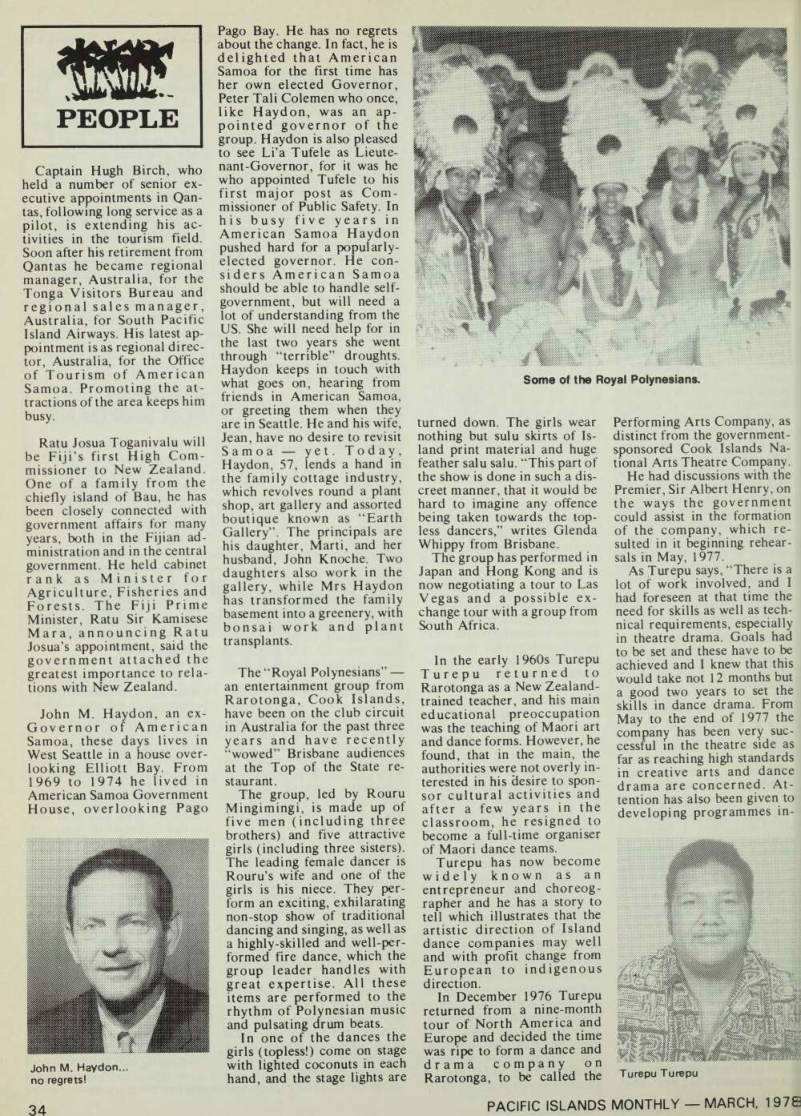
Captain Hugh Birch, who held a number of senior ex ecutive appointments in Qan tas, following long service as a pilot, is extending his ac tivities in the tourism field.
Soon after his retirement from Qantas he became regional manager, Australia, for the Tonga Visitors Bureau and regional sales manager, Australia, for South Pacific Island Airways. His latest ap pointment is as regional direc tor, Australia, for the Office of Tourism of American Samoa. Promoting the at tractions of the area keeps him busy.
Ratu Josua Toganivalu will be Fiji’s first High Com missioner to New Zealand.
One of a family from the chiefly island of Bau, he has been closely connected with government affairs for many years, both in the Fijian ad ministration and in the central government. He held cabinet rank as Minister for Agriculture, Fisheries and Forests. The Fiji Prime Minister, Ratu Sir Kamisese Mara, announcing Ratu Josua’s appointment, said the government attached the greatest importance to rela tions with New Zealand.
John M. Haydon, an ex- Governor of American Samoa, these days lives in West Seattle in a house over looking Elliott Bay. From 1969 to 1974 he lived in American Samoa Government House, overlooking Pago
Pago Bay. He has no regrets about the change. In fact, he is delighted that American Samoa for the first time has her own elected Governor, Peter Tali Colemen who once, like Haydon, was an ap pointed governor of the group. Haydon is also pleased to see Li’a Tufele as Lieute nant-Governor, for it was he who appointed Tufele to his first major post as Com missioner of Public Safety. In his busy five years in American Samoa Haydon pushed hard for a popularly elected governor. He con siders American Samoa should be able to handle self government, but will need a lot of understanding from the US. She will need help for in the last two years she went through “terrible” droughts.
Haydon keeps in touch with what goes on, hearing from friends in American Samoa, or greeting them when they are in Seattle. He and his wife, Jean, have no desire to revisit Samoa yet. Today, Haydon, 57, lends a hand in the family cottage industry, which revolves round a plant shop, art gallery and assorted boutique known as “Earth Gallery”. The principals are his daughter, Marti, and her husband, John Knoche. Two daughters also work in the gallery, while Mrs Haydon has transformed the family basement into a greenery, with bonsai work and plant transplants.
The “Royal Polynesians” an entertainment group from Rarotonga, Cook Islands, have been on the club circuit in Australia for the past three years and have recently “wowed” Brisbane audiences at the Top of the State re staurant.
The group, led by Rouru Mingimingi, is made up of five men (including three brothers) and five attractive girls (including three sisters).
The leading female dancer is Rouru’s wife and one of the girls is his niece. They per form an exciting, exhilarating non-stop show of traditional dancing and singing, as well as a highly-skilled and well-per formed fire dance, which the group leader handles with great expertise. All these items are performed to the rhythm of Polynesian music and pulsating drum beats.
In one of the dances the girls (topless!) come on stage with lighted coconuts in each hand, and the stage lights are
turned down. The girls wear nothing but sulu skirts of Is land print material and huge feather salu salu. “This part of the show is done in such a dis creet manner, that it would be hard to imagine any offence being taken towards the top less dancers,” writes Glenda Whippy from Brisbane.
The group has performed in Japan and Hong Kong and is now negotiating a tour to Las Vegas and a possible ex change tour with a group from South Africa.
In the early 1960 s Turepu Turepu returned to Rarotonga as a New Zealand trained teacher, and his main
educational preoccupation
was the teaching of Maori art and dance forms. However, he found, that in the main, the authorities were not overly in terested in his desire to spon sor cultural activities and after a few years in the classroom, he resigned to become a full-time organiser of Maori dance teams.
Turepu has now become widely known as an entrepreneur and choreog rapher and he has a story to tell which illustrates that the artistic direction of Island dance companies may well and with profit change from European to indigenous direction.
In December 1976 Turepu returned from a nine-month tour of North America and Europe and decided the time was ripe to form a dance and drama company on Rarotonga, to be called the
Performing Arts Company, as distinct from the government sponsored Cook Islands Na tional Arts Theatre Company.
He had discussions with the Premier, Sir Albert Henry, on the ways the government could assist in the formation of the company, which re sulted in it beginning rehear sals in May, 1977.
As Turepu says, “There is a lot of work involved, and I had foreseen at that time the need for skills as well as tech nical requirements, especially in theatre drama. Goals had to be set and these have to be achieved and I knew that this would take not 12 months but a good two years to set the skills in dance drama. From May to the end of 1977 the company has been very suc cessful m the theatre side as far as reaching high standards in creative arts and dance drama are concerned. At tention has also been given to developing programmes in-
John M. Haydon... no regrets!
Some of the Royal Polynesians.
Turepu Turepu
corporating legends, dance forms, the music of the Cook Islands, and improvised drama”.
Turepu maintains that art should be developed as art, with no other motives behind it and that work in music and art drama should be creative and dynamic.
Turepu’s main overseas experience began in 1974, when he formed a partnership with Paulette Vienot, the Director of the Tahiti-Niue Travel Agency, who made all the arrangements for the overseas tour, with Turepu taking responsibility for choreography and direction.
The company of 31 then was composed of Rarotongan boys and girls and top talent from Tahiti with Tahiti supplying the larger number of girls, and three singers. In Hawaii two performers also joined. In two tours in 1974 and 1976 they played in over 50 cities in the United States and Canada, the biggest audience being 8 000 in Phoenix, Arizona. This was at Sun City, a model city for retired people.
Both tours, and especially that of 1976 were financial successes, which enabled the group to get to the Riviera, to Italy, and culminating with a two-night performance in Moscow According to Turepu, dancers in the company were able to clear $lOO per week after all other expenses were met and the financial support given by the French airline UTA did much to ensure the success of the tours. In American cities the party gave frequent promotional performances for the airline Turepu sees himself as having a continuing future as a chore og r a ph e r and entrepreneur. u „,, When I was in Europe, especially in Cannes, I was studying, observing the various teams, and in panicular a folk-loric team from Mexico. I noted their choreography, their whole dance presentation, their cos : turning. The feeling of Mexico was there, right in their show, I think that our own show did portray the Pacific image, Overseas crowds must associate certain important features of a particular country, for instance here on Rarotonga, a drum dance about the wreck of the Yankee would sell well in the States. I am hoping to do a dance item on Charles Banks, who ab-
sconded from Wells Fargo and later lived on Rarotonga.
I got this idea from an article in PIM.”
At the present time, the Per forming Arts Company is developing its repertoire by appearing at the hotels on Rarotonga and there is a quality and variety about its work that is not attained by most of the other parties per forming on the island.
The Palau Political Status Commission, which is work ing for a new status for this group of islands in the Carolines, has lined up a big gun to help their campaign Professor John Kenneth Galbraith, who has agreed to become Palau’s adviser, friend and associate with the commission. An ex-Harvard University professor and US Ambassador to India under the Kennedy regime, he is regarded as one of America’s leading experts in the interna tional field. He is the author of more than 14 books and numerous articles, mainly on economics. The Palauans hope that with him in the team, their negotiating status will be regarded as at top level. The professor is due to visit Palau in March.
Brian Jones, 35-year-old Welsh sergeant in the RAF, who said he was fed up with the UK weather, has gone to Tuvalu to become PA (per sonal assistant) to the Queen’s Commissioner, Mr Tom Layng. He volunteered for the job. He and his wife, Shirley, will stay in Tuvalu till inde pendence in October. Brian has been in the RAF for 18 years. He served in Hong Kong from 1972 to 1974.
Tuvalu is his first Pacific post ing. Come October, its back to the UK again and its weather, hopefully in Devon or Corn wall.
Bishop Fine Halapua, Vicar of Tonga and assistant Bishop of the Diocese of Polynesia, retired on Decem ber 31. He will still hold a general licence from the diocesan bishop to function as a priest and a bishop. Two Anglican priests took up new duties in Tonga on January 1.
The Rev Mataiasi ’Ahokava became priest-in-charge of Vavau and Haapai, and the Rev Sosaia Fineanganofo became priest-in-charge of Nukualofa. Both are directly responsible to the Bishop in Polynesia, Bishop Jabez Bryce.
Advertisements & other items, p. 35 (1 item)
true skin beauty
Advertisement
A secret of
A more beautiful fine textured skin with the attributes of youthfulness can be enjoyed by women of many different ages and types of skin. This promise is now possible because of the remarkable advances made by modern skin care researchers that could open a new era of complexion beauty for you.
Ulan moist oil blend under your make-up before you venture outdoors. This remarkable beautifying fluid penetrates quickly, acting on the skin in a similar way to its own natural oil and moisture, providing benefits which are similar to Nature’s, so helping to keep your complexion looking youthfully soft and radiant. ☆ ☆ ☆
USE these skin care sug-
gestions every day and
help bring a more natural youthful radiance to your complexion that can sur-
vive beautifully through
the changing seasons and for years to come.
One of the easiest ways to help keep your complexion looking younger and prettier, is to cherish the skin with a daily smoothing on of a unique tropically moist oil blend that assists in preventing wrinkle-dry ness and flaky patches. As you grow older, tiny glands in your skin are no longer able to provide the oil and moisture so necessary for its continuing softness and suppleness. The oil and moisture balance in your skin must be restored and fortunately the daily smoothing on of the scientifically developed tropically moist oil blend now assures you of the aid your skin needs to help keep it softer, more supple and lovely as the years go by.
PROTECT YOUR SKIN
Harsh climate can also rob your skin of its essential skin fluids, so smooth on a light film of tropically moist Oil of
A SPECIAL
BEAUTY HINT
An occasional facial steaming will do wonders for your complexion. Commence by cleansing the face and neck thoroughly, then smooth on a light film of tropically moist Oil of Ulan paying particular attention to the delicate areas surrounding the eyes where a little extra should be lavished in. With a towel covering your head, steam over a basin of hot water for a few minutes to soften the skin and clear the pores. Dry off with a soft towel and then smooth in a further film of Oil of Ulan moist oil blend to give your skin a feeling of velvety softness.
A Row Of Silent Graves Speaks
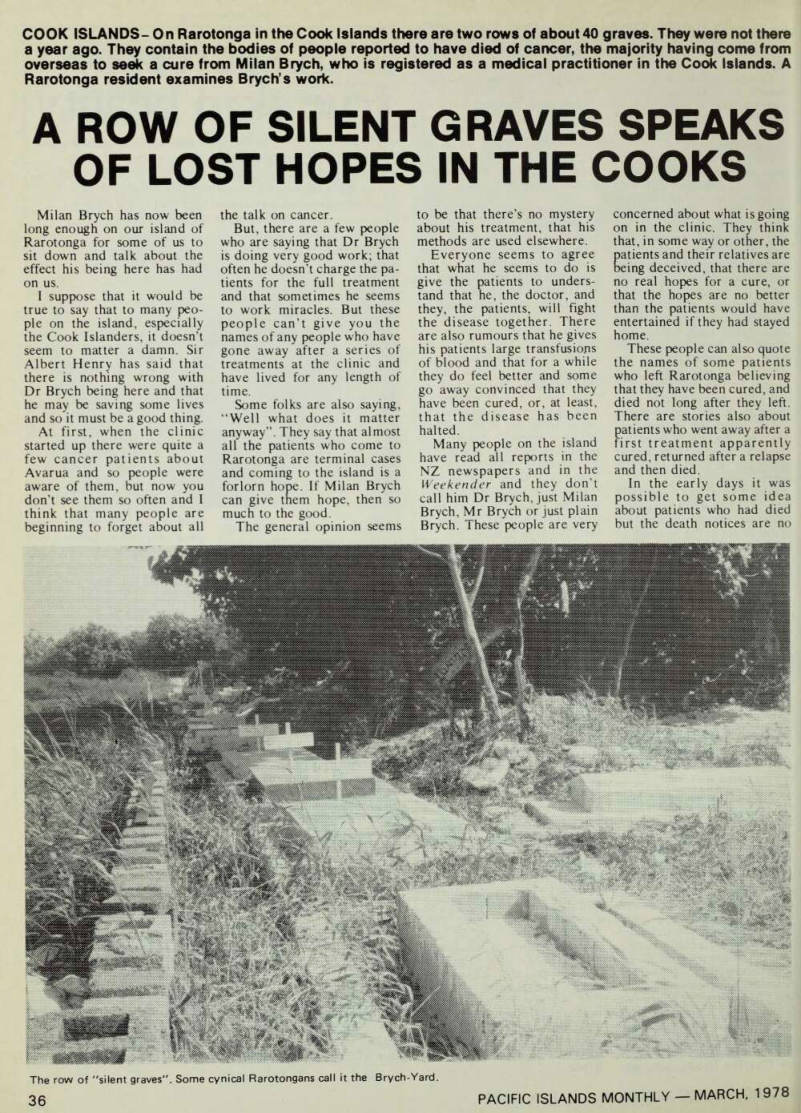
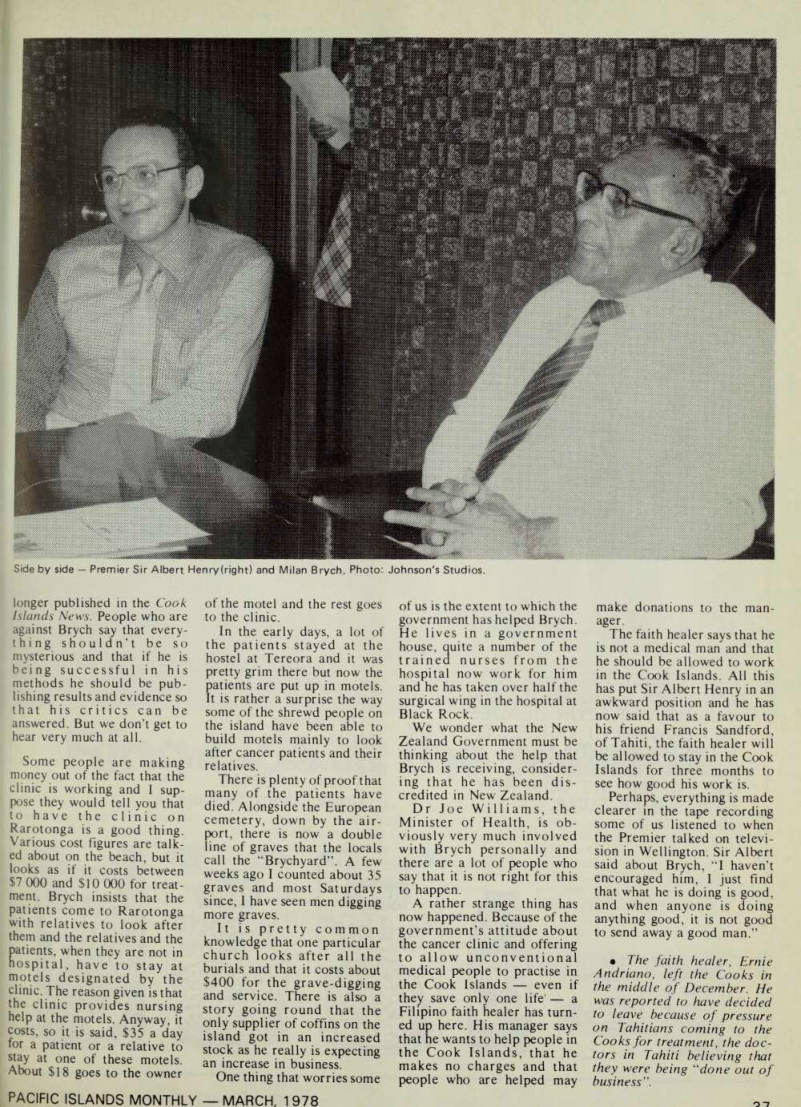
Of Lost Hopes In The Cooks
COOK ISLANDS - On Rarotonga in the Cook Islands there are two rows of about 40 graves. They were not there a year ago. They contain the bodies of people reported to have died of cancer, the majority having come from overseas to seek a cure from Milan Brych, who is registered as a medical practitioner in the Cook Islands. A Rarotonga resident examines Brych’s work.
Milan Brych has now been long enough on our island of Rarotonga for some of us to sit down and talk about the effect his being here has had on us.
I suppose that it would be true to say that to many peo ple on the island, especially the Cook Islanders, it doesn’t seem to matter a damn. Sir Albert Henry has said that there is nothing wrong with Dr Brych being here and that he may be saving some lives and so it must be a good thing.
At first, when the clinic started up there were quite a few cancer patients about Avarua and so people were aware of them, but now you don’t see them so often and I think that many people are beginning to forget about all
the talk on cancer.
But, there are a few people who are saying that Dr Brych is doing very good work; that often he doesn’t charge the pa tients for the full treatment and that sometimes he seems to work miracles. But these people can’t give you the names of any people who have gone away after a series of treatments at the clinic and have lived for any length of time.
Some folks are also saying, “Well what does it matter anyway”. They say that almost all the patients who come to Rarotonga are terminal cases and coming to the island is a forlorn hope. If Milan Brych can give them hope, then so much to the good.
The general opinion seems
to be that there’s no mystery about his treatment, that his methods are used elsewhere.
Everyone seems to agree that what he seems to do is give the patients to understand that he, the doctor, and they, the patients, will fight the disease together. There are also rumours that he gives his patients large transfusions of blood and that for a while they do feel better and some go away convinced that they have been cured, or, at least, that the disease has been halted.
Many people on the island have read all reports in the NZ newspapers and in the Weekender and they don’t call him Dr Brych, just Milan Brych, Mr Brych or just plain Brych. These people are very
concerned about what is going on in the clinic. They think that, in some way or other, the patients and their relatives are being deceived, that there are no real hopes for a cure, or that the hopes are no better than the patients would have entertained if they had stayed home.
These people can also quote the names of some patients who left Rarotonga believing that they have been cured, and died not long after they left, There are stories also about patients who went away after a first treatment apparently cured, returned after a relapse and then died.
In the early days it was possible to get some idea about patients who had died but the death notices are no
The row of "silent graves”. Some cynical Rarotongans call it the Brych-Yard.
longer published in the Cook Islands News. People who are against Brych say that every thing shouldn’t be so mysterious and that if he is being successful in his methods he should be pub lishing results and evidence so that his critics can be answered. But we don’t get to hear very much at all.
Some people are making money out of the fact that the clinic is working and I sup pose they would tell you that to have the clinic on Rarotonga is a good thing.
Various cost figures are talk ed about on the beach, but it looks as if it costs between $7 000 and $lO 000 for treat ment. Brych insists that the patients come to Rarotonga with relatives to look after them and the relatives and the patients, when they are not in hospital, have to stay at motels designated by the clinic. The reason given is that the clinic provides nursing help at the motels. Anyway, it costs, so it is said, $35 a day for a patient or a relative to stay at one of these motels.
About $lB goes to the owner
of the motel and the rest goes to the clinic.
In the early days, a lot of the patients stayed at the hostel at Tereora and it was pretty grim there but now the patients are put up in motels.
It is rather a surprise the way some of the shrewd people on the island have been able to build motels mainly to look after cancer patients and their relatives.
There is plenty of proof that many of the patients have died. Alongside the European cemetery, down by the air port, there is now a double line of graves that the locals call the “Brychyard”. A few weeks ago I counted about 35 graves and most Saturdays since, I have seen men digging more graves.
It is pretty common knowledge that one particular church looks after all the burials and that it costs about $4OO for the grave-digging and service. There is also a story going round that the only supplier of coffins on the island got in an increased stock as he really is expecting an increase in business.
One thing that worries some
of us is the extent to which the government has helped Brych.
He lives in a government house, auite a number of the trained nurses from the hospital now work for him and he has taken over half the surgical wing in the hospital at Black Rock.
We wonder what the New Zealand Government must be thinking about the help that Brych is receiving, considering that he has been discredited in New Zealand.
Dr Joe Williams, the Minister of Health, is obviously very much involved with Brych personally and there are a lot of people who say that it is not right for this to happen.
A rather strange thing has now happened. Because of the government’s attitude about the cancer clinic and offering to allow unconventional medical people to practise in the Cook Islands even if they save only one life a Filipino faith healer has turned up here. His manager says that he wants to help people in the Cook Islands, that he makes no charges and that people who are helped may
make donations to the man ager.
The faith healer says that he is not a medical man and that he should be allowed to work in the Cook Islands. All this has put Sir Albert Henry in an awkward position and he has now said that as a favour to his friend Francis Sandford, of Tahiti, the faith healer will be allowed to stay in the Cook Islands for three months to see how good his work is.
Perhaps, everything is made clearer in the tape recording some of us listened to when the Premier talked on televi sion in Wellington. Sir Albert said about Brych, “I haven’t encouraged him, I just find that what he is doing is good, and when anyone is doing anything good, it is not good to send away a good man.” The faith healer, Ernie Andriano, left the Cooks in the middle of December. He was reported to have decided to leave because of pressure on Tahitians coming to the Cooks for treatment, the doc tors in Tahiti believing that they were being “done out of business ”.
Side by side - Premier Sir Albert Henry(right) and Milan Brych. Photo: Johnson's Studios.
Advertisements & other items, pp. 38-46 (1 item)
Oiein*
m 2 Ik
All HEINZ products
are produced with the
experience gained from
more than one hundred
years of making fine foods.
In the Pacific islands
HEINZ has been on the
menu since 1925.
SELLING AND CONSULTANT
AGENTS FOR:
ANDRONICUS COFFEE PTY. LTD.
COUNTRY MAID WHITENER.
DIPLOMAT RAZOR BLADES.
MEADOWSWEET CONFECTIONERY.
ERIN FOODS LTD.
EPICURE CONTINENTAL FOODS.
BALTIC IMPORT COMPANY.
GREENSEAS TUNA.
FOR FURTHER INFORMATION
CONTACT:
H.J. HEINZ CO. AUST. LTD.
Export Branch, Princes Highway, Dandenong, 3175, Victoria, Australia.
Telephone: 792 0631.
Telex: AA32125.
Cable: Heinz Melbourne.
HEINZ
tomato sauce
HEW*
Heinz &
baked be#
i* l tomato sauce vcg< ctafi* 1
spaghetti
t °ttiato sauce & cheetf
IjliLJg
Ring-side at the seaside
Or anywhere you like. Pioneer's RK-888 radio cassette lets you take your music with you. And in great style.
One glance at the RK-888 and you immediately sense the feeling of component hi-fi. The top-mounted control panel displays a full complement of useroriented features. The long dial scale makes AM/FM tuning easier and separate bass/treble tone controls provide total sound management. Power output of the amplifier is 3,300mW. That’s real sit-down power in a carry-along size.
In the tuner section, a 3-gang variable capacitor, Integrated Circuitry and ceramic filters assure stable FM reception even in the fun, out of the way places.
The cassette recorder offers a wide range Permalloy head (50-12,000Hz with chrome tape); pause, cue and review functions, a Memory Rewind device and fully-automatic Stop. And for recording, the electret microphone automatically adjusts the level to the volume of the program source.
Next, throw the power ON switch and the 16cm (614in.) plus 4.2cm (1%in.) tweeter deliver solid bass and brilliant highs. Remember, these speakers are Pioneer designed for true hi-fi reproduction.
Pioneer's RK-888 radio cassette recorder. Real hi-fi performance you can enjoy anywhere. Anytime.
ADpioimeer
Australia Pioneer Electronics Australia Pty.
Ltd., 178-184 Boundary Road.
Braeside. Victoria 3195. Tel 90-9011 Sydney 93-0246, Brisbane 59-7457 Adelaide 433379, Perth24-9899 Fiji Islands Brijlal & Company, G.P.O. Box No. 362, Suva. Fiji Islands Tel: 22258 New Zealand Fountain Marketing Ltd., Maidstone Street. Auckland. New Zealand Tel: 763-064 Norfolk Island Burns Philp (Norfolk Island) Ltd., Norfolk Island. South Pacific New Hebrides Burns Philp (New Hebrides) Ltd., Vila, New Hebrides Nauru Island Jacob Enterprises, P.O. Box No. 4 Republic of Nauru Tahiti Est. PERFECT, B.P. 594, Papeete, Tahiti Tel: 20 407 New Caledonia Menard Freres Ville, B.P. H2Cedex, Noumea.
New Caledonia Tel: 27.52.22 American Samoa Traspac Corporation, P.O. Box 1477, Pago Pago. American Samoa 96799 Tel: 633-5224 Rarotonga South Seas International Ltd., P.O. Box 49, Rarotonga Cook Islands Tel: 2327
■ XV *'Vv, * L* Y'V *V‘, \ . \ \ •% • <✓ * ' ri - -* -> ss V SSi? ✓ . ”''*T ✓ « .. £>V
ii Jtwr :
- • tn r i
Introducing
ourneui
moisture proof
matches.
Melanesian Matches have developed a new moisture resistant match-specially formulated for use in the Tropics.
Ask for a box today.
Spntm
HSItHEs
'UJfIUf
m f 80HE5 tr Hi & mi
7SSZ
Hi S' 377 0061
PTY LTD
LAE, Papua New Guinea.
TELEPHONE: Lae 42 3566 or 42 3514 P.O. Box 1843 Lae, P.N.G. TELEX: 42445
pse n ■- - .. ■ V w WLmm i m ■ i I K# t ■« . 1 T • i *# • * ; «*. -i- HP wm *# #* J®Pr> & « A » C -vuiMtr iii 3T* I 1
PIP
It- ; m I ■:.*] - >
\ : WOWSflajL u k
TOYOTA
The Toyota truck range. Built to be unbeatable.
Bad weather conditions, no problem.
Bad roads and driving surfaces, eaten up.
Difficult loads, no contest. Built tough. Built to take it.
There's a Toyota truck built for you.
L- —> Jn TOYOTA Land Cruiser Pickup
TOYOTA Dyna
TOYOTA Stout TOYOTA Toyo-Ace
TOYOTA Hi-Lux
TOYOTA Truck
TOYOTA
For unbeatable after service: PAPUA NEW GUINEA: ELA MOTORS LIMITED, Scratchley Rd., Badili, P.O, Box 75, Port Moresby. U.S. TRUST TERRITORY: MICROL CORPORATION, 26 J' Sa '^ an FUI ISLANDS: AUTOMOTIVE SUPPLIES CO., LTD., G.P.O. Box 355, Suva. AMERICAN SAMOA: BURNS PHILP (SOUTH SEA) ' n LTO :l O J 057 ' Pa9 ° Pa9 ° WESTERN SAMOA: BURNS PHILP (SOUTH SEA) LTD., P.O. Box 188, Apia. GUAM: ATKINS, KROLL (GUAM) LTD., B ° X . 64 8 ’ Ta ™ umn 9 N EW HEBRIDES: NEW HEBRIDES MOTORS LTD., P.O. Box 18, Vila. SOLOMON ISLANDS: MENDANA ENTERPRISES (S I ), o^ D D P O n-, B ° X 174 ' Honiara TAHITI; NIPPON AUTOMOTO, B.P. 342, Papeete, COOK ISLANDS: COOK ISLANDS TRADING CORPORATION LTD P.O Box 92, Ra rotonga NAURU ISLAND: NAURU COOPERATIVE SOCIETY. GILBERT & ELLICE ISLANDS COLONY: TARAWA MOTORS, Box 36.
RFOLK ISLAND MARIE'S NORFOLK TOURS, LTD., P.O. Box 276. NEW CALEDONIA: SOCIETE IMPORTATION AUTOMOBILE DU PACIFIQUE, Rond-Pomt du Pacific (Station Total) B.P. 438, Noumea.
Direct-! i -Matic
From now, don’t settle for anything less! .
SC-3110 Direct-O-Matic is a new standard in stereo cassette decks. No deck today can be considered as truly outstanding without the important benefits of Direct- O-Matic. Direct-O-Matic is a Sansui exclusive for easier handling, positive
action and improved performance.
An exciting host of other advanced features include electronic Tape #ss Lead-in, convenient Memory Stop, Dolby*with 1C, beautiful black styling and much more!
Remember... from now on, the first thing to ask is: "Does it have Direct- O-Matic?’ "Dolby is a trademark of Dolby Lab.. Inc.
SojxsilL
Only hi-fi, everything hi-fi.
SANSUI ELECTRIC CO., LTD. 14-1 Izumi 2-chome, Suginami-ku,Tokyo 168, Japan • Fiji Prabhu Brothers Ltd. P.O.Box; 183. Nadi Phone: 7018.3/4 • Papua New Guinea Oceania Indent Agency (P.N.G.) Pty. Ltd. Box 5518, Boroko. Port Moresby Phone; PM 258406 • New Zealand David Reid Electronics Ltd. C.P.O. Box ,2630. Auckland, 1 Phone; 492-189 • New Caledonia Ets Michel MERCIER B P. 1123. Noumea Phone; 27. 59. 11 •South Pacific Miltons Department Stores Limited P.O. Box 146, Norfolk Island 2899 • Central Pacific Nauru Co-operative Society Republic of Nauru • Western Samoa H.J. Keil and Company Ltd. P.O. Box 7. Apia Phone; 198 • New Hebrides ■ Cnnlra P U.'V /I P.nl Vi • rook islands United Island Traders Ltd. P.O. Box 1 & 2, Rarotonga • Tahiti DIMECO P.O. Box 2622
THE SMALL CAR
FULL OF
>.r ■ «r'- - ■ isuzu
<0 %.*£ l *wE
ISUZU GEM
The rugged little Isuzu Gemini! All the style, features and comfort you expect from the Japanese plus General Motors parts, service and unbeatable 12 months or 20,000 km warranty.
Its got the looks, the style, the performance and handling .. . the reliability to set it way ahead of its competitors. Check out Gemini now!
O Four-on-the-floor O 1600 cc engine O Flow-through ventilation O Power assisted disc brakes O Hazard warning light O Radio O Bucket seats O 2-speed wipers O Electric clock O Headlight flasher O Anti-theft steering lock O Cigar lighter O Optional air conditioning available % l-t-i Jr-.Qu.oto Octin Is Gil At Coledonio Tongo* .Norfolk Is ’ Lord Howe JL Papua New Guinea Wamp Nga Motors, Mt. Hagen Dawapia Motors, Rabaul
Fiji
Burns Philp (South Sea) Co. Ltd, Western Samoa O. F. Nelson and Co. Ltd.
General Motors Serving you in the South Pacific n G149
If your excuse for not enjoying
great hi-fi is on this page,
you’ve just run out of excuses.
7T^ ' Ci Dt 1 * U O a § €1 C Wj 'A % “The low bankroll blues”
“The which goes with what butterflys” “The where to get a good deal shuffle”
“The low bankroll blues”
The Rondo 5000 offers fantastic value for your stereo budget.
Pioneer’s the audio pro, so our advanced production techniques enable us to give you the quality you want at a price you can afford.
“The where to get a good deal shuffle”
And for easy, one-stop shopping, just look for the Rondo 5000 display at a store near you. It’s a sure sign you’re getting the performance and value only Pioneer can deliver.
“The which goes with what butterflys”
The new Rondo 5000 System stereo takes the guesswork out of enjoying great hi-fi. Designed for easy use and built tough for dependability because every component is system created by Pioneer. A name you can trust.
Main Specifications Receiver Amp section: Continuous power output is 15 watts per channel, min. at 8 ohms from 20 to 20,000Hz with no more than 0.5% THD.
Tuner section: Usable sensitivity: Mono 10.7dBf (1.9/uV) Signal-to-noise ratio: Mono 73dB (at 65dBf) Alternate channel selectivity 60dB
IQmcU-5000
No-excuse hi-fi.
Pioneer’s new Rondo 5000 System stereo. If you’re still not enjoying great hi-fi, you’ve finally run out of excuses.
So, run out and buy one today.
Turntable Belt-drive, auto-return, and auto-shutoff.
Wow and flutter: 0.055% (WRMS) Speaker 20cm woofer, 6.6cm midrange, 6.6cm tweeter. Maximum input power: SOW
O pi o meet?
Australia Pioneer Electronics Australia Pty.
Ltd., 178-184 Boundary Road, Braeside, Victoria 3195. Tel: 90-9011, Sydney 93*-0246, Brisbane 59-7457, Adelaide 433379, Perth24-9899 Fiji Islands Brijlal & Company, G.P.O. Box No 362. Suva. Fm Islands Tel: 22258 New Zealand Fountain Marketing Ltd., Maidstone Street, Auckland, New Zealand Tel: 763-064 Norfolk Island Burns Philp (Norfolk Island) Ltd., Norfolk Island, South Pacific New Hebrides Burns Philp (New Hebrides) Ltd., Vila, New Hebrides Nauru Island Jacob Enterprises, P.O. Box No. 4 Republic of Nauru Tahiti Est. PERFECT, B.P. 594. Papeete, Tahiti Tel: 20 407 New Caledonia Menard Freres Ville, B.P, H2Cedex, Noumea, New Caledonia Tel: 27.52.22 American Samoa Traspac Corporation, P.O. Box 1477 Pago Pago, American Samoa 96799 Tel: 633-5224 Rarotonga South Seas International Ltd., P.O. Box 49, Rarotonga Cook Islands Tel: 2327
Islands
From the
Press
From the Fiji Times: The commandant of the Police Training College at Nasova, Superintendent Ambika Prasad, has been transferred and replaced by Superintendent Ambika Prasad. The ex commandant has taken over the post formerly held by Superintendent Ambika Prasad. And if that sounds a bit confusing it is. The Royal Fiji Police are blessed with two officers named Ambika Prasad both of the rank of superintendent. In a recent reshuffle they ended up exchanging jobs. The other one was formerly the Force Prosecutions Officer. If it has caused some confusion the reshuffle at least has saved the expense of new name plates for their office doors.
American Samoa 20 years ago as described by Speaker of the Legislature, Tuana’itau F. Tuia, at the opening of the Third Regular Session reported in the American Samoa News Bulletin: We at the Fqno were so powerless during those days. We saw that only privileged individuals and special interest groups were in control of the economy at that time, but there was nothing we could have done about it. We had no power or authority to correct such injustices. The rich just went on getting richer, while the poor got poorer. We suffered the indignities, not only of low wages and unemployment, but virtually no future in the economic sense.
From the Lae Nius: Gibson Wapogi, aged 58, married with two children and from Wamira in the Agamora area of the Milne Bay Province, is treated with high honour by the Tolais as a skilful witchdoctor.
Mr Wapogi, while based in Rabaul as the captain of the ship Kali-li in the late 19605, was kidnapped by a Tolai sorceress who made him leave his job and his family. He was taken to a mountain near Rabaul called Mt Kombiu, which is believed to be the homeland of devil spirits, for 14 months during which time he was taught all the skills of a witch-doctor ... In the last two years he has treated and cured more than a hundred sick people . . .
Dr Havea, Principal of the Pacific Theological College in Suva, asked “Is there a Pacific Christ?” when he spoke at a church meeting at Papauta, reported in the Samoa Times: • Christ should not be understood in a regional sense, he said.
Rather Christ should be seen as “one who laughs and weeps with us”. He implied that Christ was neither Melanesian, Polynesian or Micronesian, nor a person “with fuzzy-wuzzy hair, thick lips, flat nose, clad in tapa clothes, sitting in an outrigger canoe with opened arms widely stretched as he addresses a multi-racial audience, perhaps in pidgin, with a Suva or Port Moresby landscape in the background”.
Life on Ebeye on the Kwajalein Atoll in the Marshalls as seen by the Micronesian Independent: The bars open at one and I’ve seen guys go in and get so smashed they’re lying on the floor by two ... Another oddity are the Ebeye taxis, about 30 small Japanese-made cars that constantly circulate the island, picking up and dropping off passengers. It’s 20 cents a ride and everyone rides the taxi just to have something to do ...
From the Cook Islands News: “Our faith has paid off,” the Premier, Hon Sir Albert Henry, said this morning at the opening of the Takuvaine Water Gallery. “We have got water from the rocks.” Sir Albert based his address on the Scripture verses 7 and 8 in Psalm 114 “Tremble O earth at the presence of the Lord, at the presence of the God of Jacob, who turns the rock into a pool of water, the flint into a spring of water. Sir Albert said “.. . the Chief Engineer, Dr Waterhouse of the New Zealand Aid Scheme, had said in his report that no water would be obtained from Dr George Chan’s proposed plan because that plan took the gallery into rock area ...” “But I had faith”, said the Premier, “and that has paid off. We have searched into the rocks for water.”
From a letter by H. L. Ainuu on students’ behaviour in the Samoa Times: .. Any alert citizen, who is more concerned about a much better harvest of today’s young buds, should never be indifferent to such morally-corrupt acts but take it unlightly as an awesome challenge for our own decade and should by all means be categorised with any other social defects confronting our present society ... As one college principal has mentioned, most of the parents have suspended the usage of the rod, which is quite true. Most of them have become emotionally weak in the sense that they have praised too much the academic improvements of their children, making them blind to the unwelcome behaviours these children have manifested From the New Hebrides News: Biscuits made locally from manioc, kumala and taro flour are on sale in Tanna. Villagers around Lenakel were surprised to see the first products made by a missionary’s wife. Mrs Mike Heath says that to make flour from these vegetables you need to peel and slice them and dry them in the sun for about three days. They they are ready to be ground into flour. Biscuit tasters said that kumala is best.
From the Tonga Chronicle: . . . Two cases of shoplifting were heard in Nukualofa Magistrates Court involving items taken from the Burns Philp store. In the first case, Sifa Laloni, 21, from Taanea, Vavau, currently living at Liahona, was found builty of stealing a 94cent package of cheese, and was sentenced to three months imprisonment ... In the second shoplifting case, a 13-year-old boy was awarded 12 strokes of the cane.
From a Fiji Times editorial on a proposal to control soft drink prices in Fiji: . Nutritionists say that people waste money on soft drinks because they are lacking in real food values. Except for a dash of sugar, a pinch of flavour, there is nothing much else besides carbonated water in them. Milk is cheaper and far more nutritive, but the market for soda pop is far bigger than for milk. A survey for the Consumer Council of Fiji has shown that some people are making profits ranging from 44 per cent to 125 per cent . ..
From the American Samoa News Bulletin: Governor Peter Tali Coleman has called for a revival of what was once known as “Fa’a Samoa Day” the Friday of each week when all employees of the Government of American Samoa wore Samoan dress to add a little colour to our territory However, the Office of Samoan Information emphasises that “Fa’a Samoa Day” for GAS employees does NOT mean that each Friday we will start work according to “Samoa time”.
The work hours are the same.
From Savali, Apia, Western Samoa: Samoa is wrongly placed on the map of the world! The French research ship Coriolis recently carried out some work for the government and its crew has discovered that Samoa is three quarters of a mile out of place . . . The ship’s position was fixed by two means, firstly by a satellite navigation system and secondly by radar.
Advertisements & other items, p. 47 (1 item)
Acific Islands Monthly March 1 978
Lewis, The Navigator, Sails
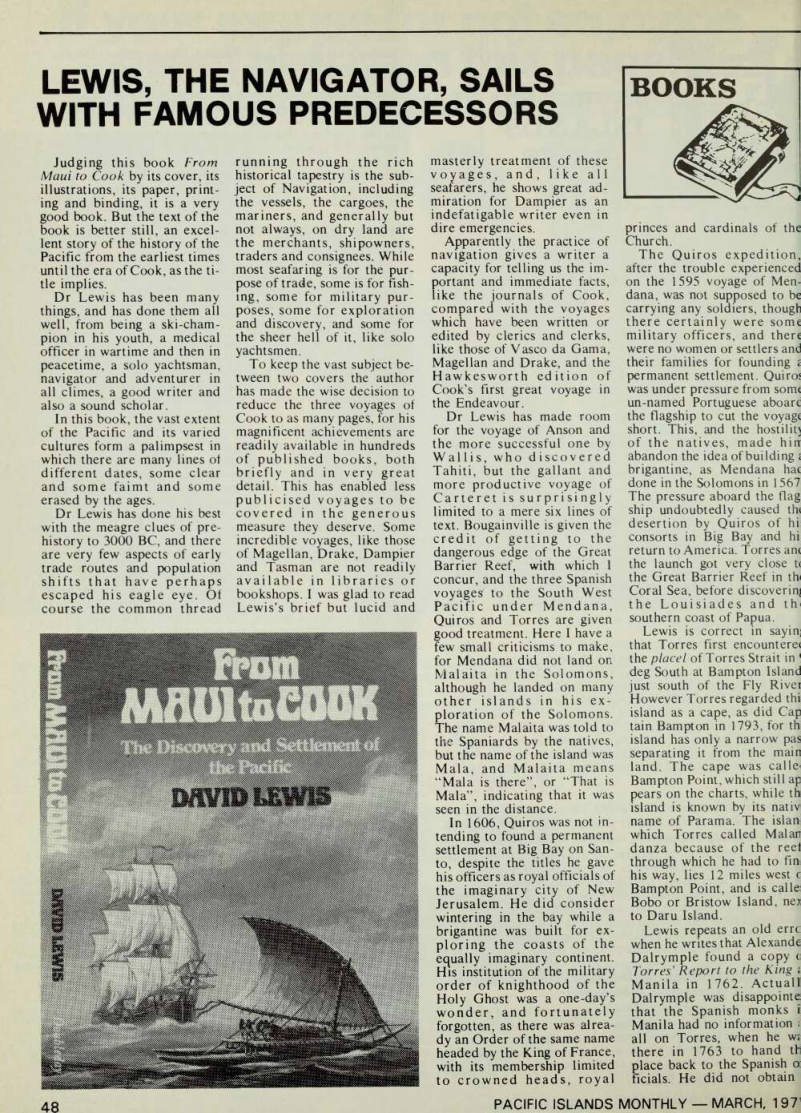
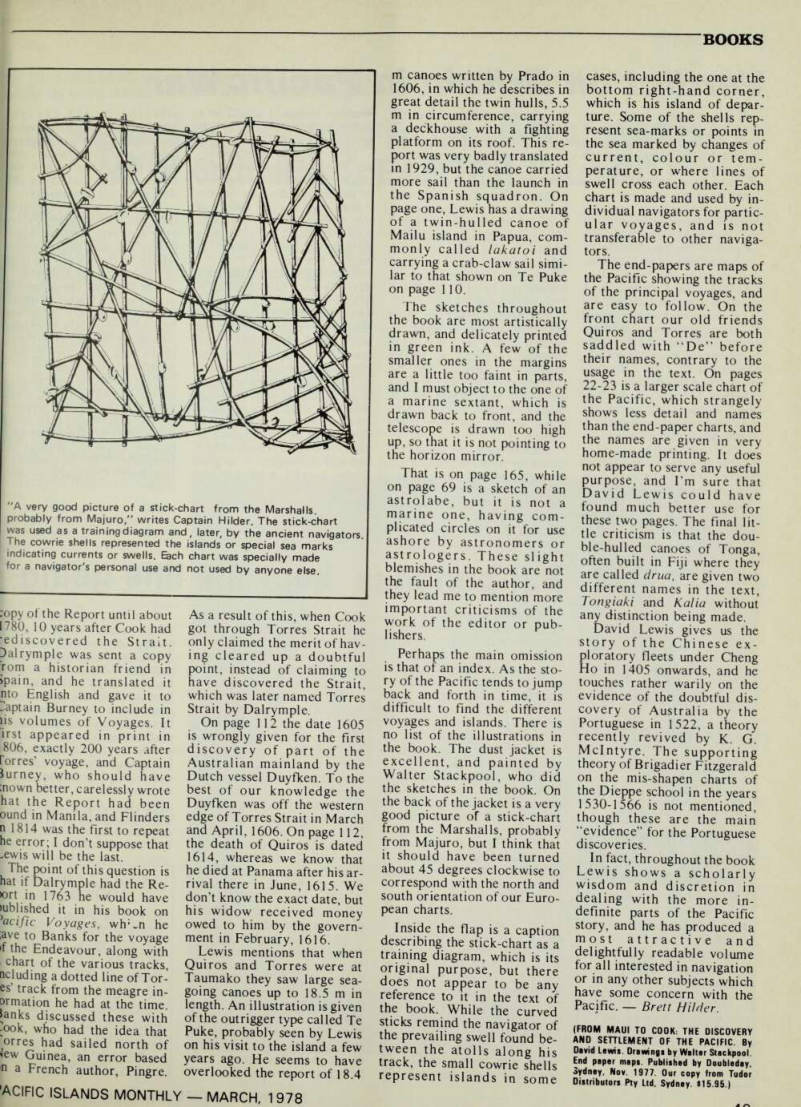
Books
With Famous Predecessors
Judging this book From Maui to Cook by its cover, its illustrations, its paper, print ing and binding, it is a very good book. But the text of the book is better still, an excel lent story of the history of the Pacific from the earliest times until the era of Cook, as the ti tle implies.
Dr Lewis has been many things, and has done them all well, from being a ski-cham pion in his youth, a medical officer in wartime and then in peacetime, a solo yachtsman, navigator and adventurer in all climes, a good writer and also a sound scholar.
In this book, the vast extent of the Pacific and its varied cultures form a palimpsest in which there are many lines ol different dates, some clear and some faimt and some erased by the ages.
Dr Lewis has done his best with the meagre clues of pre history to 3000 BC, and there are very few aspects of early trade routes and population shifts that have perhaps escaped his eagle eye. Of course the common thread
running through the rich historical tapestry is the sub ject of Navigation, including the vessels, the cargoes, the mariners, and generally but not always, on dry land are the merchants, shipowners, traders and consignees. While most seafaring is for the pur pose of trade, some is for fish ing, some for military pur poses, some for exploration and discovery, and some for the sheer hell of it, like solo yachtsmen.
To keep the vast subject be tween two covers the author has made the wise decision to reduce the three voyages of Cook to as many pages, for his magnificent achievements are readily available in hundreds of published books, both briefly and in very great detail. This has enabled less publicised voyages to be covered in the generous measure they deserve. Some incredible voyages, like those of Magellan, Drake, Dampier and Tasman are not readily available in libraries or bookshops. I was glad to read Lewis’s brief but lucid and
masterly treatment of these voyages, and, like all seafarers, he shows great ad miration for Dampier as an indefatigable writer even in dire emergencies.
Apparently the practice of navigation gives a writer a capacity for telling us the im portant and immediate facts, like the journals of Cook, compared with the voyages which have been written or edited by clerics and clerks, like those of Vasco da Gama, Magellan and Drake, and the Hawkesworth edition of Cook’s first great voyage in the Endeavour.
Dr Lewis has made room for the voyage of Anson and the more successful one by Wallis, who discovered Tahiti, but the gallant and more productive voyage of Carteret is surprisingly limited to a mere six lines of text. Bougainville is given the credit of getting to the dangerous edge of the Great Barrier Reef, with which 1 concur, and the three Spanish voyaged to the South West Pacific under Mendana, Quiros and Torres are given good treatment. Here I have a few small criticisms to make, for Mendana did not land on Malaita in the Solomons, although he landed on many other islands in his ex ploration of the Solomons.
The name Malaita was told to the Spaniards by the natives, but the name of the island was Mala, and Malaita means “Mala is there”, or “That is Mala”, indicating that it was seen in the distance.
In 1606, Quiros was not in tending to found a permanent settlement at Big Bay on San to, despite the titles he gave his officers as royal officials of the imaginary city of New Jerusalem. He did consider wintering in the bay while a brigantine was built for ex ploring the coasts of the equally imaginary continent.
His institution of the military order of knighthood of the Holy Ghost was a one-day’s wonder, and fortunately forgotten, as there was alrea dy an Order of the same name headed by the King of France, with its membership limited to crowned heads, royal
princes and cardinals of the Church.
The Quiros expedition,, after the trouble experienced on the 1595 voyage of Men dana, was not supposed to be carrying any soldiers, though there certainly were some military officers, and there were no women or settlers and their families for founding £ permanent settlement. Quiros was under pressure from some un-named Portuguese aboarc the flagship to cut the voyage short. This, and the hostility of the natives,, made hin abandon the idea of building i brigantine, as Mendana hac done in the Solomons in 1567 The pressure aboard the flag ship undoubtedly caused the desertion by Quiros of hi; consorts in Big Bay and hi return to America. Torres anc the launch got very close t( the Great Barrier Reef in th» Coral Sea, before discovering the Louisiades and thi southern coast of Papua.
Lewis is correct in sayin] that Torres first encountere* the place I of Torres Strait in ' deg South at Bampton Island just south of the Fly Rivet However Torres regarded thii island as a cape, as did Cap tain Bampton in 1793, for thi island has only a narrow pas separating it from the main land. The cape was calle< Bampton Point, which still ap pears on the charts, while th island is known by its nativ name of Parama. The islan. which Torres called Malan danza because of the reel through which he had to fim his way, lies 12 miles west c Bampton Point, and is calle: Bobo or Bristow Island, nex to Daru Island.
Lewis repeats an old errc when he writes that Alexande Dalrymple found a copy o Torres’ Report to the King ; Manila in 1762. ActualK Dalrymple was disappointed that the Spanish monks i: Manila had no information : all on Torres, when he w* there in 1763 to hand tb place back to the Spanish a ficials. He did not obtain
:opy ot the Report until about 1780, 10 years after Cook had •ediscovered the Strait.
Dalrymple was sent a copy Tom a historian friend in Jpain, and he translated it nto English and gave it to Captain Burney to include in lis volumes of Voyages. It irst appeared in print in 806, exactly 200 years after forres’ voyage, and Captain lurney, who should have
:nown better, carelessly wrote
hat the Report had been ound in Manila, and Flinders n 1814 was the first to repeat he error; I don’t suppose that -ewis will be the last.
The point of this question is hat if Dalrymple had the Re tort in 1763 he would have mb li shed it in his book on
'acific Voyages, whLn he
,ave to Banks for the voyage •f the Endeavour, along with chart of the various tracks, ncluding a dotted line of Tor es’ track from the meagre in ormation he had at the time, lanks discussed these with ■took, who had the idea that orres had sailed north of «ew Guinea, an error based n a French author, Pingre.
As a result of this, when Cook got through Torres Strait he only claimed the merit of hav ing cleared up a doubtful point, instead of claiming to have discovered the Strait, which was later named Torres Strait by Dalrymple.
On page 112 the date 1605 is wrongly given for the first discovery of part of the Australian mainland by the Dutch vessel Duyfken. To the best of our knowledge the Duyfken was off the western edge of Torres Strait in March and April, 1606. On page 112, the death of Quiros is dated 1614, whereas we know that he died at Panama after his ar rival there in June, 1615. We don’t know the exact date, but his widow received money owed to him by the govern ment in February, 1616.
Lewis mentions that when Quiros and Torres were at Taumako they saw large sea going canoes up to 18.5 m in length. An illustration is given of the outrigger type called Te Puke, probably seen by Lewis on his visit to the island a few years ago. He seems to have overlooked the report of 18.4
m canoes written by Prado in 1606, in which he describes in great detail the twin hulls, 5.5 m in circumference, carrying a deckhouse with a fighting platform on its roof. This re port was very badly translated m 1929, but the canoe carried more sail than the launch in the Spanish squadron. On page one, Lewis has a drawing of a twin-hulled canoe of Mailu island in Papua, com monly called lakatoi and carrying a crab-claw sail simi lar to that shown on Te Puke on page 110.
The sketches throughout the book are most artistically drawn, and delicately printed in green ink. A few of the smaller ones in the margins are a little too faint in parts, and I must object to the one of a marine sextant, which is drawn back to front, and the telescope is drawn too high up, so that it is not pointing to the horizon mirror.
That is on page 165, while on page 69 is a sketch of an astrolabe, but it is not a marine one, having com plicated circles on it for use ashore by astronomers or astrologers. These slight blemishes in the book are not the fault of the author, and they lead me to mention more important criticisms of the work of the editor or pub lishers.
Perhaps the main omission is that of an index. As the sto ry of the Pacific tends to jump back and forth in time, it is difficult to find the different voyages and islands. There is no list of the illustrations in the book. The dust jacket is excellent, and painted by Walter Stackpool, who did the sketches in the book. On the back of the jacket is a very good picture of a stick-chart from the Marshalls, probably from Majuro, but I think that it should have been turned about 45 degrees clockwise to correspond with the north and south orientation of our Euro pean charts.
Inside the flap is a caption describing the stick-chart as a training diagram, which is its original purpose, but there does not appear to be any reference to it in the text of the book. While the curved sticks remind the navigator of the prevailing swell found be tween the atolls along his track, the small cowrie shells represent islands in some
cases, including the one at the bottom right-hand corner, which is his island of depar ture. Some of the shells rep resent sea-marks or points in the sea marked by changes of current, colour or tem perature, or where lines of swell cross each other. Each chart is made and used by in dividual navigators for partic ular voyages, and is not transferable to other naviga tors.
The end-papers are maps of the Pacific showing the tracks of the principal voyages, and are easy to follow. On the front chart our old friends Quiros and Torres are both saddled with “De” before their names, contrary to the usage in the text. On pages 22-23 is a larger scale chart of the Pacific, which strangely shows less detail and names than the end-paper charts, and the names are given in very home-made printing. It does not appear to serve any useful purpose, and I’m sure that David Lewis could have found much better use for these two pages. The final lit tle criticism is that the dou ble-hulled canoes of Tonga, often built in Fiji where they are called drua, are given two different names in the text, Tongiaki and Kalia without any distinction being made.
David Lewis gives us the story of the Chinese ex ploratory fleets under Cheng Ho in 1405 onwards, and he touches rather warily on the evidence of the doubtful dis covery of Australia by the Portuguese in 1522, a theory recently revived by K. G.
Mclntyre. The supporting theory of Brigadier Fitzgerald on the mis-shapen charts of the Dieppe school in the years 1530-1566 is not mentioned, though these are the main “evidence” for the Portuguese discoveries.
In fact, throughout the book Lewis shows a scholarly wisdom and discretion in dealing with the more in definite parts of the Pacific story, and he has produced a most attractive and delightfully readable volume for all interested in navigation or in any other subjects which have some concern with the Pacific. Brett Milder.
(From Maui To Cook: The Discovery
And Settlement Of The Pacific. By
David Lewis. Drawings by Walter Stackpool End paper maps. Published by Doubleday, Sydney, Nov. 1977. Our copy from Tudor Distributors Pty Ltd, Sydney. $15.95.)
"A very good picture of a stick-chart from the Marshalls, probably from Majuro,” writes Captain Milder. The stick-chart was used as a training diagram and, later, by the ancient navigators The cowrie shells represented the islands or special sea marks indicating currents or swells. Each chart was specially made for a navigator's personal use and not used by anyone else.
Advertisements & other items, pp. 48-49 (2 items)
hfghfgh
49
ACIFIC ISLANDS MONTHLY MARCH, 1 978
BOOKS
Verdict on Britain in Pacific War
It all seems a long, long time ago, fhat Pacific war of 1941-45, but it still provides fodder for historical research and reappraisal. At a distance of over 30 years, this can at least be done without emo tional involvement and this Dr Peter Lowe sets out to do in Great Britain and the Origins of the Pacific War.
The origins of Britain’s in volvement in the Pacific War, says the author, stretch back into the 19th century but for his present work he has placed the emphasis on the years be tween 1937 and the Japanese bombing of Pearl Harbour, December 7, 1941. He then poses the question as to whether Britain should bear some responsibility for the war and whether or not it could have been avoided.
His conclusion is that neither Britain nor the United States was primarily re sponsible for the conflict that it was the logical result of Japanese aggression, ambition and concept of itself as crea tor of a so-called co-prosperi
ty sphere in SE Asia and the Pacific.
By 1937 Britain was alrea dy in decline as an Asian power although few then realised it and was soon to be engaged in a full-scale war with the Axis Powers in Europe. It tended to regard the growing aggression of Japan in the Pacific as an American affair and Churchill and others were careful not to rock the boat so that this remained so.
The actual attack on Pearl Harbour, which brought the United States into the world conflict, created an initial euphoria in Britain and the Commonwealth which soon gave way to a “sober realisa tion of the truly world dimen sions of the war now being waged.”
Both Britain and the US fell down in underestimating the strength and fighting qualities of the Japanese, believing that their successes in China were due to weaknesses on the Chinese side. When, or if, they came up against trained
Western troops it would be a different story, or so it was believed.
They were soon undeceiv ed. The first seven months of the Pacific War was a period of unrelieved disaster for the Allies, with the sea battles of the Coral Sea and Midway, now regarded as a turning point, but unrecognised as such at the time.
Of all the disasters, the most serious was, undoubtedly, what happened in the Malayan Peninsula and in Singapore where the British were fully responsible, and where the Japanese found them totally unprepared.
The British forces were, ac cording to General Pownall, who was in process of taking over command during the first weeks of the Japanese at tack, “out-generalled, outwit ted and outfought ... a great blow to the honour and prestige of the Army ... We have been outmatched by be tter soldiers.”
The morale and efficiency of the RAF units were
affected by the general malaise that had white-anted the service units in Malaya before hostilities began, and sank even lower when the Japanese showed from the start great air superiority.
The Navy never recovered from the sinking of the Prince of Wales and Repulse which Churchill had sent, against advice, to the area in the hope of impressing the Japanese.
The Malayan campaign wai at an end in a matter of weeks A different history of the wai in the Pacific might have beer written if the British forces there had been better pre pared and better led.
Thirty-three years latei much of what the Unitec States, Britain, the Nether lands and Australia wen fighting to preserve has hap pened anyway. Was it al worthwhile? In the context o that time? Certainly. Jud] Tudor. (GREAT BRITAIN AND THE ORIGINS OF THE PACIFIC WAR. Oxford University Press >21.)
Fiji bananas kept the line going
Without shipping to take their produce to overseas markets and bring in needed imports, life in the Pacific Is lands would be close to sub sistence level. Australian shipping has had close links with the islands for upwards of 100 years, having a vital role in two-way trade.
One of these shipping lines was the Australasian United Steam Navigation Co, which closed in the early 60s, and ended her links with the Is lands before World War 11.
The story of the line is told in From Derby to Burketown, a title which rather suggests it confined its activities to trade between Western Australia and Queensland, operating over a northerly route.
Far from it. AUSN traded for many years, not always profitably, from Australia to Fiji, Norfolk Island, New Caledonia and the New Hebrides. It was an AUSN ship which carried the first chrome from New Caledonia to Australia.
Her ship ran in the banana trade, and general cargo and passenger trade between Fiji
and Australia, often in com petition with USS Co of NZ Ltd, often in collaboration.
Shipping was a tough business then, as it is now. There were negotiations with govern ments during which hard bargains were driven.
Trading with New Caledonia had its problems for AUSN. The French Government naturally favoured Messageries Maritimes, even though AUSN offered a better ser vice, and was preferred by the Noumea Chamber of Com merce. The chamber, in fact, once made a plea to the French Government asking for a particular service by AUSN as the French line was falling down on the job. The plea was ignored.
AUSN was on the Sydney- New Hebrides run for about 10 years late in the 19th cen tury, and saw a flourishing banana trade develop. There was also some copra. Burns Philp, with which AUSN was generally on friendly terms, indicated it would prefer this route, so AUSN quietly with drew.
The Fiji banana trade which helped AUSN to mak< good profits, as well as incur ; few losses, was responsible fo the line’s final withdrawa from the Pacific Islands. Th« Australian Government pressured by Queenslan<
banana growers, imposed i
prohibitive duty of Bs. 4d. cental on Fiji bananas, bu later reduced it to 2s. 6d. Tha ended the Fiji banana trad' with Australia. N.B.
(From Derby To Burketown. By N.
McKellar, Published by University « Queensland Press, PO Box 42 St Lucii Queensland, 4067. >35.)
Advertisements & other items, p. 50 (2 items)
The Papua Hotel
Stay at Aggie Grey's
the South Pacific's
legendary hotel.
Situated right in the heart of Western Samoa. Enjoy Polyneslan-style friendliness and service, in cool surroundings, superb entertainment and food. Magnificent white sand beaches only a short drive away. Airconditioned rooms, swimming pool and full bar facilities.
Bookings through Union Steamship Company of NZ, Pan Am, Air New Zealand or direct to Aggie Grey's, Apia, Western Samoa.
Cables: AGGIES, APIA.
THE PAPUA HOTEL
PORT MORESBY
• Right in the business centre • A tradition for comfort and fine food • All rooms air conditioned • Restaurant • Bars • Banquet Hall Telephone 21 2622 Cables PARTEL
A. C. NEUMANN
Manager
Henry Lawson's
BOOKSHOP
531 Royal Arcade, (Beneath Sydney Hilton) Pitt through to George St.
SYDNEY, 2000.
Phone: 61 2365.
WE STOCK ONL Y
AUSTRALIAN BOOKS
AND BOOKS ON
OCEANIA!
Write to us for specialist attention.
A New Treasure From Unea, Papua
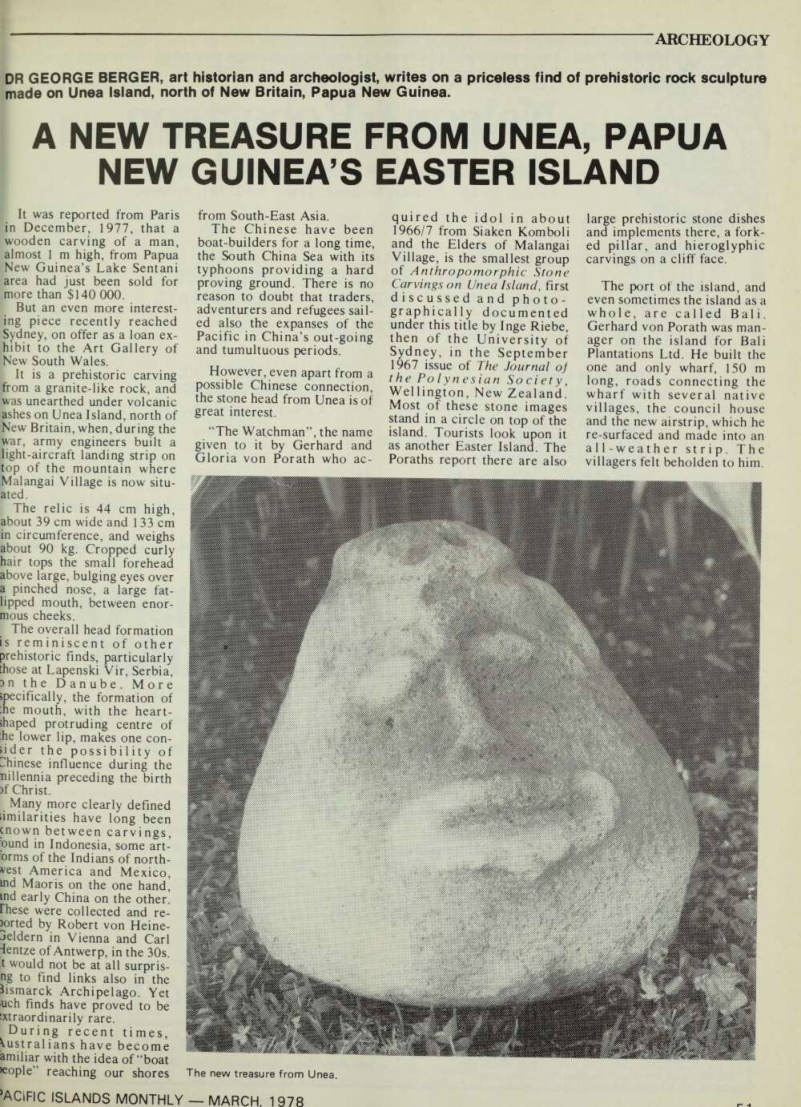
Archeology
New Guinea’S Easter Island
DR GEORGE BERGER, art historian and archeologist, writes on a priceless find of prehistoric rock sculpture made on Unea Island, north of New Britain, Papua New Guinea.
It was reported from Paris in December, 1977, that a wooden carving of a man, almost 1 m high, from Papua New Guinea’s Lake Sentani area had just been sold for more than $l4O 000.
But an even more interest ing piece recently reached Sydney, on offer as a loan ex hibit to the Art Gallery of New South Wales, i It is a prehistoric carving from a granite-like rock, and was unearthed under volcanic ashes on Unea Island, north of New Britain, when, during the war, army engineers built a light-aircraft landing strip on top of the mountain where Malangai Village is now situ ated.
The relic is 44 cm high, about 39 cm wide and 133 cm in circumference, and weighs about 90 kg. Cropped curly hair tops the small forehead above large, bulging eyes over a pinched nose, a large fat lipped mouth, between enor mous cheeks.
The overall head formation is reminiscent of other prehistoric finds, particularly those at Lapenski Vir, Serbia, t>n the Danube. More specifically, the formation of the mouth, with the heart shaped protruding centre of :he lower lip, makes one con dder the possibility of Chinese influence during the nillennia preceding the birth )f Christ.
Many more clearly defined similarities have long been cnown between carvings, ound in Indonesia, some art brms of the Indians of north vest America and Mexico, md Maoris on the one hand, md early China on the other, fhese were collected and re ported by Robert von Heine jeldern in Vienna and Carl lentze of Antwerp, in the 30s. t would not be at all surpris ng to find links also in the Bismarck Archipelago. Yet tich finds have proved to be
extraordinarily rare.
During recent times, Australians have become amiliar with the idea of “boat £ople” reaching our shores
from South-East Asia.
The Chinese have been boat-builders for a long time, the South China Sea with its typhoons providing a hard proving ground. There is no reason to doubt that traders, adventurers and refugees sail ed also the expanses of the Pacific in China’s out-going and tumultuous periods.
However, even apart from a possible Chinese connection, the stone head from Unea is of great interest.
“The Watchman”, the name given to it by Gerhard and Gloria von Porath who ac
quired the idol in about 1966/7 from Siaken Komboli and the Elders of Malangai Village, is the smallest group of Anthropomorphic Stone Carvings on Unea Island, first discussed and photo-
graphically documented
under this title by Inge Riebe, then of the University of Sydney, in the September 1967 issue of The Journal oj the Polynesian Society, Wellington, New Zealand.
Most of these stone images stand in a circle on top of the island. Tourists look upon it as another Easter Island. The Poraths report there are also
large prehistoric stone dishes and implements there, a fork ed pillar, and hieroglyphic carvings on a cliff face, The port of the island, and even sometimes the island as a whole, are called Bali, Gerhard von Porath was man ager on the island for Bali Plantations Ltd. He built the one and only wharf, 150 m long, roads connecting the wharf with several native villages, the council house and the new airstrip, which he re-surfaced and made into an all-weather strip. The villagers felt beholden to him.
The new treasure from Unea.
Advertisements & other items, pp. 51-52 (2 items)
51
ACIFIC ISLANDS MONTHLY MARCH 1 978
Ulqud
mm
QBE Rf
s o -o 2: o IP V *
IN OUR 84th YEAR SELLING ‘SERVICE’
TO THE PACIFIC ISLANDS...
Nelson&Robertson
PTY. LTD. (Established 1895)
Plantation House, 197 Clarence Street, Sydney.
Cables: ‘IVAN 1 , Sydney, Brisbane. Telex; AA22381, Sydney.
FOR:
INDENTS HARDWARE
FOODSTUFFS MACHINERY
SOFTGOODS SHIPPING
FROM AUSTRALIA & OVERSEAS
TRAVEL
INSURANCE
REAL ESTATE
C : 'i
BRANCH OFFICES:
Nelson & Robertson Pty. Ltd., 303 Adelaide Street, Brisbane, Qld.
Nelson & Robertson Pty. Ltd., P.O. Box 2092, Gout. Bldg., Suva, Fiji, Nelson & Robertson Pty. Ltd., P.O, Box 258, Lautoka, Fiji.
PAPUA NEW GUINEA
REPRESENTATIVES:
Rabtrad Niugini Pty. Ltd,
RABAUL
LAE
MADANG
KIETA
m
rara
ULQUd
i
UPRIGHT DISPLAY
REFRIGERATORS
FRIGID COLO DRINKS
LOW COST
LARGE CAPACITY
BOTTLE & FOOD DISPLAY
2 & 3 DOOR MODELS AVAILABLE
Large capacity small floor space Maximum visual display Gleaming white, vinyl coated aluminium interior for better reflection of light within cabinet Fluorescent lighting 2" Frigidfoam insulation (equivalent to 4" Polystyrene or 6" cork!) Powered by heavy-duty Kelvinator sealed unit warranteed for 5 years
AVAILABLE FROM:
AUSTRALIAN NEW CALEDONIA EXPORTS. 363 George St, Sydney, 2000 BREGKWOLDT & CO., 276 Pitt St., Sydney, 2000.
HAGEMEYER (A'SIA), 59 Anzac Pde, Kensington, 2033.
GEOFFREY HUGHES & CO, 167 Macquarie St, Sydney, 2000 NELSON & ROBERTSON PTY. LTD, 197 Clerence St, Sydney, 2000 PETER FISHER TRADING PTY.LTD, 321 Pitt St, Sydney 200 a E. RABOT (EXPORTS) PTY. LTD, 67 Cwtlereagh St, Sydney. 2000 RABTRAD NIUGINI PTY. LTD., PO Box 1406, Lae.
A. RIETTE (PACIFIC) PTY. LTD., 300 George St., Sydney, 2000.
H Y KWAN (AUST) PTY. LTD. Box 2713, GPO , Sydney, 2001.
C. SULLIVAN (EXPORT) PTY. LTD., GPO Box 3373, Sydney, 2001.
W.S. TAIT & CO, PTY. LTD, 31 Macquarie Place, Sydney, 2000. ) Attractive timber grain Marviplate exterior I Automatic frost-free, fan-assisted cooling gives even and faster cooling of stored products > 4 rows adjustable plastic-coated, hygenic, white shelves and floor tray ► LOW MAINTENANCE, the only maintenance required being periodic cleaning of condenser I Illuminated sign in top panel optional extra.
Manufactured by: T 1
FRIGID CABINETS PTY. LTD.,
Duffy Ave., Thornleigh, N.S.W. 2120 Aust. Ph. 848 8292. 14A FC2
future-on one leg

Trade
Winds
Planning the New Hebrides’ economic future-on one leg
Britain, with what seems to be a modicum of lukewarm support from its partner France, is planning an economic operation in the New Hebrides designed to assist the condominium to paddle its own canoe when independence comes. Ken McGregor analyses the whole operation which has been mounted in new headquarters in Vila.
Less than a couple of blocks from where the tear gas flew last November 29 in Vila, the closest thing the New Hebrides has to an economic think tank is quietly ticking away.
With the grandiose title of “Joint Office of Development Planning”, a small, virtually one-man operation is tucked away on the ground floor of the uninspiring Oceania Building.
David Potton, a British economist with considerable economic and business plan ning experience outside Bri tain, is the man in the hot seat.
His French equivalent, in what is still officially a joint facility, Bruno Cazals, is long since departed, his term of contract outside Paris up. The French, which did not go very much for British “develop ment plan” type organisations for troublesome colonies, didn’t bother to replace their representative and have no future plans to do so.
JODP, however, is strug gling on, aware that its impact is thus blunted somewhat by lack of direct French par ticipation in initial studies md at least a 12 months’
Jelay in seeing any of its re commendations followed up because of continued political incertainty.
Which is all rather a shame )ecause, when examined, (ODP has produced and is •till producing a wealth of )asic material, terms of eference, economic thinking )n non-political progress in he currently most unweildy condominium.
What isn’t generally ap
>reciated, unfortunately, is
he fact that, despite some 18
nonths of publicity mostly
concerning party politics, werseas big country involve nent and possible violence alk, economic action has >een mostly positive.
With a couple of excep ions, as Mr Potten notes, re ceipts and production from nost industries in the New lebrides have all been up in his period. This includes
tourism, copra and cocoa, some of the major con tributors to the New Hebri dean economy.
Good news here has made it easier to forecast plans for the base of a viable several-year development plan for this is land group, of the sort ex- African British colonials love to detail at financial reporting time under Pacific coconuts.
Most commodities exceed ed 1976 growths, Mr Potton points out, and he described turnaways of overseas liners, such as P & O’s Arcadia in early December, as mere “un fortunate hiccups” in the in creasingly attractive tourism sector.
Mr Potton remains scepti cal of revenues from liner calls anyway, because, he notes, in 1976 four ships ac counted for 60% of total liner receipts because of their size and the buying madness ashore of their passengers.
JODP’s job, then, to date, has been to identify various sectors worth scrutinising, such as currency and overseas aid, study them and put for ward various “what if’ con jectures in these areas should significant changes take place in the future.
Its reports and there are a growing number of them, such as an analysis on specific passenger expenditure from visiting liners, for example, due in February are com pulsory reading for a funda mental understanding of the ground rules in the New Hebrides.
They should not, in any way, be construed as in-depth strategy scrutiny of everything involved with a particular sector. Those looking for a cheap and ready answer for an immediate investment deci sion will go away disap pointed.
In the same context, those rushing in, expanding or even pulling out would be most un wise to over-look the Cazals- Potton reports.
A more recent report con cerning the alternatives for the condominium’s two cur
rencies, for example, is a must for bankers and the New Hebrides is the most over banked town in the South Seas!
The JODP’s Resource Survey Factors Affecting the Choice of Development Objectives is one of the ma jor accomplishments of this operation. It is a start, at least, for a blueprint for an eventual central planning office for the group, if the French can ever be persuaded to re-fill the va cant Cazals spot out of renew ed interest or the secondment of another French economist.
This survey discusses a three-year economic and social development plan, 1978/80. Approval of such a plan is now clearly “not on” because it was due out in detail early this year, which it won’t be, and because of the New Hebrides lameduck legislature.
It is fascinating to note here that while plentiful supplies of French versions of the plan still abound in Vila shops, English translations of the survey were sold out weeks ago.
In its survey, JODP got down to some straight talking: “A development plan for any country requires two main foundations knowledge of the resources available and basic objectives ...”
It notes that its report covered the resources that were available, except the future size and structure of the New Hebrides admin istration and the future likely levels of financial assistance from Britain and France. It says that basic long-term guidelines for the develop ment plan called for various objectives which could in clude development of rural and agricultural areas, a more equal distribution of income, more Melanesian participa tion in industrial and com mercial enterprise and rapid growth in national income.
Others could include strengthened balance of pay ments, increased financial
independence, reduced
vulnerability to fluctuations in the international economy, rapid replacement of ex patriates by New Hebrideans and improved social services.
It produces three examples of new projects: • Cocoa it will benefit New Hebrideans in rural areas and tends to assist those who have land. It will not create new jobs, but its may provide more work for village dwellers and reduce migra tion from rural areas. Econ omic implications here in clude government or overseas aid, increases in export tax revenues, increased exports and results in the medium to long-term. • A brewery would pro vide jobs for unemployed New Hebrideans in urban areas but would need some expatriate managers. Economic im plications here would include funds from overseas investors, no effect on government revenue, will reduce imports and would produce results in the short term. • A rural wharf construc tion project which would benefit rural areas and en courage other economic development in rural areas.
The effect on labour force would be insignificant. Econ omic implications would in clude funds from government or overseas aid, would in volve annual maintenance costs, may help increase ex ports of agricultural products and each wharf could take three months to construct.
Another fascinating JODP study is titled Possible Indus trial Opportunities in the New Hebrides, which comes up with a list of new industries intended mainly to substitute
for imports. It makes the sobering comment initially, however, that the New Hebrides import bill could not be chopped by more than |lo%.
The statement here is made after earlier conclusions that 65% of current imports by value could never conceiveably be replaced by production in the New Hebrides. It says 17.80% of current imports were represented by induses felt to have an “outside chance” of establishment.
A balance of 11.39% of imports represented items “very unlikely” to be replaced by
local production.
JODP emphasises that the above percentages do not mean that imports could feasibly be reduced by 23.61% by
establishing all the listed‘“im port-substituting industries .
This is because many indus tries listed would depend heavily on imported raw materials and, also, the estab lishment of such industries would not necessarily replace all imports of related pro ducts.
JODP’s “good chance” new import replacement industries still makes interesting read ing. It is; biscuit manufactur ing, beer, cement, ice cream, paints, tyre retreading, soap, and footwear, Those with an “outside chance” are tobacco process ing, boxes, canvas goods and battery assembly, Budding entrepreneurs may now step on the blocks mark ed “Go”.
Advertisements & other items, pp. 53-54 (2 items)
53
ACIFIC ISLANDS MONTHLY— MARPM IQ7Q
Design and lay
Western Samoa .
Niue Island
the Pacific has shifted
...because now the Polynesian Triangle fare brings a Polynesian holiday much closer. Now, when you visit Fiji, you can include Tonga, Niue and Western Samoa for very little extra! Talk to your travel agent about working in your Polynesian Triangle fare with your Fiji itinerary. Only U55266.00* (AU55229.00 or NZ5237.00) more to see three more islands in the beautiful Pacific. Our Polynesian Triangle fare is available all year round with no minimum stopover restrictions and may be purchased while you are in Fiji or before you arrive.
Contact your travel agent for more details. *Fare subject to change without notice. © Serving the heart of Polynesia
POLYNESIAN
PO Box 599, Apia,
WESTERN SAMOA
Design and lay
your own floor
I - M ; ri-
Uil
It’s easy to have your own individual floor design with CSR Vinylflex floor tiles. Many different patterns in lots of lovely decorator colours.
There are two types of CSR Vinylflex tiles — regular Vinylflex and the easy-to-lay Peel and Stick range. With Peel and Stick the adhesive is already on the back. You just peel off the protective paper and lay the tiles direct onto any clean, dry, smooth floor.
csr Vinylflex
FLOORTILES
me in AUSTRALIA MARKETED BY CSR-WUNDERLICH BUILDING ■ ■ PORTSAIIs RA 4 OXONNELITtREET, SYDNEY AUSTRALIA 2000 lilt )STAL ADDRESS; GPO BOX 483, SYDNEY, AUSTRALIA 2001 AVAILABLE FROM LEADING ISLAND MERCHANTS 92? ad
NOTICE - TRADE MARK.
Dynamit Nobel Aktiengesellschaft of P.O.
Box 1209, 521, Troisdorf, West Germany wish it to be known that they are the owners of the Trade Mark: and that this Trade Mark is used by Dynamit Nobel Aktiengesellschaft on or in connection with ammunition and projectiles, explosive substances, fireworks, firearms for hunting and sporting purposes, optical apparatus and instruments.
Proceedings will be taken against any third party found to be using the above Trade Mark on or in connection with ammunition and projectiles, explosive substances, fireworks, firearms for hunting and sporting purposes, optical apparatus and instruments.
McCUBBERV TRAIN LOVE & THOMAS
Barristers and Solicitors, Port Moresby, Agents for Davies and Co 11iso n, Trade Mark Agents for the proprietors.
split the difference
Burns Philp and PNG split the difference
The big Australian-based group Burns Philp, threatened with a compulsory takeover of one of its Pacific island plan tations, has reached a settle ment with the PNG Govern ment.
The company has agreed to sell to the government for $7B 000 part of Karu planta tion, a long-established and productive cocoa and copra property on New Ireland. But the government is not in terested in the agricultural value of the 73.4 ha of land it will use the site for a fur niture venture involving Japanese capital and New Irelander shareholders.
The largely Australian plantation investment indus try in PNG still regards the deal as amounting to a com pulsory change in ownership, but at least on market terms.
The price Burns Philp had on the piece of land and its
improvements, including
buildings and plantings, was $l2O 000, but the govern ment’s original offer which would have been the com pensation price under com pulsory acquisition was only $lB 000.
Agreement at what was call ed “a compromise purchase price” was announced late in January by the company and the government following talks in Port Moresby.
In an inter-departmental
memo disclosed earlier in January, the Deputy Prime Minister and Primary Indus try Minister, Mr Julius Chan, accused Burns Philp of hold ing PNG to ransom. He re commended compulsory ac quisition without delay and accused the company of in dulging in whims which were interfering with national development.
The government gave itself the power three years ago to
acquire foreign-controlled
agricultural properties where it saw valid reason for ac quisition. Provision for com pensation at the government’s price is written into the legislation, but so far the government has shown a willingness for fair negotia tion.
The main exercise of the government’s powers so far has been to acquire agricultural land for Papua New Guinean farmers in areas where land is genuinely short.
The Karu negotiations cre ated some money market con cern because of the low price initially offered and because of the purpose of the acquisi tion. Australian investors believe it is short-sighted to partly close down a viable plantation which is con tributing to taxes, replacing it with an untested industry in volving a new brand of foreign capital.
Rough Passage For
That Tongan Bank
Tonga’s projected new Bank of the South Pacific (PIM, Feb, p 55) has run into stiff opposition from powerful sections of the Tongan Estab lishment even before it has got off the ground.
This is clear from various reports reaching PIM since publication of the article.
As the PIM article reveal ed, the charter of the bank en titles an American former as sociate of billionaire Howard Hughes, Mr John Meier, and his backers, to do almost any thing they like in the kingdom.
One PIM correspondent writes; “Opposition first ap peared in the ranks of the government itself. But those who disagreed could not win.
“Then the battle shifted to the Bank of Tonga, whose board of directors were, and are, very much against the set ting up of the new bank.
“They believe that the set ting up of the BoSP, and the all-embracing concessions given to it, are a breach of the understanding between the Tongan Government and the Bank of Tonga (in which the Bank of New Zealand, the Bank of New South Wales and the Bank of Hawaii each holds 20% equity, and the Tongan Government the remaining 40%).
“At its annual meeting in June, 1977, the board of directors of the Bank of Tonga (comprising two Tongan Government rep resentatives, and one rep resentative each from the three above-named banks) ap proached the Tongan Govern ment and his Majesty King Taufa’ahau Tupou IV about the matter.
“But the move brought lit tle joy. The establishment of BoSP and all that it entails was then a fait accompli."
Speculating as to how Mr Meier and his associates were able to get royal approval for the bank, another correspon dent writes: “As to the financ ing of the stated projects, if they are going to be set up at all, I am inclined to think that Messrs Meier & Co had to make the extravagant pro mises which they have made
in order to get his Majesty to agree to the setting up of the BoSP under the most liberal of banking charters. They needed this first so as to facilitate their shopping around for funds.
“I do believe that they didn’t have very much money behind them, but now that they have these concessions, they are in a very strong posi tion to go shopping using his Majesty’s name and that of the Tongan Government.”
The correspondent says that a number of informed people are sceptical as to whether the bank and its publicised pro jects will ever materialise.
They tend to equate the affair with that of the Japanese millionaire, Sasakawa, who some years ago promised Tonga a national airline, plus a number of other things, which came to nothing.
The correspondent says that one theory current in Tongan circles is that some people in the government are becoming disheartened with tied aid from New Zealand and Australia. They believe that only substantial projects such as those proposed by the BoSP which include a 250-apart ment condominium project budgeted at $25 million, and a 550-bedroom luxury hotel costing even more as the nucleus of a tourist village are the answer, rather than the small and piecemeal projects undertaken by New Zealand and Australia.
He is sceptical of reports that the Australian Govern ment has promised Tonga about $3 million towards the upgrading of the country’s telecommunications facilities, a scheme in which the BoSP has been said also to be in volved, writing; “I cannot see the Australian Government agreeing to giving Tonga such an amount, or any amount for that matter, to be used as sug gested.
“In general, the Australian Government is rather reluc tant to give any of the Pacific Islands aid which would be used for ventures in which private enterprises, even of Australian origin, hold some equity.
Advertisements & other items, pp. 55-56 (3 items)
Trade Winds
55
PAPIPIP IQI AMHQ v i mo
56
PAPIFir ISI ANDR MONTHI Y MARCH. 1 978 f
that makes your home
a healthier place
How effectively you protect your family from the dangers of disease carrying insects, may well depend on the insect spray you choose.
Powerful Insect Killing Ingredients.
Concentrated Pea Beu is one of the most powerful household insect sprays in the world. Its principal insect killing ingredients have been selected to ensure rapid knock down and kill of all common disease carrying insects.
Rigid Testing. Through every stage of manufacture. Pea Beu is rigidly tested.
There are ingredient tests, spray droplet tests, pack tests, many forms of tests, some carried out three times over.
When you spray this remarkable aerosol insecticide, you can be sure that its ingredients have met with the most exacting standards enabling you to spray it safely with confidence in your home. a Family Health and Well Being. The common housefly carries up to half a billion germs and, when you realize that disease carrying insects enter even the best regulated households, you can understand why you can't be too careful about the effectiveness of your insect spray. Remember,-even the tiniest droplet w if* M'
SSSSSbai. —
Concentrated Pea Beu. Even the tiniest droplet
kills flies, mosquitoes, gjj common
disease carrying insects fast.
of concentrated Pea Beu kills flies, mosquitoes, all common disease carrying insects fast, so it is indeed a worthy guardian of your family's health and well being.
Such is the effectiveness of Pea Beu's insect killing ingredient, that no common disease carrying insect can survive it. nor develop an immunity to it. When you spray Concentrated Pea Beu, it's nice to know that no common disease carrying insect can survive.
Pea Beu — The strong one, makes your home a healthier place.
Seething And Bubbling In
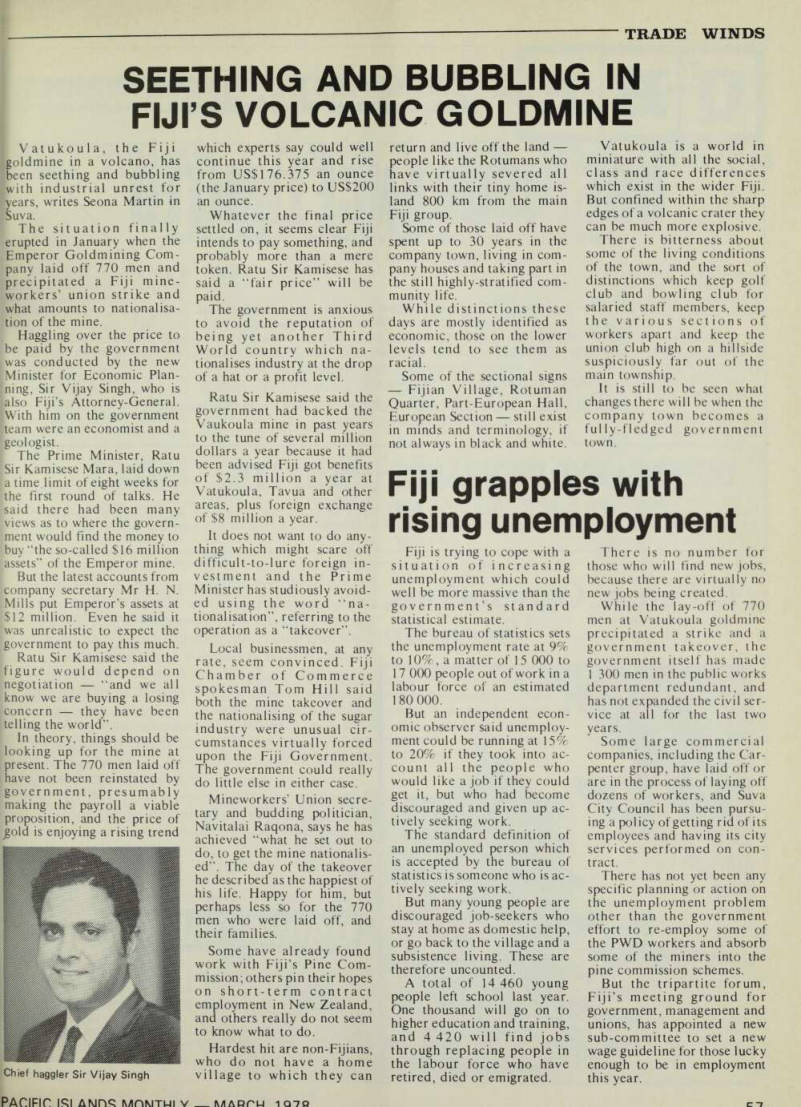
Fiji’S Volcanic Goldmine
Vatukoula, the Fiji goldmine in a volcano, has been seething and bubbling with industrial unrest for [years, writes Seona Martin in : Suva.
The situation finally erupted in January when the Emperor Goldmining Com pany laid off 770 men and precipitated a Fiji mine workers’ union strike and what amounts to nationalisa tion of the mine.
Haggling over the price to be paid by the government was conducted by the new Minister for Economic Plan ning, Sir Vijay Singh, who is [also Fiji’s Attorney-General.
With him on the government team were an economist and a geologist.
The Prime Minister, Ratu Sir Kamisese Mara, laid down a time,limit of eight weeks for the first round of talks. He said there had been many views as to where the govern ment would find the money to buy “the so-called $l6 million assets” of the Emperor mine.
But the latest accounts from company secretary Mr H. N.
Mills put Emperor’s assets at $l2 million. Even he said it was unrealistic to expect the government to pay this much.
Ratu Sir Kamisese said the figure would depend on negotiation “and we all know we are buying a losing concern they have been telling the world”.
In theory, things should be looking up for the mine at present. The 770 men laid off have not been reinstated by government, presumably making the payroll a viable proposition, and the price of gold is enjoying a rising trend
which experts say could well continue this year and rise from U 55176,375 an ounce (the January price) to US$2OO an ounce.
Whatever the final price settled on, it seems clear Fiji intends to pay something, and probably more than a mere token. Ratu Sir Kamisese has said a “fair price” will be paid.
The government is anxious to avoid the reputation of being yet another Third World country which na tionalises industry at the drop of a hat or a profit level.
Ratu Sir Kamisese said the government had backed the Vaukoula mine in past years to the tune of several million dollars a year because it had been advised Fiji got benefits of $2.3 million a year at Vatukoula, Tavua and other areas, plus foreign exchange of $8 million a year.
It does not want to do any thing which might scare off difficult-to-lure foreign in vestment and the Prime Minister has studiously avoid ed using the word “na tionalisation”, referring to the operation as a “takeover”.
Local businessmen, at any rate, seem convinced. Fiji Chamber of Commerce spokesman Tom Hill said both the mine takeover and the nationalising of the sugar industry were unusual cir cumstances virtually forced upon the Fiji Government.
The government could really do little else in either case.
Mineworkers’ Union secre tary and budding politician, Navitalai Raqona, says he has achieved “what he set out to do, to get the mine nationalis ed”. The day of the takeover he described as the happiest of his life. Happy for him, but perhaps less so for the 770 men who were laid off, and their families.
Some have already found work with Fiji’s Pine Com mission; others pin their hopes on short-term contract employment in New Zealand, and others really do not seem to know what to do.
Hardest hit are non-Fijians, who do not have a home village to which they can
return and live off the land— people like the Rotumans who have virtually severed all links with their tiny home island 800 km from the main Fiji group.
Some of those laid off have spent up to 30 years in the company town, living in company houses and taking part in the still highly-stratified community life.
While distinctions these days are mostly identified as economic, those on the lower levels tend to see them as racial.
Some of the sectional signs Fijian Village, Rotuman Quarter, Part-European Hall, European Section still exist in minds and terminology, if not always in black and white,
Vatukoula is a world in miniature with all the social, class and race differences which exist in the wider Fiji, But confined within the sharp edges of a volcanic crater they can be much more explosive, There is bitterness about some of the living conditions of the town, and the sort of distinctions which keep golf club and bowling club for salaried staff members, keep the various sections of workers apart and keep the union club high on a hillside suspiciously far out of the main township.
It is still to be seen what changes there will be when the company town becomes a
fully-fledged government
town.
Chief haggler Sir Vijay Singh
rising unemployment
Fiji grapples with rising unemployment
Fiji is trying to cope with a situation of increasing unemployment which could well be more massive than the government’s standard statistical estimate.
The bureau of statistics sets the unemployment rate at 9% to 10%, a matter of 15 000 to 17 000 people out of work in a labour force of an estimated 180 000.
But an independent econ omic observer said unemploy ment could be running at 15% to 20% if they took into ac count all the people who would like a job if they could get it, but who had become discouraged and given up ac tively seeking work.
The standard definition of an unemployed person which is accepted by the bureau of statistics is someone who is ac tively seeking work.
But many young people are discouraged job-seekers who stay at home as domestic help, or go back to the village and a subsistence living. These are therefore uncounted.
A total of 14 460 young people left school last year.
One thousand will go on to higher education and training, and 4 420 will find jobs through replacing people in the labour force who have retired, died or emigrated.
There is no number tor those who will find new jobs, because there are virtually no new jobs being created.
While the lay-off of 770 men at Vatukoula goldmine precipitated a strike and a government takeover, the government itself has made 1 300 men in the public works department redundant, and has not expanded the civil ser vice at all for the last two years.
Some large commercial companies, including the Car penter group, have laid off or are in the process of laying off dozens of workers, and Suva City Council has been pursu ing a policy of getting rid of its employees and having its city services performed on con tract.
There has not yet been any specific planning or action on the unemployment problem other than the government effort to re-employ some of the PWD workers and absorb some of the miners into the pine commission schemes.
But the tripartite forum, Fiji’s meeting ground for government, management and unions, has appointed a new sub-committee to set a new wage guideline for those lucky enough to be in employment this year.
Advertisements & other items, pp. 57-58 (2 items)
57
TRADE WINDS
PACIFIC ISI MHMTWI V MARPU 1 Q7Q
Qbe Insurance Limited
QBE
offers expert insurance
throughout the Islands.
QBE INSURANCE LIMITED
(FORMERLY - QUEENSLAND INSURANCE COMPANY)
Central Office: 82 Pitt Street, Sydney.
FIJI Branch Office, Suva, Manager for Fiji: L.G. Liddell A.A.1.1.
LAUTOKA Sub-Branch Office: Burns Philp Bldg.
NEW CALEDONIA T.A. Hagen, Ste. VI/.A. Johnston, S.A.R.L. - Noumea.
NEW HEBRIDES District Manager: G.F. Donnelly, Vila; Santo Santo: Burns Philp (New Hebrides) Ltd.
TAHITI Arthur Chung: Immeuble 8.1., Front de Mer, Papeete.
NIUE, NORFOLK ISLAND, SAMOA, TONGA and other South Sea Islands Burns Philp (South Sea) Company L td.
QUEENSLAND INSURANCE (RN.G.) LTD.
PAPUA NEW GUINEA - Head Office, PORT MORESBY.
General Manager: J.M. Dawe. Assistant Manager: R.V. Maskell.
District Managers at: LAE: I.R. Martin MOUNT HAGEN: D.F. Carroll ARAWA: J. Longbut MADANG: R.W.V. Collings RABAUL; W.F. Tinker
To Future Generations,
Security
- r - — T ... u. r .
'V vV '' 5^'f|; i ?
Horyuji Japan's 7th century temple links the past to the present with the solemn beauty.
Social welfare is a subject of serious consideration in most modern societies. Man in the twentieth century accepts his responsibility to bequeath to the next generation a society better than his own.
Daiwa Bank is not unique in accepting this responsibility, but Daiwa is unique in making acceptance of this role in society an integral part of their banking service.
Daiwa is the only Japanese city bank to combine banking and trust business. Daiwa is thus a fully integrated banking institution, comprising banking, international financing, trust, pension trust, and real estate business. This integration is part of our effort to fulfil our social responsibility consistent with society's needs in a contemporary environment. a fully integrated banking service
DAIWA BANK
Head Office; Osaka, Japan London and Frankfurt Branches New York and Los Angeles Agencies Singapore, Sydney, Sao Paulo, Hong Kong and Houston Representative Offices Subsidiary: Daiwa Bank Trust Company, New York Joint Venture Banks; P.T. Bank Perdania, Jakarta, International Credit Alliance, Ltd., Hong Kong
of wrecked Runic
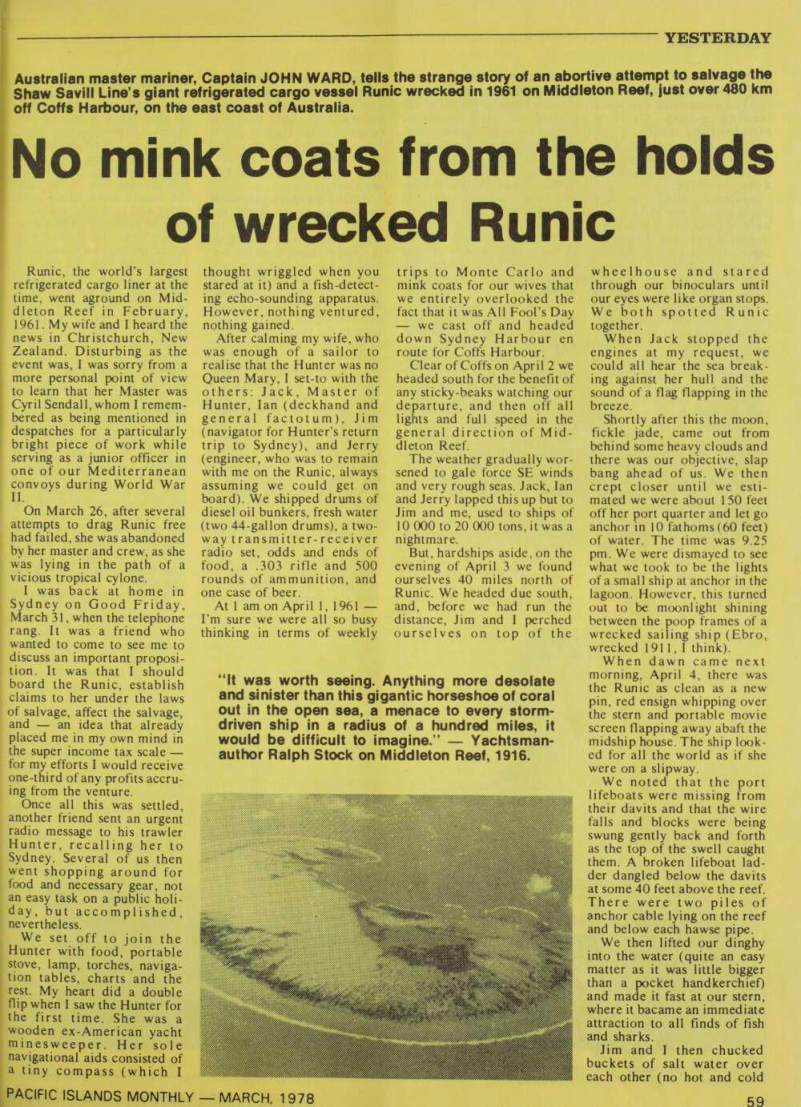
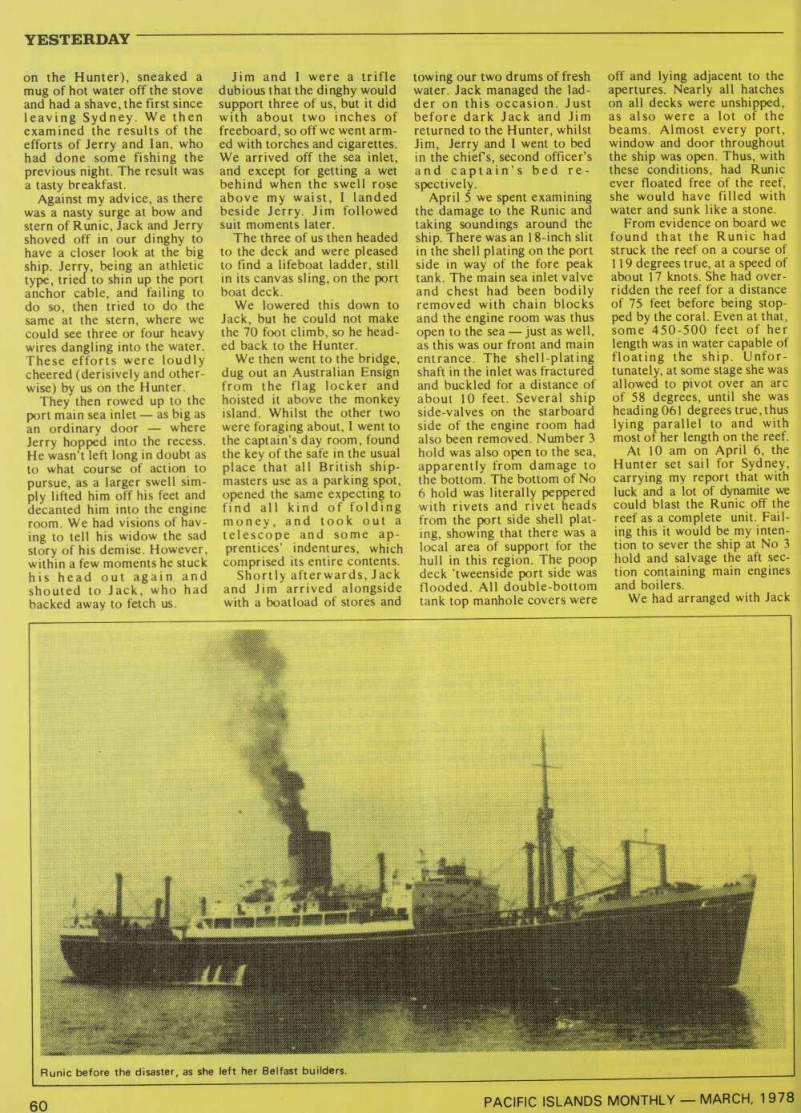
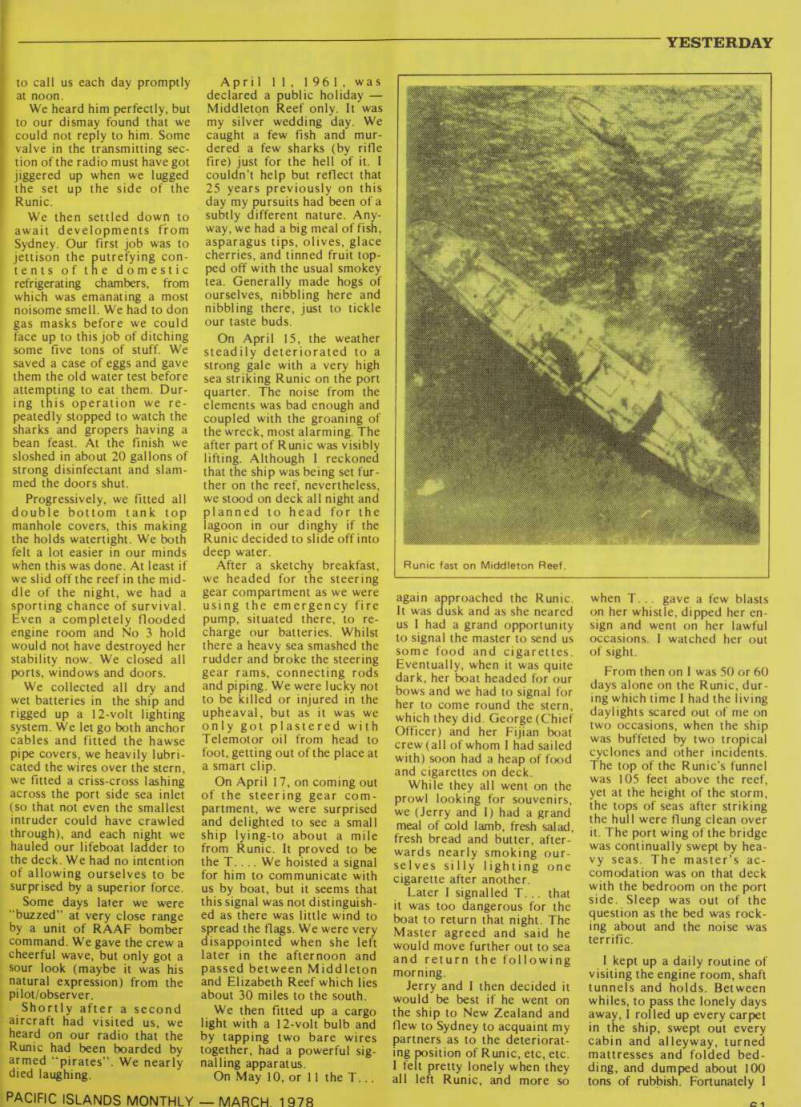
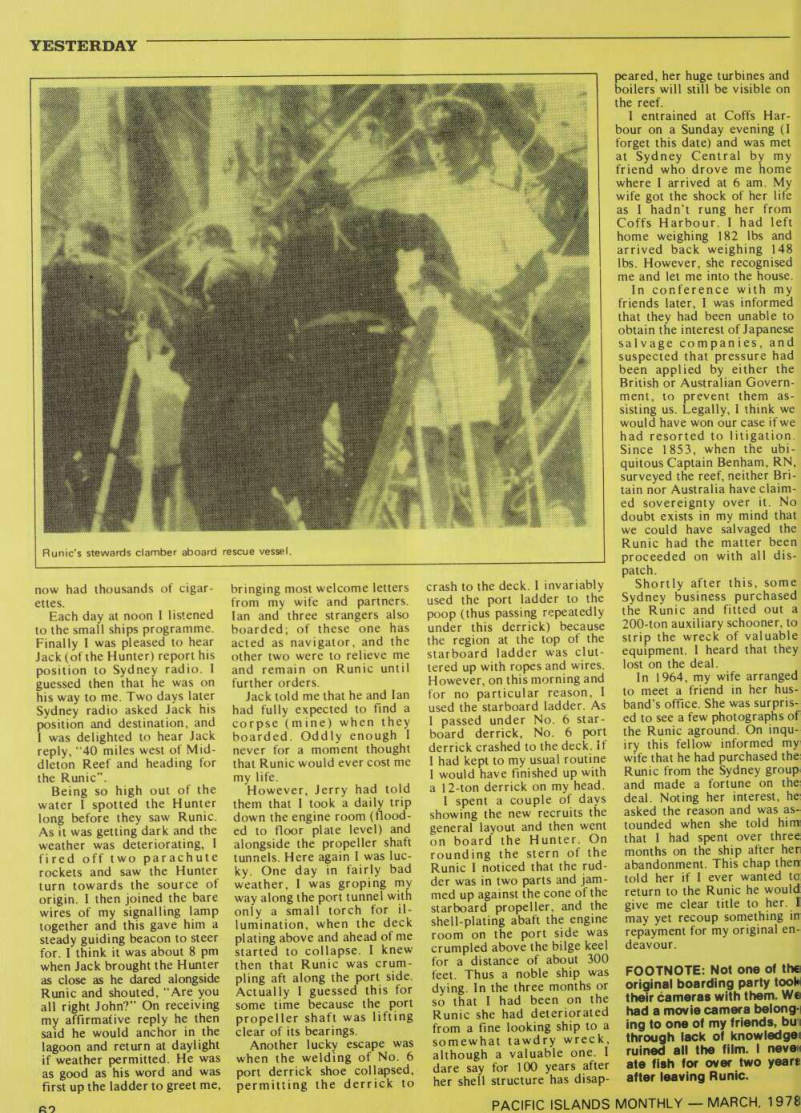
Yesterday
No mink coats from the holds of wrecked Runic
Australian master mariner, Captain JOHN WARD, tells the strange story of an abortive attempt to salvage the Shaw Savill Line’s giant refrigerated cargo vessel Runic wrecked in 1961 on Middleton Reef, just over 480 km off Coffs Harbour, on the east coast of Australia.
Runic, the world’s largest refrigerated cargo liner at the time, went aground on Mid dleton Reef in February, 1961. My wife and I heard the news in Christchurch, New Zealand. Disturbing as the event was, I was sorry from a more personal point of view to learn that her Master was Cyril Sendall, whom I remem bered as being mentioned in despatches for a particularly bright piece of work while serving as a junior officer in one of our Mediterranean convoys during World War 11.
On March 26, after several attempts to drag Runic free had failed, she was abandoned by her master and crew, as she was lying in the path of a vicious tropical cylone.
I was back at home in Sydney on Good Friday, March 31, when the telephone rang. It was a friend who wanted to come to see me to discuss an important proposi tion. It was that I should board the Runic, establish claims to her under the laws of salvage, affect the salvage, and an idea that already placed me in my own mind in the super income tax scale for my efforts I would receive one-third of any profits accru ing from the venture.
Once all this was settled, another friend sent an urgent radio message to his trawler Hunter, recalling her to Sydney. Several of us then went shopping around for food and necessary gear, not an easy task on a public holi day, but accomplished, nevertheless.
We set off to join the Hunter with food, portable stove, lamp, torches, naviga tion tables, charts and the rest. My heart did a double flip when I saw the Hunter for the first time. She was a wooden ex-American yacht minesweeper. Her sole navigational aids consisted of a tiny compass (which I
thought wriggled when you stared at it) and a fish-detect ing echo-sounding apparatus.
However, nothing ventured, nothing gained.
After calming my wife, who was enough of a sailor to realise that the Hunter was no Queen Mary, I set-to with the others: Jack, Master of Hunter, lan (deckhand and general factotum), Jim (navigator for Hunter’s return trip to Sydney), and Jerry (engineer, who was to remain with me on the Runic, always assuming we could get on board). We shipped drums of diesel oil bunkers, fresh water (two 44-gallon drums), a two way transmitter -receiver radio set, odds and ends of food, a .303 rifle and 500 rounds of ammunition, and one case of beer.
At 1 am on April 1, 1961 I’m sure we were all so busy thinking in terms of weekly
trips to Monte Carlo and mink coats for our wives that we entirely overlooked the fact that it was All Fool’s Day we cast off and headed down Sydney Harbour en route for Coffs Harbour.
Clear of Coffs on April 2 we headed south for the benefit of any sticky-beaks watching our departure, and then off all lights and full speed in the general direction of Mid dleton Reef.
The weather gradually wor sened to gale force SE winds and very rough seas. Jack, lan and Jerry lapped this up but to Jim and me, used to ships of 10 000 to 20 000 tons, it was a nightmare.
But, hardships aside, on the evening of April 3 we found ourselves 40 miles north of Runic. We headed due south, and, before we had run the distance, Jim and 1 perched ourselves on top of the
wheelhouse and stared through our binoculars until our eyes were like organ stops.
We both spotted Runic together.
When Jack stopped the engines at my request, we could all hear the sea break ing against her hull and the sound of a flag flapping in the breeze.
Shortly after this the moon, fickle jade, came out from behind some heavy clouds and there was our objective, slap bang ahead of us. We then crept closer until we esti mated we were about 1 50 feet off her port quarter and let go anchor in 10 fathoms (60 feet) of water. The time was 9.25 pm. We were dismayed to see what we took to be the lights of a small ship at anchor in the lagoon. However, this turned out to be moonlight shining between the poop frames of a wrecked sailing ship (Ebro, wrecked 1911,1 think).
When dawn came next morning, April 4, there was the Runic as clean as a new pin, red ensign whipping over the stern and portable movie screen flapping away abaft the midship house. The ship look ed for all the world as if she were on a slipway.
We noted that the port lifeboats were missing from their davits and that the wire falls and blocks were being swung gently back and forth as the top of the swell caught them. A broken lifeboat lad der dangled below the davits at some 40 feet above the reef.
There were two piles of anchor cable lying on the reef and below each hawse pipe.
We then lifted our dinghy into the water (quite an easy matter as it was little bigger than a pocket handkerchief) and made it fast at our stern, where it bacame an immediate attraction to all finds of fish and sharks.
Jim and I then chucked buckets of salt water over each other (no hot and cold
“It was worth seeing. Anything more desolate and sinister than this gigantic horseshoe of coral out in the open sea, a menace to every storm driven ship in a radius of a hundred miles, it would be difficult to imagine.” Yachtsman author Ralph Stock on Middleton Reef, 1916.
on the Hunter), sneaked a mug of hot water off the stove and had a shave, the first since leaving Sydney. We then examined the results of the efforts of Jerry and lan, who had done some fishing the previous night. The result was a tasty breakfast.
Against my advice, as there was a nasty surge at bow and stern of Runic, Jack and Jerry shoved off in our dinghy to have a closer look at the big ship. Jerry, being an athletic type, tried to shin up the port anchor cable, and failing to do so, then tried to do the same at the stern, where we could see three or four heavy wires dangling into the water, These efforts were loudly cheered (derisively and otherwise) by us on the Hunter.
They then rowed up to the port main sea inlet —as big as an ordinary door where Jerry hopped into the recess, He wasn’t left long in doubt as to what course of action to pursue, as a larger swell simply lifted him off his feet and decanted him into the engine room. We had visions of having to tell his widow the sad story of his demise. However, within a few moments he stuck his head out again and shouted to Jack, who had backed away to fetch us.
Jim and I were a trifle dubious that the dinghy would support three of us, but it did with about two inches of freeboard, so off we went arm ed with torches and cigarettes, We arrived off the sea inlet, and except for getting a wet behind when the swell rose above my waist, I landed beside Jerry. Jim followed suit moments later, The three of us then headed to the deck and were pleased to find a lifeboat ladder, still in its canvas sling, on the port boat deck, We lowered this down to Jack, but he could not make the 70 foot climb, so he head ed back to the Hunter.
We then went to the bridge, dug out an Australian Ensign from the flag locker and hoisted it above the monkey island. Whilst the other two were foraging about, I went to the captain’s day room, found the key of the safe in the usual place that all British ship masters use as a parking spot, opened the same expecting to find all kind of folding money, and took out a telescope and some ap prentices’ indentures, which comprised its entire contents, Shortly afterwards, Jack and Jim arrived alongside with a boatload of stores and
towing our two drums of fresh water. Jack managed the lad der on this occasion. Just before dark Jack and Jim returned to the Hunter, whilst Jim, Jerry and I went to bed in the chiefs, second officer’s and captain’s bed re spectively.
April 5 we spent examining the damage to the Runic and taking soundings around the ship. There was an 18-inch slit in the shell plating on the port side in way of the fore peak tank. The main sea inlet valve and chest had been bodily removed with chain blocks and the engine room was thus open to the sea just as well, as this was our front and main entrance. The shell-plating shaft in the inlet was fractured and buckled for a distance of about 10 feet. Several ship side-valves on the starboard side of the engine room had also been removed. Number 3 hold was also open to the sea, apparently from damage to the bottom. The bottom of No 6 hold was literally peppered with rivets and rivet heads from the port side shell plat ing, showing that there was a local area of support for the hull in this region. The poop deck ’tweenside port side was flooded. All double-bottom tank top manhole covers were
off and lying adjacent to the apertures. Nearly all hatches on all decks were unshipped, as also were a lot of the beams. Almost every port, window and door throughout the ship was open. Thus, with these conditions, had Runic ever floated free of the reef, she would have filled with water and sunk like a stone.
From evidence on board we found that the Runic had struck the reef on a course of 119 degrees true, at a speed of about 17 knots. She had over ridden the reef for a distance of 75 feet before being stop ped by the coral. Even at that, some 450-500 feet of her length was in water capable of floating the ship. Unfor tunately, at some stage she was allowed to pivot over an arc of 58 degrees, until she was heading 061 degrees true, thus lying parallel to and with most of her length on the reef.
At 10 am on April 6, the Hunter set sail for Sydney, carrying my report that with luck and a lot of dynamite we could blast the Runic off the reef as a complete unit. Fail ing this it would be my inten tion to sever the ship at No 3 hold and salvage the aft sec tion containing main engines and boilers.
We had arranged with Jack
Runic before the disaster, as she left her Belfast builders.
to call us each day promptly at noon.
We heard him perfectly, but to our dismay found that we could not reply to him. Some valve in the transmitting sec tion of the radio must have got jiggered up when we lugged the set up the side of the Runic.
We then settled down to await developments from Sydney. Our first job was to jettison the putrefying con tents of the domestic refrigerating chambers, from which was emanating a most noisome smell. We had to don gas masks before we could face up to this job of ditching some five tons of stuff. We saved a case of eggs and gave them the old water test before attempting to eat them. Dur ing this operation we re peatedly stopped to watch the sharks and gropers having a bean feast. At the finish we sloshed in about 20 gallons of strong disinfectant and slam med the doors shut.
Progressively, we fitted all double bottom tank top manhole covers, this making the holds watertight. We both felt a lot easier in our minds when this was done. At least if we slid off the reef in the mid dle of the night, we had a sporting chance of survival.
Even a completely flooded engine room and No 3 hold would not have destroyed her stability now. We closed all ports, windows and doors.
We collected all dry and wet batteries in the ship and rigged up a 12-volt lighting system. We let go both anchor cables and fitted the hawse pipe covers, we heavily lubri cated the wires over the stern, we fitted a criss-cross lashing across the port side sea inlet (so that not even the smallest intruder could have crawled through), and each night we hauled our lifeboat ladder to the deck. We had no intention of allowing ourselves to be surprised by a superior force.
Some days later we were “buzzed” at very close range by a unit of RAAF bomber command. We gave the crew a cheerful wave, but only got a sour look (maybe it was his natural expression) from the pilot/observer.
Shortly after a second aircraft had visited us, we heard on our radio that the Runic had been boarded by armed “pirates”. We nearly died laughing.
April 11, 1961, was declared a public holiday Middleton Reef only. It was my silver wedding day. We caught a few fish and mur dered a few sharks (by rifle fire) just for the hell of it. I couldn’t help but reflect that 25 years previously on this day my pursuits had been of a subtly different nature. Any way, we had a big meal of fish, asparagus tips, olives, glace cherries, and tinned fruit top ped off with the usual smokey tea. Generally made hogs of ourselves, nibbling here and nibbling there, just to tickle our taste buds.
On April 15, the weather steadily deteriorated to a strong gale with a very high sea striking Runic on the port quarter. The noise from the elements was bad enough and coupled with the groaning of the wreck, most alarming. The after part of Runic was visibly lifting. Although I reckoned that the ship was being set fur ther on the reef, nevertheless, we stood on deck all night and planned to head for the lagoon in our dinghy if the Runic decided to slide off into
deep water.
After a sketchy breakfast, we headed for the steering gear compartment as we were using the emergency fire pump, situated there, to re charge our batteries. Whilst there a heavy sea smashed the rudder and broke the steering gear rams, connecting rods and piping. We were lucky not to be killed or injured in the upheaval, but as it was we only got plastered with Telemotor oil from head to foot, getting out of the place at a smart clip.
On April 17, on coming out of the steering gear com partment, we were surprised and delighted to see a small ship lying-to about a mile from Runic. It proved to be the T... We hoisted a signal for him to communicate with us by boat, but it seems that this signal was not distinguish ed as there was little wind to spread the flags. We were very disappointed when she left later in the afternoon and passed between Middleton and Elizabeth Reef which lies about 30 miles to the south.
We then fitted up a cargo light with a 12-volt bulb and by tapping two bare wires together, had a powerful sig nalling apparatus.
On May 10, or 11 the T...
again approached the Runic, It was dusk and as she neared us I had a grand opportunity to signal the master to send us some food and cigarettes, !i H a f qUi,e dark, her boat headed for our bows and we had to signal for her to come round the stern, which they did. George (Chief Officer) and her Fijian boat crew (all of whom I had sailed with) soon had a heap of food and cigarettes on deck.
While they alI went on the prowl looking for souvenirs, we (Jerry and I) had a grand meal of bold lamb, fresh salad, fresh bread and butter, afterwards nearly smoking our-
selves silly lighting one
cigarette after another.
Later I signalled T... that it was too dangerous for the boat to return that night. The Master agreed and said he would move further out to sea and return the following morning.
Jerry and I then decided it would be best if he went on the ship to New Zealand and flew to Sydney to acquaint my partners as to the deteriorating position of Runic, etc, etc.
I felt pretty lonely when they all left Runic, and more so
when T. . . gave a few blasts on her whistle, dipped her en sign and went on her lawful occasions. I watched her out of sight.
From then on I was 50 or 60 .„, D • . days ?‘°" e ‘ h ® i- d “ ‘ ng * h '" h t,me ‘ had th f e I,vlng dayllgh,s *«“«* ° ul °. me ° n ' w ° ° C “ S ; W^ en he shl P was . buffe,ed by two ' r, ;>P lcal and other incidents The °P ° f f ,be * unic , S u funne ‘ * as !“ . r6ef ' yet at the beight the . s, ° rm ’ ‘°P S of seas afte f s,riklng bcbu J we , re flung<dea " °^ er The P ort *! ng of tbebr ‘ dge was conll ™ ally hea vy seas / The mast ® r sac ; c^ odat, . on . was on that deck b ci bedroom on , the P < ? rl s.de Sleep was out of the S**™ h,h WaS r ° Ck ‘ " g ab ° ut Was I kept up a daily routine of visiting the engine room, shaft tunnels and holds. Between whiles, to pass the lonely days away, I rolled up every carpet in the ship, swept out every cabin and alleyway, turned mattresses and folded bed ding, and dumped about 100 tons of rubbish. Fortunately I
Runic fast on Middleton Reef.
now had thousands of cigarettes.
Each day at noon I listened to the small ships programme, Finally I was pleased to hear Jack (of the Hunter) report his position to Sydney radio. I guessed then that he was on his way to me. Two days later Sydney radio asked Jack his position and destination, and I was delighted to hear Jack reply, “40 miles west of Middleton Reef and heading for the Runic”.
Being so high out of the water I spotted the Hunter long before they saw Runic, As it was getting dark and the weather was deteriorating, I fired off two parachute rockets and saw the Hunter turn towards the source of origin. I then joined the bare wires of my signalling lamp together and this gave him a steady guiding beacon to steer for. I think it was about 8 pm when Jack brought the Hunter as close as he dared alongside Runic and shouted, “Are you all right John?” On receiving my affirmative reply he then said he would anchor in the lagoon and return at daylight if weather permitted. He was as good as his word and was first up the ladder to greet me,
bringing most welcome letters from my wife and partners. lan and three strangers also boarded; of these one has acted as navigator, and the other two were to relieve me and remain on Runic until further orders, Jack told me that he and lan had fully expected to find a corpse (mine) when they boarded. Oddly enough 1 never for a moment thought that Runic would ever cost me my life.
However, Jerry had told them that I took a daily trip down the engine room (flood ed to floor plate level) and alongside the propeller shaft tunnels. Here again I was luc ky. One day in fairly bad weather, I was groping my way along the port tunnel with only a small torch for il lumination, when the deck plating above and ahead of me started to collapse. I knew then that Runic was crum pi ing aft along the port side.
Actually I guessed this for some time because the port propeller shaft was lifting clear of its bearings, Another lucky escape was when the welding of No. 6 port derrick shoe collapsed, permitting the derrick to
crash to the deck. I invariably used the port ladder to the poop (thus passing repeatedly under this derrick) because the region at the top of the starboard ladder was clut tered up with ropes and wires.
However, on this morning and for no particular reason, I used the starboard ladder. As I passed under No. 6 star board derrick, No. 6 port derrick crashed to the deck. If 1 had kept to my usual routine I would have finished up with a 12-ton derrick on my head.
I spent a couple of days showing the new recruits the general layout and then went on board the Hunter. On rounding the stern of the Runic I noticed that the rud der was in two parts and jam med up against the cone of the starboard propeller, and the shell-plating abaft the engine room on the port side was crumpled above the bilge keel for a distance of about 300 feet. Thus a noble ship was dying. In the three months or so that I had been on the Runic she had deteriorated from a fine looking ship to a somewhat tawdry wreck, although a valuable one. I dare say for 100 years after her shell structure has disap
peared, her huge turbines and boilers will still be visible on the reef.
I entrained at Coffs Har bour on a Sunday evening (I forget this date) and was met at Sydney Central by my friend who drove me home where I arrived at 6 am. My wife got the shock of her life as I hadn’t rung her from Coffs Harbour. I had left home weighing 182 lbs and arrived back weighing 148 lbs. However, she recognised me and let me into the house.
In conference with my friends later, I was informed that they had been unable to obtain the interest of Japanese salvage companies, and suspected that pressure had been applied by either the British or Australian Govern ment, to prevent them as sisting us. Legally, I think we would have won our case if we had resorted to litigation.
Since 1 853, when the übi quitous Captain Benham, RN, surveyed the reef, neither Bri tain nor Australia have claim ed sovereignty over it. No doubt exists in my mind that we could have salvaged the Runic had the matter been proceeded on with all dis patch.
Shortly after this, some Sydney business purchased the Runic and fitted out a 200-ton auxiliary schooner, to strip the wreck of valuable equipment. I heard that they lost on the deal.
In 1964, my wife arranged to meet a friend in her hus band’s office. She was surpris ed to see a few photographs of the Runic aground. On inqu iry this fellow informed my wife that he had purchased the Runic from the Sydney group and made a fortune on the: deal. Noting her interest, he: asked the reason and was as tounded when she told him that I had spent over three months on the ship after her abandonment. This chap then told her if I ever wanted to return to the Runic he would give me clear title to her. I may yet recoup something in repayment for my original en deavour.
FOOTNOTE: Not one of th€ original boarding party took their cameras with them. W« had a movie camera belong ing to one of my friends, bu through lack of knowledge ruined all the film. I nevei ate fish for over two year* after leaving Runic.
Runic's stewards clamber aboard rescue vessel.
Pacific Navigation of Tonga

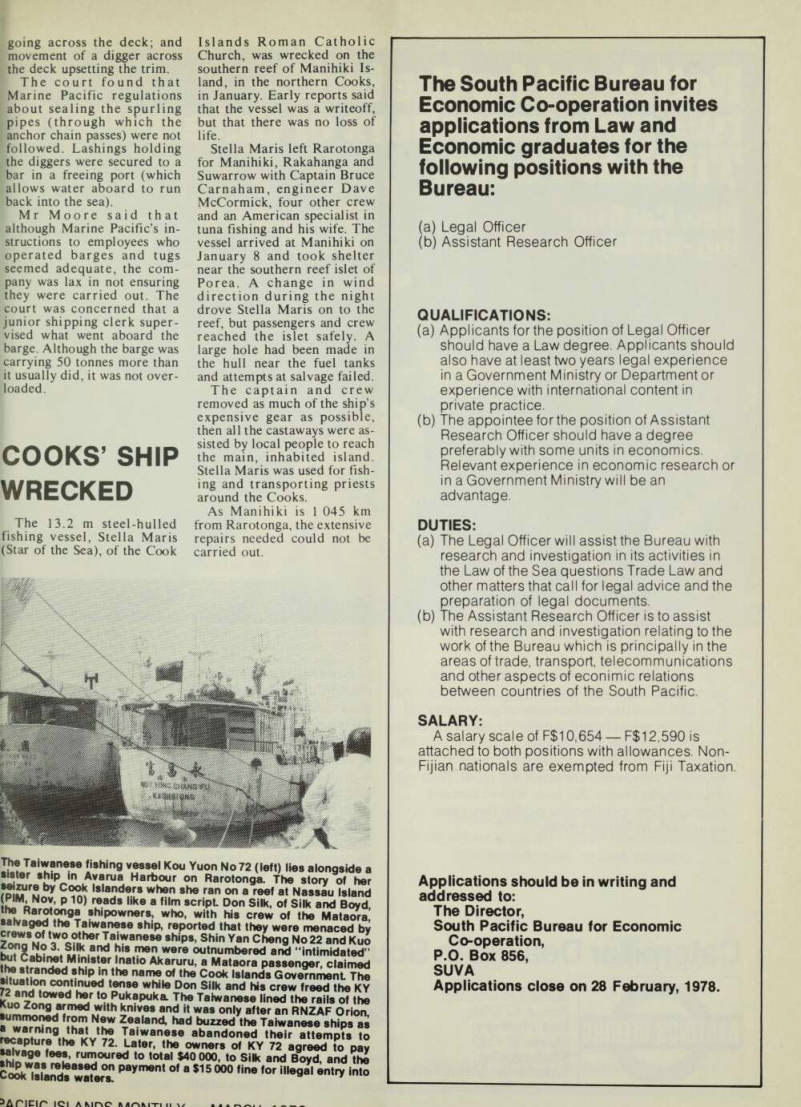
A king’s dream ship menaces Pacific Navigation of Tonga
King Taufa’ahau Tupou IV wants to shift the Tongan Government’s interest in overseas shipping from the tangible Kalia, operated by Pacific Navigation of Tonga, to a ship yet to be built. At tracted by the Columbus Line’s offer to Western Samoa of a ship which may be char tered to the Pacific Forum Line, he is seeking a similar deal for Tonga.
He said in his Christmas message it was necessary to review Tonga’s engagement in shipping because of an offer of assistance by the West Ger man Government in pro viding marine engineering, dockyard and other facilities.
West Germany calls its as sistance for undeveloped and
under-developed countries
economic co-operation. It is advised in shipping matters in the South Pacific by the Ham burg-based Columbus Line.
He considers that as Tonga is involved with the Pacific Forum Line, and because of West German (or Columbus) assistance to Western Samoa it would be beneficial to as sociate with Columbus. Ap parently, a new ship would be owned by the Shipping Cor poration of Polynesia, in which Columbus has a 60% interest. The Tongan Govern ment holds the other 40%. (In Western Samoa, the govern ment and Columbus are equal partners in a new company, Samoan Shipping Services Ltd, which will charter to the Pacific Forum Line a new ship now being built).
The king said Pacific Navigation of Tonga would :ontinue to operate, “but it would be to Tonga’s advan tage to extend shipping ac tivities over a wider field”. He also said Tonga would like to withdraw from its ar rangement with Pacific Navigation of Tonga and join Columbus.
He obviously takes the view hat if the Pacific Forum Line )perates a service covering he Australian east cost, Fiji, >amoa and Tonga there will >e no room for Pacific Navigation of Tonga, which il ready operates the service.
However, P & O, the J.
Lauritzen group, of Denmark, and Mr Alwyn Ellem, a Sydney business consultant, have good reason to feel ag grieved at the latest moves.
Tonga’s overseas shipping line, Pacific Navigation Co Ltd, was fast going broke when P & O and Mr Ellem were called in. P & O pro vided Mr George Fulcher to act as general manager of the shipping line while Mr Ellem took stock.
After a thorough investiga tion of the position it was de cided to form a new company, Pacific Navigation of Tonga, with Mr Fulcher as general manager.
In the second half of 1977, Pacific Navigation of Tonga started a five-weekly service from ports along the Australian east coast to Fiji, Tonga and Samoa with the Kalia of 9 150 tonnes. The new company is owned by the government and the J.
Lauritzen group, with Tonga
Transport
holding the major interest.
Pacific Navigation of Tonga has no financial or any other connection with Pacific Navigation Co Ltd, which is owned by the Tonga Govern ment. The new set-up seemed a nice tidy arrangement, back ed by experts, and was all set to operate profitably, once it was established. Mr Ellem, in the middle of 1977, said to PIM: “It (Pacific Navigation of Tonga) will operate profitably. It was just a matter of doing our homework and bringing sound, qualified management to the operation and the known shipping ex pertise of J. Lauritzen. The new firm will be soundly bas- When asked to comment on
the effect of Pacific Navigation of Tonga on the Pacific Forum Line, he said: “That is something for the separate governments to decide. In my opinion, if the Forum Line merely acted as a co-ordinating body, it would „ e ,K h i r i he , h . '"7 ° f the Islands. I don t believe the Forum Line can act as an op-
erator for all the Pacific Is lands nations”.
Some parts of the Pacific are now over-tonnaged.
Tonga itself is a good example with the Warner Line con sidering limiting some of its v * c ® s NWEW Zealand.
There is this to be said; Pacific Navigation of Tonga has a s hip and it is operating a via ble service.
Fiji captains in trouble over shipping mishaps
Two courts of marine inquiry in Fiji in January into shipping mishaps pointed to a lack of “tight ship” control by masters. One master lost his certificate and another was severely reprimanded, along with two senior officers. The president of the court in each case was Mr Kenneth Moore, a magistrate.
The vessels concerned were the Tabusoro, owned by the Marine Department, which went aground in Momi Passage, near Nadi, in September, 1977, and a barge, GM 10, owned by Marine Pacific Ltd, which capsized while under tow by a tug, the Wallacia, and sank in 750 fathoms about five nautical miles from Yanuca Island.
The court found that the grounding of the Tabusoro was solely the fault of the master, Captain Peni Tuitoma, and was caused by his incompetence. He failed to navigate his ship with the standard of care and competence required by the holder of a Master Fiji Islands Certificate.
He did not appear to have been alert enough to see a number of faults were rectified, yet from the time he took command he had problems with the main engine, the compass and the lights. He could not operate the ship s radar so left that to junior members of the crew.
Mr Moore said the ground ing appeared to have been caused by Tuitoma allowing the Tabusoro to drift while the generator belt was being repaired. He failed to clear the passage because he did not line the ship up with the lead ing lights and sail straight ahead. That showed he acted in a most incompetent man ner.
Jess James Dunn, chief engineer of the Tabusoro, was severely reprimanded as he had put to sea in the Tabusoro at a moment’s notice without familiarising himself with the workings of the machinery.
In the case of the GM 10, the court was unable to say with any degree of certainty why it sank. It was valued at $45 000 and was carrying two mechanical diggers, valued at $l3O 000, and about 426 000 L of fuel oil worth $52 000.
The court severely rep rimanded the master, Captain Anare Vuibureta, and the mate, Solomone Tokalau.
Mr Moore said it seemed fairly certain the barge was lost because of flooding of the swim end, resulting in trim by the stern. Possible causes were inadequate sacking in the spurling pipe to prevent water going into the barge, move ment of one of the diggers, causing a crack in the deck through which water entered; a partly-open hatch cover forced further open by water
going across the deck; and movement of a digger across the deck upsetting the trim.
The court found that Marine Pacific regulations about sealing the spurling pipes (through which the anchor chain passes) were not followed. Lashings holding the diggers were secured to a bar in a freeing port (which allows water aboard to run back into the sea).
Mr Moore said that although Marine Pacific’s in structions to employees who operated barges and tugs seemed adequate, the com pany was lax in not ensuring they were carried out. The court was concerned that a junior shipping clerk super vised what went aboard the barge. Although the barge was carrying 50 tonnes more than it usually did, it was not over loaded.
Cooks’ Ship
Wrecked
The 13.2 m steel-hulled fishing vessel, Stella Maris (Star of the Sea), of the Cook
Islands Roman Catholic Church, was wrecked on the southern reef of Manihiki Is land, in the northern Cooks, in January. Early reports said that the vessel was a writeoff, but that there was no loss of life.
Stella Maris left Rarotonga for Manihiki, Rakahanga and Suwarrow with Captain Bruce Carnaham, engineer Dave McCormick, four other crew and an American specialist in tuna fishing and his wife. The vessel arrived at Manihiki on January 8 and took shelter near the southern reef islet of Porea. A change in wind direction during the night drove Stella Maris on to the reef, but passengers and crew reached the islet safely. A large hole had been made in the hull near the fuel tanks and attempts at salvage failed.
The captain and crew removed as much of the ship’s expensive gear as possible, then all the castaways were as sisted by local people to reach the main, inhabited island.
Stella Maris was used for fish ing and transporting priests around the Cooks.
As Manihiki is 1 045 km from Rarotonga, the extensive repairs needed could not be carried out.
The Taiwanese fishing vessel Kou Yuon No 72 (left) lies alongside a sister ship in Avarua Harbour on Rarotonga. The story of her seiz ure by Cook I slan de rs when she ran on a reef at Nassau Island (PIM, Nov, p 10) reads like a film scri pt. Don Silk, of Silk and Boyd, the Rarotonga shipowners, who, with his crew of the Mataora, salv a ged the Tawanese ship, reported that they were menaced by crews of two other Ta iwanese ships, Shin Yan Cheng No 22 and Kuo Zong No3. Si lk an d hi s men were outnumbered and "intimidated” but Cabinet Minister Inatio Akaruru, a Mataora Passenger, claimed the stranded ship in the name of the Cook Islands Government The situation continued tense while Don Silk and his crew freed the KY 72 and towed her to Pukapuka. The Taiwanese lined the rails of the Kuo Zong armed with knives and it was only after an RNZAF Orion, summoned from New Zealand, had buzzed the Taiwanese ships as a warning that the Taiwanese abandoned their attempts to recapture the KY 72. Later, the owners of KY 72 agreed to pay salvage fees, rumoured to total $40 000, to Silk and Boyd, and the ship was released on pay ment of a $15 000 fine for illegal entry into Cook Islands waters.
Advertisements & other items, pp. 63-66 (5 items)
> Arii:ir ici A MHO K |-ri II \ / >a • . .
DArmir iqi amdq MOMTHI V MARCH. 1978
nusißHimn
FOOD HOD
BEUERRCES
good to eot...good to sell
Australian food and beverages give the consumer quality and value. They give the importer increased business. And there's such a great variety available.
Widely different climatic conditions enable Australia to produce some of the finest food in the world.
Australia is one of the world’s largest suppliers of wheat, sugar, meat, canned fruits, dried fruits, fresh fruits and dairy products.
There is also strong international demand for Australian seafoods, honey, jam. vegetables, wines and beers.
Over 1.00 countries are supplied by Australia.
And the list of customers is growing.
Quality and value that’s only hours away The Australian Trade Commissioner can give you details of suppliers. He can also advise Pacific Islands exporters on ways to research or develop markets in Australia.
You can contact him at; — FIJI: 7th Floor, Dominion House, Thomson Street, Suva. (Post Office Box 1252.) Telephone; 312844.
PAPUA NEW GUINEA;
Australian High Commission P.O. Box 9.129, Hohola.
Telephone; 259333. 1 O' m Wa
tOQO
m t=3
4% Ask the Australian Trade Commissioner
The South Pacific Bureau for
Economic Co-operation invites
applications from Law and
Economic graduates for the
following positions with the
Bureau:
(a) Legal Officer (b) Assistant Research Officer
QUALIFICATIONS:
(a) Applicants for the position of Legal Officer should have a Law degree. Applicants should also have at least two years legal experience in a Government Ministry or Department or experience with international content in private practice. (b) The appointee for the position of Assistant Research Officer should have a degree preferably with some units in economics.
Relevant experience in economic research or in a Government Ministry will be an advantage.
DUTIES:
(a) The Legal Officer will assist the Bureau with research and investigation in its activities in the Law of the Sea questions Trade Law and other matters that call for legal advice and the preparation of legal documents. (b) The Assistant Research Officer is to assist with research and investigation relating to the work of the Bureau which is principally in the areas of trade, transport, telecommunications and other aspects of econimic relations between countries of the South Pacific.
SALARY:
A salary scale of F 510,654 F 512,590 is attached to both positions with allowances. Non- Fijian nationals are exempted from Fiji Taxation.
Applications should be in writing and addressed to: The Director, South Pacific Bureau for Economic Co-operation, P.O. Box 856,
SUVA
Applications close on 28 February, 1978.
Both bred for the bush
TTpTnl
Timber Team
New Cat 528
New Cat 528
log-skldder
m f.
It's another step ahead towards more profitable, more efficient logging operations: Cat 528 Skidder with major improvements.
Now rear wheel caliper disc brakes increase service braking pad contact surface by 78%, thereby extending brake life. There are three master cylinders, one each for front, rear and driveline systems. All four wheel brakes engage first; additional pedal depression engages driveline brake.
Caterpillar 528 Winch has power control design to allow "winching on-the-go". Winch and skidder can be operated simultaneously.
Other features include oil disc clutch and brake to extend service life; complete sealing maintains rated capacity; winch brake accumulator allows load release from dead engine; adjustable free spool drag lets operator pull line uphill or down without cable balling. Other helpful features too!
Send for literature or talk to your Caterpillar representative.
Caterpillar Dealers in South-West Pacific.
Lae: Milford Haven Rd.
Phone 42 2355.
Port Moresby: Phone 21 2122.
Bougainville: Itakara Industrial Park, Arawa. Phone 95 9077. c
carptrac
Lautoka: Labasa; Veitari Lautoka Vulovi Labasa Phone 61877 Phone 81888 Suva: Carptrac Carpenter Street Raiwai Suva Phone 381622 Telex FJ2190 Cables CARPTRAC HD 657
Ici Amhc H Aamti Ii W >I> Nm . -
n A dcir* id AMne MHMTWI V MARCH 1978
Briefly
• Western Samoa’s new ferry, the Queen Salamasina, 784 tonnes, which was a gift from the Australian Govern ment, was taken to Suva for repairs to the shaft propeller and another propeller. The damage occurred when the fe rry was negotiating the entrance to Apia Harbour on her seventh trip between the two Samoas. Carpenters In dustrial, which has a contract with the Western Samoa Government, are repairing the ferry. The other inter island ferry, the Limulimutau, was also out of action through damage incurred when she went aground on Salelologa Reef. The bottom hull and the propellers were affected. The Limulimutau was to go to the Pago Pago slipway. While the ferries are out of action fur ther renovations will be car ried out at Mulifanua and Salelologa wharves. These will include enlarging the turning basins to allow the Queen Salamasina to manoeuvre freely, widening and deepening the entrance channels and fencing the passenger terminals. • The Shipping Cor poration of NZ has introduc ed two unit load ships to the Auckland-Niue-Cook Islands service, which has been ex tended to take in Tahiti.
These ships are the Tiare Moana (formerly the Nordkyn) and a sister ship, the Fetu Moana (formerly the Vagan). The service offered by the two ships is based on pallets and other similar units and replaces the service by the conventional ships Toa Moana, Lorena and Luhe sand. The Luhesand will be returned to her owners in West Germany. She was op erated under USS Co man agement on contract to the NZ Government. • The Western Samoa Government intends to buy a Boeing 737 for Polynesian Airlines to use on regular lights to New Zealand, via Fonga. The government is looking for delivery about nid-1979. • The 9 000-tonne Japanese bulk timber carrier Hodai- Maru was refloated tfter stranding for seven lours on a mudbank near the mtrance to Rabaul Harbour
in mid-January. The ship op erates a regular service to Japan from logging ports on the coast of New Britain and was southbound in ballast when the grounding occurred.
She continued her voyage after an inspection revealed no hull damage. • The Pacific was reluctant to let the Monterey go. On her last voyage, after more than 20 years of cruising from San Francisco and Los Angeles to the South Pacific, the luxury cruiser ran into Hurricane Bob between New Caledonia and Fiji. Hove-to for 36 hours, she had to ride out rough weather with waves 9 m to 11 m high. Two passengers were injured and a lot of crockery was broken. One of the injured passengers had a cut below an eye which re quired stitching. The Mon terey made up some time when the seas became calmer, but was still 24 hours late when she arrived at Pago Pago. • The US Corps of Engineers awarded a $4 484 084 contract to Hawaiian Dredging & Con struction Co of Micronesia to build the Majuro dock and harbour complex on Dalap.
Their bid was the lowest of the six received. The dock will be on the lagoon side of western Dalap, and will replace the existing port at Uliga Island which is inadequate. There will be about 4 000 metres of wharf space and 10.7 ha back up area for future container
development.
• The Fiji Government has approved a new type of fare for PAA which will con siderably cut travel costs be tween Fiji and the United States. The fares, which came into force from February 5, will allow passengers to fly from Nadi to the US and back for $4BB, compared with the normal economy fare of $1 080. The Nadi-Honolulu return trip will drop from $B6B to $338. To qualify for the cheap fares a passenger books 21 days in advance of the week of travel, and is told the exact days of the flights a week before flying. • Pan American World Airways has cut out one of its three weekly flights between American Samoa and Hawaii, because of fare reductions and because there are not enough passengers to justify three flights.
Advertisements & other items, pp. 67-68 (3 items)
ICI A MPvO RiIAMTI II \/ ft « a n/M i
exporter
THI
pa£!o£
UaiYi«y
TIT"
Breckwoldt & Co
P ij Ltd
276 Pitt Street, Box 5027, G.P.O. Sydney 2001
CABLE ADDRESS: BREWO SYDNEY
TELEX: AA22890
TELEPHONES: 233-2366, 233-1460, 233-1462
PACIFIC ISLAND OFFICES •
BRECKWOLDT & CO (PNG) PTY. LTD.
PO BOX 1549, BOROKO, PORT MORESBY.
PO BOX 222, RABAUL
PO BOX 72, KIETA
PO BOX 178, WEWAK
PO BOX 185, MADANG
PO BOX 237, MT. HAGEN
PO BOX 1188, LAE
BRECKWOLDT & CO., PO BOX 47, APIA BRECKWOLDT & CO. (SI) LTD. PO BOX 140, HONIARA
BRECKWOLDT SARL BP 2369, NOUMEA
OFFICES IN:
HAMBURG
LONDON
MILAN
& WEST AFRICA
ALSO AT;
SINGAPORE
KUALA LUMPUR
BANGKOK
& HONG KONG
ENQUIRIES
FROM OVERSEAS MANUFACTURERS INVITED.
S.E. TATH AM & CO. PTY. LTD
BEEHIVE BUILDING.
94 ELIZABETH STREET.
G.P.O. BOX 8.
MELBOURNE 3001,
AUSTRALIA. o
CABLES; "SET’:
TELEX: AA34552.
TELEPHONE: 63 5094
r.
G * •M *
...BUYERS for the
PACIFIC ISLANDS.
PAPUA NEW GUINEA:
S. E. TATHAM (P N G.) PTY. LTD.
LAE: MALAITA ST. (P.O. BOX 1562).
PORT MORESBY: Cm. GOROA & MANAHU Sts.,
GORDON (P.O. BOX 6733, BOROKO).
TELEGRAMS: ALL OFFICES “SET’.’
FOR SERVICE
YOUR GUARANTEE
SINCE 1924
DA<~icir' ICI a wnQ monithi Y MARCH. 197?
Yachts
Cruising
• I LOVE YOU 11, 16 8 m American ketch-rigged catamaran, late in January was well overdue at Auckland, after having sailed from Vavau in Tonga on November 18. On board were owner Donald Glidden and 20-years-old Mercy Ewing, of Noroton, US.
A search operation from New Zealand failed to locate I Love You 11. An Australian ore car rier, the Jeparit, reported that on December 22, about 9 am, she believed she had sighted I Love You II about 150 nauti cal miles north-west of New Zealand, and headed west.
The catamaran has an orange hull with 15.24 m yellow masts. Glidden is reported to have disappeared before for several months. Mercy’s father would be pleased to hear from anybody who may have seen or heard of I Love You II since November 18. He may be reached at Box 3412 Noroton CT, 06820, US. • KALAIS, 21.34 m steel <etch, in French Polynesia for he hurricane season, has a mercy mission to its credit.
Owners Vic and Prisca Ware }uier, of Belgium, volunteered o carry a gravely-ill infant rom Raivavae to Tubuai vhere there was a doctor and rom where the infant could be lown to hospital in Tahiti. The nfant’s father and a nurse vent with them for the trip from Raivavae to Tubuai. Kalais lad arrived at Raivavae two veeks earlier from New Zea and, after a three-month
voyage. They left Belgium nearly six years ago, and after cruising in the Atlantic passed through Panama Canal. They stopped in the Marquesas, Society Islands and Tonga on their way to NZ, where they worked for a year. In Raivavae they are preparing Kalais for ocean sailing again at the end of the hurricane season.
• Mata Moana, 5.5 M
long boat, was a recent arrival in Tahiti from Auckland, carry ing owner-builder, Viliami Fehoko, 23, of Tonga, who sailed single-handed. Viliami left Auckland in May, 1977.
He had an early mishap when the rudder was damaged only 32 km from Auckland, but car ried on. The Mata Moana capsized twice in bad weather before she reached the Cook Islands.
• White Cloud, Dulce
Setterfield has written to PIM for help. She is anxious to contact a 32-metre Norwegian schooner, White Cloud, prob ably flying the Canadian Flag.
She had an appointment with the skipper at Apia but failed to make contact with White Cloud. If anyone can give her any information as to the whereabouts of the yacht, please write to her at 5016 21st Avenue NE Seattle, Wa
98105 Usa.
• MINAMI ATUA, a 9 8 m Hartley-design ferrocement yacht, is now sailing through Micronesia after spending four months cruising around Fiji and Tuvalu. Jon Brett, the owner, and his crew, Bev Johns, Yoshimi Kazahaya and Rog McNaughton are finding that Pacific Islanders’ hospitality is causing them to get way behind schedule.
However, they have conve niently avoided two tropical cyclones (Steve and Mary) due to delayed departures.
Advertisements & other items, p. 69 (2 items)
Af'lClf' IPI A niPvn > lAti-r. .. ... . .
Master,
MACKEREL
PACKED BY :
NIPPON SUISAN KAISHA, LTD.
* “Master ” Brand Canned Mackerel, Canned Sardines and other Canned Fish. * “House” Brand Instant Noodle, Soup & Desserts, all kinds of Spices and Japanese Soy Sauce. * Groceries, Confectionary, Beverage, etc. * Hand Tools, B m iders & Cabinet Hardware, Plasticware, Chmaware, Kitchenware. * Building Materials, Plywood, Hardbord, Formica, Tiles, Wall Paper, etc. * Steel Products: Round, Square, Flat, Angle, Channel Bars, Iron Sheet, Pipes & Fitting. * Machinery, Motor Spare Parts, Batteries and Accessories. * Electric Household Appliances & “Daikm” Air Conditioners. * Sporting Goods, Fishing Rods & Reel, Accessories for Boat & Yacht. * “Hadson” Pocket & Table Lighters, Disposable Butane Lighters. * Soaps, Hair Shampoo, Detergents, Toiletries. * Various Novelties, Ornaments, Souvenir Items. * “New Jet Type” Labeler & Other Daily Stuff.
UNITRADE COMPANY,LIMITED
Sanritsu Building 11-12 3-chome Hachobori Chuo-ku Tokyo (104)
TELEX NO. : “252-4665 KANDK J”
CABLE ADDRESS : “KAYANDKAY TOKYO"
TELEPONE NO. : 03-553-9520
Resident Representives in Fiji, P.N.G., Philippines, Hong Kong & Singapore
BRAND
GENERAL MERCHANTS
EXPORTERS & IMPORTERS
FIBRE GLASS BOAT - FOR SALE:
Motor Vessel Liutasi, 35 foot 6 ins. in length with Fibre Glass hull. The Marine Certificate states as follows, "Gardner 4 L.W. Diesel, 48 8.H.P., 35 ft. 6 ins. in length, 11 ft. wide, 4 ft. 6 ins. depth.
Gross tonnage 13.17., Minimum freeboard 18 ins., 196 Gals, fuel, 19 coastal passengers." Marine ply super structure. Ample crew accomodation. Front and back holds. Price is open to negotiation.
Delivery early in February 1978.
Enquiries to: 'ATASI', P.O. Box 101, Honiara.
Solomon Islands,
The Golden Odyssey of a Fiji
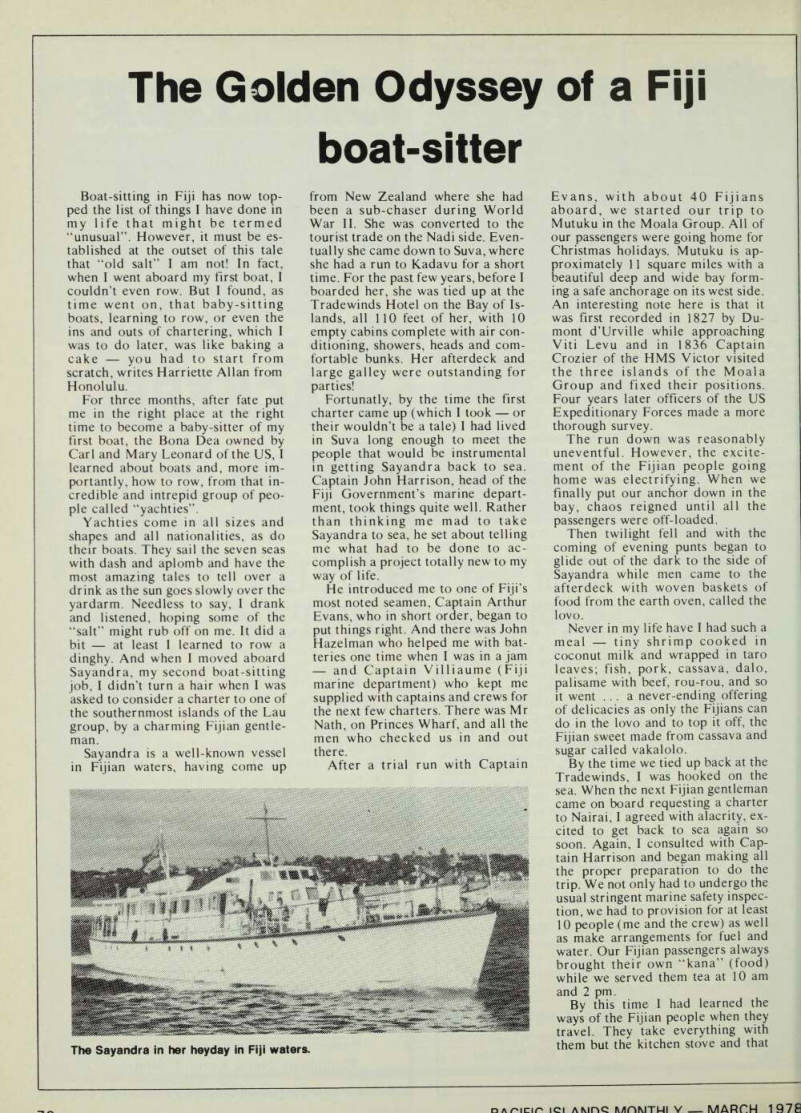
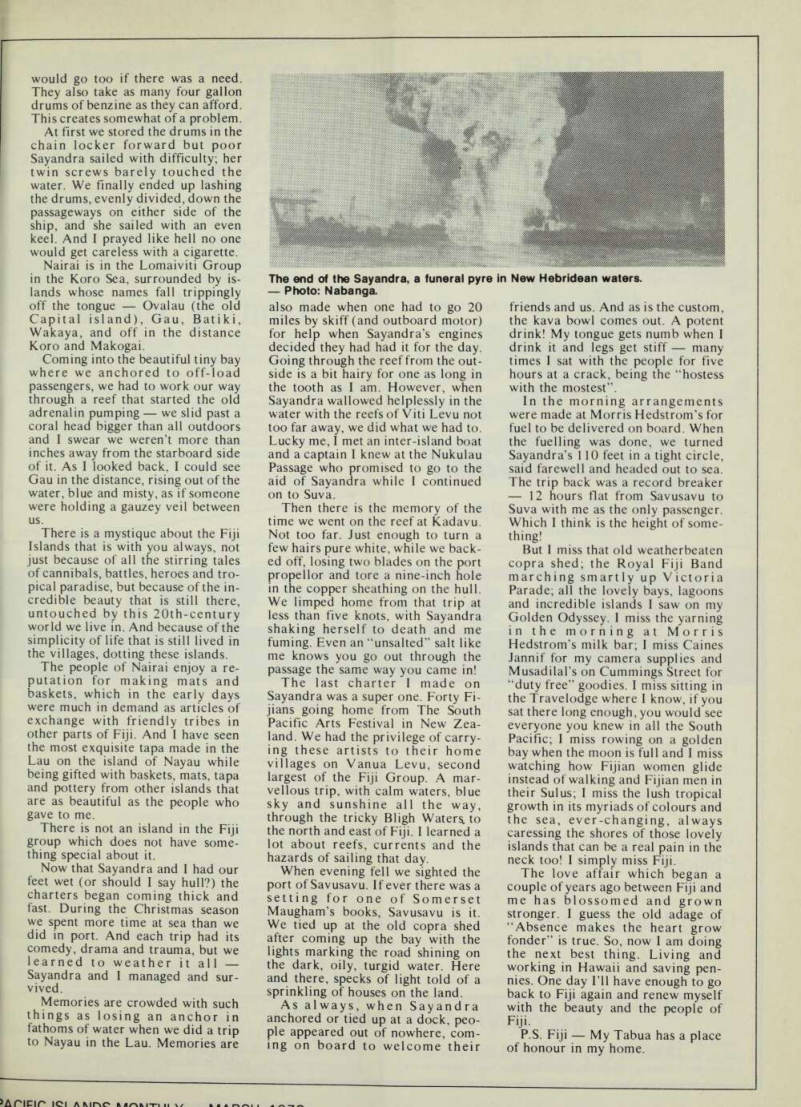
boat-sitter
Boat-sitting in Fiji has now top ped the list of things I have done in my life that might be termed “unusual”. However, it must be es tablished at the outset of this tale that “old salt” I am not! In fact, when I went aboard my first boat, I couldn’t even row. But I found, as time went on, that baby-sitting boats, learning to row, or even the ins and outs of chartering, which I was to do later, was like baking a cake you had to start from scratch, writes Harriette Allan from Honolulu.
For three months, after fate put me in the right place at the right time to become a baby-sitter of my first boat, the Bona Dea owned by Carl and Mary Leonard of the US, I learned about boats and, more im portantly, how to row, from that in credible and intrepid group of peo ple called “yachties”.
Yachties come in all sizes and shapes and all nationalities, as do their boats. They sail the seven seas with dash and aplomb and have the most amazing tales to tell over a drink as the sun goes slowly over the yardarm. Needless to say, I drank and listened, hoping some of the “salt” might rub off on me. It did a bit at least I learned to row a dinghy. And when I moved aboard Sayandra, my second boat-sitting job, I didn’t turn a hair when I was asked to consider a charter to one of the southernmost islands of the Lau group, by a charming Fijian gentle man.
Sayandra is a well-known vessel in Fijian waters, having come up
from New Zealand where she had been a sub-chaser during World War 11. She was converted to the tourist trade on the Nadi side. Even tually she came down to Suva, where she had a run to Kadavu for a short time. For the past few years, before I boarded her, she was tied up at the Tradewinds Hotel on the Bay of Is lands, all 110 feet of her, with 10 empty cabins complete with air con ditioning, showers, heads and com fortable bunks. Her afterdeck and large galley were outstanding for parties!
Fortunatly, by the time the first charter came up (which I took or their wouldn't be a tale) I had lived in Suva long enough to meet the people that would be instrumental in getting Sayandra back to sea.
Captain John Harrison, head of the Fiji Government's marine depart ment, took things quite well. Rather than thinking me mad to take Sayandra to sea, he set about telling me what had to be done to ac complish a project totally new to my way of life.
He introduced me to one of Fiji’s most noted seamen. Captain Arthur Evans, who in short order, began to put things right. And there was John Hazelman who helped me with bat teries one time when I was in a jam and Captain Villiaume (Fiji marine department) who kept me supplied with captains and crews for the next few charters. There was Mr Nath, on Princes Wharf, and all the men who checked us in and out there.
After a trial run with Captain
Evans, with about 40 Fijians aboard, we started our trip to Mutuku in the Moala Group. All of our passengers were going home for Christmas holidays. Mutuku is ap proximately 11 square miles with a beautiful deep and wide bay form ing a safe anchorage on its west side.
An interesting note here is that it was first recorded in 1827 by Du mont d’Urville while approaching Viti Levu and in 1836 Captain Crozier of the HMS Victor visited the three islands of the Moala Group and fixed their positions.
Four years later officers of the US Expeditionary Forces made a more thorough survey.
The run down was reasonably uneventful. However, the excite ment of the Fijian people going home was electrifying. When we finally put our anchor down in the bay, chaos reigned until all the passengers were off-loaded.
Then twilight fell and with the coming of evening punts began to glide out of the dark to the side of Sayandra while men came to the afterdeck with woven baskets of food from the earth oven, called the lovo.
Never in my life have I had such a meal tiny shrimp cooked in coconut milk and wrapped in taro leaves; fish, pork, cassava, dalo, palisame with beef, rou-rou, and so it went ... a never-ending offering of delicacies as only the Fijians can do in the lovo and to top it off, the Fijian sweet made from cassava and sugar called vakalolo.
By the time we tied up back at the Trade winds, I was hooked on the sea. When the next Fijian gentleman came on board requesting a charter to Nairai, I agreed with alacrity, ex cited to get back to sea again so soon. Again, I consulted with Cap tain Harrison and began making all the proper preparation to do the trip. We not only had to undergo the usual stringent marine safety inspec tion, we had to provision for at least 10 people (me and the crew) as well as make arrangements for fuel and water. Our Fijian passengers always brought their own “kana” (food) while we served them tea at 10 am and 2 pm.
By this time I had learned the ways of the Fijian people when they travel. They take everything with them but the kitchen stove and that
The Sayandra in her heyday in Fiji waters.
would go too if there was a need.
They also take as many four gallon drums of benzine as they can afford.
This creates somewhat of a problem.
At first we stored the drums in the chain locker forward but poor Sayandra sailed with difficulty; her twin screws barely touched the water. We finally ended up lashing the drums, evenly divided, down the passageways on either side of the ship, and she sailed with an even keel. And I prayed like hell no one would get careless with a cigarette.
Nairai is in the Lomaiviti Group in the Koro Sea, surrounded by is lands whose names fall trippingly off the tongue Ovalau (the old Capital island), Gau, Batiki, Wakaya, and off in the distance Koro and Makogai.
Coming into the beautiful tiny bay where we anchored to off-load passengers, we had to work our way through a reef that started the old adrenalin pumping we slid past a coral head bigger than all outdoors and I swear we weren’t more than inches away from the starboard side of it. As I looked back, I could see Gau in the distance, rising out of the water, blue and misty, as if someone were holding a gauzey veil between us.
There is a mystique about the Fiji Islands that is with you always, not just because of all the stirring tales of cannibals, battles, heroes and tro pical paradise, but because of the in credible beauty that is still there, untouched by this 20th-century world we live in. And because of the simplicity of life that is still lived in the villages, dotting these islands.
The people of Nairai enjoy a re putation for making mats and baskets, which in the early days were much in demand as articles of exchange with friendly tribes in other parts of Fiji. And I have seen the most exquisite tapa made in the Lau on the island of Nayau while being gifted with baskets, mats, tapa and pottery from other islands that are as beautiful as the people who gave to me.
There is not an island in the Fiji group which does not have some thing special about it.
Now that Sayandra and I had our feet wet (or should I say hull?) the charters began coming thick and fast. During the Christmas season we spent more time at sea than we did in port. And each trip had its comedy, drama and trauma, but we learned to weather it all Sayandra and I managed and sur vived.
Memories are crowded with such things as losing an anchor in fathoms of water when we did a trip to Nayau in the Lau. Memories are
also made when one had to go 20 miles by skiff (and outboard motor) for help when Sayandra’s engines decided they had had it for the day.
Going through the reef from the out side is a bit hairy for one as long in the tooth as I am. However, when Sayandra wallowed helplessly in the water with the reefs of Viti Levu not too far away, we did what we had to.
Lucky me, I met an inter-island boat and a captain I knew at the Nukulau Passage who promised to go to the aid of Sayandra while I continued on to Suva.
Then there is the memory of the time we went on the reef at Kadavu.
Not too far. Just enough to turn a few hairs pure white, while we back ed off, losing two blades on the port propeller and tore a nine-inch hole in the copper sheathing on the hull.
We limped home from that trip at less than five knots, with Sayandra shaking herself to death and me fuming. Even an “unsalted” salt like me knows you go out through the passage the same way you came in!
The last charter I made on Sayandra was a super one. Forty Fi jians going home from The South Pacific Arts Festival in New Zea land. We had the privilege of carry ing these artists to their home villages on Vanua Levu, second largest of the Fiji Group. A mar vellous trip, with calm waters, blue sky and sunshine all the way, through the tricky Bligh Waters, to the north and east of Fiji. I learned a lot about reefs, currents and the hazards of sailing that day.
When evening fell we sighted the port of Savusavu. If ever there was a setting for one of Somerset Maugham’s books, Savusavu is it.
We tied up at the old copra shed after coming up the bay with the lights marking the road shining on the dark, oily, turgid water. Here and there, specks of light told of a sprinkling of houses on the land.
As always, when Sayandra anchored or tied up at a dock, peo ple appeared out of nowhere, com ing on board to welcome their
friends and us. And as is the custom, the kava bowl comes out. A potent drink! My tongue gets numb when I drink it and legs get stiff many times I sat with the people for five hours at a crack, being the “hostess with the mostest”.
In the morning arrangements were made at Morris Hedstrom’s for fuel to be delivered on board. When the fuelling was done, we turned Sayandra’s 110 feet in a tight circle, said farewell and headed out to sea.
The trip back was a record breaker 12 hours flat from Savusavu to Suva with me as the only passenger.
Which I think is the height of some thing!
But I miss that old weatherbeaten copra shed; the Royal Fiji Band marching smartly up Victoria Parade; all the lovely bays, lagoons and incredible islands I saw on my Golden Odyssey. I miss the yarning in the morning at Morris Hedstrom’s milk bar; 1 miss Caines Jannif for my camera supplies and Musadilal’s on Cummings Street for “duty free” goodies. I miss sitting in the Travelodge where I know, if you sat there long enough, you would see everyone you knew in all the South Pacific; I miss rowing on a golden bay when the moon is full and I miss watching how Fijian women glide instead of walking and Fijian men in their Sulus; I miss the lush tropical growth in its myriads of colours and the sea, ever-changing, always caressing the shores of those lovely islands that can be a real pain in the neck too! I simply miss Fiji.
The love affair which began a couple of years ago between Fiji and me has blossomed and grown stronger. I guess the old adage of “Absence makes the heart grow fonder” is true. So, now I am doing the next best thing. Living and working in Hawaii and saving pen nies. One day I’ll have enough to go back to Fiji again and renew myself with the beauty and the people of
Fiji.
P.S. Fiji My Tabua has a place of honour in my home.
The end of the Sayandra, a funeral pyre in New Hebridean waters. -Photo: Nabanga.
Advertisements & other items, pp. 70-72 (4 items)
□ Aricip Ici Amhq Mnmtwi V March 1978
>Ani:ir > ici AMrvO MAtITI M \/ >a A n/M ■ <
Papifir Iri Andr Monthly March. 1 97S
Kyowa Line
PACIFIC
ISLANDS
TRANSPORT
LINE
Owners: Thor Dahls Hvalfangerseiskap A/S - Sandefjord, Norway.
MS CAMELLIA VENTURE
Express Freight Service between Pacific Coast Ports of U.S.A. and...
Tahiti 6 Samoa
Full container service including reefers.
GENERAL STEAMSHIP CORPORATION LTD.
General Agents 400 California Street, San Francisco, California, U.S.A.
APIA: Burns Philp (South Sea) Company Ltd.
PAPEETE: Agence Maritime Internationale, Tahiti.
PAGO PAGO: Polynesia Shipping Services Inc.
NOUMEA: Establissements Ballande.
SYDNEY: Trans-Austral Shipping Pty. Ltd SUVA: Bums Philp (South Sea) Company Ltd.
LAE/RABAUL: Burns Philp (New Guinea) Ltd.
PORT VILA: Comptoirs Francais de Nouvelles Hebrides.
Regular
Pacific Services
"Union South Pacific”, cellular container vessel. Reefer and general cargo from Auckland at approximately fortnightly intervals. Calls at Suva, Pago Pago, Apia and Nukualofa before returning to Auckland.
"Luhesand”, conventional reefer and general cargo. Monthly sailings from Auckland, calls at Suva, Apia, Papeete and Nukualofa.
jmimwuon
gm/Mcompmi/
Branches at all main Australian, New Zealand and Pacific Island ports
KYOWA LINE
YOUR TRADING PARTNER
Monthly Services
Hong Kong, Taiwan, S. Korea, Japan
To: British Solomon, New Caledonia, Fiji, W Samoa, A. Samoa. Tahiti, Cook Is., Tonga, New Hebrides.
Ellice Is.,
Taiwan,Hong Kong,Singapore,Jakarta,
Philippine
To: Australia, Papua New Guinea, Sabah &. Sarawak.
Hong Kong, Taiwan, S. Korea, Japan
To: Guam, Saipan, Truk, Ponape, Other Pacific Islands.
mammmA gents
Taiwan: Royal Steamship Corp, Ltd., Taipei S. Korea: Dong Sue Shipping Co, Ltd.. Seoul Hong Kong: Dahzun Enterprises Ltd.
Singapore: Ocean Shipping & Enterprises Pte., Ltd.
Guam: Maritime Agencies of Pacific Ltd., Guam Saipan: Saipan Shipping Co., Inc., Saipan B.S.I.P.: Solomon Taiyo Ltd , Honiara Tahiti: J A. Cowan & Fils, Papeete Cooks: Eastern Associates Ltd , Rarotonga Tonga: EM Jones Ltd, Nukualofa New Hebrides; Agence Maritime Raymond Velicite, Port Vila A.Samoa: Island Pacific Agencies Inc., Pago Pago W. Samoa; Morris Hedstrom Ltd, Apia Fiji: Carpenter Shipping, Suva & Lautoka PNG: Carpenter Shipping Agencies, Port Moresby, Rabaul New Caledonia: Agence Maritime Du Rond Point Du Pacific, Noumea Indonesia: P T Porodisa Raya Shipping Lines, Jakarta Sabah: KOH Han Ming Shipping & Forwarding Agent., Kotakmabalu Sarawak: Pan Sarawak Agencies Sdn Bhd , Sibu & Kuching Australia: Hethenngton Kingsbury Pty Ltd, Sydney, NSW Newzealand: Sofrana Umlmes S A , Auckland
KYOWA SHIPPING CO., LTD.
HEAD OFFICE
5th FI., Suzumaru Bldg. 39-8, 2-chome, Nishi-Shinbashi, Minato-ku, Tokyo, Japan.
Phone : 03(437)2885(Rep.) Cables : “MARIQUEEN” Tokyo. Telex : 242-4651 Kyowa J.
OSAKA OFFICE
Frontier Bldg., 3-13 Hirano-cho, Higashi-ku, Osaka, Japan.
Phone : 06(227)0422(Rep.) Cables : “MARIQUEEN” Osaka. Telex : 522-3896 Kyowa 0.
Shipping
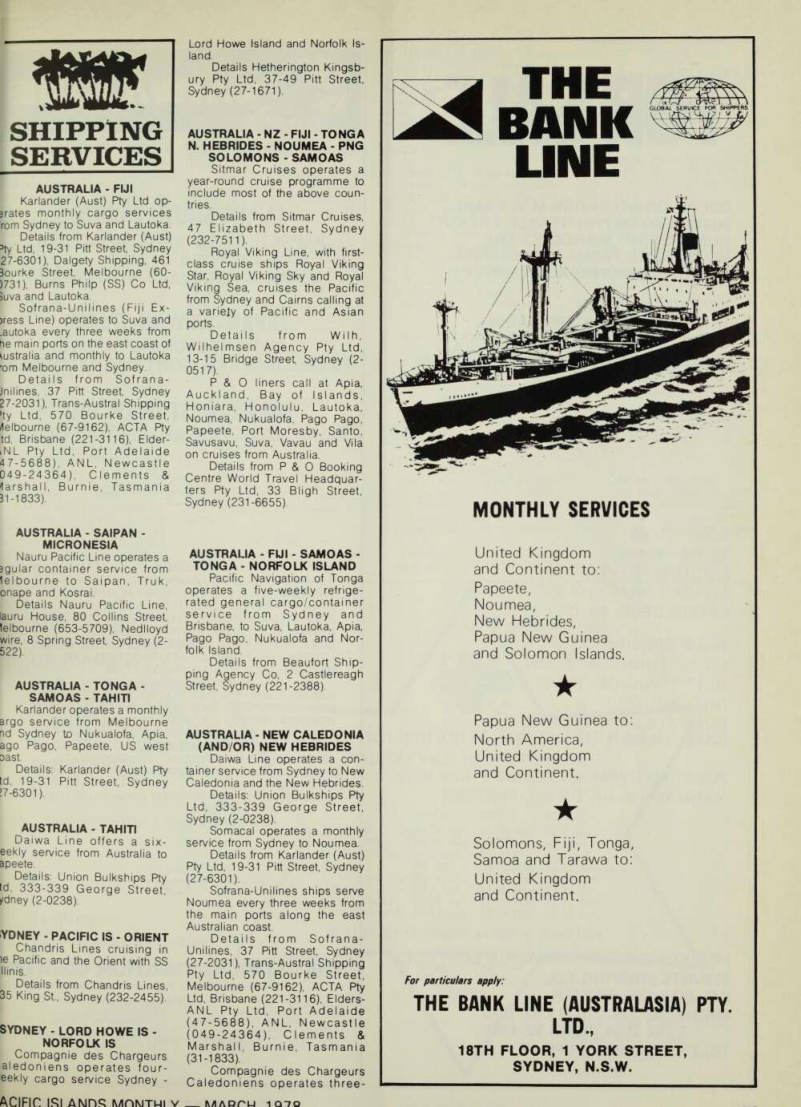
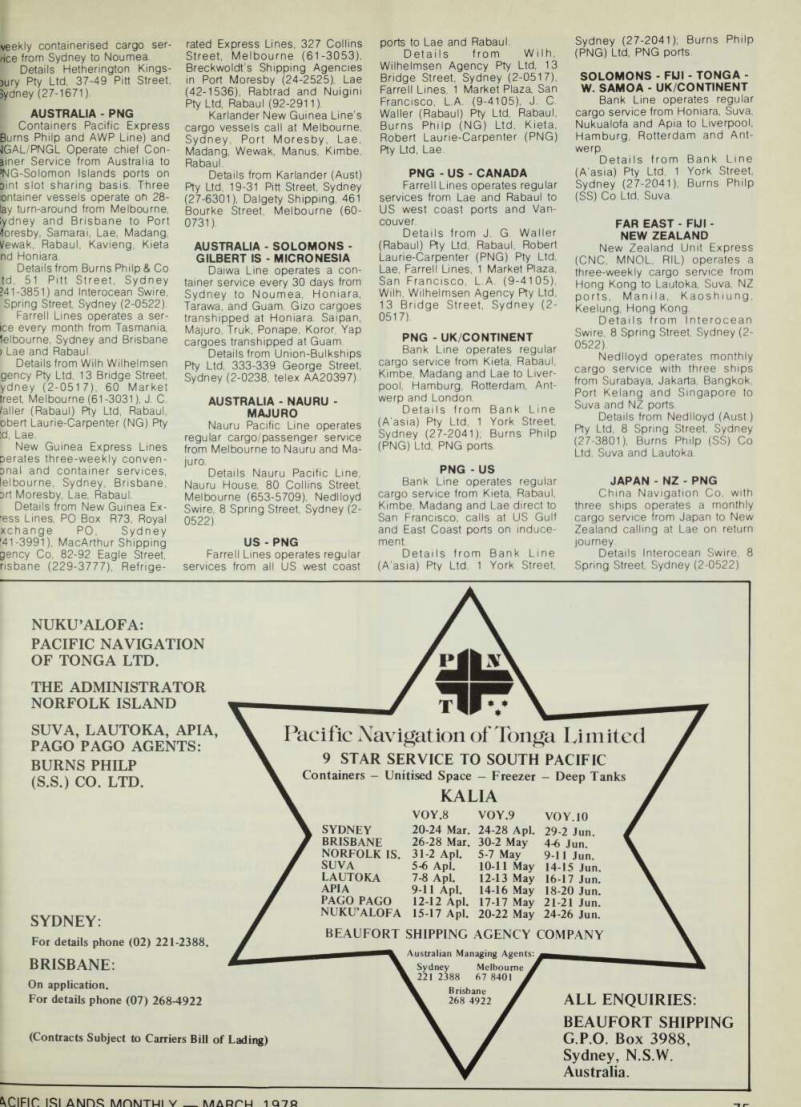
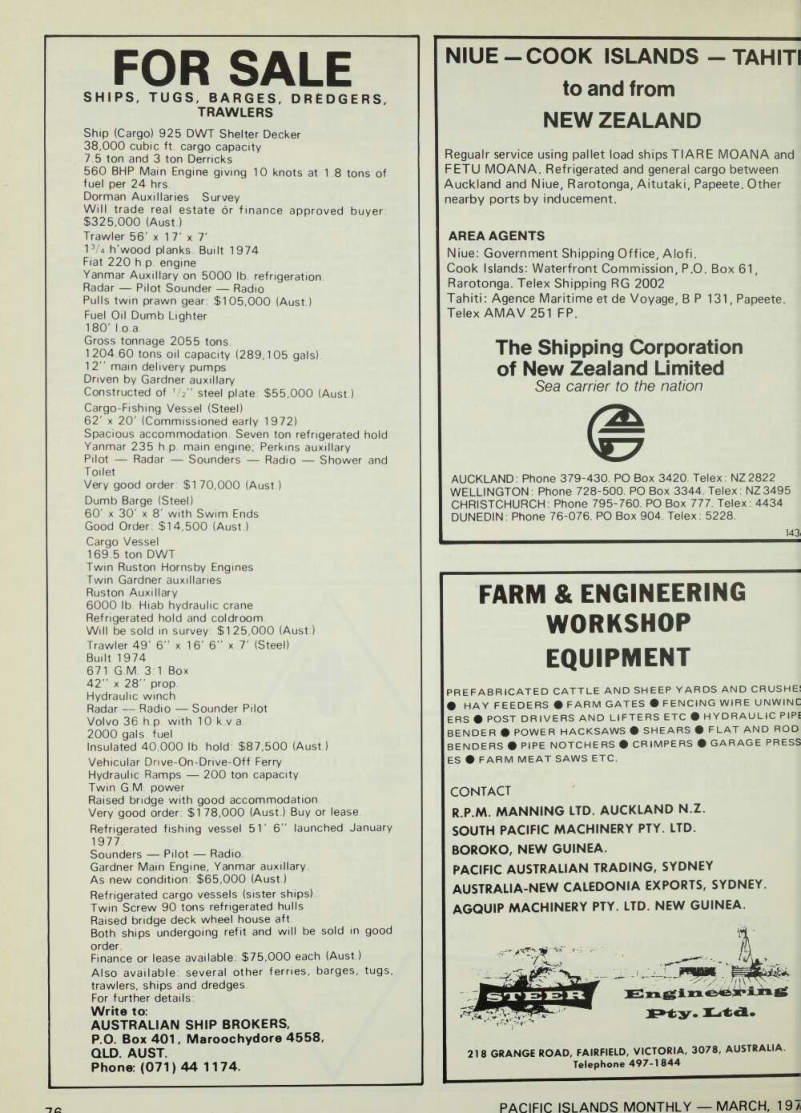
Services
Australia - Fiji
Karlander (Aust) Pty Ltd op jrates monthly cargo services rom Sydney to Suva and Lautoka.
Details from Karlander (Aust) Ltd, 19-31 Pitt Street, Sydney 27-6301), Dalgety Shipping, 461 Bourke Street, Melbourne (60- )731), Burns Philp (SS) Co Ltd.
Suva and Lautoka.
Sofrana-Unilines (Fiji Ex cess Line) operates to Suva and .autoka every three weeks from he main ports on the east coast of Australia and monthly to Lautoka r om Melbourne and Sydney.
Details from Sofrana- JnMines, 37 Pitt Street, Sydney 27-2031), Trans-Austral Shipping 'ty Ltd, 570 Bourke Street, Melbourne (67-9162), ACTA Pty td, Brisbane (221-3116), Elder iNL Pty Ltd, Port Adelaide 47-5688), ANL, Newcastle 049-24364), Clements & larshall, Burnie, Tasmania 81-1833).
Australia - Saipan -
Micronesia
Nauru Pacific Line operates a jgular container service from lelbourne to Saipan, Truk, onape and Kosrai.
Details Nauru Pacific Line, lauru House, 80 Collins Street, lelbourne (653-5709), Nedlloyd wire, 8 Spring Street, Sydney (2- 522).
Australia - Tonga -
Samoas - Tahiti
Karlander operates a monthly argo service from Melbourne nd Sydney to Nukualofa, Apia, ago Pago, Papeete, US west oast.
Details: Karlander (Aust) Pty td, 19-31 Pitt Street, Sydney 7-6301).
Australia - Tahiti
Daiwa Line offers a six eekly service from Australia to apeete.
Details; Union Bulkships Pty td, 333-339 George Street (2-0238).
Ydney - Pacific Is - Orient
Chandris Lines cruising in ie Pacific and the Orient with SS llinis.
Details from Chandris Lines, 35 King St., Sydney (232-2455).
Sydney - Lord Howe Is -
Norfolk Is
Compagnie des Chargeurs aledoniens operates four eekly cargo service Sydney -
Lord Howe Island and Norfolk Is land.
Details Hetherington Kingsb ury Pty Ltd, 37-49 Pitt Street, Sydney (27-1671).
AUSTRALIA - NZ - FIJI - TONGA
N. Hebrides - Noumea - Png
Solomons - Samoas
Sitmar Cruises operates a year-round cruise programme to include most of the above coun tries.
Details from Sitmar Cruises, 47 Elizabeth Street, Sydney (232-7511).
Royal Viking Line, with first class cruise ships Royal Viking Star, Royal Viking Sky and Royal Viking Sea, cruises the Pacific from Sydney and Cairns calling at a variety of Pacific and Asian ports.
Details from Wilh, Wilhelmsen Agency Pty Ltd, 13-15 Bridge Street Sydney (2- 0517).
P & 0 liners call at Apia, Auckland, Bay of Islands, Honiara, Honolulu, Lautoka, Noumea, Nukualofa, Pago Pago, Papeete, Port Moresby, Santo, Savusavu, Suva, Vavau and Vila on cruises from Australia.
Details from P & 0 Booking Centre World Travel Headquar ters Pty Ltd, 33 Bligh Street, Sydney (231-6655).
Australia - Fiji - Samoas -
Tonga - Norfolk Island
Pacific Navigation of Tonga operates a five-weekly refrige rated general cargo/container service from Sydney and Brisbane, to Suva, Lautoka, Apia, Pago Pago, Nukualofa and Nor folk Island.
Details from Beaufort Ship ping Agency Co, 2 Castlereagh Street, Sydney (221-2388).
Australia - New Caledonia
(And/Or) New Hebrides
Daiwa Line operates a con tainer service from Sydney to New Caledonia and the New Hebrides.
Details: Union Bulkships Pty Ltd, 333-339 George Street, Sydney (2-0238).
Somacal operates a monthly service from Sydney to Noumea.
Details from Karlander (Aust) Pty Ltd, 19-31 Pitt Street, Sydney (27-6301).
Sofrana-Unilines ships serve Noumea every three weeks from the main ports along the east Australian coast.
Details from Sofrana- Unilines, 37 Pitt Street, Sydney (27-2031), Trans-Austral Shipping Pty Ltd, 570 Bourke Street, Melbourne (67-9162), ACTA Pty Ltd, Brisbane (221-3116), Elders- ANL Pty Ltd, Port Adelaide (47-5688), ANL, Newcastle (049-24364), Clements & Marshall, Burnie, Tasmania (31-1833).
Compagnie des Chargeurs Caledonians operates three
veekly containerised cargo ser vice from Sydney to Noumea.
Details Hetherington Kings jury Pty Ltd, 37-49 Pitt Street, Sydney (27-1671).
Australia - Png
Containers Pacific Express Burns Philp and AWP Line) and JGAL/PNGL Operate chief Con ainer Service from Australia to WG-Solomon Islands ports on Dint slot sharing basis. Three ontainer vessels operate oh 28lay turn-around from Melbourne, lydney and Brisbane to Port ioresby, Samarai, Lae, Madang, Yewak, Rabaul, Kavieng, Kieta nd Honiara.
Details from Burns Philp & Co td, 51 Pitt Street, Sydney MI-3851) and Interocean Swire, Spring Street, Sydney (2-0522).
Farrell Lines operates a ser ice every month from Tasmania, lelbourne, Sydney and Brisbane ) Lae and Rabaul.
Details from Wilh Wilhelmsen gency Pty Ltd, 13 Bridge Street, ydney (2-051 7), 60 Market treet Melbourne (61-3031), J. C. (aller (Rabaul) Pty Ltd, Rabaul, obert Laurie-Carpenter (NG) Pty td, Lae.
New Guinea Express Lines perates three-weekly conven- Dnaf and container services, lelbourne, Sydney, Brisbane, Drt Moresby, Lae, Rabaul.
Details from New Guinea Ex ress Lines, PC Box R 73, Royal xchange PC, Sydney 141-3991), MacArthur Shipping gency Co, 82-92 Eagle Street, risbane (229-3777), Refrige
rated Express Lines, 327 Collins Street. Melbourne (61-3053), Breckwoldt’s Shipping Agencies in Port Moresby (24-2525), Lae (42-1536), Rabtrad and Nuigini Pty Ltd, Rabaul (92-2911).
Karlander New Guinea Line's cargo vessels call at Melbourne, Sydney, Port Moresby, Lae, Madang, Wewak, Manus, Kimbe, Rabaul.
Details from Karlander (Aust) Pty Ltd, 19-31 Pitt Street, Sydney (27-6301), Dalgety Shipping, 461 Bourke Street, Melbourne (60- 0731).
Australia - Solomons -
Gilbert Is - Micronesia
Daiwa Line operates a con tainer service every 30 days from Sydney to Noumea, Honiara, Tarawa, and Guam. Gizo cargoes transhipped at Honiara. Saipan, Majuro, Truk, Ponape, Koror, Yap cargoes transhipped at Guam.
Details from Union-Bulkships Pty Ltd, 333-339 George Street, Sydney (2-0238, telex AA20397).
Australia - Nauru -
Majuro
Nauru Pacific Line operates regular cargo/passenger service from Melbourne to Nauru and Ma juro.
Details Nauru Pacific Line, Nauru House, 80 Collins Street, Melbourne (653-5709), Nedlloyd Swire, 8 Spring Street, Sydney (2- 0522).
Us - Png
Farrell Lines operates regular services from all US west coast
ports to Lae and Rabaul.
Details from Wilh, Wilhelmsen Agency Pty Ltd, 13 Bridge Street. Sydney (2-0517), Farrell Lines, 1 Market Plaza San Francisco, L.A. (9-4105), J. C.
Waller (Rabaul) Pty Ltd, Rabaul, Burns Philp (NG) Ltd, Kieta, Robert Laurie-Carpenter (PNG) Pty Ltd, Lae.
Png - Us - Canada
Farrell Lines operates regular services from Lae and Rabaul to US west coast ports and Van couver.
Details from J. G. Waller (Rabaul) Pty Ltd, Rabaul, Robert Laurie-Carpenter (PNG) Pty Ltd.
Lae, Farrell Lines, 1 Market Plaza, San Francisco, L.A. (9-4105), Wilh, Wilhelmsen Agency Pty Ltd, 13 Bridge Street, Sydney (2- 0517).
Png - Uk/Continent
Bank Line operates regular cargo service from Kieta, Rabaul, Kimbe, Madang and Lae to Liver pool. Hamburg, Rotterdam, Ant werp and London.
Details from Bank Line (A’asia) Pty Ltd, 1 York Street, Sydney (27-2041); Burns Philp (PNG) Ltd, PNG ports
Png - Us
Bank Line operates regular cargo service from Kieta, Rabaul, Kimbe, Madang and Lae direct to San Francisco; calls at US Gulf and East Coast ports on induce ment.
Details from Bank Line (A’asia) Pty Ltd, 1 York Street,
Sydney (27-2041); Burns Philp (PNG) Ltd. PNG ports,
Solomons - Fui - Tonga -
W. Samoa - Uk/Continent
Bank Line operates regular cargo service from Honiara, Suva, Nukualofa and Apia to Liverpool, Hamburg, Rotterdam and Ant werp Details from Bank Line (A’asia) Pty Ltd, 1 York Street, Sydney (27-2041); Burns Philp (SS) Co Ltd, Suva
Far East - Fui -
New Zealand
New Zealand Unit Express (CNC, MNOL, RIL) operates a three-weekly cargo service from Hong Kong to Lautoka, Suva, NZ ports, Manila, Kaoshiung, Keelung, Hong Kong Details from Interocean Swire, 8 Spring Street, Sydney (2- 0522).
Nedlloyd operates monthly cargo service with three ships from Surabaya, Jakarta, Bangkok, Port Kelang and Singapore to Suva and NZ ports.
Details from Nedlloyd (Aust.) Pty Ltd, 8 Spring Street, Sydney (27-3801), Burns Philp (SS) Co Ltd, Suva and Lautoka.
Japan - Nz - Png
China Navigation Co, with three ships operates a monthly cargo service from Japan to New Zealand calling at Lae on return journey.
Details Interocean Swire, 8 Spring Street, Sydney (2-0522)
Far East - Mid-S. Pacific
China Navigation Co’s vessels operate a regular cargo service from Hong Kong, Taiwan and Singapore to Rabaul, Wewak, Madang, Lae, Port Moresby, Honiara, New Hebrides, Noumea, Papeete and Samoa.
Details from Interocean Swire, 8 Spring Street, Sydney (2- D 522).
Kyowa Shipping Co Ltd op erates monthly services from Hong Kong, Taiwan, S. Korea and Japan, to Guam, Saipan, Solomons, New Caledonia, Fiji, Western and American Samoa, Tahiti, Cook Is., Tonga and New Hebrides and 45-day con :ainer/break bulk cargo service : rom Kobe, Nagoya and Yokohama to Guam, Suva, .autoka and Noumea.
Details; Hetherington (ingsbury Pty Ltd, 37-49 Pitt Street. Sydney (27-1671).
Daiwa Line with container ihips operates 30-day service rom Moji, Kobe, Nagoya and r okohama to Papeete, Pago ’ago, Apia, Suva, Lautoka, lydney, Noumea, Honiara, arawa, Guam and Taiwan.
Details; Union Bulkships Pty .td, 333-339 George Street, lydney (2-0238).
North Europe - Tahiti -
New Caledonia
Hamburg-Sued operates nonthly cargo services from lamburg, Dunkirk and Le Havre D Papeete, Noumea, via Panama.
Details from Columbus Over eas Services Pty Ltd, 333 aeorge Street, Sydney 290-2966); Columbus Maritime lervices, 17 Albert Street, Auck and (75-509).
Europe - Pacific Is
Australia
Compagnie General laritime maintains regular ser ices from North Europe and lediterranean ports to Sydney via apeete, Santo, Vila and Noumea, nd via those ports on return, sing ro-ro and multi-purpose hips.
Details from Compagnie leneral Maritime, 261 George treet, Sydney (241-2872).
UROPE - TAHITI - W. SAMOA -
Fui - N. Caledonia
Nedlloyd offers regular cargo ervices from Northern Europe nd UK to Papeete, Apia, Fiji and lew Caledonia.
Details Nedlloyd (Aust) Pty td, 8 Spring Street, Sydney ’7-3801). - GUAM - FIJI - SAMOA -
I. Caledonia - N. Hebrides
Daiwa Lines runs a monthly argo service from Japan via uam to Suva, Lautoka, Pago ago, Apia, Vila, Santo, Honiara, oumea, Tahiti, Nauru and Cook '• Details from Burns Philp (SS) o Ltd, Suva.
NZ - FUI - TONGA - SAMOAS Union Steam Ship Co of NZ operates a roll-on, roll-off, unitised service.from Auckland to Lautoka- Suva-Pago Pago- Apia-Nuku'alofa on a 14 day frequency.
Details from Union Steam Ship Co of NZ Ltd., PC Box 12, Auckland or from Branch of fices/agents in Fiji, Tonga and the Samoas.
Nz - N. Caledonia -
N. Hebrides - Png - Si
Sofrana-Unilines with three ships operates to Vila and Santo, to Honiara and Papua New
Gkuinea, And To Noumea.
Details from Sofrana- Unilines, 18 Customs Street, Auckland (7-3279), PO Box 3614, Telex; NZ2313.
Nz - New Hebrides/
Solomons
Warner Pacific Line services Auckland, Honiara, Santo, Vila monthly general and freezer cargoes.
Details from Air Marine Ser vices (NZ) Ltd, PO Box 2505.
Auckland. NZ(363-731).
Nz - Australia -
New Caledonia -
Solomons - Gilberts -
Micronesia
Union Co/Daiwa Line operate a container service from New Zea land through Sydney to Noumea, Honiara, Tarawa and Guam.
Trans-shipment to Saipan, Majuro and Gizo.
Details: Union Steam Ship Co of NZ Ltd, PO Box 12, Auckland, or Union Bulkships Pty Ltd, 333-339 George Street Sydney, (2-0238),
Nz - Png
Farrell Lines operates regular service every 30 days from Auck land to Lae and Rabaul.
Details from Dalgety NZ Ltd, 41-45 Albert Street, Auckland (7-1859), J. C. Waller (Rabaul) Pty Ltd, Rabaul, Robert Laurie-Car penter (PNG) Pty Ltd, Lae.
Nz - Fiji - North America
(WC) Crusader cargo ships call at Suva, Levuka and Honolulu on NZ-US west coast trips and at Suva and/or Lautoka on US-NZ return trips.
Details from Blueport ACT (NZ) Ltd, PO Box 192, Wellington (739-029); Burns Philp (SS) Co Ltd, Suva.
Nz - Fui
Reef operates a regular 18day service from Auckland to Suva and Lautoka.
Details from Reef Shipping Agencies Ltd, PO Box 3382, Auckland, NZ (7-1221-3).
Pacific Line with one ship op erates monthly cargo service New Zealand, Lautoka, Suva.
Details: Sofrana-Unilines, 18 Customs Street, Auckland (7-3279) PO Box 3614, Telex: NZ2313.
Nz- Samoa - Tonga
Pacific Navigation of Tonga operates a four-weekly cargo ser
vice, Auckland - Nukualofa - Pago Pago - Apia - Nukualofa - Auck land.
Details from McKay Shipping Ltd, Downtown House, Queen Street, Auckland (33-656).
Warner Pacific Line services Onehunga - Nukualofa - Vavau - Haapai fortnightly, and Timaru - Nukualofa - Vavau monthly and Onehunga - Apia and Pago Pago every 21 days carrying general and freezer cargoes and Timaru - Apia every 21 days carrying freezer cargo.
Details from Air Marine Ser vices (NZ) Ltd, PO Box 2505, Auckland (362-731).
NZ - COOK IS - NIUE -
Tahiti
Shipping Corporation of NZ Ltd operates cargo services bas ed on pallets and similar units from Auckland to Niue, Cook Is lands and Tahiti.
Details from the Shipping Corp of NZ Ltd, PO Box 3420, Auckland (379-430); Waterfront Commission, PO Box 61, Rarotonga, Lighterage and Stevedoring Co, Aitutaki, Niue Govt Offices, Niue Island.
UK - PANAMA - SAMOA - FIJI The Fiji Direct Service, cargo only, is maintained by Conference vessels, sailing at regular monthly intervals out of Avonmouth, via Panama, for Apia, Suva and Lautoka.
Details from Burns Philp (SS) Co Ltd, Suva.
Uk/N. Continent - Tahiti -
N. Caledonia - N. Hebrides
Bank Line operates regular cargo service from Hull, Ham burg, Bremen, Antwerp and Rot terdam to Papeete, Noumea and Vila.
Details from Bank Line (A’asia) Pty Ltd, 1 York Street, Sydney (27-2041); Ets AMAV, Papeete; Ets Ballande, Noumea, Burns Philp (NH) Ltd, Vila.
Uk/N. Continent - Png -
Solomons
Bank Line operates regular cargo service from Hull, Ham burg, Bremen, Antwerp and Rot terdam to Port Moresby, Lae, Madang, Kimbe, Rabaul, Kieta and Honiara and, on inducement to Yandina, Tarawa and Nauru.
Details from Bank Line (A’asia) Pty Ltd, 1 York Street, Sydney (27-2041); Burns Philp (PNG) Ltd, PNG ports.
San Francisco - Honolulu
Micronesia
Nauru Pacific Line operates regular conventional/container service from San Francisco and Honolulu to Majuro, Nauru, Ponape, Truk and Saipan.
Details from Nauru Pacific Line, Nauru House, 80 Collins Street, Melbourne (653-5709),
North American Maritime Agen cies, 100 California Street, San Francisco, California 9411 (981- 0343).
US - FIJI - TAHITI - NZ -
Australia
Bank and Savill Line Ltd op erates regular cargo services from US Gulf ports to Australia and NZ, Calls at Suva, Lautoka and Papeete on demand.
Details from Bank Line (A/asia) Pty Ltd, 1 York Street,
Sydney (27-2011).
US - A. SAMOA - NZ - AUST Farrell Lines LASH ships op erate regularly from US to Australia, via Pago Pago and Auckland and Canada.
Details from Wilh, Wilhelmsen Agency Pty Ltd, 13 Bridge Street, Sydney (2-0517), 60 Market Street, Melbourne (61- 0301); Farrell Lines, 1 Market Plaza, San Francisco, L A. (415-777-3300); Dalgety NZ Ltd, Auckland (7-1859); Kneubuhl Maritime Services, Pago Pago (633-5121).
Us - Tahiti - Samoa
Pacific Islands Transport op erates a five/six weekly cargo ser vice from North American west coast ports to Papeete, Pago Pago, Apia.
Details from Trans-Austral Shipping Pty Ltd, 19 Pitt Street, Sydney (27-2441).
Polynesia Line operates con tainer and general cargo service from US west coast ports to Papeete and Pago Pago.
Details from Polynesia Ship ping Services Inc, PO Box 1478, Pago Pago (9-6799).
For Sale;
FLEETS 30 ft. Carvel general purpose boat, profess, bit. 1973, 85 h.p. diesel, pilot, radio, sounder, 2500 lb. freezer, 2 W.T. bulkheads, good accom. $31,000.
FLEETS: 221 Esplanade, Wynnum Central, Brisbane, Cable: “FLEETS
Brisbane”. Key A.
CASH for HUMAN HAIR plaits black or near from 20 cm up Mail to
Hairbuyers Of Aust. 899 Gpo
Sydney 2001. Post Paid.
WANTED TO BUY: We wish to buy green snail sea shells, polished and unpolished in large size what can you offer? FREED CO. PO BOX 394
Albuquerque, New Mexico,
Usa.
Sarifs/Crinoline Steel strip in lengths or coils. Grass/Bush Knives, Plantation tools. Advise quantities and specifica tion requirements YORKCRAFT LTD. “Dorincourt”
Warren Lane, Grays, Essex, Eng land. Cables: Yoco Grays (England) Telex Yoco G WANTED; A few acres on a very remote island suitable for a small family farm; healthy climate, sufficient water. Top dollar; finders fee. D.
WHARTON, 1916 Pelham Ave, Los Angeles, Cal 90025. USA.
See Britain And Europe By Ca
Or Camper
A Complete service from Martins Ford, Leyland, G.M., Chrysler, Over 4 model types, sedans, station wagon: fully equipped campers. Realisti rentals from SA2OO per month include insurance, maintenance unlimited free mileage. Delivery U. K. ( Europe Airport, Docks, Hotel. F( all details, quotations and brochure rental sales and guarantee repurchase, Airmail:
Martins Selfdrive Servic
LTD, School Lane, Chandlers Fon Eastleigh Sos 3YL ENG LANE Cables: Selfdrive Winchester Tele 477366. Telephone: Chandlers Foi 68386 5 lines. Clients from over £ countries.
FOR SALE: PERKINS 4 cyl 36-40 t diesels heat exchanger cooled with to 1 reduction boxes. Instrument Rebuilt engines with all ne marinisation $2500. DIABL
Motors Pty Ltd. 212 Haldon S
Lakemba, 2195, NSW Australia.
Maps And Prints Of The Ol
PACIFIC: Regular catalogues issue listing a large stock of original an quarian views and maps of Australi New Zealand, Papua New Guinea ar all island groups of the Pacific. Wri today for your free copy COLI HINCHCLIFFE, 7 Royd Avenue, Hec mondwike, West Yorkshire, WF 16 9c
United Kingdom.
Advertisements & other items, pp. 73-84 (9 items)
Acific Isi Momtui V L\/Ladru Iq-7Q
Bank
THE
LINE
GLOBAL SERVICE K>R SHIPPERS
fs#'
MONTHLY SERVICES
United Kingdom and Continent to: Papeete, Noumea, New Hebrides, Papua New Guinea and Solomon Islands. ★ Papua New Guinea to: North America, United Kingdom and Continent. ★ Solomons, Fiji, Tonga, Samoa and Tarawa to: United Kingdom and Continent.
For particulars apply:
THE BANK LINE (AUSTRALASIA) PTY.
LTD.,
18TH FLOOR, 1 YORK STREET,
SYDNEY, N.S.W.
iT VpAIWA LINE
ROLL-ON ROLL-OFF CAR & CONTAINER SERVICE
JAPAN-SOUTH PACIFIC
PAPEETE-PAGO PAGO-APIA-SUVA
LAUTOKA-SYDNEY
NOUMEA-TARAWA-GUAM-TAIWAN
JAPAN - TAIWAN - GUAM
JAPAN-KEELUNG-GUAM BY
EXCELLENT CAR/CONTAINER-CARRIER
JAPAN-WEST IRIAN-DILI
HONG KONG-TAIWAN-WEST IRIAN-DILI
e
AGENTS:
GUAM: ATKINS, KROLL (GUAM) LTD.
TARAWA: G. & E. I. DEVELOPMENT AUTHORITY.
APIA: BURNS PHILP (SOUTH SEA) CO., LTD.
PAGO PAGO: KNEUBUHL MARITIME SERVICES CORP.
NUKUALOFA: PACIFIC NAVIGATION CO., LTD.
SUVA: BURNS PHILP (SOUTH SEA) CO., LTD.
LAUTOKA: BURNS PHILP (SOUTH SEA) CO., LTD.
NOUMEA: SOCIETE D'ACCONAGE ET DE
TRANSPORT D'OCEANIE (SATO)
SANTO: BURNS PHILP (NEW HEBRIDES) LTD.
VILA: BURNS PHILP (NEW HEBRIDES) LTD
HONIARA: BRITISH SOLOMONS TRADING CO, LTD.
PAPEETE; AGENCE MARITIME DE FARE UTE.
HONG KONG: IKE MARITIME CO., LTD.
SINGAPORE: THE BORNEO CO., (SINGAPORE) LTD.
DJAJAPURA: P. N. PELAJARAN NASIONAL INDONESIA.
DILI: SANG TAI HOO
TAIWAN: FOR CARGO BETWEEN JAPAN/GUAM/TAIWAN &
SOUTH PACIFIC-
FORMOSA SHIPPING & ENTERPRISE CORP.
e
THE DAIWA NAVIGATION CO..LTD.
OSAKA: "DAILINE” TOKYO: "FUNEDAILINE”
HEAD OFFICE
DAIICHI KYOGYO BLDG.,
45, 2-CHOME, AWAZAMINAMI-DORI,
NISHI-KU, OSAKA, JAPAN
TELEPHONE (06) 531-0471 ~9
TELf X: 525-6324 & 525-6325
TOKYO OFFICE
SHIN-DAMCHI BLDG.,
4-13, NIHONBASHI 3-CHOME, CHUO-KU,
TOKYO. JAPAN
TELEPHONE (03) 274-3251 ~8
TELEX: 222-3343, 23559
FOR SALE:
OCEAN GOING BARGE M.V. RAMU
WITH PROVEN PROFITABLE FREIGHT
RUN CAIRNS - MORESBY - LAE.
REGISTERED PAPUA NEW GUINEA
UNDER COMMONWEALTH SURVEY.
ACCOMMODATION:
10 CREWS, 4 OFFICERS CABINS.
CLASS: BUREAU VERITAS.
OWNERS: STRAITS SHIPPING COMPANY
RABAUL.
e LOA: 130 feet.
BEAM: 30 feet.
MOULDED DEPTH: 7' 6".
LOADED DRAFT: 6' 3".
CARGO DECK; 88' 0" x 27' 6" (not including ramp).
RAMP OPENING: 13' 6".
GROSS TONNAGE; 226.50.
NETT TONNAGE: 190.48.
DWT: 415.00 LT.
BULK FUEL TANK CAPACITY:
92000 gallons.
POWERED BY 3 x 4 CYLINDER
YANMAR 130 HP. DIESEL ENGINES.
e
FOR FURTHER INFORMATION CONTACT:
STRAITS SHIPPING CO.
P.O. BOX 495, RABAUL.
PHONE: 92 2167, (A.H.) 92 1972
92 2954, (A.H.) 92 1158.
TELEX; NE92930 SHIPMAN.
NUKUALOFA:
PACIFIC NAVIGATION
OF TONGA LTD.
THE ADMINISTRATOR
NORFOLK ISLAND
SUVA, LAUTOKA, APIA,
PAGO PAGO AGENTS:
BURNS PHILP
(S.S.) CO. LTD.
SYDNEY:
For details phone (02) 221-2388.
BRISBANE:
On application.
For details phone (07) 268-4922 (Contracts Subject to Carriers Bill of Lading) i» x i
Pacific Navigation of Tonga Limited
9 STAR SERVICE TO SOUTH PACIFIC
Containers Unitised Space Freezer Deep Tanks
I KALIA
VOY.B
20-24 Mar, 26-28 Mar. 31-2 Apl. 5-6 Apl. 7-8 Apl. 9-11 Apl. 12-12 Apl. 15-17 Apl.
VOY.9
24-28 Apl. 30-2 May 5-7 May 10-11 May 12-13 May 14-16 May 17-17 May 20-22 May
VOY.IO
29-2 Jun. 4-6 Jun. 9-11 Jun. 14-15 Jun. 16-17 Jun. 18-20 Jun. 21-21 Jun. 24-26 Jun.
SYDNEY
BRISBANE
NORFOLK IS.
SUVA
LAUTOKA
APIA
PAGO PAGO
NUKUALOFA
BEAUFORT
SHIPPING
AGENCY
COMPANY
Australian Managing Agents Sydney Melbourne a 221 2388 67 8401 Brisbane 268 4922
ALL ENQUIRIES:
BEAUFORT SHIPPING
G.P.O. Box 3988,
Sydney, N.S.W.
Australia.
NIUE-COOK ISLANDS-TAHITI
to and from
NEW ZEALAND
Regualr service using pallet load ships TIARE MOANA and FETU MOANA. Refrigerated and general cargo between Auckland and Niue, Rarotonga, Aitutaki, Papeete. Other nearby ports by inducement.
AREA AGENTS
Niue: Government Shipping Office, Alofi.
Cook Islands: Waterfront Commission, P.O. Box 61, Rarotonga. Telex Shipping RG 2002 Tahiti: Agence Maritime et de Voyage, BP 131, Papeete.
Telex AMAV 251 FP.
The Shipping Corporation
of New Zealand Limited
Sea carrier to the nation AUCKLAND: Phone 379-430. PO Box 3420. Telex: NZ2822 WELLINGTON: Phone 728-500. PO Box 3344. Telex: NZ3495 CHRISTCHURCH; Phone 795-760. PO Box 777. Telex: 4434 DUNEDIN: Phone 76-076. PO Box 904. Telex: 5228. 143
FOR SALE
SHIPS, TUGS, BARGES, DREDGERS,
TRAWLERS
Ship (Cargo) 925 DWT Shelter Decker 38,000 cubic ft. cargo capacity 7 5 ton and 3 ton Derricks 560 BHP Main Engine giving 10 knots at 1.8 tons of fuel per 24 hrs.
Dorman Auxiliaries Survey Will trade real estate or finance approved buyer $325,000 (Aust.) Trawler 56' x 1 7' x 7' 1 3 /4 h'wood planks. Built 1974 Fiat 220 h p engine Yanmar Auxiliary on 5000 lb. refrigeration Radar Pilot Sounder Radio Pulls twin prawn gear: $105,000 (Aust.) Fuel Oil Dumb Lighter 180' 1.0. a.
Gross tonnage 2055 tons 1204.60 tons oil capacity (289,105 gals) 12" main delivery pumps Driven by Gardner auxiliary Constructed of 1 V' steel plate: $55,000 (Aust.) Cargo-Fishing Vessel (Steel) 62' x 20' (Commissioned early 1972) Spacious accommodation Seven ton refrigerated hold Yanmar 235 h p main engine; Perkins auxiliary Pilot Radar Sounders Radio Shower and Toilet Very good order $170,000 (Aust ) Dumb Barge (Steel) 60' x 30' x 8' with Swim Ends Good Order; $14,500 (Aust.) Cargo Vessel 169.5 ton DWT Twin Ruston Hornsby Engines Twin Gardner auxiliaries Ruston Auxiliary 6000 lb Hiab hydraulic crane Refrigerated hold and coldroom Will be sold in survey: $125,000 (Aust.) Trawler 49' 6" x 16' 6" x 7' (Steel) Built 1974 671 G.M. 3:1 Box 42" x 28" prop Hydraulic winch Radar Radio Sounder Pilot Volvo 36 h p with 10 k.v.a 2000 gals, fuel Insulated 40,000 lb hold: $87,500 (Aust.) Vehicular Drive-On-Drive-Off Ferry Hydraulic Ramps 200 ton capacity Twin G.M power Raised bridge with good accommodation Very good order; $1 78,000 (Aust) Buy or lease Refrigerated fishing vessel 51' 6” launched January 1977.
Sounders Pilot Radio Gardner Main Engine, Yanmar auxiliary As new condition: $65,000 (Aust.) Refrigerated cargo vessels (sister ships).
Twin Screw 90 tons refrigerated hulls Raised bridge deck wheel house aft Both ships undergoing refit and will be sold in good order.
Finance or lease available: $75,000 each (Aust.) Also available: several other ferries, barges, tugs, trawlers, ships and dredges For further details: Write to:
AUSTRALIAN SHIP BROKERS,
P.O. Box 401, Maroochydore 4558,
OLD. AUST.
Phone: (071) 44 1174.
FARM & ENGINEERING
WORKSHOP
EQUIPMENT
PREFABRICATED CATTLE AND SHEEP YARDS AND CRUSHE • HAY FEEDERS • FARM GATES • FENCING WIRE UNWINC ERS • POST DRIVERS AND LIFTERS ETC • HYDRAULIC PIP BENDER • POWER HACKSAWS • SHEARS • FLAT AND ROD BENDERS • PIPE NOTCHERS • CRIMPERS • GARAGE PRESS
ES • FARM MEAT SAWS ETC.
CONTACT
R.P.M. MANNING LTD. AUCKLAND N.Z.
SOUTH PACIFIC MACHINERY PTY. LTD.
BOROKO, NEW GUINEA.
PACIFIC AUSTRALIAN TRADING, SYDNEY
AUSTRALIA-NEW CALEDONIA EXPORTS, SYDNEY.
AGQUIP MACHINERY PTY. LTD. NEW GUINEA.
X-rtcll* 218 GRANGE ROAD, FAIRFIELD, VICTORIA, 3078, AUSTRALIA.
Telephone 497-1844
YOUR DIRECT LINK WITH THE
WEST COAST NORTH AMERICA
REFRIGERATED
& GENERAL
CARGO IN
BARGES. BULK
LIQUIDS IN
VESSEL DEEP
TANKS.
Quick &
Dependable
LASH
Service
FROM UNITED STATES WEST COAST
& CANADA TO PAPEETE, PAGO PAGO,
AUCKLAND, LAE & RABAUL.
PAPUA NEW GUINEA TO VANCOUVER B.C.
TACOMA, PORTLAND, SAN FRANCISCO,
LOS ANGELES.
SYDNEY, MELBOURNE, BURNIE, HOBART
BRISBANE TO LAE & RABAUL.
iXi
THE AMERICAN
FLAG LINE
INCORPORATED
MANAGING AGENTS: Wilh. Wilhelmsen Agency P/L., 13-15 Bridge Street, Sydney 2000-Phone 20517-60 Market Street, Melbourne, 3000-Phone 613031-344 Queer Street, Brisbane, 4000-Phone 2213316. MANAGING AGENTS N.Z.: Dalgety N.Z.
Ltd., 98 Lambton Quay, Wellington - Phone 72 4099 - 41/45 Albert Street Auckland —Phone 71859. ISLAND AGENTS: Robert Laurie (NG) P/L, P.O. Box 1032, Lae, PNG - Phone 423811. J.C. Waller (Rabaul) Pty. Ltd. P.O Box 606 Rabaul, PNG. - Phone 921997.
CLASSIFIED
ADVERTISEMENTS
Per Line $5.00 Aust. Minimum 4 lines.
GENERAL AGENTS
Express Freight Service between U.S. Pacific Coast Ports &
PAPEETE - APIA - PAGO PAGO
Full Container Service including Refrigeration 465 CALIFORNIA STREET. SAN FRANCISCO, CA 94104 Cable INTERCO • TWX 910-372 7350 • RCA 278 207
• TEL (415) 396 2000
A POLYNESIA LINE, LID.
AGENTS
PAPEETE - MORGAN; Vernex Boite Postale 449, Papeete Phone; 309 Cables: MOREX PAGO PAGO - POLYNESIA SHIPPING SERVICES. INC., Pago Pago Phone; 633-5169 Cables: POLYSHIP APIA - UNION S.S. CO., of N.Z. Ltd., P.O. Box 50. Apia, Western Samoa Phone: 570 Cables; UNION
(after water) the oldest and the strongest link between the Islands of the South Pacific.
Keep up to date and read PIM which contains the facts about every important happening in the Islands - and it gets everywhere - including the Arctic Circle!
For 48 years PIM has been the mouthpiece for the Islands. It's a MUST in every government's financial and trade departments, on every businessman's desk and in every shipping and airline office.
PlM's subscription lists read like a Gazetteer of the World! PACIFIC ISLANDS MONTHLY
Join us!
Postal Address: Box 3408, G.P.0., Sydney 2001
N.S.W., Australia.
SUBSCRIPTION FORM:
SUBSCRIPTION RATES:
Australia (including Norfolk Island) New Zealand F 'j< Papua New Guinea .$10.50 Aust. name .NZ$ll.5O $10.50 Aust. ,F $10.75 $10.50 Aust.
K 9.00 $10.50 Aust.
Tonga, New Hebrides, Cook Islands, Western Samoa, Tuvalu, address Gilbert Islands, Niue, Nauru, Solomon Islands American Samoa, Northern Marianas, Micronesia, Guam and Hawaii US Mainland and Canada New Caledonia and French Polynesia United Kingdom $10.50 Aust.
Renewal □ Elsewhere Ai Payment by personal cheque is accepted in Australia, U.S., New Zealand, U.K., Papua New Guinea and Fiji currency. For other remittances please obtain a Bank Draft in Australian dollars, made payable to ANZ Banking Group, 88 Wentworth Ave., Sydney, Australia. city/state/country/postcode Attached is my payment of. .for a 12 months' subscription. (please print) Japan.
US $15.00 $12.00 Aust.
US $17.00 $14.00 Aust. 1,600 CFP $13.50 Aust. £9.50 $12.50 Aust. 4,500 Yen $12.50 Aust.
FOR A PACIFIC READ...
Or the beginnings of a Pacific library
SHOP HERE!
*Note: Posted prices quoted are for surface mail - please allow 6 to 8 weeks for delivery outside Australia.
I I I I I I 1 I I I 1 1 I I Attached is my payment of for the books indicated.
Name Address city / state / country / postcode
PACIFIC PUBLICATIONS (AUST.) PTY. LTD.,
76 Clarence Street,
SYDNEY, N.S.W., 2000. .
(Postal Address: Box 3408, GPO, Sydney, 2001.) □ Grassroots Art of New Guinea □ Rarotonga □ Moorea □ Lost Caravel □ Say it in Fijian □ Say it in Tahitian □ Say it in Fiji Hindi □ Rambler's Guide to Norfolk Island □ New Hebrides □ Colonial Era Cemetery of Norfolk Island □ Plants and Flowers of Tahiti □ Tahiti and its Islands □ Wildlife in Papua New Guinea □ Easter Island
m u n ii s I Trojan tools dig it, scoop it, fork it, rake it, hoe it, chop it and you name it.
Trojan tools are designed for efficiency and made from materials tough enough to handle any job.
Shovels, scoops and spades: The whole range.
Scientifically designed, hardened and tempered for toughness, durability and resilience. Light and balanced to make light work in industry, on the farm or in the home garden.
Forks and drags: Every head is roll-forged from a single Dar of special steel for extra strength and so that both head and tine are properly shaped and drawn to the correct taper for the job in hand.
Rakes, garden tools, hoes and cultivators: All scientifically designed with typical Trojan strength and efficiency built in. Made stronger to last longer.
Axes, hatchets, picks and mattocks: Axes for winning wood-chops, felling tall timber or just chopping wood at home. The Trojan/Hytest range has them all, from the famous Hytest Racing Axe right through.
Trojan, Australia’s leading manufacturer of garden and Agricultural tools. Stocked by all good hardware retailers
&TROJAM
AUSTRALIA
For further information contact: Trojan Pty. Ltd. Box 139, Footscray, Victoria, Australia 3011 Telephone 689 3377.
Telegrams and cables “Trojantools,'’ Melbourne. tjig
Light and Sound
that Go Hand in Hand
The colorful V-shaped display panel of the Sanyo M 9970K lights up to indicate exactly how much of its massive 6W output power is
being delivered by the 4-speaker stereo
sound system. Besides this visual and audio
pleasure, this unit also ensures operational
convenience with its full auto stop, two built-in mikes, tape selector, cue, review and
mechanical pause functions, and 3 power
sources. So shed a little light on your soundput your hands on a Sanyo M 9970K. * m M 9970K
SANYO ELECTRIC TRADING CO., LTD.
Sanyo Distributors in South Pacific
A. SAMOA
AUSTRALIA
Sanyo Guthrie Australia Pty., Ltd.
Melbourne, Australia
NEW ZEALAND
Autocrat Radio Ltd.
Auckland, New Zealand
FIJI IS.
Morris Hedstrom Ltd.
Suva, Nadi, Sigatoka, Lautoka.
Fiji Islands
PAPUA NEW GUINEA
Breckwoldt & Co., (P.N.G.) Pty.. Ltd.
Port Moresby, Lae, Rabaul, Madang, Kieta, Wewak, Mount Hagen, Papua New Guinea
NEW CALEDONIA
Electric Radio Noumea Noumea Cedex, New Caledonia
FRENCH POLYNESIA
Ets, Lee Sou Papeete, Tahiti
NORFORK IS.
Burns Philip (N.l.) Ltd.
Norfork Islands
NEW HEBRIDES
K.P. Henry Port-Vila, New Hebrides Ah Yuen & Co., Santo, New Hebrides Lo Lam Store Port-Vila, New Hebrides Transpac Corp.
Pago Pago A. Samoa
W. SAMOA
Morris Hedstrom Ltd.
Apia W. Samoa
TONGA
Tonga Broadcasting Commission Nuku, Alofa, Tonga
REP. OF NAURU
Nauru Cooperative Society Nauru Islands
COOK IS-
Cook Islands Trading Corporation Ltd.
Rarotonga. Cook Islands
GILBERT IS.
Gilbert Islands Development Authority Tarawa, Gilbert Islands
TUVALU
Tuvalu Cooperative Wholesale Society Ltd.
Funafuti, Tuvalu
MARIANA IS.
United Micronesia Developmentti Association Mariana Islands
* -m. ;| *a» / \' Sa& I f * M .■" %
Perfermcince
You Cnjoy Living With.
Honda is a true life drama, performed on the world’s stage. By average folks, teenagers, men, and women everywhere. Your neighbors, maybe even you are playing a part. If so, you know Honda is more than great machines.
It’s people concerned with taking people where they want to go in life.
On two wheels, we’re the best selling motorcycle. The easy to operate hard workers who don’t demand much. Honda is always ready and gets you there safely. We move on four wheels. The precedent setting Honda Civic continues to receive international economy and performance awards. It’s the elegant compact car.
Sometimes, we have no wheels. Honda portable power operates machinery, generates electricity, pumps water and tills the soil.
Little wonder good things happen on Honda we work harder to assure they do. ::
HONDA MOTOR CO., LTD. TOKYO. JAPAN
pfp P ee£ FU? 1 P ° rt Moresb y/TAHITI: Societe Tahitienne d’lmportation des Produits Honda B P 1665fii p F ;x co;; is ;i- is;
My Datsun-
a football trainer’s all-star.
rx <\ m m My big hobby is football. I played the right back position in my younger days and now I help train my factory's football team. When I'm not busy with work or training, then my family and I like going for a drive.
Now that I have a Datsun, even a small trip becomes a real pleasure.
For example, we'll drive to Wiener Wald or out here to Grinzing just to see the traditional Viennese architecture and have dinner at one of the famous restaurants in the area.
I enjoy my Datsun so much that Mr. Felix Klein and his Datsun in Grinzing, Austria.
I haven’t let my friends at work drive it. Everyone agrees that the styling is very attractive and I find the engine highly reliable. The feeling is safe whenever I drive it. If I could train football players to perform as well as my Datsun, then we’d never lose a game.
Datsun Distributors: Boroko Motors Ltd. P.O. Box 1259, Boroko, Port Moresby, N.G. Suva Motors Ltd. G.P.O. Box 34, Suva, Fiji /Morris Hedstrom , Ltd. P O. Box 189, Apia, Western Samoa United Enterprises Ltd. P.O. Box 262, Honiara, British Solomon Islands /Sirius Motors P_0. Box 34 Norfolk Island, South Pacific 'Jacob Entenprises P.O. Box 4. Republic of Nauru 'Cook Islands Motor Center Ltd P.O. Box 74, Rarotonga Cook ‘sbi^Wh Pacific/Pentecost Pacific S.A. P.O. Box ID, Port Vila, New Hebrides Agence Alma S.A. B.P. A3, Noumea Cedex, New Caledoma/TAHITIBULL NISSAI S.A.R.L. B.P. 35°, Papeete, Tahiti Gilbert Islands Development Authority (Supply Division) P.O. Box 488, BetioTarawa, Gilbert Islands GEI PrOOUCt Ot NIDDA
Papifir Isi Ands Monthly March, 1 97
75
ISI ANHPi MONTMI V IWIARPI-I 1 Q7Q
77
\CIFIC ISI amhq momtui v 1 mo
78
pacific i.qi AMDS MONTHLY MARCH, 1 97
in a mhc S/IHMTUI V MAR PH 1
81
'VCIFIC ISLANDS MONTHLY MARCH, 1978