sert



Pacific Islands Monthly
Pim
_____l Alnv/ TfBIHBS
Ffrri Izffry I^L^
•L !'■ - Uhhi
sert
M£ Al
The Yank In The
Tongan Bank
v- „\ \ .
COVER PHOTO: Afternoon Siesta or Down to Earth in Fiji. It comes from the camera of R. B. Hlavica, « Melbourne, who was near the village of Navunivi in Ra when the workers stopped operations for lunch or sleep.
Advertisements & other items, pp. 2-4 (1 item)
Toyota
When you buy a Toyota
we promise you much more than
one of the world’s finest cars.
A A I ft We'll be the first to admit that at Toyota we make some of the world's finest cars.
You only have to look at them to see that.
And driving them just goes to confirm your first opinions.
But there's more to buying a car than buying a good one. You also have to be sure you can keep it that way.
Which is why Toyota have always insisted that their after-sales service be as good as the cars themselves.
In the Pacific Islands area alone we have over fifty designated outlets to provide everything you might need, from a simple service to a major overhaul. So get yourself a Toyota and get a lot more than a car.
And that's a promise.
TOYOTA
SERVICE
TOYOTA
The Toyota range includes; Toyota 1000, Toyota Corolla, Toyota Celica, Toyota Corona, Toyota Cressida, Toyota Crown PAPUA NEW GUINEA: ELA MOTORS LIMITED, Scratchley Rd„ Badili, P.O. Box 75. Port Moresby. U.S. TRUST TERRITQR C° R P°RATIOL^ P o B'o 2G7 mMSLANDo AUTOMOTIVE SUPPLIES CO., LTD., G.P.O. Box 355, Suva. AMERICAN SAMOA: BURNS PHILP (SOUTH SEA) CO,, LTD pq PO Box 18 Vila SOLOMON ISLANDIC SEA) LTD., P.O. Box 188, Apia. GUAM: ATKINS. KROLL (GUAM) LTD., P.O. Box 6428, Tamuning. NEW HEBMM: HEBR^ MENDANA ENTERPRISES (5.1.), LTD., P.O. Box 174, Honiara. TAHITI: NIPPON AUTOMOTO, B.P. 342, Papeete. COOK ELANDS. COOK' s MOUNT PITT (ENTERPRISE 92, Rarotonga. NAURU ISLAND; NAURU COOPERATIVE SOCIETY. GILBERT ISLANDS: TARAWA MOTORS. Box 36, Bair.ki Tarawa. NORFOLK ISLA LTD PO Box 169 NEW CALEDONIA: SERVICE IMPORTATION AUTOMOBILE DU PACIFIQUE, Rond-Pomtdu Pacific (Station Total) B.P. 438, Noumea.
From now, don’t settle for anything less! v - SC-3110 Direct-O-Matic is a new standard in stereo cassette decks. No deck today can be considered as truly outstanding without the important benefits of Direct- O-Matic. Direct-O-Matic is a Sansui exclusive for easier handling, positive action and improved performance.
An exciting host of other advanced features include electronic Tape
SojisilL
Lead-in, convenient Memory Stop, Dolby*with IC, beautiful black styling and much more!
Remember... from now on, the first thing to ask is: “Does it have Direct- O-Matic?’ :;: Dolby is a trademark of Dolby Lab., Inc
Only hi-fi, everything hi-fi.
SANSUI ELECTRIC CO., LTD. 14-1 Izumi 2-chome, Suginami-ku, Tokyo 168, Japan Fiji Prabhu Brothers Ltd. PTD.Box 183, Nadi Phone; 70183/4 • Papua New Guinea Oceania Indent Agency (P.N.G.) Pty. Ltd Box 5518 Boroko Port MERC^ I* bTi l23 2 N 6 oum Pfl P h 6W Ltd ‘ CP ’°- BOX 263 °’ Auckland - 1 Ph °"* 492-189 New Ca.edoniaSS Mich.l Pardfr llPrn f Pho " e ’ 27 ’J, 9 - 11 , So 4* h Pacific Mllton s Department Stores Limited P.O. Box 146, Norfolk Island 2899 • Central Paafic Nauru Co-operative Society Republic of Nauru • Western Samoa H.J. Keil and Company Ltd. P.O. Box 7. Apia Phone: 198 • New Hebrides The Sound Centre P.O. Box 434. Port Villa • Cook Islands United Island Traders Ltd. P.O. Box 1 &2. Rarotonga • Tahiti DIMECO P O Box 2622
mm hjjpj I / A W CP
SONY
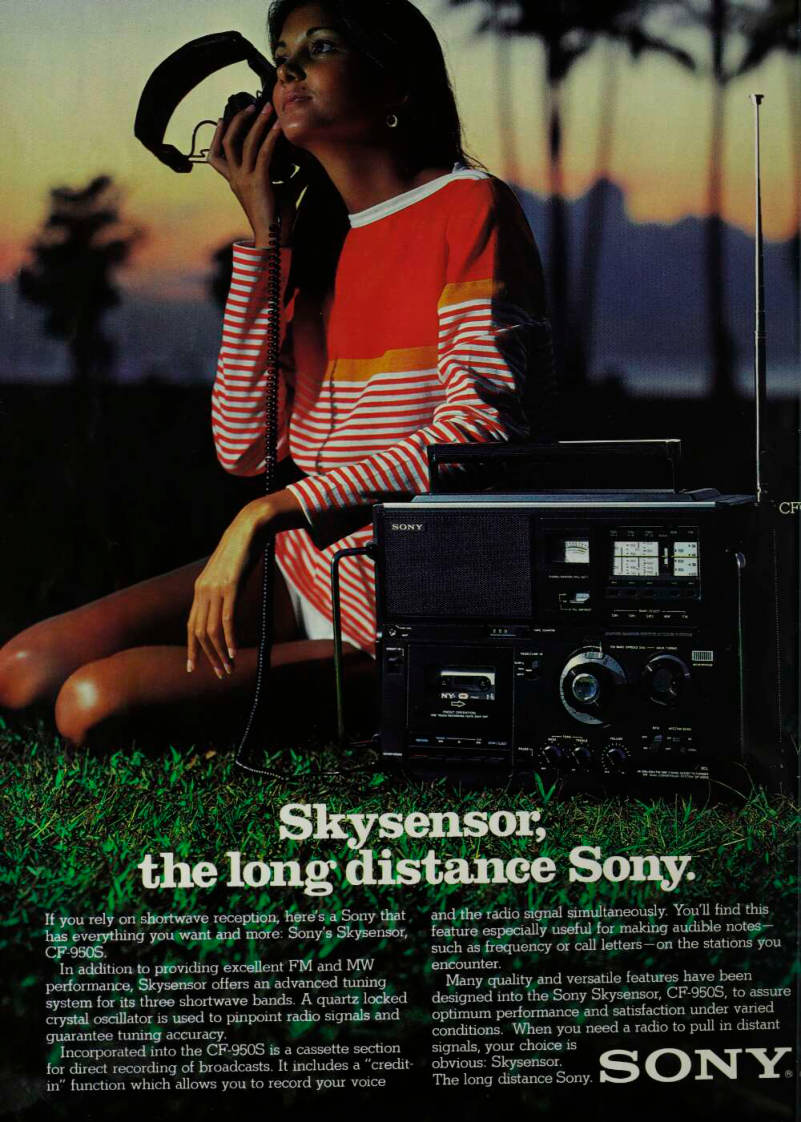
V '\^ ■ J 5S 1 n >i > NY => > • k;i v 44 •^5 v;x £&3 a ' PV> If you rely on shortwave reception, here's a Sony that has everything you want and more; Sony's Skysensor, CF-9505.
In addition to providing excellent FM and MW performance, Skysensor offers an advanced tuning system for its three shortwave bands. A quartz locked crystal oscillator is used to pinpoint radio signals and guarantee tuning accuracy.
Incorporated into the CF-950S is a cassette section for direct recording of broadcasts. It includes a "creditin'' function which allows you to record your voice and the radio signal simultaneously. You'll find this feature especially useful for making audible notes— such as frequency or call letters —on the stations you encounter.
Many quality and versatile features have been designed into the Sony Skysensor, CF-9505, to assure optimum performance and satisfaction under varied conditions. When you need a radio to pull in distant signals, your choice is obvious: Skysensor.
The long distance Sony.
Pacific Report
Top-Secret Island Invaded
Omelek, a tiny island in the heart of the American top-secret missile range on Kwajalein in the Marshalls, was invaded and occupied before Christmas by 21 Marshallese who claim ownership of the island. A court battle has been going on for over 10 years over compensation for the island’s use but there is still no decision. Early in January, leader of the invaders, clan-leader Handel Dribo, agreed to leave the island on a promise by the authorities to settle the issue. It is reported that Kwajalein is now testing the Cruise missile, the pilotless drone President Carter said the United States would rely on instead of the B-1 bomber.
Marianas Has A Governor
Democratic gubernatorial candidate, Carlos Camacho, beat the Territorial Party challenger, Jose C. Temorio by 125 votes in the December election for the first governor of the Northern Marianas in the new Commonwealth Government. Comacho’s running mate, Francisco C. Ada, beat Senator Olympic T. Borja for the vice-governorship. The Territorial Party won most of the seats in the House of Representatives but in the mayoral race the Democrats captured three out of four, Saipan, Northern Islands and Tinian. The Territorial Party won the mayoralty for Rota. Democrat Edward DLG Pangelinan had a runaway win from Territorial Party challenger Juan T. Lizama for the post of Washington Representative.
Evil Work Of Anne And 808
Nature blew out the old year and blew in the new— with two hurricanes, Hurricane Anne and Hurricane Bob. Hurricane Anne swept through Ha’afeua in the Ha’apai group of Tonga on December 28 leaving flattened houses and damaged crops in its wake. One school was destroyed in the high winds which reached 70 km an hour. In January, Hurricane Bob hit the Isle of Pines in New Caledonia gusting up to 200 km an hour, after leaving a trail of destruction in Fiji where a man was killed at Wailoko, near Sabeto, Nadi. The man’s house, along with those of neighbours, was ripped apart by the huge storm. Although Hurricane Bob caused extensive flooding on the Isle of Pines and on the main island of New Caledonia, other damage was reported to be slight. In the New Hebrides a village of about 100 homes on Emae Island was washed away.
Fiji Gold Miners Fired
The Emperor Gold Mining Co sacked about 1 000 workers in January. The company has been told by the Fiji Government that it will get no more financial aid and was accused by Labour Minister, Ratu David Toganivalu, of intending to "gut" the mine and run. The company said it was investigating a plan to reduce mining operations until gold prices rise. The Fiji Pine Commission will employ 300 of the dismissed men and it was hoped to obtain employment for 200 more in New Zealand, Hopes for the latter plan were faint.
Skin Flicks For Png??
PNG Foreign Affairs Minister, Mr Ebia Olewale, has put the cat among the pigeons by proposing to liberalise censorship regulations. He told reporters in Port Moresby that he was going to be very liberal over censorship but expected criticism from conservative clergy. Many people believe that his liberalisation will allow girlie magazines and R-rated films into the country.
Oil Search In Fiji
Pacific Energy and Mineral Ltd, of Colorado. US. has been Di ®. xclusive rights to start extensive exploration for oil in oligh Water, Fiji. The exploration area covers 764 000 ha. The area was previously explored by Southern Pacific Petroleum Ltd with Amoco Exploration Co between 1969 and 1975. This search in spite of encouraging surveys, was given up because 0T world economic conditions.
Bougainville Expels Squatters
Twenty squatters, who come from PNG's Eastern Highlands and Chimbu provinces, have been sent home from Bougainville by the North Solomons Province Government. Their expulsion comes after complaints of immigrants causing trouble on the island. The Eastern Highlanders and Chimbus have retaliated by threatening to expel all Bougainvilleans living in the two provinces. "The North Solomons Provincial Government has just made enemies by removing five Chimbus and 15 East Highlanders," Highlands Premier, James Yanepa, told the returned squatters. He added that the North Solomons Government had played a dirty game on them and they were not going to sit back and let them carry on. Silence still reigns however, over similar action by the New Ireland Province which in the past two years has sent 500 squatters home, the majority from the Sepik and Morobe provinces
A Problem In The Solomons
A woman doctor visiting the Solomon Islands recently found that the major problem that many Solomon Island women have is that they can’t have babies. They are too embarrassed to be examined by a male doctor and the Australian Government sent Dr Del Pulflett, a woman specialist gynaecologist, to the Solomon Islands. Dr Pulflett, after examining 52 women at Kira Kira Hospital, found that many needed to have surgery to cure their barren state, mainly caused by blocked tubes.
"Unfortunately this could be very hard to arrange," said Dr Pulflett. "as it could also involve their husbands " However, six women travelled to Honiara recently to receive further treatment.
Tongan Goes To The Gallows
A convicted murderer, 'Otenili Fisilau, 31, was hanged in Tonga on December 27. It was the first hanging in the kingdom since April, 1971.
Price Control In Png
Papua New Guinea is to introduce formal price control machinery to cover all industries and services in an effort to control inflation. Announcing this, Finance Minister, Mr Barry Holloway, told business leaders in Port Moresby in January that lack of effective competition had contributed to laxity in con trolling price rises and the blame was shared by the govern ment and the private sector. "The government has not worked hard for wage restraint only to see private business take unfair advantage by making excessive profits or by compensating for poor management," he said.
A “Summit’ In Sydney
Prime Ministers Ratu Sir Kamisese Mara (Fiji), Prince Tu’ipelehake (Tonga), Tupuola Efi (Western Samoa), Mr Rob Muldoon (New Zealand) along with Nauru’s President Bernard Dowiyogo are expected in Sydney in February for a two-day Commonwealth Heads of Government Regional Meeting (Feb 13/14) hosted by Australian Prime Minister Malcolm Fraser.
Other leaders will come from India, Bangladesh, Sri Lankar, Malaysia and Singapore. They will have talks on "matters of mutual interest" and may be expected to support the South Pacific Forum’s plans for 200-mile economic and fishing zones.
‘Aid’ To The Islands
The New Zealand authorities searched about 50 Pacific slanders at Auckland airport just before Christmas and found hey were carrying about $l5 000 in NZ currency. There is a limit of $5O a head. Ten of the Islanders were given "belated" approval tp take the money after they were referred to bank officials, and Jn the case of the remainder they were allowed to take the money because in the long run, approval would probably have been given. Anyway, NZ claims it has a "fairly generous” policy relating to remitting money to the Islands.
Look What Santa Brought.
The Western Samoa Government treats Head of State Melietoa Tanumafili II proudly. For a Christmas present it gave him a SW23 000 brand new Ford Lincoln car, specially imported, well equipped to remove discomforts associated with motoring. Before it was sent to Western Samoa, the car was cut in half in Chicago and a further metre was added to the length, just enough to house a small refrigerator, a portable TV set and a radio. At the back seat there is a small cocktail bar.
Tonga Renews A Treaty
Tonga and West Germany have ratified a treaty of friendship between the two countries. The original treaty of friendship was signed in 1876. The latest signing was followed by feasting and dancing at the royal residence at Kauvai.
No To Tv In Png
If recommendations from a government committee are ac cepted, there will be no broadcast television in Papua New Guinea and duties and taxes are likely to rise sharply on all closed-circuit television equipment. Such equipment is now finding ready sale in the Islands. The only television station in the South Pacific outside Australia, New Zealand and the French Territories is in Pago Pago. The committee which has been investigating the possibility of television broadcasting claims broadcast television could be “counter-productive to development".
62 Missing At Sea
An air search failed to find a Tongan 20 m wooden ship, the Tokomea, carrying 45 passengers and 17 crew, which failed to arrive as scheduled at Niuatopatapu in the Tonga group while on the way from Vavau to Pago Pago. There was no radio contact with the Tokomea after she left Vavau on December 29 and an RNZAF Orion searched in vain. The only lifesaving equipment on board were a 2.4 m x .9 m liferaft and 16 old lifejackets. The Fiji Director of Civil Aviation, Mr M. Varley, said the Tokomea had a good battery, but that was bad news. If the radio was as good as it was said to be, the search-rescue authorities would have expected to make some contact with the Tokomea if she was still afloat.
Later, debris, believed to be from the Tokomea was washed ashore on widely-separated islands.
Samoan Governors In Reverse
Mr Peter T. Coleman was sworn in on January 3 as the first elected Governor of American Samoa. Personal representatives of President Jimmy Carter at the ceremony were his son and daughter-in-law, Jeff and Annette Carter, and others present in cluded Mr Al Stern, Assistant Director for Domestic Affairs at the White House, Interior Undersecretary James A. Joseph, Mrs Ruth Vancleve, Director of the Office of Territorial Affairs and Cardinal Pio Taofinuu, Bishop of Samoa and Tokelau. The ceremony was a reversal of one which took place in 1961 Then, as retiring Governor, he handed over to Governor H. Rex Lee. In January retiring Governor Lee handed over to incoming Gover nor Coleman.
Fiji Claims Its Sea Bed
By a simple act of parliament Fiji has increased its area to about 16 541 300 ha, including a land area of about 1 829 835 ha. Fiji was one of the first countries to take advantage of a recent international agreement to allow it to claim all the sea area between islands. Before that sovereignty reached out only 12 nautical miles from the coast of each island.
Tongan Fly-Away Tax
Tonga has imposed an airport tax of $2.50 on passengers leaving the country by air. It applies to all persons from the age of two. The new tax will help Tonga to meet the increased costs of civil aviation. In recent years New Zealand, Fiji, Western Samoa and the Solomons have introduced airport departure taxes.
Gilbertese At The Polls
As a preliminary to independence the Gilbertese were scheduled to go to the polls for a general election on February 1. For the first time each inhabited island will be a single constituency, including Banaba (formerly Ocean Island) which will return one member. In all 35 members will be returned from 23 constituencies. A special feature of the Gilbert Islands’ electoral procedure is that a successful candidate must obtain more than half the total votes so provision has been made for second elections to be held within seven days.
Fiji Hicom For Nz
The Fiji Government expects to set up a high commission in Wellington by March, to make the fifth Fiji overseas mission.
The others are in London, New York, Canberra and Brussels.
The Wellington office will be staffed by four Foreign Office officials, one of whom will be High Commissioner, and office staff recruited in NZ.
Sir Alberts Strategy?
The Cook Islands will go to the polls in a general election in April. The Premier, Sir Albert Henry, in a surprise announce ment, called the election six months before it was due. A report from the Cook Islands said the opposition Democratic Party was divided by a leadership struggle, with younger members eager for more power. This may have prompted Sir Albert, leader of the ruling Cook Islands Party, to capitalise on the division among his opponents.
Flaming Wreck
The Sayandra, the ex-Fiji pleasure cruise ship which was a familiar sight in the Yasawas, burst into flames and sank in Mele Bay, five miles from Vila, on Christmas Eve. What caused the fires is unknown but it is thought there could have been an electrical fault in the engine room.
Backed The Wrong Dollar
Several Australians working for the Png Government decided nearly three y'e&rs ago that they wanted their pay in Australian dollars. It has turned out to be a bad choice for, at today’s cur rency levels, they are 20% worse off than if they had taken their pay in PNG kina. Long-term Australians in PNG thought, a few years ago, that the value of the new kina would fall when it was unpegged from the dollar but several Australian devaluations and some Png revaluations have boosted the kina.
Fiji’S Sugar Cake
Fiji finished a bumper cane harvest in January with enough sugar to meet all Fiji’s contracts and with some to spare. In ad dition Fiji was able to meet al5 000 tonne order from the Unitec States and another 40 000 tonnes was being stock-piled tc meet any shortfall, as the next cane crop has been endangerec by the drought.
Mr Lus, The Sole Rescuer
PNG Minister for Commerce, Mr Pita Lus, took off his shoes one night in January to help three people trapped in a lift. He used the shoes to wedge the doors apart a couple of inches to allow the trapped people to get fresh air in the central govern) ment office building at Waigani. Two men and a woman trappec in the lift, and the minister’s shoes, were released an hour late; by a technician.
Storm Tragedy In Port Moresby
Port Moresby, the PNG capital, was hit by a severe electrics storm on the night of January 15. A boy was drowned when thi streets became like fast-running rivers which took short cutt through shops, houses and other buildings, causing muc: minor damage. In 1V? hours 190 mm of rain fell, a record for thf city. The boy and his mother were swept into a storm drain bu the mother, who jumped into the culvert to rescue the bo' escaped with cuts. There were many landslides, blockim roads, and three cars were almost buried by debris at the Yacn
Club.’
Pacific Islands Monthly
vol 49 NO 2 Feb 1978
Publisher: Stuart Inder
Editor: John Carter
Pacific Report 5
- the 'hard news in a few lines
Letters 9
- Tuvalu independence, a denial from the Gilberts etc
Education Special 10
- problems, faults and dilemmas and a tilt at the S P Com mission
Travel 15
- up the mighty Sepik
Political Currents 18
- upheaval in Nauru, Somare in Tokyo and tears in the New Hebrides
Tropicalities 23
- yellow journalism
Afterthoughts 27
- Popular Percy Chatterton on the erosion of freedoms
Tuvalu Testament 29
- a hundred years a'coming
People 31
- Sir Kanaka Jack, an ideal mother and other honoured peo pie
Obituary 33
Dr Fox goes home
Books 44
Marsden, child of light or Mammon, workshop on the co op, Pacific paradox
Islands' Press 49
all sorts of snippets
Yesterday 51
Von Luckner, sea raider - an historical mistake?
Trade Winds 55
a Yank in a Tongan bank, Niue and the affects of sin, tra ding zephyrs
Cruising Yachts 59
life on the ocean wave
Transport 61
Germans return to Samoa; there's a headache in the Solo mons; getting together in Tokelau
Shipping 65
what's sailing where
Sydn e y I S |!f S*W oT' Teleg r a p h k^A ddress^PACPU°B SvinS S2ISo Pu » b,, S ti 2l1 S ( £ USt) Ltd ' 76 Clarence S,reet Sydne y 2000 Post Address: G.P.O. Box 3408, SUBSCRIPTION RATES Pacific Islands Mnnthiv" airfminhLJf^th^m Telephone. 29 6693 Publisher; Stuart Inder Manager: John Berry Advertising Manager: Steve Gray Zealand $l l 50 NZ ($lO 50 Aust) Fm $lO 75 Fnian r«m sf?A te cn°Pan m^jp r,t y ° f Sufc>Sf ?s ,^ s ®^f /^ r ) <^ a 9 ents in ,he Pacific Islands and the USA. Australia (including Norfolk Island) $lO 50 Aust New Nauru and Solomon slands $lO 50 AmpSan Smna Pa P ua New G “ ,nea K 9 00 ($lO 50 Aust), New Hebrides, Tonga, Cook Islands. Western Samoa, Gilbert Islands, Tuvalu, Niue, and French a and French finn r £\ r f ar a ?f s ; ne ,? ia ’ Guam and Hawaii, $l5 00 US or $l2 00 Aust. US Mainland and Canada $17.00 Aust. New Caledonia 0 bankdrafTpayable a? d ° m 19 5 ° ° f $l2 5 ° Japa " 4 s °° Yen ° f $l2 50 AuSt Elsewhere $l4 00 Aust Note overseas TelephoneJfH'x- FjS 24' P.Sli p °i £ OX Fi V Telephone: Suva 23036 Advertising, Fiji Times & Herald Ltd ,20 Gordon Street Suva, telephone 2 5855 French Potvnesi^D^tnh^nn wSThfSl 'pH 1 9 fn N ? P °o ' C ? U o' er P O Box 85, Port Moresby Distribution Robert Brown & Assoc PO. Box 3395 Port Moresby, United Kingdom: IhTSeraldaTw^eklvSSh'’, A c V « B ? at Papee ! e New Caledonia: Distribution - Depot Centre de Presse Michel Pentecost, 8.P.C2 Noumea Media Corporation CPO Box 46 666 3036 Nm zLtanH T r 6 ' i° n f P E G4A tBU Telephone: 01 831 6041 Telex: London 21989 Japan: Advertising Universal PO Box 3880 Auckland Te? 73880TelexNZ2° 1 ST^Auck^O)Ha^Jlfrius u° X ** 2 lai A o UC if d ’ Advertisin 9 inquiries International Media Representatives Ltd, Honolulu, Hawaii US Advertisino Reoresentativp inchui r p nuio i d«.! L* 11 ? Ma l" I laod only. PIM, Hawaii, 2812, Kahawai St , Honolulu, Hawaii, 96822 Second class postage paid at Anda^Agency.^Box 9 !9l imaes ° 2nd IM? D^ooS.
M *—■ by 30, d0n . GO.CK, A, ® *
Letters
Tuvalu’S
Independence
In one of your recent issues (PIM, Aug, p 12) you men tioned a letter I had written to the Secretary of State for Foreign and Commonwealth Affairs in London concerning representation in parliament for an independent Tuvalu.
You reported me as having asked the Secretary of State to remove the Chief Minister from office. In fact that was never said. Neither the Secre tary of State nor the Queen’s Commissioner in residence have the power to remove an elected Chief Minister. I made it plain when I wrote that “the action taken by the Chief Minister warranted his removal by a vote of no con fidence, but this was avoided for various reasons”.
The main points I had hoped the Secretary would concern himself with were; (1) the disregard of the Chief Minister, acting as chairman of the Constitutional Com mittee, for majority decisions of the Committee; and (2) when the question was put to a vote in parliament, elected members were evenly divid ed, and government only managed to win by the vote of an ex-officio member who was instructed by the Queen’s Commissioner (sitting in the gallery) to vote with the government.
Your readers may be in terested to know that the Secretary of State’s reply had to come through the resident Queen’s Commissioner. This may demonstrate FCO pro tocol, but I feel that the Secre tary ought to have had the decency to write to me direct.
The fact that he dodged the issues that I had raised clearly undermines the established constitutional principles at stake, particularly that of “majority rule”.
Isakala Paeniu
Nukulaelae, Tuvalu.
Gilberts’ Denial
The report in the October issue of PIM (p 15) “Gilbertese split on Ocean Is land future” suggesting that the Opposition Party in the Gilberts House of Assembly supports the Banabans’ cause on Ocean Island is entirely misleading.
The Gilberts’ delegate quoted by the Banabans is not a member of the Assembly and has, at no time, been authorised by the Opposition to speak for them on this mat ter.
The policy of the Opposi tion on the future of Ocean Is land is to maintain the inte grity of the territory of the Gilbert Islands including Ocean Island.
Ieremia Taabai
Leader of Opposition, House of Assembly Gilbert Islands
English
Murdered
I am sorry to see that Mr Chen (PIM, Oct, 31) has so firmly grasped the wrong end of the stick with which he seeks to belabour me. The “implications” which he draws from my observations are his own. I have no objec tions at all to wee Scots having reeking lums, to Americans dressing inside out, or Yorkshiremen continuing (not ongoing) to use the second person singular; such regional expressions are fair dinkum.
What is surely objec tionable is for new words, of poor construction or none, being introduced to replace
perfectly good ones already in existence. This leads to “guesstimate” (estimate), “transportation” (transport), “burglarize” (burgle), which do nothing for the language except extend it, while “escapee” makes an odd bed fellow with the other ee’s —assignee, addressee, con signee, legatee, etc who are on the receiving end. Fur thermore it sounds like “Eskie pea”, possibly a rival to Bird’s Eye, but which should be kept in the Cooler, not out of it.
As English verbs are also declined and conjugated I must ongo to differ from Mr Chen.
M. R. S. Mitchell
South Yarra, Victoria
Noumea Clinic
May I reply to an article by Paul Sterling (PIM, Nov, p 85) regarding the local hospital and clinic.
According to Mr Sterling, the local hospital is for public servants, indigent Melane sians, Polynesians and those who cannot afford to go elsewhere. What about those who really want to go there because of the competence of the surgeons and notably Pro fessor Piquard and his team?
Can the Noumea clinics boast the sophisticated equipment of this hospital, or equally competent staff? Some of their nurses don’t even have a diploma and yet the recent Noumea clinic has ex travagantly high fees.
Price is not taken into ac count in the choice of hospital
or clinic, as most or should I say all employees of the Societe de Nickel, Banks, Commerce, are reimbursed 60% of all medical fees and 100% for major surgery or long illnesses. Is that, Mr Sterling, what you call insuffi cient health insurance for a tax-free country?
I do not want to start an argument on this subject, but I did think a few facts which had been omitted needed to be brought forward. I am not qualified to criticise or judge the competence of one or other clinic, but can only face facts having had personal ex perience as a patient in the local hospital for major surg ery.
E. Preveziotis-Helsen
Kouaoua New Caledonia.
(Mrs)
Info Wanted
I have been a regular reader of PIM for some time and have always found it very in teresting. I am particularly in terested in the cultures and traditions of the Islands and am hoping to make a trip tc research the traditional pot tery of the Islands. However, 1 have been unable to find a 10l of information on this subjecl in the library and I am won dering if your readers may bt able to be of some assistance, Any information at all or the subject would be useful particularly where a revival o traditional pottery is concern ed.
Fran Ifould
1762 Pittwater Rd, Bayview 2104, NSW.
War Relics
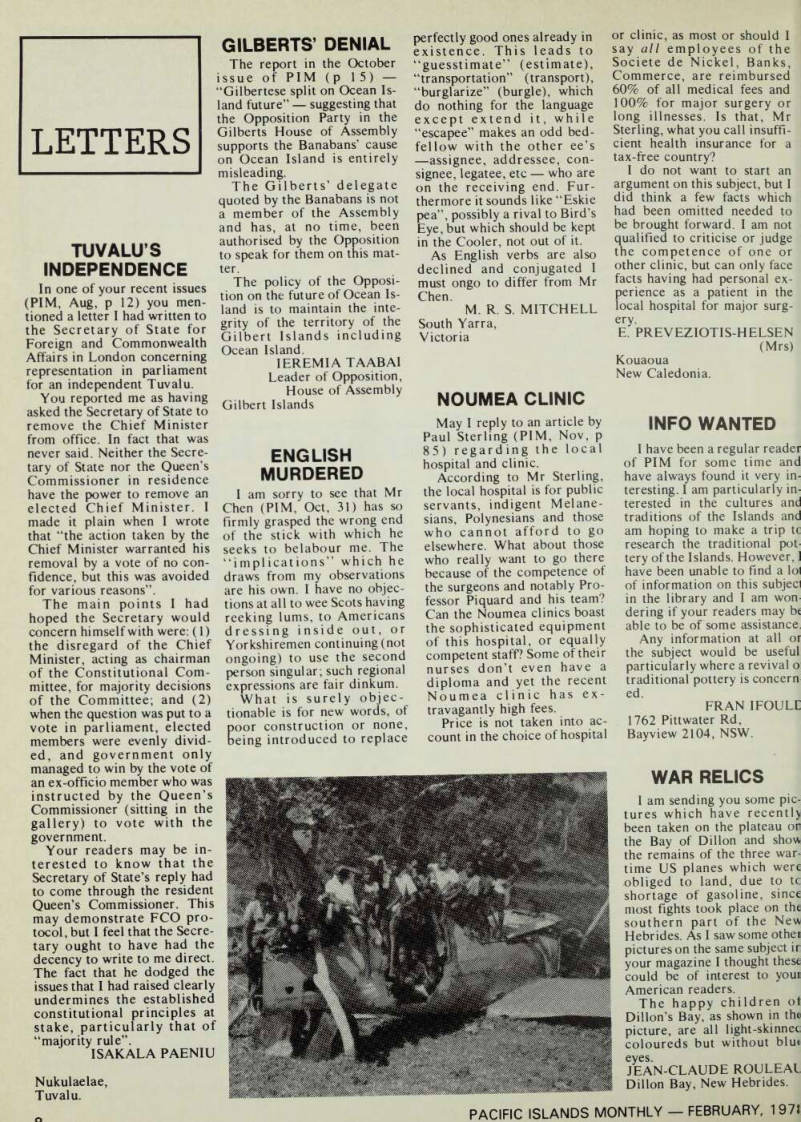
I am sending you some pic tures which have recently been taken on the plateau on the Bay of Dillon and show the remains of the three war time US planes which were obliged to land, due to tc shortage of gasoline, since most fights took place on the southern part of the New Hebrides. As I saw some other pictures on the same subject in your magazine I thought these could be of interest to your American readers.
The happy children ot Dillon’s Bay, as shown in th© picture, are all light-skinneo coloureds but without blu* eyes.
Jean-Claude Rouleau
Dillon Bay, New Hebrides.
Advertisements & other items, p. 9 (1 item)
Bukb
n
FOR DURABILITY AND SAFETY
ANTI VIBRATION
- LOW NOISE LEVEL -
DIESEL MARINE ENGINES
THE CHOICE OF
DISCERNING YACHTSMEN
The manufacturers of quality yachts realise the importance of installing quality equipment to match their custom built craft.
This is the reason why so many recommend and install BUKH Anti-Vibration Diesel Marine Engines.
Just some of the yacht builders installing "BUKH" in their quality yachts:
EAST COAST YACHTS ENDEAVOUR YACHTS
COMPASS YACHTS
PACIFIC YACHTS
MOTTLE YACHTS
TRITON YACHTS
SANTANA YACHTS
CAVALIER YACHTS
SWANSON BROS. YACHTS
SAVAGE YACHTS
WALKER BOAT CO.
just a few of the many reasons
more BUKH Diesel Engines are
being sold in Australia every year
ANTI-VIBRATION SYSTEM:
A single cylinder BUKH DV 10 vibrates less than many two cylinder diesel marine engines.
CONTROL PANEL:
Starting and stopping of the engine is by push button.
AUTOMATIC INJECTION
TIMING:
Centrifugal flyweights control the fuel injection cam in relation to the crankshaft and piston.
PRE-COMBUSTION CHAMBER:
On fuel injection, initial burning of the fuel/air mixture takes place in a secondary chamber.
HAND START;
In the interests of safety an alternative means of starting.
ZINC ANODE:
A replaceable sacrificial zinc anode is included in the BUKH system.
THERMOSTAT:
Efficiency and minimal engine wear require a closely controlled and quickly attained operating temperature.
SPEED CONTROL:
A centrifugal governor maintains the R.P.M.
VACUUM VALVE:
This device provides a partial vacuum within the crankcase.
ELECTROMAGNETIC STOP:
Just press the button and hold down till engine stops.
REMOTE CONTROL:
Both speed control and gear shift levers are fitted with attachments for remote control.
ELECTRICAL SYSTEMS:
Starter Motor 12V 2 H.P.
Alternator 12V 420 W.
WHEN YOU ARE BUYING - BUILDING -OR REPOWERING YOUR BOAT, FOLLOW THE EXAMPLE OF SO MANY WHO CARE - BUY BUKH.
EXCLUSIVE FRANCHISE AREAS NOW AVAILABLE
TO SELECTED ISLAND TRADERS-WRITE NOW!
BUKB
Established 1904 Represented in 60 countries.
Australian Sales & Service Network.
For the boats sake - and yours.
IDEAL MARINE PTY. LTD.
P.O. BOX 318, LAKEMBA 2195
Phone: (02) 759 8544.
Telex: IDEAL AA25488.
Name Address Please forward information on the BUKH anti-vibration diesel marine engines.
Marine dealer: Yes - No (Cross out) Name of company
PI M 2
Educatio:
New Partnership
Wanted In Islands
What should be the priorities on Education in the South Pacific islands? Is there too much emphasis on educating people for “white collar” jobs? These questions and others are examined in these two articles, one of which comes from extremely critical submissions made by University of South Pacific Lecturer in Education, Mr Tupeni Baba, to the Australian Senate Standing Committee on Foreign Affairs and Defence. Mr Baba also attacked the South Pacific Commission. A second article, by another lecturer in education, Dr W. G. Coppell, of Macquarie University (NSW) takes a close look at educational dilemmas.
“Would you weep if the South Pacific Commission ceased to exist?”
“No.”
The scene was Sydney, August, 1977. The questioner was Senator Peter Sim, chair man of the Australian Senate’s Standing Committee on Foreign Affairs and Defence.
The question was addressed to Mr Tupeni Baba, Lecturer in Education at the University of the South Pacific. The ex change took place in the con text of the committee’s work on its brief, “The need for an increased Australian com mitment in the South Pacific”.
Mr Baba’s reply was consis tent with a number of trenchant criticisms he made of the commission, especially in the field of his particular interest, education.
Extracts from his submis sions follow: Australia is always quick to recognise a need for its in volvement in the South Pacific, but somehow it tends to be slow in acting, and not highly sensitive to its changing role in relation to its Pacific Island neighbours. Generally, it seems to be less in touch with the South Pacific coun tries than its neighbour, New Zealand.
In matters of trade, church and mission activities, educa tion and so forth, Australia or Australian citizens undertook initiatives in many of the is lands of the South Pacific, but in many cases, particularly in Fiji, Tonga, Samoa and so forth, it has always been New Zealand or the New Zealan ders who have developed or fostered lasting ties and rela tionships.
This does not necessarily mean that the New Zealanders have helped or assisted the Pacific countries more than Australia. It may merely mean
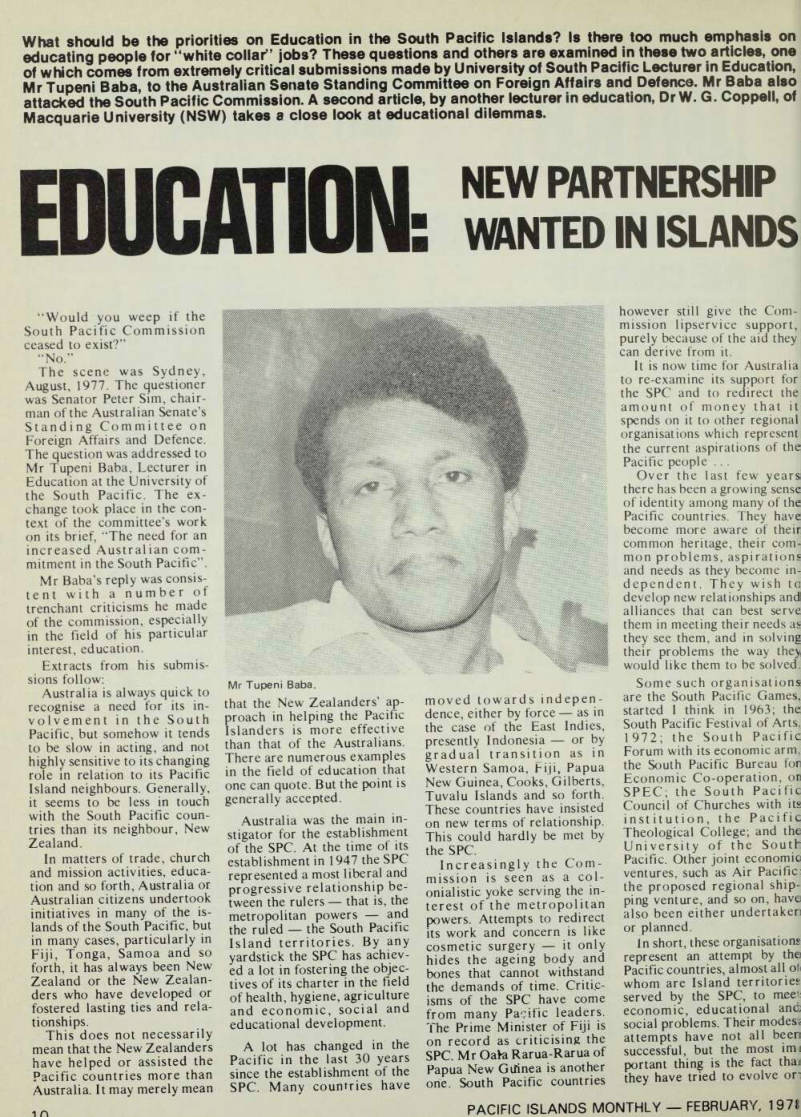
Mr Tupeni Baba. that the New Zealanders’ ap proach in helping the Pacific Islanders is more effective than that of the Australians.
There are numerous examples in the field of education that one can quote. But the point is generally accepted.
Australia was the main in stigator for the establishment of the SPC. At the time of its establishment in 1947 the SPC represented a most liberal and progressive relationship be tween the rulers that is, the metropolitan powers and the ruled the South Pacific Island territories. By any yardstick the SPC has achiev ed a lot in fostering the objec tives of its charter in the field of health, hygiene, agriculture and economic, social and educational development.
A lot has changed in the Pacific in the last 30 years since the establishment of the SPC. Many countries have
moved towards indepen dence, either by force as in the case of the East Indies, presently Indonesia or by gradual transition as in Western Samoa, Fiji, Papua New Guinea, Cooks, Gilberts, Tuvalu Islands and so forth.
These countries have insisted on new terms of relationship.
This could hardly be met by the SPC.
Increasingly the Com mission is seen as a col onialistic yoke serving the in terest of the metropolitan powers. Attempts to redirect its work and concern is like cosmetic surgery it only hides the ageing body and bones that cannot withstand the demands of time. Criti.c isms of the SPC have come from many Pacific leaders.
The Prime Minister of Fiji is on record as criticising the SPC. Mr Gate Rarua-Rarua of Papua New Gifinea is another one. South Pacific countries
however still give the Com mission lipservice support, purely because of the aid they can derive from it.
It is now time for Australia to re-examine its support for the SPC and to redirect the amount of money that it spends on it to other regional organisations which represent the current aspirations of the Pacific people ...
Over the last few yearsi there has been a growing sense of identity among many of the Pacific countries. They have become more aware of their common heritage, their com mon problems, aspirations and needs as they become in dependent. They wish to develop new relationships andl alliances that can best serve them in meeting their needs as they see them, and in solving their problems the way they would like them to be solved.
Some such organisations are the South Pacific Games, started I think in 1963; the South Pacific Festival of Arts, 1 972; the South Pacific Forum with its economic arm, the South Pacific Bureau for Economic Co-operation, on SPEC; the South Pacific Council of Churches with its institution, the Pacific Theological College; and the University of the Sou tin Pacific. Other joint economic ventures, such as Air Pacific: the proposed regional ship ping venture, and so on, have also been either undertaken or planned. in short, these organisations represent an attempt by the Pacific countries, almost all of whom are Island territories served by the SPC, to meet: economic, educational and] social problems. Their modest attempts have not all been successful, but the most imi portant thing is the fact thai they have tried to evolve on
ganisations and institutions themselves to meet their own problems. In certain areas one can argue that they can be even more successful if the SPC genuinely co-operates with them and does not stand in their way, particularly in the areas of education, re search and social develop ment.
On this last question of education, the best way to be involved in the Pacific coun tries at the moment is through the organisations that have emerged from within the South Pacific Islands them selves. This calls for a new relationship, a new partner ship between the Pacific Is lands and the metropolitan powers.
For example, four new universities have emerged the University of Guam, the University of Papua New Guinea, the University of Technology in Lae, and the University of the South Pacific. These universities have developed research units to do the kind of research that formerly had been done by the
Spc.
Some of the universities, and notably USP, are strug gling in terms of money and finance. The new Centre for Applied Studies and Develop ment in the USP attempts to do research that is requested by any of the countries that are served by the university.
UPNG is in a slightly better situation financially.
Another area of priority in education is the development of a new comprehensive cur riculum for the South Pacific countries. This project was lo cated at USP and funded by the United Nations Develop ment Programme in New York.
At the moment some of the UNDP personnel are com pleting their work, but the continuation of the cur riculum unit to oversee the dissemination, evaluation and curriculum research could hardly be met because of the lack of personnel at the university. This is a priority area that has been emphasised in numerous conferences in the South Pacific.
Another area, teacher education at the secondary
level, has been adequately
catered for by USP. The area of primary teacher education, however, has not been so suc cessful. The plan put forward in the Robert Morris Report 7- (Morris is a member of the Overseas Development
Agency) for some assistance to Pacific countries by the university was not fully im plemented.
Hence many primary teachers still come to Australia for in-service train ing. The sooner all training is done at USP or UPNG the better it will be for all con cerned. This implies a supply of teacher educators and training of local Pacific Islan ders to take over the task.
One of the most discussed areas is the establishment of the South Pacific Exam inations Board, to provide relevant examinations at the school certificate and univer sity entrance level to replace the current United Kingdom, Australian and New Zealand examinations.
Already two reports by ODA in the United Kingdom have been devoted to this problem, but it appears that the shortage of funds again has caused the project to be shelved.
The South Pacific Com mission has interfered with many USP projects, and some of its personnel have at tempted to sabotage their establishment.
A notable example is the plan for the establishment of the South Pacific Exam inations Board. As a result, this examinations board has yet to be established. Some of the islands have become desperate to get more relevant examinations for their children and they have gone on their own to get Australian and New Zealand help. The Solomon Islands is a case in point here.
From the educational, economic and long-term view of the situation, it would be better for the South Pacific Islands to have a common examinations board to cater for all the examinations now provided by New Zealand, the United Kingdom and Australia.
Other areas of common concern include training in agriculture and forestry. This has been catered for by USP in conjunction with the Tropical College of Agriculture in Fiji and the Agricultural College in Samoa.
These institutions together award diplomas and degrees in agriculture and forestry re spectively. Students from all over the South Pacific are coming to these institutions. I may also add that the agricultural and forestry col leges in Papua New Guinea
are also providing the training for the people needed in that area in that country ...
I am critical of the SPC because of the way it still tends to operate. Although we have some local staff at the SPC in Noumea, it is still seen by the majority of people as a colonialist organisation. The metropolitan powers must be aware of such resentment and I do not know why they have not taken steps to abolish the
Spc.
In my area of education I have come in contact with people who work in the SPC who resent the increased in volvement of regional organ isations like the USP in some of the work that could be done by the SPC. 1 suppose they are worried that we are removing the mat from under them in doing some of the work they can do.
Most of the staff of the SPC are expatriates; most of ours are regionals. The develop ment of regional organisations like USP is a threat to the ex istence of the SPC and naturally they resent the development of our regional organisations . . .
In many ways they work against regionalisation. They do not want to see certain things that they usually do taken over by regional organ isations like the University of the South Pacific. This was very evident when we were debating the establishment of the South Pacific Exam inations Board to develop examinations for the whole of the South Pacific.
That is my feeling anyway. I feel they were trying to in fluence the various countries of the South Pacific not to adopt or approve its proposal and the fact that we do not have a South Pacific Exam inations Board as yet is indicative of some of the SPC’s influence. I do not want to mention names on this mat ter ...
The UPNG and USP are not really in competition but they have not been working as closely as should be expected.
One of the main problems is that the University of Papua New Guinea is staffed mainly by Australians at least up to a few years ago whereas at the University of the South Pacific there is a lot of New Zealand and United Kingdom and American influence. The two universities have at tracted people from different
academic backgrounds. But I think the regional staff mem bers from the South Pacific and Papua New Guinea are beginning to look to one another for help. I think this is a very interesting and a very useful trend .. .
The implications of what I am saying are numerous, par ticularly with respect to Australian aid in the South Pacific.
The gist of it is that Australia needs to identify the general organisations that have evolved in the Pacific in the last few years and, after identifying those, must assist them. This means assistance by way of training and providing money, even at the level of PhD and Masters’ degrees, to enable these regional institutions to carry out their work.
It is important to realise the general need for the Pacific Islands to regard themselves as a regional unit, as ex pressed by the numerous or ganisations that have come up in the last few years.
If the South Pacific cannot find people to work in these areas and cannot find money to fund these important areas, it will begin to talk to other countries, countries which did not originally support the South Pacific Commission, and you know what countries I mean.
Later, Senator Sim asked Mr Baba. Do you see any value in the SPC if it were reorganised?
Mr Baba: There is a value definitely if it is reorganised.
It can be a research organ isation related to USP, re searching the problems of the South Pacific because they have facilities and libraries we can use.
Senator Sim; But could not the South Pacific Forum and the SPC be amalgamated and those facilities be made availa ble to the South Pacific Forum?
Mr Baba; That would be very good except that perhaps the educational aspects could be shifted more to USP, and other aspects might be shifted to other areas instead of the whole group being amalga mated with the Forum. I say that because at the moment the Pacific Forum is basically concerned with economic matters. There are other dimensions which are not so important. There is, for exam ple, a lot of medical and health research that can be shifted to the medical school.
Advertisements & other items, p. 11 (1 item)
11
PACIFIC ISLANDS MOMTHI V PPRRI I APV IQ-7Q
Or Practical Training, Asks Coppell
Should The Emphasis Be On Academic
In his submission, Pene Baba, writes Dr W. G. Coppell, quite rightly directed the attention of the senators to several matters which are central to the whole business of assessing the development of educational provisions throughout the Islands. He emphasised, in particular, the need for creating a regional examinations board, the need for a greater degree of regional co-operation, particularly at the tertiary level; the role the South Pacific Commission should play in the educational field and the role of expatriate teachers working in the Islands.
The very nature of his background as a staff member of the University of the South Pacific and his involvement in curriculum development meant that Pene Baba was constrained to devote himself to very wide-ranging issues and to give emphasis to broad principles of aid that the metropolitan countries can most sensibly contribute to the educational system of the Islands.
However, there are many areas of concern, common to the Pacific, which in their own way reflect, sometimes in delayed fashion, the educational problems that are now bedevilling the developed, industrial societies.
First, and foremost, there is the question of deciding on priorities in education. For instance, should there be a continuing emphasis upon an academic form of education,
when it is already quite ob vious in many island nations that there is an over-supply of academically-trained people?
In countries like the Cook Islands, a crisis point is being reached in the labour market, demographic factors, such as the easy access to New Zea land, having drastically diminished the working sector of the population. The sec ondary school system has con tinued, by and large, to emphasise academic subjects, and the graduates of the schools have continued to look to the government and the large stores for employ ment in administrative and clerical positions, A consequence of this orientation in training is the strain being placed upon the pineapple industries which have been developed on the islands of Mangaia and Atiu.
The canning factory on Rarotonga is working to about half its capacity, there is a strong likelihood that the ships will not be able to uplift the output of pineapples from the two islands and the growers’ confidence in the in dustry’s future will suffer a setback all a consequence, to a significant extent, of a labour shortage. One of the answers to the emphasis on the academic subjects is an econ omic one it is probably much cheaper to mount courses in English literature, in geography, in history, than to establish on a fully-funded basis the more practical ly oriented courses. These
courses require expensive equipment, if they are to be presented in more than token form and they require ade quately-trained staff to direct them.
On the other hand, care must be taken to ensure that the Islands do not fall into the trap which has ensnared many industrial societies, that of the over-production of graduates destined for professions and occupations that cannot pro vide employment. In Australia there is clear evidence that there has been an over-production of law yers. It is suggested that for every two law graduates in Australia, there are positions for only one. In several island nations there seems to be a similar position likely to arise concerning the training of lawyers.
The Cook Islands is making a belated attempt to divert some of its students into trade training by establishing an ap prenticeship scheme, with the intention of reaching stan dards which will receive equivalency recognition over seas.
But the Cook Islands must be on the horns of a dilemma just how many skilled tra desmen can a population of just over 18 000 absorb? The question that must face the Cooks is, are these ap prentices to be trained to work in their own country, or will the training they receive make it easier for them to find employment in New Zealand?
It is useful for the Cooks to have a population safety valve, but there are unfor tunate consequences of a brain drain of the more able members of the population.
Pene Baba made the point in his submission that “we need people of this calibre in the South Pacific now”.
In the New Hebrides, the French education system has made a dramatic attempt in its centre at Vila to come to grips with the problems of pro viding technical training for New Hebrideans. However, the number of milling machines at the centre out numbers quite considerably the number of milling machines that are in govern
merit and commercial use throughout the New Hebrides.
There must be a danger of producing skilled artisans for whom work will not exist.
Thus, the attention of politicians and educators in the Pacific is thrust back to the proposition that more stu dents should be trained to ac cept the idea that agriculture offers them a secure future.
This may be so, but there is need for substantial incentives to make a village life more at tractive to young people than the pull of the bright lights and possible financial rewards of the towns and cities.
The agricultural training that is given must be enlightened and the island governments in several cases will have to face up to ques tions of changing the land tenure systems, if graduates of agricultural training courses are to feel a sense of security concerning the land they develop and the crops they grow.
This is an issue that is well illustrated in the booklet Land Tenure on Niue, re cently produced at the University of the South Pacific. Adapting the land tenure system may well be a priority in education that is of paramount importance.
Whenever the question of adapting educational systems in the Pacific Islands comes up some of the indigenous leaders raise their voices in ire. They say, and perhaps quite logically, that their countries were given educa tional systems by the metropolitan countries. The> say that anyone who suggests a move away from the
academically-based cur
riculum is advocating a denigration of education foi Islands peoples.
This is the core of the problem that Pene Baba raise; concerning a South Pacific Is lands Examinations Board. I such a board could establish standards for the teaching o subjects relevant to life in the Islands it would be a totalb estimable objective. However the opposition will come froir those leaders who would set such a scheme as in some waj denying to islanders the op
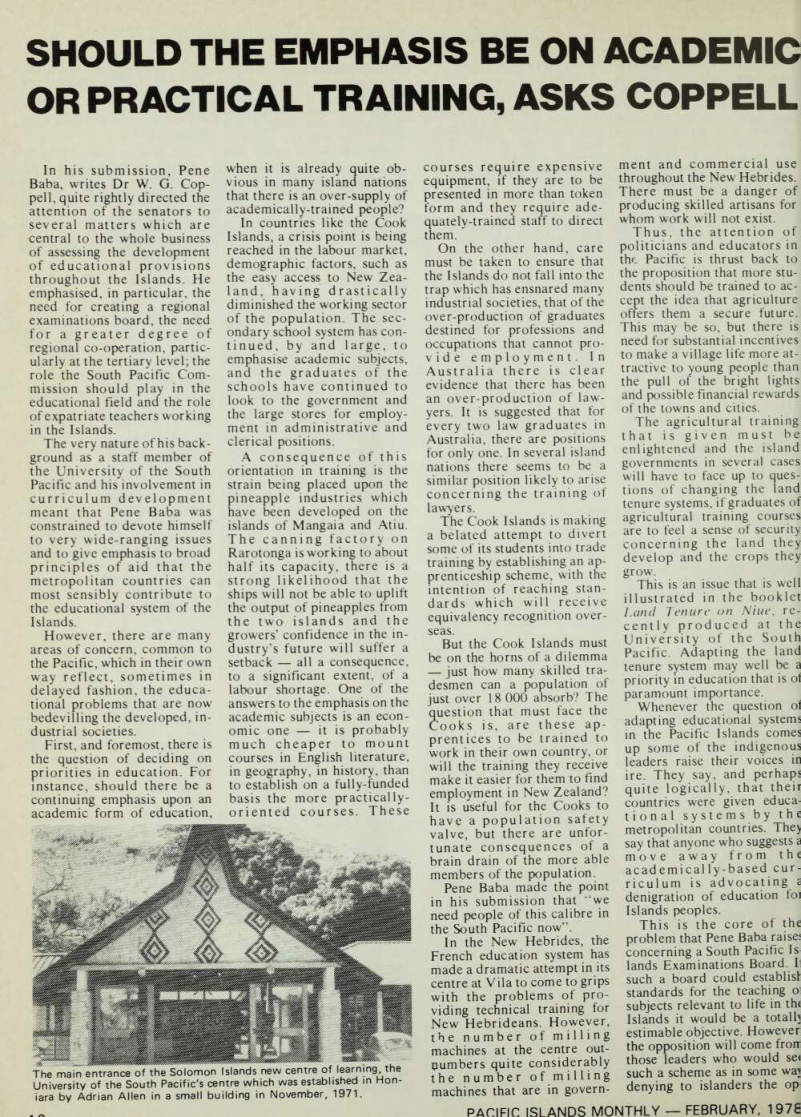
The main entrance of the Solomon Islands new centre of learning the University of the South Pacific's centre which was established in Hon iara by Adrian Allen in a small building in November, 1971.
portunity to acquire the qualifications that the Euro pean seems to so much covet and admire.
Therefore, if there is to be a move to establish a regional examinations sytem that is different but equal, the system adopted for a regional examinations structure must be capable of establishing equivalency standards with the systems used outside the Pacific region.
Pene Baba focuses much of his attention on the problems of tertiary education, and it is at this level that the most im mediate results can be most speedily achieved. There are other areas upon which a much greater weight of at tention must come. To date, the primary area has received a lesser share of support and remedial measures.
In a number of countries the standards of teacher train ing, the provision of teaching materials and the develop ment of community-related curricula leaves much to be desired. A basic problem in several instances is the lower level of training of many of the teachers who are in charge of classrooms.
Their own levels of educa tional achievement are in finitely lower than those of students who are now gra duating from the secondary schools and who cannot find jobs as teachers as the posi tions were largely filled, perhaps 10 years ago, by poorly-prepared teachers, who may well remain in the service for another 20 or 30 years.
Educators are therefore faced with making a choice, should the status quo be preserved? Should many of the poorly-trained teachers be given substantial additional training; should efforts be made to replace in some way
these less-than-adequate
teachers?
The metropolitan countries remain prepared to give as sistance to the various educa tional systems, but they are continually beset with the quandary of deciding how best to give that assistance.
Perhaps understandably, the
powers that be in distant places wish to maintain some form of control over the help they render. Traditionally, the easiest way of giving help has been to make available skilled expatriate officers.
This form of assistance is ex tremely expensive, salaries are high, fares have to be paid,
housing has to be provided.
Unfortunately for many ex patriate teachers, a period of service in the Islands is just an interlude in a career in the “normal” teaching service in their own countries. The general pattern today is for the expatriate teacher to serve a two-year term in the Islands.
It takes a year at least for the teacher to even come to grips with a strange environment and in his second year his thoughts, quite naturally are turning away towards his home-country and his future prospects there.
There are few expatriate teachers, who now see ahead of themselves a career of teaching in the Islands. A good case could be made out for diverting much of the funds presently used on ex patriate staff into projects such as the preparation of community-related cur
riculum materials, which may well in the long run have a greater impact than the ser vices of many of the expatriate teachers.
In his submission Pene Baba on a number of occa sions made reference to the need for regional co-op eration in education. That co operation needs to be on several planes. First, there needs to be a recognition that there are two perfectly worth while forces at work among the islands people. There is a growing pride in national achievement and there is also an increased awareness of the interrelationship and the in terdependence that exists be tween the island nations.
In education there is a need to sponsor these feelings of identity. Organisations such as the South Pacific Com mission, the United Nations Development Programme and the Pacific universities need
to sponsor and develop cur riculum materials concerned with the Pacific Islands com munities and which give real recognition to those two planes of identity.
Finally, education in the Is lands faces the same problems that assail education systems in the developed countries.
Gone are the days when there seemed to be a cornucopia which would respond im mediately and with a great outpouring to any request for monies to be spent on educa tion. Today we are in a real era of cost-benefit analysis, almost universally there is a questioning of the value to so ciety of an ever-increasing ex penditure on education.
Pacific islands politicians and educators, like their counterparts elsewhere, need to examine their programmes, to re-assess their priorities and come up with solutions which are conducive to the overall advancement of their countries.
In 1976 about 8% of government expenditure in Western Samoa was spent on education. For agriculture the figure was 2%. This alone would be an area in which priorities might well be re-as sessed, especially when it is realised that in 1975 the coun try imported food, tobacco and beverages to the value of
Sws2 316 000.
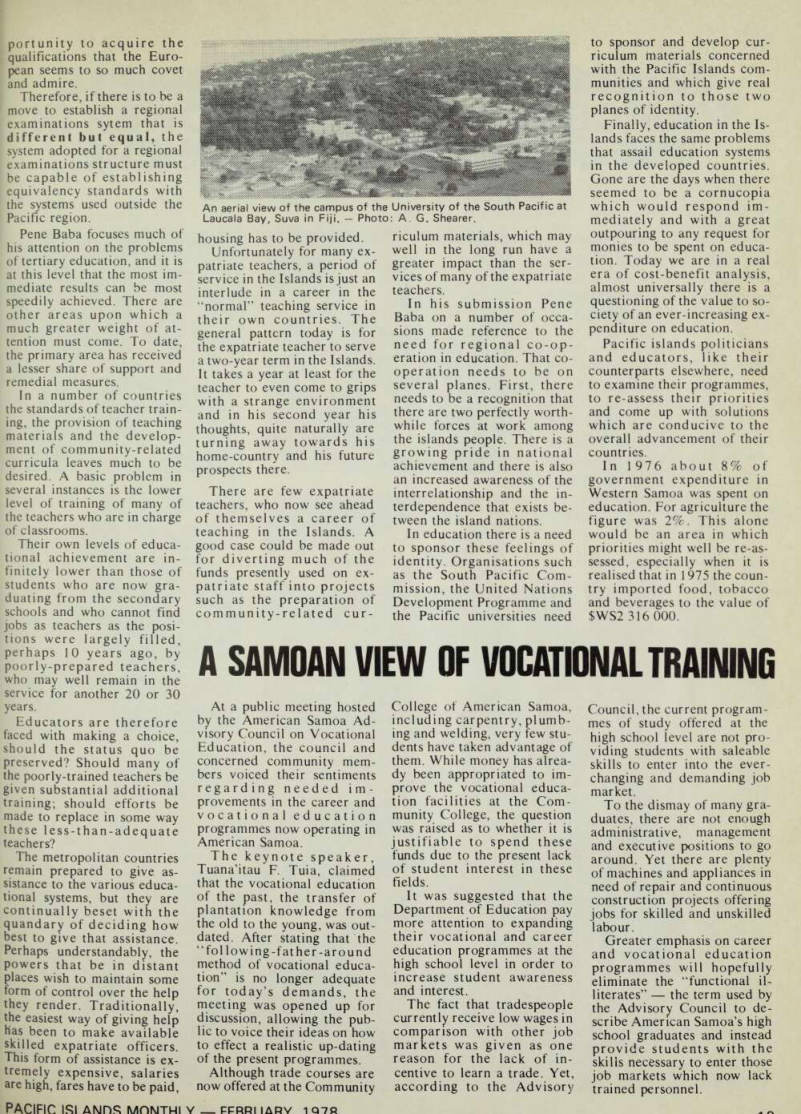
An aerial view of the campus of the University of the South Pacific at Laucala Bay, Suva in Fiji. Photo: A. G. Shearer.
A Samoan View Of Vocational Training
At a public meeting hosted by the American Samoa Ad visory Council on Vocational Education, the council and concerned community mem bers voiced their sentiments regarding needed im provements in the career and vocational education programmes now operating in American Samoa.
The keynote speaker, Tuana’itau F. Tuia, claimed that the vocational education of the past, the transfer of plantation knowledge from the old to the young, was out dated. After stating that the “following-father-around method of vocational educa tion” is no longer adequate for today’s demands, the meeting was opened up for discussion, allowing the pub lic to voice their ideas on how to effect a realistic up-dating of the present programmes.
Although trade courses are now offered at the Community
College of American Samoa, including carpentry, plumb ing and welding, very few stu dents have taken advantage of them. While money has alrea dy been appropriated to im prove the vocational educa tion facilities at the Com munity College, the question was raised as to whether it is justifiable to spend these funds due to the present lack of student interest in these fields.
It was suggested that the Department of Education pay more attention to expanding their vocational and career education programmes at the high school level in order to increase student awareness and interest.
The fact that tradespeople currently receive low wages in comparison with other job markets was given as one reason for the lack of in centive to learn a trade. Yet, according to the Advisory
Council, the current program mes of study offered at the high sc hool level are not pro viding students with saleable skills to enter into the ever changing and demanding job market, To t he dismay of many gra duates, there are not enough administrative, management and executive positions to go around. Yet there are plenty of machines and appliances in need of repair and continuous construction projects offering jobs f or skilled and unskilled labour Greater emphasis on career and vocational education programmes will hopefully eliminate the “functional il literates” the term used by the Advisory Council to de scribe American Samoa’s high school graduates and instead provide students with the skills necessary to enter those job markets which now lack trained personnel.
Advertisements & other items, pp. 13-14 (3 items)
13
PACIFIC ISI AMDS MONTHI Y FFRRI lARV 1 Q7R
14
PAriFir ISI AMDS MONTHLY FEBRUARY, 1978
Chloride The Most Complete
SOURCE OF PACKAGED POWER IN
THE SOUTHERN HEMISPHERE.
A generous statement? Maybe, but then Chloride is equipped and qualified as such . . always ready to offer advice, guidance and service on your battery requirements.
And it goes way beyond automotive batteries. No matter what the problem . . if it's a question of power . . battery power . . it's one for Chloride. It could be as small as a battery for a hearing aid the size of a coat button, or a power station battery weighing 40 tonnes.
Again, it could be a no break D.C. power system for a computer or emergency lighting for a hospital.
Nearly 50% of all batteries sold in Australia are made by Chloride.
No matter what the application . .
Transport, Industrial, Communication, Defence, Mining, Marine, Recreation . . .
Make Chloride power work for you. \ m LA Telecommunications Chloride Batteries Australia Limited 55 Bryant Street, Padstow, N S W. 2211, Australia Telephone; 77 0177 mm. 9 V ft A Electric Vehicles Emergency Lighting 1 K * Ok Automotive Engine Starting 1 8 111 Sill m
exploring the Sepik

A new, but not a cheap, way of exploring the Sepik
GEORGE LYNCH tells the story of an 1 100 km journey up New Guinea’s great Seplk River
It was a makeshift hut erected in the shadow of the high haus tambaran, the spirit house. Two men played flutes, Another did a sort of dance in a stamping way. A fourth just stood by with his eyes on the fifth, the carver of the mask.
In this place on the Sepik, a tambaran mask had recently been sold to a dealer, but without the contained spirit of an ancestor. What to do with the spirit, restless and a gadfly to the conscience of the village? Carve another mask, and keep the spirit happy with flute playing and dancing until the carver puts down his tools, when, with some ceremony, the spirit would take up residence. When?
Perhaps in two weeks; but whenever, the playing and the dancing had to go on, with
only short breaks in every 24 hours.
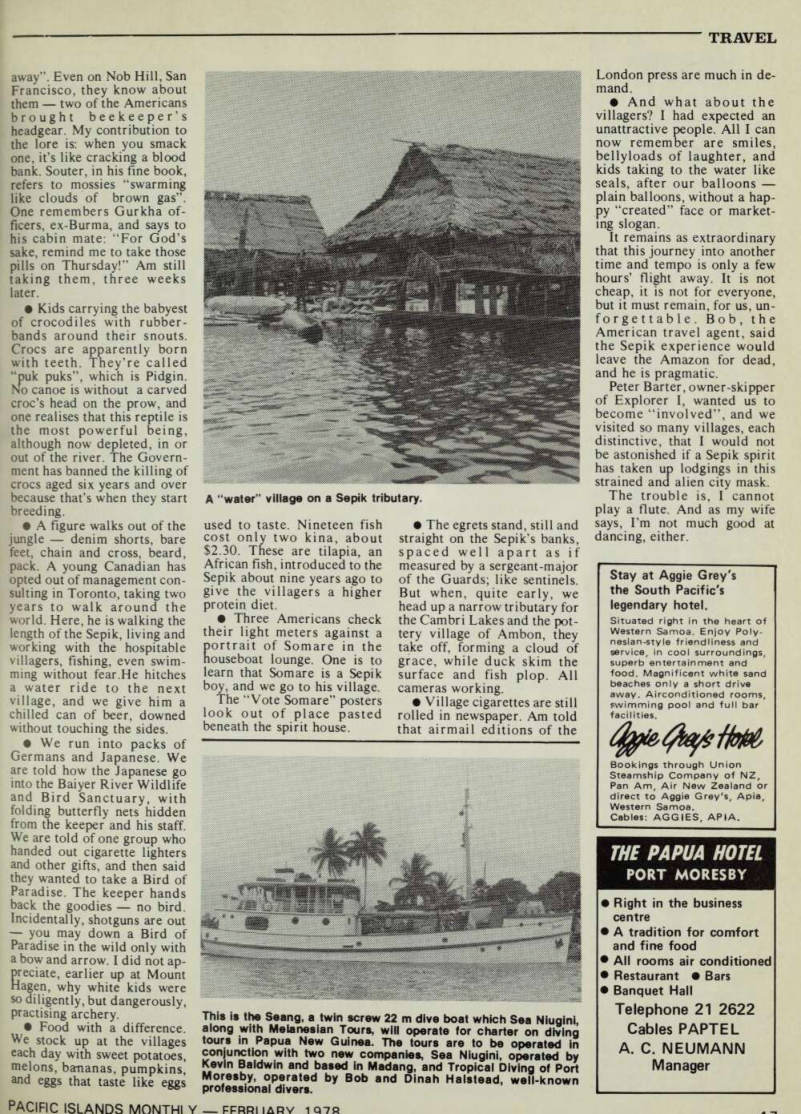
This was one of the ex traordinary happenings in an 1 100 km journey up the Sepik and its tributaries in the swampy humid lowlands of New Guinea, a river high with uncommon rain in August, a mile wide in parts, carrying menacing logs and too much Sepik “lettuce” for the filters of the houseboat, really a mobile pension with accom modation for 20 passengers in unexpected style, Fewer than 900 people a year embark in the houseboat, Sepik Explorer I, and they cover between 720-800 km.
We were lucky. We had for company an august band of Americans: a president and trustees, and affluent mem bers of museum societies, led
by a young curator, an authority on primitive arts, and cosseted by their San Francisco travel agent.
So, we covered the extra miles for the curator to search out, to buy and make movies, for the flock to learn, and for all of us to purchase with ampie time to consider the mask, a piece of brittle pottery, the standing figure. But there was never enough time to gain confidence about getting the stuff out, into port of entry and intact into our homes, However, I now believe the TV ads for a certain glue.
The houseboat made hard going of it three knots against a four-and-a-half knot current. The exploring was done in 30-knot river “trucks” flat-bottomed boats that could go anywhere, and
even churn their way through what looked like fields of the “lettuce”, known in Egypt as Nile “cabbage”, the curse of the Aswan Dam.
There was every camera under the Japanese sun, with one or two concessions to European excellence. I took no pictures, but these are my word snaps, • The widow who has just given half a million to the Academy of Science goes across to the curator, who is fiddling with his light meter.
“Now, Tom ... I don’t know what budget you have .. . (mumble). Well, if there’s
anything you particulaly like,
we can discuss it.” • Everyone has a word for the mosquitos on the Sepik. I was told before I left Sydney; “They’ll literally carry you
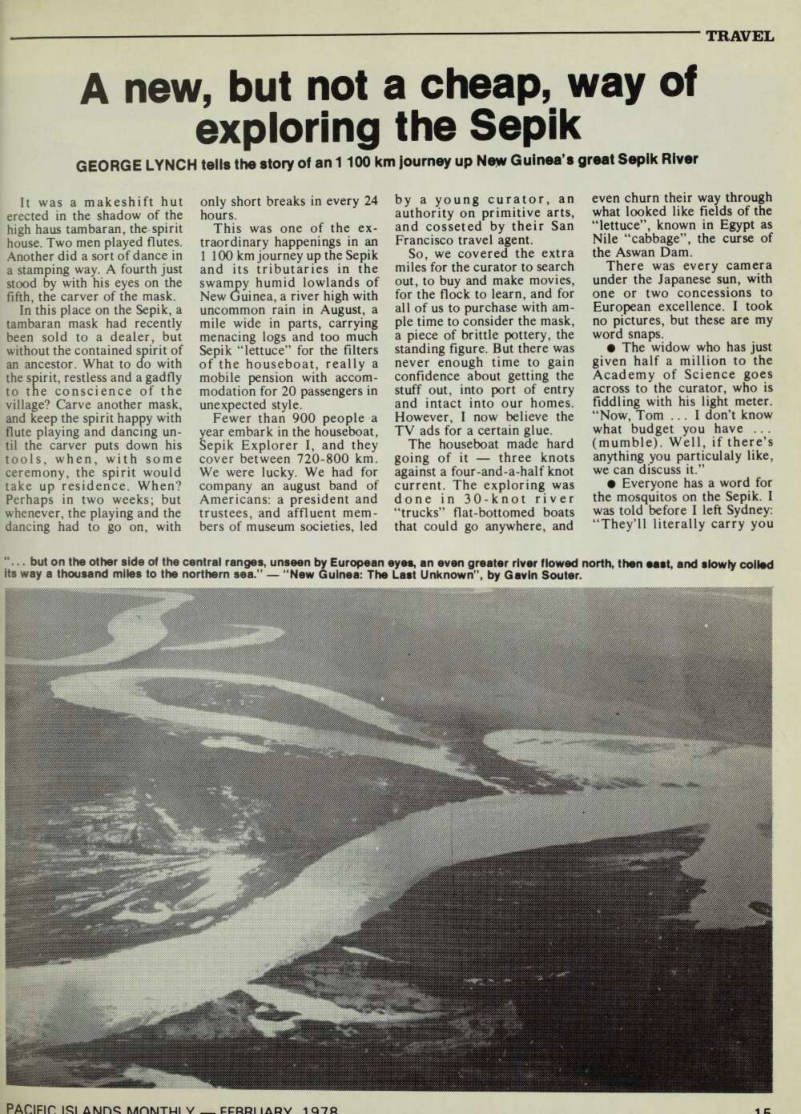
"... but on the other side of the central ranges, unseen by European eyes, an even greater river flowed north, then east, and slowly coiled its way a thousand miles to the northern sea."-“New Guinea: The Last Unknown”, by Gavin Souter.
away”. Even on Nob Hill, San Francisco, they know about them two of the Americans brought beekeeper’s headgear. My contribution to the lore is: when you smack one, it’s like cracking a blood bank. Souter, in his fine book, refers to mossies “swarming like clouds of brown gas”.
One remembers Gurkha of ficers, ex-Burma, and says to his cabin mate: “For God’s sake, remind me to take those pills on Thursday!” Am still taking them, three weeks later. • Kids carrying the babyest of crocodiles with rubber bands around their snouts.
Crocs are apparently born with teeth. They’re called “puk puks”, which is Pidgin.
No canoe is without a carved croc’s head on the prow, and one realises that this reptile is the most powerful being, although now depleted, in or out of the river. The Govern ment has banned the killing of crocs aged six years and over because that’s when they start breeding. • A figure walks out of the jungle denim shorts, bare feet, chain and cross, beard, pack. A young Canadian has opted out of management con sulting in Toronto, taking two years to walk around the world. Here, he is walking the length of the Sepik, living and working with the hospitable villagers, fishing, even swim ming without fear.He hitches a water ride to the next village, and we give him a chilled can of beer, downed without touching the sides. • We run into packs of Germans and Japanese. We are told how the Japanese go into the Baiyer River Wildlife and Bird Sanctuary, with
folding butterfly nets hidden
from the keeper and his staff.
We are told of one group who handed out cigarette lighters and other gifts, and then said they wanted to take a Bird of Paradise. The keeper hands back the goodies no bird.
Incidentally, shotguns are out you may down a Bird of Paradise in the wild only with a bow and arrow. I did not ap preciate, earlier up at Mount Hagen, why white kids were
so diligently, but dangerously,
practising archery.
• Food with a difference.
We stock up at the villages each day with sweet potatoes, melons, bananas, pumpkins, and eggs that taste like eggs
used to taste. Nineteen fish cost only two kina, about $2.30. These are tilapia, an African fish, introduced to the Sepik about nine years ago to give the villagers a higher protein diet. • Three Americans check their light meters against a portrait of Somare in the houseboat lounge. One is to learn that Somare is a Sepik boy, and we go to his village.
The “Vote Somare” posters look out of place pasted beneath the spirit house.
• The egrets stand, still and straight on the Sepik’s banks, spaced well apart as if measured by a sergeant-major of the Guards; like sentinels.
But when, quite early, we head up a narrow tributary for the Cambri Lakes and the pot tery village of Ambon, they take off, forming a cloud of grace, while duck skim the surface and fish plop. All cameras working. • Village cigarettes are still rolled in newspaper. Am told that airmail editions of the
London press are much in de mand. • And what about the villagers? I had expected an unattractive people. All I can now remember are smiles, bellyloads of laughter, and kids taking to the water like seals, after our balloons plain balloons, without a hap py “created” face or market ing slogan.
It remains as extraordinary that this journey into another time and tempo is only a few hours’ flight away. It is not cheap, it is not for everyone, but it must remain, for us, un forgettable. Bob, the American travel agent, said the Sepik experience would leave the Amazon for dead, and he is pragmatic.
Peter Barter, owner-skipper of Explorer I, wanted us to become “involved”, and we visited so many villages, each distinctive, that I would not be astonished if a Sepik spirit has taken up lodgings in this strained and alien city mask.
The trouble is, I cannot play a flute. And as my wife says, I’m not much good at dancing, either.
A “water” village on a Sepik tributary.
This is the Seang, a twin screw 22 m dive boat which Sea Niugini, along with Melanesian Tours, will operate for charter on diving tours in Papua New Guinea. The tours are to be operated in conjunction with two new companies, Sea Niugini, operated by Kevin Baldwin and based in Madang, and Tropical Diving of Port Moresby, operated by Bob and Dinah Halstead, well-known professional divers.
Advertisements & other items, pp. 15-17 (3 items)
Travel
15
PACIFin ISI amhq iwinMrm v pprri iadv 1 Q7Q
Papifir Iri Ands Monthly February, 197 S
16
Goodyear
THE WORLD OVER MORE PEOPLE
RIDE ON GOODYEAR TYRES
THAN ON ANY OTHER BRAND.
GBOO+S
BE
RADIAL
1
GO-GO
Ri
GOOOYm
3 3
FOR
SAFE
ECONOMIC MOTORING
GBOOGP7O
PR EM UM AB RA AL .
ifii
f m -
GBOO ULTRA GRIP
FABRIC RADIAL
'if w
GBOO+SGP7O
PREMIUM STEEL
BELTED RADIAL
RALLY GT
CO VENT lON A
EVERY CHOICE FOR CORRECT APPLICATION AVAILABLE
GOODYEAR
Richard Pieris & Co., Ltd.
Colombo, SRI LANKA Nepal Motor Company (P) Ltd.
Biratnagar, NEPAL Navana Ltd.
Dacca, BANGLADESH
Diethelm & Co., Ltd.
Bangkok, THAILAND Landis Brothers & Co. Ltd.
HONG KONG
Guam Tire & Supply Co.
Agana, GUAM GOODYEAR DISTRIBUTORS IN S.E. ASIA AND PACIFIC BASIN.
Susupe Enterprises Saipan, MARIANA IS.
Nicrol Corporation Saipan, MARIANA IS.
Truk Trading Co.
Truk, E CAROLINE IS.
P.A.M.I.
Kolonia, PONAPE Island Transport Service Co.
Majuro, MARSHALL IS.
Yap Cooperative Ass.
Yap, W. CAROLINE IS.
Cook Islands Motor Centre Rarotonga, COOK IS.
Ngiratkel Etpizon Co. Ltd.
Koror, PALAU Boroko Motors Ltd.
Port Moresby, PAPUA NEW GUINEA Solomon Motors Ltd.
Honiara, 8.5.1. P.
Santo Engineers
Santo, NEW HEBRIDES
Pacific Motors
Vila, NEW HEBRIDES
S.G.A.
Noumea, NEW CALEDONIA
Duncombe Bay Garage
NORFOLK IS.
Coral Island Motors Suva, FIJI Morris Hedstrom Ltd.
Nukualofa, TONGA Morris Hedstrom Ltd.
Apia, WESTERN SAMOA
W.S.T.C.S.
Apia, WESTERN SAMOA
Samoa Motors Inc.
Pago Pago, AMERICAN SAMOA
Service Mobil Papeete, TAHITI
HRMEI7I.OI£
Stay at Aggie Grey's
the South Pacific's
legendary hotel.
Situated right in the heart of Western Samoa. Enjoy Polynesian-style friendliness and service, in cool surroundings, superb entertainment and food. Magnificent white sand beaches only a short drive away. Airconditioned rooms, swimming pool and full bar facilities.
Bookings through Union Steamship Company of NZ, Pan Am, Air New Zealand or direct to Aggie Grey's, Apia, Western Samoa.
Cables: AGGIES, APIA.
THE PAPUA HOTEL
PORT MORESBY
• Right in the business centre • A tradition for comfort and fine food • All rooms air conditioned • Restaurant • Bars • Banquet Hall Telephone 21 2622 Cables PARTE L
A. C. NEUMANN
Manager
Political
Currents
Changes At
The Top
In Tonga?
Major changes at top levels in the Tongan Government seem to be in the offing.
It is no secret that the Prime Minister, Prince Tu’ipelehake, has not been in good health for some time. He saw overseas specialists dur ing 1977, and medical opi nion is that he should retire as soon as possible. Prince Tu’ipelehake has been Prime Minister since 1966 when his brother, the present king, suc ceeded to the throne after the death of their mother, the late Queen Salote.
Interested people have been speculating as to who should succeed the prince should he retire. While the appointment of a successor is the sold pre rogative of his Majesty King Tupou IV, most people believe that the Deputy Prime Minister, Hon Tuita, is the logical successor.
Apart from being Deputy Prime Minister, Hon Tuita has held the most difficult portfolio of Lands and Survey for several years. The consen sus of opinion has it that no one else can handle this ex tremely tough portfolio (in a land-hungry nation such as Tonga) as well as Hon Tuita has done and is doing.
Most civil servants agree that one of his outstanding qualities, which separates him from other ministers, is being decisive in what he does an important leadership prere quisite. He demands no less than the best of performance from those under his authori ty, and it is common knowledge in the kingdom that he is never late for work.
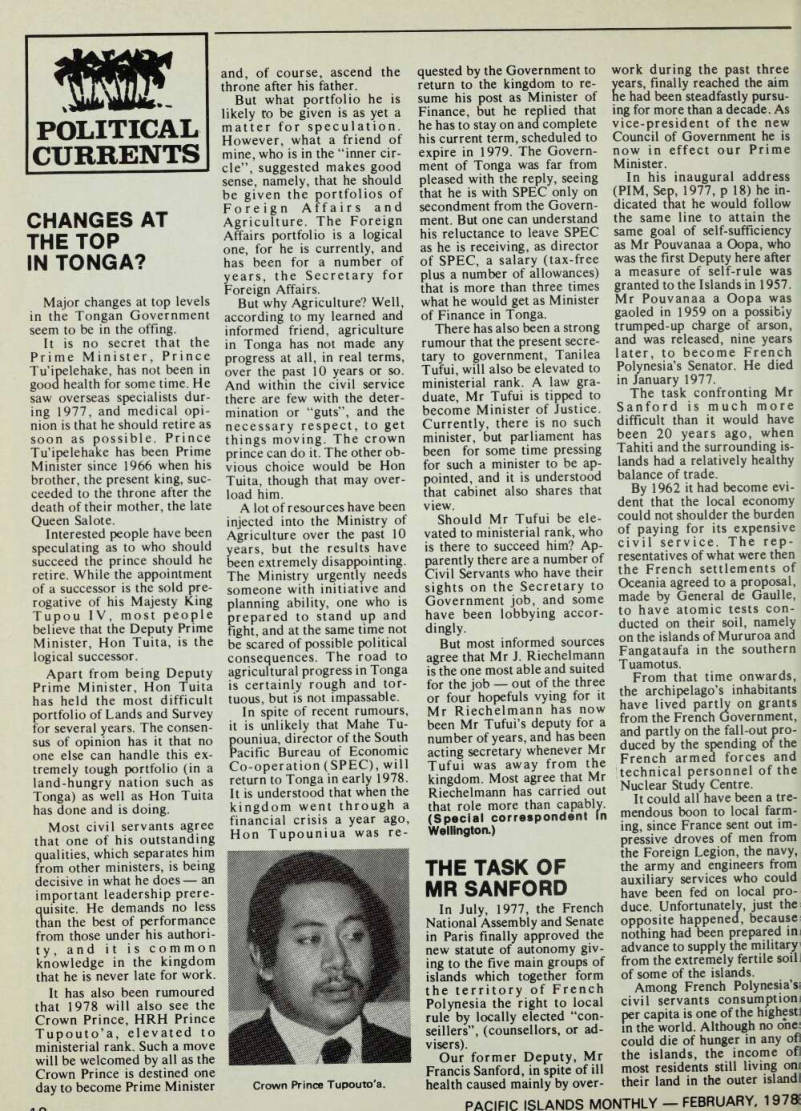
It has also been rumoured that 1978 will also see the Crown Prince, HRH Prince Tupouto’a, elevated to ministerial rank. Such a move will be welcomed by all as the Crown Prince is destined one day to become Prime Minister
and, of course, ascend the throne after his father.
But what portfolio he is likely to be given is as yet a matter for speculation.
However, what a friend of mine, who is in the “inner cir cle”, suggested makes good sense, namely, that he should be given the portfolios of Foreign Affairs and Agriculture. The Foreign Affairs portfolio is a logical one, for he is currently, and has been for a number of years, the Secretary for Foreign Affairs.
But why Agriculture? Well, according to my learned and informed friend, agriculture in Tonga has not made any progress at all, in real terms, over the past 10 years or so.
And within the civil service there are few with the deter mination or “guts”, and the necessary respect, to get things moving. The crown prince can do it. The other ob vious choice would be Hon Tuita, though that may over load him.
A lot of resources have been injected into the Ministry of Agriculture over the past 10 years, but the results have been extremely disappointing.
The Ministry urgently needs someone with initiative and planning ability, one who is prepared to stand up and fight, and at the same time not be scared of possible political consequences. The road to agricultural progress in Tonga is certainly rough and tor tuous, but is not impassable.
In spite of recent rumours, it is unlikely that Mahe Tu pouniua, director of the South Pacific Bureau of Economic Co-operation (SPEC), will return to Tonga in early 1978.
It is understood that when the kingdom went through a financial crisis a year ago, Hon Tupouniua was re-
quested by the Government to return to the kingdom to re sume his post as Minister of Finance, but he replied that he has to stay on and complete his current term, scheduled to expire in 1979. The Govern ment of Tonga was far from pleased with the reply, seeing that he is with SPEC only on secondment from the Govern ment. But one can understand his reluctance to leave SPEC as he is receiving, as director of SPEC, a salary (tax-free plus a number of allowances) that is more than three times what he would get as Minister of Finance in Tonga.
There has also been a strong rumour that the present secre tary to government, Tanilea Tufui, will also be elevated to ministerial rank. A law gra duate, Mr Tufui is tipped to become Minister of Justice.
Currently, there is no such minister, but parliament has been for some time pressing for such a minister to be ap pointed, and it is understood that cabinet also shares that view.
Should Mr Tufui be ele vated to ministerial rank, who is there to succeed him? Ap parently there are a number of Civil Servants who have their sights on the Secretary to Government job, and some have been lobbying accor dingly.
But most informed sources agree that Mr J. Riechelmann is the one most able and suited for the job out of the three or four hopefuls vying for it Mr Riechelmann has now been Mr Tufui’s deputy for a number of years, and has been acting secretary whenever Mr Tufui was away from the kingdom. Most agree that Mr Riechelmann has carried out that role more than capably. (Special correspondent in Wellington.)
The Task Of
Mr Sanford
In July, 1977, the French National Assembly and Senate in Paris finally approved the new statute of autonomy giv ing to the five main groups of islands which together form the territory of French Polynesia the right to local rule by locally elected “con seillers”, (counsellors, or ad visers).
Our former Deputy, Mr Francis Sanford, in spite of ill health caused mainly by over
work during the past three years, finally reached the aim he had been steadfastly pursu ing for more than a decade. As vice-president of the new Council of Government he is now in effect our Prime Minister.
In his inaugural address (PIM, Sep, 1977, p 18) he in dicated that he would follow the same line to attain the same goal of self-sufficiency as Mr Pouvanaa a Oopa, who was the first Deputy here after a measure of self-rule was granted to the Islands in 1957.
Mr Pouvanaa a Oopa was gaoled in 1959 on a possibly trumped-up charge of arson, and was released, nine years later, to become French Polynesia’s Senator. He died in January 1977.
The task confronting Mr Sanford is much more difficult than it would have been 20 years ago, when Tahiti and the surrounding is lands had a relatively healthy balance of trade.
By 1962 it had become evi dent that the local economy could not shoulder the burden of paying for its expensive civil service. The rep resentatives of what were then the French settlements of Oceania agreed to a proposal, made by General de Gaulle, to have atomic tests con ducted on their soil, namely on the islands of Mururoa and Fangataufa in the southern T uamotus.
From that time onwards, the archipelago’s inhabitants have lived partly on grants from the French Government, and partly on the fall-out pro duced by the spending of the French armed forces and technical personnel of the Nuclear Study Centre.
It could all have been a tre mendous boon to local farm ing, since France sent out im pressive droves of men from the Foreign Legion, the navy, the army and engineers from auxiliary services who could have been fed on local pro duce. Unfortunately, just the
opposite happened, because
nothing had been prepared in advance to supply the military from the extremely fertile soil of some of the islands.
Among French Polynesia’s civil servants consumption per capita is one of the highest in the world. Although no one could die of hunger in any of: the islands, the income of most residents still living om their land in the outer island!
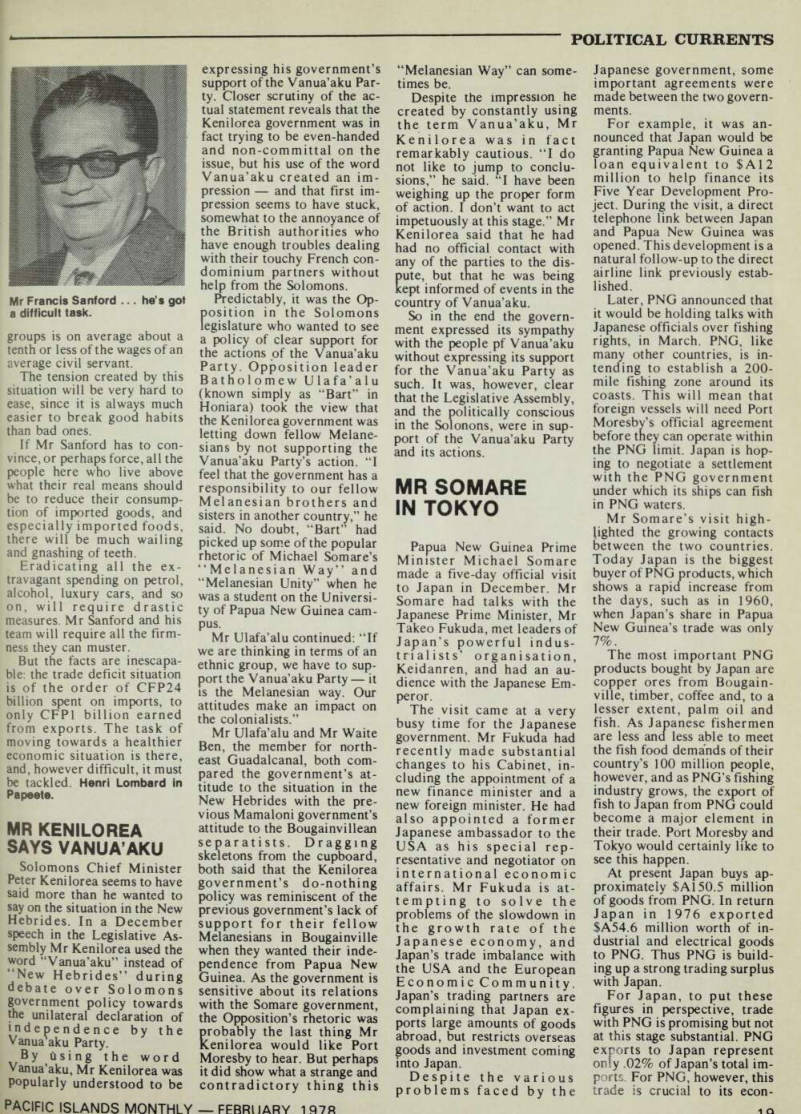
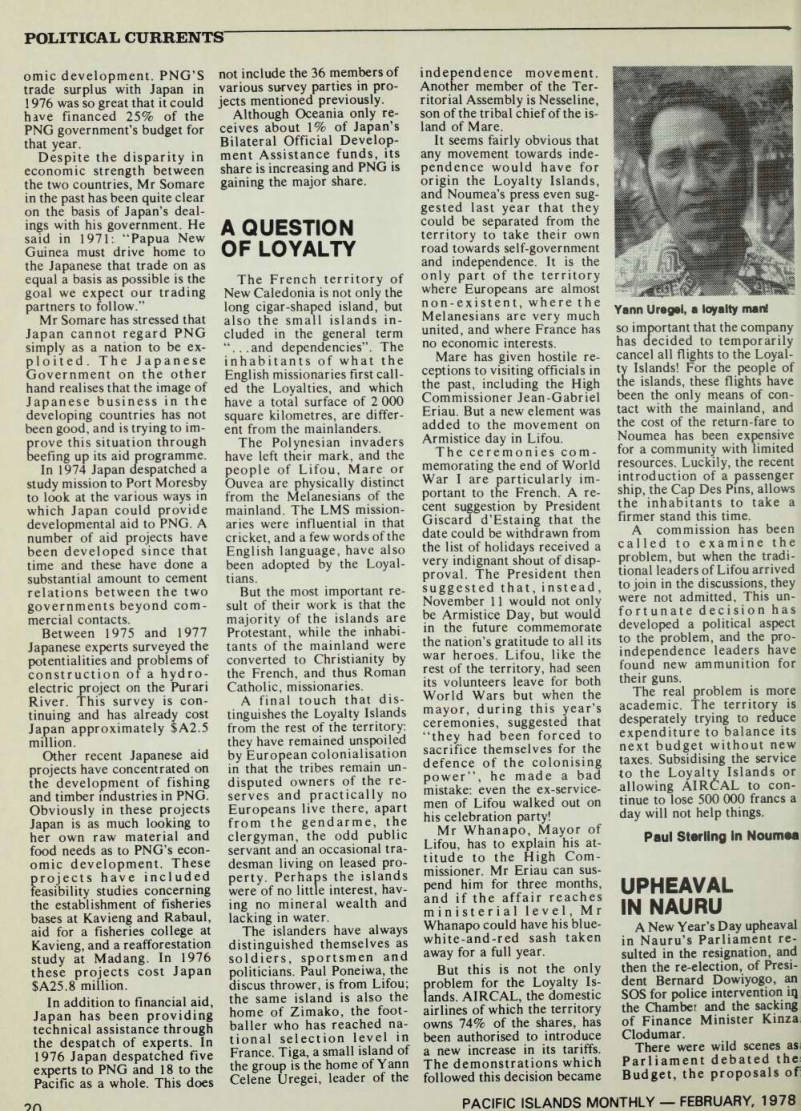
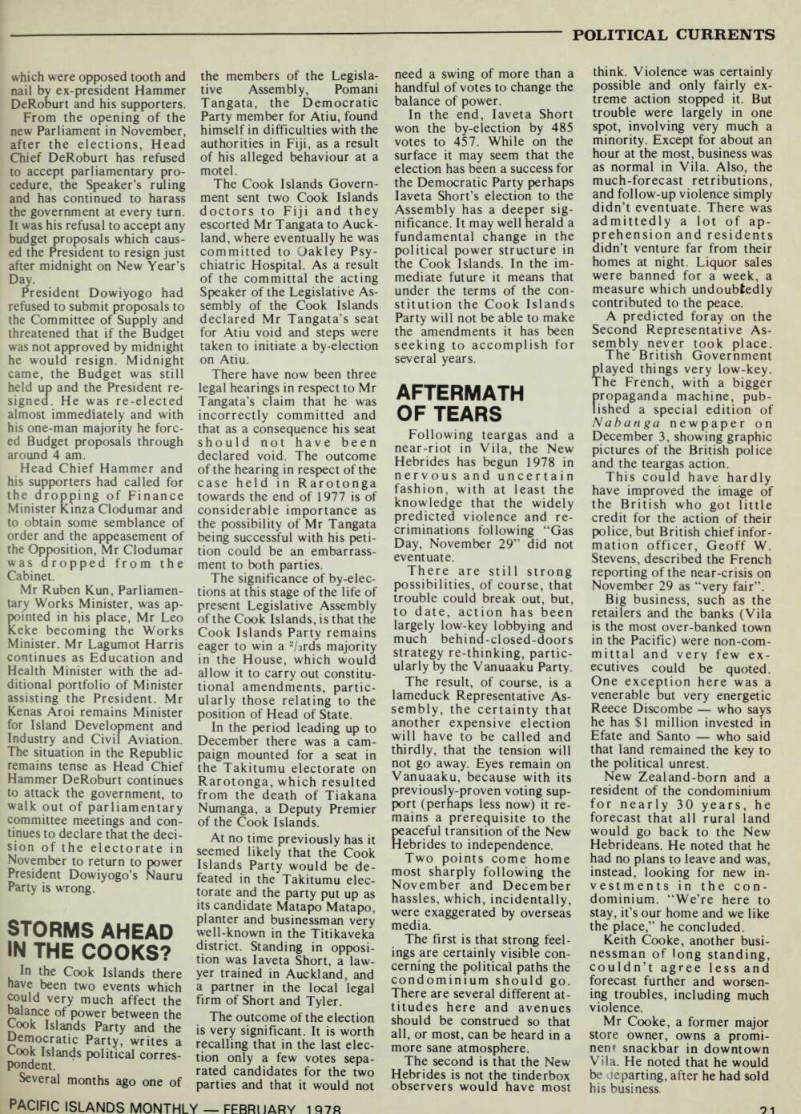
Crown Prince Tupouto'a.
groups is on average about a tenth or less of the wages of an average civil servant.
The tension created by this situation will be very hard to ease, since it is always much easier to break good habits than bad ones.
If Mr Sanford has to con vince, or perhaps force, all the people here who live above what their real means should be to reduce their consump tion of imported goods, and especially imported foods, there will be much wailing and gnashing of teeth.
Eradicating all the ex travagant spending on petrol, alcohol, luxury cars, and so on, will require drastic measures. Mr Sanford and his team will require all the firm ness they can muster.
But the facts are inescapa ble; the trade deficit situation is of the order of CFP24 billion spent on imports, to only CFPI billion earned from exports. The task of moving towards a healthier economic situation is there, and, however difficult, it must be tackled. Henri Lombard In Papeete.
Mr Kenilorea
Says Vanua’Aku
Solomons Chief Minister Peter Kenilorea seems to have said more than he wanted to say on the situation in the New Hebrides. In a December speech in the Legislative As sembly Mr Kenilorea used the word “Vanua’aku” instead of “New Hebrides’’ during debate over Solomons government policy towards the unilateral declaration of independence by the Vanua aku Party.
By using the word Vanua’aku, Mr Kenilorea was popularly understood to be
expressing his government’s support of the Vanua’aku Par ty. Closer scrutiny of the ac tual statement reveals that the Kenilorea government was in fact trying to be even-handed and non-committal on the issue, but his use of the word Vanua’aku created an im pression and that first im pression seems to have stuck, somewhat to the annoyance of the British authorities who have enough troubles dealing with their touchy French con dominium partners without help from the Solomons.
Predictably, it was the Op position in the Solomons legislature who wanted to see a policy of clear support for the actions of the Vanua’aku Party. Opposition leader Batholomew Ulafa’alu (known simply as “Bart” in Honiara) took the view that the Kenilorea government was letting down fellow Melane sians by not supporting the Vanua’aku Party’s action. “I feel that the government has a responsibility to our fellow Melanesian brothers and sisters in another country,” he said. No doubt, “Bart” had picked up some of the popular rhetoric of Michael Somare’s “Melanesian Way’’ and “Melanesian Unity” when he was a student on the Universi ty of Papua New Guinea cam pus.
Mr Ulafa’alu continued; “If we are thinking in terms of an ethnic group, we have to sup port the Vanua’aku Party— it is the Melanesian way. Our attitudes make an impact on the colonialists.”
Mr Ulafa’alu and Mr Waite Ben, the member for north east Guadalcanal, both com pared the government’s at titude to the situation in the New Hebrides with the pre vious Mamaloni government’s attitude to the Bougainvillean separatists. Dragging skeletons from the cupboard, both said that the Kenilorea government’s do-nothing policy was reminiscent of the previous government’s lack of support for their fellow Melanesians in Bougainville when they wanted their inde pendence from Papua New Guinea. As the government is sensitive about its relations with the Somare government, the Opposition’s rhetoric was probably the last thing Mr Kenilorea would like Port Moresby to hear. But perhaps it did show what a strange and contradictory thing this
“Melanesian Way” can some times be.
Despite the impression he created by constantly using the term Vanua’aku, Mr Kenilorea was in fact remarkably cautious. “I do not like to jump to conclu sions,” he said. “I have been weighing up the proper form of action. I don’t want to act impetuously at this stage.” Mr Kenilorea said that he had had no official contact with any of the parties to the dis pute, but that he was being kept informed of events in the country of Vanua’aku.
So in the end the govern ment expressed its sympathy with the people pf Vanua’aku without expressing its support for the Vanua’aku Party as such. It was, however, clear that the Legislative Assembly, and the politically conscious in the Solonons, were in sup port of the Vanua’aku Party and its actions.
Mr Somare
In Tokyo
Papua New Guinea Prime Minister Michael Somare made a five-day official visit to Japan in December. Mr Somare had talks with the Japanese Prime Minister, Mr Takeo Fukuda, met leaders of Japan’s powerful indus trialists’ organisation, Keidanren, and had an au dience with the Japanese Em peror.
The visit came at a very busy time for the Japanese government. Mr Fukuda had recently made substantial changes to his Cabinet, in cluding the appointment of a new finance minister and a new foreign minister. He had also appointed a former Japanese ambassador to the USA as his special rep resentative and negotiator on international economic affairs. Mr Fukuda is at tempting to solve the problems of the slowdown in the growth rate of the Japanese economy, and Japan’s trade imbalance with the USA and the European
Economic Community.
Japan’s trading partners are complaining that Japan ex ports large amounts of goods abroad, but restricts overseas goods and investment coming into Japan.
Despite the various problems faced by the
Japanese government, some important agreements were made between the two govern ments.
For example, it was an nounced that Japan would be granting Papua New Guinea a loan equivalent to SAI2 million to help finance its Five Year Development Pro ject. During the visit, a direct telephone link between Japan and Papua New Guinea was opened. This development is a natural follow-up to the direct airline link previously estab lished.
Later, PNG announced that it would be holding talks with Japanese officials over fishing rights, in March. PNG, like many other countries, is in tending to establish a 200mile fishing zone around its coasts. This will mean that foreign vessels will need Port Moresby’s official agreement before they can operate within the PNG limit. Japan is hop ing to negotiate a settlement with the PNG government under which its ships can fish in PNG waters.
Mr Somare’s visit high lighted the growing contacts between the two countries.
Today Japan is the biggest buyer of PNG products, which shows a rapid increase from the days, such as in 1960, when Japan’s share in Papua New Guinea’s trade was only 7%.
The most important PNG products bought by Japan are copper ores from Bougain ville, timber, coffee and, to a lesser extent, palm oil and fish. As Japanese fishermen are less and less able to meet the fish food demands of their country’s 100 million people, however, and as PNG’s fishing industry grows, the export of fish to Japan from PNG could become a major element in their trade. Port Moresby and Tokyo would certainly like to see this happen.
At present Japan buys ap proximately $A150.5 million of goods from PNG. In return Japan in 1976 exported $A54.6 million worth of in dustrial and electrical goods to PNG. Thus PNG is build ing up a strong trading surplus with Japan.
For Japan, to put these figures in perspective, trade with PNG is promising but not at this stage substantial. PNG exports to Japan represent only .02% of Japan’s total im ports. For PNG, however, this trade is crucial to its econ
Mr Francis Sanford... he’s got a difficult task.
omic development. PNG’S trade surplus with Japan in 1976 was so great that it could have financed 25% of the PNG government’s budget for that year.
Despite the disparity in economic strength between the two countries, Mr Somare in the past has been quite clear on the basis of Japan’s deal ings with his government. He said in 1971: “Papua New Guinea must drive home to the Japanese that trade on as equal a basis as possible is the goal we expect our trading partners to follow.’’
Mr Somare has stressed that Japan cannot regard PNG simply as a nation to be ex ploited. The Japanese Government on the other hand realises that the image of Japanese business in the developing countries has not been good, and is trying to im prove this situation through beefing up its aid programme.
In 1974 Japan despatched a study mission to Port Moresby to look at the various ways in which Japan could provide developmental aid to PNG. A number of aid projects have been developed since that time and these have done a substantial amount to cement relations between the two governments beyond com mercial contacts.
Between 1975 and 1977 Japanese experts surveyed the potentialities and problems of construction of a hydro electric project on the Purari River. This survey is con tinuing and has already cost Japan approximately $A2.5 million.
Other recent Japanese aid projects have concentrated on the development of fishing and timber industries in PNG.
Obviously in these projects Japan is as much looking to her own raw material and food needs as to PNG’s econ omic development. These projects have included feasibility studies concerning the establishment of fisheries bases at Kavieng and Rabaul, aid for a fisheries college at Kavieng, and a reafforestation study at Madang. In 1976 these projects cost Japan $A25.8 million.
In addition to financial aid, Japan has been providing technical assistance through the despatch of experts. In 1976 Japan despatched five experts to PNG and 18 to the Pacific as a whole. This does
not include the 36 members of various survey parties in pro jects mentioned previously.
Although Oceania only re ceives about 1% of Japan’s Bilateral Official Develop ment Assistance funds, its share is increasing and PNG is gaining the major share.
A Question
Of Loyalty
The French territory of New Caledonia is not only the long cigar-shaped island, but also the small islands in cluded in the general term “...and dependencies’’. The inhabitants of what the English missionaries first call ed the Loyalties, and which have a total surface of 2 000 square kilometres, are differ ent from the mainlanders.
The Polynesian invaders have left their mark, and the people of Lifou, Mare or Ouvea are physically distinct from the Melanesians of the mainland. The LMS mission aries were influential in that cricket, and a few words of the English language, have also been adopted by the Loyal tians.
But the most important re sult of their work is that the majority of the islands are Protestant, while the inhabi tants of the mainland were converted to Christianity by the French, and thus Roman Catholic, missionaries.
A final touch that dis tinguishes the Loyalty Islands from the rest of the territory; they have remained unspoiled by European colonialisation in that the tribes remain un disputed owners of the re serves and practically no Europeans live there, apart from the gendarme, the clergyman, the odd public servant and an occasional tra desman living on leased pro perty. Perhaps the islands were of no little interest, hav ing no mineral wealth and lacking in water.
The islanders have always distinguished themselves as soldiers, sportsmen and politicians. Paul Poneiwa, the discus thrower, is from Lifou; the same island is also the home of Zimako, the foot baller who has reached na tional selection level in France. Tiga, a small island of the group is the home of Yann Celene Uregei, leader of the
independence movement.
Another member of the Ter ritorial Assembly is Nesseline, son of the tribal chief of the is land of Mare.
It seems fairly obvious that any movement towards inde pendence would have for origin the Loyalty Islands, and Noumea’s press even sug gested last year that they could be separated from the territory to take their own road towards self-government and independence. It is the only part of the territory where Europeans are almost non-existent, where the Melanesians are very much united, and where France has no economic interests.
Mare has given hostile re ceptions to visiting officials in the past, including the High Commissioner Jean-Gabriel Eriau. But a new element was added to the movement on Armistice day in Lifou.
The ceremonies com memorating the end of World War I are particularly im portant to the French. A re cent suggestion by President Giscard d’Estaing that the date could be withdrawn from the list of holidays received a very indignant shout of disap proval. The President then suggested that, instead, November 11 would not only be Armistice Day, but would in the future commemorate the nation’s gratitude to all its war heroes. Lifou, like the rest of the territory, had seen its volunteers leave for both World Wars but when the mayor, during this year’s ceremonies, suggested that “they had been forced to sacrifice themselves for the defence of the colonising power”, he made a bad mistake: even the ex-service men of Lifou walked out on his celebration party!
Mr Whanapo, Mayor of Lifou, has to explain his at titude to the High Com missioner. Mr Eriau can sus pend him for three months, and if the affair reaches ministerial level, Mr Whanapo could have his blue white-and-red sash taken away for a full year.
But this is not the only problem for the Loyalty Is lands. AIRCAL, the domestic airlines of which the territory owns 74% of the shares, has been authorised to introduce a new increase in its tariffs.
The demonstrations which followed this decision became
so important that the company has decided to temporarily cancel all flights to the Loyal ty Islands! For the people of the islands, these flights have been the only means of con tact with the mainland, and the cost of the return-fare to Noumea has been expensive for a community with limited resources. Luckily, the recent introduction of a passenger ship, the Cap Des Pins, allows the inhabitants to take a firmer stand this time.
A commission has been called to examine the problem, but when the tradi tional leaders of Lifou arrived to join in the discussions, they were not admitted. This un fortunate decision has developed a political aspect to the problem, and the pro independence leaders have found new ammunition for their guns.
The real problem is more academic. The territory is desperately trying to reduce expenditure to balance its next budget without new taxes. Subsidising the service to the Loyalty Islands or allowing AIRCAL to con tinue to lose 500 000 francs a day will not help things.
Paul Sterling in Noumea
Upheaval
In Nauru
A New Year’s Day upheaval in Nauru’s Parliament re sulted in the resignation, and then the re-election, of Presi dent Bernard Dowiyogo, an SOS for police intervention iij the Chamber and the sacking of Finance Minister Kinza Clodumar.
There were wild scenes as Parliament debated the Budget, the proposals of
Yann Uregel, a loyalty man!
which were opposed tooth and nail by ex-president Hammer Deßoburt and his supporters.
From the opening of the new Parliament in November, after the elections, Head Chief Deßoburt has refused to accept parliamentary pro cedure, the Speaker’s ruling and has continued to harass the government at every turn.
It was his refusal to accept any budget proposals which caus ed the President to resign just after midnight on New Year’s Day.
President Dowiyogo had refused to submit proposals to the Committee of Supply and threatened that if the Budget was not approved by midnight he would resign. Midnight came, the Budget was still held up and the President re signed. He was re-elected almost immediately and with his one-man majority he forc ed Budget proposals through around 4 am.
Head Chief Hammer and his supporters had called for the dropping of Finance Minister Kmza Clodumar and to obtain some semblance of order and the appeasement of the Opposition, Mr Clodumar was dropped from the Cabinet.
Mr Ruben Kun, Parliamen tary Works Minister, was ap pointed in his place, Mr Leo Keke becoming the Works Minister. Mr Lagumot Harris continues as Education and Health Minister with the ad ditional portfolio of Minister assisting the President. Mr Kenas Aroi remains Minister for Island Development and Industry and Civil Aviation.
The situation in the Republic remains tense as Head Chief Hammer Deßoburt continues to attack the government, to walk out of parliamentary committee meetings and con tinues to declare that the deci sion of the electorate in November to return to power President Dowiyogo’s Nauru Party is wrong.
Storms Ahead
In The Cooks?
In the Cook Islands there have been two events which could very much affect the balance of power between the Cook Islands Party and the Democratic Party, writes a Cook Islands political corres pondent.
Several months ago one of
the members of the Legisla tive Assembly, Pomani Tangata, the Democratic Party member for Atiu, found himself in difficulties with the authorities in Fiji, as a result of his alleged behaviour at a motel.
The Cook Islands Govern ment sent two Cook Islands doctors to Fiji and they escorted Mr Tangata to Auck land, where eventually he was committed to Oakley Psy chiatric Hospital. As a result of the committal the acting Speaker of the Legislative As sembly of the Cook Islands declared Mr Tangata’s seat for Atiu void and steps were taken to initiate a by-election on Atiu.
There have now been three legal hearings in respect to Mr Tangata’s claim that he was incorrectly committed and that as a consequence his seat should not have been declared void. The outcome of the hearing in respect of the case held in Rarotonga towards the end of 1977 is of considerable importance as the possibility of Mr Tangata being successful with his peti tion could be an embarrass ment to both parties.
The significance of by-elec tions at this stage of the life of present Legislative Assembly of the Cook Islands, is that the Cook Islands Party remains eager to win a 2 /ards majority in the House, which would allow it to carry out constitu tional amendments, partic ularly those relating to the position of Head of State.
In the period leading up to December there was a cam paign mounted for a seat in the Takitumu electorate on Rarotonga, which resulted from the death of Tiakana Numanga, a Deputy Premier of the Cook Islands.
At no time previously has it seemed likely that the Cook Islands Party would be de feated in the Takitumu elec torate and the party put up as its candidate Matapo Matapo, planter and businessman very well-known in the Titikaveka district. Standing in opposi tion was laveta Short, a law yer trained in Auckland, and a partner in the local legal firm of Short and Tyler.
The outcome of the election is very significant. It is worth recalling that in the last elec tion only a few votes sepa rated candidates for the two parties and that it would not
need a swing of more than a handful of votes to change the balance of power.
In the end, laveta Short won the by-election by 485 votes to 457. While on the surface it may seem that the election has been a success for the Democratic Party perhaps laveta Short’s election to the Assembly has a deeper sig nificance. It may well herald a fundamental change in the political power structure in the Cook Islands. In the im mediate future it means that under the terms of the con stitution the Cook Islands Party will not be able to make the amendments it has been seeking to accomplish for several years.
Aftermath
Of Tears
Following teargas and a near-riot in Vila, the New Hebrides has begun 1978 in nervous and uncertain fashion, with at least the knowledge that the widely predicted violence and re criminations following “Gas Day, November 29” did not eventuate.
There are still strong possibilities, of course, that trouble could break out, but, to date, action has been largely low-key lobbying and much behina-closed-doors strategy re-thinking, partic ularly by the Vanuaaku Party.
The result, of course, is a lameduck Representative As sembly, the certainty that another expensive election will have to be called and thirdly, that the tension will not go away. Eyes remain on Vanuaaku, because with its previously-proven voting sup port (perhaps less now) it re mains a prerequisite to the peaceful transition of the New Hebrides to independence.
Two points come home most sharply following the November and December hassles, which, incidentally, were exaggerated by overseas media.
The first is that strong feel ings are certainly visible con cerning the political paths the condominium should go.
There are several different at titudes here and avenues should be construed so that all, or most, can be heard in a more sane atmosphere.
The second is that the New Hebrides is not the tinderbox observers would have most
think. Violence was certainly possible and only fairly ex treme action stopped it. But trouble were largely in one spot, involving very much a minority. Except for about an hour at the most, business was as normal in Vila. Also, the much-forecast retributions, and follow-up violence simply didn’t eventuate. There was admittedly a lot of ap prehension and residents didn’t venture far from their homes at night. Liquor sales were banned for a week, a measure which undoubtedly contributed to the peace.
A predicted foray on the Second Representative As sembly never took place.
The British Government played things very low-key.
The French, with a bigger propaganda machine, pub lished a special edition of Nabanga newpaper on December 3, showing graphic pictures of the British police and the teargas action.
This could have hardly have improved the image of the British who got little credit for the action of their police, but British chief infor mation officer, Geoff W.
Stevens, described the French reporting of the near-crisis on November 29 as “very fair”.
Big business, such as the retailers and the banks (Vila is the most over-banked town in the Pacific) were non-com mittal and very few ex ecutives could be quoted.
One exception here was a venerable but very energetic Reece Discombe who says he has $1 million invested in Efate and Santo who said that land remained the key to the political unrest.
New Zealand-born and a resident of the condominium for nearly 30 years, he forecast that all rural land would go back to the New Hebrideans. He noted that he had no plans to leave and was, instead, looking for new in vestments in the con dominium. “We’re here to stay, it’s our home and we like the place,” he concluded.
Keith Cooke, another busi nessman of long standing, couldn’t agree less and forecast further and worsen ing troubles, including much violence.
Mr Cooke, a former major store owner, owns a promi nent snackbar in downtown Vila. He noted that he would be departing, after he had sold his business,
Off the beaten
tourist track
A village on the Trobriand Islands has a special project to encourage tourists. They have build three small guest houses, capable of accom modating one person in each house.
The cost to stay in one of these houses is K 5 a night (all inclusive) and the tourist can share meals with the villagers, help with garden chores, fish with the villagers and
generally participate in all
aspects of local life as well as spending time at their own leisure on the island.
FOOTNOTE: The girls of the Trobriand Islands are among the most attractive in the South Pacific.
Micronesian
girls in Fiji
Several women from the US Trust Territory were selected by the South Pacific Com mission to attend the 1978 Home Economics Course in Suva, Fiji.
They include Valeria Remoket and Augustina Mesubed of Palau, Carmen Taitano of the Northern Marianas, Carmen Guchol and Lydia Sawyog of Yap, and Tarbo Hemos of the Marshalls.
They went to Fiji in January and will study there for nine months. Home Economics, Baby Care, Home Cooking, Sewing and Home Gardening are some of the courses offered.
The course is funded par tially by the South Pacific Commission. People from the member nations of the South Pacific Commission will also take part in the course.
Moscow er,
Honiara calling
The man at the Australian Security Intelligence Organ isation headquarters put down his earphones and gave his radio monitor a thump. “Darn thing must be playing up,” he mumbled to himself. He had been told to monitor the Solomon Islands Broadcast ing Corporation and all he was getting was news from Radio Moscow.
“Still, better to be sure than sorry,” he said to himself as he
picked up the telephone and dialled the Security and In telligence Service in Wellington. Perhaps their monitor was working properly and they’d picked up the news programme from Honiara.
Perhaps they’d whizz over a tape to prevent the boss from suspecting that he’d been sleeping on the job.
But the ASIO man blanch ed. Wellington had been get ting Radio Moscow too. It was coming from SIBC. What had happened a pro-Soviet coup out there in our Pacific Ocean? He ran down the cor ridor shouting “The Russians are coming!”
Well, anyway, if an ASIO man had been listening to SIBC one night in December he would have heard Honiara’s radio station broadcasting news from Moscow and sharing with listeners a few thoughts from Mr Brezhnev as well. But it wasn’t due to a coup. Simply a tuning mistake. SIBC nor mally takes its international news broadcast from Radio Australia, but someone slip ped up on the tuning and the news came from Radio Moscow’s English-language shortwave broadcast instead.
It took about 10 minutes before someone woke up that something was amiss. It was when the female announcer launched into a very long piece on a very long speech Mr Brezhnev had given re cently, that it became clear this wasn’t the ABC.
Then a few days later peo ple listening to the SIBC for the relay of Radio Australia’s international news heard a cheery voice with a strong American accent say; “Hullo Africans, welcome to African Safari.” The gremlins had been at it again ... or perhaps there had been a coup at SIBC on behalf of the Voice of America, overthrowing whoever it was had turned the dial to Radio Moscow.
Apia's case of
wages fraud
The Western Samoa Public Accounts Committee is not at all happy with procedures for paying wages in the Public Works Department. In fact the way some officers went about it was in breach of Treasury instructions, and led
to a loss of $43 882, which the committee called “a fraud”.
The committee noted a paragraph in the audit report which said that the same per son prepared the paysheet, drew up the voucher, uplifted the cheque, cashed the cheque at the bank, put the money in pay envelopes and attended to the pay-out.
It considered that senior of ficers of the department did not carry out their duties in line with Treasury instruc tions. In fact, one witness told the committee that one of the certifying officers used to bor row unclaimed wages for his private use. In many cases he had never paid the money back. ‘‘No wonder this particular certifying officer never check ed the paysheets when return ed for final certification,” the committee commented. ‘‘The result of this irresponsible at titude was a loss of govern ment revenue amounting to $43 882”.
This fraud was explained by “one of the culprits” to the committee as follows; on Sun days he (a former salary clerk) and his collaborator (former costing clerk) took the paysheets to their houses and prepared them there. On Mondays they would bring the prepared paysheets to the of fice and usually the account ant would certify the voucher.
The accountant then made the arrangements with the Treasury for the processing of the voucher, after which the former salary clerk and cost ing clerk would “uplift the cheque”, cash it at the bank, put the money on envelopes and attend to the payout.
The drooping
of the colours
In the Cook Islands, the Public Service Act has been amended to allow the Cook Islands Police Force to have a greater degree of autonomy, and the Government decided that it should give public re cognition to this increased in
dependence by presenting col
ours to the police.
And so it was on a fine morning in the first week of December, that the colour parade was held on the historic grounds of Takamoa, the site of the London Mis sionary Society’s theological college. A pavilion was set up
Tropicalities
and a large number of invited guests were seated to best ad vantage while many other people and the children of the nearby Avarua Primary School took up vantage
points.
Apart from Superintendent Lester Khan and two other senior officers, who were seated in the pavilion, the whole of the Rarotongan force, both policemen and
policewomen numbering
perhaps 40 in all, stood on parade to await the arrival of the Premier, Sir Albert Henry. The official entourage arrived and the Premier in spected the parade. A prayer was said, the colours were dedicated and then the Pre mier formally handed the col ours to two of the police of ficers.
Sir Albert mounted the rostrum to address the parade and to bring to the notice of the people the very significant role that the police force plays in the maintenance of law and order.
It was all very like Lon don’s Trooping of the Colour, all very formal, all very proper and all according to Hoyle. Even to the fainting troopers. Hardly had the Pre mier begun his oration than a hefty sergeant fell log-like through the ranks and had to be removed by several of his colleagues to be revived under a nearby tree.
A few minutes later one of the policewomen in the front rank was also overcome and quietly crumpled into an inert heap in front of Sir Albert.
She also was dragged from the parade and at this juncture Dr Tom Davis, the Leader of the Opposition, had his role to play. He rose to his feet, strode across to the insensible victims and gave his advice to those who were rendering them first-aid.
Yet, it was all very im pressive and was iust one more indication of the extent to which the leaders and peo ple of the Cook Islands wish to indicate their desire to es tablish their own traditions and their own pomp and cir cumstance.
It's off with
somebody's head
When Queen Elizabeth II left Papua New Guinea during her jubilee tour of the Islands last year, she took with her a set of human skulls which the PNG Government considered was a fit and proper gift for Britain’s monarch. After all, several of her royal ancestors collected not a few heads dur ing their respective reigns.
Now, it transpires, some body broke the law of Papua New Guinea. According to Mr John Haugie, Director of the National Cultural Coun cil, the Natural Cultural Pro perty Ordinance bans the ex portation of skulls from Papua New Guinea.
The Prime Minister’s pro tocol staff neglected to inform the National Museum that they were presenting the skulls to the Queen, said Mr Haugie. He added that the council should have been con sulted about the gift and that, therefore, the skulls had left the country illegally.
“It is true that the skulls left the country illegally when the Queen took them with her,”
Mr Haugie said. “Literally, the Queen is the figurehead of this country so she was prob ably entitled to such gifts, although there is nothing in the ordinance to say that figureheads had such pri vileges.”
Strictly, of course, the Queen did no wrong. As sovereign she is the maker of all laws, and all offences com mitted in her realm are com mitted against her “peace and sovereignty”. Ergo, she can’t offend against herself!!
NZ's " grizzlin
gifts'' slammed
A visiting Methodist clergy man lashed out in Christchurch at “New Zea land’s grizzling gifts” to the Pacific Islands.
Dr Amanaki Havea, prin cipal of the Pacific Theologi cal College in Suva, ridiculed “aid, New Zeal and-style” pouring primary produce into the Islands yet closing the door on the Pacific’s most marketable product, its labour force. * “New Zealand is exporting millions of dollars worth of goods to the Pacific and is tak-
ing only a small percentage in return,” he said.
“The Islands’ only resource is their people their sweat, tears and blood and to shut them out is not a fair ex change.”
“The Islands do not have the land available to support the returning overstayers, he said. “The young don’t return to the land, they drift into the cities and beg.”
The villain - pot,
no it's bingo!
“Legs eleven, all the sixes clickety-click, top o’ the house, 17 the age we like em.”
Any bingo enthusiast will re cognise the jargon. It echoes through the halls in thousands of cities, towns and villages throughout the world not least, apparently, in American Samoa.
Bingo is big business there and a big headache, at least for its retiring Governor H.
Rex Lee. In one of his last ad dresses to the Fono, just before Christmas, he called for a bingo ban, or its control, on the grounds that had become a “serious problem”.
“While bingo started out (not only here but in other places) as a means to raise limited funds for church and other charities, it has become big business here in American Samoa and has not been pro perly regulated,” Governor Lee said. “The effect of this
has been that many people have squandered their money, but more important their time, on the excessive playing of bingo. In recent months, it has come to my attention that there has been child neglect, educational neglect, and other serious problems because of the excessive use of this game.
Furthermore, there has been inadequate control on the use of the proceeds.
“I am confident that many bingo games have been pro perly run and the proceeds properly spent for charity but I am equally confident that in some instances, there may have been improper con trol of funds with the direct result that money has been collected for personal gain or other than for the original purpose.
“While I know that this will come as a shock to many peo- Cle, I would recommend that ingo be abolished on this is land. If you as the Legislature feel that you cannot bring yourselves to do this, then I would cut back its use to its original purpose of limited religious and highly selected charity use, with strict control on the number of times such events can take place.
“Failing in this, then I would strongly recommend a heavy tax on all such games with strict enforcement and high penalties for defiance of this law. By this last alterna tive you would at least have a means of stopping any illegal funneling of funds into per sonal hands and it would pro
vide needed revenue. This would not solve the problem of needy people squandering their time and neglecting their more important obligations.”
A complete ban would probably worry the churches who rely on the game for in come. In fact, bingo is now one of the major feasts, and Catholics, who often joke about religion tell the story of the old lady who, in con fession, told the priest she had missed Mass once and bingo twice.
Cooks say "out"
to Kiwi builder
A New Zealander who has lived in the Cook Islands for almost six years was ordered to leave Rarotonga in Decem ber. Mr R. A. Hall arrived in the Cooks as a carpenter employed to work on the con struction of the international airport in 1972. Since then he has built from practically nothing a business valued at $6O 000. Mr Hall, who is separated from his wife, a sister of the Minister of Finance, Mr Geoffrey Henry, said he was given no reason why he had to leave.
Mr Hall admitted that in itially it was his fault that he “clean forgot” to renew his permit. The authorities sent him a reminder and then refused to renew it. He was given several “deadlines” which were later extended.
University is a
first for Tonga
In their caps and red gowns, they looked like six typical university students on gradua tion day. But in an historic December ceremony attended by King Taufa’ahau Tupou, they became the first six Tongans ever to receive university-level degrees in their home kingdom.
To symbolise dedication to a dual goal of educational ad vancement and cultural preservation, the ceremony touched on many time honoured European gradua tion customs while being car ried out to a background of traditional Tongan dancing, singing and feasting.
The day-long ceremony at tracted more than 3 000 per
sons, including official rep resentatives from Australia, Fiji, Great Britain, Taiwan, the Gilbert Islands, the Federal Republic of Germa ny, and the United States.
The conferring of three As sociate of Arts and three As sociate of Science degrees marked the first time that degrees of higher education have been awarded by an in stitution within the kingdom.
For the six students, the facul ty and the founders of ’Atenisi University, a small English language college west of the capital city of Nukualofa, the day was the culmination of years of work.
T. Futa Helu, director of ’Atenisi Institute, traced the long and difficult history of his small, independent school, which began in 1966, upon his return to Tonga from studies at the University of Sydney.
“It has been an abiding goal for us to establish a school system independent of Church and State and yet with a degree of harmony with the other institutions in society,”
Mr Helu said. He said the King’s presence at the gradua tion ceremony symbolised an acceptance of the institution by Tongan society.
The King, in an unusually long address, praised the work of the students and the institution and encouraged the continued pursuit of their goals.
Tnoke Hu’akau, elected representative of the graduat ing class, said: “This diploma will serve as a first step toward continuing education to promote academic excel lence, personal integrity and social advancement for all people. It is our goal to use the education we acquire to further Tonga’s progress in a rational way.”
Following the morning ceremony, broadcast live throughout the island kingdom over Radio Tonga, came an afternoon of feasting.
Guests were seated around more than 350 polas or large tables of food, piled high with fruits, yams, lobster, roast suckling pig and other tradi tional dishes. Students danc ed, sang and presented gifts of tapa cloth and mats to the king.
From a night school in a rented building, ’Atenisi has grown to a major high school, now with more than 800 stu dents. In 1971, the institute’s
board of directors decided to begin a university division, starting with non-credit university courses. Eight full time students began the first degree programme in 1976.
There are now about 45 stu dents in the university, a spokesman said.
Modelled after the com munity college system used in the United States, the as sociate of arts and science programmes provide a broad backgrounding to prepare stu dents for local jobs or further education, Dr Thomas Schneider, Associate Pro fessor of Humanities, said.
“The students must fill in missing background material before they can compete with overseas students in specialis ed areas,” he added.
To date, the school’s academic standards have paid off in recognition by universi ties in Australia, New Zea land and the United States.
Students trasferred credits to the US and Australia last year.
Of the six graduates in this year’s class, four plan to transfer credits to New Zea land, where they have been accepted for work toward ad vanced degrees. The other two 1977 graduates have been offered teaching jobs in Tonga.
Tonga's grandees
at house-warming
The opening of a residence for the Honourable Fakafanua, in Maufunga, Nukualofa, Tonga, was no everyday affair. It warranted the presence of royalty, plus a long list of local and other VIPs. The house, 33.5 m by 29.6 m, with its furniture, cost more than STIOO 000.
It is one of the most beautiful and expensive houses in Tonga. One room has been allocated to Crown Prince Tupouto’a and another to Princess Salote Pilolevu Tuita and her daughter Lupepau’u, Most of the build ing was erected by the late Filimoehala and the people of Maufanga. It was completed by the construction division of the Commodities Board, King Taufa’ahau Tupou of ficially opened the house, and later with his wife, Queen Halaevalu Mata’aho, and other members of the royal
family, attended the housewarming ceremonies, which were attended by about 1 000 guests. Among the guests were ministers, nobles, the UK High Commissioner, the West German Consul and the Taiwanese Charge d’Affaires.
The feast was prepared by the people of Maufanga. Traditional dances of Tonga were performed as part of the celebrations, followed by a bit of variety in a Spanish dance by an American girl.
P 79 twzrkl&rl inr
-if I
r/VCi tribal tight A 40-day tribal war in the Papua New Guinea highlands put 872 people in gaol.
Magistrates gave this figlre in December It the end of a series of court hearings which followed the bitter fighting.
The fight - which started from an argument over a woman involved the Goligop and Kumai clans on the border between the Chimbu and Western Highlands provinces.
It began in October and continued until late November and defied all early attempts by police, government officers and peace-keeping groups to restore order.
Most of the charges heard by the courts were for rioting, and the jail sentences averaged three months. Government officials said that a big keep-
the-peace operation was now in progress in the area where the fight occurred. Some of the tribesmen involved had ceremonially burned their weapons and had pledged not to re-open the fight.
Introducing tllG
i • Anybody who has read any thing about the US Mafia knows how it leans on people to achieve its multiple evil ends. Western Samoa has a
Mafia-type organisation,
which also does a bit of lean
'ni. physically.
T , he mo t dus is to P ,ck , vlct ? 1 ? *" A P la , mar , k K et ’ and ‘hen follow them tIH th 7 are , ed |. ed ln , t .° a v ! nlen * Bpot Then lb * y ‘,f an al . nst ‘ h f P ers ? n ’ and ’ w , hlle he 18 dls ' radted ' hls Packets picked of money and other va 'u abl <-S- Tbe th ! eves do mos . t of ,l ! e . lr work when there is a big cro , wd , ln th ? market. This makes it easier for them to perform their nefarious tasks, and to disappear in the crowds, The market caretaker, Mr Laulua Ma’ilata, said he and market officials had been keeping a watch on the gang for some time. There about 15 in it, of an average age of 12, but the leader was an adult of 40. The leader had been arrested, and he had
Apia market... Mafia territory!
been warned never again to set foot in the market.
But that did not stop the other members operating, They were skilful and extremely dangerous, and worked in close co-operation.
Bob Parer,
"firsts" specialist
Bob Parer, brother of Papua New Guinea aviation pioneer Ray Parer, specialised in “firsts” in his long career in Papua New Guinea dating from March, 1929.
His brother Ray was the first man to put a plane in the air in New Guinea. Bob, his mechanic, was the first certificated airframe fitter in Australasia, the first to bring a car to Wewak, the first European to set up in business — a freezer works at Wewak and, probably, the first safeblower on Bougainville.
It all happened this way.
After a boyhood in Melbourne, working in a local bank and, later, as a sheep station manager around Longreach in Queensland, Bob joined his brother Ray in the aviation business in New Guinea. Pacific Aerial Transport was formed with the Parer family holding all the shares. It was sold to Carpenters who renamed it Mandated Air Lines and it was later acquired by Ansett at which time Bob was the only Parer holding shares in it.
After a brief spell gold mining with Harry O’Kane at Black Cat Creek, he returned to aviation as mechanic for Taylor and Ross who brought an all-metal Junkers plane with a Junkers engine from England. He also took a wife, marrying Molly Yates, of Melbourne, in 1933.
While with Taylor and Ross he gained his aircraft certificates. When the Junkers was sold, Bob went back to gold mining, working first on the Upper Watut and then in the Sepik district. He was at Yakamul village in the Aitape area in July, 1937, when he learned that his wife had given birth to twins (Carolin and Robert) at Wau.
Perhaps that persuaded him to leave the goldfields and install a freezing works at Wewak, where he established another “first” a second set of twins (Sheila and lan) who were the first European children to be born in the Sepik.
When war was declared in Europe and the shipping service was cut he had to close his freezer. He and a friend, George Taylor, went to Bougainville gold prospecting on a section of the present Panguna mine site. Failing to strike it rich, they tried creeks going to the coast and finally found a promising one at Atomo village, They sent their parcel of gold to District Officer Jack Read for shipment to the
bank. Japan had then joined in the war and there were Japanese warships around the top of Bougainville. Bob and George Taylor went to Kieta, finding things in a mess there with the looting of stores. As Jack Read was in the bush and they were unable to contact him, they blew the safe containing the gold. They did a perfect job. After packing the dynamite into the keyhole and sealing it with clay they blew it. The door flew open. The gold and one thousand pounds of government money were undamaged.
By that time, Drummond Thompson had arrived in a launch from Numa Numa plantation and Jack Read had come in from the bush. Bob handed the money to Read and the party left in two launches for the long trip to Tulagi Before leaving Kieta he sent a note to Paul Mason volunteering to join him as a coastwatcher but he was advised to go to Australia as he had a wife and family who would have been unprovided for had he joined Mason.
He arrived in Sydney via New Caledonia about July,
1942, and had a happy reunion with his family. His wife had been told by the Red Cross that he was missing, presumed dead. It was then that he learned that his brother, Kevin, who was operating Parer’s Sepik Airways with four aircraft had been killed in the first air-raid on the mainland at Salamaua late in January, Bob Worked with Ansett in Melbourne for a short time before being appointed in charge of aircraft overhauls, both Australian and American, in Brisbane. The war over he acquired the joinery works of Shearer and Brown at Wooloongabba and put in a sawmill at Doboy.
Two more children (Teresa and Michele) arrived about this time, About June, 1954 he returned to Aitape and was engaged in plantations and trading with his son Robert On PNG’s national day, September 16, 1977, his son Robert stepped forward to receive the Independence Medal on behalf of his father.
Bob wasn’t there. He died last July.
Bob Parer at the wheel of his “all-purpose" vehicle at Wewak.
Just a few of the many colourful stamps newly arrived in the Islands.
Advertisements & other items, p. 22 (1 item)
From Ausirauathan
QANTOS OFFERS MORE CARGO
CAWIIOTY TO MORE DESTINATIONS
ANY OTHER AIRLINE
More scheduled services. Qantas offers more flighfs into and out of Australia than any other carrier. More flighfs mean greater capacity and faster service. With Qantas cargo you can consign freight to Europe, the U.K., Asia, America, the South Pacific, the Middle East with connections to virtually anywhere else in the world. That's more destinations to and from Australia than any other carrier.
Whatever you are consigning in to or out of Australia, it will pay you to . , phone yourjfreight forwarder / ifJ or Qantas cargo now.
IVA
13 si £®l
WE'RE CARRYING A LOT
MORE WEIGHT THESE DAYS
Afterthoughts
My British passport calls on “all whom it may concern to allow the bearer to pass freely without let or hindrance” a nostalgic reminder of the fact that passports were originally devised to facilitate freedom of movement.
We all know that they no longer do so. It is no longer possible to go anywhere outside our own country without all sorts of lets and hindrances in the form of visas, health checks, currency restrictions, customs regulations and so on.
Moreover , the non-issue or withdrawal of a passport can effectively confine a would-be traveller to his own country.
It is a wry thought that we can now travel at twice the speed of sound, but that freedom of movement has become more and more hedged about with restrictions as speed of movement has increased.
Increasingly nations impose restrictions on freedom of movement into and out of their domains.
In most countries, however, though not in all, citizens do have freedom of movement within their own country.
In Papua New Guinea, the desirability or otherwise of such unrestricted freedom of movement is currently being called into question. With the growth of shanty towns on their outskirts and a rising tide of lawlessness and violence in our towns and cities, it is being asked whether people in rural areas who have little or no chance of securing an urban job should be allowed to join the urban drift.
This is not a new issue. Between 1964 and 1972, when I was a member of the House of Assembly, many of my Highlands colleagues were expressing their concern about the drift to the towns and urging some sort of control; and in 1971, when I sponsored a Human Rights Bill, I purposely omitted freedom of movement from the rights and freedoms to be guaranteed. I did so partly because this was a sensitive issue which might endanger the bill’s chance of success. But the omission was not just a matter of political expediency. I did have serious doubts as to whether complete freedom of movement was a luxury that Papua New Guinea could afford.
The bill was passed and became the Human Rights Act 1972.
Three years later the act was superseded by the civil rights provisions of the constitution adopted at independence. These include guarantees of freedom of movement and of freedom to reside in any part of the country. One cannot but wonder whether sufficient thought was given at the time to the implications of such guarantees. Anyway, it is in the North Solomons (formerly Bouganville) Province, the home province of the chief architect of the constitution, Father John Momis, that the issue has now re-surfaced.
It seems likely that when provincial governments * start flexing their muscles they will demand, among other posers, the right to control movement into and out of their provinces. This would, among other things, enable them to control the inflow of people from other provinces into their urban as well as their rural areas. If this demand were acceded to by the National Government, it would become necessary to amend the constitution.
In any case, such a development would not affect Port Moresby, where the problems of uncontrolled migration are most acute. The City of Port Moresby is no longer, as it once was, a part of the Central Province, but is a National Capital District. Any control over migration into the capital would therefore have to be exercised either by the National Government or by the City Council, or perhaps more desirably by a statutory body set up specifically for the purpose.
Of course, to many social scientists any idea of such control is anathema, Some say it can’t be done.
Others claim that we shouldn’t try, because urbanisation is, in their view, a good thing, an aspect of human progress.
I don’t think that anyone who knows me is likely to accuse me of undervaluing human rights and civil liberties. But as I see it, Papua New Guinea is faced with the alternatives either of limiting its citizens’ freedom of movement or of allowing the peace loving and law-abiding elements of its urban populations to be deprived of a freedom which it is clearly the duty of any government to guarantee, that is, freedom from fear. This is, in fact, the form in which the issue has been raised by the people of the North Solomons.
As I see it, there are three ways forward. First, the unemployed in the cities and towns must be encouraged to return to rural life. This will only be successful if provincial governments give a nigh priority to establishing projects in their provinces which will make such a return seem attractive.
Second, those who remain must be treated humanely and considerately, as has indeed been done in Port Morseby through the establisment of “no covenant” settlements. In these settlements the poorest urban dweller can secure legal title to a small block of land and put up on it the best sort of dwelling that his means allows of, without being harassed by sophisticated building regulations.
But these two steps will be of little avail unless a third step is also taken and this is that further migration from rural to urban areas must be controlled and migration of the umemployable prevented, even though this involves some restriction on freedom of movement.
Since in PNG today we are constantly being exhorted to do things in a “Melanesian” way, it is perhaps not irrelevant to point out that traditionally in Melanesia there was very little freedom of movement. Anyone who strayed beyond the limits of tribal boundaries or narrowly defined trade routes was liable to end up as a trophy in a skull house.
So whatever else may be said about it, it cannot be claimed that control of population drift is “unmelanesian”. That it’s immensely difficult is not a good reason for not trying.
Advertisements & other items, pp. 27-28 (2 items)
27
PACIFIC ISLANDS MONTHI Y FFRRIIARV IQ7Q
Qbe Insurance Limited
E Q
offers expert insurance
throughout the Islands.
QBE INSURANCE LIMITED
(FORMERLY - QUEENSLAND INSURANCE COMPANY)
Central Office: 82 Pitt Street, Sydney.
FIJI Branch Office, Suva, Manager for Fiji: L.G. Liddell A.A.1.1.
LAUTOKA - Sub-Branch Office: Burns Philp Bldg.
NEW CALEDONIA - T.A. Hagen, Ste. I/I/.A. Johnston, S.A.R.L. - Noumea.
NEW HEBRIDES - District Manager: G.F. Donnelly, Vila; Santo Santo: Burns Philp (New Hebrides) Ltd.
TAHITI - Arthur Chung: Immeuble 8.1., Front de Mer, Papeete.
NIUE, NORFOLK ISLAND, SAMOA, TONGA and other South Sea Islands - Burns Philp (South Sea) Company L td.
QUEENSLAND INSURANCE (RN.G.) LTD.
PAPUA NEW GUINEA - Head Office, PORT MORESBY.
General Manager: J.M. Dawe. Assistant Manager: R.V. Maskell.
District Managers at: LAE: I.R. Martin MOUNT HAGEN: D.F. Carroll ARAWA: J. Longbut MADANG: R.W.V. Ceilings RABAUL: W.F. Tinker
C 3
THE WATER WHEEL GROUP OF COMPANIES,
Winners of Australia’s Top Export Award
and Flour Millers for over WO years,
OFFER THE PACIFIC ISLANDS THE TOPS
IN QUALITY PRODUCTS & SERVICE.
7 m £
Q BEST AUSTRALIAN WHEATEN FLOUR
(Roller, Wholemeal, High Protein, Cake etc.)
Q STOCK & POULTRY FEEDS
(Pellets or Mash form) Q YELLOW SPLIT PEAS & WHOLE PEAS (Machined-Dressed) Additional Primary Products Available: Feed Barley (Bagged/Bulk), Maize, Sorghum, Lucerne & Oaten Chart, Millet etc.
F.C.L. Containers & Unitised Cargoes a speciality.
Areas Serviceable are: Papua New Guinea , Fiji , Tonga , Western Samoa, American Samoa, New Hebrides, New Caledonia & Micronesia.
All Enquiries Welcome to:
WATER WHEEL EXPORTS Pty. Ltd.
493 Bourke Street, Melbourne 3000, Australia.
Cables: Watermill - Melbourne. Telex: AA 32165.
Telephone: 602-1433.
New Testament For A New Nation
TUVALU More than a century ago, Samoan missionaries from the London Missionary Society established the Ellice Islands Church in the country now known as Tuvalu. But it has taken until now to produce a New Testament in the Tuvaluan language. Around 97% of the people belong to the Church of Tuvalu. How they welcomed their new New Testament is told by a special correspondent.
For two days in December, Tuvaluans celebrated what was described as the biggest event in the history of the Church of Tuvalu “since the departure of the mission aries.” The occasion was the introduction of the Tuvalu language version of the com plete New Testament Ko te Feagaiga Fou i te ’gana Tuvalu and was marked by special church services, hymn-singing, feasting and dancing on all the islands of the group and among Tuvaluans in Fiji, Samoa, the Gilberts, Ocean Island and Nauru.
The Church of Tuvalu probably one of the most united and effective in the Pacific is virtually the es tablished church for the coun try, although there are active groups of Bahais, Jehovah’s Witnesses and Seventh-day Adventists. There is a large, stone-built church on every is land except Funafuti, where the church, destroyed by hurricane Bebe in 1972, is being rebuilt at a cost of more than $BO 000 and church activity dominates village life, with family prayers at dawn and dusk, strict observance of the Sabbath, high standards of sexual morality and bible sto ries as the basis of traditional
dancing.
Protestant by tradition, and modelled on the old Con gregational Church of Eng land, the Church of Tuvalu, formerly the Ellice Islands Church, was established by Samoan pastors of the London
Missionary Society. The of
ficial date is 1865, but the first preacher, Elikana, actually landed on Nukulaelae, quite by chance, in 1861, having drifted 2 110 km from Manahiki in the Cooks. The last missionary pastor left in 1968 and the church became independent of London, run ning its own affairs through its pastors, deacons, women’s committees and boys’ and girls’ brigades.
With such close religious ties to Samoa, and with a simi lar language and culture, it was natural that the version of the Bible generally used should be O le Tusi Paia, the well-loved Samoan version.
Indeed, for some decades there was a feeling in Tuvalu that Samoan was the only proper language for religious expression. However, once the church became autonomous, and with the aid of the Bible Society in the South Pacific, translation work on the New Testament began.
The Gospel of Mark was published in 1969, followed by Luke in 1972 and the Epis tle to the Romans in 1973, all undertaken by the Rev Alovaka Maui with a team of consultants. After separation from the Gilberts in 1975, there was a growing desire to have a Tuvaluan version of the whole Bible and the work was stepped up, with the Rev Laumua Kore joining the team, and the Tuvalu Language Board advising on the written language.
The New Testament was completed by the end of 1976, when the Bible Society in the South Pacific took on the task of actual publication of what would be the first complete book published in the Tuvalu language. John Chalkley, a teacher at Motofoua School the secondary school on Vaitupu jointly maintained by church and government
was asked to design a cover; it is a picture of Christ walking on the water and surrounded by eight stars, for the eight is lands of Tuvalu. The cover proclaims Ko te Tala Nei mo Aso Nei (Good news for to day.) By Sunday, December 18, all was ready for the transla tion to be launched and it was done in true Tuvaluan style, beginning with morning wor ship which on Funafuti was conducted by the Rev Founuku Tipelu, vice-chair man of the church. After hymns, bible readings and a dedication prayer by Afaese Manoa, pastor of the SDA Church, a copy of the book was presented to Com missioner Tom Layng, as patron of the Tuvalu branch of the Bible Society. Maika R.
Bovoro, executive secretary of the Bible Society of the South Pacific, spoke and was followed by Chief Minister Toalipi Lauti, and Latasi Kamuta, chairman of the Tuvalu branch of the Bible Society.
The ceremonial feast that followed the first of several during the two days— showed Tuvaluan hospitality at its most impressive, with teams of young men and women first
presenting water for hand washing, then bringing the food (which included 3 000 fish caught by the men of Funafuti the day before,) then sitting with fans while guests ate cross-legged on the mat covered floor of the maneapa (meeting house.) But the guests, including delegates from all the islands, were nearly all Tuvaluans; these feasts were not put on for the tourists or for the palangi (Europeans) but were spon taneous examples of the best Tuvaluan tradition. So it was with the usu pese (hymn-sing ing) and faatele (dance con test) which followed. They were performed by Tuvaluans for Tuvaluans as a natural ex pression of joy on this great occasion for their church and country. The next big occa sion for celebration will no doubt be Independence, plan ed for next October, but as the Chief Minister said in his ad dress, it is most appropriate for a country like Tuvalu, that it should have attained its own New Testament before it ob tains its Independence Con stitution Ko te Tala Nei a te tou Aliki ko lesu Keliso mo aso nei (The Good News about Our Lord Jesus Christ for today.)
Nanumea church.
Niutao church.
Advertisements & other items, p. 30 (1 item)
Master,
Caring for
How skin loveliness can
be better maintained
as the years pass
With the scientific development of a tropically moist oil blend women of varying ages can reap the rewards of simple daily pampering with a fluid which simulates Natures own secret of keeping the skin soft and supple.
'MEYER neglect your comas the years go by for it can adopt signs of a prematurely older look through the accentuation of tiny surface lines and wrinkledryness, caused by a natural failure in your skin being able to supply adequate quantities of natural oils and moisture to condition its outer layer. By smoothing on the scientifically developed tropically moist oil blend on your skin you help restore and maintain its balance of oil and moisture, supplementing the natural supplies to help your skin to take on a softer bloom and a finer grained texture.
Protection against
premature signs of age
Every morning and at night, smooth the tropically moist Oil of Ulan over the face and neck, paying particular care to see that delicate areas that can induce an older look more quickly areas such as those around the expression lines of the eyes and mouth, receive an especially lavish film.
Oil of Ulan penetrates rapidly, leaving a fresh, natural, non-greasy feeling and by spending just a few moments each day, your complexion can be assisted to retain a more youthfully radiant quality.
Master,
BRAND
* X^y
MACKEREL
PACKED BY :
NIPPON SUISAN KAISHA, LTD,
* “Master” Brand Canned Mackerel, Canned Sardines and other Canned Fish. * “House” Brand Instant Noodle, Soup & Desserts, all kinds of Spices and Japanese Soy Sauce. * Groceries, Confectionary, Beverage, etc. *Hand Tools, Builders & Cabinet Hardware, Plasticware, Chinaware, Kitchenware. * Building Materials, Plywood, Hardbord, Formica, Tiles, Wall Paper, etc. * Steel Products: Round, Square, Flat, Angle, Channel Bars, Iron Sheet, Pipes & Fitting. * Machinery, Motor Spare Parts, Batteries and Accessories. * Electric Household Appliances & “Daikin” Air Conditioners. * Sporting Goods, Fishing Rods & Reel, Accessories for Boat & Yacht. * “Hadson” Pocket & Table Lighters, Disposable Butane Lighters. * Soaps, Hair Shampoo, Detergents, Toiletries. * Various Novelties, Ornaments, Souvenir Items. * “New Jet Type” Labeler & Other Daily Stuff.
UNITRADE COMPANY,LIMITED
GENERAL MERCHANTS
EXPORTERS & IMPORTERS
Sanritsu Building 11-12 3-chome Hachobori Chuo-ku Tokyo (104)
TELEX NO. : “252-4665 KANDK J”
CABLE ADDRESS : “KAYANDKAY TOKYO"
TELEPONE NO. : 03-553-9520
Resident Representives in Fiji, P.N.G., Philippines, Hong Kong & Singapore
we* If you are young, do not neglect your skin for, although its fluid supplies should be in a healthy state, you may do well to guard your complexion against short term imbalance of its natural fluids caused by excessive environmental conditions such as i v drying winds and harsh sunny weather. Smooth on a light film of Oil of Ulan moist oil blend before you venture outdoors to help protect your skin's natural fluid balance and to guard your complexion beauty. Other areas of your skin such as shoulders, knees and elbows can also be softened and made more supple by smoothing on the tropically moist oil blend after your bath or shower.
People
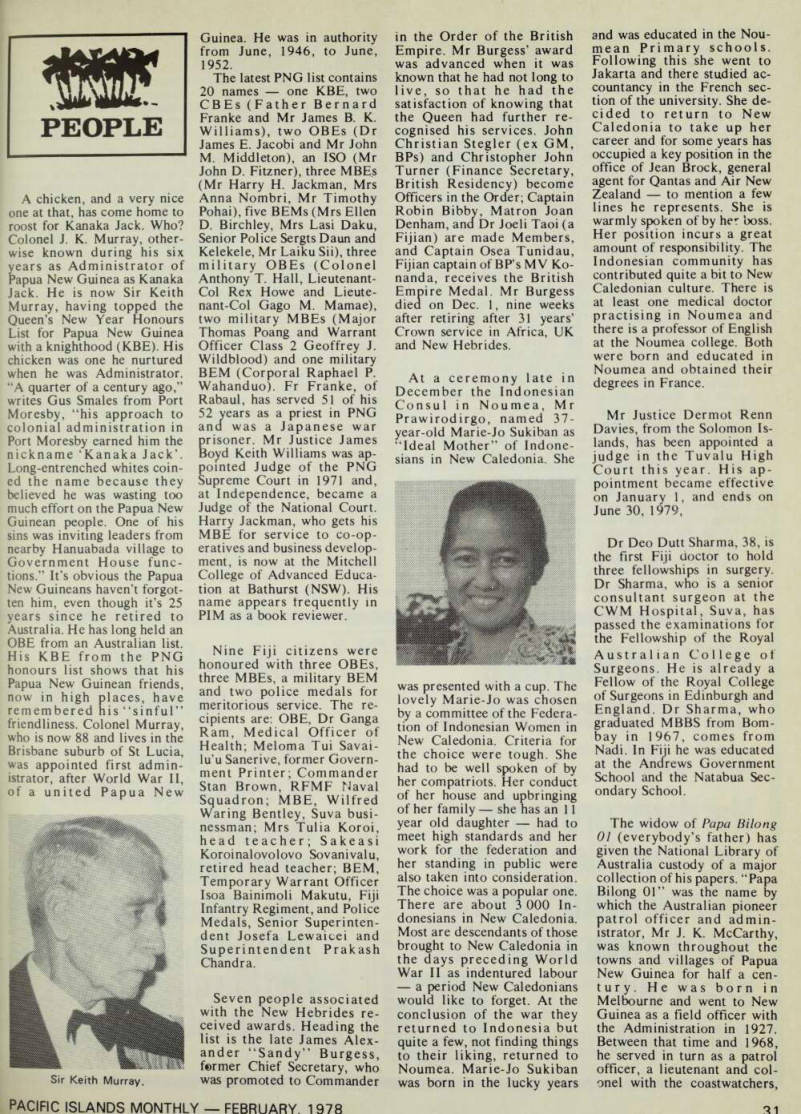
A chicken, and a very nice one at that, has come home to roost for Kanaka Jack. Who?
Colonel J. K. Murray, other wise known during his six years as Administrator of Papua New Guinea as Kanaka Jack. He is now Sir Keith Murray, having topped the Queen’s New Year Honours List for Papua New Guinea with a knighthood (KBE). His chicken was one he nurtured when he was Administrator.
“A quarter of a century ago,” writes Gus Smales from Port Moresby, “his approach to colonial administration in Port Moresby earned him the nickname ‘Kanaka Jack’.
Long-entrenched whites coin ed the name because they believed he was wasting too much effort on the Papua New Guinean people. One of his sins was inviting leaders from nearby Hanuabada village to Government House func tions.” It’s obvious the Papua New Guineans haven’t forgot ten him, even though it’s 25 years since he retired to Australia. He has long held an OBE from an Australian list.
His KBE from the PNG honours list shows that his Papua New Guinean friends, now in high places, have remembered his“sinful” friendliness. Colonel Murray, who is now 88 and lives in the Brisbane suburb of St Lucia, was appointed first admin istrator, after World War 11, of a united Papua New
Guinea. He was in authority from June, 1946, to June, 1952.
The latest PNG list contains 20 names one KBE, two CBEs(Father Bernard Franke and Mr James B. K.
Williams), two OBEs (Dr James E. Jacobi and Mr John M. Middleton), an ISO (Mr John D. Fitzner), three MBEs (Mr Harry H. Jackman, Mrs Anna Nombri, Mr Timothy Pohai), five BEMs (Mrs Ellen D. Birchley, Mrs Lasi Daku, Senior Police Sergts Daun and Kelekele, Mr Laiku Sii), three military OBEs (Colonel Anthony T. Hall, Lieutenant- Col Rex Howe and Lieute nant-Col Gago M. Mamae), two military MBEs (Major Thomas Poang and Warrant Officer Class 2 Geoffrey J.
Wildblood) and one military BEM (Corporal Raphael P.
Wahanduo). Fr Franke, of Rabaul, has served 51 of his 52 years as a priest in PNG and was a Japanese war prisoner. Mr Justice James Boyd Keith Williams was ap pointed Judge of the PNG Supreme Court in 1971 and, at Independence, became a Judge of the National Court.
Harry Jackman, who gets his MBE for service to co-op eratives and business develop ment, is now at the Mitchell College of Advanced Educa tion at Bathurst (NSW). His name appears frequently in PIM as a book reviewer.
Nine Fiji citizens were honoured with three OBEs, three MBEs, a military BEM and two police medals for meritorious service. The re cipients are: OBE, Dr Ganga Ram, Medical Officer of Health; Meloma Tui Savai lu’u Sanerive, former Govern ment Printer; Commander Stan Brown, RFMF Naval Squadron; MBE, Wilfred Waring Bentley, Suva busi nessman; Mrs Tulia Koroi, head teacher; Sakeasi Koroinalovolovo Sovanivalu, retired head teacher; BEM, Temporary Warrant Officer Isoa Bainimoli Makutu, Fiji Infantry Regiment, and Police Medals, Senior Superinten dent Josefa Lewaicei and Superintendent Prakash Chandra.
Seven people associated with the New Hebrides re ceived awards. Heading the list is the late James Alex ander “Sandy” Burgess, former Chief Secretary, who was promoted to Commander
in the Order of the British Empire. Mr Burgess’ award was advanced when it was known that he had not long to live, so that he had the satisfaction of knowing that the Queen had further re cognised his services. John Christian Stegler (ex GM, BPs) and Christopher John Turner (Finance Secretary, British Residency) become Officers in the Order; Captain Robin Bibby, Matron Joan Denham, and Dr Joeli Taoi (a Fijian) are made Members, and Captain Osea Tunidau, Fijian captain of BP’s MV Ko nanda, receives the British Empire Medal. Mr Burgess died on Dec. 1, nine weeks after retiring after 31 years’
Crown service in Africa, UK and New Hebrides.
At a ceremony late in December the Indonesian Consul in Noumea, Mr Prawirodirgo, named 37year-old Marie-Jo Sukiban as “Ideal Mother” of Indone sians in New Caledonia. She
was presented with a cup. The lovely Marie-Jo was chosen by a committee of the Federa tion of Indonesian Women in New Caledonia. Criteria for the choice were tough. She had to be well spoken of by her compatriots. Her conduct of her house and upbringing of her family she nas an 11 year old daughter had to meet high standards and her work for the federation and her standing in public were also taken into consideration.
The choice was a popular one.
There are about 3 000 In donesians in New Caledonia.
Most are descendants of those brought to New Caledonia in the days preceding World War II as indentured labour a period New Caledonians would like to forget. At the conclusion of the war they returned to Indonesia but quite a few, not finding things to their liking, returned to Noumea. Marie-Jo Sukiban was born in the lucky years
and was educated in the Nou mean Primary schools.
Following this she went to Jakarta and there studied ac countancy in the French sec tion of the university. She de cided to return to New Caledonia to take up her career and for some years has occupied a key position in the office of Jean Brock, general agent for Qantas and Air New Zealand to mention a few lines he represents. She is warmly spoken of by he r boss.
Her position incurs a great amount of responsibility. The Indonesian community has contributed quite a bit to New Caledonian culture. There is at least one medical doctor practising in Noumea and there is a professor of English at the Noumea college. Both were born and educated in Noumea and obtained their degrees in France.
Mr Justice Dermot Renn Davies, from the Solomon Is lands, has been appointed a judge in the Tuvalu High Court this year. His ap pointment became effective on January 1, and ends on June 30, 1979, Dr Deo Dutt Sharma, 38, is the first Fiji doctor to hold three fellowships in surgery.
Dr Sharma, who is a senior consultant surgeon at the CWM Hospital, Suva, has passed the examinations for the Fellowship of the Royal Australian College of Surgeons. He is already a Fellow of the Royal College of Surgeons in Edinburgh and England. Dr Sharma, who graduated MBBS from Bom bay in 1967, comes from Nadi. In Fiji he was educated at the Andrews Government School and the Natabua Sec
ondary School.
The widow of Papa Bilong 01 (everybody’s father) has given the National Library of Australia custody of a major collection of his papers. “Papa Bilong 01” was the name by which the Australian pioneer patrol officer and admin istrator, Mr J. K. McCarthy, was known throughout the towns and villages of Papua New Guinea for half a cen tury. He was born in Melbourne and went to New Guinea as a field officer with the Administration in 1927.
Between that time and 1968, he served in turn as a patrol officer, a lieutenant and col onel with the coastwatchers,
Sir Keith Murray.
an intelligence officer, district commissioner, Director of the Department of District Ad ministration and Deputy Speaker and Chairman of Committees in the Papua New Guinea House of Assembly.
Mr McCarthy died in 1976 and his widow lives at Mt Eliza, Victoria. The papers she has deposited in the libr ary include private diaries which Papa Bilong 01 kept be tween 1927 and 1971, corres pondence, reports, maps, seminar papers, manuscripts, photographs and a large col lection of original cartoons which he drew as a hobby and many of which were pub lished. They are available to historians and researchers in the library’s manuscript read ing room.
A leading noble of the kingdom of Tonga, Hon Ve’ehala, and his wife, were recently converted from Methodism to Catholicism. It is understood that both he and his wife had long been want ing to join the Catholic Church, but have to some ex tent been hampered by possi ble adverse reactions from the powerful Methodist circle, even though their children have all attended only Catholic schools. While there is apparent closer contact be
tween Catholics and Wesleyans, the conversion of the Ve’ehalas was seen as a severe setback to the Wesleyan hierarchy.
Hon Ve’ehala, one of the nobles closest to the late Queen Salote, and to the pre sent monarch, is the governor of Ha’apai and a member of Cabinet. He is regarded as the main authority on Tongan language, customs and tradi tions. He speaks English, Sa moan, Fijian and Niuean fluently.
Waisea Vatuwaqa, talented Fiji singer, has some eight months left to run of a three months singing contract at Le Lagon Hotel, Vila. He is liv ing in the New Hebrides with his wife and three children and also working at the Solaise Hotel, owned by local businessman lan Beeson.
Manus islander Luke Sela (34), who used to bounce around Sydney with shiny knees and short shorts while First Officer (information) at Papua New Guinea House, won’t be doing much more bouncing. He is now desk bound having reached the top of the journalistic tree in Port Moresby as editor of the Papua New Guinea Post-
Courier. Mr Sela is the first Papua New Guinean to fill the post. He has been getting groomed for the job as the newspaper’s chief-of-staff for the last 12 months. Married with three children, he began his journalistic career in 1963 as an announcer with Radio Wewak. Then he worked with the Australian Broadcasting Corporation in East New Bri tain and the Highlands as a regional journalist. He also worked as a correspondent for the NBC and was a Papua New Guinea correspondent for Associated Press, ABC Radio and TV and the Lon don Times. After entering the government service he was sent to Sydney to open the in formation office there and he also helped to establish Papua New Guinea government of fices in Fiji, New Zealand and New York. He parted with the government in 1976 to join the Post-Courier. His ap pointment is part of the lo calising process and Mr Grame Boyd who was editor for the past four years becomes news editor. Con gratulating Mr Sela on his ap pointment the managing edi tor of South Pacific Post Pty Ltd, Mr Reg MacDonald, said they had localised many key positions in the Post- Courier and the factory floor was now 98% localised. It was
from the factory floor that one of Luke’s first headaches came. Factory staff went on strike on December 29. The dispute was over the dismissal of a driver and a claim for leave fares. The workers went back on Sunday, January 8.
One of Tokelau’s seven police officers is training with the Western Samoa Police in Apia this year. Sergeant Tamoa Naseri (51), from Atafu, arrived in Samoa on the December charter voyage of the Cenpac Rounder. He will be attached to the Samoan Police for about three months. This is Sergeant Naseri’s second period of training in Western Samoa, his first term being in 1973.
The police establishment in Tokelau comprises three of ficers in Fakaofo and two each in Atafu and Nukunonu.
There is little crime in Tokelau, apart from petty offences, and there are no prisons. Offences are generally punished by fines or labour which is directed to as sist with public work. But unlike larger societies, there is little restraint on personal conduct during a period of sentence. It’s possible further requests will be made to Western Samoa for the train ing of Tokelau officers.
Advertisements & other items, p. 32 (1 item)
Epiglass Everdure
Timber preservative and sealer.
Hardens, protects and densities timber.
Kills all mould spores and permanently seals out moisture.
Epiglass 90 Epoxy Resin and glass cloth.
Easy to apply.
Strengthens hulls, eliminates water absorption and rot and increases the value and life of your boat.
I i
'Kakamora'goes Home
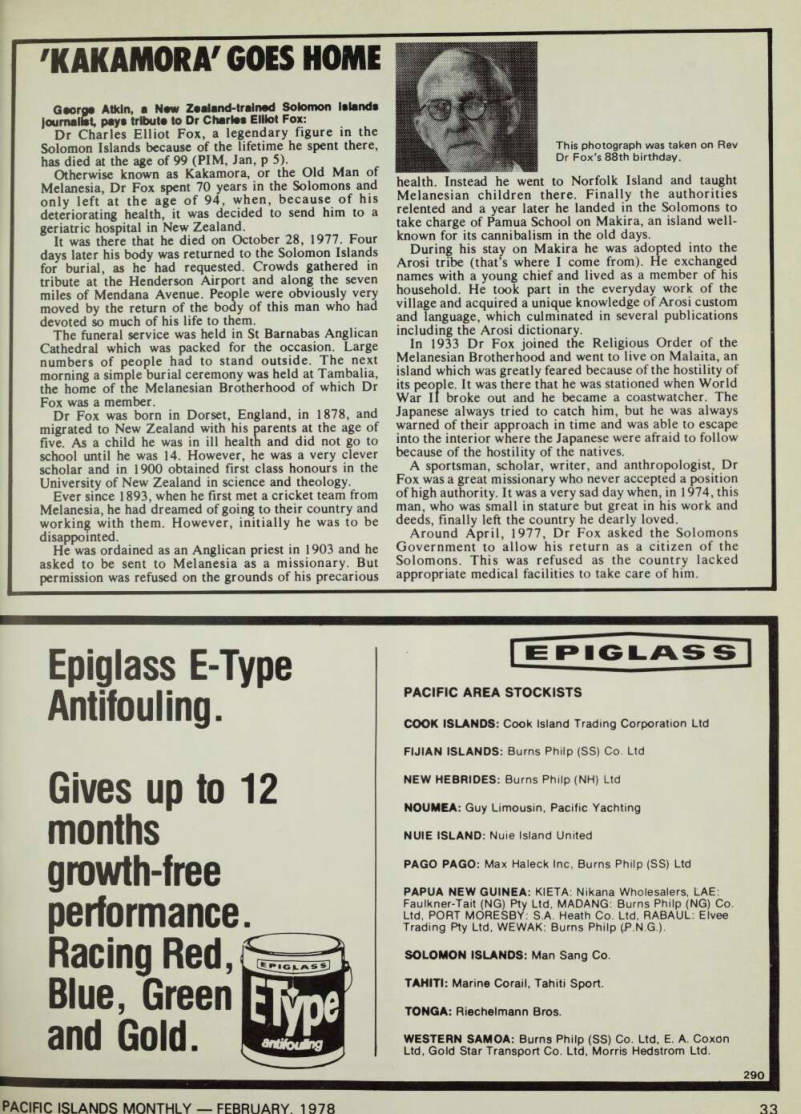
Qtorgt Atkin, a Naw Zaaland-trained Solomon Islands journalist, pays tributa to Dr Charlas Elliot Fox: Dr Charles Elliot Fox, a legendary figure in the Solomon Islands because of the lifetime he spent there, has died at the age of 99 (PIM, Jan, p 5).
Otherwise known as Kakamora, or the Old Man of Melanesia, Dr Fox spent 70 years in the Solomons and only left at the age of 94, when, because of his deteriorating health, it was decided to send him to a geriatric hospital in New Zealand.
It was there that he died on October 28, 1977. Four days later his body was returned to the Solomon Islands for burial, as he had requested. Crowds gathered in tribute at the Henderson Airport and along the seven miles of Mendana Avenue. People were obviously very moved by the return of the body of this man who had devoted so much of his life to them.
The funeral service was held in St Barnabas Anglican Cathedral which was packed for the occasion. Large numbers of people had to stand outside. The next morning a simple burial ceremony was held at Tambalia, the home of tne Melanesian Brotherhood of which Dr Fox was a member.
Dr Fox was born in Dorset, England, in 1878, and migrated to New Zealand with his parents at the age of five. As a child he was in ill health and did not go to school until he was 14. However, he was a very clever scholar and in 1900 obtained first class honours in the University of New Zealand in science and theology.
Ever since 1893, when he first met a cricket team from Melanesia, he had dreamed of going to their country and working with them. However, initially he was to be
disappointed.
He was ordained as an Anglican priest in 1903 and he asked to be sent to Melanesia as a missionary. But permission was refused on the grounds of his precarious
health. Instead he went to Norfolk Island and taught Melanesian children there. Finally the authorities relented and a year later he landed in the Solomons to take charge of Pamua School on Makira, an island well known for its cannibalism in the old days.
During his stay on Makira he was adopted into the Arosi tribe (that’s where I come from). He exchanged names with a young chief and lived as a member of his household. He took part in the everyday work of the village and acquired a unique knowledge of Arosi custom and language, which culminated in several publications including the Arosi dictionary.
In 1933 Dr Fox joined the Religious Order of the Melanesian Brotherhood and went to live on Malaita, an island which was greatly feared because of the hostility of its people. It was there that he was stationed when World War if broke out and he became a coastwatcher. The Japanese always tried to catch him, but he was always warned of their approach in time and was able to escape into the interior where the Japanese were afraid to follow because of the hostility of the natives.
A sportsman, scholar, writer, and anthropologist, Dr Fox was a great missionary who never accepted a position of high authority. It was a very sad day when, in 1974, this man, who was small in stature but great in his work and deeds, finally left the country he dearly loved.
Around April, 1977, Dr Fox asked the Solomons Government to allow his return as a citizen of the Solomons. This was refused as the country lacked appropriate medical facilities to take care of him.
This photograph was taken on Rev Dr Fox's 88th birthday.
Advertisements & other items, pp. 33-43 (1 item)
Racing Red,
Epiglass E-Type
Antifouling.
Gives up to 12
months
growth-free
performance.
Racing Red,
Blue, Green
and Gold.
PACIFIC AREA STOCKISTS
COOK ISLANDS: Cook Island Trading Corporation Ltd FIJIAN ISLANDS: Burns Philp (SS) Co. Ltd NEW HEBRIDES: Burns Philp (NH) Ltd NOUMEA: Guy Limousin, Pacific Yachting NUIE ISLAND: Nuie Island United PAGO PAGO: Max Haleck Inc, Burns Philp (SS) Ltd PAPUA NEW GUINEA: KIETA: Nikana Wholesalers. LAE: Faulkner-Tait (NG) Pty Ltd, MADANG: Burns Philp (NG) Co.
Ltd, PORT MORESBY: S.A. Heath Co. Ltd. RABAUL: Elvee Trading Pty Ltd, WEWAK: Burns Philp (P.N.G.).
SOLOMON ISLANDS: Man Sang Co.
TAHITI: Marine Corail, Tahiti Sport.
TONGA: Riechelmann Bros.
WESTERN SAMOA: Burns Philp (SS) Co. Ltd. E. A. Coxon Ltd, Gold Star Transport Co. Ltd, Morris Hedstrom Ltd.
S.E. TATHAM & CO. PTY. LTD
BEEHIVE BUILDING,
94 ELIZABETH STREET.
GrP.O. BOX 8,
MELBOURNE 3001,
AUSTRALIA.
CABLES: "SET"
TELEX; AA34552.
TELEPHONE: 63 5094
...BUYERS for the
PACIFIC ISLANDS
PAPUA NEW GUINEA:
S. E. TATHAM (P N G.) PTY. LTD.
LAE: MALAITA ST. (P.O. BOX 1562).
PORT MORESBY: Cm. GOROA
GORDON (P.O. BOX 6733, BOROKO).
TELEGRAMS: ALL OFFICES
FOR SERVICE
YOUR GUARANTEE
SINCE 1924
O •>.: v" o V\f V> * '■ * '■ '. ’*•»- V \ v-** 1 • iffb V. * * fj —-3£r ; * -5^ ■ V <r&.
»*■ Ax S
.'3SgS* o%^^
* •-. / N \ V' -V . - ■* » ~r 3® SB* "S; ✓ ✓ 0 ••• * ✓ / >.v Ar •• ** * : > T ST-
o*s •J o Trojan tools dig it, scoop it, fork it, rake it, hoe it, chop it and you name it.
Trojan tools are designed for efficiency and made from materials tough enough to handle any job.
Shovels, scoops and spades: The whole range.
Scientifically designed, hardened and tempered for toughness, durability and resilience. Light and balanced to make light work in industry, on the farm or in the home garden.
Forks and drags: Every head is roll-forged from a single bar of special steel for extra strength and so that both head and tine are properly shaped and drawn to the correct taper for the job in hand.
Rakes, garden tools, hoes and cultivators: All scientifically designed with typical Trojan strength and efficiency built in. Made stronger to last longer.
Axes, hatchets, picks and mattocks: Axes for winning wood-chops, felling tall timber or just chopping wood at home. The Trojan/Hytest range has them all, from the famous Hytest Racing Axe right through.
Trojan, Australia’s leading manufacturer of garden and Agricultural tools. Stocked by all good hardware retailers.
&TROJAM
' 7 AUSTRALIA
For further information contact: Trojan Pty. Ltd. Box 139, Footscray, Victoria, Australia, 3011.
Telephone 689 3377.
Telegrams and cables “Trojantools,” Melbourne.
i 0 i 0 0 0 0 , > m m m • •
Men who understand the water
best, often choose Yamaha first.
Because they know how
important reliability is, and they
know they have it with a
Yamaha outboard.
For more than 16 years, in more
than 100 countries around the
world, Yamaha has been trusted
for its responsive, trouble-free
performance. And even if you’re
just a weekend sailor, you need
this kind dependable power.
It takes the worry out of boating to let you relax and really enjoy
those good times on the water.
With 14 different models, you
have a choice of power ratings
and accessories to make any
enthusiast happy. See them soon
at your nearby Yamaha
dealership.
Write or call your nearest dealer for
complete information.
Papua New Gulnaa El* Motors Ltd.
P.O. Box 76 Port Moresby Tel: 54088 Tahiti Tahiti Automoto B. P. Box 439 Papeete, Tel: 29788 New Hebrides New Hebrides Motors Ltd.
Box 18 Vila New Caledonia Royal Motors B. P. 2548 Noumea Tel: 275562 Truk Susumu's Store P. 0. Box 25 Moen, Truk District A Samoa Dominique Marine Sales P. 0. Box 326 Pago Pago
rAMANA
40A
YAMAHA
i 55AE ruuHi 8B
Outboard
with
YAMAHA
YAMAHA MOTOR CO., LTD.
MARINE ENGINE DIVISION
2500 SHINGAI IWATA-SHI SHIZUOKA KEN JAPAN
Jacob Enterprises P.O. Box 4 Tonga E. M. Jones Ltd.
P. O. Box 34 Nukualofa Tel: 420,421
YAP
Family Chain Store Inc.
Box 70 Tel: 425
Honda civic Declared
1 V !f I ■■ • jm 4S -n l*ysr,». aNftV* ■ 11 mmw* fW hyovi
fisSsa
SSi **,v;
X, < U*MS
&£Ge2*9fi9E ■ < t .' ■■ : '--:v n ■ . mm m* That’s what the U.S. Environmental Protection Agency figures show. The Honda Civic placed first among the hundreds of 1976 cars tested. On the highway, in the city and in combined driving situations.
Top fuel economy is just the start. All-round operating costs are equally low. Thanks to a rugged, clean-burning OHC engine which delivers snappy acceleration. Elegance is second to none—both inside and out.
Famous Honda engineering also gives you: Enough roomy comfort to relax four adults.
A spacious trunk. Exceptional handling ease. A dual braking system featuring servo-assisted front disc brakes, independent strut suspensions.
All of this quality performance is yours in three exciting models—the 2-Door Sedan, 4-Door Sedan and Hatchback.
Own the 1976 economy champ—the Honda Civic.
HONDA
HONDA MOTOR CO., LTD. TOKYO. JAPAN
PAPUA NEW GUINEA: Steamshlps-Machinery P.O. Box 1, Port Moresby/TAHITI: Sociote Tahltlenn© d’lmportation des Produits Honda B.P. 1665-Papeete/FIJI ISLANDS: Coral Island Motors P.O. Box 48.
Suva/U.S. TRUST TERRITORY: United Micronesia Development Assn. P.O. Box 238, Saipan, Mariana Islands 96950/COOK ISLANDS: Cook Islands Motor Center Ltd. P.O. Box 74, Rarotonga/AMERICAN SAMOA: Samoan Holiday and Travel Center P.O. Box 968, Pago Pago/AMERICAN SAMOA: Haleck’s Service Center P.O. Box 1138, Pago Pago/GUAM: Mark’s Motor Co., Inc. P.O. Box DV, Agana/WESTERN SAMOA: Motor Distributors (Samoa) Ltd. P.O. Box 576, Apia/SOLOMON ISLANDS: British Solomons Trading Co., Ltd. P.O. Box 114, Honiara/NEW CALEDONIA: Establissements Ballande Boite Postale No. C 4, Noumea Cedex/TONGA: E.M. Jones Limited P.O. Box 34,Nuku'alofa/TARAWA: Gilbert & Ellice Islands Development Authority P.O. Box 488, Beito/NIUE ISLAND: S. Jessop & Sons Ltd. P.O. Box 71, f^™i U i^ /NAURU: Nauru Cooperative Society, Republic of Nauru, Nauru Island.CentralPacific/NEW HEBRIDES: Tropex International Ltd., P.O. Box 139, Port Vila.
w
Putting yourself "First
is the best thing you can do. Putting yourself "first” on Air New Zealand is often the best kind of business sense. The friendly attentive Air New Zealand service surpasses itself, very quietly and without fuss. Here you can catch up with a lot or work or a little sleep. You can unwind with fine food and premium wines. There s nothing to beat it, except perhaps the happy thought of returning the same way. Not to put yourself "first” is really a false economy. air hem zeaiann
ANZ 405
We fly the Pacific.
Another Technological Breakthrough from SEIKO.
The LC Digital Quartz WORLD TIMER.
Now you can know the exact time anywhere in the world. Instantly.
flat
to* 7 2 7*o* V c */ 2 *o* / °S* / •o*o % Os/ *6 **ga to / // *'2 *// S/* to O/q *9 s *6 o*o This new precise timepiece gtves you the"time in the world's 29 time zones on a 24-hotir readout system; in hours, minutes, seconds, plus the day and date. All in the time it takes to push a button. And it adjusts for daylight saving time.
Like all Seiko Multi-Mode LC Digital Quartz watches, the World Timer is engineered to be easy to operate and dependable. It features a Perpetual Calendar pre-programmed for 28, 30, 31-day and leap year months until the year 2009. It is water resistant, and features built-in illumination for reading the time in darkness.
The Seiko World Timer, just one of the outstanding timepieces in the new Seiko Multi-Mode LC Digital Quartz Collection.
Seiko Quartz. sa -T Home Time Mode features continuous readout in hours on a 24-hour basis, minutes seconds dav and date.
Calendar is pre-programmed for leap vears 28. 30 and 31 da\ months until the vear 2009 Built-in illumination s\stem Greenwich Mean Time is displayed at the push of a button.
World Time symbol appears when crown is pushed, indicating World Time Mode is in operation.
Each time button is pushed. Zone Marker moves to next city and time zone and displays the correct hour, minutes, seconds, day and date
SEIKO
Someday all watches will be made this way.
nr iJi m 4 I -4i
MiffliiJi
r ■-. i :- I " r* •
Hi H
This page tells a lot about
Mazda technology.
Just a few of the searching tests a Mazda has to pass before it ever goes into production. Many more follow, both during manufacture and after. The result. Superior, highquality products. Cars like the Mazda 323. A car everyone’s talking about because of its versatile, economical
performance and stylish good looks.
And like all Mazdas, a car that you can own and drive with confidence.
Because Mazdas are made right.
Right from the beginning.
Sound Testing Laboratories Nobody likes noise. Least of all Mazda. That’s why we are working hard to make our cars quieter —from the outside and the inside. The car (right) is in our anechoic test chamber. Here the whole car is subjected to vibration through a machine that creates a variety of different shakes and thumps. Ultra-sensitive microphones pick up every sound made, then amplifies it for thorough analysis. This way we can get rid of excessive noise and vibration before they annoy you and your passengers.
The Climatic Testing Laboratories (top, far right) Here a range of driving conditions can be simulated, from stop-start city driving to sustained high-speed highway running.
The tests are conducted in a wide range of temperatures and under different atmospheric conditions. So you can be sure your Mazda will be expertly tuned to run smoothly in the country where you live.
Body Testing Laboratorses(bottom,famght)
This is one of the facilities that crash tests our car bodies. Impact and torsional effects can be accurately measured by computers simulating collisions at 30-60 m.p.h. Dummies electronically wired tell us what happens to passengers —and as a result —provide our design engineers with valuable information about the safest interiors and bodies. Tests such as these helped us to design the light, crash resistant, semi-monocoque body found on all Mazda passenger cars.
mazoa
Quality through superior technology / St *** y FIJI ISIS. Niranjans Autoport Ltd. G.P.O. Box 450. Suva TEL: 381555 NAURU Tim John P.O. Box 101, Rep. of Nauru TEL: 471 NEW CALEDONIA Joseph Cheval & Cle 3. Rue Jean-Jaures. Noumea TEL: 731-01 NEW ZEALAND Mazda Motors of New Zealand Ltd. Otahuhu. Auckland P.O. Box 22-472 TEL: 69-099 NORFOLK ISL. Duncombe Bay Garage. P.O. Box 220. Norfolk Isl. TEL: 2097 PAPUA NEW GUINEA P.N.G. Associated Industries Ltd. P.O. Box 1394, Boroko TEL: 255788 SAIPAN Latte Motors Inc. P.O. Box 206, Saipan, Mariana Isl. TEL: 6142 SOLOMON ISLS. Solomon Motors Ltd. P.O. Box 20. Honiara TEL: 313 TAHITI Comptoir Polynesian B.P. 628, Papeete TEL; 2. 80. 27 TONGA Prema & Sons P.O. Box 20. Nukualofa WESTERN SAMOA Mazda Services (Samoa) Ltd. P.O. Box 576, Apia TEL:B2S The trademark MAZDA in this advertisement stands for AUTOMOBILES MAZDA as far as France and her territories are concerned.
See the experts
for business anywhere in the South-West Pacific For comprehensive service and advice on trade, both inter-island and with Australia and New Zealand, see the experienced staff at your nearest ANZ branch or agency. We can help you with importing and exporting, business transactions and personal banking. Offices are located at: Suva 128 Victoria Parade and Waimanu Road. Lautoka Naviti Street. Nadi Queen’s Road. Nausori Kings Road. Boroko Hubert Murray Highway. Lae Cnr. Coronation Drive and 7th Street. Madang Lightfoot Arcade, Kasagten Road. Mount Hagen Hagen Drive. Port Moresby ANG House, Hunter Street. Rabaul Mango Avenue. Waigani.
Honiara Mendana Avenue. Vila Rue Higginson.
AXK
AN7' qqn
PISCES DIESEL
GM's ANSWER TO THE
SMALL DIESEL MARKET!
• 27 hp. 2 cylinder. • 40 hp. 3 cylinder. • 60 hp. 4 cylinder, also: 27-10 kW Generator sets 40-25 kW Generator sets 60-37.5 kW Generator sets • Mechanical and Borg Warner gear-boxes. • Complete with heat exchangers and instrument wiring looms no extra.
Australian Distributors:
DIABLO DIESEL
212 Haldon Street, Lakemba, NSW 2195.
Phone 759 5306 759 0463.
Note: Export service available.
ALSO IN STOCK:
• Borg Warner reductions V/Drive Boxes. New & used parts service. • Fresh water heat exchangers. • Babbit disc shaft couplings.
To eliminate misalignment. • Alarm systems for flooding fire overheating low oil pressure.
An Entrepreneur?
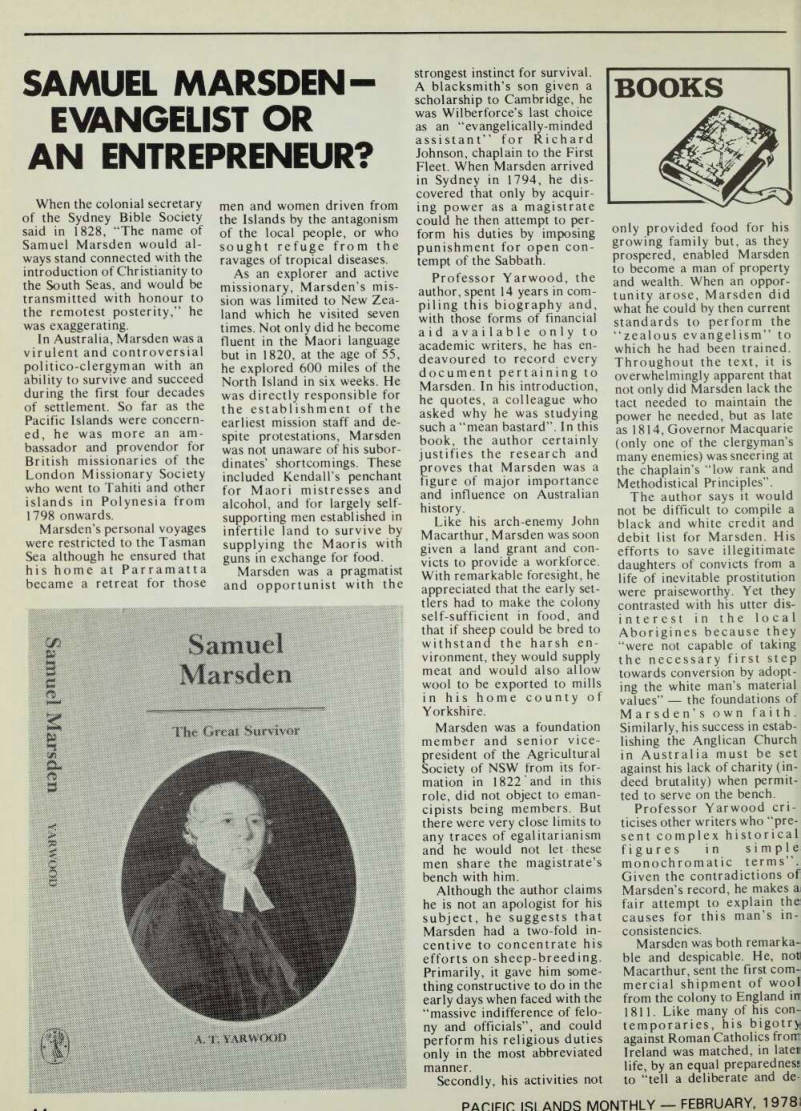
Samuel Marsden
Evangelist Or
When the colonial secretary of the Sydney Bible Society said in 1828, “The name of Samuel Marsden would always stand connected with the introduction of Christianity to the South Seas, and would be transmitted with honour to the remotest posterity,” he was exaggerating.
In Australia, Marsden was a virulent and controversial politico-clergyman with an ability to survive and succeed during the first four decades of settlement. So far as the Pacific Islands were concerned, he was more an ambassador and proyendor for British missionaries of the London Missionary Society who went to Tahiti and other islands in Polynesia from 1798 onwards.
Marsden’s personal voyages were restricted to the Tasman Sea although he ensured that his home at Parramatta became a retreat for those
men and women driven from the Islands by the antagonism G f the local people, or who sought refuge from the ravages of tropical diseases, As an explorer and active missionary, Marsden’s mis sion was limited to New Zea iand which he visited seven times. Not only did he become fi uent i n the Maori language but i n 1820, at the age of 55, be explored 600 miles of the North Island in six weeks. He was directly responsible for tbe establishment of the earliest mission staff and de spite protestations, Marsden was not unaware of his subor dinates’ shortcomings. These included Kendall’s penchant f or Maori mistresses and a i C ohol, and for largely self supporting men established in infertile land to survive by supplying the Maoris with guns in exchange for food, Marsden was a pragmatist an d opportunist with the
strongest instinct for survival.
A blacksmith’s son given a scholarship to Cambridge, he was Wilberforce’s last choice as an “evangelically-minded assistant” for Richard Johnson, chaplain to the First Fleet. When Marsden arrived in Sydney in 1794, he dis covered that only by acquir ing power as a magistrate could he then attempt to per form his duties by imposing punishment for open con tempt of the Sabbath.
Professor Yarwood, the author, spent 14 years in com piling this biography and, with those forms of financial aid available only to academic writers, he has en deavoured to record every document pertaining to Marsden. In his introduction, he quotes, a colleague who asked why he was studying such a “mean bastard”. In this book, the author certainly justifies the research and proves that Marsden was a figure of major importance and influence on Australian history.
Like his arch-enemy John Macarthur, Marsden was soon given a land grant and con victs to provide a workforce.
With remarkable foresight, he appreciated that the early set tlers had to make the colony self-sufficient in food, and that if sheep could be bred to withstand the harsh en vironment, they would supply meat and would also allow wool to be exported to mills in his home county of Yorkshire.
Marsden was a foundation member and senior vice president of the Agricultural Society of NSW from its for mation in 1822 and in this role, did not object to eman cipists being members. But there were very close limits to any traces of egalitarianism and he would not let these men share the magistrate’s bench with him.
Although the author claims he is not an apologist for his subject, he suggests that Marsden had a two-fold in centive to concentrate his efforts on sheep-breeding.
Primarily, it gave him some thing constructive to do in the early days when faced with the “massive indifference of felo ny and officials”, and could perform his religious duties only in the most abbreviated manner.
Secondly, his activities not
only provided food for his growing family but, as they prospered, enabled Marsden to become a man of property and wealth. When an oppor tunity arose, Marsden did what he could by then current standards to perform the “zealous evangelism” to which he had been trained.
Throughout the text, it is overwhelmingly apparent that not only did Marsden lack the tact needed to maintain the power he needed, but as late as 1814, Governor Macquarie (only one of the clergyman’s many enemies) was sneering at the chaplain’s “low rank and Methodistical Principles’’.
The author says it would not be difficult to compile a black and white credit and debit list for Marsden. His efforts to save illegitimate daughters of convicts from a life of inevitable prostitution were praiseworthy. Yet they contrasted with his utter dis interest in the local Aborigines because they “were not capable of taking the necessary first step towards conversion by adopt ing the white man’s material values” the foundations of Marsden’s own faith.
Similarly, his success in estab lishing the Anglican Church in Australia must be set against his lack of charity (in deed brutality) when permit ted to serve on the bench.
Professor Yarwood cri ticises other writers who “pre sent complex historical figures in simple monochromatic terms”.
Given the contradictions of Marsden’s record, he makes ai fair attempt to explain the; causes for this man’s in consistencies.
Marsden was both remarka ble and despicable. He, noti Macarthur, sent the first com mercial shipment of wool from the colony to England in 1811. Like many of his con temporaries, his bigotry against Roman Catholics from Ireland was matched, in lateit life, by an equal preparedness to “tell a deliberate and de
monstrable lie”. His life con tained & succession of politi cal feuds and there were several actions for libel.
Marsden’s story presents a revealing insight into a remarkable if hardly likeable individual, and of conditions during the first decades of set tlement in Australia. When he died, in 1 838, he was a “millionaire” by present stan dards and had accumulated 29 farms with a total area of 11 724 acres(4 745 ha).
Unfortunately, Professor Yarwood falls into the trap of needing to justify every point he makes with a textual quota
tion. Where he should have used the sharpest scalpel to prune his tedious and over detailed prose, he has fallen into the trap of writing a book for fellow historians. If edited, Samuel Marsden would be a fascinating in vestigation of a remarkable man and his times. Instead, it is very heavy going and far too frequently, a mountain of mullock must be sifted to reveal some anecdotal gem or comment.
John Goode
(Samuel Marsden The Great
SURVIVOR. A. T. Yarwood Published by Melbourne University Press. $18.60.)
Advertisements & other items, p. 44 (1 item)
Parifin Isi Amds Monthly February, 1978
44
Paradoxes Of The
Modern Pacific
The European empires in the insular Pacific lasted scar cely a century, from the rais ing of the national flags at the outset to raising the ex pectations of the inhabitants in more recent decades. In Oceania and Beyond, 20 con tributors, in 16 not always easy pieces, tell us about the many paradoxes that com prise the modern peoples of the Pacific and the places where they are trying to live.
The interested reader, and there should be some, will regard this collection of dis parate essays as a resource, to be dipped into and to be con sidered along with PI M’s up to the minute news and the oc casional specialist accounts.
Rather than examine each of the separate authors and their articles, it seems that the most relevant factors are the con
flicting and complementary
themes that run through the book’s nearly 300 pages.
Regrettably, the half dozen pages of foreword and in troduction tell us little of such matters, the usual job of the editor of such collections.
Modernity for such places as different as Funafuti and Fiji has been accompanied, in the last decade, with the assertion of independence, either aspired to or achieved.
But, such independence has
come parallel to growing economic and, even, cultural dependence. Though no longer threatened with annex ation to Queensland, as it once was in the not-so-distant
past, politically independent Papua New Guinea is today firmly a part of Australia’s economic region. The severe problem of balance of pay ments afflicts most Pacific economies and some, such as Tonga and Western Samoa, rely heavily upon exported labour remittances to pay for their next import shipment of transistor radios or anti biotics.
Scale and balance are fun damental problems in the Pacific countries, small dots of land scattered at uneven in tervals over the largest ex panse of water on earth. Now that the accidents of colonial ism have become the bound ary lines on Mercator projec tions, political states whose land area and population would be lost in most of the world’s larger cities suddenly find themselves struggling to maintain a separateness and an integrity that will only reduce them to still greater dependence. The small size of countries such as Tonga, Niue, and, even, Fiji contrasts sadly with their enormous hopes and aspirations.
To fulfil hopes and to realise aspirations, many of the new Pacific nations seemly are prepared to destroy them selves in order to develop.
Some adhere to the cargo cult of environmentally questiona ble resource exploitation, while others, not content merely to pollute, permit free
spending military estab
lishments to blast away at
their coral and coconuts. Still others look to that alleged panacea for all economic ills, tourism, heedless of both the social and economic costs in volved. The rapid conversion to tourism, with its attendant rituals and millenarian beliefs, may come to rival Christianity as a potent belief system on tomorrow’s Pacific Islands.
Still another feature closely related to modern develop ment plans is the frequent contrast between expatriate riches and local poverty. Only sections of Pacific populations are reaping the benefits, if benefits they be, of modern resource and tourist develop ment. The effect of this upon non-wage-earning rural folk is to create a poor class where only affluent subsistence ex isted before.
The list of paradoxes and complaints could go on and on, using the documented, specific examples from the ar ticles in this book. For the most part, these essays are de scriptive accounts and the authors suggest only the most obvious of solutions to the problems they analyse.
Richard Herr, for example, writes that the Unites States has not been sufficiently in volved in the South Pacific Commission and should become more concerned in future; McTaggert tells us that New Caledonians are unhappy with exploitative French rule and suggests that they may do something about it in the future; and so on.
Oceania and Beyond is not a compendium of answers, but it is a collection of questions and information. It is largely historical in orientation. The book’s dedication to C.
Hartley Grattan, as well as that scholar’s own long arti cle, remind us that most of the authors, whatever their own
discipline, display the
historian’s penchant for excit ing generalisation, often with out visible means of support.
In addition to the usual analysis of French atomic tests, American neglect, and the increasingly hasty British attenuation of effort in the Pacific, a third of the articles deal with Australian and Nfew Zealand involvement in Pacific affairs. The critical tone applied to the Great Powers is directed equally to the little ones, though the costs and benefits here are not
nearly so clear. Felise Va’a, familiar to regular readers of PIM, ends his article on the New Zealand experiment in Western Samoa with the pessimistic, “Who has really gained?”
Perhaps the most interest ing pieces are those that relate events in the colonial ex perience to wider trends, in metropolitan countries, and in the world at large. They help us to comprehend the Pacific in its world context.
The final paradox brought out by Thomson is that the newly independent nations fanned out to the north of Australia can only hope to survive if they dissolve their
recently-acquired separate
ness and co-operate on a regional basis. His suggestions for small-scale industry are particularly worthy of wider attention and consideration.
All the authors are sym pathetic to the predicament of the indigenous Pacific popula tions, though only a few are Pacific Islanders themselves.
A book with essays by Islan ders probably would have dif ferent emphases and per spectives. It seems to me that if there is a fault in this volume it is that its feeling and flavour are more redolent of the fluorescent-lit govern ment archives that produced its data than the sunlight and salt air the authors seek to de scribe and explain.
Duane Stormont’s nine carefully drawn maps are useful to those still lacking a copy of the Pacific Islands Year Book, but none of the authors seems to be aware of their inclusion in the volume, for none refers to them.
Grant McColl
(Oceania And Beyond: Essays On
THE PACIFIC SINCE 1945. Edited by F. P. King. Published by Greenwood Press, Westport, Connecticut, 1977. 5U522.50.)
Advertisements & other items, pp. 45-46 (2 items)
45
3 ACIFIC ISLANDS MONTHI Y FFRRI I ARY 1 Q7R
Henry Lawson's
BOOKSHOP
531 Royal Arcade, (Beneath Sydney Hilton) Pitt through to George St
SYDNEY, 2000.
Phone: 61 2365.
WE STOCK ONL Y
AUSTRALIAN BOOKS
AND BOOKS ON
OCEANIA!
Write to us for specialist attention.
Total service 0n...
plumbing supplies fast
WATSON & CRANE
are organised to fulfil your needs
wherever you are in the South Pacific m You can get all you need from one supply source: water taps, valves, copper tube, tools and a host of other fittings and related plumbing equipment for domestic, industrial and multistorey buildings.
Watson & Crane Pty Ltd have over 20,000 plumbing items in stock at their central warehouse located at Waterloo, NSW, Australia.
Years of experience in handling and shipping right throughout the South Pacific add up to another big reason for you to deal with Watson & Crane Pty Ltd.
Representatives call regularly at Papua New Guinea, the Solomons, New Hebrides and Fiji Islands to personally discuss your requirements and appropriate credit arrangements.
Write, cable or telephone today for complete plumbers' supplies service.
Watson & Crane Pty. Ltd, 1037 Bourke Street, Waterloo,
NSW 2017.
Phone: Sydney 699-1333.
Telex: AA 25548.
Cables: "Watcrane" Sydney.
Pacific Island distributors of Crane Enfield copper tube for water, sanitation, engineering, refrigeration and air conditioning.
Making—and missing
points on co-ops
Twenty years of active in volvement with co-operatives in Papua New Guinea must surely have caused Mr Jeebang Sifuyu to wonder whether the workshop in which he took part at Tu biana, North Solomons Prov ince, in June, 1976, had really been organised to discuss co operative movements.
Anyone reading the report by Father Patrick Murphy, a white priest who was the co ordinator, will find very little about co-operatives but a great deal about the need for the churches to be involved in politics and “integral human development”.
About half of the 26 partici pants had worked in co-op eratives or similar group en terprises, but the report leaves no doubt that North Solomons clergy (not participants but “resource persons”), inex perienced in co-operatives, carried the day.
It is worth keeping in mind that co-operatives throughout the world operate, in some
way or other, according to the Rochdale Principles: (1) voluntary membership; (2) democratic control one member, one vote; (3) re striction of interest on capital legislation usually limits this to 6%; (4) distribution of surplus as rebates on the value of members’ transactions with the co-operative; (5) goods sold at market price; (6) political and religious neutrality and (7) active education in co-operation Father Momis MP reaffirm ed some of the things which, as deputy chairman of the constitutional planning com mittee, he had sought to have incorporated in Papua New Guinea’s constitution; autonomous, village-based communalism, anti-capitalist, virtuous and, above all, the fourth tier, equal with the other three, in the nation’s politics and government.
“Our cargo cult people,’’ said Father Momis, “have so much to teach us here. They go ahead and do their own
thing. And 99% of the time they are right.”
One wonders whether this approach could ever be reconciled with that by the Bougainville Development Corporation, a multi-faceted, widespread and unashamedly capitalist enterprise praised by Dr Sarei.
In the past, PNG co-operatives have operated as business enterprises pure and simple. With one exception, they have not concerned themselves with village improvement. There is, however, no reason why they could not spread their net. In the 19505, lokea Co-operative Society in the Gulf Province used the surpluses of several years on a village water scheme. This is the kind of thing that one might have expected the Tubiana Workshop to discuss. And, even more important, there ought to have been some very serious attention to the greatest problem faced by every type of organisation in agriculture, commerce, industry and government and at all levels, from the village to ... . i .
Waigan. namely, how to achieve managerial com-
petence. In the case of the co operative movement and, in deed, other forms of en terprise, eg companies, prov incial development cor porations, Kabisawali, New Guinea Development Cor poration, local government sawmills the list is endless poor management has been the main cause of failure, As a report ot an educated elite’s views on what ought to b. e done to improve the villagers’ lot by “interaction °f church and society”, Co operative Movements in the Pa c ifi c: The Tu bia n a Workshop, is well worth reading because, although we are all equal, some are more equal than others and leader ship comes from the elite, As a contribution to the development of co-operatives »n the Pacific, this report is of little help. This is a pity in deed, as the Rochdale Princi- P^ es could be the underpin ning for rural development without the evils of capitalism or totalitarianism. Harry Jackman (co operative movements in the pacific: the tubiana workshop b v p Murphy. Published by Church and Society P , ci ; ic c..1.,.nc. .1 churches, po Box 5768, Boroko, png.)
Tonga’S New
Dictionary
For the first time in 20 years, the Kingdom of Tonga has an up-to date Tongan-English dictionary.
The first edition of Functional Tongan-English/English Tongan Dictionary has arrived in Tonga from the printers in Fiji. The 276page dictionary is also being dis tributed in New Zealand and the United States.
Edited by Dr Thomas Schneider, Associate Professor at ’Atenisi University in Nukualofa, the paper bound dictionary was compiled in about 11 months, including time for the research of the present-day Tongan vocabulary.
In addition to sections giving English equivalents for Tongan and vice-versa, the work includes 27 special vocabulary sections in tech nical fields. These vocabularies in clude oil drilling, medicine, human anatomy, chemistry, agriculture and other subjects. Many of the special word lists offer drawings or diagrams to help explain more com plicated techniques or concepts, Dr Schneider said.
An Index For Pacific Historians
If you are a reader of the Pacific Historical Review you will be pleascd to note that an index has been published to volumes 1 -4 3 (1932-74). If you are a Pacific histor Y buff and not a reader, then you should become acquainted with both the index and the periodical.
The Pacific Historical Review is a quarterly journal issued by the Pacific Coast Branch of the American Historical Society, although the publishing, advertising, and busi- " e n f v ™“ erS f by ‘he University of California Press. It is exna'nslnnkm I" 8 *. 0 .! 7 p f Al 7 ler,car expansionism to the Pacific and beyond, and to the post-frontier
developments of the 20th-century
American west. The Review also publishes articles on the historian’s methodologies and philosophies.
Compiled by Anna Marie and Everette Gordon Hagar, the Index is drawn from more than 20 000 pages of text, a formidable task by anyone’s standards. Entries include the names of authors and titles of artides, book reviewers and books reviewed, as well as those for peo-
pie, places, things, and events that are more than casually mentioned in the articles. It is a veritable card catalogue covering the gamut of Pacific history.
In spite of the preponderance of listings relating to the American continent I found many listings of interest to the enthusiast of the history of Oceania. For example I found the following; The Australian Frontier in New Guinea 1870-1885 by Donald Craig Gordon, American
Policy Respecting 'Marshalls.
Carolines and Marianas 1898-1941 ty Earl S. Pomeroy, Japan and the American Annexation of the Philip pines by James K. Eyre, Jr, and Great Britain and the Sovereignty of Hawaii by Merze Tate There is enough wealth of Pacific history published during the 42 years indexed that this volume deserves a place among reference shelves of Pacific Island libraries
Norden H. Cheatham.
(Index to Pacific Historical Review (Volumes 1-43, 1932-1974). Compiled by Anna Marie and Everett U " i,,rai ' ¥
Advertisements & other items, p. 48 (1 item)
Get amongst
it with a Stihl
Chain Saw.
STIHL 088
The really professional saw for the farmer or contractor to get amongst heavy timber. Plus, a variety of power tools - Earth augers; Cutquik; Brushcutter; etc - to simply attach to your 088 power head (56 c.c.) Weight: 7-9 Kgs.
Bar lengths: 35, 43, 53cms.
V
STIHL 051 AV (Anti - Vibration)
Easy to handle with plenty of power. Fitted with electronic ignition and safety hand guard. Weighs 10.5 kgs; 89cc power unit. Bar lengths 43, 53,
63, 75, 90cms.
i© © >
STIHL
iw m mmos For further information on these models or any of the Stihl range contact the Stihl Distributor in your area.
STIHL
PAPUA NEW GUINEA
BOUGAINVILLE.
Morgan Equipment Pty. Ltd.
P.O. Box 252, Arawa.
RABAUL
Morgan Equipment Pty. Ltd, P.O. Box 1234,
BOROKO
Morgan Equipment Pty. Ltd.
P.O. Box 5243.
LAE
Morgan Equipment Pty. Ltd.
P.O. Box 1729.
SUVA
Coral Island Motors, P.O. Box 48, Walu Bay.
NEW ZEALAND
WELLINGTON
C.M. Malfroy & Co. Ltd., P.O. Box 1031,
SOLOMON ISLAND
HONIARA
Foxwood (8.5.1. Timbers) Ltd.
P.O. Box 8.
NEW HEBRIDES
PORT VILA.
Roy Gallimore & Associates, P.O. Box 179.
NORFOLK ISLAND
Cameralines Limited, P.O. Box 29.
AUSTRALIA
Stihl Chain Saw (Aust) Pty. Ltd., 41 Barry St., Bayswater. Victoria.
Islands
From The
Press
From the Solomons News Drum, quoting Chief Minister Peter Kenilorea writing in Pacific Perspective, magazine of the South Pacific Sciences Association: ... While deploring the fall in moral standards and decrying the use of mini-skirts, Mr Kenilorea posed the question of what is the true dress of the Solomon Islands: “Our cultural value and tradition in clothing was the birthday suit,” he remarks drily. “This is accepted even today in some parts of the Solomons, yet it is unnoticed by many mini-skirt critics.”
From a poem “Mamas Teaching to Son Before Leaving”, written by a Niuean student and printed in Tohi Tala Niue: As you goes there son Think hard and remember The good teaching of your parents The great songs of our ancestors ...
As you been there son Try hard and bring more Of all diplomas and degrees For still our basket is empty ...
Don’t follow your brothers trail Who disobeyed and disgraced us Sorry for them our dear sons Who destroy their lucky straw And disappearing into the world ...
From a reader’s letter in the Tonga Chronicle: Do all of you know the horrible thing that is happening on our island of Niuafo’ou? Let me tell you about what we call “weighing copra the devil’s way”. What we mean by this is weighing the copra under another name so the profits aren’t divided in two. I believe that in 1977 many thousands of dollars have been stolen from the government in Niuafo’ou by those who use the other name referred to above ...
From American Samoa News Bulletin: There’s one thing you can say about Pago Pago, everybody knows where it is. Well, just about everybody. Yesterday, the Office of Samoan Information received a letter which was mailed from San Francisco airmail on August 30. It was addressed to “Pago Pago, Am Samoa”. Scrawled in red ink below the address is the comment “Try in South America”.
Somewhere, somebody had drawn a line through that comment in black ink and scrawled, “Try New York”. There were unreadable post marks for September 8 and September 14 and a post mark from Rangoon, Burma, on November 5. We have no idea who finally directed it here, but to someone out there somewhere, we would like to say fa’afetai!”
From New Hebrides News: I am an indigenous New Hebridean. I used to be a sober and a happy little fellow. My face was bright and broad. But now I am a day-dreamer in the world of politics. The shadow of politics has shattered the happy days, makes them gloomy and dumb.
My people have adopted politics. Politics now spreads throughout the country. It chilled my flesh and into my spine.
Politics brings fear and violence. Politics brings discrimination.
It breaks up unity and love. My country is soaked with politics like a sponge in water of politics. My country stinks with politics as a rotten egg is crammed with stinking meat.
From the Bulletin of the Chamber of Commerce, Industry and Agriculture, New Hebrides: Bar-restaurant-boutique Bauerfield air-terminal; The president explained that at some instigation from the public, the committee some months ago decided to invite the public to tender for the concession. The original contract was awarded in 1971 for three years and since then has been renewed until the present day. The present concessionnaire was therefore advised that tenders would be called. Since this, an argument has ensued regarding this decision; some members being in favour and some on humanitarian grounds against. The latter preferred to see the present concessionnaire continue for a further year ...
Mr Mackintosh advised the meeting that the chamber was not in business to protect individual citizens from social hardship; if so, the main qualification for a successful application would be social need, and not the ability to serve the public. A debate ensued and finally the matter was put to the vote and the Chamber voted 7 to 5 in favour of abiding by the original decision to call tenders.
From the Fiji Times, on a survey of Suva restaurants and snack bars: “There is no other food which is a better medium for food poisoning than pies,” Mr Jay said ... he gave a quick, stomach turning description of how a good dose of “running stomach” could be collected by an innocent pie customer.
From American Samoa News Bulletin: This story is for the birds gay birds. A university research team in California says about 14% of the female seagulls on an island off the California coast are lesbians. The scientists say it’s the first solid evidence of widespread homosexuality ever found among wild birds. The report, compiled by researchers from the University of California at Irvine, said one female gull assumes a male role and forms a stable union with another female. They go through the motions of mating, lay sterile eggs, and defend their nests like other couples. A spokesman for the group (the scientists, that is) said the gull colony has a shortage of male birds, which may be related to the high number of female pairs. H is team is also studying blood samples taken from the lesbian birds, trying to determine if their hormones are normal.
From the Solomons News Drum, as part of its tribute to the late Dr Charles Elliot Fox: Full of legends about his own life in the Solomons, Dr Fox had some favourite ones which he liked to tell his friends. When he was headmaster of Pamua catechist school, he received an invitation to a feast by a chief at Haununu district on Makira.
He refused to attend because he feared he would be eaten by the cannibals. His fears were well-founded when he learned later that about 100 men and women were eaten at the feast.
From the Cook Islands News: A four-year-old boy in the New Hebrides was playing with his two-year-old brother in 18 inches of water in the lagoon near where their father was working. A giant octopus approached and attacked the two-year-old child. The older boy called their father who came to the rescue quickly and with a bush knife and spear killed the octopus. He called his workmates to help him remove the octopus from the water. Its tentacles measured 2 x li metres (eight ft) in length.
From the Solomons News Drum: A man aged 109 has died in Kakabona village. Maturino, a warrior of head-hunting days, had his final fight in a raid on villages in the Malango district. A relative, Seraphin Taro, told the Information Department that Marurino remembered the man of Guadalcanal who had tails; a trait thought to have been of family origin, and which has since disappeared ... Mr Taro said that before he died, Maturino disclosed to his people where he had hidden a considerable amount of money, some of which came from the sale of land on which Honiara is now situated.
The mourners included old friends who came from as far away as Taboko and Lambi. The funeral was followed by a feast.
Advertisements & other items, p. 50 (1 item)
carptrac
m mv It's another step ahead towards more profitable, more efficient logging operations: Cat 528 Skidder with major improvements.
Now rear wheel caliper disc brakes increase service braking pad contact surface by 78%, thereby extending brake life. There are three master cylinders, one each for front, rear and driveline systems. All four wheel brakes engage first; additional pedal depression engages driveline brake.
Caterpillar 528 Winch has power control design to allow "winching on-the-go". Winch and skidder can be operated simultaneously.
Other features include oil disc clutch and brake to extend service life; complete sealing maintains rated capacity; winch brake accumulator allows load release from dead engine; adjustable free spool drag lets operator pull line uphill or down without cable balling. Other helpful features too!
Send for literature or talk to your Caterpillar representative.
Caterpillar Dealers in South-West Pacific.
a Lae: Milford Haven Rd.
Phone 42 2355.
Port Moresby: Phone 21 2122.
Bougainville: Itakara Industrial Park, Arawa. Phone 95 9077. £
carptrac
a division of Cl Lautoka: Labasa: Veitari Lautoka Vulovi Labasa Phone 61877 Phone 81888 Suva: Carptrac Carpenter Street Raiwai Suva E Phone 381622 c Telex FJ2190 Cables CARPTRAC
met her end..and some new light on what happened immediately after
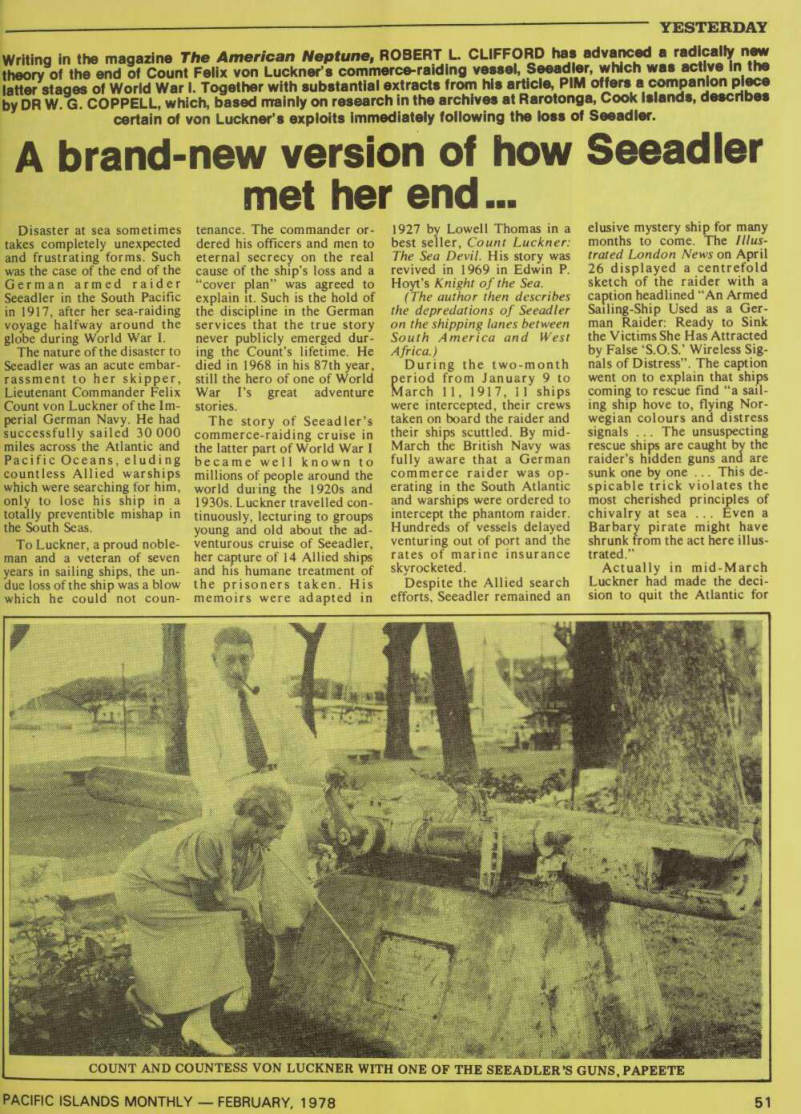
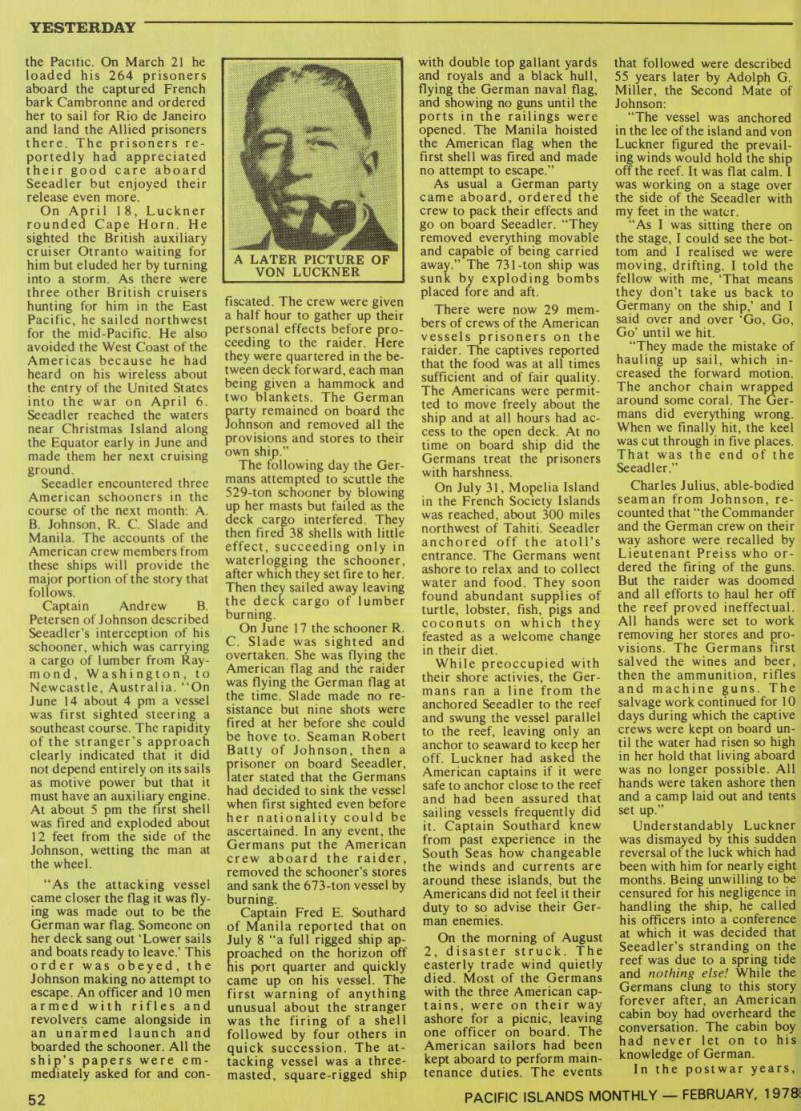
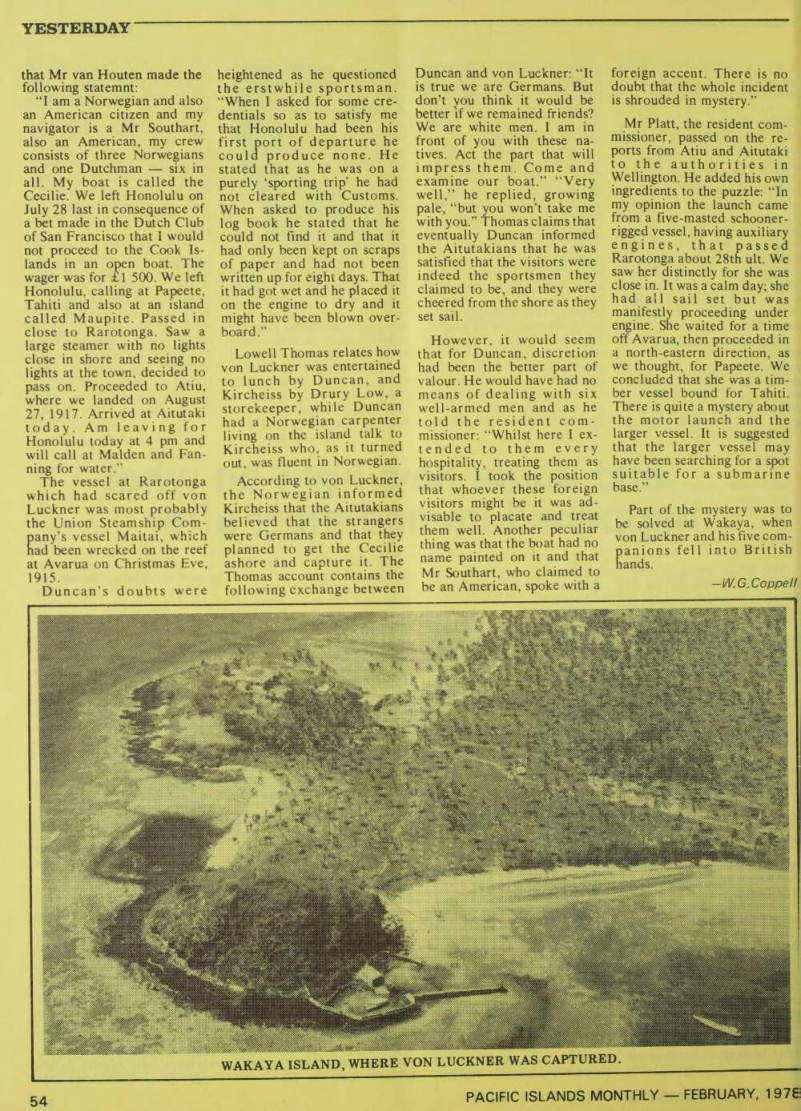
A brand-new version of how Seeadler met her end..and some new light on what happened immediately after
Writing in the magazine The American Neptune , ROBERT L CLIFFORD has advanced 11radlc theory of the end of Count Felix von Luckner s commerce-raiding vessel, Seeadler, which was In tha latter stages of World War I. Together with substantial extracts from his article, PIM offers a companion piece by DR W. G. COPPELL, which, based mainly on research in the archives at Rarotonga, Cook Islands, describes certain of von Luckner’s exploits immediately following the loss of Seeadler.
Disaster at sea sometimes takes completely unexpected and frustrating forms. Such was the case of the end of the German armed raider Seeadler in the South Pacific in 1917, after her sea-raiding voyage halfway around the globe during World War I.
The nature of the disaster to Seeadler was an acute embarrassment to her skipper, Lieutenant Commander Felix Count von Luckner of the Imperial German Navy. He had successfully sailed 30 000 miles across the Atlantic and Pacific Oceans, eluding countless Allied warships which were searching for him, only to lose his ship in a totally preventive mishap in the South Seas.
To Luckner, a proud nobleman and a veteran of seven years in sailing ships, the undue loss of the ship was a blow which he could not coun-
tenance. The commander or dered his officers and men to eternal secrecy on the real cause of the ship’s loss and a “cover plan” was agreed to explain it. Such is the hold of the discipline in the German services that the true story never publicly emerged dur ing the Count’s lifetime. He died in 1968 in his 87th year, still the hero of one of World War I’s great adventure stories, The story of Seeadler’s commerce-raiding cruise in the latter part of World War I became well known to millions of people around the world during the 1920 s and 19305. Luckner travelled con tinuously, lecturing to groups young and old about the ad venturous cruise of Seeadler, her capture of 14 Allied ships and his humane treatment of the prisoners taken. His memoirs were adapted in
1927 by Lowell Thomas in a best seller, Count Luckner: The Sea Devil. His story was revived in 1969 in Edwin P.
Hoyt’s Knight of the Sea. (The author then describes the depredations of Seeadler on the shipping lanes between South America and West Africa.) During the two-month period from January 9 to March 11, 1917, II ships were intercepted, their crews taken on board the raider and their ships scuttled. By mid- March the British Navy was fully aware that a German commerce raider was operating in the South Atlantic and warships were ordered to intercept the phantom raider, Hundreds of vessels delayed venturing out of port and the rates of marine insurance
skyrocketed.
Despite the Allied search efforts, Seeadler remained an
elusive mystery ship for many months to come. The Illus trated London News on April 26 displayed a centrefold sketch of the raider with a caption headlined “An Armed Sailing-Ship Used as a Ger man Raider: Ready to Sink the Victims She Has Attracted by False ‘S.O.S.’ Wireless Sig nals of Distress”. The caption went on to explain that ships coming to rescue find “a sail ing ship hove to, flying Nor wegian colours and distress signals . .. The unsuspecting rescue ships are caught by the raider’s hidden guns and are sunk one by one ... This de spicable trick violates the most cherished principles of chivalry at sea . . . Even a
Barbary pirate might have
shrunk from the act here illus trated.”
Actually in mid-March Luckner had made the deci sion to quit the Atlantic for
COUNT AND COUNTESS VON LUCKNER WITH ONE OF THE SEEADLER’S GUNS, PAPEETE
the Pacific. On March 21 he loaded his 264 prisoners aboard the captured French bark Cambronne and ordered her to sail for Rio de Janeiro and land the Allied prisoners there. The prisoners re portedly had appreciated their good care aboard Seeadler but enjoyed their release even more.
On April 18, Luckner rounded Cape Horn. He sighted the British auxiliary cruiser Otranto waiting for him but eluded her by turning into a storm. As there were three other British cruisers hunting for him in the East Pacific, he sailed northwest for the mid-Pacific. He also avoided the West Coast of the Americas because he had heard on his wireless about the entry of the United States into the war on April 6.
Seeadler reached the waters near Christmas Island along the Equator early in June and made them her next cruising ground.
Seeadler encountered three American schooners in the course of the next month: A.
B. Johnson, R. C. Slade and Manila. The accounts of the American crew members from these ships will provide the major portion of the story that follows.
Captain Andrew B.
Petersen of Johnson described Seeadler’s interception of his schooner, which was carrying a cargo of lumber from Ray mond, Washington, to Newcastle, Australia. “On June 14 about 4 pm a vessel was first sighted steering a southeast course. The rapidity of the stranger’s approach clearly indicated that it did not depend entirely on its sails as motive power but that it must have an auxiliary engine.
At about 5 pm the first shell was fired and exploded about 12 feet from the side of the Johnson, wetting the man at the wheel.
“As the attacking vessel came closer the flag it was fly ing was made out to be the German war flag. Someone on her deck sang out ‘Lower sails and boats ready to leave.’ This order was obeyed, the Johnson making no attempt to escape. An officer and 10 men armed with rifles and revolvers came alongside in an unarmed launch and boarded the schooner. All the ship’s papers were em meaiately asked for and con-
fiscated. The crew were given a half hour to gather up their personal effects before pro ceeding to the raider. Here they were quartered in the be tween deck forward, each man being given a hammock and two blankets. The German party remained on board the Johnson and removed all the provisions and stores to their own ship.”
The following day the Ger mans attempted to scuttle the 529-ton schooner by blowing up her masts but failed as the deck cargo interfered. They then fired 38 shells with little effect, succeeding only in waterlogging the schooner, after which they set fire to her.
Then they sailed away leaving the deck cargo of lumber burning.
On June 17 the schooner R.
C. Slade was sighted and overtaken. She was flying the American flag and the raider was flying the German flag at the time. Slade made no re sistance but nine shots were fired at her before she could be hove to. Seaman Robert Batty of Johnson, then a firisoner on board Seeadler, ater stated that the Germans had decided to sink the vessel when first sighted even before her nationality could be ascertained. In any event, the Germans put the American crew aboard the raider, removed the schooner’s stores and sank the 673-ton vessel by burning.
Captain Fred E. Southard of Manila reported that on July 8 “a full rigged ship ap proached on the horizon off nis port quarter and quickly came up on his vessel. The first warning of anything unusual about the stranger was the firing of a shell followed by four others in quick succession. The at tacking vessel was a three masted, square-rigged ship
with double top gallant yards and royals and a black hull, flying the German naval flag, and showing no guns until the ports in the railings were opened. The Manila hoisted the American flag when the first shell was fired and made no attempt to escape.”
As usual a German party came aboard, ordered the crew to pack their effects and go on board Seeadler. “They removed everything movable and capable of being carried away.” The 731-ton ship was
sunk by exploding bombs
placed fore and aft.
There were now 29 mem bers of crews of the American vessels prisoners on the raider. The captives reported that the food was at all times sufficient and of fair quality.
The Americans were permit ted to move freely about the ship and at all hours had ac cess to the open deck. At no time on board ship did the Germans treat the prisoners with harshness.
On July 31, Mopelia Island in the French Society Islands was reached, about 300 miles northwest of Tahiti. Seeadler anchored off the atoll’s entrance. The Germans went ashore to relax and to collect water and food. They soon found abundant supplies of turtle, lobster, fish, pigs and coconuts on which they feasted as a welcome change in their diet.
While preoccupied with their shore activies, the Ger mans ran a line from the anchored Seeadler to the reef and swung the vessel parallel to the reef, leaving only an anchor to seaward to keep her off. Luckner had asked the American captains if it were safe to anchor close to the reef and had been assured that sailing vessels frequently did it. Captain Southard knew from past experience in the South Seas how changeable the winds and currents are around these islands, but the Americans did not feel it their duty to so advise their Ger man enemies.
On the morning of August 2, disaster struck. The easterly trade wind quietly died. Most of the Germans with the three American cap tains, were on their way ashore for a picnic, leaving one officer on board. The American sailors had been kept aboard to perform main tenance duties. The events
that followed were described 55 years later by Adolph G.
Miller, the Second Mate of Johnson: “The vessel was anchored in the lee of the island and von Luckner figured the prevail ing winds would hold the ship off the reef. It was flat calm. I was working on a stage over the side of the Seeadler with my feet in the water.
“As I was sitting there on the stage, I could see the bot tom and I realised we were moving, drifting. I told the fellow with me, That means they don’t take us back to Germany on the ship,’ and I said over and over ‘Go, Go, Go’ until we hit.
“They made the mistake of hauling up sail, which in creased the forward motion.
The anchor chain wrapped around some coral. The Ger mans did everything wrong.
When we finally hit, the keel was cut through in five places.
That was the end of the Seeadler.’’
Charles Julius, able-bodied seaman from Johnson, re counted that “the Commander and the German crew on their way ashore were recalled by Lieutenant Preiss who or dered the firing of the guns.
But the raider was doomed and all efforts to haul her off the reef proved ineffectual.
All hands were set to work removing her stores and pro visions. The Germans first salved the wines and beer, then the ammunition, rifles and machine guns. The salvage work continued for 10 days during which the captive crews were kept on board un til the water had risen so high in her hold that living aboard was no longer possible. All hands were taken ashore then and a camp laid out and tents set up.”
Understandably Luckner was dismayed by this sudden reversal of the luck which had been with him for nearly eight months. Being unwilling to be censured for his negligence in handling the ship, he called his officers into a conference at which it was decided that Seeadler’s stranding on the reef was due to a spring tide and nothing else! While the Germans clung to this story forever after, an American cabin boy had overheard the conversation. The cabin boy had never let on to his knowledge of German.
In the postwar years,
A Later Picture Of
Von Luckner
Luckner described in awesome tones the tidal wave which upended Seeadler: “At 9.30 o’clock I noticed a strange bulge to the east. Soon we recognised it as a tidal wave rushing toward us as we lay between the island and the sea. I ordered the cable cut and the motor started. But the motor did not stir despite frantic efforts to turn her over. Quickly the tidal wave was upon us, 30 to 40 feet high. The wave swung the ship on high and threw her for ward, crashing us on the coral •eef ... Our masts and rigging went over, broken like natchsticks.
“The shattering impact of he ship smashed the coral eef and pieces flew in all lirections. The Seeadler heel id over until her deck was ilmost perpendicular. Water wept over the deck swirling
pieces of coral. I clung to an iron rail and that saved me from the tons of coral being hurled around. In a moment, the wave had ebbed away, leaving us high and dry.”
Commented Captain Adolph Muller years later: “Tidal wave? That story is for the birds!” Subsequent official depositions by the other American crew members con firm Miller’s view.
The weather records for August 1917 make no mention of such a tidal wave in the So ciety group. Had there been such it would have overrun Mopelia and damaged Bora Bora, Maupiti, and Raiatea is lands as well. There is no such incident found in the official records kept in Papeete, the capital of this French colony.
On shore the Germans and the Americans had camps side by side. The wireless set was
erected so that the German could continue to listen in to news from around the Pacific.
A hospital tent Was set up but never used as the doctor was in a perpetual state of intox ication. The Americans were put to work collecting turtles and fish on what Luckner jokingly called “Germany’s last colony”.
The German treatment of the Americans and the food given to them were not as good as they had been on the raider. When Second Mate Fred J, Williams and Charles Brown of Manila slipped off in search of food on the island and found shellfish, Luckner ordered them to make daily expeditions around the coral to collect shellfish for the en tire group. When the Americans complained that the coral cut their feet very badly, the Commander
pointed to the earth saying “There is your grave.’’ The Americans continued their
daily quests.
“On August 23, Luckner, with three officers and two men, sailed off in one of Seeadler’s 32-foot launches to go in search of a vessel to take the Germans away from the is land. They sailed west with the trade winds and never returned ...” (The Americans left on Mopelia were eventually re scued as a result of an epic I 770 km voyage to American Samoa under the command of Fred Williams. Williams and his crew sailed in a 5.5 m dingly left in a damaged state by the Germans and then re paired by the Americans. Ar riving in American Samoa they quickly organised relief for the captives on Mopelia.)
R.L.Clifford
The most dramatic sejuence of events involving the ieeadler began at Mopelia Isand in French Polynesia.
Fhere the Seeadler, the brmer American, Glasgowmilt Pass of Balmaha, was vrecked on the reef on August '>1917, Von Luckner decided that le must capture another vessel so as to continue his narauding activities and the ifeboat was converted for a ong open-ocean voyage. \fter it had been loaded with mrdtack, machine guns, riles, hand grenades and )istols, and boarded by von mckner and five of his crew, here was a 14-inch freeboard.
Von Luckner planned to iverage 95 km a day, to visit he Cook Islands and Fiji and, f he was successful in capturng a ship, to be back at Vlopeha within three months.
Phe voyage took him through he Cooks to Niue, where the jerman flag was hoisted on he lifeboat, now named Cronprinzessin Cecilie. The jermans did not land there Hit were welcomed by the Niueans and given supplies of resh water and bananas, \tter landing at Katafaga Isand in the Fiji group, von
Luckner and his men were captured by the British at Wakaya.
The saga of the Count did not end there as he was later to escape from captivity on Motiuhi Island in Auckland Harbour, capture the scow Moa and reach the Kermadec Islands before being ap prehended once more, Among the files in the archives building at Rarotonga are reports on von Luckner’sjourney through the Cook Islands, which throw fresh light on that part of his escapades. The best known ac count is Lowell Thomas’, in his book Count Luckner: The Sea Devil.
Thomas tells how von Luckner called at Atiu Island and, with Lieutenant Kircheiss, “went ashore and straight to the house of the British Resident. He lay stretched out in his shirt and trousers on a Borneo long chair on his porch and didn’t even get up when we ap preached. He was a good looking fellow but lazy as the devil. The lassitude of the South Seas had certainly got him.” Kircheiss, who was more fluent in English than his captain, told the resident
agent that they were Americans of Dutch birth and that they were on a voyage from Honolulu to Tahiti by way of the Cook Islands and back to Honolulu for a wager of $25 000.
According to the German account, the resident agent gave them a certificate stating that they had called on him in the course of a sporting cruise, They were also entertained on Atiu by the French missionary priest who wined and dined them and had the Germans sing in unison to a record of “La Marseillaise”. Von Luckner and his men found that “everywhere on the island were trees and fruits, coconuts, bananas, mangoes and oranges.” They took the supplies they needed and departed for Aitutaki.
And what did the resident agent think about this bizarre visit to his isolated island? His report to the resident commissioner on Rarotonga says: “On the morning of the 27th inst., a boat put into Tarapuka harbour and picked up a native to pilot them to Taunganiu. Upon arrival here it proved to be a motor boat Cecilie, bound from Australia to Honolulu. The crew con-
sisted of six men, Captain van Houten in command. They asked for food and water, canoes were launched, captain and chief officer came ashore, after receiving provisions and water, together with a little rest, they proceeded on their
journey/’
At Aitutaki, the Germans decided to pass themselves off as Norwegians as the French man on Atiu had told them that he had a Dutch friend liv ing there. The Cecilie steered through the reef passage to the landing place at Aitutaki and its crew were relieved to see that there was no other vessel in sight. Von Luckner found that the resident agent at Aitutaki was a harder person to manage than his Atiu coun terpart had been. “He was a tall, lank fellow, who wore glasses and looked a perfect picture of President Wilson, We found this resident to be full of the same British suspi cion. Unlike his colleague at Atiu he was in no wise lost in tropical indolence, but was active and shrewd.” Thomas Duncan was filled with doubts about the credentials and in tentions of his unexpected visitors. His report to his superior in Rarotonga says
that Mr van Houten made the following statemnt: “I am a Norwegian and also an American citizen and my navigator is a Mr Southart, also an American, my crew consists of three Norwegians and one Dutchman six in all. My boat is called the Cecilie. We left Honolulu on July 28 last in consequence of a bet made in the Dutch Club of San Francisco that I would not proceed to the Cook Islands in an open boat. The wager was for £l 500. We left Honolulu, calling at Papeete, Tahiti and also at an island called Maupite. Passed in close to Rarotonga. Saw a large steamer with no lights close in shore and seeing no lights at the town, decided to pass on. Proceeded to Atiu, where we landed on August 27, 1917. Arrived at Aitutaki t o d a y. A m I e a v i n g f o r Honolulu today at 4 pm and will call at Malden and Fanning for water.”
The vessel at Rarotonga which had scared off von Luckner was most probably the Union Steamship Company’s vessel Maitai, which nad been wrecked on the reef at Avarua on Christmas Eve, 1915.
Duncan’s doubts were
heightened as he questioned the erstwhile sportsman.
“When I asked for some cre dentials so as to satisfy me that Honolulu had been his first port of departure he could produce none. He stated that as he was on a purely ‘sporting trip' he had not cleared with Customs.
When asked to produce his log book he stated that he could not find it and that it had only been kept on scraps of paper and had not been written up for eight days. That it had got wet and he placed it on the engine to dry and it might have been blown over board.” „ Lowell Thomas von Luckner was entertained J 9. '“ n 9h Jy Du .
Kircheiss by Dru y > storekeeper, * had a Norwegian carpenter hv.ng on the island talk to K.rche.ss whl ;“J' i " e n d °ut, was fluent in Norwegian.
According to von Luckner, the Norwegian informed Kircheiss that the Aitutakians believed that the strangers were Germans and that they planned to get the Cecilie ashore and capture it. The Thomas account contains the following exchange between
Duncan and von Luckner; “It is true we are Germans. But don’t you think it would be better if we remained friends?
We are white men. I am in front of you with these nalives. Act the part that will impress them. Come and examine our boat.” “Very well,” he replied, growing pale, “but you won’t take me with you.” Thomas claims that eventually Duncan informed the Aitutakians that he was satisfied that the visitors were indeed the sportsmen they claimed to be, and they were cheered from the shore as they set sa ji However, it would seem that for Duncan, discretion had been the better part of valour. He would have had no means of dealing with six well-armed men and as he told the resident commissioner; “Whilst here I extended to them every hospitality, treating them as visitors. I took the position that whoever these foreign visitors might be it was advisable to placate and treat them , Another peculiar thing was thauhe boat had no name painted on it and that Mr Southart, who claimed to be an American, spoke with a
foreign accent. There is no doubt that the whole incident is shrouded in mystery.” ,M. r Platt, the resident con rmssioner, passed on the re ports from Atiu and Aitutaki ... e authorities in Wellington. He added his own ingredients to the puzzle: “In JPV opinion the launch came from a five-masted schooner nBBe? vessel, having auxiliary engines, that passed Rarotonga about 28th ult. We saw her distinctly for she was close in It was a calm day; she had ail sail set but was manifestly proceeding under engine. She waited for a time off Avarua, then proceeded in a north-eastern direction, as we thought, for Papeete. We concluded that she was a tim ber vessel bound for Tahiti, There is quite a mystery about the motor launch and the larger vessel. It is suggested that the larger vessel may have been searching for a spot suitable for a submarine base.” f , was , . solved at Wakava when von L „ ck d ner j fell into Br i t i s h fj anc s
W.G.Coppell
WAKAYA ISLAND, WHERE VON LUCKNER WAS CAPTURED.
Advertisements & other items, p. 53 (1 item)
happened immediately after
53
YESTERDAY
ACIFIC ISLANDS MONTHLY FEBRUARY, 1978
... and some new light on what happened immediately after
Howard Hughes’ Shadow
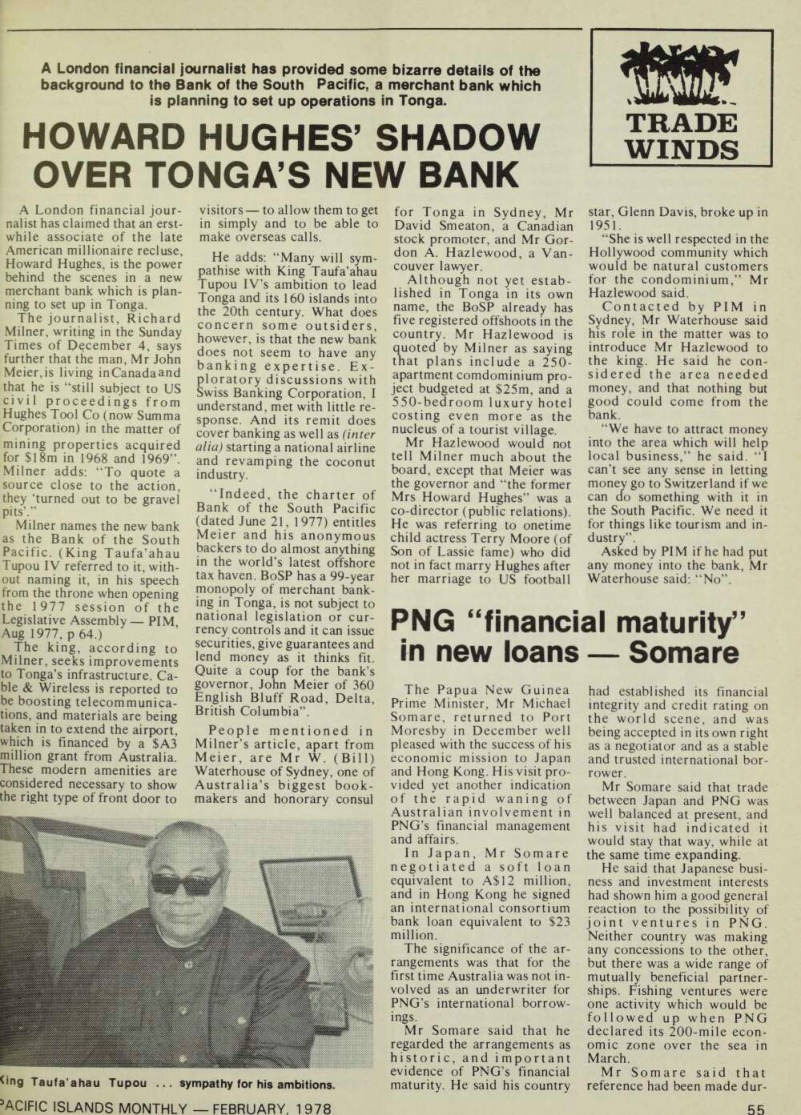
Over Tonga’S New Bank
Trade
Winds
A London financial journalist has provided some bizarre details of the background to the Bank of the South Pacific, a merchant bank which is planning to set up operations in Tonga.
A London financial journalist has claimed that an erstwhile associate of the late American millionaire recluse, Howard Hughes, is the power behind the scenes in a new merchant bank which is planning to set up in Tonga.
The journalist, Richard Milner, writing in he Sunday Time. of December 4, says further that the man, Mr John Meier,is living inCanadaand ~’ • t 4 .f. .. ITO that he is still subject to US Proceedings from ughes Tool Co (now Summa Corporation) in the matter of mining properties acquired for slBm in 1968 and 1969”.
Milner adds; “To quote a source close to the action, they ‘turned out to be gravel pits’.”
Milner names the new bank as the Bank of the South Pacific. (King Taufa’ahau Tupou IV referred to it, without naming it, in his speech from the throne when opening the 1 977 session of the Legislative Assembly—PlM Aug 1977 p 64 ) ’
The king, according to Milner, seeks improvements to Tonga’s infrastructure Cable & Wireless is reported to be boosting telecommunications, and materials are being taken in to extend the airport, which is financed by a SA3 million grant from Australia.
These modern amenities are considered necessary to show the right type of front door to
visitors—to allow them to get in simply and to be able to make overseas calls. it ttK/l . .T"’
P a ‘™ iv Kl "§ . Tau f a ah au ifupou IV s ambition to lead .' 60 '^ s ! nto ?? r h ' Mury - W , hat . does I . s ° r ; ° uts,d f r *- *™ ; l at he . new bank * eem to f have an y bank ng expertise. Ex ploratory discussions with Swiss Banking Corporation, I understand, met with little re- S ponse. And its remit does cover banking as well as (inter alia) starting a national airline and revamping the coconut industry, 4tT , ’ .
D Indeed the charter of Bank of the South Pacific (dated 21, 1977) entitles e , ier and hl , s anonymous backers to do almost anything m tbe world ’ s latest offshore lax haven. BoSP has a 99-year mono Poly of merchant bank inB.m Tonga, is not subject to natlona l legislation or cur rency controls and it can issue securities, give guarantees and 15. mone y as it thinks fit.
Qulte a COU P for the bank ’ s governor, John Meier of 360 English Bluff Road, Delta, ° ntlsb Columbia .
People mentioned in Milner’s article, apart from Meier, are Mr W. (Bill) Waterhouse of Sydney, one of Australia’s biggest book makers and honorary consul
for Tonga in Sydney, Mr David Smeaton, a Canadian stock promoter, and Mr Gordon A. Hazlewood, a Vancouver lawyer.
Although not yet established in Tonga in its own name, the BoSP already has five registered offshoots in the country. Mr Hazlewood is quoted by Milner as saying that plans include a 250apartment comdominium project budgeted at s2sm, and a 550-bedroom luxury hotel costing even more as the nucleus of a tourist village.
Mr Hazlewood would not tell Milner much about the board, except that Meier was the governor and “the former Mrs Howard Hughes” was a co-director (public relations), He was referring to onetime child actress Terry Moore (of Son of Lassie fame) who did not in fact marry Hughes after her marriage to US football
star, Glenn Davis, broke up in 1951.
“She is well respected in the Hollywood community which would be natural customers for the condominium,” Mr Hazlewood said, Contacted by PIM in Sydney, Mr Waterhouse said his role in the matter was to introduce Mr Hazlewood to the king. He said he con sidered the area needed money, and that nothing but good could come from the bank.
“We have to attract money into the area which will help local business,” he said. “I can’t see any sense in letting money go to Switzerland if we can do something with it in the South Pacific. We need it for things like tourism and in dustry”.
Asked by PIM if he had put any money into the bank, Mr Waterhouse said; “No”.
King Taufa’ahau Tupou... sympathy for his ambitions.
PNG “financial maturity”
in new loans-Somare
The Papua New Guinea Prime Minister, Mr Michael Somare, returned to Port Moresby in December well pleased with the success of his economic mission to Japan and Hong Kong. His visit provided yet another indication of the rapid waning of Australian involvement in PNG’s financial management and affairs.
In Japan, Mr Somare negotiated a soft loan equivalent to Asl2 million, and in Hong Kong he signed an international consortium bank loan equivalent to $23 million.
The significance of the arrangements was that for the first time Australia was not involved as an underwriter for PNG’s international borrowings.
Mr Somare said that he regarded the arrangements as historic, and important evidence of PNG’s financial maturity. He said his country
had established its financial integrity and credit rating on the world scene, and was being accepted in its own right as a negotiator and as a stable and trusted international bor rower.
Mr Somare said that trade between Japan and PNG was well balanced at present, and his visit had indicated it would stay that way, while at the same time expanding.
He said that Japanese busi ness and investment interests had shown him a good general reaction to the possibility of joint ventures in PNG.
Neither country was making any concessions to the other, but there was a wide range of mutually beneficial partner ships. Fishing ventures were one activity which would be followed up when PNG declared its 200-mile econ omic zone over the sea in March.
Mr Somare said that reference had been made dur
ing his visit to PNG’s action in closing down a Japanese oil palm venture which was not meeting its commitments. He believed Japanese investors in general had appreciated the fact that PNG had first called in an international arbitrator, and as a result there had been no Japanese loss of confidence in PNG.
Mr Somare also forecast that as a result of his visit the big Wabo hydro-electric scheme appeared likely to be undertaken within a decade.
The scheme, which will tap the headwaters of the Purari river north of the Gulf of Papua, will be of world pro portions.
But it cannot be undertaken unless there is a guarantee that new industries will be at tracted, prepared to buy the power generated. Mr Somare said that Japanese interests had not committed themselves to guaranteeing the involve ment of such industries, but prospects appeared good.
Niue suffers
for its sins
In the days long ago when royalty reigned on Niue, the king, who had both secular and priestly responsibilities, was blamed and expected to commit suicide in times of national disaster.
Then, when the kings died off and pastors took over the maintenance of religion, any thing that could not be logically explained was at tributed to sins they had com mitted and they were put on trial to confess them.
Although not taken too seriously today, the tradition was recalled during the severe drought last year when Niue suffered its driest period be tween May and November since weather records began in 1906. No one expected the Castors to take the entire lame for the lack of rain but it wasn’t long after someone suggested putting them on trial in the Alofi courthouse to be cross-examined on their sins that the rains started.
That, however, was too late to save Niue from what government officials regard as a national disaster. As a result of the drought, this year’s sub sistence crops are seriously affected, copra production is expected to be cut by up to 50%, the lime and pas
sionfruit industries suffered, about 70 cattle, 10% of the total herd, died, and more thap 1 000 acres of bush were
destroyed by fire.
Between May and Novem ber only 255 mm of rain was recorded, far below the pre vious lowest reading of 350 mm for the same period in 1915.
The subsistence crops, the major one being taro, are ex pected to be in short supply for the first six months of this year because of the lack of planting materials. In the bush gardens, which have no method of irrigation, the taros were baked in the ground and few young shoots survived for the next planting cycle.
The growth of coconut trees, which would normally be fully bearing late last year, was also seriously stunted in the dry heat and their copra crop could be cut by half this year.
The fruits of the pas sionfruit and lime trees were smaller than usual many falling to the ground during the drought but production could pick up if the rains last longer as they did the pre vious year.
The cattle pastures are not expected to recover fully for up to two years and the deple tion of the herd and effects of the drought on the breeding cattle may mean the cattle in dustry, which has considera ble problems apart from the drought, will suffer for some time.
The effect of the bush fires will also be felt for a few years as the land cannot be immedi ately used for crops.
For the last three months of the year, the island’s water supply was solely dependent on the bore supply which meant severe rationing of water.
Most government offices in Alofi ran out of water and one even asked permission to close down because of this.
Schools were forced to close periodically as their water supplies dried up and they were all closed a week before the end of the final term. The hospital ran out of water for a few days and some convalesc ing patients were sent home.
Domestic supplies were strictly limited, the bakery was forced to close occa sionally, and even the ice cream machine in the centre of Alofi dried up.
Advertisements & other items, p. 55 (1 item)
55
’ACIFIC ISLANDS MONTHLY FEBRUARY, 1 978
(white) middleman
Briefly
• Sir Maori Kiki has been appointed a director of Australia and New Zealand Banking Group (PNG) Limited. He will sit on the bank’s board with Mr E. D.
Cleland, PNG businessman, Mr M. Brunckhorst and Mr T. M. Williamson, managing director and general man ager-branch banking, re spectively, of ANZ’s Melbourne-based parent company; and Mr T. A.
Wightman, the local bank’s chief manager. Sir Maori, ex- PNG deputy prime minister, has held several ministerial portfolios, including foreign affairs and overseas trade. He is president of the Port Mores by Council of Trade Unions and chairman of the National Shipping Corporation and of New Guinea Motors Pty Ltd. • Mr A. Matoto, 34, for merly Assistant Secretary to the Ministry of Finance in Tonga, has been promoted to
the newly-created position of
Secretary for Finance. The promotion makes Mr Matoto the permanent head of the Ministry. Previously, Mr S.
Jones, the Accountant- General, was the departmen tal head. Mr Matoto is one of a small group of young, edu cated Tongans who have been elevated to senior positions. • Sir John Guise, ex PNG Governor-General and now a
prominent parliamentarian,
Cutting out the
(white) middleman
Whites and Asians are to be banned from February from buying unprocessed cocoa beans in parts of Papua New Guinea unless they have become naturalised citizens.
The PNG Cocoa Industry Board decided on the ban following complaints that too many non-nationals are in volved in middle-man profit making.
The areas where the ban will apply are New Ireland and West New Britain two of the major cocoa-growing regions of PNG.
has called on the government to refuse further fishing survey permits to foreign companies. “It is common knowledge,” he said, “that these fishing survey permits are being abused by foreign fishermen, who only use this type of permit as a cover when in fact they ship away thou sands of tonnes of fish to their home ports through mother ships which collect this frozen fish outside sea boundaries.”
K6OO 000, are Coral Sea En terprises Pty Ltd of Australia and a Japanese company. Sir John complained that the peo ple of Milne Bay, whom he represents in parliament, have not been consulted over the project. • The Atzira Rural Co-op erative has accused Markham Valley peanut growers of sell ing their peanuts to foreign owned companies rather than to the co-operative. The co operative said one company, Sum Sum Peanuts, was using
dirty tactics to persuade
growers to sell to them. The farmers’ answer was that they had not been given a fair deal by the co-operative which was paying only 7t per kg for their peanuts. The foreign com panies paid 30t per kg. • The Fiji Can Co Ltd has capacity to produce more than one million cans of fish a year in its new $1.5 million factory at Levuka. In the first year production is expected to be about 400 000 cans. The en terprise is a joint venture be tween the Fiji Government and the Toyo Fika Can Co Ltd, of Japan. • A new joint venture tim ber project between the Papua New Guinea Government and! a Japanese company is the Gogol Reforestation Co in Madang Province, where holdings are being replanted
in pulpwood. The Japanese
company, Jant, has 51% equi ty in the venture and PNG holds the remainder. It wil! take about six years to estab lish the plantation and 14 years before it comes intc bearing. • New Zealand will be the market for the production from a new orange growing and processing enterprise in Fiji’s Vanua Levu. Initially there will be more than 100 ha planted in citrus at Batirii
Later the area of land under citrus production will be doubled. The $6OO 000 ven ture has attracted an invest ment from the Com monwealth Development Corporation. Others in the venture are the Fiji National Marketing Authority, the Stinson-Pearce group, and Oasis Ltd, of New Zealand. • Blue Lagoon Cruises Ltd, of Fiji, is paying shareholders a 15% dividend, and is making a bonus share issue of l-for-2 after a good financial year to May 31, 1 97 7. The profit was $212 792, compared with $1 17 223 in the previous financial year. The company has placed an order for a fourth vessel for Yasawa cruises, from Lautoka. • Samoa Coconut Products Ltd will operate a copra crushing mill to be built in Western Samoa. Apart from extracting oil the mill will ilso process the offal into copra meal in pellet form. The government is borrowing SWS2.S million to establish ;he mill. • Papua New Guinea’s Pri
mary Industry Minister, Mr
fulius Chan, nas appealed to he public to “buy local” and ‘shut its ears” to commercial adio advertising, which was naking the job of promoting ocal products much more lifficult. • Convenience foods have cached Western Samoa in the orm of Southern Fried :hicken, in a take-away outlet n Apia. Chicken and chips old will be no different from hose sold in New Zealand.
Ml the machinery, chicken, jhips and fish will be sent fqm NZ to Apia. The food vill be prepared according to ecipes used in NZ. • Fiji’s sugar output for [977 was one of the “sweetest Jver”, and would earn about 594 million, according to the Minister for Agriculture, Mr Charles Walker. He told the louse of Representatives the i 977 sugar output was about 154,000 tonnes, the highest •ince the 355,000 tonnes of [970. It was the second most valuable crop ever produced. • Pacific Navigation of onga has included Norfolk sland on its regular service
from Sydney and Brisbane to Fiji, Samoa and Tonga. The company initially offered freight rates 16% lower than those of Compagnie des Chargeurs Caledoniens which runs a Sydney-Lord Howe- Norfolk Island-New Hebrides service. Pacific Navigation’s charge for general cargo is $94 for 1 000 kg and $B5 a cubic metre. Charges for acids, gas in cylinders, dangerous and reefer cargo are higher. • The Fiji Government has taken delivery of two small ships, built at the government shipyard, Walu Bay, Suva.
They are the Bulikula, 20 m, which will be used to explore for mineral resources, and the 17.8 m Nasi Yalodina (Dedi cated Nurse), which will be used in health services. Each vessel, which cost more than $5OO 000, has special equip ment for its chosen task. The Nasi Yalodina was funded by the United Nations Fund for Population Activities. • Things are looking up for Air Pacific. After five years of losses totalling $2 170 380, the airline expects to make a profit of about $250 000 in the current financial year, which ends on March 31. This result has been achieved in spite of a reduction of 500 in the work force. In fact, with
fewer employees, productivity
has risen, according to chair man Don Aidney. In the last financial year Air Pacific in curred a loss of $1 060 231, which was cut to $297 188 after selling some aircraft and making foreign exchange gains on loan repayments. • Mr G. S. Fallscheer, 44, has been appointed engineer ing department manager for Air Niugini, replacing Mr C.
Yates, who has returned to Australia. Israel-born Mr Fallscheer is no stranger to Papua New Guinea, having been maintenance supervisor for TAA at Lae in 1960-64. • Timber from Vanua Levu, in Fiji, is being ex ported to the United States.
The first shipment of 45 000 super ft of dakua, was from Savusavu on the south coast of the island, and went to Seat tle. Mr Max Olsson, general manager of Brown and Robb in Fiji, expects the market to increase and earn foreign ex change for Fiji.
Advertisements & other items, pp. 57-58 (2 items)
Acific Islands Monthly February. 1978
CHimoMn Nona:
Notice is hereby given that ZENO MANUFACTURING COMPANY, a corporation organized and existing under the laws of the State of Illinois, located at 410 North Michigan Avenue, Chicago, Illinois, United States of America, is the sole proprietor in Papua New Guinea and elsewhere of the following trade marks:
1. HUBBA BUBBA
2. ZENO
3. BIG G
Used in respect of the following: Confectionery, including chewing gum and candy.
The proprietor claims all rights in respect of the above trade marks and will take all necessary legal steps against any person or company infringing those rights.
SPRUSON & FERGUSON
Patent Attorneys, Esso House, Sydney, Australia.
Western Samoa .
Niue Island
us place in
the Pacific has shifted
.. because now the Polynesian Triangle fare brings a Polynesian holiday much closer. Now, when you visit Fiji, you can include Tonga, Niue and Western Samoa for very little extra! Talk to your travel agent about working in your Polynesian Triangle fare with your Fiji itinerary. Only U55266.00* (AU55229.00 or NZ5237.00) more to see three more islands in the beautiful Pacific. Our Polynesian Triangle fare is available all year round with no minimum stopover restrictions and may be purchased while you are in Fiji or before you arrive.
Contact your travel agent for more details. *Fare subject to change without notice.
PO Box 599, Apia.
WESTERN SAMOA
Serving the heart of Polynesia
POLYNESIAN
PO Box 599,
-0 2: O r< cP V G
IN OUR 84th YEAR SELLING ‘SERVICE’
TO THE PACIFIC ISLANDS...
Nelson & Robertson
PTY. LTD. (Established 1895)
Plantation House, 197 Clarence Street, Sydney.
Cables: ‘IVAN’, Sydney, Brisbane. Telex: AA22381, Sydney.
FOR:
INDENTS HARDWARE TRAVEL
FOODSTUFFS MACHINERY INSURANCE
SOFTGOODS SHIPPING REAL ESTATE
...FROM AUSTRALIA & OVERSEAS.
BRANCH OFFICES:
Nelson & Robertson Pty. Ltd., 303 Adelaide Street, Brisbane, Qld.
Nelson & Robertson Pty. Ltd., RO. Box 2092, Govt. Bldg., Suva, Fiji.
Nelson & Robertson Pty. Ltd., P.O. Box 258, Lautoha, Fiji.
PAPUA NEW GUINEA
REPRESENTATIVES:
Rabtrad Niugini Pty. Ltd,
RABAUL
LAE
MADANG
KIETA
Do you want to do business in New Zealand ?
Ask the bank which has
40% of the banking business
in New Zealand
The BNZ can give you full information on buying or selling in New Zealand and overseas. Full information on investment movement of money, transfers of dividends etc., is also readily available.
There are offices everywhere, more than 400 in fact.
Whatever your financial or trade needs, the BNZ can
help you.
Wellington-Head Office, International Division, Box 2392.
Sydney—GPO Box 507, Sydney, N.S.W. 2001.
Melbourne—GPO Box 528 E, Melbourne, Vic. 3001.
Tokyo-Mr E l_.Banks, Bank of New Zealand Representative Office, Japan. Suite 240, Shin Tokyo Bldg, 3-1, 3-Chrome, Marunouchi, Chiyoda-ku, Tokyo 100.
Singapore-Mr.R.F.Warren, Bank of New Zealand Representative Office, South East Asia. Suite 230, 23rd Floor, Ocean Bldg.
Co I Iyer Quay, Singapore 1.
London-PO Box 402, LondonEC4P.4.H.E.
Fiji, Suva-25 Victoria Parade. Also at Labasa, Lautoka, Nadi, Sigatoka, Ba.
Associated Banks in the South Pacific.
Bank of Western Samoa. Bank of Tonga.
Dann OT wesißlii oamua. uui.n V. a—
SgfiS Bank of New Zealand
Cruising
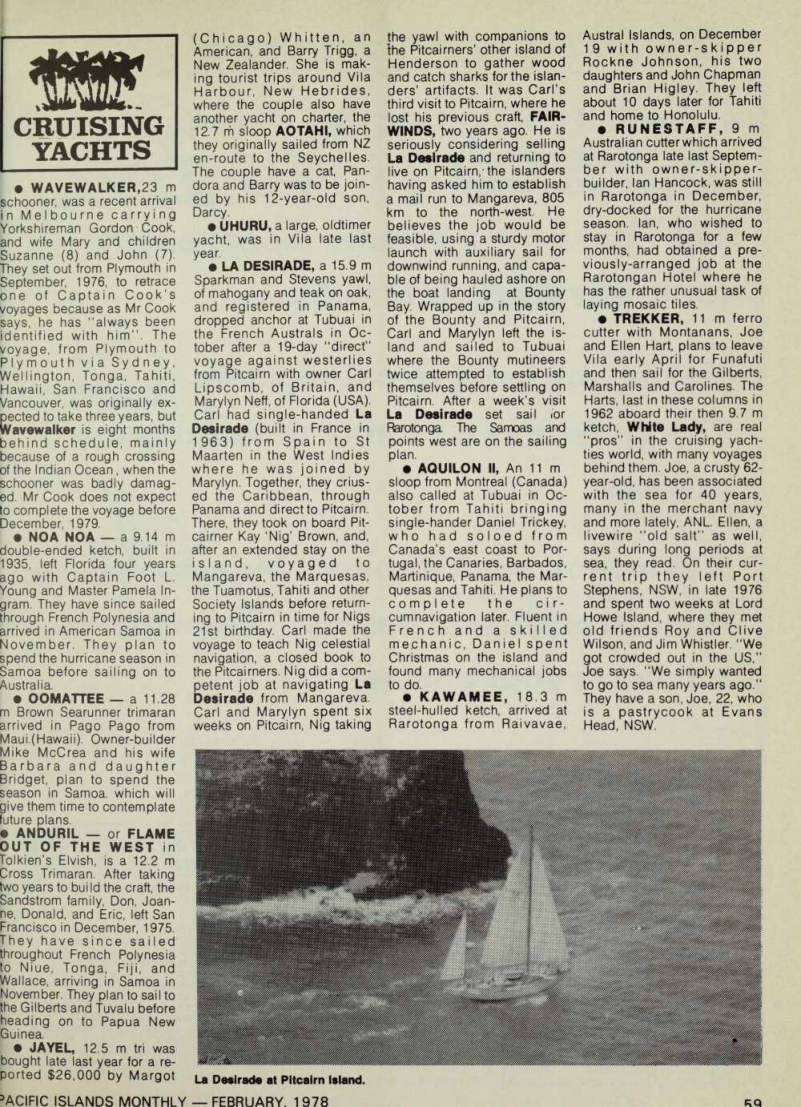
Yachts
• Wave Walker, 23 M
schooner, was a recent arrival in Melbourne carrying Yorkshireman Gordon Cook, and wife Mary and children Suzanne (8) and John (7).
They set out from Plymouth in September, 1976, to retrace one of Captain Cook’s voyages because as Mr Cook says, he has “always been identified with him’’. The voyage, from Plymouth to Plymouth via Sydney, Wellington, Tonga, Tahiti, Hawaii, San Francisco and Vancouver, was originally ex pected to take three years, but Wavewalker is eight months behind schedule, mainly because of a rough crossing of the Indian Ocean, when the schooner was badly damag ed. Mr Cook does not expect to complete the voyage before December, 1979.
• Noa Noa A 9.14 M
double-ended ketch, built in 1935, left Florida four years ago with Captain Foot L.
Young and Master Pamela In gram. They have since sailed through French Polynesia and arrived in American Samoa in November. They plan to spend the hurricane season in Samoa before sailing on to Australia.
• Oomattee A 11 28
m Brown Searunner trimaran arrived in Pago Pago from Maui.(Hawaii). Owner-builder Mike McCrea and his wife Barbara and daughter Bridget, plan to spend the season in Samoa, which will give them time to contemplate future plans.
• Anduril Or Flame
Out Of The West In
Tolkien’s Elvish, is a 12.2 m Cross Trimaran. After taking two years to build the craft, the Sandstrom family, Don, Joan ne, Donald, and Eric, left San Francisco in December, 1975.
They have since sailed throughout French Polynesia to Niue, Tonga, Fiji, and Wallace, arriving in Samoa in November. They plan to sail to the Gilberts and Tuvalu before heading on to Papua New Guinea. • JAYEL, 12 .5 m tri was bought late last year for a re ported $26,000 by Margot
(Chicago) Whitten, an American, and Barry Trigg, a New Zealander. She is mak ing tourist trips around Vila Harbour, New Hebrides, where the couple also have another yacht on charter, the 12.7 m sloop AOTAHI, which they originally sailed from NZ en-route to the Seychelles.
The couple have a cat, Pan dora and Barry was to be join ed by his 12-year-old son, Darcy. • UHURU, a large, oldtimer yacht, was in Vila late last year.
•La Desirade, A 15.9 M
Sparkman and Stevens yawl, of mahogany and teak on oak, and registered in Panama, dropped anchor at Tubuai in the French Australs in Oc tober after a 19-day “direct” voyage against westerlies from Pitcairn with owner Carl Lipscomb, of Britain, and Marylyn Neff, of Florida (USA).
Carl had single-handed La Desirade (built in France in 1 963) from Spain to St Maarten in the West Indies where he was joined by Marylyn. Together, they crius ed the Caribbean, through Panama and direct to Pitcairn.
There, they took on board Pit cairner Kay ‘Nig’ Brown, and, after an extended stay on the island, voyaged to Mangareva, the Marquesas, the Tuamotus, Tahiti and other Society Islands before return ing to Pitcairn in time for Nigs 21st birthday. Carl made the voyage to teach Nig celestial navigation, a closed book to the Pitcairners. Nig did a com petent job at navigating La Desirade from Mangareva.
Carl and Marylyn spent six weeks on Pitcairn, Nig taking
the yawl with companions to the Pitcairners’ other island of Henderson to gather wood and catch sharks for the islan ders’ artifacts. It was Carl’s third visit to Pitcairn, where he lost his previous craft, FAIR WINDS, two years ago. He is seriously considering selling La Desirade and returning to live on Pitcairn,-the islanders having asked him to establish a mail run to Mangareva, 805 km to the north-west. He believes the job would be feasible, using a sturdy motor launch with auxiliary sail for downwind running, and capa ble of being hauled ashore on the boat landing at Bounty Bay. Wrapped up in the story of the Bounty and Pitcairn, Carl and Marylyn left the is land and sailed to Tubuai where the Bounty mutineers twice attempted to establish themselves before settling on Pitcairn. After a week’s visit La Desirade set sail ior Rarotonga The Samoas and points west are on the sailing plan.
• Aquilon 11, An 11 M
sloop from Montreal (Canada) also called at Tubuai in Oc tober from Tahiti bringing single-hander Daniel Trickey, who had soloed from Canada’s east coast to Por tugal, the Canaries, Barbados, Martinique, Panama, the Mar quesas and Tahiti. He plans to complete the cir cumnavigation later. Fluent in French and a skilled mechanic, Daniel spent Christmas on the island and found many mechanical jobs to do.
• Kawamee, 18.3 M
steel-hulled ketch, arrived at Rarotonga from Raivavae,
Austral Islands, on December 1 9 with owner-skipper Rockne Johnson, his two daughters and John Chapman and Brian Higley. They left about 10 days later for Tahiti and home to Honolulu.
• Runestaff, 9 M
Australian cutter which arrived at Rarotonga late last Septem ber with owner-skipper builder, lan Hancock, was still in Rarotonga in December, dry-docked for the hurricane season. lan, who wished to stay in Rarotonga for a few months, had obtained a pre viously-arranged job at the Rarotongan Hotel where he has the rather unusual task of laying mosaic tiles. • TREKKER, 11 m ferro cutter with Montanans, Joe and Ellen Hart, plans to leave Vila early April for Funafuti and then sail for the Gilberts, Marshalls and Carolines. The Harts, last in these columns in 1962 aboard their then 9.7 m ketch, White Lady, are real “pros” in the cruising yach ties world, with many voyages behind them. Joe, a crusty 62year-old, has been associated with the sea for 40 years, many in the merchant navy and more lately, ANL Ellen, a livewire “old salt" as well, says during long periods at sea, they read. On their cur rent trip they left Port Stephens, NSW, in late 1976 and spent two weeks at Lord Howe Island, where they met old friends Roy and Clive Wilson, and Jim Whistler. “We got crowded out in the US,”
Joe says. “We simply wanted to go to sea many years ago.”
They have a son, Joe, 22, who is a pastrycook at Evans Head, NSW.
La Desirade at Pitcairn Island.
Advertisements & other items, p. 60 (1 item)
Maybe you want dependable
Maybe you want to c\^your
'» < The answer is a Yanmar diesel engine
for generating electricity.
Maybe you want to catch some^
The answer is a Yanmar diesel marine
engine.
Maybe you want dependable
transportation. A Yanmar diesel marine
engine is your answer.
o
A As * A. A
A A, A . A
m Model YNG series
2.0-10KVA
* j Yanmar diesel industrial and marine engines. From 3 to 3190 horsepower. Efficiency and dependability. A trusted name in 130 countries.
YAMMAH
DIESEL EMBIME
Model YANMAR DIESEL ENGINE CD.,LTD.
SB series Cable YANMAR TOKYO Telex: 0222-2310,0222-4733 12HP USTRALIA) CENTRAL MARINE SALES & SERVICE: Tasmania, Tel: 725079 O.FVN DIESELS QUEENSLAND PTY. Tel \SSETT MACHINERY SALES PTY LTD.: Victoria, Tel. 870-2944 IRSCO PTY. LTD.: Northern Territory, TeL 818844 LAWTON AGENC ■ >uth Australia, Tel: 426221 SIER & JOHNSTON: West Australia, Tel: 37 . 5288 S U MI T OMOSHO J I (A U ND) DREW S & BEAVEN LTD°- Tel ESTERN FUELPUMP AND INJECTOR SERVICES PTY. LTD.: South 638-6100 (HEW BEAVEN L 1-400 (PAPUA NEW GUINEA) TUTT BRYANT PACIFIC LTD.: Port Moresby, Tel: (FIJI) CORAL o , , NEW ilberti GILBERT ISLANDS DEVELOPMENT AUTHORITY (SUPPLY DIVISION): P.0.80x 488, Betio Tarawa Cable. SUPPLY BE7IO J (NEW ffISSJJ M C p!OTS^Hi»rr??p o 4 b 7 ox 7 58 5 6
ENTER, INC.: Tel: 477-6335.
“Co-operation”, W. German-style
Enter Samoan Shipping Services Ltd: “Co-operation”, W. German-style
West Germany, and its Hamburg-based Columbus Line, have moved Into Western Samoa in a big way with the formation of the new company, Samoan Shipping Services Ltd, in which Columbus is an equal partner with the Western Samoa Government. A PIM transport writer reports.
West Germany is about to become involved in shipping in Western Samoa, and possi bly Tonga as well through “economic co-operation”, which is the West Germans’ way of describing aid to u n d e r - d ev e lo pe d and developing countries. The first tangible result is ex pected to be a container ship, which may be chartered to the Forum Line.
Construction of the ship should start in April and delivery may be in November.
The Hamburg-based Colum bus Line is closely linked with the venture, as an adviser to the West German Govern ment and, initially at least, as an equal partner in the ship ping line, Samoan Shipping Services Ltd, with the Western Samoa Government.
Because of the lack of con tainer handling facilities on Apia, the ship to be built will be a combined lift-on-lift-off roll-on-roll-off (1010-roro) type. Eventually it may be converted to a full 1010 ship.
It will be of 4 000 deadweight tonnes, with a capacity for 262 TEU containers, and self-sus taining cranes to unload con tainers on the boat deck.
There will be room for 82 full containers and 30 empties on the boat deck, and 150 on the vehicle deck. Eighty of the containers will be for refrige rated cargo.
The scheme will lead to a shipping line wholly owned ana operated by Western Samoa. At present however, Western Samoa lacks almost everything required to op erate a shipping line on a profitable basis capital, shipping, trained marine and land staff and viable routes.
This is where West Germa ny and Columbus come into the picture. Mr Erwin Ludewig, president of Colum bus, takes a keen interest in Pacific affairs, and in partic ular is most interested in the proposed shipping venture.
He is a regular visitor to the South Pacific, and in 1977 was in the area four times. He met top-ranking government men in Western Samoa and later
again in West Germany.
As a result of these visits Sa moan Shipping Services Ltd was formed on December 5.
Ownership is half by Colum bus and half by the Western Samoa Government. The board includes two Ministers from Western Samoa Mr Asi Eikeni (Economic Affairs, Communications and Transport) and Mr Neroni Slade (Attorney-Gen era I).
Columbus men on the board are Mr Achim Drescher, regional director, South Pacific, and Mr R. Brown, of Columbus Line, New Zea land.
Samoan Shipping Services has opened an office in Apia.
Captain Horst Rassow, of Western Germany, is acting as joint general manager han dling administration and op erations. A second general manager will be appointed for commercial operations. Re mainder of the staff will be Samoans, except for another administrator yet to be ap pointed.
The ship will be crewed by Samoans in time. But at present there are no qualified Samoan officers, and very few Samoan seamen. Apparently the intention for the present is that West Germany, or in par ticular Columbus, will fill the gap. But the whole aim of the operation is to give Western Samoa a shipping line.
As Mr Drescher put it to PIM: “The object is to train their personnel and work our selves out of our jobs in Western Samoa.”
Samoan Shipping Services has no ships at present and naturally has nothing with which to give the fledgling staff practical maritime ex perience. But it is possible that the new inter-island ve hicle-passenger ferry, Queen Salamasina, will come under the management of the newly formed shipping line, and this will provide some practical experience, although in a very limited way in terms of what is required for an international shipping operation.
Mr Drescher has been ac tive in moves to get Tonga
into the scheme, and made four visits to the kingdom in 1977. Just before the end of the year, with Mr Ludewig, he went to Auckland to meet King Taufa’ahau Tupou, who had been in NZ for a medical check. With the king were Baron Vaea and the Tonga Crown Solicitor, Mr David Tupou.
The subject discussed in Auckland, and on earlier visits to Tonga, was economic co-operation. Mr Ludewig and Mr Drescher outlined to the Tongans how they could acquire a modern ship, simi lar to the one which will go into service for Western Samoa.
It can be forecast fairly con fidently that the king, who is always on the lookout for chances to expand Tonga’s economy, will look very closely at what Columbus and West Germany have propos-
Transport
ed. Tonga has one big advan tage over Western Samoa should she decide another ship will be a viable proposi tion. She has trained maritime crews even if perhaps not enough. But she woula soon be ready to take over a ship. Tonga also has ready access to shipping ex pertise through the recent for mation of Pacific Navigation of Tonga, which is backed by the experience of P&O, a Danish company, Burns Philp (SS) Cos Ltd, and a Sydney management consultancy.
Containerisation, a problem
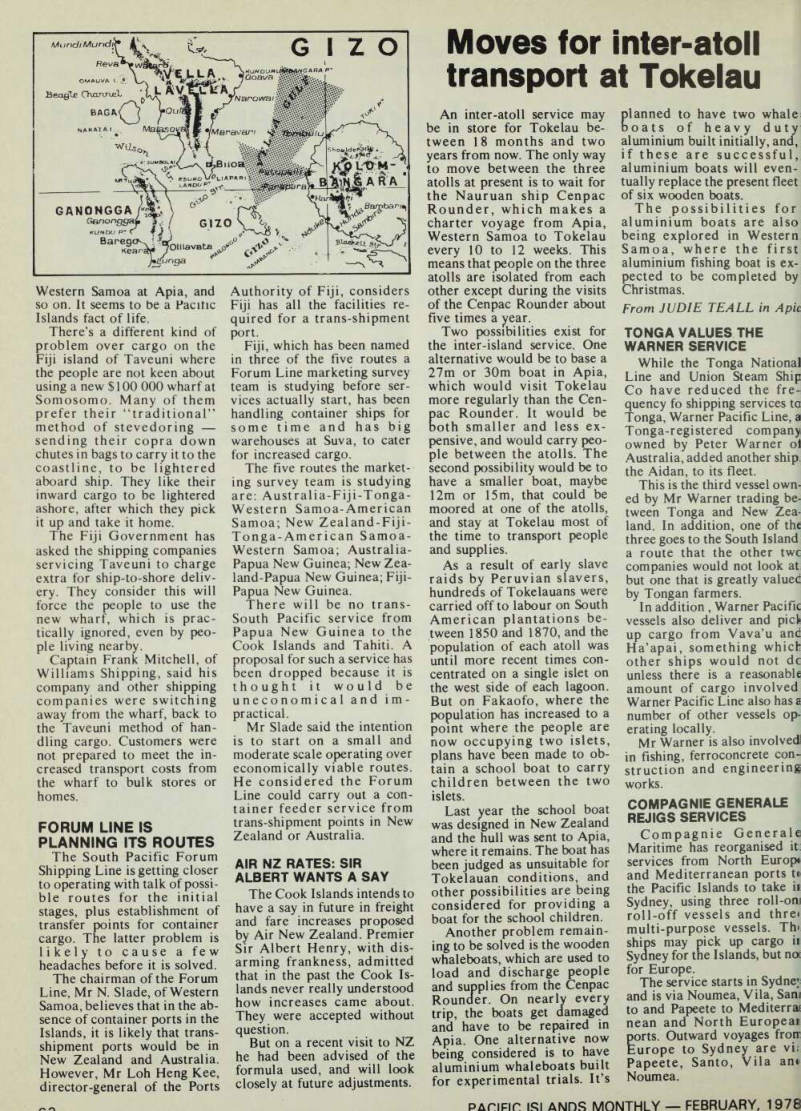
for the Solomons and others
Containerisation, the modern marine method of carrying cargo, has caught up with the Solomon Islands, and traders in the west of the group are not very happy about it. They no longer have a three-weekly service from Sydney. Instead their cargo is now carried in containers to Honiara and trans-shipped, which adds substantially to the cost.
It is something they have to learn to live with unless the government decides that Gizo should have port facilities suitable for the container age.
However, late in 1976, a special committee which made a survey of national transport needs, suggested local ports should be part of the overall transport picture, linked to the outside world through an international port such as Point Cruz (Honiara).
The committee re commended that each island needed one or two really good ports to simplify trans-ship ment of goods. If that becomes
official policy then the chances of a container port seem to be remote. Gizo, of course, could bring pressure on the government to spend on a modern port part of the $4O million-odd which Bri tain is making as a gift to the Solomons for the first four years on independence.
Were it possible for con tainer ships to use Gizo there would be no worries. It is doubtful if the wharf there could take containers. It is more likely to buckle under the weight. Lighters would not be used, as this would be too hazardous an operation.
As the trend these days is to container ships, even another service to Gizo by conven tional ships would have a limited life. The problem which Gizo faces now is not new in the Pacific. In the Gilberts, for example, cargo is landed at Tarawa for trans shipment, in Fiji, at Suva, Lautoka, and, occasionally, at Malau, for trans-shipment, in the Cooks, at Rarotonga, in
Western Samoa at Apia, and so on. It seems to be a Pacific Islands fact of life.
There’s a different kind of problem over cargo on the Fiji island of Taveuni where the people are not keen about using a new $ 100 000 wharf at Somosomo. Many of them prefer their “traditional” method of stevedoring sending their copra down chutes in bags to carry it to the coastline, to be lightered aboard ship. They like their inward cargo to be lightered ashore, after which they pick it up and take it home.
The Fiji Government has asked the shipping companies servicing Taveuni to charge extra for ship-to-shore deliv ery. They consider this will force the people to use the new wharf, which is prac tically ignored, even by peo ple living nearby.
Captain Frank Mitchell, of Williams Shipping, said his company and other shipping companies were switching away from the wharf, back to the Taveuni method of han dling cargo. Customers were not prepared to meet the in creased transport costs from the wharf to bulk stores or homes.
Forum Line Is
Planning Its Routes
The South Pacific Forum Shipping Line is getting closer to operating with talk of possi ble routes for the initial stages, plus establishment of transfer points for container cargo. The latter problem is likely to cause a few headaches before it is solved.
The chairman of the Forum Line, Mr N. Slade, of Western Samoa, believes that in the ab sence of container ports in the Islands, it is likely that trans shipment ports would be in New Zealand and Australia.
However, Mr Loh Heng Kee, director-general of the Ports
Authority of Fiji, considers Fiji has all the facilities re quired for a trans-shipment port.
Fiji, which has been named in three of the five routes a Forum Line marketing survey team is studying before ser vices actually start, has been handling container ships for some time and has big warehouses at Suva, to cater for increased cargo.
The five routes the market ing survey team is studying are: Australia-Fiji-Tonga- Western Samoa-American Samoa; New Zealand-Fiji- Tonga-American Samoa- Western Samoa; Australia- Papua New Guinea; New Zea land-Papua New Guinea; Fiji- Papua New Guinea.
There will be no trans- South Pacific service from Papua New Guinea to the Cook Islands and Tahiti. A proposal for such a service has been dropped because it is thought it would be uneconomical and im practical.
Mr Slade said the intention is to start on a small and moderate scale operating over economically viable routes.
He considered the Forum Line could carry out a con tainer feeder service from trans-shipment points in New Zealand or Australia.
Air Nz Rates: Sir
Albert Wants A Say
The Cook Islands intends to have a say in future in freight and fare increases proposed by Air New Zealand. Premier Sir Albert Henry, with dis arming frankness, admitted that in the past the Cook Is lands never really understood how increases came about.
They were accepted without
question.
But on a recent visit to NZ he had been advised of the formula used, and will look closely at future adjustments.
Advertisements & other items, p. 61 (1 item)
61
PACIFIC ISLANDS MONTHI Y FFRRIIARV 1 Q7Q
transport at Tokelau
Moves for inter-atoll transport at Tokelau
An inter-atoll service may be in store for Tokelau be tween 18 months and two years from now. The only way to move between the three atolls at present is to wait for the Nauruan ship Cenpac Rounder, which makes a charter voyage from Apia, Western Samoa to Tokelau every 10 to 12 weeks. This means that people on the three atolls are isolated from each other except during the visits of the Cenpac Rounder about five times a year.
Two possibilities exist for the inter-island service. One alternative would be to base a 27m or 30m boat in Apia, which would visit Tokelau more regularly than the Cen pac Rounder. It would be both smaller and less ex pensive, and would carry peo ple between the atolls. The second possibility would be to have a smaller boat, maybe 12m or 15m, that could be moored at one of the atolls, and stay at Tokelau most of the time to transport people and supplies.
As a result of early slave raids by Peruvian slavers, hundreds of Tokelauans were carried off to labour on South American plantations be tween 1850 and 1870, and the population of each atoll was until more recent times con centrated on a single islet on the west side of each lagoon.
But on Fakaofo, where the population has increased to a point where the people are now occupying two islets, plans have been made to ob tain a school boat to carry children between the two islets.
Last year the school boat was designed in New Zealand and the hull was sent to Apia, where it remains. The boat has been judged as unsuitable for Tokelauan conditions, and other possibilities are being considered for providing a boat for the school children.
Another problem remain ing to be solved is the wooden whaleboats, which are used to load and discharge people and supplies from the Cenpac Rounder. On nearly every trip, the boats get damaged and have to be repaired in Apia. One alternative now being considered is to have aluminium whaleboats built for experimental trials. It’s
planned to have two whale boats of heavy duty aluminium built initially, and, if these are successful, aluminium boats will even tually replace the present fleet of six wooden boats.
The possibilities for aluminium boats are also being explored in Western Samoa, where the first aluminium fishing boat is ex pected to be completed by Christmas.
From JUDIE TEALL in A pic
Tonga Values The
Warner Service
While the Tonga National Line and Union Steam Ship Co have reduced the fre quency fo shipping services to Tonga, Warner Pacific Line, a Tonga-registered company owned by Peter Warner ol Australia, added another ship, the Aidan, to its fleet.
This is the third vessel own ed by Mr Warner trading be tween Tonga and New Zea land. In addition, one of the three goes to the South Island a route that the other twc companies would not look at but one that is greatly valued by Tongan farmers.
In addition , Warner Pacific vessels also deliver and pick up cargo from Vava’u and Ha’apai, something which other ships would not dc unless there is a reasonable amount of cargo involved Warner Pacific Line also has a number of other vessels op erating locally.
Mr Warner is also involved in fishing, ferroconcrete con struction and engineering works.
Compagnie Generale
Rejigs Services
Compagnie Generate
Maritime has reorganised it services from North Europe and Mediterranean ports to the Pacific Islands to take ii Sydney, using three roll-om roll-off vessels and thre* multi-purpose vessels. Tin ships may pick up cargo ii Sydney for the Islands, but not for Europe.
The service starts in Sydney and is via Noumea, Vila, Sam to and Papeete to Mediterrai nean and North European ports. Outward voyages from Europe to Sydney are vi; Papeete, Santo, Vila ano Noumea.
Advertisements & other items, p. 62 (1 item)
62
PAPIFir ISI ANDS MONTHLY FEBRUARY, 1978
Briefly
• Fiji and Tonga have sig ned a bilateral air service agreement based on the Ber muda concept of “fair and
equal opportunity” to both
contracting parties. Equal and reciprocal rights are given to both countries, with the pro viso that, for the time being, Air Pacific operates no less than three scheduled services a week to Tonga and on to Auckland to meet the needs of the Tongan travelling public.
The proviso was inserted at the Tongans’ request. Air Pacific already operates three return services a week be tween Fiji and Auckland, via Fua’amotu. This frequency is increased in peak periods. • The Tonga Government has sold five of its ships, used in inter-island runs for $39 500. Mr Hale Vete, proprietor of Talieva Theatre paid $3O 000 for the biggest of the five, the Hifofua. Mr ’Uliti Uata, people’s representative for Ha’apai in the Legislative Assembly, bought the Pakeina for $6 000. Mr Tualau Latu, president of the Church of Jesus Christ of Latter Day Saints bought the other three, the Ulufonua for $1 500, and the Fanga’i lifuka and Funualei for $1 000 each.
They will be replaced with ships which are more efficient.
• The Fiji Marine Depart ment intends to find out whether sail is cheaper than power by building a 33 m motor schooner. It will then know if ships equipped with sail will cut fuel consumption, which is a high cost item in in ter-island shipping. The two masted Bermuda-rigged ship will be built in the govern ment shipyard at Walu Bay, Suva. Initially there will be an additional cost of about $3O 000 because of the cost of masts, rigging and sails. But the Marine Department ex pects modern sailing gear will eliminate the need for extra crew. • Air Nungaru Corp oration, recently formed by the Gilbert Islands Govern ment, is taking over the na tional air service from Air Pacific. It will run services to outlying islands, such as the Phoenix group and Christmas Island, with chartered aircraft. Air Tungaru is also taking over the handling of in ternational air travel book ings from Air Pacific. • Air Pacific plans to add a third jet aircraft to its fleet this year, and may also re place the three-engined Trislanders in Fiji internal services. The airline’s two BAC Ills are flying to capacity, and a third aircraft is needed to help on the regional routes. Planes under consideration for local ser
vices are the Skyvan and the Twin-Otter. The Skyvan, built in Britain, carries 20 passengers, and the Twin-Ot ter, made in Canada is a short take-off landing aircraft (STOL) with room for 20 passengers. • The South Pacific Air Transport Council is looking at a new method of raising money to help Nadi airport pay its way a levy on aircraft using the four million square miles of airspace con trolled from the airport. This extends from Samoa to Nor folk Island and from New Caledonia to the Cook Is lands. Aircraft using the space would be levied according to mileage and weight. The esti mated cost of running the air port in 1978 is expected to be $6.5 million. Landing fees are expected to provide about $2.5 million, passenger ser vice charges will yield about $4OO 000 and concession ren tals about $1 million. There will be other revenue from miscellaneous sources, but not enough to foot the annual bill hence the levy proposal. • Karlander from January is extending its Australian- Pacific Islands services to take in Tahiti. Every four weeks there will be a service from Melbourne and Sydney to Noumea, Fiji, Samoa, Tonga and Tahiti. The ships for the service are the Dia mond Star, Duke Star and Five Star. • The joint Polynesian Airlines-Air New Zealand air service is expected to start in February, using a Boeing 737 chartered from the NZ Na tional Airways Corporation.
Negotiations between Western Samoa and New Zealand about the service to link the two countries have been going on for about two years. • The UK, Nauru, Australian and New Zealand governments have given more than SA9OO 000 for a new air port terminal and hangar at Bonriki in the Gilberts. The terminal building will have separate wings for arrivals and departures, rooms for customs and immigration pro cessing, a VIP lounge, snack bar, toilets and open space for the public, car park, a dis tance measuring equipment office, and a new control tower. Work started in August and should be finished by April, 1978. • Benson and Hedges (NZ) Ltd is negotiating to build a factory in Tonga to employ 20 people, and produce more
than 70 million cigarettes and 24 000 kg of roll-your-own tobacco a year for local sale.
Benson and Hedges will also experiment with growing tobacco in Tonga. • A Baron aircraft, op erated by Solair, was saved by the skill of its pilot when it skidded badly on landing at Marau airfield in the Solomons recently. No one was hurt but the plane was damaged when, to stop it run ning over the end of the run way, the pilot swerved and slowed it down. The cause of the accident was algae grow ing on the runway which becomes very slippery in wet periods. This is now being sprayed with chemicals to prevent similar accidents. • The Wong Shipping Co, of Fiji, has bought the Belama, 254 tonnes, from the Solomon Islands Government. The Fiji Marine Department immedi ately chartered her for three months to help move the large number of people who wished to travel between Rotuma and Viti Levu during the Christmas-New Year period, and to carry children to school for the start of the 1978 school year. The Belama was also used as a back-up for the Kaunitoni from Suva to the Lau Islands during the peak Christmas-New Year traffic period. The Wong fleet now numbers five, Belama, Coral Princess, Broome, Evelyn and Adi Talei. • The operating profit of Newspapers of Fiji Ltd, pub lishers of the Fiji Sun, fell by $34 361, or 32.8% in the year ended September, 1977. In the same period Fiji Times and Herald Ltd, publishers of The Fiji Times and other newspaper, had a trading profit of $l7B 000. • Papua New Guinea’s newest multi-million dollar airport is nothing but “an im ported blunder from Australia” an air charter ex ecutive claimed in December.
Mr Lolong Kiapin told of the problems, expense and ineffi ciencies which have arisen from the siting of Nadzab Air port, constructed with a gift of Australian funds to serve the city of Lae. Mr Kiapin is secretary of Co-Air, a charter operator which is extensively financed by Papua New Gui nean shareholders. It is based in Lae, and village people coming into town or sending their produce by air from remote areas form a large part of the company’s operations.
Polynesian Airlines’ Plans Still In The Air
Little was definite about the first Polynesian Airlines flight to Auckland at the end of 1977. In fact, according to Mr Terence Betham, general manager of PAL, all that was definite were the date of the first flights and that a NZ Na tional Airways Corporation aircraft would be used.
Mr Betham said the first flight would leave Auckland on February 25, calling at Tonga and then flying on to Western Samoa. It would make a return flight the same day. Two days later Air New Zealand would make a similar flight.
Mr Betham described earlier reports that a holding company, comprising PAL and Air NZ, would run the operation as “not exactly cor rect”. It was not known if there would be a holding com pany. There were several alternatives. One was that the companies involved could hire the aircraft, a Boeing
737, direct from the NAC, do a flight, and then return the aircraft to the owners.
Another was that Air NZ would hire the aircraft from NAC and PAL would hire it from Air NZ, or the other way round, all of which seems a little complicated.
When asked if PAL pilots had a chance of flying the Boeing, Mr Ron Reynolds, secretary of PAL, said his board of directors was “very touchy” on that issue. Mr Reynolds would say no more lest he “rock the boat”.
Mr Betham said PAL would do its best to have its pilots trained to fly the Boeing 737. But the NZ attitude was believed to be that if PAL wanted its pilots to fly jet aircraft, it would have to get its own jet.
All in all it s'eems there are quite a few points to be cleared up before PAL gets on to a longer haul service.
Advertisements & other items, pp. 63-64 (2 items)
63
PACIFIC ISI AMDS IV/inMTMI V PPRRI IA DV 1 Q7Q
Kyowa Line
PACIFIC
ISLANDS
TRANSPORT
I L Owners: Thor Dahls Hvalfangerseiskap X-i AjS - Sandefjord, Norway.
MS CAMELLIA VENTURE
Express Freight Service between Pacific Coast Ports of U.S.A. and...
Tahiti 6 Samoa
Full container service including reefers.
GENERAL STEAMSHIP CORPORATION LTD.
General Agents 400 California Street, San Francisco, California, U.S.A.
APIA: Burns Philp (South Sea) Company Ltd, PAPEETE: Agence Maritime Internationale, Tahiti.
PAGO PAGO: Polynesia Shipping Services Inc.
NOUMEA: Establissements Ballande.
SYDNEY: Trans-Austral Shipping Pty. Ltd SUVA: Burns Philp (South Sea) Company Ltd.
LAE/RABAUL: Burns Philp (New Guinea) Ltd.
PORT VII. A • Unirmfoirs Franrais Hp NoiivpMps HphriHps
FOR SALE:
TRAWLERS AND FISHING BOATS,
STEEL CONSTRUCTION
FROM 40' to 80' L.O.A.
Early completion date - competitive prices.
TRAWLERS AND FISHING BOATS,
TIMBER CONSTRUCTION
50' x 19'6" x B'3".
Hardwood carvils, designed for up to 450 h.p. and 65" diameter propeller.
Complete to lock-up stage with hatches, wheelhouse, doors, windows etc. to survey standard: $39,850.00. (Quotations available for completed vessel to your specifications.) Also from same builder; hardwood timber construction fishing boats, early delivery, survey standard. Write for quotation.
AUSTRALIAN SHIP BROKERS,
P.O. Box 401, Maroochydore 4558, OLD. AUST. Phone: (071) 44 1174.
KYOWA LINE
YOUR TRADING PARTNER
Monthly Services
Hong Kong, Taiwan, S. Korea, Japan
To; British Solomon, New Caledonia, Fiji, W. Samoa, A. Samoa. Tahiti, Cook Is., Tonga, New Hebrides.
Ellice Is.,
Taiwan,Hong Kong, Singapore,Jakarta,
Philippine
To: Australia, Papua New Guinea, Sabah & Sarawak.
Hong Kong, Taiwan, S. Korea, Japan
To; Guam, Saipan, Truk, Ponape, Other Pacific Islands.
WBBBVA GENTS
Taiwan: Royal Steamship Corp , Ltd,, Taipei S. Korea; Dong Sue Shipping Co, Ltd. Seoul Hong Kong: Dahzun Enterprises Ltd.
Singapore: Ocean Shipping & Enterprises Pte, Ltd Guam: Maritime Agencies of Pacific Ltd, Guam Saipan: Saipan Shipping Co, Inc, Saipan 8.5.1. P.: Solomon Taiyo Ltd, Honiara Tahiti: JA Cowan & Fils, Papeete Cooks: Eastern Associates Ltd, Rarotonga Tonga: EM Jones Ltd, Nukualofa New Hebrides: Agence Maritime Raymond Velicite, Port Vila A.Samoa; Island Pacific Agencies Inc., Pago Pago W. Samoa: Morris Hedstrom Ltd, Apia Fiji: Carpenter Shipping, Suva & Lautoka PNG: Carpenter Shipping Agencies, Port Moresby, Rabaul New Caledonia: Agence Maritime Du Rond Point Du Pacific, Noumea Indonesia: P.T. Porodisa Raya Shipping Lines, Jakarta Sabah: KOH Han Ming Shipping & Forwarding Agent, Kotakinabalu Sarawak: Pan Sarawak Agencies Sdn Bhd , Sibu & Kuching Australia: Hethenngton Kingsbury Pty Ltd, Sydney, NSW Newzealand: Sofrana Unihnes SA, Auckland
KYOWA SHIPPING CO., LTD,
HEAD OFFICE
sth FI., Suzumaru Bldg. 39-8, 2-chome, Nishi-Shinbashi, Minato-ku, Tokyo, Japan.
Phone : 03(437)2885(Rep.) Cables : “MARIQUEEN” Tokyo. Telex : 242-4651 Kyowa J.
OSAKA OFFICE
Frontier Bldg., 3-13 Hirano-cho, Higashi-ku, Osaka, Japan.
Phone : 06(227)0422(Rep.) Cables : “MARIQUEEN” Osaka. Telex : 522-3896 Kyowa 0.
Shipping
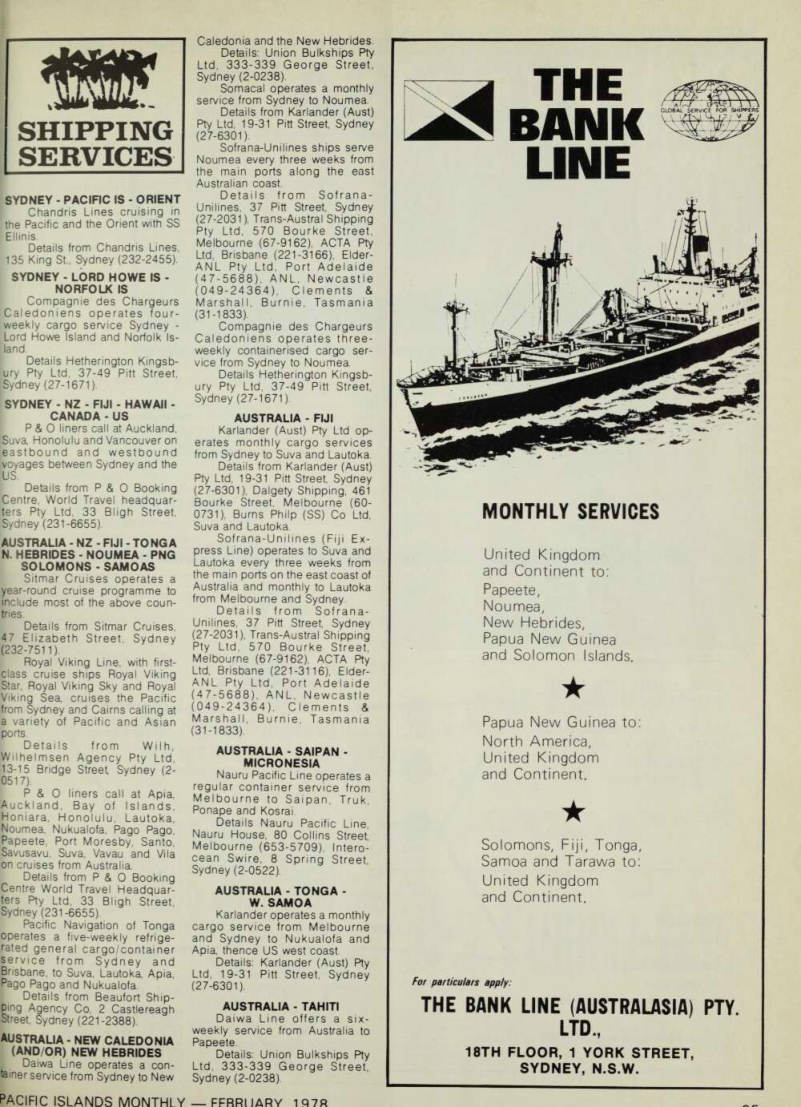
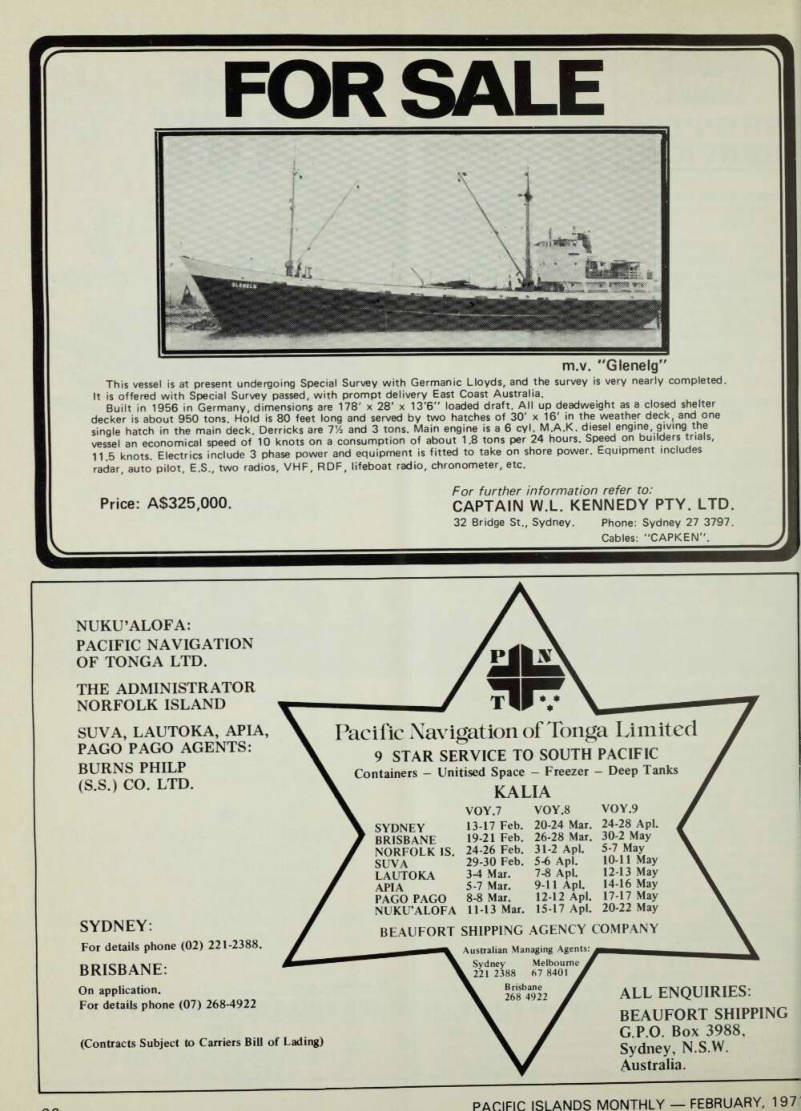

Services
Sydney - Pacific Is - Orient
Chandris Lines cruising in the Pacific and the Orient with SS Ellinis.
Details from Chandris Lines, 135 King St. Sydney (232-2455).
Sydney - Lord Howe Is -
Norfolk Is
Compagnie des Chargeurs Caledoniens operates four weekly cargo service Sydney - Lord Howe Island and Norfolk Is land.
Details Hetherington Kingsb lury Pty Ltd, 37-49 Pitt Street,
[Sydney (27-1671).
SYDNEY - NZ - FIJI - HAWAII -
Canada - Us
P & O liners call at Auckland, -Suva Honolulu and Vancouver on eastbound and westbound voyages between Sydney and the [US.
Details from P & O Booking Centre, World Travel headquar ters Pty Ltd, 33 Bligh Street, Sydney (231-6655).
AUSTRALIA - NZ - FIJI - TONGA
N. Hebrides - Noumea - Png
Solomons -Samoas
Sitmar Cruises operates a year-round cruise programme to include most of the above coun tries.
Details from Sitmar Cruises, 47 Elizabeth Street, Sydney (232-7511).
Royal Viking Line, with first class cruise ships Royal Viking Star, Royal Viking Sky and Royal Viking Sea, cruises the Pacific from Sydney and Cairns calling at a variety of Pacific and Asian ports.
Details from Wilh, Wilhelmsen Agency Pty Ltd, 13-15 Bridge Street Sydney (2- 0517).
P & O liners call at Apia, Auckland, Bay of Islands, Honiara, Honolulu, Lautoka, Noumea, Nukualofa, Pago Pago, Papeete, Port Moresby, Santo, Savusavu, Suva, Vavau and Vila on cruises from Australia.
Details from P & O Booking Centre World Travel Headquar ters Pty Ltd, 33 Bligh Street, Sydney (231-6655).
Pacific Navigation of Tonga operates a five-weekly refrige rated general cargo/container service from Sydney and Brisbane, to Suva, Lautoka, Apia, Pago Pago and Nukualofa.
Details from Beaufort Ship ping Agency Co, 2 Castlereagh Street, Sydney (221-2388).
Australia - New Caledonia
(And/Or) New Hebrides
Daiwa Line operates a con tainer service from Sydney to New
Caledonia and the New Hebrides.
Details: Union Bulkships Pty Ltd, 333-339 George Street, Sydney (2-0238).
Somacal operates a monthly service from Sydney to Noumea.
Details from Karlander (Aust) Pty Ltd, 19-31 Pitt Street, Sydney (27-6301).
Sofrana-Unilines ships serve Noumea every three weeks from the main ports along the east Australian coast.
Details from Sofrana- Unilines, 37 Pitt Street, Sydney (27-2031), Trans-Austral Shipping Pty Ltd, 570 Bourke Street, Melbourne (67-9162), ACTA Pty Ltd, Brisbane (221-3166), Elder- ANL Pty Ltd, Port Adelaide (47-5688), ANL, Newcastle (049-24364), Clements & Marshall, Burnie, Tasmania (31-1833).
Compagnie des Chargeurs Caledoniens operates three weekly containeris-ed cargo ser vice from Sydney to Noumea Details Hetherington Kingsb ury Pty Ltd, 37-49 Pitt Street, Sydney (27-1671).
Australia - Fiji
Karlander (Aust) Pty Ltd op erates monthly cargo services from Sydney to Suva and Lautoka.
Details from Karlander (Aust) Pty Ltd, 19-31 Pitt Street. Sydney (27-6301), Dalgety Shipping, 461 Bourke Street, Melbourne (60- 0731), Bums Philp (SS) Co Ltd, Suva and Lautoka.
Sofrana-Unilines (Fiji Ex press Line) operates to Suva and Lautoka every three weeks from the main ports on the east coast of Australia and monthly to Lautoka from Melbourne and Sydney Details from Sofrana- Unilines, 37 Pitt Street, Sydney (27-2031), Trans-Austral Shipping Pty Ltd, 570 Bourke Street, Melbourne (67-9162), ACTA Pty Ltd, Brisbane (221-3116), Elder- ANL Pty Ltd, Port Adelaide (47-5688), ANL, Newcastle (049-24364). Clements & Marshall, Burnie, Tasmania (31-1833).
Australia - Saipan -
Micronesia
Nauru Pacific Line operates a regular container service from Melbourne to Saipan, Truk, Ponape and Kosrai.
Details Nauru Pacific Line, Nauru House, 80 Collins Street, Melbourne (653-5709), Intero cean Swire, 8 Spring Street Sydney (2-0522).
Australia - Tonga -
W. Samoa
Karlander operates a monthly cargo service from Melbourne and Sydney to Nukualofa and Apia, thence US west coast.
Details: Karlander (Aust) Pty Ltd, 19-31 Pitt Street, Sydney (27-6301).
Australia - Tahiti
Daiwa Line offers a six weekly service from Australia to Papeete Details: Union Bulkships Pty Ltd, 333-339 George Street, Sydney (2-0238).
Australia - Png
Containers Pacific Express Burns Philp and AWP Line) and Operate chief Con ainer Service from Australia to ’NG-Solomon Islands ports on oint slot sharing basis. Three jontainer vessels operate on 28- Jay turn-around from Melbourne, Sydney and Brisbane to Port /oresby, Samarai, Lae, Madang, Vewak, Rabaul, Kavieng, Kieta md Honiara.
Details from Burns Philp & Co .td, 51 Pitt Street, Sydney 241-3851) and Interocean Swire, I Spring Street Sydney (2-0522).
Farrell Lines operates a ser vice every month from Tasmania Melbourne, Sydney and Brisbane o Lae and Rabaul.
Details from Wilh Wilhelmsen Agency Pty Ltd, 13 Bridge Street, Sydney (2-0517), 60 Market Street Melbourne (61-3031), J. C.
Valler (Rabaul) Pty Ltd, Rabaul, Robert Laurie-Carpenter (NG) Pty .td, Lae.
New Guinea Express Lines operates three-weekly conven ional and container services, Melbourne, Sydney, Brisbane, ort Moresby, Lae, Rabaul.
Details from New Guinea Ex tress Lines, PC Box R 73, Royal •xchange PC, Sydney 241-3991), MacArthur Shipping Agency Co, 82-92 Eagle Street, Jrisbane (229-3777), Western : armers Transport Pty Ltd, 459 Jttle Collins Street, Melbourne 67-8291), Breckwoldt’s Shipping Agencies in Port Moresby 24-2525). Lae (42-1536), Rabtrad md Nuigini Pty Ltd, Rabaul 92-2911).
Karlander New Guinea Line’s »rgo vessels call at Melbourne, Sydney, Port Moresby, Lae, dadang, Wewak, Manus, Kimbe, tebaul.
Details from Karlander (Aust) fy Ltd, 19-31 Pitt Street, Sydney 27-6301), Dalgety Shipping, 461 Jourke Street, Melbourne (60- )731).
Australia - Solomons -
Gilbert Is - Micronesia
Daiwa Line operates a con ainer service every 30 days from Sydney to Noumea, Honiara, Carawa, and Guam. Gizo cargoes ranshipped at Honiara, Saipan, Majuro, Truk, Ponape, Koror, Yap cargoes transhipped at Guam.
Details from Union-Bulkships Pty Ltd, 333-339 George Street, Sydney (2-0238, telex AA20397).
Australia - Nauru -
Majuro
Nauru Pacific Line operates regular cargo/passenger service from Melbourne to Nauru and Ma juro.
Details Nauru Pacific Line, Nauru House, 80 Collins Street, Melbourne (653-5709), Intero cean Swire, 8 Spring Street, Sydney (2-0522).
Us - Png
Farrell Lines operates regular services from all US west coast ports to Lae and Rabaul.
Details from Wilh, Wilhelmsen Agency Pty Ltd, 13 Bridge Street. Sydney (2-0517),
Farrell Lines, 1 Market Plaza, San Francisco, LA. (9-4105), J. C.
Waller (Rabaul) Pty Ltd, Rabaul, Burns Philp (NG) Ltd, Kieta, Robert Laurie-Carpenter (PNG) Pty Ltd, Lae.
Png - Us - Canada
Farrell Lines operates regular services from Lae and Rabaul to US west coast ports and Van couver.
Details from J. G. Waller (Rabaul) Pty Ltd, Rabaul, Robert Laurie-Carpenter (PNG) Pty Ltd, Lae, Farrell Lines, 1 Market Plaza, San Francisco, L A. (9-4105), Wilh, Wilhelmsen Agency Pty Ltd, 13 Bridge Street, Sydney (2- 0517).
Png - Uk/Continent
Bank Line operates regular cargo service from Kieta, Rabaul, Kimbe, Madang and Lae to Liver pool, Flamburg, Rotterdam, Ant werp and London.
Details from Bank Line (A’asia) Pty Ltd, 1 York Street, Sydney (27-2041)’; Burns Philp (PNG) Ltd. PNG ports.
Png - Us
Bank Line operates regular cargo service from Kieta, Rabaul, Kimbe, Madang and Lae direct to San Francisco; calls at US Gulf and East Coast ports on induce ment.
Details from Bank Line (A'asia) Pty Ltd, 1 York Street, Sydney (27-2041); Burns Philp (PNG) Ltd, PNG ports.
Solomons - Fiji - Tonga -
W. Samoa - Uk/Continent
Bank Line operates regular cargo service from Honiara, Suva, Nukualofa and Apia to Liverpool, Hamburg, Rotterdam and Ant werp.
Details from Bank Line (A'asia) Pty Ltd, 1 York Street, Sydney (27-2041); Burns Philp (SS) Co Ltd, Suva.
Far East - Fiji -
New Zealand
New Zealand Unit Express (CNC, MNOL, RIL) operates a three-weekly cargo service from Hong Kong to Lautoka, Suva, NZ ports, Manila, Kaoshiung, Keelung, Hong Kong.
Details from Interocean Swire, 8 Spring Street, Sydney (2- 0522).
Nedlloyd operates monthly cargo service with three ships from Surabaya, Jakarta, Bangkok, Port Kelang and Singapore to Suva and NZ ports.
Details from Nedlloyd (Aust) Pty Ltd, 8 Spring Street, Sydney (27-3801), Burns Philp (SS) Co Ltd, Suva and Lautoka.
Japan - Nz - Png
China Navigation Co, with three ships operates a monthly cargo service from Japan to New Zealand calling at Lae on return journey.
Details Interocean Swire, 8 Spring Street, Sydney (2-0522).
Far East - Mid-S. Pacific
China Navigation Co’s vessels operate a regular cargo
service from Hong Kong, Taiwan and Singapore to Rabaul, Wewak, Madang, Lae, Port Moresby, Honiara, New Hebrides, Noumea, Papeete and Samoa.
F Details from Interocean Swire, 8 Spring Street, Sydney (2-0522).
Kyowa Shipping Co Ltd op erates monthly services from Hong Kong, Taiwan, S. Korea and Japan, to Guam, Saipan, Solomons, New Caledonia, Fiji, Western and American Samoa, Tahiti, Cook Is., Tonga and New Hebrides'and 45-day con tainer/break bulk cargo service from Kobe, Nagoya and Yokohama to Guam, Suva, Lautoka and Noumea.
Details: Hetherington Kingsbury Pty Ltd, 37-49 Pitt Street, Sydney (27-1671).
Daiwa Line with container ships operates 30-day service from Moji, Kobe, Nagoya and Yokohama to Papeete, Pago Pago, Apia, Suva, Lautoka, Sydney, Noumea, Honiara, Tarawa, Guam and Taiwan.
Details: Union Bulkships Pty Ltd, 333-339 George Street, Sydney (2-0238).
North Europe - Tahiti -
New Caledonia
Hamburg-Sued operates monthly cargo services from Hamburg, Dunkirk and Le Havre to Papeete, Noumea, via Panama.
Details from Columbus Over seas Services Pty Ltd, 333 George Street, Sydney (290-2966); Columbus Maritime Services, 17 Albert Street, Auck land (75-509),
Europe - Pacific Is
Australia
Compagnie General Maritime maintains regular ser vices from North Europe and Mediterranean ports to Sydney via Papeete, Santo, Vila and Noumea, and via those ports on return, using ro-ro and multi-purpose ships.
Details from Compagnie General Maritime, 261 George Street, Sydney (241-2872).
EUROPE - TAHITI - W. SAMOA -
Fui - N. Caledonia
Nedlloyd offers regular cargo services from Northern Europe and UK to Papeete, Apia, Fiji and New Caledonia.
Details Nedlloyd (Aust) Pty Ltd, 8 Spring Street, Sydney [27-3801).
Japan-Guam - Fiji-Samoa-
N. Caledonia - N. Hebrides
Daiwa Lines runs a monthly cargo service from Japan via Guam to Suva, Lautoka, Pago Pago, Apia, Vila, Santo, Honiara, Noumea, Tahiti, Nauru and Cook Is.
Details from Burns Philp (SS) Co Ltd, Suva.
NZ - FUI - TONGA - SAMOAS -
Tahiti
Union Steam Ship Co of NZ operates a roll-on, roll-off, unitised service from Auckland to Lautoka-
Suva-Pago Pago-Apia-Nuku’alofa
on a 14 day frequency.
Details from Union Steam
Ship Co of NZ Ltd, PO Box 12, Auckland or from Branch of fices/agents in Fiji, Tonga and the Samoas.
Nz - N. Caledonia -
N. Hebrides - Png - Si
Sofrana-Unilines with three ships operates to Vila and Santo, to Honiara and Papua New Guinea, and to Noumea.
Details from Sofrana- Unilines, 18 Customs Street, Auckland (7-3279), PO Box 3614, Telex: NZ2313.
Nz - New Hebrides/
Solomons
Warner Pacific Line services Auckland, Honiara, Santo, Vila monthly general and freezer cargoes.
Details from Air Marine Ser vices (NZ) Ltd, PO Box 2505, Auckland, NZ(363-731).
Nz - Australia -
New Caledonia -
Solomons - Gilberts -
Micronesia
Union Co/Daiwa Line operate a container service from New Zea land through Sydney to Noumea, Honiara, Tarawa and Guam.
Trans-shipment to Saipan, Majuro and Gizo.
Details: Union Steam Ship Co of NZ Ltd, PO Box 12, Auckland, or Union Bulkships Pty Ltd, 333-339 George Street Sydney, (2-0238).
Nz - Png
Farrell Lines operates regular service every 30 days from Auck land to Lae and Rabaul.
Details from Dalgety NZ Ltd, 41-45 Albert Street, Auckland (7-1859). J. C. Waller (Rabaul) Pty Ltd, Rabaul, Robert Laurie-Car penter (PNG) Pty Ltd, Lae.
Nz - Fui * North America
(WC) Crusader cargo ships call at Suva, Levuka and Honolulu on NZ-US west coast trips and at Suva and/or Lautoka on US-NZ return trips.
Details from Blueport ACT (NZ) Ltd, PO Box 192, Wellington (739-029); Burns Philp (SS) Co Ltd, Suva
Nz - Fiji
Reef operates a regular 18day service from Auckland to Suva and Lautoka.
Details from Reef Shipping Agencies Ltd, PO Box 3382, Auckland, NZ (7-1221-3).
Pacific Line with one ship op erates monthly cargo service New Zealand, Lautoka Suva.
Details: Sofrana-Unilines, 18 Customs Street, Auckland (7-3279) PO Box 3614, Telex: NZ2313.
Nz - Samoa - Tonga
Pacific Navigation of Tonga operates a four-weekly cargo ser vice, Auckland - Nukualofa - Pago Pago - Apia - Nukualofa - Auck land.
Details from McKay Ltd, Downtown House, Queen Street Auckland (33-656).
Warner Pacific Line services Onehunga - Nukualofa - Vavau - Haapai fortnightly, and Timaru - Nukualofa - Vavau monthly and Onehunga - Apia and Pago Pago every 21 days carrying general and freezer cargoes and Timaru - Apia every 21 days carrying freezer cargo.
Details from Air Marine Ser vices (NZ) Ltd, PO Box 2505, Auckland (362-731).
NZ - COOK IS - W. SAMOA The Shipping Corporation of NZ Ltd with Toa Moana and Lorena, operates cargo services from Auckland to Rarotonga and Aitutaki (fortnightly) and Niue (monthly).
Details from the Shipping Corp of NZ Ltd, PO Box 3420, Auckland (379-430); Waterfront Commission, PO Box 61, Rarotonga, Lighterage and Stevedoring Co, Aitutaki, Niue Govt Offices, Niue Island.
Nz - American Samoa
Farrell Lines operates regular service every. 30 days from Auck land to Pago Pago.
Details from Dalgety (NZ) Ltd, 41-45 Albert St, Auckland 71859 Kneubuhl Maritime Services Box 39, Pago Pago 633-5121 UK - PANAMA - SAMOA - FIJI The Fiji Direct Service, cargo only, is maintained by Conference vessels, sailing at regular monthly intervals out of Avonmouth, via Panama, for Apia, Suva and Lautoka.
Details from Burns Philp (SS) Co Ltd, Suva.
Uk/N. Continent - Tahiti -
N. Caledonia - N. Hebrides
Bank Line operates regular cargo service from Hull, Ham burg, Bremen, Antwerp and Rot terdam to Papeete, Noumea and Vila.
Details from Bank Line (A'asia) Pty Ltd, 1 York Street, Sydney (27-2041); Ets AMAV, Papeete; Ets Ballande, Noumea, Burns Philp (NH) Ltd, Vila.
Uk/N. Continent - Png -
Solomons
Bank Line operates regular cargo service from Hull, Ham burg, Bremen, Antwerp and Rot terdam to Port Moresby, Lae,
Madang, Kimbe, Rabaul, Kieta and Honiara and, on inducement to Yandina, Tarawa and Nauru.
Details from Bank Line (A'asia) Pty Ltd, 1 York Street, Sydney (27-2041); Burns Philp (PNG) Ltd, PNG ports.
San Francisco - Honolulu
Micronesia
Nauru Pacific Line operates regular conventional/container service from San Francisco and Honolulu to Majuro, Nauru, Ponape, Truk and Saipan.
Details from Nauru Pacific Line, Nauru House, 80 Collins Street, Melbourne (653-5709), North American Maritime Agen cies, 100 California Street, San Francisco, California 9411 (981- 0343).
US - FUI - TAHITI - NZ -
Australia
Bank and Savill Line Ltd op erates regular cargo services from US Gulf ports to Australia and NZ.
Calls at Suva, Lautoka and Papeete on demand.
Details from Bank Line (A/asia) Pty Ltd, 1 York Street, Sydney (27-2011).
US - A. SAMOA - NZ - AUST Farrell Lines LASH ships op erate regularly from US to Australia, via Pago Pago and Auckland and Canada.
Details from Wilh, Wilhelmsen Agency Pty Ltd, 13 Bridge Street, Sydney (2-0517), 60 Market Street, Melbourne (61- 0301); Farrell Lines. 1 Market Plaza, San Francisco, L.A. (415-777-3300); Dalgety NZ Ltd, Auckland (7-1859); Kneubuhl Maritime Services, Pago Pago (633-5121).
Us - Tahiti - Samoa
Pacific Islands Transport op erates a five/six weekly cargo ser vice from North American west coast ports to Papeete, Pago Pago, Apia.
Details from Trans-Austral Shipping Pty Ltd, 19 Pitt Street, Sydney (27-2441).
Polynesia Line operates con tainer and general cargo service from US west coast ports to Papeete and Pago Pago.
Details from Polynesia Ship ping Services Inc, PO Box 1478, Pago Pago (9-6799).
Advertisements & other items, pp. 65-76 (2 items)
Line
THE
BANK
*2 9*.
MONTHLY SERVICES
United Kingdom and Continent to; Papeete, Noumea, New Hebrides, Papua New Guinea and Solomon Islands. ★ Papua New Guinea to: North America, United Kingdom and Continent. ★ Solomons, Fiji, Tonga, Samoa and Tarawa to: United Kingdom and Continent.
For particulars apply:
THE BANK LINE (AUSTRALASIA) PTY.
LTD.,
18TH FLOOR, 1 YORK STREET,
SYDNEY, N.S.W.
FOR SALE
m.v. Glenelg'
This vessel is at present undergoing Special Survey with Germanic Lloyds, and the survey is very nearly completed.
It is offered with Special Survey passed, with prompt delivery East Coast Australia.
Built in 1956 in Germany, dimensions are 178' x 28' x 13'6" loaded draft. All up deadweight as a closed shelter decker is about 950 tons. Hold is 80 feet long and served by two hatches of 30' x 16' in the weather deck, and one single hatch in the main deck. Derricks are 7 1 /2 and 3 tons. Main engine is a 6 cyl. M.A.K. diesel engine, giving the vessel an economical speed of 10 knots on a consumption of about 1.8 tons per 24 hours. Speed on builders trials, 11.5 knots. Electrics include 3 phase power and equipment is fitted to take on shore power. Equipment includes radar, auto pilot, E.S., two radios, VHP, RDF, lifeboat radio, chronometer, etc.
Price: A 5325,000.
For further information refer to:
CAPTAIN W.L. KENNEDY PTY. LTD.
32 Bridge St., Sydney. Phone: Sydney 27 3797.
Cables: "CAPKEN".
NUKU’ALOFA:
PACIFIC NAVIGATION
OF TONGA LTD.
THE ADMINISTRATOR
NORFOLK ISLAND
SUVA, LAUTOKA, APIA,
PAGO PAGO AGENTS:
BURNS PHILP
(S.S.) CO. LTD.
Pacific Navigation of Tonga Limited
9 STAR SERVICE TO SOUTH PACIFIC
Containers - Unitised Space - Freezer - Deep Tanks
SYDNEY:
For details phone (02) 221-2388.
BRISBANE:
On application.
For details phone (07) 268-4922 (Contracts Subject to Carriers Bill of Lading)
KALI A
SYDNEY
BRISBANE
NORFOLK IS.
SUVA
LAUTOKA
APIA
PAGO PAGO
NUKU’ALOFA
VOY.7
13-17 Feb. 19-21 Feb. 24-26 Feb. 29-30 Feb. 3-4 Mar. 5-7 Mar. 8-8 Mar. 11-13 Mar.
VOY.B
20-24 Mar. 26-28 Mar. 31-2 Apl. 5-6 Apl. 7-8 Apl. 9-11 Apl. 12-12 Apl. 15-17 Apl.
VOY.9
24-28 Apl. 30-2 May 5-7 May 10-11 May 12-13 May 14-16 May 17-17 May 20-22 May
BEAUFORT SHIPPING AGENCY COMPANY
Australian Managing Sydney Melbourne 221 2388 67 8401 Brisbane 268 4922
ALL ENQUIRIES:
BEAUFORT SHIPPING
G.P.O. Box 3988,
Sydney, N.S.W.
Australia.
FDRREU linGS
YOUR DIRECT LINK WITH THE
WEST COAST NORTH AMERICA
Quick &
Dependable
LASH
9
Service
REFRIGERATED
& GENERAL
CARGO IN
BARGES. BULK
LIQUIDS IN
VESSEL DEEP
TANKS.
FROM UNITED STATES WEST COAST
& CANADA TO PAPEETE, PAGO PAGO,
AUCKLAND, LAE & RABAUL.
PAPUA NEW GUINEA TO VANCOUVER 8.C.,
TACOMA, PORTLAND, SAN FRANCISCO,
LOS ANGELES.
SYDNEY, MELBOURNE, BURNIE, HOBART,
BRISBANE TO LAE & RABAUL.
THE AMERICAN
FLAG LINE
INCORPORATED
MANAGING AGENTS: Wilh. Wilhelmsen Agency P/L., 13-15 Bridge Street, Sydney 2000—Phone 20517 —6O Market Street, Melbourne, 3000—Phone 61 3031—344 Queen Street, Brisbane, 4000-Phone 2213316. MANAGING AGENTS N.Z.: Dalgety N.Z.
Ltd., 98 Lambton Quay, Wellington Phone 72 4099 41/45 Albert Street, Auckland —Phone 71859. ISLAND AGENTS: Robert Laurie (NG) P/L, P.O. Box 1032, Lae, PNG - Phone 423811. J.C. Waller (Rabaul) Pty. Ltd., P.O. Box 606, Rabaul, PNG. - Phone 921997.
HENRY CUMINES
PTY. LTD.
EXPORTERS o GENERAL MERCHANTS
428 GEORGE ST., SYDNEY
CABLES; HENCO SYDNEY. G.P.O. Box 3949. PHONE: 25-3383,
For specialised and personalised buying service
throughout the Pacific Islands and the East.
LOCAL AGENTS AND REPRESENTATION:
PAPUA NEW GUINEA.
PORT MORESBY: Mr. Tan,
P.O. Box 5445, Boroko.
Telephone 25 2542.
RABAUL: M. & C. Seeto, P.O. Box 131, Rabaul.
Telephone 92 2902.
MADANG: W. Double, P.O. Box 22, Madang.
Telephone 82 2696.
FIJI.
K. Witherington Ltd., P.O. Box 293, Suva.
Telephone 22 356.
NEW HEBRIDES.
John Lum & Associates, P.O. Santo.
Telephone 329.
SOLOMON ISLANDS.
Lo See War Ltd., P.O. Box 327, Honiara.
Telephone 399.
Resident Agents in other Pacific Territories. 0-
Regular
Pacific Services
"Union South Pacific”, cellular container vessel. Reefer and general cargo from Auckland at approximately fortnightly intervals. Calls at Suva, Pago Pago, Apia and Nukualofa before returning to Auckland.
"Luhesand”, conventional reefer and general cargo. Monthly sailings from Auckland, calls at Suva, Apia, Papeete and Nukualofa.
jmimumon
gm/mcompmy
Branches at all main Australian, New Zealand and Pacific Island ports
Save hundreds of dollars
on Australia's most efficient
WALK IN, ALUMINIUM
COOLROOMS AND
FREEZE ROOMS!!
Hundreds already installed! The most economical supplementary coolrooms for bottles and food, providing the largest storage capacity of any comparable coolrooms of the same exterior dimensions. Five sizes—from 90-360 cu. ft. capacity; 16 models offering normal temp., two temp., deep freeze, or for pastry and ice storage applications. White vinyl interior, embossed rustproof aluminium exterior.
O SUPPLIED IN EASY-TO-ERECT, DO-IT-YOURSELF KIT FORM.
Manufactured by:
t
AVAILABLE FROM:
AUSTRALIAN NEW CALEDONIA EXPORTS. 363 George St, Sydney, 2000 BRECKWOLDT & CO., 276 Pitt St., Sydney, 2000.
HAGEMEVER (A'SIA), 59 Anzac Pde, Kensington, 2033 GEOFFREY HUGHES & CO, 167 Macquarie St, Sydney 2000.
NELSON & ROBERTSON PTV. LTD, 197 Clarence St, Sydney, 2000.
PETER FISHER TRADING PTV.LTD, 321 Pitt St, Sydney 2000 E RABOT (EXPORTS) PTV. LTD, 67 Castlereagh St, Sydney. 2000.
RABTRAD NIUGINI PTV. LTD., PO Box 1406, Lae.
A RIETTE (PACIFIC) PTY. LTD., 300 George St., Sydney, 2000.
H Y KWAN (AUST) PTY. LTD, Box 2713, GPO , Sydney, 2001.
C. SULLIVAN (EXPORT) PTY. LTD., GPO Box 3373, Sydney, 2001.
W.S. TAIT & CO, PTY. LTD, 31 Macquarie Place, Sydney, 2000.
T 1
FRIGID CABINETS PTY. LTD.,
Buffy Ave„ Thornleigh, N.S.W. 2120 Aust. Ph. 848 8292.
I4A
FCI
DAIWA LINE
ROLL-ON ROLL-OFF CAR & CONTAINER SERVICE
JAPAN-SOUTH PACIFIC
PAPEETE-PAGO PAGO-APIA-SUVA
LAUTOKA-SYDNEY
NOUMEA-TARAWA-GUAM-TAIWAN
JAPAN-TAIWAN-GUAM
JAPAN-KEELUNG-GUAM BY
EXCELLENT CAR/CONTAINER-CARRIER
JAPAN-WEST IRIAN-DILI
HONG KONG-TAIWAN-WEST IRIAN-DILI
e
AGENTS:
GUAM: ATKINS. KROLL (GUAM) LTD.
TARAWA: G. & E. I. DEVELOPMENT AUTHORITY.
APIA: BURNS PHILP (SOUTH SEA) CO., LTD.
PAGO PAGO: KNEUBUHL MARITIME SERVICES CORP.
NUKUALOFA: PACIFIC NAVIGATION CO., LTD.
SUVA; BURNS PHILP (SOUTH SEA) CO., LTD.
LAUTOKA: BURNS PHILP (SOUTH SEA) CO,, LTD.
NOUMEA: SOCIETE D'ACCONAGE ET DE
TRANSPORT D'OCEANIE (SATO)
SANTO: BURNS PHILP (NEW HEBRIDES) LTD.
VILA: BURNS PHILP (NEW HEBRIDES) LTD.
HONIARA: BRITISH SOLOMONS TRADING CO, LTD.
PAPEETE: AGENCE MARITIME DE FARE UTE.
HONG KONG: IKE MARITIME CO.. LTD.
SINGAPORE: THE BORNEO CO., (SINGAPORE) LTD.
DJAJAPURA: P. N. PELAJARAN NASIONAL INDONESIA.
DILI: SANG TAI HOO
TAIWAN: FOR CARGO BETWEEN JAPAN/GUAM/TAIWAN &
SOUTH PACIFIC,
FORMOSA SHIPPING & ENTERPRISE CORP.
e
THE DAIWA NAVIGATION CO..LTD.
OSAKA: “DAILINE" TOKYO: "FUNEDAILINE”
HEAD OFFICE
DAIICHI KYOGYO BLDG.,
45. 2-CHOME, AWAZAMINAMI-DORI.
NISHI-KU, OSAKA, JAPAN
TELEPHONE (06) 531-0471 ~9
TELgX: 525-6324 & 525-6325
TOKYO OFFICE
SHIN-DAIICHI BLDG.,
4-13, NIHONBASHI 3-CHOME, CHUO-KU
TOKYO, JAPAN
TELEPHONE; (03) 274-3251 ~8
TELEX 222-3343, 23559
CLASSIFIED
ADVERTISEMENTS
Per Line $5.00 Aust. Minimum 4 lines.
CASH for HUMAN HAIR plaits black or near from 20 cm up. Mail to
HAIRBUYERS OF AUST. 899 GPO
Sydney 2001. Post Paid.
MARINE ENGINES:
New/Reconditioned/Marinised conversions excellent value and quick delivery. Advise requirements stating HP and type of craft, etc. To: YORKCRAFT LTD “Dorincourt”
Warren Lane, Grays, Essex England Telex 995562 YOCO G.
SEE BRITAIN AND EUROPE BY CAR
OR CAMPER
A Complete service from Martins Ford, Leyland, G.M., Chrysler, Over 40 model types, sedans, station wagons, fully equipped campers Realistic rentals from SA2OO per month include insurance, maintenance, unlimited free mileage. Delivery U.K. or Europe. Airport, Docks, Hotel. For all details, quotations and brochures, rental sales and guaranteed repurchase, Airmail;
MARTINS SELFDRIVE SERVICE
LTD, School Lane, Chandlers Ford, Eastleigh Sos 3YL ENGLAND.
Cables: Selfdrive Winchester Telex: 477366. Telephone: Chandlers Ford 68386 5 lines. Clients from over 80 countries.
FOR SALE; PERKINS 4 cyl 36-40 hp diesels heat exchanger cooled with 2 to 1 reduction boxes. Instruments.
Rebuilt engines with all new marinisation $2500. DIABLO
MOTORS PTY LTD. 212 Haldon St,
Lakemba, 2195, NSW Australia.
BULL S MARINE INDUSTRIES:
Builders and Designers of Boats and Barges to 70' in marine alloy or timber.
Currently manufacturing in marine alloy 24' diesel work-boat/cruiser. 10-20 knots to buyers’ requirements. 43' motor/sailer to any stage. Holiday afloat on self contained six to eight berth Bull Cruisers. Send for descriptive brochure. Small ship and yacht brokers, extensive listings P.O.
Box 1 Metung Gippsland Lakes Aust 3904.
FOR SALE: FLEETS 54'Steel
workboat, profess built. 1974 200 hp diesel, radar, radio, sounder, approx 900 cu ft hold, good accom $94,500.
FLEETS; 221 Esplanade Wynnum Central Brisbane. Cable: FLEETS
BRISB. (KEY C)
WANTED. ADLER SPORTSWEAR
Requires an agent to cover the Queensland market offering their 1978 summer range of boardshorts and shirts Write to: PO Box 3 Pymble
2073 NSW.
fgf
OFFERS INVITED FOR THIS
THREE MASTED AUXHILIARY
SCHOONER, 149'x30'x12'
Steel built 1957. Tonnage: 452 gross, 194 net, 400 DWT.
Accomodation: 12 single cabins.
Classed: *lOO A 1 Lloyds LMC, hull survey due August 1978.
Trading Australia/New Zealand.
Speed: 8 11 knots.
Inspect by arrangement with brokers:
SWANSEA
MANAGEMENT SERVICES
58 TOPE ST. (P.O. BOX 48)
SOUTH MELBOURNE, 3205.
FOR SALE:
One only Motor Vessel. 'EVANGEL' 62ft length, 18ft width, 7.5 ft depth. Australian Timber built, copper sheathed, 5L3 Gardner engine, 24 volt lighting and Southern Cross diesel auxiliary.
Capacity 253 bags copra, 60 persons coastal.
Eight spring beds, nine crew beds.
Price negotiable.
Enquiries: AT AS I, P.O. Box 101, Honiara,
SOLOMON ISLANDS.
c & H ...(after water) the oldest and the strongest link between the islands of the south Pacific.
Keep up to date and read PIM which contains the facts about every important happening in the Islands - and it gets everywhere - including the Arctic Circle!
For 48 years PIM has been the mouthpiece for the Islands. It's a MUST in every government's financial and trade departments, on every businessman's desk and in every shipping and airline office.
PlM's subscription lists read like a Gazetteer of the World! PACIFIC ISLANDS MONTHLY
Join us!
Postal Address: Box 3408, G.P.0., Sydney 2001,
N.S.W., Australia.
SUBSCRIPTION FORM;
name address city/state/country/postcode (please print) Attached is my payment of .for a 12 months' subscription.
New □ Renewal □
SUBSCRIPTION RATES;
Australia (including Norfolk Island) $10.50 Aust.
New Zealand NZ$ll.5O $10.50 Aust.
Fiji F $10.75 $10.50 Aust.
Papua New Guinea K S.OO $10.50 Aust.
Tonga, New Hebrides, Cook Islands, Western Samoa, Tuvalu, Gilbert Islands, Niue, Nauru, Solomon Islands $10.50 Aust.
American Samoa, Northern Marianas, Micronesia, Guam and Hawaii US $15.00 $12.00 Aust.
US Mainland and Canada US $17.00 $14.00 Aust.
New Caledonia and French Polynesia 1,600 CFP $13.50 Aust.
United Kingdom £9.50 $12.50 Aust.
Japan 4,500 Yen $12.50 Aust.
Elsewhere $14.50 Aust.
Payment by personal cheque is accepted in Australia, U.S., New Zealand, U.K., Papua New Guinea and Fiji currency. For other remittances please obtain a Bank Draft in Australian dollars, made payable to ANZ Banking Group, 88 Wentworth Ave., Sydney, Australia.
FOR A PACIFIC READ...
Or the beginnings of a Pacific library
SHOP HERE!
♦Note: Posted prices quoted are for surface mail - please allow 6 to 8 weeks for delivery outside Australia.
A ttached is my payment of for the books indicated.
Name...
Address. city / state / country / postcode
PACIFIC PUBLICATIONS (AUST.) PTY. LTD.,
76 Clarence Street,
SYDNEY, N.S.W., 2000. .
(Postal Address: Box 3408, GPO, Sydney, 2001.) □ Grassroots Art of New Guinea □ Rarotonga □ Moorea □ Lost Caravel □ Say it in Fijian □ Say it in Tahitian □ Say it in Fiji Hindi □ Rambler's Guide to Norfolk Island □ New Hebrides □ Colonial Era Cemetery of Norfolk Island □ Plants and Flowers of Tahiti □ Tahiti and its Islands □ Wildlife in Papua New Guinea □ Easter Island
You name it, Mono pumps it.
Tellusyourneeds, we’llshowyouthepump. Forover 30 years, we’ve been pumping liquids of every viscosity, under all kinds of conditions. Fresh water, sand and water, food ingredients, chemicals, acids, corrosives and abrasives, sludges and waste, effluent and sewage, even solids in suspension.
If it can be conveyed through a pipeline, we can move it, meter it or mix it, as quickly or slowly as you wish.
And we can provide pumps that run on petrol, kerosene, diesel, electricity, or PTO tractor drive (in fact even bicycle drive).
If there’s anything you want to know about pumping, write to us at Mono. We’ve got the pumps and the experience.
Please send me details of your pumps for (describe purposes): Name: Address: Send coupon to Head Office & Works (address below).
MONO
UPUMPS
AUSTRALIA PTY. LTD.
MOVE IT WITH MONO
Head Office & Works: “Mono House”, 338-348 Lower Dandenong Rd.. Mordialloc. Vic. 3195, Australia.
Agents in: Papua and New Guinea. Indonesia, Fiji, The Philippines.
it your excuse Tor not enjoying
great hi-fi is on this page,
you’ve just run out of excuses.
at r r i & * i * c * m 7 V, \ X The low bankroll blues”
“The which goes with what butterflys” “The where to get a good deal shuffle “The low bankroll blues”
The Rondo 5000 offers fantastic value for your stereo budget.
Pioneer’s the audio pro, so our advanced production techniques enable us to give you the quality you want at a price you can afford.
“The where to get a good deal shuffle”
And for easy, one-stop shopping, just look for the Rondo 5000 display at a store near you. It’s a sure sign you’re getting the performance and value only Pioneer can deliver.
“The which goes with what butterflys”
The new Rondo 5000 System stereo takes the guesswork out of enjoying great hi-fi. Designed for easy use and built tough for dependability because every component is system created by Pioneer. A name you can trust.
Main Specifications Receiver Amp section: Continuous power output is 15 watts per channel, min. at 8 ohms from 20 to 20,000 Hz with no more than 0.5% THD.
Tuner section: Usable sensitivity; Mono 10.7d8f (1,9/iV) Signal-to-noise ratio: Mono 73d8 (at 65dBf) Alternate channel selectivity 60dB
“&MCU-5000
No-excuse hi-fi.
Pioneer's new Rondo 5000 System stereo. If you’re still not enjoying great hi-fi, you’ve finally run out of excuses.
So, run out and buy one today.
Turntable Belt-drive, auto-return, and auto-shutoff.
Wow and flutter: 0.055% (WRMS) Speaker 20cm woofer, 6.6 cm midrange, 6.6 cm tweeter. Maximum input power: 30W
(W PIONEER
Australia Pioneer Electronics Australia Pty.
Ltd., 178-184 Boundary Road, Braeside, Victoria 3195, Tel: 90-9011, Sydney 93-0246, Brisbane 59-7457, Adelaide 433379, Perth 24-9899 Fiji Islands Brijlal & Company, G.P.O. Box No. 362, Suva, Fiji Islands Tel: 22258 New Zealand Fountain Marketing Ltd., Maidstone Street, Auckland', New Zealand Tel: 763-064 Norfolk Island Burns Philp (Norfolk Island) Ltd., Norfolk Island, South Pacific New Hebrides Burns Philp (New Hebrides) Ltd., Vila, New Hebrides Nauru Island Jacob Enterprises, P.O. Box No. 4 Republic of Nauru Tahiti Est. PERFECT, B.P. 594, Papeete, Tahiti Tel: 20 407 New Caledonia Menard Freres Ville, B.P. H2Cedex, Noumea, New Caledonia Tel: 27.52.22 American Samoa Traspac Corporation, P.O. Box 1477 Pago Pago, American Samoa) 96799 Tel: 633-5224 Rarotonga South Seas International Ltd., P.O, Box 49, Rarotonga Cook Islands Tel: 2327
m S ; «< , a*: \\v V M 9980 K 4-band stereo radio/cassette with 2-way/4-speaker system • Sensitive MW/SWi/SW 2 /FM stereo radio A massive 5,000mW max. output power from 3 power sources M 4515 K 4-band stereo radio/cassette with full auto stop • Sensitive MW/SWi/SW 2 /FM stereo radio • 5,000mW max. output power from 3 power sources ft m M 2429 F AM/FM radio/cassette with 2-way speaker system • Sensitive AM/FM radio with built-in a 10cm woofer and a 4cm tweeter • Delivers a hefty 2,500mW output power from 3 power sources
M 2462F/H
4,500mW feature-packed radio/cassette recorder • Choice of AM/FM (M 2462 F) or MW/SWi/SW 2 (M 2462 H) radio • Rugged eye-catching metallic cabinet • Massive 4,500mW output power from 3 power sources
SANYO ELECTRIC TRADING CO., LTD.
Sanyo Distributors in South Pacific
AUSTRALIA Sanyo Guthrie Australia Pty., Ltd. Melbourne. Australia NEW ZEALAND Autocrat Radio Ltd. Auckland, New Zealand FIJI: Morris Hedstrom Ltd. Suva, Nadi, Sigatoka, Lautoka, Fiji PAPUA NEW GUINEA; Breckwoldt & CO., (P.N.G.) Pty., Ltd.
Port Moresby, Lae, Rabaul, Madang, Kieta, Wewak. Mount Hagen, Papua New Guinea NEW CALEDONIA Electric Radio Noumea Noumea Cedex, New Caledonia FRENCH POLYNESIA: Ets, Lee Sou Papeete, Tahiti NORFORK IS Burns Philp (N. 1.) Ltd Norfork Is. NEW HEBRIDES Lo Lam Store Port-Vila, N.H. NEW HEBRIDES: K.P. Henry Port-Vila, N.H. NEW HEBRIDES: Ah Yuen & Co.
Santo, N.H. A SAMOA Transpac Corp. Pago Pago A. Samoa W. SAMOA; Morris Hedstrom Ltd. Apia W. Samoa TONGA Tonga Broadcasting Commission Nuku, Alofa, Tonga REP OF NAURU Nauru Cooperative Society Nauru Is. COOK IS Cook Islands radmg Corporation Ltd. Rarotonga, Cook Is. GILBERT IS Gilbert Islands Development Authority Tarawa, Gilbert Is. TUVALU uvalu Cooperative Wholesale Society Ltd. Funafuti, Tuvalu MARIANA IS United Micronesia Development Association Mariana Is
MyDatsuns-
three generations of top service.
8S . 'T ***• * s : SfiEt KS * Mr. Tam's three Datsun generations in Hong Kong Taxi service is competitive here in Hong Kong. Costly repairs and lengthy delays just don't pay.
So I try to keep my cars on the road IB hours every day, operating 100 miles each 9-hour driver shift.
For this kind of work I use Datsun Diesels exclusively. When ?U. the first came onto \ the marjket 10 yeajrs ago, I judged
them very suitabllehgine perform-
ance, fuel consumption, service comfort.
I've expanded my fleet with each new model change. Now I have 40 taxis and 160 hire cars—2oo Datsuns that span three model generations.
Experience shows my Datsuns havt the strength and service life for 5 to 7 years of hard work. Engine troubles are minimal, repairs quick and easy.
So my fleet runs almost 100% every day. My Datsuns make a profitable operation that's going to extend for many generations ahead.
Datsun Distributors: Boroko Motors Ltd. P.O. Box 1259, Boroko, Port Moresby, P.N.G./Suva Motors Ltd. G.P.O. Box 34, Suva, Fiji/Morris Hedstrom Ltd. P.O. Box 189, Apia, Western Samoa/United Enterprises Ltd. P.O. Box 262, Honiara, British Solomon Islands/Sirius Motors PO. Box 34, Norfolk Island, South Padfic/Jacob Enterprises P.O. Box 4, Republic of Nauru/Cook Islands Motor Center Ltd. P.O. Box 74, Rarotonga, Pacific/Pentecost Pacific SA. P.O. Box 119, Port Vila, New Hebrides/Agence Alma SA. BP. A 3, Noumea Cedex, New Caledoma/TAHITIBULL S-AiCL. B.P. 359, Papeete, Tahiti/Gilbert Islands Development Authority (Supply Division) P.O. Box 488, Betio Tarawa, Gilbert Islands
DATSUN
ese3 Product of NISSA^
67
ACIFIC ISLANDS MONTHLY FEBRUARY, 1978