Holds!




Pacific Islands Monthly
Pim
January 1978
American Samoa USS1 25 I Aust & Norfolk IsAS1 00* Fi|t fSl.OO Hawaii USS1 50 New Cal & Ft Pol CFP 140 New Hebrides AS1 00 N2, Cook Is & Niue NZS1 00 Papua New Guinea K1 00 I Solomons SSI 00 Tonga TS1 00
Usxt & Guam Uss1 25
Western Samoa WSS1 00 I * Recommended '«(*•) piic# only E Hag.tt«f*d tor petting at a publication I Catagory B
Whati97B
Holds!
Cover Photo
How many people know who or what a Chamorrita is? The attractive girl on our cover is a Chamorrita; in other words a g of Guam, one of the United States' outposts in the Pacific. This shot comes to us from "Glimpses Magazine" of Guam, quarterly, whose photographer found his subject sunning herself on one of Guam's many beaches.
Advertisements & other items, pp. 2-4 (1 item)
by the professionals.
Enjoy the very best sound
f •Sj.
O ■■■ © o © o 0 0 * * i • • ■ cr
□ OCM
|r?f m * V i - S 1 '
fbi
/*/ •7 KS ii \l\ 8 \ 8 S < I S
AKAI
AKAI ELECTRIC CO., ETC
Tokyo, Jape
P.N.G.
S.O. Svensson (N.G.) Ltd.
P.O. Box 705, Port Moresby Tel: 2275 Tahiti Etablissements Comimpex P.O. Box 200, Papeete Tel: 20477 Mariana Islands J.C.Tenorio Enterprises P.O. Box 137, Saipan Tel; 6444/8 Fiji Islands Motibhai & Company Ltd.
P.O. Box 9175 Nadi International Airport Tel: 72-165 New Hebrides (Islands) Burns Philp (New Hebrides) Co., Ltd.
P.O. Box 27 Port Vila New Hebrides Islands British Solomon Islands Security Electrical Co., Ltd.
P.O. Box 174, Honiara Tel: 881 New Zealand Pye Ltd., Consumer Products Sector 110 Mt. Eden Rd„ Mt. Eden, Auckland Tel: 686-437 Norfolk Island Burns Philp (Norfolk Island) Co., Ltd.
P.O. Box 21, Norfolk Island Cook Islands JPS Enterprises Ltd Pfl Roy IS Rerntnnne Tel - 2150. 217 s New Caledonia Menard Freres Ville B.P H 2, Noumea Tel: 275222 Samoa Islands Burns Philp (South Sea) Co., Ltd.
P.O. Box 129, Pago Pago, American Samoa
A Kenwood Hi-ri System Makes
a Wonderfully Sound Investment!
Pure tonal quality is only one of the benefits of investing in a Kenwood component system.
For one thing, you can move on up to better things as budget permits. One component at a time.
For another, you get top performance from each individually engineered component. And flexibility, too.
Ask anyone who’s ever owned a music center what that means. , , .. , The fine Kenwood quartet you see here is built around our KA-5500. A powerful, low-distortion integrated amplifier packed with advanced circuitry. ’“'or your main sound source—records—there’s KD-2070. ■ Its direct-drive system uses a new smooth-running DC servo-motor to drive a heavyweight platter.
So wow-and-flutter stays below 0.04% (WRMS).
The KX-520 lets you record and play cassettes like a pro. .
And just wait till you get your ears in front of our linear-response LS-880 speaker system.
It’s so transparent and natural-sounding, you won t even know it’s there.
Invest in Kenwood. Famous for tonal quality.
For tourists: ONE YEAR WARRANTY in Asia, and Oceania.
Also applicable in U.S.A., France, Belgium and West Germany j
BN WOOD
- ® #1 *
ftstfi
$ KEN
♦ t ♦ t * f KA-5500 ◄ ► TRIO-KENWOOD CORPORATION 6-17, 3-chome, Aobadai, Meguroku, Tokyo 153, Japan AUSTRALIA TRIO-KENWOOD (AUSTRALIA) PTY. LTD. 30 Whiting St., Artarmon, N.S.W. 2064. Tel: 439-4322 NEW ZEALAND JOHN GILBERT & CO , LTD. Auckland Tel. 30839 FDI THE DOMINION IMPORT & EXPORT PROMOTIONS Nadi Tel. 72-165 PAPUA NEW GUINEA S O SVENSSON (N G ) LTD. Port Moresby Tel. 24-2275/2285 NORFOLK ISLAND BURNS PHILP (NORFOLK ISLAND) LTD.
SOLOMON ISLANDS TECHNIQUE RADIOS CENTRE LTD Honiara Tel 416 NEW CALEDONIA HI-FI VOX Noumea Tel. 27-2466 NEW HEBRIDES RUE HIGGINSON Vila Tel. 2556 TAHITI MAI SON AURORE Papeete Tel. 29703 AMERICAN SAMOA ISLAND PACIFIC AGENCIES. INC Pago Pago Tel 633-4687
REPUBLIC OF NAURU NAURU CO-OPERATIVE SOCIETY
MARIANA ISLANDS J C TENORIO ENTERPRISES Saipan Tel 6445
m OM m. x\ / V /
SONY
r \ H ■ji _, * rt NY-
r-.kivs'y
> m
mmmmm
>• r- £ m m m A: hxk y r ». v
IST*
s fl ift. t |K# to f jft 2♦' If you rely on shortwave reception, Here's a Sony that has everything you want and more: Sony's Skysensor, CF-9505. " ' * *jW 0 * In addition to providing excellent FM and MW performance. Skysensor offers an advanced tuning system for its three shortwave bands. A quartz locked crystal oscillator is used to pinpoint radio signals and guarantee tuning accuracy.
Incorporated into the CF-950S is a cassette section for direct recording of broadcasts. It includes a "creditin'' function which allows you to record your voice and the radio signal simultaneously. You'll find this feature especially useful for making audible notes— such as frequency or call letters—on the stations you encounter.
Many quality and versatile features have been designed into the Sony Skysensor, CF-9505, to assur optimum performance and satisfaction under varied conditions. When you need a radio to pull in distant signals, your choice is obvious: Skysensor.
The long distance Sony.
Pacific Repost
Turmoil In New Hebrides
The New Hebrides’ much-awaited elections on November 29 had one main result: they will have to be held again if the country is to have anything like a democratic transition to independence, promised by Britain and France, the administering powers, for 1980.
Due to the boycott of the elections by the majority of Vanuaaku Party, the Representative Assembly as it emerged from November 29 is “representative” mainly cf minority francophone groups, and is seriously lacking in moral and political authority. The Vanuaaku Party, which marked election day by declaring a “People’s Provisional Government’’ claims its “Government” flag was successfully raised on the day in 47 out of 50 of its party centres. Opposition from pro-French groups apparently prevented the ceremony from taking place in the remaining three. In Vila, according to the Vanuaaku Party’s account, the British District Agent, Mr Osborne, was struck on the head by a stone thrown by an anti- Vanuaaku demonstrator, one of a crowd of about 300 who had come to prevent the VP’s flag-raising ceremony. After this incident, the chief of the British police, Mr Dumper, ordered his men to fire OS tear gas grenades into the crowd. According to the French/Bislama newspaper, Nabanga, five people were injured in the attack, two of them seriously. Following protests from the anti-Vanuaaku demonstrators, the British Residency later announced that Messrs Osborne and Dumper had temporarily left the condominium. British Resident Commissioner, Mr John Champion, promised a full investigation into the tear gas incidents. Nabanga also reported that a journalist working for the British Information Service, Mr Alick Kalmelu. had been stoned and slightly wounded
Nauru’S Mixture As Before!
Challenged by ex-President Hammer Deßoburtto prove it had a people’s mandate to remove him from the presidency and govern, the Nauru Government in November went to the polls and did just that. The election, on November 12, produced a parliamentary mixture exactly as before: nine seats for members of the ruling Nauru party, with one Independent supporting them, against eight held by Head Chief Deßoburt and his allies.
When Parliament met on November 15, Bernard Dowiyogo was re-elected President, surviving another challenge from the Head Chief who was also nominated for the Republic’s top job. (full report p 31)
Coleman For Governor
American Samoa’s first elected governor in history will be Mr Peter T. Coleman, who won office in a run-off election on November 22 from Mr A. P. Lutali. Mr Coleman’s election ends 77 years of leadership appointed by the US Government. (Full report, p 30.) agreement over ocean island The vexed question of the future of Ocean Island is to be decided by referendum, according to an agreement reached between Gilbertese representatives and leaders of Fiji’s Banaban community in Tarawa in November.
Voting is expected to take place by mid-1978. The United Nations will supervise the referendum, and Britain will be asked to meet the costs. In a dispute which has simmered
for years between the two sides, the Banabans have demanded that Ocean Island, their ancestral homeland, be separated from the Gilberts. The problem assumed new urgency with the expected accession of the Gilberts to independence in June this year, at about the same time as the planned referendum.
Marking Time On Norfolk
The Australian Government had yet to consider most of the recommendations of the Nimmo Report on Norfolk Island, Senator Withers, Australian Minister for Administrative Services, said in parliament in November just before the pre-election dissolution. Senator Withers had been closely questioned by a Labor senator on his failure to meet the delegation of three Norfolk Island councillors which had sought to meet him in Canberra in October. Senator Withers said the only Nimmo recommendations which had been dealt with by the government were (1) that it intended to continue to accept responsibility for the island as a territory of Australia, and (2) that Qantas be relieved of the air service connecting the island and Australia. The service is now operated by the NSW-based East-West Airlines.
Heavies At Fisheries Talks
International heavies were present in strength when the South Pacific Bureau for Economic Co-operation (SPEC) held a conference on regional fisheries in Suva in November. The USA and France sent large delegations.
Observers crowded in from Japan, Canada, Chile and the United Nations. The reason? SPEC was addressing the problem of how to operate and protect 200-nautical mile fishing zones around the coasts of member countries.
Fiji’s Minister of Agriculture, Mr Charles Walker, told the meeting that fish with a retail value of $1 000 million were caught every year in the South Pacific. But at least 75% of the total was caught processed and sold by countries outside the area. Fiji has enacted a bill for its own 200 nautical mile fishing zone. If other independent Pacific nations follow this lead, foreign fishing fleets will be barred from millions of square kilometres of ocean or will be accepted only on terms laid down by the country concerned. At present fishing fleets from Japan, Korea, Taiwan, the US and Russia range freely in the, as yet, undeclared economic zones.
Dr Fox Goes Home To Solomons
The South Seas most celebrated Anglican priest, Charles Elliot Fox, CBE, MA, Litt D, was buried in his beloved Solomon Islands on November 3. He .was 99. Dr Fox’s remains were flown from New Zealand, where he had died on October 28, for burial. He lived for 70 years in the Solomons, only leaving for New Zealand when, at the age of 94, he retired from active work in the Church of Melanesia. Dr Fox was a noted scholar, sportsman, anthropologist, writer and missionary. A full obituary tribute will appear in PIM, February.
The Hermit Of Suwarrow Died
Tom Neale, the famed hermit of Suwarrow Island in the Cooks, died in Rarotonga Hospital on December 1. He was 74. Tom had been under treatment at the hospital for some months for stomach cancer. He was taken to
Rarotonga earlier this year after the crew of a yacht which visited Suwarrow in March had found him doubled up in pain. The last of his several solitary sojourns on Suwarrow had lasted nearly 10 years. A full obituary tribute will appear in RIM, February.
Png Combats Tribal Fighters
The traditional British legal principle that the accused is innocent until proved guilty took a body blow in Papua New Guinea in November when PNG’s National Parliament adopted tough new laws to curb tribal fighting.
For some offences tribesmen will have to prove that they are innocent, instead of the State having to prove them guilty, as in the past. A December report by PNG police said that one recent outbreak of fighting in the Western Highlands had cost the tribes concerned almost SIOO 000. The report said that on an annual basis several million dollars is being lost to tribes because of the
fighting.
No Gaol For Dock Strikers
Eight leaders of the Fiji Waterside Workers’ and Seamen's Union won Supreme Court appeals against sentences of six months imprisonment imposed on them following a July, 1977, dock strike. Mr Justice Kermode quashed the convictions on technical grounds: the order declaring the strike unlawful was invalid because it purported to operate retrospectively, and there were errors in framing the charges. However, one of the unionists, Taniela Veitata, had to go back to gaol to complete a nine months term imposed for breaching the Trade Disputes Act during a second strike in August.
Solicitor ‘Named' Over Migrants
A member of the Australian Parliament has claimed that a Sydney solicitor conducted “an immigration fee racket”, extorting money from Pacific Islanders who wanted to become permanent residents of Australia, and then doing absolutely nothing for them. The MP, Mr V. J. Martin, named the solicitor as Mr D. P. Khoury, of the firm of Benjamin and Khoury. Following an original complaint to the Law Society of New South Wales, the society said the information provided did not warrant action. But Mr R. A.
Kearsley, a former Fiji magistrate and now secretary of the Law Society, confirmed later that the matter remained under investigation. A number of Fiji Indians were among those whose complaints formed the basis of Mr Martin’s charges.
A New Drug Ring In Islands!
Six Pacific nations are to join Papua New Guinea in making use of an agency retained by PNG, in Sydney for the bulk-buying of pharmaceuticals. They are Western Samoa, Fiji, the Gilbert Islands, the Solomon Islands, Tonga and Tuvalu. The scheme, sponsored by the South Pacific Bureau for Economic Co-operation, aims to provide the countries concerned with easier access to cheaper and safer pharmaceutical supplies.
Innocent Mapping Of Irian Jaya
The Chief of the Australian Defence Force Staff, General A. L. Macdonald, denied in December that his country’s aid to Indonesia in mapping operations in Irian Jaya amounted to “military intervention”. Arriving in Papua New Guinea on an official visit, General Macdonald
rejected suggestions that the mapping aid was part of ar anti-rebel military operation. “Maps themselves don’t fine rebels,” he said. Another December visitor to Papua Nev Guinea was Mr R. Sampatkumar, special representative ir South-east Asia and the Pacific of the United Nations Higl Commission for Refugees. Mr Sampatkumar toured th( border area between PNG and Irian Jaya to collec information on border crossings by Irianese into PNC territory.
Movement Control On Bougainville
Bougainville island may get a special law preventing it! people from moving freely. The North Solomons Provincia Government is seriously considering the introduction o the restrictions in the interests of development anc employment stability. The North Solomons Premier, D Alexis Sarei, said in December that a provincia government act was now being drafted. He said th( proposed act would vest movement control in loca communities. People who wanted to leave thei communities to visit towns or urban settlements woul( have to obtain written permission. The scheme was in th< overall interests of the people and their economy. He saic “We don’t want to stop people with special skills going t< an area where they can get good jobs, but as a principli we want to stop people with lesser skills from moving around. We want to keep them on their land where the are of most value to the community in general, and when no special certificate of trade is necessary”.
Fijian Mr’S Sudden Death
Ratu Julian Toganivalu, 45, a Federation member of th( Fiji House of Representatives, died suddenly ir December. Ratu Julian was also chief executive officer o the Nauru Local Government Council. Earlier, he ha( been a soldier and then a civil servant. Fellow MP Mr K. C Ramrakha suggested Ratu Julian had died of a broker heart because of the divisions in the National Federatior Party.
Forum Line Shaping Up
The Pacific Forum Line is taking a more definite shapr with the appointment of Mr Gordon R. Dewsnapp a; general manager, moves by Western Samoa to buy i modern ro-ro ship to charter to the line, and the lodging with the head office at Apia of Australia’s contribution c SIOO 000 to the line’s working capital. Mr Dewsnapp, 4£ is an experienced shipping man, with an extensivi background both at sea and as a shore-based shipping executive. Western Samoa’s contract ro-ro vessel is to b< purchased with a combined grant/loan from Wes Germany, whose Columbus Line will partner Wester Samoa in the charter venture. Despite its substantic financial contribution, Australia will not take part in the lin as a shareholder.
From Marshalls To Ralik Ratak
Ralik Ratak will be the new name of the Marsha Islands if the people approve it at public hearings run b the Marshall Islands constitutional convention. Th' convention’s president, Congressman Ruben Zachrask says that an “independent” Ralik Ratak is outlined in thi constitution, which has been drawn up as part of th Marshallese effort to negotiate separate political statu with the USA.
Pacific Islands Monthly
VOl 49 NOl Jan 1978
Publisher: Stuart Inder
Editor: John Carter
Pacific Report 5
— news from everywhere
Letters 8
— Palauan land claim; PIM & yachties etc.
Preview 1978 10
— what’s in store for the Islands
Australia & The Islands 14
— the policy of aid
Ussr & The Pacific 15
— deeds not words
Fiji’S Burning North-West 17
— wooing the Hindu rain-god
Apprentice Prime Minister Wanted 19
— Ratu Mara and retirement
Tropicalities 23
— four pages of all-sorts
Percy Chatterton’S Back 27
— afterthoughts on citizenship
Political Currents 28
— in Micronesia, PNG and A. Samoa
Nauru's Election 31
— legalising a revolution
People 34
— those who make the news
Islands Press 37
— the things they print!
In Irian Java 39
a long look at Jayapura
Road To Link Two Islands 51
with good and bad patches
Niue’S Copra 51
such a bright idea
Travel 53
Guam worries, the Japanese tour & a fruity nightclub swings
Tongan Tales 57
an island of fat folk and a colonial fossil
Books 58
new slant on coastwatchers, violence in Papua’s mountains and joy from Sogeri High
Png’S Travelling Theatre 63
a seat for a sweet potato
Fiji Marine Court 65
the million dollar wreck
Yesterday 67
a costly error in Suva harbour and ghosts in Papua New Guinea, plus the Pandora horror
Trade Winds 71
blowing through the business world
Cruising Yachts 76
who’s afloat in the Pacific
Transport 78
—cheap air fares and a showdown with Fiji shippers
Pacific Islands Monthly was founded by R. W Robson in 1930 It is published monthly by Pacific Publications (Aust) Pty Ltd, 76 Clarence Street, Sydney 2000 Post Address GPO Box 3408, Sydney, NSW. 2001 Telegraphic Address PACPUB, Sydney Telex: 21242 Telephone; 29 6693 Publisher; Stuart Inder Manager; John Berry Advertising Manager; Steve Gray SUBSCRIPTION RATES: Pacific Islands Monthly” is airfreighted to the majority of subscribers and agents m the Pacific Islands and the USA Australia (including Norfolk Island) $10 SO Aust New Zealand $11 50 NZ ($10 50 Aust), Fiji $10 75 Fijian ($10 50 Aust) Papua New Guinea K11.50 ($10 50 Aust) New Hebrides, Tonga, Cook Islands, Western Gilbert Tuvalu Niue Nauru and Solomon Islands $10 50 Aust American Samoa. Northern Marianas, Micronesia, Guam and Hawaii, $15 00 US or $12 00 Aust US Mainland and Canada $1 7 00 US or $14.00 Aust New Caledonia and French Polynesia 1.600 CFP or $13 50 Aust United Kingdom £9.50 or $12 50 Aust Japan 4,500 Yen or $12.50 Aust Elsewhere $14 00 Aust Note: Overseas remittances in Australian dollars should be by bankdraft payable at Sydney Australia n c liwa REPRESENTATIVES. Fiji; Distribution and subscriptions — Desai Bookshops, PO Box 160, Suva, Fiji Telephone Suva 23036 Advertising, Fiji Times & Herald Ltd 20 Gordon Street buva Telephone 312 111 Telex FJ2124 Papua New Guinea; Advertising and Distribution — PNG Post-Courier, P O. Box 85, Port Moresby Inquiries: Post Newsagency, Telephone 24 2148. Frencn Polynesia; Distribution — Hachette Pacifique, 10 Ave Bruat. Papeete New Caledonia; Distribution — Depot Centre de Presse Michel Pentecost, B.P.C2 Noumea United Kingdom; I he Hera_a ana Weekly Times Limited 8-10 Clifford's Inn, Fetter Lane, London EC4A1BU Telephone; 01 831 6041 Telex: London 21989 Japan; Advertising — Universal Media Corporation, C.P_0 Box 4b_ lokyo Telephone 666 3036 New Zealand: Pacific Publications C P O. Box 2229, Auckland Advertising inquiries International Media Representatives Ltd, P O Box 3880 Auckland Tel 73 88U eiex NZ21157 (Auck 40) Hawaii and U.S. Mainland only; PIM Hawaii, 2812, Kahawai St, Honolulu, Hawaii, 96822 Second class postage paid at Honolulu, Hawaii US Advertising Representative Joshua B Powers Jr, Powers International Inc 551 Fifth Ave, New York, New York 100 01 7 Telephone: 867 9580 Telex 236514 Pub 952480 Victoria; Advertising — Pacific Publications (Aust.) Pty Ltd, Herald and Weekly Times Building 2nd Floor 61 Flinders Lane, Melbourne 3000 Telephone 652 1565 Brisbane: D Wood, Anday Agency. Box 1918 GPO, Brisbane 4001 Telephone: 44 3485. 44 1546
Copyright * 1978 Pacific Publications (Aust) Pty Ltd Printed in Australia by Paramac. Mitchell Rd, Alexandria PIM is distributed in Australia and New Zealand by Gordon & Gotch Australian cover price is recommended retail only Registed at the GPO Sydney for transmission by post as a publication — category B. a
Letters
Palauan Claim
This is in regard to a letter by Stewart Firth which ap peared in your magazine, PIM, Nov., p 35).
I was intrigued by Mr Firth's revelation of an August 14, 1909 document written by Yap district officer Karlowa in which Karlowa re counted his conduct of the negotiations on the “sale” of Angaur Island to the German colonial government. As Mr Firth succinctly pointed out, this document, if made availa ble during the trial of Chief Thomas Orrenges’ case (set for trial in Palau District on December 14, 1977) could lend material support to Chief Orrenges’ claim that the so called sale of Angaur was a result of physical force and duress applied by the German colonial government.
There are several people living today in Angaur who remember this incident from their parents who were in volved in the so-called sale.
The availability of such a document during the trial of this case would corroborate their testimonies in this regard.
As the attorney for Chief Orrenges, and an Angaurese myself, I read Mr Firth’s story with a great deal of interest as I’m sure you can well imagine.
The question of the sale of Angaur was one of several issues in an earlier trial in which the court made a fac tual finding, without ever seeing a copy of the 1909 deed of sale, that Angaur Island was sold to the German col onial government.
As an attorney who has read the transcript of that trial, 1 find it incredible how a court could make such a finding of fact as there was absolutely no basis for that conclusion. In any event, the 1909 deed has now surfaced and will be ad missible during the trial of this case. That document became available about two years ago as a result of the efforts of the now defunct Micronesian War Claims Commission, and ap proximately six years after the
earlier trial referred toe herein.
As I alluded to earlier, II represent Chief Orrenges and! his clan in this very important, and possibly a landmark case.. 1 am the first lawyer fromr Angaur, and the fourthr Micronesian lawyer with legal! education from the United!
States. I received my< bachelor’s degree in political! science and psychology i nr 1969 and my Juris Doctor in 1971 from the University ot Denver. I am a member of the Trust Territory and the United States Supreme Court bars. I was the first Microne sian admitted to the latter bar Presently, I am the assistant legislative counsel of the Con gress of Micronesia and for merly chief of the legal divi sion of the Attorney General’s Office of the Trust Territory (Micronesia). I have been per mitted by the presiding of ficers of the Congress ol Micronesia to represent Chiei Orrenges’ case although 1 am a full-time employee of the Congress. Although the presiding officers have ex pressed their moral and sym pathetic support to Chief Or renges and his clan, this is no'< to say that the Congress is in any way involved in this case as I am doing it on my own time.
On behalf of Chief Or renges, his clan, and the peo( pie of Angaur, permit me to say KEMESULANG (than! you) to you and Mr Stewan Firth for a fine story and youj interest in Orrenges’ case.
Carlos H. Salt
Koror, Palau Western Caroline Islands
Architecture
The various comments a the fate of historic Pacifi architecture (PIM May, Sep tember, 1977), brought a fe; nostalgic memories back tt this reader.
I am confident that many o the military men who serve in the South Pacific with th various Allied forces durin World War II can recall a pleasant memories associate with the old Hotel du Pacift que in Noumea, Ne Caledonia. Although I do m profess any critical authorii on architecture, for me thi old rambling hostelry had charm that is difficult to fin these days. The bar, of cours had been modified to accon modate the hordes of thirs? visitors who on occasion jan med the place to overflowim
but the rooms I would dare say had not been modernised in any way to "meet’’ tourist conceptions of what hotels should look like, what with their swinging doors, mos quito netting, etc.
My wife and 1 had occasion to spend a few days in Noumea in 1965, and during our meanderings around the city came upon the old hotel, and much to our surprise it had been absolutely abandon ed. The buildings were com pletely open to any "visitors”, with the silverware still in the pantry, bedding in the linen closets, etc, but not a soul to be seen or to interrupt our in
quisitive wanderings.
Again in 1969 we had occa sion to spend an overnight, between planes, in Noumea, and found that the old relic had been razed, to (what else) make way for a highway, to the Tontouta Airfield! Admit tedly, the highway needed im proving, but it seemed a shame to demolish this old scene of so many happy memories.
Along this line, I hope that the Grand Pacific Hotel, in Suva, is still serving as "mine host”. The atmosphere at that old hostelry was really con ducive of relaxation. The modern, de luxe hostelries erected in so many places by the international airlines may have amenities that these historic buildings did not, but so many of them have inade quate air conditioning that they would be more comforta ble with the old swinging doors, to permit some air cir culation, and a bit of breeze.
More power to the Development Authority of the Pacific Area Travel As sociation in their campaign to save what is left of these old structures.
Urban D. Kapler
Phoenix, Arizona.
Pim & Yachties
Some months ago 1 wrote and asked you to put a small squib in your yachting column in order that I might make contact with some of the good friends I met in Fiji.
Not only did you put my letter in your magazine, but I had answers from people I never suspected even read PIM, even though I know it is the most widely read magazine in the South Pacific.
I had a letter from Ellen Allen in Nadi, Fiji; one from Johanna Anderson, sailing on the yacht Audacious. (Johan
na got me the first boat-sitting job I ever had in Fiji.) She saw the piece in Noumea and we have been corresponding ever since. I also heard from Reinhard Haiber, yacht Ganesh, who should be in Cairns, North Queensland, by now. Reinhard was in the Solomons when someone brought the story to his at tention. A man from Port Moresby, Mr. Haegle, also wrote me saying that he had heard of Ganesh.
And so it went. I am back in business with correspondence to my friends, thanks to PIM.
As I said, I was sure 1 would get results, but not the fan tastic things that actually hap pened. And from such widely scattered, faraway places.
When Reinhard wrote he had just left two other couples whom Fd known very well in Fiji Tom and Terri from the Junk and 800 and Lori with their big catamaran Basadarah. They had both been at anchorage in the Solomons.
My thanks again for your help— and I think it is super that yachtsmen have your magazine to fall back on when they need help or information of any kind.
Aloha and mahalo for your kindness.
Harriette Allan
Honolulu, Hawaii.
Bananas
The article headed ‘Bananas, A Dying Export In dustry in the Islands" de scribes in some detail the history of the banana industry in the area. It is a pity that it contains so many inaccuracies which, I believe, must be cor rected.
Reference is made to the conspicuously negative role played by Fruit Distributors Ltd. The facts do not support this comment as Fruit Dis tributors maintains a policy of purchasing all the bananas produced for export in the Pacific Islands at prices which have generally been in excess of world ruling market prices.
The company receives esti mates from the individual ter ritories and accepts all fruit offered at what is in effect a guaranteed price without any quantity limits. This situation does not exist for any other agricultural commodity that we know of and in our view is a positive way of giving sup port and stability to the indus try. Unlike copra and cocoa
prices, the banana price has never fluctuated downwards but only moved upwards.
The reasons for the decline in production vary between territories but generally relate to the practical difficulties of controlling the many diseases and pests that attack banana crops, the lack of suitable regular shipping services in recent years, and damage to plantations caused from time to time by high winds. The fob price, which by world stan dards is high, is not a factor in the declining production. In fact at a recent conference on bananas held in Rarotonga, it was agreed that if average levels of production per acre could be achieved, then the returns from banana growing at present prices were indeed extremely good.
The statement that the New Zealand Government insists that Fruit Distributors takes all the bananas from the Pacific Islands is entirely untrue. The company has never been instructed by government in this direction but protects a market in New Zealand for fruit from the Pacific Islands on its own in itiative in keeping with the spirit of our agreement with government.
The reference in your arti cle to pricing shows a total lack of knowledge of the pre sent situation. The current fob price paid for bananas meet ing minimum quality re quirements is in excess of NZ 8c per lb and this is the high est fob price that we know of anywhere. There is also a price for bananas shipped that do not meet the minimum quality requirements and that price is in excess of NZ 6c fob per lb. The freight to New Zealand is in excess of 5.5 c per lb which is considerably more than the figure quoted in your article.
The company is at present actively encouraging im provements in the selection, handling and packing of fruit in all the producing territories with a view to upgrading the general quality of export fruit.
It is also actively involved in efforts to improve the ship ping services from the Island territories to New Zealand.
The inference that the pre sent purchasing arrangement is some form of exploitation is not only inaccurate but en-» tirely unfair.
Michael Dossor
General Manager Fruit Distributors Ltd Wellington
Traders’ Plea
Recently, New Guinea Australia Line decided to dis continue its three-weekly ser vice by Island Chief to the port of Gizo in the Western Solomons, thereby leaving traders and importers in a quandary as to how to con tinue to import cargo from Australia while keeping prices to consumers reasonable The main problems • The freight rate to Gizo has jumped from $83.75/tonne plus bunker surcharge and CAP, to $103.75 plus bunker surcharge and CAP, as now goods must be trans-shipped from Honiara on a through bill of lading. Obviously, this increase of 25% will even tually be paid by consumers. • Importers’ cargo will be off-loaded in Honiara where goods will be susceptible to loss and pilferage. (Traders will be aware that this is never entirely compensated for by insurance.) • There will be no way of importing freezer cargo or cooler cargo direct from Australia to Gizo. • General inconvenience of not being able to supervise the off-loading of one’s own cargo but leaving it to those who do not care if it is mislaid, damaged or not received on time.
The most difficult setback of these is that consumers who are already at a disadvantage because of their isolation, are now faced with yet another levy simply due once again to their geographical position.
The only possibility of im provement in this respect is that there may be a shipping company interested in the freighting of at least 250 ton nes of general cargo plus freezer cargo every three weeks to Gizo from Australia, or alternatively over 500 ton nes every six weeks, and with the possibility of gleaning other freight from ports such as Kieta or Vila.
It seems difficult to imagine that this situation could not be advantageous to a smaller-siz ed shipping company, especially if already operating in the Western South Pacific region. Should this be the case, inquiries should be directed to: The Importers and Traders of the Western Solomons, c/- The Manager, Liapari Ltd, Vella Lavella,
Janita Lewis,
Manager, Liapari Ltd.
Advertisements & other items, p. 8 (1 item)
expoElS£
PACIf!?
THE
TO
Breckwoldt & Co
Pty Ltd
276 Pitt Street, Box 5027, G.P.O. Sydney 2001
CABLE ADDRESS: BREWO SYDNEY
TELEX: AA22890
TELEPHONES; 61-7110, 61-8674, 26-6893
PACIFIC ISLAND BRANCHES:
BRECKWOLDT & CO (PNG) PTY. LTD.
PO BOX 1549, BOROKO, PORT MORESBY.
PO BOX 222, RABAUL
PO BOX 72, KIETA
PO BOX 178, WEWAK
PO BOX 185, MADANG
PO BOX 237, MT. HAGEN
PO BOX 1188, LAE
BRECKWOLDT & CO., PO BOX 47, APIA BRECKWOLDT & CO. (SI) LTD. PO BOX 140, HONIARA
BRECKWOLDT SARL BP 2369, NOUMEA
OFFICES IN:
HAMBURG
LONDON
MILAN
& WEST AFRICA
ALSO AT:
SINGAPORE
KUALA LUMPUR
BANGKOK
& HONG KONG
ENQUIRIES
FROM OVERSEAS MANUFACTURERS INVITED.
Preview:
What 1978 Holds
For The Islands
At the start of another year, 1978, PIM studies the prospects, good or ill, for the Islands of the South Pacific. Oui correspondents on the ground read the signs and came up with forecasts which, in the main, point to a busy year for some countries, financial improvements for the odd one and, most important happening of all for three territories independence. At the end of 1978, only the French territories, the Condominium of the New Hebrides Tokelau and American Samoa with little Pitcairn away on her own and the United States Trust Territories or the other side of the Equator will be awaiting independence or self-government. As each country becomes master in its own house and free to look outside the area for new friends, the big powers will seek to develop their interests and friendships in the Islands. Australia and the Soviet Union, in two exclusive articles, spell oui their hopes and plans for the Islands.
Solomons,
Gilberts And
Tovaio
For the Solomon Islands, the Gilberts and Tuvalu, 1978 is the Year of Decision. All three will, with the blessings of Britain and some monetary gifts, declare their indepen dence the Gilberts in June, the Solomons on July 7 and Tuvalu on October 1.
The year is expected to con tain some anxious moments for the Gilbertese who have yet to clarify their relations with the Banabans and the future of Banaba, more widely known as Ocean Island.
What must be regarded as a breakthrough, more for the Banabans than for the Gilber tese the latter having for a long time set their faces against the Banabans’ claim for an independent Ocean Is land was achieved in November.
The two parties got together on Tarawa and, eventually, reached agreement on a referendum to decide Ocean Island’s future.
The referendum, with Bri tain expected to foot the bill, will be taken around the mid dle of 1978. Both the Gilber tese and the Banabans will be asked to decide what, in effect, is history “Do you feel that Ocean Island was part of the Gilberts Colony?”
To the outsider, it would seem to be a foregone conclu sion because there are more Gilbertese than Banabans.
Accordint to Banaban Mr Thomas Teai, “Their verdict will determine whether the is land remains with the Gilberts, or becomes sepa rated so that the Banabans can
negotiate a constitutional as sociation with Fiji.”
At the same time, Britain will be asked in the event of a “Yes” vote to increase Banaban phosphate revenue from Ocean Island to 75% of the phosphate royalties. At present, the Banabans’ share is 15% from most mining leases and 50% from mining on re
cently-negotiated leases.
Which must mean a loss of revenue for the Gilberts.
The Gilbertese would be allowed to fish in an indepen dent Ocean Island’s economic zone and Gilbertese labour would continue to be used on the island.
If the Banabans lose the vote, they will retain land ownership rights on the is land, have dual citizenship with a representative in the Gilberts’ House of Assembly and the British Phosphate Commissioners’ reserve fund will be split between the Gilberts Government and the Council of Leaders on Rabi Island in Fiji, which is now the Banabans’ home.
Also the Gilberts will retain its present share of the phosphate royalties until min ing finishes in the next couple of years.
Apart from all this, Britain, Australia and New Zealand, partners in the BPC will be asked to provide money for the restoration of the worked out land on Ocean Island.
All this will cast a shadow over the Gilbertese celebra tions of independence.
There seems to be little else to give the Gilbertese cause to rejoice in 1978. They will still be saddened over the tragedy of the cholera outbreak which took the lives of 18 people.
One thing is clear. Much of the year will be taken up with work to clean up areas of pollution, on beaches, in
lagoons, in villages, to ensure there is no return of cholera.
Shipping will continue to be a problem, as it is in many parts of the South Pacific where rising freight rates, caused mainly by waterfront workers’ strikes and wage rise demands in exporting coun tries, force up living costs in places like Tarawa which has become so dependent on im
ported goods.
Much of what the Gilberts can expect for 1978 seems to be in the pipeline for Tuvalu, until two years ago the Ellice Islands section of the Gilbert and Ellice Islands Colony.
The Tuvaluans, all 7 000 odd of them, will let their hair down on October 1, Indepen dence Day, known at present as Tuvalu Day because on that day in 1975 they were sepa rated from the Gilberts.
On October 1 they will become an independent na tion within the Com monwealth.
One of their first important dates in 1978 will be a date in February when their leaders hope to go to London to dis cuss terms for independence.
When the Tuvaluans asked Britain for severance from the Gilberts, they were warned that they would get little of anything that was going, that it wouldn’t be a case of dividing up the joint assets. As a matter of fact, all Tuvalu got out of the Gilberts was one small ship.
She’ll hope for more from Britain with the settlement terms, but, as Chief Minister Toalipi Lauti pointed out re cently, Tuvalu is starting out “with not a single cent in the bank”. It should be a year of
promise, however, especially
if the South Pacific Fisheries Agency really gets going.
With a 200-mile economic zone around her perimeter,
Tuvalu should be able to reap a harvest from the seas, not in fish but in the money she could get to permit the distanii fishing nations to operate in Tuvaluan waters.
Australia is also footing a bill to the tune of $1.36 million for a new wharf a Funafuti, the capital. The size of a couple of football fields; the main islet of the atolll Fongafale, is becoming buill up, with a new Governmem House, government offices, i bulk store for the co-op and * new church building, not to mention a saloon liquor bar.
So, there’s cause for optimi ism in 1978 with few dull moi ments.
And, how about the thin and biggest of the tri< celebrating independence ii 1978, the Solomons? July will be a real day of rejoicing now that the future is clear s<; far as London is concerned.
All obstacles to an agree ment with Britain have bee: cleared with the Septembe conference in London whic: resulted in a generous gran from Britain which, alonr with the grants alreadl scheduled, will bring the toU handout from Britain over thi next four years to $44. million and none of it hs to be repaid.
There are those in Honiaij who believe that Britain!
generosity was dependent o
the Solomons giving way o the business of citizenship ft non-Solomon Islanders aft 1
independence.
The position of the larg Gilbertese and Chinese com munity in the Solomons is as sured along with that of tl!
Europeans. They will all V
guaranteed citizenshij
They’re in no danger of losii their vote and will not requii
work permits.
Land occupied by Gilber tese has also been an obstacle to agreement, but that too has been removed with the Gilbertese, who have title to land, being able to hold on to it indefinitely. This conces sion does not apply to land ac quired in the future. Other non-Solomon Islanders with land have to change their titles to a fixed term of 75 years, which will be the maxi mum period for leaseholds.
Politically, the government doesn’t seem to have many in ternal problems ahead. Trade union pressure has weakened in that field and Chief Minister Peter Kenilorea has grown in stature. He seems to be firmly in the saddle and is handling the job well.
After independence, there may be some embarrassing overtures from their relations in the North Solomons. Some of the Bougainvilleans are thinking in terms of a closer relationship with the Solomons even secession from Papua New Guinea and union with the Solomons. The Shortland people would welcome it, no doubt, but the Solomon leaders are not likely to respond, not even if federalism was proposed.
On the commercial front, the Solomons should have cause for satisfaction. It’s highly likely they’ll have a favourable balance of trade with growing fish and timber exports and, the newcomer, palm oil which, although in its infancy, has already grossed more than a million dollars in exports.
Western
Samoa
Economically speaking,
Felise Va’a writes, 1975 was one of Western Samoa’s worst years with shrinking exports and an almost-unbearable cost-of-living rise. By 1977, a major recovery was on the way, thanks largely to giant leaps in cocoa and copra prices. Prognostications for 1978 are even better, the 1978 Budget reveals. It contains all the seeds of optimism, with exports, foreign reserves and money supply looking very much brighter.
Estimated revenue for 1978 totals $22.2 million which represents an 18.4% increase over the $18.75 million esti mated for 1977. Of the esti
mated revenue, $10.92 million or 49.2% will be from Customs and $3.25 million or 14.6% from Inland Revenue.
Import duties will yield about $8.35 million while sales of li quor will gross about $2.15 million.
Ordinary current ex penditure is estimated at $17.7 million and statutory expenditure at $1.6 million.
This will leave an operating surplus of $2.9 million.
In addition to this surplus, government expects non-re current revenue and foreign cash grants of $2BO 000 and National Development Loans of $2.8 million. Development expenditure of $5.9 million will be financed from these leaving an estimated cash surplus for 1978 of $36 000.
But other development finance is also available from other sources; $8.6 million from Foreign Capital Project Assistance, and $6.1 million from soft term loans raised through international lending institutions and bilaterally.
Thus, total estimated development project ex penditure in 1978 is $20.6 million, an increase of over $5 million or 33% over the $15.5 million development ex penditure estimated for 1977.
Vaovasamanaia Filipo, Minister of Finance, says the 1 978 development ex penditure represents a 50-fold increase over the last 10-year period. For example, for the entire First Five Year Development Plan 1966-1970, development ex penditure over five years was WS$2 million or $4OO 000 a year.
The minister’s optimistic forecasts also embrace export earnings (more than $1 1 million in 1977), an increase in foreign reserves, develop ment investment in the public sector and cocoa and copra production.
Aid coming from Australia, New Zealand, the Com monwealth and the EEC is also expected to boost the economy and will be worth around $8.6 million, at least, in 1978, not to mention the $6.1 million soft term loans to be raised through interna tional lending institutions and bilaterally.
All in all, Western Samoa can look with confidence to 197 8. Prime Minister Tupuola Efi and his ministers will be pulling all stops out to make it a good year. After all, they’ll be facing the electors again in 1979.
ing sugar production was beginning to pay off and sugar output is expected to hit 330 000 tons, the highest since the late 19605, and should go higher in 1978 as a massive $2O million expansion of cane-growing areas and a $lO million sugar mill modernisa tion programme advances.
Worries about how far the government should go in financially propping up a fail ing gold mine on which more than 7 000 people are depen dent, and the poor return being received by thousands of copra producers, who are also partly dependent on direct government aid, will be among the big questions of 1978.
So will an alarming increase in Fiji’s trade deficit, as the cost of imports soars at an inf lated rate high above the na tion’s capacity to increase its export earnings.
Tourism, whose growth sank to zero in 1976 after hea dy 20% to 30% growth rates in the 1960 s and early 19705, began a slow recovery in 1977 that is expected to continue at a 3-4% rate in 1978.
But many hotels are in financial trouble due to low occupancy rates and no one is willing to think about build ing new ones until trade picks up to what it once was.
Foreign investors, those already in Fiji and those thinking of starting up there, heaved a sign of relief when the Alliance Party got back to power convincingly last Sep tember having lost control of parliament to the Opposition National Federation Party in April.
The political uncertainty that reigned for most of 1977 caused the cancellation or postponement of many plans for expanding existing indus-
Fiji
What’s in store for Fiji this year now that the dominion is settling down after the politi cal upsurge of 1977 with its two general elections?
Robert Keith-Reid looked in his crystal ball in Suva.
This is what he saw; It will be at least another 12 months before the country’s ability to earn a living shows any sign of a matching per formance, according to gloomy remarks in the Fiji Government’s Economic Planning Office.
The planners are warning that like 1977, 1978 will be a time when Fiji’s economy will continue to wallow listlessly in the wake of the great world recession that began afflicting it in 1975/76.
While the world at large seems to be recovering from bad times the Fiji planners say, it takes 12 to 18 months before the return of prosperity for big countries begins to fill the sails of small third-world countries like Fiji.
Last year was a year when the number of Fiji people in regular paid jobs fell by several thousands as employers cut their work forces by numbers corres ponding with the fall in the amount of business around.
Practically no new major in vestment of note came from private enterprise, and Fiji’s second, third and fourth most important industries, tourism, gold and copra continued to languish or decline.
The only significant re storation of fortunes occurred in the first industry, sugar, where by the end of the year it was evident that a big govern ment investment in revitalis
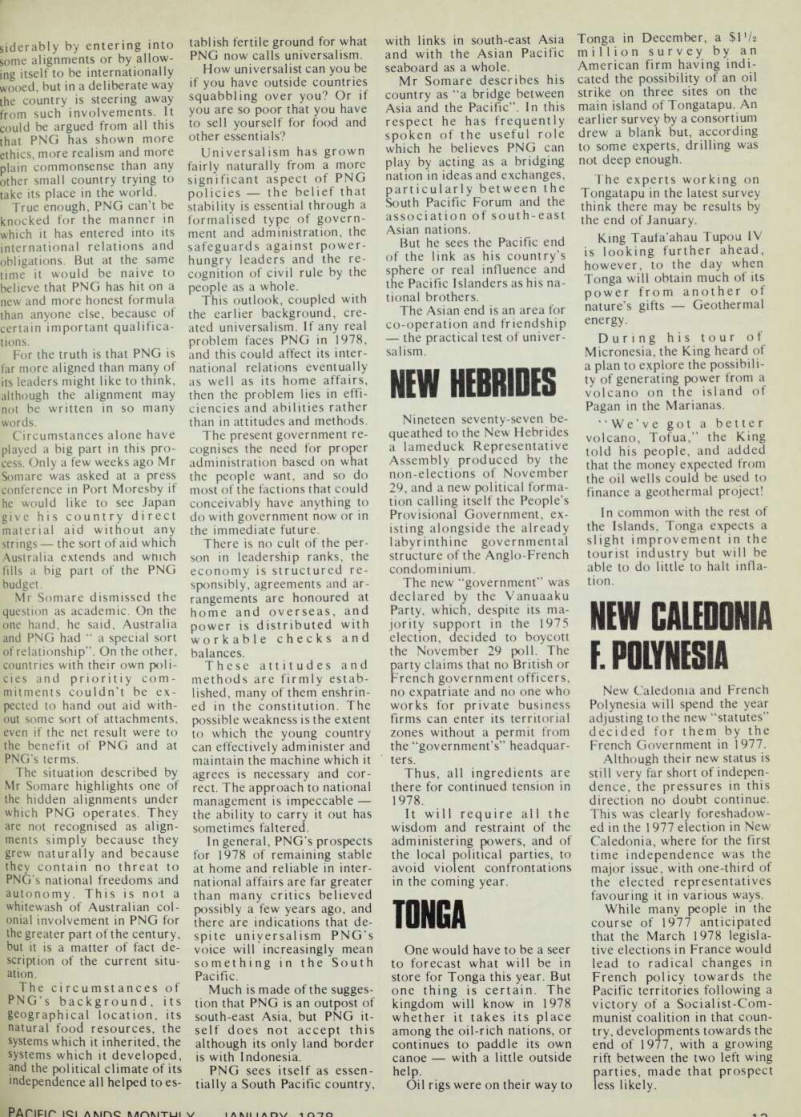
These buildings will help to ensure a healthy economy for the Solomons in 1978. They are the Solomon Taiyo fishing company’s cannery and freezer at Tulagi, the old capital.
tries or launching new ones.
But a guarantee of political stability for the next five years, with the Alliance back in full command, should create a climate of confidence in which investors reactivate themselves.
While private enterprise has for the most part been hesitant about sinking money in Fiji, increasingly large sums of aid finance are flow ing into the country from Australia, New Zealand, the European Common Market and other sources.
Pine planting, cattle, fish ing, road construction and a score of other lesser schemes being paid for by this money has created jobs for thousands of people who are helping to lay foundations of develop ments that are expected to become big income earners in the 1980s.
Without this activity Fiji would be in serious trouble.
The biggest-of-all aid scheme will start in earnest in 1978, when construction of the first installations needed for a $100 million hydro-electric power scheme for Viti Levu is due to begin.
Several million dollars a year will be poured into hydro-power through the 1970s and 1980s.
After the hectic political events of 1977 most Fiji
politicians are expecting a
relatively uncontroversial time in 1978. Apart from hav ing got back to power with an increased majority — 36 out of the 52 seats in the House of Representatives — the Alliance is facing an opposi tion that since the September election has split into three factions. As such, the NFP is in no shape to give the govern ment much to worry about.
A crucial time in deciding how the economy shapes up during 1978 will arrive in April, when the government, employers and the Fiji Trades Union Congress are due to review an agreement which began operating last May.
Under this the unions promis ed not to press for more than 10% in making pay claims.
Since then, the rate of infla tion in Fiji has dropped to below this level, according to the Central Monetary Authority. The question is whether the unions will agree to a new pay limit correspond ing with this fall, having been accustomed for some time to collecting hefty and regular increases scaled exactly to quarterly increases in the cost
of living index.
News that the country’s birth-rate has in the last 18 months climbed from 28 per 1000 to 31 per 1000 has been dismaying for the govern ment. Since 1960 it had been dramatically slashed from more than 41 per 1000, and this had brought high savings in terms of extra schools and other facilities needed for a bigger population.
The target is to get the rate down to 22 per 1000. The reason for the upturn is not yet clear, although it seems that Fijians are resisting the idea of controlling the size of their families more so than they have done in the past.
Though there may be more people in need of jobs, educa tion and social services, there may not be need for a corres ponding increase in police men. Fiji’s overall crime rate dropped by 26.16% from 1976 to 1977, a recording that quite possibly no other coun try can boast of.
A reorganisation of the police force is the chief factor for the fall, a trend, police predict, which will continue in 1978.
Micronesia
And Nauru
Micronesians, too, may regard 1978 as a milestone in their history. It’s on the cards that the political status talks which have been held on Guam and on the Hawaiian is land of Molokai will end in agreement between the United States and the Micronesians.
Agreement will have to come soon as the US trusteeship ends in 1981.
One stumbling block could be the demand for US$6O million a year “Right of Denial’’ payment to the Micronesians. They have pro posed this figure as “rent” for America’s use of their air, sea and land space, at the same time denying the right to other powers.
January 9 will be an im portant date on the Northern Marianas’ calendar. It is the day the new constitution will come into force and all of ficials will take up office.
There may be difficulties over what the new com monwealth state has power to do.
According to US Congress man Robert L. Leggett, chair man of the House Subcommit
tee on Fisheries, the act estab lishing zones does not include the Marianas because, of ficially, it is not a com monwealth of the United States until 1981. Marianas officials thought the act would apply to them on January 9.
One argument against Leggett is that, according to the com monwealth covenant, all federal laws applicable to Guam will also apply to the Northern Marianas on Janu ary 9. These laws include the fisheries zone act.
Ponape will fly her new flag in 1978. Maybe, the sight of their flag with its six stars, a coconut shell and palms will spark off new demands for separate status for the Carolines.
Not far away from the Micronesian scene are their cousins on Nauru. The past year on the island has been one of political strife with an election in November, return ing to office President Ber nard Dowiyogo and his Nauru Party who resigned earlier after a long and heated con frontation with ex-President Hammer Deßoburt and his supporters (see elsewhere in this issue).
Now that the legality of the government has been con firmed, 1978 may be a quiet year, politically, but this de pends on Chief Hammer The government is expected to bring in a few new im portant measures in an effort to secure future prosperity, somewhat eroded through falling phosphate prices.
Tourism is beginning to pick up in the Pacific and a little of this might rub off on the Nauruans who, until now, haven’t bothered much about that industry. But, the Japanese are touring in ever increasing numbers and many use Nauru as a stopover.
Papua
New Guinea
The biggest of the Island countries, Papua New Guinea, intends to use her weight in 1978, not to dominate either the Forum or the South Pacific Conference, but to strengthen the collective in fluence of all the Islands.
PNG’s voice will in creasingly mean something in the South Pacific, Angus Smales writes from Port Moresby.
“Friends with every one and enemies of none” was how' Sir Maori Kiki, Papua Guinea's first Foreign Rela tions Minister, liked to sum marise his country’s foreign! policy.
“Unaligned but very muchr involved” was another of his catchphrases.
Searching around for some: sort of name to give the policy technical respectability, his office came up with the word “universalism”.
Sir Maori is no longer irr parliament he fell victim tc an error of judgement in choosing an electorate at the 1977 general election but universalism is still the name PNG uses to describe its rela tions with the world.
The name has puzzled some of the countries with whicH PNG has had dealings, and if i a fair bet that some foreign of ficials have rushed to theii political dictionaries to see ii they can find a recognised ano established definition.
When Prime Minister M Somare, visited China jus< over a year ago, for instance it was fascinating to hear thi interpreters throw the wore “Universalism” into a string of Chinese language sem tences. They took it at its fac: value as a word, throwing it in without any apparent attemp to find a Chinese equivalent.
In PNG’s thinking, univen salism means what amounts t: a cross between politics alignment and isolationsim. 1 a country can’t be a world a regional power in its ow\ right, PNG believes that e« tablished foreign policies tern to develop in one of tw\ directions. Either the countn concerned will withdraw inti itself, relying almost entirel on its own resources, or it wii hitch itself to something bi< on the world scene.
Under the name of unive : salism PNG has set out to d something in between. In practical way it takes whr aid, expertise and protectio it can get from other countrir but always at what it claim are its own terms and withoi* selling itself.
Mr Somare and his ne; foreign Relations Minister Mr Ebia Olewale, believ there is no point in enterir bilateral arrangements i which their effective voh would be so small that the as rangement would becorrr meaningless.
There seems no doubt thi in immediate materi: benefits PNG could gain coc
siderably by entering into some alignments or by allow ing itself to be internationally wooed, but in a deliberate way the country is steering away from such involvements. It could be argued from all this that PNG has shown more ethics, more realism and more plain commonsense than any other small country trying to take its place in the world.
True enough, PNG can't be knocked for the manner in which it has entered into its international relations and obligations. But at the same time it would be naive to believe that PNG has hit on a new and more honest formula than anyone else, because of certain important qualifica tions.
For the truth is that PNG is far more aligned than many of its leaders might like to think, although the alignment may not be written in so many words.
Circumstances alone have played a big part in this pro cess. Only a few weeks ago Mr Somare was asked at a press conference in Port Moresby if he would like to see Japan give his country direct material aid without any strings— the sort of aid which Australia extends and which fills a big part of the PNG budget.
Mr Somare dismissed the question as academic. On the one hand, he said, Australia and PNG had “ a special sort of relationship". On the other, countries with their own poli cies and prioritiy com mitments couldn’t be ex pected to hand out aid with out some sort of attachments, even if the net result were to the benefit of PNG and at PNG’s terms.
The situation described by Mr Somare highlights one of the hidden alignments under which PNG operates. They are not recognised as align ments simply because they grew naturally and because they contain no threat to PNG's national freedoms and autonomy. This is not a whitewash of Australian col onial involvement in PNG for the greater part of the century, but it is a matter of fact de scription of the current situ ation.
The circumstances of PNG's background, its geographical location, its natural food resources, the systems which it inherited, the systems which it developed, and the political climate of its independence all helped to es
tablish fertile ground for what PNG now calls universalism.
How universalist can you be if you have outside countries squabbling over you? Or if you are so poor that you have to sell yourself for food and other essentials?
Universalism has grown fairly naturally from a more significant aspect of PNG policies the belief that stability is essential through a formalised type of govern ment and administration, the safeguards against power hungry leaders and the re cognition of civil rule by the people as a whole.
This outlook, coupled with the earlier background, cre ated universalism. If any real problem faces PNG in 1978, and this could affect its inter national relations eventually as well as its home affairs, then the problem lies in effi ciencies and abilities rather than in attitudes and methods.
The present government re cognises the need for proper administration based on what the people want, and so do most of the factions that could conceivably have anything to do with government now or in the immediate future.
There is no cult of the per son in leadership ranks, the economy is structured re sponsibly, agreements and ar rangements are honoured at home and overseas, and power is distributed with workable checks and balances.
These attitudes and methods are firmly estab lished, many of them enshrin ed in the constitution. The possible weakness is the extent to which the young country can effectively administer and maintain the machine which it agrees is necessary and cor rect. The approach to national management is impeccable the ability to carry it out has sometimes faltered.
In general, PNG’s prospects for 1978 of remaining stable at home and reliable in inter national affairs are far greater than many critics believed possibly a few years ago, and there are indications that de spite universalism PNG’s voice will increasingly mean something in the South Pacific.
Much is made of the sugges tion that PNG is an outpost of south-east Asia, but PNG it self does not accept this although its only land border is with Indonesia.
PNG sees itself as essen tially a South Pacific country.
with links in south-east Asia and with the Asian Pacific seaboard as a whole.
Mr Somare describes his country as “a bridge between Asia and the Pacific”. In this respect he has frequently spoken of the useful role which he believes PNG can play by acting as a bridging nation in ideas and exchanges, particularly between the South Pacific Forum and the association of south-east Asian nations.
But he sees the Pacific end of the link as his country’s sphere or real influence and the Pacific Islanders as his na tional brothers.
The Asian end is an area for co-operation and friendship the practical test of univer salism.
New Hebrides
Nineteen seventy-seven be queathed to the New Hebrides a lameduck Representative
Assembly produced by the
non-elections of November 29, and a new political forma tion calling itself the People’s Provisional Government, ex isting alongside the already
labyrinthine governmental
structure of the Anglo-French condominium.
The new “government” was declared by the Vanuaaku Party, which, despite its ma jority support in the 1975 election, decided to boycott the November 29 poll. The party claims that no British or French government officers, no expatriate and no one who works for private business firms can enter its territorial zones without a permit from the “government’s” headquar ters.
Thus, all ingredients are there for continued tension in 1978.
It will require all the wisdom and restraint of the administering powers, and of the local political parties, to avoid violent confrontations in the coming year.
Tonga
One would have to be a seer to forecast what will be in store for Tonga this year. But one thing is certain. The kingdom will know in 1978 whether it takes its place among the oil-rich nations, or continues to paddle its own canoe with a little outside help.
Oil rigs were on their way to
Tonga in December, a $1 '/* million survey by an American firm having indi cated the possibility of an oil strike on three sites on the main island of Tongatapu. An earlier survey by a consortium drew a blank but, according to some experts, drilling was not deep enough.
The experts working on Tongatapu in the latest survey think there may be results by the end of January.
King Taufa’ahau Tupou IV is looking further ahead, however, to the day when Tonga will obtain much of its power from another of nature’s gifts Geothermal energy.
During his tour of Micronesia, the King heard of a plan to explore the possibili ty of generating power from a volcano on the island of Pagan in the Marianas.
“We’ve got a better volcano, Tofua,” the King told his people, and added that the money expected from the oil wells could be used to finance a geothermal project!
In common with the rest of the Islands, Tonga expects a slight improvement in the tourist industry but will be able to do little to halt infla tion.
New Caledonia
F. Polynesia
New Caledonia and French Polynesia will spend the year adjusting to the new “statutes” decided for them by the French Government in 1977.
Although their new status is still very far short of indepen dence, the pressures in this direction no doubt continue.
This was clearly foreshadow ed in the 1977 election in New Caledonia, where for the first time independence was the major issue, with one-third of the elected representatives favouring it in various ways.
While many people in the course of 1977 anticipated that the March 1978 legisla tive elections in France would lead to radical changes in French policy towards the Pacific territories following a victory of a Socialist-Com munist coalition in that coun try, developments towards the end of 1977, with a growing rift between the two left wing parties, made that prospect less likely.
Advertisements & other items, pp. 10-13 (3 items)
Papifir If;I Ands Monthly —January, 19
10
11
PACIFIC ISLANDS MONTHI Y .lANII ARY 1 R7R
13
PAPIFin IQI AMHC A \/ iami i a r>\/ imo
Australia, The Pacific
by Senator John W Knight
The South Pacific has emerged, relatively suddenly, as an important factor in Australian foreign policy.
In 1972, a Liberal foreign minister made a major foreign policy statement which emphasised the South Pacific region as one in which Australia was “developing special initiatives”. In the same year, the Leader of the Labor Opposition referred to Australia as “the natural leader of the South Pacific”, though this statement was re sented by many in the South Pacific as suggesting many of the least-acceptable of tradi tional Australian attitudes about the region. However, it was significant that the South Pacific was rated important enough to be dealt with in an election policy speech. Thus, by 1972, the process of change was evident and it has accele rated since.
By the 19605, Australia’s relationship with the Islands of the South Pacific was fre quently expressed in terms of outmoded perceptions or cliches.
The Evatt initiatives of the 1940 s most notably the Canberra (ANZAC) Agree ment of 1944 and the estab lishment of the South Pacific Commission in 1947 had provided a basis for con tinuing development. But this was quickly dissipated in post war policies which limited the effectiveness of the South Pacific Commission, except for some aspects of its social and economic role.
This is, no doubt, partly ex plained by the fact that even by 1970 only two of the Island territories of the South Pacific had become independent.
These were Western Samoa in 1962 (formerly a New Zea land territory) and Nauru in 1 968 (previously admin istered by Australia).
When considering why the South Pacific matters to Australia and in recent years it has come to matter much more than previously the end of colonialism and the independence of the nations of the region is undoubtedly one of the major factors. In re cent years, Australia has had
to deal, not with just a few col onial metropolitan powers, but with a large number of new and assertive nations.
Despite the problems about Mr/Whitlam’s statement in 1972, it was remarkable that the South Pacific should have been mentioned with such emphasis in an election policy speech by an Australian political leader. To that ex tent the statement also mark ed the process of change by then under way.
Since that time there has been an enormous increase in Australia’s aid to the South Pacific to an extent that is sometimes resented, or at least questioned, in Asia.
Diplomatic relations have ex panded in Fiji, Papua New Guinea, the Solomon Islands, Nauru and Western Samoa, so that Australia now has an ex tensive official, trade and in formation network in the region. Ministerial visits to the region have increased and there has been an Australian parliamentary delegation to the region this year.
The Australian Senate’s Foreign Affairs and Defence Committee is now completing an inquiry and will soon re port to the Australian Parlia ment on Australia’s role in the South Pacific.
Just as the end of the col onial era is one obvious and
traditionally accepted
reason for Australia’s growing awareness of the region, there are other similar traditional and accepted reasons. Nor should it be overlooked that the move to independence in the region had particular relevance for Australia because of its own direct in volvement with Nauru and Papua New Guinea.
The other significant fac tors include Australia’s subs tantial commercial and finan cial interests in the region which some prefer to classify as instances of Australia’s neo-colonial attitude. There is the strategic relevance of the region of which Australia was made particularly aware dur ing World War 11. Elements of this concept tend to remain, but changes in strategic con cepts and weapons have made
it somewhat less relevant in this respect.
Recently, some of these fac tors have merged with the ex pansion of Japanese trading and financial activities and the display of increasing in terest by China and the Soviet Union in the South Pacific, in commercial, economic and
diplomatic terms.
All these developments help explain why the South Pacific is perceived to be of significance to Australia. All are valid reasons in ex plaining increasing Australian involvement in the region.
They are the most obvious factors, but there are others which are generally overlook ed and which are often of more fundamental sig nificance.
Perhaps one of the most sig nificant is the changing per ceptions of the ANZUS alliance, so long considered to be the “cornerstone” of Australian security. ANZUS resulted from the settlement with Japan after World War 11. It was, for example, not an “anti-communist” alliance such as SEATO or CENTO, though it is a general mutual defence pact.
Given the changed relation ships between the United States and Japan and China there are real questions about its relevance. In any case it is only one element in the ex tensive relationship between the three allies.
It is of particular sig nificance that at the most re
cent ANZUS Council meet ing, in New Zealand, there seemed to be more emphasis on economic issues and their importance to regional stability, than on defence co operation.
For example, the com munique after the meeting on July 28 said; “The Ministers recognised that the health of the economies of the three partners is of concern to each, for it affects their capacity to play the responsive and re sponsible role that world andl regional circumstances de mand of them and which is their common desire. They, therefore agreed that they< would consider their econ omic relationships and mutual problems within this larger framework.”
The ANZUS Council alsc welcomed the achievements of the southeast Asian coun tries of ASEAN in promoting economic and social develop ' ment in their region. T acknowledged that the three ANZUS allies share ”a special interest in the Asia/Pacifit region”. They went on to welcome continuing growth oc regional institutions in th< South Pacific and their com tribution to the welfare oc countries in the area.
The ANZUS Council wem so far as to comment thatr “South Pacific countries could expect continued sup: port from the ANZU partners on a bilateral an«i regional basis. Ministers look! ed forward to co-operatio(
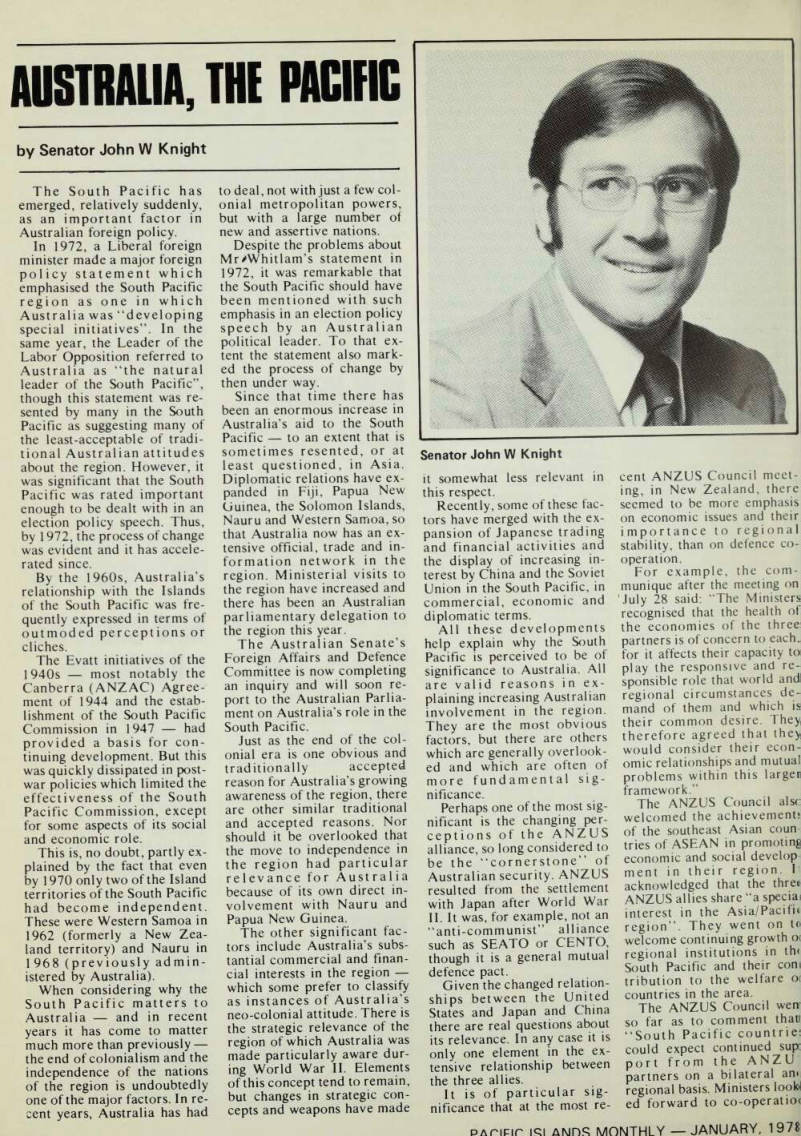
Senator John W Knight
with South Pacific nations in new areas such as the man agement and development of marine resources.”
It seems clear from such statements that the ANZUS partners are now looking to ANZUS as a more important regional instrument to be as sociated especially with econ omic initiatives and the wider regional role of the members of the pact.
The ANZUS communique has added significance in that the South Pacific Forum had on its agenda for its August meeting in Port Moresby the question of possible co-op eration between ASEAN and the Forum. The Forum com munique said the members had “agreed that informal contact on matters of common interest between the Forum and ASEAN should be initi ated." However, at the Forum some caution was evident about the possible future role of the United States in the area. Action to establish a regional fisheries agency and 200-mile sea resource zones resulted in a formulation that
effectively excluded
American Samoa and the United States. It seems sig nificant that no special effort seems to have been made to overcome this anomaly.
In an address to the Forum the Australian Prime Minister urged that Forum members extend their contacts with other international organ isations. It is of interest that Mr Fraser expressed caution about the prospect of any ma jor power dominating the region or competition be tween powers for influence in the area.
Any period of fundamental change carries with it uncer tainties. This applies to the role of the United States in the South Pacific and of the sig nificance of the ANZUS alliance and its potential role in the region.
On the question of its defence significance it is in teresting that the Australian Defence Minister has recently commented on the uncertainty
of reliance on alliances or more powerful friends.
What is obvious is that at titudes to ANZUS are chang ing. This is undoubtedly fun damental to Australia’s in creasing concern with the future of the South Pacific region and Australia’s role in it.
The second major factor, which is often overlooked, is the concept of a “new interna tional economic order”. In the so-called “north-south dialogue” context Australia (and New Zealand) are as sociated with the “north”, while the South Pacific coun tries are linked with the “south”.
The components of propos ed international economic change are, however, of mutual interest and concern; for example, the transfer of resources and technology, the operations of transnational corporations and interna tional development assistance programs.
It is also worth recalling that the ANZUS communique in July indicated that the three allies reviewed develop ments, including “considera tion of the global economic situation” and agreed that “international access to markets and resources was a factor of continuing im portance to global and regional stability”.
In future negotiations on in ternational economic issues Australia’s relations with its South Pacific neighbours could be of increasing sig nificance to Australia. We may be on different sides of many such discussions. A close understanding will be essential if Australia’s rela tions with its neighbours are not to be at times jeopardised in such circumstances.
Friendly and co-operative links with South Pacific coun tries might also help smooth Australia’s difficult path through these negotiations with more distant and, perhaps, less sympathetic na tions.
Thus, along with the tradi-
Australian is taking a whole new look at its relations with the South Pacific. John W, Knight, former member of the Australian office in Fiji and, as a senator, a member of the Australian Senate Standing Committee on Foreign Affairs and Defence, backgrounds the developing new approach. The Soviet Union is also taking a closer look at the Islands and 1978 should see a link developing between the USSR and some Island nations. Soviet journalist Alexander Malyashkin of the Novesti Press Agency presents the Soviet viewpoint exclusively for PIM.
tional factors which have given rise to growing Australian interest in its South Pacific neighbourhood, there are fundamental new ele ments.
These relate to the changing nature of the ANZUS alliance, and to changing rela tionships with Japan, China and the Soviet Union. The concept of a “new interna tional economic order’’, is relevant to Australia’s com mercial, financial and tourist interests in the South Pacific area.
While there have been tra ditional developments as sociated with Australia’s in creasing interest and concern diplomatic, political, sup port for the South Pacific Forum and changes in the South Pacific Commission, aid there have also been significant new manifesta tions. These have been sug gested in the recent ANZUS communique, the South Pacific Forum’s interest in ASEAN and a clear intent by Australian governments to take the South Pacific seriously.
No doubt all of these have been given added impetus by the increasing assertiveness of
the South Pacific countries themselves. In recent years they have expanded their diplomatic ties and not al ways in the same directions as in the case of China. Their trading horizons have widen ed and they have shown their determination to control their own destinies as in the re cent Fiji dock strike.
All of these have helped ac celerate changed attitudes in Australia. These changes are part of Australia’s adjustment to complex new developments in the international situation.
They affect issues as funda mental to Australia’s tradi tional outlook as ANZUS and as vexed as the concept of a future world economic system.
Australia’s new approach to its relations with the South Pacific is part of its changing attitudes and assumptions about its own foreign policy and the international situ ation.
The South Pacific is more important to Australia in that context and may be a “weather vane’’ for the future development of Australia’s in ternational policies on some of the most essential issues facing the Asian and Pacific region.
Advertisements & other items, p. 14 (1 item)
Pannr Iqi Awd.9 Monthly January, 1 978
Ussr, The Pacific
by Alexander Malyashkin
The USSR has two-thirds of its national territory in Asia and an outlet to the Pacific through its Far East region, which is equal in area and about equal in population to Australia. Here is a terminal of what is practically the only year-round Soviet sea route passing through the Indian Ocean to European Russia.
The Far East and Eastern Siberia are the sites of a large scale construction effort to tap more of the local natural resources, expand timber fell ing, woodworking, fishing and other industries, build new ports, modernise old ones, and so on. This is what creates, in our view, an objec tive premise for the Soviet Union’s broader involvement in the international division of labour in the Pacific area.
We know of quite a few in stances of an advanced nation using its advantages to further its own self-seeking ambitions
in disregard of other people’s interests. The Soviet Union is averse to this kind of relation ship.
It is not out of any time serving considerations that the USSR follows the princi ple of equal terms in its rela tions with other nations, big and small. This is our stra tegic policy reflecting the very essence of Soviet society. This principle rests, besides, on the assumption that the objectives pursued by Soviet foreign policy meet the interests of other nations as well as those of the USSR. These objectives are peace and greater interna tional security and co-op eration.
To bear me out, here is a case in point related to the region where this journal’s readers live. Following the proclamation of indepen dence of Papua New Guinea the Soviet Union recognised
the new state and established diplomatic relations with it.
Here is what the head of the Soviet government, Alexei Kosygin wrote on the occasion to Prime Minister Michael Somare: “Unswervingly committed to the policy of equal relations and friendship among all states regardless of their social systems, and guided by the principles of national self-determination, the Soviet Government proclaims its recognition of Papua New Guinea as a sovereign independent state and willingness to establish diplomatic relations with it.”
The USSR proves by deeds rather than words its earnest desire to have good relations with the countries of the region.
The name of my fellowcountryman Miklukho- Maklai has not been forgotten, I hope, although he lived a long time ago. It was way back in the last century that he, citing the case of the peopie of Oceania, proved the theory about the “superior” and “inferior” races to be utterly baseless. He was the first European to declare that the local natives were capable of setting up a state of their own.
This eminent Russian scientist acted on behalf of the rights of
the colonial peoples. But little could have been done for them at a time when men like Maklai were few and far be tween in face of the colonialist policies of entire states.
The USSR is developing its relations with Fiji, Tonga, Papua New Guinea and Western Samoa. The Soviet Union is keeping up the policy which has helped these states to obtain their independence.
This policy manifested itself in the promotion of political, economic and cultural con tacts on terms of bilateral co operation with due regard for the national interests of the countries of Oceania. The Soviet Union has no other ob jectives to pursue beyond those of maintaining normal relations with the newly inde pendent states. Nor does it look for any one-sided advan tages, for concessions, politi cal submission, or military bases.
In the field of trade with these countries, the Soviet Union confines itself to minor one-time deliveries of con sumer goods, There are some other com monly accepted contacts. The Soviet research vessel, the Dmitry Mendeleyev, recently made a 105-day cruise around the islands of Oceania. The
botanists of Papua New Guinea gave the Soviet scien tists much help in their excur sions into the jungles to study local vegetation. In their turn, Soviet botanists presented their foreign colleagues with Soviet floral collections.
Yet in spite of these com monly known facts, some peo ple in the West are circulating fabricated stories about a Soviet desire to draw the newly independent states of Oceania into “the Soviet sphere of influence”.
Western powers delib erately misrepresent the ob jectives of Soviet policy to obstruct the establishment and promotion of good rela tions between the USSR and the countries of Oceania and to maintain their own ex clusive influence in that region. But, according to the United Nations Charter, every independent state can develop its relations with other states as it sees fit. If the Western powers want to prevent the emergent states from indepen dently carrying out their own foreign policies, let them stop covering this up with fabrica tions distorting Soviet policy.
These fabrications about Soviet policy are, just as they have been on many occasions in the past, something which some people need in order to divert attention from their own deplorable acts and de signs.
The lot of Micronesia is a case in point. Under a com mitment undertaken before the UN, the United States, which has that territory under its trusteeship, should have laid the groundwork for the granting of independence to these Pacific Islands. What it is actually doing, as the facts indicate, is to prepare for an annexation of Micronesia to meet the Pentagon’s plans for using it as a bridgehead. In creased military construction on Tinian island has been re ported to be designed for the installation of American nuclear weapons on Tinian.
The US has likewise been re ported to be considering set ting up a base for its latest missile-carrying Trident sub marines in the vicinity of the Palau islands.
It is, however, up to the Micronesians themselves, not anybody else, to decide their homeland’s future. And this has to be decided in strict com Pi iance with the UN Charter and with the consent of the Security Council, and not at the discretion of the ad
ministering power.
The Soviet Union is con vinced of the need for the peo ple of Micronesia to exercise their inalienable right to self determination and indepen dence at the earliest oppor tunity, retaining Micronesia’s. territorial integrity, and it is. willing to contribute towards; such a settlement to the best oT its ability.
Military preparations will,, of course, continue to do tre mendous damage to mankind! unless the arms race is* brought to a halt. There are; many ways of doing so, andi one of them is by setting up( “peace zones”.
A number of Asian andl African nations have takeni the initiative in calling for the; Indian Ocean to be turnedf into such a zone. The Soviet) Union has all along beenr favourable to such an idea.
The way to solve pressing international problems, as the Soviet Union sees it, is not) through confrontation andt military preparations but) through a renunciation of the use of force, through respect for sovereignty and in violability of frontiers, non interference in internal affairs and through the development of economic, scientific and cultural co-operation on the basis of full equality and mutual advantage.
States with differing social systems can effectively co-op< erate, for instance, in the fielo of trade. In 1976 the volume of Soviet-Australian track reached its highest-ever poim of about $490 million ir value. There has likewise beer a notable increase in trade be; tween the USSR and Nev Zealand. This has been na only a quantitative im provement. Soviet product) are technologically not im ferior to Western, and cos less, as a rule, which is a cin cumstance of no mean imr portance for the troublec capitalist economies. It is es sential to form a proper judge ment of the prospects for thr economic development of ouj countries and their role in thr international division o: labour not only today bm tomorrow as well.
The USSR has, on balano good relations with AustraK and New Zealand in this are Contacts are developing alou other lines as well.
But they could be still td tter if they were not handicas ped by certain campaigns an
certain pronouncements '
some officials.
The Soviet Ambassador to Australia, Mr A. V. Basov who had been visiting Fiji at the end of November. During the visit he met his Chinese opposite number at the Chinese Embassy at Suva. ‘‘lt was just a diplomatic exchange,” said Mr. Basov. Does his Fiji visit point to the early opening of a Soviet Embassy in Fiji?
Photo:Canberra Times
Advertisements & other items, p. 15 (1 item)
15
PAflFir IQI AMHQ l\/ir*MTUI V lAMI lADV -imo
Will Lord Indra Help
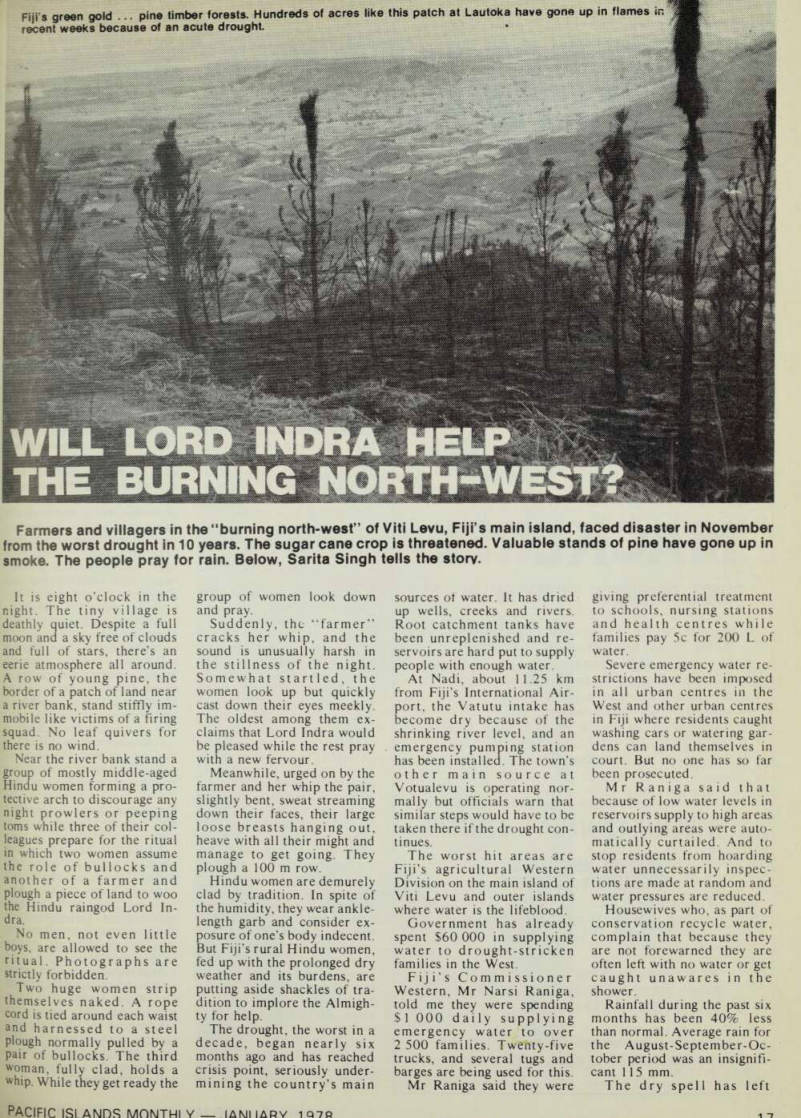
The Burning North-West
Farmers and villagers in the “burning north-west” of Viti Levu, Fiji’s main island, faced disaster in November from the worst drought in 10 years. The sugar cane crop is threatened. Valuable stands of pine have gone up in smoke. The people pray for rain. Below, Sarita Singh tells the storv.
It is eight o’clock in the night. The tiny village is deathly quiet. Despite a full moon and a sky free of clouds and full of stars, there’s an eerie atmosphere all around.
A row of young pine, the border of a patch of land near a river bank, stand stiffly immobile like victims of a firing squad. No leaf quivers for there is no wind.
Near the river bank stand a group of mostly middle-aged Hindu women forming a protective arch to discourage any night prowlers or peeping toms while three of their colleagues prepare for the ritual in which two women assume the role of bullocks and another of a farmer and plough a piece of land to woo the Hindu raingod Lord Indra.
No men, not even little boys, are allowed to see the ritual. Photographs are
strictly forbidden.
Two huge women strip themselves naked. A rope cord is tied around each waist and harnessed to a steel plough normally pulled by a pair of bullocks. The third woman, fully clad, holds a whip. While they get ready the
group of women look down and pray, Suddenly, the “farmer” cracks her whip, and the sound is unusually harsh in the stillness of the night.
Somewhat startled, the women look up but quickly cast down their eyes meekly, The oldest among them ex claims that Lord Indra would be pleased while the rest pray with a new fervour, Meanwhile, urged on by the farmer and her whip the pair, slightly bent, sweat streaming down their faces, their large loose breasts hanging out, heave with all their might and manage to get going. They plough a 100 m row.
Hindu women are demurely clad by tradition. In spite of the humidity, they wear ankle length garb and consider ex posure of one’s body indecent, But Fiji’s rural Hindu women, fed up with the prolonged dry weather and its burdens, are putting aside shackles of tra dition to implore the Almigh ty for help, The drought, the worst in a decade, began nearly six months ago and has reached crisis point, seriously under mining the country’s main
sources of water. It has dried up wells, creeks and rivers.
Root catchment tanks have been unreplenished and re servoirs are hard put to supply people with enough water.
At Nadi, about 11.25 km from Fiji’s International Air port, the Vatutu intake has become dry because of the shrinking river level, and an emergency pumping station has been installed. The town’s other main source at Votualevu is operating nor mally but officials warn that similar steps would have to be taken there if the drought con tinues.
The worst hit areas are Fiji’s agricultural Western Division on the main island of Viti Levu and outer islands where water is the lifeblood.
Government has already spent $6O 000 in supplying water to drought-stricken families in the West.
Fiji’s Commissioner Western, Mr Narsi Raniga, told me they were spending $1 000 daily supplying emergency water to over 2 500 families. Twenty-five trucks, and several tugs and barges are being used for this.
Mr Raniga said they were
giving preferential treatment to schools, nursing stations and health centres while families pay 5c for 200 L of water.
Severe emergency water re strictions have been imposed in all urban centres in the West and other urban centres in Fiji where residents caught washing cars or watering gar dens can land themselves in court. But no one has so far been prosecuted.
Mr Raniga said that because of low water levels in reservoirs supply to high areas and outlying areas were auto matically curtailed. And to stop residents from hoarding
water unnecessarily inspec
tions are made at random and water pressures are reduced.
Housewives who, as part of conservation recycle water, complain that because they are not forewarned they are often left with no water or get caught unawares in the shower.
Rainfall during the past six months has been 40% less than normal. Average rain for the August-September-Oc tober period was an insignifi cant 11 5 mm.
The dry spell has left
Fiji's green gold ... pine timber forests. Hundreds of acres like this patch at Lautoka have gone up in flames in recent weeks because of an acute drought
vegetable and flower gardens and nurseries dying. One Lautoka woman who has a passion for growing orchids showed me her garden which she tried to save by using water left from dishwashing.
For a while they struggled de sperately but died eventually carrying with them the work of many years.
The drought means a widespread crop reduction.
Vegetables are scarce in the markets and their quality is poor, but prices have shot up.
It will also hurt Fiji’s econ omy. According to Mr Raniga if the country does not have heavy rain soon, the canecrop for next season will be adver sely affected . Already hundreds of acres of cane which were planted early this year lie shrivelled and ruined.
Fiji does not have an irriga tion system or dams.
Dry weather conditions have led to an increasing number of fires which so far have destroyed several thou sand acres of mature cane.
The Fiji Sugar Corporation, concerned at the harmful effects of burnt cane on sugar
processing, has appealed to
farmers to increase their sup ply of high-quality green cane.
Fiji’s “green gold” the pine industry which the government hopes will even tually become one of the chief sources of revenue has been another target of fires. Alrea dy over 280 ha of the trees, which take years to mature, have been destroyed. The Pine Commission believes that these fires were the result of acts of arson and is keeping guards on constant duty to prevent further damage.
Major victims of the drought have been cattle which have to feed on poor grazing lands which stand de solate with grass that has dried up. Weak with under nourishment and lack of ade quate drinking water, many cattle are unable to withstand the heat and die.
Development projects and the building industry are also suffering from lack of water.
Town councils early this year had to abandon several civic projects because of insuffi cient water. Work on build ings under construction or near completion has had to halt until the present situation eases. Factories have had to reduce production but other wise have been unaffected.
Unconfirmed reports say that ships calling at the Lautoka wharf have had to replenish
their water tanks from elsewhere.
In the outer islands families at times have to make do with a pail of water for a week and resort to using coconut milk.
Yaqona parties, one of the most popular forms of enter tainment in the islands which do not have many recreational facilities, have had to stop, following bans by village heads. “Grog” preparation re quires a lot of water.
But there have been no
epidemics despite unhygienic
practices in the rural areas.
People often use the river for their drinking and cooking water, bathing, as a drinking base for their cattle, horses and goats, for washing clothes and bathing, as a toilet and for garbage disposal. The drought has left water in many rivers stagnant but many people fail to listen to officials who have been urging people to boil water before drinking it.
Simple folk in the villages explain that the drought is a punishment for the mounting sin of man. But Fiji’s meteorological department has a more realistic ex planation. It attributes this to dry anti-cyclonic weather conditions. There have been suggestions that the depart ment use chemicals to make rain. But the weathermen say that Fiji’s atmospheric condi tions are unsuitable for this.
However, recently, dark clouds have been looming over the West’s Evans Range.
Perhaps Lord Indra is about to answer the prayers of those Hindu women. More likely they are an indication that the present weather pat tern is about to be broken.
A downpour would literall> be Godsent from the heavens But Fiji’s farmers are rathei unhappy. Several told me that if they could somehow be sure that it would rain for a while and then stop they would no< worry. , . M The rainy season, whicn normally begins in November! is well known for the floodl caused in the rural areas washing away crops, roads and bridges, causing drainage and soil erosion problems am threatening cattle and home: in low-lying areas.
Superstitious farmers spemi sleepless nights in anticipation of a major flood. With theii simple logic they argue tha because of the drought thr country would have more die aster through a large flood.
Rain, or dry, they say the: will be the losers.
Advertisements & other items, pp. 17-18 (2 items)
17
PACIFIC ISLANDS MONTH! Y lAMI lARV i Q7P
, Master,
MACKEREL
PACKED BY NIPPON SUISAN KAISHA LTD.
%. “Master" Al Canned Pilchards & other Canned Fish * “House” Brand Instant Foods : Instant Ramen, Instant Curry, Various Dessert, Instant Soup, All kinds of Spices * Groceries & Confectionery % Hardware, Tools & Kitchenware % Building Materials, Iron & Steel Products, Machinery Marine equipments, Lubricating Oils * Motor Spare Parts & Accesories 11111 ii 11111 ii 1111111111111111 ■ 11111111111111111111111111111M1111 1 11111111 M11 ■ ■ Mllllllllllll'
UNITRADE COMPANY, LIMITED
GENERAL MERCHANTS
EXPORTERS & IMPORTERS
Sanritsu Building 11-12 3-chome Hachobori Chuo-ku Tokyo (104)
TELEX NO. : “252-4665 KANDK J
CABLE ADDRESS : “KAYANDKAY TOKYO”
TELEPONE NO. : 03-553-9520
Resident Reoresentives in Fiji, P.N.G., Philinninfis. Nona Kong & Singapore
BRAND
Fiji’S Ratu Mara
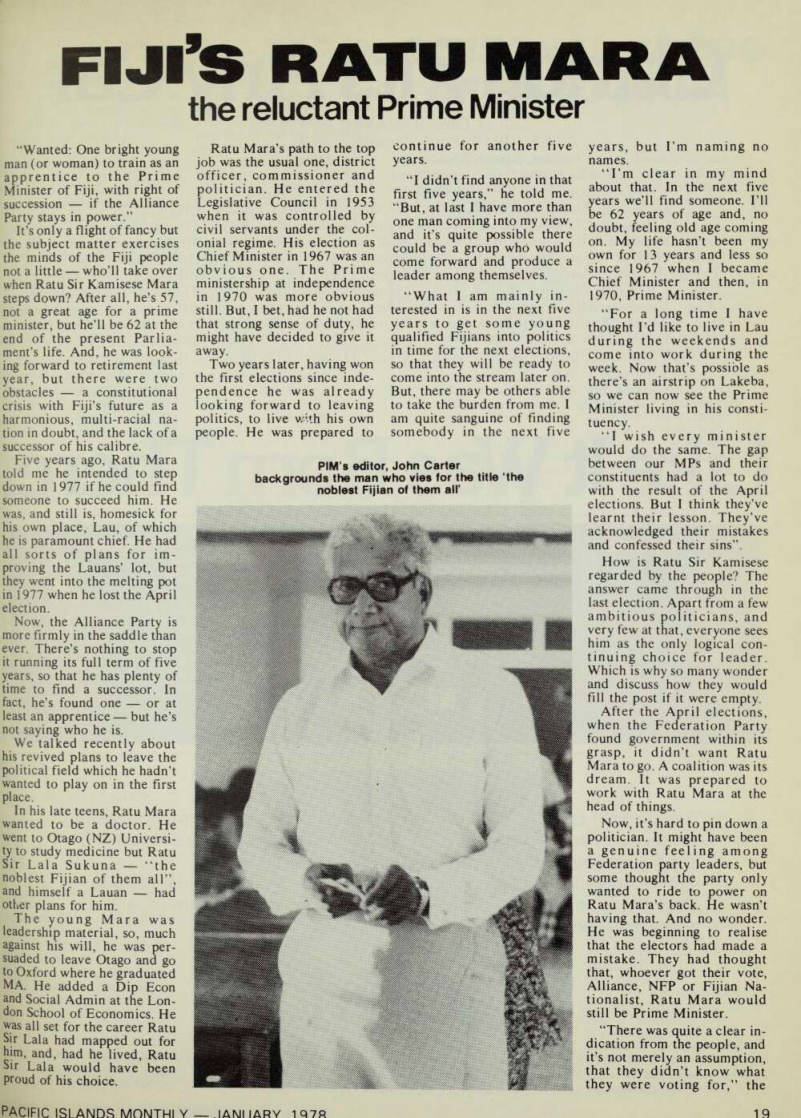
the reluctant Prime Minister
“Wanted: One bright young man (or woman) to train as an apprentice to the Prime Minister of Fiji, with right of succession if the Alliance Party stays in power.”
It’s only a flight of fancy but the subject matter exercises the minds of the Fiji people not a little who’ll take over when Ratu Sir Kamisese Mara steps down? After all, he’s 57, not a great age for a prime minister, but he’ll be 62 at the end of the present Parlia ment’s life. And, he was look ing forward to retirement last year, but there were two obstacles a constitutional crisis with Fiji’s future as a harmonious, multi-racial na tion in doubt, and the lack of a successor of his calibre.
Five years ago, Ratu Mara told me he intended to step down in 1977 if he could find someone to succeed him. He was, and still is, homesick for his own place, Lau, of which he is paramount chief. He had all sorts of plans for im proving the Lauans’ lot, but they went into the melting pot in 1977 when he lost the April election.
Now, the Alliance Party is more firmly in the saddle than ever. There’s nothing to stop it running its full term of five years, so that he has plenty of time to find a successor. In fact, he’s found one or at least an apprentice— but he’s not saying who he is.
We talked recently about his revived plans to leave the political field which he hadn’t wanted to play on in the first place.
In his late teens, Ratu Mara wanted to be a doctor. He went to Otago (NZ) Universi ty to study medicine but Ratu Sir Lala Sukuna “the noblest Fijian of them all”, and himself a Lauan had other plans for him.
The young Mara was leadership material, so, much against his will, he was per suaded to leave Otago and go to Oxford where he graduated MA. He added a Dip Econ and Social Admin at the Lon don School of Economics. He was all set for the career Ratu Sir Lala had mapped out for him, and, had he lived, Ratu Sir Lala would have been proud of his choice.
Ratu Mara’s path to the top job was the usual one, district officer, commissioner and politician. He entered the Legislative Council in 1953 when it was controlled by civil servants under the col onial regime. His election as Chief Minister in 1967 was an obvious one. The Prime ministership at independence in 1970 was more obvious still. But, I bet, had he not had that strong sense of duty, he might have decided to give it away.
Two years later, having won the first elections since inde pendence he was already looking forward to leaving politics, to live with his own people. He was prepared to
continue for another five years.
“I didn’t find anyone in that first five years,” he told me.
“But, at last I have more than one man coming into my view, and it’s quite possible there could be a group who would come forward and produce a leader among themselves.
“What I am mainly in terested in is in the next five years to get some young qualified Fijians into politics in time for the next elections, so that they will be ready to come into the stream later on.
But, there may be others able to take the burden from me. I am quite sanguine of finding somebody in the next five
years, but I’m naming no names.
“I’m clear in my mind about that. In the next five years we’ll find someone. I’ll be 62 years of age and, no doubt, feeling old age coming on. My life hasn’t been my own for 13 years and less so since 1967 when I became Chief Minister and then, in 1970, Prime Minister.
“For a long time I have thought I’d like to live in Lau during the weekends and come into work during the week. Now that’s possible as there’s an airstrip on Lakeba, so we can now see the Prime Minister living in his consti tuency.
“I wish every minister would do the same. The gap between our MPs and their constituents had a lot to do with the result of the April elections. But I think they’ve learnt their lesson. They’ve acknowledged their mistakes and confessed their sins’’.
How is Ratu Sir Kamisese regarded by the people? The answer came through in the last election. Apart from a few ambitious politicians, and very few at that, everyone sees him as the only logical con tinuing choice for leader.
Which is why so many wonder and discuss how they would fill the post if it were empty.
After the April elections, when the Federation Party found government within its grasp, it didn’t want Ratu Mara to go. A coalition was its dream. It was prepared to work with Ratu Mara at the head of things.
Now, it’s hard to pin down a politician. It might have been a genuine feeling among Federation party leaders, but some thought the party only wanted to ride to power on Ratu Mara’s back. He wasn’t having that. And no wonder.
He was beginning to realise that the electors had made a mistake. They had thought that, whoever got their vote, Alliance, NFP or Fijian Na tionalist, Ratu Mara would still be Prime Minister.
“There was quite a clear in dication from the people, and it’s not merely an assumption, that they didn’t know what they were voting for,’’ the
PIM’s editor, John Carter backgrounds the man who vies for the title ‘the noblest Fijian of them all’
Advertisements & other items, pp. 19-20 (2 items)
19
PACIFIC ISLANDS MONTHI Y .lANII ARY 1 P7R
©Clarion
Clarion Fits Any C
~,uuism General Motors U ui NSU BMW Ford Mercedes Benz G, . t Chrysler Austin ' ' IVi .all Alfa Romn anch era Leylari azda Toyota * nera h y- er For^ .ab Skoda Audi divi w i ord iviciv_cuc> uenz Opel Porshe Volkswcij., Renault Chrysler Austin Morris Jaguar Daimler M.G Rover Triumph Vau ord Vauxhall Alfa Romeo Autobianchi Fiat Lancia Leyland-Innocenti Mazda Toyota iatsun Mazda Toyota Mitsubishi General Motors Chrysler Ford Seat DAF Skoda Audi NS dvo Saab Skoda Audi NSU BMW Ford Mercedes Benz Opel Porshe Volkswagen Benz Opel i Peugeot Renault Chrysler Austin Morris Jaguar Daimler M.G Rover Triumph Jaguar/DaimL. . irysler Ford Vauxhall Alfa Romeo Autobianchi Fiat Lancia Leyland-Innocenti Lancia Leyland-Innoce , 11UU Datsun Mazda Toyota Mitsubishi General Motors Chrysler Ford Seat DAF Chrysler Seat DAF 1 ida Volvo Saab Skoda Audi NSU BMW Ford Mercedes Benz Opel Porsche Volkswagen Opel trnpn P^..^ o t Renault Chrysler Austin Morris Jaguar Daimler M.G Rover Triumph Triumph C Vauxhall Alfa R “ ' Ford Mercedes Mazda Toyota Skoda A* c Mercedes Be • een C :
Like It Was Born There.
•TUNING
•ON-VOL/PRO
©Clarion <4 !► n PE-663 The brand of car or model you own makes no difference.
Clarion fits any dashboard like the unit was installed at the factory.
Once in position, the real fun begins.
Every drive becomes more enjoyable.
Advanced Clarion electronics create dynamic sound quality and assure superb reliability.
Clarion respected and listened to by motorists worldwide.
©Clarion
Clarion Co., Ltd. Tokyo Japan Australia- Amalgamated Wireless (Australasia) Ltd. 554 Parramatta Road Ashfield N.S.W., 2131 / New Zealand: AWA New Zealand Um" ed P.O. Box 50-248 Ponrua / Fiji Islands: Brijlal & Co.. Ltd. G.P.O. Box 362 Suva / Tahiti: ETS. Com.mpex B P 200 Papeete / New Caledonia: Caldis. B.P.M 1 Noumea Cedex /Guam: Guam Radio&TV Shop. P.O. Box 1-39 Agana, u
Prime Minister told me.
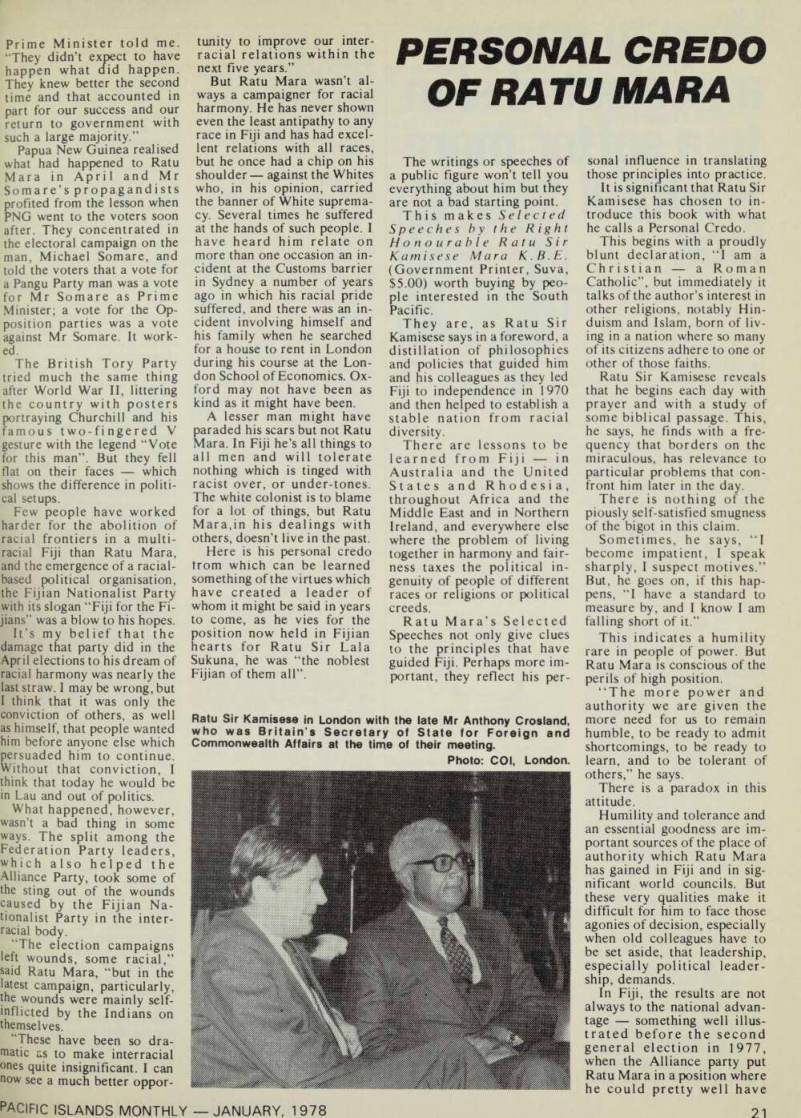
“They didn’t expect to have happen what did happen.
They knew better the second time and that accounted in part for our success and our return to government with such a large majority.”
Papua New Guinea realised what had happened to Ratu Mara in Apri 1 and Mr
Somare’s propagandists
profited from the lesson when PNG went to the voters soon after. They concentrated in the electoral campaign on the man, Michael Somare, and told the voters that a vote for a Pangu Party man was a vote for Mr Somare as Prime Minister; a vote for the Op position parties was a vote against Mr Somare. It work ed.
The British Tory Party tried much the same thing after World War 11, littering the country with posters portraying Churchill and his famous two-fingered V gesture with the legend “Vote for this man”. But they fell flat on their faces which shows the difference in politi cal setups.
Few people have worked harder for the abolition of racial frontiers in a multi racial Fiji than Ratu Mara, and the emergence of a racial based political organisation, the Fijian Nationalist Party with its slogan “Fiji for the Fi jians” was a blow to his hopes.
It’s my belief that the damage that party did in the April elections to his dream of racial harmony was nearly the last straw. I may be wrong, but I think that it was only the conviction of others, as well as himself, that people wanted him before anyone else which persuaded him to continue.
Without that conviction, I think that today he would be in Lau and out of politics.
What happened, however, wasn’t a bad thing in some ways. The split among the Federation Party leaders, which also helped the Alliance Party, took some of the sting out of the wounds caused by the Fijian Na tionalist Party in the inter
racial body.
“The election campaigns left wounds, some racial,” said Ratu Mara, “but in the latest campaign, particularly, the wounds were mainly self inflicted by the Indians on themselves.
“These have been so dra matic as to make interracial ones quite insignificant. 1 can now see a much better oppor
tunity to improve our inter racial relations within the next five years.”
But Ratu Mara wasn’t al ways a campaigner for racial harmony. He has never shown even the least antipathy to any race in Fiji and has had excel lent relations with all races, but he once had a chip on his shoulder— against the Whites who, in his opinion, carried the banner of White suprema cy. Several times he suffered at the hands of such people. I have heard him relate on more than one occasion an in cident at the Customs barrier in Sydney a number of years ago in which his racial pride suffered, and there was an in cident involving himself and his family when he searched for a house to rent in London during his course at the Lon don School of Economics. Ox ford may not have been as kind as it might have been.
A lesser man might have paraded his scars but not Ratu Mara. In Fiji he’s all things to all men and will tolerate nothing which is tinged with racist over, or under-tones.
The white colonist is to blame for a lot of things, but Ratu Mara,in his dealings with others, doesn’t live in the past.
Here is his personal credo trom which can be learned something of the virtues which have created a leader of whom it might be said in years to come, as he vies for the position now held in Fijian hearts for Ratu Sir Lala Sukuna, he was “the noblest Fijian of them all”.
Ratu Sir Kamisese in London with the late Mr Anthony Crosland, who was Britain’s Secretary of State for Foreign and Commonwealth Affairs at the time of their meeting.
Photo: COI, London.
Personal Credo
Of Ratu Mara
The writings or speeches of a public figure won’t tell you everything about him but they are not a bad starting point.
This makes Selected Speeches by the Right Honourable Ratu Sir Kamisese Mara K.B.E. (Government Printer, Suva, $5.00) worth buying by peo ple interested in the South Pacific.
They are, as Ratu Sir Kamisese says in a foreword, a distillation of philosophies and policies that guided him and his colleagues as they led Fiji to independence in 1970 and then helped to establish a stable nation from racial
diversity.
There are lessons to be learned from Fiji in Australia and the United States and Rhodesia, throughout Africa and the Middle East and in Northern Ireland, and everywhere else where the problem of living together in harmony and fair ness taxes the political in genuity of people of different races or religions or political creeds.
Ratu Mara’s Selected Speeches not only give clues to the principles that have guided Fiji. Perhaps more im portant, they reflect his per
sonal influence in translating those principles into practice.
It is significant that Ratu Sir Kamisese has chosen to in troduce this book with what he calls a Personal Credo.
This begins with a proudly blunt declaration, “I am a Christian a Roman Catholic”, but immediately it talks of the author’s interest in other religions, notably Hin duism and Islam, born of liv ing in a nation where so many of its citizens adhere to one or other of those faiths.
Ratu Sir Kamisese reveals that he begins each day with prayer and with a study of some biblical passage. This, he says, he finds with a fre quency that borders on the miraculous, has relevance to particular problems that con front him later in the day.
There is nothing of the piously self-satisfied smugness of the bigot in this claim.
Sometimes, he says, “I become impatient, I speak sharply, I suspect motives.”
But, he goes on, if this hap pens, ”1 have a standard to measure by, and I know I am falling short of it.”
This indicates a humility rare in people of power. But Ratu Mara is conscious of the perils of high position.
“The more power and authority we are given the more need for us to remain humble, to be ready to admit shortcomings, to be ready to learn, and to be tolerant of others,” he says.
There is a paradox in this attitude.
Humility and tolerance and an essential goodness are im portant sources of the place of authority which Ratu Mara has gained in Fiji and in sig nificant world councils. But these very qualities make it difficult for him to face those agonies of decision, especially when old colleagues have to be set aside, that leadership, especially political leader ship, demands.
In Fiji, the results are not always to the national advan tage something well illus trated before the second general election in 1977, when the Alliance party put Ratu Mara in a position where he could pretty well have
written his own ticket in the selection of candidates and therefore, as it turned out, of most of the elected members of Parliament and so of the Cabinet material available to him.
In the event, the selection of candidates was passed on to a committee of seven and ex posed to pressures that led to a number of choices that could hardly be called the best available.
But part of Ratu Mara’s Credo is relevant. “We must be ready to listen at all times ... It is only through dialogue that one can find real and last ing solutions.”
This belief of his is basic. It shows itself repeatedly perhaps nowhere more emphatically or more usefully in a mixed society than in his attitude to race relations.
“Race is a fact of life in Fiji,” he said at a dinner to mark the centenary of The Fiji Times in 1969.
“There are differences of background and outlook; of colour, culture and religion.
These are not things to be swept under the table where we can pretend they don’t ex ist. They are things to be faced up to squarely by men and women of goodwill of all races. No race has a monopoly of virtue. All races have good and bad among them.
D ifferences can be honestly held but men, women and children of all races have much in common, not least the desire for a better life for all the people of Fiji. It is in such things that we can find a common purpose and a com mon goal . . . While re cognising that there are things on which we differ, let us re spect and tolerate the other man’s views.”
Here is the foundation of the political structure which, in my view, is a major factor perhaps the most effective and practical one of all in Fiji’s stability as a nation, de spite its multi-racial and
multi-religious composition.
The country’s system of electing members of the House of Representatives puzzles outside observers sometimes, but it is based on principle of high importance that each major racial group will be guaranteed at least some voice in the making of national policy.
So Fijians, Indians and General Electors (Europeans, Chinese and all others who are neither Fijian nor Indian) start off by choosing parlia
mentanans from among mem bers of their own group.
These are the Communal members.
Then the three groups vote together for three more rep resentatives, one Fijian, one an Indian and the third a General Elector, in national constituencies that combine the communal groupings in proportions that reflect
population numbers.
The net result is a guarantee that constitutionally fixed numbers of Fijians, Indians and General Electors will make up the parliament.
The number in each group can be varied if population or other changes make this de sirable, but the essential prin ciple remains that each racial group is guaranteed
representation.
There is nothing unique in the principle behind the system.
Guaranteed Maori rep resentation has long been a feature of New Zealand’s parliamentary structure and the constitution of India pro vides an assurance of some parliamentary seats for rep resentatives of“scheduled castes and tribes”.
There are valuable by-pro ducts of the system in Fiji.
It is established custom for each of the major racial groups to be given places on boards or committees, official or otherwise.
The more responsible employers seek in staff re cruitment to achieve, to at least some degree, the racial balance which is a declared aim in the civil service.
Official invitation lists are consciously drawn up to en sure a similar distribution.
There are those who claim that this creates polarisation and that such race conscious ness perpetuates divisions in the community.
They underestimate the effect of continual, conscious deliberate efforts to see tha no group is left out.
Fiji hasn’t become a heaver on earth. The political systen and its by-products haven’ miraculously closed all gap: of tension, but they hav< helped to reduce the danger o such gaps widening int< unbridgeable chasms.
That in itself is a pretty con siderable achievement, fo: which Ratu Sir Kamisess Mara, by the example am precept well illustrated in hi Collected Speeches, can tak> no mean share of credit.
L. G. Ushe[?]
Advertisements & other items, p. 22 (1 item)
youthful
How to pamper
a neglected skin
to a softer, more
youthful
look
Many women have turned to the remarkable benefits of a tropically moist oil blend to help avoid accentuation of tiny surface lines on
the complexion.
THERE comes a time in your life when, for the first time, you begin to notice that your complexion no longer possesses that beautiful petal softness and vibrant glow that
epitomises the beauty of
youth.
Tiny surface lines and a tautness of skin are some of the first signs that can warn you that you have been neglecting your skin. As you grow older, this can become progressively more noticeable because the tiny oil and moisture-giving glands beneath your skin begin to reduce their supplies. This is entirely normal and it means that the natural fluids can, be supplemented with a scientifically developed tropically moist oil blend to help restore and maintain their vital balance so that your skin can achieve a softer, smoother and more supple appearance. -ff v-: m
A MORE NATURAL
SOFTNESS
Every day smooth on the tropically moist Oil of Ulan because it actually simulates the actions of the skin’s natural oils and moisture within the outer skin layer, known as the stratum corneum. This area of skin, which is made up of hardening skin cells, must be conditioned in order for your complexion to show any improvement in texture and appearance. i&y sS> 1 w * Oil of Ulan moist oil blend penetrates quickly into the stratum corneum where it boosts the dwindling supplies of the skin’s own natural fluids. Every day you should smooth a light film of this beautifying fluid over the entire face and neck both in the morning and again at night—paying particular attention to the wrinkle prone areas around the eyes and mouth.
Conscientious care with your Oil of Ulan each day helps assure a neglected and lack lustre complexion of a noticeable new softness and smoothness which can continue into your later years. ☆
Strip Jack (and
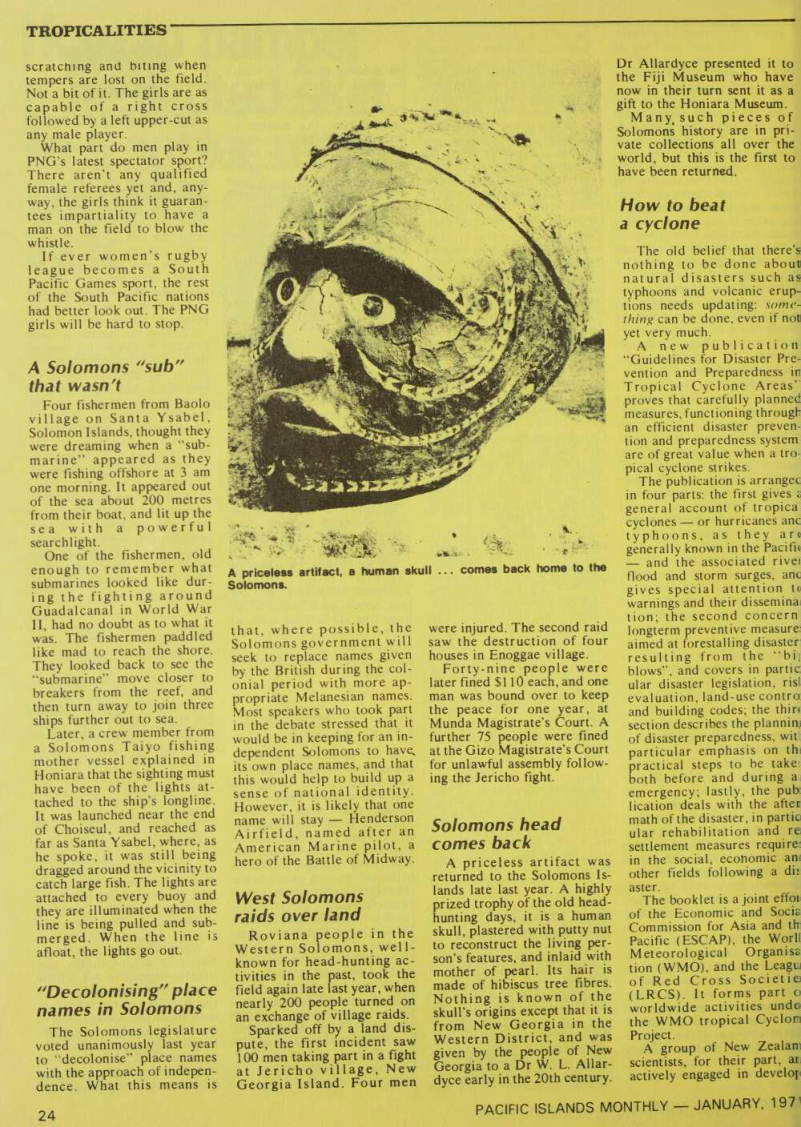
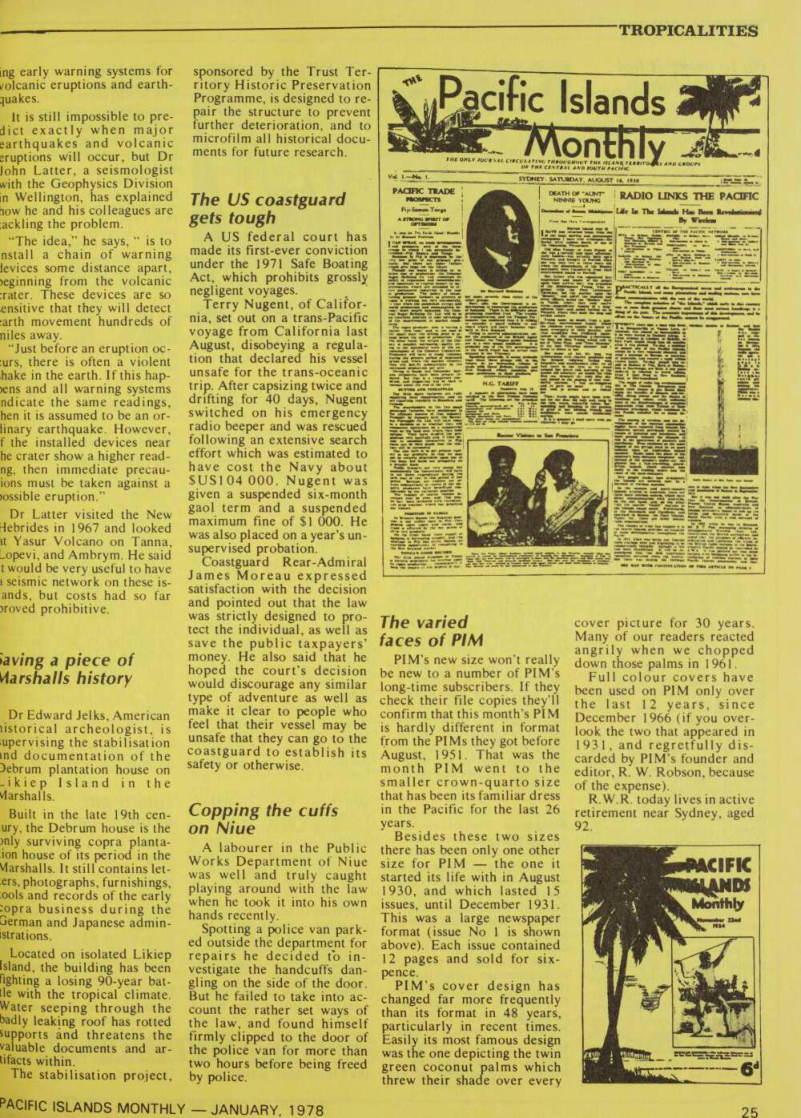
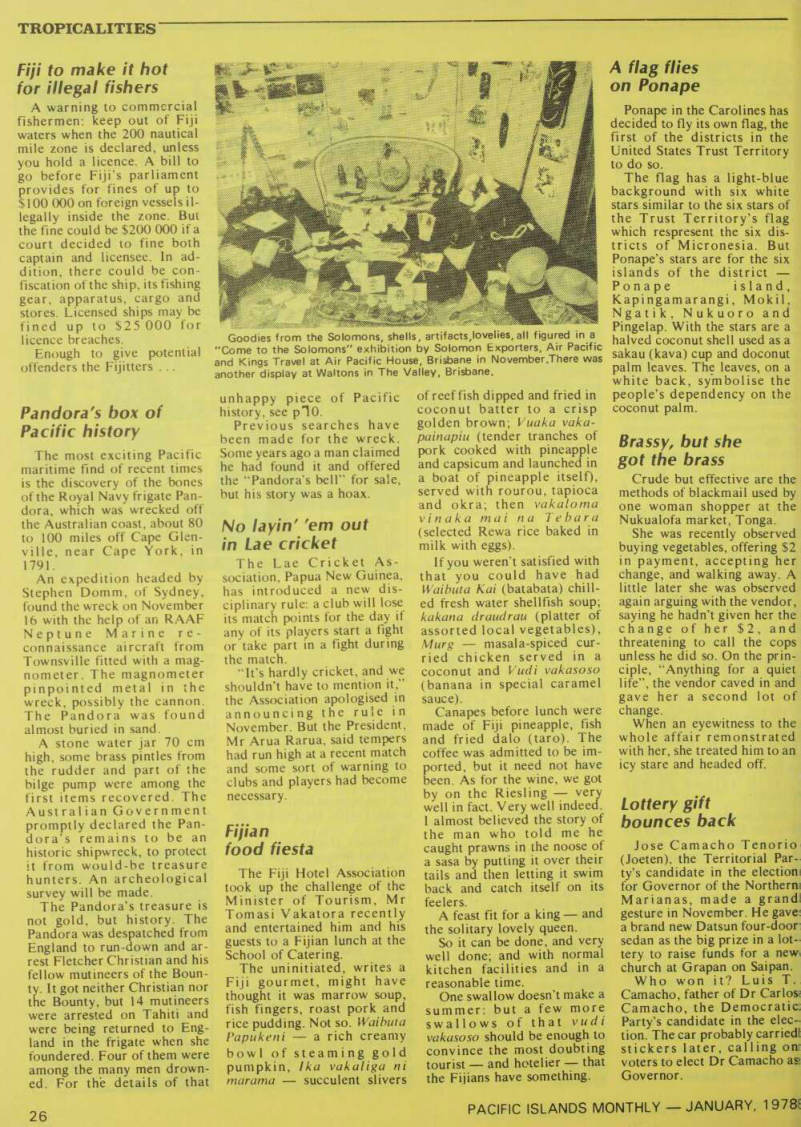
Tropicalities
New Caledonia's
tourist boom
Some French humorists have suggested that since the Caledonian tourist industry is the upswing, the easiest ivay to overcome the nickel dump would be simply to raise tourist charges. And dnee the Japanese have cut he price on nickel ore ship nents from New Caledonia by 14%, an equivalent rise in ourist charges has jokingly been suggested as a counter balance. At the moment, over ;eas visitors are being offered jarticularly attractive rates in Noumea, with a seven-day itay, ex-Sydney, costing iround $3OO including hotel oom and airfare.
The Noumea visit of the french Minister for Tourism, vlr Jacques Medicin, planned or December 1 977, has iroused growing enthusiasm or tourism. Visitor arrival igures reached a record level n 1 977, soaring around 15 000; as nickel grows tar lished, tourism glows.
Recent activities enlivening he visitor industry have in duded the “Safari Caledo lien" annual motor rally in October and the “Carnaval" n November, which has now ilso become an annual affair, fhese events were surrounded >y numerous other inter sland sporting contests and in exchange of visitors be ween two old penal settle nents of the Pacific, New Caledonia and Norfolk Is and.
The exchange of residents between Noumea and Norfolk vas arranged by a special :harter of F 27 Fokker friendship by East-West \irlines, Australia, over the ong All Saints weekend in November. While the Caledo lians made the acquaintance )f the descendants of the Bounty mutineers, the Nor blk Islanders were able to ex perience the interesting con rast of an island that has leveloped in the French tra lition.
Part of that tradition has blossomed in many parts of die world, including the Caribbean, where the islands )f the French Antilles have exported many migrants to Caledonia and with them a revival of the colour ind rhythm of the “Car laval”.
Noumea’s latest and third
“Carnaval" lasted over two weekends in November, honoured by “Miss Carnaval" and her attendants. Festivities included a quest for the most handsome “Mr Muscles” the top contenders were all Polynesians. A colourful pro cession of decorated floats paraded through the streets of Noumea where various enter tainment stalls were organ ised.
The Carnaval was accom panied by varied sporting contests and preceded the previous weekend by the is land’s eleventh annual “Safari Caledonien” motor trial.
Twenty-nine drivers were at the start for this gruelling event which was won by the Australian team Ross Dunkerton-Beaumont in a Datsun. In addition to the im aginable hazards of the rough dirt roads through the Caledonian mountains, dri vers had to change course at the last minute in the south of the island when a nickel op erator inadvertently blocked the road with a great load of dirt from the mines.
The dust-clad Safari cars and drivers were not the only colourful scene in Noumea towards the end of the year.
The local TV station planned a special colour premiere for Caledonian addicts to “the small screen” “le petit ecrun ”.
A special Christmas variety show was filmed around Noumea in colour, featuring local groups of jazz musicians and dancers, from Tahitian to Melanesian and modern ballet. The spectacular local backdrops included Coconut Square in Noumea’s central park, the open-air theatre “Theatre de rile” on Nou peninsular, foreshores of the Caledonian lagoon and the beautiful gardens of Mme Henriette Pentecost on Rocher a la voile, Sailing Rock Point, overlooking Anse Vata beach.
Strip Jack (and
Jill) Naked in Apia
The management acted quickly when SUS 2 200 went missing from the Bank of Western Samoa in Apia. Staff were ordered to remain on the spot and police were called.
Policemen and women un ceremoniously proceeded to strip a dozen male and female clerical staff in a search for
the missing money. It wasn’t found.
The strippees were angry.
One woman claimed the cops hadn’t kept the matter to themselves, and that one per son had pointed her out in the street as someone who’d been stripped in the bank. A man whose wife had been stripped complained that they’d suffered later when people asked her embarrassing and humiliating questions.
The bank management kept mum on the incident. So did Police Commissioner Sir Angus Sharp, who said he was waiting for a report from the Criminal Investigation Branch.
Don't gef bitten
by a Fiji gee-gee
A tourist has written an in dignant letter to Fiji’s Minis try of Tourism complaining about the lack of facilities in his hotel for treating his wife who’d been bitten by a horse when she went to pat it.
Inquiries at the reception desk produced nothing more effective than a packet of bandaids.
Mr Ken Oates, chairman of the Fiji Visitors Board, squirmed. He would only say that hotels were required to keep first aid kits for staff, so there should certainly be some help available for guests. In the meantime, don’t get bitten ...
New tie between
PNG , Aborigines A new strand in a growing network of relationships be tween Australian Aborigines and independent Papua New Guinea was formed last year.
Speaking to an Australian Na tional Press Club luncheon in Canberra in November, Mr Galarrwuy Yunupingu, chair man of the Australian Aborigines’ Northern Land Council, said; “Two months ago I met Father John Momis at a con ference of Pacific peoples in Honiara, Solomon Islands (PIM, Dec. pi 9), and he in vited me to Papua New Guinea, where I met ministers of the government in Port Moresby. Father Momis is a traditional owner of Bougain ville Island, where in 1967 Conzinc Riotinto signed an agreement negotiated by the
Australian Government to mine copper. In 1974, after independence, the agreement was renegotiated by the Papua New Guinea Government, with the advice of interna tional experts.
“The new agreement ex tracted from the company far more justice, in money, con trol and safeguards for the people of Papua New Guinea.
“Today, the Northern Land Council is employing one of these same international ex perts, Mr Stephen Zorn, of New York, who was with us in Darwin last month in the Ranger talks on uranium development. One of our honorary consultants is Dr Ross Garnaut, an Australian in the National University at Canberra.
“Let me remind you that Aboriginal people would prefer to be able to do this professional work for them selves. But, for reasons you might think about, we don’t have our own experienced
professionals yet."
PNG girls' gusto
for Rugby League
Women’s rugby league is the fastest growing sport in Papua New Guinea. The game got started in 1976 and there are now 1 3 teams playing in the Port Moresby city area alone. The girls play the game hard and fast and, with their entertaining style of play, are drawing big crowds of men, women and children.
The girls are well turned out in jerseys, shorts, football socks and boots. As the game warms up spectators near the touch lines have to keep their wits about them as boots are discarded by girls unused to them and hurled from the field.
When a player is laid out following a hard tackle, one usually expects to see a little man race on to the field carry ing his life-saving bucket of cold water and sponge. Not so in PNG women’s rugby league. The job is effectively performed by a stout matron or two. One would expect that there would be hair-pulling,
scratching and biting when tempers are lost on the field.
Not a bit of it. The girls are as capable of a right cross followed by a left upper-cut as any male player.
What part do men play in PNG’s latest spectator sport?
There aren’t any qualified female referees yet and, any way, the girls think it guaran tees impartiality to have a man on the field to blow the whistle.
If ever women’s rugby league becomes a South Pacific Games sport, the rest of the South Pacific nations had better look out. The PNG girls will be hard to stop.
A Solomons "sub"
that wasn't
Four fishermen from Baolo village on Santa Ysabel, Solomon Islands, thought they were dreaming when a “sub marine” appeared as they were fishing offshore at 3 am one morning. It appeared out of the sea about 200 metres from their boat, and lit up the sea with a powerful searchlight.
One of the fishermen, old enough to remember what submarines looked like dur ing the fighting around Guadalcanal in World War 11, had no doubt as to what it was. The fishermen paddled like mad to reach the shore.
They looked back to see the “submarine” move closer to breakers from the reef, and then turn away to join three ships further out to sea.
Later, a crew member from a Solomons Taiyo fishing mother vessel explained in Honiara that the sighting must have been of the lights at tached to the ship’s longline.
It was launched near the end of Choiseul, and reached as far as Santa Ysabel, where, as he spoke, it was still being dragged around the vicinity to catch large fish. The lights are attached to every buoy and they are illuminated when the line is being pulled and sub merged. When the line is afloat, the lights go out.
"Decolonising" place
names in Solomons The Solomons legislature voted unanimously last year to “decolonise” place names with the approach of indepen dence. What this means is
that, where possible, the Solomons government will seek to replace names given by the British during the col onial period with more ap propriate Melanesian names.
Most speakers who took part in the debate stressed that it would be in keeping for an in dependent Solomons to have, its own place names, and that this would help to build up a sense of national identity.
However, it is likely that one name will stay Henderson Airfield, named after an American Marine pilot, a hero of the Battle of Midway.
West Solomons
raids over land
Roviana people in the Western Solomons, well known for head-hunting ac tivities in the past, took the field again late last year, when nearly 200 people turned on an exchange of village raids.
Sparked off by a land dis pute, the first incident saw 100 men taking part in a fight at Jericho village, New Georgia Island. Four men
were injured. The second raid saw the destruction of four houses in Enoggae village.
Forty-nine people were
later fined SI 10 each, and one man was bound over to keep the peace for one year, at Munda Magistrate’s Court. A further 75 people were fined at the Gizo Magistrate’s Court for unlawful assembly follow ing the Jericho fight.
Solomons head
comes back
A priceless artifact was returned to the Solomons Is lands late last year. A highly prized trophy of the old head hunting days, it is a human skull, plastered with putty nut to reconstruct the living per son’s features, and inlaid with mother of pearl. Its hair is made of hibiscus tree fibres.
Nothing is known of the skull’s origins except that it is from New Georgia in the Western District, and was given by the people of New Georgia to a Dr W. L. Allar dyce early in the 20th century.
Dr Allardyce presented it to the Fiji Museum who have now in their turn sent it as a gift to the Honiara Museum.
Many, such pieces of Solomons history are in pri vate collections all over the world, but this is the first to have been returned.
How to beat
a cyclone
The old belief that there’s nothing to be done about natural disasters such as typhoons and volcanic erup tions needs updating; some thing can be done, even if not) yet very much.
A new publication “Guidelines for Disaster Pre vention and Preparedness irr Tropical Cyclone Areas’ proves that carefully planned measures, functioning through an efficient disaster preven tion and preparedness system are of great value when a tro pical cyclone strikes.
The publication is arrangec in four parts: the first gives s general account of tropica cyclones or hurricanes anc typhoons, as they ar« generally known in the Pacific and the associated rivei flood and storm surges, ano gives special attention to warnings and their disseminai tion; the second concern longterm preventive measure; aimed at forestalling disaster resulting from the “bi| blows”, and covers in partic ular disaster legislation, risl. evaluation, land-use contro; and building codes; the thin section describes the planning of disaster preparedness, wit:: particular emphasis on thi practical steps to be take; both before and during aj emergency; lastly, the pub: lication deals with the aften math of the disaster, in partio ular rehabilitation and re settlement measures requires in the social, economic am other fields following a di« aster.
The booklet is a joint effor of the Economic and Sods Commission for Asia and thi Pacific (ESCAP), the WorK Meteorological Organise tion (WMO), and the Leagu of Red Cross Societies (LRCS). It forms part o worldwide activities undo the WMO tropical Cyclom Project.
A group of New Zealam scientists, for their part, aij actively engaged in develop
A priceless artifact, a human skull ... comes back home to the Solomons.
ing early warning systems for /olcanic eruptions and earth quakes.
It is still impossible to pre dict exactly when major earthquakes and volcanic eruptions will occur, but Dr John Latter, a seismologist with the Geophysics Division in Wellington, has explained liow he and his colleagues are ;ackling the problem.
“The idea,” he says, “ is to nstall a chain of warning levices some distance apart, >eginning from the volcanic :rater. These devices are so ensitive that they will detect ;arth movement hundreds of niles away.
“Just before an eruption oc :urs, there is often a violent hake in the earth. If this hap >ens and all warning systems ndicate the same readings, hen it is assumed to be an or linary earthquake. However, f the installed devices near he crater show a higher read ng, then immediate precau ions must be taken against a >ossible eruption.”
Dr Latter visited the New Hebrides in 1967 and looked it Yasur Volcano on Tanna, and Ambrym. He said t would be very useful to have i seismic network on these is ands, but costs had so far )roved prohibitive.
laving a piece of
Marshalls history
Dr Edward Jelks, American listorical archeologist, is upervising the stabilisation md documentation of the )ebrum plantation house on -ikiep Island in the Marshalls.
Built in the late 19th cen ury, the Debrum house is the )nly surviving copra planta ion house of its period in the Marshalls. It still contains let ers, photographs, furnishings, ools and records of the early -opra business during the Jerman and Japanese admin istrations.
Located on isolated Likiep Island, the building has been righting a losing 90-year bat tle with the tropical climate.
Water seeping through the badly leaking roof has rotted supports and threatens the valuable documents and ar tifacts within.
The stabilisation project.
sponsored by the Trust Ter ritory Historic Preservation Programme, is designed to re pair the structure to prevent further deterioration, and to microfilm all historical docu ments for future research.
The US coastguard
gets tough
A US federal court has made its first-ever conviction under the 1971 Safe Boating Act, which prohibits grossly negligent voyages.
Terry Nugent, of Califor nia, set out on a trans-Pacific voyage from California last August, disobeying a regula tion that declared his vessel unsafe for the trans-oceanic trip. After capsizing twice and drifting for 40 days, Nugent switched on his emergency radio beeper and was rescued following an extensive search effort which was estimated to have cost the Navy about SUSIO4 000. Nugent was given a suspended six-month gaol term and a suspended maximum fine of $1 000. He was also placed on a year’s un supervised probation.
Coastguard Rear-Admiral James Moreau expressed satisfaction with the decision and pointed out that the law was strictly designed to pro tect the individual, as well as save the public taxpayers’ money. He also said that he hoped the court’s decision would discourage any similar type of adventure as well as make it clear to people who feel that their vessel may be unsafe that they can go to the coastguard to establish its safety or otherwise.
Copping the cuffs
on Niue
A labourer in the Public Works Department of Niue was well and truly caught playing around with the law when he took it into his own hands recently.
Spotting a police van park ed outside the department for repairs he decided to in vestigate the handcuffs dan gling on the side of the door.
But he failed to take into ac count the rather set ways of the law, and found himself firmly clipped to the door of the police van for more than two hours before being freed by police.
The varied
faces of PIM
PI M’s new size won’t really be new to a number of PI M’s long-time subscribers. If they check their file copies they’ll confirm that this month’s PIM is hardly different in format from the PI Ms they got before August, 1951. That was the month PIM went to the smaller crown-quarto size that has been its familiar dress in the Pacific for the last 26 years.
Besides these two sizes there has been only one other size for PIM the one it started its life with in August 1930, and which lasted 15 issues, until December 1931.
This was a large newspaper format (issue No 1 is shown above). Each issue contained 12 pages and sold for six pence.
PlM’s cover design has changed far more frequently than its format in 48 years, particularly in recent times.
Easily its most famous design was the one depicting the twin green coconut palms which threw their shade over every
cover picture for 30 years.
Many of our readers reacted angrily when we chopped down those palms in 1961.
Full colour covers have been used on PIM only over the last 12 years, since December 1966 (if you over look the two that appeared in 1931, and regretfully dis carded by PI M’s founder and editor, R. W. Robson, because of the expense).
R.W.R. today lives in active retirement near Sydney, aged 92.
Fiji to make it hot
for illegal fishers
A warning to commercial fishermen; keep out of Fiji waters when the 200 nautical mile zone is declared, unless you hold a licence. A bill to go before Fiji’s parliament provides for fines of up to $lOO 000 on foreign vessels il legally inside the zone. But the fine could be $2OO 000 if a court decided to fine both captain and licensee. In ad dition, there could be con fiscation of the ship, its fishing gear, apparatus, cargo and stores. Licensed ships may be fined up to $25 000 for licence breaches.
Enough to give potential offenders the Fijitters ...
Pandora's box of
Pacific history
The most exciting Pacific maritime find of recent times is the discovery of the bones of the Royal Navy frigate Pan dora, which was wrecked off the Australian coast, about 80 to 100 miles off Cape Glen ville, near Cape York, in 1791.
An expedition headed by Stephen Domm, of Sydney, found the wreck on November 16 with the help of an RAAF Neptune Marine re connaissance aircraft from Townsville fitted with a mag nometer. The magnometer pinpointed metal in the wreck, possibly the cannon.
The Pandora was found almost buried in sand.
A stone water jar 70 cm high, some brass pintles from the rudder and part of the bilge pump were among the first items recovered. The Australian Government promptly declared the Pan dora’s remains to be an historic shipwreck, to protect it from would-be treasure hunters. An archeological survey will be made.
The Pandora’s treasure is not gold, but history. The Pandora was despatched from England to run-down and ar rest Fletcher Christian and his fellow mutineers of the Boun ty. It got neither Christian nor the Bounty, but 14 mutineers were arrested on Tahiti and were being returned to Eng land in the frigate when she foundered. Four of them were among the many men drown ed. For the details of that
unhappy piece of Pacific history, see pTO.
Previous searches have been made for the wreck.
Some years ago a man claimed he had found it and offered the “Pandora’s bell” for sale, but his story was a hoax.
No layin' 'em out
in Lae cricket
The Lae Cricket As sociation, Papua New Guinea, has introduced a new dis ciplinary rule; a club will lose its match points for the day if any of its players start a fight or take part in a fight during the match.
It’s hardly cricket, and we shouldn’t have to mention it,” the Association apologised in announcing the rule in November. But the President, Mr Arua Rarua, said tempers had run high at a recent match and some sort of warning to clubs and players had become necessary.
Fijian
food fiesta
The Fiji Hotel Association took up the challenge of the Minister of Tourism, Mr Tomasi Vakatora recently and entertained him and his guests to a Fijian lunch at the School of Catering.
The uninitiated, writes a Fiji gourmet, might have thought it was marrow soup, fish fingers, roast pork and rice pudding. Not so. Waibuta Papukeni a rich creamy bowl of steaming gold pumpkin, Ika vakaliga ni marama succulent slivers
of reef fish dipped and fried in coconut batter to a crisp golden brown; Vuaka vaka painapiu (tender tranches of pork cooked with pineapple and capsicum and launched in a boat of pineapple itself), served with rourou, tapioca and okra; then vakaloma vi n aka mai n a T e bar a (selected Rewa rice baked in milk with eggs).
If you weren't satisfied with that you could have had Waibuta Kai (batabata) chill ed fresh water shellfish soup; kakana draudrau (platter of assorted local vegetables), Murg masala-spiced cur ried chicken served in a coconut and Vudi vakasoso (banana in special caramel sauce).
Canapes before lunch were made of Fiji pineapple, fish and fried dalo (taro). The coffee was admitted to be im ported, but it need not have been. As for the wine, we got by on the Riesling very well in fact. Very well indeed.
I almost believed the story of the man who told me he caught prawns in the noose of a sasa by putting it over their tails and then letting it swim back and catch itself on its feelers.
A feast fit for a king and the solitary lovely queen.
So it can be done, and very well done; and with normal kitchen facilities and in a reasonable time.
One swallow doesn’t make a summer; but a few more swallows of that vudi vakasoso should be enough to convince the most doubting tourist and hotelier that the Fijians have something.
A flag flies
on Ponape
Ponape in the Carolines has decided to fly its own flag, the first of the districts in the United States Trust Territory to do so.
The flag has a light-blue background with six white stars similar to the six stars of the Trust Territory’s flag which respresent the six dis tricts of Micronesia. But Ponape’s stars are for the six islands of the district Ponape island, Kapingamarangi, Mokil, Ngatik, Nukuoro and Pingelap. With the stars are a halved coconut shell used as a sakau(kava)cup and doconut palm leaves. The leaves, on a white back, symbolise the people’s dependency on the coconut palm.
Brassy, but she
got the brass
Crude but effective are the methods of blackmail used by one woman shopper at the Nukualofa market, Tonga.
She was recently observed buying vegetables, offering $2 in payment, accepting her change, and walking away. A little later she was observed again arguing with the vendor, saying he hadn’t given her the change of her $2, and threatening to call the cops unless he did so. On the prin ciple, “Anything for a quiet life”, the vendor caved in and gave her a second lot of change.
When an eyewitness to the whole affair remonstrated with her, she treated him to an icy stare and headed off.
Lottery gift
bounces back
Jose Camacho Tenorio (Joeten). the Territorial Par ty’s candidate in the election! for Governor of the Northern!
Marianas, made a grand! gesture in November. He gave; a brand new Datsun four-door sedan as the big prize in a lot tery to raise funds for a new* church at Grapan on Saipan.
Who won it? Luis T.
Camacho, father of Dr Carlos?
Camacho, the Democratic: Party’s candidate in the elec tion. The car probably carried! stickers later, calling onr voters to elect Dr Camacho as?
Governor.
Goodies from the Solomons, shells, artifacts,lovelies, all figured in a "Come to the Solomons" exhibition by Solomon Exporters, Air Pacific and Kings Travel at Air Pacific House, Brisbane in November. There was another display at Waltons in The Valley, Brisbane.
Advertisements & other items, p. 23 (1 item)
23
*ACIFIC ISLANDS MONTHLY JANUARY, 1978
'In my heart I know
I am not a Papuan’
For seven years, between 1966 and 1973, Percy Chatterton contributed a monthly column of comment to PIM, called successively “To the Point” and “Footnotes”. Its discontinuance was due to the problems which arose when his wife contracted an illness which terminated in her death in 1975. He has now accepted PlM’s invitation to start again, and here is the first of his new series. He comments: “Whether I have been wise to agree to writing it is something which PIM readers will have to make up their minds about as the months go by.”
The four years which have passed since I wrote my last “Footnotes” article have been eventful ones in Papua New Guinea, being the two years immediately preceding and the two immediately following PNG’s attainment of independence. For myself I had always been in favour of early independence, and the experiences of the last four years have not led me to think that I was wrong. True, there are some things going on around me which trouble me deeply. But taking a broad view, Papua New Guinea has made its debut among the free nations of the world in a way of which it may well be proud, and which other emerging nations may well envy. If in this column I may sometimes voice my concern about PNG’s progress, it will be against this backdrop that I would wish my words to be read.
My wife passed away just a month before Independence Day, and almost immediately I was faced with the problem of whether or not to apply for PNG citizenship. I had always thought of myself as likely to be one of the first to do so. But I had been deeply disturbed by the attitude of the Constitutional Planning Committee on the question of naturalisation; and indeed, if their original recommendations had been adopted, I should have had to add another two and a half years to the 51 I had already spent in the country before becoming eligible for citizenship. In the event, the more liberal views of Prime Minister Somare prevailed, but the sour taste of the CPC proposals remained. 1 did not want to be a citizen on sufferance.
For this and other reasons which I need not go into here I decided, after much heart-searching, not to apply for citizenship. I have had no cause to regret my decision, and indeed the suspicion with which many birthright citizens seem to regard their naturalised fellow citizens makes me glad I made it. I am happy to find that I can give my British passport an occasional affectionate pat without any lessening of my love for this land and its people; and if any of them have been shunning me as a “foreigner” I haven’t noticed it.
Indeed, I find myself wondering whether there isn’t something a bit phony about the whole exercise. Is it possible for someone from a completely different cultural background really to identify himself or herself with the outlook and aspirations of the people of this country,
however much he may admire them from outside? I have often been told by local friends, “Oh, but we think of you as a Papuan”; so often, in fact, that I have sometimes almost been persuaded that it was true. But in my heart I know that I am not a Papuan, and never can be, however much I might wish to be.
I have always been against the concept of dual citizenship and still am. But I wonder whether Papua New Guinea would not have been wiser if it had made its conditions for naturalisation quite tough, while being more liberal in allowing non-nationals to take part in the public and commercial, and even in the political, life of the country. To those who say that this would be to allow non-nationals to get more than their share of the cake 1 would point out that the present system has produced a situation in which the ratio of “naturalised” to “automatic” citizens in the country’s chief decision making body, the National Executive Council, is out of all proportion to the corresponding ratio in the country at large.
Be that as it may, my decision not to apply for citizenship has saved me from what would otherwise have been a very real temptation, namely, to try to make a come-back to the PNG political scene at the 1977 elections. Under the electoral law, I would have been eligible to stand for any one of five different electorates. I think that I would have had a fair chance of success, and I would probably have been able to make a useful contribution to parliamentary debate. But I would have been blocking the way for some eager and able young Papuan anxious to embark on a parliamentary career, and this would have made no sense at all.
In this initial article I am introducing myself to some PIM readers and re-introducing myself to others, and so it has taken on a personal tone which I shall try to keep in the background in future contributions. My aim will be to comment on general trends in Papua New Guinea rather than on particular events. If these comments are sometimes critical, they will be so against the background of a continuing loyalty to this country and a continuing confidence in the sanity and wisdom of its people, particularly of the common people of the villages and shanty towns, towards whom my trust and affection will never fail.
Afterthoughts
Political
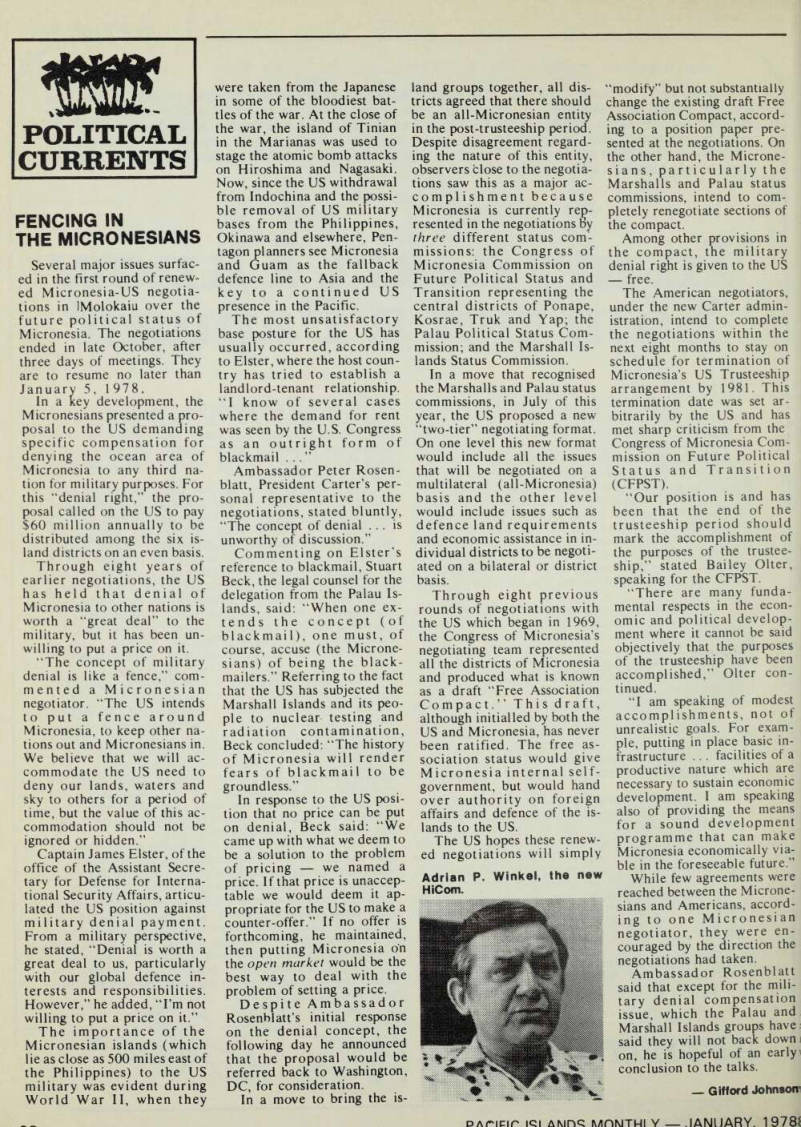
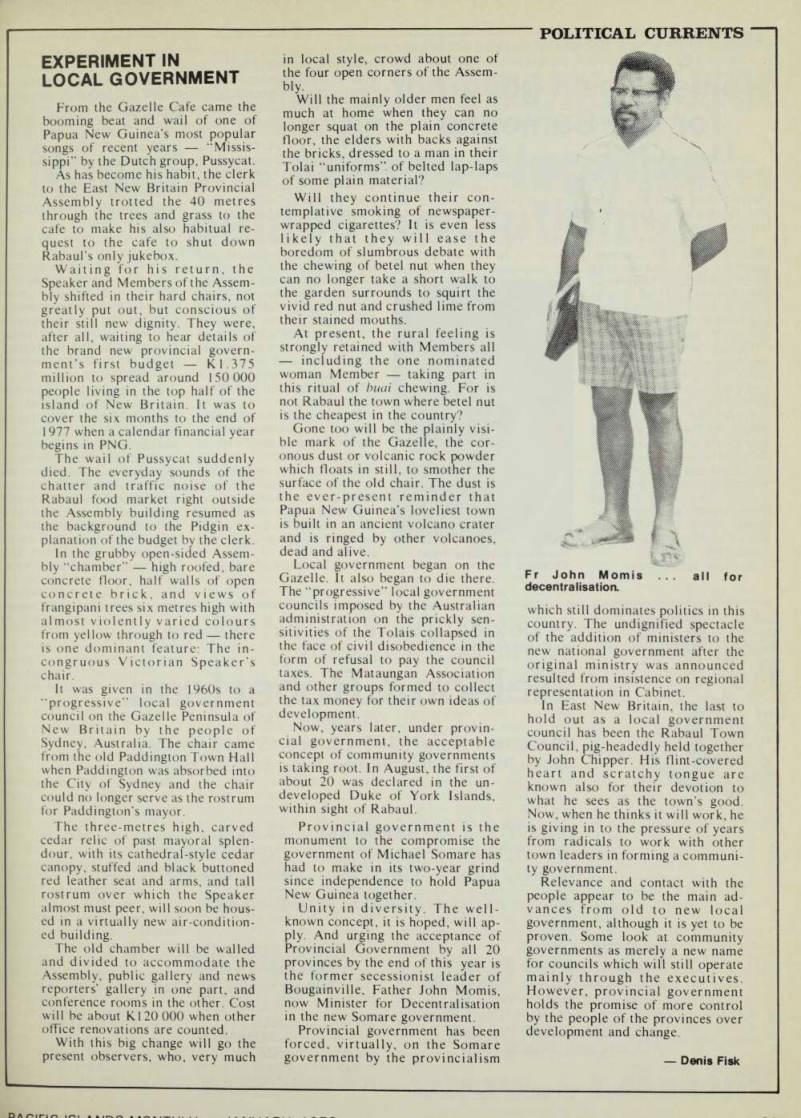
Currents
Fencing In
The Micronesians
Several major issues surfac ed in the first round of renew ed Micronesia-US negotia tions in IMolokaiu over the future political status of Micronesia. The negotiations ended in late October, after three days of meetings. They are to resume no later than
January 5, 1 978,
In a key development, the Micronesians presented a pro posal to the US demanding specific compensation for denying the ocean area of Micronesia to any third na tion for military purposes. For this “denial right,” the pro posal called on the US to pay $6O million annually to be distributed among the six is land districts on an even basis.
Through eight years of earlier negotiations, the US has held that denial of Micronesia to other nations is worth a “great deal” to the military, but it has been un willing to put a price on it.
“The concept of military denial is like a fence,” com mented a Micronesian negotiator. “The US intends to put a fence around Micronesia, to keep other na tions out and Micronesians in.
We believe that we will ac commodate the US need to deny our lands, waters and sky to others for a period of time, but the value of this ac commodation should not be ignored or hidden.”
Captain James Elster, of the office of the Assistant Secre tary for Defense for Interna tional Security Affairs, articu lated the US position against military denial payment.
From a military perspective, he stated, “Denial is worth a great deal to us, particularly with our global defence in terests and responsibilities.
However,” he added, “I’m not willing to put a price on it.”
The importance of the Micronesian islands (which lie as close as 500 miles east of the Philippines) to the US military was evident during World War 11, when they
were taken from the Japanese in some of the bloodiest bat tles of the war. At the close of the war, the island of Tinian in the Marianas was used to stage the atomic bomb attacks on Hiroshima and Nagasaki.
Now, since the US withdrawal from Indochina and the possi ble removal of US military bases from the Philippines, Okinawa and elsewhere, Pen tagon planners see Micronesia and Guam as the fallback defence line to Asia and the key to a continued US presence in the Pacific.
The most unsatisfactory base posture for the US has usually occurred, according to Elster, where the host coun try has tried to establish a landlord-tenant relationship.
'I know of several cases where the demand for rent was seen by the U.S. Congress as an outright form of blackmail ...”
Ambassador Peter Rosen blatt, President Carter’s per sonal representative to the negotiations, stated bluntly, “The concept of denial ... is unworthy of discussion.”
Commenting on Elster’s reference to blackmail, Stuart Beck, the legal counsel for the delegation from the Palau Is lands, said; “When one ex tends the concept (of blackmail), one must, ot course, accuse (the Microne sians) of being the black mailers.” Referring to the fact that the US has subjected the Marshall Islands and its peo ple to nuclear testing and radiation contamination, Beck concluded; “The history of Micronesia will render fears of blackmail to be groundless.”
In response to the US posi tion that no price can be put on denial, Beck said. “We came up with what we deem to be a solution to the problem of pricing we named price. If that price is unaccep table we would deem it ap propriate for the US to make a counter-offer.” If no offer is forthcoming, he maintained, then putting Micronesia bn the open market would be the best way to deal with the problem of setting a price.
Despite Ambassador Rosenblatt’s initial response on the denial concept, the following day he announced that the proposal would be referred back to Washington, DC, for consideration.
In a move to bring the is
land groups together, all dis tricts agreed that there should be an all-Micronesian entity in the post-trusteeship period.
Despite disagreement regard ing the nature of this entity, observers close to the negotia tions saw this as a major ac complishment because Micronesia is currently rep resented in the negotiations by three different status com missions: the Congress of Micronesia Commission on Future Political Status and Transition representing the central districts of Ponape, Kosrae, Truk and Yap; the Palau Political Status Com mission; and the Marshall Is lands Status Commission.
In a move that recognised the Marshalls and Palau status commissions, in July of this year, the US proposed a new “two-tier” negotiating format.
On one level this new format would include all the issues that will be negotiated on a multilateral (all-Micronesia) basis and the other level would include issues such as defence land requirements and economic assistance in in dividual districts to be negoti ated on a bilateral or district basis.
Through eight previous rounds of negotiations with the US which began in 1969, the Congress of Micronesia’s negotiating team represented all the districts of Micronesia and produced what is known as a draft “Free Association Compact.” This draft although initialled by both the US and Micronesia, has never been ratified. The free as sociation status would give Micronesia internal self government, but would hand over authority on foreign affairs and defence of the is lands to the US.
The US hopes these renew ed negotiations will simply
“modify” but not substantially change the existing draft Free Association Compact, accord ing to a position paper pre sented at the negotiations. On the other hand, the Microne sians, particularly the Marshalls and Palau status commissions, intend to com pletely renegotiate sections of the compact.
Among other provisions in the compact, the military denial right is given to the US free.
The American negotiators, under the new Carter admin istration, intend to complete the negotiations within the next eight months to stay on schedule for termination of Micronesia’s US Trusteeship arrangement by 1981. This termination date was set ar bitrarily by the US and has met sharp criticism from the Congress of Micronesia Com mission on Future Political Status and Transition
(Cfpst).
“Our position is and has been that the end of the trusteeship period should mark the accomplishment of the purposes of the trustee ship,” stated Bailey Olter, speaking for the CFPST.
“There are many funda mental respects in the econ omic and political develop ment where it cannot be said objectively that the purposes of the trusteeship have been accomplished,” Olter con tinued.
“I am speaking of modest accomplishments, not of unrealistic goals. For exam ple, putting in place basic in frastructure ... facilities of a productive nature which are necessary to sustain economic development. I am speaking also of providing the means for a sound development programme that can make Micronesia economically via ble in the foreseeable future.”
While few agreements were reached between the Microne sians and Americans, accord ing to one Micronesian negotiator, they were en couraged by the direction the negotiations had taken.
Ambassador Rosenblatt said that except for the mili tary denial compensation issue, which the Palau and Marshall Islands groups have said they will not back down on, he is hopeful of an early conclusion to the talks.
Gifford Johnson[?]
Adrian P. Winkel, the new HiCom.
Experiment In
Local Government
From the Gazelle Cafe came the booming beat and wail of one of Papua New Guinea’s most popular songs of recent years “Missis sippi” by the Dutch group, Pussycat.
As has become his habit, the clerk to the East New Britain Provincial Assembly trotted the 40 metres through the trees and grass to the cafe to make his also habitual re quest to the cafe to shut down Rabaul’s only jukebox.
Waiting for his return, the Speaker and Members of the Assem bly shifted in their hard chairs, not greatly put out, but conscious of their still new dignity. They were, after all, waiting to hear details of the brand new provincial govern ment’s first budget K 1.375 million to spread around 150 000 people living in the top half of the island of New Britain. It was to cover the six months to the end of 1977 when a calendar financial year begins in PNG.
The wail of Pussycat suddenly died. The everyday sounds of the chatter and traffic noise of the Rabaul food market right outside the Assembly building resumed as the background to the Pidgin ex planation of the budget by the clerk.
In the grubby open-sided Assem bly “chamber” high roofed, bare concrete floor, half walls of open concrete brick, and views of frangipani trees six metres high with almost violently varied colours from yellow through to red there is one dominant feature; The in congruous Victorian Speaker’s chair.
It was given in the 1960 s to a “progressive” local government council on the Gazelle Peninsula of New Britain by the people of Sydney, Australia. The chair came from the old Paddington Town Hall when Paddington was absorbed into the City of Sydney and the chair could no longer serve as the rostrum for Paddington’s mayor.
The three-metres high, carved cedar relic of past mayoral splen dour, with its cathedral-style cedar canopy, stuffed and black buttoned red leather seat and arms, and tall rostrum over which the Speaker almost must peer, will soon be hous ed in a virtually new air-condition ed building.
The old chamber will be walled and divided to accommodate the Assembly, public gallery and news reporters’ gallery in one part, and conference rooms in the other. Cost will be about Kl2O 000 when other office renovations are counted.
With this big change will go the present observers, who, very much
in local style, crowd about one of the four open corners of the Assem bly.
Will the mainly older men feel as much at home when they can no longer squat on the plain concrete floor, the elders with backs against the bricks, dressed to a man in their Tolai “uniforms”, of belted lap-laps of some plain material?
Will they continue their con templative smoking of newspaper wrapped cigarettes? It is even less likely that they will ease the boredom of slumbrous debate with the chewing of betel nut when they can no longer take a short walk to the garden surrounds to squirt the vivid red nut and crushed lime from their stained mouths.
At present, the rural feeling is strongly retained with Members all including the one nominated woman Member taking part in this ritual of huai chewing. For is not Rabaul the town where betel nut is the cheapest in the country?
Gone too will be the plainly visi ble mark of the Gazelle, the cor onous dust or volcanic rock powder which floats in still, to smother the surface of the old chair. The dust is the ever-present reminder that Papua New Guinea’s loveliest town is built in an ancient volcano crater and is ringed by other volcanoes, dead and alive.
Local government began on the Gazelle. It also began to die there.
The “progressive” local government councils imposed by the Australian administration on the prickly sen sitivities of the Tolais collapsed in the face of civil disobedience in the form of refusal to pay the council taxes. The Mataungan Association and other groups formed to collect the tax money for their own ideas of development.
Now, years later, under provin cial government, the acceptable concept of community governments is taking root. In August, the first of about 20 was declared in the un developed Duke of York Islands, within sight of Rabaul.
Provincial government is the monument to the compromise the government of Michael Somare has had to make in its two-year grind since independence to hold Papua New Guinea together.
Unity in diversity. The well known concept, it is hoped, will ap ply. And urging the acceptance of Provincial Government by all 20 provinces by the end of this year is the former secessionist leader of Bougainville, Father John Momis, now Minister for Decentralisation in the new Somare government.
Provincial government has been forced, virtually, on the Somare government by the provincialism
which still dominates politics in this country. The undignified spectacle of the addition of ministers to the new national government after the original ministry was announced resulted from insistence on regional representation in Cabinet.
In East New Britain, the last to hold out as a local government council has been the Rabaul Town Council, pig-headedly held together by John Chipper. His flint-covered heart and scratchy tongue are known also for their devotion to what he sees as the town’s good.
Now, when he thinks it will work, he is giving in to the pressure of years from radicals to work with other town leaders in forming a communi ty government.
Relevance and contact with the people appear to be the main ad vances from old to new local government, although it is yet to be proven. Some look at community governments as merely a new name for councils which will still operate mainly through the executives.
However, provincial government holds the promise of more control by the people of the provinces over development and change.
Denis Fisk
Fr John Momis ... all for decentralisation.
Advertisements & other items, pp. 28-29 (2 items)
28
DAnnr iqi amhq momthi Y JANUARY. 1 978 J
Political Currents
Home-grown governor
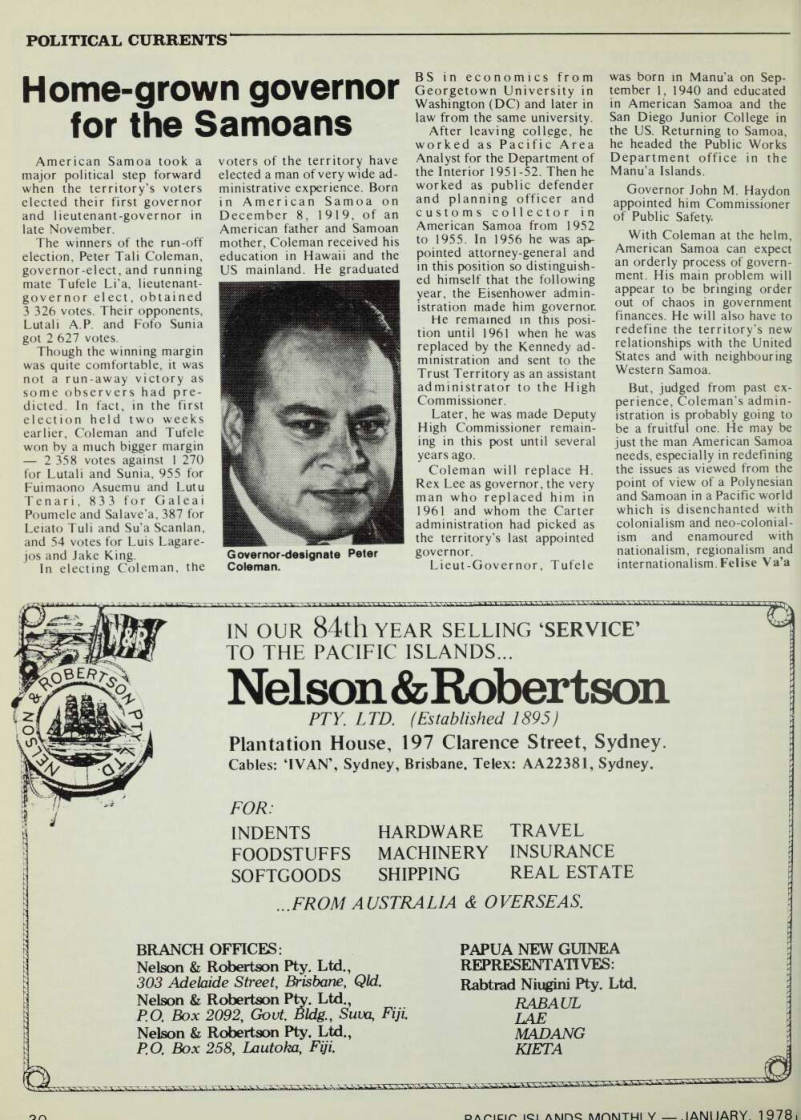
for the Samoans
American Samoa took a major political step forward when the territory’s voters elected their first governor and lieutenant-governor in late November.
The winners of the run-off election, Peter Tali Coleman, governor-elect, and running mate Tufele Li’a, lieutenant governor elect, obtained 3 326 votes. Their opponents, Lutali A.P. and Fofo Sunia got 2 627 votes.
Though the winning margin was quite comfortable, it was not a run-away victory as some observers had pre dicted. In fact, in the first election held two weeks earlier, Coleman and Tufele won by a much bigger margin 2 358 votes against 1 270 for Lutali and Sunia, 955 for Fuimaono Asuemu and Lutu Tenari, 83 3 for Galeai Poumele and Salave’a, 387 for Leiato Tuli and Su’a Scanlan, and 54 votes for Luis Lagare jos and Jake King.
In electing Coleman, the
voters of the territory have elected a man of very wide ad ministrative experience. Born in American Samoa on December 8, 1919, of an American father and Samoan mother, Coleman received his education in Hawaii and the US mainland. He graduated
BS in economics from Georgetown University in Washington (DC) and later in law from the same university.
After leaving college, he worked as Pacific Area Analyst for the Department of the Interior 1951-52. Then he worked as public defender and planning officer and customs collector in American Samoa from 1952 to 1955. In 1956 he was appointed attorney-general and in this position so distinguished himself that the following year, the Eisenhower administration made him governor, He remained in this position until 1961 when he was replaced by the Kennedy administration and sent to the Trust Territory as an assistant administrator to the High Commissioner.
Later, he was made Deputy High Commissioner remaining in this post until several years ago.
Coleman will replace H.
Rex Lee as governor, the very man who replaced him in 1961 and whom the Carter administration had picked as the territory’s last appointed governor.
Lieut-Governor, Tufele
was born in Manu’a on Sep tember 1, 1940 and educated in American Samoa and the San Diego Junior College in the US. Returning to Samoa, he headed the Public Works Department office in the Manu’a Islands.
Governor John M. Haydon appointed him Commissioner of Public Safety.
With Coleman at the helm, American Samoa can expect an orderly process of govern ment. His main problem will appear to be bringing order out of chaos in government finances. He will also have to redefine the territory’s new relationships with the United States and with neighbouring Western Samoa.
But, judged from past ex perience, Coleman’s admin istration is probably going to be a fruitful one. He may be just the man American Samoa needs, especially in redefining the issues as viewed from the point of view of a Polynesian and Samoan in a Pacific world which is disenchanted with colonialism and neo-colonial ism and enamoured with nationalism, regionalism and internationalism.Felise Va’a
Governor-designate Peter Coleman.
Advertisements & other items, p. 30 (2 items)
Political Currents
30
□ apicip ici AMnQ momtui Y —JANUARY. 1978
Nelson & Robertson
m.
mzsm
-o 2: o r* v 6/ o
IN OUR 84th YEAR SELLING ‘SERVICE’
TO THE PACIFIC ISLANDS...
Nelson & Robertson
PTY. LTD. (Established 1895)
Plantation House, 197 Clarence Street, Sydney.
Cables: ‘IVAN’, Sydney, Brisbane. Telex: AA22381, Sydney.
FOR:
INDENTS HARDWARE TRAVEL
FOODSTUFFS MACHINERY INSURANCE
SOFTGOODS SHIPPING REAL ESTATE
...FROM AUSTRALIA & OVERSEAS.
BRANCH OFFICES:
Nelson & Robertson Pty. Ltd., 303 Adelaide Street, Brisbane, Qld.
Nelson & Robertson Pty. Ltd., P.O. Box 2092, Govt. Bldg., Suva, Fiji.
Nelson & Robertson Pty. Ltd., P.O. Box 258, Lautoha, Fiji.
PAPUA NEW GUINEA
REPRESENTATIVES:
Rabtrad Niugini Pty. Ltd.
RABAUL
LAE
MADANG
KIETA
o_ .xv ,x .v. x..v.v.
a palace revolution

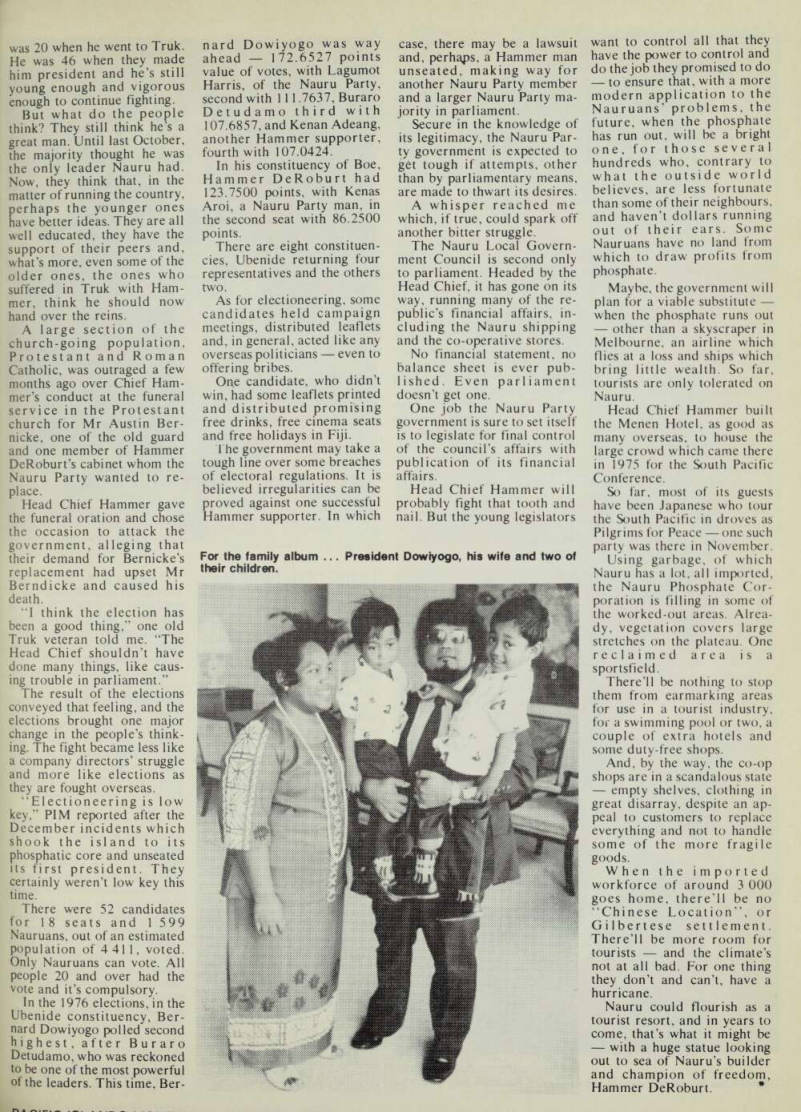
Nauruans vote to “legalise” a palace revolution
One thousand five hundred and ninety-nine Nauruans went to the polls on November 12 to elect 18 members of the Nauru Parliament. Head Chief Hammer Deßoburt, ex-President of the Nauru Republic, who was voted out of office in December, 1976 by the new Nauru Party, an alliance mainly of younger Nauruans, because he refused to energise his Cabinet through an infusion of younger blood, had challenged the new government, aMeging that it was unconstitutional. The Nauru Party accepted the challenge and went to the people. PIM s editor John Carter, who arrived in Nauru when the smoke of battle was thickest, tells the story.
Tuesday, November 15, was a sad day for Nauru’s Head Chief Hammer Deßoburt. He had persuaded himself, and others, that he was the rightful president; that his eclipse 11 months before and the defeat of his government were un constitutional acts.
The people, he argued over the months, had voted for 18 members of the Nauru Parlia ment and, because there had never been any other sugges tion since May, 1968, that anyone should be President, they expected he would be re elected.
The Nauru Party, headed by ex-Ballarat (Victoria) Col lege boy and law student Ber nard Dowiyogo (31), was just a little self-conscious over the matter, though being in no doubt that theirs was a con stitutional government.
“Let the people decide in an election with a clear-cut issue,” demanded Hammer Deßoburt and his Opposition.
So the Nauru Party stuck its neck out and went to the peo ple. The people decided “Go back and govern”.
The House was as before when Nauru’s fifth Parliament met in the afternoon of November 15 nine Nauru Party members with one inde pendent member sitting with them, and eight others, Ham mer Deßoburt and seven sup porters. The public gallery, glass-partitioned off from the chamber and fitted with a public address system, was full. It holds about 80.
It was all over in under the hour. Independent David Peter Gadaraoa was re elected Speaker. He is a Nauru Party supporter at present and, in the event of a tie, can use a casting vote.
Nauru Party member Leo Keke, a barrister, became
Deputy Speaker. There were
no contests. The ex-Deputy Speaker, Derog Gioura, was a casualty of the electoral bat tle.
Then came nominations for President first nomination, Bernard Dowiyogo; second nomination, Hammer Deßoburt. Both accepted nomination.
It was all so matter-of-fact.
The ballot papers went around. Five minutes later Bernard Dowiyogo was again President of Nauru by nine votes to eight.
There was some desultory applause from the galley full of young Nauruans and three greyheads, Europeans.
The president congratu lated the Speaker on his elec tion and all the members for their success in the elections and added; “I hope we all work for the benefit of the'Re public of Nauru.”
And that was that. Head Chief Hammer Deßoburt said nothing. The people had had their say.
Isolated, only 26 miles below the Equator, Nauru says little to the outside world, at least about its politics. The news of the dis solution of Parliament in Oc tober was slow in leaking out.
What had caused it was far from clear.
Maybe it was an accident that PIM failed to receive several copies of the re public’s only news sheet, the government-run Bulletin, which is now published fortnightly.
One Australian newspaper suggested the government re signed because of financial difficulties. Actually, apart from some criticism over the government’s plan to borrow more than $22 million over seas, there were no financial difficulties preventing Presi dent Dowiyogo and his government from continuing to govern.
The sole reason why the President dissolved Parlia ment was to seek a mandate from the people in the face of the implacable opposition of the ex-president.
True, the Opposition twice walked out of the Committee of Supply meetings, leaving it without a quorum. Govern ment members walked out once. But the government had the answer to that problem a new Supply Act passed on June 9. It was intended to give parliament full power in financial matters and, in the event of more antics in Sup ply, to bypass the committee.
The Opposition challenged the legality of the new Act in the Nauru Supreme Court and lost.
Parliament could have
passed the Appropriations
Bill giving effect to the pro visions of the Budget, the Nauru Party having a majority of one. The Appropriations Bill reached its third, and last, reading.
Then the government re
signed.
There had been uproar in the House. Several times there was violence, tables over thrown, chairs dumped on ta bles, banging and thumping.
And above it all the cry from the Opposition that every thing the government did was illegal.
Even the public gallery, in side its sound-proofed bubble, kicked up a commotion.
“What could we do?” one Nauru Party member asked me. “Our legitimacy was in question and had been ever since we came to power.
Everything was questioned
because the people didn’t know that the president would be changed. To be constitu tional wasn’t enough. Had we legality to govern?
“That’s why we put our heads on the block, knowing the popularity and ability of the former president.
“On the results of Satur day’s elections we stand. Now we can go ahead and govern.
Nauru has found us ‘not guil ty’.”
What happens now?
The issue has divided the
Nauruans and there has been a lot of ill-feeling. But the Nauruans have been divided before a century and more ago when inter-tribal warfare
prevented a population ex
plosion.
There is a chance, however, that all, or almost all, will ac cept the result of the elections and that party politics in Nauru to stay, I think will lose their sting. A lot depends on Head Chief Hammer Deßoburt. He’s a busy man and hasn’t broadcast his feel ings about the result.
He can no longer accuse the government of being illegal.
He may bide his time until the next election, in three years’ time, if nothing untoward happens.
There will be arguments.
Hammer Deßoburt is still Head Chief. He is still power ful, exercising that power from the million dollar-plus Civic Centre where he presides over the Nauru Local Government Council. He suffered, as did many of his supporters, at the hands of the Japanese who shipped him and so many other to Truk in Micronesia as slaves of their war machine. Only half about 700, including Hammer came back.
He fought the governments of Britain, Australia and New Zealand and the gnomes of high finance who had robbed the Nauruans for so long of their only treasure, the phosphate. He fought for Nauru’s independence and won.
For that, and for his many sterling qualities, they made him President in May, 1968, and twice re-elected him. He rode high all the time, im perious, reluctant to delegate, ready to supplant parliament and overrule cabinet deci sions when they didn’t please him.
All that ended in Decem ber, 1976, but the Head Chief wouldn’t accept the fact. He
was 20 when he went to Truk.
He was 46 when they made him president and he’s still young enough and vigorous enough to continue fighting.
But what do the people think? They still think he’s a great man. Until last October, the majority thought he was the only leader Nauru had.
Now, they think that, in the matter of running the country, perhaps the younger ones have better ideas. They are all well educated, they have the support of their peers and, what’s more, even some of the older ones, the ones who suffered in Truk with Ham mer, think he should now hand over the reins.
A large section of the
church-going population,
Protestant and Roman Catholic, was outraged a few months ago over Chief Ham mer’s conduct at the funeral service in the Protestant church for Mr Austin Ber nicke, one of the old guard and one member of Hammer Deßoburt’s cabinet whom the Nauru Party wanted to re place.
Head Chief Hammer gave the funeral oration and chose the occasion to attack the government, alleging that their demand for Bernicke’s replacement had upset Mr Berndicke and caused his death.
“I think the election has been a good thing,” one old Truk veteran told me. “The Head Chief shouldn’t have done many things, like caus ing trouble in parliament.”
The result of the elections conveyed that feeling, and the elections brought one major change in the people’s think ing. The fight became less like a company directors’ struggle and more like elections as they are fought overseas. ‘‘Electioneering is low key,” PIM reported after the December incidents which shook the island to its phosphatic core and unseated its first president. They certainly weren’t low key this time.
There were 52 candidates for 1 8 seats and 1 599 Nauruans, out of an estimated population of 4 411, voted.
Only Nauruans can vote. All people 20 and over had the vote and it’s compulsory.
In the 1976 elections, in the Übenide constituency, Ber nard Dowiyogo polled second highest, after Buraro Detudamo, who was reckoned to be one of the most powerful of the leaders. This time, Ber
nard Dowiyogo was way ahead 172.6527 points value of votes, with Lagumot Harris, of the Nauru Party, second with 11 1.7637, Buraro Detudamo third with 107.6857, and Kenan Adeang, another Hammer supporter, fourth with 107.0424.
In his constituency of Boe, Hammer Deßoburt had 123.7500 points, with Kenas Aroi, a Nauru Party man, in the second seat with 86.2500 points.
There are eight constituen cies, Übenide returning four representatives and the others two.
As for electioneering, some candidates held campaign meetings, distributed leaflets and, in general, acted like any overseas politicians even to offering bribes.
One candidate, who didn’t win, had some leaflets printed and distributed promising free drinks, free cinema seats and free holidays in Fiji. 1 he government may take a tough line over some breaches of electoral regulations. It is believed irregularities can be proved against one successful Hammer supporter. In which
case, there may be a lawsuit and, perhaps, a Hammer man unseated, making way for another Nauru Party member and a larger Nauru Party ma jority in parliament.
Secure in the knowledge of its legitimacy, the Nauru Par ty government is expected to get tough if attempts, other than by parliamentary means, are made to thwart its desires.
A whisper reached me which, if true, could spark off another bitter struggle.
The Nauru Local Govern ment Council is second only to parliament. Headed by the Head Chief, it has gone on its way, running many of the re public’s financial affairs, in cluding the Nauru shipping and the co-operative stores.
No financial statement, no balance sheet is ever pub lished. Even parliament doesn’t get one.
One job the Nauru Party government is sure to set itself is to legislate for final control of the council’s affairs with publication of its financial affairs.
Head Chief Hammer will probably fight that tooth and nail. But the young legislators
want to control all that they have the power to control and do the job they promised to do to ensure that, with a more modern application to the Nauruans’ problems, the future, when the phosphate has run out, will be a bright one, for those several hundreds who, contrary to what the outside world believes, are less fortunate than some of their neighbours, and haven’t dollars running out of their ears. Some Nauruans have no land from which to draw profits from
phosphate.
Maybe, the government will plan for a viable substitute when the phosphate runs out other than a skyscraper in Melbourne, an airline which flies at a loss and ships which bring little wealth. So far, tourists are only tolerated on Nauru.
Head Chief Hammer built the Menen Hotel, as good as many overseas, to house the large crowd which came there in 1975 for the South Pacific Conference.
So far, most of its guests have been Japanese who tour the South Pacific in droves as Pilgrims for Peace one such party was there in November.
Using garbage, of which Nauru has a lot, all imported, the Nauru Phosphate Cor poration is filling in some of the worked-out areas. Alrea dy, vegetation covers large stretches on the plateau. One reclaimed area is a sportsfield.
There’ll be nothing to stop them from earmarking areas for use in a tourist industry, for a swimming pool or two, a couple of extra hotels and
some duty-free shops.
And, by the way, the co-op shops are in a scandalous state empty shelves, clothing in great disarray, despite an ap peal to customers to replace everything and not to handle some of the more fragile goods.
When the imported workforce of around 3 000 goes home, there’ll be no ‘‘Chinese Location”, or Gilbertese settlement.
There’ll be more room for tourists and the climate’s not at all bad. For one thing they don’t and can’t, have a hurricane.
Nauru could flourish as a tourist resort, and in years to come, that’s what it might be with a huge statue looking out to sea of Nauru’s builder and champion of freedom, Hammer Deßoburt.
For the family album ... President Dowiyogo, his wife and two of their children.
Advertisements & other items, pp. 31-32 (3 items)
Da r'inA iss i a a ■
__ . ... v / iak ii i a n\/ 1 nio
. ... v / iak ii i a n\/ 1 nio
Goodyear
G 8
CROSS PLY TYRE
G 8 offers you improved wetskid protection smoother handling and quieter softer ride. Three choices: G 8 Custom G 8 Super Cushion G 8 * m
GOOD-YEAR
0800
RADIAL PLY TYRE
You get extra tyre toughness, longer tread life and more fuel economy from Goodyear GBOO, Custom GBOO Rib or GBOO Grand Prix.
Richard Piens & Co , Ltd Colombo. SRI LANKA Nepal Motor Company (P) Ltd Biratnagar, NEPAL Navana Ltd
Dacca. BANGLADESH
Diethelm & Co . Ltd Bangkok. THAILAND Landis Brothers & Co. Ltd.
HONG KONG
Guam Tire & Supply Co.
Agana. GUAM GOODYEAR DISTRIBUTORS IN S.E. ASIA AND PACIFIC BASIN.
Ngiratkel Etpizon Co. Ltd Koror. PALAU Boroko Motors Ltd Port Moresby. PAPUA NEW GUINEA Susupe Enterprises Saipan MARIANA IS Nicrgl Corporation Saipan MARIANA IS Truk Trading Co
Truk, E CAROLINE IS
PA M I
Kolonia. PONAPE Island Transport Service Co.
Majuro MARSHALL IS Yap Cooperative Ass
Yap W CAROLINE IS
Cook Islands Motor Centre Rarotonga COOK IS Honiara, B S I P Santo Engineers
Santo NEW HEBRIDES
Pacific Motor?
Vila NEW HEBRIDES
S G A
Noumea. NEW CALEDONIA
Duncombe Bay Garage
NORFOLK IS
Coral Island Motors Suva. FIJI Morris Hedstrom Ltd Nukualofa, TONGA Morris Hedstrom Ltd.
Apia, WESTERN SAMOA
W.ST.C.S.
Apia WESTERN SAMOA
Samoa Motors Inc.
Pago Pago AMERICAN SAMOA
Service Mobil Papeete. TAHITI 171-0141
People
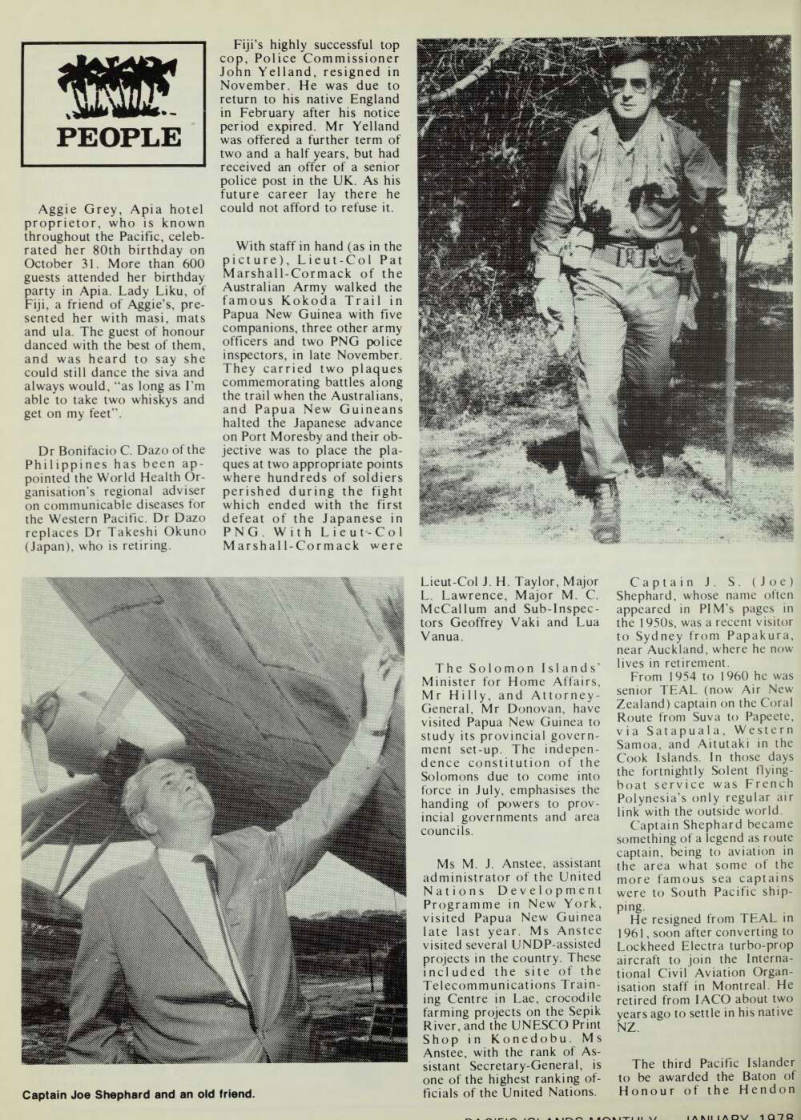
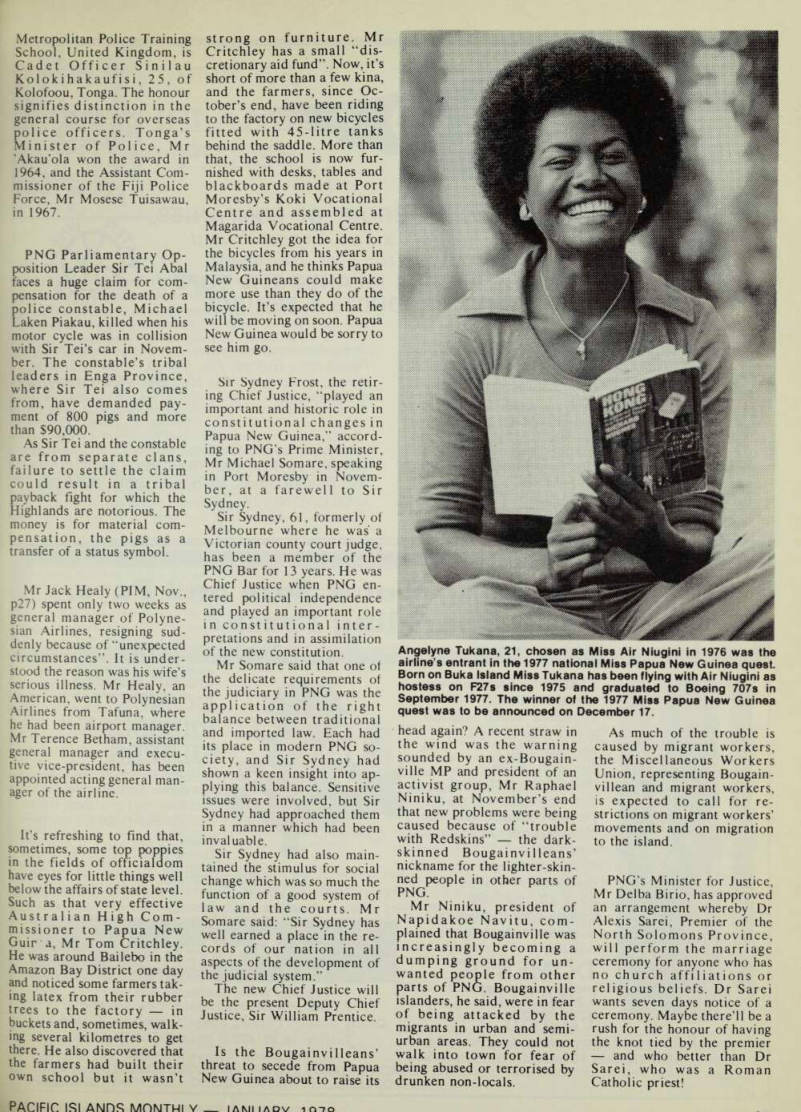
Fiji’s highly successful top cop, Police Commissioner John Yelland, resigned in November. He was due to return to his native England in February after his notice period expired. Mr Yelland was offered a further term of two and a half years, but had received an offer of a senior police post in the UK. As his future career lay there he could not afford to refuse it.
With staff in hand (as in the picture), Lieut-Col Pat Marshall-Cormack of the Australian Army walked the famous Kokoda Trail in Papua New Guinea with five companions, three other army officers and two PNG police inspectors, in late November.
They carried two plaques commemorating battles along the trail when the Australians, and Papua New Guineans halted the Japanese advance on Port Moresby and their ob jective was to place the pla ques at two appropriate points where hundreds of soldiers perished during the fight which ended with the first defeat of the Japanese in PNG. With Lieut-Col Marshall-Cormack were
Aggie Grey, Apia hotel proprietor, who is known throughout the Pacific, celebrated her 80th birthday on October 31. More than 600 guests attended her birthday party in Apia. Lady Liku, of Fiji, a friend of Aggie’s, presented her with masi, mats and ula. The guest of honour danced with the best of them, and was heard to say she could still dance the siva and always would, “as long as I’m able to take two whiskys and get on my feet”.
Dr Bonifacio C. Dazo of the Philippines has been appointed the World Health Organisation’s regional adviser on communicable diseases for the Western Pacific. Dr Dazo replaces Dr Takeshi Okuno (Japan), who is retiring.
Lieut-Col J. H. Taylor, Major L. Lawrence, Major M. C.
McCallum and Sub-Inspec tors Geoffrey Vaki and Lua Vanua.
The Solomon Islands’
Minister for Home Affairs, Mr Hilly, and Attorney- General, Mr Donovan, have visited Papua New Guinea to study its provincial govern ment set-up. The indepen dence constitution of the Solomons due to come into force in July, emphasises the handing of powers to prov incial governments and area councils.
Ms M. J. Anstee, assistant administrator of the United Nations Development Programme in New York, visited Papua New Guinea late last year. Ms Anstee visited several UNDP-assisted projects in the country. These included the site of the Telecommunications Train ing Centre in Lae, crocodile farming projects on the Sepik River, and the UNESCO Print Shop in Konedobu. Ms Anstee, with the rank of As sistant Secretary-General, is one of the highest ranking of ficials of the United Nations.
Captain J. S. (Joe) Shephard, whose name often appeared in PI M’s pages in the 19505, was a recent visitor to Sydney from Papakura, near Auckland, where he now lives in retirement.
From 1954 to 1960 he was senior TEAL (now Air New Zealand) captain on the Coral Route from Suva to Papeete, via Satapuala, Western Samoa, and Aitutaki in the Cook Islands. In those days the fortnightly Solent flying boat service was French Polynesia’s only regular air link with the outside world.
Captain Shephard became
something of a legend as route captain, being to aviation in the area what some of the more famous sea captains were to South Pacific ship ping.
He resigned from TEAL in 1961, soon after converting to Lockheed Electra turbo-prop aircraft to join the Interna tional Civil Aviation Organ isation staff in Montreal. He retired from lACO about two years ago to settle in his native NZ.
The third Pacific Islander to be awarded the Baton of Honour of the Hendon
Captain Joe Shephard and an old friend.
Metropolitan Police Training School, United Kingdom, is Cadet Officer Sinilau Kolokihakaufisi, 25, of Kolofoou, Tonga. The honour signifies distinction in the general course for overseas police officers. Tonga’s Minister of Police, Mr ’Akau’ola won the award in 1964, and the Assistant Com missioner of the Fiji Police Force, Mr Mosese Tuisawau, in 1967.
PNG Parliamentary Op position Leader Sir Tei Abal faces a huge claim for com pensation for the death of a police constable, Michael Taken Piakau, killed when his motor cycle was in collision with Sir Tei’s car in Novem ber, The constable’s tribal leaders in Enga Province, where Sir Tei also comes from, have demanded pay ment of 800 pigs and more than $90,000.
As Sir Tei and the constable are from separate clans, failure to settle the claim could result in a tribal payback fight for which the Highlands are notorious. The money is for material com pensation, the pigs as a transfer of a status symbol.
Mr Jack Healy (PIM, Nov., p 27) spent only two weeks as general manager of Polyne sian Airlines, resigning sud denly because of “unexpected circumstances”. It is under stood the reason was his wife’s serious illness. Mr Healy, an American, went to Polynesian Airlines from Tafuna, where he had been airport manager.
Mr Terence Betham, assistant general manager and execu tive vice-president, has been appointed acting general man ager of the airline.
It’s refreshing to find that, sometimes, some top poppies in the fields of officialdom have eyes for little things well below the affairs of state level.
Such as that very effective Australian High Com missioner to Papua New Guir a, Mr Tom Critchley.
He was around Bailebo in the Amazon Bay District one day and noticed some farmers tak ing latex from their rubber trees to the factory in buckets and, sometimes, walk ing several kilometres to get there. He also discovered that the farmers had built their own school but it wasn’t
strong on furniture. Mr Critchley has a small “dis cretionary aid fund”. Now, it’s short of more than a few kina, and the farmers, since Oc tober’s end, have been riding to the factory on new bicycles fitted with 45-litre tanks behind the saddle. More than that, the school is now fur nished with desks, tables and blackboards made at Port Moresby’s Koki Vocational Centre and assembled at Magarida Vocational Centre.
Mr Critchley got the idea for the bicycles from his years in Malaysia, and he thinks Papua New Guineans could make more use than they do of the bicycle. It’s expected that he will be moving on soon. Papua New Guinea would be sorry to see him go.
Sir Sydney Frost, the retir ing Chief Justice, “played an important and historic role in constitutional changes in Papua New Guinea,” accord ing to PNG’s Prime Minister, Mr Michael Somare, speaking in Port Moresby in Novem ber, at a farewell to Sir Sydney.
Sir Sydney, 61, formerly of Melbourne where he was a Victorian county court judge, has been a member of the PNG Bar for 13 years. He was Chief Justice when PNG en tered political independence and played an important role in constitutional inter pretations and in assimilation of the new constitution.
Mr Somare said that one of the delicate requirements of the judiciary in PNG was the application of the right balance between traditional and imported law. Each had its place in modern PNG so ciety, and Sir Sydney had shown a keen insight into ap plying this balance. Sensitive issues were involved, but Sir Sydney had approached them in a manner which had been invaluable.
Sir Sydney had also main tained the stimulus for social change which was so much the function of a good system of law and the courts. Mr Somare said: “Sir Sydney has well earned a place in the re cords of our nation in all aspects of the development of the judicial system.”
The new Chief Justice will be the present Deputy Chief Justice, Sir William Prentice.
Is the Bougainvilleans’ threat to secede from Papua New Guinea about to raise its
head again? A recent straw in the wind was the warning sounded by an ex-Bougainville MP and president of an activist group, Mr Raphael Niniku, at November’s end that new problems were being caused because of “trouble with Redskins” the darkskinned Bougainvilleans’ nickname for the lighter-skin ned people in other parts of
Png.
Mr Niniku, president of Napidakoe Navitu, complained that Bougainville was increasingly becoming a dumping ground for unwanted people from other parts of PNG. Bougainville islanders, he said, were in fear of being attacked by the migrants in urban and semiurban areas. They could not walk into town for fear of being abused or terrorised by drunken non-locals.
As much of the trouble is caused by migrant workers, the Miscellaneous Workers Union, representing Bougain villean and migrant workers, is expected to call for re strictions on migrant workers’ movements and on migration to the island, PNG’s Minister for Justice, Mr Delba Birio, has approved an arrangement whereby Dr Alexis Sarei, Premier of the North Solomons Province, will perform the marriage ceremony for anyone who has no church affiliations or religious beliefs. Dr Sarei wants seven days notice of a ceremony. Maybe there’ll be a rush for the honour of having the knot tied by the premier and who better than Dr Sarei, who was a Roman Catholic priest!
Angelyne Tukana, 21, chosen as Miss Air Niugini in 1976 was the airline's entrant in the 1977 national Miss Papua New Guinea quest.
Born on Buka Island Miss Tukana has been flying with Air Niugini as hostess on F27s since 1975 and graduated to Boeing 707s in September 1977. The winner of the 1977 Miss Papua New Guinea quest was to be announced on December 17.
Advertisements & other items, pp. 34-36 (4 items)
» . A k inwO R il/Ml ITI II \/ IA Ml IA DV 1 Q7Q
PACIFIC ISLANDS MONTH! Y iamiiadv iq-?o
Parifir Isi Amds Monthly January, 19785
36
Portals
(=S
THE WATER WHEEL GROUP OF COMPANIES,
Winners of Australia’s Top Export Award
and Flour Millers for over WO years,
OFFER THE PACIFIC ISLANDS THE TOPS
IN QUALITY PRODUCTS & SERVICE.
9- * m $
Q BEST AUSTRALIAN WHEATEN FLOUR
(Roller, Wholemeal, High Protein, Cake etc.)
Q STOCK & POULTRY FEEDS
(Pellets or Mash form) Q YELLOW SPLIT PEAS & WHOLE PEAS (Machined-Dressed) Additional Primary Products Available: Feed Barley (Bagged/Bulk), Maize, Sorghum, Lucerne & Oaten Chart, Millet etc.
F.C.L. Containers & Unitised Cargoes a speciality, Areas Serviceable are: Papua New Guinea , Fiji, Tonga , Western Samoa, American Samoa , New Hebrides, New Caledonia & Micronesia.
All Enquiries Welcome to:
WATER WHEEL EXPORTS Pty. Ltd.
493 Bourke Street, Melbourne 3000, Australia.
Cables: Watermill - Melbourne. Telex: AA 32165.
Telephone: 602-1433.
Is your Drinking Water Safe and Pure,
Is it Sparkling Fresh?
STERASYL Elements are ceramic filtering cylinders which release silver ions for full sterilisation.
No need to boil, chlorinate, transport or buy bottled water and periodic simple external cleaning only is entailed.
"Super Sterasyl" elements additionally have an activated carbon core to absorb unpleasant tastes and odours.
DOMESTIC
GRAVITY
FILTER
Rugged lightweight body telescoping to save on transport. 4 sizes to 13 gals (60 litres) per 24 hours.
STERAMATIC
DOMESTIC
PRESSURE
FILTERS
»Self-contained including pumpset, carbon prefilter and Sterasyl purifier. Up to 220 gallons (1000 litres) per hour.
These PORTACEL units are but a few of the models available. Contact us for all requirements for public, domestic or industrial water supplies, swimming pool, sewage and effluent, etc.
Portals
Portals Water Treatment (NZ) Ltd P.O. Box 13-558, Auckland 6. New Zealand Candy House, 11 Spring Street, Onehunga, Auckland Telephone: 661-079 (7 lines) Telex: NZ 21175 Telegrams: Portals Auckland.
PCI-PATERSON CANDY, PERMUTIT, BOBY, STELLA-META
PORTACEL, HQUSEMAN-HEGRO - ALL PORTALS GROUP.
Islands
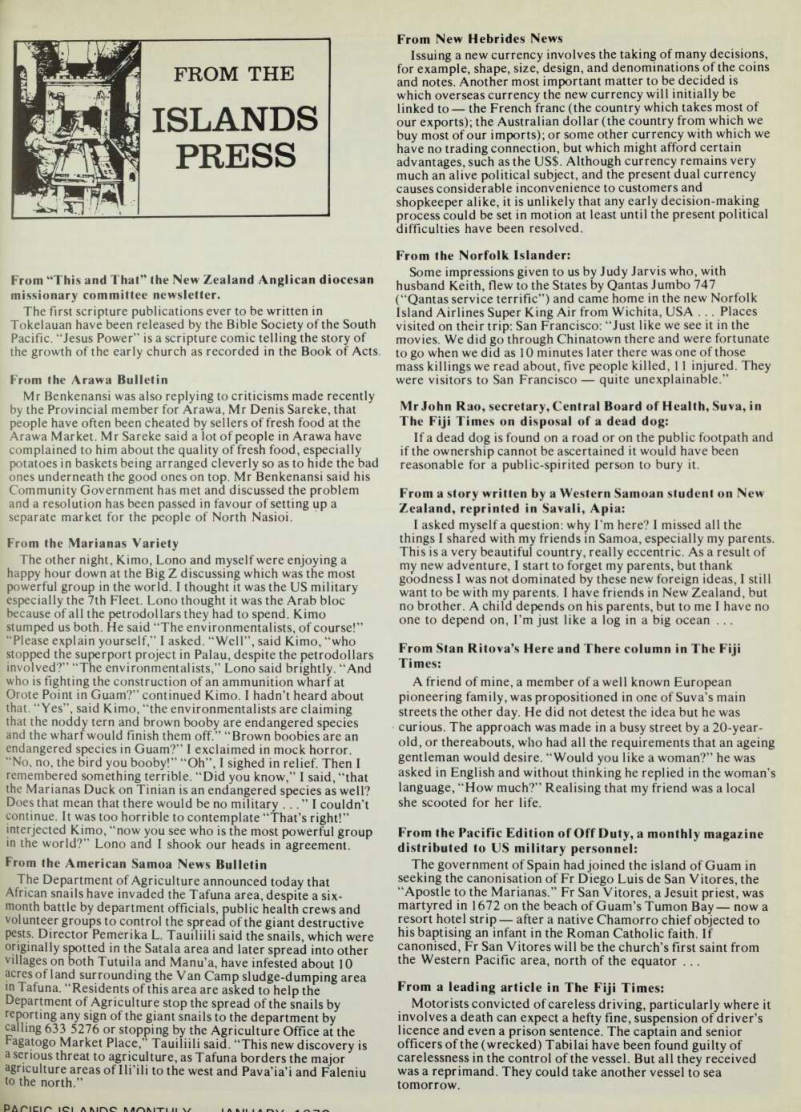
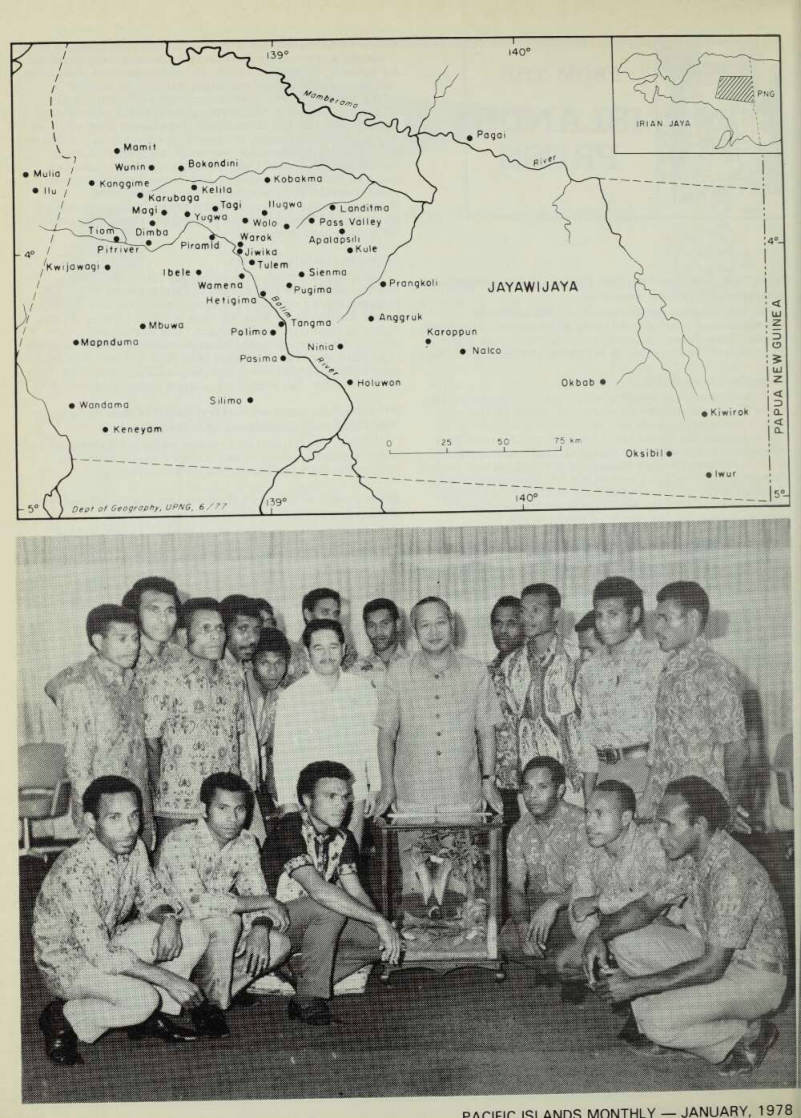
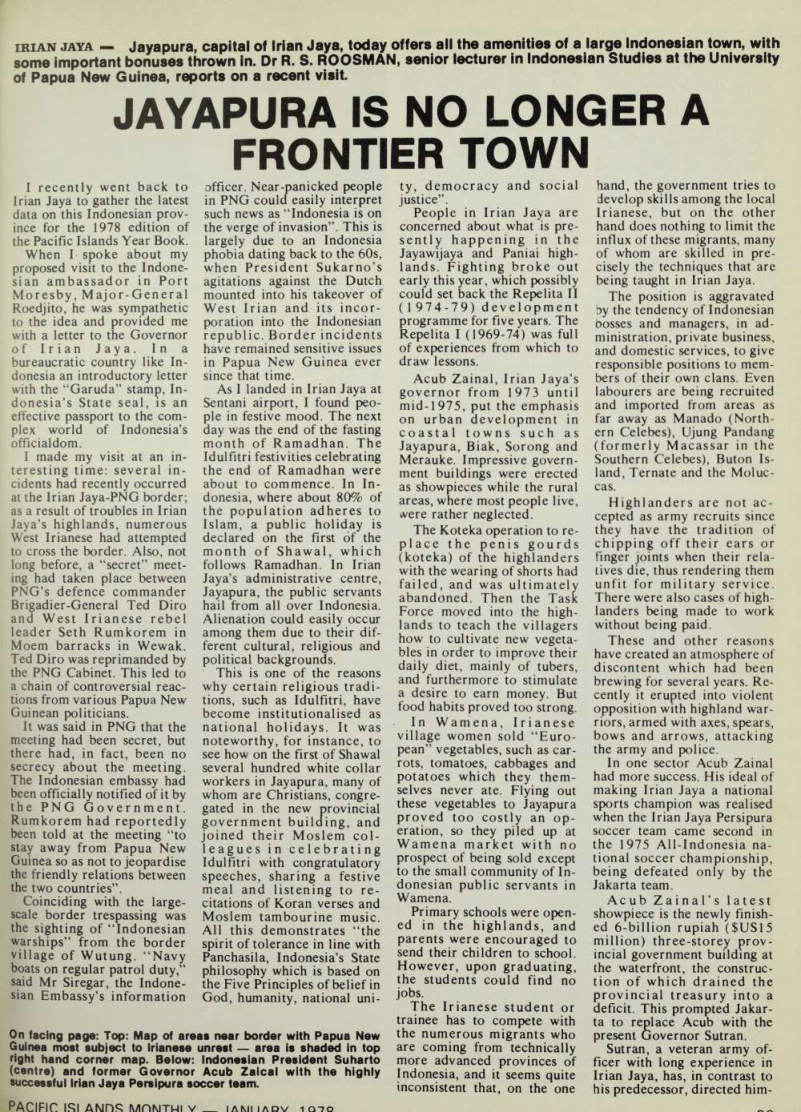
From The
Press
From “This and That” the New Zealand Anglican diocesan missionary committee newsletter.
The first scripture publications ever to be written in Tokelauan have been released by the Bible Society of the South Pacific. “Jesus Power” is a scripture comic telling the story of the growth of the early church as recorded in the Book of Acts.
From the Arawa Bulletin Mr Benkenansi was also replying to criticisms made recently by the Provincial member for Arawa, Mr Denis Sareke, that people have often been cheated by sellers of fresh food at the Arawa Market. Mr Sareke said a lot of people in Arawa have complained to him about the quality of fresh food, especially potatoes in baskets being arranged cleverly so as to hide the bad ones underneath the good ones on top. Mr Benkenansi said his Community Government has met and discussed the problem and a resolution has been passed in favour of setting up a separate market for the people of North Nasioi.
From the Marianas Variety The other night, Kimo, Lono and myself were enjoying a happy hour down at the Big Z discussing which was the most powerful group in the world. I thought it was the US military especially the 7th Fleet. Lono thought it was the Arab bloc because of all the petrodollars they had to spend. Kimo stumped us both. He said “The environmentalists, of course!”
“Please explain yourself,” I asked. “Well”, said Kimo, “who stopped the superport project in Palau, despite the petrodollars involved?” “The environmentalists,” Lono said brightly. “And who is fighting the construction of an ammunition wharf at Orote Point in Guam?” continued Kimo. I hadn’t heard about that. “Yes”, said Kimo, “the environmentalists are claiming that the noddy tern and brown booby are endangered species and the wharf would finish them off.” “Brown boobies are an endangered species in Guam?” I exclaimed in mock horror.
“No, no, the bird you booby!” “Oh”, I sighed in relief. Then I remembered something terrible. “Did you know,” I said, “that the Marianas Duck on Tinian is an endangered species as well?
Does that mean that there would be no military ...” I couldn’t continue. It was too horrible to contemplate “That’s right!” interjected Kimo, “now you see who is the most powerful group in the world?” Lono and I shook our heads in agreement.
From the American Samoa News Bulletin The Department of Agriculture announced today that African snails have invaded the Tafuna area, despite a six month battle by department officials, public health crews and volunteer groups to control the spread of the giant destructive pests. Director Pemerika L. Tauiliili said the snails, which were originally spotted in the Satala area and later spread into other villages on both Tutuila and Manu’a, have infested about 10 acres of land surrounding the Van Camp sludge-dumping area m Tafuna. “Residents of this area are asked to help the Department of Agriculture stop the spread of the snails by reporting any sign of the giant snails to the department by calling 633 5276 or stopping by the Agriculture Office at the Fagatogo Market Place,” Tauiliili said. “This new discovery is a serious threat to agriculture, as Tafuna borders the major agriculture areas of Ili’ili to the west and Pava’ia’i and Faleniu to the north.”
From New Hebrides News Issuing a new currency involves the taking of many decisions, for example, shape, size, design, and denominations of the coins and notes. Another most important matter to be decided is which overseas currency the new currency will initially be linked to — the French franc (the country which takes most of our exports); the Australian dollar (the country from which we buy most of our imports); or some other currency with which we have no trading connection, but which might afford certain advantages, such as the US$. Although currency remains very much an alive political subject, and the present dual currency causes considerable inconvenience to customers and shopkeeper alike, it is unlikely that any early decision-making process could be set in motion at least until the present political difficulties have been resolved.
From the Norfolk Islander: Some impressions given to us by Judy Jarvis who, with husband Keith, flew to the States by Qantas Jumbo 747 (“Qantas service terrific”) and came home in the new Norfolk Island Airlines Super King Air from Wichita, USA . . . Places visited on their trip; San Francisco: “Just like we see it in the movies. We did go through Chinatown there and were fortunate to go when we did as 10 minutes later there was one of those mass killings we read about, five people killed, 11 injured. They were visitors to San Francisco quite unexplainable.”
Mr John Rao, secretary, Central Board of Health, Suva, in The Fiji Times on disposal of a dead dog: If a dead dog is found on a road or on the public footpath and if the ownership cannot be ascertained it would have been reasonable for a public-spirited person to bury it.
From a story written by a Western Samoan student on New Zealand, reprinted in Savali, Apia: I asked myself a question; why I’m here? I missed all the things I shared with my friends in Samoa, especially my parents.
This is a very beautiful country, really eccentric. As a result of my new adventure, I start to forget my parents, but thank goodness I was not dominated by these new foreign ideas, I still want to be with my parents. I have friends in New Zealand, but no brother. A child depends on his parents, but to me I have no one to depend on, I’m just like a log in a big ocean . ..
From Stan Ritova’s Here and There column in The Fiji Times: A friend of mine, a member of a well known European pioneering family, was propositioned in one of Suva’s main streets the other day. He did not detest the idea but he was curious. The approach was made in a busy street by a 20-year old, or thereabouts, who had all the requirements that an ageing gentleman would desire. “Would you like a woman?” he was asked in English and without thinking he replied in the woman’s language, “How much?” Realising that my friend was a local she scooted for her life.
From the Pacific Edition of Off Duty, a monthly magazine distributed to US military personnel: The government of Spain had joined the island of Guam in seeking the canonisation of Fr Diego Luis de San Vitores, the “Apostle to the Marianas.” Fr San Vitores, a Jesuit priest, was martyred in 1672 on the beach of Guam’s Turnon Bay— now a resort hotel strip— after a native Chamorro chief objected to his baptising an infant in the Roman Catholic faith. If canonised, Fr San Vitores will be the church’s first saint from the Western Pacific area, north of the equator . ..
From a leading article in The Fiji Times: Motorists convicted of careless driving, particularly where it involves a death can expect a hefty fine, suspension of driver’s licence and even a prison sentence. The captain and senior officers of the (wrecked) T abilai have been found guilty of carelessness in the control of the vessel. But all they received was a reprimand. They could take another vessel to sea tomorrow.
On facing page: Top: Map of areas near border with Papua New Guinea most subject to Irianese unrest area is shaded in top right hand corner map. Below: Indonesian President Suharto (centre) and former Governor Acub Zaical with the highly successful Irian Jaya Persipura soccer team.
Advertisements & other items, pp. 37-38 (2 items)
Papicir'iciamrko(\A/''Kmtijiv/ Lakii ■ A M X < /N-.A
Daripir Iqi Monthly January, 1978
Frontier Town
Jayapura Is No Longer A
irian jaya Jayapura, capital of Irian Jaya, today offers all the amenities of a large Indonesian town, with some important bonuses thrown in. Dr R. S. ROOSMAN, senior lecturer in Indonesian Studies at the University of Papua New Guinea, reports on a recent visit.
I recently went back to Irian Jaya to gather the latest data on this Indonesian prov ince for the 1978 edition of the Pacific Islands Year Book.
When I spoke about my proposed visit to the Indone sian ambassador in Port Moresby, Major-General Roedjito, he was sympathetic to the idea and provided me with a letter to the Governor of Irian Jaya. In a bureaucratic country like In donesia an introductory letter with the “Garuda” stamp, In donesia’s State seal, is an effective passport to the com plex world of Indonesia’s officialdom.
I made my visit at an in teresting time; several in cidents had recently occurred at the Irian Jaya-PNG border; as a result of troubles in Irian Jaya’s highlands, numerous West Irianese had attempted to cross the border. Also, not long before, a “secret” meet ing had taken place between PNG’s defence commander Brigadier-General Ted Diro and West Irianese rebel leader Seth Rumkorem in Moem barracks in Wewak.
Ted Diro was reprimanded by the PNG Cabinet. This led to a chain of controversial reac tions from various Papua New Guinean politicians.
It was said in PNG that the meeting had been secret, but there had, in fact, been no secrecy about the meeting.
The Indonesian embassy had been officially notified of it by the PNG Government.
Rumkorem had reportedly been told at the meeting “to stay away from Papua New Guinea so as not to jeopardise the friendly relations between the two countries”.
Coinciding with the large scale border trespassing was the sighting of “Indonesian warships” from the border village of Wutung. “Navy boats on regular patrol duty,” said Mr Siregar, the Indone sian Embassy’s information
officer. Near-panicked people in PNG could easily interpret such news as “Indonesia is on the verge of invasion”. This is largely due to an Indonesia phobia dating back to the 60s, when President Sukarno’s agitations against the Dutch mounted into his takeover of West Irian and its incor poration into the Indonesian republic. Border incidents have remained sensitive issues in Papua New Guinea ever since that time.
As I landed in Irian Jaya at Sentani airport, I found peo ple in festive mood. The next day was the end of the fasting month of Ramadhan. The Idulfitri festivities celebrating the end of Ramadhan were about to commence. In In donesia, where about 80% of the population adheres to Islam, a public holiday is declared on the first of the month of Shawal, which follows Ramadhan. In Irian Jaya’s administrative centre, Jayapura, the public servants hail from all over Indonesia.
Alienation could easily occur among them due to their dif ferent cultural, religious and political backgrounds.
This is one of the reasons why certain religious tradi tions, such as Idulfitri, have become institutionalised as national holidays. It was noteworthy, for instance, to see how on the first of Shawal several hundred white collar workers in Jayapura, many of whom are Christians, congre gated in the new provincial government building, and joined their Moslem col leagues in celebrating Idulfitri with congratulatory speeches, sharing a festive meal and listening to re citations of Koran verses and Moslem tambourine music.
All this demonstrates “the spirit of tolerance in line with Panchasila, Indonesia’s State philosophy which is based on the Five Principles of belief in God, humanity, national uni
ty, democracy and social justice”.
People in Irian Jaya are concerned about what is pre sently happening in the Jayawijaya and Paniai high lands. Fighting broke out early this year, which possibly could set back the Repelita II ( 1 974-79) development programme for five years. The Repelita I (1969-74) was full of experiences from which to draw lessons.
Acub Zainal, Irian Jaya’s governor from 1973 until mid-1975, put the emphasis on urban development in coastal towns such as Jayapura, Biak, Sorong and Merauke. Impressive govern ment buildings were erected as showpieces while the rural areas, where most people live, were rather neglected.
The Koteka operation to re place the penis gourds (koteka) of the highlanders with the wearing of shorts had failed, and was ultimately abandoned. Then the Task Force moved into the high lands to teach the villagers how to cultivate new vegeta bles in order to improve their daily diet, mainly of tubers, and furthermore to stimulate a desire to earn money. But food habits proved too strong.
In Wamena, Irianese village women sold “Euro pean” vegetables, such as car rots, tomatoes, cabbages and potatoes which they them selves never ate. Flying out these vegetables to Jayapura proved too costly an op eration, so they piled up at Wamena market with no prospect of being sold except to the small community of In donesian public servants in Wamena.
Primary schools were open ed in the highlands, and parents were encouraged to send their children to school.
However, upon graduating, the students could find no jobs.
The Irianese student or trainee has to compete with the numerous migrants who are coming from technically more advanced provinces of Indonesia, and it seems quite inconsistent that, on the one
hand, the government tries to develop skills among the local Irianese, but on the other hand does nothing to limit the influx of these migrants, many of whom are skilled in pre cisely the techniques that are being taught in Irian Jaya.
The position is aggravated by the tendency of Indonesian bosses and managers, in ad ministration, private business, and domestic services, to give responsible positions to mem bers of their own clans. Even labourers are being recruited and imported from areas as far away as Manado (North ern Celebes), Ujung Pandang (formerly Macassar in the Southern Celebes), Buton Is land, Ternate and the Moluc cas.
Highlanders are not ac cepted as army recruits since they have the tradition of chipping off their ears or finger joints when their rela tives die, thus rendering them unfit for military service.
There were also cases of high landers being made to work without being paid.
These and other reasons have created an atmosphere of discontent which had been brewing for several years. Re cently it erupted into violent opposition with highland war riors, armed with axes, spears, bows and arrows, attacking the army and police.
In one sector Acub Zainal had more success. His ideal of making Irian Jaya a national sports champion was realised when the Irian Jaya Persipura soccer team came second in the 1975 All-Indonesia na tional soccer championship, being defeated only by the Jakarta team.
Acub Zainal’s latest showpiece is the newly finish ed 6-billion rupiah (SUSIS million) three-storey prov incial government building at the waterfront, the construc tion of which drained the provincial treasury into a deficit. This prompted Jakar ta to replace Acub with the present Governor Sutran.
Sutran, a veteran army of ficer with long experience in Irian Jaya, has, in contrast to his predecessor, directed him
Advertisements & other items, p. 39 (1 item)
Pacific Isi Amds Mdmtwi V _ _ I Ami I Adv 1 Q~7O
PACIFIC ISI AMDS MDMTWI V I AMI I ADV 1 Q~7O
self primarily toward rural
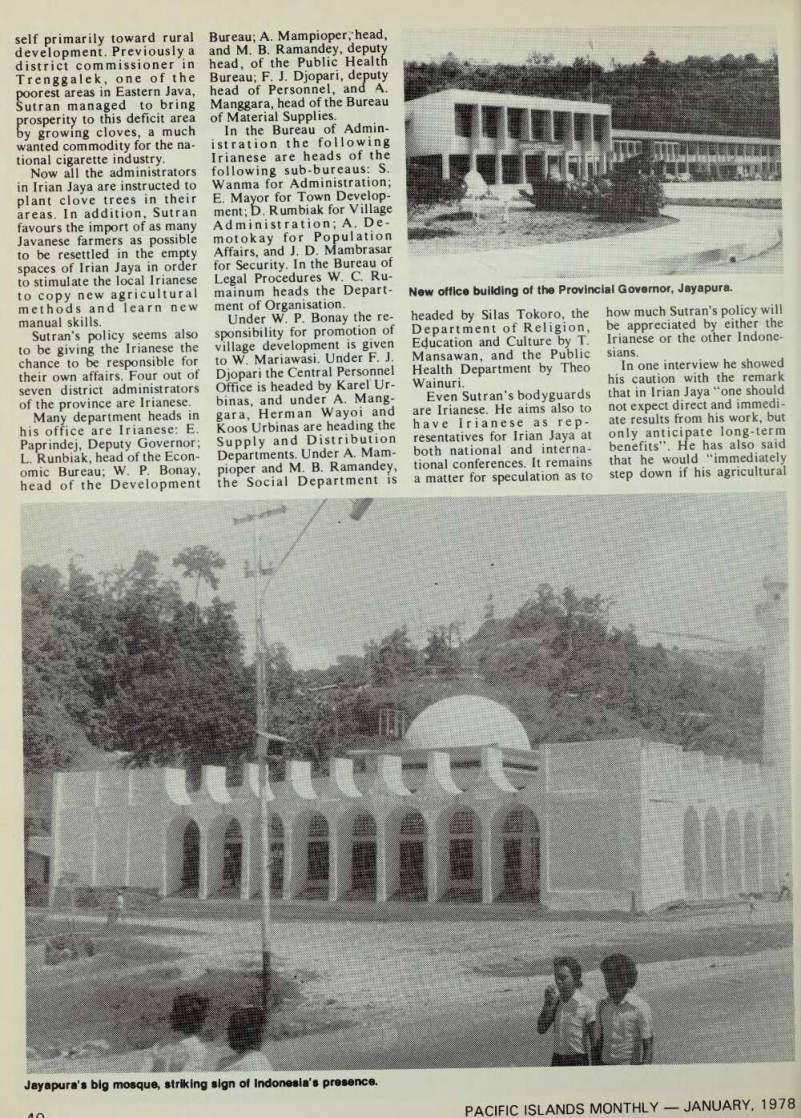
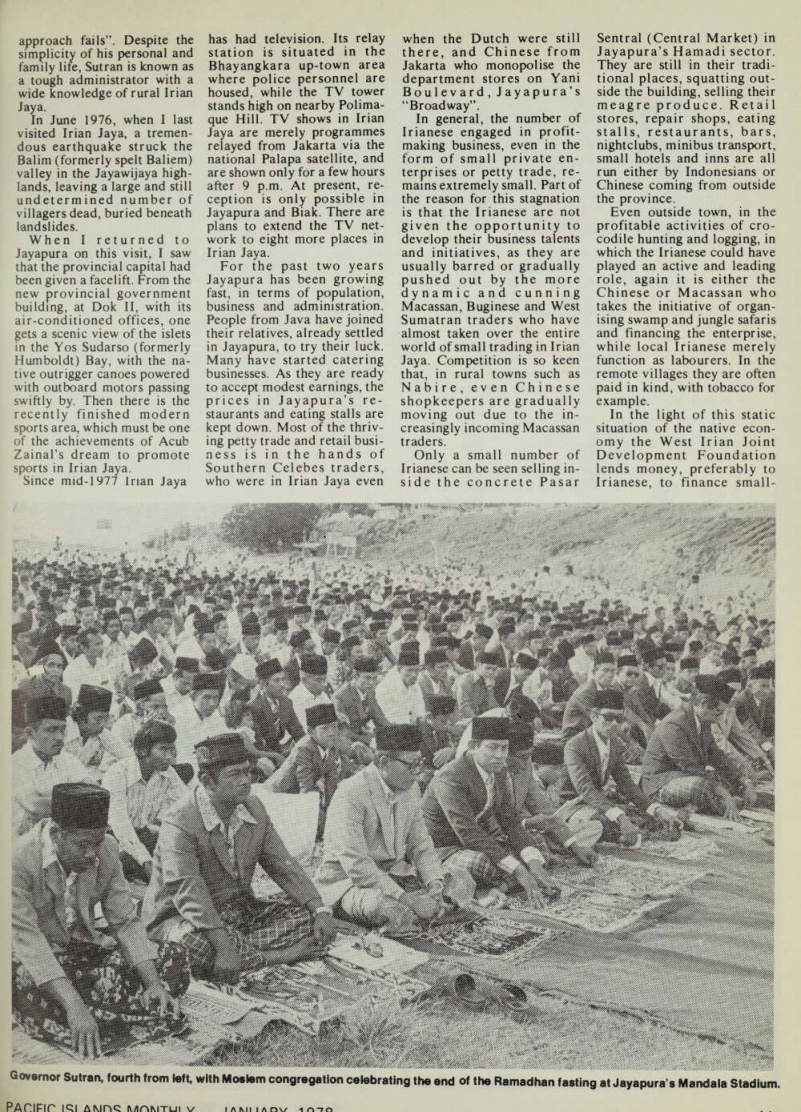

development. Previously a district commissioner in Trenggalek, one of the poorest areas in Eastern Java, Sutran managed to bring prosperity to this deficit area oy growing cloves, a much wanted commodity for the national cigarette industry.
Now all the administrators in Irian Jaya are instructed to plant clove trees in their areas. In addition, Sutran favours the import of as many Javanese farmers as possible to be resettled in the empty spaces of Irian Jaya in order to stimulate the local Irianese to copy new agricultural methods and learn new manual skills.
Sutran’s policy seems also to be giving the Irianese the chance to be responsible for their own affairs. Four out of seven district administrators of the province are Irianese.
Many department heads in his office are Irianese; E.
Paprindej, Deputy Governor; L. Runbiak, head of the Economic Bureau; W. P. Bonay, head of the Development
Bureau; A. Mampioper,head, and M. B. Ramandey, deputy head, of the Public Health Bureau; F. J. Djopari, deputy head of Personnel, and A.
Manggara, head of the Bureau of Material Supplies, In the Bureau of Admin istration the following Irianese are heads of the following sub-bureaus; S.
Wanma for Administration, E. Mayor for Town Develop ment; D. Rumbiak for Village Administration; A. De motokay for Population Affairs, and J. D. Mambrasar for Security. In the Bureau ot Legal Procedures W. C. Ru mainum heads the Depart ment of Organisation, Under W. P. Bonay the re sponsibility for promotion ot village development is given to W. Mariawasi. Under F. J.
Djopari the Central Personnel Office is headed by Karel Ur binas, and under A. Mang gar a, Herman Wayoi and Koos Urbinas are heading the Supply and Distribution Departments. Under A. Mam pioper and M. B. Ramandey, the Social Department is
headed by Silas Tokoro, the Department of Religion, Education and Culture by T.
Mansawan, and the Public Health Department by Theo Wainuri Even Sutran’s bodyguards are Irianese. He aims also to have Irianese as representatives for Irian Jaya at both national and international conferences. It remains a matter for speculation as to
how much Sutran’s policy will be appreciated by either the Irianese or the other Indone sians. . , .
In one interview he showed his caution with the remark that in Irian Jaya “one should not expect direct and immedi ate results from his work, but onl y an , l , ici P ate long-term benefits . He has also said that he would immediately step down if his agricultural
New office building of the Provincial Governor, Jayapura.
Jayapura’s big mosque, striking sign of Indonesia’s presence.
approach fails”. Despite the simplicity of his personal and family life, Sutran is known as a tough administrator with a wide knowledge of rural Irian Jaya.
In June 1976, when I last visited Irian Jaya, a tremen dous earthquake struck the Balim (formerly spelt Baliem) valley in the Jayawijaya high lands, leaving a large and still undetermined number of villagers dead, buried beneath landslides.
When I returned to Jayapura on this visit, I saw that the provincial capital had been given a facelift. From the new provincial government building, at Dok 11, with its air-conditioned offices, one gets a scenic view of the islets in the Yos Sudarso (formerly Humboldt) Bay, with the na tive outrigger canoes powered with outboard motors passing swiftly by. Then there is the recently finished modern sports area, which must be one of the achievements of Acub Zainal’s dream to promote sports in Irian Jaya.
Since mid-1977 Irian Jaya
has had television. Its relay station is situated in the Bhayangkara up-town area where police personnel are housed, while the TV tower stands high on nearby Polima que Hill. TV shows in Irian Jaya are merely programmes relayed from Jakarta via the national Palapa satellite, and are shown only for a few hours after 9 p.m. At present, re ception is only possible in Jayapura and Biak. There are plans to extend the TV net work to eight more places in Irian Jaya.
For the past two years Jayapura has been growing fast, in terms of population, business and administration.
People from Java have joined their relatives, already settled in Jayapura, to try their luck.
Many have started catering businesses. As they are ready to accept modest earnings, the prices in Jayapura’s re staurants and eating stalls are kept down. Most of the thriv ing petty trade and retail busi ness is in the hands of Southern Celebes traders, who were in Irian Jaya even
when the Dutch were still there, and Chinese from Jakarta who monopolise the department stores on Yani Boulevard,Jayapura’s “Broadway”.
In general, the number of Irianese engaged in profit making business, even in the form of small private en terprises or petty trade, re mains extremely small. Part of the reason for this stagnation is that the Irianese are not given the opportunity to develop their business talents and initiatives, as they are usually barred or gradually pushed out by the more dynamic and cunning Macassan, Buginese and West Sumatran traders who have almost taken over the entire world of small trading in Irian Jaya. Competition is so keen that, in rural towns such as Nabire, even Chinese shopkeepers are gradually moving out due to the in creasingly incoming Macassan traders.
Only a small number of Irianese can be seen selling in side the concrete Pasar
Sentral (Central Market) in Jayapura’s Hamadi sector.
They are still in their tradi tional places, squatting out side the building, selling their meagre produce. Retail stores, repair shops, eating stalls, restaurants, bars, nightclubs, minibus transport, small hotels and inns are all run either by Indonesians or Chinese coming from outside the province.
Even outside town, in the profitable activities of cro codile hunting and logging, in which the Irianese could have played an active and leading role, again it is either the Chinese or Macassan who takes the initiative of organ ising swamp and jungle safaris and financing the enterprise, while local Irianese merely function as labourers. In the remote villages they are often paid in kind, with tobacco for example.
In the light of this static situation of the native econ omy the West Irian Joint Development Foundation lends money, preferably to Irianese, to finance small-
Governor Sutran, fourth from left, with Moslem congregation celebrating the end of the Ramadhan fasting at Jayapura’s Mandala Stadium.
scale enterprises in such fields as crop-growing and cattle breeding. Small loans are also made to Irianese fishermen for the purchase of outboard motors to be attached to their primitive outrigger canoes to increase their catch.
Among the educated Irianese there is a common desire to join the public ser vice with its regularly paid salaries, and the chance of being sent outside their home region. “It is better to marry a public servant than to eat taro (= marry a villager)” has become a popular saying with Jayapura is no longer the frontier town of the past where people felt like outcasts and lived with the insatiable yearning to buy a ticket to fly straight back to Jakarta. One can now enjoy the amenities of a large Indonesian city, but in a better atmosphere with less pollution, less traffic and less interference from government regulations.
Parents no longer have to send their children to Java for their primary and secondary education which is now stan darised to Jakarta re quirements.
Apart from the “Bird of Paradise” (Cenderawasih) University in Abepura, terti ary education has been ex panded with four colleges; the College of Accountancy and Office Management, the Col lege of Local Administration, and the Protestant and Catholic theological colleges.
Collecting data for the
Pacific Islands Year Book in Jayapura meant running for a fortnight from one office to another, meeting officials who were as eager to know about “the other side of the border” as I was eager to know about Irian Jaya. I was bombarded with questions every time I entered an office.
I was also invited by the Rev Williem Maloali, a native of the Jayapura area, to speak before the Irian Jaya Parlia ment, of which he is chairman.
The following questions were asked by its members: in what respect does Michael Somare’s point of view toward Indonesia differ from Maori Kiki’s (Minister for Foreign Affairs and Trade in the pre vious PNG government); what is the aim of the Papua Besena movement; how does PNG’s policy of self-reliance work out in practice; how much is Australia’s annual financial aid to PNG; what is the volume of PNG’s annual im ports from Australia; what is the lot of the West Irian refugees in Papua New Guinea; how much do people in PNG know about In donesia, and how to improve friendly PNG-Indonesia rela tions?
In reply to the last two ques tions I suggested the parlia ment should organise cultural exchange programmes be tween Irian Jaya and Papua New Guinea, and invite the Papua New Guinea parlia ment to come over to Jayapura, to see things in Irian Jaya for themselves. -
Irian Jaya’s Deputy Governor E. Paprindej greets Moslems on occasion of Idulfitri celebrations.
Advertisements & other items, pp. 41-50 (4 items)
Pacific Iqi Anihq Momtui V Lami I A R>V/ 10-70
Parifin Islands Monthly January, 1978
JirLlx.
Western Samoa .
Niue Island
the Pacific has shifted
...because now the Polynesian Triangle fare brings a Polynesian holiday much closer. Now, when you visit Fiji, you can include Tonga, Niue and Western Samoa for very little extra! Talk to your travel agent about working in your Polynesian Triangle fare with your Fiji itinerary. Only U55266.00* (AU55229.00 or NZ5237.00) more to see three more islands in the beautiful Pacific. Our Polynesian Triangle fare is available all year round with no minimum stopover restrictions and may be purchased while you are in Fiji or before you arrive.
Contact your travel agent for more details. *Fare subject to change without notice. © Serving the heart of Polynesia
POLYNESIAN
PO Box 599, Apia.
WESTERN SAMOA
JirLlx.
HEAT
SEALING.
SHRINK
PACKAGING.
CONTACT A USTRA LI A'S
FOREMOST MANUFACTURERS
OF HEAT SEALING EQUIPMENT
SERVING INDUSTRY
IN AUSTRALIA & THE PACIFIC ISLANDS
FOR OVER 25 YEARS.
HELIX ELECTRICAL PRODUCTS PTY. LTD.
27 Rosebery Avenue, Rosebery, NSW 2018, Australia. 663 0487.
a □D kxby SA C6O
TDK
- > Jmi i p, OM€Er
ST ERe Q
fins
Some unexpected pleasures.
If you’ve been thinking of buying a cassette deck, but were afraid that your budget would put you in the ‘bare minimum’ class or limit the performance you could expect, check out our Pioneer CT-F 4040.
It’s got all the sound of higherpriced machines, many exclusive Pioneer features not found on other decks at any price, and some of the little frills you didn’t dare hope for.
The tape holding system, for example, is the same one that Pioneer uses on the top-of-the-line models. Tapes ‘snap’ into a rigid and perfectly vertical position. The reels are gripped with special hexagonal spools. The result is smooth, precise tape travel.
The special 1C in the Dolby* section assures you of hearing all the highs while you miss the hiss. Three position BIAS/EQ makes every kind of tape feel right at home. You always get perfect recording, perfect playback.
And as if solid performance weren’t enough, note the nice little extras which give the CT-F 4040 the luxury feel. The contoured cassette compartment door is oil-damped, and opens at the touch of a button. Red and green LED indicators glow to remind you when you’re recording and when Dolby is on. Owning a Pioneer cassette deck is always a pleasure, but the unusual value of the CT-F 4040 will take you by surprise. ‘Dolby is a trademark of Dolby Laboratories, Inc.
GD PIONEER
Australia Pioneer Electronics Australia Pty.
Ltd., 178-184 Boundary Road, Braeside, Victoria 3195, Tel: 90-9011 Sydney 93-0246, Brisbane 59-7457, Adelaide 433379, Perth 24-9899 Fiji Islands Brijlal & Company, G.P.O. Box No. 362, Suva, Fiji Islands Tel: 22258 New Zealand Fountain Marketing Ltd., Maidstone Street, Auckland, New Zealand Tel: 763-064 Norfolk Island Burns Philp (Norfolk Island) Ltd., Norfolk Island, South Pacific New Hebrides Burns Philp (New Hebrides) Ltd., Vila, New Hebrides Nauru Island Jacob Enterprises. P.O. Box No. 4 Republic of Nauru Tahiti Est. PERFECT, B.P. 594, Papeete, Tahiti Tel: 20 407 New Caledonia Menard Freres Ville, B.P. H2Cedex, Noumea, New Caledonia Tel: 27.52.22 American Samoa Traspac Corporation, P.O. Box 1477, Pago Pago, American Samoa 96799 Tel: 633-5224 Rarotonga South Seas International Ltd., P.O. Box 49, Rarotonga Cook Islands Tel: 2327
ISUZU KB2O
ONE-TONNE PICK-UP!
Petrol or diesel
As tough as they come!
• Choice of engines.
Economical powerful 4-cylinder SOHC oversquare engine. 68.9 kW (92.5 bhp).
Or Cl 90 diesel with an output of 62 ps/4400 rpm the world’s highest output anywhere for this class of engine.
The length, breadth, strength and suspension to deal with big 1-tonne loads! 12 months or 20,000 kilometre warranty! All diesel engines are covered by a 12/24 warranty. • Expert service and reliable spares supply right through the Pacific! • Great cabin comfort bench seat, flow-through ventilation.
Papua New Guinea Wamp Nga Motors, Mt. Hagen Solomon Islands Solomon Islands Service Station Republic of Nauru Nauru Co-Operative Society Western Samoa O. F. Nelson and Co. Ltd.
Fiji Burns Philp (South Sea) Co. Ltd New Caledonia SAIP, Noumea
it GM
General Motors Serving you in the South Pacific
Another Technological Breakthrough from SEIKO
The LC Digital Quartz WORLD TIMER.
Now you can know the exact time anywhere in thjg world. Instantly y % s * */ 6 I v Z' 4Sk 7
p€fc
7 <? * *// V/ '/<? *l G 0 •y>£ **<? 22?» This new precise timepiece gives you the’time in the world's 29 time zones on a 24-hour readout system; in hours, minutes, seconds, plus the day and date. All in the time it takes to push a button. And it adjusts for daylight saving time.
Like all Seiko Multi-Mode LC Digital Quartz watches, the World Timer is engineered to be easy to operate and dependable. It features a Perpetual Calendar pre-programmed for 28, 30, 31-day and leap year months until the year 2009. It is water resistant, and features built-in illumination for reading the time in darkness.
The Seiko World Timer, just one of the outstanding timepieces in the new Seiko Multi-Mode LC Digital Quartz Collection.
Seiko Quartz. sa t men ? i 6 in-nn u 3 r luuoV Home Time Mode features continuous readout in hours on a 24-hour basis, minutes, seconds, day and date.
Calendar is pre-programmed for leap years, 28, 30 and 31 day months until the year 2009. Built-in illumination system
°E LL/6 D <•> c‘
1 I’u 8 Greenwich Mean Time is displayed at the push of a button. :>■ rut** f -
t 13:0 Bv
-ziy/ o' H i=Te= s^-hki World Time symbol appears when crown is pushed, indicating World Time Mode is in operation. ~voT • H cJB m • LIE «> • :v o :i\ ; ?0:08v 1 KL *1 »01 >1 l»u| -n| -T m Each time button is pushed. Zone Marker moves to next city and time zone and displays the correct hour, minutes, seconds, day and date.
SEIKO
Someday all watches will be made this way.
.I*l^ seat .1 aaai %4 m
WifW J
-*> ■ * f. > 1J Wm i «2P? *-
y*ci*
■ a m m *4 f m m *if r w jf t - ;. i j -r* M P*" <-» ' m t * 11
The Toyota truck range. Built to be unbeatable.
Bad weather conditions, no problem.
Bad roads and driving surfaces, eaten up.
Difficult loads, no contest. Built tough. Built to take it.
There's a Toyota truck built for you. * TOYOTA Land Cruiser Pickup a
TOYOTA Dyna
TOYOTA Stout
TOYOTA Hi-Lux
m TOYOTA Toyo-Ace ■in TOYOTA Truck For unbeatable after service:
TOYOTA
PAPUA NEW GUINEA: ELA MOTORS LIMITED, Scratchley Rd., Badili, P.O. Box 75, Port Moresby. U.S. TRUST TERRITORY; MICROL CORPORATION, P.O. Box 267, Saipan. FIJI ISLANDS; AUTOMOTIVE SUPPLIES CO., LTD., G.P.O. Box 355, Suva AMERICAN SAMOA: BURNS PHILP (SOUTH SEA) CO., LTD., P.O. 1057, Pago Pago WESTERN SAMOA: BURNS PHILP (SOUTH SEA) LTD., P.O. Box 188, Apia. GUAM: ATKINS, KROLL (GUAM) LTD., P.O. Box 6428, Tamuning. NEW HEBRIDES: NEW HEBRIDES MOTORS LTD , P.O. Box 18, Vila, SOLOMON ISLANDS: MENDANA ENTERPRISES (5.1.), LTD., P.O. Box 174, Honiara. TAHITI: NIPPON AUTOMOTO, B.P. 342, Papeete. COOK ISLANDS: COOK ISLANDS TRADING CORPORATION LTD., P.O. Box 92, Rarotonga. NAURU ISLAND: NAURU COOPERATIVE SOCIETY. GILBERT & ELLICE ISLANDS COLONY; TARAWA MOTORS, Box 36, Bainki Tarawa NORFOLK ISLAND: MARIE'S NORFOLK TOURS, LTD., P.O. Box 276. NEW CALEDONIA: SOCIETE IMPORTATION AUTOMOBILE DU PACIFIQUE, Rond-Point du Pacific (Station Total) B.P. 438, Noumea.
% 7h a 9,
Oieinii
All HEINZ products
are produced with the
experience gained from
more than one hundred
years of making fine foods.
In the Pacific islands
HEINZ has been on the
menu since 1925.
0^
SELLING AND CONSULTANT
AGENTS FOR:
ANDROIMICUS COFFEE PTV. LTD.
COUNTRY MAID WHITENER.
DIPLOMAT RAZOR BLADES.
MEADOWSWEET CONFECTIONERY.
ERIN FOODS LTD.
EPICURE CONTINENTAL FOODS.
BALTIC IMPORT COMPANY.
GREENSEAS TUNA.
FOR FURTHER INFORMATION
CONTACT:
H.J. HEINZ CO. AUST. LTD.
Export Branch, Princes Highway, Dandenong, 3175, Victoria, Australia.
Telephone; 792 0631.
Telex: AA32125.
Cable: Heinz Melbourne. at. 'ia
HEINZ
Drained
HEINZ
«3!
HEINZ
tomato iauce (5^3
baked be#
tomato sauce S&S
spaghetti
lofr i3(o sauce & chee^ <on s m
tomatf
SOUPf
n
Set a course for pleasure
ix m .
Men who understand the water best, often choose Yamaha first.
Because they know how important reliability is, and they know they have it with a Yamaha outboard. For more than 16 years, in more than 100 countries around the world, Yamaha has been trusted for its responsive,
trouble-free performance.
And even if you’re just a weekend sailor, you need this kind dependable power.
It takes the worry out of boating to let you relax and really enjoy those good times on the water.
Outboard
with
YAMAHA
YAMAHA MOTOR CO.. LTD.
MARINE ENGINE DIVISION
2500 SHINGAI IWATA-SHI SHIZUOKA KEN JAPAN
r AMAHfI
8B
YAMAHA
40A * With 14 different models, you have a choice of power ratings and accessories to make any enthusiast happy. See them soon at your nearby Yamaha dealership.
Write or call your nearest dealer for complete information.
Store Inc.
Box 70 Tel: 425
-
no 5 * ■ ■w* EV nr- M 9980 K 4-band stereo radio/cassette with 2-way/4-speaker system • Sensitive stereo radio *• A massive 5,000mW max. output power from 3 power sources M 4515 K 4-band stereo radio/cassette with full auto stop • Sensitive MW/SWi/SW 2 /FM stereo radio • 5,000mW max. output power from 3 power sources 1 M 2429 F AM/FM radio/cassette with 2-way speaker system • Sensitive AM/FM radio with built-in a 10cm woofer and a 4cm tweeter • Delivers a hefty 2,500mW output power from 3 power sources
M 2462F/H
4,500mW feature-packed radio/cassette recorder • Choice of AM/FM (M 2462 F) or MW/SWi/SW 2 (M 2462 H) radio • Rugged eye-catching metallic cabinet • Massive 4,500mW output power from 3 power sources
SANYO ELECTRIC TRADING CO., LTD.
Sanyo Distributors in South Pacific
AUSTRALIA: Sanyo Guthrie Australia Pty., Ltd. Melbourne, Australia NEW ZEALAND Autocrat Radio Ltd. New Zealand FI Morris Hedstrom Ltd. Suva, Nadi, Sigatoka, Lautoka, Fiji PAPUA NEW GUINEA: Breckwoldt & CO.. ( p -N.G.) Pty., Port Moresby. Lae. Rabaul. Madang, Kieta, Wewak, Mount Hagen, Papua New Guinea NEW CALEDONIA: HacMc-"**”% W ° U "** Noumea Cedex, New Caledonia FRENCH POLYNESIA; Ets, Lee Sou Papeete, Tahiti NORFORK IS; Biraa PW'p (N.L) Ltd.
Norfork Is. NEW HEBRIDES Lo Lam Store Port-Vila, N.H. NEW HEBRIDES: K.P. Henry Port-Vila, N.H. NEW HEBRI S: Ah Yuen & Co.
Santo N.H. A SAMOA Transpac Corp. Pago Pago A. Samoa W. SAMOA; Morris Hedstrom Ltd. Apia W. Samoa Broadcasting Commission Nuku, Alofa, Tonga REP OF NAURU Nauru Cooperative Society Nauru Is. COOK Cook Islands Trading Corporation Ltd. Rarotonga, Cook Is. GILBERT IS Gilbert Islands Development Authority Tarawa, Gilbert Is UVAL Tuvalu Cooperative Wholesale Society Ltd. Funafuti. Tuvalu MARIANA IS: United Micronesia Development Association Manana Is
Prosperity
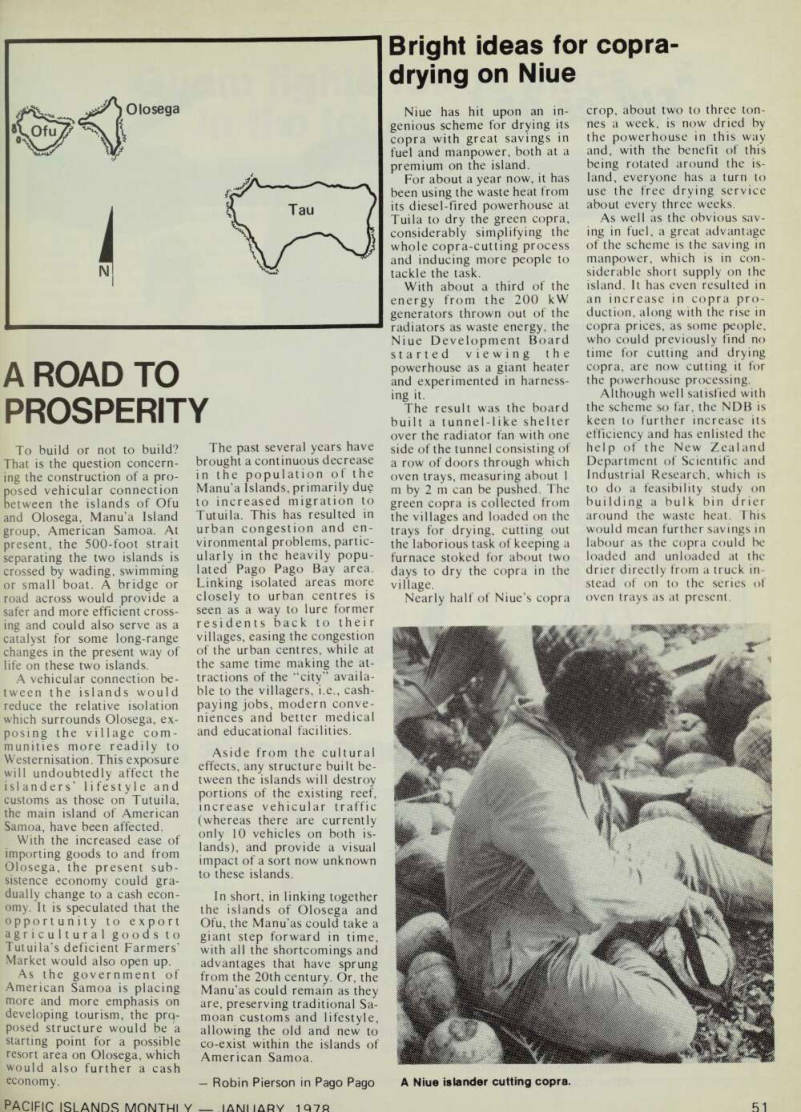
A Road To
To build or not to build?
That is the question concern ing the construction of a pro posed vehicular connection between the islands of Ofu and Olosega, Manu’a Island group, American Samoa. At present, the 500-foot strait separating the two islands is crossed by wading, swimming or small boat. A bridge or road across would provide a safer and more efficient cross ing and could also serve as a catalyst for some long-range changes in the present way of life on these two islands.
A vehicular connection be tween the islands would reduce the relative isolation which surrounds Olosega, ex posing the village com munities more readily to Westernisation, This exposure will undoubtedly affect the islanders' lifestyle and customs as those on Tutuila, the main island of American Samoa, have been affected.
With the increased ease of importing goods to and from Olosega, the present sub sistence economy could gra dually change to a cash econ omy. It is speculated that the opportunity to export agricultural goods to Tutuila’s deficient Farmers’
Market would also open up.
As the government of American Samoa is placing more and more emphasis on developing tourism, the pro posed structure would be a starting point for a possible resort area on Olosega, which would also further a cash economy.
The past several years have brought a continuous decrease in the population of the Manu’a Islands, primarily due to increased migration to Tutuila. This has resulted in urban congestion and en
vironmental problems, partic
ularly in the heavily popu lated Pago Pago Bay area.
Linking isolated areas more closely to urban centres is seen as a way to lure former residents back to their villages, easing the congestion of the urban centres, while at the same time making the at tractions of the “city” availa ble to the villagers, i.e., cash paying jobs, modern conve niences and better medical and educational facilities.
Aside from the cultural effects, any structure built be tween the islands will destroy portions of the existing reef, increase vehicular traffic (whereas there are currently only 10 vehicles on both is lands), and provide a visual impact of a sort now unknown to these islands.
In short, in linking together the islands of Olosega and Ofu, the Manu’as could take a giant step forward in time, with all the shortcomings and advantages that have sprung from the 20th century. Or, the Manu’as could remain as they are, preserving traditional Sa moan customs and lifestyle, allowing the old and new to co-exist within the islands of American Samoa.
Robin Pierson in Pago Pago
Bright ideas for copra
drying on Niue
Niue has hit upon an in genious scheme for drying its copra with great savings in fuel and manpower, both at a premium on the island.
For about a year now, it has been using the waste heat from its diesel-fired powerhouse at Tuila to dry the green copra, considerably simplifying the whole copra-cutting process and inducing more people to tackle the task.
With about a third of the energy from the 200 kW generators thrown out of the radiators as waste energy, the Niue Development Board started viewing the powerhouse as a giant heater and experimented in harness ing it.
The result was the board built a tunnel-like shelter over the radiator fan with one side of the tunnel consisting of a row of doors through which oven trays, measuring about 1 m by 2 m can be pushed. The green copra is collected from the villages and loaded on the trays for drying, cutting out the laborious task of keeping a furnace stoked for about two days to dry the copra in the village.
Nearly half of Niue’s copra
crop, about two to three ton nes a week, is now dried by the powerhouse in this way and, with the benefit of this being rotated around the is land, everyone has a turn to use the free drying service about every three weeks.
As well as the obvious sav ing in fuel, a great advantage of the scheme is the saving in manpower, which is in con siderable short supply on the island. It has even resulted in an increase in copra pro duction, along with the rise in copra prices, as some people, who could previously find no time for cutting and drying copra, are now cutting it for the powerhouse processing.
Although well satisfied with the scheme so far, the NDB is keen to further increase its efficiency and has enlisted the help of the New Zealand Department of Scientific and Industrial Research, which is to do a feasibility study on building a bulk bin drier around the waste heat. This would mean further savings in labour as the copra could be loaded and unloaded at the drier directly from a truck in stead of on to the series of oven trays as at present.
A Niue islander cutting copra.
Advertisements & other items, pp. 51-52 (3 items)
51
PACIFIC ISLANDS MONTHI Y lAMI I ARY 1 Q7R
52
DAricir iqi MONTHLY —JANUARY, 1978
The economist’s aircraft
»» u i UP er * m mm
BIG
m ■
VEnL
The economist’s aircraft
Sole distributors for Australia • Papua New Guinea • New Zealand • Pacific Islands •
FORRESTAIR
A DIVISION OF H. C. SLEIGH LIMITED Bulla Road, Essendon Airport Victoria, Australia 3041 Cables & Telegrams: Forrestair Melbourne Telex AA33015 Telephone (03)3798929.
After hours (03) 7254430 Don Knee operates an aviation fuel service at Essendon Airport. He is not impressed with the Partenavia's fuel consumption . . . though he admits that he would be if he flew one.
Don has been fuelling aircraft for 4 years.
He knows from experience and from 'shop' talk - that the Partenavia goes a long way on a litre.
But its economy does not stop there. This sleek twin 6-seater is also uncomplicated, so its maintenance cost is as modest as its thirst.
Buy it for economy, and performance is a bonus. Buy it for performance, and your bonus is economy.
Brochure, performance specs., operating costs, and flight test reports by independent experts are all together in the enquiry kit . . . free from Forrestair.
Guam fights for its place
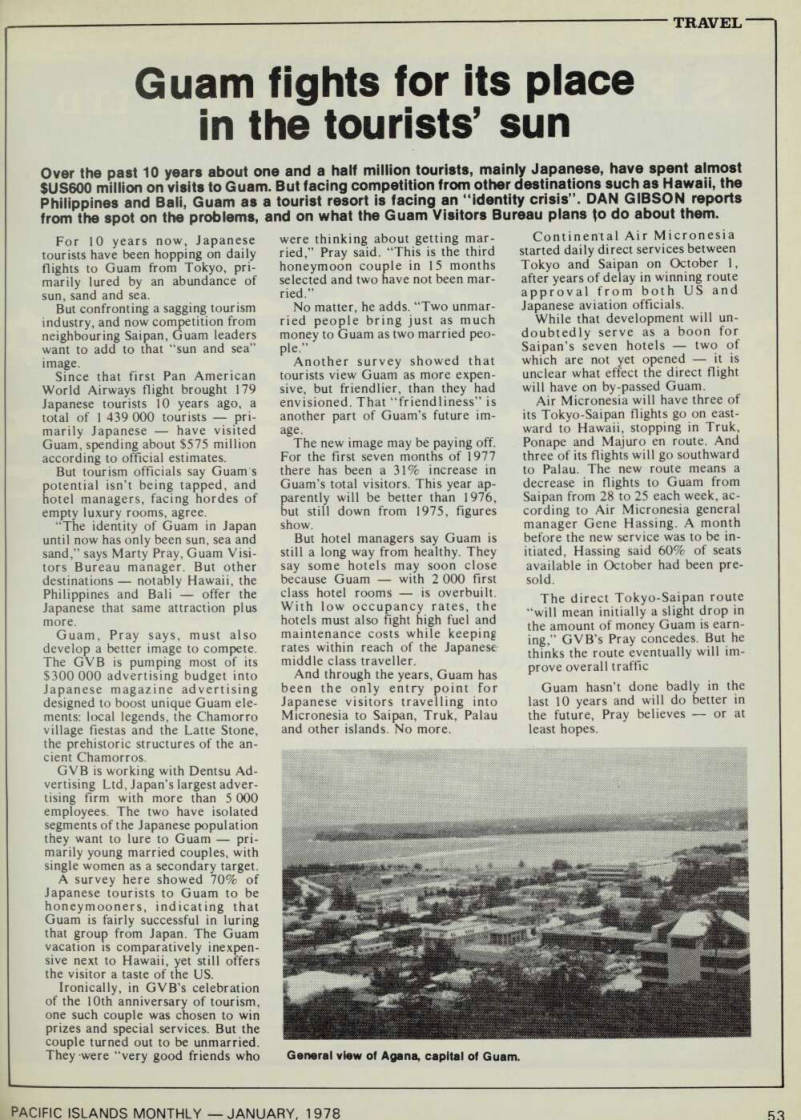
in the tourists’ sun
Over the past 10 years about one and a half million tourists, mainly Japanese, have spent almost SUS6OO million on visits to Guam. But facing competition from other destinations such as Hawaii, the Philippines and Bali, Guam as a tourist resort is facing an “identity crisis ’. DAN GIBSON reports from the spot on the problems, and on what the Guam Visitors Bureau plans \o do about them.
For 10 years now, Japanese tourists have been hopping on daily flights to Guam from Tokyo, pri marily lured by an abundance of sun, sand and sea.
But confronting a sagging tourism industry, and now competition from neighbouring Saipan, Guam leaders want to add to that “sun and sea” image.
Since that first Pan American World Airways flight brought 179 Japanese tourists 10 years ago, a total of 1 439 000 tourists pri marily Japanese have visited Guam, spending about $575 million according to official estimates.
But tourism officials say Guam s potential isn’t being tapped, and hotel managers, facing hordes of empty luxury rooms, agree.
“The identity of Guam in Japan until now has only been sun, sea and sand,” says Marty Pray, Guam Visi tors Bureau manager. But other destinations notably Hawaii, the Philippines and Bali offer the Japanese that same attraction plus more.
Guam, Pray says, must also develop a better image to compete.
The GVB is pumping most of its $3OO 000 advertising budget into Japanese magazine advertising designed to boost unique Guam ele ments: local legends, the Chamorro village fiestas and the Latte Stone, the prehistoric structures of the an cient Chamorros.
GVB is working with Dentsu Ad vertising Ltd, Japan’s largest adver tising firm with more than 5 000 employees. The two have isolated segments of the Japanese population they want to lure to Guam pri marily young married couples, with single women as a secondary target.
A survey here showed 70% of Japanese tourists to Guam to be honeymooners, indicating that Guam is fairly successful in luring that group from Japan. The Guam vacation is comparatively inexpen sive next to Hawaii, yet still offers the visitor a taste of the US.
Ironically, in GVB’s celebration of the 10th anniversary of tourism, one such couple was chosen to win prizes and special services. But the couple turned out to be unmarried.
They were “very good friends who
were thinking about getting married,” Pray said. “This is the third honeymoon couple in 15 months selected and two have not been married.”
No matter, he adds. “Two unmarried people bring just as much money to Guam as two married peopie.”
Another survey showed that tourists view Guam as more expensive, but friendlier, than they had envisioned. That “friendliness” is another part of Guam’s future image.
The new image may be paying off.
For the first seven months of 1977 there has been a 31% increase in Guam’s total visitors. This year apparently will be better than 1976, but still down from 1975, figures show.
But hotel managers say Guam is still a long way from healthy. They say some hotels may soon close because Guam with 2 000 first class hotel rooms is overbuilt.
With low occupancy rates the hotels must also fight high fuel and maintenance costs while keeping rates withm reach of the Japanese middle class traveller.
And through the years, Guam has been the only entry point for Japanese visitors travelling into Micronesia to Saipan, Truk, Palau and other islands. No more.
Continental Air Micronesia started daily direct services between Tokyo and Saipan on October 1, after years of delay in winning route approval from both US and Japanese aviation officials, While that development will un doubtedly serve as a boon for Saipan’s seven hotels two of which are not yet opened it is unclear what effect the direct flight will have on by-passed Guam, Air Micronesia will have three of its Tokyo-Saipan flights go on east ward to Hawaii, stopping in Truk, Ponape and Majuro en route. And three of its flights will go southward to Palau. The new route means a decrease in flights to Guam from Saipan from 28 to 25 each week, ac cording to Air Micronesia general manager Gene Hassing. A month before the new service was to be in itiated, Hassing said 60% of seats available in October had been pre sold.
The direct Tokyo .Saipan route .. wi „ mean initially a s igh t drop in he amount of money Guam is earn j •• GV B' s Pray concedes. But he th f nks the route eventually will im prove overall traffic K Guam hasn’t done badly in the last 10 years and will do better in the future, Pray believes or at least hopes.
General view of Agana, capital of Guam.
Advertisements & other items, p. 54 (1 item)
Pacific Islands.
S.E. TATHAM & CO. PTY. LTD
BEEHIVE BUILDING,
94 ELIZABETH STREET
G.P.O. BOX H.
MELBOURNE 3001.
AUSTRALIA.
CABLES; “SET"
TELEX: AA34552.
TELEPHONE; 63 5094
r
...BUYERS for the
PACIFIC ISLANDS.
PAPUA NEW GUINEA;
S. E. TATHAM (P N G.) PTY. LTD.
LAE: MALA IT A ST. (P.O. BOX 1562).
PORT MORESBY: Cnr. CORO A &
GORDON (P.O. BOX 6733, BOROKO).
TELEGRAMS: ALL OFFICES “SET’!
\1
FOR SERVICE
YOUR GUARANTEE
SINCE 1924
wooing Japanese tourists
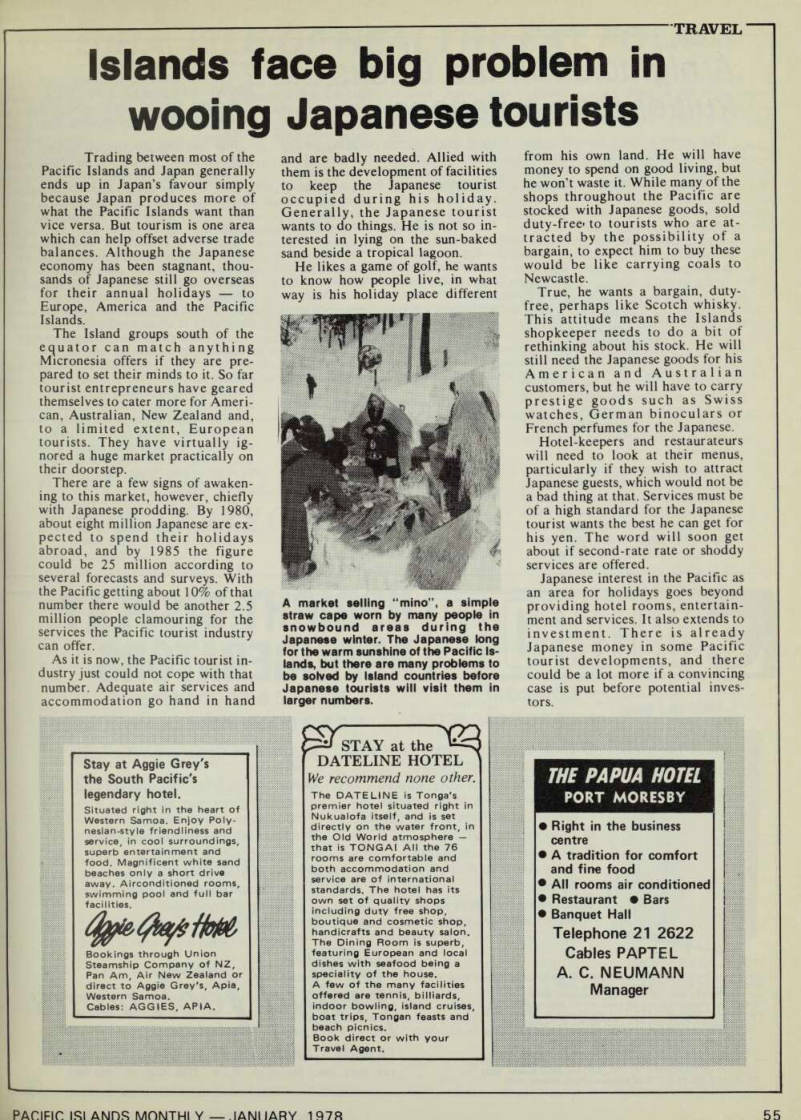
Islands face big problem in wooing Japanese tourists
Trading between most of the Pacific Islands and Japan generally ends up in Japan’s favour simply because Japan produces more of what the Pacific Islands want than vice versa. But tourism is one area which can help offset adverse trade balances. Although the Japanese economy has been stagnant, thou sands of Japanese still go overseas for their annual holidays to Europe, America and the Pacific Islands.
The Island groups south of the equator can match anything Micronesia offers if they are pre pared to set their minds to it. So far tourist entrepreneurs have geared themselves to cater more for Ameri can, Australian, New Zealand and, to a limited extent, European tourists. They have virtually ig nored a huge market practically on their doorstep.
There are a few signs of awaken ing to this market, however, chiefly with Japanese prodding. By 1980, about eight million Japanese are ex pected to spend their holidays abroad, and by 1985 the figure could be 25 million according to several forecasts and surveys. With the Pacific getting about 10% of that number there would be another 2.5 million people clamouring for the services the Pacific tourist industry can offer.
As it is now, the Pacific tourist in dustry just could not cope with that number. Adequate air services and accommodation go hand in hand
and are badly needed. Allied with them is the development of facilities to keep the Japanese tourist occupied during his holiday.
Generally, the Japanese tourist wants to do things. He is not so in terested in lying on the sun-baked sand beside a tropical lagoon.
He likes a game of golf, he wants to know how people live, in what way is his holiday place different
from his own land. He will have money to spend on good living, but he won’t waste it. While many of the shops throughout the Pacific are stocked with Japanese goods, sold duty-free* to tourists who are at tracted by the possibility of a bargain, to expect him to buy these would be like carrying coals to Newcastle.
True, he wants a bargain, duty free, perhaps like Scotch whisky.
This attitude means the Islands shopkeeper needs to do a bit of rethinking about his stock. He will still need the Japanese goods for his American and Australian customers, but he will have to carry prestige goods such as Swiss watches, German binoculars or French perfumes for the Japanese.
Hotel-keepers and restaurateurs will need to look at their menus, particularly if they wish to attract Japanese guests, which would not be a bad thing at that. Services must be of a high standard for the Japanese tourist wants the best he can get for his yen. The word will soon get about if second-rate rate or shoddy services are offered.
Japanese interest in the Pacific as an area for holidays goes beyond providing hotel rooms, entertain ment and services. It also extends to investment. There is already Japanese money in some Pacific tourist developments, and there could be a lot more if a convincing case is put before potential inves tors.
A market selling “mino”, a simple straw cape worn by many people in snowbound areas during the Japanese winter. The Japanese long for the warm sunshine of the Pacific Is lands, but there are many problems to be solved by Island countries before Japanese tourists will visit them in larger numbers.
Advertisements & other items, p. 55 (1 item)
55
PACIFIC ISI AMDS MONTHI Y .lANIIARV 1 Q7R
TRAVEL
A nightclub in the Cooks,

fruitier than a banana
The Banana Court, sprawling and brawling, is at the site of the staid old Rarotongan Hotel in Avarua. It has more atmosphere and colour than any other steamy pub I have seen in the Pacific for a long time.
The Court is presided over by a huge but gentle Cook Islander nam ed, appropriately, Apollo. (The Rarotongans pronounce it AporoJ I joined some friends one Friday night to watch the spectacle. It was a picturesque and fragrant gather ing imaginative ei katua (flower crowns) of every possible blossom and colour combination dotted the smokey dance floor. A really terrific band played pulsating Tahitian-type rhythms with electric instruments. It was a huge melee of myriad sound, muffled only by the closely-pressed, warm bodies crowding in on the dance floor.
When the crowd thinned out. my friends headed for the Trailways and more dancing. I was tired and Apollo volunteered to drive me back to my hotel within 20 minutes. I ask ed him if he enjoyed his job as man ager-cum-bouncer. He leaned for
ward, huge palms pressing on the table. "My dear,” he smiled at me heavy features thick and fleshy, a huge gingerbread man! "after 30 monotonous years as an account ant, ” he boomed, “I was delighted to shift! They asked me to take it, I didn’t look for it. ”
Apparently “they” is the Cook Is land Tourist Authority which man ages the place. And Apollo is the right choice, he loves working in an atmosphere where there is never a dull moment, I thought, as I watched him trying to gently pry a drunk from a chair. He had wrapped him self around it like a child looking for his mother's breast, and passed out cold.
The 20 minutes I was supposed to wait for a lift grew longer. An hour passed and a few crises. For one, we had to let out Bimbo, Apollo's pet poi dog, who had been locked up in error in one of the little ante rooms of this pseudo Greek- Polynesian Theatre. Another 20 minutes I was still waiting while Apollo was sweeping out drunks and floors. And then, rather embar : rassed, he gave me the news that he
had no gasoline in his car.
" I’ll just rouse this chap,” he offered, " he’ll give you a lift.” Heck, it was the nursing drunk who still couldn’t be pried loose from that chair.
That was the clincher. A hurried goodbye and I rushed out the door in a huff wondering how in the world I would ever get back to the Rarotongan Hotel, 15 minutes and a light centdry away from the Banana Court.
Out of the shadows a local girl, tall and curvy, dashed out behind me, riding on the sweet scent tipani. “I don’t know who you are, or where you came from, but not to wo rry, we’ll get you home. We’ll just get the police to drive you back!”
I followed her like a little puppy dog. We only had to walk a few yards to the conveniently-placed police station. Five limpid-eyed, Rarotongan gendarmes were stand ing around doing nothing. It was no problem getting me a lift home. A handsome chap from Aitutaki delivered me safe and sound at 1 am, telling me en route that nothing terribly exciting happens in Rarotonga.
One cannot store one’s youth in a stone jar. Go and visit Apollo and the Banana Court. Just be sure you have your own transport home.
Sheree Lipton
Advertisements & other items, p. 56 (2 items)
Dancir Id Amhq Mhmthi Y January. 1 979
TRAVEL
Refrigerators
m
rara
LM
—* LOW COST
fwgio cou> drinks * LARGE CAPACITY
UPRIGHT DISPLAY
REFRIGERATORS
* BOTTLE & FOOD DISPLAY
* 2& 3 DOOR MODELS AVAILABLE
Large capacity small floor space Maximum visual display Gleaming white, vinyl coated aluminium interior for better reflection of light within cabinet Fluorescent lighting 2" Frigidfoam insulation (equivalent to 4" Polystyrene or 6" cork!) Powered by heavy-duty Kelvinator sealed unit warranteed for 5 years
AVAILABLE FROM:
AUSTRALIAN NEW CALEDONIA EXPORTS. 363 George St, Sydney, 2000 BREGKWOLDT & CO.. 276 Pitt St., Sydney, 2000.
HAGEMEYER (A'SIA), 59 Anzac Pde, Kensington, 2033.
GEOFFREY HUGHES & CO, 167 Macquarie St, Sydney, 2000 NELSON & ROBERTSON PTY. LTD, 197 Clarence St, Sydney, 2000 PETER FISHER TRADING PTY.LTD, 321 Pitt St, Sydney 2000.
E. RABOT (EXPORTS) PTY. LTD, 67 Castlereagh St, Sydney. 2000 RABTRAD NIUGINI PTY. LTD., PO Box 1406, Lae, A. RIETTE (PACIFIC) PTY. LTD., 300 George St„ Sydney, 2000 H. Y. KWAN (AUST) PTY. LTD, Box 2713, GPO , Sydney, 2001.
C. SULLIVAN (EXPORT) PTY. LTD., GPO Box 3373, Sydney, 2001.
W.S. TAIT & CO, PTY. LTD, 31 Macquarie Place, Sydney, 2000.
Manufactured Attractive timber grain Marviplate exterior Automatic frost-free, fan-assisted cooling gives even and faster cooling of stored products 4 rows adjustable plastic-coated, hygenic, white shelves and floor tray LOW MAINTENANCE, the only maintenance required being periodic cleaning of condenser Illuminated sign in top panel optional extra. by: T 1
FRIGID CABINETS PTY. LTD.,
14A Puffy Ave., Thornleigh, N.S.W. 2120 Aust. Ph. 848 8292.
FC2.
‘Uiha, Isle Of Healthy Fat Folk
The tendency of Tongans to obesity has been the subject of international attention from two widely-different directions in recent times.
A team of Japanese o "ntists is in the midst of a threeyear survey of the health of the inhabitants of the island of ‘Uiha, in the Haapai Group, the least affected of all Tongan islands by the effects of civilisation.
Focus of their research is to learn why the ’Uiha people, while uniformly obese, are free from such adult or geriatric diseases as high blood-pressure, heart ailments and diabetes.
The islanders examined were 50 men and 58 women, including two in their 80s and nine in their 70s.
The men were on average 175.1 centimetres (fft 9 in) tall and 81.4 kilogrammes (13 stone) in weight, while the women were 161.5 centimetres (5 ft 4 in) tall and 74.2 kilogrammes (11 stone 7 lb) in weight.
None of them was found to be suffering from diabetes, and their electrocardiographs re gistered no heart disorders, Their nutritive condition was found to be perfect, The scientists said that even old people who were over weight still worked hard, Scientific curiosity about the subject doesn’t appear to rate very high among New Zealand immigration officials, According to Tongan medical-social worker. Leopino
Foliaki, a number of Tongan citizens have been refused permanent residence in New Zealand because they are “too fat”.
He told a medical seminar at Auckland University: “New Zealanders consider obesity one of the greatest diseases. But we like to see our people strong and muscular, and able to resisf violence.
“ ‘Another obese Poly nesian’, a doctor will think as an Islander walks through his door. Islanders like putting on weight . . . yet Islanders are being rejected for permanent entry because they are over weight. ”
He dismissed as inconclusive a European argument that fatness shortened the life span.
“ You complain that people will drop dead at 65 from being obese. Why not drop dead at 65? You’ve served your time But the Tongan health picture is not all rosy, according to Senituli Koloi, Tongan Wesleyan minister. He says he has observed much stress and illness among the 40,000 people who have consulted him during his six years work as a counsellor and faith healer. The main cause, he says, is poverty.
In an effort to alleviate this, he has set up a shop in Auckland’s Ponsonby Road which will provide a market for Tongan produce handicrafts and vegetables in particular and also a new meeting place for the city’s Tongan residents.
Nukualofa Club, Tonga's
Fossil Of Colonialism
A bloated dragon of racism is satiating its ravenous appetite by declining admission of indigenous Tongans into the prestigious Nukualofa Club in the Tongan capital. The private club has tradi tionally been a convenient retreat for expatriates from countries like Australia, New Zealand and Bri tain.
Of the club’s membership of over 80, fewer than 20 are Tongan na tionals. Of those 20, several had to apply for membership twice. At least one Tongan was blackballed twice before he was accepted into the inner sanctum. Some gave up after being blackballed once, others weathered the initial humiliation and succeeded after the second try.
A prospective member of the Nukualofa Club first has to be spon sored by two active members, at which point he may avail himself of the club’s services, such as the bar, billiards room and library.
His guest status normally lasts for three months. His application for membership is then voted on by the general membership. (The male gender is used throughout since the club is open only to males, a princi ple sure to be challenged sooner or later by feminists!) The critera for becoming a mem ber seem fuzzy. A long-time mem ber put it this way; “Ideally, a
prospective member should be sol vent, of good moral standing and character, and be generally ac cepted by the rest of the members.”
Several of the Tongans who have been blackballed recently would seem ideal candidates in all aspects but one being acceptable to the majority. This has caused some bit ter but revealing remarks by some of the “rejects”. ‘Epeli Hau’ofa, holder of a PhD from Australian National University (and a Nukualofa Club reject), says only Tongans in a powerful political and economic position could become members, “Otherwise, these prospective members can make it uncomfortable for them,” said Mr Hau’ofa, now a Nukualofa resident after many years of overseas study and practical ex perience. “The Nukualofa Club is probably the most exclusive private club in the entire South Pacific.”
Mr Hau’ofa is regarded in Tonga as an intellectual, and one who does not hesitate to speak his mind openly, without fear of disagreeing with expatriates or anyone else. This latter characteristic seems a major handicap to becoming a member.
Other rejects from the club include Sione Tualau Mangisi, Chief Estab lishment Officer for the Tonga Government, and Lisiate ‘Akolo, a senior officer of the Tonga Develop ment Bank.
A member who asked to remain
anonymous said rejects from the club either did not know or just did not want to “grease” or kowtow to the palangi (European) members, thus losing when their application came to be voted upon. “You must always agree with the palangis,” he said, “laugh when they joke and pat them on the back always. After you’ve been voted in, you can start doing more of what you really want.”
Of course the balloting is done in secret, and no one accepts the blame for the large-scale blackballing of Tongan applicants. The palangis are said to blame the Tongan members for not wanting more Tongans to join, since more Tongan members would erode the existing members’ elitist status. This is a hollow argu ment since the Tongans total vote is less than 20 out of 80 — hardly a majority.
“The Nukualofa Club should be preserved as a living fossil of col onialism in the South Pacific,” says Mr Hau’ofa — a particularly ironic remark since Tonga never was a col ony.
The solution? Is there a solution?
Should the club openly declare its doors closed to all Tongan nationals except for a select few? These are questions only the most powerful club members can answer. Mean while, in the “friendly islands” set ting of Tonga, the Nukualofa Club’s dragon of racism continues to burn prospective Tongan members with its fiery breath.
SIO MAGISI in Nukualofa
Coastwatchers
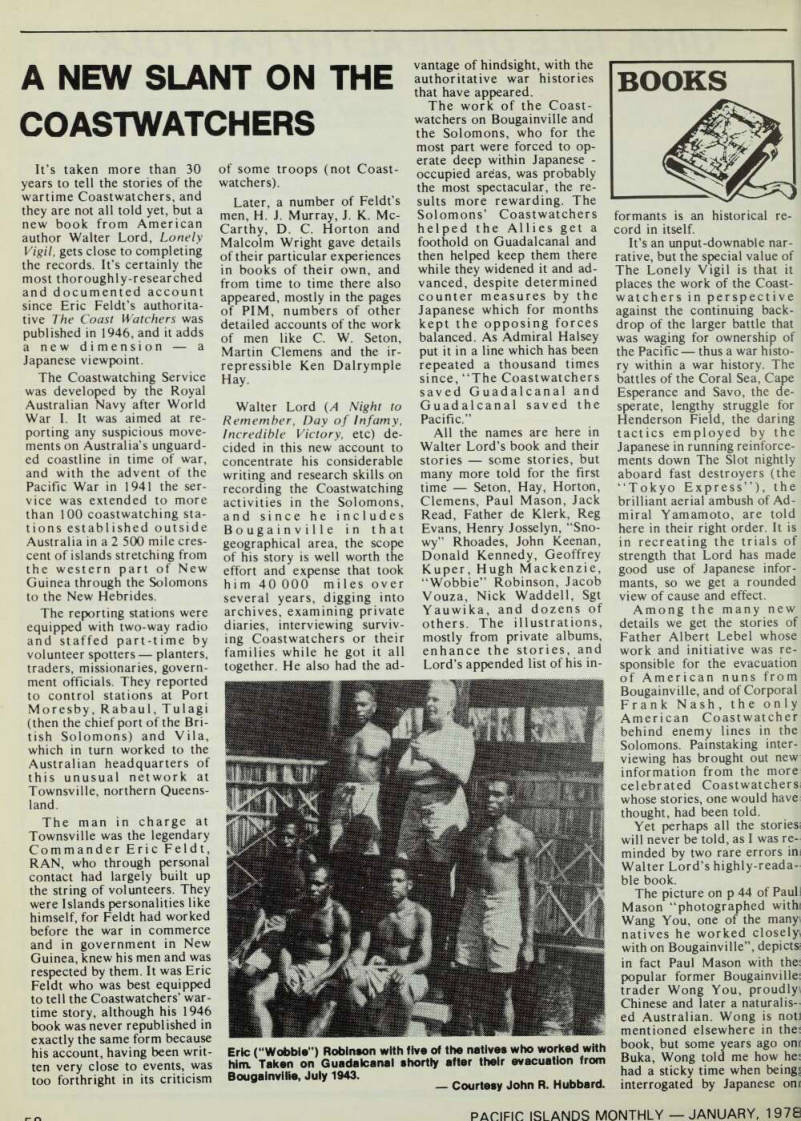
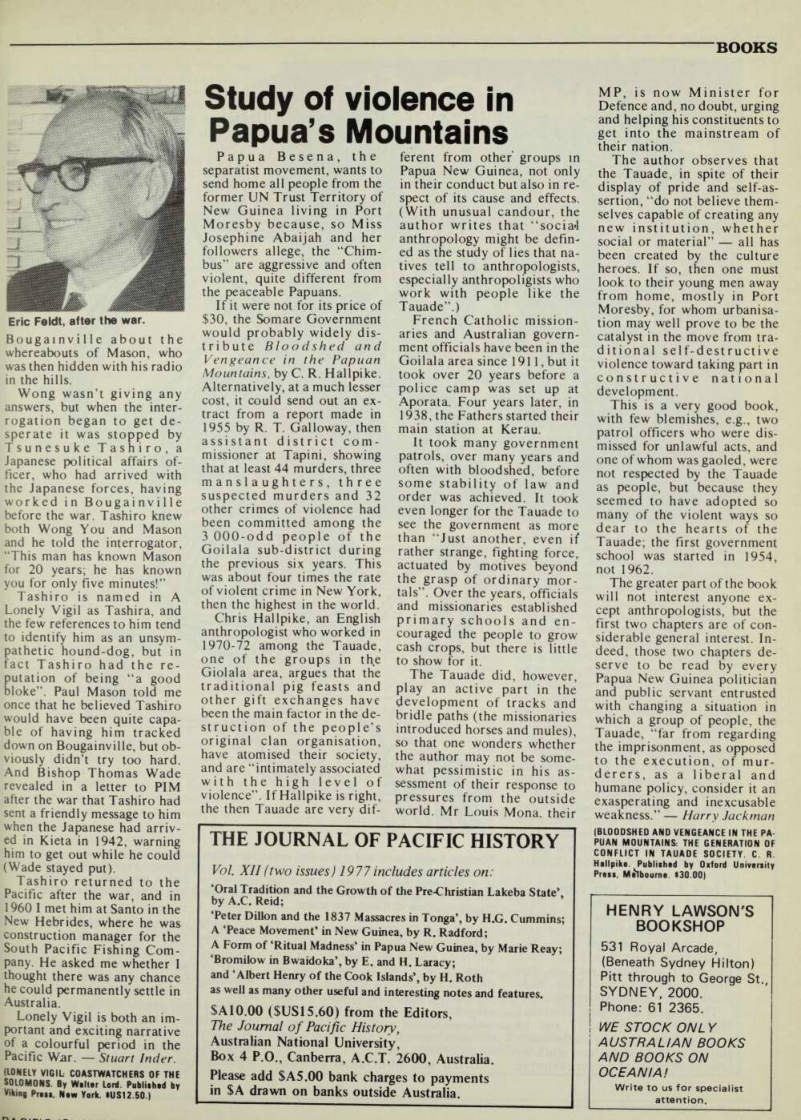
A New Slant On The
it’s taken more than 30 years to tell the stories of the wartime Coastwatchers, and they are not all told yet, but a new book from American author Walter Lord, Lonely Vigil, gets close to completing the records. It’s certainly the
most thoroughly-researched
and documented account since Eric Feldt’s authorita tive The Coast Watchers was published in 1946, and it adds a new dimension a Japanese viewpoint.
The Coastwatching Service was developed by the Royal Australian Navy after World War I. It was aimed at re porting any suspicious move ments on Australia’s unguard ed coastline in time of war, and with the advent of the Pacific War in 1941 the ser vice was extended to more than 100 coastwatching sta tions established outside Australia in a 2 500 mile cres cent of islands stretching from the western part of New Guinea through the Solomons to the New Hebrides.
The reporting stations were equipped with two-way radio and staffed part-time by volunteer spotters — planters, traders, missionaries, govern ment officials. They reported to control stations at Port Moresby, Rabaul, Tulagi (then the chief port of the Bri tish Solomons) and Vila, which in turn worked to the Australian headquarters of this unusual network at Townsville, northern Queens land.
The man in charge at Townsville was the legendary Commander Eric Feldt, RAN, who through personal contact had largely built up the string of volunteers. They were Islands personalities like himself, for Feldt had worked before the war in commerce and in government in New Guinea, knew his men and was respected by them. It was Eric Feldt who was best equipped to tell the Coastwatchers’ war time story, although his 1946 book was never republished in exactly the same form because his account, having been writ ten very close to events, was too forthright in its criticism
of some troops (not Coast watchers).
Later, a number of Feldfs men, H. J. Murray, J. K. Mc- Carthy, D. C. Horton and Malcolm Wright gave details of their particular experiences in books of their own, and from time to time there also appeared, mostly in the pages of PIM, numbers of other detailed accounts of the work of men like C. W. Seton, Martin Clemens and the ir repressible Ken Dalrymple Hay.
Walter Lord ( A Night to Remember, Day of Infamy, Incredible Victory, etc) de cided in this new account to concentrate his considerable writing and research skills on recording the Coastwatching activities in the Solomons, and since he includes Bougainville in that geographical area, the scope of his story is well worth the effort and expense that took him 40 000 miles over several years, digging into archives, examining private diaries, interviewing surviv ing Coastwatchers or their families while he got it all together. He also had the ad
vantage of hindsight, with the authoritative war histories that have appeared.
The work of the Coast watchers on Bougainville and the Solomons, who for the most part were forced to op erate deep within Japanese occupied areas, was probably the most spectacular, the re sults more rewarding. The Solomons’ Coastwatchers helped the Allies get a foothold on Guadalcanal and then helped keep them there while they widened it and ad vanced, despite determined counter measures by the Japanese which for months kept the opposing forces balanced. As Admiral Halsey put it in a line which has been repeated a thousand times since, “The Coastwatchers saved Guadalcanal and Guadalcanal saved the Pacific.”
All the names are here in Walter Lord’s book and their stories some stories, but many more told for the first time Seton, Hay, Horton, Clemens, Paul Mason, Jack Read, Father de Klerk, Reg Evans, Henry Josselyn, “Sno wy” Rhoades, John Keenan, Donald Kennedy, Geoffrey Kuper, Hugh Mackenzie, “Wobbie” Robinson, Jacob Vouza, Nick Waddell, Sgt Yauwika, and dozens of others. The illustrations, mostly from private albums, enhance the stories, and Lord’s appended list of his in-
Books
formants is an historical re cord in itself.
It’s an unput-downable nar rative, but the special value of The Lonely Vigil is that it places the work of the Coast watchers in perspective against the continuing back drop of the larger battle that was waging for ownership of the Pacific thus a war histo ry within a war history. The battles of the Coral Sea, Cape Esperance and Savo, the de sperate, lengthy struggle for Henderson Field, the daring tactics employed by the Japanese in running reinforce ments down The Slot nightly aboard fast destroyers (the “Tokyo Express”), the brilliant aerial ambush of Ad miral Yamamoto, are told here in their right order. It is in recreating the trials of strength that Lord has made good use of Japanese infor mants, so we get a rounded view of cause and effect.
Among the many new details we get the stories of Father Albert Lebel whose work and initiative was re sponsible for the evacuation of American nuns from Bougainville, and of Corporal Frank Nash, the only American Coastwatcher behind enemy lines in the Solomons. Painstaking inter viewing has brought out new information from the more celebrated Coastwatchers; whose stories, one would have: thought, had been told.
Yet perhaps all the stories* will never be told, as I was re minded by two rare errors ini Walter Lord’s highly-reada ble book.
The picture on p 44 of Pauli Mason “photographed withi Wang You, one of the many\ natives he worked closely, with on Bougainville”, depicts? in fact Paul Mason with the; popular former Bougainville; trader Wong You, proudly\ Chinese and later a naturalis ed Australian. Wong is not! mentioned elsewhere in the; book, but some years ago onr Buka, Wong told me how he; had a sticky time when beings interrogated by Japanese om
Eric ("Wobble”) Robinson with five of the natives who worked with him. Taken on Guadalcanal shortly after their evacuation from Bougainville, July 1943. -Courtesy John R. Hubbard.
Bougainville about the whereabouts of Mason, who was then hidden with his radio in the hills.
Wong wasn’t giving any answers, but when the inter rogation began to get de sperate it was stopped by Tsunesuke Tashiro, a Japanese political affairs of ficer, who had arrived with the Japanese forces, having worked in Bougainville before the war. Tashiro knew both Wong You and Mason and he told the interrogator, “This man has known Mason for 20 years; he has known you for only five minutes!”
Tashiro is named in A Lonely Vigil as Tashira, and the few references to him tend to identify him as an unsym pathetic hound-dog, but in fact Tashiro had the re putation of being “a good bloke”. Paul Mason told me once that he believed Tashiro would have been quite capa ble of having him tracked down on Bougainville, but ob viously didn’t try too hard.
And Bishop Thomas Wade revealed in a letter to PIM after the war that Tashiro had sent a friendly message to him when the Japanese had arriv ed in Kieta in 1942, warning him to get out while he could (Wade stayed put).
Tashiro returned to the Pacific after the war, and in 1960 I met him at Santo in the New Hebrides, where he was construction manager for the South Pacific Fishing Com pany. He asked me whether I thought there was any chance he could permanently settle in Australia.
Lonely Vigil is both an im portant and exciting narrative of a colourful period in the
Pacific War.
Stuart Inder.
(Lonely Vigil Coastwatchers Of The
SOLOMONS. By Waltir Lord. Publithod by Viking Prtit, Now York. tU512.50.)
Eric Feldt, after the war.
Papua’s Mountains
Study of violence in Papua’s Mountains
Papua Besena, the separatist movement, wants to send home all people from the former UN Trust Territory of New Guinea living in Port Moresby because, so Miss Josephine Abaijah and her followers allege, the “Chim bus” are aggressive and often violent, quite different from the peaceable Papuans.
If it were not for its price of $3O, the Somare Government would probably widely dis tribute Bloodshed and Vengeance in the Papuan Mountains, by C. R. Hallpike.
Alternatively, at a much lesser cost, it could send out an ex tract from a report made in 1955 by R. T. Galloway, then assistant district com missioner at Tapini, showing that at least 44 murders, three manslaughters, three suspected murders and 32 other crimes of violence had been committed among the 3 000-odd people of the Goilala sub-district during the previous six years. This was about four times the rate of violent crime in New York, then the highest in the world.
Chris Hallpike, an English anthropologist who worked in 1970-72 among the Tauade, one of the groups in the Giolala area, argues that the traditional pig feasts and other gift exchanges have been the main factor in the de struction of the people’s original clan organisation, have atomised their society, and are “intimately associated with the h igh level of violence”. If Hallpike is right, the then Tauade are very dif
ferent from other groups in Papua New Guinea, not only in their conduct but also in re spect of its cause and effects. (With unusual candour, the author writes that “social anthropology might be defin ed as the study of lies that na tives tell to anthropologists, especially anthropoligists who work with people like the Tauade”.) French Catholic mission aries and Australian govern ment officials have been in the Goilala area since 1911, but it took over 20 years before a police camp was set up at Aporata. Four years later, in 1938, the Fathers started their main station at Kerau.
It took many government patrols, over many years and often with bloodshed, before some stability of law and order was achieved. It took even longer for the Tauade to see the government as more than “Just another, even if rather strange, fighting force, actuated by motives beyond the grasp of ordinary mor tals”. Over the years, officials and missionaries established primary schools and en couraged the people to grow cash crops, but there is little to show for it.
The Tauade did, however, play an active part in the development of tracks and bridle paths (the missionaries introduced horses and mules), so that one wonders whether the author may not be some what pessimistic in his as sessment of their response to pressures from the outside world. Mr Louis Mona, their
MP, is now Minister for Defence and, no doubt, urging and helping his constituents to get into the mainstream of their nation.
The author observes that the Tauade, in spite of their display of pride and self-as sertion, “do not believe them selves capable of creating any new institution, whether social or material” all has been created by the culture heroes. If so, then one must look to their young men away from home, mostly in Port Moresby, for whom urbanisa tion may well prove to be the catalyst in the move from tra ditional self-destructive violence toward taking part in constructive national development.
This is a very good book, with few blemishes, e.g., two patrol officers who were dis missed for unlawful acts, and one of whom was gaoled, were not respected by the Tauade as people, but because they seemed to have adopted so many of the violent ways so dear to the hearts of the Tauade; the first government school was started in 1954, not 1962.
The greater part of the book will not interest anyone ex cept anthropologists, but the first two chapters are of con siderable general interest. In deed, those two chapters de serve to be read by every Papua New Guinea politician and public servant entrusted with changing a situation in which a group of people, the Tauade, “far from regarding the imprisonment, as opposed to the execution, of mur derers, as a liberal and humane policy, consider it an exasperating and inexcusable
weakness.”
Harry Jackman
(Bloodshed And Vengeance In The Pa
Puan Mountains: The Generation Of
Conflict In Tauade Society. C. R
Hallpike. Published by Oxford University Press, Melbourne. $30.00)
Advertisements & other items, p. 59 (2 items)
n *
The Journal Of Pacific History
Vo I. XII (two issues) 1977 includes articles on: ‘Oral Tradition and the Growth of the Pre-Christian Lakeba State’ by A.C. Reid; * ‘Peter Dillon and the 1837 Massacres in Tonga’, by H.G. Cummins; A ‘Peace Movement’ in New Guinea, by R. Radford; A Form of ‘Ritual Madness’ in Papua New Guinea, by Marie Reay; ‘Bromilow in Bwaidoka’, by E. and H. Laracy; and ‘Albert Henry of the Cook Islands’, by H. Roth as well as many other useful and interesting notes and features.
SA 10.00 (SUS 15.60) from the Editors, The Journal of Pacific History, Australian National University, Box 4 P. 0., Canberra, A.C.T. 2600, Australia.
Please add 5A5.00 bank charges to payments in $A drawn on banks outside Australia.
HENRY LAWSON'S
BOOKSHOP
531 Royal Arcade, (Beneath Sydney Hilton) Pitt through to George St
SYDNEY, 2000.
Phone; 61 2365.
WE STOCK ONL Y
AUSTRALIAN BOOKS
AND BOOKS ON
OCEANIA!
Write to us for specialist attention.
Of Joy Out
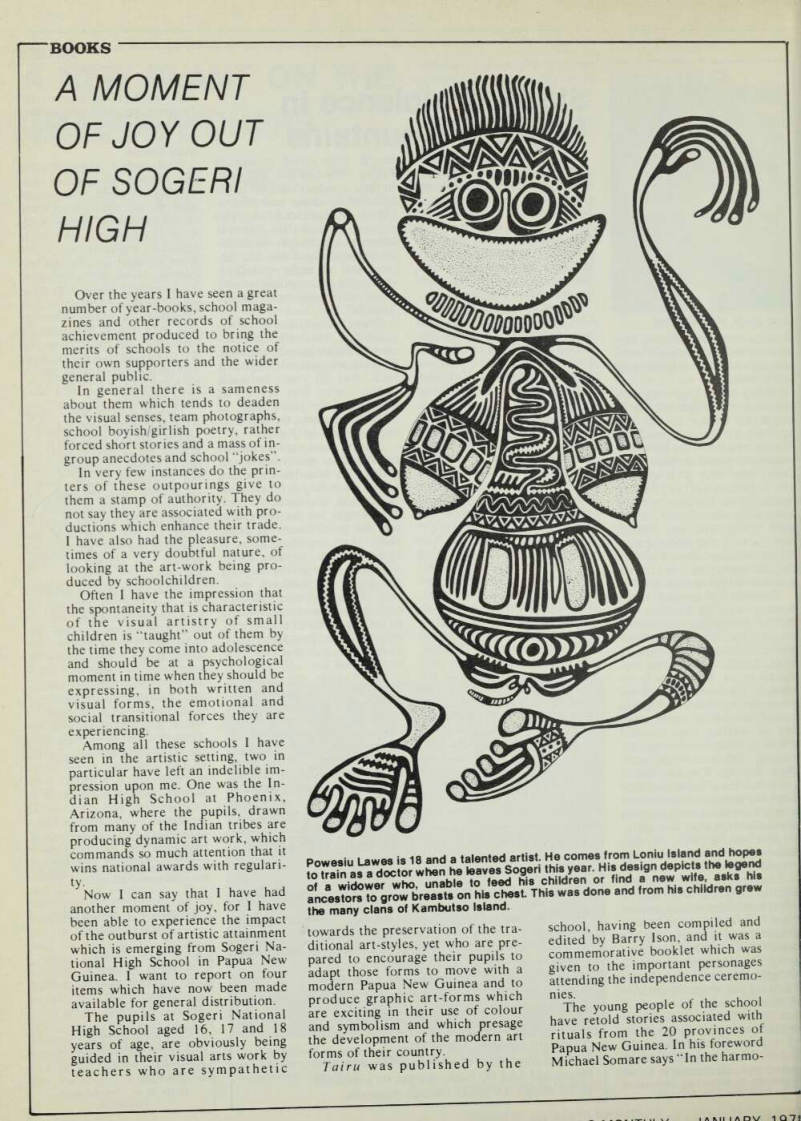
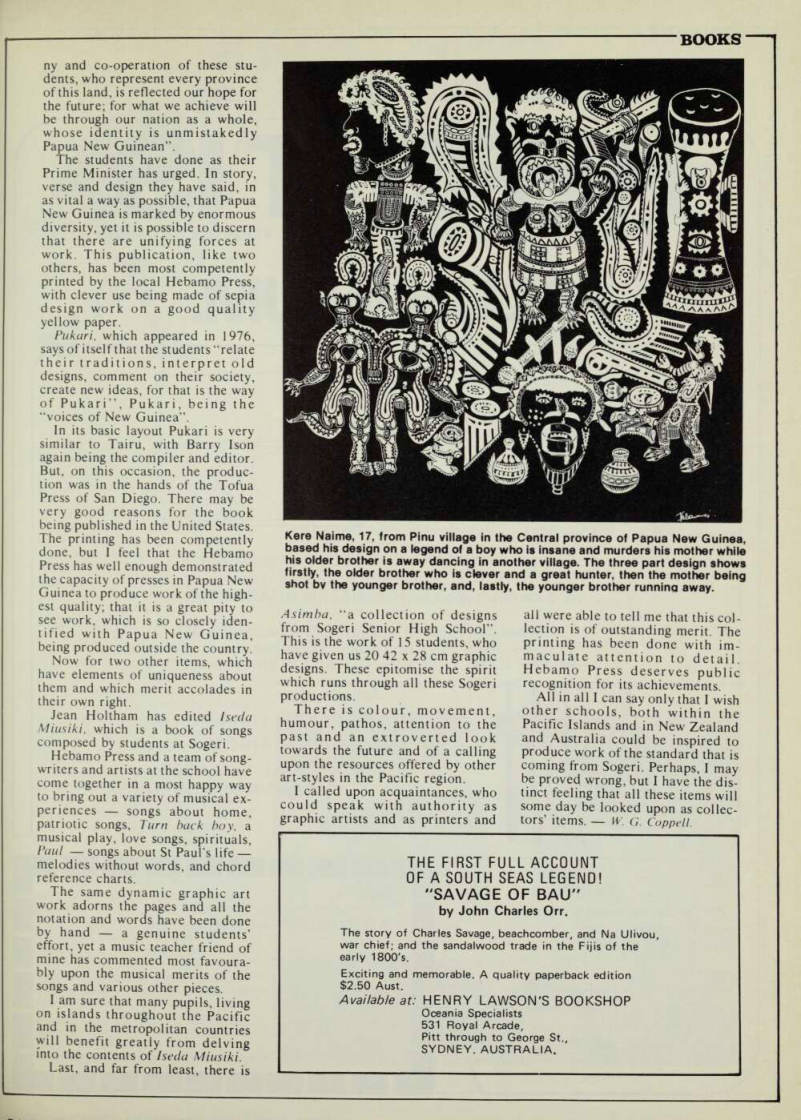
A Moment
Of Sogeri
High
Over the years I have seen a great number of year-books, school maga zines and other records of school achievement produced to bring the merits of schools to the notice of their own supporters and the wider
general public.
In general there is a sameness about them which tends to deaden the visual senses, team photographs, school boyish/girlish poetry, rather forced short stories and a mass of in group anecdotes and school “jokes”.
In very few instances do the prin ters of these outpourings give to them a stamp of authority. They do not say they are associated with pro ductions which enhance their trade.
I have also had the pleasure, some times of a very doubtful nature, of looking at the art-work being pro duced by schoolchildren.
Often I have the impression that the spontaneity that is characteristic of the visual artistry of small children is “taught” out of them by the time they come into adolescence and should be at a psychological moment in time when they should be expressing, in both written and visual forms, the emotional and social transitional forces they are
experiencing.
Among all these schools I have seen in the artistic setting, two in particular have left an indelible im pression upon me. One was the In dian High School at Phoenix, Arizona, where the pupils, drawn from many of the Indian tribes are producing dynamic art work, which commands so much attention that it wins national awards with regulari ty.
Now I can say that I have had another moment of joy, for I have been able to experience the impact of the outburst of artistic attainment which is emerging from Sogeri Na tional High School in Papua New Guinea. I want to report on four items which have now been made available for general distribution.
The pupils at Sogeri National High School aged 16, 17 and 18 years of age, are obviously being guided in their visual arts work by teachers who are sympathetic
towards the preservation of the tra ditional art-styles, yet who are pre pared to encourage their pupils to adapt those forms to move with a modern Papua New Guinea and to
produce graphic art-forms which
are exciting in their use of colour and symbolism and which presage the development of the modern art forms of their country.
Tairu was published by the
school, having been compiled and edited by Barry Ison, and it was a commemorative booklet which was given to the important personages attending the independence ceremo nies. . , The young people of the school have retold stories associated with rituals from the 20 provinces of Papua New Guinea. In his foreword Michael Somare says “In the harmo
Powesiu lawes is 18 and a talented artist. He comes from Loniu Island and hopes to train as a doctor when he leaves Sogeri this year. His design depicts the legend of a widower who, unable to feed his children or find a new wife, asks his ancestors to grow breasts on his chest. This was done and from his children grew the many clans of kambutso Island.
ny and co-operation of these stu dents, who represent every province of this land, is reflected our hope for the future; for what we achieve will be through our nation as a whole,
whose identity is unmistakedly
Papua New Guinean”.
The students have done as their Prime Minister has urged. In story, verse and design they have said, in as vital a way as possible, that Papua New Guinea is marked by enormous diversity, yet it is possible to discern that there are unifying forces at work. This publication, like two others, has been most competently printed by the local Hebamo Press, with clever use being made of sepia design work on a good quality yellow paper.
Pukari, which appeared in 1976, says of itself that the students “relate their traditions, interpret old designs, comment on their society, create new ideas, for that is the way of Pukari”, Pukari, being the “voices of New Guinea”.
In its basic layout Pukari is very similar to Tairu, with Barry Ison again being the compiler and editor.
But, on this occasion, the produc tion was in the hands of the Tofua Press of San Diego. There may be very good reasons for the book being published in the United States.
The printing has been competently done, but I feel that the Hebamo Press has well enough demonstrated the capacity of presses in Papua New Guinea to produce work of the high est quality; that it is a great pity to see work, which is so closely iden tified with Papua New Guinea, being produced outside the country.
Now for two other items, which have elements of uniqueness about them and which merit accolades in their own right.
Jean Holtham has edited Iseda Miusiki, which is a book of songs composed by students at Sogeri.
Hebamo Press and a team of song writers and artists at the school have come together in a most happy way to bring out a variety of musical ex periences songs about home, patriotic songs, Turn hack hoy, a musical play, love songs, spirituals, Paul songs about St Paul’s life melodies without words, and chord reference charts.
The same dynamic graphic art work adorns the pages and all the notation and words have been done by hand a genuine students’ effort, yet a music teacher friend of mine has commented most favoura bly upon the musical merits of the songs and various other pieces.
I am sure that many pupils, living on islands throughout the Pacific and in the metropolitan countries will benefit greatly from delving into the contents of Iseda Miusiki.
Last, and far from least, there is
Asimha, “a collection of designs from Sogeri Senior High School”.
This is the work of 15 students, who have given us 20 42 x 28 cm graphic designs. These epitomise the spirit which runs through all these Sogeri productions.
There is colour, movement, humour, pathos, attention to the past and an extroverted look towards the future and of a calling upon the resources offered by other art-styles in the Pacific region.
I called upon acquaintances, who could speak with authority as graphic artists and as printers and
all were able to tell me that this col lection is of outstanding merit. The printing has been done with im maculate attention to detail.
Hebamo Press deserves public recognition for its achievements.
All in all I can say only that I wish other schools, both within the Pacific Islands and in New Zealand and Australia could be inspired to produce work of the standard that is coming from Sogeri. Perhaps, I may be proved wrong, but I have the dis tinct feeling that all these items will some day be looked upon as collec
tors’ items.
W. G. Coppell.
Kere Naime, 17, from Pinu village in the Central province of Papua New Guinea, based his design on a legend of a boy who is insane and murders his mother while his older brother is away dancing in another village. The three part design shows firstly, the older brother who is clever and a great hunter, then the mother being shot bv the younger brother, and, lastly, the younger brother running away.
Advertisements & other items, pp. 60-62 (4 items)
Books
... v/ IAMi lADV 1 Q7{
Books
The First Full Account
OF A SOUTH SEAS LEGEND!
“SAVAGE OF BALT
by John Charles Orr.
The story of Charles Savage, beachcomber, and Na Ulivou, war chief; and the sandalwood trade in the Fijis of the early 1800's.
Exciting and memorable. A quality paperback edition $2.50 Aust.
Available at: HENRY LAWSON'S BOOKSHOP Oceania Specialists 531 Royal Arcade, Pitt through to George St.,
SYDNEY. AUSTRALIA.
HERE IT IS.
A REVOLUTIONARY BUILDING PRODUCT IN THE MOST VERSATILE MATERIAL...
ALUMINIUM.
HOME OWNERS
BUILDERS
PUBLIC WORKS DEBTS.
LOCAL GOVT. COUNCILS
MISSIONS
This product WON'T CORRODE, is lightweight YET STRONG. Permanent decorative colours •and carries a 40 YEAR WRITTEN GUARANTEE. 110 square metre (house) external walls is packaged into six boxes, 30cm width, 6cm depth, 360 cm long and WEIGHT is ONLY 180 kilos. (TOTAL EXTERIOR WALLS).
Results:
EASILY TRANSPORTABLE
EASILY FIXED
AND ALL YOU NEED
IS A HAMMER AND NAILS!
For further information and Full Product List
MAIL THIS COUPON!
TO:
SUNCOAST ALUMINIUM CO.
6-8 Currie St., Nambour Old. 4560.
P.O. Box 20, Nambour.
Phone; 41 3615 / 41 2393 Dear Sir, Please send me information on
ALUMINIUM WEATHER BOARDS.
Name
Company
Full Address
Immmmmmm.
_ - Tla&Itiii V/ Lamii A Dv 1 Q7O
- tlA&ITIII V/ lAMII A DV 1 Q7O
A Sweet Potato
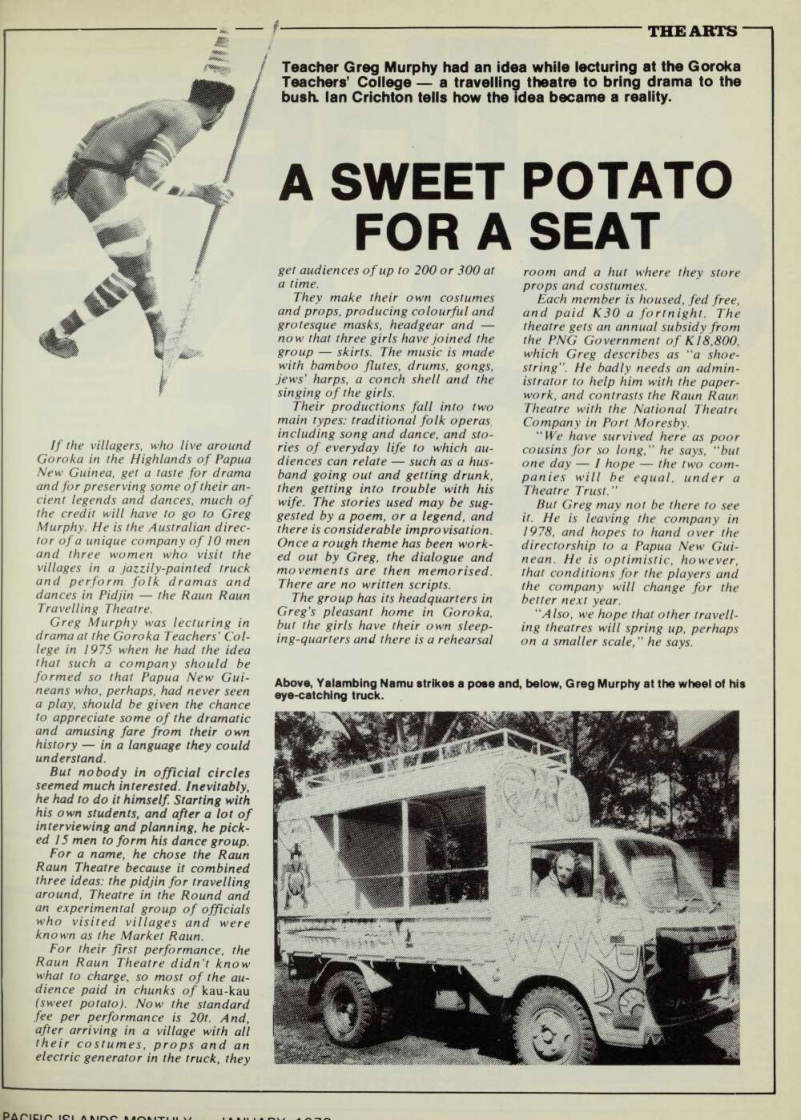
For A Seat
Teacher Greg Murphy had an idea while lecturing at the Goroka Teachers’ College a travelling theatre to bring drama to the bush. lan Crichton tells how the idea became a reality.
If the villagers, who live around Goroka in the Highlands of Papua New Guinea, get a taste for drama and for preserving some of their an cient legends and dances, much of the credit will have to go to Greg Murphy. He is the Australian direc tor of a unique company of 10 men and three women who visit the villages in a jazzily-painted truck and perform folk dramas and dances in Pidjin the Raun Raun Travelling Theatre.
Greg Murphy was lecturing in drama at the Goroka Teachers’ Col lege in 1975 when he had the idea that such a company should be formed so that Papua New Gui neans who, perhaps, had never seen a play, should be given the chance to appreciate some of the dramatic and amusing fare from their own history in a language they could understand.
But nobody in official circles seemed much interested. Inevitably, he had to do it himself. Starting with his own students, and after a lot of interviewing and planning, he pick ed 15 men to form his dance group.
For a name, he chose the Raun Raun Theatre because it combined three ideas: the pidjin for travelling around, Theatre in the Round and an experimental group of officials who visited villages and were known as the Market Raun.
For their first performance, the Raun Raun Theatre didn’t know what to charge, so most of the au dience paid in chunks of kau-kau (sweet potato). Now the standard fee per performance is 20t. And, after arriving in a village with all their costumes, props and an electric generator in the truck, they
get audiences of up to 200 or 300 at a time.
They make their own costumes and props, producing colourful and grotesque masks, headgear and now that three girls have joined the group skirts. The music is made with bamboo flutes, drums, gongs, jews’ harps, a conch shell and the singing of the girls.
Their productions fall into two main types: traditional folk operas including song and dance, and stories of everyday life to which audiences can relate such as a husband going out and getting drunk, then getting into trouble with his wife. The stories used may be suggested by a poem, or a legend, and there is considerable improvisation.
Once a rough theme has been worked out by Greg, the dialogue and movements are then memorised.
There are no written scripts.
The group has its headquarters in Greg’s pleasant home in Goroka, but the girls have their own sleeping-quarters and there is a rehearsal
room and a hut where they store props and costumes.
Each member is housed, fed free, and paid K3O a fortnight. The theatre gets an annual subsidy from the PNG Government of KlB,BOO, which Greg describes as ”a shoe string”. He badly needs an admin istrator to help him with the paper work, and contrasts the Raun Raun Theatre with the National Theatre Company in Port Moresby, “We have survived here as poor cousins for so long,” he says, “but one day / hope the two corn panies will be equal, under a Theatre Trust.”
But Greg may not be there to see it. He is leaving the company in 1978, and hopes to hand over the directorship to a Papua New Gui nean. He is optimistic, however, that conditions for the players and the company will change for the better next year.
“ Also, we hope that other travell ing theatres will spring up, perhaps on a smaller scale, ” he says.
Above, Yalambing Namu strikes a pose and, below, Greg Murphy at the wheel of his eye-catching truck.
Advertisements & other items, pp. 63-64 (3 items)
The Arts
PAPiciP ici a MPvP IV *r\K ITI II \ ✓ I A Ail ia nw A /N-.^
_ . a aiPkO mamtui v lAMI lARV 1 978
. a aiPkO mamtui v lAMI lARV 1 978
that makes your home
a healthier place
How effectively you protect your family from the dangers of disease carrying insects, may well depend on the insect spray you choose.
Powerful Insect Killing Ingredients.
Concentrated Pea Beu is one of the most powerful household insect sprays in the world. Its principal insect killing ingredients have been selected to ensure rapid knock down and kill of all common disease carrying insects.
Rigid Testing. Through every stage of manufacture. Pea Beu is rigidly tested.
There are ingredient tests, spray droplet tests, pack tests, many forms of tests, some carried out three times over.
When you spray this remarkable aerosol insecticide, you can be sure that its ingredients have met with the most exacting standards enabling you to spray it safely with confidence in your home. m M.
Wk Family Health and Well Being. The common housefly carries up to half a billion germs and, when you realize that disease carrying insects enter even the best regulated households, you can understand why you can't be too careful about the effectiveness of your insect spray. Remember,-even the tiniest droplet n 4 9 of concentrated Pea Beu kills flies, mosquitoes, all common disease carrying Concentrated Pea Beu. Even the tiniest droplet
kills flies, mosquitoes, gM common
disease carrying insects fast.
insects fast, so it is indeed a worthy guardian of your family's health and well being.
Such is the effectiveness of Pea Beu's insect killing ingredient, that no common disease carrying insect can survive it. nor develop an immunity to it. When you spray Concentrated Pea Beu, it's nice to know that no common disease carrying insect can survive.
Pea Beu - The strong one, makes your home a healthier place.
Fiji court hears tale of wreck,
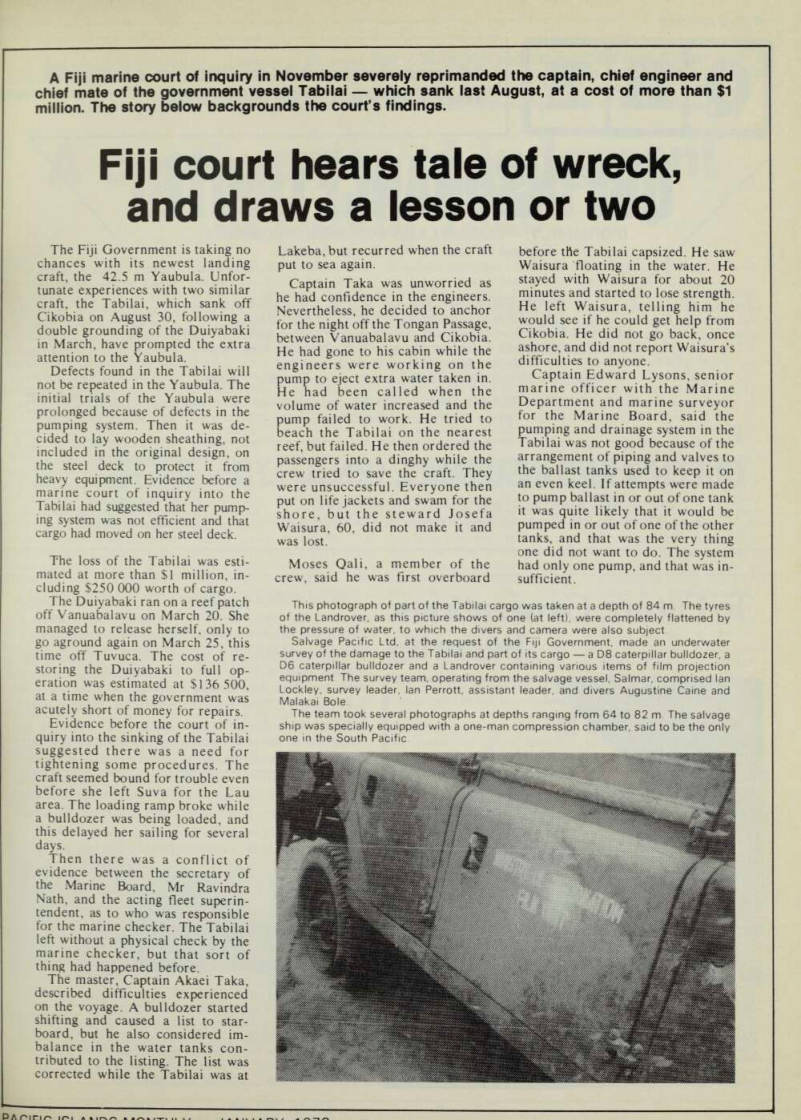
and draws a lesson or two
A Fiji marine court of inquiry in November severely reprimanded the captain, chief engineer and chief mate of the government vessel Tabilai which sank last August, at a cost of more than $1 million. The story below backgrounds the court’s findings.
The Fiji Government is taking no chances with its newest landing craft, the 42.5 m Yaubula. Unfor tunate experiences with two similar craft, the Tabilai, which sank off Cikobia on August 30, following a double grounding of the Duiyabaki in March, have prompted the extra attention to the Yaubula.
Defects found in the Tabilai will not be repeated in the Yaubula. The initial trials of the Yaubula were prolonged because of defects in the pumping system. Then it was de cided to lay wooden sheathing, not included in the original design, on the steel deck to protect it from heavy equipment. Evidence before a marine court of inquiry into the Tabilai had suggested that her pump ing system was not efficient and that cargo had moved on her steel deck.
The loss of the Tabilai was esti mated at more than $1 million, in cluding $250 000 worth of cargo.
The Duiyabaki ran on a reef patch off Vanuabalavu on March 20. She managed to release herself, only to go aground again on March 25, this time off Tuvuca. The cost of re storing the Duiyabaki to full op eration was estimated at $136 500, at a time when the government was acutely short of money for repairs.
Evidence before the court of in quiry into the sinking of the Tabilai suggested there was a need for tightening some procedures. The craft seemed bound for trouble even before she left Suva for the Lau area. The loading ramp broke while a bulldozer was being loaded, and this delayed her sailing for several days.
Then there was a conflict of evidence between the secretary of the Marine Board, Mr Ravindra Nath, and the acting fleet superin tendent, as to who was responsible for the marine checker. The Tabilai left without a physical check by the marine checker, but that sort of thing had happened before.
The master, Captain Akaei Taka, described difficulties experienced on the voyage. A bulldozer started shifting and caused a list to star board, but he also considered im balance in the water tanks con tributed to the listing. The list was corrected while the Tabilai was at
Lakeba,but recurred when the craft put to sea again.
Captain Taka was unworried as he had confidence in the engineers.
Nevertheless, he decided to anchor for the night off the Tongan Passage, between Vanuabalavu and Cikobia.
He had gone to his cabin while the engineers were working on the pump to eject extra water taken in.
He had been called when the volume of water increased and the pump failed to work. He tried to beach the Tabilai on the nearest reef, but failed. He then ordered the passengers into a dinghy while the crew tried to save the craft. They were unsuccessful. Everyone then put on life jackets and swam for the shore, but the steward Josefa Waisura, 60, did not make it and was lost.
Moses Qali, a member of the crew, said he was first overboard
before the Tabilai capsized. He saw Waisura floating in the water. He sta y ed with Waisura for about 20 minutes and started to lose strength. * Waisura, telling him he 566 “ he could get help from Cikobia. He did not go back, once not re P ort Waisura’s difficulties to anyone, Captain Edward Lysons, senior marine officer with the Marine Department and marine surveyor f° r Marine Board, said the pumping and drainage system in the Tabilai was not good because of the arrangement of piping and valves to the ballast tanks used to keep it on an even keel. If attempts were made f° pump ballast in or out of one tank was quite likely that it would be pumped in or out of one of the other tanks, and that was the very thing one did not want to do. The system had only one pump, and that was in sufficient.
This photograph of part of the Tabilai cargo was taken at a depth of 84 m The tyres of the Landrover, as this picture shows of one (at left), were completely flattened by the pressure of water, to which the divers and camera were also subject Salvage Pacific Ltd, at the request of the Fiji Government, made an underwater survey of the damage to the Tabilai and part of its cargo a D 8 caterpillar bulldozer, a D 6 caterpillar bulldozer and a Landrover containing various items of film projection equipment The survey team, operating from the salvage vessel, Salmar, comprised lan Lockley, survey leader, lan Perrott, assistant leader, and divers Augustine Caine and Malakai Bole The team took several photographs at depths ranging from 64 to 82 m The salvage ship was specially equipped with a one-man compression chamber, said to be the only one in the South Pacific
Advertisements & other items, pp. 65-66 (3 items)
PAO I r I IO I A Ik I A A & I lit v / t /
n a ir* i io i a nirvP R iIAKITUI \/ lAMII A R V 197 Hi
Qbe Insurance United
offers expert insurance
throughout the Islands.
(FORMERLY - QUEENSLAND INSURANCE COMPANY)
Central Office: 82 Pitt Street, Sydney.
FIJI Branch Office, Suva, Manager for Fiji: L.G. Liddell A.A.1.1.
LAUTOKA Sub-Branch Office: Burns Philp Bldg.
NEW CALEDONIA - T.A. Hagen, Ste. W.A. Johnston, S.A.R.L. - Noumea.
NEW HEBRIDES - District Manager: G.F. Donnelly, Vila; Santo Santo: Burns Philp (New Hebrides) Ltd.
TAHITI - Arthur Chung: Immeuble 8.1., Front de Mer, Papeete.
NIUE, NORFOLK ISLAND, SAMOA, TONGA and other South Sea Islands Burns Philp (South Sea) Company L td.
QUEENSLAND INSURANCE (RN.G.) LTD.
PAPUA NEW GUINEA - Head Office, PORT MORESBY.
General Manager: J.M. Dawe. Assistant Manager: R. Jackson, A.A.U.
District Managers at: LAE: I.R. Martin MOUNT HAGEN: D.F. Carroll ARAWA: J. Longbut MADANG: R.W.V. Ceilings RABAUL: A.M. Tanner
To Future Generations,
Security
'^^V4,:■-/* k. .> v *aM Horyuji japan's 7th century '“i temple links the past to the present with the solemn beauty.
Social welfare is a subject of serious consideration in most modern societies. Man in the twentieth century accepts his responsibility to bequeath to the next generation a society better than his own.
Daiwa Bank is not unique in accepting this responsibility, but Daiwa is unique in making acceptance of this role in society an integral part of their banking service.
Daiwa is the only Japanese city bank to combine banking and trust business. Daiwa is thus a fully integrated banking institution, comprising banking, international financing, trust, pension trust, and real estate business. This integration is part of our effort to fulfil our social responsibility consistent with society's needs in a contemporary environment. a fully integrated banking service
DAIWA BANK
Head Office: Osaka, Japan London and Frankfurt Branches New York and Los Angeles Agencies Singapore, Sydney, Sao Paulo, Hong Kong and Houston Representative Offices Subsidiary: Daiwa Bank Trust Company, New York Joint Venture Banks: P.T. Bank Perdania, Jakarta, International Credit Alliance, Ltd., Hong Kong
A costly error of judgment
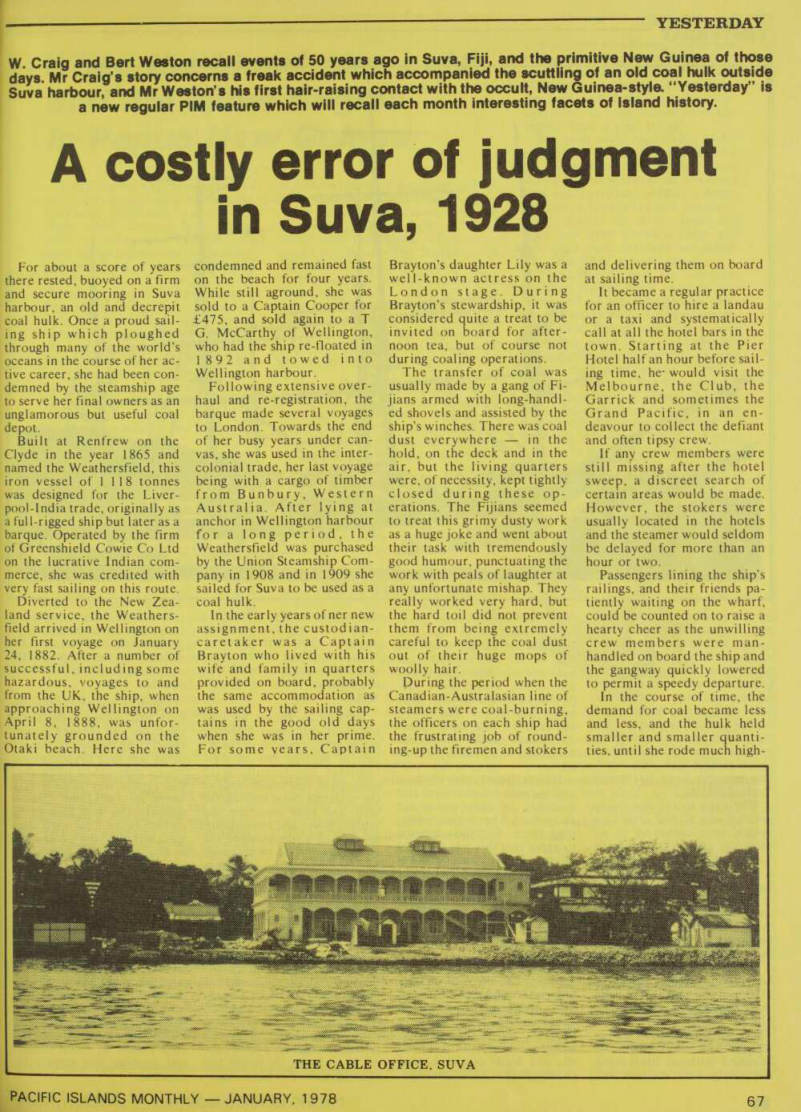
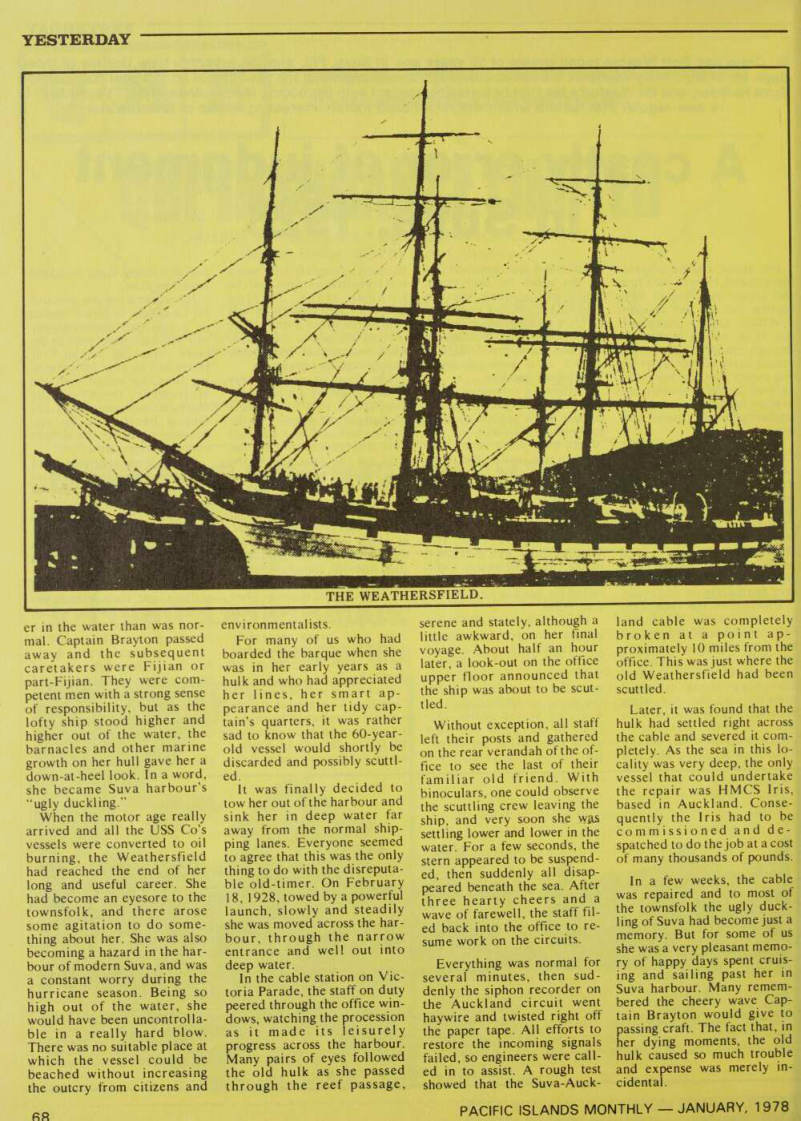
in Suva, 1928
W Craig and Bert Weston recall events of 50 years ago in Suva, Fiji, and the primitive New Guinea of those days Mr Craig’s story concerns a freak accident which accompanied the scuttling of an old coal hulk outside Suva harbour, and Mr Weston’s his first hair-raising contact with the occult, New Guinea-style. “Yesterday” is a new regular RIM feature which will recall each month interesting facets of Island history.
For about a score of years there rested, buoyed on a firm and secure mooring in Suva harbour, an old and decrepit coal hulk. Once a proud sail ing ship which ploughed through many of the world’s oceans in the course of her ac tive career, she had been con demned by the steamship age to serve her final owners as an unglamorous but useful coal depot.
Built at Renfrew on the Clyde in the year 1865 and named the Weathersfield, this iron vessel of 1 118 tonnes was designed for the Liver pool-India trade, originally as a full-rigged ship but later as a barque. Operated by the firm of Greenshield Cowie Co Ltd on the lucrative Indian com merce, she was credited with very fast sailing on this route.
Diverted to the New Zea land service, the Weathers field arrived in Wellington on her first voyage on January 24, 1882. After a number of successful, including some hazardous, voyages to and from the UK, the ship, when approaching Wellington on April 8, 1888, was unfor tunately grounded on the Otaki beach. Here she was
condemned and remained fast on the beach for four years.
While still aground, she was sold to a Captain Cooper for £475, and sold again to a T G. McCarthy of Wellington, who had the ship re-floated in 1892 and towed into Wellington harbour.
Following extensive over haul and re-registration, the barque made several voyages to London. Towards the end of her busy years under can vas, she was used in the inter colonial trade, her last voyage being with a cargo of timber from Bunbury, Western Australia. After lying at anchor in Wellington harbour for a long period, the Weathersfield was purchased by the Union Steamship Com pany in 1908 and in 1909 she sailed for Suva to be used as a coal hulk.
In the early years of ner new assignment, the custodian caretaker was a Captain Brayton who lived with his wife and family in quarters provided on board, probably the same accommodation as was used by the sailing cap tains in the good old days when she was in her prime.
For some years. Captain
Brayton’s daughter Lily was a well-known actress on the London stage. During Brayton’s stewardship, it was considered quite a treat to be invited on board for afternoon tea, but of course not during coaling operations.
The transfer of coal was usually made by a gang of Fijians armed with long-handied shovels and assisted by the ship’s winches. There was coal dust everywhere in the hold, on the deck and in the air, but the living quarters were, of necessity, kept tightly closed during these operations. The Fijians seemed to treat this grimy dusty work as a huge joke and went about their task with tremendously good humour, punctuating the work with peals of laughter at any unfortunate mishap. They really worked very hard, but the hard toil did not prevent them from being extremely careful to keep the coal dust out of their huge mops of woolly hair.
During the period when the Canadian-Australasian line of steamers were coal-burning, the officers on each ship had the frustrating job of rounding-up the firemen and stokers
and delivering them on board at sailing time.
It became a regular practice for an officer to hire a landau or a taxi and systematically call at all the hotel bars in the town. Starting at the Pier Hotel half an hour before sail ing time, he* would visit the Melbourne, the Club, the Garrick and sometimes the Grand Pacific, in an en deavour to collect the defiant and often tipsy crew, If any crew members were still missing after the hotel sweep, a discreet search of certain areas would be made, However, the stokers were usually located in the hotels and the steamer would seldom be delayed for more than an hour or two.
Passengers lining the ship’s railings, and their friends pa tiently waiting on the wharf, could be counted on to raise a hearty cheer as the unwilling crew members were man handled on board the ship and the gangway quickly lowered to permit a speedy departure.
In the course of time, the demand for coal became less and less, and the hulk held smaller and smaller quanti ties, until she rode much high-
The Cable Office. Suva
er in the water than was nor
mal. Captain Brayton passed
away and the subsequent caretakers were Fijian or part-Fijian. They were com petent men with a strong sense of responsibility, but as the lofty ship stood higher and higher out of the water, the barnacles and other marine growth on her hull gave her a down-at-heel look. In a word, she became Suva harbour’s “ugly duckling.”
When the motor age really arrived and all the USS Co’s vessels were converted to oil burning, the Weathersfield had reached the end of her long and useful career. She had become an eyesore to the townsfolk, and there arose some agitation to do some thing about her. She was also becoming a hazard in the har bour of modern Suva, and was a constant worry during the hurricane season. Being so high out of the water, she would have been uncontrolla ble in a really hard blow.
There was no suitable place at which the vessel could be beached without increasing the outcry from citizens and
environmentalists.
For many of us who had boarded the barque when she was in her early years as a hulk and who had appreciated her lines, her smart ap pearance and her tidy cap tain’s quarters, it was rather sad to know that the 60-year old vessel would shortly be discarded and possibly scuttl ed.
It was finally decided to tow her out of the harbour and sink her in deep water far away from the normal ship ping lanes. Everyone seemed to agree that this was the only thing to do with the disreputa ble old-timer. On February 18, 1928, towed by a powerful launch, slowly and steadily she was moved across the har bour, through the narrow entrance and well out into deep water.
In the cable station on Vic toria Parade, the staff on duty peered through the office win dows, watching the procession as it made its leisurely progress across the harbour.
Many pairs of eyes followed the old hulk as she passed through the reef passage,
serene and stately, although a little awkward, on her final voyage. About half an hour later, a look-out on the office upper floor announced that the ship was about to be scut tled.
Without exception, all staff left their posts and gathered on the rear verandah of the of fice to see the last of their familiar old friend. With binoculars, one could observe the scuttling crew leaving the ship, and very soon she was settling lower and lower in the water. For a few seconds, the stern appeared to be suspend ed, then suddenly all disap peared beneath the sea. After three hearty cheers and a wave of farewell, the staff fil ed back into the office to re sume work on the circuits.
Everything was normal for several minutes, then sud denly the siphon recorder on the Auckland circuit went haywire and twisted right off the paper tape. All efforts to restore the incoming signals failed, so engineers were call ed in to assist. A rough test showed that the Suva-Auck
land cable was completely broken at a point ap proximately 10 miles from the office. This was just where the old Weathersfield had been scuttled.
Later, it was found that the hulk had settled right across the cable and severed it com pletely. As the sea in this lo cality was very deep, the only vessel that could undertake the repair was HMCS Iris, based in Auckland. Conse quently the Iris had to be commissioned and de spatched to do the job at a cost of many thousands of pounds.
In a few weeks, the cable was repaired and to most of the townsfolk the ugly duck ling of Suva had become just a memory. But for some of us she was a very pleasant memo ry of happy days spent cruis ing and sailing past her in Suva harbour. Many remem bered the cheery wave Cap tain Brayton would give to passing craft. The fact that, in her dying moments, the old hulk caused so much trouble and expense was merely in cidental.
The Weathersfield,
and the spine tingles
When the blood runs cold and the spine tingles in Papua New Guinea
There have always been stories of
weird and inexplicable happenings,
generally attributed to non-white races, which include fire-walking, bone-pointing, the Indian rope trick, the performances of the gully gully man and of the witch doctors of Africa.
And anyone who has lived in Papua New Guinea for any length of time has heard of, or experienced, instances of the occult and of sorc ery among the primitive tribes.
What employer of native labour has not been approached at some time by one of his employees asking to be allowed to visit his home village hundreds of miles away by land or sea as a close relative had died over night?
The invariable answer, when questioned as to the source of the bad news, was Mi lookim wind (spirit) belong im along night.
My first impulse as a newcomer to New Guinea 50 years ago was to refuse the request as being a blatant try-out of a greenhorn employer, and one would put up with sulks and mopings for a few days as a result.
However, my attitude changed when, on subsequent recruiting visits to some of the villages, I found that the man had spoken the truth and a near-relative had, in fact, died at the time and date mentioned.
If distance and remoteness were no bar, I never afterwards refused a request for compassionate leave on such grounds and was often reward ed by the arrival of several volun teer employees from that area.
Another manifestation of some kind of perception occurred when in 1928, at Lae, I pegged out the position of a number of postholes for a cargo shed beside the airstrip and left a team of raw and newly arrived labourers from the Sepik, many miles away, to dig the holes with bush knives.
On returning some time later I found no holes dug and the team huddled in a silent group some dis tance away. Asking through an in terpreter why no work had been done, 1 was told that as soon as the first hole was started a wind ap peared and told them that they were disturbing an ancient battlefield and burying-ground. With pegs relo cated some considerable distance away the holes were dug with no fur ther demur. Although there was no
visible evidence of burial mounds or subsidence of graves I made inqu iries locally and found that the Laewombas had fought a battle there with the coastal tribes many years previously. The Sepiks could not possibly have known that.
Throughout New Guinea there has always been a universal belief and fear of an evil spirit or devil man known as a maselei and I had an instance of this fear when tramp ing down the Markham Valley with a number of recruits just before the war.
We camped for the night in a small compound near the village of Jiviseng. There was a large open sided shed in which the boys bedded down for the night and an enclosed house kiap in which my net and bed were set up.
Sometime after midnight, I was awakened by the entire team burst ing into my hut, all in a state of ter ror and shouting Maselei i come up, i walkabout long all boi. No effort of mine would induce them to move out and at daylight there was no trouble in getting them on the track away from the place. What they saw I know not but they certainly had the “wind” up in more ways than one.
A man named Jim, whose word could be relied upon, often told the story of his appointment as planta tion manager on one of the very remote Ninigo Group which was serviced every eight weeks by a small steamer from Rabaul. All went well and to schedule for eight months and then the ship failed to arrive at the end of the 10th month.
Days drew out into weeks with re sultant exhaustion of staple food supplies, tobacco, liquor and medi cal requisites and in those days there was no radio for news of the outside world.
Things were at a low ebb when one evening the boss boy came grin ning to tell Jim that the ship would arrive next day bringing a red haired man to take over as manager as Jim was needed back in the firm’s Rabaul office.
Sure enough, sunrise brought smoke on the horizon and shouts of “Sail-ho” from the men.
Taken out by canoe, our friend was on board as the anchor hit the sand and was greeted by the skipper apologising for the delay caused by
a machinery breakdown on the pre vious trip and resultant long wait for spares from Australia. But, he said “I have news for you, I am taking you back to Rabaul to another posi tion and”, as a red-haired came for ward, “here is your relief’.
My most vivid experience of the occult occurred at Salamaua when it was whispered around that there would be a demonstration of sorcery in a nearby village. About a dozen interested Europeans and dozens of locals turned up at the appointed time and were shown a large and new sago palm thatched hut stand ing on stilts in an open space.
The sorcerer and his disciples huddled around a fire about 50 feet away and we were invited to enter the hut which we found to be empty.
The door was closed and a long bamboo pole was then thrust through the side of the'shed leaving about half protruding outside.
Leaves thrown on the fire raised a pungent column of smoke and then after a rising chorus of drumming and changing from the sorcerers’ at tendants the pole began to tremble and shake until finally it was lashing about like the tail of an angry tiger.
The drumming and singing died away, the bamboo came to rest and we were allowed to again inspect the inside of the building. It was quite empty of anything.
Again the ceremony was started with the pole inserted through another side of the shed. As the bamboo went into its trembling act, I was invited to take a firm hold of it. Immediately the incantations rose to a high pitch, the pole lashed about violently and I was hurled some distance to fall flat on the ground.
At this point, Jim Livingstone, the local warrant officer in charge of police, accompanied by a number of his men, burst into the clearing, cursing us for fools, scattering the assembled crowd and finally de molishing the hut.
I have no explanation for this oc currence and it left me with an im pression of an enormously powerful and evil force on the hidden end of the bamboo pole.
I never wanted to be part of such things again.
Bert Weston
Pandora: An 18th century horror tale
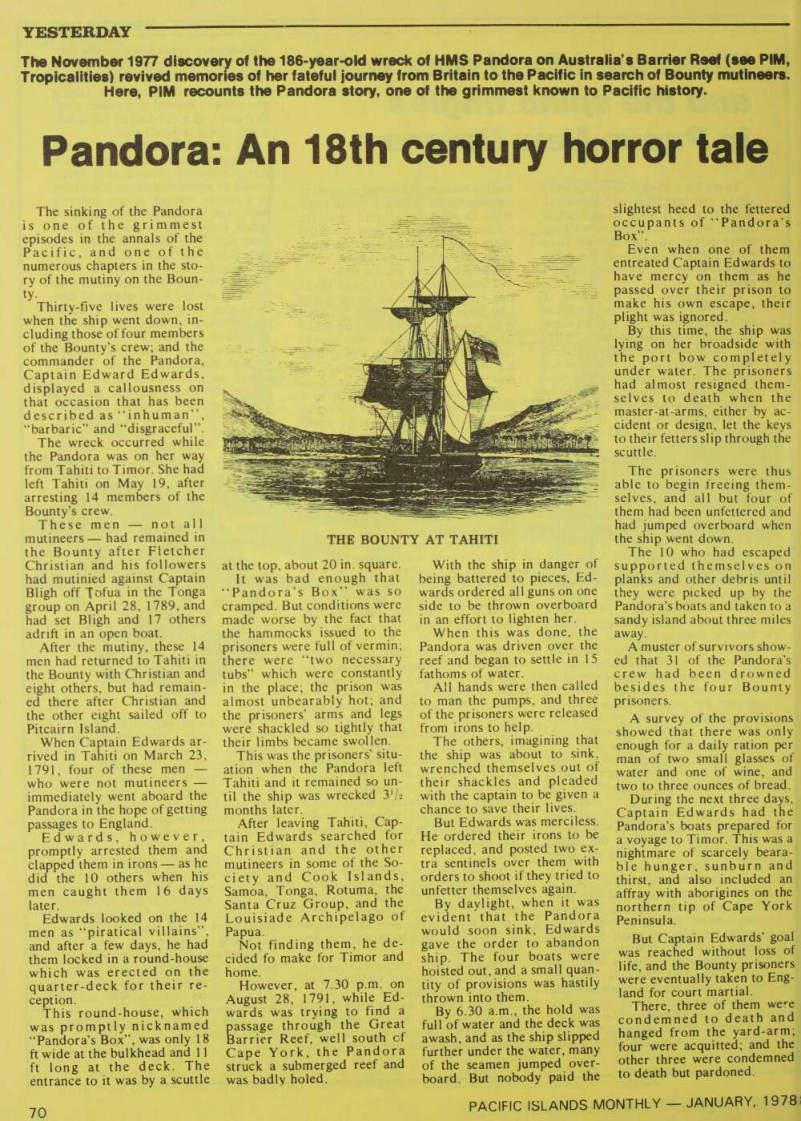
The November 1977 discovery of the 186-year-old wreck of HMS Pandora on Australia’s Barrier Reef (see PIM, Tropicalities) revived memories of her fateful journey from Britain to the Pacific in search of Bounty mutineers.
Here, PIM recounts the Pandora story, one off the grimmest known to Pacific history.
The sinking of the Pandora is one of the grimmest episodes in the annals of the Pacific, and one of the numerous chapters in the sto ry of the mutiny on the Boun ty- Thirty-five lives were lost when the ship went down, in cluding those of four members of the Bounty’s crew; and the commander of the Pandora, Captain Edward Edwards, displayed a callousness on that occasion that has been described as “inhuman”, “barbaric” and “disgraceful”.
The wreck occurred while the Pandora was on her way from Tahiti to Timor. She had left Tahiti on May 19, after arresting 14 members of the Bounty’s crew.
These men not all mutineers had remained in the Bounty after Fletcher Christian and his followers had mutinied against Captain Bligh off Tofua in the Tonga group on April 28, 1789, and had set Bligh and 17 others adrift in an open boat.
After the mutiny, these 14 men had returned to Tahiti in the Bounty with Christian and eight others, but had remain ed there after Christian and the other eight sailed off to Pitcairn Island.
When Captain Edwards ar rived in Tahiti on March 23, 1791, four of these men who were not mutineers immediately went aboard the Pandora in the hope of getting passages to England.
Edwards, however, promptly arrested them and clapped them in irons— as he did the 10 others when his men caught them 16 days later.
Edwards looked on the 14 men as “piratical villains”, and after a few days, he had them locked in a round-house which was erected on the quarter-deck for their re ception.
This round-house, which was promptly nicknamed “Pandora’s Box”, was only 18 ft wide at the bulkhead and 11 ft long at the deck. The entrance to it was by a scuttle
at the top, about 20 in. square.
It was bad enough that “Pandora’s Box” was so cramped. But conditions were made worse by the fact that the hammocks issued to the prisoners were full of vermin; there were “two necessary tubs” which were constantly in the place; the prison was almost unbearably hot; and the prisoners’ arms and legs were shackled so tightly that their limbs became swollen.
This was the prisoners’ situ ation when the Pandora left Tahiti and it remained so un til the ship was wrecked 3 l h months later.
After leaving Tahiti, Cap tain Edwards searched for Christian and the other mutineers in some of the So ciety and Cook Islands, Samoa, Tonga, Rotuma, the Santa Cruz Group, and the Louisiade Archipelago of Papua.
Not finding them, he de cided fo make for Timor and home.
However, at 7.30 p.m. on August 28, 1791, while Ed wards was trying to find a passage through the Great Barrier Reef, well south of Cape York, the Pandora struck a submerged reef and was badly holed.
With the ship in danger of being battered to pieces, Ed wards ordered all guns on one side to be thrown overboard in an effort to lighten her.
When this was done, the Pandora was driven over the reef and began to settle in 15 fathoms of water.
All hands were then called to man the pumps, and three of the prisoners were released from irons to help.
The others, imagining that the ship was about to sink wrenched themselves out of their shackles and pleaded with the captain to be given a chance to save their lives But Edwards was merciless.
He ordered their irons to be replaced, and posted two ex tra sentinels over them with orders to shoot if they tried to unfetter themselves again.
By daylight, when it was evident that the Pandora would soon sink, Edwards gave the order to abandon ship. The four boats were hoisted out, and a small quan titv of provisions was hastily thrown into them.
By 6.30 a.m., the hold was ful 1 of water and the deck was awash, and as the ship slipped further under the water, many of the seamen jumped over board. But nobody paid the
slightest heed to the fettered occupants of “Pandora’s Box”.
Even when one of them entreated Captain Edwards to have mercy on them as he passed over their prison to make his own escape, their plight was ignored.
By this time, the ship was lying on her broadside with the port bow completely under water. The prisoners had almost resigned them selves to death when the master-at-arms, either by ac cident or design, let the keys to their fetters slip through the scuttle.
The prisoners were thus able to begin freeing them selves, and all but four of them had been unfettered and had jumped overboard when the ship went down.
The 10 who had escaped supported themselves on planks and other debris until they were picked up by the Pandora’s boats and taken to a sandy island about three miles away.
A muster of survivors show ed that 31 of the Pandora’s crew had been drowned besides the four Bounty prisoners.
A survey of the provisions showed that there was only enough for a daily ration per man of two small glasses of water and one of wine, and two to three ounces of bread.
During the next three days, Captain Edwards had the Pandora’s boats prepared for a voyage to Timor. This was a nightmare of scarcely beara ble hunger, sunburn and thirst, and also included an affray with aborigines on the northern tip of Cape York Peninsula.
But Captain Edwards’ goal was reached without loss of life, and the Bounty prisoners were eventually taken to Eng land for court martial.
There, three of them were condemned to death and hanged from the yard-arm; four were acquitted; and the other three were condemned to death but pardoned.
The Bounty At Tahiti
Png Mining Guidelines
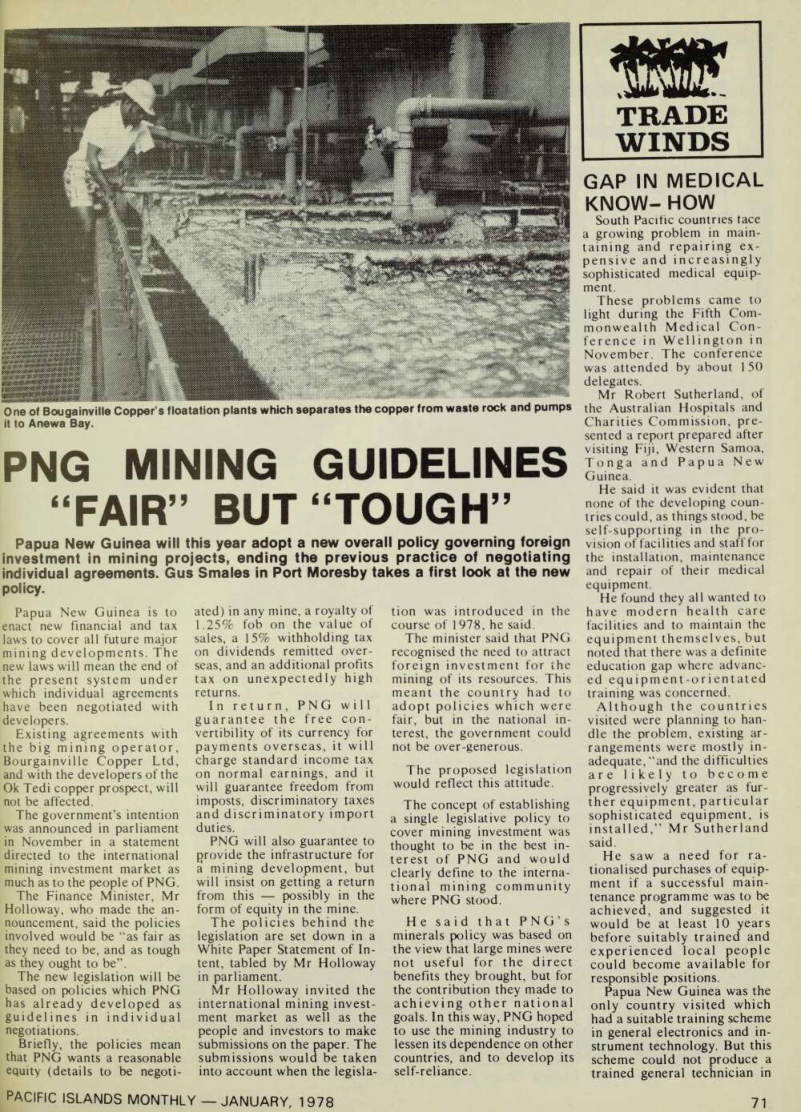
“Fair” But “Tough”
Papua New Guinea will this year adopt a new overall policy governing foreign investment in mining projects, ending the previous practice of negotiating individual agreements. Gus Smales in Port Moresby takes a first look at the new policy.
Papua New Guinea is to enact new financial and tax laws to cover all future major mining developments. The new laws will mean the end of the present system under which individual agreements have been negotiated with developers.
Existing agreements with the big mining operator, Bourgainville Copper Ltd, and with the developers of the Ok Tedi copper prospect, will not be affected.
The government’s intention was announced in parliament in November in a statement directed to the international mining investment market as much as to the people of PNG.
The Finance Minister, Mr Holloway, who made the an nouncement, said the policies involved would be “as fair as they need to be, and as tough as they ought to be”.
The new legislation will be based on policies which PNG has already developed as guidelines in individual negotiations.
Briefly, the policies mean that PNG wants a reasonable equity (details to be negoti
ated) in any mine, a royalty of 1.25% fob on the value of sales, a 15% withholding tax on dividends remitted over seas, and an additional profits tax on unexpectedly high returns.
In return, PNG will guarantee the free con vertibility of its currency for payments overseas, it will charge standard income tax on normal earnings, and it will guarantee freedom from imposts, discriminatory taxes and discriminatory import duties.
PNG will also guarantee to provide the infrastructure for a mining development, but will insist on getting a return from this possibly in the form of equity in the mine.
The policies behind the legislation are set down in a White Paper Statement of In tent, tabled by Mr Holloway in parliament.
Mr Holloway invited the international mining invest ment market as well as the people and investors to make submissions on the paper. The submissions would be taken into account when the legisla
tion was introduced in the course of 1978, he said.
The minister said that PNG recognised the need to attract foreign investment for the mining of its resources. This meant the country had to adopt policies which were fair, but in the national in terest, the government could not be over-generous.
The proposed legislation would reflect this attitude.
The concept of establishing a single legislative policy to cover mining investment was thought to be in the best in terest of PNG and would clearly define to the interna tional mining community where PNG stood.
He said that PNG’s minerals policy was based on the view that large mines were not useful for the direct benefits they brought, but for the contribution they made to achieving other national goals. In this way, PNG hoped to use the mining industry to lessen its dependence on other countries, and to develop its self-reliance.
One of Bougainville Copper’s floatation plants which separates the copper from waste rock and pumps it to Anewa Bay.
Trade
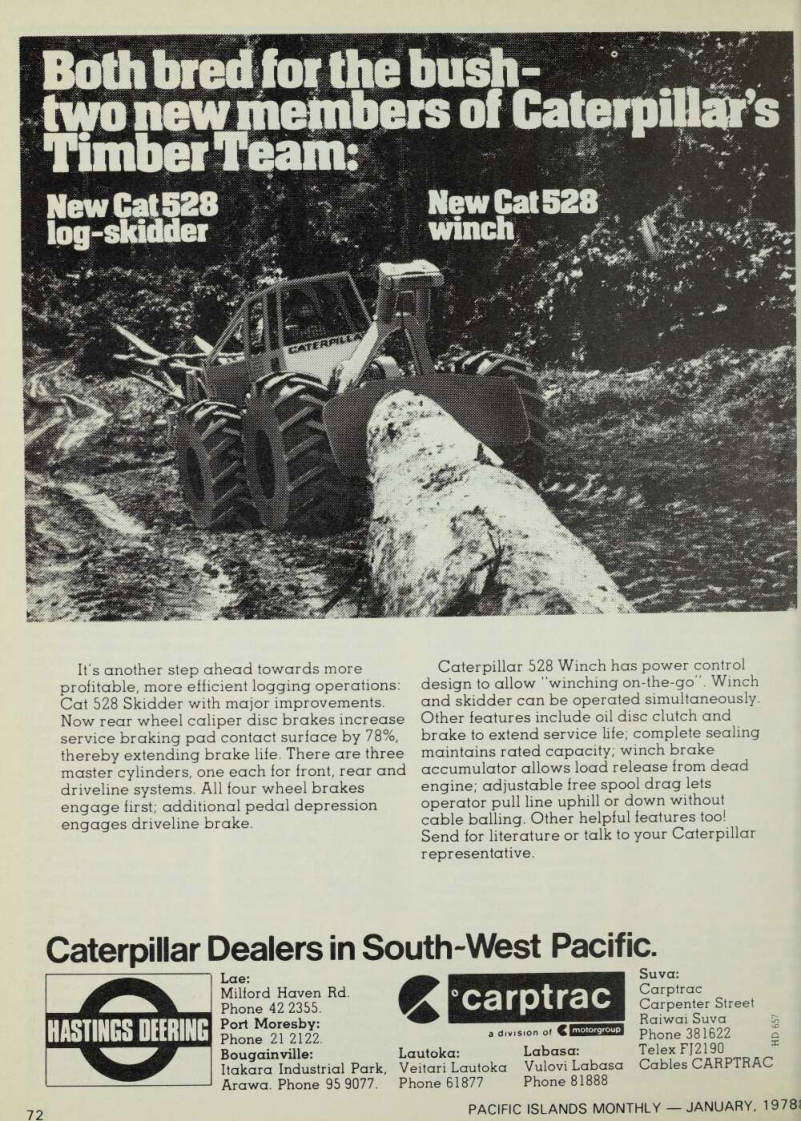
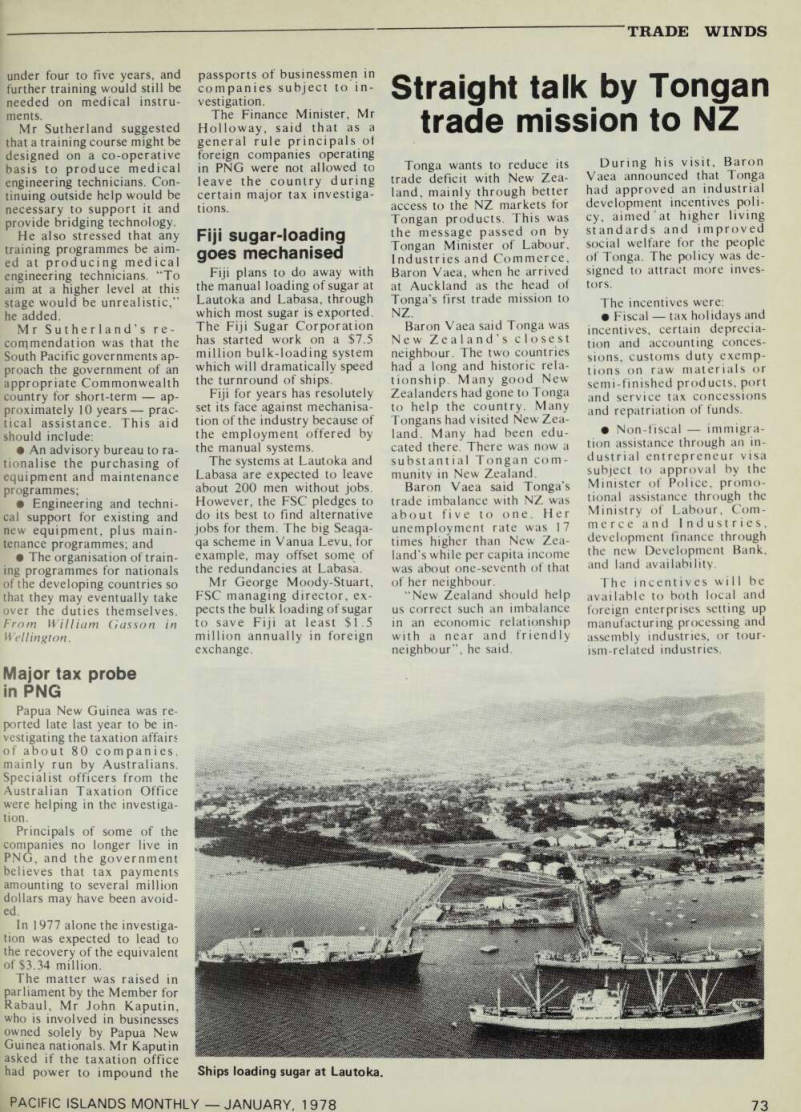
Winds
Gap In Medical
Know-How
South Pacific countries face a growing problem in main taining and repairing ex pensive and increasingly sophisticated medical equip ment.
These problems came to light during the Fifth Com monwealth Medical Con ference in Wellington in November. The conference was attended by about 150 delegates.
Mr Robert Sutherland, of the Australian Hospitals and Charities Commission, pre sented a report prepared after visiting Fiji, Western Samoa, Tonga and Papua New Guinea.
He said it was evident that none of the developing coun tries could, as things stood, be self-supporting in the pro vision of facilities and staff for the installation, maintenance and repair of their medical equipment.
He found they all wanted to have modern health care facilities and to maintain the equipment themselves, but noted that there was a definite education gap where advanc
ed equipment-orientated
training was concerned.
Although the countries visited were planning to han dle the problem, existing ar rangements were mostly in adequate, “and the difficulties are likely to become progressively greater as fur ther equipment, particular sophisticated equipment, is installed,” Mr Sutherland said.
He saw a need for ra tionalised purchases of equip ment if a successful main tenance programme was to be achieved, and suggested it would be at least 10 years before suitably trained and experienced local people could become available for responsible positions.
Papua New Guinea was the only country visited which had a suitable training scheme in general electronics and in strument technology. But this scheme could not produce a trained general technician in
under four to five years, and further training would still be needed on medical instru ments.
Mr Sutherland suggested that a training course might be designed on a co-operative basis to produce medical engineering technicians. Con tinuing outside help would be necessary to support it and provide bridging technology.
He also stressed that any training programmes be aim ed at producing medical engineering technicians. “To aim at a higher level at this stage would be unrealistic,” he added.
Mr Sutherland’s re commendation was that the South Pacific governments ap proach the government of an appropriate Commonwealth country for short-term ap proximately 10 years— prac tical assistance. This aid should include: • An advisory bureau to ra tionalise the purchasing of equipment and maintenance programmes; • Engineering and techni cal support for existing and new equipment, plus main tenance programmes; and • The organisation of train ing programmes for nationals of the developing countries so that they may eventually take over the duties themselves.
From William Gas son in Wellington.
Major tax probe
in PNG
Papua New Guinea was re ported late last year to be in vestigating the taxation affairs of about 80 companies, mainly run by Australians.
Specialist officers from the Australian Taxation Office were helping in the investiga tion.
Principals of some of the companies no longer live in PNG, and the government believes that tax payments amounting to several million dollars may have been avoid ed.
In 1977 alone the investiga tion was expected to lead to the recovery of the equivalent of $3.34 million.
The matter was raised in parliament by the Member for Rabaul, Mr John Kaputin, who is involved in businesses owned solely by Papua New Guinea nationals. Mr Kaputin asked if the taxation office had power to impound the
passports of businessmen in companies subject to in vestigation.
The Finance Minister, Mr Holloway, said that as a general rule principals of foreign companies operating in PNG were not allowed to leave the country during certain major tax investiga tions.
Fiji sugar-loading
goes mechanised
Fiji plans to do away with the manual loading of sugar at Lautoka and Labasa, through which most sugar is exported.
The Fiji Sugar Corporation has started work on a $7.5 million bulk-loading system which will dramatically speed the turnround of ships.
Fiji for years has resolutely set its face against mechanisa tion of the industry because of the employment offered by the manual systems.
The systems at Lautoka and Labasa are expected to leave about 200 men without jobs.
However, the FSC pledges to do its best to find alternative jobs for them. The big Seaqa qa scheme in Vanua Levu, for example, may offset some of the redundancies at Labasa.
Mr George Moody-Stuart, FSC managing director, ex pects the bulk loading of sugar to save Fiji at least $1.5 million annually in foreign exchange.
Advertisements & other items, p. 72 (1 item)
carptrac
rH ■ wwm mm It's another step ahead towards more profitable, more efficient logging operations: Cat 528 Skidder with major improvements.
Now rear wheel caliper disc brakes increase service braking pad contact surface by 78%, thereby extending brake life. There are three master cylinders, one each for front, rear and driveline systems. All four wheel brakes engage first; additional pedal depression engages driveline brake.
Caterpillar 528 Winch has power control design to allow "winching on-the-go". Winch and skidder can be operated simultaneously.
Other features include oil disc clutch and brake to extend service life; complete sealing maintains rated capacity; winch brake accumulator allows load release from dead engine; adjustable free spool drag lets operator pull line uphill or down without cable balling. Other helpful features too!
Send for literature or talk to your Caterpillar representative.
Caterpillar Dealers in South-West Pacific
HASTINGS DEERING
Lae; Milford Haven Rd.
Phone 42 2355.
Port Moresby: Phone 21 2122.
Bougainville: Itakara Industrial Park, Arawa. Phone 95 9077. e
carptrac
a division of CbBBBBBJ Lautoka: Labasa: Veitari Lautoka Vulovi Labasa PV-irinfi R 1 ft 77 PVinnp ft 1 ftftft Suva: Carptrac Carpenter Street Raiwai Suva [ Phone 381622 < Telex FJ2190 Cables CARPTRAC
Straight talk by Tongan
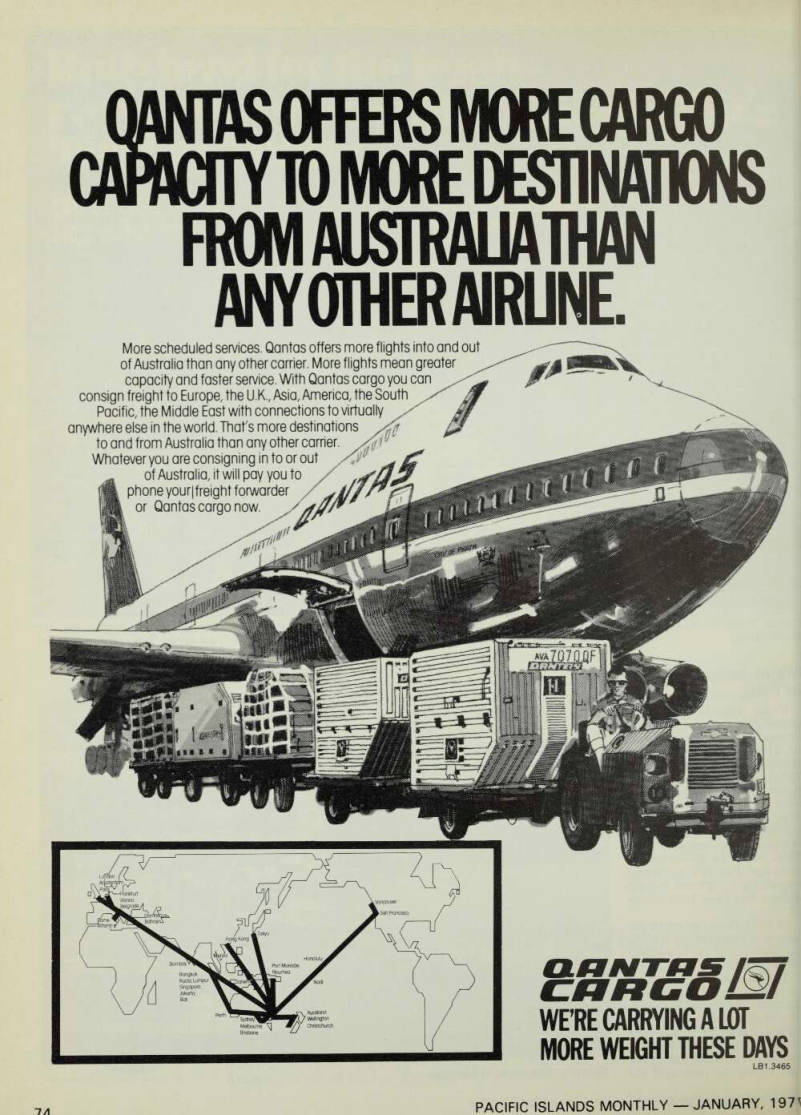
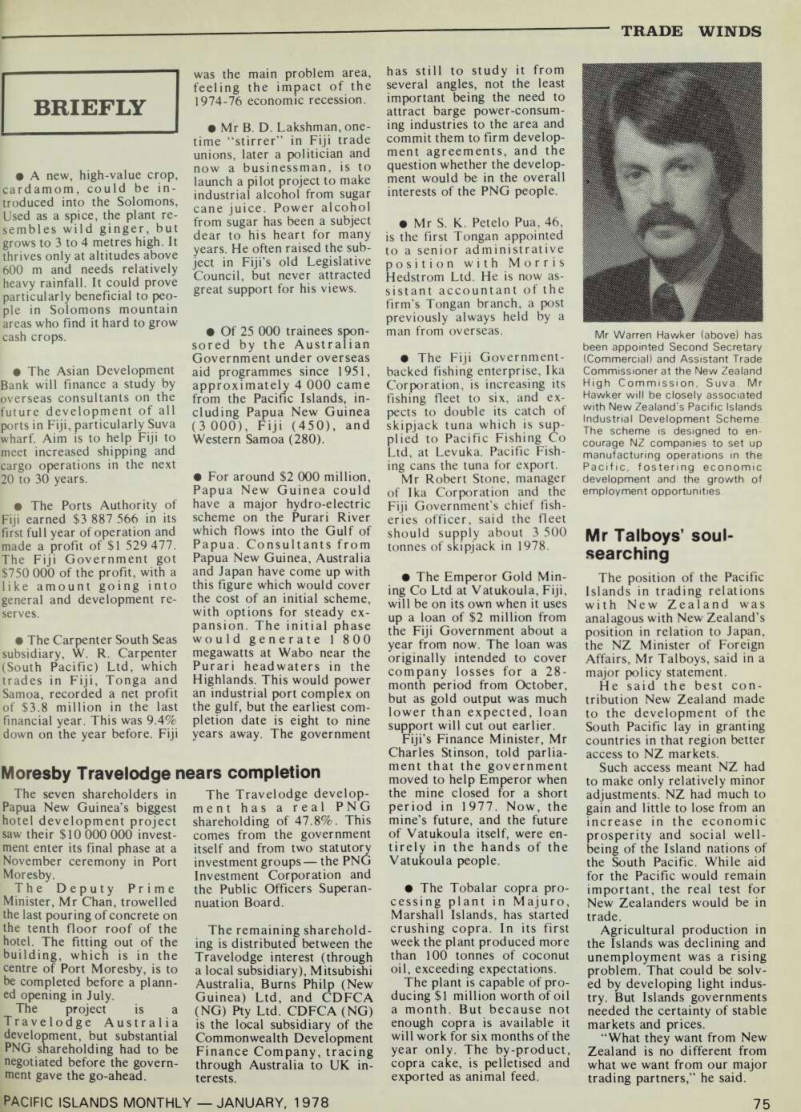
trade mission to NZ
Tonga wants to reduce its trade deficit with New Zea land, mainly through better access to the NZ markets for Tongan products. This was the message passed on by Tongan Minister of Labour, Industries and Commerce, Baron Vaea, when he arrived at Auckland as the head of Tonga’s first trade mission to NZ Baron Vaea said Tonga was New Zealand’s closest neighbour. The two countries had a long and historic rela tionship. Many good New Zealanders had gone to Tonga to help the country. Many Tongans had visited New Zea land. Many had been edu cated there. There was now a substantial Tongan com munity in New Zealand.
Baron Vaea said Tonga’s trade imbalance with NZ was about five to one. Her unemployment rate was 17 times higher than New Zea land’s while per capita income was about one-seventh of that of her neighbour.
“New Zealand should help us correct such an imbalance in an economic relationship with a near and friendly neighbour”, he said.
During his visit, Baron Vaea announced that Tonga had approved an industrial development incentives poli cy, aimed 'at higher living standards and improved social welfare for the people of Tonga. The policy was de signed to attract more inves tors.
The incentives were; • Fiscal tax holidays and incentives, certain deprecia tion and accounting conces sions, customs duty exemp tions on raw materials or semi-finished products, port and service tax concessions and repatriation of funds. • Non-fiscal immigra tion assistance through an in dustrial entrepreneur visa subject to approval by the Minister of Police, promo tional assistance through the Ministry of Labour, Com merce and Industries, development finance through the new Development Bank, and land availability.
The incentives will be available to both local and foreign enterprises setting up manufacturing processing and assembly industries, or tour ism-related industries.
Ships loading sugar at Lautoka.
Briefly
• A new, high-value crop, cardamom, could be in troduced into the Solomons, Used as a spice, the plant re sembles wild ginger, but grows to 3 to 4 metres high. It thrives only at altitudes above 600 m and needs relatively heavy rainfall. It could prove particularly beneficial to peo ple in Solomons mountain areas who find it hard to grow cash crops. • The Asian Development Bank will finance a study by overseas consultants on the future development of all ports in Fiji, particularly Suva wharf. Aim is to help Fiji to meet increased shipping and cargo operations in the next 20 to 30 years. • The Ports Authority of Fiji earned $3 887 566 in its first full year of operation and made a profit of $1 529 477.
The Fiji Government got $750 000 of the profit, with a like amount going into general and development re serves. • The Carpenter South Seas subsidiary, W. R. Carpenter (South Pacific) Ltd, which trades in Fiji, Tonga and Samoa, recorded a net profit of $3.8 million in the last financial year. This was 9.4% down on the year before. Fiji
was the main problem area, feeling the impact of the 1974-76 economic recession. • Mr B. D. Lakshman, one time “stirrer” in Fiji trade unions, later a politician and now a businessman, is to launch a pilot project to make industrial alcohol from sugar cane juice. Power alcohol from sugar has been a subject dear to his heart for many years. He often raised the sub ject in Fiji’s old Legislative Council, but never attracted great support for his views. • Of 25 000 trainees spon sored by the Australian Government under overseas aid programmes since 1951, approximately 4 000 came from the Pacific Islands, in cluding Papua New Guinea (3 000), Fiji (450), and Western Samoa (280). • For around $2 000 million, Papua New Guinea could have a major hydro-electric scheme on the Purari River which flows into the Gulf of Papua. Consultants from Papua New Guinea, Australia and Japan have come up with this figure which would cover the cost of an initial scheme, with options for steady ex pansion. The initial phase would generate 1 800 megawatts at Wabo near the Purari headwaters in the Highlands. This would power an industrial port complex on the gulf, but the earliest com pletion date is eight to nine years away. The government
has still to study it from several angles, not the least important being the need to attract barge power-consum ing industries to the area and commit them to firm develop ment agreements, and the question whether the develop ment would be in the overall interests of the PNG people. • Mr S. K. Petelo Pua, 46, is the first Tongan appointed to a senior administrative position with Morris Hedstrom Ltd. He is now as sistant accountant of the firm’s Tongan branch, a post previously always held by a man from overseas. • The Fiji Government backed fishing enterprise, Ika Corporation, is increasing its fishing fleet to six, and ex pects to double its catch of skipjack tuna which is sup plied to Pacific Fishing Co Ltd, at Levuka. Pacific Fish ing cans the tuna for export.
Mr Robert Stone, manager of Ika Corporation and the Fiji Government's chief fish eries officer, said the fleet should supply about 3 500 tonnes of skipjack in 1978. • The Emperor Gold Min ing Co Ltd at Vatukoula, Fiji, will be on its own when it uses up a loan of $2 million from the Fiji Government about a year from now. The loan was originally intended to cover company losses for a 28month period from October, but as gold output was much lower than expected, loan support will cut out earlier.
Fiji’s Finance Minister, Mr Charles Stinson, told parlia ment that the government moved to help Emperor when the mine closed for a short period in 1977. Now, the mine’s future, and the future of Vatukoula itself, were en tirely in the hands of the Vatukoula people. • The Tobalar copra pro cessing plant in Majuro, Marshall Islands, has started crushing copra. In its first week the plant produced more than 100 tonnes of coconut oil, exceeding expectations.
The plant is capable of pro ducing $1 million worth of oil a month. But because not enough copra is available it will work for six months of the year only. The by-product, copra cake, is pelletised and exported as animal feed.
Advertisements & other items, p. 74 (1 item)
Qanias Offers Morecargo
TO MORE DESTINATIONS
FROM AUSIRAUATHAN
ANY OTHER AIRLINE
More scheduled services. Qantas offers more flighfs info and ouf of Australia than any other carrier. More flights mean greater capacity and faster service. With Qantas cargo you can consign freight to Europe, the U.K., Asia, America, the South Pacific, the Middle East with connections to virtually anywhere else in the world. That's more destinations jz* to and from Australia than any other carrier.
Whatever you are consigning in to or out of Australia, it will pay you to phone your|freight forwarder / ifJ or Qantas cargo now.
JDJ
avaTOJO QF m 1 I t«« !®/
WE’RE CARRYING A LOT
MORE WEIGHT THESE DAYS
L 81.3465
Moresby Travelodge nears completion
The seven shareholders in Papua New Guinea’s biggest hotel development project saw their $lO 000 000 invest ment enter its final phase at a November ceremony in Port
Moresby.
The Deputy Prime Minister, Mr Chan, trowelled the last pouring of concrete on the tenth floor roof of the hotel. The fitting out of the building, which is in the centre of Port Moresby, is to be completed before a plann ed opening in July.
The project is a
Travelodge Australia
development, but substantial PNG shareholding had to be negotiated before the govern ment gave the go-ahead.
The Travelodge develop ment has a real PNG shareholding of 47.8%. This comes from the government itself and from two statutory investment groups the PNG Investment Corporation and the Public Officers Superan nuation Board.
The remaining sharehold ing is distributed between the Travelodge interest (through a local subsidiary), Mitsubishi Australia, Burns Philp (New Guinea) Ltd, and CDFCA
(Ng) Pty Ltd. Cdfca (Ng)
is the local subsidiary of the Commonwealth Development Finance Company, tracing through Australia to UK in terests.
searching
Mr Talboys’ soul searching
The position of the Pacific Islands in trading relations with New Zealand was analagous with New Zealand’s position in relation to Japan, the NZ Minister of Foreign Affairs, Mr Talboys, said in a major policy statement.
He said the best con tribution New Zealand made to the development of the South Pacific lay in granting countries in that region better access to NZ markets.
Such access meant NZ had to make only relatively minor adjustments. NZ had much to gain and little to lose from an increase in the economic prosperity and social well being of the Island nations of the South Pacific. While aid for the Pacific would remain important, the real test for New Zealanders would be in trade.
Agricultural production in the Islands was declining and unemployment was a rising problem. That could be solv ed by developing light indus try. But Islands governments needed the certainty of stable markets and prices.
“What they want from New Zealand is no different from what we want from our major trading partners,” he said.
Mr Warren Hawker (above) has been appointed Second Secretary (Commercial) and Assistant Trade Commissioner at the New Zealand High Commission, Suva Mr Hawker will be closely associated with New Zealand’s Pacific Islands Industrial Development Scheme The scheme is designed to en courage NZ companies to set up manufacturing operations in the Pacific, fostering economic development and the growth of employment opportunities
Yachts
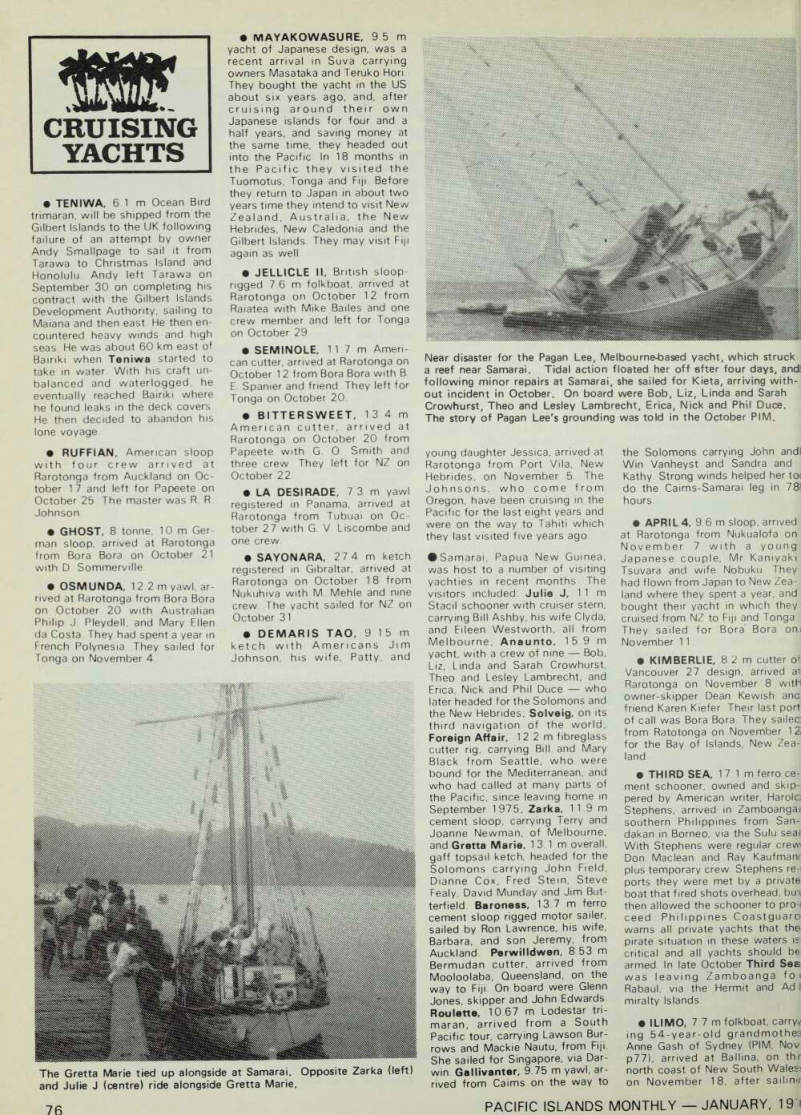
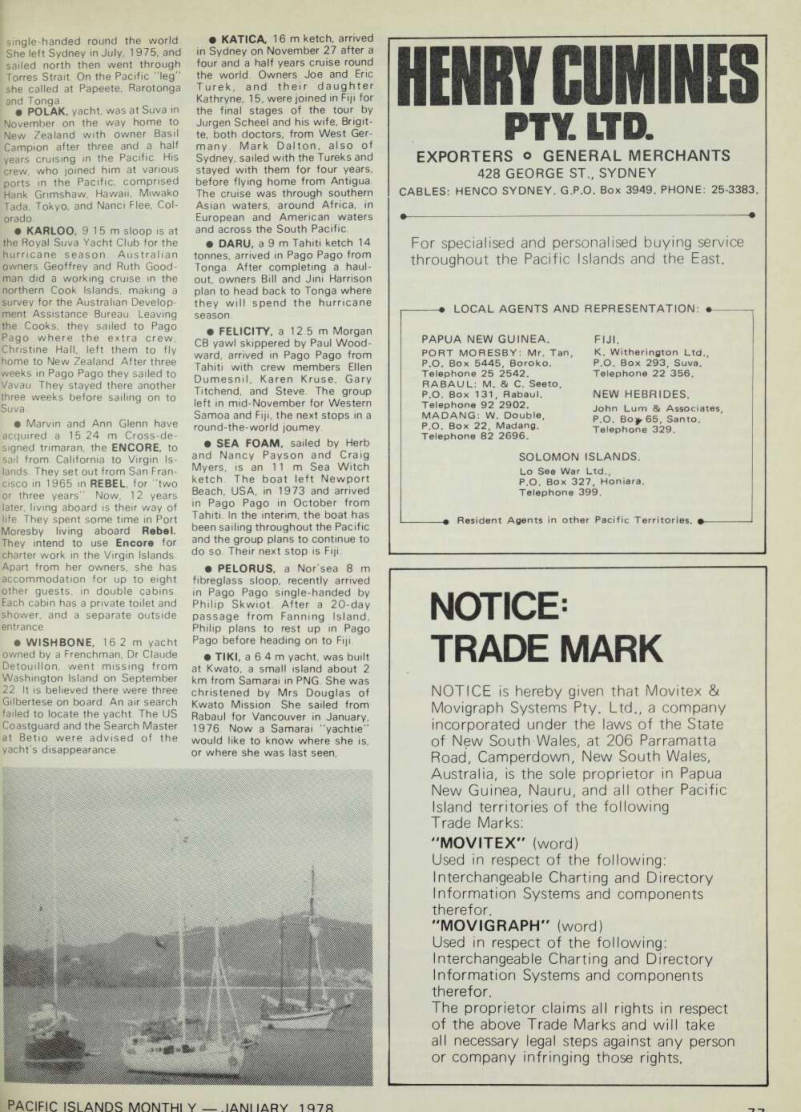
Cruising
• Mayakowasure, 9.5 M
yacht of Japanese design, was a recent arrival in Suva carrying owners Masataka and Teruko Hori They bought the yacht in the US about six years ago, and, after cruising around their own Japanese islands for four and a half years, and saving money at the same time, they headed out into the Pacific. In 18 months in the Pacific they visited the Tuomotus, Tonga and Fiji Before they return to Japan in about two years time they intend to visit New Zealand, Australia, the New Hebrides, New Caledonia and the Gilbert Islands They may visit Fiji again as well • JELLICLE 11, British sloop rigged 7 6 m folkboat, arrived at Rarotonga on October 12 from Raiatea with Mike Bailes and one crew member and left for Tonga on October 29 • SEMINOLE, 11.7 m Ameri can cutter, arrived at Rarotonga on October 1 2 from Bora Bora with B E Spanier and friend They left for Tonga on October 20
• Bittersweet, 13 4M
American cutter, arrived at Rarotonga on October 20 from Papeete with G. 0 Smith and three crew They left for NZ on October 22 • LA DESIRADE, 7 3 m yawl registered in Panama, arrived at Rarotonga from Tubuai on Oc tober 27 with G V Liscombe and one crew • SAYONARA, 27.4 m ketch registered in Gibraltar, arrived at Rarotonga on October 18 from Nukuhiva with M Mehle and nine crew The yacht sailed for NZ on October 31 • DEM AR IS TAO, 9 15m ketch with Americans Jim Johnson, his wife, Patty, and
• TENIWA, 6 1 m Ocean Bird trimaran, will be shipped from the Gilbert Islands to the UK following failure of an attempt by owner Andy Smallpage to sail it from Tarawa to Christmas Island and Honolulu Andy left Tarawa on September 30 on completing his contract with the Gilbert Islands Development Authority, sailing to Maiana and then east He then en countered heavy winds and high seas He was about 60 km east of Bairiki when Teniwa started to take in water With his craft un balanced and waterlogged, he eventually reached Bairiki where he found leaks in the deck covers He then decided to abandon his lone voyage • RUFFIAN, American sloop with four crew arrived at Rarotonga from Auckland on Oc tober 1 7 and left for Papeete on October 25 The master was R R Johnson • GHOST, 8 tonne, 10 m Ger man sloop, arrived at Rarotonga from Bora Bora on October 21 with D Sommerville • OSMUNDA, 12 2 m yawl, ar rived at Rarotonga from Bora Bora on October 20 with Australian Philip J Pleydell, and Mary Ellen da Costa They had spent a year in French Polynesia They sailed for Tonga on November 4
young daughter Jessica, arrived at Rarotonga from Port Vila, New Hebrides, on November 5 The Johnsons, who come from Oregon, have been cruising in the Pacific for the last eight years and were on the way to Tahiti which they last visited five years ago • Samarai, Papua New Guinea, was host to a number of visiting yachties in recent months The visitors included: Julie J, 1 1 m Stacil schooner with cruiser stern, carrying Bill Ashby, his wife Clyda, and Eileen Westworth, all from Melbourne, Anaunto, 15 9 m yacht, with a crew of nine Bob, Liz, Linda and Sarah Crowhurst, Theo and Lesley Lambrecht, and Erica, Nick and Phil Duce who later headed for the Solomons and the New Hebrides, Solveig, on its third navigation of the world; Foreign Affair, 12 2 m fibreglass cutter rig, carrying Bill and Mary Black from Seattle, who were bound for the Mediterranean, and who had called at many parts of the Pacific, since leaving home in September 1975; Zarka, 119 m cement sloop, carrying Terry and Joanne Newman, of Melbourne, and Gretta Marie, 13.1 m overall, gaff topsail ketch, headed for the Solomons carrying John Field, Dianne Cox, Fred Stein, Steve Fealy, David Munday and Jim But terfield Baroness, 13 7 m ferro cement sloop rigged motor sailer, sailed by Ron Lawrence, his wife, Barbara, and son Jeremy, from Auckland Perwilldwen, 853 m Bermudan cutter, arrived from Mooloolaba, Queensland, on the way to Fiji. On board were Glenn Jones, skipper and John Edwards Roulette, 10.67 m Lodestar tri maran, arrived from a South Pacific tour, carrying Lawson Bur rows and Mackie Nautu, from Fiji She sailed for Singapore, via Dar win Gallivanter, 9.75 m yawl, ar rived from Cairns on the way to
the Solomons carrying John andl Win Vanheyst and Sandra and Kathy. Strong winds helped her toi do the Cairns-Samarai leg in 781 hours • APRIL 4, 96 m sloop, arrived at Rarotonga from Nukualofa on November 7 with a young Japanese couple, Mr Kaniyaki Tsuvara and wife Nobuku. They had flown from Japan to New Zea land where they spent a year, and bought their yacht in which they cruised from NZ to Fiji and Tonga.
They sailed for Bora Bora oni November 11 • KIMBERLIE, 8 2 m cutter of Vancouver 27 design, arrived af Rarotonga on November 8 with owner-skipper Dean Kewish and friend Karen Kiefer Their last port of call was Bora Bora They sailec from Ratotonga on November 12 for the Bay of Islands, New Zea land • THIRD SEA, 17 1m ferro ce ment schooner, owned and skip pered by American writer, Harolc Stephens, arrived in Zamboanga* southern Philippines from San dakan in Borneo, via the Sulu sear With Stephens were regular crew Don Maclean and Ray Kaufmanr plus temporary crew Stephens re-; ports they were met by a private boat that fired shots overhead, bun then allowed the schooner to pro-< ceed Philippines Coastguaro warns all private yachts that the pirate situation in these waters is critical and all yachts should be armed In late October Third Sea was leaving Zamboanga foi Rabaul, via the Hermit and Ad i miralty Islands • ILIMO, 7 7m folkboat, carryy ing 54-year-old grandmothea Anne Gash of Sydney (PIM, Nov p 77), arrived at Ballina, on thr north coast of New South Wales; on November 18, after sailing
The Gretta Marie tied up alongside at Samarai. Opposite Zarka (left) and Julie J (centre) ride alongside Gretta Marie.
Near disaster for the Pagan Lee, Melbourne-based yacht, which struck a reef near Samarai. Tidal action floated her off after four days, and following minor repairs at Samarai, she sailed for Kieta, arriving with out incident in October. On board were Bob, Liz, Linda and Sarah Crowhurst, Theo and Lesley Lambrecht, Erica, Nick and Phil Duce.
The story of Pagan Lee's grounding was told in the October PIM.
single-handed round the world She left Sydney in July, 1 975, and sailed north then went through Torres Strait On the Pacific 'leg” she called at Papeete, Rarotonga and Tonga • POLAK, yacht, was at Suva in November on the way home to New Zealand with owner Basil Campion after three and a half years cruising in the Pacific His crew, who joined him at various ports in the Pacific, comprised Hank Grimshaw, Hawaii, Miwako Tada, Tokyo, and Nanci Flee, Colorado • KARLOO, 9.15 m sloop is at the Royal Suva Yacht Club for the hurricane season Australian owners Geoffrey and Ruth Goodman did a working cruise in the northern Cook Islands, making a survey for the Australian Development Assistance Bureau Leaving the Cooks, they sailed to Pago Pago where the extra crew, Chr,Stine Hall left them to fly home to New Zealand After three weeks in Pago Pago they sailed to -ru * . .u ..
Vavau They stayed there another .. , . / ... . three weeks before sai inq on to Suvg y • Marvin and Ann Glenn have acquired a 15 24 m Cross-designed trimaran, the ENCORE, to sail from California to Virgin Islands They set out from San Francisco in 1965 in REBEL, for two or three years" Now, 12 years later, living aboard is their way of life They spent some time in Port Moresby living aboard Rebel, They intend to use Encore for charter work in the Virgin Islands Apart from her owners, she has accommodation for up to eight other guests, in double cabins.
Each cabin has a private toilet and shower, and a separate outside entrance • WISHBONE, 16 2 m yacht owned by a Frenchman, Dr Claude Detouillon, went missing from Washington Island on September 22 It is believed there were three Gilbertese on board An air search failed to locate the yacht The US Coastguard and the Search Master at Betio were advised of the yacht s disappearance
• KATICA, 16 m ketch, arrived in Sydney on November 27 after a four and a half years cruise round the world. Owners Joe and Eric Turek, and their daughter Kathryne, 15, were joined in Fiji for the final stages of the tour by Jurgen Scheel and his wife, Brigit te, both doctors, from West Ger many. Mark Dalton, also of Sydney, sailed with the Tureks and stayed with them for four years, before flying home from Antigua The cruise was through southern Asian waters, around Africa, in European and American waters and across the South Pacific • DARU, a 9 m Tahiti ketch 14 tonnes, arrived in Pago Pago from Tonga After completing a haul out, owners Bill and Jini Harrison plan to head back to Tonga where they will spend the hurricane season • FELICITY, a 12 5 m Morgan CB yawl skippered by Paul Wood ward, arrived in Pago Pago from Tahiti with crew members Ellen Dumesnil, Karen Kruse, Gary Titchend, and Steve The group left in mid-November for Western Samoa and Fiji, the next stops in a round-the-world journey • SEA FOAM, sailed by Herb and Nancy Payson and Craig Myers, is an 11 m Sea Witch ketch The boat left Newport Beach, USA, in 1973 and arrived in Pago Pago in October from Tahiti. In the interim, the boat has been sailing throughout the Pacific and the group plans to continue to do so Their next stop is Fiji • PELORUS, a Nor'sea 8 m fibreglass sloop, recently arrived in Pago Pago single-handed by Philip Skwiot. After a 20-day passage from Fanning Island, Philip plans to rest up in Pago Pago before heading on to Fiji • TIKI, a 6 4 m yacht, was built at Kwato, a small island about 2 km from Samarai in PNG. She was christened by Mrs Douglas of Kwato Mission She sailed from Rabaul for Vancouver in January, 1976 Now a Samarai ''yachtie'' would like to know where she is, or where she was last seen.
Advertisements & other items, p. 77 (1 item)
Henry Cumine
PTY. LTD.
EXPORTERS o GENERAL MERCHANTS
428 GEORGE ST., SYDNEY
CABLES: HENCO SYDNEY. G.P.O. Box 3949. PHONE: 25-3383.
For specialised and personalised buying service
throughout the Pacific Islands and the East.
LOCAL AGENTS AND REPRESENTATION: *
PAPUA NEW GUINEA.
PORT MORESBY: Mr. Tan,
P.O. Box 5445, Boroko.
Telephone 25 2542.
RABAUL: M. & C. Seeto, P.O. Box 131, Rabaul.
Telephone 92 2902.
MADANG: W. Double, P.O. Box 22, Madang.
Telephone 82 2696.
FIJI.
K. Witherington Ltd., P.O. Box 293, Suva.
Telephone 22 356.
NEW HEBRIDES.
John Lum & Associates, P.O. Santo.
Telephone 329.
SOLOMON ISLANDS.
Lo See War Ltd., P.O. Box 327, Honiara.
Telephone 399.
Resident Agents in other Pacific Territories. •-
NOTICE:
TRADE MARK
NOTICE is hereby given that Movitex & Movigraph Systems Pty. Ltd., a company incorporated under the laws of the State of New South Wales, at 206 Parramatta Road, Camperdown, New South Wales, Australia, is the sole proprietor in Papua New Guinea, Nauru, and all other Pacific Island territories of the following Trade Marks: “MOVITEX" (word) Used in respect of the following; Interchangeable Charting and Directory Information Systems and components therefor.
“MOVIGRAPH" (word) Used in respect of the following: Interchangeable Charting and Directory Information Systems and components therefor.
The proprietor claims all rights in respect of the above Trade Marks and will take all necessary legal steps against any person or company infringing those rights.
Stirs Qantas, Pan Am
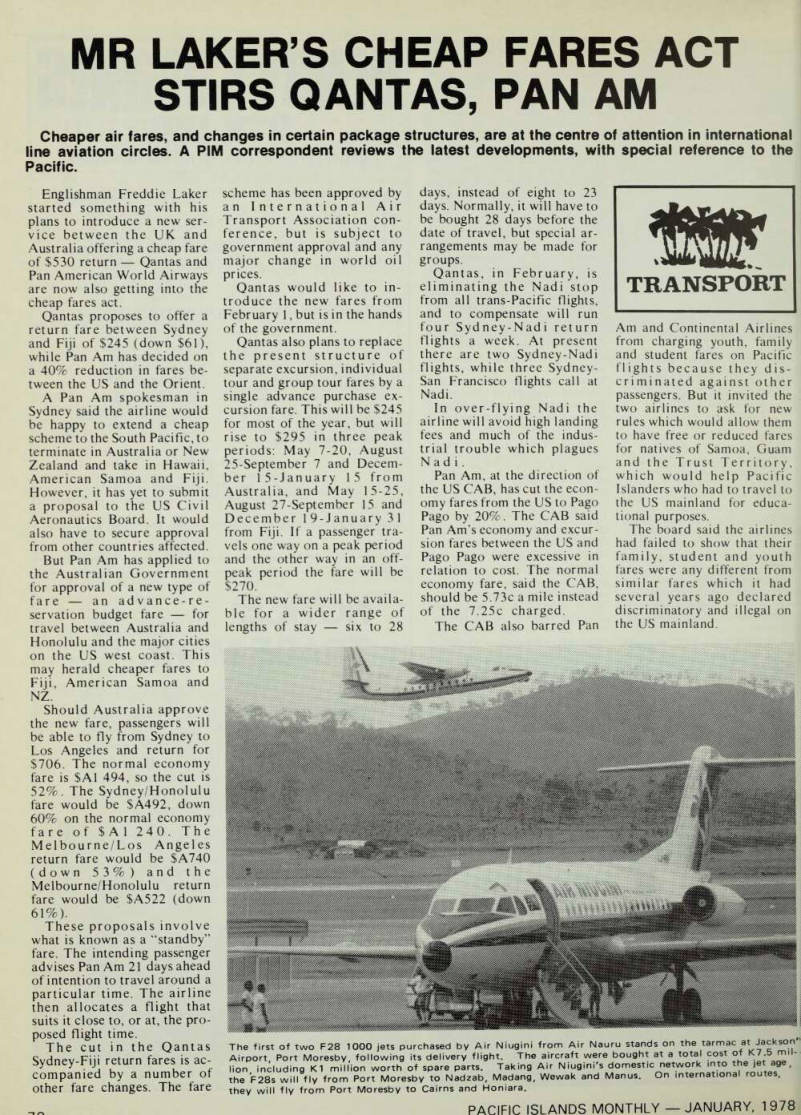
Mr Laker S Cheap Fares Act
Cheaper air fares, and changes in certain package structures, are at the centre of attention in international line aviation circles. A PIM correspondent reviews the latest developments, with special reference to the Pacific.
Englishman Freddie Laker started something with his plans to introduce a new ser vice between the UK and Australia offering a cheap fare of $530 return Qantas and Pan American World Airways are now also getting into the cheap fares act.
Qantas proposes to offer a return fare between Sydney and Fiji of $245 (down $6l), while Pan Am has decided on a 40% reduction in fares be tween the US and the Orient.
A Pan Am spokesman in Sydney said the airline would be happy to extend a cheap scheme to the South Pacific, to terminate in Australia or New Zealand and take in Hawaii, American Samoa and Fiji.
However, it has yet to submit a proposal to the US Civil Aeronautics Board. It would also have to secure approval from other countries affected.
But Pan Am has applied to the Australian Government for approval of a new type of fare an advance-re servation budget fare for travel between Australia and Honolulu and the major cities on the US west coast. This may herald cheaper fares to Fiji, American Samoa and NZ.
Should Australia approve the new fare, passengers will be able to fly from Sydney to Los Angeles and return for $706. The normal economy fare is SAI 494, so the cut is 52%. The Sydney/Honolulu fare would be $A492, down 60% on the normal economy fare of $A 1 240. The Melbourne/Los Angeles return fare would be SA74O (down 53%) and the Melbourne/Honolulu return fare would be $A522 (down 61%).
These proposals involve what is known as a “standby” fare. The intending passenger advises Pan Am 21 days ahead of intention to travel around a particular time. The airline then allocates a flight that suits it close to, or at, the pro posed flight time.
The cut in the Qantas Sydney-Fiji return fares is ac companied by a number of other fare changes. The fare
scheme has been approved by an International Air Transport Association con ference, but is subject to government approval and any major change in world oil
prices.
Qantas would like to in troduce the new fares from February 1, but is in the hands of the government.
Qantas also plans to replace the present structure of separate excursion, individual tour and group tour fares by a single advance purchase ex cursion fare. This will be $245 for most of the year, but will rise to $295 in three peak periods: May 7-20, August 25-September 7 and Decem ber 15-January 15 from Australia, and May 15-25, August 27-September 15 and December 19-January 31 from Fiji. If a passenger tra vels one way on a peak period and the other way in an off peak period the fare will be $270.
The new fare will be availa ble for a wider range of lengths of stay six to 28
days, instead of eight to 23 days. Normally, it will have to be bought 28 days before the date of travel, but special ar rangements may be made for groups.
Qantas, in February, is eliminating the Nadi stop from all trans-Pacific flights, and to compensate will run four Sydney-Nadi return flights a week. At present there are two Sydney-Nadi flights, while three Sydney- San Francisco flights call at Nadi.
In over-flying Nadi the airline will avoid high landing fees and much of the indus trial trouble which plagues Nadi.
Pan Am, at the direction of the US CAB, has cut the econ omy fares from the US to Pago Pago by 20%. The CAB said Pan Am’s economy and excur sion fares between the US and Pago Pago were excessive in relation to cost. The normal economy fare, said the CAB, should be 5.73 c a mile instead of the 7.25 c charged.
The CAB also barred Pan
Transport
Am and Continental Airlines from charging youth, family and student fares on Pacific flights because they dis criminated against other passengers. But it invited the two airlines to ask for new rules which would allow them to have free or reduced fares for natives of Samoa, Guam and the Trust Territory, which would help Pacific Islanders who had to travel to the US mainland for educa tional purposes.
The board said the airlines had failed to show that their family, student and youth fares were any different from similar fares which it had several years ago declared discriminatory and illegal on the US mainland.
The first of two F28 1000 jets purchased by Air Niugini from Air Nauru stands on the tarmac at Jackson Airport Port Moresby, following its delivery flight. The aircraft were bought at a total cost ot K 7.5 mil lion, including K 1 million worth of spare parts. Taking Air Niugini's domestic network into the jet: age, the F28s will fly from Port Moresby to Nadzab, Madang, Wewak and Manus. On international routes, they will fly from Port Moresby to Cairns and Honiara.
Fiji government showdown
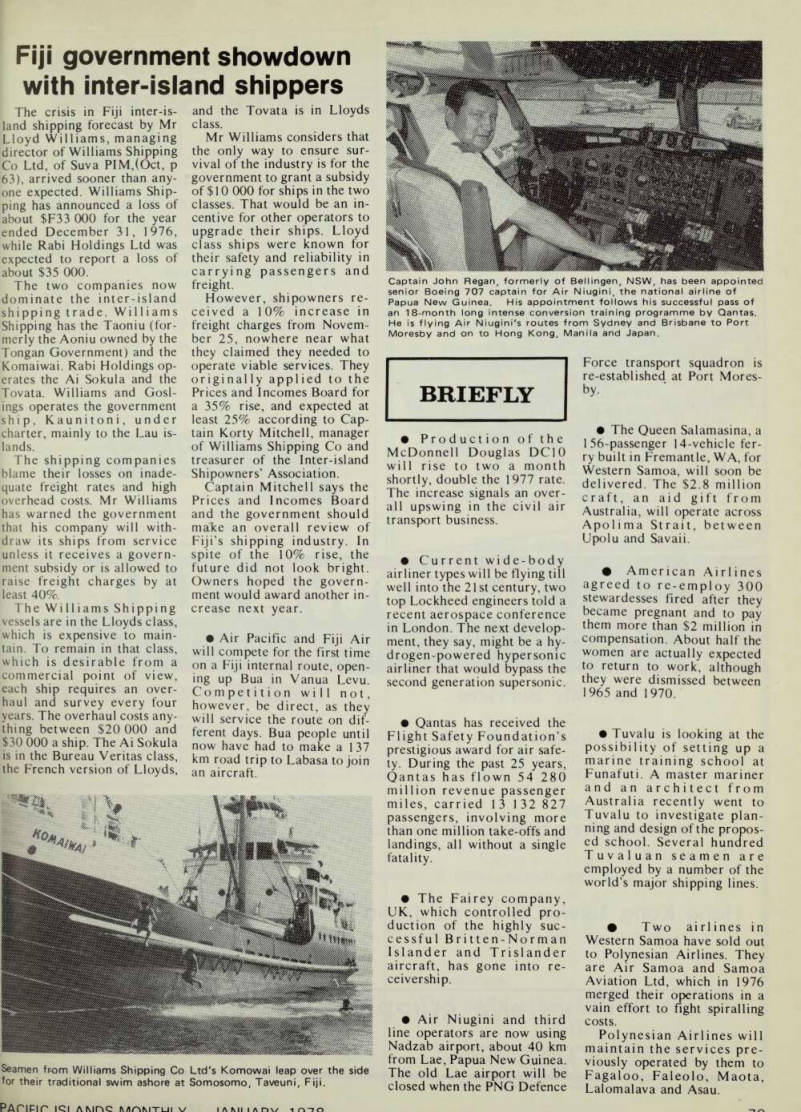
with inter-island shippers
The crisis in Fiji inter-is land shipping forecast by Mr Lloyd Williams, managing director of Williams Shipping Co Ltd, of Suva PIM,(Oct, p 63), arrived sooner than any one expected. Williams Ship ping has announced a loss of about SF33 000 for the year ended December 31, 1976, while Rabi Holdings Ltd was expected to report a loss of about $35 000.
The two companies now dominate the inter-island shipping trade. Williams Shipping has the Taoniu (for merly the Aoniu owned by the Tongan Government) and the Komaiwai. Rabi Holdings op erates the Ai Sokula and the Tovata. Williams and Gosl ings operates the government ship, Kaunitoni, under charter, mainly to the Lau is lands.
The shipping companies blame their losses on inade quate freight rates and high overhead costs. Mr Williams has warned the government that his company will with draw its ships from service unless it receives a govern ment subsidy or is allowed to raise freight charges by at least 40%.
The Williams Shipping vessels are in the Lloyds class, which is expensive to main tain. To remain in that class, which is desirable from a commercial point of view, each ship requires an over haul and survey every four years. The overhaul costs any thing between $2O 000 and $3O 000 a ship. The Ai Sokula is in the Bureau Veritas class, the French version of Lloyds,
and the Tovata is in Lloyds class.
Mr Williams considers that the only way to ensure sur vival of the industry is for the government to grant a subsidy of $lO 000 for ships in the two classes. That would be an in centive for other operators to
upgrade their ships. Lloyd
class ships were known for their safety and reliability in carrying passengers and freight.
However, shipowners re ceived a 10% increase in freight charges from Novem ber 25, nowhere near what they claimed they needed to operate viable services. They originally applied to the Prices and Incomes Board for a 35% rise, and expected at least 25% according to Cap tain Korty Mitchell, manager of Williams Shipping Co and treasurer of the Inter-island Shipowners’ Association.
Captain Mitchell says the Prices and Incomes Board and the government should make an overall review of Fiji’s shipping industry. In spite of the 10% rise, the future did not look bright.
Owners hoped the govern ment would award another in crease next year. • Air Pacific and Fiji Air will compete for the first time on a Fiji internal route, open ing up Bua in Vanua Levu.
Competition will not, however, be direct, as they will service the route on dif ferent days. Bua people until now have had to make a 137 km road trip to Labasa to join an aircraft.
Briefly
• Production of the McDonnell Douglas DCIO will rise to two a month shortly, double the 1977 rate.
The increase signals an over all upswing in the civil air transport business. • Current wide-body airliner types will be flying till well into the 21 st century, two top Lockheed engineers told a recent aerospace conference in London. The next develop ment, they say, might be a hy drogen-powered hypersonic airliner that would bypass the second generation supersonic. • Qantas has received the Flight Safety Foundation’s prestigious award for air safe ty. During the past 25 years, Qantas has flown 54 280 million revenue passenger miles, carried I 3 132 827 passengers, involving more than one million take-offs and landings, all without a single fatality. • The Fairey company, UK, which controlled pro duction of the highly suc cessful Britten-Norman Islander and Trislander aircraft, has gone into re ceivership. • Air Niugini and third line operators are now using Nadzab airport, about 40 km from Lae, Papua New Guinea.
The old Lae airport will be closed when the PNG Defence
Force transport squadron is re-established at Port Mores by. • The Queen Salamasina, a 156-passenger 14-vehicle fer ry built in Fremantle, WA, for Western Samoa, will soon be delivered. The $2.8 million craft, an aid gift from Australia, will operate across Apolima Strait, between Upolu and Savaii. • American Airlines agreed to re-employ 300 stewardesses fired after they became pregnant and to pay them more than $2 million in compensation. About half the women are actually expected to return to work, although they were dismissed between 1965 and 1970. • Tuvalu is looking at the possibility of setting up a marine training school at Funafuti. A master mariner and an architect from Australia recently went to Tuvalu to investigate plan ning and design of the propos ed school. Several hundred Tuvaluan seamen are employed by a number of the world’s major shipping lines. • Two airlines in Western Samoa have sold out to Polynesian Airlines. They are Air Samoa and Samoa Aviation Ltd, which in 1976 merged their operations in a vain effort to fight spiralling costs.
Polynesian Airlines will maintain the services pre viously operated by them to Fagaloo, Faleolo, Maota, Lalomalava and Asau.
Seamen from Williams Shipping Co Ltd's Komowai leap over the side for their traditional swim ashore at Somosomo, Taveuni, Fiji.
Captain John Regan, formerly of Bellingen, NSW, has been appointed senior Boeing 707 captain for Air Niugini, the national airline of Papua New Guinea. His appointment follows his successful pass of an 18-month long intense conversion training programme by Qantas.
He is flying Air Niugini's routes from Sydney and Brisbane to Port Moresby and on to Hong Kong, Manila and Japan.
Advertisements & other items, pp. 79-80 (2 items)
79
PAPIFIP IQI A MHQ l\/ir»MXUI v IA mi iadv Imo
Kyowa Line
PACIFIC
ISLANDS
TRANSPORT
LINE
Owners: Thor Dahls Hvalfangerseiskap A/S - Sandefjord, Norway .
Regular
Pacific Services
"Union South Pacific”, cellular container vessel. Reefer and general cargo from Auckland at approximately fortnightly intervals. Calls at Suva,
MS CAMELLIA VENTURE
Express Freight Service between Pacific Coast Ports of U.S.A. and...
Pago Pago, Apia and Nukualofa before
returning to Auckland.
Tahiti 6 Samoa
Full container service including reefers.
GENERAL STEAMSHIP CORPORATION LTD.
General Agents 400 California Street, San Francisco, California, U.S.A.
"Luhesand”, conventional reefer and
general cargo. Monthly sailings from
Auckland, calls at Suva, Apia, Papeete
and Nukualofa.
APIA: Burns Philp (South Sea) Company Ltd.
PAPEETE: Agence Maritime Internationale, Tahiti, PAGO PAGO: Polynesia Shipping Services Inc.
NOUMEA: Establissements Ballande.
SYDNEY: Trans-Austral Shipping Pty. Ltd SUVA: Burns Philp (South Sea) Company Ltd.
LAE/RABAUL: Burns Philp (New Guinea) Ltd.
PORT VILA: Comptoirs Francais de Nouvelles Hebrides. m
liMumon
Imcompanti
Branches at all main Australian, New Zealand and Pacific Island ports
Kyo^i
KYOWA LINE
YOUR TRADING PARTNER
Monthly Services
A GENTS
Hong Kong, Taiwan, S. Korea, Japan
To; British Solomon, New Caledonia, Fiji, W Samoa, A. Samoa. Tahiti, Cook Is., Tonga, New Hebrides.
Ellice Is.,
Taiwan,Hong Kong,Singapore,Jakarta,
Philippine
To; Australia, Papua New Guinea, Sabah & Sarawak.
Hong Kong, Taiwan, S. Korea, Japan
To; Guam, Saipan, Truk, Ponape, Other Pacific Islands.
Taiwan: Royal Steamship Corp., Ltd., Taipei S. Korea: Dong Sue Shipping Co., Ltd,, Seoul Hong Kong: Dahzun Enterprises Ltd.
Singapore: Ocean Shipping & Enterprises Pte., Ltd.
Guam: Maritime Agencies of Pacific Ltd., Guam Saipan: Saipan Shipping Co., Inc., Saipan 8.5.1. P.: Solomon Taiyo Ltd , Honiara Tahiti: JA. Cowan & Fils, Papeete Cooks: Eastern Associates Ltd,, Rarotonga Tonga: EM Jones Ltd, Nukualofa New Hebrides: Agence Maritime Raymond Velicite, Port Vila A.Samoa: Island Pacific Agencies Inc., Pago Pago W. Samoa: Morris Hedstrom Ltd., Apia Fiji: Carpenter Shipping, Suva & Lautoka PNG: Carpenter Shipping Agencies, Port Moresby, Rabaul New Caledonia; Agence Maritime Du Rond Point Du Pacific, Noumea Indonesia: P.T. Porodisa Raya Shipping Lines, Jakarta Sabah: KOH Han Ming Shipping & Forwarding Agent, Kotakmabalu Sarawak: Pan Sarawak Agencies Sdn Bhd., Sibu & Kuching Australia: Hethenngton Kingsbury Pty. Ltd., Sydney. NSW Newzealand: Sofrana Umlmes S.A., Auckland.
KYOWA SHIPPING CO., LTD.
HEAD OFFICE
sth FI., Suzumaru Bldg. 39-8, 2-chome, Nishi-Shinbashi, Minato-ku, Tokyo, Japan.
Phone : 03(437)2885(Rep.) Cables : “MARIQUEEN” Tokyo. Telex : 242-4651 Kyowa J.
CA OFFICE
ier Bldg., 3-13 Hirano-cho, Higashi-ku, Osaka, Japan. e : 06(227)0422(Rep.) Cables : ‘MARIQUEEN” Osaka. Telex : 522-3896 Kyowa 0.
Shipping
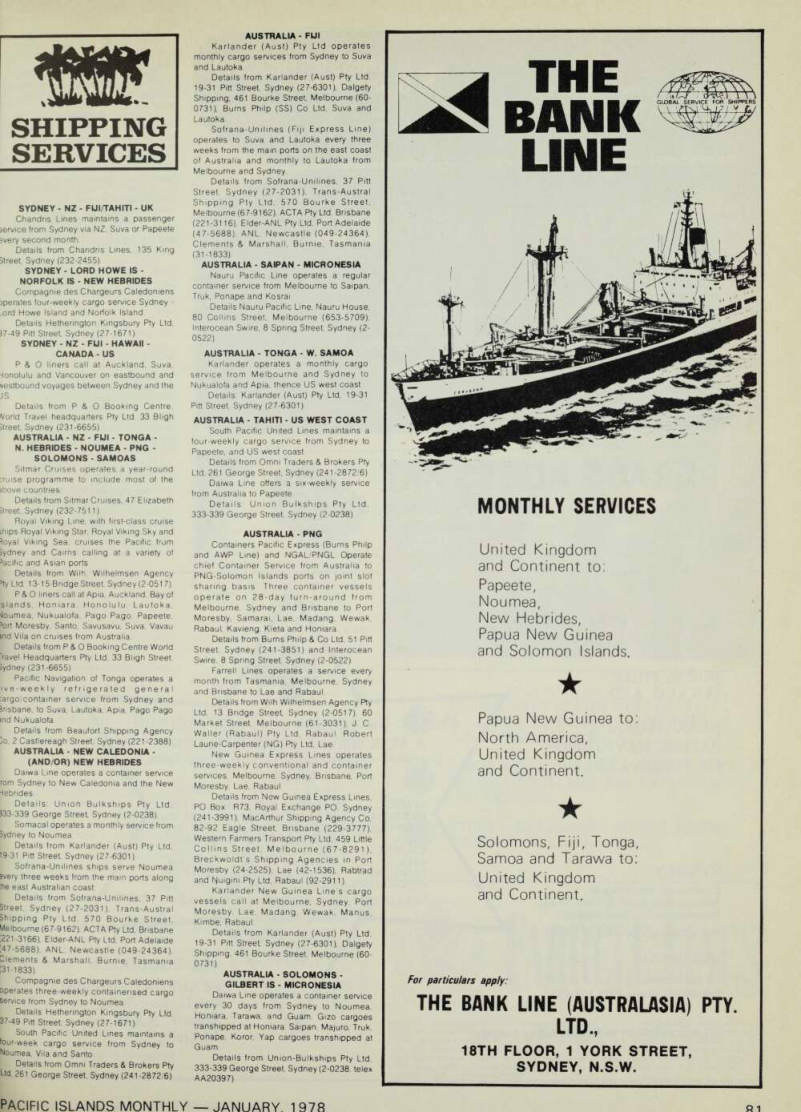
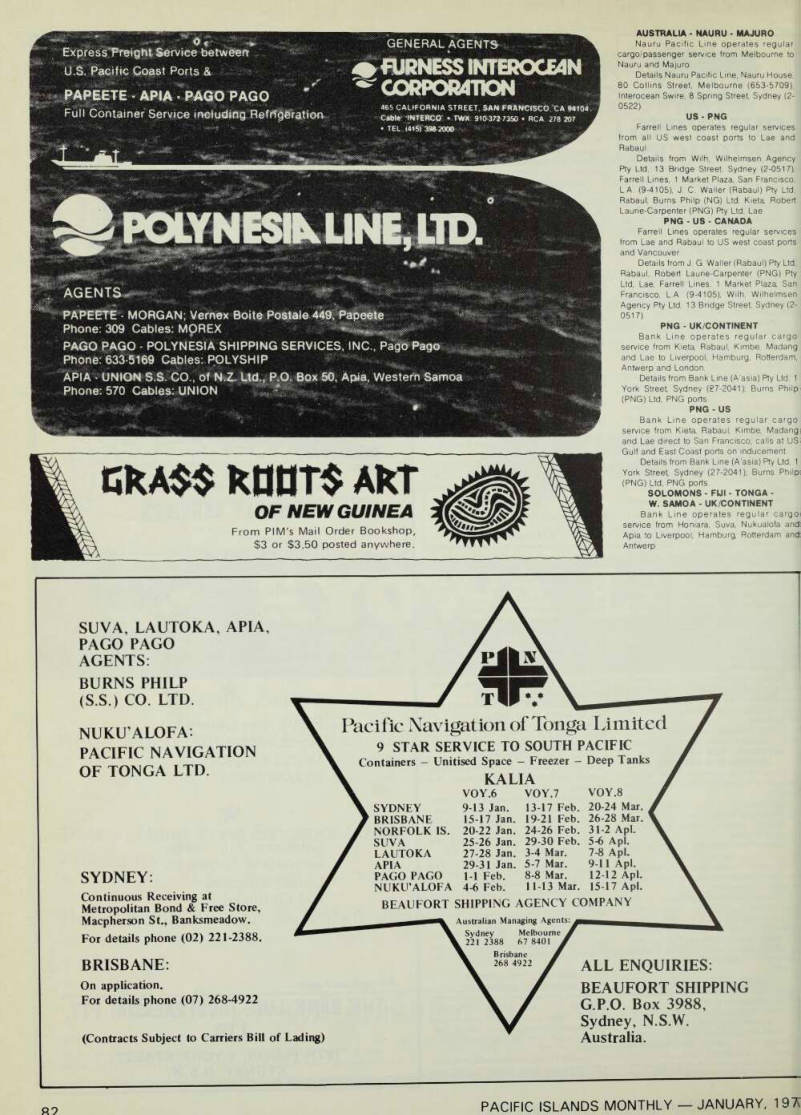
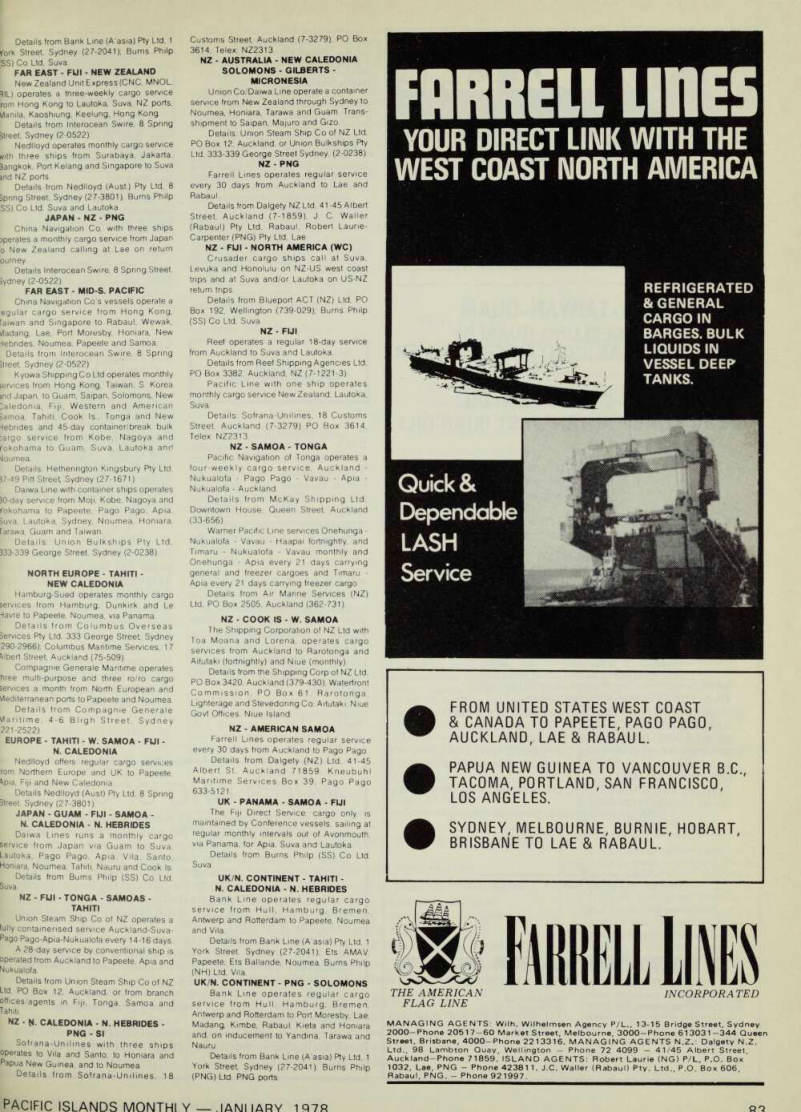
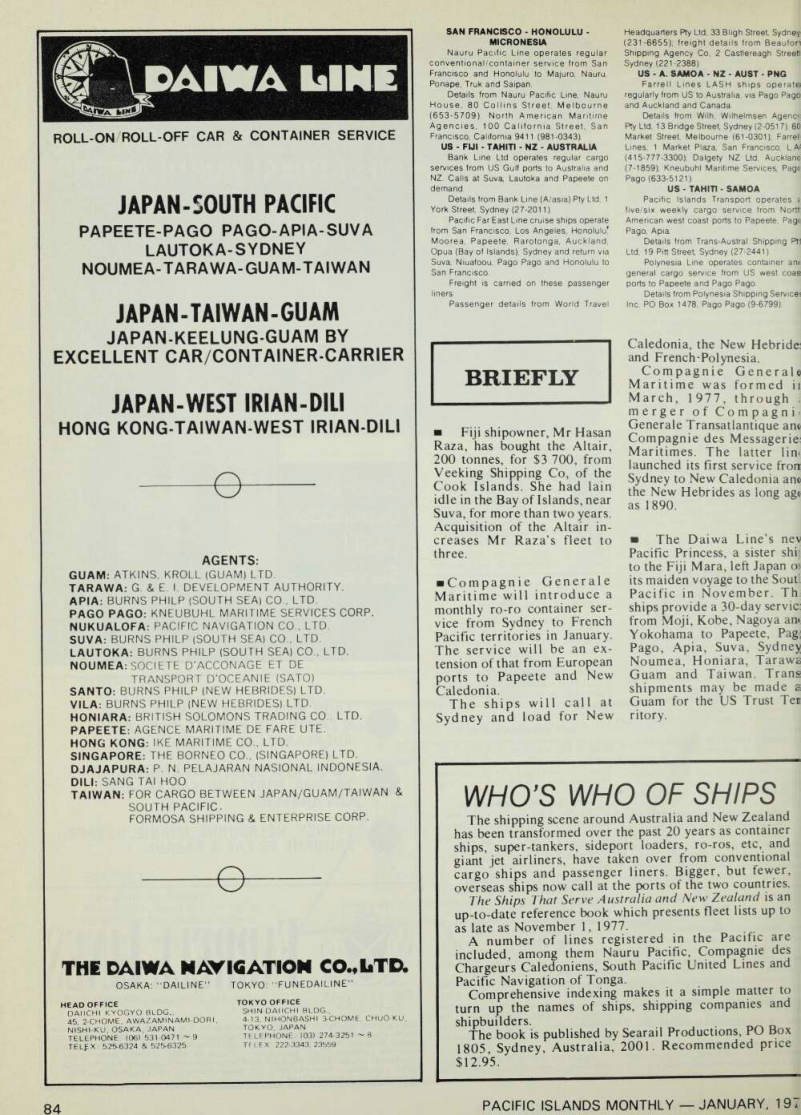
Services
SYDNEY - NZ - FUI/TAHITI - UK Chandris Lines maintains a passenger service from Sydney via NZ, Suva or Papeete svery second month.
Details from Chandris Lines, 135 King street, Sydney (232-2455)
Sydney - Lord Howe Is -
Norfolk Is - New Hebrides
Compagnie des Chargeurs Caledoniens >perates four-weekly cargo service Sydney - .ord Howe Island and Norfolk Island Details Hetherington Kingsbury Pty Ltd, )7-49 Pitt Street, Sydney (27-1671).
SYDNEY - NZ - FUI - HAWAII -
Canada - Us
P & O liners call at Auckland, Suva, Honolulu and Vancouver on eastbound and vestbound voyages between Sydney and the JS Details from P & O Booking Centre.
Vorld Travel headquarters Pty Ltd. 33 Bligh street, Sydney (231-6655) AUSTRALIA - NZ - FUI - TONGA - N. HEBRIDES - NOUMEA - PNG •
Solomons -Samoas
Sitmar Cruises operates a year-round :ruise programme to include most of the ibove countries Details from Sitmar Cruises, 47 Elizabeth street, Sydney (232-7511) Royal Viking Line, with first-class cruise ihips Royal Viking Star, Royal Viking Sky and toyal Viking Sea, cruises the Pacific from sydney and Cairns calling at a variety of ’acific and Asian ports Details from Wilh, Wilhelmsen Agency *ty Ltd, 13-15 Bridge Street, Sydney (2-0517) P & O liners call at Apia, Auckland. Bay of slands, Honiara. Honolulu, Lautoka, Noumea, Nukualofa, Pago Pago, Papeete, *ort Moresby, Santo, Savusavu, Suva, Vavau ind Vila on cruises from Australia Details from P & O Booking Centre World 'ravel Headquarters Pty Ltd, 33 Bligh Street, sydney (231-6655) Pacific Navigation of Tonga operates a ive-weekly refrigerated general :argo/container service from Sydney and Jrisbane, to Suva, Lautoka, Apia, Pago Pago ind Nukualofa Details from Beaufort Shipping Agency to, 2 Castlereagh Street, Sydney (221-2388)
Australia - New Caledonia •
(And/Or) New Hebrides
Daiwa Line operates a container service rom Sydney to New Caledonia and the New Hebrides Details: Union Bulkships Pty Ltd, J 33-339 George Street Sydney (2-0238) Somacal operates a monthly service from Sydney to Noumea Details from Karlander (Aust) Pty Ltd, 19-31 Pitt Street, Sydney (27-6301) Sofrana-Unilines ships serve Noumea 3very three weeks from the main ports along he east Australian coast.
Details from Sofrana-Unilines. 37 Pitt Street, Sydney (27-2031), Trans-Austral Shipping Pty Ltd. 570 Bourke Street, Melbourne (67-9162), ACTA Pty Ltd, Brisbane ,221-3166), Elder-ANL Pty Ltd, Port Adelaide [47-5688), ANL. Newcastle (049-24364), Clements & Marshall. Burnie, Tasmania [3l-1833) Compagnie des Chargeurs Caledoniens operates three-weekly containerised cargo service from Sydney to Noumea Details Hetherington Kingsbury Pty Ltd. 37-49 Pitt Street, Sydney (27-1671) South Pacific United Lines maintains a four-week cargo service from Sydney to Noumea, Vila and Santo Details from Omni Traders & Brokers Pty Ltd, 261 George Street, Sydney (241-2872/6)
Australia - Fui
Karlander (Aust) Pty Ltd operates monthly cargo services from Sydney to Suva and Lautoka Details from Karlander (Aust) Pty Ltd, 19-31 Pitt Street, Sydney (27-6301), Dalgety Shipping, 461 Bourke Street, Melbourne (60- 0731), Burns Philp (SS) Co Ltd, Suva and Lautoka.
Sofrana-Unilines (Fiji Express Line) operates to Suva and Lautoka every three weeks from the main ports on the east coast of Australia and monthly to Lautoka from Melbourne and Sydney.
Details from Sofrana-Unilines. 37 Pitt Street, Sydney (27-2031), Trans-Austral Shipping Pty Ltd, 570 Bourke Street, Melbourne (67-9162), ACTA Pty Ltd, Brisbane (221-3116), Elder-ANL Pty Ltd, Port Adelaide (47-5688), ANL, Newcastle (049-24364), Clements & Marshall, Burme, Tasmania (31-1833)
Australia - Saipan - Micronesia
Nauru Pacific Line operates a regular container service from Melbourne to Saipan, Truk, Ponape and Kosrai Details Nauru Pacific Line, Nauru House, 80 Collins Street, Melbourne (653-5709), Interocean Swire, 8 Spring Street Sydney (2- 0522)
Australia - Tonga - W. Samoa
Karlander operates a monthly cargo service from Melbourne and Sydney to Nukualofa and Apia, thence US west coast Details: Karlander (Aust) Pty Ltd. 19-31 Pitt Street, Sydney (27-6301).
AUSTRALIA - TAHITI - US WEST COAST South Pacific United Lines maintains a four-weekly cargo service from Sydney to Papeete, and US west coast Details from Omni Traders & Brokers Pty Ltd, 261 George Street, Sydney (241-2872/6) Daiwa Line offers a six-weekly service from Australia to Papeete Details: Union Bulkships Pty Ltd. 333-339 George Street, Sydney (2-0238)
Australia - Png
Containers Pacific Express (Burns Philp and AWP Line) and NGAL/PNGL Operate chief Container Service from Australia to PNG-Solomon Islands ports on joint slot sharing basis Three container vessels operate on 28-day turn-around from Melbourne, Sydney and Brisbane to Port Moresby. Samarai, Lae, Madang, Wewak, Rabaul, Kavieng, Kieta and Honiara Details from Burns Philp & Co Ltd. 51 Pitt Street, Sydney (241-3851) and Interocean Swire. 8 Spring Street, Sydney (2-0522) Farrell Lines operates a service every month from Tasmania, Melbourne. Sydney and Brisbane to Lae and Rabaul Details from Wilh Wilhelmsen Agency Pty Ltd. 13 Bridge Street Sydney (2-0517), 60 Market Street Melbourne (61-3031), J C Waller (Rabaul) Pty Ltd, Rabaul Robert Laurie-Carpenter (NG) Pty Ltd, Lae New Guinea Express Lines operates three-weekly conventional and container services, Melbourne, Sydney, Brisbane, Port Moresby. Lae. Rabaul Details from New Guinea Express Lines, PO Box R 73, Royal Exchange PO. Sydney (241-3991). MacArthur Shipping Agency Co, 82-92 Eagle Street, Brisbane (229-3777), Western Farmers Transport Pty Ltd. 459 Little Collins Street, Melbourne (67-8291), Breckwoldt's Shipping Agencies in Port Moresby (24-2525), Lae (42-1536), Rabtrad and hjuigini Pty Ltd. Rabaul (92-2911).
Karlander New Guinea Line s cargo vessels call at Melbourne. Sydney, Port Moresby, Lae, Madang, Wewak, Manus, Kimbe, Rabaul Details from Karlander (Aust) Pty Ltd, 19-31 Pitt Street, Sydney (27-6301), Dalgety Shipping, 461 Bourke Street, Melbourne (60- 0731)
Australia - Solomons -
Gilbert Is - Micronesia
Daiwa Line operates a container service every 30 days from Sydney to Noumea, Honiara, Tarawa, and Guam Gizo cargoes transhipped at Honiara Saipan, Majuro, Truk, Ponape, Koror, Yap cargoes transhipped at Guam Details from Union-Bulkships Pty Ltd, 333-339 George Street, Sydney (2-0238, telex AA20397)
Australia - Nauru - Majuro
Nauru Pacific Line operates regular cargo/passenger service from Melbourne to Nauru and Majuro.
Details Nauru Pacific Line, Nauru House, 80 Collins Street, Melbourne (653-5709), Interocean Swire, 8 Spring Street Sydney (2- ■ 0522).
Us - Png
Farrell Lines operates regular services from all US west coast ports to Lae and Rabaul.
Details from Wilh, Wilhelmsen Agency Pty Ltd, 13 Bridge Street, Sydney (2-0517), Farrell Lines, 1 Market Plaza, San Francisco, LA. (9-4105), J. C Waller (Rabaul) Pty Ltd, Rabaul, Burns Philp (NG) Ltd, Kieta Robert Laurie-Carpenter (PNG) Pty Ltd, Lae
Png - Us - Canada
Farrell Lines operates regular services from Lae and Rabaul to US west coast ports and Vancouver Details from J. G. Waller (Rabaul) Pty Ltd, Rabaul, Robert Laurie-Carpenter (PNG) Pty Ltd, Lae, Farrell Lines, 1 Market Plaza San Francisco, L.A. (9-4105), Wilh, Wilhelmsen Agency Pty Ltd, 13 Bridge Street Sydney (2- 0517).
Png - Uk/Continent
Bank Line operates regular cargo service from Kieta Rabaul, Kimbe, Madang and Lae to Liverpool, Hamburg, Rotterdam, Antwerp and London.
Details from Bank Line (A’asia) Pty Ltd, 1 York Street Sydney (€7-2041); Burns Philp< (PNG) Ltd, PNG ports.
Png - Us
Bank Line operates regular cargo service from Kieta Rabaul, Kimbe, Madangi and Lae direct to San Francisco; calls at USI Gulf and East Coast ports on inducement.
Details from Bank Line (A'asia) Pty Ltd, 1 York Street Sydney (27-2041); Burns Philpt (PNG) Ltd, PNG ports.
Solomons - Fui- Tonga -
W. Samoa - Uk/Continent
Bank Line operates regular cargor service from Honiara, Suva, Nukualofa andt Apia to Liverpool, Hamburg, Rotterdam andt Antwerp.
i Details from Bank Line (A'asia) Pty Ltd, 1 fork Street, Sydney (27-2041); Burns Philp SS) Co Ltd, Suva FAR EAST - FUI - NEW ZEALAND New Zealand Unit Express (CNC MNOL, RIL) operates a three-weekly cargo service rom Hong Kong to Lautoka, Suva, NZ ports, Manila, Kaoshiung, Keelung, Hong Kong Details from Interocean Swire. 8 Spring Street, Sydney (2-0522) Nedlloyd operates monthly cargo service with three ships from Surabaya. Jakarta, Bangkok, Port Kelang and Singapore to Suva jnd NZ ports Details from Nedlloyd (Aust) Pty Ltd, 8 Spring Street, Sydney (27-3801), Burns Philp SS) Co Ltd, Suva and Lautoka
Japan - Nz - Png
China Navigation Co, with three ships jperates a monthly cargo service from Japan o New Zealand calling at Lae on return ourney Details Interocean Swire, 8 Spring Street, Sydney (2-0522)
Far East - Mid-S. Pacific
China Navigation Co's vessels operate a egular cargo service from Hong Kong, Faiwan and Singapore to Rabaul, Wewak, Madang, Lae, Port Moresby, Honiara, New Hebrides, Noumea, Papeete and Samoa Details from Interocean Swire, 8 Spring Street, Sydney (2-0522) Kyowa Shipping Co Ltd operates monthly services from Hong Kong, Taiwan. S. Korea ind Japan, to Guam, Saipan, Solomons, New Caledonia, Fiji, Western and American Samoa, Tahiti, Cook Is.. Tonga and New Hebrides and 45-day container/break bulk ;argo service from Kobe. Nagoya and (okohama to Guam, Suva, Lautoka and iJoumea Details: Hetherington Kingsbury Pty Ltd, S 7-49 Pitt Street Sydney (27-1671) Daiwa Line with container ships operates )0-day service from Moji, Kobe, Nagoya and Yokohama to Papeete, Pago Pago, Apia, Suva, Lautoka, Sydney, Noumea, Honiara, Tarawa, Guam and Taiwan Details. Union Bulkships Pty Ltd, 333-339 George Street. Sydney (2-0238)
North Europe - Tahiti -
New Caledonia
Hamburg-Sued operates monthly cargo services from Hamburg, Dunkirk and Le Havre to Papeete. Noumea, via Panama Details from Columbus Overseas Services Pty Ltd, 333 George Street Sydney 290-2966), Columbus Maritime Services, 17 Mbert Street Auckland (75-509) Compagme Generale Maritime operates hree multi-purpose and three ro/ro cargo Services a month from North European and Mediterranean ports to Papeete and Noumea Details from Compagnie Generale Maritime. 4-6 Bligh Street. Sydney 221-2522) EUROPE - TAHITI - W. SAMOA - FUI -
N. Caledonia
Nedlloyd offers regular cargo services rom Northern Europe and UK to Papeete, !tpia, Fiji and New Caledonia.
Details Nedlloyd (Aust) Pty Ltd, 8 Spring Street, Sydney (27-3801) JAPAN - GUAM - FUI - SAMOA -
N. Caledonia - N. Hebrides
Daiwa Lines runs a monthly cargo service from Japan via Guam to Suva.
Lautoka, Pago Pago, Apia, Vila, Santo, Honiara, Noumea. Tahiti, Nauru and Cook Is Details from Burns Philp (SS) Co Ltd.
Suva NZ - FUI - TONGA - SAMOAS -
Tahiti
Union Steam Ship Co of NZ operates a fully containerised service Auckland-Suva- Pago Pago-Apia-Nukualofa every 14-16 days A 28-day service by conventional ship is operated from Auckland to Papeete. Apia and Nukualofa Details from Union Steam Ship Co of NZ Ltd. PO Box 12. Auckland, or from branch offices/agents in Fiji, Tonga. Samoa and Tahiti NZ - (J. CALEDONIA - N. HEBRIDES -
Png - Si
Sofrana-Unilines with three ships operates to Vila and Santo, to Honiara and Papua New Guinea, and to Noumea Details from Sofrana-Unilines. 18
Customs Street, Auckland (7-3279), PO Box 3614, Telex: NZ2313
Nz - Australia - New Caledonia
Solomons - Gilberts -
Micronesia
Union Co/Daiwa Line operate a container service from New Zealand through Sydney to Noumea, Honiara, Tarawa and Guam Trans shipment to Saipan, Majuro and Gizo Details: Union Steam Ship Co of NZ Ltd, PO Box 12, Auckland, or Union Bulkships Pty Ltd, 333-339 George Street Sydney, (2-0238)
Nz • Png
Farrell Lines operates regular service every 30 days from Auckland to Lae and Rabaul Details from Dalgety NZ Ltd, 41-45 Albert Street, Auckland (7-1859), J. C Waller (Rabaul) Pty Ltd, Rabaul, Robert Laune- Carpenter (PNG) Pty Ltd, Lae NZ - FUI - NORTH AMERICA (WC) Crusader cargo ships call at Suva, Levuka and Honolulu on NZ-US west coast trips and at Suva and/or Lautoka on US-NZ return trips.
Details from Blueport ACT (NZ) Ltd, PO Box 192, Wellington (739-029), Burns Philp (SS) Co Ltd, Suva
Nz - Fiji
Reef operates a regular 18-day service from Auckland to Suva and Lautoka Details from Reef Shipping Agencies Ltd, PO Box 3382, Auckland, NZ (7-1221-3) Pacific Line with one ship operates monthly cargo service New Zealand, Lautoka, Suva Details: Sofrana-Unilines, 18 Customs Street, Auckland (7-3279) PO Box 3614, Telex NZ2313
Nz- Samoa - Tonga
Pacific Navigation of Tonga operates a four-weekly cargo service, Auckland - Nukualofa - Pago Pago - Vavau - Apia - Nukualofa - Auckland Details from McKay Shipping Ltd, Downtown House. Queen Street Auckland (33-656).
Warner Pacific Line services Onehunga - Nukualofa - Vavau - Haapai fortnightly, and Timaru - Nukualofa - Vavau monthly and Onehunga - Apia every 21 days carrying general and freezer cargoes and Timaru - Apia every 21 days carrying freezer cargo Details from Air Marine Services (NZ) Ltd, PO Box 2505, Auckland (362-731) NZ - COOK IS - W. SAMOA The Shipping Corporation of NZ Ltd with Toa Moana and Lorena, operates cargo services from Auckland to Rarotonga and Aitutaki (fortnightly) and Niue (monthly) Details from the Shipping Corp of NZ Ltd.
PO Box 3420. Auckland (379-430), Waterfront Commission. PO Box 61, Rarotonga, Lighterage and Stevedoring Co. Aitutaki. Niue Govt Offices, Niue Island
Nz - American Samoa
Farrell Lines operates regular service every 30 days from Auckland to Pago Pago Details from Dalgety (NZ) Ltd, 41-45 Albert St. Auckland 71859 Kneubuhl Maritime Services Box 39, Pago Pago 633-5121 UK • PANAMA - SAMOA - FUI The Fiji Direct Service, cargo only, is maintained by Conference vessels, sailing at regular monthly intervals out of Avonmouth. via Panama, for Apia, Suva and Lautoka Details from Burns Philp (SS) Co Ltd, Suva.
Uk/N. Continent - Tahiti -
N. Caledonia - N. Hebrides
Bank Line operates regular cargo service from Hull, Hamburg, Bremen, Antwerp and Rotterdam to Papeete. Noumea and Vila.
Details from Bank Line (A'asia) Pty Ltd. 1 York Street, Sydney (27-2041); Ets AMAV.
Papeete: Ets Ballande, Noumea, Burns Philp (NH) Ltd, Vila
Uk/N. Continent - Png - Solomons
Bank Line operates regular cargo service from Hull. Hamburg. Bremen, Antwerp and Rotterdam to Port Moresby. Lae, Madang, Kimbe, Rabaul, Kieta and Honiara and, on inducement to Yandina, Tarawa and Nauru Details from Bank Line (A'asia) Pty Ltd. 1 York Street Sydney (27-2041); Burns Philp (PNG) Ltd, PNG ports
San Francisco - Honolulu -
Micronesia
Nauru Pacific Line operates regular conventional/container service from San Francisco and Honolulu to Majuro, Nauru, Ponape, Truk and Saipan, Details from Nauru Pacific Line, Nauru House, 80 Collins Street, Melbourne (653-5709), North American Maritime Agencies, 100 California Street, San Francisco, California 9411 (981-0343) US - FUJI - TAHITI - NZ - AUSTRALIA Bank Line Ltd operates regular cargo services from US Gulf ports to Australia and NZ. Calls at Suva, Lautoka and Papeete on demand.
Details from Bank Line (A/asia) Pty Ltd, 1 York Street, Sydney (27-2011).
Pacific Far East Line cruise ships operate from San Francisco, Los Angeles, Honolulu!
Moorea, Papeete, Rarotonga, Auckland, Opua (Bay of Islands), Sydney and return via Suva, Niuafoou, Pago Pago and Honolulu to San Francisco.
Freight is carried on these passenger liners.
Passenger details from World Travel
Briefly
■ Fiji shipowner, Mr Hasan Raza, has bought the Altair, 200 tonnes, for $3 700, from Veeking Shipping Co, of the Cook Islands. She had lain idle in the Bay of Islands, near Suva, for more than two years.
Acquisition of the Altair in creases Mr Raza’s fleet to three. ■ Compagnie Generale Maritime will introduce a monthly ro-ro container ser vice from Sydney to French Pacific territories in January.
The service will be an ex tension of that from European ports to Papeete and New Caledonia.
The ships will call at Sydney and load for New
Headquarters Pty Ltd, 33 Bllgh Street, Sydney: (231-6655); freight details from Beaufon Shipping Agency Co, 2 Castlereagh Streetf Sydney (221-2388) US - A. SAMOA - NZ - AUST - PNG Farrell Lines LASH ships operate regularly from US to Australia, via Pago Pago and Auckland and Canada.
Details from Wilh, Wilhelmsen Agency; Pty Ltd, 13 Bridge Street Sydney (2-0517), 60 Market Street. Melbourne (61-0301); Farrell: Lines, 1 Market Plaza, San Francisco, LA* (415-777-3300); Dalgety NZ Ltd. Aucklano (7-1859); Kneubuhl Maritime Services, Pago Pago (633-5121).
Us - Tahiti - Samoa
Pacific Islands Transport operates i five/six weekly cargo service from Norttl: American west coast ports to Papeete, Pagoi Pago, Apia Details from Trans-Austral Shipping Ptl Ltd, 19 Pitt Street Sydney (27-2441) Polynesia Line operates container anc general cargo service from US west coas ports to Papeete and Pago Pago.
Details from Polynesia Shipping Services Inc, PO Box 1478, Pago Pago (9-6799).
Caledonia, the New Hebride;
and French-Polynesia.
Compagnie General©
Maritime was formed ii
March, 1977, through ;
merger of CompagnL Generale Transatlantique am
Compagnie des Messagerie;
Maritimes. The latter lin< launched its first service from Sydney to New Caledonia ano the New Hebrides as long ago as 1890. ■ The Daiwa Line’s nev Pacific Princess, a sister shi] to the Fiji Mara, left Japan ov its maiden voyage to the Soutl: Pacific in November. Thi
ships provide a 30-day servic:
from Moji, Kobe, Nagoya am Yokohama to Papeete, Pag;
Pago, Apia, Suva, Sydney
Noumea, Honiara, Tarawa Guam and Taiwan. Trans shipments may be made as Guam for the US Trust Ten ritory.
Advertisements & other items, pp. 81-84 (2 items)
Bank
THE
LINE
MONTHLY SERVICES
United Kingdom and Continent to; Papeete, Noumea, New Hebrides, Papua New Guinea and Solomon Islands. ★ Papua New Guinea to: North America, United Kingdom and Continent. ★ Solomons, Fiji, Tonga, Samoa and Tarawa to: United Kingdom and Continent.
For particulars apply:
THE BANK LINE (AUSTRALASIA) PTY.
LTD.,
18TH FLOOR, 1 YORK STREET,
SYDNEY, N.S.W.
— Ot ExpressTreight Service between U.S. Pacific Coast Ports & ✓
PAPEETE • APIA • PAGO PAGO
Full Container Service including Refrigeration
GENERAL AGENTS
* fURNESS INTEROCE4N
GORPOR4TION
465 CALIFORNIA STREET. SAN FRANCISCO. CA 94104 , Cable; INTERCO' • TWX 910-372 7350 • RCA 278 207
• TEL <415) 398 2000
*** . i - 9 V ...
: AGENTS.
PAPEETE - MORGAN; Vernex Bolte Postale 449, Papeete Phone: 309 Cables: MOREX PAGO PAGO - POLYNESIA SHIPPING SERVICES, INC., Pago Pago Phone:633-5169 Cables; POLYSHIP APIA - UNION S.S. CO., of N.Z. Ltd., P.O. Box 50, Apia, Western Samoa Phone: 570 Cables: UNION L
CRA$$ ROtJT$ ART
OF NEW GUINEA
From PlM's Mail Order Bookshop, $3 or $3.50 posted anywhere. i. iv
SUVA, LAUTOKA, APIA,
PAGO PAGO
AGENTS;
BURNS PHILP
(S.S.) CO. LTD.
NUKUALOFA:
PACIFIC NAVIGATION
OF TONGA LTD.
Pacific Navigation of Tonga Limited
9 STAR SERVICE TO SOUTH PACIFIC
Containers - Unitised Space - Freezer - Deep Tanks
KALI A
SYDNEY:
Continuous Receiving at Metropolitan Bond & Free Store, Macpherson St., Banksmeadow.
For details phone (02) 221-2388.
BRISBANE:
On application.
For details phone (07) 268-4922 (Contracts Subject to Carriers Bill of Lading)
BEAUFORT SHIPPING AGENCY COMPANY
Australian Managing Sydney Melbourne 221 2388 67 8401 Brisbane 268 4922
ALL ENQUIRIES:
BEAUFORT SHIPPING
G.P.O. Box 3988, Sydney, N.S.W.
Australia.
FDRREIL linES
YOUR DIRECT LINK WITH THE
WEST COAST NORTH AMERICA
Quick &
Dependable
LASH
Service
REFRIGERATED
& GENERAL
CARGO IN
BARGES. BULK
LIQUIDS IN
VESSEL DEEP
TANKS.
JL
• FROM UNITED STATES WEST COAST
& CANADA TO PAPEETE, PAGO PAGO,
AUCKLAND, LAE & RABAUL.
• PAPUA NEW GUINEA TO VANCOUVER 8.C.,
TACOMA, PORTLAND, SAN FRANCISCO,
LOS ANGELES.
• SYDNEY, MELBOURNE, BURNIE, HOBART,
BRISBANE TO LAE & RABAUL.
THE AMERICAN
FLAG LINE
INCORPORATED
MANAGING AGE NTS: Wilh. Wilhelm sen Agency P/L., 13-15 Bridge Street, Sydney 2000—Phone 20517 —6O Market Street, Melbourne, 3000—Phone 613031—344 Queen Street, Brisbane, 4000-Phone 2213316. MANAGING AGENTS N.Z.: Dalgety N.Z.
Ltd., 98 Lambton Quay, Wellington Phone 72 4099 41/45 Albert Street, Auckland —Phone 71859. ISLAND AGENTS: Robert Laurie (NG) P/L, P.O. Box 1032, Lae, PNG - Phone 42381 1. J.C. Waller (Rabaul) Pty. Ltd. P.O Box 606 Rabaul, PNG. - Phone 921997.
gjJPAIWA LINE
ROLL-ON/ROLL-OFF CAR & CONTAINER SERVICE
JAPAN-SOUTH PACIFIC
PAPEETE-PAGO PAGO-APIA-SUVA
LAUTOKA-SYDNEY
NOUMEA-TARAWA-GUAM-TAIWAN
JAPAN - TAIWAN - GUAM
JAPAN-KEELUNG-GUAM BY
EXCELLENT CAR/CONTAINER-CARRIER
JAPAN-WEST IRIAN-DILI
HONG KONG-TAIWAN-WEST IRIAN-DILI
e
AGENTS:
GUAM: ATKINS, KROLL (GUAM) LTD.
TARAWA: G. & E. I. DEVELOPMENT AUTHORITY.
APIA: BURNS PHILP (SOUTH SEA) CO., LTD.
PAGO PAGO: KNEUBUHL MARITIME SERVICES CORP.
NUKUALOFA: PACIFIC NAVIGATION CO., LTD.
SUVA: BURNS PHILP (SOUTH SEA) CO., LTD.
LAUTOKA: BURNS PHILP (SOUTH SEA) CO., LTD.
NOUMEA: SOCIETE D'ACCONAGE ET DE
TRANSPORT D'OCEANIE (SATO)
SANTO: BURNS PHILP (NEW HEBRIDES) LTD,
VILA: BURNS PHILP (NEW HEBRIDES) LTD.
HONIARA: BRITISH SOLOMONS TRADING CO LTD.
PAPEETE: AGENCE MARITIME DE FARE UTE.
HONG KONG: IKE MARITIME CO.. LTD.
SINGAPORE: THE BORNEO CO., (SINGAPORE) LTD.
DJAJAPURA; P. N. PELAJARAN NASIONAL INDONESIA.
DILI: SANG TAI HOO
TAIWAN: FOR CARGO BETWEEN JAPAN/GUAM/TAIWAN &
SOUTH PACIFIC.
FORMOSA SHIPPING & ENTERPRISE CORP.
e
THE DAIWA NAVIGATION CO..LTD.
OSAKA: "DAILINE" TOKYO: FUNEDAILINE”
HEAD OFFICE
DAIICHI KYOGYO BLDG.,
45, 2-CHOME, AWAZAMINAMI-DORI,
NISHI-KU, OSAKA, JAPAN
TELEPHONE: (06) 531-0471 ~9
TEL£X: 525-6324 & 525-6325
TOKYO OFFICE
SHIN-DAIICHI BLDG.,
4-13, NIHONBASHI 3-CHOME. CHUO-KU,
TOKYO, JAPAN
TELEPHONE. (03) 274-3251 8
TELEX: 222-3343. 23559
WHO'S WHO OF SHIPS
The shipping scene around Australia and New Zealand has been transformed over the past 20 years as container ships, super-tankers, sideport loaders, ro-ros, etc, and giant jet airliners, have taken over from conventional cargo ships and passenger liners. Bigger, but fewer, overseas ships now call at the ports of the two countries.
The Ships That Serve Australia and New Zealand is an up-to-date reference book which presents fleet lists up to as late as November 1, 1977.
A number of lines registered in the Pacific are included, among them Nauru Pacific, Compagnie des Chargeurs Caledoniens, South Pacific United Lines and Pacific Navigation of Tonga.
Comprehensive indexing makes it a simple matter to turn up the names of ships, shipping companies and shipbuilders. The book is published by Searail Productions, PO Box 1805, Sydney, Australia, 2001. Recommended price $12.95.
83
PACIFIC ISLANDS MONTHI Y lANII ARY 1 Q7ft
Deaths
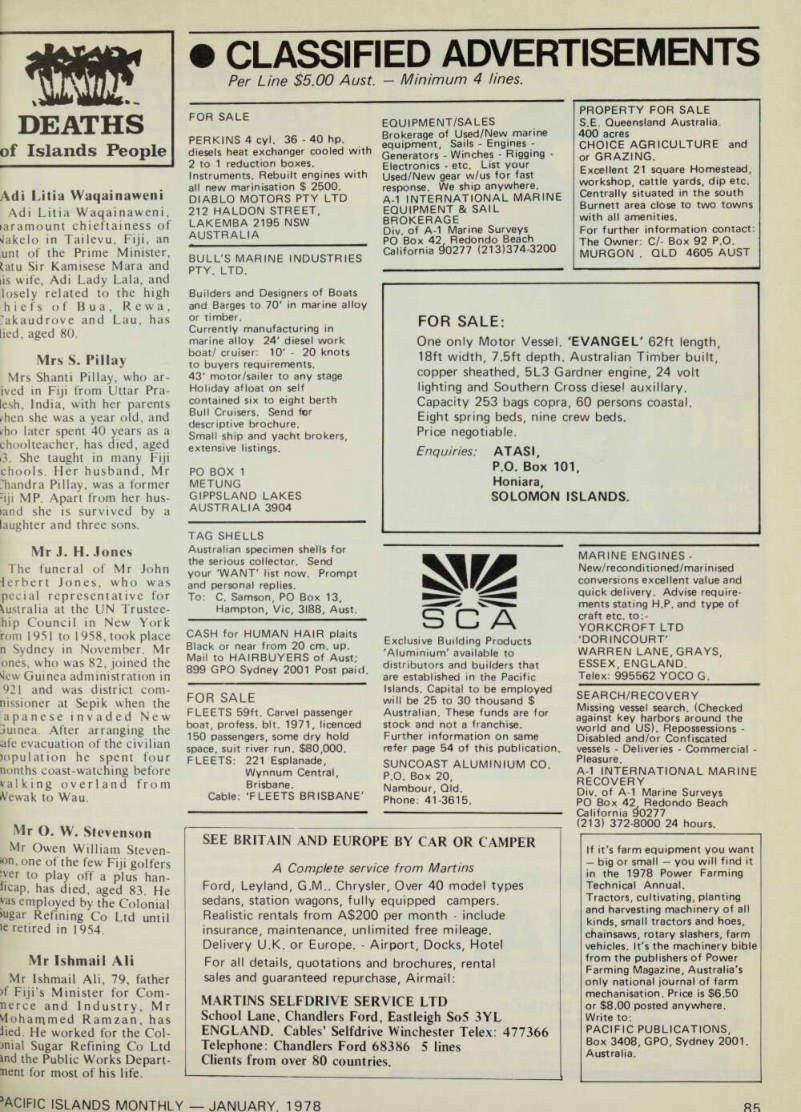
of Islands People
Adi Litia Waqainaweni
Adi Litia Waqainaweni, ►aramount chieftainess of Jakelo in Tailevu, Fiji, an unt of the Prime Minister, tatu Sir Kamisese Mara and lis wife, Adi Lady Lala, and losely related to the high hiefs of Bua, Rewa, and Lau, has lied, aged 80.
Mrs S. Pi I lay Mrs Shanti Pillay, who ar ived in Fiji from Uttar Pra lesh, India, with her parents /hen she was a year old, and /ho later spent 40 years as a choolteacher, has died, aged •3. She taught in many Fiji chools. Her husband, Mr Chandra Pillay, was a former ; iji MP. Apart from her hus »and she is survived by a laughter and three sons.
Mr J. H. Jones The funeral of Mr John Jerbert Jones, who was pecial representative for Australia at the UN Trustee hip Council in New York rom 1951 to 1958, took place n Sydney in November. Mr ones, who was 82, joined the *Jew Guinea administration in 921 and was district com nissioner at Sepik when the apanese invaded New juinea. After arranging the afe evacuation of the civilian )opulation he spent four nonths coast-watching before valking overland from iVewak to Wau.
Mr O. W. Stevenson Mr Owen William Steven son, one of the few Fiji golfers -ver to play off a plus han dicap, has died, aged 83. He vas employed by the Colonial >ugar Refining Co Ltd until ie retired in 1954.
Mr Ishmail Ali Mr Ishmail Ali, 79, father )f Fiji’s Minister for Com nerce and Industry, Mr Mohammed Ramzan, has lied. He worked for the Col onial Sugar Refining Co Ltd md the Public Works Depart ment for most of his life.
Advertisements & other items, pp. 85-92 (5 items)
• Classified Advertisements
Per Line $5.00 Aust. Minimum 4 lines.
PROPERTY FOR SALE
S.E. Queensland Australia. 400 acres
CHOICE AGRICULTURE and
or GRAZING.
Excellent 21 square Homestead, workshop, cattle yards, dip etc.
Centrally situated in the south Burnett area close to two towns with all amenities.
For further information contact: The Owner: Cl- Box 92 P.O.
MURGON . OLD 4605 AUST
FOR SALE
PERKINS 4 cyl. 36 -40 hp. diesels heat exchanger cooled with 2 to 1 reduction boxes.
Instruments. Rebuilt engines with all new marinisation $ 2500.
DIABLO MOTORS PTY LTD
212 HALDON STREET,
LAKEMBA 2195 NSW
AUSTRALIA
BULL'S MARINE INDUSTRIES
PTY. LTD.
Builders and Designers of Boats and Barges to 70' in marine alloy or timber.
Currently manufacturing in marine alloy 24' diesel work boat/ cruiser: 10' - 20 knots to buyers requirements. 43' motor/sailer to any stage Holiday afloat on self contained six to eight berth Bull Cruisers. Send for descriptive brochure.
Small ship and yacht brokers, extensive listings.
PO BOX 1
METUNG
GIPPSLAND LAKES
AUSTRALIA 3904
TAG SHELLS
Australian specimen shells for the serious collector. Send your 'WANT' list now. Prompt and personal replies.
To: C. Samson, PO Box 13, Hampton, Vic, 3188, Aust.
CASH for HUMAN HAIR plaits Black or near from 20 cm. up.
Mail to HAIRBUYERS of Aust; 899 GPO Sydney 2001 Post paid
FOR SALE
FLEETS 59ft. Carvel passenger boat, profess, bit. 1971, licenced 150 passengers, some dry hold space, suit river run. $BO,OOO.
FLEETS; 221 Esplanade, Wynnum Central, Brisbane.
Cable: 'FLEETS BRISBANE'
EQUIPMENT/SALES
Brokerage of Used/New marine equipment. Sails - Engines - Generators - Winches - Rigging Electronics - etc. List your Used/New gear w/us for fast response. We ship anywhere.
A-1 INTERNATIONAL MARINE
EQUIPMENT & SAIL
BROKERAGE
Div. of A-1 Marine Surveys PO Box 42, Redondo Beach California (213)374-3200
FOR SALE:
One only Motor Vessel. 'EVANGEL' 62ft length, 18ft width, 7,5 ft depth. Australian Timber built, copper sheathed, 5L3 Gardner engine, 24 volt lighting and Southern Cross diesel auxiliary.
Capacity 253 bags copra, 60 persons coastal.
Eight spring beds, nine crew beds.
Price negotiable.
Enquiries: AT AS I, P.O. Box 101, Honiara,
SOLOMON ISLANDS.
MARINE ENGINES -
New/reconditioned/marinised conversions excellent value and quick delivery. Advise requirements stating H.P. and type of craft etc. to:-
YORKCROFT LTD
'DORINCOURT'
WARREN LANE, GRAYS,
ESSEX, ENGLAND.
Telex: 995562 YOCO G.
SEARCH/RECOVERY
Missing vessel search. (Checked against key harbors around the world and US). Repossessions - Disabled and/or Confiscated vessels - Deliveries - Commercial - Pleasure.
A-1 INTERNATIONAL MARINE
RECOVERY
Div. of A-1 Marine Surveys PO Box 42 Redondo Beach California 90277 (213) 372-8000 24 hours.
s cT A
Exclusive Building Products 'Aluminium' available to distributors and builders that are established in the Pacific Islands. Capital to be employed will be 25 to 30 thousand $ Australian. These funds are for stock and not a franchise.
Further information on same refer page 54 of this publication,
SUNCOAST ALUMINIUM CO.
P.O. Box 20, Nambour, Old.
Phone; 41-3615.
SEE BRITAIN AND EUROPE BY CAR OR CAMPER A Complete service from Martins Ford, Leyland, G.M.. Chrysler, Over 40 model types sedans, station wagons, fully equipped campers.
Realistic rentals from As2oo per month - include insurance, maintenance, unlimited free mileage.
Delivery U.K. or Europe. - Airport, Docks, Hotel For all details, quotations and brochures, rental sales and guaranteed repurchase, Airmail:
MARTINS SELFDRIVE SERVICE LTD
School Lane, Chandlers Ford, Eastleigh SoS 3YL ENGLAND. Cables’ Selfdrive Winchester Telex: 477366 Telephone: Chandlers Ford 68386 5 lines Clients from over 80 countries.
If it's farm equipment you want big or small you will find it in the 1978 Power Farming Technical Annual.
Tractors, cultivating, planting and harvesting machinery of all kinds, small tractors and hoes, chainsaws, rotary slashers, farm vehicles. It's the machinery bible from the publishers of Power Farming Magazine, Australia's only national journal of farm mechanisation. Price is $6.50 or $B.OO posted anywhere.
Write to:
PACIFIC PUBLICATIONS,
Box 3408, GPO, Sydney 2001.
Australia.
HOUSING ?
Our Kitset Houses manufactured to your design or requirements are available for delivery and local assembly competitively anywhere in the Pacific. Units can come complete with plumbing and electrical wiring and be manpacked into the most inaccessible areas if required.
We can also cater for classrooms, hospital wards, dispensaries, etc. Our precut colour coded and numbered framing units means less skilled labour on site as initial cutting, fitting, etc., has been done in our factory.
We will design and/or help you to set up your own manufacturing facilities utilising local labour and resources on a joint venture basis.
FOR FURTHER INFORMATION WRITE TO:—
STEWART
TIMBER & HARDWARE LTD.
EXPORT DIVISION
P.O. BOX 488, WHANGAREI. NEW ZEALAND.
GOLDEN PINE
SAWMILLING
CO.
Offer for sale Plant & Equipment, located at Bakada, New Britain, including Puma 295KVA Generating Set with Dorman Engine, and switchboard, and Caterpiller 966 Log Loader, Fowler Crane, Docking Saws, Saw Benches, European houses and contents and sundry sawmilling equipment.
Contact: Mr. P. Turner,
GOLDEN PINE SAWMILLING CO.,
P.O. Box 53, Lae, P.N.G.
Telephone: 42 1999.
FOR SALE:
IN NOUMEA - NEW CALEDONIA:
1 only EUCLID BULLDOZER "8230" with ripper 1 " " " " without ripper 1 " " " 8240 with ripper
2 " " WHEEL-LOADERS 72.51
1 " KOMATSU BULLDOZER D 120 with ripper 1 " 10 acres of commercial land
IN NORFOLK ISLAND:
LAND FOR SALE - Sections of 5 acres, 7 acres and 50 acres, with beautiful trees, water well and water spring.
IN PORT VILA - NEW HEBRIDES:
1 only EUCLID BULLDOZER "8230" with ripper
1 " CATERPILLAR BULLDOZER 'DB-36A'with
ripper. Also number of blocks of land for sale.
For further details kindly contact: Mr. Albert ARDIMANNI Mr. Charles COLONNE PO BOX 1092, Uh PO BOX 70 - SMET,
NOUMEA, PORT VILA,
NEW CALEDONIA. NEW HEBRIDES.
...(after water) the oldest and the strongest link between the islands of the South Pacific.
Keep up to date and read PIM which contains the facts about every important happening in the Islands - and it gets everywhere - including the Arctic Circle!
For 48 years PIM has been the mouthpiece for the Islands. It's a MUST in every government's financial and trade departments, on every businessman's desk and in every shipping and airline office.
PlM's subscription lists read like a Gazetteer of the World! PACIFIC ISLANDS MONTHLY Join us! / Postal Address: Box 3408 ' G.P.0., Sydney 2001, Z— N.S.W., Australia.
SUBSCRIPTION FORM:
name address city/state/country/postcode Attached is my payment of.
New □ Renewal □ (please print) .for a 12 months' subscription.
SUBSCRIPTION RATES:
Australia (including Norfolk Island) $10.50 Aust.
New Zealand NZ $11.50 $10.50 Aust.
Fiji F $10.75 $10.50 Aust.
Papua New Guinea |K 9.00 $10.50 Aust.
Tonga, New Hebrides, Cook Islands, Western Samoa, Tuvalu, Gilbert Islands, Niue, Nauru, Solomon Islands $10.50 Aust.
American Samoa, Northern Marianas, Micronesia, Guam and Hawaii US $15.00 $12.00 Aust.
US Mainland and Canada US $17.00 $14.00 Aust.
New Caledonia and French Polynesia 1,600 CFP $13.50 Aust.
United Kingdom £9.50 $12.50 Aust.
Japan 4,500 Yen $12.50 Aust.
Elsewhere $14.50 Aust.
Payment by personal cheque is accepted in Australia, U.S., New Zealand, U.K., Papua New Guinea and Fiji currency. For other remittances please obtain a Bank Draft in Australian dollars, made payable to ANZ Banking Group, 88 Wentworth Ave., Sydney, Australia.
Make your selection from
our Mail Order Bookshop.
% □ Grassroots Art of New Guinea . , . . □ Rarotonga Attached is my payment of D Moorea for the books indicated. n Lost Carave □ Say it in Fijian Name ’ □ Say it in Tahitian □ Say it in Fiji Hindi Address g Rambler's Guide to Norfolk Island □ New Hebrides □ Colonial Era Cemetery of Norfolk Island □ Plants and Flowers of Tahiti ; ■/ □ Tahiti and its Islands city / state / country / postcode Q wj|d|ife in Papua Ne w Guinea
FOR A PACIFIC READ...
Or the beginnings of a Pacific library
SHOP HERE!
By using PlM's Mail Order Bookshop coupon on the opposite page you can take your pick of a fascinating selection of Pacific titles. And the prices include postage to your mail box, anywhere.
PlM's Bookshop has books for travel, for study or for simply a darn good read. Some of them are shown on this page. But there are lots more, and important new titles are being added such as the South Pacific Cookbook and the Story of the Aeroplane in New Guinea.
Ask for our latest list.
M
IT IN
m m N m m 111 m in in m m in in m m m m
Schiitz
m
l3l{ljprui
tllNbl
JCrr JICQ
£
PACIFIC PUBLICATIONS (AUSTRALIA) PTY. LTD.,
76 Clarence Street, Sydney, Australia 2000.
Telephone: Sydney 29 6693.
87
’ACIFIC ISLANDS MONTHLY JANUARY, 1978
89
'ACIFIC ISLANDS MONTHLY JANUARY, 1978
Xv
TO ’ . fi* • • v ; ■la • .«, ••—— tj j, (ft)/*'/ J vv I*' /t& * X N V X *\ t - ' Ml *** we i ✓ ✓ c ff&zm
Performance
You Enjoy Living With.
Honda is a true life drama, performed on the world’s stage. By average folks, teenagers, men, and women everywhere. Your neighbors, maybe even you are playing a part. If so, you know Honda is more than great machines.
It’s people concerned with taking people where they want to go in life.
On two wheels, we’re the best selling motorcycle. The easy to operate hard workers who don’t demand much. Honda is always ready and gets you there safely. We move on four wheels. The precedent setting Honda Civic continues to receive international economy and performance awards. It’s the elegant compact car.
Sometimes, we have no wheels. Honda portable power operates machinery, generates electricity, pumps water and tills the soil.
Little wonder good things happen on Honda we work harder to assure they do. : :: 31
HONDA MOTOR CO., LTD. TOKYO, JAPAN
PAPUA NEW GUINEA: Steamships-Machinery P.O. Box 1, Port Moresby/T AHITI: Societe Tahitienne d’lmportation des Produits Honda B P 1665- Papeete, FIJI ISLANDS: Coral Island Motors P.O. Box 48. Suva/U.S. TRUST TERRITORY: United Micronesia Development Assn. P O Box 238 Saipan Mariana Islands 96950/COOK ISLANDS: Cook Islands Motor Center Ltd. P.O. Box 74, Rarotonga AMERICAN SAMOA: Samoan Holiday and Travel Center P.a Box 968 Pago Pago /A M ER|CAN SAMOA: Haleck's Service Center P.O. Box 1138, Pago Pago/GUAM; Mark’s Motor Co., Inc. P.0.80x A B ana/ w ESTERN SAMOA: Motor Distributors (Samoa) Ltd. P.O. Box 576, Apia/ SOLOMON ISLANDS: British Solomons Trading Co.. Ltd. P O Box TABAwTr-.u , l/K: Establissement s Ballande Boite Postale No. C 4 Noumea Cedex/TONGA: EM. Jones Limited P.O. Box 34. Nukualofa/ i AKAWA: Gilbert & Ellice Islands Development Authority P.O. Box 488, Beito/NIUE ISLAND: S. Jessop & Sons Ltd. P.O. Box 71 Alofi South NAURU- Nauru Cooperative Society, Republic of Nauru, Nauru Island Central Pacific, NEW HEBRIDES: Tropex International Ltd. PO Box 139 Port Vila
V ■> - ’^4 ♦ - %■■ ■ 1 **>- ML— «**# f P i 1 t k h m*. * 4 ■■ ■■ i » 3 «SqS - ■ K: K: HI = ” ”
Mi
h : c*'*Ws :
m M ■ V«? ■- Mr. Aranete’s water resistant Datsun in Fort Santiago, Metro Manilt Last year we had seven days of torrential rain here in the Philippines.
And though it rained continuously, I still had to drive out to my handicraft embroidery factories and then make customer deliveries. That’s when my Datsun really proved itself to me.
The seventh day was the worst. Many of the streets were flooded, with water right up to the seat in my car. But my Datsun kept right on going and going.
Later it took one week for the car to dry out, but all my Datsun needed was an oil change and lubrication.
My Datsun is two years old and I’m planning to get a second one for family use.
I usually drive over 50km a day, averagirr 26,000 km a year. The family likes to go on picnic outings to the country, some 100 km each way.
Under these all-weather and all-road conditions, my Datsun performs well, rides comfortably and never overheats in hot city driving. „srm Distributors: Boroko Motor. Ltd. P.O. Box 1259, Boroko, Port Moresby, P.NWS— Motore.Ltd. CTO. *>x34/suva, SS nt Authority (Supply Division) P.O. Box 488, Betio Tarawa, Gilbert Islands
DATSUI 1 *
cSp Product of NISSA®
91
ACIFIC ISLANDS MONTHLY JANUARY, 1978