December, 1977


Pim
p f c,F, w ANDS M °mm
85c Aust $1.25 US
Cfp 130
Hawaii $1.50
December, 1977
" ' f ■- wm^
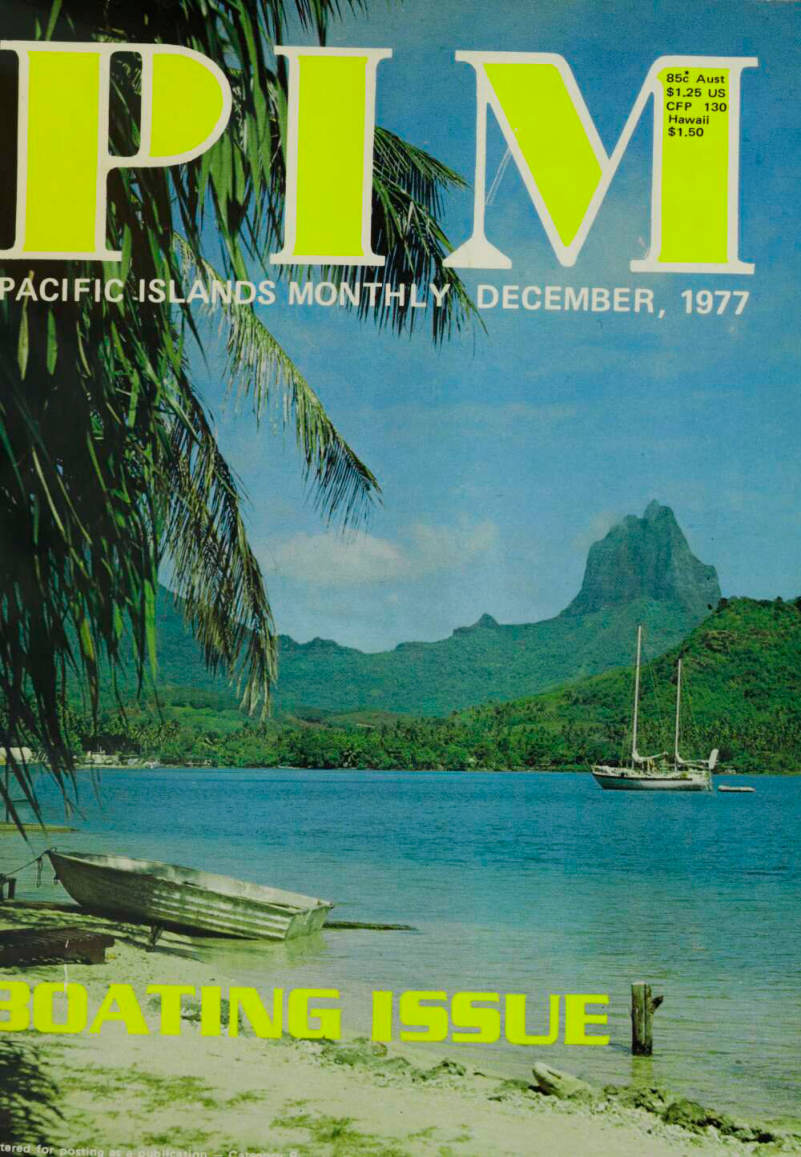
Our Cover
/Enough to make the im prisoned city dweller die of envy Pao Pao Pay, Moorea, the lovely island off Tahiti. This attractive shot is from the camera of Dr R.
Joura, of Sydney, who’s no stranger to PI M’s covers.
Advertisements & other items, pp. 2-4 (1 item)
Toyota
When you buy a Toyota
we promise you much more than
one of the world’s finest cars.
J>ss
We'll be the first to admit that at Toyota we make some of the world's finest cars.
You only have to look at them to see that.
And driving them just goes to confirm your first opinions.
But there's more to buying a car than buying a good one. You also have to be sure you can keep it that way.
Which is why Toyota have always insisted that their after-sales service be as good as the cars themselves.
In the Pacific Islands area alone we have over fifty designated outlets to provide everything you might need, from a simple service to a major overhaul. So get yourself a Toyota and get a lot more than a car.
And that's a promise.
TOYOTA
SERVICE
TOYOTA
. Tovota ranqe includes: Toyota 1000, Toyota Corolla, Toyota Celica, Toyota Corona, Toyota Cressida, Toyota Crown V .. =„ p n 00. 75 Port Mo.Mbv.ua. TRUST TERRITORV ; MICROLCORTORATION P.O 8o«M7 &|P.p. FUI ISLANMi e Tovota ranqe includes: Toyota iuuu, i oyota uoroiia, luyuia trßin-a, , UA NEW GUINEA: ELA MOTORS LIMITED, Scratchley R<1■ B °* TtcTp (SOUTH rOMOTIVE SUPPLIES CO„ LTD., G.P.O. Box 355, Suva. AMERICAN SAMOA. BURNS PHILP (SOUTH CO. HEBRIDES MOTORS LTD.. P.O. Box 18. Vila. SOLOMON ISLANDS: ) LTD.. P.O. Box 188, Apia. GUAM: ATKINS, KROLL (GUAM) LTD., P.O. 80x^6428 NEW HEM O^.NI ISLANDS TRADING CORPORATION LTD., P.O. 80, JDANA ENTERPRISES (5.1.). Box 36. BairiKi Tarawa. NORFOLK ISLAND: MARIE £ NEW CALEDONI/vf I IMPORT AT AUTOMOBILE DU PACIFIQUE. Rond-Polbt du Pacilic (Station Total! B.P. .38. Noumea.
I w %j/’i i j V y ■' v ; : r/ / -! i \ •' a v / v r < //f s/y ■J 4 \f/< y A '*y U?*VFG
-* V->. VS
'C v v \ ' % I.
V? /T ■: r . ~V. O I ' J CF-9t f> \t
VV-:w:
yy
LISUI«
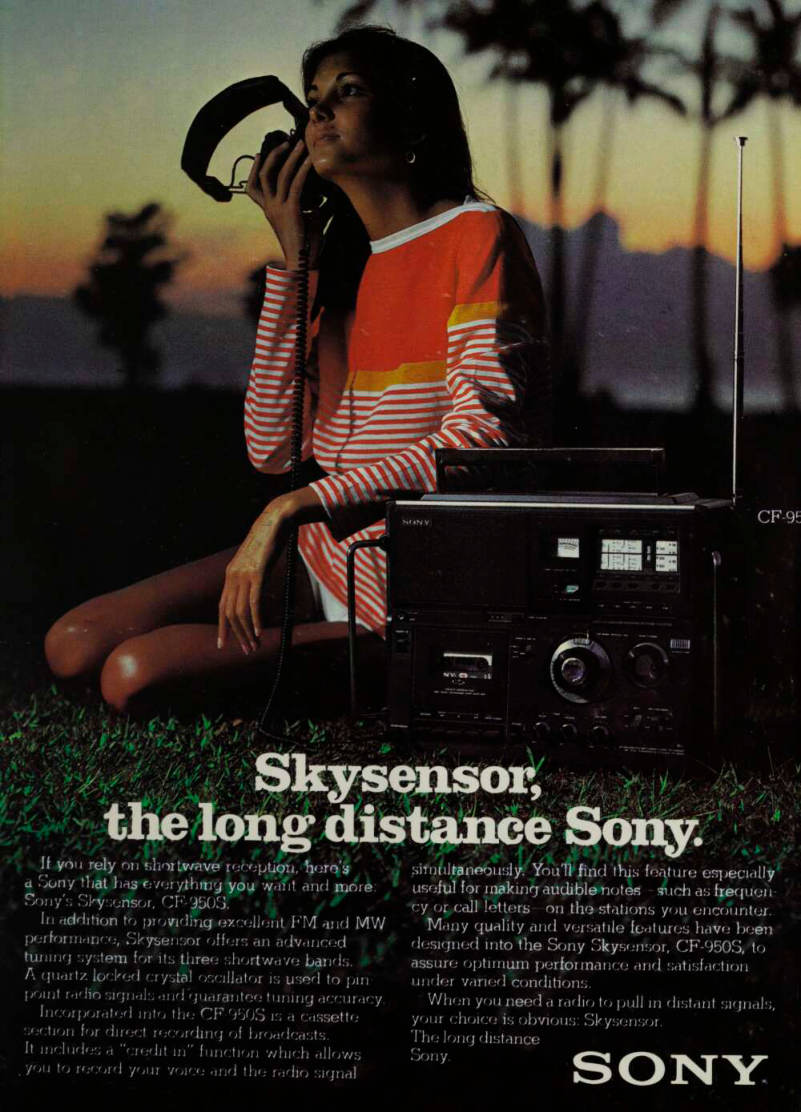
c « ■■ Jf you rely on f.hortv/ave reception, here's d oony that lias everythmy you want and more: Sony's SH/sorfeor, CF 9f>o3.
In addition to providing ox col lent FM and MW performance, Skysensor offers an advanced tuning system for its three shortwave bands, k A quartz loci'ed crystal oscillator is use*'] to pin point radio signals and guarantee tuning accuracy.
Incorporated into the CF-950S is a cassette section for direct recording of broadcasts, ft includes a credit in function which allows you to record your voice and the radio signal sifriiiltaneously. You'll find this feature especially useful for making audible notes such as frequency or call letters on the stations you encounter.
Many quality and versatile features have been designed into the Sony Skysensor, CF-9505, to assure optimum performance and satisfaction under varied conditions.
When you need a radio to pull in distant signals, your choice is obvious: Skysensor.
The long distance bony.
Another Technological Breakthrough from SEIKO.
The LC Digital Quartz WORLD TIMER.
Now you can know the exact time anywhere in the world. Instantly r . *'S / y* *4*
Sm *H,
°*>ei A
i V. * *s *** A °s/* A 70 7/ 72 *7/ 70 £4o no *8 *9
SVcT
r yo sv, This new precise timepiece'lfves you the Time in the world's 29 time zones on a 24-hour readout system; in hours, minutes, seconds, plus the day and date. All in the time it takes to push a button. And it adjusts for daylight saving time.
Like all Seiko Multi-Mode LC Digital Quartz watches, the World Timer is engineered to be easy to operate and dependable. It features a Perpetual CaU preprogrammed for 28, 30, 31-day and leap year months until the year 2009. It is water resistant, and features built-in illumination for reading the time in darkness.
The Seiko World Timer, just one of the outstanding timepieces in the new Seiko Multi-Mode LC Digital Quartz Collection.
Seiko Quartz. sa Home Time Mode features continuous readout in hours on a 24-hour basis, minutes, seconds, day and date.
Calendar is pre-programmed for leap years, 28, 30 and 31 day months until the year 2009. Built-in illumination system Greenwich Mean Time is displayed at the push of a button.
Wbrld Time symbol appears when crown is pushed, indicating \Abrld Time Mode is in operation.
Each time button is pushed, Zone Marker moves to next city and time zone and displays the correct hour, minutes, seconds, day and date.
SEIKO
Someday all watches will be made this way.
Pacific Islands
Monthly
Advertising Manager: Steve Gray
Subscription Rates
“Pacific Islands Monthly” is airfreighted to the majority of subscribers and agents in the Pacific Islands and the
Usa.
Australia (including Norfolk Island) $10.50 Aust New Zealand $11.50 NZ ($10.50 Aust). Fiji $10.75 Fijian ($10.50 Aust). Papua New Guinea, New Hebrides, Tonga, Cook Islands, Western Samoa, Gilbert Islands, Tuvalu, Niue, Nauru and Solomon Islands $10.50 Aust!
American Samoa, Northern Marianas, Micronesia Guam and Hawaii $15.00 US or $12.00 Aust. US Main land and Canada $17.00 US or $14.00 Aust New Caledonia and French Polynesia 1,600 CFP or $l3 50 Aust. United Kingdom 9.50 or $12.50 Aust. Japan 4,500 Yen or $12.50 Aust. Elsewhere $14.00 Aust Note: Overseas remittances in Australian dollars should be by bankdraft payable at Sydney Australia.
Representatives
FIJI: Distribution and subscriptions Desai Bookshops, P-O- Box 160, Suva, Fiji. Telephone: Suva 23036 Advertising, Fiji Times & Herald Ltd., 20 Gordon Street Suva Telephone: 312 111. Telex: FJ2124.
Papua New Guinea: Advertising and Distribution PNG Post-Courier, P.O Box 85, Port Moresby Inquir ies: Post Newsagency, Telephone 24 2148 French Polynesia: Distribution Hachette Pacifique 10 Ave Bruat, Papeete.
New Caledonia: Distribution Depot Centre de Presse Michel Pentecost, 8.P.C2 Noumea.
United Kingdom: The Herald and Weekly Times Lim ited, 8-10 Clifford's Inn, Fetter Lane, London EC4AIBU Telephone: 01 831 6041. Telex: London 21989 Japan: Advertising - Universal Media Corporation C P.O. Box 46, Tokyo. Telephone: 666 3036.
New Zealand; Pacific Publications, C.P.O. Box 2229 Auckland. Advertising enquiries: International Media Representatives Ltd, P.O. Box 3880 Auckland Tel 73 880. Telex: NZ21157, (Auck. 40).
Hawaii and U.S. Mainland only: PIM Hawaii 2812 Kahawai St., Honolulu, Hawaii, 96822. Second class postage paid at Honolulu, Hawaii. US Advertising Rep resentative, Joshua B. Powers, Jr, Powers International Inc 551 Fifth Ave, New York, New York 100 017 Tele phone 867 9580, Telex 236514. Pub. 952480.
Victoria: Advertising Pacific Publications (Aust.) Pty Ltd., Herald and Weekly Times Building, 2nd Floor 61 cco d fcL Lane ' Me| bourne, 3000. Telephone: 1565 Brisbane; D Wood, Anday Agency, Box 1918 G.P O Brisbane 4001. Telephone: 44 3485; 44 1546.
Printed in Australia Copyright ©, 1977, Pacific Publications (Aust.) Pty. Ltd.
Printed by Paramac, Mitchell Rd, Alexandria.
PIM is distributed in Australia and New Zealand by Gor don & Gotch. Australian cover price is recommended retail only Registered at the G.P.O. Sydney for transmission by post as a publication category B
Vol. 48 No. 12 December, 1977
Up Front
with the Publisher
Pim’S Newer Look
For 1978
Ten years is too long a time to continue writing a regular magazine column so the good news for rea ders th,„ month is that I'm quitting, This is the last Up Front with the Publisher.
It is in fact 10 years and eight months since the first monthly col umn appeared, and I didn't even notice that I had reached my 10th anniversary earlier this year. I started writing the column (then Up Front with the Editor) to fill a hole in the front of the magazine which appeared suddenly for some technical printing reason or other, then found myself saddled with it.
The column was never meant to be what it later became - an editorial comment on Pacific Islands devel opments. I had in mind to prod uce easy-going, fairly timeless pieces on people I had met, and happenings that attracted my at tention. When I look back I see that there are not nearly enough of the lightweight commentaries such as the one I wrote in June, 1967 about the disappearance of beach combers and other characters from the Islands scene, or the one done some months later about the South Seas hotels I had known (and which have, thank Heaven, since changed for the better!). I seem to remember writing one that de plored the disappearance of a sense of humour with the rise of politics in the South Seas. I enjoyed writ ing those.
But more often than not over the last 10 years I have found my self compelled to dash something off at the last minute, with the presses humming, and it's not what I wanted to say, nor has it frequen tly been of any special interest to anybody.
I'd like to get back to the lighter kind of piece. Since clearly I'm not able to do it every month, in future I'll do it only occasion ally, and not in this space, nor un der this heading.
This gives me the opportunity of saying that next month's PIM will look different in other ways.
It will be in a larger format, with more columns, and its editorial treatment will be somewhat diff erent. Not too different, because in nearly 50 years PIM has earned a unique niche in the Pacific Isl ands. It's a unique magazine, covering the biggest and most fas cinating "beat" in the world, and it will continue to do that. Only we think we can do it better with our new format. There will be more in-depth articles, more pers onality stories, more illustrations that will help show you more of what is going on.
But in January you can see for yourself. And you'll be able to start the new year with a long PIM article about what 1978 holds for the Pacific Islands, including what Russia thinks about it all.
Advertisements & other items, pp. 5-6 (2 items)
Pacific Islands Monthly December 1 977
5
FOUNDED BY R. W. ROBSON IN 1930
PUBLISHED MONTHLY BY
PACIFIC PUBLICATIONS (AUST.) PTY. LTD.,
76 CLARENCE STREET, SYDNEY 2000.
Post Address: G.P.O. BOX 3408, SYDNEY,
N.S.W. 2001
Telegraphic Address: PACPUB, Sydney Telex 21242 Telephone: 29 6693 Publisher: Stuart Inder Manager: John Berry.
EDITOR: John Carter
Mr Nauru
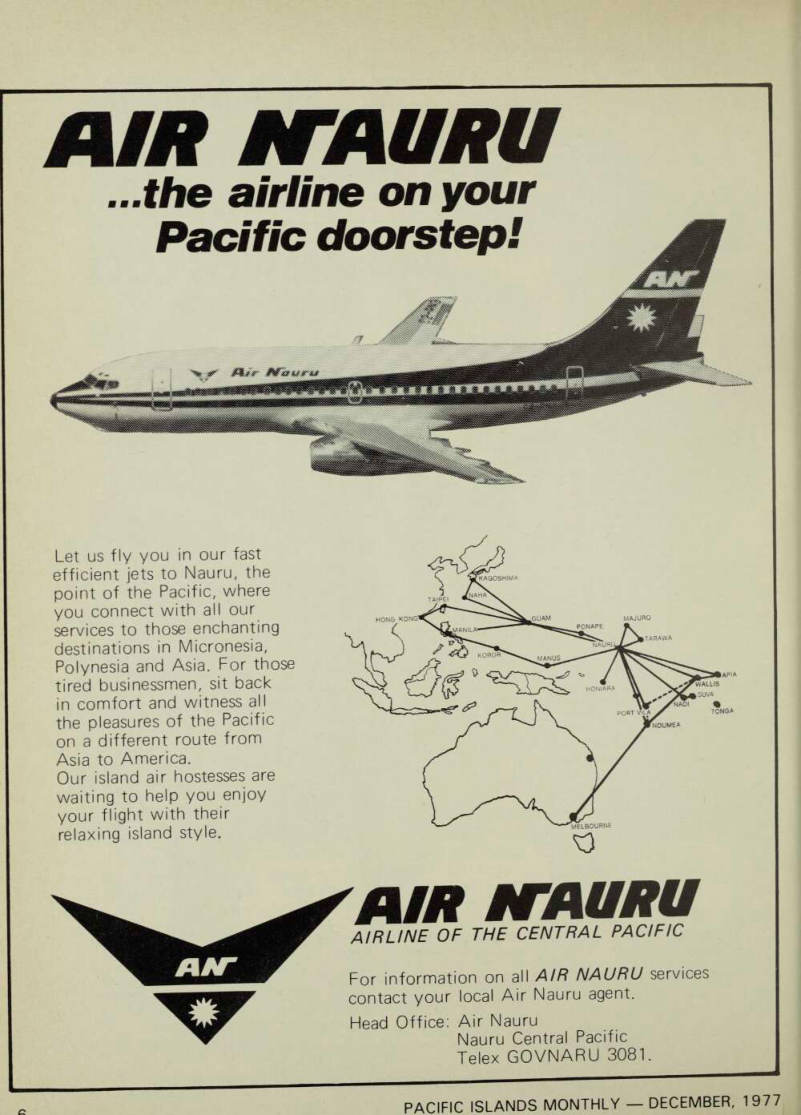
...the airline on your
Pacific doorstep!
Let us fly you in our fast efficient jets to Nauru, the point of the Pacific, where you connect with all our services to those enchanting destinations in Micronesia, Polynesia and Asia. For those tired businessmen, sit back in comfort and witness all the pleasures of the Pacific on a different route from Asia to America.
Our island air hostesses are waiting to help you enjoy your flight with their relaxing island style.
APIA
WALLIS
SUVA
NADI ' «
PORT VILA S TONGA
NOUMEA
MR M"AURU
AIRLINE OF THE CENTRAL PACIFIC
For information on all A NAURU services contact your local Air Nauru agent.
Head Office: Air Nauru Nauru Central Pacific Telex GOVNARU 3081.
Pacific Islands Monthly
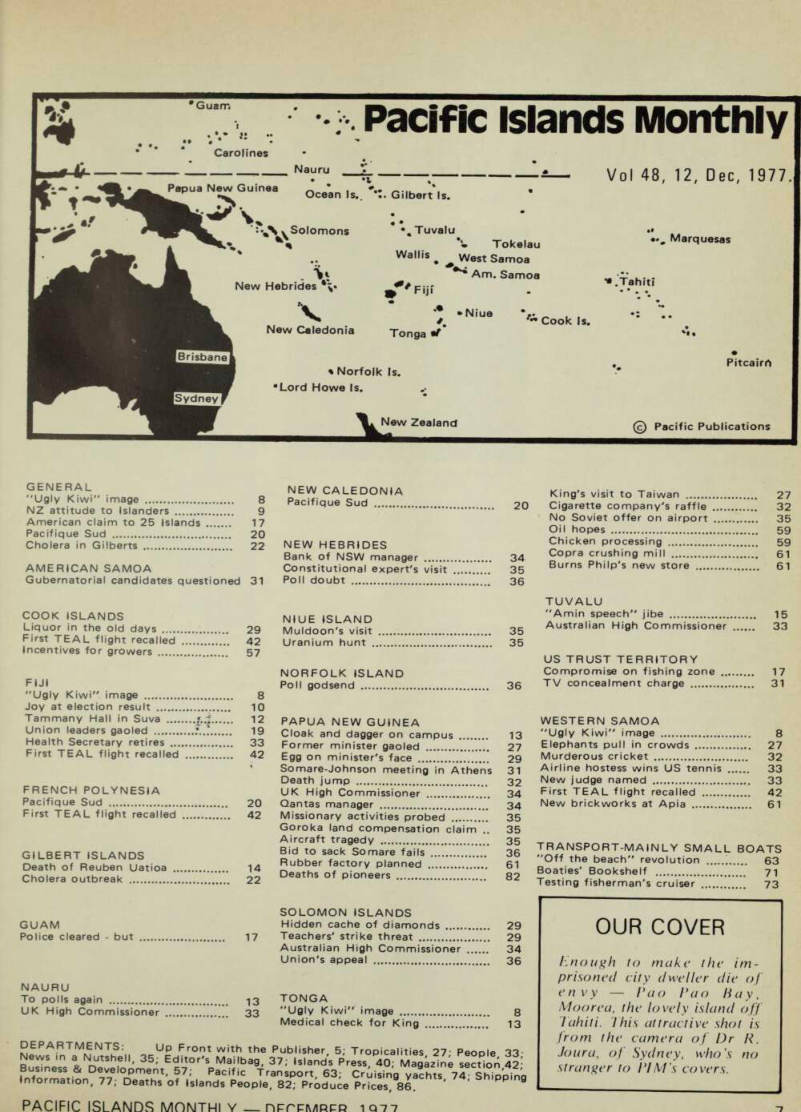
Vol 48, 12, Dec, 1977.
General
"Ugly Kiwi" image 8 NZ attitude to Islanders 9 American claim to 25 Islands 17 Pacifique Sud 20 Cholera in Gilberts 22
American Samoa
Gubernatorial candidates questioned 31
Cook Islands
Liquor in the old days 29 First TEAL flight recalled 42 Incentives for growers 57
Fiji
"Ugly Kiwi" image 8 Joy at election result 10 Tammany Hall in Suva .|„j 12 Union leaders gaoled ?... 19 Health Secretary retires 33 First TEAL flight recalled 42
French Polynesia
Pacifique Sud 20 First TEAL flight recalled 42
Gilbert Islands
Death of Reuben Uatioa 14 Cholera outbreak 22
Guam
Police cleared - but 17
Nauru
To polls again 13 UK High Commissioner 33
New Caledonia
Pacifique Sud 20
New Hebrides
Bank of NSW manager 34 Constitutional expert's visit 35 Poll doubt 36
Niue Island
Muldoon's visit 35 Uranium hunt 35
Norfolk Island
Poll godsend 36
Papua New Guinea
Cloak and dagger on campus 13 Former minister gaoled 27 Egg on minister's face 29 Somare-Johnson meeting in Athens 31 Death jump 32 UK High Commissioner 34 Qantas manager 34 Missionary activities probed 35 Goroka land compensation claim .. 35 Aircraft tragedy 35 Bid to sack Somare fails 36 Rubber factory planned 61 Deaths of pioneers 82
Solomon Islands
Hidden cache of diamonds 29 Teachers' strike threat 29 Australian High Commissioner 34 Union's appeal 36
Tonga
"Ugly Kiwi" image 8 Medical check for King 13
King's visit to Taiwan 27 Cigarette company's raffle 32 No Soviet offer on airport 35 Oil hopes 59 Chicken processing 59 Copra crushing mill 61 Burns Philp's new store 61
Tuvalu
''Amin speech" jibe 15 Australian High Commissioner 33
Us Trust Territory
Compromise on fishing zone 17 TV concealment charge 31
Western Samoa
"Ugly Kiwi" image 8 Elephants pull in crowds 27 Murderous cricket 32 Airline hostess wins US tennis 33 New judge named 33 First TEAL flight recalled 42 New brickworks at Apia 61
Transport-Mainly Small Boats
"Off the beach" revolution 63 Boaties' Bookshelf 71 Testing fisherman's cruiser 73
DEPARTMENTS: Up Front with the Publisher 5; Tropicalities 27 Peoole 33- News in a Nutshell, 35; Editor's Mailbag, 37; Islands Press 40 Magazine section 42 : Bus,ness & Development, 57; Pacific Transport, 63; Criisino ya?hts 74 ShiDPino Information, 77; Deaths of Islands People, 82; Produce Prices, 86. ' ' 9
Advertisements & other items, p. 7 (1 item)
7
PACIFIC ISLANDS MONTHI Y — nFPPMRPR 1Q77
“Ugly Kiwi” image riding high as
NZ slams door on Islanders
From a Special Correspondent in Wellington
The days of relatively easy entry to New Zealand are over for most Pacific Islanders. For Tongans, Fi jians and Samoans wishing to travel to New Zealand on holiday, the doors are as good as closed.
An informed source has stated that this is the backlash of the over stayers’ issue which have given the New Zealand Immigration authori ties so many headaches and so much public criticism over the past few years.
But instead of calmly analysing the shortcomings of a badly thought out and inefficient immigration policy she voluntarily introduced a few years ago, New Zealand now gladly slams the doors, as she used to do only a decade or so ago, in the faces of the Islanders. Tokelauans, Cook Islanders and Niueans are in a more fortunate position in this regard, thanks to the accident of history rather than to any humanitarian consideration on the part of the New Zealand Govern ment.
As for the others, their usefulness in the days when New Zealand fac tories cried out for cheap unskilled labour is a thing of the past. The new arrangement for temporary migrant workers is so cumbersome and long winded that very few employers in New Zealand wish to take advan tage of it. And the so-called unemployment situation in God’s Own Zone takes care of the rest.
In Suva, Apia and Nuku’alofa, scores of applications for holiday visas are being ruthlessly rejected.
The standard reply given by the of ficious immigration officials is “Sor ry, we have had a lot of problems with your overstayers”. The other reason is not mentioned but is clearly implied: “You are going to be another overstayer. We just can not trust you Islanders”.
Civil servants are given more le nient treatment, and Europeans more decidedly so. But woe to the civil servant who may have a parent, brother, sister, wife or husband who has overstayed his or her permit in the Kiwi land. He or she just has to
pay the price of that Original Sin.
Unless and until that overstayer relative leaves the shores of God’s Own, there is no way in the world that that civil servant can be con sidered good enough to be granted an entry visa.
It will come as no surprise at all if an overstayer neighbour would also be considered a valid obstacle, though already a couple of thousand overstayers are considered good enough reason for regarding the re maining hundreds of thousands of Fijians, Samoans and Tongans as potential overstayers. As someone remarked the other day; “The Kiwis have now discovered a foolproof formula of mathematical induction
which they use as the basis for their new immigration policy for Pacific Islanders.”
The New Zealand immigration authorities do not seem to have come across cases of Australian, American and British overstayers only of Pacific Islanders. And Pacific Islanders are so destitute that a financial guarantee of any sort is regarded by the Kiwis as a mere farce. It is a different proposition however, when a Kiwi travels to the Islands to stay with and taste the hospitality of a Samoan friend.
During the past few months, scores and scores of applications submitted from Fijians, Tongans and Samoans for holiday visas of three to four months were given an emphatic negative answer. Many of the applications were from re
spectable people, though perhaps
not so respectable in the eyes of the New Zealand immigration officials, who could afford to pay for their holidays and were prepared to un dertake any guarantee required of them.
But alas, the New Zealand im migration officials were interested only in telling them about the numerous problems caused by the Island overstayers, not to mention, of course, the extreme embarrass ment caused to the new Zealand Government by the overstayers.
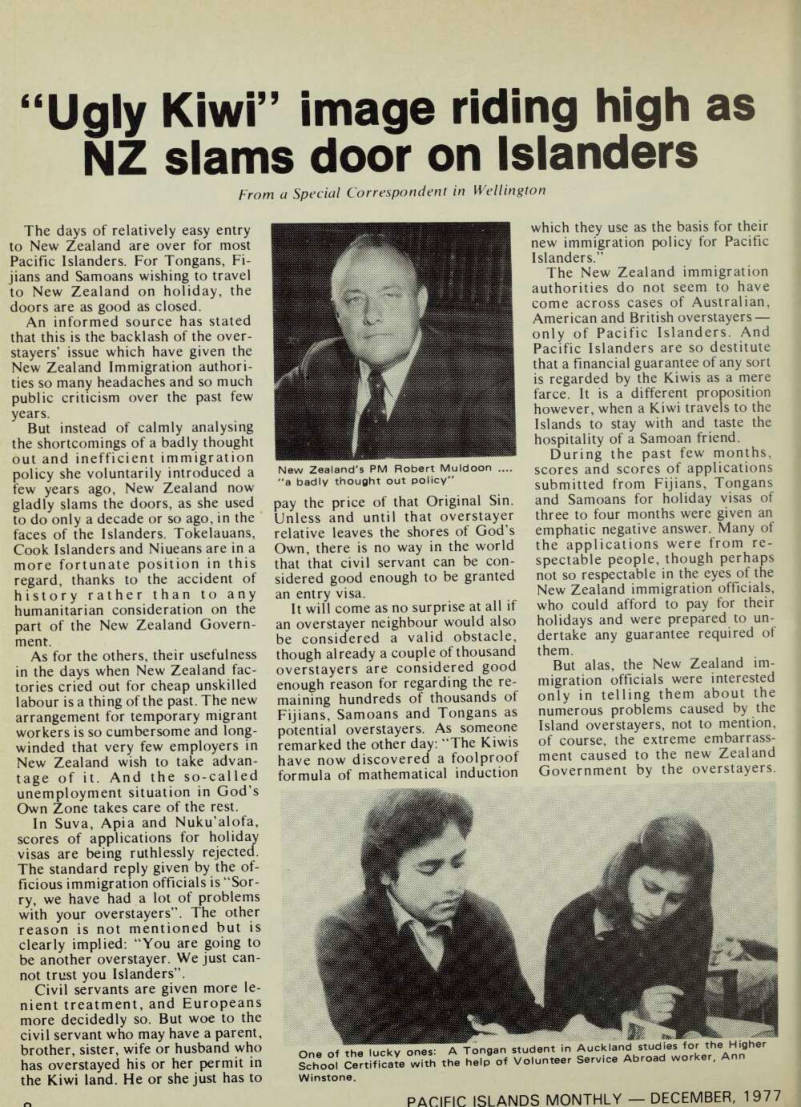
New Zealand's PM Robert Muldoon ...
"a badly thought out policy”
One of the lucky ones: A Tongan student in Auckland studies for the H igher School Certificate with the help of Volunteer Service Abroad worker, Ann Winstone.
New Zealand conveniently forgets that the overstayers’ problem was brought about initially by an ineffi cient and messy system which she created in time of dire need of unskilled labour, and which she also, to say the least, administered very badly.
One wonders whether it is now a case of the New Zealand immigra tion policy being so ridiculously dis criminatory, or of its officials being unable, for one reason or another, to exercise any discretionary powers, or simply a straight-out case of the officials concerned exercising more power than they really have.
Judging from the reported com ments of a number of Island govern ment officials, one tends to the belief that it is a combination of the first and third factors, with the latter being the more important.
Applications for holiday visas to Australia invariably take months, in some cases up to a year, to be pro
cessed, and unless the several guarantees required are given, the chances of the applications being favourably considered are rather slim. Applications for visas to New Zealand are getting just as bad.
The angry remark of someone, whose application for a three-month holiday visa to New Zealand was
refused in spite of guarantees, con tains a lot of truth; “It would prob ably be much easier to get a visa to Russia than to New Zealand. It seems that New Zealand is trying to evolve an anti-Pacific Islanders im migration policy along the lines of the White Australia Policy.”
up” on race - Sir Guy
New Zealanders "mixed up” on race - Sir Guy
An address which attracted widespread attention with its cri ticism of the racial attitudes of many New Zealanders was given by the country’s recently retired Chief Ombudsman, Sir Guy Powles, following the 1977 an nual general meeting of Volun teer Service Abroad.
Sir Guy, who was New Zea land’s High Commissioner in Western Samoa 1949-60, said New Zealanders had a mixed-up philosophy of race which allow ed many of them to adopt a set tler mentality. This gave a feeling of kinship with white settler minorities, and one heard
reference to “our Rhodesian cousins”.
He said New Zealanders had developed a blend of imperialism and paternalism towards the Pacific since the turn of the century, and this was still partly with us. But Sir Guy said New Zealand was not a welcome fairy godmother in any of the Islands she once ruled. He said Pacific people saw New Zealanders as obstinate, hard, insensifive and selfish people.
However, he said, there were “.Hashes of light given by such organisations as VSA ”. The better side of New Zealand had also been brought out by organisations like the Overseas Development Committee and the One per cent Aid Organisation.
These helped to bring to New Zealand a better understanding of Island consciousness and developed an interdependence with Island territories.
Referring to the overstayer issue of last year, Sir Guy said New Zealanders were led to believe, by a political party seek-
ing power, that it would be in their country’s national interests to send back to the Islands many thousands of people who had come here.
He said this policy, which was accepted by New Zealanders, and particularly the manner in which it was attempted to be put into effect, gave very great offence to the Island peoples.
Sir Guy said the friendship of the Island people in the past 25 years had not been won easily. and it was “bitter to see the laboriously created fruits of the lifework of some dedicated New Zealanders thrown away in a breath of anger and unthinking selfishness”.
He said great harm had been done by the over stayer issue and we should not be misled by as surances given with charac teristic magnaminity by the Is lands' political leaders. Sir Guy hoped that the future would show that New Zealand’s bark had been worse than its bite, but he asked: “ Why bite at all?”
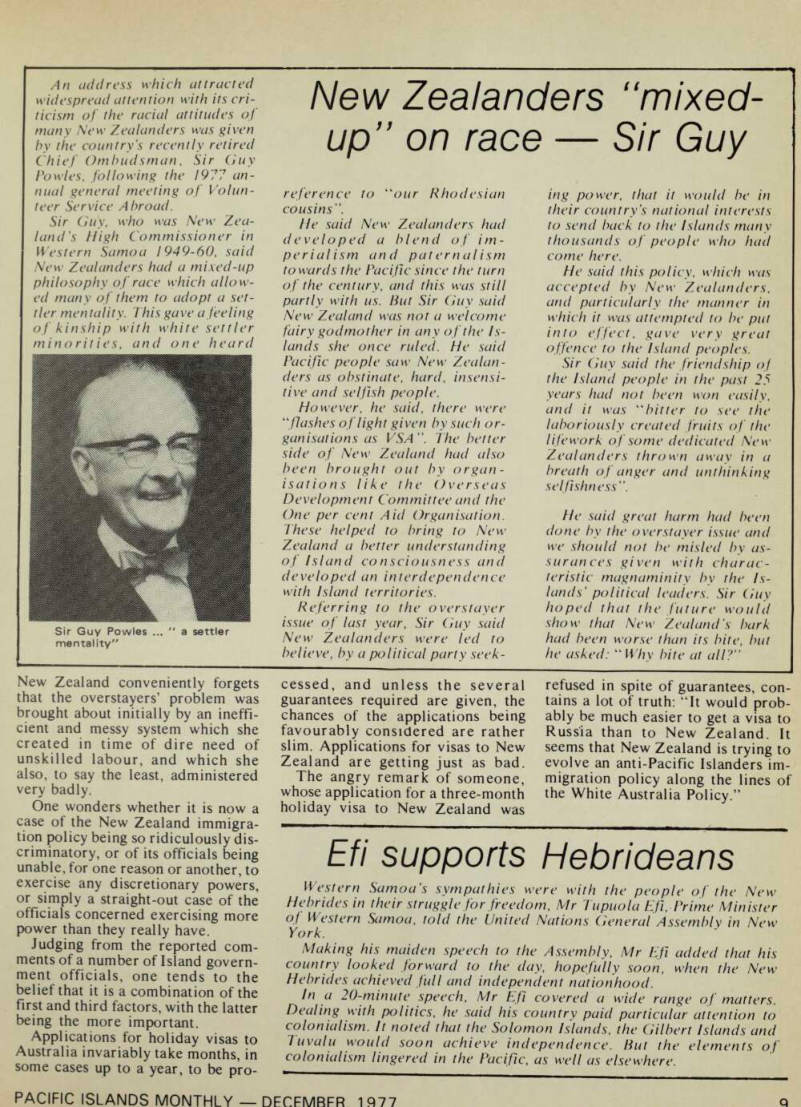
Sir Guy Powles ... " a settler mentality"
Efi supports Hebrideans
Western Samoa’s sympathies were with the people of the New Hebrides in their struggle for freedom, Mr Tupuola Eft, Prime Minister °.f Western Samoa, told the United Nations General Assembly in New York.
Making his maiden speech to the Assembly, Mr Efi added that his country looked forward to the day, hopefully soon, when the New Hebrides achieved full and independent nationhood.
In a 20-minute speech, Mr Eft covered a wide range of matters.
Dealing with politics, he said his country paid particular attention to colonialism. It noted that the Solomon Islands, the Gilbert Islands and Tuvalu would soon achieve independence. But the elements of colonialism lingered in the Pacific, as well as elsewhere.
Fiji breathes a sigh of relief
relief after poll
From L. G. USHER in Suva
The results of the September general election brought a sigh of relief from almost everybody in Fiji.
The uncertainty produced by six months of government by a party with a parliamentary minority was over.
The Alliance, with a clear majori ty of 20 in the House of Rep resentatives, and with Ratu Sir Kamisese Mara firmly at the helm as Prime Minster, was secure in power for the next five years.
The country could now settle down. Investment decisions could be made. Laws could be enacted and policies laid down without the likelihood, or at least the possibili ty, of their being torn asunder in Parliament.
At Government House, the sigh could have been of satisfaction. If protocol allowed such a thing to be dreamed of, the Governor-General, Ratu Sir George Cakobau, who had personally chosen Ratu Sir Kamisese Mara as Prime Minister, although the Alliance lacked a
parliamentary majority, could
justifiably have said, “I told you so.”
In most Fiji people’s minds there had been a certain amount of mys tery about some of the events that followed immediadely in the wake of the April election, but revelations during and after the September campaign cleared this away.
This was in spite of a “We wuz robbed” attempt by the Leader of the Opposition in the last parlia ment, Mr Siddiq Koya, to cloud the story. Mr Koya went further than just suggesting that he had been deprived of the opportuity to become Prime Minister. He claimed that there had been a deep, dark plot to stop an Indian from holding the post.
Ratu Mara reacted promptly and with anger. He described the allega tion as a “deep personal insult” and a “gross lie”. It was designed, he said, to “appeal to racialism” and its effects would “last for a very long time”.
One effect was a declaration by Ratu Mara that he would rather give
up the prime ministership than have to deal in any way with Mr Koya.
He gave the facts about immedi ate post-election events in April.
“When it was clear that we would only muster 24 seats againt the Op position’s 26 I immediately went to Government House and delivered my letter of resignation both for myself and my government,” he said.
Ratu Mara also recalled that he and his former ministers promptly moved out of their official re sidences, cleared their offices, sur rendered their official cars and began looking round for new or for their former jobs.
At the same time the Governor-
General was sending for Mr Koya, the ostensible leader of the National Federation Party, representing the largest group in the new parliament.
On the surface it seemed as if naming him as prime minister was not much more than a formality.
But it wasn’t as simple as that.
Mr Koya showed a remarkable reluctance to form and lead a government, and his fellow party members showed an equally remarkable reluctance to rally unitedly behind him, and to confirm him as a leader.
On the part of the party’s presi dent, Mrs Irene Jai Narayan, and the general secretary, Mr Karam Ramrakha, this reluctance had earlier been made apparent.
Now emerged two more rivals for the party leadership Lautoka lawyer Mr Jai Ram Reddy and one of the few Fijians in the NFP, Vanua Levu farmer and former soldier and civil servant, Mr Atunaisa Maitoga.
The first reaction of NFP mem bers to the awkward dilemma of having to choose a potential prime minister from among three rivals was to shy away from it by suggest ing that a coalition government would be a good idea, with some of them in the cabinet but with Ratu Sir Kamisese Mara as prime minister.
From both Ratu Mara and the
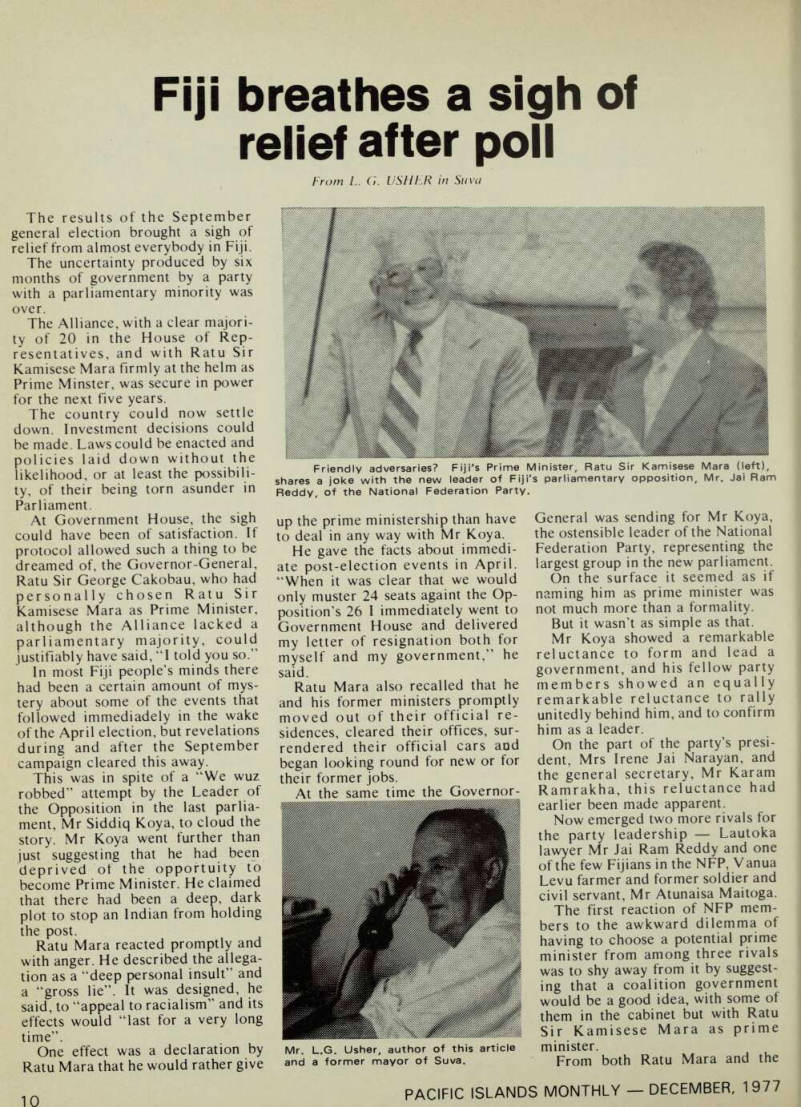
Friendly adversaries? Fiji's Prime Minister, Ratu Sir Kamisese Mara (left), shares a joke with the new leader of Fiji's parliamentary opposition, Mr. Jai Ram Reddy, of the National Federation Party.
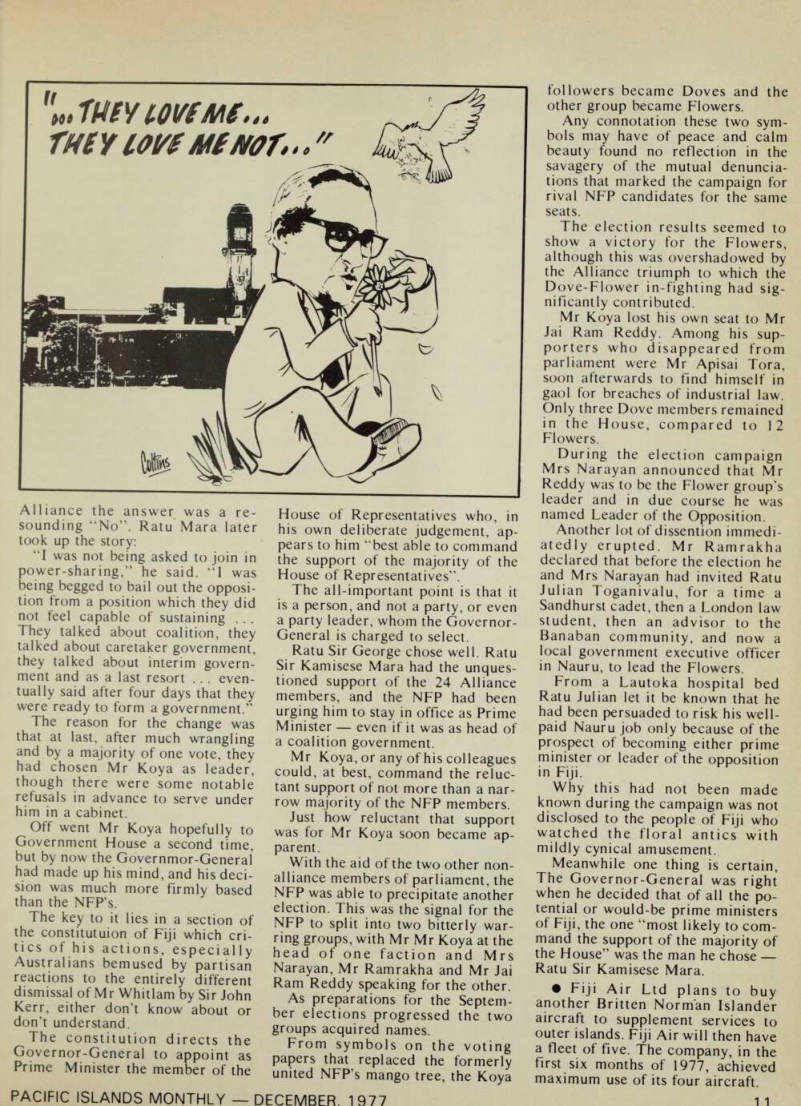
Mr. L.G. Usher, author of this article and a former mayor of Suva.
Alliance the answer was a resounding No Ratu Mara later took up the story; I was not being asked to join in power-sharing, he said. “I was being begged to bail out the opposition from a position which they did not feel capable of sustaining ...
They talked about coalition, they talked about caretaker government, they talked about interim government and as a last resort . . . eventually said after four days that they were ready to form a government.”
Ihe reason for the change was at * ast ’ after much wrangling and by a majority of one vote, they had chosen Mr Koya as leader, though there were some notable retusals in advance to serve under hl off" 3 C f b \ l l et V l c Off went Mr Koya hopefully to uovernment House a second time, but by now the Governmor-General had made up his mind, and his decithZ Z'mpp’ m ° re irmly baSCd Th? V < > r • f key to it lies in a section of ir« nf h U Ul °r ° f FIJI WhlCh C i\ l Anctr.lia K S T s P eciall y iai ? S bemused by partisan reactions to the i entirely different Kerr IS efrh°/r M H W .!" , I ! am by ? lr John don t ’ understand k "° W ab ° Ut ° f °TrL UnderSt . a . j , rL»t n C ° n^ tltUt '? n dlrects ,he overnor-General to appoint as Prime Minister the member of the
House of Representatives who, in his own deliberate judgement, ap pears to him “best able to command the support of the majority of the House of Representatives”.
The all-important point is that it is a person, and not a party, or even a party leader, whom the Governor- General is charged to select.
Ratu Sir George chose well. Ratu Sir Kamisese Mara had the unques tioned support of the 24 Alliance members, and the NFP had been urging him to stay in office as Prime Minister even if it was as head of a coalition government.
Mr Koya, or any of his colleagues could, at best, command the reluc tant support of not more than a nar row majority of the NFP members.
Just how reluctant that support was for Mr Koya soon became ap parent.
With the aid of the two other non alliance members of parliament, the NFP was able to precipitate another election. This was the signal for the NFP to split into two bitterly war ring groups, with Mr Mr Koya at the head of one faction and Mrs Narayan, Mr Ramrakha and Mr Jai Ram Reddy speaking for the other.
As preparations for the Septem ber elections progressed the two groups acquired names.
From symbols on the voting papers that replaced the formerly united NFP’s mango tree, the Koya
followers became Doves and the other group became Flowers.
Any connotation these two sym bols may have of peace and calm beauty found no reflection in the savagery of the mutual denuncia tions that marked the campaign for rival NFP candidates for the same seats.
The election results seemed to show a victory for the Flowers, although this was overshadowed by the Alliance triumph to which the Dove-Flower in-fighting had sig nificantly contributed.
Mr Koya lost his own seat to Mr Jai Ram Reddy. Among his sup porters who disappeared from parliament were Mr Apisai Tora, soon afterwards to find himself in gaol for breaches of industrial law.
Only three Dove members remained in the House, compared to 12 Flowers.
During the election campaign Mrs Narayan announced that Mr Reddy was to be the Flower group’s leader and in due course he was named Leader of the Opposition.
Another lot of dissention immedi atedly erupted. Mr Ramrakha declared that before the election he and Mrs Narayan had invited Ratu Julian Toganivalu, for a time a Sandhurst cadet, then a London law student, then an advisor to the Banaban community, and now a local government executive officer in Nauru, to lead the Flowers.
From a Lautoka hospital bed Ratu Julian let it be known that he had been persuaded to risk his well paid Nauru job only because of the prospect of becoming either prime minister or leader of the opposition in Fiji.
Why this had not been made known during the campaign was not disclosed to the people of Fiji who watched the floral antics with mildly cynical amusement.
Meanwhile one thing is certain, The Governor-General was right when he decided that of all the po tential or would-be prime ministers of Fiji, the one “most likely to com mand the support of the majority of the House” was the man he chose Ratu Sir Kamisese Mara. • Fiji Air Ltd plans to buy another Britten Norman Islander aircraft to supplement services to outer islands. Fiji Air will then have a fleet of five. The company, in the first six months of 1977, achieved maximum use of its four aircraft.
municipal stew
Strong odours from Suva’s municipal stew
Lawbreaking, inefficiency, wastefulness and corruption were just four of the words used on the re port of a special committee of inqu iry into the affairs of the Suva City Council. The committee, appointed by the Fiji Government, spared neither councillors nor staff in a hard-hitting report.
Dealing with the report is one of the first tasks of the newly appointed Minister for Urban Development and Housing, Mr Jonati Mavoa. In a rather mild comment he said that there was something “very wrong” with the council and that he would be taking action in the report. But there were legalities to be sorted out before he could say what action he would take.
Under fire in the report were the Mayor, Cr Joape Rokosoi, Cr Jone Banuve, Cr Maan Singh, and the Town Clerk, Mr Mosese Vunivutu.
Cr Rokosoi issued a statement say ing he had not committed any cri minal act. Some of the criticism aimed at him in the report was un justified, he said. But he agreed the report was correct in saying that members of the 20-man council spent too much time interfering with the work of the council staff.
The committee reported there were many occasions when the council failed to conduct its affairs in line with the law. Dishonoured cheques reflected nothing but dis credit on the councillors and senior officers. Almost 200 cheques were dishonoured in the first six months of 1977. They included 20 personal cheques, amounting to $1 596, cash ed by councillors and council staff among whom were the Mayor, Cr Banuve and Mr Vunivutu. Council officers who handled the cheques failed to tell the council or the Minister of Urban Development because they were afraid of losing their jobs.
There were cases where the electricity revenue officer gave preferential treatment to staff and councillors on outstanding ac counts. There were instances where councillors were in arrears with their rates and some officers believ ed the arrears were allowed to ac cumulate because of the councillors’
positions.
Cr Rokosoi was recorded as hav ing paid no rates since 1973, and Cr C. P. Bidesi settled sizeable arrears only a few months before the com mittee inquiry.
City Transport had been allowed to continue improper use of a pro perty. The owner of the company was Cr Maan Singh.
Advance payments were made to Banuve Bros on a maintenance con tract, but neither advance payments nor progress payments were pro vided for in the original contract.
Witnesses gave evidence that the reason for the advance payments was that the partners on Banuve Bros were two serving councillors and a previous mayor.
One witness said that veiled threats had been made by the third partner, Mr Isireli Vuibau, that if the advance payments were not made there would be unpleasant consequences for the staff concern ed.
The committee was critical of an “abortive trip" Cr Bidesi made to Vancouver in the course of a pro posed visit to Britain to inspect electricity generators. It was difficult to see how the council (a previous council) had been so irra tional as to send a totally un qualified person to inspect a highly complicated piece of machinery.
“The decision of the present council to reimburse Cr Bidesi for at least part of the cost of this trip.
from which no benefit whatsoever accrued to the council defies com prehension,” the committee com mented.
The council was continuing to employ more unestablished staff than needed. Unqualified staff were causing inefficiency and wasting council money. Overstaffing was also wasting money. Staff numbers could be reduced if properly qualified people were employed.
The rate collection policy was un satisfactory and contributed to the council’s "present unhappy financial position”. Rates accounts and busi ness licences had been allowed to continue in a state of disarray.
There had been little attempt in the last two or three years, if ever, to make a cost-benefit analysis of various council operations.
The committee said successive mayors, councillors and council of ficers in general showed abysmal ig norance of the Local Government Act. It listed many breaches of the
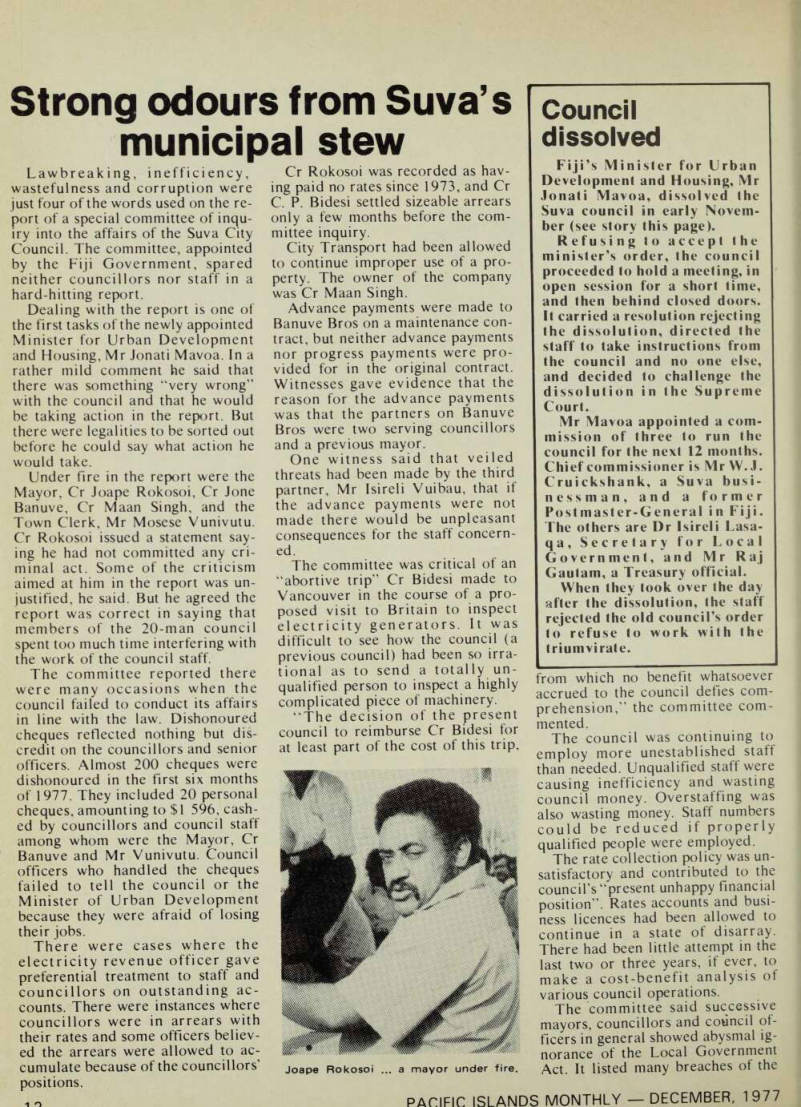
Joape Rokosoi ... a mayor under fire.
law and of council meeting by-laws.
Councillors had remained in meetings when they should have declared their interest and left. Cr Rokosoi had presided over a meet ing of the full council on June 30 when dishonoured cheques were being discussed. It was evident that he was aware that his cheques might well be included in the list. It was hard to accept that Cr Jone Banuve was unaware that his cheques had been dishonoured and were in the list.
The committee said it could not place any reliance in Cr Banuve’s evidence.
The committee said Cr Len Usher, the past mayor, was an im portant witness. He had admitted that during his tenure of office he did not strictly abide by the letter of the law, but that was largely unwit ting, and he had the best interests of the council and community in mind.
Cr Usher was clearly concerned with the rapidly deteriorating situ ation in the council and gave the committee valuable written material.
Cr Etuate Tavai was commended for a forthright and uncompromis ing approach.
The committee said the council’s central administration needed a rapid and dramatic overhaul, but it did not consider Mr Vunivutu and senior officers in his department to be capable of it.
Cr Rokosoi said he had sat in the mayor’s office in all honesty trying to solve the problems of Suva. He did not think it would be fair to staff and members for him to resign. He intended to see out his full term as mayor and at the end of 1977 hoped to see an Indian councillor succeed him.
Cr Maan Singh’s name has been mentioned in this respect.
He claimed that the Ministry of Urban Development and the council should try to find ways and means to improve the system. The present council had inherited an admin istrative mess from past councils.
Cr Rokosoi thought a council committee should study the report but there should not be a full coun cil debate because there would be a lot of mud-slinging.
“The person who will have at tention focused on him will be Cr Usher,’’ he said. He seemed to have been given preference on giving in fromation to the committee.
Council
dissolved
Fiji’s Minister for Urban Development and Housing, Mr Jonati Mavoa, dissolved the Suva council in early Novem ber (see story this page).
Refusing to accept the minister’s order, the council proceeded to hold a meeting, in open session for a short lime, and then behind closed doors.
It carried a resolution rejecting the dissolution, directed the staff to lake instructions from the council and no one else, and decided to challenge the dissolution in the Supreme Court.
Mr Mavoa appointed a com mission of three to run the council for the next 12 months.
Chief commissioner is Mr W. J.
Cruickshank, a Suva busi nessman, and a former Postmaster-General in Fiji.
The others are Dr Isireli Lasa qa. Secretary for Local Government, and Mr Raj Gautam, a Treasury official.
When they took over the day after the dissolution, the staff rejected the old council’s order to refuse to work with the triumvirate.
To Polls Again On Nauru
Nauru and Queensland had one thing in common on November 12, a general election. In Nauru's case it was the second poll in less than 12 months. President Bernard Dowiyogo failed to get his budget through parliament, and took the only course open to him advising the Speaker to dissolve parliament.
Chief Hammer Deßoburt, who was voted out of office as president at the end of 1976, made matters difficult for President Dowiyogo on a number of issues. A somewhat more difficult market for phosphate added to his problems.
The issues between Chief Deßoburt and President Dowiyogo were similar to those of last year. Chief Deßoburt promised steady conservative government, while President Dowiyogo advocated measures necessary to help the island exist in the 19905, after the phosphate deposits run out.
President Dowiyogo took time off from electioneering early in November and travelled to Ballarat in Victoria where he performed the opening ceremony for the new Charles Richardson Physical Education Centre at Ballarat and Clarendon College. President Dowiyogo is an old hoy of the college.
dagger on
Cloak and dagger on the campus
Australia’s relations with Papua New Guinea were under strain in October with the revelation that an officer of Australia’s Joint In telligence Organisation had ap proached an Australian academic at the University of Papua New Guinea asking him to provide a flow of in formation about students and staff at the university, especially in con nection with political activity re lated to Irian Jaya.
The academic, Professor Brian Brogan, who is dean of the universi ty’s faculty of arts, refused the re quest and issued a public statement lifting the lid off the whole affair.
In subsequent fast-moving
developments:
• The Australian High Com missioner, Mr Tom Critchley, ex pressed formal diplomatic regrets to PNG’s Acting Prime Minister, Mr Julius Chan, saying that “an Australian official had committed a serious indiscretion”. Mr Chan ac cepted the explanation, along with an assurance that Australia had not established, and did not intend to establish, a spy network in PNG. • Protesting students from the university damaged the garden of the Australian High Commission, and three cars belonging to the com mission and staff members. A feature of the protests was that in cases the demonstrators’ attack on
“foreign spies” was widened to in clude not only Australia but In donesia and the United States as well. • The PNG parliamentary op position demanded the withdrawal from PNG of the offending official, Mr Lindsay Burridge, a JIO officer attached to the commission with the knowledge of the PNG Govern ment. (It was later announced that Mr Burridge would be returning to Canberra.) • The executive of the universi ty’s Academic Staff Association (Overseas), which represents ex patriate staff members, adopted a resolution stating that information on student files must be regarded as completely confidential, that the op eration of intelligence organisations on campus was “abhorrent”, and that it shared Professor Brogan’s concern in the matter.
Nz Medical Check-Up
For Tonga's King
King Taufa’ahau Tupou, of Tonga, went to Auckland late in Oc tober for an examination by a New Zealand heart specialist. The king suffered from mild congestive heart failure in June because of hyperten sion. He had a series of medical examinations by two heart specialists recently, with satisfactory results. These specialists, one Japanese and the other Taiwanese, advised him to have a further check up by another heart specialist.
Queen Halaevalu Mata’aho accom panied the king to Auckland.
Gilbertese Independence
Death Of Reuben Uatioa
The first architect of Gilbertese Independence
By Barrie Macdonald
The recent death in Tarawa of Reuben Uatioa, the first Gilbertese politician to rise above the localised rivalries of island politics, marked the end of a chapter in the political history of the Gilberts.
Reuben rose to prominence in the 1960 s as Britain began to transfer responsibility to representative in stitutions and, in 1967, he became the first elected spokesman for the Gilbertese and Ellice people.
Defeated at the polls in 1974, he turned to local politics and served as president of the Teinainano Ur ban Council on Tarawa until he suffered electoral defeat earlier this year. In the months before his death he was planning a return to national politics in the hope that he could play some part in leading the Gilberts to independence.
Reuben was born in 1924 on Onotoa but as a young child was adopted by a Nonouti family and, thereafter, regarded that island as his home. He went from the Rongorongo School (run by the LMS) at Beru to the Phoenix Islands as a radio operator in 1940 and then, in the following year, he went to Fiji where he joined the Naval Reserve and was sent to Auckland for further training. After the war he remained in Fiji working for the NZ meteorological service until 1950 when he returned to the GEIC.
The absence was important in shaping Reuben's political ideas because in the course of his travels he shook off the “colonial cringe” his belief in white superiority and was thereafter prepared to press for change. By the time that he became the GEIC's first broadcasting and information officer in 1955 he already had among colonial officials a reputation for being a trouble maker.
In the late 1950 s and in the early 1960 s anti-Ellice feeling began to crystalise amongst Gilbertese civil servants; the low copra production of the Ellice and the perceived favouritism towards Ellice Islan ders shown by European officials
were particular grievances. Thus, when political consciousness began to emerge among the Gilbertese educated elite it was anti-European as much as it was anti-Ellice.
Throughout the 19605, Reuben Uatioa was the most prominent spokesman for Gilbertese interests.
He was instrumental in the founding of Tungaru a Gilbertese cultural association and of the Gilbertese National Party which grew out of it in 1965. The formation of this party and its aggressive advocacy of Gilbertese interests, and accusations that Reuben was using his broad casting position for political ends, led to his removal from the Adviso ry Council and the imposition of re strictions on the political activities of civil servants.
In 1967, Reuben was chosen as the colony's Chief Elected Member and, under the 1971 constitution, as Leader of Government Business.
In the late 19605, Gilbertese- Ell ice rivalry was at its peak. It became less of a public issue, however, once it became clear that the numerical superiority of the Gilbertese would ensure their domination of any future legislature and it was also significant that Reuben Uatioa, as President of the Gilbertese National Party and as
Chief Elected Member, tried to keep discussion on the issue to a minimum.
His view, which was accepted by others, was that the point had been made, that the Ellice Islanders would either have to accept the in evitability of a permanent Gilber tese majority or to seek some alter native future.
Reuben Uatioa was, therefore, a crucial figure in initiating the moves that led ultimately to separation but it was also his restraint that helped to make it a peaceful process.
Once he was in power, and it was clear that political responsibility was being trasferred, Reuben’s rela tionships with the colonial hierarchy were marked by co-op eration rather than by conflict. He could, however, still take delight in making the lives of senior ex patriates uncomfortable. He would, for example, make a rousing speech on some controversial issue in the House of Representatives in Gilber tese while they sat in trepidation waiting for him to repeat it in English in more moderate tones.
Once he attained elected office he did not become an anti-colonial politician; had he done so he would probably have held his South Tarawa seat in the 1974 elections. A mass labourers’ strike a month before the election won the sym pathy of Tarawa people as well as many migrant workers. Reuben would not support what he felt was an unjustified cause and was damn ed by his association with unpopular
government policies.
He subsequently entered local politics, was chairman of the Per sonal Status Tribunal, served briefly as Speaker of the Legislative As sembly and, with self-government, became Public Service Com missioner. He was not prepared to leave politics, however, and spurred by his disagreement with some of the policies of his erstwhile colleagues he planned to seek election again in 1978.
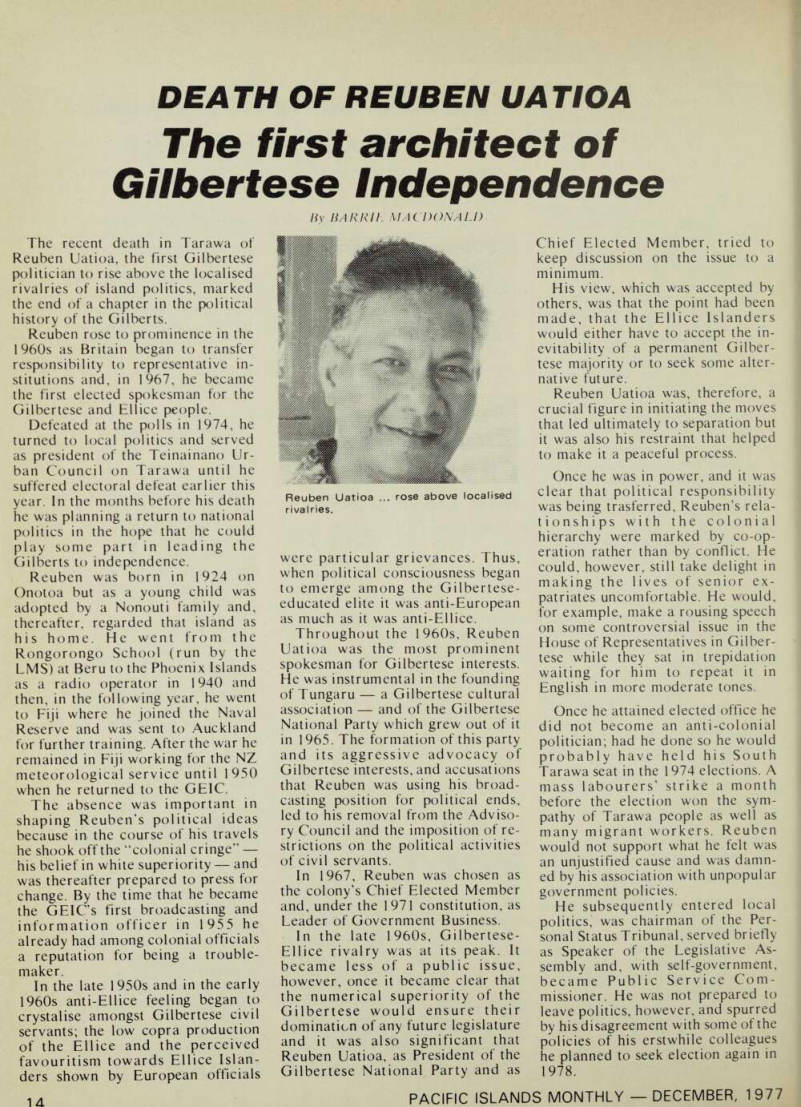
Reuben Uatioa ... rose above localised rivalries.
“Amin speech” jibe in Tuvalu’s
House of Assembly
From a Special Correspondent in Tuvalu
The first session of the Tuvalu House of Assembly elected on August 29 (PIM, Sept, p2O) pro duced some interesting con frontations between Toalipi Lauti, member for Funafuti, who was re elected Chief Minister by a clear majority of members, and Henry Naisali, newly elected member for Nukulaelae.
Naisali, a long-term civil servant in the Gilbert Islands and an early member of the old .Legislative Council there, decided in August to resign from his top post as Financial Secretary for Tuvalu and contest the Nukulaelae seat formerly held by firebrand Isakala Paeniu. Having won the seat, Naisali took over Paeniu’s role as scourge of the government and with the support of two other new members Sione Tui Kleis, the former Speaker, and Dr Tomasi Puapua and one veteran, Meauma Moeanga, formed the first organised opposition group in the two-year old House of As sembly.
In a debate on the Queen’s speech, read by Mr Thomas Layng, the Commissioner, Naisali accused the government of having no ideas of its own but needing outsiders to inject them, and said that the only finan cial policy known to the government was to be spoonfed by foreigners. He called the speech “a rubbish speech, an Amin speech, fit only for the waste-paper basket”, charging that it made no plans for the future and threatened the rights of citizens in its emphasis on the sovereignty of the House of Assembly. The Chief Minister, while admitting that Tuvalu was starting out “with not a single cent in the bank”, replied that nothing was to be gained by heated arguments and that some members appeared to think they knew every thing and were “too big for their boots”.
In two adjournment motions, Naisali accused the government of financial mismanagement, and of failing to protect the good image and reputation of Tuvalu in the world by controlling the behaviour of its representatives when overseas.
The Chief Minister pointed out that as Financial Secretary Naisali had been largely responsible for finan cial policy, and said that aggressive behaviour in the House of Assembly did as much as anything to spoil the image of Tuvalu as a peaceful coun try.
When it came to voting, the op position group was never able to get the support of any other members so that the government always had a comfortable 10 to 4 majority, and looks secure for the period leading
to independence.
On the independence issue there was no dispute, and the house voted unanimously to ask the com missioner to arrange for a London Conference in February 1978, with a view to independence on or about October 1, 1978. The Chief Minister was due to fly to London in late Oc tober for preliminary talks, and the
final debate on the details is to be held in December.
Meanwhile, building work con tinues in Funafuti, the capital, where the main government offices and Government House were finish ed in May. A bulk store for the Tuvalu Co-operative Wholesale So ciety has just been completed, and a new church building for the Church of Tuvalu will be ready soon.
The recent completion of a new house for the Chief Minister was the cause of one of the biggest official gatherings since separation. Of the same design as Government House, and right on the edge of the lagoon, it is a gracious addition to the Funafuti scene. About 200 guests gathered to watch Mr J. M. O.
Snodgrass, head of the Pacific De pendent Territories Department of the Foreign and Commonwealth Of fice in London, cut the ribbon and declare Tuvalu House open. They then heard the Chief Minister emphasise that the house would not change his Polynesian life-style and that the house would always be open for anyone without a place to sleep.
It remains to be seen whether that is literally true!
Wharf for Funafuti Australia will provide up to $ 1.36 million to construct a wharf on Funafuti, main island of Tuvalu.
The new wharf will replace a small-scale jetty and whale boat operation which has been found by investigating engineers to be ineffi cient and costly and is unable to cope with Tuvalu’s needs now that it is approaching independence.
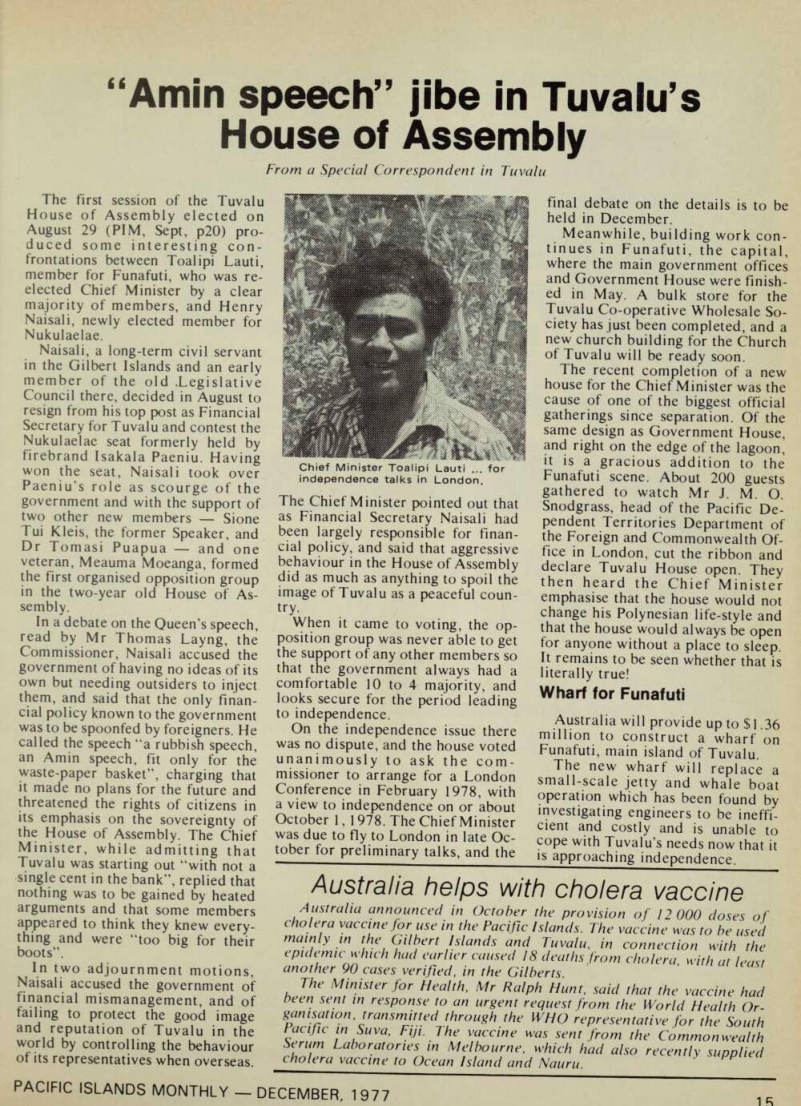
Chief Minister Toalipi Lauti ... for independence talks in London.
Australia helps with cholera vaccine
Australia announced in October the provision of 12 000 doses of cholera vaccine for use in the Pacific Islands. The vaccine was to be used mainly m the Gilbert Islands and Tuvalu, in connection with the epidemic which had earlier caused 18 deaths from cholera, with at least another 90 cases verified, in the Gilberts.
The Minister for Health, Mr Ralph Hunt, said that the vaccine had been sent in response to an urgent request from the World Health Or ganisation, transmitted through the WHO representative for the South Pacific in Suva, Fiji. The vaccine was sent from the Commonwealth S . u , m Laboratories in Melbourne, which had also recently supplied cholera vaccine to Ocean Island and Nauru.
Advertisements & other items, p. 16 (1 item)
Pacific Islands
S.E. TATHAM & CO. PTY. LTD
BEEHIVE BUILDING,
94 ELIZABETH STREET,
G.P.O. BOX 81
MELBOURNE 3001,
AUSTRALIA
CABLES; “SET 5 :
TELEX: AA34552.
TELEPHONE: 63 5094.
r
...BUYERS for the
PACIFIC ISLANDS
PAPUA NEW GUINEA:
S. E. TATHAM (P N G.) PTY. LTD.
LAE: MALAITA ST. (P.O. BOX 1562).
PORT MORESBY: Cm. GOROA & MAN AH U Sts.,
GORDON (P.O. BOX 6733, BOROKO).
TELEGRAMS: ALL OFFICES “ SET:
"9
FOR SERVICE
YOUR GUARANTEE
SINCE 1024
fishing zone compromise
US, Micronesia, in 200-mile fishing zone compromise
High Commissioner Adrian P.
Winkel of the US Trust Territory of the Pacific in October signed into law a major piece of legislation which will establish a 200-mile fish ery zone for the Trust Territory.
“There is no question,” Winkel said at the signing ceremony,“that this legislation is probably the most significant passed by the special ses sion, or passed in a number of sessions, of the Congress of Micronesia.”
Senator Nick Bossy, the chairman of the Law of the Sea Delegation, thanked the High Commissioner for signing the measure, emphasising the importance of the legislation. “I have been saying all along that we’re not asking for something that does not belong to us. We’ve been asking for something that is within our waters,” he added.
The bill would authprise fines of up to $50,000 on vessels ignoring its provisions after July I, 1979. The legislation reverses the Congress of Micronesia positions on the tuna issue, direct negotiations with foreign governments and the role of the High Commissioner.
The measure, according to the Senate and House Committees on Resources and Development, “rep resents major efforts to reach a com promise on the question of a 200mile fishery zone. It has accom modated many of the concerns ex pressed by the United States, as well as the High Commissioner. The bill has incorporated the re commendations and views of the Micronesian delegation to the United Nations Law of the Sea Con ference.”
The bill did not mention the issue of tuna fishing, defining instead Micronesian jurisdiction within the zone “to the extent permitted by in ternational law”. The legislation now satisfies the United States, which has argued in the UN Law of the Sea Conferences that tuna fish ing should not be regulated by any fishing nation.
On the other hand, the legislation permits the newly authorised Micronesian Maritime Authority to make direct contact with various fishing companies, issue permits for fishing and to establish and enforce rules for the regulation and conser-
vation of various species of marine resources found in Micronesian waters.
The bill prohibits Micronesian negotiations of fishery agreements with foreign nations, and instead allows the United States to negotiate on Micronesia’s behalf. Such deal ings by the US, however, would re quire concurrence by the Congress of Micronesia.
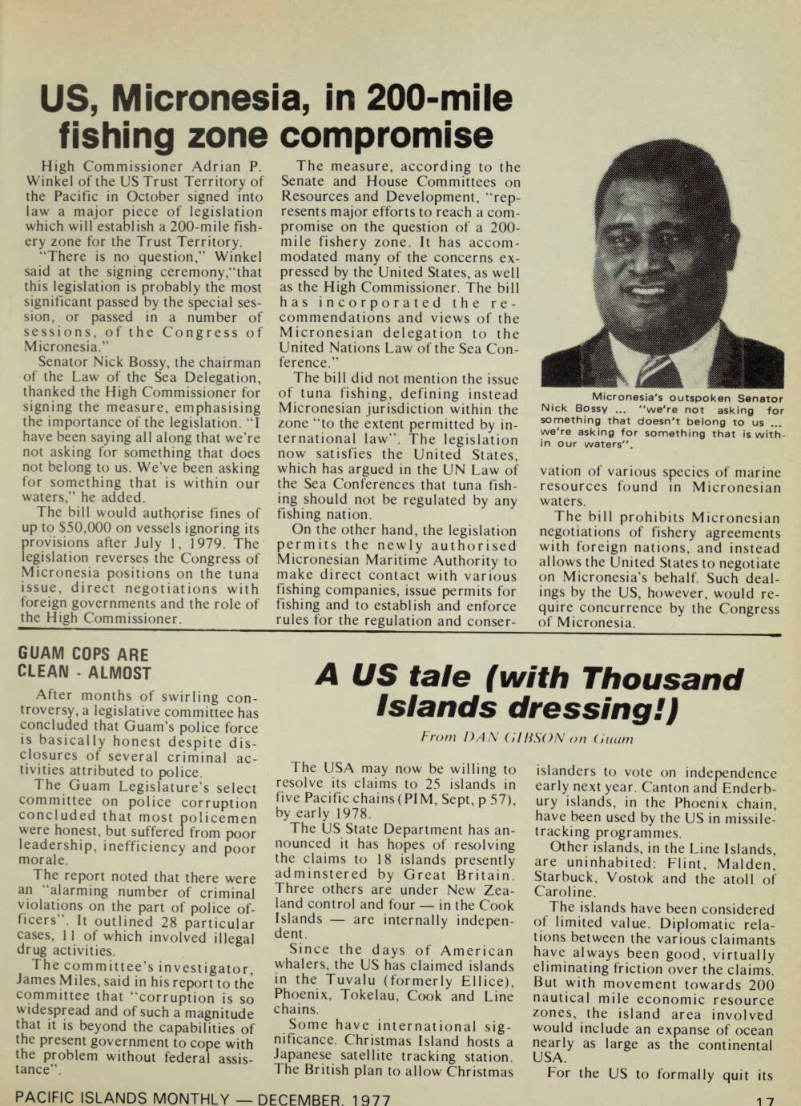
Micronesia's outspoken Senator Nick Bossy ... “we're not asking for something that doesn't belong to us we're asking for something that is with in our waters".
Guam Cops Are
Clean - Almost
After months of swirling con troversy, a legislative committee has concluded that Guam’s police force is basically honest despite dis closures of several criminal ac tivities attributed to police.
The Guam Legislature’s select committee on police corruption concluded that most policemen were honest, but suffered from poor
leadership, inefficiency and poor
morale.
The report noted that there were an “alarming number of criminal violations on the part of police of ficers”. It outlined 28 particular cases, 11 of which involved illegal drug activities.
The committee’s investigator, James Miles, said in his report to the committee that “corruption is so widespread and of such a magnitude that it is beyond the capabilities of the present government to cope with the problem without federal assis tance”.
Islands dressing!)
A US tale (with Thousand Islands dressing!)
From DAN GIBSON on Guam
Ihe USA ma y now be willing to resolve its claims to 25 islands in bve Pacific chains (PIM, Sept, p 57), °y early 1978.
The us State Department has anno u nced it has hopes of resolving the claims to 18 islands presently adminstered by Great Britain.
Three others are under New Zea- ,and control and four in the Cook Islands are internally indepen- Since the days of American whalers, the US has claimed islands * n tbe . Tuvalu (formerly Ellice), Phoenix, Tokelau, Cook and Line chains. . S° me have international significance. Christmas Island hosts a Japanese satellite tracking station.
The British plan to allow Christmas
islanders to vote on independence early next year. Canton and Enderb ury islands, in the Phoenix chain, have been used by the US in missile tracking programmes, Other islands, in the Line Islands are uninhabited: Flint, Malden,’
Starbuck, Vostok and the atoll of Caroline.
The islands have been considered of limited value. Diplomatic rela tions between the various claimants have always been good, virtually eliminating friction over the claims.
But with movement towards 200 nautical mile economic resource zones, the island area involved would include an expanse of ocean nearly as large as the continental
Usa.
For the US to formally quit its
claim may require an act of the US Congress.
Dan Gibson’s statement that the US is claiming only 25 islands rep resents a considerable “de-escala tion " from the 48 islands claimed in the original US Guano Act of 1856.
Twenty-three islands in fact.
Mr Lee Motteler of Honolulu’s Bishop Museum has stated that 15 of the islands claimed in the Act turned out to be non-existent, 12 of them were listed twice, and the names of only 18 of the 48 were spelled correctly.
How all this stacks up to a present claim on 25 islands we do not know. Perhaps some well-informed reader can help? — Editor.
For the record: PIM recently re ceived, through the good offices of the US Consulate-General in Sydney, the following statement from the US State Department con cerning the US claim to four of the Cook Islands; “Four of the Northern Cook Is lands (Danger Atoll, Manahiki Atoll, Penrhyn Atoll and Rakahanga Atoll) are claimed by both the United States and New Zealand.
“The United States’ claim goes back to legislation passed by the US Congress in 1856 concerning guano mining by US nationals in the South Pacific. During World War II the
Cont. on p 19
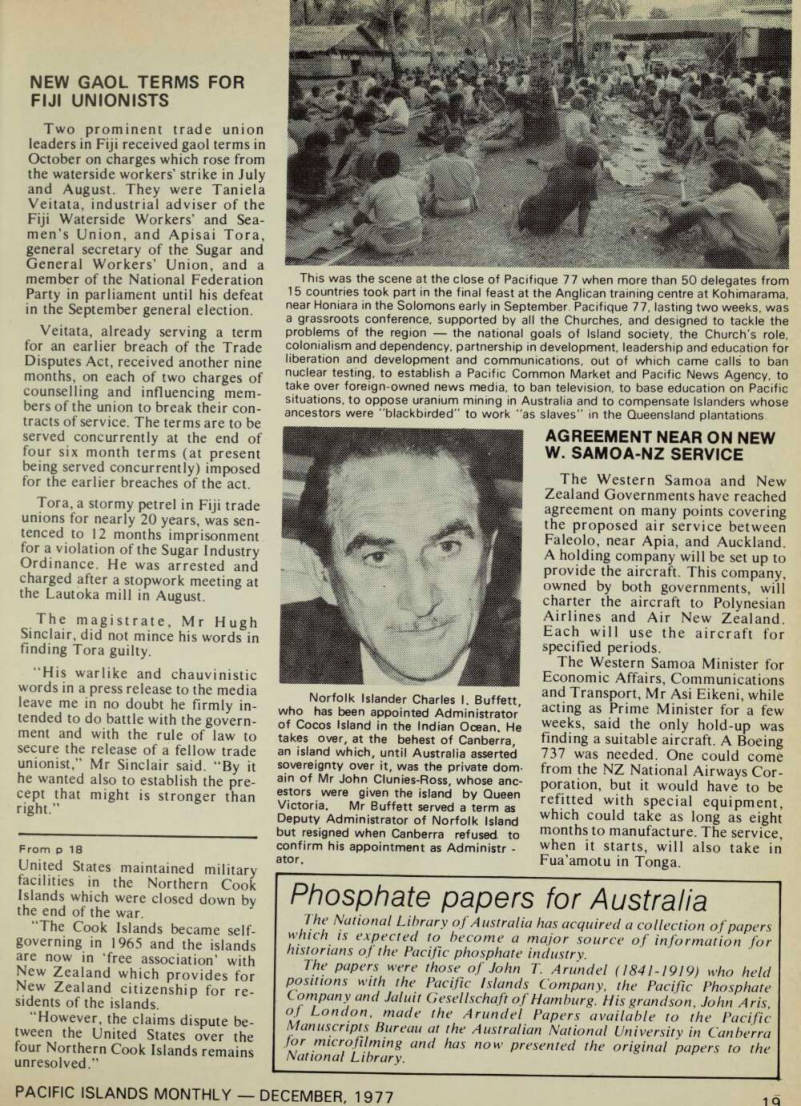
President Franklin Pierce, 14th president of the United States, who was in office when Congress passed the Guano Act on August 18, 1856. The act reflected Pierce's ambitious foreign policy, by which he hoped to divert public opinion from the slavery issue, which eventually led to the Civil War.
From p 18
United States maintained military facilities in the Northern Cook Islands which were closed down by the end of the war.
“The Cook Islands became self governing in 1965 and the islands are now in ‘free association’ with New Zealand which provides for New Zealand citizenship for re sidents of the islands.
“However, the claims dispute be tween the United States over the four Northern Cook Islands remains unresolved.”
Advertisements & other items, p. 18 (1 item)
Summer
(Advt.)
DAYS
NEED NOT
DRY YOUR
SKIN
With the scientific advances made in skin care it is possible to add to your skin's natural fluids so that your complexion can be helped to stay softer, smoother-looking and more supple even on the harshest days during the coming summer months. /'■'YNE of the joys of summer is the way in which you can make use of it to give your complexion an added dimension of beauty — to crown its petal softness with a soft bloom of gold. To see a finegrained, flawless com-
plexion exquisitely gild-
ed by the sun without its translucent softness
being compromised
does indeed seem to epitomise the peak of healthy, youthful com-
plexion beauty.
A secret of achieving this seemingly impossible harmony between the extremes of soft complexion beauty and summer glow, lies in the inter-action of the skin’s ndtural fluids with the outer layer of skin.
When you were younger your skin retained a soft, schoolgirl
complexion through the
summer, without drying and coarsening the skin because the skin’s oil and moisture supplies were ample. As you grow older this is, sadly, no longer the case and most women find their
complexion becoming
dry because of a natural fluid depletion. To sub-
ject such a complexion
even to the slightest sun exposure could increase a moisture loss already set in motion by your
body’s changing meta-
bolism and it could accentuate tiny surface lines and exaggerate dry wrinkling both of which can make your complexion look prematurely older.
Fortunately with the scientific development of a tropically moist oil blend, smoothed over your skin every day, particularly before you venture outdoors, you can help restore and maintain the essential balance of oil and moisture in your skin and
provide protection
against excessive fluid loss from the drying
conditions experienced
on summer days.
Take your Oil of Ulan moist oil blend and gently smooth it over the entire face and neck . . . even the shoulders too if they suffer from coarse texture and dry weathering. It penetrates quickly into the stratum corneum, there to create conditions more conducive to keeping your skin softer, smoother and
more supple by provid-
ing benefits similar to those of the skin’s own oil and moisture while leaving the skin with a fresh, natural non-
greasy feeling.
Cared for conscientiously with Oil of Ulan
each morning and night
your skin can become a
truly lovely summer
asset that can complement the season’s colourful summer wear to help give you a more
youthful appearance
that can be the envy of all.
New Gaol Terms For
Fiji Unionists
Two prominent trade union leaders in Fiji received gaol terms in October on charges which rose from the waterside workers’ strike in July and August. They were Taniela Veitata, industrial adviser of the Fiji Waterside Workers’ and Sea men’s Union, and Apisai Tora, general secretary of the Sugar and General Workers’ Union, and a member of the National Federation Party in parliament until his defeat in the September general election.
Veitata, already serving a term for an earlier breach of the Trade Disputes Act, received another nine months, on each of two charges of counselling and influencing mem bers of the union to break their con tracts of service. The terms are to be served concurrently at the end of four six month terms (at present being served concurrently) imposed for the earlier breaches of the act.
Tora, a stormy petrel in Fiji trade unions for nearly 20 years, was sen tenced to 12 months imprisonment for a violation of the Sugar Industry Ordinance. He was arrested and charged after a slopwork meeting at the Lautoka mill in August.
The magistrate, Mr Hugh Sinclair, did not mince his words in finding Tora guilty.
“His warlike and chauvinistic words in a press release to the media leave me in no doubt he firmly in tended to do battle with the govern ment and with the rule of law to secure the release of a fellow trade unionist,” Mr Sinclair said. “By it he wanted also to establish the pre cept that might is stronger than right.”
Agreement Near On New
W. Samoa-Nz Service
The Western Samoa and New Zealand Governments have reached agreement on many points covering the proposed air service between Faleolo, near Apia, and Auckland.
A holding company will be set up to provide the aircraft. This company, owned by both governments, will charter the aircraft to Polynesian Airlines and Air New Zealand.
Each will use the aircraft for specified periods.
The Western Samoa Minister for Economic Affairs, Communications and Transport, Mr Asi Eikeni, while acting as Prime Minister for a few weeks, said the only hold-up was finding a suitable aircraft. A Boeing 737 was needed. One could come from the NZ National Airways Cor poration, but it would have to be refitted with special equipment, which could take as long as eight months to manufacture. The service, when it starts, will also take in Fua’amotu in Tonga.
This was the scene at the close of Pacifique 77 when more than 50 delegates from 15 countries took part in the final feast at the Anglican training centre at Kohimarama, near Honiara in the Solomons early in September Pacifique 77, lasting two weeks, was a grassroots conference, supported by all the Churches, and designed to tackle the problems of the region the national goals of Island society, the Church's role, colonialism and dependency, partnership in development, leadership and education for liberation and development and communications, out of which came calls to ban nuclear testing, to establish a Pacific Common Market and Pacific News Agency, to take over foreign-owned news media, to ban television, to base education on Pacific situations, to oppose uranium mining in Australia and to compensate Islanders whose ancestors were "blackbirded" to work "as slaves" in the Queensland plantations
Norfolk Islander Charles I. Buffett, who has been appointed Administrator of Cocos Island in the Indian Ocean. He takes over, at the behest of Canberra, an island which, until Australia asserted sovereignty over it, was the private dom ain of Mr John Clunies-Ross, whose anc estors were given the island by Queen Victoria. Mr Buffett served a term as Deputy Administrator of Norfolk Island but resigned when Canberra refused to confirm his appointment as Administr ator.
Phosphate papers for Australia
The National Library of Australia has acquired a collection of papers which is expected to become a major source of information for historians of the Pacific phosphate industry.
The papers were those of John T. Arundel (1841-1919) who held positions with the Pacific Islands Company, the Pacific Phosphate Company and Jaluit Gesellschaft of Hamburg. His grandson, John Aris, oj London, made the Arundel Papers available to the Pacific Manuscripts Bureau at the Australian National University in Canberra for microfilming and has now presented the original papers to the National Library.
Pacifique Sud
With Helen Rousseau
As Christmas approaches, the Caledonians have a choice of two activities; to devote their fervour to the grand role Paris has mapped out for them in the Pacific, or to turn for pleasure to their own island beer with the “Number One” label, which has recently been awarded the sec ond prize in a Luxembourg beer contest.
The question of France’s role in the Pacific has again been raised in Paris following upon the August political assassination and other ex plosive events in Tahiti (PIM, Nov, p 16).
For Mr Pierre Messmer, one-time French Prime Minister and former Minister for Defence, the im portance of France’s overseas possessions is that they “represent much more than their population or size, for they are France in the world outside Europe”.
Mr Messmer made his remarks in a recent speech to his parliamentary colleagues in the RPR party in France. He said that his party is “determined to oppose all autonomist activity . . . for that would lead to separatist attitudes”.
Furthermore, he stressed that “following Gaullist tradition”, the overseas territories “were among the top priorities of the party”.
With Tahiti well on the road to internal autonomy, France must by now have decided whether to give in or fight for this territory. But in New Caledonia the situation is different, now that the autonomy movement has been brought under control. In response to Messmer’s speech, the French press in Noumea has emphasised New Caledonia’s sig nificance as a “showcase for France” in the Pacific and urged that the territory should be helped, like the French Canadians, to fulfil this basic role towards it Anglo-Sax on Pacific neighbours.
Such remarks show that the Caledonians are important pawns in the French power game. As the mili tary wing in this operation, Noumea has already been built up as the military showcase, the “aircraft car
rier for France in the Pacific” as one i governor remarked. Now the politi cal wing can be expected to swing into action to influence Pacific countries on behalf of Paris. The Caledonians are the missionaries who will be knocking on the doors of their Pacific brethren to influence their politics along the lines Paris would like. The economic arm is felt through the operations of banks and technical assistance, while the fourth sphere of influence is through cultural groups such as the Alliance Francaise, and the news media.
Certainly the new era of 200-mile sea limits seems to be causing great delight to the empire builders, who cannot fail to enjoy the bargaining power of their increased foothold in the Pacific. A clue to this value of the Pacific territories is given by French President Valery Giscard d'Estaing. Writing in a recent pub lication on maritime policy, the President states ‘‘France is a maritime country; she should become a maritime power”. While French officials continue to emphasise the importance of the French navy, one of the ships based in Noumea visited the offshore Chesterfield Islands in early Oc tober. The Dunkerquoise made the trip to these islands about 600 km west of the northern tip of New
Caledonia. The navy erected a pla que in the islands to commemorate the 100th anniversary of their an nexation by the French in 1877. The plaque was cast and donated by Le Nickel mining company in Noumea.
As the French have noted, there is something of an international war of the sea currently under way across the sealanes of the Pacific. While the French CGM (incorporating Messageries Maritimes) upgrade their Pacific fleet, the Polish line is to extend its voyages. From January 1978 the Poles are scheduled to open a monthly service from Dunkirk to Tahiti-Western Samoa- Noumea and New Zealand. At the same time, the French Sofrana- Unilines have joined with the New Hebrides Co-operative Federation Ltd to form Vanua Navigation.
The Japanese are also well-known seafarers in our region and next year their overseas programme will in clude Noumea on a five-week “youth ship” excursion from Tokyo.
A boatload of over 300 young Japanese will oe introduced to Guam, Australia, New Zealand and, for the first time, Noumea. Apart from 26 Australians and New Zealanders, four Caledonians will be invited by the Japanese govern ment to join the “getting-to-know you” voyage, from January 1978.
Meanwhile, on the other side of the French Pacific, Tahiti tourist traffic figures show strengthening links with the USA and Australia.
The total number of visitors staying in French Polynesia in 1976 was 91 993, an 11% increase over 1975.
Of these, 42 631 (46%) came from the US, followed by 9 640 Australians, 7 013 Canadians, 5 504 Japanese and 3 549 French visitors.
Long-time director of the Office de developpement du tourisme in French Polynesia, Alec Ata, has now been elected to quasi ministerial rank as a member of the territory’s Government Council (Conseil de Gouvernement) under the new “autonomist” status.
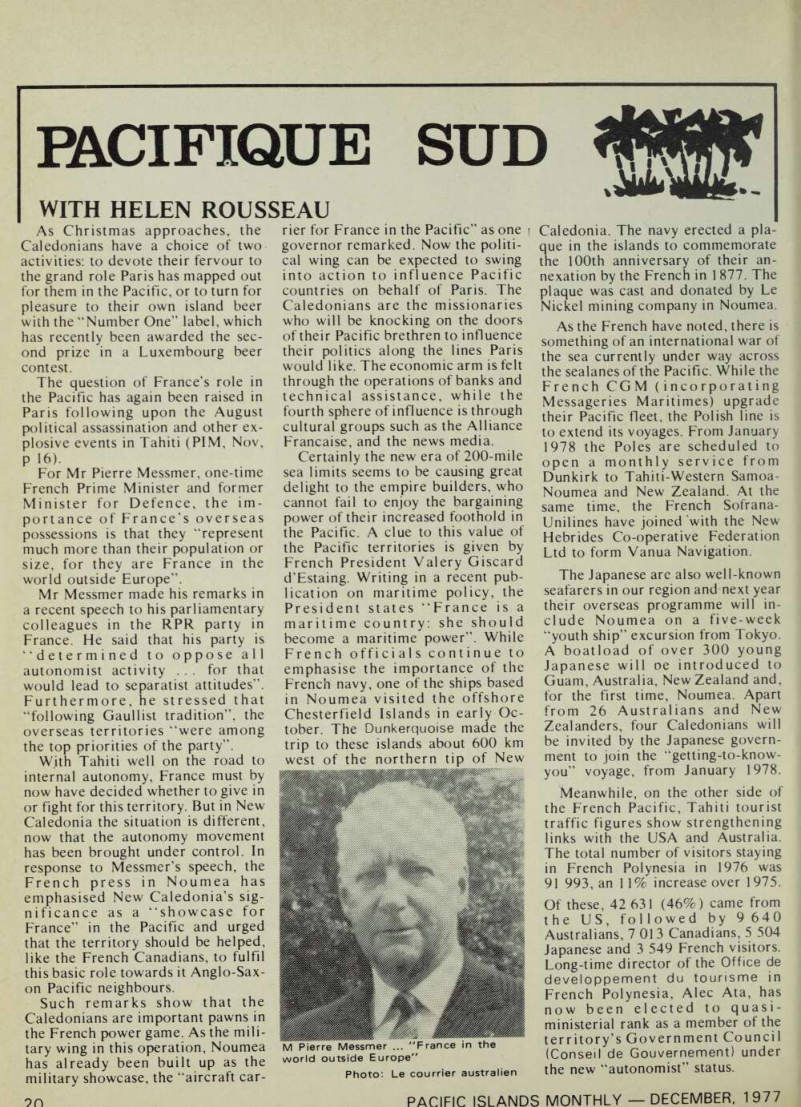
M Pierre Messmer ... "France in the world outside Europe"
Photo: Le courrier australien
Advertisements & other items, p. 21 (1 item)
subscription
T ,
\| Biblical
\1 Prophecy
V C Tr 3 - -
World
Events
Mk nr X
Send now for your FREE
subscription
Please mail to the address nearest you.
Ambassador College Agency, Box 345 G.P.0., Sydney, N.S.W. 2001,
NAME
(please print)
ADDRESS
OR Ambassador College Agency, P.O. Box 2709, Auckland 1, New Zealand.
.POSTCODE.
The Plain Truth is a unique magazine. Unique in its treatment of world affairs unique in its clarification of solutions to the problems of humanity. The Plain Truth probes issues of concern to all thinking people. Recent issues have discussed world agriculture, the Middle East, economics, venereal disease, the problem of Ireland, disarmament, the supernatural and the missing dimension in sex.
The Plain Truth goes far beyond the physical, the circumstantial, the obvious. It probes into the heart and core the spiritual side of each and every issue, and thus presents the real solutions which are otherwise unattainable.
You can have a free subscription to this remarkable magazine simply by asking for it. Mail the coupon today and you will receive your subscription free and post free.
Published by Ambassador College as a Public Service.
When cholera, the wasting death,

stalked the Gilbert Islands
By the beginning of October, 18 people had died in the Gilbert Islands, victims of cholera which, until it struck in a small village on the Tarawa atoll at the end of August, had never before been recorded in the South Pacific Islands. At one time it was feared that it would spread like wildfire throughout the whole of the South Pacific.
More than 500 cases entered the Tungaru Central Hospital and Betio Hospital on Tarawa, the fight to beat the epidemic and confine it to the four affected islands brought medical experts from Fiji, Australia and New Zealand.
How the fight was waged and won, is told below.
By John Carter
It looked like just another case of dengue fever or plain diarrhoea which struck a woman in Teaorareka village on Tarawa at the end of August. When the first sym ptoms appeared, they were mild and it was only after a few days of suffer ing that her condition appeared serious enough to merit her admis sion to the Central Hospital. By that time she was very dehydrated, like a lost wanderer dying of thirst in the desert.
This was the first attack of cholera, but unlike the many thou sands of cases which have occcurred over the years in crowded India and Asia, it was an insidious attack.
There were none of the recognised symptoms of cholera. That was the great danger which threatened the South Pacific, Dr Tin Maung Maung told me in Suva in October.
Dr Tin, the epidemiologist with the World Health Organisation (WHO) at the Suva office, led the fight against the epidemic when it was finally confirmed that cholera had struck in the islands. The sick woman was admitted to the Central Hospital on August 30 but it took nine days to confirm the presence of the disease. That, said Dr Tin, was what made the disease so deadly.
There are, he explained, two types of cholera — Classical Cholera, a more common type which strikes very quickly with symptoms easily and quickly recognisable. There is severe diarrhoea and vomiting and very quick dehydration caused by the loss of body fluid through the diarrhoea and vomiting. The victim can lose three or four pints of fluid in an hour.
The only cure is to replace the fluid by the patient drinking copious amounts of diluted salt water or a saline drip into a vein.
The second type, and the one which struck in the Gilberts, is
of a little stomach-ache and slight diarrhoea and people affected will naturally move around and spread the disease without anyone being aware of it. That is why, any case of diarrhoea, however slight, with vomiting or even diarrhoea without vomiting, should be reported and dealt with immediately. Sometimes, people carry the disease without suffering from it but they spread the germs through their waste matter for many months.
Dr Tin paid tribute to the physi cian specialist, Dr Adrian Roberts, of the Central Hospital.
Dr Tin said the credit had to go to Dr Roberts for being the first to re cognise the presence of the disease.
There was no suspicion at all for several days after the first patient was admitted and, in fact, the hospital conducted its “public open day” on September 3 even though there were five patients in the hospital suffering from cholera. By September 5, there were suspicions that some kind of epidemic was oc curring because the number of pa tients admitted had risen to seven.
The medical authorities thought
known as Cholera El Tor almost a romantic name so called because it was first recognised at El Tor in Egypt in 1906. When it strikes it doesn’t reveal its deadli ness for several days and can be mistaken, as was the case at Tarawa, for a fever or diarrhoea. Therein, Dr Tin pointed out, lay the danger.
El Tor is not readily recognisable in the early stages. There may be no symptoms at all with the exception
An idyllic scene on Tarawa - but today the cholera germ finds a compatible home in the polluted waters of the lagoon.
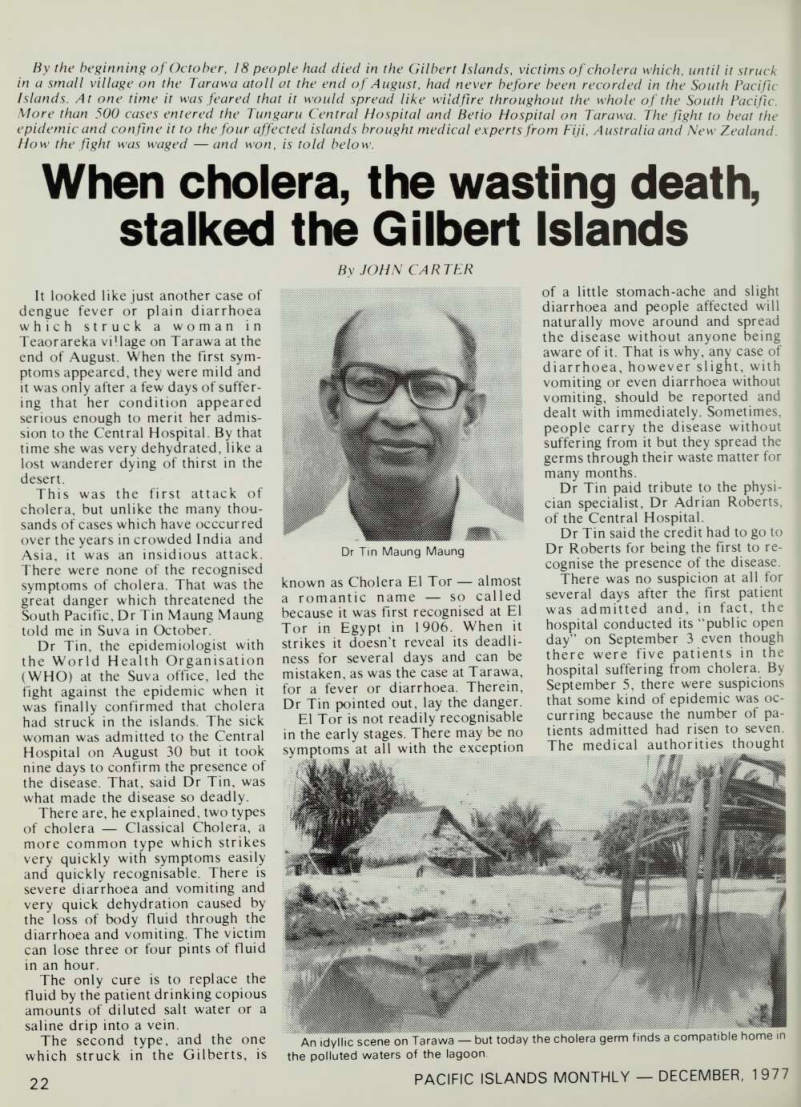
Dr Tin Maung Maung
that it might be food or fish poison ing. Then came news from Betio, which at present has no causeway and can only be reached by boat, that there were three patients in its small hospital and the first death had occurred.
The following day Dr Roberts began to suspect that it was El Tor.
Laboratory tests were made but because the laboratory lacked the necessary anti-cholera sera there were no definite results until Sep tember 8 when the analysis showed a strong indication of cholera.
The Gilbert Islands Government moved quickly and declared the group a cholera-infected area. The South Pacific Commission and WHO were told immediately.
South Tarawa, where the epidemic was first discovered among the population of 20 000, was immediately isolated from the rest of the group. There was a ban on travel to the other 15 island groups, but by this time cases had also occurred at Abemama and Abaiang, two small islands near South Tarawa.
Dr Tin, who was then in Saipan, in the Marianas, preparing to go to Nauru, heard the news and made his way to Tarawa, arriving on Septem ber 12. By that time the five British doctors had begun the fight. WHO threw in all its resources from its centre in Fiji and in three days the whole population of South Tarawa had been vaccinated by eight teams travelling throughout the islets and working around the clock.
New Zealand’s military forces sent a medical and nursing team in a Hercules aircraft under the com mand of Colonel Brian Linehan. Mr Ken Butler, a water engineer, who had been in the Gilberts shortly before helping to plan an improved water supply, was also flown over from Australia. The Peacesat satellite was also brought into op eration to enable Dr Tin to keep in continuous touch with his Suva
headquarters.
The locals also rallied round, tak ing food and mats to the two hospitals at Betio and Bikenibeu.
If treatment is given in the early stages recovery is swift, and by Sep tember 10 some of the people had
been discharged from hospital.
More were arriving, however, and on September 14, 50 new cases were at the hospital, including nine from North Tarawa, an indication that
the epidemic was spreading.
Although the death toll reached 18 and these were mainly people who had not sought treatment the experts had the outbreak under con trol.
As the days passed, the stream of patients to the hospital became a trickle and by mid-October there were only a few new cases.
Dr Tin said that, although the epidemic had been beaten, sporadic outbreaks might occur but they would be dealt with very easily now that El Tor had been recognised for what it was.
Probably the biggest job facing the health authorities was that of im proving sanitatiom which throughout the group is very poor. It was no coincidence that South Tarawa was so badly hit. Betio, in particular, is notoriously over crowded. It was also no coincidence that one small village, Tangintebu, which has a good living standard with good sanitation and a private water supply, had no cases of cholera.
The water supply was one problem which needed attention.
The only fresh water sources in the Gilberts are rain water which is col lected from roof gutters, well water from shallow wells, which are al ways in danger of pollution from human dwellings nearby, and supply mains which run from east to west in South Tarawa from 10 collection depots. This mains water is stored in a 500 000-gallon reservoir, is chlorinated and then fed into the Betio mains. But Mr Butler found that the amount of free chlorine in the water when it reached the taps was nil. Tarawa lagoon is greatly polluted by rubbish and sewage and when the microbiologists tested it they found that the cholera germ was present, especially close to the latrines.
Fly breeding is also uncontrolled and there was a high density of flies during the epidemic period. It’s also the season for the ripening of breadfruit and the pandanus fruit and this is a time of increased diar rhoea caused through eating over ripe fruit.
It was obvious that something had to be done to clean up the Gilberts and within a few days plans were completed to combat the fly menace, to attempt to immunise the people from cholera, to improve sanitation and disinfect all latrines.
A campaign is also in train to educate the people in hygienic methods of preparation of food and drink.
With regard to El Tor it again emerges as the more dangerous of the two types. According to Dr Tin, vaccination prevents Classical Cholera for as long as six months but with El Tor the immunisation period is halved to three months.
Although every precaution was taken to isolate the Gilberts, travel could not be prevented through the group, especially by the airlines. Air Pacific and Air Nauru both co-op erated to the limit.
In the case of Air Pacific, drink ing water was carried in sealed plastic containers from Nausori, Suva’s airport, so that there was no need to take on such water in Tarawa and there were no ice or food pick-ups from Tarawa or Funafuti, capital of Tuvalu.
All catering on the flights was strictly supervised and catering staff handling cooked food had to disin fect their hands and also use dis posable sterilised gloves.
All toilet water replenished at Tarawa was chlorinated and passengers were warned not to drink the tap water in the toilets. Air crews stopping overnight in Tarawa were only allowed to eat and drink provisions brought from Nausori and throughout their stay at the Otintai Hotel were not allowed to walk outside.
Aii . C
All cutlery after the return from Tarawa was sterilised under the ™ eth . ods Nauson Health Department s super vls'?n' ... , , , xt T " e a > r jine went further than this.
Night soil staff, who cleaned the aircraft af * er lts return from eacb protective clothing and sterilised raincoats and gumboots, gloves and masks, Alter completing the job they had to shower at the airport using medi cated soap and then change into f J es u h dothmg. Their discarded clothes were put in plastic bags for disinfecting before being sent to the
laundry.
Although the South Pacific’s cholera epidemic appears to have beenl beaten > a ? Dr Tin said unless sani tation and water supplies are * m P r o v ed, there could be more out breaks. However, he discounted the headlines in some newspapers which P r °phesised the spread of cholera
.f 2? the Islands
‘ fhere are no firm causes for believing that the spread of the dis ease to the rest of the Pacific is in evitable,” he said. ”But where sanitation is poor and with the ease of modern travel, the disease could s P and all the islands are faced ' mpr ° Ve " That “*!“>« and most im " * T . . . , Z The two pictures are from German S m prod uc e r Kad-Hemz Stellmach's film on the Gilberts, Sailing in the Trade Winds, which was shot in happier circumstances.
"It is forbidden to defecate on the beach The law”, says this notice at Bikenibeu, and this small boy is not one whit disturbed But the practice will have to stop if cholera is to be eradicated
Advertisements & other items, pp. 23-26 (1 item)
Forestmill
PORTABLE
SAWMILL
Latest design features mean - faster production - less maintenance - easier to operate and service.
Powered by diesel engine or electric motor. v vy'. *■ <3* v - Portable Sawmill Forestmil produces any size accurate timber ready to use up to 12" x 9" x 24'.
Purchase price and operating cost of Forestmil is less than other sawing equipment with similar production capacity.
Forestmil reduces timber waste also reduces log transport cost. Timber is sawn direct from the log in the forest.
Forestmil can be moved to a new location in one hour.
Forestmil will saw hardwood or softwood from logs any diameter.
Over 1000 Forestmils are sawing timber in 23 countries.
For literature and prices please contact manufacturers.
|A| MacQuarrie Industries Pty.Ltd.
M m. ||l P-O- Box 20, Coburg 3058, Victoria, Australia.
I Phone: 350-3411. Telex: 33729. Cables: Macbound, Melbourne.
When you build great solo performers,
it’s easy to create a great Music Center.
Pioneer is the total audio company.
For over 40 years, we’ve concentrated our skills on the reproduction of sound. From individual components to complete systems. From diamond styli to cabinet material for speakers.
So it's only natural that our KH-5522 Music Center reflects this commitment to hi-fi excellence.
Advanced features include an AM/FM receiver with a power output of 12 watts per channel (8 ohms, 1 kHz,T.H.D. 1%) and PLL (Phase- Locked Loop) circuitry in the FM section for definitive separation of left and right channels. Creative management of subtle nuances in musical reproduction is possible with separate BASS, TREBLE and BALANCE controls.
For easy handling of records the full-size component type turntable offers automatic cut and return.
The cassette deck is the new frontloading style and provides automatic STOP in any mode for dependable tape and mechanism protection.
Of course, the speakers blend perfectly. Big 2-speaker systems with a 20cm (8-inch) woofer for rich, luxuriant bass and a 6.6 cm (2%-inch) cone tweeter for brilliant highs.
Pioneer’s KH-5522 Music Center.
Another outstanding contribution to your musical enjoyment from the audio company.
ft!) PIONEER
Australia Pioneer Electronics Australia Pty.
Ltd., 178-184 Boundary Road, Braeside, Victoria 3195, Tel: 90-9011, Sydney 93-0246, Brisbane 59-7457, Adelaide 433379, Perth 24-9899 Fiji Islands Brijlal & Company, G.P.O. Box No 362. Suva, Fiji Islands Tel: 22258 New Zealand Fountain Marketing Ltd., Maidstone Street, Auckland, New Zealand Tel: 763-064 Norfolk Island Burns Philp (Norfolk Island) Ltd., Norfolk Island, South Pacific New Hebrides Burns Philp (New Hebrides) Ltd., Vila, New Hebrides Nauru Island Jacob Enterprises, P.O. Box No. 4 Republic of Nauru Tahiti Est. PERFECT, B.P. 594, Papeete, Tahiti Tel: 20 407 New Caledonia Menard Freres Ville, B.P. H2Cedex, Noumea, New Caledonia Tel: 27.52.22 American Samoa Traspac Corporation, P.O. Box 1477 Pago Pago, American Samoa 96799 Tel: 633-5224 Rarotonga South Seas International Ltd., P.O. Box 49, Rarotonga Cook Islands Tel: 2327
Jiatctunderstands shoes Your family will love the fit, comfort and colour of long wearing Bata shoes.
Tropicalities
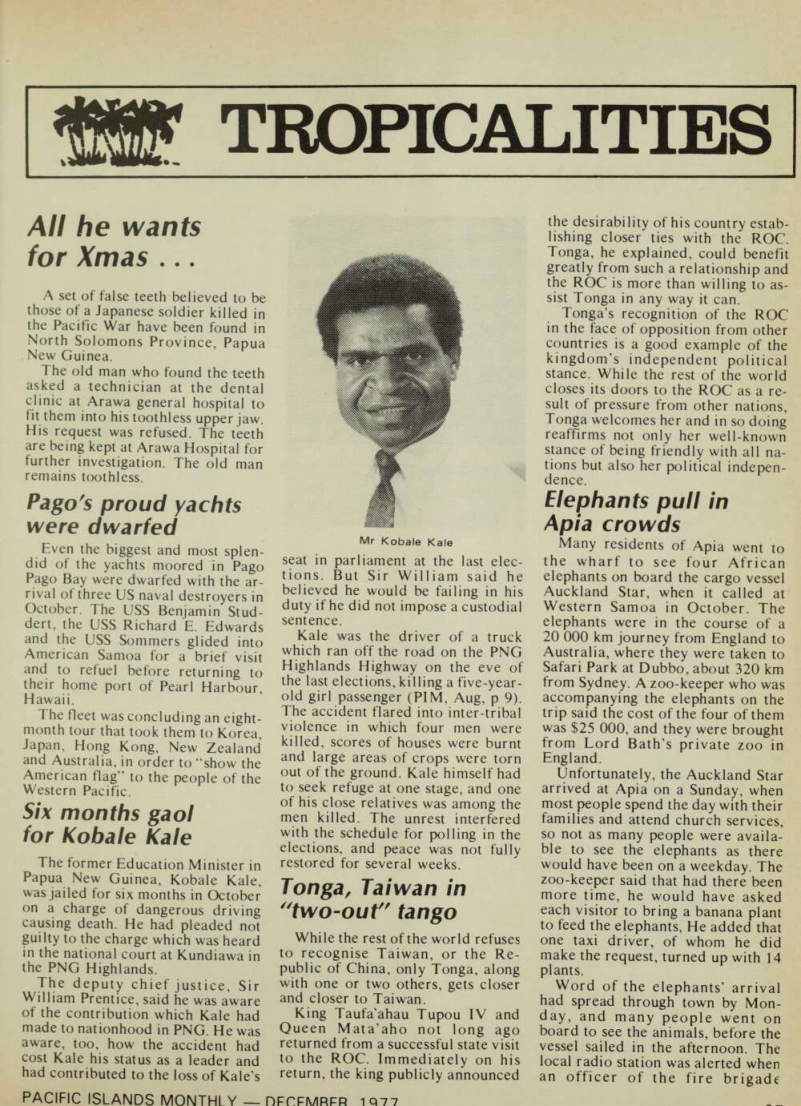

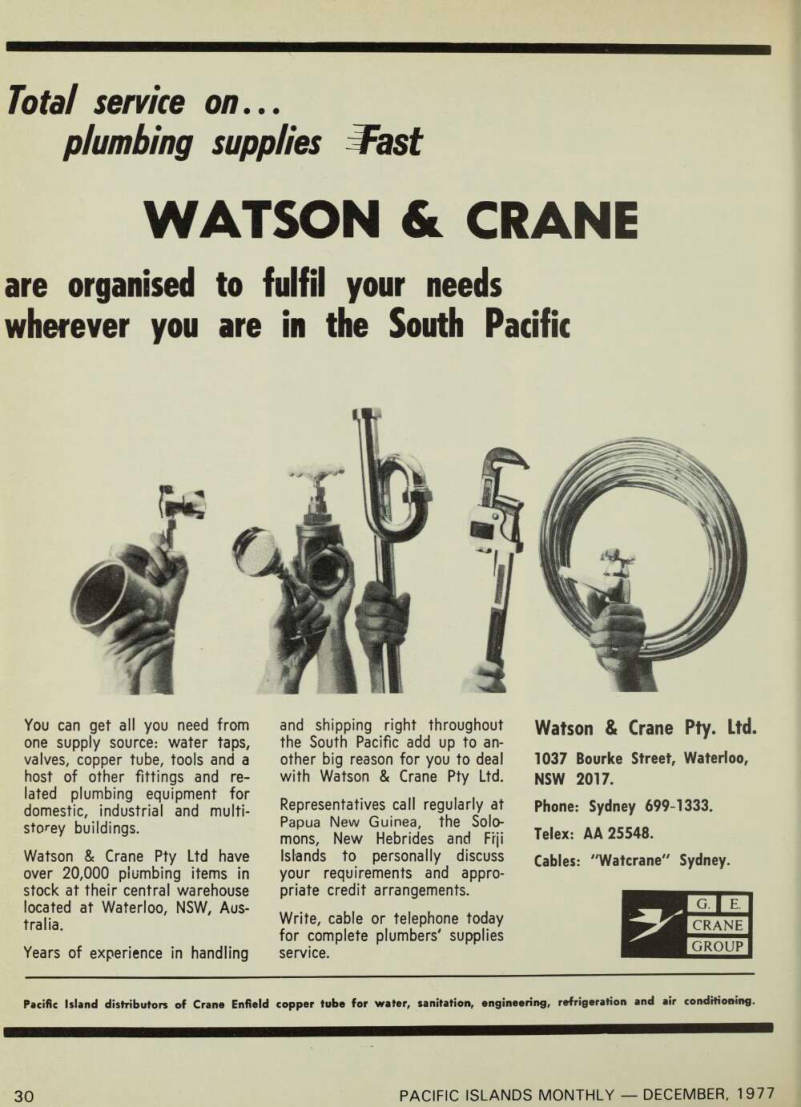
All he wants
for Xmas ...
A set of false teeth believed to be those of a Japanese soldier killed in the Pacific War have been found in North Solomons Province, Papua New Guinea.
The old man who found the teeth asked a technician at the dental clinic at Arawa general hospital to fit them into his toothless upper jaw.
His request was refused. The teeth are being kept at Arawa Hospital for further investigation. The old man remains toothless.
Pago's proud yachts
were dwarfed
Even the biggest and most splen did of the yachts moored in Pago Pago Bay were dwarfed with the ar rival of three US naval destroyers in October. The USS Benjamin Stud dert, the USS Richard E. Edwards and the USS Sommers glided into American Samoa for a brief visit and to refuel before returning to their home port of Pearl Harbour, Hawaii.
The fleet was concluding an eight month tour that took them to Korea, Japan, Hong Kong, New Zealand and Australia, in order to “show the American flag” to the people of the Western Pacific.
Six months gaol
for Kobale Kale
The former Education Minister in Papua New Guinea, Kobale Kale, was jailed for six months in October on a charge of dangerous driving causing death. He had pleaded not guilty to the charge which was heard in the national court at Kundiawa in the PNG Highlands.
The deputy chief justice, Sir William Prentice, said he was aware of the contribution which Kale had made to nationhood in PNG. He was aware, too, how the accident had cost Kale his status as a leader and had contributed to the loss of Kale’s
seat in parliament at the last elec tions. But Sir William said he believed he would be failing in his duty if he did not impose a custodial sentence.
Kale was the driver of a truck which ran off the road on the PNG Highlands Highway on the eve of the last elections, killing a five-year old girl passenger (PIM, Aug, p 9).
The accident flared into inter-tribal violence in which four men were killed, scores of houses were burnt and large areas of crops were torn out of the ground. Kale himself had to seek refuge at one stage, and one of his close relatives was among the men killed. The unrest interfered with the schedule for polling in the elections, and peace was not fully restored for several weeks.
Tonga, Taiwan in
"two-out" tango
While the rest of the world refuses to recognise Taiwan, or the Re public of China, only Tonga, along with one or two others, gets closer and closer to Taiwan.
King Taufa’ahau Tupou IV and Queen Mata’aho not long ago returned from a successful state visit to the ROC. Immediately on his return, the king publicly announced
the desirability of his country estab lishing closer ties with the ROC.
Tonga, he explained, could benefit greatly from such a relationship and the ROC is more than willing to as sist Tonga in any way it can.
Tonga’s recognition of the ROC in the face of opposition from other countries is a good example of the kingdom’s independent political stance. While the rest of the world closes its doors to the ROC as a re sult of pressure from other nations, Tonga welcomes her and in so doing reaffirms not only her well-known stance of being friendly with all na tions but also her political indepen dence.
Elephants pull in
Apia crowds
Many residents of Apia went to the wharf to see four African elephants on board the cargo vessel Auckland Star, when it called at Western Samoa in October. The elephants were in the course of a 20 000 km journey from England to Australia, where they were taken to Safari Park at Dubbo, about 320 km from Sydney. A zoo-keeper who was accompanying the elephants on the trip said the cost of the four of them was $25 000, and they were brought from Lord Bath’s private zoo in England.
Unfortunately, the Auckland Star arrived at Apia on a Sunday, when most people spend the day with their families and attend church services, so not as many people were availa ble to see the elephants as there would have been on a weekday. The zoo-keeper said that had there been more time, he would have asked each visitor to bring a banana plant to feed the elephants, He added that one taxi driver, of whom he did make the request, turned up with 14 plants.
Word of the elephants’ arrival had spread through town by Mon day, and many people went on board to see the animals, before the vessel sailed in the afternoon. The local radio station was alerted when an officer of the fire brigade
Mr Kobale Kale
telephoned to inform the news ser vice that he could see elephants al the wharf.
A gorilla was also brought for Australia’s Safari Park, but it tra velled by air.
Plane thieves had
sparklers in mind
There’s a hidden cache of dia monds in a crashed Japanese plane on a reef “somewhere” off Bougain ville. And special cutting equipment found in a Beech Baron aircraft which crash-landed on Mono airstrip in the Solomons in July was to be used to cut a way into the wrecked aircraft to get the treasure.
This claim was made at a court hearing in Brisbane when three men appeared on a charge of having unlawfully used an aircraft. They were Frederick Robert Rose, Vau dry John Bishop and Rex Lloyd Moore. The police alleged the men stole the aircraft in Cairns and flew it to the Solomons.
Senior Superintendent Harry Brown said Rose had given him an explanation about the cutting equip ment and the reason for the flight.
But Rose would not say where the crashed aircraft was as others would get to it first.
Rose had said that shotguns and ammunition found in the aircraft were to ward off sharks.
Another police witness said he had overheard Bishop claim he had seen a Japanese plane on a reef which had $1 million in diamonds in it.
Bishop had said he had flown the plane from Cairns to Mono, and ad mitted it was stolen.
The three men were arrested under the Solomons immigration laws.
Amorous yachties
way off course
The matrimonial escapades of two yachting enthusiasts who came to Lord Howe Island still provide amusing memories for those on the island.
The tale began with two young people who met while cruising in the Mediterranean. According to their story, the young man proposed to the girl on the of Gibraltar and therewith they decided to be married on the island inhabited by those sea-faring adventurers, the de
scendants of the Bounty mutineers.
Somehow, under the spell of the romance, their history and geogra phy came unstuck and instead of making for Norfolk Island, the young yachties booked themselves on a flight to Lord Howe Island.
This was about eight years ago, in the days of the flying boat, before Lord Howe came to be less than two jet-hours from Sydney.
The islanders’ curiosity was aroused when the young woman ar rived alone off the flying boat, her companion having been off-loaded at the last minute at Rose Bay in Sydney. He managed to make the trip the next day. By then the story was out, the young couple had secretly arranged to be married by the Anglican minister. The locals filled in as best man etc. The wife of the island’s Administrator, Mrs H.
Ward, who was a florist, arranged the bridal bouquet and a cake was made by the islanders. After the ceremony, the adventurous couple posed for the wedding photos under the fine cream-flowering frangipani at the Administrator’s residence.
The bride forthwith sent a cable to advise her mother in the UK of her latest travels, before she returned with her Australian husband to set tle in a suburb of Sydney.
A PNG Minister gets
egg on his face
A Samoan missionary teacher in Papua New Guinea, who struck a high school student to discipline him, was freed of an assault charge in October. The magistrate who heard the charge said he was ap palled at the discriminatory attitude towards the teacher which had been shown by the PNG Conservation Minister, Mr Stephen Tago.
Mr Tago is a brother of the stu dent who was disciplined and the court heard how he sought out the teacher shouting, “Where is that bloody pastor?’’ and threatening deportation. Pastor Favia Saga ap peared in the national court in Port Moresby before Mr J. F. Aisa, pleading not guilty to a charge of as sault on one of his students at the Sogeri High School near Port Moresby. He admitted striking a fifth form student, Jarius Tago, 17, but claimed the blow was a lawful and reasonable disciplinary measure against a student who was continuing to disrupt a music lesson.
Pastor Favia said later he was confronted by the Conservation Minister, Mr Tago, who called him “a bloody pastor”. Mr Tago had shouted “You are unqualified to teach. You should have been re placed a long time ago. You are a foreigner and I will see that you are deported.”
Dismissing the assault charge, Mr Aisa said he was surprised that the police had not taken “positive steps” over Mr Tago’s involvement in the incident.
"Putting off the
day"in Auki
Teachers in the Solomons’ “No. 2 town”, Auki, threatened strike ac tion unless they received a town allowance, arguing that town living was far more expensive than rural.
The Malaita educational council replied that it had no money to pay them anything extra.
But the council still moved smartly to solve the teachers’ prob lems: it had them all posted to rural districts.
A teachers’ spokesman said this was fine, but the council was only “putting off the day”: new teachers sent to Auki would face exactly the same problems.
The teachers won some support.
Colin Gauwane, member for Central Malaita in the Solomons legislature, spoke out in their favour. So did the chairman of the Auki primary school’s committee of management.
If the teachers were right in their prediction, the next word is proba bly up to their replacements, newly posted in to the town life conditions of Auki.
Christians and the
Demon Grog
The demon grog and the emiss aries of the Christian Church have been at odds since the fiery liquors first made their appearance on many a Pacific Island.
Islanders for all manner of reasons have been attracted to the bottle, but they have also been en meshed into membership of Chris tian organisations which have dwelt long and heavily upon the evils of alcohol, writes Bill Coppell.
The result has been an almost in soluble dilemma how to enjoy one’s spot and yet have the right to
stand in front of the congregation as a deacon of the church and pon tificate at length about the degreda tion that follows upon indulgence in drink.
W. E. Gudgeon, the Resident Commissioner in the Cook Islands, in 1904 tried to resolve this dichotomy when he reported to the Minister in New Zealand, “Previous to the arrival of the first British Re sident the will of the resident mis sionary had practically been the law of the island, and prohibition was supposed to be the rule. But it ex isted in name only, for the people, with one or two exceptions, were op posed to it, and assisted European traders to break the law whenever it suited them to do so. The Maoris do not desire prohibition. At any general meeting held on this subject every man will, for the sake of ap pearances and the safety of his church-membership, speak against the sale of liquor, but privately they, as a rule, favour it, and cannot see why a Maori should be treated dif ferently from a European.
“Whatever there may have been of drunkenness during the last five years has been due to bush beer, which is almost invariably drunk on Sundays with the full knowledge of the chiefs of the tapere, police, and church-members, but the offenders are never brought before the Court, unless they have been so foolish as to exhibit their drunkenness on the public road where they may be seen before Europeans. Police sympathy is with the beer-drinkers”.
It might be added as a postscript that today the police sympathy in many cases is with Europeans, especially the tourists, who exhibit their drunkenness in the sight of the local people in the Pacific Islands.
Sails trimmed
in Pago Pago
POWER, The Political Organ isation of Women for Equal Rights, met with American Samoa’s guber natorial candidates, in a public rally to question them regarding their views on price control, economic development and the equal rights amendment. Wisely, each of the candidates spoke in favour of the ERA and stated that women would play vital roles in their admin istration if elected. The day before the rally, Arieta Mulitauaopele became the first woman to enter the
race, as a candidate for Lieutenantu em ? r n u Hopefully, the new Governor and Lieutenant-Governor will fulfill their campaign promises by appointing qualified women and men equally within their administration, allowing American Samoa to enter mto self-government with the aid of the whole population, rather than JU T h a p S H p m f nt ' . .
The elections were to be held on November 8. • n j c 'J*U menus meet
in distant Athens
Australia’s genial ambassador in Greece, Les Johnson and his wife Dulcie, played host in mid-October to an old family friend.
Their house guest who arrived quietly in Athens with no formality he’d even left his wife at home was Michael Somare, Prime Minister of Papua New Guinea. “A holiday with an old friend to get away from journalists and people like that, was how Somare described the visit which was a fortnight’s stay on his way home from the United Nations.
Les Johnson, one-time high school teacher in Western Australia, became the technician who phased
PNG into self-government, and has remained a close friend of Somare.
He went to PNG 1 5 years ago from a headquarters job with the Western Australian education department to become director of education in
Png.
Within a few years he was As sistant Administrator for Australia in PNG, and eventually became the last man to hold the post of Admin istrator.
It was Les Johnson who signed the papers handing over his authority as Administrator when Somare became Chief Minister of PNG just before the achievement of full indepen dence.
Before his present ambassadorial post, Johnson ran the Australian Development Assistance Agency looking after PNG’s requirements from within Australia.
TV " concealment "
charge on Truk
Did the Trust Territory admin istration try to conceal the “real story” of Micronesia from a major American television team preparing a one-hour documentary about the islands? Jack Archer, of Truk, legal adviser to the Congress of Micronesia, claims it did, and add
ed that the administration would, no doubt, be pleased with a trivial tra velogue, which concealed the real story of Micronesia.
The television team went to Truk with Mr Samuel McPhetres, a TT official and a political education ad visor in the TT Public Affairs Department. Mr Archer claimed that Mr McPhetres tried to prevent any interview which might cover serious political , social and econ omic issues on Micronesia.
Mr Archer said the producer seemed to be interested in Micronesia as a subject of travel. He suggested there should be a protest
against such a superficial approach.
The administration said it had no say in the documentary. The televi sion company was free to film any thing and interview anybody it wished.
Smoking no wealth
hazard in Tonga
Rothmans cigarette company of Australia is wooing Tongan smokers by running a weekly raffle to assist sports in Tonga.
For five empty packets of one of the company’s brands and 10c, one
buys a ticket for the weekly draw which carries prizes totalling $5O.
At the end of the 10 weeks all tickets included in the weekly draws are re raffled for the Jackpot prize of $1 000.
The local agent for the brand esti mates that by the tenth week of the raffle, its share of the market could soar to 30% or 40%. The brand has the added attraction of a lower price than other cigarettes sold in the kingdom.
Death jump
from hunger?
A prisoner who jumped from a police “paddy wagon” in Papua New Guinea may have wanted to escape, but he may also have been so hungry that he wanted to search for food. His reason will never be known for he died after landing heavily.
The prisoner, Pora Win, was one of seven who jumped out. Sixteen prisoners were being driven from the Minj lockup to the nearest place for a square meal. The door was secured with nothing more than a piece of wire, and it was not long before prisoners were jumping to freedom.
At an inquest at Mt Hagen cor oner’s court a constable from Minj said the prisoners in Minj lockup had not been fed for three days. A sub-inspector said he did not have authority to buy rations on the spot.
This prompted the coroner, Mr Stoddart to remark that supply ar rangements seemed sadly inade quate. The police should have greater flexibility with their supply arrangements. (And so say all of u 5...).
Murderous
cricket
A cricket match in Western Samoa ended with a fight in which two players were killed.
The game was organised by a church fund-raising committee but led to a row in which two players were stabbed in their backs, necks and arms.
Both died before they reached hospital.
The row started after a player was bowled out and angrily hit the wicket with his bat.
Six other players were detained by police investigating the incident.
Advertisements & other items, pp. 28-32 (3 items)
Chloride
BATTERIES FOR ALL APPLICATIONS
A generous statement? Maybe, but then Chloride is equipped and qualified as such . . always ready to offer advice, guidance and service on your battery requirements.
As it goes way beyond automotive batteries. No matter what the problem . . if it's a question of power . . battery power . . it's one for Chloride. It could be as small as a battery for a hearing aid the size of a coat button, or a power station battery weighing 40 tonnes.
Again, it could be a no break D C. power system for a computer or emergency lighting for a hospital.
No matter what the application . .
Transport, Industrial, Communication, Defence, Mining, Marine, Recreation . . .
Make Chloride power work for you. m r 7 JX/ T elecommunications Chloride Batteries Australia Limited P.O. Box 141, Bankstown. N.S.W. 2200 Australia. Telex: 21262
CHLORIDE THE WORLD'S MOST EXPERIENCED BATTERYMAKER
r w IX as Emergency Lighting Electric Vehicles t I h L-vissX, - ► Engine Starting Automotive Bill Hi &
Total service 0n ...
plumbing supplies Fast
WATSON & CRANE
are organised to fulfil your needs
wherever you are in the South Pacific h r*: « You can get all you need from one supply source: water taps, valves, copper tube, tools and a host of other fittings and related plumbing equipment for domestic, industrial and multistorey buildings.
Watson & Crane Pty Ltd have over 20,000 plumbing items in stock at their central warehouse located at Waterloo, NSW, Australia.
Years of experience in handling and shipping right throughout the South Pacific add up to another big reason for you to deal with Watson & Crane Pty Ltd.
Representatives call regularly at Papua New Guinea, the Solomons, New Hebrides and Fiji Islands to personally discuss your requirements and appropriate credit arrangements.
Write, cable or telephone today for complete plumbers' supplies service.
Watson & Crane Pty. Ltd. 1037 Bourke Street, Waterloo,
NSW 2017.
Phone: Sydney 699-1333.
Telex*. AA 25548.
Cables: "Watcrane" Sydney.
Pacific Island distributors of Crane Enfield copper tube for water, sanitation, engineering, refrigeration and air conditioning.
“The Captain presents his compliments and suggests that some of you might be equally happy retching to starboard. ” 0! 0 0 o w From Royal Papua Yacht Club News Sheet
CONTROL GRAIN DRYING
with N m
Normoyle—Hume
Transportable-Continuous Flow
GRAIN DRYERS
LP.
GAS
or
OIL
FIRED
WARM,DRY &
COOL YOUR
GRAIN IN ONE
EFFICIENT
PASS.
m ns and For the efficient low-cost drying of cereal crops, coarse grains oil seeds. Harvest early, reduce field losses and market a more acceptable and profitable crop. Fully automatic controls require a minimum of labour during operation. mmm. m v ISV 9 1 Please » (V \\>» ■
P/CODE
Normoyle Silo brochure.
NAME
31
PACIFIC ISLANDS MONTH! Y opppiv/irpr i Q 77
32
PAriPir iqi AMD?; MONTHLY DECEMBER, 1977
People

Mi Sapolu, a Western Samoan woman, recently made a clean sweep of a tennis tournament held in California for employees of Pan American World Airways and de pendents. Mi, a stewardess, won the women’s overall singles, women employees’ singles, women’s dou bles, mixed doubles and the outs tanding player award, all in straight sets.
Mr Stanley Arthur, the UK High Commissioner to Fiji, has been ap pointed the first British High Com missioner (non-resident) to Nauru.
Mr Arthur will continue to live in Suva.
Mr Gordon Upton, Australian High Commissioner in Fiji, has been accredited as Australian High Com missioner to Tuvalu. He made his first visit to Funafuti at the end of October. Previously the Australian High Commission in Nauru has been Australia’s representative for
Tuvalu affairs. But in view of infre quent air communications between Nauru and Funafuti, the change of representation was requested by the Tuvalu Government.
Fuiono Faaiuaso, formerly of Radio 2AP of Western Samoa, has been appointed a Faamasino Fesoa soani (Samoan judge) in the Western Samoa Land and Titles Court. His appointment followed two others several months ago. The ap pointments were made to fill vacan cies when three faamasino were dis missed earlier this year and one retired. One more faamasino fesoa soani is needed to bring the court to full strength.
Tongan-born resident of Sydney, Ms Fatai Slender, was the moving spirit behind a group of Polynesian dancers who performed at Sydney’s Carnivale ’77 in October. Items pre sented by the group in Martin Place and at the Opera House originated in Hawaii, Tahiti, Tonga, the Cook Islands and New Zealand.
Dr Shiu Ramrakha, Secretary for Health in Fiji, will retire at the end of 1977, and may return to surgery.
He studied medicine at Sydney
University and the Royal College of Surgeons, Edinburgh, before return ing to Fiji in 1962 to become a medical officer at Lautoka hospital.
At that time he was the only Fiji born surgeon in the country. Dr Ramrakha became superintendent of the CWM hospital, Suva, in 1970, and in 1974 became Secretary for Health. Dr Ramrakha is a brother of Fiji lawyer and politician, Mr Karam Ramrakha.
Dr Dirk A. Ballendorf, 38, re cently appointed Director of the Community College of Micronesia, is no stranger to the Trust Territory.
He was once a Peace Corps staff member in Micronesia, which he has visited many times since his initial Peace Corps tour in 1966-68. He has written several articles of human and historic interest on Micronesia. Before his latest ap pointment he was Director of the Office of High Education in Pen nsylvania.
Papua New Guinea’s former am bassador to Indonesia, Mr Robin Kumaina, is now chairman of the board of directors of the PNG
Development Bank.
Papua New Guinea’s former Deputy Prime Minister and Foreign Minister, Sir Maori Kiki, who lost his seat in the July parliamentary elections, is now chairman of the board of directors of New Guinea Motors Pty Ltd.
Mr Donald King Middleton, 55, has been appointed British High Commissioner to Papua New Guinea. Mr Middleton, 55, replaces Mr George Baker.
Sir Josua Rabukawaqa, the only Fijian commoner to receive a knighthood, has been named Fiji’s Ambassador in the Pacific. He’s no newcomer to diplomatic circles, having been Fiji’s High Com missioner in London. Linked with his new job is the title of Chief Pro tocol Officer. His appointment reflects some deep thinking by Prime Minister Ratu Sir Kamisese Mara. Apart from the Forum and the South Pacific Conference, Fiji has had no continuing links with the rest of the South Pacific, an omis sion which Sir Josua (just Jo to his friends) can repair. He’s had two trial runs this year as a member of the Fiji team at the South Pacific Forum in Port Moresby and the SP Conference in Pago Pago.
Mr A. J. Melhuish has been ap pointed Australian High Com missioner to the Solomon Islands.
He succeeds Mr Philip Jackson, who has been Australia’s representative in Honiara since 1975. Mr Melhuish, 52, is married with three children. He has previously served as Deputy High Commissioner in New Zealand and India.
Mr lan R. Higgins, 27, has been appointed Qantas area manager for Papua New Guinea, succeeding Mr R. Porter, who has gone to Fiji as area manager for the South-west Pacific. Mr Higgins joined Qantas in 1968 as a clerical trainee. He was assigned to the airline’s advance planning department on completion of his training, and in 1975 he was appointed a marketing development officer. Mr Peter Chown, who was acting area manager in PNG for about three months before Mr Hig gins’ appointment, will become regional director for New Zealand and will be based in Auckland.
Joe H. McDonald has been named director of corporate information systems for C. Brewer and Co, Ltd, Hawaii. Before his appointment, Mr McDonald was a financial analyst for C. Brewer.
Mr A. J. Frizell has been ap pointed Bank of New South Wales manager at Vila, New Hebrides. He was previously American area man ager in the international division at the Wales’ head office in Sydney.
Advertisements & other items, p. 33 (1 item)
See the experts
for business anywhere in the South-West Pacific For comprehensive service and advice on trade, both inter-island and with Australia and Mew Zealand, see the experienced staff at your nearest AMZ branch or agency. We can help you with importing and exporting, business transactions and personal banking. Offices are located at: Suva 128 Victoria Parade and Waimanu Road. Lautoka Naviti Street. Nadi Queen’s Road. Nausori Kings Road. Boroko Hubert Murray Highway. Lae Cnr. Coronation Drive and 7th Street. Madang Lightfoot Arcade, Kasagten Road. Mount Hagen Hagen Drive. Port Moresby ANG House, Hunter Street. Rabaul Mango Avenue. Waigani.
Honiara Mendana Avenue. Vila Rue Higginson.
AM
BANK
“Good” said John Goode
While most writers complain bitterly when they hear that release date for a hook has been deferred, John Goode, author of RAPE OF THE FLY; Explorations in New Guinea, was delighted to get the news. The reason ? Because Just as the presses were ready to roll, the printers had to change schedules for a substantial increase in the print figure.
After seeing proofs, the Papua New Guinea bookseller and distributor, Robert Brown and Associates, decided that this uncensored account of rivalry among explorers of New Guinea in the IB7o’s warranted a special edition for Papua New Guinea.
The hook concerns the Italian, Luigi Maria d'Alberti, and Lawrence Hargrave the man on the back of the $2O note. The hook is frank, critical and decidedly different from other books that have appeared on this subject. • A long extract from the hook, published by Nelson, appeared in PIM, October.
Advertisements & other items, p. 34 (2 items)
34
DAriPir IQI AMDS MONTHI Y DECEMBER. 1977
Qbe Insurance
Q E
offers expert insurance service
throughout the Islands
QBE INSURANCE
LIMITED
(FORMERLY—QUEENSLAND INSURANCE COMPANY)
Central Office: 82 Pitt Street, Sydney FlJl—Branch Office, Suva, Manager for Fiji: L.G.Liddell A.A.1.1.
LAUTOKA—Sub-Branch Office: Bums Philp Bldg.
NEW CALEDONIA—T. A. Hagen, Stc. W. A. Johnston, S.A.R.L. —Noumea.
NEW HEBRlDES—District Manager. G. F. Donnelly, Vila; Santo; Burns Philp (New Hebrides) Ltd.
TAHlTl—Arthur Chung: Immeublc B.L, Front de Mcr, Papeete.
NIUE, NORFOLK ISLAND, SAMOA, TONGA and other South Sea Islands—Bums Philp (South Sea) Company Ltd.
QUEENSLAND INSURANCE (P.N.G.) LTD
PAPUA NEW GUINEA-Head Office, PORT MORESBY.
General Manager: J.M.Dawe. Assistant Manager: R.Jackson^.A.l.l.
District Managers at: ARAWA: J.Longbut LAE: I.R.Martin MADANG: R.W.V.Collings
MOUNT HAGEN: D.F.CarroU RABAUL: A.M.Tanner
Nutshell
The
News
In A
Nutshell
Muldoon On Niue
The special relationship between Niue and New Zealand was affirmed in glow ing promises of friendship by the leaders of the two countries at Niue’s third Con stitution Day celebrations on October 19, representing the attainment of its self-governing status.
The Prime Minister of New Zealand, Mr Robert Muldoon, made a flying visit to the island, with a member of the Op position Labour party, Mr Matui Rata, during the celebrations to unveil a pla que on the assembly building, New Zea land’s gift to Niue.
In talks with the Niue Premier, Mr Robert Rex, Mr Muldoon also assured Niue of continuing air and sea services.
Legal Expert In Vila
Professor Yash Ghai, adviser on con stitutional matters relating to indepen dence in Papua New Guinea and the Solomons, recently visited the New Hebrides. Professor Ghai holds the chair of constitutional law at Uppsala Univer sity, Sweden, and is soon to become Pro fessor of Law at Warwick University, UK. Born in Sri Lanka and a citizen of Kenya, the professor met members of the Provisional Council during his stay in the New Hebrides.
Political Missionaries?
A seven-man committee is to in vestigate the activities of missionaries in New Ireland, the most northern major is land in Papua New Guinea. The mission aries are accused of “political involve ment”.
The committee, established by the ex ecutive of the provincial government on New Ireland, had before it charges of straight-out anti-government activities on the part of some missionaries.
Three major missionary groups op
erate in New Ireland, the Catholic Church, the Seventh-day Adventist Church, and the United Church. The lat ter is an autonomous PNG group which emerged from the early missionary work of the London Missionary Society and the Australian and New Zealand Methodist Churches.
Tribesmen's Goroka Claim
Tribesmen from five mountain villages in central Papua New Guinea are demanding compensation for part of the land on which the town of Goroka stands. They say their clans have tradi tional rights over the land, and were never properly compensated when the Australian administration in Papua New Guinea established Goroka, which is PNG’s biggest inland town.
The land now being claimed by five village groups includes a developed area on the edge of the town and the Goroka
airstrip.
Uranium Hunt On Niue
Drilling for uranium on Niue (PIM, Sept, p 24) is expected to begin this month, according to an October announ cement by the secretary for government, Mr Terry Chapman.
The test drills, for which the Australian exploration company Avian Equipment is providing equipment and skilled manpower, should take about three months.
Mr Chapman said the Niue Govern ment had decided to contribute up to SlOO 000 in the form of services. He said it would take about 12 months before a decision whether uranium, if found, would be exploited.
Soviet "Nyet” To Tonga?
Russia has not followed up its offer to give Tonga a better airport in exchange for a fishing base.
Said Tongan Prime Minister, Prince Tu’ipelehake, during an October visit to New Zealand; “They don’t seem to be in terested.”
Prince Tu’ipelehake indicated that Tonga’s hopes for airport extensions now lie with the West Germans.
Pacific's Top Cops Huddle
Terrorism, hijacking and narcotics topped the agenda at an October con ference in Auckland of police chiefs from the South Pacific region.
Police heads from Fiji, Nauru, Papua New Guinea, Tonga, Western Samoa, the New Hebrides, and the Cook, Gilbert and Solomon Islands were present. New Zealand, Australia and Hong Kong had observer status.
Big Png Search For Plane
Late October and early November saw an intensive air and sea search in Papua New Guinea for a light aircraft which was believed to have plunged into the Solomon Sea on a 220-km flight from the mainland to the Trobriand Islands.
The plane, a Beechcraft Baron op
crated by Talair, was carrying the pilot and five passengers on a charter flight for the PNG Department of Health.
Among those on board were an As sistant Secretary for Health, Dr Kila Wari, and a provincial health officer, Dr Tom Gaunedi.
But for a last-minute change of plans the Health Minister, Mr Wiwi Korewi, and the Director of Health, Mr R.
Safltoa, would have been on the flight.
The pilot was Mr John Fox, married, and in his early 30s, a member of a pioneer settler family in the Mt Hagen area of the PNG highlands. (See also PIM, Deaths of Islands People.)
Sigwu's Appeal
The Solomon Islands General Workers’ Union has launched an appeal against the suspension order issued against it by the registrar of trade unions (PIM, Nov, p 31).
Grounds for the suspension were that the union could not provide evidence on paper to show how it had spent $7 496.
A call for a protest strike by SIGWU leaders against the suspension was not widely followed, but there were some stoppages in the bread, tobacco and building trades. There were also stop pages on some plantations.
Starters For Sydney-Suva
The next Sydney-Suva yacht race will start on June 4, 1978. The inaugural race, held in 1976, attracted eight star ters. The organisers said in October that with eight months still to go, at least 20 yachtsmen had already shown interest in entering next year.
Hebridean Poll Doubt
The elections set for late November in the New Hebrides faced the possibility of a total boycott in view of the setting of
preconditions to participation by some
of the smaller parties. Their action followed the decision of the Vanuaaku Party not to take part in the poll. The VP had set five conditions (PIM, Nov, p 32) which were later rejected by the British and French administrations.
The French-speaking Tan Union has called for a full census and a civil register of all New Hebrideans to be es tablished, and the Federation of Inde pendents has demanded that elections be held for autonomous regional assemblies at the same time as the national elec tions.
Poll Godsend For Norfolk?
Norfolk Islanders could well see the October decision of the Australian Government to hold elections on December 10 as a godsend for their cause.
The overriding fear of the delegation from Norfolk Island Council which visited Canberra in October was that decisions would be made about the is land’s future without full prior consulta tion with them (PIM, Nov, p 5).
Now that Australia is once again on the election trail, any question of a deci sion about Norfolk’s future is shelved.
Bid To Sack Somare Fails
An Opposition politician in Papua
New Guinea failed in October in a Supreme Court legal action to unseat the PNG Prime Minister, Mr Michael Somare.
The politician, Mr James Mopio, claimed that Mr Somare was wrongfully holding office because parliament had not followed strict constitutional pro cedures when it elected him.
But three judges, presided over by the Chief Justice, Sir Sydney Frost, ruled that no court in the land could interfere with what was a deliberation of the Na tional Parliament.
Png Police Changes
The PNG Minister of Police, Mr Pat terson Lowa, and the Commissioner of Police, Mr Pious Kerepia, have lost their jobs. Mr Lowa, a former deputy com mander of the PNG Defence Force, has been unseated by the National Court, which declared his election void after another candidate petitioned the court on the grounds that Mr Lowa did not
satisfy residential requirements. Cabinet
has decided not to reappoint Mr Kerepia when his term of office expires, but to give the job to Chief Inspector William Tiden, who is provincial commander for New Ireland.
"Update Radio —Or Else"
Nearly half the coastal ships operating in Papua New Guinea could be tied up by January unless their owners speed up the conversion of radio equip ment to new international standards.
The ban will apply to the government owned fleet as well as to privately-own ed commercial ships.
Advertisements & other items, pp. 35-36 (1 item)
“Skillet”
Round gourmet
r
THE HANDIEST NEW APPLIANCE
SINCE FRYPANS
Bacon and eggs for two? Simple for the Sunbeam "Skillet", Yet "Skillet" is big enough to roast a size 8 chicken to perfection. And to wash simply remove the control and dunk the pan in the sink.
Another first and it comes only from Sunbeam.
8 Speed
Power
Blender
THE APPLIANCE YOU CAN USE
EVERY MEAL
With powerful. Solid-state motor. Which means the exact blending action you need to — Whip, grate, mix, chop or liquefy. Stainless steel cutters give fast food preparation while switching from speed to speed without turning off . . ,
THE WATER WHEEL GROUP OF COMPANIES,
Winners of Australia's Top Export Award and Flour Millers for over WO years,
OFFER THE PACIFIC ISLANDS THE TOPS
IN QUALITY PRODUCTS & SERVICE.
'jV BEST AUSTRALIAN WHEATEN FLOUR
(Roller, Wholemeal, High Protein, Cake etc.)
iVSTOCK & POULTRY FEEDS
(Pellets or Mash form)
iVyELLOW SPLIT PEAS & WHOLE PEAS
(Machined-Dressed) Plus a range of Associated Australian Products.
F.C.L. Containers & Unitised Cargoes a speciality.
Areas Serviceable are: Papua New Guinea, Fiji, Tonga, Western Samoa, American Samoa, New Hebrides, New Caledonia & Micronesia.
All Enquiries Welcome to;
WATER WHEEL EXPORTS Pty. Ltd.
493 Bourke Street, Melbourne 3000, Australia.
Cables: Watermill - Melbourne. Telex: AA 32165.
Telephone: 602-1433.
Editor's Mailbag
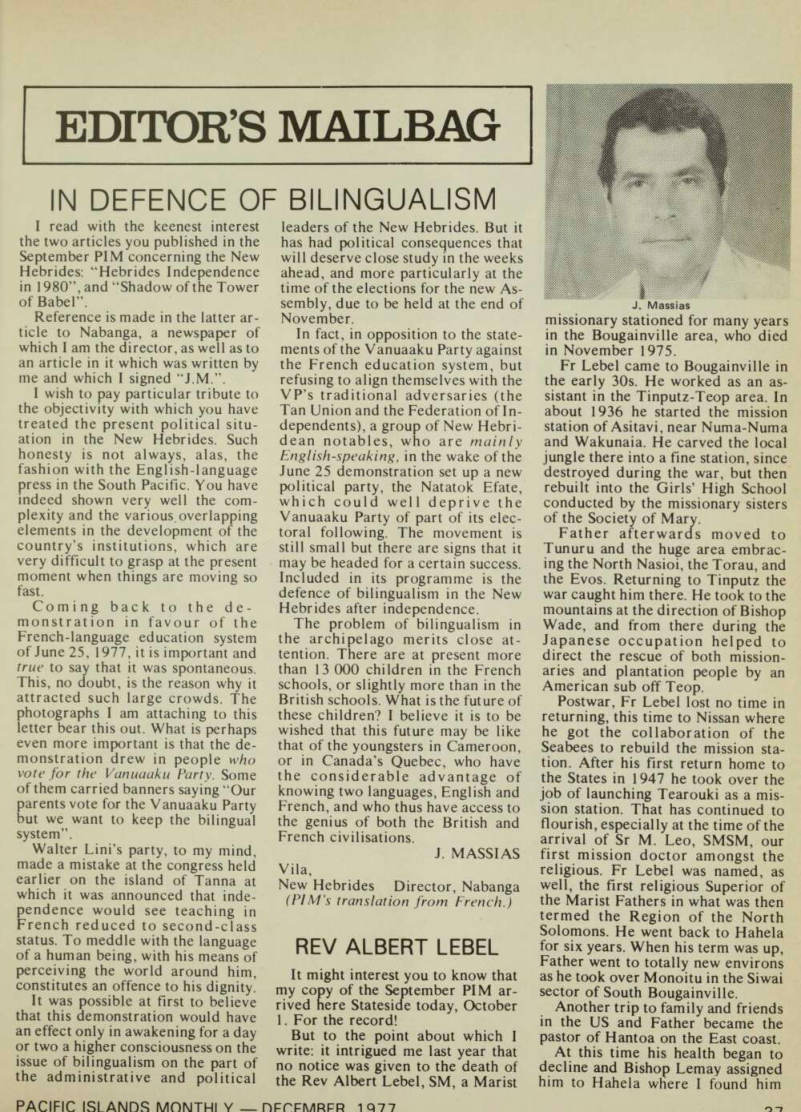

In Defence Of Bilingualism
I read with the keenest interest the two articles you published in the September PIM concerning the New Hebrides: “Hebrides Independence in 1980”, and “Shadow of the Tower of Babel”.
Reference is made in the latter ar ticle to Nabanga, a newspaper of which I am the director, as well as to an article in it which was written by me and which I signed I wish to pay particular tribute to the objectivity with which you have treated the present political situ ation in the New Hebrides. Such honesty is not always, alas, the fashion with the English-language press in the South Pacific. You have indeed shown very well the com plexity and the various, overlapping elements in the development of the country’s institutions, which are very difficult to grasp at the present moment when things are moving so fast.
Coming back to the de monstration in favour of the French-language education system of June 25, 1977, it is important and true to say that it was spontaneous.
This, no doubt, is the reason why it attracted such large crowds. The photographs I am attaching to this letter bear this out. What is perhaps even more important is that the de monstration drew in people who vote for the Vanuaaku Party. Some of them carried banners saying “Our parents vote for the Vanuaaku Party but we want to keep the bilingual system”.
Walter Lini’s party, to my mind, made a mistake at the congress held earlier on the island of Tanna at which it was announced that inde pendence would see teaching in French reduced to second-class status. To meddle with the language of a human being, with his means of perceiving the world around him, constitutes an offence to his dignity.
It was possible at first to believe that this demonstration would have an effect only in awakening for a day or two a higher consciousness on the issue of bilingualism on the part of the administrative and political
leaders of the New Hebrides. But it has had political consequences that will deserve close study in the weeks ahead, and more particularly at the time of the elections for the new As sembly, due to be held at the end of November.
In fact, in opposition to the state ments of the Vanuaaku Party against the French education system, but refusing to align themselves with the VP’s traditional adversaries (the Tan Union and the Federation of In dependents), a group of New Hebri dean notables, who are mainly English-speaking, in the wake of the June 25 demonstration set up a new political party, the Natatok Efate, which could well deprive the Vanuaaku Party of part of its elec toral following. The movement is still small but there are signs that it may be headed for a certain success.
Included in its programme is the defence of bilingualism in the New Hebrides after independence.
The problem of bilingualism in the archipelago merits close at tention. There are at present more than 13 000 children in the French schools, or slightly more than in the British schools. What is the future of these children? I believe it is to be wished that this future may be like that of the youngsters in Cameroon, or in Canada’s Quebec, who have the considerable advantage of knowing two languages, English and French, and who thus have access to the genius of both the British and French civilisations.
J. Massias
Vila, New Hebrides Director, Nabanga (PlM’s translation from French.)
Rev Albert Lebel
It might interest you to know that my copy of the September PIM ar rived here Stateside today, October 1. For the record!
But to the point about which I write; it intrigued me last year that no notice was given to the death of the Rev Albert Lebel, SM, a Marist
missionary stationed for many years in the Bougainville area, who died in November 1975.
Fr Lebel came to Bougainville in the early 30s. He worked as an as sistant in the Tinputz-Teop area. In about 1936 he started the mission station of Asitavi, near Numa-Numa and Wakunaia. He carved the local jungle there into a fine station, since destroyed during the war, but then rebuilt into the Girls’ High School conducted by the missionary sisters of the Society of Mary.
Father afterwards moved to Tunuru and the huge area embrac ing the North Nasioi, the Torau, and the Evos. Returning to Tinputz the war caught him there. He took to the mountains at the direction of Bishop Wade, and from there during the Japanese occupation helped to direct the rescue of both mission aries and plantation people by an American sub off Teop.
Postwar, Fr Lebel lost no time in returning, this time to Nissan where he got the collaboration of the Seabees to rebuild the mission sta tion. After his first return home to the States in 1947 he took over the job of launching Tearouki as a mis sion station. That has continued to flourish, especially at the time of the arrival of Sr M. Leo, SMSM, our first mission doctor amongst the religious. Fr Lebel was named, as well, the first religious Superior of the Marist Fathers in what was then termed the Region of the North Solomons. He went back to Hahela for six years. When his term was up, Father went to totally new environs as he took over Monoitu in the Siwai sector of South Bougainville.
Another trip to family and friends in the US and Father became the pastor of Hantoa on the East coast.
At this time his health began to decline and Bishop Lemay assigned him to Hahela where I found him
J. Massias
working on the history of the Marist missions in Bougainville. Being bilingual, Father was able to delve into our French resources of the early years.
In conclusion 1 simply want to salute Fr Lebel, Marist, priest, mis sionary and chief!
Rev Thomas B. Hogan, Sm
Marist Missions Washington, DC, USA
Gilberts Denial
The report in the October issue of PIM (p 15) “Gilbertese split on Ocean Island future” suggesting that the Opposition Party in the Gilberts House of Assembly sup ports the Banabans’ cause on Ocean Island is entirely misleading.
The Gilberts’ delegate quoted by the Banabans is not a member of the Assembly and has, at no time, been authorised by the Opposition to speak for them on this matter.
The policy of the Opposition on the future of Ocean Island is to maintain the integrity of the territo ry of the Gilbert Islands including Ocean Island.
Ieremia Taabai
Leader of Opposition, House of Assembly Gilbert Islands
Rabaul Air Fight
In the July issue of PIM (p 31) there was a reference to an article on page 39 of the March issue titled When the Rising Sun did barrel rolls over a battered Rabaul.
I somehow lost my copy of the March issue before getting a chance to read it. I was shot down over Rabaul on November 11, 1943, and in due course was a guest of that out standing man and coast watcher, Peter Figgis, until March 26, 1944.
W. F. Krantz
Captain, US Navy (retd).
St Paul, Minnesota • March issue on way! PIM
Slugged Yachties
I found Tardifs comments about Klaus Schaffer rather amusing (PIM Sept, p 28). Who, of the two, is un duly prejudiced? Schaffer says the Solomons Government is anti whitie and that the light fee is thinly disguised racism. Tardif finds this untrue after his two visits to the
Solomons. The amusing part is that Schaffer’s view was formed con siderably prior to June and prior to the new land and citizenship policy of the Solomon Islands Government which is blatant racism.
Tardif, however, was apparently in Gizo during the fervour when England was trying to tone down the Solomon Islands Government’s racist policy, the very subject of the lead article of the September 1977 PIM (ppB-10).
The News Drum, a Solomon Is lands weekly newspaper, has been full of racist statements about peo ple with “mixed blood” being unfit for land ownership or “first class” citizenship. It took considerable argument to get the Solomon Islands Government to back down from having “all-grandparents-born-in the-Solomons” a prerequisite for citizenship and land ownership.
Chinese, Gilbertese, and Europeans who have lived in the Solomons for whatever length of time (like Dr Fox) are somehow unfit to be first class citizens. The most alarming racist attitudes, however, are against Solomon Islanders of “mixed blood”. On my recent visit to the Solomons, I talked with several peo ple who were seriously afraid that, because their father was white, they would lose all of their land and their citizenship, even though they were born right in the Solomons. Who gets their land? Either the govern ment or the black half of their family.
People like the Tardifs are eager to raise a shout against a man who calls his cards as he sees them, a man who just happened to be astute enough to see some time ago what the Tardifs somehow cannot see when it is happening all around them.
It is a terrible thing for a white man to be a racist and a bigot but it’s OK for the poor under-privileged and uneducated blacks to be equally racist and bigoted. Why candycoat the obvious? Schaffer was proved correct by narrow-minded, ignorant bigots and racists of the worst kind, those men who are happily setting things up to rape their mixed-blood relatives, the whites, the Chinese, and the Gilbertese in the Solomons.
Tardifs of the world, open your eyes to what’s happening around you. You are condoning the worst kind of racism in your self-righteous objection to Schaffer’s honesty. You accuse Schaffer of creating racial problems which exist in the world today. He merely pointed them out.
Your insistence that such honesty be hushed up is what allows such rac ism to build and spread throughout the world. Let the Solomons government wear their racist pie.
Maybe the less racist people of the Solomons will stand up to prevent further abuse of human rights if there are any “less racist” people in the Solomons
John Fairbanks
Auckland
Advertisements & other items, pp. 37-39 (2 items)
37
PACIFIC ISLANDS MONTH! Y DFPFMRFR 1 Q 77
Good-Year
TRACTION HI-MILER HI-MILER G 8
For rugged 'stop-go' delivery work. Gives longer mileage and easier steering.
Round shoulder tire for highway trucks.
Assures extra traction on all surfaces, wet and dry.
TRACTION 100
With 3-T cord, stronger than steel, developed for bus and highway trucks.
SUPER ROAD LUG
Abrasion resistant extra-thick tread and deep-grooved, sharp angle lugs assure positive traction on all types of road surfaces.
ALL SERVICE
A non-directional mud and snow tire.
Reduces skidding and weaving. f ft i *5 I
til
m Va 'H
THE RIGHT TIRE FOR EVERY JOB
HIGHWAY - ON/OFF THE ROAD - CROSS COUNTRY
MASSEY UNIVERSITY
New Zealand
CERTIFICATE IN THE TEACHING
OF A SECOND LANGUAGE (ENGLISH)
Teachers of the English language or teachers who use English as the language of instruction for other subjects, may enrol for this special course of study.
AH tuition is by correspondence.
For details, write to: The Department of Modern Languages,
Massey University,
Palmerston North,
New Zealand.
Islands
From The
Press
From the Norfolk Islander: 18-CHARLIE recently had its second birthday, having achieved 3 518 trouble-free flying hours on scheduled service during that time and travelling one million miles! We are, of course, talking about Norfolk Island Airlines Super King Air Beechcraft aircraft. A congratulatory cable was received from Rollo Kingsford-Smith of Hawker de
Havilland, Sydney, conveying “Warmest congratulations to
Norfolk Island Airlines for this splendid record ...”
From the Arawa Bulletin, Bougainville: A Papua New Guinean, believed to be a former cannibal chief, has died in his home village in the Kokoda area of the Northern Province. He is Mr Roger Handu, believed to have turned 116 this year, who comes from Papaki village near Kokoda. A report received from Popondetta Office of Information recently, said that Mr Handu was one of the first cannibal chiefs to taste the flesh of the first Europeans when they patrolled the Kokoda area in the early British administration. Mr Handu was also one of the first group of Christians to be baptised when the Anglican Church brought Christianity into the Eiwo area in 1946. He had 27 grandchildren and 24 great grandchildren . ..
From Hiri, published by the Papua New Guinea Government Office of Information: VIOLENCE GETS THE CHOP. Advertising gimmicks showing violence to promote consumer goods have come under attack from Media Minister, Tom Koraea. Mr Koraea commented on one particular advertisement which gave the impression that a man's Kung Fu ability was directly related to his intake of meat pies. He stressed to advertisers, publishers, producers and others involved in mass media that they have a responsibility towards the community.
From the New Hebrides News, published by the British Residency Information Office, Vila: A girl aged 16 who was taking her dog for a walk with a metal lead was seriously injured, and the dog died of electric shock, when it urinated on a faulty electric sign.
From the South Pacific News Service of the Provisional Government of West Papua New Guinea: The “West Irianese” sports team that visited Wewak, the provincial capital of the East Sepik Province, on (East) Papua New Guinea’s Independence Day, was accompanied by a large group of Indonesians. Many of these were military intelligence officers. Papua New Guinean friends of the people of West Papua New Guinea noted that while the games were in progress these men were not at the sports venue. They were alarmed and dismayed to see these spies, unsupervised and unchecked, taking large numbers of photographs of various “points of interest" in Wewak. .
From Hulahaina’s column in Micronesian
Independent:
I ran into my favorite man, I will call him Weires, in a local tavern the other day. He is a great advocate of Micronesian unity. We talked for quite a while. Our conversation went like this: “Micronesian unity is shattered. Marianas is out, and Palau and the Marshalls are trying to get out. What can we do to preserve the unity of Micronesia?” my friend Weires inquired ... “let them go politically. But they cannot ignore us, because we are located in the same part of the Pacific. A poet once said: ‘So we grow together, like to a double cherry, seeming parted, but yet a union in partition; two lovely berries moulded on one stem’,” my poetic instinct urged me to say. “Yes, we are separated but located in the same ocean.
The waves that wash the shores of Palau, the Marshalls, and the Marianas also wash the shores of other districts,” Weires said. “Amen,” said I. Right after our conversation ended in the local tavern, I asked the waitress for two more Schlitzes.
We finished our drinks, and each went his separate way.
“Everything leads to nothing,” I thought continually as I drove home that night.
From Cher’s Column, Lae Nius: Honestly, you have to have a sense of humour here in Lae these days friend of mine phoned up, half laughing, half crying. Seems that her husband warned her that the potholes could damage their near-new car, and to dodge them if possible. So away she drives, weaving from one side of the road to the other when traffic clear, dutifully dodging potholes, only to be noticed by our boys in blue, and charged with drunken driving. This happened at about 9 am one day last week. It took a time to clear up the matter, all charges
dropped . . .
From Solomon Islands News Drum: Bride price for Gela women will be raised from $5O to $l5O if the Church of Melanesia approves this proposal at its next provincial synod. The Gela people feel that the present bride price is too low and asked the Church of Melanesia to help set a price acceptable to everyone on the island. One Gela man at the meeting, Henry Raraka, said that the $5O bride price was a mistake made in the 1950 s by a few Anglican priests who lowered the amount by sums of as much as $3OO or $5OO in terms of shell money. “Because it was done without the people’s consent, it has resulted in variations of bride prices on different parts of the islands,” Mr Raraka said. This had created friction between the people. “Sandfly islanders for example, have been charging $6OO and attempts by the Church of Melanesia and the Central Islands Council to control this have failed,” he said.
What does it cost to marry girls from other islands in the Solomons? The answer ranges from nothing to $2OO or more depending on where the bride comes from and her cultural background. In the Western District the cost of a bride is a token $5 which the girl shares with her relatives. Nearly half the South Sea Evangelical Church members do not follow charging bride price because the church opposes it. But many still cling to tradition . . .
From Nabanga, New Hebrides: A dramatic event occurred at Matantas, where Chief Henry Albos, 36, hanged himself on the evening of the celebrations marking the inauguration of the Fanafo-Matantas road . .
First inquiries suggested however that his unexpected action sprang purely from reasons of Custom. Several months before, in the course of a meeting of Custom Chiefs in the Big Bay region, to the east of the Jordan River, responsibility for all land in the region was vested in Chief Henry. He, in return, was obliged to offer as a gift a nubile daughter, or. failing that, commit suicide by hanging, thus assuring to his descendants dominance over the region. Since he had no daughter the Chief had to kill himself.
Advertisements & other items, p. 41 (1 item)
Tparker
V* A \ •> • » ie> »»> •A
Surprisingly slim ball pens
for such big-hearted refills.
m fi; /•: ! & K >? s ■■l* S' /<• •*r*» ' '• SH / S 3? 3$ !!!»■'» * •mJi Parker International Classic ball pens look lean and feel light but they're far from light on ink. Up to 80,000 words is what to expect from one refill.
The Parker ball point is tungsten carbide, the third-hardest substance there is, and it’s machined so accurately that we can offer it in extra fine, fine, medium or broad point sizes. From left: Stainles steel; Sterling silver; 12ct gold-filled; Vermeil (Sterling/gold); 14ct gold-filled.
tPARKER
World's most wanted pens 066.P.295D
Magazine
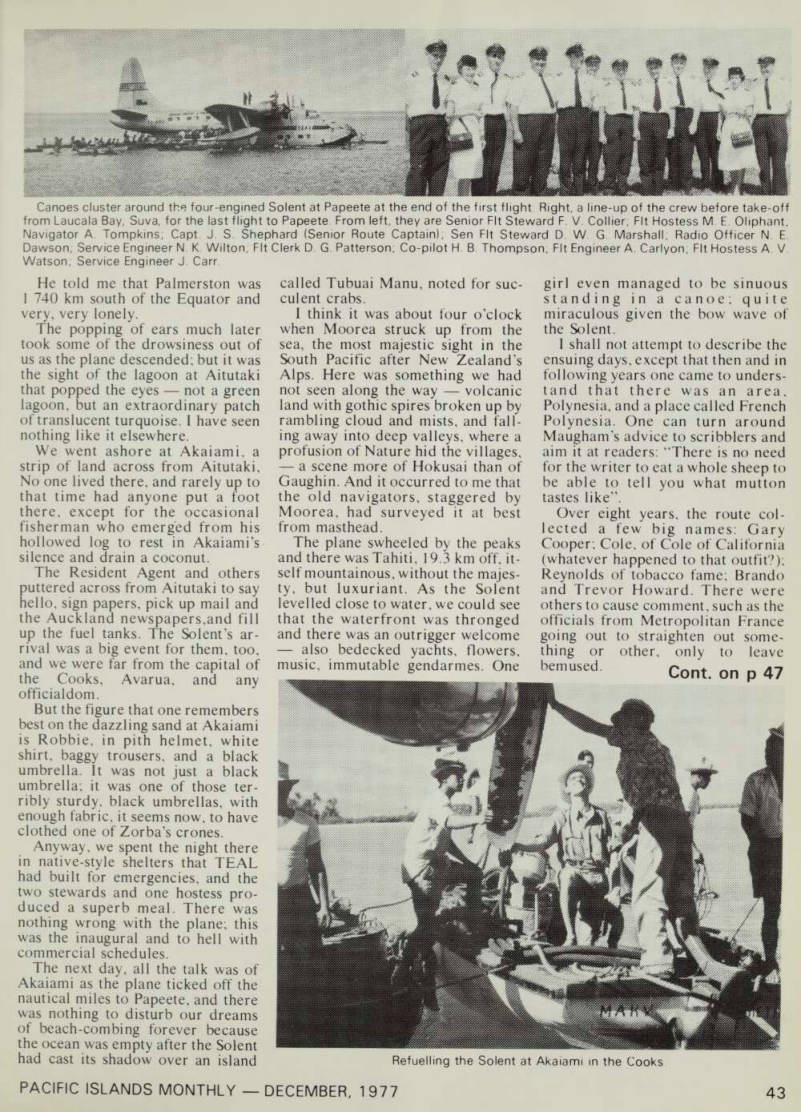
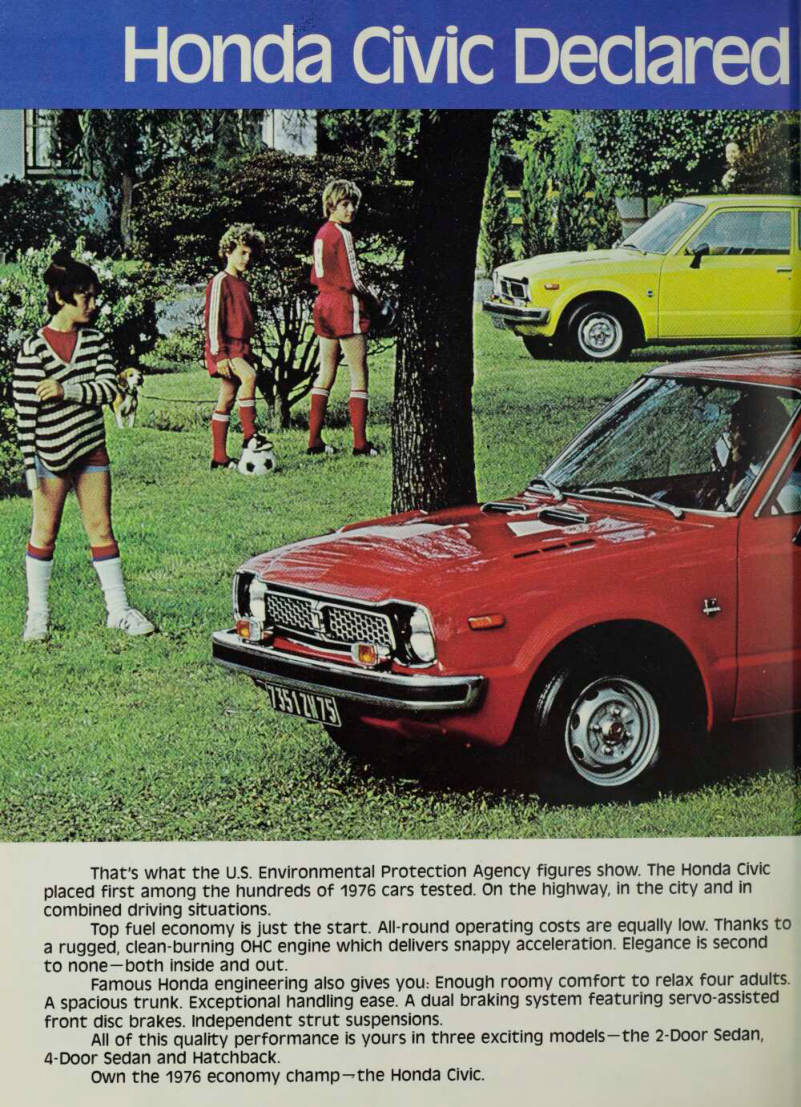

Frangipani flowers cannot float on concrete
By George Lynch
Twen ty-fi ve years ago, when Air New Zealand was known as TEAL, flying boats took off from Laucala Bay, Suva, as pioneers of a new chapter in aviation history, the opening of the Coral Route from Fiji to Tahiti.
Eight years later, the flying boat flew its last flight on the Coral Route, giving way to land-based air c r aft.
For me the past is yesterday, but flying home from Europe in a full Jumbo, with a late and irascible start and then a diversion to Jakarta, summons memories of better days in air travel.
They belonged, for me, to what must be recorded in aviation history as man’s most romantic air trek the Coral Route from Fiji to Tahiti, created for the flying-boat and in operation. 1952-60. Not long ago, really, yet that route was the preserve of few travellers by Jumbo standards: the era of the packaged hordes was then only an idea.
The Coral Route, created by TEAL (now Air New Zealand), was a crooked line running for 2 282 nautical miles. The flying-boat, at home among the flying fish and cruising yachts, would hop in daylight from lagoon to lagoon, tak ing two days usually to reach Tahiti.
The start was at Laucala Bay, Suva, before the day became clammy and the passenger cabin an oven. The passengers, only 46 at the most, would be in Aggie Grey’s hotel at Apia, Western Samoa, before sunset, 1 130 km from Fiji.
The next morning, it was early off the water to Akaiami, a tiny gem in the Cook Group, 1 432 km from Apia. Just a refuelling stop: usually.
It took a while to refuel from drums on a raft, but if everything worked, the flying-boat would be nodding in the gentle water off Papeete, 1 110 km to the East, again before sunset.
The Coral Route was formed because of New Zealand s re sponsibilities to the Cook Islands and Western Samoa, and Tahiti was tacked on in the hope that the ser vice would make money. New Zealand, like so many other countries then, was hot after the US dollar and the route certainly collected those, because Tahiti was
given its first international air service.
Mainland Americans, of dollar substance, flew at least 8 370 piston engined km from California to catch the flying-boat at Fiji.
I was on the first passenger flight, my first excursion into Polynesia.
The aircraft, a Short Solent, cruised at 290 km/h and rarely higher than 2 440 m. The cabin, un-pressurised, became as cool as an autumn morn ing. the seats would have been acceptable in the best of clubs: the early glass of French wine seemed to be outstanding to one living in post war, spartan New Zealand.
The first extraordinary event oc curred not far out from Suva. Cap tain Ross McHardy, a dapper skip per with a good flying-boat record in World War 11, told us he was going off-course to deliver an urgent bottle of medicine to a copra planter. Eventually the aircraft swept down towards the sea in war time-style, and someone in the crew dropped a cannister on to an island covered with orderly coconut trees, and ringed by a reef that frothed and spouted gallons of the Pacific.
About three hours later, we were over the rainy mountains of Western Samoa, over Mount Vaea with the tomb of Robert Louis Stevenson, lying, I remembered, where he long ed for it to be. The plane was soon
snipping open the lagoon at Satapuala, along a laneway flanked by coral heads, the most menacing of all sights on that journey.
The coming of the four-engined Solent was big news in Apia, for the people had been accustomed only to DC-3’s dropping in on a dusty air port, a blessing left behind by the American Forces. The reception was lavish, but the place did not ap peal to me. There was too much of a missionary influnce for my liking: the main island, Upolo, alone, had more than 100 churches. It was on another trip, on a documentary film assignment, that I found Samoa.
The magic then began after Samoa. Even the sea seemed to be bluer, I think now that, perhaps for us, a kind of point of no return had been passed.
We were cruising along, and I think some were sleeping Samoa off, when McHardy came down the aisle and suggested we take a look at “the most beautiful atoll” along the route, Palmerston Island. He said he’d gone a bit off-course so we could get a good view and there it was below, a sight this time beyond
imagination.
It was donut-shaped, more or less: outside the circle of pink and white, the calm blue sea, and inside the reef what looked like a sheet of glass which had been used, on the under side, for a colour experiment in vivid greens. There were huts, peo ple running about, a boat on its side in the sand, the skeleton of another half buried, and well-spaced palm trees.
Even the Solent was too fast then: a helicopter would have been better.
We had Robbie aboard R. W.
Robson, founder of the Pacific Is lands Monthly (PIM), and the Year Book: himself a walking en cyclopedia of the islands: a remarkable man now retired in
N.S.W.
He told me that Palmerston was 1 740 km south of the Equator and very, very lonely.
The popping of ears much later took some of the drowsiness out of us as the plane descended; but it was the sight of the lagoon at Aitutaki that popped the eyes not a green lagoon, but an extraordinary patch of translucent turquoise. I have seen nothing like it elsewhere.
We went ashore at Akaiami, a strip of land across from Aitutaki, No one lived there, and rarely up to that time had anyone put a foot there, except for the occasional fisherman who emerged from his hollowed log to rest in Akaiami’s silence and drain a coconut.
The Resident Agent and others puttered across from Aitutaki to say hello, sign papers, pick up mail and the Auckland newspapers,and fill up the fuel tanks. The Solent’s ar rival was a big event for them, too, and we were far from the capital of the Cooks, Avarua, and any officialdom.
But the figure that one remembers best on the dazzling sand at Akaiami is Robbie, in pith helmet, white shirt, baggy trousers, and a black umbrella. It was not just a black umbrella; it was one of those ter ribly sturdy, black umbrellas, with enough fabric, it seems now, to have clothed one of Zorba’s crones.
Anyway, we spent the night there in native-style shelters that TEAL had built for emergencies, and the two stewards and one hostess pro duced a superb meal. There was nothing wrong with the plane; this was the inaugural and to hell with commercial schedules.
The next day, all the talk was of Akaiami as the plane ticked off the nautical miles to Papeete, and there was nothing to disturb our dreams of beach-combing forever because the ocean was empty after the Solent had cast its shadow over an island
called Tubuai Manu, noted for suc culent crabs.
I think it was about four o’clock when Moorea struck up from the sea, the most majestic sight in the South Pacific after New Zealand’s Alps. Here was something we had not seen along the way volcanic land with gothic spires broken up by rambling cloud and mists, and fall ing away into deep valleys, where a profusion of Nature hid the villages, a scene more of Hokusai than of Gaughin. And it occurred to me that the old navigators, staggered by Moorea, had surveyed it at best from masthead.
The plane swheeled by the peaks and there was Tahiti, 19.3 km off, it self mountainous, without the majes ty, but luxuriant. As the Solent levelled close to water, we could see that the waterfront was thronged and there was an outrigger welcome also bedecked yachts, flowers, music, immutable gendarmes. One
girl even managed to be sinuous standing in a canoe; quite miraculous given the bow wave of the Solent.
I shall not attempt to describe the ensuing days, except that then and in following years one came to unders tand that there was an area, Polynesia, and a place called French Polynesia. One can turn around Maugham's advice to scribblers and aim it at readers: “There is no need for the writer to eat a whole sheep to be able to tell you what mutton tastes like".
Over eight years, the route col lected a few big names: Gary Cooper; Cole, of Cole of California (whatever happened to that outfit?); Reynolds of tobacco fame; Brando and Trevor Howard. There were others to cause comment, such as the officials from Metropolitan France going out to straighten out some thing or other, only to leave
bemused.
Cont. on p 47
Canoes cluster around the four-engined Solent at Papeete at the end of the first flight Right, a line-up of the crew before take-off from Laucala Bay, Suva, for the last flight to Papeete From left, they are Senior Fit Steward F V. Collier; Fit Hostess M. E. Oliphant, Navigator A. Tompkins; Capt. J. S. Shephard (Senior Route Captain), Sen Fit Steward D. W. G. Marshall; Radio Officer N. E.
Dawson; Service Engineer N. K. Wilton; Fit Clerk D. G. Patterson; Co-pilot H. B. Thompson; Fit Engineer A. Carlyon, Fit Hostess A. V.
Watson; Service Engineer J. Carr.
Refuelling the Solent at Akaiami in the Cooks.
Cont. from p 43
Over the years, the route bred a certain dottiness; in Auckland, any way, where a kind of club was form ed, meeting, according to whim, in a bar in Vulcan Lane or another, seedier, in Custom Street.
Dottiness. One traveller, a mate, turned up for work after Tahiti with a string of seashells around his neck, straw hat, floral shirt the whole imagined beach-comber bit. It was an admirable but silly thing to do in New Zealand in 1952; even in the reporters’ room of an afternoon newspaper.
He disappeared, but in time the word was passed around that he had become more than a bit religious.
And then he brought some journal from obscurity into passing pro minence by writing that the domestic DC-3’s, flying low at night, should carry fluorescent crosses under their wings, and we. looking up, would be reminded of God. We, his mates, were aghast; it was enough for an extraordinary meeting of the club.
He called on me in Sydney some years later, on his way to London.
He was okay.
The end began when the French Airline, TAI, flew a landplane into Bora Bora, another island with a left-over airfield, and with Alain Gerbault, the lonely and disillusion ed sailor, lying where it had once been peaceful to be. The landplane passengers took a 75-minute trip from there to Papeete in a local and less distinguished flying-boat.
Then South Pacific Air Lines, a Californian company, started a Super Constellation service direct from Honolulu to Bora Bora. A SPAL advertisement about that time in Travel News, the magazine of the Pacific Area Travel Assiciation, shouted: “Slash 2 650 miles and hundreds of dollars from the United States-Tahiti air route ... fly be tween Honolulu and Papeete over night.” What it meant to us was: “Slash off 2 650 miles of Paradise . bypass Samoa, Palmerston and Akaiami ... fly overnight and see nothing”.
So really, the end came before the jets. The landplane with piston engines, long-range and cruising from 5 180 m up, was enough to change the pattern of air travel over the South Seas. And in SPAL’s case, flying in from another direction, it
was perhaps as well to have scheduled the flight for night, because there is no string of Palmerstons or Akaiamis on that route; and if there was, no one 5 180 m up could get very excited about them.
The jets, bigger, faster and flying from 9 144 m up, eventually started to swoop into Tahiti from Los Angeles and from Auckland, and from elsewhere. After years of rumours and delays, the French had got on with the construction of a concrete airport where there was once a lagoon. We were told by friends down from Tahiti that it had started off as a half-hearted job. No wonder.
The later nuclear tests and the in cursions of the French military make another story.
I have just turned from the typewriter to gaze upon a wild and sinuous garden, and am reminded of the romantic, farewell touch of those other days, When one boarded the launch at Papeete to go out to the Solent, there was a hei (same as lei), placed around one’s neck. He was en couraged to throw a flower or two, or the lot, on to the lagoon, and if they floated back to land it meant that one would return to Tahiti, The frangipani, however, cannot float on concrete.
Advertisements & other items, pp. 44-48 (1 item)
That’s what the U.S. Environmental Protection Agency figures show. The Honda Civic
placed first among the hundreds of 1976 cars tested. On the highway, in the city and in combined driving situations.
Top fuel economy is just the start. All-round operating costs are equally low. Thanks to a rugged, clean-burning OHC engine which delivers snappy acceleration. Elegance is second to none-both inside and out.
Famous Honda engineering also gives you: Enough roomy comfort to relax four adults.
A spacious trunk. Exceptional handling ease. A dual braking system featuring servo-assisted front disc brakes, independent strut suspensions.
All of this quality performance is yours in three exciting models-the 2-Door sedan, 4-Door Sedan and Hatchback.
Own the 1976 economy Honda civic.
HONDA
HONDA MOTOR CO.. LTD. TOKYO, JAPAN
PAPUA NEW GUINEA: Steamships-Machinery P.O. Box 1, Port Moresby/TAHITI: Societe Tahitienne d Importation des Produits Honda B.P. 1665-Papeete/FIJI ISLANDS: Coral Island Motors P.O. Box 48 ManHc'o' ‘i nited Micronesia Development Assn. P.O. Box 238, Saipan, Mariana Li.-i* 9 i 95 ° /COOK ISLANDS: Cook Islands Motor Center Ltd. P.O. Box 74, Rarotonga/AMERICAN SAMOA: Samoan Holiday and Travel Center P.O. Box 968, Pago Pago/AMERICAN SAMOA: Haleck’s fA r^ C .! B ° xll38 ’ Pago p ago/GUAM: Mark’s Motor Co.. Inc. P.O. Box DV. Agana / WESTERN SAMOA: Motor Distributors (Samoa) Ltd. P.O. Box 576, Apia/SOLOMON ISLANDS: British Solomons °" Honiara/NEW CALEDONIA: Establissements Ballande Boite Postale No. 04 Noumea Cedex/TONGA: E.M. Jones Limited P.O. Box 34, Nuku’alofa/TARAWA: Gilbert & Ellice A S ,o a f n Q S Authority P.O. Box 488, Beito/NIUE ISLAND: S. Jessop & Sons Ltd. P.O. Box 71.
HPRmiwS NAURU: Nauru Cooperative Society. Republic of Nauru, Nauru Island Central Pacific/NEW HEBRIDES: Tropex International Ltd., P.O. Box 139, Port Vila.
COUNT ON VICTA
TO TURN GRASS INTO LAWN
VICTA
UTILITY 160
MOWER
Tough, rugged, lightweight and low priced, a mower without grass-catcher designed to handle the full range of grass cutting jobs from heavily weeded and long grass areas to fine lawns. Cuts close to trees and fences and new side chute sends the cut grass safely to the side. Powered by 160 cc Mark 4 2-stroke Victa engine with the easy pull-Zip Starter, multiposition height adjuster, fold-down handles and many more exclusive Victa features make the Utility a popular lightweight mower.
VICTA
SUPER 24
MOWER
4.
The big mower for big grass with a giant 61 cm (24 ) cut. It’s the mower for the big grass cutting jobs and municipal parks and gardens, sports grounds, roadside growth control as well as property owners with large areas of land. Solid construction, easy manoeuvrability and giant rear wheels handle rough ground effortlessly. Two free-swinging blades on the cutting disc absorb shock when hard objects are encountered, protecting the engine from damage.
Powered by a special power-boosted Victa 160 cc 2-stroke engine with the exclusive easy pull Zip Starter and many more features to make the big mowing jobs easier.
When you want tough reliable grass cutting, Victa has the mower for any job. And every Victa mower is backed by the widest service and spare parts network in the business.
Victa
TURNS GRASS INTO LAWN
L 83.8646
Prudential
G. M. Forsaith Aviation Underwriting Agency Pty. Limited are aviation underwriting agents for The Prudential Assurance Company Limited in Australia, the Pacific and South East Asia. For the security of The Prudential on your aviation insurance ask your broker, agent, or call Geoff Forsaith (02) 27 3834, Mike Neil (02) 27 7517, Bob Mitchelmore (09) 321 7303.
(\Vl\nO\ INSURANCE 1
G. M. Forsaith Aviation Underwriting Agency Pty. Limited N.S.W.: 31st Level Australia Square, Sydney, N.S.W. 2000. Telex AA 25037 W.A.: Prudential Building, 95 St. George’s Tee., Perth W.A. 6000. Telex A A 93324
I 25 I m. i ‘'Sr. t
mmm wSSSSsm
m-mm
Australia: Akar Place Denison St. Camperdown N S W 2050 Tel gft 1-3366/'Svensson (N.G.) Ltd.. P. O. Box 705, Fsrt Tel 2275/ Fiji Islands: Motibhai & Company Ltd . PO. Box 9175 Nadi ,- T . arr , Tel 72-165 'New Zealand; Pye Ltd . Consumer Product Division, 110 ML Eden Eden. Auckland Tel 686-437/ New Caledonia: Menard Freres, 275222 /Tahiti: EtablissementsComimpex. P.0.80x 200 : PapeeteTel: 20477/ New Hebrides Island: Burns Philip (New HebridesiCo, Ltd., Port Vila, New Hebrides >§land /Norfork Island: Burns Philip (Norfork IslandVCo,, Ltd.. PO. Box 21, Norfolk Island/ Samoan Islands; Burns Philip (South Seal Co.. Ltd . PO, Box 129, Pag©- Pago, American.,san^^ Apia. Western .Samoa /Mariana Islands: J.C. Tenorio Enterprises, PO Box*^7.^p^T^§44VB. /8,1 IS J Solomon: Security Electncal Co.. Ltd . PO Box 174. Honiara Enterprises Ltd PO Box 15. Rarotonga Tel: 2150. 2176 ’ " > *;‘V
Crystal-Clear Days
of Pure Stereo Sound!
Akai’s ultra-compact System-A Series stereo comes through like sunlight on a clear summer day, naturally bright and clean. Innovative Akai engineering perfectly matches each audio source’s sound spectrum for undistorted performance between Turntable, Receiver/ Cassette Deck and your choice of speakers. In all, purely professional component quality, complete with Akai’s vertical display rack. System-A stereo is designed to be your island of enjoyment. 9 >V til B B -»>i *4 I
SYSTEIII-1\
Audio & Video
AKAI
AKAI ELECTRIC CO., LTD.
Tokyo, japan
bronze misquotation
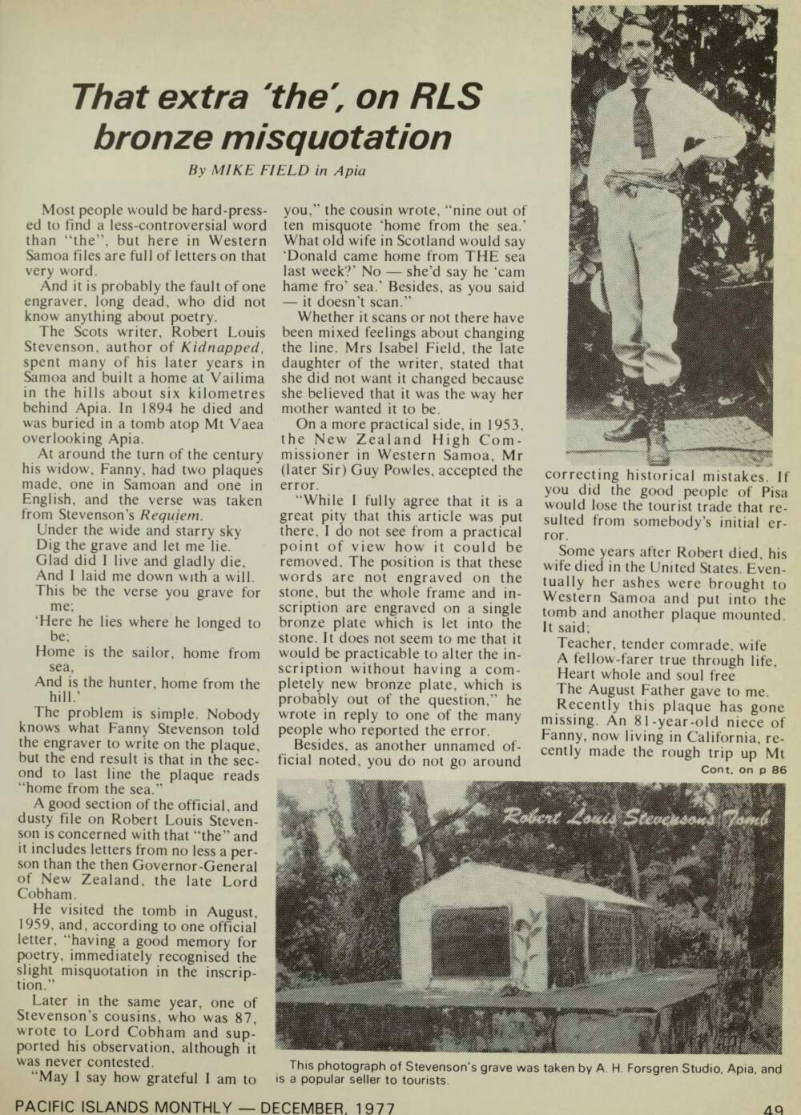
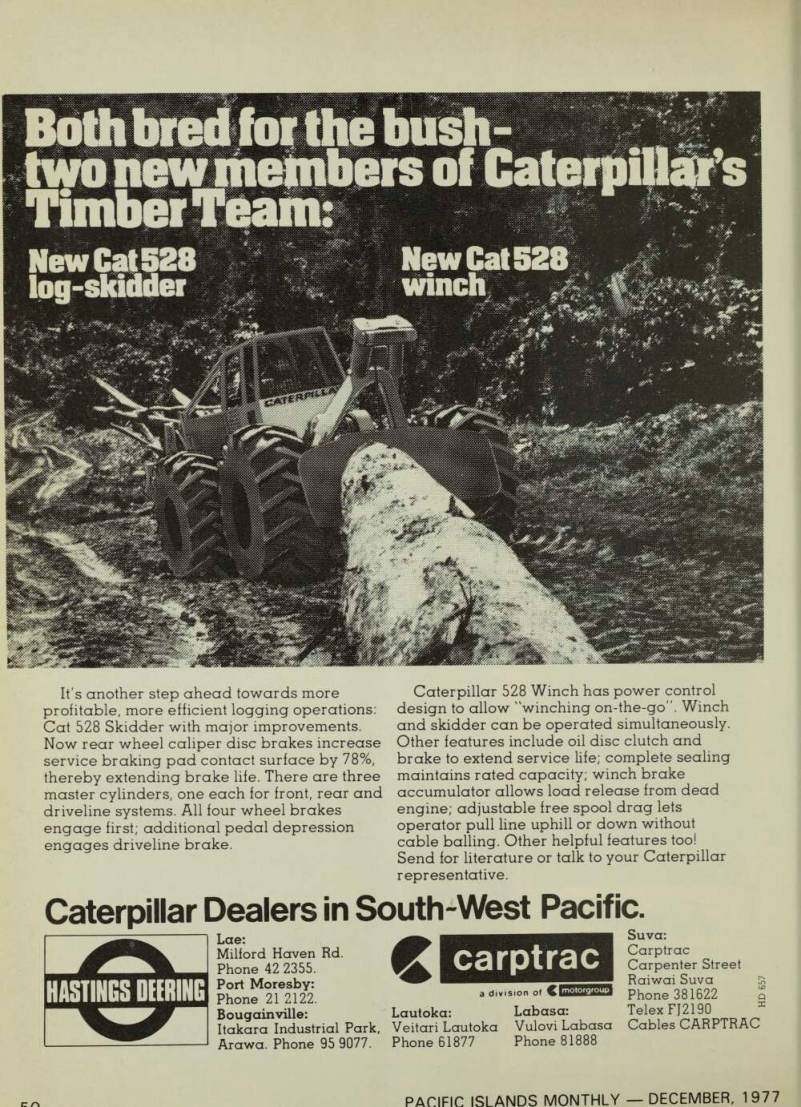
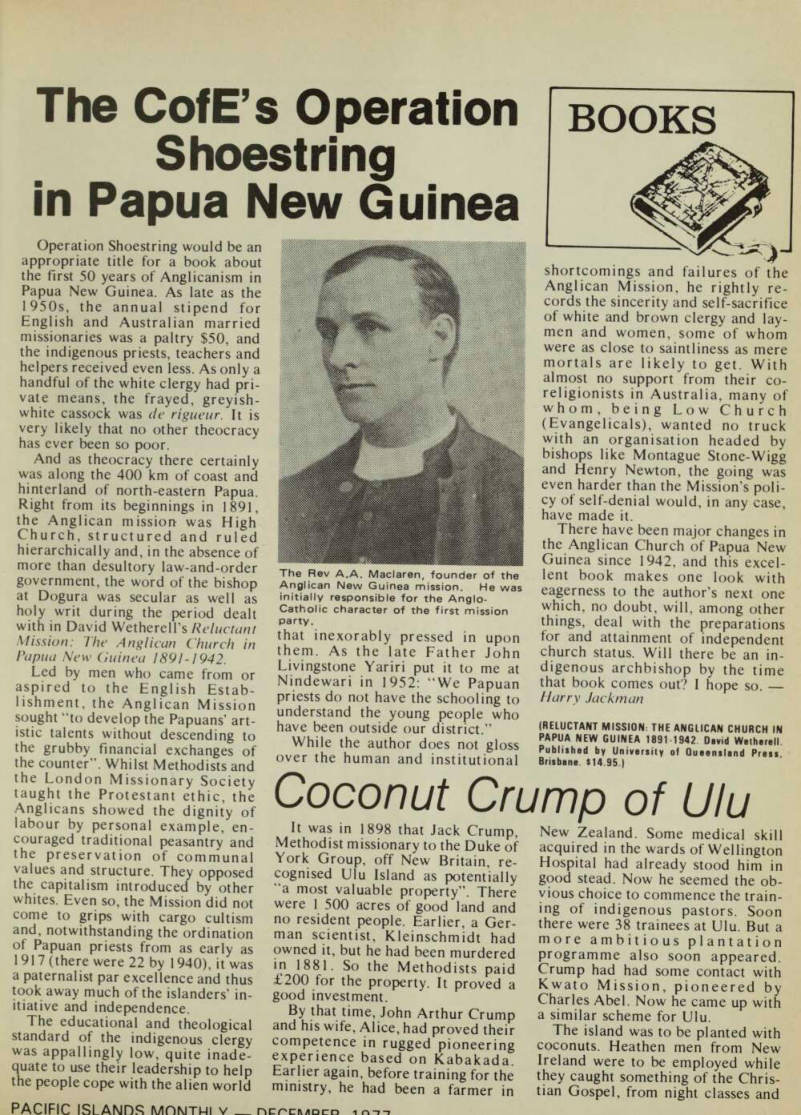

That extra 'the', on RLS bronze misquotation
By MIKE FIELD in Apia
Most people would be hard-press ed to find a less-controversial word than “the”, but here in Western Samoa files are full of letters on that very word.
And it is probably the fault of one engraver, long dead, who did not know anything about poetry.
The Scots writer, Robert Louis Stevenson, author of Kidnapped, spent many of his later years in Samoa and built a home at Vailima in the hills about six kilometres behind Apia. In 1894 he died and was buried in a tomb atop Mt Vaea overlooking Apia.
At around the turn of the century his widow, Fanny, had two plaques made, one in Samoan and one in English, and the verse was taken from Stevenson’s Requiem.
Under the wide and starry sky Dig the grave and let me lie.
Glad did I live and gladly die, And I laid me down with a will.
This be the verse you grave for me; ‘Here he lies where he longed to be; Home is the sailor, home from sea, And is the hunter, home from the hill.’
The problem is simple. Nobody knows what Fanny Stevenson told the engraver to write on the plaque, but the end result is that in the sec ond to last line the plaque reads “home from the sea.”
A good section of the official, and dusty file on Robert Louis Steven son is concerned with that “the” and it includes letters from no less a per son than the then Governor-General of New Zealand, the late Lord Cobham.
He visited the tomb in August, 1959, and, according to one official letter, “having a good memory for poetry, immediately recognised the slight misquotation in the inscrip tion.”
Later in the same year, one of Stevenson’s cousins, who was 87, wrote to Lord Cobham and sup ported his observation, although it was never contested.
“May I say how grateful I am to
you,” the cousin wrote, “nine out of ten misquote ‘home from the sea.’
What old wife in Scotland would say ‘Donald came home from THE sea last week?’ No she’d say he ‘cam hame fro’ sea.’ Besides, as you said it doesn’t scan.”
Whether it scans or not there have been mixed feelings about changing the line. Mrs Isabel Field, the late daughter of the writer, stated that she did not want it changed because she believed that it was the way her mother wanted it to be.
On a more practical side, in 1953, the New Zealand High Com missioner in Western Samoa, Mr (later Sir) Guy Powles, accepted the error.
“While I fully agree that it is a great pity that this article was put there, I do not see from a practical point of view how it could be removed. The position is that these words are not engraved on the stone, but the whole frame and in scription are engraved on a single bronze plate which is let into the stone. It does not seem to me that it would be practicable to alter the in scription without having a com pletely new bronze plate, which is probably out of the question,” he wrote in reply to one of the many people who reported the error.
Besides, as another unnamed of ficial noted, you do not go around
correcting historical mistakes. If you did the good people of Pisa would lose the tourist trade that re sulted from somebody’s initial er ror.
Some years after Robert died, his wife died in the United States. Even tually her ashes were brought to Western Samoa and put into the tomb and another plaque mounted.
It said; Teacher, tender comrade, wife A fellow-farer true through life, Heart whole and soul free The August Father gave to me.
Recently this plaque has gone missing. An 81-year-old niece of Fanny, now living in California, re cently made the rough trip up Mt
Cont. on p 86
This photograph of Stevenson's grave was taken by A. H Forsgren Studio, Apia, and is a popular seller to tourists.
Cont. from p 49
Vaea and seeing the loss, offered to replace the plaque.
This is not the first plaque to go missing. Another plaque, put on a seat near the tomb in the 1930’s by the Robert Loius of Scotland, went missing during World War Two. It turned up again, in 1963 on the island Guadalcanal in the Solomons.
And through all this letter writing and discussion the tomb site remains as one of the most beautiful spots in the Pacific.
The rugged climb from Vailima, now the official residence of the Head of State, His Highness Malietoa Tanumafili 11, is well worth it. Along a mountain stream, up through native bush and onto the flat top where, under a “wide and starry sky”, one can see most of the eastern side of Upolu with the mountains on one side and the wide blue Pacific on the other; the hills and sea, or is it the sea?
Advertisements & other items, p. 50 (1 item)
carptrac
It's another step ahead towards more profitable, more efficient logging operations: Cat 528 Skidder with major improvements.
Now rear wheel caliper disc brakes increase service braking pad contact surface by 78%, thereby extending brake life. There are three master cylinders, one each for front, rear and driveline systems. All four wheel brakes engage first; additional pedal depression engages driveline brake.
Caterpillar 528 Winch has power control design to allow "winching on-the-go". Winch and skidder can be operated simultaneously.
Other features include oil disc clutch and brake to extend service life; complete sealing maintains rated capacity; winch brake accumulator allows load release from dead engine; adjustable free spool drag lets operator pull line uphill or down without cable balling. Other helpful features too!
Send for literature or talk to your Caterpillar representative.
Caterpillar Dealers in South-West Pacific
c.
HASTINGS PEERING
Lae: Milford Haven Rd.
Phone 42 2355.
Port Moresby: Phone 21 2122.
Bougainville: Itakara Industrial Park, Amwa Phone 95 9077. £
carptrac
Lautoka: Veitari Lautoka Phono RIR77 a division of Labasa: Vulovi Labasa
Q 1 QQP
Suva: Carptrac Carpenter Street Raiwai Suva Phone 381622 Telex FJ2190 Cables CARPTRAC HD 657
Shoestring
Books
The CofE’s Operation Shoestring in Papua New Guinea
Operation Shoestring would be an appropriate title for a book about the first 50 years of Anglicanism in Papua New Guinea. As late as the 19505, the annual stipend for English and Australian married missionaries was a paltry $5O, and the indigenous priests, teachers and helpers received even less. As only a handful of the white clergy had pri vate means, the frayed, greyish white cassock was de rigueur. It is very likely that no other theocracy has ever been so poor.
And as theocracy there certainly was along the 400 km of coast and hinterland of north-eastern Papua.
Right from its beginnings in 1891, the Anglican mission was High Church, structured and ruled hierarchically and, in the absence of more than desultory law-and-order government, the word of the bishop at Dogura was secular as well as holy writ during the period dealt with in David Wetherell’s Reluctant Mission: The Anglican Church in Papua New Guinea 1891-1942.
Led by men who came from or aspired to the English Estab lishment, the Anglican Mission sought “to develop the Papuans’ art istic talents without descending to the grubby financial exchanges of the counter”. Whilst Methodists and the London Missionary Society taught the Protestant ethic, the Anglicans showed the dignity of labour by personal example, en couraged traditional peasantry and the preservation of communal values and structure. They opposed the capitalism introduced by other whites. Even so, the Mission did not come to grips with cargo cultism and, notwithstanding the ordination of Papuan priests from as early as 1917 (there were 22 by 1940), it was a paternalist par excellence and thus took away much of the islanders’ in itiative and independence.
The educational and theological standard of the indigenous clergy was appallingly low, quite inade quate to use their leadership to help the people cope with the alien world
that inexorably pressed in upon them. As the late Father John Livingstone Yariri put it to me at Nindewari in 1952: “We Papuan priests do not have the schooling to understand the young people who have been outside our district.”
While the author does not gloss over the human and institutional
shortcomings and failures of the Anglican Mission, he rightly re cords the sincerity and self-sacrifice of white and brown clergy and lay men and women, some of whom were as close to saintliness as mere mortals are likely to get. With almost no support from their co religionists in Australia, many of whom, being Low Church (Evangelicals), wanted no truck with an organisation headed by bishops like Montague Stone-Wigg and Henry Newton, the going was even harder than the Mission’s poli cy of self-denial would, in any case, have made it.
There have been major changes in the Anglican Church of Papua New Guinea since 1942, and this excel lent book makes one look with eagerness to the author’s next one which, no doubt, will, among other things, deal with the preparations for and attainment of independent church status. Will there be an in digenous archbishop by the time that book comes out? I hope so.
Harry Jackman
(Reluctant Mission: The Anglican Church In
PAPUA NEW GUINEA 1891-1942 David Wetherell.
Published by University of Queensland Press Brisbane. $14.95.)
The Rev A.A. Maclaren, founder of the Anglican New Guinea mission. He was initially responsible for the Anglo- Catholic character of the first mission party.
Coconut Crump of Ulu
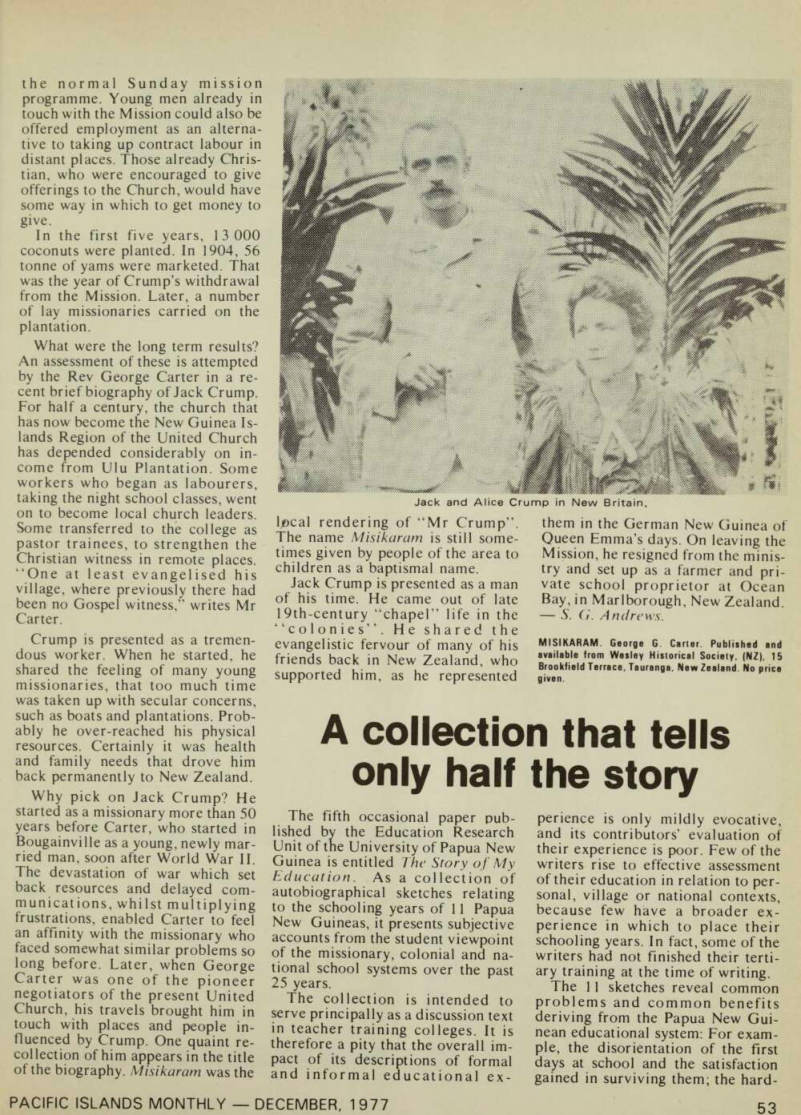
It was in 1898 that Jack Crump, Methodist missionary to the Duke of York Group, off New Britain, re cognised Ulu Island as potentially “a most valuable property”. There were I 500 acres of good land and no resident people. Earlier, a Ger man scientist, Kleinschmidt had owned it, but he had been murdered in 1881. So the Methodists paid £2OO for the property. It proved a good investment.
By that time, John Arthur Crump and his wife, Alice, had proved their competence in rugged pioneering experience based on Kabakada.
Earlier again, before training for the ministry, he had been a farmer in
New Zealand. Some medical skill acquired in the wards of Wellington Hospital had already stood him in good stead. Now he seemed the ob vious choice to commence the train ing of indigenous pastors. Soon there were 38 trainees at Ulu. But a more ambitious plantation programme also soon appeared.
Crump had had some contact with Kwato Mission, pioneered by Charles Abel. Now he came up with a similar scheme for Ulu.
The island was to be planted with coconuts. Heathen men from New Ireland were to be employed while they caught something of the Chris tian Gospel, from night classes and
the normal Sunday mission programme. Young men already in touch with the Mission could also be offered employment as an alterna tive to taking up contract labour in distant places. Those already Chris tian, who were encouraged to give offerings to the Church, would have some way in which to get money to give.
In the first five years, 13 000 coconuts were planted. In 1904, 56 tonne of yams were marketed. That was the year of Crump’s withdrawal from the Mission. Later, a number of lay missionaries carried on the plantation.
What were the long term results?
An assessment of these is attempted by the Rev George Carter in a re cent brief biography of Jack Crump.
For half a century, the church that has now become the New Guinea Is lands Region of the United Church has depended considerably on in come from Ulu Plantation. Some workers who began as labourers, taking the night school classes, went on to become local church leaders.
Some transferred to the college as pastor trainees, to strengthen the Christian witness in remote places.
“One at least evangelised his village, where previously there had been no Gospel witness,” writes Mr Carter.
Crump is presented as a tremen dous worker. When he started, he shared the feeling of many young missionaries, that too much time was taken up with secular concerns, such as boats and plantations. Prob ably he over-reached his physical resources. Certainly it was health and family needs that drove him back permanently to New Zealand.
Why pick on Jack Crump? He started as a missionary more than 50 years before Carter, who started in Bougainville as a young, newly mar ried man, soon after World War 11.
The devastation of war which set back resources and delayed com munications, whilst multiplying frustrations, enabled Carter to feel an affinity with the missionary who faced somewhat similar problems so long before. Later, when George Carter was one of the pioneer negotiators of the present United Church, his travels brought him in touch with places and people in fluenced by Crump. One quaint re collection of him appears in the title of the biography. Misikaram was the
Ipcal rendering of “Mr Crump”.
The name Misikaram is still sometimes given by people of the area to children as a baptismal name.
Jack Crump is presented as a man of his time. He came out of late 19th-century “chapel” life in the “colonies”. He shared the evangelistic fervour of many of his friends back in New Zealand, who , . . . ’ , supported him, as he represented
them in the German New Guinea of Queen Emma’s days. On leaving the Mission, he resigned from the minis try and set up as a farmer and pri vate school proprietor at Ocean Bay, in Marlborough, New Zealand.
S. G. Andrews.
MISIKARAM George G Certer. Published end S , oc '*'» ' N2 '- . 15 Brookfield Terrece, Tauranga, New Zeeland No once given
Jack and Alice Crump in New Britain.
Advertisements & other items, pp. 51-52 (2 items)
PACIFIC ISLANDS MONTMI v ncr'civ/iDco
in New Zealand
all girls are not alike...
When it comes to efficiency, simple operation, lowest running costs and a long and trouble free life, Portals equipment is without equal no-one ever regretted buying quality and to insist on Portals plant is to secure value second to none.
For pools the latest permanent sand media ranges include stainless steel ”C Series" plants for the smaller pools, the "H Series” for medium to large pools and horizontal or gravity filters suitable for even the largest complexes. Write to us for all water supply or industrial fluid treatment needs: nor are water and swimming pool treatment plants.
Portals
Portals Water Treatment (NZ) Ltd P.O. Box 13-558, Auckland 6, New Zealand Candy House. 11 Spring Street, Onehunga, Auckland Telephone: 661-079 (7 lines) Telex: NZ 21175 Telegrams: Portals Auckland.
PCI-PATERSON CANDY. PERMUTIT. BOBY. STELLA-META
PORTACEL, HOUSEMAN-HEGRO ALL PORTALS GROUP.
Do you want to do business in New Zealand?
Ask the bank which has
40% of the banking business
in New Zealand
The BNZ can give you full information on buying or selling in New Zealand and overseas. Ful information on investment movement of money, transfers of dividends etc., is also readily available.
There are offices everywhere, more tian 400 in fact.
Whatever your financial or trade needs, the BNZ can help you.
Bank of New Zealand
Wellington-Head Office, International D*iaon, Box 2392.
Sydney-GPO Box 507, Sydney. NSW. 2001 Melboume-GPO Box 528 E, Melbourne, Vc. 3001 Tokyo-Mr E. L Banks, Bank of New Zealand Representative Office, Japav Suite 240,:Shin, Tokyo Bldg, 3-1,3-Chromk Marunouchi, lOO.
Singapore-Mr R. F. Warren, Bank of New Zealand Representative Office. South East Asia. Suite 230,23 rd Floor, Ocean Bldg, Cotyer Quay, Singapore 1 London-PO Box 402. LondonEC4P.4,H.E.
Fiji, Suva-25 Victona Parade. Abo at Labasa, Lautoka, NadiJSigatoka, Ba.
Associated Banks inthe South Pacific, Bank of Western Samoa. Bank of Tonga. 7.6
only half the story

A collection that tells only half the story
The fifth occasional paper published by the Education Research Unit of the University of Papua New Guinea is entitled Ihe Story of My Education. As a collection of autobiographical sketches relating to the schooling years of 11 Papua New Guineas, it presents subjective accounts from the student viewpoint of the missionary, colonial and national school systems over the past
yf ars -
The collection is intended to serve principally as a discussion text in teacher training colleges. It is therefore a pity that the overall impact of its descriptions of formal and informal educational ex-
perience is only mildly evocative, and its contributors’ evaluation of their experience is poor. Few of the writers rise to effective assessment of their education in relation to per sonal, village or national contexts, because few have a broader ex perience in which to place their schooling years. In fact, some of the writers had not finished their terti ary training at the time of writing.
The 11 sketches reveal common problems and common benefits deriving from the Papua New Gui nean educational system; For exam pie, the disorientation of the first days at school and the satisfaction gained in surviving them; the hard
ship incurred by students having to provide their own food and the self reliance this produces; the painful rupture from village and family life occasioned by attendance at distant institutions, which is offset by village admiration for the successful scholar on his return.
In spite of the fact that each of the writers was a successful student, they suffered harsh punishments, ran away from schools, hated their teachers, were hampered by language difficulties, and saw, at the end of the schooling process, that their education was barely begun. It should be added that two important exclusions from the collection con cern the experience of female stu dents and drop-outs. How much more traumatic were their schooling years?
As literature, these sketches add marginally to the existent body of autobiographical writing from Papua New Guinea. Balaika Gonapa’s Surmounting Illness im presses as a harrowing yet dignified account, by a tragically sensitive in dividual, of education in life’s larger school. Only the inclusion of this piece brings to the collection the degree of perspicacity and emo tional impact familiar in the autobiographical writings of Hannet and Kiki, or of the lesser known Bagita, Bosomu and Kadiba.
It is my opinion that the generally bland texture of the collection derives from the way it came into being. The 11 sketches were judged best in a competition run by the Education Research Unit at the University of Papua New Guinea.
Contestants were instructed to cover certain points, judges were asked to assess by certain scales. The out come has been that only half of the published sketches rise above the prerequisite outline to form inte grated statements. Too often the writing falls to the banality of the cur riel um vitae . too rarely the anec dotal aside, the traditional song or the personal philosophy lend their texture. The writers obviously have felt too bound by the extingencies of the essay competition.
The collection might have been edited down by half to free its dynamic sections from the smother ing effect of replicated details.
Nigel Krauth.
The Story Of My Education: Autobiographies
OF SCHOOLING IN PAPUA NEW GUINEA. Edited by S. G. Weeks. Published by ERU, University of Pepua New Guinea. Port Moresby. K2.00|
Advertisements & other items, p. 54 (1 item)
Here It Is.
A REVOLUTIONARY BUILDING PRODUCT IN THE MOST VERSATILE MATERIAL...
ALUMINIUM.
r
• HOME OWNERS
• BUILDERS
• PUBLIC WORKS DEPTS.
• LOCAL GOVT. COUNCILS
• MISSIONS
522 This product WONT CORRODE, is lightweight YET STRONG. Permanent decorative colours •and carries a 40 YEAR WRITTEN GUARANTEE. 110 square metre (house) external walls is packaged into six boxes, 30cm width, 6cm depth, 360 cm long and WEIGHT is ONLY 180 kilos. (TOTAL EXTERIOR WALLS).
V- For further information and Full Product List
MAIL THIS COUPON!
TO:
SUNCOAST ALUMINIUM CO.
6-8 Currie St., Nambour Old. 4560.
P O. Box 20, Nambour.
Phone: 41 3615 / 41 2393 Results:
• EASILY TRANSPORTABLE
• EASILY FIXED
• AND ALL YOU NEED
IS A HAMMER AND NAILS!
Dear Sir, Please send me information on
ALUMINIUM WEATHER BOARDS.
Name Company Full Address i ■ I l
Newstudies Of
Islander Origins
Genetic studies by researchers from the Australian National University (ANU) are producing new evidence about the origins of populations in the Pacific.
A group led by the head of ANU’s department of human biology in the John Curtin School of Medical Re search, Dr Robert Kirk, has been studying the genetics of living populations in relation to disease and evolutionary changes.
As a by-product the results have been used to study the early move ments of man of Asia into the Pacific Dr Kirk says that archaeological evidence shows the earliest inhabi tants of New Guinea had no pottery and predated horticulture; earliest pottery began to appear in Island Melanesia about 4 500 years ago.
Similar types in Fiji, Tonga and Samoa and several hundred years later in the Marquesas, suggests Fiji as a cradle for the development of a proto-Polynesian culture which spread to Tonga and Samoa, then the central Pacific, radiating from there to Hawaii, Easter Island, Tahiti and back to the west, reach ing New Zealand about 1 000 years ago.
Intensive linguistic studies lend support to this view, as do measure ments of skeletal remains.
Dr Kirk says genetic studies can be used in two ways to give evidence about a people’s origins. The first involves looking for unique traits in specimens of blood and finding which populations have these traits; the other uses statistical techniques to combine results from many genetic systems into a single measure of genetic similarity, or dis similarity, of a population.
At present, among other studies, the researchers are studying the im portance of genetic factors in susceptibility to leprosy and malaria in Papua New Guinea, a tendency to obesity in Samoans and the effects of environmental changes in heart dis ease in Tokelau Islanders.
A Preacher In Png
An Australian Aboriginal writer, social worker and preacher, Doro thy Buyuminy, is spending up to three months in Papua New Guinea, studying book production and crea tive writing, bilingual education, and women’s educational program mes. Ms Buyuminy, who works in the bilingual education section of the Australian Government Depart ment of Education in Darwin, is one of 10 people to receive awards in 1977 under the Aboriginal Overseas Study Awards Scheme.
Advertisements & other items, pp. 55-56 (3 items)
55
PACIFIC ISLANDS MDNTHI Y DPTFIWIRFR 1 Q 77
Catalogue 1978
u
FOUNDED
S 90* xs 95
PACIFIC BOOK
CATALOGUE 1978
Over 1600 items offered for sale.
Margaret Woodhouse, New and Secondhand Books, 133 Macquarie Street,
SYDNEY, AUSTRALIA, 2000.
Phone: 27 5393.
Catalogue Price $3.
Free on request to libraries.
Fly the world's largest fleet...
Pan Am 7475.
747 miVAM 747 3 AD
P*W /KVI
747 z 747 AM 7f7
F¥WAM
747 If you're like us, you know a great thing when you see it.
Wide-bodied 747's are the fastest and most comfortable passenger planes available. And we fly nonstop to more U.S. cities than any other airline in the world including record-setting long range flights. No other airline can match our daily nonstop round trips between Tokyo and New York. We fly the world's longest commercial nonstops from Sydney to San Francisco. Building an entire fleet of 747's just made
good sense.
Our inflight service crews try very hard to meet your every need in the warmest, most personal
manner possible. Wide, spacious
cabins give you living room comfort as the world slips by.
Our 7475 P "Super Performer"
has lower fuel consumption, higher flying altitudes and faster speeds, making even the longest trip a little shorter. Pan Am's 7475 P is
Experience in tangible form.
You'll find Upper Deck Dining in the First Class lounge at the top of the spiral staircase. Enjoy a gourmet experience from a choice of four select entrees.
No matter where you fly in the world, you're always at home with Pan Am. We assembled the largest fleet of Pan Am 747's Experience makes the difference. 065. P. 285
r-> a r'lno ici a mhc momthi Y DECEMBER. 1977
Business
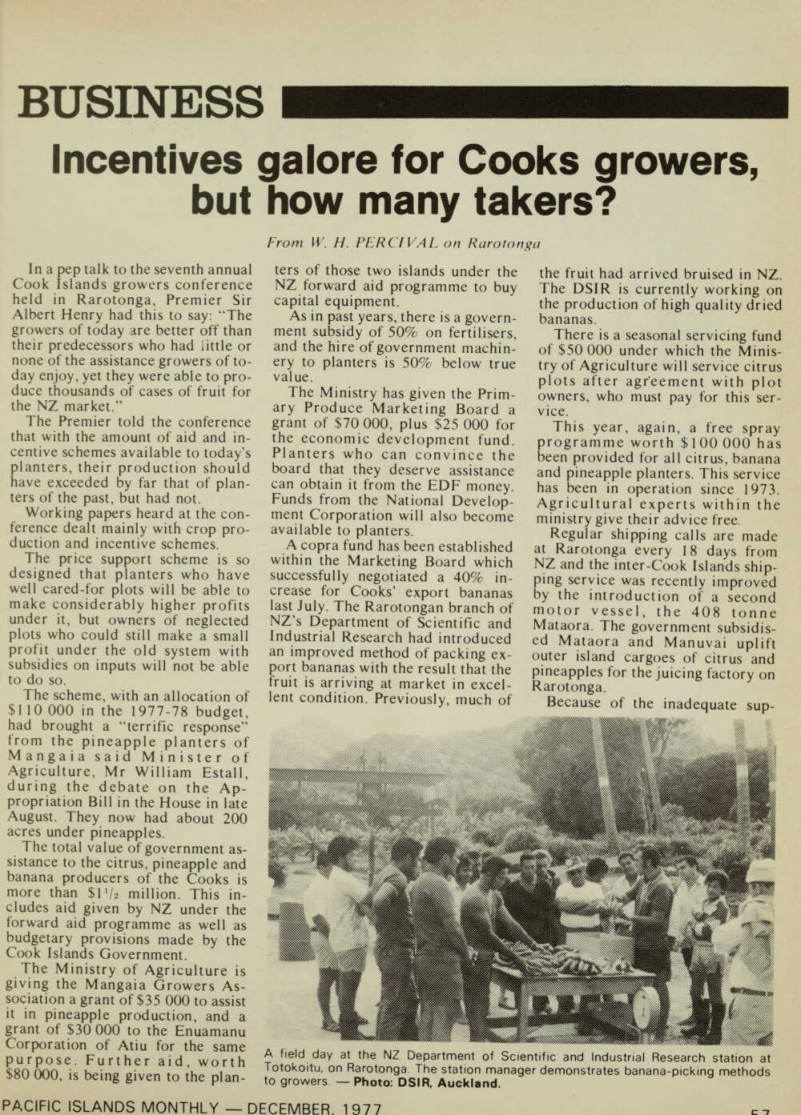


Incentives galore for Cooks growers, but how many takers?
From W. H. PERCIVAL on Rarotonga
In a pep talk to the seventh annual Cook Islands growers conference held in Rarotonga, Premier Sir Albert Henry had this to say; “The growers of today are better off than their predecessors who had little or none of the assistance growers of to day enjoy, yet they were able to pro duce thousands of cases of fruit for the NZ market.”
The Premier told the conference that with the amount of aid and in centive schemes available to today’s planters, their production should have exceeded by far that of plan ters of the past, but had not.
Working papers heard at the con ference dealt mainly with crop pro duction and incentive schemes.
The price support scheme is so designed that planters who have well cared-for plots will be able to make considerably higher profits under it, but owners of neglected plots who could still make a small profit under the old system with subsidies on inputs will not be able to do so.
The scheme, with an allocation of $llO 000 in the 1977-78 budget, had brought a “terrific response” from the pineapple planters of Mangaia said Minister of Agriculture, Mr William Estall, during the debate on the Ap propriation Bill in the House in late August. They now had about 200 acres under pineapples.
The total value of government as sistance to the citrus, pineapple and banana producers of the Cooks is more than sl'/ 2 million. This in cludes aid given by NZ under the forward aid programme as well as budgetary provisions made by the Cook Islands Government.
The Ministry of Agriculture is giving the Mangaia Growers As sociation a grant of $35 000 to assist it in pineapple production, and a grant of $3O 000 to the Enuamanu Corporation of Atiu for the same purpose. Further aid, worth $BO 000, is being given to the plan
ters of those two islands under the NZ forward aid programme to buy capital equipment.
As in past years, there is a government subsidy of 50% on fertilisers, and the hire of government machinery to planters is 50% below true
va i_Hf•
The Ministry has given the Primary Produce Marketing Board a grant of $7O 000, plus $25 000 for the economic development fund.
Planters who can convince the board that they deserve assistance can obtain it from the EDF money.
Funds from the National Development Corporation will also become available to planters.
A copra fund has been established within the Marketing Board which successfully negotiated a 40% increase for Cooks’ export bananas last July. The Rarotongan branch of NZ s Department of Scientific and Industnal Research had introduced an unproved method of packing export bananas with the result that the fruit is arriving at market in excellent condition. Previously, much of
the fruit had arrived bruised in NZ.
The DSIR is currently working on the production of high quality dried bananas.
There is a seasonal servicing fund of $5O 000 under which the Minis try of Agriculture will service citrus plots after agreement with plot owners, who must pay for this ser vice.
This year, again, a free spray programme worth $lOO 000 has been provided for all citrus, banana and pineapple planters. This service has been in operation since 1973.
Agricultural experts within the ministry give their advice free.
Regular shipping calls are made at Rarotonga every 18 days from NZ and the inter-Cook Islands ship ping service was recently improved by the introduction of a second motor vessel, the 408 tonne Mataora. The government subsidis ed Mataora and Manuvai uplift outer island cargoes of citrus and pineapples for the juicing factory on Rarotonga.
Because of the inadequate sup-
A field day at the NZ Department of Scientific and Industrial Research station at Totokoitu, on Rarotonga The station manager demonstrates banana-picking methods to growers Photo: DSIR, Auckland.
plies of fruit to Island Foods fac tory, a subsidiary of W. Gregg and Co of Dunedin, NZ, Greggs decided to cease Rarotonga operations on August 31. However, on July 21, the Cook Islands Government reached a new arrangement with Greggs which will allow the factory’s op erations to continue (PIM, Nov, p 88).
Under the new agreement Island Foods will carry on with a local par ticipation of 51%, those shares being bought initially by the govern ment. Later, the shares will be made available to Cook Islanders, especially planters who supply the factory with fruit.
Greggs will manage the factory and distribute the canned juice pro ducts, but this arrangement will be reviewed later. The board will com prise three local people, three nomi nated by Greggs, and an indepen dent chairman. The government also undertook to improve fruit pro duction, especially of citrus and pineapples. Citrus production in 1976 was 194 361 701 b cases and 60 226 cases of pineapples.
The air-freighting of market garden produce from Rarotonga to NZ started on a small scale in 1974 and has grown into a profitable business that does not need the sup port of the Price Subsidy Scheme.
However, the market gardeners re ceive the benefit of government-sub sidised fertilisers.
Mr Estall reported to the House in August that in 1976 market gar deners earned about $250 000 from this source, in addition to local sales. Produce exported included papaw, avocado pears, drinking coconuts, mangoes, breadfruit, tomatoes, beans, eggplants, mar rows, cucumbers, capsicums and tarotarua.
The Minister said: “May I remind members of the assembly that unless a response is forthcoming from the growers to the aid being given, I doubt whether we can do much in promoting the agricultural industry and achieving our aim of increased production.”
“Give me some Moa
Tongan chook”
Tonga is now processing local chickens and selling them under the trade name of Moa Ifo. The chicks are raised, dressed, packaged and supplied by Farmers Development Co Ltd. About 20 labourers are dressing 1 000 birds a fortnight.
Spokesman Mr Kali Vailahi says the aim is to increase production to about 60 000 birds a year.
Some chicks are bought from the Department of Agriculture and some from Fiji. They are butchered at seven to eight weeks and are sold at one price. The average weight per bird is about 1.35 kg. One plan for the future is to grade the chickens.
The giblets are packaged and
retailed. Retail price for the chickens and the giblets is below that of imported birds. An allied product, manure, is bagged and sold to gardeners.
The company is aiming at hatch ing all chickens in Tonga, and to manufacture feed for them from local corn, copra meal and cassava.
This will enable the birds to be sold even more cheaply.
Boost for Fiji fruit
exports planned
An Australian-owned company, South Pacific Foods Pty Ltd, is planning to lift production and ex port of fruit, fruit pulp and juice from Fiji’s Sigatoka Valley. The managing director of the company, Mr Peter Holdsworth, said the value of exports of passionfruit pulp and juice to the US should rise to about $3OO 000 from $ 1 00 000.
Australian buyers were prepared to take as much papaw and mango as growers could supply. He said he was expecting exports worth $5OO 000 not too far ahead.
W. R. C. buys
in big in Honolulu
W. R. Carpenter Holdings Ltd has extended its Pacific Activities to Hawaii with the acquisition of two companies which operate in the con struction and agricultural equip ment fields. For SUSI.O7 million cash they have acquired Bacon Co Inc, and Universal Equipment Co Ltd, both of Honolulu.
Franchises held by the two com panies will be retained. These in clude Ford tractor division pro ducts, Keohring cranes/excavators, Worthington compressors, the Melroe Bobcat range and Champ forklifts. The Carpenter group ex pects an expansion of the Hawaiian companies’ product range
Rubber factory
planned for PNG
The Dunlop rubber group in Australia has taken several firm steps towards setting up a rubber processing plant at Port Moresby.
Negotiations with the PNG Govern ment are at an advanced stage. The plant is expected to cost about $3.6 million.
Port Moresby is strategically
placed for such a plant as most rub ber is produced within a 150 km
radius of the city. The plant will use about 800 tonnes, or 18% of the an nual rubber production of PNG.
Initially, the plant will manufac ture small rubber items, such as car mats, mud flaps and brushes. A large part of the production will go to Australia and will be allowed in duty-free under the PNG-Australia free trade agreement. The market in Australia for those products is esti mated at close to $4 million a year.
The plant will give a boost to employment prospects in Port Moresby for it will require a work force of 400-500 locals.
Tonga to crush
its own copra
Tonga’s Commodities Board is erecting a copra crushing mill to process the kingdom’s copra output, which is expected to be working by Christmas. The mill is a joint ven ture between the Commodities Board and a group of Australian businessmen.
It is not yet known as to where the oil output of the mill will be ex ported but an informed source has stated that the main market will be Australia unless, as a result of pressure from local vegetable oil producers, the Australian Govern ment imposes a tariff on coconut oil going into Australia.
Apia’s brand-new
brickworks
Apia Concrete Products has in stalled a new automatic bnck-mak ing plant, costing about SWSIOO 000, and expects to double business. The plant is capable of producing 1.5 million bricks a year of a standard which will meet New
Zealand, British and American specifications. However, the de mand is not expected to reach capacity, so production will be scal ed down to about 750 000 bricks a year. More than 50 different types of bricks will be made, n
PaCITIC Travel Mart
mfiOtinn for Manila meBim 9 » or Manila A Pacific travel mart, sponsored by .the Pacific Area Travel As sociation, will be held in Manila from June 2-6, 1978. The meeting was endorsed by PATA’s board of directors at a recent session in Fiji.
The Pacific travel mart will be similar in concept to the highly suc cessful “Discover America Interna tional Pow Wow” held in the United States. The programme will bring together tour wholesalers and op erators from North America, Europe, Australia and other parts of the world to meet with the suppliers from the east Asia region, Guam and Micronesia on a pre-arranged appointment basis. Approximately 400 people from the travel industry are expected to attend, K| ew fftr RP blOic TOl Dr
j|l Nukualofa
Burns Philp (South Sea ) Co Ltd expects any day to see the com pletion of its new s'/ 4 million store in Nukualofa, Tonga.
The new Store, situated on the former Riechelmann Bros Store site, will at least give BP a perma nent place of operation since its former store was completely de stroyed by fire in 1970. From 1970 to the present time, BP has been op crating in three different premises leased from various people. Early
Solomon Islands Chief Minister Peter Kenilorea was in Australia in October and one of his jobs was to visit the CSIRO's fisheries research centre at Cronulla in New South Wales, which will be the temporary headquarters of the South Pacific Fisheries Agency planned by the South Pacific Forum and the South Pacific Conference The permanent headquarters will be in Honiara, the Solomons' capital Mr Kenilorea is pictured with Dr Garth Murphy, the senior fisheries biologist at Cronulla.
this year, BP bought the Riechelmann Bros Store and award ed the job of constructing its new building to the Tonga Construction Company. The local manager, Mr Furby estimates that the store should be in full swing by late November, early December.
Former UN men to
help Tongan fishing
A company designed to help the Tongan fishing industry has been registered by Henry Simpson, Hans Mose and George Lokan. The men became familiar with Tongan waters, fishing methods and needs while working with the United Nations Development Program me/Food and Agriculture Organ isation fishing project while station ed in Tonga.
The company, known as Western Pacific Traders Ltd, has a floating barge workshop, which will help to reduce the number of fishing days lost because of poor maintenance. It hopes to provide fishing gear for bottom line fishermen, trolling lines, hooks, lures, etc, which are not now readily available. The com pany will also be able to advise on fish farming.
Dr Geoff Glasby (above) of the Depart ment of Scientific and Industrial Research NZ Oceanographic Institute, Wellington, has been awarded the NZ Association of Scientists’ Research Medal and the NZ in state of Chemists' ICI medal for 1977 The NZAS medal is awarded annually to scientists under 40 for outstanding re search over the preceding three years, and the NZIC prize is granted to members of the institute for published research in the past five years Dr Glasby's interests include the study of factors controlling the distribution, geochemistry and mode of formation of manganese nodules in the South Pacific, particularly the South-eastern Pacific and Samoan basins, and their relation to the underlying sediment type
Export award
for food firm
An Australian firm, Scotts Foods Pty Ltd, has won its second export award given by the Department of Trade, and is aiming for a third. Mr Ralph Rivers, export manager of the company, has made many trips to the Pacific Islands since Scotts started exporting to that area in 1965. In recent years as Scotts has started to penetrate new markets in South-East Asia, Mr Rivers has con centrated on that area and on Pacific Islands north of the equator.
The criteria for these Department of Trade prestigious awards include an increase in sales, and a percen tage of total sales in export markets.
In the period when it won its award Scotts sales in export markets were worth more than $2 million. These sales included products marketed by Scotts on behalf of other compa nies. • Niue Island now boasts an up to-date all-trades open workshop at its only high school. The workshop and new sets of tools for training in all mechanical, building and joinery trades have been given by the Inter national Labour Organisation.
Advertisements & other items, p. 58 (2 items)
58
PAriFir ANDR MONTHLY DECEMBER, 1 977
Windmills
SOUTHERN CROSS
GALVANISED STEEL
PRE-FABRICATED
WATER STORAGE
TANKS
Capacities from 2,000 to 300,000 gal. •'TV 5 VERY STRONGLY MADE !! ! 16 gauge sheets heavily galvanised,with angle steel attens inside and out side wideoverlapping joints' Inside ladder ncluded with every tank.
SOUTHERN CROSS
va
WINDMILLS
STILL THE CHEAPEST
WAY TO' PUMP WATER
NO POWER COSTS///
• Heavily Galvanised • Automatic Governing • Self Oiling
SOUTHERN
SIZES:
6 ft. to 14 ft. Double Geared 17 ft. to 25 ft Direct Acting Towers from 20 ft. to 60 ft.
Full details and prices available from:
SOUTHERN CROSS MACHINERY
PTY. LTD.
39 GRANVILLE AVE., GRANVILLE, 2142, AUSTRALIA.
Telex: AA22663. Telegrams: 'SOCRQSS'.
El mm
ULqLd
* LOW COST
UPRIGHT DISPLAY
REFRIGERATORS
* BOTTLE & FOOD DISPLAY
frigid com drinks * LARGE CAPACITY * 2& 3 DOOR MODELS AVAILABLE IB Large capacity small floor space Maximum visual display Gleaming white, vinyl coated aluminium interior for better reflection of light within cabinet i Fluorescent lighting i 2" Frigidfoam insulation (equivalent to 4" Polystyrene or 6” cork!) ) Powered by heavy-duty Kelvinator sealed unit warranteed for 5 years
AVAILABLE FROM
• Attractive timber grain Marviplate exterior • Automatic frost-free, fan-assisted cooling gives even and faster cooling of stored products • 4 rows adjustable plastic-coated, hygenic, white shelves and floor tray • LOW MAINTENANCE, the only maintenance required being periodic cleaning of condenser • Illuminated sign in top panel optional extra.
Manufactured by: MVHILHDLC r num, AUSTRALIAN NEW CALEDONIA EXPORTS. 363 George St, Sydney. 2000.
BREGKWOLDT & CO., 276 Pitt St., Sydney, 2000.
HAGEMEYER (A’SIA), 59 Anzac Pde, Kensington,J 2o33 o/wt GEOFFREY HUGHES & CO, 167 Macquarie St, Sydney 2000.
NELSON & ROBERTSON PTY. LTD, 197 Clarence St, Sydney, 2000.
PFTFR FISHER TRADING PTY.LTD, 321 Pitt St, Sydney 2000.
E E RABOT (EXPORTS) PTY. LTD, 67 Castlereagh St, Sydney. 2000.
RABTRAD NIUGINI PTY. LTD., PO Box 1406, Lae.
A RIETTE (PACIFIC) PTY. LTD., 300 George St., Sydney, 2000.
H Y KWAN (AUST) PTY. LTD. Box 2713, GPO , Sydney, 2001.
C. SULLIVAN (EXPORT) PTY. LTD., GPO Box 3373, Sydney, 2001.
W.S. TAIT & CO, PTY. LTD, 31 Macquarie Place, Sydney, 2000.
rri
FRIGID CABINETS PTY. LTD.,
14A Puffy Ave., Thornleigh, N.S.W. 2120 Aust. Ph. 848 8292.
FC2.
Tongan Oil To Flow In '78?
Three wells on Tonga’s main is land, Tongatapu, are expected to produce commercial quantities of free-flowing oil next year.
One of the proposed drilling sites is in the heart of the capital, Nukualofa. The others are close to Fuamotu Airport.
A seismic survey by the Col orado-based oil exploration com pany Webb Resources has indicated a “probable strike”, says the com pany’s agent on Tonga, Mr Carl Riechelmann.
The company spent sl'/ 2 million on the survey which began five months ago, he said in Nukualofa in October.
Drilling equipment was expected to arrive in late November or early December and spudding in is likely in late January.
Mr Riechelmann said Webb Re sources has guaranteed to drill three wells. The cost will be about s4'/* million.
About 30 000 sacks of a com pound used in drilling are already in Nukualofa.
Oil seepages have been known in Tonga for many years. King Taufa’ahau Tupou IV has photo graphs of two in his palace, and has long hoped to see oil production in his economically struggling kingdom.
Mr Riechelmann said regular samples have been tested and estab lished as crude oil.
Asked if a well in the heart of Nukualofa would cause problems, he said; “They say it’s just a matter of pipes.”
Advertisements & other items, pp. 59-62 (3 items)
the Pacific has shifted
• 1 Western Samoa Niue Island Kiji Tonga
Its place in
Because now the Polynesian Triangle fare brings a Polynesian holiday much closer. Now when you visit Fiji you can include Tonga, Niue and Western Samoa for very little extra! Talk to your travel agent about working in our Polynesian Triangle fare with your Fiji itinerary. Only U55266.00* (AU55229.00 or NZ5237.00) more to see three more islands in the beautiful Pacific. Our Polynesian Triangle fare is available all year round with no minimum stopover restrictions and may be purchased while you are in Fiji or before you arrive.
Contact your travel agent for more details. * fare subject to change without notice. © Serving the heart of Polynesia
POLYNESIAN . ,
N VIS Km P-arvfct PO Box 599. Apia.
WESTERN SAMOA
PISCES DIESEL
GM's ANSWER TO THE
SMALL DIESEL MARKET!
• 27 hp. 2 cylinder. • 40 hp. 3 cylinder. • 60 hp. 4 cylinder, also: 27-10 kW Generator sets 40-25 kW Generator sets 60-37.5 kW Generator sets • Mechanical and Borg Warner gear-boxes. • Complete with heat exchangers and instrument wiring looms no extra.
Australian Distributors:
DIABLO DIESEL
212 Haldon Street, Lakemba, NSW 2195.
Phone 759 5306 759 0463.
Note: Export service available.
ALSO IN STOCK:
• Borg Warner reductions V/Drive Boxes. New & used parts service. • Fresh water heat exchangers. • Babbit disc shaft couplings.
To eliminate misalignment. • Alarm systems for flooding fire overheating low oil pressure.
1*
IN OUR 83RD YEAR SELLING
TO THE PACIFIC ISLANDS...
SERVICE’
Nelson&Robertson
PTY. LTD. (Established 1895) Plantation House, 197 Clarence Street, Sydney.
Cables: ‘IVAN% Sydney, Brisbane. Telex: AA22381, Sydney.
FOR:
INDENTS HARDWARE TRAVEL
FOODSTUFFS MACHINERY INSURANCE
SOFTGOODS SHIPPING REAL ESTATE
...FROM AUSTRALIA & OVERSEAS.
BRANCH OFFICES:
Nelson & Robertson Pty. Ltd., 303 Adelaide Street, Brisbane, Qld.
Nelson & Robertson Pty. Ltd., RO. Box 2092, Gout. Bldg., Suva, Fiji.
Nelson & Robertson Pty. Ltd., RO. Box 258, Lautoka, Fiji.
PAPUA NEW GUINEA
REPRESENTATIVES:
Rabtrad Niugini Pty. Ltd.
RABAUL
LAE
MADANG
KIETA
A look below the surface!
Not a pretty sight perhaps But the Quintrex hull is built tough. Not only special marine aluminium, but unique construction that adds great strength Continuously welded panels over a frame of rugged aluminium extrusions Built to take the pounding handed out by sea, rocks, concrete ramps, underwater snags.
On the Cruisabout above the surface - sleek fibreglass decking. Other models have tough aluminium decks.
Spend less time on maintenance and more time fishing - with any of the great range of Quintrex 5 metre boats.
Deliberately swamped 5 metre boat to demonstrate safety
SPECIFICATION
Overall Length - 5.0 m (16' 5") Maximum Width - 2.15 m (7' 1' ) Minimum Hull Depth - 0.96 m (3 2 )
FEATURES:
»Toughness. Famous Quintrex aluminium hull featuring the proven flared bow is tough and durable * Safety. Ensured by adequate quantity of foam plastic buoyancy. • Weight. Much lighter than a full fibreglass boat. Easy to tow. Saves on fuel and handling. • Transom. Built-in mounting for major engine and a small long shaft auxiliary. • Mechanical steering. lu/iTn/’
To: Quintrex Marine Pty. Ltd. 20-22 Yalgar Rd, Kirrawee NSW 2232 (Phone 02-5218444) Please send me details about Quintrex 5 metre boats and the name of my nearest dealer.
NAME
ADDRESS
(^utniitex
POSTCODE
Parifir |Ri Ands Monthly December, 1977
r> a /■'‘itrir' ici amhc iv/inMTUI v nFPFIVIRFR 1977
62
Pacific Transport
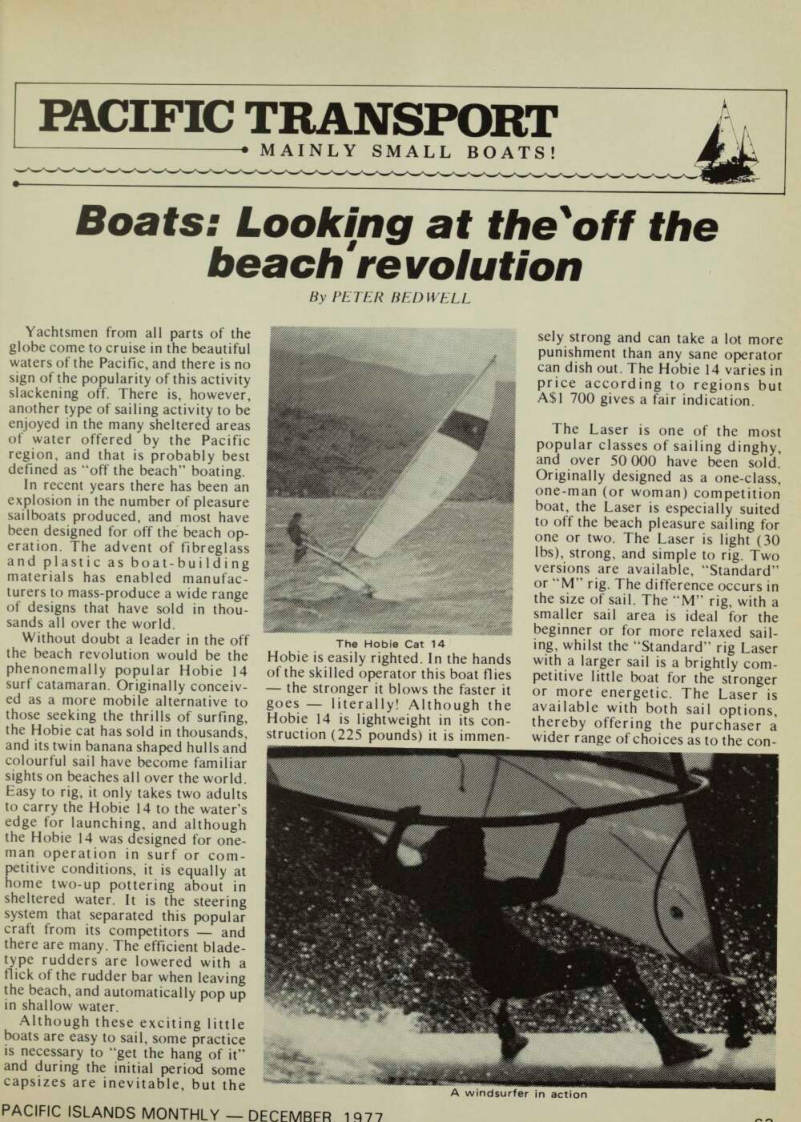
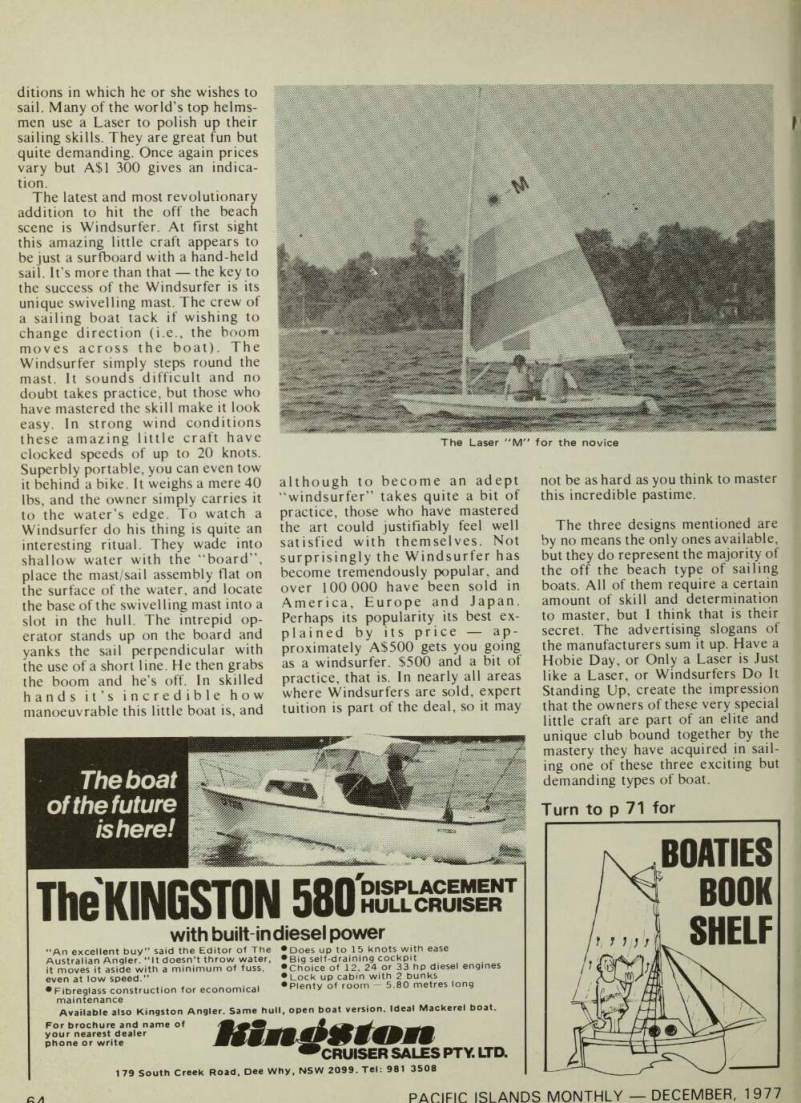
Mainly Small Boats!
Boats: Looking at the'off the beach "re volution
By Peter Bedwell
Yachtsmen from all parts of the globe come to cruise in the beautiful waters of the Pacific, and there is no sign of the popularity of this activity slackening off. There is, however, another type of sailing activity to be enjoyed in the many sheltered areas of water offered by the Pacific region, and that is probably best defined as “off the beach” boating.
In recent years there has been an explosion in the number of pleasure sailboats produced, and most have been designed for off the beach op eration. The advent of fibreglass and plastic as boat-building materials has enabled manufac turers to mass-produce a wide range of designs that have sold in thou sands all over the world.
Without doubt a leader in the off the beach revolution would be the phenonemally popular Hobie 14 surf catamaran. Originally conceiv ed as a more mobile alternative to those seeking the thrills of surfing, the Hobie cat has sold in thousands, and its twin banana shaped hulls and colourful sail have become familiar sights on beaches all over the world.
Easy to rig, it only takes two adults to carry the Hobie 14 to the water’s edge for launching, and although the Hobie 14 was designed for one man operation in surf or com petitive conditions, it is equally at home two-up pottering about in sheltered water. It is the steering system that separated this popular craft from its competitors and there are many. The efficient blade type rudders are lowered with a flick of the rudder bar when leaving the beach, and automatically pop up in shallow water.
Although these exciting little boats are easy to sail, some practice is necessary to “get the hang of it” and during the initial period some capsizes are inevitable, but the
Hobie is easily righted. In the hands of the skilled operator this boat flies the stronger it blows the faster it goes literally! Although the Hobie 14 is lightweight in its con struction (225 pounds) it is immen
sely strong and can take a lot more punishment than any sane operator can dish out. The Hobie 14 varies in price according to regions but Asl 700 gives a fair indication.
The Laser is one of the most popular classes of sailing dinghy, and over 50 000 have been sold.
Originally designed as a one-class, one-man (or woman) competition boat, the Laser is especially suited to off the beach pleasure sailing for one or two. The Laser is light (30 lbs), strong, and simple to rig. Two versions are available, “Standard” or “M” rig. The difference occurs in the size of sail. The “M” rig, with a smaller sail area is ideal for the beginner or for more relaxed sail ing, whilst the “Standard” rig Laser with a larger sail is a brightly com petitive little boat for the stronger or more energetic. The Laser is available with both sail options, thereby offering the purchaser a wider range of choices as to the con-
A windsurfer in action
The Hobie Cat 14
ditions in which he or she wishes to sail. Many of the world’s top helms men use a Laser to polish up their sailing skills. They are great fun but quite demanding. Once again prices vary but Asl 300 gives an indica tion.
The latest and most revolutionary addition to hit the off the beach scene is Windsurfer. At first sight this amazing little craft appears to be just a surfboard with a hand-held sail. It’s more than that the key to the success of the Windsurfer is its unique swivelling mast. The crew of a sailing boat tack if wishing to change direction (i.e., the boom moves across the boat). The Windsurfer simply steps round the mast. It sounds difficult and no doubt takes practice, but those who have mastered the skill make it look easy. In strong wind conditions these amazing little craft have clocked speeds of up to 20 knots.
Superbly portable, you can even tow it behind a bike. It weighs a mere 40 lbs, and the owner simply carries it to the water’s edge. To watch a Windsurfer do his thing is quite an interesting ritual. They wade into shallow water with the "board”, place the mast/sail assembly flat on the surface of the water, and locate the base of the swivelling mast into a slot in the hull. The intrepid op erator stands up on the board and yanks the sail perpendicular with the use of a short line. He then grabs the boom and he’s off. In skilled hands it’s incredible how manoeuvrable this little boat is, and
although to become an adept “windsurfer” takes quite a bit of practice, those who have mastered the art could justifiably feel well satisfied with themselves. Not surprisingly the Windsurfer has become tremendously popular, and over 100 000 have been sold in America, Europe and Japan.
Perhaps its popularity its best explained by its price approximately Assoo gets you going as a windsurfer. $5OO and a bit of practice, that is. In nearly all areas where Windsurfers are sold, expert tuition is part of the deal, so it may
not be as hard as you think to master this incredible pastime.
The three designs mentioned are by no means the only ones available, but they do represent the majority of the off the beach type of sailing boats. All of them require a certain amount of skill and determination to master, but I think that is their secret. The advertising slogans of the manufacturers sum it up. Have a Hobie Day, or Only a Laser is Just like a Laser, or Windsurfers Do It Standing Up, create the impression that the owners of these very special little craft are part of an elite and unique club bound together by the mastery they have acquired in sail ing one of these three exciting but demanding types of boat.
The Laser "M" for the novice
Advertisements & other items, pp. 64-68 (1 item)
The Kingston Mfembt
The boat
of the future
ishere!
The KINGSTON MfeMBT
with built in diesel power
'Does up to 15 knots with ease 'Big self-draining cockpit 'Choice of 12, 24 or 33 hp diesel engines 'Lock up cabin with 2 bunks 'Plenty of room 5.80 metres long “An excellent buy” said the Editor of The Australian Angler. “It doesn’t throw water, it moves it aside with a minimum of fuss, even at low speed.” •Fibreglass construction for economical maintenance Available also Kingston Angler. Same hull, open boat version. Ideal Mackerel boat.
For brochure and name of your nearest dealer phone or write
CRUISER SALES PTY LTD.
ier. nun, upcii
Himw*t*toon
•CRUISER SALES
1 79 South Creek Road. Dee Why, NSW 2099. Tel: 981 3508
Turn to p 71 for
BOATIES
BOOK
SHELF
I ‘So this is a Lamborghini/’ she breathed, as we sped down the autostrada towards Turin.
“Yes,” I said, offering her a Benson and Hedges. “Five forward gears and 170 in top.” ‘Can you prove that?” she demanded.
“Do I really have to? You did say you only wanted a little car to do the shopping. 1 • * nr * % V*-' Benson & Hedges.
When only the best Will do W 678 10/75
Quick, quiet, comfortable.
You'll start your flights on time, more times, aboard a reliable McDonnell Douglas DC-9 twinjet. That's because it's built for quick turnarounds.
The DC-9 carries its own passenger stair and power unit so you don't wait while equipment is rolled up to service the aircraft.
In the air, you'll find the 9's interior noticeably quiet.
A thicker aluminium skin and double insulation around the cabin isolate you from outside noise. And the engines are placed on the rear fuselage where they leave their sound behind.
Five abreast coach seating lets you unwind in wide-seat comfort.
Make you next flight quick, quiet and comfortable.
Book yourself aboard a DC-9.
%* ifT 4
. Negl «4
% V - How it tastes when it gets there depends a lot cm the it goes.
Australian produce. Fresh from the farm.
Meat, vegetables, fruit, seafood. Qantas can get it to Pacific and Southeast Asian markets in less than a day. And get it there in the prime top condition you expect. Unitised, palletised, air cargo Qantas offers you more capacity out of Australia to the world than any other carrier.
And because we’re Australian we can offer advice about where to order, who to order from, how much to pay. Ring Qantas or your Freight Forwarder. We’re always looking for fresh problems to solve.
OLHNTHS /~7
enrteo!®/
L 81.2846
Our engineers refused
to design a music center!
r the engineers at Kenwood, an
dio “system” doesn’t mean cramming
'ether a few components into a handy
x. It means carefully designing and
itching components. So that you get
t only fine balanced performance
m each one, but also that one vital
rredient that makes high fidelity—
ral quality. So if you’re thinking of ilding a component audio system that th looks and sounds great, you might e to think about this Kenwood line-up. 1-1500 integrated amplifier watts per channel minimum RMS driven into 8 ohms, through 20Hz to 20,000Hz, with no more than 0.1% total harmonic distortion.
Constructed the Kenwood way, with emphasis on stabilized power over long periods of use, and tonal quality. Simultaneous dubbing of two tape decks. Loudness control.
Tone controls.
KD-2055 semi-automatic belt drive turntable With new, Kenwood developed antiresonance, limestone resin-concrete base.
Wow-and-flutter 0.06% WRMS. Rumble better than 65dB (DIN wtd). Static balanced, S-shaped tonearm with low tracking error.
Automatic return and cut. Anti-skating control. Viscous-damped cueing.
KX-520 front-loading cassette deck Separate bias and equalization to match every tape. Wow-and-flutter 0.09% WRMS achieved by DC servo motor. Dolby* noise reduction system. 61dB signal-to-noise ratio using chrome tape, Dolby in. Frequency response 30Hz to 16,000Hz with chrome tape. Full auto shutoff in all modes.
LS-770 coaxial passive cone speaker system 80 watts maximum power input. 2-way, 2-speaker system using passive cone. 10" active cone woofer with hom tweeter coaxially mounted for excellent dispersion and localization. 10" passive cone provides extra bass response, with 3 different cone weights to match room acoustics. * Dolby is a trademark of Dolby Laboratories, Inc. •3 KX-520 r
|KENWOOO s
t I
Ill
rtfi«*
<£'« J |kenwo oo £ (T -sr= f ‘ L.w * i f f KD-2055 IIO-KENWOOD CORPORATION 6-17, 3-chome, Aobadai, Meguroku, Tokyo 153, Japan STRALIA TRIO-KENWOOD (AUSTRALIA) PTY. LTD, 30 Whiting St., Artarmon, N.S.W, 2064, Tel: 439-4322 nformation. please write to: PIM-SECTION, WOOD authorized Agents and Dealers: 1 ZEALAND JOHN GILBERT & CO., LTD. Tel. 30-839 tHE DOMINION IMPORT & EXPORT PROMOTIONS Tel. 72-165 PAPUA NEW GUINEA S O. SVENSSON (N G.) LTD Tel 24-2275/2285 NORFOLK ISLAND BURNS PHILP (NORFOLK ISLAND) LTD SOLOMON ISLANDS TECHNIQUE RADIOS CENTRE LTD. Tel. 416
NEW CALEDONIA HI-FI VOX Tel. 27-2466
NEW HEBRIDES RUE HIGGINSON Tel 2556
TAHITI MAI SON AURORE Tel 29703 T , eo AMERICAN SAMOA ISLAND PACIFIC AGENCIES, INC.Tel. 633-4687
REPUBLIC OF NAURU NAURU CO-OPERATIVE SOCIETY
MARIANA ISLANDS J.C.TENORIO ENTERPRISES Tel 6445
Books For The
Boaties
Book
Shelf
Books For The
Sea-Struck
JOHN COLLINS reviews a small armful of new American titles of interest to boating enthusiasts of varied types.
Waterspout!
Waterspout! The very name of this book would send shivers down the spine of most yachties. Written by Laura McCain, the story re counts what started out to be an idyllic cruise for the lady and her husband, aboard Camelot, and ended on a Papua New Guinea reef with the end of Laura and Charles McCain’s boat and home. As the foreword states, “One wonders why they are not confined to mental in stitutions ...”
The book runs almost the gamut of the disasters that can befall small cruising craft, not through bad man agement but just plain bad luck.
From a frustrating shakedown cruise, to gutting by fire and the ulti mate disaster of not just having a waterspout overtake the boat, but having it apparently develop over head and pounce down upon the luckless Camelot, dumping it on a remote reef and its owners into the water, with their cat B 1 drenched but safe and yowling, still aboard the wreck.
The story then recounts their re scue by Taiwanese fishermen il legally working Papua New Guinea reef waters, offloading to a remote village and transfer to a sailing dugout which leaked so much it had one crew member bailing cons tantly. Thence to a mission boat from Nimowa to Bwagaoia, by small aircraft from Misima to Alotau, Port Moresby, Brisbane and then home to the US. But not before the confiscation and destruction of the unfortunate 81, whom the McCains tried unsuccessfully to smuggle through Australia on their way home.
A thoroughly engrossing tale well told, though disappointingly, but understandably, not illustrated apart from a map and a few sketches.
Bedside Book
A review of The Book of Boats seems somewhat superfluous, for its editors, William and John Atkin, together with others such as Garden, Hanna, Herreshoff et ai, have pass ed into maritime legend.
The Book of Boats is really a combination of two previous books now sadly out of print, and though some of the material is dated, the reader can be enthralled by the retelling of boating life before plastics, chrome-plated everything and electronic gadgetry.
This is a book that can be picked up and put down at the whim of the reader, a book which describes sail ing and power boat designs, spins cruising yarns, tells facts about ropes and how to build a flat bottom skiff. Authors include John Hanna, William Garden, Thomas Gilmer as well as the Atkins, and there are several cartoons by courtesy of Punch by this writer’s favourite car toonist, Emett.
Two delightful features compiled and conducted under the dubious names of Messrs Cleat, Garboard and Ratline dispense such handy hints as how to get rid of mildew, how to waterproof canvas, check
cracks in wooden spars, find the capacity of cylindrical tanks, put oil on troubled waters, etc.
A real treasure trove for the reader who likes boats gaff-rigged, cotton-caulked and spartan, boats that are not plastic and lifeless and churned out like sausages but boats that live and are as individual as the men who design and build them.
Live-aboards
Six years of living aboard your own yacht should give a fair indica tion of just what is required to make such a life as comfortable and as convenient as possible. Jan and Bill Moeller have done just that and have written a book called simply Living Aboard to spread around a little of the knowledge they’ve pick ed up in their years of blue water meanderings.
This book is not another cruising yarn, but a practical guide to the cruising yachtie of recent vintage, on how to, what to, and what not to.
To those contemplating a lifetime or part thereof, of changing scenery, cooking at a 45-degree angle and ultimate togetherness, this book is a
textbook, and may even be the de cider.
Through 300-odd well illustrated pages the Moellers cover such diverse subjects as “How much does it cost?” bringing to light all those little extras that everybody else con veniently forgets, and “Climate con ditioning,” a good subject for cruisers of tropical waters, ex plaining air conditioning and how it can be adapted to a yacht, as well as heaters and heating. For the ladies there is “Below decks decor”, “Ac commodation”, “Where to stow it all” and “Boat housekeeping”.
There is one very edifying chapter called “Special problems of the live aboard”. Altogether a well-rounded book of live-aboard hints for cruis ing people who don’t happen to be retired millionaires with a 60 to 70 foot boat.
In much the same vein, and in deed from the same publisher, is Boat Living by Jack Wiley. At first glance I wondered “Why the he 11...” However, upon reading both books I see the method. Mr Wiley’s book is written from a slightly different angle and, though covering much of the same material, complements rather than competes with the Moeller work.
Boat Living covers not only sail ing craft, but houseboats, motor cruisers, etc, modifying, main tenance and children living aboard.
Once again, this is a book for the more modest bankroll, delving rather heavily into the real costs and money problems encountered while cruising or while moored and work ing ashore.
Naturally, being published in the United States, both books maintain a somewhat American flavour, through apart from variations in currency and laws, the problems relating to living aboard your own boat are much the same everywhere, except in the Australian State of NSW where it’s not allowed at all for longer than six weeks.
Eva Palasti Brown . . . now there’s a name to conjure with. And boyoboy the culinary delights this lady has conjured up in just 90 pages is really something else.
The book is illustrated by the lady’s husband, Denis, who is, says the cover blurb, a respected painter.
He must have been drooling at the time, for, delightful as they are, all the pictures are in black and white.
Called the Blue Water Cook Book and spiral bound, it covers what to buy, how to stow suDDlies.
furnishing the galley, hints on pre paring and catching fish, breakfasts, lunches and dinners, salads, desserts and in case you overdo the whole thing, or don’t follow the recipe, a chapter called “Sickness at sea”.
Imagine, if you will, this writer and three companions aboard his diminutive craft, armed with three freshly caught bream, a dinky two burner stove, one rather tatty coconut and some miscellaneous bits and pieces that had been rum
bling around the bilges for quite
some time, all converted, with Eva Palasti Brown’s guidance, into a re past that had us belching with satisfaction and yarn-spinning over the wine until late at night. (WATERSPOUT!, by Laura McCain. Publish ed by Crescent Publications, Los Angeles, USA.
Sus 3 95 )
(THE BOOK OF BOATS, by William and John Atkin Published by International Marine Publishing Company 21 Elm Street, Camden, Maine. USA. SUSB 95 ) (LIVING ABOARD, by Jan and Bill Moeller Published by International Marine Publishing Company, 21 Elm Street, Camden, Maine USA
Susi 2 50)
(BOAT LIVING, by Jack Wiley Published by International Marine Publishing Company
Susb 95.)
(BLUE WATER COOKBOOK, by Eva Palasti Brown Published by International Marine Publishing Company SUS 4 95 )
Advertisements & other items, pp. 69-70 (1 item)
UniFridsp
UniFridgo
A
MARINE
SOLID STATE
REFRIGERATION
• No noise or Vibration • No maintenance • No Compressors or Piping • No Freon Gases • Low Power Consumption • Unaffected by motion or level • Only moving parts Two low speed, ultra quiet long-life fans • Store food where the ice used to be • 2 year guarantee The “ Unifridge” was developed from cooling modules used in aerospace applications where low power drain, low weight and absolute reliability are required. These modules pump heat from the inside of the icebox to the outside through the cooling fans.
SIMPLE DO-IT-YOURSELF INSTALLATION
COCO CA dutyfree
ON REQUEST
SPECIFICATIONS
DIMENSIONS: 10” x 10” x 5”
WEIGHT: 1 0 pounds
POWER SOURCE REQUIRED: A 12 volt
DC battery will draw an average 2 amperes with the thermostat on. A 120 amp. battery will operate the unit for two or three days without recharging.
CAPACITY: Will refrigerate a 5 cu. ft. icebox insulated on every side with 2” polyurethane foam or equivalent.
TEMPERATURE: Thermostatically controlled to maintain standard refrigeration temperature.
INSTALLATION: Can be installed in any accessible side of your icebox, which is ventilated and protected from spray.
UniFridsp
AGENTS WANTED
YACHTING PARTNERS PACIFIC PIY. LTD.
337 Queensberry Street, North Melbourne, 3051 Phone: (03) 328-3583. Telex: 32571
Epiglass Everdure Timber preservative and sealer.
Hardens, protects and densities timber.
Kills all mould spores and permanently SJd seals out moisture.
SEALER
Epiglass 90 Epoxy Resin and glass cloth.
Easy to apply.
Strengthens hulls, eliminates water absorption and rot and increases the value and life of feiiN. your boat. BTQe®
Trying out a fisherman’s

cruiser
By John Collins
I must admit to being a little nonplussed at being requested to follow my nose to Pittwater, north of Sydney to try out the Kingston “Angler”, a diesel-powered open displacement launch. Though being a lover, and owner, of displacement type boats, I still have an aversion to the completely open variety, preferring the few creature comforts provided by a small cabin.
On joining one of the Kingston’s builders and stepping aboard, I found it hard to dispel the impression that I was standing inside a disembowelled liner. The amount of room was indeed vast. Here was a small boat one could actually walk inside. A good five paces from bow to stern, none of the shuffling around things and stepping over gear that one gets used to on small craft - The sole was completely clear of all obstructions except for a small !£? “ i n * r a e J the ,Y eS ~m ca e , a tWO c yl inc^er Lister diesel, of 25 hp.
My chaperone started the engine and reversed out of the marina berth. There was very little vibra tion and virtually no mechanical noise, just a comforting throb from the well-muffled exhaust, just enough to let you know that every thing was functioning correctly.
A quick trip to a nearby wharf to buy some film brought to light another big plus for the Kingston, When tying up, one does not have to scramble around precarious, nar row, side decks, or through forward hatches designed for midgets. One simply ambles to the appropriate side of the bow and drops a line around a convenient piling.
With a length of 19 ft, and not much less on the waterline, the dis placement speed should be around eight knots. In fact the builders claim that 15 knots can be achieved with the 33 hp diesel The boat doesn’t actually plane,' which ac-
Coplt. Oh P 75
Cont. from p 73
counts for the very comfortable ride, but a little over-powering brings the boat enough extra speed to allow her to run for cover in dirty weather.
Since it was early morning and Pittwater is virtually an enclosed waterway, there was no chance to try the performance in any sort of a chop, however cutting across the wakes of other boats indicated a very stable ride. Indeed, with my 12 stone riding on one gunwale there was no indication of any difference in trim at all.
Steering is by tiller which is at the
same time light and very positive.
The helmsman can either stand or sit on the full width seat in the stern where he is within easy reach of the throttle and gear lever.
After a couple of hours of delightful pottering around, I had to rethink my attitudes toward open boats, at least to the Kingston. That huge self-draining floor had heaps of advantages. The addition of a surrey-type sun top would make it an ideal and economical resort or sight-seeing boat. • //■you must have your cabin, bunks, toilet, stove and all there's always the Kingston 580 with the same hull and choice of engines.
Taa Or Ansett For
Pacific Routes?
There is a growing need for one of Australia’s domestic carriers to be licensed for regional carriage in the Southwest Pacific, Mr Alasdair Buchanan, director of the Tonga Visitors Bureau, told the recent seminar organised by the Townsville College of Advanced Education (PIM, Oct, p 24).
Mr Buchanan is also a director of PATA and president of the Pacific Islands Tourism Development Council.
“Qantas must be given full credit for its efforts in developing the out bound Australian tourist market to the islands,” he said.
“But Qantas is a long-haul car rier, and this raises the important question of whether Qantas, while developing its long-haul role, can continue to operate what, by com parison, is a short-haul regional market in the South Pacific.
“Giving a licence to one of Australia’s domestic carriers would complement Qantas services.
“The domestic carriers have the equipment, the distances are suited to the equipment, and most regional airports either now or in the near future will be able to handle 727 aircraft.
“The islands of the Southwest Pacific should be to Australia and New Zealand outbound markets what the islands of the Mediterra nean are to the European market.”
Mr Buchanan also suggested that the most meaningful step toward regional co-operation in the South west Pacific would be for the Australian Tourist Commission to take the initiative in organising a “Discover the South Pacific” pro motion during 1978.
Union S Ro-Ro Ship
For Islands Run
The Union Steam Ship Co of NZ Ltd is to introduce a roll-on roll-off (RO-RO) ship to the Auckland- Pacific Islands service in December.
The ship chosen, the Marama, has been on the trans-Tasman service for nine years.
The Marama will replace the con tainer ship. Union South Pacific, which is on charter. The Marama will operate on a fortnightly fre quency from Auckland to Lautoka, Suva, Apia, Pago Pago and Nukualofa.
Advertisements & other items, pp. 71-72 (1 item)
Antifouling.
Epiglass E-Type
Gives up to 12
months
growth-free
performance.
Racing Red,
Blue, Green
and Gold.
PACIFIC AREA STOCKISTS
COOK ISLANDS: Cook Island Trading Corporation Ltd FIJIAN ISLANDS: Burns Philp (SS) Co. Ltd NEW HEBRIDES: Burns Philp (NH) Ltd NOUMEA: Guy Limousin, Pacific Yachting NUIE ISLAND: Nuie Island United PAGO PAGO; Max Haleck Inc, Burns Philp (SS) Ltd PAPUA NEW GUINEA: KIETA: Nikana Wholesalers, LAE: Faulkner-Tait (NG) Pty Ltd, MADANG; Burns Philp (NG) Co.
Ltd, PORT MORESBY: S.A. Heath Co. Ltd, RABAUL; Elvee Trading Pty Ltd, WEWAK: Burns Philp (P.N.G.).
SOLOMON ISLANDS: Man Sang Co.
TAHITI: Marine Corail, Tahiti Sport.
TONGA: Riechelmann Bros.
WESTERN SAMOA: Burns Philp (SS) Co. Ltd, E. A. Coxon Ltd, Gold Star Transport Co. Ltd, Morris Hedstrom Ltd. 290
WATTAS
WATER POWERED GENERATOR
SOLVES THE ENERGY
PROBLEM ON YOUR BOAT
• No Maintenance cost • No operating cost • No installation cost WATTAS is a fully self-contained, maintenance free generating plant that produces uo to 20 amps per hour without engine power, fuel consumption or any other mechanical assistance.
WATTAS attaches to your boat just like an outboard motor and converts the waterflow at the impeller into 1 2V DC current.
WATTAS is by far superior to Wind Generators or Solar Cells and for the current produced it is cheaper than any other method of generating power.
It is in fact self-contained Hydro-Electric System.
WATTAS is mounted in the same way as an outboard either at the stern or on the side of the vessel. • Built in Voltage Regulator • Saltwater Proof Alloy Construction • Fully Sealed Gearbox • Built-in No-Load Protection • Weight only 30 lbs.
For information write
PERFORMANCE
Boat speed
4 Knots 5 Knots 6 Knots
Output
4 Amps
8 Amps
1 3 Amps
YACHTING PARTNERS PACIFIC PTY LTD
337 Queensberry Street. North Melbourne, 3051 Phone (03) 328-3583 Telex 32571
Cruising
Yachts
• BATWING, 10,4 m junk-rigged schooner, owned by Timothy and Sheryl Dunn, was an October arrival at Pago Pago. From their home port of Seattle, they sailed through French Polynesia, and after Pago Pago set out for New Zealand and eventually Japan. Batwing easily won the award for the most remarkable October arrival at Pago Pago with her ex tremely tilted foremast and easily reefed Chinese junk sails. • BARSOI, 945 m fibreglass sloop, sailed single-handed by Heinz Lutz, is staying in Pago Pago for the hurricane season. Lutz left Italy three years ago.
Before Pago Pago he had cruised in the Society Islands. From Pago Pago he will sail to New Zealand via Tonga and Fiji. • PINKLE PURR, 10.4 m sloop-rigged catamaran, arrived at Pago Pago in Oc tober after cruising in French Polynesia.
Swiss-born Contesse Lucian sailed the catamaran single-handed from England to the Pacific. He will spend the hurricane season in American Samoa and then head to the New Hebrides, New Zealand and Au stra 1 1 a • MOON ISLAND. 1 3.5 m ketch-rigg ed GT, was another "single-hander” to arrive at Pago Pago recently. She was sailed south from Vancouver by Colin Hempsall, who called at Hawaii on the way. He plans to spend several months in
Pago Pago.
• KISKADEE, 14 m Wharram catamaran, was a recent arrival at Pago Pago from Vancouver, via Hawaii and Fanning Island. On board were Harold and Wendy Goddard, their young sons Kevin and David, and Mike Ross. They intended to sail for Fiji before the end of October • CLAIRE DE LUNE, 10 97 m cutter rigged Erin, was a mid-October arrival in Pago Pago. After a short stay she moved on to Fiji. Owner Don White and Frank Lucas, the crewman, sailed from Honolulu to Pago Pago in 25 days. • CAPRICE, 7.7 m sloop with I T.
Mitchell, arrived at Rarotonga from Bora Bora on August 22 and left for Whangarei, New Zealand, on August 29 • LIEBCHEN, 3-tonne ketch with N.
Tauernier, master, arrived at Rarotonga on August 23 and left on September 13 for Niue. • MERLIN, 11 m cutter, master J. T Counsell, arrived at Rarotonga from Papeete on August 25 and departed four days later for Tonga • SILKIE, 11 m sloop built in 1962, arrived at Rarotonga on September 19 from French Polynesia with Frank Merri man and Larry Jacobson The cruise started from Long Beach, Calif, and took Frank to Honolulu where he spent three
years They sailed for Tonga and NZ on September 29 • CONQUISTADOR 11, 12 m sloop of Auckland, arrived at Rarotonga on Sep tember 19 from Bora Bora with owner skipper Renford Meese, Helen King and Alex Hanna Next ports of call were to be Niue, Fiji and Sydney • MATANGI, 1 1 m steel hull, aluminium superstructured sloop, registered in Auckland, arrived at Rarotonga from Bora Bora on September 19 having travelled from French Polynesia in company with CON QUISTADOR 11. On board Matangi were Mr and Mrs A. L Cantwell who had visited Rarotonga twice previously during the last three years They planned to sail to Niue and Tonga • ILIMO, 8 m folkboat registered in Sydney, moored in Avatiu Harbour, Rarotonga, in late September On board was Ann Gash of Sydney (PIM, Nov, p 77) who had sailed single-handed from Sydney to England and is on her way home again. Ann has been cruising for three years, called at the Marquesas and Tahiti, and expected to be in Sydney again by the end of October Having done that, she claims, she will be the first lady to sail single-handed around the world She had a contestant, a Polish lady, but she dropped out of the field some time ago Our hats are off to Ann who sailed from Rarotonga on September 29 • PEL ICITY, 12 5 m yawl registered at Washington, DC, arrived at Rarotonga in late September from Tahiti and Bora Bora with owner-skipper Paul Woodard, Gary Titchenal and Steve Trombley Mr Woodard planned to spend the hurricane season in Pago Pago after which he would call at Tonga, Fiji, and carry on around the world • ARD SHOLAS, 12 m cutter registered at Auckland, arrived at Rarotonga on September 26 from the So ciety Islands with Bob and Sheila Miller Bob built the boat himself in Auckland and their cruise started from that port in 1973 and took them to Scotland and England with calls at Fiji, Indonesia and South Africa Pacific ports of call on the return voyage included the Galapagos and Marquesas Next port of call was to be Tonga, but if light winds prevented that it would be Auckland direct. • VALKYRIEN, 13 m American tri maran with Frank Holtersen, (captain), Colin Jones, Karen Kruse, Chris Pile, and Ellen Dumesnil on board, arrived at Rarotonga from Bora Bora on October 1 They had spent about two months in Tahiti and then visited the rest of the So ciety Islands. Chris Pile, an Australian art ist, had spent a year in Tahiti where he held a one-man art exhibition Plans were to sail to American Samoa and Captain Holtersen was to proceed with his cir cum-navigation from there. • SOLITAIRE, 10 m Canadian cutter, arrived at Rarotonga from Bora Bora on October 2 with Art Dougherty and his wife, Elsie They sailed direct for Auck land on October 8
• ARION 111, C 2-46 sloop-rigged American yacht, arrived at Rarotonga on October 2 from Raiatea On board were owner-skipper Dr Emory S. Hoore, his wife Didi, South African crewman John Hammons, and pet Dutch barge dog, one of the Keesund breed They started from Newport Beach, California, last January on a round-the-world voyage and next ports of call were to be Tonga and Fiji The yacht is powered with a 440 hp diesel • RUNESTAFF, 9 m Australian cutter, arrived at Rarotonga from Bora Bora on September 29 with owner-skipper builder, lan Hancock and friend Derry Maynard-Steele Their cruise started from NZ, where lan built the yacht, then took them to Rarotonga, the Society Islands and back to Rarotonga where they hope to stay for a few months • VALHALLA, 12.2 m motor sailer, was a late June arrival in Tahiti Owners Charlie and Helen Weaver and crew Terry Moran and David Westphal, intended to stay for a few months before continuing their voyage round the world, which started in San Francisco in August, 1 974 The Valhalla was at Panama in March and before Tahiti called at the Las Perlas Islands, the Galapagos, the Marquesas and the Tuamotus Charlie has been rac ing boats for 50 years Helen has had 17 years experience at sea • PINK MO LA MO LA, a yacht, spec ifications unknown, set off from Kanagawa Prefecture, on September 15, for Hawaii, with lone-hander Y. Hasebe on board. He is on the first leg of a round the world lone-handed cruise.
Hasebe worked for more than 17 years with Dentsu Advertising Ltd, and has been planning for the last five years to make this world trip. He plans to reach Hawaii in mid-December and then sail on to Tahiti, Fiji and Sydney.
Advertisements & other items, pp. 73-74 (1 item)
Deutz Diesels...
you’d think they were made
just for Papua
New Guinea
Three big features of Deutz air-cooled diesel engines—toughness, performance and fuel economy—are the right advantages for PNG conditions. Engines work in some pretty lonely places and as plantation owners and managers know, chasing spare parts and service is one headache you don't need. In town or in the bush you can rely on Deutz they've worked in deserts and freezing cold with the same heavy duty performance and reliability.
Fuel Savings
High fuel costs call for a closer look at total operating costs when you buy engines. Users of Deutz air-cooled engines report savings of 20 to 40°/o ; and of course savings over petrol engines can be higher still.
Less Downtime With Deutz air-cooled engines a major source of breakdowns is eliminated. No liquid cooling system. No radiator, no water hoses, no water pump, no cavitation or electrolisis [which means no more worms in your cylinder liners).
If you’re really looking for
exceptional low cost performance, it’s likely your next engine will be a Duetz. 10 to 500 bhp.
For more information write or phone
PIMEC
2 South Street. Rydalmere. N.S.W. Australia 2116 Telephone 638 0133. pm/7?68
New Solid State Portable
nmi'iuK
MARINE REFRIGERATOR
$279.50 Suggested
Retail
DUTY FREE ON REQUEST
weighs only 15 lb. Measures 21 x 16 x 16 and holds up to 1.2 cu. ft. of food. Plugs into car or boat cigarette-lighter or connects direct to 1 2-volt battery. This rugged unit requires no maintenance, has only one moving part and is unaffected by motion or level. Average power consumption less than two amps.
Average current draw 2 amps at 75 deg. F.
Maximum draw without thermostat 3.8 Amps.
AGENTS WANTED
Sail the simple,
thrilling
Laser.
ENQUIRIES TO:
PERFORMANCE SAILCRAFT
(AUST.) PTY. LTD.
13 CROSS STREET,
BROOKVALE 2100,
SYDNEY, N.S.W.
YANMAR diesel powered for island fishing or work boat applications, traditional clinker shape for easy riding plus V 2 cabin if required.
ENQUIRIES TO: L
Western Fuel pump and Injector Services Pty. Ltd. 225-227 Victoria Road, RYDALMERE 2116, N.S.W. AUSTRALIA. Telephone; (02) 638 6100.
BRITISH SEAGULL
ORDER DIRECT...
ALL MOTORS A
& SPARE PARTS!
4V 2 H.P. $399 F. 0.8. Sydney. 6 H.P. $ 425 F. 0.8. Sydney.
Long Shaft $2O extra.
■CRONULLA MARINE CENTRE
I (NSW Distributors for British Seagull P/L) I Tonkin Street, Cronulla, NSW 2230. Telephone: 523 5181.
J Name
I Address I Postcode
ORDER DIRECT... /
ALL MOTORS A£
& SPARE PARTS!
4% H.P. $399 F. 0.8. Sydney. N 6 H.P. $ 425 F. 0.8. Sydney.
Long Shaft $2O extra.
*ROIMULLA MARINE CENTRE
■ (NSW Distributors for British Seagull P/L) I Tonkin Street, Cronulla, NSW 2230. Telephone: 523 5181.
Shipping
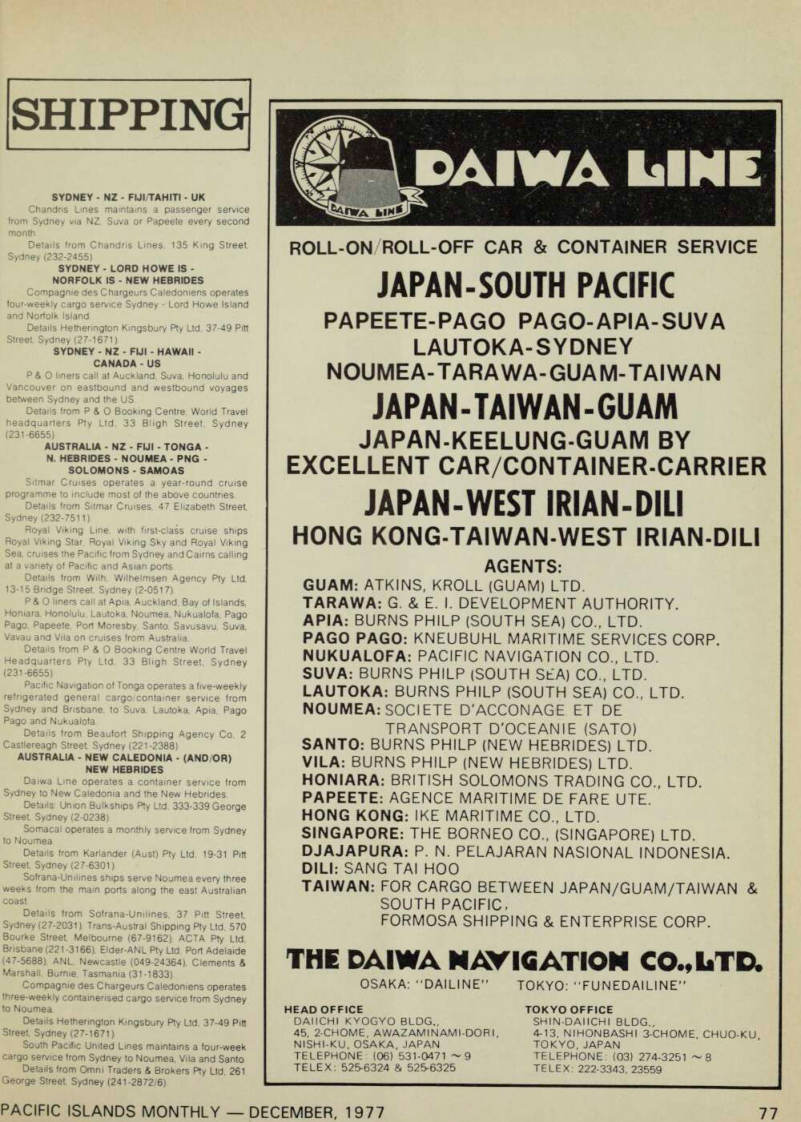
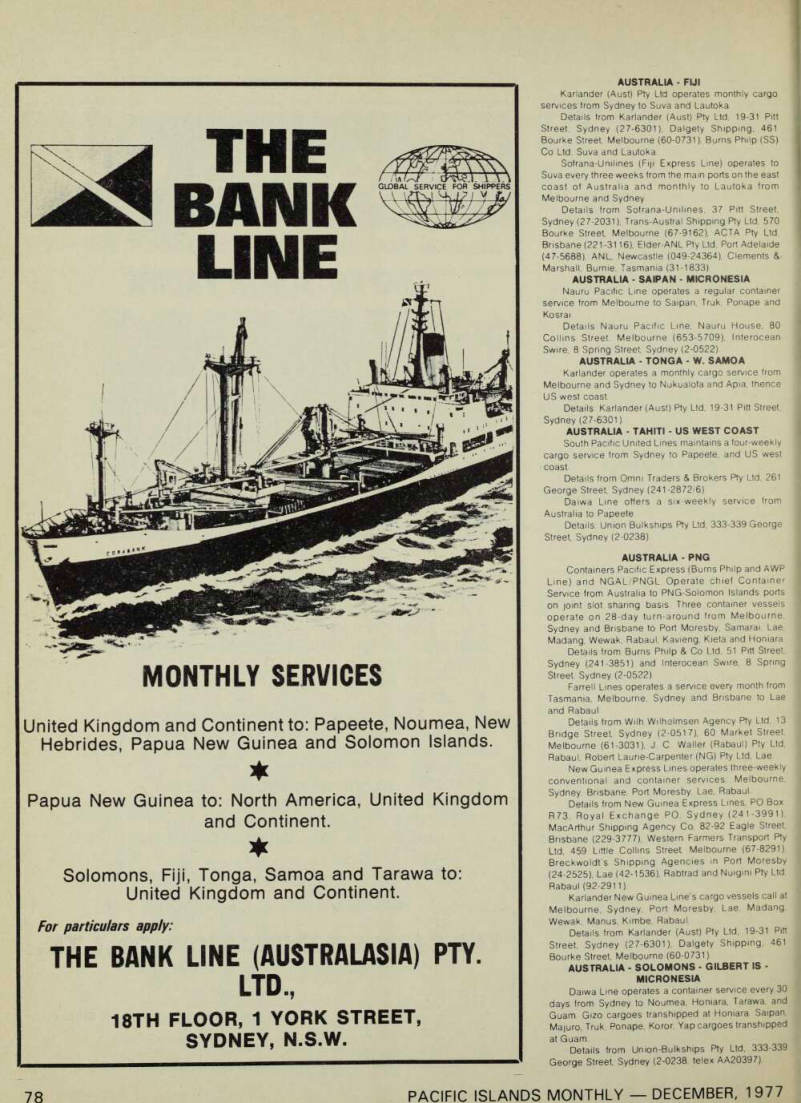
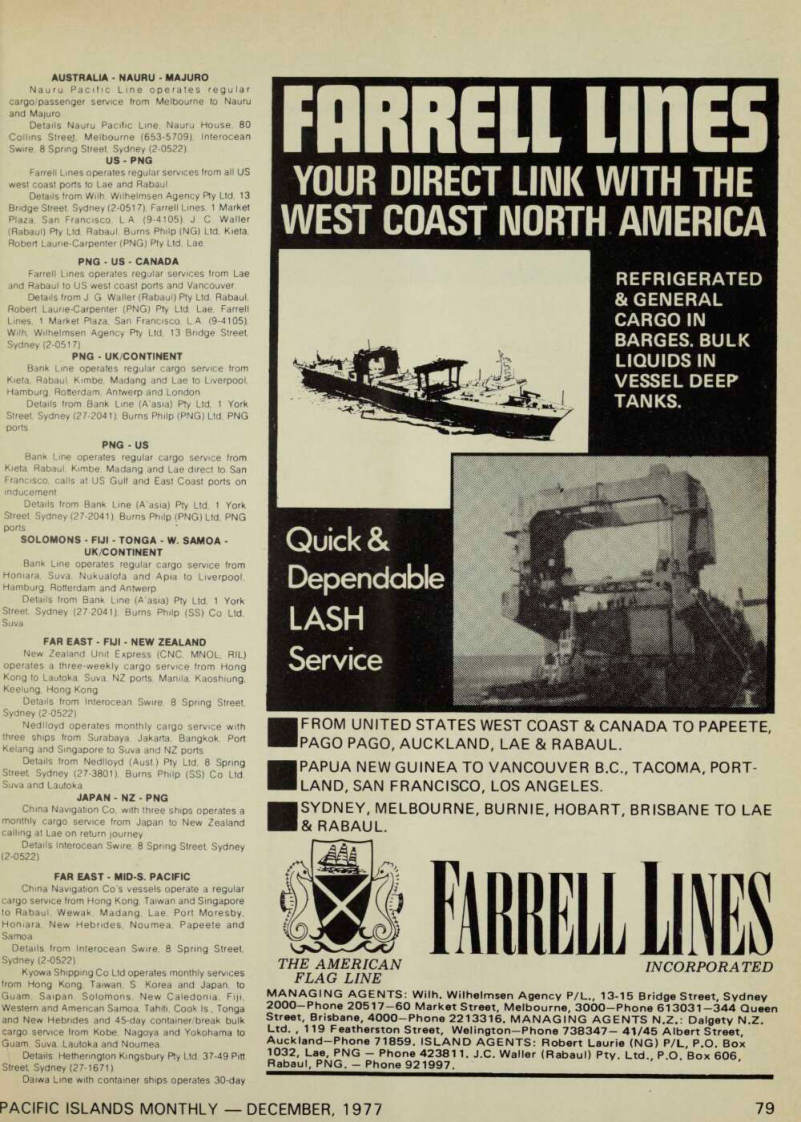
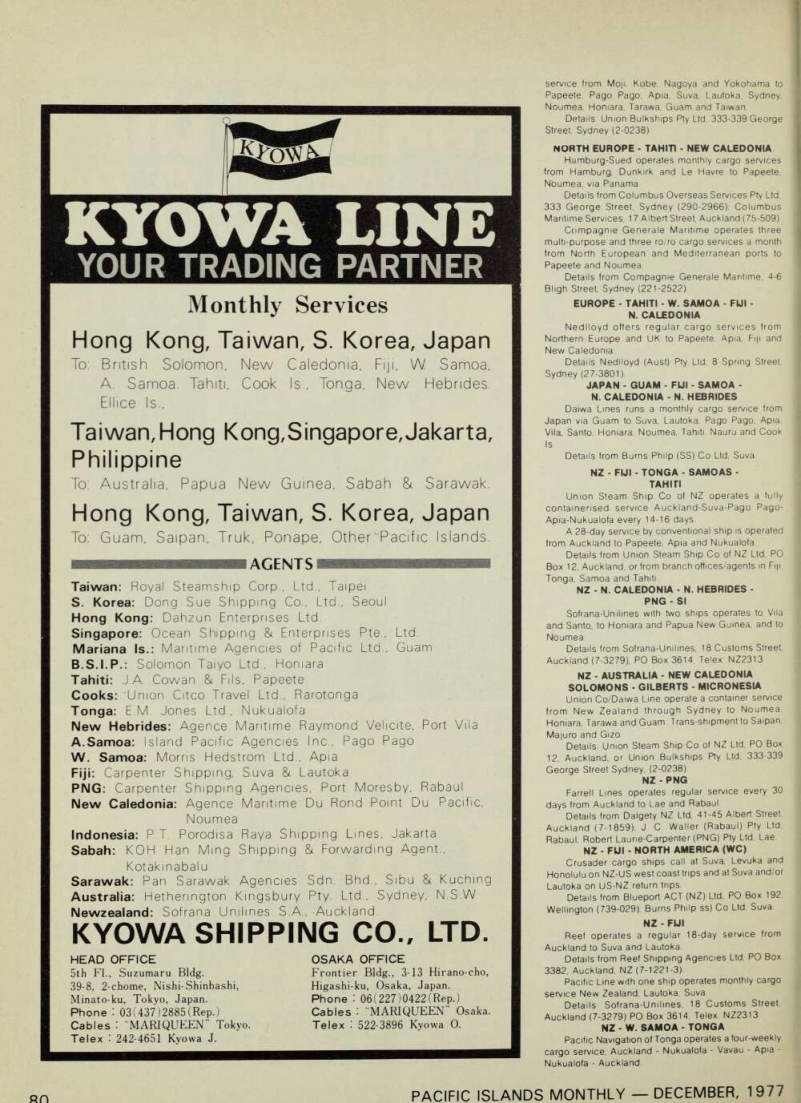
SYDNEY - NZ - FIJI/TAHITI - UK Chandris Lines maintains a passenger service from Sydney via NZ. Suva or Papeete every second month Details from Chandris Lines, 135 King Street, Sydney (232-2455)
Sydney - Lord Howe Is -
Norfolk Is • New Hebrides
Compagme des Chargeurs Caledoniens operates four-weekly cargo service Sydney - Lord Howe Island and Norfolk Island Details Hetherington Kingsbury Pty Ltd, 37-49 Pitt Street, Sydney (27-1671) SYDNEY - NZ - FIJI - HAWAII -
Canada - Us
P & O liners call at Auckland, Suva, Honolulu and Vancouver on eastbound and westbound voyages between Sydney and the US.
Details from P & 0 Booking Centre, World Travel headquarters Pty Ltd. 33 Bhgh Street, Sydney (231-6655) AUSTRALIA - NZ - FIJI - TONGA - N. HEBRIDES - NOUMEA - PNG -
Solomons -Samoas
Sitmar Cruises operates a year-round cruise programme to include most of the above countries.
Details from Sitmar Cruises, 47 Elizabeth Street Sydney (232-7511).
Royal Viking Line, with first-class cruise ships Royal Viking Star. Royal Viking Sky and Royal Viking Sea, cruises the Pacific from Sydney and Cairns calling at a variety of Pacific and Asian ports Details from Wilh, Wilhelmsen Agency Pty Ltd, 13-15 Bridge Street, Sydney (2-0517).
P & O liners call at Apia, Auckland, Bay of Islands, Honiara, Honolulu, Lautoka, Noumea, Nukualofa, Pago Pago, Papeete, Port Moresby, Santo, Savusavu, Suva, Vavau and Vila on cruises from Australia.
Details from P & O Booking Centre World Travel Headquarters Pty Ltd, 33 Bligh Street. Sydney (231-6655) Pacific Navigation of Tonga operates a five-weekly refrigerated general cargo/container service from Sydney and Brisbane, to Suva, Lautoka, Apia. Pago Pago and Nukualofa Details from Beaufort Shipping Agency Co, 2 Castlereagh Street Sydney (221-2388)
Australia - New Caledonia - (And/Or)
New Hebrides
Daiwa Line operates a container service from Sydney to New Caledonia and the New Hebrides Details Union Bulkships Pty Ltd, 333-339 George Street Sydney (2-0238) Somacal operates a monthly service from Sydney to Noumea.
Details from Karlander (Aust) Pty Ltd, 19-31 Pitt Street Sydney (27-6301) Sofrana-Unilines ships serve Noumea every three weeks from the mam ports along the east Australian coast Details from Sofrana-Unilines, 37 Pitt Street, Sydney (27-2031), Trans-Austral Shipping Pty Ltd, 570 Bourke Street Melbourne (67-9162), ACTA Pty Ltd, Brisbane (221-3166), Elder-ANL Pty Ltd, Port Adelaide (47-5688), ANL Newcastle (049-24364). Clements & Marshall, Burnie, Tasmania (31-1833).
Compagnie des Chargeurs Caledoniens operates three-weekly containerised cargo service from Sydney to Noumea Details Hetherington Kingsbury Pty Ltd, 37-49 Pitt Street Sydney (27-1671).
South Pacific United Lines maintains a four-week cargo service from Sydney to Noumea, Vila and Santo.
Details from Omni Traders & Brokers Pty Ltd, 261 George Street, Sydney (241-2872/6).
Australia - Fiji
Karlander (Aust) Pty Ltd operates monthly cargo services from Sydney to Suva and Lautoka.
Details from Karlander (Aust) Pty Ltd. 19-31 Pitt Street. Sydney (27-6301), Dalgety Shipping, 461 Bourke Street. Melbourne (60-0731), Burns Philp (SS) Co Ltd, Suva and Lautoka Sofrana-Unilines (Fiji Express Line) operates to Suva every three weeks from the main ports on the east coast of Australia and monthly to Lautoka from Melbourne and Sydney Details from Sofrana-Unilines, 37 Pitt Street, Sydney (27-2031), Trans-Austral Shipping Pty Ltd, 570 Bourke Street Melbourne (67-9162), ACTA Pty Ltd.
Brisbane (221-3116), Elder-ANL Pty Ltd. Port Adelaide (47-5688), ANL Newcastle (049-24364), Clements & Marshall, Burnie, Tasmania (31-1833)
Australia - Saipan - Micronesia
Nauru Pacific Line operates a regular container service from Melbourne to Saipan, Truk, Ponape and Kosrai.
Details Nauru Pacific Line. Nauru House, 80 Collins Street, Melbourne (653-5709), Interocean Swire, 8 Spring Street, Sydney (2-0522)
Australia - Tonga - W. Samoa
Karlander operates a monthly cargo service from Melbourne and Sydney to Nukualofa and Apia, thence US west coast Details: Karlander (Aust) Pty Ltd, 19-31 Pitt Street, Sydney (27-6301).
AUSTRALIA - TAHITI - US WEST COAST South Pacific United Lines maintains a four-weekly cargo service from Sydney to Papeete, and US west coast Details from Omni Traders & Brokers Pty Ltd, 261 George Street Sydney (241-2872/6).
Daiwa Line offers a six-weekly service from Australia to Papeete Details: Union Bulkships Pty Ltd, 333-339 George Street Sydney (2-0238).
Australia • Png
Containers Pacific Express (Burns Philp and AWP Line) and NGAL/PNGL Operate chief Container Service from Australia to PNG-Solomon Islands ports on joint slot sharing basis. Three container vessels operate on 28-day turn-around from Melbourne, Sydney and Brisbane to Port Moresby, Samarai, Lae, Madang, Wewak, Rabaul, Kavieng, Kieta and Honiara Details from Burns Philp & Co Ltd. 51 Pitt Street, Sydney (241-3851) and Interocean Swire, 8 Spring Street, Sydney (2-0522).
Farrell Lines operates a service every month from Tasmania, Melbourne, Sydney and Brisbane to Lae and Rabaul.
Details from Wilh Wilhelmsen Agency Pty Ltd. 13 Bridge Street, Sydney (2-0517), 60 Market Street, Melbourne (61-3031), J C. Waller (Rabaul) Pty Ltd, Rabaul, Robert Laurie-Carpenter (NG) Pty Ltd, Lae New Guinea Express Lines operates three-weekly conventional and container services. Melbourne, Sydney, Brisbane, Port Moresby, Lae, Rabaul Details from New Guinea Express Lines, PO Box R 73. Royal Exchange PO. Sydney (241-3991), MacArthur Shipping Agency Co. 82-92 Eagle Street, Brisbane (229-3777), Western Farmers Transport Pty Ltd, 459 Little Collins Street, Melbourne (67-8291), Breckwoldt's Shipping Agencies in Port Moresby (24-2525), Lae (42-1536), Rabtrad and Nuigini Pty Ltd, Rabaul (92-2911).
Karlander New Guinea Line's cargo vessels call at Melbourne, Sydney, Port Moresby, Lae, Madang, Wewak, Manus, Kimbe, Rabaul.
Details from Karlander (Aust) Pty Ltd, 19-31 Pitt Street, Sydney (27-6301), Dalgety Shipping, 461 Bourke Street, Melbourne (60-0731) AUSTRALIA - SOLOMONS - GILBERT IS -
Micronesia
Daiwa Line operates a container service every 30 days from Sydney to Noumea, Honiara, Tarawa, and Guam Gizo cargoes transhipped at Honiara Saipan, Majuro, Truk. Ponape, Koror, Yap cargoes transhipped at Guam.
Details from Union-Bulkships Pty Ltd, 333-339 George Street Sydney (2-0238, telex AA20397).
Australia - Nauru - Majuro
Nauru Pacific Line operates regular cargo/passenger service from Melbourne to Nauru and Majuro Details Nauru Pacific Line, Nauru House, 80 Collins Stree.t, Melbourne (653-5709). Interocean Swire, 8 Spring Street, Sydney (2-0522)
Us - Png
Farrell Lines operates regular services from all US west coast ports to Lae and Rabaul Details from Wilh, Wilhelmsen Agency Pty Ltd, 13 Bridge Street. Sydney (2-0517), Farrell Lines. 1 Market Plaza. San Francisco, LA (9-4105). J C Waller (Rabaul) Ply Ltd. Rabaul. Burns Philp (NG) Ltd, Kieta, Robert Laune-Carpenter (PNG) Pty Ltd. Lae
Png - Us - Canada
Farrell Lines operates regular services from Lae and Rabaul to US west coast ports and Vancouver Details from J G Waller (Rabaul) Pty Ltd, Rabaul, Robert Laune-Carpenter (PNG) Pty Ltd. Lae. Farrell Lines. 1 Market Plaza. San Francisco, L A (9-4105), Wilh, Wilhelmsen Agency Pty Ltd, 13 Bridge Street, Sydney (2-0517)
Png - Uk/Continent
Bank Line operates regular cargo service from Kieta, Rabaul, Kimbe, Madang and Lae to Liverpool, Hamburg. Rotterdam, Antwerp and London Details from Bank Line (A'asia) Pty Ltd, 1 York Street, Sydney (27-2041). Burns Philp (PNG) Ltd, PNG ports
Png - Us
Bank Line operates regular cargo service from Kieta, Rabaul. Kimbe, Madang and Lae direct to San Francisco, calls at US Gulf and East Coast ports on inducement Details from Bank Line (A'asia) Pty Ltd, 1 York Street, Sydney (27-2041), Burns Philp (PNG) Ltd, PNG ports SOLOMONS - FIJI - TONGA - W. SAMOA -
Uk/Continent
Bank Line operates regular cargo service from Honiara, Suva. Nukualofa and Apia to Liverpool, Hamburg, Rotterdam and Antwerp Details from Bank Line (A'asia) Pty Ltd, 1 York Street, Sydney (27-2041), Burns Philp (SS) Co Ltd.
Suva FAR EAST - FUI - NEW ZEALAND New Zealand Unit Express (CNC, MNOL, RIL) operates a three-weekly cargo service from Hong Kong to Lautoka. Suva. NZ ports. Manila Kaoshiung, Keelung. Hong Kong Details from Inferocean Swire. 8 Spring Street, Sydney (2-0522) Nedlloyd operates monthly cargo service with three ships from Surabaya, Jakarta, Bangkok. Port Kelang and Singapore to Suva and NZ ports Details from Nedlloyd (Aust ) Pty Ltd. 8 Spring Street Sydney (27-3801), Burns Philp (SS) Co Ltd.
Suva and Lautoka
Japan - Nz - Png
China Navigation Co. with three ships operates a monthly cargo service from Japan to New Zealand calling at Lae on return journey Details Interocean Swire, 8 Spring Street Sydney (2-0522)
Far East - Mid-S. Pacific
China Navigation Co’s vessels operate a regular cargo service from Hong Kong, Taiwan and Singapore to Rabaul. Wewak, Madang. Lae. Port Moresby.
Honiara. New Hebrides. Noumea, Papeete and Samoa Details from Interocean Swire, 8 Spring Street, Sydney (2-0522) Kyowa Shipping Co Ltd operates monthly services from Hong Kong. Taiwan, S. Korea and Japan, to Guam. Saipan. Solomons, New Caledonia, Fiji, Western and American Samoa, Tahiti, Cook Is.. Tonga and New Hebrides and 45-day container/break bulk cargo service from Kobe, Nagoya and Yokohama to Guam. Suva. Lautoka and Noumea Details Hethenngton Kingsbury Pty Ltd, 37-49 Pitt Street Sydney (27-1671).
Daiwa Line with container ships operates 30-day
service from Moji. Kobe. Nagoya and Yokohama to Papeete, Pago Pago. Apia, Suva, Lautoka, Sydney, Noumea. Honiara, Tarawa, Guam and Taiwan Details: Union Bulkships Pty Ltd. 333-339 George Street, Sydney (2-0238) NORTH EUROPE - TAHITI - NEW CALEDONIA Hamburg-Sued operates monthly cargo services from Hamburg, Dunkirk and Le Havre to Papeete.
Noumea, via Panama.
Details from Columbus Overseas Services Pty Ltd, 333 George Street, Sydney (290-2966); Columbus Maritime Services. 17 Albert Street Auckland (75-509).
Compagnie Generale Maritime operates three multi-purpose and three ro/ro cargo services a month from North European and Mediterranean ports to Papeete and Noumea Details from Compagnie Generale Maritime. 4-6 Bligh Street Sydney (221-2522) EUROPE - TAHITI - W. SAMOA - FUI -
N. Caledonia
Nedlloyd offers regular cargo services from Northern Europe and UK to Papeete, Apia Fiji and New Caledonia.
Details Nedlloyd (Aust) Pty Ltd, 8 Spring Street, Sydney (27-3801) JAPAN - GUAM - FIJI - SAMOA -
N. Caledonia • N. Hebrides
Daiwa Lines runs a monthly cargo service from Japan via Guam to Suva, Lautoka, Pago Pago, Apia, Vila, Santo. Honiara, Noumea, Tahiti, Nauru and Cook Is Details from Burns Philp (SS) Co Ltd, Suva.
NZ • FUI - TONGA - SAMOAS -
Tahiti
Union Steam Ship Co of NZ operates a fully containerised service Auckland-Suva-Pago Pago- Apia-Nukualofa every 14-16 days.
A 28-day service by conventional ship is operated from Auckland to Papeete, Apia and Nukualofa Details from Union Steam Ship Co of NZ Ltd, PC Box 12, Auckland, or from branch offices/agents in Fiji, Tonga, Samoa and Tahiti.
NZ - N. CALEDONIA - N. HEBRIDES -
Png - Si
Sofrana-Unilines with two ships operates to Vila and Santo, to Honiara and Papua New Guinea, and to Noumea.
Details from Sofrana-Unilines, 18 Customs Street Auckland (7-3279), PC Box 3614, Telex: NZ2313
Nz - Australia - New Caledonia
Solomons - Gilberts - Micronesia
Union Co/Daiwa Line operate a container service from New Zealand through Sydney to Noumea, Honiara, Tarawa and Guam Trans-shipment to Saipan, Majuro and Gizo Details: Union Steam Ship Co of NZ Ltd. PO Box 12, Auckland, or Union Bulkships Pty Ltd, 333-339 George Street Sydney, (2-0238)
Nz- Png
Farrell Lines operates regular service every 30 days from Auckland to Lae and Rabaul Details from Dalgety NZ Ltd. 41-45 Albert Street, Auckland (7-1859), J C. Waller (Rabaul) Pty Ltd, Rabaul, Robert Laurie-Carpenter (PNG) Pty Ltd. Lae NZ - FUI - NORTH AMERICA (WC) Crusader cargo ships call at Suva Levuka and Honolulu on NZ-US west coast trips and at Suva and/or Lautoka on US-NZ return trips Details from Blueport ACT (NZ) Ltd. PO Box 192, Wellington (739-029); Burns Philp ss) Co Ltd, Suva.
Nz - Fui
Reef operates a regular 18-day service from Auckland to Suva and Lautoka Details from Reef Shipping Agencies Ltd, PO Box 3382, Auckland. NZ (7-1221-3) Pacific Line with one ship operates monthly cargo service New Zealand, Lautoka, Suva Details Sofrana-Unilines, 18 Customs Street, Auckland (7-3279) PO Box 3614, Telex NZ2313
Nz - W. Samoa - Tonga
Pacific Navigation of Tonga operates a four-weekly cargo service, Auckland - Nukualofa - Vavau - Apia - Nukualofa - Auckland
Details from McKay Shipping Ltd, Downtown House. Queen Street. Auckland (33-656) Warner Pacific Line services Onehunga - Nukualofa - Vavau - Haapai fortnightly, and Timaru - Nukualofa - Vavau monthly and Onehunga - Apia every 21 days carrying general and freezer cargoes and Timaru - Apia every 21 days carrying freezer cargo Details from Air Marine Services (NZ) Ltd, PO Box 2505, Auckland (362-731) NZ - COOK IS - W. SAMOA The Shipping Corporation of NZ Ltd with Toa Moana and Lorena. operates cargo services from Auckland to Rarotonga and Aitutaki (fortnightly) and Niue (monthly).
Details from the Shipping Corp of NZ Ltd, PO Box 3420, Auckland (379-430), Waterfront Commission, PO Box 61, Rarotonga, Lighterage and Stevedoring Co, Aitutaki. Niue Govt Offices, Niue Island.
NZ - SE ASIA - PACIFIC ISLANDS Sofrana Fareasf Lines operates a five-weekly service from New Zealand to SE Asia, PNG, New Caledonia and Fiji.
Details from Sofrana Unilines, 18 Customs Street, Auckland (73-279) UK - PANAMA - SAMOA - FIJI The Fiji Direct Service, cargo only, is maintained by Conference vessels, sailing at regular monthly intervals out of Avonmouth, via Panama, for Apia, Suva and Lautoka.
Details from Burns Philp (SS) Co Ltd, Suva.
UK/N. CONTINENT - TAHITI - N. CALEDONIA -
N. Hebrides
Bank Line operates regular cargo service from Hull, Hamburg, Bremen, Antwerp and Rotterdam to Papeete, Noumea and Vila.
Details from Bank Line (A’asia) Pty Ltd, 1 York Street Sydney (27-2041); Ets AMAV, Papeete; Ets Ballande, Noumea, Burns Philp (NH) Ltd, Vila
Uk/N. Continent - Png - Solomons
Bank Line operates regular cargo service from Hull. Hamburg. Bremen, Antwerp and Rotterdam to Port Moresby, Lae, Madang, Kimbe. Rabaul, Kieta and Honiara and, on inducement to Yandina, Tarawa and Nauru.
Details from Bank Line (A'asia) Pty Ltd, 1 York Street. Sydney (27-2041); Burns Philp (PNG) Ltd, PNG ports
San Francisco - Honolulu -
Micronesia
Nauru Pacific Line operates regular conventional/container service from San Francisco and Honolulu to Majuro, Nauru, Ponape, Truk and Saipan Details from Nauru Pacific Line, Nauru House, 80 Collins Street Melbourne (653-5709), North American Maritime Agencies, 100 California Street, San Francisco, California 9411 (981-0343).
US - FIJI - TAHITI - NZ - AUSTRALIA Bank Line Ltd operates regular cargo services from US Gulf ports to Australia and NZ. Calls at Suva, Lautoka and Papeete on demand Details from Bank Line (A/asia) Pty Ltd, 1 York Street, Sydney (27-2011).
Pacific Far East Line cruise ships operate from San Francisco, Los Angeles, Honolulu, Moorea, Papeete, Rarotonga, Auckland. Opua (Bay of Islands), Sydney and return via Suva, Niuafoou, Pago Pago and Honolulu to San Francisco Freight is carried on these passenger liners Passenger details from World Travel Headquarters Pty Ltd, 33 Bligh Street, Sydney (231-6655), freight details from Beaufort Shipping Agency Co, 2 Castlereagh Street Sydney (221-2388) US - A. SAMOA - NZ - AUST - PNG Farrell Lines LASH ships operate regularly from US to Australia, via Pago Pago and Auckland and Canada Details from Wilh, Wilhelmsen Agency Pty Ltd, 13 Bridge Street, Sydney (2-0517), 60 Market Street, Melbourne (61-0301); Farrell Lines, 1 Market Plaza.
San Francisco. LA. (415-777-3300); Dalgety NZ Ltd, Auckland (7-1859); Kneubuhl Maritime Services. Pago Pago (633-5121).
Us - Tahiti - Samoa
Pacific Islands Transport operates a five/six weekly cargo service from North American west coast ports to Papeete, Pago Pago, Apia Details from Trans-Austral Slipping Pty Ltd, 19 Pitt Street Sydney (27-2441).
Polynesia Line operates contain&r and general cargo service from US west coast ports to Papeete and Pago Pago Details from Polynesia Shipping Services Inc, PO Box 1478, Pago Pago (9-6799)
• Fiji ports handled 544 foreign
ships in 1976. Most of them were registered in the UK. The number of
passenger ships rose by 16, com
pared with 1975. All ports handled 1 169 797 tonnes of cargo, com pared with 1 130 936 tonnes in 1975.
Advertisements & other items, pp. 75-79 (2 items)
Udaiwa Line
ROLL-ON/ROLL-OFF CAR & CONTAINER SERVICE
JAPAN-SOUTH PACIFIC
PAPEETE-PAGO PAGO-APIA-SUVA
LAUTOKA-SYDNEY
NOUMEA-TARAWA-GUAM-TAIWAN
JAPAN-TAIWAN-GUAM
JAPAN-KEELUNG-GUAM BY
EXCELLENT CAR/CONTAINER-CARRIER
JAPAN-WEST IRIAN-DILI
HONG KONG-TAIWAN-WEST IRIAN-DILI
AGENTS:
GUAM: ATKINS, KROLL (GUAM) LTD.
TARAWA: G. & E. I. DEVELOPMENT AUTHORITY.
APIA; BURNS PHILP (SOUTH SEA) CO., LTD.
PAGO PAGO: KNEUBUHL MARITIME SERVICES CORP.
NUKUALOFA: PACIFIC NAVIGATION CO., LTD.
SUVA: BURNS PHILP (SOUTH SEA) CO., LTD.
LAUTOKA: BURNS PHILP (SOUTH SEA) CO., LTD.
NOUMEA: SOCIETE D'ACCONAGE ET DE
TRANSPORT D’OCEANIE (SATO)
SANTO: BURNS PHILP (NEW HEBRIDES) LTD.
VILA: BURNS PHILP (NEW HEBRIDES) LTD.
HONIARA: BRITISH SOLOMONS TRADING CO., LTD.
PAPEETE; AGENCE MARITIME DE FARE UTE.
HONG KONG: IKE MARITIME CO., LTD.
SINGAPORE: THE BORNEO CO., (SINGAPORE) LTD.
DJAJAPURA; P. N. PELAJARAN NASIONAL INDONESIA.
DILI: SANG TAI HOO
TAIWAN: FOR CARGO BETWEEN JAPAN/GUAM/TAIWAN &
SOUTH PACIFIC,
FORMOSA SHIPPING & ENTERPRISE CORP.
THE DAIWA MAX IG AXIOM CO., LTD.
OSAKA: “DAILINE” TOKYO; "FUNEDAILINE"
HEAD OFFICE
DAIICHI KYOGYO BLDG.,
45, 2-CHOME, AWAZAMINAMI-DORI,
NISHI-KU, OSAKA, JAPAN
TELEPHONE: (06) 531-0471 ~9
TELEX: 525-6324 & 525-6325
TOKYO OFFICE
SHIN-DAIICHI BLDG.,
4-13, NIHONBASHI 3-CHOME, CHUO-KU
TOKYO, JAPAN
TELEPHONE: (03) 274-3251 ~8
TELEX: 222-3343. 23559
THE
srnn
GLOBAL SERVICE FOR SHIPPERS
\ v
UNE
MONTHLY SERVICES
United Kingdom and Continent to: Papeete, Noumea, New Hebrides, Papua New Guinea and Solomon Islands. * Papua New Guinea to: North America, United Kingdom and Continent. * Solomons, Fiji, Tonga, Samoa and Tarawa to: United Kingdom and Continent.
For particulars apply:
THE BANK LINE (AUSTRALASIA) PTY.
LTD.,
18TH FLOOR, 1 YORK STREET,
SYDNEY, N.S.W.
YOUR DIRECT LINK WITH THE
WEST COAST NORTH AMERICA
ft
LASH
Service
REFRIGERATED
& GENERAL
CARGO IN
BARGES. BULK
LIQUIDS IN
VESSEL DEEP
TANKS.
FROM UNITED STATES WEST COAST & CANADA TO PAPEETE,
IPAGO PAGO, AUCKLAND, LAE & RABAUL.
■ PAPUA NEW GUINEA TO VANCOUVER 8.C., TACOMA, PORT-
LAND, SAN FRANCISCO, LOS ANGELES.
■ SYDNEY, MELBOURNE, BURNIE, HOBART, BRISBANE TO LAE
& RABAUL.
THE AMERICAN
FLAG LINE
INCORPORATED
MANAGING AGENTS: Wilh. Wilhelmsen Agency P/L., 13-15 Bridge Street, Sydney 2000-Phone 20517-60 Market Street, Melbourne, 3000-Phone 613031-344 Queen Street, Brisbane, 4000-Phone 2213316. MANAGING AGENTS N.Z.; Dalgety N.Z.
Ltd. , 119 Featherston Street, Welington—Phone 738347- 41/45 Albert Street Auckland—Phone 71859. ISLAND AGENTS: Robert Laurie (NG) P/L, P.O. Box 1032, Lae, PNG - Phone 423811. J.C. Waller (Rabaul) Pty. Ltd. P.O Box 606 Rabaul, PNG. - Phone 921997.
KYOWA LINE
YOUR TRADING PARTNER
Monthly Services
Hong Kong, Taiwan, S. Korea, Japan
To: British Solomon, New Caledonia, Fiji, W Samoa, A. Samoa. Tahiti, Cook Is., Tonga, New Hebrides.
Ellice Is.,
Taiwan,Hong Kong,Singapore,Jakarta,
Philippine
To: Australia, Papua New Guinea, Sabah & Sarawak.
Hong Kong, Taiwan, S. Korea, Japan
To: Guam, Saipan, Truk, Ponape, Other'Pacific Islands.
Taiwan: Royal Steamship Corp , Ltd., Taipei S. Korea: Dong Sue Shipping Co., Ltd , Seoul Hong Kong: Dahzun Enterprises Ltd Singapore: Ocean Shipping & Enterprises Pte., Ltd.
Mariana Is.; Maritime Agencies of Pacific Ltd., Guam 8.5.1. P.: Solomon Taiyo Ltd., Honiara Tahiti; J.A. Cowan & Fils, Papeete Cooks: 'Union Citco Travel Ltd., Rarotonga Tonga: E.M. Jones Ltd , Nukualofa New Hebrides: Agence Maritime Raymond Velicite, Port Vila A.Samoa; island Pacific Agencies Inc., Pago Pago W. Samoa: Morris Hedstrom Ltd., Apia Fiji: Carpenter Shipping, Suva & Lautoka PNG: Carpenter Shipping Agencies, Port Moresby, Rabaul New Caledonia: Agence Maritime Du Rond Point Du Pacific, Indonesia: P.T. Porodisa Raya Shipping Lines, Jakarta Sabah: KOH Han Ming Shipping & Forwarding Agent., Kotakinabalu Sarawak: Pan Sarawak Agencies Sdn. Bhd., Sibu & Kuching Australia: Hetherington Kingsbury Pty. Ltd., Sydney, N.S.W Newzealand: Sofrana Umlmes S.A., Auckland.
KYOWA SHIPPING CO., LTD.
AGENTS
Noumea
HEAD OFFICE
sth FI., Suzumaru Bldg. 39-8, 2-chome, Nishi-Shinbashi, Minato-ku, Tokyo, Japan.
Phone : 03(437)2885(Rep.) Cables : "MARIQUEEN" Tokyo.
Telex : 242-4651 Kyowa J.
OSAKA OFFICE
Frontier Bldg., 3-13 Hirano-cho, Higashi-ku, Osaka, Japan.
Phone : 06(227)0422(Rep.) Cables : “MARIQUEEN" Osaka.
Telex : 522-3896 Kyowa 0.
THE PAPUA HOTEL
PORT MORESBY
• Right in the business centre • A tradition for comfort and fine food • All rooms air conditioned • Restaurant • Bars • Banquet Mali Telephone 24 2121 Cables PAPTEL
A. C. NEUMANN
Manager
SUVA, LAUTOKA, APIA,
PAGO PAGO
AGENTS:
BURNS PHILP
(S.S.) CO. LTD.
NUKUALOFA:
PACIFIC NAVIGATION
OF TONGA LTD.
Pacific Navigation of Tonga Limited
9 STAR SERVICE TO SOUTH PACIFIC
Containers - Unitised Space - Freezer - Deep Tanks
BEAUFORT SHIPPING AGENCY COMPANY
Australian Managing Agents^ Sydney Melbourne
SYDNEY:
Continuous Receiving at Metropolitan Bond & Free Store, Macpherson St., Banksmeadow.
For details phone (02) 221-2388. 221 2388 67 8401 Brisbane 268 4922
BRISBANE:
On application.
For details phone (07) 268-4922 (Contracts Subject to Carriers Bill of Lading)
ALL ENQUIRIES:
BEAUFORT SHIPPING
G.P.O. Box 3988, Sydney, N.S.W.
Australia.
81
ACIFIC ISLANDS MONTHLY DECEMBER, 1 977
Death’S Toll Of Png Pioneers
Death took a heavy toll in the last few months of the steadily diminishing band of Papua New Guinea pioneers. Below PIM records the passing of five of them, veteran-aviator Captain Orm Denny, Bob Schultze, a link with German colonial days, Mr. W.M. Middleton, who had a 65-year-old link with the country,Fred Turner,ex-RSL president, and Jack Fox, gold miner and explorer.
Captain Orm Denny
Captain Orm Denny has died at the age of 78, leaving a widow and three married daughters.
The name Orm Denny needs no introduction to long-time readers of PIM. One of the fast-dwindling band of pioneer aviators in Papua New Guinea, he had a distinguished lifetime career in aviation, retiring from active flying as recently as June, 1959.
He became a pilot after World War I, flying for Qantas during the early years and joining Guinea Airways Ltd in 1931. Until 1938 Orm Denny flew Junkers, De Havilland and Ford tri-motor machines out of Lae. It was during this incredible decade that New Guinea became the world leader in civil aviation difficult as this may be to believe today and Denny was one of the
best known of those superb pilots, men of the calibre of Pard Mustar, Ray Parer, Lionel Shoppee, Bill Wiltshire, Bert Heath, Bob Gurney, Tommy O’Dea, Les Holden, Dick Mant, and so many others.
Denny rejoined Qantas in 1938, but his connection with New Guinea aviation was by no means over. He was the leader of the team that effected the amazing evacuation of the Mt Hagen refugees in May, 1942, when Japan looked set to overrun the whole of the Pacific.
There were 77 men and a lone woman, Matron Jones, at Mt Hagen, and their plight was desperate. To seek aid, the Catholic missionary, Fr John Glover, made an amazing flight in a tiny DH6O Moth with engineer Karl Nagy to Australia, and Orm Denny was asked to rescue them. Using two DHB6 Airliners
(slow, four-engined biplanes, com pletely unarmed), Denny and his team Captains Sims, Rex Nicholl and Tommy O’Dea, radio operators F. S. Furniss, R. J. Anderson and L W. Louttit, and engineers D. E.
Chambers and R. Carswell made 17 dangerous flights over a period of a fortnight from Horn Island to Mt Hagen and return and brought out the refugees.
The skies were filled with Japanese fighters, but not one of the party was lost. Denny and his team were highly commended by the Australian Government for this great feat. Later, during the Buna operations, Denny averaged three trips per day for eight straight days in his Lockheed over the Owen Stanleys to lift a total of 74 884 lbs of urgently needed war supplies, After the war Denny became as
sistant operations manager and later operations manager for Qantas in PNG and was largely responsible for the rapid expansion of the inter nal network of routes that con tributed so much to the postwar development of the country.
In 1959 he retired from Qantas at the age of 60. Returning to Australia, Denny joined the Royal Flying Doctor Service as NSW branch manager and served aviation for a further nine years before retir ing, finally, at age 70.
His was a lifetime of dedication to the cause of civil aviation. Both as a pilot and a man, he will be sorely
missed.
J.S.
Mr Bob Schultze One of the few remaining links with the early colonial times in Papua New Guinea and, partic ularly, between that country and Samoa, was broken by Bob Schultze’s death in Sydney Helmut Arthur Lebrecht Schultze, younger son of Adolph Curt Schultze and Carolina Rosminia Schultze nee Coe, was born in Kavieng, New Ireland, in September 1906.
An officer in the German army, Bob’s father had spent several years in Australia, including a stint as German vice-consul in Brisbane, before going to New Guinea in 1901 and becoming secretary to Dr Hahl, governor of German New Guinea.
He resigned in 1903 and began to develop a coconut plantation on the Gazelle Peninsula.
Carolina was a niece of Emma Forsayth Kolbe.
Carolina was engaged to Curt Schultze when she almost lost her life during an attack on a plantation by Tolais, in retaliation for wrongdoings by whites. Only her thick coil of hair and the help of a New Guinean who hid her in the rafters of the planter’s house saved her life. She married Curt shortly afterwards and they moved to r plantation on New Ireland, given to her by Queen Emma.
Bob and his brother were taken to Germany where he attended high school in Berlin and then studied at the world-renowned Institute for Tropical and Sub-tropical Agriculture which continues to flourish. He returned to New Guinea in 1925 and, after working on the goldfields and as a labour re cruiter, ran a small trading vessel.
He was on one of the plantations of Phoebe Parkinson, sister of Queen Emma, near Namatanai, New Ire land, when war came to the Pacific.
After several years in Australia, Bob, his wife Doris (whom he had married during the war) and their two daughters lived at Lebrechtshof, a plantation near Ka vieng which his father had estab lished. In recent years, the Schultzes have lived in Australia.
As proud of his Samoan descent as he was of his European upbring ing and Australian nationality, Bob Schultze had an abiding love for New Guinea, the country of his birth.
His many friends are the poorer
for his passing.
H.J.
Mr W. M. Middleton Mr William Maxwell Middleton, an Australian who had close links with Papua New Guinea for 65 years, has died in Australia, aged 89. Mr Middleton, Bill to his friends, but Max within his family, apart from roughing it in PNG, also found time to serve in the two world wars.
He was born in Adelaide and as a young man of 24, in 1910, went to Samarai, as assistant manager of the Bank of NSW.
In Australia on leave in 1914 when World War I broke out, he im mediately enlisted in the AIF, and was soon in Egypt, working in a hospital in Cairo as a member of the Medical Corps. The invasion of Gallipoli was looming and he was not in the draft to go. Without con sulting those above him he managed to get into a draft by the simple ex pedient of changing places with a man who didn’t want to go. His departure, however, caused him to be posted as a deserter, a matter which was rectified when it was dis covered he was with the troops in Gallipoli.
Mr Middleton later became a Lewis machine-gunner, and was badly wounded during the second battle of the Somme. He lost an eye and suffered lung damage which plagued him for the rest of his life.
Invalided to Australia, he was soon on his way back to PNG, no longer with the Bank of NSW, but as assistant manager of Giligili, a Lever Bros plantation at Milne Bay.
Soon after he went into partnership in a trading enterprise at Baimara.
One of his moves at that time was to start a plantation known as Manapi.
Mr Middleton later went to Rabaul to join the Expropriation
Board.
As the work of the board started to run down, Mr Middleton looked for new activities. He acquired Kulili on Karkar Island and set about making it a top copra estate.
He acquired four further estates on Karkar, to become one of the biggest plantation holders in New Guinea.
In 1927, he married Miss Alice Tre gent, a Victorian who had a business in Sydney.
The world depression started to hit the planters, but Mr Middleton was a shrewd businessman who had so arranged his affairs that he was able to weather that economic storm. All his efforts were paying off when World War II broke out and he had to leave his properties.
On his way back to Australia, he had to put up with his share of or deals, one of which included tramp ing from Wau to Mt Hagen. He also served as a coast watcher for
periods.
In Australia in mid-1942 there was a call for such men as he with knowledge of Papua New Guinea to join ANGAU. He was soon com missioned as a lieutenant in this or ganisation.
After World War 11, Mr Mid dleton, like so many other Euro peans, found it difficult to get back to PNG because of the policies of the then Australian Government.
With his son, John, not long out of school, he eventually made it to Karkar to find all the plantations run down, and reverting to jungle.
Labour was also difficult to get.
Through hard work the five plan tations were rehabilitated, and as an experiment, Mr Middleton started to grow cocoa between the coconut trees. The results are now paying off handsomely.
Mr Middleton is survived by his wife, sons John and Roger, and three grandsons.
Mr Fred Turner Longtime Papua New Guinea identity, Mr Fred Turner, has died at 73 at his home in Boroko.
The Ela Beach Branch of the RSL, known as the “Town Branch” of Port Moresby, of which Mr Turner was president at the time of his death, closed its doors for two days as a mark of respect on his passing. He was a past president of the PNG branch of the RSL Mr Turner first went to PNG in 1934 to work as a medical assistant
at Rouna near Port Moresby.
He joined ANGAU during World War II and was in charge of the medical store and supplies in the Wau-Bulolo area Mr Turner returned to Port Moresby in 1945 and was dis charged from the army in that year.
He joined the administration and worked with it until his retirement in 1964.
He then went into private busi ness, starting as a driving instructor and later as a tour operator. In this capacity he became widely known, earning the nickname “Fearless Fred” for his performance behind the wheel.
Mr Jack Fox Mr Jack Fox, who has been a vital part of Papua New Guinea’s Western Highlands Province for nearly 30 years, has died at his farm near Mt Hagen, aged 84.
Returning from his customary walk one day in late October, Mr Fox was told by Talair officials that a Beechcraft Baron aircraft piloted by his son John was missing in the Milne Bay Province (see PIM, News in a Nutshell). Mr Fox’s family said the strain was too great for his weakened heart.
Born in England, Mr Fox and his brother Tom first came to PNG in 1914 with the Australian Imperial Expeditionary Forces.
Jack and Tom Fox, who were identical twins, became gold miners, and built up a reputation as good, tough men who had no hesitation in travelling through uncontrolled ter ritory where white men had never been seen. Their most famous ex pedition was in 1934 when they prospected from Mt Hagen to the then Dutch-border, and turned up emaciated, after being given up for lost.
Dr D avid Purdy Dr David Purdy, an Australian in charge of government veterinary and stock services throughout Papua New Guinea, was killed in a yacht ing accident in Port Moresby Har bour in October.
Dr Purdy, 35, and married with two children, was struck on the head by a boom on his yacht and knocked overboard. He was apparently un conscious when he hit the water, as he was a good swimmer.
Dr Purdy, who had lived in Port Moresby for 16 years, held the num ber one registration on the PNG registry of veterinary surgeons.
Advertisements & other items, pp. 80-83 (1 item)
Compagnie Generale Maritime
AUSTRALIA - EUROPE SERVICE.
Fully containerised (Member of AECS) Agents: SEABRIDGE, 60 Pitt Street, SYDNEY.
PACIFIC ISLANDS - EUROPE SERVICE.
Roßo and Multipurpose Service Twice monthly to/from Papeete - Noumea - New Hebrides.
Multipurpose Service Monthly to/from Papua/New Guinea.
SOUTH PACIFIC UNITED LINES
AUSTRALIA - PACIFIC ISLANDS - U.S. WEST COAST.
Monthly fully containerised Service. [Messageries Maritimes] Phone: 20518.
PO Box R 206.
Agents: OMNITRADERS & BROKERS,
261 George Street, Phone: 241 2872.
GPO Box 3896.
Regular Pacific Services
"Union South Pacific”, cellular container vessel. Reefer and general cargo from Auckland at approximately fortnightly intervals. Calls at Suva, Pago Pago, Apia and Nukualofa before returning to Auckland.
"Luhesand”, conventional reefer and general cargo. Monthly sailings from Auckland, calls at Suva, Apia, Papeete and Nukualofa.
jmimunton
Jm/Mcompanu
Branches at all main Australian, New Zealand and Pacific Island ports
PACIFIC ISLANDS TRANSPORT LINE
Owners: Thor Dahls Hvaljangerseiskap A/S — Sandefjord, Norway.
MS CAMELLIA VENTURE
Express Freight Service between Pacific Coast Ports of
U.S.A.
and
TAHITI and SAMOA
Full container service including reefers.
GENERAL STEAMSHIP CORPORATION LTD.
General Agents 400 California Street, San Francisco, California, U.S.A.
APlA—Burns Philp (South Sea) Company, Ltd.
PAPEETE—Afonco Maritime Internationale Tahiti.
PAGO PAGO-Polyncsia Shipping Services Inc.
NOUMEA—Etablissements Ballande.
SYDNEY—Trans-Austral Shipping Pty. Ltd.
SUVA—Bures Philp (South Sea) Company, LAE/RABAUL—Burns Philp (Now Guinea) Ltd.
PORT VlLA—Comptoirs Francais de Nouvelles
HENRY CUMINES PTY. LTD.
EXPORTERS • GENERAL MERCHANTS
428 GEORGE ST., SYDNEY
CABLES: HENCO SYDNEY. G.P.O. Box 3949. PHONE: 25-3383.
For specialised and personalised buying service throughout the Pacific Islands and the East.
LOCAL AGENTS AND REPRESENTATION:
PAPUA NEW GUINEA.
PORT MORESBY: Mr. Tan,
P.O. Box 5445, Boroko.
Telephone 25 2542.
RABAUL: M. & C. Seeto, P.O. Box 131, Rabaul.
Telephone 92 2902.
MADANG: W. Double, P.O. Box 22, Madang.
Telephone 82 2696.
FIJI.
K. Witherington Ltd., P.O. Box 293, Suva.
Telephone 22 356.
NEW HEBRIDES.
John Lum & Associates, P.O. Box 65, Santo.
Telephone 329.
SOLOMON ISLANDS.
Lo See War Ltd., P.O. Box 327, Honiara.
Telephone 399.
Resident Agents in other Pacific Territories.
ExpressTreight Service between U S. Pacific Coast Ports &
PAPEETE ■ APIA - PAGO PAGO
Full Container Service including Refrtgeratiorv
GENERAL AGENTS-
fURNESS INTEROCE4N
CORPORATION
465 CALIFORNIA STREET. SAW FRANCISCOCA *llO4.
Cable: INTERCO- • IWK; 910-372 7350 • RCA 278 207
• TEL (415) :
AGENTS-
PAPEETE - MORGAN; Vernex Boite Postale 449, Papeete Phone: 309 Cables: MOREX PAGO PAGO - POLYNESIA.SHIPPING SERVICES, INC., Pago Pago Phone:633-5169 Cables: POLYSHIP APIA - UNION S.S. CO., of N.Z. Ltd., P.O. Box 50, Apia, Western Samoa Phone: 570 Cables: UNION
Master,
I s
BRAND
Ai f
MACKEREL
% * “Master” AI Canned Pilchards & Other Canned Fish §&* * “House” Brand Instant Ramen, All kinds of Spices *“Karl” & Others Snack Foods * Groceries & Confectionery §?* *§ *“Hadson” Disposable Gas Lighters * Hardware, Tools & Kitchenware Materials, Iron & Steel Products, Machinery *§ Equipment, Lubricating Oils * Motor Spare Parts & Accessories
UNITRAOE COMPANY, LIMITED
I GENERAL MERCHANTS I
4 EXPORTERS & IMPORTERS
Sanritsu Building 11-12 3-chome Hachobori 3^ Chuo-ku Tokyo (104) *€ TELEX NO. : “252-4665 KANDK J”
4 CABLE ADDRESS : “KAYANDKAY TOKYO”
TELEPONE NO. : 03-553-9520 §*
Resident Representives in Fiji, P.N.G., §** *1 Philippines, Hong Kong & Singapore p*
Produce
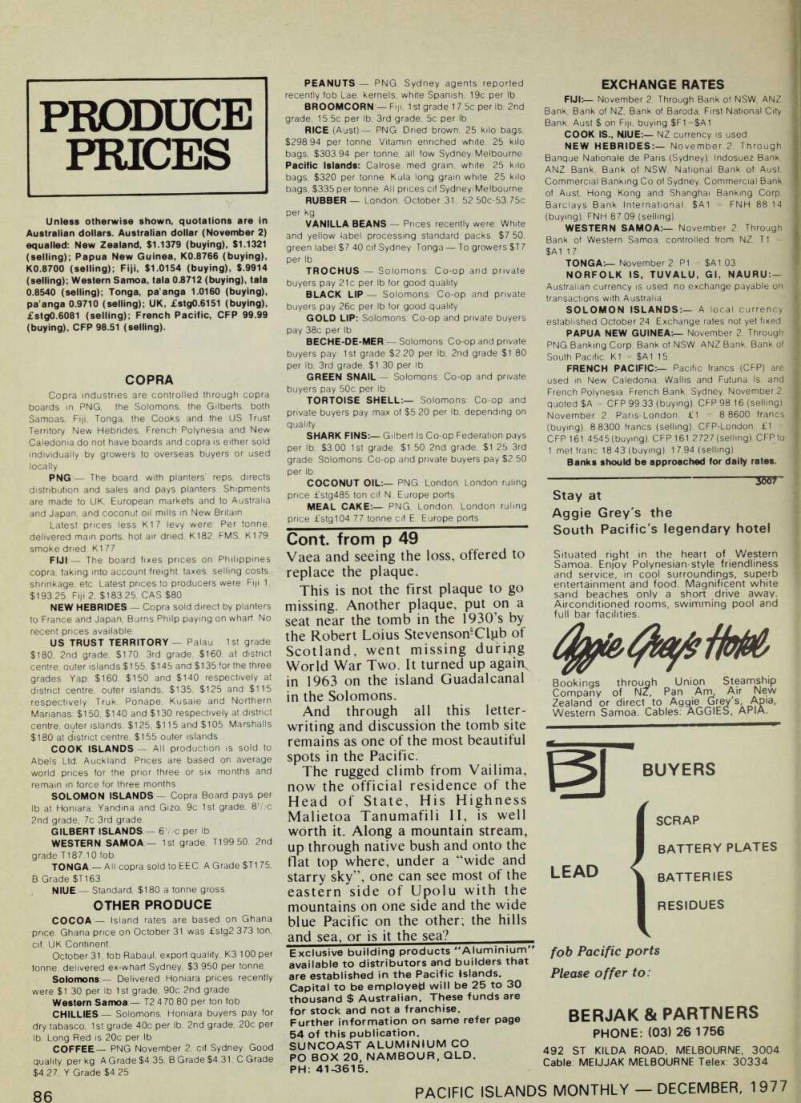
Prices
Unless otherwise shown, quotations are in Australian dollars. Australian dollar (November 2) equalled; New Zealand, $1.1379 (buying), $1.1321 (selling); Papua New Guinea, K 0.8766 (buying), K 0.8700 (selling); Fiji, $1.0154 (buying), $.9914 (selling); Western Samoa, tala 0.8712 (buying), tala 0.8540 (selling); Tonga, pa'anga 1.0160 (buying), pa'anga 0.9710 (selling); UK, £stgo.6lsl (buying), £stgo.6oBl (selling); French Pacific, CFP 99.99 (buying), CFP 98.51 (selling).
Copra
Copra industries are controlled through copra boards in PNG, the Solomons, the Gilberts, both Samoas, Fiji, Tonga, the Cooks and the US Trust Territory New Hebrides, French Polynesia and New Caledonia do not have boards and copra is either sold individually by growers to overseas buyers or used locally PNG The board, with planters' reps, directs distribution and sales and pays planters Shipments are made to UK, European markets and to Australia and Japan, and coconut oil mills in New Britain Latest prices less Kl 7 levy were: Per tonne, delivered main ports, hot air dried, KlB2, FMS, K 179, smoke dried. K 177.
FIJI — The board fixes prices on Philippines copra, taking into account freight, taxes, selling costs, shrinkage, etc Latest prices to producers were Fiji 1, $193.25. Fiji 2, $lB3 25, CAS $BO NEW HEBRIDES Copra sold direct by planters to France and Japan, Burns Philp paying on wharf No recent prices available US TRUST TERRITORY Palau Ist grade $lBO, 2nd grade. $l7O. 3rd grade. $l6O, at district centre, outer islands $155. $145 and $135 for the three grades Yap $l6O, $l5O and $l4O respectively at district centre, outer islands. $135, $125 and $ll5 respectively. Truk, Ponape, Kusaie and Northern Marianas: $l5O, $l4O and $l3O respectively at district centre, outer islands, $125, $ll5 and $lO5 Marshalls $lBO at district centre. $155 outer islands.
COOK ISLANDS All production is sold to Abels Ltd, Auckland Prices are based on average world prices for the prior three or six months and remain in force for three months.
SOLOMON ISLANDS Copra Board pays per lb at Honiara, Yandina and Gizo, 9c Ist grade. 87,’C 2nd grade, 7c 3rd grade
Gilbert Islands 67 C Per Lb
WESTERN SAMOA Ist grade, T 199.50, 2nd grade TlB7 10 fob TONGA All copra sold to EEC. A Grade STI 75, B Grade STI63 NIUE Standard, $lBO a tonne gross.
Other Produce
COCOA Island rates are based on Ghana price. Ghana price on October 31 was £stg2 373 ton, cif, UK Continent.
October 31, fob Rabaul, export quality. K 3 100 per tonne, delivered ex-wharf Sydney, $3 950 per tonne Solomons— Delivered Honiara prices recently were $1 30 per lb Ist grade, 90c 2nd grade Western Samoa T 2 470 80 per ton fob CHILLIES Solomons, Honiara buyers pay for dry tabasco, Ist grade 40c per lb, 2nd grade, 20c per lb Long Red is 20c per lb COFFEE— PNG November 2, cif Sydney Good quality, per kg: A Grade $4.35: B Grade $4 31; C Grade $4 27, Y Grade $4 25
PEANUTS — PNG. Sydney agents reported recently fob Lae, kernels, white Spanish, 19c per lb.
BROOMCORN — Fiji 1 st grade 17.5 c per lb; 2nd grade, 15.5 c per lb; 3rd grade. 5c per lb RICE (Aust): — PNG: Dried brown, 25 kilo bags. $298.94 per tonne. Vitamin enriched white. 25 kilo bags, $303 94 per tonne, all tow Sydney/Melbourne Pacific Islands: Calrose med grain, white. 25 kilo bags, $320 per tonne Kula long grain white. 25 kilo bags. $335 per tonne All prices cif Sydney/Melbourne RUBBER London. October 31. 52.50c-53.75c per kg VANILLA BEANS Prices recently were White and yellow label processing standard packs, $7 50. green label $7 40 cif Sydney Tonga To growers ST7 per lb TROCHUS Solomons: Co-op and private buyers pay 21c per lb for good quality BLACK LIP Solomons: Co-op and private buyers pay 26c per lb for good quality GOLD LIP; Solomons: Co-op and private buyers pay 38c per lb BECHE-DE-MER Solomons; Co-op and private buyers pay: Ist grade $2 20 per lb: 2nd grade $1 80 per lb: 3rd grade. $1.30 per lb.
GREEN SNAIL Solomons: Co-op and private buyers pay 50c per lb.
TORTOISE SHELL:— Solomons: Co-op and private buyers pay max of $5.20 per lb. depending on quality SHARK FINS: — Gilbert Is Co-op Federation pays per lb, $3 00 Ist grade, $1 50 2nd grade, $1 25 3rd grade. Solomons: Co-op and private buyers pay $2 50 per lb.
COCONUT OIL; PNG: London, London ruling price £stg4Bs ton cif N. Europe ports MEAL CAKE: — PNG, London, London ruling price £5tg104.77 tonne cif E. Europe ports
Exchange Rates
FIJI: — November 2. Through Bank of NSW, ANZ Bank, Bank of NZ. Bank of Baroda, First National City Bank, Aust $ on Fiji, buying SFI =$Al COOK IS., MJUE; — NZ currency is used NEW HEBRIDES:— November 2, Through Banque Nationale de Paris (Sydney), Indosuez Bank, ANZ Bank, Bank of NSW. National Bank of Aust, Commercial Banking Co of Sydney, Commercial Bank of Aust, Hong Kong and Shanghai Banking Corp.
Barclays Bank International. SAI = FNH 88 14 (buying), FNH 87 09 (selling).
WESTERN SAMOA;— November 2. Through Bank of Western Samoa, controlled from NZ, T 1 -
Sai 1 7
TONGA: — November 2, PI SAI 03
Norfolk Is, Tuvalu, Gl, Nauru:—
Australian currency is used, no exchange payable on transactions with Australia.
SOLOMON ISLANDS;— A local currency established October 24 Exchange rates not yet fixed PAPUA NEW GUINEA: — November 2. Through PNG Banking Corp, Bank of NSW ANZ Bank, Bank of South Pacific, K 1 = $A 115 FRENCH PACIFIC:— Pacific francs (CFP) are used in New Caledonia, Wallis and Futuna Is, and French Polynesia French Bank, Sydney. November 2, quoted $A - CFP 99 33 (buying), CFP 98 16 (selling) November 2. Paris-London, £1 = 8 8600 francs (buying), 8 8300 francs (selling) CFP-London, £1 = CFP 161 4545 (buying), CFP 161 2727 (selling). CFP to 1 met franc 18 43 (buying). 1 7 94 (selling) Banks should be approached (or daily rates.
Advertisements & other items, pp. 84-88 (1 item)
{Scrap
3557- Stay at Aggie Grey's the South Pacific's legendary hotel Situated right in the heart of Western Samoa. Enjoy Polynesian-style friendliness and service, in cool surroundings, superb entertainment and food. Magnificent white sand beaches only a short drive away.
Airconditioned rooms, swimming pool and full bar facilities.
Bookings through Union Steamship Company of NZ, Pan .Am, Air New Zealand or direct to Aggie Grey's, Apia, Western Samoa. Cables; AGGIES, APIA. §1
BUYERS
{SCRAP
BATTERY PLATES
BATTERIES
RESIDUES
fob Pacific ports Please offer to:
BERJAK & PARTNERS
PHONE: (03) 26 1756
492 ST KILDA ROAD, MELBOURNE. 3004
Cable MEIJJAK MELBOURNE Telex: 30334
Exclusive building products "Aluminium" available to distributors and builders that are established in the Pacific Islands.
Capital to be employed will be 25 to 30 thousand $ Australian. These funds are for stock and not a franchise.
Further information on same refer page 54 of this publication,
SUNCOAST ALUMINIUM CO
PO BOX 20, NAMBOUR, OLD.
PH; 41-3615,
Pioneer’s HPNI series:
long on guts, short on distortion
No weaklings here. Pioneer's HPM speaker systems are built tough to stand up to high power inputs all day long and come back for more til the dawn's early light. Today’s modern recording techniques capture a wider dynamic range than ever before possible. In comparison, your other components merely pick up the sound, channel it through and pump it out.
But, it’s the speaker system that must bear the brunt of this electronic onslaught. The HPM series solves this problem with exciting new innovations in speaker technology.
Leading the way is our HPM-100.
Four speakers, four ways. Nominal input power is a “gutsy’’ 50 watts.
In the 30cm (12-inch) woofer, a carbon fiber blended cone. Highly elastic, yet incredibly strong, this material reduces power loss and eliminates audible distortion. In other words, better bass for your bucks.
For super highs, a High Polymer Supertweeter. The High Polymer Membrane (HPM) offers an ideal “breathing motion" over its semicylindrical surface and radiates clean, clear highs over a more natural 180°.
Thus, putting an end to narrow beam tweeter directionality.
After that, a 10cm (4-inch) cone
midrange plus lightweight cone
tweeter provide smooth dependable transition between extreme lows and highs. Level controls for the mid and high units are located on the baffle of this handsome walnut veneered bass-reflex enclosure.
Next in the series, the HPM-60 and HPM-40. Created for those who want ‘ gutsy’’ speakers, but on a slightly lesser scale. Of course, you don’t pay as much either.
Pioneer’s HPM series speakers.
Great sound because they’re built tough. Soft on your bankroll because they’re priced right.
&DPIOIMEER
Australia Pioneer Electronics Australia Pty.
Ltd., 178-184 Boundary Road, Braeside, Victoria 3195, Tel: 90-9011 Sydney 93-0246, Brisbane 59-7457, ’
Adelaide 433379, Perth 24-9899 Fiji Islands Brijlal & Company, G.P.O. Box No. 362. Suva, Fiji Islands Tel: 22258 New Zealand Fountain Marketing Ltd., Maidstone Street, Auckland, New Zealand Tel: 763-064 Norfolk Island Burns Philp (Norfolk Island) Ltd., Norfolk Island, South Pacific New Hebrides Burns Philp (New Hebrides) Ltd., Vila, New Hebrides Nauru Island Jacob Enterprises, P.O. Box No. 4 Republic of Nauru Tahiti Est. PERFECT, B.P. 594, Papeete, Tahiti Tel: 20 407 New Caledonia Menard FreresVille, B.P. H2Cedex, Noumea, New Caledonia Tel: 27,52.22 American Samoa Traspac Corporation, P.O. Box 1477, Pago Pago, American Samoa 96799 Tel: 633-5224 Rarotonga South Seas International Ltd., P.O. Box 49, Rarotonga Cook Islands Tel: 2327
CLASSIFIED ADVERTISEMENTS
SEARCH/RECOVERV
Missing vessel search. (Checked against key harbors around the world and US).
Repossessions - Disabled and/or Confiscated vessels - Deliveries - Commercial - Pleasure.
A-l INTERNATIONAL MARINE
RECOVERY
Div. of A-1 Marine Surveys PO Box 42, Redondo Beach California 90277 (213) 372-8000 24 hours
Per Line $5.00 Aust.
Minimum 4 lines.
BOOMERANG FASHION HOUSE
MANILA
TAILORS & DRESSMAKERS
SAVE TIME!
MONEY & HASSLE
We have a wide variety of materials selling at the Right Price. (Tailor made Safari Suits US $31.00-33.00) 1214C-M.H. Del Pilar Street Ermita, Manila, Philippines
EXPORTERS TO
THE PACIFIC ISLANDS
WANTED TO BUY
CASH for HUMAN HAIR plaits Black or near from 20 cm up Mail to HAIRBUVERS of Australia 899 GPO Sydney 2001. Post paid.
EQUIPMENT/SAILS
Brokerage of Used/New marine equipment. Sails - Engines - Generators Winches - Rigging - Electronics - etc.
List your Used/New gear w/us for fast response. We ship anywhere.
A-1 INTERNATIONAL MARINE
EQUIPMENT & SAIL BROKERAGE
Div. of A-1 Marine Surveys PO Box 42, Redondo Beach California 90277 (213) 374-3200
BULL'S MARINE INDUSTRIES
PTY LTD
Builders and Designers of Boats and Barges to 70' in marine alloy or timber.
Currently manufacturing in marine
alloy - 24' diesel work boat/ cruiser. 10-20 knots to buyers requirements. 43' motor/sailer to any stage. Holiday afloat on self contained six or eight berth Bull Cruisers. Send for descriptive brochure.
Small ship and yacht brokers,
extensive listings.
PO BOX 1,
METUNG,
GIPPSLAND LAKES
AUSTRALIA 3904
WANTED:
Small hire-drive-yourself-car business or similar D. RIGG, 31 Hill Street, Toorak 3142, Australia. Phone 24 1334.
AIRCRAFT FOR SALE:
Cessna 172 Skyhawk, new in December 1976, only 130 hours full 1.F.R., sacrifice $A28,500, will deliver.
D. RIGG, 31 Hill Street, Toorak 3142, Australia. Phone 24 1334,
POSITION WANTED:
Australian 43, wishes to re-locate with family to Pacific area. Uni. degree, fluent French, English, German, Spanish, Dutch. Present location Sydney, present salary $15,000 P.A.
All enquiries welcome to P.I.M.
G.P.O. Box 3408, Sydney 2001.
(DEZ)
STAY at the
'DATELINE HOTEL
We recommend none other. 31 The DATE LINE is Tonga's premier hotel situated right in Nukualofa itself, and is set directly on the water front, in the Old World atmosphere that is TONGAI All the 76 rooms are comfortable and both accommodation and service are of international standards.
The hotel has its own set of quality shops including duty free shop, boutique and cosmetic shop, handicrafts and beauty salon.
The Dining Room is superb, featuring European and local dishes with seafood being a speciality of the house.
A few of the many facilities offered are tennis, billiards, indoor bowling, island cruises, boat trips, Tongan feasts and beach picnics.
Book direct or with your Travel Agent.
TAG SHELLS
Australian specimen shells for the serious collector. Send your "WANT" list now. Prompt and personal replies.
To: C. Samson - PO Box 13, Hampton, Vic, 3188. Aust.
MARTINS
SELFDRIVE SERVICE LTD.
School Lane, Chandlers Ford Eastleigh SO5 3VL ENGLAND.
Cables; Selfdrive Winchester.
Telex: 477366.
Telephone: Chandlers Ford 68386 5 lines. Clients from over 80 countries.
TOWAGE:
Contract towage Australia - Pacific Islands.
Interocean Marine Co., 106 Anderson St., Ballina, N.S.W. Aust.
Cables: INTERSALVAGE Sydney.
FOR SALE:
FLEETS 30ft. Carvel general purpose boat, profess, bit. 1973, 85 h.p. diesel, pilot, radio, sounder, 2500 lb. freezer, 2 W.T, bulkheads, good accom. $31,000.00.
FLEETS: 221 Esplanade, Wynnum Central, Brisbane.
A Cable: 'FLEETS BRISBANE!
CONCRETE BLOCK MAKER. Makes
blocks, flags, edgings, screen-blocks, garden stools - up to 8 at once and 96 an hour, $215 elf main ports.
Send for leaflets. Forest Farm Research, Londonderry NSW 2753 Australia.
FOR SALE:
PERKINS 4 cyl. 36 - 40 hp. diesels heat exchanger cooled with 2 to 1 reduction boxes. Instruments. Rebuilt engines with all new marinisation $2500.
DIABLO MOTORS PTY. LTD.
212 HALDON ST.,
LAKEMBA 2195, NSW.
AUSTRALIA.
FOR SALE:
DIVING HELMET with 12 volt
ELECTRIC COMPRESSOR, HOSE etc.
for diving to 30 feet. Ideal for shell collecting; boat maintenance; pier, dock and mooring inspections, recreation etc.
Over 6000 in use world-wide. Only Asl79 including freight, ORDER YOURS TODAY or write for free brochure.
J. WISELY,
53 Kennealy St., Surrey Hills 3127, Vic. Australia.
FOR SALE:
Fish Bowls round, clear acrylic.
Suitable for variety of uses, 8", 9", 10", 12" and 16".
GLOBE TRADERS LTD.,
Box 3575, Auckland, N.Z.
s?ssgs >2?-* ?'2-f M4515K <?2s* 's#' ■ 5»-* ••• ••• ••• ••• ••• ••• ••• ••• ««••• M 9950 K M 9980 K ••• ••• ••• •••* ••• ••• •••* «•••*• ••• ••• ••• 9980 K band stereo radio/cassette with 2-way/ speaker system »nsitive MW/SWI /SW2/FM stereo radio, ou can record with built-in condenser ike. Auto shut-off in record/playback odes, stereo indicator, mechanical (use control, and other features. A masre 5,000mW max. output power from ree power sources.
M9950K 4-band stereo radio/cassette with 2 speakers Sensitive MW/SW 1/SW2/FM stereo radio with LED widen indicator and stereo indicator lamp. With built-in condenser mike, VU/Battery meter. Automatic Level Control(ALC), auto shut-off in play/record and mechanical pause control. Max. 5,000mW output power.
SANYO
SANYO ELECTRIC TRADING CO.. LTD.
M4515K 4-band stereo radio/cassette recorder with full auto stop Sensitive MW/SW 1/SW2/FM stereo radio with pinpoint slide rule dialing, fine tuning and stereo indicator. Advanced cassette recorder with built-in condenser mikes, ALC, mechanical pause control.
Power from three power sources with optional adaptor. Max. 5,000mW output.
Sanyo Distributors in South Pacific
USTRALIA: Sanyo Guthrie Australia Pty., Ltd. Melbourne, Australia NEW ZEALAND: Autocrat Radio Ltd. Auckland, New Zealand Jl; Morris Hedstrom Ltd. Suva, Nadi, Sigatoka, Lautoka, Fiji PAPUA NEW GUINEA: Breckwoldt & CO., (P.N.G.) Pty., Ltd. ort Moresby, Lae, Rabaul, Madang, Kieta, Wewak, Mount Hagen, Papua New Guinea NEW CALEDONI Electric Radio Noumea oumea Cedex, New Caledonia FRENCH POLYNESIA: Ets, Lee Sou Papeete, Tahiti NORFORK IS: Bums Phllp (N. 1.) Ltd. orfork Is. NEW HEBRIDES: Lo Lam Store Port-Vila, N.H. NEW HEBRIDES: K.P. Henry Port-Vila, N.H. NEW HEBRIDES: Ah Yuen & Co. anto, N.H. SAMOA Transpac Corp. Pago Pago A. Samoa W. SAMO Morris Hedstrom Ltd. Apia W. Samoa TONGA Tonga roadcasting Commission Nuku, Alofa. Tonga REP OF NAURU Nauru Cooperative Society Nauru Is. COOK IS Cook Islands rading Corporation Ltd, Rarotonga, Cook Is. GILBERT IS Gilbert Islands Development Authority Tarawa, Gilbert Is. TUVALU: uvalu Cooperative Wholesale Society Ltd. Funafuti, Tuvalu MARIANA I! United Micronesia Development Association Mariana Is.
My Nissan Patrol-
a four-wheel fire fighter
Mr. Geoff Webb with his Nissan Patrol near Woods Point, Victoria, Au Up here in the rugged forest of Australia's Great Dividing range of mountains, my Nissan Patrol has powered through some impossible places.
In over six years of hard use, my Patrol has played a crucial role as a tow vehicle for my motor repair shop in nearby Woods Point. When I'm called out for rescue work or fighting bush fires, it has the 4-wheel drive capability to move men and water where they must go deep in the thick forest. With power and traction to spare, my Patrol can climb steep grades along the old stagecoach tracks in this historic gold mining area.
As an excellent all-weath vehicle, it can negotiate throi snow drifts, thick mud, and h dust. And after 44,000 km, nr Patrol still adapts to a comfor family camping cruise with tc satisfaction.
Datsun Distributor -5 : Boroko Motors Ltd. P.O. Box 1259, Boroko, Port Moresby, P.N.G./Suva Motors Ltd. G.P.O. Box 34, Suva, Fiji/Moms Hedstrom Ltd. P.O. Box 189, Apia, Western Samoa/United Enterprises Ltd. P.O. Box 262, Honiara, British Solomon Island/Sirius Motors P.O. Box 34, Norfolk Island, South Padfic/Jacob Enterprises P.O. Box 4, Republic of Nauru/ Cook Islandb Motor Center Ltd. P.O. Box 74, Rarotonga, Cook Island, South Pacific/Pentecost Padfic S.A. P.O. Box 119, Port Vila, New Hebndes/Agence Alma S.A. B.P. A 3, Noumea Cedex, New Caledonia/TAMTIBULL S.A.R.L. B.P. 359, Papeete, Tahiti/ Gilbert Islands Development Authority (Supply Division) P.O. Box 488, Betio Tarawa, Gilbert Islands
DATSUI
Esp Product of NISS