Advertisements & other items, pp. 1-7 (3 items)
sdfsfdsfdsfdsfsdfdsf
PACIFIC ISLANDS MONTHL Y
PIM
NOVEMBER, 1977
sdfsfdsfdsfdsfsdfdsf
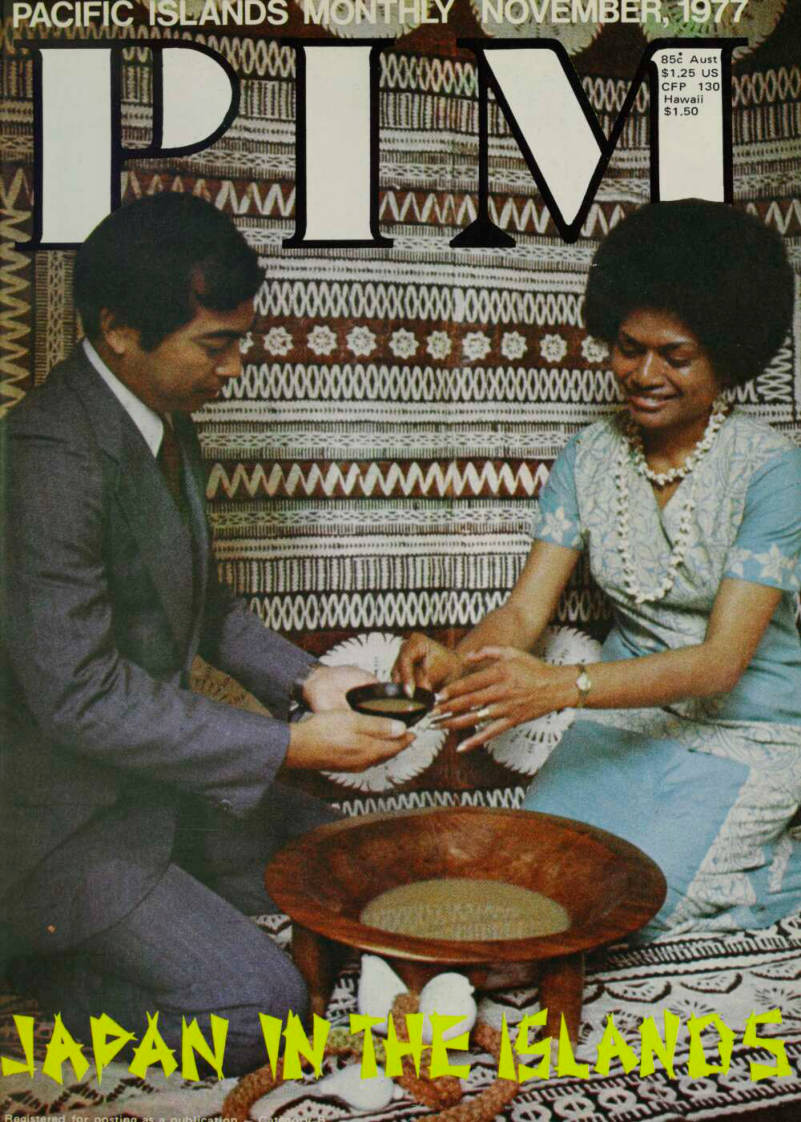
OUR COVER
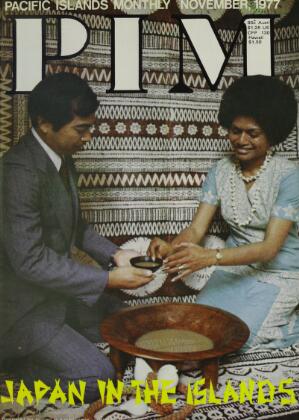
Siteri Howell, a member of the dance group of the Fiji Association of New South Wales, entertains with traditional Fijian yaqona Norinobu Saikawara, who, on behalf of the Atlantic and Pacific Travel company, takes care of Japanese groups visit ing the Pacific Islands. The characteristically Fijian ceremony was arranged by the Sydney office of the Japan Travel Bureau.
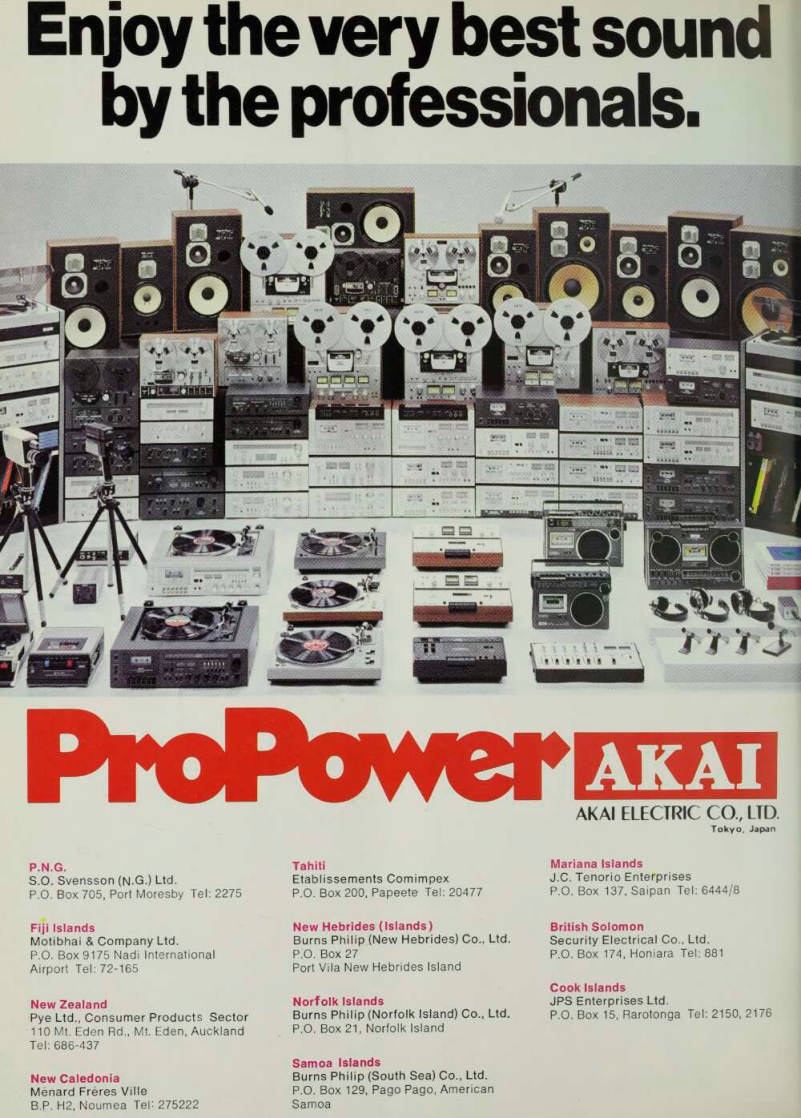
by the professionals.
Enjoy the very best sound
U ' B s G o o © o S 3 o o Q
3gp r )'|
‘3 - ' :«} ? / *3r-K* W . ■.— i 1.1. m s i
AKAI
AKAI ELECTRIC CO., LTD.
Tokyo, Japan
P.N.G.
S.O. Svensson (N.G.) Ltd.
P.O. Box 705, Port Moresby Tel: 2275 Fiji Islands Motibhai & Company Ltd.
P.O. Box 9175 Nadi International Airport Tel: 72-165 New Zealand Pye Ltd., Consumer Products Sector 110 Mt. Eden Rd., Mt. Eden, Auckland Tel: 686-437 New Caledonia Menard Freres Ville B.P. H 2, Noumea TeL 275222 Tahiti Etablissements Comimpex P.O. Box 200, Papeete Tel: 20477 New Hebrides (Islands) Burns Philip (New Hebrides) Co., Ltd.
P.O. Box 27 Port Vila New Hebrides Island Norfolk Islands Burns Philip (Norfolk Island) Co., Ltd.
P.O. Box 21, Norfolk Island Samoa Islands Burns Philip (South Sea) Co., Ltd.
P.O. Box 129, Pago Pago, American Samoa Mariana Islands J.C. Tenorio Enterprises P.O. Box 137, Saipan Tel: 6444/8 British Solomon Security Electrical Co., Ltd.
P.O. Box 174, Honiara Tel: 881 Cook Islands JPS Enterprises Ltd.
P.O. Box 15, Rarotonga Tel: 2150, 2176
Yamaha
4 ■ S
YAMAHA: POWERING
THE ADVANCEMENT
OF THE PACIFIC’S
FISHING, MARITIME
INDUSTRIES.
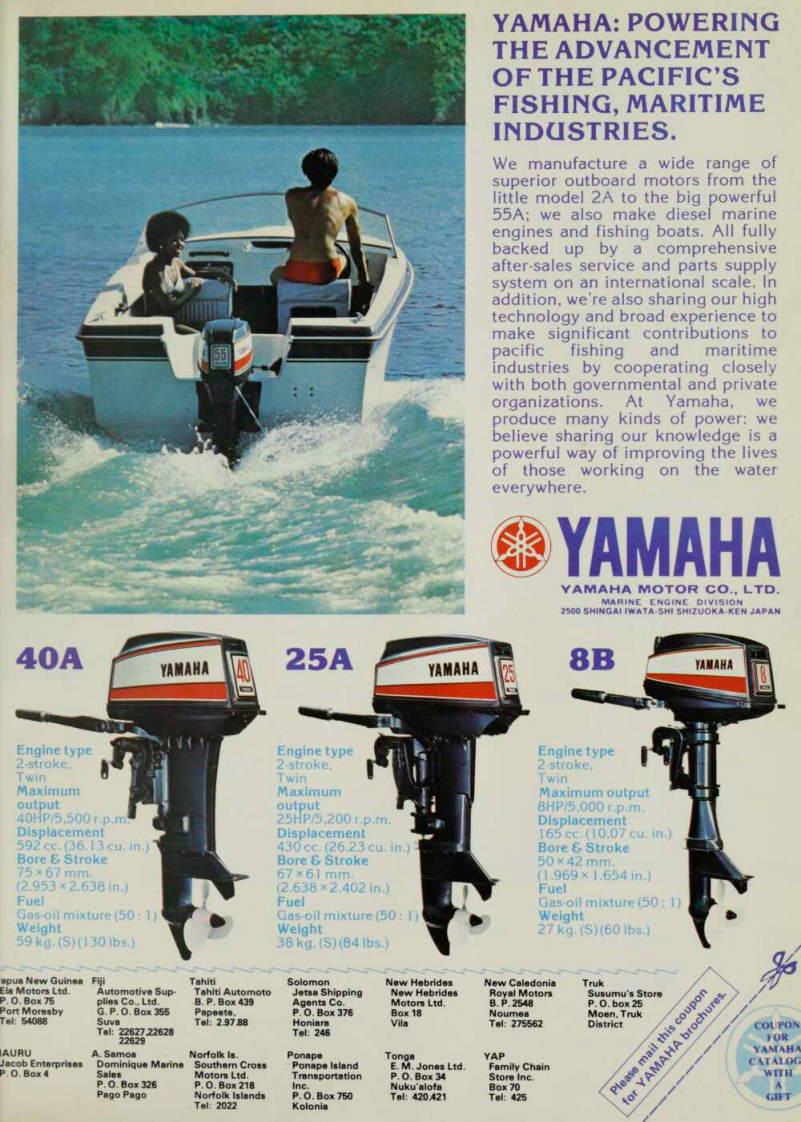
We manufacture a wide range of superior outboard motors from the little model 2A to the big powerful 53A; we also make diesel marine engines and fishing boats. All fully backed up by a comprehensive after-sales service and parts supply system on an international scale. In addition, we’re also sharing our high technology and broad experience to make significant contributions to
pacific fishing and maritime
industries by cooperating closely
with both governmental and private organizations. At Yamaha, we produce many kinds of power: we believe sharing our knowledge is a powerful way of improving the lives of those working on the water
everywhere.
YAMAHA
YAMAHA MOTOR CO., LTD.
MARINE ENGINE DIVISION
2500 SHINGAI IWATA-SHI SHIZUOKA-KEN JAPAN
40A
YAMAHA
Engine type 2-stroke, Twin Maximum output 40HP/5,500 r.p.m* Displacement 592 cc. (36.13 cu. in.) Bore & Stroke 75 x 67 mm. (2.953x2.638 in.) Fuel Gas-oil mixture (50 Weight 59 kg. (S)(130 lbs.)
YAMAHA
Engine type 2-stroke, Twin Maximum output 25HP/5.200 r.p.m.
Displacement 430 cc. (26.23 cu. in.) Bore & Stroke 67 x6l mm. (2.638x2.402 in.) Fuel Gas-oil mixture (50 : 1) Weight 38 kg. (S)(84 lbs.) 8B
YAMAHA
Engine type 2-stroke, Twin Maximum output BHP/5,000 r.p.m.
Displacement 165 cc. (10.07 cu. in.) Bore & Stroke 50 x 42 mm. (1.969 x 1.654 in.) Fuel Gas-oil mixture (50 : 1) Weight 27 kg. (S) (60 lbs.)
COL PON
HJR
YAMAHA
LAI
U IT H
GIFT
ONE-
TONNE
TOUGH!
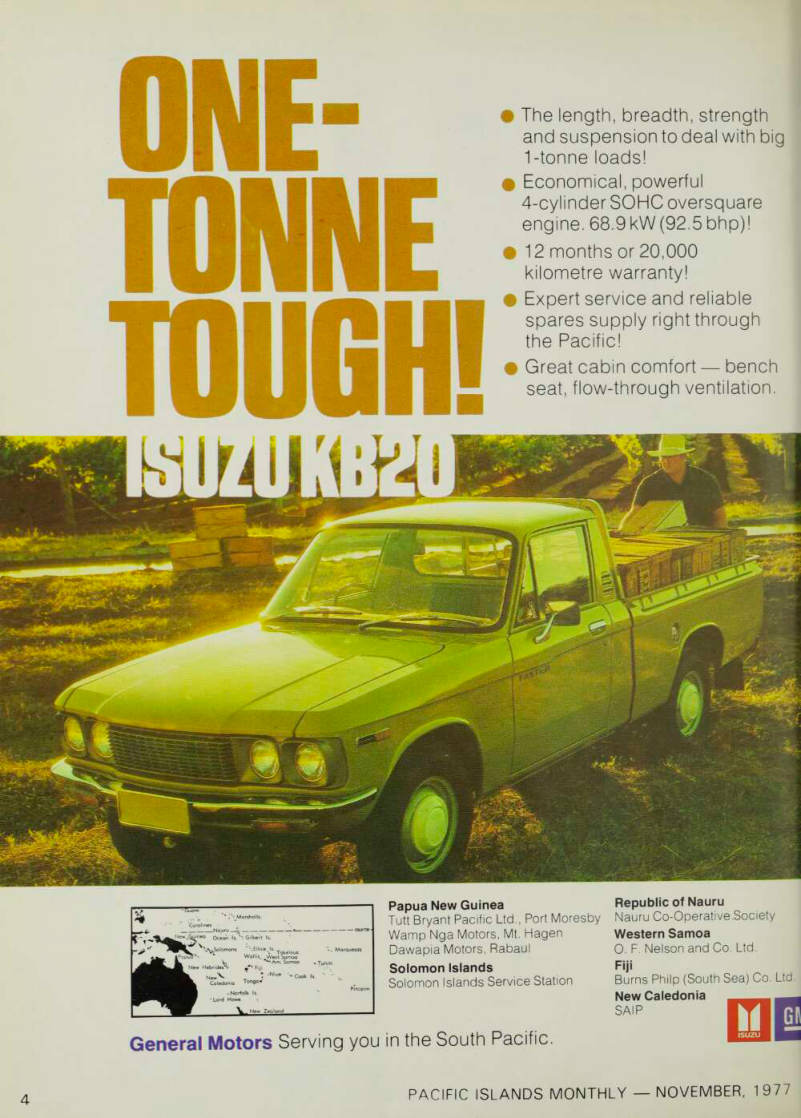
The length, breadth, strength and suspension to deal with big 1-tonne loads! Economical, powerful 4-cylinder SOHC oversquare
engine. 68.9 kW (92.5 bhp)!
12 months or 20,000 kilometre warranty! Expert service and reliable
spares supply right through
the Pacific! Great cabin comfort bench seat, flow-through ventilation. i Papua New Guinea Tutt Bryant Pacific Ltd., Port Moresby Wamp Nga Motors, Mt. Hagen Dawapia Motors, Rabaul Solomon Islands Solomon Islands Service Station General Motors Serving you in the South Pacific.
New \\vSoJomons '•.Ellice Is.
Hebrides*^- Republic of Nauru Nauru Co-Operative.Society Western Samoa O. F. Nelson and Co. Ltd.
Fiji Burns Philp (South Sea) Co. Ltd New Caledonia
SAIP
□ Gl\
Pacific Islands
Monthly
FOUNDED BY Ft W ROBSON IN 1930
Published Monthly By
Pacific Publications (Aust.) Pty. Ltd.,
76 Clarence Street, Sydney 2000.
Post Address: G.P.O. BOX 3408, SYDNEY,
Ns W 2001
Telegraphic Address: PACPUB, Sydney.
Telex 21242 Telephone: 29 6693 Publisher: Stuart Inder.
Manager: John Berry EDITOR: John Carter
Advertising Manager: Steve Gray
Subscription Rates
Pacific Islands Monthly" is airfreighted to the majority of subscribers and agents in the Pacific Islands and the
Usa.
Australia (including Norfolk Island) $10.50 Aust. New Zealand $11.50 NZ ($10.50 Aust). Fiji $10.75 Fijian ($10.50 Aust). Papua New Guinea, New (Hebrides, Tonga, Cook Islands, Western Samoa, Gilbert Islands, Tuvalu, Niue, Nauru and Solomon Islands $10.50 Aust.
American Samoa, Northern Marianas, Micronesia, Guam and Hawaii $15.00 US or $12.00 Aust. US Main land and Canada $17.00 US or $14,00 Aust New Caledonia and French Polynesia 1,600 CFP or $13.50 Aust. United Kingdom 9.50 or $12.50 Aust Japan 4,500 Yen or $12.50 Aust. Elsewhere $14.00 Aust.
Note: Overseas remittances in Australian dollars should be by bankdraft payable at Sydney Australia
Representatives
FIJI: Distribution and subscriptions Desai Bookshops, P.O. Box 160, Suva, Fiji. Telephone Suva 23036.
Advertising, Fiji Times & Herald Ltd , 20 Gordon Street, Suva. Telephone: 312 111 Telex: FJ2124.
Papua New Guinea: Advertising and Distribution PNG Post-Courier, P.O. Box 85, Port Moresby Inquir ies: Post Newsagency, Telephone 24 2148 French Polynesia: Distribution Hachette Pacifique. 10 Ave Bruat, Papeete New Caledonia: Distribution Depot Centre de Presse Michel Pentecost, 8.P.C2 Noumea United Kingdom: The Herald and Weekly Times Lim ited, 8-10 Clifford's Inn, Fetter Lane, London EC4AIBU Telephone: 01 831 6041. Telex: London 21989 Japan: Advertising Universal Media Corporation, C.P.O. Box 46, Tokyo. Telephone: 666 3036 New Zealand: Pacific Publications, C.P.O. Box 2229, Auckland. Advertising enquiries International Media Representatives Ltd, P.O Box 3880 Auckland. Tel 73 880. Telex: NZ21157. (Auck 40).
Hawaii and U.S. Mainland only; PIM, Hawaii, 2812, Kahawai St., Honolulu. Hawaii. 96822. Second class postage paid at Honolulu, Hawaii US Advertising Rep resentative, Joshua B. Powers, Jr, Powers International, Inc 551 Fifth Ave, New York, New York 100 017 Tele phone 867 9580. Telex 236514 Pub 952480 Victoria: Advertising - Pacific Publications (Aust) Pty Ltd., Herald and Weekly Times Building, 2nd Floor, 61 Flinders Lane, Melbourne, 3000 Telephone 652 1 565 Brisbane: D Wood, Anday Agency, Box 1918 G P O Brisbane 4001 Telephone 44 3485: 44 1546.
Printed in Australia Copyright ©, 1977, Pacific Publications (Aust.) Pty. Ltd.
Printed by Paramac, Mitchell Rd, Alexandria.
PIM is distributed in Australia and New Zealand by Gor don & Gofch, Australian cover price is recommended retail only.
Registered at the G.P.O Sydney for transmission by post as a publication category B
Vol. 48 No. 11
November 1977
Up Front
with the Publisher
The Cook Islands longtime Premier Sir Albert Henry, was in expansive mood for a group of us who interviewed him on Rarotonga the other day.
Air New Zealand, which operates the fast jet services which link the Cook Is lands with several important centres, in cluding now Honolulu, got together a small group of New Zealand and Australian editors for a look at develop ments in the Cook Islands, so naturally it was important that the pressmen should ask Sir Albert for a rundown. He made available the whole morning and dis cussed every kind of subject from tour ism (“everybody wants to come here”), the state of the economy (“healthy”) and the operations in the Cooks of cancer man Milan Brych (“doing a fine job here and it’s irrelevant what the New Zealand medical people feel about his formal
qualifications”).
During the interview, which was more in the nature of a friendly discussion, somebody brought up the matter of American entrepreneur Finbar Kenny and Cook Islands postage stamps. For more than 10 years Mr Kenny has had with the Cook Islands Government the sole contract to design the Cooks postage stamps, print them and dis tribute them.
The financial details of this ar rangement have never been clear. Sir Albert didn’t make them any clearer when it came to the small print, but he said that the Cook Islands’ share of the profits from the arrangement was “like a blessing from heaven, it just drops down”. The Cook Islands, he said, got 50 per cent of the takings, but he didn’t know what Mr Kenny’s expenses were in the operation and the government didn’t ask to see them. What was especially a financial boon to the Cook Islands, said Sir Albert, was that Finbar Kenny made interest-free cash available from his own profits to developing Cook Islands busi ness ventures. Mr Kenny in return now had a number of financial investments in the islands, as he sometimes took equity in business ventures that his money sup ported.
I remarked to Sir Albert at this easy going press conference that Mr Kenny would in all these circumstances no doubt hope that Sir Albert and his government would remain in power for ever. Sir Albert replied frankly that Mr Kenny no doubt could feel this, especially as “some people” would like to see some of the stamp money diverted to something else.
Lucky Finbar Kenny! Having the monopoly to print and distribute a coun try’s postage stamps is like having a monopoly to print your own money.
After 10 good years, are the Cook Islan ders satisfied they are getting every cent the country can get from Mr Kenny’s stamp operation? It reminds me of the time when Papua New Guinea thought it was doing very well from its share of the Bougainville copper mine until some
pushy people decided it really wasn’t
enough and won a lot more from the operating company on behalf of Papua New Guinea.
Sir Albert mentioned that Mr Kenny would shortly be visiting the Cook Is lands for discussions on future stamp ar rangements. Now may be the time for the Cook Islanders to decide that charity begins at home, and if need be put the stamp contract out for tender.
Three leading members of the Norfolk Island Council who officially visited Canberra in October to see the minister in charge of that Australian territory.
Senator R. G. Withers, returned home with a flea in their ear. The Senator wouldn’t see them. The councillors had wanted to ask the Senator just what Australia's plans are towards Norfolk Is land. Would it adopt the main pro visions of the Nimmo Royal Commission report that the island be integrated into Australia?
Senator Withers’ inexplicable behaviour got him some bad publicity.
The councillors have now employed a Sydney public relations firm to get Nor folk’s views directly to what is so far a poorly informed Australian public, and before the councillors left, they were able to stress publicly that (1) the Australian Government must make no decisions affecting the people of Norfolk Island without full prior consultation; (2) That it was the wish of the great ma jority of the Norfolk Island people that Norfolk Island should have internal self government including control of finance, but with continuing association with Australia; and (3) That it is the right of the people of Norfolk Island to determine their own political future by referendum.
I think Canberra has misjudged the strength of Norfolk Island’s opposition to integration. The Nimmo Report
Continued on p 107
Up Front - from p 5
touched a raw nerve among the Pitcairn descended section of the population, whose views have to be listened to because they are the "belongers”.
They suddenly saw that they were about to lose their identity— to be kill ed off as a people. Their fierce opposi tion to integration is a nationalistic fer vour, no less deep than the nationalism of the Nauruans and Papua New Gui neans when they, in their turn, made it clear to Australia that their national
identity was precious.
To integrate Norfolk Island with Australia without the agreement of the Norfolk Island population would be for Australia to undertake an exercise in gunboat diplomacy as immoral and as dishonest as Indonesia's takeover of Irian Jaya. Australia has sovereignty over Norfolk Island as a trustee, not as an owner.
Advertisements & other items, p. 6 (1 item)
Pacific Islands
S.E. TATH AM & CO. PTY. LTD.
BEEHIVE BUILDING,
94 ELIZABETH STREET.
G.P.O. BOX 8,
MELBOURNE 3001.
AUSTRALIA.
CABLES: “SET"
TELEX: AA34552.
TELEPHONE: 63 5094
jii
...BUYERS for the
PACIFIC ISLANDS
PAPUA NEW GUINEA:
S. E. TATHAM (P N G.) PTY. LTD.
LAE: MALAITA ST. (P.O. BOX 1562).
PORT MORESBY: Cm. GOROA & MAN AH U Sts.,
GORDON (P.O. BOX 6733, BOROKO).
FIJI:
S. E. TATHAM (FIJI) PTY. LTD.
LAUTOKA: P.O. BOX 366.
SUVA: G.P.O. BOX 671.
TELEGRAMS: ALL OFFICES “SET.
FOR SERVICE
YOUR GUARANTEE
SINCE 1524
Pacific islands Monthly
Vol 48, No 11, Nov 1977
General
South Pacific Conference 8 SPC Budget 9 Guerrillas active in Irian Jaya 14 Pacifique Sud 36 Dying banana industry 79 SPC skipjack study 87
American Samoa
Fred Uhrle retires 27 Slow payers warned 31 Bigger air terminal 75 Inflation beaten 87
Cook Islands
Windfall for fishing fleet 10 When warriors rioted 40 Mauke's airstrip 75 Island Foods to continue 88
Fiji
Alliance wins election 19 Director of Information 27 Airlines' row 71 Pacific air war 73 Port charges up 73 First all-Fiji air crew 73 Landing craft sinks 75 Development Bank lending 81 Fruit processer closes 83 Mapping farm lands 93 Bait for new industry 93 Copper exploration 93
French Polynesia
Political assassination 16 Political concessions 20
Gilbert Islands
Cholera deaths 13 "Money for Banabans 16 Captain Ward retires 29
Guam
New uses for coconuts 40 Expatriate workers 82
New Caledonia
Political concessions 20 Poll issue 37 Trade movements 38 Jaycee Congress meeting 81 Clinic closed 85
New Hebrides
Party's stand on poll 32
Papua New Guinea
Modernism in traditional costumes 13 The "Diro affair'' 15 Students on jet course 27 University's new vice-chancellor ... 27 Campbell Fleay retires 29 TV in 1982?. 31 Trudeau's message to Somare 31 College nearly broke 32 Trade cut with S. Africa 32 Betel nut chewing 39 Demand for better jobs for locals. 40 Allegation against Ok Tedi 49 Jets for Air Niugini 75 Statutory bodies criticised 86 Cocoa & Coffee slump 87 New hunting rules 93 Localisation "too rapid" 95 "Visual pollution" complaint 97
Solomon Islands
Independence confusion 12 Union faces crisis 31 New money 32 Shipping service criticised 39
Tonga
NZ Santa Claus 39 EEC grant 81
Tufted tape design mats 82 Secretary to government 84
Us Trust Territory
Compensation of A-test victims ... 16 Constitutional uncertainty 25 New ship delivered 73
Western Samoa
Aust High Commissioner (acting) . 27 Polynesian Airlines' new GM 27 Census 31 Miss Samoa 31 Students in Hawaii 31 Brewery short of water 83 Hint of W, German aid 83 Handbag industry 83
Japan In The Islands
PNG attitudes change 17 Demand for fish 61 Getting acquainted 62 Pacific trade 63 Trading companies 64 On the move in Fiji 65 Electronics industry 67 Auto sales 69
DEPARTMENTS: Up Front with the Publisher, 5; People, 27; News in a Nutshell, 31; Editor's Mailbag, 33; TTopicalities, 39; Magazine section, 44; Books, 50; Pacific Transport, 71; Cruising Yachts, 77; Business & Development, 79; Produce Prices, 94; Deaths of Islands People, 97; Shipping information, 99.
Horrid niggling, or happy nuptials,
for Commission and Forum?
From JOHN CARTER in Pago Pago
Are the South Pacific Commission and the South Pacific Forum on a collision course? Or are they run ning along a road which will lead to a merger? I believe the answer is “Yes” to the latter question.
And this emerges clearly from the strong trends evident in the 17th South Pacific Conference which, in four days of hard work in American Samoa’s capital, Pago Pago, made decisions and expressed views which many delegates said are among the most critical in the 27 ac tive years of the commission’s life Two years ago, Stuart Inder, PlM’s publisher, said the SPC need ed a heart transplant. Last year I thought it had had a monkey gland transplant.
Whatever it was, it did the trick.
The SPC was more vigorous than it had ever been. And it still is, despite a feeling among many that its days as a separate, and older, body are numbered; that the SPC and the Forum will marry. After all, they’re both healthy the Forum, possibly, more dominating, the SPC quieter, shy but good at housekeeping.
But, if the courtship began this year at Pago Pago, it hadn’t a very affectionate beginning. The shadow of decisions taken a few weeks ago by the Forum at Port Moresby hung like a cloud over the conference of 22 nations and territories — a cloud with a silver lining to those who think the Forum should take over; a dark cloud on the horizon but big ger than a man’s hand to others, in cluding the Secretary-General, Dr Macu Salato, who was the first to in dicate that everything wasn’t rosy in relations between the two bodies.
Reporting on the first day when the conference got through more business than any previous conference has in one day on the commission’s achievements and prospects, Dr Salato said; “What, however, is an area of delicate and serious concern to the Secretariat in terms of how it views its own prospect, is what I must in all hones ty state at this plenary session.
“I refer to what is becoming, not a question of duplication or overlap
ping in our work, but erosion, or, perhaps a more frank term, Takeover’ in the work traditionally carried out by the South Pacific Commission by our sister regional organisation, the Forum, and its own secretariat, namely SPEC.”
Two projects the SPC had been viewing for some time, the environ mental management programme and a skipjack tuna assessment pro gramme which is the costliest effort by the SPC to date, with more than a million dollars involved were being included in SPEC’s activities, Dr Salato pointed out.
He and SPEC’s director, Mr Mahe Tupouniua, often consulted over matters to avoid duplication, but in the last talk, after the Port Moresby Forum meeting, he heard for the first time that SPEC had pro posed a fisheries agency a tradi tional SPC field.
Dr Salato asked the conference for “guidance”. He got more than that. The reaction of some delega tions, notably the “metropolitans”, was to call for clarification as to who did what.
The conference was into its sec ond working day and had the two hot potatoes, Law of the Sea and the fisheries agency, and the environ mental management programme, on its agenda.
Time after time reference was made to SPEC doing this and that, and the view was forcefully express ed, with regard to the environment business, that there was no need for another agency.
Mr Lester Edmond, leader of the American delegation, clearly didn’t like it.
“We seem to be involved in en dorsing the decisions of the Forum,” he said. “I don’t think that is the function of this body. It is almost like a volley-ball game where the ball is hit by the SPC and then the ball comes back from the Forum.
Then nine members of their team (a reference to nine Forum members being SPC members) come running on to the other side of the court.
“In my view the next operation should be a meeting of the Forum officials and the SPC officials to determine clearly what the respon sibilities of each organisation should be.”
He was echoed by Mr J.
Snodgrass of the UK.
Then, both Mr Tupouniua and Dr
Salato explained their respective
positions, and both agreed there were difficulties.
The former said it had been agreed between them that SPEC would be primarily responsible for the fisheries agency report and the
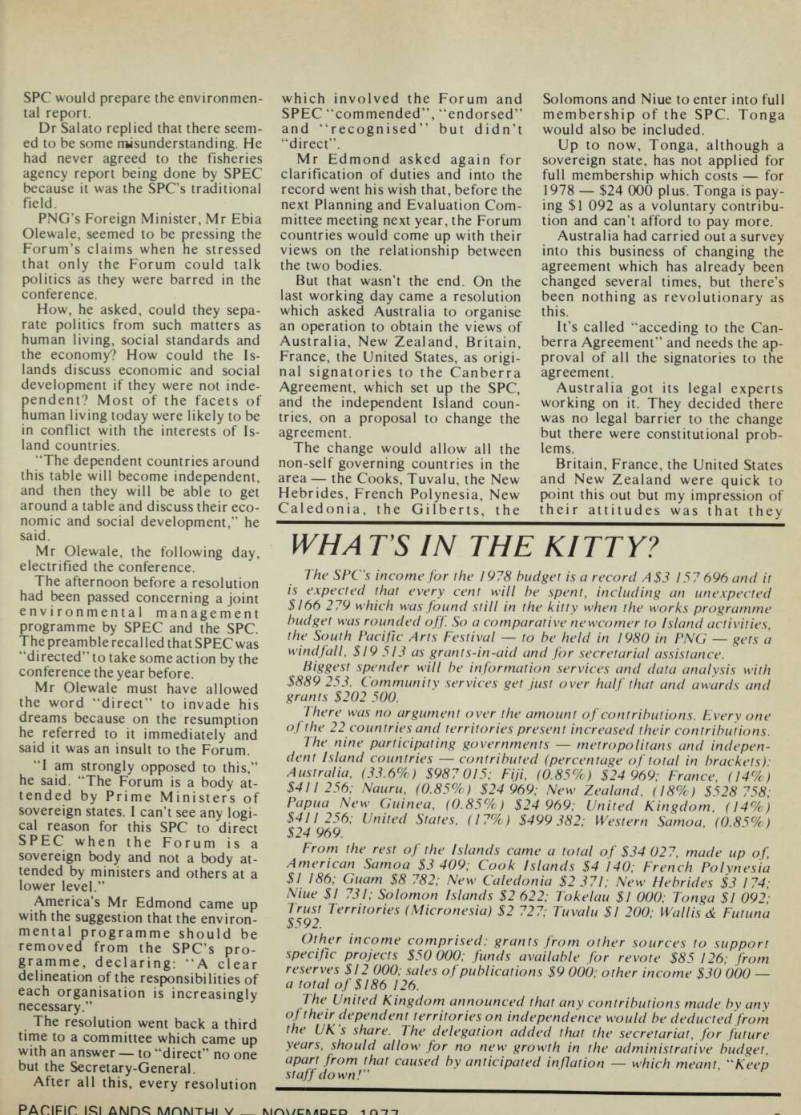
The 17th South Pacific Conference at work in Pago Pago.
SPC would prepare the environmen tal report.
Dr Salato replied that there seem ed to be some misunderstanding. He had never agreed to the fisheries agency report being done by SPEC because it was the SPC’s traditional field.
PNG’s Foreign Minister, Mr Ebia Olewale, seemed to be pressing the Forum’s claims when he stressed that only the Forum could talk politics as they were barred in the conference.
How, he asked, could they sepa rate politics from such matters as human living, social standards and the economy? How could the Is lands discuss economic and social development if they were not inde pendent? Most of the facets of human living today were likely to be in conflict with the interests of Is land countries.
“The dependent countries around this table will become independent, and then they will be able to get around a table and discuss their eco nomic and social development,” he said.
Mr Olewale, the following day, electrified the conference.
The afternoon before a resolution had been passed concerning a joint environmental management programme by SPEC and the SPC.
The preamble recalled that SPEC was “directed” to take some action by the conference the year before.
Mr Olewale must have allowed the word “direct” to invade his dreams because on the resumption he referred to it immediately and said it was an insult to the Forum.
“I am strongly opposed to this,” he said. “The Forum is a body at tended by Prime Ministers of sovereign states. I can’t see any logi cal reason for this SPC to direct SPEC when the Forum is a sovereign body and not a body at tended by ministers and others at a lower level.”
America’s Mr Edmond came up with the suggestion that the environ mental programme should be removed from the SPC’s pro gramme, declaring: ”A clear delineation of the responsibilities of each organisation is increasingly necessary.”
The resolution went back a third time to a committee which came up with an answer to “direct” no one but the Secretary-General.
After all this, every resolution
which involved the Forum and SPEC “commended”, “endorsed” and “recognised” but didn’t “direct”.
Mr Edmond asked again for clarification of duties and into the record went his wish that, before the next Planning and Evaluation Com mittee meeting next year, the Forum countries would come up with their views on the relationship between the two bodies.
But that wasn’t the end. On the last working day came a resolution which asked Australia to organise an operation to obtain the views of Australia, New Zealand, Britain, France, the United States, as origi nal signatories to the Canberra Agreement, which set up the SPC, and the independent Island coun tries, on a proposal to change the agreement.
The change would allow all the non-self governing countries in the area the Cooks, Tuvalu, the New Hebrides, French Polynesia, New Caledonia, the Gilberts, the
Solomons and Niue to enter into full membership of the SPC. Tonga would also be included.
Up to now, Tonga, although a sovereign state, has not applied for full membership which costs for 1978 $24 000 plus. Tonga is pay ing $1 092 as a voluntary contribu tion and can’t afford to pay more.
Australia had carried out a survey into this business of changing the agreement which has already been changed several times, but there’s been nothing as revolutionary as this.
It’s called “acceding to the Can berra Agreement” and needs the ap proval of all the signatories to the agreement.
Australia got its legal experts working on it. They decided there was no legal barrier to the change but there were constitutional prob lems.
Britain, France, the United States and New Zealand were quick to point this out but my impression of their attitudes was that they
Wha Ts In The Kitty?
The SPC’s income for the 1978 budget is a record A $3 157 696 and it is expected that every cent will be spent, including an unexpected $166 279 which was found still in the kitty when the works programme budget was rounded off So a comparative newcomer to Island activities, the South Pacific Arts Festival to be held in 1980 in PNG gets a windfall, $l9 513 as grants-in-aid and for secretarial assistance.
Biggest spender will he information services and data analysis with $BB9 253. Community services get just over half that and awards and grants $202 500.
There was no argument over the amount of contributions. Every one of the 22 countries and territories present increased their contributions.
The nine participating governments metropolitans and indepen dent Island countries contributed (percentage of total in brackets): Australia, (33.6%) $987 015; Fiji, (0.85%) $24 969; France, (14%) $4ll 256; Nauru, (0.85%) $24 969; New Zealand, (18%) $528 758- Papua New Guinea, (0.85%) $24 969; United Kingdom, (14%) $4ll 256; United States, (17%) $499 382; Western Samoa, (0.85%) $24 969.
From the rest of the Islands came a total of $34 027, made up of, American Samoa $3 409; Cook Islands $4 140; French Polynesia $1 186; Guam $8 782; New Caledonia $2 371; New Hebrides $3 174; Niue $1 731; Solomon Islands $2 622; Tokelau $1 000; Tonga $1 092; Territories (Micronesia) $2 727; Tuvalu $1 200; Wallis & Futuna Other income comprised: grants from other sources to support specific projects $5O 000; funds available for revote $B5 126; from reserves $l2 000; sales of publications $9 000; other income $3O 000 a total of $lB6 126.
The United Kingdom announced that any contributions made by any o f their dependent territories on independence would be deducted from the UK s share. The delegation added that the secretariat, for future years, should allow for no new growth in the administrative budget, apart from that caused by anticipated inflation which meant “Keep staff do wn!"
Advertisements & other items, p. 9 (1 item)
PACIFIC l£l A/lOMTUI V Mrvwtnv/iDCD n~r~>
It's Niggling Or
Nuptlals
(continued from previous page). wouldn’t get in the way if it were
constitutionally possible.
France's Mr Pierre Revol said their constitution would not allow, at the moment, territories to sign an international convention.
That was the view of all the
metropolitan powers.
Once again, however, PNG’s Mr Olewale was brutally frank.
“We are no longer in the 40s and 50s when the SPC was regarded as a rich man’s club, in which important decisions are made by a small group of people.” he said. “We can't afford to let this go on.”
He added that there was a consen sus among Pacific countries that the Canberra Agreement should be looked at again.
Australia’s Mr J. McLeay, Minis ter for Construction, described it as the most important issue the con ference had ever faced. It would probably affect the future of the Conference, he said.
Everyone agreed, and the next few months should see the metropolitans getting together on this.
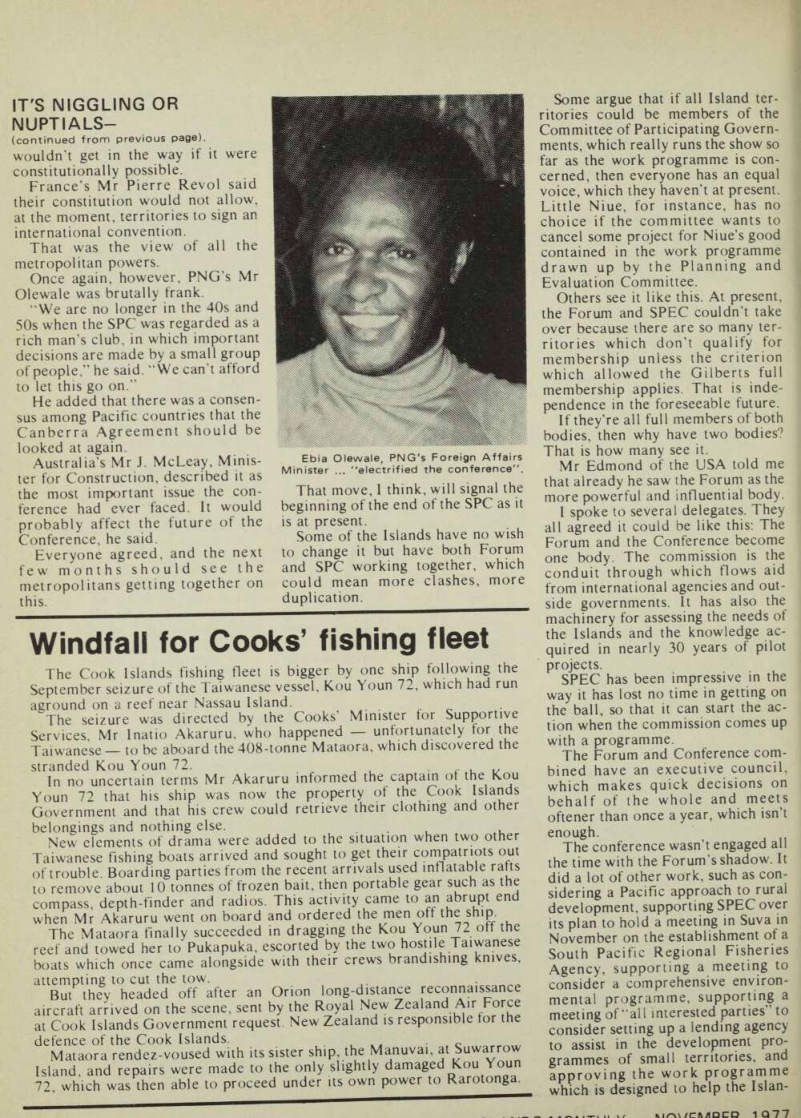
Ebia Olewale, PNG's Foreign Affairs Minister ... "electrified the conference".
That move, I think, will signal the beginning of the end of the SPC as it is at present.
Some of the Islands have no wish to change it but have both Forum and SPC working together, which could mean more clashes, more
duplication.
Some argue that if all Island ter ritories could be members of the Committee of Participating Govern ments, which really runs the show so far as the work programme is con cerned, then everyone has an equal voice, which they haven’t at present.
Little Niue, for instance, has no choice if the committee wants to cancel some project for Niue’s good contained in the work programme drawn up by the Planning and Evaluation Committee.
Others see it like this. At present, the Forum and SPEC couldn’t take over because there are so many ter ritories which don’t qualify for membership unless the criterion which allowed the Gilberts full membership applies. That is inde pendence in the foreseeable future.
If they’re all full members of both bodies, then why have two bodies?
That is how many see it.
Mr Edmond of the USA told me that already he saw the Forum as the more powerful and influential body.
I spoke to several delegates. They all agreed it could be like this; The Forum and the Conference become one body. The commission is the conduit through which flows aid from international agencies and out side governments. It has also the machinery for assessing the needs of the Islands and the knowledge ac quired in nearly 30 years of pilot
projects.
SPEC has been impressive in the way it has lost no time in getting on the ball, so that it can start the ac tion when the commission comes up with a programme.
The Forum and Conference com bined have an executive council, which makes quick decisions on behalf of the whole and meets oftener than once a year, which isn’t enough.
The conference wasn t engaged all the time with the Forum’s shadow. It did a lot of other work, such as con sidering a Pacific approach to rural development, supporting SPEC over its plan to hold a meeting in Suva in November on the establishment of a South Pacific Regional Fisheries Agency, supporting a meeting to consider a comprehensive environ mental programme, supporting a meeting of “all interested parties to consider setting up a lending agency to assist in the development pro grammes of small territories, and approving the work programme which is designed to help the Islan
ders in all sorts of ways to improve their living standards.
The conference also approved two new appointments Mr William Thomas Brown, ex-PNG kiap and reputed builder of the Bougainville copper town of Arawa, as Director of Programmes, in place of Dr G. Motha, and Mr Donald W.
J. Stewart, of New Zealand, at pre sent on Nauru, as Director of Ad ministration in place of Dr Frank Mahony.
Dr Salato’s term as Secretary- General comes to an end next year.
If he goes and people hope he won’t it will mean changing three horses in mid-stream at a crucial time in the SPC’s history.
The conference also decided to go back to Noumea for the 18th South Pacific Conference next year, asked Tuvalu to furnish the chairman and appointed a Niue man as vice-chair man.
As a piece of dessert, the con ference heard an address by Mr A.
Y. Fujimoto, minister at the Japanese Embassy at Canberra.
He was one of seven Japanese offi cials present as observers there were also a Korean and Chilean indicating the outside interest in the views and decisions of the Islands.
Mr Fujimoto said, with regard to the proposed fisheries agency and the intention of Island governments to declare 200-mile economic zones, that Japan hoped they would be given access to the fisheries resources when and where a surplus existed, which was clearly provided for in the United Nations text at the Law of the Sea conference. They must come to some arrangements on a mutually accepted basis.
Mr Fujimoto also promised a con centration of Japanese aid in the South Pacific and the services of young Japanese working like the American Peace Corps.
As the Islanders are beginning to discover make enough noise, and decide to paddle your own canoe much more vigorously, and the world outside takes notice! • The Republic of Nauru will re ceive a loan of $22.75 million to finance projects for industrial development, according to a June announcement by Chase Manhattan Asia Ltd. which arranged the loan jointly with Kuwait Pacific Finance Co.
Windfall for Cooks’ fishing fleet
The Cook Islands fishing fleet is bigger by one ship following the September seizure of the Taiwanese vessel, Kou Youn 72, which had run aground on a reef near Nassau Island.
The seizure was directed by the Cooks’ Minister for Supportive Services Mr Inatio Akaruru, who happened unfortunately for the Taiwanese to be aboard the 408-tonne Mataora, which discovered the stranded Kou Youn 72. . . , „ In no uncertain terms Mr Akaruru informed the captain of the Kou Youn 72 that his ship was now the property of the Cook Islands Government and that his crew could retrieve their clothing and other belongings and nothing else. .
New elements of drama were added to the situation when two other Taiwanese fishing boats arrived and sought to get their compatriots out of trouble. Boarding parties from the recent arrivals used inflatable ratts to remove about 10 tonnes of frozen bait, then portable gear such as the compass, depth-finder and radios. This activity came to an abrupt end when Mr Akaruru went on board and ordered the men off the ship.
The Mataora finally succeeded in dragging the Kou Youn 72 ott the reef and towed her to Pukapuka, escorted by the two hostile Taiwanese boats which once came alongside with their crews brandishing knives, attempting to cut the tow. .
But they headed off after an Orion long-distance reconnaissance aircraft arrived on the scene, sent by the Royal New Zealand Air Force at Cook Islands Government request. New Zealand is responsible tor the defence of the Cook Islands. ... »c Mataora rendezvoused with its sister ship, the Manuvai, at Suwarrow Island, and repairs were made to the only slightly damaged Kou Youn 72, which was then able to proceed under its own power to Rarotonga.
Advertisements & other items, p. 10 (1 item)
_ ~>> w ma\/ca/ipcd 1Q77
~>> w ma\/ca/ipcd 1Q77
Be Going
Tom Won't
Home
By Stuart Inder
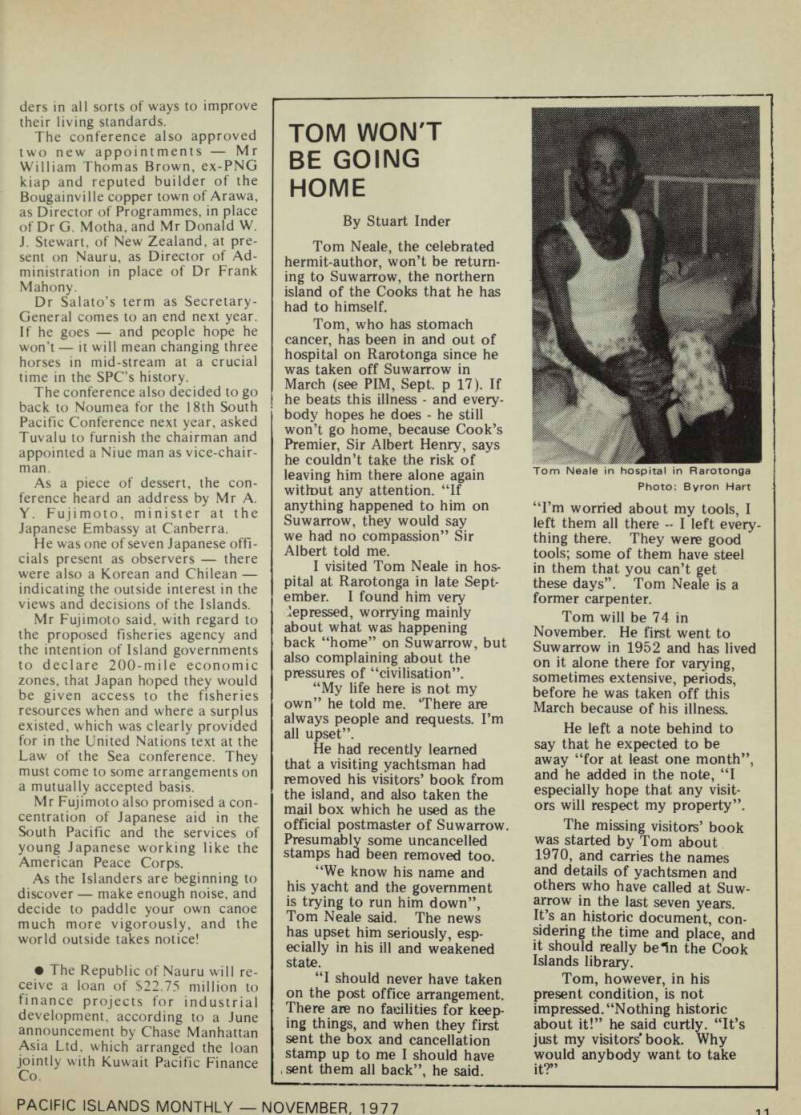
Tom Neale, the celebrated hermit-author, won’t be return ing to Suwarrow, the northern island of the Cooks that he has had to himself.
Tom, who has stomach cancer, has been in and out of hospital on Rarotonga since he was taken off Suwarrow in March (see PIM, Sept, p 17). If he beats this illness - and every body hopes he does - he still won’t go home, because Cook’s Premier, Sir Albert Henry, says he couldn’t take the risk of leaving him there alone again without any attention. “If anything happened to him on Suwarrow, they would say we had no compassion” Sir Albert told me.
I visited Tom Neale in hos pital at Rarotonga in late Sept ember. I found him very depressed, worrying mainly about what was happening back “home” on Suwarrow, but also complaining about the pressures of “civilisation”.
“My life here is not my own” he told me. ‘There are always people and requests. I’m all upset”.
He had recently learned that a visiting yachtsman had removed his visitors’ book from the island, and also taken the mail box which he used as the official postmaster of Suwarrow.
Presumably some uncancelled stamps had been removed too.
“We know his name and his yacht and the government is trying to run him down”, Tom Neale said. The news has upset him seriously, esp ecially in his ill and weakened state.
“I should never have taken on the post office arrangement.
There are no facilities for keep ing things, and when they first sent the box and cancellation stamp up to me I should have .sent them all back”, he said.
“I’m worried about my tools, I left them all there - I left every thing there. They were good tools; some of them have steel in them that you can’t get these days”. Tom Neale is a former carpenter.
Tom will be 74 in November, He first went to Suwarrow in 1952 and has lived on it alone there for varying, sometimes extensive, periods, before he was taken off this March because of his illness.
He left a note behind to say that he expected to be away “for at least one month”, and he added in the note, “I especially hope that any visit ors will respect my property”.
The missing visitors’ book was started by Tom about 1970, and carries the names and details of yachtsmen and others who have called at Suw arrow in the last seven years.
It’s an historic document, con sidering the time and place, and it should really the Cook
Islands library.
Tom, however, in his present condition, is not impressed. “Nothing historic about it!” he said curtly. “It’s just my visitors’book. Why would anybody want to take it?’
Tom Neale in hospital in Rarotonga Photo: Byron Hart
independence gets “all clear”
Still confusion as Solomons independence gets “all clear”
From GEORGE ATKIN in Honiara
The Solomons has become the first country administered by Bri tain to be given a large amount of money without having to repay it. A British protectorate for nearly 100 years, the independent Solomons will be given the money on indepen dence in grant forms.
The nation’s delegation at the September conference in London which discussed the independence constitution with the British Government won an agreement for a further s3m to be added to the orig inal s4om settlement.
This original lump sum was to be given in loans.
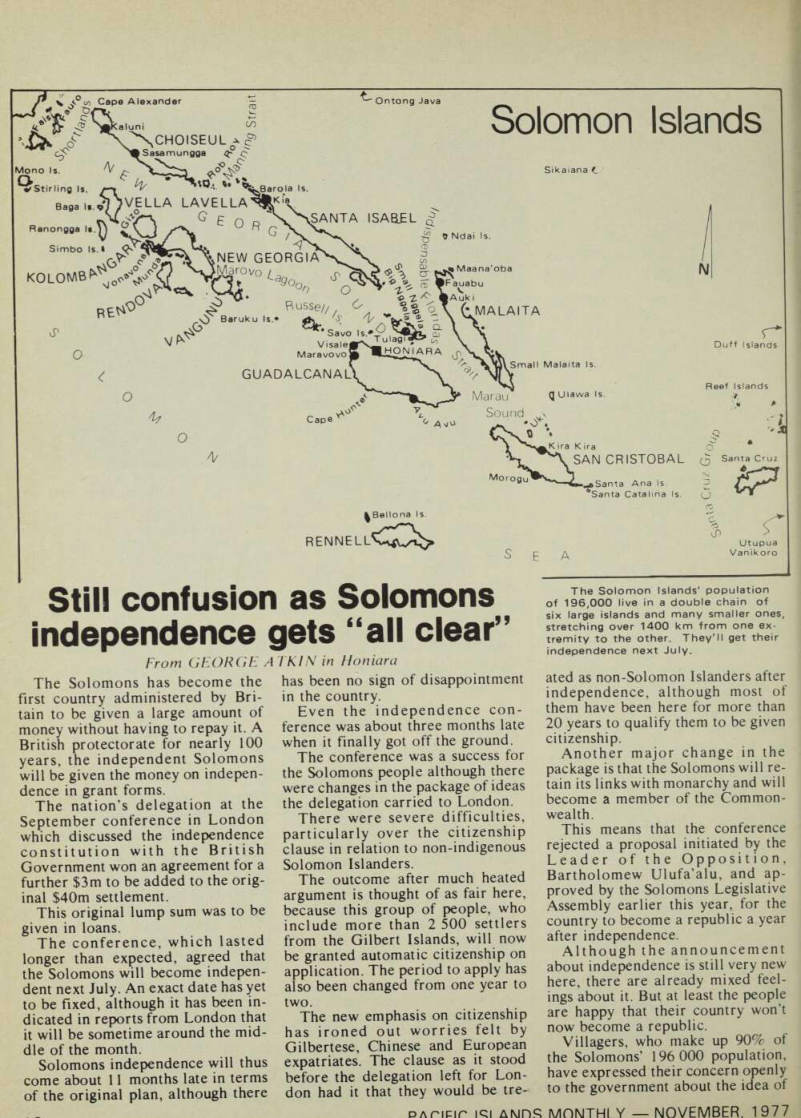
The conference, which lasted longer than expected, agreed that the Solomons will become indepen dent next July. An exact date has yet to be fixed, although it has been in dicated in reports from London that it will be sometime around the mid dle of the month.
Solomons independence will thus come about 11 months late in terms of the original plan, although there
has been no sign of disappointment in the country.
Even the independence con ference was about three months late when it finally got off the ground.
The conference was a success for the Solomons people although there were changes in the package of ideas the delegation carried to London.
There were severe difficulties, particularly over the citizenship clause in relation to non-indigenous Solomon Islanders.
The outcome after much heated argument is thought of as fair here, because this group of people, who include more than 2 500 settlers from the Gilbert Islands, will now be granted automatic citizenship on application. The period to apply has also been changed from one year to two.
The new emphasis on citizenship has ironed out worries felt by Gilbertese, Chinese and European expatriates. The clause as it stood before the delegation left for Lon don had it that they would be tre
ated as non-Solomon Islanders after independence, although most of them have been here for more than 20 years to qualify them to be given citizenship.
Another major change in the package is that the Solomons will re tain its links with monarchy and will become a member of the Common wealth.
This means that the conference rejected a proposal initiated by the Leader of the Opposition, Bartholomew Ulufa’alu, and ap proved by the Solomons Legislative Assembly earlier this year, for the country to become a republic a year after independence.
Although the announcement about independence is still very new here, there are already mixed feel ings about it. But at least the people are happy that their country won’t now become a republic.
Villagers, who make up 90% of the Solomons’ 196 000 population, have expressed their concern openly to the government about the idea of
The Solomon Islands' population of 196,000 live in a double chain of six large islands and many smaller ones, stretching over 1400 km from one ex tremity to the other. They'll get their independence next July.
having a republic in the Solomons.
They pointed out that to in troduce a new system of government would just confuse them. “We don’t want a republican system because we just don’t understand or know anything about it,” they have been
reportedly saying.
In London, the chairman of the conference, Lord Goronwy- Roberts, was pleased with the agree ment reached. He said on the clos ing day that the agreement reached is excellent, constructive and hopeful. There had been severe difficulties but these had succumbed to “the wisdom of the Solomons”, he said.
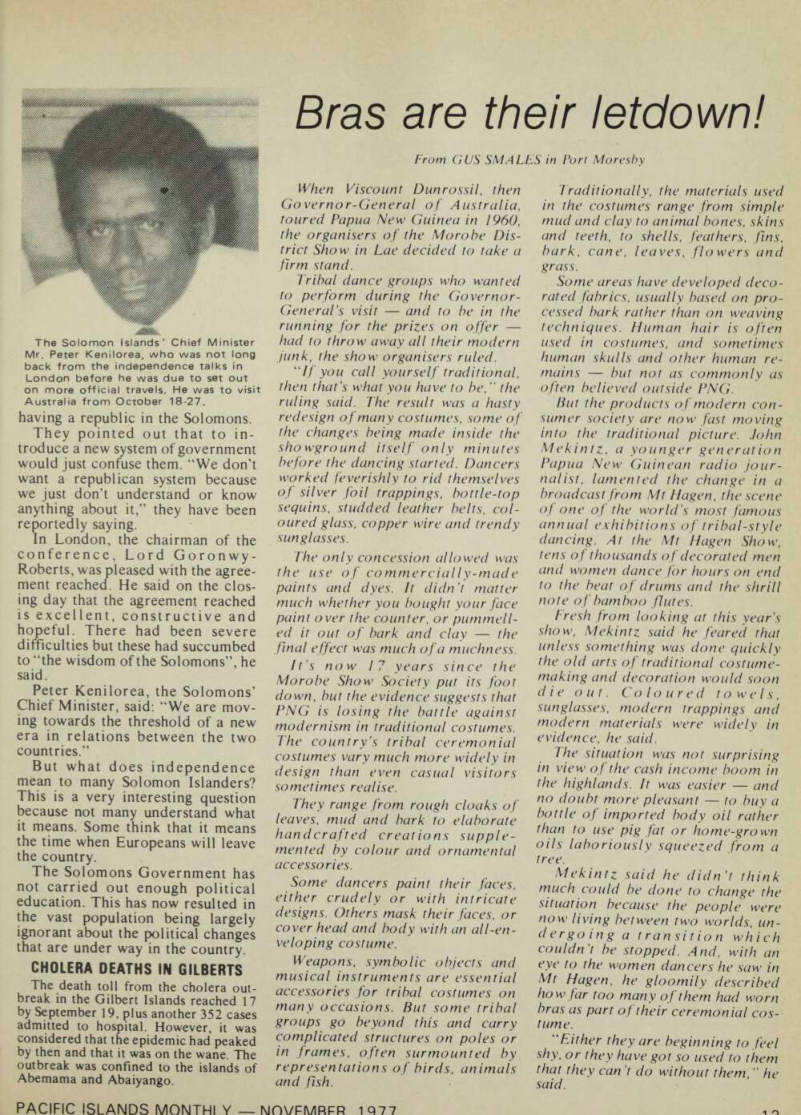
Peter Kenilorea, the Solomons’
Chief Minister, said; “We are mov ing towards the threshold of a new era in relations between the two countries.”
But what does independence mean to many Solomon Islanders?
This is a very interesting question because not many understand what it means. Some think that it means the time when Europeans will leave the country.
The Solomons Government has not carried out enough political education. This has now resulted in the vast population being largely ignorant about the political changes that are under way in the country.
Cholera Deaths In Gilberts
The death toll from the cholera out break in the Gilbert Islands reached 17 by September 19, plus another 352 cases admitted to hospital. However, it was considered that the epidemic had peaked by then and that it was on the wane. The outbreak was confined to the islands of Abemama and Abaiyango.
The Solomon Islands' Chief Minister Mr. Peter Kenilorea, who was not long back from the independence talks in London before he was due to set out on more official travels. He was to visit Australia from October 18-27.
Advertisements & other items, p. 12 (1 item)
Darinr Iqi Amd?; Monthl Y November, 1977
12
Bras are their letdown!
From GUS SMALES in Port Moresby
When Viscount Dunrossil, then Governor-General of Australia, toured Papua New Guinea in 1960, the organisers of the Mo robe Dis trict Show in Lae decided to take a firm stand.
Tribal dance groups who wanted to perform during the Governor- General’s visit and to be in the running for the prizes on offer had to throw away all their modern Junk, the show organisers ruled.
“If you call yourself traditional, then that’s what you have to he, ” the ruling said. The result was a hasty redesign of many costumes, some of the changes being made inside the showground itself only minutes before the dancing started. Dancers worked feverishly to rid themselves of silver foil trappings, bottle-top sequins, studded leather belts, col oured glass, copper wire and trendy sunglasses.
The only concession allowed was the use of commercially-made paints and dyes. It didn't matter much whether you bought your face paint over the counter, or pummell ed it out of bark and clay the final effect was much of a muchness.
It’s now 17 years since the Mo robe Show Society put its foot down, hut the evidence suggests that PNG is losing the battle against modernism in traditional costumes.
The country’s tribal ceremonial costumes vary much more widely in design than even casual visitors sometimes realise.
They range from rough cloaks of leaves, mud and hark to elaborate handcrafted creations supple mented by colour and ornamental accessories.
Some dancers paint their faces, either crudely or with intricate designs. Others mask their faces, or cover head and body with an all-en veloping costume.
Weapons, symbolic objects and musical instruments are essential accessories for tribal costumes on many occasions. But some tribal groups go beyond this and carry complicated structures on poles or in frames, often surmounted by representations of birds, animals and fish.
Traditionally, the materials used in the costumes range from simple mud and clay to animal hones, skins and teeth, to shells, feathers, fins, hark, cane, leaves, flowers and grass.
Some areas have developed deco rated fabrics, usually based on pro cessed hark rather than on weaving techniques. Human hair is often used in costumes, and sometimes human skulls and other human re mains hut not as commonly as often believed outside PNG.
But the products of modern con sumer society are now fast moving into the traditional picture. John Mekintz, a younger generation Papua New Guinean radio jour nalist, lamented the change in a broadcast from Mt Hagen, the scene of one of the world's most famous annual exhibitions of tribal-style dancing. At the Mt Hagen Show, tens of thousands of decorated men and women dance for hours on end to the heat of drums and the shrill note of bamboo flutes.
Fresh from looking at this year's show, Mekintz said he feared that unless something was done quickly the old arts of traditional costume making and decoration would soon die out. Coloured towels, sunglasses, modern trappings and modern materials were widely in evidence, he said.
The situation was not surprising in view of the cash income boom in the highlands. It was easier and no doubt more pleasant to buy a bottle of imported body oil rather than to use pig fat or home-grown oils laboriously squeezed from a tree.
Mekintz said he didn't think much could be done to change the situation because the people were now living between two worlds, un dergoing a transition which couldn't be stopped. And, with an eye to the women dancers he saw in Mt Hagen, he gloomily described how far too many of them had worn bras as part of their ceremonial cos tume.
“Either they are beginning to feel shy, or they have got so used to them that they can't do without them, ”he said.
Advertisements & other items, p. 13 (1 item)
13
PACIFIC ISLANDS MONTHI V NOVFMRFR 1 Q 77
Jaya copper project
Guerrillas strike at giant Irian Jaya copper project
With the rebellion led by mem bers of the Organised Papua Mer deka (OPM) still in full swing in the highlands of Irian Jaya, the little heard-of liberation movement ap pears to have successfully stepped up its guerrilla activities with a series of attacks on Freeport In donesia’s copper mining installa tions in the southwest of the former Dutch colony.
The OPM guerrillas are spearheading an Irianese na tionalistic struggle whose ultimate goal is the removal of Indonesian suzerainty over the West New Guinea territory which was ceded to Indonesia in 1962 after a series of naval, military and diplomatic en counters.
The guerrillas are held responsi ble for the recent destruction of an Indonesian military forces' DC3 and the holing in August of an Australian Army Pilatus Porter engaged in mapping operations near the highland capital of Wamena.
Since July 23 when a concerted guerrilla raid caused damage esti mated at SUSI million to Freeport’s giant Mt Ertsberg copper project the rebels have continued sporadic at tacks on the SUSISO million mine which began exporting in early 1973.
In the initial attack during the pre-dawn hours of July 23 the guer rillas used explosives, believed stolen from the mine, to cut the 4 in. (10 cm) pipeline carrying copper concentrate 104 km to the coastal port of Amamapare and to demolish a fuel dump and pumping installa tions. The fuel pipeline, which runs parallel with the concentrate line for 28 km from the mine to the dump on the coastal lowlands, was severed simultaneously.
After the July 23 raid copper con centrate exports valued at $7.7 million a month have had difficulty reaching Amamapare because of continued sabotage of the pipeline.
Exports have had to be made up from the concentrate stockpiled at Amamapare.
The devastation caused by the raids and the ease with which the
This report has been written for PIM by DENIS REINHARDT, who recently . .. . , • „ i’ „ visited Irian Jaya as cor res-
pondenl for the Sydney-based
weekly, Nation Review.
OPM has continued to cut the mine's vital export link represents a major upsurge in the OPM's military activity.
There were suggestions, soon after the first raid, based on signs daubed on bridges and buildings, that the raids were led by one of the OPM’s insurgent commanders, Seth Rumkorem, who defected from the Indonesian army in the early 70s.
Rumkorem was previously thought to be holed up at Wutong 15 km inside the northern Papua New Guinea/Irian Jaya border and less than 50 km from Jayapura, the capital of Irian Jaya.
Following disclosures in Port Moresby that the Commander-in- Chief of the PNG Defence Force, Brigadier-General Ted Diro had
held secret talks with Rumkorem in early September it appears most unlikely that Rumkorem took part in the sabotage of the mine, which is four weeks’ walk overland from (he pNG border Air an( j te j ex jinks between the Freeport mine, which is 80% Amer ican-owned, remained open with the outside world in the aftermath of the raids although plane movements into Freeport’s airfield at Timika were restricted for the week follow ing July 23. Planes landing at Timika kept their engines running and disembarked passengers im mediately on landing. Troops spac ed at 100-metre intervals guarded the runway.
Though Freeport's operating sub sidiary, Freeport Indonesia, has its head office in Jakarta, it is through Cairns in north Queensland that most of the mine’s important air and communications traffic passes.
At the time of the OPM raid, mine manager Bob Weaver is understood to have been holidaying in Cairns.
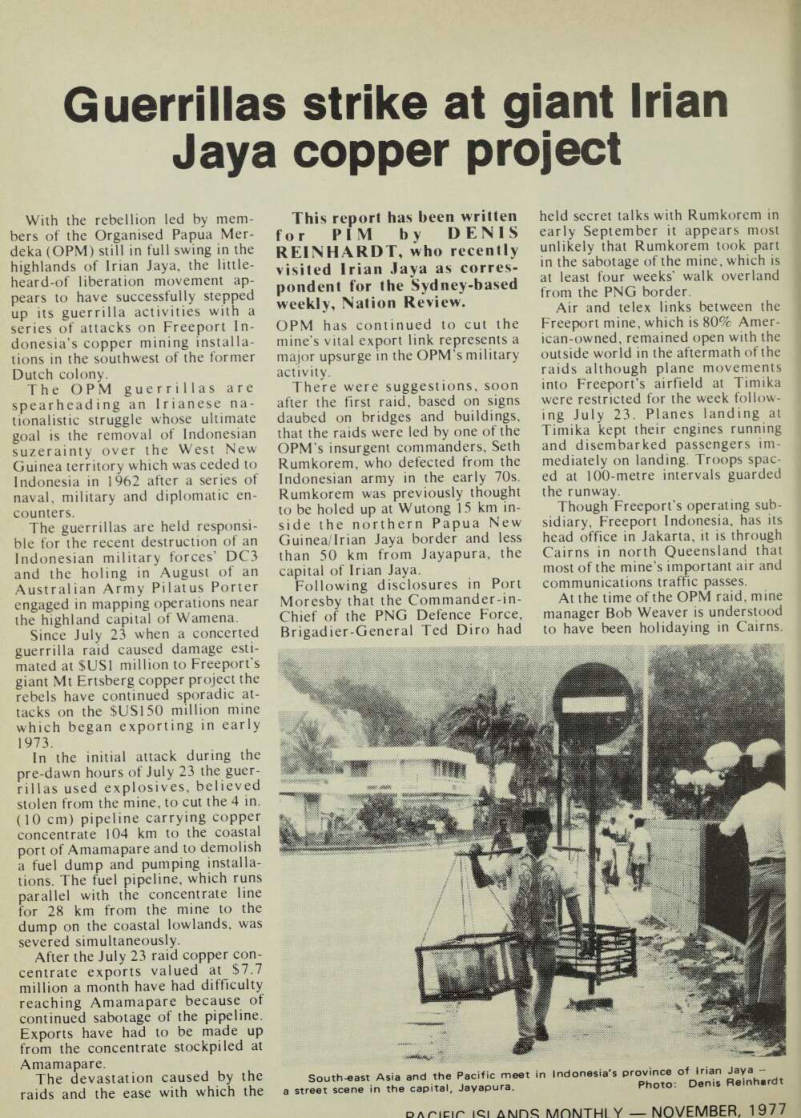
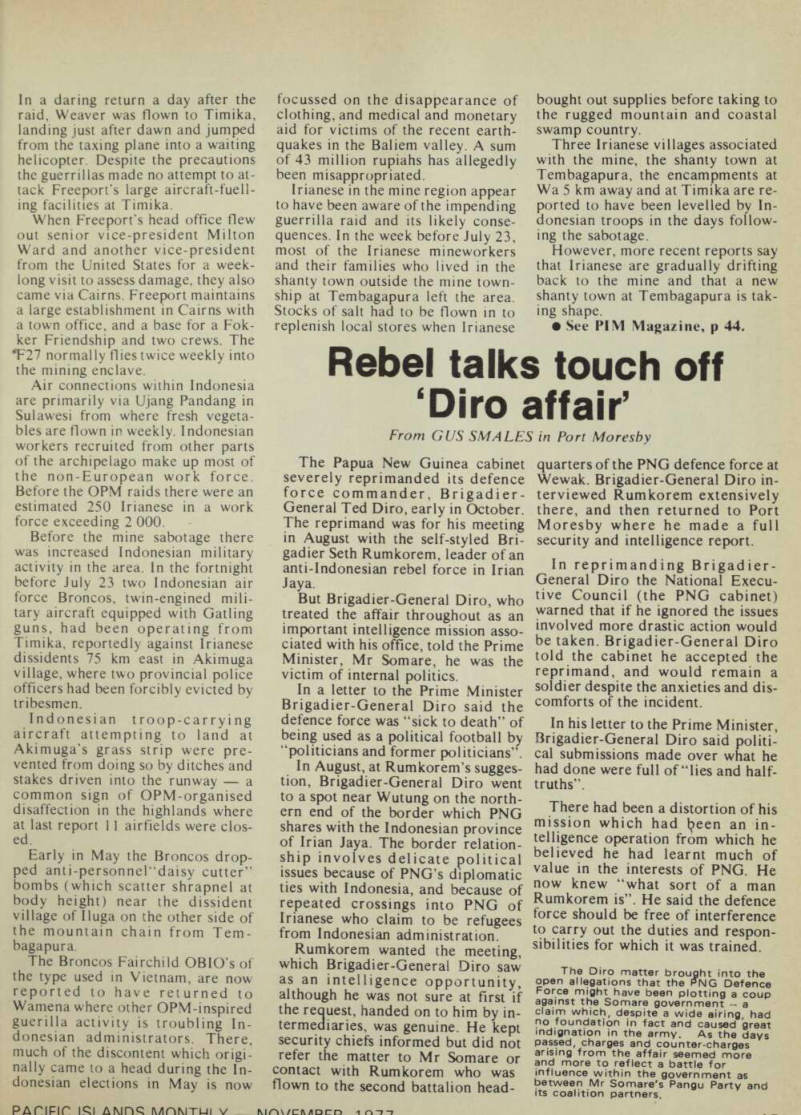
South-east Asia and the Pacific meet in Indonesia's province of Irian Jaya a street scene in the capital, Jayapura. Photo. Denis Reinhardt
In a daring return a day after the raid. Weaver was flown to Timika, landing just after dawn and jumped from the taxing plane into a waiting helicopter. Despite the precautions the guerrillas made no attempt to at tack Freeport’s large aircraft-fuell ing facilities at Timika.
When Freeport's head office flew out senior vice-president Milton Ward and another vice-president from the United States for a week long visit to assess damage, they also came via Cairns. Freeport maintains a large establishment in Cairns with a town office, and a base for a Fok ker Friendship and two crews. The *F27 normally flies twice weekly into the mining enclave.
Air connections within Indonesia are primarily via Ujang Pandang in Sulawesi from where fresh vegeta bles are flown in weekly. Indonesian workers recruited from other parts of the archipelago make up most of the non-European work force.
Before the OPM raids there were an estimated 250 Irianese in a work force exceeding 2 000.
Before the mine sabotage there was increased Indonesian military activity in the area. In the fortnight before July 23 two Indonesian air force Broncos, twin-engined mili tary aircraft equipped with Gatling guns, had been operating from Timika, reportedly against Irianese dissidents 75 km east in Akimuga village, where two provincial police officers had been forcibly evicted by tribesmen.
Indonesian troop-carrying aircraft attempting to land at Akimuga’s grass strip were pre vented from doing so by ditches and stakes driven into the runway a common sign of OPM-organised disaffection in the highlands where at last report 11 airfields were clos ed.
Early in May the Broncos drop ped anti-personnel”daisy cutter” bombs (which scatter shrapnel at body height) near the dissident village of Iluga on the other side of the mountain chain from Tem bagapura.
The Broncos Fairchild OBIO's of the type used in Vietnam, are now reported to have returned to Wamena where other OPM-inspired guerilla activity is troubling In donesian administrators. There, much of the discontent which origi nally came to a head during the In donesian elections in May is now
focussed on the disappearance of clothing, and medical and monetary aid for victims of the recent earthquakes in the Baliem valley. A sum of 43 million rupiahs has allegedly been misappropriated.
Irianese in the mine region appear to have been aware of the impending guerrilla raid and its likely consequences. In the week before July 23, most of the Irianese mineworkers and their families who lived in the shanty town outside the mine township at Tembagapura left the area.
Stocks of salt had to be flown in to replenish local stores when Irianese
bought out supplies before taking to the rugged mountain and coastal swamp country.
Three Irianese villages associated with the mine, the shanty town at Tembagapura, the encampments at Wa 5 km away and at Timika are re ported to have been levelled by In donesian troops in the days follow ing the sabotage.
However, more recent reports say that Irianese are gradually drifting back to the mine and that a new shanty town at Tembagapura is tak ing shape. • See PIIM Magazine, p 44.
Advertisements & other items, p. 14 (1 item)
Dancir Iqi Amds Monthly November, 1977
‘Diro affair’
Rebel talks touch off ‘Diro affair’
From GUS SMALES in Port Moresby
The Papua New Guinea cabinet severely reprimanded its defence force commander. Brigadier- General Ted Diro, early in October, The reprimand was for his meeting in August with the self-styled Brigadier Seth Rumkorem, leader of an anti-Indonesian rebel force in Irian Jaya.
But Brigadier-General Diro, who treated the affair throughout as an important intelligence mission associated with his office, told the Prime Minister, Mr Somare, he was the victim of internal politics.
In a letter to the Prime Minister Brigadier-General Diro said the defence force was “sick to death” of being used as a political football by “politicians and former politicians”.
In August, at Rumkorem’s suggestion, Brigadier-General Diro went to a spot near Wutung on the northern end of the border which PNG shares with the Indonesian province of Irian Jaya. The border relationship involves delicate political issues because of PNG’s diplomatic ties with Indonesia, and because of repeated crossings into PNG of Irianese who claim to be refugees from Indonesian administration Rumkorem wanted the meeting, Bngadier-General Diro saw as an intelligence opportunity, although he was not sure at first if me request, handed on to him by intermediaries was genuine. He kept Security Chiefs informed but did not refer the matter to Mr Somare or contact with Rumkorem who was flown to the second battalion head-
quarters of the PNG defence force at Wewak. Brigadier-General Diro in terviewed Rumkorem extensively there, and then returned to Port Moresby where he made a full security and intelligence report, .. „ re P ri manding Bngadier- General Diro the National Execu tive Council (the PNG cabinet) warned that if he ignored the issues mvolved more drastic action would be taken - Brigadier-General Diro told the cab,net he accepted the reprimand, and would remain a soldier despite the anxieties and dis comf°rfs of the incident, In his letter to the Prime Minister Brigadier-General Diro said politi cal submissions made over what he had done were full of “lies and half truths”, . . , 1 here had been a dls tortion of his "V, 88100 whlch had l?een an in- Jflligciice operation from which he believed be had learnt much of value , m the interests of PNG. He ow knew what sort of a man Rumkorem is . He said the defence torce should he free of interference Scarry ? ut the duties and respon -Blblllties for whlch it was trained.
The Diro matte, brought into the open allegations that the PNG Defence - a r up claim Which, despite a wide airing had
STha
passed, charges and counter-charges re influence within the government as parTne7s S Pan9u Party and
Advertisements & other items, p. 15 (1 item)
Paf'ifip Amdq Mfimtui V -Im-7
Compensation For
‘Snowfall’ Victims
Continuing health problems related to 1954 atomic bomb tests in the Marshall Islands may bring additional United States compensation to Rongelap and Utirik atoll islanders exposed to radiation.
The Omnibus Territories Act, passed by the US House of Representatives and pending in the Senate, would provide blanket compensation of US$l 000 for each of 82 Rongelap islanders and 157 Utirik islanders exposed to radiation from a March 1, 1954, test at Rlkini Atoll The bill would also provide cancer victims 19 -y ea r-okT R o nge 1 ap B re sident who died from leukemia attributed to the radiation he was exposed to after the nuclear blast when he was a year old.
Rongelap, about 100 miles from the Bikini test site, received fall-out
so thick from the blast that it was like snow. In fact, children played with the substance for hours, the Senate Committee on Energy and Natural Resources was told, Utirik, about 280 miles from the site, received a “mist-like” fall-out after the test.
Despite the greater distance and i esser exposure, Utirik islanders are continuing to develop thyroid tumours i n unexpected numbers. treated for Eleven have been tumours, and thyroid nodules are on the increase e ’chief IJS years. .
And the possibility of second generation genetic effects from he radiation has been raised with the report of a thyroid cancer detected in the son of a Utirik man.
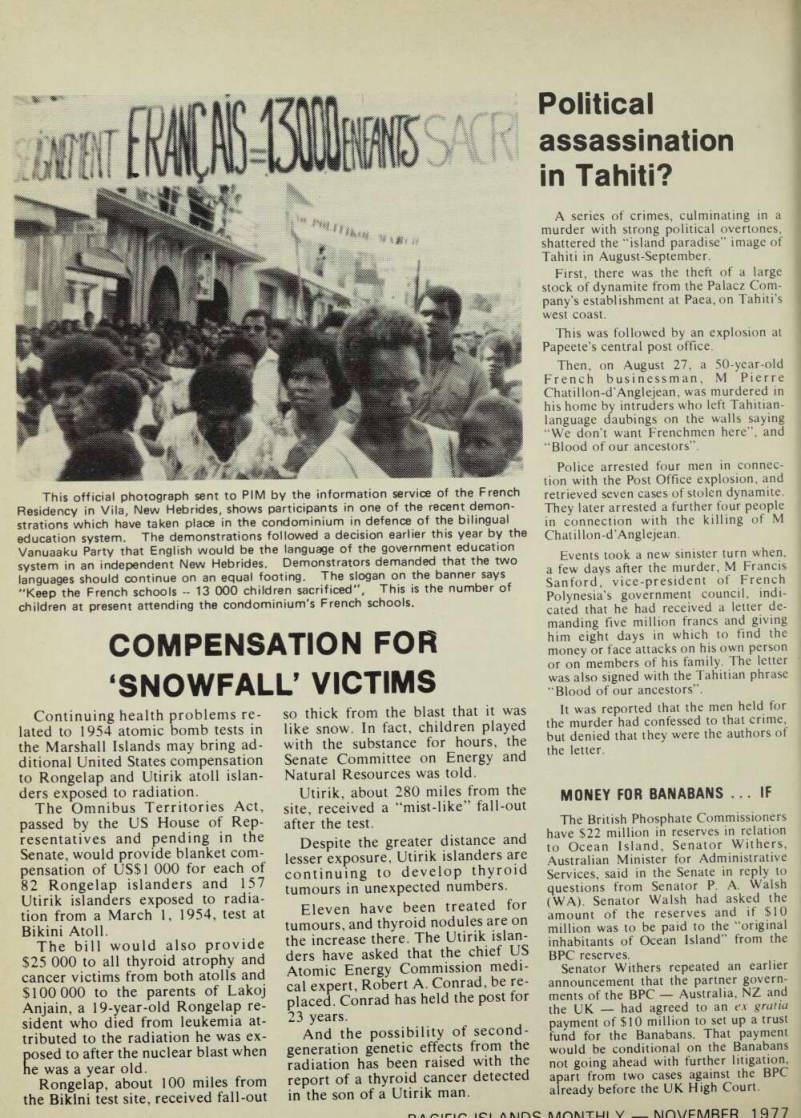
This official photograph sent to PIM by the information service of the French Residency in Vila, New Hebrides, shows participants in one of the recent demon strations which have taken place in the condominium in defence of the bilingual education system. The demonstrations followed a decision earlier this year by the Vanuaaku Party that English would be the language of the government education system in an independent New Hebrides. Demonstrators demanded that the two languages should continue on an equal footing. The slogan on the banner says “Keep the French schools —13 000 children sacrificed' , This is the number of children at present attending the condominium's French schools.
assassination
Political assassination in Tahiti?
A series of crimes, culminating in a murder with strong political overtones, shattered the “island paradise” image of Tahiti in August-September.
First, there was the theft of a large stock of dynamite from the Palacz Com pany’s establishment at Paea, on Tahiti’s west coast.
This was followed by an explosion at Papeete’s central post office.
Then, on August 27, a 50-year-old French businessman, M Pierre Chatillon-d'Anglejean, was murdered in his home by intruders who left Tahitian language daubings on the walls saying “We don’t want Frenchmen here”, and “Blood of our ancestors”.
Police arrested four men in connec tion with the Post Office explosion, and retrieved seven cases of stolen dynamite.
They later arrested a further four people in connection with the killing of M Chatillon-d’Anglejean.
Events took a new sinister turn when, a few days after the murder, M Francis Sanford, vice-president of French Polynesia’s government council, indi cated that he had received a letter de manding five million francs and giving him eight days in which to find the money or face attacks on his own person or on members of his family. The letter was also signed with the Tahitian phrase “Blood of our ancestors”.
It was reported that the men held for the murder had confessed to that crime, but denied that they were the authors of the letter.
Money For Banabans ... If
The British Phosphate Commissioners have $22 million in reserves in relation to Ocean Island, Senator Withers, Australian Minister for Administrative Services, said in the Senate in reply to questions from Senator P. A. Walsh (WA). Senator Walsh had asked the amount of the reserves and if $lO million was to be paid to the “original inhabitants of Ocean Island” from the BPC reserves.
Senator Withers repeated an earlier announcement that the partner govern ments of the BPC Australia, NZ and the UK had agreed to an ex gratia payment of $lO million to set up a trust fund for the Banabans. That payment would be conditional on the Banabans not going ahead with further litigation, apart from two cases against the BPC already before the UK High Court.
Japan PNG: Ah, what a change
was there!
From GUS SMALES in Port Moresby
Twenty years ago an entrepreneur called Michael Csolle turned socie ty upside down in Rabaul, capital of the northern islands of Papua New Guinea, when he dared to do busi ness with Japan.
Only 13 years before, Rabaul had been the Japanese naval headquar ters for the South-west Pacific in World War 11.
Papua New Guineans had been largely left alone by the Japanese occupation forces, but Whites and Asians lost their lives or were im prisoned and some were taken away by ship and never seen again.
In the years following the war, anti-Japanese feeling remained high in Papua New Guinea, but Rabaul was its focus.
Papua New Guineans, either ge nuinely or for convention, shared the feeling of resentment because it was very much the atmosphere of the times. A police officer threaten ed to change the trees in the garden of the Rabaul police station when he discovered belatedly that they were Japanese cherries. Even a war graves commission from Japan had to be given special protection in case of trouble, and its movements were rigidly controlled.
It was against this almost im penetrable barrier in the late 1950 s that Michael Csolle, who had come from Europe to Australia and then PNG, tried to arrange for a Japanese contractor to clear wartime junk from Rabaul. The operation was completed but it involved extraor dinary administrative difficulties and public controversies before it was achieved.
The mere presence of a Japanese was not wanted, let alone the con cept of doing business with the Japanese. Csolle found himself cold-shouldered, the Japanese salvage crews were confined to a fenced camp, and the solitary Japanese vehicle they brought with them (a Datsun utility which in the
PIM this month takes a close look at the rapidly multiplying contacts of Japan with the Pacific Is lands.
Beginning with Gus Smales' survey of the dev elopment of the post-war relations of Japan with the region's biggest country, Papua New Guinea, PlM's treatment of "Japan in the Islands" continues with a series of articles, beginning on page 61, which examine many facets of Japan's dy namic relationships in the Pacific, including its grow ing involvement in the ec onomic life of Fiji (p 65). 50s looked like an Austin A4O) was booed and jeered at.
In the two decades since then, a huge change has been wrought in the relationship between PNG and Japan. Japanese products, particu larly optical, electronic and domestic, fill PNG’s shops.
Japanese-made cars are selling at a rate of three to one over other makes, and Japanese investment is involved in timber, manufacturing and other activities.
From an almost zero trade situa tion just over 20 years ago the early statistics show Japan buried in a mass of “other countries” statistics Japan has now become one of PNG’s biggest trade partners.
Japan is second only to PNG’s near neighbour, Australia, as a sup plier of goods to PNG.
The single biggest item supplied is machinery and transport equipment, but the range is very wide chemi cals, foods, fabrics, electronic, scientific, optical and engineering equipment and a general cross-sec tion of manufactures. The annual value of these purchases from Japan is now estimated by PNG to be ap proaching SAIOO million a far cry from the official figure of just over $2 million in the middle of the 60s.
Japan is buying copra, fish, coffee and timber from PNG, but the ex tent of these sales, despite their rapid expansion, is only a fraction of the value of Bougainville copper ore sales to Japan. Recent annual figures indicate that Japan took ex ports from PNG valued at SA23O million, of which close to seven eighths was provided by sales of copper ore. The figure will not be so good this year because of world con ditions on the copper market, but the general development of trading links between Japan and PNG in the last 20 years has written a story of almost unbelievable growth.
Much of this has been created by the growth which accompanied PNG’s entry into independence and by the expanded need for services and industry which independence brought in urban areas, anyway.
The growth of Japan as a trading partner, for instance, has not been accomplished entirely at the ex
"Good Fortune"
pense of Australia or other trading partners. Australia has hung on remarkably well in the “open market” atmosphere which followed independence, but the changes in volving Japan have been the most dramatic. The roads and the radio shops are where the superficial changes are most reflected But quite distinct from trade matters is the new rapport which has been es tablished between PNG and Japan.
This, too, is partly an offshoot of independence, but not altogether so.
It was emerging while Australia was
still the administering authority in PNG, and it involved the rolling away of ideas and concepts which seemed to have hung on too long.
When a group of Japanese cadets visited PNG in the final years before PNG independence, a solitary Australian staged a protest in the street against their presence. But even the protester drove away from the scene in a Japanese vehicle, and clearly the cadets were puzzled rather than upset.
It's all very much history now, and time and independence have
created a huge change in the rela tionships of the two countries.
In addition to formal diplomatic ties which were created immediately after PNG’s independence, two organisations are unofficially link ing the two countries. They are the Japan-PNG Goodwill Society which has the general aims suggested by its name, and the Japan-PNG co-or dinating association which leans towards business relationships.
Keidandren the Federation of Economic Organisations of Japan also keeps an eye on Japan-PNG affairs. All three organisations have been instrumental in arranging ex change tours between the two coun tries.
One of the greatest indications of a new era of relationship is that a number of Australian ex-service men from World War II who have since lived in PNG have accepted recent invitations to meet Japanese ex-servicemen. An airline pilot, ex- RAAF, Captain John Kessey, was one. He met the anti-aircraft gunner who shot away part of his bomber over Wewak in 1945.
Said Captain Kessey after the reu nion, “Until a few years ago such a reunion would have been almost unthinkable”
This healing of old wounds in volving Australian attitudes on the one hand and Japanese blandness on the other might not appear to con cern a modern PNG governed by its own people, but it carries more sig nificance than may be obvious. This is because Australian influence is still a factor in PNG day-to-day affairs. The PNG Government finds its modern-day relationships easier if they are not complicated by side issues and hang-ups which affect public opinion. But looming biggest in the links between the two coun tries is the extent of Japanese invest ment and involvement in the PNG private sector.
Sixteen major ventures, or groups of major ventures, now operating in PNG, represent Japanese involve ment. The degree of Japanese con trol and influence in these organisa tions varies, and all must toe the line laid down by the PNG National In vestment and Development Authority.
Continued on p 105
Advertisements & other items, p. 18 (1 item)
Deutz Diesels...
you’d think they were made
just for Papua
New Guinea
Three big features of Deutz air-cooled diesel engines—toughness, performance and fuel economy—are the right advantages for PNG conditions. Engines work in some pretty lonely places and as plantation owners and managers know, chasing spare parts and service is one headache you don't need. In town or in the bush you can rely on Deutz . they’ve worked in deserts and freezing cold with the same heavy duty performance and reliability.
Fuel Savings
High fuel costs call for a closer look at total operating costs when you buy engines. Users of Deutz air-cooled engines report savings of 20 to 40°/o : and of course savings over petrol engines can be higher stilt.
Less Downtime With Deutz air-cooled engines a major source of breakdowns is eliminated. No liquid cooling system. No radiator, no water hoses, no water pump, no cavitation or electrolisis (which means no more worms in your cylinder liners).
If you’re really looking for exceptional low cost performance, it’s likely your next engine will be a Duetz. 10 to 500 bhp.
For more information write or phone
PIMEC
2 South Street. Rydalmere, N S W. Australia 2116 Telephone 638 0133
in Fiji general election
Overwhelming win for Alliance in Fiji general election
From ROBERT KEITH-REID in Suva
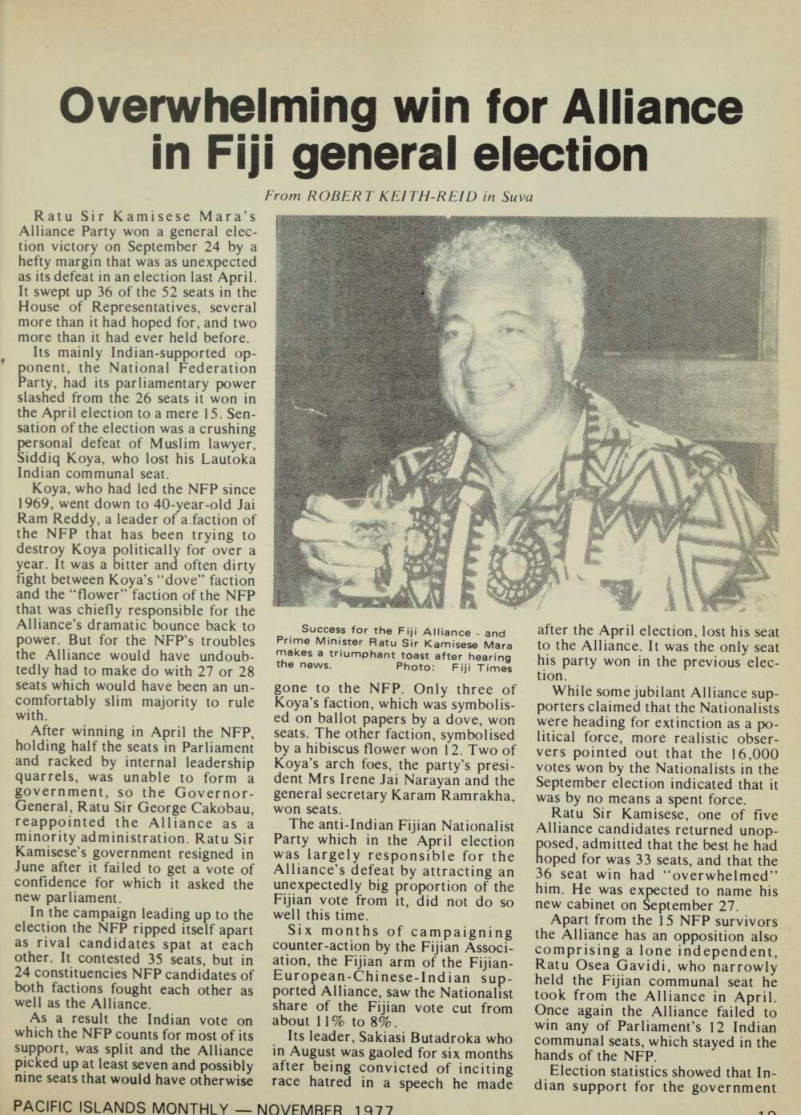
Ratu Sir Kamisese Mara’s Alliance Party won a general elec tion victory on September 24 by a hefty margin that was as unexpected as its defeat in an election last April.
It swept up 36 of the 52 seats in the House of Representatives, several more than it had hoped for, and two more than it had ever held before.
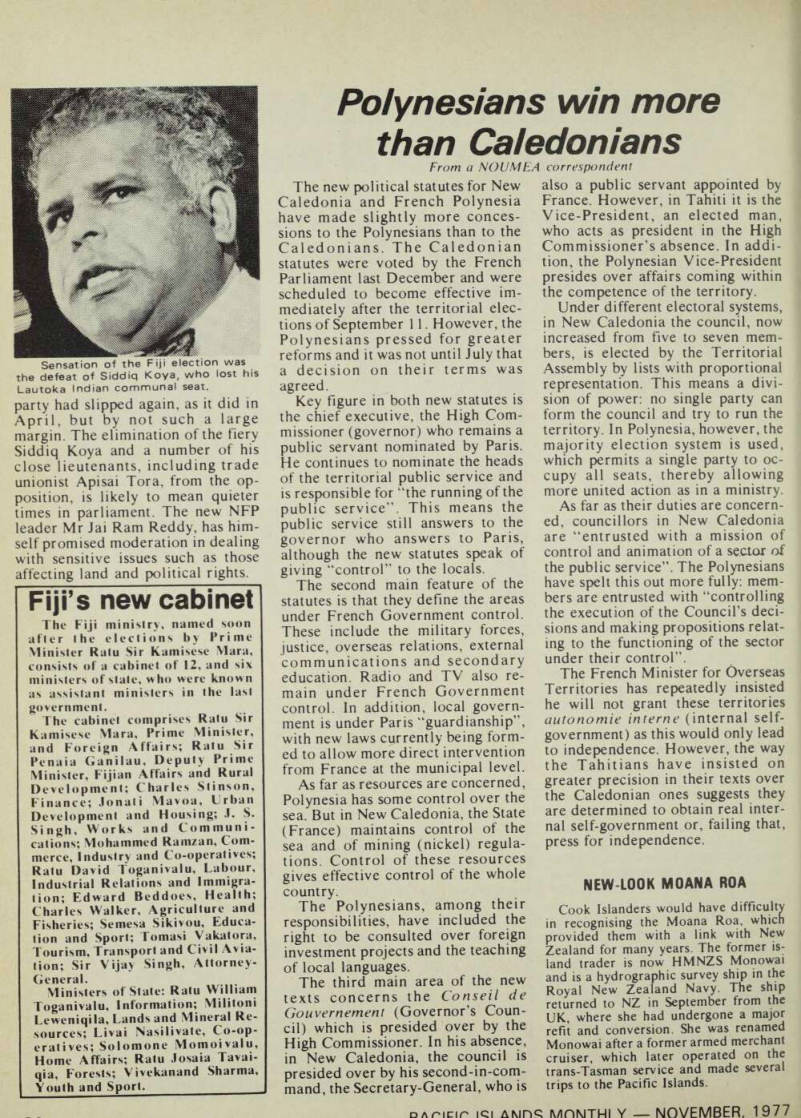
Its mainly Indian-supported op ponent, the National Federation Party, had its parliamentary power slashed from the 26 seats it won in the April election to a mere 15. Sen sation of the election was a crushing personal defeat of Muslim lawyer, Siddiq Koya, who lost his Lautoka Indian communal seat.
Koya, who had led the NFP since 1969, went down to 40-year-old Jai Ram Reddy, a leader of a.faction of the NFP that has been trying to destroy Koya politically for over a year. It was a bitter and often dirty fight between Koya’s “dove” faction and the “flower” faction of the NFP that was chiefly responsible for the Alliance’s dramatic bounce back to power. But for the NFP’s troubles the Alliance would have undoub tedly had to make do with 27 or 28 seats which would have been an un comfortably slim majority to rule with.
After winning in April the NFP, holding half the seats in Parliament and racked by internal leadership quarrels, was unable to form a government, so the Governor- General, Ratu Sir George Cakobau, reappointed the Alliance as a minority administration. Ratu Sir Kamisese’s government resigned in June after it failed to get a vote of confidence for which it asked the new parliament.
In the campaign leading up to the election the NFP ripped itself apart as rival candidates spat at each other. It contested 35 seats, but in 24 constituencies NFP candidates of both factions fought each other as well as the Alliance.
As a result the Indian vote on which the NFP counts for most of its support, was split and the Alliance picked up at least seven and possibly nine seats that would have otherwise
gone to the NFP. Only three of Koya’s faction, which was symbolis ed on ballot papers by a dove, won seats. The other faction, symbolised by a hibiscus flower won 12. Two of Koya’s arch foes, the party’s presi dent Mrs Irene Jai Narayan and the general secretary Karam Ramrakha, won seats.
The anti-Indian Fijian Nationalist Party which in the April election was largely responsible for the Alliance s defeat by attracting an unexpectedly big proportion of the rqian vote from it, did not do so well this time Six months of campaigning counter-action by the Fijian Associ ation, the Fijian arm of the Fijian- E uro pean- Ch i nese - Indian sup ported Alliance, saw the Nationalist share * he Fijian vote cut from about 11 % to 8%.
Its leader, Sakiasi Butadroka who in August was gaoled for six months after being convicted of inciting race hatred in a speech he made
after the April election, lost his seat to the Alliance. It was the only seat h ‘ S P art y WOn in the P revi °U s elec tion.
While some jubilant Alliance sup porters claimed that the Nationalists were heading for extinction as a po litical force, more realistic obser vers pointed out that the 16 000 votes won by the Nationalists in the September election indicated that it was by no means a spent force, Ratu <ji r Kamisese, one of five Alliance candidates returned unop posed, admitted that the best he had hoped for was 33 seats, and that the 36 seat win had “overwhelmed” him. He was expected to name his new cabinet on September 27 Apart from the 15 NFP survivors the Alliance has an opposition also comprising a lone independent Ratu Osea Gavidi, who narrowly held the Fijian communal seat he took from the Alliance in April Once again the Alliance failed to w in any of Parliament’s 12 Indian communal seats, which stayed in the hands of the NFP.
Election statistics showed that In dian support for the government
Success for the Fiji Alliance - and Prime Minister Ratu Sir Kamisese Mara makes a triumphant toast after hearing the news. Photo: Fiji Times
than Caledonians
Polynesians win more than Caledonians
From a NOUMEA correspondent
party had slipped again, as it did in April, but by not such a large margin. The elimination of the fiery Siddiq Koya and a number of his close lieutenants, including trade unionist Apisai Tora, from the op position, is likely to mean quieter times in parliament. The new NFP leader Mr Jai Ram Reddy, has him self promised moderation in dealing with sensitive issues such as those affecting land and political rights.
The new political statutes for New Caledonia and French Polynesia have made slightly more conces sions to the Polynesians than to the Caledonians. The Caledonian statutes were voted by the French Parliament last December and were scheduled to become effective im mediately after the territorial elec tions of September 11. However, the
Polynesians pressed for greater
reforms and it was not until July that a decision on their terms was agreed.
Key figure in both new statutes is the chief executive, the High Com missioner (governor) who remains a public servant nominated by Paris.
He continues to nominate the heads of the territorial public service and is responsible for “the running of the public service”. This means the public service still answers to the governor who answers to Paris, although the new statutes speak of giving “control” to the locals.
The second main feature of the statutes is that they define the areas under French Government control.
These include the military forces, justice, overseas relations, external communications and secondary education. Radio and TV also re main under French Government control. In addition, local govern ment is under Paris “guardianship”, with new laws currently being form ed to allow more direct intervention from France at the municipal level.
As far as resources are concerned, Polynesia has some control over the sea. But in New Caledonia, the State (France) maintains control of the sea and of mining (nickel) regula tions. Control of these resources gives effective control of the whole country.
The Polynesians, among their responsibilities, have included the right to be consulted over foreign investment projects and the teaching of local languages.
The third main area of the new texts concerns the Conseil de Gouvernement (Governor’s Coun cil) which is presided over by the High Commissioner. In his absence, in New Caledonia, the council is presided over by his second-in-com mand, the Secretary-General, who is
also a public servant appointed by France. However, in Tahiti it is the Vice-President, an elected man, who acts as president in the High Commissioner’s absence. In addi tion, the Polynesian Vice-President presides over affairs coming within the competence of the territory.
Under different electoral systems, in New Caledonia the council, now increased from five to seven mem bers, is elected by the Territorial Assembly by lists with proportional representation. This means a divi sion of power; no single party can form the council and try to run the territory. In Polynesia, however, the majority election system is used, which permits a single party to oc cupy all seats, thereby allowing more united action as in a ministry.
As far as their duties are concern ed, councillors in New Caledonia are “entrusted with a mission of control and animation of a sector of the public service’’. The Polynesians have spelt this out more fully: mem bers are entrusted with “controlling the execution of the Council’s deci sions and making propositions relat ing to the functioning of the sector under their control”.
The French Minister for Overseas Territories has repeatedly insisted he will not grant these territories autonomie interne (internal self government) as this would only lead to independence. However, the way the Tahitians have insisted on greater precision in their texts over the Caledonian ones suggests they are determined to obtain real inter nal self-government or, failing that, press for independence.
New-Look Moana Roa
Cook Islanders would have difficulty in recognising the Moana Roa, which provided them with a link with New Zealand for many years. The former is land trader is now HMNZS Monowai and is a hydrographic survey ship in the Royal New Zealand Navy. The ship returned to NZ in September from the UK, where she had undergone a major refit and conversion. She was renamed Monowai after a former armed merchant cruiser, which later operated on the trans-Tasman service and made several trips to the Pacific Islands.
Sensation of the Fiji election was the defeat of Siddiq Koya, who lost his Lautoka Indian communal seat.
Fiji’s new cabinet
The Fiji ministry, named soon after the elections by Prime Minister Ralu Sir Kamisese Mara, consists of a cabinet of 12, and six ministers of state, w ho were known as assistant ministers in the last government.
The cabinet comprises Ratu Sir Kamisese Mara, Prime Minister, and Foreign Affairs; Ratu Sir Penaia Ganilau, Deputy Prime Minister, Fijian Affairs and Rural Development; Charles Stinson, Finance; Jonati Mavoa, Urban Development and Housing; J. S.
Singh, Works and Communi cations; Mohammed Ramzan, Com merce, Industry and Co-operatives; Ralu David Toganivalu, Labour, Industrial Relations and Immigra tion; Edward Beddoes, Health; Charles Walker, Agriculture and Fisheries; Semesa Sikivou, Educa tion and Sport; Fomasi Vakatora, Tourism, Transport and Civil Avia tion; Sir Vijay Singh, Attorney- General.
Ministers of Stale: Ralu William Toganivalu, Information; Mililoni Leweniqila, Lands and Mineral Re sources; Livai Nasilivate, Co-op eratives; Solomone Momoivalu, Home Affairs; Ralu Josaia Tavai qia, Forests; Vivekanand Sharma, Youth and Sport.
Advertisements & other items, pp. 20-24 (2 items)
Dannr Iqi Monthi V November, 1977
is fast, efficient
[ls your Drinking Water Safe and Pure,
Is it Sparkling Fresh?
STERASYL Elements are ceramic filtering cylinders which release silver ions for full sterilisation.
No need to boil, chlorinate, transport or buy bottled water and periodic simple external cleaning only is entailed.
"Super Sterasyl" elements additionally have an activated carbon core to absorb unpleasant tastes and odours.
DOMESTIC
GRAVITY
FILTER
Rugged lightweight body telescoping to save on transport. 4 sizes to 13 gals (60 litres) per 24 hours. 3391
STERAMATIC
DOMESTIC
PRESSURE
FILTERS
|s**»Self-contained including
pumpset, carbon prefilter and Sterasyl purifier. Up to 220 gallons (1000 litres) per hour.
These PORTACEL units are but a few of the models available. Contact us for all requirements for public, domestic or industrial water supplies, swimming pool, sewage and effluent, etc.
Portals
Portals Water Treatment (NZ) Ltd P.O. Box 13-558, Auckland 6, New Zealand Candy House, 11 Spring, Street. Onehunga, Auckland Telephone: 661-079 (7 lines) Telex: NZ 21175 Telegrams: Portals Auckland.
PCI-PATERSON CANDY, PERMUTIT. BOBY, STELLA-META
PORTACEL, HOUSEMAN-HEGRO - ALL PORTALS GROUP.
In the home
SPEED-E-GAS
is fast, efficient
and reliable.
Terminals throughout the Pacific.
For more information write Boral Gas Limited, 221 Miller Street, nnPAI North Sydney 2060 *Speed-E-Gas is known in Papua New Guinea, aS Guinea Gas. In Tonga Tonga Speed-E-Gas, in Fiji as Fiji Gas. in Pa
mmJ Guint
as Tc MB and i; mm
SPEED-E-GAS
n 4* v¥ V A 1 M IS
HOLT GS V
• » 111 n*» •V* v.-.» •»> '»< . i>< in WV K< ‘.'•A v.v
Surprisingly slim ball pens
for such big-hearted refills.
mill:
IS/ IS: ! /»• Ik ti; H
‘I'sHH
HitSefS; am.
nigt
gSm!
iffiwat* niton!; Hi 11:0 nr mf W Parker International Classic ball pens look lean and feel light but they're far from light on ink. Up to 80,000 words is what to expect from one refill.
The Parker ball point is tungsten carbide, the third-hardest substance there is, and it's machined so accurately that we can offer it in extra fine, fine, medium or broad point sizes. From left: Stainless steel; Sterling silver; 12ct gold-filled;
Vermeil (Sterling/gold); 14ct gold-filled.
tPARKER
World's most wanted pens 066.P.295D
You name it, Mono pumps it.
Tell us your needs, we’ll showyouthepump. Forever 30 years, we’ve been pumping liquids of every viscosity, under all kinds of conditions. Fresh water, sand and water, food ingredients, chemicals, acids, corrosives and abrasives, sludges and waste, effluent and sewage, even solids in suspension.
Ifitcanbeconveyedthroughapipeline, weeanmove
it, meter it or mix it, as quickly or slowly as you wish.
And we can provide pumps that run on petrol, kerosene, diesel, electricity, or PTO tractor drive (in fact even bicycle drive).
If there’s anything you want to know about pumping, write to us at Mono. We’ve got the pumps and the experience.
Please send me details of your pumps for (describe purposes): Name: Address: Send coupon to Head Office & Works (address below).
MONO
UPUMPS
AUSTRALIA PTY. LTD.
MOVE IT WITH MONO
Head Office & Works: "Mono House". 338-348 Lower Dandenong Rd., Mordialloc. Vic, 3195, Australia.
Agents in: Papua and New Guinea. Indonesia. Fiji. The Philippines.
I-P-7177C
I s
OCCASIONAL TABLES
PEWTER FINISH
COPPER FINISH
im FURNITURE
Distinctive heraldic figures are superbly crafted in bold relief in a burnished copper * or old English pewter finish. Ask your friends to join the Knights of the Round Table! Create your own Camelot with these craftsman-built occasional tables.
Dimensions: Diameter of top 1050 mm (41 1 / 4 ") Overall height 375 mm (14 3 / 4 ")
Order Now
for Christmas
'Tops are metal foil laminates. lr:,rXfe a T£ P l7Z>te to Hockey Distributors. Bos Sydney Mei, W. 2012.
The Marshalls: Untying a knot
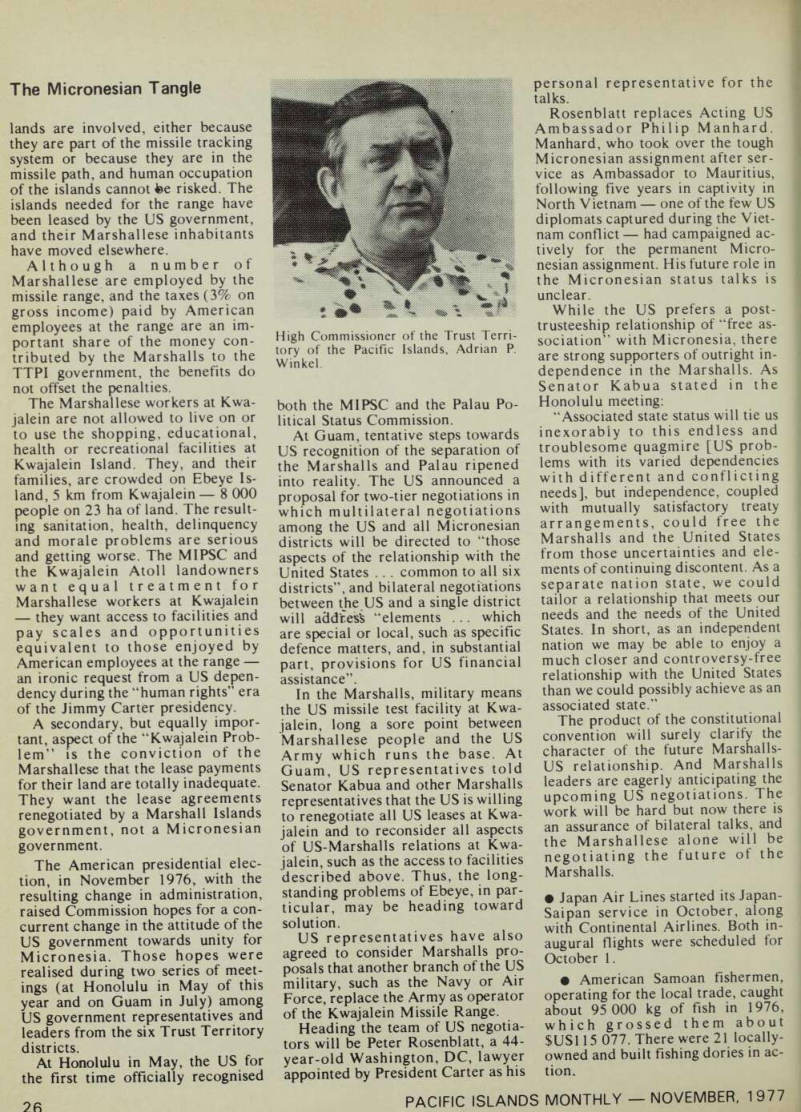
in the Micronesian tangle?
From SUSAN K. GRAFF on Majuro
For the first time since creation of the Congress of Micronesia in 1965, the senior member from the Marshall Islands, Senator Amata Kabua, missed a legislative session.
His absence from the special Con gress session at Ponape in August was one more event in an 18-month series resulting in reversal of the United States policy of unity in its troubled Micronesian trusteeship: the Marshalls in the East and Palau in the West are expected to separate from the four island groups of the Central Carolines.
Other highlights of the last year and a half have been a July 30 referendum in the Marshall Islands, with the people endorsing sepa ration by a margin of almost two to one, and two major United States/Micronesian conferences where the United States representa tives, although stating hopes for a unified Micronesia, admitted a willingness to deal separately with the Marshalls and Palau on the key issues of future relations with the United States military bases and financial aid.
Senator Kabua was not at Ponape because he was one of 48 delegates to the Marshall Islands Constitu tional Convention, which convened at Majuro on August 8. In the months ahead, these 48 delegates will struggle with the creation of a document and concepts of self government for implementation on termination of the trusteeship, scheduled for 1981.
The form of future government is uncertain, but it is interesting that the major constitutional adviser to the convention is Mrs Alison B.
Quentin-Baxter, a lawyer-scholar from New Zealand. She is assessing the difficulties of establishing a parliamentary form of government in a country without a parliamen tary tradition, and seems to be en joying the unusual situation.
Although the constitutional con vention is in its early days, with much debate and discussion ahead, one question about the future has been resolved the question of the Marshalls’ ties to the other five dis tricts of Micronesia. On July 30, the people of the Marshalls voted solidly, if not overwhelmingly, to seek a political status separate from the rest of the Trust Territory of the Pacific Islands (TTPI). The vote was about 63% in favour and 37% opposed to separation.
The separation advocates follow ed the lead of the Marshall Islands Political Status Commission (MIPSC), a powerful group of tradi tional and political leaders, led by Senator Kabua. The MIPSC was created in 1973, by act of the Marshalls’ district legislature (Niti jela) and since May, 1976, has ac tively sought US recognition of the concept of a political future for the Marshalls apart from Micronesia.
In June, 1976, a delegation from the MIPSC appeared before the Trusteeship Council of the United Nations, seeking that body’s support
for further fragmentation of the Micronesian trusteeship (the Mariana Islands by then had negoti ated a separate arrangement with the United States). The group cited an extensive list of grievances against the trustee and its ad ministering agencies and reiterated a long-standing Marshalls com plaint that Marshalls revenue was supporting Micronesia and a top heavy government administration without the Marshalls receiving a fair share of the money back for alleviation of their own substantial problems, many caused by the American presence.
The Trusteeship Council listened, but the Commission had a more responsive audience in the Ameri can press, which was intrigued by the idea of a US “colony” grumbling during the bicentennial celebration of the independence of the mother country. The press interest was con siderable (approximately 200 US newspapers covered the UN event) and was undoubtedly increased by the effective performance of a New York public relations firm, Richard Weiner Inc, retained by the commis sion to ensure its story would be told to the American people and to the American Congress.
Most of the described grievances related to the islands of Kwajalein Atoll, where the US Defence Department conducts a massive missile-testing programme. Kwa jalein Island is the central facility of the range, but a number of other is
lands are involved, either because they are part of the missile tracking system or because they are in the missile path, and human occupation of the islands cannot tee risked. The islands needed for the range have been leased by the US government, and their Marshallese inhabitants have moved elsewhere.
Although a number of Marshallese are employed by the missile range, and the taxes (3% on gross income) paid by American employees at the range are an im portant share of the money con tributed by the Marshalls to the TTPI government, the benefits do not offset the penalties.
The Marshallese workers at Kwa jalein are not allowed to live on or to use the shopping, educational, health or recreational facilities at Kwajalein Island. They, and their families, are crowded on Ebeye Is land, 5 km from Kwajalein 8 000 people on 23 ha of land. The result ing sanitation, health, delinquency and morale problems are serious and getting worse. The MIPSC and the Kwajalein Atoll landowners want equal treatment for Marshallese workers at Kwajalein they want access to facilities and pay scales and opportunities equivalent to those enjoyed by American employees at the range an ironic request from a US depen dency during the “human rights” era of the Jimmy Carter presidency.
A secondary, but equally impor tant, aspect of the “Kwajalein Prob lem” is the conviction of the Marshallese that the lease payments for their land are totally inadequate.
They want the lease agreements renegotiated by a Marshall Islands government, not a Micronesian government.
The American presidential elec tion, in November 1976, with the resulting change in administration, raised Commission hopes for a con current change in the attitude of the US government towards unity for Micronesia. Those hopes were realised during two series of meet ings (at Honolulu in May of this year and on Guam in July) among US government representatives and leaders from the six Trust Territory districts.
At Honolulu in May, the US for the first time officially recognised
both the MIPSC and the Palau Po litical Status Commission.
At Guam, tentative steps towards US recognition of the separation of the Marshalls and Palau ripened into reality. The US announced a proposal for two-tier negotiations in which multilateral negotiations among the US and all Micronesian districts will be directed to “those aspects of the relationship with the United States .. . common to all six districts”, and bilateral negotiations between the,US and a single district will add'resi “elements ... which are special or local, such as specific defence matters, and, in substantial part, provisions for US financial assistance”.
In the Marshalls, military means the US missile test facility at Kwa jalein, long a sore point between Marshallese people and the US Army which runs the base. At Guam, US representatives told Senator Kabua and other Marshalls representatives that the US is willing to renegotiate all US leases at Kwa jalein and to reconsider all aspects of US-Marshalls relations at Kwa jalein, such as the access to facilities described above. Thus, the long standing problems of Ebeye, in par ticular, may be heading toward solution.
US representatives have also agreed to consider Marshalls pro posals that another branch of the US military, such as the Navy or Air Force, replace the Army as operator of the Kwajalein Missile Range.
Heading the team of US negotia tors will be Peter Rosenblatt, a 44year-old Washington, DC, lawyer appointed by President Carter as his
personal representative for the talks.
Rosenblatt replaces Acting US Ambassador Philip Manhard.
Manhard, who took over the tough Micronesian assignment after ser vice as Ambassador to Mauritius, following five years in captivity in North Vietnam one of the few US diplomats captured during the Viet nam conflict had campaigned ac tively for the permanent Micro nesian assignment. His future role in the Micronesian status talks is unclear.
While the US prefers a post trusteeship relationship of “free as sociation” with Micronesia, there are strong supporters of outright in dependence in the Marshalls. As Senator Kabua stated in the Honolulu meeting; “Associated state status will tie us inexorably to this endless and troublesome quagmire [US prob lems with its varied dependencies with different and conflicting
needs], but independence, coupled
with mutually satisfactory treaty arrangements, could free the Marshalls and the United States from those uncertainties and ele ments of continuing discontent. As a separate nation state, we could tailor a relationship that meets our needs and the needs of the United States. In short, as an independent nation we may be able to enjoy a much closer and controversy-free relationship with the United States than we could possibly achieve as an associated state.”
The product of the constitutional convention will surely clarify the character of the future Marshalls- US relationship. And Marshalls leaders are eagerly anticipating the
upcoming US negotiations. The
work will be hard but now there is an assurance of bilateral talks, and the Marshallese alone will be negotiating the future of the Marshalls. • Japan Air Lines started its Japan- Saipan service in October, along with Continental Airlines. Both in augural flights were scheduled for October 1. • American Samoan fishermen, operating for the local trade, caught about 95 000 kg of fish in 1976, which grossed them about SUSIIS 077. There were 21 locally owned and built fishing dories in ac tion.
High Commissioner of the Trust Terri tory of the Pacific Islands, Adrian P.
Winkel.
Advertisements & other items, p. 25 (1 item)
Exclusive Offer For P.I.M. Readers Only!
Your Camelot Table s<tnr
Will COSt just . . . IOU(AUST) Delivered to your Port/Airport. Just follow these easy steps: 1. Arrange bank transfer with your local bank for Aust. $185.00 to be transferred to Hockaday Distributors, Cl- Bank of N.S.W., Botany, N.S.W. 2019, Australia. 2. Fill in coupon below. 3. Post completed coupon to Hockaday Distributors, Box MlO9. Sydney Mail Exchange, N.S.W. 2012, Australia. 77)e Camelot table of your choice will be delivered to your nearest port airport. Price does not include any applicable Customs Duty. f TO: Hockaday Distributors, Box Ml 09, ""] ■ Sydney Mail Exch. N.S.W. 2012, Australia. 1 Please send me within 28 days; I QUANTITY □COPPER FINISH □ PEWTER FINISH
* NAME „
I (Please print)
ADDRESS
■ PHONE No
I TRANSFER No BANK
L DATEOFTRANSFER_j
People
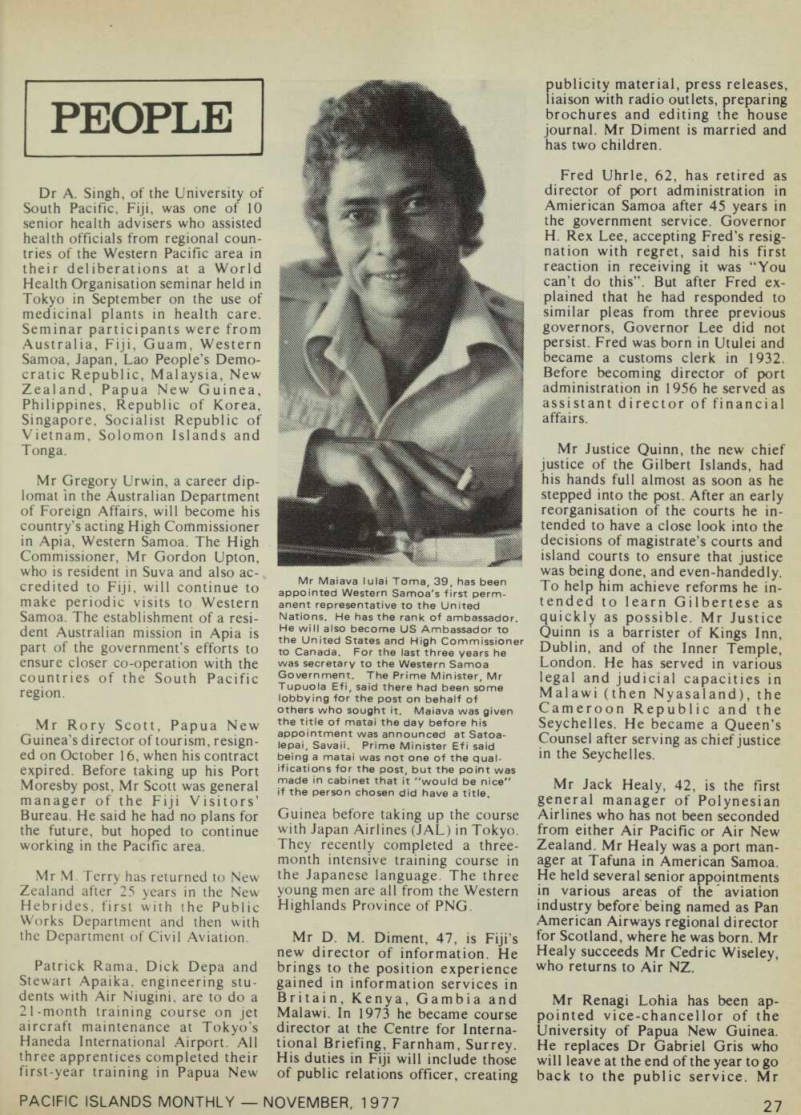

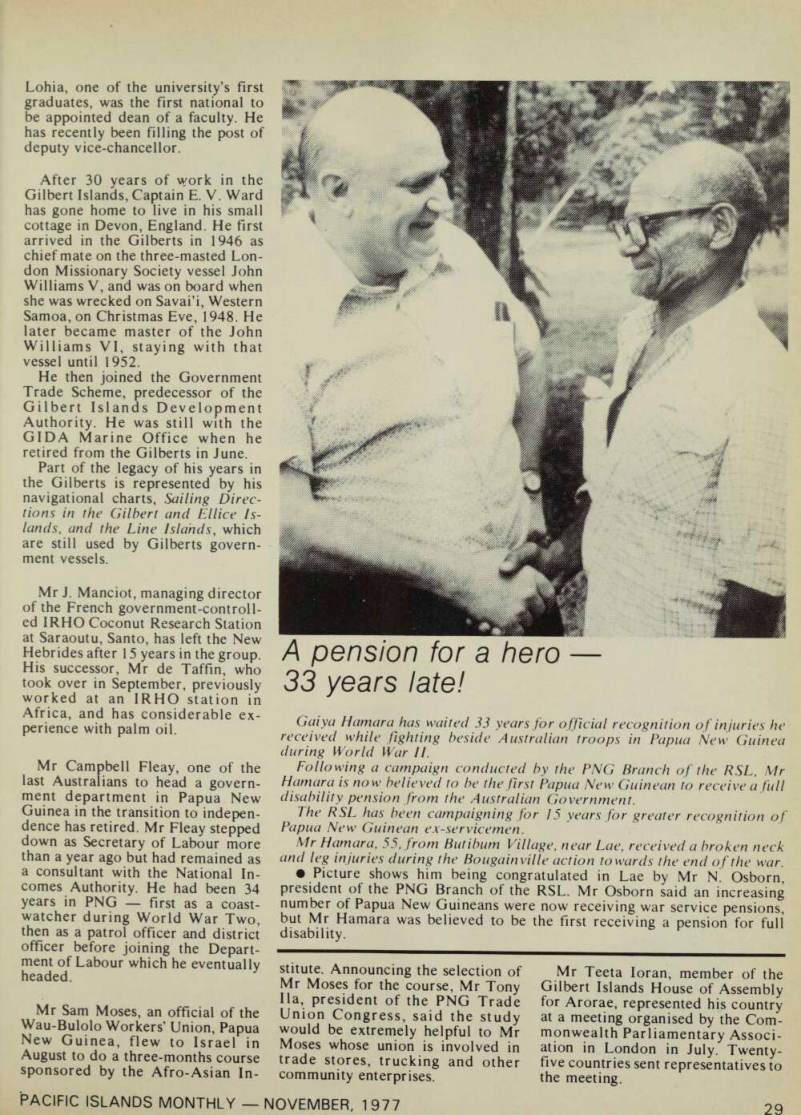
Dr A. Singh, of the University of South Pacific, Fiji, was one of 10 senior health advisers who assisted health officials from regional coun tries of the Western Pacific area in their deliberations at a World Health Organisation seminar held in Tokyo in September on the use of medicinal plants in health care.
Seminar participants were from Australia, Fiji, Guam, Western Samoa, Japan, Lao People’s Demo cratic Republic, Malaysia, New Zealand, Papua New Guinea, Philippines, Republic of Korea, Singapore, Socialist Republic of Vietnam, Solomon Islands and Tonga.
Mr Gregory Urwin, a career dip lomat in the Australian Department of Foreign Affairs, will become his country’s acting High Commissioner in Apia, Western Samoa. The High Commissioner, Mr Gordon Upton, who is resident in Suva and also ac credited to Fiji, will continue to make periodic visits to Western Samoa. The establishment of a resi dent Australian mission in Apia is part of the government’s efforts to ensure closer co-operation with the countries of the South Pacific region.
Mr Rory Scott, Papua New Guinea’s director of tourism, resign ed on October 16, when his contract expired. Before taking up his Port Moresby post, Mr Scott was general manager of the Fiji Visitors’
Bureau. He said he had no plans for the future, but hoped to continue working in the Pacific area.
Mr M. Terry has returned to New Zealand after 25 years in the New Hebrides, first with the Public Works Department and then with the Department of Civil Aviation.
Patrick Rama. Dick Depa and Stewart Apaika, engineering stu dents with Air Niugini, are to do a 21-month training course on jet aircraft maintenance at Tokyo’s Haneda International Airport. All three apprentices completed their first-year training in Papua New
Guinea before taking up the course with Japan Airlines (JAL) in Tokyo.
They recently completed a three month intensive training course in the Japanese language. The three young men are all from the Western Highlands Province of PNG.
Mr D. M. Diment, 47, is Fiji’s new director of information. He brings to the position experience gained in information services in Britain, Kenya, Gambia and Malawi. In 1973 he became course director at the Centre for Interna tional Briefing, Farnham, Surrey.
His duties in Fiji will include those of public relations officer, creating
publicity material, press releases, liaison with radio outlets, preparing brochures and editing the house journal. Mr Diment is married and has two children.
Fred Uhrle, 62, has retired as director of port administration in Amierican Samoa after 45 years in the government service. Governor H. Rex Lee, accepting Fred’s resig nation with regret, said his first reaction in receiving it was “You can’t do this”. But after Fred ex plained that he had responded to similar pleas from three previous governors, Governor Lee did not persist. Fred was born in Utulei and became a customs clerk in 1932.
Before becoming director of port administration in 1956 he served as assistant director of financial affairs.
Mr Justice Quinn, the new chief justice of the Gilbert Islands, had his hands full almost as soon as he stepped into the post. After an early reorganisation of the courts he in tended to have a close look into the decisions of magistrate’s courts and island courts to ensure that justice was being done, and even-handedly.
To help him achieve reforms he in tended to learn Gilbertese as quickly as possible. Mr Justice Quinn is a barrister of Kings Inn, Dublin, and of the Inner Temple, London. He has served in various legal and judicial capacities in Malawi (then Nyasaland), the Cameroon Republic and the Seychelles. He became a Queen’s Counsel after serving as chief justice in the Seychelles.
Mr Jack Healy, 42, is the first general manager of Polynesian Airlines who has not been seconded from either Air Pacific or Air New Zealand. Mr Healy was a port man ager at Tafuna in American Samoa.
He held several senior appointments in various areas of the aviation industry before being named as Pan American Airways regional director for Scotland, where he was born. Mr Healy succeeds Mr Cedric Wiseley, who returns to Air NZ.
Mr Renagi Lohia has been ap pointed vice-chancellor of the University of Papua New Guinea.
He replaces Dr Gabriel Gris who will leave at the end of the year to go back to the public service. Mr
Mr Maiava lulai Toma, 39, has been appointed Western Samoa's first perm anent representative to the United Nations. He has the rank of ambassador.
He will also become US Ambassador to the United States and High Commissioner to Canada. For the last three years he was secretary to the Western Samoa Government. The Prime Minister, Mr Tupuola Efi, said there had been some lobbying for the post on behalf of others who sought it. Maiava was given the title of matai the day before his appointment was announced at Satoa lepai, Savaii. Prime Minister Efi said being a matai was not one of the qual ifications for the post, but the point was made in cabinet that it "would be nice” if the person chosen did have a title.
Lohia, one of the university’s first graduates, was the first national to be appointed dean of a faculty. He has recently been filling the post of deputy vice-chancellor.
After 30 years of work in the Gilbert Islands, Captain E. V. Ward has gone home to live in his small cottage in Devon, England. He first arrived in the Gilberts in 1946 as chief mate on the three-masted Lon don Missionary Society vessel John Williams V, and was on board when she was wrecked on Savai’i, Western Samoa, on Christmas Eve, 1948. He later became master of the John Williams VI, staying with that vessel until 1952.
He then joined the Government Trade Scheme, predecessor of the Gilbert Islands Development Authority. He was still with the GIDA Marine Office when he retired from the Gilberts in June.
Part of the legacy of his years in the Gilberts is represented by his navigational charts, Sailing Direc tions in the Gilbert and Ellice Is lands, and the Line Islands, which are still used by Gilberts govern ment vessels.
Mr J. Manciot, managing director of the French government-controll ed IRHO Coconut Research Station at Saraoutu, Santo, has left the New Hebrides after 15 years in the group.
His successor, Mr de Taffin, who took over in September, previously worked at an IRHO station in Africa, and has considerable ex perience with palm oil.
Mr Campbell Fleay, one of the last Australians to head a govern ment department in Papua New Guinea in the transition to indepen dence has retired. Mr Fleay stepped down as Secretary of Labour more than a year ago but had remained as a consultant with the National In comes Authority. He had been 34 years in PNG first as a coast watcher during World War Two, then as a patrol officer and district officer before joining the Depart ment of Labour which he eventually headed.
Mr Sam Moses, an official of the Wau-Bulolo Workers’ Union, Papua New Guinea, flew to Israel in August to do a three-months course sponsored by the Afro-Asian In
stitute. Announcing the selection of Mr Moses for the course, Mr Tony I la, president of the PNG Trade Union Congress, said the study would be extremely helpful to Mr Moses whose union is involved in trade stores, trucking and other community enterprises.
Mr Teeta loran, member of the Gilbert Islands House of Assembly for Arorae, represented his country at a meeting organised by the Com monwealth Parliamentary Associ ation in London in July. Twenty five countries sent representatives to the meeting.
Advertisements & other items, p. 28 (2 items)
28
PAriPir ISI AMDS MONTHLY NOVEMBER, 1977
that makes your home
a healthier place
How effectively you protect your family from the dangers of disease carrying insects, may well depend on the insect spray you choose.
Powerful Insect Killing Ingredients.
Concentrated Pea Beu is one of the most powerful household insect sprays in the world. Its principal insect killing ingredients have been selected to ensure rapid knock down and kill of all common disease carrying insects.
Rigid Testing. Through every stage of manufacture. Pea Beu is rigidly tested.
There are ingredient tests, SfSray droplet tests, pack tests, many forms of tests, some carried out three times over.
When you spray this remarkable aerosol insecticide, you can be sure that its ingredients have met with the most exacting standards enabling you to spray it safely with confidence in your home. & Qm Family Health and Well Being. The common housefly carries up to halt a billion germs and, when you realize that disease carrying Insects enter even the best regulated households, you can understand why you can't be too careful about the effectiveness of your insect spray. Remember, even the tiniest droplet i z / / 4 m v of conceit Ira led Pea Beu kills flies, mos quitocs, all common disease carrying Concentrated Pea Beu. Even the tiniest droplet
kills flies, mosquitoes, aH common
disease carrying insects fast.
insects fast, so it is indeed a worthy guardian of your family's health and well being.
Such is the effectiveness of Pea Ben's insect killing ingred ient. that no common disease carrying insect tan survive it. nor develop an immunity to it. When you spray Concentrated Pea Beu, it's nice to know ttial no common disease carrying insect can survive.
Pea Beu - The strong one, makes your home a healthier place.
A pension for a hero
33 years late!
Gaiya Hamara has waited 33 years for official recognition of injuries he received while fighting beside Australian troops in Papua New Guinea during World War 11.
Following a campaign conducted by the PNG Branch of the RSL, Mr Hamara is now believed to be the first Papua New Guinean to receive a full disability pension from the Australian Government.
The RSL has been campaigning for 15 years for greater recognition of Papua New Guinean ex-servicemen.
Mr Hamara, 55, from Butibum Village, near Lae, received a broken neck and leg injuries during the Bougainville action towards the end of the war. • Picture shows him being congratulated in Lae by Mr N' Osborn, president of the PNG Branch of the RSL. Mr Osborn said an increasing number of Papua New Guineans were now receiving war service pensions, but Mr Hamara was believed to be the first receiving a pension for full
disability.
Advertisements & other items, p. 30 (1 item)
anytime
Give me Sunbeam
i —* • / i Sunbeam Whistling Kettle.
A 2.3 litre Stainless Steel kettle that boils the water while you get the cups, then whistles for you when it's ready. Safety cut-out turns the kettle off automatically if the water boils dry. Available in Sunset Red, Harvest Gold or polished finishes.
Sunbeam Beatermix Mixer with Burst of Power*.
The little mixer with lots of muscle.
Three mixing speeds plus an extra power burst at the touch of a button, on all speeds, for heavy mixing jobs. Buy it as a hand mixer, or with stand and two bowls.
Sunbeam Toasta Magic* Toaster.
The automatic toaster that gives Sunbeam quality at a price anyone can afford. Colour co-ordinated in Sunset Red, Harvest Gold and Chrome. Also the Sunbeam 4-Slice Toaster for big families and the breakfast rusn...4 slices of toast, cooked just the way you like at one time. Automatically. In Harvest Gold, Sunset Red and Chrome.
Sunbeam Spray/Shot-of-Steam
Iron.
It's a spray iron, it's a shot-ofsteam iron, it's a steam iron, it's a dry iron, and it has the Sunbeam self-cleaning action as well. 55 steam holes, see-through waterlevel guage, Sunbeam safety heel rest, cool white handle.
Quality and service youVe learnt to trust ‘Registered trademark of Sunbeam Corporation Ltd.
L 85.8761
News
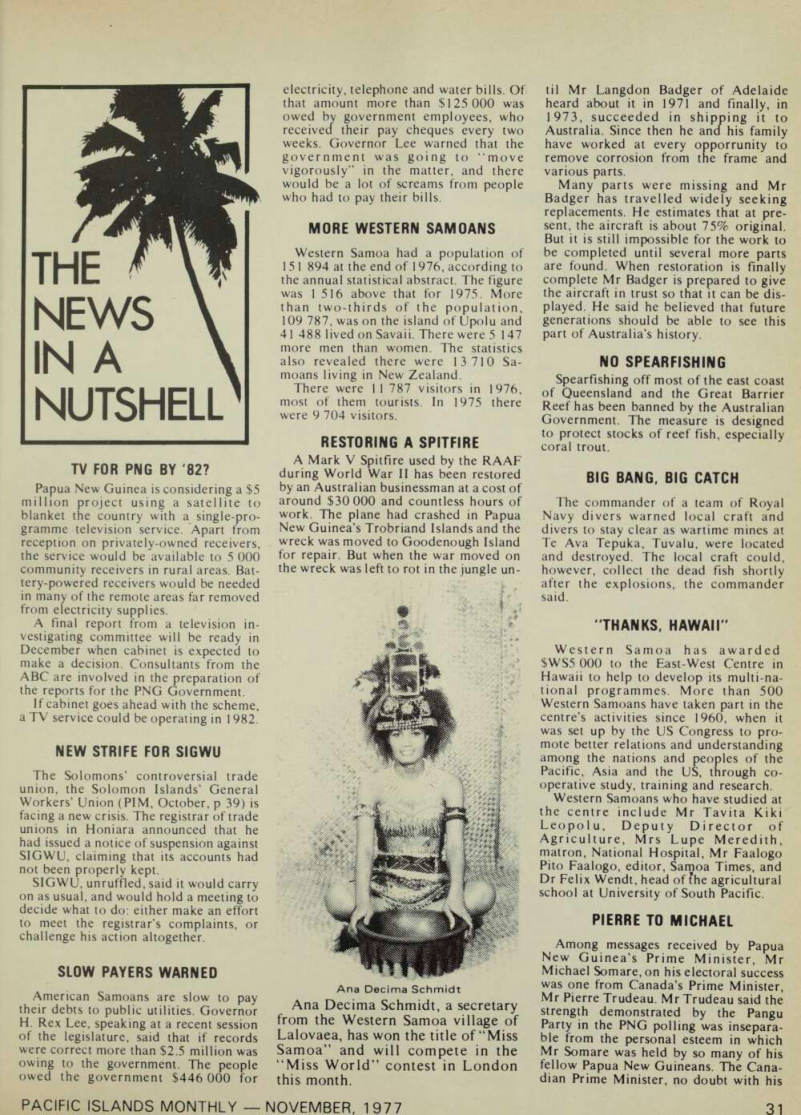
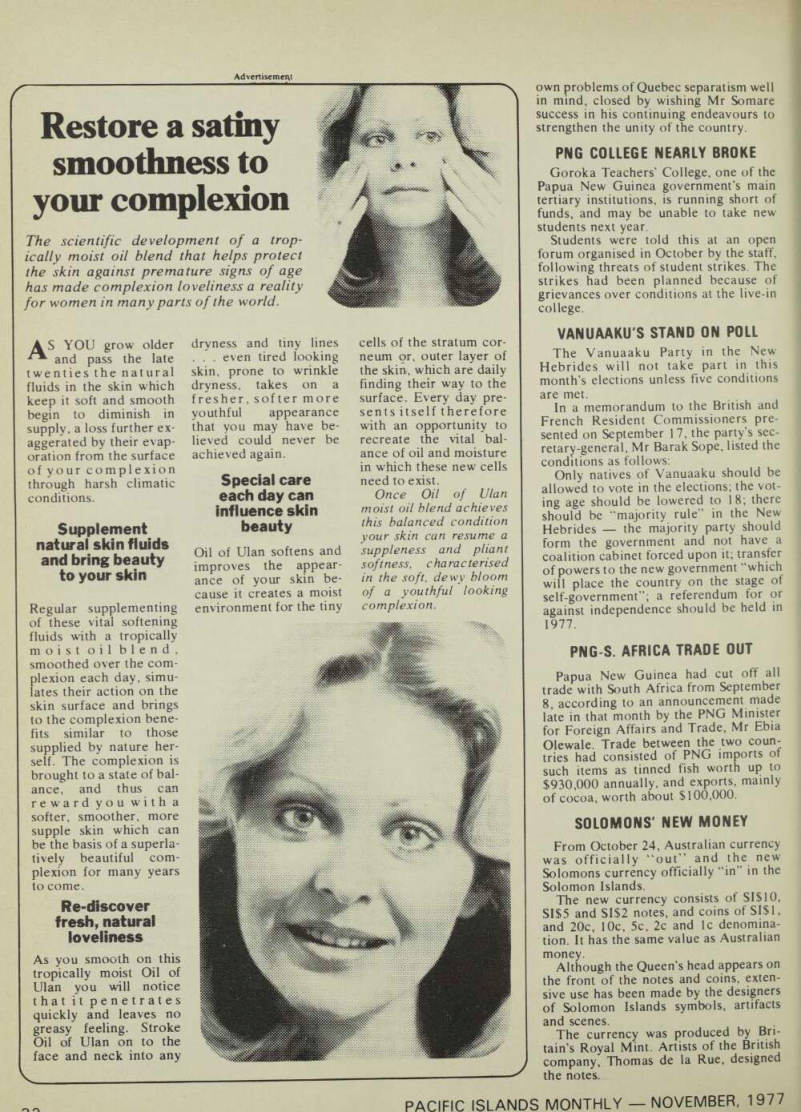
The
In A
Nutshell
Tv For Png By 'B2?
Papua New Guinea is considering a $5 million project using a satellite to blanket the country with a single-pro gramme television service. Apart from reception on privately-owned receivers, the service would be available to 5 000 community receivers in rural areas. Bat tery-powered receivers would be needed in many of the remote areas far removed from electricity supplies.
A final report from a television in vestigating committee will be ready in December when cabinet is expected to make a decision. Consultants from the ABC are involved in the preparation of the reports for the PNG Government.
If cabinet goes ahead with the scheme, a TV service could be operating in 1982.
New Strife For Sigwu
The Solomons’ controversial trade union, the Solomon Islands’ General Workers’ Union (PIM, October, p 39) is facing a new crisis. The registrar of trade unions in Honiara announced that he had issued a notice of suspension against SIGWU, claiming that its accounts had not been properly kept.
SIGWU, unruffled, said it would carry on as usual, and would hold a meeting to decide what to do; either make an effort to meet the registrar’s complaints, or challenge his action altogether.
Slow Payers Warned
American Samoans are slow to pay their debts to public utilities. Governor H. Rex Lee, speaking at a recent session of the legislature, said that if records were correct more than $2.5 million was owing to the government. The people owed the government $446 000 for
electricity, telephone and water bills. Of that amount more than $125 000 was owed by government employees, who received their pay cheques every two weeks. Governor Lee warned that the government was going to “move vigorously” in the matter, and there would be a lot of screams from people who had to pay their bills.
More Western Samoans
Western Samoa had a population of 15 1 894 at the end of 1976, according to the annual statistical abstract. The figure was 1516 above that for 1975. More than two-thirds of the population, 109 787, was on the island of Upolu and 41 488 lived on Savaii. There were 5 147 more men than women. The statistics also revealed there were 13 710 Sa moans living in New Zealand.
There were 11 787 visitors in 1976, most of them tourists. In 1975 there were 9 704 visitors.
Restoring A Spitfire
A Mark V Spitfire used by the RAAF during World War II has been restored by an Australian businessman at a cost of around $3O 000 and countless hours of work. The plane had crashed in Papua New Guinea’s Trobriand Islands and the wreck was moved to Goodenough Island for repair. But when the war moved on the wreck was left to rot in the jungle un-
Ana Decima Schmidt, a secretary from the Western Samoa village of Lalovaea, has won the title of “Miss Samoa” and will compete in the “Miss World” contest in London this month.
til Mr Langdon Badger of Adelaide heard about it in 1971 and finally, in 1973, succeeded in shipping it to Australia. Since then he and his family have worked at every opporrunity to remove corrosion from the frame and various parts.
Many parts were missing and Mr Badger has travelled widely seeking replacements. He estimates that at pre sent, the aircraft is about 75% original.
But it is still impossible for the work to be completed until several more parts are found. When restoration is finally complete Mr Badger is prepared to give the aircraft in trust so that it can be dis played. He said he believed that future generations should be able to see this part of Australia’s history.
No Spearfishing
Spearfishing off most of the east coast of Queensland and the Great Barrier Reef has been banned by the Australian Government. The measure is designed to protect stocks of reef fish, especially coral trout.
Big Bang, Big Catch
The commander of a team of Royal Navy divers warned local craft and divers to stay clear as wartime mines at Te Ava Tepuka, Tuvalu, were located and destroyed. The local craft could, however, collect the dead fish shortly after the explosions, the commander said.
"Thanks. Hawaii"'
Western Samoa has awarded SWSS 000 to the East-West Centre in Hawaii to help to develop its multi-na tional programmes. More than 500 Western Samoans have taken part in the centre’s activities since 1960, when it was set up by the US Congress to pro mote better relations and understanding among the nations and peoples of the Pacific, Asia and the US, through co operative study, training and research.
Western Samoans who have studied at the centre include Mr Tavita Kiki Leopolu, Deputy Director of Agriculture, Mrs Lupe Meredith, matron, National Hospital, Mr Faalogo Pito Faalogo, editor, Samoa Times, and Dr Felix Wendt, head of fhe agricultural school at University of South Pacific.
Pierre To Michael
Among messages received by Papua New Guinea’s Prime Minister, Mr Michael Somare,on his electoral success was one from Canada’s Prime Minister, Mr Pierre Trudeau. Mr Trudeau said the strength demonstrated by the Pangu Party in the PNG polling was insepara ble from the personal esteem in which Mr Somare was held by so many of his fellow Papua New Guineans. The Cana dian Prime Minister, no doubt with his
Ana Decima Schmidt
own problems of Quebec separatism well in mind, closed by wishing Mr Somare success in his continuing endeavours to strengthen the unity of the country.
Png College Nearly Broke
Goroka Teachers’ College, one of the Papua New Guinea government’s main tertiary institutions, is running short of funds, and may be unable to take new students next year.
Students were told this at an open forum organised in October by the staff, following threats of student strikes. The strikes had been planned because of grievances over conditions at the live-in college.
Vanuaaku's Stand On Poll
The Vanuaaku Party in the New Hebrides will not take part in this month’s elections unless five conditions are met.
In a memorandum to the British and French Resident Commissioners pre sented on September 17, the party’s sec retary-general, Mr Barak Sope, listed the conditions as follows; Only natives of Vanuaaku should be allowed to vote in the elections; the vot ing age should be lowered to 18; there should be “majority rule” in the New Hebrides the majority party should form the government and not have a coalition cabinet forced upon it; transfer of powers to the new government “which will place the country on the stage of self-government”; a referendum for or against independence should be held in 1977.
Png S. Africa Trade Out
Papua New Guinea had cut off all trade with South Africa from September 8, according to an announcement made late in that month by the PNG Minister for Foreign Affairs and Trade, Mr Ebia Olewale. Trade between the two coun tries had consisted of PNG imports of such items as tinned fish worth up to $930,000 annually, and exports, mainly of cocoa, worth about $lOO,OOO.
Solomons' New Money
From October 24, Australian currency was officially “out’’ and the new Solomons currency officially “in” in the Solomon Islands.
The new currency consists of Sls 10, Slss and Sls2 notes, and coins of Slsl, and 20c, 10c, sc, 2c and 1c denomina tion. It has the same value as Australian money.
Although the Queen’s head appears on the front of the notes and coins, exten sive use has been made by the designers of Solomon Islands symbols, artifacts and scenes.
The currency was produced by Bri tain’s Royal Mint. Artists of the British company, Thomas de la Rue, designed the notes.
Advertisements & other items, p. 32 (1 item)
your complexion
Advertisement (
Restore a satiny
smoothness to
your complexion
The scientific development of a trop-
ically moist oil blend that helps protect the skin against premature signs of age has made complexion loveliness a reality for women in many parts of the world. & * AS YOU grow older and pass the late twenties the natural fluids in the skin which keep it soft and smooth begin to diminish in supply, a loss further exaggerated by their evaporation from the surface of your complexion through harsh climatic conditions.
Supplement
natural skin fluids
and bring beauty
to your skin
Regular supplementing
of these vital softening fluids with a tropically moist oil blend, smoothed over the complexion each day, simulates their action on the skin surface and brings to the complexion benefits similar to those supplied by nature herself. The complexion is brought to a state of balance, and thus can reward you with a softer, smoother, more supple skin which can be the basis of a superlatively beautiful complexion for many years to come.
Re-discover
fresh, natural
loveliness As you smooth on this tropically moist Oil of Ulan you will notice that it penetrates quickly and leaves no greasy feeling. Stroke Oil of Ulan on to the face and neck into any dryness and tiny lines
. . . even tired looking
skin, prone to wrinkle dryness, takes on a fresher, softer more
youthful appearance
that you may have believed could never be
achieved again.
Special care
each day can influence skin
beauty
Oil of Ulan softens and improves the appearance of your skin because it creates a moist environment for the tiny cells of the stratum corneum or, outer layer of the skin, which are daily finding their way to the surface. Every day presents itself therefore with an opportunity to recreate the vital balance of oil and moisture in which these new cells need to exist.
Once Oil of Ulan moist oil blend achieves this balanced condition your skin can resume a
suppleness and pliant
softness , characterised in the soft, dewy bloom of a youthful looking complexion.
Editor’S Mailbag
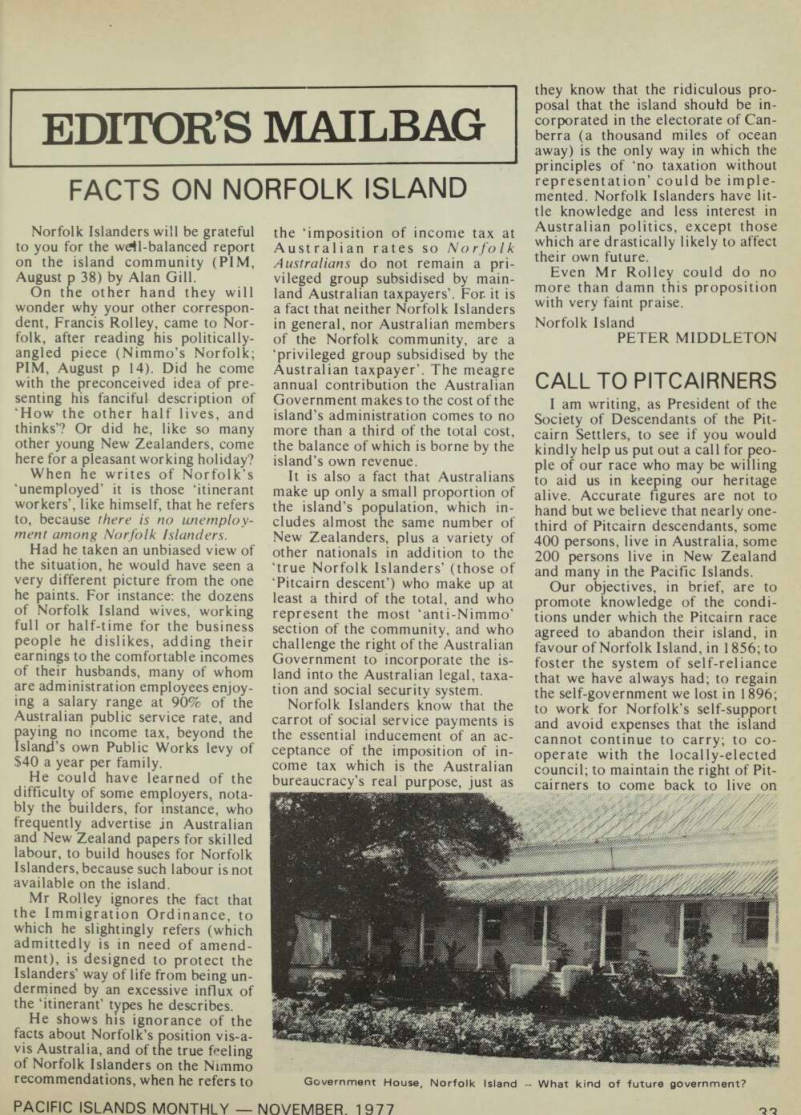

Facts On Norfolk Island
Norfolk Islanders will be grateful to you for the well-balanced report on the island community (PIM, August p 38) by Alan Gill.
On the other hand they will wonder why your other correspon dent, Francis Rolley, came to Nor folk, after reading his politically angled piece (Nimmo’s Norfolk; PIM, August p 14). Did he come with the preconceived idea of pre senting his fanciful description of ‘How the other half lives, and thinks’? Or did he, like so many other young New Zealanders, come here for a pleasant working holiday?
When he writes of Norfolk’s ‘unemployed’ it is those ‘itinerant workers’, like himself, that he refers to, because there is no unemploy ment among Norfolk Islanders.
Had he taken an unbiased view of the situation, he would have seen a very different picture from the one he paints. For instance; the dozens of Norfolk Island wives, working full or half-time for the business people he dislikes, adding their earnings to the comfortable incomes of their husbands, many of whom are administration employees enjoy ing a salary range at 90% of the Australian public service rate, and paying no income tax, beyond the Island’s own Public Works levy of $4O a year per family.
He could have learned of the difficulty of some employers, nota bly the builders, for instance, who frequently advertise in Australian and New Zealand papers for skilled labour, to build houses for Norfolk Islanders, because such labour is not available on the island.
Mr Rolley ignores the fact that the Immigration Ordinance, to which he slightingly refers (which admittedly is in need of amend ment), is designed to protect the Islanders’ way of life from being un derlined by an excessive influx of the ‘itinerant’ types he describes.
He shows his ignorance of the facts about Norfolk’s position vis-a vis Australia, and of the true feeling of Norfolk Islanders on the Nimmo recommendations, when he refers to
the ‘imposition of income tax at Australian rates so Norfolk Australians do not remain a pri vileged group subsidised by main land Australian taxpayers’. For. it is a fact that neither Norfolk Islanders in general, nor Australian members of the Norfolk community, are a ‘privileged group subsidised by the Australian taxpayer’. The meagre annual contribution the Australian Government makes to the cost of the island’s administration comes to no more than a third of the total cost, the balance of which is borne by the island’s own revenue.
It is also a fact that Australians make up only a small proportion of the island’s population, which in cludes almost the same number of New Zealanders, plus a variety of other nationals in addition to the ‘true Norfolk Islanders’ (those of ‘Pitcairn descent’) who make up at least a third of the total, and who represent the most ‘anti-Nimmo’ section of the community, and who challenge the right of the Australian Government to incorporate the is land into the Australian legal, taxa tion and social security system.
Norfolk Islanders know that the carrot of social service payments is the essential inducement of an ac ceptance of the imposition of in come tax which is the Australian bureaucracy’s real purpose, just as
they know that the ridiculous pro posal that the island should be in corporated in the electorate of Can berra (a thousand miles of ocean away) is the only way in which the principles of ‘no taxation without representation’ could be imple mented. Norfolk Islanders have lit tle knowledge and less interest in Australian politics, except those which are drastically likely to affect their own future.
Even Mr Rolley could do no more than damn this proposition with very faint praise.
Norfolk Island
Peter Middleton
Call To Pitcairners
I am writing, as President of the Society of Descendants of the Pit cairn Settlers, to see if you would kindly help us put out a call for peo ple of our race who may be willing to aid us in keeping our heritage alive. Accurate figures are not to hand but we believe that nearly one third of Pitcairn descendants, some 400 persons, live in Australia, some 200 persons live in New Zealand and many in the Pacific Islands.
Our objectives, in brief, are to promote knowledge of the condi tions under which the Pitcairn race agreed to abandon their island, in favour of Norfolk Island, in 1856; to foster the system of self-reliance that we have always had; to regain the self-government we lost in 1896; to work for Norfolk’s self-support and avoid expenses that the island cannot continue to carry; to co operate with the locally-elected council; to maintain the right of Pit cairners to come back to live on
Government House, Norfolk Island What kind of future government?
Norfolk, unless their line has been away for two generations; and, perhaps most importantly, to restore a principle that we had on Pitcairn in the 1830 s that no govern mental officer should “assume any power or authority on his own responsibility or without the consent of the majority of the people”.
We are in no way opposed to Australia and hope our island will continue being a well-regarded ad junct to the Commonwealth but, like Australians, we want to have the say in forming a new kind of govern ment for ourselves. If Pitcairners amongst your readers wish to help us I would value hearing from them.
K. Nobbs
Norfolk Island (President)
Palauan Claim
Long forgotten German docu ments captured by Australian soldiers in World War I may be vital evidence in a multi-million dollar lawsuit being brought by a Palauan chief against the US and Trust Territory governments (PIM, August, p 25).
Chief Thomas Orrenges of the Ochedarechei clan claims that the people of Angaur have always own ed the island and that the Germans never bought it. Any “sale” of land by the Angaurese to the Germans, he says, was the result of duress and cannot be used to justify the present rent-free occupation of clan land by the US and TT governments.
Among the records of German New Guinea now in the Australian Archives are those of the “Island
ders might be removed from the is land altogether and resettled elsewhere in the Palau islands, and he added; “During the negotiations which I conducted for you over the sale of their land to the (colonial government) treasury, that is to say to the phosphate company, they were at first very resolute in their refusal, spurred on by the English man Sims. We succeeded in obtain ing their consent to surrender the land only after the deportation of Sims became known.”
The reports do not say who Sims was. But the implication is clear.
For as long as he stayed on Angaur, acting as the people’s adviser, the people did not want to part with their land. He had to be deported before they would sell. Left to face the Germans alone, the Angaurese may well have felt that they had no choice but to do what they were told.
Territory”, the name given by Ger many to her Pacific possessions north of the equator, the Carolines, the Marianas and the Marshalls.
Despatches from German colonial officials in Saipan, Ponape, Jaluit and other centres went to the Governor in Rabaul. They were found there by the Australians in 1914, and the story goes that many valuable German files ended up as toilet paper in Australian Army latrines.
But some files survived and were shipped back to Australia, including those concerning the phosphate-rich island of Angaur.
The existence of the “German deed” by which the Germans bought Angaur can no longer be disputed.
A copy of it, dated Saturday, November 20, 1909, lies today in Canberra in a bundle of papers filed under the heading, oddly enough, of “Native Taxation”.
The deed was signed by a German district officer and by eight Angaur chiefs; Ugerbalau, Ungerbunch, Gagelbai, Riguchel, Midechulsch, Gaithan, Thalowak and Guang. For 1200 marks or about £6O in the sterling of the day, the chiefs sold the entire island of Angaur “forever”, though they were granted a reservation of 150 hectares in the south-east of their homeland.
If this were all we knew, Chief Or renges’s case might seem shakier than before.
But another document in a different file supports his view that the sale of Angaur was forced upon the people.
Writing from Yap on August 14, 1909, the district officer Karlowa asked what was to happen to the Angaurese now that the phosphate company had commenced opera tions. He suggested that the islan-
Stewart Firth
West Pymble, NSW
Notonesia
In your May issue (p 31) your cor respondent suggested Notonesia as a name for Papua New Guinea. But there are Pacific Islands more southerly than PNG..
If it is still necessary to perpetuate Greek-derived names in this area (and I would say the need is now past) may I suggest a word that at one and the same time indicates that the inhabitants of the territory stand firmly in the present and suggest that all past difficulties, differences and misunderstandings are forgot ten Amnesia.
Or should we leave it to the peo ple of Papua New Guinea to decide for themselves.
Funafuti, Tuvalu D. MORTIMER
August saw the launching of a new monthly magazine, New Nation, in Papua New Guinea A fresh venture by PNG's livewire publishing house Wantok Publications Inc, the magazine aims to fill the need, long felt by PNG educational authorities, for a regular publication which could be both useful and attractive to Papua New Guineans with several years' education in English The first issue contains a major feature on Port Moresby's Hohola Youth Development Project, an important self-reliance centre; an explanatory article on the July national elections; popular science features, a Tarzan adventure strip, and another strip featuring PNG's very own Super Didi, an agricultural expert with the Department of Primary Industry, who whips out to a village and solves the problem of villagers whose gardens are being eaten by giant snails a highly topical problem in PNG today Excellently printed and with plenty of illustrations in both colour and black and white, the magazine hopes to make an impact not only outside the schools but in the classrooms as well, offering material of value to both students and teachers
Advertisements & other items, p. 34 (2 items)
34
□ Aricir iqi aNinQ MfiMTHI Y NDVFMRFR 1977
Equipment
mDUSIRHI
made welL.warks iuell...sells well
Reliability, performance, quality of production and value for money, that’s how Australian industrial equipment and machinery have gained increasing sales in world markets.
The range is wide. From press brakes, guillotines, packaging machinery and materials handling equipment to pumps, machine drills, electric motors, welding equipment, wood working machinery and safety equipment. With
Australian-made products
the importer gets prompt deliveries and increased profitability, while the customer gets an efficient dependable product. Find out what Australia has to suit your requirements.
Quality and value that’s only hours away The Australian Trade Commissioner can give you details of suppliers. He can also advise Pacific Islands exporters on ways to research or develop markets in Australia.
You can contact him at;— FIJI; 7th Floor, Dominion House, Thomson Street, Suva. (Post Office Box 1252.) Telephone; 312844.
PAPUA NEW GUINEA;
Australian High Commission, P.O. Box 9129, Hohola.
Telephone; 259333.
' 1 ■ s
RtCOt
m i L
Ask the Australian Trade Commissioner
Pacifique Sud
With Helen Rousseau
The French have been engaged in a few lively sparring matches in re cent weeks. Besides the New Caledonian territorial elections, there were verbal tussles with Fiji and New Zealand, indirectly in volving the Japanese. The French insist they intend to remain in the Pacific to “contribute to the main tenance of peace” in the area. It seems it’s a help to get some battles started so that you can keep the peace.
In the first verbal war, the French were quick to protest at the “Fijian hue and cry against France” at the recent meeting of the South Pacific Forum in Port Moresby. The French press, reHecting facets of official opinion, rejected the Fijian attacks on “French colonialism”. They warned that Fiji has more to lose than to gain in such attacks, where “few States have got out of it very easily”. The French point out that
under-developed Fiji is dependent
on overseas aid, particularly from Europe, where France is a deter mining force. Moreover, they claim, France’s advanced technology has much to offer the Pacific through the BRGM (mining exploration) and ORSTOM (marine research).
At the same time, the French have welcomed decisions at the recent Forum meeting which they see as allowing France to participate in the new South Pacific fisheries agency “which will be responsible for polic ing the zones concerned”. In anti cipation of the creation of the 200mile sea limit the French have begun building up the strength of their Maritime Gendarmerie in Tahiti and New Caledonia. In an August visit to Noumea from Paris, Lt. Col. Jean Le Bastard inspected the local services. He indicated that just as in France and Tahiti so in New Caledonia also the Gendar merie Maritime might use a navy patrol boat to police territorial waters. As with other military hard ware, France could well be looking for a market for its patrol boats around the Pacific.
In the meantime, the French press reacted with “surprise” and was quick to denounce New Zealand’s unilateral announcement that it would extent its sea limits to 200 miles from October 1 (without con sulting anyone). Could it be that New Zealand has jumped the gun on France which was planning the very same action and now sees herself justified?
The French also deplored the “commercial blackmail” they claim the Kiwis are applying to the Japanese in pressing for more export sales in exchange for fishing rights.
Of course any Kiwis who remember French mining deals in the 60s might rightly wonder whether one has to be nickel-plated in order to try economic blackmail on the Japanese. Those were the days when Paris put export quotas on nickel ore supplies to Japan in a bid to force Japanese investment in a new nickel factory planned for Poum, northern New Caledonia. No doubt there will be some interesting wheeler-dealer games ahead over the exploitation of the marine resources around under-developed Pacific islands. We may even get back to those glorious days of gun boat diplomacy.
While empires are being carved out in the sealanes, there is increas ing activity in the airways, and numerous lures are being offered to Japanese tourists. Actually it pays to be able to read Japanese if you are flying around the Pacific these days.
On a flight from Auckland to Nadi one time the Air New Zealand
France is the latest country to woo Western Samoa with offers of aid. The offer, through the French Ambassador to Western Samoa, Mr de Shonner, who is based in Wellington, involves medical services, agriculture and fisheries. Most of the aid will be through sending ex perts.
In agriculture the French are ready to
help improve production of copra, cocoa
and coffee. They are prepared to help to set up aquaculture projects to breed prawns, bait fish and commercial fish.
luncheon menu included “kumaras”, which was unfamiliar to some travellers. However, by look ing at the Japanese section of the menu, written in phonetic katakana script, one could decipher “su-ii-to po-te-to”. So brush up your Japanese; it could help you identify sweet potato in New Zealand.
Actually the increase in Japanese overseas tourism has been phenomenal, considering it was only 15 years ago that the Japanese foreign currency laws were relaxed to allow private overseas trips for pleasure. The recent upsurge in the numbers of Japanese tourists visit ing the Pacific has meant that for New Caledonia, for example, the Japanese this year represent the sec ond largest group of visitors, after the Australians. For the first six months of 1977 the Nihon-jin jum bered 2 368, i.e., 13% of total stay ing visitors. At the same time in the New Hebrides provisional figures show 1 299 Japanese, more than 10% of total arrivals.
At the Turtle Club on He Ouen, off Noumea, enterprising resort owner Kolka Muller has performed several “kekkon-shiki” (marriage ceremonies) for young Japanese. As Kolka explained in Sydney recently, the couple exchange vows in a Melanesian-style thatch bungalow.
They are then treated to French champagne, a Melanesiam bougna feast and the tall French wedding cake of cream puffs.
Anyone who has seen the elaborate dressing of Japanese brides at such wedding mansions as Nihon Kaku in Tokyo, involving or nate head-dress and several layers of Kimono, can appreciate the con trast of a south seas wedding. At He Ouen, in place of the solemn Japanese Nakodo-san (match makers) the young couples are at tended by resort guests and mem bers of the island’s Melanesian tribe. The honorary Japanese consul in Noumea, Mr Georges Tsutsui, assists with translations and official documents.
New Caledonia’s poll:
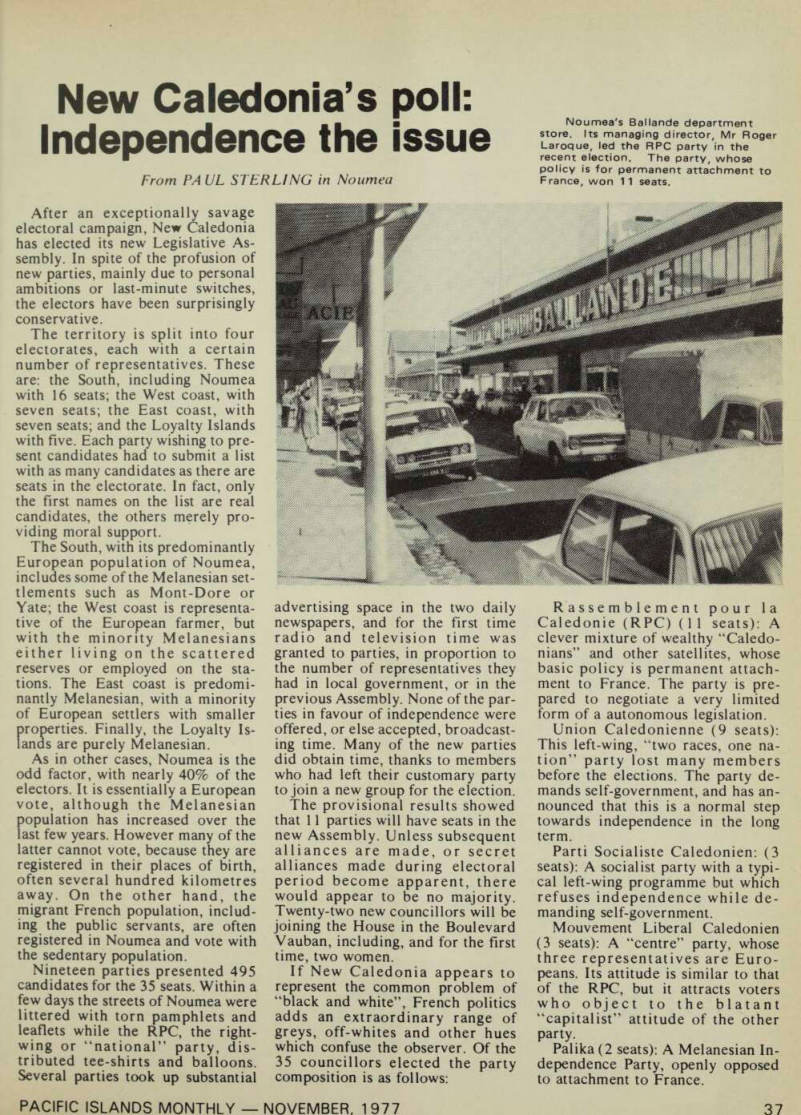
Independence the issue
From PAUL STERLING in Noumea
After an exceptionally savage electoral campaign, New Caledonia has elected its new Legislative As sembly. In spite of the profusion of new parties, mainly due to personal ambitions or last-minute switches, the electors have been surprisingly conservative.
The territory is split into four electorates, each with a certain number of representatives. These are: the South, including Noumea with 16 seats; the West coast, with seven seats; the East coast, with seven seats; and the Loyalty Islands with five. Each party wishing to pre sent candidates had to submit a list with as many candidates as there are seats in the electorate. In fact, only the first names on the list are real candidates, the others merely pro viding moral support.
The South, with its predominantly European population of Noumea, includes some of the Melanesian set tlements such as Mont-Dore or Yate; the West coast is representa tive of the European farmer, but with the minority Melanesians either living on the scattered reserves or employed on the sta tions. The East coast is predomi nantly Melanesian, with a minority of European settlers with smaller properties. Finally, the Loyalty Is lands are purely Melanesian.
As in other cases, Noumea is the odd factor, with nearly 40% of the electors. It is essentially a European vote, although the Melanesian population has increased over the last few years. However many of the latter cannot vote, because they are registered in their places of birth, often several hundred kilometres away. On the other hand, the migrant French population, includ ing the public servants, are often registered in Noumea and vote with the sedentary population.
Nineteen parties presented 495 candidates for the 35 seats. Within a few days the streets of Noumea were littered with torn pamphlets and leaflets while the RPC, the right wing or “national” party, dis tributed tee-shirts and balloons.
Several parties took up substantial
advertising space in the two daily newspapers, and for the first time radio and television time was granted to parties, in proportion to the number of representatives they had in local government, or in the previous Assembly. None of the parties in favour of independence were offered, or else accepted, broadcasting time. Many of the new parties did obtain time, thanks to members who had left their customary party to join a new group for the election.
The provisional results showed that 11 parties will have seats in the new Assembly. Unless subsequent alliances are made, or secret alliances made during electoral period become apparent, there would appear to be no majority.
Twenty-two new councillors will be joining the House in the Boulevard Vauban, including, and for the first time, two women.
If New Caledonia appears to represent the common problem of “black and white”, French politics adds an extraordinary range of greys, off-whites and other hues which confuse the observer. Of the 35 councillors elected the party composition is as follows:
Rassemblement pour la Caledonie (RPC) (11 seats): A clever mixture of wealthy “Caledo nians” and other satellites, whose basic policy is permanent attach ment to France. The party is pre pared to negotiate a very limited form of a autonomous legislation, Union Caledonienne (9 seats): This left-wing, “two races, one na tion” party lost many members before the elections. The party de mands self-government, and has an nounced that this is a normal step towards independence in the long term.
Parti Socialiste Caledonien; (3 seats); A socialist party with a typi cal left-wing programme but which refuses independence while de manding self-government, Mouvement Liberal Caledonien (3 seats): A “centre” party, whose three representatives are Euro peans. Its attitude is similar to that of the RPC, but it attracts voters who object to the blatant “capitalist” attitude of the other party.
Palika(2 seats): A Melanesian In dependence Party, openly opposed to attachment to France.
Noumea's Ballande department store. Its managing director, Mr Roger Laroque, led the RPC party in the recent election. The party, whose policy is for permanent attachment to France, won 11 seats.
Union Nouvelle Caledonienne (2 seats): A breakaway from Union Caledonienne, the major difference being their refusal to acknowledge that independence is inevitable in the long term.
Union Progressiste Melanesienne; (1 seat); Another breakaway from Union Caledonienne, which con siders that their are other problems more important than independence for the moment.
F.U.L.K.; (1 seat): A party whose attitude is similar to the Palika.
Union Pour le Renouveau Caledonien (1 seat); The right-wing “intelligensia”, a smattering of doc
tors, lawyers, company directors and college teachers, led by a woman, Dr Edwige Lagarde. This party is opposed to independence.
Union Democratique (1 seat); A breakaway from the RPC, but with an identical policy.
Emsemble Toutes Ethnics (1 seat); The only party in favour of creating a closer and more depen dent relationship with France.
As far as the important issue of in dependence is concerned, nearly a third of the electors voted for par ties who declared this as necessary or inevitable. Their representatives are the three Palika-FULK repre
sentatives and the nine Union Caledonienne councillors, just under a third of the Assembly. This was the first time that independence had ever appeared as an issue dur ing an election. On all other ques tions, it would seem that the Union Caledonienne could receive support from the UPM, UNC, and PSC, 18 seats out of 35. The local Socialist Party will be in a strong position to negotiate on giving its support to either group.
Diagnosing
New Caledonia
If a busy doctor was called to the bedside of ailing New Caledonia, after a casual inspection he would be tempted to toss the patient out of bed and tell him to go back to work.
The trade balance is favourable, only 700 people are registered as being out of work, nickel exports are higher than last year and the cost of living rose only 6.42% in 1976.
Yet the doctor would do better to consult the pathologist before pro nouncing his final diagnosis.
Blood pressure is high. There are signs of anaemia, as the blood count shows that the red corpuscles in vestors and experienced and skilled craftsmen are leaving the terri tory. And if cholesterol and urea counts are down, it is simply because the territory is not longer consuming excessively rich foods.
The territory’s revenues are limited, but important. Hopes were high for the future development of nickel production for the world’s second largest deposit. But Europe’s steel industry, the largest consumer, is in difficulty. Not only have foreign investments been dis couraged. but they have gone elsewhere, creating competitive sources of supply.
Coffee prices have climbed to
unexpected levels. But production
has dropped and is now sufficient for local consumption and limited exports. The number of tourists has tripled in four years, but the great majority are tempted by the UTA package tours which direct them to the Chateau Royal Hotel that has never made a profit. The GNP, at 54 billion Pacific francs, represents roughly SA4 000 per capita. But at constant prices this represents only 3% increase in seven years.
Advertisements & other items, p. 38 (1 item)
Laundry Equipment
o o U name
to be trusted
COMMERCIAL
LAUNDRY EQUIPMENT
Chosen throughout Australia and the Pacific Islands. Every year more and more Laundries and Institutions install Gothic machines and every year these buyers obtain the benefits of better after-sales attention throughout the Pacific.
Used throughout Australia and the Pacific Islands by Government Departments, Hospitals, Institutions, Hotels, etc.
We are currently installing machines for the Fiji Prisons Service, Suva.
HEAVY WASHERS & WASHER EXTRACTORS (Side or Front Loading). TUMBLER DRYERS (Town Gas, Natural Gas, Electric or Steam Heated). IROIMERS & HYDRO EXTRACTORS, etc.
For further information and catalogue:
GOTHIC PTY. LIMITED
37-41 Harris Street, St. Marys, IM.S.W. Australia. 2760.
Tbopicalities
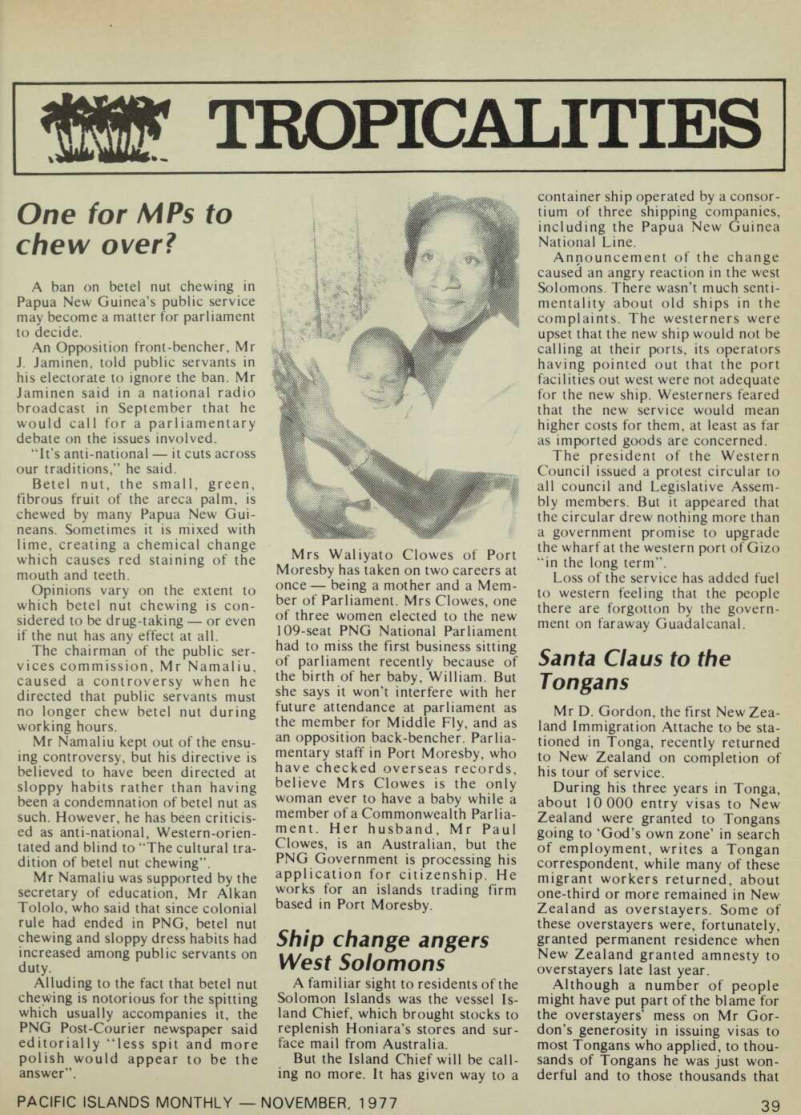
One for MPs to chew over?
A ban on betel nut chewing in Papua New Guinea’s public service may become a matter for parliament to decide.
An Opposition front-bencher, Mr J. Jaminen, told public servants in his electorate to ignore the ban. Mr Jaminen said in a national radio broadcast in September that he would call for a parliamentary debate on the issues involved.
“It’s anti-national it cuts across our traditions,” he said.
Betel nut, the small, green, fibrous fruit of the areca palm, is chewed by many Papua New Gui neans. Sometimes it is mixed with lime, creating a chemical change which causes red staining of the mouth and teeth.
Opinions vary on the extent to which betel nut chewing is con sidered to be drug-taking or even if the nut has any effect at all.
The chairman of the public ser vices commission, Mr Namaliu, caused a controversy when he directed that public servants must no longer chew betel nut during working hours.
Mr Namaliu kept out of the ensu ing controversy, but his directive is believed to have been directed at sloppy habits rather than having been a condemnation of betel nut as such. However, he has been criticis ed as anti-national, Western-orien tated and blind to “The cultural tra dition of betel nut chewing”.
Mr Namaliu was supported by the secretary of education, Mr Alkan Tololo, who said that since colonial rule had ended in PNG, betel nut chewing and sloppy dress habits had increased among public servants on
duty.
Alluding to the fact that betel nut chewing is notorious for the spitting which usually accompanies it, the PNG Post-Courier newspaper said editorially “less spit and more polish would appear to be the answer”.
Mrs Waliyato Clowes of Port Moresby has taken on two careers at once being a mother and a Mem ber of Parliament. Mrs Clowes, one of three women elected to the new 109-seat PNG National Parliament had to miss the first business sitting of parliament recently because of the birth of her baby, William. But she says it won’t interfere with her future attendance at parliament as the member for Middle Fly, and as an opposition back-bencher. Parlia mentary staff in Port Moresby, who have checked overseas records, believe Mrs Clowes is the only woman ever to have a baby while a member of a Commonwealth Parlia ment. Her husband, Mr Paul Clowes, is an Australian, but the PNG Government is processing his application for citizenship. He works for an islands trading firm based in Port Moresby.
Ship change angers
West Solomons
A familiar sight to residents of the Solomon Islands was the vessel Is land Chief, which brought stocks to replenish Honiara’s stores and sur face mail from Australia.
But the Island Chief will be call ing no more. It has given way to a
container ship operated by a consor tium of three shipping companies, including the Papua New Guinea National Line.
Announcement of the change caused an angry reaction in the west Solomons. There wasn’t much senti mentality about old ships in the complaints. The westerners were upset that the new ship would not be calling at their ports, its operators having pointed out that the port facilities out west were not adequate for the new ship. Westerners feared that the new service would mean higher costs for them, at least as far as imported goods are concerned.
The president of the Western Council issued a protest circular to all council and Legislative Assem bly members. But it appeared that the circular drew nothing more than a government promise to upgrade the wharf at the western port of Gizo “in the long term”.
Loss of the service has added fuel to western feeling that the people there are forgotten by the govern ment on faraway Guadalcanal.
Santa Claus to the
Tongans
Mr D. Gordon, the first New Zea land Immigration Attache to be sta tioned in Tonga, recently returned to New Zealand on completion of his tour of service.
During his three years in Tonga, about 10 000 entry visas to New Zealand were granted to Tongans going to ‘God’s own zone’ in search of employment, writes a Tongan correspondent, while many of these migrant workers returned, about one-third or more remained in New Zealand as overstayers. Some of these overstayers were, fortunately, granted permanent residence when New Zealand granted amnesty to overstayers late last year.
Although a number of people might have put part of the blame for the overstayers’ mess on Mr Gor don’s generosity in issuing visas to most Tongans who applied, to thou sands of Tongans he was just won derful and to those thousands that
Advertisements & other items, pp. 40-41 (1 item)
IdfTip-pOSt
finally won permanent residence in Kiwi land, he was Santa Claus a thousand times!
It is believed that the granting of visas to Tongans wishing to go to New Zealand will become more and more difficult. One hopes, however, that the procedure would not be as long-winded, cumbersome and as extremely difficult as that relating to application for visas to Australia.
Applications for entry visas to Australia can take up to six months without anything being done. In spite of the increasing involvement of Australia in the South Pacific, it is difficult to understand the very stringent Immigration Department requirements of the Australian Government.
"We want a bigger
slice" Pita Lus
Papua New Guinea’s new Com merce Minister, Mr Pita Lus, has announced a “vigorous and respon sible” crusade to get a bigger slice of the economy for Papua New Gui neans.
Too many Papua New Guineans were working at menial jobs for foreign firms and capital, he said.
Mr Lus denied any suggestion that he opposed foreign investment.
He said he realised the development value of foreign investment and wanted to encourage it.
But Papua New Guinea would not tolerate being dictated to by foreign investors. Token gestures of in volvement were not good enough.
Mr Lus said that if firms played fair, the PNG Government would guarantee them fair treatment.
He said that in evaluating criteria for foreign investment, the training and equity opportunities could be regarded as more important than the price to the consumer of the finished product or service.
Nutty ideas
for coconuts
Will the Islanders of the Pacific ever cease to find new ways of using the already multi-purpose coconut?
It seems that the residents of Guam are not satisfied with the commodity that provides them with beverages (alcoholic and other wise), food, clothing, fertilizer and a score of other uses.
In answer to a contest sponsored
by a local department store they are dreaming up zany new ideas. Absolutely anything made from an unused coconut qualifies and suggestions for new toys, masks, table decorations and dolls are among the many imaginative entries competing for trophies for the “most original, unusual, funniest and craziest coconut creation”.
Then there could be bra-cups, castanets, hanging flower baskets, babies’ rattles, caps for midgets and egg-cups for ostrich eggs.
When Cooks
warriors rioted
During the 1914-1918 War the Polynesian men of the Cook Islands answered the call of King and Empire to go and fight against the Hun and his allies.
When the Cook Islands’ contingent returned to Rarotonga and the outer islands in 1919 there was a time of great unrest. There were riots and there were attempts to challenge the authority of those who were set up to rule in the name of the New Zealand Government.
The causes of the challenges to those in power were quite patently manifold, but a letter from the Resident Commissioner to the Ministerin-Charge of the Cook Islands gives at least one explanation.
Even today it must be almost impossible to purchase a formal suit on the island. Imagine the scene in 1919 “one grave mistake that led
to a lot of trouble was the issue of 240 mufti orders for civilian clothing to the value of £5/5/- in each case. The idea was to supply one good suit to each man. These or ders certainly should have been issued in New Zealand, “Some stores supplied a few arti cles and gave the soldiers change for the balance unexpended. Others refused to give any change and hav ing got the order insisted that the soldiers should take the full value of the order in clothing. Naturally there was a great deal of waste and dissatisfaction amon s the p#A .
P' M a
IdfTip-pOSt
one of PIMs rea ders has sent a letter he received from Australia p ost j n p er th. The letter was an apology for the condition in which his PIM arrived after travelling across Australia on the Indian Pacific. When he got his PIM he realised it was a watered-down ver sion. xhe apology read; “Dear Customer, It is regretted that the enclosed article was damag ed during transmission through the postal service during transportation aboard the ‘lndian Pacific’. The bag in which your article was enclosed was saturated with canine urine, “The damage is sincerely regret ted however, I am sure you will un derstand that the incident was beyond the control of Australia Post.”
PNG independence
feted in low key
Papua New Guinea went back to work on September 19 after a low key long weekend to celebrate its second anniversary of indepen dence.
In Port Moresby dancing groups scheduled to entertain at the capital’s main stadium did not turn up, and neither did two politicians, including Papua Besena leader Miss Josephine Abaijah, who were to have addressed the crowd.
Police reported a quiet holiday weekend. Takeaway liquor sales had been banned from September 14-19.
Support for Mara
from Asian unions
Fiji is close to being able to turn its back on the possibility of the country becoming isolated through industrial action in Australia and New Zealand in support of Fiji unions. Asian unions will consider backing a Fiji protest against inter ference in its affairs by NZ and Australian unions.
The president of the Asian region of the International Confederation of Free Trade Unions, Mr C. V.
Devan Nair, in a letter to the Fiji Prime Minister, Ratu Sir Kamisese Mara, said he was concerned at un warranted intervention in Fiji by some NZ and Australian unions. He was confident the majority of the Asian regional board members of the ICFTU would condemn action by the unions concerned.
He said he would ask the Fiji Trades Union Congress for a full re port on action during Fiji’s July dock strike, by Australian and NZ unions, “which strikes us as being tantamount to bullying the judiciary of an independent nation into sub mission”.
Mr Nair said Fiji had been firm and dignified in dealing with an ar rogant attempt by NZ unions in par ticular to hold the judiciary to ran som.
With backing from Asia almost certain, Fiji is in a good position to urge the Australian and NZ Governments to take action against unions which attempt to interfere with Fiji’s affairs. Fiji holds a strong hand, with merchants looking elsewhere for goods normally sup plied by Australia or NZ.
Amacing theft
on Nauru
Somebody stole the Nauru Parlia ment’s mace from Parliament towards the end of August but, if it was returned expeditiously, no one would be prosecuted. This promise was made by the Secretary for Justice when he appealed for the return of the mace which was taken from the Chamber of Parliament in broad daylight.
Making the appeal for its return, the Secretary for Justice stated: “The mace is precious to Nauru for two reasons. Firstly and most im portantly, it is a symbol of the authority and dignity of Parliament, and secondly it is part of the heritage of Nauru and was given to Nauru shortly before Indepen dence.” The Republic’s bulletin said it was a very serious matter that the mace should have been taken from its place in Parliament. “Neverthe less, the main concern is that it should be returned unharmed.”
The Secretary for Justice said that as he was, for the time being, Direc tor of Public Prosecutions in Nauru he promised “that if the mace is
returned now in response to this ap peal, the person or persons who took it will not be prosecuted”. He also promised that the identity of the mace stealer would not be divulged.
The only previous example of the theft of a parliamentary mace known to PIM occurred in Melbourne in October, 1891.
A couple of weeks after the mace disappeared from Parliament House in Melbourne, the Ballarat Courier newspaper claimed that “the mace was not stolen, but was taken from Parliament by some ‘festive cusses’ for a lark, and is even now, so it is freely stated, in a bawdy house in Melbourne where it is freely ex hibited to clients, and where it has, so it is said, been used in low traves ties of parliamentary procedure”.
The editor of the paper, Major Williams, who wrote the article quoted, was prepared to assert the truth of his claims, and to defy the House, but he was never called before the Bar of Parliament to ex plain his story.
The mace was never recovered, but to this day, most Melbourne people accept the truth of Major Williams’ story.
Awards for Pacific Scholars
A new series of awards to help Pacific Islands scholars further their education overseas has re cently been announced by the Australian National University, Canberra.
The awards honour the late Professor J. W. (Jim) Davidson, foundation professor of Pacific History at the ANU and a con stitutional adviser to several Is lands countries as they moved towards independence or self government.
Scholars who have completed or are about to complete tertiary education are eligible for the awards. They will mainly be made to those seeking assistance
towards the cost of travel and living expenses for fairly short visits to overseas universities, libraries and archives, or to at tend conferences.
Full details about the awards are obtainable from the registrars of Islands universities, the directors of the University of the South Pacific, extension centres in Honiara, Tarawa, Nukualofa, Apia, Niue and Rarotonga, and from the Direc tor of Education, British Service, Vila. Applications must reach the Assistant Registrar, Research School of Pacific Studies, ANU, by 30 November.
Islands
From The
Press
From an article in Lae Nius titled Brief History of Football in Papua New Guinea: Football the only true code of handling the ball by foot— can claim the longest history of team sports in Papua New Guinea.
From American Samoa News Bulletin:
American Samoa’s beautification program, in preparation for the South Pacific Conference later this month, is paying off in beautiful dividends. A Beautification Committee, sponsored by the Office of Samoan Affairs, toured Manu’a last week and has been busy in the Western District this week. They are finding our villages— through the hard work of the people looking neater and more attractive than they have for years. That doesn’t mean that we don’t still have a lot of work to do . .. Look around. If something still looks shabby, or there are cans and bottles in sight, pick them up and find a trash can.
From the Arawa Bulletin, Bougainville, PNG:
Two break-ins were reported by the Arawa police last weekend, the first being at Ar igua PI antation d ur ing the night of September 4 Thieves forced entry to the plantation’s trade store, stealing cigarettes and foodstuffs. The second break-in occurred at Bougainville Laundry at the Itakara Industrial Estate some time during the weekend and is
the third break and entry at the laundry in the past 12 months. This time, thieves stole a number of football socks and shorts after gaining entry by smashing the fibro wall.
From an interview with veteran Norfolk
Island resident, “Ahlee” Schmitz, in Norfolk
Island News:
Vividly Ahlee remembers the time when the neighbour next to her grandfather’s house (where the Golf Club is now) sent her daughter to get some water from her grandfather’s well. She didn’t return. Finally, her mother sang out, “Where’s Abbey? She hasn’t come with the water.” Ahlee’s mother went to see about her and noticed that the roller on the well was gone. The girl had fallen 90 feet! “My mother went down to get her,” Ahlee recalls. “Both got back out of the well.
She should have had a medal for bravery. The doctor told her her lungs had been affected by the long dive into the well ...”
From a letter in the Tonga Chronicle from Jo
Toga Jr, of Suva:
I was shocked with the incident that occurred at the well-known football ground, Buckhurst Park, in Suva. It appeared to me that a lot of people in Fiji are still bathed in uncivilisation ... The Fijian spectators, a crowd of about 500 to 600 people, showed that they are still cannibals. The mobbing cannibals stormed into the field to beat up the Tongan players ... (A news item in the same paper said): The four Tongan rugby players who were detained in Fiji in connection with the death of a Suva man, have been discharged and the case withdrawn in a preliminary hearing in Suva Magistrate’s court . . . The presiding magistrate, Mr Colin Perrior, ruled that the proceedings against the Tongans be discontinued after the Crown Prosecutor, Mr Tevita Fa, told the court there was not enough evidence to commit the case to the Supreme Court for trial.
From the Gilbert Islands' Atoll Pioneer:
A grim picture of the employment prospects facing school leavers over the next few years was painted by the Hon Teato Teannaki when he spoke in the Assembly on Thursday of last week. There were some 4 350 in the 15-19 age group and in the next five years this would increase to 6 300 young men and women, all looking for jobs .. .
From South Pacific News Services of the
Provisional Revolutionary Government of
West Papua New Guinea:
Old News, Good News. During the recent "elections” in West Papua New Guinea, some old news surfaced. Paprindei, the speaker of the DPR DGR (the puppet Council), was informed by Suharto that he would “give” West PNG its independence in 1980. He made this “promise” in 1974, and claimed that the military and political situation in West PNG left him no choice. Chief running-dog Paprindei is from Serui, the most pro-Indonesian area of West PNG.
M Gauger, French Resident Commissioner in
the New Hebrides, quoted in Vila’s
French/Bislama fortnightly, Nabanga:
“Neither France nor Great Britain can entertain for a moment the notions of secession that have been thoughtlessly embraced by some people. Such ideas might have some force in big, rich and heavily populated countries. But the separation of any part whatsoever of the New Hebrides, which is a small and poor country, would be pure madness ...”
From Pitcairn Miscellany:
At approximately 6.30 a.m. on July 11, the five strokes on the bell sent the men scurrying down to the Landing like ants to launch the launches as an unexpected ship arrived from the south heading north. On reaching the landing however, the men were stunned, for the lower part of the slipway (submerged by water most of the time) had “busted up” making it impossible to get the launches back into the boathouse should they be put to sea. Sad to say, the Danish vessel left without anyone having made contact with it ...
From an article in the Papua New Guinea
Post-Courier:
In the wisespread movement for replacement of European languages by African ones as official languages ... a novel suggestion has been made in the Nigerian press; the use of Pidgin. Pidgin, or Pidgin English, is spoken all along the coast of West Africa and in different forms— in the Far East, where the term Pidgin (derived from “business”) is said to have originated, and in Melanesia ... To make
such a language official in the technological age is not as impossible as might be thought. Pidgin is not just bad English. Linguists hold that it is a real new language developed for convenience because of historical circumstances, and by its nature fairly adaptable . . .
From a leading article in The Fiji Times: Everyone in this country representing all shades of opinion has had a chance to have his (pre-election) say. Now we claim our turn. We are a senior team of editorial staff who discuss all editorial comments before they appear in print in this column. This editorial is no exception. We are not telling anyone how to vote. We believe readers have a right to vote how they feel . . . they (the Alliance) have more or less served us the same team (which lost the April election) again. We believe this to be a worrying aspect of Alliance policy ... so, who is best set to lead us? Weighing this against the other factors . . . our answer must be Ratu Sir Kamisese Mara. He of all is best able to lead us.
From an interview with Ambassador Peter P.
Rosenblatt, President Carter’s personal
representative to the Micronesian Status
Negotiations, in Highlights, Saipan:
I think the Carter Administration’s approach to the subject of Micronesia has to be seen within the context of its entirety— if there is one single phrase that has come to prominence since the Carter Administration took power, and which is terribly important to Micronesia in that it stands among the most firmly held beliefs of the President personally, it is the phrase “human rights”. We believe that human rights have a direct application to the future of Micronesia, in a way that they have direct application to very few other areas of American concern ...
From the Arawa Bulletin, Bougainville, PNG:
On Wednesday, 14th September at about 10.30 p.m, police were called to Section 17. Some nurses had seen, and been embarrassed by, a nude couple outside taking photographs of each other and had reported the fact to the police. The police arrested the couple and took them, still naked, to the police station in Arawa. At Kieta Court on Wednesday, Maiken and Finn Reerslev, both Danish, were charged with exposing their persons in public. They were found guilty as charged and convicted and adjudged to pay a fine of KlOO, in default, to be put in prison for one month with hard labour. Mrs Reerslev said she did not realise it was a wrong thing to do.
Advertisements & other items, pp. 42-43 (1 item)
Epiglass Everdure
Timber preservative and sealer.
Hardens, protects and densities timber.
Kills all mould spores and permanently 6S seals out moisture. S Epiglass 90 Epoxy Resin and glass cloth.
Easy to apply.
Strengthens hulls, eliminates water absorption and rot and increases the value and life of your boat.
Epiglass E-Type
Antifouling.
Gives up to 12
months
growth-free
performance.
Racing Red,
Blue, Green
and Gold.
[epiglas s|
PACIFIC AREA STOCKISTS
COOK ISLANDS: Cook Island Trading Corporation Ltd FIJIAN ISLANDS: Burns Philp (SS) Co. Ltd NEW HEBRIDES: Burns Philp (NH) Ltd NOUMEA: Guy Limousin, Pacific Yachting NUIE ISLAND: Nuie Island United PAGO PAGO: Max Haleck Inc, Burns Philp (SS) Ltd PAPUA NEW GUINEA; KIETA; Nikana Wholesalers, LAE: Faulkner-Tait (NG) Pty Ltd, MADANG: Burns Philp (NG) Co.
Ltd, PORT MORESBY: S.A. Heath Co. Ltd, RABAUL; Elvee Trading Pty Ltd, WEWAK; Burns Philp (P.N.G.).
SOLOMON ISLANDS: Man Sang Co.
TAHITI: Marine Corail, Tahiti Sport.
TONGA: Riechelmann Bros.
WESTERN SAMOA: Burns Philp (SS) Co. Ltd, E. A. Coxon Ltd, Gold Star Transport Co. Ltd, Morris Hedstrom Ltd. 290
Magazine
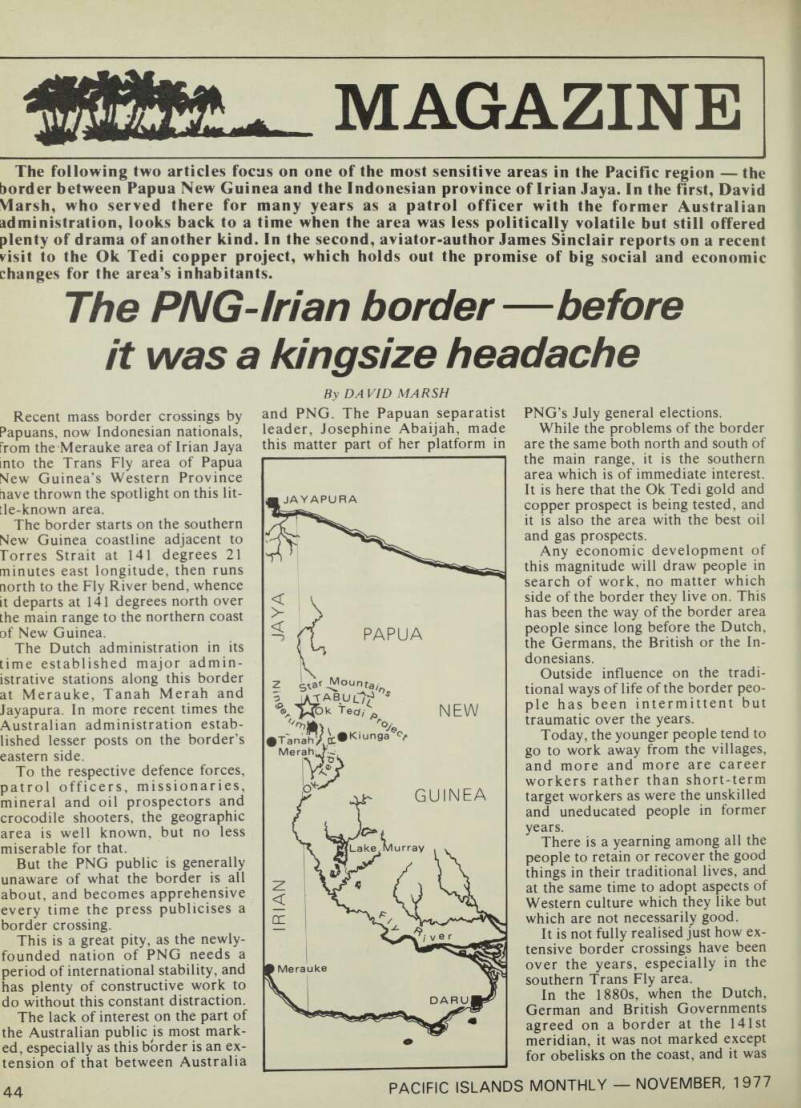
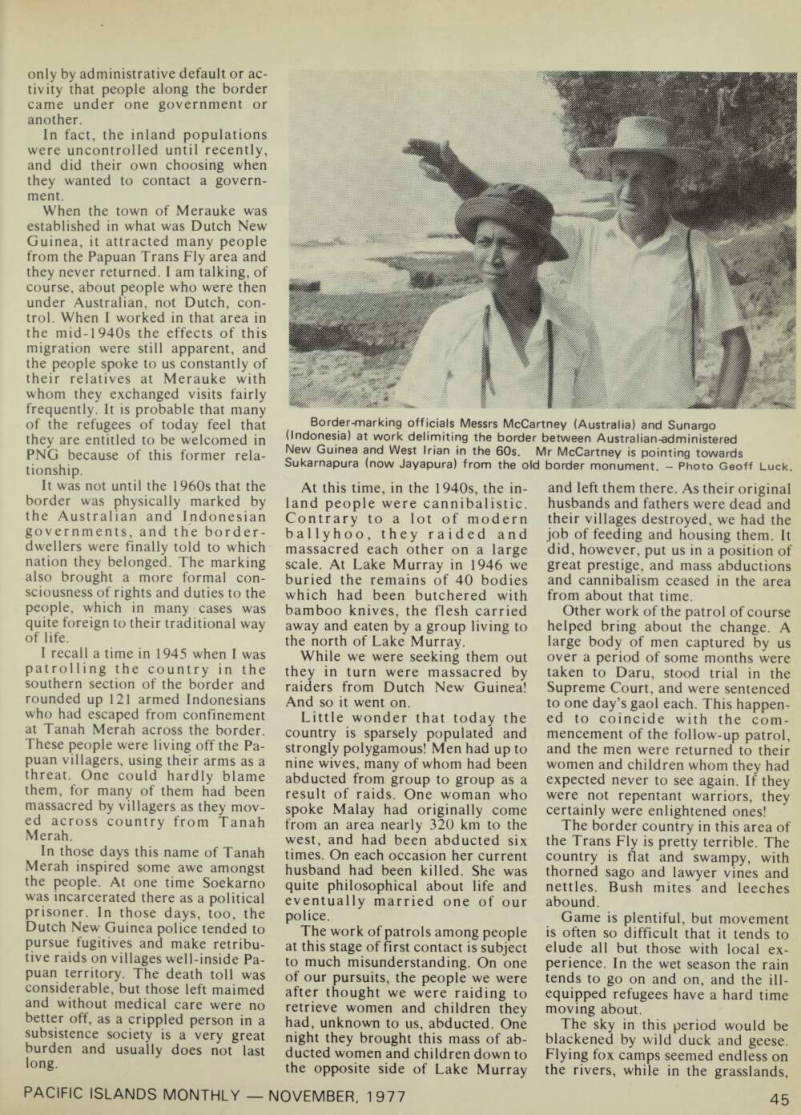
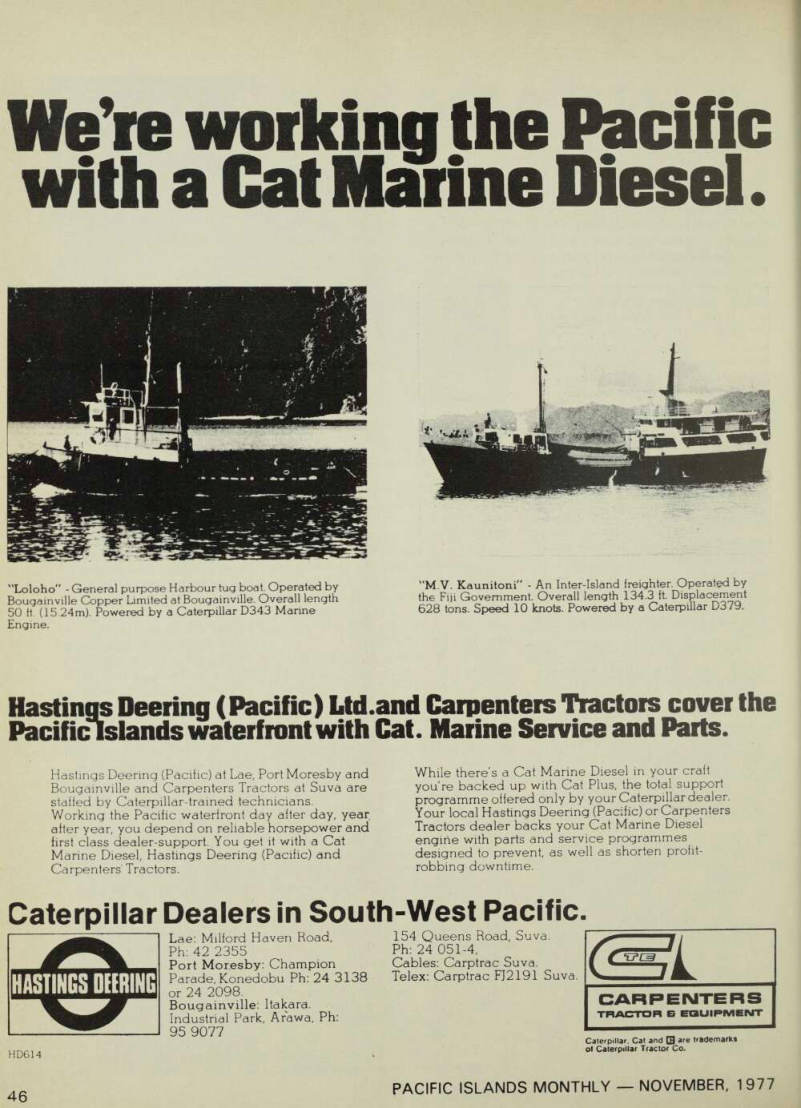
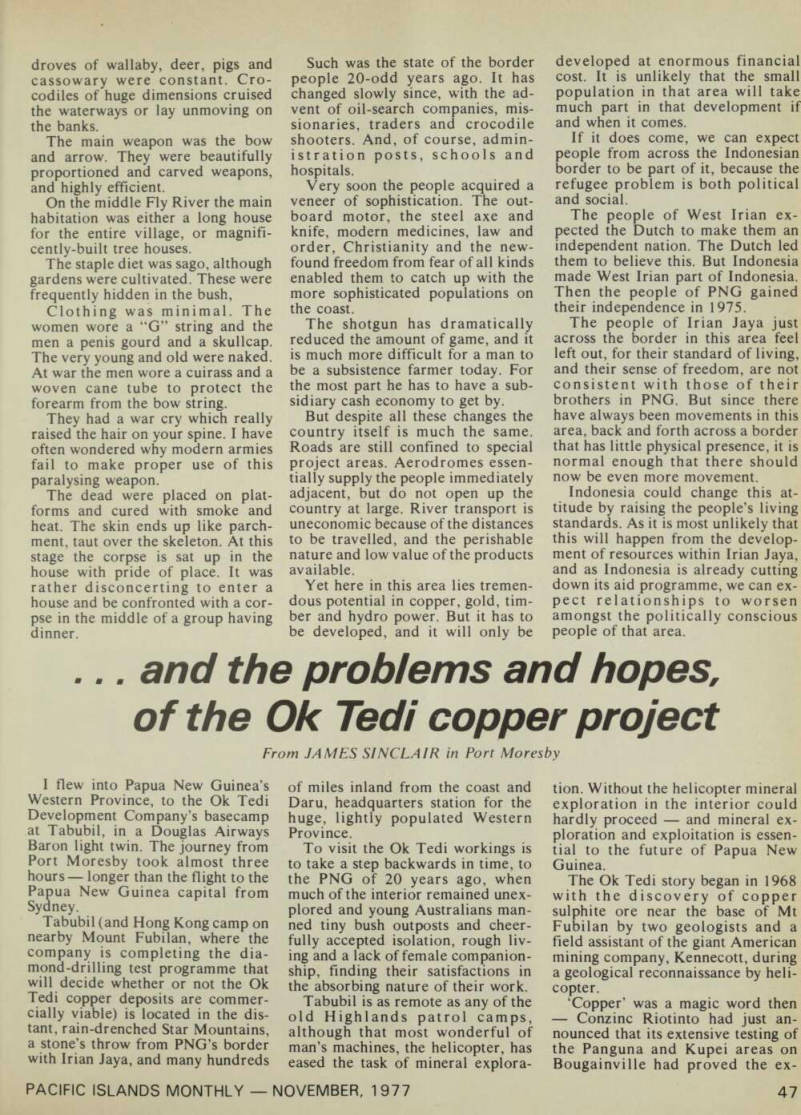
The PNG-Irian border —before it was a kingsize headache
The following two articles focus on one of the most sensitive areas in the Pacific region —the border between Papua New Guinea and the Indonesian province of Irian Jaya. In the first, David Marsh, who served there for many years as a patrol officer with the former Australian administration, looks back to a time when the area was less politically volatile but still offered plenty of drama of another kind. In the second, aviator-author James Sinclair reports on a recent visit to the Ok Tedi copper project, which holds out the promise of big social and economic changes for the area’s inhabitants.
By Da Vid Marsh
Recent mass border crossings by Papuans, now Indonesian nationals, from the Merauke area of Irian Jaya into the Trans Fly area of Papua New Guinea’s Western Province have thrown the spotlight on this lit tle-known area.
The border starts on the southern New Guinea coastline adjacent to Torres Strait at 141 degrees 21 minutes east longitude, then runs north to the Fly River bend, whence it departs at 141 degrees north over the main range to the northern coast of New Guinea.
The Dutch administration in its time established major admin istrative stations along this border at Merauke, Tanah Merah and Jayapura. In more recent times the Australian administration estab lished lesser posts on the border’s eastern side.
To the respective defence forces, patrol officers, missionaries, mineral and oil prospectors and crocodile shooters, the geographic area is well known, but no less miserable for that.
But the PNG public is generally unaware of what the border is all about, and becomes apprehensive every time the press publicises a border crossing.
This is a great pity, as the newly founded nation of PNG needs a period of international stability, and has plenty of constructive work to do without this constant distraction.
The lack of interest on the part of the Australian public is most mark ed, especially as this border is an ex tension of that between Australia
and PNG. The Papuan separatist leader, Josephine Abaijah, made this matter part of her platform in
PNG’s July general elections.
While the problems of the border are the same both north and south of the main range, it is the southern area which is of immediate interest.
It is here that the Ok Tedi gold and copper prospect is being tested, and it is also the area with the best oil and gas prospects.
Any economic development of this magnitude will draw people in search of work, no matter which side of the border they live on. This has been the way of the border area people since long before the Dutch, the Germans, the British or the In donesians.
Outside influence on the tradi tional ways of life of the border peo ple has been intermittent but traumatic over the years.
Today, the younger people tend to go to work away from the villages, and more and more are career workers rather than short-term target workers as were the unskilled and uneducated people in former years.
There is a yearning among all the people to retain or recover the good things in their traditional lives, and at the same time to adopt aspects of Western culture which they like but which are not necessarily good.
It is not fully realised just how ex tensive border crossings have been over the years, especially in the southern Trans Fly area.
In the 1880 s, when the Dutch, German and British Governments agreed on a border at the 141st meridian, it was not marked except for obelisks on the coast, and it was
only by administrative default or ac tivity that people along the border came under one government or another.
In fact, the inland populations were uncontrolled until recently, and did their own choosing when they wanted to contact a govern ment.
When the town of Merauke was established in what was Dutch New Guinea, it attracted many people from the Papuan Trans Fly area and they never returned. I am talking, of course, about people who were then under Australian, not Dutch, con trol. When I worked in that area in the mid-1940s the effects of this migration were still apparent, and the people spoke to us constantly of their relatives at Merauke with whom they exchanged visits fairly frequently. It is probable that many of the refugees of today feel that they are entitled to be welcomed in PNG because of this former rela tionship.
It was not until the 1960 s that the border was physically marked by the Australian and Indonesian governments, and the border dwellers were finally told to which nation they belonged. The marking also brought a more formal con sciousness of rights and duties to the people, which in many cases was quite foreign to their traditional way of life.
I recall a time in 1945 when I was patrolling the country in the southern section of the border and rounded up 121 armed Indonesians who had escaped from confinement at Tanah Merah across the border.
These people were living off the Pa puan villagers, using their arms as a threat. One could hardly blame them, for many of them had been massacred by villagers as they mov ed across country from Tanah Merah.
In those days this name of Tanah Merah inspired some awe amongst the people. At one time Soekarno was incarcerated there as a political prisoner. In those days, too, the Dutch New Guinea police tended to pursue fugitives and make retribu tive raids on villages well-inside Pa puan territory. The death toll was considerable, but those left maimed and without medical care were no better off, as a crippled person in a subsistence society is a very great burden and usually does not last long.
At this time, in the 19405, the in land people were cannibalistic.
Contrary to a lot of modern ballyhoo, they raided and massacred each other on a large scale. At Lake Murray in 1946 we buried the remains of 40 bodies which had been butchered with bamboo knives, the flesh carried away and eaten by a group living to the north of Lake Murray.
While we were seeking them out they in turn were massacred by raiders from Dutch New Guinea!
And so it went on.
Little wonder that today the country is sparsely populated and strongly polygamous! Men had up to nine wives, many of whom had been abducted from group to group as a result of raids. One woman who spoke Malay had originally come from an area nearly 320 km to the west, and had been abducted six times. On each occasion her current husband had been killed. She was quite philosophical about life and eventually married one of our police.
The work of patrols among people at this stage of first contact is subject to much misunderstanding. On one of our pursuits, the people we were after thought we were raiding to retrieve women and children they had, unknown to us, abducted. One night they brought this mass of ab ducted women and children down to the opposite side of Lake Murray
and left them there. As their original husbands and fathers were dead and their villages destroyed, we had the job of feeding and housing them. It did, however, put us in a position of great prestige, and mass abductions and cannibalism ceased in the area from about that time.
Other work of the patrol of course helped bring about the change. A large body of men captured by us over a period of some months were taken to Daru, stood trial in the Supreme Court, and were sentenced to one day’s gaol each. This happen ed to coincide with the com mencement of the follow-up patrol, and the men were returned to their women and children whom they had expected never to see again. If they were not repentant warriors, they certainly were enlightened ones!
The border country in this area of the Trans Fly is pretty terrible. The country is flat and swampy, with thorned sago and lawyer vines and nettles. Bush mites and leeches abound.
Game is plentiful, but movement is often so difficult that it tends to elude all but those with local ex perience. In the wet season the rain tends to go on and on, and the ill equipped refugees have a hard time moving about.
The sky in this period would be blackened by wild duck and geese.
Flying fox camps seemed endless on the rivers, while in the grasslands,
Border-marking officials Messrs McCartney (Australia) and Sunargo (Indonesia) at work delimiting the border between Australian-administered New Guinea and West Irian in the 60s. Mr McCartney is pointing towards Sukarnapura (now Jayapura) from the old border monument. - Photo Geoff Luck.
droves of wallaby, deer, pigs and cassowary were constant. Cro codiles of huge dimensions cruised the waterways or lay unmoving on the banks.
The main weapon was the bow and arrow. They were beautifully proportioned and carved weapons, and highly efficient.
On the middle Fly River the main habitation was either a long house for the entire village, or magnifi cently-built tree houses.
The staple diet was sago, although gardens were cultivated. These were frequently hidden in the bush, Clothing was minimal. The women wore a “G” string and the men a penis gourd and a skullcap.
The very young and old were naked.
At war the men wore a cuirass and a woven cane tube to protect the forearm from the bow string.
They had a war cry which really raised the hair on your spine. I have often wondered why modern armies fail to make proper use of this paralysing weapon.
The dead were placed on plat forms and cured with smoke and heat. The skin ends up like parch ment, taut over the skeleton. At this stage the corpse is sat up in the house with pride of place. It was rather disconcerting to enter a house and be confronted with a cor pse in the middle of a group having dinner.
Such was the state of the border people 20-odd years ago. It has changed slowly since, with the ad vent of oil-search companies, mis sionaries, traders and crocodile shooters. And, of course, admin istration posts, schools and hospitals.
Very soon the people acquired a veneer of sophistication. The out board motor, the steel axe and knife, modern medicines, law and order, Christianity and the new found freedom from fear of all kinds enabled them to catch up with the more sophisticated populations on the coast.
The shotgun has dramatically reduced the amount of game, and it is much more difficult for a man to be a subsistence farmer today. For the most part he has to have a sub sidiary cash economy to get by.
But despite all these changes the country itself is much the same.
Roads are still confined to special project areas. Aerodromes essen tially supply the people immediately adjacent, but do not open up the country at large. River transport is uneconomic because of the distances to be travelled, and the perishable nature and low value of the products available.
Yet here in this area lies tremen dous potential in copper, gold, tim ber and hydro power. But it has to be developed, and it will only be
developed at enormous financial cost. It is unlikely that the small population in that area will take much part in that development if and when it comes.
If it does come, we can expect people from across the Indonesian border to be part of it, because the refugee problem is both political and social.
The people of West Irian ex pected the Dutch to make them an independent nation. The Dutch led them to believe this. But Indonesia made West Irian part of Indonesia.
Then the people of PNG gained their independence in 1975.
The people of Irian Jaya just across the border in this area feel left out, for their standard of living, and their sense of freedom, are not consistent with those of their brothers in PNG. But since there have always been movements in this area, back and forth across a border that has little physical presence, it is normal enough that there should now be even more movement.
Indonesia could change this at titude by raising the people’s living standards. As it is most unlikely that this will happen from the develop ment of resources within Irian Jaya, and as Indonesia is already cutting down its aid programme, we can ex pect relationships to worsen amongst the politically conscious people of that area.
Advertisements & other items, p. 46 (1 item)
We're working the Pacific
m
with a Cat Marine Diesel.
i "Loloho" - General purpose Harbour tug boat. Operated by Bougainville Copper Limited at Bougainville. Overall length 50 ft. (15.24 m). Powered by a Caterpillar D 343 Marine Engine. ”M.V. Kaunitoni" - An Inter-Island freighter. Operated by the Fiji Government. Overall length 134.3 ft. Displacement 628 tons. Speed 10 knots. Powered by a Caterpillar D 379.
Hastings Deering (Pacific) Ltd.and Carpenters Tractors cover the Pacific islands waterfront with Cat. Marine Service and Parts.
Hastings Deering (Pacific) at Lae, Port Moresby and Bougainville and Carpenters Tractors at Suva are staffed by Caterpillar-trained technicians.
Working the Pacific waterfront day after day, year, after year, you depend on reliable horsepower and first class dealer-support. You get it with a Cat Marine Diesel, Hastings Deering (Pacific) and Carpenters’ Tractors.
While there's a Cat Marine Diesel in your craft you're backed up with Cat Plus, the total support programme offered only by your Caterpillar dealer.
Your local Hastings Deering (Pacific) or Carpenters Tractors dealer backs your Cat Marine Diesel engine with parts and service programmes designed to prevent, as well as shorten profitrobbing downtime.
Caterpillar Dealers in South-West Pacific.
HASTINGS DEERING
Lae: Milford Haven Road, Ph: 42 2355 Port Moresby: Champion Parade, Konedobu Ph; 24 3138 or 24 2098.
Bougainville: Itakara.
Industrial Park, Arawa, Ph: 95 9077 154 Queens Road, Suva.
Ph: 24 051-4, Cables: Carptrac Suva.
Telex: Carptrac FJ2191 Suva.
CARPENTERS
EQUIPMENT
HD6I4
Caterpillar. Cat and QJ are trademark* of Caterpillar Tractor Co.
of the Ok Tedi copper project
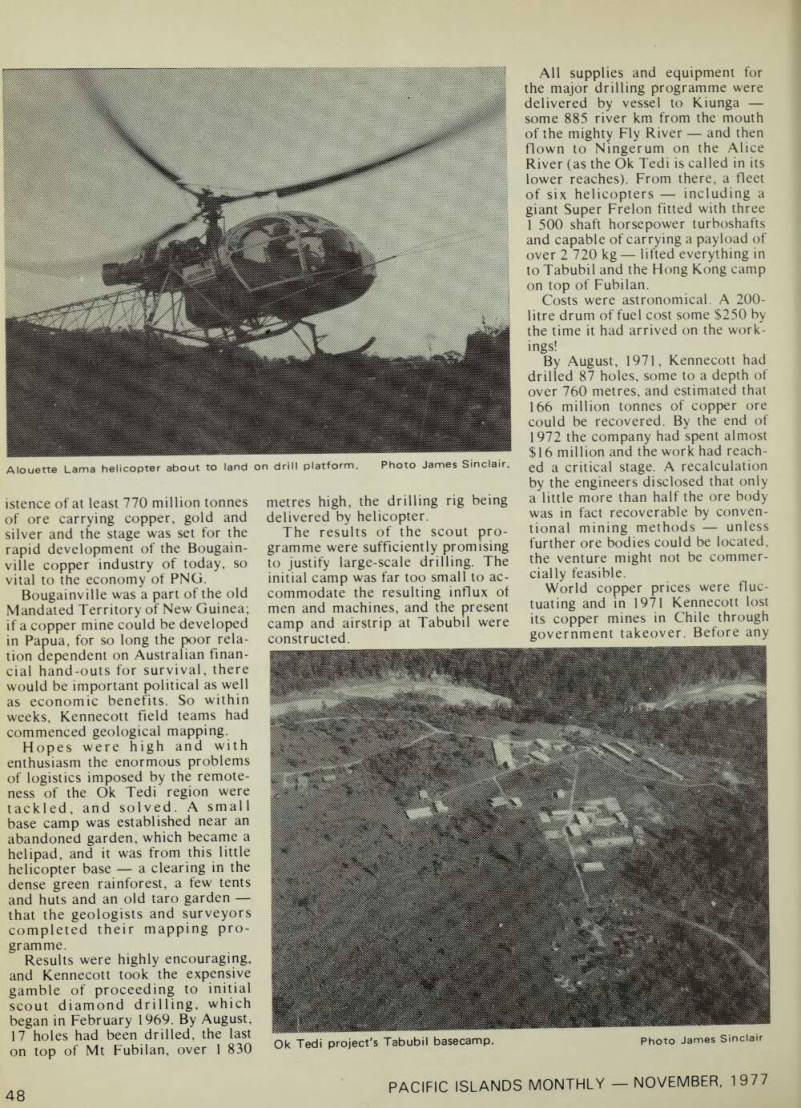
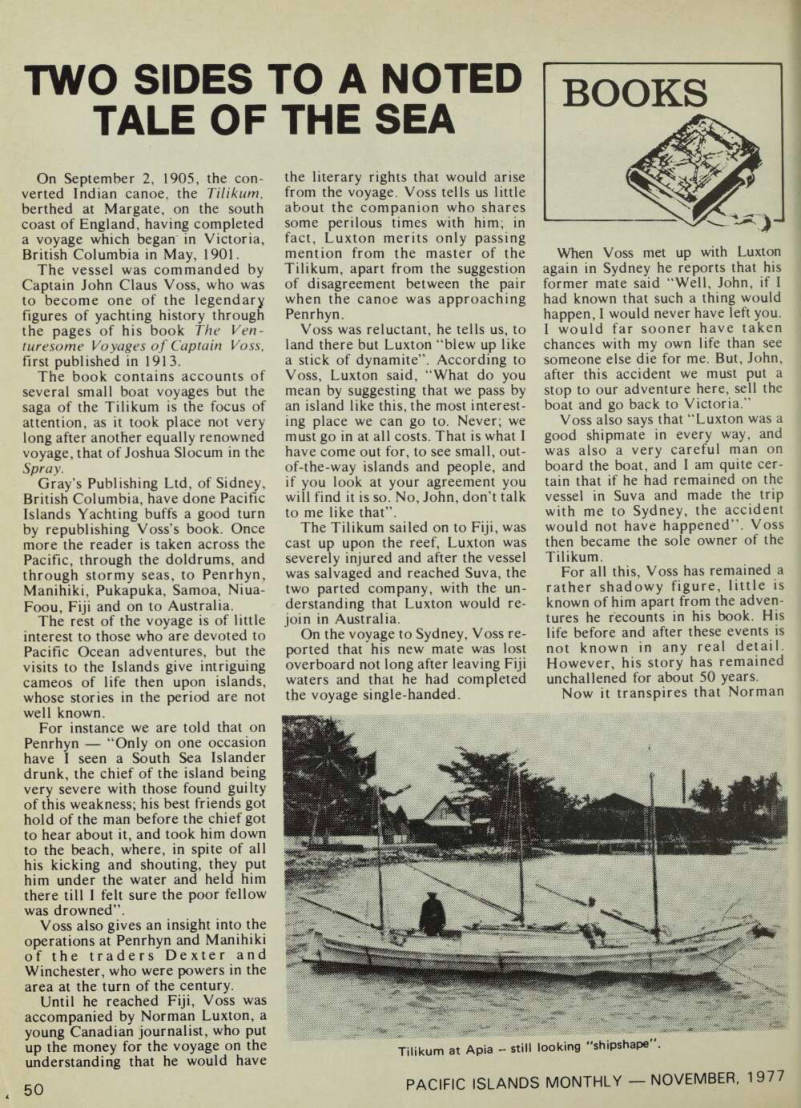
... and the problems and hopes, of the Ok Tedi copper project
From JAMES SINCLAIR in Port Moresby
I flew into Papua New Guinea’s Western Province, to the Ok Tedi Development Company’s basecamp at Tabubil, in a Douglas Airways Baron light twin. The journey from Port Moresby took almost three hours— longer than the flight to the Papua New Guinea capital from Sydney.
Tabubil (and Hong Kong camp on nearby Mount Fubilan, where the company is completing the dia mond-drilling test programme that will decide whether or not the Ok Tedi copper deposits are commer cially viable) is located in the dis tant, rain-drenched Star Mountains, a stone’s throw from PNG’s border with Irian Jaya, and many hundreds
of miles inland from the coast and Daru, headquarters station for the huge, lightly populated Western Province.
To visit the Ok Tedi workings is to take a step backwards in time, to the PNG of 20 years ago, when much of the interior remained unexplored and young Australians manned tiny bush outposts and cheerfully accepted isolation, rough living and a lack of female companionship, finding their satisfactions in the absorbing nature of their work.
Tabubil is as remote as any of the old Highlands patrol camps, although that most wonderful of man’s machines, the helicopter, has eased the task of mineral explora-
tion. Without the helicopter mineral exploration in the interior could hardly proceed and mineral ex ploration and exploitation is essen tial to the future of Papua New Guinea.
The Ok Tedi story began in 1968 with the discovery of copper sulphite ore near the base of Mt Fubilan by two geologists and a field assistant of the giant American mining company, Kennecott, during a geological reconnaissance by heli copter. ‘Copper’ was a magic word then Conzinc Riotinto had just an nounced that its extensive testing of the Panguna and Kupei areas on Bougainville had proved the ex-
istence of at least 770 million tonnes of ore carrying copper, gold and silver and the stage was set for the rapid development of the Bougain ville copper industry of today, so vital to the economy of PNG.
Bougainville was a part of the old Mandated Territory of New Guinea; if a copper mine could be developed in Papua, for so long the poor rela tion dependent on Australian finan cial hand-outs for survival, there would be important political as well as economic benefits. So within weeks, Kennecott field teams had commenced geological mapping.
Hopes were high and with enthusiasm the enormous problems of logistics imposed by the remote ness of the Ok Tedi region were tackled, and solved. A small base camp was established near an abandoned garden, which became a helipad, and it was from this little helicopter base a clearing in the dense green rainforest, a few tents and huts and an old taro garden that the geologists and surveyors
completed their mapping pro
gramme.
Results were highly encouraging, and Kennecott took the expensive gamble of proceeding to initial scout diamond drilling, which began in February 1969. By August, 17 holes had been drilled, the last on top of Mt Fubilan, over 1 830
metres high, the drilling rig being delivered by helicopter.
The results of the scout pro gramme were sufficiently promising to justify large-scale drilling. The initial camp was far too small to ac commodate the resulting influx of men and machines, and the present camp and airstrip at Tabubil were constructed.
All supplies and equipment for the major drilling programme were delivered by vessel to Kiunga some 885 river km from the mouth of the mighty Fly River and then flown to Ningerum on the Alice River (as the Ok Tedi is called in its lower reaches). From there, a fleet of six helicopters including a giant Super Frelon fitted with three 1 500 shaft horsepower turboshafts and capable of carrying a payload of over 2 720 kg— lifted everything in to Tabubil and the Hong Kong camp on top of Fubilan.
Costs were astronomical. A 200litre drum of fuel cost some $250 by the time it had arrived on the work ings!
By August, 1971, Kennecott had drilled 87 holes, some to a depth of over 760 metres, and estimated that 166 million tonnes of copper ore could be recovered. By the end of 1972 the company had spent almost $l6 million and the work had reach ed a critical stage. A recalculation by the engineers disclosed that only a little more than half the ore body was in fact recoverable by conven tional mining methods unless further ore bodies could be located, the venture might not be commer cially feasible.
World copper prices were fluc tuating and in 1971 Kennecott lost its copper mines in Chile through government takeover. Before any
Alouette Lama helicopter about to land on drill platform. Photo James Sinclair.
Ok Tedi project's Tabubil basecamp.
Photo James Sinclair
decision could be taken to proceed with the development of a Papuan copper mine a final evaluation pro gramme would have to be com pleted at a cost of many more millions of dollars. Before Ken necott entered this final phase it wanted certain assurances from the Papua New Guinea Government, mainly in relation to taxation policy and guarantees against a future government takeover, for it was by now plain the PNG would soon gain her independence.
Negotiations began, which were to drag on for two years; operations at Ok Tedi virtually ceased pending the results of these talks.
During this time the great Bougainville copper mine at Panguna had come into production, but only after much opposition from some of the Bougainville people which ended in violence and open confrontation between the people and the government. Much of the trouble on Bougainville stemmed from a failure to establish adequate communication with the people in the early stages of the project, and Kennecott did not intend to make the same mistake. It did not remain idle pending the results of its negotiations.
Luckily, the Star Mountain native population near the Ok Tedi head qaters was small about 600 and thinly settled in scattered hamlets over a vast area of country.
Before the coming of Kennecott, these people and the Min people living beyond the immediate area of the copper deposits were almost totally neglected by the government apart from visits by patrols once or twice per year. Now Kennecott launched an imaginative and sym pathetic local policy, remarkable by any standards and particularly those of multi-national big business.
Major training programmes were begun and continued at heavy cost, with the object of producing PNG nationals competent to fill positions at all levels in a future copper mining company. Scholarships were endowed at 50 high schools throughout PNG. The first primary school in the Star Mountains was established at company expense Kennecott estimated that the annual cost of maintaining the school and its pupils was at least $4O 000.
Employment preference was given to Star Mountains people and an intensive community relations
programme was developed, to keep the people informed of the company’s plans Free medical treatment was provided from the company clinic at Tabubil and by medical patrols to the scattered village hamlets. Local people were sponsored as trainee medical orderlies. The list of company benefactions was long indeed.
Unhappily, negotiations between Kennecott and the PNG Government failed, and Kennecott withdrew. On March 14, 1975, the government took over control of the Ok Tedi project and soon afterwards set up the Ok Tedi Development Company, with the object of carrying on the work of Kennecott pending the conclusion of an agreement with some other mining company. Most of the Kennecott staff agreed to carry on and the company made available the results of the long, expensive testing over the past years.
An enormous amount of work was necessary to reactivate the exploration work at Ok Tedi after almost three years of idleness, but drilling operations were soon under way.
In June, 1976, the Ok Tedi Development Company announced that proven reserves now amounted to 275 million tonnes, a figure
which made the development of a mine an economic possibility.
In March, 1976, Prime Minister Michael Somare informed the PNG Parliament that agreement had been reached with Australia’s Broken Hill Proprietary Company Limited to form a consortium to carry out a full feasibility study of the project, and in October BHP announced the formation of the consortium. The feasibility study, estimated to take 31 months to complete at a cost of K 9 million (Kina now being the dol lar unit of currency) commenced immediately.
This is the current stage of development of the Ok Tedi copper project. To date the consortium has drilled another 54 holes, and pro vided the results of the study are satisfactory, the final stage will be negotiations with the government on the terms for bringing a copper mine into production.
The enlightened training and community relations policies of Kennecott are being continued by the BHP consortium, and it can be fairly said that it was a fortunate day for the Star Mountains people when Kennecott geologists found copper in their country a statement
Continued on p 107
)k Tedi - from p 49
diich can be made about few multi ational company operations today.
The odds are presently favourable )r the eventual mining of copper at )k Tedi, but much will depend pon the technical and engineering ;udy which is still under way.
It will cost perhaps K5OO million ) bring a mine into production, .oads must be built, and a pipeline ) carry the ore from the mine to iunga on the Fly River, about 100 m away, from where special (and astly) barges will transport the ore ) the mouth of the river for trans lipment to ocean-going carriers.
Progress of the work was at all ages hampered by the impossible eather conditions, for it rains con antly in the Ok Tedi country ver 10 000 mm a year and cloud uildups frequently grounded the Hicopters for days on end.
Ok Tedi will never be as big as ougainville.
Bougainville reserves total 940 illion tonnes of 0.48% copper ore, ith 0.5 grammes of gold and three ammes of silver per metric ton, hereas at Ok Tedi there are an esti ated 250 million tonnes of 0.85% >pper plus 26.5 m tonnes of rich 33% copper and a considerable iantity of very rich gold, sufficient all to sustain mining for 25 years, ut a mine at Ok Tedi will still be of lormous importance to PNG, both :onomically and politically.
There are today about 40 ex itriates working at Tabubil and ong Kong, plus an equal number nationals. At the peak of the test •illing programme there were 250 hites employed, straining accom odation, transport and technical isources to the utmost.
They work to an austere regime x straight weeks of duty seven days it week, and then two weeks holi in Australia. They are crudely aused but very well fed at com any expense and must make icir own entertainment.
Some such as site engineer and irveyor Fred Pratt have been at k Tedi since the old Kennecott ays, and to a man they are fiercely >yal to that company. They work osely as a team, but each man to is own specialty.
Men such as Zane White, Foy eckie, lan (Ned) Kelly, Charlie
Thurgood and Greg McGrath are veterans of years of service in this distant corner of the Western Pro vince. I met a singular character of Tabubil a heavily bearded young man, an expert mechanic and jack of-all-trades known simply as ‘Old Chap'. I imagine he had a formal name, but he was Old Chap to one and all and I soon found myself using this unusual label as a matter of course. And I found an old friend there, Les Gillies, whom I first met in the Markham Valley in 1949.
I flew with the two men who pilot the Alouette Lama and Hughes 500 C helicopters still in use at Ok Tedi, Laddie Hindley a veteran ’chopper pilot with 6 500 hours in his logbooks and Wes Mclver, with 3 500 hours.
I have done a lot of flying in Papua New Guinea over the past 30 years, but I have never flown with better pilots, or under worse weather conditions. It was an ex perience to be remembered to have taken off in a helicopter from Tabubil just after dawn and ascend swiftly through mist and cloud to Mt Fubilon and Hong Kong camp, skirting the vast sheer face of the
Hindenberg Wall with far vistas of the Star Mountains showing as the sun broke through the upper layer of cumulus.
The Ok Tedi project has been conducted throughout with integri ty, honesty and purpose. Papua New Guinea needs the Ok Tedi copper, and the men at work there are quietly confident that it will be forthcoming.
Freedom fighters
“Ok Tedi active across border’’
The so-called Provisional Revolutionary Government of West Papua New Guinea, which is fighting against Indonesian control of Irian Jaya, has accus ed the Ok Tedi Development Company of planning to steal copper resources lying to the west of the Papua New Guinea border. It says the richest copper ore deposits in the area are west of the border.
In a press release it says that Ok Tedi personnel have been found as far as three days walk inside the border, and that they have begun work on road and bridge construction on the ter ritory of Irian Jaya (described by the PRG as “West Papua New Guinea”).
Accusing PNG Prime Minister Michael Somare of having become “a lapdog of Australian neo-colonialism”, the press
release asks: “Has the Somare government made a secret deal with the Indonesians to steal West PNG’s resources?”
The press release assures workers on the Ok Tedi site that they will come to no harm “pro viding they remain on the PNG side of the border”. But it warns OK Tedi management and workers that “any buildings, roads or equipment established in West PNG will be destroyed”.
The PRG “affirms that it will not tolerate multi-national thieves, not Freeport, nor the Ok Tedi company”.
The movement in August claimed successful sabotage ac tion against a section of the Ertsberg copper mine pipeline in Irian Jaya. The mine is owned by Freeport Indonesia Inc, a sub sidiary of Freeport Minerals Co of New York.
Two Sides To A Noted
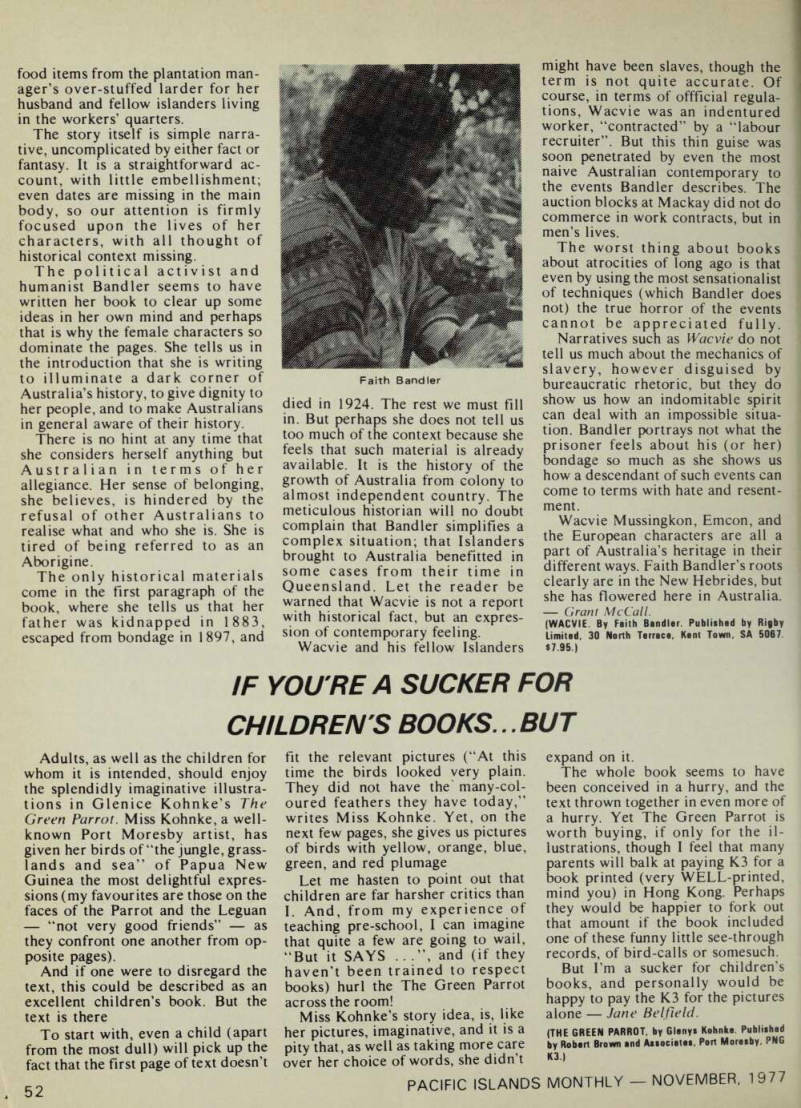
Tale Of The Sea
On September 2, 1905, the con verted Indian canoe, the Tilikum. berthed at Margate, on the south coast of England, having completed a voyage which began in Victoria, British Columbia in May, 1901.
The vessel was commanded by Captain John Claus Voss, who was to become one of the legendary figures of yachting history through the pages of his book The Ven turesome Voyages of Captain Voss, first published in 1913.
The book contains accounts of several small boat voyages but the saga of the Tilikum is the focus of attention, as it took place not very long after another equally renowned voyage, that of Joshua Slocum in the Spray.
Gray’s Publishing Ltd, of Sidney, British Columbia, have done Pacific Islands Yachting buffs a good turn by republishing Voss’s book. Once more the reader is taken across the Pacific, through the doldrums, and through stormy seas, to Penrhyn, Manihiki, Pukapuka, Samoa, Niua- Foou, Fiji and on to Australia.
The rest of the voyage is of little interest to those who are devoted to Pacific Ocean adventures, but the visits to the Islands give intriguing cameos of life then upon islands, whose stories in the period are not well known.
For instance we are told that on Penrhyn “Only on one occasion have 1 seen a South Sea Islander drunk, the chief of the island being very severe with those found guilty of this weakness; his best friends got hold of the man before the chief got to hear about it, and took him down to the beach, where, in spite of all his kicking and shouting, they put him under the water and held him there till I felt sure the poor fellow was drowned”.
Voss also gives an insight into the operations at Penrhyn and Manihiki of the traders Dexter and Winchester, who were powers in the area at the turn of the century.
Until he reached Fiji, Voss was accompanied by Norman Luxton, a young Canadian journalist, who put up the money for the voyage on the understanding that he would have
the literary rights that would arise from the voyage. Voss tells us little about the companion who shares some perilous times with him; in fact, Luxton merits only passing mention from the master of the Tilikum, apart from the suggestion of disagreement between the pair when the canoe was approaching
Penrhyn.
Voss was reluctant, he tells us, to land there but Luxton “blew up like a stick of dynamite”. According to Voss, Luxton said, “What do you mean by suggesting that we pass by an island like this, the most interest ing place we can go to. Never; we must go in at all costs. That is what I have come out for, to see small, out of-the-way islands and people, and if you look at your agreement you will find it is so. No, John, don’t talk to me like that”.
The Tilikum sailed on to Fiji, was cast up upon the reef, Luxton was severely injured and after the vessel was salvaged and reached Suva, the two parted company, with the un derstanding that Luxton would re join in Australia.
On the voyage to Sydney, Voss re ported that his new mate was lost overboard not long after leaving Fiji waters and that he had completed the voyage single-handed.
When Voss met up with Luxton again in Sydney he reports that his former mate said “Well, John, if I had known that such a thing would happen, I would never have left you.
I would far sooner have taken chances with my own life than see someone else die for me. But, John, after this accident we must put a stop to our adventure here, sell the boat and go back to Victoria.”
Voss also says that “Luxton was a good shipmate in every way, and was also a very careful man on board the boat, and I am quite cer tain that if he had remained on the vessel in Suva and made the trip with me to Sydney, the accident would not have happened”. Voss then became the sole owner of the Tilikum.
For all this, Voss has remained a rather shadowy figure, little is known of him apart from the adven tures he recounts in his book. His life before and after these events is not known in any real detail.
However, his story has remained unchallened for about 50 years.
Now it transpires that Norman
Tilikum at Apia - still looking "shipshape .
Luxton also wrote his account of the voyage of the Tilikum through the Pacific, and this was edited by his daughter Eleanor Georgina Luxton of Banff, and Gray’s Publishing Ltd., has been able to provide us with a unique dual view of a set of events, by publishing Tilikum: Lux ton’s Pacific Crossing.
Luxton gives a journalist’s ac count of events. He tells us, for in stance, of a sea monster they en countered “out of the unknown it came like one of the storm’s evil spirits, and into the darkest point of the stormy horizon it disappeared.
Honestly, I never want to see another. Pink, blue and green elephants I have heard of under cer tain conditions, but if ever that un nameable thing visited me in my dreams, I would cut Johnnie Walker cold, and all the rest of his Scotch friends.”
What then is Luxton’s story of the relationship between these two quite different characters? For Voss, the voyage between Penrhyn and Samoa was noteworthy only for the brief calls made at Manihiki and Pukapuka. On leaving the latter is land he said that “We thanked him (one of the Pukapukans), and took our departure, and rounding a long coral reef running quite a way into the north-westwards, shaped our course for Samoa, about four hundred miles, which we made in three days, experiencing similar wind and weather as we had had all the way from Penrhyn Island”.
For Luxton, quite obviously, rela tionships with the master of the canoe were set on a collision course.
He says of Voss, “All through the last six thousand miles this vile temper of his had been getting worse and worse. If I now buckled down to it, my life would be worse than any dog’s he might have owned, and while drinking the coffee I thought it all out. I had to be one of us for the sea and fishes”.
An argument of great magnitude had broken out between the two men over Luxton’s handling of the tiller and Voss had manhandled the journalist into the canoe. Luxton decided that it was a case of “one boss, and I would be that boss in just another five minutes”.
He took possession of the guns and ammunition that were aboard and, presenting a .22 pistol at Jack Voss’s head, ordered him below and
then battened down the cabin hatch.
Voss was made to cook the meals, which he passed up to Luxton, and according to the latter he was able to navigate the vessel to Apia.
After the Tilikum had entered port, “Voss asked me what I was going to do with him. I told him that we would have to have a thorough understanding that would preclude more rows. That was the end of it for the time being”.
Before they sailed on to Suva, Luxton “Took Voss to Mr Swan’s store and read to him an account of our differences while on the voyage, with a full statement of what he threatened to do to me if I refused to sail the boat in the manner in which he wished, and that if at our different ports of call between Samoa and Australia I did not ap pear with the Tilikum, Mr Swan was to take such action as he saw fit to make Voss prove to him that violence had not been the cause of my disappearance. This paper Voss signed as correct, and as a true state ment of what had passed between us”.
Of course, it is difficult to fathom the truth of the matter, as we have before us the evidence of only the two protagonists. Luxton certainly paints Voss’s character in the strongest possible terms. Yet when he met up with Voss again in Sydney
From Ambrym To Mackay! A
Blackbirding Victim's Journey
There are 30 000 descendants of Pacific Islanders, brought in the last century by blackbirders to work on the sugar plantations of Queensland, still living in Australia today. Faith Bandler tells the story of her father, Wacvie, just one of the founding ancestors of that almost unknown ethnic group, in a book of that name.
In contrast to Alex Haley’s Roots, with which Bandler’s work will almost certainly be compared, Wacvie is presented frankly as a novel, The author tells us that she is drawing upon stories and remembrances of her father’s life on (apparently) idyllic Ambrym in the New Hebrides and his progress to freedom in Australia.
The reader will be struck immediately by the apparent lack of anger in this story of human degradation. Looking beneath the
he relates that Voss then “told me the worst of all. Jack Begent had fallen overboard with the compass and was drowned. A sea had swept the boat when he was changing tack and washed him overboard. Need less to say, 1 was shocked and griev ed at the terrible news”.
There is no further speculation by Luxton about the reasons for his successor’s demise.
The last words of Luxton’s ac count read “one more word and I am through. ‘Would you repeat the trip again?’ I am often asked. Quite candidly and truly NO, but not for anything would I have missed it.
Under different circumstances, with a larger boat, the voyage would have been divine, and in such a boat if Voss were master, I would not hesitate to go anywhere the winds and storms would drive”.
For all those who enjoy tales of sailing the South Seas here are two books that command attention, one to be re-read for the value of its ac count and the other to be examined for the intriguing other side of the
coin it presents.
W. G. Coppell.
(The Venturesome Voyages Of Captain Voss:
AROUND THE WORLD IN THE TILIKUM, 1901. By John Claus Voss. Published by Gray's Publishing Ltd.
Sidnay, British Columbia.
Tilikum: Luxton's Pacific Crossing: Being
THE JOURNAL OF NORMAN KENNY LUXTON. MATE OF THE TILIKUM. Editad by Elaanor Georgina Lux ton. Published by Gray's Publishing Ltd. Sidnay. Bri tish Columbia.)
obvious, however, one can see that it is not fear or hate that has provoked the writing of this book but, rather, the writer’s disgust at the Europeans who dominated her father’s life for so long.
Two characters emerge strongly from her narrative. In some ways, Handler could have entitled her book Emcon, for her delineation of that lady is far better than the treat ment given to the title figure. Em con, also a New Hebridean, lives on a Queensland plantation with her husband, as a housegirl and head servant. In fact, it is clear that Em con really runs the household. Em con is attractive, competent in the European’s ways, and strong-willed.
At one point, an offending overseer receives a black snake in his bed (and dies) from her and, throughout, she acquires succulent
food items from the plantation man ager’s over-stuffed larder for her husband and fellow islanders living in the workers’ quarters.
The story itself is simple narra tive, uncomplicated by either fact or fantasy. It is a straightforward ac count, with little embellishment; even dates are missing in the main body, so our attention is firmly focused upon the lives of her characters, with all thought of historical context missing.
The political activist and humanist Bandler seems to have written her book to clear up some ideas in her own mind and perhaps that is why the female characters so dominate the pages. She tells us in the introduction that she is writing to illuminate a dark corner of Australia’s history, to give dignity to her people, and to make Australians in general aware of their history.
There is no hint at any time that she considers herself anything but Australian in terms of her allegiance. Her sense of belonging, she believes, is hindered by the refusal of other Australians to realise what and who she is. She is tired of being referred to as an Aborigine.
The only historical materials come in the first paragraph of the book, where she tells us that her father was kidnapped in 1883, escaped from bondage in 1897, and
If You're A Sucker For
Children's 800K5... But
Adults, as well as the children for whom it is intended, should enjoy the splendidly imaginative illustra tions in Glenice Kohnke’s The Green Parrot. Miss Kohnke, a well known Port Moresby artist, has given her birds of “the jungle, grass lands and sea” of Papua New Guinea the most delightful expres sions (my favourites are those on the faces of the Parrot and the Leguan “not very good friends” as they confront one another from op posite pages).
And if one were to disregard the text, this could be described as an excellent children’s book. But the text is there To start with, even a child (apart from the most dull) will pick up the fact that the first page of text doesn’t
died in 1924. The rest we must fill in. But perhaps she does not tell us too much of the context because she feels that such material is already available. It is the history of the growth of Australia from colony to almost independent country. The meticulous historian will no doubt complain that Bandler simplifies a complex situation; that Islanders brought to Australia benefitted in some cases from their time in Queensland. Let the reader be warned that Wacvie is not a report with historical fact, but an expres sion of contemporary feeling.
Wacvie and his fellow Islanders
fit the relevant pictures (“At this time the birds looked very plain.
They did not have the many-col oured feathers they have today,” writes Miss Kohnke. Yet, on the next few pages, she gives us pictures of birds with yellow, orange, blue, green, and red plumage Let me hasten to point out that children are far harsher critics than I. And, from my experience of teaching pre-school, I can imagine that quite a few are going to wail, “But it SAYS . . .”, and (if they haven’t been trained to respect books) hurl the The Green Parrot across the room!
Miss Kohnke’s story idea, is, like her pictures, imaginative, and it is a pity that, as well as taking more care over her choice of words, she didn’t
might have been slaves, though the term is not quite accurate. Of course, in terms of offficial regula tions, Wacvie was an indentured worker, “contracted” by a “labour recruiter”. But this thin guise was soon penetrated by even the most naive Australian contemporary to the events Bandler describes. The auction blocks at Mackay did not do commerce in work contracts, but in men’s lives.
The worst thing about books about atrocities of long ago is that even by using the most sensationalist of techniques (which Bandler does not) the true horror of the events cannot be appreciated fully.
Narratives such as Wacvie do not tell us much about the mechanics of slavery, however disguised by bureaucratic rhetoric, but they do show us how an indomitable spirit can deal with an impossible situa tion. Bandler portrays not what the prisoner feels about his (or her) bondage so much as she shows us how a descendant of such events can come to terms with hate and resent ment.
Wacvie Mussingkon, Emcon, and the European characters are all a part of Australia’s heritage in their different ways. Faith Bandler’s roots clearly are in the New Hebrides, but she has flowered here in Australia.
Grant McCall.
(WACVIE. By Faith Bandler. Published by Rigby Limited, 30 North Terrace, Kent Town, SA 5067. $7.95.)
expand on it.
The whole book seems to have been conceived in a hurry, and the text thrown together in even more of a hurry. Yet The Green Parrot is worth buying, if only for the il lustrations, though I feel that many parents will balk at paying K 3 for a
book printed (very WELL-printed,
mind you) in Hong Kong. Perhaps they would be happier to fork out that amount if the book included one of these funny little see-through records, of bird-calls or somesuch.
But I’m a sucker for children’s books, and personally would be happy to pay the K 3 for the pictures
alone Jane Belfield.
(THE GREEN PARROT, by Gleny* Kohnke. Published by Robert Brown and Associates. Port Moresby, PNG K 3.)
Faith Bandler
Advertisements & other items, pp. 53-60 (1 item)
We took three
V
of our best
and made one
of the greatest
w
rSS
V Ih OOmoNeen c c C6O
»TDK
4 4 c Pioneer's new CX-7000 cassette-receiver offers most of the truly great features found in our individual stereo components.
Integrated amplifier. FM/AM tuner. Frontloading cassette-deck. Naturally, having everything in one super-compact unit increases operational convenience and offers super value all the way.
Power is a super substantial 25 watts per channel, min. at 8 ohms from 20 to 20,000 Hz with no more than 0.3% total harmonic distortion. The high performance phono equalizer assures the wide dynamic range necessary to reproduce clean musical nuance.
The CX-7000 presents a new dimension in FM/AM enjoyment. In most listening areas, reception is less than ideal. So, Pioneer features a super sensitive (11.2d8f/ 2.ofiV) and super selective (60dB) tuner section. An automatic pilot signal canceler is included for preventing sound deterioration in the high frequency range and. of course. PLL MPX (Phase-Locked Loop Multiplex) circuitry.
CASStTTE-RECaVW
The Super Component
(M> PIONEER
Cassette handling is really a "super snap'' due to the front-loading tape mechanism with built-in auto-stop. And making your own music tapes is super easy because Pioneer’s exclusive vertical-hold compartment allows you to check tape content and movement while the tape selector enables the optimum use of either chrome or normal tape. All controls are up front (where the user is) and built-in Dolby* reduces tape hiss and noise in the high frequency range.
Pioneer’s new CX-7000 cassette-receiver.
Not just another audio product, but a giant step forward in music listening enjoyment.
It’s the super component for super hi-fi value.
We re also offering matching speakers and turntable. They’re super, too. *Dolby is a trademark of Dolby Laboratories, Inc.
Australia Pioneer Electronics Australia Pty.
Ltd., 178-184 Boundary Road, Braeside, Victoria 3195, Tel: 90-9011, Sydney 93-0246, Brisbane 59-7457, Adelaide 433379, Perth 24-9899 Fiji Islands Brijlal & Company, G P O. Box No 362 Suva Fiji Islands Tel 22258 New Zealand Fountain Marketing Ltd., Maidstone Street, Auckland, New Zealand Tel: 763-064 Norfolk Island Burns Philp (Norfolk Island) Ltd., Norfolk Island, South Pacific New Hebrides Burns Philp (New Hebrides) Ltd., Vila, New Hebrides Nauru Island Jacob Enterprises, P.O. Box No. 4 Republic of Nauru Tahiti Est. PERFECT, B.P. 594, Papeete, Tahiti Tel: 20 407 New Caledonia Menard Freres Ville, B.P. H2Cedex, Noumea, New Caledonia Tel: 27.52.22 American Samoa Traspac Corporation, P O Box 1477, Pago Pago, American Samoa 96799 Tel: 633-5224 Rarotonga South Seas International Ltd., P.O. Box 49, Rarotonga Cook Islands Tel 2327
nt eg rated Amplifier
AU-717
—-Filters —j
Subsonic High
off
off
10kHz
16Hz -34 -36 -38 -40 -43 -47 m Volume ‘ 52 . 60 ■ dB Tap -00 Balance source
Loudness
i 0 i Muting r tape-1 / < 3 "vff tape-2 -vtv/wtb on left right
Dr individual instruments?
Now you can clearly hear individual instruments of the biggest orchestra with Sansui’s new DC integrated amplifier, the beautiful ACI-717. A special Sansui-developed DC power amplifier circuit (PAT. PEND.) brings out instruments so sharply that you distinctly sense the piano’s scales, the drum’s attack, the bite of the brass. Free of coloration, the AU-717 delivers 85 RMS watts X 2 of “straight gain” with a THD that’s an unbelievably low 0.025%! This is the new DC amplifier that’s so advanced, so good that you must hear it to believe it.
Our ACJ-517 is virtually the same but with a bit less power and easier on the pocket.
Our super TCJ-717 FM/AM tuner is the perfect matching component.
TU-717 AU-517
SojisuL
Only hi-fi, everything hi-fi.
SANSUI ELECTRIC CO., LTD.
14-1 Izumi 2-chome, Suginami-ku, Tokyo 168, Japan Australia Rank Industries Australia Pty, Ltd. Head Office: 12 Barcoo Street, East Roseville, N.S.W. 2069 Phone: 406 5666 Melbourne; 68 Queensbridge Street, South Melbourne, Vic. 3205 Phone; 62 0031 Adelaide: Phone: 212 2555 Brisbane: 52 7333 Canberra: Phone; 95 2144 Perth: Phone; 28 3933 Fiji Prabhu Brothers Ltd. P.0.80x 183, Nadi Phone: 70183/4 Papua New Guinea Oceania Indent Agency (P.N.G.) Pty. Ltd. Box 5518, Boroko. Port Moresby Phone; PM256406 New Zealand David Reid Electronics Ltd. C.P.O. Box 2630, Auckland, 1 Phone: 492- 189 New Caledonia Ets Michel MERCIER B.P. 1123, Noumea Phone: 27. 59. 11 South Pacific Miltons Department Stores Limited P.O. Box 146, Norfolk Island 2899 Central Pacific Nauru Co-operative Society Republic of Nauru Western Samoa H.J. Keil and Company Ltd. P.O.
Box 7, Apia Phone: 198 New Hebrides The Sound Centre P.O. Box 434, Port Villa Cook Islands United Island Traders Ltd. P.O. Box 1 & 2, Rarotonga Tahiti DIMECO P.O. Box 2622
sdfdsfdsfdsfsf
m f r The Toyota truck range. Built to be unbeatable.
Bad weather conditions, no problem.
Bad roads and driving surfaces, eaten up.
Difficult loads, no contest. Built tough. Built to take it.
There's a Toyota truck built for you.
TOYOTA Land Cruiser Pickup
TOYOTA Dyna
TOYOTA Stout TOYOTA Toyo-Ace
UDB
El
TOYOTA Hi-Lux
TOYOTA Truck
TOYOTA
For unbeatable after service: PAPUA NEW GUINEA: ELA MOTORS LIMITED, Scratchley Rd„ Badili, P.O. Box 75, Port Moresby. U.S. TRUST TERRITORY: MICROL CORPORATION, P-O- Box 267, Saipan. FIJI ISLANDS: AUTOMOTIVE SUPPLIES CO., LTD., G.P.O. Box 355, Suva, AMERICAN SAMOA; BURNS PHILP (SOUTH SEA) CO., LTD., P.O. 1057, Pago Pago. WESTERN SAMOA: BURNS PHILP (SOUTH SEA) LTD., P.O. Box 188, Apia. GUAM: ATKINS, KROLL (GUAM) LTD., P.O. Box 6428, Tamuning. NEW HEBRIDES: NEW HEBRIDES MOTORS LTD., P.O. Box 18, Vila. SOLOMON ISLANDS: MENDANA ENTERPRISES (5.1.), LTD., P.O. Box 174, Honiara. TAHITI: NIPPON AUTOMOTO, B.P. 342, Papeete. COOK ISLANDS: COOK ISLANDS TRADING CORPORATION LTD.!
P.O. Box 92, Rarotonga NAURU ISLAND; NAURU COOPERATIVE SOCIETY. GILBERT & ELLICE ISLANDS COLONY: TARAWA MOTORS, Box 36, Bairiki Tarawa. NORFOLK ISLAND: MARIE'S NORFOLK TOURS, LTD., P.O. Box 276. NEW CALEDONIA: SOCIETE IMPORTATION AUTOMOBILE DU PACIFIQUE, Rond-Point du Pacific (Station Total) B.P. 438, Noumea.
Our engineers ref used
o design a music center!
the engineers at Kenwood, an io “system” doesn’t mean cramming sther a few components into a handy It means carefully designing and :ching components. So that you get
only fine balanced performance
n each one, but also that one vital
redient that makes high fidelity—
al quality. So if you’re thinking of Iding a component audio system that h looks and sounds great, you might ; to think about this Kenwood line-up. ■l5OO integrated amplifier watts per channel minimum RMS driven into 8 ohms, through 20Hz to 20,000 Hz, with no more than 0.1% total harmonic distortion.
Constructed the Kenwood way, with emphasis on stabilized power over long periods of use, and tonal quality. Simultaneous dubbing of two tape decks. Loudness control.
Tone controls.
KD-2055 semi-automatic belt drive turntable With new, Kenwood developed antiresonance, limestone resin-concrete base.
Wow-and-flutter 0.06% WRMS. Rumble better than 65d8 (DIN wtd). Static balanced, S-shaped tonearm with low tracking error.
Automatic return and cut. Anti-skating control. Viscous-damped cueing.
KX-520 front-loading cassette deck Separate bias and equalization to match every tape. Wow-and-flutter 0.09% WRMS achieved by DC servo motor. Dolby* noise reduction system. 61dB signal-to-noise ratio using chrome tape, Dolby in. Frequency response 30Hz to 16,000 Hz with chrome tape. Full auto shutoff in all modes.
LS-770 coaxial passive cone speaker system 80 watts maximum power input. 2-way, 2-speaker system using passive cone. 10" active cone woofer with hom tweeter coaxially mounted for excellent dispersion and localization. 10" passive cone provides extra bass response, with 3 different cone weights to match room acoustics. * Dolby is a trademark of Dolby Laboratories, Inc. i a -I %
l4t iMi
tfffffi*
- ; 4 9 9 Kl>2tfso I a.
MOKENWOOD CORPORATION 6-17, 3-chome, Aobadai, Meguroku, Tokyo, Japan.
STRALIA TRIOKENWOOD PTY LTD. P.O. Box 425, 30 Whiting St., Artarmon, N.S.W. 2064. Tel: 439-4322 NEW GUINEA S O. Svensson Ltd. Port Moresby Tel; 2275 FIJI Motibhai & Co . Ltd PO Box 280, Nadi International Airport MALAYSIA HWEE SENG (ELECTRONICS) SDN. BHD, Kuala Lumpur 3APORE HWEE SENG (PTE) LTD. Tel; 329161 ONESIA P.T GUNTUR ANTARNUSA Jakarta Tel; (021) 592455~9 VAN TAIWAN PONY MUSIC ENTERPRISES CO.. LTD. Taipei 381 7188 JPPINES SUPER MANUFACTURING INC. Manila Tel: 98-11-20 For information, please write to: NS-SECTION, KENWOOD authorized Agents and Dealers: HONG KONG KENWOOD & LEE ELECTRONIC. LTD Tel: 5-251204-7 THAILAND SA-NGUAN RADIO & ELECTRIC LTD . PART. Bangkok Tel: 2214768 Tel: 03-84590 NEW ZEALAND JOHN GILBERT Auckland Tel: 30-839 TAHITI CEO MUSIC Papeete Tel: 20201 NEW CALEDONIA HI-FI VOX Noumea Tel: BP-1458 GUAM Micropac Audio Inc. PO. Box 3478. Agana COOK ISLAND C l TO. PO Box 92, Rarotonga
m m m '
IIS
tin WM ,<r * j w ? sM Uu \ © 1977 Toyo Kogyo Co., Ltd.
This page tells a lot about Mazda technology.
Just a few of the searching tests a Mazda has to pass before it ever goes into production. Many more follow, both during manufacture and after. The result. Superior, high-quality products. Cars like the newly released Mazda 323. A car everyone's talking about because of its versatile, economical performance and stylish good looks. And like all Mazdas, a car that you can own and drive with confidence. Because Mazdas are made right.
Right from the beginning.
The Climatic Testing Laboratories Here a range of driving conditions can be simulated, from stop-start city driving to sustained high-speed highway running. The tests are conducted in a wide range of temperatures and under different atmospheric conditions. So you can be sure your Mazda will be expertly tuned to run smoothly in the country where you live.
Body Testing Laboratories This is one of the facilities that crash tests our car bodies. Impact and torsional effects can be accurately measured by computers simulating collisions at 30-60 m.p.h. Dummies electronically wired tell us what happens to passengers—and as a result —provide our design engineers with valuable information about the safest interiors and bodies.
Tests such as these helped us to design the light, crash resistant, semimonocoque body found on all Mazda passenger cars.
Sound Testing Laboratories Nobody likes noise. Least of all Mazda.
That’s why we are working hard to make our cars quieter —from the outside and the inside. The car below is in our anechoic test chamber. Here the whole car is subjected to vibration through a machine that creates a variety of different shakes and thumps.
Ultra-sensitive microphones pick up every sound made, then amplifies it for thorough analysis. This way we can get rid of excessive noise and vibration before they annoy you and your passengers. r r
mazoa
Quality through superior technology Niranjans Autoport Ltd. G PO Box 450, Suva ILL TimJohnPO ti i Rep of Nauru TEL 4.1 NEW CALEDONIA Joseph Cheval & Cia 3. Rue Jean-Jaures, Noumea TEL 731-01 ■, ■ ,-, Mazda Motors ot New Zealand Ltd. Otahuhu. Auckland > J Bi ... : , ' ' NORFOLK ISL Duncombe Bay Garage PO Box 220, Norfork Isl TEL 2097 PAPUA NEW GUI ML A PNG, Associated Industries Ltd. PO Box 1394 Boroko TEL 255/88 SAIPAN Latte Motors Inc. PO Box 206. Saipan, Mariana Isl TEL 6142 SOLOMON ISL; Solomon Motors Ltd. PO Box 20. Honiara TEL 313 TAHITI Comptoir Polynesian B P 628, Papeete TEL 2.80.27 TONGA Prema & Sons PO Box 20, Nukualofa WESTERN SAMOA Mazda Services (Samoa) Ltd. PO Box 576. Apia TEL 825 The trademark MAZDA in this advertisement stands for AUTOMOBILES MAZDA as far as France and her territories are concerned.
x\ wv / > / CF-950;
V v \ v^
!sa '' wo- rt K>7. si 1 If you rely on shortwave reception, here's a Sony that has everything you want and more: Sony's Skysensor, CF-9505.
In addition to providing excellent FM and MW performance, Skysensor offers an advanced tuning system for its three shortwave bands.
A quartz locked crystal oscillator is used to pinpoint radio signals and guarantee tuning accuracy.
Incorporated into the CF-950S is a cassette section for direct recording of broadcasts.
It includes a "credit-in" function which allows you to record your voice and the radio signal simultaneously. You'll find this feature especially useful for making audible notes—such as frequency or call letters—on the stations you encounter.
Many quality and versatile features have been designed into the Sony Skysensor, CF-9505, to assure optimum performance and satisfaction under varied conditions.
When you need a radio to pull in distant signals, your choice is obvious: Skysensor.
The long distance Sony.
“We eat fish!” - a Japanese
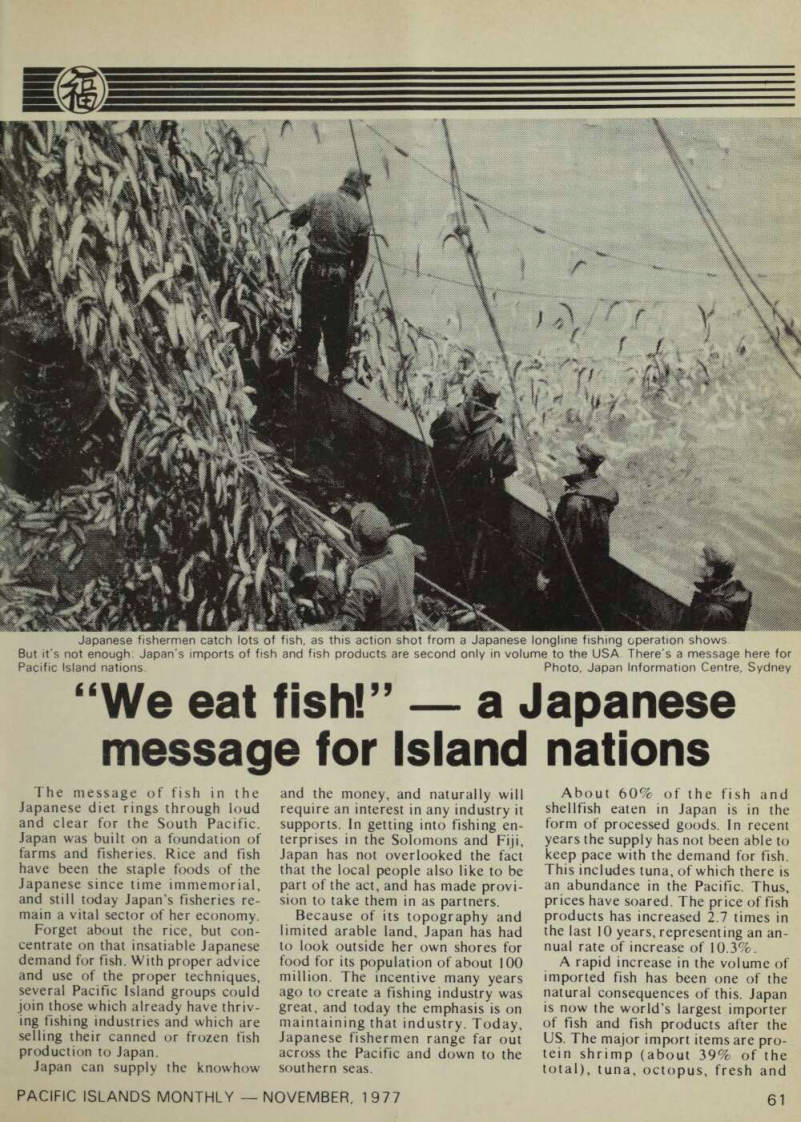
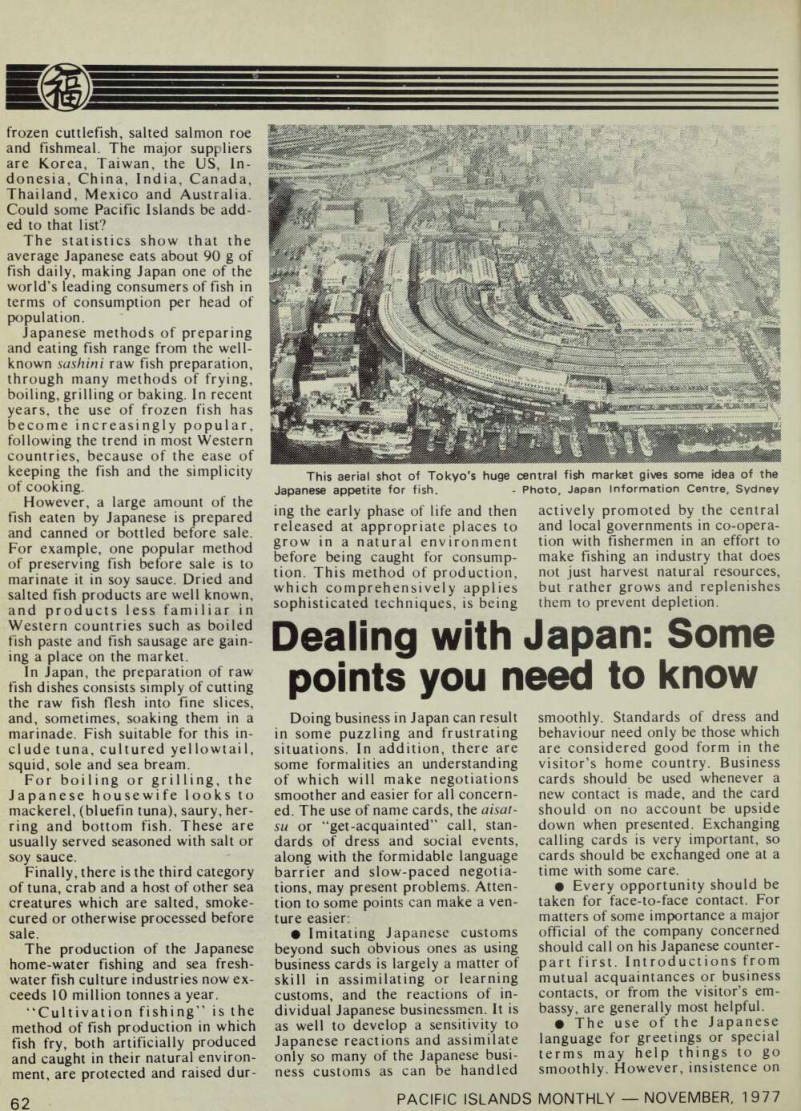
message for Island nations
The message of fish in the Japanese diet rings through loud and clear for the South Pacific, Japan was built on a foundation of farms and fisheries. Rice and fish have been the staple foods of the Japanese since time immemorial, and still today Japan’s fisheries remain a vital sector of her economy.
Forget about the rice, but concentrate on that insatiable Japanese demand for fish. With proper advice and use of the proper techniques, several Pacific Island groups could join those which already have thriving fishing industries and which are selling their canned or frozen fish production to Japan.
Japan can supply the knowhow
and the money, and naturally will require an interest in any industry it supports. In getting into fishing enterprises in the Solomons and Fiji, Japan has not overlooked the fact that the local people also like to be part of the act, and has made provision to take them in as partners.
Because of its topography and limited arable land, Japan has had to look outside her own shores for food for its population of about 100 million. The incentive many years ago to create a fishing industry was great, and today the emphasis is on maintaining that industry. Today, Japanese fishermen range far out across the Pacific and down to the southern seas.
About 60% of the fish and shellfish eaten in Japan is in the form of processed goods. In recent years the supply has not been able to keep pace with the demand for fish.
This includes tuna, of which there is an abundance in the Pacific. Thus, prices have soared. The price of fish products has increased 2.7 times in the last 10 years, representing an an nual rate of increase of 10.3%.
A rapid increase in the volume of imported fish has been one of the natural consequences of this. Japan is now the world’s largest importer of fish and fish products after the US. The major import items are pro tein shrimp (about 39% of the total), tuna, octopus, fresh and
Japanese fishermen catch lots of fish, as this action shot from a Japanese longline fishing operation shows But it's not enough: Japan's imports of fish and fish products are second only in volume to the USA There's a message here for Pacific Island nations Photo, Japan Information Centre, Sydney
frozen cuttlefish, salted salmon roe and fishmeal. The major suppliers are Korea, Taiwan, the US, In donesia, China, India, Canada, Thailand, Mexico and Australia.
Could some Pacific Islands be add ed to that list?
The statistics show that the average Japanese eats about 90 g of fish daily, making Japan one of the world’s leading consumers of fish in terms of consumption per head of
population.
Japanese methods of preparing and eating fish range from the well known sashini raw fish preparation, through many methods of frying, boiling, grilling or baking. In recent years, the use of frozen fish has become increasingly popular, following the trend in most Western countries, because of the ease of keeping the fish and the simplicity of cooking.
However, a large amount of the fish eaten by Japanese is prepared and canned or bottled before sale.
For example, one popular method of preserving fish before sale is to marinate it in soy sauce. Dried and salted fish products are well known, and products less familiar in Western countries such as boiled fish paste and fish sausage are gain ing a place on the market.
In Japan, the preparation of raw fish dishes consists simply of cutting the raw fish flesh into fine slices, and, sometimes, soaking them in a marinade. Fish suitable for this in clude tuna, cultured yellowtail, squid, sole and sea bream.
For boiling or grilling, the Japanese housewife looks to mackerel, (bluefin tuna), saury, her ring and bottom fish. These are usually served seasoned with salt or soy sauce.
Finally, there is the third category of tuna, crab and a host of other sea creatures which are salted, smoke cured or otherwise processed before sale.
The production of the Japanese home-water fishing and sea fresh water fish culture industries now ex ceeds 10 million tonnes a year.
“Cultivation fishing” is the method of fish production in which fish fry, both artificially produced and caught in their natural environ ment, are protected and raised dur-
ing the early phase of life and then released at appropriate places to grow in a natural environment before being caught for consump tion. This method of production, which comprehensively applies sophisticated techniques, is being
actively promoted by the central and local governments in co-opera tion with fishermen in an effort to make fishing an industry that does not just harvest natural resources, but rather grows and replenishes them to prevent depletion.
This aerial shot of Tokyo's huge central fish market gives some idea of the Japanese appetite for fish. - Photo, Japan Information Centre, Sydney
Dealing with Japan: Some
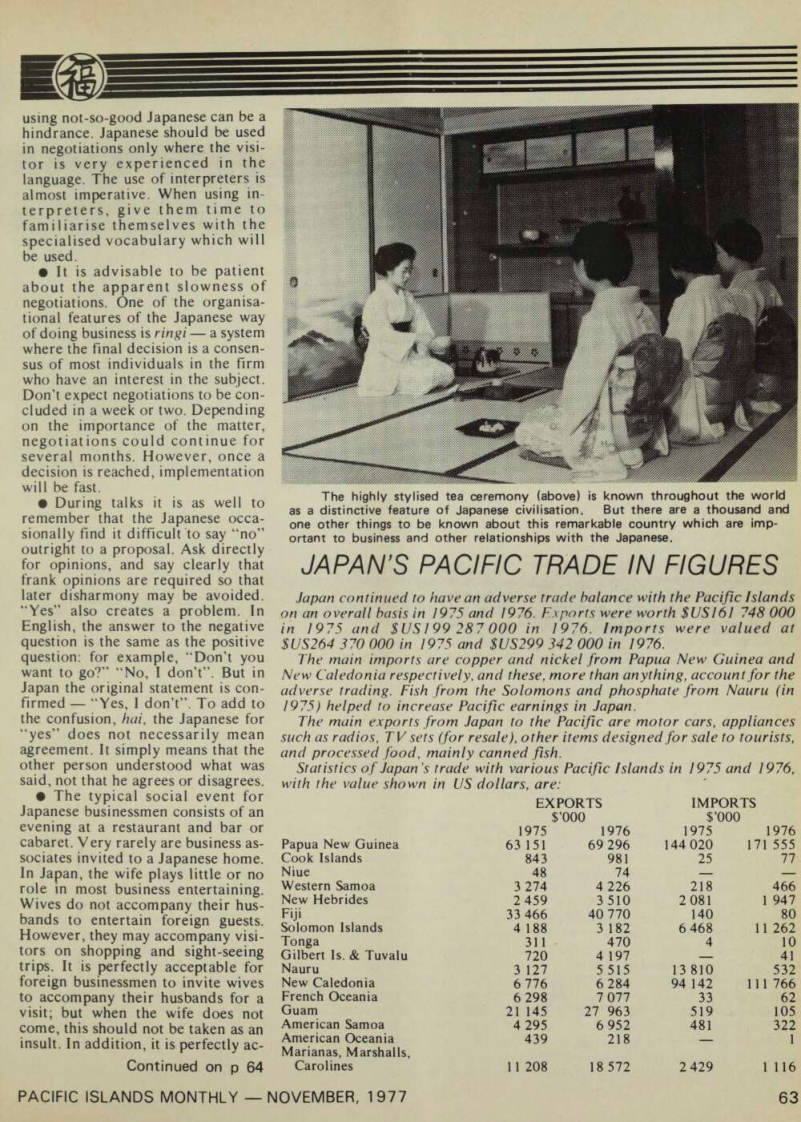
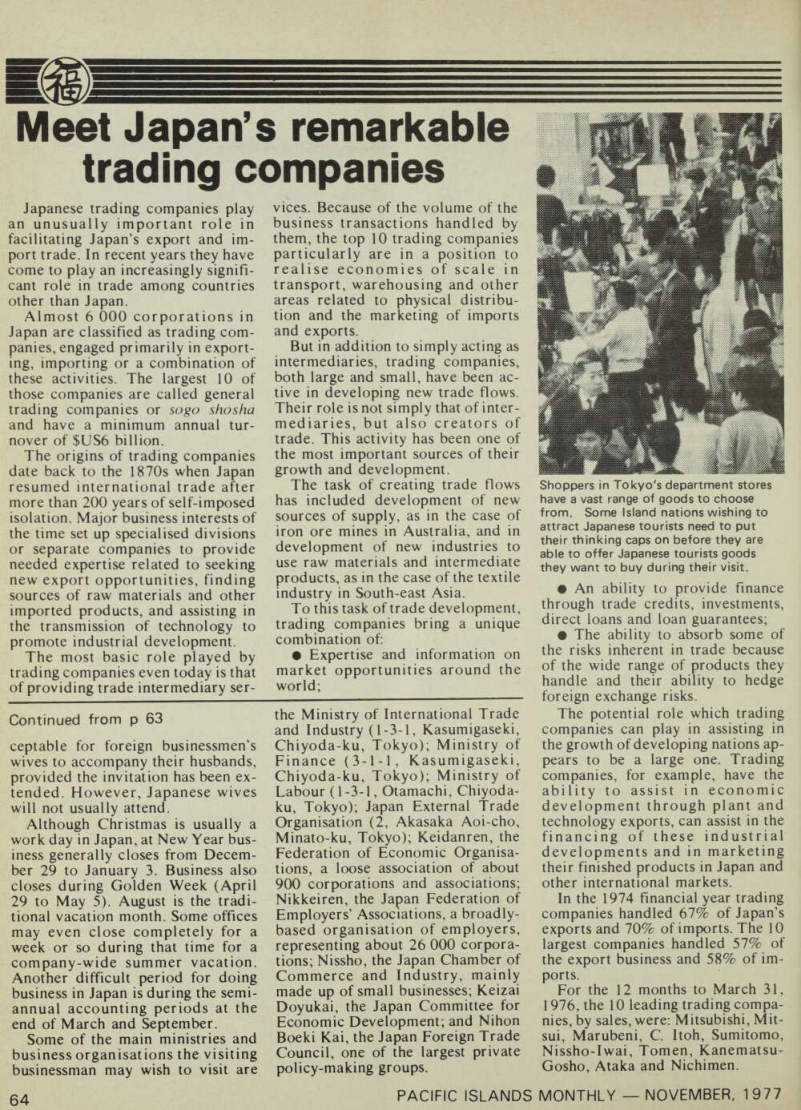
points you need to know
Doing business in Japan can result in some puzzling and frustrating situations. In addition, there are some formalities an understanding of which will make negotiations smoother and easier for all concerned. The use of name cards, the aisatsu or “get-acquainted” call, standards of dress and social events, along with the formidable language barrier and slow-paced negotiations, may present problems. Attention to some points can make a venture easier; • Imitating Japanese customs beyond such obvious ones as using business cards is largely a matter of skill in assimilating or learning customs, and the reactions of individual Japanese businessmen. It is as well to develop a sensitivity to Japanese reactions and assimilate only so many of the Japanese business customs as can be handled
smoothly. Standards of dress and behaviour need only be those which are considered good form in the visitor’s home country. Business cards should be used whenever a new contact is made, and the card should on no account be upside down when presented. Exchanging calling cards is very important, so cards should be exchanged one at a time with some care, • Every opportunity should be taken for face-to-face contact. For matters of some importance a major official of the company concerned should call on his Japanese counter part first. Introductions from mutual acquaintances or business contacts, or from the visitor’s em bassy, are generally most helpful, • The use of the Japanese language for greetings or special terms may help things to go smoothly. However, insistence on
using not-so-good Japanese can be a hindrance. Japanese should be used in negotiations only where the visi tor is very experienced in the language. The use of interpreters is almost imperative. When using in terpreters, give them time to familiarise themselves with the specialised vocabulary which will be used. • It is advisable to be patient about the apparent slowness of negotiations. One of the organisa tional features of the Japanese way of doing business is ringi a system where the final decision is a consen sus of most individuals in the firm who have an interest in the subject.
Don’t expect negotiations to be con cluded in a week or two. Depending on the importance of the matter, negotiations could continue for several months. However, once a decision is reached, implementation will be fast. • During talks it is as well to remember that the Japanese occa sionally find it difficult to say “no” outright to a proposal. Ask directly for opinions, and say clearly that frank opinions are required so that later disharmony may be avoided.
“Yes” also creates a problem. In English, the answer to the negative question is the same as the positive question; for example, “Don’t you want to go?” “No, I don’t”. But in Japan the original statement is con firmed “Yes, I don’t”. To add to the confusion, hai, the Japanese for “yes” does not necessarily mean agreement. It simply means that the other person understood what was said, not that he agrees or disagrees. • The typical social event for Japanese businessmen consists of an evening at a restaurant and bar or cabaret. Very rarely are business as sociates invited to a Japanese home.
In Japan, the wife plays little or no role in most business entertaining.
Wives do not accompany their hus bands to entertain foreign guests.
However, they may accompany visi tors on shopping and sight-seeing trips. It is perfectly acceptable for foreign businessmen to invite wives to accompany their husbands for a visit; but when the wife does not come, this should not be taken as an insult. In addition, it is perfectly ac-
Continued on p 64
Continued from p 63
ceptable for foreign businessmen’s wives to accompany their husbands, provided the invitation has been ex tended. However, Japanese wives will not usually attend.
Although Christmas is usually a work day in Japan, at New Year bus iness generally closes from Decern ber 29 to January 3. Business also closes during Golden Week (April 29 to May 5). August is the tradi tional vacation month. Some offices may even close completely for a week or so during that time for a company-wide summer vacation, Another difficult period for doing business in Japan is during the semi annual accounting periods at the end of March and September.
Some of the main ministries and business organisations the visiting businessman may wish to visit are
the Ministry of International Trade and Industry (1-3-1, Kasumigaseki, Chiyoda-ku, Tokyo); Ministry of Finance (3-1 -1 , Kasumigaseki, Chiyoda-ku, Tokyo); Ministry of Labour (1-3-1, Otamachi, Chiyoda ku, Tokyo); Japan External Trade Organisation (2, Akasaka Aoi-cho, Minato-ku, Tokyo); Keidanren, the Federation of Economic Organisa tions, a loose association of about 900 corporations and associations; Nikkeiren, the Japan Federation of Employers’ Associations, a broadly based organisation of employers, representing about 26 000 corpora tions; Nissho, the Japan Chamber of Commerce and Industry, mainly made up of small businesses; Keizai Doyukai, the Japan Committee for Economic Development; and Nihon Boeki Kai, the Japan Foreign Trade Council, one of the largest private policy-making groups.
Japan’S Pacific Trade In Figures
Japan continued to have an adverse trade balance with the Pacific Islands on an overall basis in 1975 and 1976. Exports were worth SUSI6I 748 000 in 1975 and SUSI 99 287 000 in 1976. Imports were valued at SUS 264 370 000 in 1975 and SUS 299 342 000 in 1976.
The main imports are copper and nickel from Papua New Guinea and New Caledonia respectively, and these, more than anything, account for the adverse trading. Fish from the Solomons and phosphate from Nauru (in 1975) helped to increase Pacific earnings in Japan.
The main exports from Japan to the Pacific are motor cars, appliances such as radios, TV sets (for resale), other items designed for sale to tourists, and processed food, mainly canned fish.
Statistics of Japan's trade with various Pacific Islands in 1975 and 1976, with the value shown in US dollars, are:
The highly stylised tea ceremony (above) is known throughout the world as a distinctive feature of Japanese civilisation. But there are a thousand and one other things to be known about this remarkable country which are imp ortant to business and other relationships with the Japanese.
Exports
Imports
$’000 $’000 1975 1976 1975 1976 Papua New Guinea 63 151 69 296 144 020 171 555 Cook Islands 843 981 25 77 Niue 48 74 — — Western Samoa 3 274 4 226 218 466 New Hebrides 2 459 3510 2 081 1 947
Fiji
33 466 40 770 140 80 Solomon Islands 4 188 3 182 6 468 11 262 Tonga 311 470 4 10 Gilbert Is. & Tuvalu 720 4 197 — 41 Nauru 3 127 5 515 13 810 532 New Caledonia 6 776 6 284 94 142 111 766 French Oceania 6 298 7 077 33 62 Guam 21 145 27 963 519 105 American Samoa 4 295 6 952 481 322 American Oceania 439 218 ] Marianas, Marshalls, Carolines 11 208 18 572 2 429 1 116
trading companies
Meet Japan’s remarkable trading companies
Japanese trading companies play an unusually important role in facilitating Japan’s export and import trade. In recent years they have come to play an increasingly significant role in trade among countries other than Japan.
Almost 6 000 corporations in Japan are classified as trading companics, engaged primarily in exporting, importing or a combination of these activities. The largest 10 of those companies are called general trading companies or sogo shosha and have a minimum annual turnover of SUS 6 billion.
The origins of trading companies date back to the 1870 s when Japan resumed international trade after more than 200 years of self-imposed isolation. Major business interests of the time set up specialised divisions or separate companies to provide needed expertise related to seeking new export opportunities, finding sources of raw materials and other imported products, and assisting in the transmission of technology to promote industrial development.
The most basic role played by trading companies even today is that of providing trade intermediary ser-
vices. Because of the volume of the business transactions handled by them, the top 10 trading companies particularly are in a position to realise economies of scale in transport, warehousing and other areas related to physical distribu tion and the marketing of imports and exports.
But in addition to simply acting as intermediaries, trading companies, both large and small, have been ac tive in developing new trade flows, Their role is not simply that of inter mediaries, but also creators of trade. This activity has been one of the most important sources of their growth and development, The task of creating trade flows has included development of new sources of supply, as in the case of iron ore mines in Australia, and in development of new industries to use raw materials and intermediate products, as in the case of the textile industry in South-east Asia, To this task of trade development, trading companies bring a unique combination of; • Expertise and information on market opportunities around the world;
• An ability to provide finance through trade credits, investments, direct loans and loan guarantees; • The ability to absorb some of the risks inherent in trade because of the wide range of products they handle and their ability to hedge foreign exchange risks.
The potential role which trading companies can play in assisting in the growth of developing nations ap pears to be a large one. Trading companies, for example, have the ability to assist in economic development through plant and technology exports, can assist in the financing of these industrial developments and in marketing their finished products in Japan and other international markets.
In the 1974 financial year trading companies handled 67% of Japan’s exports and 70% of imports. The 10 largest companies handled 57% of the export business and 58% of im ports.
For the 12 months to March 31, 1976, the 10 leading trading compa nies, by sales, were; Mitsubishi, Mit sui, Marubeni, C. Itoh, Sumitomo, Nissho-Iwai, Tomen, Kanematsu- Gosho, Ataka and Nichimen.
Shoppers in Tokyo's department stores have a vast range of goods to choose from. Some Island nations wishing to attract Japanese tourists need to put their thinking caps on before they are able to offer Japanese tourists goods they want to buy during their visit.
The talking’s over Japan is
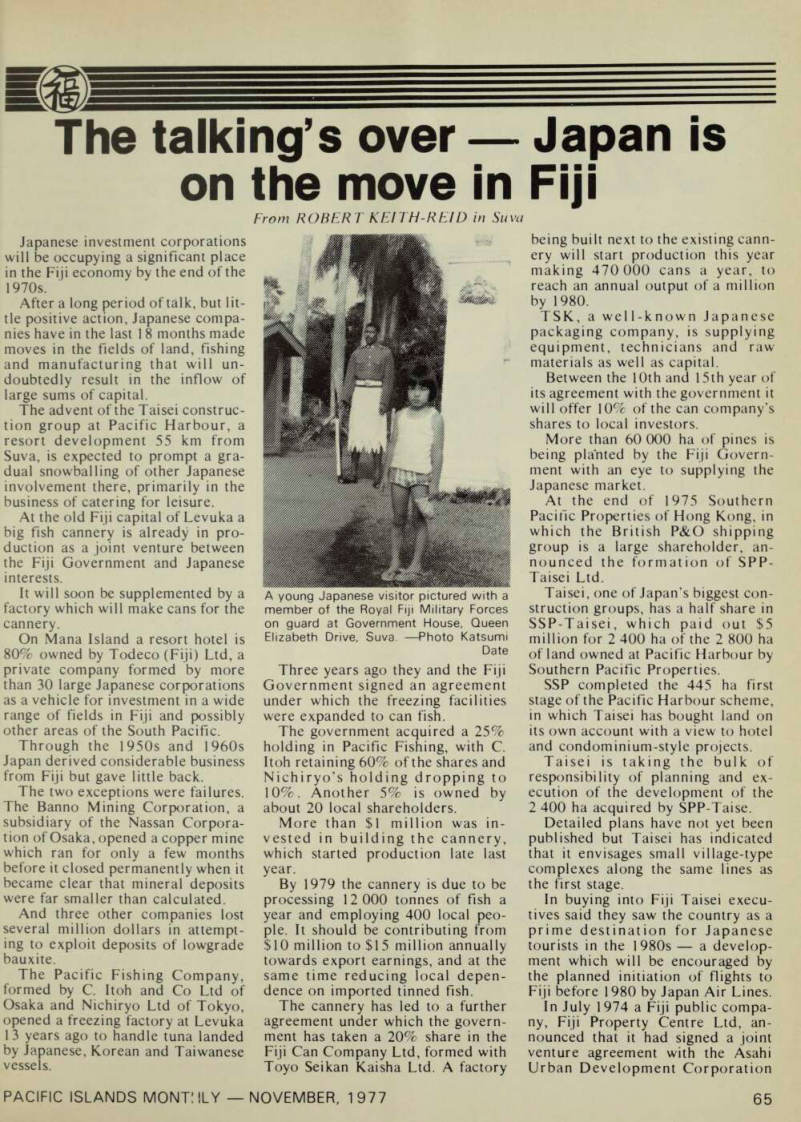
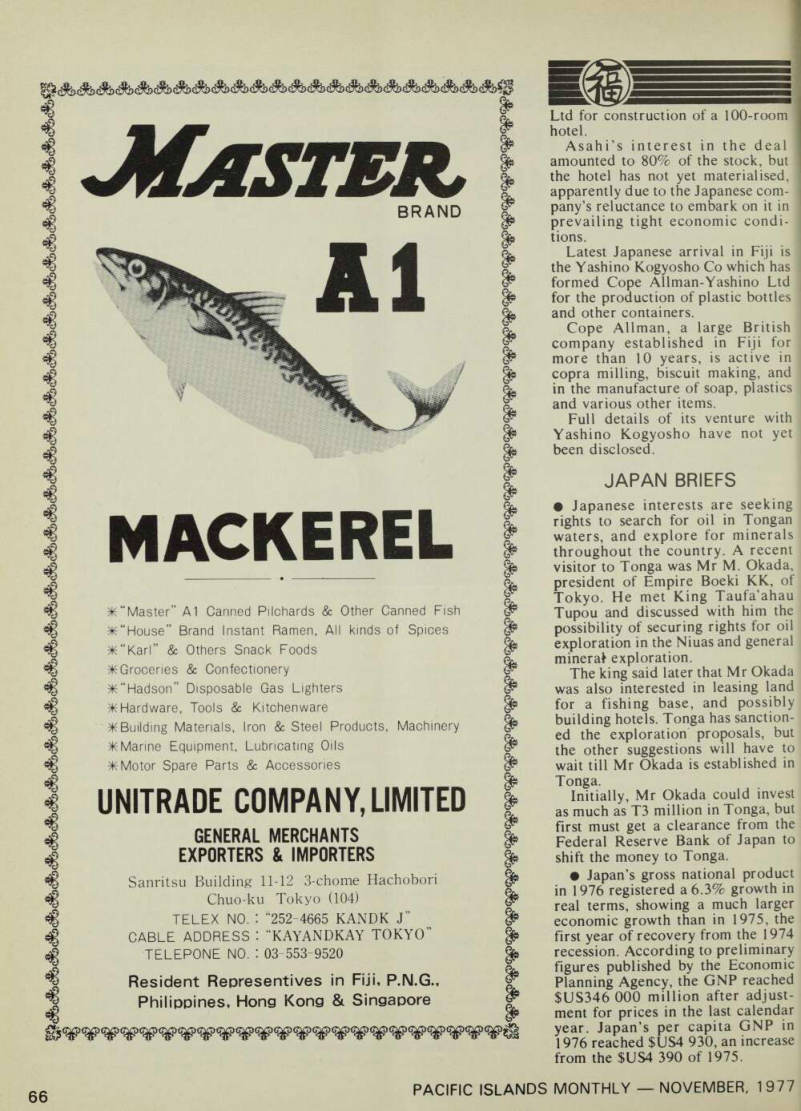
on the move in Fiji
From ROBERT KEITH-REID in Suva
Japanese investment corporations will be occupying a significant place in the Fiji economy by the end of the 19705.
After a long period of talk, but lit tle positive action, Japanese compa nies have in the last 18 months made moves in the fields of land, fishing and manufacturing that will un doubtedly result in the inflow of large sums of capital.
The advent of the Taisei construc tion group at Pacific Harbour, a resort development 55 km from Suva, is expected to prompt a gra dual snowballing of other Japanese involvement there, primarily in the business of catering for leisure.
At the old Fiji capital of Levuka a big fish cannery is already in pro duction as a joint venture between the Fiji Government and Japanese interests.
It will soon be supplemented by a factory which will make cans for the cannery.
On Mana Island a resort hotel is 80% owned by Todeco (Fiji) Ltd, a private company formed by more than 30 large Japanese corporations as a vehicle for investment in a wide range of fields in Fiji and possibly other areas of the South Pacific.
Through the 1950 s and 1960 s Japan derived considerable business from Fiji but gave little back.
The two exceptions were failures.
The Banno Mining Corporation, a subsidiary of the Nassan Corpora tion of Osaka, opened a copper mine which ran for only a few months before it closed permanently when it became clear that mineral deposits were far smaller than calculated.
And three other companies lost several million dollars in attempt ing to exploit deposits of lowgrade bauxite.
The Pacific Fishing Company, formed by C. Itoh and Co Ltd of Osaka and Nichiryo Ltd of Tokyo, opened a freezing factory at Levuka 13 years ago to handle tuna landed by Japanese, Korean and Taiwanese vessels.
Three years ago they and the Fiji Government signed an agreement under which the freezing facilities were expanded to can fish.
The government acquired a 25% holding in Pacific Fishing, with C.
Itoh retaining 60% of the shares and Nichiryo’s holding dropping to 10%. Another 5% is owned by about 20 local shareholders.
More than SI million was in vested in building the cannery, which started production late last year.
By 1979 the cannery is due to be processing 12 000 tonnes of fish a year and employing 400 local peo ple. It should be contributing from $lO million to $l5 million annually towards export earnings, and at the same time reducing local depen dence on imported tinned fish.
The cannery has led to a further agreement under which the govern ment has taken a 20% share in the Fiji Can Company Ltd, formed with Toyo Seikan Kaisha Ltd. A factory
being built next to the existing cann ery will start production this year making 470 000 cans a year, to reach an annual output of a million by 1980.
TSK, a well-known Japanese packaging company, is supplying equipment, technicians and raw materials as well as capital.
Between the 10th and 15th year of its agreement with the government it will offer 10% of the can company’s shares to local investors.
More than 60 000 ha of pines is being planted by the Fiji Govern ment with an eye to supplying the Japanese market.
At the end of 1975 Southern Pacific Properties of Hong Kong, in which the British P&O shipping group is a large shareholder, an nounced the formation of SPP- Taisei Ltd.
Taisei, one of Japan’s biggest con struction groups, has a half share in SSP-Taisei, which paid out $5 million for 2 400 ha of the 2 800 ha of land owned at Pacific Harbour by Southern Pacific Properties.
SSP completed the 445 ha first stage of the Pacific Harbour scheme, in which Taisei has bought land on its own account with a view to hotel and condominium-style projects.
Taisei is taking the bulk of responsibility of planning and ex ecution of the development of the 2 400 ha acquired by SPP-Taise.
Detailed plans have not yet been published but Taisei has indicated that it envisages small village-type complexes along the same lines as the first stage.
In buying into Fiji Taisei execu tives said they saw the country as a prime destination for Japanese tourists in the 1980 s a develop ment which will be encouraged by the planned initiation of flights to Fiji before 1980 by Japan Air Lines.
In July 1974 a Fiji public compa ny, Fiji Property Centre Ltd, an nounced that it had signed a Joint venture agreement with the Asahi Urban Development Corporation
A young Japanese visitor pictured with a member of the Royal Fiji Military Forces on guard at Government House, Queen Elizabeth Drive, Suva. —Photo Katsumi Date
Ltd for construction of a 100-room hotel.
Asahi’s interest in the deal amounted to 80% of the stock, but the hotel has not yet materialised, apparently due to the Japanese com pany’s reluctance to embark on it in prevailing tight economic condi tions.
Latest Japanese arrival in Fiji is the Yashino Kogyosho Co which has formed Cope Allman-Yashino Ltd for the production of plastic bottles and other containers.
Cope Allman, a large British company established in Fiji for more than 10 years, is active in copra milling, biscuit making, and in the manufacture of soap, plastics and various other items.
Full details of its venture with Yashino Kogyosho have not yet been disclosed.
Japan Briefs
• Japanese interests are seeking rights to search for oil in Tongan waters, and explore for minerals throughout the country. A recent visitor to Tonga was Mr M. Okada, president of Empire Boeki KK, of Tokyo. He met King Taufa’ahau Tupou and discussed with him the possibility of securing rights for oil exploration in the Niuas and general mineral exploration.
The king said later that Mr Okada was also interested in leasing land for a fishing base, and possibly building hotels. Tonga has sanction ed the exploration proposals, but the other suggestions will have to wait till Mr Okada is established in Tonga.
Initially, Mr Okada could invest as much as T 3 million in Tonga, but first must get a clearance from the Federal Reserve Bank of Japan to shift the money to Tonga. • Japan’s gross national product in 1976 registered a 6.3% growth in real terms, showing a much larger economic growth than in 1975, the first year of recovery from the 1974 recession. According to preliminary figures published by the Economic Planning Agency, the GNP reached SUS 346 000 million after adjust ment for prices in the last calendar year. Japan’s per capita GNP in 1976 reached SUS 4 930, an increase from the SUS 4 390 of 1975.
Advertisements & other items, p. 66 (1 item)
Master.
MACKEREL
Master” A1 Canned Pilchards & Other Canned Fish % “House” Brand Instant Ramen, All kinds of Spices *“Karl” & Others Snack Foods * Groceries & Confectionery *“Hadson” Disposable Gas Lighters * Hardware, Tools & Kitchenware * Building Materials, Iron & Steel Products, Machinery * Marine Equipment, Lubricating Oils % Motor Spare Parts & Accessories
UNITRADE COMPANY, LIMITED
Sanritsu Building 11-12 3-chome Hachobori Chuo-ku Tokyo (104)
TELEX NO. : “252-4665 KANDK J”
CABLE ADDRESS : “KAYANDKAY TOKYO”
TELEPONE NO. : 03-553-9520
BRAND
GENERAL MERCHANTS
EXPORTERS & IMPORTERS
Resident Representives in Fiji, P.N.G., Philippines, Hong Kong & Singapore
“Electronic?” “It’s probably
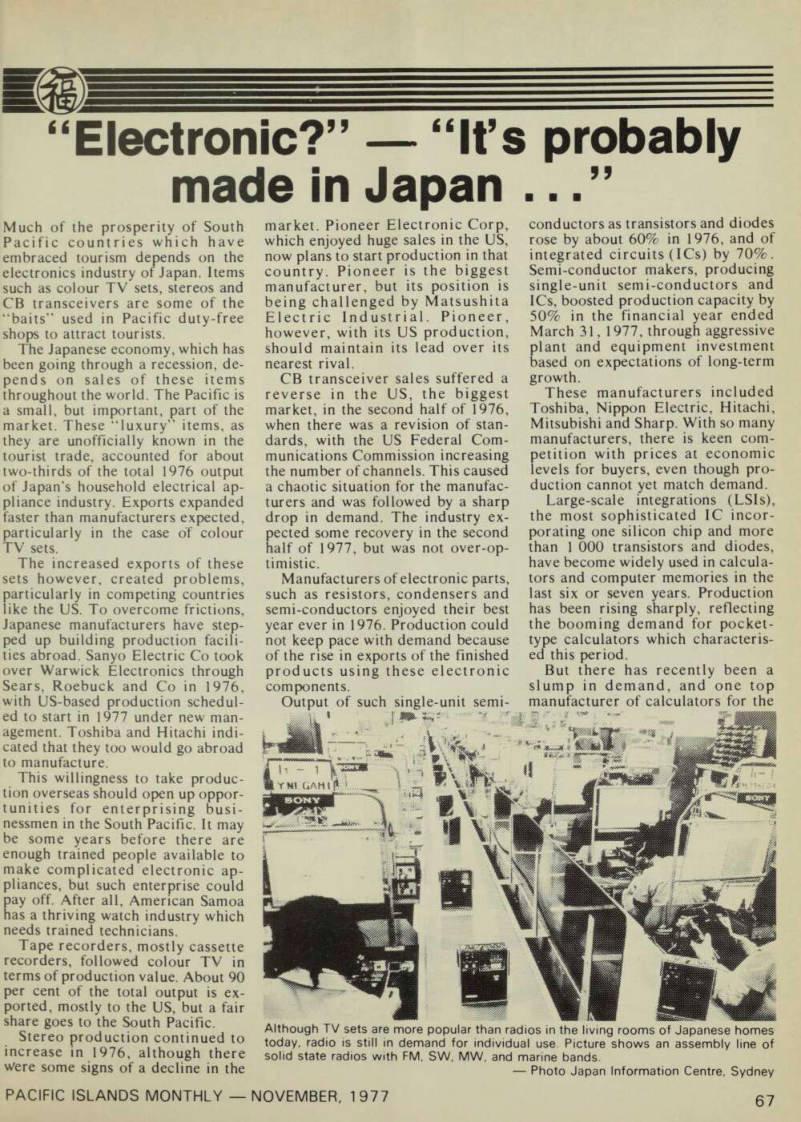
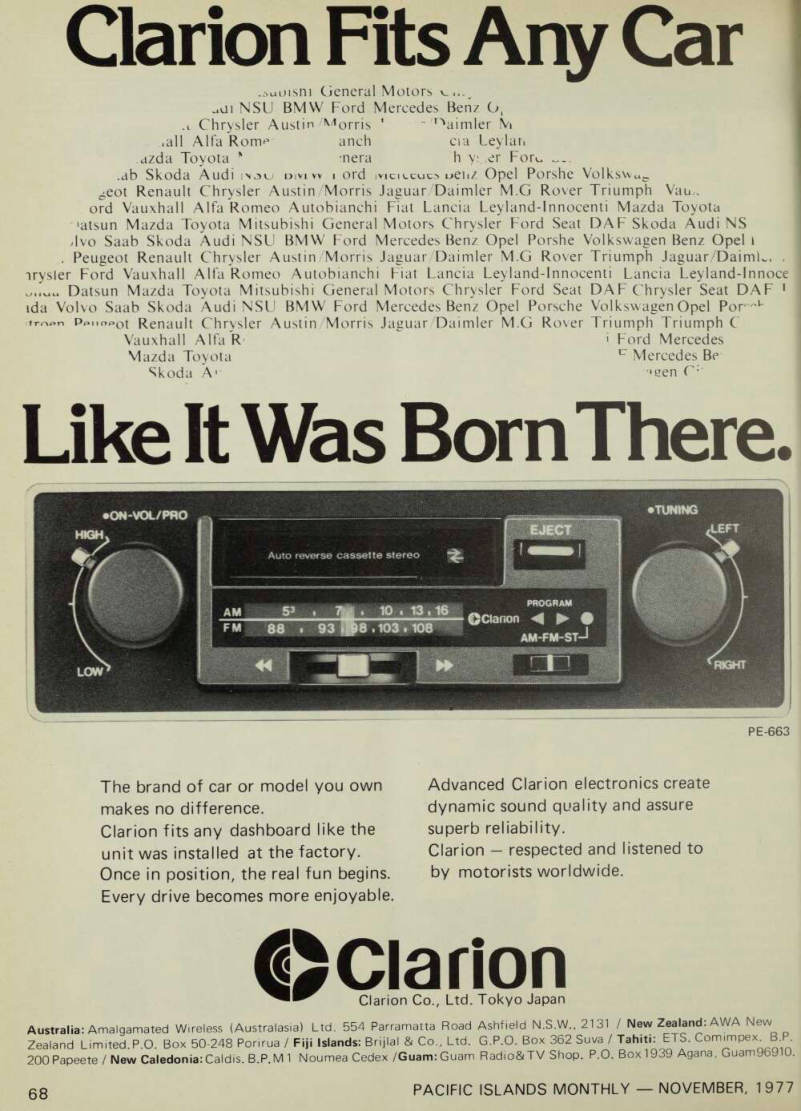
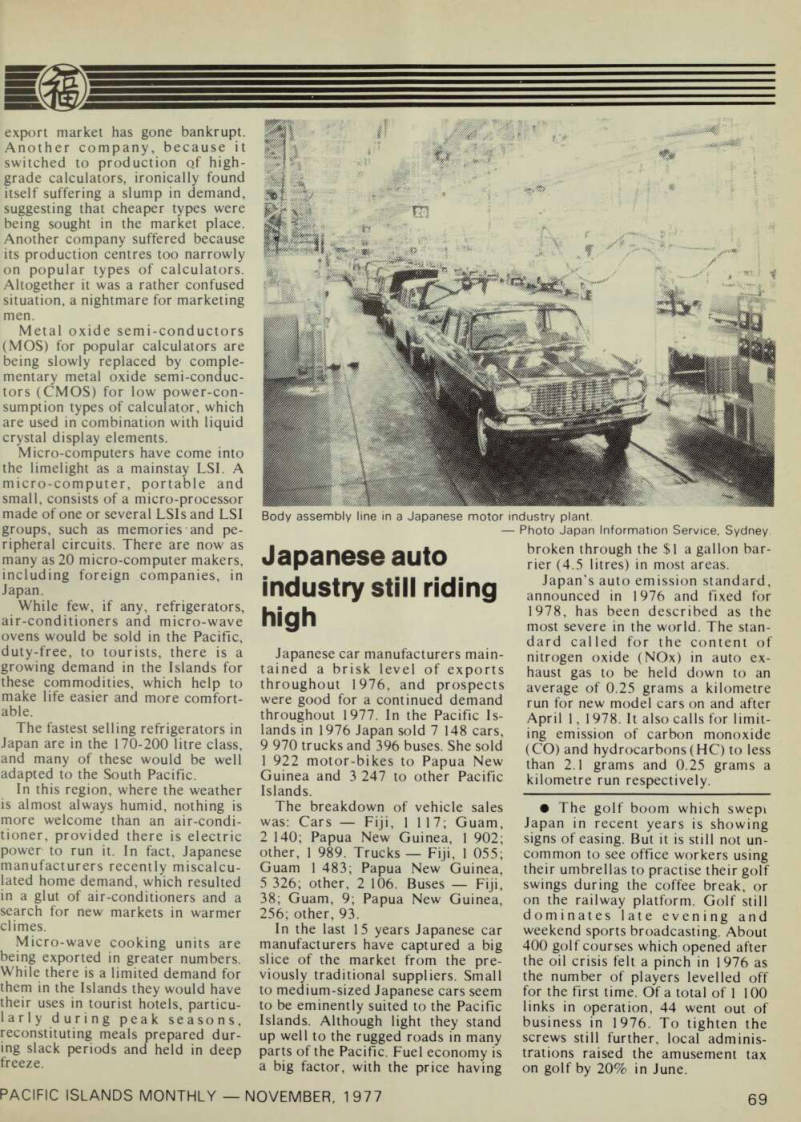
made in Japan ...”
Much of the prosperity of South Pacific countries which have embraced tourism depends on the electronics industry of Japan. Items such as colour TV sets, stereos and CB transceivers are some of the “baits” used in Pacific duty-free shops to attract tourists.
The Japanese economy, which has been going through a recession, de pends on sales of these items throughout the world. The Pacific is a small, but important, part of the market. These “luxury” items, as they are unofficially known in the tourist trade, accounted for about two-thirds of the total 1976 output of Japan’s household electrical ap pliance industry. Exports expanded faster than manufacturers expected, particularly in the case of colour TV sets.
The increased exports of these sets however, created problems, particularly in competing countries like the US. To overcome frictions, Japanese manufacturers have step ped up building production facili ties abroad. Sanyo Electric Co took over Warwick Electronics through Sears, Roebuck and Co in 1976, with US-based production schedul ed to start in 1977 under new man agement. Toshiba and Hitachi indi cated that they too would go abroad to manufacture.
This willingness to take produc tion overseas should open up oppor tunities for enterprising busi nessmen in the South Pacific. It may be some years before there are enough trained people available to make complicated electronic ap pliances, but such enterprise could pay off. After all, American Samoa has a thriving watch industry which needs trained technicians.
Tape recorders, mostly cassette recorders, followed colour TV in terms of production value. About 90 per cent of the total output is ex ported, mostly to the US, but a fair share goes to the South Pacific.
Stereo production continued to increase in 1976, although there Were some signs of a decline in the
market. Pioneer Electronic Corp, which enjoyed huge sales in the US, now plans to start production in that country. Pioneer is the biggest manufacturer, but its position is being challenged by Matsushita Electric Industrial. Pioneer, however, with its US production, should maintain its lead over its nearest rival.
CB transceiver sales suffered a reverse in the US, the biggest market, in the second half of 1976, when there was a revision of stan dards, with the US Federal Com munications Commission increasing the number of channels. This caused a chaotic situation for the manufac turers and was followed by a sharp drop in demand. The industry ex pected some recovery in the second half of 1977, but was not over-op timistic.
Manufacturers of electronic parts, such as resistors, condensers and semi-conductors enjoyed their best year ever in 1976. Production could not keep pace with demand because of the rise in exports of the finished products using these electronic components.
Output of such single-unit semi
conductors as transistors and diodes rose by about 60% in 1976, and of integrated circuits (ICs) by 70%.
Semi-conductor makers, producing single-unit semi-conductors and ICs, boosted production capacity by 50% in the financial year ended March 31, 1977, through aggressive plant and equipment investment based on expectations of long-term growth.
These manufacturers included Toshiba, Nippon Electric, Hitachi, Mitsubishi and Sharp. With so many manufacturers, there is keen com petition with prices at economic levels for buyers, even though pro duction cannot yet match demand.
Large-scale integrations (LSIs), the most sophisticated IC incor porating one silicon chip and more than 1 000 transistors and diodes, have become widely used in calcula tors and computer memories in the last six or seven years. Production has been rising sharply, reflecting the booming demand for pocket type calculators which characteris ed this period.
But there has recently been a slump in demand, and one top manufacturer of calculators for the
Although TV sets are more popular than radios in the living rooms of Japanese homes today, radio is still in demand for individual use. Picture shows an assembly line of solid state radios with FM, SW, MW, and marine bands.
Photo Japan Information Centre, Sydney
export market has gone bankrupt.
Another company, because it switched to production of high grade calculators, ironically found itself suffering a slump in demand, suggesting that cheaper types were being sought in the market place.
Another company suffered because its production centres too narrowly on popular types of calculators.
Altogether it was a rather confused situation, a nightmare for marketing men.
Metal oxide semi-conductors (MOS) for popular calculators are being slowly replaced by comple mentary metal oxide semi-conduc tors (CMOS) for low power-con sumption types of calculator, which are used in combination with liquid crystal display elements.
Micro-computers have come into the limelight as a mainstay LSI. A micro-computer, portable and small, consists of a micro-processor made of one or several LSIs and LSI groups, such as memories and pe ripheral circuits. There are now as many as 20 micro-computer makers, including foreign companies, in Japan.
While few, if any, refrigerators, air-conditioners and micro-wave ovens would be sold in the Pacific, duty-free, to tourists, there is a growing demand in the Islands for these commodities, which help to make life easier and more comfort able.
The fastest selling refrigerators in Japan are in the 170-200 litre class, and many of these would be well adapted to the South Pacific.
In this region, where the weather is almost always humid, nothing is more welcome than an air-condi tioner, provided there is electric power to run it. In fact, Japanese manufacturers recently miscalcu lated home demand, which resulted in a glut of air-conditioners and a search for new markets in warmer climes.
Micro-wave cooking units are being exported in greater numbers.
While there is a limited demand for them in the Islands they would have their uses in tourist hotels, particu larly during peak seasons, reconstituting meals prepared dur ing slack periods and held in deep freeze.
Advertisements & other items, p. 68 (1 item)
Clarion Fits Any Car
General Motors NSU BMW Ford Mercedes Benz O, .1 Chrysler Austin ' M .all Alfa Romp anch era Leylan azda Toyota •nera h yr er For. .ab Skoda Audi i>ou divi w i ord iviuvcucs ueiiz Opel Porshe Volksvvti & Renault Chrysler Austin/Morris Jaguar/Daimler M.G Rover Triumph Van,, ord Vauxhall Alfa Romeo Autobianchi Fiat Lancia Leyland-lnnocenti Mazda Toyota •atsun Mazda Toyota Mitsubishi General Motors Chrysler Ford Seat DAF Skoda Audi NS /Ivo Saab Skoda Audi NSU BMW Ford Mercedes Benz Opel Porshe Volkswagen Benz Opel i . Peugeot Renault Chrysler Austin/Morris Jaguar/Daimler M.G Rover Triumph Jaguar/DaimL. . irysler Ford Vauxhall Alfa Romeo Autobianchi Fiat Lancia Leyland-lnnocenti Lancia Leyland-Innoce Datsun Mazda Toyota Mitsubishi General Motors Chrysler Ford Seat DAF Chrysler Seat DAF 1 ida Volvo Saab Skoda Audi NSU BMW Ford Mercedes Benz Opel Porsche Volkswagen Opel Por^ 1 * tmpn P^..a^ o t Renault Chrysler Austin Morris Jaguar/Daimler M.G Rover Triumph Triumph C Vauxhall Alfa R ' Ford Mercedes Mazda Toyota c Mercedes Be Skoda A 1 C ;
Like It Was Born There.
m \ - ; . • PE-663 The brand of car or model you own makes no difference.
Clarion fits any dashboard like the unit was installed at the factory.
Once in position, the real fun begins.
Every drive becomes more enjoyable.
Advanced Clarion electronics create dynamic sound quality and assure
superb reliability.
Clarion respected and listened to by motorists worldwide.
Clarion Co., Ltd. Tokyo Japan Australia: Amalgamated Wireless (Australasia) Ltd. 554 Parramatta Road Ashfield N.S.W., 2131 / New Zealand: AWA New Zealand Limited.P.O. Box 50-248 Porirua / Fiji Islands: Brijlal & Co., Ltd. G.P.O. Box 362 Suva / Tahiti: ETS. Comimpex BP. 200Papeete / New Caledonia:Caldis. B.P.M 1 Noumea Cedex /Guam: Guam Radio&TV Shop. P.O. Box 1939 Agana, Guam 969 0.
high
Japanese auto industry still riding high
Japanese car manufacturers main tained a brisk level of exports throughout 1976, and prospects were good for a continued demand throughout 1977. In the Pacific Is lands in 1976 Japan sold 7 148 cars, 9 970 trucks and 396 buses. She sold 1 922 motor-bikes to Papua New Guinea and 3 247 to other Pacific Islands.
The breakdown of vehicle sales was; Cars Fiji, 1 117; Guam, 2 140; Papua New Guinea, 1 902; other, 1 989. Trucks Fiji, 1 055; Guam 1 483; Papua New Guinea, 5 326; other, 2 106. Buses Fiji, 38; Guam, 9; Papua New Guinea, 256; other, 93.
In the last 15 years Japanese car manufacturers have captured a big slice of the market from the pre viously traditional suppliers. Small to medium-sized Japanese cars seem to be eminently suited to the Pacific Islands. Although light they stand up well to the rugged roads in many parts of the Pacific. Fuel economy is a big factor, with the price having
broken through the $1 a gallon bar rier (4.5 litres) in most areas.
Japan’s auto emission standard, announced in 1976 and fixed for 1978, has been described as the most severe in the world. The stan dard called for the content of nitrogen oxide (NOx) in auto ex haust gas to be held down to an average of 0.25 grams a kilometre run for new model cars on and after April 1, 1978. It also calls for limit ing emission of carbon monoxide (CO) and hydrocarbons (HC) to less than 2.1 grams and 0.25 grams a kilometre run respectively.
• The golf boom which swept Japan in recent years is showing signs of easing. But it is still not un common to see office workers using their umbrellas to practise their golf swings during the coffee break, or on the railway platform. Golf still dominates late evening and weekend sports broadcasting. About 400 golf courses which opened after the oil crisis felt a pinch in 1976 as the number of players levelled off for the first time. Of a total of 1 100 links in operation, 44 went out of business in 1976. To tighten the screws still further, local adminis trations raised the amusement tax on golf by 20% in June.
Body assembly line in a Japanese motor industry plant Photo Japan Information Service, Sydney
Advertisements & other items, p. 70 (1 item)
SiffiEMisaßai
Maybe you want to your
* »<»' The answer is a Yanmar diesel engine
for
(U
Maybe you want to catch some^
The answer is a Yanmar diesel marine
engine.
Maybe you want dependable
transportation. A Yanmar diesel marine
engine is your answer.
O
A A / A
-< A , A. j* J*.
A * A **- < A 4BM Model YNG series
2.0—10 KVA
w Yanmar diesel industrial and marine engines. From 3 to 3190 horsepower. Efficiency and dependability. A trusted name in 130 countries.
Model SB series 7-12 HP
YANMAR
DIESEL ENGINE
YANMAR DIESEL ENGINE CO ,LTD
Cable YANMAR TOKYO Telex: 0222-2310,0222-4733
SALES^TY^TD^*■
SiffiEMisaßai
VILAIpALAUi PALAU FISHING AUTHORITY: P.0.80x 586 Koror Palau, Western Caroline Island 96940 (WESTERN SAMOA) D 'S™ B UTORS t^uk^alofa^ 6abl'e 8 JON^C(J'(TO^CK^^K)MAS/TENT^R^WS^^^Bo^26^' Truck ECI 969*42 (GUAM) CORAL REEF MARINE
CENTER, INC.: Tel: 477-6335
at daggers drawn
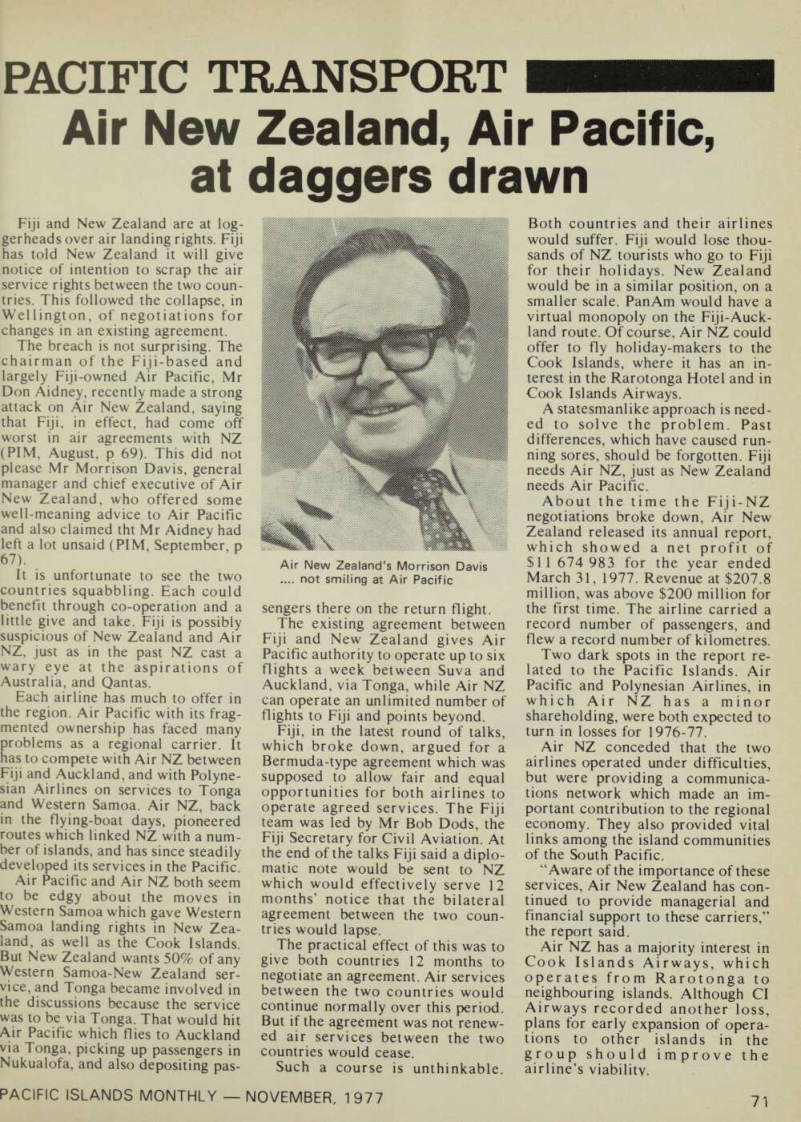
Pacific Transport
Air New Zealand, Air Pacific, at daggers drawn
Fiji and New Zealand are at log gerheads over air landing rights. Fiji has told New Zealand it will give notice of intention to scrap the air service rights between the two coun tries. This followed the collapse, in Wellington, of negotiations for changes in an existing agreement.
The breach is not surprising. The chairman of the Fiji-based and largely Fiji-owned Air Pacific, Mr Don Aidney, recently made a strong attack on Air New Zealand, saying that Fiji, in effect, had come off worst in air agreements with NZ (PIM, August, p 69). This did not please Mr Morrison Davis, general manager and chief executive of Air New Zealand, who offered some well-meaning advice to Air Pacific and also claimed tht Mr Aidney had left a lot unsaid (PIM, September, p 67).
It is unfortunate to see the two countries squabbling. Each could benefit through co-operation and a little give and take. Fiji is possibly suspicious of New Zealand and Air NZ, just as in the past NZ cast a wary eye at the aspirations of Australia, and Qantas.
Each airline has much to offer in the region. Air Pacific with its frag mented ownership has faced many problems as a regional carrier. It has to compete with Air NZ between Fiji and Auckland, and with Polyne sian Airlines on services to Tonga and Western Samoa. Air NZ, back in the flying-boat days, pioneered routes which linked NZ with a num ber of islands, and has since steadily developed its services in the Pacific.
Air Pacific and Air NZ both seem to be edgy about the moves in Western Samoa which gave Western Samoa landing rights in New Zea land, as well as the Cook Islands.
But New Zealand wants 50% of any Western Samoa-New Zealand ser vice, and Tonga became involved in the discussions because the service was to be via Tonga. That would hit Air Pacific which flies to Auckland via Tonga, picking up passengers in Nukualofa, and also depositing pas-
sengers there on the return flight.
The existing agreement between Fiji and New Zealand gives Air Pacific authority to operate up to six flights a week between Suva and Auckland, via Tonga, while Air NZ can operate an unlimited number of flights to Fiji and points beyond.
Fiji, in the latest round of talks, which broke down, argued for a Bermuda-type agreement which was supposed to allow fair and equal opportunities for both airlines to operate agreed services. The Fiji team was led by Mr Bob Dods, the Fiji Secretary for Civil Aviation. At the end of the talks Fiji said a diplo matic note would be sent to NZ which would effectively serve 12 months’ notice that the bilateral agreement between the two coun tries would lapse.
The practical effect of this was to give both countries 12 months to negotiate an agreement. Air services between the two countries would continue normally over this period.
But if the agreement was not renew ed air services between the two countries would cease.
Such a course is unthinkable.
Both countries and their airlines would suffer. Fiji would lose thou sands of NZ tourists who go to Fiji for their holidays. New Zealand would be in a similar position, on a smaller scale. PanAm would have a virtual monopoly on the Fiji-Auck land route. Of course, Air NZ could offer to fly holiday-makers to the Cook Islands, where it has an in terest in the Rarotonga Hotel and in Cook Islands Airways.
A statesmanlike approach is need ed to solve the problem. Past differences, which have caused run ning sores, should be forgotten. Fiji needs Air NZ, just as New Zealand needs Air Pacific.
About the time the Fiji-NZ negotiations broke down, Air New Zealand released its annual report, which showed a net profit of $ll 674 983 for the year ended March 31, 1977. Revenue at $207.8 million, was above $2OO million for the first time. The airline carried a record number of passengers, and flew a record number of kilometres.
Two dark spots in the report re lated to the Pacific Islands. Air Pacific and Polynesian Airlines, in which Air NZ has a minor shareholding, were both expected to turn in losses for 1976-77.
Air NZ conceded that the two airlines operated under difficulties, but were providing a communica tions network which made an im portant contribution to the regional economy. They also provided vital links among the island communities of the South Pacific.
“Aware of the importance of these services, Air New Zealand has con tinued to provide managerial and financial support to these carriers,” the report said.
Air NZ has a majority interest in Cook Islands Airways, which operates from Rarotonga to neighbouring islands. Although Cl Airways recorded another loss, plans for early expansion of opera tions to other islands in the group should improve the airline’s viability.
Air New Zealand's Morrison Davis ... not smiling at Air Pacific
Advertisements & other items, p. 72 (1 item)
C. Itoh has been contributing to Oceania's economic growth
120 130 140 150 I C. Itoh has been contributing to Oceania's economic growth for 20 years since our doors first opened in Sydney in 1957 C. Itoh & Co. (Aust.) Ltd. total business company <§>
C. ITOH
Port Moresby Office: Office 5, James Arcade, Section 4, Lot 6, Cuthbertson St., Port Moresby. P.O. Box 3576, Port Moresby Phone; 211668 Telex; CITOH NE22174 Sydney Office: Gold Fields House, 1 Alfred St., Sydney N.S.W. 2000 G.P.O. Box 4271, Sydney, N.S.W. 2001 Phone:27-7611 Telex: 20205 (CITOH) C. Itoh & Co., (N.Z.) Ltd. -O'" Auckland Office; Norwich Union Bldg., 3rd Floor, 171/5 Queen St., Auckland. P.O. Box 6401, Auckland Phone; 379-220 Telex; NZ2504 (CITOH) Other Offices in Oceania: Adelaide, Brisbane, Fremantle, Melbourne, Perth and Wellington.
C. Itoh & Co., Ltd.
Founded in 1858 Capital: Y 37.251,476,800 (approx. ASSI2S million) Tokyo Office: C.P.O. Box 136, Tokyo, 100-91 Japan Telex: J 22295 (ITOHCHU) Osaka Office; C.P.O. Box 117, Osaka, 530-91 Japan Telex: J 63335 (ITOHCHU) < • Port
Moresby
bj T O q O < $ pa C/p P c °cp
Apr
Brisbane
30 pc*'" 1
Adelaide
Sydney
• lie Melbourne ft* Vi- -0 l n ot o n
US, Australian
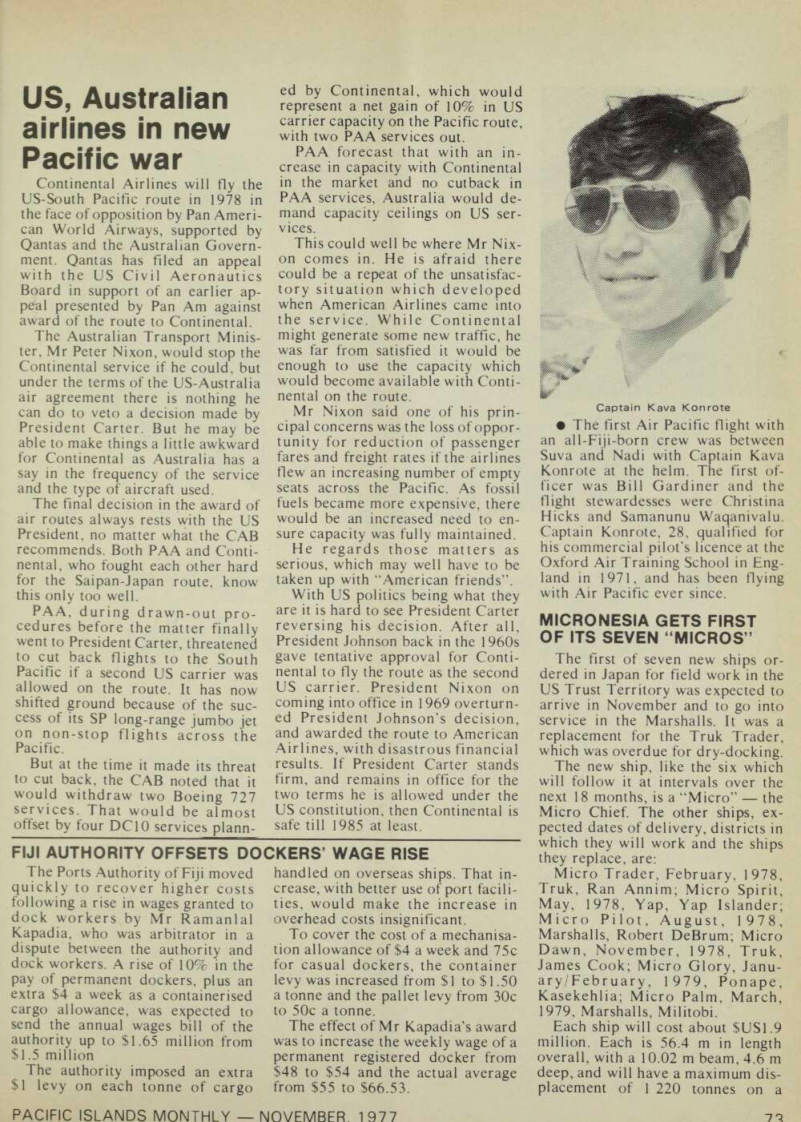

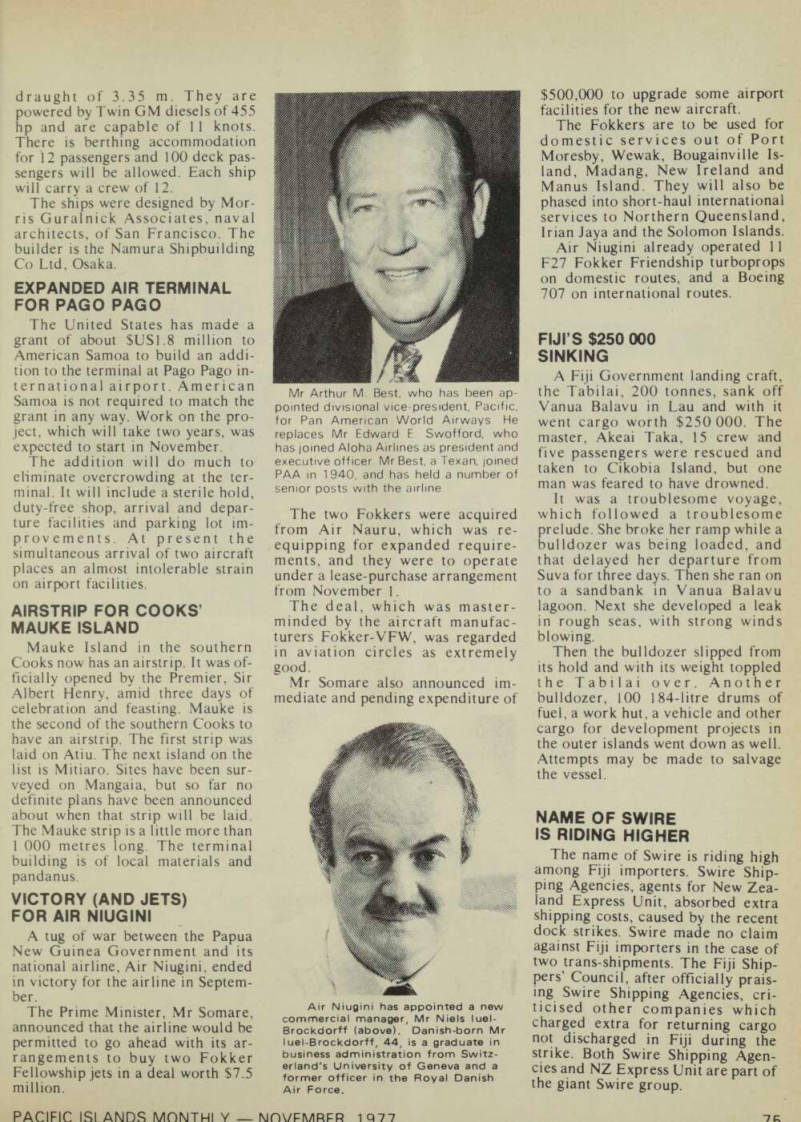
airlines in new Pacific war
Continental Airlines will fly the US-South Pacific route in 1978 in the face of opposition by Pan Ameri can World Airways, supported by Qantas and the Australian Govern ment. Qantas has filed an appeal with the US Civil Aeronautics Board in support of an earlier ap peal presented by Pan Am against award of the route to Continental.
The Australian Transport Minis ter, Mr Peter Nixon, would stop the Continental service if he could, but under the terms of the US-Australia air agreement there is nothing he can do to veto a decision made by President Carter. But he may be able to make things a little awkward for Continental as Australia has a say in the frequency of the service and the type of aircraft used.
The final decision in the award of air routes always rests with the US President, no matter what the CAB recommends. Both PAA and Conti nental, who fought each other hard for the Saipan-Japan route, know this only too well.
PAA, during drawn-out pro cedures before the matter finally went to President Carter, threatened to cut back flights to the South Pacific if a second US carrier was allowed on the route. It has now shifted ground because of the suc cess of its SP long-range jumbo jet on non-stop flights across the Pacific.
But at the time it made its threat to cut back, the CAB noted that it would withdraw two Boeing 727 services. That would be almost offset by four DCIO services plann
ed by Continental, which would represent a net gain of 10% in US carrier capacity on the Pacific route, with two PAA services out.
PAA forecast that with an in crease in capacity with Continental in the market and no cutback in PAA services, Australia would de mand capacity ceilings on US ser vices.
This could well be where Mr Nix on comes in. He is afraid there could be a repeat of the unsatisfac tory situation which developed when American Airlines came into the service. While Continental might generate some new traffic, he was far from satisfied it would be enough to use the capacity which would become available with Conti nental on the route.
Mr Nixon said one of his prin cipal concerns was the loss of oppor tunity for reduction of passenger fares and freight rates if the airlines flew an increasing number of empty seats across the Pacific. As fossil fuels became more expensive, there would be an increased need to en sure capacity was fully maintained.
He regards those matters as serious, which may well have to be taken up with “American friends”.
With US politics being what they are it is hard to see President Carter reversing his decision. After all, President Johnson back in the 1960 s gave tentative approval for Conti nental to fly the route as the second US carrier. President Nixon on coming into office in 1969 overturn ed President Johnson’s decision, and awarded the route to American Airlines, with disastrous financial results. If President Carter stands firm, and remains in office for the two terms he is allowed under the US constitution, then Continental is safe till 1985 at least.
• The first Air Pacific flight with an all-Fiji-born crew was between Suva and Nadi with Captain Kava Konrote at the helm. The first of ficer was Bill Gardiner and the flight stewardesses were Christina Hicks and Samanunu Waqanivalu.
Captain Konrote, 28, qualified for his commercial pilot’s licence at the Oxford Air Training School in Eng land in 1971, and has been flying with Air Pacific ever since.
Micronesia Gets First
Of Its Seven “Micros”
The first of seven new ships or dered in Japan for field work in the US Trust Territory was expected to arrive in November and to go into service in the Marshalls. It was a replacement for the Truk Trader, which was overdue for dry-docking.
The new ship, like the six which will follow it at intervals over the next 18 months, is a “Micro” the Micro Chief. The other ships, ex pected dates of delivery, districts in which they will work and the ships they replace, are; Micro Trader, February, 1978, Truk, Ran Annim; Micro Spirit, May, 1978, Yap, Yap Islander; Micro Pilot, August, 1978, Marshalls, Robert Deßrum; Micro Dawn, November, 1978, Truk, James Cook; Micro Glory, Janu ary/February, 1979, Ponape, Kasekehlia; Micro Palm, March, 1979, Marshalls, Militobi.
Each ship will cost about SUSI. 9 million. Each is 56.4 m in length overall, with a 10.02 m beam, 4.6 m deep, and will have a maximum dis placement of 1 220 tonnes on a
Captain Kava Konrote
draught of 3.35 m. They are powered by Twin GM diesels of 455 hp and are capable of 11 knots.
There is berthing accommodation for 12 passengers and 100 deck pas sengers will be allowed. Each ship will carry a crew of 12.
The ships were designed by Mor ris Guralnick Associates, naval architects, of San Francisco. The builder is the Namura Shipbuilding Co Ltd, Osaka.
Expanded Air Terminal
For Pago Pago
The United States has made a grant of about SUSI.B million to American Samoa to build an addi tion to the terminal at Pago Pago in ternational airport. American Samoa is not required to match the grant in any way. Work on the pro ject, which will take two years, was expected to start in November.
The addition will do much to eliminate overcrowding at the ter minal. It will include a sterile hold, duty-free shop, arrival and depar ture facilities and parking lot im provements. At present the simultaneous arrival of two aircraft places an almost intolerable strain on airport facilities.
Airstrip For Cooks’
Mauke Island
Mauke Island in the southern Cooks now has an airstrip. It was of ficially opened by the Premier, Sir Albert Henry, amid three days of celebration and feasting. Mauke is the second of the southern Cooks to have an airstrip. The first strip was laid on Atiu. The next island on the list is Mitiaro. Sites have been sur veyed on Mangaia, but so far no definite plans have been announced about when that strip will be laid.
The Mauke strip is a little more than 1 000 metres long. The terminal building is of local materials and pandanus.
Victory (And Jets)
For Air Niugini
A tug of war between the Papua New Guinea Government and its national airline, Air Niugini, ended in victory for the airline in Septem ber.
The Prime Minister, Mr Somare, announced that the airline would be permitted to go ahead with its ar rangements to buy two Fokker Fellowship jets in a deal worth $7.5 million.
The two Fokkers were acquired from Air Nauru, which was re equipping for expanded require ments, and they were to operate under a lease-purchase arrangement from November 1.
The deal, which was master minded by the aircraft manufac turers Fokker-VFW, was regarded in aviation circles as extremely good.
Mr Somare also announced im mediate and pending expenditure of
$500,000 to upgrade some airport facilities for the new aircraft.
The Fokkers are to be used for domestic services out of Port Moresby, Wewak, Bougainville Is land, Madang, New Ireland and Manus Island. They will also be phased into short-haul international services to Northern Queensland, Irian Jaya and the Solomon Islands.
Air Niugini already operated 11 F 27 Fokker Friendship turboprops on domestic routes, and a Boeing 707 on international routes.
Fiji’S $250 000
Sinking
A Fiji Government landing craft, the Tabilai, 200 tonnes, sank off Vanua Balavu in Lau and with it went cargo worth $250 000. The master, Akeai Taka, 15 crew and five passengers were rescued and taken to Cikobia Island, but one man was feared to have drowned.
It was a troublesome voyage, which followed a troublesome prelude. She broke her ramp while a bulldozer was being loaded, and that delayed her departure from Suva for three days. Then she ran on to a sandbank in Vanua Balavu lagoon. Next she developed a leak in rough seas, with strong winds blowing.
Then the bulldozer slipped from its hold and with its weight toppled the Tabilai over. Another bulldozer, 100 184-litre drums of fuel, a work hut, a vehicle and other cargo for development projects in the outer islands went down as well.
Attempts may be made to salvage the vessel.
Name Of Swire
Is Riding Higher
The name of Swire is riding high among Fiji importers. Swire Ship ping Agencies, agents for New Zea land Express Unit, absorbed extra shipping costs, caused by the recent dock strikes. Swire made no claim against Fiji importers in the case of two trans-shipments. The Fiji Ship pers’ Council, after officially prais ing Swire Shipping Agencies, cri ticised other companies which charged extra for returning cargo not discharged in Fiji during the strike. Both Swire Shipping Agen cies and NZ Express Unit are part of the giant Swire group.
Mr Arthur M Best, who has been ap pointed divisional vice-president. Pacific, for Pan American World Airways He replaces Mr Edward E Swofford, who has joined Aloha Airlines as president and executive officer Mr Best, a Texan, joined PAA in 1940, and has held a number of senior posts with the airline
Air Niugini has appointed a new commercial manager, Mr Niels luel- Brockdorff (above). Danish-born Mr luel-Brockdorff, 44, is a graduate in business administration from Switz erland's University of Geneva and a former officer in the Royal Danish Air Force.
Fiji Authority Offsets Dockers’ Wage Rise
The Ports Authority of Fiji moved quickly to recover higher costs following a rise in wages granted to dock workers by Mr Ramanlal Kapadia, who was arbitrator in a dispute between the authority and dock workers. A rise of 10% in the pay of permanent dockers, plus an extra $4 a week as a containerised cargo allowance, was expected to send the annual wages bill of the authority up to $1.65 million from $1.5 million The authority imposed an extra $1 levy on each tonne of cargo
handled on overseas ships. That in crease, with better use of port facili ties, would make the increase in overhead costs insignificant.
To cover the cost of a mechanisa tion allowance of $4 a week and 75c for casual dockers, the container levy was increased from $1 to $1.50 a tonne and the pallet levy from 30c to 50c a tonne, The effect of Mr Kapadia’s award was to increase the weekly wage of a permanent registered docker from $4B to $54 and the actual average from $55 to $66.53.
Advertisements & other items, pp. 74-76 (2 items)
Bridgestone specializes
in Value and Variety
What's the value of variety? Well, suppose you need some new tires for your car, motorcycle, bus, truck, jumbo jet. You know there are more than 3,000 different sizes, types and tread patterns for every road and driving condition. If your dealer only has a few in stock, he'll ask you to settle for the nearest thing he can supply.
Your Bridgestone man has the full Bridgestone range at his fingertips in over 130 countries worldwide. When you need a tire. he'll get you that tire.
And what does Bridgestone value mean?
It means that with every Bridgestone tire you get built-in safety and durability-results of the Bridgestone research efforts that are behind exciting new breakthroughs like extrastrong jumbo jet tires, steel radial types that defy punctures and take extra-economy retread after retread and off-the-road tires that include the biggest model ever made.
If it's a tire, Bridgestone builds it—better.
(es? BRIDGESTONE
I TOKYO, JAPAN
RIDRESTONE DISTRIBUTORS IN THE PACIFIC AREA —— ... A "i Australia: Marubeni-Bridgestone Tyres 1N.5.W.1 Pty. Ltd./Kingstone Tire Agency Pty, ' " ty, Ltd./Bridgestone Tyres (OLD.) Pty. Ltd./Maruben, -Bridgestone Tyres (S.A.I^J£? u * J.G.G. Trading Company/Lae Tyre Service/Madang Tyre Serv.ee/Moresby Tyre■ 'ieta Tyre Service New Zealand: Bridgestone Tyres (N.Z.) Ltd. Fiji Caines Tire Ltd. Solomon Islands: 'ransport Co., Ltd. New Hebrides: Fung Kuei New Caledon.: Pacific '-port Export Co Ud So \ce Trading & Service Guam: Lujan Tire Shop American Samoa.G.H.C. Reid St Lo„ Lta./na.ec fah iti:Tahiti Automoto. Norfolk Islands: Martins Agencies Ltd.
* K I i» Ki V/ **• ■ \ h The world over, more vehicles of all kinds roll on Goodyear tyres ... more planes land on Goodyear tyres ... more synthetic rubber is produced by Goodyear... and more different kinds of hose, transmission belts, conveyor belts and other industrial rubber goods bear the Goodyear trademark.
For leadership in rubber technology, look to Goodyear. The world s largest rubber company.
GOODfYEAR
We solve industrial problems.
GOODYEAR DISTRIBUTORS IN S.E. ASIA AND PACIFIC BASIN.
Richard Pieris & Co.. Ltd.
Colombo, SRI LANKA Nepal Motor Company (P) Ltd.
Biratnagar. NEPAL Navana Ltd.
Dacca, BANGLADESH
Diethelm & Co., Ltd.
Bangkok. THAILAND Landis Brothers & Co. Ltd.
HONG KONG
Guam Tire & Supply Co.
Agana. GUAM Susupe Enterprises Saipan. MARIANA IS.
Nicrol Corporation Saipan. MARIANA IS Truk Trading Co.
Truk. E. CAROLINE IS.
PA M I.
Koloma, PONAPE Island Transport Service Co.
Majuro. MARSHALL IS.
Yap Cooperative Ass.
Yap. W. CAROLINE IS.
Cook Islands Motor Centre u>, n i™« nnriK is Ngiratkel Etpizon Co. Ltd.
Korpr. PALAU Boroko Motors Ltd.
Port Moresby. PAPUA NEW GUINEA Solomon Motors Ltd.
Honiara. B.SJ.P
Santo Engineers
Santol NEW HEBRIDES
Pacific Motors
Vila. NEW HEBRIDES
S.G.A.
Noumea. NEW CALEDONIA
Duncombe Bay Garage
NORFOLK IS
Coral Island Motors Suva. FIJI Morris Hedstrom Ltd.
Nukualofa. TONGA Morris Hedstrom Ltd.
Apia. WESTERN SAMOA
W.S.T.C.S.
Apia. WESTERN SAMOA
Samoa Motors Inc
Pago Pago AMERICAN SAMOA
Service Mobil Papeete. TAHITI 171-0140
Pacific Lsi Amds Month! V Nowfmrfr 1 Q 77
Cruising
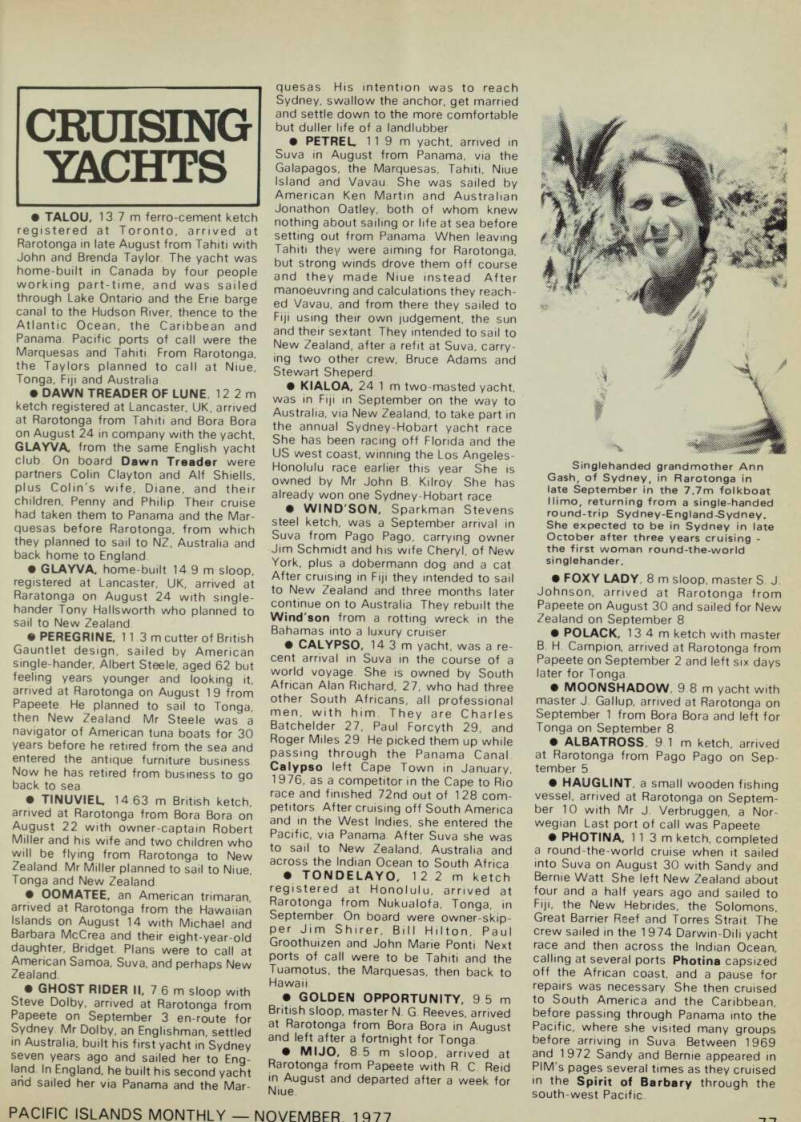
Yachts
• TALOU, 13.7 m ferro-cement ketch registered at Toronto, arrived at Rarotonga in late August from Tahiti with John and Brenda Taylor The yacht was home-built in Canada by four people working part-time, and was sailed through Lake Ontario and the Erie barge canal to the Hudson River, thence to the Atlantic Ocean, the Caribbean and Panama Pacific ports of call were the Marquesas and Tahiti From Rarotonga, the Taylors planned to call at Niue, Tonga, Fiji and Australia • DAWN TREADER OF LUNE, 12 2 m ketch registered at Lancaster, UK, arrived at Rarotonga from Tahiti and Bora Bora on August 24 in company with the yacht, GLAYVA from the same English yacht club On board Dawn Treader were partners Colin Clayton and Alf Shiells, plus Colin's wife, Diane, and their children. Penny and Philip Their cruise had taken them to Panama and the Mar quesas before Rarotonga, from which they planned to sail to NZ, Australia and back home to England • GLAYVA, home-built 14 9 m sloop, registered at Lancaster, UK, arrived at Raratonga on August 24 with single hander Tony Hallsworth who planned to sail to New Zealand • PEREGRINE, 113 m cutter of British Gauntlet design, sailed by American single-hander, Albert Steele, aged 62 but feeling years younger and looking it, arrived at Rarotonga on August 1 9 from Papeete He planned to sail to Tonga, then New Zealand Mr Steele was a navigator of American tuna boats for 30 years before he retired from the sea and entered the antique furniture business Now he has retired from business to go back to sea • TINUVIEL, 14 63 m British ketch, arrived at Rarotonga from Bora Bora on August 22 with owner-captain Robert Miller and his wife and two children who will be flying from Rarotonga to New Zealand Mr Miller planned to sail to Niue, Tonga and New Zealand • OOMATEE, an American trimaran, arrived at Rarotonga from the Hawaiian Islands on August 14 with Michael and Barbara McCrea and their eight-year-old daughter, Bridget Plans were to call at American Samoa, Suva, and perhaps New Zealand • GHOST RIDER 11, 7 6 m sloop with Steve Dolby, arrived at Rarotonga from Papeete on September 3 en-route for Sydney Mr Dolby, an Englishman, settled in Australia, built his first yacht in Sydney seven years ago and sailed her to Eng land In England, he built his second yacht and sailed her via Panama and the Mar
quesas His intention was to reach Sydney, swallow the anchor, get married and settle down to the more comfortable but duller life of a landlubber • PETREL, 119 m yacht, arrived in Suva in August from Panama, via the Galapagos, the Marquesas, Tahiti, Niue Island and Vavau She was sailed by American Ken Martin and Australian Jonathon Oatley, both of whom knew nothing about sailing or life at sea before setting out from Panama When leaving Tahiti they were aiming for Rarotonga, but strong winds drove them off course and they made Niue instead After manoeuvring and calculations they reach ed Vavau, and from there they sailed to Fiji using their own judgement, the sun and their sextant They intended to sail to New Zealand, after a refit at Suva, carry ing two other crew, Bruce Adams and Stewart Sheperd • KIALOA, 24 1 m two-masted yacht, was in Fiji in September on the way to Australia, via New Zealand, to take part in the annual Sydney-Hobart yacht race She has been racing off Florida and the US west coast, winning the Los Angeles- Honolulu race earlier this year She is owned by Mr John B. Kilroy She has already won one Sydney-Hobart race • WIND'SON, Sparkman Stevens steel ketch, was a September arrival in Suva from Pago Pago, carrying owner Jim Schmidt and his wife Cheryl, of New York, plus a dobermann dog and a cat After cruising in Fiji they intended to sail to New Zealand and three months later continue on to Australia They rebuilt the Wind'son from a rotting wreck in the Bahamas into a luxury cruiser • CALYPSO, 14 3 m yacht, was a re cent arrival in Suva in the course of a world voyage She is owned by South African Alan Richard, 27, who had three other South Africans, all professional men, with him They are Charles Batchelder 27, Paul Forcyth 29, and Roger Miles 29 He picked them up while passing through the Panama Canal Calypso left Cape Town in January, 1976, as a competitor in the Cape to Rio race and finished 72nd out of 128 com petitors After cruising off South America and in the West Indies, she entered the Pacific, via Panama After Suva she was to sail to New Zealand, Australia and across the Indian Ocean to South Africa • TONDELAYO, 12 2 m ketch registered at Honolulu, arrived at Rarotonga from Nukualofa, Tonga, in September On board were owner-skip per Jim Shirer, Bill Hilton, Paul Groothuizen and John Marie Ponti Next ports of call were to be Tahiti and the Tuamotus, the Marquesas, then back to Hawaii
• Golden Opportunity, 9 5 M
British sloop, master N. G. Reeves, arrived at Rarotonga from Bora Bora in August and left after a fortnight for Tonga • MIJO, 8 5 m sloop, arrived at Rarotonga from Papeete with R. C. Reid in August and departed after a week for Niue
• FOXY LADY, 8 m sloop, master S. J.
Johnson, arrived at Rarotonga from Papeete on August 30 and sailed for New Zealand on September 8 • POLACK, 13 4 m ketch with master B. H. Campion, arrived at Rarotonga from Papeete on September 2 and left six days later for Tonga • MOONSHADOW. 9 8 m yacht with master J. Gallup, arrived at Rarotonga on September 1 from Bora Bora and left for Tonga on September 8 • ALBATROSS, 9 1 m ketch, arrived at Rarotonga from Pago Pago on Sep tember 5 • HAUGLINT, a small wooden fishing vessel, arrived at Rarotonga on Septem ber 10 with Mr J. Verbruggen, a Nor wegian Last port of call was Papeete
• PHOTINA, 113 m ketch, completed
a round-the-world cruise when it sailed into Suva on August 30 with Sandy and Bernie Watt She left New Zealand about four and a half years ago and sailed to Fiji, the New Hebrides, the Solomons, Great Barrier Reef and Torres Strait The crew sailed in the 1974 Darwin-Dili yacht race and then across the Indian Ocean, calling at several ports Photina capsized off the African coast, and a pause for repairs was necessary She then cruised to South America and the Caribbean, before passing through Panama into the Pacific, where she visited many groups before arriving in Suva Between 1969 and 1972 Sandy and Bernie appeared in PIM s pages several times as they cruised in the Spirit of Barbary through the south-west Pacific
Singlehanded grandmother Ann Gash, of Sydney, in Rarotonga in late September in the 7.7 m folkboat llimo, returning from a single-handed round-trip Sydney-England-Sydney, She expected to be in Sydney in late October after three years cruising the first woman round-the-world singlehander.
Advertisements & other items, p. 78 (2 items)
DAncir ici amhq MOMTHI Y NOVEMBER. 1977
cnncotzl
\ 4 r How it tastes when it gets there depends a lot on the way it goes.
Australian produce. Fresh from the farm.
Meat, vegetables, fruit, seafood. Qantas can get it to Pacific and Southeast Asian markets in less than a day. And get it there in the prime top condition you expect. Unitised, palletised, air cargo Qantas offers you more capacity out of Australia to the world than any other carrier.
And because we’re Australian we can offer advice about where to order, who to order from, how much to pay. Ring Qantas or your Freight Forwarder. We’re always looking for fresh problems to solve.
afiNjrffs f—,
cnncotzl
L81.2846
Bananas, a dying export industry
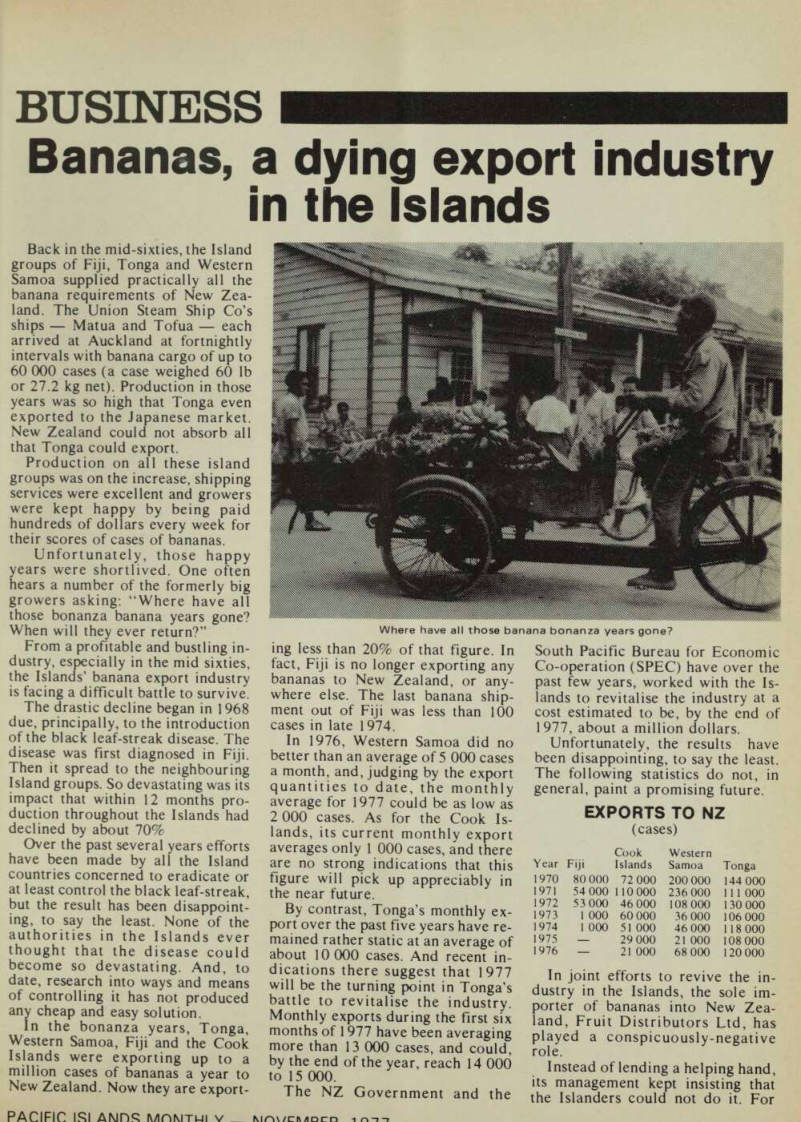
Business
Bananas, a dying export industry in the Islands
Back in the mid-sixties, the Island groups of Fiji, Tonga and Western Samoa supplied practically all the banana requirements of New Zea land. The Union Steam Ship Co’s ships Matua and Tofua each arrived at Auckland at fortnightly intervals with banana cargo of up to 60 000 cases (a case weighed 60 lb or 27.2 kg net). Production in those years was so high that Tonga even exported to the Japanese market.
New Zealand could not absorb all that Tonga could export.
Production on all these island groups was on the increase, shipping services were excellent and growers were kept happy by being paid hundreds of dollars every week for their scores of cases of bananas.
Unfortunately, those happy
years were shortlived. One often hears a number of the formerly big growers asking: “Where have all those bonanza banana years gone?
When will they ever return?”
From a profitable and bustling in dustry, especially in the mid sixties, the Islands’ banana export industry is facing a difficult battle to survive.
The drastic decline began in 1968 due, principally, to the introduction of the black leaf-streak disease. The disease was first diagnosed in Fiji.
Then it spread to the neighbouring Island groups. So devastating was its impact that within 12 months pro duction throughout the Islands had declined by about 70% Over the past several years efforts have been made by all the Island countries concerned to eradicate or at least control the black leaf-streak, but the result has been disappoint ing, to say the least. None of the authorities in the Islands ever thought that the disease could become so devastating. And, to date, research into ways and means of controlling it has not produced any cheap and easy solution.
In the bonanza years, Tonga, Western Samoa, Fiji and the Cook Islands were exporting up to a million cases of bananas a year to New Zealand. Now they are export-
ing less than 20% of that figure. In fact, Fiji is no longer exporting any bananas to New Zealand, or any where else. The last banana ship ment out of Fiji was less than 100 cases in late 1974.
In 1976, Western Samoa did no better than an average of 5 000 cases a month, and, judging by the export quantities to date, the monthly average for 1977 could be as low as 2 000 cases. As for the Cook Is lands, its current monthly export averages only 1 000 cases, and there are no strong indications that this figure will pick up appreciably in the near future.
By contrast, Tonga’s monthly ex port over the past five years have re mained rather static at an average of about 10 000 cases. And recent in dications there suggest that 1977 will be the turning point in Tonga’s battle to revitalise the industry.
Monthly exports during the first six months of 1977 have been averaging more than 13 000 cases, and could, by the end of the year, reach 14 000 to 15 000.
The NZ Government and the
South Pacific Bureau for Economic Co-operation (SPEC) have over the past few years, worked with the Is lands to revitalise the industry at a cost estimated to be, by the end of 1977, about a million dollars.
Unfortunately, the results have been disappointing, to say the least.
The following statistics do not, in general, paint a promising future.
Exports To Nz
In joint efforts to revive the in dustry in the Islands, the sole im porter of bananas into New Zea land, Fruit Distributors Ltd, has played a conspicuously-negative role.
Instead of lending a helping hand, its management kept insisting that the Islanders could not do it. For
Where have all those banana bonanza years gone?
(cases)
Cook Western Year Fiji Islands Samoa Tonga 1970 80 000 72 000 200 000 144 000 1971 54000 110000 236000 111000 1972 53 000 46 000 108 000 130 000 1973 1000 60 000 36 000 106 000 1974 1000 51000 46 000 118 000 1975 — 29000 21000 108000 1976 — 21000 68 000 120 000
Advertisements & other items, p. 79 (1 item)
Pacific Isi Amdfi Momtui V Mav/Ca/Idco Imn
years, therefore, the seller and the buyer could not

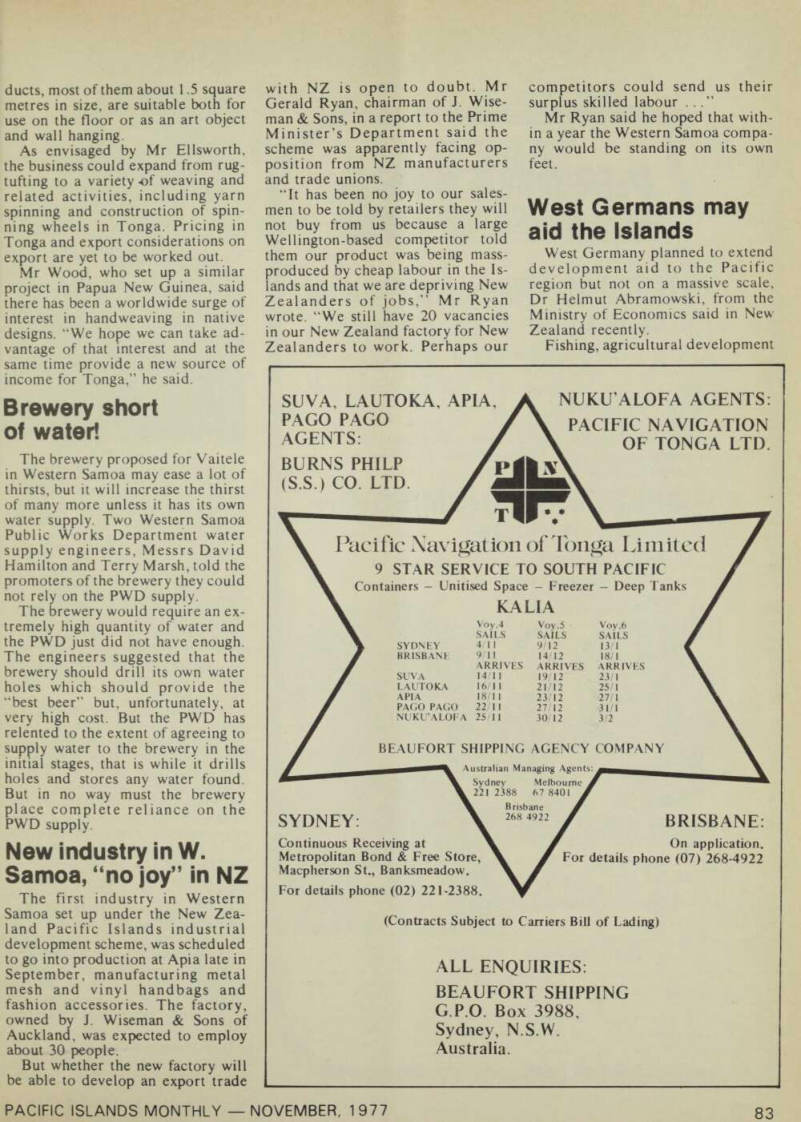
buyer could not, and to a large ex tent, still do not see eye to eye on the issue. Were it not for the NZ Government’s insistence on Fruit Distributors taking all the bananas that the Islands could offer, there would not be a single Island banana on the New Zealand market. Fruit Distributors has often complained and with reason about the Is land banana’s quality.
Fortunately, however, there ap pear to be some definite changes in the outlook of Fruit Distributors Ltd towards Island bananas, and the Islanders are now quite optimistic about the future, at least as far as both parties getting down to looking at the problems seriously.
Perhaps the greatest problem at the moment is lack of proper farm management by the Island growers.
Productivity is still only about one half and, in some instances, even less than what could be achieved.
The Island growers are, by and large, still treating the industry as an extension of the traditional sub sistence farming complex.
They have still to grasp fully the need to look at the industry on a commercial basis.
The other major problem is the comparatively low price now being paid to the growers. Fruit Distribu tors are not prepared to increase the current fob price of NZ6c lb. The retail price on the New Zealand market is about 28c lb. The shipping company, which will never lose on the deal, gets roughly 3c lb in freight the same as the grower gets after paying for his packaging materials and transport. When the grower takes out his labour costs etc he is lucky to come out with 1c lb in his pocket.
So it’s high time the NZ Govern ment and the Island governments seriously considered this unfair situation. One can be excused for referring to it as exploitation. The Island growers would not be over paid at 10c lb fob, and the com paratively wealthy Kiwi consumers can more than afford such a price.
Such a step would be much more effective in helping to develop the Island economies than some of the aid schemes being funded by the NZ taxpayers.
A rise in price and a much more stringent standard of quality of bananas are the key things needed to infuse new life into the industry.
A Stabex transfer
for Tonga
Under the Lome Convention, Tonga will receive almost $1 million from the Common Market to help stabilise the kingdom’s ex port earnings.
This money will certainly be a welcome windfall for the growers and one hopes that such transfers will continue for the primary pro ducers of the South Pacific like other private producers in all developing countries, have been bearing the brunt of the recent eco nomic recession.
It would also be a welcome move, politically as well as morally, for the two senior members of the South Pacific Forum, Australia and New Zealand, to consider seriously the idea of a Common Fund for the South Pacific countries, along the lines of the Lome Convention, writes a Tonga correspondent.
Development bank
poured out the money
The Fiji Development Bank lent money at the rate of more than $1 million a month in 1976-77 to help finance a number of agricultural and industrial projects. There were 1 480 loans totalling $B.l million for agriculture, which included $4.4 million for the new sugarcane pro ject at Seaqaqa in Vanua Levu.
Industrial loans totalled $4.4 million spread over 404 accounts.
Included were 296 loans, totalling $1.6 million, made under the Com mercial and Industrial Loans to the Fijians’ Scheme. Loans under this scheme now total 428 and involve $2.6 million.
Mr Lloyd Guthrey, managing director of the bank, said the board was pleased with the growth of busi ness during the year. There was a net profit of $4O 856 for the year.
Jaycees’ congress
meets in Noumea
The ORSTOM auditorium in Noumea was the seat of this year’s National Congress of the Junior Chamber of France. More than 400 delegates attended, including Jean Seraqui, a Noumea doctor who is the present International Vice- President. The congress approved the creation of the Junior Chamber of Lifou, one of the three Loyalty Is lands.
ftuarri' Qmilinn all uuam. smiling dll
the way to the exit
G uam’s al i en construct ion workers may become extinct in a few years, but they will be better paid along the road to their extinction.
After a long series of proposals and counter-proposals between the US Department of Labour and the government of Guam, a compromise plan has been agreed upon to make construction industry wages more attractive to Guam citizens and train them in construction trades.
Under the plan, effective im-
mediately, alien construction workers mostly from the Philip pines and South Korea received about a 30% hourly wage increase in September. They will receive other increases every six months un til September, 1979, when their wages will have doubled over pre sent rates.
The average hourly wage for the alien workers now is U 553.25. by the end of the two-year programme, the wage average will be about $7 an hour.
The original US plan was to dou ble the wages immediately. Guam officials reacted in outrage, afraid that the overnight action would
force local contractors out of busi ness, nearly double the cost of hous ing and generally spur heavy infla tion, possibly harmful to Guam’s fragile tourist industry which is at tempting to compete with high value destinations such as the Philippines and Taiwan.
Guam Governor Ricky Bordallo, Guam Legislature Speaker Joseph Ada and local businessmen took their case to Washington, DC and appeared pleased with the com promise.
“By going this route,” Ada said, “our economy will be able to adjust itself gradually to the increase.”
Ada added. “It will give local construction companies a chance to breathe so they can re-direct their efforts.”
To accompany the wage increases, the US will fund a major training programme on the island to prepare Guam citizens for construction jobs.
A total of $3.8 million will be spent in the effort to train 1 500 construc tion workers and another 500-700 tourism industry workers.
Explaining the US Labour Department’s actions,a federal offi cial said; “It is quite obvious alien wage rates are artificially held down, and they depress the entire wage structure.”
Tufted Tongan tapa
design rugs?
Rugs tufted in Tongan tapa designs may soon be in production in Nukualofa through a feasibility project now under way. John Ellsworth, an Australian busi nessman, arrived in the kingdom in late August with a shipment of yarn, rug-tufting tools, canvas, latex and other equipment. Frames for the tufting were built by the Tonga Con struction Company.
Frank Wood, technical manager on loan from the Australian Wool Corporation, and Barbara Taylor, Ellsworth’s partner, also came to work on the project.
With the help of the Hon Baron Vaea, Minister of Labour, Com merce and Industries, the three set up in a local youth hall, where in terested women were invited to try tufting and designing their own rugs.
About 12 rugs, in tapa designs and other geometric patterns, were finished in time to be displayed at the annual Agricultural Show in early September. The finished pro
ducts, most of them about 1.5 square metres in size, are suitable both for use on the floor or as an art object and wall hanging.
As envisaged by Mr Ellsworth, the business could expand from rug tufting to a variety -of weaving and related activities, including yarn spinning and construction of spin ning wheels in Tonga. Pricing in Tonga and export considerations on export are yet to be worked out.
Mr Wood, who set up a similar project in Papua New Guinea, said there has been a worldwide surge of interest in handweaving in native designs. “We hope we can take ad vantage of that interest and at the same time provide a new source of income for Tonga,” he said.
Brewery short
of water!
The brewery proposed for Vaitele in Western Samoa may ease a lot of thirsts, but it will increase the thirst of many more unless it has its own water supply. Two Western Samoa Public Works Department water supply engineers, Messrs David Hamilton and Terry Marsh, told the promoters of the brewery they could not rely on the PWD supply.
The brewery would require an ex tremely high quantity of water and the PWD just did not have enough.
The engineers suggested that the brewery should drill its own water holes which should provide the “best beer” but, unfortunately, at very high cost. But the PWD has relented to the extent of agreeing to supply water to the brewery in the initial stages, that is while it drills holes and stores any water found.
But in no way must the brewery place complete reliance on the PWD supply.
New industry in W.
Samoa, “no joy’’ in NZ
The first industry in Western Samoa set up under the New Zea land Pacific Islands industrial development scheme, was scheduled to go into production at Apia late in September, manufacturing metal mesh and vinyl handbags and fashion accessories. The factory, owned by J. Wiseman & Sons of Auckland, was expected to employ about 30 people.
But whether the new factory will be able to develop an export trade
with NZ is open to doubt. Mr Gerald Ryan, chairman of J. Wise man & Sons, in a report to the Prime Minister’s Department said the scheme was apparently facing op position from NZ manufacturers and trade unions.
“It has been no joy to our sales men to be told by retailers they will not buy from us because a large Wellington-based competitor told them our product was being mass produced by cheap labour in the Is lands and that we are depriving New Zealanders of jobs,” Mr Ryan wrote. "We still have 20 vacancies in our New Zealand factory for New Zealanders to work. Perhaps our
competitors could send us their surplus skilled labour . .."
Mr Ryan said he hoped that with in a year the Western Samoa compa ny would be standing on its own feet.
West Germans may
aid the Islands
West Germany planned to extend development aid to the Pacific region but not on a massive scale, Dr Helmut Abramowski, from the Ministry of Economics said in New Zealand recently.
Fishing, agricultural development
and mining were some of the areas where investigations were under way, he added.
Dr Abramowski was speaking at a press conference given for the West German Economics Minister, Dr Hans Friderichs, following the Ger man delegation’s talks with Prime Minister Mr Robert Muldoon.
Dr Abramowski named Samoa, Tonga, Fiji and Papua New Guinea where something would be done but he stressed Germany’s financial limitations on its aid programme in the area. Apart from the financial limitation, there was the problem of the ability of the countries receiving aid to absorb the projects.
“The country which asks for such aid must develop a certain maturity in projects and that, of course, is sometimes difficult,” he said. Some feasibility work was necessary before reaching any financial deci sion.
Dr Abramowski added that West German private businesses were also interested in the Pacific region.
Mr. S. Ravaghan Mr S. Ravaghan has been ap pointed to the new post of Secretary to Tonga’s Ministry of Labour, Commerce and Industries. An In dian national on loan to the kingdom from the Indian Technical
Economic Co-operation (ITEC)
programme, Mr Ravaghan will be replaced in the post in July 1978 by Mr Steven Vete, who is at present assistant secretary to the ministry.
Advertisements & other items, pp. 80-84 (2 items)
ici amhq iwinMTHl Y NOVEMBER, 1977
One good Scotch
*#• Fine Old Scotch Whisky
00% SCOTCH WHISKIES
White Horse
Fine Old Scotch Whisky.
deserves another.
SCOTCH WHISKY
wm m 1 MB The White Horse Cellar EsUb 1742
Logan De Luxe
ScotchWhisky.
PAPUA NEW GUINEA
ECONOMIC DEVELOPMENT PROSPECTS
INVESTMENT OPPORTUNITIES
TRADING AND MARKET POTENTIALS
POLITICAL ASSESSMENT
Economic Research Unit has just published a new, completely updated edition of its well-received 1975 report on the economic and political outlook for Papua New Guinea It takes into account the recent election results, changing government policies, and current trends in world markets for the country's primary products This report will provide a down-to-earth guide for organisations with an existing or potential interest in this newly emerging nation Cost of the report is $B5 and a descriptive brochure is available on request Interested subscribers are invited to contact Mr Terry Heap, Managing Director,
Economic Research Unit Pty Ltd,
18 Armstrong Street, Middle Park, Vic 3206 Telephone; 639 3977 Telex: AA 34247 Consultants to Government and Industry.
STOP THIEF!
W |TH Q
Automark
GTA 417
WINDOW ETCHING
TRANSFERS
Every day goods are stolen, Automark protects by etching letters and figures onto any glass.
Each kit contains 18 letters & 18 figures $4.75 including postage, (ie. 6 sets of each).
SO SIMPLE TO APPLY NAME
Moisten the chemically impregnated self-etching transfer, to the glass ADDRESS, and leave for three minutes. Remove transfer and clean.
Glass is PERMANENTLY ENGRAVED.
SEND TO: Letters & figures required:
AUTOMARK
1/32 MARAU CRESCENT,
MISSION BAY,
AUCKLAND, NEW ZEALAND.
SUVA, LAUTOKA, APIA,
PAGO PAGO
AGENTS:
BURNS PHILP
(S.S.) CO. LTD.
NUKU ALOFA AGENTS:
PACIFIC NAVIGATION
OF TONGA LTD.
\icific Navigation of Tonga Limited
9 STAR SERVICE TO SOUTH PACIFIC
Containers Unitised Space - Freezer Deep Tanks
KALI A
BEAUFORT SHIPPING AGENCY COMPANY
Australian Managing Agents: Sydney Melbourne 221 2388 67 8401 Brisbane
BRISBANE:
On application.
For details phone (07) 268-4922
SYDNEY:
Continuous Receiving at Metropolitan Bond & Free Store Macpherson St., Banksmeadow.
For details phone (02) 221-2388. 268 4922 (Contracts Subject to Carriers Bill of Lading)
ALL ENQUIRIES:
BEAUFORT SHIPPING
G.P.O. Box 3988, Sydney, N.S.W.
Australia.
ANDREWS &
BE AVEN LTD
INDUSTRIAL TRANSMISSION
suppliers to the Pacific Basin !
For many years, Andrews & Beaven have been supplying the power transmission needs of New Zealand industry. Today they are geared to meet the demands of industrial development throughout the Pacific Basin.
From Gear boxes to Flexible couplings, Andrews & Beaven manufacture a wide range of power transmission components. Their modern, sophisticated plant ensures consistent accuracy of all components and complete dependability.
COMPLETE TRANSMISSION
RANGE
• Transmission Gearboxes • Conveyor Equipment • Transmission Bearings • Flexible Couplings S . t it For further information and full product list MAIL THIS COUPON Andrews & Beaven Ltd. Transmission Division Private Bag, Christchurch, N.Z.
Please mail by return post details and full product list of Power Transmission Equipment.
Name Company . .
Full Address
Noumea: The end of
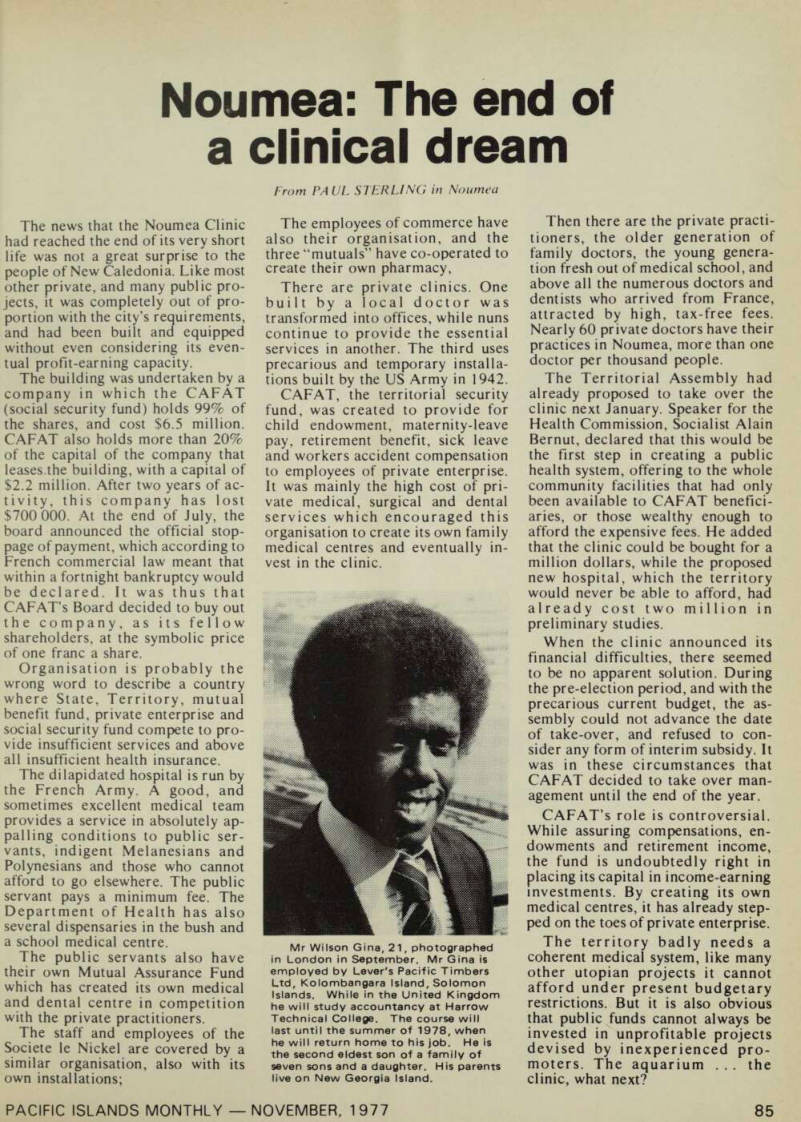
a clinical dream
From PAUL STERLING in Noumea
The news that the Noumea Clinic had reached the end of its very short life was not a great surprise to the people of New Caledonia. Like most other private, and many public pro jects, it was completely out of pro portion with the city’s requirements, and had been built and equipped without even considering its even tual profit-earning capacity.
The building was undertaken by a company in which the CAFAT (social security fund) holds 99% of the shares, and cost $6.5 million.
CAFAT also holds more than 20% of the capital of the company that leases.the building, with a capital of $2.2 million. After two years of ac tivity, this company has lost $7OO 000. At the end of July, the board announced the official stop page of payment, which according to French commercial law meant that within a fortnight bankruptcy would be declared. It was thus that CAFAT’s Board decided to buy out the company, as its fellow shareholders, at the symbolic price of one franc a share.
Organisation is probably the wrong word to describe a country where State, Territory, mutual benefit fund, private enterprise and social security fund compete to pro vide insufficient services and above all insufficient health insurance.
The dilapidated hospital is run by the French Army. A good, and sometimes excellent medical team provides a service in absolutely ap palling conditions to public ser vants, indigent Melanesians and Polynesians and those who cannot afford to go elsewhere. The public servant pays a minimum fee. The Department of Health has also several dispensaries in the bush and a school medical centre.
The public servants also have their own Mutual Assurance Fund which has created its own medical and dental centre in competition with the private practitioners.
The staff and employees of the Societe le Nickel are covered by a similar organisation, also with its own installations;
The employees of commerce have also their organisation, and the three “mutuals” have co-operated to create their own pharmacy, There are private clinics. One built by a local doctor was transformed into offices, while nuns continue to provide the essential services in another. The third uses precarious and temporary installa tions built by the US Army in 1942.
CAFAT, the territorial security fund, was created to provide for child endowment, maternity-leave pay, retirement benefit, sick leave and workers accident compensation to employees of private enterprise.
It was mainly the high cost of pri vate medical, surgical and dental services which encouraged this organisation to create its own family medical centres and eventually in vest in the clinic.
Then there are the private practi tioners, the older generation of family doctors, the young genera tion fresh out of medical school, and above all the numerous doctors and dentists who arrived from France, attracted by high, tax-free fees.
Nearly 60 private doctors have their practices in Noumea, more than one doctor per thousand people.
The Territorial Assembly had already proposed to take over the clinic next January. Speaker for the Health Commission, Socialist Alain Bernut, declared that this would be the first step in creating a public health system, offering to the whole community facilities that had only been available to CAFAT benefici aries, or those wealthy enough to afford the expensive fees. He added that the clinic could be bought for a million dollars, while the proposed new hospital, which the territory would never be able to afford, had already cost two million in preliminary studies.
When the clinic announced its financial difficulties, there seemed to be no apparent solution. During the pre-election period, and with the precarious current budget, the as sembly could not advance the date of take-over, and refused to con sider any form of interim subsidy. It was in these circumstances that CAFAT decided to take over man agement until the end of the year.
CAFAT’s role is controversial.
While assuring compensations, en dowments and retirement income, the fund is undoubtedly right in placing its capital in income-earning investments. By creating its own medical centres, it has already step ped on the toes of private enterprise.
The territory badly needs a coherent medical system, like many other utopian projects it cannot afford under present budgetary restrictions. But it is also obvious that public funds cannot always be
invested in unprofitable projects
devised by inexperienced pro moters. The aquarium . . . the clinic, what next?
Mr Wilson Gina, 21, photographed in London in September. Mr Gina is employed by Lever's Pacific Timbers Ltd, Kolombangara Island, Solomon Islands. While in the United Kingdom he will study accountancy at Harrow Technical College. The course will last until the summer of 1978, when he will return home to his job. He is the second eldest son of a family of seven sons and a daughter. His parents live on New Georgia Island.
Somare talks tough
on statutory bodies
Some statutory authorities in Papua New Guinea are to have their powers pruned and could even be abolished altogether if the govern ment considers it could do the work more cheaply and just as effectively.
The Prime Minister, Mr Somare, said this in a September radio inter view broadcast nationally in PNG.
The National Airlines Commis sion (which operates Air Niugini), the National Broadcasting Commis sion and the Housing Commission bore the brunt of Mr Somare’s cri
licism of statutory bodies. Earlier, in his budget sp * ech Mr So mare had hinted at greater direct control over the affairs of statutory authori ties. He referred to “pulling them ‘ n to line”.
But his broadcast showed that he was angry at what he called “em pire-buildmg" in statutory authon ties, and that legislative changes were already under consideration, Mr Somare said; “We don t plan specifically to get rid of them, but as a government we must insist that we control them. And if it comes to the stage where we have to abolish them, then we will abolish them, Mr Somare conceded that no
statutory body appeared to have broken the letter of its charter, but too many major and often expensive decisions had been planned without taking the government into con fidence. Sometimes this had com mitted the government to heavy unexpected expenditure which it could ill afford, or had resulted in policy lines which conflicted with government thinking.
Mr Somare mentioned in particu lar the unilateral decision by the National Broadcasting Commission to commence commercial radio last year and the recent planning by Air Niugini which has committed the government to acquiring two Fok ker F2B jets (see Transport section).
He denied that the government wanted to control the news and comment programmes of the Na tional Broadcasting Commission.
Planning, policy and expenditure were what concerned the govern ment, he said.
He said that Air Niugini’s ar rangements to operate two Fokker jets, a multi-million dollar deal, had been undertaken without govern ment collaboration, but the govern ment had to back the financial ar rangements.
He said steps were now being taken to increase the government’s direct voice in the Air Niugini boardroom. This is understood to be the creation of two specialised directorships one representing the finance ministry and the other the national planning office, which is an arm of the Prime Minister’s
department.
Mr Somare described statutory authorities as part of the bureaucratic concept inherited from Australia, and not always necessarily the best answer to PNG’s requirements.
He said he would not interfere with the Ombudsman Commission which was an office created under the constitution. • Trade between New Zealand and Western Samoa is six-to-one in New Zealand's favour. In 1976, Western Samoa’s exports to NZ were worth T 1.987 million, while in return she bought goods worth T 6.544 million.
But Western Samoa has a favoura ble trade balance with West Germa ny, with exports worth T 1.907 million in 1976 and imports worth T 422 000.
Advertisements & other items, p. 86 (1 item)
New Zealand
THE UNIVERSITY OFSYDNEY
WALTER MERSH STRONG SCHOLARSHIPS
Applications are invited from Papua New Guineans for the above scholarships, which are available either as (a) undergraduate scholarships open to Papua New Guineans who are qualified to matriculate in the University of Sydney or (b) postgraduate research or course work at the University of Sydney.
Further information is available from the Registrar, University of Sydney, NSW 2006, Australia, from whom application forms may be obtained. Applications close on 30 November.
Students applying for undergraduate scholarships must also apply for admission to the University through the Metropolitan Universities Admission Centre by 1 October and lodge a separate application for matriculation status with the Registrar, University of Sydney also by 1 October. (Late applications are accepted up to January on payment of a late fee).
MASSEY UNIVERSITY
New Zealand
CERTIFICATE IN THE TEACHING
OF A SECOND LANGUAGE (ENGLISH)
Teachers of the English language or teachers who use English as the language of instruction for other subjects, may enrol for this special course of study.
AH tuition is by correspondence.
For details, write to: The Department of Modern Languages, Massey University, Palmerston North, New Zealand.
PNG cocoa, coffee slump
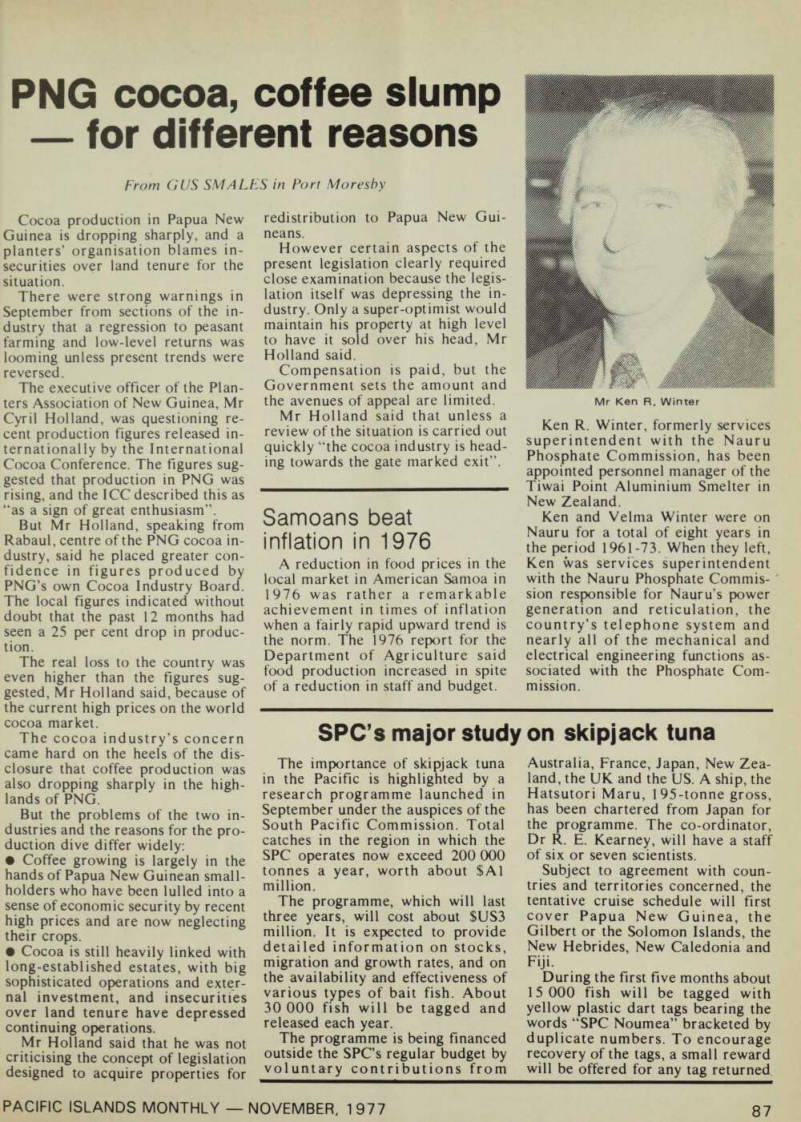
for different reasons
From GUS SMALES in Port Moresby
Cocoa production in Papua New Guinea is dropping sharply, and a planters’ organisation blames in securities over land tenure for the situation.
There were strong warnings in September from sections of the in dustry that a regression to peasant farming and low-level returns was looming unless present trends were reversed.
The executive officer of the Plan ters Association of New Guinea, Mr Cyril Holland, was questioning re cent production figures released in ternationally by the International Cocoa Conference. The figures sug gested that production in PNG was rising, and the ICC described this as “as a sign of great enthusiasm”.
But Mr Holland, speaking from Rabaul, centre of the PNG cocoa in dustry, said he placed greater con fidence in figures produced by PNG’s own Cocoa Industry Board.
The local figures indicated without doubt that the past 12 months had seen a 25 per cent drop in produc tion.
The real loss to the country was even higher than the figures sug gested, Mr Holland said, because of the current high prices on the world cocoa market.
The cocoa industry’s concern came hard on the heels of the dis closure that coffee production was also dropping sharply in the high lands of PNG, But the problems of the two in dustries and the reasons for the pro duction dive differ widely; • Coffee growing is largely in the hands of Papua New Guinean small holders who have been lulled into a sense of economic security by recent high prices and are now neglecting their crops. • Cocoa is still heavily linked with long-established estates, with big sophisticated operations and exter nal investment, and insecurities over land tenure have depressed continuing operations.
Mr Holland said that he was not criticising the concept of legislation designed to acquire properties for
redistribution to Papua New Gui neans.
However certain aspects of the present legislation clearly required close examination because the legis lation itself was depressing the in dustry. Only a super-optimist would maintain his property at high level to have it sold over his head, Mr Holland said.
Compensation is paid, but the Government sets the amount and the avenues of appeal are limited.
Mr Holland said that unless a review of the situation is carried out quickly “the cocoa industry is head ing towards the gate marked exit”.
Samoans beat
A reduction in food prices in the local market in American Samoa in 1976 was rather a remarkable achievement in times of inflation when a fairly rapid upward trend is the norm. The 1976 report for the Department of Agriculture said food production increased in spite of a reduction in staff and budget.
Ken R. Winter, formerly services superintendent with the Nauru Phosphate Commission, has been appointed personnel manager of the Tiwai Point Aluminium Smelter in New Zealand.
Ken and Velma Winter were on Nauru for a total of eight years in the period 1961-73. When they left, Ken was services superintendent with the Nauru Phosphate Commis sion responsible for Nauru’s power generation and reticulation, the country’s telephone system and nearly all of the mechanical and electrical engineering functions as sociated with the Phosphate Com mission.
Mr Ken R. Winter
SPC’s major study on skipjack tuna
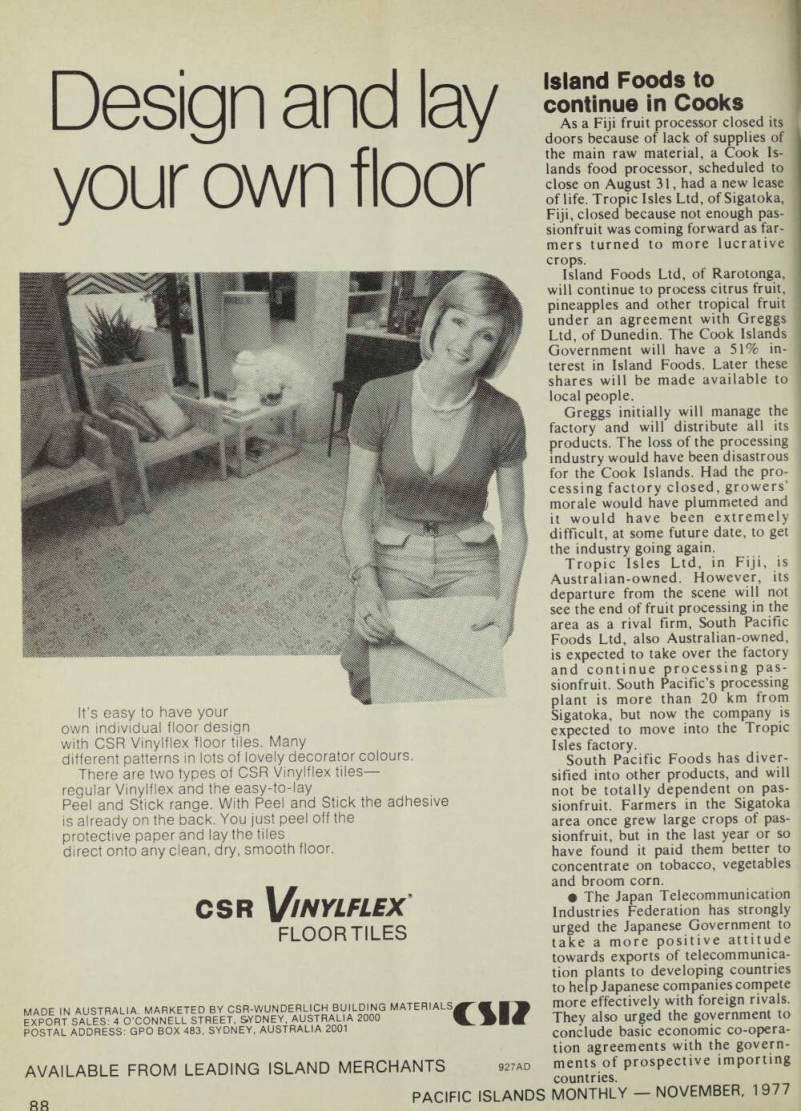
The importance of skipjack tuna in the Pacific is highlighted by a research programme launched in September under the auspices of the South Pacific Commission. Total catches in the region in which the SPC operates now exceed 200 000 tonnes a year, worth about SAI million.
The programme, which will last three years, will cost about SUS 3 million. It is expected to provide detailed information on stocks, migration and growth rates, and on the availability and effectiveness of various types of bait fish. About 30 000 fish will be tagged and released each year.
The programme is being financed outside the SPC’s regular budget by voluntary contributions from
Australia, France, Japan, New Zea land, the UK and the US. A ship, the Hatsutori Maru, 1 95-tonne gross, has been chartered from Japan for the programme. The co-ordinator, Dr R. E. Kearney, will have a staff of six or seven scientists, Subject to agreement with coun tries and territories concerned, the tentative cruise schedule will first cover Papua New Guinea, the Gilbert or the Solomon Islands, the New Hebrides, New Caledonia and Fiji.
During the first five months about 15 000 fish will be tagged with yellow plastic dart tags bearing the words “SPC Noumea” bracketed by duplicate numbers. To encourage recovery of the tags, a small reward will be offered for any tag returned
Island Foods to
continue in Cooks
As a Fiji fruit processor closed its doors because of lack of supplies of the main raw material, a Cook Is lands food processor, scheduled to close on August 31, had a new lease of life. Tropic Isles Ltd, of Sigatoka, Fiji, closed because not enough pas sionfruit was coming forward as far mers turned to more lucrative crops.
Island Foods Ltd, of Rarotonga, will continue to process citrus fruit, pineapples and other tropical fruit under an agreement with Greggs Ltd, of Dunedin. The Cook Islands Government will have a 51% in terest in Island Foods. Later these shares will be made available to local people.
Greggs initially will manage the factory and will distribute all its products. The loss of the processing industry would have been disastrous for the Cook Islands. Had the pro cessing factory closed, growers’ morale would have plummeted and it would have been extremely difficult, at some future date, to get the industry going again.
Tropic Isles Ltd, in Fiji, is Australian-owned. However, its departure from the scene will not see the end of fruit processing in the area as a rival firm, South Pacific Foods Ltd, also Australian-owned, is expected to take over the factory and continue processing pas sionfruit. South Pacific’s processing plant is more than 20 km from Sigatoka, but now the company is expected to move into the Tropic Isles factory.
South Pacific Foods has diver sified into other products, and will not be totally dependent on pas sionfruit. Farmers in the Sigatoka area once grew large crops of pas sionfruit, but in the last year or so have found it paid them better to concentrate on tobacco, vegetables and broom corn. • The Japan Telecommunication Industries Federation has strongly urged the Japanese Government to take a more positive attitude towards exports of telecommunica tion plants to developing countries to help Japanese companies compete more effectively with foreign rivals.
They also urged the government to conclude basic economic co-opera tion agreements with the govern ments of prospective importing countries.
Advertisements & other items, pp. 88-92 (2 items)
Design and lay
your own floor
Wmt-Jk It’s easy to have your own individual floor design with CSR Vinylflex floor tiles. Many different patterns in lots of lovely decorator colours.
There are two types of CSR Vinylflex tiles — regular Vinylflex and the easy-to-lay Peel and Stick range. With Peel and Stick the adhesive is already on the back. You just peel off the protective paper and lay the tiles direct onto any clean, dry, smooth floor.
csr Vinylflex
FLOORTILES
ADE IN AUSTRALIA. MARKETED BY CSR-WUNDERLICH BUILDING MATERIALS XPORT SALES; 4 O’CONNELL STREET, SYDNEY, AUSTRALIA 2000 OSTAL ADDRESS: GPO BOX 483, SYDNEY, AUSTRALIA 2001 (111 AVAILABLE FROM LEADING ISLAND MERCHANTS 92? ad
ri^S
M 4515 K ••• ••• ••• ••• ••• ••• ••• ••• ••• ••• ••• ••• ••• ••• ••• ••• ••• ••• ••• •••a •••a aaaaaaaaaaa • a aaaaaaaaaaaaaaaa aaaaaaaaaaaaaaat M 9950 K M 9980 K aaaaaaaaaaaaaat aaaaaaaaaaaaaaaa aaaaaaaaaaaaaaat tititittittiitt M9980K 4-band stereo radio/cassette with 2-way/ 4-speaker system Sensitive MW/SWI /SW2/FM stereo radio.
You can record with built-in condenser mike. Auto shut-off in record/playback modes, stereo indicator, mechanical pause control, and other features. A massive 5,000mW max. output power from three power sources.
M 9950 K 4-band stereo radio/cassette with 2 speakers Sensitive MW/SWI/SW2/FM stereo radio with LED widen indicator and stereo indicator lamp. With built-in condenser mike, VU/Battery meter. Automatic Level Control (A LC), auto shut-off in play/record and mechanical pause control. Max. 5,000mW output power.
SANYO
SANYO ELECTRIC TRADING CO., LTD.
M4515K 4-band stereo radio/cassette recorder with full auto stop Sensitive MW/SW 1/SW2/FM stereo radio with pinpoint slide rule dialing, fine tuning and stereo indicator. Advanced cassette recorder with built-in condenser mikes, ALC, mechanical pause control.
Power from three power sources with optional adaptor. Max. 5,000mW output.
Sanyo Distributors in South Pacific
AUSTRALIA: Sanyo Guthrie Australia Pty., Ltd. Melbourne, Australia NEW ZEALAND: Autocrat Radio Ltd.
Morris Hedstrom Ltd. Suva, Nadi, Sigatoka, Lautoka, Fiji Auckland, New Zealan J neusirom no. ouva, iNaoi, sigaioka, Lautoka, Fiji PAPUA NEW GUINEA: Breckwoldt & CO., (P.N.G.) Pty., Ltc Port Moresby, Lae, Rabaul, Madang, Kieta, Wewak, Mount Hagen, Papua New Guinea NEW CALEDONIA: Electric Radio No’ume Noumea Cedex New Caledonia FRENCH POLYNESIA: Ets, Lee Sou Papeete, Tahiti NORFORK IS Burns Philp (N. 1.) LU Norfork I NEW HEBRIDES; Lo Lam Store Port-Vila, N.H. NEW HEBRIDES: K.P. Henry Port-Vila, N.H. NEW HEBRIDES: Ah Yuen &C< Santo, N.H. OA: Transpac Corp. Pago Pago A, Samoa W. SAMOA Morris Hedstrom Ltd. Apia W. Samoa TONGA: Tong TradhuTcorn^atift' 1 T ? n . 9a NAURU Nauru Cooperative Society Nauru Is. COOK IS. Cook Island TuvtluVnftnorlt wi d ’i Rar otonga, Cook Is. GILBERT IS Gilbert Islands Development Authority Tarawa, Gilbert Is. TUVALL Tuvalu Cooperative Wholesale Society Ltd. Funafuti. Tuvalu MARIANA IS United Micronesia Development Association Mariana !:
A world in harmony is a big job.
We’re trying to play a small part.
A world working closely together. To benefit all people,everywhere.
At Marubeni, we’re committing our capabilities in total trading on a global scale to help build that world. Overall, it’s a small contribution, but one we feel is significant. Because big jobs are best accomplished when people make a large number of small contributions.
T t.
'tr me '?■ •T-
-ife
m k as r sft B y ; 31
=. 'm.*' XT m - - "-V.
V :C / i T -'- .
I» tm
Come up to kool
The cool refreshing taste of menthol.
L 584
DAIWA LIME
JAPAN-SOUTH PACIFIC REGULAR CONTAINER SERVICE
AUSTRALIA-SOUTH PACIFIC CONTAINER SERVICE
NEW SHIPBUILDINGS "FIJI MARU”
AND "PACIFIC PRINCESS”
MUCH IMPROVED IN SAFETY,
QUICKNESS & ECONOMY
We wish to thank you, all concerned, for your patronage and support rendered to Daiwa Vessels during many past years. As a matter of fact, we are proud of the unique position where we, Daiwa, have contributed to the development and wellbeing of the South Pacific areas.
Taking into consideration many advices received from shippers and consignees and also opinions given by our company's technical staff, we have pursued study from various angles and have now come to the realization of a new shipbuilding "Fiji Mam" and "Pacific Princess"
The vessel is designed for carriage of Motor Vehicles and Containers as well as accepting Bulk and Heavy cargo. You will find the vessel full of originality in construction. Furthermore, various merits of accuracy, safety, speediness and economy are ensured.
By means of putting this vessel in liner service to the South Pacific islands, we are confident that Daiwa can achieve punctuality in sailings and arrivals at ports.
We are awaiting with pleasure your esteemed favour and support of the "Fiji Mam" and "Pacific Princess". Thank you.
Fiji’s “come-on”
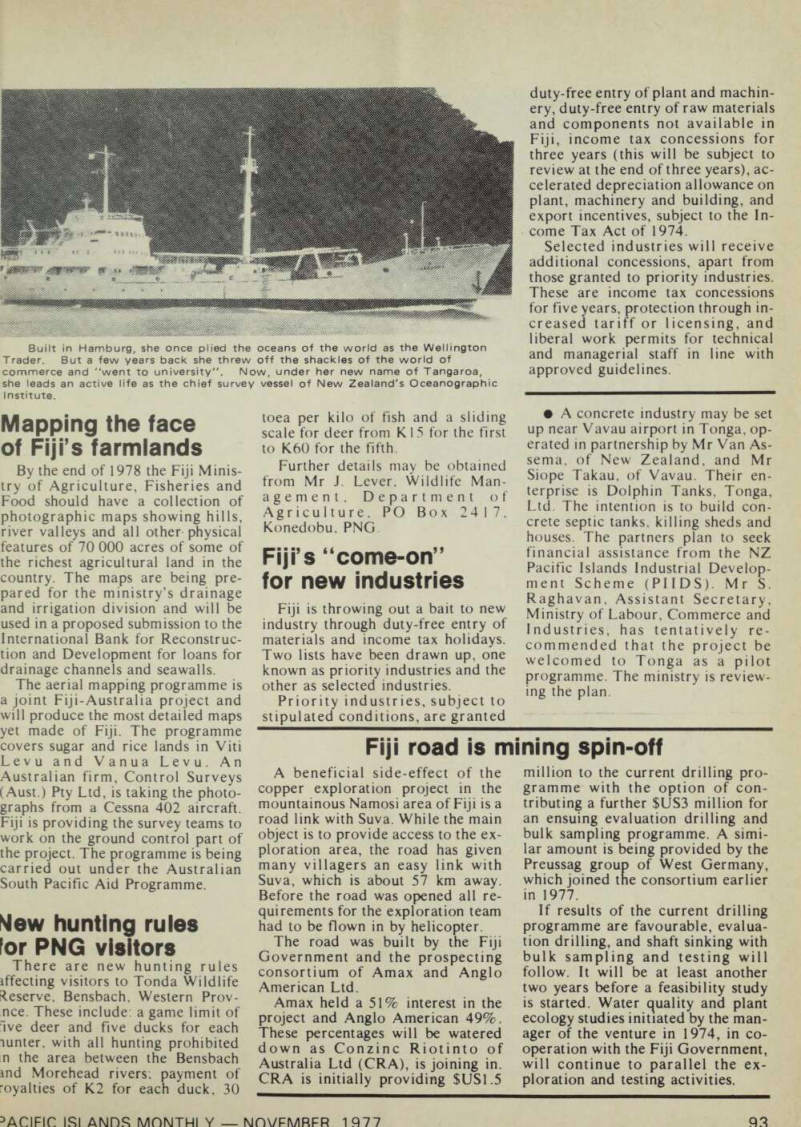
Mapping the face
of Fiji’s farmlands
By the end of 1978 the Fiji Minis try of Agriculture, Fisheries and Food should have a collection of photographic maps showing hills, river valleys and all other physical features of 70 000 acres of some of the richest agricultural land in the country. The maps are being pre pared for the ministry’s drainage and irrigation division and will be used in a proposed submission to the International Bank for Reconstruc tion and Development for loans for drainage channels and seawalls.
The aerial mapping programme is a joint Fiji-Australia project and will produce the most detailed maps yet made of Fiji. The programme covers sugar and rice lands in Viti Levu and Vanua Levu. An Australian firm, Control Surveys (Aust.) Pty Ltd, is taking the photo graphs from a Cessna 402 aircraft.
Fiji is providing the survey teams to work on the ground control part of the project. The programme is being carried out under the Australian South Pacific Aid Programme.
Mew hunting rules
lor PNG visitors
There are new hunting rules iffecting visitors to Tonda Wildlife Reserve. Bensbach, Western Prov nce. These include; a game limit of r ive deer and five ducks for each lunter, with all hunting prohibited n the area between the Bensbach ind Morehead rivers, payment of royalties of K 2 for each duck, 30
toea per kilo of fish and a sliding scale for deer from Kl 5 for the first to K6O for the fifth.
Further details may be obtained from Mr J Lever. Wildlife Management. Department of Agriculture. PO Box 2417.
KnnpHnhu PNir.
Fiji’s “come-on”
for new industries
Fiji is throwing out a bait to new industry through duty-free entry of materials and income tax holidays.
Two lists have been drawn up one known as priority industries and the other as selected industries.
Priority industries, subject to stipulated conditions, are granted
duty-free entry of plant and machin ery, duty-free entry of raw materials and components not available in Fiji, income tax concessions for three years (this will be subject to review at the end of three years), ac celerated depreciation allowance on plant, machinery and building, and export incentives, subject to the In come Tax Act of 1974.
Selected industries will receive additional concessions, apart from those granted to priority industries.
These are income tax concessions for five years, protection through in creased tariff or licensing, and liberal work permits for technical and managerial staff in line with approved guidelines.
• A concrete industry may be set up near Vavau airport in Tonga, op erated in partnership by Mr Van As sema, of New Zealand, and Mr Siope Takau, of Vavau. Their en terprise is Dolphin Tanks, Tonga, Ltd. The intention is to build con crete septic tanks, killing sheds and houses. The partners plan to seek financial assistance from the NZ Pacific Islands Industrial Develop ment Scheme (PUDS). Mr S.
Raghavan, Assistant Secretary, Ministry of Labour, Commerce and Industries, has tentatively re commended that the project be welcomed to Tonga as a pilot programme. The ministry is review ing the plan.
Built in Hamburg, she once plied the oceans of the world as the Wellington Trader. But a few years back she threw off the shackles of the world of commerce and "went to university". Now, under her new name of Tangaroa, she leads an active life as the chief survey vessel of New Zealand's Oceanographic Institute.
Fiji road is mining spin-off
A beneficial side-effect of the copper exploration project in the mountainous Namosi area of Fiji is a road link with Suva. While the main object is to provide access to the exploration area, the road has given many villagers an easy link with Suva, which is about 57 km away.
Before the road was opened all requirements for the exploration team had to be flown in by helicopter.
The road was built by the Fiji Government and the prospecting consortium of Amax and Anglo American Ltd.
Amax held a 51% interest in the project and Anglo American 49%.
These percentages will be watered down as Conzinc Riotinto of Australia Ltd (CRA), is joining in.
CRA is initially providing SUSI.S
million to the current drilling pro gramme with the option of con tributing a further SUS 3 million for an ensuing evaluation drilling and bulk sampling programme. A simi lar amount is being provided by the Preussag group of West Germany, which joined the consortium earlier in 1977.
If results of the current drilling programme are favourable, evalua tion drilling, and shaft sinking with bulk sampling and testing will follow. It will be at least another two years before a feasibility study is started. Water quality and plant ecology studies initiated by the man ager of the venture in 1974, in co operation with the Fiji Government, will continue to parallel the ex ploration and testing activities.
Advertisements & other items, p. 93 (1 item)
93
PACIFIC ISI ANDR MONTHI V NDVFMRFFi 1 P 77
Produce
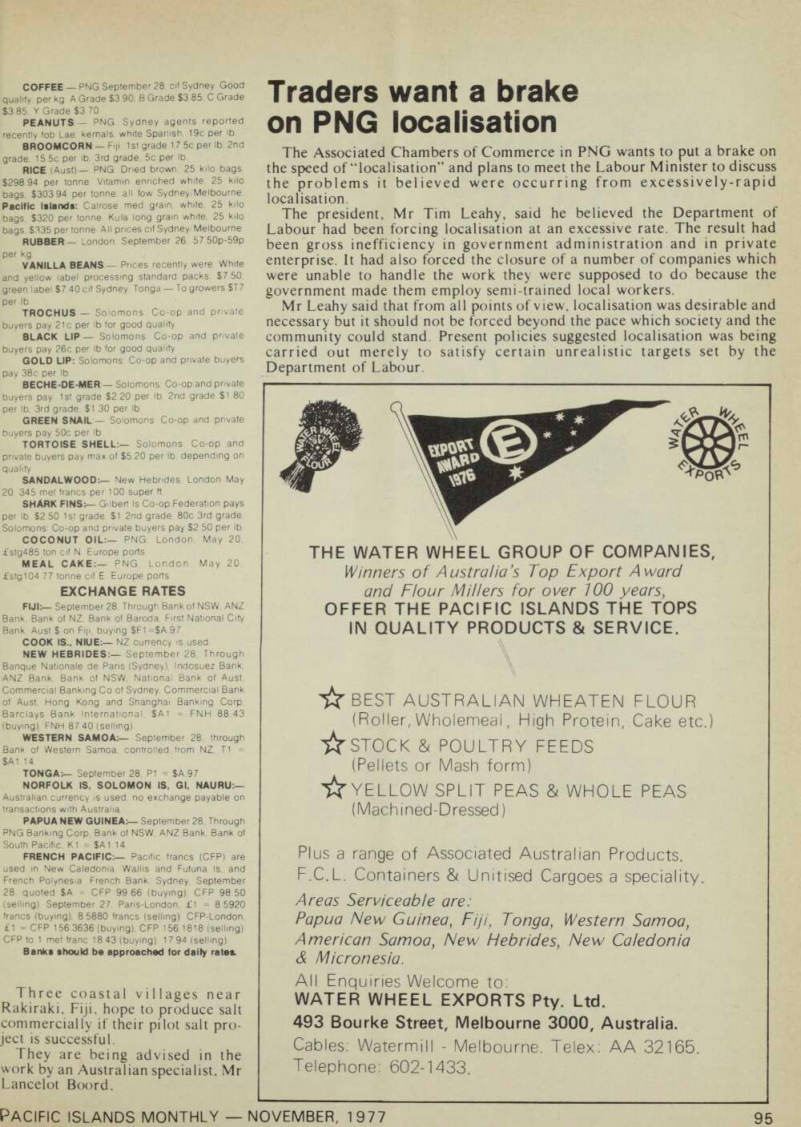
Prices
Unless otherwise shown, quotations are in Australian dollars. Australian dollar (September 26) equalled: New Zealand, $1.1425 (buying), $1.1367 (selling); Papua New Guinea, K 0.8766 (buying), K 0.8700 (selling); Fiji, $1.0261 (buying), $1.0021 (selling); Western Samoa, tala 0.8724 (buying), tala 0.8598 (selling); Tonga, pa'anga 1.0275 (buying), pa'anga 0.9830 (selling); US, $1.1075 (buying), $1.1027 (selling); UK. £5tg0.6377 (buying), £5tg0.6303 (selling); French Pacific, CFP 99.93 (buying), CFP 98.37 (selling).
Copra
Copra industries are controlled through copra] boards in PNG, the Solomons, the Gilberts, both Samoas, Fiji, Tonga, the Cooks and the US Trust!
Territory New Hebrides, French Polynesia and New Caledonia do not have boards and copra is either sold ; individually by growers to overseas buyers or used locally PNG — The board, with planters' reps, directs! distribution and sales and pays planters. Shipments; are made to UK, European markets and to Australia and Japan, and coconut oil mills in New Britain Latest prices less Kl 7 levy were: Per tonne, delivered main ports, hot air dried, K2OB. FMS, K 205, smoke dried. K 203 FIJI — The board fixes prices on Philippines copra, taking into account freight, taxes, selling costs, shrinkage, etc Latest prices to producers were: Fiji 1, $l9O. Fiji 2 $lBO. CAS $BO NEW HEBRIDES Copra sold direct by planters to France and Japan, Burns Philp paying on wharf. Vila or Santo July 20 FNH 12 000: London May 20, 244 met francs 100 kg cif Marseilles US TRUST TERRITORY Palau Ist grade $lBO, 2nd grade. $l7O, 3rd grade. $l6O, at district centre, outer islands $155, $145 and $135 for the three grades Yap $l6O, $l5O and $l4O respectively at district centre, outer islands, $135. $125 and $ll5 respectively Truk, Ponape. Kusaie and Northern Marianas: $l5O. $l4O and $l3O respectively at district centre, outer islands. $125, $ll5 and $lO5 Marshalls $lBO at district centre, $155 outer islands COOK ISLANDS All production is sold to Abels Ltd, Auckland. Prices are based on average world prices for the prior three or six months and remain in force for three months SOLOMON ISLANDS Copra Board pays per lb at Honiara, Yandina and Gizo. 9c Ist grade, 8’ ?c 2nd grade, 7c 3rd grade
Gilbert Islands 6'/?C Per Lb
WESTERN SAMOA Ist grade, T 199 50, 2nd grade TlB7 10 fob TONGA All copra sold to EEC, A Grade STI7S.
B Grade STI63.
NIUE Standard, $lBO a tonne gross
Other Produce
COCOA Island rates are based on Ghana price Ghana price on September 28 was £stg2 430 ton, cif, UK Continent.
September 28, fob Rabaul, export quality, K 3 150 per tonne, delivered ex-wharf Sydney, $4 000 per tonne New Hebrides— London, May 20, 1 150 met francs 100 kg Solomons Delivered Honiara prices recently were $1 30 per lb Ist grade, 90c 2nd grade Western Samoa T 2 470 80 per ton fob CHILLIES Solomons, Honiara buyers pay for dry tabasco, Ist grade 40c per lb, 2nd grade, 20c per lb Long Red is 20c per lb
COFFEE PNG September 28 cif Sydney Good quality per kg A Grade $3 90, B Grade $3 85. C Grade $3 85 V Grade $3 70 PEANUTS PNG Sydney agents reported recently fob Lae, kernals. white Spanish. 19c per lb BROOMCORN Fiji Ist grade 17 5c per lb. 2nd grade. 15 5c per lb. 3rd grade. 5c per lb RICE (Aust) PNG Dried brown. 25 kilo bags. $298 94 per tonne Vitamin enriched white 25 kilo bags. $303 94 per tonne, all fow Sydney/Melbourne Pacific Island*: Calrose med gram, white. 25 kilo bags $320 per tonne Kula long gram white, 25 kilo bags $335 per tonne All prices cif Sydney Melbourne RUBBER— London September 26, 57 50p-59p per kg VANILLA BEANS Prices recently were White and yellow label processing standard packs $7 50 green label $7 40 cif Sydney Tonga —To growers ST7 per lb TROCHUS Solomons Co-op and private buyers pay 21c per lb for good quality BLACK LIP Solomons. Co-op and private buyers pay 26c per lb for good quality GOLD LIP: Solomons Co-op and private buyers pay 38c per lb BECHE-DE-MER— Solomons Co-op and private buyers pay Ist grade $2 20 per lb; 2nd grade $1 80 per lb, 3rd grade. $1 30 per lb GREEN SNAII Solomons Co-op and private buyers pay 50c per lb TORTOISE SHELL:— Solomons Co-op and private buyers pay max of $5 20 per lb, depending on quality SANDALWOOD:— New Hebrides London May 20 345 met francs per 100 super ft SHARK FINS: — Gilbert Is Co-op Federation pays per lb $2 50 Ist grade, $1 2nd grade. 80c 3rd grade Solomons: Co-op and private buyers pay $2 50 per lb COCONUT OIL: PNG: London, May 20 £stg4Bs ton cif N Europe ports MEAL CAKE:— PNG, London. May 20 £stglo4 77 tonne cif E Europe ports
Exchange Rates
FIJI - . September 28, Through Bank of NSW. ANZ Bank. Bank of NZ. Bank of Baroda. First National City Bank. Aust $ on Fiji, buying SFI =$A,97 COOK IS., NIUE;— NZ currency is used NEW HEBRIDES:— September 28. Through Banque Nationale de Pans (Sydney), Indosuez Bank.
ANZ Bank, Bank of NSW. National Bank of Aust, Commercial Banking Co of Sydney, Commercial Bank of Aust, Hong Kong and Shanghai Banking Corp, Barclays Bank International. SAI = FNH 88 43 (buying) FNH 87 40 (selling) WESTERN SAMOA: — September 28, through Bank of Western Samoa, controlled from NZ. T 1 =
Sai 14
TONGA*. — September 28, PI =$A 97
Norfolk Is, Solomon Is, Gt, Nauru:—
Australian currency is used, no exchange payable on transactions with Australia PAPUA NEW GUINEA:— September 28. Through PNG Banking Corp. Bank of NSW ANZ Bank, Bank of South Pacific, K 1 = $A 114 FRENCH PACIFIC:— Pacific francs (CFP) are used in New Caledonia Wallis and Futuna Is, and French Polynesia French Bank, Sydney. September 28 quoted $A = CFP 99 66 (buying) CFP 98 50 (selling) September 27, Pans-London. £1 = 8 5920 francs (buying). 8 5880 francs (selling) CFP-London, £1 = CFP 156 3636 (buying), CFP 156 1818 (selling) CFP to 1 met franc 18 43 (buying). 17 94 (selling) Bank* should be approached for daily rates.
Three coastal villages near
Rakiraki. Fiji, hope to produce salt
commercially if their pilot salt pro
ject is successful.
They are being advised in the
work by an Australian specialist. Mr
Lancelot Boord.
Advertisements & other items, p. 94 (2 items)
94
dArmir iqi amdq MONTHI Y NOVEMBER. 1977
Daiwa Line
fclHj
ROLL-ON/ROLL-OFF CAR & CONTAINER SERVICE
JAPAN-SOUTH PACIFIC
PAPEETE-PAGO PAGO-APIA-SUVA
LAUTOKA-SYDNEY
NOUMEA-TARAWA-GUAM-TAIWAN
JAPAN-TAIWAN-GUAM
JAPAN-KEELUNG-GUAM BY
EXCELLENT CAR/CONTAINER-CARRIER
JAPAN-WEST IRIAN-DILI
HONG KONG-TAIWAN-WEST IRIAN-DILI
AGENTS:
GUAM: ATKINS, KROLL (GUAM) LTD.
TARAWA: G. & E. I. DEVELOPMENT AUTHORITY.
APIA: BURNS PHILP (SOUTH SEA) CO., LTD.
PAGO PAGO: KNEUBUHL MARITIME SERVICES CORP.
NUKUALOFA: PACIFIC NAVIGATION CO., LTD.
SUVA: BURNS PHILP (SOUTH SEA) CO., LTD.
LAUTOKA: BURNS PHILP (SOUTH SEA) CO., LTD.
NOUMEA: SOCIETE D'ACCONAGE ET DE
TRANSPORT D'OCEANIE (SATO)
SANTO: BURNS PHILP (NEW HEBRIDES) LTD.
VILA: BURNS PHILP (NEW HEBRIDES) LTD.
HONIARA: BRITISH SOLOMONS TRADING CO., LTD.
PAPEETE: AGENCE MARITIME DE FARE UTE.
HONG KONG: IKE MARITIME CO., LTD.
SINGAPORE: THE BORNEO CO., (SINGAPORE) LTD.
DJAJAPURA: P. N. PELAJARAN NASIONAL INDONESIA.
DILI: SANG TAI HOO
TAIWAN: FOR CARGO BETWEEN JAPAN/GUAM/TAIWAN &
SOUTH PACIFIC,
FORMOSA SHIPPING & ENTERPRISE CORP.
THE DAIWA NAVIGATION CO., LTD*
OSAKA: “DAILINE" TOKYO; “FUNEDAILINE”
HEAD OFFICE
DAIICHI KYOGVO BLDG.,
45, 2-CHOME, AWAZAMINAMI-DORI,
NISHI-KU, OSAKA, JAPAN
TELEPHONE: (06) 531-0471 ~9
TELEX: 525-6324 & 525-6325
TOKYO OFFICE
SHIN-DAIICHI BLDG.,
4-13, NIHONBASHI 3-CHOME, CHUO-KU,
TOKYO, JAPAN
TELEPHONE. (03) 274-3251 ~8
TELEX: 222-3343, 23559
Traders want a brake
on PNG localisation
The Associated Chambers of Commerce in PNG wants to put a brake on the speed of “localisation” and plans to meet the Labour Minister to discuss the problems it believed were occurring from excessively-rapid localisation.
The president, Mr Tim Leahy, said he believed the Department of Labour had been forcing localisation at an excessive rate. The result had been gross inefficiency in government administration and in private enterprise. It had also forced the closure of a number of companies which were unable to handle the work they were supposed to do because the government made them employ semi-trained local workers.
Mr Leahy said that from all points of view, localisation was desirable and necessary but it should not be forced beyond the pace which society and the community could stand. Present policies suggested localisation was being carried out merely to satisfy certain unrealistic targets set by the Department of Labour.
Advertisements & other items, pp. 95-96 (1 item)
The Water Wheel Group Of Companies,
Winners of Australia's Top Export Award and Flour Millers for over 100 years,
OFFER THE PACIFIC ISLANDS THE TOPS
IN QUALITY PRODUCTS & SERVICE.
BEST AUSTRALIAN WHEATEN FLOUR
(Roller, Wholemeal, High Protein, Cake etc.)
ft STOCK & POULTRY FEEDS
(Pellets or Mash form)
SPLIT PEAS & WHOLE PEAS
(Machined-Dressed) Plus a range of Associated Australian Products.
F.C.L. Containers & Unitised Cargoes a speciality.
Areas Serviceable are: Papua New Guinea, Fiji, Tonga, Western Samoa, American Samoa, New Hebrides, New Caledonia & Micronesia.
All Enquiries Welcome to:
WATER WHEEL EXPORTS Pty. Ltd.
493 Bourke Street, Melbourne 3000, Australia.
Cables; Watermill - Melbourne. Telex; AA 32165.
Telephone: 602-1433.
Fly the world's largest fleet...
Pan Am 747'5.
miVAM 747 0 2 AD
WWAM
/37 / 7 #7 AM
RfWAM
✓37 If you're like us, you know a great thing when you see it.
Wide-bodied 747's are the fastest and most comfortable passenger planes available. And we fly nonstop to more U.S. cities than any other airline in the world
including record-setting long
range flights. No other airline can match our daily nonstop round trips between Tokyo and New York. We fly the world's longest commercial nonstops from Sydney to San Francisco. Building an entire fleet of 747's just made
good sense.
Our inflight service crews try very hard to meet your every need in the warmest, most personal
manner possible. Wide, spacious
cabins give you living room comfort as the world slips by.
Our 7475 P "Super Performer"
has lower fuel consumption, higher flying altitudes and faster speeds, making even the longest trip a little shorter. Pan Am's 7475 P is
Experience in tangible form.
You'll find Upper Deck Dining in the First Class lounge at the top of the spiral staircase. Enjoy a gourmet experience from a choice of four select entrees.
No matter where you fly in the world, you're always at home with Pan Am. We assembled the largest fleet of Pan Am 747's just for you.
FWV/MVT
Experience makes the difference. 065. P. 285
Deaths
of Islands People
Ratu J. K. Sovasova Ratu Josua Kanakamakama Sovasova, the Tui Vitogo of Fiji, has died. He was in his 70s. As Tui Vitogo he was head of about 3 000 people. He is survived by his wife and nine children.
Mr Ngatupuna Matepi
Mr Ngatupuna Matepi, Member for Mangaia Island in the Cooks Legislative Assembly, has died in Rarotonga, aged 68.
Mr Matepi, born in Rarotonga, :ompleted his eduction in New Zea land. He was a school teacher in Mangaia for 33 years, then became a businessman in Mangaia, estab lishing a bakery, general store and :inema there.
He entered politics in the Cooks before self-government was achiev ed in 1965 and later became a mem ber of the opposition Democratic Party. During his years in the Legis ative Assembly he worked hard and consistently for the economic bet erment of Mangaia. He was espected by all his business and bolitical associates for his honesty md forthright attitude.
Chief Isaiah Bangara A 91-years-old Solomon Islands ehief, Isaiah Bangara, drowned dur ng a fishing trip near Hele Island.
Fhree boys, aged 10 to 14, who were vith him, managed to swim to safe y. The old man was chief of Nazareth Village, near Sege, in the Western District. The four were hrown into the sea when their canoe vas broken in half by a big wave.
Mrs M. Binzegger Mrs May Binzegger, sister of veil-known Western Samoa musi :ian and entertainer, Bertie Mann, las died at Taumaranui, NZ. She eft Western Samoa in 1948, and in 949 married Mr Binzegger, a King Country farmer and later a politi :ian. Three cultures were repre sented at her funeral Samoan, Maori and pakeha. Mrs Binzegger vas Mayoress of Taumaranui when ihe died. She is survived by her hus band and a son.
Mr G. Deighton Mr George Deighton, English born, who spent 45 years in Fiji, has died at Drummoyne, Sydney, aged 93. He went to Australia from Eng land after service in the Boer War, and in 1906 went to Fiji, where he set up a trading store in Vanua Levu. He married Lily Rachel Simpson, a member of a pioneering family, most of whom settled on copra estates in Vanua Levu.
In the time he was in Fiji, Mr Deighton managed a copra estate in Vanua Levu, a sawmill at Nukubalavu, on the south coast of Viti Levu, and a stone-crushing quarry at Nasinu, near Suva. While living in Suva he took an active part in instructing young people in gym nastics and physical culture.
Mr and Mrs Deighton left Fiji in 1950, to join their three children, Emily, Terence and George, who had settled in Sydney. Mrs Deighton died in 1963. They always made visiting people from Fiji welcome at their Sydney home.
Mr Anitnara Nooroa A prominent Cook Islands public servant, Mr Animara Nooroa, died at Rarotonga in March, aged 64.
Mr Nooroa’s long career covered work in treasury, radio and post of fice services.
Mr Denys Hibbert Mr Denys Hibbert, who, for four years up to 1970, was Director of Education in the Solomon Islands, has died in England at the age of 71.
‘Visual pollution’
complaint in PNG
Compilers of a national tourism plan for Papua New Guinea are not at all happy with the Port Moresby wharf development. They want a completely new approach to take into account visual pollution and the need for park and recreation space. There should be a develop ment code to govern future harbour foreshore and urban industrial development.
They said the present reclamation and warehouse building programme effectively ruined the outlook pre viously obtained from the foreshore road and nearby hills. A once-grand harbour vista had been reduced to a view of dockyards and warehouses typical of ports the world over.
According to the report, there was a “startling lack” of recreation and park space in Port Moresby.
“There is a clear need for the authorities involved and responsi ble the Harbours Board, the Port Moresby City Council, and the na tional and provincial governments to come to terms with the prospect for a trade-off between recreational needs for an in creasingly urbanised population and real development needs,” the report said.
To offset the impact of the warehouse development on the foreshore, the council should con sider widening the road and plant ing trees and shrubs.
In practical terms, the Port Moresby harbour development scheme necessitated the construc tion of a new haven for yachts and a marine base for tourist and game fishing vessels. Ideally, a new yacht basin should be in the harbour to take advantage of natural shelter.
However, it appeared that site choices were limited to the harbour foreshore north of the reclamation area and defence base. An alterna tive site could be on the coast east of Koki in the of Matirogo and Daunagena Islands. • Japanese enterprise, consisting mainly of small businessmen, far mers and fishermen, from southern Niigata, have a joint investment in a hotel at Bora Bora, as a place where people from the snow country can go to soak up the sun. They planned to invest $35 million in the project, with local interests putting up a like amount.
Advertisements & other items, pp. 97-98 (3 items)
97
"i A r' Irl r* IO I A K I O It A K It - i i i v ✓ k i \ im «p%rr» /i -i
Required:
CM
Conventional, container and reefer cargo required for 1 500-tonne deadweight vessel intending entering service Pacific Basin 1978.
Details to the Marine Superintendent, Box 64, GPO, Sydney 2001.
4 no T 7
EXPORTERS TO THE PACIFIC ISLANDS
Breekwoldt & Co Pty Ltd
276 Pitt Street, Box 5027, G.P.O. Sydney 2001 cable address: brewo Sydney
TELEPHONES: 61-7110 26-6893
TELEX AA22890.
Pacific Island Branches:
BRECKWOLDT & CO (PNG) PTY LTD
PO BOX 1549, BOROKO, PORT MORESBY
PO BOX 222, RABAUL PO BOX 185, MADANG PO BOX 72. KIETA PO BOX 237, MT HAGAN PO BOX 178, WEWAK PO BOX 1188, LAE BRECKWOLDT & CO., PO BOX 47, APIA BRECKWOLDT & CO. (SI) LTD. PO BOX 140, HONIARA
BRECKWOLDT SARL BP 2369, NOUMEA
Offices in : Hamburg, London, Milan and West Africa as well as Singapore, Kuala Lumpur, Bangkok and Hong Kong.
Enquiries from Australian Manufacturers invited.
SHIPBUILDERS TO THE PACIFIC...
A 1 a LANDING BARGE under construction at
CARPENTERS INDUSTRIAL SHIPYARD, Walu Bay, Suva
Fiji Islands, for Mr. Anton Lee of Port Moresby, Papua New Guinea.
CARGO CAPACITY: 14,000 aft LENGTH: 114 ft.O.A.
Powered by twin GARDNER diesel engines each 230 hp.
[CARPENTERS INDUSTRIAL RO. BOX 296
l SUVA,FIJI. PHONE 312-133.
I Please send me information on Shipbuilding in the I South Pacific I Name - Company Address-
. . t inkiTi ii v/ 1 Q 77
Shipping
SYDNEY - NZ - FUI/TAHITI - UK Chandris Lines maintains a passenger service om Sydney via NZ, Suva or Papeete every second tonth Details from Chandris Lines, 135 King Street, lydney (232-2455)
Sydney - Lord Howe Is -
Norfolk Is - New Hebrides
Compagnie des Chargeurs Caledonians operates )ur-weekly cargo service Sydney - Lord Howe Island nd Norfolk Island Details Hethenngton Kingsbury Pty Ltd, 37-49 Pitt treet, Sydney (27-1671) SYDNEY - NZ - FIJI - HAWAII -
Canada - Us
P & O liners call at Auckland, Suva, Honolulu and ancouver on eastbound and westbound voyages ietween Sydney and the US.
Details from P & O Booking Centre, World Travel eadquarters Pty Ltd. 33 Bligh Street, Sydney 231-6655) AUSTRALIA - NZ - FIJI - TONGA -
N. Hebrides - Noumea Png -
Solomons -Samoas
Sitmar Cruises operates a year-round cruise irogramme to include most of the above countries Details from Sitmar Cruises, 47 Elizabeth Street, lydney (232-7511) Royal Viking Line, with first-class cruise ships loyal Viking Star. Royal Viking Sky and Royal Viking ea. cruises the Pacific from Sydney and Cairns calling t a variety of Pacific and Asian ports Details from Wilh, Wilhelmsen Agency Pty Ltd, 3-15 Bridge Street, Sydney (2-0517) P & O liners call at Apia, Auckland, Bay of Islands, lomara, Honolulu, Lautoka. Noumea, Nukualofa, Pago ’ago, Papeete, Port Moresby. Santo, Savusavu, Suva, avau and Vila on cruises from Australia Details from P & O Booking Centre World Travel leadquarters Pty Ltd. 33 Bligh Street, Sydney 231-6655) Pacific Navigation of Tonga operates a five-weekly sfrigerated general cargo/container service from lydney and Brisbane, to Suva. Lautoka, Apia, Pago 'ago and Nukualofa.
Details from Beaufort Shipping Agency Co, 2 lastlereagh Street Sydney (221-2388)
Australia - New Caledonia - (And/Or)
New Hebrides
Daiwa Line operates a container service from lydney to New Caledonia and the New Hebrides Details: Union Bulkships Pty Ltd, 333-339 George •treet Sydney (2-0238) Somacal operates a monthly service from Sydney 3 Noumea Details from Karlander (Aust) Pty Ltd, 19-31 Pitt •treet, Sydney (27-6301) Sofrana-Unilines ships serve Noumea every three /eeks from the mam ports along the east Australian ;oast Details from Sofrana-Unilines. 37 Pitt Street, Sydney (27-2031), Trans-Austral Shipping Pty Ltd. 570 Jourke Street Melbourne (67-9162), ACTA Pty Ltd, Srisbane (221-3166), Elder-ANL Pty Ltd. Port Adelaide 47-5688), ANL Newcastle (049-24364), Clements & i/larshall, Burnie. Tasmania (31-1833) Compagnie des Chargeurs Caledoniens operates hree-weekly containerised cargo service from Sydney o Noumea Details Hethenngton Kingsbury Pty Ltd, 37-49 Pitt Street Sydney (27-1671).
South Pacific United Lines maintains a four-week :argo service from Sydney to Noumea, Vila and Santo Details from Omni Traders & Brokers Pty Ltd, 261 Seorge Street, Sydney (241-2872/6)
Australia - Fiji
Karlander (Aust) Pty Ltd operates monthly cargo services from Sydney to Suva and Lautoka.
Details from Karlander (Aust) Pty Ltd, 19-31 Pitt Street, Sydney (27-6301). Dalgety Shipping. 461 Bourke Street, Melbourne (60-0731), Burns Philp (SS) Co Ltd, Suva and Lautoka Sofrana-Unilines (Fiji Express Line) operates to Suva every three weeks from the mam ports on the east coast of Australia and monthly to Lautoka from Melbourne and Sydney Details from Sofrana-Unilines, 37 Pitt Street, Sydney (27-2031), Trans-Austral Shipping Pty Ltd, 570 Bourke Street Melbourne (67-9162), ACTA Pty Ltd, Brisbane (221-3116), Elder-ANL Pty Ltd. Port Adelaide (47-5688), ANL, Newcastle (049-24364), Clements & Marshall, Burnie, Tasmania (31-1833)
Australia - Fui - W. Samoa
Nauru Pacific Line operates regular containerised, unitised and b/bulk service from Sydney and Brisbane to Lautoka, Suva and Apia Details Nauru Pacific Line, Nauru House. 80 Collins Street, Melbourne (653-5709). Interocean Swire, 8 Spring Street, Sydney (2-0522)
Australia - Tonga - W. Samoa
Karlander operates a monthly cargo service from Melbourne and Sydney to Nukualofa and Apia, thence US west coast Details: Karlander (Aust) Pty Ltd. 19-31 Pitt Street, Sydney (27-6301) AUSTRALIA - TAHITI - US WEST COAST South Pacific United Lines maintains a four-weekly cargo service from Sydney to Papeete, and US west coast Details from Omni Traders & Brokers Pty Ltd. 261 George Street, Sydney (241-2872/6).
Daiwa Line offers a six-weekly service from Australia to Papeete Details: Union Bulkships Pty Ltd, 333-339 George Street, Sydney (2-0238)
Australia - Png
Containers Pacific Express (Burns Philp and AWP Line) and NGAL/PNGL Chief operate Container Service from Australia to PNG-Solomon Islands ports on joint slot sharing basis Three container vessels operate on 28-day turn-around from Melbourne, Sydney and Brisbane to Port Moresby, Samarai, Lae, Madang, Wewak, Rabaul, Kavieng, Kieta and Honiara Details from Burns Philp & Co Ltd, 51 Pitt Street, Sydney (241-3851) and Interocean Swire, 8 Spring Street, Sydney (2-0522).
Farrell Lines operates a service every month from Tasmania, Melbourne. Sydney and Brisbane to Lae and Rabaul Details from Wilh Wilhelmsen Agency Pty Ltd,. 13 Bridge Street, Sydney (2-0517), 60 Market Street.
Melbourne (61-3031), J. C Waller (Rabaul) Pty Ltd.
Rabaul, Robert Laune-Carpenter (NG) Pty Ltd, Lae.
New Guinea Express Lines operates three-weekly conventional and container services, Melbourne, Sydney, Brisbane. Port Moresby, Lae, Rabaul Details from New Guinea Express Lines, PO Box R 73, Royal Exchange PO, Sydney (241-3991), MacArthur Shipping Agency Co, 82-92 Eagle Street, Brisbane (229-3777), Western Farmers Transport Pty Ltd, 459 Little Collins Street, Melbourne (67-8291), Breckwoldt's Shipping Agencies in Port Moresby (24-2525), Lae (42-1536). Rabtrad and Nuigini Pty Ltd, Rabaul(92-2911) Karlander New Guinea Line's cargo vessels call at Melbourne, Sydney, Port Moresby, Lae, Madang, Wewak, Manus. Kimbe, Rabaul.
Details from Karlander (Aust) Pty Ltd, 19-31 Pitt Street. Sydney (27-6301), Dalgety Shipping, 461 b • vke Street, Melbourne (60-0731).
AUSTRALIA - SOLOMONS • GILBERT IS -
Micronesia
Daiwa Line operates a container service every 30 days from Sydney to Noumea, Honiara. Tarawa, and Guam Saipan cargoes transhipped via Guam or Japan Majuro cargoes transhipped via Japan Details from Union-Bulkships Pty Ltd, 333-339 George Street, Sydney (2-0238, telex AA20397)
Advertisements & other items, pp. 99-106 (3 items)
For Sale:
TRAWLERS, FISHING BOATS,
TUGS, BARGES & DREDGES.
CARGO VESSEL - 56' x 17' x 6' Steel construction. 5 ton derrik in bow.
Cargo hold approx, 35' x 10'6" x 8'8", Twin Ford 510 E diesels. Crew quarters and galley for two $26,500 (Aust.) TUG - Very heavy timber construction. 6 years old. 4 ton Bollard pull.
Comfortable crew quarters $65,000 (Aust.) LANDING BARGE - 45' x 18' x 3'.
Steel construction 3 years old. Raised bridge. Hydraulic operated loading ramp Ford Harbour Master power $48,750 (Aust.) CARGO VESSEL - Steel construction, 120' L.O.A. Twin Ruston power, $BO,OOO (Aust.)
REFRIGERATED CARGO VESSEL -
120' L.O.A. 90 tons refrigerated capacity. Twin power $60,000 (Aust.) LANDING BARGE - 150' x 36' x 3 1 / 2 '.
Steel construction. Hydraulic loading ramps forward and aft. Ideal drive on drive off cargo or vehicular ferry. 200 ton capacity. Crew quarters, toilets GM powered 10 knots $178,000 (Aust.) DREDGE - Cutter suction. 18'' suction, 16'' discharge, pump power 2 x D 343 Cats. Total 960 H.P. Cutter power 300 H.P. Hyd. Complete with work and anchor barges, discharge lines, auxiliaries, spares etc. $325,000 (Aust.)
SHIP (PASSENGER/CARGO) - 200'
L.O.A. 384 tons gross, low hours on polar engine, 44,000 gallons fuel, 40,000 gallons water. POA.
NEW TRAWLER/FISHING BOATS -
Steel construction, 54' x 18*3" x 7'.
GM power completed to any stage required. Standard price $86,000 (Aust.) available March, 1978.
TRAWLERS & FISHING BOATS -
Available from $12,000 to $600,000 (Aust.)
WRITE TO:
AUSTRALIAN SHIP BROKERS,
P.O. Box 401, Maroochydore 4558,
OLD. AUST.
PHONE: (071) 44 1174.
100
DAnnr ICI amhq MOMTWI V NO\/FMRFR 1977
Security
To Future Generations,
-filial
Horyuji Japan's 7th century temple links the past to the present with the solemn beauty.
Social welfare is a subject of serious consideration in most modern societies. Man in the twentieth century accepts his responsibility to bequeath to the next generation a society better than his own. Daiwa Bank is not unique in accepting this responsibility, but Daiwa is unique in making acceptance of this role in society an integral part of their banking service.
Daiwa is the only Japanese city bank to combine banking and trust business. Daiwa is thus a fully integrated banking institution, comprising banking, international financing, trust, pension trust, and real estate business. This integration is part of our effort to fulfil our social responsibility consistent with society's needs in a contemporary environment. a fully integrated banking service
DAIWA BANK
Head Office: Osaka, Japan London and Frankfurt Branches New York and Los Angeles Agencies Singapore, Sydney. Sao Paulo and Hong Kong Representative Offices Subsidiary: Daiwa Bank Trust Company, New York Joint Venture Banks; P.T. Bank Perdania, Jakarta, International Credit Alliance, Ltd., Hong Kong
* LOW COST
frigid COU) drinks * LARGE CAPACITY
* BOTTLE & FOOD DISPLAY
* 2& 3 DOOR MODELS AVAILABLE
Large capacity small floor space Maximum visual display • Gleaming white, vinyl coated aluminium interior for better reflection of light within cabinet Fluorescent lighting • 2" Frigidfoam insulation (equivalent to 4" Polystyrene or 6" cork!) • Powered by heavy-duty Kelvinator sealed unit warranteed for 5 years
AVAILABLE FROM:
AUSTRALIAN NEW CALEDONIA EXPORTS. 363 George St, Sydney, 2000.
BREGKWOLDT & CO., 276 Pitt St., Sydney, 2000.
HAGEMEYER (A'SIA), 59 Anzac Pde, Kensington, 2033.
GEOFFREY HUGHES & CO, 167 Macquarie St, Sydney, 2000.
NELSON & ROBERTSON PTY. LTD, 197 Clarence St, Sydney, 2000 PETER FISHER TRADING PTY.LTD, 321 Pin St, Sydney 200(T E RABOT (EXPORTS) PTY. LTD, 67 Castlereagh St, Sydney. 2000.
RABTRAD NIUGINI PTY. LTD., PO Box 1406, Lae.
A. RIETTE (PACIFIC) PTY. LTD,, 300 George St„ Sydney, 2000.
H Y. KWAN (AUST) PTY. LTD. Box 2713, GPO , Sydney, 2001.
C. SULLIVAN (EXPORT) PTY. LTD., GPO Box 3373, Sydney, 2001.
W.S. TAIT & CO, PTY. LTD, 31 Macquarie Place, Sydney, 2000. Attractive timber grain Marviplate exterior Automatic frost-free, fan-assisted cooling gives even and faster cooling of stored products 4 rows adjustable plastic-coated, hygenic, white shelves and floor tray LOW MAINTENANCE, the only maintenance required being periodic cleaning of condenser Illuminated sign in top panel optional extra.
Manufactured by: T 1
FRIGID CABINETS PTY. LTD.,
14A Puffy Ave., Thornleigh, N.S.W. 2120 Aust. Ph. 848 8292.
FC2.
YOUR DIRECT LINK WITH THE
WEST COAST NORTH AMERICA
REFRIGERATED
& GENERAL
CARGO IN
BARGES. BULK
LIQUIDS IN
VESSEL DEEP
TANKS.
IFROM UNITED STATES WEST COAST & CANADA TO PAPEETE,
IPAGO PAGO, AUCKLAND, LAE & RABAUL.
■ PAPUA NEW GUINEA TO VANCOUVER 8.C., TACOMA, PORT-
LAND, SAN FRANCISCO, LOS ANGELES.
■ SYDNEY, MELBOURNE, BURNIE, HOBART, BRISBANE TO LAE
& RABAUL.
X I
THE AMERICAN
FLAG LINE
INCORPORATED
MANAGING AGENTS: Wilh. Wilhelmsen Agency P/L., 13-15 Bridge Street, Sydney 2000-Phone 20517-60 Market Street, Melbourne, 3000-Phone 613031—344 Queen Street, Brisbane, 4000-Phone 2213316. MANAGING AGENTS N.Z.: Dalgety N.Z.
Ltd. , 119 Featherston Street, Welington-Phone 738347- 41/45 Albert Street Auckland —Phone 71859. ISLAND AGENTS: Robert Laurie (NG) P/L, P.O. Box 1032, Lae, PNG Phone 423811. J.C. Waller (Rabaul) Pty. Ltd. P.O Box 606 Rabaul, PNG. Phone 921997.
KYOWA LINE
YOUR TRADING PARTNER
CAR (ROLL-ON/ROLL-OFF)
& CONTAINER CARRIER "ASIAN ROSE”
The Asian Rose, the world's first container/ break bulk cargo/car roll-on and roll-off systems all in one, is in liner service from Japan to the South Pacific islands. The multi-mission carrier, the latest addition to our fleet, maintains a 45-day service, linking
Japan, Guam, Fiji, New Caledonia and
New Hebrides. She is capable of carrying 280 cars, 48 containers and 5,508 tonnes of break bulk cargo, offering greater safety and speeds in the delivery of merchandise.
She is another symbol of the quality service with which we are already credited.
AGENTS
Taiwan: Royal Steamship Corp., Ltd . Taipei S. Korea: Dong Sue Shipping Co, Ltd Seoul Hong Kong: Dahzun Enterprises Ltd.
Singapore: Ocean Shipping & Enterprses Pte . Ltd Mariana Is.: Maritime Agencies of Pacific Ltd , Guam 8.5.1. P.: Solomon Taiyo Ltd., Honiara Tahiti: J A Cowan & Fils, Papeete Cooks: Union Citco Travel Ltd, Rarotonga Tonga; E M Jones Ltd . Nukualofa New Hebrides: Agence Maritime Roymond Velicite, Polr Vila A. Samoa: island Pacific Agencies Inc, Pago Pago W. Samoa; Morris Hedstrom Ltd,, Apia Fiji: Carpenter Shipping, Suva & Lautoka PNG: Carpenter Shipping Agencies, Port Moresby, Rabaul New Caledonia: Agence Maritime Du Rond Point Du Pacific, Noumea Indonesia: P.T. Porodisa Raya Shipping Lines. Jakarta Sabah: KOH Han Ming Shipping & Forwarding Agent., Kotakmabalu Sarawak: Pan Sarawak Agencies Sdn, Bhd., Sibu & Kuching Australia: Hethenngton Kingsbury Pty Ltd,. Sydney, NSW, Newzealand: Sofrana Unilines S A Auckland m r '-\ ;JA 9
E3C-' .«ui
KYOWA SHIPPING CO., LTD.
HEAD OFFICE
sth FI., Suzumaru Bldg. 39-8, 2-chome, Nishi-Shinbashi, Minato-ku, Tokyo, Japan.
Phone : 03(437)2885( Rep.) Cables : “MARIQUEEN” Tokyo. Telex : 242-4651 Kyowa J.
OSAKA OFFICE
Frontier Bldg., 3-13 Hirano-cho, Higashi-ku, Osaka, Japan.
Phone I 06(227)0422(Rep.) Cables : “MARIQUEEN” Osaka. Telex : 522-3896 Kyowa 0.
KYOWA LINE
YOUR TRADING PARTNER
Monthly Services
Hong Kong, Taiwan, S. Korea, Japan
To: British Solomon, New Caledonia, Fiji, W. Samoa, A. Samoa. Tahiti, Cook Is., Tonga, New Hebrides.
Ellice Is.,
Taiwan,Hong Kong,Singapore,Jakarta,
Philippine
To: Australia, Papua New Guinea, Sabah & Sarawak.
Hong Kong, Taiwan, S. Korea, Japan
To; Guam, Saipan, Truk, Ponape, Other Pacific Islands.
Taiwan: Royal Steamship Corp , Ltd.. Taipei S. Korea: Dong Sue Shipping Co.. Ltd , Seoul Hong Kong: Dahzun Enterprises Ltd.
Singapore: Ocean Shipping & Enterprises Pte., Ltd Mariana Is,: Maritime Agencies of Pacific Ltd., Guam 8.5.1. P.: Solomon Tai/O Ltd , Honiara Tahiti: J.A. Cowan & Fils, Papeete Cooks: Union Citco Travel Ltd., Rarotonga Tonga: E M Jones Ltd , Nukualofa New Hebrides: Agence Maritime Raymond Veiicite. Port Vila A.Samoa; sland Pacific Agencies Inc., Pago Pago W. Samoa: Morris Hedstrom Ltd., Apia Fiji: Carpenter Shipping, Suva & Lautoka PNG: Carpenter Shipping Agencies, Port Moresby, Rabaul New Caledonia: Agence Maritime Du Rond Point Du Pacific, Indonesia: P T Porodisa Raya Shipping Lines, Jakarta Sabah; KOH Han Ming Shipping & Forwarding Agent., Kotakmabalu Sarawak: Pan Sarawak Agencies Sdn Bhd , Sibu & Kuching Australia: Hetherington Kingsbury Pty Ltd., Sydney, NSW Newzealand: Sofrana Umlmes S.A., Auckland.
KYOWA SHIPPING CO., LTD.
AGENTS
Noumea
HEAD OFFICE
sth FI., Suzumaru Bldg. 39-8, 2-chome, Nishi-Shinbashi, Minato-ku, Tokyo, Japan.
Phone : 03 1 437 >2885( Rep.) Cables : MARI QUEEN" Tokyo.
Telex : 242-4651 Kyowa J.
OSAKA OFFICE
Frontier Bldg,, 3-13 Hirano-cho, Higashi-ku. Osaka, Japan.
Phone : 06 227)0422i Rep.
Cables : MARI QUEEN" Osaka.
Telex : 522-3896 Kyowa 0.
THE
BANK
LINE
m
MONTHLY SERVICES
United Kingdom and Continent to: Papeete, Noumea, New Hebrides, Papua New Guinea and Solomon Islands. * Papua New Guinea to: North America, United Kingdom and Continent. * Solomons, Fiji, Tonga, Samoa and Tarawa to: United Kingdom and Continent.
For particulars apply:
THE BANK LINE (AUSTRALASIA) PTY.
LTD.,
18TH FLOOR, 1 YORK STREET,
SYDNEY, N.S.W.
HENRY CUMINES PTY. LTD.
EXPORTERS • GENERAL MERCHANTS
428 GEORGE ST., SYDNEY
CABLES: HENCO SYDNEY. G.P.O. Box 3949. PHONE: 25-3383.
For specialised and personalised buying service through out the Pacific Islands and the EasL
LOCAL AGENTS AND REPRESENTATION:
PAPUA NEW GUINEA.
PORT MORESBY: Mr. Tan,
P.O. Box 5445, Boroko.
Telephone 25 2542.
RABAUL: M. & C. Seeto, P.O. Box 131, Rabaul.
Telephone 92 2902.
MADANG: W. Double, P.O. Box 22, Madang.
Telephone 82 2696.
K. Witherington Ltd., P.O. Box 293, Suva.
Telephone 22 356.
NEW HEBRIDES.
John Lum & Associates, P.O. Box 65, Santo, Telephone 329.
SOLOMON ISLANDS.
Lo See War Ltd., P.O. Box 327, Honiara.
Telephone 399.
Resident Agents in other Pacific Territories.
Q E
offers expert insurance service
throughout the Islands
QBE INSURANCE
LIMITED
(FORMERLY—QUEENSLAND INSURANCE COMPANY)
Central Office: 82 Pitt Street, Sydney FlJl—Branch Office, Suva, Manager for Fiji: L.G.Liddell A A I I LAUTOKA—Sub-Branch Office: Bums Philp Bldg.
NEW CALEDONIA—T. A. Hagen, Stc. W. A. Johnston, S.A.R.L. —Noumea.
NEW HEBRlDES—District Manager; G. F. Donnelly, Vila; Santo: Burns Philp (New Hebrides) Ltd.
TAJ-llTl—Arthur Chung: Immeublc B.L, Front dc Mcr. Papeete.
NIUE, NORFOLK ISLAND, SAMOA. TONGA and other South Sea Islands—Bums Philp (South Sea) Company Ltd.
Q im
ISLAND INSURANCE(P.N.G.)LTD
PAPUA NEW GUINEA-Head Office, PORT MORESBY.
General Manager: J.M.Dawe. Assistant Manager; R.Jackson,A.A.LL District Managers at: LAE: I.R.Martin
MOUNT HAGEN: D.F.CarroU
ARAWA: J.Longbut MADANG: R.W.V.Collings RABAUL: A.M.Tanner
DATELINE HOTEL
TONGA
"Friendly Hotel" of the "Friendly Islands' Situated along the Nuku'alofa waterfront. Only five minutes walk from town. Single, double, family suites, airconditioning, and hot and cold water showers. Pool, bar, restaurant, duty-free shop, tour desk and boutique.
Book through your travel agent or write to International Dateline Hotel, P.O. Box 62, Nuku'alofa Tonga.
Cable Address: "DATELINE".
Represented Overseas by: Charles J. Henry and Associates Pty. Ltd.
Sydney and Melbourne. 7
THE PAPUA HOTEL
PORT MORESBY
• Right in the business centre • A tradition for comfort and fine food • All rooms air conditioned • Restaurant • Bars • Banquet Hall Telephone 24 2121 Cables PAPTEL
A. C. NEUMANN
Manager
Regular Pacific Services
"Union South Pacific", cellular container vessel. Reefer and general cargo from Auckland at approximately fortnightly intervals. Calls at Suva, Pago Pago, Apia and Nukualofa before returning to Auckland.
"Luhesand". conventional reefer and general cargo. Monthly sailings from Auckland, calls at Suva, Apia, Papeete and Nukualofa.
jmtmwuon
gMUcompany
Branches at all mam Australian. New Zealand and Pacific Island ports
PACIFIC ISLANDS TRANSPORT LINE
Owners: Thor Dahls TTvaij angerseiskap A/S —Sonde fjord, Norway.
MS CAMELLIA VENTURE
Express Freight Service between Pacific Coast Ports of
U.S.A.
and
TAHITI and SAMOA
Full container service including reefers.
GENERAL STEAMSHIP CORPORATION LTD.
General Agents 400 California Street, San Francisco, California, U.S.A.
APlA—Burns Philp (South Sea) Company, Ltd.
PAPEETE—Afence Maritime Internationale Tahiti.
PAGO PAGO-Polyncsia Shipping Services Inc.
NOUMEA—Etaklissements Ballande.
SYDNEY—Trans-Austral Shipping Pty. Ltd.
SUVA—Bums Philp (South Sea) Company, Ltd.
LAE/RABAUL—Burns Philp (Now Guinea) Ltd.
PORT VlLA—Comptoirs Francais de Nouvelles Hebrides
Australia - Nauru - Majuro
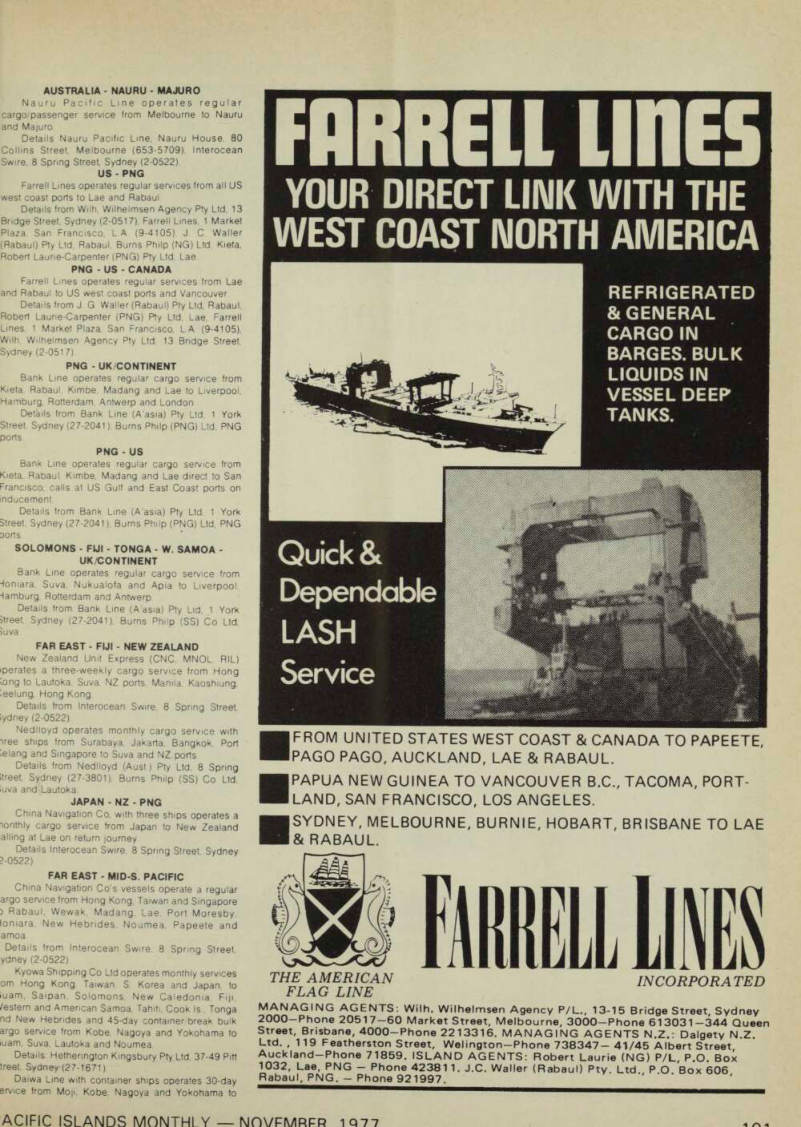
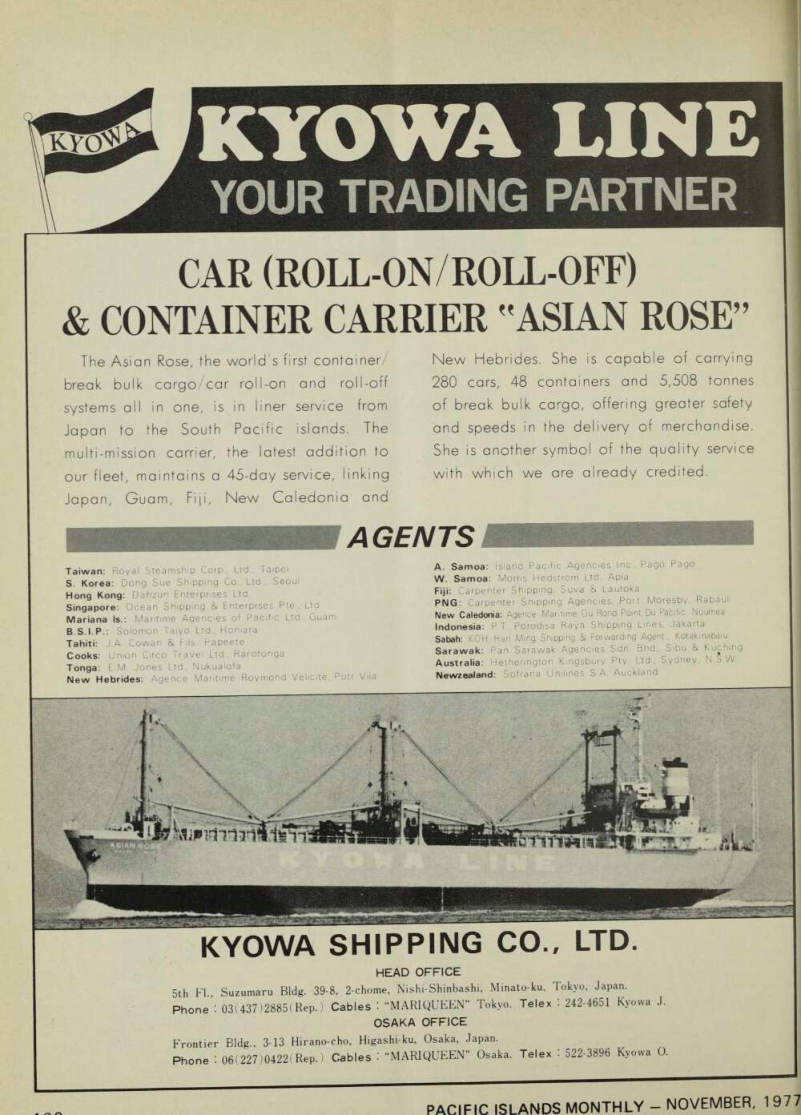
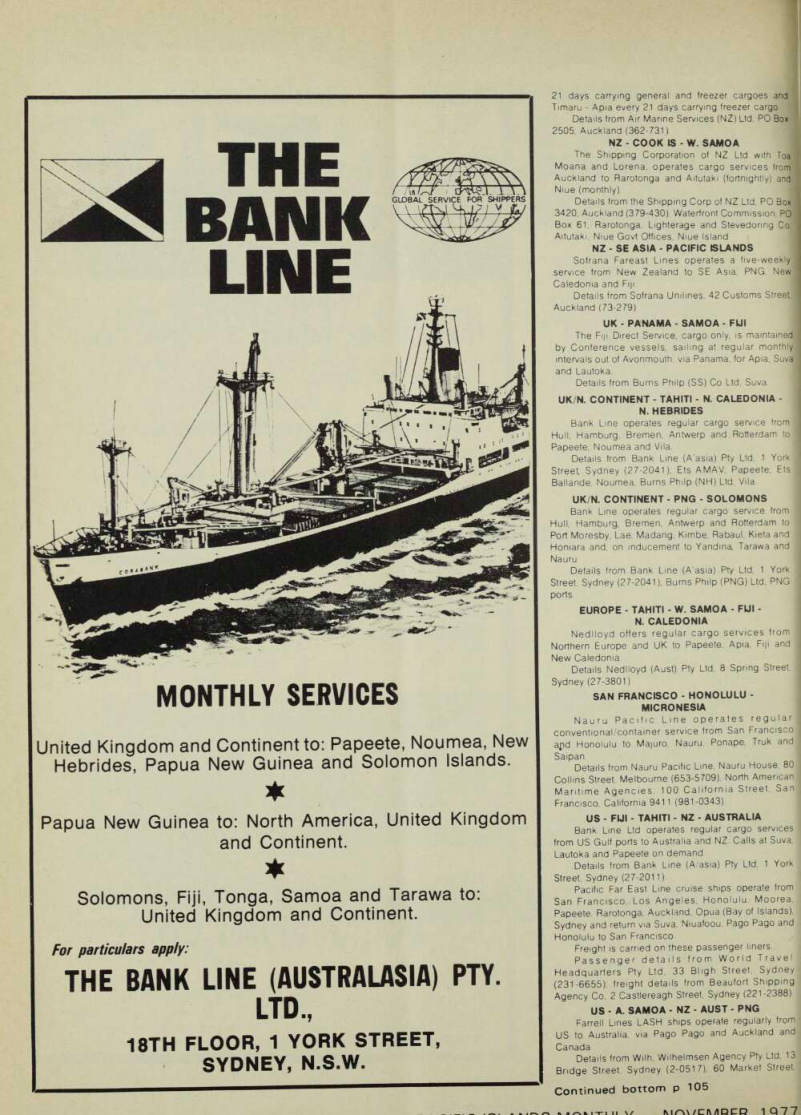
Nauru Pacific Line operates regular cargo/passenger service from Melbourne to Nauru and Majuro.
Details Nauru Pacific Line, Nauru House, 80 Collms Street, Melbourne (653-5709). Interocean Swire, 8 Spring Street Sydney (2-0522)
Us - Png
Farrell Lines operates regular services from all US west coast ports to Lae and Rabaul Details from Wilh, Wilhelmsen Agency Pty Ltd, 13 Bridge Street, Sydney (2-0517), Farrell Lines, 1 Market Plaza. San Francisco, L A (9-4105), J C. Waller (Rabaul) Pty Ltd. Rabaul. Burns Philp (NG) Ltd, Kieta, Robert Laune-Carpenter (PNG) Pty Ltd, Lae
Png - Us • Canada
Farrell Lines operates regular services from Lae and Rabaul to US west coast ports and Vancouver Details from J. G Waller (Rabaul) Pty Ltd, Rabaul, Robert Laune-Carpenter (PNG) Pty Ltd, Lae, Farrell Lines, 1 Market Plaza, San Francisco, LA (9-4105), Wilh, Wilhelmsen Agency Ply Ltd, 13 Bridge Street.
Sydney (2-0517).
Png - Uk/Continent
Bank Line operates regular cargo service from Kieta, Rabaul, Kimbe, Madang and Lae to Liverpool, Hamburg, Rotterdam, Antwerp and London Details from Bank Line (A’asia) Pty Ltd. 1 York Street, Sydney (27-2041). Burns Philp (PNG) Ltd, PNG ports
Png - Us
Bank Line operates regular cargo service from Kieta Rabaul. Kimbe, Madang and Lae direct to San Francisco, calls at US Gulf and East Coast ports on inducement Details from Bank Line (A'asia) Pty Ltd. 1 York Street, Sydney (27-2041), Burns Philp (PNG) Ltd, PNG sorts SOLOMONS - FUI - TONGA - W. SAMOA -
Uk/Continent
Bank Line operates regular cargo service from Honiara, Suva, Nukualofa and Apia to Liverpool.
Hamburg. Rotterdam and Antwerp Details from Bank Line (A'asia) Pty Lid, 1 York Street, Sydney (27-2041), Burns Philp (SS) Co Ltd, Suva.
FAR EAST - FIJI - NEW ZEALAND New Zealand Unit Express (CNC, MNOL RIL) iperates a three-weekly cargo service from Hong (ong to Lautoka, Suva. NZ ports, Manila, Kaoshiung, (eelung, Hong Kong Details from Interocean Swire, 8 Spring Street, lydney (2-0522).
Nedlloyd operates monthly cargo service with iree ships from Surabaya, Jakarta, Bangkok, Port (elang and Singapore to Suva and NZ ports Details from Nedlloyd (Aust) Pty Ltd, 8 Spring Street, Sydney (27-3801). Burns Philp (SS) Co Ltd, Suva and- Lautoka
Japan - Nz - Png
China Navigation Co. with three ships operates a lonthly cargo service from Japan to New Zealand ailing at Lae on return journey Details Interocean Swire, 8 Spring Street, Sydney ?-0522)
Far East - Mid-S. Pacific
China Navigation Co's vessels operate a regular argo service from Hong Kong, Taiwan and Singapore ) Rabaul, Wewak, Madang, Lae, Port Moresby, loniara. New Hebrides. Noumea, Papeete and amoa Details from Interocean Swire, 8 Spring Street, ydney (2-0522) Kyowa Shipping Co Ltd operates monthly services om Hong Kong, Taiwan. S Korea and Japan, to iuam, Saipan. Solomons, New Caledonia, Fiji, /estern and American Samoa, Tahiti, Cook Is , Tonga nd New Hebrides and 45-day container break bulk argo service from Kobe, Nagoya and Yokohama to iuam, Suva, Lautoka and Noumea Details: Hethermgton Kingsbury Pty Ltd, 37-49 Pitt treet, Sydney (27-167 t) Daiwa Line with container ships operates 30-day ervice from Moji, Kobe, Nagoya and Yokohama to
Papeete, Pago Pago. Apia, Suva, Lautoka, Sydney, vloumea, Honiara, Tarawa. Guam and Taiwan Details: Union Bulkships Pty Ltd, 333-339 George street, Sydney (2-0238) NORTH EUROPE - TAHITI - NEW CALEDONIA Hamburg-Sued operates monthly cargo services rom Hamburg. Dunkirk and Le Havre to Papeete, Noumea, via Panama Details from Columbus Overseas Services Pty Ltd, 333 George Street, Sydney (290-2966). Columbus Maritime Services, 17 Albert Street. Auckland (75-509)
North Europe - Tahiti -
N. Caledonia
Compagnie Generate Maritime operates three nulti-purpose and three ro/ro cargo services a month rom North European and Mediterranean ports to 3 apeete and Noumea Details from Compagme Generate Maritime, 4-6 Bligh Street, Sydney (221-2522) JAPAN - GUAM - FUI - SAMOA -
N. Caledonia - N. Hebrides
Daiwa Lmes runs a monthly cargo service from lapan via Guam to Suva Lautoka Pago Pago. Apia, rila, Santo. Honiara, Noumea, Tahiti, Nauru and Cook s.
Details from Burns Philp (SS) Co Ltd, Suva NZ - FIJI - TONGA - SAMOAS -
Tahiti
Union Steam Ship Co of NZ operates a fully :ontainerised service Auckland-Suva-Pago Pago- Vpia-Nukualofa every 14-16 days A 28-day service by conventional ship is operated rom Auckland to Papeete. Apia and Nukualofa Details from Union Steam Ship Co of NZ Ltd. PO 3ox 12. Auckland, or from branch offices/agents in Fiji, Conga Samoa and Tahiti NZ - N. CALEDONIA - N HEBRIDES -
Png - Si
Sofrana-Unilines with two ships operates to Vila md Santo, to Honiara and Papua New Guinea, and to vloumea.
Details from Sofrana-Unilines, 42 Customs Street, Auckland (7-3279), PO Box 3614, Telex NZ2313
Nz - Australia - New Caledonia
Solomons - Gilberts - Micronesia
Union Co/Daiwa Line operate a container service rom New Zealand through Sydney to Noumea, foniara, Tarawa and Guam Trans-shipment to Saipan, rtajuro and Gizo Details; Union Steam Ship Co of NZ Ltd PO Box 2, Auckland, or Union Bulkships Pty Ltd, 333-339 ieorge Street Sydney, (2-0238)
Nz•Png
Farrell Lines operates regular service every 30 lays from Auckland to Lae and Rabaul Details from Dalgety NZ Ltd. 41-45 Albert Street, Auckland (7-1859). J. C Waller (Rabaul) Pty Ltd. fabaul, Robert Laurie-Carpenter (PNG) Pty Ltd Lae NZ - FUI - NORTH AMERICA (WC) Crusader cargo ships call at Suva Levuka and lonolulu on NZ-US west coast trips and at Suva and/or .autoka on US-NZ return trips Details from Blueport ACT (NZ) Ltd PO Box 192, Vellmgton (739-029), Burns Philp ss) Co Ltd, Suva
Nz - Fui
Reef operates a regular 18-day service from Auckland to Suva and Lautoka Details from Reef Shipping Agencies Ltd, PO Box 3382 Auckland. NZ (7-1221-3) Pacific Line with one snip operates monthly cargo iervice New Zealand Lautoka Suva Details Sofrana-Unilines 42 Customs Street.
Auckland (7-3279) PO Box 3614 Telex NZ2313
Nz - W. Samoa - Tonga
Pacific Navigation of Tonga operates a four-weekly targo service. Auckland - Nukualofa - Vavau - Apia - Nukualofa - Auckland Details from McKay Shipping Ltd. Downtown louse, Queen Street Auckland (33-656) Warner Pacific Line services Onehunga lukualofa - Vavau - Haapai fortnightly, and Timaru lukualofa - Vavau monthly and Onehunga - Apia every
21 days carrying general and freezer cargoes and Timaru - Apia every 21 days carrying freezer cargo. S Details from Air Marine Services (NZ) Ltd, PO Box \ 2505, Auckland (362-731).
NZ - COOK IS - W. SAMOA The Shipping Corporation of NZ Ltd with Toa \ Moana and Lorena, operates cargo services from!
Auckland to Rarotonga and Aitutaki (fortnightly) and 1 Niue (monthly).
Details from the Shipping Corp of NZ Ltd, PO Box 3 3420. Auckland (379-430). Waterfront Commission, POi Box 61. Rarotonga, Lighterage and Stevedoring Co.] Aitutaki, Niue Govt Offices, Niue Island.
NZ - SE ASIA - PACIFIC ISLANDS Sofrana Fareast Lines operates a five-weeklyl service from New Zealand to SE Asia, PNG, New ] Caledonia and Fiji Details from Sofrana Unilines, 42 Customs Street!
Auckland (73-279) UK - PANAMA - SAMOA - FIJI The Fiji Direct Service, cargo only, is maintained] by Conference vessels, sailing at regular monthlJ intervals out of Avonmouth, via Panama, for Apia, Suva! and Lautoka.
Details from Burns Philp (SS) Co Ltd, Suva.
UK/N. CONTINENT - TAHITI - N. CALEDONIA -
N. Hebrides
Bank Line operates regular cargo service from I Hull, Hamburg, Bremen, Antwerp and Rotterdam to Papeete, Noumea and Vila.
Details from Bank Line (A’asia) Pty Ltd, 1 York!
Street Sydney (27-2041), Ets AMAV, Papeete, Etsj Ballande, Noumea, Burns Philp (NH) Ltd, Vila.
Uk/N. Continent - Png - Solomons
Bank Line operates regular cargo service from Hull, Hamburg, Bremen, Antwerp and Rotterdam to Port Moresby, Lae, Madang, Kimbe, Rabaul, Kieta and 3 Honiara and, on inducement to Yandina, Tarawa and j Nauru Details from Bank Line (A’asia) Pty Ltd, 1 York Street, Sydney (27-2041), Burns Philp (PNG) Ltd, PNG ports EUROPE - TAHITI - W. SAMOA - FUI -
N. Caledonia
Nedlloyd offers regular cargo services from Northern Europe and UK to Papeete, Apia, Fiji and i New Caledonia.
Details Nedlloyd (Aust) Pty Ltd, 8 Spring Street, ‘ Sydney (27-3801)
San Francisco - Honolulu -
Micronesia
Nauru Pacific Line operates regular conventional/contamer service from San Francisco ajid Honolulu to Majuro, Nauru, Ponape, Truk and Saipan Details from Nauru Pacific Line, Nauru House, 80 Collins Street, Melbourne (653-5709). North American Maritime Agencies, 100 California Street, San Francisco, California 9411 (981-0343).
US - FUI - TAHITI - NZ - AUSTRALIA Bank Line Ltd operates regular cargo services from US Gulf ports to Australia and NZ. Calls at Suva, Lautoka and Papeete on demand Details from Bank Line (A/asia) Pty Ltd. 1 York Street, Sydney (27-2011).
Pacific Far East Line cruise ships operate from San Francisco, Los Angeles, Honolulu. Moorea, Papeete. Rarotonga, Auckland, Opua (Bay of Islands), Sydney and return via Suva, Niuafoou. Pago Pago and Honolulu to San Francisco.
Freight is carried on these passenger liners Passenger details from World Travel Headquarters Pty Ltd, 33 Bhgh Street, Sydney (231-6655). freight details from Beaufort Shipping Agency Co, 2 Castlereagh Street, Sydney (221-2388).
US - A. SAMOA - NZ - AUST - PNG Farrell Lines LASH ships operate regularly from US to Australia, via Pago Pago and Auckland and Canada Details from Wilh, Wilhelmsen Agency Pty Ltd, 13 Bridge Street, Sydney (2-0517), 60 Market Street,
Continued bottom p 105
lelbourne (61-0301), Farrell Lines, 1 Market Plaza, an Francisco. L A (415-777-3300), Dalgety NZ Ltd, uckland (7-1859), Kneubuhl Maritime Services. Pago ago (633-5121)
Us - Tahiti - Samoa
Pacific Islands Transport operates a five/six eekly cargo service from North American west coast oris to Papeete. Pago Pago, Apia Details from Trans-Austral Shipping Pty Ltd, 19 Pitt treet, Sydney (27-2441).
Polynesia Line operates container and general argo service from US west coast ports to Papeete and ago Pago Details from Polynesia Shipping Services Inc, PO ox 1478, Pago Pago (9-6799)
Advertisements & other items, pp. 101-104 (3 items)
101
ACIFIC ISLANDS MONTHI Y NOX/FMRFR 1 Q 77
103
1 0 1 A Mn»o l\ /I /"'k \I T I 11 \ / Mm /( n «nrn i - >
_ . _ k ir>r> ft JI/NKITI II V/ Mn \ /Cl\/IDPD 1Q 7 7
. k ir>r> ft JI/NKITI II V/ Mn \ /Cl\/IDPD 1Q 7 7
rom p 18
Some of the ventures are a direct nd specialised Japanese involve lent in major enterprises where apanese expertise is acknowledged, 'his type of operation is typified by he Honshu Paper Company’s big roject, Jant Pty. Ltd., at Madang. ant is tearing out whole forests, jrning the timber to woodchip in a ort-side mill, and replanting the Dgged-out areas.
Another is Sohbu Trading Cor oration which bought out the major eneer and ply operation at Bulolo f Commonwealth New Guinea imbers (and which, incidentally, as begun exporting chopsticks to apan as a small side industry for nds of timber). One of the most iteresting aspects of how Japanese ivestment has become involved is le use of Australian “gateways”, hree of the main Japanese opera irs in PNG are offshoots of original Australian subsidiaries. Mitsubishi Australia Ltd., registered in PNG nder that name, is typical.
But even more complex are the lipping, trading, timber and light idustry ventures which represent )int Australia-Japan companies, he names speak for themselves; 'arpenter Kagai, Gollin Kyokuyo nd Thiess Sohbu.
The total capital investment gure is hard to estimate, and Ithough NIDA is supposed to be ic watchdog of this sort of thing it i reluctant to give any figures, ommercial observers describe the gure as “substantial, but not over owering”.
With a few exceptions Japan has voided establishing its own dis puting or servicing ventures for ic technical products it exports.
Continued on p 106
From p 105
This is no longer particularly easy under the NIDA rules, but in the long run it creates a healthier local situation.
Strong factory liaison, including training courses for Papua New Gui-j neans some with visits to Japan exists in the air-conditioning, mechanical engineering, vehicle, fisheries and electronic industries. ] Fisheries ventures are one of the biggest hopes of the PNG Govern-] ment in its investment negotiations with Japan, and four Japanese firms have been involved. But ironically there have been extreme sensitive ties in this field of operation, largely rooted in the attitudes of coastal Papua New Guineans who are sub sistence, rather than commercial fishermen.
There has been some PNG politi cal criticism of Japan on the grounds that its diplomacy and its aid and involvement programs are too heavily tied to what it wants commercially In one incident last year Japan was accused in the PNG Parliament of having threatened to withdraw' some aid if a pending palm oil venture, in which a Japanese firm was involved, did not get what it wanted. In the final showdown the PNG Government cancelled its agreement with the palm oil developers who were una ble to get their scheme off the ground. Other Japanese interests apologised profusely to a PNG po litical delegation which visited Japan soon afterwards.
Japan now ranks fifth among countries which have visitors and residents moving in and out of PNG.
This figure is maintained by the large number of artisans and techni cians with short-term involvement in Japanese PNG projects, by cons tant liaison from Japanese interests, and by a small but growing tourist interest.
Air Niugini, the PNG national airline, flies to Japan in a weekly service in which loadings are in creasing Japan has reciprocal airline rights (but hasn’t yet exercis ed them).
It’s all a long way from the Rabaul incident of 20 years ago, when the Japanese simply weren't wanted.
Advertisements & other items, p. 105 (1 item)
105
ACIFIC ISLANDS MONTHLY NOVEMBER, 1977
HIPPING -- Continued from p 104
PNG’s new ‘adultery’ law
is for everyone
Papua New Guinea's proposed new law on adultery and enticement will apply to all people in Papua New Guinea, and not Just to “automatic citizens ” as under the present law.
Announcing the proposal, the chairman of the Law Reform Commission, Mr Bernard Narokohi, said that the existing law, part of the so-called Native Regulations, discriminated between automatic citizens and others.
Mr Narokohi said adultery would include both completed and attempted intercourse. It would also include any act of a sexual nature if it was, by custom, unlawful.
He said that enticement under the Native Regulations is an offence where a native induces a female native to have sexual intercourse with a man not her husband.
In the proposed law it is recommended that any person who persuades another to live apart from his or her spouse for the purpose of sexual intercourse with the enticer or some other person is guilty of the offence of enticement.
The proposed law provides for up to K2OO compensation or up to six months gaol for either offence.
Other features of the proposed law outlined by Mr Narokohi include: • A person can only be ordered to do community work or sent to prison if he refuses to pay compensation, • Village courts would be the main courts to deal with alleged offences only if there is no village court can a person be taken to a local court, • A magistrate would only make a decision if mediation between the parties failed, • Strict rules of evidence should not be applied, and courts should receive and consider any available relevant information.
Advertisements & other items, pp. 107-112 (3 items)
107
ACIFIC ISLANDS MONTHI V NOVFMRFR 1Q77
Classified Advertisements
Per Line $5.00 Aust.
Minimum 4 lines.
SIMI P. SEPULONA
FOREIGN IMPORTS EXPORT
EXPORTS;
Beverages Beer Furniture Fabric Groceries Frozen Meat Poultry School supplies
P.O. BOX 17281,
HONOLULU, HAWAII 96817.
PHONE: 841-6692.
License No. 8311 38,
IMPORTS:
Baskets Crafts Hats Shells
BOOMERANG FASHION HOUSE
MANILA
TAILORS & DRESSMAKERS
SAVE TIME!
MONEY & HASSLE
We have a wide variety of materials selling at the Right Price. (Tailor made Safari Suits US $31.00-33.00) 1214C-M.H. Del Pilar Street Ermita, Manila, Philippines
EXPORTERS TO
THE PACIFIC ISLANDS
FLEETS 46ft. Fibreglass Ketch Rigged Motor Sailer, profess, bit. 1971, alum, masts & spars, big wardrobe sails, 6 cyl. mar. diesel, lengthy inventory gadgets, Teak furniture, Master's Stateroom. $105,000:00.
FLEETS 221 Esplanade Wynnum Central, Brisbane. Cable FLEETS
BRISBANE
-30or Stay at Aggie Grey's the South Pacific's legendary hotel Situated right in the heart of Western Samoa. Enjoy Polynesian-style friendliness and service, in cool surroundings, superb entertainment and food. Magnificent white sand beaches only a short drive away.
Airconditioned rooms, swimming pool and full bar facilities.
Bookings through Union Steamship Company of NZ, Pan An\ Air New Zealand or direct to Aggie Urey's, Apia, Western Samoa. Cables; AGGIES, APIA.
MARTINS
SELFDRIVE SERVICE LTD.
School Lane, Chandlers Ford Eastleigh SO5 3VL ENGLAND.
Cables; Selfdrive Winchester.
Telex: 477366.
Telephone: Chandlers Ford 68386 - 5 lines. Clients from over 80 countries.
BULL'S MARINE INDUSTRIES
PTY LTD
Builders and Designers of Boats and Barges to 70' in marine alloy or timber.
Currently manufacturing in marine alloy - 24' diesel work boat/ cruiser. 10-20 knots to buyers requirements. 43' motor/sailer to any stage. Holiday afloat on self contained six or eight berth Bull Cruisers. Send for descriptive brochure.
Small ship and yacht brokers, extensive listings.
PO BOX 1,
METUNG,
GIPPSLAND LAKES
AUSTRALIA 3904
TAG SHELLS
Australian specimen shells for the serious collector. Send your “WANT" list now. Prompt and personal replies.
To: C. Samson - PO Box 13, Hampton, Vic, 3188. Aust.
TOWAGE;
Contract towage Australia Pacific Islands.
Interocean Marine Co., 106 Anderson St., Ballina, N.S.W. Aust.
Cables: INTERSALVAGE Sydney.
CONCRETE BLOCK MAKER. Makes
blocks, flags, edgings, screen-blocks, garden stools - up to 8 at once and 96 an hour. $215 cif main ports.
Send for leaflets. Forest Farm Research, Londonderry NSW 2753 Australia.
FOR SALE
Motor cruiser steel const. 46 feet.
Sep. shower toilets cabins. Ideal family boat $41,000.
Further details:
M.V. 'LUCY'
PO Box 1811, TOWNSVILLE.
WANTED
License plates of Pacific origin wanted for collection - ssss paid. Write:
FRASER 8P515 PAPEETE, TAHITI.
FOR SALE
CARGO VESSELS
1. Bit 52.Lloyds 100A1. S/S 74.47 m x 8.2 m. DWT 600 tons. 1 Ho/2 Ha.Macgregors. 2 x 2 T. SWL derricks. Mach S/S S/A Brons 375 BMP.
Spd 8/1.5 TD. K 85,000. 2. Bit 56. GL 100 Al. S/S 77. 54.42 m x 8.7 m x 5.2 m. DWT 925 T. Grain 37,470 Cu ft. 1 Ho/2 Ha. M/E 45SCA. 560 BHP 10k Del. Aust $A325,000. 3. Bit 31. Rebuilt 75. GL 100A1.
M/E S/S Deutz 230 BHP. 8 k. DWT abt 250 T. Bale 11,000 cu ft. 1 H/2 Ha All nav aids K 45,000 del PNG. ONO. 4. Bit 21. Rebuilt 75. PNG survey. 26.2 m x 5.41 m x 1.9 m DWT 85 T.
Bale 125m3. I Ho/1 Ha. M/E S/S 6 cyl GM 180 BHP. 8 k. All nav aids.
Excellent cond. K 35,000.
BARGES
5. Multi purpose shallow draft V/L.
Bit 75. BV class. 39.6 m x 9.14 m x 1.90 m. Deck area 23.8 x 8.38. DWT 415 T. M/E 3 x Yanmar 130 BHP. 7.5 k. Full LSA/Nav equip. K 300,000, 6. Dry cargo hatch barge. Bit 57.
PNG survey. 20.7 m x 5.6 m x 1.22 m DWT 60 T. Bale 150 m 3. Bulk fuel 12,000 gals. I x 1.5 SWL Derrick.
M/E 2x6 cyl Gardner 110 BHP each. (+ 1 spare) 7/8 knts.Kss,ooo. 7. 3 x Dumb Barges. Bit 68. PNG survey. 18.3 m x 6.7 m x I.Bm Steel 5/16" plate.
No. 1 Accom barge. Aircond 22 persons + storerooms, messrooms etc. Good cond.
N 0.2 Workshop barge incl full equip - lathes, generators, storerooms etc. Fair cond.
No. 3 Dry hatch cargo barge.
Total price K 50,000. 8. Bit Aust 69. PNG survey. 27.4 m x 7.9 m x 2.2 m DWT 127 T' Bulk fuel 40 tons. M/E 4 x 120 BHP Perkins.
Deck area 26 m 2. Full Nav equip/LSA K 145,000.
NIUGINI PACIFIC PTY LIMITED
P.O. BOX 783, LAE PNG
TELEPHONE 42-4305 / 42-3757
TELEX NE42515
?vw>
/111 ifl
‘I
{Heinz
All HEINZ products
are produced with the
experience gained from
more than one hundred
years of making fine foods,
In the Pacific islands
HEINZ has been on the
menu since 1925.
0^
SELLING AND CONSULTANT
AGENTS FOR:
ANDRONICUS COFFEE PTY. LTD.
COUNTRY MAID WHITENER.
DIPLOMAT RAZOR BLADES.
MEADOWSWEET CONFECTIONERY,
ERIN FOODS LTD.
EPICURE CONTINENTAL FOODS.
BALTIC IMPORT COMPANY.
GREENSEAS TUNA.
FOR FURTHER INFORMATION
CONTACT:
H.J. HEINZ CO. AUST. LTD.
Export Branch, Princes Highway, Dandenong, 3175, Victoria, Australia.
Telephone: 792 0631.
Telex: AA32125.
Cable: Heinz Melbourne. wm? heinz Bab u-t
HEINZ
lomato sauce
mm ■ 1 * m ■ Trojan tools dig it scoop it, fork it, rake it, hoe it, chop it and you name Trojan tools are designed for efficiency and made from materials tough enough to handle any job.
Shovels, scoops and spades: The whole range.
Scientifically designed, hardened and tempered for toughness, durability and resilience. Light and balanced to make light work in industry, on the farm or in the home garden. , f .
Forks and drags: Every head is roll-forged from a single bar of special steel for extra strength and so that both head and tine are properly shaped and drawn to the correct taper for the job in hand.
&TROJAN
AUSTRALIA
Rakes, garden tools, hoes and cultivators: All scientifically designed with typical Trojan strength and efficiency built in. Made stronger to last longer.
Axes, hatchets, picks and mattocks: Axes for winning wood-chops, felling tall timber or just chopping wood at home. The Trojan/Hytest range has them all, from the famous Hytest Racing Axe right through.
Troian, Australia’s leading manufacturer of garden and Agricultural tools. Stocked by all good hardware retailers.
For further information contact: Trojan Pty. Ltd. Box 139, Footscray, Victoria. Australia, Telephone 689 3377.
Telegrams and cables “Trojantools, Melbourne. 3011.
TJI6
V
Performance
You Enjoy Living With.
Honda is a true life drama, performed on the world’s stage. By average folks, teenagers, men, and women everywhere. Your neighbors, maybe even you are playing a part. If so, you know Honda is more than great machines.
It’s people concerned with taking people where they want to go in life.
On two wheels, we’re the best selling motorcycle. The easy to operate hard workers who don’t demand much. Honda is always ready and gets you there safely. We move on four wheels. The precedent setting Honda Civic continues to receive international economy and performance awards. It’s the elegant compact car.
Sometimes, we have no wheels. Honda portable power operates machinery, generates electricity, pumps water and tills the soil.
Little wonder good things happen on Honda —we work harder to assure they do. r
HONDA MOTOR CO., LTD. TOKYO, JAPAN
pfp P eet A e/FuVISLi N N E D A S o B ?o I P ° rt Mores by/TAHITI: Societe Tahitienne d'lmportation des Produits Honda B P 1665as:g:S:is;
* Ptlrsiciic WMgM T h«Uio prtichte 1 W f ,¥UU! f KttlvSSß i ' mvhv.ta »B&REN SpaisenuarkT marke 5 99A3 IP 9 99
IRftNGEN
D* 1M .Men z 3
■taßl
OMill Mrs.
My life took an exciting turn for the better when I drove a friend's Datsun two years ago. Everything about her Datsun impressed me, and at the showroom I was amazed at the wide variety of styles.
The thing is, I just love having a new car. I’ve moved right up the Datsun line, first Krause and her Datsun preparing for a road a coupe, then a sedan, a saloon, and now my sports hatchback.
My dream is to have Datsun’s sportiest car—a 260 Z.
My Datsun is a car for all uses. I often dash off to swim or play tennis. It's comfortable and spacious, with room to carry stereos and televisions that I test for my job. I easily holiday in Moenchengladbach, West German)! drive 2 ; 000km a month, taking
holidays whenever possible, J
It's nothing to drive 500 km tc| Berlin or the Netherlands coa| for the weekend.
I'm happy with my Datsif for its distinctive styling, gre ; fuel economy and the power! j heater that warms my car in no time at all.
Datsun Distributors: Boroko Motors Ltd. P.O. Box 1259, Boroko, Port Moresby, P M-G- Suva Motors Ltd. GJLO• Box M Suva, Fiji/Morris Hedstrom Ltd. P.O. Box 189, Apia, Western Samoa/United Enterprises Ltd PX). Box 262, Honiara, Bn ish Solomon Island/Sirius Motors P.O. Box 34, Norfolk Island, South Pacific/Jacob Enterprises P.O. Repubhc of NaW Zook Islands Motor Center Ltd. P.O. Box 74, Rarotonga, Co aUiUR S.A. P.O. Box 119^Po 7ila, New Hebrides/ Agence Alma S.A. B.P. A 3, Noumea Cedex,,Ngw Caledonia/TAHITIBULL S.A.R.L. B.P. 359, Papeete, Fahiti/GUbert Islands Development Authority (Supply Division) P.O. Box 488„Betio Tarawa, Gilbert Islands
DATSUN
HMD Product of NISSAN
109
ACIFIC ISLANDS MONTHLY NOVEMBER, 1 977