Pacific Islands Monthy


Pim
dfdf
dfdf
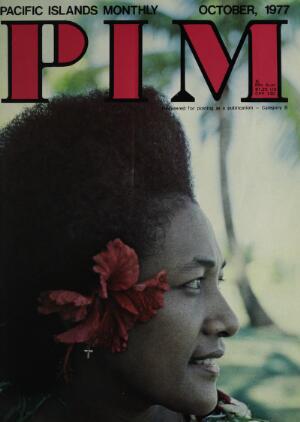
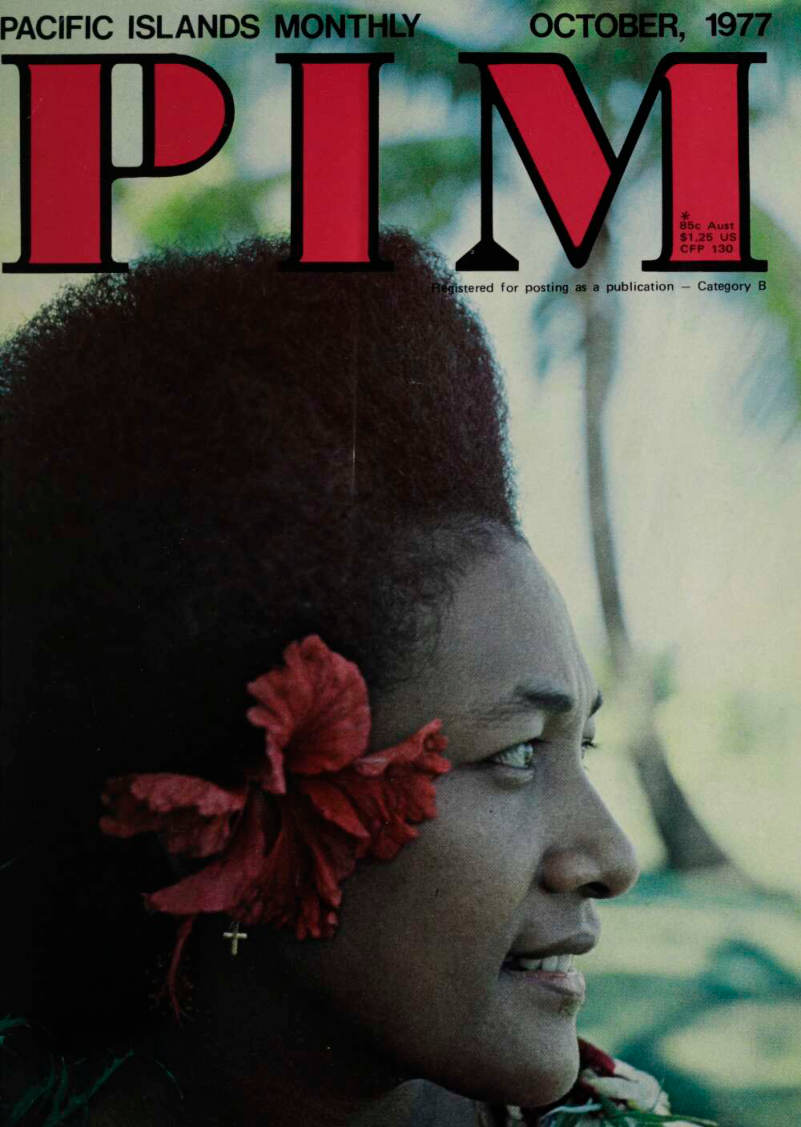
Our Cover
The September P!M cover showed an attractive Tahitian girl photographed by Ameri can photographer and author Sheree Lipton. This month’s cover is another good-to look-at study from Sheree Fijian girl Mereani whom Sheree met at the Regent of the Fiji hotel on the coast near Nadi Airport.
Advertisements & other items, pp. 2-4 (1 item)
Toyota
When you buy a Toyota
we promise you much more than
one of the world’s finest cars.
W fete V w We'll be the first to admit that at Toyota we make some of the world's finest cars.
You only have to look at them to see that.
And driving them just goes to confirm your first opinions.
But there's more to buying a car than buying a good one. You also have to be sure you can keep it that way.
Which is why Toyota have always insisted that their after-sales service be as good as the cars themselves.
In the Pacific Islands area alone we have over fifty designated outlets to provide everything you might need, from a simple service to a major overhaul. So get yourself a Toyota and get a lot more than a car.
And that's a promise.
TOYOTA
SERVICE
TOYOTA
The Toyota range includes: Toyota 1000, Toyota Corolla, Toyota Celica, Toyota Corona, Toyota Cressida, Toyota Crown PAPUA NEW GUINEA: ELA MOTORS LIMITED, Scratchley Rd., Badili, P.O. Box 75, Port Moresby. U.S. TRUST TERRITORY: MICROL CORPORATION, P.O. Box 267, Saipan. FIJI ISLANDS AUTOMOTIVE SUPPLIES CO., LTD., G.P.O. Box 355. Suva. AMERICAN SAMOA: BURNS PHILP (SOUTH SEA) CO., LTD., P.O. 1057, Pago Pago. WESTERN SAMOA: BURNS PHILP (SOUTH SEA) LTD., P.O. Box 188, Apia. GUAM: ATKINS, KROLL (GUAM) LTD., P.O. Box 6428, Tamuning. NEW HEBRIDES: NEW HEBRIDES MOTORS LTD., P.O. Box 18, Vila. SOLOMON ISLANDS MENDANA ENTERPRISES (5.1.), LTD., P.O. Box 174, Honiara. TAHITI: NIPPON AUTOMOTO, B.P. 342, Papeete. COOK ISLANDS: COOK ISLANDS TRADING CORPORATION LTD., P.O. Bo> 92 Rarotonga. NAURU ISLAND: NAURU COOPERATIVE SOCIETY. GILBERT & ELLICE ISLANDS COLONY: TARAWA MOTORS, Box 36, Bairiki Tarawa. NORFOLK ISLAND: MARIE'S NORFOLK TOURS LTD P O Box 276 NEW CALEDONIA; SERVICE IMPORTATION AUTOMOBILE DU PACIFIQUE. Rond-Point du Pacific (Station Total) B.P. 438, Noumea.
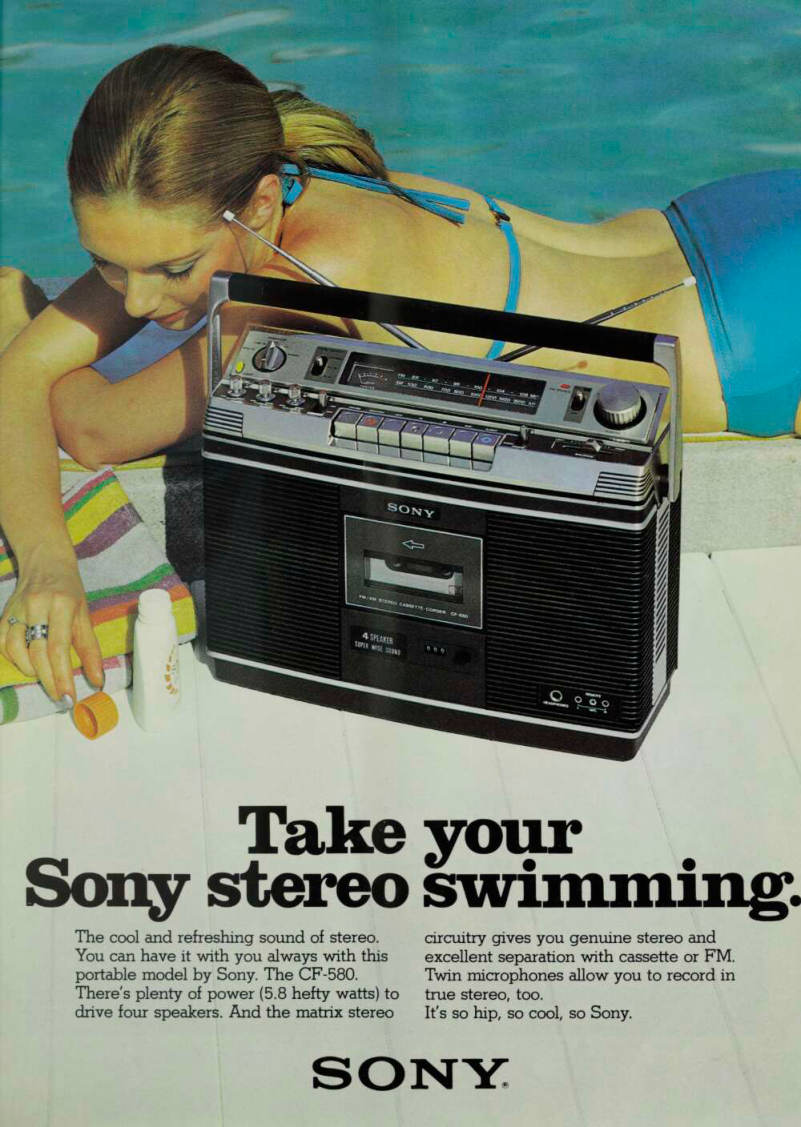
Take your
Sony stereo swimming.
The cool and refreshing sound of stereo.
You can have it with you always with this portable model by Sony. The CF-580.
There's plenty of power (5.8 hefty watts) to drive four speakers. And the matrix stereo circuitry gives you genuine stereo and excellent separation with cassette or FM.
Twin microphones allow you to record in true stereo, too.
It's so hip, so cool, so Sony.
SONY
STATESMAN
smoothest cigars on
ie international scene
SR£6U
, O M"°C O
1801 N bk ;
STATESMAN
CORONA
5
Corona
X554-10/75
Pacific Islands
Monthly
Publisher; Stuart Inder.
Manager: John Berry EDITOR: John Carter
Advertising Manager: Steve Gray
Subscription Rates
"Pacific Islands Monthly" is airfreighted to the majority of subscribers and agents in the Pacific Islands and the
Usa.
Australia (including Norfolk Island) $10.50 Aust. New Zealand $11.50 NZ ($10.50 Aust). Fiji $10.75 Fijian ($10.50 Aust). Papua New Guinea, New Hebrides, Tonga, Cook Islands, Western Samoa, Gilbert Islands, Tuvalu, Niue, Nauru and Solomon Islands $10.50 Aust American Samoa, Northern Marianas, Micronesia, Guam and Hawaii $15.00 US or $12,00 Aust. US Main land and Canada $17.00 US or $l4 00 Aust New Caledonia and French Polynesia 1,600 CFP or $13.50 Aust. United Kingdom 9.50 or $12.50 Aust. Japan 4,500 Yen or $12.50 Aust. Elsewhere $14.00 Aust Note: Overseas remittances in Australian dollars should be by bankdraft payable at Sydney Australia.
Representatives
H|l: Distribution and subscriptions Desai Bookshops, P.O Box 160, Suva, Fiji. Telephone: Suva 23036 Advertising, Fiji Times & Herald Ltd., 20 Gordon Street, Suva. Telephone: 312 111. Telex: FJ2124.
Papua New Guinea: Advertising and Distribution PNG Post-Courier, P.O. Box 85, Port Moresby. Inquir ies: Post Newsagency, Telephone 24 2148 French Polynesia: Distribution Hachette Pacifique, 10 Ave Bruat, Papeete New Caledonia: Distribution Depot Centre de Presse Michel Pentecost, 8.P.C2 Noumea.
United Kingdom: The Herald and Weekly Times Lim ited, 8-10 Clifford's Inn, Fetter Lane, London EC4AIBU Telephone: 01 831 6041. Telex: London 21989 Japan: Advertising Universal Media Corporation, C.P.O. Box 46, Tokyo Telephone: 666 3036.
New Zealand: Pacific Publications, C.P.O. Box 2229, Auckland. Advertising enquiries International Media Representatives Ltd, P.O. Box 3880 Auckland. Tel 73 880. Telex; NZ21157. (Auck. 40).
Hawaii and U.S. Mainland only: PIM, Hawaii, 2812, Kahawai St., Honolulu, Hawaii, 96822. Second class postage paid at Honolulu, Hawaii US Advertising Rep resentative, Joshua B. Powers. Jr, Powers International, Inc 551 Fifth Ave, New York, New York 100 017 Tele phone 867 9580 Telex 236514 Pub 952480 Victoria: Advertising Pacific Publications (Aust.) Pty Ltd., Herald and Weekly Times Building, 2nd Floor, 61 Flinders Lane, Melbourne, 3000 Telephone 652 1565 Brisbane: D Wood, Anday Agency, Box 1918 G.P.O.
Brisbane 4001 Telephone: 44 3485; 44 1546 Printed in Australia Copyright ©, 1977, Pacific Publications (Aust.) Pty. Ltd.
Printed by Paramac, Mitchell Rd, Alexandria.
PIM is distributed in Australia and New Zealand by Gor don & Gotch. Australian cover price is recommended retail only.
Registered at the G.P.O. Sydney for transmission by post as a publication category B
Vol. 48 No. 10
October 1977
Up Front
with the Publisher
Congratulations to the South Pacific Forum, which six years after its establishment, has decided to review some of its operations, par ticularly its requirements for
membership.
The decision, made in Port Moresby, comes not too early and not too late.
Internal strains are only just beginn ing to show, as you can see from John Carter’s story on page 8. So the review is well timed.
The South Pacific Commission almost died some years ago because of the reluctance of the colonial governments to review its opera tions regularly, and the Pacific’s new leaders have good memories.
The South Pacific Forum was established as a less unwieldly alternative to the SPC and its design ers intended it to represent a new era in Pacific politics, as it has become.
I was among those in Wellington in August 1971 to report on that first, low-key meeting. Many of the delegates took part witnout know ing just what to expect, and the trutn was that the organisers themselves - notably Sir Ratu Kamisese Mara and Sir (then Mr) Albert Henry - were playing it by ear. The meeting was, as the official announcement later phrased it ‘an ad hoc gathering of island leaders and representatives of Australia and New Zealand - the initiative coming from the leaders of the independent self-governing islands 4 States all of which are associated with the Commonwealth.
The talks were essentially exploratory.
Those present discussed as neighbours and partners a number of problems which concerned them and possible ways of solving them’.
Ratu Mara spoke for the Island neighbours when he told the meet ing, ‘We emergent nations in the Pacific would like to maintain the friendly relations that have existed with our former guides and pro tectors beyond independence and into the future. It may be that the operation of independence in this way - the Pacific way - is what will distinguish us from other parts of the world where this has not always been so. And in Australia and New Zealand we have neighbours who
have gone through this experience and can share it with us.‘ The neighbours and partners in 1971 were Fiji, the Cooks, Western Samoa, Tonga, Nauru, Australia and New Zealand. The presence of Australia and New Zealand was crucial to the success of that first Forum because the island leaders deliberately set out to involve their big neighbours in a genuine partner ship - to bring them into regular informal dialogue with the Islanders.
This aim has long since been achieved. The problem the Forum has now is to keep itself informal, neighbourly and effective. With the addition of new Island States it is probably inevitable that it will loose some of its ability to decide on courses of action and there is always the possibility of internal political bickering which will destroy the atmosphere of goodwill.
Genuine disagreement is no bad thing. The Forum is designed to be just that - a forum of opinion. But the disagreement between the Gilberts and Fiji at the Port Moresby meeting was unnecessary. It would not have occurred if the rules of Forum membership were specific in their detail.
The committee is now to spell out the details and report back to next year‘s meeting. Among those who will follow the results with close interest are the French Pacific Territories. It was stressed at that initial Wellington meeting that the Forum was not designed as a Commonwealth club - that it was • open to any State which genuinely controlled its own affairs - that was ‘independent 4 . The New Zealanders, at that time involved in sensitive Common Market negotiations in respect of their agricultural products, were apprehensive as to whether the Forum could avoid an anti-French label. It did, and so far it has.
Now that the Gilberts have been admitted in fairly loose circum stances, it will earn the label soon enough unless it makes its member ship requirements absolutely specific and sticks to them, Stuart Inder
Advertisements & other items, pp. 5-6 (2 items)
Founded By R. W Robson In 1930
PUBLISHED MONTHLY BY
PACIFIC PUBLICATIONS (AUST.) PTY. LTD.,
76 CLARENCE STREET, SYDNEY 2000
Post Address: G.P.O. BOX 3408, SYDNEY,
NS W 2001
Telegraphic Address; PACPUB, Sydney.
Telex 21242 Telephone: 29 6693
Pacific Islands.
S.E. TATH AM & CO. PTY. LTD.
BEEHIVE BUILDING,
94 ELIZABETH STREET.
C.P.O. BOX 8,
MELBOURNE 3001,
AUSTRALIA.
CABLES: “SET"
TELEX: AA34552.
TELEPHONE: 63 5094.
T 4*
...BUYERS for the
PACIFIC ISLANDS.
PAPUA NEW GUINEA:
S. E. TATHAM (P.N.G.) PTY. LTD.
LAE: MAIAITA ST. (P.O. BOX 1562).
PORT MORESBY: Cnr. GOROA & MANAHU Sts.,
GORDON (P.O. BOX 6733, BOROKO).
FIJI:
S. E. TATHAM (FIJI) PTY. LTD.
LAUTOKA: P.O. BOX 366.
SUVA: G.P.O. BOX 671.
TELEGRAMS: ALL OFFICES "SET.’
YOUR GUARANTEE
FOR SERVICE
SINCE 1024
Pacific islands Monthly
Vol 48, No 10, Oct 1977
General
Forum meeting at Port Moresby 8 Pacifique Sud 14 Brett Milder on screen 25 Migration to Australia 37 Brig Maria's goal 42 Use for coconut wood 58 PAA fights for monopoly 64 Fewer firms ship from UK 64 Viking Line cruises 73 Cruise liners to be retired 73
American Samoa
Line-up for top job 10 Old friendship renewed 11 Shortage of beds 25 Notre Dame graduate 37
Cook Islands
Forum meeting 8 Brych controversy 18 Stirring singing 27 Use for the Yankee 27 Manager of leading hotel 36 Telecom training centre 57 Use for coconut wood 58
Fiji
Forum meeting 8 Close look at docks 17 Easy electioneering 18 Crime ebb 20 Telecom training centre 57 Use for coconut wood 58 Shipping crisis looms 63 Ship's master suspended 71
French Polynesia
Fish farm 13 Pacifique Sud 14
Gilbert Islands
Forum meeting 8 Split on Ocean Island 15 Blow to Banabans 15 Cholera outbreak 20 Worst accident for 1977 24 Use for coconut wood 58
Nauru
Forum meeting 8 Rosie D in service 72
New Caledonia
Olivier Stirn's visit 12 HiCom under fire 13 Pacifique Sud 14 Tight economy 61
New Hebrides
Pacifique Sud 14 NZ gift of spectacles 29 Rice project 55 Use for coconut wood 58
Niue Island
Use for coconut wood 58
Norfolk Island
Minister replies to criticism 18 Dearer smokes and liquor 20 Anti-weed insects 57
Papua New Guinea
Forum meeting 8 Somare's cabinet team 20 Castaways survive 20 Snake in studio 20 First female police 24 Air fares order to public service 24 Anti-brothel demonstration 29 Priest's golden jubilee 36 Graduate's severe injuries 36 Copper market prospects 61
Pitcairn Island
Harbour works 59
Solomon Islands
Forum meeting 8 Melanesian missionary in NZ 25 New deputy governor 37 Questions about union 39 Chances for trade 57
Tokelau
Better days ahead 19
Tonga
Forum meeting 8 Oil strike 17 Port of Refuge sold 20 Air from Britain 24 Workers in demand 24 Telecom training centre 57 Russian interest in trade 57 Use for coconut wood 58 Vavau runway lengthened 64
Tuvalu
Election results 18
Us Trust'territory
Mother wants to go home 36 Copra mill in Micronesia 85
West Irian
Freedom fighters accuse Australia 19
Western Samoa
Foftim meeting 8 Bank shares sell quickly 10 Old friendships renewed 11 Royal titles 11 Blasting reef passages 20 Australian aid 29 Telecom training centre 57 Use for coconut wood 58 Near disaster for ferry 72
DEPARTMENTS: Up Front with the Publisher, 5; News in a Nutshell, 20; Tropicalities, 25; Editor's Mailbag, 31; People, 36; Islands Press, 40; Magazine Section, 42; Books, 51; Business & Development, 55; Pacific Transport, 63; Cruising Yachts, 75; Deaths of Islands People, 79; Shipping Information, 80; Produce Prices, 85.
countries listen - and worry
The Forum speaks, and faraway countries listen - and worry
From JOHN CARTER in Port Moresby
For the first time in its seven years, the South Pacific Forum has made its presence felt outside the confines of the South Pacific. In its three-day meeting at the Administrative College at Waigani it made decisions which will invite reactions from Japan, the United States, the Philippines and, perhaps, even Russia A decision to establish a South Pacific Regional Fisheries Agency coupled with the planned declaration of Forum members to claim a 200-mile economic and fishing zone is already causing anxiety in Tokyo and, before this report is read, there could be strong reaction from the United States via the South Pacific Conference in Pago Pago at the end of September.
The Forum is also planning to stretch out a hand to the member countries of ASEAN, the Association of South-East Asian Nations and it may not stop there. It is beginnine to flex its political muscles— politics was the first consideration when the Forum was first thought of as a political platform denied to them by the South Pacific Commiss j on y Somebody else thinks it should do a bit of muscle-flexing the National Revolutionary Council of
West Papua which endeavoured, without success, to get the Forum to react to a petition it tried to cir culate among the members which alleged “untold atrocities” by In donesians in Irian Jaya.
The Forum let well alone, as it did over another demonstration mounted by young members of Papua Besena, the Papuan separatist party, who paraded with banners outside the delegates’ hotel. The banners asked for a third of Australian aid to be given to Papua and sought the Forum’s aid in the “struggle for independence” by the peoples of Papua and West New Guinea.
But these demonstrations and the presence for the first time at the Forum of a covey of Japanese jour nalists underlined the growing im portance of the Forum in world affairs. Not that most Forum leaders saw the meeting as any more impor tant than the previous seven.
But my own view is that this Forum has stirred things up to the extent that its members might have to decide that an annual meeting isn’t often enough (even though its hard-worked SPEC the South Pacific Bureau for Economic Co operation usually takes care of most things in between forums).
Fiji at this meeting wasn’t very satisfied with the Forum s decision to admit the Gilberts to full mem bership, and the absence from the formal agenda of the establishment of a regional airline, The admission of the Gilberts to full Forum membership was done at an unfortunate time. At present, there’s no love lost between the Gilberts and Fiji over the matter of Ocean Island and the desire ot the Banabans, living in Rabi in Fiji, to have Ocean Island declared inde pendent from the Gilberts and ad ministered by Fiji .
The fact that Fiji opposed tu membership for the Gilberts on the grounds that no one could give a tix ed date for Gilbertese independence was genuinely be! leved by the Gilberts’ Chief Minister Naboua Ratieta to be flak from the 1 " agreement on Ocean Island, He told me as much at the end ot the first session although 1 had pointed out, as Fiji pointed out, that Fiji was worried that a change in t e criteria on which membership is based would bring applications from other territories like Frenc Polynesia and New Caledonia.
“Membership of SPEC does not automatically confer tull membe ship of the Forum, Fiji s ueputy
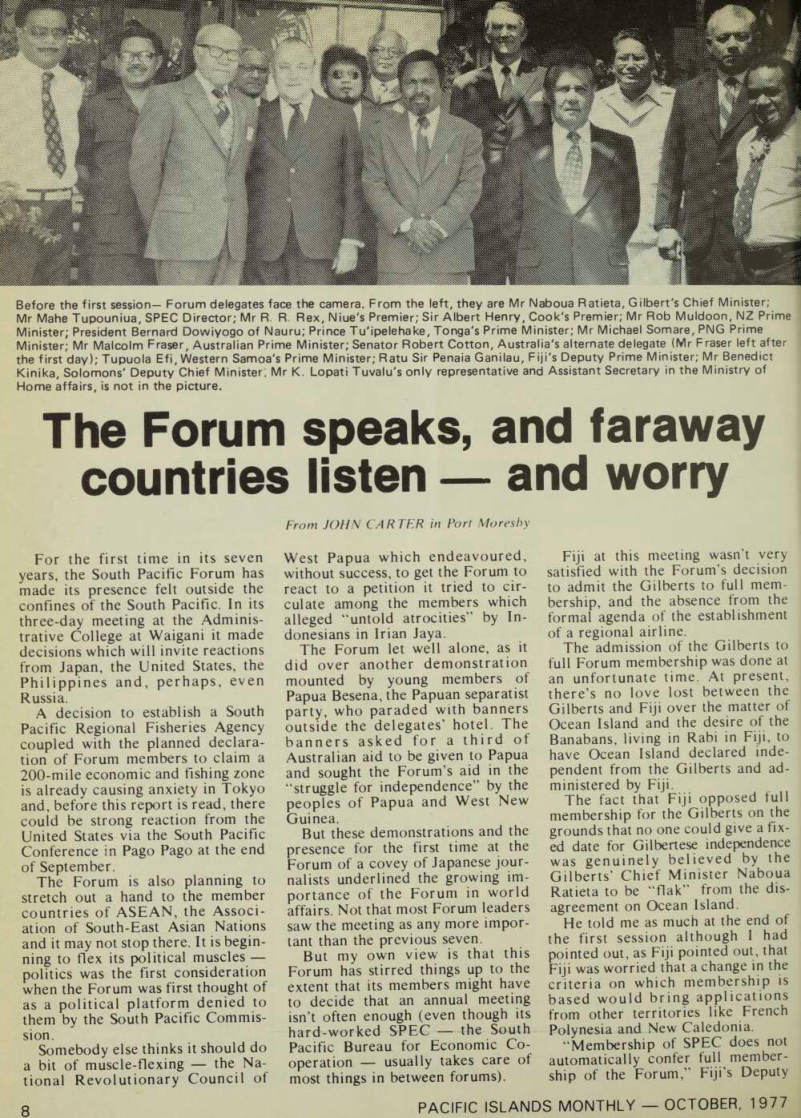
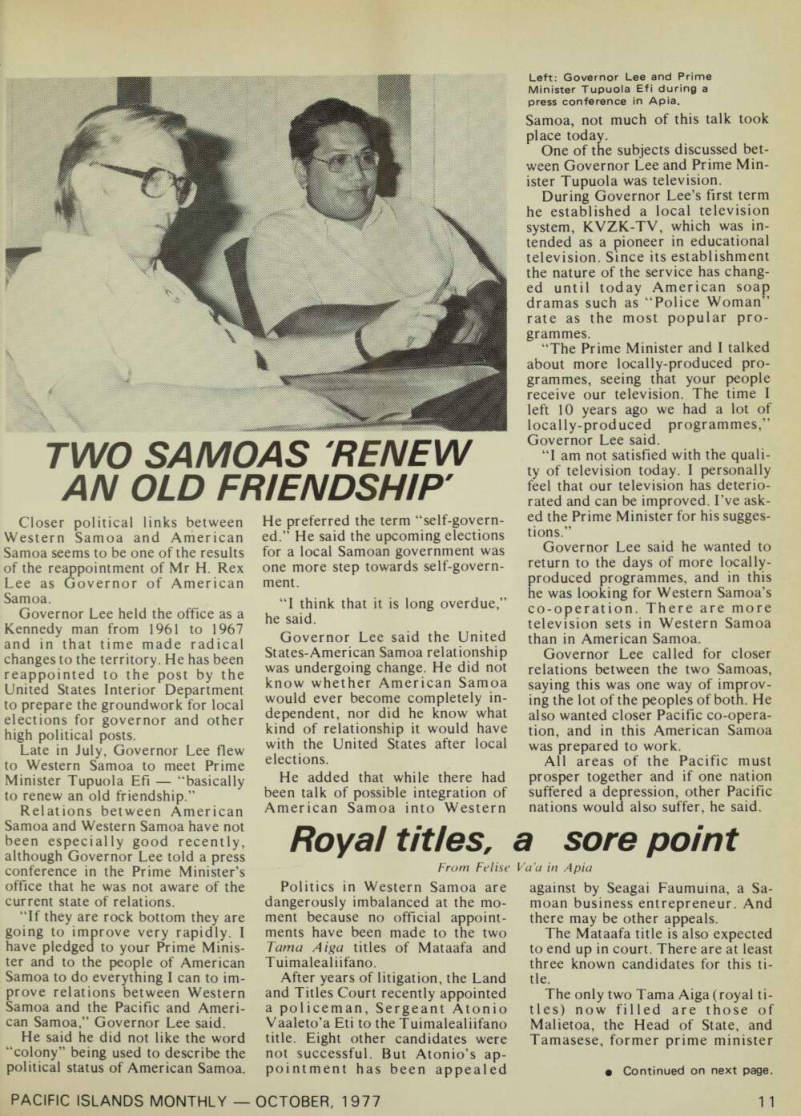
Before the first session— Forum delegates face the camera. From the left, they are Mr Naboua Ratieta, Gilbert's Chief Minister; Mr Mahe Tupouniua, SPEC Director; Mr R. R. Rex, Niue's Premier; Sir Albert Henry, Cook's Premier; Mr Rob Muldoon, NZ Prime Minister; President Bernard Dowiyogo of Nauru; Prince Tu'ipelehake, Tonga's Prime Minister; Mr Michael Somare, PNG Prime Minister; Mr Malcolm Fraser, Australian Prime Minister; Senator Robert Cotton, Australia's alternate delegate (Mr Fraser left after the first day); Tupuola Efi, Western Samoa's Prime Minister; Ratu Sir Penaia Ganilau, Fiji's Deputy Prime Minister; Mr Benedict Kinika, Solomons' Deputy Chief Minister; Mr K. Lopati Tuvalu's only representative and Assistant Secretary in the Ministry of Home affairs, is not in the picture.
Prime Minister, Ratu Sir Penaia Ganilau, told the members. “Con versely, membership of the Forum is not a pre-requisite to membership of SPEC. The Forum sets its own criteria for admitting countries to full membership of the Forum.
“Fiji’s understanding is that these criteria are; (a) That a country must be independent, or (b) that a coun try must be internally self-governing but with a clear date on which it will achieve independence.”
Ratu Penaia said Fiji regarded membership of the Forum by the Cooks and Niue as special cases because of their peculiar constitu tional arrangement with New Zea land.
Earlier, on the first day, Ratu Penaia had expressed the fear that “if countries are admitted to full membership of the Forum only on the basis of a general statement of intention to move to independence, we shall have to accept applications for membership from other coun tries in the region, including the French territories even though they may not actually achieve indepen dence until after three, five or 10 years or even longer. In this event, we doubt whether the Forum will remain a forum of decision-makers as it is today.
One can foresee the danger of Fiji, or someone else, failing to support the Forum if it becomes a body without the power to make deci sions. Fiji was a prime mover in the Forum’s creation.
Mr Ratieta assured the Forum that the Gilberts was truly self governing and was definitely mov ing to independence within a year or so.
The Forum accepted his assurance and voted the Gilberts in.
The Solomons and Tuvalu, almost in the same boat, made no applica tion.
Fiji got some satisfaction. It was agreed that a group of member countries’ officials should meet and discuss the re-definition of the cri teria for full membership, and re port at the next Forum.
The two decisions regarding fish eries, the establishment of a South Pacific Regional Fisheries Agency and the agreement to declare a 200mile fishing or economic zone, could run into heavy weather.
The Law of the Sea conference hasn’t come up with anything yet in the way of framing international
laws or zones but the Forum felt that as many countries had already declared such zones, the South Pacific should protect its own in terests.
The resolution said that “in view of the action taken by a large num ber of countries including distant water fishing countries exploiting the valuable highly migratory spe cies in the region, the countries in the region should move quickly to establish fishing or exclusive eco nomic zones and should take steps to co-ordinate their policies and ac tivities if they are to secure more than a very small part of the benefits from their resources for their peo ples”.
SPEC was told to call a meeting of officials of all interested countries by the end of November. Their job will be to prepare a draft convention establishing the agency, and to make arrangements for setting up an in terim office and a staff who will pre pare guidelines for gathering all the information, biological, economic, etc, needed to make sure the Forum countries are in a position to harvest their own seas. The deadline is March 31 next year.
The temporary office will be, at the invitation of the Australian Government, at the CSIRO centre at Cronulla in New South Wales, which has already gathered much information on fisheries and has a computer. The Solomons has offered to put the permanent head quarters at Honiara. SPEC’s Direc tor, Mr Mahe Tupouniua, has the task of seeking funds from govern ments and international agencies for the agency operations.
The agency will negotiate with countries like Japan and other “dis tant water fishing nations and other extra-regional interests” and will also facilitate “without detriment to the sovereign rights of coastal coun tries, a regional approach to man agement and to licensing including agreement on generally applicable policies and measures, pooling of information and standardisation of procedures and forms”.
They’ll also grapple with the mammoth task of finding resources and means for surveillance and policing the areas.
It may not be as hard as people think to police the millions of square miles of ocean in the South Pacific. Papua New Guinea has six patrol vessels and it’s surprising,
since they began work and roped in a few illegal fishing vessels, how much the incidence of illegal fishing in PNG waters has been cut.
The Forum didn’t take long to agree to most of the proposals on the agency, but one clause held them up.
It went through eventually, in this way: “... to establish a South Pacific Regional Fisheries Agency open to all Forum countries and all countries in the South Pacific with coastal state interests in the region who support the sovereign rights of the coastal state to conserve and manage living resources, including highly migratory species, in its 200 mile zone”.
The key is in the words “including highly migratory species, in its 200 mile zone”. That’s likely to cause great concern to countries like Japan, Russia and the United States, and it was with regard to these, and especially the USA, that there were two camps. Japan takes 300 000 ton nes of fish a year out of the South Pacific. The United States, it is believed, is, over all the Pacific, the biggest operator.
According to the terms of the resolution, the US will be excluded from the agency because it opposes any sovereign rights being exercised with regard to “highly migratory species”. It believes those resources belong to everyone.
Western Samoa and Fiji were not happy over the US being excluded.
American Samoa, with its large fish ing fleets and fish canneries, is not far away from Western Samoa and only recently Prime Minister Tupuola Efi of Western Samoa, and Governor Rex Lee of American Samoa, agreed to more brotherly co-operation.
Western Samoa thought it was better to have the United States within the fold than outside, where it wouldn’t have to respect the views of those inside.
Fiji thought that if surveillance and supervision were to be really effective, the agency must have the widest possible membership.
Papua New Guinea was among those who took the opposite view that those countries which did not recognise the right of sovereign countries to control all the resources in their own areas should not be admitted to membership.
The view prevailed, but it will be interesting to see the United States’
• Continued on p. 78
reaction when the South Pacific Conference gets around to discuss ing the matter at Pago during the last week in September, as it will be invited to do.
Another regional hot potato to come up was environmental man agement. Both the Forum and the SPEC last year agreed on joint ac tion to formulate a programme reflecting the environmental in
terest of all countries in the region.
The SPC sent the Forum a paper on the proposals, the Forum decid ed it didn’t contain enough informa tion and has sent it back for more work.
On the question of a regional airline Ratu Sir Penaia Ganilau said that the continuing problem in the field of regional civil aviation was that the regional partners in Air
Pacific had not really committed themselves to recognising that they i had a regional service. If there was no collective commitment to sup port the concept of developing Air j Pacific as the regional carrier, there was really no point in continuing with a common regional carrier.
Fiji, Ratu Penaia said, had always supported the development of a designated regional carrier because she felt they must avoid the situation where Island governments in the region were competing against each other at great expense to themselves but to the definite advantage of the established trunk route carriers operating across the Pacific.
As Western Samoa, Nauru and Papua New Guinea with Tonga thinking of coming along— have all got their own airlines and intend to keep them, Fiji got no response.
The only apparent interest in a regional airline was contained in the SPEC director’s report as just another item.
The report of SPEC’s activities over the last 12 months was approv ed, as was Fiji’s view that the Telecommunications Training School in Fiji should be run as a Fiji institution but would provide facilities and places for students from other countries in the region in the same way as that operated by the Fiji School of Medicine and the Fiji School of Agriculture.
Some members had taken the view that the school should be regionally owned, with Fiji as ad ministrator. Fiji opposed that idea and the Forum agreed to regard it as a Fiji national institution with places guaranteed for students from outside.
Ratu Penaia told members the school was flourished with 108 stu dents— four from the Cooks, seven from the New Hebrides, three from Niue, 10 from Tonga, 17 from Western Samoa and 67 from Fiji.
There were no opponents of the proposal to establish “informal con tact on matters of common interest” with ASEAN, and members ac cepted two invitations for the Third South Pacific Festival of Arts to be held in late June/early July, 1980, in Papua New Guinea, and for the 9th South Pacific Forum to be held on Niue next year at a date to be fixed.
The Line-Up For Top Job
In American Samoa
From Felise Va'a in Apia
This year will go down in history books as one of the most important in American Samoa for it is the year when the people of the territory will elect for the first time their own governor and lieutenant-governor.
The elections in November have already been approved by the peo ple in a plebiscite, by the legislature and now by the United States Con gress. And the Interior Department has sent a top-rate administrator and former governor of the terri tory. Rex Lee. to be the territory’s last Washington-appointed gover nor.
For a time, there was speculation that Frank Barnett, the Republican governor who succeeded Earl Ruth might be the last governor since there was not much time left before the elections. But Washington thought otherwise. The Democratic Administration appointed Rex Lee to take over the post for the three crucial months before the elections.
Lee has denied he is here for the purpose of supervising the guber natorial elections. And he is quite right in this.
But most probably. Washington wanted its last governor to be the best one possible in every way. but especially in promoting United States interests at this cruical period. The governor Washington wanted was one who could rally the people of American Samoa around the US flag, so that there is no danger of breaking away from the United States.
Lee's vast experience in federal administration is intended to ensure that there will be as little trouble as possible in the transition period.
He was governor of American Samoa from 1961 to 1967. perhaps the longest term ever had by any governor in the territory. During his term, the United States began to show for the first time that it really cared about the territory.
Millions of dollars were spent to upgrade government services which included a modern airport, sealed roads, many new buildings, and the educational and community televi sion system. Lee also showed he was
talented in being able to get along with the Samoans.
He was loved by the majority, especially for the jobs he created for them, and many considered him the best governor Samoa ever had.
While Lee is busy trying to straighten out administrative prob lems. campaigning has already started with a number of candidates already announced.
On one ticket is former governor.
Samoan Peter Coleman, and his run ning mate Tufele Li’a. On another is the present Delegate at Large in Washington Lutali A.P. and Senator Fofo Sunia.
On yet another is the former Delegate at Large, Senator Fui maono Asuemu and his running mate Senator Lutu Tenari.
Also, several other persons like Mr Lagarejos and Papu Siofele have
announced their intention to run for I governor.
Campaigning has just started and it is expected to be in full swing bv September and early October.
Right now, it may be a bit pre-1 mature to predict the eventual win ner but certainly it is very likely that I the top candidates will be Peter Col eman. Lutali A. P. and Fuimaono Asuemu.
They are all men of wide ex perience in government and civic affairs, have proved themselves as capable political leaders and, moreover, were very successful in the past.
The importance of the Number Two man can hardly be over emphasised. A strong candidate for governor may have dim chances ot winning if his Number Two is not at tractive to the voters.
But it could also be said that much of the voting will be along partisan and family lines.
Whatever happens, after the elec tions in November. American Samoa is going to have its own elected governor and lieutenant governor. This will have important effects on the future administration of the territory.
Though the Interior Department will still be the boss, American Sa moan politics will move nearer maturity.
American Samoa’s decision to elect its own governor and lieute nant-governor is also a sure sign that American Samoa is aligning herself more firmly with the United Stales.
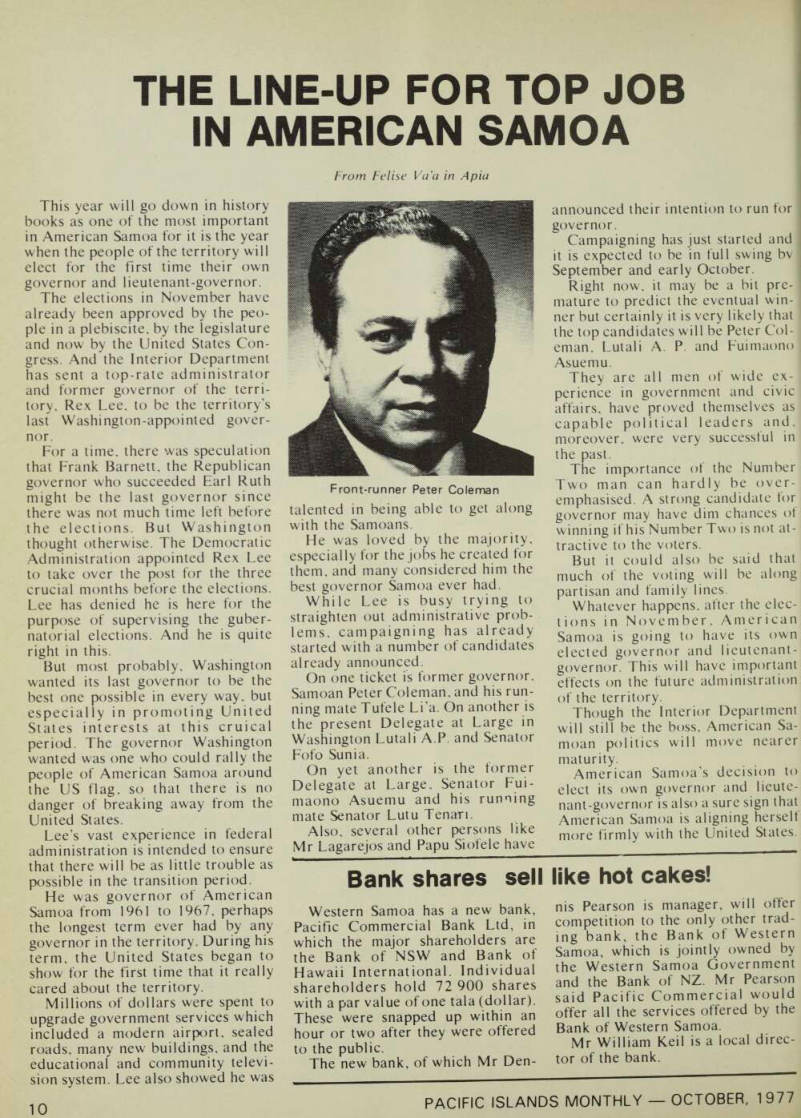
Front-runner Peter Coleman
Bank shares sell like hot cakes!
Western Samoa has a new bank, Pacific Commercial Bank Ltd, in which the major shareholders are the Bank of NSW and Bank of Hawaii International. Individual shareholders hold 72 900 shares with a par value of one tala (dollar).
These were snapped up within an hour or two after they were offered to the public.
The new bank, of which Mr Den
nis Pearson is manager, will offer competition to the only other trad ing bank, the Bank of Western Samoa, which is jointly owned by the Western Samoa Government and the Bank of NZ. Mr Pearson said Pacific Commercial would offer all the services offered by the Bank of Western Samoa.
Mr William Keil is a local direc tor of the bank.
Two Samoas 'Renew
An Old Friendship'
Closer political links between Western Samoa and American Samoa seems to be one of the results of the reappointment of Mr H. Rex Lee as Governor of American Samoa.
Governor Lee held the office as a Kennedy man from 1961 to 1967 and in that time made radical changes to the territory. He has been reappointed to the post by the United States Interior Department to prepare the groundwork for local elections for governor and other high political posts.
Late in July, Governor Lee flew to Western Samoa to meet Prime Minister Tupuola Efi “basically to renew an old friendship.”
Relations between American Samoa and Western Samoa have not been especially good recently, although Governor Lee told a press conference in the Prime Minister’s office that he was not aware of the current state of relations.
“If they are rock bottom they are going to improve very rapidly. I have pledged to your Prime Minis ter and to the people of American Samoa to do everything I can to im prove relations between Western Samoa and the Pacific and Ameri can Samoa,” Governor Lee said.
He said he did not like the word “colony” being used to describe the political status of American Samoa.
He preferred the term “self-govern ed.” He said the upcoming elections for a local Samoan government was one more step towards self-govern ment.
“I think that it is long overdue,” he said.
Governor Lee said the United States-American Samoa relationship was undergoing change. He did not know whether American Samoa would ever become completely in dependent, nor did he know what kind of relationship it would have with the United States after local elections.
He added that while there had been talk of possible integration of American Samoa into Western
Samoa, not much of this talk took place today.
One of the subjects discussed bet ween Governor Lee and Prime Min ister Tupuola was television.
During Governor Lee’s first term he established a local television system, KVZK-TV, which was in tended as a pioneer in educational television. Since its establishment the nature of the service has chang ed until today American soap dramas such as “Police Woman” rate as the most popular pro grammes.
“The Prime Minister and I talked about more locally-produced pro grammes, seeing that your people receive our television. The time I left 10 years ago we had a lot of
locally-produced programmes,”
Governor Lee said.
“I am not satisfied with the quali ty of television today. I personally feel that our television has deterio rated and can be improved. I’ve ask ed the Prime Minister for his sugges tions.”
Governor Lee said he wanted to return to the days of more locally produced programmes, and in this he was looking for Western Samoa’s co-operation. There are more television sets in Western Samoa than in American Samoa.
Governor Lee called for closer relations between the two Samoas, saying this was one way of improv ing the lot of the peoples of both. He also wanted closer Pacific co-opera tion, and in this American Samoa was prepared to work.
All areas of the Pacific must prosper together and if one nation suffered a depression, other Pacific nations would also suffer, he said.
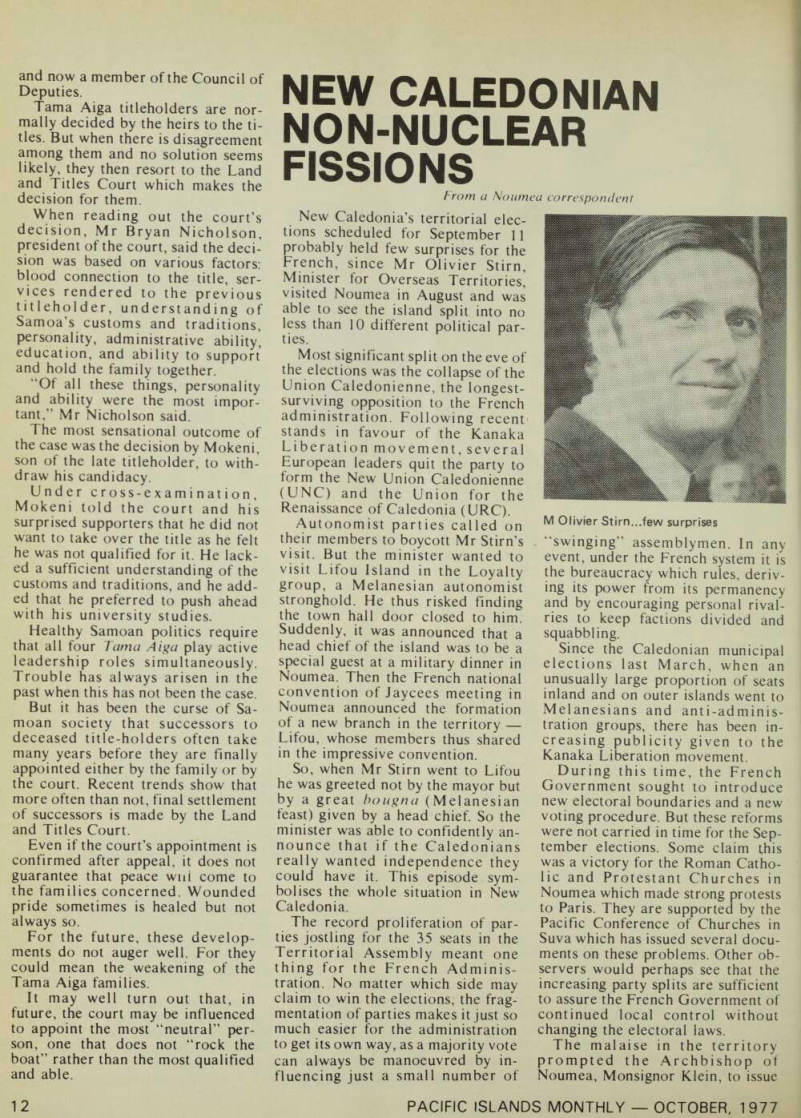
Left: Governor Lee and Prime Minister Tupuola Efi during a press conference in Apia.
Royal titles, a sore point
From Felise Va’a in Apia
Politics in Western Samoa are dangerously imbalanced at the mo ment because no official appoint ments have been made to the two Tama Aiga titles of Mataafa and Tuimalealiifano.
After years of litigation, the Land and Titles Court recently appointed a policeman, Sergeant Atonio Vaaleto’a Eti to the Tuimalealiifano title. Eight other candidates were not successful. But Atonio’s ap pointment has been appealed
against by Seagai Faumuina, a Sa moan business entrepreneur. And there may be other appeals.
The Mataafa title is also expected to end up in court. There are at least three known candidates for this ti tle.
The only two Tama Aiga (royal ti tles) now filled are those of Malietoa, the Head of State, and Tamasese, former prime minister
• Continued on next page.
and now a member of the Council of
Deputies.
Tama Aiga titleholders are nor mally decided by the heirs to the ti tles. But when there is disagreement among them and no solution seems likely, they then resort to the Land and Titles Court which makes the decision for them.
When reading out the court’s decision, Mr Bryan Nicholson, president of the court, said the deci sion was based on various factors: blood connection to the title, ser vices rendered to the previous
titleholder, understanding of
Samoa’s customs and traditions,
personality, administrative ability,
education, and ability to support and hold the family together. ”Of all these things, personality and ability were the most impor tant,” Mr Nicholson said.
The most sensational outcome of the case was the decision by Mokeni, son of the late titleholder, to with draw his candidacy.
Under cross-examination, Mokeni told the court and his surprised supporters that he did not want to take over the title as he felt he was not qualified for it. He lack ed a sufficient understanding of the customs and traditions, and he add ed that he preferred to push ahead with his university studies.
Healthy Samoan politics require that all four Tama Aiga play active
leadership roles simultaneously.
Trouble has always arisen in the past when this has not been the case.
But it has been the curse of Sa moan society that successors to deceased title-holders often take many years before they are finally appointed either by the family or by the court. Recent trends show that more often than not, final settlement of successors is made by the Land and Titles Court.
Even if the court’s appointment is confirmed after appeal, it does not guarantee that peace wui come to the families concerned. Wounded pride sometimes is healed but not always so.
For the future, these develop ments do not auger well. For they could mean the weakening of the Tama Aiga families.
It may well turn out that, in future, the court may be influenced to appoint the most “neutral” per son, one that does not “rock the boat” rather than the most qualified and able.
New Caledonian
Non-Nuclear
Fissions
From a Noumea correspondent
New Caledonia’s territorial elec tions scheduled for September 11 probably held few surprises for the French, since Mr Olivier Stirn, Minister for Overseas Territories' visited Noumea in August and was able to see the island split into no less than 10 different political par ties.
Most significant split on the eve of the elections was the collapse of the Union Caledonienne, the longest surviving opposition to the French administration. Following recent stands in favour of the Kanaka Liberation movement, several European leaders quit the party to form the New Union Caledonienne (UNC) and the Union for the Renaissance of Caledonia (URC).
Autonomist parties called on their members to boycott Mr Stirn’s visit. But the minister wanted to visit Lifou Island in the Loyalty group, a Melanesian autonomist stronghold. He thus risked finding the town hall door closed to him.
Suddenly, it was announced that a head chief of the island was to be a special guest at a military dinner in Noumea. Then the French national convention of Jaycees meeting in Noumea announced the formation of a new branch in the territory Lifou, whose members thus shared in the impressive convention.
So, when Mr Stirn went to Lifou he was greeted not by the mayor but by a great hougna (Melanesian feast) given by a head chief. So the minister was able to confidently an nounce that if the Caledonians really wanted independence they could have it. This episode sym bolises the whole situation in New Caledonia.
The record proliferation of par ties Jostling for the 35 seats in the Territorial Assembly meant one thing for the French Adminis tration. No matter which side may claim to win the elections, the frag mentation of parties makes it just so much easier for the administration to get its own way, as a majority vote can always be manoeuvred by in fluencing just a small number of
“swinging” assemblymen. In any event, under the French system it is the bureaucracy which rules, deriv ing its power from its permanency and by encouraging personal rival ries to keep factions divided and squabbling.
Since the Caledonian municipal elections last March, when an unusually large proportion of seats inland and on outer islands went to Melanesians and anti-adminis tration groups, there has been in creasing publicity given to the Kanaka Liberation movement.
During this time, the French Government sought to introduce new electoral boundaries and a new voting procedure. But these reforms were not carried in time for the Sep tember elections. Some claim this was a victory for the Roman Catho lic and Protestant Churches in Noumea which made strong protests to Paris. They are supported by the Pacific Conference of Churches in Suva which has issued several docu ments on these problems. Other ob servers would perhaps see that the increasing party splits are sufficient to assure the French Government of continued local control without changing the electoral laws.
The malaise in the territory prompted the Archbishop of Noumea, Monsignor Klein, to issue
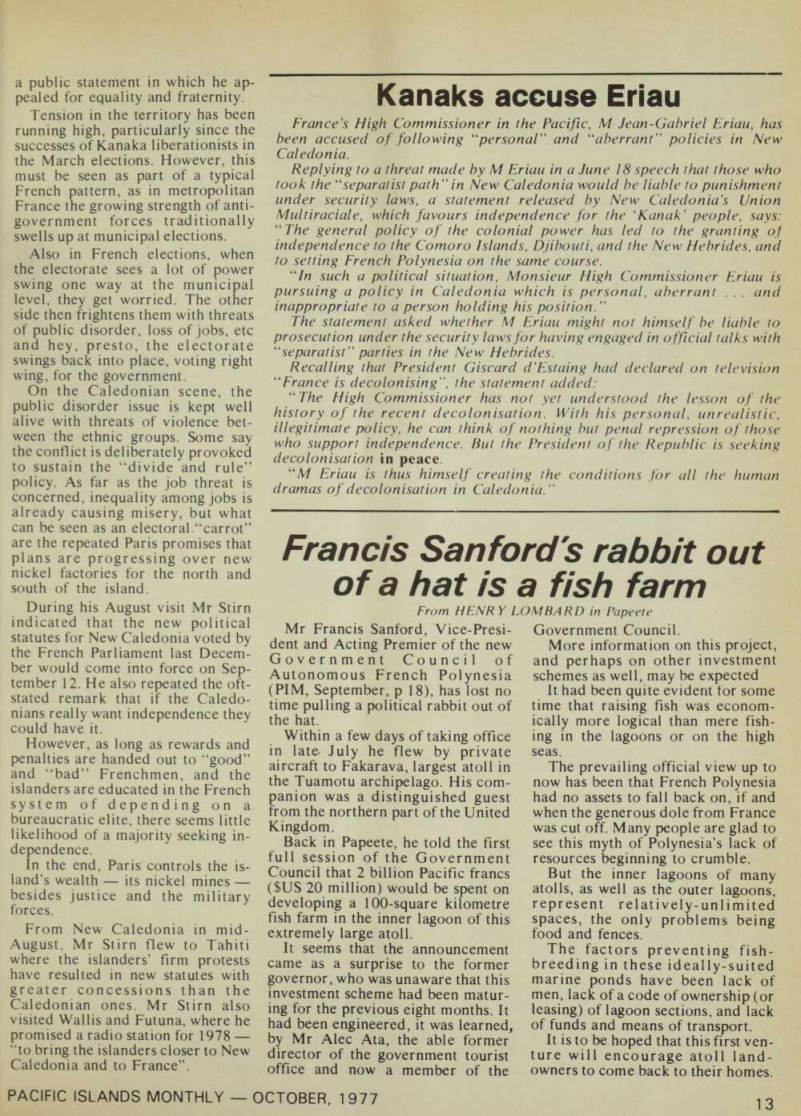
M Olivier Stirn...few surprises
a public statement in which he ap pealed for equality and fraternity.
Tension in the territory has been running high, particularly since the successes of Kanaka liberationists in the March elections. However, this must be seen as part of a typical French pattern, as in metropolitan France the growing strength of anti government forces traditionally swells up at municipal elections.
Also in French elections, when the electorate sees a lot of power swing one way at the municipal level, they get worried. The other side then frightens them with threats of public disorder, loss of jobs, etc and hey, presto, the electorate swings back into place, voting right wing, for the government.
On the Caledonian scene, the public disorder issue is kept well alive with threats of violence bet ween the ethnic groups. Some say the conflict is deliberately provoked to sustain the “divide and rule” policy. As far as the job threat is concerned, inequality among jobs is already causing misery, but what can be seen as an electoral.“carrot” are the repeated Paris promises that plans are progressing over new nickel factories for the north and south of the island.
During his August visit Mr Stirn indicated that the new political statutes for New Caledonia voted by the French Parliament last Decem ber would come into force on Sep tember 12. He also repeated the oft stated remark that if the Caledo nians really want independence they could have it.
However, as long as rewards and penalties are handed out to “good” and “bad” Frenchmen, and the islanders are educated in the French system of depending on a bureaucratic elite, there seems little likelihood of a majority seeking in
dependence.
In the end, Paris controls the is land’s wealth its nickel mines besides justice and the military forces.
From New Caledonia in mid- August, Mr Stirn flew to Tahiti where the islanders’ firm protests have resulted in new statutes with greater concessions than the Caledonian ones. Mr Stirn also visited Wallis and Futuna, where he promised a radio station for 1978 “to bring the islanders closer to New Caledonia and to France”.
Kanaks accuse Eriau
France’s High Commissioner in the Pacific, M Jean-Gabriel Eriau, has been accused of following “ personal” and “ aberrant” policies in New Caledonia.
Replying to a threat made by M Eriau in a June 18 speech that those who took the “separatist path” in New Caledonia would be liable to punishment under security laws, a statement released by New Caledonia’s Union Multiraciale, which favours independence for the ‘Kanak ’ people, says: “The general policy of the colonial power has led to the granting of independence to the Comoro Islands, Djibouti, and the New Hebrides, and to setting French Polynesia on the same course.
“In such a political situation, Monsieur High Commissioner Eriau is pursuing a policy in Caledonia which is personal, aberrant . . . and inappropriate to a person holding his position.”
The statement asked whether M Eriau might not himself be liable to prosecution under the security laws for having engaged in official talks with “separatist” parties in the New Hebrides.
Recalling that President Giscard d’Estaing had declared on television “France is decolonising”, the statement added: “The High Commissioner has not yet understood the lesson of the history of the recent decolonisation. With his personal, unrealistic, illegitimate policy, he can think of nothing but penal repression of those who support independence. But the President of the Republic is seeking decolonisation in peace.
“M Eriau is thus himself creating the conditions for all the human dramas of decolonisation in Caledonia . ”
Francis Sanford's rabbit out
of a hat is a fish farm
From HENR Y LOMBARD in Papeete
Mr Francis Sanford, Vice-Presi dent and Acting Premier of the new Government Council of Autonomous French Polynesia (PIM, September, p 18), has lost no time pulling a political rabbit out of the hat.
Within a few days of taking office in late- July he flew by private aircraft to Fakarava, largest atoll in the Tuamotu archipelago. His com panion was a distinguished guest from the northern part of the United Kingdom.
Back in Papeete, he told the first full session of the Government Council that 2 billion Pacific francs (SUS 20 million) would be spent on developing a 100-square kilometre fish farm in the inner lagoon of this extremely large atoll.
It seems that the announcement came as a surprise to the former governor, who was unaware that this investment scheme had been matur ing for the previous eight months. It had been engineered, it was learned, by Mr Alec Ata, the able former director of the government tourist office and now a member of the
Government Council.
More information on this project, and perhaps on other investment schemes as well, may be expected It had been quite evident for some time that raising fish was econom ically more logical than mere fish ing in the lagoons or on the high seas.
The prevailing official view up to now has been that French Polynesia had no assets to fall back on, if and when the generous dole from France was cut off. Many people are glad to see this myth of Polynesia’s lack of resources beginning to crumble.
But the inner lagoons of many atolls, as well as the outer lagoons,
represent relatively-unlimited
spaces, the only problems being food and fences.
The factors preventing fish breeding in these ideally-suited marine ponds have been lack of men, lack of a code of ownership (or leasing) of lagoon sections, and lack of funds and means of transport.
It is to be hoped that this first ven ture will encourage atoll land owners to come back to their homes.
Pacifique Sud
With Helen Rousseau
What do the following two men have in common underwater French scientist Captain Jacques Cousteau and commander of the Tahiti nuclear test base Rear- Admiral de Castelbajac? Both these members of the French Navy share an intense interest in the Pacific Ocean though each has his own out look upon this vast area.
One of the most significant changes coming to the Pacific is demonstrated by a new map recently published in Noumea. It features the new face of the Pacific for the end of 1977 once islands claim their new sea boundaries extending out to 320 km. This new zone of economic in terest gives the Islands within the scope of the South Pacific Commis sion a sea area of some 20 million square km. Yet the total land area is only about 560 000 sq km.
A territory such as French Polynesia, for example, has a land area of only 4 000 sq km, but its sea boundaries enclose over 4 million sq km. For the territory of New Caledonia the land area is 19 103 sq km while the new sea boundaries will enclose over 1 million sq km.
The third French territory, Wallis and Futuna, has similar areas of 210 and about 2 400 sq km respectively.
The new sea limits have prompted a Noumea newspaper to point out that “This pin head lost in the mid dle of the ocean, New Caledonia, takes on greater importance in this new context ... The new Pacific is no longer an empty stomach held in disdain right up to the military top brass; it has become a gigantic em pire. Empires have always had a great history.”
It will be interesting to see who is carving out new empires in the Pacific. Certainly the French have been promoting interesting ideas to justify their share of the cake, or should we say jelly? Ideas being espoused in both the New Hebrides and Canberra are that the Pacific risks greater infiltration by the Chinese and Russians. In this con
text, it is argued, the French presence should be encouraged as a stabilising force in the balance of power. The French seem to be very considerate in this role of hopping in and pointing out other people’s frightening problems, especially problems other people are not bright enough to see for themselves,
then promptly proposing expert
French diplomacy (not to mention nuclear aid) to solve the situation.
Of course no-one would be so un civilised as to openly mention arms deals, but it can happen that offers of technical assistance awaken a keen appetite for expensive arma ments and protective naval vessels, to police the extended island waters.
When the commander of the nuclear test base in Tahiti, Rear- Admiral Gerard de Castelbajac, spoke out early this year about French intentions in the Pacific he mentioned the importance of sea resources. He also said France “ex pects to remain here and make her contribution to the maintenance of peace in this part of the world.”
More recently, Captain Jac-* ques Cousteau, world-famed French underwater explorer, in a radio broadcast from America launched a strong plea for the protection of the sea and in particular denounced the use of nuclear energy and urged the development of solar energy which is naturally concentrated in the sea.
Jaques Cousteau, who holds the rank of captain in the French Navy, has been awarded the Legion of Honour by the French Government as well as the Croix de Guerre ser vice medal for his contributions to underwater science including the Cousteau diving bell. But his many years observing the destruction in oceans and lakes prompted him to create the Cousteau Society in 1974.
There he put all his personal resources for the production of films and publications to promote public awareness of the environment prob lem. The society has aroused tre mendous public response in the US
and plans to expand to other coun tries. Captain Cousteau spoke re cently with America’s “Mr Radio”
Studs Terkel in a lengthy interview broadcast in August by the Australian Broadcasting Commis sion.
Cousteau said, “The world has made the most formidable mistake that was ever made, to go nuclear.”
He said this compromises future generations. It was a bad choice, “probably made under military in fluence”. For example, he claimed Pakistan is buying nuclear power plants from France as they want the bomb. Instead, he urged the development of solar energy which is renewable, non-polluting and re quires the same investment as nuclear energy. He said solar power is only 15-20 years away. He urged people to check the affiliations of people involved in the nuclear debate because “unfortunately with money you can influence people”.
Cousteau’s campaign would not be popular with the French nuclear industry. He has already made him self unpopular with the French min ing authorities after his comments several years ago about the pollu tion of the New Caledonian lagoon caused by nickel mining. About four years ago, before his Noumea visit, eleclrrc power authorities were speaking of the possibility of a nuclear power plant for New Caledonia within 12 years.
As short-term economic interests have no weight in view of the need to preserve life, Cousteau says he now spends two-thirds of his time communicating his ideas on the pro tection of the earth’s water system.
The headquarters of the Cousteau Society is 777 Third Avenue, New York City, USA, where new in dividual members are welcome to join. The Pacific will no doubt be hearing more of the famous French explorer’s views as he plans to visit Australia next year for a conference on the ocean.
Gilbertese split on Ocean Island future?
Ocean Island future?
A surprise development that could bring about a complete reversal of Britain’s attitude toward the possibV separation of Ocean Island (Banaba) from the Gilbert Islands has excited Banaban leaders in Fiji and their advisers in London.
Britain has repeatedly rejected Banaban separation submissions on the ground that she could not go against the wishes of the Gilbertese people. The Gilberts Government, as representative of the people, has repeatedly declared that Banaba is an in tegral part of the colony and must remain so.
But now, out of the blue, comes a startling contention from reputable politicians in the Gilberts that their outer islands favour the separation of Banaba because they do not believe that the Gilberts have any right to it.
Messages reaching Banaban advisers in London claim that 99% of the Gilbertese in the outer islands who form a ma jority of the Gilberts’ population are against their government in this matter. The way in which this appraisal of feeling in the Gilberts came to the Banabans is interesting and seems to indicate a genuine compulsion on the part of those who reached it to make it known to the world.
A Gilbertese politician made a special journey to Fiji a dis tance of about 2 250 km to tell the Banabans, who now live there. He was sent on his mission by the opposition party in the Gilberts, to which he belongs, and the vital information that he brought was not simply an un substantiated impression of Gilbertese sentiment.
Its bearer has close links with a parliamentary committee charg ed with constitutional duties in readiness for the Gilberts’ ap proaching independence. He said that whenever the future of Banaba had been discussed at public meetings in the outer is lands there had been no room for
doubt about what the mass of people believed.
His party’s suggestion was that an impartial observer should go from Britain to confirm what he said. One observer from Britain has already visited the Pacific Mr Richard Posnett, a former colonial governor. He was sent out by the government earlier this year to examine at close range the Banaban case for sepa ration and to report back to the Minister for Foreign and Com monwealth Affairs.
He told the minister that his visit had convinced him that the Gilbertese would not agree to the separation of Ocean Island in any circumstances. He described a three-and-a-half hour public meeting in Bairiki, attended by 300 people, from which emerged an emphatic refusal even to con template it.
But the emissary who went to Fiji to pass on his important in formation to the Banabans re ported another viewpoint (not mentioned by Mr Posnett) that came from a man named Itaia.
He said that Itaia, speaking at the same meeting for himself and others, declared; “We would be wrong and un-Christian to hold
on to Ocean Island because it is written ‘Thou shalt not covet the properties of others’ and Banaba is not ours.’’
Only government ministers, civil servants and an insignificant number of Gilbertese oppose separation, the emissary said. His approach to the Banabans took them by surprise but they are satisfied of its good faith. His news confirmed their own assess ment of feeling on the part of or dinary Gilbertese in islands dis tant from their seat of govern ment.
They have not overlooked the fact that a pre-independence election is due in the Gilberts next year, or the possibility that anti-separationists will try to dis credit the opposition party’s tim ing and motives in making these disclosures.
At this stage, separation hardly seems likely to become an elec tion issue, but in Banaban reckoning that is beside the point. To them, the crux of the matter is the weight of support now reported. They do not believe that Britain could ignore proof of it without going back on her earlier reasons for rejecting their claims.
And if the majority view is as the opposition party claims and is held as strongly as it says, the ordinary Gilbertese might yet decide that the ballot box would be a good way of showing it, offi cial issue or not.
Rubbing salt into Banabans' wounds
The Banahans' cause suffered a stunning reverse when on July 29 in London the High Court ruled that they should be paid about $l4 000 as compensation for the effects of phosphate mining on Ocean Island.
Earlier, the British Phosphate Commissioners had offered about $1.5 million in an out-of-court settlement, but, in the words of Banaban spokesman in London, Tebuke Rotan, “we turned that offer down because we thought the High Court award would be better”.
Salt was rubbed into Banaban wounds by the court’s further decision that they would have to pay legal costs, estimated by Mr Rotan at about $460 000.
Mr Rotan said that in August he would go to Rabi Island, Fiji, where most of the 3 000 Banabans now live, to advise an appeal against the High Court decision.
Australia, Britain and New Zealand in May offered an ex-gratia payment of $lO million on condition that Banabans made no further claims “arising out of past events”.
In view of the proposed appeal by the Banabans over the recent High Court decision the offer from the three governments could now be in doubt.
Advertisements & other items, p. 16 (1 item)
Depilatron.
The Depilatron* machine is the only USA patented electronic tweezer equipment for effective hair removal.
The patent recently issued for the Depilatron* equipment by the US Dept, of Commerce, will be in effect for 17 years and the Australian patent, now granted, will run for 16 years.
Universal Technology Inc. ofWoodbridge Conn. USA intends to exercise the rights provided by the Australian Patents Act to challenge any imitators of Depilatron* equipment. *DEPILATRON is a registered trademark
No needles.
No pain.
No hah:
Depilatron.
It’s that simple. Depilatron* uses no needles. So there’s no pain.
With the Depilatron* method of hair removal, the electronic tweezer doesn’t even touch your skin.
In seconds, it seems to slide the hair right out. It’s safe, medically approved, effective and completely painless, even on sensitive parts of the body.
For more information, phone our Head Office: Gordon Depilatron Centre - on 498 8603. Or call at corner Pacific Highway and St Johns Avenue, Gordon.
The equipment meets the demanding standards set by the Australian Electricity Authorities of NSW
(CS62BN).
Trade Enquiries to:
depilatron
DEPILATRON (AUSTRALIA)
PTY LTD.
756 Pacific Highway, Gordon 2072, NSW, Australia.
Phone 02 498-8603, Write P.O, Box 124, Gordon 2072.
Gaolings - And A Close
Look At Fiji’S Docks
The Fiji public was given an in sight into the working of the coun try’s port and the operations of the Waterside Workers’ and Seamen’s Union, during an arbitration hear ing into a number of claims by the union. Trouble on the wharf in July and August led to two strikes, and saw eight union leaders go to gaol for breaches of the industrial laws.
These were some of the facts to come out at arbitration: • The Pacific Line, in which the union has shares, made a profit of $l5O 000 in its last financial year; • Deductions of pay from water side workers from July, 1976, to June, 1977, totalled $134 769, of which $57 902 was in union fees and $76 866 in credit union contribu tions; • Suva dockworkers were paid for 40 hours a week, but for some time had been working less than 13 hours a week; • The port of Suva could handle 355 600 tonnes a year without more wharves (it was handling 284 480 tonnes a year at present); • Suva handled 163 800 tonnes of import cargo and 82 588 tonnes of export cargo in 1975, 233 400 tonnes of import cargo and 52 565 tonnes of export cargo in 1976. • The cost of handling cargo at Lautoka would increase by 486% if the union demand for a fixed pool of 350 men was granted; there was even no justification for the current labour pool of 100. • The Pacific Line was now carrying more than half the sea cargo moved between Fiji and NZ; • The Union Steam Ship Co of NZ, Pacific Line’s competitor on the route, raised freight rates by 10% in July, 1976, and by 12% in January, 1977; Pacific Line had increased its rates once only by 12% in Janu ary; During the hearing the director general of the Ports Authority, Mr Loh Heng Kee, said Fiji’s chance of becoming the chief trans-shipment port of the South Pacific would be endangered by restrictions on the handling of containers, as sought by the union.
He shared the fear of the union that more container traffic would
lead to a reduction in the number of men needed to handle cargo. For that reason the authority proposed to retrain dockers in packing and unpacking containers, repairing them and working at inland cargo stations. At present, about 20% of the cargo moving through Fiji ports was in containers, but the quantity would rise significantly in the next few years.
The authority had offered the union a three-year scheme to help to cushion the reduction of work caus ed by the arrival of more containers.
There would be a levy of $1 a tonne on container cargo and 30c a tonne on palletised cargo. The money would be paid to the dockers in esti mated amounts of $9B 000 in the first year, $165 000 in the second year and $220 000 in the third The union wanted retiring allowances in lump sums based on $2OO a year for each year worked. A docker is now paid $ 1 000 a year when he retires at 60. The Ports Authority is offering a sliding scale of allowances $1 100 for retirement at 60, $1 200 at 59, $1 300 at 58, $1 400 at 57, $1 500 at 56 and $1 600 at 55.
The union claimed the authority was trying to get rid of older workers. The union’s proposals were to help men who would leave with only a small amount of money in retirement and Fiji National Pro vident Fund benefits if they retired in the next few years.
The arbitrator, Mr Ramanlal Kapadia, was told that a minimum of $2.40 a week in union dues was high in relation to other unions, but the union replied that it paid out money for funeral expenses, school fees and other benefits. Gross earn ings quoted ranged from $4B a week to $77.50 a week. However, the top figure included overtime and work done on Sundays.
Taniela Veitata, industrial ad viser to the union, was gaoled for six months on each of four charges relating to the first strike. Apisai Vere, the union secretary, received similar terms on four charges, while Viliame Taufa, president, Eroni Serukalou, vice-president, Sakiusa Secake, Aisea Dralia, Aminiasi Vosi and Taito Rawaqa, members of the committee, each received six months on each of two charges. The terms were ordered to be served concurrently. Twenty-one other members of the union, headmen of dock gangs, were each given sus pended sentences on charges of hav ing taken part in an illegal strike.
The union was fined the maximum of $5OO on a charge of having engag ed in an unlawful strike.
The magistrate, Mr Kenneth Moore, was strongly critical of the union when he gaoled the six men.
He likened it to a rogue elephant on the rampage, saying it cared for no one but its members.
The dock union leaders were not the only ones before the court.
Seven officials of the Sugar and General Workers Union were charged with having disrupted the sugar industry. A strike of sugar workers at Lautoka spread to other mills. The men went on strike as a protest against the laying-off of 230 casual workers, and as a protest against the detention of Taniela Veitata. Crushing resumed at the mills four days after the strike at Lautoka. Among those charged was the union secretary, Apisai Tora.
Gaol sentences were not the end of the matter for Veitata, for further charges were preferred in relation to the second strike. He was allowed out of gaol to attend the arbitration proceedings on the order of the ar bitrator.
Oil Strike!
Results from the latest Webb/Tonga oil survey indicated that seven oil fields had been dis covered on Tongatapu and one offshore, and one of the fields was Nukualofa itself, according to King Taufa'ahau Tupou. He said there were two wells drilled by a previous consortium. One was in Maufanga and the other in Totoli in Hofoa village. Those wells were too shallow and were just outside the Nukualofa field, one a little too far east and the other a little too far west. The oil field was sitting right in the middle.
The king said oil rigs could be in
Tonga early in 1978.
Norfolk Is.
Sen. Withers talks about Norfolk Is.
Certain people on Norfolk Island, for their own selfish, personal and financial interests, were totally op posed to implementation of some sections of the Nimmo report on the future of the island, Senator With ers, Australian Minister for Admin istrative Services, said when reply ing to a question in parliament.
Those people were waging their campaign in the Canberra Times, he said.
Senator Withers had been asked by Senator Devitt (Tasmania) what decisions had been made about the constitutional position of the island and its future administration; would decisions about the future take strongly into account the interests and life-style of the true Norfolk Islanders, and what significance, if any, could be attached to the fact that the budget reduced the vote for Norfolk Island by $BB 000?
Senator Withers said that an at tack was launched, under privilege, before a Senate committee, alleging that the administrator had commit ted certain unlawful acts. Although he had invited the person involved to go to the Commonwealth Police or the Crown law officers, he had not yet taken up that offer.
“That action, if I may say so, was described by a Norfolk Island coun cillor as the worst example of gutter politics he had seen exercised by a Norfolk Islander”, Senator Withers said. “That shows the tactics some people on Norfolk Island are at tempting to use to protect their own financial interests and even more tragically in some ways to persuade the Commonwealth Government not to grant certain benefits in the social security area to Australian people who live on Norfolk Island”.
Senator Withers said he hoped before the end of 1977 that the government would be able to an nounce a positive decision over a whole range of matters affecting Norfolk Island. One of the funda mental aims of any government policy would be to see that those who were truly part of Norfolk Is land and had not gone there for other purposes would be properly looked after.
Referring to the reduced vote for Norfolk Island for 1977-78, Senator Withers said most of the revenues were raised locally. There had been quite a significant increase in com pany registration fees which would add greatly to the revenue.
Norfolk Island’s constitutional position had been laid down quite clearly by the High Court it was an Australian territory over which parliament had plenary powers.
Fiji elections - a dream run!
The Alliance Party in Fiji had a dream run through August-September with its electioneering. The election, late in September, was expected to. confirm the Alliance in office. The main opposition, the National Federa tion Party, was sharply divided into two factions, one led by Mr S. M. Koya, Leader of the Opposition in the last two parliaments, and the other by law yer Karam Ramrakha and Mrs Jai Narayan.
The NFP tore itself to pieces while its hapless supporters looked on. With NFP candidates opposing each other in many seats, and with first-past-the post voting, the chances of substantial representation in the new parliament seemed remote.
Another lift for the Alliance were blows to the Fijian Nationalist Party, with one leader bankrupt and disqualified from standing, another languish ing in gaol.
The second election in 1977 became necessary when the Alliance Party suffered a reverse in the March-April elections, winning only 24 of the 52 seats. The NFP won 26 seats and one went to an FNP candidate and one to an independent. Because of disunity in the NFP the Governor-General, Ratu Sir George Cakobau, called on the Alliance Party to form a govern ment.
Inevitably, the Alliance Party was unable to control parliament, and the only way out of the impasse was a general election.
Tuvalu elections
Tuvalu's elections for the House of Assembly at the end of August saw the defeat of two stalwarts, Isakaia Paeniu (Nukulaelae), who was beaten by 14 votes by ex-Financial Secretary Henry Naisali, and Slone Tui Kleis (Nui), Speaker in the last House, who lost by one vote to Petero Koveu. Naisali is confidently expected by some to become Tuvalu’s Chief Minister and, probably, its first Prime Minister. The new House will have 12 elected members, an increase of four. These seats were won by ex-junior civil servants Alia Tav i t a (Funafuti), Motofoua Peso (Nanumea), Tepepe Papua (Niutao) and Thomas Puapua (Vaitupu).
Doesn’T Give
Sir Albert
Two Damns
From JA N- WER NER HENTE in Melbourne The Prime Minister of the Cook Islands, Sir Albert Henry, has strongly attacked Australia’s Health Minister, Mr Hunt, and other medi cal critics of controversial cancer therapist Dr Milan Brych.
Sir Albert stopped in Melbourne in August on his way to the South Pacific Forum in Papua New Guinea.
He had with him his Health Min ister, Dr Joe William.
Asked about statements made by Mr Hunt, recently, Sir Albert said; “I don’t give a damn what Mr Hunt says. I’m talking for my country, and it’s an independent country. I won’t be dictated to by Mr Hunt, or by anyone else.
“If Mr Brych is killing people, as Mr Hunt claims, I would be con demning him. But he’s saving people and 90% of them are Australians.
"I don’t give a damn if he doesn’t have a certificate in other countries, I’ve given him a certificate to save people, and he is legal in my coun
try.”
Sir Albert, 70, revealed that his government had appointed Dr
Brych director of the new Cook Is lands Medical Research Institute, which will start work in a new $400,000 centre early next year.
“We are building a place for him to do his cancer research work, and accommodation for his patients, as well as facilities for him to do research into our own Cook Island tradition of using herbs on pa tients,” he said.
“We are getting the money for this centre from Americans and Australians. Many of them are rela tives of people who have been saved by Dr Brych.
Sir Albert said he had no differences of opinion with Mr Fraser, or Mr Muldoon.
There was a “dark conspiracy” between the Premier of the Cook Is lands, Sir Albert Henry, and a “crook, charlatan and swindler”, Mr Jack Birney, a NSW MP, claim ed in the Australian Parliament early in September. Mr Birney said Australian doctors were openly recruiting patients for a bogus “cancer healer”, Milan Brych.
Mr Birney said Brych.had been struck off the NZ medical register in November, 1974, on the basis that he fraudulently claimed to hold medical degrees. Brych had then set himself up in the Cook Islands under the patronage of Sir Albert Henry.
He drew the attention of the House of Representatives to what he called the “Rarotonga rip-off”, under which Australians and Amer icans were asked to pay $7 000 and $lO 000 a patient. They were people with terminal diseases who looked to Brych for a cure.
Sir Albert had made Brych direc tor of the new Cook Islands Medical Research Institute, which would cost about $4OO 000. Brych ex pected to start work in the centre in 1978. The only possible way to finance the centre was by “ripping off’ money from Australians and Americans worried to the depths of despair by their terminal condition.
Mr Birney said the hospital in which Brych worked had no auto matic suction, oxygen or similar amenities at the bedside of the pa tients. There were no elaborate laboratory or X-ray facilities.
Mr Birney said the Australian Health Insurance Act should be amended to preclude benefits pay ments for services by people such as Brych.
Better days for Tokelau!
Forty dancers from Nukunonu have returned to thr r isolated homes in Tokelau frc i Western Samoa, where they en ;rtained at the 15th Anniversary i slebrations of Western Samoa’s Im ependence.
The Official Secretary of the Tokelau Affairs Office in Apia, Mr Neil Walter, recently visited Tokelau, travelling in the Cenpac Rounder.
Mr Walter met members of the Tokelau Public Service on each is land.
Each atoll now has its own co operative store. Until about a year ago, the people of Tokelau depend ed on business firms in Apia for most of their food and supplies, but they have always hoped to establish their own co-operative stores through which they can buy goods more cheaply and ensure the profit goes to the village.
People will also be able to buy their goods throughout the year in stead of only on shipping days.
A team in each village has been preparing a building for use as a store, until the new administration centres are complete.
Significant developments have also been taking place in agriculture. A commercial piggery housing 120 to 130 pigs has been es tablished at Nukunonu. During the May voyage to the islands, the Chief Livestock Officer in Apia took 12 roosters and six sows to Tokelau for a pilot study in breeding.
An agricultural worker from each of the three atolls is now receiving training The Tokelauans are also hoping for new fishing developments. Dur ing a visit by UNDP representative Mr Garth ap Rees earlier this year, all three atolls expressed interest in improving fishing facilities. The Council of Elders specifically re quested assistance to set up a freez ing chamber for storing fish and provide fishing equipment.
Accuse Australia
Papuan Freedom Fighters
The West Irian independence movement known as Organiasi Tapua Merdeka (OPM), which attempted to obtain support from the South Pacific Forum meeting in Port Moresby, has alleged that Australia is helping the Indonesians in their drive against the OPM.
They have said that an aerial mapping operation being carried out by the RAAF over Irian Jaya is giving valuable information to Indonesia; that an RA A F helicopter which crashed in August near Wamena with the loss of the pilot, was shot down by OPM marksmen, and that an RAAF plane had also been hit. They warned that, although they had no quarrel with Australia, Australian lives would in jeopardy as they were determined to prevent the Indonesians from benefiting from the RAAF’s operations.
An Australian Government'annouhcement denied the allegations, saying that the aerial mapping operations were part of a world-wide survey to help undeveloped countries, and that the RAAF had mapped the whole of Java and Sumatra before arriving over Irian Jaya.
Some observers described the decision to continue the mapping over an area in which the OPM and the Indonesians were in combat, instead of postponing their survey until matters were cleared up, as stupid. Australia described it as a “ co-incidence ”. The statement issued in Port Moresby said the operation would end by September 30 when Australian personnel 25 army and 50 RAAF servicemen headquartered at Biak would be with drawn. But Prime Minister Malcolm Fraser, interviewed in Port Moresby half an hour after the statement was issued, said the operation would con tinue.
"But R A A F denied the helicopter was shot down and said it crashed white manoeuvring through the valley. Air strength based on Biak comprised two Canberras, one Caribou and a chartered Queen Air. One helicopter had crashed, and one had returned to Australia.
News

The
In A
Nutshell
Tonga Hotel Sold
An offer has been accepted from Metrovincial Corporation Ltd for the Port of Refuge Hotel, Vava’u, of $350 000, on the basis of a 60-day contract, cash on completion, sub ject to 10% deposit, and a period of six months to obtain the approval of the Supreme Court of Tonga. Va cant possession will be given on ap
proval and completion.
Dearer Norfolk
Norfolk Islanders found themselves facing heavy imposts for liquor and cigarettes when the duties were lifted sharply to help the Island Council bal ance its budget. Cigarettes rose about 80% from 36c to 64c a packet, as the duty went up from B.Bc to 28c a packet.
Higher duty put the price of beer up by 4c a bottle and spirits by 20c a bottle.
The expected budget deficit will now be about $l4l 000 instead of about $6OO 000.
Crime Ebbi
The Fiji Government’s decision of a couple of years ago not to localise the post of Commissioner of Police, for the time being anyway, is paying off. The Prime Minister, Ratu Sir Kamisese Mara, announcing the government’s decision, then said criminals were becoming more sophisticated, so an overseas officer with more experience than Fiji could offer, would be brought in. Mr John Kelland, who is from the north of England, on secondment as Commissioner of Police, has reported that the number of serious crimes in 1976 fell by 22% compared with 1975.
What is more, the police expected a further drop in 1977, if current trends
continued. However, there was a slight increase in offences against morality, which include rape, from 133 in 1975 to 141 in 1976. There were 36 rape charges in 1976 against 35 in 1975. The drop in crime coincided with higher education qualifications for police recruits.
Hot Cargo
Western Samoa has enough gelignite and detonators to blast 10 small reef passages, but it was not an easy job get ting it. The NZ High Commission in Western Samoa imported the explosives, but had to wait till a willing shipping company was available. Most shipping companies refused to carry it, which was not altogether unreasonable. However, it finally arrived in a specially chartered explosives carrier, the Coral Princess, which was taking a consignment of blast ing material from Fiji to Pago Pago.
The passages blasted in reefs will ena ble small double-hulled fishing boats used by villagers to get out to the open sea at any time. Otherwise the boats can only get out and in at high tide, which was a handicap to families trying to pay off loans on their boats and make a reasonable living.
Diet For Drifters
Twelve shipwreck victims lived on beer and biscuits while they drifted for six days in the Solomon Sea off eastern Papua New Guinea in July. They lived on two cartons of beer and two cartons of biscuits while they tried unsuc cessfully to row their dinghy to the safety of the PNG mainland after their ship struck a reef and sank.
The 12, all Papua New Guineans, in cluded two women and a five-year-old girl. They soon recovered at Lae after a passing ship saw their distress flares and saved them.
The castaways, eight crewmen and four passengers, were in the small coastal ship, Lakatoi, when she struck a reef and sank in reef-studded seas west of the Trobriand Islands.
In the following six days they drifted more than 100 km towards the main land. They sighted Cape Ward Hunt on the south-eastern coast and came to within 20 km but were too weak by then to row the dinghy to safety.
Marine and safety authorities have cri ticised the failure of the wrecked ship to carry radio. When the survivors were picked up it was not even known that the ship was overdue, the National Emergency Service reported.
Snakes Alive!
An announcer kept his programme going while bailed up by a snake in the studio of a PNG radio station. Joseph Jano was alone in the building conduct ing the ‘before dawn broadcast’ from Radio Wewak on the north coast of the PNG mainland. A six-foot snake came from under drapes in the studio and coil ed itself near the announcer’s desk. Jano
said later, “I didn’t like the look of it it raised its head and flicked its tongue at me.” He repressed an impulse to call for help over the air, and he didn’t like to make any sudden movement in case the snake struck at him. So he crouched in his chair with his legs tucked under him to keep them clear of the snake, and kept the programme going. He was still there more than an hour later when the situa tion was saved by the arrival of other staff members who trapped the snake in a waste paper basket.
Cholera Deaths
Nine people died and another 61 were admitted to hospital in the Gilbert Is lands early in September following an outbreak of cholera. A medical team from New Zealand, and specialists from the South Pacific Commission and the World Health Organisation, plus a water engineer from Australia were rushed to Tarawa to help combat the outbreak.
Australia and New Zealand sent drugs.
The Fiji Medical Department introduc ed a system of checks on passengers, food and water on flights from the Gilberts to Fiji.
0 More nuts on p. 24
Atoll Road Deaths
Four people were killed in a collision between two vehicles at Antebuka, South Tarawa, Gilbert Islands. The accident was Tarawa’s worst for 1977. Vehicles in the collision were a truck belonging to the Gilbert Islands Development Authority and another belonging to an investment company on Nikunau Island.
The dead were two women, the nine year-old son of one of them, and a man aged 42.
Miss Pc
Papua New Guinea’s first women “policemen” were inducted into the force by the Police Commissioner, Mr Pious Kerepia. He told them their
recruitment was a milestone in the histo ry of the Royal Papua New Guinea Con stabulary. The six, aged between 19 and 25, were chosen from 114 girls inter viewed during a national recruiting cam
paign.
Generous Britain
Tonga will receive a T 1 million loan from Britain, interest-free, to help with
several development projects, chiefly
roads and electricity. The terms could hardly be more generous it is repaya ble over 25 years, with a grace period of seven years. It will be drawn over three years. The loan will maintain the level of capital aid given by Britain to Tonga.
This is now about T 335 000 a year. It is on top of the technical co-operation which Britain continues to give to Tonga
in training Tongans in Britain and in
providing experts and supplementary
staff in Tonga. Britain has made two other interest-free loans to Tonga, each repayable over a long period. These loans have helped to finance Tonga’s
development programme.
Prize Workers
Tongan workers are in demand over seas. King Taufa’ahau Tupou, of Tonga, said recently that the Premier of Niue, Mr R. R. Rex, was trying to get an agree ment to have 900 Tongans work in the Niue uranium mines. Niue is having trouble in exploiting its mineral sources because labour is short. Many Niueans have gone to NZ to work, and show no inclination to return to their native land, even though it may be uranium-rich.
New Zealand is also seeking Tongan workers, but not to the same extent as Niue. Mr Peter Norfolk, operations man ager of Jaybel Nichimo Ltd, recently spent two weeks in Tonga recruiting 20 men for his company’s fish processing
enterprise. He visited Tongatapu,
Vavau, Haapai, Eueiki and Eua. Mr Norfolk obviously had a high opinion of Tongans as workers, for the 20 he chose were to join 13 already employed at the
Jaybel factory.
No Flying Free Drinks
The PNG Public Service Commission has banned first-class air fares for public servants travelling overseas on duty.
And, if possible, the commission will try to ensure that public servants use excur sion tickets instead of standard economy tickets. The high loading for first-class tickets can no longer be justified for of ficial travel and the increased comfort and speed of international flight made economy acceptable for overseas flights, the commission has ruled. Public ser vants are also being told they cannot make stopovers during a flight unless there is no other means of making a con nection.
So Mare’S Team
Grows
In a move, described as an at tempt to try to appease dissatisfied backbenchers in his government and to avert a split in the Pangu Party, PNG's Prime Minister, Mr Michael Somare, has added four more ministers to the list of 18 nam ed after the elections. They are, Pro-Pangu independent member Mrs Nahau Rooney (Manus Open) as Minister for Corrective Institu tions and Liquor Licensing; Peo ple’s Progress Party member Mr Yano Belo (KagualErave), Minister for Works and Supply; Pangu mem ber Mr Karl Kitchens (West Sepik Province), Minister for Minerals and Energy; Pro-Pangu indepen dent Mr Thomas Kavali (Jimi), Minister for Housing.
Mr Somare also appointed nine parliamentary secretaries and these are being challenged by the Opposi tion on the grounds that such ap pointments infringed the Constitu tion. . . r Dr Reuben Taureka, Minister for Broadcasting and Information in the last government, lost his seat in the election, polling for which was delayed until the end of August through a candidate s death. This brings the number of the original Somare cabinet defeated in the elec tions to 10, half the strength.
Advertisements & other items, pp. 21-24 (1 item)
&Trojan
Trojan tools dig it, scoop it, fork it, rake it, hoe it, chop it and you name Trojan tools are designed for efficiency and made from materials tough enough to handle any job.
Shovels, scoops and spades: The whole range.
Scientifically designed, hardened and tempered for toughness, durability and resilience. Light and balanced to make light work in industry, on the farm or in the home garden.
Forks and drags: Every head is roll-forged from a single bar of special steel for extra strength and so that both head and tine are properly shaped and drawn to the correct taper for the job in hand.
Rakes, garden tools, hoes and cultivators: All scientifically designed with typical Trojan strength and efficiency built in. Made stronger to last longer.
Axes, hatchets, picks and mattocks: Axes for winning wood-chops, felling tall timber or just chopping wood at home. The Trojan/Hytest range has them all, from the famous Hytest Racing Axe right through.
Trojan, Australia’s leading manufacturer of garden and Agricultural tools. Stocked by all good hardware retailers.
&TROJAN
AUSTRALIA
For further information contact: Trojan Pty. Ltd. Box 139, Footscray, Victoria, Australia, 3011 Telephone 689 3377.
Telegrams and cables “Trojantools,” Melbourne.
TJI6
AKAI ELECTRIC CO., LTD -
■ o a o o □ □ r * * * .
A A ' "
M V men mm .. . ttiitt •w* <■«.%
ITT
ISSSI’ —■
\ \ n t 1
\ll|V|Vj|\l\l •
»*r * 3 ustralla: Akai Australia Pty Ltd., 17/18 Hordern Place Denison St. Camper-down, Sydney, N.S.W, 2050 Tel; 516-3366/P.N.G.: S.O. Svensson J.G.) Ltd., P.O. Box 705, Port Moresby Tel: 2275/Fiji Islands: Motibhai & Company Ltd., P.O. Box 9175 Nadi International Airport Tel: 72-165/ lew Zealand: Pye Ltd., Consumer Product Division, 110 Mt. Eden Rd., Mt. Eden, Auckland Tel: 686-437/IMew Caledonia: M6nard Freres, B.P. 2, Noumea Tel: 275222/Tahiti: Etablissements Comimpex, P.O. Box 200, Papeete Tel: 20477/New Hebrides Island: Burns Philip (New ebrides) Co., Ltd,, Port Vila, New Hebrides Island/Norfolk Island: Burns Philip (Norfolk Island) Co., Ltd., P.O. Box 21, Norfolk Island/Samoan stands: Burns Philip South Sea; Co., Ltd., P.O. Box 129, Pago Pago, American Samoa, Apia, Western Samoa/Maraina Islands: J.C. Tenorio nterprises, P.O. Box 137, Saipan Tel: 6444/8/British Solomon: Security Electrical Co., Ltd., P.O. Box 174, Honiara Tel; 881/Cook Islands: PS Enterprises Ltd., P.O. Box 15, Rarotonga Tel: 2150, 2176
Prudential
G. M. Forsaith Aviation Underwriting Agency Pty. Limited are aviation underwriting agents for The Prudential Assurance Company Limited in Australia, the Pacific and South East Asia. For the security of The Prudential on your aviation insurance ask your broker, agent, or call Geoff Forsaith (02) 27 3834, Mike Neil (02) 27 7517, Bob Mitchelmore (09) 321 7303.
( AVIATION INSURANCE >
G. M. Forsaith Aviation Underwriting Agency Pty. Limited N.S.W.: 31st Level Australia Square, Sydney, N.S.W. 2000. Telex AA 25037 W.A.: Prudential Building, 95 St. George’s Tee., Perth W.A. 6000. Telex AA 93324
Tourism Talkathon
Australian and Pacific Island tourist officials will get together at a three-day seminar in Townsville October 14-16 on the theme “Tourism and the Future Co-ordination or Chaos?”
They will explore problems of more
effective co-operation between Island and Australian tourist bodies, the role of governments in tourism, and measures required to protect Island environments from the impact of large numbers of
foreign tourists.
The seminar, at the Townsville Col lege of Advanced Education, is organ ised by Jim Griffith, formerly of the
History Department, University of
Papua New Guinea. Several Islands speakers will be among those taking part.
Tropicalities
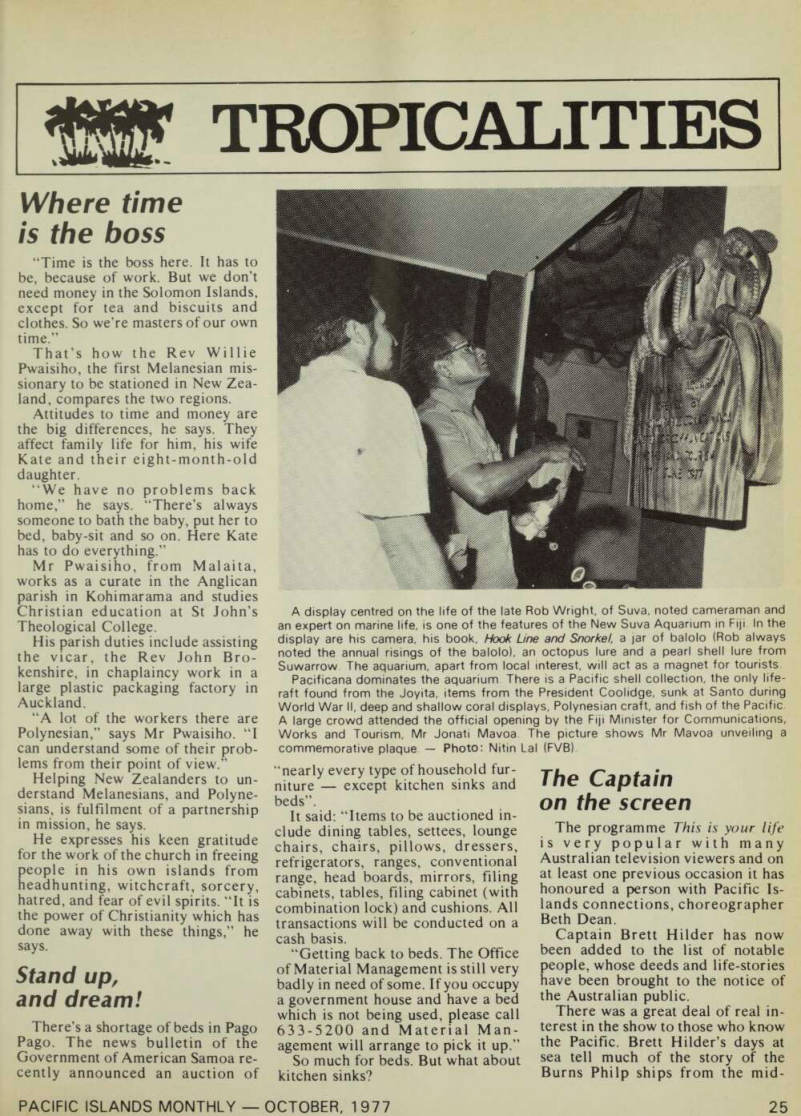

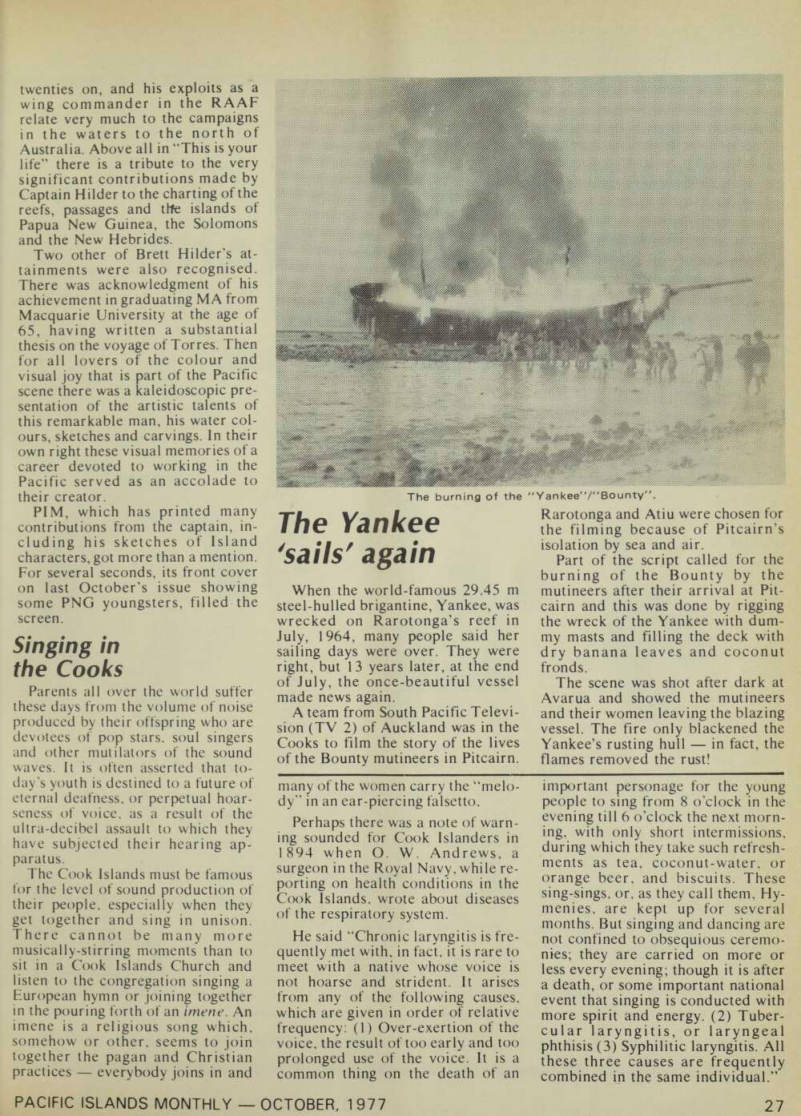
Where time
is the boss
“Time is the boss here. It has to be, because of work. But we don’t need money in the Solomon Islands, except for tea and biscuits and clothes. So we’re masters of our own time.”
That’s how the Rev Willie Pwaisiho, the first Melanesian mis sionary to be stationed in New Zea land, compares the two regions.
Attitudes to time and money are the big differences, he says. They affect family life for him, his wife Kate and their eight-month-old daughter.
“We have no problems back home,” he says. “There’s always someone to bath the baby, put her to bed, baby-sit and so on. Here Kate has to do everything.”
Mr Pwaisiho, from Malaita, works as a curate in the Anglican parish in Kohimarama and studies Christian education at St John’s Theological College.
His parish duties include assisting the vicar, the Rev John Bro kenshire, in chaplaincy work in a large plastic packaging factory in Auckland.
“A lot of the workers there are Polynesian,” says Mr Pwaisiho. “I can understand some of their prob lems from their point of view.”
Helping New Zealanders to un derstand Melanesians, and Polyne sians, is fulfilment of a partnership in mission, he says.
He expresses his keen gratitude for the work of the church in freeing people in his own islands from headhunting, witchcraft, sorcery, hatred, and fear of evil spirits. “It is the power of Christianity which has done away with these things,” he says.
Stand up,
and dream!
There’s a shortage of beds in Pago Pago. The news bulletin of the Government of American Samoa re cently announced an auction of
“ nearly every type of household fur niture except kitchen sinks and beds”.
It said; “Items to be auctioned in clude dining tables, settees, lounge chairs, chairs, pillows, dressers, refrigerators, ranges, conventional range, head boards, mirrors, filing cabinets, tables, filing cabinet (with combination lock) and cushions. All transactions will be conducted on a cash basis.
“Getting back to beds. The Office of Material Management is still very badly in need of some. If you occupy a government house and have a bed which is not being used, please call 633-5200 and Material Man agement will arrange to pick it up.”
So much for beds. But what about kitchen sinks?
The Captain
on the screen The programme This is your life is very popular with many Australian television viewers and on at least one previous occasion it has honoured a person with Pacific Is lands connections, choreographer Beth Dean.
Captain Brett Hilder has now been added to the list of notable people, whose deeds and life-stories have been brought to the notice of the Australian public.
There was a great deal of real in terest in the show to those who know the Pacific. Brett Hilder’s days at sea tell much of the story of the Burns Philp ships from the mid
A display centred on the life of the late Rob Wright, of Suva, noted cameraman and an expert on marine life, is one of the features of the New Suva Aquarium in Fiji In the display are his camera, his book. Hook Line and Snorkel, a jar of balolo (Rob always noted the annual risings of the balolo), an octopus lure and a pearl shell lure from Suwarrow. The aquarium, apart from local interest, will act as a magnet for tourists.
Pacificana dominates the aquarium There is a Pacific shell collection, the only life raft found from the Joyita, items from the President Coolidge, sunk at Santo during World War II, deep and shallow coral displays, Polynesian craft, and fish of the Pacific.
A large crowd attended the official opening by the Fiji Minister for Communications, Works and Tourism, Mr Jonati Mavoa The picture shows Mr Mavoa unveiling a commemorative plaque -Photo; Nitin Lai (FVB).
twenties on, and his exploits as a wing commander in the RAAF relate very much to the campaigns in the waters to the north of Australia. Above all in “This is your life” there is a tribute to the very significant contributions made by Captain Milder to the charting of the reefs, passages and the islands of Papua New Guinea, the Solomons and the New Hebrides.
Two other of Brett Hilder’s at tainments were also recognised.
There was acknowledgment of his achievement in graduating MA from Macquarie University at the age of 65, having written a substantial thesis on the voyage of Torres. Then for all lovers of the colour and visual joy that is part of the Pacific scene there was a kaleidoscopic pre sentation of the artistic talents of this remarkable man, his water col ours, sketches and carvings. In their own right these visual memories of a career devoted to working in the Pacific served as an accolade to their creator.
PIM, which has printed many contributions from the captain, in cluding his sketches of Island characters, got more than a mention.
For several seconds, its front cover on last October’s issue showing some PNG youngsters, filled the screen.
Singing in
the Cooks
Parents all over the world suffer these days from the volume of noise produced by their offspring who are devotees of pop stars, soul singers and other mutilators of the sound waves. It is often asserted that to day's youth is destined to a future of eternal deafness, or perpetual hoar seness of voice, as a result of the ultra-decibel assault to which they have subjected their hearing ap paratus.
The Cook Islands must be famous for the level of sound production of their people, especially when they get together and sing in unison.
There cannot be many more musically-stirring moments than to sit in a Cook Islands Church and listen to the congregation singing a European hymn or joining together in the pouring forth of an imene. An imene is a religious song which, somehow or other, seems to join together the pagan and Christian practices everybody joins in and
many of the women carry the “melo dy” in an ear-piercing falsetto.
Perhaps there was a note of warn ing sounded for Cook Islanders in 1894 when O. W. Andrews, a surgeon in the Royal Navy, while re porting on health conditions in the Cook Islands, wrote about diseases of the respiratory system.
He said “Chronic laryngitis is fre quently met with, in fact, it is rare to meet with a native whose voice is not hoarse and strident. It arises from any of the following causes, which are given in order of relative frequency; (1) Over-exertion of the voice, the result of too early and too prolonged use of the voice. It is a common thing on the death of an
important personage for the young people to sing from 8 o’clock in the evening till 6 o’clock the next morn ing, with only short intermissions, during which they take such refresh ments as tea, coconut-water, or orange beer, and biscuits. These sing-sings, or, as they call them, Hy menies, are kept up for several months. But singing and dancing are not confined to obsequious ceremo nies; they are carried on more or less every evening; though it is after a death, or some important national event that singing is conducted with more spirit and energy. (2) Tuber cular laryngitis, or laryngeal phthisis (3) Syphilitic laryngitis. All these three causes are frequently combined in the same individual.”
The modest
Australian?
In Western Samoa for the 15th Anniversary celebrations of inde pendence, Australia’s Minister for Industry and Commerce, Senator Robert Cotton, had this to say about his country’s aid policy: “We ge nuinely give, we don’t lend the bloo dy stuff. We’re so far ahead it isn’t funny ...”
On the Australian aid project to build the Public Works workshop near Apia, on which Australia will spend $A4.6 million over the next five years. Senator Cotton said: “This is a beauty. It’s a logical thing to do.”
Describing Australian aid to the project as “seed money”, the minister said the workshop would establish pre-conditions necessary for a World Bank loan for future bigger projects.
An anti-brothel
demonstration
A crowd of women protesting against prostitution danced the hula in Port Moresby in mid-July to the tune of the PNG National Anthem.
Two generously-built women per formed the limbo rock using an old umbrella as the limbo stick. Police put up barricades while the women danced and made speeches outside the central government offices.
A few of the demonstrators car ried babies and some waved placards saying, “We don’t want brothels”. Public servants working in the big office block watched from the windows, many seeing their mothers, wives, sisters and aunts in the crowd of women.
There were women of all ages, some well-dressed and some roughly-dressed. Many wore red hats which had been handed out at the recent Port Moresby Show.
The whole deal was like a car
nival day.
The 400 women had marched for two hours in the hot sun to reach the government offic.es, making speeches along the way and carrying drinking water in plastic bot tles. They wanted the Prime Minister, Mr Somare, but had to be content with the head of his depart ment, Mr P. Bouraga, who used a loud-hailer to speak to them. He told them the government had no plans to legalise prostitution.
The campaign against prostitution was sparked off several months ago whem two community planners in Rabaul tentatively proposed that prostitution should be legalised.
Although neither the government nor any statutory authorities have given the recomendation any con sideration— and apparently don’t intend to a huge public campaign has developed.
Entente (lemon!)
cordiale
’Twas ever thus in the con dominium of the New Hebrides.
The English-language text re ceived by PIM of the statement released by the French and British Ministers following the July talks in Paris on the political future of the New Hebrides contained the follow ing paragraph: “The British Minister (Lord Goronwy Roberts) emphasised the fact that the parallel use of the French and the English languages (bilingualisme) was a major asset for the archipelago and far from being a handicap would allow it to play a unique role among the nations of the Pacific. The minister expressed the view that any discrimination in education, employment and the use of language would be deplorable.”
Laudable sentiments, and ob viously directed against the policy of the Vanuaaku Party that English would be the language of the educa tion system in an independent New Hebrides, with French continuing to be taught in private schools.
It would have been more convinc ing, however, if the minister had got it right when he made his little parenthetical stab at the French language. “Bilingualisme” is not French but an English word with an “e” tacked on. The French word is bilinguisme.
Still, nobody could say the French are unready to return the com pliment by getting English wrong when they have a go at it.
A Hebridean
spectacular
When the New Zealand Red Cross appealed for spectacles for people in the New Hebrides the response was overwhelming. More than 1 000 pairs arrived. The Red Cross wanted 500.
The medical superintendent of the New Hebrides. Dr Spooner.
wrote recently that the spectacles had been distributed throughout the hospitals in the New Hebrides and would be matched to individual
needs by a visiting optician.
The size of the selection had meant that everyone had been catered for who could not afford
spectacles. Apparently a pair in the
islands costs about a month’s wages.
Red Cross field officer, Moya McTammy, who made the appeal, recently visited the islands to see for herself the success of the project.
New Zealand Red Cross secre tary-general, Mr Jerry Talbot, said; “We were amazed at the response.
We now have plenty of spare specta cles to meet any foreseeable require ments.”
And, as an afterthought, he added the Red Cross didn’t need any more.
You can fuel
some folk often!
There was a part-European trader in Polynesia who made something of a fortune during World War II by selling hula skirts and strings of shells to American servicemen. This shrewd headed dealer went on to found a
shipping line.
He was always one who kept an eye open for the chance to make a profit and he came to hold the franchise for the sale of petroleum in his island home. All the petrol came in 44-gallon drums.
However, the drums were usually used on more than one occasion and they became contaminated with water, rust and various other foreign substances. Eventually the voices of protest grew loud and there were strident demands that our trader take measures to correct the situation.
Away went one of his schooners to pick up another load of petrol in drums and when these were put on sale a notice was posted to the effect that the petrol being offered for sale was in clean drums. For the unfortunate motorists and other users the results, if anything, were more disastrous than ever it was quite clear that the petrol was at least as dirty as it had ever been.
The guilty party was asked to explain why so much trouble was being experienced with his petrol when he had claimed that the petrol was clean.
Not so was the reply. What was all the fuss about? Hadn’t he said that the petrol was in clean drums? Well, he had had the drums thoroughly scrubbed on the outside before they were filled.
Advertisements & other items, p. 26 (1 item)
Chloride
BATTERIES FOR ALL APPLICATIONS
A generous statement? Maybe, but then Chloride is equipped and qualified as such . . always ready to offer advice, guidance and service on your battery requirements.
As it goes way beyond automotive batteries. No matter what the problem . . if it's a question of power. . battery power . . it's one for Chloride. It could be as small as a battery for a hearing aid the size of a coat button, or a power station battery weighing 40 tonnes.
Again, it could be a no break D.C. power system for a computer or emergency lighting for a hospital.
No matter what the application . .
Transport, Industrial, Communication, Defence, Mining, Marine, Recreation . . .
Make Chloride power work for you. -7
iXZJIIS
T elecommunications Chloride Batteries Australia Limited pO. Box 141, Bankstown. N.S.W. 2200 Australia. Telex; 21262
CHLORIDE THE WORLD'S MOST EXPERIENCED BATTERYMAKER
W * 0 * Electric Vehicles Emergency Lighting i J i h x R Automotive Engine Starting 1 IHi Slit & o
'sails' again
The Yankee 'sails' again
When the world-famous 29.45 m steel-hulled brigantine, Yankee, was wrecked on Rarotonga’s reef in July, 1964, many people said her sailing days were over. They were right, but 13 years later, at the end of July, the once-beautiful vessel made news again.
A team from South Pacific Televi sion (TV 2) of Auckland was in the Cooks to film the story of the lives of the Bounty mutineers in Pitcairn.
Rarotonga and Atiu were chosen for the filming because of Pitcairn’s isolation by sea and air.
Part of the script called for the burning of the Bounty by the mutineers after their arrival at Pit cairn and this was done by rigging the wreck of the Yankee with dum my masts and filling the deck with dry banana leaves and coconut fronds.
The scene was shot after dark at Avarua and showed the mutineers and their women leaving the blazing vessel. The fire only blackened the Yankee’s rusting hull in fact, the flames removed the rust!
The burning of the "Yankee"/"Bounty".
Advertisements & other items, pp. 28-30 (1 item)
Watson & Crane
Total service 0n ...
plumbing supplies Tast
are organised to fulfil your needs
wherever you are in the South Pacific K r, « In# You can get all you need from one supply source: water taps, valves, copper tube, tools and a host of other fittings and related plumbing equipment for domestic, industrial and multistorey buildings.
Watson & Crane Pty Ltd have over 20,000 plumbing items in stock at their central warehouse located at Waterloo, NSW, Australia.
Years of experience in handling and shipping right throughout the South Pacific add up to another big reason for you to deal with Watson & Crane Pty Ltd.
Representatives call regularly at Papua New Guinea, the Solomons, New Hebrides and Fiji Islands to personally discuss your requirements and appropriate credit arrangements.
Write, cable or telephone today for complete plumbers' supplies service.
Watson & Crane Pty. Ltd, 1037 Bourke Street, Waterloo,
NSW 2017.
Phone: Sydney 699-1333.
Telex: AA 25548.
Cables: "Watcrane" Sydney.
Pacific Island distributors of Crane Enfield copper tube for water, sanitation, engineering, refrigeration and
yvyour
Maybe you want to
The answer is a Yanmar diesel engine
for generating electricity.
if
Maybe you want to catch some^
The answer is a Yanmar diesel marine
engine.
Maybe you want dependable
transportation. A Yanmar diesel marine
engine is your answer.
O
A * A ■*- A.
4. A*' ** J, Model YNG series
2.O—IOKVA
m Yanmar diesel industrial and marine engines. From 3 to 3190 horsepower. Efficiency and dependability. A trusted name in 130 countries.
YANMAR
DIESEL EMDIME
Model YANMAR DIESEL ENGINE CD.,LTD.
SB series Cable YANMAR TOKYO Telex: 0222-2310,0222-4733 7-12 HP (AUSTRALIA) CENTRAL MARINE SALES & SERVICE: Tasmania, Tel: 725079 C.P.N. DIESELS - PTY. LTD.: QueenslancL TeL3999200 HASSETT MACHINERY SALES PTY. LTD.: Victoria, Tel: 870-2944 IRSCO PTY. LTD.: Northern Territory, Tel 818844 LAWTON AGENCjES PTY. LTD South Australia, Tel: 426221 SIER & JOHNSTON; West Australia Tel: 37_5288 SUMITOMO PTIT LTD.: WESTERN FUELPUMP AND INJECTOR SERVICES PTY. LTD.: New South Wales, Tel: 638-6100 (NEW ZEALAND) ANDREWS & BEAVEN LTD.. iei. 791 400 (PAPUA NEW GUINEA) TUTT BRYANT PACIFIC LTD : Port Moresby, Tel: 54844,53522 (FIJI) CORAL ISLAND MOTORS: TeL311655,3T1824 (GILBERT! GILBERT ISLANDS DEVELOPMENT AUTHORITY (SUPPLY DIVISION): P C 9^^ 4 0 8 A 8 TarawaS a J?' e ' I^Q^rt\n E CALEDONIA) PACIFIC MOTORS S.A.: Te^s7-44 .757-45 CME¥IfHIBBRIDBSI PENTECOST PACI
iiurcTßQii <tAUOAI MOTOR DISTRIBUTORS
VILA (PALAU) PALAU FISHING AUTHORITY- P.O 80x586 Koror Palau, Western Caroline 151and96940 (WESTERN SAMOA) M
(SAMO
34, Nukualofa Cable: JONESCO (TRUCK) KIOMASA ENTERPRISE: P.0.80x 26, Moen Island Truck ECI 96942 (GUAM) CORAL REEF MARINE
CENTER, INC.: Tel: 477-6335.
Editor’S Mailbag
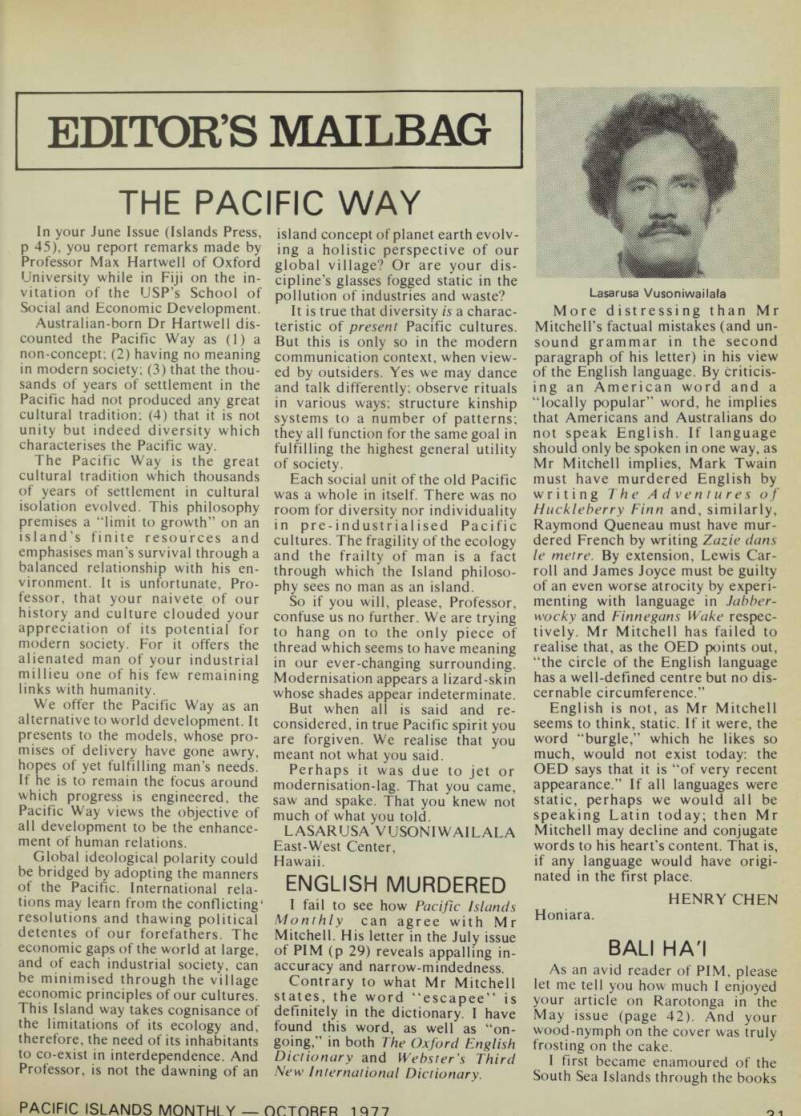
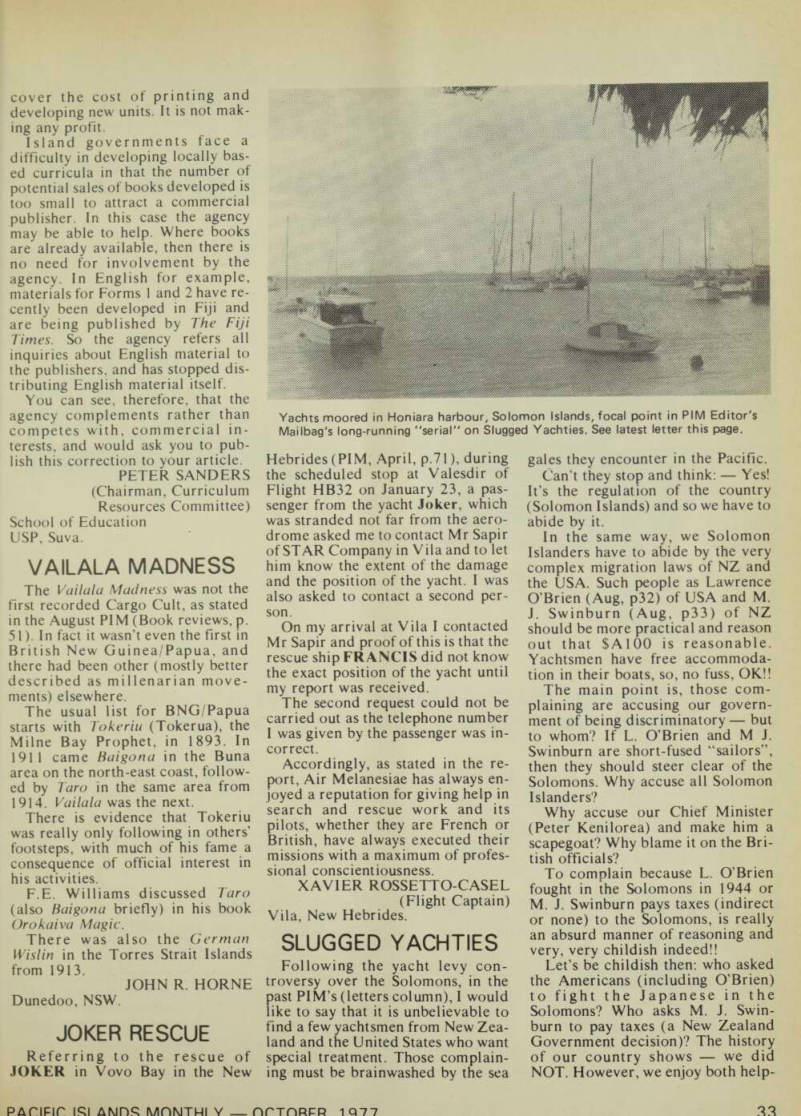
The Pacific Way
In your June Issue (Islands Press, p 45), you report remarks made by Professor Max Hartwell of Oxford University while in Fiji on the in vitation of the USP’s School of Social and Economic Development.
Australian-born Dr Hartwell dis counted the Pacific Way as (1) a non-concept; (2) having no meaning in modern society; (3) that the thou sands of years of settlement in the Pacific had not produced any great cultural tradition; (4) that it is not unity but indeed diversity which characterises the Pacific way.
The Pacific Way is the great cultural tradition which thousands of years of settlement in cultural isolation evolved. This philosophy premises a “limit to growth” on an island’s finite resources and emphasises man’s survival through a balanced relationship with his en vironment. It is unfortunate, Pro fessor, that your naivete of our history and culture clouded your appreciation of its potential for modern society. For it offers the alienated man of your industrial millieu one of his few remaining links with humanity.
We offer the Pacific Way as an alternative to world development. It presents to the models, whose pro mises of delivery have gone awry, hopes of yet fulfilling man’s needs.
If he is to remain the focus around which progress is engineered, the Pacific Way views the objective of all development to be the enhance ment of human relations.
Global ideological polarity could be bridged by adopting the manners of the Pacific. International rela tions may learn from the conflicting 1 resolutions and thawing political detentes of our forefathers. The economic gaps of the world at large, and of each industrial society, can be minimised through the village economic principles of our cultures.
This Island way takes cognisance of the limitations of its ecology and, therefore, the need of its inhabitants to co-exist in interdependence. And Professor, is not the dawning of an
island concept of planet earth evolv ing a holistic perspective of our global village? Or are your dis cipline’s glasses fogged static in the pollution of industries and waste? it is true that diversity is a charac teristic of present Pacific cultures, But this is only so in the modern communication context, when view ed by outsiders. Yes we may dance and talk differently; observe rituals in various ways; structure kinship systems to a number of patterns; they all function for the same goal in fulfilling the highest general utility of society, Each social unit of the old Pacific was a whole in itself. There was no room for diversity nor individuality in pre-industrialised Pacific cultures. The fragility of the ecology and the frailty of man is a fact through which the Island philoso phy sees no man as an island, So if you will, please, Professor, confuse us no further. We are trying to hang on to the only piece of thread which seems to have meaning in our ever-changing surrounding, Modernisation appears a lizard-skin whose shades appear indeterminate.
But when all is said and re considered, in true Pacific spirit you are forgiven. We realise that you mea nt not what you said, Perhaps it was due to jet or modernisation-lag. That you came, saw and spake. That you knew not much of what you told,
Lasarusa Vusoniwailala
East-West Center, Hawaii.
English Murdered
I fail to see how Pacific Islands Monthly can agree with Mr Mitchell. His letter in the July issue of PIM (p 29) reveals appalling in accuracy and narrow-mindedness.
Contrary to what Mr Mitchell states, the word “escapee” is definitely in the dictionary. I have found this word, as well as “on going,” in both The Oxford English Dictionary and Webster’s Third New International Dictionary.
More distressing than Mr Mitchell’s factual mistakes (and un sound grammar in the second paragraph of his letter) in his view of the English language. By criticis ing an American word and a “locally popular” word, he implies that Americans and Australians do not speak English. If language should only be spoken in one way, as Mr Mitchell implies, Mark Twain must have murdered English by writing The Adventures of Huckleberry Finn and, similarly, Raymond Queneau must have mur dered French by writing Zazie dans le metre. By extension, Lewis Car roll and James Joyce must be guilty of an even worse atrocity by experi menting with language in Jabber woe ky and Finnegans Wake respec tively. Mr Mitchell has failed to realise that, as the OED points out, “the circle of the English language has a well-defined centre but no dis cernable circumference.”
English is not, as Mr Mitchell seems to think, static. If it were, the word “burgle,” which he likes so much, would not exist today: the OED says that it is “of very recent appearance.” If all languages were static, perhaps we would all be speaking Latin today; then Mr Mitchell may decline and conjugate words to his heart’s content. That is, if any language would have origi nated in the first place.
Henry Chen
Honiara.
Bali Ha'i
As an avid reader of PIM, please let me tell you how much I enjoyed your article on Rarotonga in the May issue (page 42). And your wood-nymph on the cover was truly frosting on the cake.
I first became enamoured of the South Sea Islands through the books
Lasarusa Vusoniwailala
of Frederick O’Brien and Robert Dean Frisbie. I have all of Frisbie’s books in my library along with Dr Tom Davis’ Doctor To The Islands, Tom Neale’s An Island To Oneself, R. J. Dashwood’s Today Is Forever, Percival and Helm’s Sisters in the Sun, and Ronald Syme’s Isles of the Frigate Bird, and many others that touch on the Cook Group.
My pleasure through the years has been in surrounding myself with books about the South Pacific and I am very proud of my collection.
And on a visit to Tahiti in 1968 I was fortunate to meet and get to know the widow of James Norman Hall, a lovely lady known to all as “Lala”.
I first became acquainted with Tom Neale through his book about 10 years ago and since that time have kept up a fairly active corres pondence with him. I have also cor responded with Dr Tom Davis and Mr Ronald Syme. I have been retired from business for a number of years and have definitely made up my mind that I must visit Rarotonga. Up until just a few months ago the care of an elderly mother (92) kept me pretty close to home; however, she recently passed away and now I will be able to make some travel plans. Having waited this long I have lost forever the chance of meeting Andy Thompson and Robert Julian Dashwood.
Thanks for reassuring me that Rarotonga is, indeed, as lovely as I have come to believe.
Byron W. Hart
Boulder, Colo, USA.
Usr A Correction
While we welcome the publicity given by your magazine to the Cur riculum Resources Agency of the University of the South Pacific (PIM, July, p 25), we regret your choice of a title (Biting the hand that feeds it), and your suggestion that the agency is attempting to compete with commercial enterprises.
The Curriculum Resources Agen cy was established last year in re sponse to requests from ministries and departments of education in the region for a continuation of the teaching materials which were for merly provided by the Unesco Cur riculum Development Project based at the USP. Lacking the funds which were available to Unesco, the agen cy relies on the sales of material to
cover the cost of printing and developing new units. It is not mak ing any profit.
Island governments face a difficulty in developing locally bas ed curricula in that the number of potential sales of books developed is too small to attract a commercial publisher. In this case the agency may be able to help. Where books are already available, then there is no need for involvement by the agency. In English for example, materials for Forms 1 and 2 have re cently been developed in Fiji and are being published by The Fiji Times. So the agency refers all inquiries about English material to the publishers, and has stopped dis tributing English material itself.
You can see, therefore, that the agency complements rather than competes with, commercial in terests, and would ask you to pub lish this correction to your article.
Peter Sanders
(Chairman, Curriculum Resources Committee) School of Education USP, Suva.
Vailala Madness
The Vailala Madness was not the first recorded Cargo Cult, as stated in the August PIM (Book reviews, p. 51). In fact it wasn’t even the first in British New Guinea/Papua, and there had been other (mostly better described as millenarian move ments) elsewhere.
The usual list for BNG/Papua starts with Tokeriu (Tokerua), the Milne Bay Prophet, in 1893. In 1911 came Baigona in the Buna area on the north-east coast, follow ed by Taro in the same area from 1914. Vailala was the next.
There is evidence that Tokeriu was really only following in others’ footsteps, with much of his fame a consequence of official interest in his activities.
F.E. Williams discussed Taro (also Baigona briefly) in his book Orokaiva Magic.
There was also the German Wislin in the Torres Strait Islands from 1913.
John R. Horne
Dunedoo, NSW.
Joker Rescue
Referring to the rescue of JOKER in Vovo Bay in the New
Hebrides (PIM, April, p. 71), during the scheduled stop at Valesdir of Flight H 832 on January 23, a pas senger from the yacht Joker, which was stranded not far from the aero drome asked me to contact Mr Sapir of STAR Company in Vila and to let him know the extent of the damage and the position of the yacht. I was also asked to contact a second per son.
On my arrival at Vila I contacted Mr Sapir and proof of this is that the rescue ship FRANCIS did not know the exact position of the yacht until my report was received.
The second request could not be carried out as the telephone number I was given by the passenger was in correct.
Accordingly, as stated in the re port, Air Melanesiae has always en joyed a reputation for giving help in search and rescue work and its pilots, whether they are French or British, have always executed their missions with a maximum of profes sional conscientiousness.
Xavier Rossetto-Casel
flight Captain) Vila, New Hebrides.
Slugged Yachties
Following the yacht levy con troversy over the Solomons, in the past PlM’s (letters column), I would like to say that it is unbelievable to find a few yachtsmen from New Zea land and the United States who want special treatment. Those complain ing must be brainwashed by the sea
gales they encounter in the Pacific.
Can’t they stop and think; Yes!
It’s the regulation of the country (Solomon Islands) and so we have to abide by it.
In the same way, we Solomon Islanders have to abide by the very complex migration laws of NZ and the USA. Such people as Lawrence O’Brien (Aug, p 32) of USA and M.
J. Swinburn (Aug, p 33) of NZ should be more practical and reason out that SAIOO is reasonable.
Yachtsmen have free accommoda tion in their boats, so, no fuss, OK!!
The main point is, those com plaining are accusing our govern ment of being discriminatory but to whom? If L. O’Brien and M J.
Swinburn are short-fused “sailors”, then they should steer clear of the Solomons. Why accuse all Solomon Islanders?
Why accuse our Chief Minister (Peter Kenilorea) and make him a scapegoat? Why blame it on the Bri tish officials?
To complain because L. O’Brien fought in the Solomons in 1944 or M. J. Swinburn pays taxes (indirect or none) to the Solomons, is really an absurd manner of reasoning and very, very childish indeed!!
Let’s be childish then; who asked the Americans (including O’Brien) to fight the Japanese in the Solomons? Who asks M. J. Swin burn to pay taxes (a New Zealand Government decision)? The history of our country shows we did NOT. However, we enjoy both help
Yachts moored in Honiara harbour, Solomon Islands, focal point in PIM Editor's Mailbag's long-running "serial" on Slugged Yachties. See latest letter this page.
ing hands. Thank God, it’s US and NZ that should be grateful, as the Solomons is not ruled by the Japanese or become communist.
A hint for dissatisfied yachtsmen is: Think twice! All yachtsmen have the choice of cheap entry (whatever), either by plane or cruise boats. All yachtsmen are welcome to the Solomons. Complaining ones like L. O’Brien and M. J. Swinburn should not discourage those looking forward to the beautiful “Isles of Solomon”. Otherwise steer clear of the Solomons, it’s too expensive bah!! Grudging yachtsmen should bear in mind that “beachcomber days” should be over. Nor are we Solomon Islanders fools to any “globe-trotters” this goes for the complaining ones mainly.
Being patriotic makes me proud of my country.
Clemento Kengava
USP, Suva
Islands And Eec
In PIM (Aug., p. 55), your article “with water everywhere, Islanders are still tillers of the soil” needs up dating concerning information about the relations to the European Economic Community.
For the commodities in question (at the moment coconut products, cocoa, bananas), Fiji is reimbursed for shortfalls in earnings only for export to the EEC, while Western Samoa and Tonga receive for ex ports to all destinations in the world.
Contrary to your article, all Bri tish Dependencies and French Ter ritories are already included under the Stabex (stabilisation of ex port-earnings) system. Thus New Hebrides, Solomons, Tuvalu and Gilberts have already received or will receive reimbursement from the Stabex fund.
P. B. Christiansen
(Economic Adviser) Delegation of the Commission of the European Communities for the Pacific, Suva.
New Chapter On
Henderson
May and June issues of PIM have arrived, and I am in contact again after having been without my Pacific news for some years.
As I read the travail that Fiji, Papua New Guinea and the Solomons are going through I
wonder if independence is measur ing up to their expectations and if the result is worth the price. I have a notion they will learn much in the next decade and I have a hunch that they will reflect kindly on their
former “patrons”.
PlM’s publisher sits in the centre of such a great amphitheatre of cur rent political, economic and social action that I herewith nominate him as the best and most knowledgeable candidate for the next directing head of the United Nations. It will need him so badly by the time the present incumbent’s time expires, that he had better get ready to be drafted!
Peter John Young’s story in the June issue, “Henderson Field: Aftermath of a Bloody Holocaust”, is a smash-hit. He added a new and additional chapter to that great theatre of war. My congratulations to PJY!
Brig-Gen William J. Fox
Usmc (Ret.)
San Miguel de Allende, Guanajuato, Mexico • General Fox, now 80, was com manding officer of Henderson Field during the fierce battle for Guadalcanal during 1942-43, so he knows something about that bloody holocaust in which he was wound ed. The June issue of PI M told how he now trains horses at his ranch in Mexico. The publisher of PIM herewith declines nomination as the next directing head of the United Nations; he says he has enough un solved problems of his own, right here in Sydney.
Advertisements & other items, pp. 31-34 (3 items)
31
PACIFIC ISLANDS MONTHL Y OCTORFR 1 Q 77
Save?*'
World Record Glob
Savings Certificate
AN INVITATION TO
SAVE?*'
per record or cassette as a member of World Record Club Name Address Postcode. •Records from $3.99, Cassettes $4.50. Normal price for similar type records and cassettes -$6.99. Club membership and discounts start with your first purchase.
Post today for FREE
CATALOGUES
and the chance to enjoy normal club discounts on your classical, rock, pop and soul recordings.
To: WORLD RECORD CLUB
605 Camberwell Rd., Hartwell, Vic. 3124.
SEND NO MONEY! P f M 1077
We're working the Pacific
with a Cat Marine Diesel.
"Loloho" - General purpose Harbour tug boat. Operated by Bougainville Copper Limited at Bougainville. Overall length 50 ft. (15.24 m). Powered by a Caterpillar D 343 Marine Engine.
"M V. Kaunitoni" - An Inter-Island freighter. Operated by the Fiji Government. Overall length 134.3 ft. Displacement 628 tons. Speed 10 knots. Powered by a Caterpillar D 379.
Hastings Deering (Pacific) Ltd.and Carpenters Tractors cover the Pacific islands waterfront with Cat. Marine Service and Parts.
Hastings Deering (Pacific) at Lae, Port Moresby and Bougainville and Carpenters Tractors at Suva are staffed by Caterpillar-trained technicians.
Working the Pacific waterfront day after day, year after year, you depend on reliable horsepower and first class dealer-support. You get it with a Cat Marine Diesel, Hastings Deering (Pacific) and Carpenters Tractors.
While there's a Cat Marine Diesel in your craft you're backed up with Cat Plus, the total support programme offered only by your Caterpillar dealer.
Your local Hastings Deering (Pacific) or Carpenters Tractors dealer backs your Cat Marine Diesel engine with parts and service programmes designed to prevent, as well as shorten profitrobbing downtime.
Caterpillar Dealers in South-West Pacific.
HASTINGS DEERING
Lae: Milford Haven Road, Ph: 42 2355 Port Moresby: Champion Parade, Konedobu Ph; 24 3138 or 24 2098.
Bougainville: Itakara.
Industrial Park, Arawa, Ph: 95 9077 154 Queens Road, Suva.
Ph: 24 051-4, Cables: Carptrac Suva.
Telex: Carptrac FJ2191 Suva.
HD6I4
Caterpillar. Cat and QJ are trademarks ol Caterpillar Tractor Co.
33
PAPIFir ISI AMDQ MONTMI Y fIPTfIRFR 1Q77
Mombasa
Calling
• All the way from a PIM reader in Mombasa, Kenya, comes a request for girl penpals from among PIM readers.
Confident that his intentions are strictly honourable, PIM obliges Mr Shabbir A. K. Mamujee, PO Box 81810, Mombasa, Kenya, by print ing his request, along with the following information: Mr Mamu jee is of Asian extraction, a Muslim, 22 years of age and sft 77 2 in. tall.
His hobbies are corresponding, reading, music, swimming, sports and travel.
Advertisements & other items, pp. 35-36 (1 item)
“Skillet”
Round gourmet
r
THE HANDIEST NEW APPLIANCE
SINCE FRYPANS
Bacon and eggs for two? Simple for the Sunbeam "Skillet”. Yet "Skillet" is big enough to roast a size 8 chicken to perfection. And to wash simply remove the control and dunk the pan in the sink.
Another first and it comes only from Sunbeam.
8 Speed
Power
Blender
M
THE APPLIANCE YOU CAN USE
EVERY MEAL
With powerful. Solid-state motor. Which means the exact blending action you need to— Whip, grate, mix, chop or liquefy. Stainless steel cutters give fast food preparation while switching from speed to speed without turning off . . .
Hie
Polynesian
Triangle
Western Samoa Niue Island hji Tonga
Its place in
the Pacific has shifted
Because now the Polynesian
Triangle fare brings a Polynesian
holiday much closer. Now when you visit Fiji you can include Tonga, Niue and Western Samoa for very little extra! Talk to your travel agent about working in our Polynesian Triangle fare with your
Fiji itinerary. Only U55266.00*
(AU55229.00 or NZ5237.00) more to see three more islands in the beautiful Pacific. Our Polynesian Triangle fare is available all year round with no minimum stopover restrictions and may be purchased while you are in Fiji or before you arrive.
Contact your travel agent for more details.
Fare subject to change without notice. ©Serving the heart of Polynesia
POLYNESIAN,^
PO Box 599, Apia.
WESTERN SAMOA
People
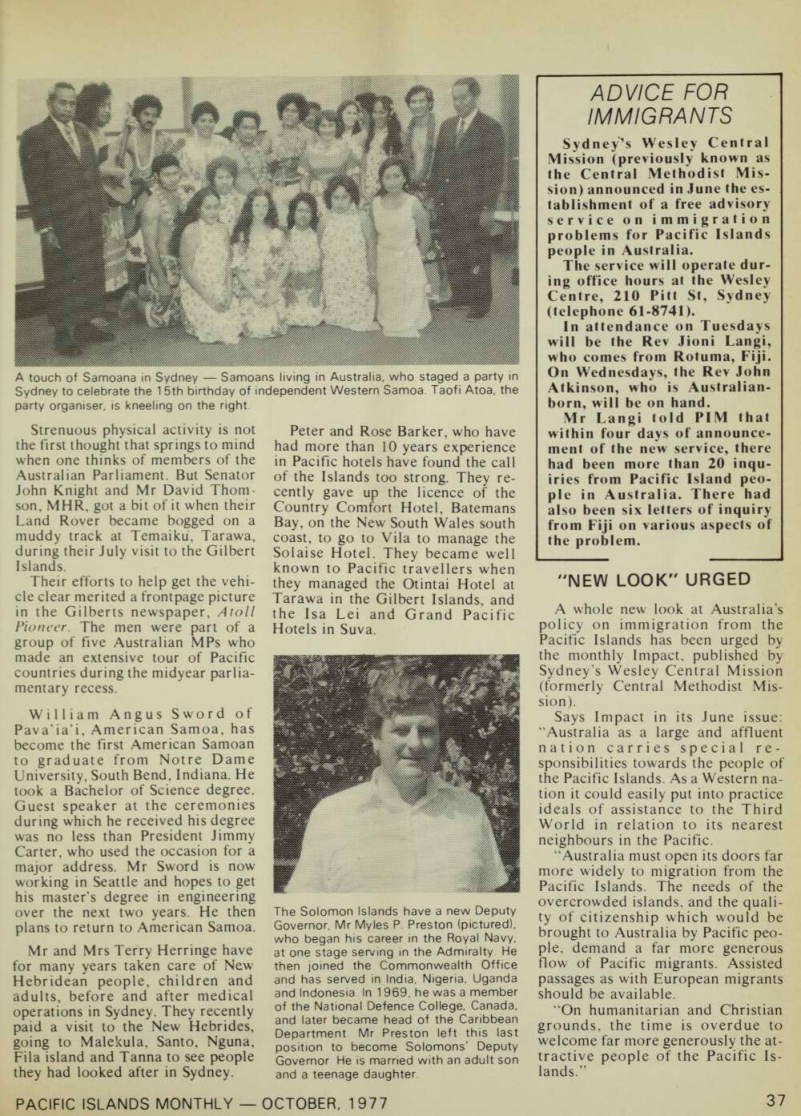
Sir Emmet McDermott, a former Lord Major of Sydney, has been elected chairman of the Australian branch of the Foundation for the peoples of the South Pacific. The foundation is a voluntary organ isation which works solely for the welfare of the people in the Pacific region. The headquarters of the foundation is in New York.
Mr Jim Reid, a New Zealander, has been appointed manager of the new resort hotel in the Cook Is lands, the Rarotongan. Mr Reid gained much of this experience in the hotel trade with the Tourist Hotel Corporation of NZ. In 1970, he spent six months in Melbourne at the Southern Cross Hotel on an ex change basis. He has managed THC resort hotels, the Wanaka and the Waitomo.
German-born Father Bernard Franke, Roman Catholic parish priest of Matupit and Rabaul celeb tated his golden jubilee as a priest on August 7. Born in the small coun try town of Warendorf in Germany.
Fr Franke. who is 74. has been in New Britain since 1928. The people of Rabaul and Matupit celebrated his jubilee with masses at Matupit and at the cathedral of St Francis Xavier in Rabaul. Those who know the work he has done in his near half century in New Britain call Father Franke “the Living Mira cle”. He has come near to death a few times including an occasion when he escaped execution by Japenese soldiers by only a few hours.
Mr Holme Kavora, from lokea village in the Gulf Province of Papua New Guinea, has been ap pointed assistant to the Air Niugini industrial relations manager, Mr B.
Croft. Mr Kavora received his sec ondary education at Slade, War wick, in Queensland, and in 1974 joined Air Niugini as operations controller at Lae. He was later transferred to Port Moresby where he held the posts of aircraft schedul ing officer and charters superinten dent before taking up his latest post.
Charles Pupu, the top engineering graduate for Air Niugini in 1976, suffered severe spinal injuries and had his right leg broken in a traffic accident just 17 days after gradua tion. He was paralysed from the waist down. Air Niugini later flew him to Brisbane for treatment in a hospital spinal injuries unit. He had started on a rehabilitation program me when he again broke his right leg, which, according to doctors “set him back six months”. Doctors were also forced to stop his rehabilitation programme for three months. Apart from that, however, Charles was happy and generally in good condi tion. Charles was one of Air Niugini’s first 10 aircraft and airframe graduates. They all gradu ated together after a five-year course at Lae Technical College.
Mr Norman L. Santos has been appointed general manager in Guam and Micronesia for RCA Global Communications Inc, succeeding Mr William A. Klatt, who is return ing to a new appointment in the US.
Mr Santos was manager of RCA Globcom Operations, Lodi, Califor nia, before his latest appointment.
He joined RCA as a technician in 1961 and has held a number of im portant positions with that com pany. He served in the US Air Force from 1952 to 1961. His favourite re creation is tennis.
Mrs Marina Oei Terry, 42, a Palauan woman who has been living in Holland for 14 years, has asked the Micronesian Government for permission to return home. She said in a letter to the government that she and her eight children were cons tantly falling ill in the “cold and wet” Dutch climate. Her request is being supported by the Palau legislature. Mrs Terry is a de scendant of inhabitants of Palau’s Sonsoral Island who were shifted to Dutch-administered West New Guinea in the 19th century by the famous American trader. Captain David O’Keefe.
Mr Vishnu Prasad, 45. has retired from the Fiji Civil Service to settle in Australia. He was awarded the CBE in the 1977 Queens Birthday honours list. Mr Prasad was secre tary of the Fiji Public Service'Com mission when he retired. Before that he was counsellor at the Fiji United Nations Mission in New York.
Strenuous physical activity is not the first thought that springs to mind when one thinks of members of the Australian Parliament. But Senator John Knight and Mr David Thom son, MHR, got a bit of it when their Land Rover became bogged on a muddy track at Temaiku, Tarawa, during their July visit to the Gilbert Islands.
Their efforts to help get the vehi cle clear merited a frontpage picture in the Gilberts newspaper, Atoll Pioneer. The men were part of a group of five Australian MPs who made an extensive tour of Pacific countries during the midyear parlia mentary recess.
William Angus Sword of Pava'ia’i, American Samoa, has become the first American Samoan to graduate from Notre Dame University, South Bend, Indiana. He took a Bachelor of Science degree.
Guest speaker at the ceremonies during which he received his degree was no less than President Jimmy Carter, who used the occasion for a major address. Mr Sword is now working in Seattle and hopes to get his master's degree in engineering over the next two years. He then plans to return to American Samoa.
Mr and Mrs Terry Herringe have for many years taken care of New Hebridean people, children and adults, before and after medical operations in Sydney. They recently paid a visit to the New Hebrides, going to Malekula, Santo, Nguna, Fila island and Tanna to see people they had looked after in Sydney.
Peter and Rose Barker, who have had more than 10 years experience in Pacific hotels have found the call of the Islands too strong. They re cently gave up the licence of the Country Comfort Hotel, Batemans Bay, on the New South Wales south coast, to go to Vila to manage the Solaise Hotel. They became well known to Pacific travellers when they managed the Otintai Hotel at Tarawa in the Gilbert Islands, and the Isa Lei and Grand Pacific Hotels in Suva.
A touch of Samoana in Sydney-Samoans living in Australia, who staged a party in Sydney to celebrate the 15th birthday of independent Western Samoa. Taofi Atoa, the party organiser, is kneeling on the right
The Solomon Islands have a new Deputy Governor, Mr Myles P. Preston (pictured), who began his career in the Royal Navy, at one stage serving in the Admiralty He then joined the Commonwealth Office and has served in India, Nigeria, Uganda and Indonesia In 1969, he was a member of the National Defence College, Canada, and later became head of the Caribbean Department Mr Preston left this last position to become Solomons’ Deputy Governor He is married with an adult son and a teenage daughter
Advice For
Immigrants
Sydney’s Wesley Central
Mission (previously known as the Central Methodist Mis sion) announced in June the es tablishment of a free advisory service on immigration problems for Pacific Islands people in Australia.
The service will operate dur ing office hours at the Wesley Centre, 210 Pitt St, Sydney
(telephone 61-8741).
In attendance on Tuesdays will be the Rev Jioni Langi, who comes from Rotuma, Fiji.
On Wednesdays, the Rev John Atkinson, who is Australian born, will be on hand.
Mr Langi told PIM that within four days of announce ment of the new service, there had been more than 20 inqu iries from Pacific Island peo ple in Australia. There had also been six letters of inquiry from Fiji on various aspects of
the problem.
“New Look" Urged
A whole new look at Australia’s policy on immigration from the Pacific Islands has been urged by the monthly Impact, published by Sydney’s Wesley Central Mission (formerly Central Methodist Mis sion).
Says Impact in its June issue: “Australia as a large and affluent nation carries special re sponsibilities towards the people of the Pacific Islands. As a Western na tion it could easily put into practice ideals of assistance to the Third World in relation to its nearest neighbours in the Pacific.
“Australia must open its doors far more widely to migration from the Pacific Islands. The needs of the overcrowded islands, and the quali ty of citizenship which would be brought to Australia by Pacific peo ple, demand a far more generous flow of Pacific migrants. Assisted passages as with European migrants should be available.
“On humanitarian and Christian grounds, the time is overdue to welcome far more generously the at tractive people of the Pacific Is lands.”
Advertisements & other items, p. 38 (1 item)
engineering developments
Gel the world's latest control
in Singer controls from Australia.
Buying Singer controls from Australia is like searching the world for the latest control •engineering developments. Because we re part of the great Singer organisation Our controls and control systems include the latest advances made by over 6000 Singer scientists, engineers and technicians around the world. Singer controls give your product the best possible performance and a competitive edge in increasingly competitive markets jaml43lc
Electronic
Submersible
Pump
Has neither seal nor glands. The Impeller is driven by a magnet, and will pump a large variety Of solutions.
Powered by a sub- (ractional ball race motor Capacity: 13.63 litres at 914 mm (nett head) Ideal lor fruit juice dispensers and ice cube makers Available with simple two wire connection for easy installation in marine bilge situations. Fully automatic level control, solid state componentry and is completely encapsulated. Moulded in high impact material with dual teflon seals. Capacity 5500 litres per hour.
Positive Pump
Magnetic
Coupled Pump
A 12-ton positive pump that has been precision engineered to meet the water circulation requirements of the marine and caravan Industries. Especially suited to applications such as bilge pumping, bait tanks, water tor galleys and showers.
mmm
Th« The ?!** ft A-P ft Line
Thermostatic
Expansion Valve
Pressure Regulators
Constant Pressure
Expansion Valve
The Singer-AP range can meet your pressure regulation needs in crankcase pressure regulation, head pressure control, air cooled condensors and hot gas bypass.
A 90° angle valve suited tor use in automotive air conditioning systems, combining compactness, lightness and extremely high reliability.
Filter Dryer
Receiver
SINGER
Refrigerant driers are employed to remove solids contaminants, water and acids. Stores refrigerant to balance varying demands. Is availble in varying sizes and capacities for automotive airconditioning and commercial refrigeration systems.
CONTROLS LIMITED
Thermostatit
Expansion Valve
Sigwu —Solomons Workers’
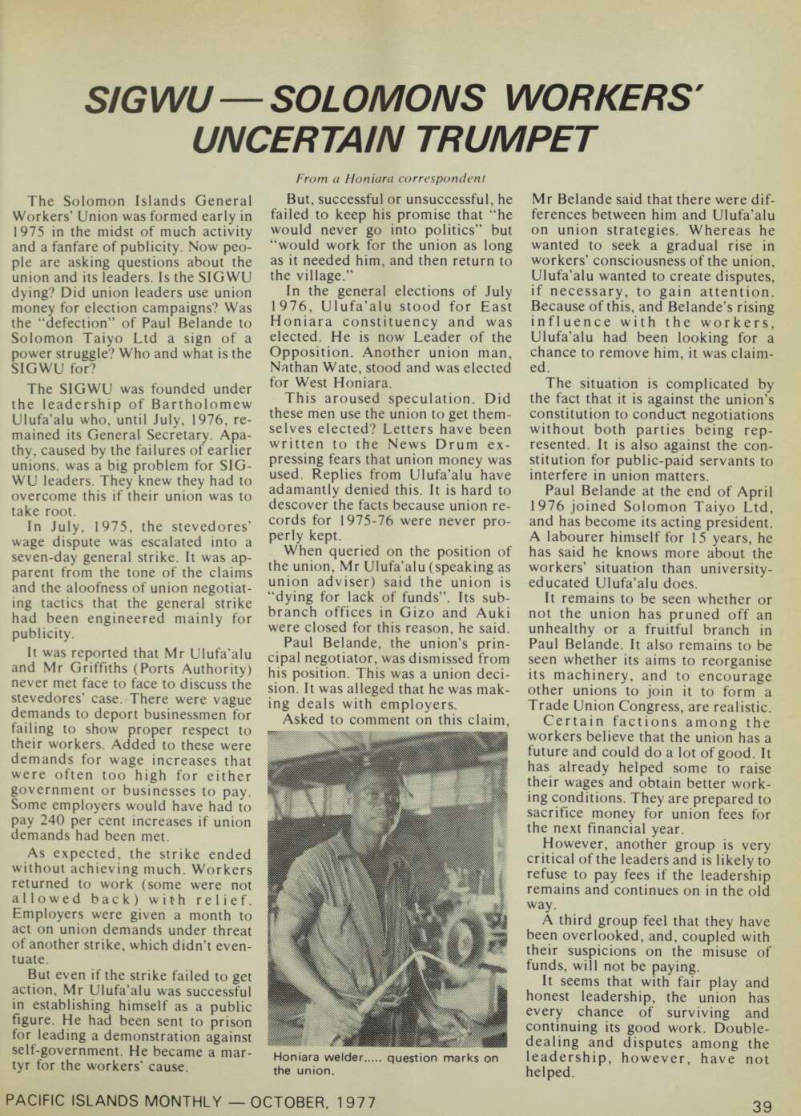
Uncertain Trumpet
From a Honiara correspondent
The Solomon Islands General Workers’ Union was formed early in 1975 in the midst of much activity and a fanfare of publicity. Now peo ple are asking questions about the union and its leaders. Is the SIGWU dying? Did union leaders use union money for election campaigns? Was the “defection” of Paul Belande to Solomon Taiyo Ltd a sign of a power struggle? Who and what is the SIGWU for?
The SIGWU was founded under the leadership of Bartholomew Ulufa’alu who, until July, 1976, re mained its General Secretary. Apa thy, caused by the failures of earlier unions, was a big problem for SIG WU leaders. They knew they had to overcome this if their union was to take root.
In July, 1975, the stevedores’ wage dispute was escalated into a seven-day general strike. It was ap parent from the tone of the claims and the aloofness of union negotiat ing tactics that the general strike had been engineered mainly for publicity.
It was reported that Mr Ulufa’alu and Mr Griffiths (Ports Authority) never met face to face to discuss the stevedores’ case. There were vague demands to deport businessmen for failing to show proper respect to their workers. Added to these were demands for wage increases that were often too high for either government or businesses to pay.
Some employers would have had to pay 240 per cent increases if union demands had been met.
As expected, the strike ended without achieving much. Workers returned to work (some were not allowed back) with relief.
Employers were given a month to act on union demands under threat of another strike, which didn’t even tuate.
But even if the strike failed to get action, Mr Ulufa’alu was successful in establishing himself as a public figure. He had been sent to prison for leading a demonstration against self-government. He became a mar tyr for the workers’ cause.
But, successful or unsuccessful, he failed to keep his promise that “he would never go into politics” but “would work for the union as long as it needed him, and then return to the village.”
In the general elections of July 1976, Ulufa’alu stood for East Honiara constituency and was elected. He is now Leader of the Opposition. Another union man, Nathan Wate, stood and was elected for West Honiara.
This aroused speculation. Did these men use the union to get them selves elected? Letters have been written to the News Drum ex pressing fears that union money was used. Replies from Ulufa’alu have adamantly denied this. It is hard to descover the facts because union re cords for 1975-76 were never pro perly kept.
When queried on the position of the union, Mr Ulufa’alu (speaking as union adviser) said the union is “dying for lack of funds”. Its sub branch offices in Gizo and Auki were closed for this reason, he said.
Paul Belande, the union’s prin cipal negotiator, was dismissed from his position. This was a union deci sion. It was alleged that he was mak ing deals with employers.
Asked to comment on this claim,
Mr Belande said that there were dif ferences between him and Ulufa’alu on union strategies. Whereas he wanted to seek a gradual rise in workers’ consciousness of the union, Ulufa’alu wanted to create disputes, if necessary, to gain attention.
Because of this, and Belande’s rising influence with the workers, Ulufa’alu had been looking for a chance to remove him, it was claim ed.
The situation is complicated by the fact that it is against the union’s constitution to conduct negotiations without both parties being rep resented. It is also against the con stitution for public-paid servants to interfere in union matters.
Paul Belande at the end of April 1976 joined Solomon Taiyo Ltd, and has become its acting president.
A labourer himself for 15 years, he has said he knows more about the workers’ situation than university educated Ulufa’alu does.
It remains to be seen whether or not the union has pruned off an unhealthy or a fruitful branch in Paul Belande. It also remains to be seen whether its aims to reorganise its machinery, and to encourage other unions to join it to form a Trade Union Congress, are realistic.
Certain factions among the workers believe that the union has a future and could do a lot of good. It has already helped some to raise their wages and obtain better work ing conditions. They are prepared to sacrifice money for union fees for the next financial year.
However, another group is very critical of the leaders and is likely to refuse to pay fees if the leadership remains and continues on in the old way.
A third group feel that they have been overlooked, and, coupled with their suspicions on the misuse of funds, will not be paying.
It seems that with fair play and honest leadership, the union has every chance of surviving and continuing its good work. Double dealing and disputes among the leadership, however, have not helped.
Honiara welder... question marks on the union.
Islands
From The
Press
From the Solomons News Drum; A three-year-old wrangle over $147,448 worth of fertiliser, ordered by the then Department of Agriculture through government stores without having the money to pay for it, has been settled. The fertiliser was ordered from overseas. But the money allocated for that year for fertiliser was not enough to meet the cost. Mr Kinika, Finance Minister, told the House last week, when he sought approval for a supplementary appropriations bill to clear the books, that a mistake had been made the word “tons” was used instead of “bags” in writing the order.
From Lae Nius, Papua New Guinea: It is interesting to note the words of Mr Pita Lus when withdrawing government approval of the (anti-drinking) Operation Moderation. “It must therefore be accepted that the trial has been a failure.” Let us hope that a really good look is taken at the good and bad effects of the many restrictions we seem to get on public drinking hours and take-away bottle sales. A lot of things seem to indicate that such restrictions only go a long way towards putting alcohol on the top of the list of priorities for the pay packet. The queues to purchase cartons of beer, etc., just before the election restrictions were a good indication of this.
From the Papua New Guinea Post-Courier; There was evidence of only token willingness on the part of the people (of the Trobriands) to make the small sacrifices necessary to encourage airlines, tour co-ordinators and independent travellers. Government departments and airlines tire easily of obstructionist or thoughtless activities such as the removal of fenceposts, pedestrians crossing the airfield in the path of taxiing aircraft, burning of terminals and unruly crowd behaviour near waiting aircraft ...
From Tohi Tala Niue, Niue Island: According to a Treasury spokesman, the rise in liquor prices is due to increased prices in New Zealand . Another reason is that pilfering of liquor by boat labourers adds the cost of two and a half bottles or cans of beer to every carton of beer that lands. This is because the New Zealand Shipping Corporation will not pay any claims by Niue Government on liquor missing on arrival.
Some reasons why Paul Biro, independent
candidate for Lae Open in the PNG elections, was applying to the National Court for a new election, according to his advertisement in the Lae Nius; Voters were forced into trucks to vote tor a particular candidate and were told they would be calaboused; voters from outside the Lae Open Electorate were brought into vote in the Lae electorate ... a frequent practice is that people voted a number of times.
From an interview with Western Samoan MP Maniileleua Fouvale in the Samoa Times; He has been deeply concerned with the effects of recent elections and he wants to do something about them. A great deal of money has been spent on beer and food during the campaign and all this money is going out of the country . . .
From the Micronesian Independent which,
incidentally, had no date for the issue; Notice 1 had nothing to do with this paper other than to put this notice in to say I will be back working next issue.
Joe Murphy.
From “Melanesian Voice”, in the Papua New Guinea Post-Courier, with author Bernard Narokobi replying to one of his Melanesian critics; With regard to the crime rate in PNG as being frightening and worse than in the United States, I have this to say. You certainly know how to exaggerate! True enough we have our share of troublemakers. Having lived in Australia for six years, in England for six weeks, in Europe for a week, in the United States for six weeks, in Indonesia for three weeks, in Port Moresby for five years, in Sepik for over 20 years and in almost every town in Papua New Guinea, I still believe that Papua New Guinea is the most peaceful country of all the places I have lived in.
What it’s like to be dubbed a knight by the Queen, according to Sir Fred Osifelo, Speaker of the Solomons Legislative Assembly, in an interview with the Solomons News Drum; At the age-old ceremony in the Throne Room at Buckingham Palace, the Queen lightly tapped his shoulder with the flat of a sword. It was the first time, said Sir Fred, that a Solomon Islander had.been in the Throne Room. The ceremony was “so very quiet, almost like a funeral service From a commentary in the Tonga Chronicle of the ill-fated tour of Fiji by the Tonga National
Rugby team.
... it is both frustrating and humiliating, that in its last match in Fiji, the Tongan team should be subjected to the worst exhibition of damaging rugby as that exhibited by Fiji.
I can't help but speak out frankly against the Fiji style of play because one would have thought that Fiji Rugby would be so far advanced as to play a more civilised type of rugby and disregard any shortcomings in the Tongan team . . .
From the Arawa Bulletin; Some time during the early hours of last Saturday morning, the home of Jim and Janet Hall was broken into. Police believe two men were responsible and entry was gained by forcing a pinned verandah window. Once inside the house, a strange assortment of articles was taken. Food and alcohol were overlooked, as well as money and two wrist watches. A third watch was taken, holiday photographs and a few other items including the car keys. They then made use of the keys and stole the car. The next morning the theft was discovered and reported to the police, who very promptly traced the car. together with all stolen articles except the watch, to Kieta police station. It appears that a police vehicle had been tailing the stolen car without the police at that time realising it had been stolen. This unnerved the thieves who abandoned the car in a great hurry at Toniva Beach.
Advertisements & other items, p. 41 (1 item)
Jewellery that writes.
It’s known as Parker's ‘Place Vendome’ collection.
Each model is distinguished by the painstaking engraving of Parisian craftsmen, and the precious metals, gold and silver.
There are four distinctive patterns in gold pens, and three patterns in silver, each with matching ball pensand pencils.
The pens have convertible filling systems and nibs that adjust to your writing style. The point can be rotated 360° until it reaches the angle that most naturally suits you.
The ball pens and pencils give you long-lasting Parker cartridge refills. Up to 80,000 words is what you can expect from the ball pen refills.
Clearly, the finest in function and fashion, and magnificent gifts whether you choose a single or a set from the Place Vendome collection.
tPARKER
World's most wanted pens
Magazine
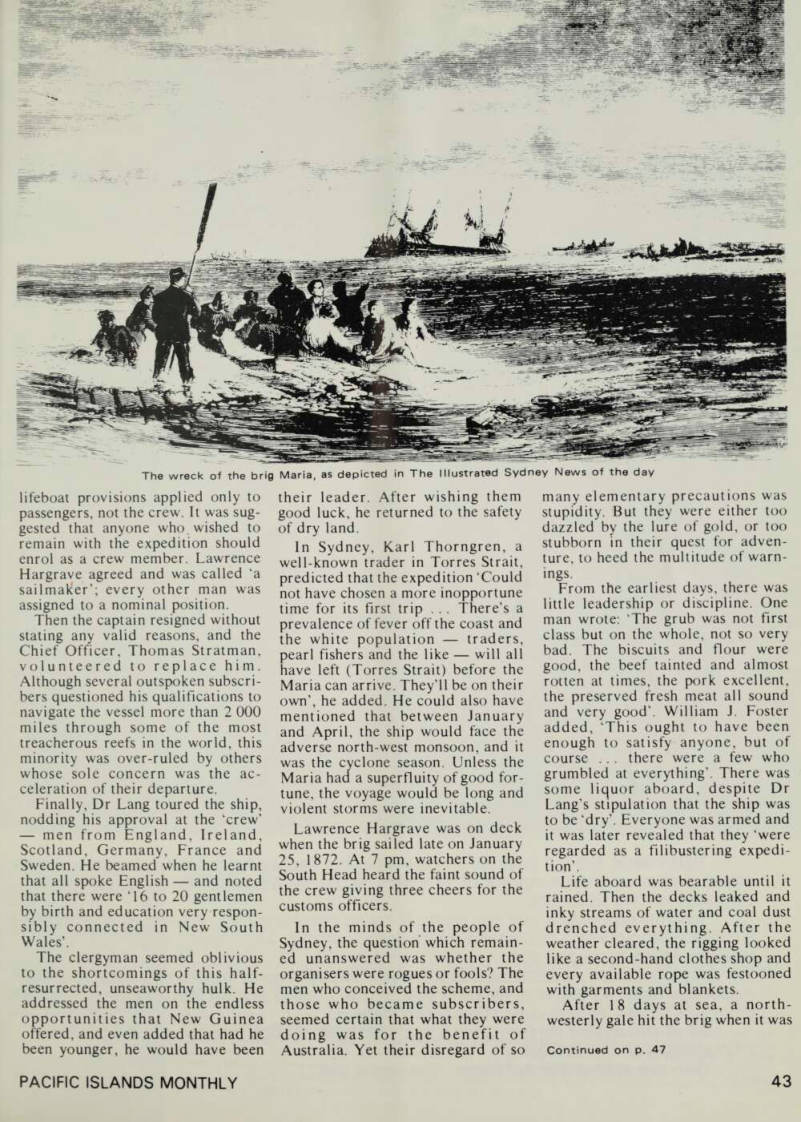

Gold was the Brig ‘Maria’s’ goal but her crew found only death
Many people consider the New Guinea prospecting expedition of 1872 an ill-planned, hair-brained scheme, but it spelled adventure for young Lawrence Hargrave, who later became a celebrated inventor and aviation experimenter. He was one of a group who set sail from Sydney in the brig Maria, but the Maria never reached New Guinea. It foundered off the Queensland coast with great loss of life. The story is told by John Goode in The Rape of the Fly, an account of early explorations in Papua, which is to be released by Thomas Nelson Ltd in October. The following account of the ill-fated voyage of the Maria is taken from the book.
By the lime he was 20, Lawrence Hargrave was bored with work in a Sydney drawing office. As a distrac tion, he had begun to invent things and much has been made of his first design a pair of shoes for walking on water. Really, they were a form of toy (enclosed water skis) which demonstrated that he understood the Archimedes principle and had a somewhat adolescent sense of humour.
A friend,. Merrewether Busby, used to visit his workshop in what is now Potts Point and recalled: “Often at night, armed with a hur ricane lantern and wearing these floats, he played harmless but rather startling tricks near Rushcutters Bay on Sydney Harbour. He would ‘walk’ out on to the water and ap pearing from ‘nowhere’ would sud denly wave his lantern over a boat’s side, frightening the occupants".
Next year, he designed but did not build a one-wheeled velocipede.
However, this inventiveness was only a means of procrastination un til he discovered what he had been seeking since his voyage round Australia an opportunity to ex plore unknown places.
In 1871, a possible solution emerged with the announcement of the New Guinea Prospecting Ex pedition. Many considered it an ill planned, hair-brained scheme, but Lawrence Hargrave was blind to the project’s deficiencies, like many bored young men seeking some ex citement as a change from their monotonous lives.
The scheme was announced in the Sydney Morning Herald on Decem ber 2, 1871. A co-operative had been formed and was calling for volunteers to subscribe £lO each.
For this, they would be taken to New Guinea by ship where, the prospectus boasted, There exist rich deposits of alluvial gold'.
The plan for the expedition had evolved from a lecture given to the Royal Society of New South Wales by the Rev John Dunmore Lang. His ponderously-entitled text, ‘New Guinea a highly promising field for settlement and colonisation, and how such an object might be most easily and successfully effected’ was highly selective in the evidence pre sented. This was not surprising for Lang, a man obsessed with the con cept of immigration, was one of the most unscrupulous and controver sial politico-clergymen in the colo ny of New South Wales.
In his lecture, Dr Lang had sketched the known history of New Guinea and quoted John MacGillivray, naturalist on Captain Owen Stanley’s ship, HMS Rat tlesnake, ‘That gold exists in the western and northern portions of New Guinea has long been known.
Specimens of pottery procured (dur ing a very brief visit ashore) contain a few laminated grains of this pre cious metal’.
From Lang’s hypothesis, the New
Guinea Prospecting Co-operative
had continued where the clergyman had cautiously paused. One vital sentence in the prospectus read ‘lt
having been satisfactorily proved that in the vicinity of Redscar Bay, and along the south-eastern coast of New Guinea, there exist very rich deposits of alluvial gold Today, we know that the source of pottery collected by MacGillivray was not necessarily Redscar Bay; that up to 1871, no one had ever taken a gold pan ashore anywhere in the east of New Guinea; that the first gold to be discovered was at Laloki, 16 km inland from Port Moresby in 1878.
After the news item appeared, the organisers were besieged by appli cants. Many were men with mining experience on the goldfields of Australia and California. The Maria, an old collier plying between Newcastle and Sydney, was bought on terms for a down-payment of £SOO. The ship was leaky, its quar ters narrow and badly ventilated, and it was infested with cockroaches.
Although Lawrence, now 21, was inexperienced in any form of seamanship, he was accepted as a volunteer and appointed a member of the working committee. His diary shows that he was an enthusiastic worker when asked to help with the preparation and loading of supplies.
Meanwhile, the organising com mittee had received an official letter stating that under the Navigation Act, there were insufficient lifeboats for the number of passengers aboard the Maria. But the wily organisers buoyed the hopes of their subscri bers by revealing that under the act,
lifeboat provisions applied only to passengers, not the crew. It was sug gested that anyone who . wished to remain with the expedition should enrol as a crew member. Lawrence Hargrave agreed and was called ‘a sailmaker’; every other man was assigned to a nominal position.
Then the captain resigned without stating any valid reasons, and the Chief Officer, Thomas Stratman, volunteered to replace him.
Although several outspoken subscri bers questioned his qualifications to navigate the vessel more than 2 000 miles through some of the most treacherous reefs in the world, this minority was over-ruled by others whose sole concern was the ac celeration of their departure.
Finally, Dr Lang toured the ship, nodding his approval at the ‘crew’ men from England, Ireland, Scotland, Germany, France and Sweden. He beamed when he learnt that all spoke English and noted that there were ‘l6 to 20 gentlemen by birth and education very respon sibly connected in New South Wales’.
The clergyman seemed oblivious to the shortcomings of this half resurrected, unseaworthy hulk. He addressed the men on the endless opportunities that New Guinea offered, and even added that had he been younger, he would have been
their leader. After wishing them good luck, he returned to the safety of dry land.
In Sydney, Karl Thorngren, a well-known trader in Torres Strait, predicted that the expedition ‘Could not have chosen a more inopportune time for its first trip . . . There’s a prevalence of fever off the coast and the white population traders, pearl fishers and the like will all have left (Torres Strait) before the Maria can arrive. They’ll be on their own’, he added. He could also have mentioned that between January and April, the ship would face the adverse north-west monsoon, and it was the cyclone season. Unless the Maria had a superfluity of good for tune, the voyage would be long and violent storms were inevitable.
Lawrence Hargrave was on deck when the brig sailed late on January 25, 1872. At 7 pm, watchers on the South Head heard the faint sound of the crew giving three cheers for the customs officers.
In the minds of the people of Sydney, the question which remain ed unanswered was whether the organisers were rogues or fools? The men who conceived the scheme, and those who became subscribers, seemed certain that what they were doing was for the benefit of Australia. Yet their disregard of so
many elementary precautions was stupidity. But they were either too dazzled by the lure of gold, or too stubborn in their quest for adven ture, to heed the multitude of warn ings.
From the earliest days, there was little leadership or discipline. One man wrote; ‘The grub was not first class but on the whole, not so very bad. The biscuits and flour were good, the beef tainted and almost rotten at times, the pork excellent, the preserved fresh meat all sound and very good'. William J. Foster added, ‘This ought to have been enough to satisfy anyone, but of course .. . there were a few who grumbled at everything’. There was some liquor aboard, despite Dr Lang’s stipulation that the ship was to be ‘dry’. Everyone was armed and it was later revealed that they ‘were regarded as a filibustering expedi tion’.
Life aboard was bearable until it rained. Then the decks leaked and inky streams of water and coal dust drenched everything. After the weather cleared, the rigging looked like a second-hand clothes shop and every available rope was festooned with garments and blankets.
After 18 days at sea, a north westerly gale hit the brig when it was
Continued on p. 47
The wreck of the brig Maria, as depicted in The Illustrated Sydney News of the day
carrying full sail. The maintop gallant was carried away and the sails shredded. For eight days, the old ship was battered by pile-driv ing seas and carried south by the prevailing current. The planking was ‘so strained that I could put my fingers between the gaps in the deck timbers’, Hargrave wrote.
During the night of February 17, a wave made the Maria shudder from end to end. Bulwarks were washed overboard and the tiller swept away. Despite Hargrave’s claim that single-handed he had im provised a new tiller, Foster wrote that Hargrave designed a windlass block and ‘the carpenters, assisted by Hargrave, at once set to work to repair our disaster’. However, the steering was so much heavier that two men were needed thereafter.
Then a deputation approached the committee and their spokesman was succinct. ‘We’ve had enough.
We want to be landed at an Australian port and we’ve agreed that we’re prepared to resign our shares.’
The committee members were equally alarmed and told Stratman to sail for sheltered waters. But the storm continued, the ship became heavier with water and, while at the mercy of the waters, and drifting, ‘the captain seems to have been im becile or helpless’.
Buckets and pumps had to be manned constantly and on February
20, even Hargrave wrote: T thought we should founder’.
When the gale finally abated, the battered vessel limped northward and lookouts were posted to spot one of the few gaps in the Barrier Reef which would admit a sailing ship into the calmer waters between the reef and the Queensland coast.
Land was sighted on February 25, to the relief of all aboard, but no one ever explained why the ship did not anchor at nightfall. At 3 am, Hargrave was awakened by ‘A hor rible grating sound followed by a shock'. He rushed to the deck to find the ship grounded on the reef. The sternpost had been driven through the deck, the rudder was gone and the bottom vented by coral nig gerheads as though its timbers had been tissue paper. When the tide rose, the Maria still floated and drifted clear of the outcrop.
Then confusion resulted from another decision which no one, least of all Lawrence Hargrave, ever ex plained satisfactorily.
Stratman told the committee that he would take six men in the surfboat and row north to Townsville to obtain a rescue ship.
Inexplicably the committee agreed.
Only Sonnichsen, the mate, lost his head when he heard what had happened, grabbed a rifle and fired after the boat, claiming that Strat man was ‘leaving them for dead’.
Neither Stratman nor Hargrave realised that they were on Bramble Reef, opposite Cardwell and 160 km farther north than they had calculated.
Aboard, the second officer, Andrews, organised some men to rig two rafts while Goble, the storekeeper, brought up plenty of food and opened the cases of bran dy, port and sherry. Foster wrote ‘A few of. us, among whom were Coyle and Hargrave .. . adjourned to the roof of the cabin, set to work on some preserved meat and biscuits . . . one or two only drank too much’.
After the rafts were launched, the Maria subsided on to the reef and keeled over. Hargrave and 12 men retreated to the masthead with pro visions, fresh water and clothes to await the captain’s return. However, as the poorly-constructed rafts drifted northwards, the boats returned to the wreck and Hargrave and six or seven others were per suaded to go into the sternboat.
They rowed all day to reach a deserted beach at dusk and were joined next morning by the other boat.
There was a disagreement as to where they were. Some maintained, correctly, that they were on Hinchinbrook Island, while Hargrave insisted that they were on Magnetic Island. For three days they lived on periwinkles, waiting for the weather to abate. Finally, the boats left for the mainland and reached Cardwell six days after leaving the wreck. The survivors were badly sunburnt and most had dreadfully swollen feet and could barely hobble.
For three days, Hargrave sailed with the steamer Tinonee to seek survivors. When they went to the wreck he recorded, ‘Found nothing but Zimmermann’s coat. Tobacco, matches and some biscuits in the pocket’. Otherwise no trace remain ed of the men left in the rigging.
Lawrence Hargrave, photographed not long before the great adventure
Advertisements & other items, pp. 44-46 (1 item)
• I 9K
» * * m
f*wi
m
s&is&
V ■ 45£S?S5
gMI
yi&s
fcwapiKy **«N*. l; That’s what the U.S. Environmental Protection Agency figures show. The Honda Civic placed first among the hundreds of 1976 cars tested. On the highway, in the city and in combined driving situations.
Top fuel economy is just the start. All-round operating costs are equally low. Thanks to a rugged, clean-burning OHC engine which delivers snappy acceleration. Elegance is second to none-both inside and out.
Famous Honda engineering also gives you: Enough roomy comfort to relax four adults.
A spacious trunk. Exceptional handling ease. A dual braking system featuring servo-assisted front disc brakes, independent strut suspensions.
All of this quality performance is yours in three exciting models-the 2-Door Sedan, 4-Door Sedan and Hatchback.
Own the 1976 economy champ-the Honda Civic.
HONDA
HONDA MOTOR CO., LTD. TOKYO, JAPAN
PAPUA NEW GUINEA: Steamships-Machinery P.O. Box 1, Port Moresby/TAHITI: Societe Tahitienne d Importation des Produits Honda B.P. 1665-Papeete/FIJI ISLANDS: Coral Island Motors P.O. Box 48 TRUST TERRITORY: United Micronesia Development Assn. P.O. Box 238, Saipan, Mariana oi a^ 96950/COOK ISLANDS: Cook Islands Motor Center Ltd. P.O. Box 74, Rarotonga/ AMERICAN SAMOA: Samoan Holiday and Travel Center P.O. Box 968, Pago Pago/AMERICAN SAMOA: Haleck’s f Center P 0 Box 1138 - p ago Pago/GUAM: Mark’s Motor Co., Inc. P.O. Box DV. Agana / WESTERN SAMOA: Motor Distributors (Samoa) Ltd. P.O. Box 576. Apia/SOLOMON ISLANDS: British Solomons i ra J' n « Co ” Ltd ’ P - Box 114 ’ Honiara/NEW CALEDONIA: Establissements Ballande Boite Postale No. C 4 Noumea Cedex/TONGA: E.M. Jones Limited P.O. Box 34, Nuku’alofa/TARAWA: Gilbert & Ellice Islands Development Authority P.O. Box 488, Beito/NIUE ISLAND: S. Jessop & Sons Ltd. P.O. Box 71. ucDD.ncc NAURU: Nauru Cooperative Society, Republic of Nauru, Nauru Island Central Pacific/NEW HEBRIDES: Tropex International Ltd., P.O. Box 139, Port Vila.
Another reason to keep’m Cummins;
™SItW
Tju 3*
p rr J Sr w
The K Scries.
From the world’s leading diesel engine manufacturer, an entirely new assax s t t rv"*v K “ nd engines capable of producing 450 to Bme details and specifications. 1600 h.p. The K Series offer exceptionally high power-to-volume |H NAM£ ratio, yet are generally more compact than other diesels in their h.p. range. address: Tests show that the K engine will use less fuel than other diesels in the same h.p. range. Their 4 cycle design also postcode contributes to durability. They give the . vital promise of minimum regular PHONE . servicing at extended intervals for decreased maintenance costs. Clean, uncluttered in design, the Cummins K Cummins Diesel Series carry the benefits of installation Sales and Service, ease and fewer maintenance problems. 164-170 Hume Highway, They have been designed to limit noise, Lansvale NSW 2166 smoke and gaseous emissions to well Telephone: 7286211 below present and projected standards. K The Cummins K Series. Another reason to keep ’em Cummins.
The Casualty List
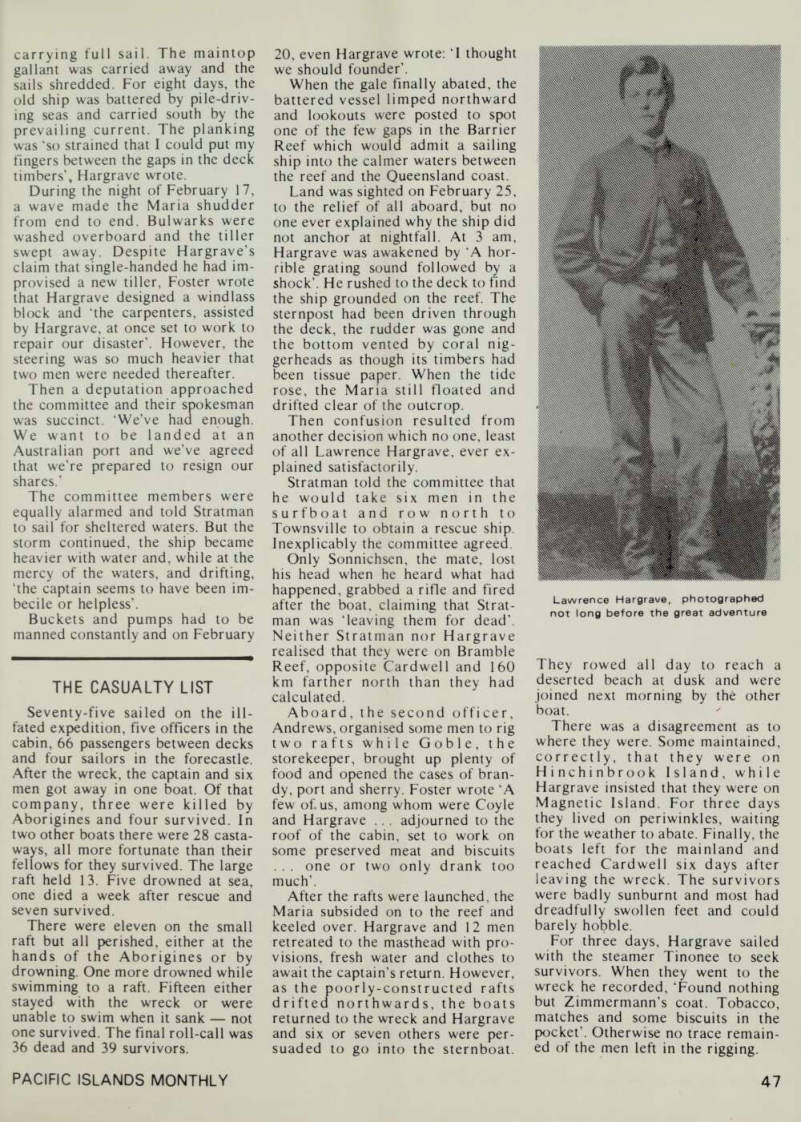
Seventy-five sailed on the ill fated expedition, five officers in the cabin, 66 passengers between decks and four sailors in the forecastle.
After the wreck, the captain and six men got away in one boat. Of that company, three were killed by Aborigines and four survived. In two other boats there were 28 casta ways, all more fortunate than their fellows for they survived. The large raft held 13. Five drowned at sea, one died a week after rescue and seven survived.
There were eleven on the small raft but all perished, either at the hands of the Aborigines or by drowning. One more drowned while swimming to a raft. Fifteen either stayed with the wreck or were unable to swim when it sank not one survived. The final roll-call was 36 dead and 39 survivors.
Advertisements & other items, p. 48 (1 item)
|«M Furniture
9 i / r\
OCCASIONAL TABLES
PEWTER FINISH
COPPER FINISH
POIMGRASS
|«M FURNITURE
Distinctive heraldic figures are superbly crafted in bold relief in a burnished copper* or old English pewter finish. Ask your friends to join the Knights of the Round Table! Create your own Camelot with these craftsman-built occasional tables.
Dimensions: Diameter of top 1050 mm (41 1 / 4 ") Overall height 375 mm (14 3 / 4 ")
Order Now
for Christmas
'Tops are metal foil laminates. dipped, write to Hockaday Distributors, Box Mlo9. Sydney Mad Exchange, N.S. W. 2012.
Gold was the Brig ‘Maria’s’ goal

When the coastal steamer Boomerang called at Cardwell on the followng Wednesday, Lawrence Hargrave sailed to Sydney. Only the surgeon of the Maria went south at the same time and he was not a member of the working committee.
All other survivors remained in Cardwell to continue sailing with vessels seeking survivors.
To some people, Hargrave’s departure must have been viewed as similar to that of Stratman from the Maria. The fate of 40 men was still unknown and Hargrave, as a com mittee member, had a responsibility to remain; furthermore, his own papers suggest that when he arrived back in Sydney, his only impedi ments were a slight limp and some minor after-effects of exposure.
For the next six weeks, together with murders in the Parramatta River and the Tichbourne case in England, the wreck of the Maria dominated the news. The accounts published revealed many details omitted from Lawrence’s private records.
For example, one survivor wrote: “There are men of some ability whose conduct and demeanour would have the effect of keeping good order and inspiring other men to maintain a respectful obedience to the rules of the Association. I am happy to say that very little ill-feel ing was manifested though at times a few displayed some objectionable proceedings (I shall refrain from saying what they were) .. . Some would not join the others because they . . . said the ‘swells’ wanted
everything their own way. Such ideas were, of course, erroneous and discussed by men scarcely able to judge the merits of others, much less venture an opinion on matters foreign to them”.
At the subsequent inquiry, Strat man was condemned as being ‘ut terly worthless as a navigator ...
Scarcely had the luckless vessel fastened herself to the rocks than the master, whose incapacity had caus ed the disaster, basely deserted the vessel before daybreak, taking six men in the best boat which would have held 20, pretending he was going for assistance Whatever his motives, Stratman received poetic justice; he was mur dered by Aborigines, as were two of the men in his boat, when they land ed some 16 km north of Cardwell.
Twelve days later, two other sur vivors from this boat, horribly emaciated, wounded by spears and naked, reached Cardwell after a tor tuous walk through trackless bush.
Two more arrived several days later.
When it was realised that some Aborigines had murdered several survivors and had then eaten them (some of the men from one of the rafts had got to shore and also been killed), there was alarm in Card well. The townspeople demanded retribution, insisting that, otherwise, the Aborigines might attack the town. A punitive expedition led by Sub-Inspector Johnstone and a patrol of Aboriginal troopers was escorted by crews from Captain John Moresby’s ship. Moresby re
lated how his officers had been com pelled to watch the troopers ‘inflict decisive punishment’ on the Aborigines. The tribe was surprised before daylight several unfor tunate blacks were shot down by the native troopers who showed an unrestrained ferocity that disgusted our officers.’
In his report to the Attorney- General of New South Wales, the in vestigating officer. Lieutenant Gowlland, also wrote ‘it appears that the spot where they (the crews in the two other boats) camped was in a small bay on the north-east side of Hinchinbrook. If, instead of leav ing this place and steering to the south, they would most probably have sighted shipping .. . and thus saved a pull of nearly 80 km.
He added, ‘What 1 cannot pass over without noticing is that the boats and their crews abandoned the rafts to their fate, which had neither food, nor water, and only one oar, instead of, as is invariably the rule in such cases, keeping in their com pany, and towing them when prac ticable.
It was obvious that the expedition had been a tragic fiasco but strong pressures must have been applied by people who felt that the final remarks (above) had to be answered. Ignorance of the law (or maritime tradition) is no defence, and Lawrence Hargrave, a Judge’s son, could not allow himself to be labelled guilty of a misdemeanour.
Some defence was necessary.
On April 1, 1872, this letter was published in the Sydney Morning Herald; Sir.
We saw in your paper of March 30th, a re port censuring the two boats of the Maria for abandoning the rafts. The facts of the
Continued on p. 86
case stand thus; The rafts were considera bly to the northward when the boats left.
We pulled to the W.S.W. for the only land in sight, intending to return with our best ; pullers, and make the men leave the masts ... we were utterly unable to carry out our intentions. Supposing we had done as Lieutenant Gowlland seems to think we ought to have done, viz, try to tow the rafts ashore, what would have been the conse quences? Why, we should have towed perhaps for two days, which is the most any man’s stomach would have allowed him to do with land in sight, then we should have tried to cram some more into our boats, when all hands, in their endeavour to come, would inevitably have swamped us and nothing ever would have been heard of the Maria or her crew. (Signed); L. Hargrave, Jacob Magg and ‘lO other names'. 31 March 1872 As a result of the tragedy, amend ments were made to the Navigation Act making lifeboats mandatory for the crew of a ship; but no action was instituted against the organisers of the expedition. Nor was any ex planation offered as to why they were able to avoid prosecution.
Throughout the weeks of reports, one voice was conspicuously silent.
Dunmore Lang seemed to have dis appeared into an opaque cloud of anonymity. Finally, he was persuad ed to support a second appeal for the survivors. He ignored the Herald, which was strongly critical of the expedition, and wrote to the Empire, Sydney’s other morning newspaper, stating; T feel bound to do so (appeal for funds) from having been in some way connected with the original expedition if not its original author ...
I have no reason to regret having written the paper (for the Royal Society) ... I was only ... pointing out .. . the way for as noble and heroic an effort in British colonisa tion as has ever been made Without apology he continued, That another expedition will, in due time, be undertaken with the same objective, and I trust under happier auspices, I have no doubt whatsoever
• A US Congress conference committee has approved a sup plementary budget of SUS2I.4 million for the US Trust Territory.
The amount comprises $11.4 million for regular programmes and $lO million for the new Truk air port.
Advertisements & other items, pp. 49-50 (1 item)
Exclusive Offerer P.I.M. Readers Only!
Your Camelot Table s«nr
will cost just . . . Io3(aust.) Delivered to your Port/Airport. Just follow these easy steps: 1. Arrange bank transfer with your local bank for Aust. $185.00 to be transferred to Hockaday Distributors.
C/- Bank of N.S.W . Botany, N.S.W. 2019. Australia. 2. Fill in coupon below. 3. Post completed coupon to Hockaday Distributors.
Box MlO9, Sydney Mail Exchange. N.S.W. 2012.
Australia.
The "Camelot " table of your choice will be delivered to your nearest port airport. Price does not include any applicable Customs Duty.
f TO: Hockaday Distributors, Box MlO9,
Sydney Mail Exch. N.S.W. 2012, Australia. , I Please send me within 28 days: ' I QUANTITY □ COPPER FINISH □ PEWTER FINISH I
NAME
ADDRESS
(PieaSe print)
1 PHONE No.
I TRANSFER No BANK
L DATEjO^RANSFERk . ...
I I J
all girls are not alike
When it comes .to efficiency, simple operation, lowest running costs and a long and trouble free life. Portals equipment is without equal no-one ever regretted buying quality and to insist on Portals plant is to secure value second to none.
For pools the latest permanent sand media ranges include stainless steel "C Series" plants for the smaller pools, the "H Series" for medium to large pools and horizontal or gravity filters suitable for even the largest complexes. Write to us for all water supply or industrial fluid treatment needs: nor are water and swimming pool treatment plants.
Portals
Portals Water Treatment (NZ) Ltd P.O. Box 13-558, Auckland 6, New Zealand Candy House, 11 Spring Street, Onehunga, Auckland Telephone: 661-079 (7 lines) Telex; NZ 21175 Telegrams: Portals Auckland.
PCI-PATERSON CANDY. PERMUTIT. BOBY. STELLA-META
PORTACEI HOUSEMAN-HEGRO ALL PORTALS GROUP.
E 3398
See the experts
for business anywhere in the South-West Pacific m For comprehensive service and advice on trade, both inter-island and with Australia and New Zealand, see the experienced staff at your nearest ANZ branch or agency. We can help you with importing and exporting, business transactions and personal banking. Offices are located at: Suva 128 Victoria Parade and Waimanu Road. Lautoka Naviti Street. Nadi Queen’s Road. Nausori Kings Road. Boroko Hubert Murray Highway. Lae Cnr. Coronation Drive and 7th Street. Madang Lightfoot Arcade, Kasagten Road. Mount Hagen Hagen Drive. Port Moresby ANG House, Hunter Street. Rabaul Mango Avenue. Waigani.
Honiara Mendana Avenue. Vila Rue Higginson. BANK AM
ANZ* 990
gifts of Mother Nature
How the New Guinean has used the gifts of Mother Nature
Books
New Guinea Vegetation is an unassuming but significant and stimulating book. Under the editor ship of K. Paijmans, the information provided by 25 years of Resources Reconnaissance Surveys in Papua New Guinea by CSIRO has been as sembled.
M. M. J. van Balgooy. a plant geographer from the Rijksher barium. Leiden (one of the great plant institutions of the world), dis cusses the origin and distribution of the flora and J. M. Powell (formerly of the Australian National Universi ty's New Guinea Research Unit) de scribes the role of the vegetation in the life of the New Guinea people.
This book should be read by all con cerned with the land and people of New Guinea. It incorporates much of our present day botanical knowledge of this tropical island which has environments ranging from coastal swamps to snowcapped mountains.
The writers have obviously avoid ed the unnecessary use of technical terms, but some knowledge of what botany is about is needed to get a full measure of value from the book.
The general reader must not be dis couraged by the technical terms, many of which are defined, or the botanical names of plants, for there is much fascinating information here. The publishers. CSIRO and the Australian National University Press, have produced a book of most pleasing format, and the compres sion of so much information into a work of modest size is quite an achievement.
In the first section. M. M. J. van Balgooy introduces the reader to the flora of New Guinea. How did it arise? Why is it so different from those of its very near neighbours Malaysia and Australia?
New Guinea has no endemic plant families but the large number of en demic genera and species indicate that evolution has been occurring rapidly and in isolation. It has been estimated that, of the 9 000 flower
ing-plant species of the region. 90% are endemic, so that plant genera in stead of species must be used to relate the flora to floras outside the island. A great deal of knowledge is assembled here, all well-docu mented and providing a splendid starting point for future study and speculation.
Speculation about the history of land-surfaces has been influenced by our increased knowledge of the movement of large land-masses over the surface of the globe. Who could fail to be excited by the thought that the mountains of New Guinea were formed by the collision of the Asian and Australian plates, or that an anti-clockwise rotation of New Guinea separated it from Queens land, giving it its present shape and
position?
In the second part of the book. K.
Paijmans. a plant ecologist with CSiRO, gives an account of the main vegetation-types of the island as they were observed by ecologists over the years the surveys were con ducted in Papua New Guinea. A sec tion on Irian Jaya is also included.
Over 50 plant communities, in seven major environments, are de scribed. from beach-ridges and flats at sea-level to the upper montane zone reaching over 4 000 m. Paij mans gives an account of nature, not static but changing with the seasons, the vicissitudes of earthquake, storm and volcanic action, and most of all with the violence of man and his fires. In some cases warning is given to future planners of areas vulnera ble to inappropriate use.
This section has a number of striking photographs which are very pertinent and well-placed and should help readers new to plant ecology to identify each community.
An interesting re-construction of the vegetation changes over the last 30 000 years, based on studies of pollen in the bogs of the Highlands, shows that not only was the vegeta tion pattern influenced by the wax ing and waning of ice on the high mountains but also by man who over 5 000 years ago was altering the landscape by destroying the natural forests for agricultural purposes.
In the third section of this book. J.
Powell describes, with considerable detail, the uses to which New Guinea people have put their rich flora and the many introduced spe cies, including most of the staples, which have reached their shores from elsewhere.
She deals with the staple and mostly very starchy crops (yams, sweet potatoes, taro, sago and bananas) and with a range of some 250 supplementary foods which sup ply the normal, low calorie, but ap parently nutritionally adequate.
New Guinean diet.
Methods of cultivation, prepara
tion and cooking the main foods are included, with details of the condi ments used and methods of obtain ing plant ash as a salt substitute.
A remarkable amount of informa tion is given about all the other uses for plants, as narcotics and intoxi cants, for medicine, ritual and magic (even for toothache), for tools, weapons, canoes, houses, utensils and textiles in fact all the uses a population largely involved in subsistence agriculture has for its crops and the surrounding natural vegetation. Most of this is tabulated for easy reference, and much of it given greater exposition in an infor mative text. In all. some 1 035 plant species have been recorded as hav ing a use to the New Guinea people.
Such a prodigious variety of plant usage by a people must be unique.
This section ends with a historical survey. It suggests that man landed on the coastal strand some 50 000 years ago. By 1 1 000 years ago he had reached the Highlands, and by 9 000 years ago. with a substantial reduction in the number of the large marsupials, man became more de pendent on the plants which he was perhaps already tending. The first ot the introduced staple crops, taro, was being tended more than 4 500 years ago. and the last, the sweet potato, was in cultivation in New Guinea centuries before Columbus introduced it in Europe.
Paijmans says of New Guinea: “Our knowledge of its flora is still incomplete and patchy: in some areas it is known reasonably well, but in other areas, which remain unexplored the flora has yet to be investigated. Consequently there is much scope for further study. The vegetation of New Guinea is relatively unspoilt in comparison with many other tropical areas and many natural habitats can still be preserved, a challenging task for a newly independent country.”
This book is very well indexed and its facts well supported by references to published literature.
The comprehensive and up-to-date (1975) bibliography is a valuable reference work in its own right, drawing together the relevant literature not only of botany but of a
number of other disciplines.
Thompson
Joy
NEW GUINEA VEGETATION. Edited by K. Paijmen*.
Published by the CSIRO in association with the Australian National University Press, Canberra. $16.95)
human development
A Pacific view of human development
Development is People is a 16page booklet that suggests a self help approach to development, on the basis of the Christian ethical view of freedom, which involves Justice as well as kindness for all.
The booklet is the result of the Pacific Conference of Churches’ study of human development in January, 1976. It puts forward three principles for Pacific development: the use of local resources, aware ness of real needs, and the ability to face up to failures and start again.
A series of questions for study are expressed simply enough for any one with reasonable English and a local language to be able to initiate village discussion of vital issues.
Development is People is a Church document, but it sets the Church to examining some of its own shortcomings in serving the
w elfare of Pacific peoples.
Matthew's.
Rex
(DEVELOPMENT IS PEOPLE, Lotu Pasifika Pro ductions, P 0 Box 208, Suva, Fiji. Recommended price F 38 cents.)
Rarotonga
Through The Eye
Of A Camera
James Siers’ photographic essay on Rarotonga is similar to a number of others which have been produced in recent years with the principal purpose of catering for the Pacific Islands tourist trade. This is a type of book which has inherent deficien cies and if these are accepted for what they are then Rarotonga must be considered to match its pre decessors in content and quality of presentation. The book looks at only two of the islands in the Cook Is lands, Rarotonga and Aitutaki, because it is only there that there is available access by air and accom modation catering for tourists.
As he has demonstrated on several occasions, James Siers is a most competent professional photo grapher and he does his Cook Is lands subjects proud. The reader cannot fail to be entranced by the rugged beauty of the Rarotongan skyline, or the sweep of some of the island’s beaches or the dramatic ap peal of the lagoon of Aitutaki.
However, it is with the local peo ple that Siers shows the mastery of his trade and his feeling for the Cook Islands’ way of life. He cap tures with sympathy and perception much of the ebullient character of this island society in the people, young and old, well-known and not so well-known that appear on many of the pages in the book.
Here we are able to see in quite natural surroundings, the honoured elder citizens, such as Mrs J.
Williams, and Charlie Cowan, known to many as Tumu Korero, for his great volume of writing on his own people. We can also see Sir Albert Henry, in the informal style which he so often adopts, as he stands on the beach at Titikaveka, clad in a floral pareu and with a beach towel tossed over his shoulders.
But the lesser-known are not neglected and the book gives deserved prominence to fishermen, schoolchildren, the boys who ride the race horses on the beach at Mun and the people who dance and sing
on so many occasions in the Cook Islands way of life. The casual visi tor to the islands will also get some impressions of the economic back ground of these places for there is a reasonable coverage of the agricultural, craft and entertain ment industries.
This is, in most respects, a book that can be recommended to the particular audience for which it is prepared, and I hope that it proves to be a worthwhile venture for Mr Siers, and then, perhaps, he may feel encouraged to produce a second edition in which he will be able to eliminate a number of minor flaws, which to anyone who knows the Cook Islands in any degree of familiarity must be considerable irritants.
Cook Islands dancing and singing is at its best when it is spontaneous, or linked to .some occasion which has deep local significance and 1 would have preferred to have seen more of this feature of life on Rarotonga and Aitutaki and less of the quite synthetic dancing that is served up for tourists and as the bill of-fare of touring dance teams.
There is so much colour in the is lands. in the sky, the sea and on the land, that I feel that it is inap propriate for the phoographer to enhance what nature has to offer.
I may be doing Mr Siers an in justice. but my memories ot so many sunsets are such that 1 feel that Mr Siers must have made use ot filters to obtain, in several ot his scenes, effects which are not Rarotongan.
This book is also interesting because its author has made use of some of the photographs in the George Crummer collection, which date back some 60-70 years, to pro vide a contrast between the past and present and this is to be commend ed. But I wish that a little more research had been done ot a wreck cast upon a coral shore. The book says “No one knows where this ship ran aground.” The most elementary steps in research would have told the author that this was the
Saragossa, the wreck of which on Mangaia is in fact one of the best known incidents in the maritime history of the Cook Islands.
The author also falls into the common trap of crediting the Rev John Williams with “rediscovering”
Rarotonga, which is quite erroneous as there were a number of ships that came before Williams on the En deavour. including the Sydney vessel Cumberland , whose visit to Rarotonga has been well-docu mented. And 1 am not impressed with sentences that leave me with the suspended feeling “Swim ming, snorkelling, canoeing, tour ing, or just hiring a motorcycle or car and pleasing yourself’.
To sum up. 1 must not be too carp ing in my criticism of this book. It more than adequately serves the purpose it was designed to meet, that is to provide an introduction to the island of Rarotonga and Aitutaki, for the visitor whose stay
there will be of short duration.
G. Coppell
w.
SIERS, James (RAROTONGA By James Siers.
Published by Wellington, Millwood Press Ltd, 1977).
Pils For The Librarian
Attendance at any conference, seminar or workshop concerned with the Pacific region serves to bring home one truth that needs to be emphasised with much weight. The rate of development is such and the range of interests in the region is growing at such a rate that it is essential that means be found whereby information may be spread as widely and as effectively as possible. The South Pacific Commission has for many years acted as a clearing house for technical information about the Pacific and, more recently, the establishment of the PEACESA 7 satellite system has given a further dimension to information dissemination.
For specialist groups, however, there still exists the need for services that meet their particular needs. Librarians are typical of these workers who feel the necessity to know what is going on elsewhere in the region, which affects their work. Therefore it is a pleasure to note the appearance o/ PI LS Pacific Information and Library Services Newsletter. The Graduate School of Library Service at the University of Hawaii is responsible for the production of PI LS, which is to be a quarterly publication and which will report on developments in library and information services in the Pacific". Harold V. Bonny, in the first issue of PILS, comments on its prospectus and says —* / applaud this because, inter alia, it will: (I) facilitate communications between librarians and the exchange of ideas and information, (2) help professional development, education and qualifications, (3) encourage the enthusiasm of librarians; libraries develop in direct relationship to the enthusiasm and professional ability of librarians. ”
Volume I, Number I gives an indication of the scope of PILS as it deals with the work of PEACESA T. the new Journal Pacific Studies, the Hawaii Medical Library, Library for the Blind and Handicapped, book notes, the South Pacific Commission Library and exchange publications. PILS has begun at a modest level, it is to be hoped it will command the support which
w/// ensure its continued existence.
W. C. Coppell
Looking carefully at some books
some books for children
Choosing interesting books on the Pacific for children to read should not only be the obligation of teachers. Parents can improve their child’s reading and knowledge of the world around them. All it re quires is some encouragement and wise buying.
One sign that a book is appealing to children is if it has been reprinted many times. One such book is Moki ha n a lives in Hawaii (Methuens Children’s Books, Lon don) which first appeared in 1961.
It is one of a series entitled the Children Everywhere Series.
Mokihana appeals because of its very clear, natural photographs of children at play. The text is simple and complements the photographs well. There are about 50 to 70 words to each large photograph.
This book could serve four pur poses. It could be used as a story book read by parents to children of four to seven years. The photo
graphs ensure that the child sees what is being read and can extract even more information about the children if you give him time to dwell on each picture.
It could be used as a reader; it would probably be suitable for ad vanced seven-year-olds upward and would provide a challenge beyond the basic readers that so often bore the brighter child.
It would make an excellent social studies reader for children between the ages of seven and 14 because the pictures provide ample scope for discussion on the ways in which these children lead their lives.
It would make an excellent remedial reader for older children, particularly Pacific children.
Children of the Pacific Islands ($1.90) is published by Reed Educa tion of New Zealand. It covers life in Melanesia, Micronesia and Polynesia and is most suitable for secondary school children. It is de signed as a social studies text and has projects and exercises and very
good photographs.
It is part of a series on life in New Zealand and the Pacific, is well planned and encourages the child to work out some things for himself.
The book concentrates very much on how Island children spend their time at school and at play.
I would recommend this book and the series to teachers of social stu dies in Australia, New Zealand and the Pacific. Parents might find books of this type a useful reference work for children’s social studies projects as an easily understood in dex is included.
The Pageant of the Pacific series ($1.45) is also produced by Reed Education. Possibly the most com prehensive, is the one on the Cook Islands, although all the books in the series are very comprehensive and are in much demand from social studies teachers for children in the junior years of high school. The book provides a simple statistical table and an explanation of techni cal or Cook Island terms used. Asa series it is probably a more relevant buy than the serialised en cyclopaedias that are often adver
tised.
P. L. Young
Advertisements & other items, p. 54 (1 item)
in the future of
We believe
Papua New Guinea
Since achieving our independence in 1975, Papua New Guinea has established a record of democratic political stability that has enabled our people to get on with the job of building a strong and durable young nation.
We encourage private enterprise and foreign investment in ways that will provide maximum benefits for all our people.
We vigorously support the search for natural wealth such as oil and minerals.
We have adopted a long-range policy on natural resource development and a short range policy to maintain economic stability.
Through our membership in international economic organisations, and the establishment of diplomatic offices in several major overseas capitals we are working to assure stable market outlets for our agricultural and raw material exports.
We have the problems of any young nation. But we also have a tradition of patience and determination attributes that have always served us well and will continue to do so.
RIGHT HON. M.T. SOMARE
PRIME MINISTER OF
PAPUA NEW GUINEA
GOVERNMENT OF
PAPUA NEW GUINEA
minerals - and found rice
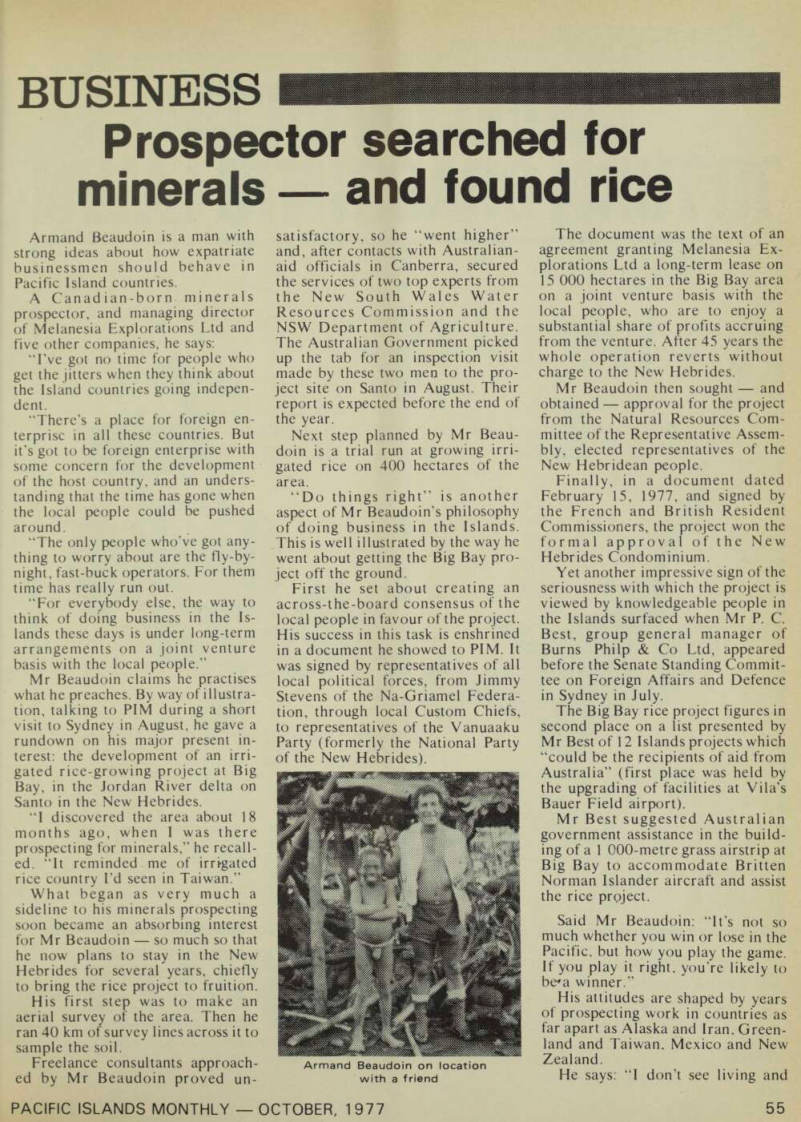
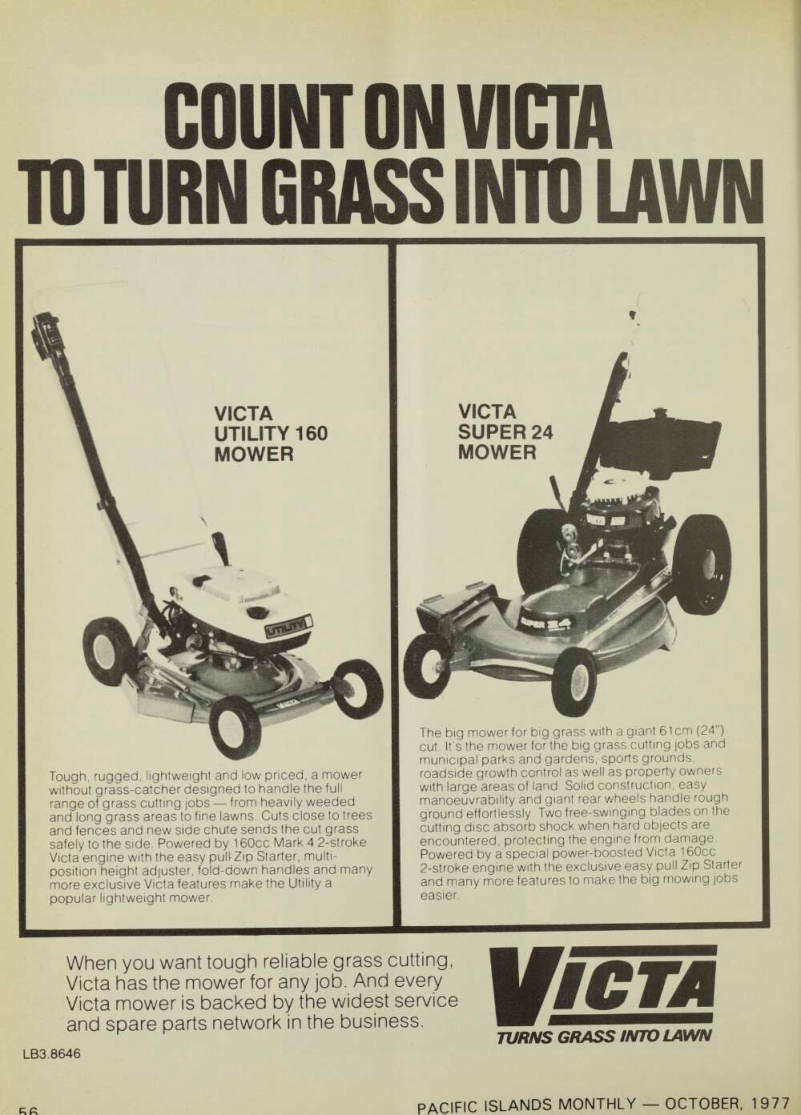
Business
Prospector searched for minerals - and found rice
Armand Beaudoin is a man with strong ideas about how expatriate businessmen should behave in Pacific Island countries.
A Canadian-born minerals prospector, and managing director of Melanesia Explorations Ltd and five other companies, he says; “I’ve got no time for people who get the jitters when they think about the Island countries going indepen dent.
“There’s a place for foreign en terprise in all these countries. But it’s got to be foreign enterprise with some concern for the development of the host country, and an unders tanding that the time has gone when the local people could be pushed around.
“The only people who’ve got any thing to worry about are the fly-by night, fast-buck operators. For them time has really run out.
“For everybody else, the way to think of doing business in the Is lands these days is under long-term arrangements on a joint venture basis with the local people.”
Mr Beaudoin claims he practises what he preaches. By way of illustra tion, talking to PIM during a short visit to Sydney in August, he gave a rundown on his major present in terest; the development of an irri gated rice-growing project at Big Bay, in the Jordan River delta on Santo in the New Hebrides.
“I discovered the area about 18 months ago, when I was there prospecting for minerals,” he recall ed. “It reminded me of irrigated rice country I'd seen in Taiwan.”
What began as very much a sideline to his minerals prospecting soon became an absorbing interest for Mr Beaudoin so much so that he now plans to stay in the New Hebrides for several years, chiefly to bring the rice project to fruition.
His first step was to make an aerial survey of the area. Then he ran 40 km of survey lines across it to sample the soil.
Freelance consultants approach ed by Mr Beaudoin proved un
satisfactory, so he “went higher’’ and, after contacts with Australian aid officials in Canberra, secured the services of two top experts from the New South Wales Water Resources Commission and the NSW Department of Agriculture.
The Australian Government picked up the tab for an inspection visit made by these two men to the pro ject site on Santo in August. Their report is expected before the end of the year.
Next step planned by Mr Beau doin is a trial run at growing irri gated rice on 400 hectares of the area.
“Do things right’’ is another aspect of Mr Beaudoin’s philosophy of doing business in the Islands.
This is well illustrated by the way he went about getting the Big Bay pro ject off the ground.
First he set about creating an across-the-board consensus of the local people in favour of the project.
His success in this task is enshrined in a document he showed to PIM. It was signed by representatives of all local political forces, from Jimmy Stevens of the Na-Griamel Federa tion, through local Custom Chiefs, to representatives of the Vanuaaku Party (formerly the National Party of the New Hebrides).
The document was the text of an agreement granting Melanesia Ex plorations Ltd a long-term lease on 15 000 hectares in the Big Bay area on a joint venture basis with the local people, who are to enjoy a substantial share of profits accruing from the venture. After 45 years the whole operation reverts without charge to the New Hebrides.
Mr Beaudoin then sought and obtained approval for the project from the Natural Resources Com mittee of the Representative Assem bly, elected representatives of the New Hebridean people.
Finally, in a document dated February 15, 1977, and signed by the French and British Resident Commissioners, the project won the formal approval of the New Hebrides Condominium.
Yet another impressive sign of the seriousness with which the project is viewed by knowledgeable people in the Islands surfaced when Mr P. C.
Best, group general manager of Burns Philp & Co Ltd, appeared before the Senate Standing Commit tee on Foreign Affairs and Defence in Sydney in July.
The Big Bay rice project figures in second place on a list presented by Mr Best of 12 Islands projects which “could be the recipients of aid from Australia” (first place was held by the upgrading of facilities at Vila’s Bauer Field airport).
Mr Best suggested Australian government assistance in the build ing of a 1 000-metre grass airstrip at Big Bay to accommodate Britten Norman Islander aircraft and assist the rice project.
Said Mr Beaudoin: "It’s not so much whether you win or lose in the Pacific, but how you play the game.
If you play it right, you're likely to be a winner.”
His attitudes are shaped by years of prospecting work in countries as far apart as Alaska and Iran. Green land and Taiwan. Mexico and New Zealand.
He says: “1 don’t see living and
Armand Beaudoin on location with a friend
working in the Islands as any kind of an escape from the rat-race. I don't see it as a fast, hard-cash business deal either. I see it more as a way of life.
“If business people are willing to change their altitudes, work hard to understand the local people, and then decide how they're going to work with them, they'll succeed"
The New Hebrides at present im ports 4 000 tonnes of rice a year at a price of roughly $4OO a tonne. Mr Beaudoin foresees a time when not only will these islands be freed of this import cost burden, but they will actually be rice exporters.
Many problems remain to be overcome; there are difficulties pos ed by wild cattle in the area, not to mention malaria-carrying mos quitoes.
But as Armand Beaudoin and his dozen or so local assistants battle on in their spartan work camp at Big Bay “no politics, no religion and no booze” is the rigid rule there it is possible to share their optimism that an operation of real economic and social significance for the New Hebrides will one day flourish on the flat, swampy country that sur rounds them.
Regional telecom
set up in Suva
A regional telecommunications training centre has been established in Suva by Fiji, Tonga. Western Samoa, the Cook Islands, Niue and the New Hebrides to train staff to operate and maintain the telecom munications network in the region.
The project is supported by the United Nations Development Pro gramme. the International Telecom munications Union, the Common wealth Fund for Technical Co operation. Australia and New Zea land. Apart from the regional train ing centre in Suva, there are basic training centres in the Cook Islands, Tonga and Western Samoa.
Mr Ray Hillier, of the Australian Telecommunications Commission, has been seconded to Suva for 18 months as senior training adviser.
Other Australian assistance with the project includes a contribution of $5O 000 and three advisers for two years. Australia recently undertook to contribute another $250 000.
Advertisements & other items, p. 56 (1 item)
Count On Vigta
TOTURN GRASS INTO LAWN
VICTA
UTILITY 160
MOWER
A Tough, rugged, lightweight and low priced, a mower without grass-catcher designed to handle the full range of grass cutting jobs from heavily weeded and long grass areas to fine lawns. Cuts close to trees and fences and new side chute sends the cut grass safely to the side. Powered by 160 cc Mark 4 2-stroke Victa engine with the easy pultZip Starter, multiposition height adjuster, fold-down handles and many more exclusive Victa features make the Utility a popular lightweight mower. t
VICTA
SUPER 24
MOWER
The big mower for big grass with a giant 61 cm (24") cut. It's the mower for the big grass cutting jobs and municipal parks and gardens, sports grounds, roadside growth control as well as property owners with large areas of land. Solid construction, easy manoeuvrability and giant rear wheels handle rough ground effortlessly. Two free-swinging blades on the cutting disc absorb shock when hard objects are encountered, protecting the engine from damage.
Powered by a special power-boosted Victa 160 cc 2-stroke engine with the exclusive easy pull Zip Starter and many more features to make the big mowing jobs easier.
When you want tough reliable grass cutting, Victa has the mower for any job. And every Victa mower is backed by the widest service and spare parts network in the business.
L 83.8646
Victa
TURNS GRASS INTO LAWN
Russian glad-hand


Opportunity Knocks In
The Solomons
The Solomon Islands offers excel lent opportunities for trade ex pansion, investment, consultancy and the provision of infrastructure for a number of new industries in the pipeline, and in this connection Mr H. E. McClelland, former Australian Assistant Trade Com missioner, Pacific Islands, writing in Overseas Trading, the official jour nal of the Australian Overseas Trade Department, outlined some of the developments which offer opportunities for trade.
Thirty-two of 58 foreign-owned companies in the Solomons are Australian. Existing industries cover the manufacture of soft drinks, biscuits, soap, tobacco pro ducts, concrete blocks and corru gated iron.
Opportunities exist for the manufacture or partial manufacture of beer, salt, paint, insecticides, fibre travel goods, matches, textile goods, footwear, wire and nails, plastic ware.
If the Solomon Islands Govern ment approves a detailed proposal, some or all of the following as sistance may be provided: • With site choice, negotiations, security of tenure and information for use in planning and design. • Tax relief;
Norfolk recruits
anti-weed insects
Grappling with its weed problem, Norfolk Island is considering taking a leaf from Hawaii’s book and im porting insects for biological con trol of Hawaiian holly, one of the major villains in Norfolk’s escalat ing weed drama. A small army of in sects is already at work trying to curb the spread of the major villain, lantana. But there’s not much sign yet that they’re winning.
Some people see export possibili ties in coping with another of Nor folk’s perennial weeds, the cherry guava. Its fruit is prized by local re sidents. Although much of it falls unused at present, it seems possible that it could be harvested and pro cessed into jellies and juices for ex port.
• Import duty concessions on capital goods; • Infrastructure and com munications; • Training, employment coun selling and staff selection and • Contracts to purchase output at competitive prices.
Russian glad-hand
for the Tongans
From a Nukualofa correspondent Russia has had a close look at the possibility of opening up regular trade between the Soviet Union and Tonga. Mr Fedor I. Shptoa (com mercial counsellor) and Mr Alex ander A. Malkhanov, from the Soviet Embassy in Wellington, visited Tonga to meet the Prime Minister, Prince Tu’ipelehake, min isters, the manager of the Bank of Tonga and government officials.
The idea, Mr Shptoa said, was to get acquainted with Tonga’s idea of future trade and to discuss what types of equipment and machinery Tonga needed.
Mr Shptoa said the Soviet Union was prepared to supply Tonga with a variety of equipment, such as fully mechanised agricultural equipment, road construction machinery, electrical generators, welding equipment, improved construction materials, prefabricated units for houses, consumer goods and techni cal assistance.
When asked if agreements to assist developing countries con stituted foreign aid or joint business ventures, Mr Shptoa said it was neither. The Soviet Union just helped countries by supplying machinery, equipment and other goods. In return, countries “paid their national product”.
“Everything is negotiable as far as the amount of return of the national product,” he said.
Nothing was signed and nothing was completed, but if Tonga was ready to go into trade, then there could be an exchange of specialists and businessmen.
Coconut wood comes
into its own
Coconut logs, previously left to rot in plantations or to litter beaches; are now being put to pro- I ductive use.
Thanks to a research programme ] by New Zealand’s Forest Research Unit at Rotorua, they are now able to turn the logs into housing timber, fence posts, furniture, charcoal, and. in some cases, artifacts.
Fiji, Tonga and Western Samoa are the principal present benefici aries of the new techniques, but the Cook Islands, the Gilbert Islands, the New Hebrides and Niue are already queueing for them.
The portable sawmills and preser vative treatment plants supplied by New Zealand are serving a threefold purpose. They help to overcome the problem of unwanted coconut logs, provide additional jobs, and pro duce supplies of sawn timber and treated fencing material which would otherwise have to be im ported.
Each country is using the coconut timber for its own needs.
Fiji is using it for furniture and for decorative purposes, Tonga for building timber and Western Samoa for agricultural fencing.
All three countries have developed a process for manufac turing charcoal from coconut wood, and the Fiji Government has spon sored a scheme to develop efficient charcoal cooking stoves and suita ble recipes for dishes to be cooked on them.
Fiji’s Prime Minister. Ratu Sir Kamisese Mara, has long advocated the use of coconut wood for housing purposes such as window frames.
A ‘prawn
capital’ in Hawaii
The big Honolulu firm of C.
Brewer & Co Ltd plans to make Kilauea, on the Hawaiian island of Kauai the “prawn capital” of the Pacific.
A recent announcement by the company said that its subsidiary, Kilauea Agronomics Inc, was in the first stages of setting up a major 121.5-ha (300-acre) integrated
prawn operation.
It began construction in July of the first 40.5-ha (100-acre) section of prawn ponds and related water system. The ponds will be rectangu
lar and about a metre deep. Prawn population will average about 200 000 a hectare. The first prawn harvest will probably take place about a year from the date ot initial stocking.
When the first 40.5-ha section is in operation, it will more than triple Hawaii's present capability. There are now only about 12 ha devoted to freshwater prawn farming in Hawaii.
“We fully intend to help meet local demand and do our best to make prawns a viable export com modity for Hawaii, bringing new dollars into the State,” said Mr J. W.
A. Buyers, president and chief ex ecutive of Brewer’s.
With the money and knowhow which is going into this major ven ture by Brewer’s, there could well be a valuable spin-off for other Is land countries who may be con sidering prawn farming develop ment.
How about the South Pacific Commission plugging into it and co ordinating information gained for use by other Island countries? It could save the SPC time arid money, and turn out to be helpful all round.
Big job for
little Pitcairn
The 18 men on Pitcairn Island available for the task worked a total of 2 353 eight-hour man days on a harbour works project, which in volved a new jetty, road works and repairs to installations. The 18 men included one who was visiting “on holiday”. The project, when the work of the medical officers who tended to the fortunately few inj uries. and the women who cooked and cleaned for the workmen, is considered to have involved most of the population of just over 70 and three “imported” Royal Engineers.
A decision to go ahead with breakwaters, airstrip and water sup ply will be made by the engineers in Auckland and the UK Government.
But Captain Hugh Cowan, RE, who was in charge of the current and sug gested works, wrote after he left the island that none of the investigations was encouraging as all three tasks would be large undertakings and ex pensive. Construction of the break water would take about two years and place a heavy demand on Pit cairners able to operate or maintain mechanical equipment.
Advertisements & other items, pp. 58-60 (1 item)
White Horse
509919 99 VAm~
Fine Old
Scotch Whisky
BOTTLED IN SCOTLAND
horse distillers ltd and LONDON 00 *#« The White Horse Cellar It E s t a b I 742
White Horse
Fine Old ScotchWhisky.
...deserves another.
B OTTL E p/,;l,|)l;'.S;C PT t A N D n fj m m 1 r
W.I.WWWS
The While Horse Cellar Est&b 1742
Logan De Luxe
Scotch Whisky.
Goodyear has lots of ways
to help you cut costs.
Make your drives last longer. Goodyear Hy-T V-belts are the new standard of V-belt performance. Hy-T V-belts are designed to take heavy shock loads; resist heat, oil, and mechanical abuse.
You’ll use fewer belts, and your drives will last longer. r Plylon pays for itself. Goodyear Plylon conveyor belting has a habit of paying for itself. This belt has been on the job for over 11 years and it’s still moving limestone. No downtime, no breakdowns. When you look for performance, look to Plylon conveyor belting.
Cut chemical hose inventory. Goodyear Blue Flexwing hose handles oils, acids, solvents up to 90% of all of today’s chemicals. Look to Blue Flexwing hose. It could provide you with a smaller, easier-to-handle inventory and give you lower chemical hose costs in the bargain. vS «; » y Cut your maintenance costs. Goodyear Armadillo rubber lining reduces the daily wear and tear on chutes, screens, flumes, shaker tables —everywhere exposed metal is subject to abrasion. Armadillo rubber lining outwears metal as much as 12 to 1 and is a noise fighter as well.
GOODpYEAR
INDUSTRIAL PRODUCTS
We know
how to help.
Contact your Goodyear distributor.
He has lots of ways to help you cut costs.
GOODYEAR DISTRIBUTORS IN S.E. ASIA AND PACIFIC BASIN.
Richard Pieris & Co., Ltd.
Colombo, SRI LANKA Nepal Motor Company (P) Ltd.
Biratnagar, NEPAL Navana Ltd.
Dacca, BANGLADESH
Diethelm & Co., Ltd.
Bangkok, THAILAND Landis Brothers & Co. Ltd.
HONG KONG
Guam Tire & Supply Co.
Agana, GUAM Susupe Enterprises Saipan, MARIANA IS.
Nicrol Corporation Saipan, MARIANA IS.
Truk Trading Co.
Truk, E. CAROLINE IS.
P.A.M.I.
Kolonia, PONAPE Island Transport Service Co.
Majuro, MARSHALL IS.
Yap Cooperative Ass.
Yap, W. CAROLINE IS.
Cook Islands Motor Centre Rarotonga, COOK IS.
Ngiratkel Etpizon Co. Ltd.
Koror, PALAU Boroko Motors Ltd.
Port Moresby, PAPUA NEW GUINEA Solomon Motors Ltd.
Honiara, 8.5.1. P.
Santo Engineers
Santo, NEW HEBRIDES
Pacific Motors
Vila, NEW HEBRIDES
S.G.A.
Noumea, NEW CALEDONIA
Duncombe Bay Garage
NORFOLK IS.
Coral Island Motors Suva, FIJI Morris Hedstrom Ltd.
Nukualofa, TONGA Morris Hedstrom Ltd.
Apia, WESTERN SAMOA
W.S.T.C.S.
Apia, WESTERN SAMOA
Samoa Motors Inc.
Pago Pago, AMERICAN SAMOA
Service Mobil Papeete, TAHITI
HRME 17V0170
Wallets are growing thin
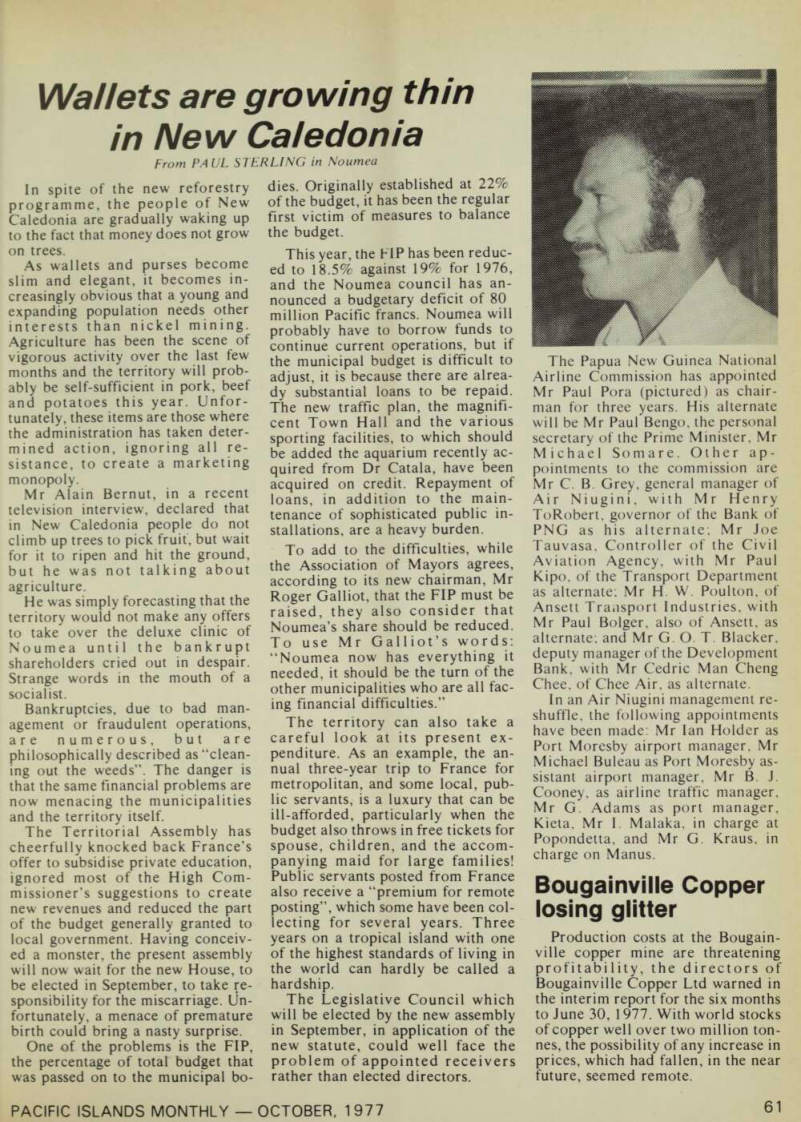
in New Caledonia
From PAUL STERLING in Noumea
In spite of the new reforestry programme, the people of New Caledonia are gradually waking up to the fact that money does not grow on trees.
As wallets and purses become slim and elegant, it becomes in creasingly obvious that a young and
expanding population needs other
interests than nickel mining.
Agriculture has been the scene of vigorous activity over the last few months and the territory will prob ably be self-sufficient in pork, beef and potatoes this year. Unfor tunately, these items are those where the administration has taken deter mined action, ignoring all re sistance, to create a marketing monopoly.
Mr Alain Bernut, in a recent television interview, declared that in New Caledonia people do not climb up trees to pick fruit, but wait for it to ripen and hit the ground, but he was not talking about agriculture.
He was simply forecasting that the territory would not make any offers to take over the deluxe clinic of Noumea until the bankrupt shareholders cried out in despair.
Strange words in the mouth of a socialist.
Bankruptcies, due to bad man agement or fraudulent operations, are numerous, but are philosophically described as “clean ing out the weeds”. The danger is that the same financial problems are now menacing the municipalities and the territory itself.
The Territorial Assembly has cheerfully knocked back France’s offer to subsidise private education, ignored most of the High Com missioner’s suggestions to create new revenues and reduced the part of the budget generally granted to local government. Having conceiv ed a monster, the present assembly will now wait for the new House, to be elected in September, to take re sponsibility for the miscarriage. Un fortunately, a menace of premature birth could bring a nasty surprise.
One of the problems is the FIP, the percentage of total budget that was passed on to the municipal bo
dies. Originally established at 22% of the budget, it has been the regular first victim of measures to balance the budget.
This year, the HP has been reduc ed to 18.5% against 19% for 1976, and the Noumea council has an nounced a budgetary deficit of 80 million Pacific francs. Noumea will probably have to borrow funds to continue current operations, but if the municipal budget is difficult to adjust, it is because there are alrea dy substantial loans to be repaid.
The new traffic plan, the magnifi cent Town Hall and the various sporting facilities, to which should be added the aquarium recently ac quired from Dr Catala, have been acquired on credit. Repayment of loans, in addition to the main tenance of sophisticated public in stallations, are a heavy burden.
To add to the difficulties, while the Association of Mayors agrees, according to its new chairman, Mr Roger Galliot, that the FIP must be raised, they also consider that Noumea’s share should be reduced.
To use Mr Galliot’s words: “Noumea now has everything it needed, it should be the turn of the other municipalities who are all fac ing financial difficulties.”
The territory can also take a careful look at its present ex penditure. As an example, the an nual three-year trip to France for metropolitan, and some local, pub lic servants, is a luxury that can be ill-afforded, particularly when the budget also throws in free tickets for spouse, children, and the accom panying maid for large families!
Public servants posted from France also receive a “premium for remote posting”, which some have been col lecting for several years. Three years on a tropical island with one of the highest standards of living in the world can hardly be called a hardship.
The Legislative Council which will be elected by the new assembly in September, in application of the new statute, could well face the problem of appointed receivers rather than elected directors.
The Papua New Guinea National Airline Commission has appointed Mr Paul Pora (pictured) as chair man for three years. His alternate will be Mr Paul Bengo. the personal secretary of the Prime Minister, Mr Michael Somare. Other ap pointments to the commission are Mr C. B. Grey, general manager of Air Niugini, with Mr Henry Toßobert, governor of the Bank of PNG as his alternate: Mr Joe Tauvasa, Controller of the Civil Aviation Agency, with Mr Paul Kipo, of the Transport Department as alternate: Mr H. W. Poulton, of Ansett Transport Industries, with Mr Paul Bolger, also of Ansett, as alternate: and Mr G. O. T. Blacker, deputy manager of the Development Bank, with Mr Cedric Man Cheng Chee, of Chee Air, as alternate.
In an Air Niugini management re shuffle, the following appointments have been made: Mr lan Holder as Port Moresby airport manager, Mr Michael Buleau as Port Moresby as sistant airport manager. Mr B J.
Cooney, as airline traffic manager, Mr G. Adams as port manager, Kieta, Mr I. Malaka, in charge at Popondetta, and Mr G. Kraus, in charge on Manus.
Bougainville Copper
losing glitter
Production costs at the Bougain ville copper mine are threatening profitability, the directors of Bougainville Copper Ltd warned in the interim report for the six months to June 30, 1977. With world stocks of copper well over two million ton nes, the possibility of any increase in prices, which had fallen, in the near future, seemed remote.
Advertisements & other items, p. 62 (1 item)
How it tastes when it gets there
' : : A y r How it tastes when it gets there depends alot on the way it goes.
Australian produce. Fresh from the farm.
Meat, vegetables, fruit, seafood. Qantas can get it to Pacific and Southeast Asian markets in less than a day. And get it there in the prime top condition you expect. Unitised, palletised, air cargo Qantas offers you more capacity out of Australia to the world than any other carrier.
And because we’re Australian we can offer advice about where to order, who to order from, how much to pay. Ring Qantas or your Freight Forwarder. We’re always looking for fresh problems to solve.
amras /~7
can co!— I
L81.2846
inter-island shipping
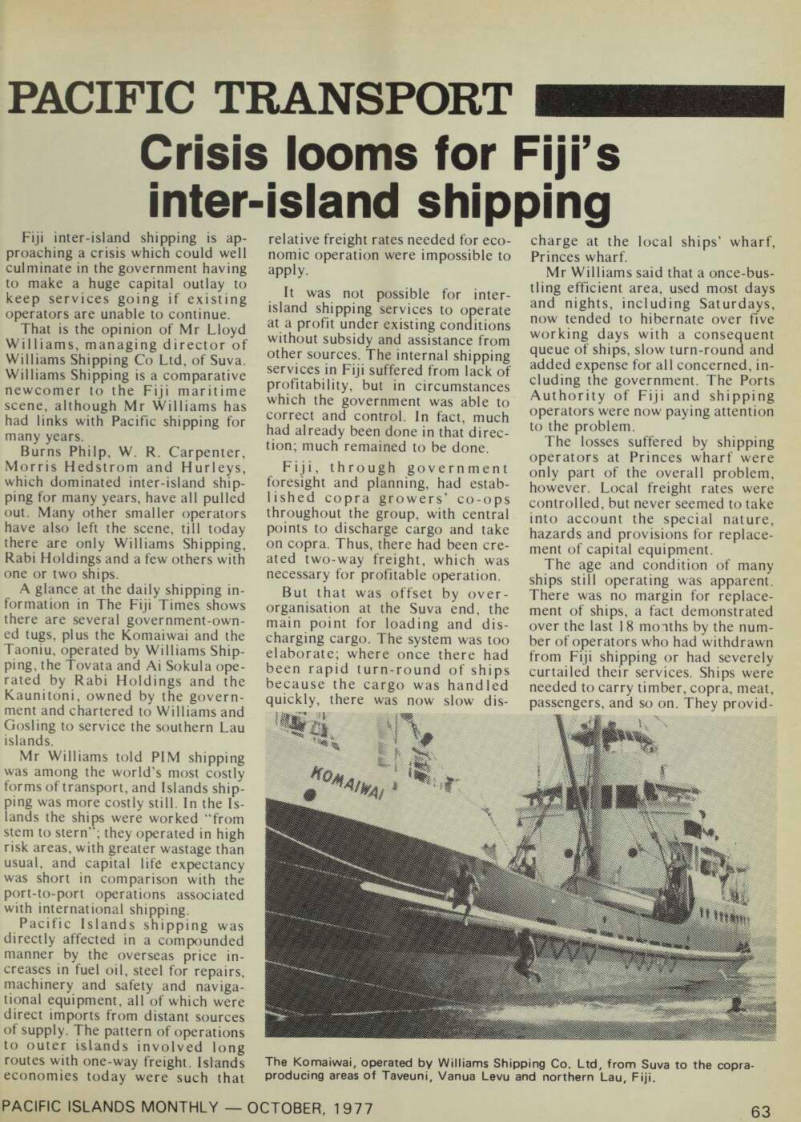
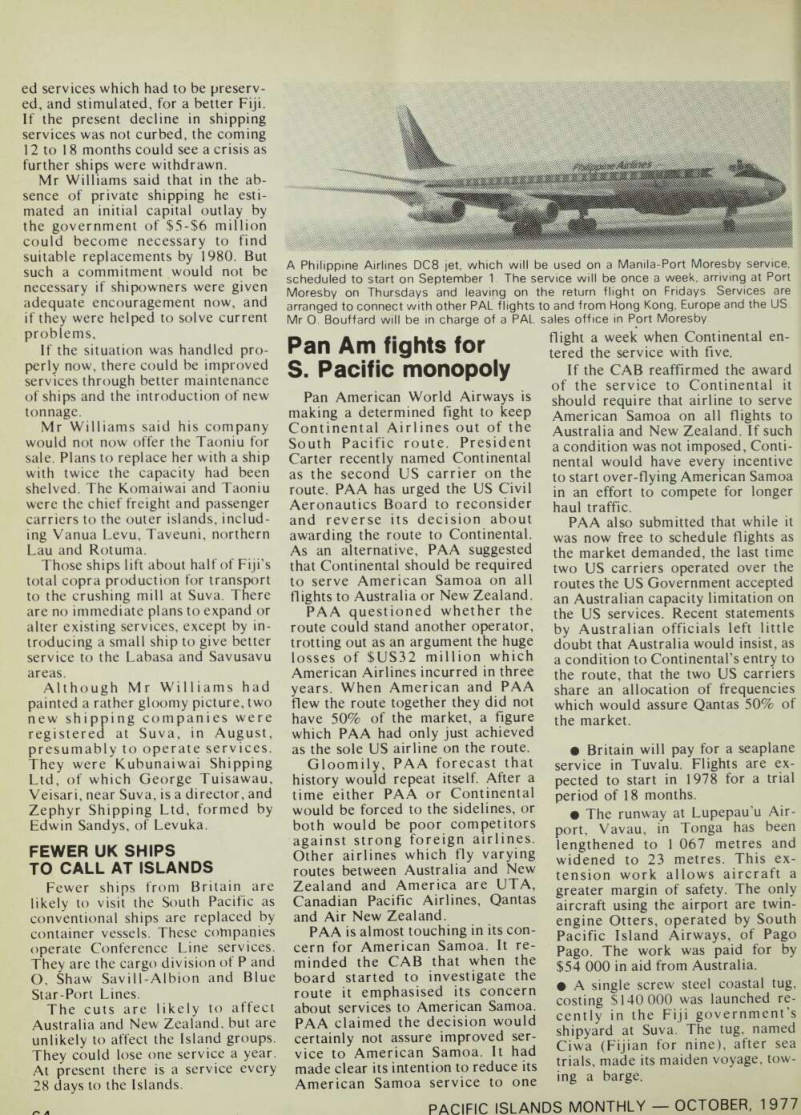

Pacific Transport
Crisis looms for Fiji’s inter-island shipping
Fiji inter-island shipping is ap proaching a crisis which could well culminate in the government having to make a huge capital outlay to keep services going if existing operators are unable to continue.
That is the opinion of Mr Lloyd Williams, managing director of Williams Shipping Cos Ltd, of Suva.
Williams Shipping is a comparative newcomer to the Fiji maritime scene, although Mr Williams has had links with Pacific shipping for many years.
Burns Philp, W. R. Carpenter, Morris Hedstrom and Hurleys, which dominated inter-island ship ping for many years, have all pulled out. Many other smaller operators have also left the scene, till today there are only Williams Shipping, Rabi Holdings and a few others with one or two ships.
A glance at the daily shipping in formation in The Fiji Times shows there are several government-own ed tugs, plus the Komaiwai and the Taoniu, operated by Williams Ship ping, the Tovata and Ai Sokula ope rated by Rabi Holdings and the Kaunitoni, owned by the govern ment and chartered to Williams and Gosling to service the southern Lau islands.
Mr Williams told PIM shipping was among the world’s most costly forms of transport, and Islands ship ping was more costly still. In the Is lands the ships were worked “from stem to stern”; they operated in high risk areas, with greater wastage than usual, and capital life expectancy was short in comparison with the port-to-port operations associated with international shipping.
Pacific Islands shipping was directly affected in a compounded manner by the overseas price in creases in fuel oil, steel for repairs, machinery and safety and naviga tional equipment, all of which were direct imports from distant sources of supply. The pattern of operations to outer islands involved long routes with one-way freight. Islands economies today were such that
relative freight rates needed for eco nomic operation were impossible to apply.
It was not possible for inter island shipping services to operate at a profit under existing conditions without subsidy and assistance from other sources. The internal shipping services in Fiji suffered from lack of profitability, but in circumstances which the government was able to correct and control. In fact, much had already been done in that direc tion; much remained to be done.
Fiji, through government foresight and planning, had estab lished copra growers’ co-ops throughout the group, with central points to discharge cargo and take on copra. Thus, there had been cre ated two-way freight, which was necessary for profitable operation.
But that was offset by over organisation at the Suva end, the main point for loading and dis charging cargo. The system was too elaborate; where once there had been rapid turn-round of ships because the cargo was handled quickly, there was now slow dis
charge at the local ships’ wharf, Princes wharf.
Mr Williams said that a once-bus tling efficient area, used most days and nights, including Saturdays, now tended to hibernate over five working days with a consequent queue of ships, slow turn-round and added expense for all concerned, in cluding the government. The Ports Authority of Fiji and shipping operators were now paying attention to the problem.
The losses suffered by shipping operators at Princes wharf were only part of the overall problem, however. Local freight rates were controlled, but never seemed to take into account the special nature, hazards and provisions for replace ment of capital equipment.
The age and condition of many ships still operating was apparent.
There was no margin for replace ment of ships, a fact demonstrated over the last 18 months by the num ber of operators who had withdrawn from Fiji shipping or had severely curtailed their services. Ships were needed to carry timber, copra, meat, passengers, and so on. They provid-
The Komaiwai, operated by Williams Shipping Co. Ltd, from Suva to the copra producing areas of Taveuni, Vanua Levu and northern Lau, Fiji.
ed services which had to be preserv ed, and stimulated, for a better Fiji.
If the present decline in shipping services was not curbed, the coming 12 to 18 months could see a crisis as further ships were withdrawn.
Mr Williams said that in the ab sence of private shipping he esti mated an initial capital outlay by the government of $5-$6 million could become necessary to find suitable replacements by 1980. But such a commitment would not be necessary if shipowners were given adequate encouragement now, and if they were helped to solve current problems.
If the situation was handled pro perly now, there could be improved services through better maintenance of ships and the introduction of new tonnage.
Mr Williams said his company would not now offer the Taoniu for sale. Plans to replace her with a ship with twice the capacity had been shelved. The Komaiwai and Taoniu were the chief freight and passenger carriers to the outer islands, includ ing Vanua Levu, Taveuni, northern Lau and Rotuma.
Those ships lift about half of Fiji’s total copra production for transport to the crushing mill at Suva. There are no immediate plans to expand or alter existing services, except by in troducing a small ship to give better service to the Labasa and Savusavu areas.
Although Mr Williams had painted a rather gloomy picture, two new shipping companies were registered at Suva, in August, presumably to operate services.
They were Kubunaiwai Shipping Ltd, of which George Tuisawau, Veisari, near Suva, is a director, and Zephyr Shipping Ltd, formed by Edwin Sandys, of Levuka.
Fewer Uk Ships
To Call At Islands
Fewer ships from Britain are likely to visit the South Pacific as conventional ships are replaced by container vessels. These companies operate Conference Line services.
They are the cargo division of P and O, Shaw Savill-Albion and Blue Star-Port Lines.
The cuts are likely to attect Australia and New Zealand, but are unlikely to affect the Island groups.
They could lose one service a year.
At present there is a service every 28 days to the Islands.
Pan Am fights for
S. Pacific monopoly
Pan American World Airways is making a determined fight to keep Continental Airlines out of the South Pacific route. President Carter recently named Continental as the second US carrier on the route. PAA has urged the US Civil Aeronautics Board to reconsider and reverse its decision about awarding the route to Continental.
As an alternative, PAA suggested that Continental should be required to serve American Samoa on all flights to Australia or New Zealand.
PAA questioned whether the route could stand another operator, trotting out as an argument the huge losses of SUS 32 million which American Airlines incurred in three years. When American and PAA flew the route together they did not have 50% of the market, a figure which PAA had only just achieved as the sole US airline on the route.
Gloomily, PAA forecast that history would repeat itself. After a time either PAA or Continental would be forced to the sidelines, or both would be poor competitors against strong foreign airlines.
Other airlines which fly varying routes between Australia and New Zealand and America are UTA, Canadian Pacific Airlines, Qantas and Air New Zealand.
PAA is almost touching in its con cern for American Samoa. It re minded the CAB that when the board started to investigate the route it emphasised its concern about services to American Samoa.
PAA claimed the decision would certainly not assure improved ser vice to American Samoa. It had made clear its intention to reduce its American Samoa service to one
flight a week when Continental en tered the service with five.
If the CAB reaffirmed the award of the service to Continental it should require that airline to serve American Samoa on all flights to Australia and New Zealand. If such a condition was not imposed, Conti nental would have every incentive to start over-flying American Samoa in an effort to compete for longer haul traffic.
PAA also submitted that while it was now free to schedule flights as the market demanded, the last time two US carriers operated over the routes the US Government accepted an Australian capacity limitation on the US services. Recent statements by Australian officials left little doubt that Australia would insist, as a condition to Continental’s entry to the route, that the two US carriers share an allocation of frequencies which would assure Qantas 50% of the market. • Britain will pay for a seaplane service in Tuvalu. Flights are ex pected to start in 1978 for a trial period of 18 months. • The runway at Lupepau’u Air port, Vavau, in Tonga has been lengthened to 1 067 metres and widened to 23 metres. This ex tension work allows aircraft a greater margin of safety. The only aircraft using the airport are twin engine Otters, operated by South Pacific Island Airways, of Pago Pago. The work was paid for by $54 000 in aid from Australia. • A single screw steel coastal tug, costing $l4O 000 was launched re cently in the Fiji government’s shipyard at Suva. The tug, named Ciwa (Fijian for nine), after sea trials, made its maiden voyage, tow ing a barge.
A Philippine Airlines DC8 jet, which will be used on a Manila-Port Moresby service, scheduled to start on September 1 The service will be once a week, arriving at Port Moresby on Thursdays and leaving on the return flight on Fridays. Services are arranged to connect with other PAL flights to and from Hong Kong, Europe and the US.
Mr O. Bouffard will be in charge of a PAL sales office in Port Moresby
Fiji Ship’S Master
Suspended For
Grounding
Captain Charles Junior Andrews, 27, has been suspended for 12 months by a Fiji court of marine in quiry. Andrews was master of the Fiji government landing barge, Duiyabaki, 260 tonnes, which ran aground in Lau in March. The ship grounded twice on the same voyage, while carrying government officers to supervise polling in Lau during the general election.
Mr Kenneth Moore, the presiding magistrate, said the two strandings were entirely due to the in competence of Andrews, who had failed to set a proper course for the Duiyabaki, and had failed to obtain the necessary information to help him navigate with safety. Andrews had shown great concern for the comfort of his passengers, but failed to make proper allowance for, and give consideration to, the effects of the current, tide, wind and position of sun.
Andrews was a young captain with his first command, sailing on a tight schedule in unfamiliar waters. But he was the master and was re sponsible for the passengers and the crew. Before a master was allowed to sail into unknown waters and put his ship at risk, the appropriate authorities should ensure he was properly advised.
Captain John Kerbeyson, the Marine Department’s principal ship surveyor and examiner of Fiji master’s certificates, told the court the government would have to spend about $BO 000 to restore the Duiyabaki to full-operational con dition. The government, at this stage, had no money for repairs. But if there was a general overhaul the Duiyabaki could run at least seven years without any trouble.
Andrews, in evidence, admitted his judgement was greatly handicap ped by the sun.
The Duiyabaki, on March 20, hit a reef patch near Daliconi village, Vanuabalavu. After pulling herself off, she ran aground on March 25, off Tuvuca.
When the Duiyabaki was launch ed at the end of 1967, the govern ment had plans to operate her as a landing craft should there be a need for mounting military operations on any of the islands. One of her first runs was with buses loaded with
their passengers at Suva for passengers read ‘troops’ and landed on Vanua Levu.
Near-Disaster For
Samoan Ferry
Western Samoa’s island ferry Hamutana almost overturned in August when buffeted by strong seas close to Apolima Island, between Savaii and Upolu. As it was a nine year-old child, three girls and three men were thrown overboard but were rescued.
The Hamutana rolled to about 45 degrees and stayed in that position for two to three minutes. Finally she righted and at reduced speed returned to pick up the people who had gone overboard. Sailors who jumped into the sea to help those in the water were picked up by another boat which went to the rescue.
Mr Falevi Kaiona Petana, man ager of the Inter-Island Shipping Co, which owns the Hamutana, said that, according to the clearance signed by a marine officer, there were 85 passengers on the trip.
Nauru’S Rosie D
Is In Service
The Nauru Pacific Line has taken delivery of a new bulk carrier, the Rosie D, which was built in Japan.
The ship is named in honour of the wife of the late Chief Detudamo, mother of Cr Buraro Detudamo.
The delivery ceremony was attend ed on behalf of the Nauru Local Government Council by Head Chief Hammer Deßoburt and Madame Deßoburt, and the secretary of the council, Cr Detudamo, and his wife.
The Rosie D has a gross carrying capacity of 17 691 tonnes. She can carry bulk fuel as well as bulk general cargo. Her maiden voyage was to Nagoya, Japan, to load general cargo for Singapore, she was then to sail to Nauru.
Korean Fish Catcher
Runs On Fiji Reef
The master of a wrecked Korear fishing ship, the Tongwha 303, offi cially abandoned the vessel twc days after it went aground or Cakaulekaleka Reef, about 22 mile* south of Korolevu in Fiji on July 17 The ship then passed into the hands of the Receiver of Wreck and the underwriter’s representative in Fiji.
The ship apparently caught fire before it ran aground on the reef
which is between Beqa and Vatulele Islands. The 19 members of the crew and the master, Captain Kim Chul Ho, were taken to Suva. They did not want to leave Fiji later for Pago Pago because, according to one man, they did not want to be brought before an inquest.
Two Cruise Liners
To Be Retired
The luxury US cruise liners, Mariposa and Monterey, which have been cruising in the Pacific for more than 20 years, will be with
drawn from service by next April, Pacific Far East Line announced re cently. They carried thousands of Americans on cruises from the US west coast to French Polynesia, the Cook Islands, New Zealand, Australia, New Caledonia, Fiji, Niuafoou (Tonga), American Samoa and Honolulu.
For much of their service they were operated by the Matson Line, but since 1971 they sailed under the PFEL flag. The Matson Line started a service from North America to Australia and New Zealand early this century.
The Vikings
Sail Again
The three cruise ships of the Royal Viking Line will be back in the South Pacific early in 1978. The ships have been calling regularly at various islands for the last four years. The Royal Viking cruises differ from the usual run of Islands cruises, which start and end in Sydney.
Extended line voyages are availa ble, with the opportunity of cruising between ports. It is possible, space permitting, to join one of the ships in an island port and disembark in New Zealand, Sydney, Cairns, or any port of call in any part of the world.
The Royal Viking Sky will sail
from Los Angeles on January 19 for Papeete, Moorea, Nukualofa, Auck land, Wellington, Picton and Sydney. She will then leave Sydney for California via Suva, Apia and Honolulu.
The Royal Viking Star will leave Los Angeles on January 24 for Bora Bora, Moorea, Papeete, Rarotonga, Auckland, Picton and Sydney. She leaves Sydney on February 18 for Florida via Suez. The Royal Viking Sea will leave San Francisco in February for Papeete, Moorea, Nukualofa, Auckland, Wellington, Picton and Sydney, sailing from Sydney for a cruise in south-east Asia, then across the north of the Pacific to California, before return ing to Europe.
The "Royal Viking Sky" passes the Sydney Opera House.
Advertisements & other items, pp. 65-72 (1 item)
In cooking
Save hundreds of dollars
on Australia's most efficient
WALK IN, ALUMINIUM
COOLROOMS AND
FREEZE ROOMS!!
Hundreds already installed! The most economical supplementary coolrooms for bottles and food, providing the largest storage capacity of any comparable coolrooms of the same exterior dimensions. Five sizes—from 90-360 cu. ft. capacity; 16 models offering normal temp., two temp., deep freeze, or for pastry and ice storage applications. White vinyl interior, embossed rustproof aluminium exterior
SUPPLIED IN EASY-TO-ERECT, DO-IT-YOURSELF KIT FORM.
AVAILABLE FROM: Manufactured by:
AUSTRALIAN NEW CALEDONIA EXPORTS. 363 George St, Sydney, 2000.
BRECKWOLDT & CO., 276 Pitt St„ Sydney, 2000.
HAGEMEYER (A'SIA), 59 Anzac Pde, Kensington, 2033.
GEOFFREY HUGHES & CO, 167 Macquarie St, Sydney, 2000.
NELSON & ROBERTSON PTY. LTD, 197 Clarence St, Sydney, 2000.
PETER FISHER TRADING PTY.LTD, 321 Pitt St, Sydney 2000.
E. RABOT (EXPORTS) PTY. LTD, 67 Castlereagh St, Sydney. 2000.
RABTRAD NIUGINI PTY. LTD., PO Box 1406, Lae.
A. RIETTE (PACIFIC) PTY. LTD., 300 George St., Sydney, 2000.
H. Y. KWAN (AUST) PTY. LTD. Box 2713, GPO , Sydney, 2001.
C. SULLIVAN (EXPORT) PTY. LTD., GPO Box 3373, Sydney, 2001.
W.S. TAIT & CO, PTY. LTD, 31 Macquarie Place, Sydney, 2000.
T 1
FRIGID CABINETS PTY. LTD.,
14A Puffy Ave., Thornleigh, N.S.W. 2120 Aust. Ph. 848 8292.
FCI
In cooking
SPEED-E-GAS
is fast, efficient
and reliable.
Terminals throughout the Pacific.
For more information write Boral Gas Limited, 221 Miller Street, DAD A I North Sydney 2060 j *Speed-E-Gas is known in Papua New Guinea, as.
J Guinea Gas. In Tonga as Tonga Speed-E-Gas, > and in Fiji as Fiji Gas. *
SPEED-E-GAS
D a r 4 / Q
HOLT GS 13
Do you hear a big sonic smear r
ntegrated Amplifier
AU-717
Filters
Subsonic
off
16Hz -a •30. •32 •34 -36 -38 -40 -43 -47 Volume •24 -22-20 -60 - X ■*6-S'S 4T 4f yyin* r ms aw~ f rS't
Dr individual instruments?
i Mow you can clearly hear individual instruments of the biggest orchestra with Sansui’s new DC integrated amplifier, the beautiful AG-717. A special Sansui-developed DC power amplifier circuit (PAT. PEMD.) brings out instruments so sharply that you distinctly sense the piano’s scales, the drum’s attack, the bite of the brass. Free of coloration, the AG-717 delivers 85 RMS watts X 2 of “straight gain” with a THD that’s an unbelievably low 0.025%! This is the new DC amplifier that’s so advanced, so good that you must hear it to believe it.
Our AG-517 is virtually the same but with a bit less power and easier on the pocket.
Our super TG-717 FM/AM tuner is the perfect
matching component.
TCJ-717
AU-517
Only hi-fi, everything hi-fi.
SANSUI ELECTRIC CO., LTD.
14-1 Izumi 2-chome, Suginami-ku, Tokyo 168, Japan Australia Rank Industries Australia Pty, Ltd. Head Office: 12 Barcoo Street, East Roseville, N.S.W. 2069 Phone: 406 5666 Melbourne: 68 Queensbridge Street, South Melbourne, Vic. 3205 Phone: 62 0031 Adelaide: Phone; 212 2555 Brisbane; 52 7333 Canberra; Phone; 95 2144 Perth: Phone; 28 3933 Fiji Prabhu Brothers Ltd. P.0.80x 183, Nadi Phone: 70183/4 Papua New Guinea Oceania Indent Agency (P.N.G.) Pty. Ltd. Box 5518, Boroko. Port Moresby Phone; PM256406 New Zealand David Reid Electronics Ltd. C.P.O. Box 2630, Auckland. 1 Phone: 492- 189 New Caledonia Ets Michel MERCIER B.P. 1123, Noumea Phone: 27. 59. 11 South Pacific Miltons Department Stores Limited P.O. Box 146, Norfolk Island 2899 Central Pacific Nauru Co-operative Society Republic of Nauru Western Samoa H.J. Keil and Company Ltd. P.O.
Box 7, Apia Phone; 198 New Hebrides The Sound Centre P.O. Box 434, Port Villa Cook Islands United Island Traders Ltd. P.O. Box 1 & 2, Rarotonga Tahiti DIMECO P.O. Box 2622
I
{Heinz
All HEINZ products
are produced with the
experience gained from
more than one hundred
years of making fine foods.
In the Pacific islands
HEINZ has been on the
menu since 1925.
SELLING AND CONSULTANT
AGENTS FOR;
ANDRONICUS COFFEE PTY. LTD.
COUNTRY MAID WHITENER.
DIPLOMAT RAZOR BLADES.
MEADOWSWEET CONFECTIONERY.
ERIN FOODS LTD.
EPICURE CONTINENTAL FOODS.
BALTIC IMPORT COMPANY.
GREENSEAS TUNA.
FOR FURTHER INFORMATION
CONTACT:
H.J. HEINZ CO. AUST. LTD.
Export Branch, Princes Highway, Dandenong, 3175, Victoria, Australia.
Telephone; 792 0631.
Telex: AA32125.
Cable: Heinz Melbourne.
HEIN;,
babv
HEINZ
3ab
HEINZ
tomato sauce i ifc > n tomato sauce vegetal
spaghetti
. sauce & chees* "A :Ai L.
Design and lay
your own floor
It’s easy to have your own individual floor design with CSR Vinylflex floor tiles. Many different patterns in lots of lovely decorator colours.
There are two types of CSR Vinylflex tiles — regular Vinylflex and the easy-to-lay Peel and Stick range. With Peel and Stick the adhesive is already on the back. You just peel off the protective paper and lay the tiles direct onto any clean, dry, smooth floor.
csr Vinylflex
FLOORTILES
MADE IN AUSTRALIA. MARKETED BY CSR-WUNDERLICH BUILDING MATERIALS EXPORT SALES: 4 O'CONNELL STREET, SYDNEY, AUSTRALIA 2000 POSTAL ADDRESS: GPO BOX 483, SYDNEY, AUSTRALIA 2001 (111
AVAILABLE FROM LEADING ISLAND MERCHANTS
ANDREWS &
INDUSTRIAL TRANSMISSION
suppliers to the Pacific Basin !
For many years, Andrews & Beaven have been supplying the power transmission needs of New Zealand industry. Today they are geared to meet the demands of industrial development throughout the Pacific Basin.
From Gear boxes to Flexible couplings, Andrews & Beaven manufacture a wide range of power transmission components. Their modern, sophisticated plant ensures consistent accuracy of all components and complete dependability.
COMPLETE TRANSMISSION
RANGE
• Transmission Gearboxes • Conveyor Equipment • Transmission Bearings • Flexible Couplings For further information and full product list MAIL THIS COUPON Andrews & Beaven Ltd. Transmission Division Private Bag, Christchurch, N.Z.
Please mail by return post details and full product list of Power Transmission Equipment.
Name Company Full Address
CAUTIONARY NOTICE:
Trade Marks
PAPUA NEW GUINEA
IMPERIAL
Notice is hereby given that the above symbol, is the trade mark of IMPERIAL GROUP LIMITED, of East Street, Bedminster, Bristol, England; Tobacco Manufacturers, and is used by the said Company in respect of tobacco, whether manufactured or unmanufactured; substances for smoking sold separately or blended with tobacco, none being for medicinal or curative purposes; smokers ’ articles, and that the said trade mark is the exclusive property of the said Company in Papua New Guinea and that they will take legal steps against any person or persons who henceforth copy, imitate or in any way whatsoever infringe their rights in the above trade mark.
IMPERIAL GROUP
LIMITED,
East Street, Bedminster, Bristol, England.
COMPAGNIE GENERALE MARITIME
AUSTRALIA - EUROPE SERVICE.
Fully containerised (Member of AECS) Agents: SEABRIDGE, 60 Pitt Street, SYDNEY.
PACIFIC ISLANDS - EUROPE SERVICE.
Roßo and Multipurpose Service Twice monthly to/from Papeete Noumea New Hebrides.
Multipurpose Service Monthly to/from Papua/New Guinea.
SOUTH PACIFIC UNITED LINES
AUSTRALIA - PACIFIC ISLANDS - U.S. WEST COAST.
Monthly fully containerised Service. [Messageries Maritimes] Phone: 20518.
PO Box R 206.
Agents: OMNITRADERS & BROKERS,
261 George Street, Phone: 241 2872.
GPO Box 3896.
SOUTHERN CROSS
GALVANISED STEEL
PRE-FABRICATED
WATER STORAGE
TANKS
Capacities from 2,000 to 300,000 gal
VERY STRONGLY MADE ! ! !
16 gauge sheets heavily galvanised,with angle steel fattens inside and out side wideoverlapping joints.
Inside ladder included with every tank.
SOUTHERN CROSS
WINDMILLS
STILL THE CHEAPEST
WAY TO' PUMP WATER
NO POWER COSTS///
• Heavily Galvanised • Automatic Governing • Self Oiling
SOUTHERN
SIZES:
6 ft. to 14 ft. Double Geared 17 ft. to 25 ft. Direct Acting Towers from 20 ft. to 60 ft.
Full details and prices available from:
SOUTHERN CROSS MACHINERY
PTY. LTD.
39 GRANVILLE AVE., GRANVILLE, 2142, AUSTRALIA.
Telex: AA22663. Telegrams: 'SOCRQSS'.
Cruising

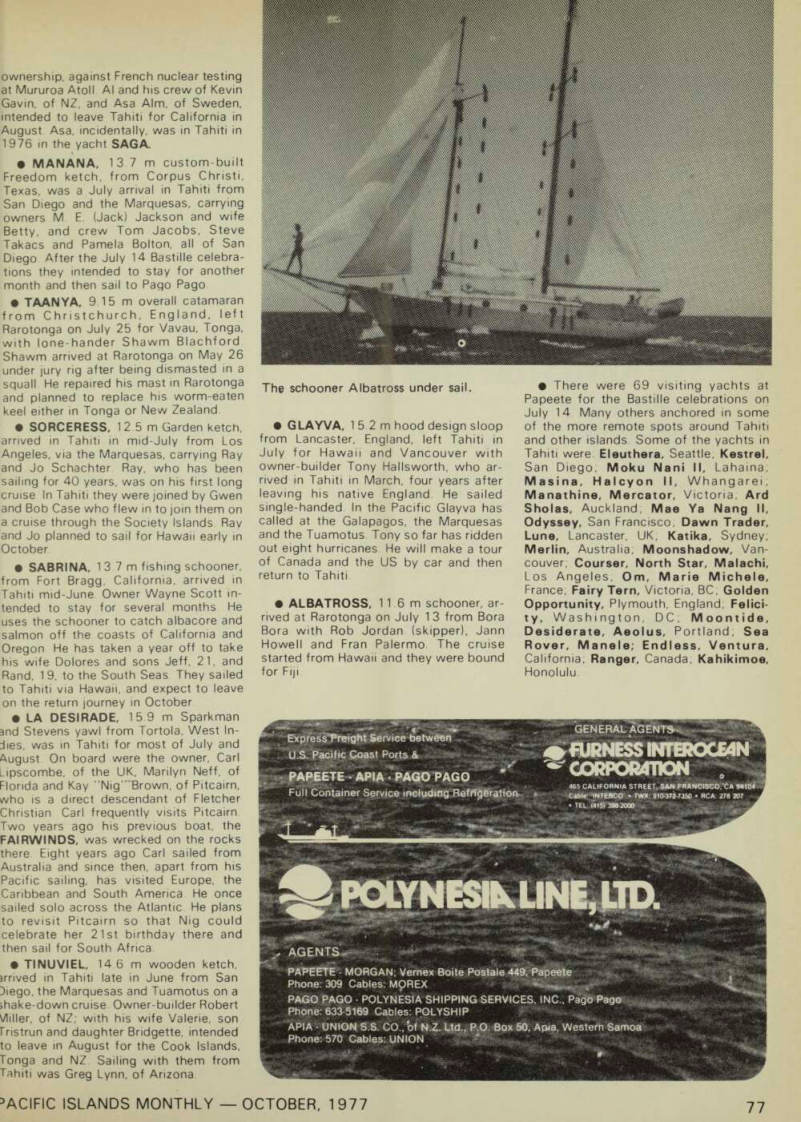
Yachts
• SOLONG 11 , 37 ft sloop from Auck land, arrived at Rarotonga on May 12 with Terry Fitzpatrick, Gary Terry and Mervin Helsey. Their next port of call was to be Tahiti. • RHIANNON, 30 ft sloop with Mike Jacker and Lewis Gordon arrived at Rarotonga on April 30 from Bora Bora.
Their cruise started from New Orleans and took them to Mexico, Panama, and the Galapagos and Marquesas Islands and the Tuamotu and Society Islands.
Their plans for the future were uncertain. • LINDA, 61 ft ketch registered in Panama arrived at Rarotonga on May 1 from Papeete. On board were Captain Dario Del Greppo, Luigi Romolo, Rinaldo Vecchi and Silvano Oprandi, all Italians except for Romolo who is an Australian citizen. They were bound for Suva, Noumea and Sydney. • BANSHEE, 34 ft sloop registered in Los Angeles, arrived at Rarotonga from Maupiti on May 12 with Jim and Joy Lauffenburger and their cat. They will continue their round-the-world cruise with calls at Tonga, Fiji and New Zealand. • PAKA, 65 ft motor yacht, was a May arrival in Suva from Australia. She is owned and skippered by George Talbott, of Hawaii, who owns a chain of liquor stores. After Suva, Mr Talbott planned to visit Tonga, Samoa and Christmas Island and then return to Hawaii. While in Suva Mr Talbott had a public brush with the Customs Department over a couple of motor-cycles, on which a bond was de manded, and over the clearance of spare parts sent from Honolulu. • HAEATA, 21 m yacht, was wrecked on an uninhabited island in the Cook Is lands in August The nine people on board eight men and a woman spent 12 days on the island before they were picked up by the Acheron, which heard their Mayday distress call. The Acheron took them to Atiu, which was about 25 km away The Haeata was on its way from New Zealand to Stockholm, home city of the owner, Eric Persson Mr Persson built the yacht at Nelson. With him were an Australian, an American and six New Zealanders The Haeata was on her maiden voyage, which started unhap pily About a week after leaving New Zea land she was caught in bad weather and had to return to port for repairs • PAGON LEE, Melbourne-owned yawl, went aground on a reef east of Milne Bay, Papua New Guinea, in August An aircraft guided the coastal ship, Misima, to the reef to rescue the six oc
cupants of the Pagon Lee, and take them to Samarai The owner of the yawl is Mr R G. Lee, of Richmond, a Melbourne suburb Yachts which recently anchored off the Port of Refuge Hotel, Vavau, Tonga, in cluded: • SUNDAY MORNING, schooner, sailed by Charlie and Kath Hast and children from Newport Beach, California, to Pago Pago-Vavau-Haapai-Nukualofa- Vavau, then to Fiji • PING PONG, 9 8 m Ericson yacht, with Jim Feidon (skipper) and Vichi Richardson, bound for Fiji and possibly New Zealand Ping Pong sailed from San Diego in 1974 She was at Pago Pago before Vavau • HINEWA, 7 m cutter, sailed single handed by Dave Booth from Rarotonga Suva was next port of call
• STRANGER IV, 12 5 m cutter, with Mary and Dan Jordan and children The cutter was missing for some time be tween Pago Pago and Vavau It was at Late Island for several miserable days while Mary and Dan tried to mend a broken tiller and a split bow After Vavau the Jordans intended to sail to Fiji • IRISH MAID, sailed single-handed by Dave Benson arrived from Nukualofa, en route to Fiji • MIYAKOWASURE, 9 1 m sloop from Yokohama, sailed first to the US, Mexico and Tahiti, carrying Masataka Hori and Teruko Hori They intended to sail south through Tonga and possibly to Auckland • WINDWAGON, 18 3 m overall ketch registered in Los Angeles, arrived at Rarotonga on July 31 from Bora Bora with owner-skipper Ron Burton, wife
Wendy, their young son and two crew members, Paul and Joe Next ports of call were to be Niue and Tonga • CONQUISTADOR 11, 10 7 m sloop registered in Auckland, arrived at Rarotonga on July 16 and left for Tahiti on July 29 with skipper Renfreo Meese, Robert Giles, Helen King and Alexander Hanna • KETCHUP, a red-hulled 11.9 m Canadian ketch, arrived at Rarotonga on July 2 from Tahiti with skipper Ron Tilloston and Bruce and Oliver Tilloston They left for Tonga on July 8 • SONADORA, (Dreamer) 15 85 m catamaran registered at Guernsey, Chan nel Islands, arrived at Rarotonga from Bora Bora on August 5 with Ron and Carol May They were bound for Niue and Tonga • KATIKA, 18 9 m ketch registered in Sydney, arrived at Rarotonga on August 5 from Tahiti, bound for Niue On board were owner-skipper Joe Turek, his wife, Erica, and teen-age daughter, Kathyrine, with crew Steve Krueger, Steve Glennon and Hoyt Eason Mr Turek and wife and daughter were sailing home to Sydney to complete a circumnavigation lasting four years • NATHANAEL, 15 m gaff-rigged schooner of French design arrived at Rarotonga on August 8 from Tahiti, Tonga-bound With owner-skipper Hans Jobert and wife, Christiane, were Miguel De Peyrecave and Paul Giacobbi • SPINDRIFT, 12.2 m overall Colin
Archer ketch, registered in San Diego and built in 1943, arrived at Rarotonga on August 1 1 from Bora Bora On board were owner-captain George Budd, a US citizen, and Welshman Dave Reynolds Mr Budd is sailing to Japan which he hopes to reach in May 1 978 in time to at tend an International Rotary Convention to be held in Tokyo • CHAMPION (US), 16 2 m Lap worth-design diesel motor yacht arrived at Bora Bora in time for the Fete Na tional, Bastille Day celebrations Owner skipper Larry Briggs of Hawaii and Eric Lund, 18, of California, left Los Angeles in February, making an 1 1 -day passage to Hawaii From Honolulu they visited Palmyra, Washington, Fanning and Christmas atolls of the Line Islands In Bora Bora circumnavigator Dwight Long joined the Champion to revisit the Socie ty Islands In the late 1930 s he sailed the 9 8 m ketch IDLE HOUR to Bora Bora where a Tahitian boy, Timi Tefaaroa, join ed him on his successful world cruise The Champion is powered by a 671 GMC diesel engine and at present is the only motor yacht circumnavigating the globe She is equipped with four genera tor systems, 10 900 litres of fuel, 3 640 litres of water and has a range of over 4 024 km at 9 knots They are bound for American Samoa and on through the South Pacific to reach Singapore by Christmas • BONNIE G, 16 2m Lapworth design ketch, from St Louis, Missouri, arrived in
Tahiti in July for a visit expected to last several months, carrying owners A 1 and Bommie Gilland, nephew Douglas Scott, of Alaska, and Sam the parrot They left San Diego in December with Al then knowing nothing whatever about naviga tion On the way down the coast to Mex ico Bonnie G sailed close to SOR CERESS, skippered by Ray Schachter, who obligingly passed on some knowledge of the rudiments of naviga tion Al and Bonnie planned to sail through the Tuamotus and Marquesas then go to Hawaii for the northern winter • ERIKA 10 m sloop from Dana Point, California, arrived in Papeete in June with German-born Erhard Autrata, who was sailing single-handed Erhard built Erika himself and left California in August, 1 976 for Hawaii, where he stayed for five months before turning south to the Mar quesas He intended to cruise through the Society Islands before making plans to move elsewhere • FEARLESS, owned by Al Chipman of San Diego, arrived in Tahiti in May for an extended visit Fearless was built in 1926 as a John Alden design schooner and was changed to ketch rigging in 1 949 She raced off the east coast of the US for many years, and upheld her record in NZ, when she won the first tall ships' race in 1976 Fearless has been in the Pacific for about 10 years, and has called at the Australs, Pitcairn, Easter Island and most islands between Tahiti and NZ She was a protest boat, under different
ownership, against French nuclear testing at Mururoa Atoll Al and his crew of Kevin Gavin, of NZ, and Asa Aim, of Sweden, intended to leave Tahiti for California in August Asa, incidentally, was in Tahiti in 1976 in the yacht SAGA. • MANANA, 13 7 m custom-built Freedom ketch, from Corpus Christi, Texas, was a July arrival in Tahiti from San Diego and the Marquesas, carrying owners M. E. (Jack) Jackson and wife Betty, and crew Tom Jacobs, Steve Takacs and Pamela Bolton, all of San Diego After the July 14 Bastille celebra tions they intended to stay for another month and then sail to Pago Pago • TAANYA, 9.15 m overall catamaran from Christchurch, England, left Rarotonga on July 25 for Vavau, Tonga, with lone-hander Shawm Blachford Shawm arrived at Rarotonga on May 26 under jury rig after being dismasted in a squall He repaired his mast in Rarotonga and planned to replace his worm-eaten keel either in Tonga or New Zealand • SORCERESS, 12 5 m Garden ketch, arrived in Tahiti in mid-July from Los Angeles, via the Marquesas, carrying Ray and Jo Schachter Ray, who has been sailing for 40 years, was on his first long cruise In Tahiti they were joined by Gwen and Bob Case who flew in to join them on a cruise through the Society Islands Ray and Jo planned to sail for Hawaii early in October • SABRINA, 1 3 7 m fishing schooner, from Fort Bragg, California, arrived in Tahiti mid-June Owner Wayne Scott in tended to stay for several months He uses the schooner to catch albacore and salmon off the coasts of California and Oregon He has taken a year off to take his wife Dolores and sons Jeff, 21, and Rand, 19, to the South Seas They sailed to Tahiti via Hawaii, and expect to leave on the return journey in October • LA DESIRADE, 15 9 m Sparkman and Stevens yawl from Tortola, West In dies, was in Tahiti for most of July and August On board were the owner, Carl Lipscombe, of the UK, Marilyn Neff, of Florida and Kay "Nig"'Brown, of Pitcairn, who is a direct descendant of Fletcher Christian Carl frequently visits Pitcairn Two years ago his previous boat, the FAIRWINDS, was wrecked on the rocks there Eight years ago Carl sailed from Australia and since then, apart from his Pacific sailing, has visited Europe, the Caribbean and South America He once sailed solo across the Atlantic He plans to revisit Pitcairn so that Nig could celebrate her 21st birthday there and then sail for South Africa • TINUVIEL, 14 6 m wooden ketch, arrived in Tahiti late in June from San Diego, the Marquesas and Tuamotus on a >hake-down cruise Owner-builder Robert Miller, of NZ; with his wife Valerie, son Fristrun and daughter Bridgette, intended to leave in August for the Cook Islands, Tonga and NZ. Sailing with them from Tahiti was Greg Lynn, of Arizona
• GLAYVA, 1 5 2 m hood design sloop from Lancaster, England, left Tahiti in July for Hawaii and Vancouver with owner-builder Tony Hallsworth, who ar rived in Tahiti in March, four years after leaving his native England He sailed single-handed In the Pacific Glayva has called at the Galapagos, the Marquesas and the Tuamotus Tony so far has ridden out eight hurricanes He will make a tour of Canada and the US by car and then return to Tahiti • ALBATROSS, 116 m schooner, ar rived at Rarotonga on July 1 3 from Bora Bora with Rob Jordan (skipper), Jann Howell and Fran Palermo The cruise started from Hawaii and they were bound for Fiji
• There were 69 visiting yachts at Papeete for the Bastille celebrations on July 14 Many others anchored in some of the more remote spots around Tahiti and other islands Some of the yachts in Tahiti were Eleuthera, Seattle, Kestrel, San Diego, Moku Nani 11, Lahaina, Masina, Halcyon 11, Whangarei, Manathine, Mercator, Victoria, Ard Sholas, Auckland, Mae Ya Nang 11, Odyssey, San Francisco, Dawn Trader, Lune, Lancaster, UK, Katika, Sydney, Merlin, Australia, Moonshadow, Van couver, Courser, North Star, Malachi, Los Angeles, Om, Marie Michele, France, Fairy Tern, Victoria, BC, Golden Opportunity, Plymouth, England; Felici ty, Washington, DC Moontide, Desiderate, Aeolus, Portland; Sea Rover, Manele; Endless, Ventura, California Ranger, Canada, Kahikimoe, Honolulu
The schooner Albatross under sail.
Advertisements & other items, pp. 73-76 (2 items)
The Water Wheel Group Of Companies,
Winners of Australia's Top Export Award and Flour Millers for over 100 years,
OFFER THE PACIFIC ISLANDS THE TOPS
IN QUALITY PRODUCTS & SERVICE.
•fa BF.oT AUSTRALIAN WHEATEN FLOUR
(Roller, Wholemeal, High Protein, Cake etc.)
INSTOCK & POULTRY FEEDS
(Pellets or Mash form)
YELLOW SPLIT PEAS & WHOLE PEAS
(Machined-Dressed) Plus a range of Associated Australian Products.
F.C.L. Containers & Unitised Cargoes a speciality.
Areas Serviceable are: Papua New Guinea, Fiji, Tonga, Western Samoa, American Samoa, New Hebrides, New Caledonia & Micronesia.
All Enquiries Welcome to:
WATER WHEEL EXPORTS Pty. Ltd.
493 Bourke Street, Melbourne 3000, Australia.
Cables: Watermill - Melbourne. Telex: AA 32165.
Telephone; 602-1433.
Do you want to do business in New Zealand?
Ask the bank which has
40% of the banking business
in New Zealand
The BNZ can give you full information on buying or selling in New Zealand and overseas Ful information on investment movement of money, transfers of dividends etc., is also readily available.
There are offices everywhere, more #«n 400 in fact.
Whatever your financial or trade needs, the BNZ can help you.
Bank of New Zealand
Wellington -Head Office, International Dwckxi, Box 2392.
Sydney-GPO Box 507, Sydney, N.S.W. 2001 Melbourne -GPO Box 528 E, Melbourne, Vc. 3001 Tokyo-Mr E. L Banks, Bank of New Zealand Representative Office, Japan. Sorte 240,Shin.Tokyo Bldg, 3-1, 3-Chrohn4 Marunouchi, Chiyoda-ku.Tokyo 100.
Singapoce-Mr R. F. Warren, Bank of New Zealand Representative Office. South East Asia. Suite 230,23 rd Floor, Ocean Bldg.
Cofyer Quay, Singapore 1 London-PO Box 402, LondonEC4P.4.H.E.
Fiji, Suva-25 Victooa Parade. Abo at Labasa, Lautoka, NadiJSigatoka, Ba.
Associated Banks rithe SotMh Pacific.
Bank of Western Samoa- Bank of Tonga. 7.6
ExpressTreight Service between U.S. Pacific Coast Ports & - 'V
PAPEETE • APIA ■ PAGO PAGO
Full Container Service including Refrigeration
GENERAL AGENTS-
* FURNESS INTBXXE4N
465 CALIFORNIA STREET, SAN FRANCISCO,’tA §4104.
c*ble: INTEHCO - • TWA: 91MTJ 7350 • RCA 278 207
• TEE: (415 t:
AGENTS- -
PAPEETE - MORGAN; Vernex Boite Postale 449, Papeete Phone: 309 Cables: MpREX , PAGO PAGO - POLYNESIA SHIPPING SERVICES, INC., Pago Pago Phone; 633-5169 Cables: POLYSHIP APIA - UNION S.S. CO., 'of N.Z. Ltd., P.O. Box 50, Apia, Westefh Samoa Phone; 570 Cables; UNION ■
Diesel Power! Displacement Hull!
The KINGSTON ANGLER'
is good news
for fishermen
and island
traders.
• The 19’ displacement hull gives you smoother cruising than a planing hull (it’s the same hull as the Kingston 580) •The diesel engine (up to 33 h.p. and 15 knots) is safe, reliable and cheaper to run. •Full length, self-draining floor. •The fibreglass construction throughout makes it easier to maintain. no c_..*u dn.
CRUISER SALES PTY. LTD.
179 South Creek Road, Dee Why, N.S.W. 2099. Australia.
Telephone: 981 3508
J-LeJ-UC
HEAT SEALING.
SHRINK PACKAGING.
CONTACT
AUSTRALIA'S FOREMOST MANUFACTURERS
OF HEAT SEALING EQUIPMENT
SERVING INDUSTRY
IN AUSTRALIA & THE PACIFIC ISLANDS
FOR OVER 25 YEARS.
HELIX ELECTRICAL PRODUCTS PTY. LTD.
27 Rosebery Avenue, Rosebery, NSW 2018, Australia.
The Forum Speaks
78
PACIFIC ISLANDS MONTHLY OCTOBER, 1977
From p. 9
Deaths
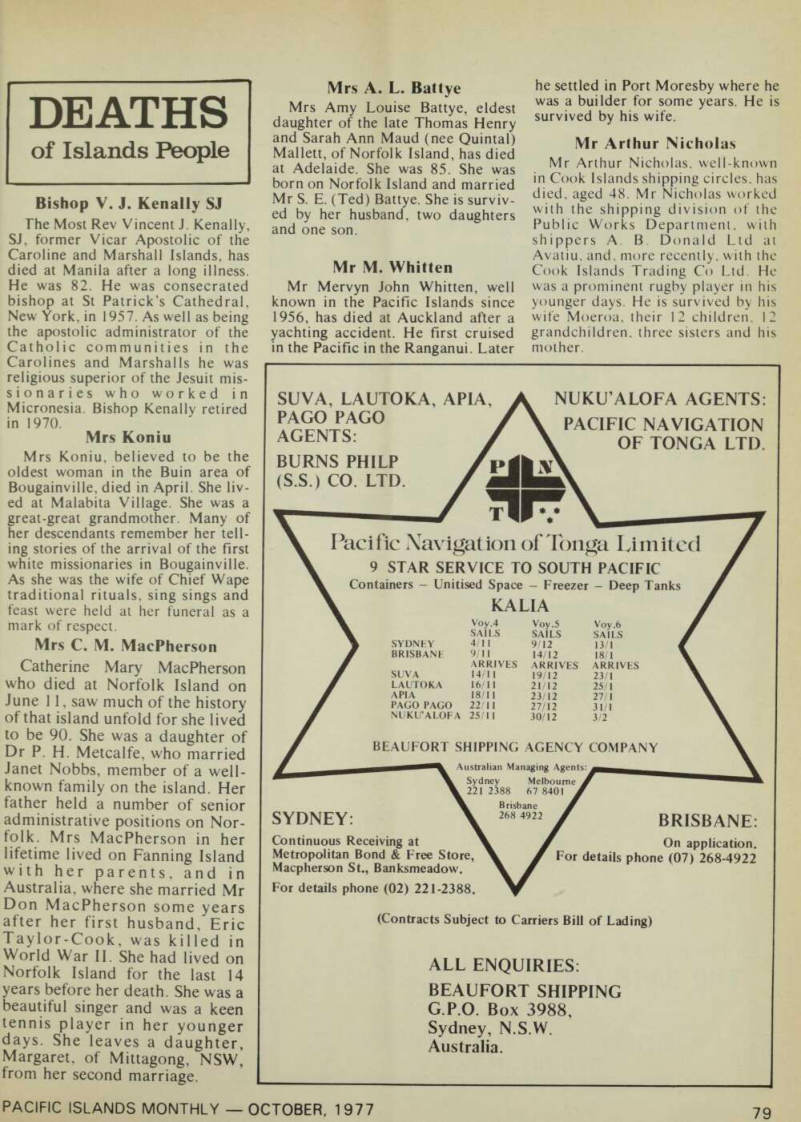
of Islands People
Bishop V. J. Kenally SJ The Most Rev Vincent J Kenally, SJ, former Vicar Apostolic of the Caroline and Marshall Islands, has died at Manila after a long illness.
He was 82. He was consecrated bishop at St Patrick’s Cathedral, New York, in 1957. As well as being the apostolic administrator of the Catholic communities in the Carolines and Marshalls he was religious superior of the Jesuit mis sionaries who worked in Micronesia. Bishop Kenally retired in 1970.
Mrs Koniu Mrs Koniu, believed to be the oldest woman in the Buin area of Bougainville, died in April. She liv ed at Malabita Village. She was a great-great grandmother. Many of her descendants remember her tell ing stories of the arrival of the first white missionaries in Bougainville.
As she was the wife of Chief Wape traditional rituals, sing sings and feast were held at her funeral as a mark of respect.
Mrs C. M. MacPherson Catherine Mary MacPherson who died at Norfolk Island on June 11, saw much of the history of that island unfold for she lived to be 90. She was a daughter of Dr P. H. Metcalfe, who married Janet Nobbs, member of a well known family on the island. Her father held a number of senior administrative positions on Nor folk. Mrs MacPherson in her lifetime lived on Fanning Island with her parents, and in Australia, where she married Mr Don MacPherson some years after her first husband, Eric Taylor-Cook, was killed in World War 11. She had lived on Norfolk Island for the last 14 years before her death. She was a beautiful singer and was a keen tennis player in her younger days. She leaves a daughter,
Margaret, of Mittagong, NSW,
from her second marriage.
Mrs A. L. Battye Mrs Amy Louise Battye, eldest daughter of the late Thomas Henry and Sarah Ann Maud (nee Quintal) Mallett, of Norfolk Island, has died at Adelaide. She was 85. She was born on Norfolk Island and married Mr S. E. (Ted) Battye. She is surviv ed by her husband, two daughters and one son.
Mr M. Whitten Mr Mervyn John Whitten, well known in the Pacific Islands since 1956, has died at Auckland after a yachting accident. He first cruised in the Pacific in the Ranganui. Later
he settled in Port Moresby where he was a builder for some years. He is survived by his wife.
Mr Arthur Nicholas Mr Arthur Nicholas, well-known in Cook Islands shipping circles, has died, aged 48. Mr Nicholas worked with the shipping division of the Public Works Department, with shippers A. B. Donald Ltd at Avatiu, and, more recently, with the Cook Islands Trading Co Ltd. He was a prominent rugby player in his younger days. He is survived by his wife Moeroa, their 12 children, 12 grandchildren, three sisters and his mother.
Advertisements & other items, pp. 77-78 (1 item)
Suva, Lautoka, Apia,
PAGO PAGO
AGENTS:
BURNS PHILP
(S.S.) CO. LTD.
NUKU ALOFA AGENTS:
PACIFIC NAVIGATION
OF TONGA LTD.
Pacific Navigation of Tonga Limited
9 STAR SERVICE TO SOUTH PACIFIC
Containers Unitised Space Freezer Deep Tanks
KALI A
BEAUFORT SHIPPING AGENCY COMPANY
Australian Managing Sydney Melbourne 221 2388 67 8401
SYDNEY:
Continuous Receiving at Metropolitan Bond & Free Store, Macpherson St., Banksmeadow.
For details phone (02) 221-2388.
Brisbane 268 4922
BRISBANE:
On application.
For details phone (07) 268-4922 (Contracts Subject to Carriers Bill of Lading)
ALL ENQUIRIES:
BEAUFORT SHIPPING
G.P.O. Box 3988,
Sydney, N.S.W.
Australia.
THE
BANK
LINE
GLOBAL SERVICE FOR SHIPPERS
\\ y u & ■■■ilffß. i»
MONTHLY SERVICES
Inited Kingdom and Continent to: Papeete, Noumea, New Hebrides, Papua New Guinea and Solomon Islands.
Papua New Guinea to: North America, United Kingdom and Continent. ★ Solomons, Fiji, Tonga, Samoa and Tarawa to: United Kingdom and Continent.
For particulars apply:
THE BANK LINE (AUSTRALASIA) PTY.
LTD.,
18TH FLOOR, 1 YORK STREET,
SYDNEY, N.S.W.
Shipping
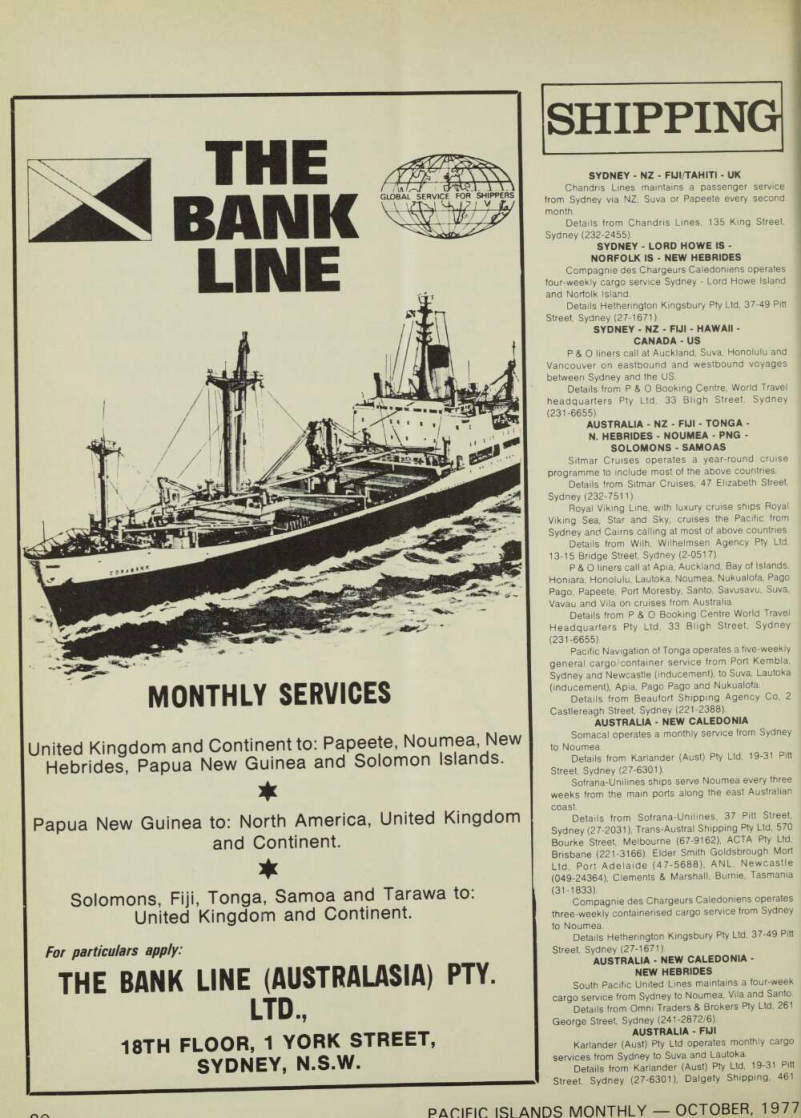
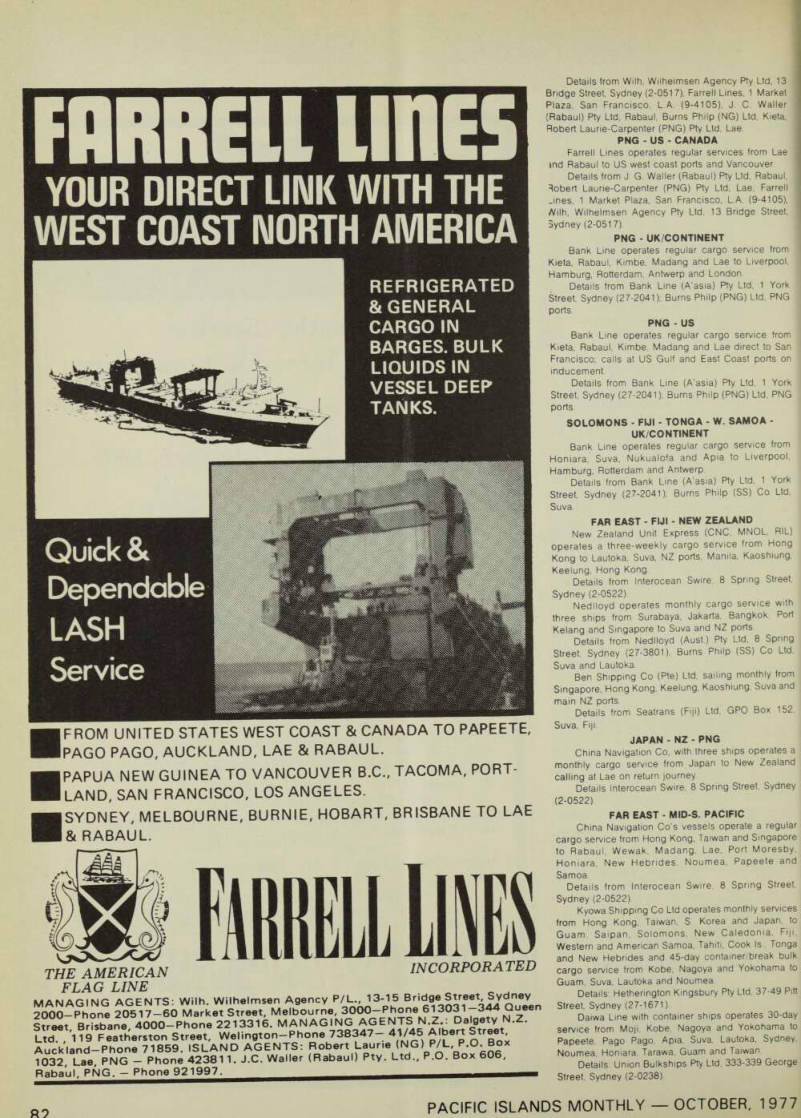
SYDNEY - NZ - FIJI/TAHITI - UK Chandris Lines maintains a passenger service I from Sydney via NZ, Suva or Papeete every second month.
Details from Chandris Lines, 135 King Street, I Sydney (232-2455).
Sydney - Lord Howe Is -
Norfolk Is - New Hebrides
Compagnie des Chargeurs Caledoniens operates four-weekly cargo service Sydney - Lord Howe Island ] and Norfolk Island.
Details Hetherington Kingsbury Pty Ltd, 37-49 Pitt Street, Sydney (27-1671).
SYDNEY - NZ - FIJI - HAWAII -
Canada - Us
P & 0 liners call at Auckland, Suva, Honolulu and Vancouver on eastbound and westbound voyages between Sydney and the US.
Details from P & 0 Booking Centre, World Travel headquarters Pty Ltd, 33 Bligh Street, Sydney (231-6655).
AUSTRALIA - NZ - FIJI - TONGA - N. HEBRIDES - NOUMEA - PNG -
Solomons -Samoas
Sitmar Cruises operates a year-round cruise programme to include most of the above countries.
Details from Sitmar Cruises, 47 Elizabeth Street, Sydney (232-7511) Royal Viking Line, with luxury cruise ships Royal Viking Sea, Star and Sky, cruises the Pacific from Sydney and Cairns calling at most of above countries.
Details from Wilh, Wilhelmsen Agency Pty Ltd, 13-15 Bridge Street, Sydney (2-0517).
P & 0 liners call at Apia, Auckland, Bay of Islands, Honiara, Honolulu, Lautoka, Noumea, Nukualofa, Pago Pago, Papeete, Port Moresby, Santo, Savusavu, Suva, Vavau and Vila on cruises from Australia.
Details from P & 0 Booking Centre World Travel Headquarters Pty Ltd, 33 Bligh Street, Sydney (231-6655).
Pacific Navigation of Tonga operates a five-weekly general cargo/container service from Port Kembla, Sydney and Newcastle (inducement), to Suva, Lautoka (inducement), Apia, Pago Pago and Nukualofa.
Details from Beaufort Shipping Agency Co, 2 Castlereagh Street, Sydney (221-2388).
Australia - New Caledonia
Somacal operates a monthly service from Sydney to Noumea.
Details from Karlander (Aust) Pty Ltd, 19-31 Pitt Street, Sydney (27-6301).
Sofrana-Unilines ships serve Noumea every three weeks from the main ports along the east Australian coast.
Details from Sofrana-Unilines, 37 Pitt Street, Sydney (27-2031), Trans-Austral Shipping Pty Ltd, 570 Bourke Street, Melbourne (67-9162), ACTA Pty Ltd, Brisbane (221-3166), Elder Smith Goldsbrough Mort Ltd, Port Adelaide (47-5688), ANL, Newcastle (049-24364), Clements & Marshall, Burnie, Tasmania (31-1833).
Compagnie des Chargeurs Caledoniens operates three-weekly containerised cargo service from Sydney to Noumea.
Details Hetherington Kingsbury Pty Ltd, 37-49 Pitt Street, Sydney (27-1671).
Australia - New Caledonia -
New Hebrides
South Pacific United Lines maintains a four-week cargo service from Sydney to Noumea, Vila and Santo.
Details from Omni Traders & Brokers Pty Ltd, 261 George Street, Sydney (241-2872/6).
Australia - Fiji
Karlander (Aust) Pty Ltd operates monthly cargo services from Sydney to Suva and Lautoka.
Details from Karlander (Aust) Pty Ltd, 19-31 Pitt Street, Sydney (27-6301), Dalgety Shipping, 461
Bourke Street. Melbourne (60-0731), Burns Philp (SS) Co Ltd, Suva and Lautoka.
Sofrana-Unilines (Fiji Express Line) operates to Suva every three weeks from the main ports on the east coast of Australia and monthly to Lautoka from Melbourne and Sydney.
Details from Sofrana-Unilines, 37 Pitt Street, Sydney (27-2031), Trans-Austral Shipping Pty Ltd, 570 Bourke Street, Melbourne (67-9162), ACTA Pty Ltd, Brisbane (221-3116), Elder Smith Goldsbrough Mort Ltd, Port Adelaide (47-5688), ANL, Newcastle (049-24364), Clements & Marshall, Burnie, Tasmania (31-1833)
Australia - Fui - W. Samoa
Nauru Pacific Line operates regular containerised, unitised and b/bulk service from Sydney and Brisbane to Lautoka, Suva and Apia.
Details Nauru Pacific Line, Nauru House, 80 Collins Street, Melbourne (653-5709), Interocean Swire, 8 Spring Street, Sydney (2-0522).
Australia - Tonga - W. Samoa
Karlander operates a monthly cargo service from Melbourne and Sydney to Nukualofa and Apia, thence US west coast.
Details: Karlander (Aust) Pty Ltd, 19-31 Pitt Street, Sydney (27-6301).
AUSTRALIA - TAHITI - US WEST COAST South Pacific United Lines maintains a four-weekly service from Sydney to Papeete, and US west coast.
Details from Omni Traders & Brokers Pty Ltd, 261 George Street, Sydney (241-2872/6)
Australia - Png
Containers Pacific Express (Burns Philp and AWP Line) and NGAL/PNGL Chief operate Container Service from Australia to PNG-Solomon Islands ports on joint slot sharing basis. Three container vessels operate on 28-day turn-around from Melbourne, Sydney and Brisbane to Port Moresby, Samarai. Lae, Madang, Wewak, Rabaul, Kavieng, Kieta and Honiara.
Details from Burns Philp & Co Ltd, 51 Pitt Street, Sydney (241-3851) and Interocean Swire, 8 Spring Street, Sydney (2-0522) Farrell Lines operates a service every month from Tasmania, Melbourne, Sydney and Brisbane to Lae and Rabaul.
Details from Wilh Wilhelmsen Agency Pty Ltd, 13 Bridge Street, Sydney (2-0517), 60 Market Street, Melbourne (61-3031), J. C. Waller (Rabaul) Pty Ltd, Rabaul, Robert Laurie-Carpenter (NG) Pty Ltd, Lae.
New Guinea Express Lines operates three-weekly conventional and container services. Melbourne, Sydney, Brisbane, Port Moresby, Lae, Rabaul Details from New Guinea Express Lines, PO Box R 73, Royal Exchange PO, Sydney (241-3991), MacArthur Shipping Agency Co, 82-92 Eagle Street, Brisbane (229-3777), Western Farmers Transport Pty Ltd, 459 Little Collins Street, Melbourne (67-8291), Breckwoldt’s Shipping Agencies in Port Moresby (24-2525), Lae (42-1536), Rabtrad and Nuigini Pty Ltd Rabaul (92-2911).
Karlander New Guinea Line's cargo vessels call at Melbourne, Sydney, Port Moresby, Lae. Madang, Wewak. Manus, Kimbe, Rabaul Details from Karlander (Aust) Pty Ltd, 19-31 Pitt Street. Sydney (27-6301), Dalgety Shipping, 461 Bourke Street, Melbourne (60-0731).
AUSTRALIA - SOLOMONS - GILBERT IS -
Micronesia
Daiwa Line operates a container service every 30 days from Sydney to Noumea, Honiara. Tarawa, and Guam Saipan cargoes transhipped via Guam or Japan Majuro cargoes transhipped via Japan Details from Union-Bulkships Pty Ltd. 333-339 George Street, Sydney (2-0238, telex AA20397)
Australia - Nauru - Majuro
Nauru Pacific Line operates regular cargo/passenger service from Melbourne to Nauru and Majuro.
Details Nauru Pacific Line, Nauru House. 80 Collins Street, Melbourne (653-5709), Interocean Swire, 8 Spring Street, Sydney (2-0522)
Us - Png
Farrell Lines operates regular services from all US west coast ports to Lae and Rabaul
Details from Wilh, Wilheimsen Agency Pty Ltd, 13 j Bridge Street, Sydney (2-0517), Farrell Lines, 1 Market Plaza, San Francisco, L A. (9-4105), J. C. Waller (Rabaul) Pty Ltd, Rabaul, Burns Philp (NG) Ltd, Kieta, j Robert Laurie-Carpenter (PNG) Pty Ltd, Lae.
Png - Us - Canada
Farrell Lines operates regular services from Lae md Rabaul to US west coast ports and Vancouver.
Details from J. G. Waller (Rabaul) Pty Ltd, Rabaul, Robert Laurie-Carpenter (PNG) Pty Ltd, Lae, Farrell ; _ines, 1 Market Plaza, San Francisco, LA. (9-4105), Wilh, Wilheimsen Agency Pty Ltd, 13 Bridge Street, j Sydney (2-0517).
Png - Uk/Continent
Bank Line operates regular cargo service from I Kieta, Rabaul, Kimbe, Madang and Lae to Liverpool, I Hamburg, Rotterdam, Antwerp and London.
Details from Bank Line (A'asia) Pty Ltd, 1 York j Street, Sydney (27-2041); Burns Philp (PNG) Ltd, PNG ] ports.
Png - Us
Bank Line operates regular cargo service from Kieta, Rabaul, Kimbe, Madang and Lae direct to San Francisco; calls at US Gulf and East Coast ports on ] inducement.
Details from Bank Line (A’asia) Pty Ltd, 1 York Street, Sydney (27-2041); Burns Philp (PNG) Ltd, PNG ports.
SOLOMONS - FIJI - TONGA - W. SAMOA -
Uk/Continent
Bank Line operates regular cargo service from Honiara, Suva, Nukualofa and Apia to Liverpool, Hamburg, Rotterdam and Antwerp.
Details from Bank Line (A’asia) Pty Ltd, 1 York Street, Sydney (27-2041); Burns Philp (SS) Co Ltd, Suva.
FAR EAST - FIJI - NEW ZEALAND New Zealand Unit Express (CNC, MNOL, RIL) operates a three-weekly cargo service from Hong Kong to Lautoka, Suva, NZ ports, Manila, Kaoshiung, Keelung, Hong Kong.
Details from Interocean Swire, 8 Spring Street, Sydney (2-0522).
Nedlloyd operates monthly cargo service with three ships from Surabaya, Jakarta, Bangkok, Port Kelang and Singapore to Suva and NZ ports.
Details from Nedlloyd (Aust.) Pty Ltd, 8 Spring Street, Sydney (27-3801), Burns Philp (SS) Co Ltd, Suva and Lautoka.
Ben Shipping Co (Pte) Ltd, sailing monthly from Singapore, Hong Kong, Keelung, Kaoshiung, Suva and main NZ ports.
Details from Seatrans (Fiji) Ltd, GPO Box 152, Suva, Fiji.
Japan - Nz - Png
China Navigation Co, with three ships operates a monthly cargo service from Japan to New Zealand calling at Lae on return journey Details Interocean Swire, 8 Spring Street, Sydney (2-0522).
Far East - Mid-S. Pacific
China Navigation Co’s vessels operate a regular cargo service from Hong Kong, Taiwan and Singapore to Rabaul, Wewak, Madang, Lae, Port Moresby, Honiara, New Hebrides, Noumea. Papeete and Samoa.
Details from Interocean Swire, 8 Spring Street, Sydney (2-0522).
Kyowa Shipping Co Ltd operates monthly services from Hong Kong, Taiwan, S Korea and Japan, to Guam, Saipan, Solomons, New Caledonia. Fiji, Western and American Samoa, Tahiti, Cook Is., Tonga and New Hebrides and 45-day container/break bulk cargo service from Kobe, Nagoya and Yokohama to Guam, Suva, Lautoka and Noumea.
Details: Hetherington Kingsbury Pty Ltd, 37-49 Pitt Street, Sydney (27-1671).
Daiwa Line with container ships operates 30-day service from Moji, Kobe. Nagoya and Yokohama to Papeete, Pago Pago, Apia. Suva, Lautoka, Sydney, Noumea, Honiara, Tarawa, Guam and Taiwan.
Details: Union Bulkships Pty Ltd, 333-339 George Street, Sydney (2-0238).
NORTH EUROPE - TAHITI - NEW CALEDONIA Hamburg-Sued operates monthly cargo services from Hamburg, Dunkirk and Le Havre to Papeete, Noumea, via Panama Details from Columbus Overseas Services Pty Ltd, 333 George Street, Sydney (290-2966); Columbus Maritime Services, 17 Albert Street, Auckland (75-509)
North Europe - Tahiti -
N. Caledonia
Compagme Generale Maritime operates three multi-purpose and three ro/ro cargo services a month from North European and Mediterranean ports to Papeete and Noumea.
Details from Compagnie Generale Maritime, 4-6 Bhgh Street. Sydney (221-2522) JAPAN - GUAM - FIJI - SAMOA -
N. Caledonia - N. Hebrides
Daiwa Lines runs a monthly cargo service from Japan via Guam to Suva, Lautoka, Pago Pago, Apia, Vila, Santo, Honiara, Noumea, Tahiti, Nauru and Cook Is.
Details from Burns Philp (SS) Co Ltd, Suva NZ - FIJI - TONGA - SAMOAS -
Tahiti
Union Steam Ship Co of NZ operates a fully containerised service Auckland-Suva-Pago Pago- Apia-Nukualofa every 14-16 days.
A 28-day service by conventional ship is operated from Auckland to Papeete, Apia and Nukualofa.
Details from Union Steam Ship Co of NZ Ltd. PO Box 12, Auckland, or from branch offices/agents in Fiji.
Tonga, Samoa and Tahiti NZ - N. CALEDONIA - N. HEBRIDES -
Png - Si
Sofrana-Unilmes with two ships operates to Vila and Santo, to Honiara and Papua New Guinea, and to Noumea Details from Sofrana-Unilines, 42 Customs Street, Auckland (7-3279), PO Box 3614, Telex: NZ2313.
Nz - Png
Farrell Lines operates regular service every 30 days from Auckland to Lae and Rabaul Details from Dalgety NZ Ltd, 41-45 Albert Street, Auckland (7-1859), J C Waller (Rabaul) Pty Ltd, Rabaul, Robert Laune-Carpenter (PNG) Pty Ltd, Lae.
NZ - FUI - NORTH AMERICA (WC) Crusader cargo ships call at Suva, Levuka and Honolulu on NZ-US west coast trips and at Suva and/or Lautoka on US-NZ return trips Details from Blueport ACT (NZ) Ltd, PO Box 192, Wellington (739-029); Burns Philp ss) Co Ltd, Suva.
Nz - Fui
Reef operates a regular 18-day service from Auckland to Suva and Lautoka.
Details from Reef Shipping Agencies Ltd. PO Box 3382, Auckland, NZ (7-1221-3) Pacific Line with one ship operates monthly cargo service New Zealand. Lautoka, Suva Details Sofrana-Unilines, 42 Customs Street, Auckland (7-3279) PO Box 3614, Telex NZ2313
Nz - W. Samoa - Tonga
Pacific Navigation of Tonga operates a four-weekly cargo service, Auckland - Nukualofa - Vavau - Apia - Nukualofa - Auckland Details from McKay Shipping Ltd, Downtown House, Queen Street, Auckland (33-656)
Nz - Cook Is - Niue
Warner Pacific Line services Onehunga - Nukualofa - Vavau - Haapai fortnightly, and Timaru - Nukualofa - Vavau monthly and Onehunga - Apia every 21 days carrying general and freezer cargoes and Timaru - Apia every 21 days carrying freezer cargo Details from Air Marine Services (NZ) Ltd, PO Box 2505, Auckland (362-731) The Shipping Corporation of NZ Ltd with Toa Moana and Lorena. operates cargo services from Auckland to Rarotonga and Aitutaki (fortnightly) and Niue (monthly).
Details from the Shipping Corp of NZ Ltd, PO Box 3420. Auckland (379-430), Waterfront Commission. PO Box 61. Rarotonga. Lighterage and Stevedoring Co, Aitutaki, Niue Govt Offices. Niue Island
NZ - SE ASIA - PACIFIC ISLANDS Sofrana Fareast Lines operates a five-weekly service from New Zealand to SE Asia, PNG, New Caledonia and Fiji.
Details from Sofrana Unilines, 42 Customs Street,!
Auckland (73-279).
UK - PANAMA - SAMOA - FIJI The Fiji Direct Service, cargo only, is maintained! by Conference vessels, sailing at regular monthly intervals out of Avonmouth, via Panama, for Apia, Suva and Lautoka.
Details from Burns Philp (SS) Co Ltd, Suva.
UK/N. CONTINENT - TAHITI - N. CALEDONIA -
N. Hebrides
Bank Line operates regular cargo service from Hull, Hamburg, Bremen, Antwerp and Rotterdam to !
Papeete, Noumea and Vila.
Details from Bank Line (A’asia) Pty Ltd, 1 York \ Street, Sydney (27-2041); Ets AMAV, Papeete; Ets Ballande, Noumea, Burns Philp (NH) Ltd. Vila.
Uk/N. Continent - Png - Solomons
Bank Line operates regular cargo service from Hull, Hamburg, Bremen, Antwerp and Rotterdam to j Port Moresby, Lae, Madang, Kimbe, Rabaul, Kieta and Honiara and, on inducement to Yandina, Tarawa and Nauru.
Details from Bank Line (A'asia) Pty Ltd, 1 York Street Sydney (27-2041); Burns Philp (PNG) Ltd, PNG ports.
EUROPE - TAHITI - W. SAMOA - FIJI -
N. Caledonia
Nedlloyd offers regular cargo services from Northern Europe and UK to Papeete, Apia, Fiji and New Caledonia.
Details Nedlloyd (Aust) Pty Ltd, 8 Spring Street, Sydney (27-3801).
San Francisco - Honolulu -
Micronesia
Nauru Pacific Line operates regular conventional/container service from San Francisco and Honolulu to Majuro, Nauru, Ponape, Truk and Saipan.
Details from Nauru Pacific Line, Nauru House, 8C Collins Street, Melbourne (653-5709), North American Maritime Agencies, 100 California Street, San Francisco, California 9411 (981-0343).
US - FIJI - TAHITI - NZ - AUSTRALIA Bank Line Ltd operates regular cargo services from US Gulf ports to Australia and NZ. Calls at Suva, Lautoka and Papeete on demand.
Details from Bank Line (A/asia) Pty Ltd, 1 York Street, Sydney (27-2011).
Pacific Far East Line cruise ships operate from San Francisco, Los Angeles, Honolulu, Moorea, Papeete, Rarotonga, Auckland, Opua (Bay of Islands), Sydney and return via Suva, Niuafoou, Pago Pago and Honolulu to San Francisco.
Freight is carried on these passenger liners.
Passenger details from World Travel Headquarters Pty Ltd, 33 Bligh Street, Sydney (231-6655); freight details from Beaufort Shipping Agency Co, 2 Castlereagh Street, Sydney (221-2388).
US - A. SAMOA - NZ - AUST - PNG Farrell Lines LASH ships operate regularly from US to Australia, via Pago Pago and Auckland and Canada.
Details from Wilh, Wilhelmsen Agency Pty Ltd, 13 Bridge Street, Sydney (2-0517), 60 Market Street, Melbourne (61-0301); Farrell Lines, 1 Market Plaza, San Francisco, L.A. (415-777-3300); Dalgety NZ Ltd, Auckland (7-1859); Kneubuhl Maritime Services, Pago Pago (633-5121).
Us - Tahiti - Samoa
Pacific Islands Transport operates a five/six weekly cargo service from North American west coast ports to Papeete, Pago Pago, Apia.
Details from Trans-Austral Shipping Pty Ltd, 19 Pitt Street, Sydney (27-2441).
Polynesia Line operates container and general cargo service from US west coast ports to Papeete and Pago Pago.
Details from Polynesia Shipping Services Inc, PO Box 1478, Pago Pago (9-6799).
Advertisements & other items, pp. 79-82 (1 item)
Kyowa Une
YOUR TRADING PARTNER
Monthly Services
Hong Kong, Taiwan, S. Korea, Japan
To: British Solomon, New Caledonia, Fiji, W Samoa, A. Samoa. Tahiti, Cook Is., Tonga, New Flebndes.
Ellice Is.,
Taiwan,Hong Kong,Singapore,Jakarta,
Philippine
To: Australia, Papua New Guinea, Sabah & Sarawak.
Hong Kong, Taiwan, S. Korea, Japan
To; Guam, Saipan, Truk, Ponape, Other Pacific Islands.
Taiwan: Royal Steamship Corp,. Ltd., Taipei S. Korea: Dong Sue Shipping Co., Ltd., Seoul Hong Kong; Dahzun Enterprises Ltd.
Singapore: Ocean Shipping & Enterprises Pte., Ltd.
Mariana Is.: Island Navigation Co., Ltd., Guam 8.5.1. P.: Solomon Taiyo Ltd., Honiara Tahiti: J.A. Cowan & Fils, Papeete Cooks: Union Citco Travel Ltd., Rarotonga Tonga: E.M. Jones Ltd., Nukualofa New Hebrides: Agence Maritime Raymond Velicite, Port Vila A.Samoa: Island Pacific Agencies Inc., Pago Pago W. Samoa: Morris Hedstrom Ltd., Apia Fiji: Carpenter Shipping, Suva & Lautoka PNG: Carpenter Shipping Agencies, Port Moresby, Rabaul New Caledonia: Agence Maritime Du Rond Point Du Pacific, Indonesia; P.T, Porodisa Raya Shipping Lines, Jakarta Sabah: KOH Han Ming Shipping & Forwarding Agent., Kotakinabalu Sarawak: Pan Sarawak Agencies Sdn. Bhd., Sibu & Kuching Australia: Hethermgton Kingsbury Pty. Ltd., Sydney, N.S.W.
KYOWA SHIPPING CO., LTD.
AGENTS
Noumea
HEAD OFFICE
OSAKA OFFICE
Frontier Bldg., 3-13 Hirano-cho, Higashi-ku, Osaka, Japan.
Phone : 06(227)0422(Rep.) Cables : “MARIQUEEN” Osaka.
Telex : 522-3896 Kyowa 0. sth FI., Suzumaru Bldg. 39-8, 2-chome, Nishi-Shinbashi, Minato-ku, Tokyo, Japan.
Phone : 03(437)2885(Rep.) Cables : “MARIQUEEN” Tokyo.
Telex • 242-4651 Kyowa J.
FDRRELL llllES
YOUR DIRECT LINK WITH THE
WEST COAST NORTH AMERICA
REFRIGERATED
& GENERAL
CARGO IN
BARGES. BULK
LIQUIDS IN
VESSEL DEEP
TANKS.
> IFROM UNITED STATES WEST COAST & CANADA TO PAPEETE,
IpAGO PAGO, AUCKLAND, LAE & RABAUL.
IPAPUA NEW GUINEA TO VANCOUVER 8.C., TACOMA, PORT-
LAND, SAN FRANCISCO, LOS ANGELES.
I SYDNEY, MELBOURNE, BURNIE, HOBART, BRISBANE TO LAE
RABAUL.
INCORPORATED
THE AMERICAN
FLAG LINE
MANAGING AGENTS: Wilh. Wilhelmsen Agency P/L., 13-15 Br Street Sydney 2000-Phone 20517-60 Market Street, Melbourne, 3000-Phone 613031 344 Queen ISSSt, Brisbane, 4000-Phone 2213316. MANAGING AGENTS N Z, D. WN.Z.
Ltd. , 119 Featherston Street, Welington-Phone 738347- 4V45 pi? p obox Auckland—Phone 71859. ISLAND AGENTS: Laune (NG) P/L, P -°- *£ x 1032, Lae, PNG - Phone 423811. J.C. Waller (Rabaul) Pty. Ltd., P.O. Box 606, Rabaul, PNG. - Phone 921997. ———
HENRY CUMINES PTY. LTD.
EXPORTERS • GENERAL MERCHANTS
428 GEORGE ST. SYDNEY
CABLES: HENCO SYDNEY. G.P.O. Box 3949. PHONE: 25-3383.
For specialised and personalised buying service throughout the Pacific Islands and the East
LOCAL AGENTS AND REPRESENTATION:
PAPUA NEW GUINEA.
PORT MORESBY: Mr. Tan,
P.O. Box 5445, Boroko.
Telephone 25 2542.
RABAUL: M. & C. Seeto, P.O. Box 131, Rabaul.
Telephone 92 2902.
MADANG: W. Double, P.O. Box 22, Madang.
Telephone 82 2696.
FIJI.
K, Witherington Ltd., P.O. Box 293, Suva.
Telephone 22 356.
NEW HEBRIDES.
John Lum & Associates, P.O. Box 65, Santo.
Telephone 329.
SOLOMON ISLANDS.
Lo See War Ltd., P.O. Box 327, Honiara.
Telephone 399, Resident Agents in other Pacific Territories.
Q E
offers expert insurance service
throughout the Islands
QBE INSURANCE
LIMITED
(FORMERLY—QUEENSLAND INSURANCE COMPANY)
Central Office: 82 Pitt Street, Sydney Ch Suva ’ M .anager for Fi i i: L.G.Liddell A.A.1.1.
LAUTOKA—Sub-Branch Office: Bums Philp Bldg. —Breckwoldt & Company (5.1.) Pty. Limited.
N EW CALEDONIA—T. A. Hagen, Stc. W. A. Johnston, S.A.R.L. —Noumea. p 5i BR r I S ES ~IPu t -!f t , Mana B er: G F Donnelly, Vila; Santo Burns Philp (New Hebrides) Ltd.
Immeuble 8.1.. Front de Mcr, Papeete.
NIUE, NORFOLK ISLAND, SAMOA, TONGA and other South Sea Islands—Bums Philp (South Sea) Company Ltd.
Q 1
ii a a
ISLAND INSURANCE (P N G.) LTD
PAPUA NEW GUINEA-Head Office, PORT MORESBY.
General Manager: J.M.Dawe. Assistant Manager; R.Jackson,A.A.Ll.
District Managers at: LAE: W.J.Leonard
MOUNT HAGEN: D.F.CarroU
ARAWA; J.Longbut MADANG: I.R.Martin RABAUL: A.M.Tanner
DATELINE HOTEL «S|
TONGA T
"Friendly Hotel" of the "Friendly Islands"
Situated along the Nukualofa waterfront. Only five minutes walk from town. Single, double, family suites, airconditioning, and hot and cold water showers. Pool, bar, restaurant, duty-free shop, tour desk and boutique.
Book through your travel agent or write to International Dateline Hotel, P.O. Box 62, Nukualofa Tonga.
Cable Address: “DATELINE".
Represented Overseas by: Charles J. Henry and Associates Pty. Ltd.
Sydney and Melbourne. -^97
THE PAPUA HOTEL
PORT MORESBY
• Right in the business centre • A tradition for comfort and fine food • All rooms air conditioned • Restaurant • Bars • Banquet Hall Telephone 24 2121
Cables PAPTEL
A. C. NEUMANN
Manager
Regular Pacific Services
"Union South Pacific”, cellular container vessel. Reefer and general cargo from Auckland at approximately fortnightly intervals. Calls at Suva, Pago Pago, Apia and Nukualofa before returning to Auckland.
"Luhesand’’, conventional reefer and general cargo. Monthly sailings from Auckland, calls at Suva, Apia, Papeete and Nukualofa.
Branches at all main Australian, New Zealand and Pacific Island ports.
]union
company
PACIFIC ISLANDS TRANSPORT LINE
Owners: Thor Dahls Hvuijangerseiskap A/S—Sonde fjord, Norway.
MS CAMELLIA VENTURE
Express Freight Service between Pacific Coast Ports of
U.S.A.
and
TAHITI and SAMOA
Full container service including reefers.
GENERAL STEAMSHIP CORPORATION LTD.
General Agents 400 California Street, San Francisco, California, U.S.A.
SM > U;
laVAaßAUL—Burnt Philp (Np. Gi11...) IM.
PAGO* PAGO—Polynesia Shipping Services Inc. PORT VlLA—Comptoirs Fnncais de Nouvelles NOUMEA —Etaklissements Ballande. Hebrides.
Produce
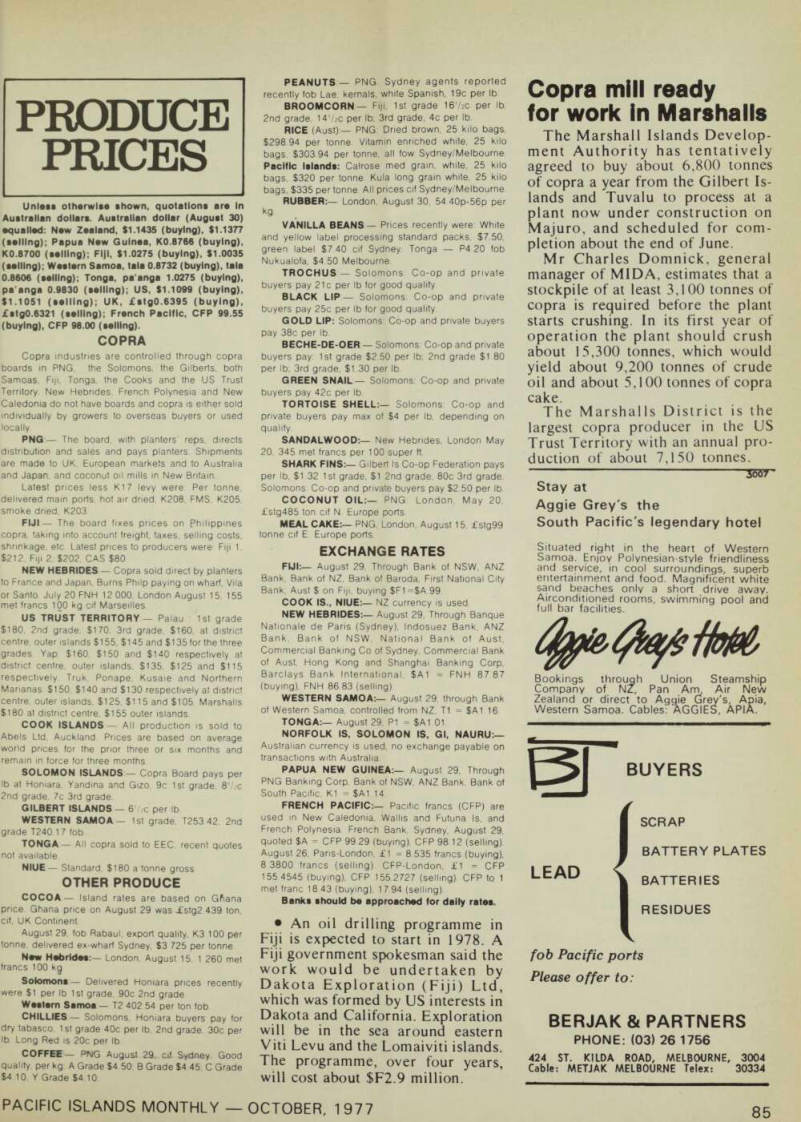
Prices
Unless otherwise shown, quotations are In Australian dollars. Australian dollar (August 30) equalled: New Zealand, $1.1435 (buying), $1.1377 (selling); Papua New Guinea, K 0.8766 (buying), K 0.8700 (selling); Fiji, $1.0275 (buying), $1.0035 (selling); Western Samoa, tala 0.8732 (buying), tala 0.8606 (selling); Tonga, pa'anga 1.0275 (buying), pa anga 0.9830 (selling); US, $1.1099 (buying), $1.1051 (selling); UK, £5tg0.6395 (buying), £5tg0.6321 (selling); French Pacific, CFP 99.55 (buying), CFP 98.00 (selling).
Copra
Copra industries are controlled through copra boards in PNG, the Solomons, the Gilberts, both Samoas, Fiji, Tonga, the Cooks and the US Trust Territory. New Hebrides, French Polynesia and New Caledonia do not have boards and copra is either sold individually by growers to overseas buyers or used locally.
PNG — The board, with planters' reps, directs distribution and sales and pays planters Shipments are made to UK, European markets and to Australia and Japan, and coconut oil mills in New Britain.
Latest prices less Kl 7 levy were: Per tonne, delivered main ports, hot air dried, K2OB, FMS, K 205, smoke dried, K 203 FIJI — The board fixes prices on Philippines copra, taking into account freight, taxes, selling costs, shrinkage, etc Latest prices to producers were: Fiji 1, $212, Fiji 2. $202, CAS $BO NEW HEBRIDES Copra sold direct by planters to France and Japan, Burns Philp paying on wharf, Vila or Santo July 20 FNH 12 000, London August 15, 155 met francs 100 kg cif Marseilles US TRUST TERRITORY Palau Ist grade $lBO, 2nd grade, $l7O, 3rd grade, $l6O, at district centre, outer islands $155, $145 and $135 for the three grades Yap: $l6O, $l5O and $l4O respectively at district centre, outer islands, $135, $125 and $ll5 respectively Truk, Ponape, Kusaie and Northern Marianas $l5O, $l4O and $l3O respectively at district centre, outer islands, $125, $ll5 and $lO5 Marshalls $lBO at district centre, $155 outer islands.
COOK ISLANDS — All production is sold to Abels Ltd, Auckland. Prices are based on average world prices for the prior three or six months and remain in force for three months SOLOMON ISLANDS — Copra Board pays per lb at Honiara, Yandina and Gizo, 9c Ist grade, B'he 2nd grade, 7c 3rd grade
Gilbert Islands 6V.C Per Lb
WESTERN SAMOA— Ist grade, T 253.42. 2nd grade T 240 17 fob TONGA — All copra sold to EEC, recent quotes not available NIUE — Standard, $lBO a tonne gross
Other Produce
COCOA Island rates are based on Ghana price Ghana price on August 29 was £)stg2 439 ton, cif, UK Continent.
August 29, fob Rabaul, export quality, K 3 100 per tonne, delivered ex-wharf Sydney. $3 725 per tonne.
Naw Habrldas;— London, August 15. 1 260 met francs 100 kg Solomons — Delivered Honiara prices recently were $1 per lb Ist grade, 90c 2nd grade Wsstsrn Samoa T 2 402 54 per ton fob CHILLIES — Solomons, Honiara buyers pay for dry tabasco. Ist grade 40c per lb. 2nd grade, 30c per lb. Long Red is 20c per lb.
COFFEE — PNG August 29, cil Sydney. Good quality, per kg A Grade $4 50: B Grade $4 45. C Grade $4 10. Y Grade $4 10
PEANUTS — PNG. Sydney agents reported recently fob Lae, kernals, white Spanish, 19c per lb BROOMCORN— Fiji, Ist grade I6V2C per lb; 2nd grade, 14'/?c per lb; 3rd grade, 4c per lb.
RICE (Aust):— PNG: Dried brown, 25 kilo bags, $298 94 per tonne. Vitamin enriched white, 25 kilo bags, $303.94 per tonne, all fow Sydney/Melbourne.
Pacific Islands: Calrose med grain, white, 25 kilo bags, $320 per tonne. Kula long grain white, 25 kilo bags, $335 per tonne. All prices cif Sydney/Melbourne.
RUBBER;— London, August 30, 54 40p-56p per kg VANILLA BEANS Prices recently were: White and yellow label processing standard packs, $7.50, green label $7 40 cif Sydney. Tonga P 4.20 fob Nukualofa, $4.50 Melbourne.
TROCHUS Solomons: Co-op and private buyers pay 21c per lb for good quality.
BLACK LIP — Solomons: Co-op and private buyers pay 25c per lb for good quality.
GOLD LIP: Solomons: Co-op and private buyers pay 38c per lb.
BECHE-DE-OER —Solomons Co-op and private buyers pay: Ist grade $2,50 per lb: 2nd grade $1 80 per lb: 3rd grade, $1.30 per lb.
GREEN SNAIL Solomons: Co-op and private buyers pay 42c per lb.
TORTOISE SHELL:— Solomons: Co-op and private buyers pay max of $4 per lb, depending on quality.
SANDALWOOD:— New Hebrides, London May 20, 345 met francs per 100 super ft.
SHARK FINS: — Gilbert Is Co-op Federation pays per lb, $1 32 Ist grade, $1 2nd grade, 80c 3rd grade.
Solomons: Co-op and private buyers pay $2.50 per lb.
COCONUT OIL: PNG: London, May 20, £stg4Bs ton cif N. Europe ports MEAL CAKE: — PNG, London, August 15, £stg99 tonne cif E Europe ports.
Exchange Rates
FIJI: — August 29, Through Bank of NSW, ANZ Bank, Bank of NZ, Bank of Baroda, First National City Bank, Aust $ on Fiji, buying $Fl=$A 99 COOK IS., NIUE:— NZ currency is used NEW HEBRIDES:— August 29, Through Banque Nationale de Paris (Sydney), Indosuez Bank, ANZ Bank, Bank of NSW, National Bank of Aust, Commercial Banking Co of Sydney, Commercial Bank of Aust, Hong Kong and Shanghai Banking Corp, Barclays Bank International. SAI = FNH 87 87 (buying), FNH 86 83 (selling).
WESTERN SAMOA: — August 29, through Bank of Western Samoa, controlled from NZ, T 1 = $A1.16 TONGA;— August 29, PI = SAI 01
Norfolk Is, Solomon Is, Gl, Nauru:—
Australian currency is used, no exchange payable on transactions with Australia.
PAPUA NEW GUINEA:— August 29. Through PNG Banking Corp, Bank of NSW, ANZ Bank, Bank of South Pacific, K 1 = SAI 14 FRENCH PACIFIC; — Pacific francs (CFP) are used in New Caledonia, Wallis and Futuna Is, and French Polynesia. French Bank, Sydney, August 29, quoted $A = CFP 99 29 (buying), CFP 98.12 (selling) August 26, Paris-London, £1 = 8 535 francs (buying), 8 3800 francs (selling) CFP-London, £1 = CFP 155 4545 (buying), CFP 155 2727 (selling). CFP to 1 met franc 18 43 (buying), 17 94 (selling).
Banks should be approached for daily rates.
• An oil drilling programme in
Fiji is expected to start in 1978. A
Fiji government spokesman said the
work would be undertaken by
Dakota Exploration (Fiji) Ltd,
which was formed by US interests in
Dakota and California. Exploration
will be in the sea around eastern
Viti Levu and the Lomaiviti islands.
The programme, over four years,
will cost about $F2.9 million.
Copra mill ready
for work in Marshalls
The Marshall Islands Develop
ment Authority has tentatively
agreed to buy about 6,800 tonnes of copra a year from the Gilbert Is lands and Tuvalu to process at a plant now under construction on Majuro, and scheduled for com pletion about the end of June.
Mr Charles Domnick, general manager of MI DA, estimates that a stockpile of at least 3,100 tonnes of copra is required before the plant starts crushing. In its first year of operation the plant should crush about 15,300 tonnes, which would yield about 9,200 tonnes of crude oil and about 5,100 tonnes of copra The Marshalls District is the largest copra producer in the US Trust Territory with an annual pro duction of about 7,150 tonnes.
Advertisements & other items, pp. 83-88 (2 items)
{Scrap
3557-
Stay at
Aggie Grey's the
South Pacific's legendary hotel Situated right in the heart of Western Samoa. Enjoy Polynesian-style friendliness and service, in cool surroundings, superb entertainment and food. Magnificent white sand beaches only a short drive away.
Airconditioned rooms, swimming pool and full bar facilities.
Bookings through Union Steamship Company of NZ, Pan Ann, Air New Zealand or direct to Aggie Grey's, Apia, Western Samoa. Cables; AGGIES, APIA.
BUYERS
LEAD
{SCRAP
BATTERY PLATES
BATTERIES
RESIDUES
fob Pacific ports
Please offer to:
BERJAK& PARTNERS
PHONE: (03) 26 1756
424 ST. KILDA ROAD, MELBOURNE, 3004
Cable: METJAK MELBOURNE Telex: 30334
CLASSIFIED ADVERTISEMENTS
Per Line $5.00 Aust.
Minimum 4 lines.
BULL'S MARINE INDUSTRIES
PTY LTD
Builders and Designers of Boats and Barges to 70' in marine alloy or timber.
Currently manufacturing in marine alloy - 24' diesel work boat/ cruiser. 10-20 knots to buyers requirements. 43' motor/sailer to any stage. Holiday afloat on self contained six or eight berth Bull Cruisers. Send for descriptive brochure.
Small ship and yacht brokers, extensive listings.
PO BOX 1,
METUNG,
GIPPSLAND LAKES
AUSTRALIA 3904
CONCRETE BLOCK MAKER. Makes
blocks, flags, edgings, screen-blocks, garden stools - up to 8 at once and 96 an hour, $215 cif main ports.
Send for leaflets. Forest Farm Research, Londonderry NSW 2753 Australia.
TAG SHELLS
Australian specimen shells for the serious collector. Send your "WANT" list now, Prompt and personal replies.
To: C. Samson - PO Box 13, Hampton, Vic, 3188. Aust.
TOWAGE:
Contract towage Australia Pacific Islands.
Interocean Marine Co., 106 Anderson St., Baltina, N.S.W. Aust.
Cables: INTERSALVAGE Sydney.
FLEETS 30ft, fibreglass cutter bit. 1976, 25 hp mar, diesel, alum, mast & boom, sails, s.s.stays, self-steering, 4 berths, toilet, gas stove, sounder, $32,000.00. FLEETS 221 Esplanade, Wynnum Central, Brisbane. Cable
FLEETS BRISBANE.
FOR SALE
Old established shell trading and exporting company. Also shipyard with boat building and shipwright facilities. Long term contracts in shell export and boatbuilding in hand. Land title assured. Excellent location Ranadi Beach, Honiara, Guadalcanal, Solomon Islands.
Assets include offices, buildings, small boats, shipyard tools, etc.
Apply - MANAGER Box 443,
HONIARA,
SOLOMON ISLANDS.
— SCOT
Stay at Aggie Grey's the South Pacific's legendary hotel Situated right in the heart of Western Samoa. Enjoy Polynesian-style friendliness and service, in cool surroundings, superb entertainment and food. Magnificent white sand beaches only a short drive away.
Airconditioned rooms, swimming pool and full bar facilities.
Bookings through Union Steamship Company of NZ, Pan Air New Zealand or direct to Aggie Grey's, Apia, Western Samoa. Cables: AGGIES, APIA.
ACCOUNTANT/ADMINISTRATOR
32 years, married, no children, experience in audit taxation, O+M, systems design, seeks short or long term work in Pacific Islands.
PETER GOERMAN, Box 42, DUFFY,
ACT 2611 AUSTRALIA
WANTED TO BUY
CASH for HUMAN HAIR plaits Black or near from 20 cm up Mail to HAIRBUYERS of Australia 899 GPO Sydney 2001. Post paid.
Another Techn<
T AU » i a fJ I [■ n o A o A S~ TO As you'd expect, Seiko was the one to create a Muiti-Mode LC Digital in which all four modes can function simultaneously. Seiko's dedication to technology makes this watch possible in a surprisingly compact case. Seiko's concern with human engineering makes it the easiest multi-mode quartz watch to operate.
Naturally, it has continuous readout, built-in illumination, battery life approximately two years, and the assurance of incomparable quality because it's by Seiko, world leader in quartz. Seiko Quartz, w?
TIME AND DAY
Large, easy-to-read LC digits display the hour, minute, second and day of week.
So Mo Tu m TW Fn Sa
IE: E
MONTH AND DATE
At the push of a button, time display disappears and the month and date appear. ssTuST.r.si uu
ELECTRONIC STOPWATCH
Push the mode button, and the stopwatch readout in minutes, seconds and 1/10 seconds is displayed.
T-r. 51
ALARM MODE
Push mode button and alarm display appears.
Then set alarm to exact hour and minute desired.
No resetting required for daily alarm signals.
SEIKO
Someday all watches will be made this way.
We took three
of our best
and made one
of the greatest
U <» 1 ■ w *4 f-f it Hi m Pioneer's new CX-7000 cassette-receiver offers most of the truly great features found in our individual stereo components.
Integrated amplifier. FM/AM tuner. Frontloading cassette-deck. Naturally, having everything in one super-compact unit increases operational convenience and offers super value all the way.
Power is a super substantial 25 watts per channel, min. at 8 ohms from 20 to 20,000 Hz with no more than 0.3% total harmonic distortion. The high performance phono equalizer assures the wide dynamic range necessary to reproduce clean musical nuance.
The CX-7000 presents a new dimension in FM/AM enjoyment. In most listening areas, reception is less than ideal. So, Pioneer features a super sensitive (11.2 cIBf/ 2.0/iV) and super selective (60dB) tuner section. An automatic pilot signal canceler is included for preventing sound deterioration in the high frequency range and, of course, PLL MPX (Phase-Locked Loop Multiplex) circuitry.
iti
m
The Super Component
ft!) PIONEER
Cassette handling is really a “super snap’ 1 due to the front-loading tape mechanism with built-in auto-stop. And making your own music tapes is super easy because Pioneer’s exclusive vertical-hold compartment allows you to check tape content and movement while the tape selector enables the optimum use of either chrome or normal tape. All controls are up front (where the user is) and built-in Dolby* reduces tape hiss and noise in the high frequency range.
Pioneer's new CX-7000 cassette-receiver.
Not just another audio product, but a giant step forward in music listening enjoyment.
It’s the super component for super hi-fi value.
We’re also offering matching speakers and turntable. They’re super, too. ‘Dolby is a trademark of Dolby Laboratories, Inc.
Australia Pioneer Electronics Australia Pty.
Ltd., 178-184 Boundary Road, Braeside, Victoria 3195, Tel; 90-9011, Sydney 93-0246, Brisbane 59-7457, Adelaide 433379, Perth 24-9899 Fiji Islands Brijlal & Company. G.P.O. Box No 362, Suva, Fiji Islands Tel: 22258 New Zealand Fountain Marketing Ltd., Maidstone Street, Auckland, New Zealand Tel: 763-064 Norfolk Island Burns Philp (Norfolk Island) Ltd., Norfolk Island, South Pacific New Hebrides Burns Philp (New Hebrides) Ltd..
Vila. New Hebrides Nauru Island Jacob Enterprises, Republic of Nauru P.O. Box No. 4 Est. PERFECT, B P. 594, Papeete.
Tahiti Tel: 20 407 New Caledonia Menard Freres Ville, B P. H 2 Cedex, Noumea, New Caledonia Tel: 27.52.22 American Samoa Traspac Corporation, P.O. Box 1477 Pago Pago, American Samoa 96799 Tel: 633-5224 Rarotonga South Seas International Ltd., P.O. Box 49, Rarotonga Cook Islands Tel: 2327
•r/i mm • i i ■ »- -i
ipr 1
... sau *3 Tv 41
" &f*yi
u \ 54- 1977 Toyo Kogyo Co.. Ltd
This page tells
lot about Mazda technology.
Just a few of the searching tests a Mazda has to pass before it ever goes into production. Many more follow, both during manufacture and after. The result. Superior, high-quality products. Cars like the newly released Mazda 323. A car everyone’s talking about because of its versatile, economical performance and stylish good looks. And like all Mazdas, a car that you can own and drive with confidence. Because Mazdas are made right.
Right from the beginning.
The Climatic Testing Laboratories Here a range of driving conditions can be simulated, from stop-start city driving to sustained high-speed highway running. The tests are conducted in a wide range of temperatures and under different atmospheric conditions. So you can be sure your Mazda will be expertly tuned to run smoothly in the country where you live.
Sound Testing Laboratories Nobody likes noise. Least of all Mazda.
That’s why we are working hard to make our cars quieter—from the outside and the inside. The car below is in our anechoic test chamber. Here the whole car is subjected to vibration through a machine that creates a variety of different shakes and thumps.
Ultra-sensitive microphones pick up every sound made, then amplifies it for thorough analysis. This way we can get rid of excessive noise and vibration before they annoy you and your passengers. \ r Body Testing Ldboratories This is one of the facilities that crash tests our car bodies. Impact and torsional effects can be accurately measured by computers simulating collisions at 30-60 m.p.h. Dummies electronically wired tell us what happens to passengers —and as a result —provide our design engineers with valuable information about the safest interiors and bodies.
Tests such as these helped us to design the light, crash resistant, semimonocoque body found on all Mazda passenger cars.
Quality through superior technology PApi|., JMr , i . Nlr * n|an * L,d - G.P.O. Box 450, Suva TEL: 22691 NEW CALEDON I A Social. Blvlar. at Bernano. 27, Rue de Sebastopol, Noumea ' - PN.O. Aa.ocl.hKj ladu.tr!.. Ltd. P.O. Box 1394, Boroko TEL 255788 JE W ZEALAND Mazda Motors of New Zealand Ltd. Otahuhu, Auckland. P.O. Box 22-472 TEL: 69-099 1 Bay Garage P.O. Box 220, Norfolk Island TEL: 2097 B.S. Solomon Motors Ltd. P.O. Box 20, Honiara TEL: 313 TAHI Comptolr Polynesian BP. 628, Papeete
NORFOLK
The trademark MAZDA in this advertisement stands for AUTOMOBILES MAZDA as far as France and her territories are concerned.
I V ■ My old car used to stall in busy city traffic. It would overheat and I'd really boil over with embarrassment. But that hasn't happened in three years since I got my green Datsun for daily city driving. It always keeps its cool and is very easy to park in many small places.
My wife drives our more prestigious red Datsun. We use it for client meetings, business trips and holidays. We often drive three hours over rough, rocky roads to my father's beach property. My Datsun always makes it a smooth, comfortable journey.
My Datsun Pickup truck transports building materials. lumber and sheet metal for my construction company. Its strength and large cargo capacity are impressive.
I really rely on my Datsuns for very satisfying performance and a variety of uses. All my good experience with them makes me glad to recommend Datsun whenever people ask. )atsun Distributors: Boroko Motors Ltd. P.O. Box 1259, Boroko, Port Moresby, PN G / f uv a M°to« Ltd. GP.O. Box M uva, Fiji/Morris Hedstrom Ltd. P.O. Box 189, Apia, Western Samoa/Umted Enterprises Ltd. PC). Box 262, Homara, Bnti olomon Island /Sirius Motors P.O. Box 34, Norfolk Island, South Pacific/Jacob Enterpnses PO. x 119 F^rt look Islands Motor Center Ltd. P.O. Box 74, Rarotonga, Cook Islands, S.A. P.O. Bo ,P ',la. New Hebrides/ Agence Alma S.A. B.P. A 3, Noumea Cedex, New S.A.R.L. B.P. 359, 1 apeete, ahiti/Gilbert Islands Development Authority (Supply Division) P.O. Box 488, Betio Tarawa, Gilbert Islands
DATSUN
A) Product of NISSAN
86
GOLD WAS THE GOAL
Continued from p. 49
PACIFIC ISLANDS MONTHLY OCTOBER, 1977