September, 1977


Pacific Islands Monthly
Pim
85c Aust $1.25 US
Cfp 130
jr* JKlSlu-3tT<ib' -: f *TateQorv B
Our Cover
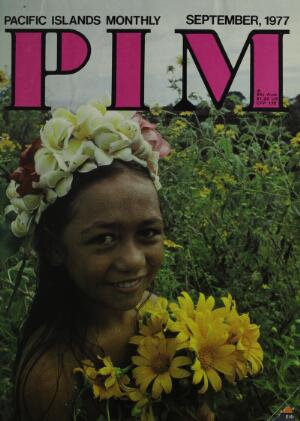
The flower-bedecked girl waist deep in flowers is Erena H e iman u, of Puurai on Tahiti. The attractive study comes from the camera of Sheree Lipton, the American photographer and author who has been toting her camera around the Islands for around 10 years. Sheree, author of the picture-filled book “/ love you Fiji full speed", has just ended a tour of Tahiti and the Cook Is lands.
Advertisements & other items, pp. 2-4 (1 item)
Akai
Crystal-Clear Days
of Pure Stereo Sound!
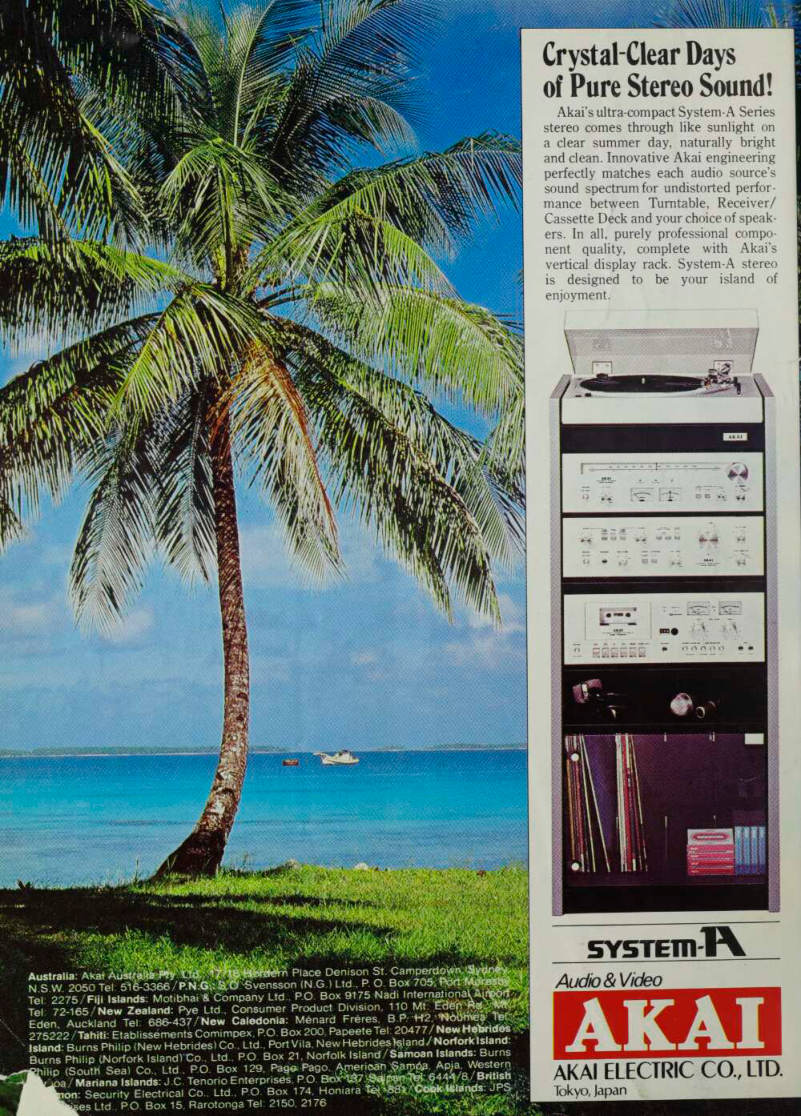
Akai’s ultra-compact System-A Series stereo comes through like sunlight on a clear summer day, naturally bright and clean. Innovative Akai engineering perfectly matches each audio source’s sound spectrum for undistorted performance between Turntable, Receiver/ Cassette Deck and your choice of speakers. In all, purely professional component quality, complete with Akai’s vertical display rack. System-A stereo is designed to be your island of enjoyment.
W W I f> o O -- m&mmmm
SYSTEIII-I\
Audio & Video
AKAI
AKAI ELECTRIC CO., LTD.
Tokyo, Japan
,o ?nCr^sSf-
-2 month or 20 the
jsSS^SS?
expert
ImM
S 5
THUCKSi^^ r
x W| ‘ j sSss S u 2^ k__ V" oVe rslunq s , es P°ns/' sysf em n9s^Pens/on
springs Un fm'! ent
. ?^ S tair
a Psorters. E aS w „ .. ac c V ' i r § *«v
ISUZU TXD ISUZU TLD 238 BUS
A big, powerful truck designed to A great way to carry up to 15 tackle the toughest jobs with ease! passengers reliably and comfortably.
Western Samoa O.F. Nelson & Co. Ltd.
Fiji Burns Philp (South Sea) Co. Ltd.
Papua New Guinea Dawapia Motors, Rabaul Wamp Nga Motors, Mt. Hagen Solomon Islands Solomon Islands Service Station New Caledonia
SAIP
GM I General Motors. Serving you in the South Pacific.
Take your
Sony stereo swimming.
The cool and refreshing sound of stereo.
You can have it with you always with this portable model by Sony. The CF-580.
There's plenty of power (5.8 hefty watts) to drive four speakers. And the matrix stereo circuitry gives you genuine stereo and excellent separation with cassette or FM.
Twin microphones allow you to record in true stereo, too.
It's so hip, so cool, so Sony.
Pacific Islands
Monthly
Subscription Rates
“Pacific Islands Monthly” is airfreighted to the majority of subscribers and agents in the Pacific Islands and the
Usa
Australia (including Norfolk Island) $10.50 Aust New Zealand $11,50 NZ ($10.50 Aust). Fiji $10.75 Fijian ($10.50 Aust) Papua New Guinea, New Hebrides, Tonga, Cook Islands, Western Samoa, Gilbert Islands, Tuvalu, Niue, Nauru and Solomon Islands $10.50 Aust American Samoa, Northern Marianas, Micronesia, Guam and Hawaii $l5 00 US or $12.00 Aust. US Main land and Canada $17.00 US or $14.00 Aust New Caledonia and French Polynesia 1,600 CFP or $13.50 Aust United Kingdom 9.50 or $12.50 Aust Japan 4,500 Yen or $12.50 Aust. Elsewhere $l4 50 Aust.
Note Overseas remittances in Australian dollars should be by bankdraft payable at Sydney Australia.
Representatives
FIJI: Distribution and subscriptions Desai Bookshops, P.O Box 160, Suva, Fiji Telephone: Suva 23036 Advertising, Fiji Times & Herald Ltd,, 20 Gordon Street, Suva. Telephone: 312 111. Telex: FJ2124..
Papua New Guinea: Advertising and Distribution PNG Post-Courier, P.O. Box 85, Port Moresby. Inquir ies Post Newsagency, Telephone 24 2148 French Polynesia: Distribution Hachette Pacifique, 10 Ave Bruat, Papeete.
New Caledonia: Distribution Depot Centre de Presse Michel Pentecost, 8.P.C2 Noumea.
United Kingdom: The Herald and Weekly Times Lim ited. 8-10 Clifford's Inn, Fetter Lane, London EC4AIBU.
Telephone; 01 831 6041 Telex: London 21989 Japan: Advertising Universal Media Corporation, C P.O, Box 46. Tokyo Telephone; 666 3036.
New Zealand; Pacific Publications, C.P.O. Box 2229, Auckland. Advertising enquiries: International Media Representatives Ltd, P.O, Box 3880 Auckland. Tel 73 880 Telex NZ21157. (Auck 40) Hawaii and U.S. Mainland only: PIM. Hawaii, 2812, Kahawai St., Honolulu, Hawaii, 96822 Second class postage paid at Honolulu, Hawaii US Advertising Rep resentative. Joshua B. Powers. Jr, Powers International, Inc 551 Fifth Ave, New York, New York 100 017 Tele phone 867 9580 Telex 236514 Pub, 952480 Victoria: Advertising Pacific Publications (Aust.) Pty Ltd , Herald and Weekly Times Building, 2nd Floor, 61 Flinders Lane, Melbourne, 3000. Telephone: 252 1565 Brisbane; D Wood, Anday Agency, Box 1918 G.P.O , Brisbane 4001. Telephone; 44 3485; 44 1546 Printed in Australia Copyright ©, 1977, Pacific Publications (Aust.) Ply. Ltd.
Printed by Paramac, Mitchell Rd, Alexandria
Copyright ©’, 1977,
Pacific Publications (Aust.) Pty. Ltd.
Printed by Paramac, Mitchell Rd., Alexandria PIM is distributed in Australia and New Zealand by Gor don & Gotch Australian cover price is recommended retail only Registered at the G.P.O Sydney for transmission by post as a publication category B
V 01.48 No. 9
September 1977
Up Front
with the Publisher
As a magazine that appears monthly, one of PlM’s strengths is that it’s often in a position to stand off and look at developments in a detached way, without the day-to-day necessity of a newspaper to report somewhat breathlessly bit by bit as a thing happens. But it has its disadvantages when a story is moving fast and PIM, as a monthly is unable to keep abreast of it as quickly as it might. Such is the case with the Norfolk Island report we have on page 13.
Ed Howard has made charges against the Norfolk Island Admin istrator, Mr. D. O’Leary, at a meeting of the Australian Senate Standing Committee on Foreign Affairs and Defence in Sydney. But his main attack is clearly not on the Administrator, but on a ‘syndicate’ which he suspects of being involved in a racket of very large propor tions. He gave evidence under oath, in camera, to the Senate committee on these other matters.
I understand his fears are (and for which he has some supporting evidence) that currency, diamonds, drugs - anything - might already have been smuggled into Norfolk Island under the present lax Customs inspection on that island, and that these goods could thus be moved into Australia without restriction should the main provisions of the Nimmo Report be passed by the Commonwealth Parliament and Norfolk Island become part and parcel of Australia.
At this time of writing Mr.
O’Leary has denied the allegations affecting him, but nobody can predict how far or how fast the hare will run that Ed Howard has let loose. I can’t claim to know whether he is right or wrong on his charges. But I know him to be honourable, I believe he has no motive other than to get at the truth, and he must be taken seriously. His allegations call for a full, fearless official investigation.
When it comes to timing, PIM has had better luck with its report on the first Papua New Guinea general elections since independence in 1972. It’s got tidily into this issue. I was in Port Moresby while the votes were being counted, as I was in 1972, and the atmos phere on both occasions was the same. You could feel Islands politics at work -- subtle, intelligent, human. None of the rawness of straight party politics the way they’re played in Australia and New Zealand.
A cliff-hanger almost to the final, clinching parliamentary vote for Prime Minister, every day brought a new move on the chess board as the personalities took part in the play. Sometimes the moves were sudden and far-ranging, other times the players studied the board thoughtfully, and moved almost tentatively.
The game continued for several weeks and was made necessary by the large number of uncommitted members in the parliament of 109.
They are independent members in every sense of the word, and that’s a point to bear in mind.
There can be no guarantee that the present state of play, with its firm support of Michael Somare’s coalition, will last for the five-year term of parliament.
And there will be added strains in the next five years as the national government gets on with the task it has started of decentral ising its administration and giving the provinces the autonomy they must have if that big country of 700 languages is not to fragment into small states.
These elections opened the wounds of Papuan separatism, which are now festering. They must be healed. If in the next vital five years Papua New Guinea can’t hang together the fragments will certainly hang separately.
Stuart Inder
Advertisements & other items, pp. 5-6 (2 items)
Pacific Islands Monthly September, 1977
5
FOUNDED BY R W ROBSON IN 1930
PUBLISHED MONTHLY BY
PACIFIC PUBLICATIONS (AUST.) PTY. LTD.,
76 CLARENCE STREET, SYDNEY 2000
Post Address; G.P.O. BOX 3408, SYDNEY,
NSW 2001
Telegraphic Address: PACPUB, Sydney.
Telex 21242 Telephone: 29 6693 Publisher: Stuart Inder Manager: John Berry EDITOR: John Carter
Radio Australuts
PACinC ISLANDS SUNKE
Radio Australia's Pacific Islands service now broadcasting in Tok-Pisin and simple English to New Caledonia, the New Hebrides and Solomon Islands. (Commencing 4th September).
World news and current affairs in English and Tok-Pisin.
Latest popular music and Pacific Islands music.
Tune to 5995 Kilohertz in the 50 metre band.
Local time 6.00 p.m. to 9.00 p.m.
To Papua New Guinea 9760 Kilohertz 31 metre band and 11790 in the 25 metre band PNG time 5.00 p.m. - 8.00 p.m.
Programme guides in English and Tok-Pisin available from Australian Consulate, Noumea, ABC Representative, PO Box 779, Port Moresby, PNG, Radio Australia Box 428 G Melbourne 3001.
Radio Australia the overseas service of the A ustraiian Broadcasting Commission.
Pacific Islands Monthly
Vol 48, No 9, Sept. 1977.
General
Australia's paternalism criticised 14 Australian MPs' tour 15 Parliamentary Speakers meet 21 Pacifique Sud 55 Continental gets S.Pacific Route 71
American Samoa
TV popular 21 Rex Lee back as Governor 34 Daiwa service 67 Port problems of 1976 68 Continental wins S.Pacific route. 71
Cook Islands
Another Neale chapter 17 Murder plot mirth 19 An old school 31 Rabbit tale 33 New RC bishop 34 Sir Albert takes on US 57 Shipping service to continue 68 Philip Woonton dies 77
Fiji
Rotuma water wells 21 Lautoka water shortage 21 USP hall of residence 21 NZ sappers at work 21 Powerhouse spooks 31 Outstanding Jaycee 34 Sir John Falvey resigns 35 Freddie Ladd retires 35 Fight for tourist dollar 59 Dock strike 65 Daiwa service 67 Reply to criticism of NZ 67 Kyowa's new service 68 Continental wins S.Pacific route 71 Airport tax 73
French Polynesia
New Era' Dawns 18 Pacifique Sud 55 Daiwa service 67 Shipping service to continue 68
Gilbert Islands
Daiwa service 67
Guam
Dogs drugged 21 Oil superport wanted 62 Daiwa service 67 Kyowa's new service 68
New Caledonia
Interest in elections 32 Pacifique Sud 55 Daiwa service 67 Kyowa's new service 68
New Hebrides
Independence by 1980? 11 Bilingualism supported 11 Pacifique Sud 55
Niue Island
Stamp issue criticised 31 Shipping service to continue 68
Norfolk Island
Editor lifts lid 13 Customs loophole 13
Papua New Guinea
New government 9 Election result 16 Tourist salesgirls 20 Law on tribal fights 21 New Ireland walkabout 23 Artifacts returned 32 Painter's achievements 34 Beginning of aviation 36 Expert to study fisheries 61 Aust. tourism representative 61 Crocodile capital of world 63 Expert's opinion of timber industry... 63 Air Niugini plans expansion 71
Pitcairn Island
New stamps 20 Natural navigator 35
Solomon Islands
Independence hurdles 8 British official speaks 10 Mitsui interest in bauxite 60 Daiwa service 67
Tonga
Cheaper power 21 Drilling for water 32 Oil search to resume 61 Olovaha breaks down 67
Tuvalu
Election date 20 Tree destruction bill 63
Us Trust Territory
UN seeks unity 12 US changes policy 12 Teachers' sit-in 20 New newspaper 20 Russia's charge on 'base' 21 Micronesians want 200 m zone 61 'Faithful' aircraft wrecked 71
Western Samoa
Govt takes over Potlatch 18 Early warning of 'quake 21 Kaiser's monument 32 Daiwa service 67 Polynesian Airlines expanding 73
DEPARTMENTS: Up Front with the Publisher, 5; News in a nutshell, 20; Editor's Mailbag, 28; Topicalities, 31; People, 34; Magazine Section, 36; Islands Press, 41; Books, 49; Business & Development, 57; Pacific Transport, 65; Cruising Yachts, 74; Deaths of Islands People, 77; Shipping Information, 80; Produce Prices, 85.
Tricky Reefs On The Solomons’
Cruise To Independence
From a special correspondent
After the British Government had deferred indefinitely the constitu tional conference that would have confirmed Solomons independence, the British sent a special represen tative to Honiara. Mr Richard Posnett, the British negotiator, however, did not please Mr Keni lorea, the Solomons’ Chief Minister, who seemed to have expected Mr Posnett to have wider-ranging powers.
As Mr Kenilorea said in a radio interview: “When this .person (Mr Posnett) came we thought he would come with counter-proposals. He did not show flexibility. He did not have the mandate to negotiate on behalf of the British Government.”
Mr Kenilorea was obviously let ting his frustration show.
Mr Posnett’s approach had, in fact, been quite cautious. He had been given 24 hours’ notice to go to Honiara which must have left little or no time for briefing on the situ ation in the Solomons. Mr Posnett, who had never been to the Solomons before, saw his role as “ex
ploratory”.
While Mr Kenilorea was showing signs of frustration, it was obvious that relations between Professor Yash Gai, the constitutional adviser to the Solomons Government and the Solomons Legislative Assembly, were rather strained.
As the legislature was determined to stand by its draft of the Solomons’
Constitution, Professor Yash Gai was probably wondering what use his presence in Honiara was serving.
The professor had arrived in Honiara a few days before Mr Posnett.
Throughout the negotiations the Solomons Government was secre tive. Mr Kenilorea defended this, saying; “Since it is a negotiation it must be treated as confidential.”
However, there were those who thought the Kenilorea government was being overly non-com municative. In particular, the Solomon Island Christian As sociation criticised the government for lack of information on the dis agreement between the two govern
ments and the lack of open debate on the issues involved.
The SICA criticism brought the desired reaction from Mr Kenilorea, who gave a radio inter view. Though Mr Kenilorea would not have satisfied SICA fully, he did give some background to the dis agreement. Much of what Mr Kenilorea said, however, was com mon if to that time unofficial knowledge.
The issues of disagreement were listed as citizenship and land.
The draft of the proposed con stitution requires that for “auto matic citizenship” after Solomons’ independence, a person must have at least two grandparents born in these islands. The “two grandparent clause” apparently is a reduction from a previous proposal that all four grandparents were to have been born in the Solomons. It is apparent, however, that the Solomons Government is prepared to modify its stand on this matter no further.
As Mr Kenilorea said; “That is the stand of the 38 members of the House.”
This clause, obviously, will affect Chinese merchants in the Solomons, of which there has been an exodus in recent years. It will also have its effect on the Gilbertese, who the
British administration brought to the Solomons from the over-popu lated Gilbert and Phoenix islands in the mid-fifties. There was no con sultation with the Melanesians as a whole at the time of this re settlement.
The original four grandparent clause would have affected persons of mixed blood. Consequently, and not surprisingly, the Archbishop of the Church of Melanesia in the Solomons, Norman Palmer, who is Euronesian, has been a critic of the government on this issue. It is ob vious, however, that the “two grand parent clause” will still affect a large number of people.
Persons unable to get “automatic citizenship” will have to apply for citizenship. This will enable the Solomons’ administration to “scrutinise” such applicants, as Mr Kenilorea puts it. The government is concerned about “illegal im migrants” among the Gilbertese.
Their resettlement in the Solomons, apparently, was not very strictly
policed.
Mr Kenilorea is among the “liberals”, it would appear, in rela tion to applications for,citizenship after independence. He has per sonally championed the cause of Dr Charles E. Fox, the Anglican mis sionary who spent 65 years in the Solomons.
Dr Fox had written to Mr Kenilorea of his wish to become a Solomons citizen.
Mr Kenilorea has pointed out to the assembly that provisions in the constitution would not allow Dr Fox to become an automatic citizen and that an inflexible approach would discriminate against people such as the bishop, who had given their lives to the Solomons and its people.
It will remain to be seen whether the British accept the citizenship clause as it stands, Mr Kenilorea’s fine words notwithstanding.
It will also remain to be seen whether Mr Kenilorea’s “liberal” approach will predominate if the clause is accepted by the British.
Some Gilbertese and Chinese fear
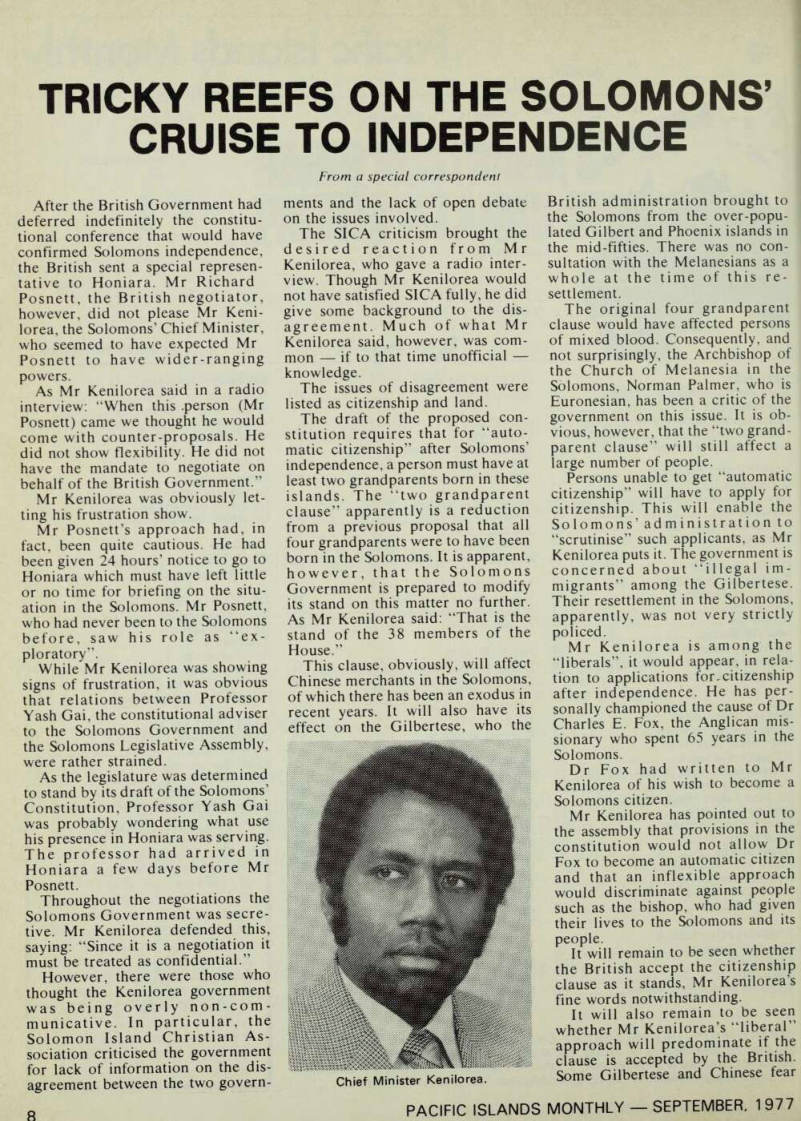
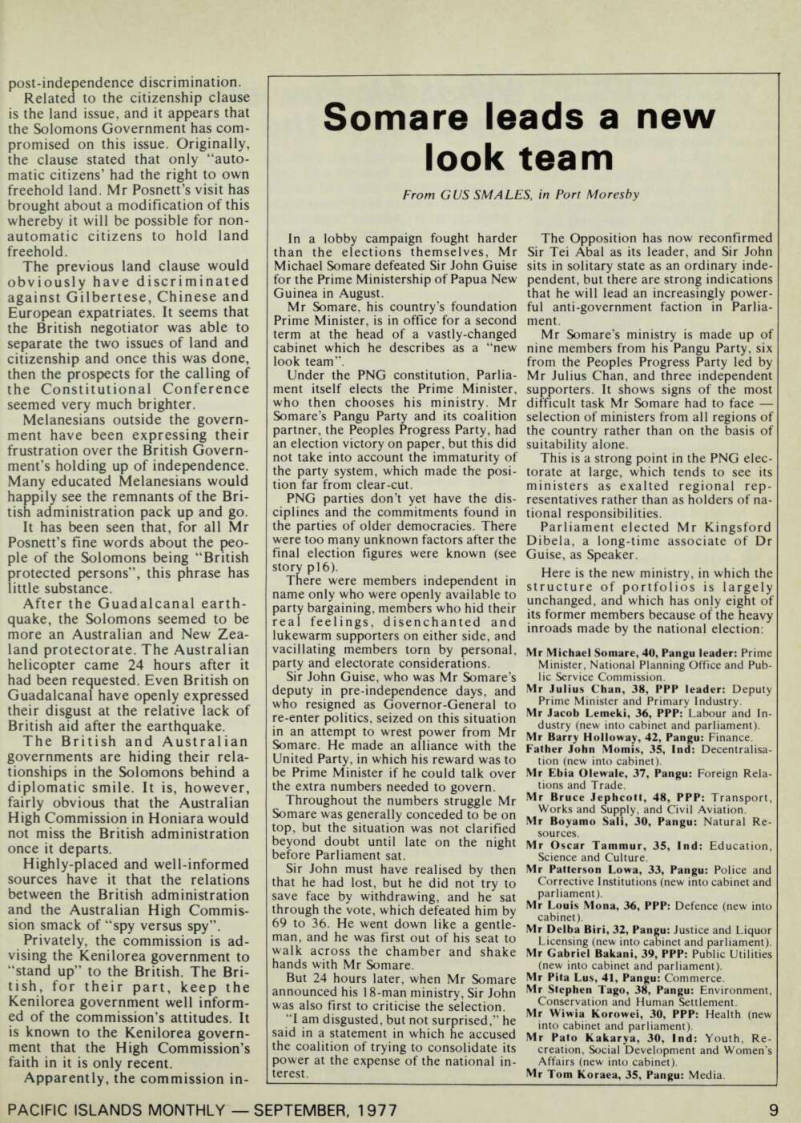
Chief Minister Kenilorea.
post-independence discrimination.
Related to the citizenship clause is the land issue, and it appears that the Solomons Government has com promised on this issue. Originally, the clause stated that only “auto matic citizens’ had the right to own freehold land. Mr Posnett’s visit has brought about a modification of this whereby it will be possible for non automatic citizens to hold land freehold.
The previous land clause would obviously have discriminated against Gilbertese, Chinese and European expatriates. It seems that the British negotiator was able to separate the two issues of land and citizenship and once this was done, then the prospects for the calling of the Constitutional Conference seemed very much brighter.
Melanesians outside the govern ment have been expressing their frustration over the British Govern ment’s holding up of independence.
Many educated Melanesians would happily see the remnants of the Bri tish administration pack up and go.
It has been seen that, for all Mr Posnett’s fine words about the peo ple of the Solomons being “British protected persons”, this phrase has little substance.
After the Guadalcanal earth quake, the Solomons seemed to be more an Australian and New Zea land protectorate. The Australian helicopter came 24 hours after it had been requested. Even British on Guadalcanal have openly expressed their disgust at the relative lack of British aid after the earthquake.
The British and Australian governments are hiding their rela tionships in the Solomons behind a diplomatic smile. It is, however, fairly obvious that the Australian High Commission in Honiara would not miss the British administration once it departs.
Highly-placed and well-informed sources have it that the relations between the British administration and the Australian High Commis sion smack of “spy versus spy”.
Privately, the commission is ad vising the Kenilorea government to “stand up” to the British. The Bri tish, for their part, keep the Kenilorea government well inform ed of the commission’s attitudes. It is known to the Kenilorea govern ment that the High Commission’s faith in it is only recent.
Apparently, the commission in
Somare leads a new
look team
From GUS SMALES, in Port Moresby
In a lobby campaign fought harder than the elections themselves, Mr Michael Somare defeated Sir John Guise for the Prime Ministership of Papua New Guinea in August.
Mr Somare, his country's foundation Prime Minister, is in office for a second term at the head of a vastly-changed cabinet which he describes as a “new look team”.
Under the PNG constitution, Parlia ment itself elects the Prime Minister, who then chooses his ministry. Mr Somare’s Pangu Party and its coalition partner, the Peoples Progress Party, had an election victory on paper, but this did not take into account the immaturity of the party system, which made the posi tion far from clear-cut.
PNG parties don’t yet have the dis ciplines and the commitments found in the parties of older democracies. There were too many unknown factors after the final election figures were known (see story pi 6).
There were members independent in name only who were openly available to party bargaining, members who hid their real feelings, disenchanted and lukewarm supporters on either side, and vacillating members torn by personal, party and electorate considerations.
Sir John Guise, who was Mr Somare’s
deputy in pre-independence days, and
who resigned as Governor-General to re-enter politics, seized on this situation in an attempt to wrest power from Mr Somare. He made an alliance with the United Party, in which his reward was to be Prime Minister if he could talk over the extra numbers needed to govern.
Throughout the numbers struggle Mr Somare was generally conceded to be on top, but the situation was not clarified beyond doubt until late on the night before Parliament sat.
Sir John must have realised by then that he had lost, but he did not try to save face by withdrawing, and he sat through the vote, which defeated him by 69 to 36. He went down like a gentle man, and he was first out of his seat to walk across the chamber and shake hands with Mr Somare.
But 24 hours later, when Mr Somare announced his 18-man ministry, Sir John was also first to criticise the selection.
“I am disgusted, but not surprised,” he said in a statement in which he accused the coalition of trying to consolidate its power at the expense of the national in terest.
The Opposition has now reconfirmed Sir Tei Abal as its leader, and Sir John sits in solitary state as an ordinary inde pendent, but there are strong indications that he will lead an increasingly power ful anti-government faction in Parlia ment.
Mr Somare’s ministry is made up of nine members from his Pangu Party, six from the Peoples Progress Party led by Mr Julius Chan, and three independent supporters. It shows signs of the most difficult task Mr Somare had to face selection of ministers from all regions of the country rather than on the basis of
suitability alone.
This is a strong point in the PNG elec torate at large, which tends to see its ministers as exalted regional rep resentatives rather than as holders of na
tional responsibilities.
Parliament elected Mr Kingsford Dibela, a long-time associate of Dr Guise, as Speaker.
Here is the new ministry, in which the structure of portfolios is largely unchanged, and which has only eight of its former members because of the heavy inroads made by the national election: Mr Michael Somare, 40, Pangu leader: Prime Minister, National Planning Office and Pub lic Service Commission.
Mr Julius Chan, 38, PPP leader: Deputy Prime Minister and Primary Industry.
Mr Jacob Lemeki, 36, PPP; Labour and In dustry (new into cabinet and parliament).
Mr Barry Holloway, 42, Pangu: Finance.
Father John Momis, 35, Ind: Decentralisa tion (new into cabinet).
Mr Ebia Olewale, 37, Pangu: Foreign Rela tions and Trade.
Mr Bruce Jephcott, 48, PPP: Transport, Works and Supply, and Civil Aviation.
Mr Boyamo Sali, 30, Pangu: Natural Re sources.
Mr Oscar Tammur, 35, Ind: Education, Science and Culture.
Mr Patterson Lowa, 33, Pangu: Police and Corrective Institutions (new into cabinet and parliament).
Mr Louis Mona, 36, PPP: Defence (new into cabinet).
Mr Delba Biri, 32, Pangu: Justice and Liquor Licensing (new into cabinet and parliament).
Mr Gabriel Bakani, 39, PPP; Public Utilities (new into cabinet and parliament).
Mr Pita Lus, 41, Pangu: Commerce.
Mr Stephen Tago, 38, Pangu: Environment, Conservation and Human Settlement.
Mr Wiwia Korowei, 30, PPP: Health (new into cabinet and parliament).
Mr Pato Kakarya, 30, Ind: Youth, Re creation, Social Development and Women's Affairs (new into cabinet).
Mr Tom Koraea, 35, Pangu: Media.
itially had little faith in the stability
of the Kenilorea government and had been predicting to Canberra that a political “come-back” by former Chief Minister Mamaloni was most likely.
Whilst the British and the Australians battle it out for in fluence, an issue that should be resolved by the ever-increasing flow of Australian dollars in aid to the Pacific, the Solomons’ legislature has a problem with its electorate.
Some members of the legislature have been doing their best to dis credit themselves. One member, when picked up in Honiara by the police for drunkenness, claimed that he could not be detained on the grounds of parliamentary privilege.
The police and the public were not impressed.
But an even greater row has broken out over the announcement that all the members of the assembly want to fly to the Constitutional Conference. British Government reaction to this varied from astonishment to laughter to fear that the conference would become un
wieldly.
Mr Kinika, the Solomons’
Finance Minister, pointed out that the cost was unlikely to be less than Asloo 000 and that it would have to be met from the public purse.
This resulted in protest meetings in Honiara and Auki. The Auki meeting suggested that all the mem bers wanting to go to the Conference “indicated distrust or that they just wanted to travel”.
There has been a rumour going around Honiara that is being told as a joke. The tale goes that the mem bers of the assembly going to the conference will be 10 the rest will take their trip somewhere else! This story reflects the loss of prestige that the legislature has suffered over this issue.
The proposed trip comes at a time when members of the assembly have had just voted themselves an in crease in salary from A 54296 to A 56600.
• The first Monday in October will be observed as a public holi day in the Solomon Islands. The holiday will commemorate the achievement of the ministerial system of government in 1974.
What Mr Posnett
thought of the talks
What happened between Britain’s Mr Richard N. Posnett and rep resentatives of the Solomons Government when Mr Posnett made a flying trip at 24 hours’ notice in an effort to heal the breach between the “Protectors” and the “Protected” which appeared when the latter de cided to stick to their guns over the Constitution?
One of PlM’s representatives in the Solomons, Mr Peter L. Young, talked to Mr Posnett. The result is below.
PIM: What are the points of dif ference between the Solomons and the UK which are holding up the Constitutional Conference and Solomons independence?
Mr Posnett: There is the issue of citizenship. At present, all persons in the Solomons are British-pro tected persons. We are concerned to see that all people in the Solomons and that includes Gilbertese and Chinese are properly looked after. As far as defining who is a citizen of the Solomon Islands goes, that is a complex question and very precise definitions have to be work ed out. Part of my overall task is to ensure that any difficulties are sorted out before the Constitutional Conference is held. So, in a sense I am here to help clear the way for the Constitutional Conference.
PIM: And what about the land question?
Mr Posnett: It seems that in the past there has been a tendency in the Solomons to see the citizenship and the land issues as one and the same.
However, you do not necessarily have to define a citizen as a person who is entitled to hold land. It is better to keep the two issues separate. A person who is not a citizen does not necessarily have to be debarred from holding land. I am sure that the members of the Solomons Government are now beginning to see that the two issues can be separated.
PIM: Is the financial settlement final as far as the UK Government is concerned?
Mr Posnett: Yes. It is an unusually generous settlement in both absolute and per capita terms. It is much more than other states received, such as Grenada and Fiji.
PIM: The Finance Minister, M Kinika, has said that the Solomon. delegation had gained a good dec but had based its arguments so lei on financial and econo mi grounds. He has suggested thi members may wish to argue fc more money from the UK on polit cal grounds.
Mr Posnett: Of course, th Solomons’ Government is free to ac cept or reject the offer.
PIM: Was the UK Governmen surprised when it found that all thi members of the Solomons Legisla tive Assembly wished to attend the Constitutional Conference in Lon don?
Mr Posnett; I wasn’t aware that they had asked for this, but I fully realise that difficulties arise where there are no clear-cut political par ties. However, the problem of num bers making such a conference un wieldly must be closely watched.
Still, this is an issue that is for the Solomons Government to decide.
PIM: What will remain to be done before the Constitutional Conference can be held?
Mr Posnett: We will need to con sider whether the prospects for the conference are good.
PIM: On a general note, is the Westminster style of government the most suitable for developing countries? I am interested in your personal opinion on this because recently some doubts have been ex pressed by politicians in Fiji and Papua New Guinea on this issue.
Mr Posnett: Well, personally, I feel that each country should decide how it will be run. As far as possible, the constitution should reflect the desires and lifestyles of the inhabi tants. You don’t have to follow the Westminster model but you do have to make suitable protection of human rights, freedom, and politi cal stability.
PIM: A recent Newsweek article suggested that the UK has at various times attempted to give its various Pacific territories away to Australia.
What is your reaction to this?
Mr Posnett: It’s nonsense. Of course Australia will be involved with the Solomons in the future after the independence of these islands.
Hebrides independence in 1980?
The New Hebrides, jointly ruled by Britain and France since 1906, will become independent in the second half of 1980, according to a joint British-French statement released in Paris in July.
The statement came after three days of talks between the two governments on one side and six New Hebridean delegates of the Nagriamel Federation, the Tan Union and the elected Chiefs’Council on the other.
The big absentee from the talks was the Vanuaaku Party, largest political party in the New Hebrides The statement from the two governments said that the territory would be given internal autonomy early next year. Rules governing the working of the administration will be drawn up at a further conference to be held in Vila in December or January.
A referendum and new elections for a representative assembly will be held before the proclamation of independence, the statement said.
The Paris conference followed a similar meeting in London last October.
A representative assembly, elected by popular vote in 1975, held its first meeting in the New Hebrides last year. It was suspended hy the British and French resident commissioners in March, 1977, following a boycott of its proceedings by the Vanuaaku Party. 1° a statement released in Vila on the eve of the Paris talks the Vanuaaku Party recalled that on July 18 it had sent a communique to the two resident commissioners advising them that it would not be represented at the Paris talks.
The communique added that although the Vanuaaku Party would not be represented “physically or vocally” in Paris, it requested the governments of Britain and France “to exercise their civilised judgment to recognise our people’s demands which our party has voiced.”
The communique went on: “For the British and French Governments to unduly defend the rights of minorities would, if the two colonial powers are not careful, be tantamount to ensuring the continuance of aspects of the colonial past which would tend to prolong divisions
among the people of Vanuaaku” (name used by the party for the New Hebrides).
The Vanuaaku Party is demand ing that the party emerging from the next elections with a majority in the Assembly should form a govern ment, but the British and French j iave stated that “the two govern ments hope to tranfer responsibility to a COU ncil of ministers reflecting t he widest possible range of New Hebridean opinion’’. . .
The communique reminded the f ßr msh and French Governments h Q a ‘ a \ ota ' ° f 34 ™! er ? m th ? 1975 elections, 20 000 had voted f? r th « Vanuaaku Party (then the New Hebrides National Party), a clear bU/o majority This vote had been for a political programme which had “majority rule” and “independence in 1977” as its foremost slogans. The com munique said that if the party had changed its position on anything, it was in its acceptance of the political compromise of calling for self government rather than full inde pendence in 1977.
Shadow Of The Tower Of Babel
From a Vila correspondent In what the official British publication New Hebrides News called “Vila’s biggest ‘ demo’ so far”, an estimated 3 000 people marched through the city’s streets on June 25 in support of the condominium’s bilingual education system.
Occasion for their action was the decision by the sixth congress of the Vanuaaku Party (formerly National Party of the New Hebrides) earlier in the month to make English the main teaching language in the education system of the future independent New Hebrides. The congress decided that the French schools should continue as private schools.
The Vanuaaku Party leaders refused to accept a petition presented by the demonstrators. The petition, and a shortened version of the Vanuaaku Party’s reply to it, were later braodcast in Bislama on Radio Vila.
Demonstrations on the same issue also took place on Santo, Malekula and Tanna.
Reflecting, no doubt, the age-old
difficulty of estimating crowd num bers, the British residency paper said 3 000 demonstrated in Vila, but the French/Bislama language Nabanga said the number was 3 500.
There were even bigger differ ences in the estimates for the other islands. Nabanga said 1 500 de monstrated on Santo (New Hebrides News, 800). Nabanga had 2 000 out demonstrating on Malekula, while NHN estimated that there were about 750 involved in two separate actions. Nabanga said there were 2 000 in the streets on Tanna, while NHN estimated the crowd at be tween 1 000 and 1 500.
The figures give respective totals of 9 000 (Nabanga) and less than
6 000 (Nhn).
But if the exact numbers involved are obscure, there can be no mistak
ing the passions aroused by the Vanuaaku Party’s decision.
An article in Nabanga of June 18 signed “J.M.” described the Vanuaaku Party’s decision on the language issue as expressing the “mindless francophobia” of the par ty’s leaders.
The article characterised the VP as follows: “The history of the VP is clear, beyond all doubt; this politi cal formation was founded by sor cerers’ apprentices, most of them Europeans, clergymen in some cases, all of them English-speak ing.”
It said; “The clear, irrefutable truth is there. For wretched reasons of language, the VP is not the de fender of the interests of New Hebrideans as a whole. It is merely the emanation within the New
Hebrides of the most mindless fran
cophobia. ...
‘ r As the VP sees things, power should be in the hands of the party and not in those of a de
mocratically-elected assembly.
There should be no opposition, because it’s easier to govern that way. This is what is called fascism.
“And the sooner this is all brought about the better, in the VP view, because it is of paramount im portance that they should act before the French schools have time to pro duce elites of sufficient weight to feel that they have their word to say ”
Reviewing the sixth congress of the VP, the article said that at the congress the VP had “dropped the mask’’ and that those who had hitherto remained unconvinced of the YP’s “bad faith” would now on know what to expect.
Admitting that in the past, and until as recently as the London con ference of November, 1974, the two administering powers had treated the New Hebrides as “a nation that had not yet come of age”, the article said that they had since come round to the viewpoint of the VP and had unmistakably demonstrated their desire to involve Melanesians in their negotiations.
The article went on: “But now the Vanuaaku Party, after paralysing the work of the Representative As sembly, strangling at birth the work ing model of democratic institutions which could have made an exempl ary country of the New Hebrides, has decided to put on its tough face once again and to boycott the Paris conference. Certainly, the boycott is not complete; ‘We will go to Paris, but on certain conditions,’ says the VP. But it is careful not to say what these conditions are.”
“J. M.” wrote scathingly of VP leaders as acting out a “comedy” in which they pretend to be “a band of poor mystical creeps”, “sitting in committee barefooted and in threadbare shorts, trying to give the impression they are noble tramps”.
In fact, the writers said, they rep resent “a political party with im mense financial backing”.
“J. M.” claimed that it would be impossible to stage such “comedies” in Paris or London, where, moreover, it would also be im possible for the VP to pressure the negotiators bv means of de monstrations.
Micronesia
Un Wants
Unity For
From DAN GIBSON on Guam The 44th session of the United Nations Trusteeship Council has ended with general support for the United States’ plans for dissolution of the last remaining trust territory, Micronesia, in 1981.
The USA, according to rep resentative John Kriendler, believes “that the interests of the people of Micronesia would be best served by the maintenance of some form of unity” among the various island dis tricts after the trusteeship is dissolv ed.
The US believes that a political status of free association with the US. “provides the most promising basis for ensuring a mutually satisfying relationship between the US and the peoples of the Marshall Islands and the Caroline Islands.”
But representatives from both Palau and the Marshalls repeated their desire to break away from the remaining districts of Yap, Truk, Ponape and Kosrae and enter into separate negotiations with the US.
While acknowledging the islan ders’ right to self-determination, the Trusteeship Council tended to echo the US position in its final report, noting “with satisfaction’’ that Micronesia “would best be served by the maintenance of some form of unity.”
“Free association might have the advantage of providing a transi tional period that would allow the people time to evaluate the relation ship; it would also provide time for further economic development while keeping open the possibility of altering their political status at a future date,” the report observed.
A draft constitution was schedul ed to go before the people of both is land chains in a referendum on July 12, 1978. The council, the report noted, hopes that the draft constitu tion “will be in a form likely to be acceptable to all the districts in the Caroline Islands and the Marshall Islands, and calculated to preserve a degree of unity among them.”
The report was adopted by a 2-1 vote, with Great Britain and France
in favour and Russia against. USSR delegate Vadim P. Kovalenko said the US should promote the islan ders’ right to self-determination “not in words but in deeds.”
About-Turn
America's
In what appears to be a complete about-face in relation to US policy for Micronesia the US Government has come down in favour of “ex pedited negotiations” to end the 30year US trusteeship over Micronesia.
The suggestion of early indepen dence was raised for the first time during a US Senate hearing on the confirmation of Adrian Winkel as High Commissioner for the Trust Territory.
Senator Henry M. Jackson (Washington State) said he would like to see “a piece of paper up here” from the State Department on newspaper reports of a change in US policy on the Trust Territory. He was concerned about a report that the Carter administration had de cided to seek expedited negotiations to end the trusteeship agreement, and was willing to contemplate early independence for Micronesia.
Mr Frederick Z. Brown, a US State Department spokesman had been quoted as saying: “The United States continues to prefer a free as sociation agreement with Micronesia. But the United States is not in the business of dictating such arrangements. Thus, other forms of self-determination, including inde pendence, would be considered if that is the expressed desire of the Micronesian people”.
Mr Winkel. in reply to Senator Jackson, said he understood there had been a review of policy.
Mr Andon Amaraich, chairman of the Micronesian Congress Com mission on Future Political Status, said the option of independence was very important to Micronesia. When status talks were suspended in June, 1976, a free association compact was the objective of the US negotia tors.
“At times their approach was like a threat”, he said. “They would say, ‘you can ask for independence and less money, or free association and more money, but not both’.”
A Norfolk Island Editor
Takes The Lid Off
Allegations of “shameful” and “shabby behaviour” by members of the Australian Administration in its dealings with Norfolk Island which could result in “vastly greater potential loss to Commonwealth revenues” were made at a hearing of the Australian Senate Standing Committee on Foreign Affairs and Defence in Sydney at the end of July.
The allegations were made by Mr Edward Howard, editor of the Nor folk Island News, in a statement given in camera to the committee.
Mr Howard also made a long writ ten submission, and gave a 20minute address to the four Senators who comprise the standing commit tee.
The following is a verbatim re port of Mr Howard’s address: “Australia’s correct understand ing of Norfolk Island, and Australia’s relationship with Nor folk Island, are crucial to Australia’s foreign affairs and defence relationships with all other islands in the South Pacific.
“The people of the South Pacific have little of the sophistication of Sydney, Canberra or Melbourne, but they are not stupid. They are very canny at believing what they see rather than what they are told.
“If France says it is a friend and supporter of the people of the South Pacific, we pay no attention to what France says we simply observe what France does. We observe France insisting on the preposterous claim that New Caledonia and the Society Islands are actually integral parts of metropolitan France.
“We observe France suppressing the normal desires of New Caledo nians and Tahitians to be self governing. We observe France using the South Pacific as a garbage dump for testing nuclear devices. And we know that France is not a friend but an arrogant, imperialist nation, con cerned primarily with its own ad vantage.
“In exactly the same way, people in the Pacific measure Australia’s true attitudes toward the Islands by observing how Australia in fact
behaves toward its own Pacific ter
ritory.
“The Islands of the South Pacific are well aware of one another. Our differing problems and aspirations are discussed with great intelligence in one of the world’s outstanding magazines, Pacific Islands Monthly.
Newspapers criss-cross among the Islands. We visit one another, and we talk. There are periodic con ferences, and informal sessions long into the night afterward. We corres pond, and we read one another’s of ficial reports.
“How does Australia behave, in the South Pacific, when Australia has plenary power to behave any way it likes? That question is the true test. I am a loyal Australian and I am sorry to tell you that Australia is failing that test in a shameful man ner.
“Norfolk Island is, very simply, governed as a colony of Australia, by a resident Administrator, and a group of public servants and a Min ister in Canberra who know very lit tle of the island, and none of whom has the slightest willingness, let alone inclination, to live their lives on Norfolk.
“The attitude of some of our rulers in Canberra is reflected in a comment made by the head of one of the various commonwealth depart ments having responsibility for Nor folk in recent years. His view of
Norfolk is well known on the island.
He said, Norfolk Island is a painful, pustulent pimple on the backside of this department, and I would gladly undergo equally painful surgery to have it removed.’
“The attitude of our current resi dent Administrator, Mr Desmond Vincent O’Leary, is reflected in his recent importation of a Mercedes- Benz motor car. He does not require such a car on Norfolk, but he plans to take it back into Australia duty free at the end of his tour of duty on the island.
“Every person on Norfolk pays full and heavy freight costs on every bit of food, clothing or other
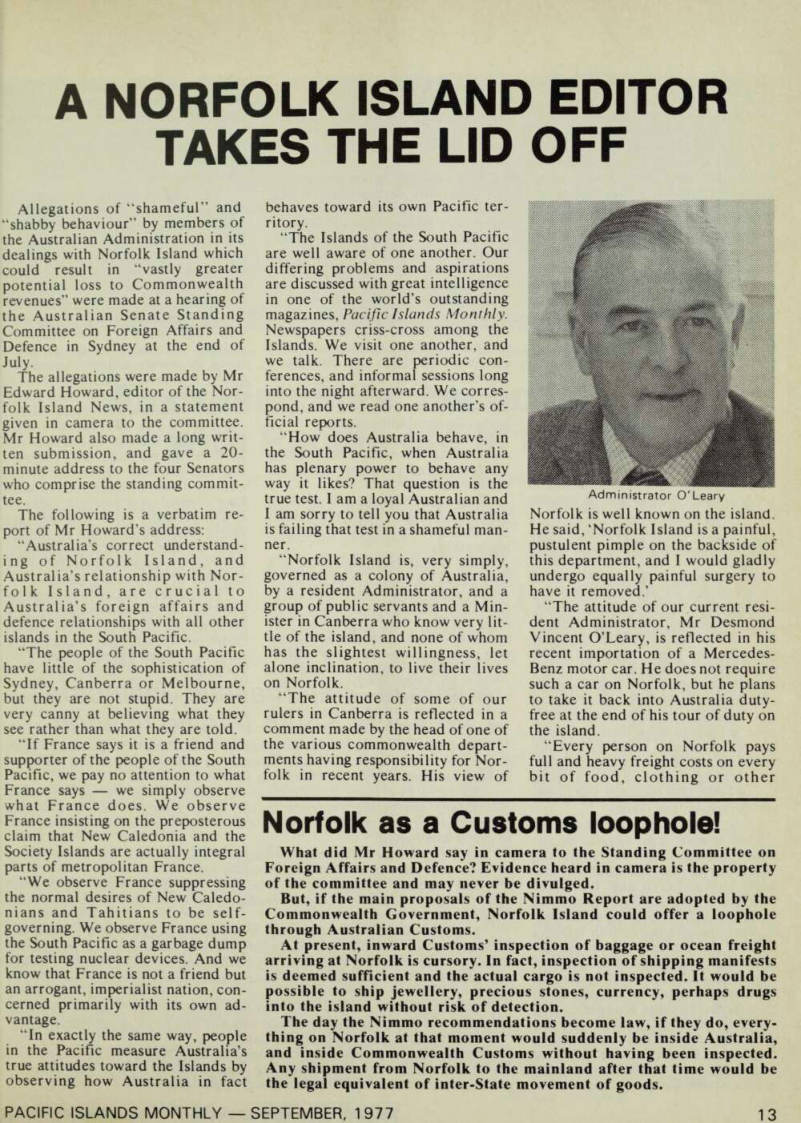
Administrator O'Leary
necessities imported; but the Ad ministrator twice solicited, and finally received, a disguised reduc tion of about 40% in the bill for shipping his Mercedes from Sydney.
It should be noted that the Adminis trator has direct control over many matters that can affect the prof itability of a shipping line serving Norfolk Island.
“On Norfolk, customs duty is our main source of public revenue, amounting to about three times the amount of our yearly $126 000 grant from the Commonwealth.
Even a pensioner pays import duty on a new pair of shoes. But the Ad ministrator evaded the payment of over $1 000 of Norfolk customs duty on his new Mercedes by in forming the Collector of Customs that he was immune from duty, which he is not. It should be noted that the Collector of Customs is an officer directly under the control of the Adminstrator. The evasion of customs duty on Norfolk Island is analogous to the evasion of income tax in Australia.
“On Norfolk everyone pays lighterage charges for anything brought in by sea. The Adminis trator refused to pay $2O-odd of such charges on his new Mercedes not because he is exempt from them, which he is not, but because his word is law on Norfolk Island, and his only supervisors are 2 000 km away in Canberra.
“All of these facts are common knowledge on Norfolk Island, but to my knowledge no one until now has been willing to state them publicly.
To do so would be to risk many kinds of retribution from the Ad ministrator, who has very wide powers affecting the daily life of ev ery person on the Island.
“Far more important than this shabby episode is an unyielding, in sistent pressure not only from the Administrator but from our Depart ment in Canberra and from our Minister, Sen R. G. Withers, to force through a sweeping set of per manent changes in Norfolk Island’s form of government even though more than two-thirds of the electors of the island have solemnly and in dividually declared themselves to be opposed to these changes.
“Individual declarations by the great majority of the island’s elec tors were handed to the Minister last month on Norfolk Island by our senior elected-representative, the
chairman of committees of the ad visory Norfolk Island Council. The Minister said they were ‘totally, completely and utterly valueless’ and he left them behind when he left Norfolk Island.
“The changes being pressed by our governing authorities are con tained in the recommendations of the recent Nimmo Royal Commis sion Report. They would terminate Norfolk Island’s 121-year status as a separate and distinct political enti ty, with its own system of laws, taxes and benefits. Contrary to the ex pressed wish of the great majority of the island’s electors, the Nimmo recommendations would politically integrate Norfolk into mainland Australia just as France so ar rogantly insists that New Caledonia and the Society Islands are integral parts of metropolitan France.
“It is an astonishing fact that no clear, sensible reason for ending Norfolk Island’s separate status has yet been stated.
“Two main reasons are given in the Nimmo Report itself, but neither one of these is capable of withstand
ing scrutiny.
“One is that Norfolk Island is a heavy financial burden on Australia, and that Norfolk, therefore, should have no say in its own future. The logic and the morality of this statement are offen sive to anyone who believes in dem ocratic government and the
financial data on which it is based are partly inaccurate, partly irrele vant and partly sheer imagination.
Norfolk Island is not a heavy finan cial burden on Australia, it never has been, and there is no reason it ever should be.
“The second reason given by the Nimmo Report for terminating Nor folk Island’s separate status is the belief that Australia is obliged to make Norfolk uniform with the mainland because of a recent High Court decision in the Berwick case.
I submit that any competent and un biased legal authority will assure you that the Berwick decision obliges Australia to do no such thing; it merely affirms Australia’s power to establish whatever form of government may appear most sensi ble and effective on Norfolk Island.
“Yet in the statements, the answers to formal questions, the policies, the parliamentary remarks and the personal behaviour of the commonwealth authorities who have control over Norfolk today, it is unmistakably clear that they are relentlessly determined to imple ment the Nimmo recommendations, ignoring the expressed wishes of the majority of the island’s electors.
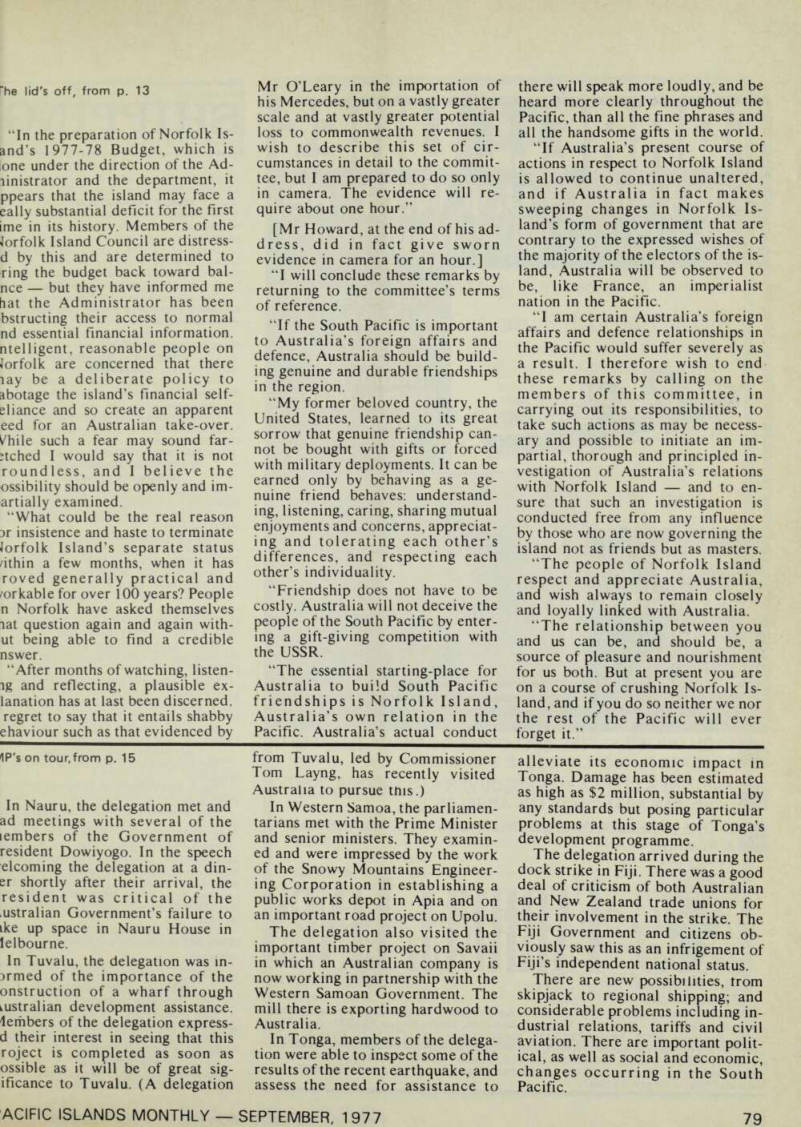
“The most recent and ominous in dication of this determination is a set of events that may reflect a scur rilous policy. I say may because the facts have been obscured and I do not know. Continued on p. 79
“In the preparation of Norfolk Is and’s 1977-78 Budget, which is lone under the direction of the Ad linistrator and the department, it ppears that the island may face a eally substantial deficit for the first ime in its history. Members of the Jorfolk Island Council are distress d by this and are determined to ring the budget back toward bal nce but they have informed me bat the Administrator has been bstructing their access to normal nd essential financial information, ntelligent, reasonable people on Jorfolk are concerned that there lay be a deliberate policy to abotage the island’s financial self eliance and so create an apparent eed for an Australian take-over.
Mile such a fear may sound far- Jtched I would say that it is not roundless, and I believe the ossibility should be openly and im artially examined.
“What could be the real reason ar insistence and haste to terminate Jorfolk Island’s separate status dthin a few months, when it has roved generally practical and workable for over 100 years? People n Norfolk have asked themselves lat question again and again with ut being able to find a credible nswer.
“After months of watching, listen ig and reflecting, a plausible ex lanation has at last been discerned, regret to say that it entails shabby ehaviour such as that evidenced by
Mr O’Leary in the importation of his Mercedes, but on a vastly greater scale and at vastly greater potential loss to commonwealth revenues. I wish to describe this set of cir cumstances in detail to the commit tee, but I am prepared to do so only in camera. The evidence will re quire about one hour.” [Mr Howard, at the end of his ad dress, did in fact give sworn evidence in camera for an hour.] “I will conclude these remarks by returning to the committee’s terms of reference.
“If the South Pacific is important to Australia’s foreign affairs and defence, Australia should be build ing genuine and durable friendships in the region.
“My former beloved country, the United States, learned to its great sorrow that genuine friendship can not be bought with gifts or forced with military deployments. It can be earned only by behaving as a ge nuine friend behaves; understand ing, listening, caring, sharing mutual enjoyments and concerns, appreciat ing and tolerating each other’s differences, and respecting each
other’s individuality.
“Friendship does not have to be costly. Australia will not deceive the people of the South Pacific by enter ing a gift-giving competition with the USSR.
“The essential starting-place for Australia to build South Pacific friendships is Norfolk Island, Australia’s own relation in the Pacific. Australia’s actual conduct
there will speak more loudly, and be heard more clearly throughout the Pacific, than all the fine phrases and all the handsome gifts in the world.
“If Australia’s present course of actions in respect to Norfolk Island is allowed to continue unaltered, and if Australia in fact makes sweeping changes in Norfolk Is land’s form of government that are contrary to the expressed wishes of the majority of the electors of the is land, Australia will be observed to be, like France, an imperialist nation in the Pacific.
“I am certain Australia’s foreign affairs and defence relationships in the Pacific would suffer severely as a result. I therefore wish to end these remarks by calling on the members of this committee, in carrying out its responsibilities, to take such actions as may be necess ary and possible to initiate an im partial, thorough and principled in vestigation of Australia’s relations with Norfolk Island and to en sure that such an investigation is conducted free from any influence by those who are now governing the island not as friends but as masters.
“The people of Norfolk Island respect and appreciate Australia, and wish always to remain closely and loyally linked with Australia.
“The relationship between you and us can be, and should be, a source of pleasure and nourishment for us both. But at present you are on a course of crushing Norfolk Is land, and if you do so neither we nor the rest of the Pacific will ever forget it.”
Norfolk as a Customs loophole!
What did Mr Howard say in camera to the Standing Committee on Foreign Affairs and Defence? Evidence heard in camera is the property of the committee and may never be divulged.
But, if the main proposals of the Nimmo Report are adopted by the Commonwealth Government, Norfolk Island could offer a loophole through Australian Customs.
At present, inward Customs’ inspection of baggage or ocean freight arriving at Norfolk is cursory. In fact, inspection of shipping manifests is deemed sufficient and the actual cargo is not inspected. It would be possible to ship jewellery, precious stones, currency, perhaps drugs into the island without risk of detection.
The day the Nimmo recommendations become law, if they do, every thing on Norfolk at that moment would suddenly be inside Australia, and inside Commonwealth Customs without having been inspected.
Any shipment from Norfolk to the mainland after that time would be the legal equivalent of inter-State movement of goods.
Australia “paternalistic, insincere”
on aid to South Pacific Islands
Australia’s announcement in October, 1976, that it was quadrupling its aid to the South Pacific had been handled in a paternalistic and insincere style, a parliamentary committee was told in Canberra.
Mr Greg Fry, tutor in politics at the Canberra College of Advanced Education, was giving evidence to the inquiry by the Senate Standing Committee on Foreign Affairs and Defence into Australian Commitments to the South Pacific.
Mr Fry criticised Australian policy in the South Pacific as being geared to what were seen as threats to Australian security.
The increase in Australian aid last year had followed on the Russian offer of economic aid to Tonga in exchange for a base for the Soviet fishing fleet, he said.
The approach by the Australian Minister for Industry and Commerce, Senator Robert Cotton, in announcing the increased aid had treated the Islanders like children, with little sophistication, no ability to see through Australian policies and willing to take what amounted to a bribe, Mr Fry said.
This was made worse by the Foreign Minister, Mr Andrew Peacock, claiming that the quadrupling of aid was not linked to the Russian threat.
This was obviously untrue, he said.
Ironically, Australian policy, aimed at achieving good relations with the Islands and thereby promoting Australian security, was actually pushing Australia away from its objective, he said.
Australian MPs’ hectic tour-
Australian MPs’ hectic tourwith Pacific aid in mind
By SENA TOR JOHN KNIGHT, a delegation member
A five-member Australian Parlia mentary delegation made an exten sive tour of the South Pacific region from June 29 to July 20. The delega tion was led by Senator Durack (Lib, WA) and included Senator Bill Brown (ALP, Vic) Senator John Knight (Lib, ACT), Mr Les Johnson (ALP, NSW) and Mr David Thompson (NCP, Qld).
In a hectic and intensive three weeks, the delegation visited 10 countries and territories. This in cluded stopovers for talks with senior administrators and political leaders in the Solomon Islands, Gilbert Islands and Tuvalu.
A visit by the all-party delegation again emphasised Australia’s in creasing awareness of the impor tance of the South Pacific and the rapid changes occurring there.
One impression gained was that Australia’s standing with its South Pacific neighbours is somewhat bet ter than it was around 1970. There are, no doubt, many reasons includ ing the effective and co-operative work of the South Pacific Forum and SPEC and Australia’s new development assistance efforts.
Australia’s growing interest in the South Pacific has been recently demonstrated by the decisions to open new diplomatic posts in the New Hebrides and Western Samoa.
It has also been illustrated by rapidly-increasing development
assistance in recent years. This will total $6O million in the current three-year programme.
This process can be seen, in part at least, as demonstrating a growing awareness of the importance of pro posals for a new international eco nomic order and the growing com plexity of international economic relations.
These factors, together with grow ing interest in the region by a num ber of other countries, including the Soviet Union and China as well as Japan and the United States, has contributed to Australia’s greater involvement in the South Pacific. It is perhaps worth noting that Australia’s closer direct involve ment in regional issues (beyond the SPC) began in the late 1960 s and early 19705, predating the recent greater activity of the Soviet Union and China.
But recent Australian government policies (since about 1970) build on the association which developed from the Canberra Agreement of the 19405; a very different relationship to that which existed before World War 11. But the pace of change is ac celerating and 1970 probably marks as significant a “watershed” as 1947.
During its three-week tour, the delegation visited the headquarters of the South Pacific Commission in Noumea and met senior officials of the organisation.
Perhaps the most significant issue to arise from these talks was that of the skipjack tuna study to be under taken by the South Pacific Commis sion.
Australia has already committed $750 000 to this project and much of the research so far has been car ried out by an Australian, Dr Bob Kearney.
The prospects seem encouraging for the development of skipjack fisheries as a source of substantial wealth to the Island nations of the region. But there are potential prob lems, particularly with such a migratory species, with the likely declaration of 320 km economic zones and the licensing and control of fishing activities by regional and “distant water” fleets, I n the Ne w Hebrides, the delega lion met with leaders of the main political groups including the Vanuaaku Party and the Tan Union, One thing that seems especially important is establishment of a con sulate in Vila as the pace of political change in the New Hebrides in creases. The delegation heard, after i* s visit, of Vanuaaku’s withdrawal from the July Paris talks. There must be growing concern at the ap patently increasing polarisation of political groups in the New Hebrides.
Continued on page 79
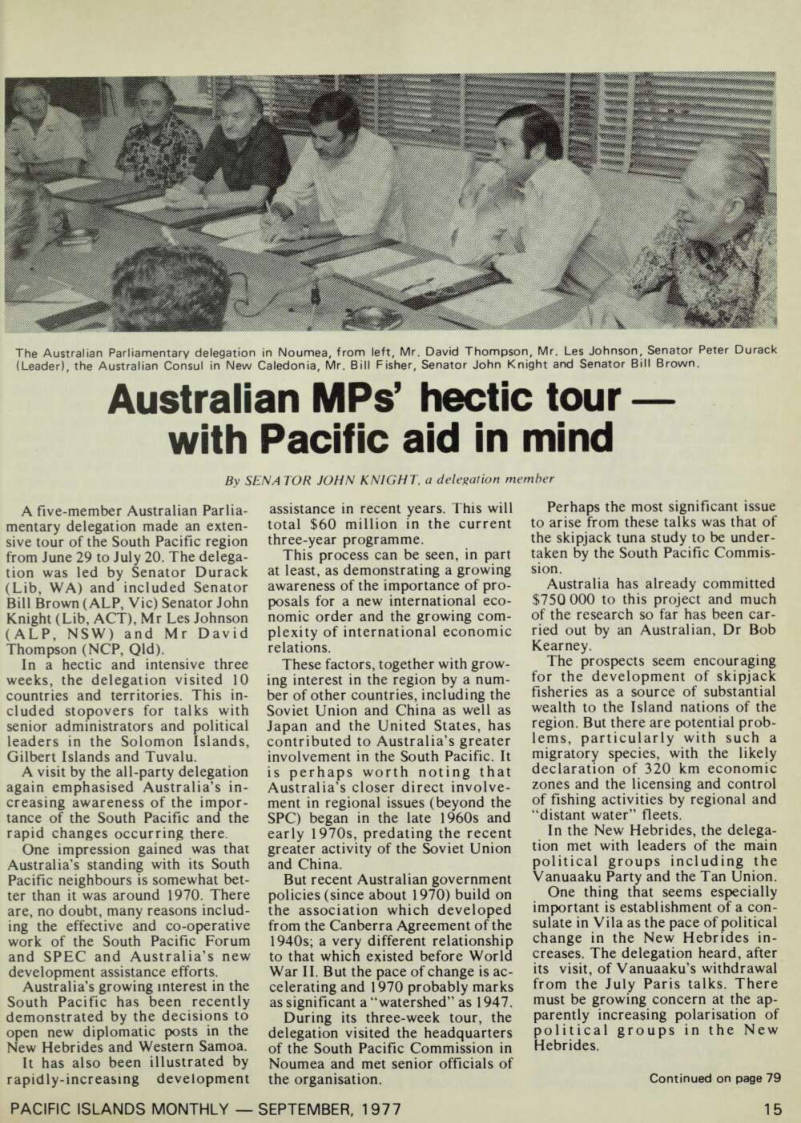
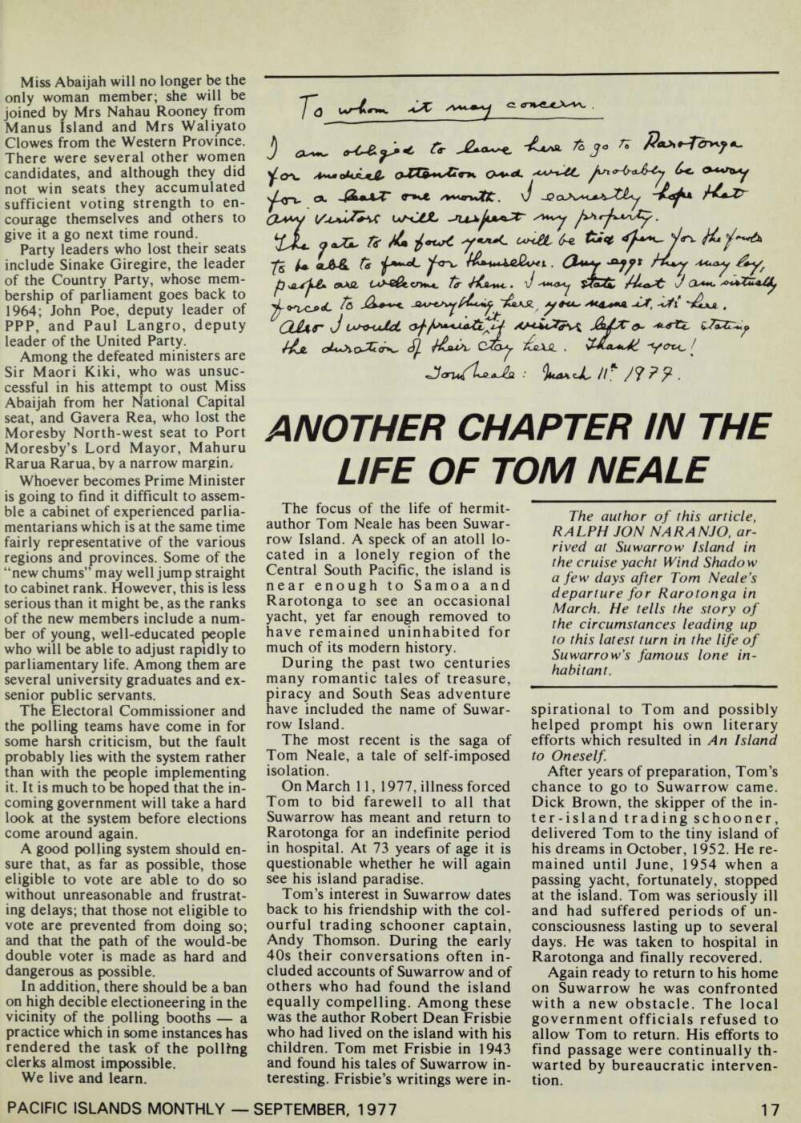
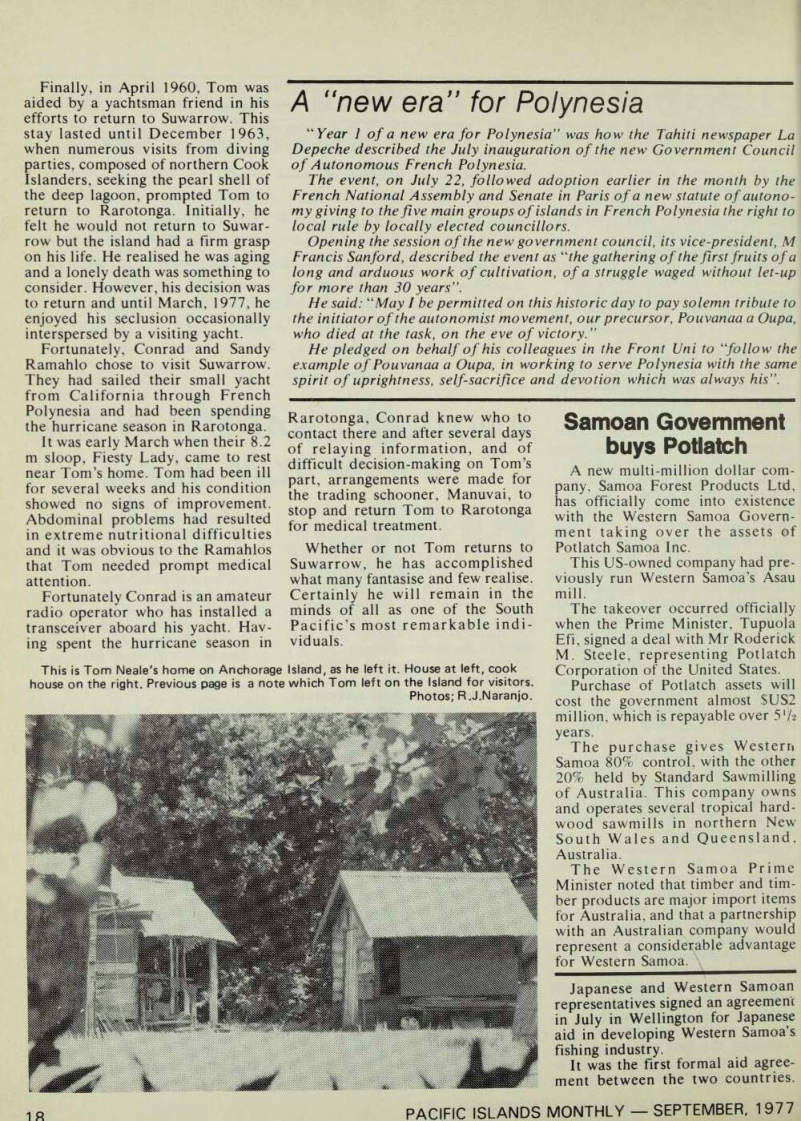
The Australian Parliamentary delegation in Noumea, from left, Mr. David Thompson, Mr. Les Johnson, Senator Peter Durack (Leader), the Australian Consul in New Caledonia, Mr. Bill Fisher, Senator John Knight and Senator Bill Brown.
In Nauru, the delegation met and ad meetings with several of the [embers of the Government of resident Dowiyogo. In the speech elcoming the delegation at a din er shortly after their arrival, the resident was critical of the .ustralian Government’s failure to ike up space in Nauru House in lelbourne.
In Tuvalu, the delegation was in armed of the importance of the onstruction of a wharf through
Australian development assistance,
lerhbers of the delegation express d their interest in seeing that this roject is completed as soon as ossible as it will be of great sig ificance to Tuvalu. (A delegation
from Tuvalu, led by Commissioner Tom Layng, has recently visited Australia to pursue this.) In Western Samoa, the parliamen tarians met with the Prime Minister and senior ministers. They examin ed and were impressed by the work of the Snowy Mountains Engineer ing Corporation in establishing a public works depot in Apia and on an important road project on Upolu.
The delegation also visited the important timber project on Savaii in which an Australian company is now working in partnership with the Western Samoan Government. The mill there is exporting hardwood to Australia.
In Tonga, members of the delega tion were able to inspect some of the results of the recent earthquake, and assess the need for assistance to
alleviate its economic impact in Tonga. Damage has been estimated as high as $2 million, substantial by any standards but posing particular problems at this stage of Tonga’s
development programme.
The delegation arrived during the dock strike in Fiji. There was a good deal of criticism of both Australian and New Zealand trade unions for their involvement in the strike. The Fiji Government and citizens ob viously saw this as an infrigement of Fiji’s independent national status.
There are new possibilities, trom skipjack to regional shipping; and considerable problems including in dustrial relations, tariffs and civil aviation. There are important polit ical, as well as social and economic, changes occurring in the South Pacific.
Png’S Elections: A Cliffhanger
And A Lesson For The Future
By Percy Chatterton
Papua New Guinea has just held its first national elections since in dependence. In 1975, the Constitu tion decreed that the legislature should, in future, be known as the National Parliament, but no im mediate arrangements were made for elections. Instead, the pre independence House of Assembly underwent a name change, and became the National Parliament for the remainder of its term of office.
Nation-wide elections were held in June and July, following a lively, but, in the main, good-tempered campaign, in which nearly 900 can didates nominated for the 109 seats.
The number of candidates con testing each seat varied from two to 21. Voting was on the first-past-the post system, in contrast to previous elections, in which a modified form of the Australian preference system was adopted.
Voting in one electorate had to be postponed due to the death of one of the candidates in a road accident, so that the polling,which took place between June 18 and July 9, was for 108 of the 109 seats. The lengthy period of voting is made necessary by Papua New Guinea’s rugged ter rain and scattered population; poll ing teams have to travel strenuously from village to village collecting the votes.
A characteristic of Papua New Guinea’s elections is the confidence of the contenders, both individuals and parties. In one electorate, two of the candidates arranged “victo ry” parties before the vote-counting started.
As many of the candidates cam paign as “independents” and decide later, if they are elected, which par ty they will join, the shape of our new parliament will not be com pletely known till it holds its first meeting, in August, to elect a Speaker and a Prime Minister. Until the crucial vote for the Prime Minis tership is taken, no one can be quite sure which way the cat is going to jump.
The main contending parties are the Pangu Pati, the People’s Progress Party and the United Party.
Roughly these may be regarded as
being left, centre and right respec tively in the political spectrum, but the differences in their policies are very slight indeed. In addition, there are several smaller groups and, as I have said, a number of “in dependents”.
At the conclusion of counting, the score board stood as follows; Pangu Pati (endorsed) 30 Peoples Progress Party (en dorsed) 16 United Party (endorsed)... 23 Papua Besena (endorsed)... 5 Mataungan Association 3 Country Party 2 National Party 2 Independent (ie not officially endorsed by any party) 27 108 Immediately a battle began for the hearts and minds of the minor groups and the “independent”, or, as I would prefer to call them, “un committed”,members.
At first it looked as if it would be a case of “the mixture as before”, in other words, that the Pangu-PPP Coalition which has governed the country since 1972 would be able to secure the allegiance of enough un committed members to win the cru cial vote for the Prime Ministership.
However, the United Party was not prepared to concede defeat. “I can get 60 votes,” declared Michael Somare. “We can get 56,” replied UP leader, Sir Tei Abal. Clearly so meone was counting his chickens before they were hatched.
Most observers, including myself, thought that it was a foregone con clusion; the United Party hadn’t a hope, we decided. Then came the big surprise.
Among the uncommitted mem bers was Sir John Guise, our erst while Governor-General, who re cently resigned from that exalted position in order to re-enter the po litical arena, and who had secured a run-away victory in his Milne Bay Provincial electorate.
The United Party, declared Sir Tei, would nominate Sir John as Prime Minister, and form a “Na tional Alliance” of the United Party and such minor groups and uncom
mined members as wished to join it.
Sir John, if successful in securing the Prime Ministership, would form an Alliance government in which he (Sir Tei) would be Deputy Prime Minister.
This spectacular move threw the whole issue back into the melting pot.
At the same time a move was afoot for the formation of another kind of alliance. This move, instigated by those stormy petrels of the New Guinea Islands, Father John Momis and Mr John Kaputin, was a call to those members, who shared their view that party politics is a colonial hangover not appropriate to Papua New Guinea, to join them in opposi tion to all parties and in seeking to replace them by regional and special interest groups.
Ideologically, this stance should appeal to Miss Abaijah, who has al ways claimed that Papua Besena is not a party. In the meantime, it looks as if the Momis-Kaputin alliance will support the Guise-Abal alliance in trying to outnumber and defeat the Pangu-PPP coalition.
With 2V2 weeks still to go before the chips go down, anything could happen. But it does look at the mo ment as if the Pangu-PPP team will have the numbers. However, the possibility that things might go the other way cannot be ruled out. This is, of course, very worrying to those “independents” who want to make sure that they are on the winning side. A newly-elected Highlands member, when asked which party he was going to join, replied that he would join whichever party became the government, because in that way he would have a better chance of getting things for his electorate. He’s not the only one, though he was a lit tle more outspoken than the rest.
One thing’s for sure. Whoever is elected to the Speaker’s chair will look out over a sea of new faces. An exceptionally-large number of sit ting members, including nine minis ters, have suffered defeat, being replaced in some cases by new in cumbents and in others by pre-1972 parliamentarians who have staged a come back, continued over
Miss Abaijah will no longer be the only woman member; she will be joined by Mrs Nahau Rooney from Manus Island and Mrs Waliyato Clowes from the Western Province.
There were several other women candidates, and although they did not win seats they accumulated sufficient voting strength to en courage themselves and others to give it a go next time round.
Party leaders who lost their seats include Sinake Giregire, the leader of the Country Party, whose mem bership of parliament goes back to 1964; John Poe, deputy leader of PPP, and Paul Langro, deputy leader of the United Party.
Among the defeated ministers are Sir Maori Kiki, who was unsuc cessful in his attempt to oust Miss Abaijah from her National Capital seat, and Gavera Rea, who lost the Moresby North-west seat to Port Moresby’s Lord Mayor, Mahuru Rarua Rarua, by a narrow margin.
Whoever becomes Prime Minister is going to find it difficult to assem ble a cabinet of experienced parlia mentarians which is at the same time fairly representative of the various regions and provinces. Some of the “new chums’’ may well jump straight to cabinet rank. However, this is less serious than it might be, as the ranks of the new members include a num ber of young, well-educated people who will be able to adjust rapidly to parliamentary life. Among them are several university graduates and ex senior public servants.
The Electoral Commissioner and the polling teams have come in for some harsh criticism, but the fault probably lies with the system rather than with the people implementing it. It is much to be hoped that the in coming government will take a hard look at the system before elections come around again.
A good polling system should en sure that, as far as possible, those eligible to vote are able to do so without unreasonable and frustrat ing delays; that those not eligible to vote are prevented from doing so; and that the path of the would-be double voter is made as hard and dangerous as possible.
In addition, there should be a ban on high decible electioneering in the vicinity of the polling booths a practice which in some instances has rendered the task of the polling clerks almost impossible.
We live and learn.
Another Chapter In The
Life Of Tom Neale
The focus of the life of hermit author Tom Neale has been Suwar row Island. A speck of an atoll lo cated in a lonely region of the Central South Pacific, the island is near enough to Samoa and Rarotonga to see an occasional yacht, yet far enough removed to have remained uninhabited for much of its modern history.
During the past two centuries many romantic tales of treasure, piracy and South Seas adventure have included the name of Suwar row Island.
The most recent is the saga of Tom Neale, a tale of self-imposed isolation.
On March 11, 1977, illness forced Tom to bid farewell to all that Suwarrow has meant and return to Rarotonga for an indefinite period in hospital. At 73 years of age it is questionable whether he will again see his island paradise.
Tom’s interest in Suwarrow dates back to his friendship with the col ourful trading schooner captain, Andy Thomson. During the early 40s their conversations often in cluded accounts of Suwarrow and of others who had found the island equally compelling. Among these was the author Robert Dean Frisbie who had lived on the island with his children. Tom met Frisbie in 1943 and found his tales of Suwarrow in teresting. Frisbie’s writings were in-
The author of this article,
Ralph Jon Naranjo, Ar
rived at Suwarrow Island in the cruise yacht Wind Shadow a few days after Tom Neale's departure for Rarotonga in March. He tells the story of the circumstances leading up to this latest turn in the life of Suwarrow's famous lone in habitant.
spirational to Tom and possibly helped prompt his own literary efforts which resulted in An Island to Oneself.
After years of preparation, Tom’s chance to go to Suwarrow came.
Dick Brown, the skipper of the in ter-island trading schooner, delivered Tom to the tiny island of his dreams in October, 1952. He re mained until June, 1954 when a passing yacht, fortunately, stopped at the island. Tom was seriously ill and had suffered periods of un consciousness lasting up to several days. He was taken to hospital in
Rarotonga and finally recovered.
Again ready to return to his home on Suwarrow he was confronted with a new obstacle. The local government officials refused to allow Tom to return. His efforts to find passage were continually th warted by bureaucratic interven tion.
Finally, in April 1960, Tom was aided by a yachtsman friend in his efforts to return to Suwarrow. This stay lasted until December 1963, when numerous visits from diving parties, composed of northern Cook Islanders, seeking the pearl shell of the deep lagoon, prompted Tom to return to Rarotonga. Initially, he felt he would not return to Suwar row but the island had a firm grasp on his life. He realised he was aging and a lonely death was something to consider. However, his decision was to return and until March, 1977, he enjoyed his seclusion occasionally interspersed by a visiting yacht.
Fortunately, Conrad and Sandy Ramahlo chose to visit Suwarrow.
They had sailed their small yacht from California through French Polynesia and had been spending the hurricane season in Rarotonga.
It was early March when their 8.2 m sloop, Fiesty Lady, came to rest near Tom’s home. Tom had been ill for several weeks and his condition showed no signs of improvement.
Abdominal problems had resulted in extreme nutritional difficulties and it was obvious to the Ramahlos that Tom needed prompt medical attention.
Fortunately Conrad is an amateur radio operator who has installed a transceiver aboard his yacht. Hav ing spent the hurricane season in
Rarotonga, Conrad knew who to contact there and after several days of relaying information, and of difficult decision-making on Tom’s part, arrangements were made for the trading schooner, Manuvai, to stop and return Tom to Rarotonga for medical treatment.
Whether or not Tom returns to Suwarrow, he has accomplished what many fantasise and few realise.
Certainly he will remain in the minds of all as one of the South Pacific’s most remarkable indi viduals.
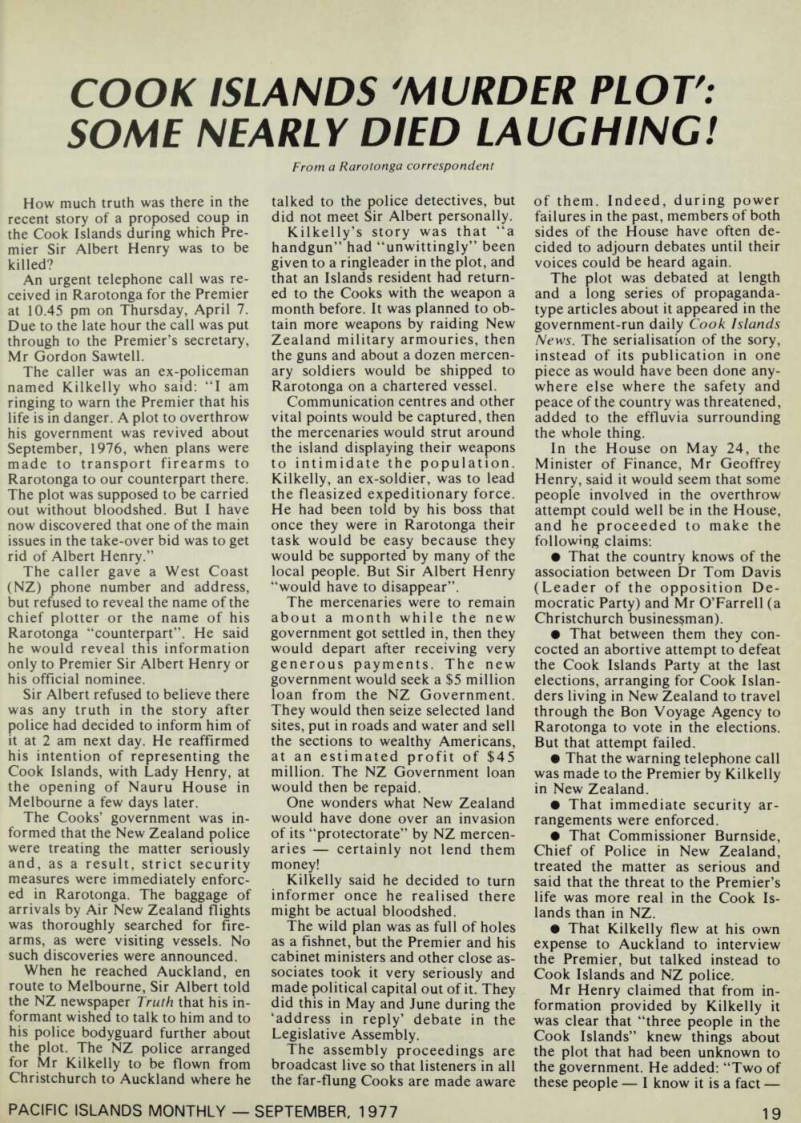
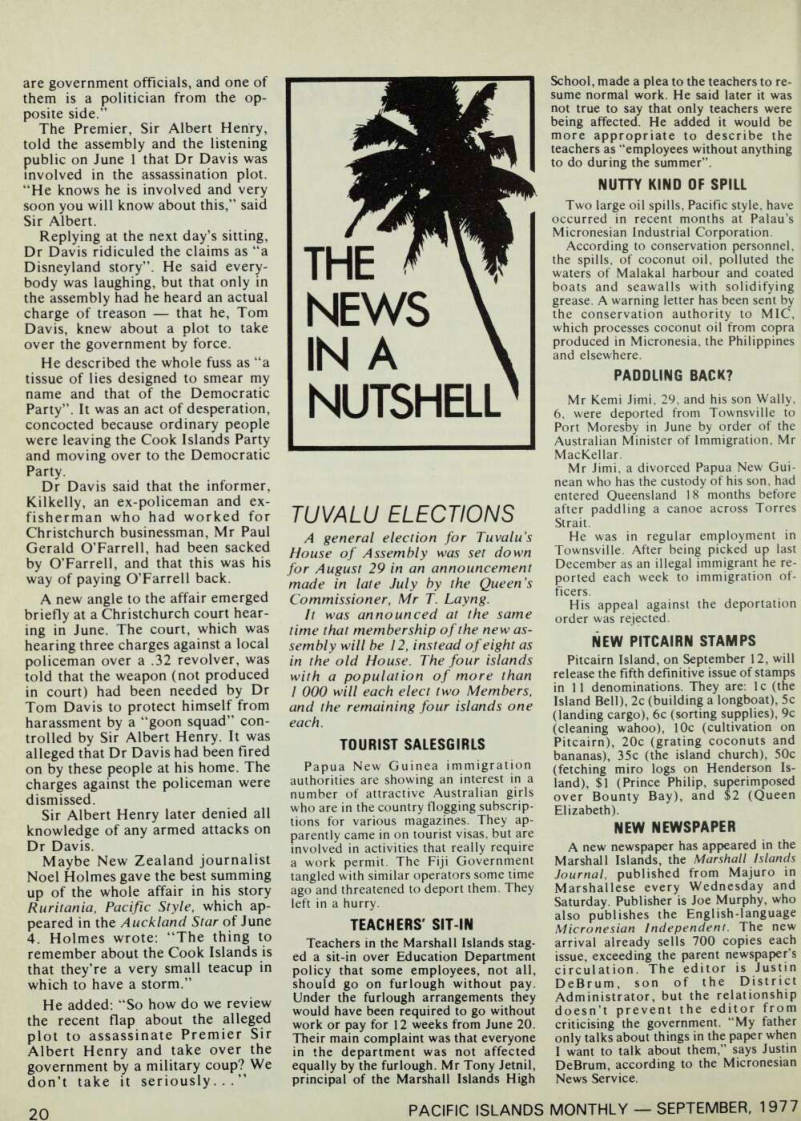
This is Tom Neale's home on Anchorage Island, as he left it. House at left, cook house on the right. Previous page is a note which Tom left on the Island for visitors.
Photos; R.J. Naranjo.
A “new era" for Polynesia
“ Year 1 of a new era for Polynesia” was how the Tahiti newspaper La Depeche described the July inauguration of the new Government Council of Autonomous French Polynesia.
The event, on July 22, followed adoption earlier in the month by the French National Assembly and Senate in Paris of a new statute of autono my giving to the five main groups of islands in French Polynesia the right to local rule by locally elected councillors.
Opening the session of the new government council, its vice-president, M Francis Sanford, described the event as “the gathering of the first fruits of a long and arduous work of cultivation, of a struggle waged without let-up for more than 30 years”.
He said: “May I be permitted on this historic day to pay solemn tribute to the initiator of the autonomist movement, our precursor, Pouvanaa a Oupa, who died at the task, on the eve of victory.”
He pledged on behalf of his colleagues in the Front Uni to ‘follow the example of Pouvanaa a Oupa, in working to serve Polynesia with the same spirit of uprightness, self-sacrifice and devotion which was always his”.
buys Potlatch
Samoan Government buys Potlatch
A new multi-million dollar com pany, Samoa Forest Products Ltd, has officially come into existence with the Western Samoa Govern ment taking over the assets of Potlatch Samoa Inc.
This US-owned company had pre viously run Western Samoa’s Asau mill.
The takeover occurred officially when the Prime Minister, Tupuola Efi, signed a deal with Mr Roderick M. Steele, representing Potlatch Corporation of the United States.
Purchase of Potlatch assets will cost the government almost SUS 2 million, which is repayable over 5 7* years.
The purchase gives Western Samoa 80% control, with the other 20% held by Standard Sawmilling of Australia. This company owns and operates several tropical hard wood sawmills in northern New South Wales and Queensland, Australia.
The Western Samoa Prime Minister noted that timber and tim ber products are major import items for Australia, and that a partnership with an Australian company would represent a considerable advantage for Western Samoa.
Japanese and Western Samoan representatives signed an agreement in July in Wellington for Japanese aid in developing Western Samoa s fishing industry.
It was the first formal aid agree ment between the two countries.
Cook Islands 'Murder Plot':
Some Nearly Died Laughing!
From a Rarotonga correspondent
How much truth was there in the recent story of a proposed coup in the Cook Islands during which Pre mier Sir Albert Henry was to be killed?
An urgent telephone call was re ceived in Rarotonga for the Premier at 10.45 pm on Thursday, April 7.
Due to the late hour the call was put through to the Premier’s secretary, Mr Gordon Sawtell.
The caller was an ex-policeman named Kilkelly who said: “I am ringing to warn the Premier that his life is in danger. A plot to overthrow his government was revived about September, 1976, when plans were made to transport firearms to Rarotonga to our counterpart there.
The plot was supposed to be carried out without bloodshed. But I have now discovered that one of the main issues in the take-over bid was to get rid of Albert Henry.”
The caller gave a West Coast (NZ) phone number and address, but refused to reveal the name of the chief plotter or the name of his Rarotonga “counterpart”. He said he would reveal this information only to Premier Sir Albert Henry or his official nominee.
Sir Albert refused to believe there was any truth in the story after police had decided to inform him of it at 2 am next day. He reaffirmed his intention of representing the Cook Islands, with Lady Henry, at the opening of Nauru House in Melbourne a few days later.
The Cooks’ government was in formed that the New Zealand police were treating the matter seriously and, as a result, strict security measures were immediately enforc ed in Rarotonga. The baggage of arrivals by Air New Zealand flights was thoroughly searched for fire arms, as were visiting vessels. No such discoveries were announced.
When he reached Auckland, en route to Melbourne, Sir Albert told the NZ newspaper Truth that his in formant wished to talk to him and to his police bodyguard further about the plot. The NZ police arranged for Mr Kilkelly to be flown from Christchurch to Auckland where he
talked to the police detectives, but did not meet Sir Albert personally.
Kilkelly’s story was that “a handgun” had “unwittingly” been given to a ringleader in the plot, and that an Islands resident had return ed to the Cooks with the weapon a month before. It was planned to ob tain more weapons by raiding New Zealand military armouries, then the guns and about a dozen mercen ary soldiers would be shipped to Rarotonga on a chartered vessel.
Communication centres and other vital points would be captured, then the mercenaries would strut around the island displaying their weapons to intimidate the population.
Kilkelly, an ex-soldier, was to lead the fleasized expeditionary force.
He had been told by his boss that once they were in Rarotonga their task would be easy because they would be supported by many of the local people. But Sir Albert Henry “would have to disappear”.
The mercenaries were to remain about a month while the new government got settled in, then they would depart after receiving very generous payments. The new government would seek a $5 million loan from the NZ Government.
They would then seize selected land sites, put in roads and water and sell the sections to wealthy Americans, at an estimated profit of $45 million. The NZ Government loan would then be repaid.
One wonders what New Zealand would have done over an invasion of its “protectorate” by NZ mercen aries certainly not lend them money!
Kilkelly said he decided to turn informer once he realised there might be actual bloodshed.
The wild plan was as full of holes as a fishnet, but the Premier and his cabinet ministers and other close as sociates took it very seriously and made political capital out of it. They did this in May and June during the ‘address in reply’ debate in the Legislative Assembly.
The assembly proceedings are broadcast live so that listeners in all the far-flung Cooks are made aware
of them. Indeed, during power failures in the past, members of both sides of the House have often de cided to adjourn debates until their voices could be heard again.
The plot was debated at length and a long series of propaganda type articles about it appeared in the government-run daily Cook Islands News. The serialisation of the sory, instead of its publication in one piece as would have been done any where else where the safety and peace of the country was threatened, added to the effluvia surrounding the whole thing.
In the House on May 24, the Minister of Finance, Mr Geoffrey Henry, said it would seem that some people involved in the overthrow attempt could well be in the House, and he proceeded to make the following claims; • That the country knows of the association between Dr Tom Davis (Leader of the opposition De mocratic Party) and Mr O’Farrell (a Christchurch businessman). • That between them they con cocted an abortive attempt to defeat the Cook Islands Party at the last elections, arranging for Cook Islan ders living in New Zealand to travel through the Bon Voyage Agency to Rarotonga to vote in the elections.
But that attempt failed. • That the warning telephone call was made to the Premier by Kilkelly in New Zealand. • That immediate security ar rangements were enforced. • That Commissioner Burnside, Chief of Police in New Zealand, treated the matter as serious and said that the threat to the Premier’s life was more real in the Cook Is lands than in NZ. • That Kilkelly flew at his own expense to Auckland to interview the Premier, but talked instead to Cook Islands and NZ police, Mr Henry claimed that from in formation provided by Kilkelly it was clear that “three people in the Cook Islands” knew things about the plot that had been unknown to the government. He added; “Two of these people I know it is a fact
are government officials, and one of them is a politician from the op posite side.”
The Premier, Sir Albert Henry, told the assembly and the listening public on June 1 that Dr Davis was involved in the assassination plot.
“He knows he is involved and very soon you will know about this,” said Sir Albert.
Replying at the next day’s sitting, Dr Davis ridiculed the claims as “a Disneyland story”. He said every body was laughing, but that only in the assembly had he heard an actual charge of treason that he, Tom Davis, knew about a plot to take over the government by force.
He described the whole fuss as “a tissue of lies designed to smear my name and that of the Democratic Party”. It was an act of desperation, concocted because ordinary people were leaving the Cook Islands Party and moving over to the Democratic Party.
Dr Davis said that the informer, Kilkelly, an ex-policeman and ex fisherman who had worked for Christchurch businessman, Mr Paul Gerald O’Farrell, had been sacked by O’Farrell, and that this was his way of paying O’Farrell back.
A new angle to the affair emerged briefly at a Christchurch court hear ing in June. The court, which was hearing three charges against a local policeman over a .32 revolver, was told that the weapon (not produced in court) had been needed by Dr Tom Davis to protect himself from harassment by a “goon squad” con trolled by Sir Albert Henry. It was alleged that Dr Davis had been fired on by these people at his home. The charges against the policeman were dismissed.
Sir Albert Henry later denied all knowledge of any armed attacks on Dr Davis.
Maybe New Zealand journalist Noel Holmes gave the best summing up of the whole affair in his story Ruritania, Pacific Style, which ap peared in the Auckland Star of June 4. Holmes wrote: “The thing to remember about the Cook Islands is that they’re a very small teacup in which to have a storm.”
He added; “So how do we review the recent flap about the alleged plot to assassinate Premier Sir Albert Henry and take over the government by a military coup? We don’t take it seriously...”
Nutshell
The
News
In A
Nutshell
Tuvalu Elections
A general election for Tuvalu’s House of Assembly was set down for August 29 in an announcement made in late July by the Queen’s Commissioner, Mr T. Layng.
It was announced at the same time that membership of the new as sembly will be 12, instead of eight as in the old House. The four islands with a population of more than I 000 will each elect two Members, and the remaining four islands one each.
Tourist Salesgirls
Papua New Guinea immigration authorities are showing an interest in a number of attractive Australian girls who are in the country flogging subscrip tions for various magazines. They ap parently came in on tourist visas, but are involved in activities that really require a work permit. The Fiji Government tangled with similar operators some time ago and threatened to deport them. They left in a hurry.
Teachers' Sit-In
Teachers in the Marshall Islands stag ed a sit-in over Education Department policy that some employees, not all, should go on furlough without pay.
Under the furlough arrangements they would have been required to go without work or pay for 12 weeks from June 20.
Their main complaint was that everyone in the department was not affected equally by the furlough. Mr Tony Jetnil, principal of the Marshall Islands High
School, made a plea to the teachers to re sume normal work. He said later it was not true to say that only teachers were being affected. He added it would be more appropriate to describe the teachers as “employees without anything to do during the summer”.
Nutty Kind Of Spill
Two large oil spills, Pacific style, have occurred in recent months at Palau’s Micronesian Industrial Corporation.
According to conservation personnel,
the spills, of coconut oil, polluted the waters of Malakal harbour and coated boats and seawalls with solidifying grease. A warning letter has been sent by the conservation authority to MIC, which processes coconut oil from copra produced in Micronesia, the Philippines and elsewhere.
Paddling Back?
Mr Kemi Jimi, 29, and his son Wally, 6, were deported from Townsville to Port Moresby in June by order of the Australian Minister of Immigration. Mr MacKellar.
Mr Jimi, a divorced Papua New Gui nean who has the custody of his son, had entered Queensland 18 months before after paddling a canoe across Torres Strait.
He was in regular employment in Townsville. After being picked up last December as an illegal immigrant he re ported each week to immigration of ficers.
His appeal against the deportation order was rejected.
New Pitcairn Stamps
Pitcairn Island, on September 12, will release the fifth definitive issue of stamps in 11 denominations. They are: 1c (the Island Bell), 2c (building a longboat), 5c (landing cargo), 6c (sorting supplies), 9c (cleaning wahoo), 10c (cultivation on Pitcairn), 20c (grating coconuts and bananas), 35c (the island church), 50c (fetching miro logs on Henderson Is land), $1 (Prince Philip, superimposed over Bounty Bay), and $2 (Queen Elizabeth).
New Newspaper
A new newspaper has appeared in the Marshall Islands, the Marshall Islands Journal, published from Majuro in Marshallese every Wednesday and Saturday. Publisher is Joe Murphy, who
also publishes the English-language
Micronesian Independent. The new arrival already sells 700 copies each issue, exceeding the parent newspaper’s circulation. The editor is Justin Deßrum, son of the District Administrator, but the relationship doesn’t prevent the editor from criticising the government. “My father only talks about things in the paper when I want to talk about them,” says Justin Deßrum, according to the Micronesian News Service.
Square Eyes' In Samoa
Television remains extremely popular
with the people of American Samoa. Ac cording to latest estimates there are be tween 5 000 and 6 000 sets in use in pri vate homes. About 20% are colour sets.
Television is considered the major source of entertainment for the 30 000 people who live in American Samoa. The American Samoa administration con siders that there is probably no other
community anywhere under the US flag
where non-commercial public TV plays such a vital role as it does in American Samoa. It was introduced by Governor H. Rex Lee in the 1960 s as a teaching aid in the schools. Their brothers across the water in Western Samoa, who have TV sets, are also thankful for the free enter tainment.
Water Strike!
The people of Rotuma in Fiji will no longer have to rely on coconuts and rain water for drinking and washing. The mineral resources division of the Lands and Mineral Resources Department, which had been digging for underground water since the beginning of 1977, struck water at 37.19 m. Early estimates were that the source would give about 15 000 litres an hour. Rotuma has a population of about 3 500. The drilling team has since transferred its activities to another part of Rotuma.
Water Shortage!
Although Lautoka is on the “dry” side of Fiji’s main island of Viti Levu it has an annual rainfall of 1 800 mm (about 72 in). Yet that is insufficient to sustain the growth of a centre which recently
became a city. Most major development
projects have been frozen for at least the next five years because there will not be enough water for new factories, hotels or housing estates. In 1976, Lautoka used all the water which came into the city re servoir. In about 12 months there will be some easing of the situation when a new 1 1 000 metre pipeline is built into the system. But the main project, a dam on the Magodro plateau, is not expected to supply water before 1983 at the earliest.
This dam will be the biggest engineering project in Fiji and will cost $4O million to $5O million. Lautoka’s average water consumption is about 8.64 million litres (1.9 million gallons) a year. As the in take is only about 9.1 million litres (about 2 million gallons) it is next to im possible to build up a reserve supply.
Law On Tribal Fights
A Papua New Guinea magistrate, Mr M. Mackellar, has urged a whole new approach to tribal fighting in the PNG Highlands, “without reference to the in troduced law”. Speaking in the Mount Hagen court in July Mr Mackellar said.
“The whole tribal fighting control problem derives from the complete ab sence of any meaningful laws on the sub
ject.
“The origin of all our introduced laws
lies deep in the common law of England.
Yet tribal fighting had ended in England long before the common law was formu lated there. There is therefore no point in looking into common law precedent, practice or procedures to find the answer to tribal fighting in the Highlands, or the role police should play during tribal fights.”
Speakers Meet
Western Samoa in June hosted a meet ing of Speakers and other officials from Pacific Parliaments. They were the Com monwealth of Australia, the Cook Is lands, Fiji, Nauru, New South Wales, New Zealand, Northern Territory, Papua New Guinea, Queensland, South Australia, Tasmania, Tuvalu, Victoria, Western Australia and Western Samoa.
The 12 papers on the agenda included one on “Bribery and Corruption in Parliamentary Affairs” and another on “Freedom of Speech in Parliament; The Effectiveness of Checks Against its Abuses”.
Dogs Drugged
Just four months after its opening, Guam’s greyhound racing track is embroiled in a dog-drugging scandal. On at least three occasions in February and April, dogs were given valium, a depres sant, at the track, according to laborato ry examinations of urine specimens, Guam Greyhound, Inc. president Norm Smith admitted at a committee hearing of the Guam Legislature. And two dogs were scratched from a June 17 race when they became suspiciously ill before race time, he said. Mr Smith, an Australian who has managed tracks in Australia, Macao and Jakarta before coming to Guam, said he fired two kennel boys he suspected in the druggings. But he said it would be almost impossible to prove who the culprits were unless they were actually caught in the act. Following the disclosure, Guam Attorney-General Don Parkinson called for a full police investigation of the incidents, and also recommended that Guam tax investiga tors look into “rumours” that the track may not be fully complying with tax laws.
Nz Helps Usp
The New Zealand Government has agreed to help build a hall of residence for the University of the South Pacific in Fiji. The building, due to be completed early in 1979. will house I 50 students in a multi-storey block of 81 bedrooms with bathrooms and laundry facilities and single blocks containing a total of 61 bedrooms plus six self-contained units tor married quarters. The project will be funded from the regional element of New Zealand's Pacific bilateral aid programme.
Cowed By Quake
People in the Vaivase area of Western Samoa’s capital, Apia, had good warning of the quake which hit the town early in the morning of June 22. A local cow
bellowed and paced around in great agitation for hours before the quake hit.
Like most animals, she could sense it was on its way. No damage was reported.
Nz Sappers Aid Fiji
Sixty Royal New Zealand Army engineers put their training to practical use in Fiji when they undertook to com plete four projects in 14 days in Namosi province in Fiji. The sappers had been on a jungle training course in Fiji. The projects were construction of a dam and water reticulation for Nabukavesi village, a rural nursing station at Waivaka and foot bridges at Mau and Navua. The Fiji Government supplied the materials. Three helicopters were used, one to carry the men to the con struction sites and the others to take in material. If the sappers had had to walk through the thick jungle the time re quired for their work would have been much longer than 14 days. On the other side of Viti Levu, at Natutu. Ba 43 men from the Royal Fiji Military Forces built three footbridges. One of these replaced a 230 mm wide single wooden plank, which caused Colonel Paul Manueli. commander of the RFMF to say of the villagers, “They must have had to do a pretty good balancing act not to fall in the river”.
Russia Accuses U S.
The June hearings of the United Na tions Trusteeship Council in New York heard charges by Soviet delegates that the US was turning the islands of Micronesia into “an American military and strategic base”. The Soviets claimed that the US was planning to build by 1982 an airport, seaport and a head quarter’s base housing 3 000 US military personnel on Tinian Island.
Responding. US representative Erwin D. Canham said: “There is not a single military person stationed on Tinian.
There is not a single piece of military equipment or installation on Tinian or elsewhere in the Northern Marianas.”
Mr Canham admitted that the US had the right to retain a portion of land on Tinian for possible defence purposes, and several pieces of land on Saipan
similarly.
But he said there were no proposals in the Defence Department budget for the years immediately ahead to make use of any of these rights.
What! A Price Drop
Tonga electricity consumers were
given advance notice in June of an unex pected cut of 4% in the price of power from August 15 for Tongatapu and from August 31 for Vavau. The act of generosity by the Tonga Electric Power Board followed a recent decision by the Privy Council to exempt the board from paying customs duty on fuel and lubricating oils. Had the exemption not been granted the board would have been up lor P2l 000 in customs duty.
Advertisements & other items, p. 22 (1 item)
Travelodge
soon for Port Moresby.
i fl % I am d Port Moresby, Papua New Guinea's bustling capital, will soon boast a spectacular new Travelodge tri-arc hotel on a superb hillside location in the middle of the city. The 189-room property will offer guests panoramic views of the magnificent harbour and a full range of facilities including convention rooms. In July 1978, Travelodge will be proud to open the first truly international standard hotel in this exciting new nation.
For further information write to the manager, Travelodge, ANG House, Hunter Street, Port Moresby, Papua New Guinea. Or phone 21 4798
'RMfmoeE
South Radf ic AUSTRALIA • NEW ZEALAND • FIJI • TAHITI • PAPUA NEW GUINEA • INDONESIA • NEW CALEDONIA
‘ T LG 3208
When Some Fools Stepped In-
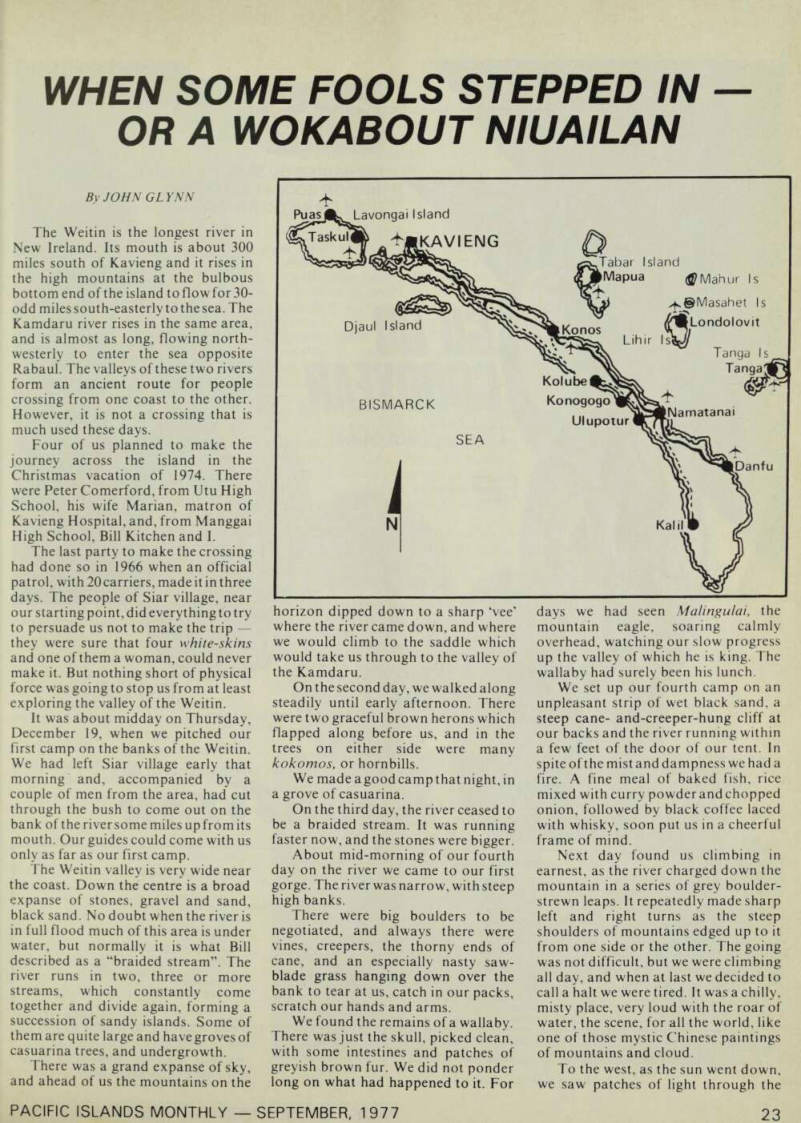

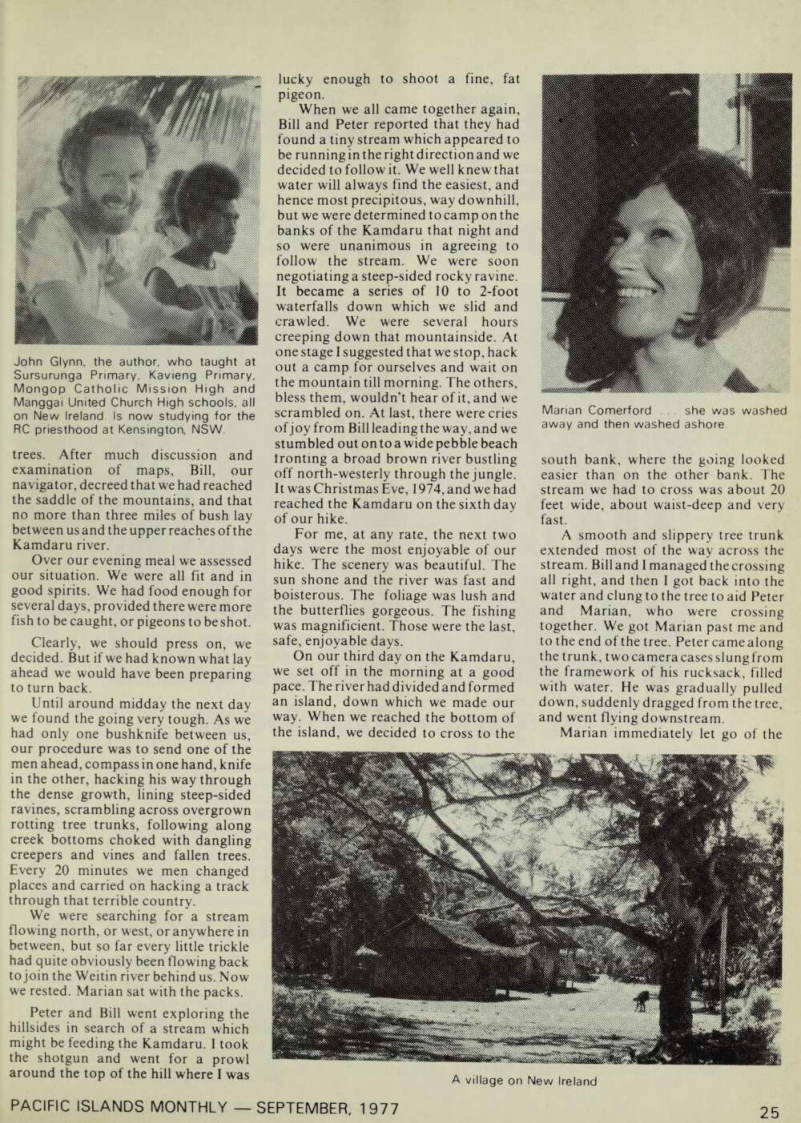

Or A Wokabout Niuailan
By John Glynn
The Weitin is the longest river in New Ireland. Its mouth is about 300 miles south of Kavieng and it rises in the high mountains at the bulbous bottom end of the island to flowfor 30odd miles south-easterly to the sea. The Kamdaru river rises in the same area, and is almost as long, flowing north westerly to enter the sea opposite Rabaul. The valleys of these two rivers form an ancient route for people crossing from one coast to the other.
However, it is not a crossing that is much used these days.
Four of us planned to make the journey across the island in the Christmas vacation of 1974. There were Peter Comerford, from Utu High School, his wife Marian, matron of Kavieng Hospital, and, from Manggai High School, Bill Kitchen and I.
The last party to make the crossing had done so in 1966 when an official patrol, with 20 carriers, made it in three days. The people of Siar village, near our starting point, did everything to try to persuade us not to make the trip they were sure that four white-skins and one of them a woman, could never make it. But nothing short of physical force was going to stop us from at least exploring the valley of the Weitin.
It was about midday on Thursday, December 19, when we pitched our first camp on the banks of the Weitin.
We had left Siar village early that morning and, accompanied by a couple of men from the area, had cut through the bush to come out on the bank of the river some miles up from its mouth. Our guides could come with us only as far as our first camp.
The Weitin valley is very wide near the coast. Down the centre is a broad expanse of stones, gravel and sand, black sand. No doubt when the river is in full flood much of this area is under water, but normally it is what Bill described as a “braided stream”. The river runs in two, three or more streams, which constantly come together and divide again, forming a succession of sandy islands. Some of them are quite large and have groves of casuarina trees, and undergrowth.
There was a grand expanse of sky, and ahead of us the mountains on the
horizon dipped down to a sharp ‘vee’ where the river came down, and where we would climb to the saddle which would take us through to the valley of the Kamdaru.
On the second day, we walked along steadily until early afternoon. There were two graceful brown herons which flapped along before us, and in the trees on either side were many kokomos, or hornbills.
We madeagoodcampthatnight,in
a grove of casuarina.
On the third day, the river ceased to be a braided stream. It was running faster now, and the stones were bigger.
About mid-morning of our fourth day on the river we came to our first gorge. The river was narrow, with steep high banks.
There were big boulders to be negotiated, and always there were vines, creepers, the thorny ends of cane, and an especially nasty saw blade grass hanging down over the bank to tear at us, catch in our packs, scratch our hands and arms.
We found the remains of a wallaby.
There was just the skull, picked clean, with some intestines and patches of greyish brown fur. We did not ponder long on what had happened to it. For
days we had seen Malingu/ai. the mountain eagle, soaring calmly overhead, watching our slow progress up the valley of which he is king. The wallaby had surely been his lunch.
We set up our fourth camp on an unpleasant strip of wet black sand, a steep cane- and-creeper-hung cliff at our backs and the river running within a few feet of the door of our tent. In spite of the mist and dampness we had a fire. A fine meal of baked fish, rice mixed with curry powder and chopped onion, followed by black coffee laced with whisky, soon put us in a cheerful frame of mind.
Next day found us climbing in earnest, as the river charged down the mountain in a series of grey boulder strewn leaps. It repeatedly made sharp left and right turns as the steep shoulders of mountains edged up to it from one side or the other. The going was not difficult, but we were climbing all day, and when at last we decided to call a halt we were tired. It was a chilly, misty place, very loud with the roar of water, the scene, for all the world, like one of those mystic Chinese paintings of mountains and cloud.
To the west, as the sun went down, we saw patches of light through the
John Glynn, the author, who taught at Sursurunga Primary, Kavieng Primary, Mongop Catholic Mission High and Manggai United Church High schools, all on New Ireland Is now studying for the RC priesthood at Kensington, NSW. trees. After much discussion and examination of maps, Bill, our navigator, decreed that we had reached the saddle of the mountains, and that no more than three miles of bush lay between us and the upper reaches of the Kamdaru river.
Over our evening meal we assessed our situation. We were all fit and in good spirits. We had food enough for several days, provided there were more fish to be caught, or pigeons to be shot.
Clearly, we should press on, we decided. But if we had known what lay ahead we would have been preparing to turn back.
Until around midday the next day we found the going very tough. As we had only one bushknife between us, our procedure was to send one of the men ahead, compass in one hand, knife in the other, hacking his way through the dense growth, lining steep-sided ravines, scrambling across overgrown rotting tree trunks, following along creek bottoms choked with dangling creepers and vines and fallen trees.
Every 20 minutes we men changed places and carried on hacking a track through that terrible country.
We were searching for a stream flowing north, or west, or anywhere in between, but so far every little trickle had quite obviously been flowing back to join the Weitin river behind us. Now we rested. Marian sat with the packs.
Peter and Bill went exploring the hillsides in search of a stream which might be feeding the Kamdaru. I took the shotgun and went for a prowl around the top of the hill where I was
lucky enough to shoot a fine, fat
pigeon.
When we all came together again.
Bill and Peter reported that they had found a tiny stream which appeared to be running in the right direction and we decided to follow it. We well knew that water will always find the easiest, and hence most precipitous, way downhill, but we were determined to camp on the banks of the Kamdaru that night and so were unanimous in agreeing to follow the stream. We were soon negotiating a steep-sided rocky ravine.
It became a series of 10 to 2-foot waterfalls down which we slid and crawled. We were several hours creeping down that mountainside. At one stage I suggested that we stop, hack out a camp for ourselves and wait on the mountain till morning. The others, bless them, wouldn’t hear of it, and we scrambled on. At last, there were cries ofjoy from Billleadingthe way,and we stumbled out on to a wide pebble beach Irontmg a broad brown river bustling off north-westerly through the jungle.
It was Christmas Eve, 1974, and we had reached the Kamdaru on the sixth day of our hike.
For me, at any rate, the next two days were the most enjoyable of our hike. The scenery was beautiful. The sun shone and the river was fast and boisterous. The foliage was lush and the butterflies gorgeous. The fishing was magnificient. Those were the last, safe, enjoyable days.
On our third day on the Kamdaru, we set off in the morning at a good pace. The river had divided and formed an island, down which we made our way. When we reached the bottom of the island, we decided to cross to the
south bank, where the going looked easier than on the other bank. The stream we had to cross was about 20 feet wide, about waist-deep and very fast.
A smooth and slippery tree trunk extended most of the way across the stream. Bill and I managed thecrossing all right, and then I got back into the water and clung to the tree to aid Peter and Marian, who were crossing together. We got Marian past me and to the end of the tree. Peter came along the trunk, twocameracasesslungfrom the framework of his rucksack, filled with water. He was gradually pulled down, suddenly dragged from the tree, and went flying downstream.
Marian immediately let go of the
Marian Comerford ... she was washed away and then washed ashore
A village on New Ireland
tree and was washed away after him.
Peter was taken almost to the point of the island, where he grabbed hold of the exposed roots of a tree and hauled himself partly out ofthe water. Marian caught hold of another tree trunk extending from the south bank, but at once began to slide down its greasy length, out into the stream. * 1, fool that I was, yelled to Peter to look out for Marian. She was all right.
An eddy took heraroundtheend ofthe tree and washed her ashore, but Peter, hearing my yell, let go his hold and was at once taken by the current out into the middle of the mam river and quickly disappeared from our view, tossing and turning in the turbulent water. He was rolled over and over by the stream. His waterporrf rucksack tended to ride up and force his head under water and Peter struggled desperately to get it off while he was repeatedly tumbled and battered against the rocks.
We found him a couple of hundred yards downstream sheltering behind a large boulder in the middle ofthe river.
He had finally got rid of his rucksack, and it had gone on out of sight down the river. He had no broken bones but was badly bruised and quite ex-
hausted. The rucksack turned up a mile further on.
We camped on a broad stone and pebble beach, and took stock of our
position. Clearly, we could no longer
pretend to know how far we were from the coast. Unless we stopped for a day or two to do some hunting, we were not going to get any more food, but we didn’t want to stop. We determined to press on as hard as we could from dawn next day. We were quite shocked by all our experiences and were in a very
introspective mood.
In his accident, Peter had lost his still and movie cameras and lenses. All his exposed film had been in the camera cases and was gone also, and the diary he had been keeping, which contained all his notes on local snake lore, was reduced to unreadable pulp.
The following two days seemed unreal. Mother nature was still wearing her most beautiful face. The sun shone and the river sang, but a new element had now entered into things.
We had become very aware of how implacable mother nature is, and how dangerous our situation was, and had been from the very start of our expedition. But we had to overcome our fears and plod on regardless.
Around midday on the 11th day of
our crossing, we suddenly began to find the prints of men and dogs together. Clearly there was a hunting party m the area. Then, all at once we were standing in wheel tracks. The tracks led us to a logging road through the jungle. We had reached Kamdaru, on the west coast ol New Ireland.
Another five davs were to oass . Another live days were to pass before we could get a speedboat to take as U P * be coast to where the . road b . e B an - s P ent those days enjoying the hos P lt ahty (and eating out of house and bo ™ e) 0 " e of the fm . est Scottl sh ** lgb * and gent [emen everTo grace the u . th , Seas ’. Mr Alex MacCrae of Mala P lantatlon - The general opinion of our friends, when they heard of our adventure, was that we had been very foolish, that what we had done was extremely dangerous. That is all quite correct, What we did was dangerous, and our ignorance made it foolish. Yet none of us regrets having made the trip and I, for one, will do it again if the opportunity ever offers. I wouldn’t mind, for instance, hiking up the Kamdaru into the mountains, camp ing for a week or two to explore, photograph, shoot and fish, returning to the coast by raft. Care to come?
Advertisements & other items, pp. 24-27 (2 items)
iiwmm
GOODS YEAR
THE WORLD OVER MORE PEOPLE
RlbE ON GOODYEAR TYRES
THAN ON ANY OTHER BRAND.
GBOO+S
STEEL BELTED
RADIAL i
iiwmm
irv
FOR SAFE,
ECONOMIC MOTORING
V K
GBOOGR7O
PREMIUM FABRIC
RADIAL
f*r (Ml SI
GBOO+SGP7O
PREMIUM STEEL
BELTED RADIAL
GBOO ULTRA GRIP
FABRIC RADIAL
& mt
RALLY GT
COVENTIONAC
EVERY CHOICE FOR CORRECT APPLICATION AVAILABLE
GOOD-YEAR
GOODYEAR DISTRIBUTORS IN S.E. ASIA AND PACIFIC BASIN.
Richard Pieris & Co., Ltd.
Colombo, SRI LANKA Nepal Motor Company (P) Ltd.
Biratnagar, NEPAL Navana Ltd.
Dacca, BANGLADESH
Diethelm & Co., Ltd.
Bangkok, THAILAND Landis Brothers & Co. Ltd.
HONG KONG
Guam Tire & Supply Co.
Agana, GUAM Susupe Enterprises Saipan, MARIANA IS.
Nicrol Corporation Saipan, MARIANA IS.
Truk Trading Co.
Truk, E. CAROLINE IS.
P.A.M.I.
Kolonia, PONAPE Island Transport Service Co.
Majuro, MARSHALL IS.
Yap Cooperative Ass.
Yap, W. CAROLINE IS
Cook Islands Motor Centre Rarotonga, COOK IS.
Ngiratkel Etpizon Co. Ltd.
Koror, PALAU Boroko Motors Ltd.
Port Moresby, PAPUA NEW GUINEA Solomon Motors Ltd.
Honiara, 8.5.1. P.
Santo Engineers
Santo, NEW HEBRIDES
Pacific Motors
Vila, NEW HEBRIDES
S.G.A.
Noumea, NEW CALEDONIA
Duncombe Bay Garage
NORFOLK IS.
Coral Island Motors Suva, FIJI Morris Hedstrom Ltd.
Nukualofa, TONGA Morris Hedstrom Ltd.
Apia, WESTERN SAMOA
W.S.T.C.S.
Apia, WESTERN SAMOA
Samoa Motors Inc.
Pago Pago, AMERICAN SAMOA
Service Mobil Papeete, TAHITI
HRME 171.0169
Wild Heerbrugg
has a lot
of good levels.
. a mm ■ M
HEERBRUGG
For you the best.
Seven basic models to meet all your levelling requirements. From First Order Precision Levelling down to Spot Levelling. All designed for a specific purpose, but with versatility and a wide range of accessories for ail needs. Ask for details, or a demonstration on site, and we will show you that we are truly on the level or the square for that matter, as we can offer you the choice of levels with or without horizontal circles.
E£
WILD (AUSTRALIA) PTY. LTD.
P.N.G.: B. BELL & CO. PTY. LTD., BOROKO, P.N.G.
N .S.W.: 45 Epping Road, North Ryde Phone: 888 7122 Vic.: 83-85 Palmerston Crescent, South Melbourne . . Phone: 69 2263 Old.: 11 Buchanan Street, West End, Brisbane Phone: 44 3455 S,A.: Trevor Ley, 21 Griffith St, Henley Beach ... Phone: 356 1334
ram
ULqUd
UPRIGHT DISPLAY
REFRIGERATORS
rWGJD COLD DRINKS
* LOW COST
* LARGE CAPACITY
* BOTTLE & FOOD DISPLAY
* 2& 3 DOOR MODELS AVAILABLE
Large capacity small floor space Maximum visual display Gleaming white, vinyl coated aluminium interior for better reflection of light within cabinet Fluorescent lighting 2" Frigidfoam insulation (equivalent to 4" Polystyrene or 6" cork!) Powered by heavy-duty Kelvinator sealed unit warranteed for 5 years
AVAILABLE FROM:
AUSTRALIAN NEW CALEDONIA EXPORTS. 363 George St, Sydney, 2000.
BRECKWOLDT & CO., 276 Pin St., Sydney, 2000.
HAGEMEYER (A'SIA), 59 Anzac Pde, Kensington, 2033.
GEOFFREY HUGHES & CO, 167 Macquarie St, Sydney, 2000.
NELSON & ROBERTSON PTY. LTD, (97 Clarence St, Sydney, 2000.
PETER FISHER TRADING PTY.LTD, 321 Pin St, Sydney 2000.
E. RABOT (EXPORTS) PTY. LTD, 67 Castlereagh St, Sydney. 2000.
RABTRAD NIUGINI PTY. LTD., PO Box 1406, Lae.
A. RIETTE (PACIFIC) PTY. LTD., 300 George St., Sydney 2000 H. Y. KWAN (AUST) PTY. LTD. Box 2713, GPO , Sydney 2001 C. SULLIVAN (EXPORT) PTY. LTD., GPO Box 3373, Sydney,'2ool.
W.S. TAIT & CO, PTY. LTD, 31 Macquarie Place, Sydney, 2000. • Attractive timber grain Marviplate exterior • Automatic frost-free, fan-assisted cooling gives even and faster cooling of stored products • 4 rows adjustable plastic-coated, hygenic, white shelves and floor tray • LOW MAINTENANCE, the only maintenance required being periodic cleaning of condenser • Illuminated sign in top panel optional extra.
Manufactured by:
frigid footrooms
FRIGID CABINETS PTY. LTD.,
14A Duffy Ave., Thornleigh, N.S.W. 2120 Aust. Ph. 848 8292.
FC2.
27
ISLANDS MONTHLY SEPTEMBER, 1977
PACIFIC
Editor’S Mailbag
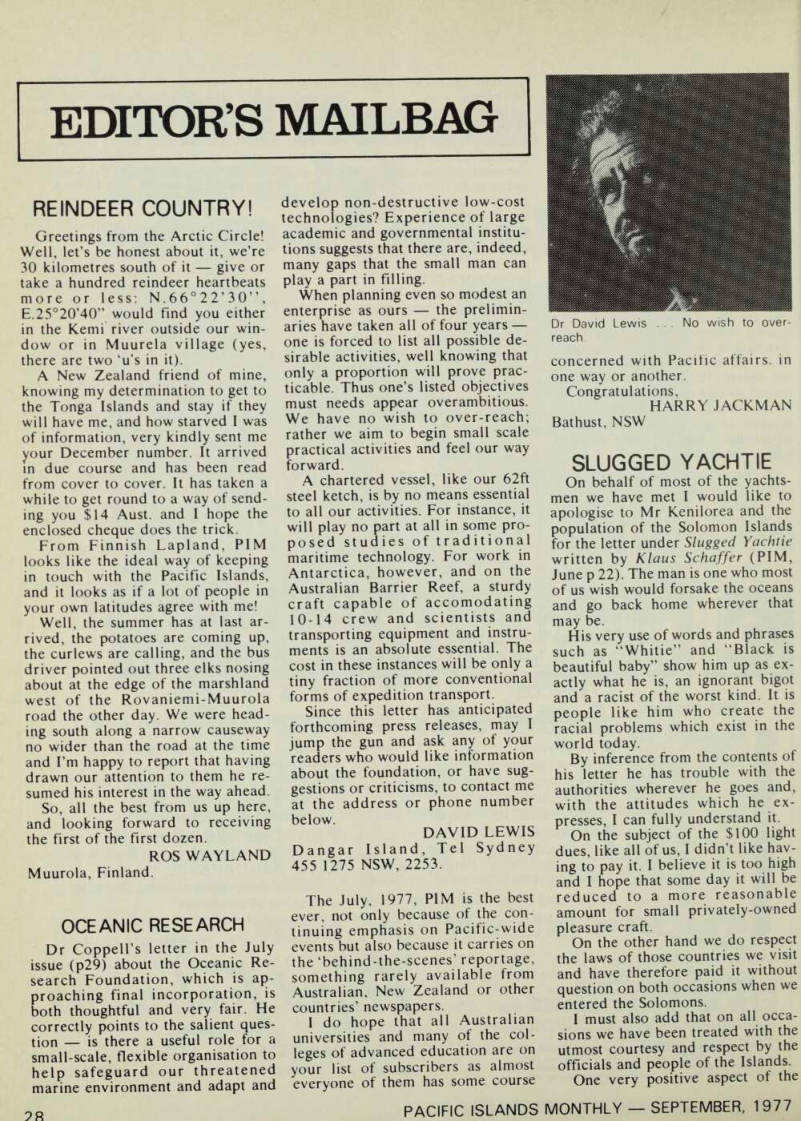
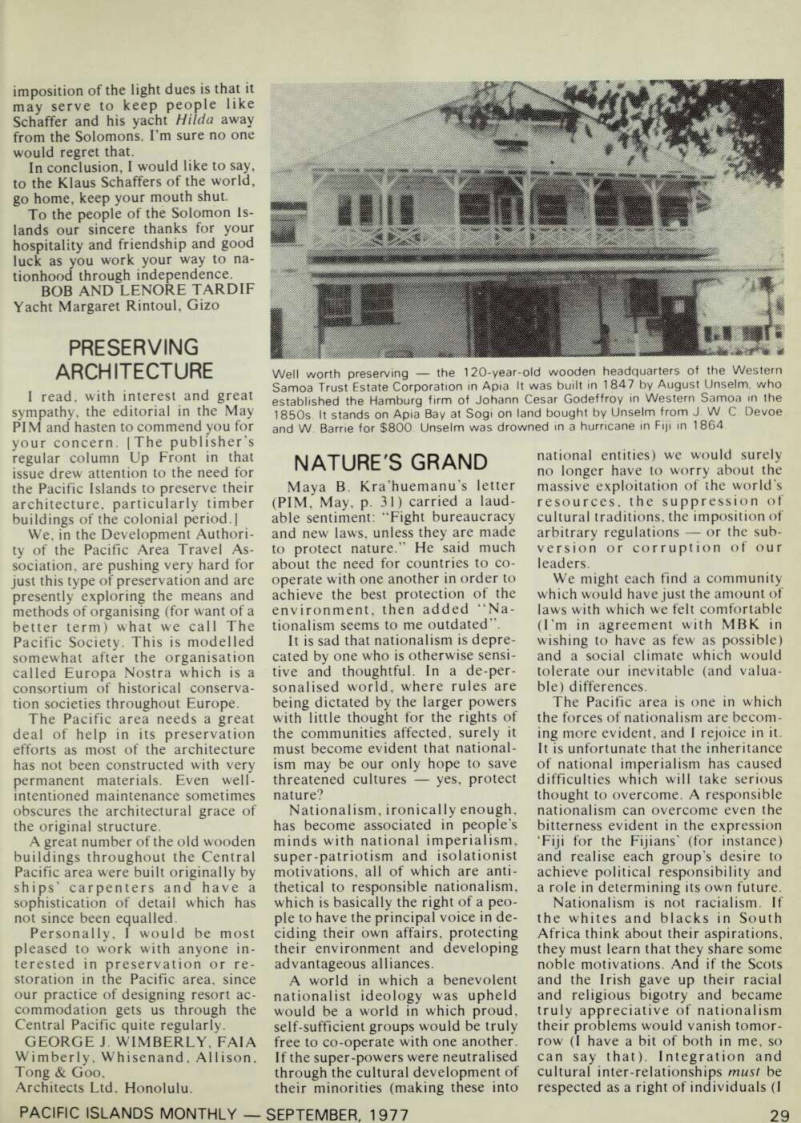
Reindeer Country!
Greetings from the Arctic Circle!
Well, let’s be honest about it, we’re 30 kilometres south of it give or take a hundred reindeer heartbeats more or less: N.66°22’30”, E.25°20’40” would find you either in the Kemi river outside our win dow or in Muurela village (yes, there are two ‘u’s in it).
A New Zealand friend of mine, knowing my determination to get to the Tonga Islands and stay if they will have me, and how starved I was of information, very kindly sent me your December number. It arrived in due course and has been read from cover to cover. It has taken a while to get round to a way of send ing you $l4 Aust. and I hope the enclosed cheque does the trick.
From Finnish Lapland, PIM looks like the ideal way of keeping in touch with the Pacific Islands, and it looks as if a lot of people in your own latitudes agree with me!
Well, the summer has at last ar rived, the potatoes are coming up, the curlews are calling, and the bus driver pointed out three elks nosing about at the edge of the marshland west of the Rovaniemi-Muurola road the other day. We were head ing south along a narrow causeway no wider than the road at the time and I’m happy to report that having drawn our attention to them he re sumed his interest in the way ahead.
So, all the best from us up here, and looking forward to receiving the first of the first dozen.
Ros Wayland
Muurola, Finland.
Oceanic Research
Dr Coppell’s letter in the July issue (p 29) about the Oceanic Re search Foundation, which is ap proaching final incorporation, is both thoughtful and very fair. He correctly points to the salient ques tion is there a useful role for a small-scale, flexible organisation to help safeguard our threatened marine environment and adapt and
develop non-destructive low-cost technologies? Experience of large academic and governmental institu tions suggests that there are, indeed, many gaps that the small man can play a part in filling.
When planning even so modest an enterprise as ours the prelimin aries have taken all of four years one is forced to list all possible de sirable activities, well knowing that only a proportion will prove prac ticable. Thus one’s listed objectives must needs appear overambitious.
We have no wish to over-reach; rather we aim to begin small scale practical activities and feel our way forward.
A chartered vessel, like our 62ft steel ketch, is by no means essential to all our activities. For instance, it will play no part at all in some pro posed studies of traditional maritime technology. For work in Antarctica, however, and on the Australian Barrier Reef, a sturdy craft capable of accomodating 10-14 crew and scientists and
transporting equipment and instru
ments is an absolute essential. The cost in these instances will be only a tiny fraction of more conventional forms of expedition transport.
Since this letter has anticipated forthcoming press releases, may I jump the gun and ask any of your readers who would like information about the foundation, or have sug gestions or criticisms, to contact me at the address or phone number below.
David Lewis
Dangar Island, Tel Sydney
455 1275 Nsw, 2253.
The July, 1977, PIM is the best ever, not only because of the con tinuing emphasis on Pacific-wide events but also because it carries on the ‘behind-the-scenes’ reportage, something rarely available from Australian, New Zealand or other countries’ newspapers.
I do hope that all Australian universities and many of the col leges of advanced education are on your list of subscribers as almost everyone of them has some course
concerned with Pacific affairs, in one way or another.
Congratulations,
Harry Jackman
Bathust, NSW
Slugged Yachtie
On behalf of most of the yachts men we have met I would like to apologise to Mr Kenilorea and the population of the Solomon Islands for the letter under Slugged Yachtie written by Klaus Schaffer (PIM, June p 22). The man is one who most of us wish would forsake the oceans and go back home wherever that may be.
His very use of words and phrases such as “Whitie” and “Black is beautiful baby” show him up as ex actly what he is, an ignorant bigot and a racist of the worst kind. It is people like him who create the racial problems which exist in the world today.
By inference from the contents of his letter he has trouble with the authorities wherever he goes and, with the attitudes which he ex presses, I can fully understand it.
On the subject of the SIOO light dues, like all of us, I didn’t like hav ing to pay it. I believe it is too high and I hope that some day it will be reduced to a more reasonable amount for small privately-owned pleasure craft.
On the other hand we do respect the laws of those countries we visit and have therefore paid it without question on both occasions when we entered the Solomons.
I must also add that on all occa sions we have been treated with the utmost courtesy and respect by the officials and people of the Islands.
One very positive aspect of the
Dr David Lewis ... No wish to over reach
imposition of the light dues is that it may serve to keep people like Schaffer and his yacht Hilda away from the Solomons. I’m sure no one would regret that.
In conclusion, I would like to say, to the Klaus Schaffers of the world, go home, keep your mouth shut.
To the people of the Solomon Is lands our sincere thanks for your hospitality and friendship and good luck as you work your way to na tionhood through independence.
Bob And Lenore Tardif
Yacht Margaret Rintoul, Gizo
Preserving
Architecture
I read, with interest and great sympathy, the editorial in the May PIM and hasten to commend you for your concern. [The publisher’s regular column Up Front in that issue drew attention to the need for the Pacific Islands to preserve their architecture, particularly timber buildings of the colonial period.) We, in the Development Authori ty of the Pacific Area Travel As sociation, are pushing very hard for just this type of preservation and are presently exploring the means and methods of organising (for want of a better term) what we call The Pacific Society. This is modelled somewhat after the organisation called Europa Nostra which is a consortium of historical conserva tion societies throughout Europe.
The Pacific area needs a great deal of help in its preservation efforts as most of the architecture has not been constructed with very permanent materials. Even well intentioned maintenance sometimes obscures the architectural grace of the original structure.
A great number of the old wooden buildings throughout the Central Pacific area were built originally by ships’ carpenters and have a sophistication of detail which has not since been equalled.
Personally, I would be most pleased to work with anyone in terested in preservation or re storation in the Pacific area, since our practice of designing resort ac commodation gets us through the Central Pacific quite regularly.
George J. Wimberly, Faia
Wimberly. Whisenand, Allison, Tong & Goo, Architects Ltd. Honolulu.
Nature's Grand
Maya B. Kra’huemanu’s letter (PIM, May, p. 31) carried a laud able sentiment: “Fight bureaucracy and new laws, unless they are made to protect nature.” He said much about the need for countries to co operate with one another in order to achieve the best protection of the environment, then added “Na tionalism seems to me outdated”.
It is sad that nationalism is depre cated by one who is otherwise sensi tive and thoughtful. In a de-per sonalised world, where rules are being dictated by the larger powers with little thought for the rights of the communities affected, surely it must become evident that national ism may be our only hope to save threatened cultures yes, protect nature?
Nationalism, ironically enough, has become associated in people’s minds with national imperialism, super-patriotism and isolationist motivations, all of which are anti thetical to responsible nationalism, which is basically the right of a peo ple to have the principal voice in de ciding their own affairs, protecting their environment and developing advantageous alliances.
A world in which a benevolent nationalist ideology was upheld would be a world in which proud, self-sufficient groups would be truly free to co-operate with one another.
If the super-powers were neutralised through the cultural development of their minorities (making these into
national entities) we would surely no longer have to worry about the massive exploitation of the world's resources, the suppression of cultural traditions, the imposition of arbitrary regulations or the sub version or corruption of our leaders.
We might each find a community which would have just the amount of laws with which we felt comfortable (I’m in agreement with MBK in wishing to have as few as possible) and a social climate which would tolerate our inevitable (and valua ble) differences.
The Pacific area is one in which the forces of nationalism are becom ing more evident, and I rejoice in it.
It is unfortunate that the inheritance of national imperialism has caused difficulties which will take serious thought to overcome. A responsible nationalism can overcome even the bitterness evident in the expression ‘Fiji for the Fijians’ (for instance) and realise each group’s desire to achieve political responsibility and a role in determining its own future.
Nationalism is not racialism. If the whites and blacks in South Africa think about their aspirations, they must learn that they share some noble motivations. And if the Scots and the Irish gave up their racial and religious bigotry and became truly appreciative of nationalism their problems would vanish tomor row (I have a bit of both in me, so can say that). Integration and cultural inter-relationships must be respected as a right of individuals (I
Well worth preserving - the 120-year-old wooden headquarters of the Western Samoa Trust Estate Corporation in Apia It was built in 1847 by August Unselm. who established the Hamburg firm of Johann Cesar Godeffroy in Western Samoa in the 1850s. It stands on Apia Bay at Sogi on land bought by Unselm from J. W. C. Devoe and W. Barrie for $800. Unselm was drowned in a hurricane in Fiji in 1864.
was a happy participant/beneficiary of an Inter-racial marriage for 12 years) but history has shown that en forcement of integration policies is taken as a threat to existing cultures, and I believe this fear should be re spected.
The larger problem lies in na tional and cultural jealousies these lead to group hostilities which serve only the culture-levelling super-powers.
Let us begin to see national aspirations as part of the quality of life. If we do not, we condemn the Pacific to a future in which an island must become a Waikiki Beach or a desert. The Pacific communities can best serve nature (as MBK enjoins) and themselves by taking re sponsibility for the direction of their own lives, and by examining their bureaucratic inheritance to see if they might abandon the restrictions which alien traditions have im planted. thereby making their freedom and political independence an example to others.
Gordon Mcshean
Scotts Valley, California, USA
Brych's 'Calvary'
Having read the account of the calvary of Mr Milan Brych by W. H.
Percival and Malcolm Salmon (PIM, June, p 23) I wish to record my reaction.
It seems to me that any person who has chosen the medical pro fession, even if only to make money, and who disagrees with Brych’s theory concerning cancer, as outlin ed in the PIM article, can only .be motivated by bad faith.
Ever since work done at the University of Jerusalem some seven or eight years ago on the foetus ejection process in pregnant women, it has seemed to me that it has become accepted medical knowledge that cancer is due, as stated by Brych, to an impairment of the body’s self-immunising capacity.
That the cancerous cells, being abnormal entities, should be treated by the body’s still normal cells as in truders has always seemed to me to be the base of all and any research into cancer.
I hope that Mr Brych will be able to withstand the onslaught of the mixture of jealousy and ignorance which has often, from the times of Galileo Galilei until our own, characterised official human
behaviour when confronted with the discoveries of a clear, uncluttered
mind.
Henri Lombard
Papeete, Tahiti
Wrong Picture
I am writing to take issue with Mr Bruce Adams in July PIM (p3l), where he states that the remains of Admiral Isoroku Yamamoto’s Betty bomber lied disintegrating in the jungle 27 miles from Kahili Air field in Buin, Bougainville. Kangu Mountain, where the bomber lies is not more than 7 miles from Kihili, (not Kahili) airfield. I left this sta tion which I had cleared and planted from 1936 onwards, and which the Japanese made their main base on Bougainville, in 1958, but have revisited the place three times since then.
I, too, had noted that the previous picture was incorrect, for there are no coconut palms growing around Yamamoto’s plane on the side of Kangu mountain, but I was unable to say where the picture was taken, and I had not visited Finschhafen since I was there aboard the S.S.
Marsina In 1926.
But I have had more than a pass ing interest in Admiral Yamamoto, and indeed in a memorial built at Kihili in 1958 to commemorate all servicemen and civilians and also war prisoners who lost their lives in that area. Special mention was made of Yamamoto. The memorial was dedicated on Anzac Day, 1958, in a ceremony carried out by the District Commissioner resident then at Kangu, and since that time the memorial has been visited by num bers of Japanese groups. It is the only private war memorial in Papua New Guinea.
A. H. Voyce (Rev)
Milford, Auckland. NZ
No. 1 Hatch?
When Mrs Maui Maui gave birth to her son on the No. 1 hatch of the MV Manuvai (PIM, July, p. 34), neither the crew of the vessel nor the members of the Women’s Institute were practical in their choice of names for the child (“the Manuvai crew naturally preferred the name ‘Manuvai’, while the Women’s In stitute deemed ‘Women’s Institute’ appropriate’’).
The obvious choice was “No. 1 Hatch’’, especially if the babv was
her first!
Neutral Bay, NSW.
P. E. Hills
Advertisements & other items, p. 30 (1 item)
anywhere,
any time,
any gas.
For further information & addresses of your local distributor contact:
THE COMMONWEALTH
INDUSTRIAL GASES LIMITED
Gases Export Department, 138 Bourke Road, Alexandria, N.S.W.
Australia 2015.
Cables CIGAS’-Telex AA25475 SYDNEY CG 96/76
Tropicalities
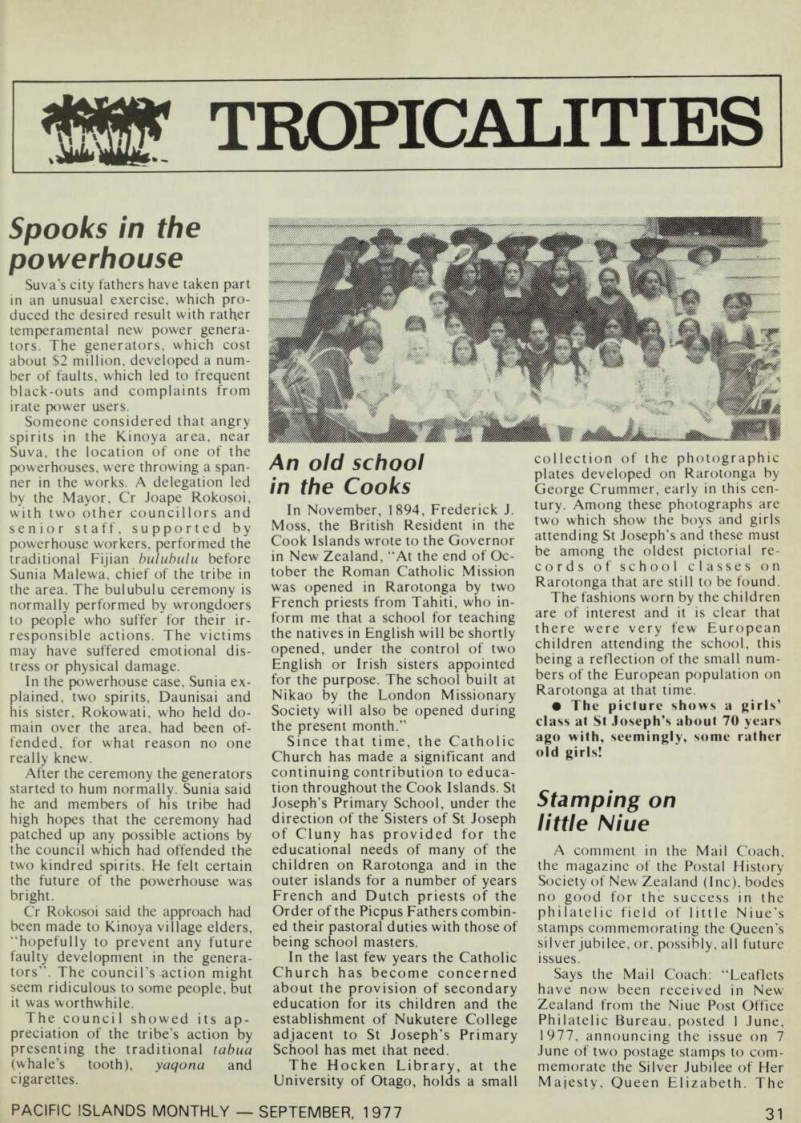
Spooks in the
powerhouse
Suva’s city fathers have taken part in an unusual exercise, which pro duced the desired result with rather temperamental new power genera tors. The generators, which cost about $2 million, developed a num ber of faults, which led to frequent black-outs and complaints from irate power users.
Someone considered that angry spirits in the Kinoya area, near Suva, the location of one of the powerhouses, were throwing a span ner in the works. A delegation led by the Mayor, Cr Joape Rokosoi. with two other councillors and senior staff, supported by powerhouse workers, performed the traditional Fijian bulubulu before Sunia Malewa, chief of the tribe in the area. The bulubulu ceremony is normally performed by wrongdoers to people who suffer for their ir responsible actions. The victims may have suffered emotional dis tress or physical damage.
In the powerhouse case, Sunia ex plained, two spirits, Daunisai and his sister. Rokowati, who held do main over the area, had been of fended, for what reason no one really knew.
After the ceremony the generators started to hum normally. Sunia said he and members of his tribe had high hopes that the ceremony had patched up any possible actions by the council which had offended the two kindred spirits. He felt certain the future of the powerhouse was bright.
Cr Rokosoi said the approach had been made to Kinoya village elders, “hopefully to prevent any future faulty development in the genera tors”. The council’s action might seem ridiculous to some people, but it was worthwhile.
The council showed its ap preciation of the tribe’s action by presenting the traditional tabua (whale’s tooth), yaqona and cigarettes.
An old school
in the Cooks
In November, 1894, Frederick J.
Moss, the British Resident in the Cook Islands wrote to the Governor in New Zealand, “At the end of Oc tober the Roman Catholic Mission was opened in Rarotonga by two French priests from Tahiti, who in form me that a school for teaching the natives in English will be shortly opened, under the control of two English or Irish sisters appointed for the purpose. The school built at Nikao by the London Missionary Society will also be opened during the present month.”
Since that time, the Catholic Church has made a significant and continuing contribution to educa tion throughout the Cook Islands. St Joseph’s Primary School, under the direction of the Sisters of St Joseph of Cluny has provided for the educational needs of many of the children on Rarotonga and in the outer islands for a number of years French and Dutch priests of the Order of the Picpus Fathers combin ed their pastoral duties with those of being school masters.
In the last few years the Catholic Church has become concerned about the provision of secondary education for its children and the establishment of Nukutere College adjacent to St Joseph’s Primary School has met that need.
The Hocken Library, at the University of Otago, holds a small
collection of the photographic plates developed on Rarotonga by George Crummer, early in this cen tury. Among these photographs are two which show the boys and girls attending St Joseph’s and these must be among the oldest pictorial re cords of school classes on Rarotonga that are still to be found.
The fashions worn by the children are of interest and it is clear that there were very few European children attending the school, this being a reflection of the small num bers of the European population on Rarotonga at that time. • The picture shows a girls’ class at St Joseph’s about 70 years ago with, seemingly, some rather old girls!
Stamping on
little Niue
A comment in the Mail Coach, the magazine of the Postal History Society of New Zealand (Inc), bodes no good for the success in the philatelic field of little Niue’s stamps commemorating the Queen’s silver jubilee, or, possibly, all future issues.
Says the Mail Coach: “Leaflets have now been received in New Zealand from the Niue Post Office Philatelic Bureau, posted 1 June, 1977, announcing the issue on 7 June of two postage stamps to com memorate the Silver Jubilee of Her Majesty, Queen Elizabeth. The
stamps are $1 and $2 in value re spectively, are printed in sheets of five stamps plus a label, and a mini sheet of one stamp of each value is also available.
“The immediate reaction of readers has been one of horror and decisions to stop collecting Niue in future! The excessive face value of the two stamps plus the miniature sheet which is unnecess ary will mean that this stamp issue will be ‘Black-Blotted’ and may not be accepted if shown in stamp ex hibitions.
“The establishment of the local Philatelic Bureau appears to have been arranged by an American backed organisation which already operates in Rarotonga, Aitutaki and Penrhyn, and if this is correct the coffers of Niue will benefit, the background organisation will benefit infinitely more and the collector will be the loser!”
The Cook Islands were criticised when they first began to flood the market, and the queer shape of Tonga’s stamps have earned the wrath of the philatelists, which all adds up to the fact that stamps re jected by the collectors and some philatelic firms don't get wide cir culation. The odd thing about that, however, is that in years to come, as the rejected stamps will be scarcer, their potential value will be greater.
PNG treasures
go back home
The first consignment of a hoped-for influx of Papua New Gui nean artifacts returned by foreign countries arrived in Port Moresby in July in time for the formal open ing of PNG's National Museum.
They were brought from Australia by Mr Jim Specht, curator for anthropology at the Australian Museum, who attended the opening of the PNG Museum.
The 17 pieces returned included a fighting shield from the Central Province which was bought in Sydney in 1883, dance paddles from Buka bought in Sydney in 1885, a stone figure and a dance mask from Kikori in the Gulf Province given to the Australian Museum by the Rev.
W. W. Gill in about 1885, and spears from various parts of the country.
Mr Specht said these artifacts were historically important because some of the areas from which they
came have almost completely lost their traditional art forms. The stone figure in particular was now a rare artifact.
He added that artifacts still to be returned will be selected by PNG National Museum personnel, and would fill many gaps in their present collection.
Kaiser Bill's
monument is 75
Western Samoa’s Apia Observato ry in June completed 75 years of ser vice to the world of science and to Western Samoa. The observatory was established in 1902 by a Dr Otto Tetens of the University of Got tingen, using a grant of 30 000 marks authorised the year before by Kaiser Wilhelm 11. From 1905, the observatory enjoyed annual grants of 25 000 marks from the German treasury over a period of five years.
Dr G. Angenheister became director in 1912 and remained in that post until 1920, despite New Zealand’s take-over of Western Samoa during World War I.
When Western Samoa achieved independence in 1962, most of the facilities established by New Zea land were transferred to the Government of Western Samoa, but New Zealand continued to shoulder financial responsibility for the
geophysical programmes.
A 75th anniversary booklet put out by the observatory notes that the four major areas of observatory work at present are meteorology, hydrology (investigating Western Samoa’s water resources), seismolo gy and geomagnetism.
Present superintendent of the ob servatory is Mr Jack E. Hoffman.
He has a staff of 29, mostly Western Samoan public servants.
Well! They've
no water
Nakolo village in Tonga does not have a “pub with no beer” but it could boast a well with no water.
Nakolo, which houses about 400 people, is about 61 m above sea level, while the water table is 3 m below sea level. Getting anything out of the water table was im possible till a drill was made availa ble through New Zealand aid.
The Water Board provided three workers to work the drill, and the villagers provided them with food, and supplied transport to bring
water for the drill. As the well was not a “gusher” a pump became a necessity to bring the water up, and a drill costs anything between $3 000 and $5 000, which was beyond the ready cash resources of the villagers. On top of the cost of the pump, the cost of drilling was about $lOO a day.
The water for the drill was carted from Fua’amotu Airport, about 8 km away. It was necessary to clear rock chips from a 100 mm wide hole. The villagers hoped for water from the well towards the end of May, provided they secured a pump.
Two other villages, Puke and Nukeleka, also without water, could get wells next year. According to one of the men working on the Nakolo well those two villages could have bucketsful of water before Nakolo had a sip unless “a pump materialised from somewhere fast”.
Geometric
elections
The coming general elections are the central point of interest for the 13 or 14 political parties of New Caledonia.
Counsellor Lafleur of EDS started the ball rolling by creating the proposed coalition of national parties, those in favour of remaining a French territory, which he called
Rpc.
It looks as if the coalition will now become a party as EDS and GSL have been disbanded, while a junior section called RJPC has just been created. The members of UD, who were ready to join the coalition, have protested as they saw UD and EDS as joint partners in RPC. The MLC has decided not to join, while the RPR has decided to become a section within RPC.
On the left wing, the PSC declares itself the official representative of the French PS; but the recently created UGCF claims to represent an association of left-wing tenden cies.
With hopes of obtaining one or two of the comfortable and well paid seats in the next assembly, two new parties have appeared: URC and ETE; the latter failed in its re cent attempt to grab a few seats on Noumea’s Town Council.
UM spokesman is not surprised.
He considers that it is quite natural for GSL and EDS to join RPC, as he considers this as an electoral
manoeuvre. Maybe the UD mem bers do not agree with this point of view.
UC is a very sad party. Once the biggest formation, over recent years it has seen members break away to form new groups such as MLC, UM and UMP. Recently three more members walked out; one of whom joined URC. Luckily, and to avoid more confusion the UPM remains the UPM, although the name of the party has changed.
If the right-wing electors remem ber that to maintain the present statute they must vote UD or MLC or PSC or URC or ETE with an ulti mate option RPC, everything will be OK. Of course, you must remember that RPC = RPR + EDS + GSL.
Luckily the young voters have been prepared by mathematics
Qed.
Statistics
from the past
A census taken on Niue in 1900 showed that the population of the is land numbered 4,676 and of these 561 were absent from the island, either as sailors or as labourers on other Pacific Islands.
In 1901, S. Percy Smith, the New Zealand Government Resident Agent reported that he had “found in existence here 23 native magistrates or judges and 124 police, who paid themselves by the fines inflicted”. This meant that there was one policeman for every 33 persons then living on the island.
The Native Magistrates and Police Act of 1901 began the process of reducing the numbers of law enfor cement officers by reducing the number of magistrates to five.
In 1900, the total population of Rarotonga aged 16 years or more was 1418, with 769 men and 649 women. In those days the sale of li quor to the Maori population was severely restricted.
The figures for the sale of liquor from the government bond on Rarotonga, for the year ending December 31, 1900, make interest ing reading gin 759 bottles; whis ky 1,330; rum 1,668; cognac 258; beer 2,345; wine 4,214. It would be interesting to compare the tastes for varieties of alcohol and the levels of consumption with these of today on Rarotonga, where no restrictions on the sale of liquor to Cook Islanders are now enforced.
Perhaps in 1900, the apparent shortage of females may have con tributed to the need to seek the pleasures of the bottle.
I say you cha ,
look there!
Two Papua New Guineans, John Laki and Nema Joarafa, produced more than one crinkle in the stiff British upper lip when they arrived in London on a pre-publicity cam paign for their country’s largest overseas exhibition at the Com monwealth Institue.
Heavily disguised under the tra ditional mask and croton leaf cos tume of the Asaro people of Eastern Highlands Province, the first “ghostly mudmen" ever to visit Bn tish shores invaded the newspaper precincts of Fleet Street, danced their ghostly dance steps along its pavements; caused an elderly passer-by to pause, gape and mutter to his companion “Gawd, now I’ve seen everything!" and got involved in a mild brush with the law when two London bobbies obliged them to move on after the crowd they had gathered “caused an obstruction".
Advertisements & other items, p. 33 (1 item)
Breekwoldt & Co
EXPORTERS TO THE PACIFIC ISLANDS
P ij Ltd
4
rrravrr
T 7 276 Pitt Street, Box 5027, G.P.O. Sydney 2001
CABLE ADDRESS: BREWO SYDNEY
TELEPHONES: 61-7110 26-6893
TELEX AA22890.
Pacific Island Branches:
BRECKWOLDT & CO (PNG) PTY LTD
PO BOX 1549, BOROKO, PORT MORESBY
PO BOX 222, RABAUL
PO BOX 72, KIETA
PO BOX 178, WEWAK
PO BOX 185, MADANG
PO BOX 237, MT HAGAN
PO BOX 1188, LAE
BRECKWOLDT & CO., PO BOX 47, APIA BRECKWOLDT & CO. (SI) LTD. PO BOX 140, HONIARA
BRECKWOLDT SARL BP 2369, NOUMEA
Offices in : Hamburg, London, Milan and West Africa as well as Singapore, Kuala Lumpur, Bangkok and Hong Kong.
Enquiries from Australian
Manufacturers invited.
People
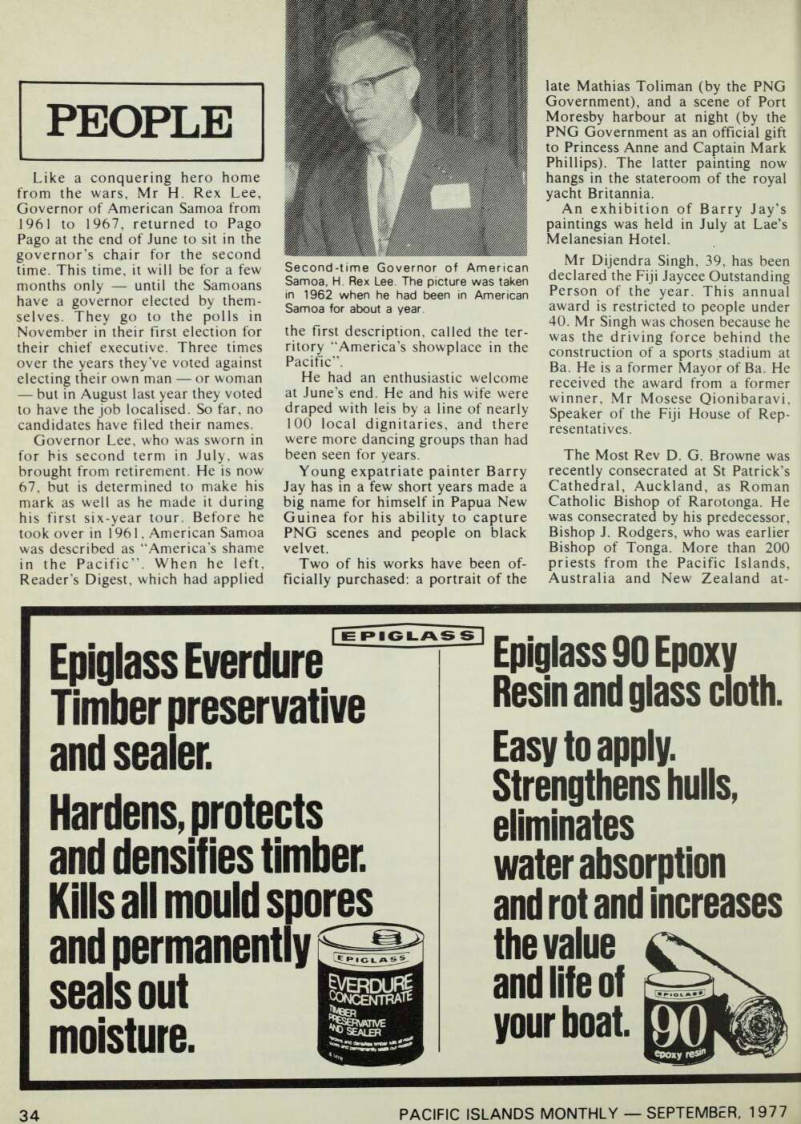
Like a conquering hero home from the wars, Mr H. Rex Lee, Governor of American Samoa from 1961 to 1967, returned to Pago Pago at the end of June to sit in the governor’s elixir for the second time. This time, it will be for a few months only — until the Samoans have a governor elected by them selves. They go to the polls in November in their first election for their chief executive. Three times over the years they’ve voted against electing their own man — or woman — but in August last year they voted to have the job localised. So far, no candidates have filed their names.
Governor Lee, who was sworn in for his second term in July, was brought from retirement. He is now 67, but is determined to make his mark as well as he made it during his first six-year tour. Before he took over in 1961, American Samoa was described as “America’s shame in the Pacific”. When he left.
Reader’s Digest, which had applied
the first description, called the ter ritory “America’s showplace in the Pacific”.
He had an enthusiastic welcome at June’s end. He and his wife were draped with leis by a line of nearly 100 local dignitaries, and there were more dancing groups than had been seen for years.
Young expatriate painter Barry Jay has in a few short years made a big name for himself in Papua New Guinea for his ability to capture PNG scenes and people on black velvet.
Two of his works have been of ficially purchased: a portrait of the
late Mathias Toliman (by the PNG Government), and a scene of Port Moresby harbour at night (by the PNG Government as an official gift to Princess Anne and Captain Mark Phillips). The latter painting now hangs in the stateroom of the royal yacht Britannia.
An exhibition of Barry Jay’s paintings was held in July at Lae’s Melanesian Hotel.
Mr Dijendra Singh, 39, has been declared the Fiji Jaycee Outstanding Person of the year. This annual award is restricted to people under 40. Mr Singh was chosen because he was the driving force behind the construction of a sports stadium at Ba. He is a former Mayor of Ba. He received the award from a former winner, Mr Mosese Qionibaravi, Speaker of the Fiji House of Rep resentatives.
The Most Rev D. G. Browne was recently consecrated at St Patrick’s Cathedral, Auckland, as Roman Catholic Bishop of Rarotonga. He was consecrated by his predecessor, Bishop J. Rodgers, who was earlier Bishop of Tonga. More than 200 priests from the Pacific Islands, Australia and New Zealand at
Second-time Governor of American Samoa, H. Rex Lee. The picture was taken in 1962 when he had been in American Samoa for about a year.
tended the consecration. Twelve bishops including the Metropolitan of New Zealand Cardinal Delargey, and 18 priests celebrated Mass. The new bishop’s two brothers, the Revs M and N Browne, were his chaplains for the consecration.
Bishop Browne served in Tonga as a missionary priest for two years before his new appointment. Bishop Rodgers is now an auxiliary bishop in Auckland.
Sir John Falvey, QC, Fiji’s Attorney-General since independence in 1974, has resigned “to restore my financial reserves which have been greatly eroded during the years on a ministerial salary which I regard as quite inadequate”. Sir John became a politician in 1953 when he was elected to what was then the Southern Division of the Legislative Council. He was soon appointed to the Executive Council, forerunner of the Council of M inisters under internal selfgovernment and then to Cabinet. He was appointed a senator in 1972, vacating the House of Representatives, but as Attorney- General he was still entitled to
speak in the lower house, but not to vote. Sir John, New Zealand-born, went to Fiji in 1940 to join the colonial administration. He studied law in his spare time and in the late 1940 s qualified as a barrister and solicitor. He joined the oldestablished Suva legal firm of Cromptons in 1949. . f . . ..
Captain Freddie Ladd, a notable figure in New Zealand aviation and once a pilot with Fiji Airways (now Air Pacific), has ended a colourful flying career. At the age of 68 he has decided it is time to give the game away. He flew torpedo-bombers in the Pacific during World War 11. He then helped the late Harold Gatty to launch Fiji Airways with Drover aircraft. After leaving Fiji Captain Ladd followed an aviation career in NZ, which embraced tourist traffic, delivering newspapers, mercy flights, to name just a few. He also had more than his share of crashes on a reef in Fiji, on a Rotorua thermal ridge and into Lake Rotorua. The last-named was a helicopter in which he was a passenger.
Kevin Brian Young, 23, must have been born to be a navigator.
He is a seventh-generation member of the family of Midshipman Ed ward Young, who was navigator in Captain Bligh’s Bounty, and who joined the mutineers to overthrow the old “tyrant” and put him to sea in a long boat. Kevin is now Pilot Officer Young of the Royal New Zealand Air Gorce, and when he graduated at Wigram, near Christchurch, he was awarded the Astrolabe Trophy for the navigator who had the highest aggregate of marks in practical navigation and academic studies. Kevin was born on Pitcairn Island in 1954 and went to NZ seven years later to attend school. He would like to go back to Pitcairn when he retires in about 22 years, unless an airstrip is built on the island. Meantime, he is sta tioned at Whenuapai, Auckland, and is flying in Orion aircraft.
Pastor Colin Winch, who has flown Seventh-day Adventist mis sion planes in the Solomons and Papua New Guinea for the past 22 years, has left the Islands. He is now chief flying instructor with the Se venth-day Adventist aviation ser vice in Australia.
Advertisements & other items, pp. 34-35 (1 item)
Epiglass Everdure
Timber preservative and sealer.
Hardens,protects
and densities timber.
Kills all mould spores and permanently seals out moisture. ,S S Epiglass 90 Epoxy Resin and glass cloth.
Easy to apply.
Strengthens hulls, eliminates water absorption and rot and increases the value and life of your boat.
Epiglass E-Type
Antifouling.
Gives up to 12
months
growth-free
performance.
Racing Red,
Blue, Green
and Gold.
PACIFIC AREA STOCKISTS
COOK ISLANDS: Cook Island Trading Corporation Ltd FIJIAN ISLANDS: Burns Philp (SS) Co. Ltd NEW HEBRIDES: Burns Philp (NH) Ltd NOUMEA: Guy Limousin, Pacific Yachting NUIE ISLAND: Nuie Island United PAGO PAGO: Max Haleck Inc, Burns Philp (SS) Ltd PAPUA NEW GUINEA; KIETA: Nikana Wholesalers, LAE: Faulkner-Tait (NG) Pty Ltd, MADANG: Burns Philp (NG) Co.
Ltd, PORT MORESBY; S.A. Heath Co. Ltd, RABAUL; Elvee Trading Pty Ltd, WEWAK; Burns Philp (P.N.G.).
SOLOMON ISLANDS: Man Sang Co.
TAHITI: Marine Corail, Tahiti Sport.
TONGA: Rierhelmann Bros.
WESTERN SAMOA; Burns Philp (SS) Co. Ltd, E. A. Coxon Ltd, Gold Star Transport Co. Ltd, Morris Hedstrom Ltd.
Magazine
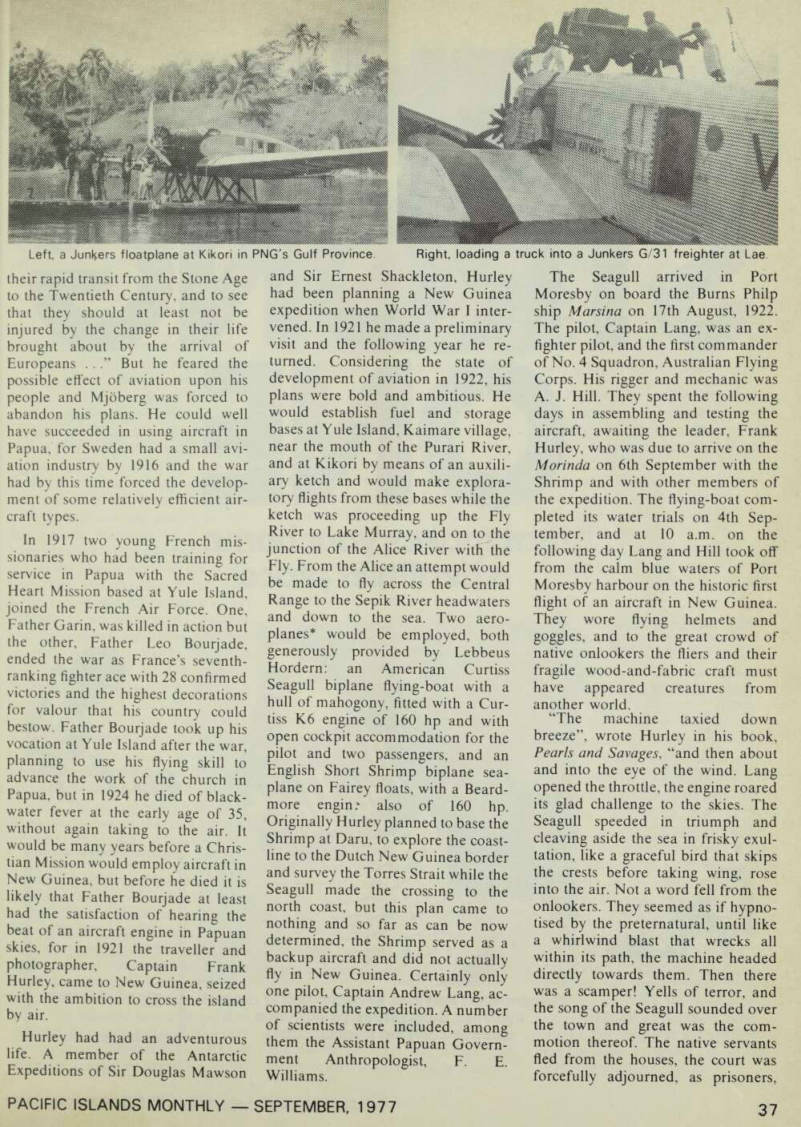

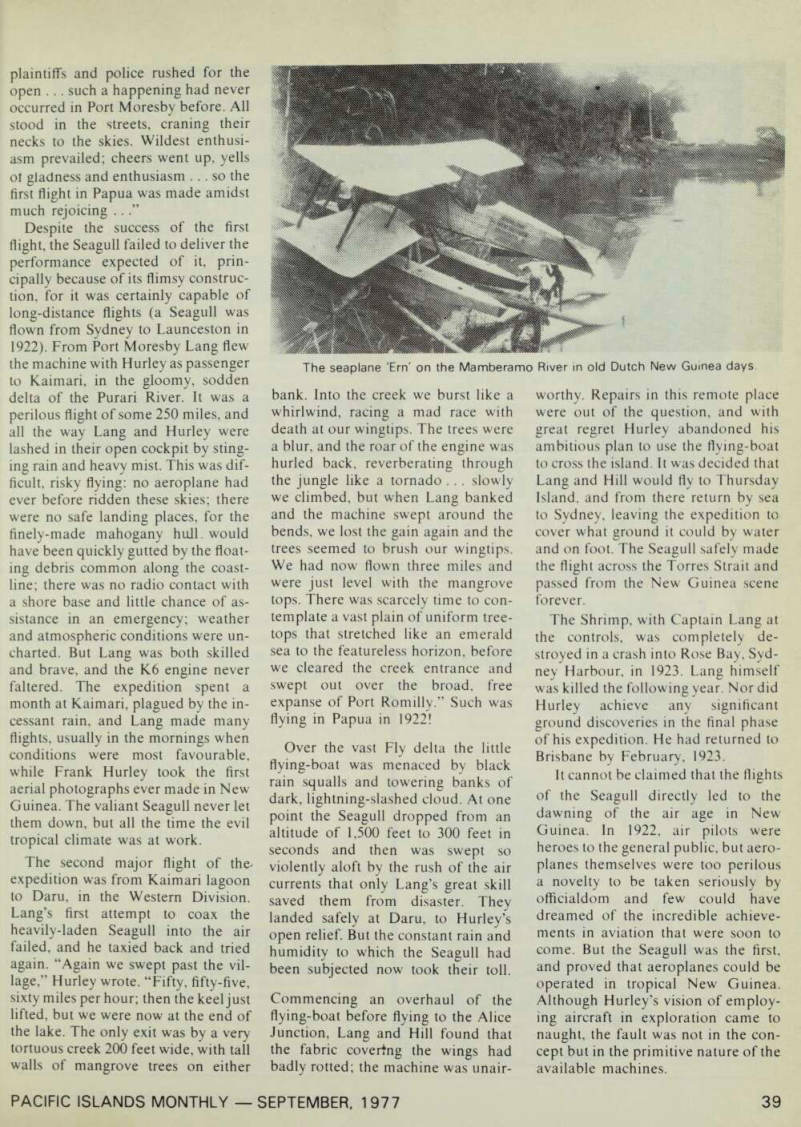
When wings of gold first flew over a stone-age Papua New Guinea
On a still morning in October, 1922, a single column of men set out from a crude bush camp deep in the interior of the Western Division of Papua. At their head walked a white man; then came a grizzled veteran sergeant of the Armed Constabulary, commanding the seven constables of the force who walked behind, swags strapped to their sturdy backs, their single shot carbines held carelessly, muzzle-first, across their shoulders as
they encouraged the eighteen laden
carriers of this little expedition to greater efforts. Four half naked Papuans scouted ahead, seeking a path. Leo Austen, an Assistant Resi dent Magistrate of the Magisterial Service, was looking for the source of the Tedi River and a pass through which he could lead his men into the fabled Star Mountains.
With food for a month, if carefully husbanded tinned meat, fat, sugar, tea, salt, tobacco and rice in mats they had worked their way up the Tedi, hauling their supplies and meagre camp equipment on crude rafts, constantly soaked by rain and mist. The people they encountered
were primitives, bushmen, wearing
the curved stem of the “kamenkor” calabash on their penises, bands of pig skin around their foreheads and pig’s tusk neck aces across their scaly chests. The country, wild, tangled, broken, was unexplored a blank on the map. They were on their own, out of communication, feeling their way with infinite caution, spending each
long day in weary foot-travel, patient
and enduring in the face of hardship.
Austen had made many such patrols, exploring new territory: the methods he was employing were those in use in the manv other remote corners of
This article, on the beginnings of aviation in Papua New Guinea more than half a century ago, is taken from the book, Wings of Gold, written by Papua New Guinea old hand James Sinclair and due for publication by Pacific Publications later this year.
this land. In 1922, and for years after
wards, the long, grinding foot patrol
was the accepted, the only way in which New Guinea could be
explored.
But even as Leo Austen and his little band were pushing their way towards the Star Mountains, a strange new sound was being heard along the swamps and deltas of the Papuan coast; the high, urgent note of an engine resounding from the sky. The rush of a graceful winged machine
startled the sleepy fishing villages and
frightened the big-eyed children into yells and tears, for never before had they seen such a wonderful, terrible thing. The twentieth century was about to catch up with this stone age land. The aeroplane had come to New Guinea.
The history of exploration in New Guinea contains some bizarre chap ters, surely one of the strangest a plan to use airships. In October, 1913, a committee was formed in Germany under the patronage of the Grand Duke of Hesse, its members drawn from influential financial and scien tific circles. The Graf von Zeppelin, soon to become notorious throughout the English-speaking world when the giant rigid dirigibles bearing his name made history’s first bombing raids against a city London was
a member, as was the celebrated ge ographer, Professor Richard Neuhauss. It was proposed that diri gibles and ships be chartered for two years, and great airship sheds con structed, two on the Sepik River and one in Dutch New Guinea. The cost, some three million marks, was to be shared between the Governments of Germany, Holland and Australia.
Nothing came of these daring pro posals; soon afterwards came World War I. It is very doubtful whether air ships could have been successfully employed in New Guinea. The story of general airship development is a tragic one, and by the time of World War II all giant dirigible construction had ceased throughout the world after a series of disasters, with great loss of life.
In November, 1914, two seaplanes a Maurice Farman, originally owned by Sydney businessman and pioneer aviator, Lebbeus Hordern, and presented by him to the Aus tralian Government, and a BE2A from the Central Flying School of the Australian Army at Point Cook were sent to New Guinea with their pilots, Captain Eric Harrison and G.
P. Merz, and four mechanics. They accompanied an Australian naval force which was on the trail of a Ger man commerce raider, but the air craft were never uncrated.
In 1916 the Swedish scientist and aviator. Dr. Erik Mjoberg, sought permission to establish bases in Papua and from these to employ air craft to explore the Territory. Sir Hubert Murray, the Lieutenant- Governor, would have nothing of this proposal; in 1920 he wrote ... it is our plain duty to assist the natives in
their rapid transit from the Stone Age to the Twentieth Century, and to see that they should at least not be injured by the change in their life brought about by the arrival of Europeans ...” But he feared the possible effect of aviation upon his people and Mjoberg was forced to abandon his plans. He could well have succeeded in using aircraft in Papua, for Sweden had a small avi ation industry by 1916 and the war had by this time forced the develop ment of some relatively efficient air craft types.
In 1917 two young French mis sionaries who had been training for service in Papua with the Sacred Heart Mission based at Yule Island, joined the French Air Force. One, Father Garin, was killed in action but the other. Father Leo Bourjade, ended the war as France’s seventh ranking fighter ace with 28 confirmed victories and the highest decorations for valour that his country could bestow. Father Bourjade took up his vocation at Yule Island after the war, planning to use his flying skill to advance the work of the church in Papua, but in 1924 he died of black water fever at the early age of 35, without again taking to the air. It would be many years before a Chris tian Mission would employ aircraft in New Guinea, but before he died it is likely that Father Bourjade at least had the satisfaction of hearing the beat of an aircraft engine in Papuan skies, for in 1921 the traveller and
photographer, Captain Frank
Hurley, came to New Guinea, seized with the ambition to cross the island by air.
Hurley had had an adventurous life. A member of the Antarctic Expeditions of Sir Douglas Mawson
and Sir Ernest Shackleton, Hurley had been planning a New Guinea expedition when World War I inter vened. In 1921 he made a preliminary visit and the following year he re turned. Considering the state of development of aviation in 1922, his plans were bold and ambitious. He would establish fuel and storage bases at Yule Island, Kaimare village, near the mouth of the Purari River, and at Kikori by means of an auxili ary ketch and would make explora tory flights from these bases while the ketch was proceeding up the Fly River to Lake Murray, and on to the junction of the Alice River with the Fly. From the Alice an attempt would be made to fly across the Central Range to the Sepik River headwaters and down to the sea. Two aero planes* would be employed, both
generously provided by Lebbeus
Hordern: an American Curtiss
Seagull biplane flying-boat with a
hull of mahogony, fitted with a Cur tiss K 6 engine of 160 hp and with open cockpit accommodation for the pilot and two passengers, and an
English Short Shrimp biplane sea
plane on Fairey floats, with a Beard more engine also of 160 hp.
Originally Hurley planned to base the
Shrimp at Daru, to explore the coast line to the Dutch New Guinea border and survey the Torres Strait while the Seagull made the crossing to the north coast, but this plan came to nothing and so far as can be now determined, the Shrimp served as a backup aircraft and did not actually
fly in New Guinea. Certainly only
one pilot. Captain Andrew Lang, ac companied the expedition. A number of scientists were included, among them the Assistant Papuan Govern ment Anthropologist, F. E.
Williams.
The Seagull arrived in Port Moresby on board the Burns Philp ship Marsina on 17th August, 1922.
The pilot, Captain Lang, was an ex fighter pilot, and the first commander of No. 4 Squadron, Australian Flying Corps. His rigger and mechanic was A. J. Hill. They spent the following
days in assembling and testing the
aircraft, awaiting the leader, Frank Hurley, who was due to arrive on the Morinda on 6th September with the Shrimp and with other members of the expedition. The flying-boat com pleted its water trials on 4th Sep tember, and at 10 a.m. on the following day Lang and Hill took off from the calm blue waters of Port Moresby harbour on the historic first flight of an aircraft in New Guinea.
They wore flying helmets and goggles, and to the great crowd of native onlookers the fliers and their fragile wood-and-fabric craft must have appeared creatures from another world.
“The machine taxied down breeze”, wrote Hurley in his book, Pearls and Savages, “and then about and into the eye of the wind. Lang opened the throttle, the engine roared its glad challenge to the skies. The
Seagull speeded in triumph and
cleaving aside the sea in frisky exul tation, like a graceful bird that skips the crests before taking wing, rose into the air. Not a word fell from the onlookers. They seemed as if hypno tised by the preternatural, until like a whirlwind blast that wrecks all within its path, the machine headed directly towards them. Then there was a scamper! Yells of terror, and the song of the Seagull sounded over the town and great was the com motion thereof. The native servants fled from the houses, the court was
forcefully adjourned, as prisoners,
Left, a Junkers floatplane at Kikori in PNG's Gulf Province.
Right, loading a truck into a Junkers G/31 freighter at Lae.
plaintiffs and police rushed for the open ... such a happening had never occurred in Port Moresby before. All stood in the streets, craning their necks to the skies. Wildest enthusi asm prevailed; cheers went up, yells ot gladness and enthusiasm ... so the first flight in Papua was made amidst
much rejoicing ..
Despite the success of the first flight, the Seagull failed to deliver the
performance expected of it, prin
cipally because of its flimsy construc tion, for it was certainly capable of
long-distance flights (a Seagull was
flown from Sydney to Launceston in 1922). From Port Moresby Lang flew the machine with Hurley as passenger to Kaimari, in the gloomy, sodden delta of the Purari River. It was a perilous flight of some 250 miles, and all the way Lang and Hurley were lashed in their open cockpit by sting ing rain and heavy mist. This was dif
ficult, risky flying; no aeroplane had
ever before ridden these skies; there were no safe landing places, for the
finely-made mahogany hull, would
have been quickly gutted by the float ing debris common along the coast line; there was no radio contact with a shore base and little chance of as sistance in an emergency; weather and atmospheric conditions were un charted. But Lang was both skilled and brave, and the K 6 engine never faltered. The expedition spent a month at Kaimari, plagued by the in cessant rain, and Lang made many flights, usually in the mornings when conditions were most favourable, while Frank Hurley took the first aerial photographs ever made in New Guinea. The valiant Seagull never let them down, but all the time the evil tropical climate was at work.
The second major flight of expedition was from Kaimari lagoon to Daru, in the Western Division.
Lang’s first attempt to coax the heavily-laden Seagull into the air failed, and he taxied back and tried again. “Again we swept past the vil
lage,” Hurley wrote. “Fifty, fifty-five,
sixty miles per hour; then the keel just lifted, but we were now at the end of the lake. The only exit was by a very tortuous creek 200 feet wide, with tall walls of mangrove trees on either
bank. Into the creek we burst like a whirlwind, racing a mad race with death at our wingtips. The trees were a blur, and the roar of the engine was hurled back, reverberating through the jungle like a tornado ... slowly we climbed, but when Lang banked and the machine swept around the bends, we lost the gain again and the trees seemed to brush our wingtips.
We had now flown three miles and were just level with the mangrove tops. There was scarcely time to con template a vast plain of uniform tree tops that stretched like an emerald sea to the featureless horizon, before we cleared the creek entrance and swept out over the broad, free expanse of Port Romilly.” Such was flying in Papua in 1922!
Over the vast Fly delta the little flying-boat was menaced by black rain squalls and towering banks of dark, lightning-slashed cloud. At one
point the Seagull dropped from an
altitude of 1,500 feet to 300 feet in seconds and then was swept so violently aloft by the rush of the air currents that only Lang’s great skill saved them from disaster. They landed safely at Daru, to Hurley’s open relief. But the constant rain and humidity to which the Seagull had been subjected now took their toll.
Commencing an overhaul of the flying-boat before flying to the Alice Junction, Lang and Hill found that the fabric covering the wings had badly rotted; the machine was unair
worthy. Repairs in this remote place
were out of the question, and with great regret Hurley abandoned his ambitious plan to use the flying-boat to cross the island. It was decided that Lang and Hill would fly to Thursday Island, and from there return by sea
to Sydney, leaving the expedition to
cover what ground it could by water and on foot. The Seagull safely made the flight across the Torres Strait and passed from the New Guinea scene forever.
The Shrimp, with Captain Lang at the controls, was completely de stroyed in a crash into Rose Bay, Syd ney Harbour, in 1923. Lang himself was killed the following year. Nor did
Hurley achieve any significant
ground discoveries in the final phase of his expedition. He had returned to
Brisbane by February, 1923.
It cannot be claimed that the flights of the Seagull directly led to the dawning of the air age in New Guinea. In 1922, air pilots were heroes to the general public, but aero planes themselves were too perilous a novelty to be taken seriously by officialdom and few could have dreamed of the incredible achieve ments in aviation that were soon to come. But the Seagull was the first, and proved that aeroplanes could be operated in tropical New Guinea.
Although Hurley’s vision of employ
ing aircraft in exploration came to naught, the fault was not in the con cept but in the primitive nature of the available machines.
The seaplane 'Ern' on the Mamberamo River in old Dutch New Guinea days.
Advertisements & other items, pp. 36-40 (2 items)
36
PACIFIC ISLANDS MONTFILY SEPTEMBER, 1977
that makes your home
a healthier place
How effectively you protect your family from the dangers of disease carrying insects, may well depend on the insect spray you choose.
Powerful Insect Killing Ingredients.
Concentrated Pea Beu is one of the most powerful household insect sprays in the world. Its principal insect killing ingredients have been selected to ensure rapid knock down and kill of all common disease carrying insects.
Rigid Testing. Ttirough every stage of manufacture. Pea Beu is rigidly tested.
There are ingredient tests, spray droplet tests, pack tests, many forms of tests, some carried out three times over.
When you spray this remarkable aerosol insecticide, you can be sure that its ingredients have met with the most exacting standards enabling you to spray it safely with confidence in your home. & Family Health and Well Being. The common housefly carries up to halt a billion germs and, when you realize that disease carrying insects enter even the best regulated households, you can understand why you can't be too careful about the effectiveness of your inseci spray. Remember, even the tiniest droplet II li 111 I i / ol conceitlraled Pea Beu kills (lies, mos quiloes, all common disease carrying Concentrated Pea Beu. Even the tiniest droplet
kills flies, mosquitoes, gH common
disease carrying insects fast.
insects fast, so it is indeed a worthy guardian of your family's health and well \ being Such is the effectiveness of Pea Ben’s insect killing ingred lent, that no common disease carrying inseci ran survive it. nor develop an immunity to it. When you spray Concentrated Pea Beu. it's nice to know that no common disease carrying insect can survive l .
Pea Beu - The strong one. makes your home a healthier place.
Is your Drinking Water Safe and Pure,
Is it Sparkling Fresh?
STERASYL Elements are ceramic filtering cylinders which release silver ions for full sterilisation.
No need to boil, chlorinate, transport or buy bottled water and periodic simple external cleaning only is entailed.
"Super Sterasyl" elements additionally have an activated carbon core to absorb unpleasant tastes and odours.
DOMESTIC
GRAVITY
FILTER
Rugged lightweight body telescoping to save on transport. 4 sizes to 13 gals (60 litres) per 24 hours. 339)
STERAMATIC
DOMESTIC
PRESSURE
FILTERS
Self-contained including pumpset, carbon prefilter and Sterasyl purifier. Up to 220 gallons (1000 litres) per hour.
These PORTACEL units are but a few of the models available. Contact us for all requirements for public, domestic or industrial water supplies, swimming pool, sewage and effluent, etc.
Portals
Portals Water Treatment (NZ) Ltd P.O. Box 13-558, Auckland 6, New Zealand Candy House, 11 Spring > Street, Onehunga, Auckland Telephone: 661-079 (7 lines) Telex: NZ 21175 Telegrams: Portals Auckland.
PCI-PATERSON CANDY, PERMUTIT, BOBY, STELLA-META
PORTACEL, HOUSEMAN-HEGRO - ALL PORTALS GROUP.
To Future Generations*
Security
Horyuji Japan's 7th century temple links the past to the present with the solemn beauty.
Social welfare is a subject of serious consideration in most modern societies. Man in the twentieth century accepts his responsibility to bequeath to the next generation a society better than his own. Daiwa Bank is not unique in accepting this responsibility, but Daiwa is unique in making acceptance of this role in society an integral part of their banking service.
Daiwa is the only Japanese city bank to combine banking and trust business. Daiwa is thus a fully integrated banking institution, comprising banking, international financing, trust, pension trust, and real estate business. This integration is part of our effort to fulfil our social responsibility consistent with society's needs in a contemporary environment. a fully integrated banking service
DAIWA BANK
Head Office: Osaka, Japan London and Frankfurt Branches New York and Los Angeles Agencies Singapore, Sydney, Sao Paulo and Hong Kong Representative Offices Subsidiary: Daiwa Bank Trust Company, New York Joint Venture Banks: P.T. Bank Perdania, Jakarta, International Credit Alliance, Ltd., Hong Kong
Islands
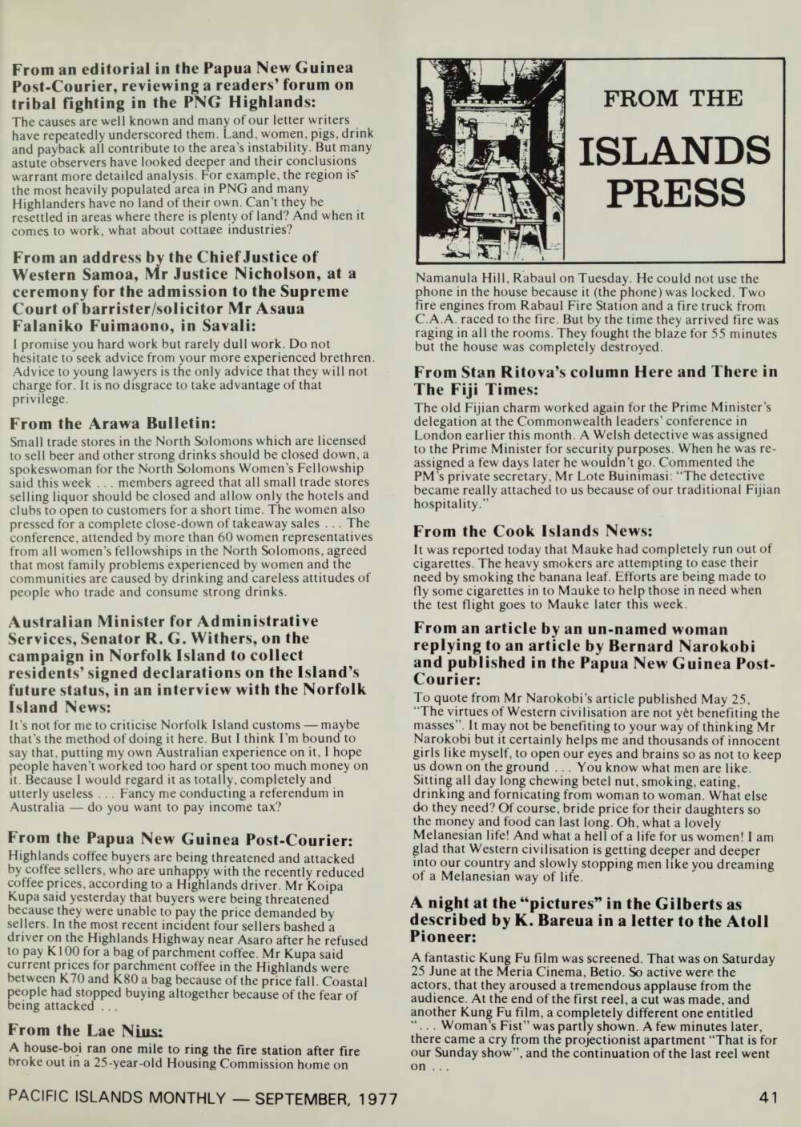
From The
Press
From an editorial in the Papua New Guinea Post-Courier, reviewing a readers’ forum on tribal fighting in the PNG Highlands: The causes are well known and many of our letter writers have repeatedly underscored them. Land, women, pigs, drink and payback all contribute to the area’s instability. But many astute observers have looked deeper and their conclusions warrant more detailed analysis. For example, the region is* the most heavily populated area in PNG and many Highlanders have no land of their own. Can’t they be resettled in areas where there is plenty of land? And when it comes to work, what about cottage industries?
From an address by the Chief Justice of Western Samoa, Mr Justice Nicholson, at a ceremony for the admission to the Supreme Court of barrister/solicitor Mr Asaua Falaniko Fuimaono, in Savali: I promise you hard work but rarely dull work. Do not hesitate to seek advice from your more experienced brethren.
Advice to young lawyers is the only advice that they will not charge for. It is no disgrace to take advantage of that
privilege.
From the Arawa Bulletin: Small trade stores in the North Solomons which are licensed to sell beer and other strong drinks should be closed down, a spokeswoman for the North Solomons Women’s Fellowship said this week ... members agreed that all small trade stores selling liquor should be closed and allow only the hotels and clubs to open to customers for a short time. The women also pressed for a complete close-down of takeaway sales . . . The conference, attended by more than 60 women representatives from all women’s fellowships in the North Solomons, agreed that most family problems experienced by women and the communities are caused by drinking and careless attitudes of people who trade and consume strong drinks.
Australian Minister for Administrative Services, Senator R. G. Withers, on the campaign in Norfolk Island to collect residents’ signed declarations on the Island’s future status, in an interview with the Norfolk Island News: It’s not for me to criticise Norfolk Island customs maybe that’s the method of doing it here. But I think I’m bound to say that, putting my own Australian experience on it, I hope people haven’t worked too hard or spent too much money on it. Because I would regard it as totally, completely and utterly useless ... Fancy me conducting a referendum in Australia do you want to pay income tax?
From the Papua New Guinea Post-Courier: Highlands coffee buyers are being threatened and attacked by coffee sellers, who are unhappy with the recently reduced coffee prices, according to a Highlands driver. Mr Koipa Kupa said yesterday that buyers were being threatened because they were unable to pay the price demanded by sellers. In the most recent incident four sellers bashed a driver on the Highlands Highway near Asaro after he refused to pay KlOO for a bag of parchment coffee. Mr Kupa said current prices for parchment coffee in the Highlands were between K7O and KBO a bag because of the price fall. Coastal people had stopped buying altogether because of the fear of
being attacked ...
From the Lae Niu&i A house-boi ran one mile to ring the fire station after fire broke out in a 25-year-old Housing Commission home on
Namanula Hill, Rabaul on Tuesday. He could not use the phone in the house because it (the phone) was locked. Two fire engines from Rabaul Fire Station and a fire truck from C.A.A. raced to the fire. But by the time they arrived fire was raging in all the rooms. They fought the blaze for 55 minutes but the house was completely destroyed.
From Stan Ritova’s column Here and There in The Fiji Times: The old Fijian charm worked again for the Prime Minister’s delegation at the Commonwealth leaders’ conference in London earlier this month. A Welsh detective was assigned to the Prime Minister for security purposes. When he was re assigned a few days later he wouldn’t go. Commented the PM’s private secretary, Mr Lote Buinimasi: “The detective became really attached to us because of our traditional Fijian
hospitality.”
From the Cook Islands News: It was reported today that Mauke had completely run out of cigarettes. The heavy smokers are attempting to ease their need by smoking the banana leaf. Efforts are being made to fly some cigarettes in to Mauke to help those in need when the test flight goes to Mauke later this week.
From an article by an un-named woman replying to an article by Bernard Narokobi and published in the Papua New Guinea Post-
Courier:
To quote from Mr Narokobi’s article published May 25, “The virtues of Western civilisation are not y6t benefiting the masses”. It may not be benefiting to your way of thinking Mr Narokobi but it certainly helps me and thousands of innocent girls like myself, to open our eyes and brains so as not to keep us down on the ground ... You know what men are like.
Sitting all day long chewing betel nut, smoking, eating, drinking and fornicating from woman to woman. What else do they need? Of course, bride price for their daughters so the money and food can last long. Oh, what a lovely Melanesian life! And what a hell of a life for us women! I am glad that Western civilisation is getting deeper and deeper into our country and slowly stopping men like you dreaming of a Melanesian way of life.
A night at the “pictures” in the Gilberts as described by K. Bareua in a letter to the Atoll
Pioneer:
A fantastic Kung Fu film was screened. That was on Saturday 25 June at the Meria Cinema, Betio. So active were the actors, that they aroused a tremendous applause from the audience. At the end of the first reel, a cut was made, and another Kung Fu film, a completely different one entitled “.. . Woman’s Fist” was partly shown. A few minutes later, there came a cry from the projectionist apartment “That is for our Sunday show”, and the continuation of the last reel went on . . .
Advertisements & other items, pp. 42-48 (2 items)
iSwi
* 9
Mil
f m mm o K m m 4 4^ *** &«*** -V %• iU *< *. •
l r £l***- *• *v£Jl
VSX'.SSNWW
MMAi- •
«• V . « \ « V ;T». * ♦ * r
KJ sn «SSSS
Kk VSWSV^
V\W\\\V
> K Vj t ; vV* &!*♦£ * o® SANSUI ELECTRIC CO., LTD. 14-1 Izumi 2-chome, Suginami-ku, Tokyo 168, Japai Australia Rank Industries Australia Pty. Ltd. Head Office: 12 Barcoo Street. East Roseville, N.S.W. 2069 Phone: 406 56© Melbourne: 68 Oueensbridge Street. South Melbourne, Vic. 3206 Phone: 62 0031 Adelaide: Phone: 212 2555/Br.sbane: Phone: 52 733 ■ Canberra: Phone; 95 2144 Perth: Phone: 28 393
Performers by Sansui!
Sansui! Who else could present such an exciting array of spectacular stereo?
Sansui! Who else but the hi-fi specialist could assure you of outstanding and reliable performance for every model on this page!
Sansui means sound that’s clean and powerful. It means stereo that touches your soul. And it means even the subtle nuances of music sources are crisp.
Here is proof that Sansui is dedicated to excellent sound quality for everyone.
If you put sound quality first, it’s Sansui all the way! mm f t t M I / •*l#| * i * . 4 J m m > o Vvx^ 'W. /
Sansui.
)nly hi-fi, everything hi-fi.
j! Prabhu Brothers Ltd. P.0.80x 183. Nadi Phone: 70183/4 Papua New Guinea Oceania Indent Agency (P.N.G.) Pty. Ltd. Box 5518, Boroko. Port d° fn!! 256406 New Zealand David Reid Electronics Ltd. C.P.O. Box 2630, Auckland. 1 Phone:492-189 New Caledonia Ets Michel ER f C t." BP ;J I23 ' Noumea Phone: 27. 59. 11 South Pacific Miltons Department Stores Limited P.O. Box 146, Norfolk Island 2899 Central acme Nauru Co-operative Society Republic of Nauru Western Samoa H.J. Keil and Company Ltd. P.O. Box 7, Apia Phone: 198 New Hebrides he Sound Centre P.O. Box 434, Port Villa Cook Islands United island Traders Ltd. P.O. Box 1& 2, Rarotonga Tahiti DIMECO PO. Box 2622
- ■I 1 tssi P>* - % * / w**30 ( ■7> m- <i ft *■> w: m TJk c i* i '■ ■rm if miiimm*** mil m m §t##
r * r r r The Toyota truck range. Built to be unbeatable.
Bad weather conditions, no problem.
Bad roads and driving surfaces, eaten up.
Difficult loads, no contest. Built tough. Built to take it.
There's a Toyota truck built for you. f i rtn„ ; ~t| TOYOTA Land Cruiser Pickup
rtm
TOYOTA Stout
TOYOTA Hi-Lux
TOYOTA Dyna
TOYOTA Toyo-Ace Hi TOYOTA Truck For unbeatable after service:
TOYOTA
PAPUA NEW GUINEA; ELA MOTORS LIMITED, Scratchley Rd„ Badili, P.O. Box 75, Port Moresby. U.S. TRUST TERRITORY: MICROL CORPORATION, P.O. Box 267, Saipan. FIJI ISLANDS: AUTOMOTIVE SUPPLIES CO., LTD., G.P.O. Box 355, Suva. AMERICAN SAMOA: BURNS PHILP (SOUTH SEA) CO., LTD., P.O, 1057, Pago Pago. WESTERN SAMOA: BURNS PHILP (SOUTH SEA) LTD., P.O. Box 188, Apia. GUAM: ATKINS, KROLL (GUAM) LTD., P.O. Box 6428, Tamuning. NEW HEBRIDES; NEW HEBRIDES MOTORS LTD., P.O. Box 18, Vila. SOLOMON ISLANDS: MENDANA ENTERPRISES (5.1.), LTD., P.O. Box 174, Honiara. TAHITI: NIPPON AUTOMOTO, B.P. 342, Papeete. COOK ISLANDS: COOK ISLANDS TRADING CORPORATION LTD., P.O. Box 92, Rarotonga. NAURU ISLAND: NAURU COOPERATIVE SOCIETY. GILBERT & ELLICE ISLANDS COLONY: TARAWA MOTORS, Box 36, Bairiki Tarawa. NORFOLK ISLAND: MARIE'S NORFOLK TOURS, LTD., P.O. Box 276. NEW CALEDONIA: SOCIETE IMPORTATION AUTOMOBILE DU PACIFIQUE, Rond-Point du Pacific (Station Total) B.P. 438, Noumea.
of the greatest
We took three
of our best
and made one
of the greatest
* m m •ioneer’s new CX-7000 cassette-receiver fers most of the truly great features jnd in our individual stereo components. :egrated amplifier. FM/AM tuner. Fronting cassette-deck. Naturally, having erything in one super-compact unit creases operational convenience and fers super value all the way. ower is a super substantial 25 watts per annel, min. RMS, at 8 ohms from 20 20,000 Hz with no more than 0.3% total irmonic distortion. The high performance lono equalizer assures the wide dynamic nge necessary to reproduce clean jsical nuance.
'he CX-7000 presents a new dimension FM/AM enjoyment. In most listening eas, reception is less than ideal. So. □neer features a super sensitive (11.2d8f/ 2.OmV) and super selective (60dB) tuner section. An automatic pilot signal canceled is included for preventing sound deterioration in the high frequency range and, of course, PLL MPX (Phase-Locked Loop Multiplex) circuitry.
Cassette handling is really a “super snap" due to the front-loading tape mechanism with built-in auto-stop. And making your own music tapes is super easy because Pioneer’s exclusive vertical-hold compartment allows you to check tape content and movement while the tape selector enables the optimum use of either chrome or normal tape. All controls are up front (where the user is) and built-in Dolby* reduces tape hiss and noise in the high frequency range.
Pioneer's new CX-7000 cassette-receiver.
Not just another audio product, but a giant step forward in music listening enjoyment.
It : s the super component for super hi-fi value.
We re also offering matching speakers and turntable. They're super, too. *Dolby is a trademark of Dolby Laboratories. Inc.
H
The Super Component
Cf) PIONEER
stralia jneer Electronics Australia Pty. j., 178-184 Boundary Road, aeside, Victoria 3195, Tel: 90-9011, dney 93-0246, Brisbane 59-7457, elaide 433379, Perth 24-9899 i Islands jjlal & Company, G.P.O. Box i. 362, Suva, Fiji Islands Tel: 22258 New Zealand Fountain Marketing Ltd., Maidstone Street, Auckland, New Zealand Tel: 763-064 Norfolk Island Burns Philp (Norfolk Island) Ltd., Norfolk Island, South Pacific New Hebrides Burns Philp (New Hebrides) Ltd., Vila, New Hebrides Nauru Island Jacob Enterprises, P.O. Box No. 4 Republic of Nauru Tahiti Est. PERFECT, B.P. 594, Papeete, Tahiti Tel: 20 407 New Caledonia Menard Freres Ville, B.P. H2Cedex, Noumea, New Caledonia Tel: 27.52.22 American Samoa Traspac Corporation, P.O. Box 1477, Pago Pago, American Samoa 96799 Tel: 633-5224 Rarotonga South Seas International Ltd., P.O. Box 49, Rarotonga Cook Islands Tel: 2327
tt* ttt r.r* tt* m ssx -c
’’ JV Jr J*-J»
Jewellery that writes.
It’s known as Parker's ‘Place Vendome’ collection.
Each model is distinguished by the painstaking engraving of Parisian craftsmen, and the precious metals, gold and silver.
There are four distinctive patterns in gold pens, and three patterns in silver, each with matching ball pensand pencils.
The pens have convertible filling systems and nibs that adjust to your writing style. The point can be rotated 360° until it reaches the angle that most naturally suits you.
The ball pens and pencils give you long-lasting Parker cartridge refills. Up to 80,000 words is what you can expect from the ball pen refills.
Clearly, the finest in function and fashion, and magnificent gifts whether you choose a single or a set from the Place Vendome collection.
+PARKER
World's most wanted pens
mt 7m 'r
Sieim>
All HEINZ products
are produced with the
experience gained from
more than one hundred
years of making fine foods.
In the Pacific islands
HEINZ has been on the
menu since 1925.
SELLING AND CONSULTANT
AGENTS FOR:
ANDRONICUS COFFEE PTY. LTD.
COUNTRY MAID WHITENER.
DIPLOMAT RAZOR BLADES.
MEADOWSWEET CONFECTIONERY.
ERIN FOODS LTD.
EPICURE CONTINENTAL FOODS.
BALTIC IMPORT COMPANY.
GREENSEAS TUNA.
FOR FURTHER INFORMATION
CONTACT;
H.J. HEINZ CO. AUST. LTD.
Export Branch, Princes Highway, Dandenong, 3175, Victoria, Australia.
Telephone: 792 0631.
Telex: AA32125.
Cable: Heinz Melbourne.
HEINZ
tomato xi* tfuce ajKI
tHEIIV*
STRAINED
HEINZ
taked heart
* tomato sauce
spaghetti
sauce & chert* S
Independence Road
Books
The huffing and the puffing on PNG’s Independence Road
Don Woolford spent five years as AAP/Reuters correspondent in Papua New Guinea from January, 1968, to December, 1972, and was a part-time student at, and later a gra duate of, the University of Papua New Guinea. So he is well qualified to write on Papua New Guinea’s progress to self-government and in dependence Papua New Guinea: Initiation and Independence.
He begins his story with the estab lishment of the House of Assembly in 1964, and carries it through with clarity and meticulous accuracy to Independence Day on September 16,1975.
Having been personally involved in these events as a member of the House from 1964 to 1972, I found this book fascinating reading, re minding me as it did of the political battles in which I once took part.
All who are interested in the politi cal development of Papua New Guinea will find it equally fascinat ing, while future historians will be able to rely on it as an accurate source book.
The book confines itself pretty ex clusively to politics, though it has a good chapter on the economy. The general reader with no specific in terest in politics may find some of the huffing and puffing a bit tiresome; and we all need to remind ourselves that, while all this argy bargying was going on, some two million Papua New Guinean villagers were quietly getting on with planting their yams, taro and sweet potatoes, collecting their pro tein from sea and bush, gathering materials for and building their houses, and procreating children for future Papua New Guinean politi cians to push around.
It’s a pity that Don Woolford had to talk so much about blacks and whites. In today’s world these are emotive words; and in this case they are not really very descriptive. Only a few of Papua New Guinea’s
‘blacks’ are really black; most of them come in varying shades of brown. And most ‘whites’ who have been in the tropics for any length of time have been either tanned to an attractive brown or burnt to a rather less attractive pink.
But I appreciate Don Woolford’s difficulty. He couldn’t keep talking about indigenes and expatriates.
Papua New Guineans is a dreadful mouthful. And I’m told that quite a lot of white Australians object to being called Europeans.
Don Woolford’s final chapter on Independence and Beyond is first rate, and I would have liked it to have been twice as long. Among the many good things in it I will quote two short passages.
On the Public Service: ‘‘Black public servants seem as adept as their white predecessors at entrenching themselves and build ing their own little empires. A good case could be made for a country like Papua New Guinea having a large public service, provided the bulk of its members were engaged in public service teachers, health
workers, agricultural extension of ficers, public works tradesmen, foresters and the like. But it is ap parently necessary to have, in sup port of such people, an army of white-shirted blacks, sitting in air conditioned offices reading the Government Gazette and writing in ter-office memos.”
And on egalitarianism; “Most people may wish to retain at least part of their traditional society, but they still seem keen to acquire the material wealth of the Western world. This is perhaps even more true of the men of influence the national politicians and senior civil servants. Good homes, cars, and re staurants figure prominently in the life-styles of most of them; even some of those who fervently espouse the spiritual superiority of the an cient Melanesian virtues. . . . Those with the power and influence will get richer. Those without will lag further behind. It is a very familiar story.”
To write a book of this kind with out a single footnote is quite an achievement, and one of which I whole-heartedly approve. Don Woolford compensates for their ab sence by seven pages of chapter by chapter Notes on Sources at the end of his book. An admirable ar rangement!
The paperback edition of this book will cost you $8.95, but it’s worth it, and its Hong Kong printers have given it an attractive format and a good stout binding. It will not fall to pieces in your hands as so many Australian-produced paper backs do in the tropics.
For the libraries and the wealthy there is a hardback edition at $18.95. I would expect tooled pigskin at that price! Percy Chat terton
(Papua New Guinea: Initiation And Indepen
DENCE. By Don Woolford. Published by University of Queenslend Press, P.O. Box 42, St Lucia, Queens land 4067. >18.95 cloth, >8.95 paper.)
New Newsletter
The Center for South Pacific Stu dies, University of California, Santa Cruz, has launched a newsletter which will cover its various ac tivities.
Among reports in the first number of the attractively presented, eight page newsletter is one dealing with the visit to the Center late last year of Susuga To’oa Salamasina Malietoa, elder sister of His High ness Malietoa Tanumafili 11, Western Samoa’s Head of State.
Also reported is the visit of Rab bie Namaliu, prominent Papua New Guinea public servant.
Further information on the newsletter, which is to appear three times a year, may be had by writing to the Center at Santa Cruz, CA,
Usa, 95064
Advertisements & other items, p. 50 (1 item)
anytime
Give me Sunbeam
A, / / I —«* • Sunbeam Whistling Kettle.
A 2.3 litre Stainless Steel kettle that boils the water while you get the cups, then whistles for you when if s ready. Safety cut-out turns the kettle off automatically if the water boils dry. Available in Sunset Red, Harvest Gold or polished finishes.
Sunbeam Beatermix Mixer with Burst of Power*.
The little mixer with lots of muscle.
Three mixing speeds plus an extra power burst at the touch of a button, on all speeds, for heavy mixing Jobs. Buy it as a hand mixer, or with stand and two bowls.
Toaster for big families and the breakfast rush... 4 slices of toast, cooked just the way you like at one time. Automatically. In Harvest Gold, Sunset Red and Chrome.
Sunbeam Toasta Magic* Toaster.
The automatic toaster that gives Sunbeam quality at a price anyone can afford. Colour co-ordinated in Sunset Red, Harvest Gold and Chrome. Also the Sunbeam 4-Slice
Sunbeam Spray/Shot-of-Steam
Iron.
Ifs a spray iron, if s a shot-ofsteam iron, ifs a steam iron, ifs a dry iron, and it has the Sunbeam self-cleaning action as well. 55 steam holes, see-through waterlevel guage. Sunbeam safety heel rest, cool white handle.
Quality and service you’ve learnt to trust 'Registered trademark of Sunbeam Corporation Ltd.
L 85.8761
French Scholar's Tribute
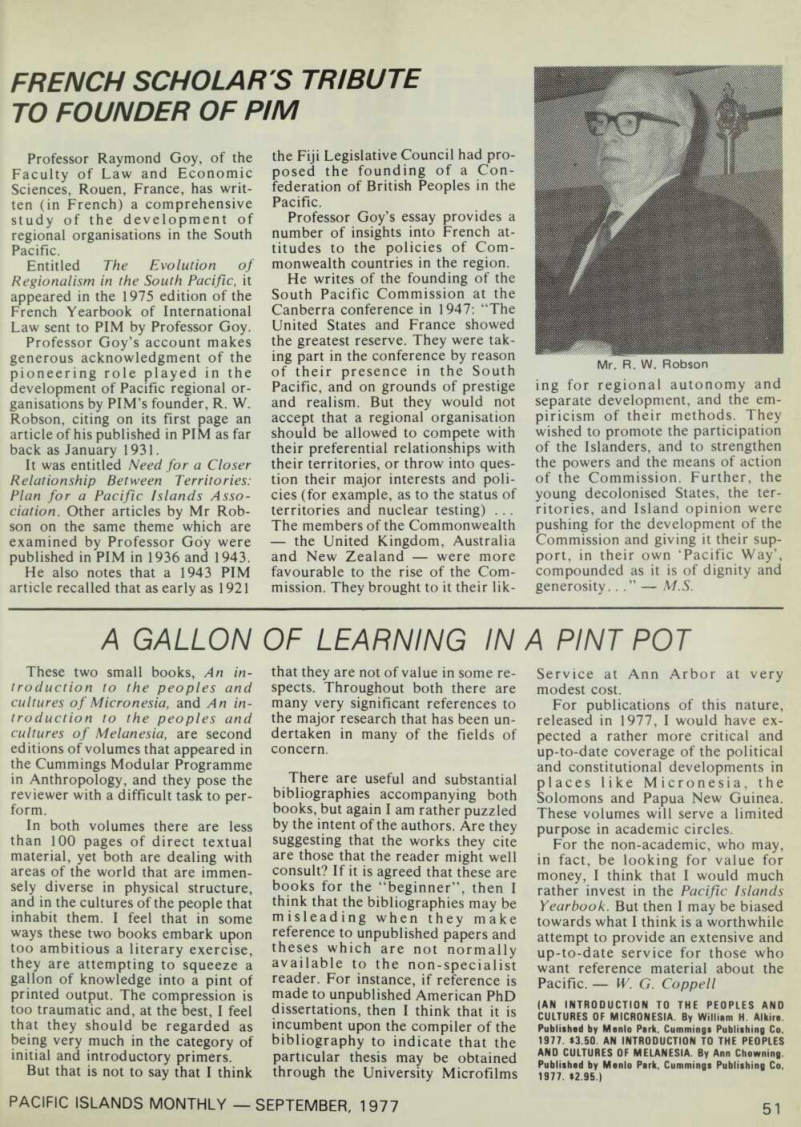
To Founder Of Pim
Professor Raymond Goy, of the Faculty of Law and Economic Sciences, Rouen, France, has writ ten (in French) a comprehensive study of the development of regional organisations in the South Pacific.
Entitled The Evolution of Regionalism in the South Pacific, it appeared in the 1975 edition of the French Yearbook of International Law sent to PIM by Professor Goy.
Professor Goy’s account makes generous acknowledgment of the pioneering role played in the development of Pacific regional or ganisations by PlM’s founder, R. W.
Robson, citing on its first page an article of his published in PIM as far back as January 1931.
It was entitled Need for a Closer Relationship Between Territories: Plan for a Pacific Islands Asso ciation. Other articles by Mr Rob son on the same theme which are examined by Professor Goy were published in PIM in 1936 and 1943.
He also notes that a 1943 PIM article recalled that as early as 1921
the Fiji Legislative Council had pro posed the founding of a Con federation of British Peoples in the Pacific.
Professor Goy’s essay provides a number of insights into French at titudes to the policies of Com monwealth countries in the region.
He writes of the founding of the South Pacific Commission at the Canberra conference in 1947; “The United States and France showed the greatest reserve. They were tak ing part in the conference by reason of their presence in the South Pacific, and on grounds of prestige and realism. But they would not accept that a regional organisation should be allowed to compete with their preferential relationships with their territories, or throw into ques tion their major interests and poli cies (for example, as to the status of territories and nuclear testing) ...
The members of the Commonwealth the United Kingdom, Australia and New Zealand were more favourable to the rise of the Com mission. They brought to it their lik-
ing for regional autonomy and separate development, and the em piricism of their methods. They wished to promote the participation of the Islanders, and to strengthen the powers and the means of action of the Commission. Further, the young decolonised States, the ter ritories, and Island opinion were pushing for the development of the Commission and giving it their sup port, in their own ‘Pacific Way’, compounded as it is of dignity and
generosity...”
M.S.
Mr. R. W. Robson
A Gallon Of Learning In A Pint Pot
These two small books, An in troduction to the peoples and cultures of Micronesia, and An in troduction to the peoples and cultures of Melanesia, are second editions of volumes that appeared in the Cummings Modular Programme in Anthropology, and they pose the reviewer with a difficult task to per form.
In both volumes there are less than 100 pages of direct textual material, yet both are dealing with areas of the world that are immen sely diverse in physical structure, and in the cultures of the people that inhabit them. I feel that in some ways these two books embark upon too ambitious a literary exercise, they are attempting to squeeze a gallon of knowledge into a pint of printed output. The compression is too traumatic and, at the best, I feel that they should be regarded as being very much in the category of initial and introductory primers.
But that is not to say that I think
that they are not of value in some re spects. Throughout both there are many very significant references to the major research that has been un dertaken in many of the fields of concern.
There are useful and substantial bibliographies accompanying both books, but again I am rather puzzled by the intent of the authors. Are they suggesting that the works they cite are those that the reader might well consult? If it is agreed that these are books for the “beginner”, then I think that the bibliographies may be misleading when they make reference to unpublished papers and theses which are not normally available to the non-specialist reader. For instance, if reference is made to unpublished American PhD dissertations, then I think that it is incumbent upon the compiler of the bibliography to indicate that the particular thesis may be obtained through the University Microfilms
Service at Ann Arbor at very modest cost.
For publications of this nature, released in 1977, I would have ex pected a rather more critical and up-to-date coverage of the political and constitutional developments in places like Micronesia, the Solomons and Papua New Guinea.
These volumes will serve a limited purpose in academic circles.
For the non-academic, who may, in fact, be looking for value for money, I think that I would much rather invest in the Pacific Islands Yearbook. But then I may be biased towards what I think is a worthwhile attempt to provide an extensive and up-to-date service for those who want reference material about the
Pacific.
W. G. Coppell
(An Introduction To The Peoples And
CULTURES OF MICRONESIA. By William H. Alkire.
Published by Menlo Park, Cummings Publishing Co, 1977. $3.50. AN INTRODUCTION TO THE PEOPLES AND CULTURES OF MELANESIA. By Ann Chowning.
Published by Menlo Park, Cummings Publishing Co, 1977. $2.95.)
Advertisements & other items, p. 52 (1 item)
We're working the Pacific
with a Cat Marine Diesel.
■P -o-.
"Loloho" - General purpose Harbour tug boat. Operated by Bougainville Copper Limited at Bougainville. Overall length 50 ft. (15.24 m). Powered by a Caterpillar D 343 Marine Engine.
"M.V. Kaunitoni" - An Inter-Island freighter. Operated by the Fiji Government. Overall length 134.3 ft. Displacement 628 tons. Speed 10 knots. Powered by a Caterpillar 0370.
Hastings Hearing (Pacific) Ltd.and Carpenters Tractors cover the Pacific islands waterfront with Cat. Marine Service and Parts.
Hastings Deering (Pacific) at Lae, Port Moresby and Bougainville and Carpenters Tractors at Suva are staffed by Caterpillar-trained technicians.
Working the Pacific waterfront day after day, year, after year, you depend on reliable horsepower and first class dealer-support. You get it with a Cat Marine Diesel, Hastings Deering (Pacific) and Carpenters Tractors.
While there's a Cat Marine Diesel in your craft you're backed up with Cat Plus, the total support programme offered only by your Caterpillar dealer.
Your local Hastings Deering (Pacific) or Carpenters Tractors dealer backs your Cat Marine Diesel engine with parts and service programmes designed to prevent, as well as shorten profitrobbing downtime.
Caterpillar Dealers in South-West Pacific
Lae- Milford Haven Road, 154 Queens Road, Suva.
Ph: 42 2355 Ph; 24 051-4, Port Moresby: Champion Cables; Carptrac Suva.
Parade, Konedobu Ph: 24 3138 Telex: Carptrac FJ2191 Suva, or 24 2098.
Bougainville; Itakara.
Industrial Park, Arawa, Ph: 95 9077
HASTINGS DEERING
HD6I4
(SL
CARPENTERS
TRACTOR B EQUIPMENT
Caterpillar. Cat and [B are trademarks ol Caterpillar Tractor Co.
Hard-headed tips
on island hopping
Wherever you’re island hopping, there’s something for you in a new Australian publication, Island Hop ping through the Indonesian Archipelago, written by Englishman Maurice Taylor in association with the Melbourne-based Trail Finders organisation.
Although the book deals with Thailand, Malaysia, Indonesia and Singapore, much of its island hopping lore is just as relevant for those who choose to hop through the Pacific Islands.
A few samples of Taylor’s highly professional and practical advice will give the general idea; “Appearance: It is advisable to give some thought to personal ap pearance. ‘Hippies’ are discouraged . . . Way-out clothing should be avoided and men will find life easier if their hair is not too long. Both long hair and beards are likely to be frowned upon, partly because such folk tend to look alike .. .
“Carrying luggage: Lightweight travelling is imperative and this cannot be too strongly emphasised, for heavy luggage just cannot be
manoeuvred in often crowded transport in tropical conditions.
Although a rucksack may at first sight seem comfortable, it is difficult to carry in some of the cir cumstances encountered ... Its cumbersome nature does not lend it self to many of the buses one must use, and physically it is impossible to take it inside the buses on many occasions. Suitcases are only for the affluent, who can afford a constant stream of taxis and do not wish to visit more remote areas.
“The answer is the humble duffle bag. A strong waterproof variety is the best. The cords could be re placed with firmly stitched leather straps if the material is stout enough, so that it will be more com fortable to carry. Brass tacks could be used as an alternative to stitching “Brush: A small hard brush is a handy article. It is useful for brush ing clothing which easily becomes covered with dust on unmade roads, or caked with mud in tropical streets after a storm. The feet become the dirtiest part of the body, and the brush can then take over.
Furthermore, hot water is rarely en countered and a brush is the finest tool for a good all-over scrub ...
“Polythene bags; A supply of small polythene bags will help to keep clothing clean and separate . ..
Get a dozen or more than you think you really need ... It is one of the surest ways of making friends on a bumpy country road, travelling with a family which includes a child passenger unaccustomed to such
journeys ...”
There are many more such hard headed human tips for island hop pers in the book which also contains highly detailed information on tra velling through the countries with which the author is directly con cerned.
Add in the delightful descriptions of such islands as Sumatra, for which Maurice Taylor evidently has a particular love, and you have a thoroughly worthwhile book.
F.L.S.
(Island Hopping Through The Indonesian
ARCHIPELAGO. By Maurice Taylor with Trail Fin ders. Published by Hill of Content. Melbourne. 110.50.)
Going Cheap!
The University of Papua New Guinea’s active and creative Educa tional Research Unit is offering subscriptions to its next 10 pub lications for SAI3, SUSIS and £UK9, postage included. Also covered by these prices is a copy of the ERU’s basic text, “Education and Independence, 1975: A Re source Book of Documents and Issues in Education”.
Among titles already released in the ERU 1976-77 publishing programme are “High School Leavers Look to Their Future: A Study in Mendiand Tari”, “Student Opinions About Teaching and Learning in PNG”, “ Something’s Got to he Done so We Can Survive in this Place: Problems of Women Students at UPNG”, and “Tertiary Education Leavers 1973-75: Causes and Consequences of Wastage”.
Of keen interest to all students of education in developing countries, the ERU research reports may be had on application to the Secretary, ERU. UPNG, Port Moresby.
Remembers
A Poet
War-Torn
New Guinea
If you like one house to grow old in, It is probably better not to live in New Guinea New Guinea is impatient of all things durable.
So writes Eric Rolls in his book of poems, The Green Mosaic. His memories are of the war-torn New Guinea of the mid-1940s, and there is no indication that he has revisited the place since, though a remark in his preface suggests that he has kept in touch with Papua New Guinean creative writing.
The crashed Zeros have long since been carted away to war museums or swallowed up by the jungle, and today’s New Guinea is a very different place from the one Eric Rolls knew.
But some things in New Guinea are durable — the landscape itself, the birds, animals, insects and plant life, and, in spite of new life-styles, the human emotions, especially the erotic ones in which Eric Rolls takes such a lively interest.
Of these he writes evocatively.
But his insights are a white man’s in sights, and one wonders how rele vant they are in a New Guinea which now has its home-grown poets.
Nevertheless, many Australians who shared Eric Rolls’ wartime ex periences will read these poems with pleasure and perhaps with nostalgia; and our Papua New Guinea poets may well profit by studying them for their craftsmanship, even if they dis agree with, or are indifferent to,
their insights.
Percy Chatterion
(THE GREEN MOSAIC: MEMORIES OF NEW GUINEA.
By Eric C. Rolls. Published by Thomas Nelson (Australia) Ltd, 19-39 Jeffcott Street, West Melbourne 3C03, Vic. $6.95.)
Advertisements & other items, pp. 53-54 (3 items)
53
PACIFIC ISLANDS MONTH! Y qpptpmdcd 1
Cook Exhibition
Hawaii’s Kauai Museum is mounting a special Cook Exhibition to celebrate the 200th anniversary of the landing of Captain Cook at Waimea, Kauai, on January 20, 1778.
It is scheduled to open on November 1, 1977
Turn moments
into memories
mm m % *r m
iDGE
posu** 20 Ex /2 0^ pplN^
COL° P
110
FOP
20
take your pictures
on Kodak film*
See your photo dealer now.
K6l-5076
Pacifique Sud
With Helen Rousseau
Communicating around the Pacific has always been a fun affair of island resourcefulness, amid the powerful barrage of imported material transmitted for propagan da purposes. Even today the radio cocotier (coconut radio) relaying local rumour has as powerful a message as the most sophisticated satellite relays from Paris. The media is the message, and just re cently the Pacific way of com municating has manifested itself in three particular ways out of Noumea from stamps to ham radio and coconut cocktails.
Of course, the communicative effects of alcohol are debatable since an overdose can render the imbiber virtually incommunicado.
This is apparently the case with a very much island-flavoured cocktail that some of the P & O cruisemen have concocted on their way out of Noumea. According to one who has shared in this coconut cocktail, the essential ingredients include ginger syrup, vodka, gin, lime, liqueur and coconut juice. This juice is pre pared, as all Islanders know, by scraping out the coconut in shreds then squeezing out the juice through a cloth. The resultant cocktail looks like a milk shake, but the effect is quite dissimilar. The drink must be downed fast as it congeals in three minutes. P & O have no less than 22 voyages touching Noumea in the 12 months to next March. The coconut cocktail is one obvious way of shar ing happy memories as the ships steam out of New Caledonia.
Another method of com munication recently highlighted in Noumea was the hobby of stamp col lecting, demonstrated through a philatelic exhibition in a city high school. French designers have been most resourceful in producing numerous sets of Caledonian stamps to depict local flora, land and marine fauna, significant buildings, Melanesian tribal life, as well as in land scenery and environment pro tection motifs. At the recent exhibi
tion, students were invited to submit designs to serve as the theme for a “student stamp” to be issued in 1978.
Meanwhile in Sydney, a new philatelic investment service was set up in July by a local sharebroker and a long-time stamp dealer. The new partnership, Duffy and Consta ble, of 4 Bligh Street, Sydney, is specialising in rare stamps of Australasia and those Pacific Is lands where Australia has a partic ular interest, such as Papua New Guinea, Norfolk, Cocos and Christmas Island. Mr Kevin Duffy explained that the finest item in his collection is a block of 12 PNG stamps worth $l2 500. They date from March 1960 where there was a shortage of postage-due stamps, so ordinary T'/ad stamps were over printed. His collector’s set has a double overprint and is believed to be unique, the kind of stamps fastidious international purchasers would seek. Mr Duffy also de scribed the much sought-after post war series of PNG stamps issued from 1952 to 1960. A set of 23 in superb mint condition with a nominal value of $5 would have a present day value of $lOO.
Sharebroker David Constable claims this form of investment can show a much more profitable return than some other business ventures in recent times. Moreover, argues Mr Constable, stamps are very portable $5O 000 worth can be carried around in a wallet. The two men’s collection is valued at over $2OO 000. Referring to the possible investment value of many colourful stamps produced by some Pacific Is lands, Mr Duffy said he would like to “give them a few years to mature”. It was important to wait and see how many were issued; the numbers were not known till the stamps were taken off sale.
Questioned about Australian in terest in French Pacific stamps, Mr Duffy said there was little interest from Australia so far since people
tend to collect according to “ethnic loyalty”. It was a matter of con sumer-demand and what is fashionable, he said, although he ad mitted that this could be a case of which comes first the chicken or the egg since Australian clients would not be so familiar with French issues. Again, it’s all a mat ter of communication.
A novel way of breaking the language and cultural barrier be tween English and French is being explored by a group of Sydney schoolboys speaking by amateur radio to a French military man in Noumea. The boys are at Marist Brothers High School, Eastwood, where Brother Cyril Quinlan has an amateur licence with call sign VK2 ACQ operating on 14.1 50 MHZ. As part of club-work in radio and electronics, the boys met at school on Saturday afternoons to speak with Noumea for one hour from 4 pm Sydney time (0600 GMT). At the Noumea end is 30-year-old Daniel Ludec from France, member of a military radio club. Con versation is exchanged in English and French. The school’s French master, Brother Ralph Arnell, has already visited Noumea to par ticipate in the annual French teachers’ summer school there. The Sydney schoolboys’ initiative in making the radio contact has arous ed considerable interest, including a filming of their French operation by a Sydney TV channel.
A Japanese personality recently back in Noumea was Henry Goto, the roving Pacific artist. Goto-san first appeared in Noumea at the time of the 1966 South Pacific Games when he held his first New Caledo nian exhibition. Since then the former Tokyo advertising man has exhibited in Fiji. Sydney and elsewhere. He has no doubt found great changes in Noumea since 1 1 years ago when the vivid colours and intense light of the South Pacific first surprised his canvas.
Advertisements & other items, p. 56 (2 items)
Dapicir Iqi Amds Monthly September, 1 977
depends alert cm theway it goes.
I ■ 11 *7 fL )Pk p 7 A w r How it tastes when it gets there
Australian produce. Fresh from the farm.
Meat, vegetables, fruit, seafood. Qantas can get it to Pacific and Southeast Asian markets in less than a day. And get it there in the prime top condition you expect. Unitised, palletised, air cargo Qantas offers you more capacity out of Australia to the world than any other carrier.
And because we’re Australian we can offer advice about where to order, who to order from, how much to pay. Ring Qantas or your Freight Forwarder. We’re always looking for fresh problems to solve.
txaNTffS /7#
cane a!—/
L81.2846
‘Roaring Mouse’ Sir Albert
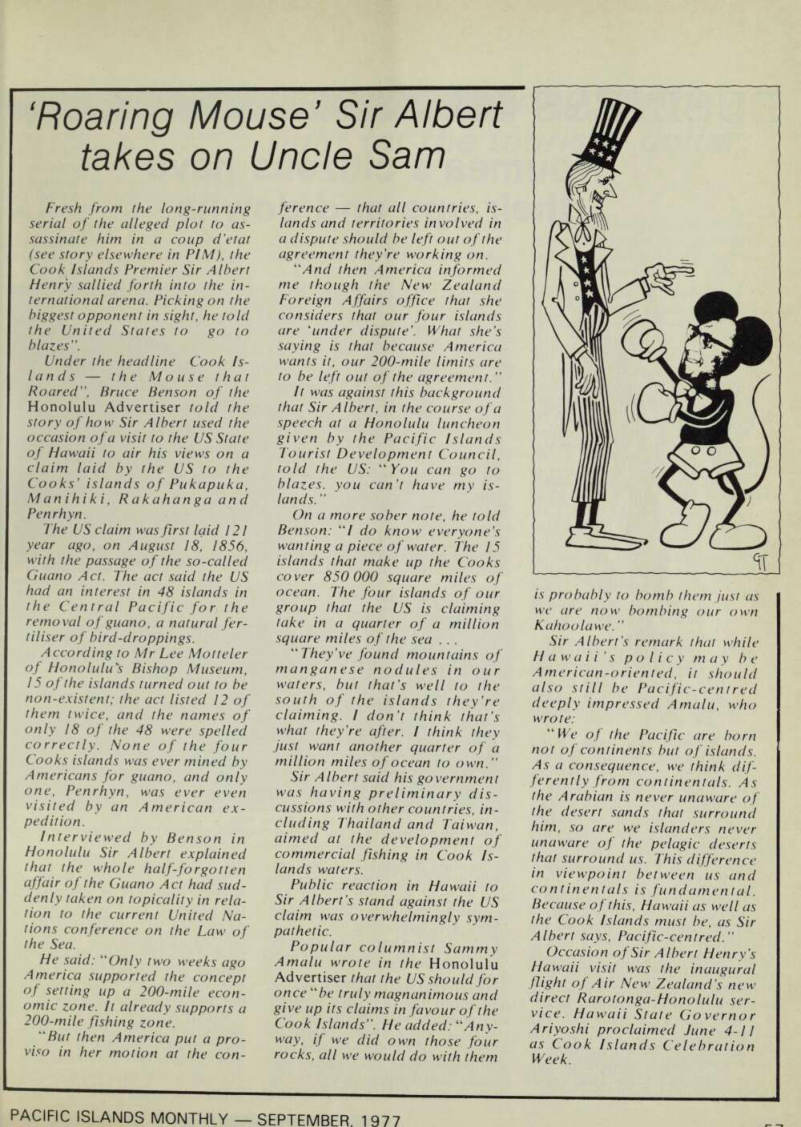
takes on Uncle Sam
Fresh from the long-running serial of the alleged plot to as sassinate him in a coup d’etat (see story elsewhere in PIM), the Cook Islands Premier Sir Albert Henry sallied forth into the in ternational arena. Picking on the biggest opponent in sight, he told the United States to go to blazes”.
Under the headline Cook Is lands the Mouse that Roared”, Bruce Benson of the Honolulu Advertiser told the story of how Sir Albert used the occasion of a visit to the US State of Hawaii to air his views on a claim laid by the US to the Cooks’ islands of Pukapuka, Manihi k i, Rakahan g a and Penrhyn.
The US claim was first laid 121 year ago, on August 18, 1856, with the passage of the so-called Guano Act. The act said the US had an interest in 48 islands in the Central Pacific for the removal of guano, a natural fer tiliser of bird-droppings.
According to Mr Lee Motteler of Honolulu”s Bishop Museum, 15 of the islands turned out to be non-existent; the act listed 12 of them twice, and the names of only 18 of the 48 were spelled correctly. None of the four Cooks islands was ever mined by Americans for guano, and only one, Penrhyn, was ever even visited by an American ex pedition.
Interviewed by Benson in Honolulu Sir Albert explained that the whole half-forgotten affair of the Guano Act had sud denly taken on topicality in rela tion to the current United Na tions conference on the Law of the Sea.
He said: “Only two weeks ago America supported the concept of setting up a 200-mile econ omic zone. It already supports a 200-mile fishing zone.
“But then America put a pro viso in her motion at the con
ference that all countries, is lands and territories involved in a dispute should be left out of the agreement they’re working on.
“And then America informed me though the New Zealand Foreign Affairs office that she considers that our four islands are ‘under dispute’. What she’s saying is that because America wants it, our 200-mile limits are to be left out of the agreement.”
It was against this background that Sir A Ibert, in the course of a speech at a Honolulu luncheon given by the Pacific Islands Tourist Development Council, told the US: “ You can go to blazes, you can’t have my is lands. ”
On a more sober note, he told Benson: “/ do know everyone’s wanting a piece of water. The 15 islands that make up the Cooks cover 850 000 square miles of ocean. The four islands of our group that the US is claiming take in a quarter of a million square miles of the sea . . .
“ They’ve found mountains of manganese nodules in our waters, but that’s well to the south of the islands they’re claiming. I don’t think that’s what they’re after. I think they just want another quarter of a million miles of ocean to own.”
Sir Albert said his government was having preliminary dis cussions with other countries, in cluding Thailand and Taiwan, aimed at the development of commercial fishing in Cook Is lands waters.
Public reaction in Hawaii to Sir Albert’s stand against the US claim was overwhelmingly sym pathetic.
Popular columnist Sammy Amalu wrote in the Honolulu Advertiser that the US should for once “be truly magnanimous and give up its claims in favour of the Cook Islands”. He added: “Any way, if we did own those four rocks, all we would do with them
is probably to bomb them Just as we are now bombing our own Kahoolawe. ”
Sir Albert’s remark that while Hawaii’s policy may he American-oriented, it should also still he Pacific-centred deeply impressed Amalu, who wrote: “We of the Pacific are born not of continents but of islands.
As a consequence, we think dif ferently from continentals. As the Arabian is never unaware of the desert sands that surround him, so are we islanders never unaware of the pelagic deserts that surround us. This difference in viewpoint between us and continentals is fundamental.
Because of this, Hawaii as well as the Cook Islands must be, as Sir Albert says, Pacific-centred.”
Occasion of Sir Albert Henry’s Hawaii visit was the inaugural flight of A ir New Zealand’s new direct Rarotonga-Honolulu ser vice. Hawaii State Governor Ariyoshi proclaimed June 4-11 as Cook Islands Celebration Week.
Business
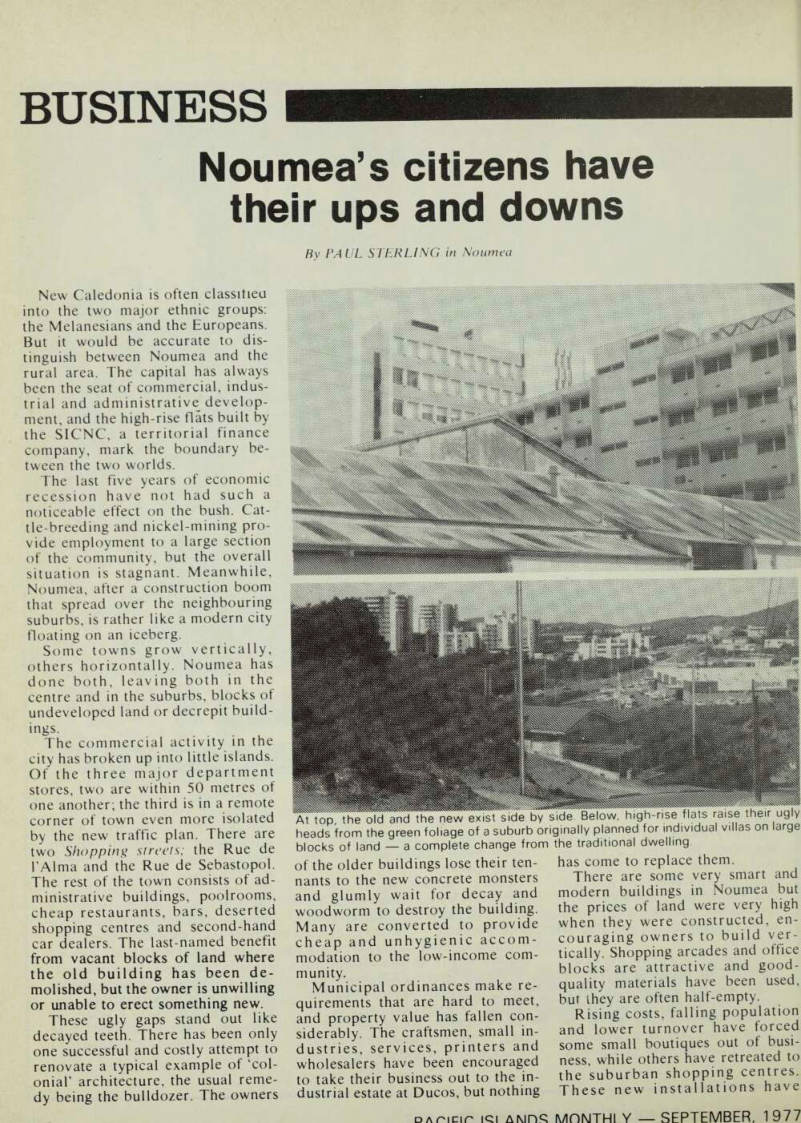
Noumea’s citizens have their ups and downs
By PAUL STERLING in Noumea
New Caledonia is often classified into the two major ethnic groups; the Melanesians and the Europeans.
But it would be accurate to dis tinguish between Noumea and the rural area. The capital has always been the seat of commercial, indus trial and administrative develop ment, and the high-rise flats built by the SICNC, a territorial finance company, mark the boundary be tween the two worlds.
The last five years of economic recession have not had such a noticeable effect on the bush. Cat tle-breeding and nickel-mining pro vide employment to a large section of the community, but the overall situation is stagnant. Meanwhile, Noumea, after a construction boom that spread over the neighbouring suburbs, is rather like a modern city floating on an iceberg.
Some towns grow vertically, others horizontally. Noumea has done both, leaving both in the centre and in the suburbs, blocks of undeveloped land or decrepit build
ings. . , . ,
The commercial activity in the city has broken up into little islands.
Of the three major department stores, two are within 50 metres of one another; the third is in a remote corner of town even more isolated by the new traffic plan. There are two Shopping streets; the Rue de I’Alma and the Rue de Sebastopol.
The rest of the town consists of ad ministrative buildings, poolrooms, cheap restaurants, bars, deserted shopping centres and second-hand car dealers. The last-named benefit from vacant blocks of land where the old building has been de molished, but the owner is unwilling or unable to erect something new.
These ugly gaps stand out like decayed teeth. There has been only one successful and costly attempt to renovate a typical example of ‘col onial’ architecture, the usual reme dy being the bulldozer. The owners
of the older buildings lose their ten nants to the new concrete monsters and glumly wait for decay and woodworm to destroy the building.
Many are converted to provide cheap and unhygienic accom modation to the low-income com munity.
Municipal ordinances make re quirements that are hard to meet, and property value has fallen con siderably. The craftsmen, small in dustries, services, printers and wholesalers have been encouraged to take their business out to the in dustrial estate at Ducos, but nothing
has come to replace them.
There are some very smart and modern buildings in Noumea but the prices of land were very high when they were constructed, en couraging owners to build ver tically. Shopping arcades and office blocks are attractive and good quality materials have been used, but they are often half-empty.
Rising costs, falling population and lower turnover have forced some small boutiques out of busi ness, while others have retreated to the suburban shopping centres.
These new installations have
At top the old and the new exist side by side Below, high-rise flats raise their ugly heads from the green foliage of a suburb originally planned for individual villas on large blocks of land - a complete change from the traditional dwelling.
generally followed the extension of the Housing Commission’s programme, but the Normandie is slowly losing its tenants and the re cently-opened Riviere Salee has not attracted many retailers. In town, the Surcouf, the Moana, the Passage and the Foch shopping centres are only partially occupied.
A new system of taxing traders and businesses, a revision of the old Patant tax is also partially based on commercial surface occupied. This has encouraged many businesses to reduce the size of their stores or close down secondary outlets.
Lessors of dwellings pay land tax, rental tax and the patent tax, which combine to make a heavy overhead for the owners of some of the older buildings.
Over the last three years the population of the town has fallen from 59 000 to 56 000. Present empty dwellings offer accom modation for a further 12 000. Of the total population, roughly 1 33 000, there are 86 000 under 14 years old. There is thus a potential for a rapid expansion of family groups, if a corresponding employ ment potential is created. The size of families is variable with an average of 3.3 for the Europeans, and of 7.1 for expatriates from Wallis and Futuna. But there is a growing tendency to move to the neighbouring Dumbea and Mont- Dore, where the population growth has been very rapid.
A 1975 census showed that of the 9 418 families in Noumea, 5 080 liv ed in rented accommodation, 1 500 were living in accommodation sup plied by their employers, and 2 440 owned their own residence. Yet the potential for new home-owners is not as important as this would seem to indicate. Noumea has a high migratory population of public housing organisations. This shows that while the assistance to the lower-income bracket is important, the more expensive homes and flats will probably be on the market for some time to come. To sell a private home today, vendor finance of up to 75% of the value is necessary.
The building trade is in a sad state, and an analysis of the situation shows little motivation for new pro jects. Noumea is already well equip ped for further expansion, although it would be preferable to see future activity concentrate on the less developed rural areas.
Advertisements & other items, p. 58 (1 item)
Dancir Iqi Month! Y September, 1977
Fiji dears the ring for the fight
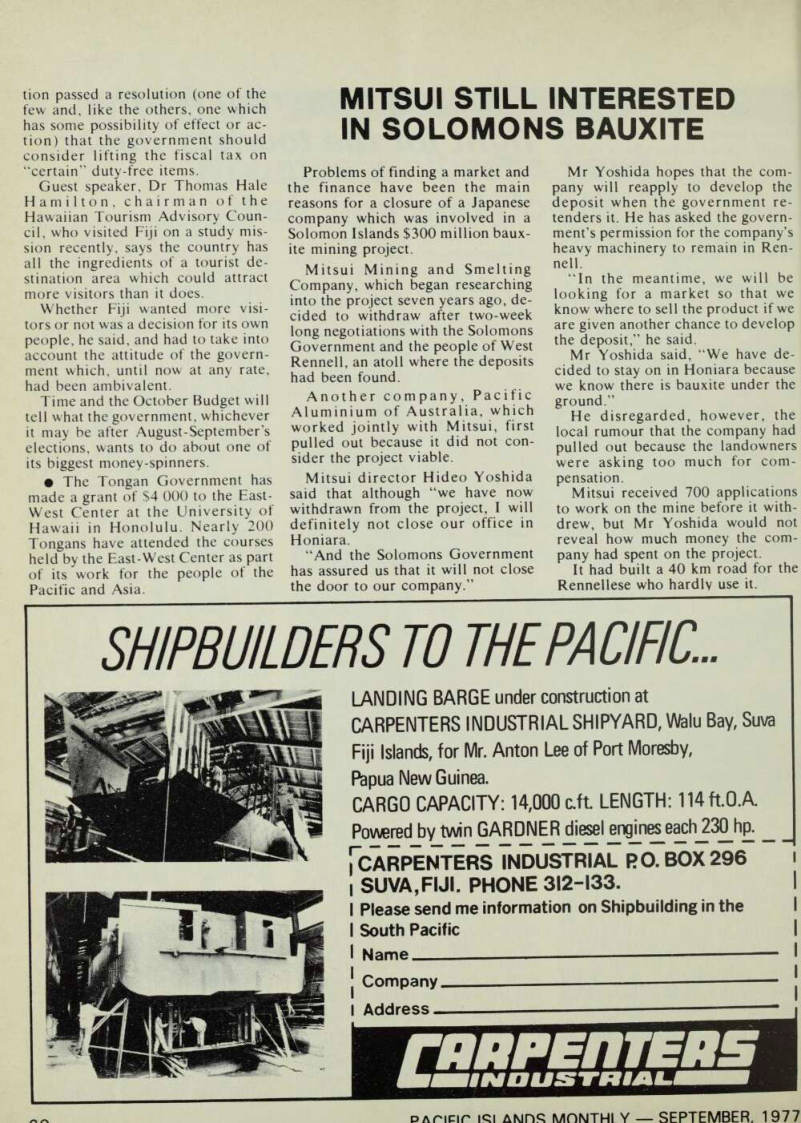
fight for the tourists' dollar
From SEONA MARTIN in Suva
The Golden Era of Fiji tourism, with its ever-swelling number of visitors and easy profits, is over and it’s a fight for every mega-buck.
But the usual air of optimism pre vailed at this year’s Fiji Tourism Convention at the Fijian hotel, Yanuca, on Viti Levu’s Coral Coast.
Perhaps with more reason than for the last couple of years, when delegates winced over drastically declining tourist figures and gloom ed about world recession.
This year they had plans for a strong national promotion campaign by the Fiji Visitors Bureau and in dications of government money to pay for it to cheer them, some home truths from the three-minister Fiji Tourism Commission and strong meat from Air Pacific to chew over.
Yet all was not rosy, as FVB general manager, Paddy Doyle, said in his opening talk.
While world and Pacific tourism figures continued to increase, Fiji was still losing its market share de spite a slight rise in actual visitor numbers last year.
He still claimed, however, that tourism was Fiji’s best bet as the main financial bridge between the present economic situation and future bonanzas expected from fledgling industries such as pine wood and beef schemes.
Last year, tourists left behind $30.4 million to help counter the country’s annual trade deficit of $ll2 million, which includes $3B million-worth of food imports.
The industry employed about 3 000 people in hotels alone, plus an estimated further 6 000 who derive their livelihood from tourism.
Mr Doyle said the usual things about everybody in the industry playing their part to improve the situation, and aimed a couple of pot shots at poor hotel housekeeping and fast-buck merchants in the taxi industry and among duty-free dealers.
To play its part, the FVB is look ing tor $450 000 running costs for next year and $7OO 000 for a na tional marketing plan.
The FVB budget has traditionally been made up of a government grant and a notoriously miserly voluntary contribution from the industry, usually from the same small group of businesses each year with indica tions of a growing suspicion that they might not be getting their money’s worth.
The Minister for Tourism, Mr Jonati Mavoa. has indicated his ministry budget submission will in clude the sum the FVB has asked for on which note he urged industry representatives at the convention to give a demonstration of their good intentions by supporting the FVB $5O 000 publicity campaign for the remainder of this year.
The campaign included a heavy Australian advertising component which was sold out within the day at the convention and contributions began tumbling in with $2 000 from the Society of Fiji Travel Agents and a similar sum from the Fiji Hotel Association.
Next year’s campaign, if it gets the money, will be aimed primarily at Australia and New Zealand, then towards North America, and on the home front at educating people “from the Prime Minister down” about the benefits and possible problems of tourism.
An outstanding feature of this convention was the presence of the Commission Mr Mavoa, the Minister for Finance, Mr Charles Stinson, and Minister for Urban Development, Housing and Social Welfare, Mr Mohammed Ramzan all of whom had pertinent points to put and some interesting infor mation to air.
They took a worthwhile and ac tive part in convention sessions with only rare absences because of press ing engagements on the golf course.
For instance, Mr Stinson gave the reasoning behind a strongly criticised, terse two-sentence reply from government refusing a request from the 1976 Convention for the 10% fiscal tax on imported “duty free” items to be lifted.
After his explanation, the conven
tion passed a resolution (one of the few and, like the others, one which has some possibility of effect or ac tion) that the government should consider lifting the fiscal tax on “certain” duty-free items.
Guest speaker. Dr Thomas Hale Hamilton, chairman of the Hawaiian Tourism Advisory Coun cil, who visited Fiji on a study mis sion recently, says the country has all the ingredients of a tourist de stination area which could attract more visitors than it does.
Whether Fiji wanted more visi tors or not was a decision for its own people, he said, and had to take into account the attitude of the govern ment which, until now at any rate, had been ambivalent.
Time and the October Budget will tell what the government, whichever it may be after August-September’s elections, wants to do about one of its biggest money-spinners. • The Tongan Government has made a grant of $4 000 to the East- West Center at the University of Hawaii in Honolulu. Nearly 200 Tongans have attended the courses held by the East-West Center as part of its work for the people of the Pacific and Asia.
Mitsui Still Interested
In Solomons Bauxite
Problems of finding a market and the finance have been the main reasons for a closure of a Japanese company which was involved in a Solomon Islands $3OO million baux ite mining project.
Mitsui Mining and Smelting Company, which began researching into the project seven years ago, de cided to withdraw after two-week long negotiations with the Solomons Government and the people of West Rennell, an atoll where the deposits had been found.
Another company. Pacific Aluminium of Australia, which worked jointly with Mitsui, first pulled out because it did not con sider the project viable.
Mitsui director Hideo Yoshida said that although “we have now withdrawn from the project, I will definitely not close our office in Honiara.
“And the Solomons Government has assured us that it will not close the door to our company.”
Mr Yoshida hopes that the com pany will reapply to develop the deposit when the government re tenders it. He has asked the govern ment’s permission for the company’s heavy machinery to remain in Ren nell.
“In the meantime, we will be looking for a market so that we know where to sell the product if we are given another chance to develop the deposit,” he said.
Mr Yoshida said, “We have de cided to stay on in Honiara because we know there is bauxite under the ground.”
He disregarded, however, the local rumour that the company had pulled out because the landowners were asking too much for com
pensation.
Mitsui received 700 applications to work on the mine before it with drew, but Mr Yoshida would not reveal how much money the com pany had spent on the project.
It had built a 40 km road for the Rennellese who hardly use it.
Six experts to
study PNG fisheries
The Food and Agriculture Organ isation will provide six technical ex perts to evaluate the status of exist ing fisheries operations in Papua New Guinea. The experts will also assess the potential of the op erations, and decide the institu tional framework most suitable for the long-term expansion of the in dustry.
The Asian Development Bank has agreed to pay for the project on a grant basis. One of the aims of the project is to expand fish and pearl production to generate increased in comes and employment oppor tunities in fisheries. The main com ponents are expected to include shore facilities for the skipjack fleets, pole and line fishing boats, fish collection facilities for the ar tisanal fisheries sector, pearl culture expansion and consultant services.
Oil search to
resume in Tonga
Oil drilling in Tonga is expected to be resumed early in 1977, Mr Robert Birdsong, president of Webb-Tonga, the drilling company, said after an agreement was signed in Nukualofa.
The company, under the agree ment, is committed to drill three ex ploratory wells on Tongatapu in a 53.5 million programme. The drill ing rig will arrive in Tonga in about four months.
Micronesians want
200-mile zone
The US Trust Territory and the United Slates are at issue over Micronesia’s claim for legislation fv>r a 200-mile fishing zone. Mr Charles Domnick, chairman of the Micronesian Law of the Sea delega tion at recent round-table dis cussions in Honolulu, said the US had given two reasons for disap proving the 200-mile zone legisla tion.
The first was that the Micronesian Act was inconsistent with US inter national responsibilities. However, the US and Micronesian interests over tuna were opposites.
Micronesia did not believe that the conflict of interest constituted a valid basis for the veto under the
United Nations Charter and Trusteeship Agreement.
Mr Domnick, referring to the sec ond objection which covered US obligations, said that while the Trusteeship Agreement gave the US responsibilities for peace and security in the area, there was no mention of foreign affairs in the agreement. The peace and security responsibility of the US should not prevent protection of Micronesia's marine resources.
Congress of Micronesia Senate President Senator Tosiwo Nakayama, said the Micronesians believed the marine resources belonged to them.
‘Sniping’ for
PNG Tourism
Papua New Guinea’s Office of Tourism has appointed Harrowgate Associates, Sydney, to represent it in Australia.
Harrowgate managing director, Mr George Lynch, said: “Based on past experience, we know broadly what to do for PNG. What we have to work out are the relevant techni ques and the potential segments in the market. It does seem certain that at this stage in PNG’s development as a destination or stop-over, a sniper’s rifle is needed rather than a shotgun.”
Advertisements & other items, pp. 60-62 (2 items)
60
PAriPir ISI ANDR MONTHLY SEPTEMBER, 1977
Shipbuilders To The Pacific.
LANDING BARGE under construction at
CARPENTERS INDUSTRIAL SHIPYARD, Walu Bay, Suva
Fiji Islands, for Mr. Anton Lee of Port Moresby, Papua New Guinea.
CARGO CAPACITY: 14,000 c.ft. LENGTH: 114 ft.OA Powered by twin GARDNER engineseachi_23ohp.
[CARPENTERS INDUSTRIAL RO. BOX 296
I SUVA,FIJI. PHONE 312-133.
I Please send me information on Shipbuilding in the I South Pacific
THE WATER WHEEL GROUP OF COMPANIES,
Winners of Australia’s Top Export Award and Flour Millers for over 100 years,
OFFER THE PACIFIC ISLANDS THE TOPS
IN QUALITY PRODUCTS & SERVICE.
-fa BEST AUSTRALIAN WHEATEN FLOUR
(Roller, Wholemeal, High Protein, Cake etc.)
INSTOCK & POULTRY FEEDS
(Pellets or Mash form)
SPLIT PEAS & WHOLE PEAS
(Machined-Dressed) Plus a range of Associated Australian Products.
F.C.L. Containers & Unitised Cargoes a speciality.
Areas Serviceable are: Papua New Guinea, Fiji, Tonga, Western Samoa, American Samoa, New Hebrides, New Caledonia & Micronesia.
All Enquiries Welcome to;
WATER WHEEL EXPORTS Pty. Ltd.
493 Bourke Street, Melbourne 3000, Australia.
Cables: Watermill - Melbourne. Telex: AA 32165.
Telephone: 602-1433.
ANDREWS &
BE AVEN LTD
INDUSTRIAL TRANSMISSION
suppliers to the Pacific Basin !
For many years, Andrews & Beaven have been supplying the power transmission needs of New Zealand industry. Today they are geared to meet the demands of industrial development throughout the Pacific Basin.
From Gear boxes to Flexible couplings, Andrews & Beaven manufacture a wide range of power transmission components. Their modern, sophisticated plant ensures consistent accuracy of all components and complete dependability.
COMPLETE TRANSMISSION
RANGE
• Transmission Gearboxes • Conveyor Equipment • Transmission Bearings • Flexible Couplings & m s r i L It For further information and full product list MAIL THIS COUPON Andrews & Beaven Ltd. Transmission Division Private Bag, Christchurch, N.Z.
Please mail by return post details and full product list of Power Transmission Equipment.
Name Company . .
Full Address
Superport

Guam Wants
The Oil
While a battle over whether a Japanese oil “superport” should be built in Palau continues, Guam has taken a first step towards enticing port backers to transfer their project from Palau to Guam.
Environmentalists, intent on preserving the pristine Palau coral reefs, are battling business interests eyeing Palau as a site for a huge oil storage complex for Japan.
The port, if built, would accom modate supertankers far too large for most conventional seaports. At present, only one port in Japan and one in Okinawa are capable of han dling the supertankers on Japanese soil. But backers are looking to build elsewhere in an attempt to bypass the environmental outcry that could develop in Japan.
Foes of the port went to the re cently-completed United Nations Trusteeship Council session, the final report of which urges careful attention to the environmental im pact of such a project. And Palau leaders publicly are taking a very neutral stance.
However, in a May 24 letter to Nissho-Iwai, the Japanese firm that put together a consortium of poten tial financiers for the project, Johnson Toribiong, chairman of the Palau Legislature’s Special Com mittee on Palau Port Authority, said it was the legislature’s intention “to conduct a referendum after the completion of the reasibility study to assure full political support for the port development.”
The letter said the US had agreed to pay $2OO 000 for an en vironmental study to establish guidelines for Nissho-Iwai’s econ omic studies.
Meanwhile, on Guam, the legislature has passed a bill calling for a team to study the feasibility of building the superport on Guam.
The bill’s sponsor, Senator Frank Bias, said construction costs for the port on Guam would be only US$3OO million, compared with $670 million for Palau.
Bias said “it would be premature to guess the degree of opposition” would be generated on Guam to the port project.
capital
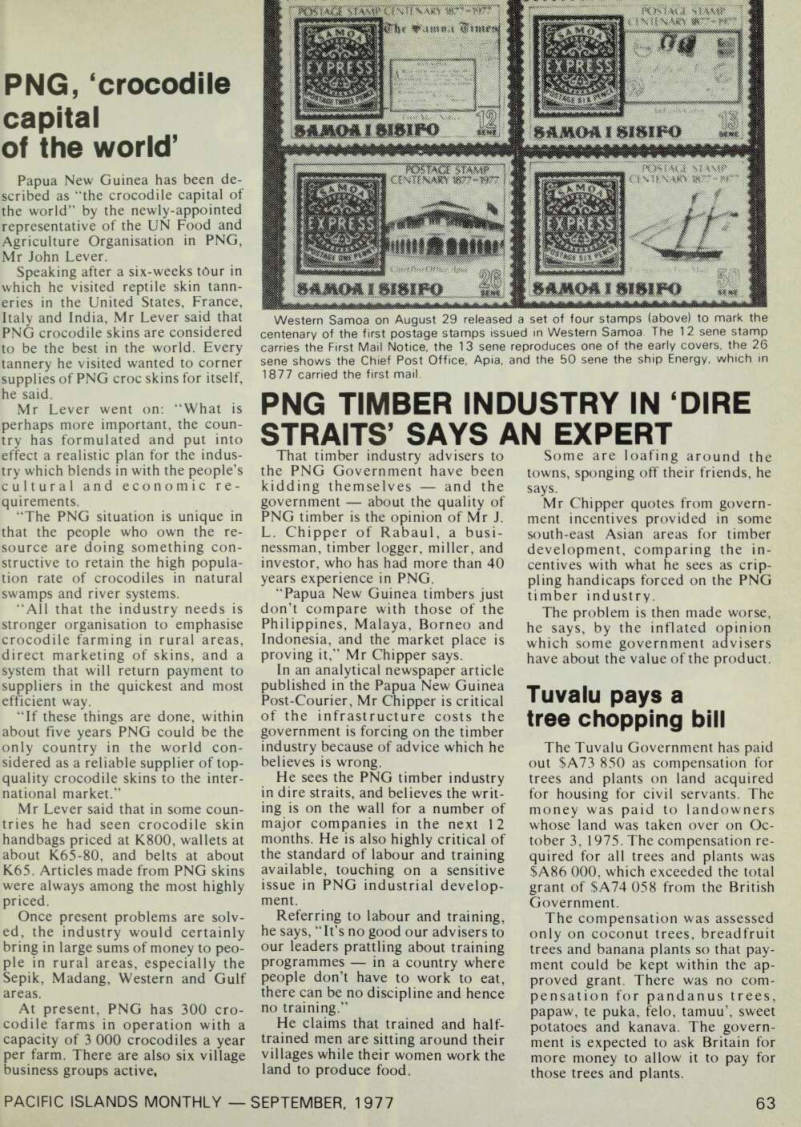
Png Timber Industry In 'Dire
Straits’ Says An Expert
PNG, ‘crocodile
capital
of the world’
Papua New Guinea has been de scribed as “the crocodile capital of the world” by the newly-appointed representative of the UN Food and Agriculture Organisation in PNG, Mr John Lever.
Speaking after a six-weeks tour in which he visited reptile skin tann eries in the United States, France, Italy and India, Mr Lever said that PNG crocodile skins are considered to be the best in the world. Every tannery he visited wanted to corner supplies of PNG croc skins for itself, he said.
Mr Lever went on; “What is perhaps more important, the coun try has formulated and put into effect a realistic plan for the indus try which blends in with the people’s cultural and economic re quirements.
“The PNG situation is unique in that the people who own the re source are doing something con structive to retain the high popula tion rate of crocodiles in natural swamps and river systems.
“All that the industry needs is stronger organisation to emphasise crocodile farming in rural areas, direct marketing of skins, and a system that will return payment to suppliers in the quickest and most efficient way.
“If these things are done, within about five years PNG could be the only country in the world con sidered as a reliable supplier of top quality crocodile skins to the inter national market.”
Mr Lever said that in some coun tries he had seen crocodile skin handbags priced at K800, wallets at about K65-80, and belts at about K65. Articles made from PNG skins were always among the most highly priced.
Once present problems are solv ed, the industry would certainly bring in large sums of money to peo ple in rural areas, especially the Sepik, Madang, Western and Gulf areas.
At present, PNG has 300 cro codile farms in operation with a capacity of 3 000 crocodiles a year per farm. There are also six village business groups active,
That timber industry advisers to the PNG Government have been kidding themselves and the government about the quality of PNG timber is the opinion of Mr J.
L. Chipper of Rabaul, a businessman, timber logger, miller, and investor, who has had more than 40 years experience in PNG.
“Papua New Guinea timbers just don t compare with those of the Philippines, Malaya, Borneo and Indonesia, and the market place is proving it, Mr Chipper says.
In an analytical newspaper article published in the Papua New Guinea Post-Courier, Mr Chipper is critical of the infrastructure costs the government is forcing on the timber industry because of advice which he believes is wrong.
He sees the PNG timber industry in dire straits, and believes the writing is on the wall for a number of major companies in the next 12 months. He is also highly critical of the standard of labour and training available, touching on a sensitive issue in PNG industrial developmen L Referring to labour and training, he says, “It’s no good our advisers to our leaders prattling about training programmes in a country where people don’t have to work to eat, there can be no discipline and hence no training.”
He claims that trained and halftrained men are sitting around their villages while their women work the land to produce food.
Some are loafing around the towns, sponging off their friends, he says.
Mr Chipper quotes from govern ment incentives provided in some south-east Asian areas for timber development, comparing the in centives with what he sees as crip pling handicaps forced on the PNG timber industry, The problem is then made worse, he says, by the inflated opinion which some government advisers have about the value of the product.
T« I UVaIU PayS a
trG6 ChOPDiIICI bill
3 The Tuvalu Government has paid out SA73 850 as compensation for trees and plants on land acquired for housing for civil servants. The money was paid to landowners whose land was taken over on Oc tober 3, 1975. The compensation re quired for all trees and plants was SAB6 000, which exceeded the total grant of SA74 058 from the British Government.
The compensation was assessed only on coconut trees, breadfruit trees and banana plants so that pay ment could be kept within the ap proved grant. There was no com pensation for pandanus trees, papaw, te puka, felo, tamuu’, sweet potatoes and kanava. The govern ment is expected to ask Britain for more money to allow it to pay for those trees and plants.
Western Samoa on August 29 released a set of four stamps (above) to mark the centenary of the first postage stamps issued in Western Samoa. The 12 sene stamp carries the First Mail Notice, the 13 sene reproduces one of the early covers, the 26 sene shows the Chief Post Office, Apia, and the 50 sene the ship Energy, which in 1877 carried the first mail.
Advertisements & other items, p. 64 (1 item)
A
* I I I » It flies with grace and experience from the land that helped pioneer commercial aviation back in the 1920 s Papua New Guinea home of the Birds of Paradise; now the cross-road from the Pacific to Asia 'W u 9 A/ *s- ■ ,
at Fiji’s striking dockers
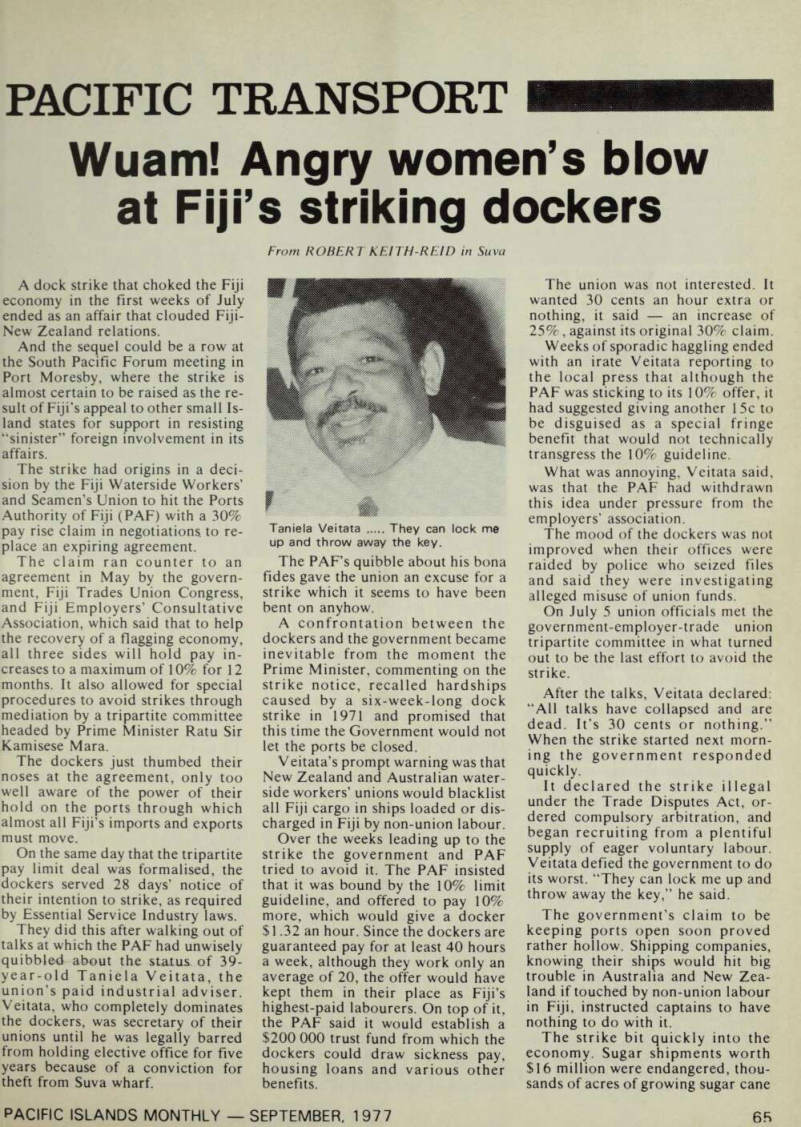
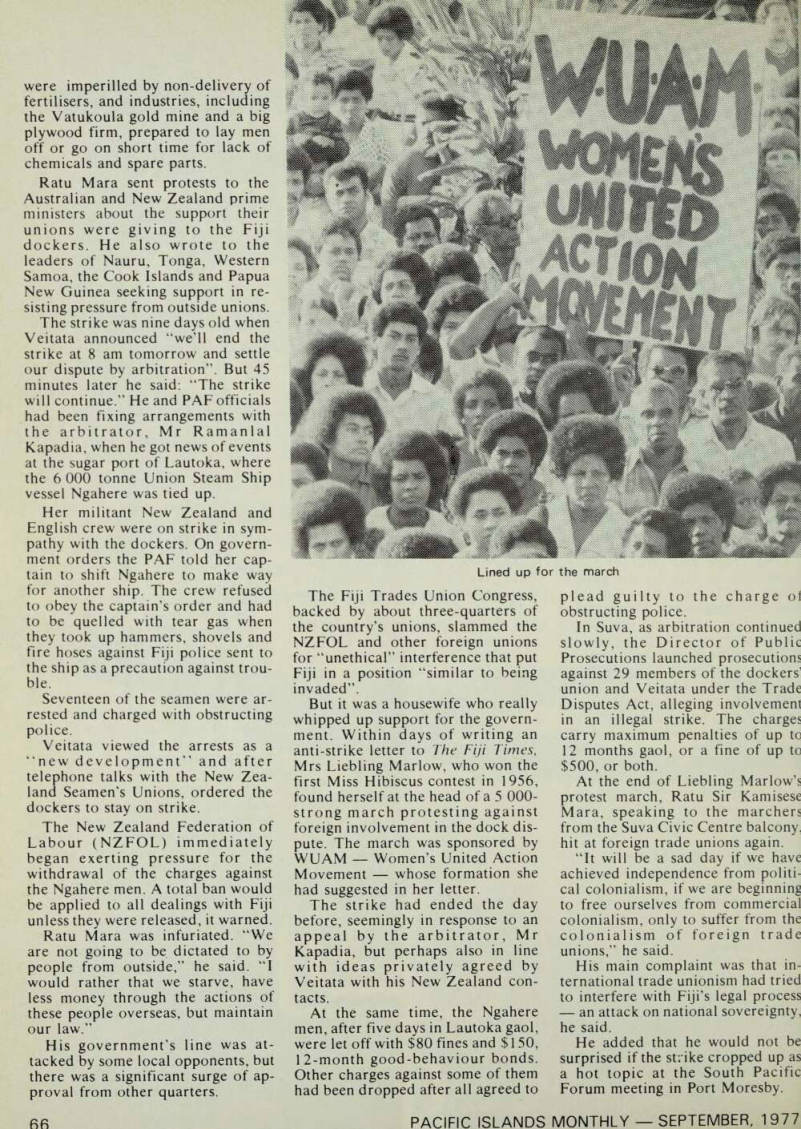
Pacific Transport
Wuam! Angry women’s blow at Fiji’s striking dockers
From ROBERT KEITH-RE/D in Suva
A dock strike that choked the Fiji economy in the first weeks of July ended as an affair that clouded Fiji- New Zealand relations.
And the sequel could be a row at the South Pacific Forum meeting in Port Moresby, where the strike is almost certain to be raised as the re sult of Fiji’s appeal to other small Is land states for support in resisting “sinister” foreign involvement in its affairs.
The strike had origins in a deci sion by the Fiji Waterside Workers’ and Seamen’s Union to hit the Ports Authority of Fiji (PAF) with a 30% pay rise claim in negotiations, to re place an expiring agreement.
The claim ran counter to an agreement in May by the govern ment, Fiji Trades Union Congress, and Fiji Employers’ Consultative Association, which said that to help the recovery of a flagging economy, all three sides will hold pay in creases to a maximum of 10% for 12 months. It also allowed for special procedures to avoid strikes through mediation by a tripartite committee headed by Prime Minister Ratu Sir Kamisese Mara.
The dockers just thumbed their noses at the agreement, only too well aware of the power of their hold on the ports through which almost all Fiji’s imports and exports must move.
On the same day that the tripartite pay limit deal was formalised, the dockers served 28 days’ notice of their intention to strike, as required by Essential Service Industry laws.
They did this after walking out of talks at which the PAF had unwisely quibbled about the status of 39year-old Taniela Veitata, the union’s paid industrial adviser.
Veitata, who completely dominates the dockers, was secretary of their unions until he was legally barred from holding elective office for five years because of a conviction for theft from Suva wharf.
The PAF’s quibble about his bona fides gave the union an excuse for a strike which it seems to have been bent on anyhow.
A confrontation between the dockers and the government became inevitable from the moment the Prime Minister, commenting on the strike notice, recalled hardships caused by a six-week-long dock strike in 1971 and promised that this time the Government would not let the ports be closed.
Veitata’s prompt warning was that New Zealand and Australian water side workers’ unions would blacklist all Fiji cargo in ships loaded or dis charged in Fiji by non-union labour.
Over the weeks leading up to the strike the government and PAF tried to avoid it. The PAF insisted that it was bound by the 10% limit guideline, and offered to pay 10% more, which would give a docker $1.32 an hour. Since the dockers are guaranteed pay for at least 40 hours a week, although they work only an average of 20, the offer would have kept them in their place as Fiji’s highest-paid labourers. On top of it, the PAF said it would establish a $2OO 000 trust fund from which the dockers could draw sickness pay, housing loans and various other benefits.
The union was not interested. It wanted 30 cents an hour extra or nothing, it said an increase of 25%, against its original 30% claim.
Weeks of sporadic haggling ended with an irate Veitata reporting to the local press that although the PAF was sticking to its 10% offer, it had suggested giving another 15c to be disguised as a special fringe benefit that would not technically transgress the 10% guideline.
What was annoying, Veitata said, was that the PAF had withdrawn this idea under pressure from the employers’ association.
The mood of the dockers was not improved when their offices were raided by police who seized files and said they were investigating alleged misuse of union funds.
On July 5 union officials met the government-employer-trade union tripartite committee in what turned out to be the last effort to avoid the strike.
After the talks, Veitata declared: “All talks have collapsed and are dead. It’s 30 cents or nothing.”
When the strike started next morn ing the government responded quickly.
It declared the strike illegal under the Trade Disputes Act, or dered compulsory arbitration, and began recruiting from a plentiful supply of eager voluntary labour.
Veitata defied the government to do its worst. “They can lock me up and throw away the key,” he said.
The government’s claim to be keeping ports open soon proved rather hollow. Shipping companies, knowing their ships would hit big trouble in Australia and New Zea land if touched by non-union labour in Fiji, instructed captains to have nothing to do with it.
The strike bit quickly into the economy. Sugar shipments worth $l6 million were endangered, thou sands of acres of growing sugar cane
Taniela Veitata ... They can lock me up and throw away the key.
were imperilled by non-delivery of fertilisers, and industries, including the Vatukoula gold mine and a big plywood firm, prepared to lay men off or go on short time for lack of chemicals and spare parts.
Ratu Mara sent protests to the Australian and New Zealand prime ministers about the support their unions were giving to the Fiji dockers. He also wrote to the leaders of Nauru, Tonga, Western Samoa, the Cook Islands and Papua New Guinea seeking support in re sisting pressure from outside unions.
The strike was nine days old when Veitata announced “we’ll end the strike at 8 am tomorrow and settle our dispute by arbitration”. But 45 minutes later he said; “The strike will continue.” He and PAF officials had been fixing arrangements with the arbitrator, Mr Ramanlal Kapadia, when he got news of events at the sugar port of Lautoka, where the 6 000 tonne Union Steam Ship vessel Ngahere was tied up.
Her militant New Zealand and English crew were on strike in sym pathy with the dockers. On govern ment orders the PAF told her cap tain to shift Ngahere to make way for another ship. The crew refused to obey the captain’s order and had to be quelled with tear gas when they took up hammers, shovels and fire hoses against Fiji police sent to the ship as a precaution against trou ble.
Seventeen of the seamen were ar rested and charged with obstructing police.
Veitata viewed the arrests as a “new development” and after telephone talks with the New Zea land Seamen’s Unions, ordered the dockers to stay on strike.
The New Zealand Federation of Labour (NZFOL) immediately began exerting pressure for the withdrawal of the charges against the Ngahere men. A total ban would be applied to all dealings with Fiji unless they were released, it warned.
Ratu Mara was infuriated. “We are not going to be dictated to by people from outside,” he said. “I would rather that we starve, have less money through the actions of these people overseas, but maintain our law.”
His government’s line was at tacked by some local opponents, but there was a significant surge of ap proval from other quarters.
The Fiji Trades Union Congress, backed by about three-quarters of the country’s unions, slammed the NZFOL and other foreign unions for “unethical” interference that put Fiji in a position “similar to being invaded”.
But it was a housewife who really whipped up support for the govern ment. Within days of writing an anti-strike letter to The Fiji Times, Mrs Liebling Marlow, who won the first Miss Hibiscus contest in 1956, found herself at the head of a 5 000strong march protesting against foreign involvement in the dock dis pute. The march was sponsored by WUAM Women’s United Action Movement whose formation she had suggested in her letter.
The strike had ended the day before, seemingly in response to an appeal by the arbitrator, Mr Kapadia, but perhaps also in line with ideas privately agreed by Veitata with his New Zealand con tacts.
At the same time, the Ngahere men, after five days in Lautoka gaol, were let off with $BO fines and $ 150, 12-month good-behaviour bonds.
Other charges against some of them had been dropped after all agreed to
plead guilty to the charge of obstructing police.
In Suva, as arbitration continued slowly, the Director of Public Prosecutions launched prosecutions against 29 members of the dockers’ union and Veitata under the Trade Disputes Act, alleging involvement in an illegal strike. The charges carry maximum penalties of up to 12 months gaol, or a fine of up to $5OO, or both.
At the end of Liebling Marlow’s protest march, Ratu Sir Kamisese Mara, speaking to the marchers from the Suva Civic Centre balcony, hit at foreign trade unions again.
“It will be a sad day if we have achieved independence from politi cal colonialism, if we are beginning to free ourselves from commercial colonialism, only to suffer from the colonialism of foreign trade unions,” he said.
His main complaint was that in ternational trade unionism had tried to interfere with Fiji’s legal process an attack on national sovereignty, he said.
He added that he would not be surprised if the strike cropped up as a hot topic at the South Pacific Forum meeting in Port Moresby.
Lined up for the march
Puts The Record Straight
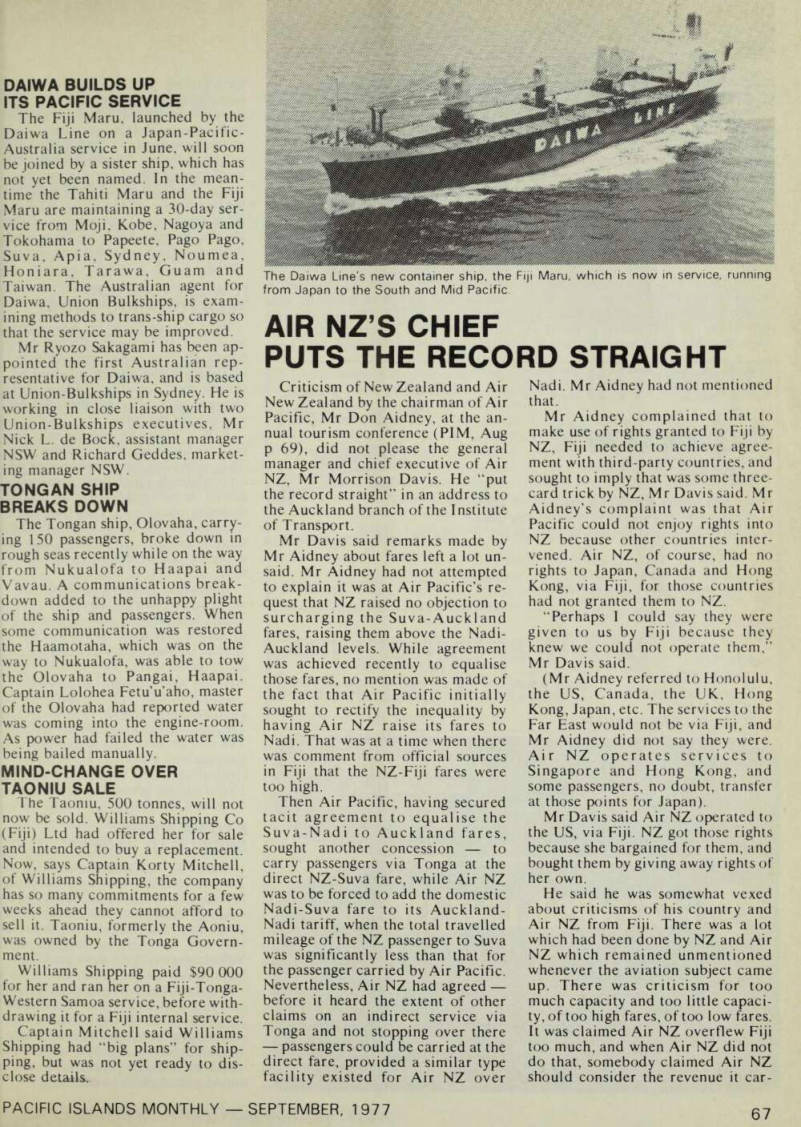
Air Nz’S Chief
Daiwa Builds Up
Its Pacific Service
The Fiji Maru, launched by the Daiwa Line on a Japan-Pacific- Australia service in June, will soon be joined by a sister ship, which has not yet been named. In the mean time the Tahiti Maru and the Fiji Maru are maintaining a 30-day ser vice from Moji, Kobe, Nagoya and Tokohama to Papeete, Pago Pago, Suva, Apia, Sydney, Noumea, Honiara, Tarawa, Guam and Taiwan. The Australian agent for Daiwa, Union Bulkships, is exam ining methods to trans-ship cargo so that the service may be improved.
Mr Ryozo Sakagami has been ap pointed the first Australian rep resentative for Daiwa, and is based at Union-Bulkships in Sydney. He is working in close liaison with two Union-Bulkships executives. Mr Nick L. de Bock, assistant manager NSW and Richard Geddes, market ing manager NSW.
Tongan Ship
Breaks Down
The Tongan ship, Olovaha, carry ing 150 passengers, broke down in rough seas recently while on the way from Nukualofa to Haapai and Vavau. A communications break down added to the unhappy plight of the ship and passengers. When some communication was restored the Haamotaha, which was on the way to Nukualofa, was able to tow the Olovaha to Pangai, Haapai.
Captain Lolohea Fetu’u’aho, master of the Olovaha had reported water was coming into the engine-room.
As power had failed the water was being bailed manually.
Mind-Change Over
Taoniu Sale
The Taomu, 500 tonnes, will not now be sold. Williams Shipping Co (Fiji) Ltd had offered her for sale and intended to buy a replacement.
Now, says Captain Korty Mitchell, of Williams Shipping, the company has so many commitments for a few weeks ahead they cannot afford to sell it. Taoniu, formerly the Aoniu, was owned by the Tonga Govern ment.
Williams Shipping paid $9O 000 for her and ran her on a Fiji-Tonga- Western Samoa service, before with drawing it for a Fiji internal service.
Captain Mitchell said Williams Shipping had “big plans” for ship ping, but was not yet ready to dis close details.
Criticism of New Zealand and Air New Zealand by the chairman of Air Pacific, Mr Don Aidney, at the an nual tourism conference (PIM, Aug p 69), did not please the general manager and chief executive of Air NZ, Mr Morrison Davis. He “put the record straight” in an address to the Auckland branch of the Institute of Transport.
Mr Davis said remarks made by Mr Aidney about fares left a lot un said. Mr Aidney had not attempted to explain it was at Air Pacific’s re quest that NZ raised no objection to surcharging the Suva-Auckland fares, raising them above the Nadi- Auckland levels. While agreement was achieved recently to equalise those fares, no mention was made of the fact that Air Pacific initially sought to rectify the inequality by having Air NZ raise its fares to Nadi. That was at a time when there was comment from official sources in Fiji that the NZ-Fiji fares were too high.
Then Air Pacific, having secured tacit agreement to equalise the Suva-Nadi to Auckland fares, sought another concession to carry passengers via Tonga at the direct NZ-Suva fare, while Air NZ was to be forced to add the domestic Nadi-Suva fare to its Auckland- Nadi tariff, when the total travelled mileage of the NZ passenger to Suva was significantly less than that for the passenger carried by Air Pacific.
Nevertheless, Air NZ had agreed before it heard the extent of other claims on an indirect service via Tonga and not stopping over there passengers could be carried at the direct fare, provided a similar type facility existed for Air NZ over
Nadi. Mr Aidney had not mentioned that.
Mr Aidney complained that to make use of rights granted to Fiji by NZ, Fiji needed to achieve agree ment with third-party countries, and sought to imply that was some three card trick by NZ, Mr Davis said. Mr Aidney’s complaint was that Air Pacific could not enjoy rights into NZ because other countries inter vened. Air NZ, of course, had no rights to Japan, Canada and Hong Kong, via Fiji, for those countries had not granted them to NZ.
“Perhaps I could say they were given to us by Fiji because they knew we could not operate them,"
Mr Davis said. (Mr Aidney referred to Honolulu, the US, Canada, the UK, Hong Kong, Japan, etc. The services to the Far East would not be via Fiji, and Mr Aidney did not say they were.
Air NZ operates services to Singapore and Hong Kong, and some passengers, no doubt, transfer at those points for Japan).
Mr Davis said Air NZ operated to the US, via Fiji. NZ got those rights because she bargained for them, and bought them by giving away rights of her own.
He said he was somewhat vexed about criticisms of his country and Air NZ from Fiji. There was a lot which had been done by NZ and Air NZ which remained unmentioned whenever the aviation subject came up. There was criticism for too much capacity and too little capaci ty, of too high fares, of too low fares.
It was claimed Air NZ overflew Fiji too much, and when Air NZ did not do that, somebody claimed Air NZ should consider the revenue it car
The Daiwa Line's new container ship, the Fiji Maru, which is now in service, running from Japan to the South and Mid Pacific.
ried on those sectors and apply it to the balance of the bilateral.
“We are asked to pass revenue op portunities to the Fiji airline, thus reducing the need for our own capacity and are then criticised when the landing fee income at Nadi diminishes “ Mr Davis said. “So landing fees go up to compensate and fuel taxes go on and we find ourselves in the present position losing $1 million a year on the route.”
Mr Davis said there was much in Mr Aidney’s general comments with which he had sympathy, and it was a pity from his (Mr Davis’s) point of view that Mr Aidney made the one
sided comments about NZ that he did. He did not expect Air NZ and Air Pacific views to agree at all times. Nor did he believe Air NZ or NZ were beyond criticism in avia tion matters associated with Fiji.
Nz Government Backs
Service To Islands
The New Zealand will continue its charter of the cargo ship, Luhe sand, till the end of 1977 so that the service to and from NZ to Tahiti, Samoa and Tonga will not be dis rupted. The NZ Deputy Prime Minister, Mr Talboys, said that although the new charter was only
for a limited period, his government was examining proposals for im provement of the services to the three groups following withdrawal of the Luhesand.
The Shipping Corporation of NZ would recommend replacement ton nage for the route. With the amalgamation of the Cook Islands/ Niue service and the advent of the Pacific Forum Line, an improved network of regional shipping should result.
It Wasn’T A Good
Year For Pago’S Port
Port operations in American Samoa in 1976 were affected by a financial crisis, which was reflected in a drop in the number of ships en tering and leaving. Many staff changes also affected the efficient working of the port.
A new revenue source was in troduced half-way through the year.
This provided for storage charges on containers which were previously stored on port property at no cost to shipping companies. Now there is a storage fee of $1 a day for con tainers less than 6.1 m long, and $2 a day for containers 6.1 mto 12.2 m long.
The wharf suffered some damage through cargo operations by Toko Shimasaki and Knewbuhl Maritime Services and the Public Works Department when unloading army generators. The cruise liner Arcadia also damaged the wharf.
In 1976, 640 vessels entered the port, compared with 754 in 1975.
The number of departures was 645.
The entries were 19 cruise ships, 10 government vessels, 110 freighters (including LASH ships), 12 tankers, 196 fishing vessels, 192 local vessels, 85 yachts and 16 others.
Kyowa’S New
Service To Pacific
The Kyowa Shipping Co Ltd, of Tokyo, has launched a new service from Japan to the South Pacific with a newly built container/break bulk cargo ship, the Asian Rose. The ship will sail from Kobe, Nagoya and Yokohama every 45 days for Guam, Suva, Lautoka and Noumea.
The Asian Rose, apart from carrying containers and break bulk cargo, is also designed to carry motor cars. Her capacity is 280 cars, 48 containers and 5 508 tonnes of break bulk cargo. She has an esti mated speed of 13 knots.
Advertisements & other items, p. 68 (1 item)
Automark
STOP THIEF! gt*™
WITH
WINDOW ETCHING
TRANSFERS
Every day goods are stolen. Automark protects by etching letters and figures onto any glass.
Each kit contains 18 letters & 18 figures $4.75 including postage (ie. 6 sets of each).
SO SIMPLE TO APPLY NAME
Moisten the chemically impregnated self-etching transfer, to the glass ADDRESS and leave for three minutes. Remove transfer and clean.
Glass is PERMANENTLY ENGRAVED.
SEND TO: Letters & figures required;
AUTOMARK
1/32 MARAU CRESCENT,
MISSION BAY,
AUCKLAND, NEW ZEALAND.
ExpressTreight- Service between U S. Pacific Coast Ports & » *
PAPEETE ■ APIA • PAGO PAGO
Full Container Service including Refrigeration
GENERAL AGENTS- w
FURNESS INTEROCE4N
CORPORATION r
465 CALIFORNIA STREET. SAN FRANCISCO. fiA 9*104.
Cable INTERCO • TWX: 910-372 7350 • RCA; 278 207
• TEL (415) 398-2000
AGENTS^
• ■ PAPEETE - MORGAN; Vernex Boite Postale 449, Papeete Phone: 309 Cables: MOREX PAGO PAGO - POLYNESIA SHIPPING SERVICES, INC., Pago Pago Phone: 633-5169 Cables; POLYSHIP APIA - UNION S.S. CO., of N.Z. Ltd., P.O. Box 50. Apia, Western Samoa Phone; 570 Cables; UNION '
Air Niugini
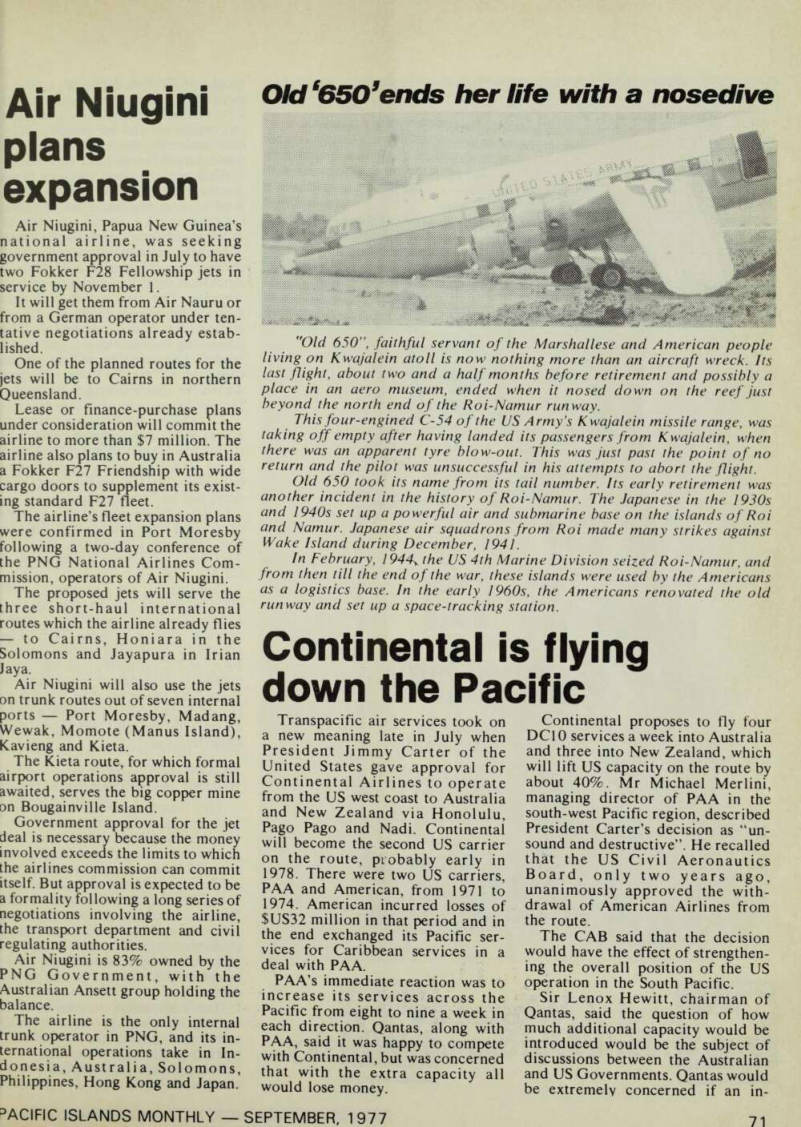
plans expansion
Air Niugini, Papua New Guinea’s national airline, was seeking government approval in July to have two Fokker F2B Fellowship jets in service by November 1.
It will get them from Air Nauru or from a German operator under ten tative negotiations already estab lished.
One of the planned routes for the jets will be to Cairns in northern Queensland.
Lease or finance-purchase plans under consideration will commit the airline to more than $7 million. The airline also plans to buy in Australia a Fokker F 27 Friendship with wide cargo doors to supplement its exist ing standard F 27 fleet.
The airline’s fleet expansion plans were confirmed in Port Moresby following a two-day conference of the PNG National Airlines Com mission, operators of Air Niugini.
The proposed jets will serve the three short-haul international routes which the airline already flies to Cairns, Honiara in the Solomons and Jayapura in Irian Jay a.
Air Niugini will also use the jets on trunk routes out of seven internal ports Port Moresby, Madang, Wewak, Momote (Manus Island), Kavieng and Kieta.
The Kieta route, for which formal airport operations approval is still awaited, serves the big copper mine on Bougainville Island.
Government approval for the jet deal is necessary because the money involved exceeds the limits to which the airlines commission can commit itself. But approval is expected to be a formality following a long series of negotiations involving the airline, the transport department and civil regulating authorities.
Air Niugini is 83% owned by the PNG Government, with the Australian Ansett group holding the balance.
The airline is the only internal trunk operator in PNG, and its in ternational operations take in In donesia, Australia, Solomons, Philippines, Hong Kong and Japan.
Old ‘650' ends her life with a nosedive
"Old 650”, faithful servant of the Marshallese and American people living on Kwajalein atoll is now nothing more than an aircraft wreck. Its last flight, about two and a half months before retirement and possibly a place in an aero museum, ended when it nosed down on the reef just beyond the north end of the Roi-Namur runway.
This four-engined C-54 of the US Army’s Kwajalein missile range, was taking off empty after having landed its passengers from Kwajalein, when there was an apparent tyre blow-out. This was just past the point of no return and the pilot was unsuccessful in his attempts to abort the flight.
Old 650 took its name from its tail number. Its early retirement was another incident in the history of Roi-Namur. The Japanese in the 1930 s and 1940 s set up a powerful air and submarine base on the islands of Roi and Namur. Japanese air squadrons from Roi made many strikes against Wake Island during December, 1941.
In February, 1944 y the US 4th Marine Division seized Roi-Namur, and from then till the end of the war, these islands were used by the Americans as a logistics base. In the early 19605, the Americans renovated the old runway and set up a space-tracking station.
Continental is flying

down the Pacific
Transpacific air services took on a new meaning late in July when President Jimmy Carter of the United States gave approval for Continental Airlines to operate from the US west coast to Australia and New Zealand via Honolulu, Pago Pago and Nadi. Continental will become the second US carrier on the route, probably early in 1978. There were two US carriers, PAA and American, from 1971 to 1974. American incurred losses of SUS 32 million in that period and in the end exchanged its Pacific ser vices for Caribbean services in a deal with PAA.
PAA’s immediate reaction was to increase its services across the Pacific from eight to nine a week in each direction. Qantas, along with PAA, said it was happy to compete with Continental, but was concerned that with the extra capacity all would lose money.
Continental proposes to fly four DCIO services a week into Australia and three into New Zealand, which will lift US capacity on the route by about 40%. Mr Michael Merlini, managing director of PAA in the south-west Pacific region, described President Carter’s decision as “un sound and destructive”. He recalled that the US Civil Aeronautics Board, only two years ago, unanimously approved the with drawal of American Airlines from the route.
The CAB said that the decision would have the effect of strengthen ing the overall position of the US operation in the South Pacific.
Sir Lenox Hewitt, chairman of Qantas, said the question of how much additional capacity would be introduced would be the subject of discussions between the Australian and US Governments. Qantas would be extremely concerned if an in
crease of 27% in capacity, a figure the airline had heard, resulted from Continental’s arrival. Such a large increase would be financially destructive for the economics of the route for all the airlines involved.
PAA will fly five services from Australia and four from New Zea land to Los Angeles from October (at present PAA services terminate at San Francisco). Two flights from Australia will be non-stop, and three from Australia will be via Auckland, and then non-stop to Los Angeles. The two non-stop flights from Australia will be in direct competition with Continental. The remaining four services, from Auck land to Los Angeles, will be some thing of a “mix”. They will put down at Nadi, Pago Pago or Honolulu.
At present PAA is operating at about 80% capacity on non-stop flights from Australia to the US, and about 50.8% capacity on all flights between the US west coast and Australia or New Zealand.
Other airlines operating a variety of services from the South Pacific to the US are Canadian Pacific Airlines, Air New Zealand and
Uta.
Continental, on October 1, will take up its rights on the Saipan- Japan services, operating a daily service with a Boeing 727. The squabble over this service, with PAA and Continental as the pro tagonists, dragged on for about five years, and twice reached the White House, from where it was once turn ed back to the US CAB for further consideration.
Alkinoos’ Crew’S
Brush With Death
The three crew members of a yacht grounded on the Great Bar rier Reef on May 6 spent seven days in an open liferaft before being dis covered by a passing prawn trawler.
The men, Alf Bradshaw, 53, his son Christopher, 24, and friend Michael Locblee, 24, were making the crossing from Honiara to Cairns (Queensland) when their yacht, the 12-metre sloop Alkinoos slid on to an unmarked reef and turned on her side.
Heavy seas swept the men away on the liferaft with only nine litres of water and half a tin of survival biscuits in the way of supplies.
For six days they drifted north wards and finally made a landfall on
tiny Croquet Island where they broke an automatic navigation beacon to attract attention.
The prawn trawler Kennedy in vestigated and found them at 5.40 pm on May 12, but sheltered nearby until the men could be transferred to the tanker Pacific Explorer and then to the pilot vessel Matthew Flinders.
Alf Bradshaw, well-known on Nauru and in the New Hebrides for his skill as an engineer, had an earlier brush with death when he was in a Britten Norman aircraft which crashed on White Grass Plains, Tanna. A visiting friend from Nauru was killed in the crash, and he and the pilot were seriously injured.
Reports suggested that Alkinoos was not seriously damaged.
Fiji Imposes
Airport Tax
The Fiji Government has in troduced a $2.50 service charge for all passengers leaving Fiji airports.
The charge, which is expected to yield $4OO 000 a year, follows a January recommendation from the South Pacific Air Transport Coun cil.
Because of the increasing number Df overflights, the income from landing and parking fees had not risen in line with the costs of op ;ration. The additional revenue will iclp the Nadi Airport admin istration to continue to provide a ligh standard of service to passengers and aircraft using the lirport. Service charges are applied it airports in several other coun ries.
Samoans Spread
Fheir Wings
A Western Samoan carrier may Hy direct to Auckland, and Polyne sian Airlines may run a service to Rarotonga under the first Western Samoa-New Zealand bilateral air igreement initialled in Wellington.
Fhe signatories were Mr Tuala Karanita Enari, who led the Western Samoa delegation in talks setween officials, and Mr Burt Ed wards, secretary of the NZ Ministry
Df Transport.
The Western Samoa Minister of Economic Affairs and Com munications, said the agreement was :he first ever negotiated between Western Samoa and any other coun ty.
Advertisements & other items, pp. 70-71 (1 item)
One good Scotch
mmm 999999 Y.W
Fine Old
Scotch Whisky
BOTTLED IN SCOTLAND
MjK horse distillers ltd and LONDON
SCOTCH WHISKIES
The White Horse Cellar Estab. 1742
White Horse
Fine Old ScotchWhisky.
deserves another.
i
SCOTCH WHISKY
=s^ Logan De Luxe ScotchWhisky.
Cruising
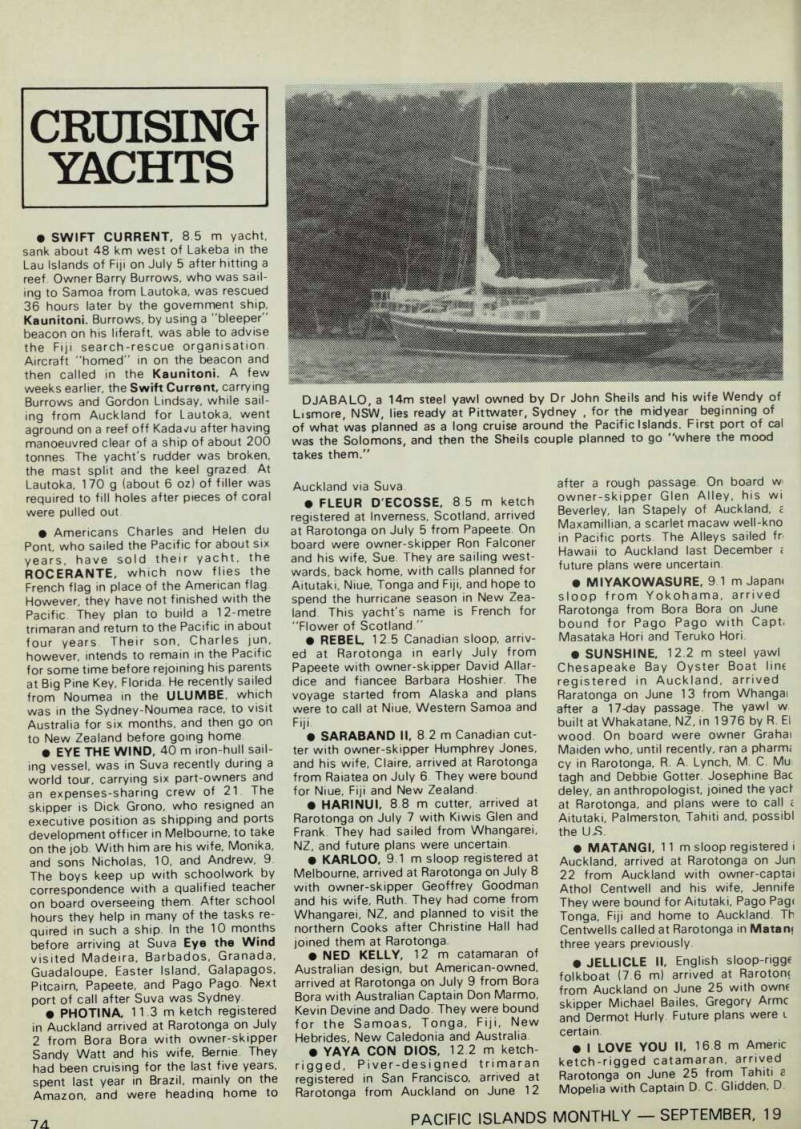
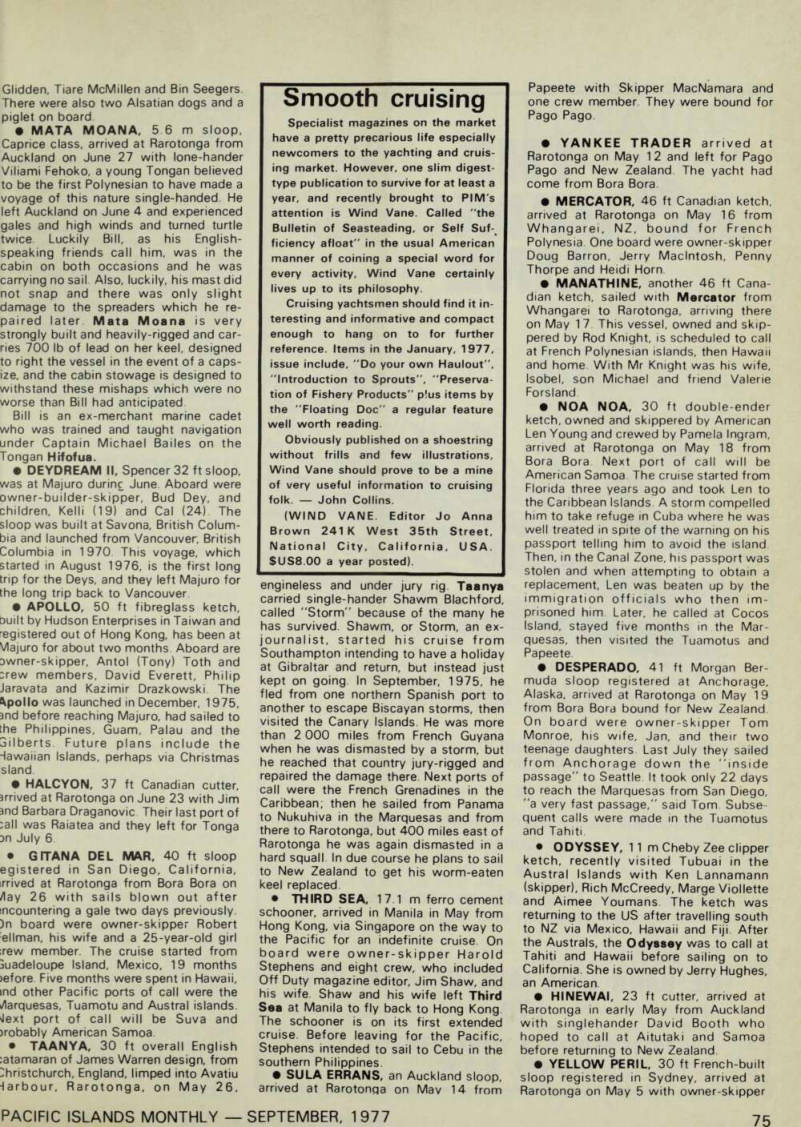
Yachts
• SWIFT CURRENT, 8 5 m yacht, sank about 48 km west of Lakeba in the Lau Islands of Fiji on July 5 after hitting a reef Owner Barry Burrows, who was sail ing to Samoa from Lautoka, was rescued 36 hours later by the government ship, Kaunitoni. Burrows, by using a "bleeper" beacon on his liferaft, was able to advise the Fiji search-rescue organisation Aircraft "homed" in on the beacon and then called in the Kaunitoni. A few weeks earlier, the Swift Current, carrying Burrows and Gordon Lindsay, while sail ing from Auckland for Lautoka, went aground on a reef off Kadavu after having manoeuvred clear of a ship of about 200 tonnes The yacht's rudder was broken, the mast split and the keel grazed At Lautoka, 170 g (about 6 oz) of filler was required to fill holes after pieces of coral were pulled out • Americans Charles and Helen du Pont, who sailed the Pacific for about six years, have sold their yacht, the ROCERANTE, which now flies the French flag in place of the American flag However, they have not finished with the Pacific. They plan to build a 12-metre trimaran and return to the Pacific in about four years. Their son, Charles jun, however, intends to remain in the Pacific for some time before rejoining his parents at Big Pine Key, Florida. He recently sailed from Noumea in the ULUMBE, which was in the Sydney-Noumea race, to visit Australia for six months, and then go on to New Zealand before going home • EYE THE WIND, 40 m iron-hull sail ing vessel, was in Suva recently during a world tour, carrying six part-owners and an expenses-sharing crew of 21 The skipper is Dick Grono, who resigned an executive position as shipping and ports development officer in Melbourne, to take on the job. With him are his wife, Monika, and sons Nicholas, 10, and Andrew, 9.
The boys keep up with schoolwork by correspondence with a qualified teacher on board overseeing them. After school hours they help in many of the tasks re quired in such a ship. In the 10 months before arriving at Suva Eye the Wind visited Madeira, Barbados, Granada, Guadeloupe, Easter Island, Galapagos, Pitcairn, Papeete, and Pago Pago Next port of call after Suva was Sydney. • PHOTINA, 11.3 m ketch registered in Auckland arrived at Rarotonga on July 2 from Bora Bora with owner-skipper Sandy Watt and his wife, Bernie. They had been cruising for the last five years, spent last year in Brazil, mainly on the Amazon, and were heading home to
Auckland via Suva • FLEUR D'ECOSSE, 8 5 m ketch registered at Inverness, Scotland, arrived at Rarotonga on July 5 from Papeete. On board were owner-skipper Ron Falconer and his wife, Sue. They are sailing west wards, back home, with calls planned for Aitutaki, Niue, Tonga and Fiji, and hope to spend the hurricane season in New Zea land This yacht's name is French for "Flower of Scotland." • REBEL, 12.5 Canadian sloop, arriv ed at Rarotonga in early July from Papeete with owner-skipper David Allar dice and fiancee Barbara Hoshier. The voyage started from Alaska and plans were to call at Niue, Western Samoa and Fiji, • SARABAND 11, 8 2 m Canadian cut ter with owner-skipper Humphrey Jones, and his wife, Claire, arrived at Rarotonga from Raiatea on July 6. They were bound for Niue, Fiji and New Zealand. • HARINUI, 8 8 m cutter, arrived at Rarotonga on July 7 with Kiwis Glen and Frank. They had sailed from Whangarei, NZ, and future plans were uncertain. • KARLOO, 9 1 m sloop registered at Melbourne, arrived at Rarotonga on July 8 with owner-skipper Geoffrey Goodman and his wife, Ruth. They had come from Whangarei, NZ, and planned to visit the northern Cooks after Christine Hall had joined them at Rarotonga • NED KELLY, 12 m catamaran of Australian design, but American-owned, arrived at Rarotonga on July 9 from Bora Bora with Australian Captain Don Marmo, Kevin Devine and Dado. They were bound for the Samoas, Tonga, Fiji, New Hebrides, New Caledonia and Australia. • YAYA CON DIOS, 12 2 m ketch
rigged, Piver-designed trimaran
registered in San Francisco, arrived at Rarotonga from Auckland on June 12
after a rough passage. On board w owner-skipper Glen Alley, his wi Beverley, lan Stapely of Auckland, c Maxamillian, a scarlet macaw well-kno in Pacific ports. The Alleys sailed fr Hawaii to Auckland last December < future plans were uncertain.
• Miyakowasure, 9 1 M Japan*
sloop from Yokohama, arrived Rarotonga from Bora Bora on June bound for Pago Pago with Capt; Masataka Hori and Teruko Hori. • SUNSHINE, 12.2 m steel yawl Chesapeake Bay Oyster Boat line registered in Auckland, arrived Raratonga on June 13 from Whangat after a 17-day passage. The yawl w built at Whakatane, NZ, in 1976 by R. El wood. On board were owner Grahai Maiden who, until recently, ran a pharrm cy in Rarotonga, R. A. Lynch, M. C. Mu tagh and Debbie Gotter Josephine Bac deley, an anthropologist, joined the yacf at Rarotonga, and plans were to call £ Aitutaki, Palmerston, Tahiti and, possibl the U.S. • MATANGI, 11 m sloop registered i Auckland, arrived at Rarotonga on Jun 22 from Auckland with owner-captai Athol Centwell and his wife, Jennife They were bound for Aitutaki, Pago Pag< Tonga, Fiji and home to Auckland. Th Centwells called at Rarotonga in Matani three years previously. • JELLICLE 11, English sloop-rigge folkboat (7.6 m) arrived at Rarotonc from Auckland on June 25 with owne skipper Michael Bailes, Gregory Armc and Dermot Hurly. Future plans were l certain. • I LOVE YOU 11, 16 8 m Americ ketch-rigged catamaran, arrived Rarotonga on June 25 from Tahiti s Mopelia with Captain D. C. Glidden, D.
DJABALO, a 14m steel yawl owned by Dr John Shells and his wife Wendy of Lismore, NSW, lies ready at Pittwater, Sydney, for the midyear beginning of of what was planned as a long cruise around the Pacific Islands. First port of cal was the Solomons, and then the Shells couple planned to go "where the mood takes them."
Glidden, Tiare McMillen and Bin Seegers There were also two Alsatian dogs and a piglet on board. • MATA MOANA, 5.6 m sloop.
Caprice class, arrived at Rarotonga from Auckland on June 27 with lone-hander Viliami Fehoko, a young Tongan believed to be the first Polynesian to have made a voyage of this nature single-handed. He left Auckland on June 4 and experienced gales and high winds and turned turtle twice. Luckily Bill, as his English speaking friends call him, was in the cabin on both occasions and he was carrying no sail. Also, luckily, his mast did not snap and there was only slight damage to the spreaders which he re paired later Mata Moana is very strongly built and heavily-rigged and car ries 700 lb of lead on her keel, designed to right the vessel in the event of a caps ize, and the cabin stowage is designed to withstand these mishaps which were no worse than Bill had anticipated Bill is an ex-merchant marine cadet who was trained and taught navigation under Captain Michael Bailes on the Tongan Hifofua. • DEYDREAM 11, Spencer 32 ft sloop, was at Majuro during June. Aboard were owner-builder-skipper, Bud Dey, and children, Kelli (19) and Cal (24) The sloop was built at Savona, British Colum bia and launched from Vancouver, British Columbia in 1970. This voyage, which started in August 1976, is the first long trip for the Deys, and they left Majuro for the long trip back to Vancouver • APOLLO, 50 ft fibreglass ketch, built by Hudson Enterprises in Taiwan and registered out of Hong Kong, has been at Majuro for about two months. Aboard are awner-skipper, Antol (Tony) Toth and crew members, David Everett, Philip Jaravata and Kazimir Drazkowski. The Apollo was launched in December, 1975, and before reaching Majuro, had sailed to the Philippines, Guam, Palau and the Gilberts. Future plans include the Hawaiian Islands, perhaps via Christmas sland. • HALCYON, 37 ft Canadian cutter, arrived at Rarotonga on June 23 with Jim and Barbara Draganovic. Their last port of call was Raiatea and they left for Tonga cn July 6. • GITANA DEL MAR, 40 ft sloop egistered in San Diego, California, rrived at Rarotonga from Bora Bora on /lay 26 with sails blown out after mcountering a gale two days previously. )n board were owner-skipper Robert ellman, his wife and a 25-year-old girl ;rew member. The cruise started from Guadeloupe Island, Mexico, 19 months >efore. Five months were spent in Hawaii, md other Pacific ports of call were the i/larquesas, Tuamotu and Austral islands.
Jext port of call will be Suva and jrobably American Samoa. • TAANYA, 30 ft overall English :atamaran of James Warren design, from Christchurch, England, limped into Avatiu Harbour, Rarotonga, on May 26,
engineless and under jury rig Taanya carried single-hander Shawm Blachford, called "Storm” because of the many he has survived. Shawm, or Storm, an ex journalist, started his cruise from Southampton intending to have a holiday at Gibraltar and return, but instead just kept on going. In September, 1975, he fled from one northern Spanish port to another to escape Biscayan storms, then visited the Canary Islands. He was more than 2 000 miles from French Guyana when he was dismasted by a storm, but he reached that country jury-rigged and repaired the damage there. Next ports of call were the French Grenadines in the Caribbean; then he sailed from Panama to Nukuhiva in the Marquesas and from there to Rarotonga, but 400 miles east of Rarotonga he was again dismasted in a hard squall. In due course he plans to sail to New Zealand to get his worm-eaten keel replaced. • THIRD SEA, 17.1 m ferro cement schooner, arrived in Manila in May from Hong Kong, via Singapore on the way to the Pacific for an indefinite cruise. On board were owner-skipper Harold Stephens and eight crew, who included Off Duty magazine editor, Jim Shaw, and his wife Shaw and his wife left Third Sea at Manila to fly back to Hong Kong.
The schooner is on its first extended cruise. Before leaving for the Pacific, Stephens intended to sail to Cebu in the southern Philippines. • SULA ERRANS, an Auckland sloop, arrived at Rarotonga on Mav 14 from
Papeete with Skipper MacNamara and one crew member. They were bound for Pago Pago. • YANKEE TRADER arrived at Rarotonga on May 12 and left for Pago Pago and New Zealand. The yacht had come from Bora Bora. • MERCATOR, 46 ft Canadian ketch, arrived at Rarotonga on May 16 from Whangarei, NZ, bound for French Polynesia One board were owner-skipper Doug Barron, Jerry Macintosh, Penny Thorpe and Heidi Horn. • MANATHINE, another 46 ft Cana dian ketch, sailed with Mercator from Whangarei to Rarotonga, arriving there on May 17 This vessel, owned and skip pered by Rod Knight, is scheduled to call at French Polynesian islands, then Hawaii and home. With Mr Knight was his wife, Isobel, son Michael and friend Valerie Forsland • NOA NOA, 30 ft double-ender ketch, owned and skippered by American Len Young and crewed by Pamela Ingram, arrived at Rarotonga on May 18 from Bora Bora Next port of call will be American Samoa The cruise started from Florida three years ago and took Len to the Caribbean Islands A storm compelled him to take refuge in Cuba where he was well treated in spite of the warning on his passport telling him to avoid the island Then, in the Canal Zone, his passport was stolen and when attempting to obtain a replacement, Len was beaten up by the immigration officials who then im prisoned him. Later, he called at Cocos Island, stayed five months in the Mar quesas, then visited the Tuamotus and Papeete • DESPERADO, 41 ft Morgan Ber muda sloop registered at Anchorage, Alaska, arrived at Rarotonga on May 19 from Bora Bora bound for New Zealand On board were owner-skipper Tom Monroe, his wife, Jan, and their two teenage daughters Last July they sailed from Anchorage down the "inside passage” to Seattle It took only 22 days to reach the Marquesas from San Diego, "a very fast passage,” said Tom. Subse quent calls were made in the Tuamotus and Tahiti. • ODYSSEY, 11 m Cheby Zee clipper ketch, recently visited Tubuai in the Austral Islands with Ken Lannamann (skipper), Rich McCreedy, Marge Viollette and Aimee Youmans. The ketch was returning to the US after travelling south to NZ via Mexico, Hawaii and Fiji After the Australs, the Odyssey was to call at Tahiti and Hawaii before sailing on to California. She is owned by Jerry Hughes, an American. • HINEWAI, 23 ft cutter, arrived at Rarotonga in early May from Auckland with singlehander David Booth who hoped to call at Aitutaki and Samoa before returning to New Zealand. • YELLOW PERIL, 30 ft French-built sloop registered in Sydney, arrived at Rarotonga on May 5 with owner-skipper
Ricky White, Katherine Picco and Barry Keyes. Mr White bought the yacht in the UK and sailed her from there to Mediter ranean ports in 1975, then to the Carib been Islands, Panama and Costa Rica.
Pacific ports of call were the Galapagos and Marquesas Islands and Tahiti. Plans were to sail to Tonga, Fiji and Auckland. • BOLD SPIRIT, 48 ft Canadian tri maran, arrived at Rarotonga from Whangarei, NZ, on May 12 with owner skipper Keith Sandilands, his wife and their two daughters and son. They will probably call at Tahiti and then Hawaii. • WISHBONE, 41ft gaff-rigged dou ble-ender from Vancouver, owned by French doctor Claude Detouilion, sailed to Hawaii from Bora Bora on March 6, carrying Claude and his crew of Mimi Teauna from Tahiti, Michael Cooke and Claire Hallenbeck of the USA Wishbone was bought by the doctor in Tahiti in 1975 and the past several months have been spent remodelling her.
Fold A
Schooner
With the world of yacht and boat designers and some naval architects still smarting from the success of his first book Small Boats, Mr Philip Bolger is at it again with more offbeat designs and salty wit to delight the lover of small craft.
Called The Folding Schooner and sub titled "and Other Adventures in Boat Designs", the author isn't kidding. The folding schooner is a 9.5 metre affair wich folds in the middle like an elongated oyster to fit on an average-size boat-trailer.
Other designs include a 39 metre, flat bot tom five-masted excursion schooner with suggestions on how to operate it as a business; a 12 metre proa (one outrigger); a small paddle steamer and numerous other dinghies and power boats.
Probably the most interesting designs for the would-be boat builder, who, like mosi home builders, is living close to subsistence level, are the sharpie sailing designs. These are flat-bottom lee-board boats that are sim pie and cheap to build and are in the mair very seaworthy and attractive to the eye.
One of the class racing rules for the folding schooner states, "Boats protested for inade quate structural strength shall be tested one kick from the bare toes of the proteste at a point of his choosing, any resulting damage to be the penalty of the protestee fo the excessive lightness."
Entertaining reading for any boating o yachting enthusiast who is not hide-bound convention.
John Collin .
(The Folding Schooner And Othe
Adventures in Boat Design by Philip C Bolger, International Marine Publishinj Co., 21 Elm Street, Camden Maine, US/ 5U513.50).
Smooth cruising
Specialist magazines on the market have a pretty precarious life especially newcomers to the yachting and cruis ing market. However, one slim digest type publication to survive for at least a year, and recently brought to PlM's attention is Wind Vane. Called "the Bulletin of Seasteading, or Self Suf- a ficiency afloat” in the usual American manner of coining a special word for every activity. Wind Vane certainly lives up to its philosophy.
Cruising yachtsmen should find it in teresting and informative and compact enough to hang on to for further reference. Items in the January, 1977, issue include, "Do your own Haulout”, "Introduction to Sprouts", "Preserva tion of Fishery Products" plus items by the "Floating Doc" a regular feature well worth reading.
Obviously published on a shoestring without frills and few illustrations.
Wind Vane should prove to be a mine of very useful information to cruising folk. John Collins. (WIND VANE. Editor Jo Anna Brown 241 K West 35th Street, National City, California, USA.
SUSB.OO a year posted).
Advertisements & other items, p. 74 (2 items)
Parifir Isi Amds Monthly September, 197:
Bank
THE
LINE
GLOBAL SERVICE FOR SHIPPERS
MONTHLY SERVICES
United Kingdom and Continent to: Papeete, Noumea, New Hebrides, Papua New Guinea and Solomon Islands. * Papua New Guinea to: North America, United Kingdom and Continent. * Solomons, Fiji, Tonga, Samoa and Tarawa to: United Kingdom and Continent.
For particulars apply:
THE BANK LINE (AUSTRALASIA) PTY.
LTD.,
18TH FLOOR, 1 YORK STREET,
SYDNEY, N.S.W.
Deaths

of Islands People
Philip Woonton, old 'Pearl King of Penrhyn'
The Cook Islands lost another colourful link with its past when Philip Woonton died on Penrhyn atoll in early July, aged 91. Philipa, as he was known in Penrhyn, skip pered sailing vessels, ran his own store and was once known as the ‘Pearl King of Penrhyn.” He was a lard-drinking, robust character vho weighed about 200 lb in his Drime and /as famed for his tremen dous voice and lavish hospitality.
He was born at Penrhyn in 1886, he son of an English trader from Devon and a Manihiki mother. Dur ng his childhood he saw the wrecks )f the four-masted barque, Derby Q ark, and the schooner, Flying Venus. Both piled up on the same 3 enrhyn reef. Derby Park had left Vancouver, British Columbia, with i cargo of timber for the Melbourne exhibition and when that cargo fail id to arrive the consignees shipped a limilar cargo for the Exhibition on he Flying Venus which came to jrief so close to the wreck of the Derby Park that the crew could see he men salvaging its cargo.
Woonton senior bought both the ost vessels and their cargoes and iold the timber for a profit that mabled him to set himself up in bus ness in Auckland.
Philip Woonton was taken to New Zealand when he was nine and, after caving school, took on various jobs fom driving bullock teams to going 0 sea round New Zealand’s coasts n sailing vessels. When he was ibout 18 he returned to Penrhyn vith Captain Thomas Harries in the chooner, Vaite. Some years later, le himself became the master of the /aite. Later still, he commanded agger and Harvey’s Hurunui, A. B.
Donald’s schooner Tiare Taporo, ind the Cook Islands Trading Com
>any’s Tagua.
He became a leading trader and lealer in pearls in the northern -ooks and owned and operated div ng machines in Penrhyn and Manihiki. He was said to have made 1 fortune from pearls, and one of his dients was Father Rogier of Tahiti vho visited Penrhyn to buy pearls fom him.
Philip Woonton outlived all his old shipmates, including schooner captains Joe Winchester, Viggo Rasmussen and famous Andy Thomson who died in Rarotonga in 1975, aged 89. Great friends of Philip's were authors Robert Dean Frisbie and James Norman Hall of Mutiny on the Bounty fame. Philip Woonton was married three times and is survived by eight children all of whom live in New Zealand.
Mrs H. S. Williams Mrs Harriet Sarah Williams, 92, and Lord Howe Island’s oldest re sident, died on the island in March.
As Harriet West, Mrs Williams left her birthplace, Norfolk Island, late last century with her family to make their home on Lord Howe. She mar ried Herbert Wilson, and they rais ed a family of four. She later mar ried Jack Williams, who predeceas ed her.
A member of Norfolk Island’s bowling team who was recently on Lord Howe for matches said Mrs Williams played for the local team skippered by Bill Adams, and “lick ed the pants off us”. He also observ ed that on her way home after the match she rode pillion on a Honda motor bike.
Mr R. T. Gallemore Mr Roy T. Gallemore, former district administrator in the US Trust Territory, has died in Florida, US, aged 81. He went to the Trust Territory in 1955 and served in Truk, Yap and the Marianas. He retired in 1965. Mr Gallemore earlier served in the US Navy and reached the rank of captain.
Mr A. Rossi Mr Antoine Rossi, owner of the Rossi Hotel in the New Hebrides, has died in Sydney, aged 76. Mr Rossi was born in the New Hebrides, son of Mr Charles Rossi who had arrived there late in the 19th century. Earlier in his life he worked for the Public Works Department, and in World War II was a Home Guardsman.
In 1951 he became owner of the Rossi Hotel, which was previously a store. He was founder of the Amicale Soccer Club, Vila. He is survived by a son and four daughters. One of his daughters, Helene, is the wife of Mr Remy Delaveuve, Mayor of Vila.
Mr E. A. Hussein Mr Edward Ali Hussein, a Fiji schoolteacher for 44 years, died at Lautoka after a fairly long illness, aged 69. He first taught at St Colum ba’s School, Suva. Later he taught at Nasinu Training School, finally returning to the Marist Bros Prim ary School (as St Columba’s is now called) where he taught till Decem ber, 1976. Mr Hussein leaves a widow, four daughters and two sons.
Dr F. Wilson Dr Freddy Wilson, a consultant pathologist at Lautoka Hospital, and former Fiji hockey rep resentative, died suddenly on June 28, aged 44. He graduated from the Fiji School of Medicine and did a special course on pathology in Australia. In his younger days he represented both Suva and Lautoka at hockey, and in 1961 was the only Indian in the Fiji hockey team which toured NZ. He is survived by his widow and three children.
Mr C. Hamer Mr Charles Hamer, formerly of Fiji, has died in San Francisco, aged 68. He was born at Ono-i-Lau and was educated at Levuka Public School. He went to sea in sailing ships soon after leaving school. He sailed to the US in the Lollie Ben nett in August, 1931, and settled on the west coast, where he became a well-known seaman among fellow mariners. He is survived by his wife, four daughters and four sons.
Mrs B. H. Wright Mrs B. H. Wright, who lived in Morobe Province, Papua New Guinea, for many years, has died.
She was living in the Wau area before World War II and was
evacuated before the Japanese inva sion. Her husband, the late Jim Wright, was one of the many gold miners who flocked into the area.
Mrs Wright is survived by a daughter, Mrs Kathy Hannam, of Lae.
Mrs E. Christian Mrs Evelyn Christian, known to all as “Nurse” has died on Pitcairn Island, aged 82. She was born in Australia and trained as a nurse at the SDA Sanitarium Hospital, Wahroonga, Sydney. She spent 17 years in the Solomons at the SDA Hospital, Batuna, and in 1944 was appointed to the dispensary on Pit cairn. After 12 years she went back to Australia, but in 1947 was back on Pitcairn again to marry Elwyn Christian. Although she retired from nursing in 1956, she continued to assist with maternity nursing and attended her last case on October 14, 1975, when Shaun Christian was born.
Adi Unaisi Gadai Adi Unaisi Gadai, a great-grand daughter of Ratu Seru Cakobau who ceded Fiji to Great Britain in 1874, has died. She was in her early 60s.
She was the daughter of Ratu Etuate Wainiu, a son of Ratu Seru's eldest son, Ratu Epeli Nailatikau. A chiefly assembly of mourners was held at the home of the Prime Minister, Ratu Sir Kamisese Mara, at Veiuto in Suva. Adi Uniasi is survived by her husband, Ratu Dr Vakaruru and a son, Ratu Drainubaka.
Pandit G. N. Pathik Pandit Gopendra Narayan Pathik a leader of the Hindu community in Fiji, and a pioneer in education there, has died, aged 82. He was born in Uttar Pradesh and went tc Fiji in 1925 to help to launch educa tion programmes. Schools he helped to establish were the Bhawani Dayal Memorial School at Nasinu, Swami Shradanand Memorial School al Samabula, DAY Boys’ College DAY Girls’ College, Nadera Prim ary School and Yishnu Dec Memorial School. He edited and published a weekly, Pradash, in 1966. He leaves five sons and two daughters. One of his sons, Mr Da vendra Pathik, is a magistrate, and another, Dr Bhupendra Pathik, is principal of the Fiji School of Medicine.
Advertisements & other items, pp. 76-78 (2 items)
through the passing years
(Advt.) Soft, smooth, supple skin is achieved by ensuring continued supplementation of the dwindling supplies of naturally produced skin fluids. m
Your complexion can
stay more beautiful
through the passing years
Women in their more mature years find that they can protect their complexions from the signs of a prematurely older look by being attentive to the needs of the skin by daily smoothing on a scientifically developed tropically moist oil blend.
NO MATTER whe-
ther your skin be dry or delicate, the daily smoothing on of a tropically moist oil blend,
scientifically developed
to help sustain the vital balance of oil and moisture in your skin, can exert an influence on the supplies of natural fluids flowing by way of tiny ducts to the stratum corneum to create a moist environment that conditions the skin to softness and beauty.
This influence is necessary because for many women the natural supplies of oil and moisture become diminished with the passing years. The action of supplementation by tropically moist Oil of Ulan provides similar benefits to those created by the natural fluids and, by simply smoothing a feather light film over the face and neck with the fingertips each day, a fresher, more natural look of beauty can be realised by many women.
The tropically moist Oil of Ulan penetrates rapidly for it has an affinity with the natural oils and moisture and merges with them in the stratum corneum so that wrinkle dryness and tiny facial lines accentuated by dryness can be quickly made softer, re-
ducing the tell-tale signs
of a prematurely aged
look.
Beauty for
dry skin
If your skin is especially dry, smooth on your Oil of Ulan moist oil blend each morning so that your skin’s fluid reserves are always balanced before venturing outdoors in drying conditions. y
FDRREII Lines
YOUR DIRECT LINK WITH THE
WEST COAST NORTH AMERICA
REFRIGERATED
& GENERAL
CARGO IN
BARGES. BULK
LIQUIDS IN
VESSEL DEEP
TANKS.
[FROM UNITED STATES WEST COAST & CANADA TO PAPEETE,
IPAGO PAGO, AUCKLAND, LAE & RABAUL.
|PAPUA NEW GUINEA TO VANCOUVER 8.C., TACOMA, PORT-
LAND, SAN FRANCISCO, LOS ANGELES.
[SYDNEY, MELBOURNE, BURNIE, HOBART, BRISBANE TO LAE
& RABAUL.
THE AMERICAN INCORPORATED
FLAG LINE
MANAGING AGENTS; Wilh. Wilhelmsen Agency p /L., IS-JS Bridge nlfeen 2000-Phone 20517-60 Market Street, Melbourne, 3000-Phone 613031 344 Queen Street, Brisbane, 4000-Phone 2213316. MANAGING AGE NJSN.Z.: Dalgety N.Z.
Ltd. , 119 Featherston Street, Welington-Phone 738347- 41/45 Albert Street Auckland—Phone 71859. ISLAND AGENTS: Robert Laurie (NG) P/L P.O. Box 1032, Lae, PNG - Phone 423811. J.C. Waller (Rabaul) Pty. Ltd., P.O. Box 606, Rabaul, PNG. Phone 921997.
79
ACIFIC ISLANDS MONTHLY SEPTEMBER, 1 977
IP's on tour, from p, 15
rhe lid's off, from p. 13
Shipping
SYDNEY - NZ - FUI/TAHITI - UK Chandris Lines maintains a passenger service * from Sydney via NZ, Suva or Papeete every second ; month.
Details from Chandris Lines, 135 King Street, Sydney (232-2455).
Sydney - Lord Howe Is -
Norfolk Is - New Hebrides
Compagnie des Chargeurs Caledoniens operates four-weekly cargo service Sydney - Lord Howe Island and Norfolk Island.
Details Hetherington Kingsbury Pty Ltd, 37-49 Pitt Street, Sydney (27-1671).
SYDNEY - NZ - FIJI - HAWAII -
Canada - Us
P & 0 liners call at Auckland, Suva, Honolulu and Vancouver on eastbound and westbound voyages between Sydney and the US.
Details from P & 0 Booking Centre, World Travel headquarters Pty Ltd, 33 Bligh Street, Sydney (231-6655).
AUSTRALIA - NZ - FIJI - TONGA - N. HEBRIDES - NOUMEA - PNG -
Solomons -Samoas
Sitmar Cruises operates a year-round cruise programme to include most of the above countries.
Details from Sitmar Cruises. 47 Elizabeth Street, Sydney (232-7511).
Royal Viking Line, with luxury cruise ships Royal Viking Sea, Star and Sky, cruises the Pacific from Sydney and Cairns calling at most of above countries.
Details from Wilh, Wilhelmsen Agency Pty Ltd, 13-15 Bridge Street, Sydney (2-0517).
P & 0 liners call at Apia, Auckland, Bay of Islands, Honiara, Honolulu, Lautoka, Noumea, Nukualofa, Pago Pago, Papeete, Port Moresby, Santo, Savusavu, Suva, Vavau and Vila on cruises from Australia.
Details from P & 0 Booking Centre World Travel Headquarters Pty Ltd, 33 Bligh Street, Sydney (231-6655).
Pacific Navigation of Tonga operates a five-weekly general cargo/container service from Port Kembla, Sydney and Newcastle (inducement), to Suva, Lautoka (inducement), Apia, Pago Pago and Nukualofa.
Details from Beaufort Shipping Agency Co. 2 Castlereagh Street, Sydney (221-2388).
Australia - New Caledonia
Somacal operates a monthly service from Sydney to Noumea.
Details from Karlander (Aust) Pty Ltd, 19-31 Pitt Street, Sydney (27-6301).
Sofrana-Unilines ships serve Noumea every three weeks from the main ports along the east Australian coast.
Details from Sofrana-Unilines, 37 Pitt Street, Sydney (27-2031), Trans-Austral Shipping Pty Ltd, 570 Bourke Street, Melbourne (67-9162), ACTA Pty Ltd, Brisbane (221-3166), Elder Smith Goldsbrough Mort Ltd, Port Adelaide (47-5688), ANL, Newcastle (049-24364), Clements & Marshall, Burnie, Tasmania (31-1833).
Compagnie des Chargeurs Caledoniens operates three-weekly containerised cargo service from Sydney to Noumea.
Details Hetherington Kingsbury Pty Ltd, 37-49 Pitt Street, Sydney (27-1671).
Australia - New Caledonia -
New Hebrides
South Pacific United Lines maintains a four-week cargo service from Sydney to Noumea, Vila and Santo.
Details from Omni Traders & Brokers Pty Ltd, 261 George Street, Sydney (241-2872/6).
Australia - Fiji
Karlander (Aust) Pty Ltd operates monthly cargo services from Sydney to Suva and Lautoka.
Details from Karlander (Aust) Pty Ltd, 19-31 Pitt Street, Sydney (27-6301), Dalgety Shipping, 461 Jourke Street, Melbourne (60-0731), Burns Philp (SS) Jo Ltd, Suva and Lautoka.
Sofrana-Unilines (Fiji Express Line) operates to Suva every three weeks from the main ports on the east ;oast of Australia and monthly to Lautoka from Melbourne and Sydney.
Details from Sofrana-Unilines, 37 Pitt Street, Sydney (27-2031), Trans-Austral Shipping Pty Ltd, 570 lourke Street, Melbourne (67-9162), ACTA Ply Ltd, Irisbane (221-3116), Elder Smith Goldsbrough Mod td, Port Adelaide (47-5688), AML, Newcastle 349-24364), Clements & Marshall, Burnie, Tasmania 31-1833).
Australia - Fiji - W. Samoa
Nauru Pacific Line operates regular containerised, nitised and b/bulk service from Sydney and Brisbane ) Lautoka, Suva and Apia.
Details Nauru Pacific Line, Nauru House, 80 Sollins Street, Melbourne (653-5709), Interocean wire, 8 Spring Street, Sydney (2-0522).
Australia - Tonga - W. Samoa
Karlander operates a monthly cargo service from lelbourne and Sydney to Nukualofa and Apia, thence IS west coast.
Details: Karlander (Aust) Pty Ltd, 19-31 Pitt Street, ydney (27-6301).
AUSTRALIA - TAHITI - US WEST COAST South Pacific United Lines maintains a four-weekly srvice from Sydney to Papeete, and US west coast.
Details from Omni Traders & Brokers Pty Ltd, 261 eorge Street, Sydney (241-2872/6).
Australia - Png
Containers Pacific Express (Burns Philp and AWP ne) and NGAL/PNGL operate container service from ustralia to PNG-Solomon Islands ports on joint slot laring basis Three container vessels operate on 28iy turn-around from Melbourne, Sydney and Brisbane Port Moresby, Samarai, Alotau, Lae, Madang, ewak, Rabaul, Kavieng, Kieta and Honiara Details from Burns Philp & Co Ltd, 51 Pitt Street (241-3851) and Interocean Swire, 8 Spring reel, Sydney (2-0522) Farrell Lines operates a service every month from ismania, Melbourne, Sydney and Brisbane to Lae id Rabaul Details from Wilh Wilhelmsen Agency Pty Ltd, 13 ridge Street Sydney (2-0517), 60 Market Street, elbourne (61-3031), J. C. Waller (Rabaul) Pty Ltd, abaul, Robert Laurie-Carpenter (NG) Pty Ltd, Lae.
New Guinea Express Lines operates three-weekly jnventional and container services, Melbourne, Brisbane, Port Moresby, Lae, Rabaul.
Details from New Guinea Express Lines, PO Box 73, Royal Exchange PO, Sydney (241-3991), acArthur Shipping Agency Co, 82-92 Eagle Street risbane (229-3777), Western Farmers Transport Pty d, 459 Little Collins Street Melbourne (67-8291), reckwoldt’s Shipping Agencies in Port Moresby 4-2525), Lae (42-1536), Rabtrad and Nuigini Pty Ltd, abaul (92-2911).
Karlander New Guinea Line’s cargo vessels call at elbourne, Sydney, Port Moresby, Lae, Madang, r ewak, Manus, Kimbe, Rabaul.
Details from Karlander (Aust) Pty Ltd, 19-31 Pitt Ireet, Sydney (27-6301), Dalgety Shipping, 461 ourke Street, Melbourne (60-0731).
AUSTRALIA - SOLOMONS - GILBERT IS -
Micronesia
Daiwa Line operates a container service every 30 ays from Sydney to Noumea, Honiara, Tarawa, Guam, id Saipan.
Details from Union-Bulkships Pty Ltd, 333-339 eorge Street Sydney (2-0238, telex AA20397)
Australia - Nauru - Majuro
Nauru Pacific Line operates regular argo/passenger service from Melbourne to Nauru id Majuro.
Details Nauru Pacific Line, Nauru House, 80 ollins Street, Melbourne (653-5709), Interocean wire, 8 Spring Street, Sydney (2-0522).
Us - Png
Farrell Lines operates regular services from all US
west coast ports to Lae and RabauL Details from Wilh, Wilhelmsen Agency Pty Ltd, 13 Bridge Street Sydney (2-0517), Farrell Lines, 1 Market Plaza, San Francisco, L A. (9-4105), J. C. Waller (Rabaul) Pty Ltd, Rabaul, Burns Philp (NG) Ltd, Kieta, Robert Laurie-Carpenter (PNG) Pty Ltd, Lae.
Png - Us - Canada
Farrell Lines operates regular services from Lae and Rabaul to US west coast ports and Vancouver.
Details from J. G. Waller (Rabaul) Pty Ltd, Rabaul.
Robert Laurie-Carpenter (PNG) Pty Ltd, Lae, Farrell Lines, 1 Market Plaza, San Francisco, LA. (9-4105), Wilh, Wilhelmsen Agency Pty Ltd, 13 Bridge Street Sydney (2-0517),
Png - Uk/Continent
Bank Line operates regular cargo service from Kieta Rabaul. Kimbe, Madang and Lae to Liverpool, Hamburg, Rotterdam, Antwerp and London.
Details from Bank Line (A'asia) Pty Ltd, 1 York Street. Sydney (27-2041); Burns Philp (PNG) Ltd, PNG ports.
Png - Us
Bank Line operates regular cargo service from Kieta, Rabaul, Kimbe, Madang and Lae direct to Sar Francisco; calls at US Gulf and East Coast ports or inducement.
Details from Bank Line (A'asia) Pty Ltd, 1 Vorl< Street, Sydney (27-2041); Burns Philp (PNG) Ltd, PNG ports SOLOMONS - FUI - TONGA - W. SAMOA -
Uk/Continent
Bank Line operates regular cargo service fron Honiara, Suva, Nukualofa and Apia to Liverpool Hamburg, Rotterdam and Antwerp, Details from Bank Line (A'asia) Pty Ltd. 1 Yorl Street, Sydney (27-2041); Burns Philp (SS) Co Ltd Suva.
FAR EAST - FUI - NEW ZEALAND New Zealand Unit Express (CNC, MNOL RIL operates a three-weekly cargo service from Hong Kong to Lautoka, Suva. NZ ports, Manila Kaoshiung Keelung, Hong Kong.
Details from Interocean Swire, 8 Spring Street Sydney (2-0522).
Nedlloyd operates monthly cargo service witf three ships from Surabaya, Jakarta, Bangkok, Por Kelang and Singapore to Suva and NZ ports Details from Nedlloyd (Aust) Pty Ltd, 8 Spring Street Sydney (27-3801), Burns Philp (SS) Co Ltd Suva and Lautoka.
Ben Shipping Co (Pie) Ltd, sailing monthly fron Singapore, Hong Kong, Keelung, Kaoshiung, Suva anc main NZ ports.
Details from Seatrans (Fiji) Ltd, GPO Box 152 Suva, Fiji.
Japan - Nz - Png
China Navigation Co, with three ships operates < monthly cargo service from Japan to New Zealant calling at Lae on return journey Details Interocean Swire, 8 Spring Street, Sydney (2-0522).
Far East - Mid-S. Pacific
China Navigation Co's vessels operate a regula cargo service from Hong Kong, Taiwan and Singapon to Rabaul, Wewak, Madang, Lae, Port Moresby Honiara, New Hebrides. Noumea, Papeete am Samoa.
Details from Interocean Swire, 8 Spring Street Sydney (2-0522).
Kyowa Shipping Co Ltd operates monthly service: from Hong Kong, Taiwan, S. Korea and Japan, t( Guam, Saipan, Solomons, New Caledonia, Fiji Western and American Samoa, Tahiti, Cook Is., Tong< and New Hebrides and 45-day container/break bull cargo service from Kobe, Nagoya and Yokohama t< Guam, Suva, Lautoka and Noumea Details: Hetherington Kingsbury Pty Ltd, 37-49 Pit Street, Sydney (27-1671).
Daiwa Line with container ships operates 30-dai service from Moji, Kobe, Nagoya and Yokohama tc Papeete, Pago Pago, Apia, Suva, Lautoka, Sydney Noumea, Honiara. Tarawa, Guam and Taiwan Details: Union Bulkships Pty Ltd, 333-339 Georgr Street, Sydney (2-0238)
NORTH EUROPE - TAHITI - NEW CALEDONIA Hamburg-Sued operates monthly cargo services am Hamburg, Dunkirk and Le Havre to Papeete, oumea, via Panama.
Details from Columbus Overseas Services Pty Ltd, 33 George Street. Sydney (290-2966); Columbus aritime Services, 17 Albert Street, Auckland (75-509).
North Europe - Tahiti -
N. Caledonia - Png
Compagnie Generale Maritime operates three ulti-purpose and three ro/ro cargo services a month am North European and Mediterranean ports to jpeete and Noumea. Three multi-purpose ships call onthly in Papua New Guinea.
Details from Compagnie General Maritime, 4-6 igh Street Sydney (221-2522).
JAPAN - GUAM - FIJI - SAMOA -
N. Caledonia - N. Hebrides
Daiwa Lines runs a monthly cargo service from ipan via Guam to Suva, Lautoka, Pago Pago, Apia, la, Santo and Noumea.
Details from Burns Philp (SS) Co Ltd, Suva.
NZ - FIJI - TONGA - SAMOAS -
Tahiti
Union Steam Ship Co of NZ operates a fully mtainerised service Auckland-Suva-Pago Pago )ia-Nukualofa every 14-16 days.
A 28-day service by conventional ship is operated •m Auckland to Papeete, Apia and Nukualofa.
Details from Union Steam Ship Co of NZ Ltd, PO )x 12, Auckland, or from branch offices/agents in Fiji, mga, Samoa and Tahiti.
NZ - N. CALEDONIA - N. HEBRIDES -
Png - Si
Sofrana-Unilines with two ships operates to Vila id Santo, to Honiara and Papua New Guinea, and to )umea.
Details from Sofrana-Unilines, 42 Customs Street, ickland (7-3279), PO Box 3614, Telex: NZ2313.
Nz - Png
Farrell Lines operates regular service every 30 ys from Auckland to Lae and Rabaul.
Details from Dalgety NZ Ltd. 41-45 Albert Street, ickland (7-1859), J. C. Waller (Rabaul) Pty Ltd, ibaul, Robert Laurie-Carpenter (PNG) Pty Ltd, Lae NZ - FIJI - NORTH AMERICA (WC) Crusader cargo ships call at Suva, Levuka and jnolulu on NZ-US west coast trips and at Suva and/or utoka on US-NZ return trips.
Details from Blueport ACT (NZ) Ltd, PO Box 192, sllington (739-029); Burns Philp ss) Co Ltd, Suva.
Nz - Fiji
Reef operates a regular 18-day service from ickland to Suva and Lautoka.
Details from Reef Shipping Agencies Ltd, PO Box 82, Auckland. NZ (7-1221-3).
Pacific Line with one ship operates monthly cargo rvice New Zealand, Lautoka, Suva.
Details: Sofrana-Unilines, 42 Customs Street, ckland (7-3279) PO Box 3614, Telex: NZ2313
Nz - W. Samoa - Tonga
Pacific Navigation of Tonga operates a four-weekly rgo service, Auckland - Nukualofa - Vavau - Apia ikualofa - Auckland.
Details from McKay Shipping Ltd, Downtown •use, Queen Street, Auckland (33-656).
Warner Pacific Line services Onehunga ikualofa - Vavau - Haapai fortnightly, and Timaru ikualofa - Vavau monthly and Onehunga - Apia every days carrying general and freezer cargoes and naru - Apia every 21 days carrying freezer cargo Details from Air Marine Services (NZ) Ltd, PO Box 05, Auckland (362-731).
Nz - Cook Is - Niue
The Shipping Corporation of NZ Ltd with Toa Jana and Lorena, operates cargo services from ickland to Rarotonga and Aitutaki (fortnightly) and ue (monthly).
Details from the Shipping Corp of NZ Ltd, PO Box 20. Auckland (379-430): Waterfront Commission, PO ix 61. Rarotonga, Lighterage and Stevedoring Co, lutaki, Niue Govt Offices, Niue Island.
NZ - SE ASIA - PACIFIC ISLANDS Sofrana Fareast Lines operates a five-weekly
service from Auckland to SE Asia, PNG, New Caledonia and Fiji.
Details from Sofrana Unilines, 42 Customs Street,' Auckland (73-279).
UK - PANAMA - SAMOA - FIJI The Fiji Direct Service, cargo only, is maintained by Conference vessels, sailing at regular monthly intervals out of Avonmouth, via Panama, for Apia, Suvsi and Lautoka.
Details from Burns Philp (SS) Co Ltd, Suva.
UK/N. CONTINENT - TAHITI - N. CALEDONIA -
N. Hebrides
Bank Line operates regular cargo service from Hull, Hamburg, Bremen, Antwerp and Rotterdam to Papeete, Noumea and Vila.
Details from Bank Line (A’asia) Pty Ltd, 1 York Street, Sydney (27-2041); Ets AMAV, Papeete; Ets Ballande, Noumea, Burns Philp (NH) Ltd, Vila.
Uk/N. Continent - Png - Solomons
Bank Line operates regular cargo service from Hull, Hamburg, Bremen, Antwerp and Rotterdam tc Port Moresby, Lae, Madang, Kimbe, Rabaul, Kieta anc Honiara and, on inducement to Yandina, Tarawa anc Nauru.
Details from Bank Line (A'asia) Pty Ltd, 1 Yorl Street, Sydney (27-2041); Burns Philp (PNG) Ltd, PNG ports.
EUROPE - TAHITI - W. SAMOA - FIJI -
N. Caledonia
Nedlloyd offers regular cargo services fron Northern Europe and UK to Papeete, Apia, Fiji am New Caledonia Details Nedlloyd (Aust) Pty Ltd, 8 Spring Stree Sydney (27-3801).
San Francisco - Honolulu -
Micronesia
Nauru Pacific Line operates regula conventional/container service from San Franciso and Honolulu to Majuro, Nauru, Ponape, Truk am Saipan.
Details from Nauru Pacific Line. Nauru House, 8 Collins Street, Melbourne (653-5709), North America Maritime Agencies, 100 California Street, Sa Francisco, California 9411 (981-0343).
US - FIJI - TAHITI - NZ - AUSTRALIA Bank Line Ltd operates regular cargo service from US Gulf ports to Australia and NZ. Calls at Suvs Lautoka and Papeete on demand.
Details from Bank Line (A/asia) Pty Ltd, 1 Yor Street, Sydney (27-2011).
Pacific Far East Line cruise ships operate fror San Francisco, Los Angeles, Honolulu, Moores Papeete, Rarotonga, Auckland, Opua (Bay of Islands Sydney and return via Suva, Niuafoou, Pago Pago an Honolulu to San Francisco.
Freight is carried on these passenger liners.
Passenger details from World Trave Headquarters Pty Ltd, 33 Bligh Street, Sydne (231-6655); freight details from Beaufort Shippin Agency Co, 2 Castlereagh Street Sydney (221-2388 US - A. SAMOA - NZ - AUST - PNG Farrell Lines LASH ships operate regularly fror US to Australia, via Pago Pago and Auckland an Canada.
Details from Wilh, Wilhelmsen Agency Pty Ltd, 1 Bridge Street, Sydney (2-0517), 60 Market Stree Melbourne (61-0301); Farrell Lines, 1 Market Plazr San Francisco, L.A. (415-777-3300); Dalgety NZ Lt( Auckland (7-1859); Kneubuhl Maritime Services, Pag Pago (633-5121).
Us - Tahiti - Samoa
Pacific Islands Transport operates a five/si weekly cargo service from North American west coai ports to Papeete, Pago Pago, Apia.
Details from Trans-Austral Shipping Pty Ltd, 19 Pi Street, Sydney (27-2441).
Polynesia Line operates container and genen cargo service from US west coast ports to Papeete an Pago Pago.
Details from Polynesia Shipping Services Inc, P( Box 1478, Pago Pago (9-6799).
Advertisements & other items, pp. 79-82 (2 items)
Kyowa Line
YOUR TRADING PARTNER
Monthly Services
Hong Kong, Taiwan, S. Korea, Japan
To: British Solomon, New Caledonia, Fiji, W. Samoa, A. Samoa. Tahiti, Cook IsV, Tonga, New Hebrides.
Ellice Is.,
Taiwan,Hong Kong,Singapore,Jakarta,
Philippine
To: Australia, Papua New Guinea, Sabah & Sarawak.
Hong Kong, Taiwan, S. Korea, Japan
To: Guam, Saipan, Truk, Ponape, Other Pacific Islands.
Taiwan: Royal Steamship Corp., Ltd., Taipei S. Korea: Dong Sue Shipping Co., Ltd , Seoul Hong Kong: Dahzun Enterprises Ltd.
Singapore: Ocean Shipping & Enterprises Pte., Ltd.
Mariana Is.: Island Navigation Co., Ltd., Guam 8.5.1. P.: Solomon Taiyo Ltd., Honiara Tahiti: J.A. Cowan & Fils, Papeete Cooks: Union Citco Travel Ltd., Rarotonga Tonga: E.M. Jones Ltd., Nukualofa New Hebrides: Agence Maritime Raymond Velicite, Port Vila A.Samoa: Island Pacific Agencies Inc., Pago Pago W. Samoa: Morris Hedstrom Ltd., Apia Fiji: Carpenter Shipping, Suva & Lautoka PNG: Carpenter Shipping Agencies, Port Moresby, Rabaul New Caledonia: Agence Maritime Du Rond Point Du Pacific, Indonesia: PT. Porodisa Raya Shipping Lines, Jakarta Sabah: KOH Han Ming Shipping & Forwarding Agent., Kotakinabalu Sarawak: Pan Sarawak Agencies Sdn. Bhd., Sibu & Kuching Australia; Hetherington Kingsbury Pty. Ltd., Sydney, N.S.W.
KYOWA SHIPPING CO., LTD.
■ AGENTS*
Noumea
HEAD OFFICE
OSAKA OFFICE
sth FI., Suzumaru Bldg. 39-8, 2-chome, Nishi-Shinbashi, Minato-ku, Tokyo, Japan.
Frontier Bldg., 3-13 Hirano-cho, Higashi-ku, Osaka, Japan.
Phone : 06(227)0422(Rep.) Cables : “MARIQUEEN” Osaka.
Telex : 522-3896 Kyowa 0.
Phone : 03(437)2885(Rep.) Cables : “MARIQUEEN" Tokyo.
Telex : 242-4651 Kyowa J.
HENRY CUMINES PTY. LTD.
EXPORTERS • GENERAL MERCHANTS
428 GEORGE ST., SYDNEY
CABLES: HENCO SYDNEY. G.P.O. Box 3949. PHONE: 25-3383.
For specialised and personalised buying service throughout the Pacific Islands and the East
LOCAL AGENTS AND REPRESENTATION:
PAPUA NEW GUINEA.
PORT MORESBY: Mr. Tan,
P.O. Box 5445, Boroko.
Telephone 25 2542.
RABAUL: M. & C. Seeto, P.O. Box 131, Rabaul.
Telephone 92 2902.
MADANG: W. Double, P.O. Box 22, Madang.
Telephone 82 2696.
FIJI.
K. Witherington Ltd., P.O. Box 293, Suva.
Telephone 22 356.
NEW HEBRIDES.
John Lum & Associates, P.O. Box 65, Santo.
Telephone 329.
SOLOMON ISLANDS.
Lo See War Ltd., P.O. Box 327, Honiara.
Telephone 399.
Resident Agents in other Pacific Territories.
Q E
offers expert insurance service
throughout the Islands
QBE INSURANCE
LIMITED
(FORMERLY—QUEENSLAND INSURANCE COMPANY)
Central Office: 82 Pitt Street, Sydney FlJl—Branch Office, Suva, Manager for Fiji: L.G.Liddell A A LL LAUTOKA—Sub-Branch Office: Bums Philp Bldg. .
HONIARA (8.5.1. P. & Company (5.1.) Pty. Limited.
NEW CALEDONIA—T. A. Hagen, Stc. W. A. Johnston, S.A.R.L. —Noumea.
NEW HEBRlDES—District Manager; G.
Burns Philp (New Hebrides) Ltd.
TAHlTl—Arthur Chung: Immeuble 8.1. r „ .
NIUE, NORFOLK ISLAND, SAMOA, TONGA and other South Sea Islands—Bums Philp (South Sea) Company Ltd.
QUEENSLAND INSURANCE (P.N.G.) LTD
PAPUA NEW GUINEA-Head Office, PORT MORESBY.
General Manager: J.M.Dawe. Assistant Manager: R.Jackson,A.A.l.l.
District Managers at: ARAWA: J.Longbut LAE: W.J.Leonard MADANG: I.R.Martin MOUNT HAGEN: D.F.Carroll RABAUL: A.M.Tanner F. Donnelly, Vila; Santo: Front dc Mer, Papeete.
r
DAIWA LINE
ROLL-ON/ROLL-OFF CAR & CONTAINER SERVICE
JAPAN-SOUTH PACIFIC
PAPEETE-PAGO PAGO-APIA-SUVA
LAUTOKA-SYDNEY
NOUMEA-TARA WA-GUAM-TAIWAN
JAPAN-TAIWAN-GUAM
JAPAN-KEELUNG-GUAM BY
EXCELLENT CAR/CONTAINER-CARRIER
JAPAN-WEST IRIAN-DILI
HONG KONG-TAIWAN-WEST IRIAN-DILI
AGENTS:
GUAM: ATKINS, KROLL (GUAM) LTD.
TARAWA: G. & E. I. DEVELOPMENT AUTHORITY.
APIA; BURNS PHILP (SOUTH SEA) CO., LTD.
PAGO PAGO: KNEUBUHL MARITIME SERVICES CORP.
NUKUALOFA: PACIFIC NAVIGATION CO., LTD.
SUVA: BURNS PHILP (SOUTH SEA) CO., LTD.
LAUTOKA: BURNS PHILP (SOUTH SEA) CO., LTD,
NOUMEA: SOCIETE D'ACCONAGE ET DE
TRANSPORT D'OCEANIE (SATO)
SANTO: BURNS PHILP (NEW HEBRIDES) LTD.
VILA; BURNS PHILP (NEW HEBRIDES) LTD.
HONIARA: BRITISH SOLOMONS TRADING CO., LTD.
PAPEETE: AGENCE MARITIME DE FARE UTE.
HONG KONG; IKE MARITIME CO., LTD.
SINGAPORE; THE BORNEO CO., (SINGAPORE) LTD,
DJAJAPURA: P. N. PELAJARAN NASIONAL INDONESIA.
DILI: SANG TAI HOO
TAIWAN: FOR CARGO BETWEEN JAPAN/GUAM/TAIWAN &
SOUTH PACIFIC.
FORMOSA SHIPPING & ENTERPRISE CORP.
THE DAIWA MITIGATION CO-LTD.
OSAKA: "DAILINE" TOKYO: “FUNEDAILINE"
HEAD OFFICE
DAIICHI KYOGYO BLDG.,
45, 2-CHOME, AWAZ AM I NAM l-DOR I,
NISHI-KU, OSAKA, JAPAN
TELEPHONE: (06) 531-0471 " 9
TELEX: 525-6324 & 525-6325
TOKYO OFFICE
SHIN-DAIICHI BLDG.,
4-13, NIHONBASHI 3-CHOME, CHUO-KU
TOKYO, JAPAN
TELEPHONE: (03) 274-3251 ~8
TELEX: 222-3343, 23559
DATELINE HOTEL
TONGA
Friendly Hotel" of the "Friendly Islands' Situated along the Nukualofa waterfront. Only five minutes walk from town. Single, double, family suites, airconditioning, and hot and cold water showers. Pool, bar, restaurant, duty-free shop, tour desk and boutique.
Book through your travel agent or write to International Dateline Hotel, P.O. Box 62, Nukualofa Tonga.
Cable Address; ''DATELINE".
Represented Overseas by: Charles J. Henry and Associates Pty. Ltd.
Sydney and Melbourne. 7(
THE PAPUA HOTEL
PORT MORESBY
• Right in the business centre • A tradition for comfort and fine food • All rooms air conditioned • Restaurant • Bars • Banquet Hall Telephone 24 2121 Cables PAPTEL
A. C. NEUMANN
Manager
Regular Pacific Services
"Union South Pacific’’, cellular container vessel. Reefer and general cargo from Auckland at approximately fortnightly intervals. Calls at Suva, Pago Pago, Apia and Nukualofa before returning to Auckland.
"Luhesand”, conventional reefer and general cargo. Monthly sailings from Auckland, calls at Suva, Apia, Papeete and Nukualofa.
jmtmumon
gM/mcompani/
Branches at all main Australian, New Zealand and Pacific Island ports.
PACIFIC ISLANDS TRANSPORT LINE
Owners: Thor Dahls H v aljangerseiskap A/S — Sandefjord, Norway.
MS CAMELLIA VENTURE
Express Freight Service between Pacific Coast Ports of
U.S.A.
and
TAHITI and SAMOA
Full container service including reefers.
GENERAL STEAMSHIP CORPORATION LTD.
General Agents 400 California Street, San Francisco, California, U.S.A. phi,p «-"■ SM) Co " p *”'' eiw.
LAE/RABAUL —Buriu Phil. (New Guitwi) Ltd.
PACO PAGO—Polynesia Shipping Services Inc. PORT VlLA—Cemptoirs Francais de Nouvelles NOUMEA—Etablissements Ballande. Hebrides.
83
ACIFIC ISLANDS MONTHLY SEPTEMBER, 1977
Produce
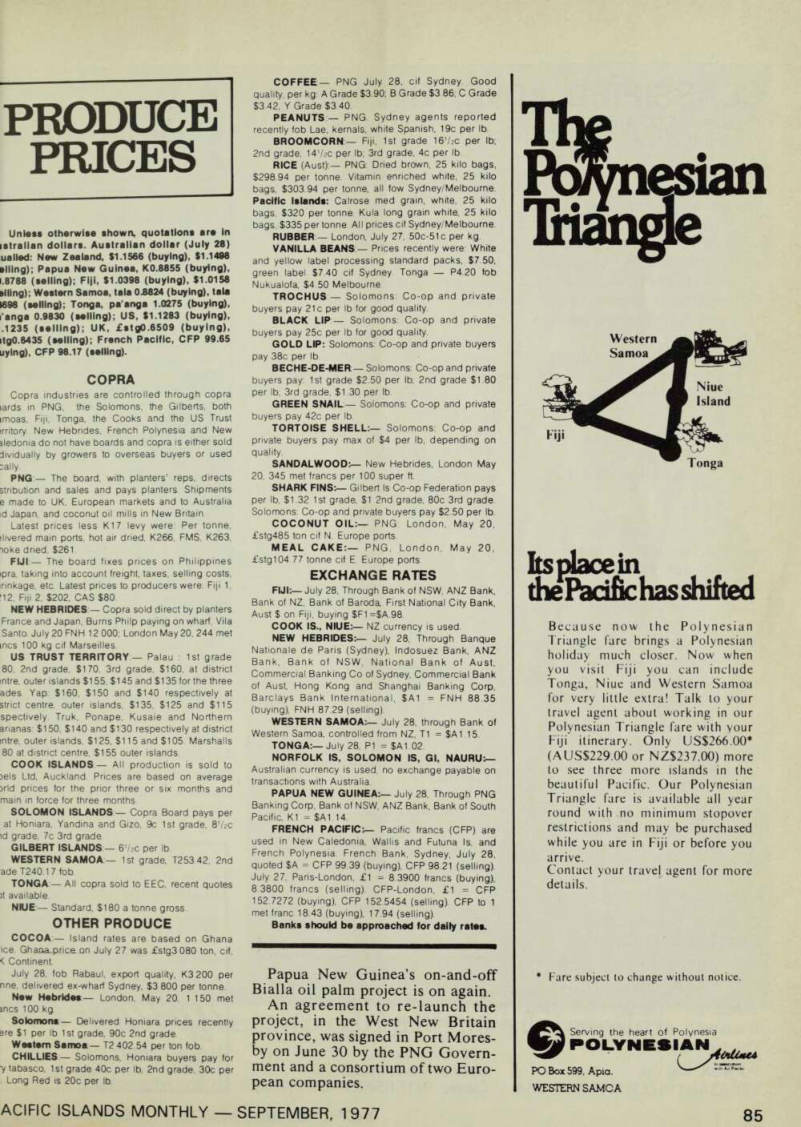
Prices
Unless otherwise shown, quotation* are In istralian dollars. Australian dollar (July 28) ualled: New Zealand, $1.1566 (buying), $1.1498 slling); Papua New Guinea, K 0.8855 (buying), i. 8788 (selling); Fiji, $1.0398 (buying), $1.0158 slling); Western Samoa, tala 0.8824 (buying), tala 1698 (selling); Tonga, pa'anga 1.0275 (buying), ranga 0.9830 (selling); US, $1.1283 (buying), .1235 (sailing); UK, £*tg0.6509 (buying), itg0.6435 (selling); French Pacific, CFP 99.65 uylng), CFP 98.17 (selling).
Copra
Copra industries are controlled through copra tards in PNG, the Solomons, the Gilberts, both imoas, Fiji, Tonga, the Cooks and the US Trust irritory. New Hebrides, French Polynesia and New iledonia do not have boards and copra is either sold dividually by growers to overseas buyers or used :ally.
PNG The board, with planters' reps, directs stribution and sales and pays planters. Shipments e made to UK, European markets and to Australia d Japan, and coconut oil mills in New Britain.
Latest prices less Kl 7 levy were: Per tonne, ilivered main ports, hot air dried, K 266, FMS, K 263, loke dried, $261 FIJI:— The board fixes prices on Philippines ipra, taking into account freight, taxes, selling costs, rinkage, etc. Latest prices to producers were: Fiji 1, 'l2, Fiji 2, $202, CAS $BO NEW HEBRIDES Copra sold direct by planters France and Japan, Burns Philp paying on wharf, Vila Santo. July 20 FNH 12 000; London May 20, 244 met incs 100 kg cif Marseilles.
US TRUST TERRITORY Palau : Ist grade 80, 2nd grade, $l7O, 3rd grade, $l6O, at district mtre, outer islands $155, $145 and $135 for the three ades. Yap: $l6O, $l5O and $l4O respectively at strict centre, outer islands, $135, $125 and $ll5 spectively. Truk, Ponape, Kusaie and Northern ananas $l5O, $l4O and $l3O respectively at district intre, outer islands, $125, $ll5 and $lO5. Marshalls 80 at district centre, $155 outer islands.
COOK ISLANDS— All production is sold to )els Ltd, Auckland. Prices are based on average jrld prices for the prior three or six months and main in force for three months.
SOLOMON ISLANDS Copra Board pays per at Honiara, Yandina and Gizo, 9c Ist grade, BV2C id grade, 7c 3rd grade.
Gilbert Islands 6V2C Per Lb
WESTERN SAMOA Ist grade, T 253 42, 2nd ade T 240.17 fob.
TONGA All copra sold to EEC, recent quotes )t available.
NIUE Standard, $lBO a tonne gross
Other Produce
COCOA Island rates are based on Ghana ice. Ghana.price on July 27 was £stg3 080 ton, cif, < Continent July 28, fob Rabaul, export quality, K 3 200 per nne, delivered ex-wharf Sydney, $3 800 per tonne New Hebrides— London, May 20, 1 150 met incs 100 kg Solomons— Delivered Honiara prices recently are $1 per lb Ist grade, 90c 2nd grade Western Samoa— T 2 402 54 per ton fob CHILLIES Solomons, Honiara buyers pay for y tabasco, Ist grade 40c per lb, 2nd grade, 30c per Long Red is 20c per lb.
COFFEE— PNG July 28, cif Sydney Good quality, per kg: A Grade $3.90; B Grade $3 86; C Grade $3 42, Y Grade $3 40 PEANUTS PNG. Sydney agents reported recently fob Lae, kernals, white Spanish, 19c per lb.
BROOMCORN Fiji, Ist grade 16V?c per lb; 2nd grade, 14 1 /sc per lb; 3rd grade, 4c per lb.
RICE (Aust):— PNG: Dried brown, 25 kilo bags, $298 94 per tonne. Vitamin enriched white, 25 kilo bags, $303.94 per tonne, all fow Sydney/Melbourne.
Pacific Island*: Calrose med grain, white, 25 kilo bags, $320 per tonne. Kula long grain white, 25 kilo bags, $335 per tonne. All prices cif Sydney/Melbourne.
RUBBER London, July 27. 50c-51c per kg VANILLA BEANS Prices recently were: White and yellow label processing standard packs, $7.50, green label $7 40 cif Sydney. Tonga P 4.20 fob Nukualofa, $4 50 Melbourne.
TROCHUS Solomons: Co-op and private buyers pay 21c per lb for good quality.
BLACK LIP— Solomons: Co-op and private buyers pay 25c per lb for good quality.
GOLD LIP: Solomons: Co-op and private buyers pay 38c per lb BECHE-DE-MER —Solomons: Co-op and private buyers pay: Ist grade $2.50 per lb; 2nd grade $1 80 per lb, 3rd grade, $1.30 per lb GREEN SNAIL Solomons: Co-op and private buyers pay 42c per lb.
TORTOISE SHELL:— Solomons: Co-op and private buyers pay max of $4 per lb, depending on quality.
SANDALWOOD',— New Hebrides, London May 20, 345 met francs per 100 super ft, SHARK FINS:— Gilbert Is Co-op Federation pays per lb, $1.32 Ist grade, $1 2nd grade, 80c 3rd grade.
Solomons: Co-op and private buyers pay $2.50 per lb.
COCONUT OIL: PNG: London, May 20, £stg4Bs ton cif N, Europe ports.
MEAL CAKE:— PNG, London, May 20, £5tg104.77 tonne cif E. Europe ports.
Exchange Rates
FUI:— July 28, Through Bank of NSW, ANZ Bank, Bank of NZ, Bank of Baroda First National City Bank, Aust $ on Fiji, buying SFI =$A.9B.
COOK IS., NIUE;— NZ currency is used NEW HEBRIDES:— July 28, Through Banque Nationale de Paris (Sydney), Indosuez Bank, ANZ Bank, Bank of NSW, National Bank of Aust, Commercial Banking Co of Sydney, Commercial Bank of Aust Hong Kong and Shanghai Banking Corp, Barclays Bank International, SAI = FNH 88.35 (buying), FNH 87.29 (selling).
WESTERN SAMOA:— July 28, through Bank of Western Samoa, controlled from NZ, T 1 = $A1.15.
TONGA:— July 28, PI = SAI 02.
Norfolk Is, Solomon Is, Gl, Nauru'—
Australian currency is used, no exchange payable on transactions with Australia.
PAPUA NEW GUINEA:— July 28, Through PNG Banking Corp, Bank of NSW, ANZ Bank, Bank of South Pacific, K 1 = $A 1.14 FRENCH PACIFIC:— Pacific francs (CFP) are used in New Caledonia. Wallis and Futuna Is, and French Polynesia. French Bank, Sydney, July 28, quoted $A = CFP 99.39 (buying), CFP 98.21 (selling), July 27, Paris-London, £1 = 8.3900 francs (buying), 8 3800 francs (selling). CFP-London, £1 = CFP 152.7272 (buying), CFP 152.5454 (selling). CFP to 1 met franc 18.43 (buying), 17.94 (selling).
Banks should be approached for daily rates.
Papua New Guinea’s on-and-off Bialla oil palm project is on again.
An agreement to re-launch the project, in the West New Britain province, was signed in Port Mores by on June 30 by the PNG Govern ment and a consortium of two Euro pean companies.
Advertisements & other items, pp. 83-88 (3 items)
85
ACIFIC ISLANDS MONTHLY SEPTEMBER, 1977
Triangle
'I^V
mynesian
Western Samoa Niue Island Fiji Tonga
Its place in
the Pacific has shifted
Because now the Polynesian Triangle fare brings a Polynesian holiday much closer. Now when you visit Fiji you can include Tonga, Niue and Western Samoa for very little extra! Talk to your travel agent about working in our Polynesian Triangle fare with your Fiji itinerary. Only U55266.00* (AU55229.00 or NZ5237.00) more to see three more islands in the beautiful Pacific. Our Polynesian Triangle fare is available all year round with no minimum stopover restrictions and may be purchased while you are in Fiji or before you arrive.
Contact your trave| agent for more details.
Fare subject to change without notice. ©Serving the heart of Polynesia
POLYNESIAN^
PO Box 599, Apia. ' *'* -
WESTERN SAMOA
CLASSIFIED ADVERTISEMENTS
Per Line $5.00 Aust.
Minimum 4 lines.
A Free
Colour Film
Fast Service
Send us any brand, any size film and your cheque or whatever for - 816.00 with 36 exposure 8 9.60 with 20 exposure 8 6.40 with 12 exposure We return - sparkling silk-finish prints - our refund cheque (negotiable at any bank) for any unprinted frames, - a postage paid mailer to save you all future postage, - a free 20 exposure Fuji colour print film and quite a few other good things which we haverrt space to describe here.
We Out of film?
From us, a fresh 20 exposure Fuji colour print film normally 83.63 is only 82.00 Dept w P.O. Box 72-000 Northcotc, Auckland 9 Photo Lab is a division of Commercial & Technical II Photographic Ltd. Est 1968.
Director Noel Brotherston, 64 Queen Street, Northcote, Auckland 9, N Z think you’ll enjoy our service
BULL'S MARINE INDUSTRIES
PTY LTD
Builders and Designers of Boats and Barges to 70' in marine alloy or timber.
Currently manufacturing in marine alloy - 24' diesel work boat/ cruiser. 10-20 knots to buyers requirements. 43' motor/sailer to any stage. Holiday afloat on self contained six or eight berth Bull Cruisers. Send for descriptive brochure.
Small ship and yacht brokers, extensive listings.
PO BOX 1,
METUNG,
GIPPSLAND LAKES
AUSTRALIA 3904
BLACK AUSTRALASIAN DOCTOR,
interested in the people of the islands, would appreciate correspondence with information to help plan his extended visit.
DR. SUDAN SHAHEB
REPATRIATION HOSPITAL
W. HEIDELBERG VIC 3077
CONCRETE BLOCK MAKER. Makes
blocks, flags, edgings, screen-blocks, garden stools - up to 8 at once and 96 an hour. $215 cif main ports.
Send for leaflets. Forest Farm Research, Londonderry NSW 2753 Australia.
TAG SHELLS
Australian specimen shells for the serious collector. Send your “WANT" list now. Prompt and personal replies.
To: C. Samson - PO Box 13, Hampton, Vic, 3188. Aust.
TOWAGE:
Contract towage Australia Pacific Islands.
Interocean Marine Co., 106 Anderson St., Ballina, N.S.W. Aust.
Cables: INTERSALVAGE Sydney.
FOR SALE
Old established shell trading and exporting company. Also shipyard with boat building and shipwright facilities. Long term contracts in shell export and boatbuilding in hand. Land title assured. Excellent location Ranadi Beach, Honiara, Guadalcanal, Solomon Islands.
Assets include offices, buildings, small boats, shipyard tools, etc.
Apply - MANAGER Box 443,
HONIARA,
SOLOMON ISLANDS.
FOR SALE
Leasehold land and building .0306 hectares (approx.) commercial centre Kukum Honiara Guadalcanal Solomon Islands. Lease provides for use as restaurant but may be altered to suit viable alternative.
Ideally situated for retail or wholesale outlet. All enquiries to the Resident Partner Peat, Marwick, Mitchell & Co., PO Box 2,
HONIARA.
Phone Honiara 755/6.
FOR SALE
HOME STONE FLOUR MILLS
Mill your stone ground flour and bake your own bread. Send 3 18c stamps for 8 mill catalogue:
29 MELVILLE AVENUE
STRATHFIELD NSW 2135
HAWAII BEACH COTTAGE
Sleeps four. Tennis. Pool. Oahu.
Rental U.S. $320 per week.
Condominium.
PO BOX 129 -p,
PLEASANTVILLE NY 10570 USA.
FLEETS 36 ft. steel ketch, bit. 1973, 36 h.p.mar. diesel installed new, 6 berths, radio, sounder, S.Steel Pulpit, Pushpit & stanchior
$31,000.00. FLEETS 221
Esplanade Wynnum Central, Brisbane. Cable 'FLEETS
BRISBANE'.
300
Stay at
Aggie Grey's the
South Pacific's legendary hotel Situated right in the heart of Wester Samoa. Enjoy Polynesian-style friendlines and service, in cool surroundings, super entertainment and food. Magnificent whit sand beaches only a short drive Airconditioned rooms, swimming pool an full bar facilities.
Bookings Union
Steamship
. w.. Air Nev Zealand or direct to Aggie Grey's, Apia Western Samoa. Cables: AGGIES, APIA. through Company of NZ, Pan Ann, Air Nev
4 1 * V m
Pocketalitdegold
m r *i&t9 mm /M Benson«u Hedges 20 Benson and Hedges Special Filter. When only the best will do. L
Seiko
As you'd expect, Seiko was the one to create a Multi-Mode LC Digital in which all four modes can function simultaneously. Seiko's dedication to technology makes this watch possible in a surprisingly compact case. Seiko's concern with human engineering makes it the easiest multi-mode quartz watch to operate.
Naturally, it has continuous readout, built-in illumination, battery life approximately two years, and the assurance of incomparable quality because it's by Seiko, world leader in quartz. Seiko Quartz.
Tu?K ThFkSa®
ID.OSw?
BuMoTu^SthFiiSall
IE: E
nn uu
CSTuST-KSI
TIME AND DAY
Large, easy-to-read LC digits display the hour, minute, second and day of week.
MONTH AND DATE
At the push of a button, time display disappears and the month and date appear.
ELECTRONIC STOPWATCH
Push the mode button, and the stopwatch readout in minutes, seconds and 1/10 seconds is displayed.
ALARM MODE
Push mode button and alarm display appears.
Then set alarm to exact hour and minute desired.
No resetting required for daily alarm signals.
SEIKO
Someday all watches will be made this way.
Performance
Ybu Enjoy Living With.
Honda is a true life drama, performed on the world’s stage. By average folks, teenagers, men, and women everywhere. Your neighbors, maybe even you are playing a part. If so, you know Honda is more than great machines.
It’s people concerned with taking people where they want to go in life.
On two wheels, we’re the best selling motorcycle. The easy to operate hard workers who don’t demand much. Honda is always ready and gets you there safely. We move on four wheels. The precedent setting Honda Civic continues to receive international economy and performance awards. It’s the elegant compact car.
Sometimes, we have no wheels. Honda portable power operates machinery, generates electricity, pumps water and tills the soil.
Little wonder good things happen on Honda we work harder to assure they do.
L
HONDA MOTOR CO.. LTD. TOKYO, JAPAN
PAPUA NEW GUINEA; Steamships-Machinery P.O. Box 1, Port Moresby/TAHITI: Societe Tahitienne d'lmportation des Produits Honda B.P. 1665- Papeete/FIJI ISLANDS: Coral Island Motors P.O. Box 48, Suva/U.S. TRUST TERRITORY: United Micronesia Development Assn. P.O. Box 238, Saipan, Mariana Islands 96950/COOK ISLANDS; Cook Islands Motor Center Ltd. P.O. Box 74, Rarotonga/AMERICAN SAMOA: Samoan Holiday and Travel Center P.O. Box 968, Pago Pago/AMERICAN SAMOA: Haleck’s Service Center P.O. Box 1138, Pago Pago/GUAM: Mark’s Motor Co., Inc. P.O. Box DV. Agana/ WESTERN SAMOA: Motor Distributors (Samoa) Ltd. P.O. Box 576, Apia SOLOMON ISLANDS: British Solomons Trading Co., Ltd. P.O. Box 114, Honiara NEW CALEDONIA; Establissements Ballande Boite Postale No. C 4 Noumea Cedex/TONGA: E.M. Jones Limited P.O. Box 34, Nukualofa/ TARAWA: Gilbert & Ellice Islands Development Authority P.O. Box 488, Beito/NIUE ISLAND: S. Jessop & Sons Ltd. P.O. Box 71, Alofi South/NAURU: Nauru Cooperative Society, Republic of Nauru, Nauru Island Central Pacific/NEW HEBRIDES: Tropex International Ltd., P.O. Box 139, Port Vila.
My Datsun-
just right for a young lady’s
modern life.
SI h u I i m L Miss. Leontine Liary and her Datsun in Abidjan, Ivory Coas It's nice having a job that's both interesting and profitable.
I'm a secretary for a supermarket chain here in Ivory Coast.
I was able to save enough money to buy my own car two years ago. You can imagine how excited I was.
I'd tested many different models when a friend said that the Datsun's engine was very reliable. My Datsun has proven to handle easily and perform well under African conditions.
On weekends, my friends and I drive 80 miles away to the coast for swimming. The road is very rough but my Datsun takes it well. I drive to the office ever day and often pick up my friends to go dancing.
My Datsun is very economic to run and I've never had a prol lem with it. It's made me much more interested in driving than ever expected and I'd recommen Datsun to everybody in town.
Datsun Distributors; Boroko Motors Ltd. P.O. Box 1259, Boroko, Port Moresby, P.N.G./Suva Motors Ltd. GP.O. Box 34, Suva, Fiji/Morris Hedstrom Ltd. P.O. Box 189, Apia, Western Samoa/United Enterprises Ltd. P.O. Box 262, Honiara, British Solomon Island/Sirius Motors P.O. Box 34, Norfolk Island, South Pacific/Jacob Enterprises P.O. Box 4, Republic of Nauru/ Cook Islands Motor Center Ltd. P.O. Box 74, Rarotonga, Cook Islands, South Pacific/Pentecost Pacific S.A. P.O. Box 119, Port Vila, New Hebrides/Agence Alma S.A. B.P. A 3, Noumea Cedex, New Caledonia/TAHI 11 BULL S.A.R.L. B.P. 359, Papeete, Tahiti/Gilbert Islands Development Authority (Supply Division) P.O. Box 488, Betio Tarawa, Gilbert Islands
DATSUN
m Product of NISSAf